IBM HDAPS Someone interested?
A message that is not in the archive (sent off-list or not yet received): [email protected]
Quoted 24 lines
Quoted 2 lines
Well, some piece of software needs to park the HDD when the
notebook is
Quoted 1 line
falling, and that piece of software should better be
running since the
Quoted 1 line
notebook is powered on. Hence my suspicion it's in the
BIOS. It doesn't
Quoted 1 line
have to be visible to the user, at all.
No, the software, under Windows, is an application; you can control the behaviour of the disk based on the response of the chip.
Anyway I don't think it's a simple task to create a driver for the accelerometer; one thing is to read the data from the chip (I suppose it's not too hard), but the most part of the job is to know what to do with the data you read.
IBM developed a mathematical model that describes the typical usage of the ThinkPad, and they based the action on this math model. Developing a free math model is quite hard and also we cannot destroy 5 or 6 TP only to see how the signals are produced by the chip in all the possible situations (IBM instead can destroy as much TP as they want :(
Quoted 5 lines
I think the only practical solution is to ask IBM to release a free driver for linux; maybe joining our forces we can achive some result.
- --
Flavio Visentin
What is normally done here in Linux? A mass of people starts sending emails to IBM to ask for ANY support, or do we have contacts? I have already contacted the Linux developers that created the Linux driver for the security chip for the IBM's and they had no clue of what they can do?
If this is the case, and there is no normal way for IBM to release the spec or driver, then we will need to send emails to IBM, asking for the Linux support. After all, they claim that they are all into Linux (not all, but they kind of like it)
What should we do? [email protected] ? Should we go into the Query page and ask them there? https://www.ibm.com/contact/us/en/query
Lenovo has the PC stuff of IBM, but still, they are fully into it and therefore will be able to know what they can do here. The support is given by IBM, not lenovo, they just sell the computers.
????
.Alejandro
Hi Alejandro,
You aren't the only one interested in a Linux active protection driver, and unfortunately you aren't the first person to try to get IBM/Lenevo to release the specs for the interface (the chip documentation itself is useless without it). Lenevo has clearly stated in the past that it will not open up the specifications and/or write an open source Linux driver for it at the moment because they consider it a competitive advantage, if you search back through the lm_sensors or lkml archives (I can't remember which I saw it in) you will find the statement.
I myself have tried to determine where it is interfaced from. I checked ACPI and I2c/Smbus (I don't recommend the latter, although experimenting with lm_sensors/i2cdump on a thinkpad is often fatal I've been lucky on my T42p) but with no luck. I had come to the conclusion myself that it is interfaced through the embedded controller. Unfortunately the embedded controller is not that well supported by Linux itself, except what is supported through the thinkpad (and company) kernel modules, and Lenz seems to think this is not the case anyway.
If anyone managed to work out how to interface to the sensors (there is I believe two sensors, an accelerometer and gyroscope) then I might be willing to help, although I'm sure I haven't got the agility to drop my notebook and catch it a few hundred times ;-).
Quoted 11 lines · Alejandro Bonilla
Quoted 11 lines
Quoted 2 lines
Well, some piece of software needs to park the HDD when the
notebook is
Quoted 1 line
falling, and that piece of software should better be
running since the
Quoted 1 line
notebook is powered on. Hence my suspicion it's in the
BIOS. It doesn't
Quoted 1 line
have to be visible to the user, at all.
No, the software, under Windows, is an application; you can control the behaviour of the disk based on the response of the chip.
Actually it is kind of both, notice when you are booting the thinkpad pauses as it calibrates/initializes the sensor. If you are unlucky enough to be on a bumpy train ride like I have been at times when trying to boot the sensor subsystem can't calibrate/initialize and won't let you boot. After that initial test though control seems to be left to the userspace driver.
Yani
Quoted 11 lines · Yani Ioannou
Hi Alejandro,
You aren't the only one interested in a Linux active protection driver, and unfortunately you aren't the first person to try to get IBM/Lenevo to release the specs for the interface (the chip documentation itself is useless without it). Lenevo has clearly stated in the past that it will not open up the specifications and/or write an open source Linux driver for it at the moment because they consider it a competitive advantage, if you search back through the
lm_sensorsor lkml archives (I can't remember which I saw it in) you will find the statement.
Ah..here it is:
http://lkml.org/lkml/2005/5/11/163
I guess you already know about that satement then ...err..nevermind :-).
Yani
Quoted 8 lines
Ah..here it is:
http://lkml.org/lkml/2005/5/11/163I guess you already know about that satement then
...err..nevermind :-).Yani
Yani,
What company has ever released a Linux driver, just for the heck of it, or
simply because they wanted it out? Hell no.
(maybe a couple odd ones)
We have to be persistent and ask them to release something, we paid a lot of money, and I have been missinformed to the fact that IBM loved Linux and wanted to "support it". Looks like a big lie to me. They don't even need to release a driver, just information. It is not even something that they only have. Now we all know that Analog Devices makes the hardware. Not them.
So much for anything. I will keep asking for this information.
If people would send emails to IBM like I have, instead of complaining and doing pilitical arguments, we probably would have an answer already.
.Alejandro
Quoted 4 lines · Alejandro Bonilla
Yani,
What company has ever released a Linux driver, just for the heck of it, or
simply because they wanted it out? Hell no.
Actually..a quick search through LKML and lm_sensors reveals quite a few, but there could always be more.
Quoted 5 lines
We have to be persistent and ask them to release something, we paid a lot of money, and I have been missinformed to the fact that IBM loved Linux and wanted to "support it". Looks like a big lie to me. They don't even need to release a driver, just information. It is not even something that they only have. Now we all know that Analog Devices makes the hardware. Not them.
Well, aside from this having nothing to do with IBM anymore, I agree that I personally don't see the great harm in Lenevo releasing the information. Many other notebook manufactuers have a similair system now (Apple powerbooks, and some others) so the competitive advantage is waning.
Quoted 2 lines
If people would send emails to IBM like I have, instead of complaining and doing pilitical arguments, we probably would have an answer already.
I don't see how I did either of those :-|. I simply thought you hadn't seen the statement, obviously you had. I also wanted to provide what I thought was important feedback on what I had determined myself about the system.
Yani
Quoted 9 lines
I don't see how I did either of those :-|. I simply thought you hadn't seen the statement, obviously you had. I also wanted to provide what I thought was important feedback on what I had determined myself about the system.
Yani
Yani,
I apologize. I meant not to say this. I'm just frustrated that there are
all this hax0rs and shit, and still no one (even me ((no haxor)) don't know anything about it.
Again, I would appreciate any input about getting in touch to the hardware.
And if you can't do that, then we shall organize to ask IBM again, that us, the Linux users, Want support for this feature, whatever it takes.
I'm sometimes amazed by the fact that this OEM's simply send us to fuck
off, instead of providing more help or support. In IBM there are a lot of Linux developers, even here in LKML. It would take them like 20 minutes to make some sort of interface for this thing. BUT NO!
.Alejandro
Quoted 2 lines · Alejandro Bonilla
It would take them like 20 minutes to
make some sort of interface for this thing. BUT NO!
Sounds like it would also take 20 minutes to RE, has anyone even tried?
Lee
Lenz Grimmer,
I'm trying to do watch -n1 cat /proc/acpi/ibm/ecdump, But I don't have ecdump. I'm with ibm-acpi 0.8
Any idea?
.Alejandro
Quoted 5 lines · Alejandro Bonilla
Lenz Grimmer,
I'm trying to do watch -n1 cat
/proc/acpi/ibm/ecdump, But I don't have ecdump. I'm with ibm-acpi 0.8
I was thinking more along the lines of figure out the io port it's using, then boot windows, set an IO breakpoint in softice, then drop your laptop on the bed or something.
Lee
Hi!
Quoted 7 lines
Quoted 3 lines
I'm trying to do watch -n1 cat
/proc/acpi/ibm/ecdump, But I don't have ecdump. I'm with ibm-acpi 0.8I was thinking more along the lines of figure out the io port it's using, then boot windows, set an IO breakpoint in softice, then drop your laptop on the bed or something.
It should be enough to tilt your laptop so that it parks heads... safer than dropping it.
And perhaps easier solution is to locate the sensor on the mainboard, and trace where it is connected with magnifying glass (as vojtech already suggested).
Pavel
Signature · 1 line
64 bytes from 195.113.31.123: icmp_seq=28 ttl=51 time=448769.1 ms
Quoted 21 lines
Hi!
Quoted 1 line
Quoted 1 line
I'm trying to do watch -n1 cat
/proc/acpi/ibm/ecdump, ButI don't have
Quoted 6 lines
Quoted 2 lines
ecdump. I'm with ibm-acpi 0.8
I was thinking more along the lines of figure out the io port it's using, then boot windows, set an IO breakpoint in softice, then drop your laptop on the bed or something.
It should be enough to tilt your laptop so that it parks heads... safer than
dropping it.And perhaps easier solution is to locate the sensor on the mainboard, and
trace where it is connected with magnifying glass (as vojtech already suggested).
Quoted 6 lines
Pavel
--
64 bytes from 195.113.31.123: icmp_seq=28 ttl=51
time=448769.1 ms
/proc/acpi/ibm/ecdump is really not providing any information about this sensor. yesterday, I almost broke the laptop to see if it would generate anything, but it really only outputs ACPI events...
I shaked it, moved it 90deg and still no result, threw the lappy from like 40cm to the bed and nothing was really generated. Unless it is too fast like to generate it in the watch or to be seen by human eye. I dunno.
It looks like /ecdump won't do it.
.Alejandro
Quoted 32 lines · Alejandro Bonilla
Quoted 21 lines
Hi!
Quoted 1 line
Quoted 1 line
I'm trying to do watch -n1 cat
/proc/acpi/ibm/ecdump, ButI don't have
Quoted 6 lines
Quoted 2 lines
ecdump. I'm with ibm-acpi 0.8
I was thinking more along the lines of figure out the io port it's using, then boot windows, set an IO breakpoint in softice, then drop your laptop on the bed or something.
It should be enough to tilt your laptop so that it parks heads... safer than
dropping it.And perhaps easier solution is to locate the sensor on the mainboard, and
trace where it is connected with magnifying glass (as vojtech already suggested).Quoted 6 lines
Pavel
--
64 bytes from 195.113.31.123: icmp_seq=28 ttl=51
time=448769.1 ms
/proc/acpi/ibm/ecdumpis really not providing any information about this sensor. yesterday, I almost broke the laptop to see if it would generate anything, but it really only outputs ACPI events...
Quoted 5 lines
I shaked it, moved it 90deg and still no result, threw the lappy from like 40cm to the bed and nothing was really generated. Unless it is too fast like to generate it in the watch or to be seen by human eye. I dunno.
It looks like /ecdump won't do it.
But that doesn't mean it's not connected to the embedded controller. It just means the embedded controller doesn't generate any inertial events by itself - it may have to be polled with some specific command.
Signature · 2 lines
Vojtech Pavlik
SuSE Labs, SuSE CR
Quoted 10 lines · Vojtech Pavlik wrote/
Quoted 8 lines · Alejandro Bonilla
/proc/acpi/ibm/ecdumpis really not providing any information about this sensor. yesterday, I almost broke the laptop to see if it would generate anything, but it really only outputs ACPI events...I shaked it, moved it 90deg and still no result, threw the lappy from like 40cm to the bed and nothing was really generated. Unless it is too fast like to generate it in the watch or to be seen by human eye. I dunno.
Quoted 7 lines
Quoted 1 line
It looks like /ecdump won't do it.
But that doesn't mean it's not connected to the embedded controller. It just means the embedded controller doesn't generate any inertial events by itself - it may have to be polled with some specific command.
Well, in the changelog of the embedded controller firmware (ftp://ftp.software.ibm.com/pc/pccbbs/mobiles/1uhj07us.txt) there is:
- (New) Support for IBM Hard Disk Active Protection System.
I would conclude that the embedded controller is involved with the HDAPS!
Just my two cents.
Eric
Quoted 12 lines
Quoted 2 lines
But that doesn't mean it's not connected to the embedded
controller. It
Quoted 1 line
just means the embedded controller doesn't generate any
inertial events
Quoted 2 lines
by itself - it may have to be polled with some specific command.
Well, in the changelog of the embedded controller firmware (ftp://ftp.software.ibm.com/pc/pccbbs/mobiles/1uhj07us.txt) there is:
- (New) Support for IBM Hard Disk Active Protection System.
Quoted 7 lines
I would conclude that the embedded controller is involved with the HDAPS!
Just my two cents.
Eric
OK, awesome. This gives us pretty much a where to go from now.
Should the IBM-ACPI project have anything to do with this? I mean, we should, or could be getting more -vvv information from ecdump or the fact that because this is attached to the embedded controller makes things harder?
.Alejandro
Quoted 17 lines · Alejandro Bonilla
Quoted 17 lines
Quoted 2 lines
But that doesn't mean it's not connected to the embedded
controller. It
Quoted 1 line
just means the embedded controller doesn't generate any
inertial events
Quoted 2 lines
by itself - it may have to be polled with some specific command.
Well, in the changelog of the embedded controller firmware (ftp://ftp.software.ibm.com/pc/pccbbs/mobiles/1uhj07us.txt) there is:
- (New) Support for IBM Hard Disk Active Protection System.I would conclude that the embedded controller is involved with the HDAPS!
Just my two cents.
Quoted 8 lines
Quoted 2 lines
Eric
OK, awesome. This gives us pretty much a where to go from now.
Should the IBM-ACPI project have anything to do with this? I mean, we should, or could be getting more -vvv information from ecdump or the fact that because this is attached to the embedded controller makes things harder?
We'll likely have to take a look at the extra IBM ACPI BIOS methods the BIOS exports and see if any of them is interfacing to the EC.
Signature · 2 lines
Vojtech Pavlik
SuSE Labs, SuSE CR
Quoted 6 lines · Alejandro Bonilla wrote/
Quoted 6 lines
Well, in the changelog of the embedded controller firmware (ftp://ftp.software.ibm.com/pc/pccbbs/mobiles/1uhj07us.txt) there is:
- (New) Support for IBM Hard Disk Active Protection System.I would conclude that the embedded controller is involved with the HDAPS!
Quoted 9 lines
Quoted 4 lines
Just my two cents.
Eric
OK, awesome. This gives us pretty much a where to go from now.
Should the IBM-ACPI project have anything to do with this? I mean, we should, or could be getting more -vvv information from ecdump or the fact that because this is attached to the embedded controller makes things harder?
Just to add a few more cents, googling around I found that Paul Sladen has already been looking for some info on the chip. Started to RE the windows driver, this kind of info _might_ be useful :
Windows drivers read in 28-bytes via an IOCTL(0x733fc) on "\ShockMgr" .
(See shockprf.sys)
http://www.paul.sladen.org/thinkpad-r31/accelerometer.html
http://www.paul.sladen.org/thinkpad-r31/aps/
Eric (who is looking forward playing Neverball the Right Way (tm) ;-) )
PS: I don't know Paul Sladen's address and couldn't find it on his webpage. Hopping this email address will do it anyway.
Quoted 7 lines · Eric Piel
06/23/2005 02:53 PM, Alejandro Bonilla wrote/a écrit:
Just to add a few more cents, googling around I found that Paul Sladen has already been looking for some info on the chip. Started to RE the windows driver, this kind of info _might_ be useful :
Windows drivers read in 28-bytes via an IOCTL(0x733fc) on "\ShockMgr" .
(See shockprf.sys)
Quoted 9 lines
http://www.paul.sladen.org/thinkpad-r31/accelerometer.html
http://www.paul.sladen.org/thinkpad-r31/aps/Eric (who is looking forward playing Neverball the Right Way (tm) ;-) )
PS: I don't know Paul Sladen's address and couldn't find it on his webpage. Hopping this email address will do it anyway.
Yup, it's just doing port IO. Get a kernel debugger for windows like softice and this will be trivial to RE.
READ_PORT_USHORTWRITE_PORT_UCHARREAD_PORT_UCHAR
Lee
Re: [ltp] IBM HDAPS Someone interested? (Accelerometer)
Quoted 3 lines · Lee Revell
Yup, it's just doing port IO. Get a kernel debugger for windows like softice and this will be trivial to RE.
READ_PORT_USHORT/WRITE_PORT_UCHAR/READ_PORT_UCHAR
There are 3 ports involved. The 0xed "non-existant delay port" and a pair of ports that are through the Super-I/O / IDE. They are used in a index+value setup similar to reading/writing the AT keyboard controller.
Quoted 1 line
From what I remember, my conclusion was that these instructions were the
ones to park the heads and then lock the IDE bus. It's a couple of months ago, but somewhere I have the simplified version of what it was doing...
-Paul
Signature · 1 line
It sometimes snows here. Cambridge, GB
Re: [ltp] IBM HDAPS Someone interested? (Accelerometer)
Quoted 5 lines · Paul Sladen
Quoted 3 lines · Lee Revell
Yup, it's just doing port IO. Get a kernel debugger for windows like softice and this will be trivial to RE.
READ_PORT_USHORT/WRITE_PORT_UCHAR/READ_PORT_UCHAR
Quoted 7 lines
There are 3 ports involved. The
0xed"non-existant delay port" and a pair of ports that are through the Super-I/O / IDE. They are used in a index+value setup similar to reading/writing the AT keyboard controller.Quoted 1 line
From what I remember, my conclusion was that these instructions were the
ones to park the heads and then lock the IDE bus. It's a couple of months ago, but somewhere I have the simplified version of what it was doing...
It'd rather surprise me, since parking is usually achieved through sending a IDE command to the drive, which involves a rather different set of ports.
The ports you mention could possibly set the IDE channel to a 'reset' condition, although I doubt that, too.
Signature · 2 lines
Vojtech Pavlik
SuSE Labs, SuSE CR
Re: [ltp] IBM HDAPS Someone interested? (Accelerometer)
In reply to Paul SladenHi!
Quoted 8 lines
Quoted 3 lines
Yup, it's just doing port IO. Get a kernel debugger for windows like softice and this will be trivial to RE.
READ_PORT_USHORT/WRITE_PORT_UCHAR/READ_PORT_UCHARThere are 3 ports involved. The
0xed"non-existant delay port" and a pair of ports that are through the Super-I/O / IDE. They are used in a index+value setup similar to reading/writing the AT keyboardQuoted 1 line
controller.
I think you got it... 2ports seem like enough for some kind of small u-controller...
Quoted 3 lines
Quoted 1 line
From what I remember, my conclusion was that these instructions were the
ones to park the heads and then lock the IDE bus. It's a couple of months ago, but somewhere I have the simplified version of what it was doing...
Don't think so... parking heads will go through IDE layer...
Pavel
Signature · 1 line
Boycott Kodak -- for their patent abuse against Java.
Re: [ltp] IBM HDAPS Someone interested? (Accelerometer)
Quoted 7 lines · Pavel Machek
Hi!
Quoted 4 lines
Quoted 3 lines
Yup, it's just doing port IO. Get a kernel debugger for windows like softice and this will be trivial to RE.
READ_PORT_USHORT/WRITE_PORT_UCHAR/READ_PORT_UCHAR
Quoted 7 lines
Quoted 4 lines
There are 3 ports involved. The
0xed"non-existant delay port" and a pair of ports that are through the Super-I/O / IDE. They are used in a index+value setup similar to reading/writing the AT keyboardQuoted 1 line
controller.
I think you got it... 2ports seem like enough for some kind of small u-controller...
Quite possibly the ACPI EC. Most likely a side entrance into the onboard 8042.
Signature · 2 lines
Vojtech Pavlik
SuSE Labs, SuSE CR
Re: [ltp] IBM HDAPS Someone interested? (Accelerometer)
Quoted 21 lines · Vojtech Pavlik
Quoted 18 lines · Pavel Machek
Hi!
Quoted 13 lines
Quoted 5 lines
Yup, it's just doing port IO. Get a kernel debugger for windows like softice and this will be trivial to RE.
READ_PORT_USHORT/WRITE_PORT_UCHAR/READ_PORT_UCHARThere are 3 ports involved. The
0xed"non-existant delay port" and a pair of ports that are through the Super-I/O / IDE. They are used in a index+value setup similar to reading/writing the AT keyboardQuoted 3 lines
controller.
Quoted 9 lines
Quoted 4 lines
I think you got it... 2ports seem like enough for some kind of small u-controller...
Quite possibly the ACPI EC. Most likely a side entrance into the onboard 8042.
Vojtech,
What is the onboads 8042?
.Alejandro
Re: [ltp] IBM HDAPS Someone interested? (Accelerometer)
Quoted 5 lines · Alejandro Bonilla
Quoted 5 lines
Quoted 4 lines
I think you got it... 2ports seem like enough for some kind of small u-controller...
Quoted 8 lines
Quoted 5 lines
Quite possibly the ACPI EC. Most likely a side entrance into the onboard 8042.
Vojtech,
What is the onboads 8042?
Every PC has a small microprocessor on the mainboard, descended from the ancient Intel i8042. It is primarily intended to take care of the keyboard and mouse, but in notebooks the input functionality is overshadowed by other uses.
Those often include: Battery monitoring and communication, display backlight control, power on/off, and similar stuff.
It is usually accessible through ACPI, and ACPI calls it the EC - embedded controller. ACPI doesn't mandate the EC to be the 8042, they could be separate, but for cost reasons, they usually are the same chip.
Since the 8042 is the chip where you attach stuff that no other chip wants, it's probably the primary choice for connecting the ADXL output.
A small problem is that the 8042 normally doesn't have any ADCs, however, I assume most of the 8042 implementations in modern notebooks do have at least a few ADCs, for battery monitoring, etc.
Signature · 2 lines
Vojtech Pavlik
SuSE Labs, SuSE CR
Re: [ltp] IBM HDAPS Someone interested? (Accelerometer)
-----BEGIN PGP SIGNED MESSAGE-----
Hash: SHA1
Hi,
Vojtech, thanks for the great description.
Quoted 13 lines · Vojtech Pavlik
Every PC has a small microprocessor on the mainboard, descended from the ancient Intel i8042. It is primarily intended to take care of the keyboard and mouse, but in notebooks the input functionality is overshadowed by other uses.
Those often include: Battery monitoring and communication, display backlight control, power on/off, and similar stuff.
It is usually accessible through ACPI, and ACPI calls it the EC - embedded controller. ACPI doesn't mandate the EC to be the 8042, they
could be separate, but for cost reasons, they usually are the same
chip.
Quoted 7 lines
Since the 8042 is the chip where you attach stuff that no other chip wants, it's probably the primary choice for connecting the ADXL output.
A small problem is that the 8042 normally doesn't have any ADCs, however, I assume most of the 8042 implementations in modern notebooks do have at least a few ADCs, for battery monitoring, etc.
Hmm, but isn't that exactly the kind of data that is printed by the ibm_acpi kernel module in "/proc/acpi/ibm/ecdump" then?
According to the README "this feature dumps the values of 256 embedded controller registers." So shouldn't the reading of the accelerometers be included in these values as well?
Or could this mean that the embedded controller might have more than these 256 registers that could be read out? Or does it need to be "told" to poll the accelerometer for these values repeatedly?
Many register values in there change automatically (e.g. fan speed), but so far we have not seen a pattern of register value changes that look like they are related to acceleration of the laptop in any direction.
Bye,
LenZ
- --
- ------------------------------------------------------------------
 Lenz Grimmer <[email protected]>                             -o)
 [ICQ: 160767607 | Jabber: [email protected]]                /\\
 http://www.lenzg.org/                                       V_V
-----BEGIN PGP SIGNATURE-----
Version: GnuPG v1.4.0 (GNU/Linux)
Comment: Using GnuPG with Thunderbird - http://enigmail.mozdev.org
iD8DBQFCv/IeSVDhKrJykfIRAokmAJ45VnDjUXgopPJrlatdXs1DXoArqACfaJKD sQgfJr0mZ0JLmypk7HmfxYk=
=qcpP
-----END PGP SIGNATURE-----
RE: [ltp] IBM HDAPS Someone interested? (Accelerometer)
Quoted 16 lines
Quoted 3 lines
A small problem is that the 8042 normally doesn't have any ADCs, however, I assume most of the 8042 implementations in modern notebooks do have at least a few ADCs, for battery monitoring, etc.
Hmm, but isn't that exactly the kind of data that is printed by the
ibm_acpikernel module in "/proc/acpi/ibm/ecdump" then?According to the README "this feature dumps the values of 256 embedded controller registers." So shouldn't the reading of the accelerometers be included in these values as well?
Or could this mean that the embedded controller might have more than these 256 registers that could be read out? Or does it need to be "told"
to poll the accelerometer for these values repeatedly?
Quoted 7 lines
Many register values in there change automatically (e.g. fan speed), but
so far we have not seen a pattern of register value changes that look like they are related to acceleration of the laptop in any direction.Bye,
LenZ
Borislav,
Do you have any input or anything to say? You are probably the one who has
messed more with the ecdump or with the controller and might be able to help us grow a clue here. Any answer should point us more to were we want.
Could ecdump give any output of the accelerometer? Could this be really attached to the controller?
.Alejandro
RE: [ltp] IBM HDAPS Someone interested? (Accelerometer)
Quoted 8 lines · Alejandro Bonilla
Do you have any input or anything to say? You are probably the
one who has
messed more with the ecdump or with the controller and might be able to help
us grow a clue here. Any answer should point us more to were we want.Could ecdump give any output of the accelerometer? Could this be really attached to the controller?
IMHO anything other than capturing the port IO from the Windows driver is a waste of time. You'll never figure it out with blind guesswork.
Good luck,
Lee
Re: [ltp] IBM HDAPS Someone interested? (Accelerometer)
Quoted 14 lines · Lee Revell
Quoted 10 lines · Alejandro Bonilla
Do you have any input or anything to say? You are probably the
one who has
messed more with the ecdump or with the controller and might be able to help
us grow a clue here. Any answer should point us more to were we want.Could ecdump give any output of the accelerometer? Could this be really attached to the controller?
Quoted 8 lines
IMHO anything other than capturing the port IO from the Windows driver is a waste of time. You'll never figure it out with blind guesswork.
Good luck,
Lee
Lee,
Any idea on how can I do this? I guess I will need to get myself
working here...
.Alejandro
Re: [ltp] IBM HDAPS Someone interested? (Accelerometer)
Quoted 2 lines · Alejandro Bonilla
Any idea on how can I do this? I guess I will need to get myself
working here...
As I explained at the beginning of the thread, the easiest way is to get a kernel debugger for Windows like SoftICE and set some IO breakpoints.
Lee
Re: [ltp] IBM HDAPS Someone interested? (Accelerometer)
In reply to Lenz GrimmerQuoted 6 lines · Lenz Grimmer
Hmm, but isn't that exactly the kind of data that is printed by the
ibm_acpikernel module in "/proc/acpi/ibm/ecdump" then?According to the README "this feature dumps the values of 256 embedded controller registers." So shouldn't the reading of the accelerometers be included in these values as well?
Not necessarily. The registers are just a way to communicate with the EC. For example on the amd8111 chipset, the SMBus is accessed through the EC, and it takes several writes and reads to initiate an SMBus transaction.
Similarly here, reading the accelerometer may take more than just reading the register values.
Quoted 2 lines
Or could this mean that the embedded controller might have more than these 256 registers that could be read out?
Unlikely, I believe it's byte addressed. But there may be address and data registers among those, for accessing specific functionality.
Quoted 2 lines
Or does it need to be "told"
to poll the accelerometer for these values repeatedly?
Quite possibly.
Quoted 3 lines
Many register values in there change automatically (e.g. fan speed), but so far we have not seen a pattern of register value changes that look like they are related to acceleration of the laptop in any direction.
It really depends on how IBM implemented it.
Signature · 2 lines
Vojtech Pavlik
SuSE Labs, SuSE CR
Re: [ltp] IBM HDAPS Someone interested? (Accelerometer)
In reply to Pavel MachekQuoted 24 lines · Pavel Machek
Hi!
Quoted 5 lines
Quoted 5 lines
Yup, it's just doing port IO. Get a kernel debugger for windows like softice and this will be trivial to RE.
READ_PORT_USHORT/WRITE_PORT_UCHAR/READ_PORT_UCHARQuoted 8 lines
There are 3 ports involved. The
0xed"non-existant delay port" and a pair of ports that are through the Super-I/O / IDE. They are used in a index+value setup similar to reading/writing the AT keyboardQuoted 3 lines
controller.
I think you got it... 2ports seem like enough for some kind of small u-controller...
Quoted 11 lines
Quoted 5 lines
Quoted 1 line
From what I remember, my conclusion was that these instructions were the
ones to park the heads and then lock the IDE bus. It's a couple of months ago, but somewhere I have the simplified version of what it was doing...
Don't think so... parking heads will go through IDE layer...
Pavel
I have a question here, how do you guys think that the head is parked, is it done by the controller directly, which then sends the command to the HD to park the head, or this is done by the operating system in some kind of way?
I think the OS or user space is too slow like to react to send a park command to the hard drive, so this most be done directly by the embedded controller, but still I think it needs some input from the OS, to initialize it's settings. i.e. after all, in windows you do have the settings in the software for HDAPS, but it looks like it is _not_ managed by the operating system at all if there is some type of action to be taken. This is also probably why HDAPS won't kick in until booted, and that is because it needs to load its config setup by the software.
This is what I think, please correct me if I'm saying something crazy.
OS booted, sends settings to the controller, if settings changed, the OS will send the settings again to the controller. -> once the controller has the configuration from the user, which is in Windows, loaded by default, then the controller reacts depending on it's output from the accelerometer, sending inmediate commands or parking the head of the HD.
Then also, the OS is either notified about the movement, or actually it starts reading from the controller, for example, when doing the 3D view.
The 3D view software takes some time loading, if it would be normally monitoring, then It wouldn't take the 4 seconds it takes. I think the OS only reads to give the user a clue of their nice feature, but is all really done with the controller-> HD.
After all, IBM testing says that HDAPS worked perfectly from a 70cm fall.
.Alejandro
Re: [ltp] IBM HDAPS Someone interested? (Accelerometer)
Quoted 9 lines · Alejandro Bonilla
I have a question here, how do you guys think that the head is parked, is it done by the controller directly, which then sends the command to the HD to park the head, or this is done by the operating system in some kind of way?
I think the OS or user space is too slow like to react to send a park command to the hard drive, so this most be done directly by the embedded controller, but still I think it needs some input from the OS, to initialize it's settings.
The only way to park a drive is to send a command to it through the IDE interface. This can't be done by the controller itself, since the controller in the ThinkPad is a classic Intel ICH chip which only passes commands around.
The OS is definitely fast enough for this kind of task, it's doable even in userspace, although not easy.
Quoted 7 lines
i.e. after all, in windows you do have the settings in the software for HDAPS, but it looks like it is _not_ managed by the operating system at all if there is some type of action to be taken. This is also probably why HDAPS won't kick in until booted, and that is because it needs to load its config setup by the software.
This is what I think, please correct me if I'm saying something crazy.
It is definitely all done by the windows kernel driver.
Signature · 2 lines
Vojtech Pavlik
SuSE Labs, SuSE CR
Re: [ltp] IBM HDAPS Someone interested? (Accelerometer)
Quoted 30 lines · Vojtech Pavlik
Quoted 5 lines · Alejandro Bonilla
I have a question here, how do you guys think that the head is parked, is it done by the controller directly, which then sends the command to the HD to park the head, or this is done by the operating system in some kind of way?
I think the OS or user space is too slow like to react to send a park command to the hard drive, so this most be done directly by the embedded controller, but still I think it needs some input from the OS, to initialize it's settings.
The only way to park a drive is to send a command to it through the IDE interface. This can't be done by the controller itself, since the controller in the ThinkPad is a classic Intel ICH chip which only passes commands around.
The OS is definitely fast enough for this kind of task, it's doable even in userspace, although not easy.
Quoted 7 lines
i.e. after all, in windows you do have the settings in the software for HDAPS, but it looks like it is _not_ managed by the operating system at all if there is some type of action to be taken. This is also probably why HDAPS won't kick in until booted, and that is because it needs to load its config setup by the software.
Quoted 8 lines
Quoted 3 lines
This is what I think, please correct me if I'm saying something crazy.
It is definitely all done by the windows kernel driver.
OK, So if this is done by the user space then I think we can play more with it? I guess that we could do a type of hdparm -F or hdparm -S to spin down the drive or maybe there is a way to add feature to hdparm to park the drive itself.
Aside from what we should do when we get the data... How can we/us/I start checking and see if we can find any response from the embedded controller?
Do we have to backengineer everything, can we get anything of this from IBM-ACPI, or our only way to go here is see if IBM will do anything?
Thanks for all the answers. I really don't want to drop the topic, so that we can figure this one out.
.Alejandro
Re: [Hdaps-devel] Re: [ltp] IBM HDAPS Someone interested? (Accelerometer)
In reply to Vojtech PavlikPerhaps a kernel space daemon but with some ioctls that userspace can manipulate?
Or can the whole daemon be offloaded to userspace? Having some driver ioctls and a sysfs interface would allow the KDE and GNOME people to read the sysfs info and parse accordingly for some nifty tools.
Sounds good?
Shawn.
Quoted 28 lines · Vojtech Pavlik
Quoted 9 lines · Alejandro Bonilla
I have a question here, how do you guys think that the head is parked, is it done by the controller directly, which then sends the command to the HD to park the head, or this is done by the operating system in some kind of way?
I think the OS or user space is too slow like to react to send a park command to the hard drive, so this most be done directly by the embedded controller, but still I think it needs some input from the OS, to initialize it's settings.
The only way to park a drive is to send a command to it through the IDE interface. This can't be done by the controller itself, since the controller in the ThinkPad is a classic Intel ICH chip which only passes commands around.
The OS is definitely fast enough for this kind of task, it's doable even in userspace, although not easy.
Quoted 7 lines
i.e. after all, in windows you do have the settings in the software for HDAPS, but it looks like it is _not_ managed by the operating system at all if there is some type of action to be taken. This is also probably why HDAPS won't kick in until booted, and that is because it needs to load its config setup by the software.
This is what I think, please correct me if I'm saying something crazy.
It is definitely all done by the windows kernel driver.
Re: [ltp] IBM HDAPS Someone interested? (Accelerometer)
In reply to Vojtech PavlikQuoted 9 lines
Quoted 4 lines
This is what I think, please correct me if I'm saying something crazy.
It is definitely all done by the windows kernel driver.
Guys,
We might have something here. If you are a driver writer, developer
or want to help us, this is when.
PLEASE read the following article, it has the data of a guy that made a driver in IBM for Linux and he described the driver he made. He cannot release it, but he explained it and someone can write one. Believe me, that I would do it, if I would have any knowledge. ;-)
http://www.almaden.ibm.com/cs/people/marksmith/tpaps.html
If you have an IBM Thinkpad with HDAPS, this is when you can help us with a driver.
Thanks,
.Alejandro
Re: [ltp] IBM HDAPS Someone interested? (Accelerometer)
Quoted 10 lines · Alejandro Bonilla
Guys,
We might have something here. If you are a driver writer, developer
or want to help us, this is when.PLEASE read the following article, it has the data of a guy that made a driver in IBM for Linux and he described the driver he made. He cannot release it, but he explained it and someone can write one. Believe me, that I would do it, if I would have any knowledge. ;-)
http://www.almaden.ibm.com/cs/people/marksmith/tpaps.html
This should indeed be enough to write a Linux driver.
Quoted 2 lines
If you have an IBM Thinkpad with HDAPS, this is when you can help us with a driver.
I don't yet.
Signature · 2 lines
Vojtech Pavlik
SuSE Labs, SuSE CR
Re: [ltp] IBM HDAPS Someone interested? (Accelerometer)
Quoted 7 lines · Vojtech Pavlik
Quoted 5 lines · Alejandro Bonilla
Guys,
We might have something here. If you are a driver writer, developer
or want to help us, this is when.
Quoted 8 lines
Quoted 5 lines
PLEASE read the following article, it has the data of a guy that made a driver in IBM for Linux and he described the driver he made. He cannot release it, but he explained it and someone can write one. Believe me, that I would do it, if I would have any knowledge. ;-)
http://www.almaden.ibm.com/cs/people/marksmith/tpaps.htmlThis should indeed be enough to write a Linux driver.
I'll give it a shot. I've got the day off today so I'll try a simple module and test it on my T42. I'll post whatever I come up with tonight.
Signature · 3 lines
Jesper Juhl <[email protected]>
Don't top-post  http://www.catb.org/~esr/jargon/html/T/top-post.html
Plain text mails only, please      http://www.expita.com/nomime.html
Re: [ltp] IBM HDAPS Someone interested? (Accelerometer)
Quoted 16 lines · Jesper Juhl
Quoted 14 lines · Vojtech Pavlik
Quoted 10 lines · Alejandro Bonilla
Guys,
We might have something here. If you are a driver writer, developer
or want to help us, this is when.PLEASE read the following article, it has the data of a guy that made a driver in IBM for Linux and he described the driver he made. He cannot release it, but he explained it and someone can write one. Believe me, that I would do it, if I would have any knowledge. ;-)
http://www.almaden.ibm.com/cs/people/marksmith/tpaps.html
Quoted 7 lines
Quoted 2 lines
This should indeed be enough to write a Linux driver.
I'll give it a shot. I've got the day off today so I'll try a simple module and test it on my T42. I'll post whatever I come up with tonight.
Ok, just to show you people what I've done so far.
This doesn't work yet, but it should be resonably close (at least it builds ;)
Stuff the two (attached) files into some directory, then build with
make -C /path/to/kernel/source SUBDIRS=$PWD modules
it may blow up, it may do anything, I take no responsability for it in its current state - play with it at your own risk.
Signature · 1 line
Jesper Juhl
obj-m := ibm_hdaps.o
/*
* Driver for IBM HDAPS (HardDisk Active Protection system)
*
* Based on the document by Mark A. Smith available at
* http://www.almaden.ibm.com/cs/people/marksmith/tpaps.html
*
* Copyright (c) 2005 Jesper Juhl <[email protected]>
*
* This program is free software; you can redistribute it and/or modify
* it under the terms of the GNU General Public License as published by
* the Free Software Foundation; either version 2 of the License, or
* (at your option) any later version.
*
* This program is distributed in the hope that it will be useful,
* but WITHOUT ANY WARRANTY; without even the implied warranty of
* MERCHANTABILITY or FITNESS FOR A PARTICULAR PURPOSE. See the
* GNU General Public License for more details.
*
* You should have received a copy of the GNU General Public License
* along with this program; if not, write to the Free Software
* Foundation, Inc., 59 Temple Place - Suite 330, Boston, MA 02111-1307, USA. */
#include <linux/module.h>
#include <linux/kernel.h>
#include <linux/config.h>
#include <linux/compiler.h>
#include <linux/ioport.h>
#include <linux/timer.h>
#include <linux/delay.h>
#include <asm/io.h>
#define HDAPS_LOW_PORT 0x1600 /* first port used by accelerometer */
#define HDAPS_NR_PORTS 0x30 /* nr of ports total - 0x1600 through 0x162f */
#define STATE_STALE 0x00 /* accelerometer data is stale */
#define STATE_FRESH 0x50 /* accelerometer data fresh fresh */
#define REFRESH_ASYNC 0x00 /* do asynchronous refresh */
#define REFRESH_SYNC 0x01 /* do synchronous refresh */
/*
* where to find the various accelerometer data
* these map to the members of struct hdaps_accel_data */
#define HDAPS_PORT_STATE 0x1611
#define HDAPS_PORT_XACCEL 0x1612
#define HDAPS_PORT_YACCEL 0x1614
#define HDAPS_PORT_TEMP 0x1616
#define HDAPS_PORT_XVAR 0x1617
#define HDAPS_PORT_YVAR 0x1619
#define HDAPS_PORT_TEMP2 0x161b
#define HDAPS_PORT_UNKNOWN 0x161c
#define HDAPS_PORT_KMACCT 0x161d
/* structure to hold data from the accelerometer */ struct hdaps_accel_data {
unsigned char state; /* accelerometer state */
unsigned short x_accel; /* X acceleration value */
unsigned short y_accel; /* Y acceleration value */
unsigned char temp; /* accelerometer temp (in celcius) */
unsigned short x_variation; /* this might hold something else */
unsigned short y_variation; /* this might hold something else */
unsigned char temp2; /* really the temperature again? */
unsigned char unknown; /* we don't know what this holds */
unsigned char km_activity; /* any keyboard/mouse activity */
};
/* check a port latch for a given value */
static unsigned int check_latch(unsigned short port, unsigned char val)
{
	unsigned read;
	read = inb(port & 0xff);
	if (read == val)
		return 1;

	return 0;
}
/* wait for a latch to get a certain value for up to 50 microseconds */ static unsigned int wait_latch(unsigned short port, unsigned char val)
{
	unsigned char i;

	for (i = 0; i < 10; i++) {
		if (check_latch(port, val))
			return 1;
		udelay(5);
	}

	return 0;
}
/* check the refresh state of the accelerometer */ unsigned int check_state(void)
{
	unsigned state;

	state = inb(0x1604);
	if (state != STATE_FRESH)
		state = STATE_STALE;

	return state;
}
/* request a refresh from accelerometer */
static int request_refresh(int sync)
{
	unsigned state;

	state = check_state();
	if (state == STATE_FRESH) {
		return 1;
	} else {
		outb(0x1610, 0x11);
		outb(0x161f, 0x01);
		if (sync)
			return wait_latch(0x1604, STATE_FRESH);
	}

	/* if we get here we didn't do a synchronous wait and all we can say
	 * is that we initiated the refresh request, so the state *ought* to
	 * be fresh when read next time - but no guarantees.
	 * Do a synchronous wait if you need to be sure you read fresh data.
	 */
	return 1;
}
/* indicate to the accelerometer that we are done reading data */ static void tell_accelerometer_done(void)
{
	inb(0x161f);
	inb(0x1604);
}
/* read accelerometer data into provided struct, return success or failure */
unsigned int accelerometer_read(struct hdaps_accel_data *data) {
	/* do a sync refresh - we need to be sure we read fresh data */
	if (!request_refresh(REFRESH_SYNC))
		return 0;

	data->state = inb(HDAPS_PORT_STATE);
	data->x_accel = inw(HDAPS_PORT_XACCEL);
	data->y_accel = inw(HDAPS_PORT_YACCEL);
	data->temp = inb(HDAPS_PORT_TEMP);
	data->x_variation = inw(HDAPS_PORT_XVAR);
	data->y_variation = inw(HDAPS_PORT_YVAR);
	data->temp2 = inb(HDAPS_PORT_TEMP2);
	data->unknown = inb(HDAPS_PORT_UNKNOWN);
	data->km_activity = inb(HDAPS_PORT_KMACCT);

	tell_accelerometer_done();
	return request_refresh(REFRESH_ASYNC);
}
/* initialize the accelerometer, wait up to `timeout' seconds for success */ int accelerometer_init(unsigned int timeout)
{
	unsigned long wait_until = jiffies + timeout * HZ;

	outb(0x13, 0x1610);
	outb(0x01, 0x161f);
 	if (!wait_latch(0x00, 0x161f))
		return -EIO;
	if (!wait_latch(0x03, 0x1611))
		return -EIO;
	outb(0x17, 0x1610);
	outb(0x81, 0x1611);
	outb(0x01, 0x161f);
	if (!wait_latch(0x00, 0x161f))
		return -EIO;
	if (!wait_latch(0x00, 0x1611))
		return -EIO;
	if (!wait_latch(0x60, 0x1612))
		return -EIO;
	if (!wait_latch(0x00, 0x1613))
		return -EIO;
	outb(0x14, 0x1610);
	outb(0x01, 0x1611);
	outb(0x01, 0x161f);
	if (!wait_latch(0x00, 0x161f))
		return -EIO;
	outb(0x10, 0x1610);
	outb(0xc8, 0x1611);
	outb(0x00, 0x1612);
	outb(0x02, 0x1613);
	outb(0x01, 0x161f);
	if (!wait_latch(0x00, 0x161f))
		return -EIO;
	if (!request_refresh(REFRESH_SYNC))
		return -EIO;
	if (!wait_latch(0x00, 0x1611))
		return -EIO;

	while (1) {
		if (wait_latch(0x02, 0x1611)) {
			struct hdaps_accel_data data;
			/*
			 * accelerometer initialized, do an initial read and
			 * return success.
			 */
			 accelerometer_read(&data);
			return 0;
		} else if (time_before(jiffies, wait_until)) {
			set_current_state(TASK_INTERRUPTIBLE);
			schedule_timeout(HZ);
		} else {
			/* we timed out, return failure */
			return -ENXIO;
		}
	}
}
static int ibm_hdaps_init(void)
{
	int i;
	int retval;
	struct hdaps_accel_data data;

	printk(KERN_WARNING "init 1\n");
	if (!request_region(HDAPS_LOW_PORT, HDAPS_NR_PORTS, "ibm_hdaps"))
		return -ENXIO;

	printk(KERN_WARNING "init 2\n");
	retval = accelerometer_init(10);
	if (retval)
		return retval;

	printk(KERN_WARNING "init 3\n");
	for (i = 0; i < 5; i++) {
		accelerometer_read(&data);
		printk(KERN_WARNING "state = %d\n", data.state);
		printk(KERN_WARNING "x_accel = %d\n", data.x_accel);
		printk(KERN_WARNING "y_accel = %d\n", data.y_accel);
		printk(KERN_WARNING "temp = %d\n", data.temp);
		printk(KERN_WARNING "x_variation = %d\n", data.x_variation);
		printk(KERN_WARNING "y_variation = %d\n", data.y_variation);
		printk(KERN_WARNING "temp2 = %d\n", data.temp2);
		printk(KERN_WARNING "unknown = %d\n", data.unknown);
		printk(KERN_WARNING "km_activity = %d\n", data.km_activity);
		printk(KERN_WARNING "\n");
	}

	printk(KERN_WARNING "init 4\n");
	return 0;
}
static void ibm_hdaps_exit(void)
{
	release_region(HDAPS_LOW_PORT, HDAPS_NR_PORTS);
}module_init(ibm_hdaps_init);module_exit(ibm_hdaps_exit);
MODULE_LICENSE("GPL");MODULE_AUTHOR("Jesper Juhl");
Re: [Hdaps-devel] Re: [ltp] IBM HDAPS Someone interested? (Accelerometer)
Quoted 3 lines · Jesper Juhl
Ok, just to show you people what I've done so far.
This doesn't work yet, but it should be resonably close (at least it builds ;)
On top of what you sent at first this morning (not the most recent one) I did some stuff (in the attached patch). It implements the last bit of initialization that your earlier one didn't do, but I see you've done in the most recent one.
Anyway, I get 10 reads out of it, 1 second apart, and it appears to be getting real data:
10 seconds while tilting my thinkpad around:
x_accel: 372y_accel: 339x_accel: 475y_accel: 396x_accel: 429y_accel: 414x_accel: 441y_accel: 519x_accel: 431y_accel: 525x_accel: 387y_accel: 311x_accel: 389y_accel: 246x_accel: 385y_accel: 266
10 seconds of stationary reads:
x_accel: 368y_accel: 390x_accel: 368y_accel: 391x_accel: 368y_accel: 390x_accel: 369y_accel: 390x_accel: 369y_accel: 391x_accel: 369y_accel: 390x_accel: 370y_accel: 390x_accel: 369y_accel: 392x_accel: 369y_accel: 392x_accel: 368y_accel: 390x_accel: 368y_accel: 391
-- Dave
accelerometer.c renamed from accelerometer.c.orig +97 -12
@@ -53,17 +53,17 @@static inline int latch_wait (unsigned char value,unsigned short port) { - printk(KERN_DEBUG DRV_NAME ": latch_wait(0x%x, 0x%x)\n", value, port); -int status =0 ;int i; -for (i =0 ; i <10 ; i++) { + printk(KERN_DEBUG DRV_NAME ": latch_wait(0x%x, 0x%x)\n", value, port); + +for (i =0 ; i <100 ; i++) {if (latch_check (value, port)) { status =1 ;break ; } -udelay (5 ); +udelay (10 ); }return status;
@@ -78,9 +78,9 @@static inline int refresh (int synchronous) { - printk(KERN_DEBUG DRV_NAME ": refresh(%d)\n", synchronous); -int status =0 ; + + printk(KERN_DEBUG DRV_NAME ": refresh(%d)\n", synchronous);if (refresh_check ()) { status =1 ;
@@ -103,29 +103,54 @@inb (0x1604 ); } -static int read (void ) -{ - printk(KERN_DEBUG DRV_NAME ": read()\n"); +struct accelerometer_data { +unsigned char state; +unsigned short x_accel; +unsigned short y_accel; +unsigned char temperature_a; +unsigned short x_variation; +unsigned short y_variation; +unsigned char temperature_b; +unsigned char unknown; +unsigned char mk_use; +} __attribute__ ((packed)); +static int read (int print) +{ +int i;int status =0 ; +struct accelerometer_data d; + + printk(KERN_DEBUG DRV_NAME ": read()\n");if (refresh (ACCELEROMETER_SYNC )) { +for (i=0 ; i<sizeof (struct accelerometer_data ); i++) { + ((unsigned char *)(&d))[i] =inb (0x1611 + i); + } +/* FIXME: read data from 0x1611 through 0x161E */ read_done ();refresh (ACCELEROMETER_ASYNC ); status =1 ; } +if (print) { +//for (i=0; i< sizeof(struct accelerometer_data); i++) +// printk("data[%2d]: %02x\n", i, ((unsigned char *)(&d))[i]); +printk ("x_accel: %d\n" , d.x_accel); +printk ("y_accel: %d\n" , d.y_accel); + }return status; }static int initialize (void ) { +int ret = -EIO ;outb (0x13 ,0x1610 );outb (0x01 ,0x161f );if (!latch_wait (0x0 ,0x161f )) -return -EIO ; +return ret;if (!latch_wait (0x3 ,0x1611 ))return -EIO ;
@@ -140,6 +165,7 @@return -EIO ;if (!latch_wait (0x0 ,0x1613 ))return -EIO ; +printk ("%s() 5\n" , __func__);outb (0x14 ,0x1610 );outb (0x01 ,0x1611 );
@@ -159,9 +185,57 @@if (!latch_wait (0x0 ,0x1611 ))return -EIO ; -/* FIXME: finish init sequence */ +/* +* I issue an outb at port 0x1610 of value 0x13, +* followed by an outb at port 0x161f of value 0x01. +* I then waits for latch 0x161f for value 0x0, +* and then wait for latch 0x1611 for value 0x3. +* +* Three more outbs at ports 0x1610, 0x1611, and 0x161f of values 0x17, 0x81, and 0x01, respectively follow. +* +* Four more waits for latches 0x161f, 0x1611, 0x1612, and 0x1613 for values 0x0, 0x0, 0x60, and 0x0 respectively. +* Then three more outbs at ports 0x1610, 0x1611, and 0x161f of values 0x14, 0x01, and 0x01. +* +* Then I wait for latch 0x161f for value 0x0. +* Then five outbs at ports 0x1610, 0x1611, 0x1612, 0x1613, and 0x161f of values 0x10, 0xc8, 0x00, 0x02, and 0x01 +* +* I then wait for latch 0x161f for value 0x0 again. +* +* I then issues a synchronous refresh of the accelerometer data, and wait for latch 0x1611 to become 0x0. +*/ + +/*---------------------------------------------- +* The next part is a little bit tricky because it can take a long time for the accelerometer to complete. +* I loop forever until latch 0x1611 becomes 0x02. +* Inside this loop, I check the timeout value against the "time waited so far" variable. +* If the function has taken too long, +* return failure. +* else, I call the function which reads the accelerometer data +* and I throw away the (probably garbage) data +* (this read somehow seems to kick the accelerometer into being initialized). +* I set_current_state to TASK_INTERRUPTIBLE, and schedule_timeout for HZ. +* I then increment our "seconds waited so far" variable and continue the loop. +* If the loop ever exits successfully, the function returns success. +* A good value to pass for the initialize timeout value is 10 seconds. +* +*/ +/* I loop forever until latch 0x1611 becomes 0x02. */ { +unsigned long msecs_to_sleep =10000 ; +unsigned long msecs_per_sleep =100 ; +unsigned long msecs_slept =0 ; +while (msecs_slept <= msecs_to_sleep) { +if (latch_check (0x2 ,0x1611 )) { +printk ("good latch check\n" ); + ret =0 ; +break ; + } + +read (0 ); +msleep_interruptible (msecs_per_sleep); + msecs_slept += msecs_per_sleep; + }} -return 0 ; +return ret; }static int __init accelerometer_init (void )
@@ -180,6 +254,17 @@ } ret =initialize (); +printk ("initialize() ret: %d\n" , ret); +if (ret) +return ret; +read (1 ); + { +int i; +for (i=0 ; i<10 ;i++) { +msleep_interruptible (1000 ); +read (1 ); + } + }if (ret !=0 ) { printk(KERN_ERR DRV_NAME ": initialization failed\n");
Re: [Hdaps-devel] Re: [ltp] IBM HDAPS Someone interested? (Accelerometer)
Quoted 14 lines · Dave Hansen
Quoted 5 lines · Jesper Juhl
Ok, just to show you people what I've done so far.
This doesn't work yet, but it should be resonably close (at least it builds ;)On top of what you sent at first this morning (not the most recent one) I did some stuff (in the attached patch). It implements the last bit of initialization that your earlier one didn't do, but I see you've done in the most recent one.
Quoted 10 lines
Anyway, I get 10 reads out of it, 1 second apart, and it appears to be getting real data:
10 seconds while tilting my thinkpad around:
x_accel: 372y_accel: 339x_accel: 475
Dave,
Simply awesome. Could you please send me the complete source that you have? Maybe also cc hdaps mailing list?
It's appreciated.
or, is this patch against Brix source?
.Alejandro
Re: [Hdaps-devel] Re: [ltp] IBM HDAPS Someone interested? (Accelerometer)
Quoted 1 line · Alejandro Bonilla
or, is this patch against Brix source?
It was against the files posted in this message:
Quoted 3 lines
From: Henrik Brix Andersen <brix@ge...>
Re: Re: [ltp] IBM HDAPS Someone interested? (Accelerometer) 2005-07-03 09:01
Sorry, I wasn't on the m/l then, and I don't have a full msgid.
I'll redo and retest against the files that were just posted under msgid:
[email protected].
-- Dave
Re: [Hdaps-devel] Re: [ltp] IBM HDAPS Someone interested? (Accelerometer)
In reply to Dave HansenQuoted 6 lines · Dave Hansen
Quoted 3 lines · Jesper Juhl
Ok, just to show you people what I've done so far.
This doesn't work yet, but it should be resonably close (at least it builds ;)On top of what you sent at first this morning (not the most recent one)
I believe you are refering to the driver Henrik Brix Andersen wrote. It seems we both started implementing the same thing at aproximately the same time. I only saw Henriks version after I had send in my own. His seems to work a bit better than mine :-)
Henrik: Are you planning on doing more work on this? I ask since it
seems we are duplicating effort atm. I think we should instead pool our resources and work on just one implementation (don't know if you've seen mine, but it's in the lkml archives earlier in this thread).
What are your plans? Got any suggestions on how we should proceed? Personally I just want to end up with a working driver and I don't care much if we use your work or mine as a starting point.
Quoted 4 lines
I did some stuff (in the attached patch). It implements the last bit of initialization that your earlier one didn't do, but I see you've done in the most recent one.
Again, you did something on top of Henriks driver, but it is fairly close to what I myself did.
Quoted 3 lines
Anyway, I get 10 reads out of it, 1 second apart, and it appears to be getting real data:
Great, nice to see that something seems to be working. :-)
Signature · 3 lines
Jesper Juhl <[email protected]>
Don't top-post  http://www.catb.org/~esr/jargon/html/T/top-post.html
Plain text mails only, please      http://www.expita.com/nomime.html
Re: [Hdaps-devel] Re: [ltp] IBM HDAPS Someone interested? (Accelerometer)
Quoted 5 lines · Jesper Juhl
Henrik: Are you planning on doing more work on this? I ask since it
seems we are duplicating effort atm. I think we should instead pool our resources and work on just one implementation (don't know if you've seen mine, but it's in the lkml archives earlier in this thread).
No need to duplicate effort.
Quoted 3 lines
What are your plans? Got any suggestions on how we should proceed? Personally I just want to end up with a working driver and I don't care much if we use your work or mine as a starting point.
I'd love to be able to work on this driver, but unfortunately it seem IBM did not put any accelerometers in the X31, which is what I have available for testing.
I keep getting 0x01 and 0x80 from the first latch check instead of 0x0. So unless someone wants to sponsor me an X41... ;)
Quoted 1 line
Great, nice to see that something seems to be working. :-)
Yes, good to hear.
Sincerely,
Brix
Signature · 2 lines
Henrik Brix Andersen <[email protected]>
Gentoo Metadistribution | Mobile computing herd
Re: [Hdaps-devel] Re: [ltp] IBM HDAPS Someone interested? (Accelerometer)
Quoted 9 lines · Henrik Brix Andersen
Quoted 5 lines · Jesper Juhl
Henrik: Are you planning on doing more work on this? I ask since it
seems we are duplicating effort atm. I think we should instead pool our resources and work on just one implementation (don't know if you've seen mine, but it's in the lkml archives earlier in this thread).No need to duplicate effort.
Quoted 8 lines
Quoted 3 lines
What are your plans? Got any suggestions on how we should proceed? Personally I just want to end up with a working driver and I don't care much if we use your work or mine as a starting point.
I'd love to be able to work on this driver, but unfortunately it seem IBM did not put any accelerometers in the X31, which is what I have available for testing.
Ok, I'll carry this forward then. I see some good bits in your driver and some good bits in mine. I'll merge the good bits from both and carry on with that.
Thanks a lot for the work you did so far :-)
Signature · 3 lines
Jesper Juhl <[email protected]>
Don't top-post  http://www.catb.org/~esr/jargon/html/T/top-post.html
Plain text mails only, please      http://www.expita.com/nomime.html
Re: [Hdaps-devel] Re: [ltp] IBM HDAPS Someone interested? (Accelerometer)
In reply to Jesper JuhlQuoted 11 lines · Jesper Juhl
Quoted 8 lines · Dave Hansen
Quoted 5 lines · Jesper Juhl
Ok, just to show you people what I've done so far.
This doesn't work yet, but it should be resonably close (at least it builds ;)
Quoted 10 lines
Quoted 3 lines
On top of what you sent at first this morning (not the most recent one)
I believe you are refering to the driver Henrik Brix Andersen wrote. It seems we both started implementing the same thing at aproximately the same time. I only saw Henriks version after I had send in my own. His seems to work a bit better than mine :-)
Guys,
Great job, by looking at Dave's posts, he got data from the accel.
Nice. I'm removing some people from the CC list as I'm getting flooded with admin messages from the ML settings and crap... Will leave LKML, HDAPS and dev.
Thanks again. I hope we can make a tarball by the end of the day and
see what we have.
.Alejandro
Re: [Hdaps-devel] Re: [ltp] IBM HDAPS Someone interested? (Accelerometer)
In reply to Dave HansenQuoted 5 lines · Dave Hansen
Quoted 3 lines · Jesper Juhl
Ok, just to show you people what I've done so far.
This doesn't work yet, but it should be resonably close (at least it builds ;)
Quoted 7 lines
On top of what you sent at first this morning (not the most recent one) I did some stuff (in the attached patch). It implements the last bit of initialization that your earlier one didn't do, but I see you've done in the most recent one.
Anyway, I get 10 reads out of it, 1 second apart, and it appears to be getting real data:
Could this be done in userspace?
Signature · 2 lines
Tomasz Torcz                Only gods can safely risk perfection,
[email protected]     it's a dangerous thing for a man.  -- Alia
Re: [Hdaps-devel] Re: [ltp] IBM HDAPS Someone interested? (Accelerometer)
In reply to Jesper JuhlQuoted 1 line · Jesper Juhl
while (1) {....
Quoted 4 lines
                } else if (time_before(jiffies, wait_until)) {
                        set_current_state(TASK_INTERRUPTIBLE);
                        schedule_timeout(HZ);
                } else {
Please don't do the manual task state setting. It's preferable to just use msleep_interruptable(). jiffies and HZ can change with each kernel configuration, and are not dependable.
I've attached an untested patch that cleans up the init function a bit (I think).
-- Dave
accelerometer.c renamed from accelerometer.c-0.1.orig +22 -20
@@ -158,45 +158,49 @@ }/* initialize the accelerometer, wait up to `timeout' seconds for success */ -int accelerometer_init (unsigned int timeout) +int accelerometer_init (unsigned int timeout_secs) { -unsigned long wait_until = jiffies + timeout *HZ ; +unsigned long total_wait_msecs = timeout_secs *1000 ; +unsinged msec_per_wait =10 ; +unsigned long msecs_waited =0 ; +int ret = -EIO ;outb (0x13 ,0x1610 );outb (0x01 ,0x161f );if (!wait_latch (0x00 ,0x161f )) -return -EIO ; +return ret;if (!wait_latch (0x03 ,0x1611 )) -return -EIO ; +return ret;outb (0x17 ,0x1610 );outb (0x81 ,0x1611 );outb (0x01 ,0x161f );if (!wait_latch (0x00 ,0x161f )) -return -EIO ; +return ret;if (!wait_latch (0x00 ,0x1611 )) -return -EIO ; +return ret;if (!wait_latch (0x60 ,0x1612 )) -return -EIO ; +return ret;if (!wait_latch (0x00 ,0x1613 )) -return -EIO ; +return ret;outb (0x14 ,0x1610 );outb (0x01 ,0x1611 );outb (0x01 ,0x161f );if (!wait_latch (0x00 ,0x161f )) -return -EIO ; +return ret;outb (0x10 ,0x1610 );outb (0xc8 ,0x1611 );outb (0x00 ,0x1612 );outb (0x02 ,0x1613 );outb (0x01 ,0x161f );if (!wait_latch (0x00 ,0x161f )) -return -EIO ; +return ret;if (!request_refresh (REFRESH_SYNC )) -return -EIO ; +return ret;if (!wait_latch (0x00 ,0x1611 )) -return -EIO ; +return ret; -while (1 ) { + ret = -ENXIO ; +while (msecs_waited <= total_wait_msecs) {if (wait_latch (0x02 ,0x1611 )) {struct hdaps_accel_data data;/*
@@ -204,15 +208,13 @@* return success. */ accelerometer_read (&data); -return 0 ; - }else if (time_before (jiffies, wait_until)) { -set_current_state (TASK_INTERRUPTIBLE ); -schedule_timeout (HZ ); - }else { -/* we timed out, return failure */ -return -ENXIO ; + ret =0 ; +break ; } +msleep (msecs_per_wait); + msecs_waited += msecs_per_wait; } +return ret; }static int ibm_hdaps_init (void )
Re: [ltp] IBM HDAPS Someone interested? (Userspace accelerometer viewer)
In reply to Alejandro BonillaQuoted 3 lines · Alejandro Bonilla
PLEASE read the following article, it has the data of a guy that made a driver in IBM for Linux and he described the driver he made.
http://www.almaden.ibm.com/cs/people/marksmith/tpaps.html
Yesterday evening, I used my time here at Debconf5 constructively! ;-)
http://www.paul.sladen.org/thinkpad-r31/aps/accelerometer-viewer.jpg (43kB)
http://www.paul.sladen.org/thinkpad-r31/aps/accelerometer-lid-shut.jpg (27kB)
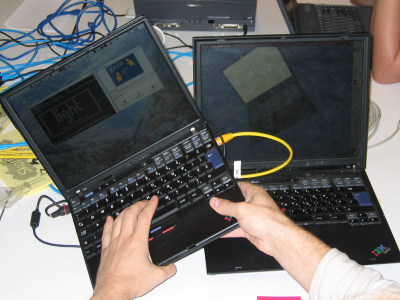
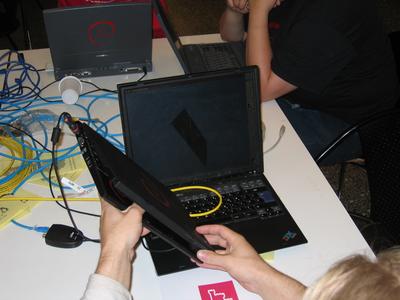
The sensor gives us two 10-bit AD values (corresponding to 0..1 volts on the ADI chip), temperature (Celsius) and three status bits indicating:
* lid open/closed
* keyboard activity
* nipple movement
On the X40 I borrowed (thanks Robert McQueen), at rest the outputs hover around 512 (0x200). Gravity is supposed to fall off in a sine-wave during rotation, but I found that:
theta = (N - 512) * 0.5
provides a surprisingly good approximation for pitch/roll values in degrees in the range (-90..+90) so I think the sensor can do ~= +/-2.5G .
http://www.paul.sladen.org/thinkpad-r31/aps/accelerometer-screenshot.png (9kB)
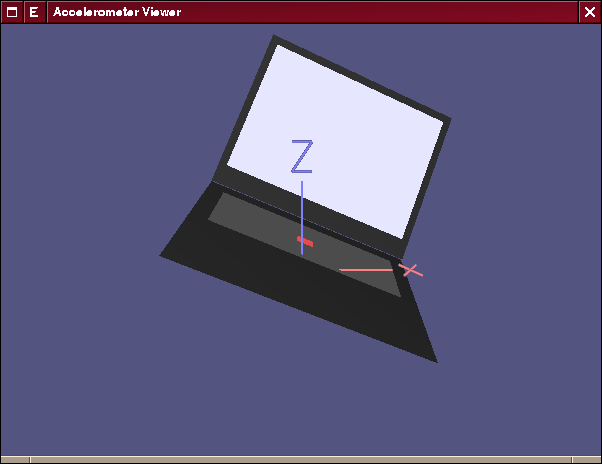
-Paul
PS. Coincidently, the name of the machine I borrowed is 'theta'...
Signature · 1 line
Mostly it snows here. Helsinki, FI
Re: [ltp] IBM HDAPS Someone interested? (Userspace accelerometer viewer)
Quoted 6 lines · Paul Sladen
theta = (N - 512) * 0.5
provides a surprisingly good approximation for pitch/roll values in degrees in the range (-90..+90) so I think the sensor can do ~= +/-2.5G .
http://www.paul.sladen.org/thinkpad-r31/aps/accelerometer-screenshot.png (9kB)
Is the quality good enough to use it DEC itsy style as an input device for games like Marble madness ?
Re: [Hdaps-devel] Re: [ltp] IBM HDAPS Someone interested? (Userspace accelerometer viewer)
Quoted 10 lines · Alan Cox
Quoted 6 lines · Paul Sladen
theta = (N - 512) * 0.5
provides a surprisingly good approximation for pitch/roll values in degrees in the range (-90..+90) so I think the sensor can do ~= +/-2.5G .
http://www.paul.sladen.org/thinkpad-r31/aps/accelerometer-screenshot.png (9kB)
Is the quality good enough to use it DEC itsy style as an input device for games like Marble madness ?
I was using it as a mouse as I tested interfacing it as an input device. It could use some fine tuning, but it worked well enough for me to navigate over to some icons. Should be fine for games like that.
-- Dave
Re: [ltp] IBM HDAPS Someone interested? (Userspace accelerometer viewer)
In reply to Alan CoxWhen I recieved my laptop last week, I had windows preinstalled on and before reinstalling a proper free system, I wanted to have a look to that feature, so I lauched the ibm HDAPS monitor. But to my mind precision is not really good, and when you roll your laptop twice or more the monitor forget its initial position and movements are only relative (may be a software issue, I don't know). But i love your idea ;)
Paul
Quoted 17 lines · Alan Cox
Quoted 8 lines · Paul Sladen
theta = (N - 512) * 0.5
provides a surprisingly good approximation for pitch/roll values in degrees in the range (-90..+90) so I think the sensor can do ~= +/-2.5G .
http://www.paul.sladen.org/thinkpad-r31/aps/accelerometer-screenshot.png (9kB)
Is the quality good enough to use it DEC itsy style as an input device for games like Marble madness ?
Re: [Hdaps-devel] Re: [ltp] IBM HDAPS Someone interested? (Userspace accelerometer viewer)
In reply to Alan CoxHello,
Quoted 2 lines · On Mon, 11 Jul 2005 15:26:57 +0100 Alan Cox <[email protected]> wrote:
Is the quality good enough to use it DEC itsy style as an input device for games like Marble madness ?
it sure is good enough to play neverball.
I have implemented an absolute input driver (aka joystick) on the basis of Dave's 0.02 version of the driver. I attached the diff to this mail or just get it from:
http://thebe.orbit.homelinux.net/~alphaone/ibm_hdaps_joystick.tar.gz
Before you can use your thinkpad as a joystick you have to set the upper and lower bounds for both axis and if any of your axis are reversed (like X40) through the files in /sys/devices/platform/ibm_hdaps/ I wrote a little python script to calibrate and enable the joystick which is included in the tarball or can be downloaded from
http://thebe.orbit.homelinux.net/svn/ibm-hdaps/util/calibrate.py
Regards,
Daniel
ibm_hdaps.c +238 -51
@@ -5,6 +5,7 @@* http://www.almaden.ibm.com/cs/people/marksmith/tpaps.html * * Copyright (c) 2005 Jesper Juhl <[email protected]> +* Copyright (c) 2005 Daniel Willmann <[email protected]> * * This program is free software; you can redistribute it and/or modify * it under the terms of the GNU General Public License as published by
@@ -356,18 +357,7 @@**************************************************************************/ static struct input_dev hdaps_idev; -static u16 restx =0 ; -static u16 resty =0 ; -static void hdaps_calibrate (void ) -{ -struct hdaps_accel_data accel_data; -accelerometer_read (&accel_data); - restx = accel_data.x_accel; - resty = accel_data.y_accel; -printk ("restx: %d resty: %d\n" , restx, resty); -} -static struct miscdevice ibm_hdaps_dev = { .minor =MISC_DYNAMIC_MINOR , .name ="ibm_hdaps" ,
@@ -376,41 +366,64 @@static struct timer_list ibm_hdaps_poll_timer; -static unsigned long ibm_hdaps_mousedev_fuzz =4 ;static unsigned long ibm_hdaps_poll_int_msecs =25 ; -static void ibm_hdaps_mousedev_poll (unsigned long unused) +static unsigned int ibm_hdaps_joystick_reversex =0 ; +static unsigned int ibm_hdaps_joystick_reversey =0 ; +static u16 lastx =0 , lasty =0 ; + +static void ibm_hdaps_joystick_poll (unsigned long unused) { -int movex, movey; +int posx, posy;struct hdaps_accel_data accel_data;accelerometer_read (&accel_data); - movex = restx - accel_data.x_accel; - movey = resty - accel_data.y_accel; -if (abs (movex) > ibm_hdaps_mousedev_fuzz) -input_report_rel (&hdaps_idev,REL_Y , movex); -if (abs (movey) > ibm_hdaps_mousedev_fuzz) -input_report_rel (&hdaps_idev,REL_X , movey); + posx = accel_data.x_accel; + posy = accel_data.y_accel; + +if (ibm_hdaps_joystick_reversex) + posy = hdaps_idev.absmax[ABS_X ] + (hdaps_idev.absmin[ABS_X ] - posy); +if (ibm_hdaps_joystick_reversey) + posx = hdaps_idev.absmax[ABS_Y ] + (hdaps_idev.absmin[ABS_Y ] - posx); + +if (abs (posx-lastx) >0 ) +input_report_abs (&hdaps_idev,ABS_Y , posx); +if (abs (posy-lasty) >0 ) +input_report_abs (&hdaps_idev,ABS_X , posy);input_sync (&hdaps_idev); + lastx = posx; + lasty = posy;mod_timer (&ibm_hdaps_poll_timer, jiffies +msecs_to_jiffies (ibm_hdaps_poll_int_msecs)); } -static int calibrated =0 ; -static int ibm_hdaps_mousedev_registered =0 ; -static int ibm_hdaps_mousedev_enable (void ) +static int ibm_hdaps_joystick_registered =0 ; + +static void ibm_hdaps_joystick_disable (void ) { -printk ("ibm_hdaps_mousedev_enable()\n" ); +if (!ibm_hdaps_joystick_registered) +return ; + +del_timer_sync (&ibm_hdaps_poll_timer); +input_unregister_device (&hdaps_idev); + ibm_hdaps_joystick_registered =0 ; + +return ; +} + +static int ibm_hdaps_joystick_enable (void ) +{ +printk (KERN_DEBUG "ibm_hdaps_joystick_enable()\n" ); hdaps_idev.dev = &ibm_hdaps_plat_dev.dev;init_input_dev (&hdaps_idev); - hdaps_idev.evbit[0 ] =BIT (EV_KEY ) |BIT (EV_REL ); - hdaps_idev.relbit[0 ] =BIT (REL_X ) |BIT (REL_Y ); - hdaps_idev.keybit[LONG (BTN_LEFT )] =BIT (BTN_LEFT ); + hdaps_idev.name ="IBM Accelerometer" ; + hdaps_idev.evbit[0 ] =BIT (EV_ABS ); + hdaps_idev.absbit[0 ] =BIT (ABS_X ) |BIT (ABS_Y );input_register_device (&hdaps_idev); - ibm_hdaps_mousedev_registered =1 ; + ibm_hdaps_joystick_registered =1 ;init_timer (&ibm_hdaps_poll_timer); - ibm_hdaps_poll_timer.function = ibm_hdaps_mousedev_poll; + ibm_hdaps_poll_timer.function = ibm_hdaps_joystick_poll; ibm_hdaps_poll_timer.expires = jiffies +msecs_to_jiffies (ibm_hdaps_poll_int_msecs);add_timer (&ibm_hdaps_poll_timer);
@@ -418,39 +431,199 @@return 1 ; } -static void ibm_hdaps_mousedev_disable (void ) +static ssize_t +hdaps_joystick_enable_read (struct device *dev,char *buf) { -if (!ibm_hdaps_mousedev_registered) -return ; +if (ibm_hdaps_joystick_registered) + { +snprintf (buf,256 ,"enabled\n" ); + } +else +snprintf (buf,256 ,"disabled\n" ); +return strlen (buf)+1 ; +} -del_timer_sync (&ibm_hdaps_poll_timer); -input_unregister_device (&hdaps_idev); +static ssize_t +hdaps_joystick_enable_store (struct device *dev,const char * buf,size_t count) +{ +if ((strncmp (buf,"1" ,1 ) ==0 )&&(!ibm_hdaps_joystick_registered)) + { +ibm_hdaps_joystick_enable (); + } +else if ((strncmp (buf,"0" ,1 ) ==0 )&&(ibm_hdaps_joystick_registered)) + { +ibm_hdaps_joystick_disable (); + } +return count; +} +static DEVICE_ATTR(joystick_enable, S_IWUGO | S_IRUGO, hdaps_joystick_enable_read, hdaps_joystick_enable_store); -return ; +static ssize_t +hdaps_joystick_fuzzx_read (struct device *dev,char *buf) +{ +snprintf (buf,256 ,"%hu\n" , hdaps_idev.absfuzz[ABS_X ]); +return strlen (buf)+1 ; }static ssize_t -hdaps_mousedev_enable_store (struct device *dev,struct device_attribute *attr, -const char * buf,size_t count) +hdaps_joystick_fuzzx_store (struct device *dev,const char * buf,size_t count) { -if (!calibrated) +uint16_t temp; +if (ibm_hdaps_joystick_registered)return -EINVAL ; +if (sscanf (buf,"%hu" , &temp) ==1 ) + { + hdaps_idev.absfuzz[ABS_X ] = temp; + } +return count; +} +static DEVICE_ATTR(joystick_fuzzx, S_IWUGO | S_IRUGO, hdaps_joystick_fuzzx_read, hdaps_joystick_fuzzx_store); -ibm_hdaps_mousedev_enable (); +static ssize_t +hdaps_joystick_fuzzy_read (struct device *dev,char *buf) +{ +snprintf (buf,256 ,"%hu\n" , hdaps_idev.absfuzz[ABS_Y ]); +return strlen (buf)+1 ; +} + +static ssize_t +hdaps_joystick_fuzzy_store (struct device *dev,const char * buf,size_t count) +{ +uint16_t temp; +if (ibm_hdaps_joystick_registered) +return -EINVAL ; +if (sscanf (buf,"%hu" , &temp) ==1 ) + { + hdaps_idev.absfuzz[ABS_Y ] = temp; + }return count; } -static DEVICE_ATTR(mousedev_enable,S_IWUGO, NULL, hdaps_mousedev_enable_store); +static DEVICE_ATTR(joystick_fuzzy, S_IWUGO | S_IRUGO, hdaps_joystick_fuzzy_read, hdaps_joystick_fuzzy_store); -ssize_t hdaps_calibrate_store (struct device *dev, -struct device_attribute *attr, -const char * buf,size_t count) +static ssize_t +hdaps_joystick_minx_read (struct device *dev,char *buf) { -hdaps_calibrate (); - calibrated =1 ; +snprintf (buf,256 ,"%hu\n" , hdaps_idev.absmin[ABS_X ]); +return strlen (buf)+1 ; +} + +static ssize_t +hdaps_joystick_minx_store (struct device *dev,const char * buf,size_t count) +{ +uint16_t temp; +if (ibm_hdaps_joystick_registered) +return -EINVAL ; +if (sscanf (buf,"%hu" , &temp) ==1 ) + { + hdaps_idev.absmin[ABS_X ] = temp; + }return count; } -static DEVICE_ATTR(calibrate,S_IWUGO, NULL, hdaps_calibrate_store); +static DEVICE_ATTR(joystick_minx, S_IWUGO | S_IRUGO, hdaps_joystick_minx_read, hdaps_joystick_minx_store); +static ssize_t +hdaps_joystick_miny_read (struct device *dev,char *buf) +{ +snprintf (buf,256 ,"%hu\n" , hdaps_idev.absmin[ABS_Y ]); +return strlen (buf)+1 ; +} + +static ssize_t +hdaps_joystick_miny_store (struct device *dev,const char * buf,size_t count) +{ +uint16_t temp; +if (ibm_hdaps_joystick_registered) +return -EINVAL ; +if (sscanf (buf,"%hu" , &temp) ==1 ) + { + hdaps_idev.absmin[ABS_Y ] = temp; + } +return count; +} +static DEVICE_ATTR(joystick_miny, S_IWUGO | S_IRUGO, hdaps_joystick_miny_read, hdaps_joystick_miny_store); + +static ssize_t +hdaps_joystick_maxx_read (struct device *dev,char *buf) +{ +snprintf (buf,256 ,"%hu\n" , hdaps_idev.absmax[ABS_X ]); +return strlen (buf)+1 ; +} + +static ssize_t +hdaps_joystick_maxx_store (struct device *dev,const char * buf,size_t count) +{ +uint16_t temp; +if (ibm_hdaps_joystick_registered) +return -EINVAL ; +if (sscanf (buf,"%hu" , &temp) ==1 ) + { + hdaps_idev.absmax[ABS_X ] = temp; + } +return count; +} +static DEVICE_ATTR(joystick_maxx, S_IWUGO | S_IRUGO, hdaps_joystick_maxx_read, hdaps_joystick_maxx_store); + +static ssize_t +hdaps_joystick_maxy_read (struct device *dev,char *buf) +{ +snprintf (buf,256 ,"%hu\n" , hdaps_idev.absmax[ABS_Y ]); +return strlen (buf)+1 ; +} + +static ssize_t +hdaps_joystick_maxy_store (struct device *dev,const char * buf,size_t count) +{ +uint16_t temp; +if (ibm_hdaps_joystick_registered) +return -EINVAL ; +if (sscanf (buf,"%hu" , &temp) ==1 ) + { + hdaps_idev.absmax[ABS_Y ] = temp; + } +return count; +} +static DEVICE_ATTR(joystick_maxy, S_IWUGO | S_IRUGO, hdaps_joystick_maxy_read, hdaps_joystick_maxy_store); + +static ssize_t +hdaps_joystick_reversex_read (struct device *dev,char *buf) +{ +snprintf (buf,256 ,"%hu\n" , ibm_hdaps_joystick_reversex); +return strlen (buf)+1 ; +} + +static ssize_t +hdaps_joystick_reversex_store (struct device *dev,const char * buf,size_t count) +{ +if (ibm_hdaps_joystick_registered) +return -EINVAL ; +if (strncmp (buf,"1" ,1 ) ==0 ) + ibm_hdaps_joystick_reversex =1 ; +else if (strncmp (buf,"0" ,1 ) ==0 ) + ibm_hdaps_joystick_reversex =0 ; +return count; +} +static DEVICE_ATTR(joystick_reversex, S_IWUGO | S_IRUGO, hdaps_joystick_reversex_read, hdaps_joystick_reversex_store); + +static ssize_t +hdaps_joystick_reversey_read (struct device *dev,char *buf) +{ +snprintf (buf,256 ,"%hu\n" , ibm_hdaps_joystick_reversey); +return strlen (buf)+1 ; +} + +static ssize_t +hdaps_joystick_reversey_store (struct device *dev,const char * buf,size_t count) +{ +if (ibm_hdaps_joystick_registered) +return -EINVAL ; +if (strncmp (buf,"1" ,1 ) ==0 ) + ibm_hdaps_joystick_reversey =1 ; +else if (strncmp (buf,"0" ,1 ) ==0 ) + ibm_hdaps_joystick_reversey =0 ; +return count; +} +static DEVICE_ATTR(joystick_reversey, S_IWUGO | S_IRUGO, hdaps_joystick_reversey_read, hdaps_joystick_reversey_store); +static int ibm_hdaps_init (void ) {int retval;
@@ -475,8 +648,15 @@printk (KERN_DEBUG "ibm_hdaps_init: platform_dev_register\n" );platform_device_register (&ibm_hdaps_plat_dev); -device_create_file (&ibm_hdaps_plat_dev.dev, &dev_attr_calibrate); -device_create_file (&ibm_hdaps_plat_dev.dev, &dev_attr_mousedev_enable); +device_create_file (&ibm_hdaps_plat_dev.dev, &dev_attr_joystick_enable); +device_create_file (&ibm_hdaps_plat_dev.dev, &dev_attr_joystick_fuzzx); +device_create_file (&ibm_hdaps_plat_dev.dev, &dev_attr_joystick_fuzzy); +device_create_file (&ibm_hdaps_plat_dev.dev, &dev_attr_joystick_minx); +device_create_file (&ibm_hdaps_plat_dev.dev, &dev_attr_joystick_miny); +device_create_file (&ibm_hdaps_plat_dev.dev, &dev_attr_joystick_maxx); +device_create_file (&ibm_hdaps_plat_dev.dev, &dev_attr_joystick_maxy); +device_create_file (&ibm_hdaps_plat_dev.dev, &dev_attr_joystick_reversex); +device_create_file (&ibm_hdaps_plat_dev.dev, &dev_attr_joystick_reversey);printk (KERN_DEBUG "ibm_hdaps_init: done\n" );return 0 ;
@@ -484,10 +664,17 @@static void ibm_hdaps_exit (void ) { -ibm_hdaps_mousedev_disable (); +ibm_hdaps_joystick_disable (); -device_remove_file (&ibm_hdaps_plat_dev.dev, &dev_attr_calibrate); -device_remove_file (&ibm_hdaps_plat_dev.dev, &dev_attr_mousedev_enable); +device_remove_file (&ibm_hdaps_plat_dev.dev, &dev_attr_joystick_enable); +device_remove_file (&ibm_hdaps_plat_dev.dev, &dev_attr_joystick_fuzzx); +device_remove_file (&ibm_hdaps_plat_dev.dev, &dev_attr_joystick_fuzzy); +device_remove_file (&ibm_hdaps_plat_dev.dev, &dev_attr_joystick_minx); +device_remove_file (&ibm_hdaps_plat_dev.dev, &dev_attr_joystick_miny); +device_remove_file (&ibm_hdaps_plat_dev.dev, &dev_attr_joystick_maxx); +device_remove_file (&ibm_hdaps_plat_dev.dev, &dev_attr_joystick_maxy); +device_remove_file (&ibm_hdaps_plat_dev.dev, &dev_attr_joystick_reversex); +device_remove_file (&ibm_hdaps_plat_dev.dev, &dev_attr_joystick_reversey);platform_device_unregister (&ibm_hdaps_plat_dev);misc_deregister (&ibm_hdaps_dev);
Re: [Hdaps-devel] Re: [ltp] IBM HDAPS Someone interested? (Userspace accelerometer viewer)
Quoted 4 lines · Daniel Willmann
I have implemented an absolute input driver (aka joystick) on the basis of Dave's 0.02 version of the driver. I attached the diff to this mail or just get it from:
http://thebe.orbit.homelinux.net/~alphaone/ibm_hdaps_joystick.tar.gz
Thanks for doing this. A few comments below.
Quoted 13 lines
ibm_hdaps.c +3
-4+static u16 lastx =0 , lasty =0 ; +static void ibm_hdaps_joystick_poll (unsigned long unused) { -int movex, movey; +int posx, posy;struct hdaps_accel_data accel_data;accelerometer_read (&accel_data); - movex = restx - accel_data.x_accel; - movey = resty - accel_data.y_accel; -if (abs (movex) > ibm_hdaps_mousedev_fuzz)
ibm_hdaps.c line 386
Quoted 10 lines
ibm_hdaps.c +7
-3-input_report_rel (&hdaps_idev,REL_Y , movex); -if (abs (movey) > ibm_hdaps_mousedev_fuzz) -input_report_rel (&hdaps_idev,REL_X , movey); + posx = accel_data.x_accel; + posy = accel_data.y_accel; + +if (ibm_hdaps_joystick_reversex) + posy = hdaps_idev.absmax[ABS_X ] + (hdaps_idev.absmin[ABS_X ] - posy); +if (ibm_hdaps_joystick_reversey) + posx = hdaps_idev.absmax[ABS_Y ] + (hdaps_idev.absmin[ABS_Y ] - posx);
I'm not sure this is a good idea to do in the driver. Reversing the movement like this is something that surely should be going into the input layer. It might even be there already.
ibm_hdaps.c line 391
Quoted 4 lines
ibm_hdaps.c +4
-0+if (abs (posx-lastx) >0 ) +input_report_abs (&hdaps_idev,ABS_Y , posx); +if (abs (posy-lasty) >0 ) +input_report_abs (&hdaps_idev,ABS_X , posy);
Why do you suppress the events like this? I think this is done inside of the input layer already. What happens if you don't do this?
ibm_hdaps.c line 442
Quoted 6 lines
ibm_hdaps.c +6
-0+if (ibm_hdaps_joystick_registered) + { +snprintf (buf,256 ,"enabled\n" ); + } +else +snprintf (buf,256 ,"disabled\n" );
Please follow the coding style that Jesper and I have been working with:
        if () {
        	foo();
        } else {
        	bar();
        }
ibm_hdaps.c line 458
Quoted 13 lines
ibm_hdaps.c +13
-0+static ssize_t +hdaps_joystick_enable_store (struct device *dev,const char * buf,size_t count) +{ +if ((strncmp (buf,"1" ,1 ) ==0 )&&(!ibm_hdaps_joystick_registered)) + { +ibm_hdaps_joystick_enable (); + } +else if ((strncmp (buf,"0" ,1 ) ==0 )&&(ibm_hdaps_joystick_registered)) + { +ibm_hdaps_joystick_disable (); + } +return count; +}
I think this makes the sysfs interface a bit counter-intuitive. The "cat joystick_enable" shows "enabled" or "disabled", but you have to echo "0" and "1" into it to get it to do what you want.
ibm_hdaps.c line 479
Quoted 13 lines
+hdaps_joystick_fuzzx_store(struct device *dev, const char * buf,
size_tcount)
{ibm_hdaps.c +8
-1-if (!calibrated) +uint16_t temp; +if (ibm_hdaps_joystick_registered)return -EINVAL ; +if (sscanf (buf,"%hu" , &temp) ==1 ) + { + hdaps_idev.absfuzz[ABS_X ] = temp; + } +return count; +}
Since that fuzz variable is actually part of the input layer, we should probably have a conversation with the input people to see if they want a generic, adjustable fuzz for all ABS input devices, instead of duplicating it in a bunch of drivers.
BTW, I don't think there's a need for a different fuzzx and fuzzy.
-- Dave
Re: [ltp] IBM HDAPS Someone interested? (Userspace accelerometer viewer)
In reply to Paul SladenHi!
Quoted 9 lines
Quoted 3 lines
PLEASE read the following article, it has the data of a guy that made a driver in IBM for Linux and he described the driver he made.
http://www.almaden.ibm.com/cs/people/marksmith/tpaps.htmlYesterday evening, I used my time here at Debconf5 constructively! ;-)
http://www.paul.sladen.org/thinkpad-r31/aps/accelerometer-viewer.jpg (43kB)
http://www.paul.sladen.org/thinkpad-r31/aps/accelerometer-lid-shut.jpg (27kB)
Quoted 6 lines
The sensor gives us two 10-bit AD values (corresponding to 0..1 volts on the ADI chip), temperature (Celsius) and three status bits indicating:
* lid open/closed
* keyboard activity
* nipple movement
Oh, very nice pictures indeed... What is the current interface between userspace and kernel parts?
Pavel
Signature · 1 line
teflon -- maybe it is a trademark, but it should not be.
Re: [ltp] IBM HDAPS Someone interested? (Userspace accelerometer viewer)
Quoted 2 lines · Pavel Machek
Oh, very nice pictures indeed... What is the current interface between userspace and kernel parts?
This one is implemented entirely in userspace, with stdio between the io application and the 3D viewer.
Signature · 1 line
Matthew Garrett | [email protected]
Re: [Hdaps-devel] Re: [ltp] IBM HDAPS Someone interested? (Userspace accelerometer viewer)
In reply to Paul SladenQuoted 4 lines · Paul Sladen
The sensor gives us two 10-bit AD values (corresponding to 0..1 volts on the ADI chip), temperature (Celsius) and three status bits indicating:
* lid open/closed
Which bit did you find this in? I haven't tried with the lid closed.
Quoted 2 lines
* keyboard activity
* nipple movement
Technically, it's mouse movement :) I think it gets set on my T41p when I'm using the touchpad.
Quoted 8 lines
On the X40 I borrowed (thanks Robert McQueen), at rest the outputs hover around 512 (
0x200). Gravity is supposed to fall off in a sine-wave during rotation, but I found that:theta = (N - 512) * 0.5
provides a surprisingly good approximation for pitch/roll values in degrees in the range (-90..+90) so I think the sensor can do ~= +/-2.5G .
Interesting.
-- Dave
RE: [Hdaps-devel] Re: [ltp] IBM HDAPS Someone interested? (Userspace accelerometer viewer)
In reply to Paul SladenQuoted 10 lines · Alejandro Bonilla
Quoted 1 line
PLEASE read the following article, it has the data of a guy
that made a
Quoted 2 lines
driver in IBM for Linux and he described the driver he made.
http://www.almaden.ibm.com/cs/people/marksmith/tpaps.htmlYesterday evening, I used my time here at Debconf5 constructively! ;-)
Paul,
Nice info. We need to look more deep into this.
Have you tried what we have so far?
.Alejandro
Re: [ltp] IBM HDAPS Someone interested? (Accelerometer)
In reply to Paul SladenQuoted 13 lines · Paul Sladen
Quoted 5 lines · Lee Revell
Yup, it's just doing port IO. Get a kernel debugger for windows like softice and this will be trivial to RE.
READ_PORT_USHORT/WRITE_PORT_UCHAR/READ_PORT_UCHARThere are 3 ports involved. The
0xed"non-existant delay port" and a pair of ports that are through the Super-I/O / IDE. They are used in a index+value setup similar to reading/writing the AT keyboard controller.
Quoted 7 lines
Quoted 1 line
From what I remember, my conclusion was that these instructions were the
ones to park the heads and then lock the IDE bus. It's a couple of months ago, but somewhere I have the simplified version of what it was doing...
-Paul
Paul, if you can find that information and Join us into the Project, then we will be very happy about it. I hope you still have your ThinkPad. ;-)
So, let me get this correct. The Super-I/O only sends the information or should we be reading the information of what the accelerometer is outputting?
The way I was thinking about it, is that you would only read from the accelerometer, and within the value that is read, you will park or not the heads depending on how sensitive the user specified the option on the driver.
.Alejandro
Re: [ltp] IBM HDAPS Someone interested? (Accelerometer)
Quoted 11 lines · Alejandro Bonilla
Quoted 9 lines · Paul Sladen
Quoted 4 lines · Lee Revell
Yup, it's just doing port IO. Get a kernel debugger for windows like softice and this will be trivial to RE.
READ_PORT_USHORT/WRITE_PORT_UCHAR/READ_PORT_UCHAR
Quoted 3 lines
Quoted 3 lines
There are 3 ports involved. The
0xed"non-existant delay port" and a pair of ports that are through the Super-I/O / IDE. They are used in a index+value setup similar to reading/writing the AT keyboard controller.
Note the winbond docs are incomplete for the W83627HF at least. I needed to download the reference for the W83697HF to complete the picture for when I was writing:
http://lxr.linux.no/source/drivers/char/watchdog/w83627hf_wdt.c
Give us a shout if you need any docs/programming help.
Signature · 2 lines
Pádraig Brady - http://www.pixelbeat.org
--
Quoted 3 lines · Lee Revell
I was thinking more along the lines of figure out the io port it's using, then boot windows, set an IO breakpoint in softice, then drop your laptop on the bed or something.
io ports 0x2E, 0x2F and 0xED aren't assigned to anything "known" on other computers, are they? Someone with windows, softice and tendency to reach deep insights into life, the universe and everything, might find it fun to stare at.
Quoted 11 lines · Jan Knutar
Quoted 3 lines · Lee Revell
I was thinking more along the lines of figure out the io port it's using, then boot windows, set an IO breakpoint in softice, then drop your laptop on the bed or something.
io ports
0x2E,0x2Fand0xEDaren't assigned to anything "known" on other computers, are they? Someone with windows, softice and tendency to reach deep insights into life, the universe and everything, might find it fun to stare at.
Now you're talking my language... nope, they aren't used on any of my machines... hmm... Anyone want to lend me their Thinkpad? ;-P
On a related note, I found it kind of depressing when I went to RE a Windows driver, I got millions of hits on how to crack copy protection on games, and only one guide to RE for Linux driver development:
http://dxr3.sourceforge.net/re.html
I'd really like to create a HOWTO, as there are some tricky aspects (like getting your IDA Pro symbols loaded into SoftICE), and it's much easier to find the register write routines than the document indicates. Just grep for "inb", "outb" and friends, most likely they each appear exactly once.
Of course, with IO breakpoints, you don't even have to do that, but the register read/write routines are a good place to work backwards from...
Lee
Quoted 1 line · Lee Revell
Anyone want to lend me their Thinkpad? ;-P
While I'd like APS support on my Thinkpad while running Linux as much as the next guy/gal, I'm not sure that I'm ready to do this just yet (unless someone on the Ohio State University campus thinks they can do something, in which case, contact me off-list).
However, if the more knowledgeable hardware hackers amongst us could put together some instructions for the daring but not-yet-initiated of us that happen to have this hardware, I'd be happy to try to do what I can.
Someone else mentioned SoftIce, which appears to cost more than 0USD, so I'm not going to get and try that right away. Are there any other low-cost methods of getting detailed information about the hardware as it's initialized and used?
-Andy
Quoted 11 lines · Lee Revell
Quoted 9 lines · Jan Knutar
Quoted 3 lines · Lee Revell
I was thinking more along the lines of figure out the io port it's using, then boot windows, set an IO breakpoint in softice, then drop your laptop on the bed or something.
io ports
0x2E,0x2Fand0xEDaren't assigned to anything "known" on other computers, are they?
Generally watchdogs use 2[EF]
Pádraig.
Quoted 13 lines
Quoted 5 lines
io ports
0x2E,0x2Fand0xEDaren't assigned to anything "known" on other computers, are they? Someone with windows, softice and tendency to reach deep insights into life, the universe andeverything,
Quoted 2 lines
might find it fun to stare at.
Now you're talking my language... nope, they aren't used on any of my machines... hmm... Anyone want to lend me their Thinkpad? ;-P
Quoted 8 lines
Of course, with IO breakpoints, you don't even have to do that, but the
register read/write routines are a good place to work backwards from...Lee
Lee,
I can lend you the laptop with SSH. :) I'll out the dammed thing with a
public IP and anyone can do whatever they want to with it. (Of course, that won't kill the PC) ;-|
That is all I can do.
Also, if anyone wants to check this pdf, it talks about the protection system and how well it worked...
http://www-605.ibm.com/misc_includes/en_IN/drop_test.pdf
.Alejandro
Guys/Gals,
Let's please NOT drop this subject... But I think we can do it somewhere else...
If you are some sort of engineer, but don't have an IBM laptop. Feel free to help us.
If you own a IBM laptop and care about HD APS or will get a laptop in the future with this, please continue with us.
If you want to follow the project anyway, please feel free to join us. And of course. If you know about making drivers... :) don't hesitate to join us either...
I created a mailing list. Let's see if we can continue with this and get HD APS to work.
http://lists.sourceforge.net/lists/listinfo/hdaps-devel
Let's keep trying....
.Alejandro
Quoted 23 lines
Now you're talking my language... nope, they aren't used on any of my machines... hmm... Anyone want to lend me their Thinkpad? ;-P
On a related note, I found it kind of depressing when I went to RE a Windows driver, I got millions of hits on how to crack copy protection on games, and only one guide to RE for Linux driver development:
http://dxr3.sourceforge.net/re.html
I'd really like to create a HOWTO, as there are some tricky aspects (like getting your IDA Pro symbols loaded into SoftICE), and it's much easier to find the register write routines than the document indicates.
Just grep for "inb", "outb" and friends, most likely they each appear exactly once.Of course, with IO breakpoints, you don't even have to do that, but the
register read/write routines are a good place to work backwards from...Lee
Quoted 5 lines · Alejandro Bonilla
Yani,
What company has ever released a Linux driver, just for the heck of it, or simply because they wanted it out? Hell no.
Quoted 8 lines
(maybe a couple odd ones)
We have to be persistent and ask them to release something, we paid a lot of money, and I have been missinformed to the fact that IBM loved Linux and wanted to "support it". Looks like a big lie to me. They don't even need to release a driver, just information. It is not even something that they only have. Now we all know that Analog Devices makes the hardware. Not them.
Motorola makes similar sensors (MMA1220D, etc). The fact that the sensor is from AD doesn't mean anything, unfortunately, it's a generic sensor used in videocameras (picture stabilization), digital cameras (picture orientation detection), joysticks (logitech wingman gamepad), and many other devices.
It's IBM (Lenovo) who interfaced it to some kind of a A/D and a processor inside the machine that detects the free fall condition and informs the BIOS/OS about it.
Quoted 4 lines
So much for anything. I will keep asking for this information.
If people would send emails to IBM like I have, instead of complaining and doing pilitical arguments, we probably would have an answer already.
I believe at this moment the best approach is to track where the connections on the mainboard go from the accelerometer. ;)
Signature · 2 lines
Vojtech Pavlik
SuSE Labs, SuSE CR
A message that is not in the archive (sent off-list or not yet received): [email protected]
Hi!
Quoted 8 lines
Quoted 8 lines
No, the software, under Windows, is an application; you can control the behaviour of the disk based on the response of the chip.
Anyway I don't think it's a simple task to create a driver for the accelerometer; one thing is to read the data from the chip (I suppose it's not too hard), but the most part of the job is to know what to do with the data you read.
Quoted 6 lines
Quoted 6 lines
IBM developed a mathematical model that describes the typical usage of the ThinkPad, and they based the action on this math model. Developing a free math model is quite hard and also we cannot destroy 5 or 6 TP only to see how the signals are produced by the chip in all the possible situations (IBM instead can destroy as much TP as they want :(
You basically want to detect free fall. You don't need to make the machine hit the concrete at the bottom; as long as it detects free fall, it is okay. It does not seem *that* hard to me (but I do speech recognition at university :-).
Anyway, accelerometers are usefull for other stuff, too, like playing neverball.
Oh, and there should be reasonable way to develop this. First, detect
"machine sitting on unmoving table", and park heads if you detect anythink
else. Now, someone who really cares can develop model for "train", but most users are already quite well protected after you do "table" model.
Pavel
Signature · 1 line
64 bytes from 195.113.31.123: icmp_seq=28 ttl=51 time=448769.1 ms