Static/fallback external labels for NetLabel
Subsystems (5)
cover Static/fallback external labels for NetLabel
This patchset adds the static/fallback labeling feature to NetLabel that has been requested on the SELinux mailing list more and more recently. This new bit of functionality also matches what can be found on similar trusted/labeled OSs such as Trusted Solaris, HP-UX CMW, etc. This patchset it not yet ready for "upstreaming" so please do not pull this into any tree bound for the mainline kernel; I still need to do more review and testing of the code. However, I know there are several of you on this list that have been anxiously awaiting this patchset so I thought I would make an early release so you could get a peek and test it out. I won't be able to work on this patchset much, if at all, between August 10th and the 20th so don't expect an update from me until the end of August.
The basic idea is that currently there is no method for providing an external label to fallback on if a labeled networking mechanism such as NetLabel/CIPSO or labeled IPsec is not in use. This patch adds a mechanism for providing a static fallback label, specified per interface/network, which is used when a NetLabel recognized labeling protocol (at this point CIPSO) is not in use.
For those of you wishing to try this patchset, it is backed against Linus' linux-2.6 git tree from the afternoon of August 6th, but I don't imagine you'll have many problems applying the patchset to later trees at this point in the 2.6.23 release cycle. In addition to the kernel patches you will also need a modified version of netlabelctl from the netlabel_tools package. A very crude version of the modified tools can be found in the netlabel_tools SVN repository in the static_label branch. Please check the NetLabel website on SourceForge,
http://netlabel.sf.net, for information on the SVN repository. The three new netlabelctl commands are as follows:
 # netlabelctl unlbl add interface:<DEV> address:<ADDR>[/<MASK>] label:<LABEL>
 # netlabelctl unlbl del interface:<DEV> address:<ADDR>[/<MASK>]
 # netlabelctl -p unlbl list
DEV = interface, examples: eth0, lo
ADDR = IP address, examples: 192.168.0.3, ::1
MASK = IP address mask length, examples 8, 24, 64
LABEL = LSM/SELinux label, example: system_u:object_r:unlabeled_t:s2
For example, if you wanted to label all inbound traffic on eth1 from 192.168.0.0/16 with the label "system_u:object_r:staticlabel_t:s7" you would type:
 # netlabelctl unlbl add interface:eth1 address:192.168.0.0/16 \
                         label:system_u:object_r:staticlabel_t:s7
Both IPv4 and IPv6 addresses can be used and if the address mask is ommitted from the command the address is assumed to be a host address, not a network, and the maximum mask size for that address family is used. If you do not wish to specify an address, simply use a address mask of zero, "/0", which will cause all addresses within that address family to match.
Signature · 7 lines
paul moore
linux security @ hp

--
This message was distributed to subscribers of the selinux mailing list.
If you no longer wish to subscribe, send mail to [email protected] with
the words "unsubscribe selinux" without quotes as the message.
RFC 1/5 SELinux: add secctx_to_secid() LSM hook
Add a secctx_to_secid() LSM hook to go along with the existing secid_to_secctx() LSM hook. This patch also includes a SELinux implementation for this hook.
---
 include/linux/security.h |   17 +++++++++++++++++
 security/dummy.c         |    6 ++++++
 security/selinux/hooks.c |    6 ++++++
 3 files changed, 29 insertions(+)
include/linux/security.h +17 -0
@@ -1141,6 +1141,10 @@ struct request_sock;* Convert secid to security context. * @secid contains the security ID. * @secdata contains the pointer that stores the converted security context. +* @secctx_to_secid: +* Convert security context to secid. +* @secid contains the pointer to the generated security ID. +* @secdata contains the security context. * * @release_secctx: * Release the security context.
@@ -1329,6 +1333,7 @@ struct security_operations {int (*getprocattr)(struct task_struct *p,char *name,char **value);int (*setprocattr)(struct task_struct *p,char *name,void *value,size_t size);int (*secid_to_secctx)(u32 secid,char **secdata,u32 *seclen); +int (*secctx_to_secid)(char *secdata,u32 seclen,u32 *secid);void (*release_secctx)(char *secdata,u32 seclen);#ifdef CONFIG_SECURITY_NETWORK
@@ -2122,6 +2127,13 @@ static inline int security_secid_to_seccreturn security_ops->secid_to_secctx (secid, secdata, seclen); } +static inline int security_secctx_to_secid (char *secdata, +u32 seclen, +u32 *secid) +{ +return security_ops->secctx_to_secid (secdata, seclen, secid); +} +static inline void security_release_secctx (char *secdata,u32 seclen) {return security_ops->release_secctx (secdata, seclen);
@@ -2800,6 +2812,11 @@ static inline int security_secid_to_seccreturn -EOPNOTSUPP ; } +static inline int secctx_to_secid (char *secdata,u32 seclen,u32 *secid) +{ +return -EOPNOTSUPP ; +} +static inline void security_release_secctx (char *secdata,u32 seclen) { }
security/dummy.c +6 -0
@@ -926,6 +926,11 @@ static int dummy_secid_to_secctx(u32 secreturn -EOPNOTSUPP ; } +static int dummy_secctx_to_secid (char *secdata,u32 seclen,u32 *secid) +{ +return -EOPNOTSUPP ; +} +static void dummy_release_secctx (char *secdata,u32 seclen) { }
@@ -1083,6 +1088,7 @@ void security_fixup_ops (struct securityset_to_dummy_if_null (ops, getprocattr);set_to_dummy_if_null (ops, setprocattr);set_to_dummy_if_null (ops, secid_to_secctx); +set_to_dummy_if_null (ops, secctx_to_secid);set_to_dummy_if_null (ops, release_secctx);#ifdef CONFIG_SECURITY_NETWORK set_to_dummy_if_null (ops, unix_stream_connect);
security/selinux/hooks.c +6 -0
@@ -4656,6 +4656,11 @@ static int selinux_secid_to_secctx(u32 sreturn security_sid_to_context (secid, secdata, seclen); } +static int selinux_secctx_to_secid (char *secdata,u32 seclen,u32 *secid) +{ +return security_context_to_sid (secdata, seclen, secid); +} +static void selinux_release_secctx (char *secdata,u32 seclen) {kfree (secdata);
@@ -4842,6 +4847,7 @@ static struct security_operations selinu
 	.setprocattr =                  selinux_setprocattr,

 	.secid_to_secctx =		selinux_secid_to_secctx,
+	.secctx_to_secid =		selinux_secctx_to_secid,
 	.release_secctx =		selinux_release_secctx,

         .unix_stream_connect =		selinux_socket_unix_stream_connect,
Signature · 7 lines
paul moore
linux security @ hp

--
This message was distributed to subscribers of the selinux mailing list.
If you no longer wish to subscribe, send mail to [email protected] with
the words "unsubscribe selinux" without quotes as the message.
RFC 2/5 NetLabel: Add secid token support to the NetLabel secattr struct
In reply to Paul MooreThis patch adds support to the NetLabel LSM secattr struct for a secid token, paving the way for full LSM/SELinux context support. In this patch adds a fair amount of documentation to the core NetLabel structures used as part of the NetLabel kernel API.
---
 include/net/netlabel.h         |   92 +++++++++++++++++++++++++++++++++--------
 net/ipv4/cipso_ipv4.c          |   56 +++++++++++++++---------
 security/selinux/ss/mls.c      |   10 ++--
 security/selinux/ss/services.c |    5 +-
 4 files changed, 118 insertions(+), 45 deletions(-)
include/net/netlabel.h +75 -17
@@ -105,17 +105,49 @@ struct netlbl_dom_map;/* Domain mapping operations */ int netlbl_domhsh_remove (const char *domain,struct netlbl_audit *audit_info); -/* LSM security attributes */ +/* +* LSM security attributes +*/ + +/** +* struct netlbl_lsm_cache - NetLabel LSM security attribute cache +* @refcount: atomic reference counter +* @free: LSM supplied function to free the cache data +* @data: LSM supplied cache data +* +* Description: +* This structure is provided for LSMs which wish to make use of the NetLabel +* caching mechanism to store LSM specific data/attributes in the NetLabel +* cache. If the LSM has to perform a lot of translation from the NetLabel +* security attributes into it's own internal representation then the cache +* mechanism can provide a way to eliminate some or all of that translation +* overhead on a cache hit. +* +*/ struct netlbl_lsm_cache {atomic_t refcount;void (*free) (const void *data);void *data; }; -/* The catmap bitmap field MUST be a power of two in length and large + +/** +* struct netlbl_lsm_secattr_catmap - NetLabel LSM secattr category bitmap +* @startbit: the value of the lowest order bit in the bitmap +* @bitmap: the category bitmap +* @next: pointer to the next bitmap "node" or NULL +* +* Description: +* This structure is used to represent category bitmaps. Due to the large +* number of categories supported by most labeling protocols it is not +* practical to transfer a full bitmap internally so NetLabel adopts a sparse +* bitmap structure modeled after SELinux's ebitmap structure. +* The catmap bitmap field MUST be a power of two in length and large * enough to hold at least 240 bits. Special care (i.e. check the code!) * should be used when changing these values as the LSM implementation * probably has functions which rely on the sizes of these types to speed -* processing. */ +* processing. +* +*/ #define NETLBL_CATMAP_MAPTYPE u64#define NETLBL_CATMAP_MAPCNT 4#define NETLBL_CATMAP_MAPSIZE (sizeof(NETLBL_CATMAP_MAPTYPE) * 8)
@@ -127,22 +159,51 @@ struct netlbl_lsm_secattr_catmap {NETLBL_CATMAP_MAPTYPE bitmap[NETLBL_CATMAP_MAPCNT ];struct netlbl_lsm_secattr_catmap *next; }; + +/** +* struct netlbl_lsm_secattr - NetLabel LSM security attributes +* @flags: indicate which attributes are contained in this structure +* @domain: the NetLabel LSM domain +* @cache: NetLabel LSM specific cache +* @attr.mls: MLS sensitivity label +* @attr.mls.cat: MLS category bitmap +* @attr.mls.lvl: MLS sensitivity level +* @attr.secid: LSM specific secid token +* +* Description: +* This structure is used to pass security attributes between NetLabel and the +* LSM modules. The flags field is used to specify which fields within the +* struct are valid and valid values can be created by bitwise OR'ing the +* NETLBL_SECATTR_* defines. The domain field is typically set by the LSM to +* specify domain specific configuration settings and is not usually used by +* NetLabel itself when returning security attributes to the LSM. +* +*/ #define NETLBL_SECATTR_NONE 0x00000000#define NETLBL_SECATTR_DOMAIN 0x00000001#define NETLBL_SECATTR_CACHE 0x00000002#define NETLBL_SECATTR_MLS_LVL 0x00000004#define NETLBL_SECATTR_MLS_CAT 0x00000008 +#define NETLBL_SECATTR_SECID 0x00000010#define NETLBL_SECATTR_CACHEABLE (NETLBL_SECATTR_MLS_LVL | \ NETLBL_SECATTR_MLS_CAT)struct netlbl_lsm_secattr {u32 flags; - +/* there is a 4 byte hole here in 64 bit architectures which we could +* solve by moving the 'flags' field elsewhere in this structure but +* to do so would move push it out of the first cacheline, which is not +* desireable from a performance standpoint as in the case of an +* unlabeled packet (most common) the 'flags' field is the only field +* the LSM is likely to check */ char *domain; - -u32 mls_lvl; -struct netlbl_lsm_secattr_catmap *mls_cat; -struct netlbl_lsm_cache *cache; +union { +struct { +struct netlbl_lsm_secattr_catmap *cat; +u32 lvl; + } mls; +u32 secid; + } attr; };/*
@@ -231,10 +292,7 @@ static inline void netlbl_secattr_catmap*/ static inline void netlbl_secattr_init (struct netlbl_lsm_secattr *secattr) { - secattr->flags =0 ; - secattr->domain =NULL ; - secattr->mls_cat =NULL ; - secattr->cache =NULL ; +memset (secattr,0 ,sizeof (*secattr)); }/**
@@ -248,11 +306,11 @@ static inline void netlbl_secattr_init(s*/ static inline void netlbl_secattr_destroy (struct netlbl_lsm_secattr *secattr) { -if (secattr->cache) -netlbl_secattr_cache_free (secattr->cache);kfree (secattr->domain); -if (secattr->mls_cat) -netlbl_secattr_catmap_free (secattr->mls_cat); +if (secattr->flags &NETLBL_SECATTR_CACHE ) +netlbl_secattr_cache_free (secattr->cache); +if (secattr->flags &NETLBL_SECATTR_MLS_CAT ) +netlbl_secattr_catmap_free (secattr->attr.mls.cat); }/**
@@ -300,7 +358,7 @@ int netlbl_secattr_catmap_setrng(struct gfp_t flags);/* -* LSM protocol operations +* LSM protocol operations (NetLabel LSM/kernel API) */ int netlbl_enabled (void ); int netlbl_sock_setattr(struct sock *sk,
net/ipv4/cipso_ipv4.c +34 -22
161 lines not on this page · raw message
security/selinux/ss/mls.c +5 -5
@@ -569,7 +569,7 @@ void mls_export_netlbl_lvl(struct contexif (!selinux_mls_enabled)return ; - secattr->mls_lvl = context->range.level[0 ].sens -1 ; + secattr->attr.mls.lvl = context->range.level[0 ].sens -1 ; secattr->flags |=NETLBL_SECATTR_MLS_LVL ; }
@@ -589,7 +589,7 @@ void mls_import_netlbl_lvl(struct contexif (!selinux_mls_enabled)return ; - context->range.level[0 ].sens = secattr->mls_lvl +1 ; + context->range.level[0 ].sens = secattr->attr.mls.lvl +1 ; context->range.level[1 ].sens = context->range.level[0 ].sens; }
@@ -612,8 +612,8 @@ int mls_export_netlbl_cat(struct contextreturn 0 ; rc =ebitmap_netlbl_export (&context->range.level[0 ].cat, - &secattr->mls_cat); -if (rc ==0 && secattr->mls_cat !=NULL ) + &secattr->attr.mls.cat); +if (rc ==0 && secattr->attr.mls.cat !=NULL ) secattr->flags |=NETLBL_SECATTR_MLS_CAT ;return rc;
@@ -640,7 +640,7 @@ int mls_import_netlbl_cat(struct contextreturn 0 ; rc =ebitmap_netlbl_import (&context->range.level[0 ].cat, - secattr->mls_cat); + secattr->attr.mls.cat);if (rc !=0 ) goto import_netlbl_cat_failure;
security/selinux/ss/services.c +4 -1
@@ -2498,6 +2498,9 @@ int security_netlbl_secattr_to_sid(strucdefault : goto netlbl_secattr_to_sid_return; } + }else if (secattr->flags &NETLBL_SECATTR_SECID ) { + *sid = secattr->attr.secid; + rc =0 ; }else if (secattr->flags &NETLBL_SECATTR_MLS_LVL ) { ctx =sidtab_search (&sidtab, base_sid);if (ctx ==NULL )
@@ -2509,7 +2512,7 @@ int security_netlbl_secattr_to_sid(strucmls_import_netlbl_lvl (&ctx_new, secattr);if (secattr->flags &NETLBL_SECATTR_MLS_CAT ) {if (ebitmap_netlbl_import (&ctx_new.range.level[0 ].cat, - secattr->mls_cat) !=0 ) + secattr->attr.mls.cat) !=0 ) goto netlbl_secattr_to_sid_return; ctx_new.range.level[1 ].cat.highbit = ctx_new.range.level[0 ].cat.highbit;
Signature · 7 lines
paul moore
linux security @ hp

--
This message was distributed to subscribers of the selinux mailing list.
If you no longer wish to subscribe, send mail to [email protected] with
the words "unsubscribe selinux" without quotes as the message.
RFC 3/5 NetLabel: add IP address family information to the netlbl_skbuff_getattr() function
In reply to Paul MooreIn order to do any sort of IP header inspection of incoming packets we need to know which address family, AF_INET/AF_INET6/etc., it belongs to and since the sk_buff structure does not store this information we need to pass along the address family separate from the packet itself.
---
 include/net/netlabel.h              |    2 ++
 net/netlabel/netlabel_kapi.c        |    2 ++
 security/selinux/hooks.c            |   24 ++++++++++++++++++------
 security/selinux/include/netlabel.h |    8 +++++++-
 security/selinux/netlabel.c         |   12 +++++++++---
 5 files changed, 38 insertions(+), 10 deletions(-)
include/net/netlabel.h +2 -0
@@ -366,6 +366,7 @@ int netlbl_sock_setattr(struct sock *sk,int netlbl_sock_getattr (struct sock *sk,struct netlbl_lsm_secattr *secattr);int netlbl_skbuff_getattr (const struct sk_buff *skb, +u16 family,struct netlbl_lsm_secattr *secattr);void netlbl_skbuff_err (struct sk_buff *skb,int error);
@@ -418,6 +419,7 @@ static inline int netlbl_sock_getattr(streturn -ENOSYS ; }static inline int netlbl_skbuff_getattr (const struct sk_buff *skb, +u16 family,struct netlbl_lsm_secattr *secattr) {return -ENOSYS ;
net/netlabel/netlabel_kapi.c +2 -0
@@ -331,6 +331,7 @@ int netlbl_sock_getattr(struct sock *sk,/** * netlbl_skbuff_getattr - Determine the security attributes of a packet * @skb: the packet +* @family: protocol family * @secattr: the security attributes * * Description:
@@ -341,6 +342,7 @@ int netlbl_sock_getattr(struct sock *sk,* */ int netlbl_skbuff_getattr (const struct sk_buff *skb, +u16 family,struct netlbl_lsm_secattr *secattr) { if (CIPSO_V4_OPTEXIST(skb) &&
security/selinux/hooks.c +18 -6
@@ -3129,6 +3129,7 @@ static int selinux_parse_skb(struct sk_b/** * selinux_skb_extlbl_sid - Determine the external label of a packet * @skb: the packet +* @family: protocol family * @sid: the packet's SID * * Description:
@@ -3141,13 +3142,16 @@ static int selinux_parse_skb(struct sk_b* selinux_netlbl_skbuff_getsid(). * */ -static void selinux_skb_extlbl_sid (struct sk_buff *skb,u32 *sid) +static void selinux_skb_extlbl_sid (struct sk_buff *skb, +u16 family, +u32 *sid) {u32 xfrm_sid;u32 nlbl_sid;selinux_skb_xfrm_sid (skb, &xfrm_sid);if (selinux_netlbl_skbuff_getsid (skb, + family, (xfrm_sid ==SECSID_NULL ?SECINITSID_NETMSG : xfrm_sid), &nlbl_sid) !=0 )
@@ -3635,7 +3639,7 @@ static int selinux_socket_sock_rcv_skb(sif (err) goto out; - err =selinux_netlbl_sock_rcv_skb (sksec, skb, &ad); + err =selinux_netlbl_sock_rcv_skb (sksec, skb, family, &ad);if (err) goto out;
@@ -3692,11 +3696,19 @@ static int selinux_socket_getpeersec_dgr {u32 peer_secid =SECSID_NULL ;int err =0 ; +u16 family; + +if (sock) + family = sock->sk->sk_family; +else if (skb->sk) + family = skb->sk->sk_family; +else + family =PF_UNSPEC ; -if (sock && sock->sk->sk_family ==PF_UNIX ) +if (sock && family ==PF_UNIX )selinux_get_inode_sid (SOCK_INODE (sock), &peer_secid);else if (skb) -selinux_skb_extlbl_sid (skb, &peer_secid); +selinux_skb_extlbl_sid (skb, family, &peer_secid);if (peer_secid ==SECSID_NULL ) err = -EINVAL ;
@@ -3757,7 +3769,7 @@ static int selinux_inet_conn_request(stru32 newsid;u32 peersid; -selinux_skb_extlbl_sid (skb, &peersid); +selinux_skb_extlbl_sid (skb, sk->sk_family, &peersid);if (peersid ==SECSID_NULL ) { req->secid = sksec->sid; req->peer_secid =SECSID_NULL ;
@@ -3795,7 +3807,7 @@ static void selinux_inet_conn_establishe {struct sk_security_struct *sksec = sk->sk_security; -selinux_skb_extlbl_sid (skb, &sksec->peer_sid); +selinux_skb_extlbl_sid (skb, sk->sk_family, &sksec->peer_sid); } static void selinux_req_classify_flow(const struct request_sock *req,
security/selinux/include/netlabel.h +7 -1
@@ -46,13 +46,17 @@ void selinux_netlbl_sk_security_init(strvoid selinux_netlbl_sk_security_clone (struct sk_security_struct *ssec,struct sk_security_struct *newssec); -int selinux_netlbl_skbuff_getsid (struct sk_buff *skb,u32 base_sid,u32 *sid); +int selinux_netlbl_skbuff_getsid (struct sk_buff *skb, +u16 family, +u32 base_sid, +u32 *sid);void selinux_netlbl_sock_graft (struct sock *sk,struct socket *sock);int selinux_netlbl_socket_post_create (struct socket *sock);int selinux_netlbl_inode_permission (struct inode *inode,int mask);int selinux_netlbl_sock_rcv_skb (struct sk_security_struct *sksec,struct sk_buff *skb, +u16 family,struct avc_audit_data *ad); int selinux_netlbl_socket_setsockopt(struct socket *sock, int level,
@@ -83,6 +87,7 @@ static inline void selinux_netlbl_sk_sec }static inline int selinux_netlbl_skbuff_getsid (struct sk_buff *skb, +u16 family,u32 base_sid,u32 *sid) {
@@ -106,6 +111,7 @@ static inline int selinux_netlbl_inode_p }static inline int selinux_netlbl_sock_rcv_skb (struct sk_security_struct *sksec,struct sk_buff *skb, +u16 family,struct avc_audit_data *ad) {return 0 ;
security/selinux/netlabel.c +9 -3
@@ -141,6 +141,7 @@ void selinux_netlbl_sk_security_clone(st/** * selinux_netlbl_skbuff_getsid - Get the sid of a packet using NetLabel * @skb: the packet +* @family: protocol family * @base_sid: the SELinux SID to use as a context for MLS only attributes * @sid: the SID *
@@ -150,7 +151,10 @@ void selinux_netlbl_sk_security_clone(st* assign to the packet. Returns zero on success, negative values on failure. * */ -int selinux_netlbl_skbuff_getsid (struct sk_buff *skb,u32 base_sid,u32 *sid) +int selinux_netlbl_skbuff_getsid (struct sk_buff *skb, +u16 family, +u32 base_sid, +u32 *sid) {int rc;struct netlbl_lsm_secattr secattr;
@@ -161,7 +165,7 @@ int selinux_netlbl_skbuff_getsid(struct }netlbl_secattr_init (&secattr); - rc =netlbl_skbuff_getattr (skb, &secattr); + rc =netlbl_skbuff_getattr (skb, family, &secattr);if (rc ==0 && secattr.flags !=NETLBL_SECATTR_NONE ) { rc =security_netlbl_secattr_to_sid (&secattr, base_sid, sid); if (rc == 0 &&
@@ -289,6 +293,7 @@ int selinux_netlbl_inode_permission(stru* selinux_netlbl_sock_rcv_skb - Do an inbound access check using NetLabel * @sksec: the sock's sk_security_struct * @skb: the packet +* @family: protocol family * @ad: the audit data * * Description:
@@ -299,6 +304,7 @@ int selinux_netlbl_inode_permission(stru*/ int selinux_netlbl_sock_rcv_skb (struct sk_security_struct *sksec,struct sk_buff *skb, +u16 family,struct avc_audit_data *ad) {int rc;
@@ -310,7 +316,7 @@ int selinux_netlbl_sock_rcv_skb(struct sreturn 0 ;netlbl_secattr_init (&secattr); - rc =netlbl_skbuff_getattr (skb, &secattr); + rc =netlbl_skbuff_getattr (skb, family, &secattr);if (rc ==0 && secattr.flags !=NETLBL_SECATTR_NONE ) { rc = security_netlbl_secattr_to_sid(&secattr, SECINITSID_NETMSG,
Signature · 7 lines
paul moore
linux security @ hp

--
This message was distributed to subscribers of the selinux mailing list.
If you no longer wish to subscribe, send mail to [email protected] with
the words "unsubscribe selinux" without quotes as the message.
RFC 4/5 NetLabel: introduce static network labels for unlabeled connections
In reply to Paul MooreMost trusted OSs, with the exception of Linux, have the ability to specify static security labels for unlabeled networks. This patch adds this ability to the NetLabel packet labeling framework.
If the NetLabel subsystem is called to determine the security attributes of an incoming packet it first checks to see if any recognized NetLabel packet labeling protocols are in-use on the packet. If none can be found then the unlabled connection table is queried and based on the packets incoming interface and address it is matched with a security label as configured by the administrator using the netlabel_tools package. The matching security label is returned to the caller just as if the packet was explicitly labeled using a labeling protocol.
---
 include/net/netlabel.h            |    6
 net/netlabel/netlabel_kapi.c      |   16
 net/netlabel/netlabel_unlabeled.c | 1168 +++++++++++++++++++++++++++++++++++++-
 net/netlabel/netlabel_unlabeled.h |   90 ++
 4 files changed, 1262 insertions(+), 18 deletions(-)
include/net/netlabel.h +5 -1
@@ -67,7 +67,11 @@* NetLabel NETLINK protocol */ -#define NETLBL_PROTO_VERSION 1 +/* NetLabel NETLINK protocol version +* 1: initial version +* 2: added static labels for unlabeled connections +*/ +#define NETLBL_PROTO_VERSION 2/* NetLabel NETLINK types/families */ #define NETLBL_NLTYPE_NONE 0
net/netlabel/netlabel_kapi.c +7 -9
@@ -311,7 +311,7 @@ socket_setattr_return:* @secattr: the security attributes * * Description: -* Examines the given sock to see any NetLabel style labeling has been +* Examines the given sock to see if any NetLabel style labeling has been * applied to the sock, if so it parses the socket label and returns the * security attributes in @secattr. Returns zero on success, negative values * on failure.
@@ -319,13 +319,7 @@ socket_setattr_return:*/ int netlbl_sock_getattr (struct sock *sk,struct netlbl_lsm_secattr *secattr) { -int ret_val; - - ret_val =cipso_v4_sock_getattr (sk, secattr); -if (ret_val ==0 ) -return 0 ; - -return netlbl_unlabel_getattr (secattr); +return cipso_v4_sock_getattr (sk, secattr); }/**
@@ -349,7 +343,7 @@ int netlbl_skbuff_getattr(const struct s cipso_v4_skbuff_getattr(skb, secattr) == 0)return 0 ; -return netlbl_unlabel_getattr (secattr); +return netlbl_unlabel_getattr (skb, family, secattr); }/**
@@ -433,6 +427,10 @@ static int __init netlbl_init(void)if (ret_val !=0 ) goto init_failure; + ret_val =netlbl_unlabel_init (NETLBL_UNLHSH_BITSIZE ); +if (ret_val !=0 ) + goto init_failure; + ret_val =netlbl_netlink_init ();if (ret_val !=0 ) goto init_failure;
net/netlabel/netlabel_unlabeled.c +1161 -7
1,239 lines not on this page · raw message
net/netlabel/netlabel_unlabeled.h +89 -1
115 lines not on this page · raw message
Signature · 7 lines
paul moore
linux security @ hp

--
This message was distributed to subscribers of the selinux mailing list.
If you no longer wish to subscribe, send mail to [email protected] with
the words "unsubscribe selinux" without quotes as the message.
RFC 5/5 NetLabel: add auditing to the static labeling mechanism
In reply to Paul MooreThis patch adds auditing support to the NetLabel static labeling mechanism.
---
 include/linux/audit.h             |    2
 net/netlabel/netlabel_unlabeled.c |   91 ++++++++++++++++++++++++++++++--------
 2 files changed, 75 insertions(+), 18 deletions(-)
include/linux/audit.h +2 -0
@@ -112,6 +112,8 @@#define AUDIT_MAC_IPSEC_DELSA 1412/* Delete a XFRM state */ #define AUDIT_MAC_IPSEC_ADDSPD 1413/* Add a XFRM policy */ #define AUDIT_MAC_IPSEC_DELSPD 1414/* Delete a XFRM policy */ +#define AUDIT_MAC_UNLBL_STCADD 1415/* NetLabel: add a static label */ +#define AUDIT_MAC_UNLBL_STCDEL 1416/* NetLabel: del a static label */ #define AUDIT_FIRST_KERN_ANOM_MSG 1700#define AUDIT_LAST_KERN_ANOM_MSG 1799
net/netlabel/netlabel_unlabeled.c +73 -18
193 lines not on this page · raw message
Signature · 7 lines
paul moore
linux security @ hp

--
This message was distributed to subscribers of the selinux mailing list.
If you no longer wish to subscribe, send mail to [email protected] with
the words "unsubscribe selinux" without quotes as the message.
Paul,
Thanks so much! I was looking forward to your patch set.
I tried to build kernel with the patch and configure a fallbacked label, but the netlabelctl returns the following error message:
[root@masu ~]# netlabelctl unlbl add interface:eth0 address:192.168.11.0/24 \
Quoted 1 line
label:system_u:system_r:unconfined_t:s0
netlabelctl: error, invalid argument or parameter
[root@masu ~]# netlabelctl -p unlbl list
Allow unlabeled packets : on
[root@masu ~]#
The kernel config contains CONFIG_NETLABEL=y, and the netlabelctl command is built from the latest svn repository.
Are any more configurations necessary?
Thanks,
Quoted 50 lines · Paul Moore
This patchset adds the static/fallback labeling feature to NetLabel that has been requested on the SELinux mailing list more and more recently. This new bit of functionality also matches what can be found on similar trusted/labeled OSs such as Trusted Solaris, HP-UX CMW, etc. This patchset it not yet ready for "upstreaming" so please do not pull this into any tree bound for the mainline kernel; I still need to do more review and testing of the code. However, I know there are several of you on this list that have been anxiously awaiting this patchset so I thought I would make an early release so you could get a peek and test it out. I won't be able to work on this patchset much, if at all, between August 10th and the 20th so don't expect an update from me until the end of August.
The basic idea is that currently there is no method for providing an external label to fallback on if a labeled networking mechanism such as NetLabel/CIPSO or labeled IPsec is not in use. This patch adds a mechanism for providing a static fallback label, specified per interface/network, which is used when a NetLabel recognized labeling protocol (at this point CIPSO) is not in use.
For those of you wishing to try this patchset, it is backed against Linus' linux-2.6 git tree from the afternoon of August 6th, but I don't imagine you'll have many problems applying the patchset to later trees at this point in the 2.6.23 release cycle. In addition to the kernel patches you will also need a modified version of netlabelctl from the
netlabel_toolspackage. A very crude version of the modified tools can be found in thenetlabel_toolsSVN repository in thestatic_labelbranch. Please check the NetLabel website on SourceForge,
http://netlabel.sf.net, for information on the SVN repository. The three new netlabelctl commands are as follows:# netlabelctl unlbl add interface:<DEV> address:<ADDR>[/<MASK>] label:<LABEL> # netlabelctl unlbl del interface:<DEV> address:<ADDR>[/<MASK>] # netlabelctl -p unlbl listDEV = interface, examples: eth0, lo
ADDR = IP address, examples: 192.168.0.3, ::1
MASK = IP address mask length, examples 8, 24, 64
LABEL = LSM/SELinux label, example: system_u:object_r:unlabeled_t:s2For example, if you wanted to label all inbound traffic on eth1 from 192.168.0.0/16 with the label "system_u:object_r:staticlabel_t:s7" you would type:
 # netlabelctl unlbl add interface:eth1 address:192.168.0.0/16 \
                         label:system_u:object_r:staticlabel_t:s7
Both IPv4 and IPv6 addresses can be used and if the address mask is ommitted from the command the address is assumed to be a host address, not a network, and the maximum mask size for that address family is used. If you do not wish to specify an address, simply use a address mask of zero, "/0", which will cause all addresses within that address family to match.
Signature · 6 lines
KaiGai Kohei <[email protected]>

--
This message was distributed to subscribers of the selinux mailing list.
If you no longer wish to subscribe, send mail to [email protected] with
the words "unsubscribe selinux" without quotes as the message.
Quoted 5 lines · KaiGai Kohei
Thanks so much! I was looking forward to your patch set.
I tried to build kernel with the patch and configure a fallbacked label, but the netlabelctl returns the following error message:
Quoted 7 lines
[root@masu ~]# netlabelctl unlbl add interface:eth0 address:192.168.11.0/24
label:system_u:system_r:unconfined_t:s0
netlabelctl: error, invalid argument or parameterThe kernel config contains
CONFIG_NETLABEL=y, and the netlabelctl command is built from the latest svn repository.
Are any more configurations necessary?
Thanks for taking the time to try it out, sorry it wasn't more successful :/
It looks like you are using the userspace from sources under the "head/" directory. In order to get the new features you need to use the sources under the "branches/static_label" directory.
* http://netlabel.svn.sf.net/viewvc/netlabel/netlabel_tools/branches
I apologize, I probably wasn't as clear about this as I should have been in my original posting.
Here are the commands, in order, that I used to fetch and build the static_label branch of the netlabel_tools package:
 # svn co https://netlabel.svn.sf.net/svnroot/netlabel netlabel
 # cd netlabel/netlabel_tools/branches/static_label
 # make
If you run into any more problems, or have any questions let me know.
Thanks again for your help.
Signature · 7 lines
paul moore
linux security @ hp

--
This message was distributed to subscribers of the selinux mailing list.
If you no longer wish to subscribe, send mail to [email protected] with
the words "unsubscribe selinux" without quotes as the message.
Quoted 41 lines · Paul Moore
This patchset adds the static/fallback labeling feature to NetLabel that has been requested on the SELinux mailing list more and more recently. This new bit of functionality also matches what can be found on similar trusted/labeled OSs such as Trusted Solaris, HP-UX CMW, etc. This patchset it not yet ready for "upstreaming" so please do not pull this into any tree bound for the mainline kernel; I still need to do more review and testing of the code. However, I know there are several of you on this list that have been anxiously awaiting this patchset so I thought I would make an early release so you could get a peek and test it out. I won't be able to work on this patchset much, if at all, between August 10th and the 20th so don't expect an update from me until the end of August.
The basic idea is that currently there is no method for providing an external label to fallback on if a labeled networking mechanism such as NetLabel/CIPSO or labeled IPsec is not in use. This patch adds a mechanism for providing a static fallback label, specified per interface/network, which is used when a NetLabel recognized labeling protocol (at this point CIPSO) is not in use.
For those of you wishing to try this patchset, it is backed against Linus' linux-2.6 git tree from the afternoon of August 6th, but I don't imagine you'll have many problems applying the patchset to later trees at this point in the 2.6.23 release cycle. In addition to the kernel patches you will also need a modified version of netlabelctl from the
netlabel_toolspackage. A very crude version of the modified tools can be found in thenetlabel_toolsSVN repository in thestatic_labelbranch. Please check the NetLabel website on SourceForge,
http://netlabel.sf.net, for information on the SVN repository. The three new netlabelctl commands are as follows:# netlabelctl unlbl add interface:<DEV> address:<ADDR>[/<MASK>] label:<LABEL> # netlabelctl unlbl del interface:<DEV> address:<ADDR>[/<MASK>] # netlabelctl -p unlbl listDEV = interface, examples: eth0, lo
ADDR = IP address, examples: 192.168.0.3, ::1
MASK = IP address mask length, examples 8, 24, 64
LABEL = LSM/SELinux label, example: system_u:object_r:unlabeled_t:s2For example, if you wanted to label all inbound traffic on eth1 from 192.168.0.0/16 with the label "system_u:object_r:staticlabel_t:s7" you would type:
Quoted 8 lines
 # netlabelctl unlbl add interface:eth1 address:192.168.0.0/16 \
                         label:system_u:object_r:staticlabel_t:s7
Both IPv4 and IPv6 addresses can be used and if the address mask is ommitted from the command the address is assumed to be a host address, not a network, and the maximum mask size for that address family is used. If you do not wish to specify an address, simply use a address mask of zero, "/0", which will cause all addresses within that address family to match.
Hi,
I like the functionality, but I don't like having yet another mechanism and configuration, and I'm concerned about it being netlabel-centric. Especially when we already have a more generic and flexible mechanism for specifying packet labels, i.e. secmark.
The only reason to not use secmark today for a fallback mechanism is the current separation between 'internal' and 'external' labels. But I don't believe that separation is necessary or useful, and secmark today is effectively unused. The original usage scenario for it simply hasn't materialized.
Meanwhile, getting secmark employed, not only as a mechanism for assigning default labels (via iptables rules) but also as a seamless way of propagating labels with socket buffers would solve a lot of our current limitations. We'd get loopback labeling for free, flexible and generic fallback labeling, forwarding controls would become straightforward, and PEERSEC/SCM_SECURITY becomes much simpler. NetLabel would benefit from it as well. There are alternative implementation approaches, but none as clean and efficient and reliable. There was a reason we put a sid in the sk_buff in the original SELinux implementations (prior to Linux 2.6 merge).
I've had some initial discussions with James, and he seemed open to revisiting this notion, so I think we need to take another look.
Signature · 8 lines
Stephen Smalley
National Security Agency


--
This message was distributed to subscribers of the selinux mailing list.
If you no longer wish to subscribe, send mail to [email protected] with
the words "unsubscribe selinux" without quotes as the message.
Quoted 2 lines · Stephen Smalley
I like the functionality, but I don't like having yet another mechanism and configuration, and I'm concerned about it being netlabel-centric.
NetLabel has always been designed as a framework to support multiple different types of labeling protocols/mechanisms. Adding this bit of functionality to NetLabel isn't a major departure from the existing architecture. The only real substantial changes to the underlying NetLabel framework are the passing of the IP address family to some of the NetLabel APIs (minor tweak) and the addition of a secid field to the NetLabel security attributes struct (also a pretty minor tweak).
I'm also a little confused about your concern over this new feature being NetLabel-centric? I guess I don't understand how that is a problem, further explanation might help ...
I understand your concern regarding the additional configuration. While netlabelctl and netlabel_tools are not new, they may be new to users who want to make use of this new feature. On an older thread Josh and I had a bit of a discussion regarding this and while we never really arrived at a magic solution we did talk about integrating some, or all, of the netlabelctl functionality into semanage. This wouldn't be that difficult as most of the "intelligence" in netlabelctl is already in a separate library; adding that library to semanage should not be that difficult. Would that help ease your configuration concerns?
Quoted 17 lines
The only reason to not use secmark today for a fallback mechanism is the current separation between 'internal' and 'external' labels. But I don't believe that separation is necessary or useful, and secmark today is effectively unused. The original usage scenario for it simply hasn't materialized.
Meanwhile, getting secmark employed, not only as a mechanism for assigning default labels (via iptables rules) but also as a seamless way of propagating labels with socket buffers would solve a lot of our current limitations. We'd get loopback labeling for free, flexible and generic fallback labeling, forwarding controls would become straightforward, and PEERSEC/SCM_SECURITY becomes much simpler. NetLabel would benefit from it as well. There are alternative implementation approaches, but none as clean and efficient and reliable. There was a reason we put a sid in the
sk_buffin the original SELinux implementations (prior to Linux 2.6 merge).
Quoted 2 lines
I've had some initial discussions with James, and he seemed open to revisiting this notion, so I think we need to take another look.
I still think merging the two types of packet labels, "internal" and "external" is a mistake; I stated my reasoning a few times before so I will save people following this thread from reading it again.
However, I agree that packet labeling is in a "weird" state right now and there is a lot of room for improvement. Bearing in mind your comments that SECMARK is effectively unused due to lack of demand and that having two types of packet labels is not helpful I wonder if the following would a worthwhile effort:
* Do away with internal label concept completely, but leave the SECMARK secid field in the sk_buff struct. This includes removing the SECMARK related MAC checks on incoming traffic, whether we bring back compat_net or not is not important.
* Convert the external labeling protocols to make use of the SECMARK secid field in the sk_buff struct. The advantage to NetLabel and explicit labeling protocols is really marginal but this should be a huge win for labeled IPsec.
As you stated above, there are some obvious advantages here including "free" loopback labeling, easier implementation of general iptables forwarding controls in the future, as well as some general implementation cleanups in the existing code. If we did decide to go this route, I think I would prefer to keep a fallback/static labeling mechanism similar to what is being done in this patchset, with the obvious change being made to utilize the new SECMARK secid value. We've seen all of the issues that come to light when we start to make use of iptables to set labels on packets and not all of them have elegant solutions; one could even argue this is one of the reasons SECMARK as an internal label has failed to achieve much use.
Signature · 7 lines
paul moore
linux security @ hp

--
This message was distributed to subscribers of the selinux mailing list.
If you no longer wish to subscribe, send mail to [email protected] with
the words "unsubscribe selinux" without quotes as the message.
Quoted 12 lines · Paul Moore
Quoted 2 lines · Stephen Smalley
I like the functionality, but I don't like having yet another mechanism and configuration, and I'm concerned about it being netlabel-centric.
NetLabel has always been designed as a framework to support multiple different types of labeling protocols/mechanisms. Adding this bit of functionality to NetLabel isn't a major departure from the existing architecture. The only real substantial changes to the underlying NetLabel framework are the passing of the IP address family to some of the NetLabel APIs (minor tweak) and the addition of a secid field to the NetLabel security attributes struct (also a pretty minor tweak).
Quoted 3 lines
I'm also a little confused about your concern over this new feature being NetLabel-centric? I guess I don't understand how that is a problem, further explanation might help ...
We want a fallback mechanism that is agnostic to the labeled networking mechanism. netlabel may be a "framework" but only for a particular subset of such mechanisms, i.e. explicit packet labeling. Putting functionality into it that should also apply to xfrm labeling is wrong.
Quoted 9 lines
I understand your concern regarding the additional configuration. While netlabelctl and
netlabel_toolsare not new, they may be new to users who want to make use of this new feature. On an older thread Josh and I had a bit of a discussion regarding this and while we never really arrived at a magic solution we did talk about integrating some, or all, of the netlabelctl functionality into semanage. This wouldn't be that difficult as most of the "intelligence" in netlabelctl is already in a separate library; adding that library to semanage should not be that difficult. Would that help ease your configuration concerns?
I don't care what we call the userland tool; it is still using netlabel-specific interfaces and infrastructure. And re-inventing the secmark wheel.
Quoted 17 lines
Quoted 17 lines
The only reason to not use secmark today for a fallback mechanism is the current separation between 'internal' and 'external' labels. But I don't believe that separation is necessary or useful, and secmark today is effectively unused. The original usage scenario for it simply hasn't materialized.
Meanwhile, getting secmark employed, not only as a mechanism for assigning default labels (via iptables rules) but also as a seamless way of propagating labels with socket buffers would solve a lot of our current limitations. We'd get loopback labeling for free, flexible and generic fallback labeling, forwarding controls would become straightforward, and PEERSEC/SCM_SECURITY becomes much simpler. NetLabel would benefit from it as well. There are alternative implementation approaches, but none as clean and efficient and reliable. There was a reason we put a sid in the
sk_buffin the original SELinux implementations (prior to Linux 2.6 merge).
Quoted 6 lines
Quoted 2 lines
I've had some initial discussions with James, and he seemed open to revisiting this notion, so I think we need to take another look.
I still think merging the two types of packet labels, "internal" and "external" is a mistake; I stated my reasoning a few times before so I will save people following this thread from reading it again.
No one is using the "internal" labels AFAIK, and conceptually, I don't see a security goal that you would enforce that way that isn't more cleanly expressed (and more useful) in terms of "external" label.
Quoted 10 lines
However, I agree that packet labeling is in a "weird" state right now and there is a lot of room for improvement. Bearing in mind your comments that SECMARK is effectively unused due to lack of demand and that having two types of packet labels is not helpful I wonder if the following would a worthwhile effort:
* Do away with internal label concept completely, but leave the SECMARK secid field in the
sk_buffstruct. This includes removing the SECMARK related MAC checks on incoming traffic, whether we bring backcompat_netor not is not important.
Agree with the first part, but not the second. The secmark packet checks are actually what we want, with some modification. IOW, we want a unified set of checks independent of labeled networking mechanism so that we can have coherent policy. And while we do away with any separate notion of "internal" vs "external", we'd still use iptables secmark rules to define and apply the fallback labels - that is more expressive and generic than your approach.
Quoted 4 lines
* Convert the external labeling protocols to make use of the SECMARK secid field in the
sk_buffstruct. The advantage to NetLabel and explicit labeling protocols is really marginal but this should be a huge win for labeled IPsec.
I'm not so sure it is so marginal for netlabel - being able to use a field from the skb (once initially set for the packet) instead of inspecting the payload should be a win.
Quoted 10 lines
As you stated above, there are some obvious advantages here including "free" loopback labeling, easier implementation of general iptables forwarding controls in the future, as well as some general implementation cleanups in the existing code. If we did decide to go this route, I think I would prefer to keep a fallback/static labeling mechanism similar to what is being done in this patchset, with the obvious change being made to utilize the new SECMARK secid value. We've seen all of the issues that come to light when we start to make use of iptables to set labels on packets and not all of them have elegant solutions; one could even argue this is one of the reasons SECMARK as an internal label has failed to achieve much use.
You'll have to elaborate on that one; defining an iptables rule to apply a fallback label seems much more general and expressive than the netlabelctl approach.
Signature · 8 lines
Stephen Smalley
National Security Agency


--
This message was distributed to subscribers of the selinux mailing list.
If you no longer wish to subscribe, send mail to [email protected] with
the words "unsubscribe selinux" without quotes as the message.
Quoted 10 lines · Stephen Smalley
Quoted 4 lines · Paul Moore
On Thursday 09 August 2007 8:42:43 am Stephen Smalley wrote:
I'm also a little confused about your concern over this new feature being NetLabel-centric? I guess I don't understand how that is a problem, further explanation might help ...We want a fallback mechanism that is agnostic to the labeled networking mechanism. netlabel may be a "framework" but only for a particular subset of such mechanisms, i.e. explicit packet labeling. Putting functionality into it that should also apply to xfrm labeling is wrong.
I guess this is always going to be a bit of a religious argument then, as I tend to think of this feature as a static external label and implementing this feature as part of an existing external labeling system/framework makes the most sense to me. Regardless, it's probably best to focus on the other issues in this thread, namely what to do with SECMARK, first as that will have a huge impact on this topic.
Quoted 10 lines
Quoted 9 lines
I understand your concern regarding the additional configuration. While netlabelctl and
netlabel_toolsare not new, they may be new to users who want to make use of this new feature. On an older thread Josh and I had a bit of a discussion regarding this and while we never really arrived at a magic solution we did talk about integrating some, or all, of the netlabelctl functionality into semanage. This wouldn't be that difficult as most of the "intelligence" in netlabelctl is already in a separate library; adding that library to semanage should not be that difficult. Would that help ease your configuration concerns?
Quoted 4 lines
I don't care what we call the userland tool; it is still using netlabel-specific interfaces and infrastructure.
And re-inventing the secmark wheel.
Well, only if you redefine SECMARK to a greater scope that what it is used for today. Granted, both this new static/fallback label feature use IP header information to derive a packet label but that's about the only similarity I see here. If we do decide to redefine SECMARK then you'll be correct, no need for this patchset.
Quoted 20 lines
Quoted 20 lines
Quoted 19 lines
The only reason to not use secmark today for a fallback mechanism is the current separation between 'internal' and 'external' labels. But I don't believe that separation is necessary or useful, and secmark today is effectively unused. The original usage scenario for it simply hasn't materialized.
Meanwhile, getting secmark employed, not only as a mechanism for assigning default labels (via iptables rules) but also as a seamless way of propagating labels with socket buffers would solve a lot of our current limitations. We'd get loopback labeling for free, flexible and generic fallback labeling, forwarding controls would become straightforward, and PEERSEC/SCM_SECURITY becomes much simpler. NetLabel would benefit from it as well. There are alternative implementation approaches, but none as clean and efficient and reliable. There was a reason we put a sid in the
sk_buffin the original SELinux implementations (prior to Linux 2.6 merge).I've had some initial discussions with James, and he seemed open to revisiting this notion, so I think we need to take another look.
Quoted 7 lines
Quoted 3 lines
I still think merging the two types of packet labels, "internal" and "external" is a mistake; I stated my reasoning a few times before so I will save people following this thread from reading it again.
No one is using the "internal" labels AFAIK, and conceptually, I don't see a security goal that you would enforce that way that isn't more cleanly expressed (and more useful) in terms of "external" label.
Okay, so let's get rid of the "internal" label.
Quoted 11 lines
Quoted 10 lines
However, I agree that packet labeling is in a "weird" state right now and there is a lot of room for improvement. Bearing in mind your comments that SECMARK is effectively unused due to lack of demand and that having two types of packet labels is not helpful I wonder if the following would a worthwhile effort:
* Do away with internal label concept completely, but leave the SECMARK secid field in the
sk_buffstruct. This includes removing the SECMARK related MAC checks on incoming traffic, whether we bring backcompat_netor not is not important.
Quoted 4 lines
Agree with the first part, but not the second. The secmark packet checks are actually what we want, with some modification. IOW, we want a unified set of checks independent of labeled networking mechanism so that we can have coherent policy.
Looking again at what I typed, I realized I worded it very poorly. What I mean was that we should remove the iptables/SECMARK hooks so that the iptables bits no longer set the label of a packet, i.e. remove the internal labeling as we know it today.
Quoted 4 lines
And while we do away with any
separate notion of "internal" vs "external", we'd still use iptables secmark rules to define and apply the fallback labels - that is more expressive and generic than your approach.
My main concern with this goes back to the failed secid-reconciliation efforts; the key problem here has to do with the behavior of getpeercon(). As it stands right now, in the case of of a UNIX domain socket we return the label of the domain on the other end, the same with network sockets. The current proposed static/fallback mechanism is intentionally coarse grained with the granularity limit being a single IP address/host. My reasoning being that if the other host is not able or willing to send labeled traffic we should treat it as a single label host. This seems to mesh well with what has been done in the past.
If we adopt the revised SECMARK/iptables method then this is no guaranteed to be the case. With the added flexibility/granularity of iptables we could arrive in a situation where a single IP address/host could take on multiple different labels based on the type of connection. Maybe this is what you want, but it is a departure from what we do today as well as what I've heard has been done in the past. Then again, just because we've always done it this way doesn't mean it's the best solution.
Quoted 10 lines
Quoted 4 lines
* Convert the external labeling protocols to make use of the SECMARK
secid field in thesk_buffstruct. The advantage to NetLabel and explicit labeling protocols is really marginal but this should be a huge win for labeled IPsec.I'm not so sure it is so marginal for netlabel - being able to use a field from the skb (once initially set for the packet) instead of inspecting the payload should be a win.
From a functionality standpoint it is marginal for explicitly labeled packets
because you already have the label as part of the packet's header/payload; that is what I was referring to. I agree there are some obvious performance advantages if you have to look at the label twice.
Quoted 12 lines
Quoted 11 lines
As you stated above, there are some obvious advantages here including "free" loopback labeling, easier implementation of general iptables forwarding controls in the future, as well as some general implementation cleanups in the existing code. If we did decide to go this route, I think I would prefer to keep a fallback/static labeling mechanism similar to what is being done in this patchset, with the obvious change being made to utilize the new SECMARK secid value. We've seen all of the issues that come to light when we start to make use of iptables to set labels on packets and not all of them have elegant solutions; one could even argue this is one of the reasons SECMARK as an internal label has failed to achieve much use.
Quoted 3 lines
You'll have to elaborate on that one; defining an iptables rule to apply a fallback label seems much more general and expressive than the netlabelctl approach.
See my comments above about the difference in getpeercon() behavior. There are also implementation issues regarding the use of iptables, the "flush all" case being a good example. Yes, there have been solutions tossed around but nothing concrete. There is also the ongoing debate about how to properly generate iptables rules in policy, without a good solution here anything we do that uses iptables to label packets is going to have a hard time getting adopted by users.
Signature · 8 lines
paul moore
linux security @ hp


--
This message was distributed to subscribers of the selinux mailing list.
If you no longer wish to subscribe, send mail to [email protected] with
the words "unsubscribe selinux" without quotes as the message.
James Morris
maintainerQuoted 3 lines · Paul Moore
See my comments above about the difference in
getpeercon()behavior. There are also implementation issues regarding the use of iptables, the "flush all" case being a good example.
You need cap_net_admin, so it is technically controllable in terms of MAC.
It may also be possible to create a new table which has finer-grained MAC controls.
Signature · 7 lines
James Morris
<[email protected]>

--
This message was distributed to subscribers of the selinux mailing list.
If you no longer wish to subscribe, send mail to [email protected] with
the words "unsubscribe selinux" without quotes as the message.
Quoted 12 lines · Paul Moore
Quoted 10 lines · Stephen Smalley
Quoted 4 lines · Paul Moore
On Thursday 09 August 2007 8:42:43 am Stephen Smalley wrote:
I'm also a little confused about your concern over this new feature being NetLabel-centric? I guess I don't understand how that is a problem, further explanation might help ...We want a fallback mechanism that is agnostic to the labeled networking mechanism. netlabel may be a "framework" but only for a particular subset of such mechanisms, i.e. explicit packet labeling. Putting functionality into it that should also apply to xfrm labeling is wrong.
Quoted 6 lines
I guess this is always going to be a bit of a religious argument then, as I tend to think of this feature as a static external label and implementing this feature as part of an existing external labeling system/framework makes the most sense to me. Regardless, it's probably best to focus on the other issues in this thread, namely what to do with SECMARK, first as that will have a huge impact on this topic.
I agree with that last sentence ;)
Quoted 13 lines
Quoted 12 lines
Quoted 9 lines
I understand your concern regarding the additional configuration. While netlabelctl and
netlabel_toolsare not new, they may be new to users who want to make use of this new feature. On an older thread Josh and I had a bit of a discussion regarding this and while we never really arrived at a magic solution we did talk about integrating some, or all, of the netlabelctl functionality into semanage. This wouldn't be that difficult as most of the "intelligence" in netlabelctl is already in a separate library; adding that library to semanage should not be that difficult. Would that help ease your configuration concerns?I don't care what we call the userland tool; it is still using netlabel-specific interfaces and infrastructure.
Quoted 7 lines
Quoted 1 line
And re-inventing the secmark wheel.
Well, only if you redefine SECMARK to a greater scope that what it is used for today. Granted, both this new static/fallback label feature use IP header information to derive a packet label but that's about the only similarity I see here. If we do decide to redefine SECMARK then you'll be correct, no need for this patchset.
Exactly.
Quoted 24 lines
Quoted 24 lines
Quoted 23 lines
Quoted 17 lines
The only reason to not use secmark today for a fallback mechanism is the current separation between 'internal' and 'external' labels. But I don't believe that separation is necessary or useful, and secmark today is effectively unused. The original usage scenario for it simply hasn't materialized.
Meanwhile, getting secmark employed, not only as a mechanism for assigning default labels (via iptables rules) but also as a seamless way of propagating labels with socket buffers would solve a lot of our current limitations. We'd get loopback labeling for free, flexible and generic fallback labeling, forwarding controls would become straightforward, and PEERSEC/SCM_SECURITY becomes much simpler. NetLabel would benefit from it as well. There are alternative implementation approaches, but none as clean and efficient and reliable. There was a reason we put a sid in the
sk_buffin the original SELinux implementations (prior to Linux 2.6 merge).Quoted 2 lines
I've had some initial discussions with James, and he seemed open to revisiting this notion, so I think we need to take another look.
I still think merging the two types of packet labels, "internal" and "external" is a mistake; I stated my reasoning a few times before so I will save people following this thread from reading it again.
Quoted 5 lines
Quoted 3 lines
No one is using the "internal" labels AFAIK, and conceptually, I don't see a security goal that you would enforce that way that isn't more cleanly expressed (and more useful) in terms of "external" label.
Okay, so let's get rid of the "internal" label.
Yep, a packet has a single label at any given time. Period. That label can get refined over time as we get more information, starting from e.g. the receiving network device and sending address and working our way up to an actual label associated with the packet via netlabel or labeled xfrm.
Any other model is too confusing and yields curious behavior as the distinct labels can become inconsistent with one another.
Quoted 16 lines
Quoted 11 lines
Quoted 10 lines
However, I agree that packet labeling is in a "weird" state right now and there is a lot of room for improvement. Bearing in mind your comments that SECMARK is effectively unused due to lack of demand and that having two types of packet labels is not helpful I wonder if the following would a worthwhile effort:
* Do away with internal label concept completely, but leave the SECMARK secid field in the
sk_buffstruct. This includes removing the SECMARK related MAC checks on incoming traffic, whether we bring backcompat_netor not is not important.Quoted 4 lines
Agree with the first part, but not the second. The secmark packet checks are actually what we want, with some modification. IOW, we want a unified set of checks independent of labeled networking mechanism so that we can have coherent policy.
Quoted 4 lines
Looking again at what I typed, I realized I worded it very poorly. What I mean was that we should remove the iptables/SECMARK hooks so that the iptables bits no longer set the label of a packet, i.e. remove the internal labeling as we know it today.
Disagree. Letting a label be initially associated with a packet via iptables is very useful.
Quoted 5 lines
Quoted 4 lines
And while we do away with any
separate notion of "internal" vs "external", we'd still use iptables secmark rules to define and apply the fallback labels - that is more expressive and generic than your approach.
Quoted 9 lines
My main concern with this goes back to the failed secid-reconciliation efforts; the key problem here has to do with the behavior of
getpeercon(). As it stands right now, in the case of of a UNIX domain socket we return the label of the domain on the other end, the same with network sockets. The current proposed static/fallback mechanism is intentionally coarse grained with the granularity limit being a single IP address/host. My reasoning being that if the other host is not able or willing to send labeled traffic we should treat it as a single label host. This seems to mesh well with what has been done in the past.
The selection granularity is up to the person configuring the iptables rules, so no harm there in providing him with more options but only using the coarse-grained choices.
Quoted 7 lines
If we adopt the revised SECMARK/iptables method then this is no guaranteed to be the case. With the added flexibility/granularity of iptables we could arrive in a situation where a single IP address/host could take on multiple different labels based on the type of connection. Maybe this is what you want, but it is a departure from what we do today as well as what I've heard has been done in the past. Then again, just because we've always done it this way doesn't mean it's the best solution.
My preference would be to have it assigned a single default/fallback label based on iptables, and then overridden after a permission check if labeled networking is in use. No other mutations.
Quoted 5 lines
Quoted 5 lines
Quoted 4 lines
* Convert the external labeling protocols to make use of the SECMARK
secid field in thesk_buffstruct. The advantage to NetLabel and explicit labeling protocols is really marginal but this should be a huge win for labeled IPsec.
Quoted 8 lines
Quoted 5 lines
I'm not so sure it is so marginal for netlabel - being able to use a field from the skb (once initially set for the packet) instead of inspecting the payload should be a win.
From a functionality standpoint it is marginal for explicitly labeled packets
because you already have the label as part of the packet's header/payload; that is what I was referring to. I agree there are some obvious performance advantages if you have to look at the label twice.
Propagation/preservation of the label throughout also gets simpler and more reliable, and possibly goes beyond what you can do today. How do you deal with ICMP replies currently?
Quoted 16 lines
Quoted 12 lines
Quoted 11 lines
As you stated above, there are some obvious advantages here including "free" loopback labeling, easier implementation of general iptables forwarding controls in the future, as well as some general implementation cleanups in the existing code. If we did decide to go this route, I think I would prefer to keep a fallback/static labeling mechanism similar to what is being done in this patchset, with the obvious change being made to utilize the new SECMARK secid value. We've seen all of the issues that come to light when we start to make use of iptables to set labels on packets and not all of them have elegant solutions; one could even argue this is one of the reasons SECMARK as an internal label has failed to achieve much use.
Quoted 3 lines
You'll have to elaborate on that one; defining an iptables rule to apply a fallback label seems much more general and expressive than the netlabelctl approach.
Quoted 7 lines
See my comments above about the difference in
getpeercon()behavior. There are also implementation issues regarding the use of iptables, the "flush all" case being a good example. Yes, there have been solutions tossed around but nothing concrete. There is also the ongoing debate about how to properly generate iptables rules in policy, without a good solution here anything we do that uses iptables to label packets is going to have a hard time getting adopted by users.
We don't generate netlabelctl configuration or ipsec configuration from policy, so this isn't really different. Ultimately, you'd have some front-end tool that lets you configure labeled networking, including selection of mechanism (NetLabel/CIPSO or NetLabel/other or labeled IPSEC), selection of appropriate settings for that mechanism, and fallbacks (via secmark).
Separate table would likely be useful.
Signature · 8 lines
Stephen Smalley
National Security Agency


--
This message was distributed to subscribers of the selinux mailing list.
If you no longer wish to subscribe, send mail to [email protected] with
the words "unsubscribe selinux" without quotes as the message.
Quoted 28 lines · Stephen Smalley
Quoted 10 lines · Paul Moore
Quoted 1 line · Stephen Smalley
On Thu, 2007-08-09 at 09:29 -0400, Paul Moore wrote:
If we adopt the revised SECMARK/iptables method then this is no guaranteed to be the case. With the added flexibility/granularity of iptables we could arrive in a situation where a single IP address/host could take on multiple different labels based on the type of connection. Maybe this is what you want, but it is a departure from what we do today as well as what I've heard has been done in the past. Then again, just because we've always done it this way doesn't mean it's the best solution.
My preference would be to have it assigned a single default/fallback label based on iptables, and then overridden after a permission check if labeled networking is in use. No other mutations.
Quoted 12 lines
Quoted 11 lines
Quoted 4 lines
* Convert the external labeling protocols to make use of the SECMARK
secid field in thesk_buffstruct. The advantage to NetLabel and explicit labeling protocols is really marginal but this should be a huge win for labeled IPsec.I'm not so sure it is so marginal for netlabel - being able to use a field from the skb (once initially set for the packet) instead of inspecting the payload should be a win.
From a functionality standpoint it is marginal for explicitly labeled packets
Quoted 6 lines
Quoted 3 lines
because you already have the label as part of the packet's header/payload; that is what I was referring to. I agree there are some obvious performance advantages if you have to look at the label twice.
Propagation/preservation of the label throughout also gets simpler and more reliable, and possibly goes beyond what you can do today.
Um, okay ... what are you trying to sell me here ;) I never said this particular point is good/bad, just that I don't see this single point as reason enough to go through with the changes you are proposing (from a NetLabel point of view).
Quoted 1 line
How do you deal with ICMP replies currently?
For CIPSO they are labeled based on the packet which caused the ICMP message to be generated as dictated by the draft.
Quoted 24 lines
Quoted 16 lines
Quoted 12 lines
Quoted 11 lines
As you stated above, there are some obvious advantages here including "free" loopback labeling, easier implementation of general iptables forwarding controls in the future, as well as some general implementation cleanups in the existing code. If we did decide to go this route, I think I would prefer to keep a fallback/static labeling mechanism similar to what is being done in this patchset, with the obvious change being made to utilize the new SECMARK secid value. We've seen all of the issues that come to light when we start to make use of iptables to set labels on packets and not all of them have elegant solutions; one could even argue this is one of the reasons SECMARK as an internal label has failed to achieve much use.
Quoted 3 lines
You'll have to elaborate on that one; defining an iptables rule to apply a fallback label seems much more general and expressive than the netlabelctl approach.
Quoted 7 lines
See my comments above about the difference in
getpeercon()behavior. There are also implementation issues regarding the use of iptables, the "flush all" case being a good example. Yes, there have been solutions tossed around but nothing concrete. There is also the ongoing debate about how to properly generate iptables rules in policy, without a good solution here anything we do that uses iptables to label packets is going to have a hard time getting adopted by users.
Quoted 6 lines
We don't generate netlabelctl configuration or ipsec configuration from policy, so this isn't really different. Ultimately, you'd have some front-end tool that lets you configure labeled networking, including selection of mechanism (NetLabel/CIPSO or NetLabel/other or labeled IPSEC), selection of appropriate settings for that mechanism, and fallbacks (via secmark).
Doesn't this hit at some of the same arguments you had against this patchset regarding configuration at the start of this thread.
Quoted 1 line
Separate table would likely be useful.
Yes, probably even a requirement to help preserve the sanity of the admins.
Signature · 7 lines
paul moore
linux security @ hp

--
This message was distributed to subscribers of the selinux mailing list.
If you no longer wish to subscribe, send mail to [email protected] with
the words "unsubscribe selinux" without quotes as the message.
James Morris
maintainerQuoted 5 lines · Paul Moore
However, I agree that packet labeling is in a "weird" state right now and there is a lot of room for improvement. Bearing in mind your comments that SECMARK is effectively unused due to lack of demand and that having two types of packet labels is not helpful I wonder if the following would a worthwhile effort:
I think a big factor here is that the OS integration work has not been done, and there's a (general) lack of high-level tools for managing SELinux. The functionality, in terms of providing complete coverage of the OS, is required.
Quoted 5 lines
* Do away with internal label concept completely, but leave the SECMARK secid field in the
sk_buffstruct. This includes removing the SECMARK related MAC checks on incoming traffic, whether we bring backcompat_netor not is not important.
Removing the secmark checks would leave us without a good way to perform local network labeling & control.
We should probably schedule compat_net removal per the kernel deprecation schedule guidelines.
Quoted 4 lines
* Convert the external labeling protocols to make use of the SECMARK secid field in the
sk_buffstruct. The advantage to NetLabel and explicit labeling protocols is really marginal but this should be a huge win for labeled IPsec.
The way we were discussing this (off-list) was that we'd allow iptables secmark labeling to set fallback/default labels, which may be overridden by external labeling (Netlabel, IPsec).
Signature · 7 lines
James Morris
<[email protected]>

--
This message was distributed to subscribers of the selinux mailing list.
If you no longer wish to subscribe, send mail to [email protected] with
the words "unsubscribe selinux" without quotes as the message.
Quoted 9 lines · James Morris
Quoted 4 lines · Paul Moore
* Convert the external labeling protocols to make use of the SECMARK
secid field in thesk_buffstruct. The advantage to NetLabel and explicit labeling protocols is really marginal but this should be a huge win for labeled IPsec.The way we were discussing this (off-list) was that we'd allow iptables secmark labeling to set fallback/default labels, which may be overridden by external labeling (Netlabel, IPsec).
If I understand you correctly, SECMARK would continue as SECMARK as we know it today, the only real difference is that if getpeercon() would return failure because NetLabel or labeled IPsec was not in use we would return the SECMARK label?
Signature · 7 lines
paul moore
linux security @ hp

--
This message was distributed to subscribers of the selinux mailing list.
If you no longer wish to subscribe, send mail to [email protected] with
the words "unsubscribe selinux" without quotes as the message.
Quoted 7 lines · Paul Moore
Quoted 6 lines · James Morris
Quoted 4 lines · Paul Moore
* Convert the external labeling protocols to make use of the SECMARK
secid field in thesk_buffstruct. The advantage to NetLabel and explicit labeling protocols is really marginal but this should be a huge win for labeled IPsec.
Quoted 8 lines
Quoted 3 lines
The way we were discussing this (off-list) was that we'd allow iptables secmark labeling to set fallback/default labels, which may be overridden by external labeling (Netlabel, IPsec).
If I understand you correctly, SECMARK would continue as SECMARK as we know it today, the only real difference is that if
getpeercon()would return failure because NetLabel or labeled IPsec was not in use we would return the SECMARK label?
Except that secmark would also be used as the means of propagating the label with the skb throughout the stack, thereby enabling loopback labeling and flow control. So secmark gets initialized via iptables to a fallback (or left unlabeled if no iptables match exists), then replaced (after a consistency check) if labeled networking is in use with the explicit or implicit label. Then the secmark gets used everywhere for permission checking - it represents the most accurate label we know for the packet at any given time.
Signature · 8 lines
Stephen Smalley
National Security Agency


--
This message was distributed to subscribers of the selinux mailing list.
If you no longer wish to subscribe, send mail to [email protected] with
the words "unsubscribe selinux" without quotes as the message.
Quoted 5 lines · Paul Moore
Quoted 2 lines · Stephen Smalley
I like the functionality, but I don't like having yet another mechanism and configuration, and I'm concerned about it being netlabel-centric.
NetLabel has always been designed as a framework to support multiple
different
Quoted 1 line
types of labeling protocols/mechanisms. Adding this bit of functionality
to
Quoted 3 lines
NetLabel isn't a major departure from the existing architecture. The only
real substantial changes to the underlying NetLabel framework are the
passing
Quoted 1 line
of the IP address family to some of the NetLabel APIs (minor tweak) and
the
Quoted 1 line
addition of a secid field to the NetLabel security attributes struct (also
a
Quoted 4 lines
pretty minor tweak).
I'm also a little confused about your concern over this new feature being NetLabel-centric? I guess I don't understand how that is a problem,
further
Quoted 1 line
explanation might help ...
I actually have a question regarding this. This all seems to be aimed at getting
getpeercon to always return our "best knowledge" of what the peer's context actually
is. This is excellent - we need this functionality. getpeercon will return the
xfrm label (which is, by mechanism, the context of the peer) if labeled ipsec is
being used, correct? netlabel will then modify that label with it's own idea
of the peer, correct? Doesn't that mean a secret peer (using labeled ipsec) will
now actually look like a top_secret peer if there is a "fallback" that specifies
this host as top_secret? I think this is currently a problem with "fighting"
mechanism that attempt to give information regarding the peer. There is no consistency between them. A true fallback would have to occur *before* any peer
provided label information would be processed. I also think that there must be consistency forced between the different peer labeling mechanisms. If I get
packets that are specified as top_secret via CIPSO over an ipsec association labeled as user_u:user_r:user_t:secret, that packet should die.
Signature · 6 lines
Darrel

--
This message was distributed to subscribers of the selinux mailing list.
If you no longer wish to subscribe, send mail to [email protected] with
the words "unsubscribe selinux" without quotes as the message.
Quoted 4 lines · Darrel Goeddel
... I also think that there must be consistency forced between the different peer labeling mechanisms. If I get packets that are specified as
top_secretvia CIPSO over an ipsec association labeled as user_u:user_r:user_t:secret, that packet should die.
Yes. This is one of the places in the labeled networking code that has always bothered me. The current mashup of labels was rather a poor attempt at compromise by everyone involved and I think everyone will agree that we need to come up with a better solution.
Signature · 7 lines
paul moore
linux security @ hp

--
This message was distributed to subscribers of the selinux mailing list.
If you no longer wish to subscribe, send mail to [email protected] with
the words "unsubscribe selinux" without quotes as the message.
Quoted 2 lines · Paul Moore
Quoted 1 line · Darrel Goeddel
... I also think that there must be consistency forced between the
different
Quoted 1 line
Quoted 1 line
peer labeling mechanisms. If I get packets that are specified as
top_secret
Quoted 1 line
Quoted 1 line
via CIPSO over an ipsec association labeled as
user_u:user_r:user_t:secret,
Quoted 3 lines
Quoted 1 line
that packet should die.
Yes. This is one of the places in the labeled networking code that has
always
Quoted 2 lines
bothered me. The current mashup of labels was rather a poor attempt at compromise by everyone involved and I think everyone will agree that we
need
Quoted 1 line
to come up with a better solution.
That is what I was afraid of... So we currently have a problem where getpeercon
can distort the MLS portion of the peer's context in the case of CIPSO and labeled ipsec being employed. The netlabel fallback mechanism will exacerbate
this problem by making making it much easier to exploit the problem because labeled ipsec with fallback is very desirable. I want to treat hosts on a certain net as secret in general, but I also want to allow some administrative
connections at systemhigh using labled ipsec. In this case, the fallback would
be trumping my attempts to provide my real local context to the server I am trying to connect to. It is real scary in the opposite case - a top_secret fallback MLS level trumping a lowly user's unclassified ipsec label and giving
him access to a whole bunch of goodies... I really think using secmark as a fallback, below the peer provided labeling information, is going to be the best
solution to this problem.
Signature · 6 lines
Darrel

--
This message was distributed to subscribers of the selinux mailing list.
If you no longer wish to subscribe, send mail to [email protected] with
the words "unsubscribe selinux" without quotes as the message.
Quoted 60 lines · --- Paul Moore
Quoted 2 lines · Stephen Smalley
I like the functionality, but I don't like having yet another mechanism and configuration, and I'm concerned about it being netlabel-centric.
NetLabel has always been designed as a framework to support multiple different
types of labeling protocols/mechanisms. Adding this bit of functionality to NetLabel isn't a major departure from the existing architecture. The only real substantial changes to the underlying NetLabel framework are the passingof the IP address family to some of the NetLabel APIs (minor tweak) and the addition of a secid field to the NetLabel security attributes struct (also a pretty minor tweak).
I'm also a little confused about your concern over this new feature being NetLabel-centric? I guess I don't understand how that is a problem, further explanation might help ...
I understand your concern regarding the additional configuration. While netlabelctl and
netlabel_toolsare not new, they may be new to users who wantto make use of this new feature. On an older thread Josh and I had a bit of a discussion regarding this and while we never really arrived at a magic solution we did talk about integrating some, or all, of the netlabelctl functionality into semanage. This wouldn't be that difficult as most of the "intelligence" in netlabelctl is already in a separate library; adding that library to semanage should not be that difficult. Would that help ease your configuration concerns?
Quoted 17 lines
The only reason to not use secmark today for a fallback mechanism is the current separation between 'internal' and 'external' labels. But I don't believe that separation is necessary or useful, and secmark today is effectively unused. The original usage scenario for it simply hasn't materialized.
Meanwhile, getting secmark employed, not only as a mechanism for assigning default labels (via iptables rules) but also as a seamless way of propagating labels with socket buffers would solve a lot of our current limitations. We'd get loopback labeling for free, flexible and generic fallback labeling, forwarding controls would become straightforward, and PEERSEC/SCM_SECURITY becomes much simpler. NetLabel would benefit from it as well. There are alternative implementation approaches, but none as clean and efficient and reliable. There was a reason we put a sid in the
sk_buffin the original SELinux implementations (prior to Linux 2.6 merge).Quoted 2 lines
I've had some initial discussions with James, and he seemed open to revisiting this notion, so I think we need to take another look.
I still think merging the two types of packet labels, "internal" and "external" is a mistake; I stated my reasoning a few times before so I will save people following this thread from reading it again.
However, I agree that packet labeling is in a "weird" state right now and there is a lot of room for improvement. Bearing in mind your comments that SECMARK is effectively unused due to lack of demand and that having two types
of packet labels is not helpful I wonder if the following would a worthwhile effort:
Quoted 8 lines
* Do away with internal label concept completely, but leave the SECMARK secid field in the
sk_buffstruct. This includes removing the SECMARK related MAC checks on incoming traffic, whether we bring backcompat_netor not is not important.
* Convert the external labeling protocols to make use of the SECMARK secid field in thesk_buffstruct. The advantage to NetLabel and explicit labeling protocols is really marginal but this should be a huge win for labeled IPsec.
If y'all are going to look at this, please consider that secid's are SELinux specific and using them in system interfaces is an impediment to the development of other schemes. One important reason that Smack is using netlabel in favor of secmark is that secid interface.
Quoted 5 lines
As you stated above, there are some obvious advantages here including "free" loopback labeling, easier implementation of general iptables forwarding controls in the future, as well as some general implementation cleanups in the existing code. If we did decide to go this route, I think I would prefer
Quoted 20 lines
to keep a fallback/static labeling mechanism similar to what is being done in
this patchset, with the obvious change being made to utilize the new SECMARK secid value. We've seen all of the issues that come to light when we start to make use of iptables to set labels on packets and not all of them have elegant solutions; one could even argue this is one of the reasons SECMARK as
an internal label has failed to achieve much use.
Signature · 7 lines
paul moore
linux security @ hp

--
This message was distributed to subscribers of the selinux mailing list.
If you no longer wish to subscribe, send mail to [email protected] with
the words "unsubscribe selinux" without quotes as the message.
Casey Schaufler
[email protected]
--
This message was distributed to subscribers of the selinux mailing list. If you no longer wish to subscribe, send mail to [email protected] with the words "unsubscribe selinux" without quotes as the message.
Quoted 71 lines · Casey Schaufler
Quoted 60 lines · --- Paul Moore
Quoted 2 lines · Stephen Smalley
I like the functionality, but I don't like having yet another mechanism and configuration, and I'm concerned about it being netlabel-centric.
NetLabel has always been designed as a framework to support multiple different
types of labeling protocols/mechanisms. Adding this bit of functionality to NetLabel isn't a major departure from the existing architecture. The only real substantial changes to the underlying NetLabel framework are the passingof the IP address family to some of the NetLabel APIs (minor tweak) and the addition of a secid field to the NetLabel security attributes struct (also a pretty minor tweak).
I'm also a little confused about your concern over this new feature being NetLabel-centric? I guess I don't understand how that is a problem, further explanation might help ...
I understand your concern regarding the additional configuration. While netlabelctl and
netlabel_toolsare not new, they may be new to users who wantto make use of this new feature. On an older thread Josh and I had a bit of a discussion regarding this and while we never really arrived at a magic solution we did talk about integrating some, or all, of the netlabelctl functionality into semanage. This wouldn't be that difficult as most of the "intelligence" in netlabelctl is already in a separate library; adding that library to semanage should not be that difficult. Would that help ease your configuration concerns?
Quoted 17 lines
The only reason to not use secmark today for a fallback mechanism is the current separation between 'internal' and 'external' labels. But I don't believe that separation is necessary or useful, and secmark today is effectively unused. The original usage scenario for it simply hasn't materialized.
Meanwhile, getting secmark employed, not only as a mechanism for assigning default labels (via iptables rules) but also as a seamless way of propagating labels with socket buffers would solve a lot of our current limitations. We'd get loopback labeling for free, flexible and generic fallback labeling, forwarding controls would become straightforward, and PEERSEC/SCM_SECURITY becomes much simpler. NetLabel would benefit from it as well. There are alternative implementation approaches, but none as clean and efficient and reliable. There was a reason we put a sid in the
sk_buffin the original SELinux implementations (prior to Linux 2.6 merge).Quoted 2 lines
I've had some initial discussions with James, and he seemed open to revisiting this notion, so I think we need to take another look.
I still think merging the two types of packet labels, "internal" and "external" is a mistake; I stated my reasoning a few times before so I will save people following this thread from reading it again.
However, I agree that packet labeling is in a "weird" state right now and there is a lot of room for improvement. Bearing in mind your comments that SECMARK is effectively unused due to lack of demand and that having two types
of packet labels is not helpful I wonder if the following would a worthwhile effort:
Quoted 8 lines
* Do away with internal label concept completely, but leave the SECMARK secid field in the
sk_buffstruct. This includes removing the SECMARK related MAC checks on incoming traffic, whether we bring backcompat_netor not is not important.
* Convert the external labeling protocols to make use of the SECMARK secid field in thesk_buffstruct. The advantage to NetLabel and explicit labeling protocols is really marginal but this should be a huge win for labeled IPsec.
Quoted 4 lines
If y'all are going to look at this, please consider that secid's are SELinux specific and using them in system interfaces is an impediment to the development of other schemes. One important reason that Smack is using netlabel in favor of secmark is that secid interface.
The secid notion is the only reason we have a field in the sk_buff at all. The original security blob in the sk_buff was rejected by David Miller when the LSM networking hooks were put forward by James; it comes back to lifecycle management and overhead. The secmark (just another name for a secid) construct in contrast avoids the lifecycle management requirement and due to its small fixed size avoids significant bloat. There is considerable doubt that we could even get it expanded to being a u64, much less turned into a security blob.
Signature · 8 lines
Stephen Smalley
National Security Agency


--
This message was distributed to subscribers of the selinux mailing list.
If you no longer wish to subscribe, send mail to [email protected] with
the words "unsubscribe selinux" without quotes as the message.
Quoted 5 lines · --- Stephen Smalley
Quoted 4 lines
If y'all are going to look at this, please consider that secid's are SELinux specific and using them in system interfaces is an impediment to the development of other schemes. One important reason that Smack is using netlabel in favor of secmark is that secid interface.
Quoted 8 lines
The secid notion is the only reason we have a field in the
sk_buffat all. The original security blob in thesk_buffwas rejected by David Miller when the LSM networking hooks were put forward by James; it comes back to lifecycle management and overhead. The secmark (just another name for a secid) construct in contrast avoids the lifecycle management requirement and due to its small fixed size avoids significant bloat. There is considerable doubt that we could even get it expanded to being a u64, much less turned into a security blob.
This is the answer I expected. I did have to raise the question. I will stick with netlabel/cipso, and "ambient" labels rather than the suggested secid based default scheme, at least for the time being. Thank you.
Casey Schaufler
[email protected]
--
This message was distributed to subscribers of the selinux mailing list. If you no longer wish to subscribe, send mail to [email protected] with the words "unsubscribe selinux" without quotes as the message.
Quoted 2 lines · Stephen Smalley
Quoted 1 line · Paul Moore
This patchset adds the static/fallback labeling feature to NetLabel that
has
Quoted 1 line
Quoted 1 line
been requested on the SELinux mailing list more and more recently. This
new
Quoted 1 line
Quoted 1 line
bit of functionality also matches what can be found on similar
trusted/labeled
Quoted 1 line
Quoted 1 line
OSs such as Trusted Solaris, HP-UX CMW, etc. This patchset it not yet
ready
Quoted 3 lines
Quoted 3 lines
for "upstreaming" so please do not pull this into any tree bound for the mainline kernel; I still need to do more review and testing of the code. However, I know there are several of you on this list that have been
anxiously
Quoted 1 line
Quoted 1 line
awaiting this patchset so I thought I would make an early release so you
could
Quoted 1 line
Quoted 1 line
get a peek and test it out. I won't be able to work on this patchset
much, if
Quoted 1 line
Quoted 1 line
at all, between August 10th and the 20th so don't expect an update from
me
Quoted 3 lines
Quoted 3 lines
until the end of August.
The basic idea is that currently there is no method for providing an
external
Quoted 1 line
Quoted 1 line
label to fallback on if a labeled networking mechanism such as
NetLabel/CIPSO
Quoted 1 line
Quoted 1 line
or labeled IPsec is not in use. This patch adds a mechanism for
providing a
Quoted 1 line
Quoted 1 line
static fallback label, specified per interface/network, which is used
when
Quoted 1 line
Quoted 1 line
a NetLabel recognized labeling protocol (at this point CIPSO) is not in
use.
Quoted 2 lines
Quoted 2 lines
For those of you wishing to try this patchset, it is backed against
Linus'
Quoted 1 line
Quoted 1 line
linux-2.6 git tree from the afternoon of August 6th, but I don't imagine
you'll
Quoted 1 line
Quoted 1 line
have many problems applying the patchset to later trees at this point in
the
Quoted 1 line
Quoted 1 line
2.6.23 release cycle. In addition to the kernel patches you will also
need a
Quoted 1 line
Quoted 1 line
modified version of netlabelctl from the
netlabel_toolspackage. A very
crude
Quoted 1 line
Quoted 1 line
version of the modified tools can be found in the
netlabel_toolsSVN
repository
Quoted 1 line
Quoted 1 line
in the
static_labelbranch. Please check the NetLabel website on
SourceForge,
Quoted 1 line
Quoted 1 line
http://netlabel.sf.net, for information on the SVN repository. The three
new
Quoted 3 lines
Quoted 3 lines
netlabelctl commands are as follows:
# netlabelctl unlbl add interface:<DEV> address:<ADDR>[/<MASK>]
label:<LABEL>
Quoted 10 lines
Quoted 10 lines
 # netlabelctl unlbl del interface:<DEV> address:<ADDR>[/<MASK>]
 # netlabelctl -p unlbl list
DEV = interface, examples: eth0, lo
ADDR = IP address, examples: 192.168.0.3, ::1
MASK = IP address mask length, examples 8, 24, 64
LABEL = LSM/SELinux label, example: system_u:object_r:unlabeled_t:s2For example, if you wanted to label all inbound traffic on eth1 from 192.168.0.0/16 with the label "system_u:object_r:staticlabel_t:s7" you
would
Quoted 6 lines
Quoted 6 lines
type:
 # netlabelctl unlbl add interface:eth1 address:192.168.0.0/16 \
                         label:system_u:object_r:staticlabel_t:s7
Both IPv4 and IPv6 addresses can be used and if the address mask is
ommitted
Quoted 1 line
Quoted 1 line
from the command the address is assumed to be a host address, not a
network,
Quoted 1 line
Quoted 1 line
and the maximum mask size for that address family is used. If you do not
wish
Quoted 1 line
Quoted 1 line
to specify an address, simply use a address mask of zero, "/0", which
will
Quoted 9 lines
Quoted 1 line
cause all addresses within that address family to match.
Hi,
I like the functionality, but I don't like having yet another mechanism and configuration, and I'm concerned about it being netlabel-centric. Especially when we already have a more generic and flexible mechanism for specifying packet labels, i.e. secmark.
Quoted 5 lines
The only reason to not use secmark today for a fallback mechanism is the current separation between 'internal' and 'external' labels. But I don't believe that separation is necessary or useful, and secmark today is effectively unused. The original usage scenario for it simply hasn't materialized.
I agree whole-heartedly with the above statements. I actually use the secmark
mechanism and labeled ipsec, but unfortunately I need a patched kernel to make
the useful in in regards to the issues of flow control (providing a mechanism
for a controlled network interface) and loopback labeling. These are necessary
features for the user base I work with. This user base happens to be the LSPP
crowd, folks that needed a certified platform, but now they can't use the certified
platform because it is woefully lacking in the network control department.
Quoted 11 lines
Meanwhile, getting secmark employed, not only as a mechanism for assigning default labels (via iptables rules) but also as a seamless way of propagating labels with socket buffers would solve a lot of our current limitations. We'd get loopback labeling for free, flexible and generic fallback labeling, forwarding controls would become straightforward, and PEERSEC/SCM_SECURITY becomes much simpler. NetLabel would benefit from it as well. There are alternative implementation approaches, but none as clean and efficient and reliable. There was a reason we put a sid in the
sk_buffin the original SELinux implementations (prior to Linux 2.6 merge).
Quoted 2 lines
I've had some initial discussions with James, and he seemed open to revisiting this notion, so I think we need to take another look.
Because of the position I am in (needing to find something workable for actual
users), I have been trying to get my head aounrd the state of SELinux networking,
the ideas that have been talked about in the past, and how we can prevent the
SELinux networking infrastructure from resembling a Rube-Goldberg machine. I'll
be presenting some of the problems I perceive along with some very high level
ideas early next week.
Signature · 6 lines
Darrel

--
This message was distributed to subscribers of the selinux mailing list.
If you no longer wish to subscribe, send mail to [email protected] with
the words "unsubscribe selinux" without quotes as the message.
James Morris
maintainerQuoted 11 lines · Darrel Goeddel
Because of the position I am in (needing to find something workable for actual
users), I have been trying to get my head aounrd the state of SELinux networking,
the ideas that have been talked about in the past, and how we can prevent the
SELinux networking infrastructure from resembling a Rube-Goldberg machine. I'll
be presenting some of the problems I perceive along with some very high level
ideas early next week.
I think the problem we have faced in this area here is not enough focus on general usability, and how to make this stuff useful beyond "lspp" customers. It is essential for SELinux to succeed that it is generally useful, and capable of addressing general security requirements, otherwise we _effectively_ end up with a Trusted Solaris style fork, where you have this odd code in the corner that most people don't and won't use.
The proposal outlined in my last email is:
- Retain existing secmark facilities, allowing them to be used as a way to provide default/fallback labeling
- Allow external labeling (IPsec, CIPSO) to override the secmark labels
This gives us loopback labeling, the ability to retain the general usability of only local iptables-based labeling, and a very simple mechanism for integrating external labeling.
Does this address all of your requirements ?
If not, please explain what's missing.
- James
Signature · 7 lines
James Morris
<[email protected]>

--
This message was distributed to subscribers of the selinux mailing list.
If you no longer wish to subscribe, send mail to [email protected] with
the words "unsubscribe selinux" without quotes as the message.
Quoted 9 lines · James Morris
Quoted 7 lines · Darrel Goeddel
Because of the position I am in (needing to find something workable for actual
users), I have been trying to get my head aounrd the state of SELinux networking,
the ideas that have been talked about in the past, and how we can prevent the
SELinux networking infrastructure from resembling a Rube-Goldberg
machine.
Quoted 5 lines
Quoted 4 lines
I'll
be presenting some of the problems I perceive along with some very high level
ideas early next week.
Quoted 8 lines
I think the problem we have faced in this area here is not enough focus on
general usability, and how to make this stuff useful beyond "lspp" customers. It is essential for SELinux to succeed that it is generally useful, and capable of addressing general security requirements, otherwise
we _effectively_ end up with a Trusted Solaris style fork, where you have this odd code in the corner that most people don't and won't use.
I am in full agreement. In fact I fear we may have started down that road and
need to look at the big picture to avoid going further (and possibly back up a bit...) Part of the problem set that I am looking at include the complexity
of the network controls in general. It seems that what people really want is
to think of the peer when deciding on whether or not we can do a little networking. I'll get into this more when I think I have a good enough understanding of some of the issues (why couldn't this have all waited a bit...). I would be interested in hearing if people think that this does not
make sense because I don't want to waste a bunch of time getting focused on that (confirmation of the desire is also welcome).
OK, I'll give a quick thought right now:
It seems like "can system_u:system_r:ntpd_t:secret (ntp daemon) talk to system_u:system_r:ntp_t:secret (peer ntp client)" is a much more sensible question to address than "can system_u:system_r:ntpd_t:secret receive a system_u:system_r:ntp_client_pkt_t packet, through a system_u:system_r:unlabeled_t:systemhigh association (which may not really exist), through a system_u:system_r:unlabeled_t:systemhigh socket"?
The socket vs secmark check seems to become intuitive and the others are no longer necessary when everything is seen as the context of the peer (whether it be from our iptables definition or explicit info from the peer itself).
Yes, I was all in favor of treating the packet as data in the past - that is still very intuitive to me as there is no process inside of it. However, I realize the nicety of treating the packet as an extension of the peer process.
If we pick one and stick with it, things are much easier to understand and therefore configure properly. I am now choosing the peer domain instead of the packet data idea for my further thoughts...
Quoted 6 lines
The proposal outlined in my last email is:
- Retain existing secmark facilities, allowing them to be used as a way to
provide default/fallback labeling
Quoted 7 lines
- Allow external labeling (IPsec, CIPSO) to override the secmark labels
This gives us loopback labeling, the ability to retain the general usability of only local iptables-based labeling, and a very simple mechanism for integrating external labeling.
Does this address all of your requirements ?
Yes. That is the foundation of the labeling process. There are details such as making sure that multiple sources of peer-provided label information are in agreement, but the foundation is solid and simple.
Quoted 1 line
If not, please explain what's missing.
As far as labeling goes, we are good. We'll need to do something constructive
with those labels as well. I think the above example that gives meaning to the socket vs. secmark check shows how we could look at things in a simpler, more intuitive way. We'll also need to address the checks on outbound (locally
generated and forwarded) traffic. Good news is that getpeercon work for free,
just return secmark, and it will actually give you *the* label that was used for the access check :)
Signature · 6 lines
Darrel

--
This message was distributed to subscribers of the selinux mailing list.
If you no longer wish to subscribe, send mail to [email protected] with
the words "unsubscribe selinux" without quotes as the message.
Quoted 1 line · Darrel Goeddel
(why couldn't this have all waited a bit...)
Paul is addressing a real need. Like many things that really need doing and take time, multiple people are simultaneously working on it.
I installed the netlabel patches and have tested them with good results in MLS/permissive at a few levels (s0, s2:c0.c253, s2:c0.c253). More testing to follow.
netlabelctl unlbl add interface:eth0 address:10.211.55.8/32 label:user_u:object_r:user_t:s2:c0.c253
/netlabelctl unlbl list
accept:on interface:eth0,address:192.168.20.253/32,label:"user_u:object_r:user_t:s0" interface:eth0,address:10.211.55.8/32,label:"user_u:object_r:user_t:s2:c0.c253"
getpeercon() returned 'user_u:object_r:user_t:C O N F I D E N T I A L'
for a connection from 10.211.55.8.
This is a big improvement in linux labeled networking functionality.
joe
--
This message was distributed to subscribers of the selinux mailing list. If you no longer wish to subscribe, send mail to [email protected] with the words "unsubscribe selinux" without quotes as the message.
Quoted 21 lines · Joe Nall
Quoted 1 line · Darrel Goeddel
(why couldn't this have all waited a bit...)
Paul is addressing a real need. Like many things that really need doing and take time, multiple people are simultaneously working on it.
I installed the netlabel patches and have tested them with good results in MLS/permissive at a few levels (s0, s2:c0.c253, s2:c0.c253). More testing to follow.
netlabelctl unlbl add interface:eth0 address:10.211.55.8/32 label:user_u:object_r:user_t:s2:c0.c253
/netlabelctl unlbl list
accept:on
interface:eth0,address:
192.168.20.253/32,label:"user_u:object_r:user_t:s0" interface:eth0,address:
10.211.55.8/32,label:"user_u:object_r:user_t:s2:c0.c253"
Quoted 5 lines
getpeercon()returned 'user_u:object_r:user_t:C O N F I D E N T I A L'for a connection from 10.211.55.8.
This is a big improvement in linux labeled networking functionality.
As described in an earlier email, from my not-yet-full grasp on the patch, this is a vulnerability waiting to happen in the event of using netlabel fallback contexts alongside labeled ipsec. That is not an improvement. If there were consistency checks between the various forms of external labels, this would not be an issue and the functionality would indeed be an improvement. Again, I do not have a test case, but Paul's response to my query about getpeercon returning a netlabel modified version of the xfrm label seemed to validate my concern.
Signature · 6 lines
Darrel

--
This message was distributed to subscribers of the selinux mailing list.
If you no longer wish to subscribe, send mail to [email protected] with
the words "unsubscribe selinux" without quotes as the message.
Quoted 9 lines · Darrel Goeddel
Quoted 5 lines
getpeercon()returned 'user_u:object_r:user_t:C O N F I D E N T I A L'for a connection from 10.211.55.8.
This is a big improvement in linux labeled networking functionality.
As described in an earlier email, from my not-yet-full grasp on the patch, this is a vulnerability waiting to happen in the event of using netlabel fallback contexts alongside labeled ipsec.
Which would be a configuration error. There are lots of dangerous but useful tools (rm, dd). I have ipsec and netlabel configured. I'll try crossing the streams and see if we get total protonic reversal.
Quoted 1 line
That is not an improvement.
We will have to disagree. It is a big improvement in functionality. It may not be the final approach, but it is the only one I can evaluate today.
joe
--
This message was distributed to subscribers of the selinux mailing list. If you no longer wish to subscribe, send mail to [email protected] with the words "unsubscribe selinux" without quotes as the message.
Quoted 18 lines · Joe Nall
Quoted 5 lines · Darrel Goeddel
Quoted 5 lines
getpeercon()returned 'user_u:object_r:user_t:C O N F I D E N T I A L'for a connection from 10.211.55.8.
Quoted 7 lines
Quoted 1 line
This is a big improvement in linux labeled networking functionality.
As described in an earlier email, from my not-yet-full grasp on the patch,
this is a vulnerability waiting to happen in the event of using netlabel
fallback contexts alongside labeled ipsec.Which would be a configuration error. There are lots of dangerous but useful tools (rm, dd). I have ipsec and netlabel configured. I'll try crossing the streams and see if we get total protonic reversal.
Quoted 5 lines
Quoted 1 line
That is not an improvement.
We will have to disagree. It is a big improvement in functionality. It may not be the final approach, but it is the only one I can evaluate today.
I think we all agree that it is important functionality to have, it is just a matter of doing it in a way that works cleanly for all labeled networking mechanisms (netlabel and labeled IPSEC) and ideally leverages infrastructure that we already have (secmark).
Signature · 8 lines
Stephen Smalley
National Security Agency


--
This message was distributed to subscribers of the selinux mailing list.
If you no longer wish to subscribe, send mail to [email protected] with
the words "unsubscribe selinux" without quotes as the message.
Quoted 13 lines · Joe Nall
Quoted 11 lines · Darrel Goeddel
Quoted 6 lines
getpeercon()returned 'user_u:object_r:user_t:C O N F I D E N T I A L'for a connection from 10.211.55.8.
This is a big improvement in linux labeled networking functionality.
As described in an earlier email, from my not-yet-full grasp on the patch,
this is a vulnerability waiting to happen in the event of using netlabel
fallback contexts alongside labeled ipsec.
Quoted 3 lines
Which would be a configuration error. There are lots of dangerous but useful tools (rm, dd). I have ipsec and netlabel configured. I'll try crossing the streams and see if we get total protonic reversal.
If netlabel and labeled ipsec are mutually exclusive, then the idea of implementing the fallback contexts in netlabel is only helping one specific use case and muddying the waters for a comprehensive solution in the future. I think it is is a novel idea but not suitable for upstream inclusion on those grounds. If there were no conflicts with other existing labeling mechanisms, I'd be all for it.
It also seems to be internally defining and external label, which seems to be against the rules ;)
Quoted 5 lines
Quoted 1 line
That is not an improvement.
We will have to disagree. It is a big improvement in functionality. It may not be the final approach, but it is the only one I can evaluate today.
Agreed. If the "fallback" context wouldn't actually replace a real peer context supplied by the peer itself, this would be useful. I'm sure it can be made to operate this way if this patch set would be deemed the way-to-go in the end.
Signature · 6 lines
Darrel

--
This message was distributed to subscribers of the selinux mailing list.
If you no longer wish to subscribe, send mail to [email protected] with
the words "unsubscribe selinux" without quotes as the message.
Quoted 4 lines · Darrel Goeddel
Agreed. If the "fallback" context wouldn't actually replace a real peer context supplied by the peer itself, this would be useful. I'm sure it can be made to operate this way if this patch set would be deemed the way-to-go in the end.
Darrel is right, I believe we can fix up the issues he presented today without too much fuss, however, at this point it's not clear to me this patchset would be accepted. I'm happy to keep working on these patches, but I suspect it will get an explicit NACK from either James or Stephen; if one or both of you could clarify this I would appreciate it.
For better or worse I'm leaving tommorrow, August 10th, on vacation and I won't be back in front of a computer until the 20th. I realized it's a bit of a "party-foul" to push a patch out for comments like this then disappear for a week, but up until today no one really had much to say about this idea so I wasn't quite expecting the discussion we had today ;)
That said, I'm sure you guys will keep talking about this (I hope you do anyway), just don't think I'm ignoring you - I'll do that when I get back ;)
Signature · 8 lines
paul moore
linux security @ hp


--
This message was distributed to subscribers of the selinux mailing list.
If you no longer wish to subscribe, send mail to [email protected] with
the words "unsubscribe selinux" without quotes as the message.
Quoted 27 lines · Darrel Goeddel
Quoted 20 lines · Joe Nall
Quoted 1 line · Darrel Goeddel
(why couldn't this have all waited a bit...)
Paul is addressing a real need. Like many things that really need doing and take time, multiple people are simultaneously working on it.
I installed the netlabel patches and have tested them with good results in MLS/permissive at a few levels (s0, s2:c0.c253, s2:c0.c253). More testing to follow.
netlabelctl unlbl add interface:eth0 address:10.211.55.8/32 label:user_u:object_r:user_t:s2:c0.c253
/netlabelctl unlbl list
accept:on
interface:eth0,address:
192.168.20.253/32,label:"user_u:object_r:user_t:s0" interface:eth0,address:
10.211.55.8/32,label:"user_u:object_r:user_t:s2:c0.c253"Quoted 5 lines
getpeercon()returned 'user_u:object_r:user_t:C O N F I D E N T I A L'for a connection from 10.211.55.8.
This is a big improvement in linux labeled networking functionality.
Quoted 8 lines
As described in an earlier email, from my not-yet-full grasp on the patch, this is a vulnerability waiting to happen in the event of using netlabel fallback contexts alongside labeled ipsec. That is not an improvement. If there were consistency checks between the various forms of external labels, this would not be an issue and the functionality would indeed be an improvement. Again, I do not have a test case, but Paul's response to my query about getpeercon returning a netlabel modified version of the xfrm label seemed to validate my concern.
This is more of a general issue between NetLabel and labeled IPsec, it is not specific to the fallback approach. For better or worse, this particular problem is not new.
If the powers that be decide to redefine SECMARK and move forward with that approach then we can fix the issue with the new design. If we want to fix it in the status quo we could probably do something like this ... (simple patch to describe a basic fix to the problem, not necessarily complete or even compile tested).
security/selinux/hooks.c +8 -1
@@ -3152,7 +3152,14 @@ static void selinux_skb_extlbl_sid(struc SECINITSID_NETMSG : xfrm_sid), &nlbl_sid) != 0) nlbl_sid =SECSID_NULL ; - *sid = (nlbl_sid ==SECSID_NULL ? xfrm_sid : nlbl_sid); + +if (nlbl_sid !=SECSID_NULL && xfrm_sid !=SECSID_NULL && + nlbl_sid != xfrm_sid) + *sid =SECSID_NULL ; +else if (nlbl_sid !=SECSID_NULL ) + *sid = nlbl_sid; +else + *sid = xfrm_sid; }
It's likely we would want/need a bit more, but I don't believe it's a difficult problem to fix with the current approach. In fact, regardless of what we chose to do in the future, unless we can do it probably is a good idea to fix in in the current design as well.
Signature · 7 lines
paul moore
linux security @ hp

--
This message was distributed to subscribers of the selinux mailing list.
If you no longer wish to subscribe, send mail to [email protected] with
the words "unsubscribe selinux" without quotes as the message.
Quoted 11 lines · Darrel Goeddel
Because of the position I am in (needing to find something workable for actual
users), I have been trying to get my head aounrd the state of SELinux networking,
the ideas that have been talked about in the past, and how we can prevent the
SELinux networking infrastructure from resembling a Rube-Goldberg machine. I'll
be presenting some of the problems I perceive along with some very high level
ideas early next week.
Such a tease! ;)
I assume from other, previous discussions you are currently using the secid-reconciliation patches?
Signature · 7 lines
paul moore
linux security @ hp

--
This message was distributed to subscribers of the selinux mailing list.
If you no longer wish to subscribe, send mail to [email protected] with
the words "unsubscribe selinux" without quotes as the message.
Quoted 8 lines · Paul Moore
Quoted 7 lines · Darrel Goeddel
Because of the position I am in (needing to find something workable for actual
users), I have been trying to get my head around the state of SELinux networking,
the ideas that have been talked about in the past, and how we can prevent the
SELinux networking infrastructure from resembling a Rube-Goldberg
machine.
Quoted 6 lines
Quoted 4 lines
I'll
be presenting some of the problems I perceive along with some very high level
ideas early next week.Such a tease! ;)
Sorry, I'm getting slow as I age, and I'm going out of town tomorrow.
Quoted 2 lines
I assume from other, previous discussions you are currently using the secid-reconciliation patches?
Yes and no - we've evolved a bit from them. We implemented a completely orthogonal peer context mechanism - basically the "reconciled" sid and we have that in an *cough*expanded*cough* skb. We kept the idea of external and internal labels (which, BTW, I find to be really unwieldy and confusing in
practice - anyone else actually use this stuff?). We have a hodgepodge that keeps the standard RHEL5 idea in place and adds loopback labeling and flow control. It works but it is a bear to figure out and I wouldn't suggest it for an upstream implementation. Our constraint (self-imposed) for this was "meet our needs without modifying already-in-place controls". We need to look at the big picture to get something sensible from the ground up and not just tack more stuff on. Our current implementation is not the desired end goal - the community needs to come up with that somehow.
Signature · 6 lines
Darrel

--
This message was distributed to subscribers of the selinux mailing list.
If you no longer wish to subscribe, send mail to [email protected] with
the words "unsubscribe selinux" without quotes as the message.
Quoted 8 lines · Paul Moore
Quoted 7 lines · Darrel Goeddel
Because of the position I am in (needing to find something workable for actual
users), I have been trying to get my head aounrd the state of SELinux networking,
the ideas that have been talked about in the past, and how we can prevent the
SELinux networking infrastructure from resembling a Rube-Goldberg
machine.
Quoted 6 lines
Quoted 4 lines
I'll
be presenting some of the problems I perceive along with some very high level
ideas early next week.Such a tease! ;)
Here's a general high-level idea. Remember that this is in no way a proposal
(yet) because I'm not even sure if it makes sense. It is a very simple idea,
but it should prove to be flexible enough to handle everything. I make no claims as to its workability, or it implementability given the fact that we should offer some kind of backwards compatibility. I think this would be something that one might come up with if they were starting from scratch (I seriously doubt that the current mechanisms would ever come out of an intentional up-front design). It is just a vision of my perfect scenario (perfect until I figure out that it doesn't do what I need it to do)... Please try to look at this from a clean slate as well as a retrofit point-of-view.
picture here: http://home.insightbb.com/~dgoeddel/networking/simple.png
(when commenting, please refrain from belittling my artistic skills)
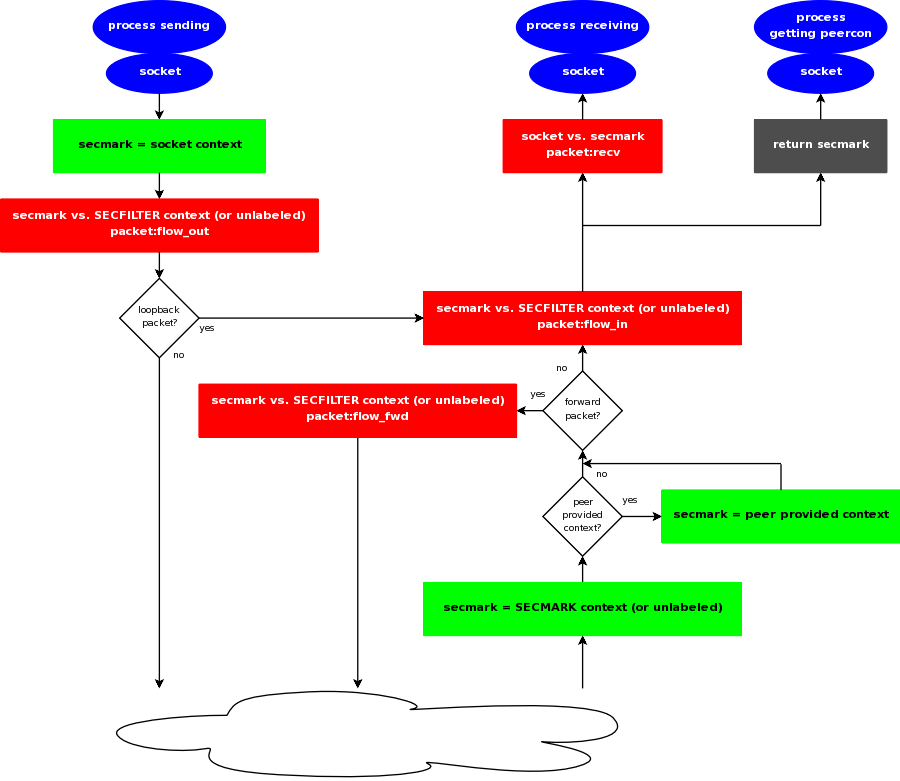
The high level ideas are (I'll be using sid and context interchangeably, but I think we can all figure that one out):
- The secmark (lowercase, denoting the secmark field in the skb) will always contain the peer's context. The secmark will begin life as the unlabeled sid - we don't know who we are dealing with yet. If the SECMARK (uppercase denoting the SECMARK iptables module) facility find a match for the skb, we will replace the secmark with the context specified by the matching rule - this is the fallback label, our best guess as to who we are dealing with. In the event of the peer supplying context information (complete context via ipsec, mls level via cipso, or type information via carrier pigeon), the peer supplied context information will be evaluated and verified for some sort of consistency if there is more than one source of information. If the context created with consideration of all peer supplied info checks out, that will then replace the current secmark value. That's it for secmark - we now have the best idea of who the peer really is in there.
- OK, one more bit about what is in secmark. For locally generated traffic, it is the domain of the process, err... socket. Still the peer context, just from a real reliable source.
- The secmark, and nothing else, will be used for all flow control checks as well as the access check at consumption (process reading from the socket). This means that policy represents who we can talk to, not what association we can use, or what socket we can recvfrom, or what internal label we can read from. Yes, secmark does it all - yeah :)
- A new SECFILTER iptables module is in place to perform flow control checks. Just as we have used the expressiveness (either fine grained or coarse grained - your choice) of iptables to define fallback labels for packets based on their attributes, we want to be able to define access check based on those attributes. It is here where we can say that only http_client_t can get to port 80 on this machine, or that only a secret packet can leave the machine through the eth1 device. The SECFILTER mechanism will be able to distinguish controls for incoming, outgoing, and forwarded traffic. In the absence of a matching "target context" from SECFILTER, the secmark will be checked against the unlabeled context (no SECFILTER - no label).
- Since the secmark for locally generated traffic is the context of the sender and that is preserved as the packet gets bounced back up to the local peer, we have labeled localhost. We can even put flow control checks on that to boot!
- getpeeron() will return the value of secmark. This will be the same context that was actually used by the access check and it is the same context that considered locally defined fallbacks as well as peer supplied information.
so, I think these ideas would:
- provide flow control
- enable loopback labeling
- provide one label instead of three possibly conflicting labels for an skb
- streamline, simplify, make sense of access checks regarding skbs
- simplify understanding of what the skb context is - the peer's context
- enable a more reliable, safe, and informative getpeercon result
I'm not sure that any of these ideas are particularly new, but I'm hoping that this particular combination of previously presented ideas makes a bit of sense. I'm sure that I will get tons of useful commentary to incorporate, and I thank you in advance :) That's why I wanted to toss something out there now.
I'm off for a weekend trip, so please don't feel that I am ignoring all of the scathing criticisms that will be coming tomorrow... I'll ignore all of that next week when I return ;)
We'll be working through some prototypes to make sure that the ideas that we present are at least somewhat feasible - unlike the blue sky idea presented here (although that'll get prototyped to see if it is workable - I hope it is).
Signature · 6 lines
Darrel

--
This message was distributed to subscribers of the selinux mailing list.
If you no longer wish to subscribe, send mail to [email protected] with
the words "unsubscribe selinux" without quotes as the message.
James Morris
maintainerQuoted 2 lines · Darrel Goeddel
picture here: http://home.insightbb.com/~dgoeddel/networking/simple.png
(when commenting, please refrain from belittling my artistic skills)
I think this looks good in terms of labeling via secmark, although it hides external labeling.
Quoted 11 lines
- A new SECFILTER iptables module is in place to perform flow control checks. Just as we have used the expressiveness (either fine grained or coarse grained - your choice) of iptables to define fallback labels for packets based on their attributes, we want to be able to define access check based on those attributes. It is here where we can say that only
http_client_tcan get to port 80 on this machine, or that only a secret packet can leave the machine through the eth1 device. The SECFILTER mechanism will be able to distinguish controls for incoming, outgoing, and forwarded traffic. In the absence of a matching "target context" from SECFILTER, the secmark will be checked against the unlabeled context (no SECFILTER - no label).
This seems problematic. The secmark model is currently based upon iptables rules being used to classify and label traffic, with access control performed within SELinux based upon those labels and permission types. So, the access control decisions are performed via the AVC and according to SELinux policy.
In the case of local labeling, the packet is labeled based upon the port (and any other iptables selector), so you don't need to have a separate mechanism i.e. the packet will only be labled as http_client_t if it's leaving via port 80 and also part of a validated connection.
Not sure what the answer is for applying controls to externally labeled packets. It seems like a special case, though, and that typically, the network interface is the only thing you really want to check here. If so, perhaps we implement a secmark (packet label) vs. netif check once external labeling has been applied.
So, the packet control permissions using secmark would be something like:
socket layer : send, recv
network layer : flow_in, flow_forward, flow_out
link layer : netif_in, netif_out
I think this will make sense to users due to the layering, and separation of labeling and access control.
The order of mediation is:
Inbound to local:
netif_in -> flow_in -> recv
Forward:
netif_in -> flow_forward -> netif_out
Outbound from local:
send -> flow_out -> netif_out
Now, labeling is not so simple :-)
We have local labeling via secmark, which needs to be applied first and then potentially overridden.
Then we have two differnt forms of external labeling, with differing mechanisms and policy constructs.
For general and non-legacy users, we need to be focused on IPsec labeling.
I'm not sure what the answer is for making it more usable at this stage, although if we don't make significant improvements, people will never use it. Any bright ideas? :-)
- James
Signature · 7 lines
James Morris
<[email protected]>

--
This message was distributed to subscribers of the selinux mailing list.
If you no longer wish to subscribe, send mail to [email protected] with
the words "unsubscribe selinux" without quotes as the message.
Quoted 7 lines · James Morris
Quoted 2 lines · Darrel Goeddel
picture here: http://home.insightbb.com/~dgoeddel/networking/simple.png
(when commenting, please refrain from belittling my artistic skills)I think this looks good in terms of labeling via secmark, although it hides external labeling.
The external labeling was left (rather intentionally at this point) as a black box. The reason for this is that there can only be one label so just wanted to show that the secmark field will be overidden with the "peer provided" (external) label if it exists. That could either be an xfrm label, a netlbl label, or an *agreement* of the two. In the case of CIPSO over an labeled xfrm, I'd say that the xfrm context and the netlbl modified context must be equal or the packet is dropped on the grounds that it is invalid (can't be secret and top_secret all at once). Once the peer information has been taken into account, the idea of "external labeling" goes away because we are now just dealing with the one and only label.
Quoted 12 lines
Quoted 11 lines
- A new SECFILTER iptables module is in place to perform flow control checks. Just as we have used the expressiveness (either fine grained or coarse grained - your choice) of iptables to define fallback labels for packets based on their attributes, we want to be able to define access check based on those attributes. It is here where we can say that only
http_client_tcan get to port 80 on this machine, or that only a secret packet can leave the machine through the eth1 device. The SECFILTER mechanism will be able to distinguish controls for incoming, outgoing, and forwarded traffic. In the absence of a matching "target context" from SECFILTER, the secmark will be checked against the unlabeled context (no SECFILTER - no label).
Quoted 5 lines
This seems problematic. The secmark model is currently based upon iptables rules being used to classify and label traffic, with access control performed within SELinux based upon those labels and permission types. So, the access control decisions are performed via the AVC and according to SELinux policy.
SECFILTER would be obtaining an access decision from the security server. The subject of that access would be the secmark on the packet (peer domain) and the object would be the context of the matching SECFILTER rule. So SECMARK provides the fallback for the subject label in the absense of a peer-provided label and SECFILTER provides the object label.
An important aspect that is that there needs to be a check against the unlabeled context if the SECFILTER mechanism did not provide a match to ensure that the security server was consulted for every packet. This would catch the case where the modules was not active or the SECFILTER ruleset was not able to match the traffic.
Quoted 7 lines
In the case of local labeling, the packet is labeled based upon the port (and any other iptables selector), so you don't need to have a separate mechanism i.e. the packet will only be labled as
http_client_tif it's leaving via port 80 and also part of a validated connection.Not sure what the answer is for applying controls to externally labeled packets.
There is no distinction here because the secmark is the only label, whether or not the label came from a SECMARK rule like:
iptables -t mangle -A INPUT -p tcp --dport 80 -j SECMARK \
--selctx system_u:object_r:http_client_t:s0
or from a labeled xfrm, it is treated the same.
Since the SECMARK facility is just providing the fallback labels, the actual flow controls are provided by the SECFILTER rules. These rules specify the "gates" that the skb is going to traverse. Let's say we want to make eth0 an "internal" only network and eth1 and external network - we would have SECFILTER rules like:
iptables -t filter -A INPUT -i eth0 -j SECFILTER \
--selctx system_u:object_r:internal_t:s0
iptables -t filter -A INPUT -i eth1 -j SECFILTER \
--selctx system_u:object_r:external_t:s0
iptables -t filter -A OUTPUT -o eth0 -j SECFILTER \
--selctx system_u:object_r:internal_t:s0
iptables -t filter -A OPTPUT -o eth1 -j SECFILTER \
--selctx system_u:object_r:external_t:s0
iptables -t filter -A FORWARD -i eth0 -o eth1 -j SECFILTER \
--selctx system_u:object_r:cross_the_line_t:s0
iptables -t filter -A FORWARD -i eth1 -o eth0 -j SECFILTER \
--selctx system_u:object_r:cross_the_line_t:s0
The flow control policy arbitration would be defined as:
allow http_client_t packet:internal_t { flow_in flow_out }; allow httpd_t packet:internal_t { flow_in flow_out };
Maybe we want to allow external access from an ssl connection. A SECMARK rule like:
iptables -t mangle -A INPUT -p tcp --dport 443 -j SECMARK \
--selctx system_u:object_r:https_client_t:s0
and policy like:
allow https_client_t packet:external_t { flow_in flow_out }; allow httpd_t packet:external_t { flow_in flow_out };
take care of that. Note that httpd_t is the domain of the webserver in the above examples.
Quoted 9 lines
It seems like a special case, though, and that typically, the network interface is the only thing you really want to check here. If so,
perhaps we implement a secmark (packet label) vs. netif check once external labeling has been applied.
So, the packet control permissions using secmark would be something like:
socket layer : send, recv
The recv check at the socket layer becomes socket (proxy for local process) receiving information from the secmark (peer process). This process vs. process style check didn't seem to have a natural fit with sending the information because the peer isn't as well known as it could be in the receive case. For this reason, send is actually absent in this idea right now.
If there were a process vs. process check on send the peer process could only
be identified through the SECMARK fallback labels.
Quoted 2 lines
network layer :
flow_in,flow_forward,flow_out
link layer :netif_in,netif_out
The flexibility of the SECFILTER mechanism should make it adequate for these two. My example above shows SECFILTER being used for the link layer checks. The thought had crossed my mind to include another layer earlier, but then I realized that I was adding another check that probably wasn't necessary.
Quoted 9 lines
I think this will make sense to users due to the layering, and separation of labeling and access control.
The order of mediation is:
Inbound to local:
netif_in -> flow_in -> recv
Quoted 7 lines
Forward:
netif_in -> flow_forward -> netif_outOutbound from local:
send -> flow_out -> netif_out
There's that darn send again... The flow_out check from SECFILTER is really performing the duties of the current send operation. It would be providing a way to say "can information from this process (with it's context conveyed through the secmark on the skb) flow through this security gate?". It is here that one could say only httpd_t could flow_out to port 80, just like SECMARK currently allows. Note that this is a more granular approach to constructing SECFILTER rules than I presented above.
The above layering makes perfect sense to me and I can live with that if it is
deemed necessary. Do you think the extra check will help with usability? Usually
I would think that an extra thing to think about would make it harder, but I am
not sure in this case.
Quoted 1 line
Now, labeling is not so simple :-)
Maybe that answers my question ;)
Quoted 2 lines
We have local labeling via secmark, which needs to be applied first and then potentially overridden.
Yep, this is our fallback in the absence of peer-provided information.
Quoted 4 lines
Then we have two differnt forms of external labeling, with differing mechanisms and policy constructs.
For general and non-legacy users, we need to be focused on IPsec labeling.
Yep, but they all convey the same information in this scheme - the label of the peer process. So the label is treated the same way no matter where it comes from (as I mentioned above, I think simultaneous use of netlbl and labeled xfrm should require and agreement on context). IMHO, this unification
of the label to one abstraction simplifies things greatly. Now we can always
perform the same check - "Can process A (local) receive info from process B (peer)?".
Quoted 3 lines
I'm not sure what the answer is for making it more usable at this stage, although if we don't make significant improvements, people will never use it. Any bright ideas? :-)
Does anything I tried to clarify above shed a different light on things in you eyes? I think the basic tenants are:
- secmark is always the label of the peer, and getpeercon() returns it
- a packet goes though "filter points", the packet is the subject and the "filter point" is the object it must pass through (these filters happen at input, output, and forwarding)
- a socket reading a packet must be able to listen to the peer that created it - a slightly new meaning for current socket vs. secmark access check
This is a drastic simplification of the whole system. I think it is much easier from a conceptual level and it allows more control that the previous system. I'm just wondering what hidden problems there are with the simplification?
Signature · 6 lines
Darrel

--
This message was distributed to subscribers of the selinux mailing list.
If you no longer wish to subscribe, send mail to [email protected] with
the words "unsubscribe selinux" without quotes as the message.
James Morris
maintainerQuoted 10 lines · Darrel Goeddel
The recv check at the socket layer becomes socket (proxy for local process)
receiving information from the secmark (peer process). This process vs. process style check didn't seem to have a natural fit with sending the information because the peer isn't as well known as it could be in the receive case. For this reason, send is actually absent in this idea right now.
If there were a process vs. process check on send the peer process could only
be identified through the SECMARK fallback labels.
Perhaps I'm missing something, but the send check is necessary for e.g. "can a httpd_server_t socket send an smtp_client_t packet" ?
What you're calling fallback labels will likely be the only labels a normal user encounters.
Quoted 2 lines
There's that darn send again... The
flow_outcheck from SECFILTER is really performing the duties of the current send operation.
I think there's a slight misunderstanding here. I'm proposing not having SECFILTER at all, and instead adding netif_in and netif_out SELinux hooks.
Discussion of security gates and similar I think will really confuse people, as will the idea of labeling such abstract entities, which is heading down a similar path to earlier proposals on this topic.
Quoted 3 lines
- a packet goes though "filter points", the packet is the subject and the "filter point" is the object it must pass through (these filters happen at input, output, and forwarding)
What they really are is the boundary of network layer of the machine, which is to say, the boundary of machine itself in terms of network functionality. i.e. once a packet is accepted into the IP stack, it can be forwarded, delivered etc.
So, allowing flow_in means "the packet can flow into this machine", and similar for flow_forward and flow_out.
The socket recv/send checks are against the endpoint (at least, as delegated by an authorized endpoint via the socket).
The netif_in and netif_out allow checking of the packet flowing across specific physical interfaces.
I don't think we need to add any new abstractions here, and these should be understandable by people who can configure networking.
Quoted 3 lines
- a socket reading a packet must be able to listen to the peer that created it - a slightly new meaning for current socket vs. secmark access check
I'm not sure what this means.
Signature · 7 lines
James Morris
<[email protected]>

--
This message was distributed to subscribers of the selinux mailing list.
If you no longer wish to subscribe, send mail to [email protected] with
the words "unsubscribe selinux" without quotes as the message.
Quoted 13 lines · James Morris
Quoted 10 lines · Darrel Goeddel
The recv check at the socket layer becomes socket (proxy for local process)
receiving information from the secmark (peer process). This process vs. process style check didn't seem to have a natural fit with sending the information because the peer isn't as well known as it could be in the receive case. For this reason, send is actually absent in this idea right now.
If there were a process vs. process check on send the peer process could only
be identified through the SECMARK fallback labels.
Quoted 2 lines
Perhaps I'm missing something, but the send check is necessary for e.g. "can a
httpd_server_tsocket send ansmtp_client_tpacket" ?
The send check would be necessary for that particular type of check. In the proposed scheme, that particular question would never arise. The skb is merely an extension of the socket, much as the socket is an extension of the process. The question is now "can httpd_server_t flow_out of an smtp_t network entity?" I'm having trouble coming up with nice terminology for that one. How's this for the question - "can an httpd_server_t packet go to a destination with certain characteristics?"
Quoted 2 lines
What you're calling fallback labels will likely be the only labels a normal user encounters.
That is correct. In the absence of labeled network (just about all cases), the SECMARK facility will provide the label of the peer.
Quoted 5 lines
Quoted 2 lines
There's that darn send again... The
flow_outcheck from SECFILTER is really performing the duties of the current send operation.I think there's a slight misunderstanding here. I'm proposing not having SECFILTER at all, and instead adding
netif_inandnetif_outSELinux hooks.
That would provide flow control only at the interface level. That is certainly better than the current lack of flow control ability, but it does not offer the flexibility of the iptables mechanism. It also gives us different controls over forwarded traffic. Instead of the ability of the unique forward check that SECFILTER would provide, we are limited to using the in and out netif checks. We can no longer say that sysadm_t traffic can come into the machine, sysadm_t traffic can go out of the machine, but sysadm_t traffic can not pass through the machine.
Quoted 3 lines
Discussion of security gates and similar I think will really confuse people, as will the idea of labeling such abstract entities, which is heading down a similar path to earlier proposals on this topic.
I think a lot of the previous confusion came from some of the following points:
- trying to use secmark as BOTH an implicit fallback context AND a flow control point
- the transitions from secmark to xfrm to NetLabel, etc., that were thrown in to allow domain->packet->domain
I'm avoiding those issues with these simple rules:
- SECMARK is used only for establishing a fallback context for the peer
- SECFILTER is used only for performing the flow control checks
- the packet always carries the peer's context, not a data context
Quoted 9 lines
Quoted 3 lines
- a packet goes though "filter points", the packet is the subject and the "filter point" is the object it must pass through (these filters happen at input, output, and forwarding)
What they really are is the boundary of network layer of the machine, which is to say, the boundary of machine itself in terms of network functionality. i.e. once a packet is accepted into the IP stack, it can be forwarded, delivered etc.
Quoted 5 lines
So, allowing
flow_inmeans "the packet can flow into this machine", and similar forflow_forwardandflow_out.The socket recv/send checks are against the endpoint (at least, as delegated by an authorized endpoint via the socket).
The recv check makes sense. The socket is getting a packet from peer peer_domain_t:secret, can the socket read that in? The label of peer_domain_t:secret came from the SECMARK mechanism which arrived at that label based on the characteristics of the sender. The peer_domain_t:secret could have just as easily been explicitly conveyed by the sender.
Does it make sense to make that check for outgoing traffic? There is no way to have peer-provided information about the receiver, you only know where the info is going, not who will actually get it. Yes, I understand that I double standard here because I somehow believe that the src characteristics for incoming packets are more useful than the dst characteristics for outgoing packets. I don't love outgoing packets any less - I am giving the incoming more credibility because there _can_ be real information about the context in that case.
Using SECMARK for the target of the outgoing access check means that we are back to needing another place to store the "target" info in the skb, or the SECMARK module will be performing the access check (via LSM to the security server) :( This is the reason SECFILTER came about - to separate the labeling mechanism from the enforcement mechanism. I think the separation adds clarity.
SECFILTER really is doing the same job for outgoing traffic as the current usage of SECMARK, the only difference is that the subject comes from the skb (same as the socket for locally generated traffic) and the decision is made in the SECFILTER module, not delayed (which needs storage) until later.
I'll bang my head around here to see what kind of functionality would be missing (as opposed to the SECMARK/SECFILTER combo) with what you are suggesting. I'll try to come up with some diagrams for the different methods that are being discussed to make sure we are on the same page. Since you are going for "no SECFILTER", how are you envisioning the network layer checks you described before being (flow_in, flow_forward, flow_out) handled? Or are you saying the idea should go, not just the SECFILTER way of doing it?
Quoted 11 lines
The
netif_inandnetif_outallow checking of the packet flowing across specific physical interfaces.I don't think we need to add any new abstractions here, and these should be understandable by people who can configure networking.
Quoted 3 lines
- a socket reading a packet must be able to listen to the peer that created it - a slightly new meaning for current socket vs. secmark access check
I'm not sure what this means.
The socket vs. secmark check conceptually means "can the local process read this type of information" right now. By having the secmark field always convey the context of the peer, the check takes on a slightly different meaning - "can the local process read information written by the peer process?".
Signature · 8 lines
Darrel


--
This message was distributed to subscribers of the selinux mailing list.
If you no longer wish to subscribe, send mail to [email protected] with
the words "unsubscribe selinux" without quotes as the message.
James Morris
maintainerQuoted 11 lines · Darrel Goeddel
Quoted 3 lines
Perhaps I'm missing something, but the send check is necessary for e.g. "can a
httpd_server_tsocket send ansmtp_client_tpacket" ?The send check would be necessary for that particular type of check. In the proposed scheme, that particular question would never arise. The skb is merely an extension of the socket, much as the socket is an extension of the process. The question is now "can
httpd_server_tflow_outof ansmtp_tnetwork entity?" I'm having trouble coming up with nice terminology for that one. How's this for the question - "can anhttpd_server_tpacket go to a destination with certain characteristics?"
I don't see the problem. The skb is labeled by SECMARK and optionally external labeling, and then the check is applied.
There is no need for for new terminology or abstractions, it is simply "Can socket_t send packet_t" ?
Quoted 5 lines
Quoted 2 lines
What you're calling fallback labels will likely be the only labels a normal user encounters.
That is correct. In the absence of labeled network (just about all cases), the SECMARK facility will provide the label of the peer.
Not really. It will be a label describing what we know about the packet, which in the case of local labeling, is based only on local attributes (e.g. destination port, derived from existing connection etc.).
Once external labeling is applied, what we know will become more specific, and ultimately, could be the label of the peer.
Quoted 9 lines
Quoted 5 lines
Quoted 2 lines
There's that darn send again... The
flow_outcheck from SECFILTER is really performing the duties of the current send operation.I think there's a slight misunderstanding here. I'm proposing not having SECFILTER at all, and instead adding
netif_inandnetif_outSELinux hooks.That would provide flow control only at the interface level. That is certainly better than the current lack of flow control ability, but it does not offer the flexibility of the iptables mechanism.
It's not needed here -- the flexibility is provided in the selection and classification of packets. What you need here is the ability to control which interfaces a packet can flow across, and this does not call for the use of a generalized and separate mechanism.
Quoted 6 lines
It also gives us
different controls over forwarded traffic. Instead of the ability of the unique forward check that SECFILTER would provide, we are limited to using the in and out netif checks. We can no longer say thatsysadm_ttraffic can come into the machine,sysadm_ttraffic can go out of the machine, butsysadm_ttraffic can not pass through the machine.
The forward check will be performed via the flow_forward hook.
Quoted 7 lines
Quoted 3 lines
Discussion of security gates and similar I think will really confuse people, as will the idea of labeling such abstract entities, which is heading down a similar path to earlier proposals on this topic.
I think a lot of the previous confusion came from some of the following points:
Quoted 8 lines
- trying to use secmark as BOTH an implicit fallback context AND a flow control point
- the transitions from secmark to xfrm to NetLabel, etc., that were thrown in to allowdomain->packet->domainI'm avoiding those issues with these simple rules:
- SECMARK is used only for establishing a fallback context for the peer
Not in the general case, only when external labeling is in use.
Quoted 1 line
- SECFILTER is used only for performing the flow control checks
Unnecessary and complicated. SELinux hooks can do this within the existing framework.
Quoted 1 line
- the packet always carries the peer's context, not a data context
What is a "data context"?
The label always simply has the most specific current information about the packet. It may be some default for all packets, it may be based upon local attributes, or it may carry the label of the peer.
Quoted 23 lines
Quoted 10 lines
Quoted 4 lines
- a packet goes though "filter points", the packet is the subject and the "filter point" is the object it must pass through (these filters happen
at input, output, and forwarding)What they really are is the boundary of network layer of the machine, which is to say, the boundary of machine itself in terms of network functionality. i.e. once a packet is accepted into the IP stack, it can be forwarded, delivered etc.
Quoted 5 lines
So, allowing
flow_inmeans "the packet can flow into this machine", and similar forflow_forwardandflow_out.The socket recv/send checks are against the endpoint (at least, as delegated by an authorized endpoint via the socket).
The recv check makes sense. The socket is getting a packet from peer peer_domain_t:secret, can the socket read that in? The label of peer_domain_t:secret came from the SECMARK mechanism which arrived at that label based on the characteristics of the sender. The peer_domain_t:secret could have just as easily been explicitly conveyed by the sender.
Quoted 8 lines
Does it make sense to make that check for outgoing traffic? There is no way to have peer-provided information about the receiver, you only know where the info is going, not who will actually get it. Yes, I understand that I double standard here because I somehow believe that the src characteristics for incoming packets are more useful than the dst characteristics for outgoing packets. I don't love outgoing packets any less - I am giving the incoming more credibility because there _can_ be real information about the context in that case.
So, you trust the characteristics of a packet arriving from the network more than those on locally generated packets?
Keep in mind that we are also able to leverage connection tracking, so the vast majority of packet labeling via secmark will have been validated as being part of an existing connection.
Quoted 2 lines
Using SECMARK for the target of the outgoing access check means that we are back to needing another place to store the "target" info in the skb,
I need a concrete example. What target information? How is it used?
Quoted 5 lines
SECFILTER really is doing the same job for outgoing traffic as the current usage of SECMARK, the only difference is that the subject comes from the skb (same as the socket for locally generated traffic) and the decision is made in the SECFILTER module, not delayed (which needs storage) until later.
I don't understand.
Quoted 8 lines
I'll bang my head around here to see what kind of functionality would be missing (as opposed to the SECMARK/SECFILTER combo) with what you are suggesting. I'll try to come up with some diagrams for the different methods that are being discussed to make sure we are on the same page. Since you are going for "no SECFILTER", how are you envisioning the network layer checks you described before being (
flow_in,flow_forward,flow_out) handled? Or are you saying the idea should go, not just the SECFILTER way of doing it?
Well, we need something for the forwarding case at least. Is it enough to have just a flow_forward check which matches the packet label against kernel_t ?
e.g. "Can this machine forward a packet labeled intranet_t" ?
Quoted 7 lines
Quoted 7 lines
The
netif_inandnetif_outallow checking of the packet flowing across specific physical interfaces.I don't think we need to add any new abstractions here, and these should be understandable by people who can configure networking.
Quoted 8 lines
Quoted 5 lines
Quoted 3 lines
- a socket reading a packet must be able to listen to the peer that created it - a slightly new meaning for current socket vs. secmark access check
I'm not sure what this means.
The socket vs. secmark check conceptually means "can the local process read this type of information" right now.
The secmark label can be anything at all, so it means whatever its labeled with. e.g. someone could label all traffic passing over eth0 as "secret", or "sysadm_t"
Quoted 4 lines
By having the secmark field
always convey the context of the peer, the check takes on a slightly different meaning - "can the local process read information written by the peer process?".
As mentioned, it carries the most specific currently available information about the packet. What it means in terms of distributed information flow is thus context-specific.
Without a specific field for e.g. peer_sid, which always only means the peer, policy development & analysis will need to be "aware" of what the label represents in a specific situation.
I think this is an acceptable trade-off, as the users of external labeling where such concepts are also critical also tend to have access to policy expertise and can tightly control the policy and deployment.
- James
Signature · 7 lines
James Morris
<[email protected]>

--
This message was distributed to subscribers of the selinux mailing list.
If you no longer wish to subscribe, send mail to [email protected] with
the words "unsubscribe selinux" without quotes as the message.
For those of you who are still paying attention to this thread you may have been wondering why it went quiet all of a sudden; well, the thread didn't go quiet, it went off-list. Needless to say, we'd like to bring the discussion back on-list so that others can participate, or at the very least get some cheap entertainment on a Friday afternoon. The discussion was pretty lively so it's not really practical to replay the entire off-list thread here but I'll try to hit upon where we are currently at as well as some of the highlights that brought us to this point.
If anyone who was a part of the discussion has anything to add to these notes, feel free.
* Packet labels (one or two)
There was quite a bit of debate about the possibility of going from the two packet labels we have currently, external and internal, to a single packet label. In order to consolidate the two labels there were two approaches
considered: a form of "reconciliation" similar to what was discussed earlier this year, and the elimination of internal labels so that only the external label would be used. After much discussion it was deemed that the two labels, as currently defined/used, are truly independent labels used for two different purposes and that "reconciliation" was still a bad idea and should not be pursued. Further, while SECMARK and internal labeling have been slow to be adopted in the major distributions it still serves a useful purpose and should not be eliminated. The end result was the majority, including Stephen and James, voting to continue with the two packet labels as they currently exist.
One thing that did arise during the discussion was the slow realization that the names for the two packet labels are probably not as descriptive as they should be and that has most likely led to a certain amount of confusion. In an effort to help make the two different label types more clear it was decided to start calling the external labels "peer labels" as the external label always represents the label of the peer who originated the packet and it's data. It was also decided to start calling the internal labels "secmark labels", while the compat_net mechanism still exists it is deprecated in favor of the SECMARK mechanism which is the only way to set/manipulate the internal label.
As a reminder, below is a definition of the two types of labels.
Secmark, or internal, labels are essentially a means for integrating the traditional firewall rules with SELinux mandatory access controls. The secmark labels allow policy writers and security administrators to meet security goals similar to the following:
"Only allow Apache to accept connections over tcp/80 from
192.168.0.0/24, restricting it to my local network and not the Big-Bad-Internet."
-- or --
"Only allow a particular instance of Firefox to connect to
1.2.3.4 over tcp/443, restricting it to my online banking site."
Peer, or external, labels, furnished by NetLabel or labeled IPsec/XFRM, provide the domain/context/label of the process which generated the packet/data. The external labels allow policy writers and security administrators to meet security goals similar to the following:
"This instance of Apache serves sensitive financial data and
I only want specific clients/peers/domains to be able to access the data from this Apache instance."
-- or --
"I want to ensure that users connecting to the login server over
a Secret connection run in a Secret domain."
* Splitting the SECMARK field
After it was agreed to continue using both the peer and secmark labels the discussion turned to how best to propagate those labels with the packet. As you probably know there is a 32 bit field already in the packet/sk_buff structure which is currently used exclusively by the secmark label. Once again, there were two approaches considered. The first was the continuation of the status quo where the secmark label is determined by looking directly at the secmark field in the sk_buff, "sk_buff.secmark", and the peer label is determined through a function call with the sk_buff as an argument, "peer_label(sk_buff)". The second idea was to divide the secmark field in the sk_buff into two 16 bit sub-fields effectively shortening peer and secmark SIDs to 16 bits.
While there is still no final agreement on the best way forward, there does seem to be agreement that the split secmark field offers a good deal of implementation convenience/cleanliness but it requires either a reduction in the system's SID space from 32 bits to 16 bits (4.<mumble> billion unique labels down to 65 thousand unique labels for all subjects/objects on the system) or some sort of additional internal SID mapping mechanism which has yet to be defined. Both of which have the potential for introducing compatibility problems.
* Loopback/Localhost peer packet labeling
This has been a long standing requirement which at first glance seems like it would be simple to achieve but in practice it has proven quiet difficult to implement. Current solutions to the problem involve using either NetLabel/CIPSO or labeled IPsec over loopback to provide peer labels, unfortunately both have drawbacks. NetLabel/CIPSO is currently limited to only conveying the MLS sensitivity label over the wire and only then for IPv4 packets. Labeled IPsec can convey the full SELinux label/context of the peer for both IPv4 and IPv6 but is difficult to configure and introduces unnecessary overhead for packets that never leave the machine.
The solution for this problem is tightly coupled with the decision to split/not-split the secmark field in the sk_buff structure. If the secmark field were split then the peer label could be set directly in the packet to the originating socket and then preserved across the loopback pseudo-interface for use on the receiving/inbound side. However, this does require splitting the secmark field and all that goes along with it (see above). If the secmark field were not split then the solution is to continue to develop the peer labeling mechanisms to support loopback labeling. Joy Latten from IBM has been working on better support for IPsec over loopback (although I'm not sure of it's current status) and I am steadily working towards a more full featured NetLabel which would be able to convey a full SELinux context over the wire/loopback.
* Packet flow control
Another long standing goal that has not seen much success over the years. The two approaches currently being considered are: per-interface checks against the peer label with the possibility of an additional forwarding hook/check if needed for labeling purposes, as well as an iptables based filtering mechanism which has already been discussed off and on on the public SELinux and LSPP mailing lists (SECFILTER/SECPOINT). The idea behind the iptables based filtering mechanism is that "filter points" could be defined using iptables/netfilter which would provide very granular access control checks. The big question that is currently being debated is how much granularity is needed and how much makes sense?
* Fallback labels
The simple idea that started this whole discussion. The need for a usable peer label fallback mechanism is understood by everyone but the granularity with which peer fallback labels are assigned are still a source of debate. The idea is wether the granularity proposed in this NetLabel patchset which allows per-host/subnet granularity for each interface is enough, and if not is a very granular iptables/netfilter peer label assignment of fallback labels required? This topic did come up briefly some time ago on the public mailing list between Joshua Brindle and myself and we agreed that the granularity presented in this patchset is sufficient, however, not everyone feels this way so we are still discussing the best solution.
As part of the peer fallback label discussion it became apparent to everyone that better integration/cooperation between the NetLabel and XFRM labeling mechanisms is needed. The strict separation worked well in the beginning but as we start to develop a richer set of functionality the two labeling mechanisms need to work better together to ensure the consistency of the network access controls. If the approach put forward in this patch set is agreed upon as the right way to solve the peer fallback problem I will be modifying it to take into account XFRM labels so that the NetLabel provided fallback peer label will only be used when there is no XFRM or NetLabel/CIPSO label on the packet. Further, work will be done to ensure that when both a XFRM and NetLabel/CIPSO label are present on an incoming packet that the labels are the same, otherwise the packet will be dropped/rejected.
Signature · 7 lines
paul moore
linux security @ hp

--
This message was distributed to subscribers of the selinux mailing list.
If you no longer wish to subscribe, send mail to [email protected] with
the words "unsubscribe selinux" without quotes as the message.
James Morris
maintainerQuoted 5 lines · Paul Moore
implementation convenience/cleanliness but it requires either a reduction in the system's SID space from 32 bits to 16 bits (4.<mumble> billion unique labels down to 65 thousand unique labels for all subjects/objects on the system) or some sort of additional internal SID mapping mechanism which has yet to be defined.
To clarify, with a network SID mapper, it means that we are only limiting the total number of SIDs being used over the wire at some time, not the total number of SIDs on the system.
Decoupling network representation of SIDs is likely a good idea anyway, for this and NFS.
- James
Signature · 7 lines
James Morris
<[email protected]>

--
This message was distributed to subscribers of the selinux mailing list.
If you no longer wish to subscribe, send mail to [email protected] with
the words "unsubscribe selinux" without quotes as the message.
Quoted 3 lines · --- Paul Moore
For those of you who are still paying attention to this thread you may have been wondering why it went quiet all of a sudden; well, the thread didn't go quiet, it went off-list.
Boo.
Quoted 6 lines
...
* Packet labels (one or two)
... voting to continue with the two packet labels as they currently exist.
For SELinux this appears prudent. For those using other schemes the difference may be less obvious, but I see you discuss that more below.
Quoted 11 lines
One thing that did arise during the discussion was the slow realization that the names for the two packet labels are probably not as descriptive as they should be and that has most likely led to a certain amount of confusion. In an effort to help make the two different label types more clear it was decided to start calling the external labels "peer labels" as the external label always represents the label of the peer who originated the packet and it's data. It was also decided to start calling the internal labels "secmark
labels", while the
compat_netmechanism still exists it is deprecated in favor of the SECMARK mechanism which is the only way to set/manipulate the internal label.
Hmm. In one case the name reflects the purpose (label of peer) and in the other the name reflects the mechanism (label used in SECMARK). I like the clarification of the former as it tells an LSM writer what to use the label for, while I dislike the latter because it does nothing to help me understand the intent of the mechanism.
Quoted 4 lines
As a reminder, below is a definition of the two types of labels.
Secmark, or internal, labels are essentially a means for integrating the traditional firewall rules with SELinux mandatory access controls.
Is it really intended that Secmark is an SELinux specific mechanism? Yes, yes, I understand that SELinux is the only upstream LSM and all that. If it is intended only as a component of SELinux going forward regardless of alternative LSM availability maybe that should be more explicit in the related documentation. I would personally be disappointed if the mechanism were unavailable to other LSMs, but that is of course your call.
Quoted 11 lines
The
secmark labels allow policy writers and security administrators to meet security goals similar to the following:
"Only allow Apache to accept connections over tcp/80 from
192.168.0.0/24, restricting it to my local network and not the Big-Bad-Internet."
-- or --
"Only allow a particular instance of Firefox to connect to
1.2.3.4 over tcp/443, restricting it to my online banking site."
Quoted 3 lines
Peer, or external, labels, furnished by NetLabel or labeled IPsec/XFRM, provide the domain/context/label of the process which generated the packet/data.
As I mentioned earlier, I like this definition because it describes the intent of the facility and provides guidance to those who would extend the facility or use it to other ends.
Quoted 19 lines
The external labels allow policy writers and security administrators to meet security goals similar to the following:
"This instance of Apache serves sensitive financial data and
I only want specific clients/peers/domains to be able to access the data from this Apache instance."
-- or --
"I want to ensure that users connecting to the login server over
a Secret connection run in a Secret domain."* Splitting the SECMARK field
After it was agreed to continue using both the peer and secmark labels the discussion turned to how best to propagate those labels with the packet. As you probably know there is a 32 bit field already in the packet/sk_buff structure which is currently used exclusively by the secmark label. Once again, there were two approaches considered. The first was the continuation of the status quo where the secmark label is determined by looking directly at the secmark field in the
sk_buff, "sk_buff.secmark", and the peer label is
Quoted 2 lines
determined through a function call with the
sk_buffas an argument, "peer_label(sk_buff)".
Would that be netlbl_peer_label(sk_buff), selinux_peer_label(sk_buff), or security_peer_label(sk_buff)?
Quoted 2 lines
The second idea was to divide the secmark ... the potential for introducing compatibility problems.
Yup.
Quoted 10 lines
* Loopback/Localhost peer packet labeling
This has been a long standing requirement which at first glance seems like it
would be simple to achieve but in practice it has proven quiet difficult to implement. Current solutions to the problem involve using either NetLabel/CIPSO or labeled IPsec over loopback to provide peer labels, unfortunately both have drawbacks. NetLabel/CIPSO is currently limited to only conveying the MLS sensitivity label over the wire and only then for IPv4
Quoted 4 lines
packets. Labeled IPsec can convey the full SELinux label/context of the peer
for both IPv4 and IPv6 but is difficult to configure and introduces unnecessary overhead for packets that never leave the machine.
In the early Smack development I experimented with a scheme that was very like CIPSO with the exception that it carried the MAC information directly. That would be a smack_t for me, but it would do u32s just fine. I abandoned it in favor of CIPSO to reduce the changes outside of the LSM, but it would be easy to resurrect. It has the disadvantage that you have to be careful to avoid going off the box since there's no RFC supporting it. I seem to recall there is an "approved" scheme lurking in the networking header files, but I never persued that.
Quoted 8 lines
The solution for this problem is tightly coupled with the decision to split/not-split the secmark field in the
sk_buffstructure. If the secmark field were split then the peer label could be set directly in the packet to the originating socket and then preserved across the loopback pseudo-interface for use on the receiving/inbound side. However, this does require splitting the secmark field and all that goes along with it (see above). If the secmark field were not split then the solution is to continue
Quoted 5 lines
to develop the peer labeling mechanisms to support loopback labeling. Joy Latten from IBM has been working on better support for IPsec over loopback (although I'm not sure of it's current status) and I am steadily working towards a more full featured NetLabel which would be able to convey a full SELinux context over the wire/loopback.
So how big is a "full" context?
Quoted 28 lines
* Packet flow control
...
* Fallback labels
The simple idea that started this whole discussion. The need for a usable peer label fallback mechanism is understood by everyone but the granularity with which peer fallback labels are assigned are still a source of debate. The idea is wether the granularity proposed in this NetLabel patchset which allows per-host/subnet granularity for each interface is enough, and if not is a very granular iptables/netfilter peer label assignment of fallback labels required? This topic did come up briefly some time ago on the public mailing list between Joshua Brindle and myself and we agreed that the granularity presented in this patchset is sufficient, however, not everyone feels this way so we are still discussing the best solution.
As part of the peer fallback label discussion it became apparent to everyone that better integration/cooperation between the NetLabel and XFRM labeling mechanisms is needed. The strict separation worked well in the beginning but
as we start to develop a richer set of functionality the two labeling mechanisms need to work better together to ensure the consistency of the network access controls. If the approach put forward in this patch set is agreed upon as the right way to solve the peer fallback problem I will be modifying it to take into account XFRM labels so that the NetLabel provided fallback peer label will only be used when there is no XFRM or NetLabel/CIPSO
Quoted 3 lines
label on the packet. Further, work will be done to ensure that when both a XFRM and NetLabel/CIPSO label are present on an incoming packet that the labels are the same, otherwise the packet will be dropped/rejected.
It makes me uncomfortable to hear you say that XFRM is SELinux specific and that it needs to be integrated with NetLabel, which currently isn't. I know that Smack isn't upstream yet. Nonetheless, I would hate to see underlying mechanisms that currently provide useful facilities become SELinux specific.
Thank you.
Casey Schaufler
[email protected]
--
This message was distributed to subscribers of the selinux mailing list. If you no longer wish to subscribe, send mail to [email protected] with the words "unsubscribe selinux" without quotes as the message.
Quoted 6 lines · Casey Schaufler
Quoted 3 lines · --- Paul Moore
For those of you who are still paying attention to this thread you may have been wondering why it went quiet all of a sudden; well, the thread didn't go quiet, it went off-list.
Boo.
I know, I know ...
Quoted 11 lines
Quoted 10 lines
One thing that did arise during the discussion was the slow realization that the names for the two packet labels are probably not as descriptive as they should be and that has most likely led to a certain amount of confusion. In an effort to help make the two different label types more clear it was decided to start calling the external labels "peer labels" as the external label always represents the label of the peer who originated the packet and it's data. It was also decided to start calling the internal labels "secmark labels", while the
compat_netmechanism still exists it is deprecated in favor of the SECMARK mechanism which is the only way to set/manipulate the internal label.
Quoted 5 lines
Hmm. In one case the name reflects the purpose (label of peer) and in the other the name reflects the mechanism (label used in SECMARK). I like the clarification of the former as it tells an LSM writer what to use the label for, while I dislike the latter because it does nothing to help me understand the intent of the mechanism.
Feel free to suggest something better, I don't think anyone was ever really in love with the term "secmark label". I believe at one point Stephen suggested "iptables label", does that sound any better?
Quoted 6 lines
Quoted 4 lines
As a reminder, below is a definition of the two types of labels.
Secmark, or internal, labels are essentially a means for integrating the traditional firewall rules with SELinux mandatory access controls.
Is it really intended that Secmark is an SELinux specific mechanism?
I don't see why it _has_ to be a SELinux specific mechanism. I understand that some of the netfilter code is SELinux specific (mostly the part dealing with SELinux secctx/secid conversions) but you could either change that to the more generic LSM secctx/secid conversion API or simply augment it for SMACK (I even see some nice case statements already in place to make things easy for you).
However, all of this assumes that the LSM has a functional label-to-32bit-token mapping mechanism similar to what SELinux has with the SID concept. I know, and understand why, you are not a big fan of this for SMACK but secids/tokens are a reality in several parts of the kernel and I don't expect that to change anytime soon. You don't have to implement a label/token mapping mechanism I guess, but you won't be able to make use of kernel subsystems which require it.
Quoted 4 lines
Yes, yes, I understand that SELinux is the only upstream LSM and all that. If it is intended only as a component of SELinux going forward regardless of alternative LSM availability maybe that should be more explicit in the related documentation.
Documentation? Who has documentation?! ;)
You make a good point, one that became clear to me over the course of the discussion is that we need better documentation about the SELinux/LSM network access controls work in the kernel. Josh wrote up a nice blog entry a while ago about how to make some of it work in userspace (no NetLabel instructions, though ... tsk tsk <g>!) but we don't have anyting for kernel hack[er]s. One of the things that made it on to my todo list (but I haven't shared this with anyone until now) is a document/wiki-entry describing how things work in the kernel, and I'll be sure to point out which things are SELinux specific (which is pretty few, if any).
Quoted 3 lines
I would personally be
disappointed if the mechanism were unavailable to other LSMs, but that is of course your call.
As long as their is an LSM my opinion is that all mechanisms which live outside the LSM and/or provide services to LSM modules should be agnostic of any one particular LSM. However, this does not mean that the is must deal only with binary/string/secctx labels; if it makes sense to deal strictly with secid tokens then so be it.
Quoted 11 lines
Quoted 11 lines
* Splitting the SECMARK field
After it was agreed to continue using both the peer and secmark labels the discussion turned to how best to propagate those labels with the packet. As you probably know there is a 32 bit field already in the packet/sk_buff structure which is currently used exclusively by the secmark label. Once again, there were two approaches considered. The first was the continuation of the status quo where the secmark label is determined by looking directly at the secmark field in the
sk_buff, "sk_buff.secmark", and the peer label is
Quoted 5 lines
Quoted 2 lines
determined through a function call with the
sk_buffas an argument, "peer_label(sk_buff)".Would that be
netlbl_peer_label(sk_buff),selinux_peer_label(sk_buff), orsecurity_peer_label(sk_buff)?
At this point I'm thinking this would be internal/specific to the LSM; SMACK and other LSMs cand devise whatever internal mechanism they want. SMACK for example only has one labeling mechanism that I can see so this is kind of a moot point for you, just make use of the NetLabel API to get the security attributes/label of a packet. For SELinux it's not quite so simple as both NetLabel and XFRM can provide peer label information, in order to make it easier I was suggesting providing a single wrapper function that would take into account all peer labeling mechanisms and return the correct peer label.
Quoted 15 lines
Quoted 15 lines
* Loopback/Localhost peer packet labeling
This has been a long standing requirement which at first glance seems like it
would be simple to achieve but in practice it has proven quiet difficult to implement. Current solutions to the problem involve using either NetLabel/CIPSO or labeled IPsec over loopback to provide peer labels, unfortunately both have drawbacks. NetLabel/CIPSO is currently limited to only conveying the MLS sensitivity label over the wire and only then for IPv4
packets. Labeled IPsec can convey the full SELinux label/context of the peer
Quoted 6 lines
Quoted 2 lines
for both IPv4 and IPv6 but is difficult to configure and introduces unnecessary overhead for packets that never leave the machine.
In the early Smack development I experimented with a scheme that was very like CIPSO with the exception that it carried the MAC information directly.
I am thinking along the same lines for NetLabel/CIPSO, similar to the old Selopt concept. I'm also considering adding some additional fields/info to carry additional information that used to passed along via MaxSix/SAMP; more on that when I get to that work item.
Quoted 1 line
That would be a
smack_tfor me, but it would do u32s just fine.
While having to deal only with secids would make life easier, it might be possible to offer alternate option formats for different LSMs (as long as they were in mainline).
Quoted 2 lines
It has the disadvantage that you have to be careful to avoid going off the box since there's no RFC supporting it.
Yes, indeed. Although in the case of NetLabel/CIPSO we have the wonderful (well, not so wonderful if your a router vendor) FIPS defined "freeform" tag which would allow us to stuff whatever we want so long as it fits in the IP header length limitations. That said, I'm currently tossing around ways to leverage the ip_build_options() routine to provide destination specific NetLabel labeling in conjunction with the existing per-domain labeling.
IPv6 is of course, a different story.
Quoted 2 lines
I seem to recall there is an "approved" scheme lurking in the networking header files, but I never persued that.
I have absolutely no idea what you are talking about here.
Quoted 9 lines
Quoted 9 lines
The solution for this problem is tightly coupled with the decision to split/not-split the secmark field in the
sk_buffstructure. If the secmark field were split then the peer label could be set directly in the packet to the originating socket and then preserved across the loopback pseudo-interface for use on the receiving/inbound side. However, this does require splitting the secmark field and all that goes along with it (see above). If the secmark field were not split then the solution is to continue
Quoted 7 lines
Quoted 5 lines
to develop the peer labeling mechanisms to support loopback labeling. Joy Latten from IBM has been working on better support for IPsec over loopback (although I'm not sure of it's current status) and I am steadily working towards a more full featured NetLabel which would be able to convey a full SELinux context over the wire/loopback.
So how big is a "full" context?
See my comments above. In the case of SELinux I would probably simply just pass the SID directly over loopback for performance reasons.
Quoted 27 lines
Quoted 27 lines
* Fallback labels
The simple idea that started this whole discussion. The need for a usable peer label fallback mechanism is understood by everyone but the granularity with which peer fallback labels are assigned are still a source of debate. The idea is wether the granularity proposed in this NetLabel patchset which allows per-host/subnet granularity for each interface is enough, and if not is a very granular iptables/netfilter peer label assignment of fallback labels required? This topic did come up briefly some time ago on the public mailing list between Joshua Brindle and myself and we agreed that the granularity presented in this patchset is sufficient, however, not everyone feels this way so we are still discussing the best solution.
As part of the peer fallback label discussion it became apparent to everyone that better integration/cooperation between the NetLabel and XFRM labeling mechanisms is needed. The strict separation worked well in the beginning but
as we start to develop a richer set of functionality the two labeling mechanisms need to work better together to ensure the consistency of the network access controls. If the approach put forward in this patch set is agreed upon as the right way to solve the peer fallback problem I will be modifying it to take into account XFRM labels so that the NetLabel provided fallback peer label will only be used when there is no XFRM or NetLabel/CIPSO
Quoted 6 lines
Quoted 3 lines
label on the packet. Further, work will be done to ensure that when both a XFRM and NetLabel/CIPSO label are present on an incoming packet that the labels are the same, otherwise the packet will be dropped/rejected.
It makes me uncomfortable to hear you say that XFRM is SELinux specific and that it needs to be integrated with NetLabel, which currently isn't.
Relax, I plan on making the integration/cooperation within SELinux. I'm still working on the patches (just started thinking/coding yesterday) but as it stands the only real change to NetLabel will be the addition of label source information in the netlbl_lsm_secattr struct, i.e. is this a CIPSO label, a unlabeled/fallback label, etc.
Quoted 1 line
I know that Smack isn't upstream yet.
Slacker :)
Quoted 3 lines
Nonetheless, I would hate to see
underlying mechanisms that currently provide useful facilities become SELinux specific.
As long as the LSM is in place, so would I.
Signature · 7 lines
paul moore
linux security @ hp

--
This message was distributed to subscribers of the selinux mailing list.
If you no longer wish to subscribe, send mail to [email protected] with
the words "unsubscribe selinux" without quotes as the message.
James Morris
maintainerQuoted 3 lines · Paul Moore
Feel free to suggest something better, I don't think anyone was ever really in love with the term "secmark label". I believe at one point Stephen suggested "iptables label", does that sound any better?
I like packet label, because it's a label based on the attributes of the packet.
Signature · 7 lines
James Morris
<[email protected]>

--
This message was distributed to subscribers of the selinux mailing list.
If you no longer wish to subscribe, send mail to [email protected] with
the words "unsubscribe selinux" without quotes as the message.
Quoted 7 lines · James Morris
Quoted 3 lines · Paul Moore
Feel free to suggest something better, I don't think anyone was ever really in love with the term "secmark label". I believe at one point Stephen suggested "iptables label", does that sound any better?
I like packet label, because it's a label based on the attributes of the packet.
[Sorry, I forgot about this suggestion when replying]
I was always a little nervous that just the term "packet label" would get confusing ... are we talking about the "peer" packet label or the "packet" packet label ... but I see your point.
What do other people think? I know you've got an opinion Casey ...
Signature · 7 lines
paul moore
linux security @ hp

--
This message was distributed to subscribers of the selinux mailing list.
If you no longer wish to subscribe, send mail to [email protected] with
the words "unsubscribe selinux" without quotes as the message.
Quoted 8 lines · Paul Moore
Quoted 6 lines · James Morris
Quoted 4 lines · Paul Moore
Feel free to suggest something better, I don't think anyone was ever really in love with the term "secmark label". I believe at one point Stephen suggested "iptables label", does that sound any better?
Quoted 9 lines
Quoted 3 lines
I like packet label, because it's a label based on the attributes of the packet.
[Sorry, I forgot about this suggestion when replying]
I was always a little nervous that just the term "packet label" would get confusing ... are we talking about the "peer" packet label or the "packet" packet label ... but I see your point.
I agree, packet is ambiguous, it could mean the label thats in the packet in the CIPSO field. netfilter label or iptables label (I prefer the former since that is the real mechanism that does it, iptables could be replaced with a new userspace interface anytime...)
Quoted 2 lines
What do other people think? I know you've got an opinion Casey ...
--
This message was distributed to subscribers of the selinux mailing list. If you no longer wish to subscribe, send mail to [email protected] with the words "unsubscribe selinux" without quotes as the message.
Quoted 10 lines · --- Paul Moore
Quoted 5 lines
Hmm. In one case the name reflects the purpose (label of peer) and in the other the name reflects the mechanism (label used in SECMARK). I like the clarification of the former as it tells an LSM writer what to use the label for, while I dislike the latter because it does nothing to help me understand the intent of the mechanism.
Feel free to suggest something better, I don't think anyone was ever really in
love with the term "secmark label". I believe at one point Stephen suggested "iptables label", does that sound any better?
It does because it describes the intended use.
Quoted 6 lines
Quoted 6 lines
Quoted 5 lines
As a reminder, below is a definition of the two types of labels.
Secmark, or internal, labels are essentially a means for integrating the traditional firewall rules with SELinux mandatory access controls.
Quoted 8 lines
Quoted 1 line
Is it really intended that Secmark is an SELinux specific mechanism?
I don't see why it _has_ to be a SELinux specific mechanism. I understand that some of the netfilter code is SELinux specific (mostly the part dealing with SELinux secctx/secid conversions) but you could either change that to the more generic LSM secctx/secid conversion API or simply augment it for SMACK (I even see some nice case statements already in place to make things easy for you).
I can see where the mechanism is intended for generality and where there is strong SELinux influence. I always get nervous when what looks like a general mechanism is described in terms of a specific use to which it gets put.
Quoted 7 lines
However, all of this assumes that the LSM has a functional label-to-32bit-token mapping mechanism similar to what SELinux has with the SID concept. I know, and understand why, you are not a big fan of this for SMACK but secids/tokens are a reality in several parts of the kernel and I don't expect that to change anytime soon. You don't have to implement a label/token mapping mechanism I guess, but you won't be able to make use of kernel subsystems which require it.
Having come to that realization myself while trying to deal with the audit code (which would be easily repairable were it not for xfrm) I've been working on accomodating this particularily.
Quoted 13 lines
Quoted 4 lines
Yes, yes, I understand that SELinux is the only upstream LSM and all that. If it is intended only as a component of SELinux going forward regardless of alternative LSM availability maybe that should be more explicit in the related documentation.
Documentation? Who has documentation?! ;)
You make a good point, one that became clear to me over the course of the discussion is that we need better documentation about the SELinux/LSM network
access controls work in the kernel. Josh wrote up a nice blog entry a while ago about how to make some of it work in userspace (no NetLabel instructions,
Quoted 7 lines
though ... tsk tsk <g>!) but we don't have anyting for kernel hack[er]s. One
of the things that made it on to my todo list (but I haven't shared this with
anyone until now) is a document/wiki-entry describing how things work in the kernel, and I'll be sure to point out which things are SELinux specific (which is pretty few, if any).
I expect that the actual dependencies are isolated. Where they exist it would be nice for them to be explicit.
Quoted 9 lines
Quoted 3 lines
I would personally be
disappointed if the mechanism were unavailable to other LSMs, but that is of course your call.As long as their is an LSM my opinion is that all mechanisms which live outside the LSM and/or provide services to LSM modules should be agnostic of any one particular LSM. However, this does not mean that the is must deal only with binary/string/secctx labels; if it makes sense to deal strictly with secid tokens then so be it.
Maybe we can fix that in 3.0. That is, I'll accept it for now, but someday we really ought to revisit the decision.
Quoted 17 lines
Quoted 11 lines
Quoted 11 lines
* Splitting the SECMARK field
After it was agreed to continue using both the peer and secmark labels the discussion turned to how best to propagate those labels with the packet. As you probably know there is a 32 bit field already in the packet/sk_buff structure which is currently used exclusively by the secmark label. Once again, there were two approaches considered. The first was the continuation of the status quo where the secmark label is determined by looking directly at the secmark field in the
sk_buff, "sk_buff.secmark", and the peer label isQuoted 5 lines
Quoted 2 lines
determined through a function call with the
sk_buffas an argument, "peer_label(sk_buff)".Would that be
netlbl_peer_label(sk_buff),selinux_peer_label(sk_buff), orsecurity_peer_label(sk_buff)?
Quoted 8 lines
At this point I'm thinking this would be internal/specific to the LSM; SMACK and other LSMs cand devise whatever internal mechanism they want. SMACK for example only has one labeling mechanism that I can see so this is kind of a moot point for you, just make use of the NetLabel API to get the security attributes/label of a packet. For SELinux it's not quite so simple as both NetLabel and XFRM can provide peer label information, in order to make it easier I was suggesting providing a single wrapper function that would take into account all peer labeling mechanisms and return the correct peer label.
Sound.
Quoted 27 lines
Quoted 15 lines
Quoted 15 lines
* Loopback/Localhost peer packet labeling
This has been a long standing requirement which at first glance seems like it
would be simple to achieve but in practice it has proven quiet difficult to implement. Current solutions to the problem involve using either NetLabel/CIPSO or labeled IPsec over loopback to provide peer labels, unfortunately both have drawbacks. NetLabel/CIPSO is currently limited to only conveying the MLS sensitivity label over the wire and only then for IPv4
packets. Labeled IPsec can convey the full SELinux label/context of the peer
Quoted 6 lines
Quoted 2 lines
for both IPv4 and IPv6 but is difficult to configure and introduces unnecessary overhead for packets that never leave the machine.
In the early Smack development I experimented with a scheme that was very like CIPSO with the exception that it carried the MAC information directly.
I am thinking along the same lines for NetLabel/CIPSO, similar to the old Selopt concept. I'm also considering adding some additional fields/info to carry additional information that used to passed along via MaxSix/SAMP; more on that when I get to that work item.
Quoted 5 lines
Quoted 1 line
That would be a
smack_tfor me, but it would do u32s just fine.While having to deal only with secids would make life easier, it might be possible to offer alternate option formats for different LSMs (as long as they were in mainline).
Well, you could define the interface to take a pointer and length, thereby leaving it up to the LSM. Heck, SELinux could use it to pass two sids instead of one that way.
Quoted 11 lines
Quoted 2 lines
It has the disadvantage that you have to be careful to avoid going off the box since there's no RFC supporting it.
Yes, indeed. Although in the case of NetLabel/CIPSO we have the wonderful (well, not so wonderful if your a router vendor) FIPS defined "freeform" tag which would allow us to stuff whatever we want so long as it fits in the IP header length limitations. That said, I'm currently tossing around ways to leverage the
ip_build_options()routine to provide destination specific NetLabel labeling in conjunction with the existing per-domain labeling.IPv6 is of course, a different story.
Indeed.
Quoted 4 lines
Quoted 2 lines
I seem to recall there is an "approved" scheme lurking in the networking header files, but I never persued that.
I have absolutely no idea what you are talking about here.
It might even have been selopt.
Quoted 15 lines
Quoted 15 lines
Quoted 14 lines
The solution for this problem is tightly coupled with the decision to split/not-split the secmark field in the
sk_buffstructure. If the secmark field were split then the peer label could be set directly in the packet to the originating socket and then preserved across the loopback pseudo-interface for use on the receiving/inbound side. However, this does require splitting the secmark field and all that goes along with it (see above). If the secmark field were not split then the solution is to continueto develop the peer labeling mechanisms to support loopback labeling. Joy Latten from IBM has been working on better support for IPsec over loopback (although I'm not sure of it's current status) and I am steadily working towards a more full featured NetLabel which would be able to convey a full SELinux context over the wire/loopback.
Quoted 4 lines
Quoted 1 line
So how big is a "full" context?
See my comments above. In the case of SELinux I would probably simply just pass the SID directly over loopback for performance reasons.
Yup.
Quoted 12 lines
Quoted 11 lines
Quoted 8 lines
* Fallback labels
...
label on the packet. Further, work will be done to ensure that when both a XFRM and NetLabel/CIPSO label are present on an incoming packet that the labels are the same, otherwise the packet will be dropped/rejected.
It makes me uncomfortable to hear you say that XFRM is SELinux specific and that it needs to be integrated with NetLabel, which currently isn't.
Quoted 6 lines
Relax, I plan on making the integration/cooperation within SELinux. I'm still
working on the patches (just started thinking/coding yesterday) but as it stands the only real change to NetLabel will be the addition of label source information in thenetlbl_lsm_secattrstruct, i.e. is this a CIPSO label, a unlabeled/fallback label, etc.
Ok. I've relaxed.
Quoted 3 lines
Quoted 1 line
I know that Smack isn't upstream yet.
Slacker :)
Sometimes the Rock Star Lifestyle gets in the way.
Quoted 5 lines
Quoted 3 lines
Nonetheless, I would hate to see
underlying mechanisms that currently provide useful facilities become SELinux specific.As long as the LSM is in place, so would I.
Carefully worded.
Thank you.
Casey Schaufler
[email protected]
--
This message was distributed to subscribers of the selinux mailing list. If you no longer wish to subscribe, send mail to [email protected] with the words "unsubscribe selinux" without quotes as the message.
Quoted 7 lines · Casey Schaufler
Quoted 6 lines · --- Paul Moore
Quoted 5 lines
Hmm. In one case the name reflects the purpose (label of peer) and in the other the name reflects the mechanism (label used in SECMARK). I like the clarification of the former as it tells an LSM writer what to use the label for, while I dislike the latter because it does nothing to help me understand the intent of the mechanism.
Quoted 6 lines
Quoted 4 lines
Feel free to suggest something better, I don't think anyone was ever really in
love with the term "secmark label". I believe at one point Stephen suggested "iptables label", does that sound any better?It does because it describes the intended use.
Actually, after reading Josh's mail I'm now thinking "netfilter label" is probably a better choice. After all, the bikeshed will need to be repainted in a few years ... ;)
Quoted 15 lines
Quoted 6 lines
Quoted 6 lines
Quoted 5 lines
As a reminder, below is a definition of the two types of labels.
Secmark, or internal, labels are essentially a means for integrating the traditional firewall rules with SELinux mandatory access controls.
Quoted 8 lines
Quoted 1 line
Is it really intended that Secmark is an SELinux specific mechanism?
I don't see why it _has_ to be a SELinux specific mechanism. I understand that some of the netfilter code is SELinux specific (mostly the part dealing with SELinux secctx/secid conversions) but you could either change that to the more generic LSM secctx/secid conversion API or simply augment it for SMACK (I even see some nice case statements already in place to make things easy for you).
Quoted 4 lines
I can see where the mechanism is intended for generality and where there is strong SELinux influence. I always get nervous when what looks like a general mechanism is described in terms of a specific use to which it gets put.
Then channel some of that nervous energy into some patches :) Really, I think you could probably "fix" some of this without affecting the user visible portion of it ... but then again I haven't thought about it for that long.
Quoted 4 lines
Quoted 4 lines
Quoted 3 lines
I would personally be
disappointed if the mechanism were unavailable to other LSMs, but that is of course your call.
Quoted 8 lines
Quoted 5 lines
As long as their is an LSM my opinion is that all mechanisms which live outside the LSM and/or provide services to LSM modules should be agnostic of any one particular LSM. However, this does not mean that the is must deal only with binary/string/secctx labels; if it makes sense to deal strictly with secid tokens then so be it.
Maybe we can fix that in 3.0. That is, I'll accept it for now, but someday we really ought to revisit the decision.
Sure, in a perfect world we would have void pointers everywhere, with a well defined set of lifecycle management hooks that would enable us to do whatever we wanted in terms of labeling objects on the system. It's a nice idea, scratch that, a truly awesome idea, but I just don't see that happening in the near future.
Quoted 27 lines
Quoted 27 lines
Quoted 15 lines
Quoted 15 lines
* Loopback/Localhost peer packet labeling
This has been a long standing requirement which at first glance seems like it
would be simple to achieve but in practice it has proven quiet difficult to implement. Current solutions to the problem involve using either NetLabel/CIPSO or labeled IPsec over loopback to provide peer labels, unfortunately both have drawbacks. NetLabel/CIPSO is currently limited to only conveying the MLS sensitivity label over the wire and only then for IPv4
packets. Labeled IPsec can convey the full SELinux label/context of the peer
Quoted 6 lines
Quoted 2 lines
for both IPv4 and IPv6 but is difficult to configure and introduces unnecessary overhead for packets that never leave the machine.
In the early Smack development I experimented with a scheme that was very like CIPSO with the exception that it carried the MAC information directly.
I am thinking along the same lines for NetLabel/CIPSO, similar to the old Selopt concept. I'm also considering adding some additional fields/info to carry additional information that used to passed along via MaxSix/SAMP; more on that when I get to that work item.
Quoted 8 lines
Quoted 5 lines
Quoted 1 line
That would be a
smack_tfor me, but it would do u32s just fine.While having to deal only with secids would make life easier, it might be possible to offer alternate option formats for different LSMs (as long as they were in mainline).
Well, you could define the interface to take a pointer and length, thereby leaving it up to the LSM.
Yes, that is one of the things I'm considering but one of the drawbacks to this approach is that it makes commonality between LSMs very hard.
We can talk more about the exact functionality/API later if you would like, right now I think we should stick to the topics in the original email so we don't get stuck in a rathole. My plan is to start looking into this after the fallback label issue is resolved.
Signature · 7 lines
paul moore
linux security @ hp

--
This message was distributed to subscribers of the selinux mailing list.
If you no longer wish to subscribe, send mail to [email protected] with
the words "unsubscribe selinux" without quotes as the message.
Quoted 13 lines · --- Paul Moore
Quoted 12 lines · Casey Schaufler
Quoted 10 lines · --- Paul Moore
Quoted 5 lines
Hmm. In one case the name reflects the purpose (label of peer) and in the other the name reflects the mechanism (label used in SECMARK). I like the clarification of the former as it tells an LSM writer what to use the label for, while I dislike the latter because it does nothing to help me understand the intent of the mechanism.
Feel free to suggest something better, I don't think anyone was ever really in
love with the term "secmark label". I believe at one point Stephen suggested "iptables label", does that sound any better?
Quoted 4 lines
Quoted 1 line
It does because it describes the intended use.
Actually, after reading Josh's mail I'm now thinking "netfilter label" is probably a better choice.
I also found his reasoning sound. "netfilter label" has my approval.
Quoted 23 lines
After all, the bikeshed will need to be repainted
in a few years ... ;)Quoted 15 lines
Quoted 6 lines
Quoted 6 lines
Quoted 5 lines
As a reminder, below is a definition of the two types of labels.
Secmark, or internal, labels are essentially a means for integrating the traditional firewall rules with SELinux mandatory access controls.
Quoted 8 lines
Quoted 1 line
Is it really intended that Secmark is an SELinux specific mechanism?
I don't see why it _has_ to be a SELinux specific mechanism. I understand that some of the netfilter code is SELinux specific (mostly the part dealing with SELinux secctx/secid conversions) but you could either change that to the more generic LSM secctx/secid conversion API or simply augment it for SMACK (I even see some nice case statements already in place to make things easy for you).
Quoted 4 lines
I can see where the mechanism is intended for generality and where there is strong SELinux influence. I always get nervous when what looks like a general mechanism is described in terms of a specific use to which it gets put.
Quoted 4 lines
Then channel some of that nervous energy into some patches :) Really, I think
you could probably "fix" some of this without affecting the user visible portion of it ... but then again I haven't thought about it for that long.
Yeah, yeah. It's behind audit on the list. "soon".
Quoted 13 lines
Quoted 4 lines
Quoted 4 lines
Quoted 3 lines
I would personally be
disappointed if the mechanism were unavailable to other LSMs, but that is of course your call.Quoted 8 lines
Quoted 5 lines
As long as their is an LSM my opinion is that all mechanisms which live outside the LSM and/or provide services to LSM modules should be agnostic of any one particular LSM. However, this does not mean that the is must deal only with binary/string/secctx labels; if it makes sense to deal strictly with secid tokens then so be it.
Maybe we can fix that in 3.0. That is, I'll accept it for now, but someday we really ought to revisit the decision.
Quoted 6 lines
Sure, in a perfect world we would have void pointers everywhere, with a well defined set of lifecycle management hooks that would enable us to do whatever
we wanted in terms of labeling objects on the system. It's a nice idea, scratch that, a truly awesome idea, but I just don't see that happening in the near future.
I had a go at it, and there are only a couple gnarly places, but they are unpleasant enough to I'm deferring it for the time being.
Quoted 36 lines
Quoted 27 lines
Quoted 27 lines
Quoted 15 lines
Quoted 15 lines
* Loopback/Localhost peer packet labeling
This has been a long standing requirement which at first glance seems like it
would be simple to achieve but in practice it has proven quiet difficult to implement. Current solutions to the problem involve using either NetLabel/CIPSO or labeled IPsec over loopback to provide peer labels, unfortunately both have drawbacks. NetLabel/CIPSO is currently limited to only conveying the MLS sensitivity label over the wire and only then for IPv4
packets. Labeled IPsec can convey the full SELinux label/context of the peer
Quoted 6 lines
Quoted 2 lines
for both IPv4 and IPv6 but is difficult to configure and introduces unnecessary overhead for packets that never leave the machine.
In the early Smack development I experimented with a scheme that was very like CIPSO with the exception that it carried the MAC information directly.
I am thinking along the same lines for NetLabel/CIPSO, similar to the old Selopt concept. I'm also considering adding some additional fields/info to carry additional information that used to passed along via MaxSix/SAMP; more on that when I get to that work item.
Quoted 8 lines
Quoted 5 lines
Quoted 1 line
That would be a
smack_tfor me, but it would do u32s just fine.While having to deal only with secids would make life easier, it might be possible to offer alternate option formats for different LSMs (as long as they were in mainline).
Well, you could define the interface to take a pointer and length, thereby leaving it up to the LSM.
Quoted 7 lines
Yes, that is one of the things I'm considering but one of the drawbacks to this approach is that it makes commonality between LSMs very hard.
We can talk more about the exact functionality/API later if you would like, right now I think we should stick to the topics in the original email so we don't get stuck in a rathole. My plan is to start looking into this after the fallback label issue is resolved.
OK by me. Lots to do.
Casey Schaufler
[email protected]
--
This message was distributed to subscribers of the selinux mailing list. If you no longer wish to subscribe, send mail to [email protected] with the words "unsubscribe selinux" without quotes as the message.
Quoted 4 lines · Casey Schaufler
Quoted 2 lines · --- Paul Moore
as we start to develop a richer set of functionality the two labeling mechanisms need to work better together to ensure the consistency of the network access controls. If the approach put forward in this patch set is agreed upon as the right way to solve the peer fallback problem I will be modifying it to take into account XFRM labels so that the NetLabel provided fallback peer label will only be used when there is no XFRM or NetLabel/CIPSO
Quoted 9 lines
Quoted 2 lines
label on the packet. Further, work will be done to ensure that when both a XFRM and NetLabel/CIPSO label are present on an incoming packet that the labels are the same, otherwise the packet will be dropped/rejected.
It makes me uncomfortable to hear you say that XFRM is SELinux specific and that it needs to be integrated with NetLabel, which currently isn't. I know that Smack isn't upstream yet. Nonetheless, I would hate to see underlying mechanisms that currently provide useful facilities become SELinux specific.
Joy will know better but I don't think there is anything really SELinux specific about XRFM. As far as the racoon support goes it just serializes and sends over a string context, algorithm and DOI. The LSM would responsible for verifying the context when it is set. One thing you'd have to figure out as an LSM writer is how to reconcile multiple incoming labels, much like we are trying to do right now. There are already function pointers in the security_ops struct for managing xfrm security data, it shouldn't be any problem for you to use them.
--
This message was distributed to subscribers of the selinux mailing list. If you no longer wish to subscribe, send mail to [email protected] with the words "unsubscribe selinux" without quotes as the message.
Paul Moore wrote:
<snip>
Quoted 5 lines
* Loopback/Localhost peer packet labeling
This has been a long standing requirement which at first glance seems like it would be simple to achieve but in practice it has proven quiet difficult to implement. Current solutions to the problem involve using either NetLabel/CIPSO or labeled IPsec over loopback to provide peer labels, unfortunately both have drawbacks. NetLabel/CIPSO is currently limited to only conveying the MLS sensitivity label over the wire and only then for IPv4 packets. Labeled IPsec can convey the full SELinux label/context of the peer for both IPv4 and IPv6 but is difficult to configure and introduces unnecessary overhead for packets that never leave the machine.
The solution for this problem is tightly coupled with the decision to split/not-split the secmark field in the
sk_buffstructure. If the secmark field were split then the peer label could be set directly in the packet to the originating socket and then preserved across the loopback pseudo-interface for use on the receiving/inbound side. However, this does require splitting the secmark field and all that goes along with it (see above). If the secmark field were not split then the solution is to continue to develop the peer labeling mechanisms to support loopback labeling. Joy Latten from IBM has been working on better support for IPsec over loopback (although I'm not sure of it's current status) and I am steadily working towards a more full featured NetLabel which would be able to convey a full SELinux context over the wire/loopback.
I just want to note that there are a few associated changes that should go along with this. Once we have the concept of the sender's context in in/associated with (I prefer in :)) the skb, we should use that when applying on-the-wire labels. For the case fo locally generated packets, this end up doing the same thing since the socket's label is in the skb as the peer label. The real difference in behavior is the added functionality of putting labels on the wire for forwarded packets (if prescribed by the on-the-wire policy). For instance, a packet which receives a fallback label of SECRET (because it came in a interface we treat as SECRET) would be given the opportunity to exit a different interface with that SECRET label on-the-wire. This gives us the ability to "consolidate" single level networks into a single network that uses explicit labeling. Should work nicely for cipso and labeled ipsec This is something we currently employ with a patched kernel.
--
Darrel
--
This message was distributed to subscribers of the selinux mailing list. If you no longer wish to subscribe, send mail to [email protected] with the words "unsubscribe selinux" without quotes as the message.
Quoted 30 lines · Darrel Goeddel
Paul Moore wrote:
<snip>
Quoted 13 lines
* Loopback/Localhost peer packet labeling
This has been a long standing requirement which at first glance seems like it would be simple to achieve but in practice it has proven quiet difficult to implement. Current solutions to the problem involve using either NetLabel/CIPSO or labeled IPsec over loopback to provide peer labels, unfortunately both have drawbacks. NetLabel/CIPSO is currently limited to only conveying the MLS sensitivity label over the wire and only then for IPv4 packets. Labeled IPsec can convey the full SELinux label/context of the peer for both IPv4 and IPv6 but is difficult to configure and introduces unnecessary overhead for packets that never leave the machine.
Quoted 12 lines
The solution for this problem is tightly coupled with the decision to split/not-split the secmark field in the
sk_buffstructure. If the secmark field were split then the peer label could be set directly in the packet to the originating socket and then preserved across the loopback pseudo-interface for use on the receiving/inbound side. However, this does require splitting the secmark field and all that goes along with it (see above). If the secmark field were not split then the solution is to continue to develop the peer labeling mechanisms to support loopback labeling. Joy Latten from IBM has been working on better support for IPsec over loopback (although I'm not sure of it's current status) and I am steadily working towards a more full featured NetLabel which would be able to convey a full SELinux context over the wire/loopback.
Quoted 14 lines
I just want to note that there are a few associated changes that should go along with this. Once we have the concept of the sender's context in in/associated with (I prefer in :)) the skb, we should use that when applying on-the-wire labels. For the case fo locally generated packets, this end up doing the same thing since the socket's label is in the skb as the peer label. The real difference in behavior is the added functionality of putting labels on the wire for forwarded packets (if prescribed by the on-the-wire policy). For instance, a packet which receives a fallback label of SECRET (because it came in a interface we treat as SECRET) would be given the opportunity to exit a different interface with that SECRET label on-the-wire. This gives us the ability to "consolidate" single level networks into a single network that uses explicit labeling. Should work nicely for cipso and labeled ipsec This is something we currently employ with a patched kernel.
Yes. For locally generated packets the peer label of the packet is the label of the socket which generated the packet, for forwarded packets the peer label is the peer label that was associated with the packet when it arrived at the system. On-the-wire labeling should always be based on the peer label of the packet as defined above.
On-the-wire labeling for forwarded packets was discussed just recently in a few messages between Venkat and myself on this thread.
Signature · 7 lines
paul moore
linux security @ hp

--
This message was distributed to subscribers of the selinux mailing list.
If you no longer wish to subscribe, send mail to [email protected] with
the words "unsubscribe selinux" without quotes as the message.
Quoted 16 lines · --- Paul Moore
This patchset adds the static/fallback labeling feature to NetLabel that has been requested on the SELinux mailing list more and more recently. This new bit of functionality also matches what can be found on similar trusted/labeled
OSs such as Trusted Solaris, HP-UX CMW, etc. This patchset it not yet ready for "upstreaming" so please do not pull this into any tree bound for the mainline kernel; I still need to do more review and testing of the code. However, I know there are several of you on this list that have been anxiously
awaiting this patchset so I thought I would make an early release so you could
get a peek and test it out. I won't be able to work on this patchset much, if
at all, between August 10th and the 20th so don't expect an update from me until the end of August.
Quoted 5 lines
The basic idea is that currently there is no method for providing an external label to fallback on if a labeled networking mechanism such as NetLabel/CIPSO or labeled IPsec is not in use. This patch adds a mechanism for providing a static fallback label, specified per interface/network, which is used when a NetLabel recognized labeling protocol (at this point CIPSO) is not in use.
I'm all in favor of the facility. I do however object to the use of a secid as the mechanism for storing the default label. As I've mentioned elsewhere, secid's are SELinux specific and add unnecessary overhead to schemes that don't use them natively. I understand and appreciate that SELinux is upstream, etc, etc. I understand that a scheme that does not use secid's is less convenient for SELinux. Please?
Casey Schaufler
[email protected]
--
This message was distributed to subscribers of the selinux mailing list. If you no longer wish to subscribe, send mail to [email protected] with the words "unsubscribe selinux" without quotes as the message.
[I'm moving offices today and am a bit behind on this thread right now so I'm cherry picking the easy threads]
Quoted 8 lines · Casey Schaufler
Quoted 6 lines · --- Paul Moore
The basic idea is that currently there is no method for providing an external label to fallback on if a labeled networking mechanism such as NetLabel/CIPSO or labeled IPsec is not in use. This patch adds a mechanism for providing a static fallback label, specified per interface/network, which is used when a NetLabel recognized labeling protocol (at this point CIPSO) is not in use.
Quoted 6 lines
I'm all in favor of the facility. I do however object to the use of a secid as the mechanism for storing the default label. As I've mentioned elsewhere, secid's are SELinux specific and add unnecessary overhead to schemes that don't use them natively. I understand and appreciate that SELinux is upstream, etc, etc. I understand that a scheme that does not use secid's is less convenient for SELinux. Please?
I was waiting for you to say something about this, and I think you'll be happy with my take on it ...
The patchset right now takes a binary/string blob label which it converts to a token/secid through the LSM secctx_to_secid interface and returns it to the LSM when it asks for the packet's security attributes. If the LSM secctx_to_secid interface were to return an error value signifying that the running LSM did not implement that functionality it would be very easy to store the binary/string blob label and return that to the LSM when asked for security attributes. However, like we talked about regarding the NetLabel/LSM domain mapping API work, until SMACK is accepted upstream I don't want to add any of these changes.
As long as the LSM hooks exist and the possibility of multiple LSM implementation exist I'm going to do my best to keep NetLabel LSM agnostic. If LSM were to go away and be replaced with SELinux (or some other LSM for that matter) then the NetLabel interface would change a bit to remove some of the abstraction.
That said, it may be a moot point as from what I've read so far this patchset doesn't appear to have much support.
Signature · 7 lines
paul moore
linux security @ hp

--
This message was distributed to subscribers of the selinux mailing list.
If you no longer wish to subscribe, send mail to [email protected] with
the words "unsubscribe selinux" without quotes as the message.