Use ticket locks for spinlocks
v3 cover Use ticket locks for spinlocks
Use ticket locks for spin locks instead of the current byte locks. Ticket locks are fair. This is an important property for hypervisor locks.
Note that spin_lock_irq() and spin_lock_irqsave() now spin with irqs disabled (previously, they would spin with irqs enabled if possible). This is required to prevent deadlocks when the irq handler tries to take the same lock with a higher ticket.
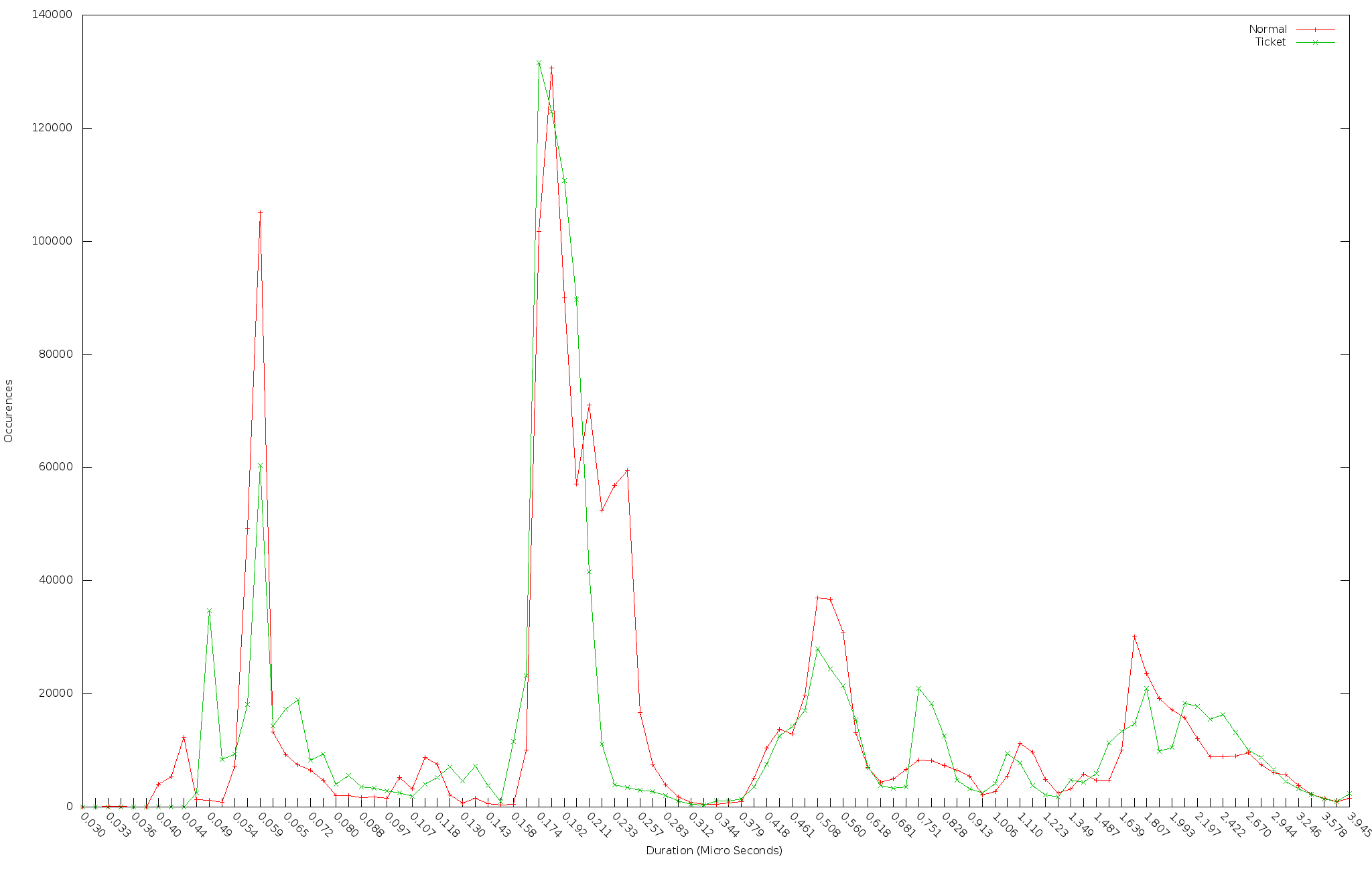
We have analysed the affect of this series on interrupt latency (by measuring the duration of irq disable/enable regions) and there is no signficant impact.
http://xenbits.xen.org/people/dvrabel/bar2_comp.png
Interestingly, the biggest offenders for long critical sections are bare irq disable/enable regions, and some of these are really bad (10s of ms)!
http://xenbits.xen.org/people/dvrabel/bar_normal_busy.png
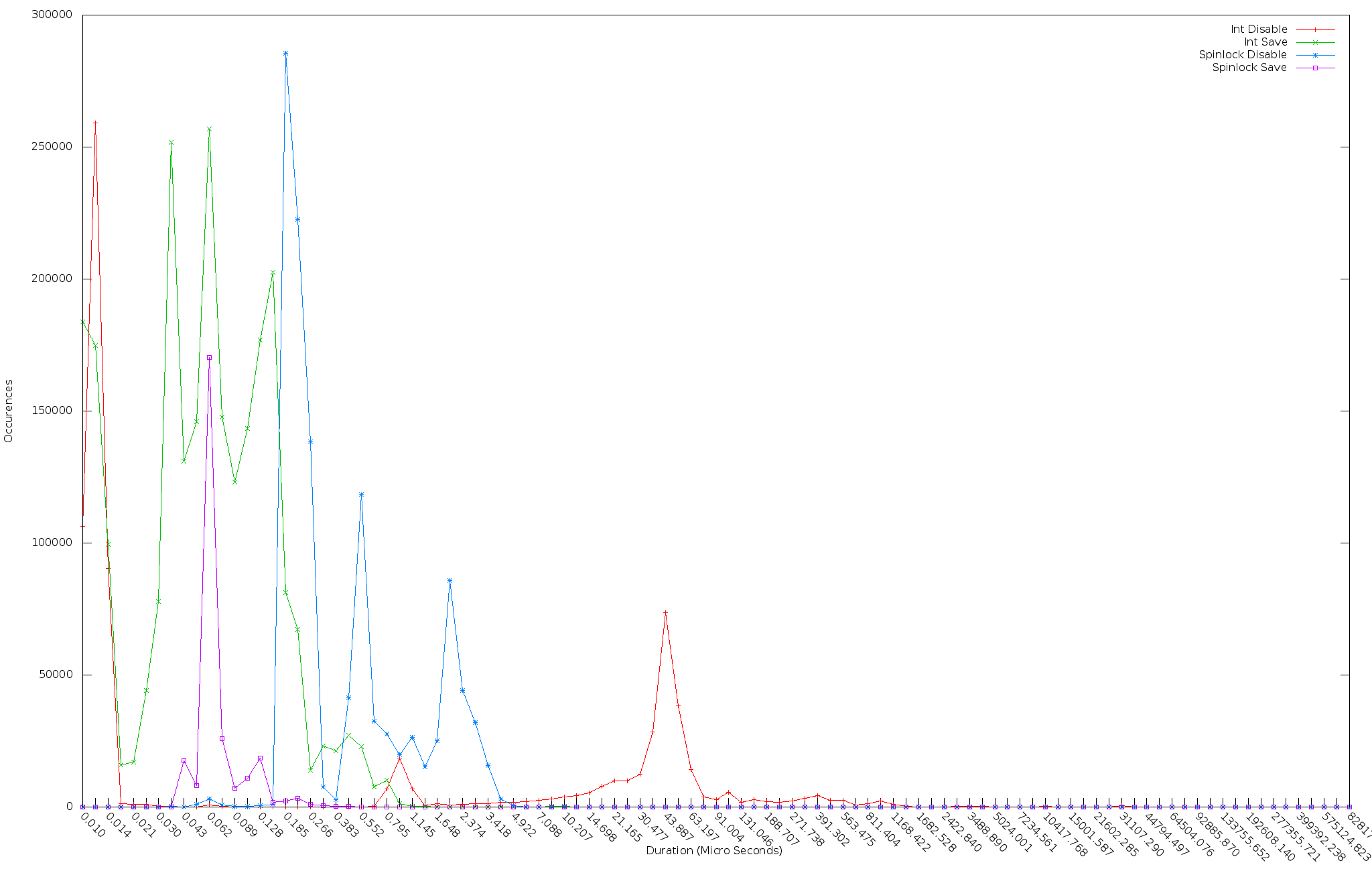
Thanks to Jennifer Herbert for performing this analysis.
Performance results (using a earlier prototype) of aggregate network throughput between 20 VIF pairs shows good improvements.
http://xenbits.xen.org/people/dvrabel/3336.png

This benchmark is limited by contention on the map track lock.
Changes in v3:
- xadd() implementation for arm32 and arm64.
- Add barriers required on arm.
- Only wait for the current lock holder in _spin_barrier().
Changes in v2:
- Reimplemented in C, requiring only an arch-specific xadd() op
- Optimize spin_lock_recursive() to call spin_lock() since trylock loops are bad with ticket locks.
David
PATCH v3 1/4 x86: provide xadd()
xadd() atomically adds a value and returns the previous value. This is needed to implement ticket locks.
---
 xen/include/asm-x86/system.h |   47 ++++++++++++++++++++++++++++++++++++++++++
 1 file changed, 47 insertions(+)
xen/include/asm-x86/system.h +47 -0
@@ -118,6 +118,53 @@ static always_inline unsigned long __cmpxchg( })/* +* Undefined symbol to cause link failure if a wrong size is used with +* xadd(). +*/ +extern unsigned long __bad_xadd_size (void ); + +static always_inline unsigned long __xadd ( +volatile void *ptr,unsigned long v,int size) +{ +switch ( size ) + { +case 1 : + asmvolatile ("lock; xaddb %b0,%1" + :"+r" (v),"+m" (*__xg ((volatile void *)ptr)) + ::"memory" ); +return v; +case 2 : + asmvolatile ("lock; xaddw %w0,%1" + :"+r" (v),"+m" (*__xg ((volatile void *)ptr)) + ::"memory" ); +return v; +case 4 : + asmvolatile ("lock; xaddl %k0,%1" + :"+r" (v),"+m" (*__xg ((volatile void *)ptr)) + ::"memory" ); +return v; +case 8 : + asmvolatile ("lock; xaddq %q0,%1" + :"+r" (v),"+m" (*__xg ((volatile void *)ptr)) + ::"memory" ); + +return v; +default : +return __bad_xadd_size (); + } +} + +/* +* Atomically add @v to the 1, 2, 4, or 8 byte value at @ptr. Returns +* the previous value. +* +* This is a full memory barrier. +*/ +#define xadd (ptr, v) ({ \ + __xadd((ptr), (unsigned long)(v), sizeof(*(ptr))); \ + }) + +/* * Both Intel and AMD agree that, from a programmer's viewpoint: * Loads cannot be reordered relative to other loads. * Stores cannot be reordered relative to other stores.
Signature · 1 line
1.7.10.4
Re: [PATCHv3 1/4] x86: provide xadd()
xen/include/asm-x86/system.h static always_inline unsigned long __cmpxchg( · line 135
Quoted 11 lines
Quoted 1 line
Quoted 1 line · On 21.04.15 at 12:11, <[email protected]> wrote:
xen/include/asm-x86/system.h +10
-0+static always_inline unsigned long __xadd ( +volatile void *ptr,unsigned long v,int size) +{ +switch ( size ) + { +case 1 : + asmvolatile ("lock; xaddb %b0,%1" + :"+r" (v),"+m" (*__xg ((volatile void *)ptr)) + ::"memory" ); +return v;
This doesn't seem to guarantee to return the old value: When the passed in v has more than 8 significant bits (which will get ignored as input), nothing will zap those bits from the register. Same for the 16-bit case obviously.
xen/include/asm-x86/system.h static always_inline unsigned long __cmpxchg( · line 165
Quoted 3 lines
xen/include/asm-x86/system.h +3
-0+#define xadd (ptr, v) ({ \ + __xadd((ptr), (unsigned long)(v), sizeof(*(ptr))); \ + })
Assuming only xadd() is supposed to be used directly, perhaps the easiest would be to cast v to typeof(*(ptr)) (instead of unsigned long) here?
Also note that there's still a superfluous pair of parentheses left here.
Jan
Re: [PATCHv3 1/4] x86: provide xadd()
Quoted 17 lines · Jan Beulich
xen/include/asm-x86/system.h static always_inline unsigned long __cmpxchg( · line 135
Quoted 11 lines
Quoted 1 line
Quoted 1 line · On 21.04.15 at 12:11, <[email protected]> wrote:
xen/include/asm-x86/system.h +10
-0+static always_inline unsigned long __xadd ( +volatile void *ptr,unsigned long v,int size) +{ +switch ( size ) + { +case 1 : + asmvolatile ("lock; xaddb %b0,%1" + :"+r" (v),"+m" (*__xg ((volatile void *)ptr)) + ::"memory" ); +return v;This doesn't seem to guarantee to return the old value: When the passed in v has more than 8 significant bits (which will get ignored as input), nothing will zap those bits from the register. Same for the 16-bit case obviously.
Quoted 7 lines
xen/include/asm-x86/system.h static always_inline unsigned long __cmpxchg( · line 165
Quoted 3 lines
xen/include/asm-x86/system.h +3
-0+#define xadd (ptr, v) ({ \ + __xadd((ptr), (unsigned long)(v), sizeof(*(ptr))); \ + })Assuming only
xadd()is supposed to be used directly, perhaps the easiest would be to cast v to typeof(*(ptr)) (instead of unsigned long) here?
I don't see how this helps. Did you perhaps mean cast the result?
#define xadd(ptr, v) ({                                    \
            (typeof *(ptr))__xadd(ptr, (unsigned long)(v), \
                                  sizeof(*(ptr)));         \
        })
David
Re: [PATCHv3 1/4] x86: provide xadd()
Quoted 27 lines
Quoted 1 line
Quoted 1 line · On 21.04.15 at 14:36, <[email protected]> wrote:
Quoted 17 lines · Jan Beulich
xen/include/asm-x86/system.h static always_inline unsigned long __cmpxchg( · line 135
Quoted 11 lines
Quoted 1 line
Quoted 1 line · On 21.04.15 at 12:11, <[email protected]> wrote:
xen/include/asm-x86/system.h +10
-0+static always_inline unsigned long __xadd ( +volatile void *ptr,unsigned long v,int size) +{ +switch ( size ) + { +case 1 : + asmvolatile ("lock; xaddb %b0,%1" + :"+r" (v),"+m" (*__xg ((volatile void *)ptr)) + ::"memory" ); +return v;This doesn't seem to guarantee to return the old value: When the passed in v has more than 8 significant bits (which will get ignored as input), nothing will zap those bits from the register. Same for the 16-bit case obviously.
Quoted 7 lines
xen/include/asm-x86/system.h static always_inline unsigned long __cmpxchg( · line 165
Quoted 3 lines
xen/include/asm-x86/system.h +3
-0+#define xadd (ptr, v) ({ \ + __xadd((ptr), (unsigned long)(v), sizeof(*(ptr))); \ + })Assuming only
xadd()is supposed to be used directly, perhaps the easiest would be to cast v to typeof(*(ptr)) (instead of unsigned long) here?
Quoted 6 lines
I don't see how this helps. Did you perhaps mean cast the result?
#define xadd(ptr, v) ({                                    \
            (typeof *(ptr))__xadd(ptr, (unsigned long)(v), \
                                  sizeof(*(ptr)));         \
        })
Casting the result would work too; casting the input would have the same effect because (as said) the actual xadd doesn't alter bits 8...63 (or 16...63 in the 16-bit case), i.e. whether zero extension happens before or after doing the xadd doesn't matter.
Jan
Re: [PATCHv3 1/4] x86: provide xadd()
Quoted 34 lines · Jan Beulich
Quoted 27 lines
Quoted 1 line
Quoted 1 line · On 21.04.15 at 14:36, <[email protected]> wrote:
Quoted 17 lines · Jan Beulich
xen/include/asm-x86/system.h static always_inline unsigned long __cmpxchg( · line 135
Quoted 11 lines
Quoted 1 line
Quoted 1 line · On 21.04.15 at 12:11, <[email protected]> wrote:
xen/include/asm-x86/system.h +10
-0+static always_inline unsigned long __xadd ( +volatile void *ptr,unsigned long v,int size) +{ +switch ( size ) + { +case 1 : + asmvolatile ("lock; xaddb %b0,%1" + :"+r" (v),"+m" (*__xg ((volatile void *)ptr)) + ::"memory" ); +return v;This doesn't seem to guarantee to return the old value: When the passed in v has more than 8 significant bits (which will get ignored as input), nothing will zap those bits from the register. Same for the 16-bit case obviously.
Quoted 7 lines
xen/include/asm-x86/system.h static always_inline unsigned long __cmpxchg( · line 165
Quoted 3 lines
xen/include/asm-x86/system.h +3
-0+#define xadd (ptr, v) ({ \ + __xadd((ptr), (unsigned long)(v), sizeof(*(ptr))); \ + })Assuming only
xadd()is supposed to be used directly, perhaps the easiest would be to cast v to typeof(*(ptr)) (instead of unsigned long) here?Quoted 6 lines
I don't see how this helps. Did you perhaps mean cast the result?
#define xadd(ptr, v) ({                                    \
            (typeof *(ptr))__xadd(ptr, (unsigned long)(v), \
                                  sizeof(*(ptr)));         \
        })
Quoted 4 lines
Casting the result would work too; casting the input would have the same effect because (as said) the actual xadd doesn't alter bits 8...63 (or 16...63 in the 16-bit case), i.e. whether zero extension happens before or after doing the xadd doesn't matter.
Oh yes, of course. Any preference to which method?
David
Re: [PATCHv3 1/4] x86: provide xadd()
Quoted 36 lines
Quoted 1 line
Quoted 1 line · On 21.04.15 at 15:15, <[email protected]> wrote:
Quoted 34 lines · Jan Beulich
Quoted 33 lines
Quoted 1 line
Quoted 1 line · On 21.04.15 at 14:36, <[email protected]> wrote:
Quoted 17 lines · Jan Beulich
xen/include/asm-x86/system.h static always_inline unsigned long __cmpxchg( · line 135
Quoted 11 lines
Quoted 1 line
Quoted 1 line · On 21.04.15 at 12:11, <[email protected]> wrote:
xen/include/asm-x86/system.h +10
-0+static always_inline unsigned long __xadd ( +volatile void *ptr,unsigned long v,int size) +{ +switch ( size ) + { +case 1 : + asmvolatile ("lock; xaddb %b0,%1" + :"+r" (v),"+m" (*__xg ((volatile void *)ptr)) + ::"memory" ); +return v;This doesn't seem to guarantee to return the old value: When the passed in v has more than 8 significant bits (which will get ignored as input), nothing will zap those bits from the register. Same for the 16-bit case obviously.
Quoted 7 lines
xen/include/asm-x86/system.h static always_inline unsigned long __cmpxchg( · line 165
Quoted 3 lines
xen/include/asm-x86/system.h +3
-0+#define xadd (ptr, v) ({ \ + __xadd((ptr), (unsigned long)(v), sizeof(*(ptr))); \ + })Assuming only
xadd()is supposed to be used directly, perhaps the easiest would be to cast v to typeof(*(ptr)) (instead of unsigned long) here?I don't see how this helps. Did you perhaps mean cast the result?
#define xadd(ptr, v) ({                                    \
            (typeof *(ptr))__xadd(ptr, (unsigned long)(v), \
                                  sizeof(*(ptr)));         \
        })
Quoted 6 lines
Quoted 4 lines
Casting the result would work too; casting the input would have the same effect because (as said) the actual xadd doesn't alter bits 8...63 (or 16...63 in the 16-bit case), i.e. whether zero extension happens before or after doing the xadd doesn't matter.
Oh yes, of course. Any preference to which method?
Not really - I guess the way you proposed it is the more obvious one.
Jan
PATCH v3 2/4 arm: provide xadd()
In reply to David Vrabelxadd() atomically adds a value and returns the previous value. This is needed to implement ticket locks.
This generic arm implementation uses the GCC __sync_fetch_and_add() builtin. This builtin resulted in suitable inlined asm for GCC 4.8.3 (arm64) and GCC 4.6.3 (arm32).
---
 xen/include/asm-arm/system.h |    2 ++
 1 file changed, 2 insertions(+)
xen/include/asm-arm/system.h +2 -0
@@ -51,6 +51,8 @@# error "unknown ARM variant"#endif +#define xadd (x, v) __sync_fetch_and_add(x, v) +extern struct vcpu *__context_switch (struct vcpu *prev,struct vcpu *next);#endif
Signature · 1 line
1.7.10.4
PATCH v3 3/4 xen: use ticket locks for spin locks
In reply to David VrabelReplace the byte locks with ticket locks. Ticket locks are: a) fair; and b) peform better when contented since they spin without an atomic operation.
The lock is split into two ticket values: head and tail. A locker acquires a ticket by (atomically) increasing tail and using the previous tail value. A CPU holds the lock if its ticket == head. The lock is released by increasing head.
Architectures need only provide an xadd() implementation.
---
 xen/common/spinlock.c      |  110 ++++++++++++++++++++++++--------------------
 xen/include/xen/spinlock.h |   16 +++++--
 2 files changed, 72 insertions(+), 54 deletions(-)
xen/common/spinlock.c +61 -49
@@ -115,16 +115,32 @@ void spin_debug_disable(void)#endif +static always_inline spinlock_tickets_t observe_lock(spinlock_tickets_t *t) +{ +spinlock_tickets_t v; + +smp_rmb (); + v.head_tail =read_atomic (&t->head_tail); +return v; +} + +static always_inline u16 observe_head(spinlock_tickets_t *t) +{ +smp_rmb (); +return read_atomic (&t->head); +} +void _spin_lock (spinlock_t *lock) { +spinlock_tickets_t tickets = { .tail =1 , };LOCK_PROFILE_VAR ;check_lock (&lock->debug); -while (unlikely (!_raw_spin_trylock (&lock->raw)) ) + tickets.head_tail =xadd (&lock->tickets.head_tail, tickets.head_tail); +while ( tickets.tail !=observe_head (&lock->tickets) ) {LOCK_PROFILE_BLOCK ; -while (likely (_raw_spin_is_locked (&lock->raw)) ) -cpu_relax (); +cpu_relax (); }LOCK_PROFILE_GOT ;preempt_disable ();
@@ -132,76 +148,58 @@ void _spin_lock(spinlock_t *lock)void _spin_lock_irq (spinlock_t *lock) { -LOCK_PROFILE_VAR ; -ASSERT (local_irq_is_enabled ());local_irq_disable (); -check_lock (&lock->debug); -while (unlikely (!_raw_spin_trylock (&lock->raw)) ) - { -LOCK_PROFILE_BLOCK ; -local_irq_enable (); -while (likely (_raw_spin_is_locked (&lock->raw)) ) -cpu_relax (); -local_irq_disable (); - } -LOCK_PROFILE_GOT ; -preempt_disable (); +_spin_lock (lock); }unsigned long _spin_lock_irqsave (spinlock_t *lock) {unsigned long flags; -LOCK_PROFILE_VAR ;local_irq_save (flags); -check_lock (&lock->debug); -while (unlikely (!_raw_spin_trylock (&lock->raw)) ) - { -LOCK_PROFILE_BLOCK ; -local_irq_restore (flags); -while (likely (_raw_spin_is_locked (&lock->raw)) ) -cpu_relax (); -local_irq_disable (); - } -LOCK_PROFILE_GOT ; -preempt_disable (); +_spin_lock (lock);return flags; }void _spin_unlock (spinlock_t *lock) { +smp_mb ();preempt_enable ();LOCK_PROFILE_REL ; -_raw_spin_unlock (&lock->raw); + lock->tickets.head++; }void _spin_unlock_irq (spinlock_t *lock) { -preempt_enable (); -LOCK_PROFILE_REL ; -_raw_spin_unlock (&lock->raw); +_spin_unlock (lock);local_irq_enable (); }void _spin_unlock_irqrestore (spinlock_t *lock,unsigned long flags) { -preempt_enable (); -LOCK_PROFILE_REL ; -_raw_spin_unlock (&lock->raw); +_spin_unlock (lock);local_irq_restore (flags); }int _spin_is_locked (spinlock_t *lock) {check_lock (&lock->debug); -return _raw_spin_is_locked (&lock->raw); +return lock->tickets.head != lock->tickets.tail; }int _spin_trylock (spinlock_t *lock) { +spinlock_tickets_t old, new; +check_lock (&lock->debug); -if ( !_raw_spin_trylock (&lock->raw) ) + old =observe_lock (&lock->tickets); +if ( old.head != old.tail ) +return 0 ; + new = old; + new.tail++; +if (cmpxchg (&lock->tickets.head_tail, old.head_tail, new.head_tail) + != old.head_tail )return 0 ;#ifdef LOCK_PROFILE if (lock->profile)
@@ -213,27 +211,32 @@ int _spin_trylock(spinlock_t *lock)void _spin_barrier (spinlock_t *lock) { +spinlock_tickets_t sample;#ifdef LOCK_PROFILE s_time_t block =NOW (); -u64 loop =0 ; +#endif check_barrier (&lock->debug); -do {smp_mb (); loop++;}while (_raw_spin_is_locked (&lock->raw) ); -if ((loop >1 ) && lock->profile) + sample =observe_lock (&lock->tickets); +if (sample.head != sample.tail) { - lock->profile->time_block +=NOW () - block; - lock->profile->block_cnt++; - } -#else -check_barrier (&lock->debug); -do {smp_mb (); }while (_raw_spin_is_locked (&lock->raw) ); +while (observe_head (&lock->tickets) != sample.tail) + { +#ifdef LOCK_PROFILE +if (lock->profile) + { + lock->profile->time_block +=NOW () - block; + lock->profile->block_cnt++; + }#endif + } + }smp_mb (); }int _spin_trylock_recursive (spinlock_t *lock) { -int cpu =smp_processor_id (); +unsigned int cpu =smp_processor_id ();/* Don't allow overflow of recurse_cpu field. */ BUILD_BUG_ON (NR_CPUS >0xfffu );
@@ -256,8 +259,17 @@ int _spin_trylock_recursive(spinlock_t *lock)void _spin_lock_recursive (spinlock_t *lock) { -while ( !spin_trylock_recursive (lock) ) -cpu_relax (); +unsigned int cpu =smp_processor_id (); + +if (likely (lock->recurse_cpu != cpu) ) + { +spin_lock (lock); + lock->recurse_cpu = cpu; + } + +/* We support only fairly shallow recursion, else the counter overflows. */ +ASSERT (lock->recurse_cnt <0xfu ); + lock->recurse_cnt++; }void _spin_unlock_recursive (spinlock_t *lock)
xen/include/xen/spinlock.h +11 -5
@@ -80,8 +80,7 @@ struct lock_profile_qhead { static struct lock_profile *__lock_profile_##name \ __used_section(".lockprofile.data") = \ &__lock_profile_data_##name -#define _SPIN_LOCK_UNLOCKED (x) { _RAW_SPIN_LOCK_UNLOCKED, 0xfffu, 0, \ - _LOCK_DEBUG, x } +#define _SPIN_LOCK_UNLOCKED (x) { { 0 }, 0xfffu, 0, _LOCK_DEBUG, x }#define SPIN_LOCK_UNLOCKED _SPIN_LOCK_UNLOCKED(NULL)#define DEFINE_SPINLOCK (l) \ spinlock_t l = _SPIN_LOCK_UNLOCKED(NULL); \
@@ -117,8 +116,7 @@ extern void spinlock_profile_reset(unsigned char key);struct lock_profile_qhead { }; -#define SPIN_LOCK_UNLOCKED \ - { _RAW_SPIN_LOCK_UNLOCKED, 0xfffu, 0, _LOCK_DEBUG } +#define SPIN_LOCK_UNLOCKED { { 0 }, 0xfffu, 0, _LOCK_DEBUG }#define DEFINE_SPINLOCK (l) spinlock_t l = SPIN_LOCK_UNLOCKED#define spin_lock_init_prof (s, l) spin_lock_init(&((s)->l))
@@ -127,8 +125,16 @@ struct lock_profile_qhead { };#endif +typedef union { +u32 head_tail; +struct { +u16 head; +u16 tail; + }; +}spinlock_tickets_t ; + typedef struct spinlock { - raw_spinlock_t raw; + spinlock_tickets_t tickets; u16 recurse_cpu:12; u16 recurse_cnt:4; struct lock_debug debug;
Signature · 1 line
1.7.10.4
Re: [PATCHv3 3/4] xen: use ticket locks for spin locks
Quoted 6 lines
Quoted 1 line
Quoted 1 line · On 21.04.15 at 12:11, <[email protected]> wrote:
xen/common/spinlock.c +1
-0@@ -213,27 +211,32 @@ int _spin_trylock(spinlock_t *lock)void _spin_barrier (spinlock_t *lock) { +spinlock_tickets_t sample;
xen/common/spinlock.c int _spin_trylock(spinlock_t *lock) · line 221
Quoted 10 lines
xen/common/spinlock.c +3
-3#ifdef LOCK_PROFILE s_time_t block =NOW (); -u64 loop =0 ; +#endif check_barrier (&lock->debug); -do {smp_mb (); loop++;}while (_raw_spin_is_locked (&lock->raw) ); -if ((loop >1 ) && lock->profile) + sample =observe_lock (&lock->tickets); +if (sample.head != sample.tail)
Even if the old code didn't conform to coding style, please make sure the new code does (a few more further down).
Quoted 5 lines
xen/include/xen/spinlock.h +1
-0@@ -127,8 +125,16 @@ struct lock_profile_qhead { };#endif +typedef union {
xen/include/xen/spinlock.h struct lock_profile_qhead { }; · line 137
Quoted 10 lines
xen/include/xen/spinlock.h +8
-1+u32 head_tail; +struct { +u16 head; +u16 tail; + }; +} spinlock_tickets_t; + typedef struct spinlock { - raw_spinlock_t raw; + spinlock_tickets_t tickets;
At least for x86 this means a growth of this and hence various other structures - did you examine the effects thereof? Of course otoh getting the lock size uniform across architectures is a good thing.
Jan
Re: [PATCHv3 3/4] xen: use ticket locks for spin locks
Quoted 17 lines · Jan Beulich
xen/include/xen/spinlock.h struct lock_profile_qhead { }; · line 137
Quoted 12 lines
xen/include/xen/spinlock.h +9
-1+typedef union { +u32 head_tail; +struct { +u16 head; +u16 tail; + }; +}spinlock_tickets_t ; + typedef struct spinlock { - raw_spinlock_t raw; + spinlock_tickets_t tickets;At least for x86 this means a growth of this and hence various other structures - did you examine the effects thereof? Of course otoh getting the lock size uniform across architectures is a good thing.
I've not looked.
Are there any structures whose size you're particularly concerned about?
David
Re: [PATCHv3 3/4] xen: use ticket locks for spin locks
Quoted 19 lines
Quoted 1 line
Quoted 1 line
David Vrabel <[email protected]> 04/28/15 6:16 PM >>>
Quoted 8 lines · Jan Beulich
Quoted 8 lines
xen/include/xen/spinlock.h +8
-0+typedef union { +u32 head_tail; +struct { +u16 head; +u16 tail; + }; +}spinlock_tickets_t ; +Quoted 8 lines
xen/include/xen/spinlock.h struct lock_profile_qhead { }; · line 137
Quoted 3 lines
typedef struct spinlock {
xen/include/xen/spinlock.h +1
-1-raw_spinlock_t raw; +spinlock_tickets_t tickets;At least for x86 this means a growth of this and hence various other structures - did you examine the effects thereof? Of course otoh getting the lock size uniform across architectures is a good thing.
Quoted 3 lines
I've not looked.
Are there any structures whose size you're particularly concerned about?
No specific ones (but of course structures with an inherent size constraint
- like struct domain and struct vcpu - are, with all of their sub-structures, primary candidates). I just recall that in some cases (and this may no longer apply due to later additions) structures got arranged specifically taking in mind the 2-byte size of the locks, and the growth here may thus mean a structure size growth of more than just two bytes.
Jan
Re: [PATCHv3 3/4] xen: use ticket locks for spin locks
Quoted 21 lines · Jan Beulich
Quoted 21 lines
Quoted 1 line
Quoted 1 line
David Vrabel <[email protected]> 04/28/15 6:16 PM >>>
Quoted 8 lines · Jan Beulich
Quoted 8 lines
xen/include/xen/spinlock.h +8
-0+typedef union { +u32 head_tail; +struct { +u16 head; +u16 tail; + }; +}spinlock_tickets_t ; +Quoted 8 lines
xen/include/xen/spinlock.h struct lock_profile_qhead { }; · line 137
Quoted 3 lines
typedef struct spinlock {
xen/include/xen/spinlock.h +1
-1-raw_spinlock_t raw; +spinlock_tickets_t tickets;At least for x86 this means a growth of this and hence various other structures - did you examine the effects thereof? Of course otoh getting the lock size uniform across architectures is a good thing.
I've not looked.
Quoted 8 lines
Quoted 1 line
Are there any structures whose size you're particularly concerned about?
No specific ones (but of course structures with an inherent size constraint
- like struct domain and struct vcpu - are, with all of their sub-structures, primary candidates). I just recall that in some cases (and this may no longer apply due to later additions) structures got arranged specifically taking in mind the 2-byte size of the locks, and the growth here may thus mean a structure size growth of more than just two bytes.
Spin locks are currently 4 bytes (2 bytes for the lock, plus 2 bytes for the recurse_{cnt,cpu}), and ticket locks are now 8 bytes (an increase in 4 bytes).
struct vcpu does not increase in size (there is 56, now 48 bytes, of padding before the arch field).
struct domain increases from 3480 to 3544 bytes.
There's no change to any event channel structure.
struct grant_table increases from 64 to 74 bytes, but in combination with the pending grant table locking patches this can be made 64 bytes again.
David
Re: [PATCHv3 3/4] xen: use ticket locks for spin locks
Quoted 12 lines
Quoted 1 line
Quoted 1 line
David Vrabel <[email protected]> 04/29/15 5:28 PM >>>
Quoted 9 lines · Jan Beulich
Quoted 2 lines
Quoted 1 line
Quoted 1 line
David Vrabel <[email protected]> 04/28/15 6:16 PM >>>
Are there any structures whose size you're particularly concerned about?
No specific ones (but of course structures with an inherent size constraint
- like struct domain and struct vcpu - are, with all of their sub-structures, primary candidates). I just recall that in some cases (and this may no longer apply due to later additions) structures got arranged specifically taking in mind the 2-byte size of the locks, and the growth here may thus mean a structure size growth of more than just two bytes.
Quoted 8 lines
Spin locks are currently 4 bytes (2 bytes for the lock, plus 2 bytes for the recurse_{cnt,cpu}), and ticket locks are now 8 bytes (an increase in 4 bytes).
struct vcpu does not increase in size (there is 56, now 48 bytes, of padding before the arch field).
struct domain increases from 3480 to 3544 bytes.
Odd - this suggests there's still some 64-byte alignment somewhere, but I can't immediately spot it. Only struct vcpu has an obvious 64-byte aligned field (struct pi_desc) afaics.
Jan
Re: [PATCHv3 3/4] xen: use ticket locks for spin locks
Quoted 16 lines · Jan Beulich
Quoted 16 lines
Quoted 1 line
Quoted 1 line
David Vrabel <[email protected]> 04/29/15 5:28 PM >>>
Quoted 9 lines · Jan Beulich
Quoted 2 lines
Quoted 1 line
Quoted 1 line
David Vrabel <[email protected]> 04/28/15 6:16 PM >>>
Are there any structures whose size you're particularly concerned about?
No specific ones (but of course structures with an inherent size constraint
- like struct domain and struct vcpu - are, with all of their sub-structures, primary candidates). I just recall that in some cases (and this may no longer apply due to later additions) structures got arranged specifically taking in mind the 2-byte size of the locks, and the growth here may thus mean a structure size growth of more than just two bytes.Spin locks are currently 4 bytes (2 bytes for the lock, plus 2 bytes for the recurse_{cnt,cpu}), and ticket locks are now 8 bytes (an increase in 4 bytes).
Quoted 8 lines
Quoted 4 lines
struct vcpu does not increase in size (there is 56, now 48 bytes, of padding before the arch field).
struct domain increases from 3480 to 3544 bytes.
Odd - this suggests there's still some 64-byte alignment somewhere, but I can't immediately spot it. Only struct vcpu has an obvious 64-byte aligned field (struct
pi_desc) afaics.
I got slightly different numbers to David (I suspect just starting from a different baseline) but the biggest hole came from struct arch_domain being __cacheline_aligned (i.e. 128-byte aligned).
There are some holes above it in struct domain which should pack in nicely to counteract the larger spinlocks, e.g. this was enough to naturally align arch_domain again in my tree:
@@ -334,9 +334,9 @@ struct domain
     spinlock_t       rangesets_lock;

     /* Event channel information. */
+    unsigned int     max_evtchns;
     struct evtchn   *evtchn;                         /* first bucket only */
     struct evtchn  **evtchn_group[NR_EVTCHN_GROUPS]; /* all other buckets */
-    unsigned int     max_evtchns;
     unsigned int     max_evtchn_port;
     spinlock_t       event_lock;
     const struct evtchn_port_ops *evtchn_port_ops;
Cheers,
Tim.
Re: [PATCHv3 3/4] xen: use ticket locks for spin locks
Quoted 35 lines · Tim Deegan
Quoted 16 lines · Jan Beulich
Quoted 16 lines
Quoted 1 line
Quoted 1 line
David Vrabel <[email protected]> 04/29/15 5:28 PM >>>
Quoted 9 lines · Jan Beulich
Quoted 2 lines
Quoted 1 line
Quoted 1 line
David Vrabel <[email protected]> 04/28/15 6:16 PM >>>
Are there any structures whose size you're particularly concerned about?
No specific ones (but of course structures with an inherent size constraint
- like struct domain and struct vcpu - are, with all of their sub-structures, primary candidates). I just recall that in some cases (and this may no longer apply due to later additions) structures got arranged specifically taking in mind the 2-byte size of the locks, and the growth here may thus mean a structure size growth of more than just two bytes.Spin locks are currently 4 bytes (2 bytes for the lock, plus 2 bytes for the recurse_{cnt,cpu}), and ticket locks are now 8 bytes (an increase in 4 bytes).
Quoted 8 lines
Quoted 4 lines
struct vcpu does not increase in size (there is 56, now 48 bytes, of padding before the arch field).
struct domain increases from 3480 to 3544 bytes.
Odd - this suggests there's still some 64-byte alignment somewhere, but I can't immediately spot it. Only struct vcpu has an obvious 64-byte aligned field (struct
pi_desc) afaics.I got slightly different numbers to David (I suspect just starting from a different baseline) but the biggest hole came from struct
arch_domainbeing__cacheline_aligned(i.e. 128-byte aligned).There are some holes above it in struct domain which should pack in nicely to counteract the larger spinlocks, e.g. this was enough to naturally align
arch_domainagain in my tree:
Review struct domain · line 342
Quoted 10 lines
(quoted diff) +1
-1@@ -334,9 +334,9 @@ struct domain spinlock_t rangesets_lock; /* Event channel information. */ + unsigned int max_evtchns; struct evtchn *evtchn; /* first bucket only */ struct evtchn **evtchn_group[NR_EVTCHN_GROUPS]; /* all other buckets */ - unsigned int max_evtchns; unsigned int max_evtchn_port; spinlock_t event_lock; const struct evtchn_port_ops *evtchn_port_ops;
This change makes struct domain 8 bytes bigger with ticket locks.
On x86 there are 12 spinlocks in struct domain which is 48 bytes extra.
I've clawed back 16 bytes by repacking struct paging_domain and structhvm_domain.
David
Re: [PATCHv3 3/4] xen: use ticket locks for spin locks
In reply to David VrabelHi,
Quoted 7 lines · David Vrabel
void
_spin_lock(spinlock_t *lock)
{xen/common/spinlock.c +1
-1+spinlock_tickets_t tickets = { .tail =1 , };LOCK_PROFILE_VAR ;check_lock (&lock->debug); -while (unlikely (!_raw_spin_trylock (&lock->raw)) )
xen/common/spinlock.c void spin_debug_disable(void) · line 146
Quoted 10 lines
xen/common/spinlock.c +3
-2+ tickets.head_tail =xadd (&lock->tickets.head_tail, tickets.head_tail); +while ( tickets.tail !=observe_head (&lock->tickets) ) {LOCK_PROFILE_BLOCK ; -while (likely (_raw_spin_is_locked (&lock->raw)) ) -cpu_relax (); +cpu_relax (); }LOCK_PROFILE_GOT ;preempt_disable ();
I think you need an smp_mb() here to make sure that locked accesses don't get hoisted past the wait-for-my-ticket loop by an out-of-order (ARM) cpu.
xen/common/spinlock.c void _spin_lock(spinlock_t *lock) · line 170
Quoted 7 lines
void
_spin_unlock(spinlock_t *lock)
{xen/common/spinlock.c +2
-1+smp_mb ();preempt_enable ();LOCK_PROFILE_REL ; -_raw_spin_unlock (&lock->raw); + lock->tickets.head++;
This needs to be done with an explicit atomic (though not locked) write; otherwise the compiler might use some unsuitable operation that clobbers .tail as well. (For some reason I convinced myself last time that this was OK, but I can't remember why. :))
Cheers,
Tim.
Re: [PATCHv3 3/4] xen: use ticket locks for spin locks
Quoted 21 lines · Tim Deegan
Hi,
Quoted 7 lines · David Vrabel
void
_spin_lock(spinlock_t *lock)
{xen/common/spinlock.c +1
-1+spinlock_tickets_t tickets = { .tail =1 , };LOCK_PROFILE_VAR ;check_lock (&lock->debug); -while (unlikely (!_raw_spin_trylock (&lock->raw)) )xen/common/spinlock.c void spin_debug_disable(void) · line 146
Quoted 10 lines
xen/common/spinlock.c +3
-2+ tickets.head_tail =xadd (&lock->tickets.head_tail, tickets.head_tail); +while ( tickets.tail !=observe_head (&lock->tickets) ) {LOCK_PROFILE_BLOCK ; -while (likely (_raw_spin_is_locked (&lock->raw)) ) -cpu_relax (); +cpu_relax (); }LOCK_PROFILE_GOT ;preempt_disable ();
Quoted 3 lines
I think you need an
smp_mb()here to make sure that locked accesses don't get hoisted past the wait-for-my-ticket loop by an out-of-order (ARM) cpu.
Ok, but smp_mb() turns into an mfence on x86. Is this a problem/sub-optimal?
David
Re: [PATCHv3 3/4] xen: use ticket locks for spin locks
Quoted 21 lines · David Vrabel
Quoted 20 lines · Tim Deegan
Hi,
Quoted 17 lines · David Vrabel
void
_spin_lock(spinlock_t *lock)
{xen/common/spinlock.c +4
-3+spinlock_tickets_t tickets = { .tail =1 , };LOCK_PROFILE_VAR ;check_lock (&lock->debug); -while (unlikely (!_raw_spin_trylock (&lock->raw)) ) + tickets.head_tail =xadd (&lock->tickets.head_tail, tickets.head_tail); +while ( tickets.tail !=observe_head (&lock->tickets) ) {LOCK_PROFILE_BLOCK ; -while (likely (_raw_spin_is_locked (&lock->raw)) ) -cpu_relax (); +cpu_relax (); }LOCK_PROFILE_GOT ;preempt_disable ();
Quoted 5 lines
Quoted 3 lines
I think you need an
smp_mb()here to make sure that locked accesses don't get hoisted past the wait-for-my-ticket loop by an out-of-order (ARM) cpu.Ok, but
smp_mb()turns into an mfence on x86. Is this a problem/sub-optimal?
That can probably change back to a plain compiler barrier as Xen only supports 64bit and doesn't need PPRO ordering errata workarounds.
~Andrew
Re: [PATCHv3 3/4] xen: use ticket locks for spin locks
Quoted 22 lines · Andrew Cooper
Quoted 21 lines · David Vrabel
Quoted 20 lines · Tim Deegan
Hi,
Quoted 17 lines · David Vrabel
void
_spin_lock(spinlock_t *lock)
{xen/common/spinlock.c +4
-3+spinlock_tickets_t tickets = { .tail =1 , };LOCK_PROFILE_VAR ;check_lock (&lock->debug); -while (unlikely (!_raw_spin_trylock (&lock->raw)) ) + tickets.head_tail =xadd (&lock->tickets.head_tail, tickets.head_tail); +while ( tickets.tail !=observe_head (&lock->tickets) ) {LOCK_PROFILE_BLOCK ; -while (likely (_raw_spin_is_locked (&lock->raw)) ) -cpu_relax (); +cpu_relax (); }LOCK_PROFILE_GOT ;preempt_disable ();
Quoted 8 lines
Quoted 5 lines
Quoted 3 lines
I think you need an
smp_mb()here to make sure that locked accesses don't get hoisted past the wait-for-my-ticket loop by an out-of-order (ARM) cpu.Ok, but
smp_mb()turns into an mfence on x86. Is this a problem/sub-optimal?That can probably change back to a plain compiler barrier as Xen only supports 64bit and doesn't need PPRO ordering errata workarounds.
And for the archive: smp_mb() needs to be an mfence in the general case, otherwise "WRITE; smp_mb(); READ;" can be reordered, if the write and read are to different addresses.
Tim.
Re: [PATCHv3 3/4] xen: use ticket locks for spin locks
In reply to David VrabelQuoted 22 lines · David Vrabel
Quoted 21 lines · Tim Deegan
Hi,
Quoted 17 lines · David Vrabel
void
_spin_lock(spinlock_t *lock)
{xen/common/spinlock.c +4
-3+spinlock_tickets_t tickets = { .tail =1 , };LOCK_PROFILE_VAR ;check_lock (&lock->debug); -while (unlikely (!_raw_spin_trylock (&lock->raw)) ) + tickets.head_tail =xadd (&lock->tickets.head_tail, tickets.head_tail); +while ( tickets.tail !=observe_head (&lock->tickets) ) {LOCK_PROFILE_BLOCK ; -while (likely (_raw_spin_is_locked (&lock->raw)) ) -cpu_relax (); +cpu_relax (); }LOCK_PROFILE_GOT ;preempt_disable ();
Quoted 6 lines
Quoted 3 lines
I think you need an
smp_mb()here to make sure that locked accesses don't get hoisted past the wait-for-my-ticket loop by an out-of-order (ARM) cpu.Ok, but
smp_mb()turns into an mfence on x86. Is this a problem/sub-optimal?
So, having chased this around my head for a while, I think you're right. Expanding this code a bit, I think the important ops are:
(in observe_head())
smp_rmb() (== barrier())
[ POINT A ]
read lock and see that we have acquired it
(in preempt_disable())
increment disable count (this is both a read and a write) barrier();
[ POINT B ]
A read after point B can't see unlocked state because of the second compiler barrier and the fact that x86 won't reorder it past the read in observe_head().
A write after point B can't be observed before we have the lock because
1) the second barrier stops the compiler reorderign before the increment;
2) x86 won't make it visible before the write half of the increment;
3) the write half of the increment can't happen before the read half; and
4) the read half can't happen before the read in observe_head().
I'm not 100% sure about (3), as it happens; maybe either the compiler or the CPU might do something unexpected there?
So probably, on x86, we don't need the mfence. A bit fragile, though, relying on the internals of preempt_disable().
Tim.
Re: [PATCHv3 3/4] xen: use ticket locks for spin locks
Quoted 53 lines · Tim Deegan
Quoted 22 lines · David Vrabel
Quoted 21 lines · Tim Deegan
Hi,
Quoted 17 lines · David Vrabel
void
_spin_lock(spinlock_t *lock)
{xen/common/spinlock.c +4
-3+spinlock_tickets_t tickets = { .tail =1 , };LOCK_PROFILE_VAR ;check_lock (&lock->debug); -while (unlikely (!_raw_spin_trylock (&lock->raw)) ) + tickets.head_tail =xadd (&lock->tickets.head_tail, tickets.head_tail); +while ( tickets.tail !=observe_head (&lock->tickets) ) {LOCK_PROFILE_BLOCK ; -while (likely (_raw_spin_is_locked (&lock->raw)) ) -cpu_relax (); +cpu_relax (); }LOCK_PROFILE_GOT ;preempt_disable ();Quoted 6 lines
Quoted 3 lines
I think you need an
smp_mb()here to make sure that locked accesses don't get hoisted past the wait-for-my-ticket loop by an out-of-order (ARM) cpu.Ok, but
smp_mb()turns into an mfence on x86. Is this a problem/sub-optimal?So, having chased this around my head for a while, I think you're right. Expanding this code a bit, I think the important ops are:
(in
observe_head())
smp_rmb()(==barrier())
[ POINT A ]
read lock and see that we have acquired it
(inpreempt_disable())
increment disable count (this is both a read and a write)barrier();
[ POINT B ]A read after point B can't see unlocked state because of the second compiler barrier and the fact that x86 won't reorder it past the read in
observe_head().A write after point B can't be observed before we have the lock because
1) the second barrier stops the compiler reorderign before the increment;
2) x86 won't make it visible before the write half of the increment;
3) the write half of the increment can't happen before the read half; and
4) the read half can't happen before the read inobserve_head().
Quoted 5 lines
I'm not 100% sure about (3), as it happens; maybe either the compiler or the CPU might do something unexpected there?
So probably, on x86, we don't need the mfence. A bit fragile, though, relying on the internals of
preempt_disable().
Andrew pointed me at the SDM (vol 3, 8.2.2.) that says that writes are not reordered with older reads. So the write case is the same as the read case: the read in observe_head() is the important one and all we need here is a barrier().
I guess you could invent an arch_lock_acquire_barrier() or similar to go here, that expands to barrier() on x86 and dmb() on ARM...
Tim.
Re: [PATCHv3 3/4] xen: use ticket locks for spin locks
In reply to Tim DeeganQuoted 10 lines
Quoted 1 line
Quoted 1 line · On 23.04.15 at 14:03, <[email protected]> wrote:
xen/common/spinlock.c void _spin_lock(spinlock_t *lock) · line 170
Quoted 7 lines · David Vrabel
void
_spin_unlock(spinlock_t *lock)
{xen/common/spinlock.c +2
-1+smp_mb ();preempt_enable ();LOCK_PROFILE_REL ; -_raw_spin_unlock (&lock->raw); + lock->tickets.head++;
Quoted 3 lines
This needs to be done with an explicit atomic (though not locked) write; otherwise the compiler might use some unsuitable operation that clobbers .tail as well.
How do you imagine that to happen? An increment of one structure member surely won't modify any others.
Jan
Re: [PATCHv3 3/4] xen: use ticket locks for spin locks
Quoted 10 lines · Jan Beulich
Quoted 10 lines
Quoted 1 line
Quoted 1 line · On 23.04.15 at 14:03, <[email protected]> wrote:
Quoted 7 lines · David Vrabel
void
_spin_unlock(spinlock_t *lock)
{xen/common/spinlock.c +2
-1+smp_mb ();preempt_enable ();LOCK_PROFILE_REL ; -_raw_spin_unlock (&lock->raw); + lock->tickets.head++;
Quoted 6 lines
Quoted 3 lines
This needs to be done with an explicit atomic (though not locked) write; otherwise the compiler might use some unsuitable operation that clobbers .tail as well.
How do you imagine that to happen? An increment of one structure member surely won't modify any others.
AIUI, the '++' could end up as a word-size read, modify, and word-size write. If another CPU updates .tail parallel, that update could get lost.
Tim.
Re: [PATCHv3 3/4] xen: use ticket locks for spin locks
Quoted 16 lines
Quoted 1 line
Quoted 1 line · On 23.04.15 at 16:43, <[email protected]> wrote:
Quoted 14 lines · Jan Beulich
Quoted 13 lines
Quoted 1 line
Quoted 1 line · On 23.04.15 at 14:03, <[email protected]> wrote:
xen/common/spinlock.c void _spin_lock(spinlock_t *lock) · line 170
Quoted 7 lines · David Vrabel
void
_spin_unlock(spinlock_t *lock)
{xen/common/spinlock.c +2
-1+smp_mb ();preempt_enable ();LOCK_PROFILE_REL ; -_raw_spin_unlock (&lock->raw); + lock->tickets.head++;This needs to be done with an explicit atomic (though not locked) write; otherwise the compiler might use some unsuitable operation that clobbers .tail as well.
Quoted 6 lines
Quoted 2 lines
How do you imagine that to happen? An increment of one structure member surely won't modify any others.
AIUI, the '++' could end up as a word-size read, modify, and word-size write. If another CPU updates .tail parallel, that update could get lost.
Ah, right, compilers are allowed to do that, albeit normally wouldn't unless the architecture has no suitable loads/stores.
Jan
Re: [PATCHv3 3/4] xen: use ticket locks for spin locks
Quoted 19 lines · Jan Beulich
Quoted 19 lines
Quoted 1 line
Quoted 1 line · On 23.04.15 at 16:43, <[email protected]> wrote:
Quoted 16 lines · Jan Beulich
Quoted 10 lines
Quoted 1 line
Quoted 1 line · On 23.04.15 at 14:03, <[email protected]> wrote:
xen/common/spinlock.c void _spin_lock(spinlock_t *lock) · line 170
Quoted 7 lines · David Vrabel
void
_spin_unlock(spinlock_t *lock)
{xen/common/spinlock.c +2
-1+smp_mb ();preempt_enable ();LOCK_PROFILE_REL ; -_raw_spin_unlock (&lock->raw); + lock->tickets.head++;Quoted 3 lines
This needs to be done with an explicit atomic (though not locked) write; otherwise the compiler might use some unsuitable operation that clobbers .tail as well.
How do you imagine that to happen? An increment of one structure member surely won't modify any others.
Quoted 6 lines
Quoted 3 lines
AIUI, the '++' could end up as a word-size read, modify, and word-size write. If another CPU updates .tail parallel, that update could get lost.
Ah, right, compilers are allowed to do that, albeit normally wouldn't unless the architecture has no suitable loads/stores.
lock->tickets.head++;
7b: 66 83 07 01 addw $0x1,(%rdi)
write_atomic(&lock->tickets.head, lock->tickets.head + 1);
  7b:   0f b7 07                movzwl (%rdi),%eax
  7e:   83 c0 01                add    $0x1,%eax
  81:   66 89 07                mov    %ax,(%rdi)
Do you want a new add_atomic() operation? e.g.,
#define add_atomic(ptr, inc) \
        asm volatile ("addw %1,%w" \
            : "+m" (*(ptr)) : "ri" (inc) : "memory")
(but obviously handling all the different sizes.)
David
Re: [PATCHv3 3/4] xen: use ticket locks for spin locks
Quoted 29 lines · David Vrabel
Quoted 19 lines · Jan Beulich
Quoted 19 lines
Quoted 1 line
Quoted 1 line · On 23.04.15 at 16:43, <[email protected]> wrote:
Quoted 16 lines · Jan Beulich
Quoted 10 lines
Quoted 1 line
Quoted 1 line · On 23.04.15 at 14:03, <[email protected]> wrote:
xen/common/spinlock.c void _spin_lock(spinlock_t *lock) · line 170
Quoted 7 lines · David Vrabel
void
_spin_unlock(spinlock_t *lock)
{xen/common/spinlock.c +2
-1+smp_mb ();preempt_enable ();LOCK_PROFILE_REL ; -_raw_spin_unlock (&lock->raw); + lock->tickets.head++;Quoted 3 lines
This needs to be done with an explicit atomic (though not locked) write; otherwise the compiler might use some unsuitable operation that clobbers .tail as well.
How do you imagine that to happen? An increment of one structure member surely won't modify any others.
Quoted 6 lines
Quoted 3 lines
AIUI, the '++' could end up as a word-size read, modify, and word-size write. If another CPU updates .tail parallel, that update could get lost.
Ah, right, compilers are allowed to do that, albeit normally wouldn't unless the architecture has no suitable loads/stores.
lock->tickets.head++;
Quoted 7 lines
7b: 66 83 07 01 addw $0x1,(%rdi)
write_atomic(&lock->tickets.head, lock->tickets.head + 1);7b: 0f b7 07 movzwl (%rdi),%eax 7e: 83 c0 01 add $0x1,%eax 81: 66 89 07 mov %ax,(%rdi)
:(
Quoted 7 lines
Do you want a new
add_atomic()operation? e.g.,#define add_atomic(ptr, inc) \ asm volatile ("addw %1,%w" \ : "+m" (*(ptr)) : "ri" (inc) : "memory")(but obviously handling all the different sizes.)
I guess so. An equivalent 'inc' operation would be even shorter, but maybe GCC has its reasons for using addw + immediate? (Ah, it's in the optimization manual: addw $1 is preferred because it sets all the flags, whereas inc sets only some, so the inc has a dependence on the previous instruction to set flags.)
It needs some careful naming -- this series will add two new add operations, currently xadd() and add_atomic(), where xadd() is the more atomic of the two, IYSWIM.
Cheers,
Tim.
Re: [PATCHv3 3/4] xen: use ticket locks for spin locks
Quoted 54 lines · Tim Deegan
Quoted 29 lines · David Vrabel
Quoted 19 lines · Jan Beulich
Quoted 19 lines
Quoted 1 line
Quoted 1 line · On 23.04.15 at 16:43, <[email protected]> wrote:
Quoted 16 lines · Jan Beulich
Quoted 10 lines
Quoted 1 line
Quoted 1 line · On 23.04.15 at 14:03, <[email protected]> wrote:
Review
Quoted 7 lines · David Vrabel
void
_spin_unlock(spinlock_t *lock)
{(quoted diff) +2
-1+ smp_mb(); preempt_enable(); LOCK_PROFILE_REL; - _raw_spin_unlock(&lock->raw); + lock->tickets.head++;Quoted 3 lines
This needs to be done with an explicit atomic (though not locked) write; otherwise the compiler might use some unsuitable operation that clobbers .tail as well.
How do you imagine that to happen? An increment of one structure member surely won't modify any others.
Quoted 6 lines
Quoted 3 lines
AIUI, the '++' could end up as a word-size read, modify, and word-size write. If another CPU updates .tail parallel, that update could get lost.
Ah, right, compilers are allowed to do that, albeit normally wouldn't unless the architecture has no suitable loads/stores.
lock->tickets.head++;
Quoted 7 lines
7b: 66 83 07 01 addw $0x1,(%rdi)
write_atomic(&lock->tickets.head, lock->tickets.head + 1);7b: 0f b7 07 movzwl (%rdi),%eax 7e: 83 c0 01 add $0x1,%eax 81: 66 89 07 mov %ax,(%rdi):(
Quoted 7 lines
Do you want a new
add_atomic()operation? e.g.,#define add_atomic(ptr, inc) \ asm volatile ("addw %1,%w" \ : "+m" (*(ptr)) : "ri" (inc) : "memory")(but obviously handling all the different sizes.)
I guess so. An equivalent 'inc' operation would be even shorter, but maybe GCC has its reasons for using addw + immediate? (Ah, it's in the optimization manual: addw $1 is preferred because it sets all the flags, whereas inc sets only some, so the inc has a dependence on the previous instruction to set flags.)
Quoted 3 lines
It needs some careful naming -- this series will add two new add operations, currently
xadd()andadd_atomic(), wherexadd()is the more atomic of the two, IYSWIM.
Should I rename xadd() to arch_fetch_and_add() to match the GCC builtin name?
David
Re: [PATCHv3 3/4] xen: use ticket locks for spin locks
Quoted 55 lines · David Vrabel
Quoted 54 lines · Tim Deegan
Quoted 29 lines · David Vrabel
Quoted 19 lines · Jan Beulich
Quoted 19 lines
Quoted 1 line
Quoted 1 line · On 23.04.15 at 16:43, <[email protected]> wrote:
Quoted 16 lines · Jan Beulich
Quoted 10 lines
Quoted 1 line
Quoted 1 line · On 23.04.15 at 14:03, <[email protected]> wrote:
Review
Quoted 7 lines · David Vrabel
void
_spin_unlock(spinlock_t *lock)
{(quoted diff) +2
-1+ smp_mb(); preempt_enable(); LOCK_PROFILE_REL; - _raw_spin_unlock(&lock->raw); + lock->tickets.head++;Quoted 3 lines
This needs to be done with an explicit atomic (though not locked) write; otherwise the compiler might use some unsuitable operation that clobbers .tail as well.
How do you imagine that to happen? An increment of one structure member surely won't modify any others.
Quoted 6 lines
Quoted 3 lines
AIUI, the '++' could end up as a word-size read, modify, and word-size write. If another CPU updates .tail parallel, that update could get lost.
Ah, right, compilers are allowed to do that, albeit normally wouldn't unless the architecture has no suitable loads/stores.
lock->tickets.head++;
Quoted 7 lines
7b: 66 83 07 01 addw $0x1,(%rdi)
write_atomic(&lock->tickets.head, lock->tickets.head + 1);7b: 0f b7 07 movzwl (%rdi),%eax 7e: 83 c0 01 add $0x1,%eax 81: 66 89 07 mov %ax,(%rdi):(
Quoted 7 lines
Do you want a new
add_atomic()operation? e.g.,#define add_atomic(ptr, inc) \ asm volatile ("addw %1,%w" \ : "+m" (*(ptr)) : "ri" (inc) : "memory")(but obviously handling all the different sizes.)
I guess so. An equivalent 'inc' operation would be even shorter, but maybe GCC has its reasons for using addw + immediate? (Ah, it's in the optimization manual: addw $1 is preferred because it sets all the flags, whereas inc sets only some, so the inc has a dependence on the previous instruction to set flags.)
Quoted 6 lines
Quoted 3 lines
It needs some careful naming -- this series will add two new add operations, currently
xadd()andadd_atomic(), wherexadd()is the more atomic of the two, IYSWIM.Should I rename
xadd()toarch_fetch_and_add()to match the GCC builtin name?
Yes, that sounds good. And maybe the new one could be add_sized() or similar? Just to avoid anyone using it when they wanted a locked op.
Tim.
Re: [PATCHv3 3/4] xen: use ticket locks for spin locks
In reply to David VrabelQuoted 17 lines
Quoted 1 line
Quoted 1 line
David Vrabel <[email protected]> 04/29/15 5:39 PM >>>
Quoted 8 lines · Jan Beulich
Quoted 5 lines
Quoted 1 line
Quoted 1 line · On 23.04.15 at 16:43, <[email protected]> wrote:
At 14:54 +0100 on 23 Apr (1429800874), Jan Beulich wrote:
AIUI, the '++' could end up as a word-size read, modify, and word-size write. If another CPU updates .tail parallel, that update could get lost.Ah, right, compilers are allowed to do that, albeit normally wouldn't unless the architecture has no suitable loads/stores.
lock->tickets.head++;
7b: 66 83 07 01 addw $0x1,(%rdi)
write_atomic(&lock->tickets.head, lock->tickets.head + 1);
Quoted 7 lines
7b: 0f b7 07 movzwl (%rdi),%eax 7e: 83 c0 01 add $0x1,%eax 81: 66 89 07 mov %ax,(%rdi)Do you want a new
add_atomic()operation? e.g.,#define
add_atomic(ptr, inc)\
        >asm volatile ("addw %1,%w" \
            >: "+m" (*(ptr)) : "ri" (inc) : "memory")
<
Quoted 1 line
(but obviously handling all the different sizes.)
I think that would be desirable.
Jan
PATCH v3 4/4 x86, arm: remove asm/spinlock.h from all architectures
In reply to David VrabelNow that all architecture use a common ticket lock implementation for spinlocks, remove the architecture specific byte lock implementations.
---
 xen/arch/arm/README.LinuxPrimitives  |   28 ---------------
 xen/include/asm-arm/arm32/spinlock.h |   66 ----------------------------------
 xen/include/asm-arm/arm64/spinlock.h |   63 --------------------------------
 xen/include/asm-arm/spinlock.h       |   23 ------------
 xen/include/asm-x86/spinlock.h       |   37 -------------------
 xen/include/xen/spinlock.h           |    1 -
 6 files changed, 218 deletions(-)
 delete mode 100644 xen/include/asm-arm/arm32/spinlock.h
 delete mode 100644 xen/include/asm-arm/arm64/spinlock.h
 delete mode 100644 xen/include/asm-arm/spinlock.h
 delete mode 100644 xen/include/asm-x86/spinlock.h
xen/arch/arm/README.LinuxPrimitives +0 -28
@@ -25,16 +25,6 @@ linux/arch/arm64/include/asm/atomic.h xen/include/asm-arm/arm64/atomic.h --------------------------------------------------------------------- -spinlocks: last sync @ v3.16-rc6 (last commit: 95c4189689f9) - -linux/arch/arm64/include/asm/spinlock.h xen/include/asm-arm/arm64/spinlock.h - -Skipped: - 5686b06 arm64: lockref: add support for lockless lockrefs using cmpxchg - 52ea2a5 arm64: locks: introduce ticket-based spinlock implementation - ---------------------------------------------------------------------- - mem*: last sync @ v3.16-rc6 (last commit: d875c9b37240) linux/arch/arm64/lib/memchr.S xen/arch/arm/arm64/lib/memchr.S
@@ -103,24 +93,6 @@ linux/arch/arm/include/asm/atomic.h     xen/include/asm-arm/arm32/atomic.h

 ---------------------------------------------------------------------

-spinlocks: last sync: 15e7e5c1ebf5
-
-linux/arch/arm/include/asm/spinlock.h   xen/include/asm-arm/arm32/spinlock.h
-
-*** Linux has switched to ticket locks but we still use bitlocks.
-
-resync to v3.14-rc7:
-
-  7c8746a ARM: 7955/1: spinlock: ensure we have a compiler barrier before sev
-  0cbad9c ARM: 7854/1: lockref: add support for lockless lockrefs using cmpxchg64
-  9bb17be ARM: locks: prefetch the destination word for write prior to strex
-  27a8479 ARM: smp_on_up: move inline asm ALT_SMP patching macro out of spinlock.
-  00efaa0 ARM: 7812/1: rwlocks: retry trylock operation if strex fails on free lo
-  afa31d8 ARM: 7811/1: locks: use early clobber in arch_spin_trylock
-  73a6fdc ARM: spinlock: use inner-shareable dsb variant prior to sev instruction
-
----------------------------------------------------------------------
-
 mem*: last sync @ v3.16-rc6 (last commit: d98b90ea22b0)

 linux/arch/arm/lib/copy_template.S      xen/arch/arm/arm32/lib/copy_template.S
xen/include/asm-arm/arm32/spinlock.h deleted +0 -66
66 lines not on this page · raw message
xen/include/asm-arm/arm64/spinlock.h deleted +0 -63
63 lines not on this page · raw message
xen/include/asm-arm/spinlock.h deleted +0 -23
@@ -1,23 +0,0 @@ -#ifndef __ASM_SPINLOCK_H -#define __ASM_SPINLOCK_H - -#include <xen/config.h> -#include <xen/lib.h> - -#if defined(CONFIG_ARM_32 ) -# include <asm/arm32/spinlock.h> -#elif defined(CONFIG_ARM_64 ) -# include <asm/arm64/spinlock.h> -#else -# error "unknown ARM variant" -#endif - -#endif /* __ASM_SPINLOCK_H */ -/* -* Local variables: -* mode: C -* c-file-style: "BSD" -* c-basic-offset: 4 -* indent-tabs-mode: nil -* End: -*/
xen/include/asm-x86/spinlock.h deleted +0 -37
@@ -1,37 +0,0 @@ -#ifndef __ASM_SPINLOCK_H -#define __ASM_SPINLOCK_H - -#include <xen/config.h> -#include <xen/lib.h> -#include <asm/atomic.h> - -typedef struct { -volatile s16 lock; -}raw_spinlock_t ; - -#define _RAW_SPIN_LOCK_UNLOCKED/*(raw_spinlock_t)*/ { 1 } - -#define _raw_spin_is_locked (x) ((x)->lock <= 0) - -static always_inline void _raw_spin_unlock(raw_spinlock_t *lock) -{ -ASSERT (_raw_spin_is_locked (lock)); - asmvolatile ( -"movw $1,%0" - :"=m" (lock->lock) : :"memory" ); -} - -static always_inline int _raw_spin_trylock(raw_spinlock_t *lock) -{ -s16 oldval; - asmvolatile ( -"xchgw %w0,%1" - :"=r" (oldval),"=m" (lock->lock) - :"0" ((s16 )0 ) :"memory" ); -return (oldval >0 ); -} - -#define _raw_read_unlock (l) \ - asm volatile ( "lock; dec%z0 %0" : "+m" ((l)->lock) :: "memory" ) - -#endif /* __ASM_SPINLOCK_H */
xen/include/xen/spinlock.h +0 -1
@@ -2,7 +2,6 @@#define __SPINLOCK_H__#include <asm/system.h> -#include <asm/spinlock.h> #ifndef NDEBUG struct lock_debug {
Signature · 1 line
1.7.10.4
Quoted 6 lines
Quoted 1 line
Quoted 1 line · On 21.04.15 at 12:11, <[email protected]> wrote:
We have analysed the affect of this series on interrupt latency (by measuring the duration of irq disable/enable regions) and there is no signficant impact.
Thanks for doing this!
Quoted 5 lines
Interestingly, the biggest offenders for long critical sections are bare irq disable/enable regions, and some of these are really bad (10s of ms)!
Despite both pictures saying micro-seconds at the respective axis (and hence the problem not being _as bad_) - did the data collection reveal where these IRQ disable regions are, so we could look into eliminating them? (ISTR there being some open coded IRQ-disable, lock, unlock, IRQ-restore/enable sequences, but I'm not sure whether they got eliminated already.)
Jan
Quoted 1 line · Jan Beulich
Despite both pictures saying micro-seconds at the respective axis (and hence the problem not being
_asbad_) - did the data collection reveal where these IRQ disable regions are, so we could look into eliminating them? (ISTR there being some open coded IRQ-disable, lock, unlock, IRQ-restore/enable sequences, but I'm not sure whether they got eliminated already.) Jan
The location of the locks was not collected, (Other then if it was from a spinlock or not) but I'm certainly considering doing this, as another graph of duration against cumulative time, shows the majority of time spent with interrupts disabled, is during code that keeps it disabled for long contiguous periods, all using raw (not spinlock) Interrupt disable. (A few occurrences, but very long when they happen) It would certainly be interesting to know where these come from.
-jenny
Quoted 9 lines · Jan Beulich
Quoted 6 lines
Quoted 1 line
Quoted 1 line · On 21.04.15 at 12:11, <[email protected]> wrote:
We have analysed the affect of this series on interrupt latency (by measuring the duration of irq disable/enable regions) and there is no signficant impact.
Thanks for doing this!
Quoted 8 lines
Quoted 5 lines
Interestingly, the biggest offenders for long critical sections are bare irq disable/enable regions, and some of these are really bad (10s of ms)!
Despite both pictures saying micro-seconds at the respective axis (and hence the problem not being
_asbad_)
This particular graph doesn't show it very well but there are small blips around 4, 10, and 31 ms.
David
Quoted 14 lines · David Vrabel
Quoted 13 lines · Jan Beulich
Quoted 6 lines
Quoted 1 line
Quoted 1 line · On 21.04.15 at 12:11, <[email protected]> wrote:
We have analysed the affect of this series on interrupt latency (by measuring the duration of irq disable/enable regions) and there is no signficant impact.
Thanks for doing this!
Quoted 4 lines
Interestingly, the biggest offenders for long critical sections are bare irq disable/enable regions, and some of these are really bad (10s of ms)!
Quoted 7 lines
Quoted 4 lines
Despite both pictures saying micro-seconds at the respective axis (and hence the problem not being
_asbad_)This particular graph doesn't show it very well but there are small blips around 4, 10, and 31 ms.
This first set of analysis incorrect included some bogus data.
1. The mwait idle driver has interrupts masked for the mwait instruction (with the wake-on-interrupt bit enabled), thus the very long times were measuring idle time.
2. do_IRQ() calls spin_unlock_irq() without a corresponding spin_lock_irq() thus the values for this lock were incorrect.
Here's an updated graph (Thanks to Jennifer).
http://xenbits.xen.org/people/dvrabel/ticket-locks/busy_byte.png
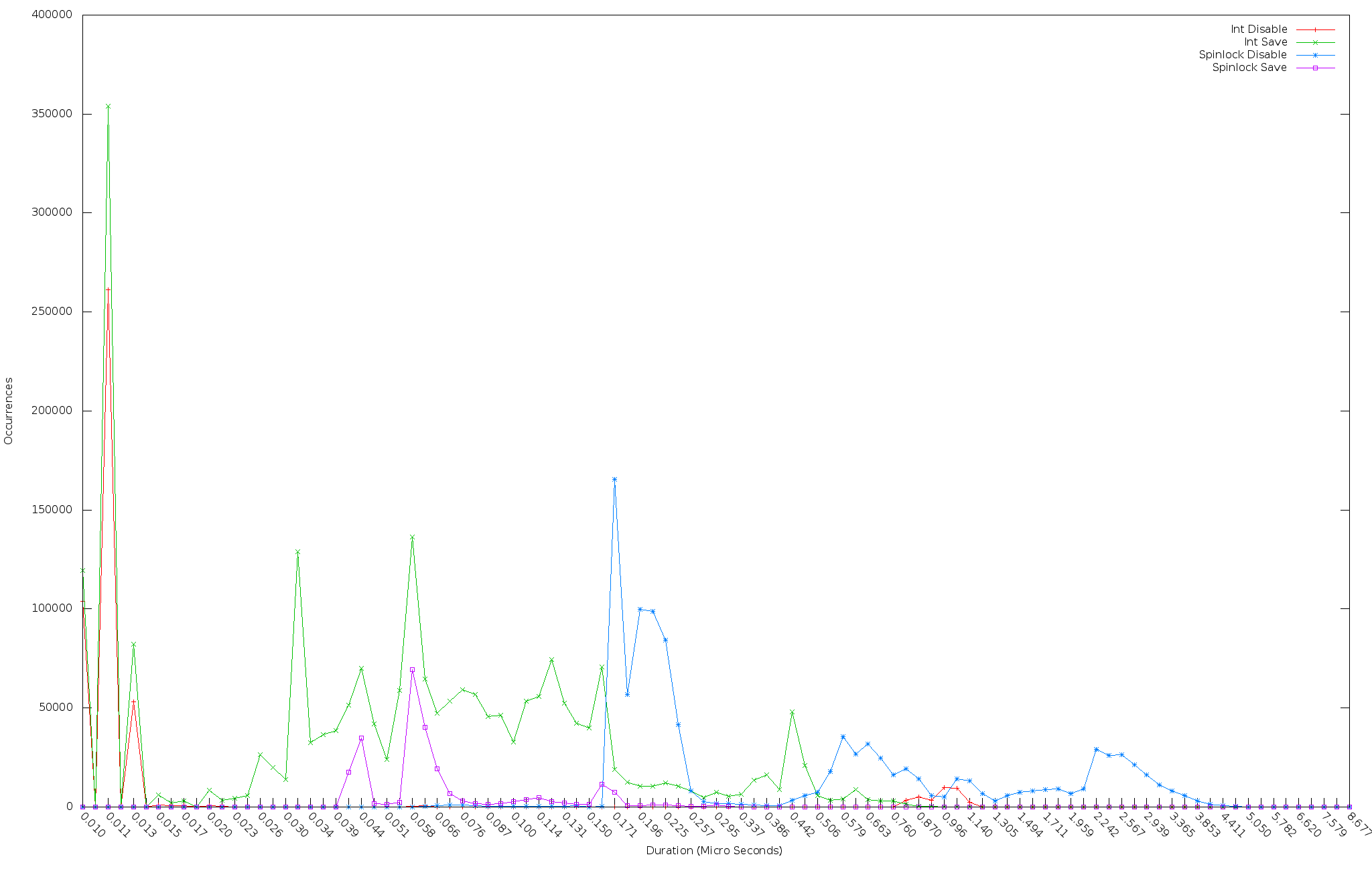
The durations are all more reasonable now.
David
Quoted 30 lines
Quoted 1 line
Quoted 1 line · On 30.04.15 at 17:44, <[email protected]> wrote:
Quoted 14 lines · David Vrabel
Quoted 13 lines · Jan Beulich
Quoted 6 lines
Quoted 1 line
Quoted 1 line · On 21.04.15 at 12:11, <[email protected]> wrote:
We have analysed the affect of this series on interrupt latency (by measuring the duration of irq disable/enable regions) and there is no signficant impact.
Thanks for doing this!
Quoted 4 lines
Interestingly, the biggest offenders for long critical sections are bare irq disable/enable regions, and some of these are really bad (10s of ms)!
Quoted 7 lines
Quoted 4 lines
Despite both pictures saying micro-seconds at the respective axis (and hence the problem not being
_asbad_)This particular graph doesn't show it very well but there are small blips around 4, 10, and 31 ms.
This first set of analysis incorrect included some bogus data.
1. The mwait idle driver has interrupts masked for the mwait instruction (with the wake-on-interrupt bit enabled), thus the very long times were measuring idle time.
Quoted 8 lines
2.
do_IRQ()callsspin_unlock_irq()without a correspondingspin_lock_irq()thus the values for this lock were incorrect.Here's an updated graph (Thanks to Jennifer).
http://xenbits.xen.org/people/dvrabel/ticket-locks/busy_byte.png
The durations are all more reasonable now.
Thanks for doing this! I think this makes clear that there's no immediate need for any further investigation then (a couple of microsecond IRQ-disabled sections don't seem to be a problem for other than true real-time uses).
Jan