ASoC: bcm2835: Add 8 channel (multitrack) capability
Subsystems (4)
PATCH 1/1 ASoC: bcm2835: Add 8 channel (multitrack) capability
This patch adds 8 channel capability by allowing DSP modes. It also increases the channels_max (in the bcm2835_i2s_dai structure) to 8.
The driver guards against multitrack mode when the codec isn't master. The driver guards against multitrack capability when in I2S mode.
---
 sound/soc/bcm/bcm2835-i2s.c | 18 +++++++++++++++---
 1 file changed, 15 insertions(+), 3 deletions(-)
sound/soc/bcm/bcm2835-i2s.c +15 -3
@@ -276,11 +276,16 @@ static int bcm2835_i2s_hw_params(struct snd_pcm_substream *substream,/* otherwise calculate a fitting block ratio */ bclk_ratio =2 * data_length; -/* Clock should only be set up here if CPU is clock master */ +/* Clock should only be set up here if CPU is clock master. +If codec isn't master guard against multichannel mode. */ switch (dev->fmt &SND_SOC_DAIFMT_MASTER_MASK ) {case SND_SOC_DAIFMT_CBS_CFS :case SND_SOC_DAIFMT_CBS_CFM :clk_set_rate (dev->clk, sampling_rate * bclk_ratio); +case SND_SOC_DAIFMT_CBM_CFS : +/* Codec must be master in multichannel mode */ +if (params_channels (params) >2 ) +return -EINVAL ;break ;default :break ;
@@ -294,8 +299,14 @@ static int bcm2835_i2s_hw_params(struct snd_pcm_substream *substream, format |=BCM2835_I2S_CHWID ((data_length-8 )&0xf ); +/* Default data delay to 1 bit. +In I2S mode, we must have 2 channels */ switch (dev->fmt &SND_SOC_DAIFMT_FORMAT_MASK ) {case SND_SOC_DAIFMT_I2S : +if (params_channels (params) !=2 ) +return -EINVAL ; +case SND_SOC_DAIFMT_DSP_A : +case SND_SOC_DAIFMT_DSP_B : data_delay =1 ;break ;default :
@@ -312,6 +323,7 @@ static int bcm2835_i2s_hw_params(struct snd_pcm_substream *substream,switch (params_channels (params)) {case 2 : +case 8 : format =BCM2835_I2S_CH1 (format) |BCM2835_I2S_CH2 (format); format |=BCM2835_I2S_CH1 (BCM2835_I2S_CHPOS (ch1pos)); format |=BCM2835_I2S_CH2 (BCM2835_I2S_CHPOS (ch2pos));
@@ -577,7 +589,7 @@ static struct snd_soc_dai_driver bcm2835_i2s_dai = { .probe = bcm2835_i2s_dai_probe, .playback = { .channels_min = 2, - .channels_max = 2, + .channels_max = 8, .rates =SNDRV_PCM_RATE_8000_192000 , .formats = SNDRV_PCM_FMTBIT_S16_LE |SNDRV_PCM_FMTBIT_S24_LE
@@ -585,7 +597,7 @@ static struct snd_soc_dai_driver bcm2835_i2s_dai = { }, .capture = { .channels_min = 2, - .channels_max = 2, + .channels_max = 8, .rates =SNDRV_PCM_RATE_8000_192000 , .formats = SNDRV_PCM_FMTBIT_S16_LE |SNDRV_PCM_FMTBIT_S24_LE
Signature · 1 line
2.7.4
Mark Brown
maintainersound/soc/bcm/bcm2835-i2s.c static int bcm2835_i2s_hw_params(struct snd_pcm_substream *substream, · line 285
Quoted 3 lines · Matt Flax
sound/soc/bcm/bcm2835-i2s.c +1
-0case SND_SOC_DAIFMT_CBS_CFM :clk_set_rate (dev->clk, sampling_rate * bclk_ratio); +case SND_SOC_DAIFMT_CBM_CFS :
Is this fall through deliberate?
sound/soc/bcm/bcm2835-i2s.c static int bcm2835_i2s_hw_params(struct snd_pcm_substream *substream, · line 312
Quoted 11 lines
sound/soc/bcm/bcm2835-i2s.c +6
-0+/* Default data delay to 1 bit. +In I2S mode, we must have 2 channels */ switch (dev->fmt &SND_SOC_DAIFMT_FORMAT_MASK ) {case SND_SOC_DAIFMT_I2S : +if (params_channels (params) !=2 ) +return -EINVAL ; +case SND_SOC_DAIFMT_DSP_A : +case SND_SOC_DAIFMT_DSP_B : data_delay =1 ;break ;default :
Same here. This is also buggy in that it treats DSP A and DSP B identically, they are different so the configuration must be incorrect for one of them. I suspect this is configuring for DSP A.
You should also really have a setup() function that imposes a channel
constraint when in I2S mode, wm8988 is one example here.
-------------- next part --------------
A non-text attachment was scrubbed...
Name: signature.asc
Type: application/pgp-signature
Size: 488 bytes
Desc: not available
URL: <http://lists.infradead.org/pipermail/linux-arm-kernel/attachments/20170208/3e1a2c01/attachment.sig>
Quoted 8 lines · Mark Brown
sound/soc/bcm/bcm2835-i2s.c static int bcm2835_i2s_hw_params(struct snd_pcm_substream *substream, · line 285
Quoted 3 lines · Matt Flax
sound/soc/bcm/bcm2835-i2s.c +1
-0case SND_SOC_DAIFMT_CBS_CFM :clk_set_rate (dev->clk, sampling_rate * bclk_ratio); +case SND_SOC_DAIFMT_CBM_CFS :Is this fall through deliberate?
Quoted 11 lines
sound/soc/bcm/bcm2835-i2s.c static int bcm2835_i2s_hw_params(struct snd_pcm_substream *substream, · line 312
Quoted 11 lines
sound/soc/bcm/bcm2835-i2s.c +6
-0+/* Default data delay to 1 bit. +In I2S mode, we must have 2 channels */ switch (dev->fmt &SND_SOC_DAIFMT_FORMAT_MASK ) {case SND_SOC_DAIFMT_I2S : +if (params_channels (params) !=2 ) +return -EINVAL ; +case SND_SOC_DAIFMT_DSP_A : +case SND_SOC_DAIFMT_DSP_B : data_delay =1 ;break ;default :
Matt, could you please include linux-rpi-kernel at lists.infradead.org in your emails?
I fail to see the part where DSP modes are actually set up in the hardware. bcm2835 still seems to be operating in 2-channel stereo I2S mode, i.e. no real frame sync information at the hardware level.
If all you do is adding code to pretend the bcm2835 could do multichannel modes wouldn't it be easier to implement that as a userspace alsa plugin?
Quoted 14 lines
Same here. This is also buggy in that it treats DSP A and DSP B identically, they are different so the configuration must be incorrect for one of them. I suspect this is configuring for DSP A.
You should also really have a
setup()function that imposes a channel constraint when in I2S mode, wm8988 is one example here._______________________________________________
linux-rpi-kernel mailing list
linux-rpi-kernel at lists.infradead.org
http://lists.infradead.org/mailman/listinfo/linux-rpi-kernel
Quoted 8 lines · Matthias Reichl
Quoted 7 lines · Mark Brown
sound/soc/bcm/bcm2835-i2s.c static int bcm2835_i2s_hw_params(struct snd_pcm_substream *substream, · line 285
Quoted 3 lines · Matt Flax
  	case SND_SOC_DAIFMT_CBS_CFM:
  		clk_set_rate(dev->clk, sampling_rate * bclk_ratio);
sound/soc/bcm/bcm2835-i2s.c +1
-0+case SND_SOC_DAIFMT_CBM_CFS :Is this fall through deliberate?
Quoted 13 lines
Quoted 11 lines
sound/soc/bcm/bcm2835-i2s.c static int bcm2835_i2s_hw_params(struct snd_pcm_substream *substream, · line 312
Quoted 11 lines
sound/soc/bcm/bcm2835-i2s.c +6
-0+/* Default data delay to 1 bit. +In I2S mode, we must have 2 channels */ switch (dev->fmt &SND_SOC_DAIFMT_FORMAT_MASK ) {case SND_SOC_DAIFMT_I2S : +if (params_channels (params) !=2 ) +return -EINVAL ; +case SND_SOC_DAIFMT_DSP_A : +case SND_SOC_DAIFMT_DSP_B : data_delay =1 ;break ;default :Matt, could you please include linux-rpi-kernel at lists.infradead.org in your emails?
I have joined that list now. It was included originally, but wasn't accepting my posts.
Quoted 4 lines
I fail to see the part where DSP modes are actually set up in the hardware. bcm2835 still seems to be operating in 2-channel stereo I2S mode, i.e. no real frame sync information at the hardware level.
From the SoC's perspective I agree with you. There is frame
synchronisation at the hardware level, implemented in an master FPGA. This starts to hit at a lack of functionality in ALSA ... I will discuss more below.
Quoted 5 lines
If all you do is adding code to pretend the bcm2835 could do multichannel modes wouldn't it be easier to implement that as a userspace alsa plugin?
I am not familiar with how to implement all of this with a plugin ? Could you give me a little hand in describing that further ? That would mean that an asoundrc needs to be used to defined to make the system usable ? Is it something which does the unpacking for us in user space ? If this happens in user space is there extra cost/latency ?
I would like to bring up another topic here.
In my opinion some of these changes we are making in this general thread are only really window dressing.
We have 4 ways of setting up master, however all of them assume that either the codec or the SoC is master. None of them allow for intermediate digital logic between the two.
In this case there is a FPGA which is matching the system differences between the Codec and the SoC. In actual fact, the FPGA needs to be master - a fifth mode.
A similar problem exists when you are using a sample rate converter chip. For example, the DAC and ADC are running at different sample rates. In this case ALSA can't represent both of the sample rates. For that reason, the ADCs and the DACs have to be hard coded - it is nasty.
The only solution for me is to use snd_soc_dai_set_fmt in the machine driver to instruct both to enter slave mode. For what it is worth, I can also
In my opinion there is nothing wrong with making hardware level introductions, such as an ASIC/FPGA to implement the hardware. I accept the inflexibility of ALSA w.r.t. this type of situation, however the real fix is to adjust the core of ALSA. Hardware ASICS and FPGAs which are intermediatries between codecs and SoCs exist and are used in industry.
This happens to be one of those cases.
thanks
Matt
Quoted 39 lines · Matt Flax
Quoted 19 lines · Matthias Reichl
Quoted 18 lines · Mark Brown
Quoted 3 lines · Matt Flax
      case SND_SOC_DAIFMT_CBS_CFM:
          clk_set_rate(dev->clk, sampling_rate * bclk_ratio);
+ case
SND_SOC_DAIFMT_CBM_CFS:Is this fall through deliberate?
Quoted 11 lines
sound/soc/bcm/bcm2835-i2s.c +6
-0+/* Default data delay to 1 bit. +In I2S mode, we must have 2 channels */ switch (dev->fmt &SND_SOC_DAIFMT_FORMAT_MASK ) {case SND_SOC_DAIFMT_I2S : +if (params_channels (params) !=2 ) +return -EINVAL ; +case SND_SOC_DAIFMT_DSP_A : +case SND_SOC_DAIFMT_DSP_B : data_delay =1 ;break ;default :Quoted 2 lines
Matt, could you please include linux-rpi-kernel at lists.infradead.org in your emails?
I have joined that list now. It was included originally, but wasn't accepting my posts.
Quoted 4 lines
I fail to see the part where DSP modes are actually set up in the hardware. bcm2835 still seems to be operating in 2-channel stereo I2S mode, i.e. no real frame sync information at the hardware level.
From the SoC's perspective I agree with you. There is frame synchronisation at the hardware level, implemented in an master FPGA. This starts to hit at a lack of functionality in ALSA ... I will discuss more below.
Quoted 5 lines
If all you do is adding code to pretend the bcm2835 could do multichannel modes wouldn't it be easier to implement that as a userspace alsa plugin?
Quoted 6 lines
I am not familiar with how to implement all of this with a plugin ? Could you give me a little hand in describing that further ? That would mean that an asoundrc needs to be used to defined to make the system usable ? Is it something which does the unpacking for us in user space ? If this happens in user space is there extra cost/latency ?
You know, I am genuinely interested in your concept and still invite an example of your creativity, however ...
The more I think about this approach, the concept of pushing the support of hardware into user space the more I disagree with it. My understanding is that the Linux Kernel is there to support hardware. The concept of pushing hardware support into user space doesn't seem right.
As I have pointed out below, there are missing things in ALSA and as Mark previously pointed out "this is a thing". What I understand is that this hardware is a thing and has been thought of before - this happens to be a hardware implementation of this "thing" which ALSA doesn't currently have the capacity to support (e.g. an ASIC/FPGA which is mater, not the SoC nor the Codec).
I remember back in the '90s when ALSA was started - I witnessed its birth. ALSA was started because of inadequacies of OSS. I truly don't believe that we need a new sound system for Linux as of yet. I also don't believe that because ALSA has these inadequacies (which I mention below) that we need to start afresh. I would personally put effort into this part of ALSA if I had the money to support myself whilst I did it - but I don't. So for now, I am trying to make do with ALSA as best I can. I am trying to put the necessary support for existing hardware into ALSA in its current state and form - in the best possible manner. So please lets continue with support for this hardware in the kernel.
Quoted 38 lines
I would like to bring up another topic here.
In my opinion some of these changes we are making in this general thread are only really window dressing.
We have 4 ways of setting up master, however all of them assume that either the codec or the SoC is master. None of them allow for intermediate digital logic between the two.
In this case there is a FPGA which is matching the system differences between the Codec and the SoC. In actual fact, the FPGA needs to be master - a fifth mode.
A similar problem exists when you are using a sample rate converter chip. For example, the DAC and ADC are running at different sample rates. In this case ALSA can't represent both of the sample rates. For that reason, the ADCs and the DACs have to be hard coded - it is nasty.
The only solution for me is to use
snd_soc_dai_set_fmtin the machine driver to instruct both to enter slave mode. For what it is worth, I can alsoIn my opinion there is nothing wrong with making hardware level introductions, such as an ASIC/FPGA to implement the hardware. I accept the inflexibility of ALSA w.r.t. this type of situation, however the real fix is to adjust the core of ALSA. Hardware ASICS and FPGAs which are intermediatries between codecs and SoCs exist and are used in industry.
This happens to be one of those cases.
thanks
Matt_______________________________________________
Alsa-devel mailing list
Alsa-devel at alsa-project.org
http://mailman.alsa-project.org/mailman/listinfo/alsa-devel
Quoted 41 lines · Matt Flax
Quoted 39 lines · Matt Flax
Quoted 19 lines · Matthias Reichl
Quoted 18 lines · Mark Brown
Quoted 3 lines · Matt Flax
     case SND_SOC_DAIFMT_CBS_CFM:
         clk_set_rate(dev->clk, sampling_rate * bclk_ratio);
+ case
SND_SOC_DAIFMT_CBM_CFS:Is this fall through deliberate?
Quoted 11 lines
sound/soc/bcm/bcm2835-i2s.c +6
-0+/* Default data delay to 1 bit. +In I2S mode, we must have 2 channels */ switch (dev->fmt &SND_SOC_DAIFMT_FORMAT_MASK ) {case SND_SOC_DAIFMT_I2S : +if (params_channels (params) !=2 ) +return -EINVAL ; +case SND_SOC_DAIFMT_DSP_A : +case SND_SOC_DAIFMT_DSP_B : data_delay =1 ;break ;default :Quoted 2 lines
Matt, could you please include linux-rpi-kernel at lists.infradead.org in your emails?
I have joined that list now. It was included originally, but wasn't accepting my posts.
Quoted 4 lines
I fail to see the part where DSP modes are actually set up in the hardware. bcm2835 still seems to be operating in 2-channel stereo I2S mode, i.e. no real frame sync information at the hardware level.
From the SoC's perspective I agree with you. There is frame synchronisation at the hardware level, implemented in an master FPGA. This starts to hit at a lack of functionality in ALSA ... I will discuss more below.
Quoted 5 lines
If all you do is adding code to pretend the bcm2835 could do multichannel modes wouldn't it be easier to implement that as a userspace alsa plugin?
Quoted 5 lines
Quoted 5 lines
I am not familiar with how to implement all of this with a plugin ? Could you give me a little hand in describing that further ? That would mean that an asoundrc needs to be used to defined to make the system usable ? Is it something which does the unpacking for us in user space ? If this happens in user space is there extra cost/latency ?
I haven't written a plugin myself, but there are plenty of examples out there. Maybe there's already one that does what you need.
Have a look at the code in alsa-lib
http://git.alsa-project.org/?p=alsa-lib.git;a=tree;f=src/pcm
Also have a look at how iec958 is handled in most setups (pcm_iec958 plugin, integration via /usr/share/alsa/cards/*.conf
Plugins don't necessarily add a latency overhead, I've got the impression all you need to do is to hook into hw_params and setup the slave hw to 2 channels and 4 times the requested samplerate.
eg when 8-channel 48kHz is requested configure the hardware to 2-channel 192kHz.
You can pass additional information to the machine driver via controls, eg to signal that you are transmitting 8-channel PCM encapsulated in a 2-channel stream. Again a good example is iec958, the AES channel status bits are transferred to the card via the IEC958 Playback Default control in the card .conf via a hook plug.
Quoted 7 lines
You know, I am genuinely interested in your concept and still invite an example of your creativity, however ...
The more I think about this approach, the concept of pushing the support of hardware into user space the more I disagree with it. My understanding is that the Linux Kernel is there to support hardware. The concept of pushing hardware support into user space doesn't seem right.
Quoted 8 lines
As I have pointed out below, there are missing things in ALSA and as Mark previously pointed out "this is a thing". What I understand is that this hardware is a thing and has been thought of before - this happens to be a hardware implementation of this "thing" which ALSA doesn't currently have the capacity to support (e.g. an ASIC/FPGA which is mater, not the SoC nor the Codec).
From what you describe it looks to me the FPGA is just acting as a codec,
converting between 2-channel I2S and 8-channel (DSP?) at 1/4 of the I2S rate.
So you have bcm2835 I2S <-> FPGA <-> codec - IOW a standard codec<->codec link.
What you seem to be missing is just a method to transfer your 8-channel data via a 2-channel link - userspace want's to see an 8-channel PCM, but the hardware link (bcm2835-i2s) is only 2-channel.
And that's where IMO as userspace plugin looks like a very good solution. It's basically the counterpart of your FPGA and contains the code that's neccessary to encapsulate/pack/whatever the 8-channel data into a 2-channel stream so it can then be unpacked to 8-channel by the FPGA.
If you go this route your hardware and machine driver will work with other I2S codecs as well, and IMO that's a far better solution than adding very ugly hacks to a single I2S driver.
so long,
Hias
Quoted 50 lines
I remember back in the '90s when ALSA was started - I witnessed its birth. ALSA was started because of inadequacies of OSS. I truly don't believe that we need a new sound system for Linux as of yet. I also don't believe that because ALSA has these inadequacies (which I mention below) that we need to start afresh. I would personally put effort into this part of ALSA if I had the money to support myself whilst I did it - but I don't. So for now, I am trying to make do with ALSA as best I can. I am trying to put the necessary support for existing hardware into ALSA in its current state and form - in the best possible manner. So please lets continue with support for this hardware in the kernel.
Quoted 37 lines
I would like to bring up another topic here.
In my opinion some of these changes we are making in this general thread are only really window dressing.
We have 4 ways of setting up master, however all of them assume that either the codec or the SoC is master. None of them allow for intermediate digital logic between the two.
In this case there is a FPGA which is matching the system differences between the Codec and the SoC. In actual fact, the FPGA needs to be master
- a fifth mode.A similar problem exists when you are using a sample rate converter chip. For example, the DAC and ADC are running at different sample rates. In this case ALSA can't represent both of the sample rates. For that reason, the ADCs and the DACs have to be hard coded - it is nasty.
The only solution for me is to use
snd_soc_dai_set_fmtin the machine driver to instruct both to enter slave mode. For what it is worth, I can alsoIn my opinion there is nothing wrong with making hardware level introductions, such as an ASIC/FPGA to implement the hardware. I accept the inflexibility of ALSA w.r.t. this type of situation, however the real fix is to adjust the core of ALSA. Hardware ASICS and FPGAs which are intermediatries between codecs and SoCs exist and are used in industry.
This happens to be one of those cases.
thanks
Matt_______________________________________________
Alsa-devel mailing list
Alsa-devel at alsa-project.org
http://mailman.alsa-project.org/mailman/listinfo/alsa-devel
Quoted 7 lines · Mark Brown
sound/soc/bcm/bcm2835-i2s.c static int bcm2835_i2s_hw_params(struct snd_pcm_substream *substream, · line 285
Quoted 3 lines · Matt Flax
  	case SND_SOC_DAIFMT_CBS_CFM:
  		clk_set_rate(dev->clk, sampling_rate * bclk_ratio);
sound/soc/bcm/bcm2835-i2s.c +1
-0+case SND_SOC_DAIFMT_CBM_CFS :Is this fall through deliberate?
Quoted 14 lines
sound/soc/bcm/bcm2835-i2s.c static int bcm2835_i2s_hw_params(struct snd_pcm_substream *substream, · line 312
Quoted 11 lines
sound/soc/bcm/bcm2835-i2s.c +6
-0+/* Default data delay to 1 bit. +In I2S mode, we must have 2 channels */ switch (dev->fmt &SND_SOC_DAIFMT_FORMAT_MASK ) {case SND_SOC_DAIFMT_I2S : +if (params_channels (params) !=2 ) +return -EINVAL ; +case SND_SOC_DAIFMT_DSP_A : +case SND_SOC_DAIFMT_DSP_B : data_delay =1 ;break ;default :Same here. This is also buggy in that it treats DSP A and DSP B identically, they are different so the configuration must be incorrect for one of them. I suspect this is configuring for DSP A.
I can remove DSP_B. In actual fact this isn't the real problem.
Quoted 3 lines
You should also really have a
setup()function that imposes a channel constraint when in I2S mode, wm8988 is one example here.
I had a look at wm8988.c and couldn't see this channel constraint linking to I2S. Can you point me to it ?
thanks
Matt
Quoted 23 lines · Matt Flax
Quoted 18 lines · Mark Brown
Quoted 3 lines · Matt Flax
      case SND_SOC_DAIFMT_CBS_CFM:
          clk_set_rate(dev->clk, sampling_rate * bclk_ratio);
+ case
SND_SOC_DAIFMT_CBM_CFS:Is this fall through deliberate?
sound/soc/bcm/bcm2835-i2s.c static int bcm2835_i2s_hw_params(struct snd_pcm_substream *substream, · line 312
Quoted 11 lines
sound/soc/bcm/bcm2835-i2s.c +6
-0+/* Default data delay to 1 bit. +In I2S mode, we must have 2 channels */ switch (dev->fmt &SND_SOC_DAIFMT_FORMAT_MASK ) {case SND_SOC_DAIFMT_I2S : +if (params_channels (params) !=2 ) +return -EINVAL ; +case SND_SOC_DAIFMT_DSP_A : +case SND_SOC_DAIFMT_DSP_B : data_delay =1 ;break ;default :Quoted 3 lines
Same here. This is also buggy in that it treats DSP A and DSP B identically, they are different so the configuration must be incorrect for one of them. I suspect this is configuring for DSP A.
Quoted 6 lines
I can remove
DSP_B. In actual fact this isn't the real problem.Quoted 3 lines
You should also really have a
setup()function that imposes a channel constraint when in I2S mode, wm8988 is one example here.I had a look at
wm8988.cand couldn't see this channel constraint linking to I2S. Can you point me to it ?
Hang on, I have got it. It is the patch I sent in previously for the wm8580.c codec !
Matt
PATCH v2 1/1 ASoC: bcm2835: Add 8 channel (multitrack) capability
In reply to Matt FlaxThis patch adds multitrack capability if in DSP mode A and the codec is master.
In bcm2835_i2s_startup, snd_pcm_hw_constraint_minmax is used to set max channels to 8 if both SND_SOC_DAIFMT_CBM_CFM and SND_SOC_DAIFMT_DSP_A are set. Otherwise, max channels is set to 2. Min channels is always set to 2. These settings are accomplished using the SNDRV_PCM_HW_PARAM_CHANNELS variable.
In bcm2835_i2s_shutdown max channels is set to 2 by default.
In bcm2835_i2s_hw_params, DSP mode A format is now an option. Before replicating the format variable (from ch2 to ch1) for register loading, requested channels are checked to be either 2 or 8. This can be expaneded later to accomodate other channel counts if supported by the sound card hardware.
---
 sound/soc/bcm/bcm2835-i2s.c | 21 ++++++++++++++++-----
 1 file changed, 16 insertions(+), 5 deletions(-)
sound/soc/bcm/bcm2835-i2s.c +16 -5
@@ -296,6 +296,7 @@ static int bcm2835_i2s_hw_params(struct snd_pcm_substream *substream,switch (dev->fmt &SND_SOC_DAIFMT_FORMAT_MASK ) {case SND_SOC_DAIFMT_I2S : +case SND_SOC_DAIFMT_DSP_A : data_delay =1 ;break ;default :
@@ -312,6 +313,7 @@ static int bcm2835_i2s_hw_params(struct snd_pcm_substream *substream,switch (params_channels (params)) {case 2 : +case 8 : format =BCM2835_I2S_CH1 (format) |BCM2835_I2S_CH2 (format); format |=BCM2835_I2S_CH1 (BCM2835_I2S_CHPOS (ch1pos)); format |=BCM2835_I2S_CH2 (BCM2835_I2S_CHPOS (ch2pos));
@@ -526,7 +528,16 @@ static int bcm2835_i2s_startup(struct snd_pcm_substream *substream,regmap_update_bits (dev->i2s_regmap,BCM2835_I2S_CS_A_REG ,BCM2835_I2S_STBY ,BCM2835_I2S_STBY ); -return 0 ; +/* Set the max channels to 8 if the codec is master and +* we are in DSP A mode. Otherwise only allow 2 channels. +*/ +if (dev->fmt & + (SND_SOC_DAIFMT_CBM_CFM |SND_SOC_DAIFMT_DSP_A )) +return snd_pcm_hw_constraint_minmax (substream->runtime, +SNDRV_PCM_HW_PARAM_CHANNELS ,2 ,8 ); +else +return snd_pcm_hw_constraint_minmax (substream->runtime, +SNDRV_PCM_HW_PARAM_CHANNELS ,2 ,2 ); } static void bcm2835_i2s_shutdown(struct snd_pcm_substream *substream,
@@ -549,6 +560,10 @@ static void bcm2835_i2s_shutdown(struct snd_pcm_substream *substream,* not stop the clock when SND_SOC_DAIFMT_CONT */ bcm2835_i2s_stop_clock (dev); + +/* Default to 2 channels */ +snd_pcm_hw_constraint_minmax (substream->runtime, +SNDRV_PCM_HW_PARAM_CHANNELS ,2 ,2 ); }static const struct snd_soc_dai_ops bcm2835_i2s_dai_ops = {
@@ -576,16 +591,12 @@ static struct snd_soc_dai_driver bcm2835_i2s_dai = { .name = "bcm2835-i2s", .probe = bcm2835_i2s_dai_probe, .playback = { - .channels_min = 2, - .channels_max = 2, .rates = SNDRV_PCM_RATE_8000_192000, .formats =SNDRV_PCM_FMTBIT_S16_LE |SNDRV_PCM_FMTBIT_S24_LE |SNDRV_PCM_FMTBIT_S32_LE }, .capture = { - .channels_min = 2, - .channels_max = 2, .rates =SNDRV_PCM_RATE_8000_192000 , .formats = SNDRV_PCM_FMTBIT_S16_LE |SNDRV_PCM_FMTBIT_S24_LE
Signature · 1 line
2.7.4
Quoted 9 lines · Matt Flax
This patch adds multitrack capability if in DSP mode A and the codec is master.
In
bcm2835_i2s_startup,snd_pcm_hw_constraint_minmaxis used to set max channels to 8 if bothSND_SOC_DAIFMT_CBM_CFMandSND_SOC_DAIFMT_DSP_Aare set. Otherwise, max channels is set to 2. Min channels is always set to 2. These settings are accomplished using theSNDRV_PCM_HW_PARAM_CHANNELSvariable.
Quoted 6 lines
In
bcm2835_i2s_shutdownmax channels is set to 2 by default.In
bcm2835_i2s_hw_params, DSP mode A format is now an option. Before replicating the format variable (from ch2 to ch1) for register loading, requested channels are checked to be either 2 or 8. This can be expaneded later to accomodate other channel counts if
"expanded"
Quoted 1 line
supported by the sound card hardware.
This is looking a lot nicer! I'm totally deferring to the audio guys here for deciding if it's the right fix, but for what it's worth, from the platform side:
-------------- next part --------------
A non-text attachment was scrubbed...
Name: signature.asc
Type: application/pgp-signature
Size: 832 bytes
Desc: not available
URL: <http://lists.infradead.org/pipermail/linux-arm-kernel/attachments/20170213/f78424b1/attachment.sig>
Quoted 19 lines · Matt Flax
This patch adds multitrack capability if in DSP mode A and the codec is master.
In
bcm2835_i2s_startup,snd_pcm_hw_constraint_minmaxis used to set max channels to 8 if bothSND_SOC_DAIFMT_CBM_CFMandSND_SOC_DAIFMT_DSP_Aare set. Otherwise, max channels is set to 2. Min channels is always set to 2. These settings are accomplished using theSNDRV_PCM_HW_PARAM_CHANNELSvariable.In
bcm2835_i2s_shutdownmax channels is set to 2 by default.In
bcm2835_i2s_hw_params, DSP mode A format is now an option. Before replicating the format variable (from ch2 to ch1) for register loading, requested channels are checked to be either 2 or 8. This can be expaneded later to accomodate other channel counts if supported by the sound card hardware.Signed-off-by Matt Flax <[email protected]>---
<snip>
Quoted 10 lines
sound/soc/bcm/bcm2835-i2s.c +1
-0@@ -312,6 +313,7 @@ static int bcm2835_i2s_hw_params(struct snd_pcm_substream *substream,switch (params_channels (params)) {case 2 : +case 8 : format =BCM2835_I2S_CH1 (format) |BCM2835_I2S_CH2 (format); format |=BCM2835_I2S_CH1 (BCM2835_I2S_CHPOS (ch1pos)); format |=BCM2835_I2S_CH2 (BCM2835_I2S_CHPOS (ch2pos));@@ -526,7 +528,16 @@ static int bcm2835_i2s_startup(struct snd_pcm_substream *substream, regmap_update_bits(dev->i2s_regmap, BCM2835_I2S_CS_A_REG,
sound/soc/bcm/bcm2835-i2s.c static int bcm2835_i2s_startup(struct snd_pcm_substream *substream, · line 537
Quoted 10 lines
sound/soc/bcm/bcm2835-i2s.c +7
-1BCM2835_I2S_STBY, BCM2835_I2S_STBY); -return 0 ; +/* Set the max channels to 8 if the codec is master and +* we are in DSP A mode. Otherwise only allow 2 channels. +*/ +if (dev->fmt & + (SND_SOC_DAIFMT_CBM_CFM |SND_SOC_DAIFMT_DSP_A )) +return snd_pcm_hw_constraint_minmax (substream->runtime, +SNDRV_PCM_HW_PARAM_CHANNELS ,2 ,8 );
Would it be worth using snd_pcm_hw_constraint_list here? We are going to error out of hw_params if the user requests anything other than 2 or 8 channels so we should probably just constrain to those two.
sound/soc/bcm/bcm2835-i2s.c static int bcm2835_i2s_startup(struct snd_pcm_substream *substream, · line 540
Quoted 3 lines
sound/soc/bcm/bcm2835-i2s.c +3
-0+else +return snd_pcm_hw_constraint_minmax (substream->runtime, +SNDRV_PCM_HW_PARAM_CHANNELS ,2 ,2 );
snd_pcm_hw_constraint_single, it's exactly the same thing but I guess we should probably use the helper if it exists.
sound/soc/bcm/bcm2835-i2s.c static void bcm2835_i2s_shutdown(struct snd_pcm_substream *substream, · line 567
Quoted 12 lines
sound/soc/bcm/bcm2835-i2s.c +4
-0} static void bcm2835_i2s_shutdown(struct snd_pcm_substream *substream,@@ -549,6 +560,10 @@ static void bcm2835_i2s_shutdown(struct snd_pcm_substream *substream,* not stop the clock when SND_SOC_DAIFMT_CONT */ bcm2835_i2s_stop_clock (dev); + +/* Default to 2 channels */ +snd_pcm_hw_constraint_minmax (substream->runtime, +SNDRV_PCM_HW_PARAM_CHANNELS ,2 ,2 ); }
ditto.
Thanks,
Charles
Quoted 33 lines · Charles Keepax
Quoted 19 lines · Matt Flax
This patch adds multitrack capability if in DSP mode A and the codec is master.
In
bcm2835_i2s_startup,snd_pcm_hw_constraint_minmaxis used to set max channels to 8 if bothSND_SOC_DAIFMT_CBM_CFMandSND_SOC_DAIFMT_DSP_Aare set. Otherwise, max channels is set to 2. Min channels is always set to 2. These settings are accomplished using theSNDRV_PCM_HW_PARAM_CHANNELSvariable.In
bcm2835_i2s_shutdownmax channels is set to 2 by default.In
bcm2835_i2s_hw_params, DSP mode A format is now an option. Before replicating the format variable (from ch2 to ch1) for register loading, requested channels are checked to be either 2 or 8. This can be expaneded later to accomodate other channel counts if supported by the sound card hardware.Signed-off-by Matt Flax <[email protected]>---
<snip>
Quoted 12 lines
sound/soc/bcm/bcm2835-i2s.c +1
-0@@ -312,6 +313,7 @@ static int bcm2835_i2s_hw_params(struct snd_pcm_substream *substream,switch (params_channels (params)) {case 2 : +case 8 : format =BCM2835_I2S_CH1 (format) |BCM2835_I2S_CH2 (format); format |=BCM2835_I2S_CH1 (BCM2835_I2S_CHPOS (ch1pos)); format |=BCM2835_I2S_CH2 (BCM2835_I2S_CHPOS (ch2pos));@@ -526,7 +528,16 @@ static int bcm2835_i2s_startup(struct snd_pcm_substream *substream,regmap_update_bits (dev->i2s_regmap,BCM2835_I2S_CS_A_REG ,BCM2835_I2S_STBY ,BCM2835_I2S_STBY );
Quoted 12 lines
sound/soc/bcm/bcm2835-i2s.c static int bcm2835_i2s_startup(struct snd_pcm_substream *substream, · line 537
Quoted 8 lines
sound/soc/bcm/bcm2835-i2s.c +7
-1-return 0 ; +/* Set the max channels to 8 if the codec is master and +* we are in DSP A mode. Otherwise only allow 2 channels. +*/ +if (dev->fmt & + (SND_SOC_DAIFMT_CBM_CFM |SND_SOC_DAIFMT_DSP_A )) +return snd_pcm_hw_constraint_minmax (substream->runtime, +SNDRV_PCM_HW_PARAM_CHANNELS ,2 ,8 );Would it be worth using
snd_pcm_hw_constraint_listhere? We are going to error out ofhw_paramsif the user requests anything other than 2 or 8 channels so we should probably just constrain to those two.
Actually, I didn't think of this, but there is no reason to have 2 channels available in DSP A mode with codec master. I will change this to constrain the channels to 8.
Quoted 6 lines
sound/soc/bcm/bcm2835-i2s.c static int bcm2835_i2s_startup(struct snd_pcm_substream *substream, · line 540
Quoted 4 lines
sound/soc/bcm/bcm2835-i2s.c +3
-0+else +return snd_pcm_hw_constraint_minmax (substream->runtime, +SNDRV_PCM_HW_PARAM_CHANNELS ,2 ,2 );
snd_pcm_hw_constraint_single, it's exactly the same thing but I guess we should probably use the helper if it exists.
Will do.
Quoted 13 lines
sound/soc/bcm/bcm2835-i2s.c static void bcm2835_i2s_shutdown(struct snd_pcm_substream *substream, · line 567
Quoted 12 lines
sound/soc/bcm/bcm2835-i2s.c +4
-0} static void bcm2835_i2s_shutdown(struct snd_pcm_substream *substream,@@ -549,6 +560,10 @@ static void bcm2835_i2s_shutdown(struct snd_pcm_substream *substream,* not stop the clock when SND_SOC_DAIFMT_CONT */ bcm2835_i2s_stop_clock (dev); + +/* Default to 2 channels */ +snd_pcm_hw_constraint_minmax (substream->runtime, +SNDRV_PCM_HW_PARAM_CHANNELS ,2 ,2 ); }ditto.
Will do.
Quoted 3 lines
Thanks,
Charles
PATCH v3 1/1 ASoC: bcm2835: Add 8 channel (multitrack) capability
In reply to Matt FlaxThis patch adds multitrack capability if in DSP mode A and the codec is master.
In bcm2835_i2s_startup, snd_pcm_hw_constraint_minmax is used to set max channels to 8 if both SND_SOC_DAIFMT_CBM_CFM and SND_SOC_DAIFMT_DSP_A are set. Otherwise, max channels is set to 2. Min channels is always set to 2. These settings are accomplished using the SNDRV_PCM_HW_PARAM_CHANNELS variable.
In bcm2835_i2s_shutdown max channels is set to 2 by default.
In bcm2835_i2s_hw_params, DSP mode A format is now an option. Before replicating the format variable (from ch2 to ch1) for register loading, requested channels are checked to be either 2 or 8. This can be expaneded later to accomodate other channel counts if supported by the sound card hardware.
---
 sound/soc/bcm/bcm2835-i2s.c | 21 ++++++++++++++++-----
 1 file changed, 16 insertions(+), 5 deletions(-)
sound/soc/bcm/bcm2835-i2s.c +16 -5
@@ -296,6 +296,7 @@ static int bcm2835_i2s_hw_params(struct snd_pcm_substream *substream,switch (dev->fmt &SND_SOC_DAIFMT_FORMAT_MASK ) {case SND_SOC_DAIFMT_I2S : +case SND_SOC_DAIFMT_DSP_A : data_delay =1 ;break ;default :
@@ -312,6 +313,7 @@ static int bcm2835_i2s_hw_params(struct snd_pcm_substream *substream,switch (params_channels (params)) {case 2 : +case 8 : format =BCM2835_I2S_CH1 (format) |BCM2835_I2S_CH2 (format); format |=BCM2835_I2S_CH1 (BCM2835_I2S_CHPOS (ch1pos)); format |=BCM2835_I2S_CH2 (BCM2835_I2S_CHPOS (ch2pos));
@@ -526,7 +528,16 @@ static int bcm2835_i2s_startup(struct snd_pcm_substream *substream,regmap_update_bits (dev->i2s_regmap,BCM2835_I2S_CS_A_REG ,BCM2835_I2S_STBY ,BCM2835_I2S_STBY ); -return 0 ; +/* Set the max channels to 8 if the codec is master and +* we are in DSP A mode. Otherwise only allow 2 channels. +*/ +if (dev->fmt & + (SND_SOC_DAIFMT_CBM_CFM |SND_SOC_DAIFMT_DSP_A )) +return snd_pcm_hw_constraint_single (substream->runtime, +SNDRV_PCM_HW_PARAM_CHANNELS ,8 ); +else +return snd_pcm_hw_constraint_single (substream->runtime, +SNDRV_PCM_HW_PARAM_CHANNELS ,2 ); } static void bcm2835_i2s_shutdown(struct snd_pcm_substream *substream,
@@ -549,6 +560,10 @@ static void bcm2835_i2s_shutdown(struct snd_pcm_substream *substream,* not stop the clock when SND_SOC_DAIFMT_CONT */ bcm2835_i2s_stop_clock (dev); + +/* Default to 2 channels */ +snd_pcm_hw_constraint_single (substream->runtime, +SNDRV_PCM_HW_PARAM_CHANNELS ,2 ); }static const struct snd_soc_dai_ops bcm2835_i2s_dai_ops = {
@@ -576,16 +591,12 @@ static struct snd_soc_dai_driver bcm2835_i2s_dai = { .name = "bcm2835-i2s", .probe = bcm2835_i2s_dai_probe, .playback = { - .channels_min = 2, - .channels_max = 2, .rates = SNDRV_PCM_RATE_8000_192000, .formats =SNDRV_PCM_FMTBIT_S16_LE |SNDRV_PCM_FMTBIT_S24_LE |SNDRV_PCM_FMTBIT_S32_LE }, .capture = { - .channels_min = 2, - .channels_max = 2, .rates =SNDRV_PCM_RATE_8000_192000 , .formats = SNDRV_PCM_FMTBIT_S16_LE |SNDRV_PCM_FMTBIT_S24_LE
Signature · 1 line
2.7.4
Quoted 9 lines · Matt Flax
This patch adds multitrack capability if in DSP mode A and the codec is master.
In
bcm2835_i2s_startup,snd_pcm_hw_constraint_minmaxis used to set max channels to 8 if bothSND_SOC_DAIFMT_CBM_CFMandSND_SOC_DAIFMT_DSP_Aare set. Otherwise, max channels is set to 2. Min channels is always set to 2. These settings are accomplished using theSNDRV_PCM_HW_PARAM_CHANNELSvariable.
Quoted 7 lines
In
bcm2835_i2s_shutdownmax channels is set to 2 by default.In
bcm2835_i2s_hw_params, DSP mode A format is now an option. Before replicating the format variable (from ch2 to ch1) for register loading, requested channels are checked to be either 2 or 8. This can be expaneded later to accomodate other channel counts if supported by the sound card hardware.
I notice my commit message didn't update, will resend with an updated commit message as v4.
Quoted 71 lines
Signed-off-by Matt Flax <[email protected]>--- sound/soc/bcm/bcm2835-i2s.c | 21 ++++++++++++++++----- 1 file changed, 16 insertions(+), 5 deletions(-)sound/soc/bcm/bcm2835-i2s.c +16
-5@@ -296,6 +296,7 @@ static int bcm2835_i2s_hw_params(struct snd_pcm_substream *substream,switch (dev->fmt &SND_SOC_DAIFMT_FORMAT_MASK ) {case SND_SOC_DAIFMT_I2S : +case SND_SOC_DAIFMT_DSP_A : data_delay =1 ;break ;default :@@ -312,6 +313,7 @@ static int bcm2835_i2s_hw_params(struct snd_pcm_substream *substream,switch (params_channels (params)) {case 2 : +case 8 : format =BCM2835_I2S_CH1 (format) |BCM2835_I2S_CH2 (format); format |=BCM2835_I2S_CH1 (BCM2835_I2S_CHPOS (ch1pos)); format |=BCM2835_I2S_CH2 (BCM2835_I2S_CHPOS (ch2pos));@@ -526,7 +528,16 @@ static int bcm2835_i2s_startup(struct snd_pcm_substream *substream,regmap_update_bits (dev->i2s_regmap,BCM2835_I2S_CS_A_REG ,BCM2835_I2S_STBY ,BCM2835_I2S_STBY ); -return 0 ; +/* Set the max channels to 8 if the codec is master and +* we are in DSP A mode. Otherwise only allow 2 channels. +*/ +if (dev->fmt & + (SND_SOC_DAIFMT_CBM_CFM |SND_SOC_DAIFMT_DSP_A )) +return snd_pcm_hw_constraint_single (substream->runtime, +SNDRV_PCM_HW_PARAM_CHANNELS ,8 ); +else +return snd_pcm_hw_constraint_single (substream->runtime, +SNDRV_PCM_HW_PARAM_CHANNELS ,2 ); } static void bcm2835_i2s_shutdown(struct snd_pcm_substream *substream,@@ -549,6 +560,10 @@ static void bcm2835_i2s_shutdown(struct snd_pcm_substream *substream,* not stop the clock when SND_SOC_DAIFMT_CONT */ bcm2835_i2s_stop_clock (dev); + +/* Default to 2 channels */ +snd_pcm_hw_constraint_single (substream->runtime, +SNDRV_PCM_HW_PARAM_CHANNELS ,2 ); }static const struct snd_soc_dai_ops bcm2835_i2s_dai_ops = {@@ -576,16 +591,12 @@ static struct snd_soc_dai_driver bcm2835_i2s_dai = { .name = "bcm2835-i2s", .probe = bcm2835_i2s_dai_probe, .playback = { - .channels_min = 2, - .channels_max = 2, .rates = SNDRV_PCM_RATE_8000_192000, .formats =SNDRV_PCM_FMTBIT_S16_LE |SNDRV_PCM_FMTBIT_S24_LE |SNDRV_PCM_FMTBIT_S32_LE }, .capture = { - .channels_min = 2, - .channels_max = 2, .rates =SNDRV_PCM_RATE_8000_192000 , .formats = SNDRV_PCM_FMTBIT_S16_LE |SNDRV_PCM_FMTBIT_S24_LE
PATCH v4 1/1 ASoC: bcm2835: Add 8 channel (multitrack) capability
In reply to Matt FlaxThis patch adds multitrack capability if in DSP mode A and the codec is master.
In bcm2835_i2s_startup, snd_pcm_hw_constraint_single is used to set channels to 8 if both SND_SOC_DAIFMT_CBM_CFM and SND_SOC_DAIFMT_DSP_A are set. Otherwise, channels are set to 2. These settings are accomplished using the SNDRV_PCM_HW_PARAM_CHANNELS variable.
In bcm2835_i2s_shutdown the channels are set to 2 by default.
In bcm2835_i2s_hw_params, DSP mode A format is now an option. Before replicating the format variable (from ch2 to ch1) for register loading, requested channels are checked to be either 2 or 8. This can be expanded later to accomodate other channel counts if supported by the sound card hardware.
---
  sound/soc/bcm/bcm2835-i2s.c | 21 ++++++++++++++++-----
  1 file changed, 16 insertions(+), 5 deletions(-)
sound/soc/bcm/bcm2835-i2s.c +16 -5
@@ -296,6 +296,7 @@ static int bcm2835_i2s_hw_params(struct snd_pcm_substream *substream,switch (dev->fmt &SND_SOC_DAIFMT_FORMAT_MASK ) {case SND_SOC_DAIFMT_I2S : +case SND_SOC_DAIFMT_DSP_A : data_delay =1 ;break ;default :
@@ -312,6 +313,7 @@ static int bcm2835_i2s_hw_params(struct snd_pcm_substream *substream,switch (params_channels (params)) {case 2 : +case 8 : format =BCM2835_I2S_CH1 (format) |BCM2835_I2S_CH2 (format); format |=BCM2835_I2S_CH1 (BCM2835_I2S_CHPOS (ch1pos)); format |=BCM2835_I2S_CH2 (BCM2835_I2S_CHPOS (ch2pos));
@@ -526,7 +528,16 @@ static int bcm2835_i2s_startup(struct snd_pcm_substream *substream,regmap_update_bits (dev->i2s_regmap,BCM2835_I2S_CS_A_REG ,BCM2835_I2S_STBY ,BCM2835_I2S_STBY ); -return 0 ; +/* Set the max channels to 8 if the codec is master and +* we are in DSP A mode. Otherwise only allow 2 channels. +*/ +if (dev->fmt & + (SND_SOC_DAIFMT_CBM_CFM |SND_SOC_DAIFMT_DSP_A )) +return snd_pcm_hw_constraint_single (substream->runtime, +SNDRV_PCM_HW_PARAM_CHANNELS ,8 ); +else +return snd_pcm_hw_constraint_single (substream->runtime, +SNDRV_PCM_HW_PARAM_CHANNELS ,2 ); } static void bcm2835_i2s_shutdown(struct snd_pcm_substream *substream,
@@ -549,6 +560,10 @@ static void bcm2835_i2s_shutdown(struct snd_pcm_substream *substream,* not stop the clock when SND_SOC_DAIFMT_CONT */ bcm2835_i2s_stop_clock (dev); + +/* Default to 2 channels */ +snd_pcm_hw_constraint_single (substream->runtime, +SNDRV_PCM_HW_PARAM_CHANNELS ,2 ); }static const struct snd_soc_dai_ops bcm2835_i2s_dai_ops = {
@@ -576,16 +591,12 @@ static struct snd_soc_dai_driver bcm2835_i2s_dai = { .name = "bcm2835-i2s", .probe = bcm2835_i2s_dai_probe, .playback = { - .channels_min = 2, - .channels_max = 2, .rates = SNDRV_PCM_RATE_8000_192000, .formats =SNDRV_PCM_FMTBIT_S16_LE |SNDRV_PCM_FMTBIT_S24_LE |SNDRV_PCM_FMTBIT_S32_LE }, .capture = { - .channels_min = 2, - .channels_max = 2, .rates =SNDRV_PCM_RATE_8000_192000 , .formats = SNDRV_PCM_FMTBIT_S16_LE |SNDRV_PCM_FMTBIT_S24_LE
Signature · 1 line
2.7.4
Hi,
sound/soc/bcm/bcm2835-i2s.c static int bcm2835_i2s_startup(struct snd_pcm_substream *substream, · line 535
Quoted 3 lines · Matt Flax
[...]
sound/soc/bcm/bcm2835-i2s.c +2
-0+if (dev->fmt & + (SND_SOC_DAIFMT_CBM_CFM |SND_SOC_DAIFMT_DSP_A ))
SND_SOC_DAIFMT_DSP_A is not a bit. It is an enum
#define SND_SOC_DAIFMT_I2S 1 /* I2S mode */ #define SND_SOC_DAIFMT_RIGHT_J 2 /* Right Justified mode */ #define SND_SOC_DAIFMT_LEFT_J 3 /* Left Justified mode */ #define SND_SOC_DAIFMT_DSP_A 4 /* L data MSB after FRM LRC */ #define SND_SOC_DAIFMT_DSP_B 5 /* L data MSB during FRM LRC */ #define SND_SOC_DAIFMT_AC97 6 /* AC97 */ #define SND_SOC_DAIFMT_PDM 7 /* Pulse density modulation */
So your test is wrong.
Other question that bother me (I'm not familiar with bcm2835, so may be I'm wrong):
why should we put channel number constraint in the SOC driver whereas ASOC already compute the constraint by making the intersection of channels constraints coming from soc AND codecs.
If you connect one 8 channel capable soc driver (eg. bcm2835) with a 2 channel codec in DSP_A mode, ASOC already tell the user space that the limit is 2 channels.
Shouldn't you just specify that bcm2835 is 8 channel capable (and may be more), whatever the format is, and let ASOC do the job. Given a specific device tree connecting the bcm2835 with one or more codecs is sufficient to specify the limits.
And if in the future someone wants to connect a 4 channels capable codec, or a 2x 2channels codecs, must he also send a new patch with 4 channels support ?
Regards,
Arnaud
Quoted 36 lines
sound/soc/bcm/bcm2835-i2s.c +9
-4+return snd_pcm_hw_constraint_single (substream->runtime, +SNDRV_PCM_HW_PARAM_CHANNELS ,8 ); + else + return snd_pcm_hw_constraint_single(substream->runtime, +SNDRV_PCM_HW_PARAM_CHANNELS ,2 ); } static void bcm2835_i2s_shutdown(struct snd_pcm_substream *substream,@@ -549,6 +560,10 @@ static void bcm2835_i2s_shutdown(struct snd_pcm_substream *substream,* not stop the clock when SND_SOC_DAIFMT_CONT */ bcm2835_i2s_stop_clock (dev); + +/* Default to 2 channels */ +snd_pcm_hw_constraint_single (substream->runtime, +SNDRV_PCM_HW_PARAM_CHANNELS ,2 ); }static const struct snd_soc_dai_ops bcm2835_i2s_dai_ops = {@@ -576,16 +591,12 @@ static struct snd_soc_dai_driver bcm2835_i2s_dai = { .name = "bcm2835-i2s", .probe = bcm2835_i2s_dai_probe, .playback = { - .channels_min = 2, - .channels_max = 2, .rates = SNDRV_PCM_RATE_8000_192000, .formats =SNDRV_PCM_FMTBIT_S16_LE |SNDRV_PCM_FMTBIT_S24_LE |SNDRV_PCM_FMTBIT_S32_LE }, .capture = { - .channels_min = 2, - .channels_max = 2, .rates =SNDRV_PCM_RATE_8000_192000 , .formats = SNDRV_PCM_FMTBIT_S16_LE |SNDRV_PCM_FMTBIT_S24_LE
Quoted 16 lines · Arnaud Mouiche
Hi,
sound/soc/bcm/bcm2835-i2s.c static int bcm2835_i2s_startup(struct snd_pcm_substream *substream, · line 535
Quoted 3 lines · Matt Flax
[...]
sound/soc/bcm/bcm2835-i2s.c +2
-0+if (dev->fmt & + (SND_SOC_DAIFMT_CBM_CFM |SND_SOC_DAIFMT_DSP_A ))
SND_SOC_DAIFMT_DSP_Ais not a bit. It is an enum#define SND_SOC_DAIFMT_I2S 1 /* I2S mode */ #define SND_SOC_DAIFMT_RIGHT_J 2 /* Right Justified mode */ #define SND_SOC_DAIFMT_LEFT_J 3 /* Left Justified mode */ #define SND_SOC_DAIFMT_DSP_A 4 /* L data MSB after FRM LRC */ #define SND_SOC_DAIFMT_DSP_B 5 /* L data MSB during FRM LRC */ #define SND_SOC_DAIFMT_AC97 6 /* AC97 */ #define SND_SOC_DAIFMT_PDM 7 /* Pulse density modulation */
Quoted 2 lines
So your test is wrong.
Indeed I am going to fix this in patch v5.
Quoted 11 lines
Other question that bother me (I'm not familiar with bcm2835, so may be I'm wrong):
why should we put channel number constraint in the SOC driver whereas ASOC already compute the constraint by making the intersection of channels constraints coming from soc AND codecs.If you connect one 8 channel capable soc driver (eg. bcm2835) with a 2 channel codec in
DSP_Amode, ASOC already tell the user space that the limit is 2 channels.
Shouldn't you just specify that bcm2835 is 8 channel capable (and may be more), whatever the format is, and let ASOC do the job. Given a specific device tree connecting the bcm2835 with one or more codecs is sufficient to specify the limits.And if in the future someone wants to connect a 4 channels capable codec, or a 2x 2channels codecs, must he also send a new patch with 4 channels support ?
It does seem simpler using this approach you mention. From what I understand it is necessary to guard carefully in the SoC driver so that the codecs and machine drivers don't have to implicitly define these guards.
Quoted 45 lines
Regards,
ArnaudQuoted 36 lines
sound/soc/bcm/bcm2835-i2s.c +5
-0+return snd_pcm_hw_constraint_single (substream->runtime, +SNDRV_PCM_HW_PARAM_CHANNELS ,8 ); + else + return snd_pcm_hw_constraint_single(substream->runtime, +SNDRV_PCM_HW_PARAM_CHANNELS ,2 ); } static void bcm2835_i2s_shutdown(struct snd_pcm_substream*substream,
sound/soc/bcm/bcm2835-i2s.c +4
-4@@ -549,6 +560,10 @@ static void bcm2835_i2s_shutdown(structsnd_pcm_substream *substream, * not stop the clock when SND_SOC_DAIFMT_CONT */ bcm2835_i2s_stop_clock (dev); + +/* Default to 2 channels */ +snd_pcm_hw_constraint_single (substream->runtime, +SNDRV_PCM_HW_PARAM_CHANNELS ,2 ); }static const struct snd_soc_dai_ops bcm2835_i2s_dai_ops = {@@ -576,16 +591,12 @@ static struct snd_soc_dai_driver bcm2835_i2s_dai = { .name = "bcm2835-i2s", .probe = bcm2835_i2s_dai_probe, .playback = { - .channels_min = 2, - .channels_max = 2, .rates = SNDRV_PCM_RATE_8000_192000, .formats =SNDRV_PCM_FMTBIT_S16_LE |SNDRV_PCM_FMTBIT_S24_LE |SNDRV_PCM_FMTBIT_S32_LE }, .capture = { - .channels_min = 2, - .channels_max = 2, .rates =SNDRV_PCM_RATE_8000_192000 , .formats = SNDRV_PCM_FMTBIT_S16_LEQuoted 1 line
| SNDRV_PCM_FMTBIT_S24_LE_______________________________________________
Alsa-devel mailing list
[email protected]
http://mailman.alsa-project.org/mailman/listinfo/alsa-devel
Quoted 10 lines · Matt Flax
This patch adds multitrack capability if in DSP mode A and the codec is master.
In
bcm2835_i2s_startup,snd_pcm_hw_constraint_singleis used to set channels to 8 if bothSND_SOC_DAIFMT_CBM_CFMandSND_SOC_DAIFMT_DSP_Aare set. Otherwise, channels are set to 2. These settings are accomplished using theSNDRV_PCM_HW_PARAM_CHANNELSvariable.In
bcm2835_i2s_shutdownthe channels are set to 2 by default.
Quoted 8 lines
In
bcm2835_i2s_hw_params, DSP mode A format is now an option. Before replicating the format variable (from ch2 to ch1) for register loading, requested channels are checked to be either 2 or 8. This can be expanded later to accomodate other channel counts if supported by the sound card hardware.Signed-off-by Matt Flax <[email protected]>---
Thanks,
Charles
Quoted 10 lines · Matt Flax
This patch adds multitrack capability if in DSP mode A and the codec is master.
In
bcm2835_i2s_startup,snd_pcm_hw_constraint_singleis used to set channels to 8 if bothSND_SOC_DAIFMT_CBM_CFMandSND_SOC_DAIFMT_DSP_Aare set. Otherwise, channels are set to 2. These settings are accomplished using theSNDRV_PCM_HW_PARAM_CHANNELSvariable.In
bcm2835_i2s_shutdownthe channels are set to 2 by default.
Quoted 8 lines
In
bcm2835_i2s_hw_params, DSP mode A format is now an option. Before replicating the format variable (from ch2 to ch1) for register loading, requested channels are checked to be either 2 or 8. This can be expanded later to accomodate other channel counts if supported by the sound card hardware.Signed-off-by Matt Flax <[email protected]>---
Looks good and is a much better approach than just adding the additional case.
Greetings,
Florian
Quoted 10 lines · Matt Flax
This patch adds multitrack capability if in DSP mode A and the codec is master.
In
bcm2835_i2s_startup,snd_pcm_hw_constraint_singleis used to set channels to 8 if bothSND_SOC_DAIFMT_CBM_CFMandSND_SOC_DAIFMT_DSP_Aare set. Otherwise, channels are set to 2. These settings are accomplished using theSNDRV_PCM_HW_PARAM_CHANNELSvariable.In
bcm2835_i2s_shutdownthe channels are set to 2 by default.
Quoted 7 lines
In
bcm2835_i2s_hw_params, DSP mode A format is now an option. Before replicating the format variable (from ch2 to ch1) for register loading, requested channels are checked to be either 2 or 8. This can be expanded later to accomodate other channel counts if supported by the sound card hardware.Signed-off-by Matt Flax <[email protected]>
-------------- next part --------------
A non-text attachment was scrubbed...
Name: signature.asc
Type: application/pgp-signature
Size: 832 bytes
Desc: not available
URL: <http://lists.infradead.org/pipermail/linux-arm-kernel/attachments/20170215/e70917d7/attachment.sig>
PATCH v5 1/1 ASoC: bcm2835: Add 8 channel (multitrack) capability
In reply to Matt FlaxThis patch adds multitrack capability if in DSP mode A and the codec is master.
In bcm2835_i2s_startup, snd_pcm_hw_constraint_single is used to set channels to 8 if both SND_SOC_DAIFMT_CBM_CFM and SND_SOC_DAIFMT_DSP_A are set. Otherwise, channels are set to 2. These settings are accomplished using the SNDRV_PCM_HW_PARAM_CHANNELS variable.
In bcm2835_i2s_shutdown the channels are set to 2 by default.
In bcm2835_i2s_hw_params, DSP mode A format is now an option. Before replicating the format variable (from ch2 to ch1) for register loading, requested channels are checked to be either 2 or 8. This can be expanded later to accomodate other channel counts if supported by the sound card hardware.
---
 sound/soc/bcm/bcm2835-i2s.c | 21 ++++++++++++++++-----
 1 file changed, 16 insertions(+), 5 deletions(-)
sound/soc/bcm/bcm2835-i2s.c +16 -5
@@ -296,6 +296,7 @@ static int bcm2835_i2s_hw_params(struct snd_pcm_substream *substream,switch (dev->fmt &SND_SOC_DAIFMT_FORMAT_MASK ) {case SND_SOC_DAIFMT_I2S : +case SND_SOC_DAIFMT_DSP_A : data_delay =1 ;break ;default :
@@ -312,6 +313,7 @@ static int bcm2835_i2s_hw_params(struct snd_pcm_substream *substream,switch (params_channels (params)) {case 2 : +case 8 : format =BCM2835_I2S_CH1 (format) |BCM2835_I2S_CH2 (format); format |=BCM2835_I2S_CH1 (BCM2835_I2S_CHPOS (ch1pos)); format |=BCM2835_I2S_CH2 (BCM2835_I2S_CHPOS (ch2pos));
@@ -526,7 +528,16 @@ static int bcm2835_i2s_startup(struct snd_pcm_substream *substream,regmap_update_bits (dev->i2s_regmap,BCM2835_I2S_CS_A_REG ,BCM2835_I2S_STBY ,BCM2835_I2S_STBY ); -return 0 ; +/* Set the max channels to 8 if the codec is master and +* we are in DSP A mode. Otherwise only allow 2 channels. +*/ +if (dev->fmt & + (SND_SOC_DAIFMT_CBM_CFM |SND_SOC_DAIFMT_DSP_A )) +return snd_pcm_hw_constraint_single (substream->runtime, +SNDRV_PCM_HW_PARAM_CHANNELS ,8 ); +else +return snd_pcm_hw_constraint_single (substream->runtime, +SNDRV_PCM_HW_PARAM_CHANNELS ,2 ); } static void bcm2835_i2s_shutdown(struct snd_pcm_substream *substream,
@@ -549,6 +560,10 @@ static void bcm2835_i2s_shutdown(struct snd_pcm_substream *substream,* not stop the clock when SND_SOC_DAIFMT_CONT */ bcm2835_i2s_stop_clock (dev); + +/* Default to 2 channels */ +snd_pcm_hw_constraint_single (substream->runtime, +SNDRV_PCM_HW_PARAM_CHANNELS ,2 ); }static const struct snd_soc_dai_ops bcm2835_i2s_dai_ops = {
@@ -576,16 +591,12 @@ static struct snd_soc_dai_driver bcm2835_i2s_dai = { .name = "bcm2835-i2s", .probe = bcm2835_i2s_dai_probe, .playback = { - .channels_min = 2, - .channels_max = 2, .rates = SNDRV_PCM_RATE_8000_192000, .formats =SNDRV_PCM_FMTBIT_S16_LE |SNDRV_PCM_FMTBIT_S24_LE |SNDRV_PCM_FMTBIT_S32_LE }, .capture = { - .channels_min = 2, - .channels_max = 2, .rates =SNDRV_PCM_RATE_8000_192000 , .formats = SNDRV_PCM_FMTBIT_S16_LE |SNDRV_PCM_FMTBIT_S24_LE
Signature · 1 line
2.7.4
This patch doesn't include the update, I will resend as v6
Quoted 87 lines · Matt Flax
This patch adds multitrack capability if in DSP mode A and the codec is master.
In
bcm2835_i2s_startup,snd_pcm_hw_constraint_singleis used to set channels to 8 if bothSND_SOC_DAIFMT_CBM_CFMandSND_SOC_DAIFMT_DSP_Aare set. Otherwise, channels are set to 2. These settings are accomplished using theSNDRV_PCM_HW_PARAM_CHANNELSvariable.In
bcm2835_i2s_shutdownthe channels are set to 2 by default.In
bcm2835_i2s_hw_params, DSP mode A format is now an option. Before replicating the format variable (from ch2 to ch1) for register loading, requested channels are checked to be either 2 or 8. This can be expanded later to accomodate other channel counts if supported by the sound card hardware.Signed-off-by Matt Flax <[email protected]>--- sound/soc/bcm/bcm2835-i2s.c | 21 ++++++++++++++++----- 1 file changed, 16 insertions(+), 5 deletions(-)sound/soc/bcm/bcm2835-i2s.c +16
-5@@ -296,6 +296,7 @@ static int bcm2835_i2s_hw_params(struct snd_pcm_substream *substream,switch (dev->fmt &SND_SOC_DAIFMT_FORMAT_MASK ) {case SND_SOC_DAIFMT_I2S : +case SND_SOC_DAIFMT_DSP_A : data_delay =1 ;break ;default :@@ -312,6 +313,7 @@ static int bcm2835_i2s_hw_params(struct snd_pcm_substream *substream,switch (params_channels (params)) {case 2 : +case 8 : format =BCM2835_I2S_CH1 (format) |BCM2835_I2S_CH2 (format); format |=BCM2835_I2S_CH1 (BCM2835_I2S_CHPOS (ch1pos)); format |=BCM2835_I2S_CH2 (BCM2835_I2S_CHPOS (ch2pos));@@ -526,7 +528,16 @@ static int bcm2835_i2s_startup(struct snd_pcm_substream *substream,regmap_update_bits (dev->i2s_regmap,BCM2835_I2S_CS_A_REG ,BCM2835_I2S_STBY ,BCM2835_I2S_STBY ); -return 0 ; +/* Set the max channels to 8 if the codec is master and +* we are in DSP A mode. Otherwise only allow 2 channels. +*/ +if (dev->fmt & + (SND_SOC_DAIFMT_CBM_CFM |SND_SOC_DAIFMT_DSP_A )) +return snd_pcm_hw_constraint_single (substream->runtime, +SNDRV_PCM_HW_PARAM_CHANNELS ,8 ); +else +return snd_pcm_hw_constraint_single (substream->runtime, +SNDRV_PCM_HW_PARAM_CHANNELS ,2 ); } static void bcm2835_i2s_shutdown(struct snd_pcm_substream *substream,@@ -549,6 +560,10 @@ static void bcm2835_i2s_shutdown(struct snd_pcm_substream *substream,* not stop the clock when SND_SOC_DAIFMT_CONT */ bcm2835_i2s_stop_clock (dev); + +/* Default to 2 channels */ +snd_pcm_hw_constraint_single (substream->runtime, +SNDRV_PCM_HW_PARAM_CHANNELS ,2 ); }static const struct snd_soc_dai_ops bcm2835_i2s_dai_ops = {@@ -576,16 +591,12 @@ static struct snd_soc_dai_driver bcm2835_i2s_dai = { .name = "bcm2835-i2s", .probe = bcm2835_i2s_dai_probe, .playback = { - .channels_min = 2, - .channels_max = 2, .rates = SNDRV_PCM_RATE_8000_192000, .formats =SNDRV_PCM_FMTBIT_S16_LE |SNDRV_PCM_FMTBIT_S24_LE |SNDRV_PCM_FMTBIT_S32_LE }, .capture = { - .channels_min = 2, - .channels_max = 2, .rates =SNDRV_PCM_RATE_8000_192000 , .formats = SNDRV_PCM_FMTBIT_S16_LE |SNDRV_PCM_FMTBIT_S24_LE
PATCH v6 1/1 ASoC: bcm2835: Add 8 channel (multitrack) capability
In reply to Matt FlaxThis patch adds multitrack capability if in DSP mode A and the codec is master.
In bcm2835_i2s_startup, snd_pcm_hw_constraint_single is used to set channels to 8 if both SND_SOC_DAIFMT_CBM_CFM and SND_SOC_DAIFMT_DSP_A are set. Otherwise, channels are set to 2. These settings are accomplished using the SNDRV_PCM_HW_PARAM_CHANNELS variable.
In bcm2835_i2s_shutdown the channels are set to 2 by default.
In bcm2835_i2s_hw_params, DSP mode A format is now an option. Before replicating the format variable (from ch2 to ch1) for register loading, requested channels are checked to be either 2 or 8. This can be expanded later to accomodate other channel counts if supported by the sound card hardware.
---
 sound/soc/bcm/bcm2835-i2s.c | 21 ++++++++++++++++-----
 1 file changed, 16 insertions(+), 5 deletions(-)
sound/soc/bcm/bcm2835-i2s.c +16 -5
@@ -296,6 +296,7 @@ static int bcm2835_i2s_hw_params(struct snd_pcm_substream *substream,switch (dev->fmt &SND_SOC_DAIFMT_FORMAT_MASK ) {case SND_SOC_DAIFMT_I2S : +case SND_SOC_DAIFMT_DSP_A : data_delay =1 ;break ;default :
@@ -312,6 +313,7 @@ static int bcm2835_i2s_hw_params(struct snd_pcm_substream *substream,switch (params_channels (params)) {case 2 : +case 8 : format =BCM2835_I2S_CH1 (format) |BCM2835_I2S_CH2 (format); format |=BCM2835_I2S_CH1 (BCM2835_I2S_CHPOS (ch1pos)); format |=BCM2835_I2S_CH2 (BCM2835_I2S_CHPOS (ch2pos));
@@ -526,7 +528,16 @@ static int bcm2835_i2s_startup(struct snd_pcm_substream *substream,regmap_update_bits (dev->i2s_regmap,BCM2835_I2S_CS_A_REG ,BCM2835_I2S_STBY ,BCM2835_I2S_STBY ); -return 0 ; +/* Set the max channels to 8 if the codec is master and +* we are in DSP A mode. Otherwise only allow 2 channels. +*/ +if (dev->fmt & (SND_SOC_DAIFMT_MASTER_MASK |SND_SOC_DAIFMT_FORMAT_MASK ) + == (SND_SOC_DAIFMT_CBM_CFM |SND_SOC_DAIFMT_DSP_A )) +return snd_pcm_hw_constraint_single (substream->runtime, +SNDRV_PCM_HW_PARAM_CHANNELS ,8 ); +else +return snd_pcm_hw_constraint_single (substream->runtime, +SNDRV_PCM_HW_PARAM_CHANNELS ,2 ); } static void bcm2835_i2s_shutdown(struct snd_pcm_substream *substream,
@@ -549,6 +560,10 @@ static void bcm2835_i2s_shutdown(struct snd_pcm_substream *substream,* not stop the clock when SND_SOC_DAIFMT_CONT */ bcm2835_i2s_stop_clock (dev); + +/* Default to 2 channels */ +snd_pcm_hw_constraint_single (substream->runtime, +SNDRV_PCM_HW_PARAM_CHANNELS ,2 ); }static const struct snd_soc_dai_ops bcm2835_i2s_dai_ops = {
@@ -576,16 +591,12 @@ static struct snd_soc_dai_driver bcm2835_i2s_dai = { .name = "bcm2835-i2s", .probe = bcm2835_i2s_dai_probe, .playback = { - .channels_min = 2, - .channels_max = 2, .rates = SNDRV_PCM_RATE_8000_192000, .formats =SNDRV_PCM_FMTBIT_S16_LE |SNDRV_PCM_FMTBIT_S24_LE |SNDRV_PCM_FMTBIT_S32_LE }, .capture = { - .channels_min = 2, - .channels_max = 2, .rates =SNDRV_PCM_RATE_8000_192000 , .formats = SNDRV_PCM_FMTBIT_S16_LE |SNDRV_PCM_FMTBIT_S24_LE
Signature · 1 line
2.7.4
kbuild test robot
build boturl: https://github.com/0day-ci/linux/commits/Matt-Flax/ASoC-bcm2835-Add-8-channel-multitrack-capability/20170222-134433 config: alpha-allyesconfig (attached as .config) compiler…
Hi Matt,
[auto build test WARNING on v4.9-rc8]
[also build test WARNING on next-20170221]
[cannot apply to linux-rpi/for-rpi-next]
[if your patch is applied to the wrong git tree, please drop us a note to help improve the system]
url: https://github.com/0day-ci/linux/commits/Matt-Flax/ASoC-bcm2835-Add-8-channel-multitrack-capability/20170222-134433
config: alpha-allyesconfig (attached as .config)
compiler: alpha-linux-gnu-gcc (Debian 6.1.1-9) 6.1.1 20160705
reproduce:
wget https://git.kernel.org/cgit/linux/kernel/git/wfg/lkp-tests.git/plain/sbin/make.cross -O ~/bin/make.cross chmod +x ~/bin/make.cross
# save the attached .config to linux build tree
make.cross ARCH=alpha
All warnings (new ones prefixed by >>):
sound/soc/bcm/bcm2835-i2s.c: In function 'bcm2835_i2s_startup':
>> sound/soc/bcm/bcm2835-i2s.c:534:15: warning: suggest parentheses around comparison in operand of '&' [-Wparentheses]
     if (dev->fmt & (SND_SOC_DAIFMT_MASTER_MASK | SND_SOC_DAIFMT_FORMAT_MASK)
                  ^
vim +534 sound/soc/bcm/bcm2835-i2s.c
518 bcm2835_i2s_stop_clock(dev);
519
520 /* Enable PCM block */
521 regmap_update_bits(dev->i2s_regmap, BCM2835_I2S_CS_A_REG,
522 BCM2835_I2S_EN, BCM2835_I2S_EN);
523
524 /*
525 * Disable STBY.
526 * Requires at least 4 PCM clock cycles to take effect.
527 */
528 regmap_update_bits(dev->i2s_regmap, BCM2835_I2S_CS_A_REG,
529 BCM2835_I2S_STBY, BCM2835_I2S_STBY);
530
531 /* Set the max channels to 8 if the codec is master and
532 * we are in DSP A mode. Otherwise only allow 2 channels.
533 */
> 534 if (dev->fmt & (SND_SOC_DAIFMT_MASTER_MASK | SND_SOC_DAIFMT_FORMAT_MASK)
535 == (SND_SOC_DAIFMT_CBM_CFM | SND_SOC_DAIFMT_DSP_A))
536 return snd_pcm_hw_constraint_single(substream->runtime,
537 SNDRV_PCM_HW_PARAM_CHANNELS, 8);
538 else
539 return snd_pcm_hw_constraint_single(substream->runtime,
540 SNDRV_PCM_HW_PARAM_CHANNELS, 2);
541 }
542
---
0-DAY kernel test infrastructure Open Source Technology Center
https://lists.01.org/pipermail/kbuild-all Intel Corporation
_______________________________________________
linux-arm-kernel mailing list [email protected]
http://lists.infradead.org/mailman/listinfo/linux-arm-kernel
Mark Brown
maintainerQuoted 2 lines · Matt Flax
This patch adds multitrack capability if in DSP mode A and the codec is master.
As I'm pretty sure I've said before please don't send new patches in
reply to existing threads, it makes it much harder to follow what's
going on and what the current versions of things are.
-------------- next part --------------
A non-text attachment was scrubbed...
Name: signature.asc
Type: application/pgp-signature
Size: 488 bytes
Desc: not available
URL: <http://lists.infradead.org/pipermail/linux-arm-kernel/attachments/20170222/f700dc63/attachment.sig>
Quoted 7 lines · Mark Brown
Quoted 2 lines · Matt Flax
This patch adds multitrack capability if in DSP mode A and the codec is master.
As I'm pretty sure I've said before please don't send new patches in reply to existing threads, it makes it much harder to follow what's going on and what the current versions of things are.
Understood, would you like me to resend my patch on a new thread ?
thanks
Matt
Mark Brown
maintainerQuoted 1 line · Matt Flax
Understood, would you like me to resend my patch on a new thread ?
It's fine, I've seen it this time. Just please remember this in future.
-------------- next part --------------
A non-text attachment was scrubbed...
Name: signature.asc
Type: application/pgp-signature
Size: 488 bytes
Desc: not available
URL: <http://lists.infradead.org/pipermail/linux-arm-kernel/attachments/20170223/8a4360ea/attachment.sig>
PATCH v8 1/1 ASoC: bcm2835: Add 8 channel (multitrack) capability
In reply to Matt FlaxThis patch adds multitrack capability if in DSP mode A and the codec is master.
In bcm2835_i2s_startup, snd_pcm_hw_constraint_single is used to set channels to 8 if both SND_SOC_DAIFMT_CBM_CFM and SND_SOC_DAIFMT_DSP_A are set. Otherwise, channels are set to 2. These settings are accomplished using the SNDRV_PCM_HW_PARAM_CHANNELS variable.
In bcm2835_i2s_shutdown the channels are set to 2 by default.
In bcm2835_i2s_hw_params, DSP mode A format is now an option. Before replicating the format variable (from ch2 to ch1) for register loading, requested channels are checked to be either 2 or 8. This can be expanded later to accomodate other channel counts if supported by the sound card hardware.
---
 sound/soc/bcm/bcm2835-i2s.c | 22 +++++++++++++++++-----
 1 file changed, 17 insertions(+), 5 deletions(-)
sound/soc/bcm/bcm2835-i2s.c +17 -5
@@ -296,6 +296,7 @@ static int bcm2835_i2s_hw_params(struct snd_pcm_substream *substream,switch (dev->fmt &SND_SOC_DAIFMT_FORMAT_MASK ) {case SND_SOC_DAIFMT_I2S : +case SND_SOC_DAIFMT_DSP_A : data_delay =1 ;break ;default :
@@ -312,6 +313,7 @@ static int bcm2835_i2s_hw_params(struct snd_pcm_substream *substream,switch (params_channels (params)) {case 2 : +case 8 : format =BCM2835_I2S_CH1 (format) |BCM2835_I2S_CH2 (format); format |=BCM2835_I2S_CH1 (BCM2835_I2S_CHPOS (ch1pos)); format |=BCM2835_I2S_CH2 (BCM2835_I2S_CHPOS (ch2pos));
@@ -526,7 +528,17 @@ static int bcm2835_i2s_startup(struct snd_pcm_substream *substream,regmap_update_bits (dev->i2s_regmap,BCM2835_I2S_CS_A_REG ,BCM2835_I2S_STBY ,BCM2835_I2S_STBY ); -return 0 ; +/* Set the max channels to 8 if the codec is master and +* we are in DSP A mode. Otherwise only allow 2 channels. +*/ +if ((dev->fmt & + (SND_SOC_DAIFMT_MASTER_MASK |SND_SOC_DAIFMT_FORMAT_MASK )) + == (SND_SOC_DAIFMT_CBM_CFM |SND_SOC_DAIFMT_DSP_A )) +return snd_pcm_hw_constraint_single (substream->runtime, +SNDRV_PCM_HW_PARAM_CHANNELS ,8 ); +else +return snd_pcm_hw_constraint_single (substream->runtime, +SNDRV_PCM_HW_PARAM_CHANNELS ,2 ); } static void bcm2835_i2s_shutdown(struct snd_pcm_substream *substream,
@@ -549,6 +561,10 @@ static void bcm2835_i2s_shutdown(struct snd_pcm_substream *substream,* not stop the clock when SND_SOC_DAIFMT_CONT */ bcm2835_i2s_stop_clock (dev); + +/* Default to 2 channels */ +snd_pcm_hw_constraint_single (substream->runtime, +SNDRV_PCM_HW_PARAM_CHANNELS ,2 ); }static const struct snd_soc_dai_ops bcm2835_i2s_dai_ops = {
@@ -576,16 +592,12 @@ static struct snd_soc_dai_driver bcm2835_i2s_dai = { .name = "bcm2835-i2s", .probe = bcm2835_i2s_dai_probe, .playback = { - .channels_min = 2, - .channels_max = 2, .rates = SNDRV_PCM_RATE_8000_192000, .formats =SNDRV_PCM_FMTBIT_S16_LE |SNDRV_PCM_FMTBIT_S24_LE |SNDRV_PCM_FMTBIT_S32_LE }, .capture = { - .channels_min = 2, - .channels_max = 2, .rates =SNDRV_PCM_RATE_8000_192000 , .formats = SNDRV_PCM_FMTBIT_S16_LE |SNDRV_PCM_FMTBIT_S24_LE
Signature · 1 line
2.7.4
Hi Matt,
please include me in CC, your emails don't seem to get through linux-rpi-kernel reliably.
I did a few tests with WM5102 in DSP A mode connected to RPi3 with downstream kernel 4.9.11 plus your patch. wm5102 was configured as master, cpu<->codec dai_link.dai_fmt = SND_SOC_DAIFMT_DSP_A | SND_SOC_DAIFMT_NB_NF | SND_SOC_DAIFMT_CBM_CFM
Comments are inline.
Quoted 26 lines · Matt Flax
This patch adds multitrack capability if in DSP mode A and the codec is master.
In
bcm2835_i2s_startup,snd_pcm_hw_constraint_singleis used to set channels to 8 if bothSND_SOC_DAIFMT_CBM_CFMandSND_SOC_DAIFMT_DSP_Aare set. Otherwise, channels are set to 2. These settings are accomplished using theSNDRV_PCM_HW_PARAM_CHANNELSvariable.In
bcm2835_i2s_shutdownthe channels are set to 2 by default.In
bcm2835_i2s_hw_params, DSP mode A format is now an option. Before replicating the format variable (from ch2 to ch1) for register loading, requested channels are checked to be either 2 or 8. This can be expanded later to accomodate other channel counts if supported by the sound card hardware.Signed-off-by Matt Flax <[email protected]>--- sound/soc/bcm/bcm2835-i2s.c | 22 +++++++++++++++++----- 1 file changed, 17 insertions(+), 5 deletions(-)sound/soc/bcm/bcm2835-i2s.c +0
-0
sound/soc/bcm/bcm2835-i2s.c static int bcm2835_i2s_hw_params(struct snd_pcm_substream *substream, · line 300
Quoted 5 lines
sound/soc/bcm/bcm2835-i2s.c +1
-0@@ -296,6 +296,7 @@ static int bcm2835_i2s_hw_params(struct snd_pcm_substream *substream,switch (dev->fmt &SND_SOC_DAIFMT_FORMAT_MASK ) {case SND_SOC_DAIFMT_I2S : +case SND_SOC_DAIFMT_DSP_A : data_delay =1 ;
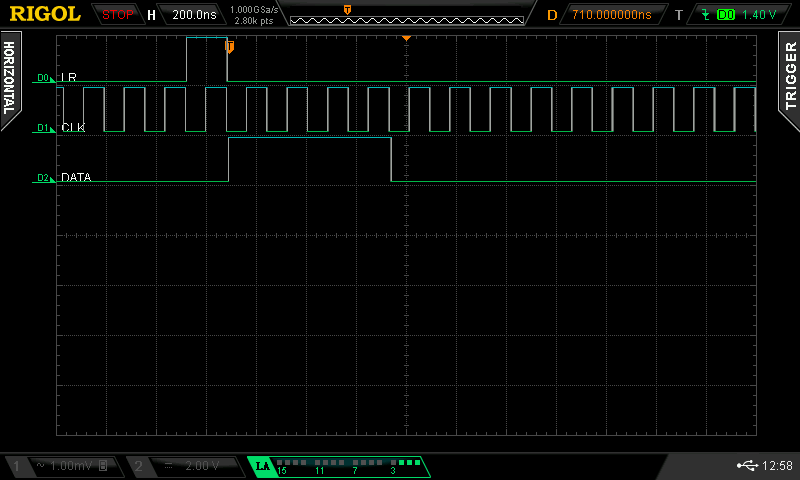
In DSP_A mode data_delay should be set to 0. With data_delay = 1 the MSB is transmitted 1 clock cycle too late and the LSB of the previous sample is received as MSB (i.e. you get loud noise).
See these screenshots, I2S data was 0xF000 (S16_LE format)
data_delay = 1:
http://www.horus.com/~hias/tmp/rpi/bcm2835-dsp-a-delay-1.png
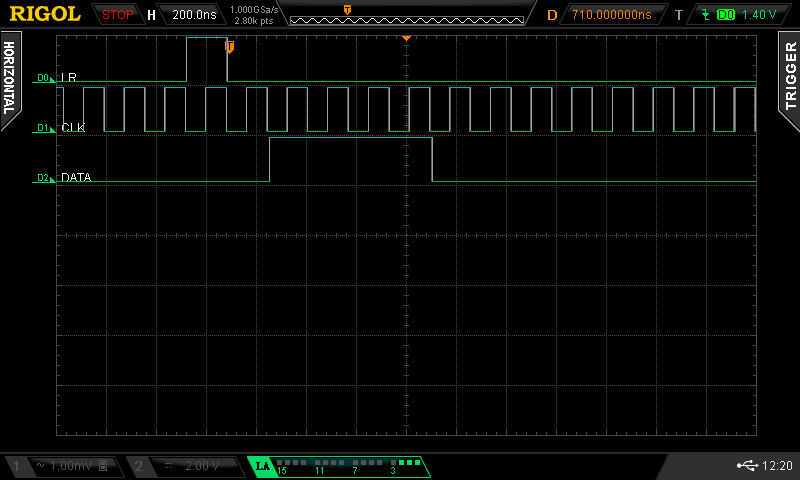
data_delay = 0:
http://www.horus.com/~hias/tmp/rpi/bcm2835-dsp-a-delay-0.png
Quoted 13 lines
sound/soc/bcm/bcm2835-i2s.c +1
-0break ;default :@@ -312,6 +313,7 @@ static int bcm2835_i2s_hw_params(struct snd_pcm_substream *substream,switch (params_channels (params)) {case 2 : +case 8 : format =BCM2835_I2S_CH1 (format) |BCM2835_I2S_CH2 (format); format |=BCM2835_I2S_CH1 (BCM2835_I2S_CHPOS (ch1pos)); format |=BCM2835_I2S_CH2 (BCM2835_I2S_CHPOS (ch2pos));@@ -526,7 +528,17 @@ static int bcm2835_i2s_startup(struct snd_pcm_substream *substream,regmap_update_bits (dev->i2s_regmap,BCM2835_I2S_CS_A_REG ,BCM2835_I2S_STBY ,BCM2835_I2S_STBY );
sound/soc/bcm/bcm2835-i2s.c static int bcm2835_i2s_startup(struct snd_pcm_substream *substream, · line 538
Quoted 10 lines
sound/soc/bcm/bcm2835-i2s.c +8
-1-return 0 ; +/* Set the max channels to 8 if the codec is master and +* we are in DSP A mode. Otherwise only allow 2 channels. +*/ +if ((dev->fmt & + (SND_SOC_DAIFMT_MASTER_MASK |SND_SOC_DAIFMT_FORMAT_MASK )) + == (SND_SOC_DAIFMT_CBM_CFM |SND_SOC_DAIFMT_DSP_A )) +return snd_pcm_hw_constraint_single (substream->runtime, +SNDRV_PCM_HW_PARAM_CHANNELS ,8 );
I'm not sure why you are limiting to exactly 8 channels. 2 channels worked fine here, too. Haven't tested with 4 or 6 channels yet but I guess any even number of channels should work.
In 8-channel configuration I often got swapped/shifted channels. Not 100% sure why, but probably because bcm2835 hadn't DMAed the data in when the codec started the clocks - in that case bcm2835 seems to repeat the last stereo frame data it had in it's buffer. I haven't digged into that deeper though, could be something in my test setup as well.
Quoted 24 lines
sound/soc/bcm/bcm2835-i2s.c +7
-2+else +return snd_pcm_hw_constraint_single (substream->runtime, +SNDRV_PCM_HW_PARAM_CHANNELS ,2 ); } static void bcm2835_i2s_shutdown(struct snd_pcm_substream *substream,@@ -549,6 +561,10 @@ static void bcm2835_i2s_shutdown(struct snd_pcm_substream *substream,* not stop the clock when SND_SOC_DAIFMT_CONT */ bcm2835_i2s_stop_clock (dev); + +/* Default to 2 channels */ +snd_pcm_hw_constraint_single (substream->runtime, +SNDRV_PCM_HW_PARAM_CHANNELS ,2 ); }static const struct snd_soc_dai_ops bcm2835_i2s_dai_ops = {@@ -576,16 +592,12 @@ static struct snd_soc_dai_driver bcm2835_i2s_dai = { .name = "bcm2835-i2s", .probe = bcm2835_i2s_dai_probe, .playback = { - .channels_min = 2, - .channels_max = 2, .rates = SNDRV_PCM_RATE_8000_192000,
sound/soc/bcm/bcm2835-i2s.c static struct snd_soc_dai_driver bcm2835_i2s_dai = { · line 603
Quoted 10 lines
sound/soc/bcm/bcm2835-i2s.c +0
-2.formats = SNDRV_PCM_FMTBIT_S16_LE |SNDRV_PCM_FMTBIT_S24_LE |SNDRV_PCM_FMTBIT_S32_LE }, .capture = { - .channels_min = 2, - .channels_max = 2, .rates =SNDRV_PCM_RATE_8000_192000 , .formats = SNDRV_PCM_FMTBIT_S16_LE |SNDRV_PCM_FMTBIT_S24_LE
With .channels_max removed I get no alsa PCMs with the downstream card drivers - "aplay -L" only reported the "null" PCM.
Changing that to .channels_min = 2, .channels_max = 8 brought back the PCMs.
so long,
Hias
Quoted 11 lines · Matthias Reichl
Hi Matt,
please include me in CC, your emails don't seem to get through linux-rpi-kernel reliably.
I did a few tests with WM5102 in DSP A mode connected to RPi3 with downstream kernel 4.9.11 plus your patch. wm5102 was configured as master, cpu<->codec dai_link.dai_fmt =
SND_SOC_DAIFMT_DSP_A|SND_SOC_DAIFMT_NB_NF|SND_SOC_DAIFMT_CBM_CFMComments are inline.
Sure will do, thanks for testing. My comments are also inline.
Quoted 37 lines · Matt Flax
Quoted 26 lines
This patch adds multitrack capability if in DSP mode A and the codec is master.
In
bcm2835_i2s_startup,snd_pcm_hw_constraint_singleis used to set channels to 8 if bothSND_SOC_DAIFMT_CBM_CFMandSND_SOC_DAIFMT_DSP_Aare set. Otherwise, channels are set to 2. These settings are accomplished using theSNDRV_PCM_HW_PARAM_CHANNELSvariable.In
bcm2835_i2s_shutdownthe channels are set to 2 by default.In
bcm2835_i2s_hw_params, DSP mode A format is now an option. Before replicating the format variable (from ch2 to ch1) for register loading, requested channels are checked to be either 2 or 8. This can be expanded later to accomodate other channel counts if supported by the sound card hardware.Signed-off-by Matt Flax <[email protected]>--- sound/soc/bcm/bcm2835-i2s.c | 22 +++++++++++++++++----- 1 file changed, 17 insertions(+), 5 deletions(-)sound/soc/bcm/bcm2835-i2s.c +0
-0sound/soc/bcm/bcm2835-i2s.c static int bcm2835_i2s_hw_params(struct snd_pcm_substream *substream, · line 300
Quoted 5 lines
sound/soc/bcm/bcm2835-i2s.c +1
-0@@ -296,6 +296,7 @@ static int bcm2835_i2s_hw_params(struct snd_pcm_substream *substream,switch (dev->fmt &SND_SOC_DAIFMT_FORMAT_MASK ) {case SND_SOC_DAIFMT_I2S : +case SND_SOC_DAIFMT_DSP_A : data_delay =1 ;In
DSP_Amodedata_delayshould be set to 0. Withdata_delay= 1 the MSB is transmitted 1 clock cycle too late and the LSB of the previous sample is received as MSB (i.e. you get loud noise).
Quoted 7 lines
See these screenshots, I2S data was
0xF000(S16_LEformat)
data_delay= 1:
http://www.horus.com/~hias/tmp/rpi/bcm2835-dsp-a-delay-1.png
data_delay= 0:
http://www.horus.com/~hias/tmp/rpi/bcm2835-dsp-a-delay-0.png
I can do this, however that would require DSP mode B to have an offset of -1, which can't be set in the BCM2835 position register.
I really like your approach, however it needs extra resources at the hardware level. Without those resources it will never be usable and stable. The reason is that you will never be able to get proper synchrony and your channels will be randomly shifted. It is the curious nature of the BCM2835 I2S silicon - I have used an FPGA to overcome this problem.
Quoted 27 lines
Quoted 13 lines
sound/soc/bcm/bcm2835-i2s.c +1
-0break ;default :@@ -312,6 +313,7 @@ static int bcm2835_i2s_hw_params(struct snd_pcm_substream *substream,switch (params_channels (params)) {case 2 : +case 8 : format =BCM2835_I2S_CH1 (format) |BCM2835_I2S_CH2 (format); format |=BCM2835_I2S_CH1 (BCM2835_I2S_CHPOS (ch1pos)); format |=BCM2835_I2S_CH2 (BCM2835_I2S_CHPOS (ch2pos));@@ -526,7 +528,17 @@ static int bcm2835_i2s_startup(struct snd_pcm_substream *substream,regmap_update_bits (dev->i2s_regmap,BCM2835_I2S_CS_A_REG ,BCM2835_I2S_STBY ,BCM2835_I2S_STBY );sound/soc/bcm/bcm2835-i2s.c static int bcm2835_i2s_startup(struct snd_pcm_substream *substream, · line 538
Quoted 10 lines
sound/soc/bcm/bcm2835-i2s.c +8
-1-return 0 ; +/* Set the max channels to 8 if the codec is master and +* we are in DSP A mode. Otherwise only allow 2 channels. +*/ +if ((dev->fmt & + (SND_SOC_DAIFMT_MASTER_MASK |SND_SOC_DAIFMT_FORMAT_MASK )) + == (SND_SOC_DAIFMT_CBM_CFM |SND_SOC_DAIFMT_DSP_A )) +return snd_pcm_hw_constraint_single (substream->runtime, +SNDRV_PCM_HW_PARAM_CHANNELS ,8 );I'm not sure why you are limiting to exactly 8 channels. 2 channels worked fine here, too. Haven't tested with 4 or 6 channels yet but I guess any even number of channels should work.
Quoted 6 lines
In 8-channel configuration I often got swapped/shifted channels. Not 100% sure why, but probably because bcm2835 hadn't DMAed the data in when the codec started the clocks - in that case bcm2835 seems to repeat the last stereo frame data it had in it's buffer. I haven't digged into that deeper though, could be something in my test setup as well.
Ah - there you go - I would imagine they are only shifted, not swapped !
I have a very robust stream, where I never get swapped channels. In other words, I find that the channels 1 to 8 are always locked to the correct pins.
Multichannel simply can't be done (on the BCM2835) without a suitable FPGA/ASIC/chip between the codec and the BCM2835.
Quoted 37 lines
Quoted 24 lines
sound/soc/bcm/bcm2835-i2s.c +7
-2+else +return snd_pcm_hw_constraint_single (substream->runtime, +SNDRV_PCM_HW_PARAM_CHANNELS ,2 ); } static void bcm2835_i2s_shutdown(struct snd_pcm_substream *substream,@@ -549,6 +561,10 @@ static void bcm2835_i2s_shutdown(struct snd_pcm_substream *substream,* not stop the clock when SND_SOC_DAIFMT_CONT */ bcm2835_i2s_stop_clock (dev); + +/* Default to 2 channels */ +snd_pcm_hw_constraint_single (substream->runtime, +SNDRV_PCM_HW_PARAM_CHANNELS ,2 ); }static const struct snd_soc_dai_ops bcm2835_i2s_dai_ops = {@@ -576,16 +592,12 @@ static struct snd_soc_dai_driver bcm2835_i2s_dai = { .name = "bcm2835-i2s", .probe = bcm2835_i2s_dai_probe, .playback = { - .channels_min = 2, - .channels_max = 2, .rates = SNDRV_PCM_RATE_8000_192000,sound/soc/bcm/bcm2835-i2s.c static struct snd_soc_dai_driver bcm2835_i2s_dai = { · line 603
Quoted 10 lines
sound/soc/bcm/bcm2835-i2s.c +0
-2.formats = SNDRV_PCM_FMTBIT_S16_LE |SNDRV_PCM_FMTBIT_S24_LE |SNDRV_PCM_FMTBIT_S32_LE }, .capture = { - .channels_min = 2, - .channels_max = 2, .rates =SNDRV_PCM_RATE_8000_192000 , .formats = SNDRV_PCM_FMTBIT_S16_LE |SNDRV_PCM_FMTBIT_S24_LE With .channels_max removed I get no alsa PCMs with the downstream card drivers - "aplay -L" only reported the "null" PCM.
Quoted 4 lines
Changing that to .channels_min = 2, .channels_max = 8 brought back the PCMs.
That is curious, channels_max and channels_min are set in _startup implicitly in the snd_pcm_hw_constraint_single call which is inlined to the snd_pcm_hw_constraint_minmax call.
I have tested with an Audio Injector stereo card for the Pi ... I can confirm this problem. I will look into it further.
Can anyone explain why this would happen ?
Matt
Quoted 55 lines · Matt Flax
Quoted 11 lines · Matthias Reichl
Hi Matt,
please include me in CC, your emails don't seem to get through linux-rpi-kernel reliably.
I did a few tests with WM5102 in DSP A mode connected to RPi3 with downstream kernel 4.9.11 plus your patch. wm5102 was configured as master, cpu<->codec dai_link.dai_fmt =
SND_SOC_DAIFMT_DSP_A|SND_SOC_DAIFMT_NB_NF|SND_SOC_DAIFMT_CBM_CFMComments are inline.
Sure will do, thanks for testing. My comments are also inline.
Quoted 38 lines · Matt Flax
Quoted 26 lines
This patch adds multitrack capability if in DSP mode A and the codec is master.
In
bcm2835_i2s_startup,snd_pcm_hw_constraint_singleis used to set channels to 8 if bothSND_SOC_DAIFMT_CBM_CFMandSND_SOC_DAIFMT_DSP_Aare set. Otherwise, channels are set to 2. These settings are accomplished using theSNDRV_PCM_HW_PARAM_CHANNELSvariable.In
bcm2835_i2s_shutdownthe channels are set to 2 by default.In
bcm2835_i2s_hw_params, DSP mode A format is now an option. Before replicating the format variable (from ch2 to ch1) for register loading, requested channels are checked to be either 2 or 8. This can be expanded later to accomodate other channel counts if supported by the sound card hardware.Signed-off-by Matt Flax <[email protected]>--- sound/soc/bcm/bcm2835-i2s.c | 22 +++++++++++++++++----- 1 file changed, 17 insertions(+), 5 deletions(-)sound/soc/bcm/bcm2835-i2s.c +0
-0sound/soc/bcm/bcm2835-i2s.c static int bcm2835_i2s_hw_params(struct snd_pcm_substream *substream, · line 299
Quoted 4 lines
sound/soc/bcm/bcm2835-i2s.c +1
-0@@ -296,6 +296,7 @@ static int bcm2835_i2s_hw_params(struct snd_pcm_substream *substream,switch (dev->fmt &SND_SOC_DAIFMT_FORMAT_MASK ) {case SND_SOC_DAIFMT_I2S : +case SND_SOC_DAIFMT_DSP_A : data_delay =1 ;In
DSP_Amodedata_delayshould be set to 0. Withdata_delay= 1 the MSB is transmitted 1 clock cycle too late and the LSB of the previous sample is received as MSB (i.e. you get loud noise).See these screenshots, I2S data was
0xF000(S16_LEformat)
Quoted 8 lines
Quoted 5 lines
data_delay= 1:
http://www.horus.com/~hias/tmp/rpi/bcm2835-dsp-a-delay-1.png
data_delay= 0:
http://www.horus.com/~hias/tmp/rpi/bcm2835-dsp-a-delay-0.pngI can do this, however that would require DSP mode B to have an offset of -1, which can't be set in the BCM2835 position register.
I don't see where you are using mode B - you only added support for mode A. Not quite sure what you mean with that.
Quoted 5 lines
I really like your approach, however it needs extra resources at the hardware level. Without those resources it will never be usable and stable. The reason is that you will never be able to get proper synchrony and your channels will be randomly shifted. It is the curious nature of the BCM2835 I2S silicon - I have used an FPGA to overcome this problem.
I don't quite follow you here. DSP mode A timing usually means that the MSB follows immediately after the 1-cycle LR pulse. Or, if the pulse is longer than one cycle, MSB starts 1 clk after the leading LR pulse edge.
With data delay=1 you are using I2S timing, not mode A timing.
Quoted 32 lines
Quoted 25 lines
Quoted 11 lines
sound/soc/bcm/bcm2835-i2s.c +1
-0break ;default :@@ -312,6 +313,7 @@ static int bcm2835_i2s_hw_params(struct snd_pcm_substream *substream,switch (params_channels (params)) {case 2 : +case 8 : format =BCM2835_I2S_CH1 (format) |BCM2835_I2S_CH2 (format); format |=BCM2835_I2S_CH1 (BCM2835_I2S_CHPOS (ch1pos)); format |=BCM2835_I2S_CH2 (BCM2835_I2S_CHPOS (ch2pos));@@ -526,7 +528,17 @@ static int bcm2835_i2s_startup(struct snd_pcm_substream *substream, regmap_update_bits(dev->i2s_regmap, BCM2835_I2S_CS_A_REG,sound/soc/bcm/bcm2835-i2s.c static int bcm2835_i2s_startup(struct snd_pcm_substream *substream, · line 537
Quoted 10 lines
sound/soc/bcm/bcm2835-i2s.c +8
-1BCM2835_I2S_STBY, BCM2835_I2S_STBY); -return 0 ; +/* Set the max channels to 8 if the codec is master and +* we are in DSP A mode. Otherwise only allow 2 channels. +*/ +if ((dev->fmt & + (SND_SOC_DAIFMT_MASTER_MASK |SND_SOC_DAIFMT_FORMAT_MASK )) + == (SND_SOC_DAIFMT_CBM_CFM |SND_SOC_DAIFMT_DSP_A )) +return snd_pcm_hw_constraint_single (substream->runtime, +SNDRV_PCM_HW_PARAM_CHANNELS ,8 );I'm not sure why you are limiting to exactly 8 channels. 2 channels worked fine here, too. Haven't tested with 4 or 6 channels yet but I guess any even number of channels should work.
Quoted 6 lines
In 8-channel configuration I often got swapped/shifted channels. Not 100% sure why, but probably because bcm2835 hadn't DMAed the data in when the codec started the clocks - in that case bcm2835 seems to repeat the last stereo frame data it had in it's buffer. I haven't digged into that deeper though, could be something in my test setup as well.
Quoted 8 lines
Ah - there you go - I would imagine they are only shifted, not swapped !
I have a very robust stream, where I never get swapped channels. In other words, I find that the channels 1 to 8 are always locked to the correct pins.
Multichannel simply can't be done (on the BCM2835) without a suitable FPGA/ASIC/chip between the codec and the BCM2835.
I'd put it in another way: it seems to me that the bcm2835 I2S won't reliably sync in DSP mode A.
I did some more tests and noticed channel/sample shifts both in 2-channel and in 8-channel DSP mode A. When using 2-channel I2S mode I never got any channel/sample shifts.
Here are screenshots of 8-channel S16_LE data, first transmitted sample is 0xf000, then 0xf100, then 0xf200 ... up to 0xf700.
This is the first full frame with data from bcm2835. Before that the clocks were active for about 1.2ms and bcm2835 transmitted a low data signal:
http://www.horus.com/~hias/tmp/rpi/bcm2835-dsp-a-8ch-frame1.png
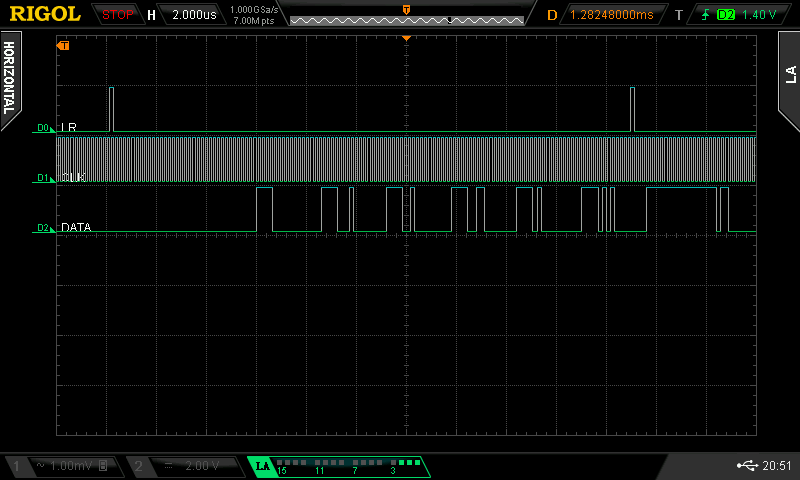
Note that immediately after LR pulse there's not a 0xf000 sample but 0x0000. The transmitted data doesn't seem to be synced on sample boundaries at all (i.e. the seem to be bit-shifted), let alone frame-synced.
Here's the second full frame:
http://www.horus.com/~hias/tmp/rpi/bcm2835-dsp-a-8ch-frame2.png
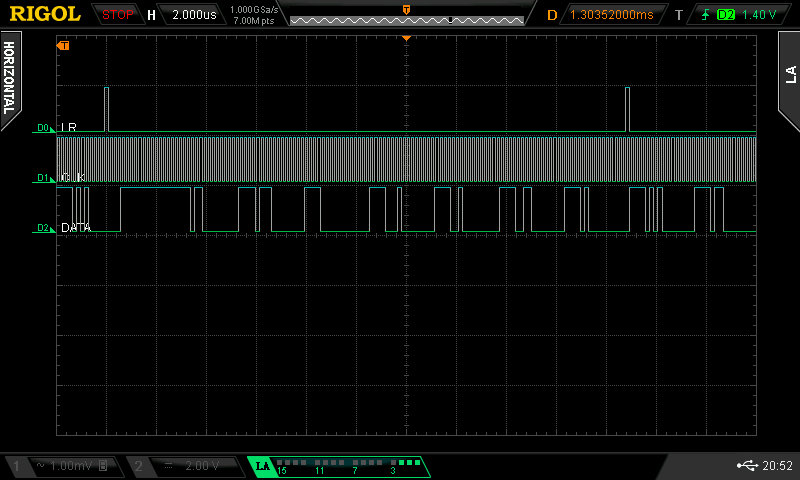
Note that the first sample is rather odd, MSB isn't 1 but 0 and then a long run of 1 bits follow. About 8us after that the data sees to be sample-synced.
But also note that at the 3rd frame with data starts with 0xf500, not 0xf000 as expected. At least the samples are now synced and MSB occurs on the correct position. Still, the rest of the stream has the samples/channels shifted by 5.
Quoted 51 lines
Quoted 36 lines
Quoted 23 lines
sound/soc/bcm/bcm2835-i2s.c +7
-2+else +return snd_pcm_hw_constraint_single (substream->runtime, +SNDRV_PCM_HW_PARAM_CHANNELS ,2 ); } static void bcm2835_i2s_shutdown(struct snd_pcm_substream *substream,@@ -549,6 +561,10 @@ static void bcm2835_i2s_shutdown(struct snd_pcm_substream *substream,* not stop the clock when SND_SOC_DAIFMT_CONT */ bcm2835_i2s_stop_clock (dev); + +/* Default to 2 channels */ +snd_pcm_hw_constraint_single (substream->runtime, +SNDRV_PCM_HW_PARAM_CHANNELS ,2 ); }static const struct snd_soc_dai_ops bcm2835_i2s_dai_ops = {@@ -576,16 +592,12 @@ static struct snd_soc_dai_driver bcm2835_i2s_dai = { .name = "bcm2835-i2s", .probe = bcm2835_i2s_dai_probe, .playback = { - .channels_min = 2, - .channels_max = 2, .rates = SNDRV_PCM_RATE_8000_192000,sound/soc/bcm/bcm2835-i2s.c static struct snd_soc_dai_driver bcm2835_i2s_dai = { · line 603
Quoted 10 lines
sound/soc/bcm/bcm2835-i2s.c +0
-2.formats = SNDRV_PCM_FMTBIT_S16_LE |SNDRV_PCM_FMTBIT_S24_LE |SNDRV_PCM_FMTBIT_S32_LE }, .capture = { - .channels_min = 2, - .channels_max = 2, .rates =SNDRV_PCM_RATE_8000_192000 , .formats = SNDRV_PCM_FMTBIT_S16_LE |SNDRV_PCM_FMTBIT_S24_LE With .channels_max removed I get no alsa PCMs with the downstream card drivers - "aplay -L" only reported the "null" PCM.
Quoted 4 lines
Changing that to .channels_min = 2, .channels_max = 8 brought back the PCMs.
That is curious,
channels_maxandchannels_minare set in_startupimplicitly in thesnd_pcm_hw_constraint_singlecall which is inlined to thesnd_pcm_hw_constraint_minmaxcall.I have tested with an Audio Injector stereo card for the Pi ... I can confirm this problem. I will look into it further.
Can anyone explain why this would happen ?
Matt
Quoted 4 lines · Matthias Reichl
I'd put it in another way: it seems to me that the bcm2835 I2S won't reliably sync in DSP mode A.
What you are explaining here is the nature of the BCM2835 responding to a codec master. The hardware setup you are describing is elegantly simple, but TOO simple.
Measurements on a system which uses a codec master don't represent a robust implementation of multichannel with the BCM2835. My experiments (and now yours) have shown that the system has a bit shift and an uncontrollable channel drift.
Multichannel simply can't be done (on the BCM2835) without control at the hardware level - this requires an intermediate master control chip.
The Audio Injector Octo machine driver, sets both the codec and the BCM2835 as slaves - the FPGA is master because it has to control both the BCM2835 and the codec's systems to get reliability. You can see the machine driver on github :
https://github.com/flatmax/linux/blob/rpi-4.4.y/sound/soc/bcm/audioinjector-octo-soundcard.c
It has taken month to implement a robust solution to this problem using an FPGA and the result is a fantastic (Audio Injector Octo) sound card. I am almost certain this hardware technique can be used on all stereo I2S SoC chips.
Matt
Quoted 4 lines · Matt Flax
On 25/02/17 07:25, Matthias Reichl wrote:
Quoted 8 lines
Quoted 4 lines
I'd put it in another way: it seems to me that the bcm2835 I2S won't reliably sync in DSP mode A.
What you are explaining here is the nature of the BCM2835 responding to a codec master. The hardware setup you are describing is elegantly simple, but TOO simple.
Your patch only changes the CPU DAI driver. At this point it doesn't matter if the codec or an external source is driving the clocks.
If the clock timing adheres to DSP mode A timing and you add code to the the CPU DAI driver so it can operate in DSP mode A then that should also work. If not, it's broken.
The (rather brief) publically available bcm2835 datasheet only mentions I2S mode and my tests lead me to the conclusion that the bcm2835 is actually expecting I2S timing, not DSP A - at least with the current code.
Quoted 14 lines
Measurements on a system which uses a codec master don't represent a robust implementation of multichannel with the BCM2835. My experiments (and now yours) have shown that the system has a bit shift and an uncontrollable channel drift.
Multichannel simply can't be done (on the BCM2835) without control at the hardware level - this requires an intermediate master control chip.
The Audio Injector Octo machine driver, sets both the codec and the BCM2835 as slaves - the FPGA is master because it has to control both the BCM2835 and the codec's systems to get reliability. You can see the machine driver on github :
https://github.com/flatmax/linux/blob/rpi-4.4.y/sound/soc/bcm/audioinjector-octo-soundcard.c
Quoted 4 lines
It has taken month to implement a robust solution to this problem using an FPGA and the result is a fantastic (Audio Injector Octo) sound card. I am almost certain this hardware technique can be used on all stereo I2S SoC chips.
Can you please provide details about the timing / protocol you are actually using?
so long,
Hias
Quoted 4 lines
Matt
Le 25/02/2017 ? 00:02, Matthias Reichl a ?crit :
Quoted 14 lines · Matt Flax
Quoted 10 lines · Matthias Reichl
Quoted 5 lines
I'd put it in another way: it seems to me that the bcm2835 I2S won't reliably sync in DSP mode A.
What you are explaining here is the nature of the BCM2835 responding to a codec master. The hardware setup you are describing is elegantly simple, but TOO simple.
Your patch only changes the CPU DAI driver. At this point it doesn't matter if the codec or an external source is driving the clocks.
Quoted 8 lines
If the clock timing adheres to DSP mode A timing and you add code to the the CPU DAI driver so it can operate in DSP mode A then that should also work. If not, it's broken.
The (rather brief) publically available bcm2835 datasheet only mentions I2S mode and my tests lead me to the conclusion that the bcm2835 is actually expecting I2S timing, not DSP A - at least with the current code.
After reading this long thread and gluing all info together, my guess is that the "real" thing he's trying to do is to introduce a new DPS mode which is nothing more than a multichannel capable I2S mode or a "DSP I" mode : DSP A with data_delay 1.
As it is basically an I2S (2 channel) encapsulation of multichannel stream, the real question is alsa plugin or new bastardized DSP mode ?
Quoted 15 lines
Quoted 15 lines
Measurements on a system which uses a codec master don't represent a robust implementation of multichannel with the BCM2835. My experiments (and now yours) have shown that the system has a bit shift and an uncontrollable channel drift.
Multichannel simply can't be done (on the BCM2835) without control at the hardware level - this requires an intermediate master control chip.
The Audio Injector Octo machine driver, sets both the codec and the BCM2835 as slaves - the FPGA is master because it has to control both the BCM2835 and the codec's systems to get reliability. You can see the machine driver on github :
https://github.com/flatmax/linux/blob/rpi-4.4.y/sound/soc/bcm/audioinjector-octo-soundcard.c
Quoted 6 lines
Quoted 4 lines
It has taken month to implement a robust solution to this problem using an FPGA and the result is a fantastic (Audio Injector Octo) sound card. I am almost certain this hardware technique can be used on all stereo I2S SoC chips.
Can you please provide details about the timing / protocol you are actually using?
I suspect that the FPGA act as an I2S <=> DSP A translator, taking care of data_delay difference translation relative to the falling edge of LRCLK. It could translate the duration of the one BCLK duration of LRCLK DSP A pulse to standard I2S LRCLK even if most codecs works with I2S fs LRCLK timing as the sync point is the falling edge.
As the FPGA has to deals with the clocks of the two sides, it's more simple if it's the master.
If I'm right, the real used mode from the soc point of view is I2S and all of this is valid for all I2S IP, there is nothing BMC2835 specific here. It is not the right place to do the mod.
Emmanuel.
Quoted 25 lines · Emmanuel Fust?
Le 25/02/2017 ? 00:02, Matthias Reichl a ?crit :
Quoted 16 lines · Matt Flax
Quoted 7 lines · Matthias Reichl
Quoted 5 lines
I'd put it in another way: it seems to me that the bcm2835 I2S won't reliably sync in DSP mode A.
Quoted 5 lines
What you are explaining here is the nature of the BCM2835 responding to a
codec master. The hardware setup you are describing is elegantly simple, but
TOO simple.Your patch only changes the CPU DAI driver. At this point it doesn't matter if the codec or an external source is driving the clocks.
Quoted 8 lines
If the clock timing adheres to DSP mode A timing and you add code to the the CPU DAI driver so it can operate in DSP mode A then that should also work. If not, it's broken.
The (rather brief) publically available bcm2835 datasheet only mentions I2S mode and my tests lead me to the conclusion that the bcm2835 is actually expecting I2S timing, not DSP A - at least with the current code.
Quoted 7 lines
After reading this long thread and gluing all info together, my guess is that the "real" thing he's trying to do is to introduce a new DPS mode which is nothing more than a multichannel capable I2S mode or a "DSP I" mode : DSP A with
data_delay1.
As it is basically an I2S (2 channel) encapsulation of multichannel stream, the real question is alsa plugin or new bastardized DSP mode ?
I am not sure if creating a new DSP mode is necesary ?
Having a conflict over DSP mode is a "red herring". Below we talk about clocking and timing mater, it is likely that that is where the real problem is.
Quoted 31 lines
Quoted 29 lines
Quoted 22 lines
Measurements on a system which uses a codec master don't represent a robust
implementation of multichannel with the BCM2835. My experiments (and now
yours) have shown that the system has a bit shift and an uncontrollable channel drift.Multichannel simply can't be done (on the BCM2835) without control at the
hardware level - this requires an intermediate master control chip.The Audio Injector Octo machine driver, sets both the codec and the BCM2835
as slaves - the FPGA is master because it has to control both the BCM2835
and the codec's systems to get reliability. You can see the machine driver
on github :
https://github.com/flatmax/linux/blob/rpi-4.4.y/sound/soc/bcm/audioinjector-octo-soundcard.cQuoted 7 lines
It has taken month to implement a robust solution to this problem using an
FPGA and the result is a fantastic (Audio Injector Octo) sound card. I am
almost certain this hardware technique can be used on all stereo I2S SoC
chips.Quoted 2 lines
Can you please provide details about the timing / protocol you are actually using?
Quoted 12 lines
I suspect that the FPGA act as an I2S <=> DSP A translator, taking care of
data_delaydifference translation relative to the falling edge of LRCLK.
It could translate the duration of the one BCLK duration of LRCLK DSP A pulse to standard I2S LRCLK even if most codecs works with I2S fs LRCLK timing as the sync point is the falling edge.
As the FPGA has to deals with the clocks of the two sides, it's more simple if it's the master.
If I'm right, the real used mode from the soc point of view is I2S and all of this is valid for all I2S IP, there is nothing BMC2835 specific here. It is not the right place to do the mod.
That is right, the functionality doesn't exist in ALSA to have neither the codec nor the SoC as master.
As I have mentioned before, this is really window dressing for the
lack of functionality currently in ALSA.
Consider that the same problem exists for sample rate converter chips, it isn't only the Audio Injector Octo's use case.
I would like to change focus to the missing piece of the puzzle where an FPGA or ASIC is bit and frame master. For example a new definition :
#define SND_SOC_DAIFMT_ABM_AFM (5 << 12) /* ASIC clk & FRM
master */
Now with this new mode, it will force all codecs and SoC drivers to fail EINVAL unless they have been manually set up to handle an ASIC master.
This also solves the problem Mattias brought up where choosing DSP mode and codec master causes this terrible channel swapping and bit offset. Now we fail if in DSP mode with a codec master, or succeed in DSP mode with an ASIC master :
Example for the bcm2835_is2.c :
     /* In DSP mode, ensure that an ASIC is master */
     if ((dev->fmt & SND_SOC_DAIFMT_FORMAT_MASK)
                                           == SND_SOC_DAIFMT_DSP_A)
         if ((dev->fmt & SND_SOC_DAIFMT_MASTER_MASK)
                                        != SND_SOC_DAIFMT_ABM_AFM )
             return -EINVAL;
         else
return snd_pcm_hw_constraint_single(substream->runtime,SNDRV_PCM_HW_PARAM_CHANNELS, 8);
Matt
Quoted 120 lines · Matt Flax
Quoted 25 lines · Emmanuel Fust?
Le 25/02/2017 ? 00:02, Matthias Reichl a ?crit :
Quoted 16 lines · Matt Flax
Quoted 7 lines · Matthias Reichl
Quoted 5 lines
I'd put it in another way: it seems to me that the bcm2835 I2S won't reliably sync in DSP mode A.
Quoted 5 lines
What you are explaining here is the nature of the BCM2835 responding to a
codec master. The hardware setup you are describing is elegantly simple, but
TOO simple.Your patch only changes the CPU DAI driver. At this point it doesn't matter if the codec or an external source is driving the clocks.
Quoted 8 lines
If the clock timing adheres to DSP mode A timing and you add code to the the CPU DAI driver so it can operate in DSP mode A then that should also work. If not, it's broken.
The (rather brief) publically available bcm2835 datasheet only mentions I2S mode and my tests lead me to the conclusion that the bcm2835 is actually expecting I2S timing, not DSP A - at least with the current code.
Quoted 7 lines
After reading this long thread and gluing all info together, my guess is that the "real" thing he's trying to do is to introduce a new DPS mode which is nothing more than a multichannel capable I2S mode or a "DSP I" mode : DSP A with
data_delay1.
As it is basically an I2S (2 channel) encapsulation of multichannel stream, the real question is alsa plugin or new bastardized DSP mode ?I am not sure if creating a new DSP mode is necesary ?
Having a conflict over DSP mode is a "red herring". Below we talk about clocking and timing mater, it is likely that that is where the real problem is.
Quoted 32 lines
Quoted 30 lines
Quoted 23 lines
Measurements on a system which uses a codec master don't represent a robust
implementation of multichannel with the BCM2835. My experiments (and now
yours) have shown that the system has a bit shift and an uncontrollable
channel drift.Multichannel simply can't be done (on the BCM2835) without control at the
hardware level - this requires an intermediate master control chip.The Audio Injector Octo machine driver, sets both the codec and the BCM2835
as slaves - the FPGA is master because it has to control both the BCM2835
and the codec's systems to get reliability. You can see the machine driver
on github :
https://github.com/flatmax/linux/blob/rpi-4.4.y/sound/soc/bcm/audioinjector-octo-soundcard.cQuoted 7 lines
It has taken month to implement a robust solution to this problem using an
FPGA and the result is a fantastic (Audio Injector Octo) sound card. I am
almost certain this hardware technique can be used on all stereo I2S SoC
chips.Quoted 2 lines
Can you please provide details about the timing / protocol you are actually using?
Quoted 12 lines
I suspect that the FPGA act as an I2S <=> DSP A translator, taking care of
data_delaydifference translation relative to the falling edge of LRCLK.
It could translate the duration of the one BCLK duration of LRCLK DSP A pulse to standard I2S LRCLK even if most codecs works with I2S fs LRCLK timing as the sync point is the falling edge.
As the FPGA has to deals with the clocks of the two sides, it's more simple if it's the master.
If I'm right, the real used mode from the soc point of view is I2S and all of this is valid for all I2S IP, there is nothing BMC2835 specific here. It is not the right place to do the mod.That is right, the functionality doesn't exist in ALSA to have neither the codec nor the SoC as master.
As I have mentioned before, this is really window dressing for the
lack of functionality currently in ALSA.Consider that the same problem exists for sample rate converter chips, it isn't only the Audio Injector Octo's use case.
I would like to change focus to the missing piece of the puzzle where an FPGA or ASIC is bit and frame master. For example a new definition :
#defineSND_SOC_DAIFMT_ABM_AFM(5 << 12) /* ASIC clk & FRM
master */Now with this new mode, it will force all codecs and SoC drivers to fail EINVAL unless they have been manually set up to handle an ASIC master.
This also solves the problem Mattias brought up where choosing DSP mode and codec master causes this terrible channel swapping and bit offset. Now we fail if in DSP mode with a codec master, or succeed in DSP mode with an ASIC master :
Example for the
bcm2835_is2.c:/* In DSP mode, ensure that an ASIC is master */ if ((dev->fmt & SND_SOC_DAIFMT_FORMAT_MASK) == SND_SOC_DAIFMT_DSP_A) if ((dev->fmt & SND_SOC_DAIFMT_MASTER_MASK) != SND_SOC_DAIFMT_ABM_AFM ) return -EINVAL; else return snd_pcm_hw_constraint_single(substream->runtime,
Quoted 2 lines
SNDRV_PCM_HW_PARAM_CHANNELS, 8);
I am sending a patch set which implements this concept to the list.
Matt
Quoted 125 lines · Matt Flax
Quoted 120 lines · Matt Flax
Quoted 25 lines · Emmanuel Fust?
Le 25/02/2017 ? 00:02, Matthias Reichl a ?crit :
Quoted 16 lines · Matt Flax
Quoted 7 lines · Matthias Reichl
Quoted 5 lines
I'd put it in another way: it seems to me that the bcm2835 I2S won't reliably sync in DSP mode A.
Quoted 5 lines
What you are explaining here is the nature of the BCM2835 responding to a
codec master. The hardware setup you are describing is elegantly simple, but
TOO simple.Your patch only changes the CPU DAI driver. At this point it doesn't matter if the codec or an external source is driving the clocks.
Quoted 8 lines
If the clock timing adheres to DSP mode A timing and you add code to the the CPU DAI driver so it can operate in DSP mode A then that should also work. If not, it's broken.
The (rather brief) publically available bcm2835 datasheet only mentions I2S mode and my tests lead me to the conclusion that the bcm2835 is actually expecting I2S timing, not DSP A - at least with the current code.
Quoted 7 lines
After reading this long thread and gluing all info together, my guess is that the "real" thing he's trying to do is to introduce a new DPS mode which is nothing more than a multichannel capable I2S mode or a "DSP I" mode : DSP A with
data_delay1.
As it is basically an I2S (2 channel) encapsulation of multichannel stream, the real question is alsa plugin or new bastardized DSP mode ?I am not sure if creating a new DSP mode is necesary ?
Having a conflict over DSP mode is a "red herring". Below we talk about clocking and timing mater, it is likely that that is where the real problem is.
Quoted 32 lines
Quoted 30 lines
Quoted 23 lines
Measurements on a system which uses a codec master don't represent a robust
implementation of multichannel with the BCM2835. My experiments (and now
yours) have shown that the system has a bit shift and an uncontrollable
channel drift.Multichannel simply can't be done (on the BCM2835) without control at the
hardware level - this requires an intermediate master control chip.The Audio Injector Octo machine driver, sets both the codec and the BCM2835
as slaves - the FPGA is master because it has to control both the BCM2835
and the codec's systems to get reliability. You can see the machine driver
on github :
https://github.com/flatmax/linux/blob/rpi-4.4.y/sound/soc/bcm/audioinjector-octo-soundcard.cQuoted 7 lines
It has taken month to implement a robust solution to this problem using an
FPGA and the result is a fantastic (Audio Injector Octo) sound card. I am
almost certain this hardware technique can be used on all stereo I2S SoC
chips.Quoted 2 lines
Can you please provide details about the timing / protocol you are actually using?
Quoted 12 lines
I suspect that the FPGA act as an I2S <=> DSP A translator, taking care of
data_delaydifference translation relative to the falling edge of LRCLK.
It could translate the duration of the one BCLK duration of LRCLK DSP A pulse to standard I2S LRCLK even if most codecs works with I2S fs LRCLK timing as the sync point is the falling edge.
As the FPGA has to deals with the clocks of the two sides, it's more simple if it's the master.
If I'm right, the real used mode from the soc point of view is I2S and all of this is valid for all I2S IP, there is nothing BMC2835 specific here. It is not the right place to do the mod.That is right, the functionality doesn't exist in ALSA to have neither the codec nor the SoC as master.
As I have mentioned before, this is really window dressing for the
lack of functionality currently in ALSA.Consider that the same problem exists for sample rate converter chips, it isn't only the Audio Injector Octo's use case.
I would like to change focus to the missing piece of the puzzle where an FPGA or ASIC is bit and frame master. For example a new definition :
#defineSND_SOC_DAIFMT_ABM_AFM(5 << 12) /* ASIC clk & FRM
master */Now with this new mode, it will force all codecs and SoC drivers to fail EINVAL unless they have been manually set up to handle an ASIC master.
This also solves the problem Mattias brought up where choosing DSP mode and codec master causes this terrible channel swapping and bit offset. Now we fail if in DSP mode with a codec master, or succeed in DSP mode with an ASIC master :
Example for the
bcm2835_is2.c:/* In DSP mode, ensure that an ASIC is master */ if ((dev->fmt & SND_SOC_DAIFMT_FORMAT_MASK) == SND_SOC_DAIFMT_DSP_A) if ((dev->fmt & SND_SOC_DAIFMT_MASTER_MASK) != SND_SOC_DAIFMT_ABM_AFM ) return -EINVAL; else return snd_pcm_hw_constraint_single(substream->runtime,Quoted 2 lines
SNDRV_PCM_HW_PARAM_CHANNELS, 8);
Quoted 2 lines
I am sending a patch set which implements this concept to the list.
Hey Matthias, I had an idea which may work with your setup, which doesn't include the FPGA.
Firstly, add a DSP mode B to the bcm2835_i2s.c driver. Set its delay to
0. Now we have (in the bcm2835_i2s.c) DSP mode A as delay of 1 and DSP mode B as a delay of 0. Set your codec to DSP mode A, the CPU (bcm2835) to DSP mode B. This solves the bit shift issue you mentioned before.
Secondly, to try to get rid of your random channels swapping, can you please check and if necessary change the DMA setup in the dts (or elsewhere if necessary) so that it will DMA in multiples of 8 ? Don't know but a hunch suggests that this may fix things ... which would be amazing.
Matt