performance r nfsd with RWF_DONTCACHE and larger wsizes
Subsystems (3)
Jeff Layton
maintainerFYI I decided to try and get some numbers with Mike's RWF_DONTCACHE patches for nfsd [1]. Those add a module param that make all reads and writes use RWF_DONTCACHE.
I had one host that was running knfsd with an XFS export, and a second that was acting as NFS client. Both machines have tons of memory, so pagecache utilization is irrelevant for this test.
I tested sequential writes using the fio-seq_write.fio test, both with and without the module param enabled.
These numbers are from one run each, but they were pretty stable over several runs:
# fio /usr/share/doc/fio/examples/fio-seq-write.fio
wsize=1M:
Normal:      WRITE: bw=1034MiB/s (1084MB/s), 1034MiB/s-1034MiB/s (1084MB/s-1084MB/s), io=910GiB (977GB), run=901326-901326msec
DONTCACHE:   WRITE: bw=649MiB/s (681MB/s), 649MiB/s-649MiB/s (681MB/s-681MB/s), io=571GiB (613GB), run=900001-900001msec
DONTCACHE with a 1M wsize vs. recent (v6.14-ish) knfsd was about 30% slower. Memory consumption was down, but these boxes have oodles of memory, so I didn't notice much change there.
Chris suggested that the write sizes were too small in this test, so I grabbed Chuck's patches to increase the max RPC payload size [2] to 4M, and patched the client to allow a wsize that big:
wsize=4M:
Normal:       WRITE: bw=1053MiB/s (1104MB/s), 1053MiB/s-1053MiB/s (1104MB/s-1104MB/s), io=930GiB (999GB), run=904526-904526msec
DONTCACHE:    WRITE: bw=1191MiB/s (1249MB/s), 1191MiB/s-1191MiB/s (1249MB/s-1249MB/s), io=1050GiB (1127GB), run=902781-902781msec
Not much change with normal buffered I/O here, but DONTCACHE is faster with a 4M wsize. My suspicion (unconfirmed) is that the dropbehind flag ends up causing partially-written large folios in the pagecache to get written back too early, and that slows down later writes to the same folios.
I wonder if we need some heuristic that makes generic_write_sync() only kick off writeback immediately if the whole folio is dirty so we have more time to gather writes before kicking off writeback?
This might also be a good reason to think about a larger rsize/wsize limit in the client.
I'd like to also test reads with this flag, but I'm currently getting back that EOPNOTSUPP error when I try to test them.
[1]: https://lore.kernel.org/linux-nfs/20250220171205.12092-1-
[email protected]/
[2]: https://lore.kernel.org/linux-nfs/20250428193702.5186-15-
[email protected]/
Signature · 1 line
Jeff Layton <[email protected]>
Quoted 31 lines · Jeff Layton
FYI I decided to try and get some numbers with Mike's
RWF_DONTCACHEpatches for nfsd [1]. Those add a module param that make all reads and writes useRWF_DONTCACHE.I had one host that was running knfsd with an XFS export, and a second that was acting as NFS client. Both machines have tons of memory, so pagecache utilization is irrelevant for this test.
I tested sequential writes using the fio-seq_write.fio test, both with and without the module param enabled.
These numbers are from one run each, but they were pretty stable over several runs:
# fio /usr/share/doc/fio/examples/fio-seq-write.fiowsize=1M:
Normal:      WRITE: bw=1034MiB/s (1084MB/s), 1034MiB/s-1034MiB/s (1084MB/s-1084MB/s), io=910GiB (977GB), run=901326-901326msec
DONTCACHE:   WRITE: bw=649MiB/s (681MB/s), 649MiB/s-649MiB/s (681MB/s-681MB/s), io=571GiB (613GB), run=900001-900001msec
DONTCACHE with a 1M wsize vs. recent (v6.14-ish) knfsd was about 30% slower. Memory consumption was down, but these boxes have oodles of memory, so I didn't notice much change there.
Chris suggested that the write sizes were too small in this test, so I grabbed Chuck's patches to increase the max RPC payload size [2] to 4M, and patched the client to allow a wsize that big:
wsize=4M:
Quoted 8 lines
Normal:       WRITE: bw=1053MiB/s (1104MB/s), 1053MiB/s-1053MiB/s (1104MB/s-1104MB/s), io=930GiB (999GB), run=904526-904526msec
DONTCACHE:    WRITE: bw=1191MiB/s (1249MB/s), 1191MiB/s-1191MiB/s (1249MB/s-1249MB/s), io=1050GiB (1127GB), run=902781-902781msec
Not much change with normal buffered I/O here, but DONTCACHE is faster with a 4M wsize. My suspicion (unconfirmed) is that the dropbehind flag ends up causing partially-written large folios in the pagecache to get written back too early, and that slows down later writes to the same folios.
My feeling is that at this point, the NFSD read and write paths are not currently tuned for large folios -- they break every I/O into single pages.
Quoted 3 lines
I wonder if we need some heuristic that makes
generic_write_sync()only kick off writeback immediately if the whole folio is dirty so we have more time to gather writes before kicking off writeback?
Mike has suggested that NFSD should limit the use RWF_UNCACHED to WRITE requests with large payloads (for some arbitrary definition of "large").
Quoted 5 lines
This might also be a good reason to think about a larger rsize/wsize limit in the client.
I'd like to also test reads with this flag, but I'm currently getting back that EOPNOTSUPP error when I try to test them.
That's expected for that patch series.
But I have to ask: what problem do you expect RWF_UNCACHED to solve?
Quoted 4 lines
[1]: https://lore.kernel.org/linux-nfs/20250220171205.12092-1-
[email protected]/
[2]: https://lore.kernel.org/linux-nfs/20250428193702.5186-15-
[email protected]/
Signature · 1 line
Chuck Lever
Jeff Layton
maintainerQuoted 41 lines · Chuck Lever
Quoted 31 lines · Jeff Layton
FYI I decided to try and get some numbers with Mike's
RWF_DONTCACHEpatches for nfsd [1]. Those add a module param that make all reads and writes useRWF_DONTCACHE.I had one host that was running knfsd with an XFS export, and a second that was acting as NFS client. Both machines have tons of memory, so pagecache utilization is irrelevant for this test.
I tested sequential writes using the fio-seq_write.fio test, both with and without the module param enabled.
These numbers are from one run each, but they were pretty stable over several runs:
# fio /usr/share/doc/fio/examples/fio-seq-write.fiowsize=1M:
Normal:      WRITE: bw=1034MiB/s (1084MB/s), 1034MiB/s-1034MiB/s (1084MB/s-1084MB/s), io=910GiB (977GB), run=901326-901326msec
DONTCACHE:   WRITE: bw=649MiB/s (681MB/s), 649MiB/s-649MiB/s (681MB/s-681MB/s), io=571GiB (613GB), run=900001-900001msec
DONTCACHE with a 1M wsize vs. recent (v6.14-ish) knfsd was about 30% slower. Memory consumption was down, but these boxes have oodles of memory, so I didn't notice much change there.
Chris suggested that the write sizes were too small in this test, so I grabbed Chuck's patches to increase the max RPC payload size [2] to 4M, and patched the client to allow a wsize that big:
wsize=4M:
Quoted 8 lines
Normal:       WRITE: bw=1053MiB/s (1104MB/s), 1053MiB/s-1053MiB/s (1104MB/s-1104MB/s), io=930GiB (999GB), run=904526-904526msec
DONTCACHE:    WRITE: bw=1191MiB/s (1249MB/s), 1191MiB/s-1191MiB/s (1249MB/s-1249MB/s), io=1050GiB (1127GB), run=902781-902781msec
Not much change with normal buffered I/O here, but DONTCACHE is faster with a 4M wsize. My suspicion (unconfirmed) is that the dropbehind flag ends up causing partially-written large folios in the pagecache to get written back too early, and that slows down later writes to the same folios.
Quoted 4 lines
My feeling is that at this point, the NFSD read and write paths are not currently tuned for large folios -- they break every I/O into single pages.
*nod*
Quoted 9 lines
Quoted 4 lines
I wonder if we need some heuristic that makes
generic_write_sync()only kick off writeback immediately if the whole folio is dirty so we have more time to gather writes before kicking off writeback?Mike has suggested that NFSD should limit the use
RWF_UNCACHEDto WRITE requests with large payloads (for some arbitrary definition of "large").
Yeah. I think we need something along those lines.
Quoted 9 lines
Quoted 6 lines
This might also be a good reason to think about a larger rsize/wsize limit in the client.
I'd like to also test reads with this flag, but I'm currently getting back that EOPNOTSUPP error when I try to test them.
That's expected for that patch series.
Yep, I figured.
Quoted 2 lines
But I have to ask: what problem do you expect
RWF_UNCACHEDto solve?
I don't have a problem to solve, per-se. I was mainly just wondering what sort of effect RWF_DONTCACHE and larger payloads would have on performance.
Quoted 6 lines
Signature · 1 line
Jeff Layton <[email protected]>
Quoted 7 lines · Jeff Layton
FYI I decided to try and get some numbers with Mike's
RWF_DONTCACHEpatches for nfsd [1]. Those add a module param that make all reads and writes useRWF_DONTCACHE.I had one host that was running knfsd with an XFS export, and a second that was acting as NFS client. Both machines have tons of memory, so pagecache utilization is irrelevant for this test.
Does RWF_DONTCACHE result in server side STABLE write requests from the NFS client, or are they still unstable and require a post-write completion COMMIT operation from the client to trigger server side writeback before the client can discard the page cache?
Quoted 7 lines
I tested sequential writes using the fio-seq_write.fio test, both with and without the module param enabled.
These numbers are from one run each, but they were pretty stable over several runs:
# fio /usr/share/doc/fio/examples/fio-seq-write.fio
$ cat /usr/share/doc/fio/examples/fio-seq-write.fio
cat: /usr/share/doc/fio/examples/fio-seq-write.fio: No such file or directory
$
What are the fio control parameters of the IO you are doing? (e.g. is this single threaded IO, does it use the psync, libaio or iouring engine, etc)
Quoted 8 lines
wsize=1M:
Normal:      WRITE: bw=1034MiB/s (1084MB/s), 1034MiB/s-1034MiB/s (1084MB/s-1084MB/s), io=910GiB (977GB), run=901326-901326msec
DONTCACHE:   WRITE: bw=649MiB/s (681MB/s), 649MiB/s-649MiB/s (681MB/s-681MB/s), io=571GiB (613GB), run=900001-900001msec
DONTCACHE with a 1M wsize vs. recent (v6.14-ish) knfsd was about 30% slower. Memory consumption was down, but these boxes have oodles of memory, so I didn't notice much change there.
So what is the IO pattern that the NFSD is sending to the underlying XFS filesystem?
Is it sending 1M RWF_DONTCACHE buffered IOs to XFS as well (i.e. one buffered write IO per NFS client write request), or is DONTCACHE only being used on the NFS client side?
Quoted 3 lines
I wonder if we need some heuristic that makes
generic_write_sync()only kick off writeback immediately if the whole folio is dirty so we have more time to gather writes before kicking off writeback?
You're doing aligned 1MB IOs - there should be no partially dirty large folios in either the client or the server page caches.
That said, this is part of the reason I asked about both whether the client side write is STABLE and whether RWF_DONTCACHE on the server side. i.e. using either of those will trigger writeback on the serer side immediately; in the case of the former it will also complete before returning to the client and not require a subsequent COMMIT RPC to wait for server side IO completion...
-Dave.
Signature · 2 lines
Dave Chinner
[email protected]
Jeff Layton
maintainerQuoted 5 lines · Dave Chinner
Quoted 4 lines · Jeff Layton
FYI I decided to try and get some numbers with Mike's
RWF_DONTCACHEpatches for nfsd [1]. Those add a module param that make all reads and writes useRWF_DONTCACHE.
Quoted 9 lines
Quoted 3 lines
I had one host that was running knfsd with an XFS export, and a second that was acting as NFS client. Both machines have tons of memory, so pagecache utilization is irrelevant for this test.
Does
RWF_DONTCACHEresult in server side STABLE write requests from the NFS client, or are they still unstable and require a post-write completion COMMIT operation from the client to trigger server side writeback before the client can discard the page cache?
The latter. I didn't change the client at all here (other than to allow it to do bigger writes on the wire). It's just doing bog-standard buffered I/O. nfsd is adding RWF_DONTCACHE to every write via Mike's patch.
Quoted 8 lines
Quoted 7 lines
I tested sequential writes using the fio-seq_write.fio test, both with and without the module param enabled.
These numbers are from one run each, but they were pretty stable over several runs:
# fio /usr/share/doc/fio/examples/fio-seq-write.fio
Quoted 8 lines
$ cat /usr/share/doc/fio/examples/fio-seq-write.fio
cat: /usr/share/doc/fio/examples/fio-seq-write.fio: No such file or directory
$
What are the fio control parameters of the IO you are doing? (e.g. is this single threaded IO, does it use the psync, libaio or iouring engine, etc)
; fio-seq-write.job for fiotest
[global]
name=fio-seq-write
filename=fio-seq-write
rw=write
bs=256K
direct=0
numjobs=1time_based
runtime=900
[file1]
size=10G
ioengine=libaio
iodepth=16
Quoted 9 lines
Quoted 8 lines
wsize=1M:
Normal:      WRITE: bw=1034MiB/s (1084MB/s), 1034MiB/s-1034MiB/s (1084MB/s-1084MB/s), io=910GiB (977GB), run=901326-901326msec
DONTCACHE:   WRITE: bw=649MiB/s (681MB/s), 649MiB/s-649MiB/s (681MB/s-681MB/s), io=571GiB (613GB), run=900001-900001msec
DONTCACHE with a 1M wsize vs. recent (v6.14-ish) knfsd was about 30% slower. Memory consumption was down, but these boxes have oodles of memory, so I didn't notice much change there.
Quoted 7 lines
So what is the IO pattern that the NFSD is sending to the underlying XFS filesystem?
Is it sending 1M
RWF_DONTCACHEbuffered IOs to XFS as well (i.e. one buffered write IO per NFS client write request), or is DONTCACHE only being used on the NFS client side?
It's should be sequential I/O, though the writes would be coming in from different nfsd threads. nfsd just does standard buffered I/O. The WRITE handler calls nfsd_vfs_write(), which calls vfs_write_iter(). With the module parameter enabled, it also adds RWF_DONTCACHE.
DONTCACHE is only being used on the server side. To be clear, the protocol doesn't support that flag (yet), so we have no way to project DONTCACHE from the client to the server (yet). This is just early exploration to see whether DONTCACHE offers any benefit to this workload.
Quoted 7 lines
Quoted 3 lines
I wonder if we need some heuristic that makes
generic_write_sync()only kick off writeback immediately if the whole folio is dirty so we have more time to gather writes before kicking off writeback?You're doing aligned 1MB IOs - there should be no partially dirty large folios in either the client or the server page caches.
Interesting. I wonder what accounts for the slowdown with 1M writes? It seems likely to be related to the more aggressive writeback with DONTCACHE enabled, but it'd be good to understand this.
Quoted 7 lines
That said, this is part of the reason I asked about both whether the client side write is STABLE and whether
RWF_DONTCACHEon the server side. i.e. using either of those will trigger writeback on the serer side immediately; in the case of the former it will also complete before returning to the client and not require a subsequent COMMIT RPC to wait for server side IO completion...
I need to go back and sniff traffic to be sure, but I'm fairly certain the client is issuing regular UNSTABLE writes and following up with a later COMMIT, at least for most of them. The occasional STABLE write might end up getting through, but that should be fairly rare.
Signature · 1 line
Jeff Layton <[email protected]>
Quoted 16 lines · Jeff Layton
Quoted 5 lines · Dave Chinner
Quoted 4 lines · Jeff Layton
FYI I decided to try and get some numbers with Mike's
RWF_DONTCACHEpatches for nfsd [1]. Those add a module param that make all reads and writes useRWF_DONTCACHE.Quoted 9 lines
Quoted 3 lines
I had one host that was running knfsd with an XFS export, and a second that was acting as NFS client. Both machines have tons of memory, so pagecache utilization is irrelevant for this test.
Does
RWF_DONTCACHEresult in server side STABLE write requests from the NFS client, or are they still unstable and require a post-write completion COMMIT operation from the client to trigger server side writeback before the client can discard the page cache?
Quoted 4 lines
The latter. I didn't change the client at all here (other than to allow it to do bigger writes on the wire). It's just doing bog-standard buffered I/O. nfsd is adding
RWF_DONTCACHEto every write via Mike's patch.
Ok, that wasn't clear that it was only server side RWF_DONTCACHE.
I have some more context from a different (internal) discussion thread about how poorly the NFSD read side performs with RWF_DONTCACHE compared to O_DIRECT. This is because there is massive page allocator spin lock contention due to all the concurrent reads being serviced.
The buffered write path locking is different, but I suspect something similar is occurring and I'm going to ask you to confirm it...
Quoted 30 lines
Quoted 8 lines
Quoted 7 lines
I tested sequential writes using the fio-seq_write.fio test, both with and without the module param enabled.
These numbers are from one run each, but they were pretty stable over several runs:
# fio /usr/share/doc/fio/examples/fio-seq-write.fioQuoted 8 lines
$ cat /usr/share/doc/fio/examples/fio-seq-write.fio
cat: /usr/share/doc/fio/examples/fio-seq-write.fio: No such file or directory
$
What are the fio control parameters of the IO you are doing? (e.g. is this single threaded IO, does it use the psync, libaio or iouring engine, etc)
; fio-seq-write.job for fiotest
[global]
name=fio-seq-write
filename=fio-seq-write
rw=write
bs=256K
direct=0
numjobs=1time_based
runtime=900
Quoted 4 lines
[file1]
size=10G
ioengine=libaio
iodepth=16
Ok, so we are doing AIO writes on the client side, so we have ~16 writes on the wire from the client at any given time.
This also means they are likely not being received by the NFS server in sequential order, and the NFS server is going to be processing roughly 16 write RPCs to the same file concurrently using RWF_DONTCACHE IO.
These are not going to be exactly sequential - the server side IO pattern to the filesystem is quasi-sequential, with random IOs being out of order and leaving temporary holes in the file until the OO write is processed.
XFS should handle this fine via the speculative preallocation beyond EOF that is triggered by extending writes (it was designed to mitigate the fragmentation this NFS behaviour causes). However, we should always keep in mind that while client side IO is sequential, what the server is doing to the underlying filesystem needs to be treated as "concurrent IO to a single file" rather than "sequential IO".
Quoted 17 lines
Quoted 9 lines
Quoted 8 lines
wsize=1M:
Normal:      WRITE: bw=1034MiB/s (1084MB/s), 1034MiB/s-1034MiB/s (1084MB/s-1084MB/s), io=910GiB (977GB), run=901326-901326msec
DONTCACHE:   WRITE: bw=649MiB/s (681MB/s), 649MiB/s-649MiB/s (681MB/s-681MB/s), io=571GiB (613GB), run=900001-900001msec
DONTCACHE with a 1M wsize vs. recent (v6.14-ish) knfsd was about 30% slower. Memory consumption was down, but these boxes have oodles of memory, so I didn't notice much change there.
Quoted 7 lines
So what is the IO pattern that the NFSD is sending to the underlying XFS filesystem?
Is it sending 1M
RWF_DONTCACHEbuffered IOs to XFS as well (i.e. one buffered write IO per NFS client write request), or is DONTCACHE only being used on the NFS client side?
Quoted 4 lines
It's should be sequential I/O, though the writes would be coming in from different nfsd threads. nfsd just does standard buffered I/O. The WRITE handler calls
nfsd_vfs_write(), which callsvfs_write_iter(). With the module parameter enabled, it also addsRWF_DONTCACHE.
Ok, so buffered writes (even with RWF_DONTCACHE) are not processed concurrently by XFS - there's an exclusive lock on the inode that will be serialising all the buffered write IO.
Given that most of the work that XFS will be doing during the write will not require releasing the CPU, there is a good chance that there is spin contention on the i_rwsem from the 15 other write waiters.
That may be a contributing factor to poor performance, so kernel profiles from the NFS server for both the normal buffered write path as well as the RWF_DONTCACHE buffered write path. Having some idea of the total CPU usage of the nfsds during the workload would also be useful.
Quoted 5 lines
DONTCACHE is only being used on the server side. To be clear, the protocol doesn't support that flag (yet), so we have no way to project DONTCACHE from the client to the server (yet). This is just early exploration to see whether DONTCACHE offers any benefit to this workload.
The nfs client largely aligns all of the page caceh based IO, so I'd think that O_DIRECT on the server side would be much more performant than RWF_DONTCACHE. Especially as XFS will do concurrent O_DIRECT writes all the way down to the storage.....
Quoted 10 lines
Quoted 6 lines
Quoted 3 lines
I wonder if we need some heuristic that makes
generic_write_sync()only kick off writeback immediately if the whole folio is dirty so we have more time to gather writes before kicking off writeback?You're doing aligned 1MB IOs - there should be no partially dirty large folios in either the client or the server page caches.
Interesting. I wonder what accounts for the slowdown with 1M writes? It seems likely to be related to the more aggressive writeback with DONTCACHE enabled, but it'd be good to understand this.
What I suspect is that block layer IO submission latency has increased significantly with RWF_DONTCACHE and that is slowing down the rate at which it can service buffered writes to a single file.
The difference between normal buffered writes and RWF_DONTCACHE is that the write() context will marshall the dirty folios into bios and submit them to the block layer (via generic_write_sync()). If the underlying device queues are full, then the bio submission will be throttled to wait for IO completion.
At this point, all NFSD write processing to that file stalls. All the other nfsds are blocked on the i_rwsem, and that can't be released until the holder is released by the block layer throttling. Hence any time the underlying device queue fills, nfsd processing of incoming writes stalls completely.
When doing normal buffered writes, this IO submission stalling does not occur because there is no direct writeback occurring in the write() path.
Remember the bad old days of balance_dirty_pages() doing dirty throttling by submitting dirty pages for IO directly in the write() context? And how much better buffered write performance and write() submission latency became when we started deferring that IO to the writeback threads and waiting on completions?
We're essentially going back to the bad old days with buffered RWF_DONTCACHE writes. Instead of one nicely formed background writeback stream that can be throttled at the block layer without adversely affecting incoming write throughput, we end up with every write() context submitting IO synchronously and being randomly throttled by the block layer throttle....
There are a lot of reasons the current RWF_DONTCACHE implementation is sub-optimal for common workloads. This IO spraying and submission side throttling problem
is one of the reasons why I suggested very early on that an async write-behind window (similar in concept to async readahead winodws) would likely be a much better generic solution for RWF_DONTCACHE writes. This would retain the "one nicely formed background writeback stream" behaviour that is desirable for buffered writes, but still allow in rapid reclaim of DONTCACHE folios as IO cleans them...
Quoted 8 lines
Quoted 7 lines
That said, this is part of the reason I asked about both whether the client side write is STABLE and whether
RWF_DONTCACHEon the server side. i.e. using either of those will trigger writeback on the serer side immediately; in the case of the former it will also complete before returning to the client and not require a subsequent COMMIT RPC to wait for server side IO completion...
Quoted 4 lines
I need to go back and sniff traffic to be sure, but I'm fairly certain the client is issuing regular UNSTABLE writes and following up with a later COMMIT, at least for most of them. The occasional STABLE write might end up getting through, but that should be fairly rare.
Yeah, I don't think that's an issue given that only the server side is using RWF_DONTCACHE. The COMMIT will effectively just be a journal and/or device cache flush as all the dirty data has already been written back to storage....
-Dave.
Signature · 2 lines
Dave Chinner
[email protected]
Quoted 112 lines · Dave Chinner
Quoted 16 lines · Jeff Layton
Quoted 5 lines · Dave Chinner
Quoted 4 lines · Jeff Layton
FYI I decided to try and get some numbers with Mike's
RWF_DONTCACHEpatches for nfsd [1]. Those add a module param that make all reads and writes useRWF_DONTCACHE.Quoted 9 lines
Quoted 3 lines
I had one host that was running knfsd with an XFS export, and a second that was acting as NFS client. Both machines have tons of memory, so pagecache utilization is irrelevant for this test.
Does
RWF_DONTCACHEresult in server side STABLE write requests from the NFS client, or are they still unstable and require a post-write completion COMMIT operation from the client to trigger server side writeback before the client can discard the page cache?Quoted 4 lines
The latter. I didn't change the client at all here (other than to allow it to do bigger writes on the wire). It's just doing bog-standard buffered I/O. nfsd is adding
RWF_DONTCACHEto every write via Mike's patch.Ok, that wasn't clear that it was only server side
RWF_DONTCACHE.I have some more context from a different (internal) discussion thread about how poorly the NFSD read side performs with
RWF_DONTCACHEcompared toO_DIRECT. This is because there is massive page allocator spin lock contention due to all the concurrent reads being serviced.The buffered write path locking is different, but I suspect something similar is occurring and I'm going to ask you to confirm it...
Quoted 30 lines
Quoted 8 lines
Quoted 7 lines
I tested sequential writes using the fio-seq_write.fio test, both with and without the module param enabled.
These numbers are from one run each, but they were pretty stable over several runs:
# fio /usr/share/doc/fio/examples/fio-seq-write.fioQuoted 8 lines
$ cat /usr/share/doc/fio/examples/fio-seq-write.fio
cat: /usr/share/doc/fio/examples/fio-seq-write.fio: No such file or directory
$
What are the fio control parameters of the IO you are doing? (e.g. is this single threaded IO, does it use the psync, libaio or iouring engine, etc)
; fio-seq-write.job for fiotest
[global]
name=fio-seq-write
filename=fio-seq-write
rw=write
bs=256K
direct=0
numjobs=1time_based
runtime=900Quoted 4 lines
[file1]
size=10G
ioengine=libaio
iodepth=16Ok, so we are doing AIO writes on the client side, so we have ~16 writes on the wire from the client at any given time.
This also means they are likely not being received by the NFS server in sequential order, and the NFS server is going to be processing roughly 16 write RPCs to the same file concurrently using
RWF_DONTCACHEIO.These are not going to be exactly sequential - the server side IO pattern to the filesystem is quasi-sequential, with random IOs being out of order and leaving temporary holes in the file until the OO write is processed.
XFS should handle this fine via the speculative preallocation beyond EOF that is triggered by extending writes (it was designed to mitigate the fragmentation this NFS behaviour causes). However, we should always keep in mind that while client side IO is sequential, what the server is doing to the underlying filesystem needs to be treated as "concurrent IO to a single file" rather than "sequential IO".
Quoted 17 lines
Quoted 9 lines
Quoted 8 lines
wsize=1M:
Normal:      WRITE: bw=1034MiB/s (1084MB/s), 1034MiB/s-1034MiB/s (1084MB/s-1084MB/s), io=910GiB (977GB), run=901326-901326msec
DONTCACHE:   WRITE: bw=649MiB/s (681MB/s), 649MiB/s-649MiB/s (681MB/s-681MB/s), io=571GiB (613GB), run=900001-900001msec
DONTCACHE with a 1M wsize vs. recent (v6.14-ish) knfsd was about 30% slower. Memory consumption was down, but these boxes have oodles of memory, so I didn't notice much change there.
Quoted 7 lines
So what is the IO pattern that the NFSD is sending to the underlying XFS filesystem?
Is it sending 1M
RWF_DONTCACHEbuffered IOs to XFS as well (i.e. one buffered write IO per NFS client write request), or is DONTCACHE only being used on the NFS client side?Quoted 4 lines
It's should be sequential I/O, though the writes would be coming in from different nfsd threads. nfsd just does standard buffered I/O. The WRITE handler calls
nfsd_vfs_write(), which callsvfs_write_iter(). With the module parameter enabled, it also addsRWF_DONTCACHE.
Quoted 8 lines
Ok, so buffered writes (even with
RWF_DONTCACHE) are not processed concurrently by XFS - there's an exclusive lock on the inode that will be serialising all the buffered write IO.Given that most of the work that XFS will be doing during the write will not require releasing the CPU, there is a good chance that there is spin contention on the
i_rwsemfrom the 15 other write waiters.
This observation echoes my experience with a client pushing 16MB writes via 1MB NFS WRITEs to one file. They are serialized on the server by the i_rwsem (or a similar generic per-file lock). The first NFS WRITE to be emitted by the client is as fast as can be expected, but the RTT of the last NFS WRITE to be emitted by the client is almost exactly 16 times longer.
I've wanted to drill into this for some time, but unfortunately (for me) I always seem to have higher priority issues to deal with.
Comparing performance with a similar patch series that implements uncached server-side I/O with O_DIRECT rather than RWF_UNCACHED might be illuminating.
Quoted 91 lines
That may be a contributing factor to poor performance, so kernel profiles from the NFS server for both the normal buffered write path as well as the
RWF_DONTCACHEbuffered write path. Having some idea of the total CPU usage of the nfsds during the workload would also be useful.Quoted 5 lines
DONTCACHE is only being used on the server side. To be clear, the protocol doesn't support that flag (yet), so we have no way to project DONTCACHE from the client to the server (yet). This is just early exploration to see whether DONTCACHE offers any benefit to this workload.
The nfs client largely aligns all of the page caceh based IO, so I'd think that
O_DIRECTon the server side would be much more performant thanRWF_DONTCACHE. Especially as XFS will do concurrentO_DIRECTwrites all the way down to the storage.....Quoted 10 lines
Quoted 6 lines
Quoted 3 lines
I wonder if we need some heuristic that makes
generic_write_sync()only kick off writeback immediately if the whole folio is dirty so we have more time to gather writes before kicking off writeback?You're doing aligned 1MB IOs - there should be no partially dirty large folios in either the client or the server page caches.
Interesting. I wonder what accounts for the slowdown with 1M writes? It seems likely to be related to the more aggressive writeback with DONTCACHE enabled, but it'd be good to understand this.
What I suspect is that block layer IO submission latency has increased significantly with
RWF_DONTCACHEand that is slowing down the rate at which it can service buffered writes to a single file.The difference between normal buffered writes and
RWF_DONTCACHEis that thewrite()context will marshall the dirty folios into bios and submit them to the block layer (viageneric_write_sync()). If the underlying device queues are full, then the bio submission will be throttled to wait for IO completion.At this point, all NFSD write processing to that file stalls. All the other nfsds are blocked on the
i_rwsem, and that can't be released until the holder is released by the block layer throttling. Hence any time the underlying device queue fills, nfsd processing of incoming writes stalls completely.When doing normal buffered writes, this IO submission stalling does not occur because there is no direct writeback occurring in the
write()path.Remember the bad old days of
balance_dirty_pages()doing dirty throttling by submitting dirty pages for IO directly in thewrite()context? And how much better buffered write performance andwrite()submission latency became when we started deferring that IO to the writeback threads and waiting on completions?We're essentially going back to the bad old days with buffered
RWF_DONTCACHEwrites. Instead of one nicely formed background writeback stream that can be throttled at the block layer without adversely affecting incoming write throughput, we end up with everywrite()context submitting IO synchronously and being randomly throttled by the block layer throttle....There are a lot of reasons the current
RWF_DONTCACHEimplementation is sub-optimal for common workloads. This IO spraying and submission side throttling problem
is one of the reasons why I suggested very early on that an async write-behind window (similar in concept to async readahead winodws) would likely be a much better generic solution forRWF_DONTCACHEwrites. This would retain the "one nicely formed background writeback stream" behaviour that is desirable for buffered writes, but still allow in rapid reclaim of DONTCACHE folios as IO cleans them...Quoted 8 lines
Quoted 7 lines
That said, this is part of the reason I asked about both whether the client side write is STABLE and whether
RWF_DONTCACHEon the server side. i.e. using either of those will trigger writeback on the serer side immediately; in the case of the former it will also complete before returning to the client and not require a subsequent COMMIT RPC to wait for server side IO completion...Quoted 4 lines
I need to go back and sniff traffic to be sure, but I'm fairly certain the client is issuing regular UNSTABLE writes and following up with a later COMMIT, at least for most of them. The occasional STABLE write might end up getting through, but that should be fairly rare.
Yeah, I don't think that's an issue given that only the server side is using
RWF_DONTCACHE. The COMMIT will effectively just be a journal and/or device cache flush as all the dirty data has already been written back to storage....-Dave.
Signature · 1 line
Chuck Lever
Quoted 10 lines · Chuck Lever
Quoted 8 lines · Dave Chinner
Ok, so buffered writes (even with
RWF_DONTCACHE) are not processed concurrently by XFS - there's an exclusive lock on the inode that will be serialising all the buffered write IO.Given that most of the work that XFS will be doing during the write will not require releasing the CPU, there is a good chance that there is spin contention on the
i_rwsemfrom the 15 other write waiters.
Quoted 6 lines
This observation echoes my experience with a client pushing 16MB writes via 1MB NFS WRITEs to one file. They are serialized on the server by the
i_rwsem(or a similar generic per-file lock). The first NFS WRITE to be emitted by the client is as fast as can be expected, but the RTT of the last NFS WRITE to be emitted by the client is almost exactly 16 times longer.
Yes, that is the symptom that will be visible if you just batch write IO 16 at a time. If you allow AIO submission up to a depth of 16 (i.e. first 16 submit in a batch, then submit new IO in completion batch sizes) then there is always 16 writes on the wire instead of it trailing off like 16 -> 0, 16 -> 0, 16 -> 0.
This would at least keep the pipeline full, but it does nothing to address the IO latency of the server side serialisation.
There is some work in progress to allow concurrent buffered writes in XFS, and this would largely solve this issue for the NFS server...
Quoted 2 lines
I've wanted to drill into this for some time, but unfortunately (for me) I always seem to have higher priority issues to deal with.
It's really an XFS thing, not an NFS server problem...
Quoted 3 lines
Comparing performance with a similar patch series that implements uncached server-side I/O with
O_DIRECTrather thanRWF_UNCACHEDmight be illuminating.
Yes, that will directly compare concurrent vs serialised submission, but O_DIRECT will also include IO completion latency in the write RTT, so overall write throughput can still go down.
In my experience, Improving NFS IO throughput is all about maximising the number of OTW requests in flight (client side) whilst simultaneously minimising the latency of individual IO operations (server side). RWF_DONTCACHE makes the latency of individual operations somewhat worse, O_DIRECT makes the latency quite a bit worse. O_DIRECT, however, can mitigate IO latency via concurrency, but RWF_DONTCACHE cannot (yet).
Hence it is no surprise to me that, everything else being equal, these server side options actually reduce throughput rather than improve it...
-Dave.
Signature · 2 lines
Dave Chinner
[email protected]
Hey Dave,
Thanks for providing your thoughts on all this. More inlined below.
Quoted 22 lines · Dave Chinner
Quoted 16 lines · Jeff Layton
Quoted 5 lines · Dave Chinner
Quoted 4 lines · Jeff Layton
FYI I decided to try and get some numbers with Mike's
RWF_DONTCACHEpatches for nfsd [1]. Those add a module param that make all reads and writes useRWF_DONTCACHE.Quoted 9 lines
Quoted 3 lines
I had one host that was running knfsd with an XFS export, and a second that was acting as NFS client. Both machines have tons of memory, so pagecache utilization is irrelevant for this test.
Does
RWF_DONTCACHEresult in server side STABLE write requests from the NFS client, or are they still unstable and require a post-write completion COMMIT operation from the client to trigger server side writeback before the client can discard the page cache?Quoted 4 lines
The latter. I didn't change the client at all here (other than to allow it to do bigger writes on the wire). It's just doing bog-standard buffered I/O. nfsd is adding
RWF_DONTCACHEto every write via Mike's patch.
Quoted 7 lines
Ok, that wasn't clear that it was only server side
RWF_DONTCACHE.I have some more context from a different (internal) discussion thread about how poorly the NFSD read side performs with
RWF_DONTCACHEcompared toO_DIRECT. This is because there is massive page allocator spin lock contention due to all the concurrent reads being serviced.
That discussion started with: its a very chaotic workload "read a bunch of large files that cause memory to be oversubscribed 2.5x across 8 servers". Many knfsd threads (~240) per server handling 1MB IO to 8 XFS on NVMe.. (so 8 servers, each with 8 NVMe devices).
For others' benefit here is the flamegraph for this heavy nfsd.nfsd_dontcache=Y read workload as seen on 1 of the 8 servers:
https://original.art/dontcache_read.svg
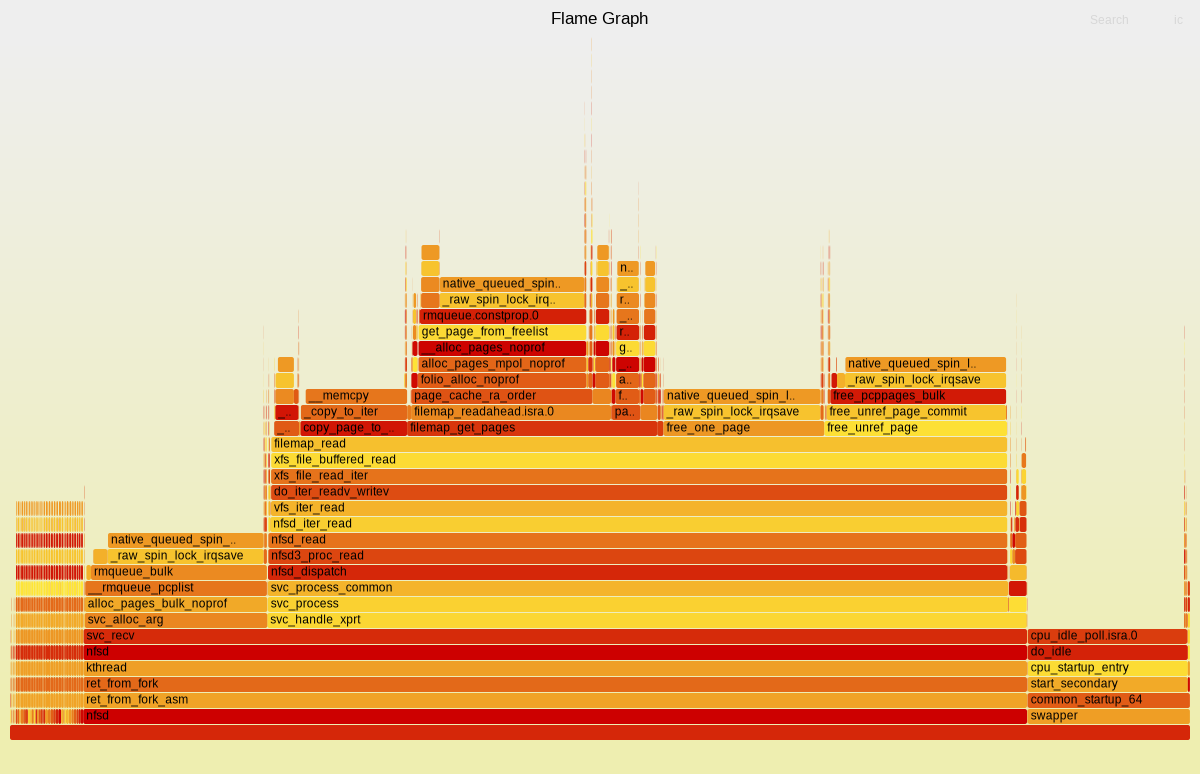
Dave offered this additional analysis:
"the flame graph indicates massive lock contention in the page allocator (i.e. on the page free lists). There's a chunk of time in data copying (copy_page_to_iter), but 70% of the CPU usage looks to be page allocator spinlock contention."
All this causes RWF_DONTCACHE reads to be considerably slower than normal buffered reads (only getting 40-66% of normal buffered reads, worse read performance occurs when the system is less loaded). How knfsd is handling the IO seems to be contributing to the 100% cpu usage. If fio is used (with pvsync2 and uncached=1) directly to a single XFS then CPU is ~50%.
(Jeff: not following why you were seeing EOPNOTSUPP for RWF_DONTCACHE reads, is that somehow due to the rsize/wsize patches from Chuck? RWF_DONTCACHE reads work with my patch you quoted as "[1]").
Quoted 3 lines
The buffered write path locking is different, but I suspect something similar is occurring and I'm going to ask you to confirm it...
With knfsd to XFS on NVMe, favorable difference for RWF_DONTCACHE writes is that despite also seeing 100% CPU usage, due to lock contention et al, RWF_DONTCACHE does perform 0-54% better compared to normal buffered writes that exceed the system's memory by 2.5x (largest gains seen with most extreme load).
Without RWF_DONTCACHE the system gets pushed to reclaim and the associated work really hurts.
As tested with knfsd we've been generally unable to see the reduced CPU usage that is documented in Jens' commit headers:
for reads: https://git.kernel.org/linus/8026e49bff9b
for writes: https://git.kernel.org/linus/d47c670061b5
But as mentioned above, eliminating knfsd and testing XFS directly with fio does generally reflect what Jens documented.
So more work needed to address knfsd RWF_DONTCACHE inefficiencies.
Quoted 30 lines
Quoted 30 lines
Quoted 8 lines
Quoted 7 lines
I tested sequential writes using the fio-seq_write.fio test, both with and without the module param enabled.
These numbers are from one run each, but they were pretty stable over several runs:
# fio /usr/share/doc/fio/examples/fio-seq-write.fioQuoted 8 lines
$ cat /usr/share/doc/fio/examples/fio-seq-write.fio
cat: /usr/share/doc/fio/examples/fio-seq-write.fio: No such file or directory
$
What are the fio control parameters of the IO you are doing? (e.g. is this single threaded IO, does it use the psync, libaio or iouring engine, etc)
; fio-seq-write.job for fiotest
[global]
name=fio-seq-write
filename=fio-seq-write
rw=write
bs=256K
direct=0
numjobs=1time_based
runtime=900
Quoted 7 lines
Quoted 4 lines
[file1]
size=10G
ioengine=libaio
iodepth=16Ok, so we are doing AIO writes on the client side, so we have ~16 writes on the wire from the client at any given time.
Jeff's workload is really underwhelming given he is operating well within available memory (so avoiding reclaim, etc). As such this test is really not testing what RWF_DONTCACHE is meant to address (and to answer Chuck's question of "what do you hope to get from RWF_DONTCACHE?"): the ability to reach steady state where even if memory is oversubscribed the network pipes and NVMe devices are as close to 100% utilization as possible.
Quoted 10 lines
This also means they are likely not being received by the NFS server in sequential order, and the NFS server is going to be processing roughly 16 write RPCs to the same file concurrently using
RWF_DONTCACHEIO.These are not going to be exactly sequential - the server side IO pattern to the filesystem is quasi-sequential, with random IOs being out of order and leaving temporary holes in the file until the OO write is processed.
Quoted 7 lines
XFS should handle this fine via the speculative preallocation beyond EOF that is triggered by extending writes (it was designed to mitigate the fragmentation this NFS behaviour causes). However, we should always keep in mind that while client side IO is sequential, what the server is doing to the underlying filesystem needs to be treated as "concurrent IO to a single file" rather than "sequential IO".
Hammerspace has definitely seen that 1MB IO coming off the wire is fragmented by the time it XFS issues it to underlying storage; so much so that IOPs bound devices (e.g. AWS devices that are capped at ~10K IOPs) are choking due to all the small IO.
So yeah, minimizing the fragmentation is critical (and largely *not* solved at this point... hacks like sync mount from NFS client or using O_DIRECT at the client, which sets sync bit, helps reduce the fragmentation but as soon as you go full buffered the N=16+ IOs on the wire will fragment each other).
Do you recommend any particular tuning to help XFS's speculative preallocation work for many competing "sequential" IO threads? Like would having 32 AG allow for 32 speculative preallocation engines? Or is it only possible to split across AG for different inodes? (Sorry, I really do aim to get more well-versed with XFS... its only been ~17 years that it has featured in IO stacks I've had to engineer, ugh...).
Quoted 43 lines
Quoted 17 lines
Quoted 9 lines
Quoted 8 lines
wsize=1M:
Normal:      WRITE: bw=1034MiB/s (1084MB/s), 1034MiB/s-1034MiB/s (1084MB/s-1084MB/s), io=910GiB (977GB), run=901326-901326msec
DONTCACHE:   WRITE: bw=649MiB/s (681MB/s), 649MiB/s-649MiB/s (681MB/s-681MB/s), io=571GiB (613GB), run=900001-900001msec
DONTCACHE with a 1M wsize vs. recent (v6.14-ish) knfsd was about 30% slower. Memory consumption was down, but these boxes have oodles of memory, so I didn't notice much change there.
Quoted 7 lines
So what is the IO pattern that the NFSD is sending to the underlying XFS filesystem?
Is it sending 1M
RWF_DONTCACHEbuffered IOs to XFS as well (i.e. one buffered write IO per NFS client write request), or is DONTCACHE only being used on the NFS client side?Quoted 4 lines
It's should be sequential I/O, though the writes would be coming in from different nfsd threads. nfsd just does standard buffered I/O. The WRITE handler calls
nfsd_vfs_write(), which callsvfs_write_iter(). With the module parameter enabled, it also addsRWF_DONTCACHE.Ok, so buffered writes (even with
RWF_DONTCACHE) are not processed concurrently by XFS - there's an exclusive lock on the inode that will be serialising all the buffered write IO.Given that most of the work that XFS will be doing during the write will not require releasing the CPU, there is a good chance that there is spin contention on the
i_rwsemfrom the 15 other write waiters.That may be a contributing factor to poor performance, so kernel profiles from the NFS server for both the normal buffered write path as well as the
RWF_DONTCACHEbuffered write path. Having some idea of the total CPU usage of the nfsds during the workload would also be useful.Quoted 5 lines
DONTCACHE is only being used on the server side. To be clear, the protocol doesn't support that flag (yet), so we have no way to project DONTCACHE from the client to the server (yet). This is just early exploration to see whether DONTCACHE offers any benefit to this workload.
Quoted 4 lines
The nfs client largely aligns all of the page caceh based IO, so I'd think that
O_DIRECTon the server side would be much more performant thanRWF_DONTCACHE. Especially as XFS will do concurrentO_DIRECTwrites all the way down to the storage.....
Yes. We really need to add full-blown O_DIRECT support to knfsd. And Hammerspace wants me to work on it ASAP. But I welcome all the help I can get, I have ideas but look forward to discussing next week at Bakeathon and/or in this thread...
The first hurdle is coping with the head and/or tail of IO being misaligned relative to the underlying storage's logical_block_size. Need to cull off misaligned IO and use RWF_DONTCACHE for those but O_DIRECT for the aligned middle is needed.
I aim to deal with that for NFS LOCALIO first (NFS client issues IO direct to XFS, bypassing knfsd) and then reuse it for knfsd's O_DIRECT support.
Quoted 44 lines
Quoted 10 lines
Quoted 6 lines
Quoted 3 lines
I wonder if we need some heuristic that makes
generic_write_sync()only kick off writeback immediately if the whole folio is dirty so we have more time to gather writes before kicking off writeback?You're doing aligned 1MB IOs - there should be no partially dirty large folios in either the client or the server page caches.
Interesting. I wonder what accounts for the slowdown with 1M writes? It seems likely to be related to the more aggressive writeback with DONTCACHE enabled, but it'd be good to understand this.
What I suspect is that block layer IO submission latency has increased significantly with
RWF_DONTCACHEand that is slowing down the rate at which it can service buffered writes to a single file.The difference between normal buffered writes and
RWF_DONTCACHEis that thewrite()context will marshall the dirty folios into bios and submit them to the block layer (viageneric_write_sync()). If the underlying device queues are full, then the bio submission will be throttled to wait for IO completion.At this point, all NFSD write processing to that file stalls. All the other nfsds are blocked on the
i_rwsem, and that can't be released until the holder is released by the block layer throttling. Hence any time the underlying device queue fills, nfsd processing of incoming writes stalls completely.When doing normal buffered writes, this IO submission stalling does not occur because there is no direct writeback occurring in the
write()path.Remember the bad old days of
balance_dirty_pages()doing dirty throttling by submitting dirty pages for IO directly in thewrite()context? And how much better buffered write performance andwrite()submission latency became when we started deferring that IO to the writeback threads and waiting on completions?We're essentially going back to the bad old days with buffered
RWF_DONTCACHEwrites. Instead of one nicely formed background writeback stream that can be throttled at the block layer without adversely affecting incoming write throughput, we end up with everywrite()context submitting IO synchronously and being randomly throttled by the block layer throttle....
Quoted 10 lines
There are a lot of reasons the current
RWF_DONTCACHEimplementation is sub-optimal for common workloads. This IO spraying and submission side throttling problem
is one of the reasons why I suggested very early on that an async write-behind window (similar in concept to async readahead winodws) would likely be a much better generic solution forRWF_DONTCACHEwrites. This would retain the "one nicely formed background writeback stream" behaviour that is desirable for buffered writes, but still allow in rapid reclaim of DONTCACHE folios as IO cleans them...
I recall you voicing this concern and nobody really seizing on it. Could be that Jens is open changing the RWF_DONTCACHE implementation if/when more proof is made for the need?
Quoted 13 lines
Quoted 8 lines
Quoted 7 lines
That said, this is part of the reason I asked about both whether the client side write is STABLE and whether
RWF_DONTCACHEon the server side. i.e. using either of those will trigger writeback on the serer side immediately; in the case of the former it will also complete before returning to the client and not require a subsequent COMMIT RPC to wait for server side IO completion...Quoted 4 lines
I need to go back and sniff traffic to be sure, but I'm fairly certain the client is issuing regular UNSTABLE writes and following up with a later COMMIT, at least for most of them. The occasional STABLE write might end up getting through, but that should be fairly rare.
Quoted 4 lines
Yeah, I don't think that's an issue given that only the server side is using
RWF_DONTCACHE. The COMMIT will effectively just be a journal and/or device cache flush as all the dirty data has already been written back to storage....
FYI, most of Hammerspace RWF_DONTCACHE testing has been using O_DIRECT for client IO and nfsd.nfsd_dontcache=Y on the server.
Thanks for the interesting discussion!
Mike
Jeff Layton
maintainerQuoted 57 lines · Mike Snitzer
Hey Dave,
Thanks for providing your thoughts on all this. More inlined below.
Quoted 22 lines · Dave Chinner
Quoted 16 lines · Jeff Layton
Quoted 5 lines · Dave Chinner
Quoted 4 lines · Jeff Layton
FYI I decided to try and get some numbers with Mike's
RWF_DONTCACHEpatches for nfsd [1]. Those add a module param that make all reads and writes useRWF_DONTCACHE.Quoted 9 lines
Quoted 3 lines
I had one host that was running knfsd with an XFS export, and a second that was acting as NFS client. Both machines have tons of memory, so pagecache utilization is irrelevant for this test.
Does
RWF_DONTCACHEresult in server side STABLE write requests from the NFS client, or are they still unstable and require a post-write completion COMMIT operation from the client to trigger server side writeback before the client can discard the page cache?Quoted 4 lines
The latter. I didn't change the client at all here (other than to allow it to do bigger writes on the wire). It's just doing bog-standard buffered I/O. nfsd is adding
RWF_DONTCACHEto every write via Mike's patch.Quoted 7 lines
Ok, that wasn't clear that it was only server side
RWF_DONTCACHE.I have some more context from a different (internal) discussion thread about how poorly the NFSD read side performs with
RWF_DONTCACHEcompared toO_DIRECT. This is because there is massive page allocator spin lock contention due to all the concurrent reads being serviced.That discussion started with: its a very chaotic workload "read a bunch of large files that cause memory to be oversubscribed 2.5x across 8 servers". Many knfsd threads (~240) per server handling 1MB IO to 8 XFS on NVMe.. (so 8 servers, each with 8 NVMe devices).
For others' benefit here is the flamegraph for this heavy nfsd.nfsd_dontcache=Y read workload as seen on 1 of the 8 servers:
https://original.art/dontcache_read.svgDave offered this additional analysis:
"the flame graph indicates massive lock contention in the page allocator (i.e. on the page free lists). There's a chunk of time in data copying (copy_page_to_iter), but 70% of the CPU usage looks to be page allocator spinlock contention."All this causes
RWF_DONTCACHEreads to be considerably slower than normal buffered reads (only getting 40-66% of normal buffered reads, worse read performance occurs when the system is less loaded). How knfsd is handling the IO seems to be contributing to the 100% cpu usage. If fio is used (with pvsync2 and uncached=1) directly to a single XFS then CPU is ~50%.
Quoted 4 lines
(Jeff: not following why you were seeing EOPNOTSUPP for
RWF_DONTCACHEreads, is that somehow due to the rsize/wsize patches from Chuck?RWF_DONTCACHEreads work with my patch you quoted as "[1]").
Possibly. I'm not sure either. I hit that error on reads with the RWF_DONTCACHE enabled and decided to focus on writes for the moment. I'll run it down when I get a chance.
Quoted 4 lines
Quoted 3 lines
The buffered write path locking is different, but I suspect something similar is occurring and I'm going to ask you to confirm it...
I started collecting perf traces today, but I'm having trouble getting meaningful reports out of it. So, I'm working on it, but stay tuned.
Quoted 9 lines
With knfsd to XFS on NVMe, favorable difference for
RWF_DONTCACHEwrites is that despite also seeing 100% CPU usage, due to lock contention et al,RWF_DONTCACHEdoes perform 0-54% better compared to normal buffered writes that exceed the system's memory by 2.5x (largest gains seen with most extreme load).Without
RWF_DONTCACHEthe system gets pushed to reclaim and the associated work really hurts.
That makes total sense. The boxes I've been testing on have gobs of memory. The system never gets pushed into reclaim. It sounds like I need to do some testing with small memory sizes (maybe in VMs).
Quoted 9 lines
As tested with knfsd we've been generally unable to see the reduced CPU usage that is documented in Jens' commit headers:
for reads: https://git.kernel.org/linus/8026e49bff9b
for writes: https://git.kernel.org/linus/d47c670061b5
But as mentioned above, eliminating knfsd and testing XFS directly with fio does generally reflect what Jens documented.So more work needed to address knfsd
RWF_DONTCACHEinefficiencies.
Agreed.
Quoted 38 lines
Quoted 30 lines
Quoted 30 lines
Quoted 8 lines
Quoted 7 lines
I tested sequential writes using the fio-seq_write.fio test, both with and without the module param enabled.
These numbers are from one run each, but they were pretty stable over several runs:
# fio /usr/share/doc/fio/examples/fio-seq-write.fioQuoted 8 lines
$ cat /usr/share/doc/fio/examples/fio-seq-write.fio
cat: /usr/share/doc/fio/examples/fio-seq-write.fio: No such file or directory
$
What are the fio control parameters of the IO you are doing? (e.g. is this single threaded IO, does it use the psync, libaio or iouring engine, etc)
; fio-seq-write.job for fiotest
[global]
name=fio-seq-write
filename=fio-seq-write
rw=write
bs=256K
direct=0
numjobs=1time_based
runtime=900Quoted 7 lines
Quoted 4 lines
[file1]
size=10G
ioengine=libaio
iodepth=16Ok, so we are doing AIO writes on the client side, so we have ~16 writes on the wire from the client at any given time.
Quoted 8 lines
Jeff's workload is really underwhelming given he is operating well within available memory (so avoiding reclaim, etc). As such this test is really not testing what
RWF_DONTCACHEis meant to address (and to answer Chuck's question of "what do you hope to get fromRWF_DONTCACHE?"): the ability to reach steady state where even if memory is oversubscribed the network pipes and NVMe devices are as close to 100% utilization as possible.
I'll see about setting up something more memory-constrained on the server side. That would be more interesting for sure.
Quoted 90 lines
Quoted 10 lines
This also means they are likely not being received by the NFS server in sequential order, and the NFS server is going to be processing roughly 16 write RPCs to the same file concurrently using
RWF_DONTCACHEIO.These are not going to be exactly sequential - the server side IO pattern to the filesystem is quasi-sequential, with random IOs being out of order and leaving temporary holes in the file until the OO write is processed.
Quoted 7 lines
XFS should handle this fine via the speculative preallocation beyond EOF that is triggered by extending writes (it was designed to mitigate the fragmentation this NFS behaviour causes). However, we should always keep in mind that while client side IO is sequential, what the server is doing to the underlying filesystem needs to be treated as "concurrent IO to a single file" rather than "sequential IO".
Hammerspace has definitely seen that 1MB IO coming off the wire is fragmented by the time it XFS issues it to underlying storage; so much so that IOPs bound devices (e.g. AWS devices that are capped at ~10K IOPs) are choking due to all the small IO.
So yeah, minimizing the fragmentation is critical (and largely *not* solved at this point... hacks like sync mount from NFS client or using
O_DIRECTat the client, which sets sync bit, helps reduce the fragmentation but as soon as you go full buffered the N=16+ IOs on the wire will fragment each other).Do you recommend any particular tuning to help XFS's speculative preallocation work for many competing "sequential" IO threads? Like would having 32 AG allow for 32 speculative preallocation engines? Or is it only possible to split across AG for different inodes? (Sorry, I really do aim to get more well-versed with XFS... its only been ~17 years that it has featured in IO stacks I've had to engineer, ugh...).
Quoted 43 lines
Quoted 17 lines
Quoted 9 lines
Quoted 8 lines
wsize=1M:
Normal:      WRITE: bw=1034MiB/s (1084MB/s), 1034MiB/s-1034MiB/s (1084MB/s-1084MB/s), io=910GiB (977GB), run=901326-901326msec
DONTCACHE:   WRITE: bw=649MiB/s (681MB/s), 649MiB/s-649MiB/s (681MB/s-681MB/s), io=571GiB (613GB), run=900001-900001msec
DONTCACHE with a 1M wsize vs. recent (v6.14-ish) knfsd was about 30% slower. Memory consumption was down, but these boxes have oodles of memory, so I didn't notice much change there.
Quoted 7 lines
So what is the IO pattern that the NFSD is sending to the underlying XFS filesystem?
Is it sending 1M
RWF_DONTCACHEbuffered IOs to XFS as well (i.e. one buffered write IO per NFS client write request), or is DONTCACHE only being used on the NFS client side?Quoted 4 lines
It's should be sequential I/O, though the writes would be coming in from different nfsd threads. nfsd just does standard buffered I/O. The WRITE handler calls
nfsd_vfs_write(), which callsvfs_write_iter(). With the module parameter enabled, it also addsRWF_DONTCACHE.Ok, so buffered writes (even with
RWF_DONTCACHE) are not processed concurrently by XFS - there's an exclusive lock on the inode that will be serialising all the buffered write IO.Given that most of the work that XFS will be doing during the write will not require releasing the CPU, there is a good chance that there is spin contention on the
i_rwsemfrom the 15 other write waiters.That may be a contributing factor to poor performance, so kernel profiles from the NFS server for both the normal buffered write path as well as the
RWF_DONTCACHEbuffered write path. Having some idea of the total CPU usage of the nfsds during the workload would also be useful.Quoted 5 lines
DONTCACHE is only being used on the server side. To be clear, the protocol doesn't support that flag (yet), so we have no way to project DONTCACHE from the client to the server (yet). This is just early exploration to see whether DONTCACHE offers any benefit to this workload.
Quoted 4 lines
The nfs client largely aligns all of the page caceh based IO, so I'd think that
O_DIRECTon the server side would be much more performant thanRWF_DONTCACHE. Especially as XFS will do concurrentO_DIRECTwrites all the way down to the storage.....Yes. We really need to add full-blown
O_DIRECTsupport to knfsd. And Hammerspace wants me to work on it ASAP. But I welcome all the help I can get, I have ideas but look forward to discussing next week at Bakeathon and/or in this thread...
Quoted 9 lines
The first hurdle is coping with the head and/or tail of IO being misaligned relative to the underlying storage's
logical_block_size. Need to cull off misaligned IO and useRWF_DONTCACHEfor those butO_DIRECTfor the aligned middle is needed.I aim to deal with that for NFS LOCALIO first (NFS client issues IO direct to XFS, bypassing knfsd) and then reuse it for knfsd's
O_DIRECTsupport.
I'll be interested to hear your thoughts on this!
Quoted 55 lines
Quoted 44 lines
Quoted 10 lines
Quoted 6 lines
Quoted 3 lines
I wonder if we need some heuristic that makes
generic_write_sync()only kick off writeback immediately if the whole folio is dirty so we have more time to gather writes before kicking off writeback?You're doing aligned 1MB IOs - there should be no partially dirty large folios in either the client or the server page caches.
Interesting. I wonder what accounts for the slowdown with 1M writes? It seems likely to be related to the more aggressive writeback with DONTCACHE enabled, but it'd be good to understand this.
What I suspect is that block layer IO submission latency has increased significantly with
RWF_DONTCACHEand that is slowing down the rate at which it can service buffered writes to a single file.The difference between normal buffered writes and
RWF_DONTCACHEis that thewrite()context will marshall the dirty folios into bios and submit them to the block layer (viageneric_write_sync()). If the underlying device queues are full, then the bio submission will be throttled to wait for IO completion.At this point, all NFSD write processing to that file stalls. All the other nfsds are blocked on the
i_rwsem, and that can't be released until the holder is released by the block layer throttling. Hence any time the underlying device queue fills, nfsd processing of incoming writes stalls completely.When doing normal buffered writes, this IO submission stalling does not occur because there is no direct writeback occurring in the
write()path.Remember the bad old days of
balance_dirty_pages()doing dirty throttling by submitting dirty pages for IO directly in thewrite()context? And how much better buffered write performance andwrite()submission latency became when we started deferring that IO to the writeback threads and waiting on completions?We're essentially going back to the bad old days with buffered
RWF_DONTCACHEwrites. Instead of one nicely formed background writeback stream that can be throttled at the block layer without adversely affecting incoming write throughput, we end up with everywrite()context submitting IO synchronously and being randomly throttled by the block layer throttle....Quoted 10 lines
There are a lot of reasons the current
RWF_DONTCACHEimplementation is sub-optimal for common workloads. This IO spraying and submission side throttling problem
is one of the reasons why I suggested very early on that an async write-behind window (similar in concept to async readahead winodws) would likely be a much better generic solution forRWF_DONTCACHEwrites. This would retain the "one nicely formed background writeback stream" behaviour that is desirable for buffered writes, but still allow in rapid reclaim of DONTCACHE folios as IO cleans them...
Quoted 4 lines
I recall you voicing this concern and nobody really seizing on it. Could be that Jens is open changing the
RWF_DONTCACHEimplementation if/when more proof is made for the need?
It does seem like using RWF_DONTCACHE currently leads to a lot of fragmented I/O. I suspect that doing filemap_fdatawrite_range_kick() after every DONTCACHE write is the main problem on the write side. We probably need to come up with a way to make it flush more optimally when there are streaming DONTCACHE writes.
An async writebehind window could be a solution. How would we implement that? Some sort of delay before we kick off writeback (and hopefully for larger ranges)?
Quoted 13 lines
Quoted 13 lines
Quoted 12 lines
Quoted 7 lines
That said, this is part of the reason I asked about both whether the client side write is STABLE and whether
RWF_DONTCACHEon the server side. i.e. using either of those will trigger writeback on the serer side immediately; in the case of the former it will also complete before returning to the client and not require a subsequent COMMIT RPC to wait for server side IO completion...I need to go back and sniff traffic to be sure, but I'm fairly certain the client is issuing regular UNSTABLE writes and following up with a later COMMIT, at least for most of them. The occasional STABLE write might end up getting through, but that should be fairly rare.
Quoted 7 lines
Quoted 4 lines
Yeah, I don't think that's an issue given that only the server side is using
RWF_DONTCACHE. The COMMIT will effectively just be a journal and/or device cache flush as all the dirty data has already been written back to storage....FYI, most of Hammerspace
RWF_DONTCACHEtesting has been usingO_DIRECTfor client IO and nfsd.nfsd_dontcache=Y on the server.
Good to know. I'll switch my testing to O_DIRECT as well. The client- side pagecache isn't adding any benefit to this.
--
Jeff Layton <[email protected]>
Quoted 40 lines · Jeff Layton
Quoted 29 lines · Mike Snitzer
Hey Dave,
Thanks for providing your thoughts on all this. More inlined below.
Quoted 13 lines · Dave Chinner
Remember the bad old days of
balance_dirty_pages()doing dirty throttling by submitting dirty pages for IO directly in thewrite()context? And how much better buffered write performance andwrite()submission latency became when we started deferring that IO to the writeback threads and waiting on completions?We're essentially going back to the bad old days with buffered
RWF_DONTCACHEwrites. Instead of one nicely formed background writeback stream that can be throttled at the block layer without adversely affecting incoming write throughput, we end up with everywrite()context submitting IO synchronously and being randomly throttled by the block layer throttle....Quoted 10 lines
There are a lot of reasons the current
RWF_DONTCACHEimplementation is sub-optimal for common workloads. This IO spraying and submission side throttling problem
is one of the reasons why I suggested very early on that an async write-behind window (similar in concept to async readahead winodws) would likely be a much better generic solution forRWF_DONTCACHEwrites. This would retain the "one nicely formed background writeback stream" behaviour that is desirable for buffered writes, but still allow in rapid reclaim of DONTCACHE folios as IO cleans them...Quoted 3 lines
I recall you voicing this concern and nobody really seizing on it. Could be that Jens is open changing the
RWF_DONTCACHEimplementation if/when more proof is made for the need?It does seem like using
RWF_DONTCACHEcurrently leads to a lot of fragmented I/O. I suspect that doingfilemap_fdatawrite_range_kick()after every DONTCACHE write is the main problem on the write side. We probably need to come up with a way to make it flush more optimally when there are streaming DONTCACHE writes.
Quoted 3 lines
An async writebehind window could be a solution. How would we implement that? Some sort of delay before we kick off writeback (and hopefully for larger ranges)?
My thoughts on this are as follows...
When we mark the inode dirty, we currently put it on the list of dirty inodes for writeback. We could change how we mark an inode dirty for RWF_DONTCACHE writes to say "dirty for write-through" and put it on a new write-through inode list. Then we can kick an expedited write-through worker thread that writes back all the dirty write-through inodes on it's list.
In this case, a delay of a few milliseconds is probably large enough time to allow decent write-through IO sizes to build up without causing excessive page cache memory usage for dirty DONTCACHE folios...
The other thing that this could allow is throttling incoming RWF_DONTCACHE IOs in balance_dirty_pages_ratelimited. e.g. if more than 16MB of DONTCACHE folios are built up on a BDI, kick the write-through worker and wait for the DONTCACHE folio count to drop. This then gives some control (and potential admin control) of how much dirty page cache is allowed to accrue for DONTCACHE write IOs...
-Dave.
Signature · 2 lines
Dave Chinner
[email protected]
Quoted 33 lines · Mike Snitzer
Hey Dave,
Thanks for providing your thoughts on all this. More inlined below.
Quoted 20 lines · Dave Chinner
Quoted 19 lines · Jeff Layton
Quoted 4 lines · Dave Chinner
What are the fio control parameters of the IO you are doing? (e.g. is this single threaded IO, does it use the psync, libaio or iouring engine, etc)
; fio-seq-write.job for fiotest
[global]
name=fio-seq-write
filename=fio-seq-write
rw=write
bs=256K
direct=0
numjobs=1time_based
runtime=900Quoted 7 lines
Quoted 4 lines
[file1]
size=10G
ioengine=libaio
iodepth=16Ok, so we are doing AIO writes on the client side, so we have ~16 writes on the wire from the client at any given time.
Quoted 7 lines
Jeff's workload is really underwhelming given he is operating well within available memory (so avoiding reclaim, etc). As such this test is really not testing what
RWF_DONTCACHEis meant to address (and to answer Chuck's question of "what do you hope to get fromRWF_DONTCACHE?"): the ability to reach steady state where even if memory is oversubscribed the network pipes and NVMe devices are as close to 100% utilization as possible.
Right.
However, one of the things that has to be kept in mind is that we don't have 100% of the CPU dedicated to servicing RWF_DONTCACHE IO like the fio microbenchmarks have.
Applications are going to take a chunk of CPU time to create/marshall/process the data that we we are doing IO on, so any time we spend on doing IO is less time that the applications have to do their work. If you can saturate the storage without saturating CPUs, then RWF_DONTCACHE should allow that steady state to be maintained indefinitely.
However, RWF_DONTCACHE does not remove the data copy overhead of buffered IO, whilst it adds IO submission overhead to each IO. Hence it will require more CPU time to saturate the storage devices than normal buffered IO. If you've got CPU to spare, great. If you don't, then overall performance will be reduced.
Quoted 18 lines
Quoted 10 lines
This also means they are likely not being received by the NFS server in sequential order, and the NFS server is going to be processing roughly 16 write RPCs to the same file concurrently using
RWF_DONTCACHEIO.These are not going to be exactly sequential - the server side IO pattern to the filesystem is quasi-sequential, with random IOs being out of order and leaving temporary holes in the file until the OO write is processed.
Quoted 7 lines
XFS should handle this fine via the speculative preallocation beyond EOF that is triggered by extending writes (it was designed to mitigate the fragmentation this NFS behaviour causes). However, we should always keep in mind that while client side IO is sequential, what the server is doing to the underlying filesystem needs to be treated as "concurrent IO to a single file" rather than "sequential IO".
Quoted 4 lines
Hammerspace has definitely seen that 1MB IO coming off the wire is fragmented by the time it XFS issues it to underlying storage; so much so that IOPs bound devices (e.g. AWS devices that are capped at ~10K IOPs) are choking due to all the small IO.
That should not happen in the general case. Can you start a separate thread to triage the issue so we can try to understand why that is happening?
Quoted 5 lines
So yeah, minimizing the fragmentation is critical (and largely *not* solved at this point... hacks like sync mount from NFS client or using
O_DIRECTat the client, which sets sync bit, helps reduce the fragmentation but as soon as you go full buffered the N=16+ IOs on the wire will fragment each other).
Fragmentation mitigation for NFS server IO is generally only addressable at the filesystem level - it's not really something you can mitigate at the NFS server or client.
Quoted 2 lines
Do you recommend any particular tuning to help XFS's speculative preallocation work for many competing "sequential" IO threads?
I can suggest lots of things, but without knowing the IO pattern, the fragmentation pattern, the filesystem state, what triggers the fragmentation, etc, I'd just be guessing as to which knob might make the problem go away (hence the request to separate that out).
-Dave.
Signature · 2 lines
Dave Chinner
[email protected]