Radix-tree pagecache for 2.5
Subsystems (11)
PATCH 1/1 Radix-tree pagecache for 2.5
I've ported my hacked up version of Momchil Velikov's radix tree radix tree pagecache to 2.5.3-pre{5,6}.
The changes over the 2.4.17 version are:
o use mempool to avoid OOM situation involving radix nodes.
o remove add_to_page_cache_locked, it was unused in the 2.4.17 patch.
o unify add_to_page and add_to_page_unique
It gives nice scalability improvements on big machines and drops the memory usage on small ones (if you consider my 64MB Athlon small :)).
The patch is at
	ftp://ftp.kernel.org:/pub/linux/kernel/people/hch/patches/v2.5/2.5.3-pre5/linux-2.5.3-ratpagecache.patch.gz
	ftp://ftp.kernel.org:/pub/linux/kernel/people/hch/patches/v2.5/2.5.3-pre5/linux-2.5.3-ratpagecache.patch.bz2
or below.
Christoph
Signature · 1,904 lines
Of course it doesn't work. We've performed a software upgrade.

diff -uNr -Xdontdiff /datenklo/ref/linux-vger/drivers/block/rd.c linux-vger/drivers/block/rd.c
--- /datenklo/ref/linux-vger/drivers/block/rd.c	Sun Jan 13 00:05:09 2002
+++ linux-vger/drivers/block/rd.c	Tue Jan 29 03:05:40 2002
@@ -156,7 +156,6 @@

 	do {
 		int count;
-		struct page ** hash;
 		struct page * page;
 		char * src, * dst;
 		int unlock = 0;
@@ -166,8 +165,7 @@
 			count = size;
 		size -= count;

-		hash = page_hash(mapping, index);
-		page = __find_get_page(mapping, index, hash);
+		page = find_get_page(mapping, index);
 		if (!page) {
 			page = grab_cache_page(mapping, index);
 			err = -ENOMEM;
diff -uNr -Xdontdiff /datenklo/ref/linux-vger/fs/inode.c linux-vger/fs/inode.c
--- /datenklo/ref/linux-vger/fs/inode.c	Fri Jan 25 13:12:03 2002
+++ linux-vger/fs/inode.c	Tue Jan 29 03:05:40 2002
@@ -144,6 +144,7 @@
 	INIT_LIST_HEAD(&inode->i_devices);
 	sema_init(&inode->i_sem, 1);
 	sema_init(&inode->i_zombie, 1);
+	INIT_RAT_ROOT(&inode->i_data.page_tree, GFP_ATOMIC);
 	spin_lock_init(&inode->i_data.i_shared_lock);
 }

diff -uNr -Xdontdiff /datenklo/ref/linux-vger/include/linux/fs.h linux-vger/include/linux/fs.h
--- /datenklo/ref/linux-vger/include/linux/fs.h	Fri Jan 25 13:15:19 2002
+++ linux-vger/include/linux/fs.h	Tue Jan 29 03:05:40 2002
@@ -21,6 +21,7 @@
 #include <linux/cache.h>
 #include <linux/stddef.h>
 #include <linux/string.h>
+#include <linux/rat.h>

 #include <asm/atomic.h>
 #include <asm/bitops.h>
@@ -378,6 +379,7 @@
 };

 struct address_space {
+	struct rat_root		page_tree;	/* radix tree of all pages */
 	struct list_head	clean_pages;	/* list of clean pages */
 	struct list_head	dirty_pages;	/* list of dirty pages */
 	struct list_head	locked_pages;	/* list of locked pages */
diff -uNr -Xdontdiff /datenklo/ref/linux-vger/include/linux/mm.h linux-vger/include/linux/mm.h
--- /datenklo/ref/linux-vger/include/linux/mm.h	Wed Jan 16 21:49:08 2002
+++ linux-vger/include/linux/mm.h	Tue Jan 29 03:05:40 2002
@@ -149,15 +149,12 @@
 	struct list_head list;		/* ->mapping has some page lists. */
 	struct address_space *mapping;	/* The inode (or ...) we belong to. */
 	unsigned long index;		/* Our offset within mapping. */
-	struct page *next_hash;		/* Next page sharing our hash bucket in
-					   the pagecache hash table. */
 	atomic_t count;			/* Usage count, see below. */
 	unsigned long flags;		/* atomic flags, some possibly
 					   updated asynchronously */
 	struct list_head lru;		/* Pageout list, eg. active_list;
 					   protected by pagemap_lru_lock !! */
 	wait_queue_head_t wait;		/* Page locked?  Stand in line... */
-	struct page **pprev_hash;	/* Complement to *next_hash. */
 	struct buffer_head * buffers;	/* Buffer maps us to a disk block. */
 	void *virtual;			/* Kernel virtual address (NULL if
 					   not kmapped, ie. highmem) */
@@ -225,9 +222,8 @@
  * using the page->list list_head. These fields are also used for
  * freelist managemet (when page->count==0).
  *
- * There is also a hash table mapping (mapping,index) to the page
- * in memory if present. The lists for this hash table use the fields
- * page->next_hash and page->pprev_hash.
+ * There is also a per-mapping radix tree mapping index to the page
+ * in memory if present. The tree is rooted at mapping->root.
  *
  * All process pages can do I/O:
  * - inode pages may need to be read from disk,
@@ -461,6 +457,24 @@
 		return 0;
 }

+static inline void add_page_to_inode_queue(struct address_space *mapping, struct page * page)
+{
+	struct list_head *head = &mapping->clean_pages;
+
+	mapping->nrpages++;
+	list_add(&page->list, head);
+	page->mapping = mapping;
+}
+
+static inline void remove_page_from_inode_queue(struct page * page)
+{
+	struct address_space * mapping = page->mapping;
+
+	mapping->nrpages--;
+	list_del(&page->list);
+	page->mapping = NULL;
+}
+
 struct zone_t;
 /* filemap.c */
 extern void remove_inode_page(struct page *);
diff -uNr -Xdontdiff /datenklo/ref/linux-vger/include/linux/pagemap.h linux-vger/include/linux/pagemap.h
--- /datenklo/ref/linux-vger/include/linux/pagemap.h	Mon Nov 12 18:19:18 2001
+++ linux-vger/include/linux/pagemap.h	Tue Jan 29 03:18:57 2002
@@ -41,53 +41,22 @@
  */
 #define page_cache_entry(x)	virt_to_page(x)

-extern unsigned int page_hash_bits;
-#define PAGE_HASH_BITS (page_hash_bits)
-#define PAGE_HASH_SIZE (1 << PAGE_HASH_BITS)
-
-extern atomic_t page_cache_size; /* # of pages currently in the hash table */
-extern struct page **page_hash_table;
-
-extern void page_cache_init(unsigned long);
-
-/*
- * We use a power-of-two hash table to avoid a modulus,
- * and get a reasonable hash by knowing roughly how the
- * inode pointer and indexes are distributed (ie, we
- * roughly know which bits are "significant")
- *
- * For the time being it will work for struct address_space too (most of
- * them sitting inside the inodes). We might want to change it later.
- */
-static inline unsigned long _page_hashfn(struct address_space * mapping, unsigned long index)
-{
-#define i (((unsigned long) mapping)/(sizeof(struct inode) & ~ (sizeof(struct inode) - 1)))
-#define s(x) ((x)+((x)>>PAGE_HASH_BITS))
-	return s(i+index) & (PAGE_HASH_SIZE-1);
-#undef i
-#undef s
-}
-
-#define page_hash(mapping,index) (page_hash_table+_page_hashfn(mapping,index))
-
-extern struct page * __find_get_page(struct address_space *mapping,
-				unsigned long index, struct page **hash);
-#define find_get_page(mapping, index) \
-	__find_get_page(mapping, index, page_hash(mapping, index))
-extern struct page * __find_lock_page (struct address_space * mapping,
-				unsigned long index, struct page **hash);
+extern atomic_t page_cache_size; /* # of pages currently in the page cache */
+
+extern struct page * find_get_page(struct address_space *mapping,
+				unsigned long index);
+extern struct page * find_lock_page(struct address_space *mapping,
+				unsigned long index);
+extern struct page * find_trylock_page(struct address_space *mapping,
+				unsigned long index);
 extern struct page * find_or_create_page(struct address_space *mapping,
 				unsigned long index, unsigned int gfp_mask);

+extern int add_to_page_cache(struct page * page, struct address_space *mapping,
+				unsigned long index);
+
 extern void FASTCALL(lock_page(struct page *page));
 extern void FASTCALL(unlock_page(struct page *page));
-#define find_lock_page(mapping, index) \
-	__find_lock_page(mapping, index, page_hash(mapping, index))
-extern struct page *find_trylock_page(struct address_space *, unsigned long);
-
-extern void add_to_page_cache(struct page * page, struct address_space *mapping, unsigned long index);
-extern void add_to_page_cache_locked(struct page * page, struct address_space *mapping, unsigned long index);
-extern int add_to_page_cache_unique(struct page * page, struct address_space *mapping, unsigned long index, struct page **hash);

 extern void ___wait_on_page(struct page *);

diff -uNr -Xdontdiff /datenklo/ref/linux-vger/include/linux/rat.h linux-vger/include/linux/rat.h
--- /datenklo/ref/linux-vger/include/linux/rat.h	Thu Jan  1 01:00:00 1970
+++ linux-vger/include/linux/rat.h	Tue Jan 29 03:05:40 2002
@@ -0,0 +1,26 @@
+#ifndef _LINUX_RAT_H
+#define _LINUX_RAT_H
+
+struct rat_node;
+
+#define RAT_SLOT_RESERVED	((void *)~0UL)
+
+struct rat_root {
+	unsigned int	height;
+	int		gfp_mask;
+	struct rat_node	*rnode;
+};
+
+#define INIT_RAT_ROOT(root, mask)	\
+do {					\
+	(root)->height = 0;		\
+	(root)->gfp_mask = (mask);	\
+	(root)->rnode = NULL;		\
+} while (0)
+
+extern int rat_reserve(struct rat_root *, unsigned long, void ***);
+extern int rat_insert(struct rat_root *, unsigned long, void *);
+extern void *rat_lookup(struct rat_root *, unsigned long);
+extern int rat_delete(struct rat_root *, unsigned long);
+
+#endif /* _LINUX_RAT_H */
diff -uNr -Xdontdiff /datenklo/ref/linux-vger/include/linux/swap.h linux-vger/include/linux/swap.h
--- /datenklo/ref/linux-vger/include/linux/swap.h	Wed Jan 16 21:49:11 2002
+++ linux-vger/include/linux/swap.h	Tue Jan 29 03:05:40 2002
@@ -96,7 +96,7 @@
 struct task_struct;
 struct vm_area_struct;
 struct sysinfo;
-
+struct address_space;
 struct zone_t;

 /* linux/mm/swap.c */
@@ -126,6 +126,9 @@
 extern int add_to_swap_cache(struct page *, swp_entry_t);
 extern void __delete_from_swap_cache(struct page *page);
 extern void delete_from_swap_cache(struct page *page);
+extern int move_to_swap_cache(struct page *page, swp_entry_t entry);
+extern int move_from_swap_cache(struct page *page, unsigned long index,
+		struct address_space *mapping);
 extern void free_page_and_swap_cache(struct page *page);
 extern struct page * lookup_swap_cache(swp_entry_t);
 extern struct page * read_swap_cache_async(swp_entry_t);
diff -uNr -Xdontdiff /datenklo/ref/linux-vger/init/main.c linux-vger/init/main.c
--- /datenklo/ref/linux-vger/init/main.c	Fri Jan 25 13:16:04 2002
+++ linux-vger/init/main.c	Tue Jan 29 03:05:40 2002
@@ -69,6 +69,7 @@
 extern void sbus_init(void);
 extern void sysctl_init(void);
 extern void signals_init(void);
+extern void ratcache_init(void) __init;

 extern void free_initmem(void);

@@ -377,7 +378,7 @@
 	proc_caches_init();
 	vfs_caches_init(mempages);
 	buffer_init(mempages);
-	page_cache_init(mempages);
+	ratcache_init();
 #if defined(CONFIG_ARCH_S390)
 	ccwcache_init();
 #endif
diff -uNr -Xdontdiff /datenklo/ref/linux-vger/kernel/ksyms.c linux-vger/kernel/ksyms.c
--- /datenklo/ref/linux-vger/kernel/ksyms.c	Fri Jan 25 13:16:04 2002
+++ linux-vger/kernel/ksyms.c	Tue Jan 29 03:05:40 2002
@@ -218,8 +218,6 @@
 EXPORT_SYMBOL(generic_file_mmap);
 EXPORT_SYMBOL(generic_ro_fops);
 EXPORT_SYMBOL(generic_buffer_fdatasync);
-EXPORT_SYMBOL(page_hash_bits);
-EXPORT_SYMBOL(page_hash_table);
 EXPORT_SYMBOL(file_lock_list);
 EXPORT_SYMBOL(locks_init_lock);
 EXPORT_SYMBOL(locks_copy_lock);
@@ -254,8 +252,8 @@
 EXPORT_SYMBOL(__pollwait);
 EXPORT_SYMBOL(poll_freewait);
 EXPORT_SYMBOL(ROOT_DEV);
-EXPORT_SYMBOL(__find_get_page);
-EXPORT_SYMBOL(__find_lock_page);
+EXPORT_SYMBOL(find_get_page);
+EXPORT_SYMBOL(find_lock_page);
 EXPORT_SYMBOL(grab_cache_page);
 EXPORT_SYMBOL(grab_cache_page_nowait);
 EXPORT_SYMBOL(read_cache_page);
diff -uNr -Xdontdiff /datenklo/ref/linux-vger/lib/Makefile linux-vger/lib/Makefile
--- /datenklo/ref/linux-vger/lib/Makefile	Wed Jan 16 21:49:17 2002
+++ linux-vger/lib/Makefile	Tue Jan 29 03:05:40 2002
@@ -8,9 +8,10 @@

 L_TARGET := lib.a

-export-objs := cmdline.o dec_and_lock.o rwsem-spinlock.o rwsem.o crc32.o
+export-objs := cmdline.o dec_and_lock.o rwsem-spinlock.o rwsem.o crc32.o rat.o

-obj-y := errno.o ctype.o string.o vsprintf.o brlock.o cmdline.o bust_spinlocks.o rbtree.o
+obj-y := errno.o ctype.o string.o vsprintf.o brlock.o cmdline.o \
+	 bust_spinlocks.o rbtree.o rat.o

 obj-$(CONFIG_RWSEM_GENERIC_SPINLOCK) += rwsem-spinlock.o
 obj-$(CONFIG_RWSEM_XCHGADD_ALGORITHM) += rwsem.o
diff -uNr -Xdontdiff /datenklo/ref/linux-vger/lib/rat.c linux-vger/lib/rat.c
--- /datenklo/ref/linux-vger/lib/rat.c	Thu Jan  1 01:00:00 1970
+++ linux-vger/lib/rat.c	Tue Jan 29 03:05:40 2002
@@ -0,0 +1,294 @@
+/*
+ * Copyright (C) 2001 Momchil Velikov
+ * Portions Copyright (C) 2001 Christoph Hellwig
+ *
+ * This program is free software; you can redistribute it and/or
+ * modify it under the terms of the GNU General Public License as
+ * published by the Free Software Foundation; either version 2, or (at
+ * your option) any later version.
+ *
+ * This program is distributed in the hope that it will be useful, but
+ * WITHOUT ANY WARRANTY; without even the implied warranty of
+ * MERCHANTABILITY or FITNESS FOR A PARTICULAR PURPOSE.  See the GNU
+ * General Public License for more details.
+ *
+ * You should have received a copy of the GNU General Public License
+ * along with this program; if not, write to the Free Software
+ * Foundation, Inc., 675 Mass Ave, Cambridge, MA 02139, USA.
+ */
+
+#include <linux/errno.h>
+#include <linux/init.h>
+#include <linux/kernel.h>
+#include <linux/mempool.h>
+#include <linux/module.h>
+#include <linux/rat.h>
+#include <linux/slab.h>
+
+
+/*
+ * Radix tree node definition.
+ */
+#define RAT_MAP_SHIFT		7
+#define RAT_MAP_SIZE		(1UL << RAT_MAP_SHIFT)
+#define RAT_MAP_MASK		(RAT_MAP_SIZE-1)
+
+struct rat_node {
+	unsigned int	count;
+	void		*slots[RAT_MAP_SIZE];
+};
+
+struct rat_path {
+	struct rat_node *node, **slot;
+};
+
+#define RAT_INDEX_BITS	(8/* CHAR_BIT */ * sizeof(unsigned long))
+
+/*
+ * Radix tree node cache.
+ */
+#define POOL_SIZE	32
+
+static kmem_cache_t *ratnode_cachep;
+static mempool_t *ratnode_pool;
+
+#define ratnode_alloc(root) \
+	mempool_alloc(ratnode_pool, (root)->gfp_mask)
+#define ratnode_free(node) \
+	mempool_free((node), ratnode_pool);
+
+
+/*
+ *	Return the maximum key which can be store into a
+ *	radix tree with height HEIGHT.
+ */
+static inline unsigned long rat_maxindex(unsigned int height)
+{
+	unsigned int tmp = height * RAT_MAP_SHIFT;
+	unsigned long index = (~0UL >> (RAT_INDEX_BITS - tmp - 1)) >> 1;
+
+	if (tmp >= RAT_INDEX_BITS)
+		index = ~0UL;
+	return index;
+}
+
+
+/*
+ *	Extend a radix tree so it can store key @index.
+ */
+static int rat_extend(struct rat_root *root, unsigned long index)
+{
+	struct rat_node *node;
+	unsigned int height;
+
+	/* Figure out what the height should be.  */
+	height = root->height + 1;
+	while (index > rat_maxindex(height))
+		height++;
+
+	if (root->rnode) {
+		do {
+			if (!(node = ratnode_alloc(root)))
+				return -ENOMEM;
+
+			/* Increase the height.  */
+			node->slots[0] = root->rnode;
+			if (root->rnode)
+				node->count = 1;
+			root->rnode = node;
+			root->height++;
+		} while (height > root->height);
+	} else
+		root->height = height;
+
+	return 0;
+}
+
+
+/**
+ *	rat_reserve    -    reserve space in a radix tree
+ *	@root:		radix tree root
+ *	@index:		index key
+ *	@pslot:		pointer to reserved slot
+ *
+ *	Reserve a slot in a radix tree for the key @index.
+ */
+int rat_reserve(struct rat_root *root, unsigned long index, void ***pslot)
+{
+	struct rat_node *node = NULL, *tmp, **slot;
+	unsigned int height, shift;
+	int error;
+
+	/* Make sure the tree is high enough.  */
+	if (index > rat_maxindex(root->height)) {
+		error = rat_extend(root, index);
+		if (error)
+			return error;
+	}
+
+	slot = &root->rnode;
+	height = root->height;
+	shift = (height-1) * RAT_MAP_SHIFT;
+
+	while (height > 0) {
+		if (*slot == NULL) {
+			/* Have to add a child node.  */
+			if (!(tmp = ratnode_alloc(root)))
+				return -ENOMEM;
+			*slot = tmp;
+			if (node)
+				node->count++;
+		}
+
+		/* Go a level down.  */
+		node = *slot;
+		slot = (struct rat_node **)
+			(node->slots + ((index >> shift) & RAT_MAP_MASK));
+		shift -= RAT_MAP_SHIFT;
+		height--;
+	}
+
+	if (*slot != NULL)
+		return -EEXIST;
+	if (node)
+		node->count++;
+
+	*pslot = (void **)slot;
+	**pslot = RAT_SLOT_RESERVED;
+	return 0;
+}
+
+EXPORT_SYMBOL(rat_reserve);
+
+
+/**
+ *	rat_insert    -    insert into a radix tree
+ *	@root:		radix tree root
+ *	@index:		index key
+ *	@item:		item to insert
+ *
+ *	Insert an item into the radix tree at position @index.
+ */
+int rat_insert(struct rat_root *root, unsigned long index, void *item)
+{
+	void **slot;
+	int error;
+
+	error = rat_reserve(root, index, &slot);
+	if (!error)
+		*slot = item;
+	return error;
+}
+
+EXPORT_SYMBOL(rat_insert);
+
+
+/**
+ *	rat_lookup    -    perform lookup operation on a radix tree
+ *	@root:		radix tree root
+ *	@index:		index key
+ *
+ *	Lookup them item at the position @index in the radix tree @root.
+ */
+void *rat_lookup(struct rat_root *root, unsigned long index)
+{
+	unsigned int height, shift;
+	struct rat_node **slot;
+
+	height = root->height;
+	if (index > rat_maxindex(height))
+		return NULL;
+
+	shift = (height-1) * RAT_MAP_SHIFT;
+	slot = &root->rnode;
+
+	while (height > 0) {
+		if (*slot == NULL)
+			return NULL;
+
+		slot = (struct rat_node **)
+			((*slot)->slots + ((index >> shift) & RAT_MAP_MASK));
+		shift -= RAT_MAP_SHIFT;
+		height--;
+	}
+
+	return (void *) *slot;
+}
+
+EXPORT_SYMBOL(rat_lookup);
+
+
+/**
+ *	rat_delete    -    delete an item from a radix tree
+ *	@root:		radix tree root
+ *	@index:		index key
+ *
+ *	Remove the item at @index from the radix tree rooted at @root.
+ */
+int rat_delete(struct rat_root *root, unsigned long index)
+{
+	struct rat_path path[RAT_INDEX_BITS/RAT_MAP_SHIFT + 2], *pathp = path;
+	unsigned int height, shift;
+
+	height = root->height;
+	if (index > rat_maxindex(height))
+		return -ENOENT;
+
+	shift = (height-1) * RAT_MAP_SHIFT;
+	pathp->node = NULL;
+	pathp->slot = &root->rnode;
+
+	while (height > 0) {
+		if (*pathp->slot == NULL)
+			return -ENOENT;
+
+		pathp[1].node = *pathp[0].slot;
+		pathp[1].slot = (struct rat_node **)
+		    (pathp[1].node->slots + ((index >> shift) & RAT_MAP_MASK));
+		pathp++;
+		shift -= RAT_MAP_SHIFT;
+		height--;
+	}
+
+	if (*pathp[0].slot == NULL)
+		return -ENOENT;
+
+	*pathp[0].slot = NULL;
+	while (pathp[0].node && --pathp[0].node->count == 0) {
+		pathp--;
+		*pathp[0].slot = NULL;
+		ratnode_free(pathp[1].node);
+	}
+
+	return 0;
+}
+
+EXPORT_SYMBOL(rat_delete);
+
+
+static void ratnode_ctor(void *node, kmem_cache_t *cachep, unsigned long flags)
+{
+	memset(node, 0, sizeof(struct rat_node));
+}
+
+static void *ratnode_pool_alloc(int gfp_mask, void *data)
+{
+	return kmem_cache_alloc(ratnode_cachep, gfp_mask);
+}
+
+static void ratnode_pool_free(void *node, void *data)
+{
+	kmem_cache_free(ratnode_cachep, node);
+}
+
+void __init ratcache_init(void)
+{
+	ratnode_cachep = kmem_cache_create("ratnode", sizeof(struct rat_node),
+			0, SLAB_HWCACHE_ALIGN, ratnode_ctor, NULL);
+	if (!ratnode_cachep)
+		panic ("Failed to create ratnode cache\n");
+	ratnode_pool = mempool_create(POOL_SIZE, ratnode_pool_alloc,
+			ratnode_pool_free, NULL);
+	if (!ratnode_pool)
+		panic ("Failed to create ratnode pool\n");
+}
diff -uNr -Xdontdiff /datenklo/ref/linux-vger/mm/filemap.c linux-vger/mm/filemap.c
--- /datenklo/ref/linux-vger/mm/filemap.c	Fri Jan 25 13:16:04 2002
+++ linux-vger/mm/filemap.c	Tue Jan 29 03:32:41 2002
@@ -44,69 +44,16 @@
  */

 atomic_t page_cache_size = ATOMIC_INIT(0);
-unsigned int page_hash_bits;
-struct page **page_hash_table;

-spinlock_t pagecache_lock __cacheline_aligned_in_smp = SPIN_LOCK_UNLOCKED;
 /*
- * NOTE: to avoid deadlocking you must never acquire the pagemap_lru_lock
- *	with the pagecache_lock held.
- *
- * Ordering:
- *	swap_lock ->
- *		pagemap_lru_lock ->
- *			pagecache_lock
+ * The deadlock-free ordering of lock acquisition is:
+ *	pagemap_lru_lock ==> mapping_lock
  */
 spinlock_t pagemap_lru_lock __cacheline_aligned_in_smp = SPIN_LOCK_UNLOCKED;

 #define CLUSTER_PAGES		(1 << page_cluster)
 #define CLUSTER_OFFSET(x)	(((x) >> page_cluster) << page_cluster)

-static void FASTCALL(add_page_to_hash_queue(struct page * page, struct page **p));
-static void add_page_to_hash_queue(struct page * page, struct page **p)
-{
-	struct page *next = *p;
-
-	*p = page;
-	page->next_hash = next;
-	page->pprev_hash = p;
-	if (next)
-		next->pprev_hash = &page->next_hash;
-	if (page->buffers)
-		PAGE_BUG(page);
-	atomic_inc(&page_cache_size);
-}
-
-static inline void add_page_to_inode_queue(struct address_space *mapping, struct page * page)
-{
-	struct list_head *head = &mapping->clean_pages;
-
-	mapping->nrpages++;
-	list_add(&page->list, head);
-	page->mapping = mapping;
-}
-
-static inline void remove_page_from_inode_queue(struct page * page)
-{
-	struct address_space * mapping = page->mapping;
-
-	mapping->nrpages--;
-	list_del(&page->list);
-	page->mapping = NULL;
-}
-
-static inline void remove_page_from_hash_queue(struct page * page)
-{
-	struct page *next = page->next_hash;
-	struct page **pprev = page->pprev_hash;
-
-	if (next)
-		next->pprev_hash = pprev;
-	*pprev = next;
-	page->pprev_hash = NULL;
-	atomic_dec(&page_cache_size);
-}
-
 /*
  * Remove a page from the page cache and free it. Caller has to make
  * sure the page is locked and that nobody else uses it - or that usage
@@ -115,18 +62,20 @@
 void __remove_inode_page(struct page *page)
 {
 	if (PageDirty(page)) BUG();
+	rat_delete(&page->mapping->page_tree, page->index);
 	remove_page_from_inode_queue(page);
-	remove_page_from_hash_queue(page);
+	atomic_dec(&page_cache_size);
 }

 void remove_inode_page(struct page *page)
 {
+	struct address_space *mapping = page->mapping;
 	if (!PageLocked(page))
 		PAGE_BUG(page);

-	spin_lock(&pagecache_lock);
+	spin_lock(&mapping->i_shared_lock);
 	__remove_inode_page(page);
-	spin_unlock(&pagecache_lock);
+	spin_unlock(&mapping->i_shared_lock);
 }

 static inline int sync_page(struct page *page)
@@ -147,10 +96,10 @@
 		struct address_space *mapping = page->mapping;

 		if (mapping) {
-			spin_lock(&pagecache_lock);
+			spin_lock(&mapping->i_shared_lock);
 			list_del(&page->list);
 			list_add(&page->list, &mapping->dirty_pages);
-			spin_unlock(&pagecache_lock);
+			spin_unlock(&mapping->i_shared_lock);

 			if (mapping->host)
 				mark_inode_dirty_pages(mapping->host);
@@ -170,11 +119,12 @@
 {
 	struct list_head *head, *curr;
 	struct page * page;
+	struct address_space *mapping = inode->i_mapping;

-	head = &inode->i_mapping->clean_pages;
+	head = &mapping->clean_pages;

 	spin_lock(&pagemap_lru_lock);
-	spin_lock(&pagecache_lock);
+	spin_lock(&mapping->i_shared_lock);
 	curr = head->next;

 	while (curr != head) {
@@ -205,7 +155,7 @@
 		continue;
 	}

-	spin_unlock(&pagecache_lock);
+	spin_unlock(&mapping->i_shared_lock);
 	spin_unlock(&pagemap_lru_lock);
 }

@@ -244,8 +194,9 @@
 	page_cache_release(page);
 }

-static int FASTCALL(truncate_list_pages(struct list_head *, unsigned long, unsigned *));
-static int truncate_list_pages(struct list_head *head, unsigned long start, unsigned *partial)
+static int FASTCALL(truncate_list_pages(struct address_space *, struct list_head *, unsigned long, unsigned *));
+static int truncate_list_pages(struct address_space *mapping,
+	struct list_head *head, unsigned long start, unsigned *partial)
 {
 	struct list_head *curr;
 	struct page * page;
@@ -274,7 +225,7 @@
 				/* Restart on this page */
 				list_add(head, curr);

-			spin_unlock(&pagecache_lock);
+			spin_unlock(&mapping->i_shared_lock);
 			unlocked = 1;

  			if (!failed) {
@@ -295,7 +246,7 @@
 				schedule();
 			}

-			spin_lock(&pagecache_lock);
+			spin_lock(&mapping->i_shared_lock);
 			goto restart;
 		}
 		curr = curr->prev;
@@ -319,24 +270,28 @@
 	unsigned partial = lstart & (PAGE_CACHE_SIZE - 1);
 	int unlocked;

-	spin_lock(&pagecache_lock);
+	spin_lock(&mapping->i_shared_lock);
 	do {
-		unlocked = truncate_list_pages(&mapping->clean_pages, start, &partial);
-		unlocked |= truncate_list_pages(&mapping->dirty_pages, start, &partial);
-		unlocked |= truncate_list_pages(&mapping->locked_pages, start, &partial);
+		unlocked = truncate_list_pages(mapping, &mapping->clean_pages,
+						start, &partial);
+		unlocked |= truncate_list_pages(mapping, &mapping->dirty_pages,
+						start, &partial);
+		unlocked |= truncate_list_pages(mapping, &mapping->locked_pages,
+						start, &partial);
 	} while (unlocked);
 	/* Traversed all three lists without dropping the lock */
-	spin_unlock(&pagecache_lock);
+	spin_unlock(&mapping->i_shared_lock);
 }

-static inline int invalidate_this_page2(struct page * page,
+static inline int invalidate_this_page2(struct address_space *mapping,
+					struct page * page,
 					struct list_head * curr,
 					struct list_head * head)
 {
 	int unlocked = 1;

 	/*
-	 * The page is locked and we hold the pagecache_lock as well
+	 * The page is locked and we hold the mapping lock as well
 	 * so both page_count(page) and page->buffers stays constant here.
 	 */
 	if (page_count(page) == 1 + !!page->buffers) {
@@ -345,7 +300,7 @@
 		list_add_tail(head, curr);

 		page_cache_get(page);
-		spin_unlock(&pagecache_lock);
+		spin_unlock(&mapping->i_shared_lock);
 		truncate_complete_page(page);
 	} else {
 		if (page->buffers) {
@@ -354,7 +309,7 @@
 			list_add_tail(head, curr);

 			page_cache_get(page);
-			spin_unlock(&pagecache_lock);
+			spin_unlock(&mapping->i_shared_lock);
 			block_invalidate_page(page);
 		} else
 			unlocked = 0;
@@ -366,8 +321,8 @@
 	return unlocked;
 }

-static int FASTCALL(invalidate_list_pages2(struct list_head *));
-static int invalidate_list_pages2(struct list_head *head)
+static int FASTCALL(invalidate_list_pages2(struct address_space *mapping, struct list_head *));
+static int invalidate_list_pages2(struct address_space *mapping, struct list_head *head)
 {
 	struct list_head *curr;
 	struct page * page;
@@ -381,7 +336,7 @@
 		if (!TryLockPage(page)) {
 			int __unlocked;

-			__unlocked = invalidate_this_page2(page, curr, head);
+			__unlocked = invalidate_this_page2(mapping, page, curr, head);
 			UnlockPage(page);
 			unlocked |= __unlocked;
 			if (!__unlocked) {
@@ -394,7 +349,7 @@
 			list_add(head, curr);

 			page_cache_get(page);
-			spin_unlock(&pagecache_lock);
+			spin_unlock(&mapping->i_shared_lock);
 			unlocked = 1;
 			wait_on_page(page);
 		}
@@ -405,7 +360,7 @@
 			schedule();
 		}

-		spin_lock(&pagecache_lock);
+		spin_lock(&mapping->i_shared_lock);
 		goto restart;
 	}
 	return unlocked;
@@ -420,32 +375,13 @@
 {
 	int unlocked;

-	spin_lock(&pagecache_lock);
+	spin_lock(&mapping->i_shared_lock);
 	do {
-		unlocked = invalidate_list_pages2(&mapping->clean_pages);
-		unlocked |= invalidate_list_pages2(&mapping->dirty_pages);
-		unlocked |= invalidate_list_pages2(&mapping->locked_pages);
+		unlocked = invalidate_list_pages2(mapping, &mapping->clean_pages);
+		unlocked |= invalidate_list_pages2(mapping, &mapping->dirty_pages);
+		unlocked |= invalidate_list_pages2(mapping, &mapping->locked_pages);
 	} while (unlocked);
-	spin_unlock(&pagecache_lock);
-}
-
-static inline struct page * __find_page_nolock(struct address_space *mapping, unsigned long offset, struct page *page)
-{
-	goto inside;
-
-	for (;;) {
-		page = page->next_hash;
-inside:
-		if (!page)
-			goto not_found;
-		if (page->mapping != mapping)
-			continue;
-		if (page->index == offset)
-			break;
-	}
-
-not_found:
-	return page;
+	spin_unlock(&mapping->i_shared_lock);
 }

 /*
@@ -483,13 +419,14 @@
 	return error;
 }

-static int do_buffer_fdatasync(struct list_head *head, unsigned long start, unsigned long end, int (*fn)(struct page *))
+static int do_buffer_fdatasync(struct address_space *mapping,
+	struct list_head *head, unsigned long start, unsigned long end, int (*fn)(struct page *))
 {
 	struct list_head *curr;
 	struct page *page;
 	int retval = 0;

-	spin_lock(&pagecache_lock);
+	spin_lock(&mapping->i_shared_lock);
 	curr = head->next;
 	while (curr != head) {
 		page = list_entry(curr, struct page, list);
@@ -502,7 +439,7 @@
 			continue;

 		page_cache_get(page);
-		spin_unlock(&pagecache_lock);
+		spin_unlock(&mapping->i_shared_lock);
 		lock_page(page);

 		/* The buffers could have been free'd while we waited for the page lock */
@@ -510,11 +447,11 @@
 			retval |= fn(page);

 		UnlockPage(page);
-		spin_lock(&pagecache_lock);
+		spin_lock(&mapping->i_shared_lock);
 		curr = page->list.next;
 		page_cache_release(page);
 	}
-	spin_unlock(&pagecache_lock);
+	spin_unlock(&mapping->i_shared_lock);

 	return retval;
 }
@@ -525,17 +462,18 @@
  */
 int generic_buffer_fdatasync(struct inode *inode, unsigned long start_idx, unsigned long end_idx)
 {
+	struct address_space *mapping = inode->i_mapping;
 	int retval;

 	/* writeout dirty buffers on pages from both clean and dirty lists */
-	retval = do_buffer_fdatasync(&inode->i_mapping->dirty_pages, start_idx, end_idx, writeout_one_page);
-	retval |= do_buffer_fdatasync(&inode->i_mapping->clean_pages, start_idx, end_idx, writeout_one_page);
-	retval |= do_buffer_fdatasync(&inode->i_mapping->locked_pages, start_idx, end_idx, writeout_one_page);
+	retval = do_buffer_fdatasync(mapping, &mapping->dirty_pages, start_idx, end_idx, writeout_one_page);
+	retval |= do_buffer_fdatasync(mapping, &mapping->clean_pages, start_idx, end_idx, writeout_one_page);
+	retval |= do_buffer_fdatasync(mapping, &mapping->locked_pages, start_idx, end_idx, writeout_one_page);

 	/* now wait for locked buffers on pages from both clean and dirty lists */
-	retval |= do_buffer_fdatasync(&inode->i_mapping->dirty_pages, start_idx, end_idx, waitfor_one_page);
-	retval |= do_buffer_fdatasync(&inode->i_mapping->clean_pages, start_idx, end_idx, waitfor_one_page);
-	retval |= do_buffer_fdatasync(&inode->i_mapping->locked_pages, start_idx, end_idx, waitfor_one_page);
+	retval |= do_buffer_fdatasync(mapping, &mapping->dirty_pages, start_idx, end_idx, waitfor_one_page);
+	retval |= do_buffer_fdatasync(mapping, &mapping->clean_pages, start_idx, end_idx, waitfor_one_page);
+	retval |= do_buffer_fdatasync(mapping, &mapping->locked_pages, start_idx, end_idx, waitfor_one_page);

 	return retval;
 }
@@ -580,7 +518,7 @@
 {
 	int (*writepage)(struct page *) = mapping->a_ops->writepage;

-	spin_lock(&pagecache_lock);
+	spin_lock(&mapping->i_shared_lock);

         while (!list_empty(&mapping->dirty_pages)) {
 		struct page *page = list_entry(mapping->dirty_pages.next, struct page, list);
@@ -592,7 +530,7 @@
 			continue;

 		page_cache_get(page);
-		spin_unlock(&pagecache_lock);
+		spin_unlock(&mapping->i_shared_lock);

 		lock_page(page);

@@ -603,9 +541,9 @@
 			UnlockPage(page);

 		page_cache_release(page);
-		spin_lock(&pagecache_lock);
+		spin_lock(&mapping->i_shared_lock);
 	}
-	spin_unlock(&pagecache_lock);
+	spin_unlock(&mapping->i_shared_lock);
 }

 /**
@@ -617,7 +555,7 @@
  */
 void filemap_fdatawait(struct address_space * mapping)
 {
-	spin_lock(&pagecache_lock);
+	spin_lock(&mapping->i_shared_lock);

         while (!list_empty(&mapping->locked_pages)) {
 		struct page *page = list_entry(mapping->locked_pages.next, struct page, list);
@@ -629,83 +567,57 @@
 			continue;

 		page_cache_get(page);
-		spin_unlock(&pagecache_lock);
+		spin_unlock(&mapping->i_shared_lock);

 		___wait_on_page(page);

 		page_cache_release(page);
-		spin_lock(&pagecache_lock);
+		spin_lock(&mapping->i_shared_lock);
 	}
-	spin_unlock(&pagecache_lock);
-}
-
-/*
- * Add a page to the inode page cache.
- *
- * The caller must have locked the page and
- * set all the page flags correctly..
- */
-void add_to_page_cache_locked(struct page * page, struct address_space *mapping, unsigned long index)
-{
-	if (!PageLocked(page))
-		BUG();
-
-	page->index = index;
-	page_cache_get(page);
-	spin_lock(&pagecache_lock);
-	add_page_to_inode_queue(mapping, page);
-	add_page_to_hash_queue(page, page_hash(mapping, index));
-	spin_unlock(&pagecache_lock);
-
-	lru_cache_add(page);
+	spin_unlock(&mapping->i_shared_lock);
 }

 /*
  * This adds a page to the page cache, starting out as locked,
  * owned by us, but unreferenced, not uptodate and with no errors.
  */
-static inline void __add_to_page_cache(struct page * page,
-	struct address_space *mapping, unsigned long offset,
-	struct page **hash)
+static int __add_to_page_cache(struct page * page, struct address_space *mapping,
+				      unsigned long offset)
 {
 	unsigned long flags;
+	int error;

-	flags = page->flags & ~(1 << PG_uptodate | 1 << PG_error | 1 << PG_dirty | 1 << PG_referenced | 1 << PG_arch_1 | 1 << PG_checked);
-	page->flags = flags | (1 << PG_locked);
 	page_cache_get(page);
+	if ((error = rat_insert(&mapping->page_tree, offset, page)))
+		goto fail;
+	flags = page->flags & ~(1 << PG_uptodate | 1 << PG_error |
+				1 << PG_dirty | 1 << PG_referenced |
+				1 << PG_arch_1 | 1 << PG_checked);
+	page->flags = flags | (1 << PG_locked);
 	page->index = offset;
 	add_page_to_inode_queue(mapping, page);
-	add_page_to_hash_queue(page, hash);
-}

-void add_to_page_cache(struct page * page, struct address_space * mapping, unsigned long offset)
-{
-	spin_lock(&pagecache_lock);
-	__add_to_page_cache(page, mapping, offset, page_hash(mapping, offset));
-	spin_unlock(&pagecache_lock);
-	lru_cache_add(page);
+	atomic_inc(&page_cache_size);
+	return 0;
+fail:
+	page_cache_release(page);
+	return error;
 }

-int add_to_page_cache_unique(struct page * page,
-	struct address_space *mapping, unsigned long offset,
-	struct page **hash)
+int add_to_page_cache(struct page *page, struct address_space *mapping,
+		      unsigned long offset)
 {
-	int err;
-	struct page *alias;
-
-	spin_lock(&pagecache_lock);
-	alias = __find_page_nolock(mapping, offset, *hash);
-
-	err = 1;
-	if (!alias) {
-		__add_to_page_cache(page,mapping,offset,hash);
-		err = 0;
-	}
+	int error;

-	spin_unlock(&pagecache_lock);
-	if (!err)
-		lru_cache_add(page);
-	return err;
+	spin_lock(&mapping->i_shared_lock);
+	if ((error = __add_to_page_cache(page, mapping, offset)))
+		goto fail;
+	spin_unlock(&mapping->i_shared_lock);
+	lru_cache_add(page);
+	return 0;
+fail:
+	spin_unlock(&mapping->i_shared_lock);
+	return -ENOMEM;
 }

 /*
@@ -716,12 +628,12 @@
 static int page_cache_read(struct file * file, unsigned long offset)
 {
 	struct address_space *mapping = file->f_dentry->d_inode->i_mapping;
-	struct page **hash = page_hash(mapping, offset);
 	struct page *page;
+	int error;

-	spin_lock(&pagecache_lock);
-	page = __find_page_nolock(mapping, offset, *hash);
-	spin_unlock(&pagecache_lock);
+	spin_lock(&mapping->i_shared_lock);
+	page = rat_lookup(&mapping->page_tree, offset);
+	spin_unlock(&mapping->i_shared_lock);
 	if (page)
 		return 0;

@@ -729,11 +641,18 @@
 	if (!page)
 		return -ENOMEM;

-	if (!add_to_page_cache_unique(page, mapping, offset, hash)) {
-		int error = mapping->a_ops->readpage(file, page);
+	while ((error = add_to_page_cache(page, mapping, offset)) == -ENOMEM) {
+		/* Yield for kswapd, and try again */
+		__set_current_state(TASK_RUNNING);
+		yield();
+	}
+
+	if (!error) {
+		error = mapping->a_ops->readpage(file, page);
 		page_cache_release(page);
 		return error;
 	}
+
 	/*
 	 * We arrive here in the unlikely event that someone
 	 * raced with us and added our page to the cache first.
@@ -837,8 +756,7 @@
  * a rather lightweight function, finding and getting a reference to a
  * hashed page atomically.
  */
-struct page * __find_get_page(struct address_space *mapping,
-			      unsigned long offset, struct page **hash)
+struct page * find_get_page(struct address_space *mapping, unsigned long offset)
 {
 	struct page *page;

@@ -846,11 +764,11 @@
 	 * We scan the hash list read-only. Addition to and removal from
 	 * the hash-list needs a held write-lock.
 	 */
-	spin_lock(&pagecache_lock);
-	page = __find_page_nolock(mapping, offset, *hash);
+	spin_lock(&mapping->i_shared_lock);
+	page = rat_lookup(&mapping->page_tree, offset);
 	if (page)
 		page_cache_get(page);
-	spin_unlock(&pagecache_lock);
+	spin_unlock(&mapping->i_shared_lock);
 	return page;
 }

@@ -860,15 +778,14 @@
 struct page *find_trylock_page(struct address_space *mapping, unsigned long offset)
 {
 	struct page *page;
-	struct page **hash = page_hash(mapping, offset);

-	spin_lock(&pagecache_lock);
-	page = __find_page_nolock(mapping, offset, *hash);
+	spin_lock(&mapping->i_shared_lock);
+	page = rat_lookup(&mapping->page_tree, offset);
 	if (page) {
 		if (TryLockPage(page))
 			page = NULL;
 	}
-	spin_unlock(&pagecache_lock);
+	spin_unlock(&mapping->i_shared_lock);
 	return page;
 }

@@ -877,9 +794,9 @@
  * will return with it held (but it may be dropped
  * during blocking operations..
  */
-static struct page * FASTCALL(__find_lock_page_helper(struct address_space *, unsigned long, struct page *));
-static struct page * __find_lock_page_helper(struct address_space *mapping,
-					unsigned long offset, struct page *hash)
+static struct page * FASTCALL(find_lock_page_helper(struct address_space *, unsigned long));
+static struct page * find_lock_page_helper(struct address_space *mapping,
+					unsigned long offset)
 {
 	struct page *page;

@@ -888,13 +805,13 @@
 	 * the hash-list needs a held write-lock.
 	 */
 repeat:
-	page = __find_page_nolock(mapping, offset, hash);
+	page = rat_lookup(&mapping->page_tree, offset);
 	if (page) {
 		page_cache_get(page);
 		if (TryLockPage(page)) {
-			spin_unlock(&pagecache_lock);
+			spin_unlock(&mapping->i_shared_lock);
 			lock_page(page);
-			spin_lock(&pagecache_lock);
+			spin_lock(&mapping->i_shared_lock);

 			/* Has the page been re-allocated while we slept? */
 			if (page->mapping != mapping || page->index != offset) {
@@ -911,39 +828,40 @@
  * Same as the above, but lock the page too, verifying that
  * it's still valid once we own it.
  */
-struct page * __find_lock_page (struct address_space *mapping,
-				unsigned long offset, struct page **hash)
+struct page * find_lock_page(struct address_space *mapping, unsigned long offset)
 {
 	struct page *page;

-	spin_lock(&pagecache_lock);
-	page = __find_lock_page_helper(mapping, offset, *hash);
-	spin_unlock(&pagecache_lock);
+	spin_lock(&mapping->i_shared_lock);
+	page = find_lock_page_helper(mapping, offset);
+	spin_unlock(&mapping->i_shared_lock);
+
 	return page;
 }

 /*
  * Same as above, but create the page if required..
  */
-struct page * find_or_create_page(struct address_space *mapping, unsigned long index, unsigned int gfp_mask)
+struct page * find_or_create_page(struct address_space *mapping,
+				  unsigned long index, unsigned int gfp_mask)
 {
 	struct page *page;
-	struct page **hash = page_hash(mapping, index);

-	spin_lock(&pagecache_lock);
-	page = __find_lock_page_helper(mapping, index, *hash);
-	spin_unlock(&pagecache_lock);
+	spin_lock(&mapping->i_shared_lock);
+	page = find_lock_page_helper(mapping, index);
+	spin_unlock(&mapping->i_shared_lock);
 	if (!page) {
 		struct page *newpage = alloc_page(gfp_mask);
 		if (newpage) {
-			spin_lock(&pagecache_lock);
-			page = __find_lock_page_helper(mapping, index, *hash);
+			spin_lock(&mapping->i_shared_lock);
+			page = find_lock_page_helper(mapping, index);
 			if (likely(!page)) {
-				page = newpage;
-				__add_to_page_cache(page, mapping, index, hash);
-				newpage = NULL;
+				if (!__add_to_page_cache(newpage, mapping, index)) {
+					page = newpage;
+					newpage = NULL;
+				}
 			}
-			spin_unlock(&pagecache_lock);
+			spin_unlock(&mapping->i_shared_lock);
 			if (newpage == NULL)
 				lru_cache_add(page);
 			else
@@ -970,10 +888,9 @@
  */
 struct page *grab_cache_page_nowait(struct address_space *mapping, unsigned long index)
 {
-	struct page *page, **hash;
+	struct page *page;

-	hash = page_hash(mapping, index);
-	page = __find_get_page(mapping, index, hash);
+	page = find_get_page(mapping, index);

 	if ( page ) {
 		if ( !TryLockPage(page) ) {
@@ -998,7 +915,7 @@
 	if ( unlikely(!page) )
 		return NULL;	/* Failed to allocate a page */

-	if ( unlikely(add_to_page_cache_unique(page, mapping, index, hash)) ) {
+	if (unlikely(add_to_page_cache(page, mapping, index)) ) {
 		/* Someone else grabbed the page already. */
 		page_cache_release(page);
 		return NULL;
@@ -1323,7 +1240,7 @@
 	}

 	for (;;) {
-		struct page *page, **hash;
+		struct page *page;
 		unsigned long end_index, nr, ret;

 		end_index = inode->i_size >> PAGE_CACHE_SHIFT;
@@ -1342,15 +1259,14 @@
 		/*
 		 * Try to find the data in the page cache..
 		 */
-		hash = page_hash(mapping, index);

-		spin_lock(&pagecache_lock);
-		page = __find_page_nolock(mapping, index, *hash);
+		spin_lock(&mapping->i_shared_lock);
+		page = rat_lookup(&mapping->page_tree, index);
 		if (!page)
 			goto no_cached_page;
 found_page:
 		page_cache_get(page);
-		spin_unlock(&pagecache_lock);
+		spin_unlock(&mapping->i_shared_lock);

 		if (!Page_Uptodate(page))
 			goto page_not_up_to_date;
@@ -1444,7 +1360,7 @@
 		 * We get here with the page cache lock held.
 		 */
 		if (!cached_page) {
-			spin_unlock(&pagecache_lock);
+			spin_unlock(&mapping->i_shared_lock);
 			cached_page = page_cache_alloc(mapping);
 			if (!cached_page) {
 				desc->error = -ENOMEM;
@@ -1455,8 +1371,8 @@
 			 * Somebody may have added the page while we
 			 * dropped the page cache lock. Check for that.
 			 */
-			spin_lock(&pagecache_lock);
-			page = __find_page_nolock(mapping, index, *hash);
+			spin_lock(&mapping->i_shared_lock);
+			page = rat_lookup(&mapping->page_tree, index);
 			if (page)
 				goto found_page;
 		}
@@ -1464,9 +1380,13 @@
 		/*
 		 * Ok, add the new page to the hash-queues...
 		 */
+		if (__add_to_page_cache(cached_page, mapping, index) == -ENOMEM) {
+			spin_unlock (&mapping->i_shared_lock);
+			desc->error = -ENOMEM;
+			break;
+		}
 		page = cached_page;
-		__add_to_page_cache(page, mapping, index, hash);
-		spin_unlock(&pagecache_lock);
+		spin_unlock(&mapping->i_shared_lock);
 		lru_cache_add(page);
 		cached_page = NULL;

@@ -1866,7 +1786,7 @@
 	struct file *file = area->vm_file;
 	struct address_space *mapping = file->f_dentry->d_inode->i_mapping;
 	struct inode *inode = mapping->host;
-	struct page *page, **hash;
+	struct page *page;
 	unsigned long size, pgoff, endoff;

 	pgoff = ((address - area->vm_start) >> PAGE_CACHE_SHIFT) + area->vm_pgoff;
@@ -1888,9 +1808,8 @@
 	/*
 	 * Do we have something in the page cache already?
 	 */
-	hash = page_hash(mapping, pgoff);
 retry_find:
-	page = __find_get_page(mapping, pgoff, hash);
+	page = find_get_page(mapping, pgoff);
 	if (!page)
 		goto no_cached_page;

@@ -2575,13 +2494,13 @@
 {
 	unsigned char present = 0;
 	struct address_space * as = vma->vm_file->f_dentry->d_inode->i_mapping;
-	struct page * page, ** hash = page_hash(as, pgoff);
+	struct page * page;

-	spin_lock(&pagecache_lock);
-	page = __find_page_nolock(as, pgoff, *hash);
+	spin_lock(&as->i_shared_lock);
+	page = rat_lookup(&as->page_tree, pgoff);
 	if ((page) && (Page_Uptodate(page)))
 		present = 1;
-	spin_unlock(&pagecache_lock);
+	spin_unlock(&as->i_shared_lock);

 	return present;
 }
@@ -2724,20 +2643,24 @@
 				int (*filler)(void *,struct page*),
 				void *data)
 {
-	struct page **hash = page_hash(mapping, index);
 	struct page *page, *cached_page = NULL;
 	int err;
 repeat:
-	page = __find_get_page(mapping, index, hash);
+	page = find_get_page(mapping, index);
 	if (!page) {
 		if (!cached_page) {
 			cached_page = page_cache_alloc(mapping);
 			if (!cached_page)
 				return ERR_PTR(-ENOMEM);
 		}
-		page = cached_page;
-		if (add_to_page_cache_unique(page, mapping, index, hash))
+		err = add_to_page_cache(cached_page, mapping, index);
+		if (err == -EEXIST)
 			goto repeat;
+		if (err < 0) {
+			page_cache_release(cached_page);
+			return ERR_PTR(err);
+		}
+		page = cached_page;
 		cached_page = NULL;
 		err = filler(data, page);
 		if (err < 0) {
@@ -2792,19 +2715,23 @@
 static inline struct page * __grab_cache_page(struct address_space *mapping,
 				unsigned long index, struct page **cached_page)
 {
-	struct page *page, **hash = page_hash(mapping, index);
+	int err;
+	struct page *page;
 repeat:
-	page = __find_lock_page(mapping, index, hash);
+	page = find_lock_page(mapping, index);
 	if (!page) {
 		if (!*cached_page) {
 			*cached_page = page_cache_alloc(mapping);
 			if (!*cached_page)
 				return NULL;
 		}
-		page = *cached_page;
-		if (add_to_page_cache_unique(page, mapping, index, hash))
+		err = add_to_page_cache(*cached_page, mapping, index);
+		if (err == -EEXIST)
 			goto repeat;
-		*cached_page = NULL;
+		if (err == 0) {
+			page = *cached_page;
+			*cached_page = NULL;
+		}
 	}
 	return page;
 }
@@ -3064,30 +2991,3 @@
 		status = generic_osync_inode(inode, OSYNC_METADATA);
 	goto out_status;
 }
-
-void __init page_cache_init(unsigned long mempages)
-{
-	unsigned long htable_size, order;
-
-	htable_size = mempages;
-	htable_size *= sizeof(struct page *);
-	for(order = 0; (PAGE_SIZE << order) < htable_size; order++)
-		;
-
-	do {
-		unsigned long tmp = (PAGE_SIZE << order) / sizeof(struct page *);
-
-		page_hash_bits = 0;
-		while((tmp >>= 1UL) != 0UL)
-			page_hash_bits++;
-
-		page_hash_table = (struct page **)
-			__get_free_pages(GFP_ATOMIC, order);
-	} while(page_hash_table == NULL && --order > 0);
-
-	printk("Page-cache hash table entries: %d (order: %ld, %ld bytes)\n",
-	       (1 << page_hash_bits), order, (PAGE_SIZE << order));
-	if (!page_hash_table)
-		panic("Failed to allocate page hash table\n");
-	memset((void *)page_hash_table, 0, PAGE_HASH_SIZE * sizeof(struct page *));
-}
diff -uNr -Xdontdiff /datenklo/ref/linux-vger/mm/shmem.c linux-vger/mm/shmem.c
--- /datenklo/ref/linux-vger/mm/shmem.c	Fri Jan 25 13:16:06 2002
+++ linux-vger/mm/shmem.c	Tue Jan 29 03:20:18 2002
@@ -366,7 +366,7 @@
 	swp_entry_t *ptr;
 	unsigned long idx;
 	int offset;
-
+
 	idx = 0;
 	spin_lock (&info->lock);
 	offset = shmem_clear_swp (entry, info->i_direct, SHMEM_NR_DIRECT);
@@ -385,11 +385,8 @@
 	spin_unlock (&info->lock);
 	return 0;
 found:
-	delete_from_swap_cache(page);
-	add_to_page_cache(page, info->vfs_inode.i_mapping, offset + idx);
-	SetPageDirty(page);
-	SetPageUptodate(page);
-	info->swapped--;
+	if (!move_from_swap_cache(page, offset + idx, info->vfs_inode.i_mapping))
+		info->swapped--;
 	spin_unlock(&info->lock);
 	return 1;
 }
@@ -426,6 +423,7 @@
 	struct address_space *mapping;
 	unsigned long index;
 	struct inode *inode;
+	int error;

 	if (!PageLocked(page))
 		BUG();
@@ -438,7 +436,6 @@
 	info = SHMEM_I(inode);
 	if (info->locked)
 		return fail_writepage(page);
-getswap:
 	swap = get_swap_page();
 	if (!swap.val)
 		return fail_writepage(page);
@@ -451,21 +448,12 @@
 	if (entry->val)
 		BUG();

-	/* Remove it from the page cache */
-	remove_inode_page(page);
-	page_cache_release(page);
-
-	/* Add it to the swap cache */
-	if (add_to_swap_cache(page, swap) != 0) {
-		/*
-		 * Raced with "speculative" read_swap_cache_async.
-		 * Add page back to page cache, unref swap, try again.
-		 */
-		add_to_page_cache_locked(page, mapping, index);
+	error = move_to_swap_cache(page, swap);
+	if (error) {
 		spin_unlock(&info->lock);
 		swap_free(swap);
-		goto getswap;
-	}
+		return fail_writepage(page);
+	}

 	*entry = swap;
 	info->swapped++;
@@ -520,8 +508,6 @@

 	shmem_recalc_inode(inode);
 	if (entry->val) {
-		unsigned long flags;
-
 		/* Look it up and read it in.. */
 		page = find_get_page(&swapper_space, entry->val);
 		if (!page) {
@@ -546,16 +532,15 @@
 			goto repeat;
 		}

-		/* We have to this with page locked to prevent races */
+		/* We have to do this with page locked to prevent races */
 		if (TryLockPage(page))
 			goto wait_retry;

+		if (move_from_swap_cache(page, idx, mapping))
+			goto nomem_retry;
+
 		swap_free(*entry);
 		*entry = (swp_entry_t) {0};
-		delete_from_swap_cache(page);
-		flags = page->flags & ~((1 << PG_uptodate) | (1 << PG_error) | (1 << PG_referenced) | (1 << PG_arch_1));
-		page->flags = flags | (1 << PG_dirty);
-		add_to_page_cache_locked(page, mapping, idx);
 		info->swapped--;
 		spin_unlock (&info->lock);
 	} else {
@@ -579,7 +564,11 @@
 			return ERR_PTR(-ENOMEM);
 		clear_highpage(page);
 		inode->i_blocks += BLOCKS_PER_PAGE;
-		add_to_page_cache (page, mapping, idx);
+		while (add_to_page_cache(page, mapping, idx) == -ENOMEM) {
+			/* Yield for kswapd, and try again */
+			__set_current_state(TASK_RUNNING);
+			yield();
+		}
 	}

 	/* We have the page */
@@ -594,6 +583,16 @@
 	wait_on_page(page);
 	page_cache_release(page);
 	goto repeat;
+
+nomem_retry:
+	spin_unlock (&info->lock);
+	UnlockPage (page);
+	page_cache_release (page);
+
+	/* Yield for kswapd, and try again */
+	__set_current_state(TASK_RUNNING);
+	yield();
+	goto repeat;
 }

 static int shmem_getpage(struct inode * inode, unsigned long idx, struct page **ptr)
diff -uNr -Xdontdiff /datenklo/ref/linux-vger/mm/swap_state.c linux-vger/mm/swap_state.c
--- /datenklo/ref/linux-vger/mm/swap_state.c	Mon Nov 12 18:19:54 2001
+++ linux-vger/mm/swap_state.c	Tue Jan 29 03:30:00 2002
@@ -14,6 +14,7 @@
 #include <linux/init.h>
 #include <linux/pagemap.h>
 #include <linux/smp_lock.h>
+#include <linux/rat.h>

 #include <asm/pgtable.h>

@@ -37,11 +38,12 @@
 };

 struct address_space swapper_space = {
-	LIST_HEAD_INIT(swapper_space.clean_pages),
-	LIST_HEAD_INIT(swapper_space.dirty_pages),
-	LIST_HEAD_INIT(swapper_space.locked_pages),
-	0,				/* nrpages	*/
-	&swap_aops,
+	page_tree:	{0, GFP_ATOMIC, NULL},
+	clean_pages:	LIST_HEAD_INIT(swapper_space.clean_pages),
+	dirty_pages:	LIST_HEAD_INIT(swapper_space.dirty_pages),
+	locked_pages:	LIST_HEAD_INIT(swapper_space.locked_pages),
+	a_ops:		&swap_aops,
+	i_shared_lock:	SPIN_LOCK_UNLOCKED,
 };

 #ifdef SWAP_CACHE_INFO
@@ -69,17 +71,20 @@

 int add_to_swap_cache(struct page *page, swp_entry_t entry)
 {
+	int error;
+
 	if (page->mapping)
 		BUG();
 	if (!swap_duplicate(entry)) {
 		INC_CACHE_INFO(noent_race);
 		return -ENOENT;
 	}
-	if (add_to_page_cache_unique(page, &swapper_space, entry.val,
-			page_hash(&swapper_space, entry.val)) != 0) {
+
+	error = add_to_page_cache(page, &swapper_space, entry.val);
+	if (error) {
 		swap_free(entry);
 		INC_CACHE_INFO(exist_race);
-		return -EEXIST;
+		return error;
 	}
 	if (!PageLocked(page))
 		BUG();
@@ -121,14 +126,100 @@

 	entry.val = page->index;

-	spin_lock(&pagecache_lock);
+	spin_lock(&swapper_space.i_shared_lock);
 	__delete_from_swap_cache(page);
-	spin_unlock(&pagecache_lock);
+	spin_unlock(&swapper_space.i_shared_lock);

 	swap_free(entry);
 	page_cache_release(page);
 }

+int move_to_swap_cache(struct page *page, swp_entry_t entry)
+{
+	struct address_space *mapping = page->mapping;
+	void **pslot;
+	int err;
+
+	if (!mapping)
+		BUG();
+
+	if (!swap_duplicate(entry)) {
+		INC_CACHE_INFO(noent_race);
+		return -ENOENT;
+	}
+
+	spin_lock(&swapper_space.i_shared_lock);
+	spin_lock(&mapping->i_shared_lock);
+
+	err = rat_reserve(&swapper_space.page_tree, entry.val, &pslot);
+	if (!err) {
+		/* Remove it from the page cache */
+		__remove_inode_page(page);
+
+		/* Add it to the swap cache */
+		*pslot = page;
+		page->flags = ((page->flags & ~(1 << PG_uptodate | 1 << PG_error
+						| 1 << PG_dirty  | 1 << PG_referenced
+						| 1 << PG_arch_1 | 1 << PG_checked))
+			       | (1 << PG_locked));
+		page->index = entry.val;
+		add_page_to_inode_queue(&swapper_space, page);
+		atomic_inc(&page_cache_size);
+	}
+
+	spin_unlock(&mapping->i_shared_lock);
+	spin_unlock(&swapper_space.i_shared_lock);
+
+	if (!err) {
+		INC_CACHE_INFO(add_total);
+		return 0;
+	}
+
+	swap_free(entry);
+
+	if (err == -EEXIST)
+		INC_CACHE_INFO(exist_race);
+
+	return err;
+}
+
+int move_from_swap_cache(struct page *page, unsigned long index,
+		struct address_space *mapping)
+{
+	void **pslot;
+	int err;
+
+	if (!PageLocked(page))
+		BUG();
+
+	spin_lock(&swapper_space.i_shared_lock);
+	spin_lock(&mapping->i_shared_lock);
+
+	err = rat_reserve(&mapping->page_tree, index, &pslot);
+	if (!err) {
+		swp_entry_t entry;
+
+		block_flushpage(page, 0);
+		entry.val = page->index;
+		__delete_from_swap_cache(page);
+		swap_free(entry);
+
+		*pslot = page;
+		page->flags = ((page->flags & ~(1 << PG_uptodate | 1 << PG_error
+						| 1 << PG_referenced | 1 << PG_arch_1
+						| 1 << PG_checked))
+			       | (1 << PG_dirty));
+		page->index = index;
+		add_page_to_inode_queue (mapping, page);
+		atomic_inc(&page_cache_size);
+	}
+
+	spin_lock(&mapping->i_shared_lock);
+	spin_lock(&swapper_space.i_shared_lock);
+
+	return err;
+}
+
 /*
  * Perform a free_page(), also freeing any swap cache associated with
  * this page if it is the last user of the page. Can not do a lock_page,
diff -uNr -Xdontdiff /datenklo/ref/linux-vger/mm/swapfile.c linux-vger/mm/swapfile.c
--- /datenklo/ref/linux-vger/mm/swapfile.c	Fri Jan 25 13:16:06 2002
+++ linux-vger/mm/swapfile.c	Tue Jan 29 03:05:40 2002
@@ -239,10 +239,10 @@
 		/* Is the only swap cache user the cache itself? */
 		if (p->swap_map[SWP_OFFSET(entry)] == 1) {
 			/* Recheck the page count with the pagecache lock held.. */
-			spin_lock(&pagecache_lock);
+			spin_lock(&swapper_space.i_shared_lock);
 			if (page_count(page) - !!page->buffers == 2)
 				retval = 1;
-			spin_unlock(&pagecache_lock);
+			spin_unlock(&swapper_space.i_shared_lock);
 		}
 		swap_info_put(p);
 	}
@@ -307,13 +307,13 @@
 	retval = 0;
 	if (p->swap_map[SWP_OFFSET(entry)] == 1) {
 		/* Recheck the page count with the pagecache lock held.. */
-		spin_lock(&pagecache_lock);
+		spin_lock(&swapper_space.i_shared_lock);
 		if (page_count(page) - !!page->buffers == 2) {
 			__delete_from_swap_cache(page);
 			SetPageDirty(page);
 			retval = 1;
 		}
-		spin_unlock(&pagecache_lock);
+		spin_unlock(&swapper_space.i_shared_lock);
 	}
 	swap_info_put(p);

diff -uNr -Xdontdiff /datenklo/ref/linux-vger/mm/vmscan.c linux-vger/mm/vmscan.c
--- /datenklo/ref/linux-vger/mm/vmscan.c	Fri Jan 25 13:16:06 2002
+++ linux-vger/mm/vmscan.c	Tue Jan 29 03:12:59 2002
@@ -137,10 +137,16 @@
 		 * (adding to the page cache will clear the dirty
 		 * and uptodate bits, so we need to do it again)
 		 */
-		if (add_to_swap_cache(page, entry) == 0) {
+		switch (add_to_swap_cache(page, entry)) {
+		case 0:
 			SetPageUptodate(page);
 			set_page_dirty(page);
 			goto set_swap_pte;
+		case -ENOMEM:
+			swap_free(entry);
+			goto preserve;
+		default:
+			break;
 		}
 		/* Raced with "speculative" read_swap_cache_async */
 		swap_free(entry);
@@ -338,6 +344,7 @@
 static int shrink_cache(int nr_pages, zone_t * classzone, unsigned int gfp_mask, int priority)
 {
 	struct list_head * entry;
+	struct address_space *mapping;
 	int max_scan = nr_inactive_pages / priority;
 	int max_mapped = nr_pages << (9 - priority);

@@ -392,7 +399,9 @@
 			continue;
 		}

-		if (PageDirty(page) && is_page_cache_freeable(page) && page->mapping) {
+		mapping = page->mapping;
+
+		if (PageDirty(page) && is_page_cache_freeable(page) && mapping) {
 			/*
 			 * It is not critical here to write it only if
 			 * the page is unmapped beause any direct writer
@@ -403,7 +412,7 @@
 			 */
 			int (*writepage)(struct page *);

-			writepage = page->mapping->a_ops->writepage;
+			writepage = mapping->a_ops->writepage;
 			if ((gfp_mask & __GFP_FS) && writepage) {
 				ClearPageDirty(page);
 				SetPageLaunder(page);
@@ -430,7 +439,7 @@
 			page_cache_get(page);

 			if (try_to_release_page(page, gfp_mask)) {
-				if (!page->mapping) {
+				if (!mapping) {
 					/*
 					 * We must not allow an anon page
 					 * with no buffers to be visible on
@@ -467,13 +476,22 @@
 			}
 		}

-		spin_lock(&pagecache_lock);
+		/*
+		 * Page is locked, so mapping can't change under our
+		 * feet.
+		 */
+		if (!mapping) {
+			UnlockPage (page);
+			goto page_mapped;
+		}
+
+		spin_lock(&mapping->i_shared_lock);

 		/*
 		 * this is the non-racy check for busy page.
 		 */
-		if (!page->mapping || !is_page_cache_freeable(page)) {
-			spin_unlock(&pagecache_lock);
+		if (!is_page_cache_freeable(page)) {
+			spin_unlock(&mapping->i_shared_lock);
 			UnlockPage(page);
 page_mapped:
 			if (--max_mapped >= 0)
@@ -493,7 +511,7 @@
 		 * the page is freeable* so not in use by anybody.
 		 */
 		if (PageDirty(page)) {
-			spin_unlock(&pagecache_lock);
+			spin_unlock(&mapping->i_shared_lock);
 			UnlockPage(page);
 			continue;
 		}
@@ -501,12 +519,12 @@
 		/* point of no return */
 		if (likely(!PageSwapCache(page))) {
 			__remove_inode_page(page);
-			spin_unlock(&pagecache_lock);
+			spin_unlock(&mapping->i_shared_lock);
 		} else {
 			swp_entry_t swap;
 			swap.val = page->index;
 			__delete_from_swap_cache(page);
-			spin_unlock(&pagecache_lock);
+			spin_unlock(&mapping->i_shared_lock);
 			swap_free(swap);
}In article <[email protected]>,
Quoted 11 lines · Christoph Hellwig
I've ported my hacked up version of Momchil Velikov's radix tree radix tree pagecache to 2.5.3-pre{5,6}.
The changes over the 2.4.17 version are:
o use mempool to avoid OOM situation involving radix nodes.
o removeadd_to_page_cache_locked, it was unused in the 2.4.17 patch.
o unifyadd_to_pageandadd_to_page_uniqueIt gives nice scalability improvements on big machines and drops the memory usage on small ones (if you consider my 64MB Athlon small :)).
Looks good.
In fact, this looks a _lot_ more palatable than the "scalable page cache" approach with the hashed locks.
Can you post the numbers on scalability (I can see the locking improvement, but if you have numbers I'd be even happier) and any benchmarks you have?
The only real complaint I have is that I'd rather see "radix_root" than "rat_root". Maybe it is just me, but the latter makes me wonder about the sex-lives of small furry mammals. Which is not what I really want to be thinking about.
It looks straigthforward enough, so if you feel it is stable (and cleaned up), I'd suggest just submitting it for real.
Linus
From: [email protected] (Linus Torvalds)
Date: Tue, 29 Jan 2002 19:27:43 +0000 (UTC)
In article <[email protected]>,
Quoted 2 lines · Christoph Hellwig
I've ported my hacked up version of Momchil Velikov's radix tree radix tree pagecache to 2.5.3-pre{5,6}.
Looks good.
I like the changes too, but I'd like to see some numbers as well.
My only concern is that it doesn't handle one particular case better than the ugly per-hashchain lock version. When we're running through a file and the task doing this changes cpus. In that case we'll get a lock collision and the per-hashchain lock changes would at least potentially avoid that.
For web serving sizeable files this might matter, but probably we don't really care. Probably it doesn't matter and we are limited to moving one lock over in such an event anyways.
Quoted 3 lines · David S. Miller
I like the changes too, but I'd like to see some numbers as well.
Absolutely. Even something as simplistic as "lmbench file re-read" changed by 0.1% or something. I definitely believe in the scalability part (as long as the different processes don't all touch the same mapping all the time), so I'm more interested in the "what is the impact of the hash chain lookup/walk vs the radix tree walk" kinds of numbers.
Quoted 5 lines
My only concern is that it doesn't handle one particular case better than the ugly per-hashchain lock version. When we're running through a file and the task doing this changes cpus. In that case we'll get a lock collision and the per-hashchain lock changes would at least potentially avoid that.
Well, I would put it the other way around: the advantage of the per-mapping lock (as opposed to the per-hashchain one) is that for common access patterns where one process walks the whole file, we get added locality from the per-mapping approach. While the per-hashchain one tends to take a _lot_ of different locks (module bucket behaviour, of course).
And locality is good - especially as we try to make processes have CPU affinity anyway. So I'd expect the per-mapping lock to generally show _nicer_ cache behaviour.
Linus
Quoted 10 lines · Linus Torvalds
Quoted 3 lines · David S. Miller
I like the changes too, but I'd like to see some numbers as well.
Absolutely. Even something as simplistic as "lmbench file re-read" changed by 0.1% or something. I definitely believe in the scalability part (as long as the different processes don't all touch the same mapping all the time), so I'm more interested in the "what is the impact of the hash chain lookup/walk vs the radix tree walk" kinds of numbers.
There's another nice advantage to the radix tree.
We can let oracle shared memory segments use 4 MB pages, but still use the normal page cache code to look up the pages.
With a radix tree there is no overhead in using different page sizes since we'll just run into them in the tree.
(as opposed to the horrors of trying a hash lookup with multiple page orders)
regards,
Rik
Signature · 4 lines
"Linux holds advantages over the single-vendor commercial OS"
    -- Microsoft's "Competing with Linux" document

http://www.surriel.com/ http://distro.conectiva.com/Quoted 3 lines
We can let oracle shared memory segments use 4 MB pages, but still use the normal page cache code to look up the pages.
That has some potential big wins beyond oracle. Some of the big number crunching algorithms also benefit heavily from 4Mb pages even when you try and minimise tlb misses.
Just remember to read the ppro/early pII errata when starting - there are some page invalidation funnies. If I remember rightly we have to kill MCE support on PPro if we do 4Mb pages that may overlap 4K ones
Quoted 7 lines · Alan Cox
Quoted 3 lines
We can let oracle shared memory segments use 4 MB pages, but still use the normal page cache code to look up the pages.
That has some potential big wins beyond oracle. Some of the big number crunching algorithms also benefit heavily from 4Mb pages even when you try and minimise tlb misses.
Note that I'm not sure whether the complexity of using 4 MB pages is worth it or not ... I just like the fact that the radix tree page cache gives us the opportunity to easily implement and try it.
I like radix trees for making our design more flexible and opening doors to possible new functionality.
It could even be a CONFIG option for the embedded folks, if we can keep the code isolated enough ;)
cheers,
Rik
Signature · 4 lines
"Linux holds advantages over the single-vendor commercial OS"
    -- Microsoft's "Competing with Linux" document

http://www.surriel.com/ http://distro.conectiva.com/Quoted 14 lines · Rik van Riel
Quoted 7 lines · Alan Cox
Quoted 3 lines
We can let oracle shared memory segments use 4 MB pages, but still use the normal page cache code to look up the pages.
That has some potential big wins beyond oracle. Some of the big number crunching algorithms also benefit heavily from 4Mb pages even when you try and minimise tlb misses.
Note that I'm not sure whether the complexity of using 4 MB pages is worth it or not ... I just like the fact that the radix tree page cache gives us the opportunity to easily implement and try it.
Quoted 5 lines
I like radix trees for making our design more flexible and opening doors to possible new functionality.
It could even be a CONFIG option for the embedded folks, if we can keep the code isolated enough ;)
Making it a CONFIG option would preclude leveraging the advantages of the radix tree that fall out from its ordered nature, so I'd vote for all or nothing in this case.
I also have some perhaps-twisted plans for this thing, but if this patch passes muster on its own merits - that is, in the context we're currently using the pcache hash as opposed to new capabilities that can be leveraged - that's the ideal situation. Hence no, or minimal, talking up other advantages.
I'm inclined to think that the radix tree has locality advantages for UP as well as SMP, under certain types of filesystem loads, and that it is never worse. Well, we shall see about that soon enogh.
Signature · 1 line
Daniel
Quoted 4 lines
That has some potential big wins beyond oracle. Some of the big number crunching algorithms also benefit heavily from 4Mb pages even when you try and minimise tlb misses.
There are further wins on some architectures, eg POWER has hardware prefetch streams which terminate at a page boundary. With a 4kB pagesize the prefetch engine will have to restart every 4kB, so we would want to use 16MB pages if possible.
How would we allocate large pages? Would there be a boot option to reserve an area of RAM for large pages only?
Anton
Quoted 5 lines
the prefetch engine will have to restart every 4kB, so we would want to use 16MB pages if possible.
How would we allocate large pages? Would there be a boot option to reserve an area of RAM for large pages only?
If you have an rmap all you have to do is to avoid smearing kernel objects around lots of 16Mb page sets. If need be you can then get a 16Mb page back just by shuffling user pages.
It does make the performance analysis much more interesting though.
Quoted 11 lines · Alan Cox
Quoted 5 lines
the prefetch engine will have to restart every 4kB, so we would want to use 16MB pages if possible.
How would we allocate large pages? Would there be a boot option to reserve an area of RAM for large pages only?
If you have an rmap all you have to do is to avoid smearing kernel objects around lots of 16Mb page sets. If need be you can then get a 16Mb page back just by shuffling user pages.
It does make the performance analysis much more interesting though.
Actually, I suspect that for most workloads the amount of large pages vs. the amount of small pages should be fairly static.
In that case we can just reclaim an old large page from the inactive_clean list whenever we want to allocate a new one.
As for not putting kernel objects everywhere, this comes naturally with HIGHMEM ;)
regards,
Rik
Signature · 4 lines
"Linux holds advantages over the single-vendor commercial OS"
    -- Microsoft's "Competing with Linux" document

http://www.surriel.com/ http://distro.conectiva.com/Quoted 19 lines · Rik van Riel
Quoted 11 lines · Alan Cox
Quoted 5 lines
the prefetch engine will have to restart every 4kB, so we would want to use 16MB pages if possible.
How would we allocate large pages? Would there be a boot option to reserve an area of RAM for large pages only?
If you have an rmap all you have to do is to avoid smearing kernel objects around lots of 16Mb page sets. If need be you can then get a 16Mb page back just by shuffling user pages.
It does make the performance analysis much more interesting though.
Actually, I suspect that for most workloads the amount of large pages vs. the amount of small pages should be fairly static.
Quoted 6 lines
In that case we can just reclaim an old large page from the
inactive_cleanlist whenever we want to allocate a new one.As for not putting kernel objects everywhere, this comes naturally with HIGHMEM ;)
well except when you start doing pagetables high, as Andrea is doing (and it makes tons of sense to do that)
Quoted 2 lines · Rik van Riel
As for not putting kernel objects everywhere, this comes naturally with HIGHMEM ;)
Not for 64-bit targets.
r~
Quoted 5 lines · Richard Henderson
Quoted 2 lines · Rik van Riel
As for not putting kernel objects everywhere, this comes naturally with HIGHMEM ;)
Not for 64-bit targets.
Agreed. We'll probably want to find something else to fix this problem ...
(like, allocating kernel area as much contiguously as possible, leaving space for large freeable areas elsewhere)
Rik
Signature · 4 lines
"Linux holds advantages over the single-vendor commercial OS"
    -- Microsoft's "Competing with Linux" document

http://www.surriel.com/ http://distro.conectiva.com/Quoted 8 lines · Christoph Hellwig
I've ported my hacked up version of Momchil Velikov's radix tree radix tree pagecache to 2.5.3-pre{5,6}.
The changes over the 2.4.17 version are:
o use mempool to avoid OOM situation involving radix nodes.
o removeadd_to_page_cache_locked, it was unused in the 2.4.17 patch.
o unifyadd_to_pageandadd_to_page_unique
It gives nice scalability improvements on big machines and drops the memory usage on small ones (if you consider my 64MB Athlon small :)).
I love this patch. My only concern is about worst-case space consumption, but it is beautiful regardless, and space consumption can be addressed later if it is a problem in practice. The average case space consumption, as you have noted, is quite good already, and it seems difficult to trigger the worst case (I have tested it myself).
Cheers,
Bill
Quoted 1 line
Quoted 1 line
Quoted 1 line
Quoted 1 line
Quoted 1 line
"Linus" == Linus Torvalds <[email protected]> writes:
Linus> In article <[email protected]>,
Quoted 11 lines · Linus> Christoph Hellwig <[email protected]> wrote:
Quoted 11 lines
I've ported my hacked up version of Momchil Velikov's radix tree radix tree pagecache to 2.5.3-pre{5,6}.
The changes over the 2.4.17 version are:
o use mempool to avoid OOM situation involving radix nodes.
o removeadd_to_page_cache_locked, it was unused in the 2.4.17 patch.
o unifyadd_to_pageandadd_to_page_uniqueIt gives nice scalability improvements on big machines and drops the memory usage on small ones (if you consider my 64MB Athlon small :)).
Linus> Can you post the numbers on scalability (I can see the locking Linus> improvement, but if you have numbers I'd be even happier) and any Linus> benchmarks you have?
Well, these are dbench numbers from December, it's
2.4.17. Unfortunately, it appears OSDL have trouble with 2.5 currently ...
FWIW, box is 8-way PIII Xeon, 700MHz, 1MB cache, 8G RAM
rat-7 is with 128-way radix tree branch factor, rat-4 is with 16-way.
#Clients 2.4.17 2.4.17-rat-7 2.4.17-rat-4
---------------------------------------------------------
1 81.81 82.70 79.49
2               131.77       133.15        116.32
3               179.74       188.04        184.80
4               221.60       228.70        223.97
5               249.86       252.89        258.77
6               260.56       277.70        265.20
7               285.82       287.47        281.27
8               263.61       258.81        256.29
9               271.06       268.29        261.04
10              261.23       265.82        259.34
11              256.82       260.38        258.35
12              255.55       255.68        252.78
13              252.70       254.02        249.42
14              251.41       253.93        252.21
15              255.27       257.13        262.21
16              156.81       146.69        180.77
17              113.00       103.32        101.14
18               81.06        78.98         86.77
19               76.24        40.09         39.89
20               17.51        17.64         17.53
The results are similar on 4-way OSDL boxen and on the 12- and 16-way PPC64 runs by Anton Blanchard:
   # clients
   [1 - ncpu]         - linear increase in the throughput, small improvement over the
                        stock kernel, I guess we quickly hit other locks
   [ncpu - 2 * ncpu]  - flat
   [2 * ncpu, +infty) - drops down do zero
Linus> The only real complaint I have is that I'd rather see "radix_root" than Linus> "rat_root". Maybe it is just me, but the latter makes me wonder about Linus> the sex-lives of small furry mammals. Which is not what I really want to Linus> be thinking about.
Done. rat_* -> radix_tree_*
Linus> It looks straigthforward enough, so if you feel it is stable (and Linus> cleaned up), I'd suggest just submitting it for real.
I'll wait for a day for some more comments (e.g. Ingo) and will submit it.
Regards,
-velco
Quoted 2 lines · Momchil Velikov
rat-7 is with 128-way radix tree branch factor, rat-4 is with 16-way.
Hmm. It appears that the 128-way one is no slower, at least.
Probably not very relevant question: What are the memory usage implications? I love having that global big page_hash_table gone, but what are the differences in memory usage between rat-4 and rat-7? In particular, it _looks_ like the way the radix_node is done, it will basically always be a factor-of-two+1 words, which sounds like the worst possible schenario from an allocator standpoint.
Linus
Quoted 3 lines · In article <[email protected]> you…
it _looks_ like the way the
radix_nodeis done, it will basically always be a factor-of-two+1 words, which sounds like the worst possible schenario from an allocator standpoint.
One advantage of the slab allocator is that if works efficiently with odd object sizes..
Christoph
Signature · 1 line
Of course it doesn't work. We've performed a software upgrade.
Quoted 1 line
Quoted 1 line
Quoted 1 line
Quoted 1 line
Quoted 1 line
"Linus" == Linus Torvalds <[email protected]> writes:
Quoted 2 lines · Momchil Velikov
Quoted 2 lines
rat-7 is with 128-way radix tree branch factor, rat-4 is with 16-way.
Linus> Hmm. It appears that the 128-way one is no slower, at least.
Linus> Probably not very relevant question: What are the memory usage Linus> implications? I love having that global big page_hash_table gone, but what Linus> are the differences in memory usage between rat-4 and rat-7? In Linus> particular, it _looks_ like the way the radix_node is done, it will Linus> basically always be a factor-of-two+1 words, which sounds like the worst Linus> possible schenario from an allocator standpoint.
Memory overhead due to allocator overhead is of no concern with the slab allocator. What matters most is probably the overhead of the radix tree nodes themselves, compared to the two pointers in struct page with the hash table approach. rat-4 variant ought to have less overhead compared to rat-7 at the expense of deeper/higher tree. I have no figures for the actual memory usage though. For small files it should be negligible, i.e. one radix tree node, 68 or 516 bytes for rat-4 or rat-7, for a file of size up to 65536 or 524288 bytes. The worst case would be very large file with a few cached pages with offsets uniformly distributed across the whole file, that is having deep tree with only one page hanging off each leaf node.
Regards,
-velco
Momchil> Memory overhead due to allocator overhead is of no concern with the Momchil> slab allocator. What matters most is probably the overhead of the Momchil> radix tree nodes themselves, compared to the two pointers in struct Momchil> page with the hash table approach. rat-4 variant ought to have less Momchil> overhead compared to rat-7 at the expense of deeper/higher tree. I Momchil> have no figures for the actual memory usage though. For small files it Momchil> should be negligible, i.e. one radix tree node, 68 or 516 bytes for Momchil> rat-4 or rat-7, for a file of size up to 65536 or 524288 bytes. The Momchil> worst case would be very large file with a few cached pages with Momchil> offsets uniformly distributed across the whole file, that is having Momchil> deep tree with only one page hanging off each leaf node.
Isn't this a good place to use AVL trees then, since they balance automatically? Admittedly, it may be more overhead than we want in the case where the tree is balanced by default anyway.
Again, benchmarks would be the good thing to see either way.
John
Quoted 3 lines · In article <[email protected]> you wrote:
Isn't this a good place to use AVL trees then, since they balance automatically? Admittedly, it may be more overhead than we want in the case where the tree is balanced by default anyway.
OpenUnix uses AVL trees for the pagecache. The overhead in struct page is immense..
Quoted 1 line
Quoted 1 line
Quoted 1 line
Quoted 1 line
Quoted 1 line
"John" == John Stoffel <[email protected]> writes:
Momchil> Memory overhead due to allocator overhead is of no concern with the Momchil> slab allocator. What matters most is probably the overhead of the Momchil> radix tree nodes themselves, compared to the two pointers in struct Momchil> page with the hash table approach. rat-4 variant ought to have less Momchil> overhead compared to rat-7 at the expense of deeper/higher tree. I Momchil> have no figures for the actual memory usage though. For small files it Momchil> should be negligible, i.e. one radix tree node, 68 or 516 bytes for Momchil> rat-4 or rat-7, for a file of size up to 65536 or 524288 bytes. The Momchil> worst case would be very large file with a few cached pages with Momchil> offsets uniformly distributed across the whole file, that is having Momchil> deep tree with only one page hanging off each leaf node.
John> Isn't this a good place to use AVL trees then, since they balance John> automatically? Admittedly, it may be more overhead than we want in John> the case where the tree is balanced by default anyway.
The widespread opinion is that binary trees are generally way too deep compared to radix trees, so searches have larger cache footprint.
John> Again, benchmarks would be the good thing to see either way.
I've posted some with 2.4.
Quoted 14 lines · Momchil Velikov
Quoted 1 line
Quoted 1 line
Quoted 1 line
Quoted 1 line
Quoted 1 line
"John" == John Stoffel <[email protected]> writes:
Momchil> Memory overhead due to allocator overhead is of no concern with the Momchil> slab allocator. What matters most is probably the overhead of the Momchil> radix tree nodes themselves, compared to the two pointers in struct Momchil> page with the hash table approach. rat-4 variant ought to have less Momchil> overhead compared to rat-7 at the expense of deeper/higher tree. I Momchil> have no figures for the actual memory usage though. For small files it Momchil> should be negligible, i.e. one radix tree node, 68 or 516 bytes for Momchil> rat-4 or rat-7, for a file of size up to 65536 or 524288 bytes. The Momchil> worst case would be very large file with a few cached pages with Momchil> offsets uniformly distributed across the whole file, that is having Momchil> deep tree with only one page hanging off each leaf node.
Quoted 3 lines
John> Isn't this a good place to use AVL trees then, since they balance John> automatically? Admittedly, it may be more overhead than we want in John> the case where the tree is balanced by default anyway.
rbtree are not too overhead for the rebalance, but the problem of not using the hashtable is that you can't just pay with ram globally. Of course you can enlarge the array for each radix node (that will end to be a waste with an huge number of inodes with only a page in them), but as the height of the tree increases performance will go down anyways (it will never be as large as the global hashtable that we can tune optimally at boot). With the hashtable the ram we pay for is not per inode, but it's global.
I'm not optimistic it will work (even if it can be better than an rb or an avl during the lookups because it pays more ram per tree node [and per-inode], but still nearly not enoguh ram per node with big files to be fast, and a big waste of ram with lots of inodes with a only 1 page in them)
So I wouldn't merge it, at least until some math is done for the memory consumation with 500k inodes with only 1 page in them each, and on the number of heights/levels that must be walked during the tree lookup, during a access at offset 10G (or worst case in general [biggest height]) of an inode with 10G just allocated in pagecache.
Quoted 6 lines
The widespread opinion is that binary trees are generally way too deep compared to radix trees, so searches have larger cache footprint.
John> Again, benchmarks would be the good thing to see either way.
Quoted 8 lines
I've posted some with 2.4.
-
To unsubscribe from this list: send the line "unsubscribe linux-kernel" in the body of a message to [email protected]
More majordomo info at http://vger.kernel.org/majordomo-info.html
Please read the FAQ at http://www.tux.org/lkml/
Andrea
Quoted 5 lines · Andrea Arcangeli
So I wouldn't merge it, at least until some math is done for the memory consumation with 500k inodes with only 1 page in them each, and on the number of heights/levels that must be walked during the tree lookup, during a access at offset 10G (or worst case in general [biggest height]) of an inode with 10G just allocated in pagecache.
Ummm, I don't see how this worst case is any more realistic as the worst case for the hash table (where all pages live in very few hash buckets and we have really deep chains).
People just don't go around caching a single page each for all of their 10 GB files and even if they _wanted to_ they couldn't because of the readahead code.
I suspect that for large files we'll always have around min_readahead logically contiguous pages cached, if not more.
regards,
Rik
Signature · 4 lines
"Linux holds advantages over the single-vendor commercial OS"
    -- Microsoft's "Competing with Linux" document

http://www.surriel.com/ http://distro.conectiva.com/Quoted 11 lines · Rik van Riel
Quoted 5 lines · Andrea Arcangeli
So I wouldn't merge it, at least until some math is done for the memory consumation with 500k inodes with only 1 page in them each, and on the number of heights/levels that must be walked during the tree lookup, during a access at offset 10G (or worst case in general [biggest height]) of an inode with 10G just allocated in pagecache.
Ummm, I don't see how this worst case is any more realistic as the worst case for the hash table (where all pages live in very few hash buckets and we have really deep chains).
Mathematically the hashtable complexity is O(N). But probabilistically with the tuning we do on the hashtable size, the collisions will be nearly zero for most buckets for of most workloads. Despite the worst case is with all the pagecache and swapcache queued in a single linked list :).
So in short math is wrong about O(N) being bad, hashtable is infact the only way we can get an effective O(1) by just paying RAM. We pay with RAM and we get performance back to us.
but with the radix tree (please correct me if I'm wrong) the height will increase eventually, no matter what (so it won't be an effective O(1) like the hashtable provides in real life, not the worst case, the common case). With the hashtable the height won't increase instead.
In short to get the same performance with the radix tree, you'd need to waste an huge amount of ram per inode, the hashtable is instead global so we pay only once for all the pages in the system. At least this is my understanding, I'm not a radix tree guru though, so I may be missing something.
Quoted 7 lines
People just don't go around caching a single page each for all of their 10 GB files and even if they
_wantedto_they couldn't because of the readahead code.I suspect that for large files we'll always have around
min_readaheadlogically contiguous pages cached, if not more.
readahead really doesn't matter at all. consider all the data just in cache, assume you wrote it and you will never ever need to read it once again because you've 64G of ram and only 20G of disk.
I/O on large files can and must run as fast as I/O on small files, at the pagecache level. If the fs doesn't support extents or it's inefficient with large files that's an enterly different problem, and the underlying fs doesn't matter any longer once the data is in cache. pagecache must not slowdown on big files.
Otherwise for an unix fs developer usage (the small files ala dbench) the rbtree was much nicer data structure than the hash in first place (and it eats less ram than the radix tree if only one page is queued etc...).
Andrea
Quoted 5 lines
Mathematically the hashtable complexity is O(N). But probabilistically with the tuning we do on the hashtable size, the collisions will be nearly zero for most buckets for of most workloads. Despite the worst case is with all the pagecache and swapcache queued in a single linked list :).
Providing it handles the worst case. Some of the hash table inputs appear to be user controllable so an end user can set out to get worst case behaviour 8(
Quoted 5 lines · Andrea Arcangeli
but with the radix tree (please correct me if I'm wrong) the height will increase eventually, no matter what (so it won't be an effective O(1) like the hashtable provides in real life, not the worst case, the common case). With the hashtable the height won't increase instead.
No.
The radix tree is basically O(1), because the maximum depth of a 7-bit radix tree is just 5. The index is only a 32-bit number.
We could, in fact, make all page caches use a fixed-depth tree, which is clearly O(1). But the radix tree is slightly faster and tends to use less memory under common loads, so..
Remember: you must NOT ignore the constant part of a "O(x)" equation. Hashes tend to be effectively O(1) under most loads, but they have cache costs, and they have scalability costs that a radix tree doesn't have.
Linus
Quoted 11 lines · Linus Torvalds
Quoted 5 lines · Andrea Arcangeli
but with the radix tree (please correct me if I'm wrong) the height will increase eventually, no matter what (so it won't be an effective O(1) like the hashtable provides in real life, not the worst case, the common case). With the hashtable the height won't increase instead.
No.
The radix tree is basically O(1), because the maximum depth of a 7-bit radix tree is just 5. The index is only a 32-bit number.
then it will break on archs with more ram than 1<<(32+PAGE_CACHE_SHIFT).
Also there must be some significant memory overhead that can be triggered with a certain layout of pages, in some configuration it should take much more ram than the hashtable if I understood well how it works.
Also its O(1) may be slower than the O(N) of the hashtable in the 99% of the cases.
Quoted 8 lines
We could, in fact, make all page caches use a fixed-depth tree, which is clearly O(1). But the radix tree is slightly faster and tends to use less memory under common loads, so..
Remember: you must NOT ignore the constant part of a "O(x)" equation. Hashes tend to be effectively O(1) under most loads, but they have cache costs, and they have scalability costs that a radix tree doesn't have.
the scalability cost I obviously agree :) (however on some workload with all tasks on the same inode, the scalability cost remains the same).
Andrea
Quoted 5 lines · Andrea Arcangeli
Quoted 3 lines
The radix tree is basically O(1), because the maximum depth of a 7-bit radix tree is just 5. The index is only a 32-bit number.
then it will break on archs with more ram than 1<<(32+PAGE_CACHE_SHIFT).
NO.
The radix tree is an index lookup mechanism.
The index is 32 bits.
That's true regardless of how much RAM you have.
Quoted 4 lines
Also there must be some significant memory overhead that can be triggered with a certain layout of pages, in some configuration it should take much more ram than the hashtable if I understood well how it works.
Considering that the radix tree can _remove_ 8 bytes per "struct page", I suspect you potentially win more memory than you lose.
Linus
Quoted 7 lines · Linus Torvalds
Quoted 4 lines
Also there must be some significant memory overhead that can be triggered with a certain layout of pages, in some configuration it should take much more ram than the hashtable if I understood well how it works.
Considering that the radix tree can _remove_ 8 bytes per "struct page", I suspect you potentially win more memory than you lose.
Actually, since the page cache hash table is also 8 bytes per page, the radix trees effectively remove 16 bytes per struct page.
Also, Momchil's radix trees are only as deep as needed for each file, so most files should have very shallow radix trees.
Combine these two facts with min_readahead and you'll see that the memory consumption for radix trees should be pretty decent.
It's still a question whether we'll want to use 128 as the branch factor or another number ... but I'm sure somebody will figure that out (and it can be changed later, it's just one define).
regards,
Rik
Signature · 4 lines
"Linux holds advantages over the single-vendor commercial OS"
    -- Microsoft's "Competing with Linux" document

http://www.surriel.com/ http://distro.conectiva.com/Quoted 5 lines · Rik van Riel
It's still a question whether we'll want to use 128 as the branch factor or another number ... but I'm sure somebody will figure that out (and it can be changed later, it's just one define).
Actually, I think the big question is whether somebody is willing to clean up and fix the "move_from_swap_cache()" issue with block_flushpage.
Linus
Quoted 1 line
Quoted 1 line
Quoted 1 line
Quoted 1 line
Quoted 1 line
"Linus" == Linus Torvalds <[email protected]> writes:
Quoted 5 lines · Rik van Riel
Quoted 5 lines
It's still a question whether we'll want to use 128 as the branch factor or another number ... but I'm sure somebody will figure that out (and it can be changed later, it's just one define).
Linus> Actually, I think the big question is whether somebody is willing to clean Linus> up and fix the "move_from_swap_cache()" issue with block_flushpage.
Actually, I would be the one, only if I knew what was the issue :)
Quoted 1 line
Quoted 1 line
Quoted 1 line
Quoted 1 line
Quoted 1 line
"Linus" == Linus Torvalds <[email protected]> writes:
Quoted 5 lines · Rik van Riel
Quoted 5 lines
It's still a question whether we'll want to use 128 as the branch factor or another number ... but I'm sure somebody will figure that out (and it can be changed later, it's just one define).
Linus> Actually, I think the big question is whether somebody is willing to clean Linus> up and fix the "move_from_swap_cache()" issue with block_flushpage.
Ah, almost forgot it. The patch removes ``next_hash'' and ``pprev_hash'' from ``struct page'', which breaks ARM and sparc64.
Regards,
-velco
Quoted 11 lines · Linus Torvalds
Quoted 5 lines · Rik van Riel
It's still a question whether we'll want to use 128 as the branch factor or another number ... but I'm sure somebody will figure that out (and it can be changed later, it's just one define).
Actually, I think the big question is whether somebody is willing to clean up and fix the "
move_from_swap_cache()" issue withblock_flushpage.
It appears that move_from_swap_cache() is in good company:
1: shmem_unuse_inode() calls delete_from_swap_cache under
spinlock, but delete_from_swap_cache() calls block_flushpage(), which can sleep.
2: shmem_getpage_locked() calls delete_from_swap_cache() calls
block_flushpage() under info->lock.
3: zap_pte_range holds mm->page_table_lock, and calls
free_swap_and_cache() calls delete_from_swap_cache() calls block_flushpage().
block_flushpage() can only sleep in the lock_buffer() indiscard_buffer(). It so happens that all three callers
are always using block_flushpage() against a locked swapcache page, and (correct me if I'm wrong), it's not possible for those buffers to be locked.
So we got lucky.
A short-term fix is to put a BIG FAT COMMENT over block_flushpage.
-
Quoted 8 lines · Linus Torvalds
Quoted 5 lines · Andrea Arcangeli
Quoted 3 lines
The radix tree is basically O(1), because the maximum depth of a 7-bit radix tree is just 5. The index is only a 32-bit number.
then it will break on archs with more ram than 1<<(32+PAGE_CACHE_SHIFT).
Quoted 7 lines
NO.
The radix tree is an index lookup mechanism.
The index is 32 bits.
That's true regardless of how much RAM you have.
then there must be some collision handling that raise the complexity to O(N) like with the hashtable, if the depth is fixed and if 32bits of index are enough regardless of how many entries are in the tree.
I'm confused by the comments I heard so far, but well I don't want to bother you further until I have clear how this data structure is layed out exactly. I mainly wanted to give a warning, to be sure some point is evalulated properly before integration.
Quoted 2 lines
Considering that the radix tree can _remove_ 8 bytes per "struct page", I suspect you potentially win more memory than you lose.
of course if we add kmalloc to the pagecache code we can drop such part from the page structure with the hashtable too.
Andrea
Quoted 4 lines · Andrea Arcangeli
then there must be some collision handling that raise the complexity to O(N) like with the hashtable, if the depth is fixed and if 32bits of index are enough regardless of how many entries are in the tree.
No collisions. Each mapping has its own private tree. And mappings are virtually indexed by 32 bits. No hashes, no collisions, no nothing.
Think of the page tables. We can have 64GB of memory, and the page tables will shrink and grow dynamically to match the needs for virtual memory. The radix tree is no different, except it ends up being a bit more aggressive about shrinking by virtue of not always using the maximum depth.
(A fixed depth tree is much simpler, and has equivalent memory use for not-very-dense mappings. But file mappings are 99% dense).
Quoted 2 lines
of course if we add kmalloc to the pagecache code we can drop such part from the page structure with the hashtable too.
But you still need the hashtable.
Right now the hashtable is _roughly_ the size of 4 bytes per physical page in the machine - and it was done that way explicitly to avoid havin gto walk the chains. That's a LOT of memory.
For example, on my 2GB machine, I have 2MB worth of hash-tables.
In addition, each "struct page" has 8 bytes in it, so we have a total of 12 bytes per page just for the hash chains.
And yes, you could use kmalloc to allocate the hash chain entries. But we're _guaranteed_ that 12 bytes, and kmalloc overhead might make it worse.
In short: the radix tree certainly isn't any worse.
Linus
Quoted 6 lines · Linus Torvalds
Quoted 3 lines
then there must be some collision handling that raise the complexity to O(N) like with the hashtable, if the depth is fixed and if 32bits of index are enough regardless of how many entries are in the tree.
No collisions. Each mapping has its own private tree. And mappings are virtually indexed by 32 bits. No hashes, no collisions, no nothing.
Yes, it's very nice. Anton Blanchard has benchmarked both patch variants (tree vs. scalable-hash page buckets) for SMP scalability against the stock hash, on big RAM, many CPUs boxes, via dbench load. He has found performance of radix trees vs. scalable hash to be at least equivalent. (i think Anton has a few links to show the resulting graphs.)
In fact the radix trees showed a slight performance/scalability edge in some parts of the performance curve. So given the fact that hashes/buckets were *purely* designed for speed/scalability and not for RAM usage, this proves that radix trees are superior. Plus the locking is much simpler than for the hash buckets solution. Which make radix trees a clear winner IMO.
Ingo
arch/i386/mm/init.c line 471
Quoted 9 lines · David S. Miller
arch/i386/mm/init.c renamed from linux/arch/i386/mm/init.c +2
-0@@ -466,6 +466,8 @@#endif high_memory = (void *)__va (max_low_pfn *PAGE_SIZE ); +page_cache_init (count_free_bootmem ()); +/* clear the zero-page */
I wanted to merge it, but pagecache will be in highmem as well, and the above only takes into account the normal classzone (so it can be off by 63G).
Also I'd prefer page_cache_init() to be recalled within free_all_bootmem/free_all_bootmem_node, so we don't need to change all archs. to take highmem into account we can use the globals highstart_pfn/highend_pfn within an #ifdef CONFIG_HIGHMEM.
Are you interested in fixing it? Otherwise let me know. Thanks!
Andrea
Hi Ingo,
Quoted 5 lines
Yes, it's very nice. Anton Blanchard has benchmarked both patch variants (tree vs. scalable-hash page buckets) for SMP scalability against the stock hash, on big RAM, many CPUs boxes, via dbench load. He has found performance of radix trees vs. scalable hash to be at least equivalent. (i think Anton has a few links to show the resulting graphs.)
Here are some results on a 12 way machine. (2.4.16-splay is the radix patch):
http://samba.org/~anton/linux/pagecache_locking/1/summary.png

As you can see both patches give pretty much equal improvements.
The other problem with the current pagecache hash is that it maxes out at order 9 (due to the get_free_pages limitation) which starts to hurt at 4GB RAM and above. On a 32GB machine the average hashchain depth was very high:
http://samba.org/~anton/linux/pagecache/pagecache_before.png
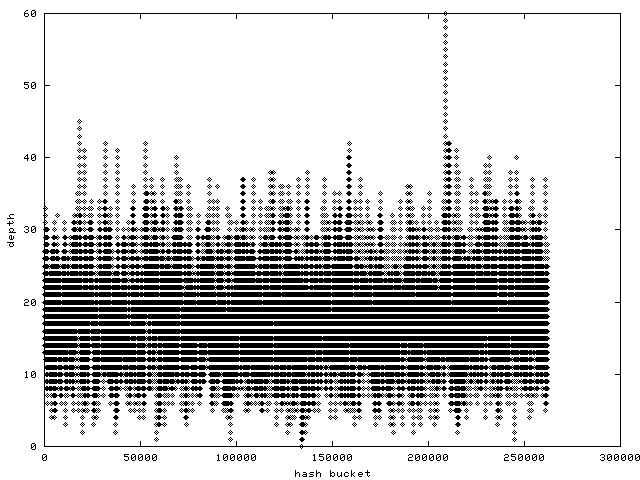
There were a few solutions (from davem and ingo) to allocate a larger hash but with the radix patch we no longer have to worry about this.
So the radix patch solves 2 problems quite nicely :)
Anton
Quoted 2 lines · Anton Blanchard
There were a few solutions (from davem and ingo) to allocate a larger hash but with the radix patch we no longer have to worry about this.
there is one big issue we forgot to consider.
in the case of radix trees it's not only search depth that gets worse with big files. The thing i'm worried about is the 'big pagecache lock' being reintroduced again. If eg. a database application puts lots of data into a single file (multiple gigabytes - why not), then the mapping->i_shared_lock becomes a 'big pagecache lock' again, causing serious SMP contention for even the read() case. Benchmarks show that it's the distribution of locks that matters on big boxes.
dbench hides this issue, because it uses many temporary files, so the locking overhead is distributed. Would you be willing to run benchmarks that measure the scalability of reading from one bigger file, from multiple CPUs?
with hash based locking, the locking overhead is *always* distributed.
with radix trees the locking overhead is distributed only if multiple files are used. With one big file (or a few big files), the i_shared_lock will always bounce between CPUs wildly in read() workloads, degrading scalability just as much as it is degraded with the pagecache_lock now.
Ingo
Quoted 1 line
Quoted 1 line
Quoted 1 line
Quoted 1 line
Quoted 1 line
"Ingo" == Ingo Molnar <[email protected]> writes:
Quoted 2 lines · Anton Blanchard
Quoted 2 lines
There were a few solutions (from davem and ingo) to allocate a larger hash but with the radix patch we no longer have to worry about this.
Ingo> there is one big issue we forgot to consider.
Ingo> in the case of radix trees it's not only search depth that gets worse with
Hmm, worse, yes, the same way as page tables get "worse" with larger address spaces.
Ingo> big files. The thing i'm worried about is the 'big pagecache lock' being Ingo> reintroduced again. If eg. a database application puts lots of data into a
Yes, though I'd strongly suspect big database engines can/should/do benefit from doing their application specific caching and indexing, outperforming whatever cache implementation the OS has.
Ingo> single file (multiple gigabytes - why not), then the mapping-> i_shared_lock becomes a 'big pagecache lock' again, causing Ingo> serious SMP contention for even the read() case. Benchmarks show that it's Ingo> the distribution of locks that matters on big boxes.
So, we can use a read-write spinlock instead ->i_shared_lock, ok ?
Regards,
-velco
Quoted 2 lines · Momchil Velikov
Hmm, worse, yes, the same way as page tables get "worse" with larger address spaces.
with the difference that for address spaces one of the preferred methods of operation is read() [or sendfile(), or any other non-mmap() operation], while for pagetables the hardware helps to get locking-free access to the mapped contents.
Quoted 6 lines
Ingo> big files. The thing i'm worried about is the 'big pagecache lock' being Ingo> reintroduced again. If eg. a database application puts lots of data into a
Yes, though I'd strongly suspect big database engines can/should/do benefit from doing their application specific caching and indexing, outperforming whatever cache implementation the OS has.
it's not just databases. It's webservers too, serving content via sendfile() from a single, bigger file. Think streaming media servers, where the 'movie of the night' sits in a single big binary glob.
Quoted 6 lines
Ingo> single file (multiple gigabytes - why not), then the mapping->
i_shared_lockbecomes a 'big pagecache lock' again, causing Ingo> serious SMP contention for even theread()case. Benchmarks show that it's Ingo> the distribution of locks that matters on big boxes.So, we can use a read-write spinlock instead ->i_shared_lock, ok ?
using read-write locks does not solve the scalability problem: the problem is the bouncing of the spinlock cacheline from CPU to CPU.
Ingo
Quoted 1 line
Quoted 1 line
Quoted 1 line
Quoted 1 line
Quoted 1 line
"Ingo" == Ingo Molnar <[email protected]> writes:
Quoted 1 line · Momchil Velikov
Quoted 1 line
So, we can use a read-write spinlock instead ->i_shared_lock, ok ?
Ingo> using read-write locks does not solve the scalability problem: the problem Ingo> is the bouncing of the spinlock cacheline from CPU to CPU.
Does cache line bounce (shared somewhere -> exclusive elsewhere) cost more that a simple miss (present nowhere -> exclusive somewhere) ?
Regards,
-velco
From: Momchil Velikov <[email protected]>
Date: 01 Feb 2002 11:01:50 +0200
Does cache line bounce (shared somewhere -> exclusive elsewhere) cost more that a simple miss (present nowhere -> exclusive somewhere) ?
They are about equal. For coherency purposes all cpus have to listen to all the transactions anyways to see if they have a match in their L2 caches (and thus must provide the data to the requestor).
Perhaps the exclusive somewhere --> exclusive somewhere else is a bit more expensive because you eat a write port for the cache line move on the processor providing the data.
From: Ingo Molnar <[email protected]>
Date: Fri, 1 Feb 2002 11:29:53 +0100 (CET)
using read-write locks does not solve the scalability problem: the problem is the bouncing of the spinlock cacheline from CPU to CPU.
I so much wish more people understood this :(
Quoted 4 lines · Ingo Molnar
it's not just databases. It's webservers too, serving content via
sendfile()from a single, bigger file. Think streaming media servers, where the 'movie of the night' sits in a single big binary glob.
Hey guys, be _realistic_.
Don't bother with "oh, this could be bad", when there are absolutely _no_ numbers showing any such badness.
Even databases often use multiple files, and quite frankly, a database that doesn't use mmap and doesn't try very hard to not cause extra system calls is going to be bad performance-wise _regardless_ of any page cache locking.
Radix-trees are cleaner than the alternatives, and all the numbers anybody has ever shown shows them to be at least equal in performance.
Stop making up things that just are NOT problems.
In web-servers, 99% of the content is small files, and if the file is cached the expensive parts are all elsewhere. Don't make up "worst case schenarios" that simply do no exist.
Linus
Quoted 3 lines · Linus Torvalds
In web-servers, 99% of the content is small files, and if the file is cached the expensive parts are all elsewhere. Don't make up "worst case schenarios" that simply do no exist.
in fact the locking structure of radix trees have a locking advantage in the 'multiple small files' case: if one CPU does a sendfile() on one file, then the lock will be likely CPU-local for the duration of the sendfile(), while page buckets will access a new spinlock for every page accessed.
Ingo
Quoted 4 lines · Linus Torvalds
Even databases often use multiple files, and quite frankly, a database that doesn't use mmap and doesn't try very hard to not cause extra system calls is going to be bad performance-wise _regardless_ of any page cache locking.
I've always thought that read(2) and write(2) would in the end wind up faster than mmap(2)... Tests in my rewritten cp/rm/mv type utilities seem to bear this out.
Is mmap(2) only preferred for large files/databases?
Jeff
Quoted 9 lines · In article <[email protected]> you wrote:
Quoted 4 lines · Linus Torvalds
Even databases often use multiple files, and quite frankly, a database that doesn't use mmap and doesn't try very hard to not cause extra system calls is going to be bad performance-wise _regardless_ of any page cache locking.
I've always thought that read(2) and write(2) would in the end wind up faster than mmap(2)... Tests in my rewritten cp/rm/mv type utilities seem to bear this out.
the biggest reason for this is that we *suck* at readahead for mmap....
Quoted 7 lines · On Fri, Feb 01, 2002 at 06:44:50PM +0000, [email protected] wrote:
Quoted 5 lines · In article <[email protected]> you wrote:
Quoted 4 lines · Linus Torvalds
Even databases often use multiple files, and quite frankly, a database that doesn't use mmap and doesn't try very hard to not cause extra system calls is going to be bad performance-wise _regardless_ of any page cache locking.
Quoted 5 lines
Quoted 3 lines
I've always thought that read(2) and write(2) would in the end wind up faster than mmap(2)... Tests in my rewritten cp/rm/mv type utilities seem to bear this out.
the biggest reason for this is that we *suck* at readahead for mmap....
Is there not also fault overhead and similar issues related to mmap(2) in general, that are not present with read(2)/write(2)?
Jeff
Quoted 4 lines · Jeff Garzik
Quoted 1 line
the biggest reason for this is that we *suck* at readahead for mmap....
Is there not also fault overhead and similar issues related to mmap(2) in general, that are not present with read(2)/write(2)?
If a fault is more expensive than a system call, we're doing something wrong in the page fault path ;)
Rik
Signature · 4 lines
"Linux holds advantages over the single-vendor commercial OS"
    -- Microsoft's "Competing with Linux" document

http://www.surriel.com/ http://distro.conectiva.com/Hi!
Quoted 7 lines
Quoted 4 lines
Quoted 1 line
the biggest reason for this is that we *suck* at readahead for mmap....
Is there not also fault overhead and similar issues related to mmap(2) in general, that are not present with read(2)/write(2)?
If a fault is more expensive than a system call, we're doing something wrong in the page fault path ;)
You can read 128K at a time, but you can't fault 128K...
Pavel
Signature · 2 lines
Philips Velo 1: 1"x4"x8", 300gram, 60, 12MB, 40bogomips, linux, mutt,
details at http://atrey.karlin.mff.cuni.cz/~pavel/velo/index.html.
Quoted 9 lines · Pavel Machek
Quoted 7 lines
Quoted 4 lines
Quoted 1 line
the biggest reason for this is that we *suck* at readahead for mmap....
Is there not also fault overhead and similar issues related to mmap(2) in general, that are not present with read(2)/write(2)?
If a fault is more expensive than a system call, we're doing something wrong in the page fault path ;)
You can read 128K at a time, but you can't fault 128K...
Why not ?
If the pages are present (read-ahead) and the page table is present, I see no reason why we couldn't fill in 32 page table entries at once.
Rik
Signature · 3 lines
DMCA, SSSCA, W3C?  Who cares?  http://thefreeworld.net/

http://www.surriel.com/		http://distro.conectiva.com/
Quoted 3 lines · Pavel Machek
Quoted 2 lines
Quoted 2 lines
Quoted 2 lines
Quoted 2 lines
the biggest reason for this is that we *suck* at readahead for
mmap....
Quoted 2 lines
Quoted 2 lines
Quoted 2 lines
Quoted 2 lines
Is there not also fault overhead and similar issues related to
mmap(2)
Quoted 7 lines
Quoted 6 lines
Quoted 4 lines
Quoted 1 line
in general, that are not present with read(2)/write(2)?
If a fault is more expensive than a system call, we're doing something wrong in the page fault path ;)
You can read 128K at a time, but you can't fault 128K...
Quoted 7 lines
Why not ?
If the pages are present (read-ahead) and the page table is present, I see no reason why we couldn't fill in 32 page table entries at once.
Rik
Well, filling 32 page tables entries at once is certainly a big readahead... for the common cases.
Maybe this high number could be a result of a madavise(..., MADV_SEQUENTIAL or MAP_WILLNEED)
Solaris does exactly this kind of trick.
Eric
Quoted 10 lines · Rik van Riel
Quoted 9 lines · Pavel Machek
Quoted 8 lines
Quoted 5 lines
Quoted 2 lines
the biggest reason for this is that we *suck* at readahead for mmap....
Is there not also fault overhead and similar issues related to mmap(2) in general, that are not present with read(2)/write(2)?
If a fault is more expensive than a system call, we're doing something wrong in the page fault path ;)
Quoted 7 lines
Quoted 1 line
You can read 128K at a time, but you can't fault 128K...
Why not ?
If the pages are present (read-ahead) and the page table is present, I see no reason why we couldn't fill in 32 page table entries at once.
Yes, essentially what you want is to schedule a generic_file_readahead, which we'd need to cook up a mechanism for doing. The other part - much harder - is deciding when to readahead, and how much.
I'd amend your original statement to just 'we *suck* at readahead'.
Signature · 1 line
Daniel
Hi!
Quoted 8 lines
Quoted 8 lines
Quoted 7 lines
Quoted 4 lines
Quoted 1 line
the biggest reason for this is that we *suck* at readahead for mmap....
Is there not also fault overhead and similar issues related to mmap(2) in general, that are not present with read(2)/write(2)?
If a fault is more expensive than a system call, we're doing something wrong in the page fault path ;)
Quoted 7 lines
Quoted 1 line
You can read 128K at a time, but you can't fault 128K...
Why not ?
If the pages are present (read-ahead) and the page table is present, I see no reason why we couldn't fill in 32 page table entries at once.
Ugh.
Okay, CPU will still have to fill its TLBs (it does not have to in read case), but that is way easier operation.
I did not think about this possibility, sorry.
Pavel
Signature · 2 lines
(about SSSCA) "I don't say this lightly.  However, I really think that the U.S.
no longer is classifiable as a democracy, but rather as a plutocracy." --hpa
Quoted 7 lines · Jeff Garzik
Quoted 4 lines · Linus Torvalds
Even databases often use multiple files, and quite frankly, a database that doesn't use mmap and doesn't try very hard to not cause extra system calls is going to be bad performance-wise _regardless_ of any page cache locking.
Quoted 5 lines
I've always thought that read(2) and write(2) would in the end wind up faster than mmap(2)... Tests in my rewritten cp/rm/mv type utilities seem to bear this out.
Is mmap(2) only preferred for large files/databases?
I've tried to make faster md5summing program and programmed several ways of accessing file - for the very large files the fastest way seemed to be O_DIRECT with threaded precaching.
For fast mmap access I'd to implement two parallel mmpad areas with madvise MADV_WILLNEED - then it was almost as fast as read
Signature · 4 lines
  .''`.  Which fundamental human right do you want to give up today?
 : :' :      Debian GNU/Linux maintainer - www.debian.{org,cz}
 `. `'  Zdenek Kabelac  kabi@{debian.org, users.sf.net, fi.muni.cz}
`- When in doubt, just blame the Euro. :)Quoted 1 line
Quoted 1 line
Quoted 1 line
Quoted 1 line
Quoted 1 line
"David" == David S Miller <[email protected]> writes:
David> From: Ingo Molnar <[email protected]>
David> Date: Fri, 1 Feb 2002 11:29:53 +0100 (CET)
David> using read-write locks does not solve the scalability problem: the problem
David> is the bouncing of the spinlock cacheline from CPU to CPU.
David> I so much wish more people understood this :(
Amen. From now on I'll have it on an yellow sticker on my display ;)
Quoted 1 line
Quoted 1 line
Quoted 1 line
Quoted 1 line
Quoted 1 line
"Ingo" == Ingo Molnar <[email protected]> writes:
Ingo> files are used. With one big file (or a few big files), the i_shared_lock Ingo> will always bounce between CPUs wildly in read() workloads, degrading
Will there be difference between bounces of a rwlock in the radix tree variant and the cache misses in hashed locks variant for the case of concurrently accessed large file ?
Regards,
-velco
Quoted 6 lines · Momchil Velikov
Ingo> files are used. With one big file (or a few big files), the
i_shared_lockIngo> will always bounce between CPUs wildly inread()workloads, degradingWill there be difference between bounces of a rwlock in the radix tree variant and the cache misses in hashed locks variant for the case of concurrently accessed large file ?
definitely, because in the case of page buckets there are many locks hashed in a mapping-neutral way. Ie. different parts of the same file will likely map to different spinlocks. In the radix tree case all pages in the inode will map to the same spinlock.
Ingo
Quoted 1 line
Quoted 1 line
Quoted 1 line
Quoted 1 line
Quoted 1 line
"Ingo" == Ingo Molnar <[email protected]> writes:
Ingo> On 1 Feb 2002, Momchil Velikov wrote:
Ingo> files are used. With one big file (or a few big files), the i_shared_lock Ingo> will always bounce between CPUs wildly in read() workloads, degrading
Quoted 4 lines
Quoted 4 lines
Will there be difference between bounces of a rwlock in the radix tree variant and the cache misses in hashed locks variant for the case of concurrently accessed large file ?
Ingo> definitely, because in the case of page buckets there are many locks Ingo> hashed in a mapping-neutral way. Ie. different parts of the same file will Ingo> likely map to different spinlocks.
That's why it's likely to miss on each access.
Ingo> In the radix tree case all pages in the inode will map to the Ingo> same spinlock.
That's why it's likely to bounce on each access.
So, is there any difference ? :)
Regards,
-velco
Quoted 5 lines · Momchil Velikov
Ingo> definitely, because in the case of page buckets there are many locks Ingo> hashed in a mapping-neutral way. Ie. different parts of the same file will Ingo> likely map to different spinlocks.
That's why it's likely to miss on each access.
yes, you are right.
Quoted 6 lines
Ingo> In the radix tree case all pages in the inode will map to the Ingo> same spinlock.
That's why it's likely to bounce on each access.
So, is there any difference ? :)
no difference. I tried to create a testcase that shows the difference (multiple processes read()ing a single big file on an 8-way box), but performance was equivalent. So given the clear advantages of radix trees in other areas, they win hands down. :)
Ingo
Quoted 8 lines · Ingo Molnar
Quoted 2 lines · Anton Blanchard
There were a few solutions (from davem and ingo) to allocate a larger hash but with the radix patch we no longer have to worry about this.
there is one big issue we forgot to consider.
Quoted 7 lines
in the case of radix trees it's not only search depth that gets worse with big files. The thing i'm worried about is the 'big pagecache lock' being reintroduced again. If eg. a database application puts lots of data into a single file (multiple gigabytes - why not), then the
mapping->i_shared_lockbecomes a 'big pagecache lock' again, causing serious SMP contention for even theread()case. Benchmarks show that it's the distribution of locks that matters on big boxes.
exactly, this is the same thing I mentioned in some past email. It's not that having per-inode data structures solves the locking completly, DBMS are used to store stuff in a single file. And of course with a structure like radix tree it would be a pain to have it scale within the same file, unlike with the hashtable where each bucket is indipendent from the others.
Quoted 2 lines
dbench hides this issue, because it uses many temporary files, so the
Indeed, a lot of workloads would benefit from the separate data structure and locking, but not all, some important one not.
Quoted 3 lines
locking overhead is distributed. Would you be willing to run benchmarks that measure the scalability of reading from one bigger file, from multiple CPUs?
Agreed, also with DaveM patch applied, sizing the hash properly so it has a mean distribution of 1 entry per bucket or so, will decrease the window for the spinlock collisions as well btw.
Quoted 9 lines
with hash based locking, the locking overhead is *always* distributed.
with radix trees the locking overhead is distributed only if multiple files are used. With one big file (or a few big files), the
i_shared_lockwill always bounce between CPUs wildly inread()workloads, degrading scalability just as much as it is degraded with thepagecache_locknow.Ingo
Andrea
Quoted 21 lines · Anton Blanchard
Hi Ingo,
Quoted 5 lines
Yes, it's very nice. Anton Blanchard has benchmarked both patch variants (tree vs. scalable-hash page buckets) for SMP scalability against the stock hash, on big RAM, many CPUs boxes, via dbench load. He has found performance of radix trees vs. scalable hash to be at least equivalent. (i think Anton has a few links to show the resulting graphs.)
Here are some results on a 12 way machine. (2.4.16-splay is the radix patch):
http://samba.org/~anton/linux/pagecache_locking/1/summary.png
As you can see both patches give pretty much equal improvements.
The other problem with the current pagecache hash is that it maxes out at order 9 (due to the
get_free_pageslimitation) which starts to hurt at 4GB RAM and above. On a 32GB machine the average hashchain depth was very high:
Quoted 6 lines
http://samba.org/~anton/linux/pagecache/pagecache_before.png
There were a few solutions (from davem and ingo) to allocate a larger hash but with the radix patch we no longer have to worry about this.
So the radix patch solves 2 problems quite nicely :)
all the hashes should be allocated with the bootmem allocator, that doesn't have the MAX_ORDER limit. Not only the pagecache hash, that is the only one replaced.
In short, for an optimal comparison between hash and radix tree, we'd need to fixup the hash allocation with the bootmem allocator first.
Andrea
From: Andrea Arcangeli <[email protected]>
Date: Fri, 1 Feb 2002 00:55:43 +0100
In short, for an optimal comparison between hash and radix tree, we'd need to fixup the hash allocation with the bootmem allocator first.
I'm totally convinced the radix stuff is much better, but since you are not here is the "pagecache hash in bootmem" patch I did ages ago so Anton can make you happy :-)
arch/alpha/mm/init.c renamed from linux/arch/alpha/mm/init.c +2 -0
@@ -23,6 +23,7 @@#ifdef CONFIG_BLK_DEV_INITRD #include <linux/blk.h> #endif +#include <linux/pagemap.h> #include <asm/system.h> #include <asm/uaccess.h>
@@ -360,6 +361,7 @@mem_init (void) { max_mapnr = num_physpages = max_low_pfn; +page_cache_init (count_free_bootmem ()); totalram_pages +=free_all_bootmem (); high_memory = (void *)__va (max_low_pfn *PAGE_SIZE );
arch/alpha/mm/numa.c renamed from linux/arch/alpha/mm/numa.c +7 -1
@@ -15,6 +15,7 @@#ifdef CONFIG_BLK_DEV_INITRD #include <linux/blk.h> #endif +#include <linux/pagemap.h> #include <asm/hwrpb.h> #include <asm/pgalloc.h>
@@ -359,8 +360,13 @@extern char _text, _etext, _data, _edata;extern char __init_begin, __init_end;extern unsigned long totalram_pages; -unsigned long nid, i; +unsigned long nid, i, num_free_bootmem_pages;mem_map_t * lmem_map; + + num_free_bootmem_pages =0 ; +for (nid =0 ; nid < numnodes; nid++) + num_free_bootmem_pages +=count_free_bootmem_node (NODE_DATA (nid)); +page_cache_init (num_free_bootmem_pages); high_memory = (void *)__va (max_mapnr <<PAGE_SHIFT );
arch/arm/mm/init.c renamed from linux/arch/arm/mm/init.c +7 -0
@@ -23,6 +23,7 @@#include <linux/init.h> #include <linux/bootmem.h> #include <linux/blk.h> +#include <linux/pagemap.h> #include <asm/segment.h> #include <asm/mach-types.h>
@@ -594,6 +595,7 @@void __init mem_init (void ) {unsigned int codepages, datapages, initpages; +unsigned long num_free_bootmem_pages;int i, node; codepages = &_etext - &_text;
@@ -608,6 +610,11 @@*/ if (meminfo.nr_banks !=1 )create_memmap_holes (&meminfo); + + num_free_bootmem_pages =0 ; +for (node =0 ; node < numnodes; node++) + num_free_bootmem_pages +=count_free_bootmem_node (NODE_DATA (node)); +page_cache_init (num_free_bootmem_pages);/* this will put all unused low memory onto the freelists */ for (node =0 ; node < numnodes; node++) {
arch/cris/mm/init.c renamed from linux/arch/cris/mm/init.c +3 -0
@@ -95,6 +95,7 @@#include <linux/swap.h> #include <linux/smp.h> #include <linux/bootmem.h> +#include <linux/pagemap.h> #include <asm/system.h> #include <asm/segment.h>
@@ -366,6 +367,8 @@ max_mapnr = num_physpages = max_low_pfn - min_low_pfn; +page_cache_init (count_free_bootmem ()); +/* this will put all memory onto the freelists */ totalram_pages =free_all_bootmem ();
arch/i386/mm/init.c renamed from linux/arch/i386/mm/init.c +2 -0
@@ -466,6 +466,8 @@#endif high_memory = (void *)__va (max_low_pfn *PAGE_SIZE ); +page_cache_init (count_free_bootmem ()); +/* clear the zero-page */ memset (empty_zero_page,0 ,PAGE_SIZE );
arch/ia64/mm/init.c renamed from linux/arch/ia64/mm/init.c +3 -0
@@ -13,6 +13,7 @@#include <linux/reboot.h> #include <linux/slab.h> #include <linux/swap.h> +#include <linux/pagemap.h> #include <asm/bitops.h> #include <asm/dma.h>
@@ -406,6 +407,8 @@ max_mapnr = max_low_pfn; high_memory =__va (max_low_pfn *PAGE_SIZE ); + +page_cache_init (count_free_bootmem ()); totalram_pages +=free_all_bootmem ();
arch/m68k/mm/init.c renamed from linux/arch/m68k/mm/init.c +3 -0
@@ -20,6 +20,7 @@#ifdef CONFIG_BLK_DEV_RAM #include <linux/blk.h> #endif +#include <linux/pagemap.h> #include <asm/setup.h> #include <asm/uaccess.h>
@@ -135,6 +136,8 @@if (MACH_IS_ATARI )atari_stram_mem_init_hook ();#endif + +page_cache_init (count_free_bootmem ());/* this will put all memory onto the freelists */ totalram_pages =free_all_bootmem ();
arch/mips/mm/init.c renamed from linux/arch/mips/mm/init.c +3 -0
@@ -28,6 +28,7 @@#ifdef CONFIG_BLK_DEV_INITRD #include <linux/blk.h> #endif +#include <linux/pagemap.h> #include <asm/bootinfo.h> #include <asm/cachectl.h>
@@ -203,6 +204,8 @@ max_mapnr = num_physpages = max_low_pfn; high_memory = (void *)__va (max_mapnr <<PAGE_SHIFT ); + +page_cache_init (count_free_bootmem ()); totalram_pages +=free_all_bootmem (); totalram_pages -=setup_zero_pages ();/* Setup zeroed pages. */
arch/mips64/mm/init.c renamed from linux/arch/mips64/mm/init.c +3 -0
@@ -25,6 +25,7 @@#ifdef CONFIG_BLK_DEV_INITRD #include <linux/blk.h> #endif +#include <linux/pagemap.h> #include <asm/bootinfo.h> #include <asm/cachectl.h>
@@ -396,6 +397,8 @@ max_mapnr = num_physpages = max_low_pfn; high_memory = (void *)__va (max_mapnr <<PAGE_SHIFT ); + +page_cache_init (count_free_bootmem ()); totalram_pages +=free_all_bootmem (); totalram_pages -=setup_zero_pages ();/* Setup zeroed pages. */
arch/mips64/sgi-ip27/ip27-memory.c renamed from linux/arch/mips64/sgi-ip27/ip27-memory.c +6 -0
@@ -15,6 +15,7 @@#include <linux/mm.h> #include <linux/bootmem.h> #include <linux/swap.h> +#include <linux/pagemap.h> #include <asm/page.h> #include <asm/bootinfo.h>
@@ -277,6 +278,11 @@ num_physpages = numpages;/* memory already sized by szmem */ max_mapnr = pagenr;/* already found during paging_init */ high_memory = (void *)__va (max_mapnr <<PAGE_SHIFT ); + + tmp =0 ; +for (nid =0 ; nid < numnodes; nid++) + tmp +=count_free_bootmem_node (NODE_DATA (nid)); +page_cache_init (tmp);for (nid =0 ; nid < numnodes; nid++) {
arch/parisc/mm/init.c renamed from linux/arch/parisc/mm/init.c +3 -0
@@ -17,6 +17,7 @@#include <linux/pci.h> /* for hppa_dma_ops and pcxl_dma_ops */ #include <linux/swap.h> #include <linux/unistd.h> +#include <linux/pagemap.h> #include <asm/pgalloc.h>
@@ -48,6 +49,8 @@ { max_mapnr = num_physpages = max_low_pfn; high_memory =__va (max_low_pfn *PAGE_SIZE ); + +page_cache_init (count_free_bootmem ()); totalram_pages +=free_all_bootmem ();printk ("Memory: %luk available\n" , totalram_pages << (PAGE_SHIFT -10 ));
arch/ppc/mm/init.c renamed from linux/arch/ppc/mm/init.c +3 -0
@@ -34,6 +34,7 @@#ifdef CONFIG_BLK_DEV_INITRD #include <linux/blk.h> /* for initrd_* */ #endif +#include <linux/pagemap.h> #include <asm/pgalloc.h> #include <asm/prom.h>
@@ -462,6 +463,8 @@ high_memory = (void *)__va (max_low_pfn *PAGE_SIZE ); num_physpages = max_mapnr;/* RAM is assumed contiguous */ + +page_cache_init (count_free_bootmem ()); totalram_pages +=free_all_bootmem ();
arch/s390/mm/init.c renamed from linux/arch/s390/mm/init.c +2 -0
@@ -186,6 +186,8 @@/* clear the zero-page */ memset (empty_zero_page,0 ,PAGE_SIZE ); +page_cache_init (count_free_bootmem ()); +/* this will put all low memory onto the freelists */ totalram_pages +=free_all_bootmem ();
arch/s390x/mm/init.c renamed from linux/arch/s390x/mm/init.c +2 -0
@@ -198,6 +198,8 @@/* clear the zero-page */ memset (empty_zero_page,0 ,PAGE_SIZE ); +page_cache_init (count_free_bootmem ()); +/* this will put all low memory onto the freelists */ totalram_pages +=free_all_bootmem ();
arch/sh/mm/init.c renamed from linux/arch/sh/mm/init.c +8 -0
@@ -26,6 +26,7 @@#endif #include <linux/highmem.h> #include <linux/bootmem.h> +#include <linux/pagemap.h> #include <asm/processor.h> #include <asm/system.h>
@@ -139,6 +140,7 @@void __init mem_init (void ) {extern unsigned long empty_zero_page[1024 ]; +unsigned long num_free_bootmem_pages;int codesize, reservedpages, datasize, initsize;int tmp;
@@ -148,6 +150,12 @@/* clear the zero-page */ memset (empty_zero_page,0 ,PAGE_SIZE );__flush_wback_region (empty_zero_page,PAGE_SIZE ); + + num_free_bootmem_pages =count_free_bootmem_node (NODE_DATA (0 )); +#ifdef CONFIG_DISCONTIGMEM + num_free_bootmem_pages +=count_free_bootmem_node (NODE_DATA (1 )); +#endif +page_cache_init (num_free_bootmem_pages);/* this will put all low memory onto the freelists */ totalram_pages +=free_all_bootmem_node (NODE_DATA (0 ));
arch/sparc/mm/init.c renamed from linux/arch/sparc/mm/init.c +3 -0
@@ -25,6 +25,7 @@#include <linux/init.h> #include <linux/highmem.h> #include <linux/bootmem.h> +#include <linux/pagemap.h> #include <asm/system.h> #include <asm/segment.h>
@@ -434,6 +432,8 @@ max_mapnr = last_valid_pfn - (phys_base >>PAGE_SHIFT ); high_memory =__va (max_low_pfn <<PAGE_SHIFT ); + +page_cache_init (count_free_bootmem ());#ifdef DEBUG_BOOTMEM prom_printf ("mem_init: Calling free_all_bootmem().\n" );
arch/sparc64/mm/init.c renamed from linux/arch/sparc64/mm/init.c +2 -0
@@ -1583,6 +1583,8 @@ max_mapnr = last_valid_pfn - (phys_base >>PAGE_SHIFT ); high_memory =__va (last_valid_pfn <<PAGE_SHIFT ); + +page_cache_init (count_free_bootmem ()); num_physpages =free_all_bootmem () -1 ;
include/linux/bootmem.h renamed from linux/include/linux/bootmem.h +2 -0
@@ -43,11 +43,13 @@#define alloc_bootmem_low_pages (x) \ __alloc_bootmem((x), PAGE_SIZE, 0)extern unsigned long __init free_all_bootmem (void ); +extern unsigned long __init count_free_bootmem (void );extern unsigned long __init init_bootmem_node (pg_data_t *pgdat,unsigned long freepfn,unsigned long startpfn,unsigned long endpfn);extern void __init reserve_bootmem_node (pg_data_t *pgdat,unsigned long physaddr,unsigned long size);extern void __init free_bootmem_node (pg_data_t *pgdat,unsigned long addr,unsigned long size);extern unsigned long __init free_all_bootmem_node (pg_data_t *pgdat); +extern unsigned long __init count_free_bootmem_node (pg_data_t *pgdat);extern void *__init __alloc_bootmem_node (pg_data_t *pgdat,unsigned long size,unsigned long align,unsigned long goal);#define alloc_bootmem_node (pgdat, x) \ __alloc_bootmem_node((pgdat), (x), SMP_CACHE_BYTES, __pa(MAX_DMA_ADDRESS))
init/main.c renamed from linux/init/main.c +0 -1
@@ -597,7 +597,6 @@proc_caches_init ();vfs_caches_init (mempages);buffer_init (mempages); -page_cache_init (mempages);#if defined(CONFIG_ARCH_S390 )ccwcache_init ();#endif
mm/bootmem.c renamed from linux/mm/bootmem.c +32 -0
@@ -272,6 +279,28 @@return total; } +static unsigned long __init count_free_bootmem_core (pg_data_t *pgdat) +{ +bootmem_data_t *bdata = pgdat->bdata; +unsigned long i, idx, total; + +if (!bdata->node_bootmem_map)BUG (); + + total =0 ; + idx = bdata->node_low_pfn - (bdata->node_boot_start >>PAGE_SHIFT ); +for (i =0 ; i < idx; i++) { +if (!test_bit (i, bdata->node_bootmem_map)) + total++; + } + +/* +* Count the allocator bitmap itself. +*/ + total += ((bdata->node_low_pfn-(bdata->node_boot_start >>PAGE_SHIFT ))/8 +PAGE_SIZE -1 )/PAGE_SIZE ; + +return total; +} +unsigned long __init init_bootmem_node (pg_data_t *pgdat,unsigned long freepfn,unsigned long startpfn,unsigned long endpfn) {return (init_bootmem_core (pgdat, freepfn, startpfn, endpfn));
@@ -292,6 +321,11 @@return (free_all_bootmem_core (pgdat)); } +unsigned long __init count_free_bootmem_node (pg_data_t *pgdat) +{ +return (count_free_bootmem_core (pgdat)); +} +unsigned long __init init_bootmem (unsigned long start,unsigned long pages) { max_low_pfn = pages;
@@ -312,6 +346,11 @@unsigned long __init free_all_bootmem (void ) {return (free_all_bootmem_core (&contig_page_data)); +} + +unsigned long __init count_free_bootmem (void ) +{ +return (count_free_bootmem_core (&contig_page_data)); }void *__init __alloc_bootmem (unsigned long size,unsigned long align,unsigned long goal)
mm/filemap.c renamed from linux/mm/filemap.c +30 -9
@@ -24,6 +24,7 @@#include <linux/mm.h> #include <linux/iobuf.h> #include <linux/compiler.h> +#include <linux/bootmem.h> #include <asm/pgalloc.h> #include <asm/uaccess.h>
@@ -2931,28 +2932,48 @@ goto unlock; } +/* This is called from the arch specific mem_init routine. +* It is done right before free_all_bootmem (or NUMA equivalent). +* +* The mempages arg is the number of pages free_all_bootmem is +* going to liberate, or a close approximation. +* +* We have to use bootmem because on huge systems (ie. 16GB ram) +* get_free_pages cannot give us a large enough allocation. +*/ void __init page_cache_init (unsigned long mempages) { -unsigned long htable_size, order; +unsigned long htable_size, real_size; htable_size = mempages; htable_size *=sizeof (struct page *); -for (order =0 ; (PAGE_SIZE << order) < htable_size; order++) + +for (real_size =1UL ; real_size < htable_size; real_size <<=1UL ) ;do { -unsigned long tmp = (PAGE_SIZE << order) /sizeof (struct page *); +unsigned long tmp = (real_size /sizeof (struct page *)); +unsigned long align; page_hash_bits =0 ;while ((tmp >>=1UL ) !=0UL ) page_hash_bits++; + + align = real_size; +if (align > (4UL *1024UL *1024UL )) + align = (4UL *1024UL *1024UL ); + + page_hash_table =__alloc_bootmem (real_size, align, +__pa (MAX_DMA_ADDRESS )); + +/* Perhaps the alignment was too strict. */ +if (page_hash_table ==NULL ) + page_hash_table =alloc_bootmem (real_size); + }while (page_hash_table ==NULL && + (real_size >>=1UL ) >=PAGE_SIZE ); - page_hash_table = (struct page **) -__get_free_pages (GFP_ATOMIC , order); - }while (page_hash_table ==NULL && --order >0 ); - -printk ("Page-cache hash table entries: %d (order: %ld, %ld bytes)\n" , - (1 << page_hash_bits), order, (PAGE_SIZE << order)); +printk ("Page-cache hash table entries: %d (%ld bytes)\n" , + (1 << page_hash_bits), real_size);if (!page_hash_table)panic ("Failed to allocate page hash table\n" );memset ((void *)page_hash_table,0 ,PAGE_HASH_SIZE *sizeof (struct page *));
Quoted 7 lines
all the hashes should be allocated with the bootmem allocator, that doesn't have the
MAX_ORDERlimit. Not only the pagecache hash, that is the only one replaced.In short, for an optimal comparison between hash and radix tree, we'd need to fixup the hash allocation with the bootmem allocator first.
All my results use vmalloc to allocate the hashes so they get sized correctly.
Don't worry, there is no increased tlb pressure on these machines due to vmalloc, that cpu doesnt have large page support.
Anton
Quoted 1 line
Quoted 1 line
Quoted 1 line
Quoted 1 line
Quoted 1 line
"Anton" == Anton Blanchard <[email protected]> writes:
Anton> Hi Ingo,
Quoted 5 lines
Quoted 5 lines
Yes, it's very nice. Anton Blanchard has benchmarked both patch variants (tree vs. scalable-hash page buckets) for SMP scalability against the stock hash, on big RAM, many CPUs boxes, via dbench load. He has found performance of radix trees vs. scalable hash to be at least equivalent. (i think Anton has a few links to show the resulting graphs.)
Anton> Here are some results on a 12 way machine. (2.4.16-splay is the radix Anton> patch):
Anton> http://samba.org/~anton/linux/pagecache_locking/1/summary.png
A correction, "-splay" is the very first variant I posted, which used splay trees for the page cache.
Anton> As you can see both patches give pretty much equal improvements.
Anton> The other problem with the current pagecache hash is that it maxes out Anton> at order 9 (due to the get_free_pages limitation) which starts to hurt Anton> at 4GB RAM and above. On a 32GB machine the average hashchain depth Anton> was very high:
Anton> http://samba.org/~anton/linux/pagecache/pagecache_before.png
Anton> There were a few solutions (from davem and ingo) to allocate a larger Anton> hash but with the radix patch we no longer have to worry about this.
Anton> So the radix patch solves 2 problems quite nicely :)
Anton> Anton
Quoted 3 lines
A correction, "-splay" is the very first variant I posted, which used splay trees for the page cache.
Oops now I remember why I called it -splay :) I have a radix comparison somewhere, I'll fish it out.
Anton
Quoted 5 lines · Andrea Arcangeli
Quoted 5 lines
Quoted 5 lines
So I wouldn't merge it, at least until some math is done for the memory consumation with 500k inodes with only 1 page in them each, and on the number of heights/levels that must be walked during the tree lookup, during a access at offset 10G (or worst case in general [biggest height]) of an inode with 10G just allocated in pagecache.
Did someone say math? Looks like I popped in just in time.
The radix tree forest worst case space usage for fixed-precision search keys is where each leaf node of a radix tree is occupied by a unique page, and furthermore, each radix tree contains a single page (otherwise the shared root conserves a small amount of space).
key precision = D^B = wordsize (e.g. 2^32 or 2^64) D = depth
B = branch factor
Each leaf node lies within a chain of D nodes, where all but the root nodes are of size B words. This is (D-1)*B + 1 words per file, hence per-page. Variable branch factors don't complicate this significantly:
1 + \sum_{0 \leq k \leq D} B_k words per page.
For a branch factor of 128 on i386, this ends up as 1 + 7 + 7 + 6 = 21 words per file. So for 500K inodes each with one page, 42MB (Douglas Adams fan?). Offsets of 10GB don't work here. Sounds like either an interesting patch or a 64-bit machine if they work for you. =)
Quoted 3 lines · Rik van Riel
Quoted 3 lines
Ummm, I don't see how this worst case is any more realistic as the worst case for the hash table (where all pages live in very few hash buckets and we have really deep chains).
I don't believe it's particularly realistic either. And sorry about the inaccurate estimates from before. =)
Quoted 5 lines · Andrea Arcangeli
Mathematically the hashtable complexity is O(N). But probabilistically with the tuning we do on the hashtable size, the collisions will be nearly zero for most buckets for of most workloads. Despite the worst case is with all the pagecache and swapcache queued in a single linked list :).
To avoid its worst case (or just poor distribution across the buckets), a good hash function is necessary. And I don't believe the measurements are in favor of the one currently in use. Also, the pointer links for separate chaining within the objects costs extremely-precious boot-time allocated memory and that memory is taken away from the system for all time, where the dynamic allocation at least allows for the possibility of recovering memory when needed.
Quoted 7 lines · Andrea Arcangeli
So in short math is wrong about O(N) being bad, hashtable is infact the only way we can get an effective O(1) by just paying RAM. We pay with RAM and we get performance back to us.
but with the radix tree (please correct me if I'm wrong) the height will increase eventually, no matter what (so it won't be an effective O(1) like the hashtable provides in real life, not the worst case, the common case). With the hashtable the height won't increase instead.
The key is of a fixed precision, hence the tree is of a fixed depth. The radix tree is O(1).
Quoted 5 lines · Andrea Arcangeli
In short to get the same performance with the radix tree, you'd need to waste an huge amount of ram per inode, the hashtable is instead global so we pay only once for all the pages in the system. At least this is my understanding, I'm not a radix tree guru though, so I may be missing something.
Lock and cache contention introduced by intermixing data from unrelated objects. We've all seen radix trees before: most page tables are radix trees.
Quoted 5 lines · Rik van Riel
Quoted 5 lines
People just don't go around caching a single page each for all of their 10 GB files and even if they
_wantedto_they couldn't because of the readahead code.
I suspect that for large files we'll always have aroundmin_readaheadlogically contiguous pages cached, if not more.
I suspect the worst case could only arise after evictions of the readahead from the pagecache.
Quoted 3 lines · Andrea Arcangeli
readahead really doesn't matter at all. consider all the data just in cache, assume you wrote it and you will never ever need to read it once again because you've 64G of ram and only 20G of disk.
Good luck booting on a 64GB x86 with excess pointer links in struct page. Boot-time allocations filling the direct-mapped portion of the kernel virtual address space -appear- to be a severe problem there, but I've not got the RAM to empirically verify this quite yet.
Quoted 5 lines · Andrea Arcangeli
I/O on large files can and must run as fast as I/O on small files, at the pagecache level. If the fs doesn't support extents or it's inefficient with large files that's an enterly different problem, and the underlying fs doesn't matter any longer once the data is in cache. pagecache must not slowdown on big files.
O(1) is O(1). This isn't even average-case or worst case: it's all cases. In a radix tree using fixed-precision search keys, such as machine words, exactly the same number of internal nodes are traversed to reach a leaf for every search key, every time, regardless of how populated or unpopulated the radix tree is.
Quoted 4 lines · Andrea Arcangeli
Otherwise for an unix fs developer usage (the small files ala dbench) the rbtree was much nicer data structure than the hash in first place (and it eats less ram than the radix tree if only one page is queued etc...).
And the pointer links in struct page? Sounds like more RAM to me... 4000 open files (much more realistic than 500K) each with one page leads to 48000 words of radix tree overhead. 3 words per page of pointer links and > 16000 pages of RAM and the rbtree eats more, not less. And 16000 pages is just 64MB on i386.
Cheers,
Bill
Quoted 11 lines · William Lee Irwin III
The radix tree forest worst case space usage for fixed-precision search keys is where each leaf node of a radix tree is occupied by a unique page, and furthermore, each radix tree contains a single page (otherwise the shared root conserves a small amount of space).
key precision = D^B = wordsize (e.g. 2^32 or 2^64)
D = depth
B = branch factor
Each leaf node lies within a chain of D nodes, where all but the root nodes are of size B words. This is (D-1)*B + 1 words per file, hence per-page. Variable branch factors don't complicate this significantly:
1 + \sum_{0 \leq k \leq D}B_kwords per page.
Quoted 4 lines · William Lee Irwin III
For a branch factor of 128 on i386, this ends up as 1 + 7 + 7 + 6 = 21 words per file. So for 500K inodes each with one page, 42MB (Douglas Adams fan?). Offsets of 10GB don't work here. Sounds like either an interesting patch or a 64-bit machine if they work for you. =)
As just pointed out to me the minute I did a substitution I went wrong:
A branch factor of 128 leads to
1 + (7 + 7 + 6)*128 words = 2561 words per file, which is somewhat more severe. =(
More corrections are welcome.
Quoted 4 lines · Andrea Arcangeli
Quoted 4 lines
Otherwise for an unix fs developer usage (the small files ala dbench) the rbtree was much nicer data structure than the hash in first place (and it eats less ram than the radix tree if only one page is queued etc...).
Quoted 5 lines · William Lee Irwin III
And the pointer links in struct page? Sounds like more RAM to me... 4000 open files (much more realistic than 500K) each with one page leads to 48000 words of radix tree overhead. 3 words per page of pointer links and > 16000 pages of RAM and the rbtree eats more, not less. And 16000 pages is just 64MB on i386.
This doesn't quite hold up after the the correction above. 4K open files ends up having 10.5K words or 40MB of overhead.
Cheers,
Bill
Quoted 23 lines · William Lee Irwin III
Quoted 5 lines · Andrea Arcangeli
Quoted 5 lines
Quoted 5 lines
So I wouldn't merge it, at least until some math is done for the memory consumation with 500k inodes with only 1 page in them each, and on the number of heights/levels that must be walked during the tree lookup, during a access at offset 10G (or worst case in general [biggest height]) of an inode with 10G just allocated in pagecache.
Did someone say math? Looks like I popped in just in time.
The radix tree forest worst case space usage for fixed-precision search keys is where each leaf node of a radix tree is occupied by a unique page, and furthermore, each radix tree contains a single page (otherwise the shared root conserves a small amount of space).
key precision = D^B = wordsize (e.g. 2^32 or 2^64) D = depth
B = branch factorEach leaf node lies within a chain of D nodes, where all but the root nodes are of size B words. This is (D-1)*B + 1 words per file, hence per-page. Variable branch factors don't complicate this significantly:
1 + \sum_{0 \leq k \leq D}B_kwords per page.
Quoted 4 lines
For a branch factor of 128 on i386, this ends up as 1 + 7 + 7 + 6 = 21 words per file. So for 500K inodes each with one page, 42MB (Douglas Adams fan?). Offsets of 10GB don't work here. Sounds like either an interesting patch or a 64-bit machine if they work for you. =)
What do you mean with offsets of 10GB not working? In any recent distribution supporting LFS the file size limit is only a constraint of the filesystem on disk format. You don't need a 64bit arch for that. (and anyways any change to the pagecahce must work fine for 64bit archs too)
Quoted 15 lines · Rik van Riel
Quoted 3 lines
Quoted 3 lines
Ummm, I don't see how this worst case is any more realistic as the worst case for the hash table (where all pages live in very few hash buckets and we have really deep chains).
I don't believe it's particularly realistic either. And sorry about the inaccurate estimates from before. =)
Quoted 5 lines · Andrea Arcangeli
Mathematically the hashtable complexity is O(N). But probabilistically with the tuning we do on the hashtable size, the collisions will be nearly zero for most buckets for of most workloads. Despite the worst case is with all the pagecache and swapcache queued in a single linked list :).
Quoted 3 lines
To avoid its worst case (or just poor distribution across the buckets), a good hash function is necessary. And I don't believe the measurements are in favor of the one currently in use. Also, the pointer links for
the randomization provided by the inode is quite powerful (and it makes not possible to guess the hash bucket in use from userspace without privilegies), and the current one make sure to optimize the cacheline usage during consecutive reads.
Quoted 14 lines
separate chaining within the objects costs extremely-precious boot-time allocated memory and that memory is taken away from the system for all time, where the dynamic allocation at least allows for the possibility of recovering memory when needed.
Quoted 7 lines · Andrea Arcangeli
So in short math is wrong about O(N) being bad, hashtable is infact the only way we can get an effective O(1) by just paying RAM. We pay with RAM and we get performance back to us.
but with the radix tree (please correct me if I'm wrong) the height will increase eventually, no matter what (so it won't be an effective O(1) like the hashtable provides in real life, not the worst case, the common case). With the hashtable the height won't increase instead.
Quoted 2 lines
The key is of a fixed precision, hence the tree is of a fixed depth. The radix tree is O(1).
what does it mean the tree is of a fixed depth? If the depth is fixed and you claim the lookup complexity O(1) how can you support terabytes of pagecache queued into the tree without wasting quite a lot of ram per inode in the worst case (the worst case is with only a few pages into each radix tree, just to make sure all the depth gets allocated)? Forget totally about x86, some box runs linux with 256G of ram (I guess terabyte is next).
Also the complexity arguments are all about the worst case, O(1) as said in the earlier email may very well be much slower than O(N) when you get to numbers. hashtable will provide a common case where there is no collision in the bucket, and then the lookup only consiste of a pointer check.
If your radix tree O(1) fixed depth is 10000, you will always have to walk 10000 pointers before you can finish the lookup and it will be definitely much slower than O(N).
So keep in mind the math complexity arguments can be very misleading in real life.
Quoted 9 lines · Andrea Arcangeli
Quoted 5 lines
In short to get the same performance with the radix tree, you'd need to waste an huge amount of ram per inode, the hashtable is instead global so we pay only once for all the pages in the system. At least this is my understanding, I'm not a radix tree guru though, so I may be missing something.
Lock and cache contention introduced by intermixing data from unrelated objects. We've all seen radix trees before: most page tables are radix
of course with a per-inode data structure the locking issue while accessing different inodes goes away but I think nominal performance of the data structure is more important than scalability issue (also contention would remain in workloads where all tasks access the same inode like database). The cacheline part has to be taken into account but the hashfn is just optimized for that one.
Quoted 12 lines
trees.
Quoted 5 lines · Rik van Riel
Quoted 5 lines
People just don't go around caching a single page each for all of their 10 GB files and even if they
_wantedto_they couldn't because of the readahead code.
I suspect that for large files we'll always have aroundmin_readaheadlogically contiguous pages cached, if not more.I suspect the worst case could only arise after evictions of the readahead from the pagecache.
Quoted 6 lines
Quoted 3 lines · Andrea Arcangeli
readahead really doesn't matter at all. consider all the data just in cache, assume you wrote it and you will never ever need to read it once again because you've 64G of ram and only 20G of disk.
Good luck booting on a 64GB x86 with excess pointer links in struct page.
x86 doesn't matter. this is common code.
Quoted 11 lines
Boot-time allocations filling the direct-mapped portion of the kernel virtual address space -appear- to be a severe problem there, but I've not got the RAM to empirically verify this quite yet.
Quoted 5 lines · Andrea Arcangeli
I/O on large files can and must run as fast as I/O on small files, at the pagecache level. If the fs doesn't support extents or it's inefficient with large files that's an enterly different problem, and the underlying fs doesn't matter any longer once the data is in cache. pagecache must not slowdown on big files.
Quoted 5 lines
O(1) is O(1). This isn't even average-case or worst case: it's all cases. In a radix tree using fixed-precision search keys, such as machine words, exactly the same number of internal nodes are traversed to reach a leaf for every search key, every time, regardless of how populated or unpopulated the radix tree is.
and this mean it will be slower than the hashtable that will reach the page without walking any "depth" in the common case.
Quoted 8 lines · Andrea Arcangeli
Quoted 4 lines
Otherwise for an unix fs developer usage (the small files ala dbench) the rbtree was much nicer data structure than the hash in first place (and it eats less ram than the radix tree if only one page is queued etc...).
And the pointer links in struct page? Sounds like more RAM to me...
yes, that would be a few more bytes per page.... unless you allocate the node structure dynamically like you seems to be doing in the radix tree patch for the very same reason of not increasing the struct page I guess.
Quoted 1 line
4000 open files (much more realistic than 500K) each with one page
open files doesn't matter. what matters are the number of inodes with cache in them. 500k is definitely realistic, try to run updatedb with plenty of ram free and then check /proc/sys/fs/inode-nr.
Quoted 7 lines
leads to 48000 words of radix tree overhead. 3 words per page of pointer links and > 16000 pages of RAM and the rbtree eats more, not less. And 16000 pages is just 64MB on i386.
Cheers,
Bill
Andrea
Quoted 4 lines · William Lee Irwin III
Quoted 4 lines
For a branch factor of 128 on i386, this ends up as 1 + 7 + 7 + 6 = 21 words per file. So for 500K inodes each with one page, 42MB (Douglas Adams fan?). Offsets of 10GB don't work here. Sounds like either an interesting patch or a 64-bit machine if they work for you. =)
These numbers are wrong -- see the other reply.
Quoted 5 lines · Andrea Arcangeli
What do you mean with offsets of 10GB not working? In any recent distribution supporting LFS the file size limit is only a constraint of the filesystem on disk format. You don't need a 64bit arch for that. (and anyways any change to the pagecahce must work fine for 64bit archs too)
I stand corrected on that. It appears the extra bits are used for large files. The depth of the tree as represented in the calculation may need to go up and so the worst case space usage is even larger than the 2.2-ish 32-bit - PAGE_SHIFT calculation.
Quoted 3 lines · William Lee Irwin III
Quoted 3 lines
To avoid its worst case (or just poor distribution across the buckets), a good hash function is necessary. And I don't believe the measurements are in favor of the one currently in use. Also, the pointer links for
Quoted 4 lines · Andrea Arcangeli
the randomization provided by the inode is quite powerful (and it makes not possible to guess the hash bucket in use from userspace without privilegies), and the current one make sure to optimize the cacheline usage during consecutive reads.
chi^2 is nowhere near passing a confidence test for uniformity on the pagecache and on various machines extremely poor bucket distribution has been observed (i.e. visibly poor from histograms).
Quoted 2 lines · William Lee Irwin III
Quoted 2 lines
The key is of a fixed precision, hence the tree is of a fixed depth. The radix tree is O(1).
Quoted 7 lines · Andrea Arcangeli
what does it mean the tree is of a fixed depth? If the depth is fixed and you claim the lookup complexity O(1) how can you support terabytes of pagecache queued into the tree without wasting quite a lot of ram per inode in the worst case (the worst case is with only a few pages into each radix tree, just to make sure all the depth gets allocated)? Forget totally about x86, some box runs linux with 256G of ram (I guess terabyte is next).
The number of levels in the tree is proportional to the number of bits in the machine word, which is a constant. A double-precision machine word is of constant size as well. Radix trees can be used on strings, which is where they would not be of fixed depth.
Quoted 5 lines · Andrea Arcangeli
Also the complexity arguments are all about the worst case, O(1) as said in the earlier email may very well be much slower than O(N) when you get to numbers. hashtable will provide a common case where there is no collision in the bucket, and then the lookup only consiste of a pointer check.
Quoted 5 lines · Andrea Arcangeli
If your radix tree O(1) fixed depth is 10000, you will always have to walk 10000 pointers before you can finish the lookup and it will be definitely much slower than O(N).
So keep in mind the math complexity arguments can be very misleading in real life.
I know how to use them. Unfortunately, I am not a lightning calculator, as seen in the preceding post.
Quoted 6 lines · Andrea Arcangeli
of course with a per-inode data structure the locking issue while accessing different inodes goes away but I think nominal performance of the data structure is more important than scalability issue (also contention would remain in workloads where all tasks access the same inode like database). The cacheline part has to be taken into account but the hashfn is just optimized for that one.
Quoted 1 line · William Lee Irwin III
Quoted 1 line
Good luck booting on a 64GB x86 with excess pointer links in struct page.
Quoted 1 line · Andrea Arcangeli
x86 doesn't matter. this is common code.
I wish.
Quoted 5 lines · William Lee Irwin III
Quoted 5 lines
O(1) is O(1). This isn't even average-case or worst case: it's all cases. In a radix tree using fixed-precision search keys, such as machine words, exactly the same number of internal nodes are traversed to reach a leaf for every search key, every time, regardless of how populated or unpopulated the radix tree is.
Quoted 2 lines · Andrea Arcangeli
and this mean it will be slower than the hashtable that will reach the page without walking any "depth" in the common case.
Not so; the hash table will walk some number of pointer links which can be estimated from the load on the table, and this is likely to be approximately the same as the radix tree from hash table statistics I've seen.
Quoted 3 lines · Andrea Arcangeli
yes, that would be a few more bytes per page.... unless you allocate the node structure dynamically like you seems to be doing in the radix tree patch for the very same reason of not increasing the struct page I guess.
Well, maybe not given the revised numbers. =)
Quoted 1 line · William Lee Irwin III
Quoted 1 line
4000 open files (much more realistic than 500K) each with one page
Quoted 3 lines · Andrea Arcangeli
open files doesn't matter. what matters are the number of inodes with cache in them. 500k is definitely realistic, try to run updatedb with plenty of ram free and then check
/proc/sys/fs/inode-nr.
I misspoke -- I used an estimate of the number of address_spaces in use on busy systems I heard elsewhere and quadrupled it (and then said "open files"). Since it's inodes, 4K is still a bad estimate.
Cheers,
Bill
Quoted 14 lines · Momchil Velikov
Quoted 1 line
Quoted 1 line
Quoted 1 line
Quoted 1 line
Quoted 1 line
"John" == John Stoffel <[email protected]> writes:
Momchil> Memory overhead due to allocator overhead is of no concern with the Momchil> slab allocator. What matters most is probably the overhead of the Momchil> radix tree nodes themselves, compared to the two pointers in struct Momchil> page with the hash table approach. rat-4 variant ought to have less Momchil> overhead compared to rat-7 at the expense of deeper/higher tree. I Momchil> have no figures for the actual memory usage though. For small files it Momchil> should be negligible, i.e. one radix tree node, 68 or 516 bytes for Momchil> rat-4 or rat-7, for a file of size up to 65536 or 524288 bytes. The Momchil> worst case would be very large file with a few cached pages with Momchil> offsets uniformly distributed across the whole file, that is having Momchil> deep tree with only one page hanging off each leaf node.
Quoted 6 lines
John> Isn't this a good place to use AVL trees then, since they balance John> automatically? Admittedly, it may be more overhead than we want in John> the case where the tree is balanced by default anyway.
The widespread opinion is that binary trees are generally way too deep compared to radix trees, so searches have larger cache footprint.
I've posted this before -- my cache-optimized skip list solves the problem of balanced-tree cache footprint. It uses cacheline-sized nodes and per-node locking to avoid false-sharing and increase concurrency. The memory usage for the skip list is also less than the red-black tree for trees larger than several hundred nodes.
I posted a graph on space consumption (using the Linux vm_area_struct to calculate space overhead) at:
http://prdownloads.sourceforge.net/skiplist/slrb_space.gif

There are also results for concurrency and performance as a function of node size.
-josh
Signature · 3 lines
PRCS version control system    http://sourceforge.net/projects/prcs
Xdelta storage & transport     http://sourceforge.net/projects/xdelta
Need a concurrent skip list?   http://sourceforge.net/projects/skiplist
Quoted 5 lines · Josh MacDonald
I've posted this before -- my cache-optimized skip list solves the problem of balanced-tree cache footprint. It uses cacheline-sized nodes and per-node locking to avoid false-sharing and increase concurrency. The memory usage for the skip list is also less than the red-black tree for trees larger than several hundred nodes.
I'd be happy to test a kernel where the page cache uses these skip lists for indexing.
Where can I download the patch ? ;)
Rik
Signature · 4 lines
"Linux holds advantages over the single-vendor commercial OS"
    -- Microsoft's "Competing with Linux" document

http://www.surriel.com/ http://distro.conectiva.com/Quoted 1 line
Quoted 1 line
Quoted 1 line
Quoted 1 line
Quoted 1 line
"Josh" == Josh MacDonald <[email protected]> writes:
Josh> Quoting Momchil Velikov ([email protected]):
Quoted 1 line
Quoted 1 line
Quoted 1 line
Quoted 1 line
Quoted 1 line
Quoted 1 line
Quoted 1 line
"John" == John Stoffel <[email protected]> writes:
Momchil> The worst case would be very large file with a few cached Momchil> pages with offsets uniformly distributed across the whole Momchil> file, that is having deep tree with only one page hanging off Momchil> each leaf node.
John> Isn't this a good place to use AVL trees then, since they balance John> automatically? Admittedly, it may be more overhead than we want in John> the case where the tree is balanced by default anyway.
Quoted 2 lines
Quoted 2 lines
The widespread opinion is that binary trees are generally way too deep compared to radix trees, so searches have larger cache footprint.
Josh> I've posted this before -- my cache-optimized skip list solves the Josh> problem of balanced-tree cache footprint. It uses cacheline-sized
I don't think skip lists differ from the balanced trees w.r.t cache line footprint.
Josh> nodes and per-node locking to avoid false-sharing and increase
Whether there _is_ a (non-negligible) false sharing would be an open question.
Josh> concurrency. The memory usage for the skip list is also less than Josh> the red-black tree for trees larger than several hundred nodes.
Yes. Skip list or (whatever) b-tree are sure to have less space overhead in the worst case. Therefore, I'd be curious to see comparisons with the three pagecache implementations. Note that in my last patch you can do a drop-in replacement of the radix tree with a skip list, since memory allocation issues are solved.
Regards,
-velco
Quoted 2 lines · Momchil Velikov
Well, these are dbench numbers from December, it's
2.4.17. Unfortunately, it appears OSDL have trouble with 2.5 currently ...
Have you tested with anything besides dbench?
Signature · 1 line
Daniel