lockfree rtcache lookup using RCU
PATCH 1/1 lockfree rtcache lookup using RCU
During a past thread about lockfree hashtable lookups using RCU, merits and complexities of such an approach were discussed. Here is a patch that uses RCU to do lockfree ipv4 route cache lookup.
I decided that I should do some microbenchmarking to see
if it really makes a difference or not. Since, we know that lock contention is not an issue (rwlock with rare updates), I thought I should concentrate on the cache line bouncing of
the per-bucket rwlock. I figured that if we have lots of
hits in the route cache, the corresponding rwlock cache lines are going to bounce. So I wrote a test that
uses about 8 processes to send a large number of randomly sized packets to a single destination. For 1 to 8 CPUs I used the test script to send a fixed number of packets to a single destination address. The results show that time needed for lookup continuously increases for 2.5.3 wherease for rt_rcu-2.5.3, it remains constant.
http://lse.sourceforge.net/locking/rcu/rtcache/rttest/rttest.png
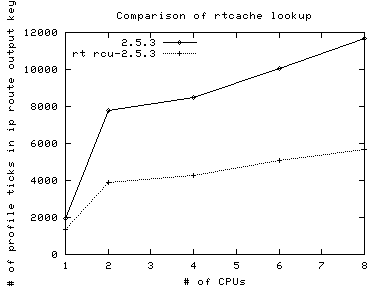
The results are in -
http://lse.sourceforge.net/locking/rcu/rtcache/rttest/
The measurements were done in an 8way PIII xeon with 1MB L2 cache and 6GB memory.
Comments/suggestions are welcome.
Thanks
Signature · 336 lines
Dipankar Sarma  <[email protected]> http://lse.sourceforge.net
Linux Technology Center, IBM Software Lab, Bangalore, India.


diff -urN linux-2.5.3/include/net/dst.h linux-2.5.3-rt_rcu/include/net/dst.h
--- linux-2.5.3/include/net/dst.h	Wed Jan 30 11:11:52 2002
+++ linux-2.5.3-rt_rcu/include/net/dst.h	Fri Feb  8 11:45:15 2002
@@ -9,6 +9,7 @@
 #define _NET_DST_H

 #include <linux/config.h>
+#include <linux/rcupdate.h>
 #include <net/neighbour.h>

 /*
@@ -62,6 +63,7 @@
 #endif

 	struct  dst_ops	        *ops;
+	struct rcu_head		rcu_head;

 	char			info[0];
 };
diff -urN linux-2.5.3/net/ipv4/route.c linux-2.5.3-rt_rcu/net/ipv4/route.c
--- linux-2.5.3/net/ipv4/route.c	Wed Jan 16 00:26:35 2002
+++ linux-2.5.3-rt_rcu/net/ipv4/route.c	Fri Feb  8 11:37:22 2002
@@ -85,6 +85,7 @@
 #include <linux/mroute.h>
 #include <linux/netfilter_ipv4.h>
 #include <linux/random.h>
+#include <linux/rcupdate.h>
 #include <net/protocol.h>
 #include <net/ip.h>
 #include <net/route.h>
@@ -188,7 +189,7 @@

 struct rt_hash_bucket {
 	struct rtable	*chain;
-	rwlock_t	lock;
+	spinlock_t	lock;
 } __attribute__((__aligned__(8)));

 static struct rt_hash_bucket 	*rt_hash_table;
@@ -227,7 +228,6 @@
   	}

 	for (i = rt_hash_mask; i >= 0; i--) {
-		read_lock_bh(&rt_hash_table[i].lock);
 		for (r = rt_hash_table[i].chain; r; r = r->u.rt_next) {
 			/*
 			 *	Spin through entries until we are ready
@@ -238,6 +238,8 @@
 				len = 0;
 				continue;
 			}
+			/* read_barrier_depends() here */
+			rmb();
 			sprintf(temp, "%s\t%08lX\t%08lX\t%8X\t%d\t%u\t%d\t"
 				"%08lX\t%d\t%u\t%u\t%02X\t%d\t%1d\t%08X",
 				r->u.dst.dev ? r->u.dst.dev->name : "*",
@@ -262,11 +264,9 @@
 			sprintf(buffer + len, "%-127s\n", temp);
 			len += 128;
 			if (pos >= offset+length) {
-				read_unlock_bh(&rt_hash_table[i].lock);
 				goto done;
 			}
 		}
-		read_unlock_bh(&rt_hash_table[i].lock);
         }

 done:
@@ -314,13 +314,13 @@

 static __inline__ void rt_free(struct rtable *rt)
 {
-	dst_free(&rt->u.dst);
+	call_rcu(&rt->u.dst.rcu_head, (void (*)(void *))dst_free, &rt->u.dst);
 }

 static __inline__ void rt_drop(struct rtable *rt)
 {
 	ip_rt_put(rt);
-	dst_free(&rt->u.dst);
+	call_rcu(&rt->u.dst.rcu_head, (void (*)(void *))dst_free, &rt->u.dst);
 }

 static __inline__ int rt_fast_clean(struct rtable *rth)
@@ -373,7 +373,7 @@
 		i = (i + 1) & rt_hash_mask;
 		rthp = &rt_hash_table[i].chain;

-		write_lock(&rt_hash_table[i].lock);
+		spin_lock(&rt_hash_table[i].lock);
 		while ((rth = *rthp) != NULL) {
 			if (rth->u.dst.expires) {
 				/* Entry is expired even if it is in use */
@@ -392,7 +392,7 @@
 			*rthp = rth->u.rt_next;
 			rt_free(rth);
 		}
-		write_unlock(&rt_hash_table[i].lock);
+		spin_unlock(&rt_hash_table[i].lock);

 		/* Fallback loop breaker. */
 		if ((jiffies - now) > 0)
@@ -415,11 +415,11 @@
 	rt_deadline = 0;

 	for (i = rt_hash_mask; i >= 0; i--) {
-		write_lock_bh(&rt_hash_table[i].lock);
+		spin_lock_bh(&rt_hash_table[i].lock);
 		rth = rt_hash_table[i].chain;
 		if (rth)
 			rt_hash_table[i].chain = NULL;
-		write_unlock_bh(&rt_hash_table[i].lock);
+		spin_unlock_bh(&rt_hash_table[i].lock);

 		for (; rth; rth = next) {
 			next = rth->u.rt_next;
@@ -538,7 +538,7 @@

 			k = (k + 1) & rt_hash_mask;
 			rthp = &rt_hash_table[k].chain;
-			write_lock_bh(&rt_hash_table[k].lock);
+			spin_lock_bh(&rt_hash_table[k].lock);
 			while ((rth = *rthp) != NULL) {
 				if (!rt_may_expire(rth, tmo, expire)) {
 					tmo >>= 1;
@@ -549,7 +549,7 @@
 				rt_free(rth);
 				goal--;
 			}
-			write_unlock_bh(&rt_hash_table[k].lock);
+			spin_unlock_bh(&rt_hash_table[k].lock);
 			if (goal <= 0)
 				break;
 		}
@@ -607,18 +607,20 @@
 restart:
 	rthp = &rt_hash_table[hash].chain;

-	write_lock_bh(&rt_hash_table[hash].lock);
+	spin_lock_bh(&rt_hash_table[hash].lock);
 	while ((rth = *rthp) != NULL) {
 		if (memcmp(&rth->key, &rt->key, sizeof(rt->key)) == 0) {
 			/* Put it first */
 			*rthp = rth->u.rt_next;
+			wmb();
 			rth->u.rt_next = rt_hash_table[hash].chain;
+			wmb();
 			rt_hash_table[hash].chain = rth;

 			rth->u.dst.__use++;
 			dst_hold(&rth->u.dst);
 			rth->u.dst.lastuse = now;
-			write_unlock_bh(&rt_hash_table[hash].lock);
+			spin_unlock_bh(&rt_hash_table[hash].lock);

 			rt_drop(rt);
 			*rp = rth;
@@ -634,7 +636,7 @@
 	if (rt->rt_type == RTN_UNICAST || rt->key.iif == 0) {
 		int err = arp_bind_neighbour(&rt->u.dst);
 		if (err) {
-			write_unlock_bh(&rt_hash_table[hash].lock);
+			spin_unlock_bh(&rt_hash_table[hash].lock);

 			if (err != -ENOBUFS) {
 				rt_drop(rt);
@@ -675,7 +677,7 @@
 	}
 #endif
 	rt_hash_table[hash].chain = rt;
-	write_unlock_bh(&rt_hash_table[hash].lock);
+	spin_unlock_bh(&rt_hash_table[hash].lock);
 	*rp = rt;
 	return 0;
 }
@@ -742,7 +744,7 @@
 {
 	struct rtable **rthp;

-	write_lock_bh(&rt_hash_table[hash].lock);
+	spin_lock_bh(&rt_hash_table[hash].lock);
 	ip_rt_put(rt);
 	for (rthp = &rt_hash_table[hash].chain; *rthp;
 	     rthp = &(*rthp)->u.rt_next)
@@ -751,7 +753,7 @@
 			rt_free(rt);
 			break;
 		}
-	write_unlock_bh(&rt_hash_table[hash].lock);
+	spin_unlock_bh(&rt_hash_table[hash].lock);
 }

 void ip_rt_redirect(u32 old_gw, u32 daddr, u32 new_gw,
@@ -790,10 +792,10 @@

 			rthp=&rt_hash_table[hash].chain;

-			read_lock(&rt_hash_table[hash].lock);
 			while ((rth = *rthp) != NULL) {
 				struct rtable *rt;
-
+				/* read_barrier_depends() here */
+				rmb();
 				if (rth->key.dst != daddr ||
 				    rth->key.src != skeys[i] ||
 				    rth->key.tos != tos ||
@@ -811,7 +813,6 @@
 					break;

 				dst_clone(&rth->u.dst);
-				read_unlock(&rt_hash_table[hash].lock);

 				rt = dst_alloc(&ipv4_dst_ops);
 				if (rt == NULL) {
@@ -822,6 +823,8 @@

 				/* Copy all the information. */
 				*rt = *rth;
+ 				memset(&rt->u.dst.rcu_head, 0,
+ 					sizeof(struct rcu_head));
 				rt->u.dst.__use		= 1;
 				atomic_set(&rt->u.dst.__refcnt, 1);
 				if (rt->u.dst.dev)
@@ -857,7 +860,6 @@
 					ip_rt_put(rt);
 				goto do_next;
 			}
-			read_unlock(&rt_hash_table[hash].lock);
 		do_next:
 			;
 		}
@@ -1037,9 +1039,10 @@
 	for (i = 0; i < 2; i++) {
 		unsigned hash = rt_hash_code(daddr, skeys[i], tos);

-		read_lock(&rt_hash_table[hash].lock);
 		for (rth = rt_hash_table[hash].chain; rth;
 		     rth = rth->u.rt_next) {
+			/* read_barrier_depends() here */
+			rmb();
 			if (rth->key.dst == daddr &&
 			    rth->key.src == skeys[i] &&
 			    rth->rt_dst  == daddr &&
@@ -1075,7 +1078,6 @@
 				}
 			}
 		}
-		read_unlock(&rt_hash_table[hash].lock);
 	}
 	return est_mtu ? : new_mtu;
 }
@@ -1629,8 +1631,9 @@
 	tos &= IPTOS_RT_MASK;
 	hash = rt_hash_code(daddr, saddr ^ (iif << 5), tos);

-	read_lock(&rt_hash_table[hash].lock);
 	for (rth = rt_hash_table[hash].chain; rth; rth = rth->u.rt_next) {
+		/* read_barrier_depends() here */
+		rmb();
 		if (rth->key.dst == daddr &&
 		    rth->key.src == saddr &&
 		    rth->key.iif == iif &&
@@ -1643,12 +1646,10 @@
 			dst_hold(&rth->u.dst);
 			rth->u.dst.__use++;
 			rt_cache_stat[smp_processor_id()].in_hit++;
-			read_unlock(&rt_hash_table[hash].lock);
 			skb->dst = (struct dst_entry*)rth;
 			return 0;
 		}
 	}
-	read_unlock(&rt_hash_table[hash].lock);

 	/* Multicast recognition logic is moved from route cache to here.
 	   The problem was that too many Ethernet cards have broken/missing
@@ -1988,8 +1989,9 @@

 	hash = rt_hash_code(key->dst, key->src ^ (key->oif << 5), key->tos);

-	read_lock_bh(&rt_hash_table[hash].lock);
 	for (rth = rt_hash_table[hash].chain; rth; rth = rth->u.rt_next) {
+		/* read_barrier_depends() here */
+		rmb();
 		if (rth->key.dst == key->dst &&
 		    rth->key.src == key->src &&
 		    rth->key.iif == 0 &&
@@ -2003,12 +2005,10 @@
 			dst_hold(&rth->u.dst);
 			rth->u.dst.__use++;
 			rt_cache_stat[smp_processor_id()].out_hit++;
-			read_unlock_bh(&rt_hash_table[hash].lock);
 			*rp = rth;
 			return 0;
 		}
 	}
-	read_unlock_bh(&rt_hash_table[hash].lock);

 	return ip_route_output_slow(rp, key);
 }
@@ -2194,9 +2194,10 @@
 		if (h < s_h) continue;
 		if (h > s_h)
 			s_idx = 0;
-		read_lock_bh(&rt_hash_table[h].lock);
 		for (rt = rt_hash_table[h].chain, idx = 0; rt;
 		     rt = rt->u.rt_next, idx++) {
+			/* read_barrier_depends() here */
+			rmb();
 			if (idx < s_idx)
 				continue;
 			skb->dst = dst_clone(&rt->u.dst);
@@ -2204,12 +2205,10 @@
 					 cb->nlh->nlmsg_seq,
 					 RTM_NEWROUTE, 1) <= 0) {
 				dst_release(xchg(&skb->dst, NULL));
-				read_unlock_bh(&rt_hash_table[h].lock);
 				goto done;
 			}
 			dst_release(xchg(&skb->dst, NULL));
 		}
-		read_unlock_bh(&rt_hash_table[h].lock);
 	}

 done:
@@ -2496,7 +2495,7 @@

 	rt_hash_mask--;
 	for (i = 0; i <= rt_hash_mask; i++) {
-		rt_hash_table[i].lock = RW_LOCK_UNLOCKED;
+		rt_hash_table[i].lock = SPIN_LOCK_UNLOCKED;
 		rt_hash_table[i].chain = NULL;
 	}
From: Dipankar Sarma <[email protected]>
Date: Wed, 8 May 2002 12:57:11 +0530
For 1 to 8 CPUs I used the test script
to send a fixed number of packets to a single destination address. The results show that time needed for lookup continuously increases for 2.5.3 wherease for rt_rcu-2.5.3, it remains constant.
How does it perform for a write-heavy workload such as a massive route flap?
Both are equally important.
Also, workload for single destination isn't all that interesting since such a workload isn't all that common except in benchmarking.
Quoted 10 lines · David S. Miller
From: Dipankar Sarma <[email protected]>
Date: Wed, 8 May 2002 12:57:11 +0530For 1 to 8 CPUs I used the test script
to send a fixed number of packets to a single destination address. The results show that time needed for lookup continuously increases for 2.5.3 wherease for rt_rcu-2.5.3, it remains constant.How does it perform for a write-heavy workload such as a massive route flap?
Can you suggest a test to do this ? I can't think of anything other than manually flushing the route cache.
Quoted 2 lines
Both are equally important.
Yes. With RCU, the write-side doesn't affect the performance of the read-side. However, there is the additional overhead of calling call_rcu() and queueing up of the RCU callback for every dst entry that is freed. The other aspect is of latency, how quickly the deferred rcu callbacks are invoked. We have done some studies in this regard under various degrees of workloads. I will put up the graphs in lse. They will also be presented at OLS2002.
Quoted 3 lines
Also, workload for single destination isn't all that interesting since such a workload isn't all that common except in benchmarking.
A heavily loaded webserver with NATed ip addresses. Would this not result in many server processes looking up the same ip address ?
Thanks
Signature · 2 lines
Dipankar Sarma  <[email protected]> http://lse.sourceforge.net
Linux Technology Center, IBM Software Lab, Bangalore, India.
From: Dipankar Sarma <[email protected]>
Date: Wed, 8 May 2002 14:24:33 +0530
Quoted 2 lines · David S. Miller
Also, workload for single destination isn't all that interesting since such a workload isn't all that common except in benchmarking.
A heavily loaded webserver with NATed ip addresses. Would this not result in many server processes looking up the same ip address ?
The more common situation is server N IP (where N is 1 or a very small number), destination clients == thousands of IPs.
So looking up the same dst cache entry with each benchmark client is very unrealistic. Try a unique IP address for every single lookup.
Quoted 10 lines · David S. Miller
From: Dipankar Sarma <[email protected]>
Date: Wed, 8 May 2002 18:54:57 +0530A large number of processes of which small sets may look up the same ip address. dst ip addresses change after every 50 packets or so.
Is this more realistic ?
More like every 4 or 5 packets.
Ok, here are some results from a test like that on a 8-way PIII xeon with 1MB L2 cache. The test has 32 processes sending random sized packets with dst ip changing every 5 packets. There results are probably a bit skewed because of the neighbor table overflows as seen in by the high profile count in __write_lock_failed and neigh_forced_gc. It does seem that the packet rate in this test is very high.
ip_route_output_key() is 22% faster with rt_rcu. I will publish the results on a 16way NUMA later.
Thanks
Signature · 55 lines
Dipankar Sarma  <[email protected]> http://lse.sourceforge.net
Linux Technology Center, IBM Software Lab, Bangalore, India.


base (2.5.3)
----
__write_lock_failed [c0107af0]: 602749
stext_lock [c024eb18]: 178874
neigh_forced_gc [c020a430]: 104295
USER [c01263d0]: 49856
qdisc_restart [c020f070]: 45435
__read_lock_failed [c0107b10]: 35868
dev_queue_xmit [c0207d00]: 27545
__generic_copy_from_user [c0193b10]: 18680
ace_start_xmit [c01bf670]: 14331
nf_hook_slow [c020e940]: 8365
__kfree_skb [c0204180]: 6919
default_idle [c0106ed0]: 6511
sock_alloc_send_pskb [c02032d0]: 6420
ace_interrupt [c01bf180]: 6254
pfifo_fast_dequeue [c020f550]: 4466
net_tx_action [c0208230]: 4228
ip_finish_output2 [c0219520]: 3747
kfree_skbmem [c0204110]: 3436
ip_route_output_key [c0214470]: 3034


rt_rcu (2.5.3)
-------

__write_lock_failed [c0107af0]: 558354
stext_lock [c024ef58]: 227526
neigh_forced_gc [c020aaa0]: 100893
USER [c0126a40]: 49559
qdisc_restart [c020f6e0]: 45950
dev_queue_xmit [c0208370]: 27353
__read_lock_failed [c0107b10]: 24113
__generic_copy_from_user [c0194180]: 18375
ace_start_xmit [c01bfce0]: 15677
nf_hook_slow [c020efb0]: 8865
__kfree_skb [c02047f0]: 6890
sock_alloc_send_pskb [c0203940]: 6239
ace_interrupt [c01bf7f0]: 5982
default_idle [c0106ed0]: 4679
pfifo_fast_dequeue [c020fbc0]: 4067
ip_finish_output2 [c0219940]: 3886
kfree_skbmem [c0204780]: 3496
pfifo_fast_enqueue [c020fb40]: 3003
net_tx_action [c02088a0]: 2994
sock_def_write_space [c0204230]: 2552
sock_wfree [c0203700]: 2408
skb_release_data [c02046f0]: 2395
ip_route_output_key [c0214990]: 2358
PATCH 1/1 Completely honor prctl(PR_SET_KEEPCAPS, 1)
In reply to Dipankar SarmaOriginally when a process set*uided all capabilities bits were cleared. Then sometime later (wish BK went back 3 years), the behaviour was modified according to the comment "A process may, via prctl(), elect to keep its capabilites when it calls setuid() and switches away from uid==0. Both permitted and effective sets will be retained."
The current behavior/implementation doesn't match the comment. Only permitted capabilities are retained.
This patch against 2.4.18-3 (RHL7.3 kernel, should apply against stock) fixes it. Now both permitted and effective capabilities are retained.
sys.c renamed from sys.c-org +1 -1
@@ -482,7 +482,7 @@cap_clear (current->cap_permitted);cap_clear (current->cap_effective); } -if (old_euid ==0 && current->euid !=0 ) { +if ((old_euid ==0 && current->euid !=0 ) && !current->keep_capabilities) {cap_clear (current->cap_effective); }if (old_euid !=0 && current->euid ==0 ) {
Re: [PATCH] Completely honor prctl(PR_SET_KEEPCAPS, 1)
Quoted 5 lines · Dax Kelson
Originally when a process set*uided all capabilities bits were cleared. Then sometime later (wish BK went back 3 years), the behaviour was modified according to the comment "A process may, via
prctl(), elect to keep its capabilites when it callssetuid()and switches away from uid==0. Both permitted and effective sets will be retained."
FWIW, the change was in 2.2.18-pre18, between October 26 and 29, 2000.
I have all the kernel versions from 2.0.21 (1997) through 2.5.14 in a set of PRCS repositories. A binary chop on 2.2 found the change in a few minutes.
Re: [PATCH] Completely honor prctl(PR_SET_KEEPCAPS, 1)
Quoted 9 lines · Keith Owens
Quoted 5 lines · Dax Kelson
Originally when a process set*uided all capabilities bits were cleared. Then sometime later (wish BK went back 3 years), the behaviour was modified according to the comment "A process may, via
prctl(), elect to keep its capabilites when it callssetuid()and switches away from uid==0. Both permitted and effective sets will be retained."FWIW, the change was in 2.2.18-pre18, between October 26 and 29, 2000.
I did the original change in 2.3.x. Since it is so important to get useful capability functionality, someone (Chris Wing?) backported the change to 2.2.x.
I'll reply to the original e-mail shortly..
Cheers
Chris
Re: [PATCH] Completely honor prctl(PR_SET_KEEPCAPS, 1)
In reply to Dax KelsonHi,
Quoted 11 lines · Dax Kelson
Originally when a process set*uided all capabilities bits were cleared. Then sometime later (wish BK went back 3 years), the behaviour was modified according to the comment "A process may, via
prctl(), elect to keep its capabilites when it callssetuid()and switches away from uid==0. Both permitted and effective sets will be retained."The current behavior/implementation doesn't match the comment. Only permitted capabilities are retained.
This patch against 2.4.18-3 (RHL7.3 kernel, should apply against stock) fixes it. Now both permitted and effective capabilities are retained.
This is a change of behaviour in a fairly security sensitive area, so I'd like us to step back and ask - should we fix the code or the comment?
An application using prctl()[1] is capability aware. I think it is fair (and more secure) if we require these applications to explicitly request raising capabilities in the effective set, after the switch from euid == 0 to euid != 0.
Comments?
Cheers
Chris
[1] There are quite a few now - search google for PR_SET_KEEPCAPS.
Re: [PATCH] Completely honor prctl(PR_SET_KEEPCAPS, 1)
Quoted 9 lines · On Wed, 8 May 2002, [email protected] wrote:
This is a change of behaviour in a fairly security sensitive area, so I'd like us to step back and ask - should we fix the code or the comment?
An application using prctl()[1] is capability aware. I think it is fair (and more secure) if we require these applications to explicitly request raising capabilities in the effective set, after the switch from euid == 0 to euid != 0.
Comments?
With the current behaviour an app has to link against libcap and do:
prtctl(PR_SET_KEEPCAPS, 1)pre_caps = (capgetp(0, cap_init()) // save our caps into a struct setuid(uid)
setgid(gid)capsetp(0,pre_caps) // Restore them
With this patch, the app does:
prtctl(PR_SET_KEEPCAPS, 1)
setuid(uid)
setgid(gid)
The end result is exactly the same. I'm trying to envision how this patch would change security in a negative way. I keep coming back to the Unix idea of "don't be smarter than the admin; don't try to protect root from himself".
Maybe we could enchance PR_SET_KEEPCAPS so that:
prtctl(PR_SET_KEEPCAPS, 2) kept both the permitted and the effective caps.
Dax Kelson
Guru Labs
Re: [PATCH] Completely honor prctl(PR_SET_KEEPCAPS, 1)
Quoted 4 lines
prtctl(PR_SET_KEEPCAPS, 1)
setuid(uid)
setgid(gid)
Quoted 8 lines
The end result is exactly the same. I'm trying to envision how this patch would change security in a negative way. I keep coming back to the Unix idea of "don't be smarter than the admin; don't try to protect root from himself".
Maybe we could enchance
PR_SET_KEEPCAPSso that:
prtctl(PR_SET_KEEPCAPS, 2)kept both the permitted and the effective caps.
If thats the concern (and its a fair one) then just fix 2.5 not 2.4. 2.4 stuff will need to do the usermode fixes anyway due to old releases
Re: [PATCH] Completely honor prctl(PR_SET_KEEPCAPS, 1)
In reply to Dax KelsonQuoted 8 lines · Dax Kelson
With the current behaviour an app has to link against libcap and do:
prtctl(PR_SET_KEEPCAPS, 1)pre_caps= (capgetp(0, cap_init())// save our caps into a struct setuid(uid)
setgid(gid)capsetp(0,pre_caps)// Restore them
Quoted 5 lines
With this patch, the app does:
prtctl(PR_SET_KEEPCAPS, 1)
setuid(uid)
setgid(gid)
Are you sure about the current behaviour? Taking vsftpd as an example, it does
prctl()setuid()setgid()cap_set_proc()
i.e. it only fiddles with capabilities after dropping euid == 0. Of course, someone is welcome to fiddle with capabilities while euid == 0. But, euid == 0 is hugely privileged even without any capabilities. So, the benefit of running with euid == 0 and less than full capabilities is a bit limited.
Cheers
Chris
Re: [PATCH] Completely honor prctl(PR_SET_KEEPCAPS, 1)
Quoted 3 lines · On Wed, 8 May 2002, [email protected] wrote:
Are you sure about the current behaviour? Taking vsftpd as an example, it does
1 prctl()
2 setuid()
3 setgid()
4 cap_set_proc()
Quoted 2 lines
i.e. it only fiddles with capabilities after dropping euid == 0. Of course, someone is welcome to fiddle with capabilities while euid == 0.
Sure this can be done before and after the proposed patch, end results are the same. The difference would be what the effective caps are at step 3.5.
The point is when doing PR_SET_KEEPCAPS, one would expect not to have my caps fiddled with at all.
Dax
[RFC] Making capabilites useful with legacy apps
In reply to [email protected]In attempt to make capabilites more useful before the filesytem support arrives, I would like to "wrap" non-capabilities aware apps.
For example:
# capwrap --user nobody --grp nobody --cap CAP_NET_BIND_SERVICE nc -l -p 80
The wrapper would look like:
1 prtctl(PR_SET_KEEPCAPS, 1)
2 setreuid(uid,uid)
3 setregid(gid,gid)
4 desired_caps = cap_from_text(argv[caps])
5 capsetp(0,desired_caps)
6 execvp(argv[legacyapp])
This wrapper[1] (that would increase security) won't work with the current kernel though, because at step 6, all capabilities are cleared.
It looks like when a non uid 0 process execs, all capabilities are cleared.
The wrapper could also support chroot and setrlimit.
Dax Kelson
Guru Labs
[1] Marc Heuse wrote "compartment" that does caps OR set*uid, but not both (see my discussion above)
Re: [RFC] Making capabilites useful with legacy apps
In reply to [email protected]Hi!
Quoted 6 lines
In attempt to make capabilites more useful before the filesytem support arrives, I would like to "wrap" non-capabilities aware apps.
For example:
# capwrap --user nobody --grp nobody --cap CAP_NET_BIND_SERVICE nc -l -p 80
That looks pretty nice...
Quoted 2 lines
This wrapper[1] (that would increase security) won't work with the current kernel though, because at step 6, all capabilities are cleared.
This should be fixed, then.
Pavel
PS: you could ptrace attach yourself, fork and exec on root, and then force newly exec-ed app to give up id... But that's ugly and complicated hack.
Signature · 2 lines
Philips Velo 1: 1"x4"x8", 300gram, 60, 12MB, 40bogomips, linux, mutt,
details at http://atrey.karlin.mff.cuni.cz/~pavel/velo/index.html.
Re: [RFC] Making capabilites useful with legacy apps
In reply to [email protected]You might want to look at my "capwrap" kernel module. You can get it from:
http://arctrix.com/nas/linux/capwrap.tar.gz
It's pretty simple and does the job for me. Comments appreciated.
Neil
Quoted 5 lines · David S. Miller
The more common situation is server N IP (where N is 1 or a very small number), destination clients == thousands of IPs.
So looking up the same dst cache entry with each benchmark client is very unrealistic. Try a unique IP address for every single lookup.
Ok, how about this then -
A large number of processes of which small sets may look up the same ip address. dst ip addresses change after every 50 packets or so.
Is this more realistic ?
Thanks
Signature · 2 lines
Dipankar Sarma  <[email protected]> http://lse.sourceforge.net
Linux Technology Center, IBM Software Lab, Bangalore, India.
From: Dipankar Sarma <[email protected]>
Date: Wed, 8 May 2002 18:54:57 +0530
A large number of processes of which small sets may look up the same ip address. dst ip addresses change after every 50 packets or so.
Is this more realistic ?
More like every 4 or 5 packets.