terminal enhancement
To support Unicode in the menu interface, I think we need to add one more function into the terminal system. For now, the menu only thinks about ASCII characters. So the number of bytes in a string is identical to the number of columns to be used for displaying the string.
This is not true, generally speaking. In UTF-8, most Latin characters are 2-bytes but one column is used to show each character. Simply speaking, width(string) != length(string).
In POSIX, the function wcwidth is defined to get the width of a string of wide characters. We need a similar function in GRUB.
Basically, only terminal drivers know how many columns are used for a given string. If a terminal driver uses the font manager completely, we can get the information from the font manager, but not all terminals use the font manager (such as the PC console).
So I'd like to propose adding a new member 'getwidth' into struct grub_term. This function would be like this:
int
getwidth (grub_uint32_t code)
{
/* CODE is encoded in UCS-4. */
/* Do something here. */
width = ...;
return width;
}
Anyway, you need this kind of function to implement a terminal.
What do you think?
Okuji
Quoted 11 lines · Yoshinori K. Okuji
To support Unicode in the menu interface, I think we need to add one more function into the terminal system. For now, the menu only thinks about ASCII characters. So the number of bytes in a string is identical to the number of columns to be used for displaying the string.
This is not true, generally speaking. In UTF-8, most Latin characters are 2-bytes but one column is used to show each character. Simply speaking, width(string) != length(string).
In POSIX, the function wcwidth is defined to get the width of a string of wide characters. We need a similar function in GRUB.
[...]
Quoted 3 lines
Anyway, you need this kind of function to implement a terminal.
What do you think?
If it is required, I agree. But I know little about unicode to say more sane things about this. I hope you can explain some things to me.
First of all, why does the terminal has to determine the width? Isn't that something generic and how the POSIX function wcwidth (which I could not find...) works? What I mean is that the character 'a' always has the same size, unless you are using some ttf-fonts. Do you have bigger characters in mind?
So basically, my question is why POSIX seems to implement it independent of a terminal while we need to integrate it there. I'm sure you are correct about this, but I want to understand this so I can implement the terminals for the PPC ports properly.
Thanks,
Marco
Quoted 1 line · Marco Gerards
First of all, why does the terminal has to determine the width?
Because it is dependent upon the implementation of a terminal. For example, some Japanese characters can be shown both in one-column and two-column. I think this problem has been discussed in a xfree86 mailing list.
Another problem is that not all Unicode characters may not be shown in a given terminal. For example, some glyphs might be missing in a font. Then, the font manager uses a default glyph. This glyph might use a different width from real ones.
One way to solve this problem independently is to define standard widths used in GRUB, and terminal drivers and the font manager follow them. I'd like to avoid this, because I want to map some Unicode characters to built-in glyphs in a ROM (for instance, in the PC console driver). Another reason why I am willing to avoid this is that we need to create our own font if any font does not follow our standard.
Quoted 2 lines
Isn't that something generic and how the POSIX function wcwidth (which I could not find...) works?
I don't think it is very useful in reality, since Unicode does not define how each character code is displayed.
Quoted 3 lines
What I mean is that the character
'a' always has the same size, unless you are using some ttf-fonts. Do you have bigger characters in mind?
Surely. For example, look at this one:
http://yudit.org/images/yudit-2.4.8.gif
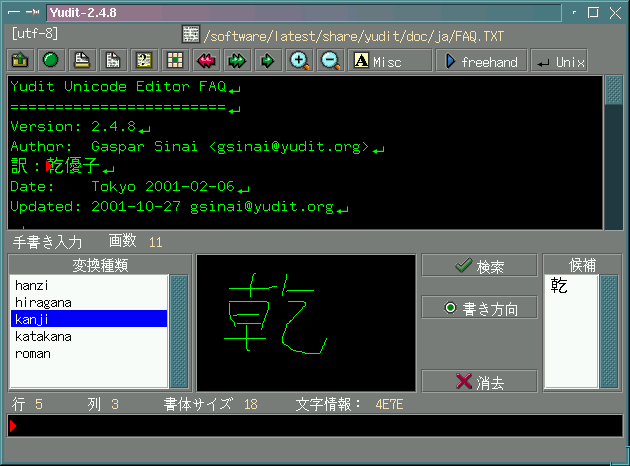
Even if you don't understand what the characters mean, you should be able to distinguish characters.
Quoted 4 lines
So basically, my question is why POSIX seems to implement it independent of a terminal while we need to integrate it there. I'm sure you are correct about this, but I want to understand this so I can implement the terminals for the PPC ports properly.
The SUSP v2 says that this function was removed from the final ISO C Amendment 1. So probably they understand that this function is meaningless.
http://www.opengroup.org/onlinepubs/007908799/xsh/wcwidth.html
When implementing a terminal, never assume (the number of bytes) == (the number of columns) or (the number of characters) < (the number of columns). A given character can be one-column or two-column in the current implementation of GRUB. If we want to support Hindi, things will be more complicated.
Okuji
Quoted 7 lines · Yoshinori K. Okuji
Quoted 3 lines
What I mean is that the character
'a' always has the same size, unless you are using some ttf-fonts. Do you have bigger characters in mind?Surely. For example, look at this one:
[...]
Quoted 5 lines
When implementing a terminal, never assume (the number of bytes) == (the number of columns) or (the number of characters) < (the number of columns). A given character can be one-column or two-column in the current implementation of GRUB. If we want to support Hindi, things will be more complicated.
I understand.
Thanks,
Marco