Free memory never fully used, swapping
Subsystems (9)
Hi!
We're seeing cases on a number of servers where cache never fully grows to use all available memory. Sometimes we see servers with 4 GB of memory that never seem to have less than 1.5 GB free, even with a constantly-active VM. In some cases, these servers also swap out while this happens, even though they are constantly reading the working set into memory. We have been seeing this happening for a long time; I don't think it's anything recent, and it still happens on 2.6.36.
I noticed that CONFIG_NUMA seems to enable some more complicated reclaiming bits and figured it might help since most stock kernels seem to ship with it now. This seems to have helped, but it may just be wishful thinking. We still see this happening, though maybe to a lesser degree. (The following observations are with CONFIG_NUMA enabled.)
I was eyeballing "vmstat 1" and "watch -n.2 -d cat /proc/vmstat" at the same time, and I can see distinctly that the page cache is growing nicely until a sudden event where 400 MB is freed within 1 second, leaving this particular box with 700 MB free again. kswapd numbers increase in /proc/vmstat, which leads me to believe that __alloc_pages_slowpath() has been called, since it seems to be the thing that wakes up kswapd.
Previous patterns and watching of "vmstat 1" show that the swapping out also seems to occur during the times that memory is quickly freed.
These are all x86_64, and so there is no highmem garbage going on. The only zones would be for DMA, right? Is the combination of memory fragmentation and large-order allocations the only thing that would be causing this reclaim here? Is there some easy bake knob for finding what is causing the free memory jumps each time this happens?
Kernel config and munin graph of free memory here:
I notice CONFIG_COMPACTION is still "EXPERIMENTAL". Would it be worth trying here? It seems to enable defrag before reclaim, but that sounds kind of ...complicated...
Cheers,
Simon-
procs -----------memory---------- ---swap-- -----io---- -system-- ----cpu----
 r  b   swpd   free   buff  cache   si   so    bi    bo   in   cs us sy id wa
 1  0  11496 401684  40364 2531844    0    0  4540   773 7890 16291 13  9 77  1
 3  0  11492 400180  40372 2534204    0    0  5572   699 8544 14856 25  9 66  1
 0  0  11492 394344  40372 2540796    0    0  5256   345 8239 16723 17  7 73  2
 0  0  11492 388524  40372 2546236    0    0  5216   393 8687 17289 14  9 76  1
 4  1  11684 716296  40244 2218612    0  220  6868  1837 11124 27368 28 20 51  0
 1  0  11732 753992  40248 2181468    0  120  5240   647 9542 15609 38 11 50  1
 1  0  11712 736864  40260 2197788    0    0  5872  9147 9838 16373 41 11 47  1
 0  0  11712 738096  40260 2196984    0    0  4628   493 7980 15536 22 10 67  1
 2  0  11712 733508  40260 2201756    0    0  4404   418 7265 16867 10  9 80  2
Andrew Morton
maintainer(cc linux-mm, where all the suckiness ends up)
Quoted 45 lines · On Mon, 15 Nov 2010 11:52:46 -0800 Simon Kirby <[email protected]> wrote:
Hi!
We're seeing cases on a number of servers where cache never fully grows to use all available memory. Sometimes we see servers with 4 GB of memory that never seem to have less than 1.5 GB free, even with a constantly-active VM. In some cases, these servers also swap out while this happens, even though they are constantly reading the working set into memory. We have been seeing this happening for a long time; I don't think it's anything recent, and it still happens on 2.6.36.
I noticed that
CONFIG_NUMAseems to enable some more complicated reclaiming bits and figured it might help since most stock kernels seem to ship with it now. This seems to have helped, but it may just be wishful thinking. We still see this happening, though maybe to a lesser degree. (The following observations are withCONFIG_NUMAenabled.)I was eyeballing "vmstat 1" and "watch -n.2 -d cat
/proc/vmstat" at the same time, and I can see distinctly that the page cache is growing nicely until a sudden event where 400 MB is freed within 1 second, leaving this particular box with 700 MB free again. kswapd numbers increase in/proc/vmstat, which leads me to believe that__alloc_pages_slowpath()has been called, since it seems to be the thing that wakes up kswapd.Previous patterns and watching of "vmstat 1" show that the swapping out also seems to occur during the times that memory is quickly freed.
These are all
x86_64, and so there is no highmem garbage going on. The only zones would be for DMA, right? Is the combination of memory fragmentation and large-order allocations the only thing that would be causing this reclaim here? Is there some easy bake knob for finding what is causing the free memory jumps each time this happens?Kernel config and munin graph of free memory here:
I notice
CONFIG_COMPACTIONis still "EXPERIMENTAL". Would it be worth trying here? It seems to enable defrag before reclaim, but that sounds kind of ...complicated...Cheers,
Simon-
procs -----------memory---------- ---swap-- -----io---- -system-- ----cpu----
Quoted 10 lines
 r  b   swpd   free   buff  cache   si   so    bi    bo   in   cs us sy id wa
 1  0  11496 401684  40364 2531844    0    0  4540   773 7890 16291 13  9 77  1
 3  0  11492 400180  40372 2534204    0    0  5572   699 8544 14856 25  9 66  1
 0  0  11492 394344  40372 2540796    0    0  5256   345 8239 16723 17  7 73  2
 0  0  11492 388524  40372 2546236    0    0  5216   393 8687 17289 14  9 76  1
 4  1  11684 716296  40244 2218612    0  220  6868  1837 11124 27368 28 20 51  0
 1  0  11732 753992  40248 2181468    0  120  5240   647 9542 15609 38 11 50  1
 1  0  11712 736864  40260 2197788    0    0  5872  9147 9838 16373 41 11 47  1
 0  0  11712 738096  40260 2196984    0    0  4628   493 7980 15536 22 10 67  1
 2  0  11712 733508  40260 2201756    0    0  4404   418 7265 16867 10  9 80  2
--
To unsubscribe, send a message with 'unsubscribe linux-mm' in the body to [email protected]. For more info on Linux MM,
see: http://www.linux-mm.org/ .
Fight unfair telecom policy in Canada: sign http://dissolvethecrtc.ca/
Don't email: <a href=mailto:"[email protected]"> [email protected] </a>
Uploaded a new graph with maybe more useful pixels.
( http://0x.ca/sim/ref/2.6.36/memory_long.png ) Units are day-of-month.
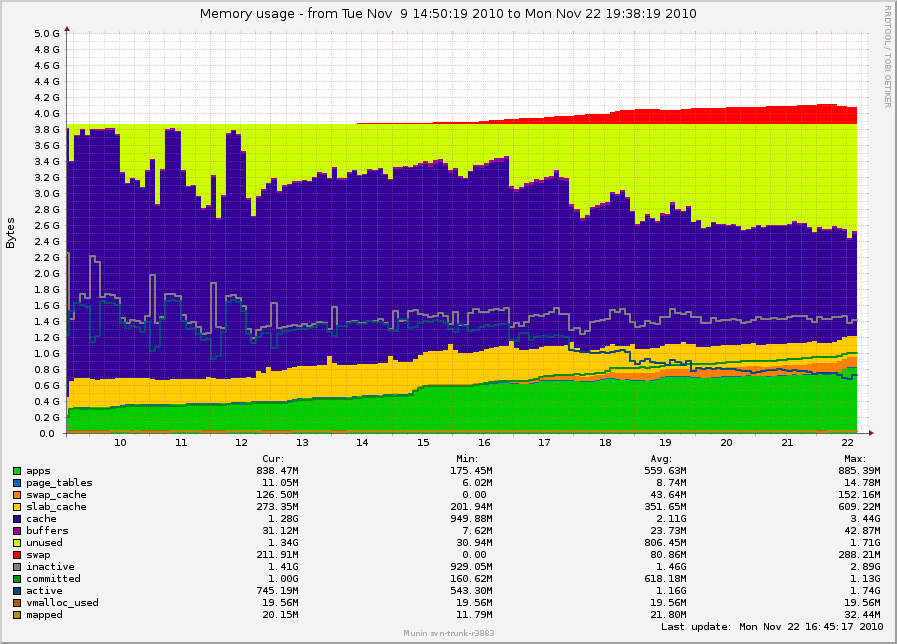
On this same server, dovecot is probably leaking a bit, but it seems to be backing off on the page cache at the same time. Disk usage grows all day and not much is unlink()ed until the middle of the night, so I don't see any reason things shouldn't stay around in page cache.
We then restarted dovecot (with old processes left around), and it seems it started swapping to /dev/sda and throwing out pages from running apps which came from /dev/sda (disks) while churning through mail on /dev/md0 (/dev/sd[bc]) which is SSD. Killing the old processes seemed to make it happy to keep enough in page cache again to make /dev/sda idle again.
I guess the vm has no idea about the relative expensiveness of reads from the SSD versus conventional disks connected to the same box?
Anyway, we turned off swap to try to stop load on /dev/sda. sysreq-M showed this sort of output while kswapd was churning, if it helps:
SysRq : Show Memory
Mem-Info:
Node 0 DMA per-cpu:
CPU 0: hi: 0, btch: 1 usd: 0
CPU 1: hi: 0, btch: 1 usd: 0
CPU 2: hi: 0, btch: 1 usd: 0
CPU 3: hi: 0, btch: 1 usd: 0
Node 0 DMA32 per-cpu:
CPU 0: hi: 186, btch: 31 usd: 164
CPU 1: hi: 186, btch: 31 usd: 177
CPU 2: hi: 186, btch: 31 usd: 157
CPU 3: hi: 186, btch: 31 usd: 156
Node 0 Normal per-cpu:
CPU 0: hi: 186, btch: 31 usd: 51
CPU 1: hi: 186, btch: 31 usd: 152
CPU 2: hi: 186, btch: 31 usd: 57
CPU 3: hi: 186, btch: 31 usd: 157
active_anon:102749 inactive_anon:164705 isolated_anon:0
active_file:117584 inactive_file:132410 isolated_file:0
unevictable:7155 dirty:64 writeback:18 unstable:0
free:409953 slab_reclaimable:41904 slab_unreclaimable:10369
mapped:3980 shmem:698 pagetables:3947 bounce:0
Node 0 DMA free:15904kB min:28kB low:32kB high:40kB active_anon:0kB inactive_anon:0kB active_file:0kB inactive_file:0kB unevictable:0kB isolated(anon):0kB isolated(file):0kB present:15772kB mlocked:0kB dirty:0kB writeback:0kB mapped:0kB shmem:0kB slab_reclaimable:0kB slab_unreclaimable:16kB kernel_stack:0kB pagetables:0kB unstable:0kB bounce:0kB writeback_tmp:0kB pages_scanned:0 all_unreclaimable? yes lowmem_reserve[]: 0 3251 4009 4009
Node 0 DMA32 free:1477136kB min:6560kB low:8200kB high:9840kB active_anon:351928kB inactive_anon:512024kB active_file:405472kB inactive_file:361028kB unevictable:16kB isolated(anon):0kB isolated(file):0kB present:3329568kB mlocked:16kB dirty:128kB writeback:0kB mapped:9184kB shmem:1584kB slab_reclaimable:153108kB slab_unreclaimable:17180kB kernel_stack:808kB pagetables:5760kB unstable:0kB bounce:0kB writeback_tmp:0kB pages_scanned:0 all_unreclaimable? no lowmem_reserve[]: 0 0 757 757
Node 0 Normal free:146772kB min:1528kB low:1908kB high:2292kB active_anon:59068kB inactive_anon:146796kB active_file:64864kB inactive_file:168464kB unevictable:28604kB isolated(anon):0kB isolated(file):92kB present:775680kB mlocked:28604kB dirty:128kB writeback:72kB mapped:6736kB shmem:1208kB slab_reclaimable:14508kB slab_unreclaimable:24280kB kernel_stack:1320kB pagetables:10028kB unstable:0kB bounce:0kB writeback_tmp:0kB pages_scanned:236 all_unreclaimable? no lowmem_reserve[]: 0 0 0 0
Node 0 DMA: 2*4kB 1*8kB 1*16kB 2*32kB 1*64kB 1*128kB 1*256kB 0*512kB 1*1024kB 1*2048kB 3*4096kB = 15904kB
Node 0 DMA32: 126783*4kB 85660*8kB 13612*16kB 2013*32kB 32*64kB 3*128kB 1*256kB 0*512kB 0*1024kB 0*2048kB 0*4096kB = 1477308kB
Node 0 Normal: 19801*4kB 8446*8kB 0*16kB 0*32kB 0*64kB 0*128kB 0*256kB 0*512kB 0*1024kB 0*2048kB 0*4096kB = 146772kB
252045 total pagecache pages
0 pages in swap cache
Swap cache stats: add 10390951, delete 10390951, find 21038039/22538430
Free swap = 0kB
Total swap = 0kB
1048575 pages RAM
35780 pages reserved
263717 pages shared
455184 pages non-shared
Simon-
Quoted 60 lines · Andrew Morton
(cc linux-mm, where all the suckiness ends up)
Quoted 55 lines · On Mon, 15 Nov 2010 11:52:46 -0800 Simon Kirby <[email protected]> wrote:
Hi!
We're seeing cases on a number of servers where cache never fully grows to use all available memory. Sometimes we see servers with 4 GB of memory that never seem to have less than 1.5 GB free, even with a constantly-active VM. In some cases, these servers also swap out while this happens, even though they are constantly reading the working set into memory. We have been seeing this happening for a long time; I don't think it's anything recent, and it still happens on 2.6.36.
I noticed that
CONFIG_NUMAseems to enable some more complicated reclaiming bits and figured it might help since most stock kernels seem to ship with it now. This seems to have helped, but it may just be wishful thinking. We still see this happening, though maybe to a lesser degree. (The following observations are withCONFIG_NUMAenabled.)I was eyeballing "vmstat 1" and "watch -n.2 -d cat
/proc/vmstat" at the same time, and I can see distinctly that the page cache is growing nicely until a sudden event where 400 MB is freed within 1 second, leaving this particular box with 700 MB free again. kswapd numbers increase in/proc/vmstat, which leads me to believe that__alloc_pages_slowpath()has been called, since it seems to be the thing that wakes up kswapd.Previous patterns and watching of "vmstat 1" show that the swapping out also seems to occur during the times that memory is quickly freed.
These are all
x86_64, and so there is no highmem garbage going on. The only zones would be for DMA, right? Is the combination of memory fragmentation and large-order allocations the only thing that would be causing this reclaim here? Is there some easy bake knob for finding what is causing the free memory jumps each time this happens?Kernel config and munin graph of free memory here:
I notice
CONFIG_COMPACTIONis still "EXPERIMENTAL". Would it be worth trying here? It seems to enable defrag before reclaim, but that sounds kind of ...complicated...Cheers,
Simon-
procs -----------memory---------- ---swap-- -----io---- -system-- ----cpu----
 r  b   swpd   free   buff  cache   si   so    bi    bo   in   cs us sy id wa
 1  0  11496 401684  40364 2531844    0    0  4540   773 7890 16291 13  9 77  1
 3  0  11492 400180  40372 2534204    0    0  5572   699 8544 14856 25  9 66  1
 0  0  11492 394344  40372 2540796    0    0  5256   345 8239 16723 17  7 73  2
 0  0  11492 388524  40372 2546236    0    0  5216   393 8687 17289 14  9 76  1
 4  1  11684 716296  40244 2218612    0  220  6868  1837 11124 27368 28 20 51  0
 1  0  11732 753992  40248 2181468    0  120  5240   647 9542 15609 38 11 50  1
 1  0  11712 736864  40260 2197788    0    0  5872  9147 9838 16373 41 11 47  1
 0  0  11712 738096  40260 2196984    0    0  4628   493 7980 15536 22 10 67  1
 2  0  11712 733508  40260 2201756    0    0  4404   418 7265 16867 10  9 80  2
--
To unsubscribe, send a message with 'unsubscribe linux-mm' in the body to [email protected]. For more info on Linux MM,
see: http://www.linux-mm.org/ .
Fight unfair telecom policy in Canada: sign http://dissolvethecrtc.ca/
Don't email: <a href=mailto:"[email protected]"> [email protected] </a>
Quoted 2 lines · Andrew Morton
Quoted 2 lines
These are all
x86_64, and so there is no highmem garbage going on. The only zones would be for DMA, right?
There shouldn't be any highmem-related action going on.
Quoted 2 lines
Is the combination of memory fragmentation and large-order allocations the only thing that would be causing this reclaim here?
It does sound somewhat suspicious. Are you using hugetlbfs or allocating large pages? What are your high-order allocations going to?
Quoted 2 lines
Is there some easy bake knob for finding what
is causing the free memory jumps each time this happens?
I wish. :) The best thing to do is to watch stuff like /proc/vmstat along with its friends like /proc/{buddy,meminfo,slabinfo}. Could you post some samples of those with some indication of where the bad behavior was seen?
I've definitely seen swapping in the face of lots of free memory, but only in cases where I was being a bit unfair about the numbers of hugetlbfs pages I was trying to reserve.
-- Dave
--
To unsubscribe, send a message with 'unsubscribe linux-mm' in the body to [email protected]. For more info on Linux MM,
see: http://www.linux-mm.org/ .
Fight unfair telecom policy in Canada: sign http://dissolvethecrtc.ca/
Don't email: <a href=mailto:"[email protected]"> [email protected] </a>
Quoted 8 lines · Dave Hansen
I wish. :) The best thing to do is to watch stuff like
/proc/vmstatalong with its friends like/proc/{buddy,meminfo,slabinfo}. Could you post some samples of those with some indication of where the bad behavior was seen?I've definitely seen swapping in the face of lots of free memory, but only in cases where I was being a bit unfair about the numbers of hugetlbfs pages I was trying to reserve.
So, Dave and I spent quite some time today figuring out was going on here. Once load picked up during the day, kswapd actually never slept until late in the afternoon. During the evening now, it's still waking up in bursts, and still keeping way too much memory free:
	http://0x.ca/sim/ref/2.6.36/memory_tonight.png

	(NOTE: we did swapoff -a to keep /dev/sda from overloading)
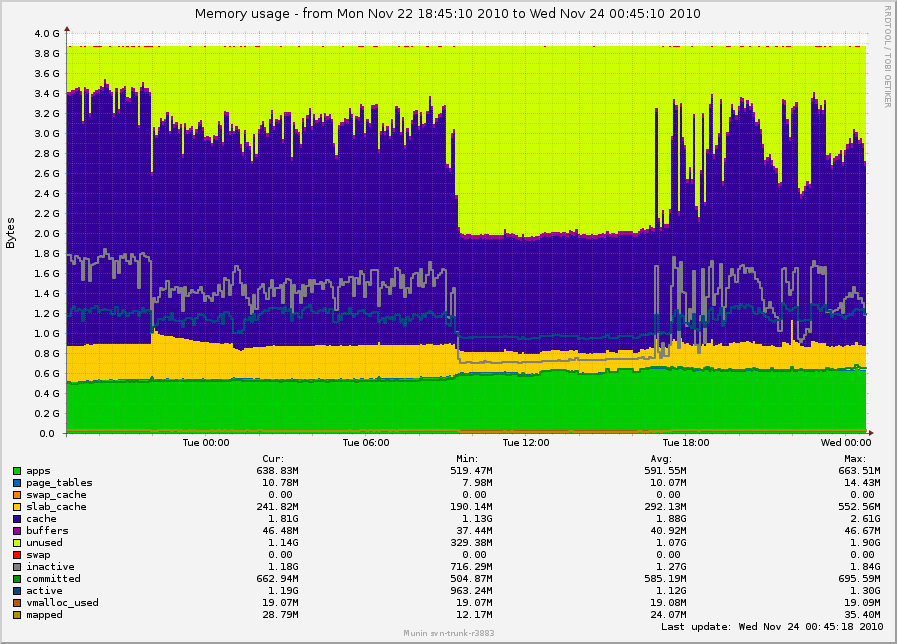
We have a much better idea on what is happening here, but more questions.
This x86_64 box has 4 GB of RAM; zones are set up as follows:
[    0.000000] Zone PFN ranges:
[    0.000000]   DMA      0x00000001 -> 0x00001000
[    0.000000]   DMA32    0x00001000 -> 0x00100000
[    0.000000]   Normal   0x00100000 -> 0x00130000
...
[    0.000000] On node 0 totalpages: 1047279
[    0.000000]   DMA zone: 56 pages used for memmap
[    0.000000]   DMA zone: 0 pages reserved
[    0.000000]   DMA zone: 3943 pages, LIFO batch:0
[    0.000000]   DMA32 zone: 14280 pages used for memmap
[    0.000000]   DMA32 zone: 832392 pages, LIFO batch:31
[    0.000000]   Normal zone: 2688 pages used for memmap
[    0.000000]   Normal zone: 193920 pages, LIFO batch:31
So, "Normal" is relatively small, and DMA32 contains most of the RAM. Watermarks from /proc/zoneinfo are:
Node 0, zone DMA
        min      7
        low      8
        high     10
        protection: (0, 3251, 4009, 4009)
Node 0, zone    DMA32
        min      1640
        low      2050
        high     2460
        protection: (0, 0, 757, 757)
Node 0, zone   Normal
        min      382
        low      477
        high     573
        protection: (0, 0, 0, 0)
This box has a couple bnx2 NICs, which do about 60 Mbps each. Jumbo frames were disabled for now (to try to stop big order allocations), but this did not stop atomic allocations of order 3 coming in, as found with:
perf record --event kmem:mm_page_alloc --filter 'order>=3' -a --call-graph -c 1 -a sleep 10 perf report
__alloc_pages_nodemaskalloc_pages_currentnew_slab__slab_alloc__kmalloc_node_track_caller__alloc_skb__netdev_alloc_skbbnx2_poll_work
Quoted 1 line
From my reading of this, it seems like
__alloc_skbuseskmalloc(), and
kmalloc uses the kmalloc slab unless (unlikely(size > SLUB_MAX_SIZE)), where SLUB_MAX_SIZE is 2 * PAGE_SIZE, in which case kmalloc_large is called which allocates pages directly. This means that reception of jumbo frames probably actually results in (consistent) smaller order allocations! Anyway, these GFP_ATOMIC allocations don't seem to be failing, BUT...
Right after kswapd goes to sleep, we're left with DMA32 with 421k or so free pages, and Normal with 20k or so free pages (about 1.8 GB free).
Immediately, zone Normal starts being used until it reaches about 468 pages free in order 0, nothing else free. kswapd is not woken here, but allocations just start coming from zone DMA32 instead. While this happens, the occasional order=3 allocations coming in via the slab from __alloc_skb seem to be picking away at the available order=3 chunks. /proc/buddyinfo shows that there are 10k or so when it starts, so this succeeds easily.
After a minute or so, available order-3 start reaching a lower number, like 20 or so. order-4 then starts dropping as it is split into order-3, until it reaches 20 or so as well. Then, order-3 hits 0, and kswapd is woken. When this occurs, there are still a few order-5, order-6, etc., available. I presume the GFP_ATOMIC allocation can still split buddies here, still making order-3 available without sleeping, because there is no allocation failure message that I can see.
Here is a "while true; do sleep 1; grep -v 'DMA ' /proc/buddyinfo; done" ("DMA" zone is totally untouched, always, so excluded; white space crushed to avoid wrapping), while it happens:
Node 0, zone DMA 2 1 1 2 1 1 1 0 1 1 3
Node 0, zone DMA32 25770 29441 14512 10426 1901 123 4 0 0 0 0
Node 0, zone Normal 455 0 0 0 0 0 0 0 0 0 0
...
Node 0, zone DMA32 23343 29405 6062 6478 1901 123 4 0 0 0 0
Node 0, zone Normal 455 0 0 0 0 0 0 0 0 0 0
Node 0, zone DMA32 23187 29358 6047 5960 1901 123 4 0 0 0 0
Node 0, zone Normal 455 0 0 0 0 0 0 0 0 0 0
Node 0, zone DMA32 23000 29372 6047 5411 1901 123 4 0 0 0 0
Node 0, zone Normal 455 0 0 0 0 0 0 0 0 0 0
Node 0, zone DMA32 22714 29391 6076 4225 1901 123 4 0 0 0 0
Node 0, zone Normal 455 0 0 0 0 0 0 0 0 0 0
Node 0, zone DMA32 22354 29459 6059 3178 1901 123 4 0 0 0 0
Node 0, zone Normal 455 0 0 0 0 0 0 0 0 0 0
Node 0, zone DMA32 22202 29388 6035 2395 1901 123 4 0 0 0 0
Node 0, zone Normal 455 0 0 0 0 0 0 0 0 0 0
Node 0, zone DMA32 21971 29411 6036 1032 1901 123 4 0 0 0 0
Node 0, zone Normal 455 0 0 0 0 0 0 0 0 0 0
Node 0, zone DMA32 21514 29388 6019 433 1796 123 4 0 0 0 0
Node 0, zone Normal 455 0 0 0 0 0 0 0 0 0 0
Node 0, zone DMA32 21334 29387 6019 240 1464 123 4 0 0 0 0
Node 0, zone Normal 455 0 0 0 0 0 0 0 0 0 0
Node 0, zone DMA32 21237 29421 6052 216 1336 123 4 0 0 0 0
Node 0, zone Normal 455 0 0 0 0 0 0 0 0 0 0
Node 0, zone DMA32 20968 29378 6020 244 751 123 4 0 0 0 0
Node 0, zone Normal 453 1 0 0 0 0 0 0 0 0 0
Node 0, zone DMA32 20741 29383 6022 134 272 123 4 0 0 0 0
Node 0, zone Normal 453 1 0 0 0 0 0 0 0 0 0
Node 0, zone DMA32 20476 29370 6024 117 48 116 4 0 0 0 0
Node 0, zone Normal 453 1 0 0 0 0 0 0 0 0 0
Node 0, zone DMA32 20343 29369 6020 110 23 10 2 0 0 0 0
Node 0, zone   Normal    453      1      0      0      0     0 0 0 0 0 0
Node 0, zone    DMA32  21592  30477   4856     22     10     4 2 0 0 0 0
Node 0, zone   Normal    453      1      0      0      0     0 0 0 0 0 0
Node 0, zone    DMA32  24388  33261   1985      6     10     4 2 0 0 0 0
Node 0, zone   Normal    453      1      0      0      0     0 0 0 0 0 0
Node 0, zone    DMA32  25358  34080   1068      0      4     4 2 0 0 0 0
Node 0, zone   Normal    453      1      0      0      0     0 0 0 0 0 0
Node 0, zone    DMA32  75985  68954   5345     87      1     4 2 0 0 0 0
Node 0, zone   Normal  18249      0      0      0      0     0 0 0 0 0 0
Node 0, zone    DMA32  81117  71630  19261    429      3     4 2 0 0 0 0
Node 0, zone   Normal  17908      0      0      0      0     0 0 0 0 0 0
Node 0, zone    DMA32  81226  71299  21038    569     19     4 2 0 0 0 0
Node 0, zone   Normal  18559      0      0      0      0     0 0 0 0 0 0
Node 0, zone    DMA32  81347  71278  21068    640     19     4 2 0 0 0 0
Node 0, zone   Normal  17928     21      0      0      0     0 0 0 0 0 0
Node 0, zone    DMA32  81370  71237  21241   1073     29     4 2 0 0 0 0
Node 0, zone   Normal  18187      0      0      0      0     0 0 0 0 0 0
Node 0, zone    DMA32  81401  71237  21314   1139     29     4 2 0 0 0 0
Node 0, zone   Normal  16978      0      0      0      0     0 0 0 0 0 0
Node 0, zone    DMA32  81410  71239  21314   1145     29     4 2 0 0 0 0
Node 0, zone   Normal  18156      0      0      0      0     0 0 0 0 0 0
Node 0, zone    DMA32  81419  71232  21317   1160     30     4 2 0 0 0 0
Node 0, zone   Normal  17536      0      0      0      0     0 0 0 0 0 0
Node 0, zone    DMA32  81347  71144  21443   1160     31     4 2 0 0 0 0
Node 0, zone   Normal  18483      7      0      0      0     0 0 0 0 0 0
Node 0, zone    DMA32  81300  71059  21556   1178     38     4 2 0 0 0 0
Node 0, zone   Normal  18528      0      0      0      0     0 0 0 0 0 0
Node 0, zone    DMA32  81315  71042  21577   1180     39     4 2 0 0 0 0
Node 0, zone   Normal  18431      2      0      0      0     0 0 0 0 0 0
Node 0, zone    DMA32  81301  71002  21702   1202     39     4 2 0 0 0 0
Node 0, zone   Normal  18487      5      0      0      0     0 0 0 0 0 0
Node 0, zone    DMA32  81301  70998  21702   1202     39     4 2 0 0 0 0
Node 0, zone   Normal  18311      0      0      0      0     0 0 0 0 0 0
Node 0, zone    DMA32  81296  71025  21711   1208     45     4 2 0 0 0 0
Node 0, zone   Normal  17092      5      0      0      0     0 0 0 0 0 0
Node 0, zone    DMA32  81299  71023  21716   1226     45     4 2 0 0 0 0
Node 0, zone   Normal  18225     12      0      0      0     0 0 0 0 0 0
Running a perf record on the kswapd wakeup right when it happens shows:
perf record --event vmscan:mm_vmscan_wakeup_kswapd -a --call-graph -c 1 -a sleep 10 perf trace
         swapper-0     [002] 1323136.979119: mm_vmscan_wakeup_kswapd: nid=0 zid=2 order=3
         swapper-0     [002] 1323136.979131: mm_vmscan_wakeup_kswapd: nid=0 zid=1 order=3
            lmtp-20593 [003] 1323136.984066: mm_vmscan_wakeup_kswapd: nid=0 zid=2 order=3
            lmtp-20593 [003] 1323136.984079: mm_vmscan_wakeup_kswapd: nid=0 zid=1 order=3
         swapper-0     [001] 1323136.985511: mm_vmscan_wakeup_kswapd: nid=0 zid=2 order=3
         swapper-0     [001] 1323136.985515: mm_vmscan_wakeup_kswapd: nid=0 zid=1 order=3
            lmtp-20593 [003] 1323136.985673: mm_vmscan_wakeup_kswapd: nid=0 zid=2 order=3
            lmtp-20593 [003] 1323136.985675: mm_vmscan_wakeup_kswapd: nid=0 zid=1 order=3
This causes kswapd to throw out a bunch of stuff from Normal and from DMA32, to try to get zone_watermark_ok() to be happy for order=3. However, we have a heavy read load from all of the email stored on SSDs on this box, and kswapd ends up fighting to try to keep reclaiming the allocations (mostly order-0). During the whole day, it never wins -- the allocations are faster. At night, it wins after a minute or two. The fighting is happening in all of the lines after it awakes above.
slabs_scanned, kswapd_steal, kswapd_inodesteal (slowly), kswapd_skip_congestion_wait, and pageoutrun go up in vmstat while kswapd is running. With the box up for 15 days, you can see it struggling on pgscan_kswapd_normal (from /proc/vmstat):
pgfree 3329793080
pgactivate 643476431
pgdeactivate 155182710
pgfault 2649106647
pgmajfault 58157157pgrefill_dma 0pgrefill_dma32 19688032pgrefill_normal 7600864pgrefill_movable 0pgsteal_dma 0pgsteal_dma32 465191578pgsteal_normal 651178518pgsteal_movable 0pgscan_kswapd_dma 0pgscan_kswapd_dma32 768300403pgscan_kswapd_normal 34614572907pgscan_kswapd_movable 0pgscan_direct_dma 0pgscan_direct_dma32 2853983pgscan_direct_normal 885799pgscan_direct_movable 0
pginodesteal 191895
pgrotated 27290463
So, here are my questions.
Why do we care about order > 0 watermarks at all in the Normal zone? Wouldn't it make a lot more sense to just make the DMA32 zone the only one we care about for larger-order allocations? Or is this required for the hugepage stuff?
The fact that so much stuff is evicted just because order-3 hits 0 is crazy, especially when larger order pages are still free. It seems like we're trying to keep large orders free here. Why? Maybe things would be better if kswapd does not reclaim at all unless the requested order is empty _and_ all orders above are empty. This would require hugepage users to use CONFIG_COMPACT, and have _compaction_ occur the way the watermark checks work now, but people without CONFIG_HUGETLB_PAGE could just actually use the memory. Would this work?
There is logic at the end of balance_pgdat() to give up balancing order>0 and just try another loop with order = 0 if sc.nr_reclaimed is < SWAP_CLUSTER_MAX. However, when this order=0 pass returns, the caller of balance_pgdat(), kswapd(), gets true from sleeping_prematurely() and just calls right back to balance_pgdat() again. I think this is why this logic doesn't seem to work here.
Is my assumption about GFP_ATOMIC order=3 working even when order 3 is empty, but order>3 is not? Regardless, shouldn't kswapd be woken before order 3 is 0 since it may have nothing above order 3 to split from, thus actually causing an allocation failure? Does something else do this?
Ok, that's enough for now.. :)
Simon-
--
To unsubscribe, send a message with 'unsubscribe linux-mm' in the body to [email protected]. For more info on Linux MM,
see: http://www.linux-mm.org/ .
Fight unfair telecom policy in Canada: sign http://dissolvethecrtc.ca/
Don't email: <a href=mailto:"[email protected]"> [email protected] </a>
Quoted 245 lines · Simon Kirby
Quoted 8 lines · Dave Hansen
I wish. :) The best thing to do is to watch stuff like
/proc/vmstatalong with its friends like/proc/{buddy,meminfo,slabinfo}. Could you post some samples of those with some indication of where the bad behavior was seen?I've definitely seen swapping in the face of lots of free memory, but only in cases where I was being a bit unfair about the numbers of hugetlbfs pages I was trying to reserve.
So, Dave and I spent quite some time today figuring out was going on here. Once load picked up during the day, kswapd actually never slept until late in the afternoon. During the evening now, it's still waking up in bursts, and still keeping way too much memory free:
http://0x.ca/sim/ref/2.6.36/memory_tonight.png
(NOTE: we did swapoff -a to keep
/dev/sdafrom overloading)We have a much better idea on what is happening here, but more questions.
This
x86_64box has 4 GB of RAM; zones are set up as follows:[ 0.000000] Zone PFN ranges: [ 0.000000] DMA 0x00000001 -> 0x00001000 [ 0.000000] DMA32 0x00001000 -> 0x00100000 [ 0.000000] Normal 0x00100000 -> 0x00130000 ... [ 0.000000] On node 0 totalpages: 1047279 [ 0.000000] DMA zone: 56 pages used for memmap [ 0.000000] DMA zone: 0 pages reserved [ 0.000000] DMA zone: 3943 pages, LIFO batch:0 [ 0.000000] DMA32 zone: 14280 pages used for memmap [ 0.000000] DMA32 zone: 832392 pages, LIFO batch:31 [ 0.000000] Normal zone: 2688 pages used for memmap [ 0.000000] Normal zone: 193920 pages, LIFO batch:31So, "Normal" is relatively small, and DMA32 contains most of the RAM. Watermarks from
/proc/zoneinfoare:Node 0, zone DMA
min 7 low 8 high 10 protection: (0, 3251, 4009, 4009) Node 0, zone DMA32 min 1640 low 2050 high 2460 protection: (0, 0, 757, 757) Node 0, zone Normal min 382 low 477 high 573 protection: (0, 0, 0, 0)This box has a couple bnx2 NICs, which do about 60 Mbps each. Jumbo frames were disabled for now (to try to stop big order allocations), but this did not stop atomic allocations of order 3 coming in, as found with:
perf record --event kmem:mm_page_alloc --filter 'order>=3' -a --call-graph -c 1 -a sleep 10 perf report
__alloc_pages_nodemaskalloc_pages_currentnew_slab__slab_alloc__kmalloc_node_track_caller__alloc_skb__netdev_alloc_skbbnx2_poll_workFrom my reading of this, it seems like
__alloc_skbuseskmalloc(), and kmalloc uses the kmalloc slab unless (unlikely(size > SLUB_MAX_SIZE)), whereSLUB_MAX_SIZEis 2 *PAGE_SIZE, in which casekmalloc_largeis called which allocates pages directly. This means that reception of jumbo frames probably actually results in (consistent) smaller order allocations! Anyway, theseGFP_ATOMICallocations don't seem to be failing, BUT...Right after kswapd goes to sleep, we're left with DMA32 with 421k or so free pages, and Normal with 20k or so free pages (about 1.8 GB free).
Immediately, zone Normal starts being used until it reaches about 468 pages free in order 0, nothing else free. kswapd is not woken here, but allocations just start coming from zone DMA32 instead. While this happens, the occasional order=3 allocations coming in via the slab from
__alloc_skbseem to be picking away at the available order=3 chunks./proc/buddyinfoshows that there are 10k or so when it starts, so this succeeds easily.After a minute or so, available order-3 start reaching a lower number, like 20 or so. order-4 then starts dropping as it is split into order-3, until it reaches 20 or so as well. Then, order-3 hits 0, and kswapd is woken. When this occurs, there are still a few order-5, order-6, etc., available. I presume the
GFP_ATOMICallocation can still split buddies here, still making order-3 available without sleeping, because there is no allocation failure message that I can see.Here is a "while true; do sleep 1; grep -v 'DMA '
/proc/buddyinfo; done" ("DMA" zone is totally untouched, always, so excluded; white space crushed to avoid wrapping), while it happens:Node 0, zone DMA 2 1 1 2 1 1 1 0 1 1 3
Node 0, zone DMA32 25770 29441 14512 10426 1901 123 4 0 0 0 0
Node 0, zone Normal 455 0 0 0 0 0 0 0 0 0 0
...
Node 0, zone DMA32 23343 29405 6062 6478 1901 123 4 0 0 0 0
Node 0, zone Normal 455 0 0 0 0 0 0 0 0 0 0
Node 0, zone DMA32 23187 29358 6047 5960 1901 123 4 0 0 0 0
Node 0, zone Normal 455 0 0 0 0 0 0 0 0 0 0
Node 0, zone DMA32 23000 29372 6047 5411 1901 123 4 0 0 0 0
Node 0, zone Normal 455 0 0 0 0 0 0 0 0 0 0
Node 0, zone DMA32 22714 29391 6076 4225 1901 123 4 0 0 0 0
Node 0, zone Normal 455 0 0 0 0 0 0 0 0 0 0
Node 0, zone DMA32 22354 29459 6059 3178 1901 123 4 0 0 0 0
Node 0, zone Normal 455 0 0 0 0 0 0 0 0 0 0
Node 0, zone DMA32 22202 29388 6035 2395 1901 123 4 0 0 0 0
Node 0, zone Normal 455 0 0 0 0 0 0 0 0 0 0
Node 0, zone DMA32 21971 29411 6036 1032 1901 123 4 0 0 0 0
Node 0, zone Normal 455 0 0 0 0 0 0 0 0 0 0
Node 0, zone DMA32 21514 29388 6019 433 1796 123 4 0 0 0 0
Node 0, zone Normal 455 0 0 0 0 0 0 0 0 0 0
Node 0, zone DMA32 21334 29387 6019 240 1464 123 4 0 0 0 0
Node 0, zone Normal 455 0 0 0 0 0 0 0 0 0 0
Node 0, zone DMA32 21237 29421 6052 216 1336 123 4 0 0 0 0
Node 0, zone Normal 455 0 0 0 0 0 0 0 0 0 0
Node 0, zone DMA32 20968 29378 6020 244 751 123 4 0 0 0 0
Node 0, zone Normal 453 1 0 0 0 0 0 0 0 0 0
Node 0, zone DMA32 20741 29383 6022 134 272 123 4 0 0 0 0
Node 0, zone Normal 453 1 0 0 0 0 0 0 0 0 0
Node 0, zone DMA32 20476 29370 6024 117 48 116 4 0 0 0 0
Node 0, zone Normal 453 1 0 0 0 0 0 0 0 0 0
Node 0, zone DMA32 20343 29369 6020 110 23 10 2 0 0 0 0Node 0, zone Normal 453 1 0 0 0 0 0 0 0 0 0 Node 0, zone DMA32 21592 30477 4856 22 10 4 2 0 0 0 0 Node 0, zone Normal 453 1 0 0 0 0 0 0 0 0 0 Node 0, zone DMA32 24388 33261 1985 6 10 4 2 0 0 0 0 Node 0, zone Normal 453 1 0 0 0 0 0 0 0 0 0 Node 0, zone DMA32 25358 34080 1068 0 4 4 2 0 0 0 0 Node 0, zone Normal 453 1 0 0 0 0 0 0 0 0 0 Node 0, zone DMA32 75985 68954 5345 87 1 4 2 0 0 0 0 Node 0, zone Normal 18249 0 0 0 0 0 0 0 0 0 0 Node 0, zone DMA32 81117 71630 19261 429 3 4 2 0 0 0 0 Node 0, zone Normal 17908 0 0 0 0 0 0 0 0 0 0 Node 0, zone DMA32 81226 71299 21038 569 19 4 2 0 0 0 0 Node 0, zone Normal 18559 0 0 0 0 0 0 0 0 0 0 Node 0, zone DMA32 81347 71278 21068 640 19 4 2 0 0 0 0 Node 0, zone Normal 17928 21 0 0 0 0 0 0 0 0 0 Node 0, zone DMA32 81370 71237 21241 1073 29 4 2 0 0 0 0 Node 0, zone Normal 18187 0 0 0 0 0 0 0 0 0 0 Node 0, zone DMA32 81401 71237 21314 1139 29 4 2 0 0 0 0 Node 0, zone Normal 16978 0 0 0 0 0 0 0 0 0 0 Node 0, zone DMA32 81410 71239 21314 1145 29 4 2 0 0 0 0 Node 0, zone Normal 18156 0 0 0 0 0 0 0 0 0 0 Node 0, zone DMA32 81419 71232 21317 1160 30 4 2 0 0 0 0 Node 0, zone Normal 17536 0 0 0 0 0 0 0 0 0 0 Node 0, zone DMA32 81347 71144 21443 1160 31 4 2 0 0 0 0 Node 0, zone Normal 18483 7 0 0 0 0 0 0 0 0 0 Node 0, zone DMA32 81300 71059 21556 1178 38 4 2 0 0 0 0 Node 0, zone Normal 18528 0 0 0 0 0 0 0 0 0 0 Node 0, zone DMA32 81315 71042 21577 1180 39 4 2 0 0 0 0 Node 0, zone Normal 18431 2 0 0 0 0 0 0 0 0 0 Node 0, zone DMA32 81301 71002 21702 1202 39 4 2 0 0 0 0 Node 0, zone Normal 18487 5 0 0 0 0 0 0 0 0 0 Node 0, zone DMA32 81301 70998 21702 1202 39 4 2 0 0 0 0 Node 0, zone Normal 18311 0 0 0 0 0 0 0 0 0 0 Node 0, zone DMA32 81296 71025 21711 1208 45 4 2 0 0 0 0 Node 0, zone Normal 17092 5 0 0 0 0 0 0 0 0 0 Node 0, zone DMA32 81299 71023 21716 1226 45 4 2 0 0 0 0 Node 0, zone Normal 18225 12 0 0 0 0 0 0 0 0 0Running a perf record on the kswapd wakeup right when it happens shows:
perf record --event vmscan:mm_vmscan_wakeup_kswapd -a --call-graph -c 1 -a sleep 10 perf traceswapper-0 [002] 1323136.979119: mm_vmscan_wakeup_kswapd: nid=0 zid=2 order=3 swapper-0 [002] 1323136.979131: mm_vmscan_wakeup_kswapd: nid=0 zid=1 order=3 lmtp-20593 [003] 1323136.984066: mm_vmscan_wakeup_kswapd: nid=0 zid=2 order=3 lmtp-20593 [003] 1323136.984079: mm_vmscan_wakeup_kswapd: nid=0 zid=1 order=3 swapper-0 [001] 1323136.985511: mm_vmscan_wakeup_kswapd: nid=0 zid=2 order=3 swapper-0 [001] 1323136.985515: mm_vmscan_wakeup_kswapd: nid=0 zid=1 order=3 lmtp-20593 [003] 1323136.985673: mm_vmscan_wakeup_kswapd: nid=0 zid=2 order=3 lmtp-20593 [003] 1323136.985675: mm_vmscan_wakeup_kswapd: nid=0 zid=1 order=3This causes kswapd to throw out a bunch of stuff from Normal and from DMA32, to try to get
zone_watermark_ok()to be happy for order=3. However, we have a heavy read load from all of the email stored on SSDs on this box, and kswapd ends up fighting to try to keep reclaiming the allocations (mostly order-0). During the whole day, it never wins -- the allocations are faster. At night, it wins after a minute or two. The fighting is happening in all of the lines after it awakes above.
slabs_scanned,kswapd_steal,kswapd_inodesteal(slowly),kswapd_skip_congestion_wait, and pageoutrun go up in vmstat while kswapd is running. With the box up for 15 days, you can see it struggling onpgscan_kswapd_normal(from/proc/vmstat):pgfree 3329793080
pgactivate 643476431
pgdeactivate 155182710
pgfault 2649106647
pgmajfault 58157157pgrefill_dma0pgrefill_dma3219688032pgrefill_normal7600864pgrefill_movable0pgsteal_dma0pgsteal_dma32465191578pgsteal_normal651178518pgsteal_movable0pgscan_kswapd_dma0pgscan_kswapd_dma32768300403pgscan_kswapd_normal34614572907pgscan_kswapd_movable0pgscan_direct_dma0pgscan_direct_dma322853983pgscan_direct_normal885799pgscan_direct_movable0
pginodesteal 191895
pgrotated 27290463So, here are my questions.
Why do we care about order > 0 watermarks at all in the Normal zone? Wouldn't it make a lot more sense to just make the DMA32 zone the only one we care about for larger-order allocations? Or is this required for the hugepage stuff?
The fact that so much stuff is evicted just because order-3 hits 0 is crazy, especially when larger order pages are still free. It seems like we're trying to keep large orders free here. Why? Maybe things would be better if kswapd does not reclaim at all unless the requested order is empty _and_ all orders above are empty. This would require hugepage users to use
CONFIG_COMPACT, and have _compaction_ occur the way the watermark checks work now, but people withoutCONFIG_HUGETLB_PAGEcould just actually use the memory. Would this work?There is logic at the end of
balance_pgdat()to give up balancing order>0 and just try another loop with order = 0 if sc.nr_reclaimed is <SWAP_CLUSTER_MAX. However, when this order=0 pass returns, the caller ofbalance_pgdat(),kswapd(), gets true fromsleeping_prematurely()and just calls right back tobalance_pgdat()again. I think this is why this logic doesn't seem to work here.
Quoted 4 lines
Is my assumption about
GFP_ATOMICorder=3 working even when order 3 is empty, but order>3 is not? Regardless, shouldn't kswapd be woken before order 3 is 0 since it may have nothing above order 3 to split from, thus actually causing an allocation failure? Does something else do this?
even kswapd is woken after order>3 is empty, the issue will occur since the order > 3 pages will be used soon and kswapd still needs to reclaim some pages. So the issue is there is high order page allocation and lumpy reclaim wrongly reclaims some pages. maybe you should use slab instead of slub to avoid high order allocation.
--
To unsubscribe, send a message with 'unsubscribe linux-mm' in the body to [email protected]. For more info on Linux MM,
see: http://www.linux-mm.org/ .
Fight unfair telecom policy in Canada: sign http://dissolvethecrtc.ca/
Don't email: <a href=mailto:"[email protected]"> [email protected] </a>
Quoted 251 lines · Shaohua Li
Quoted 245 lines · Simon Kirby
Quoted 8 lines · Dave Hansen
I wish. :) The best thing to do is to watch stuff like
/proc/vmstatalong with its friends like/proc/{buddy,meminfo,slabinfo}. Could you post some samples of those with some indication of where the bad behavior was seen?I've definitely seen swapping in the face of lots of free memory, but only in cases where I was being a bit unfair about the numbers of hugetlbfs pages I was trying to reserve.
So, Dave and I spent quite some time today figuring out was going on here. Once load picked up during the day, kswapd actually never slept until late in the afternoon. During the evening now, it's still waking up in bursts, and still keeping way too much memory free:
http://0x.ca/sim/ref/2.6.36/memory_tonight.png
(NOTE: we did swapoff -a to keep
/dev/sdafrom overloading)We have a much better idea on what is happening here, but more questions.
This
x86_64box has 4 GB of RAM; zones are set up as follows:[ 0.000000] Zone PFN ranges: [ 0.000000] DMA 0x00000001 -> 0x00001000 [ 0.000000] DMA32 0x00001000 -> 0x00100000 [ 0.000000] Normal 0x00100000 -> 0x00130000 ... [ 0.000000] On node 0 totalpages: 1047279 [ 0.000000] DMA zone: 56 pages used for memmap [ 0.000000] DMA zone: 0 pages reserved [ 0.000000] DMA zone: 3943 pages, LIFO batch:0 [ 0.000000] DMA32 zone: 14280 pages used for memmap [ 0.000000] DMA32 zone: 832392 pages, LIFO batch:31 [ 0.000000] Normal zone: 2688 pages used for memmap [ 0.000000] Normal zone: 193920 pages, LIFO batch:31So, "Normal" is relatively small, and DMA32 contains most of the RAM. Watermarks from
/proc/zoneinfoare:Node 0, zone DMA
min 7 low 8 high 10 protection: (0, 3251, 4009, 4009) Node 0, zone DMA32 min 1640 low 2050 high 2460 protection: (0, 0, 757, 757) Node 0, zone Normal min 382 low 477 high 573 protection: (0, 0, 0, 0)This box has a couple bnx2 NICs, which do about 60 Mbps each. Jumbo frames were disabled for now (to try to stop big order allocations), but this did not stop atomic allocations of order 3 coming in, as found with:
perf record --event kmem:mm_page_alloc --filter 'order>=3' -a --call-graph -c 1 -a sleep 10 perf report
__alloc_pages_nodemaskalloc_pages_currentnew_slab__slab_alloc__kmalloc_node_track_caller__alloc_skb__netdev_alloc_skbbnx2_poll_workFrom my reading of this, it seems like
__alloc_skbuseskmalloc(), and kmalloc uses the kmalloc slab unless (unlikely(size > SLUB_MAX_SIZE)), whereSLUB_MAX_SIZEis 2 *PAGE_SIZE, in which casekmalloc_largeis called which allocates pages directly. This means that reception of jumbo frames probably actually results in (consistent) smaller order allocations! Anyway, theseGFP_ATOMICallocations don't seem to be failing, BUT...Right after kswapd goes to sleep, we're left with DMA32 with 421k or so free pages, and Normal with 20k or so free pages (about 1.8 GB free).
Immediately, zone Normal starts being used until it reaches about 468 pages free in order 0, nothing else free. kswapd is not woken here, but allocations just start coming from zone DMA32 instead. While this happens, the occasional order=3 allocations coming in via the slab from
__alloc_skbseem to be picking away at the available order=3 chunks./proc/buddyinfoshows that there are 10k or so when it starts, so this succeeds easily.After a minute or so, available order-3 start reaching a lower number, like 20 or so. order-4 then starts dropping as it is split into order-3, until it reaches 20 or so as well. Then, order-3 hits 0, and kswapd is woken. When this occurs, there are still a few order-5, order-6, etc., available. I presume the
GFP_ATOMICallocation can still split buddies here, still making order-3 available without sleeping, because there is no allocation failure message that I can see.Here is a "while true; do sleep 1; grep -v 'DMA '
/proc/buddyinfo; done" ("DMA" zone is totally untouched, always, so excluded; white space crushed to avoid wrapping), while it happens:Node 0, zone DMA 2 1 1 2 1 1 1 0 1 1 3
Node 0, zone DMA32 25770 29441 14512 10426 1901 123 4 0 0 0 0
Node 0, zone Normal 455 0 0 0 0 0 0 0 0 0 0
...
Node 0, zone DMA32 23343 29405 6062 6478 1901 123 4 0 0 0 0
Node 0, zone Normal 455 0 0 0 0 0 0 0 0 0 0
Node 0, zone DMA32 23187 29358 6047 5960 1901 123 4 0 0 0 0
Node 0, zone Normal 455 0 0 0 0 0 0 0 0 0 0
Node 0, zone DMA32 23000 29372 6047 5411 1901 123 4 0 0 0 0
Node 0, zone Normal 455 0 0 0 0 0 0 0 0 0 0
Node 0, zone DMA32 22714 29391 6076 4225 1901 123 4 0 0 0 0
Node 0, zone Normal 455 0 0 0 0 0 0 0 0 0 0
Node 0, zone DMA32 22354 29459 6059 3178 1901 123 4 0 0 0 0
Node 0, zone Normal 455 0 0 0 0 0 0 0 0 0 0
Node 0, zone DMA32 22202 29388 6035 2395 1901 123 4 0 0 0 0
Node 0, zone Normal 455 0 0 0 0 0 0 0 0 0 0
Node 0, zone DMA32 21971 29411 6036 1032 1901 123 4 0 0 0 0
Node 0, zone Normal 455 0 0 0 0 0 0 0 0 0 0
Node 0, zone DMA32 21514 29388 6019 433 1796 123 4 0 0 0 0
Node 0, zone Normal 455 0 0 0 0 0 0 0 0 0 0
Node 0, zone DMA32 21334 29387 6019 240 1464 123 4 0 0 0 0
Node 0, zone Normal 455 0 0 0 0 0 0 0 0 0 0
Node 0, zone DMA32 21237 29421 6052 216 1336 123 4 0 0 0 0
Node 0, zone Normal 455 0 0 0 0 0 0 0 0 0 0
Node 0, zone DMA32 20968 29378 6020 244 751 123 4 0 0 0 0
Node 0, zone Normal 453 1 0 0 0 0 0 0 0 0 0
Node 0, zone DMA32 20741 29383 6022 134 272 123 4 0 0 0 0
Node 0, zone Normal 453 1 0 0 0 0 0 0 0 0 0
Node 0, zone DMA32 20476 29370 6024 117 48 116 4 0 0 0 0
Node 0, zone Normal 453 1 0 0 0 0 0 0 0 0 0
Node 0, zone DMA32 20343 29369 6020 110 23 10 2 0 0 0 0Node 0, zone Normal 453 1 0 0 0 0 0 0 0 0 0 Node 0, zone DMA32 21592 30477 4856 22 10 4 2 0 0 0 0 Node 0, zone Normal 453 1 0 0 0 0 0 0 0 0 0 Node 0, zone DMA32 24388 33261 1985 6 10 4 2 0 0 0 0 Node 0, zone Normal 453 1 0 0 0 0 0 0 0 0 0 Node 0, zone DMA32 25358 34080 1068 0 4 4 2 0 0 0 0 Node 0, zone Normal 453 1 0 0 0 0 0 0 0 0 0 Node 0, zone DMA32 75985 68954 5345 87 1 4 2 0 0 0 0 Node 0, zone Normal 18249 0 0 0 0 0 0 0 0 0 0 Node 0, zone DMA32 81117 71630 19261 429 3 4 2 0 0 0 0 Node 0, zone Normal 17908 0 0 0 0 0 0 0 0 0 0 Node 0, zone DMA32 81226 71299 21038 569 19 4 2 0 0 0 0 Node 0, zone Normal 18559 0 0 0 0 0 0 0 0 0 0 Node 0, zone DMA32 81347 71278 21068 640 19 4 2 0 0 0 0 Node 0, zone Normal 17928 21 0 0 0 0 0 0 0 0 0 Node 0, zone DMA32 81370 71237 21241 1073 29 4 2 0 0 0 0 Node 0, zone Normal 18187 0 0 0 0 0 0 0 0 0 0 Node 0, zone DMA32 81401 71237 21314 1139 29 4 2 0 0 0 0 Node 0, zone Normal 16978 0 0 0 0 0 0 0 0 0 0 Node 0, zone DMA32 81410 71239 21314 1145 29 4 2 0 0 0 0 Node 0, zone Normal 18156 0 0 0 0 0 0 0 0 0 0 Node 0, zone DMA32 81419 71232 21317 1160 30 4 2 0 0 0 0 Node 0, zone Normal 17536 0 0 0 0 0 0 0 0 0 0 Node 0, zone DMA32 81347 71144 21443 1160 31 4 2 0 0 0 0 Node 0, zone Normal 18483 7 0 0 0 0 0 0 0 0 0 Node 0, zone DMA32 81300 71059 21556 1178 38 4 2 0 0 0 0 Node 0, zone Normal 18528 0 0 0 0 0 0 0 0 0 0 Node 0, zone DMA32 81315 71042 21577 1180 39 4 2 0 0 0 0 Node 0, zone Normal 18431 2 0 0 0 0 0 0 0 0 0 Node 0, zone DMA32 81301 71002 21702 1202 39 4 2 0 0 0 0 Node 0, zone Normal 18487 5 0 0 0 0 0 0 0 0 0 Node 0, zone DMA32 81301 70998 21702 1202 39 4 2 0 0 0 0 Node 0, zone Normal 18311 0 0 0 0 0 0 0 0 0 0 Node 0, zone DMA32 81296 71025 21711 1208 45 4 2 0 0 0 0 Node 0, zone Normal 17092 5 0 0 0 0 0 0 0 0 0 Node 0, zone DMA32 81299 71023 21716 1226 45 4 2 0 0 0 0 Node 0, zone Normal 18225 12 0 0 0 0 0 0 0 0 0Running a perf record on the kswapd wakeup right when it happens shows:
perf record --event vmscan:mm_vmscan_wakeup_kswapd -a --call-graph -c 1 -a sleep 10 perf traceswapper-0 [002] 1323136.979119: mm_vmscan_wakeup_kswapd: nid=0 zid=2 order=3 swapper-0 [002] 1323136.979131: mm_vmscan_wakeup_kswapd: nid=0 zid=1 order=3 lmtp-20593 [003] 1323136.984066: mm_vmscan_wakeup_kswapd: nid=0 zid=2 order=3 lmtp-20593 [003] 1323136.984079: mm_vmscan_wakeup_kswapd: nid=0 zid=1 order=3 swapper-0 [001] 1323136.985511: mm_vmscan_wakeup_kswapd: nid=0 zid=2 order=3 swapper-0 [001] 1323136.985515: mm_vmscan_wakeup_kswapd: nid=0 zid=1 order=3 lmtp-20593 [003] 1323136.985673: mm_vmscan_wakeup_kswapd: nid=0 zid=2 order=3 lmtp-20593 [003] 1323136.985675: mm_vmscan_wakeup_kswapd: nid=0 zid=1 order=3This causes kswapd to throw out a bunch of stuff from Normal and from DMA32, to try to get
zone_watermark_ok()to be happy for order=3. However, we have a heavy read load from all of the email stored on SSDs on this box, and kswapd ends up fighting to try to keep reclaiming the allocations (mostly order-0). During the whole day, it never wins -- the allocations are faster. At night, it wins after a minute or two. The fighting is happening in all of the lines after it awakes above.
slabs_scanned,kswapd_steal,kswapd_inodesteal(slowly),kswapd_skip_congestion_wait, and pageoutrun go up in vmstat while kswapd is running. With the box up for 15 days, you can see it struggling onpgscan_kswapd_normal(from/proc/vmstat):pgfree 3329793080
pgactivate 643476431
pgdeactivate 155182710
pgfault 2649106647
pgmajfault 58157157pgrefill_dma0pgrefill_dma3219688032pgrefill_normal7600864pgrefill_movable0pgsteal_dma0pgsteal_dma32465191578pgsteal_normal651178518pgsteal_movable0pgscan_kswapd_dma0pgscan_kswapd_dma32768300403pgscan_kswapd_normal34614572907pgscan_kswapd_movable0pgscan_direct_dma0pgscan_direct_dma322853983pgscan_direct_normal885799pgscan_direct_movable0
pginodesteal 191895
pgrotated 27290463So, here are my questions.
Why do we care about order > 0 watermarks at all in the Normal zone? Wouldn't it make a lot more sense to just make the DMA32 zone the only one we care about for larger-order allocations? Or is this required for the hugepage stuff?
The fact that so much stuff is evicted just because order-3 hits 0 is crazy, especially when larger order pages are still free. It seems like we're trying to keep large orders free here. Why? Maybe things would be better if kswapd does not reclaim at all unless the requested order is empty _and_ all orders above are empty. This would require hugepage users to use
CONFIG_COMPACT, and have _compaction_ occur the way the watermark checks work now, but people withoutCONFIG_HUGETLB_PAGEcould just actually use the memory. Would this work?There is logic at the end of
balance_pgdat()to give up balancing order>0 and just try another loop with order = 0 if sc.nr_reclaimed is <SWAP_CLUSTER_MAX. However, when this order=0 pass returns, the caller ofbalance_pgdat(),kswapd(), gets true fromsleeping_prematurely()and just calls right back tobalance_pgdat()again. I think this is why this logic doesn't seem to work here.Quoted 4 lines
Is my assumption about
GFP_ATOMICorder=3 working even when order 3 is empty, but order>3 is not? Regardless, shouldn't kswapd be woken before order 3 is 0 since it may have nothing above order 3 to split from, thus actually causing an allocation failure? Does something else do this?
Quoted 5 lines
even kswapd is woken after order>3 is empty, the issue will occur since the order > 3 pages will be used soon and kswapd still needs to reclaim some pages. So the issue is there is high order page allocation and lumpy reclaim wrongly reclaims some pages. maybe you should use slab instead of slub to avoid high order allocation.
There are actually a few problems here. I think they are worth looking at them separately, unless "don't use order 3 allocations" is a valid statement, in which case we should fix slub.
The funny thing here is that slub.c's allocate_slab() calls alloc_pages() with flags | __GFP_NOWARN | __GFP_NORETRY, and intentionally tries a lower order allocation automatically if it fails. This is why there is no allocation failure warning when this happens. However, it is too late -- kswapd is woken and it ties to bring order 3 up to the watermark. If we hacked __alloc_pages_slowpath() to not wake kswapd when __GFP_NOWARN is set, we would never see this problem and the slub optimization might still mostly work. Either way, we should "fix" slub or "fix" order-3 allocations, so that other people who are using slub don't hit the same problem.
kswapd is throwing out many times what is needed for the order 3 watermark to be met. It seems to be not as bad now, but look at these pages being reclaimed (200ms intervals, whitespace-packed buddyinfo followed by nr_pages_free calculation and final order-3 watermark test, kswapd woken after the second sample):
Zone order:0 1 2 3 4 5 6 7 8 9 A nr_free or3-low-chk
DMA32 20374 35116 975 1 2 5 1 0 0 0 0 94770 257 <= 256 DMA32 20480 35211 870 1 1 5 1 0 0 0 0 94630 241 <= 256 (kswapd wakes, gobble gobble) DMA32 24387 37009 2910 297 100 5 1 0 0 0 0 114245 4193 <= 256 DMA32 36169 37787 4676 637 110 5 1 0 0 0 0 137527 7073 <= 256 DMA32 63443 40620 5716 982 144 5 1 0 0 0 0 177931 10377 <= 256 DMA32 65866 57006 6462 1180 158 5 1 0 0 0 0 217918 12185 <= 256 DMA32 67188 66779 9328 1893 208 5 1 0 0 0 0 256754 18689 <= 256 DMA32 67909 67356 18307 2268 235 5 1 0 0 0 0 297977 22121 <= 256 DMA32 68333 67419 20786 4192 298 7 1 0 0 0 0 324907 38585 <= 256 DMA32 69872 68096 21580 5141 326 7 1 0 0 0 0 339016 46625 <= 256 DMA32 69959 67970 22339 5657 371 10 1 0 0 0 0 346831 51569 <= 256 DMA32 70017 67946 22363 6078 417 11 1 0 0 0 0 351073 55705 <= 256 DMA32 70023 67949 22376 6204 439 12 1 0 0 0 0 352529 57097 <= 256 DMA32 70045 67937 22380 6262 451 12 1 0 0 0 0 353199 57753 <= 256 DMA32 70062 67939 22378 6298 456 12 1 0 0 0 0 353580 58121 <= 256 DMA32 70079 67959 22388 6370 458 12 1 0 0 0 0 354285 58729 <= 256 DMA32 70079 67959 22388 6387 460 12 1 0 0 0 0 354453 58897 <= 256 DMA32 70076 67954 22387 6393 460 12 1 0 0 0 0 354484 58945 <= 256 DMA32 70105 67975 22385 6466 468 12 1 0 0 0 0 355259 59657 <= 256 DMA32 70110 67972 22387 6466 470 12 1 0 0 0 0 355298 59689 <= 256 DMA32 70152 67989 22393 6476 470 12 1 0 0 0 0 355478 59769 <= 256 DMA32 70175 67991 22401 6493 471 12 1 0 0 0 0 355689 59921 <= 256 DMA32 70175 67991 22401 6493 471 12 1 0 0 0 0 355689 59921 <= 256 DMA32 70175 67991 22401 6493 471 12 1 0 0 0 0 355689 59921 <= 256 DMA32 70192 67990 22401 6495 471 12 1 0 0 0 0 355720 59937 <= 256 DMA32 70192 67988 22401 6496 471 12 1 0 0 0 0 355724 59945 <= 256 DMA32 70099 68061 22467 6602 477 12 1 0 0 0 0 356985 60889 <= 256 DMA32 70099 68062 22467 6602 477 12 1 0 0 0 0 356987 60889 <= 256 DMA32 70099 68062 22467 6602 477 12 1 0 0 0 0 356987 60889 <= 256 DMA32 70099 68062 22467 6603 477 12 1 0 0 0 0 356995 60897 <= 256
(kswapd sleeps)
Normal zone at the same time (shown separately for clarity):
Normal 452 1 0 0 0 0 0 0 0 0 0 454 -5 <= 238 Normal 452 1 0 0 0 0 0 0 0 0 0 454 -5 <= 238 (kswapd wakes) Normal 7618 76 0 0 0 0 0 0 0 0 0 7770 145 <= 238 Normal 8860 73 1 0 0 0 0 0 0 0 0 9010 143 <= 238 Normal 8929 25 0 0 0 0 0 0 0 0 0 8979 43 <= 238 Normal 8917 0 0 0 0 0 0 0 0 0 0 8917 -7 <= 238 Normal 8978 16 0 0 0 0 0 0 0 0 0 9010 25 <= 238 Normal 9064 4 0 0 0 0 0 0 0 0 0 9072 1 <= 238 Normal 9068 2 0 0 0 0 0 0 0 0 0 9072 -3 <= 238 Normal 8992 9 0 0 0 0 0 0 0 0 0 9010 11 <= 238 Normal 9060 6 0 0 0 0 0 0 0 0 0 9072 5 <= 238 Normal 9010 0 0 0 0 0 0 0 0 0 0 9010 -7 <= 238 Normal 8907 5 0 0 0 0 0 0 0 0 0 8917 3 <= 238 Normal 8576 0 0 0 0 0 0 0 0 0 0 8576 -7 <= 238 Normal 8018 0 0 0 0 0 0 0 0 0 0 8018 -7 <= 238 Normal 6778 0 0 0 0 0 0 0 0 0 0 6778 -7 <= 238 Normal 6189 0 0 0 0 0 0 0 0 0 0 6189 -7 <= 238 Normal 6220 0 0 0 0 0 0 0 0 0 0 6220 -7 <= 238 Normal 6096 0 0 0 0 0 0 0 0 0 0 6096 -7 <= 238 Normal 6251 0 0 0 0 0 0 0 0 0 0 6251 -7 <= 238 Normal 6127 0 0 0 0 0 0 0 0 0 0 6127 -7 <= 238 Normal 6218 1 0 0 0 0 0 0 0 0 0 6220 -5 <= 238 Normal 6034 0 0 0 0 0 0 0 0 0 0 6034 -7 <= 238 Normal 6065 0 0 0 0 0 0 0 0 0 0 6065 -7 <= 238 Normal 6189 0 0 0 0 0 0 0 0 0 0 6189 -7 <= 238 Normal 6189 0 0 0 0 0 0 0 0 0 0 6189 -7 <= 238 Normal 6096 0 0 0 0 0 0 0 0 0 0 6096 -7 <= 238 Normal 6127 0 0 0 0 0 0 0 0 0 0 6127 -7 <= 238 Normal 6158 0 0 0 0 0 0 0 0 0 0 6158 -7 <= 238 Normal 6127 0 0 0 0 0 0 0 0 0 0 6127 -7 <= 238
(kswapd sleeps -- maybe too much turkey)
DMA32 get so much reclaimed that the watermark test succeeded long ago. Meanwhile, Normal is being reclaimed as well, but because it's fighting with allocations, it tries for a while and eventually succeeds (I think), but the 200ms samples didn't catch it.
KOSAKI Motohiro, I'm interested in your commit 73ce02e9. This seems to be similar to this problem, but your change is not working here. We're seeing kswapd run without sleeping, KSWAPD_SKIP_CONGESTION_WAIT is increasing (so has_under_min_watermark_zone is true), and pageoutrun increasing all the time. This means that balance_pgdat() keeps being called, but sleeping_prematurely() is returning true, so kswapd() just keeps re-calling balance_pgdat(). If your approach is correct to stop kswapd here, the problem seems to be that balance_pgdat's copy of order and sc.order is being set to 0, but not pgdat->kswapd_max_order, so kswapd never really sleeps. How is this supposed to work?
Our allocation load here is mostly file pages, some anon pages, and relatively little slab and anything else.
Simon-
--
To unsubscribe, send a message with 'unsubscribe linux-mm' in the body to [email protected]. For more info on Linux MM,
see: http://www.linux-mm.org/ .
Fight unfair telecom policy in Canada: sign http://dissolvethecrtc.ca/
Don't email: <a href=mailto:"[email protected]"> [email protected] </a>
Quoted 4 lines
There are actually a few problems here. I think they are worth looking at them separately, unless "don't use order 3 allocations" is a valid statement, in which case we should fix slub.
Quoted 10 lines
The funny thing here is that slub.c's
allocate_slab()callsalloc_pages()with flags |__GFP_NOWARN|__GFP_NORETRY, and intentionally tries a lower order allocation automatically if it fails. This is why there is no allocation failure warning when this happens. However, it is too late -- kswapd is woken and it ties to bring order 3 up to the watermark. If we hacked__alloc_pages_slowpath()to not wake kswapd when__GFP_NOWARNis set, we would never see this problem and the slub optimization might still mostly work. Either way, we should "fix" slub or "fix" order-3 allocations, so that other people who are using slub don't hit the same problem.
This?
Subject: [PATCH] slub: use no __GFP_WAIT instead __GFP_NORETRY
--- mm/slub.c | 2 +- 1 files changed, 1 insertions(+), 1 deletions(-)
mm/slub.c +1 -1
@@ -1134,7 +1134,7 @@ static struct page *allocate_slab(struct kmem_cache *s, gfp_t flags, int node)* Let the initial higher-order allocation fail under memory pressure * so we fall-back to the minimum order allocation. */ - alloc_gfp = (flags | __GFP_NOWARN | __GFP_NORETRY) & ~__GFP_NOFAIL; + alloc_gfp = (flags | __GFP_NOWARN) & ~(__GFP_NOFAIL | __GFP_WAIT); page =alloc_slab_page (alloc_gfp, node, oo);if (unlikely (!page)) {
Signature · 1 line
1.6.5.2
mm/slub.c static struct page *allocate_slab(struct kmem_cache *s, gfp_t flags, int node) · line 1137
Quoted 4 lines · KOSAKI Motohiro
This?
mm/slub.c +1
-1- alloc_gfp = (flags | __GFP_NOWARN | __GFP_NORETRY) & ~__GFP_NOFAIL; + alloc_gfp = (flags | __GFP_NOWARN) & ~(__GFP_NOFAIL | __GFP_WAIT);
kswapd still gets woken in the !__GFP_WAIT case, which is what I was seeing anyway, because the order-3 allocatons were starting from __alloc_skb().
Simon-
--
To unsubscribe, send a message with 'unsubscribe linux-mm' in the body to [email protected]. For more info on Linux MM,
see: http://www.linux-mm.org/ .
Fight unfair telecom policy in Canada: sign http://dissolvethecrtc.ca/
Don't email: <a href=mailto:"[email protected]"> [email protected] </a>
Quoted 10 lines · KOSAKI Motohiro
mm/slub.c static struct page *allocate_slab(struct kmem_cache *s, gfp_t flags, int node) · line 1137
Quoted 5 lines
This?
mm/slub.c +1
-1- alloc_gfp = (flags | __GFP_NOWARN | __GFP_NORETRY) & ~__GFP_NOFAIL; + alloc_gfp = (flags | __GFP_NOWARN) & ~(__GFP_NOFAIL | __GFP_WAIT);kswapd still gets woken in the !__GFP_WAIT case, which is what I was seeing anyway, because the order-3 allocatons were starting from
__alloc_skb().
Oops, my fault.
We also need __GFP_NOKSWAPD. (Proposed by Andrea)
--
To unsubscribe, send a message with 'unsubscribe linux-mm' in the body to [email protected]. For more info on Linux MM,
see: http://www.linux-mm.org/ .
Fight unfair telecom policy in Canada: sign http://dissolvethecrtc.ca/
Don't email: <a href=mailto:"[email protected]"> [email protected] </a>
Quoted 48 lines
kswapd is throwing out many times what is needed for the order 3 watermark to be met. It seems to be not as bad now, but look at these pages being reclaimed (200ms intervals, whitespace-packed buddyinfo followed by
nr_pages_freecalculation and final order-3 watermark test, kswapd woken after the second sample):Normal zone at the same time (shown separately for clarity):
Zone order:0 1 2 3 4 5 6 7 8 9 A
nr_freeor3-low-chkNormal 452 1 0 0 0 0 0 0 0 0 0 454 -5 <= 238 Normal 452 1 0 0 0 0 0 0 0 0 0 454 -5 <= 238 (kswapd wakes) Normal 7618 76 0 0 0 0 0 0 0 0 0 7770 145 <= 238 Normal 8860 73 1 0 0 0 0 0 0 0 0 9010 143 <= 238 Normal 8929 25 0 0 0 0 0 0 0 0 0 8979 43 <= 238 Normal 8917 0 0 0 0 0 0 0 0 0 0 8917 -7 <= 238 Normal 8978 16 0 0 0 0 0 0 0 0 0 9010 25 <= 238 Normal 9064 4 0 0 0 0 0 0 0 0 0 9072 1 <= 238 Normal 9068 2 0 0 0 0 0 0 0 0 0 9072 -3 <= 238 Normal 8992 9 0 0 0 0 0 0 0 0 0 9010 11 <= 238 Normal 9060 6 0 0 0 0 0 0 0 0 0 9072 5 <= 238 Normal 9010 0 0 0 0 0 0 0 0 0 0 9010 -7 <= 238 Normal 8907 5 0 0 0 0 0 0 0 0 0 8917 3 <= 238 Normal 8576 0 0 0 0 0 0 0 0 0 0 8576 -7 <= 238 Normal 8018 0 0 0 0 0 0 0 0 0 0 8018 -7 <= 238 Normal 6778 0 0 0 0 0 0 0 0 0 0 6778 -7 <= 238 Normal 6189 0 0 0 0 0 0 0 0 0 0 6189 -7 <= 238 Normal 6220 0 0 0 0 0 0 0 0 0 0 6220 -7 <= 238 Normal 6096 0 0 0 0 0 0 0 0 0 0 6096 -7 <= 238 Normal 6251 0 0 0 0 0 0 0 0 0 0 6251 -7 <= 238 Normal 6127 0 0 0 0 0 0 0 0 0 0 6127 -7 <= 238 Normal 6218 1 0 0 0 0 0 0 0 0 0 6220 -5 <= 238 Normal 6034 0 0 0 0 0 0 0 0 0 0 6034 -7 <= 238 Normal 6065 0 0 0 0 0 0 0 0 0 0 6065 -7 <= 238 Normal 6189 0 0 0 0 0 0 0 0 0 0 6189 -7 <= 238 Normal 6189 0 0 0 0 0 0 0 0 0 0 6189 -7 <= 238 Normal 6096 0 0 0 0 0 0 0 0 0 0 6096 -7 <= 238 Normal 6127 0 0 0 0 0 0 0 0 0 0 6127 -7 <= 238 Normal 6158 0 0 0 0 0 0 0 0 0 0 6158 -7 <= 238 Normal 6127 0 0 0 0 0 0 0 0 0 0 6127 -7 <= 238(kswapd sleeps -- maybe too much turkey)
DMA32 get so much reclaimed that the watermark test succeeded long ago. Meanwhile, Normal is being reclaimed as well, but because it's fighting with allocations, it tries for a while and eventually succeeds (I think), but the 200ms samples didn't catch it.
Quoted 10 lines
KOSAKI Motohiro, I'm interested in your commit
73ce02e9. This seems to be similar to this problem, but your change is not working here. We're seeing kswapd run without sleeping,KSWAPD_SKIP_CONGESTION_WAITis increasing (sohas_under_min_watermark_zoneis true), and pageoutrun increasing all the time. This means thatbalance_pgdat()keeps being called, butsleeping_prematurely()is returning true, sokswapd()just keeps re-callingbalance_pgdat(). If your approach is correct to stop kswapd here, the problem seems to be that balance_pgdat's copy of order and sc.order is being set to 0, but notpgdat->kswapd_max_order, so kswapd never really sleeps. How is this supposed to work?
Um. this seems regression since commit f50de2d381 (vmscan: have kswapd sleep for a short interval and double check it should be asleep)
Can you please try this?
Subject: [PATCH] vmscan: don't rewakeup kswapd if zone memory was exhaust
--- mm/vmscan.c | 18 +++++++++++------- 1 files changed, 11 insertions(+), 7 deletions(-)
mm/vmscan.c +11 -7
@@ -2148,7 +2148,7 @@ static int sleeping_prematurely(pg_data_t *pgdat, int order, long remaining)* For kswapd, balance_pgdat() will work across all this node's zones until * they are all at high_wmark_pages(zone). * -* Returns the number of pages which were actually freed. +* Return 1 if balancing was suceeded, otherwise 0. * * There is special handling here for zones which are full of pinned pages. * This can happen if the pages are all mlocked, or if they are all used by
@@ -2165,7 +2165,7 @@ static int sleeping_prematurely(pg_data_t *pgdat, int order, long remaining)* interoperates with the page allocator fallback scheme to ensure that aging * of pages is balanced across the zones. */ -static unsigned long balance_pgdat (pg_data_t *pgdat,int order) +static int balance_pgdat (pg_data_t *pgdat,int order) {int all_zones_ok;int priority;
@@ -2361,10 +2361,10 @@ out: goto loop_again; } -return sc.nr_reclaimed; +return (sc.nr_reclaimed >=SWAP_CLUSTER_MAX ); } -static void kswapd_try_to_sleep (pg_data_t *pgdat,int order) +static void kswapd_try_to_sleep (pg_data_t *pgdat,int order,int force) {long remaining =0 ;DEFINE_WAIT (wait);
@@ -2374,6 +2374,9 @@ static void kswapd_try_to_sleep(pg_data_t *pgdat, int order)prepare_to_wait (&pgdat->kswapd_wait, &wait,TASK_INTERRUPTIBLE ); +if (force) + goto sleep: +/* Try to sleep for a short interval */ if (!sleeping_prematurely (pgdat, order, remaining)) { remaining =schedule_timeout (HZ /10 );
@@ -2386,6 +2389,7 @@ static void kswapd_try_to_sleep(pg_data_t *pgdat, int order)* go fully to sleep until explicitly woken up. */ if (!sleeping_prematurely (pgdat, order, remaining)) { + sleep:trace_mm_vmscan_kswapd_sleep (pgdat->node_id);/*
@@ -2426,11 +2430,11 @@ static int kswapd(void *p)unsigned long order;pg_data_t *pgdat = (pg_data_t *)p;struct task_struct *tsk = current; -struct reclaim_state reclaim_state = { .reclaimed_slab =0 , };const struct cpumask *cpumask =cpumask_of_node (pgdat->node_id); +int balanced =0 ;lockdep_set_current_reclaim_state (GFP_KERNEL );
@@ -2467,7 +2471,7 @@ static int kswapd(void *p)*/ order = new_order; }else { -kswapd_try_to_sleep (pgdat, order); +kswapd_try_to_sleep (pgdat, order, !balanced); order = pgdat->kswapd_max_order; }
@@ -2481,7 +2485,7 @@ static int kswapd(void *p)*/ if (!ret) {trace_mm_vmscan_kswapd_wake (pgdat->node_id, order); -balance_pgdat (pgdat, order); + balanced =balance_pgdat (pgdat, order); } }return 0 ;
Signature · 1 line
1.6.5.2
Quoted 59 lines · KOSAKI Motohiro
Quoted 48 lines
kswapd is throwing out many times what is needed for the order 3 watermark to be met. It seems to be not as bad now, but look at these pages being reclaimed (200ms intervals, whitespace-packed buddyinfo followed by
nr_pages_freecalculation and final order-3 watermark test, kswapd woken after the second sample):Normal zone at the same time (shown separately for clarity):
Zone order:0 1 2 3 4 5 6 7 8 9 A
nr_freeor3-low-chkNormal 452 1 0 0 0 0 0 0 0 0 0 454 -5 <= 238 Normal 452 1 0 0 0 0 0 0 0 0 0 454 -5 <= 238 (kswapd wakes) Normal 7618 76 0 0 0 0 0 0 0 0 0 7770 145 <= 238 Normal 8860 73 1 0 0 0 0 0 0 0 0 9010 143 <= 238 Normal 8929 25 0 0 0 0 0 0 0 0 0 8979 43 <= 238 Normal 8917 0 0 0 0 0 0 0 0 0 0 8917 -7 <= 238 Normal 8978 16 0 0 0 0 0 0 0 0 0 9010 25 <= 238 Normal 9064 4 0 0 0 0 0 0 0 0 0 9072 1 <= 238 Normal 9068 2 0 0 0 0 0 0 0 0 0 9072 -3 <= 238 Normal 8992 9 0 0 0 0 0 0 0 0 0 9010 11 <= 238 Normal 9060 6 0 0 0 0 0 0 0 0 0 9072 5 <= 238 Normal 9010 0 0 0 0 0 0 0 0 0 0 9010 -7 <= 238 Normal 8907 5 0 0 0 0 0 0 0 0 0 8917 3 <= 238 Normal 8576 0 0 0 0 0 0 0 0 0 0 8576 -7 <= 238 Normal 8018 0 0 0 0 0 0 0 0 0 0 8018 -7 <= 238 Normal 6778 0 0 0 0 0 0 0 0 0 0 6778 -7 <= 238 Normal 6189 0 0 0 0 0 0 0 0 0 0 6189 -7 <= 238 Normal 6220 0 0 0 0 0 0 0 0 0 0 6220 -7 <= 238 Normal 6096 0 0 0 0 0 0 0 0 0 0 6096 -7 <= 238 Normal 6251 0 0 0 0 0 0 0 0 0 0 6251 -7 <= 238 Normal 6127 0 0 0 0 0 0 0 0 0 0 6127 -7 <= 238 Normal 6218 1 0 0 0 0 0 0 0 0 0 6220 -5 <= 238 Normal 6034 0 0 0 0 0 0 0 0 0 0 6034 -7 <= 238 Normal 6065 0 0 0 0 0 0 0 0 0 0 6065 -7 <= 238 Normal 6189 0 0 0 0 0 0 0 0 0 0 6189 -7 <= 238 Normal 6189 0 0 0 0 0 0 0 0 0 0 6189 -7 <= 238 Normal 6096 0 0 0 0 0 0 0 0 0 0 6096 -7 <= 238 Normal 6127 0 0 0 0 0 0 0 0 0 0 6127 -7 <= 238 Normal 6158 0 0 0 0 0 0 0 0 0 0 6158 -7 <= 238 Normal 6127 0 0 0 0 0 0 0 0 0 0 6127 -7 <= 238(kswapd sleeps -- maybe too much turkey)
DMA32 get so much reclaimed that the watermark test succeeded long ago. Meanwhile, Normal is being reclaimed as well, but because it's fighting with allocations, it tries for a while and eventually succeeds (I think), but the 200ms samples didn't catch it.
Quoted 10 lines
KOSAKI Motohiro, I'm interested in your commit
73ce02e9. This seems to be similar to this problem, but your change is not working here. We're seeing kswapd run without sleeping,KSWAPD_SKIP_CONGESTION_WAITis increasing (sohas_under_min_watermark_zoneis true), and pageoutrun increasing all the time. This means thatbalance_pgdat()keeps being called, butsleeping_prematurely()is returning true, sokswapd()just keeps re-callingbalance_pgdat(). If your approach is correct to stop kswapd here, the problem seems to be that balance_pgdat's copy of order and sc.order is being set to 0, but notpgdat->kswapd_max_order, so kswapd never really sleeps. How is this supposed to work?
Quoted 3 lines
Um. this seems regression since commit
f50de2d381(vmscan: have kswapd sleep for a short interval and double check it should be asleep)
I wrote my own patch before I saw this but for one of the issues we are doing something similar. You are checking if enough pages got reclaimed where as my patch considers any zone being balanced for high-orders being sufficient for kswapd to go to sleep. I think mine is a little stronger because it's checking what state the zones are in for a given order regardless of what has been reclaimed. Lets see what testing has to say.
Signature · 10 lines
Mel Gorman Part-time Phd Student Linux Technology Center University of Limerick IBM Dublin Software Lab -- To unsubscribe, send a message with 'unsubscribe linux-mm' in the body to [email protected]. For more info on Linux MM, see: http://www.linux-mm.org/ . Fight unfair telecom policy in Canada: sign http://dissolvethecrtc.ca/ Don't email: <a href=mailto:"[email protected]"> [email protected] </a>
Quoted 64 lines · Mel Gorman
Quoted 59 lines · KOSAKI Motohiro
Quoted 48 lines
kswapd is throwing out many times what is needed for the order 3 watermark to be met. It seems to be not as bad now, but look at these pages being reclaimed (200ms intervals, whitespace-packed buddyinfo followed by
nr_pages_freecalculation and final order-3 watermark test, kswapd woken after the second sample):Normal zone at the same time (shown separately for clarity):
Zone order:0 1 2 3 4 5 6 7 8 9 A
nr_freeor3-low-chkNormal 452 1 0 0 0 0 0 0 0 0 0 454 -5 <= 238 Normal 452 1 0 0 0 0 0 0 0 0 0 454 -5 <= 238 (kswapd wakes) Normal 7618 76 0 0 0 0 0 0 0 0 0 7770 145 <= 238 Normal 8860 73 1 0 0 0 0 0 0 0 0 9010 143 <= 238 Normal 8929 25 0 0 0 0 0 0 0 0 0 8979 43 <= 238 Normal 8917 0 0 0 0 0 0 0 0 0 0 8917 -7 <= 238 Normal 8978 16 0 0 0 0 0 0 0 0 0 9010 25 <= 238 Normal 9064 4 0 0 0 0 0 0 0 0 0 9072 1 <= 238 Normal 9068 2 0 0 0 0 0 0 0 0 0 9072 -3 <= 238 Normal 8992 9 0 0 0 0 0 0 0 0 0 9010 11 <= 238 Normal 9060 6 0 0 0 0 0 0 0 0 0 9072 5 <= 238 Normal 9010 0 0 0 0 0 0 0 0 0 0 9010 -7 <= 238 Normal 8907 5 0 0 0 0 0 0 0 0 0 8917 3 <= 238 Normal 8576 0 0 0 0 0 0 0 0 0 0 8576 -7 <= 238 Normal 8018 0 0 0 0 0 0 0 0 0 0 8018 -7 <= 238 Normal 6778 0 0 0 0 0 0 0 0 0 0 6778 -7 <= 238 Normal 6189 0 0 0 0 0 0 0 0 0 0 6189 -7 <= 238 Normal 6220 0 0 0 0 0 0 0 0 0 0 6220 -7 <= 238 Normal 6096 0 0 0 0 0 0 0 0 0 0 6096 -7 <= 238 Normal 6251 0 0 0 0 0 0 0 0 0 0 6251 -7 <= 238 Normal 6127 0 0 0 0 0 0 0 0 0 0 6127 -7 <= 238 Normal 6218 1 0 0 0 0 0 0 0 0 0 6220 -5 <= 238 Normal 6034 0 0 0 0 0 0 0 0 0 0 6034 -7 <= 238 Normal 6065 0 0 0 0 0 0 0 0 0 0 6065 -7 <= 238 Normal 6189 0 0 0 0 0 0 0 0 0 0 6189 -7 <= 238 Normal 6189 0 0 0 0 0 0 0 0 0 0 6189 -7 <= 238 Normal 6096 0 0 0 0 0 0 0 0 0 0 6096 -7 <= 238 Normal 6127 0 0 0 0 0 0 0 0 0 0 6127 -7 <= 238 Normal 6158 0 0 0 0 0 0 0 0 0 0 6158 -7 <= 238 Normal 6127 0 0 0 0 0 0 0 0 0 0 6127 -7 <= 238(kswapd sleeps -- maybe too much turkey)
DMA32 get so much reclaimed that the watermark test succeeded long ago. Meanwhile, Normal is being reclaimed as well, but because it's fighting with allocations, it tries for a while and eventually succeeds (I think), but the 200ms samples didn't catch it.
Quoted 10 lines
KOSAKI Motohiro, I'm interested in your commit
73ce02e9. This seems to be similar to this problem, but your change is not working here. We're seeing kswapd run without sleeping,KSWAPD_SKIP_CONGESTION_WAITis increasing (sohas_under_min_watermark_zoneis true), and pageoutrun increasing all the time. This means thatbalance_pgdat()keeps being called, butsleeping_prematurely()is returning true, sokswapd()just keeps re-callingbalance_pgdat(). If your approach is correct to stop kswapd here, the problem seems to be that balance_pgdat's copy of order and sc.order is being set to 0, but notpgdat->kswapd_max_order, so kswapd never really sleeps. How is this supposed to work?Quoted 3 lines
Um. this seems regression since commit
f50de2d381(vmscan: have kswapd sleep for a short interval and double check it should be asleep)
Quoted 6 lines
I wrote my own patch before I saw this but for one of the issues we are doing something similar. You are checking if enough pages got reclaimed where as my patch considers any zone being balanced for high-orders being sufficient for kswapd to go to sleep. I think mine is a little stronger because it's checking what state the zones are in for a given order regardless of what has been reclaimed. Lets see what testing has to say.
record the order seems not sufficient. in balance_pgdat(), the for look exit only when:
priority <0 or sc.nr_reclaimed >= SWAP_CLUSTER_MAX.
but we do if (sc.nr_reclaimed < SWAP_CLUSTER_MAX)
order = sc.order = 0;
this means before we set order to 0, we already reclaimed a lot of pages, so I thought we need set order to 0 earlier before there are enough free pages. below is a debug patch.
mm/vmscan.c +22 -1
@@ -2117,6 +2117,26 @@ unsigned long try_to_free_mem_cgroup_pages(struct mem_cgroup *mem_cont, }#endif +static int all_zone_enough_free_pages (pg_data_t *pgdat) +{ +int i; + +for (i =0 ; i < pgdat->nr_zones; i++) { +struct zone *zone = pgdat->node_zones + i; + +if (!populated_zone (zone)) +continue ; + +if (zone->all_unreclaimable) +continue ; + +if (!zone_watermark_ok (zone,0 ,high_wmark_pages (zone) *8 , +0 ,0 )) +return 0 ; + } +return 1 ; +} +/* is kswapd sleeping prematurely? */ static int sleeping_prematurely (pg_data_t *pgdat,int order,long remaining) {
@@ -2355,7 +2375,8 @@ out:* back to sleep. High-order users can still perform direct * reclaim if they wish. */ -if (sc.nr_reclaimed <SWAP_CLUSTER_MAX ) +if (sc.nr_reclaimed <SWAP_CLUSTER_MAX || + (order >0 &&all_zone_enough_free_pages (pgdat))) order = sc.order =0 ; goto loop_again;
Quoted 42 lines
record the order seems not sufficient. in
balance_pgdat(), the for look exit only when:
priority <0 or sc.nr_reclaimed >=SWAP_CLUSTER_MAX.
but we do if (sc.nr_reclaimed <SWAP_CLUSTER_MAX)order = sc.order = 0;this means before we set order to 0, we already reclaimed a lot of pages, so I thought we need set order to 0 earlier before there are enough free pages. below is a debug patch.
mm/vmscan.c +20
-0@@ -2117,6 +2117,26 @@ unsigned long try_to_free_mem_cgroup_pages(struct mem_cgroup *mem_cont, }#endif +static int all_zone_enough_free_pages (pg_data_t *pgdat) +{ +int i; + +for (i =0 ; i < pgdat->nr_zones; i++) { +struct zone *zone = pgdat->node_zones + i; + +if (!populated_zone (zone)) +continue ; + +if (zone->all_unreclaimable) +continue ; + +if (!zone_watermark_ok (zone,0 ,high_wmark_pages (zone) *8 , +0 ,0 )) +return 0 ; + } +return 1 ; +} +/* is kswapd sleeping prematurely? */ static int sleeping_prematurely (pg_data_t *pgdat,int order,long remaining) {
mm/vmscan.c out: · line 2380
Quoted 7 lines
mm/vmscan.c +2
-1@@ -2355,7 +2375,8 @@ out:* back to sleep. High-order users can still perform direct * reclaim if they wish. */ -if (sc.nr_reclaimed <SWAP_CLUSTER_MAX ) +if (sc.nr_reclaimed <SWAP_CLUSTER_MAX || + (order >0 &&all_zone_enough_free_pages (pgdat))) order = sc.order =0 ;
Ummm. this doesn't work. this place is processed every 32 pages reclaimed. (see below code and comment). Theresore your patch break high order reclaim logic.
/*
* We do this so kswapd doesn't build up large priorities for
* example when it is freeing in parallel with allocators. It
* matches the direct reclaim path behaviour in terms of impact
* on zone->*_priority.
*/
if (sc.nr_reclaimed >= SWAP_CLUSTER_MAX)
break;
Quoted 45 lines · KOSAKI Motohiro
Quoted 45 lines
record the order seems not sufficient. in
balance_pgdat(), the for look exit only when:
priority <0 or sc.nr_reclaimed >=SWAP_CLUSTER_MAX.
but we do if (sc.nr_reclaimed <SWAP_CLUSTER_MAX)order = sc.order = 0;this means before we set order to 0, we already reclaimed a lot of pages, so I thought we need set order to 0 earlier before there are enough free pages. below is a debug patch.
mm/vmscan.c +20
-0@@ -2117,6 +2117,26 @@ unsigned long try_to_free_mem_cgroup_pages(struct mem_cgroup *mem_cont, }#endif +static int all_zone_enough_free_pages (pg_data_t *pgdat) +{ +int i; + +for (i =0 ; i < pgdat->nr_zones; i++) { +struct zone *zone = pgdat->node_zones + i; + +if (!populated_zone (zone)) +continue ; + +if (zone->all_unreclaimable) +continue ; + +if (!zone_watermark_ok (zone,0 ,high_wmark_pages (zone) *8 , +0 ,0 )) +return 0 ; + } +return 1 ; +} +/* is kswapd sleeping prematurely? */ static int sleeping_prematurely (pg_data_t *pgdat,int order,long remaining) {@@ -2355,7 +2375,8 @@ out:* back to sleep. High-order users can still perform direct * reclaim if they wish. */
Quoted 8 lines
mm/vmscan.c out: · line 2380
Quoted 4 lines
mm/vmscan.c +2
-1-if (sc.nr_reclaimed <SWAP_CLUSTER_MAX ) +if (sc.nr_reclaimed <SWAP_CLUSTER_MAX || + (order >0 &&all_zone_enough_free_pages (pgdat))) order = sc.order =0 ;Ummm. this doesn't work. this place is processed every 32 pages reclaimed. (see below code and comment). Theresore your patch break high order reclaim logic.
Yes, this will break high order reclaim, but we need a compromise. wrongly reclaim pages is more worse. could increase the watermark in all_zone_enough_free_pages() better?
--
To unsubscribe, send a message with 'unsubscribe linux-mm' in the body to [email protected]. For more info on Linux MM,
see: http://www.linux-mm.org/ .
Fight unfair telecom policy in Canada: sign http://dissolvethecrtc.ca/
Don't email: <a href=mailto:"[email protected]"> [email protected] </a>
Quoted 54 lines · KOSAKI Motohiro
Quoted 45 lines
Quoted 45 lines
record the order seems not sufficient. in
balance_pgdat(), the for look exit only when:
priority <0 or sc.nr_reclaimed >=SWAP_CLUSTER_MAX.
but we do if (sc.nr_reclaimed <SWAP_CLUSTER_MAX)order = sc.order = 0;this means before we set order to 0, we already reclaimed a lot of pages, so I thought we need set order to 0 earlier before there are enough free pages. below is a debug patch.
mm/vmscan.c +20
-0@@ -2117,6 +2117,26 @@ unsigned long try_to_free_mem_cgroup_pages(struct mem_cgroup *mem_cont, }#endif +static int all_zone_enough_free_pages (pg_data_t *pgdat) +{ +int i; + +for (i =0 ; i < pgdat->nr_zones; i++) { +struct zone *zone = pgdat->node_zones + i; + +if (!populated_zone (zone)) +continue ; + +if (zone->all_unreclaimable) +continue ; + +if (!zone_watermark_ok (zone,0 ,high_wmark_pages (zone) *8 , +0 ,0 )) +return 0 ; + } +return 1 ; +} +/* is kswapd sleeping prematurely? */ static int sleeping_prematurely (pg_data_t *pgdat,int order,long remaining) {@@ -2355,7 +2375,8 @@ out:* back to sleep. High-order users can still perform direct * reclaim if they wish. */ Quoted 8 lines
mm/vmscan.c out: · line 2380
Quoted 4 lines
mm/vmscan.c +2
-1-if (sc.nr_reclaimed <SWAP_CLUSTER_MAX ) +if (sc.nr_reclaimed <SWAP_CLUSTER_MAX || + (order >0 &&all_zone_enough_free_pages (pgdat))) order = sc.order =0 ;Ummm. this doesn't work. this place is processed every 32 pages reclaimed. (see below code and comment). Theresore your patch break high order reclaim logic.
Quoted 4 lines
Yes, this will break high order reclaim, but we need a compromise. wrongly reclaim pages is more worse. could increase the watermark in
all_zone_enough_free_pages()better?
Hmm..
I guess I haven't catch your mention. you wrote
Quoted 4 lines
Quoted 4 lines
Quoted 4 lines
mm/vmscan.c +0
-0but we do if (sc.nr_reclaimed < SWAP_CLUSTER_MAX) order = sc.order = 0;this means before we set order to 0, we already reclaimed a lot of pages
and I wrote it's not a lot. So, I don't understand why you are talking about watermark increasing now. Personally you seems to talk unrelated topic. Can you please elablate your point more?
Quoted 62 lines · KOSAKI Motohiro
Quoted 54 lines · KOSAKI Motohiro
Quoted 45 lines
Quoted 45 lines
record the order seems not sufficient. in
balance_pgdat(), the for look exit only when:
priority <0 or sc.nr_reclaimed >=SWAP_CLUSTER_MAX.
but we do if (sc.nr_reclaimed <SWAP_CLUSTER_MAX)order = sc.order = 0;this means before we set order to 0, we already reclaimed a lot of pages, so I thought we need set order to 0 earlier before there are enough free pages. below is a debug patch.
mm/vmscan.c +20
-0@@ -2117,6 +2117,26 @@ unsigned long try_to_free_mem_cgroup_pages(struct mem_cgroup *mem_cont, }#endif +static int all_zone_enough_free_pages (pg_data_t *pgdat) +{ +int i; + +for (i =0 ; i < pgdat->nr_zones; i++) { +struct zone *zone = pgdat->node_zones + i; + +if (!populated_zone (zone)) +continue ; + +if (zone->all_unreclaimable) +continue ; + +if (!zone_watermark_ok (zone,0 ,high_wmark_pages (zone) *8 , +0 ,0 )) +return 0 ; + } +return 1 ; +} +/* is kswapd sleeping prematurely? */ static int sleeping_prematurely (pg_data_t *pgdat,int order,long remaining) {@@ -2355,7 +2375,8 @@ out:* back to sleep. High-order users can still perform direct * reclaim if they wish. */ Quoted 8 lines
mm/vmscan.c out: · line 2380
Quoted 4 lines
mm/vmscan.c +2
-1-if (sc.nr_reclaimed <SWAP_CLUSTER_MAX ) +if (sc.nr_reclaimed <SWAP_CLUSTER_MAX || + (order >0 &&all_zone_enough_free_pages (pgdat))) order = sc.order =0 ;Ummm. this doesn't work. this place is processed every 32 pages reclaimed. (see below code and comment). Theresore your patch break high order reclaim logic.
Quoted 4 lines
Yes, this will break high order reclaim, but we need a compromise. wrongly reclaim pages is more worse. could increase the watermark in
all_zone_enough_free_pages()better?Hmm..
I guess I haven't catch your mention. you wrote
Quoted 8 lines
Quoted 4 lines
Quoted 4 lines
Quoted 4 lines
mm/vmscan.c +0
-0but we do if (sc.nr_reclaimed < SWAP_CLUSTER_MAX) order = sc.order = 0;this means before we set order to 0, we already reclaimed a lot of pages
and I wrote it's not a lot. So, I don't understand why you are talking about watermark increasing now. Personally you seems to talk unrelated topic. Can you please elablate your point more
ok let me clarify, in the for-loop of balance_pgdat() we reclaim 32 pages one time. but we have
if (!all_zones_ok) {
...
if (sc.nr_reclaimed < SWAP_CLUSTER_MAX) order = sc.order = 0; goto loop_again; }
only when sc.nr_reclaimed < SWAP_CLUSTER_MAX or priority < 0, we set order to 0. before this, we still use high order for zone_watermark_ok() and it will fail and we keep doing page reclaim. So in the proposed patch by you or Mel, checking the freed pages or order in kswapd() is later. so I suggest we check if there is enough free pages in balance_pgdat() and break high order allocation if yes.
--
To unsubscribe, send a message with 'unsubscribe linux-mm' in the body to [email protected]. For more info on Linux MM,
see: http://www.linux-mm.org/ .
Fight unfair telecom policy in Canada: sign http://dissolvethecrtc.ca/
Don't email: <a href=mailto:"[email protected]"> [email protected] </a>
Quoted 9 lines
ok let me clarify, in the for-loop of
balance_pgdat()we reclaim 32 pages one time. but we have
if (!all_zones_ok) {
...if (sc.nr_reclaimed < SWAP_CLUSTER_MAX) order = sc.order = 0; goto loop_again; }
Quoted 6 lines
only when sc.nr_reclaimed <
SWAP_CLUSTER_MAXor priority < 0, we set order to 0. before this, we still use high order forzone_watermark_ok()and it will fail and we keep doing page reclaim. So in the proposed patch by you or Mel, checking the freed pages or order inkswapd()is later. so I suggest we check if there is enough free pages inbalance_pgdat()and break high order allocation if yes.
Ok, got it. Thanks. But I think Mel's approach is more conservative. I don't think a lot of order-0 pages are good sign to ignore high order shortage.
I think we should prevent overkill reclaim, but number of order-0 pages are not related high order overkill.
My point is, many cheap device require high order GFP_ATOMIC allocation and high order ignorerance may makes system unstabilization on laptop world.
At least, your patch need more conservative guard.
--
To unsubscribe, send a message with 'unsubscribe linux-mm' in the body to [email protected]. For more info on Linux MM,
see: http://www.linux-mm.org/ .
Fight unfair telecom policy in Canada: sign http://dissolvethecrtc.ca/
Don't email: <a href=mailto:"[email protected]"> [email protected] </a>
Quoted 5 lines
Subject: [PATCH] vmscan: don't rewakeup kswapd if zone memory was exhaust
--- mm/vmscan.c | 18 +++++++++++------- 1 files changed, 11 insertions(+), 7 deletions(-)
Ugh, this is buggy. please ignore.
sorry.
--
To unsubscribe, send a message with 'unsubscribe linux-mm' in the body to [email protected]. For more info on Linux MM,
see: http://www.linux-mm.org/ .
Fight unfair telecom policy in Canada: sign http://dissolvethecrtc.ca/
Don't email: <a href=mailto:"[email protected]"> [email protected] </a>
Quoted 18 lines · Simon Kirby
Quoted 18 lines
Quoted 18 lines
<SNIP>
This
x86_64box has 4 GB of RAM; zones are set up as follows:[ 0.000000] Zone PFN ranges: [ 0.000000] DMA 0x00000001 -> 0x00001000 [ 0.000000] DMA32 0x00001000 -> 0x00100000 [ 0.000000] Normal 0x00100000 -> 0x00130000 ... [ 0.000000] On node 0 totalpages: 1047279 [ 0.000000] DMA zone: 56 pages used for memmap [ 0.000000] DMA zone: 0 pages reserved [ 0.000000] DMA zone: 3943 pages, LIFO batch:0 [ 0.000000] DMA32 zone: 14280 pages used for memmap [ 0.000000] DMA32 zone: 832392 pages, LIFO batch:31 [ 0.000000] Normal zone: 2688 pages used for memmap [ 0.000000] Normal zone: 193920 pages, LIFO batch:31
Quoted 1 line
Quoted 1 line
Quoted 1 line
So, "Normal" is relatively small, and DMA32 contains most of the RAM.
Ok. A consequence of this is that kswapd balancing a node will still try to balance Normal even if DMA32 has enough memory. This could account for some of kswapd being mean.
Quoted 34 lines
Quoted 34 lines
Quoted 34 lines
Watermarks from
/proc/zoneinfoare:Node 0, zone DMA
min 7 low 8 high 10 protection: (0, 3251, 4009, 4009) Node 0, zone DMA32 min 1640 low 2050 high 2460 protection: (0, 0, 757, 757) Node 0, zone Normal min 382 low 477 high 573 protection: (0, 0, 0, 0)This box has a couple bnx2 NICs, which do about 60 Mbps each. Jumbo frames were disabled for now (to try to stop big order allocations), but this did not stop atomic allocations of order 3 coming in, as found with:
perf record --event kmem:mm_page_alloc --filter 'order>=3' -a --call-graph -c 1 -a sleep 10 perf report
__alloc_pages_nodemaskalloc_pages_currentnew_slab__slab_alloc__kmalloc_node_track_caller__alloc_skb__netdev_alloc_skbbnx2_poll_work
Quoted 8 lines
Quoted 8 lines
Quoted 8 lines
From my reading of this, it seems like
__alloc_skbuseskmalloc(), and kmalloc uses the kmalloc slab unless (unlikely(size > SLUB_MAX_SIZE)), whereSLUB_MAX_SIZEis 2 *PAGE_SIZE, in which casekmalloc_largeis called which allocates pages directly. This means that reception of jumbo frames probably actually results in (consistent) smaller order allocations! Anyway, theseGFP_ATOMICallocations don't seem to be failing, BUT...
It's possible to reduce the maximum order that SLUB uses but lets not resort to that as a workaround just yet. In case it needs to be elminiated as a source of problems later, the relevant kernel parameter is slub_max_order=.
Quoted 6 lines
Quoted 6 lines
Quoted 6 lines
Right after kswapd goes to sleep, we're left with DMA32 with 421k or so free pages, and Normal with 20k or so free pages (about 1.8 GB free).
Immediately, zone Normal starts being used until it reaches about 468 pages free in order 0, nothing else free. kswapd is not woken here, but allocations just start coming from zone DMA32 instead.
kswapd is not woken up because we stay in the allocator fastpath once that much memory hs been freed.
Quoted 10 lines
Quoted 10 lines
Quoted 10 lines
While this
happens, the occasional order=3 allocations coming in via the slab from__alloc_skbseem to be picking away at the available order=3 chunks./proc/buddyinfoshows that there are 10k or so when it starts, so this succeeds easily.After a minute or so, available order-3 start reaching a lower number, like 20 or so. order-4 then starts dropping as it is split into order-3, until it reaches 20 or so as well. Then, order-3 hits 0, and kswapd is woken.
Allocator slowpath.
Quoted 2 lines
Quoted 2 lines
Quoted 2 lines
When this occurs, there are still a few order-5, order-6, etc., available.
Watermarks are probably not met though.
Quoted 4 lines
Quoted 4 lines
Quoted 4 lines
I presume the
GFP_ATOMICallocation can still split buddies here, still making order-3 available without sleeping, because there is no allocation failure message that I can see.
Technically it could, but watermark maintenance is important.
Quoted 85 lines
Quoted 85 lines
Quoted 85 lines
Here is a "while true; do sleep 1; grep -v 'DMA '
/proc/buddyinfo; done" ("DMA" zone is totally untouched, always, so excluded; white space crushed to avoid wrapping), while it happens:Node 0, zone DMA 2 1 1 2 1 1 1 0 1 1 3
Node 0, zone DMA32 25770 29441 14512 10426 1901 123 4 0 0 0 0
Node 0, zone Normal 455 0 0 0 0 0 0 0 0 0 0
...
Node 0, zone DMA32 23343 29405 6062 6478 1901 123 4 0 0 0 0
Node 0, zone Normal 455 0 0 0 0 0 0 0 0 0 0
Node 0, zone DMA32 23187 29358 6047 5960 1901 123 4 0 0 0 0
Node 0, zone Normal 455 0 0 0 0 0 0 0 0 0 0
Node 0, zone DMA32 23000 29372 6047 5411 1901 123 4 0 0 0 0
Node 0, zone Normal 455 0 0 0 0 0 0 0 0 0 0
Node 0, zone DMA32 22714 29391 6076 4225 1901 123 4 0 0 0 0
Node 0, zone Normal 455 0 0 0 0 0 0 0 0 0 0
Node 0, zone DMA32 22354 29459 6059 3178 1901 123 4 0 0 0 0
Node 0, zone Normal 455 0 0 0 0 0 0 0 0 0 0
Node 0, zone DMA32 22202 29388 6035 2395 1901 123 4 0 0 0 0
Node 0, zone Normal 455 0 0 0 0 0 0 0 0 0 0
Node 0, zone DMA32 21971 29411 6036 1032 1901 123 4 0 0 0 0
Node 0, zone Normal 455 0 0 0 0 0 0 0 0 0 0
Node 0, zone DMA32 21514 29388 6019 433 1796 123 4 0 0 0 0
Node 0, zone Normal 455 0 0 0 0 0 0 0 0 0 0
Node 0, zone DMA32 21334 29387 6019 240 1464 123 4 0 0 0 0
Node 0, zone Normal 455 0 0 0 0 0 0 0 0 0 0
Node 0, zone DMA32 21237 29421 6052 216 1336 123 4 0 0 0 0
Node 0, zone Normal 455 0 0 0 0 0 0 0 0 0 0
Node 0, zone DMA32 20968 29378 6020 244 751 123 4 0 0 0 0
Node 0, zone Normal 453 1 0 0 0 0 0 0 0 0 0
Node 0, zone DMA32 20741 29383 6022 134 272 123 4 0 0 0 0
Node 0, zone Normal 453 1 0 0 0 0 0 0 0 0 0
Node 0, zone DMA32 20476 29370 6024 117 48 116 4 0 0 0 0
Node 0, zone Normal 453 1 0 0 0 0 0 0 0 0 0
Node 0, zone DMA32 20343 29369 6020 110 23 10 2 0 0 0 0Node 0, zone Normal 453 1 0 0 0 0 0 0 0 0 0 Node 0, zone DMA32 21592 30477 4856 22 10 4 2 0 0 0 0 Node 0, zone Normal 453 1 0 0 0 0 0 0 0 0 0 Node 0, zone DMA32 24388 33261 1985 6 10 4 2 0 0 0 0 Node 0, zone Normal 453 1 0 0 0 0 0 0 0 0 0 Node 0, zone DMA32 25358 34080 1068 0 4 4 2 0 0 0 0 Node 0, zone Normal 453 1 0 0 0 0 0 0 0 0 0 Node 0, zone DMA32 75985 68954 5345 87 1 4 2 0 0 0 0 Node 0, zone Normal 18249 0 0 0 0 0 0 0 0 0 0 Node 0, zone DMA32 81117 71630 19261 429 3 4 2 0 0 0 0 Node 0, zone Normal 17908 0 0 0 0 0 0 0 0 0 0 Node 0, zone DMA32 81226 71299 21038 569 19 4 2 0 0 0 0 Node 0, zone Normal 18559 0 0 0 0 0 0 0 0 0 0 Node 0, zone DMA32 81347 71278 21068 640 19 4 2 0 0 0 0 Node 0, zone Normal 17928 21 0 0 0 0 0 0 0 0 0 Node 0, zone DMA32 81370 71237 21241 1073 29 4 2 0 0 0 0 Node 0, zone Normal 18187 0 0 0 0 0 0 0 0 0 0 Node 0, zone DMA32 81401 71237 21314 1139 29 4 2 0 0 0 0 Node 0, zone Normal 16978 0 0 0 0 0 0 0 0 0 0 Node 0, zone DMA32 81410 71239 21314 1145 29 4 2 0 0 0 0 Node 0, zone Normal 18156 0 0 0 0 0 0 0 0 0 0 Node 0, zone DMA32 81419 71232 21317 1160 30 4 2 0 0 0 0 Node 0, zone Normal 17536 0 0 0 0 0 0 0 0 0 0 Node 0, zone DMA32 81347 71144 21443 1160 31 4 2 0 0 0 0 Node 0, zone Normal 18483 7 0 0 0 0 0 0 0 0 0 Node 0, zone DMA32 81300 71059 21556 1178 38 4 2 0 0 0 0 Node 0, zone Normal 18528 0 0 0 0 0 0 0 0 0 0 Node 0, zone DMA32 81315 71042 21577 1180 39 4 2 0 0 0 0 Node 0, zone Normal 18431 2 0 0 0 0 0 0 0 0 0 Node 0, zone DMA32 81301 71002 21702 1202 39 4 2 0 0 0 0 Node 0, zone Normal 18487 5 0 0 0 0 0 0 0 0 0 Node 0, zone DMA32 81301 70998 21702 1202 39 4 2 0 0 0 0 Node 0, zone Normal 18311 0 0 0 0 0 0 0 0 0 0 Node 0, zone DMA32 81296 71025 21711 1208 45 4 2 0 0 0 0 Node 0, zone Normal 17092 5 0 0 0 0 0 0 0 0 0 Node 0, zone DMA32 81299 71023 21716 1226 45 4 2 0 0 0 0 Node 0, zone Normal 18225 12 0 0 0 0 0 0 0 0 0Running a perf record on the kswapd wakeup right when it happens shows:
perf record --event vmscan:mm_vmscan_wakeup_kswapd -a --call-graph -c 1 -a sleep 10 perf traceswapper-0 [002] 1323136.979119: mm_vmscan_wakeup_kswapd: nid=0 zid=2 order=3 swapper-0 [002] 1323136.979131: mm_vmscan_wakeup_kswapd: nid=0 zid=1 order=3 lmtp-20593 [003] 1323136.984066: mm_vmscan_wakeup_kswapd: nid=0 zid=2 order=3 lmtp-20593 [003] 1323136.984079: mm_vmscan_wakeup_kswapd: nid=0 zid=1 order=3 swapper-0 [001] 1323136.985511: mm_vmscan_wakeup_kswapd: nid=0 zid=2 order=3 swapper-0 [001] 1323136.985515: mm_vmscan_wakeup_kswapd: nid=0 zid=1 order=3 lmtp-20593 [003] 1323136.985673: mm_vmscan_wakeup_kswapd: nid=0 zid=2 order=3 lmtp-20593 [003] 1323136.985675: mm_vmscan_wakeup_kswapd: nid=0 zid=1 order=3
Quoted 2 lines
Quoted 2 lines
Quoted 2 lines
This causes kswapd to throw out a bunch of stuff from Normal and from DMA32, to try to get
zone_watermark_ok()to be happy for order=3.
Yep.
Quoted 6 lines
Quoted 6 lines
Quoted 6 lines
However, we have a heavy read load from all of the email stored on SSDs on this box, and kswapd ends up fighting to try to keep reclaiming the allocations (mostly order-0). During the whole day, it never wins -- the allocations are faster. At night, it wins after a minute or two. The fighting is happening in all of the lines after it awakes above.
It's probably fighting to keep *all* zones happy even though it's not strictly necessary. I suspect it's fighting the most for Normal.
Quoted 29 lines
Quoted 29 lines
Quoted 29 lines
slabs_scanned,kswapd_steal,kswapd_inodesteal(slowly),kswapd_skip_congestion_wait, and pageoutrun go up in vmstat while kswapd is running. With the box up for 15 days, you can see it struggling onpgscan_kswapd_normal(from/proc/vmstat):pgfree 3329793080
pgactivate 643476431
pgdeactivate 155182710
pgfault 2649106647
pgmajfault 58157157pgrefill_dma0pgrefill_dma3219688032pgrefill_normal7600864pgrefill_movable0pgsteal_dma0pgsteal_dma32465191578pgsteal_normal651178518pgsteal_movable0pgscan_kswapd_dma0pgscan_kswapd_dma32768300403pgscan_kswapd_normal34614572907pgscan_kswapd_movable0pgscan_direct_dma0pgscan_direct_dma322853983pgscan_direct_normal885799pgscan_direct_movable0
pginodesteal 191895
pgrotated 27290463
Quoted 7 lines
Quoted 7 lines
Quoted 7 lines
So, here are my questions.
Why do we care about order > 0 watermarks at all in the Normal zone? Wouldn't it make a lot more sense to just make the DMA32 zone the only one we care about for larger-order allocations? Or is this required for the hugepage stuff?
It's not required. The logic for kswapd is "balance all zones" and Normal is one of the zones. Even though you know that DMA32 is just fine, kswapd doesn't.
Quoted 3 lines
Quoted 3 lines
Quoted 3 lines
The fact that so much stuff is evicted just because order-3 hits 0 is crazy, especially when larger order pages are still free. It seems like we're trying to keep large orders free here. Why?
Watermarks. The steady stream of order-3 allocations is telling the allocator and kswapd that these size pages must be available. It doesn't know that slub can happily fall back to smaller pages because that information is lost. Even removing __GFP_WAIT won't help because kswapd still gets woken up for atomic allocation requests.
Quoted 7 lines
Quoted 7 lines
Quoted 7 lines
Maybe things would be
better if kswapd does not reclaim at all unless the requested order is empty _and_ all orders above are empty. This would require hugepage users to useCONFIG_COMPACT, and have _compaction_ occur the way the watermark checks work now, but people withoutCONFIG_HUGETLB_PAGEcould just actually use the memory. Would this work?
Quoted 7 lines
Quoted 7 lines
Quoted 7 lines
There is logic at the end of
balance_pgdat()to give up balancing order>0 and just try another loop with order = 0 if sc.nr_reclaimed is <SWAP_CLUSTER_MAX. However, when this order=0 pass returns, the caller ofbalance_pgdat(),kswapd(), gets true fromsleeping_prematurely()and just calls right back tobalance_pgdat()again. I think this is why this logic doesn't seem to work here.
Ok, this is true. kswapd in balance_pgdat() has given up on the order but that information is lost when sleeping_prematurely() is called so it constantly loops. That is a mistake. balance_pgdat() could return the order so sleeping_prematurely() doesn't do the wrong thing.
Quoted 11 lines
Quoted 10 lines
Quoted 4 lines
Is my assumption about
GFP_ATOMICorder=3 working even when order 3 is empty, but order>3 is not? Regardless, shouldn't kswapd be woken before order 3 is 0 since it may have nothing above order 3 to split from, thus actually causing an allocation failure? Does something else do this?even kswapd is woken after order>3 is empty, the issue will occur since the order > 3 pages will be used soon and kswapd still needs to reclaim some pages. So the issue is there is high order page allocation and lumpy reclaim wrongly reclaims some pages. maybe you should use slab instead of slub to avoid high order allocation.
Quoted 4 lines
There are actually a few problems here. I think they are worth looking at them separately, unless "don't use order 3 allocations" is a valid statement, in which case we should fix slub.
SLUB can be forced to use smaller orders but I don't think that's the right fix here.
Quoted 8 lines
The funny thing here is that slub.c's
allocate_slab()callsalloc_pages()with flags |__GFP_NOWARN|__GFP_NORETRY, and intentionally tries a lower order allocation automatically if it fails. This is why there is no allocation failure warning when this happens. However, it is too late -- kswapd is woken and it ties to bring order 3 up to the watermark. If we hacked__alloc_pages_slowpath()to not wake kswapd when__GFP_NOWARNis set, we would never see this problem and the slub optimization might still mostly work.
Yes, but we'd see more high-order atomic allocation (e.g. jumbo frames) failures as a result so that fix would cause other regressions.
Quoted 78 lines
Either way, we should "fix" slub
or "fix" order-3 allocations, so that other people who are using slub don't hit the same problem.kswapd is throwing out many times what is needed for the order 3 watermark to be met. It seems to be not as bad now, but look at these pages being reclaimed (200ms intervals, whitespace-packed buddyinfo followed by
nr_pages_freecalculation and final order-3 watermark test, kswapd woken after the second sample):Zone order:0 1 2 3 4 5 6 7 8 9 A
nr_freeor3-low-chkDMA32 20374 35116 975 1 2 5 1 0 0 0 0 94770 257 <= 256 DMA32 20480 35211 870 1 1 5 1 0 0 0 0 94630 241 <= 256 (kswapd wakes, gobble gobble) DMA32 24387 37009 2910 297 100 5 1 0 0 0 0 114245 4193 <= 256 DMA32 36169 37787 4676 637 110 5 1 0 0 0 0 137527 7073 <= 256 DMA32 63443 40620 5716 982 144 5 1 0 0 0 0 177931 10377 <= 256 DMA32 65866 57006 6462 1180 158 5 1 0 0 0 0 217918 12185 <= 256 DMA32 67188 66779 9328 1893 208 5 1 0 0 0 0 256754 18689 <= 256 DMA32 67909 67356 18307 2268 235 5 1 0 0 0 0 297977 22121 <= 256 DMA32 68333 67419 20786 4192 298 7 1 0 0 0 0 324907 38585 <= 256 DMA32 69872 68096 21580 5141 326 7 1 0 0 0 0 339016 46625 <= 256 DMA32 69959 67970 22339 5657 371 10 1 0 0 0 0 346831 51569 <= 256 DMA32 70017 67946 22363 6078 417 11 1 0 0 0 0 351073 55705 <= 256 DMA32 70023 67949 22376 6204 439 12 1 0 0 0 0 352529 57097 <= 256 DMA32 70045 67937 22380 6262 451 12 1 0 0 0 0 353199 57753 <= 256 DMA32 70062 67939 22378 6298 456 12 1 0 0 0 0 353580 58121 <= 256 DMA32 70079 67959 22388 6370 458 12 1 0 0 0 0 354285 58729 <= 256 DMA32 70079 67959 22388 6387 460 12 1 0 0 0 0 354453 58897 <= 256 DMA32 70076 67954 22387 6393 460 12 1 0 0 0 0 354484 58945 <= 256 DMA32 70105 67975 22385 6466 468 12 1 0 0 0 0 355259 59657 <= 256 DMA32 70110 67972 22387 6466 470 12 1 0 0 0 0 355298 59689 <= 256 DMA32 70152 67989 22393 6476 470 12 1 0 0 0 0 355478 59769 <= 256 DMA32 70175 67991 22401 6493 471 12 1 0 0 0 0 355689 59921 <= 256 DMA32 70175 67991 22401 6493 471 12 1 0 0 0 0 355689 59921 <= 256 DMA32 70175 67991 22401 6493 471 12 1 0 0 0 0 355689 59921 <= 256 DMA32 70192 67990 22401 6495 471 12 1 0 0 0 0 355720 59937 <= 256 DMA32 70192 67988 22401 6496 471 12 1 0 0 0 0 355724 59945 <= 256 DMA32 70099 68061 22467 6602 477 12 1 0 0 0 0 356985 60889 <= 256 DMA32 70099 68062 22467 6602 477 12 1 0 0 0 0 356987 60889 <= 256 DMA32 70099 68062 22467 6602 477 12 1 0 0 0 0 356987 60889 <= 256 DMA32 70099 68062 22467 6603 477 12 1 0 0 0 0 356995 60897 <= 256(kswapd sleeps)
Normal zone at the same time (shown separately for clarity):
Normal 452 1 0 0 0 0 0 0 0 0 0 454 -5 <= 238 Normal 452 1 0 0 0 0 0 0 0 0 0 454 -5 <= 238 (kswapd wakes) Normal 7618 76 0 0 0 0 0 0 0 0 0 7770 145 <= 238 Normal 8860 73 1 0 0 0 0 0 0 0 0 9010 143 <= 238 Normal 8929 25 0 0 0 0 0 0 0 0 0 8979 43 <= 238 Normal 8917 0 0 0 0 0 0 0 0 0 0 8917 -7 <= 238 Normal 8978 16 0 0 0 0 0 0 0 0 0 9010 25 <= 238 Normal 9064 4 0 0 0 0 0 0 0 0 0 9072 1 <= 238 Normal 9068 2 0 0 0 0 0 0 0 0 0 9072 -3 <= 238 Normal 8992 9 0 0 0 0 0 0 0 0 0 9010 11 <= 238 Normal 9060 6 0 0 0 0 0 0 0 0 0 9072 5 <= 238 Normal 9010 0 0 0 0 0 0 0 0 0 0 9010 -7 <= 238 Normal 8907 5 0 0 0 0 0 0 0 0 0 8917 3 <= 238 Normal 8576 0 0 0 0 0 0 0 0 0 0 8576 -7 <= 238 Normal 8018 0 0 0 0 0 0 0 0 0 0 8018 -7 <= 238 Normal 6778 0 0 0 0 0 0 0 0 0 0 6778 -7 <= 238 Normal 6189 0 0 0 0 0 0 0 0 0 0 6189 -7 <= 238 Normal 6220 0 0 0 0 0 0 0 0 0 0 6220 -7 <= 238 Normal 6096 0 0 0 0 0 0 0 0 0 0 6096 -7 <= 238 Normal 6251 0 0 0 0 0 0 0 0 0 0 6251 -7 <= 238 Normal 6127 0 0 0 0 0 0 0 0 0 0 6127 -7 <= 238 Normal 6218 1 0 0 0 0 0 0 0 0 0 6220 -5 <= 238 Normal 6034 0 0 0 0 0 0 0 0 0 0 6034 -7 <= 238 Normal 6065 0 0 0 0 0 0 0 0 0 0 6065 -7 <= 238 Normal 6189 0 0 0 0 0 0 0 0 0 0 6189 -7 <= 238 Normal 6189 0 0 0 0 0 0 0 0 0 0 6189 -7 <= 238 Normal 6096 0 0 0 0 0 0 0 0 0 0 6096 -7 <= 238 Normal 6127 0 0 0 0 0 0 0 0 0 0 6127 -7 <= 238 Normal 6158 0 0 0 0 0 0 0 0 0 0 6158 -7 <= 238 Normal 6127 0 0 0 0 0 0 0 0 0 0 6127 -7 <= 238
Quoted 7 lines
(kswapd sleeps -- maybe too much turkey)
DMA32 get so much reclaimed that the watermark test succeeded long ago. Meanwhile, Normal is being reclaimed as well, but because it's fighting with allocations, it tries for a while and eventually succeeds (I think), but the 200ms samples didn't catch it.
So, the key here is kswapd didn't need to balance all zones, any one of them would have been fine.
Quoted 2 lines
KOSAKI Motohiro, I'm interested in your commit
73ce02e9. This seems to be similar to this problem, but your change is not working here.
It's not because sleeping_prematurely() interferes with it.
Quoted 9 lines
We're seeing kswapd run without sleeping,
KSWAPD_SKIP_CONGESTION_WAITis increasing (sohas_under_min_watermark_zoneis true), and pageoutrun increasing all the time. This means thatbalance_pgdat()keeps being called, butsleeping_prematurely()is returning true, sokswapd()just keeps re-callingbalance_pgdat(). If your approach is correct to stop kswapd here, the problem seems to be that balance_pgdat's copy of order and sc.order is being set to 0, but notpgdat->kswapd_max_order, so kswapd never really sleeps. How is this supposed to work?
It doesn't.
Quoted 3 lines
Our allocation load here is mostly file pages, some anon pages, and relatively little slab and anything else.
I think there are at least two fixes required here.
1. sleeping_prematurely() must be aware that balance_pgdat() has dropped the order.
2. kswapd is trying to balance all zones for higher orders even though it doesn't really have to.
This patch has potential fixes for both of these problems. I have a split-out series but I'm posting it as a single patch so see if it allows kswapd to go to sleep as expected for you and whether it stops hammering the Normal zone unnecessarily. I tested it locally here (albeit with compaction enabled) and it did reduce the amount of time kswapd spent awake.
==== CUT HERE ====
include/linux/mmzone.h +2 -1
@@ -645,6 +645,7 @@ typedef struct pglist_data {wait_queue_head_t kswapd_wait;struct task_struct *kswapd;int kswapd_max_order; +enum zone_type high_zoneidx; } pg_data_t;#define node_present_pages (nid) (NODE_DATA(nid)->node_present_pages)
@@ -660,7 +661,7 @@ typedef struct pglist_data {extern struct mutex zonelists_mutex;void build_all_zonelists (void *data); -void wakeup_kswapd (struct zone *zone,int order); +void wakeup_kswapd (struct zone *zone,int order,enum zone_type high_zoneidx);int zone_watermark_ok (struct zone *z,int order,unsigned long mark,int classzone_idx,int alloc_flags);enum memmap_context {
mm/page_alloc.c +1 -1
@@ -1921,7 +1921,7 @@ void wake_all_kswapd(unsigned int order, struct zonelist *zonelist,struct zone *zone;for_each_zone_zonelist (zone, z, zonelist, high_zoneidx) -wakeup_kswapd (zone, order); +wakeup_kswapd (zone, order, high_zoneidx); } static inline int
mm/vmscan.c +35 -10
124 lines not on this page · raw message
Quoted 557 lines · Mel Gorman
Quoted 18 lines · Simon Kirby
Quoted 18 lines
Quoted 18 lines
<SNIP>
This
x86_64box has 4 GB of RAM; zones are set up as follows:[ 0.000000] Zone PFN ranges: [ 0.000000] DMA 0x00000001 -> 0x00001000 [ 0.000000] DMA32 0x00001000 -> 0x00100000 [ 0.000000] Normal 0x00100000 -> 0x00130000 ... [ 0.000000] On node 0 totalpages: 1047279 [ 0.000000] DMA zone: 56 pages used for memmap [ 0.000000] DMA zone: 0 pages reserved [ 0.000000] DMA zone: 3943 pages, LIFO batch:0 [ 0.000000] DMA32 zone: 14280 pages used for memmap [ 0.000000] DMA32 zone: 832392 pages, LIFO batch:31 [ 0.000000] Normal zone: 2688 pages used for memmap [ 0.000000] Normal zone: 193920 pages, LIFO batch:31Quoted 1 line
Quoted 1 line
Quoted 1 line
So, "Normal" is relatively small, and DMA32 contains most of the RAM.
Ok. A consequence of this is that kswapd balancing a node will still try to balance Normal even if DMA32 has enough memory. This could account for some of kswapd being mean.
Quoted 34 lines
Quoted 34 lines
Quoted 34 lines
Watermarks from
/proc/zoneinfoare:Node 0, zone DMA
min 7 low 8 high 10 protection: (0, 3251, 4009, 4009) Node 0, zone DMA32 min 1640 low 2050 high 2460 protection: (0, 0, 757, 757) Node 0, zone Normal min 382 low 477 high 573 protection: (0, 0, 0, 0)This box has a couple bnx2 NICs, which do about 60 Mbps each. Jumbo frames were disabled for now (to try to stop big order allocations), but this did not stop atomic allocations of order 3 coming in, as found with:
perf record --event kmem:mm_page_alloc --filter 'order>=3' -a --call-graph -c 1 -a sleep 10 perf report
__alloc_pages_nodemaskalloc_pages_currentnew_slab__slab_alloc__kmalloc_node_track_caller__alloc_skb__netdev_alloc_skbbnx2_poll_workQuoted 8 lines
Quoted 8 lines
Quoted 8 lines
From my reading of this, it seems like
__alloc_skbuseskmalloc(), and kmalloc uses the kmalloc slab unless (unlikely(size > SLUB_MAX_SIZE)), whereSLUB_MAX_SIZEis 2 *PAGE_SIZE, in which casekmalloc_largeis called which allocates pages directly. This means that reception of jumbo frames probably actually results in (consistent) smaller order allocations! Anyway, theseGFP_ATOMICallocations don't seem to be failing, BUT...It's possible to reduce the maximum order that SLUB uses but lets not resort to that as a workaround just yet. In case it needs to be elminiated as a source of problems later, the relevant kernel parameter is slub_max_order=.
Quoted 6 lines
Quoted 6 lines
Quoted 6 lines
Right after kswapd goes to sleep, we're left with DMA32 with 421k or so free pages, and Normal with 20k or so free pages (about 1.8 GB free).
Immediately, zone Normal starts being used until it reaches about 468 pages free in order 0, nothing else free. kswapd is not woken here, but allocations just start coming from zone DMA32 instead.
kswapd is not woken up because we stay in the allocator fastpath once that much memory hs been freed.
Quoted 10 lines
Quoted 10 lines
Quoted 10 lines
While this
happens, the occasional order=3 allocations coming in via the slab from__alloc_skbseem to be picking away at the available order=3 chunks./proc/buddyinfoshows that there are 10k or so when it starts, so this succeeds easily.After a minute or so, available order-3 start reaching a lower number, like 20 or so. order-4 then starts dropping as it is split into order-3, until it reaches 20 or so as well. Then, order-3 hits 0, and kswapd is woken.
Allocator slowpath.
Quoted 2 lines
Quoted 2 lines
Quoted 2 lines
When this occurs, there are still a few order-5, order-6, etc., available.
Watermarks are probably not met though.
Quoted 4 lines
Quoted 4 lines
Quoted 4 lines
I presume the
GFP_ATOMICallocation can still split buddies here, still making order-3 available without sleeping, because there is no allocation failure message that I can see.Technically it could, but watermark maintenance is important.
Quoted 85 lines
Quoted 85 lines
Quoted 85 lines
Here is a "while true; do sleep 1; grep -v 'DMA '
/proc/buddyinfo; done" ("DMA" zone is totally untouched, always, so excluded; white space crushed to avoid wrapping), while it happens:Node 0, zone DMA 2 1 1 2 1 1 1 0 1 1 3
Node 0, zone DMA32 25770 29441 14512 10426 1901 123 4 0 0 0 0
Node 0, zone Normal 455 0 0 0 0 0 0 0 0 0 0
...
Node 0, zone DMA32 23343 29405 6062 6478 1901 123 4 0 0 0 0
Node 0, zone Normal 455 0 0 0 0 0 0 0 0 0 0
Node 0, zone DMA32 23187 29358 6047 5960 1901 123 4 0 0 0 0
Node 0, zone Normal 455 0 0 0 0 0 0 0 0 0 0
Node 0, zone DMA32 23000 29372 6047 5411 1901 123 4 0 0 0 0
Node 0, zone Normal 455 0 0 0 0 0 0 0 0 0 0
Node 0, zone DMA32 22714 29391 6076 4225 1901 123 4 0 0 0 0
Node 0, zone Normal 455 0 0 0 0 0 0 0 0 0 0
Node 0, zone DMA32 22354 29459 6059 3178 1901 123 4 0 0 0 0
Node 0, zone Normal 455 0 0 0 0 0 0 0 0 0 0
Node 0, zone DMA32 22202 29388 6035 2395 1901 123 4 0 0 0 0
Node 0, zone Normal 455 0 0 0 0 0 0 0 0 0 0
Node 0, zone DMA32 21971 29411 6036 1032 1901 123 4 0 0 0 0
Node 0, zone Normal 455 0 0 0 0 0 0 0 0 0 0
Node 0, zone DMA32 21514 29388 6019 433 1796 123 4 0 0 0 0
Node 0, zone Normal 455 0 0 0 0 0 0 0 0 0 0
Node 0, zone DMA32 21334 29387 6019 240 1464 123 4 0 0 0 0
Node 0, zone Normal 455 0 0 0 0 0 0 0 0 0 0
Node 0, zone DMA32 21237 29421 6052 216 1336 123 4 0 0 0 0
Node 0, zone Normal 455 0 0 0 0 0 0 0 0 0 0
Node 0, zone DMA32 20968 29378 6020 244 751 123 4 0 0 0 0
Node 0, zone Normal 453 1 0 0 0 0 0 0 0 0 0
Node 0, zone DMA32 20741 29383 6022 134 272 123 4 0 0 0 0
Node 0, zone Normal 453 1 0 0 0 0 0 0 0 0 0
Node 0, zone DMA32 20476 29370 6024 117 48 116 4 0 0 0 0
Node 0, zone Normal 453 1 0 0 0 0 0 0 0 0 0
Node 0, zone DMA32 20343 29369 6020 110 23 10 2 0 0 0 0Node 0, zone Normal 453 1 0 0 0 0 0 0 0 0 0 Node 0, zone DMA32 21592 30477 4856 22 10 4 2 0 0 0 0 Node 0, zone Normal 453 1 0 0 0 0 0 0 0 0 0 Node 0, zone DMA32 24388 33261 1985 6 10 4 2 0 0 0 0 Node 0, zone Normal 453 1 0 0 0 0 0 0 0 0 0 Node 0, zone DMA32 25358 34080 1068 0 4 4 2 0 0 0 0 Node 0, zone Normal 453 1 0 0 0 0 0 0 0 0 0 Node 0, zone DMA32 75985 68954 5345 87 1 4 2 0 0 0 0 Node 0, zone Normal 18249 0 0 0 0 0 0 0 0 0 0 Node 0, zone DMA32 81117 71630 19261 429 3 4 2 0 0 0 0 Node 0, zone Normal 17908 0 0 0 0 0 0 0 0 0 0 Node 0, zone DMA32 81226 71299 21038 569 19 4 2 0 0 0 0 Node 0, zone Normal 18559 0 0 0 0 0 0 0 0 0 0 Node 0, zone DMA32 81347 71278 21068 640 19 4 2 0 0 0 0 Node 0, zone Normal 17928 21 0 0 0 0 0 0 0 0 0 Node 0, zone DMA32 81370 71237 21241 1073 29 4 2 0 0 0 0 Node 0, zone Normal 18187 0 0 0 0 0 0 0 0 0 0 Node 0, zone DMA32 81401 71237 21314 1139 29 4 2 0 0 0 0 Node 0, zone Normal 16978 0 0 0 0 0 0 0 0 0 0 Node 0, zone DMA32 81410 71239 21314 1145 29 4 2 0 0 0 0 Node 0, zone Normal 18156 0 0 0 0 0 0 0 0 0 0 Node 0, zone DMA32 81419 71232 21317 1160 30 4 2 0 0 0 0 Node 0, zone Normal 17536 0 0 0 0 0 0 0 0 0 0 Node 0, zone DMA32 81347 71144 21443 1160 31 4 2 0 0 0 0 Node 0, zone Normal 18483 7 0 0 0 0 0 0 0 0 0 Node 0, zone DMA32 81300 71059 21556 1178 38 4 2 0 0 0 0 Node 0, zone Normal 18528 0 0 0 0 0 0 0 0 0 0 Node 0, zone DMA32 81315 71042 21577 1180 39 4 2 0 0 0 0 Node 0, zone Normal 18431 2 0 0 0 0 0 0 0 0 0 Node 0, zone DMA32 81301 71002 21702 1202 39 4 2 0 0 0 0 Node 0, zone Normal 18487 5 0 0 0 0 0 0 0 0 0 Node 0, zone DMA32 81301 70998 21702 1202 39 4 2 0 0 0 0 Node 0, zone Normal 18311 0 0 0 0 0 0 0 0 0 0 Node 0, zone DMA32 81296 71025 21711 1208 45 4 2 0 0 0 0 Node 0, zone Normal 17092 5 0 0 0 0 0 0 0 0 0 Node 0, zone DMA32 81299 71023 21716 1226 45 4 2 0 0 0 0 Node 0, zone Normal 18225 12 0 0 0 0 0 0 0 0 0Running a perf record on the kswapd wakeup right when it happens shows:
perf record --event vmscan:mm_vmscan_wakeup_kswapd -a --call-graph -c 1 -a sleep 10 perf traceswapper-0 [002] 1323136.979119: mm_vmscan_wakeup_kswapd: nid=0 zid=2 order=3 swapper-0 [002] 1323136.979131: mm_vmscan_wakeup_kswapd: nid=0 zid=1 order=3 lmtp-20593 [003] 1323136.984066: mm_vmscan_wakeup_kswapd: nid=0 zid=2 order=3 lmtp-20593 [003] 1323136.984079: mm_vmscan_wakeup_kswapd: nid=0 zid=1 order=3 swapper-0 [001] 1323136.985511: mm_vmscan_wakeup_kswapd: nid=0 zid=2 order=3 swapper-0 [001] 1323136.985515: mm_vmscan_wakeup_kswapd: nid=0 zid=1 order=3 lmtp-20593 [003] 1323136.985673: mm_vmscan_wakeup_kswapd: nid=0 zid=2 order=3 lmtp-20593 [003] 1323136.985675: mm_vmscan_wakeup_kswapd: nid=0 zid=1 order=3Quoted 2 lines
Quoted 2 lines
Quoted 2 lines
This causes kswapd to throw out a bunch of stuff from Normal and from DMA32, to try to get
zone_watermark_ok()to be happy for order=3.Yep.
Quoted 6 lines
Quoted 6 lines
Quoted 6 lines
However, we have a heavy read load from all of the email stored on SSDs on this box, and kswapd ends up fighting to try to keep reclaiming the allocations (mostly order-0). During the whole day, it never wins -- the allocations are faster. At night, it wins after a minute or two. The fighting is happening in all of the lines after it awakes above.
It's probably fighting to keep *all* zones happy even though it's not strictly necessary. I suspect it's fighting the most for Normal.
Quoted 29 lines
Quoted 29 lines
Quoted 29 lines
slabs_scanned,kswapd_steal,kswapd_inodesteal(slowly),kswapd_skip_congestion_wait, and pageoutrun go up in vmstat while kswapd is running. With the box up for 15 days, you can see it struggling onpgscan_kswapd_normal(from/proc/vmstat):pgfree 3329793080
pgactivate 643476431
pgdeactivate 155182710
pgfault 2649106647
pgmajfault 58157157pgrefill_dma0pgrefill_dma3219688032pgrefill_normal7600864pgrefill_movable0pgsteal_dma0pgsteal_dma32465191578pgsteal_normal651178518pgsteal_movable0pgscan_kswapd_dma0pgscan_kswapd_dma32768300403pgscan_kswapd_normal34614572907pgscan_kswapd_movable0pgscan_direct_dma0pgscan_direct_dma322853983pgscan_direct_normal885799pgscan_direct_movable0
pginodesteal 191895
pgrotated 27290463Quoted 7 lines
Quoted 7 lines
Quoted 7 lines
So, here are my questions.
Why do we care about order > 0 watermarks at all in the Normal zone? Wouldn't it make a lot more sense to just make the DMA32 zone the only one we care about for larger-order allocations? Or is this required for the hugepage stuff?
It's not required. The logic for kswapd is "balance all zones" and Normal is one of the zones. Even though you know that DMA32 is just fine, kswapd doesn't.
Quoted 3 lines
Quoted 3 lines
Quoted 3 lines
The fact that so much stuff is evicted just because order-3 hits 0 is crazy, especially when larger order pages are still free. It seems like we're trying to keep large orders free here. Why?
Watermarks. The steady stream of order-3 allocations is telling the allocator and kswapd that these size pages must be available. It doesn't know that slub can happily fall back to smaller pages because that information is lost. Even removing
__GFP_WAITwon't help because kswapd still gets woken up for atomic allocation requests.Quoted 7 lines
Quoted 7 lines
Quoted 7 lines
Maybe things would be
better if kswapd does not reclaim at all unless the requested order is empty _and_ all orders above are empty. This would require hugepage users to useCONFIG_COMPACT, and have _compaction_ occur the way the watermark checks work now, but people withoutCONFIG_HUGETLB_PAGEcould just actually use the memory. Would this work?Quoted 7 lines
Quoted 7 lines
Quoted 7 lines
There is logic at the end of
balance_pgdat()to give up balancing order>0 and just try another loop with order = 0 if sc.nr_reclaimed is <SWAP_CLUSTER_MAX. However, when this order=0 pass returns, the caller ofbalance_pgdat(),kswapd(), gets true fromsleeping_prematurely()and just calls right back tobalance_pgdat()again. I think this is why this logic doesn't seem to work here.Ok, this is true. kswapd in
balance_pgdat()has given up on the order but that information is lost whensleeping_prematurely()is called so it constantly loops. That is a mistake.balance_pgdat()could return the order sosleeping_prematurely()doesn't do the wrong thing.Quoted 11 lines
Quoted 10 lines
Quoted 4 lines
Is my assumption about
GFP_ATOMICorder=3 working even when order 3 is empty, but order>3 is not? Regardless, shouldn't kswapd be woken before order 3 is 0 since it may have nothing above order 3 to split from, thus actually causing an allocation failure? Does something else do this?even kswapd is woken after order>3 is empty, the issue will occur since the order > 3 pages will be used soon and kswapd still needs to reclaim some pages. So the issue is there is high order page allocation and lumpy reclaim wrongly reclaims some pages. maybe you should use slab instead of slub to avoid high order allocation.
Quoted 4 lines
There are actually a few problems here. I think they are worth looking at them separately, unless "don't use order 3 allocations" is a valid statement, in which case we should fix slub.
SLUB can be forced to use smaller orders but I don't think that's the right fix here.
Quoted 8 lines
The funny thing here is that slub.c's
allocate_slab()callsalloc_pages()with flags |__GFP_NOWARN|__GFP_NORETRY, and intentionally tries a lower order allocation automatically if it fails. This is why there is no allocation failure warning when this happens. However, it is too late -- kswapd is woken and it ties to bring order 3 up to the watermark. If we hacked__alloc_pages_slowpath()to not wake kswapd when__GFP_NOWARNis set, we would never see this problem and the slub optimization might still mostly work.Yes, but we'd see more high-order atomic allocation (e.g. jumbo frames) failures as a result so that fix would cause other regressions.
Quoted 78 lines
Either way, we should "fix" slub
or "fix" order-3 allocations, so that other people who are using slub don't hit the same problem.kswapd is throwing out many times what is needed for the order 3 watermark to be met. It seems to be not as bad now, but look at these pages being reclaimed (200ms intervals, whitespace-packed buddyinfo followed by
nr_pages_freecalculation and final order-3 watermark test, kswapd woken after the second sample):Zone order:0 1 2 3 4 5 6 7 8 9 A
nr_freeor3-low-chkDMA32 20374 35116 975 1 2 5 1 0 0 0 0 94770 257 <= 256 DMA32 20480 35211 870 1 1 5 1 0 0 0 0 94630 241 <= 256 (kswapd wakes, gobble gobble) DMA32 24387 37009 2910 297 100 5 1 0 0 0 0 114245 4193 <= 256 DMA32 36169 37787 4676 637 110 5 1 0 0 0 0 137527 7073 <= 256 DMA32 63443 40620 5716 982 144 5 1 0 0 0 0 177931 10377 <= 256 DMA32 65866 57006 6462 1180 158 5 1 0 0 0 0 217918 12185 <= 256 DMA32 67188 66779 9328 1893 208 5 1 0 0 0 0 256754 18689 <= 256 DMA32 67909 67356 18307 2268 235 5 1 0 0 0 0 297977 22121 <= 256 DMA32 68333 67419 20786 4192 298 7 1 0 0 0 0 324907 38585 <= 256 DMA32 69872 68096 21580 5141 326 7 1 0 0 0 0 339016 46625 <= 256 DMA32 69959 67970 22339 5657 371 10 1 0 0 0 0 346831 51569 <= 256 DMA32 70017 67946 22363 6078 417 11 1 0 0 0 0 351073 55705 <= 256 DMA32 70023 67949 22376 6204 439 12 1 0 0 0 0 352529 57097 <= 256 DMA32 70045 67937 22380 6262 451 12 1 0 0 0 0 353199 57753 <= 256 DMA32 70062 67939 22378 6298 456 12 1 0 0 0 0 353580 58121 <= 256 DMA32 70079 67959 22388 6370 458 12 1 0 0 0 0 354285 58729 <= 256 DMA32 70079 67959 22388 6387 460 12 1 0 0 0 0 354453 58897 <= 256 DMA32 70076 67954 22387 6393 460 12 1 0 0 0 0 354484 58945 <= 256 DMA32 70105 67975 22385 6466 468 12 1 0 0 0 0 355259 59657 <= 256 DMA32 70110 67972 22387 6466 470 12 1 0 0 0 0 355298 59689 <= 256 DMA32 70152 67989 22393 6476 470 12 1 0 0 0 0 355478 59769 <= 256 DMA32 70175 67991 22401 6493 471 12 1 0 0 0 0 355689 59921 <= 256 DMA32 70175 67991 22401 6493 471 12 1 0 0 0 0 355689 59921 <= 256 DMA32 70175 67991 22401 6493 471 12 1 0 0 0 0 355689 59921 <= 256 DMA32 70192 67990 22401 6495 471 12 1 0 0 0 0 355720 59937 <= 256 DMA32 70192 67988 22401 6496 471 12 1 0 0 0 0 355724 59945 <= 256 DMA32 70099 68061 22467 6602 477 12 1 0 0 0 0 356985 60889 <= 256 DMA32 70099 68062 22467 6602 477 12 1 0 0 0 0 356987 60889 <= 256 DMA32 70099 68062 22467 6602 477 12 1 0 0 0 0 356987 60889 <= 256 DMA32 70099 68062 22467 6603 477 12 1 0 0 0 0 356995 60897 <= 256(kswapd sleeps)
Normal zone at the same time (shown separately for clarity):
Normal 452 1 0 0 0 0 0 0 0 0 0 454 -5 <= 238 Normal 452 1 0 0 0 0 0 0 0 0 0 454 -5 <= 238 (kswapd wakes) Normal 7618 76 0 0 0 0 0 0 0 0 0 7770 145 <= 238 Normal 8860 73 1 0 0 0 0 0 0 0 0 9010 143 <= 238 Normal 8929 25 0 0 0 0 0 0 0 0 0 8979 43 <= 238 Normal 8917 0 0 0 0 0 0 0 0 0 0 8917 -7 <= 238 Normal 8978 16 0 0 0 0 0 0 0 0 0 9010 25 <= 238 Normal 9064 4 0 0 0 0 0 0 0 0 0 9072 1 <= 238 Normal 9068 2 0 0 0 0 0 0 0 0 0 9072 -3 <= 238 Normal 8992 9 0 0 0 0 0 0 0 0 0 9010 11 <= 238 Normal 9060 6 0 0 0 0 0 0 0 0 0 9072 5 <= 238 Normal 9010 0 0 0 0 0 0 0 0 0 0 9010 -7 <= 238 Normal 8907 5 0 0 0 0 0 0 0 0 0 8917 3 <= 238 Normal 8576 0 0 0 0 0 0 0 0 0 0 8576 -7 <= 238 Normal 8018 0 0 0 0 0 0 0 0 0 0 8018 -7 <= 238 Normal 6778 0 0 0 0 0 0 0 0 0 0 6778 -7 <= 238 Normal 6189 0 0 0 0 0 0 0 0 0 0 6189 -7 <= 238 Normal 6220 0 0 0 0 0 0 0 0 0 0 6220 -7 <= 238 Normal 6096 0 0 0 0 0 0 0 0 0 0 6096 -7 <= 238 Normal 6251 0 0 0 0 0 0 0 0 0 0 6251 -7 <= 238 Normal 6127 0 0 0 0 0 0 0 0 0 0 6127 -7 <= 238 Normal 6218 1 0 0 0 0 0 0 0 0 0 6220 -5 <= 238 Normal 6034 0 0 0 0 0 0 0 0 0 0 6034 -7 <= 238 Normal 6065 0 0 0 0 0 0 0 0 0 0 6065 -7 <= 238 Normal 6189 0 0 0 0 0 0 0 0 0 0 6189 -7 <= 238 Normal 6189 0 0 0 0 0 0 0 0 0 0 6189 -7 <= 238 Normal 6096 0 0 0 0 0 0 0 0 0 0 6096 -7 <= 238 Normal 6127 0 0 0 0 0 0 0 0 0 0 6127 -7 <= 238 Normal 6158 0 0 0 0 0 0 0 0 0 0 6158 -7 <= 238 Normal 6127 0 0 0 0 0 0 0 0 0 0 6127 -7 <= 238Quoted 7 lines
(kswapd sleeps -- maybe too much turkey)
DMA32 get so much reclaimed that the watermark test succeeded long ago. Meanwhile, Normal is being reclaimed as well, but because it's fighting with allocations, it tries for a while and eventually succeeds (I think), but the 200ms samples didn't catch it.
So, the key here is kswapd didn't need to balance all zones, any one of them would have been fine.
Quoted 2 lines
KOSAKI Motohiro, I'm interested in your commit
73ce02e9. This seems to be similar to this problem, but your change is not working here.It's not because
sleeping_prematurely()interferes with it.Quoted 9 lines
We're seeing kswapd run without sleeping,
KSWAPD_SKIP_CONGESTION_WAITis increasing (sohas_under_min_watermark_zoneis true), and pageoutrun increasing all the time. This means thatbalance_pgdat()keeps being called, butsleeping_prematurely()is returning true, sokswapd()just keeps re-callingbalance_pgdat(). If your approach is correct to stop kswapd here, the problem seems to be that balance_pgdat's copy of order and sc.order is being set to 0, but notpgdat->kswapd_max_order, so kswapd never really sleeps. How is this supposed to work?It doesn't.
Quoted 3 lines
Our allocation load here is mostly file pages, some anon pages, and relatively little slab and anything else.
I think there are at least two fixes required here.
1.
sleeping_prematurely()must be aware thatbalance_pgdat()has dropped the order.
2. kswapd is trying to balance all zones for higher orders even though it doesn't really have to.This patch has potential fixes for both of these problems. I have a split-out series but I'm posting it as a single patch so see if it allows kswapd to go to sleep as expected for you and whether it stops hammering the Normal zone unnecessarily. I tested it locally here (albeit with compaction enabled) and it did reduce the amount of time kswapd spent awake.
==== CUT HERE ====
include/linux/mmzone.h +2
-1@@ -645,6 +645,7 @@ typedef struct pglist_data {wait_queue_head_t kswapd_wait;struct task_struct *kswapd;int kswapd_max_order; +enum zone_type high_zoneidx; } pg_data_t;#define node_present_pages (nid) (NODE_DATA(nid)->node_present_pages)@@ -660,7 +661,7 @@ typedef struct pglist_data {extern struct mutex zonelists_mutex;void build_all_zonelists (void *data); -void wakeup_kswapd (struct zone *zone,int order); +void wakeup_kswapd (struct zone *zone,int order,enum zone_type high_zoneidx);int zone_watermark_ok (struct zone *z,int order,unsigned long mark,int classzone_idx,int alloc_flags);enum memmap_context {mm/page_alloc.c +1
-1@@ -1921,7 +1921,7 @@ void wake_all_kswapd(unsigned int order, struct zonelist *zonelist,struct zone *zone;for_each_zone_zonelist (zone, z, zonelist, high_zoneidx) -wakeup_kswapd (zone, order); +wakeup_kswapd (zone, order, high_zoneidx); } static inline intmm/vmscan.c +22
-6@@ -2118,15 +2118,17 @@ unsigned long try_to_free_mem_cgroup_pages(struct mem_cgroup *mem_cont,#endif /* is kswapd sleeping prematurely? */ -static int sleeping_prematurely (pg_data_t *pgdat,int order,long remaining) +static bool sleeping_prematurely (pg_data_t *pgdat,int order,long remaining) {int i; +bool all_zones_ok = true; +bool any_zone_ok = false;/* If a direct reclaimer woke kswapd within HZ/10, it's premature */ if (remaining)return 1 ; -/* If after HZ/10, a zone is below the high mark, it's premature */ +/* Check the watermark levels */ for (i =0 ; i < pgdat->nr_zones; i++) {struct zone *zone = pgdat->node_zones + i;@@ -2138,10 +2140,20 @@ static int sleeping_prematurely(pg_data_t *pgdat, int order, long remaining)if (!zone_watermark_ok (zone, order,high_wmark_pages (zone),0 ,0 )) -return 1 ; + all_zones_ok = false; +else + any_zone_ok = true; } -return 0 ; +/* +* For high-order requests, any zone meeting the watermark is enough +* to allow kswapd go back to sleep +* For order-0, all zones must be balanced +*/ +if (order) +return !any_zone_ok; +else +return !all_zones_ok; }/* @@ -2168,6 +2180,7 @@ static int sleeping_prematurely(pg_data_t *pgdat, int order, long remaining)static unsigned long balance_pgdat (pg_data_t *pgdat,int order) {int all_zones_ok; +int any_zone_ok;int priority;int i;unsigned long total_scanned;@@ -2201,6 +2214,7 @@ loop_again:disable_swap_token (); all_zones_ok =1 ; + any_zone_ok =0 ;/* * Scan in the highmem->dma direction for the highest @@ -2310,10 +2324,12 @@ loop_again:* spectulatively avoid congestion waits */ zone_clear_flag (zone,ZONE_CONGESTED ); +if (i <= pgdat->high_zoneidx) + any_zone_ok =1 ; } } -if (all_zones_ok) +if (all_zones_ok || (order && any_zone_ok))break ;/* kswapd: all done */ /* * OK, kswapd is getting into trouble. Take a nap, then take @@ -2336,7 +2352,7 @@ loop_again:break ; } out: -if (!all_zones_ok) { +if (!(all_zones_ok || (order && any_zone_ok))) {cond_resched ();try_to_freeze ();@@ -2361,7 +2377,13 @@ out: goto loop_again; }
mm/vmscan.c out: · line 2387
Quoted 10 lines
mm/vmscan.c +7
-1-return sc.nr_reclaimed; +/* +* Return the order we were reclaiming at so sleeping_prematurely() +* makes a decision on the order we were last reclaiming at. However, +* if another caller entered the allocator slow path while kswapd +* was awake, order will remain at the higher level +*/ +return order; }
This seems always fail. because you have the protect in the kswapd side, but no in the page allocation side. so every time a high order allocation occurs, the protect breaks and kswapd keeps running.
Quoted 43 lines · Shaohua Li
Quoted 43 lines
mm/vmscan.c +6
-2@@ -2168,6 +2180,7 @@ static int sleeping_prematurely(pg_data_t *pgdat, int order, long remaining)static unsigned long balance_pgdat (pg_data_t *pgdat,int order) {int all_zones_ok; +int any_zone_ok;int priority;int i;unsigned long total_scanned;@@ -2201,6 +2214,7 @@ loop_again:disable_swap_token (); all_zones_ok =1 ; + any_zone_ok =0 ;/* * Scan in the highmem->dma direction for the highest @@ -2310,10 +2324,12 @@ loop_again:* spectulatively avoid congestion waits */ zone_clear_flag (zone,ZONE_CONGESTED ); +if (i <= pgdat->high_zoneidx) + any_zone_ok =1 ; } } -if (all_zones_ok) +if (all_zones_ok || (order && any_zone_ok))break ;/* kswapd: all done */ /* * OK, kswapd is getting into trouble. Take a nap, then take @@ -2336,7 +2352,7 @@ loop_again:break ; } out: -if (!all_zones_ok) { +if (!(all_zones_ok || (order && any_zone_ok))) {cond_resched ();try_to_freeze ();@@ -2361,7 +2377,13 @@ out: goto loop_again; }
Quoted 13 lines
mm/vmscan.c out: · line 2387
Quoted 9 lines
mm/vmscan.c +7
-1-return sc.nr_reclaimed; +/* +* Return the order we were reclaiming at so sleeping_prematurely() +* makes a decision on the order we were last reclaiming at. However, +* if another caller entered the allocator slow path while kswapd +* was awake, order will remain at the higher level +*/ +return order; }This seems always fail. because you have the protect in the kswapd side, but no in the page allocation side. so every time a high order allocation occurs, the protect breaks and kswapd keeps running.
I don't understand your question. sc.nr_reclaimed was being unused. The point of returning order was to tell kswapd that "the order you were reclaiming at may or may not be still valid, make your decisions on the order I am currently reclaiming at". The key here is if that multiple allocation requests come in for higher orders, kswapd will get reworken multiple times. Unless it gets rewoken multiple times, kswapd is willing to go back to sleep to avoid reclaiming an excessive number of pages.
Signature · 3 lines
Mel Gorman Part-time Phd Student Linux Technology Center University of Limerick IBM Dublin Software Lab
Quoted 58 lines · Mel Gorman
Quoted 43 lines · Shaohua Li
Quoted 43 lines
mm/vmscan.c +6
-2@@ -2168,6 +2180,7 @@ static int sleeping_prematurely(pg_data_t *pgdat, int order, long remaining)static unsigned long balance_pgdat (pg_data_t *pgdat,int order) {int all_zones_ok; +int any_zone_ok;int priority;int i;unsigned long total_scanned;@@ -2201,6 +2214,7 @@ loop_again:disable_swap_token (); all_zones_ok =1 ; + any_zone_ok =0 ;/* * Scan in the highmem->dma direction for the highest @@ -2310,10 +2324,12 @@ loop_again:* spectulatively avoid congestion waits */ zone_clear_flag (zone,ZONE_CONGESTED ); +if (i <= pgdat->high_zoneidx) + any_zone_ok =1 ; } } -if (all_zones_ok) +if (all_zones_ok || (order && any_zone_ok))break ;/* kswapd: all done */ /* * OK, kswapd is getting into trouble. Take a nap, then take @@ -2336,7 +2352,7 @@ loop_again:break ; } out: -if (!all_zones_ok) { +if (!(all_zones_ok || (order && any_zone_ok))) {cond_resched ();try_to_freeze ();@@ -2361,7 +2377,13 @@ out: goto loop_again; }Quoted 13 lines
mm/vmscan.c out: · line 2387
Quoted 9 lines
mm/vmscan.c +7
-1-return sc.nr_reclaimed; +/* +* Return the order we were reclaiming at so sleeping_prematurely() +* makes a decision on the order we were last reclaiming at. However, +* if another caller entered the allocator slow path while kswapd +* was awake, order will remain at the higher level +*/ +return order; }This seems always fail. because you have the protect in the kswapd side, but no in the page allocation side. so every time a high order allocation occurs, the protect breaks and kswapd keeps running.
Quoted 7 lines
I don't understand your question. sc.nr_reclaimed was being unused. The point of returning order was to tell kswapd that "the order you were reclaiming at may or may not be still valid, make your decisions on the order I am currently reclaiming at". The key here is if that multiple allocation requests come in for higher orders, kswapd will get reworken multiple times. Unless it gets rewoken multiple times, kswapd is willing to go back to sleep to avoid reclaiming an excessive number of pages.
yes, I thought is rewoken multiple times, in the workload Simon reported
Node 0, zone DMA32 20741 29383 6022 134 272 123 4 0 0 0 0
Node 0, zone Normal 453 1 0 0 0 0 0 0 0 0 0
Node 0, zone DMA32 20476 29370 6024 117 48 116 4 0 0 0 0
Node 0, zone Normal 453 1 0 0 0 0 0 0 0 0 0
Node 0, zone DMA32 20343 29369 6020 110 23 10 2 0 0 0 0
Node 0, zone Normal 453 1 0 0 0 0 0 0 0 0 0
Node 0, zone DMA32 21592 30477 4856 22 10 4 2 0 0 0 0
order >=3 pages are reduced a lot in a second
Two points.
Quoted 15 lines
mm/vmscan.c +3
-1@@ -2310,10 +2324,12 @@ loop_again:* spectulatively avoid congestion waits */ zone_clear_flag (zone,ZONE_CONGESTED ); +if (i <= pgdat->high_zoneidx) + any_zone_ok =1 ; } } -if (all_zones_ok) +if (all_zones_ok || (order && any_zone_ok))break ;/* kswapd: all done */ /* * OK, kswapd is getting into trouble. Take a nap, then take
mm/vmscan.c loop_again: · line 2355
Quoted 5 lines
mm/vmscan.c +1
-1@@ -2336,7 +2352,7 @@ loop_again:break ; } out: -if (!all_zones_ok) { +if (!(all_zones_ok || (order && any_zone_ok))) {
This doesn't work ;)
kswapd have to clear ZONE_CONGESTED flag before enter sleeping. otherwise nobody can clear it.
Say, we have to fill below condition.
- All zone are successing zone_watermark_ok(order-0)
- At least one zone are successing zone_watermark_ok(high-order)
mm/vmscan.c static int kswapd(void *p) · line 2442
Quoted 5 lines
mm/vmscan.c +1
-0@@ -2417,6 +2439,7 @@ static int kswapd(void *p)prepare_to_wait (&pgdat->kswapd_wait, &wait,TASK_INTERRUPTIBLE ); new_order = pgdat->kswapd_max_order; pgdat->kswapd_max_order =0 ; + pgdat->high_zoneidx =MAX_ORDER ;
I don't think MAX_ORDER is correct ;)
high_zoneidx = pgdat->high_zoneidx;
pgdat->high_zoneidx = pgdat->nr_zones - 1;?
And, we have another kswapd_max_order reading place. (after kswapd_try_to_sleep) We need it too.
--
To unsubscribe, send a message with 'unsubscribe linux-mm' in the body to [email protected]. For more info on Linux MM,
see: http://www.linux-mm.org/ .
Fight unfair telecom policy in Canada: sign http://dissolvethecrtc.ca/
Don't email: <a href=mailto:"[email protected]"> [email protected] </a>
Quoted 10 lines · KOSAKI Motohiro
Two points.
Quoted 8 lines
mm/vmscan.c +2
-0@@ -2310,10 +2324,12 @@ loop_again:* spectulatively avoid congestion waits */ zone_clear_flag (zone,ZONE_CONGESTED ); +if (i <= pgdat->high_zoneidx) + any_zone_ok =1 ; }
Quoted 17 lines
mm/vmscan.c loop_again: · line 2355
Quoted 12 lines
mm/vmscan.c +2
-2} -if (all_zones_ok) +if (all_zones_ok || (order && any_zone_ok))break ;/* kswapd: all done */ /* * OK, kswapd is getting into trouble. Take a nap, then take @@ -2336,7 +2352,7 @@ loop_again:break ; } out: -if (!all_zones_ok) { +if (!(all_zones_ok || (order && any_zone_ok))) {This doesn't work ;)
kswapd have to clearZONE_CONGESTEDflag before enter sleeping. otherwise nobody can clear it.
Does it not do it earlier in balance_pgdat() here
/*
* If a zone reaches its high watermark,
* consider it to be no longer congested. It's
* possible there are dirty pages backed by
* congested BDIs but as pressure is
* relieved, spectulatively avoid congestion waits */
zone_clear_flag(zone, ZONE_CONGESTED); if (i <= pgdat->high_zoneidx)
any_zone_ok = 1;
Quoted 2 lines
Say, we have to fill below condition.
- All zone are successingzone_watermark_ok(order-0)
We should loop around at least once with order == 0 where all_zones_ok is checked.
Quoted 2 lines
- At least one zone are successing
zone_watermark_ok(high-order)
This is preferable but it's possible for kswapd to go to sleep without this condition being satisified.
Quoted 10 lines
mm/vmscan.c static int kswapd(void *p) · line 2442
Quoted 7 lines
mm/vmscan.c +1
-0@@ -2417,6 +2439,7 @@ static int kswapd(void *p)prepare_to_wait (&pgdat->kswapd_wait, &wait,TASK_INTERRUPTIBLE ); new_order = pgdat->kswapd_max_order; pgdat->kswapd_max_order =0 ; + pgdat->high_zoneidx =MAX_ORDER ;I don't think
MAX_ORDERis correct ;)
Quoted 5 lines
high_zoneidx = pgdat->high_zoneidx; pgdat->high_zoneidx = pgdat->nr_zones - 1;?
Bah. It should have been MAX_NR_ZONES. This happens to still work because MAX_ORDER will always be higher than MAX_NR_ZONES but it's wrong.
Quoted 3 lines
And, we have another
kswapd_max_orderreading place. (afterkswapd_try_to_sleep) We need it too.
I'm not quite sure what you mean here. kswapd_max_order is read again after kswapd tries to sleep (or wakes for that matter) but it'll be in response to another caller having tried to wake kswapd indicating that those high orders really are needed.
Signature · 3 lines
Mel Gorman Part-time Phd Student Linux Technology Center University of Limerick IBM Dublin Software Lab
Hi
Quoted 31 lines · KOSAKI Motohiro
Quoted 10 lines
Two points.
Quoted 8 lines
mm/vmscan.c +2
-0@@ -2310,10 +2324,12 @@ loop_again:* spectulatively avoid congestion waits */ zone_clear_flag (zone,ZONE_CONGESTED ); +if (i <= pgdat->high_zoneidx) + any_zone_ok =1 ; }Quoted 17 lines
mm/vmscan.c loop_again: · line 2355
Quoted 12 lines
mm/vmscan.c +2
-2} -if (all_zones_ok) +if (all_zones_ok || (order && any_zone_ok))break ;/* kswapd: all done */ /* * OK, kswapd is getting into trouble. Take a nap, then take @@ -2336,7 +2352,7 @@ loop_again:break ; } out: -if (!all_zones_ok) { +if (!(all_zones_ok || (order && any_zone_ok))) {This doesn't work ;)
kswapd have to clearZONE_CONGESTEDflag before enter sleeping. otherwise nobody can clear it.Does it not do it earlier in
balance_pgdat()here
Quoted 10 lines
/*
* If a zone reaches its high watermark,
* consider it to be no longer congested. It's
* possible there are dirty pages backed by
* congested BDIs but as pressure is
* relieved, spectulatively avoid congestion waits */
zone_clear_flag(zone, ZONE_CONGESTED); if (i <=pgdat->high_zoneidx)
any_zone_ok= 1;
zone_clear_flag(zone, ZONE_CONGESTED) only clear one zone status. other zone remain old status.
Quoted 5 lines
Quoted 2 lines
Say, we have to fill below condition.
- All zone are successingzone_watermark_ok(order-0)We should loop around at least once with order == 0 where
all_zones_okis checked.
But no gurantee. IOW kswapd early stopping increase GFP_ATOMIC allocation failure risk, I think.
Quoted 4 lines
Quoted 1 line
- At least one zone are successing
zone_watermark_ok(high-order)This is preferable but it's possible for kswapd to go to sleep without this condition being satisified.
Yes.
Quoted 11 lines
Quoted 11 lines
mm/vmscan.c static int kswapd(void *p) · line 2442
Quoted 8 lines
mm/vmscan.c +1
-0@@ -2417,6 +2439,7 @@ static int kswapd(void *p)prepare_to_wait (&pgdat->kswapd_wait, &wait,TASK_INTERRUPTIBLE ); new_order = pgdat->kswapd_max_order; pgdat->kswapd_max_order =0 ; + pgdat->high_zoneidx =MAX_ORDER ;I don't think
MAX_ORDERis correct ;)
Quoted 8 lines
Quoted 5 lines
high_zoneidx = pgdat->high_zoneidx; pgdat->high_zoneidx = pgdat->nr_zones - 1;?
Bah. It should have been
MAX_NR_ZONES. This happens to still work becauseMAX_ORDERwill always be higher thanMAX_NR_ZONESbut it's wrong.
Well, no. balance_pgdat() shuldn't read pgdat->high_zoneidx. please remember why balance balance_pgdat() don't read pgdat->kswapd_max_order directly. wakeup_kswapd() change pgdat->kswapd_max_order and pgdat->high_zoneidx without any lock. so, we need to afraid following bad scenario.
T1: wakeup_kswapd(order=0, HIGHMEM)
T2: enter balance_kswapd()
T1: wakeup_kswapd(order=1, DMA32)
T2: exit balance_kswapd()
kswapd() erase pgdat->high_zoneidx and decide to don't sleep (because old-order=0, new-order=1). So now we will start unnecessary HIGHMEM reclaim.
Quoted 9 lines
Quoted 4 lines
And, we have another
kswapd_max_orderreading place. (afterkswapd_try_to_sleep) We need it too.I'm not quite sure what you mean here.
kswapd_max_orderis read again after kswapd tries to sleep (or wakes for that matter) but it'll be in response to another caller having tried to wake kswapd indicating that those high orders really are needed.
My expected bad scenario was written above.
Thanks.
--
To unsubscribe, send a message with 'unsubscribe linux-mm' in the body to [email protected]. For more info on Linux MM,
see: http://www.linux-mm.org/ .
Fight unfair telecom policy in Canada: sign http://dissolvethecrtc.ca/
Don't email: <a href=mailto:"[email protected]"> [email protected] </a>
Quoted 43 lines · KOSAKI Motohiro
Hi
Quoted 31 lines · KOSAKI Motohiro
Quoted 10 lines
Two points.
Quoted 8 lines
mm/vmscan.c +2
-0@@ -2310,10 +2324,12 @@ loop_again:* spectulatively avoid congestion waits */ zone_clear_flag (zone,ZONE_CONGESTED ); +if (i <= pgdat->high_zoneidx) + any_zone_ok =1 ; }Quoted 17 lines
mm/vmscan.c loop_again: · line 2355
Quoted 12 lines
mm/vmscan.c +2
-2} -if (all_zones_ok) +if (all_zones_ok || (order && any_zone_ok))break ;/* kswapd: all done */ /* * OK, kswapd is getting into trouble. Take a nap, then take @@ -2336,7 +2352,7 @@ loop_again:break ; } out: -if (!all_zones_ok) { +if (!(all_zones_ok || (order && any_zone_ok))) {This doesn't work ;)
kswapd have to clearZONE_CONGESTEDflag before enter sleeping. otherwise nobody can clear it.Does it not do it earlier in
balance_pgdat()hereQuoted 10 lines
/*
* If a zone reaches its high watermark,
* consider it to be no longer congested. It's
* possible there are dirty pages backed by
* congested BDIs but as pressure is
* relieved, spectulatively avoid congestion waits */
zone_clear_flag(zone, ZONE_CONGESTED); if (i <=pgdat->high_zoneidx)
any_zone_ok= 1;
Quoted 3 lines
zone_clear_flag(zone, ZONE_CONGESTED)only clear one zone status. other zone remain old status.
Ah now I get you. kswapd does not necessarily balance all zones so it needs to unconditionally clear them all before it goes to sleep in case. At some time in the future, the tagging of ZONE_CONGESTED needs more thinking about.
Quoted 9 lines
Quoted 5 lines
Quoted 2 lines
Say, we have to fill below condition.
- All zone are successingzone_watermark_ok(order-0)We should loop around at least once with order == 0 where
all_zones_okis checked.But no gurantee. IOW kswapd early stopping increase
GFP_ATOMICallocation failure risk, I think.
Force all zones to be balanced for order-0?
Quoted 34 lines
Quoted 5 lines
Quoted 2 lines
- At least one zone are successing
zone_watermark_ok(high-order)This is preferable but it's possible for kswapd to go to sleep without this condition being satisified.
Yes.
Quoted 11 lines
Quoted 11 lines
mm/vmscan.c static int kswapd(void *p) · line 2442
Quoted 8 lines
mm/vmscan.c +1
-0@@ -2417,6 +2439,7 @@ static int kswapd(void *p)prepare_to_wait (&pgdat->kswapd_wait, &wait,TASK_INTERRUPTIBLE ); new_order = pgdat->kswapd_max_order; pgdat->kswapd_max_order =0 ; + pgdat->high_zoneidx =MAX_ORDER ;I don't think
MAX_ORDERis correct ;)Quoted 8 lines
Quoted 5 lines
high_zoneidx = pgdat->high_zoneidx; pgdat->high_zoneidx = pgdat->nr_zones - 1;?
Bah. It should have been
MAX_NR_ZONES. This happens to still work becauseMAX_ORDERwill always be higher thanMAX_NR_ZONESbut it's wrong.Well, no.
balance_pgdat()shuldn't readpgdat->high_zoneidx. please remember why balancebalance_pgdat()don't readpgdat->kswapd_max_orderdirectly.wakeup_kswapd()changepgdat->kswapd_max_orderandpgdat->high_zoneidxwithout any lock. so, we need to afraid following bad scenario.
Quoted 8 lines
T1:
wakeup_kswapd(order=0, HIGHMEM)
T2: enterbalance_kswapd()
T1:wakeup_kswapd(order=1, DMA32)
T2: exitbalance_kswapd()
kswapd()erasepgdat->high_zoneidxand decide to don't sleep (because old-order=0, new-order=1). So now we will start unnecessary HIGHMEM reclaim.
Correct. I'll fix this up.
Quoted 15 lines
Quoted 8 lines
Quoted 3 lines
And, we have another
kswapd_max_orderreading place. (afterkswapd_try_to_sleep) We need it too.I'm not quite sure what you mean here.
kswapd_max_orderis read again after kswapd tries to sleep (or wakes for that matter) but it'll be in response to another caller having tried to wake kswapd indicating that those high orders really are needed.My expected bad scenario was written above.
Thanks.
Signature · 3 lines
Mel Gorman Part-time Phd Student Linux Technology Center University of Limerick IBM Dublin Software Lab
Hi
Quoted 22 lines
Quoted 22 lines
Quoted 21 lines
Quoted 8 lines
mm/vmscan.c loop_again: · line 2355
Quoted 3 lines
out:
mm/vmscan.c +1
-1-if (!all_zones_ok) { +if (!(all_zones_ok || (order && any_zone_ok))) {This doesn't work ;)
kswapd have to clearZONE_CONGESTEDflag before enter sleeping. otherwise nobody can clear it.Does it not do it earlier in
balance_pgdat()here/*
* If a zone reaches its high watermark,
* consider it to be no longer congested. It's
* possible there are dirty pages backed by
* congested BDIs but as pressure is
* relieved, spectulatively avoid congestion waits */
zone_clear_flag(zone, ZONE_CONGESTED); if (i <=pgdat->high_zoneidx)
any_zone_ok= 1;
Quoted 9 lines
Quoted 3 lines
zone_clear_flag(zone, ZONE_CONGESTED)only clear one zone status. other zone remain old status.Ah now I get you. kswapd does not necessarily balance all zones so it needs to unconditionally clear them all before it goes to sleep in case. At some time in the future, the tagging of
ZONE_CONGESTEDneeds more thinking about.
This is a option.
Quoted 11 lines
Quoted 9 lines
Quoted 5 lines
Quoted 2 lines
Say, we have to fill below condition.
- All zone are successingzone_watermark_ok(order-0)We should loop around at least once with order == 0 where
all_zones_okis checked.But no gurantee. IOW kswapd early stopping increase
GFP_ATOMICallocation failure risk, I think.Force all zones to be balanced for order-0?
Yes.
I think following change does.
if (i <= pgdat->high_zoneidx)
- any_zone_ok = 1;
+ order = sc.order = 0;
This is more conservative.
--
To unsubscribe, send a message with 'unsubscribe linux-mm' in the body to [email protected]. For more info on Linux MM,
see: http://www.linux-mm.org/ .
Fight unfair telecom policy in Canada: sign http://dissolvethecrtc.ca/
Don't email: <a href=mailto:"[email protected]"> [email protected] </a>
Quoted 5 lines · Mel Gorman
Quoted 4 lines · Simon Kirby
Quoted 4 lines
Quoted 4 lines
<SNIP>
This
x86_64box has 4 GB of RAM; zones are set up as follows:
Quoted 8 lines
Quoted 4 lines
Quoted 4 lines
Quoted 4 lines
[ 0.000000] Zone PFN ranges: [ 0.000000] DMA 0x00000001 -> 0x00001000 [ 0.000000] DMA32 0x00001000 -> 0x00100000 [ 0.000000] Normal 0x00100000 -> 0x00130000Ok. A consequence of this is that kswapd balancing a node will still try to balance Normal even if DMA32 has enough memory. This could account for some of kswapd being mean.
This seemed to be the case. DMA32 would be freed until watermarks were met, and then it would fight order-0 allocations in Normal to try to meet the watermark there, even though DMA32 had more than enough free.
Quoted 9 lines
Quoted 3 lines
Quoted 3 lines
Quoted 3 lines
The fact that so much stuff is evicted just because order-3 hits 0 is crazy, especially when larger order pages are still free. It seems like we're trying to keep large orders free here. Why?
Watermarks. The steady stream of order-3 allocations is telling the allocator and kswapd that these size pages must be available. It doesn't know that slub can happily fall back to smaller pages because that information is lost. Even removing
__GFP_WAITwon't help because kswapd still gets woken up for atomic allocation requests.
Since slub has a fallback to s->min (order 0 in this case), I think it makes sense to make a GFP_NOBALANCE / GFP_NOKSWAPD, or GFP_NORECLAIM (allow compaction if compiled, since slub's purpose is to reduce object container waste).
Quoted 11 lines
Quoted 8 lines
The funny thing here is that slub.c's
allocate_slab()callsalloc_pages()with flags |__GFP_NOWARN|__GFP_NORETRY, and intentionally tries a lower order allocation automatically if it fails. This is why there is no allocation failure warning when this happens. However, it is too late -- kswapd is woken and it ties to bring order 3 up to the watermark. If we hacked__alloc_pages_slowpath()to not wake kswapd when__GFP_NOWARNis set, we would never see this problem and the slub optimization might still mostly work.Yes, but we'd see more high-order atomic allocation (e.g. jumbo frames) failures as a result so that fix would cause other regressions.
The part of your patch that fixes the SWAP_CLUSTER_MAX also increases this chance.
Quoted 7 lines
I think there are at least two fixes required here.
1.
sleeping_prematurely()must be aware thatbalance_pgdat()has dropped the order.
2. kswapd is trying to balance all zones for higher orders even though it doesn't really have to.
Quoted 5 lines
This patch has potential fixes for both of these problems. I have a split-out series but I'm posting it as a single patch so see if it allows kswapd to go to sleep as expected for you and whether it stops hammering the Normal zone unnecessarily. I tested it locally here (albeit with compaction enabled) and it did reduce the amount of time kswapd spent awake.
Ok, so this patch has been running in production since Friday, and there is a definite improvement in our case. The reading of daemons and core system stuff back into memory all the time from /dev/sda has stopped, since kswapd now actually sleeps. Since this allows caching to work, we can keep swap enabled. However, my userspace reimplementation of zone_watermark_ok(order=3) shows that order-3 is almost never reached now. It's not freeing The Right Stuff, or not enough of it before SWAP_CLUSTER_MAX.
Also, as the days go by, it is still keeping more and more free memory. my whitespace-compressed buddyinfo+extras right now shows:
DMA32 234402 493 2 3 2 2 2 0 0 0 0 235644 249 <= 512 Normal 369 5 3 7 1 0 0 0 0 0 0 463 87 <= 238
So, the order-3 watermarks are still not met, and the free order-0 free pages seems to keep rising. Here is the munin memory graph of the week:
http://0x.ca/sim/ref/2.6.36/memory_mel_patch_4days.png
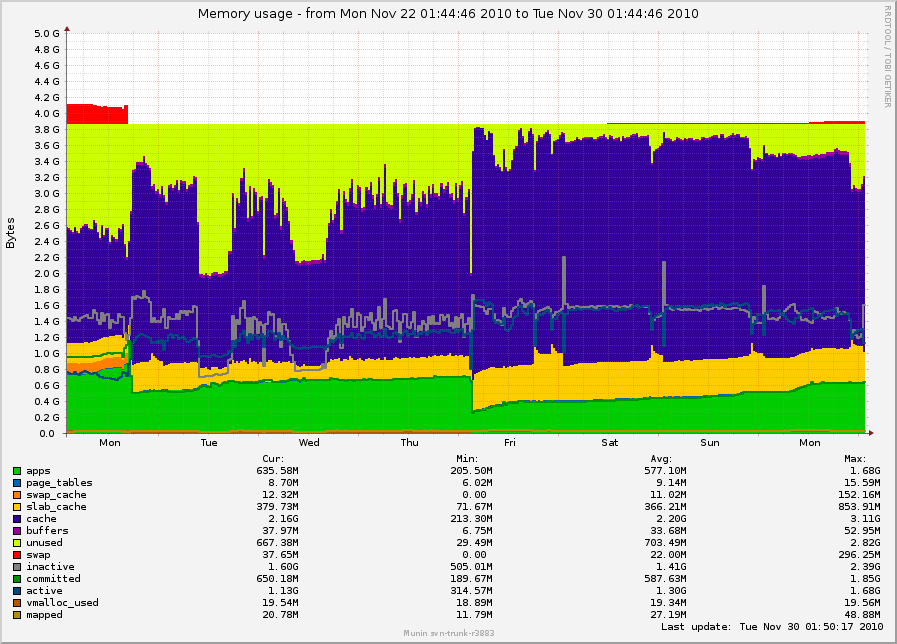
Things seem to be drifting to kswapd reclaiming order-0 in a way that doesn't add up to more order-3 blocks available, so fragmentation is increasing.
You mentioned that there was some mechanism to have it actually target allocations that could be made into higher order allocations?
Simon-
Quoted 164 lines
==== CUT HERE ====
include/linux/mmzone.h +2
-1@@ -645,6 +645,7 @@ typedef struct pglist_data {wait_queue_head_t kswapd_wait;struct task_struct *kswapd;int kswapd_max_order; +enum zone_type high_zoneidx; } pg_data_t;#define node_present_pages (nid) (NODE_DATA(nid)->node_present_pages)@@ -660,7 +661,7 @@ typedef struct pglist_data {extern struct mutex zonelists_mutex;void build_all_zonelists (void *data); -void wakeup_kswapd (struct zone *zone,int order); +void wakeup_kswapd (struct zone *zone,int order,enum zone_type high_zoneidx);int zone_watermark_ok (struct zone *z,int order,unsigned long mark,int classzone_idx,int alloc_flags);enum memmap_context {mm/page_alloc.c +1
-1@@ -1921,7 +1921,7 @@ void wake_all_kswapd(unsigned int order, struct zonelist *zonelist,struct zone *zone;for_each_zone_zonelist (zone, z, zonelist, high_zoneidx) -wakeup_kswapd (zone, order); +wakeup_kswapd (zone, order, high_zoneidx); } static inline intmm/vmscan.c +32
-9@@ -2118,15 +2118,17 @@ unsigned long try_to_free_mem_cgroup_pages(struct mem_cgroup *mem_cont,#endif /* is kswapd sleeping prematurely? */ -static int sleeping_prematurely (pg_data_t *pgdat,int order,long remaining) +static bool sleeping_prematurely (pg_data_t *pgdat,int order,long remaining) {int i; +bool all_zones_ok = true; +bool any_zone_ok = false;/* If a direct reclaimer woke kswapd within HZ/10, it's premature */ if (remaining)return 1 ; -/* If after HZ/10, a zone is below the high mark, it's premature */ +/* Check the watermark levels */ for (i =0 ; i < pgdat->nr_zones; i++) {struct zone *zone = pgdat->node_zones + i;@@ -2138,10 +2140,20 @@ static int sleeping_prematurely(pg_data_t *pgdat, int order, long remaining)if (!zone_watermark_ok (zone, order,high_wmark_pages (zone),0 ,0 )) -return 1 ; + all_zones_ok = false; +else + any_zone_ok = true; } -return 0 ; +/* +* For high-order requests, any zone meeting the watermark is enough +* to allow kswapd go back to sleep +* For order-0, all zones must be balanced +*/ +if (order) +return !any_zone_ok; +else +return !all_zones_ok; }/* @@ -2168,6 +2180,7 @@ static int sleeping_prematurely(pg_data_t *pgdat, int order, long remaining)static unsigned long balance_pgdat (pg_data_t *pgdat,int order) {int all_zones_ok; +int any_zone_ok;int priority;int i;unsigned long total_scanned;@@ -2201,6 +2214,7 @@ loop_again:disable_swap_token (); all_zones_ok =1 ; + any_zone_ok =0 ;/* * Scan in the highmem->dma direction for the highest @@ -2310,10 +2324,12 @@ loop_again:* spectulatively avoid congestion waits */ zone_clear_flag (zone,ZONE_CONGESTED ); +if (i <= pgdat->high_zoneidx) + any_zone_ok =1 ; } } -if (all_zones_ok) +if (all_zones_ok || (order && any_zone_ok))break ;/* kswapd: all done */ /* * OK, kswapd is getting into trouble. Take a nap, then take @@ -2336,7 +2352,7 @@ loop_again:break ; } out: -if (!all_zones_ok) { +if (!(all_zones_ok || (order && any_zone_ok))) {cond_resched ();try_to_freeze ();@@ -2361,7 +2377,13 @@ out: goto loop_again; } -return sc.nr_reclaimed; +/* +* Return the order we were reclaiming at so sleeping_prematurely() +* makes a decision on the order we were last reclaiming at. However, +* if another caller entered the allocator slow path while kswapd +* was awake, order will remain at the higher level +*/ +return order; }/* @@ -2417,6 +2439,7 @@ static int kswapd(void *p)prepare_to_wait (&pgdat->kswapd_wait, &wait,TASK_INTERRUPTIBLE ); new_order = pgdat->kswapd_max_order; pgdat->kswapd_max_order =0 ; + pgdat->high_zoneidx =MAX_ORDER ;if (order < new_order) {/* * Don't sleep if someone wants a larger 'order' @@ -2464,7 +2487,7 @@ static int kswapd(void *p)*/ if (!ret) {trace_mm_vmscan_kswapd_wake (pgdat->node_id, order); -balance_pgdat (pgdat, order); + order =balance_pgdat (pgdat, order); } }return 0 ;@@ -2473,7 +2496,7 @@ static int kswapd(void *p)/* * A zone is low on free memory, so wake its kswapd task to service it. */ -void wakeup_kswapd (struct zone *zone,int order) +void wakeup_kswapd (struct zone *zone,int order,enum zone_type high_zoneidx) {pg_data_t *pgdat;@@ -2483,8 +2506,10 @@ void wakeup_kswapd(struct zone *zone, int order) pgdat = zone->zone_pgdat;
mm/vmscan.c void wakeup_kswapd(struct zone *zone, int order) · line 2515
Quoted 10 lines
mm/vmscan.c +3
-1if (zone_watermark_ok (zone, order,low_wmark_pages (zone),0 ,0 ))return ; -if (pgdat->kswapd_max_order < order) +if (pgdat->kswapd_max_order < order) { pgdat->kswapd_max_order = order; + pgdat->high_zoneidx =min (pgdat->high_zoneidx, high_zoneidx); + }trace_mm_vmscan_wakeup_kswapd (pgdat->node_id,zone_idx (zone), order);if (!cpuset_zone_allowed_hardwall (zone,GFP_KERNEL ))return ;
--
To unsubscribe, send a message with 'unsubscribe linux-mm' in the body to [email protected]. For more info on Linux MM,
see: http://www.linux-mm.org/ .
Fight unfair telecom policy in Canada: sign http://dissolvethecrtc.ca/
Don't email: <a href=mailto:"[email protected]"> [email protected] </a>
Hi
Quoted 24 lines · Dave Hansen
Quoted 9 lines
I wish. :) The best thing to do is to watch stuff like
/proc/vmstatalong with its friends like/proc/{buddy,meminfo,slabinfo}. Could you post some samples of those with some indication of where the bad behavior was seen?I've definitely seen swapping in the face of lots of free memory, but only in cases where I was being a bit unfair about the numbers of hugetlbfs pages I was trying to reserve.
So, Dave and I spent quite some time today figuring out was going on here. Once load picked up during the day, kswapd actually never slept until late in the afternoon. During the evening now, it's still waking up in bursts, and still keeping way too much memory free:
http://0x.ca/sim/ref/2.6.36/memory_tonight.png (NOTE: we did swapoff -a to keep /dev/sda from overloading)We have a much better idea on what is happening here, but more questions.
This
x86_64box has 4 GB of RAM; zones are set up as follows:
Quoted 13 lines
[    0.000000] Zone PFN ranges:
[    0.000000]   DMA      0x00000001 -> 0x00001000
[    0.000000]   DMA32    0x00001000 -> 0x00100000
[    0.000000]   Normal   0x00100000 -> 0x00130000
...
[    0.000000] On node 0 totalpages: 1047279
[    0.000000]   DMA zone: 56 pages used for memmap
[    0.000000]   DMA zone: 0 pages reserved
[    0.000000]   DMA zone: 3943 pages, LIFO batch:0
[    0.000000]   DMA32 zone: 14280 pages used for memmap
[    0.000000]   DMA32 zone: 832392 pages, LIFO batch:31
[    0.000000]   Normal zone: 2688 pages used for memmap
[    0.000000]   Normal zone: 193920 pages, LIFO batch:31
This machine's zone size are
DMA32: 3250MB NORMAL: 750MB
This inbalance zone size is one of root cause of the strange swapping issue. I'm sure we certinally need to fix our VM heuristics. However there is no perfect heuristics in the real world and we can't make it. Also, I guess a bug reporter need practical workaround.
Then, I wrote following patch.
if you pass a following boot parameter, zone division change to dma32=1G + normal=3G.
in grub.conf
kernel /boot/vmlinuz ro root=foobar .... zone_dma32_size=1G
I bet this one reduce your head pain a lot. Can you please try this? Of cource, this is only workaround. not truth fix.
Quoted 1 line
From
1446c915fd59a5f123c2619d1f1f3b4e1bd0c648Mon Sep 17 00:00:00 2001
From: KOSAKI Motohiro <[email protected]>
Date: Thu, 23 Dec 2010 08:57:27 +0900
Subject: [PATCH] x86: implement zone_dma32_size boot parameter
--- Documentation/kernel-parameters.txt | 5 +++++ arch/x86/mm/init_64.c | 17 ++++++++++++++++- 2 files changed, 21 insertions(+), 1 deletions(-)
Documentation/kernel-parameters.txt +5 -0
@@ -2686,6 +2686,11 @@ and is between 256 and 4096 characters. It is defined in the file Format: <irq>,<irq_mask>,<io>,<full_duplex>,<do_sound>,<lockup_hack>[,<irq2>[,<irq3>[,<irq4>]]] + zone_dma32_size=nn[KMG] [KNL,BOOT,X86-64] + forces the dma32 zone to have an exact size of <nn>. + This works to reduce dma32 zone (In other word, to + increase normal zone) size. + ______________________________________________________________________ TODO:
arch/x86/mm/init_64.c +16 -1
@@ -95,6 +95,21 @@ static int __init nonx32_setup(char *str) }__setup ("noexec32=" , nonx32_setup); +static unsigned long max_dma32_pfn =MAX_DMA32_PFN ; +static int __init parse_zone_dma32_size (char *arg) +{ +unsigned long dma32_pages; + +if (!arg) +return -EINVAL ; + + dma32_pages =memparse (arg, &arg) >>PAGE_SHIFT ; + max_dma32_pfn =min (MAX_DMA_PFN + dma32_pages,MAX_DMA32_PFN ); + +return 0 ; +} +early_param ("zone_dma32_size" , parse_zone_dma32_size); +/* * When memory was added/removed make sure all the processes MM have * suitable PGD entries in the local PGD level page.
@@ -625,7 +640,7 @@ void __init paging_init(void)memset (max_zone_pfns,0 ,sizeof (max_zone_pfns)); max_zone_pfns[ZONE_DMA ] =MAX_DMA_PFN ; - max_zone_pfns[ZONE_DMA32 ] =MAX_DMA32_PFN ; + max_zone_pfns[ZONE_DMA32 ] = max_dma32_pfn; max_zone_pfns[ZONE_NORMAL ] = max_pfn;sparse_memory_present_with_active_regions (MAX_NUMNODES );
Signature · 1 line
1.6.5.2
Quoted 9 lines · Andrew Morton
Quoted 6 lines · On Mon, 15 Nov 2010 11:52:46 -0800 Simon Kirby <[email protected]> wrote:
I noticed that
CONFIG_NUMAseems to enable some more complicated reclaiming bits and figured it might help since most stock kernels seem to ship with it now. This seems to have helped, but it may just be wishful thinking. We still see this happening, though maybe to a lesser degree. (The following observations are withCONFIG_NUMAenabled.)
Hi,
As this is a NUMA machine, what is the value of /proc/sys/vm/zone_reclaim_mode ? When enabled, this reclaims memory local to the node in preference to using remote nodes. For certain workloads this performs better but for users that expect all of memory to be used, it has surprising results.
If set to 1, try testing with it set to 0 and see if it makes a difference. Thanks
Signature · 3 lines
Mel Gorman Part-time Phd Student Linux Technology Center University of Limerick IBM Dublin Software Lab
Quoted 13 lines · Mel Gorman
Quoted 9 lines · Andrew Morton
Quoted 6 lines · On Mon, 15 Nov 2010 11:52:46 -0800 Simon Kirby <[email protected]> wrote:
I noticed that
CONFIG_NUMAseems to enable some more complicated reclaiming bits and figured it might help since most stock kernels seem to ship with it now. This seems to have helped, but it may just be wishful thinking. We still see this happening, though maybe to a lesser degree. (The following observations are withCONFIG_NUMAenabled.)Hi,
Quoted 8 lines
As this is a NUMA machine, what is the value of
/proc/sys/vm/zone_reclaim_mode? When enabled, this reclaims memory local to the node in preference to using remote nodes. For certain workloads this performs better but for users that expect all of memory to be used, it has surprising results.If set to 1, try testing with it set to 0 and see if it makes a difference. Thanks
Hi Mel,
It is set to 0. It's an Intel EM64T...I only enabled CONFIG_NUMA since it seemed to enable some more complicated handling, and I figured it might help, but it didn't seem to. It's also required for CONFIG_COMPACTION, but that is still marked experimental.
Simon-
--
To unsubscribe, send a message with 'unsubscribe linux-mm' in the body to [email protected]. For more info on Linux MM,
see: http://www.linux-mm.org/ .
Fight unfair telecom policy in Canada: sign http://dissolvethecrtc.ca/
Don't email: <a href=mailto:"[email protected]"> [email protected] </a>
Quoted 24 lines · Simon Kirby
Quoted 13 lines · Mel Gorman
Quoted 9 lines · Andrew Morton
Quoted 6 lines · On Mon, 15 Nov 2010 11:52:46 -0800 Simon Kirby <[email protected]> wrote:
I noticed that
CONFIG_NUMAseems to enable some more complicated reclaiming bits and figured it might help since most stock kernels seem to ship with it now. This seems to have helped, but it may just be wishful thinking. We still see this happening, though maybe to a lesser degree. (The following observations are withCONFIG_NUMAenabled.)Hi,
Quoted 8 lines
As this is a NUMA machine, what is the value of
/proc/sys/vm/zone_reclaim_mode? When enabled, this reclaims memory local to the node in preference to using remote nodes. For certain workloads this performs better but for users that expect all of memory to be used, it has surprising results.If set to 1, try testing with it set to 0 and see if it makes a difference. Thanks
Quoted 7 lines
Hi Mel,
It is set to 0. It's an Intel EM64T...I only enabled
CONFIG_NUMAsince it seemed to enable some more complicated handling, and I figured it might help, but it didn't seem to. It's also required forCONFIG_COMPACTION, but that is still marked experimental.
I'm surprised a little that you are bringing compaction up because unless there are high-order involved, it wouldn't make a difference. Is there a constant source of high-order allocations in the system e.g. a network card configured to use jumbo frames? A possible consequence of that is that reclaim is kicking in early to free order-[2-4] pages that would prevent 100% of memory being used.
Signature · 10 lines
Mel Gorman
Part-time Phd Student                          Linux Technology Center
University of Limerick                         IBM Dublin Software Lab

--
To unsubscribe, send a message with 'unsubscribe linux-mm' in
the body to [email protected].  For more info on Linux MM,
see: http://www.linux-mm.org/ .
Fight unfair telecom policy in Canada: sign http://dissolvethecrtc.ca/
Don't email: <a href=mailto:"[email protected]"> [email protected] </a>
Quoted 33 lines · Mel Gorman
Quoted 24 lines · Simon Kirby
Quoted 13 lines · Mel Gorman
Quoted 9 lines · Andrew Morton
Quoted 6 lines · On Mon, 15 Nov 2010 11:52:46 -0800 Simon Kirby <[email protected]> wrote:
I noticed that
CONFIG_NUMAseems to enable some more complicated reclaiming bits and figured it might help since most stock kernels seem to ship with it now. This seems to have helped, but it may just be wishful thinking. We still see this happening, though maybe to a lesser degree. (The following observations are withCONFIG_NUMAenabled.)Hi,
Quoted 8 lines
As this is a NUMA machine, what is the value of
/proc/sys/vm/zone_reclaim_mode? When enabled, this reclaims memory local to the node in preference to using remote nodes. For certain workloads this performs better but for users that expect all of memory to be used, it has surprising results.If set to 1, try testing with it set to 0 and see if it makes a difference. Thanks
Quoted 7 lines
Hi Mel,
It is set to 0. It's an Intel EM64T...I only enabled
CONFIG_NUMAsince it seemed to enable some more complicated handling, and I figured it might help, but it didn't seem to. It's also required forCONFIG_COMPACTION, but that is still marked experimental.
Quoted 6 lines
I'm surprised a little that you are bringing compaction up because unless there are high-order involved, it wouldn't make a difference. Is there a constant source of high-order allocations in the system e.g. a network card configured to use jumbo frames? A possible consequence of that is that reclaim is kicking in early to free order-[2-4] pages that would prevent 100% of memory being used.
We /were/ using jumbo frames, but only over a local cross-over connection to another node (for DRBD), so I disabled jumbo frames on this interface and reconnected DRBD. Even with MTUs set to 1500, we saw GFP_ATOMIC order=3 allocations coming from __alloc_skb:
perf record --event kmem:mm_page_alloc --filter 'order>=3' -a --call-graph sleep 10 perf trace
imap-20599 [002] 1287672.803567: mm_page_alloc: page=0xffffea00004536c0 pfn=4536000 order=3 migratetype=0 gfp_flags=GFP_ATOMIC|GFP_NOWARN|GFP_NORETRY|GFP_COMP
perf report shows:
__alloc_pages_nodemaskalloc_pages_currentnew_slab__slab_alloc__kmalloc_node_track_caller__alloc_skb__netdev_alloc_skbbnx2_poll_work
Dave was seeing these on his laptop with an Intel NIC as well. Ralf noted that the slab cache grows in higher order blocks, so this is normal. The GFP_ATOMIC bubbles up from *alloc_skb, I guess.
Simon-
--
To unsubscribe, send a message with 'unsubscribe linux-mm' in the body to [email protected]. For more info on Linux MM,
see: http://www.linux-mm.org/ .
Fight unfair telecom policy in Canada: sign http://dissolvethecrtc.ca/
Don't email: <a href=mailto:"[email protected]"> [email protected] </a>
Quoted 63 lines · Mel Gorman
Quoted 34 lines · Simon Kirby
Quoted 24 lines · Mel Gorman
Quoted 14 lines · Andrew Morton
Quoted 9 lines
Quoted 6 lines · On Mon, 15 Nov 2010 11:52:46 -0800 Simon Kirby <[email protected]> wrote:
I noticed that
CONFIG_NUMAseems to enable some more complicated reclaiming bits and figured it might help since most stock kernels seem to ship with it now. This seems to have helped, but it may just be wishful thinking. We still see this happening, though maybe to a lesser degree. (The following observations are withCONFIG_NUMAenabled.)Hi,
Quoted 8 lines
As this is a NUMA machine, what is the value of
/proc/sys/vm/zone_reclaim_mode? When enabled, this reclaims memory local to the node in preference to using remote nodes. For certain workloads this performs better but for users that expect all of memory to be used, it has surprising results.If set to 1, try testing with it set to 0 and see if it makes a difference. Thanks
Quoted 7 lines
Hi Mel,
It is set to 0. It's an Intel EM64T...I only enabled
CONFIG_NUMAsince it seemed to enable some more complicated handling, and I figured it might help, but it didn't seem to. It's also required forCONFIG_COMPACTION, but that is still marked experimental.Quoted 6 lines
I'm surprised a little that you are bringing compaction up because unless there are high-order involved, it wouldn't make a difference. Is there a constant source of high-order allocations in the system e.g. a network card configured to use jumbo frames? A possible consequence of that is that reclaim is kicking in early to free order-[2-4] pages that would prevent 100% of memory being used.
We /were/ using jumbo frames, but only over a local cross-over connection to another node (for DRBD), so I disabled jumbo frames on this interface and reconnected DRBD. Even with MTUs set to 1500, we saw
GFP_ATOMICorder=3 allocations coming from__alloc_skb:perf record --event kmem:mm_page_alloc --filter 'order>=3' -a --call-graph sleep 10 perf trace
imap-20599 [002] 1287672.803567: mm_page_alloc: page=0xffffea00004536c0 pfn=4536000 order=3 migratetype=0 gfp_flags=GFP_ATOMIC|GFP_NOWARN|GFP_NORETRY|GFP_COMPperf report shows:
__alloc_pages_nodemaskalloc_pages_currentnew_slab__slab_alloc__kmalloc_node_track_caller__alloc_skb__netdev_alloc_skbbnx2_poll_work
Quoted 3 lines
Dave was seeing these on his laptop with an Intel NIC as well. Ralf noted that the slab cache grows in higher order blocks, so this is normal. The
GFP_ATOMICbubbles up from*alloc_skb, I guess.
Please try SLAB instead SLUB (it can be switched by kernel build option). SLUB try to use high order allocation implicitly.
--
To unsubscribe, send a message with 'unsubscribe linux-mm' in the body to [email protected]. For more info on Linux MM,
see: http://www.linux-mm.org/ .
Fight unfair telecom policy in Canada: sign http://dissolvethecrtc.ca/
Don't email: <a href=mailto:"[email protected]"> [email protected] </a>
Quoted 2 lines · KOSAKI Motohiro
Please try SLAB instead SLUB (it can be switched by kernel build option). SLUB try to use high order allocation implicitly.
SLAB uses orders 0-1. Order is fixed per slab cache and determined based on object size at slab creation.
SLUB uses orders 0-3. Falls back to smallest order if alloc order cannot be met by the page allocator.
One can reduce SLUB to SLAB orders by specifying the following kernel commandline parameter:
slub_max_order=1
--
To unsubscribe, send a message with 'unsubscribe linux-mm' in the body to [email protected]. For more info on Linux MM,
see: http://www.linux-mm.org/ .
Fight unfair telecom policy in Canada: sign http://dissolvethecrtc.ca/
Don't email: <a href=mailto:"[email protected]"> [email protected] </a>
Quoted 7 lines · KOSAKI Motohiro
Quoted 2 lines
Please try SLAB instead SLUB (it can be switched by kernel build option). SLUB try to use high order allocation implicitly.
SLAB uses orders 0-1. Order is fixed per slab cache and determined based on object size at slab creation.
Quoted 7 lines
SLUB uses orders 0-3. Falls back to smallest order if alloc order cannot be met by the page allocator.
One can reduce SLUB to SLAB orders by specifying the following kernel commandline parameter:
slub_max_order=1
This?
From 3edd305fc58ac89364806cd60140793d37422acc Mon Sep 17 00:00:00 2001
From: KOSAKI Motohiro <[email protected]>
Date: Fri, 24 Dec 2010 18:04:10 +0900
Subject: [PATCH] slub: reduce slub_max_order by default
slab is already using order-1.
---
 mm/slub.c |    3 ++-
 1 files changed, 2 insertions(+), 1 deletions(-)
mm/slub.c +2 -1
@@ -1964,7 +1964,8 @@ static struct page *get_object_page(const void *x)* take the list_lock. */ static int slub_min_order; -static int slub_max_order =PAGE_ALLOC_COSTLY_ORDER ; +/* order-1 is maximum size which we can assume to exist always. */ +static int slub_max_order =1 ;static int slub_min_objects;/*
Signature · 10 lines
1.6.5.2


--
To unsubscribe, send a message with 'unsubscribe linux-mm' in
the body to [email protected].  For more info on Linux MM,
see: http://www.linux-mm.org/ .
Fight unfair telecom policy in Canada: sign http://dissolvethecrtc.ca/
Don't email: <a href=mailto:"[email protected]"> [email protected] </a>
Quoted 1 line · KOSAKI Motohiro
This?
Specifying a parameter to temporarily override to see if this has the effect is ok. But this has worked for years now. There must be something else going with with reclaim that causes these issues now.
--
To unsubscribe, send a message with 'unsubscribe linux-mm' in the body to [email protected]. For more info on Linux MM,
see: http://www.linux-mm.org/ .
Fight unfair telecom policy in Canada: sign http://dissolvethecrtc.ca/
Don't email: <a href=mailto:"[email protected]"> [email protected] </a>
Quoted 7 lines · KOSAKI Motohiro
Quoted 2 lines
This?
Specifying a parameter to temporarily override to see if this has the effect is ok. But this has worked for years now. There must be something else going with with reclaim that causes these issues now.
I don't think this has worked. Simon have found the corner case recently, but it is not new.
So I hope you realize that high order allocation is no free lunch. __GFP_NORETRY makes no sense really. Even though we have compaction, high order reclaim is still costly operation.
I don't think SLUB's high order allocation trying is bad idea. but now It does more costly trying. that's bad. Also I'm worry about SLUB assume too higher end machine. Now Both SLES and RHEL decided to don't use SLUB, instead use SLAB. Now linux community is fragmented. If you are still interesting SL*B unification, can you please consider to join corner case smashing activity?
--
To unsubscribe, send a message with 'unsubscribe linux-mm' in the body to [email protected]. For more info on Linux MM,
see: http://www.linux-mm.org/ .
Fight unfair telecom policy in Canada: sign http://dissolvethecrtc.ca/
Don't email: <a href=mailto:"[email protected]"> [email protected] </a>
Quoted 6 lines · KOSAKI Motohiro
Quoted 3 lines
Specifying a parameter to temporarily override to see if this has the effect is ok. But this has worked for years now. There must be something else going with with reclaim that causes these issues now.
I don't think this has worked. Simon have found the corner case recently, but it is not new.
What has worked? If the reduction of the maximum allocation order did not have the expected effect of fixing things here then the issue is not related to the higher allocations from slub.
Higher order allocations are not only a slub issue but a general issue for various subsystem that require higher order pages. This ranges from jumbo frames, to particular needs for certain device drivers, to huge pages.
Quoted 3 lines
So I hope you realize that high order allocation is no free lunch.
__GFP_NORETRYmakes no sense really. Even though we have compaction, high order reclaim is still costly operation.
Sure. There is a tradeoff between reclaim effort and the benefit of higher allocations. The costliness of reclaim may have increased with the recent changes to the reclaim logic. In fact reclaim gets more and more complex over time and there may be subtle bugs in there given the recent flurry of changes.
Quoted 6 lines
I don't think SLUB's high order allocation trying is bad idea. but now It does more costly trying. that's bad. Also I'm worry about SLUB assume too higher end machine. Now Both SLES and RHEL decided to don't use SLUB, instead use SLAB. Now linux community is fragmented. If you are still interesting SL*B unification, can you please consider to join corner case smashing activity?
The problems with higher order reclaim get more difficult with small memory sizes yes. We could reduce the maximum order automatically if memory is too tight. There is nothing hindering us from tuning the max order behavior of slub in a similar way that we now tune the thresholds of the vm statistics.
But for that to be done we first need to have some feedback if the changes to max order have indeed the desired effect in this corner case.
--
To unsubscribe, send a message with 'unsubscribe linux-mm' in the body to [email protected]. For more info on Linux MM,
see: http://www.linux-mm.org/ .
Fight unfair telecom policy in Canada: sign http://dissolvethecrtc.ca/
Don't email: <a href=mailto:"[email protected]"> [email protected] </a>
Quoted 9 lines · KOSAKI Motohiro
Quoted 7 lines
Quoted 4 lines
Specifying a parameter to temporarily override to see if this has the effect is ok. But this has worked for years now. There must be something else going with with reclaim that causes these issues now.
I don't think this has worked. Simon have found the corner case recently, but it is not new.
Quoted 7 lines
What has worked? If the reduction of the maximum allocation order did not have the expected effect of fixing things here then the issue is not related to the higher allocations from slub.
Higher order allocations are not only a slub issue but a general issue for various subsystem that require higher order pages. This ranges from jumbo frames, to particular needs for certain device drivers, to huge pages.
Sure yes. However One big difference is there. Other user certinally need such high order, but slub are using high order for only performance. but its stragegy often shoot our own foot. It often makes worse than low order. IOW, slub isn't always win against slab.
Quoted 9 lines
Quoted 3 lines
So I hope you realize that high order allocation is no free lunch.
__GFP_NORETRYmakes no sense really. Even though we have compaction, high order reclaim is still costly operation.Sure. There is a tradeoff between reclaim effort and the benefit of higher allocations. The costliness of reclaim may have increased with the recent changes to the reclaim logic. In fact reclaim gets more and more complex over time and there may be subtle bugs in there given the recent flurry of changes.
I can't insist reclaim is really complex. So maybe one of problem is now reclaim can't know the request is must necessary or optimistic try. And, allocation failure often makes disaster then we were working on fixint it. But increasing high order allocation successful ratio sadly can makes slub unhappy. umm..
So I think we have multiple option
1) reduce slub_max_order and slub only use safely order
2) slub don't invoke reclaim when high order tryal allocation (ie turn off GFP_WAIT and turn on GFP_NOKSWAPD)
3) slub pass new hint to reclaim and reclaim don't work so aggressively if such hint is passwd.
So I have one question. I thought (2) is most nature. but now slub doesn't. Why don't you do that? As far as I know, reclaim haven't been lighweight operation since linux was born. I'm curious your assumed cost threshold for slub high order allocation.
Quoted 7 lines
Quoted 6 lines
I don't think SLUB's high order allocation trying is bad idea. but now It does more costly trying. that's bad. Also I'm worry about SLUB assume too higher end machine. Now Both SLES and RHEL decided to don't use SLUB, instead use SLAB. Now linux community is fragmented. If you are still interesting SL*B unification, can you please consider to join corner case smashing activity?
Quoted 5 lines
The problems with higher order reclaim get more difficult with small memory sizes yes. We could reduce the maximum order automatically if memory is too tight. There is nothing hindering us from tuning the max order behavior of slub in a similar way that we now tune the thresholds of the vm statistics.
Sound like really good idea. :)
Quoted 2 lines
But for that to be done we first need to have some feedback if the changes to max order have indeed the desired effect in this corner case.
Quoted 10 lines · KOSAKI Motohiro
So I think we have multiple option
1) reduce
slub_max_orderand slub only use safely order
2) slub don't invoke reclaim when high order tryal allocation (ie turn offGFP_WAITand turn onGFP_NOKSWAPD)
3) slub pass new hint to reclaim and reclaim don't work so aggressively if such hint is passwd.So I have one question. I thought (2) is most nature. but now slub doesn't.
2) so far has not been available. GFP_NOKSWAPD does not exist upstream.
--
To unsubscribe, send a message with 'unsubscribe linux-mm' in the body to [email protected]. For more info on Linux MM,
see: http://www.linux-mm.org/ .
Fight unfair telecom policy in Canada: sign http://dissolvethecrtc.ca/
Don't email: <a href=mailto:"[email protected]"> [email protected] </a>
Quoted 7 lines · Christoph Lameter
Quoted 2 lines · KOSAKI Motohiro
Please try SLAB instead SLUB (it can be switched by kernel build option). SLUB try to use high order allocation implicitly.
SLAB uses orders 0-1. Order is fixed per slab cache and determined based on object size at slab creation.
Quoted 7 lines
SLUB uses orders 0-3. Falls back to smallest order if alloc order cannot be met by the page allocator.
One can reduce SLUB to SLAB orders by specifying the following kernel commandline parameter:
slub_max_order=1
Can we also mess with these /sys files on the fly?
[/sys/kernel/slab]# grep . kmalloc-*/order | sort -n -k2 -t- kmalloc-8/order:0
kmalloc-16/order:0
kmalloc-32/order:0
kmalloc-64/order:0
kmalloc-96/order:0
kmalloc-128/order:0
kmalloc-192/order:0
kmalloc-256/order:1
kmalloc-512/order:2
kmalloc-1024/order:3
kmalloc-2048/order:3
kmalloc-4096/order:3
kmalloc-8192/order:3
I'm not familiar with how slub works, but I assume there's some overhead or some reason not to just use order 0 for <= kmalloc-4096? Or is it purely just trying to reduce cpu by calling alloc_pages less often?
Simon-
--
To unsubscribe, send a message with 'unsubscribe linux-mm' in the body to [email protected]. For more info on Linux MM,
see: http://www.linux-mm.org/ .
Fight unfair telecom policy in Canada: sign http://dissolvethecrtc.ca/
Don't email: <a href=mailto:"[email protected]"> [email protected] </a>
Quoted 1 line · Simon Kirby
Can we also mess with these /sys files on the fly?
Sure. Go ahead. These are runtime configurable.
Quoted 3 lines
I'm not familiar with how slub works, but I assume there's some overhead or some reason not to just use order 0 for <= kmalloc-4096? Or is it purely just trying to reduce cpu by calling
alloc_pagesless often?
Using higher order pages reduces the memory overhead for objects (that after all need to be packed into an order N page), decreases the amount of metadata that needs to be managed and decreases the use of the slowpaths. That implies also a reduction in the locking overhead.