System CPU increasing on idle 2.6.36
Subsystems (2)
Possibly related to the flush-processes-taking-CPU issues I saw previously, I thought this was interesting. I found a log-crunching box that does all of its work via NFS and spends most of the day sleeping. It has been using a linearly-increasing amount of system time during the time where is sleeping. munin graph:
http://0x.ca/sim/ref/2.6.36/cpu_logcrunch_nfs.png

top shows:
  PID USER      PR  NI  VIRT  RES  SHR S %CPU %MEM    TIME+  COMMAND
 4767 root      20   0     0    0    0 S   16  0.0   2413:29 flush-0:69
22385 root      20   0     0    0    0 S   10  0.0   1320:23 flush-0:70
(rest idle)
perf top shows:
-------------------------------------------------------------------------------------------
PerfTop: 252 irqs/sec kernel:97.2% exact: 0.0% [1000Hz cycles], (all, 2 CPUs)
-------------------------------------------------------------------------------------------
samples pcnt function DSO
_______ _____ _______________________________ ___________
912.00 21.2% _raw_spin_lock [kernel]
592.00 13.8% nfs_writepages [kernel]
474.00 11.0% queue_io [kernel]
428.00 10.0% writeback_single_inode [kernel]
379.00 8.8% writeback_sb_inodes [kernel]
237.00 5.5% bit_waitqueue [kernel]
184.00 4.3% do_writepages [kernel]
169.00 3.9% __iget [kernel]
132.00 3.1% redirty_tail [kernel]
85.00 2.0% iput [kernel]
72.00 1.7% _atomic_dec_and_lock [kernel]
67.00 1.6% write_cache_pages [kernel]
63.00 1.5% port_inb [ipmi_si]
62.00 1.4% __mark_inode_dirty [kernel]
48.00 1.1% __wake_up_bit [kernel]
32.00 0.7% nfs_write_inode [kernel]
26.00 0.6% native_read_tsc [kernel]
25.00 0.6% radix_tree_gang_lookup_tag_slot [kernel]
25.00 0.6% schedule [kernel]
24.00 0.6% wake_up_bit [kernel]
20.00 0.5% apic_timer_interrupt [kernel]
19.00 0.4% ia32_syscall [kernel]
16.00 0.4% find_get_pages_tag [kernel]
15.00 0.3% _raw_spin_lock_irqsave [kernel]
15.00 0.3% load_balance [kernel]
13.00 0.3% ktime_get [kernel]
12.00 0.3% shrink_icache_memory [kernel]
11.00 0.3% semop libc-2.7.so
9.00 0.2% nfs_pageio_doio [kernel]
8.00 0.2% dso__find_symbol perf
8.00 0.2% down_read [kernel]
7.00 0.2% __switch_to [kernel]
7.00 0.2% __phys_addr [kernel]
7.00 0.2% nfs_pageio_init [kernel]
7.00 0.2% pagevec_lookup_tag [kernel]
7.00 0.2% _cond_resched [kernel]
7.00 0.2% up_read [kernel]
6.00 0.1% sched_clock_local [kernel]
5.00 0.1% rb_erase [kernel]
5.00 0.1% page_fault [kernel]
"tcpdump -i any -n port 2049" and "nfsstat" shows this work does not actually result in any NFS packets.
Known 2.6.36 issue? This did not occur on 2.6.35.4, according to the munin graphs. I'll try 2.6.37-rc an see if it changes.
Simon-
Quoted 65 lines · Simon Kirby
Possibly related to the flush-processes-taking-CPU issues I saw previously, I thought this was interesting. I found a log-crunching box that does all of its work via NFS and spends most of the day sleeping. It has been using a linearly-increasing amount of system time during the time where is sleeping. munin graph:
http://0x.ca/sim/ref/2.6.36/cpu_logcrunch_nfs.png
top shows:
  PID USER      PR  NI  VIRT  RES  SHR S %CPU %MEM    TIME+  COMMAND
 4767 root      20   0     0    0    0 S   16  0.0   2413:29 flush-0:69
22385 root      20   0     0    0    0 S   10  0.0   1320:23 flush-0:70
(rest idle)
perf top shows:
-------------------------------------------------------------------------------------------
PerfTop: 252 irqs/sec kernel:97.2% exact: 0.0% [1000Hz cycles], (all, 2 CPUs)
-------------------------------------------------------------------------------------------samples pcnt function DSO
_______ _____ _______________________________ ___________912.00 21.2%
_raw_spin_lock[kernel]
592.00 13.8%nfs_writepages[kernel]
474.00 11.0%queue_io[kernel]
428.00 10.0%writeback_single_inode[kernel]
379.00 8.8%writeback_sb_inodes[kernel]
237.00 5.5%bit_waitqueue[kernel]
184.00 4.3%do_writepages[kernel]
169.00 3.9%__iget[kernel]
132.00 3.1%redirty_tail[kernel]
85.00 2.0% iput [kernel]
72.00 1.7%_atomic_dec_and_lock[kernel]
67.00 1.6%write_cache_pages[kernel]
63.00 1.5%port_inb[ipmi_si]
62.00 1.4%__mark_inode_dirty[kernel]
48.00 1.1%__wake_up_bit[kernel]
32.00 0.7%nfs_write_inode[kernel]
26.00 0.6%native_read_tsc[kernel]
25.00 0.6%radix_tree_gang_lookup_tag_slot[kernel]
25.00 0.6% schedule [kernel]
24.00 0.6%wake_up_bit[kernel]
20.00 0.5%apic_timer_interrupt[kernel]
19.00 0.4%ia32_syscall[kernel]
16.00 0.4%find_get_pages_tag[kernel]
15.00 0.3%_raw_spin_lock_irqsave[kernel]
15.00 0.3%load_balance[kernel]
13.00 0.3%ktime_get[kernel]
12.00 0.3%shrink_icache_memory[kernel]
11.00 0.3% semop libc-2.7.so
9.00 0.2%nfs_pageio_doio[kernel]
8.00 0.2%dso__find_symbolperf
8.00 0.2%down_read[kernel]
7.00 0.2%__switch_to[kernel]
7.00 0.2%__phys_addr[kernel]
7.00 0.2%nfs_pageio_init[kernel]
7.00 0.2%pagevec_lookup_tag[kernel]
7.00 0.2%_cond_resched[kernel]
7.00 0.2%up_read[kernel]
6.00 0.1%sched_clock_local[kernel]
5.00 0.1%rb_erase[kernel]
5.00 0.1%page_fault[kernel]
Quoted 5 lines
"tcpdump -i any -n port 2049" and "nfsstat" shows this work does not actually result in any NFS packets.
Known 2.6.36 issue? This did not occur on 2.6.35.4, according to the munin graphs. I'll try 2.6.37-rc an see if it changes.
Possibly a side effect of the fs/fs-writeback.c changes in 2.6.36? You do appear to be hitting a lot of spinlock contention, but I suspect that a lot of it is coming from writeback_sb_inodes, writeback_single_inode and queue_io, all of which seem unnaturally high on your stats above.
I don't see how you can be seeing no traffic on the wire. You are certainly hitting some page writeout (0.2% nfs_pageio_doio).
Cheers
Trond
Signature · 6 lines
Trond Myklebust
Linux NFS client maintainer

NetApp
[email protected]
www.netapp.com
Quoted 7 lines · Trond Myklebust
Possibly a side effect of the
fs/fs-writeback.cchanges in 2.6.36? You do appear to be hitting a lot of spinlock contention, but I suspect that a lot of it is coming fromwriteback_sb_inodes,writeback_single_inodeandqueue_io, all of which seem unnaturally high on your stats above.I don't see how you can be seeing no traffic on the wire. You are certainly hitting some page writeout (0.2%
nfs_pageio_doio).
It really seems to not be doing anything. I ran nfsstat -Zcv for 5 minutes, and the only non-zero counters are rpc calls and authrefrsh, even though perf top shows similar profiles the whole time.
Simon-
Quoted 7 lines · Simon Kirby
Quoted 5 lines · Trond Myklebust
Possibly a side effect of the
fs/fs-writeback.cchanges in 2.6.36? You do appear to be hitting a lot of spinlock contention, but I suspect that a lot of it is coming fromwriteback_sb_inodes,writeback_single_inodeandqueue_io, all of which seem unnaturally high on your stats above.
Quoted 6 lines
Quoted 2 lines
I don't see how you can be seeing no traffic on the wire. You are certainly hitting some page writeout (0.2%
nfs_pageio_doio).It really seems to not be doing anything. I ran nfsstat -Zcv for 5 minutes, and the only non-zero counters are rpc calls and authrefrsh, even though perf top shows similar profiles the whole time.
That sounds like a bug in nfsstat, then. As I said, your trace results definitely indicate that you are doing page writeout. I'd cross check using wireshark...
Cheers
Trond
Signature · 6 lines
Trond Myklebust
Linux NFS client maintainer

NetApp
[email protected]
www.netapp.com
Quoted 11 lines · Trond Myklebust
Quoted 10 lines · Simon Kirby
Quoted 7 lines · Trond Myklebust
Possibly a side effect of the
fs/fs-writeback.cchanges in 2.6.36? You do appear to be hitting a lot of spinlock contention, but I suspect that a lot of it is coming fromwriteback_sb_inodes,writeback_single_inodeandqueue_io, all of which seem unnaturally high on your stats above.I don't see how you can be seeing no traffic on the wire. You are certainly hitting some page writeout (0.2%
nfs_pageio_doio).
Quoted 7 lines
Quoted 3 lines
It really seems to not be doing anything. I ran nfsstat -Zcv for 5 minutes, and the only non-zero counters are rpc calls and authrefrsh, even though perf top shows similar profiles the whole time.
That sounds like a bug in nfsstat, then. As I said, your trace results definitely indicate that you are doing page writeout. I'd cross check using wireshark...
I know it's weird, but it really isn't writing anything. Confirmed with tcpdump and tshark. Maybe it writes a single thing after a lot of trying, or something.
2.6.36.1 is also doing the same thing when completely idle, after finishing a bunch of log crunching. I'm just about to try 2.6.37-rc5-git3 on there plus your NFS fixes (which Linus seems to have half-merged and uploaded as -git3 but not pushed to his public git) and your NFSv4 UID patch, which I will be testing shortly. If it works, this should show if the same flush issue exists there or not.
Also, I just saw something similar in from 2.6.37-rc4-git1 plus your leak fixes (this ver of top's %sys cpu is broken, ignore):
top - 16:54:44 up 8 days, 16:04, 1 user, load average: 40.11, 43.36, 24.71
Tasks: 490 total,  28 running, 461 sleeping,   0 stopped,   1 zombie
Cpu(s): 17.8%us,  6.9%sy,  0.0%ni, 60.2%id, 13.1%wa,  0.0%hi,  2.0%si,  0.0%st
Mem:   4051256k total,  1717004k used,  2334252k free,    17112k buffers
Swap:   979960k total,   268756k used,   711204k free,   362940k cached
  PID USER      PR  NI  VIRT  RES  SHR S %CPU %MEM    TIME+  COMMAND
 2221 root      20   0     0    0    0 R   16  0.0   4:37.71 flush-0:65
10557 root      20   0     0    0    0 R   16  0.0   2:54.90 flush-0:46
 7240 root      20   0     0    0    0 R   15  0.0   7:46.64 flush-0:31
 8682 root      20   0     0    0    0 R   15  0.0   3:04.89 flush-0:34
13915 root      20   0     0    0    0 R   15  0.0   4:37.43 flush-0:27
17778 root      20   0     0    0    0 R   15  0.0   4:53.57 flush-0:83
19281 root      20   0     0    0    0 R   15  0.0   3:59.55 flush-0:56
19484 root      20   0     0    0    0 R   15  0.0  17:12.80 flush-0:77
19693 root      20   0     0    0    0 R   15  0.0   6:16.20 flush-0:71
25272 root      20   0     0    0    0 R   15  0.0   3:47.70 flush-0:68
 5494 root      20   0     0    0    0 R   13  0.0  28:23.03 flush-0:75
 7095 root      20   0     0    0    0 R   13  0.0   1:55.52 flush-0:42
10298 root      20   0     0    0    0 R   13  0.0   3:39.00 flush-0:61
13900 root      20   0     0    0    0 R   13  0.0   8:38.14 flush-0:80
14389 root      20   0     0    0    0 R   13  0.0   4:52.59 flush-0:81
16412 root      20   0     0    0    0 R   13  0.0   2:52.46 flush-0:33
17225 root      20   0     0    0    0 R   13  0.0   4:01.92 flush-0:78
20985 root      20   0     0    0    0 R   13  0.0   3:09.37 flush-0:29
24424 root      20   0     0    0    0 R   13  0.0   2:01.69 flush-0:20
25273 root      20   0     0    0    0 R   13  0.0   4:08.11 flush-0:70
25560 root      20   0     0    0    0 R   13  0.0   3:40.00 flush-0:69
27578 root      20   0     0    0    0 R   13  0.0   6:17.51 flush-0:57
25270 root      20   0     0    0    0 R   12  0.0   5:15.30 flush-0:26
25392 root      20   0     0    0    0 R   12  0.0   2:39.36 flush-0:82
27488 root      20   0     0    0    0 R   12  0.0   3:35.94 flush-0:76
31283 root      20   0     0    0    0 R   12  0.0   2:58.57 flush-0:18
28461 root      20   0 29556 2404 1544 R    4  0.1   0:00.04 top
 6426 root      20   0     0    0    0 S    1  0.0   1:57.74 flush-0:73
14639 root      20   0     0    0    0 S    1  0.0   2:41.38 flush-0:58
20081 root      20   0     0    0    0 S    1  0.0   1:51.78 flush-0:60
24845 root      20   0     0    0    0 S    1  0.0   2:55.30 flush-0:32
    1 root      20   0 10364  332  328 S    0  0.0   0:10.35 init
PerfTop: 3886 irqs/sec kernel:98.8% exact: 0.0% [1000Hz cycles], (all, 4 CPUs)
----------------------------------------------------------------------------------------
samples pcnt function DSO
_______ _____ _______________________________ __________________________
17772.00 80.6% _raw_spin_lock [kernel.kallsyms]
770.00 3.5% nfs_writepages [kernel.kallsyms]
530.00 2.4% writeback_sb_inodes [kernel.kallsyms]
463.00 2.1% writeback_single_inode [kernel.kallsyms]
364.00 1.7% queue_io [kernel.kallsyms]
283.00 1.3% nfs_write_inode [kernel.kallsyms]
210.00 1.0% bit_waitqueue [kernel.kallsyms]
185.00 0.8% redirty_tail [kernel.kallsyms]
182.00 0.8% do_writepages [kernel.kallsyms]
155.00 0.7% __iget [kernel.kallsyms]
129.00 0.6% iput [kernel.kallsyms]
122.00 0.6% __mark_inode_dirty [kernel.kallsyms]
102.00 0.5% write_cache_pages [kernel.kallsyms]
89.00 0.4% file_softmagic /usr/lib/libmagic.so.1.0.0
67.00 0.3% _atomic_dec_and_lock [kernel.kallsyms]
53.00 0.2% is_bad_inode [kernel.kallsyms]
48.00 0.2% page_fault [kernel.kallsyms]
44.00 0.2% __wake_up_bit [kernel.kallsyms]
32.00 0.1% find_get_pages_tag [kernel.kallsyms]
25.00 0.1% wake_up_bit [kernel.kallsyms]
17.00 0.1% copy_page_c [kernel.kallsyms]
17.00 0.1% clear_page_c [kernel.kallsyms]
13.00 0.1% radix_tree_gang_lookup_tag_slot [kernel.kallsyms]
12.00 0.1% ktime_get [kernel.kallsyms]
12.00 0.1% symbol_filter /usr/local/bin/perf
12.00 0.1% pagevec_lookup_tag [kernel.kallsyms]
11.00 0.0% mapping_tagged [kernel.kallsyms]
10.00 0.0% do_page_fault [kernel.kallsyms]
10.00 0.0% unmap_vmas [kernel.kallsyms]
9.00 0.0% find_get_page [kernel.kallsyms]
9.00 0.0% dso__load_sym /usr/local/bin/perf
9.00 0.0% __phys_addr [kernel.kallsyms]
8.00 0.0% nfs_pageio_init [kernel.kallsyms]
8.00 0.0% __d_lookup [kernel.kallsyms]
8.00 0.0% filemap_fault [kernel.kallsyms]
7.00 0.0% sched_clock_local [kernel.kallsyms]
7.00 0.0% memset /lib/libc-2.7.so
7.00 0.0% number [kernel.kallsyms]
6.00 0.0% handle_mm_fault [kernel.kallsyms]
6.00 0.0% symbols__insert /usr/local/bin/perf
6.00 0.0% radix_tree_tagged [kernel.kallsyms]
5.00 0.0% perf_event_task_tick [kernel.kallsyms]
5.00 0.0% native_write_msr_safe [kernel.kallsyms]
5.00 0.0% kfree [kernel.kallsyms]
5.00 0.0% __switch_to [kernel.kallsyms]
5.00 0.0% strlen /lib/libc-2.7.so
5.00 0.0% _cond_resched [kernel.kallsyms]
5.00 0.0% format_decode [kernel.kallsyms]
5.00 0.0% nfs_pageio_doio [kernel.kallsyms]
# cat /proc/5494/stack
[<ffffffff81052025>] __cond_resched+0x25/0x40
[<ffffffff81135459>] writeback_sb_inodes+0xb9/0x140
[<ffffffff81135efc>] writeback_inodes_wb+0xcc/0x140
[<ffffffff8113629b>] wb_writeback+0x32b/0x370
[<ffffffff811363b4>] wb_do_writeback+0xd4/0x1d0
[<ffffffff8113658b>] bdi_writeback_thread+0xdb/0x240
[<ffffffff81075046>] kthread+0x96/0xb0
[<ffffffff8100bca4>] kernel_thread_helper+0x4/0x10
[<ffffffffffffffff>] 0xffffffffffffffff
# vmstat 1
procs -----------memory---------- ---swap-- -----io---- -system-- ----cpu----
 r  b   swpd   free   buff  cache   si   so    bi    bo   in   cs us sy id wa
24  0 256484 2346524  26168 385584    0    1    33    26    5   14 18  9 60 13
25  0 256320 2346528  26168 385676    4    0   156     0 2041 2900  2 98  0  0
24  0 256144 2348916  26168 385968   32    0   172     8 2030 2879  3 97  0  0
24  0 255984 2349260  26168 386136    8    0   156     4 2080 2970  1 99  0  0
24  0 255360 2351216  26176 386168  128    0   272    44 2082 2942  0 100  0  0
25  0 255152 2351352  26184 386248   52    0   196    44 2071 3030  2 98  0  0
23  0 254880 2353400  26192 386660  144    0   296    84 2249 2960  3 97  0  0
23  0 254660 2354028  26192 386756   40    0   200     8 2060 3114  1 100  0  0
Gradually, the flush processes go back to sleeping, and then everything works again, as if nothing happened. This is in contrast to what we are seeing on the log crunching server, where system time just keeps increasing forever with each log cruching run. These two cases may or may not be the same problem.
See longer vmstat, nfsstat output, etc. here:
http://0x.ca/sim/ref/2.6.37-rc4-git1_flushy_nfs/
Simon-
Quoted 3 lines · Simon Kirby
I'm just about to try
2.6.37-rc5-git3 on there plus your NFS fixes (which Linus seems to have half-merged and uploaded as -git3 but not pushed to his public git)
Ignore this; I was just confusing myself by having the leak fixes already applied. Otoh, I got this Oops while trying NFSv4. I'll check my merging again.
Do you have a git branch exposed with the "Allow the admin to turn off NFSv4 uid/gid mapping" patches applied?
Simon-
[   89.312786] BUG: unable to handle kernel NULL pointer dereference at 0000000000000018
[   89.316758] IP: [<ffffffff8120ed82>] nfs_follow_remote_path+0x212/0x3c0
[   89.316758] PGD 2221c5067 PUD 225324067 PMD 0
[   89.316758] Oops: 0000 [#1] SMP
[   89.316758] last sysfs file: /sys/devices/platform/dcdbas/smi_data_buf_phys_addr
[   89.316758] CPU 0
[   89.316758] Modules linked in: ipmi_devintf ipmi_si ipmi_msghandler bnx2
[   89.316758]
[   89.316758] Pid: 4632, comm: mount.nfs Not tainted 2.6.37-rc5-git3-hw #1 0NH278/PowerEdge 2950
[   89.316758] RIP: 0010:[<ffffffff8120ed82>]  [<ffffffff8120ed82>] nfs_follow_remote_path+0x212/0x3c0
[   89.316758] RSP: 0018:ffff880222073c98  EFLAGS: 00010246
[   89.316758] RAX: ffff880222069a40 RBX: ffff8802222e0000 RCX: 0000000000000003
[   89.316758] RDX: ffff8802222e0000 RSI: 0000000000000002 RDI: 0000000000000000
[   89.316758] RBP: ffff880222073cd8 R08: ffff8800cfc16548 R09: ffffffff81a0c950
[   89.316758] R10: 0000000000000000 R11: 0000000000000000 R12: 0000000000000000
[   89.316758] R13: 0000000000000000 R14: ffff880226698d00 R15: ffff8802252df180
[   89.316758] FS:  00007f6626f176e0(0000) GS:ffff8800cfc00000(0000) knlGS:0000000000000000
[   89.316758] CS:  0010 DS: 0000 ES: 0000 CR0: 000000008005003b
[   89.316758] CR2: 0000000000000018 CR3: 000000022516d000 CR4: 00000000000006f0
[   89.316758] DR0: 0000000000000000 DR1: 0000000000000000 DR2: 0000000000000000
[   89.316758] DR3: 0000000000000000 DR6: 00000000ffff0ff0 DR7: 0000000000000400
[   89.316758] Process mount.nfs (pid: 4632, threadinfo ffff880222072000, task ffff8802222e0000)
[   89.316758] Stack:
[   89.316758]  ffff880226699800 ffff880222007040 ffff880222337f40 0000000026698d00
[   89.316758]  ffff880222007040 0000000000000000 ffff880226699800 ffff880222040c00
[   89.316758]  ffff880222073d08 ffffffff8120f09e 0000000000000000 ffff8802220eea00
[   89.316758] Call Trace:
[   89.316758]  [<ffffffff8120f09e>] nfs4_try_mount+0x9e/0xe0
[   89.316758]  [<ffffffff812100b0>] nfs_get_sb+0x500/0xae0
[   89.316758]  [<ffffffff810e76bb>] ? pcpu_alloc+0x7ab/0x950
[   89.316758]  [<ffffffff81387551>] ? ida_get_new_above+0x151/0x220
[   89.316758]  [<ffffffff810e787b>] ? __alloc_percpu+0xb/0x10
[   89.316758]  [<ffffffff81114d5f>] vfs_kern_mount+0x11f/0x1a0
[   89.316758]  [<ffffffff81114e4e>] do_kern_mount+0x4e/0x110
[   89.316758]  [<ffffffff8112f7a1>] do_mount+0x241/0x870
[   89.316758]  [<ffffffff8112da72>] ? copy_mount_options+0xf2/0x190
[   89.316758]  [<ffffffff8112fe83>] sys_mount+0xb3/0xe0
[   89.316758]  [<ffffffff8100af12>] system_call_fastpath+0x16/0x1b
[   89.316758] Code: 65 48 8b 14 25 40 cc 00 00 eb 0f 66 0f 1f 44 00 00 48 39 57 10 74 14 48 89 c7 48 8b 07 48 81 ff f0 20 9a 81 0f 18 08 75 e8 31 ff <8b> 47 18 83 e8 01 85 c0 89 47 18 0f 84 c5 00 00 00 31 ff fe 05
[   89.316758] RIP  [<ffffffff8120ed82>] nfs_follow_remote_path+0x212/0x3c0
[   89.316758]  RSP <ffff880222073c98>
[   89.316758] CR2: 0000000000000018
[   89.845673] ---[ end trace 2be6416a581974cc ]---
Quoted 6 lines · Simon Kirby
Quoted 3 lines · Simon Kirby
I'm just about to try
2.6.37-rc5-git3 on there plus your NFS fixes (which Linus seems to have half-merged and uploaded as -git3 but not pushed to his public git)
Quoted 6 lines
Ignore this; I was just confusing myself by having the leak fixes already applied. Otoh, I got this Oops while trying NFSv4. I'll check my merging again.
Do you have a git branch exposed with the "Allow the admin to turn off NFSv4 uid/gid mapping" patches applied?
Hm, the fixes were merged for -git4, and it seems to work fine there.
As for the nfs4 uid/gid mapping patch, it seems the server side support for this is still neded?
Simon-
Quoted 12 lines · Simon Kirby
Quoted 10 lines · Simon Kirby
Quoted 3 lines · Simon Kirby
I'm just about to try
2.6.37-rc5-git3 on there plus your NFS fixes (which Linus seems to have half-merged and uploaded as -git3 but not pushed to his public git)Ignore this; I was just confusing myself by having the leak fixes already applied. Otoh, I got this Oops while trying NFSv4. I'll check my merging again.
Quoted 7 lines
Quoted 2 lines
Do you have a git branch exposed with the "Allow the admin to turn off NFSv4 uid/gid mapping" patches applied?
Hm, the fixes were merged for -git4, and it seems to work fine there.
As for the nfs4 uid/gid mapping patch, it seems the server side support for this is still neded?
I'm not convinced that this behavior should depend on the security flavor, so I'm assuming that something like steved's libnfsidmap patches should do the job.
--b.
Quoted 16 lines · J. Bruce Fields
Quoted 15 lines · Simon Kirby
Quoted 12 lines · Simon Kirby
Quoted 3 lines · Simon Kirby
I'm just about to try
2.6.37-rc5-git3 on there plus your NFS fixes (which Linus seems to have half-merged and uploaded as -git3 but not pushed to his public git)Ignore this; I was just confusing myself by having the leak fixes already applied. Otoh, I got this Oops while trying NFSv4. I'll check my merging again.
Do you have a git branch exposed with the "Allow the admin to turn off NFSv4 uid/gid mapping" patches applied?
Quoted 8 lines
Quoted 4 lines
Hm, the fixes were merged for -git4, and it seems to work fine there.
As for the nfs4 uid/gid mapping patch, it seems the server side support for this is still neded?
I'm not convinced that this behavior should depend on the security flavor, so I'm assuming that something like steved's libnfsidmap patches should do the job.
Don't assume.
Those patches do not fix the problem that if uid(name@server) != uid(name@client), then the client will be creating files with the 'wrong username' on the server.
In that case, everything from setuid applications through open(O_CREAT) to 'chown' will be broken because your authentication and authorisation models do not match up.
Trond
Signature · 6 lines
Trond Myklebust
Linux NFS client maintainer

NetApp
[email protected]
www.netapp.com
Quoted 26 lines · Trond Myklebust
Quoted 16 lines · J. Bruce Fields
Quoted 15 lines · Simon Kirby
Quoted 12 lines · Simon Kirby
Quoted 3 lines · Simon Kirby
I'm just about to try
2.6.37-rc5-git3 on there plus your NFS fixes (which Linus seems to have half-merged and uploaded as -git3 but not pushed to his public git)Ignore this; I was just confusing myself by having the leak fixes already applied. Otoh, I got this Oops while trying NFSv4. I'll check my merging again.
Do you have a git branch exposed with the "Allow the admin to turn off NFSv4 uid/gid mapping" patches applied?
Quoted 8 lines
Quoted 4 lines
Hm, the fixes were merged for -git4, and it seems to work fine there.
As for the nfs4 uid/gid mapping patch, it seems the server side support for this is still neded?
I'm not convinced that this behavior should depend on the security flavor, so I'm assuming that something like steved's libnfsidmap patches should do the job.
Quoted 5 lines
Don't assume.
Those patches do not fix the problem that if uid(name@server) != uid(name@client), then the client will be creating files with the 'wrong username' on the server.
I don't see any obviously correct solution in cases where the mapping disagrees between client and server sides, so prefer to stick to the NFSv3 behavior.
The only reason I see to do this anyway is to provide compatibility with NFSv3.
Quoted 3 lines
In that case, everything from setuid applications through
open(O_CREAT)to 'chown' will be broken because your authentication and authorisation models do not match up.
Those are preexisting problems from NFSv3, and it's up to the administrator to fix them.
The best we can do is provide backwards-compatible behavior so that things that worked before continue working.
--b.
Quoted 44 lines · J. Bruce Fields
Quoted 26 lines · Trond Myklebust
Quoted 16 lines · J. Bruce Fields
Quoted 15 lines · Simon Kirby
Quoted 12 lines · Simon Kirby
Quoted 3 lines · Simon Kirby
I'm just about to try
2.6.37-rc5-git3 on there plus your NFS fixes (which Linus seems to have half-merged and uploaded as -git3 but not pushed to his public git)Ignore this; I was just confusing myself by having the leak fixes already applied. Otoh, I got this Oops while trying NFSv4. I'll check my merging again.
Do you have a git branch exposed with the "Allow the admin to turn off NFSv4 uid/gid mapping" patches applied?
Quoted 8 lines
Quoted 4 lines
Hm, the fixes were merged for -git4, and it seems to work fine there.
As for the nfs4 uid/gid mapping patch, it seems the server side support for this is still neded?
I'm not convinced that this behavior should depend on the security flavor, so I'm assuming that something like steved's libnfsidmap patches should do the job.
Quoted 5 lines
Don't assume.
Those patches do not fix the problem that if uid(name@server) != uid(name@client), then the client will be creating files with the 'wrong username' on the server.
I don't see any obviously correct solution in cases where the mapping disagrees between client and server sides, so prefer to stick to the NFSv3 behavior.
The only reason I see to do this anyway is to provide compatibility with NFSv3.
Quoted 3 lines
In that case, everything from setuid applications through
open(O_CREAT)to 'chown' will be broken because your authentication and authorisation models do not match up.
Quoted 5 lines
Those are preexisting problems from NFSv3, and it's up to the administrator to fix them.
The best we can do is provide backwards-compatible behavior so that things that worked before continue working.
No. There are two cases here:
1) The user is authenticating using uids and gids (AUTH_SYS). In that case, the server is using those uids and gids to authorise user behaviour, and so file/directory creation/access/deletion/... will depend only on the numeric values of those uids and gids. It doesn't matter if the client belongs to a different domain, 'cos AUTH_SYS has no concept of a domain. It doesn't matter whether or mot there exists a name@domain mapping on the client, and server. Only the numbers matter. NFSv2 and NFSv3 got this case right, and NFSv4 got it wrong (or didn't consider it).
2) The user is authenticating using a principal name@DOMAIN. In this case, either there is a mapping between name@DOMAIN and a owner@domain +groupname@domain on the server, or there isn't. In the latter case, the server treats the principal as the anonymous user. In the former case, then if the client and server map owner@domain and groupname@domain to the same uid and gid, then it is safe to pass uids and gids back and forth. If they don't have identical mappings, then it is still safe to pass owner@domain and groupname@domain, but passing uids and gids is now wrong. NFSv4 gets this case right, but NFSv2/v3 get it wrong.
Trond
Signature · 6 lines
Trond Myklebust
Linux NFS client maintainer

NetApp
[email protected]
www.netapp.com
Quoted 63 lines · Trond Myklebust
Quoted 44 lines · J. Bruce Fields
Quoted 26 lines · Trond Myklebust
Quoted 16 lines · J. Bruce Fields
Quoted 15 lines · Simon Kirby
Quoted 12 lines · Simon Kirby
Quoted 3 lines · Simon Kirby
I'm just about to try
2.6.37-rc5-git3 on there plus your NFS fixes (which Linus seems to have half-merged and uploaded as -git3 but not pushed to his public git)Ignore this; I was just confusing myself by having the leak fixes already applied. Otoh, I got this Oops while trying NFSv4. I'll check my merging again.
Do you have a git branch exposed with the "Allow the admin to turn off NFSv4 uid/gid mapping" patches applied?
Quoted 8 lines
Quoted 4 lines
Hm, the fixes were merged for -git4, and it seems to work fine there.
As for the nfs4 uid/gid mapping patch, it seems the server side support for this is still neded?
I'm not convinced that this behavior should depend on the security flavor, so I'm assuming that something like steved's libnfsidmap patches should do the job.
Quoted 5 lines
Don't assume.
Those patches do not fix the problem that if uid(name@server) != uid(name@client), then the client will be creating files with the 'wrong username' on the server.
I don't see any obviously correct solution in cases where the mapping disagrees between client and server sides, so prefer to stick to the NFSv3 behavior.
The only reason I see to do this anyway is to provide compatibility with NFSv3.
Quoted 3 lines
In that case, everything from setuid applications through
open(O_CREAT)to 'chown' will be broken because your authentication and authorisation models do not match up.Quoted 5 lines
Those are preexisting problems from NFSv3, and it's up to the administrator to fix them.
The best we can do is provide backwards-compatible behavior so that things that worked before continue working.
No. There are two cases here:
1) The user is authenticating using uids and gids (
AUTH_SYS). In that case, the server is using those uids and gids to authorise user behaviour, and so file/directory creation/access/deletion/... will depend only on the numeric values of those uids and gids. It doesn't matter if the client belongs to a different domain, 'cosAUTH_SYShas no concept of a domain. It doesn't matter whether or mot there exists a name@domain mapping on the client, and server. Only the numbers matter. NFSv2 and NFSv3 got this case right, and NFSv4 got it wrong (or didn't consider it).
Quoted 8 lines
2) The user is authenticating using a principal name@DOMAIN. In this case, either there is a mapping between name@DOMAIN and a owner@domain +groupname@domain on the server, or there isn't. In the latter case, the server treats the principal as the anonymous user. In the former case, then if the client and server map owner@domain and groupname@domain to the same uid and gid, then it is safe to pass uids and gids back and forth. If they don't have identical mappings, then it is still safe to pass owner@domain and groupname@domain,
Not necessarily; for example, there could be just a one-off mapping between root/client@DOMAIN and root on the server. And that would be sufficient to do something like a dumb
cp -ax / /nfs
backup, where you're just saving/restoring id's using chown/stat.
I don't know if those sorts of cases are common. But they work under v3, and I don't see a reason to break them on upgrade to v4.
Certainly I don't see any motivation for going out of our way to break that case when an administrator explicitly requests numeric id's.
--b.
Quoted 13 lines
but passing uids and gids is now
wrong. NFSv4 gets this case right, but NFSv2/v3 get it wrong.Trond
Signature · 6 lines
Trond Myklebust
Linux NFS client maintainer

NetApp
[email protected]
www.netapp.com
Quoted 77 lines · J. Bruce Fields
Quoted 63 lines · Trond Myklebust
Quoted 44 lines · J. Bruce Fields
Quoted 26 lines · Trond Myklebust
Quoted 16 lines · J. Bruce Fields
Quoted 15 lines · Simon Kirby
Quoted 12 lines · Simon Kirby
Quoted 3 lines · Simon Kirby
I'm just about to try
2.6.37-rc5-git3 on there plus your NFS fixes (which Linus seems to have half-merged and uploaded as -git3 but not pushed to his public git)Ignore this; I was just confusing myself by having the leak fixes already applied. Otoh, I got this Oops while trying NFSv4. I'll check my merging again.
Do you have a git branch exposed with the "Allow the admin to turn off NFSv4 uid/gid mapping" patches applied?
Quoted 8 lines
Quoted 4 lines
Hm, the fixes were merged for -git4, and it seems to work fine there.
As for the nfs4 uid/gid mapping patch, it seems the server side support for this is still neded?
I'm not convinced that this behavior should depend on the security flavor, so I'm assuming that something like steved's libnfsidmap patches should do the job.
Quoted 5 lines
Don't assume.
Those patches do not fix the problem that if uid(name@server) != uid(name@client), then the client will be creating files with the 'wrong username' on the server.
I don't see any obviously correct solution in cases where the mapping disagrees between client and server sides, so prefer to stick to the NFSv3 behavior.
The only reason I see to do this anyway is to provide compatibility with NFSv3.
Quoted 3 lines
In that case, everything from setuid applications through
open(O_CREAT)to 'chown' will be broken because your authentication and authorisation models do not match up.Quoted 5 lines
Those are preexisting problems from NFSv3, and it's up to the administrator to fix them.
The best we can do is provide backwards-compatible behavior so that things that worked before continue working.
No. There are two cases here:
1) The user is authenticating using uids and gids (
AUTH_SYS). In that case, the server is using those uids and gids to authorise user behaviour, and so file/directory creation/access/deletion/... will depend only on the numeric values of those uids and gids. It doesn't matter if the client belongs to a different domain, 'cosAUTH_SYShas no concept of a domain. It doesn't matter whether or mot there exists a name@domain mapping on the client, and server. Only the numbers matter. NFSv2 and NFSv3 got this case right, and NFSv4 got it wrong (or didn't consider it).Quoted 8 lines
2) The user is authenticating using a principal name@DOMAIN. In this case, either there is a mapping between name@DOMAIN and a owner@domain +groupname@domain on the server, or there isn't. In the latter case, the server treats the principal as the anonymous user. In the former case, then if the client and server map owner@domain and groupname@domain to the same uid and gid, then it is safe to pass uids and gids back and forth. If they don't have identical mappings, then it is still safe to pass owner@domain and groupname@domain,
Not necessarily; for example, there could be just a one-off mapping between root/client@DOMAIN and root on the server. And that would be sufficient to do something like a dumb
Quoted 6 lines
cp -ax / /nfs
backup, where you're just saving/restoring id's using chown/stat.
I don't know if those sorts of cases are common. But they work under v3, and I don't see a reason to break them on upgrade to v4.
See above. It's about fixing what is broken with NFSv3.
Quoted 2 lines
Certainly I don't see any motivation for going out of our way to break that case when an administrator explicitly requests numeric id's.
What do you mean by 'explicitly requests numeric ids'? If you mean 'decides to use NFSv3' then that works today.
What is the point of bending over backwards to make NFSv4 bug-compatible with NFSv3? If people want NFSv3 they can use it. You can even mount an NFSv3 partition while someone else is using NFSv4 on the same machine.
Trond
Signature · 6 lines
Trond Myklebust
Linux NFS client maintainer

NetApp
[email protected]
www.netapp.com
Quoted 25 lines · Trond Myklebust
Quoted 24 lines · J. Bruce Fields
Quoted 10 lines · Trond Myklebust
1) The user is authenticating using uids and gids (
AUTH_SYS). In that case, the server is using those uids and gids to authorise user behaviour, and so file/directory creation/access/deletion/... will depend only on the numeric values of those uids and gids. It doesn't matter if the client belongs to a different domain, 'cosAUTH_SYShas no concept of a domain. It doesn't matter whether or mot there exists a name@domain mapping on the client, and server. Only the numbers matter. NFSv2 and NFSv3 got this case right, and NFSv4 got it wrong (or didn't consider it).Quoted 8 lines
2) The user is authenticating using a principal name@DOMAIN. In this case, either there is a mapping between name@DOMAIN and a owner@domain +groupname@domain on the server, or there isn't. In the latter case, the server treats the principal as the anonymous user. In the former case, then if the client and server map owner@domain and groupname@domain to the same uid and gid, then it is safe to pass uids and gids back and forth. If they don't have identical mappings, then it is still safe to pass owner@domain and groupname@domain,
Not necessarily; for example, there could be just a one-off mapping between root/client@DOMAIN and root on the server. And that would be sufficient to do something like a dumb
Quoted 8 lines
Quoted 6 lines
cp -ax / /nfs
backup, where you're just saving/restoring id's using chown/stat.
I don't know if those sorts of cases are common. But they work under v3, and I don't see a reason to break them on upgrade to v4.
See above. It's about fixing what is broken with NFSv3.
The practical result in this particular example would be to break something under NFSv4 that worked under NFSv3.
Could you give an example of a case in which all of the following are true?:
- the administrator explicitly requests numeric id's (for example by setting nfs4_disable_idmapping).
- numeric id's work as long as the client uses auth_sys.
- they no longer work if that same client switches to krb5.
If so, that would help me to understand why switching automatically from numeric to string-based uid's in this case would be useful.
Quoted 4 lines
Quoted 2 lines
Certainly I don't see any motivation for going out of our way to break that case when an administrator explicitly requests numeric id's.
What do you mean by 'explicitly requests numeric ids'?
For example, if they set "nfs4_disable_idmapping".
Quoted 4 lines
If you mean 'decides to use NFSv3' then that works today.
What is the point of bending over backwards to make NFSv4 bug-compatible with NFSv3?
The advantage of supporting numeric user id's would be that it would allow upgrades from NFSv3 to NFSv4 which would be transparent to the user in more cases.
Quoted 2 lines
If people want NFSv3 they can use it. You can even mount an NFSv3 partition while someone else is using NFSv4 on the same machine.
NFSv4 also has other advantages, which we would like to be able to bring to people without requiring them to jump through unnecessary hoops.
--b.
Quoted 6 lines · J. Bruce Fields
Could you give an example of a case in which all of the following are true?:
- the administrator explicitly requests numeric id's (for example by settingnfs4_disable_idmapping).
- numeric id's work as long as the client usesauth_sys.
- they no longer work if that same client switches to krb5.
Trivially:
Server /etc/passwd maps trondmy to uid 1000
Client /etc/passwd maps trondmy to uid 500
Signature · 6 lines
Trond Myklebust
Linux NFS client maintainer

NetApp
[email protected]
www.netapp.com
Quoted 9 lines · Trond Myklebust
Quoted 6 lines · J. Bruce Fields
Could you give an example of a case in which all of the following are true?:
- the administrator explicitly requests numeric id's (for example by settingnfs4_disable_idmapping).
- numeric id's work as long as the client usesauth_sys.
- they no longer work if that same client switches to krb5.
Quoted 4 lines
Trivially:
Server
/etc/passwdmaps trondmy to uid 1000
Client/etc/passwdmaps trondmy to uid 500
I understand that any problematic case would involve different name<->id mappings on the two sides.
What I don't understand--and apologies if I'm being dense!--is what sequence of operations exactly would work in this situation if we automatically switch idmapping based on auth flavor, and would not work without it.
Are you imagining a future client that is also able to switch auth flavors on the fly (say, based on whether a krb5 ticket exists or not), or just unmounting and remounting to change the security flavor?
Are you thinking of creating a file under one flavor and accessing it under another?
--b.
Quoted 23 lines · J. Bruce Fields
Quoted 9 lines · Trond Myklebust
Quoted 6 lines · J. Bruce Fields
Could you give an example of a case in which all of the following are true?:
- the administrator explicitly requests numeric id's (for example by settingnfs4_disable_idmapping).
- numeric id's work as long as the client usesauth_sys.
- they no longer work if that same client switches to krb5.Quoted 4 lines
Trivially:
Server
/etc/passwdmaps trondmy to uid 1000
Client/etc/passwdmaps trondmy to uid 500I understand that any problematic case would involve different name<->id mappings on the two sides.
What I don't understand--and apologies if I'm being dense!--is what sequence of operations exactly would work in this situation if we automatically switch idmapping based on auth flavor, and would not work without it.
Quoted 6 lines
Are you imagining a future client that is also able to switch auth flavors on the fly (say, based on whether a krb5 ticket exists or not), or just unmounting and remounting to change the security flavor?
Are you thinking of creating a file under one flavor and accessing it under another?
Neither.
I'm quite happy to accept that my user may map to completely different identities on the server as I switch authentication schemes. Fixing that is indeed the administrator's problem.
I'm thinking of the simple case of creating a file, and then expecting to see that file appear labelled with the correct user id when I do 'ls -l'. That should work irrespectively of the authentication scheme that I choose.
In other words, if I authenticate as 'trond' on my client or to the kerberos server, then do
touch foo
ls -l foo
I should see a file that is owned by 'trond'.
Trond
Signature · 6 lines
Trond Myklebust
Linux NFS client maintainer

NetApp
[email protected]
www.netapp.com
Quoted 42 lines · Trond Myklebust
Quoted 23 lines · J. Bruce Fields
Quoted 9 lines · Trond Myklebust
Quoted 6 lines · J. Bruce Fields
Could you give an example of a case in which all of the following are true?:
- the administrator explicitly requests numeric id's (for example by settingnfs4_disable_idmapping).
- numeric id's work as long as the client usesauth_sys.
- they no longer work if that same client switches to krb5.Quoted 4 lines
Trivially:
Server
/etc/passwdmaps trondmy to uid 1000
Client/etc/passwdmaps trondmy to uid 500I understand that any problematic case would involve different name<->id mappings on the two sides.
What I don't understand--and apologies if I'm being dense!--is what sequence of operations exactly would work in this situation if we automatically switch idmapping based on auth flavor, and would not work without it.
Quoted 6 lines
Are you imagining a future client that is also able to switch auth flavors on the fly (say, based on whether a krb5 ticket exists or not), or just unmounting and remounting to change the security flavor?
Are you thinking of creating a file under one flavor and accessing it under another?
Neither.
I'm quite happy to accept that my user may map to completely different identities on the server as I switch authentication schemes. Fixing that is indeed the administrator's problem.
I'm thinking of the simple case of creating a file, and then expecting to see that file appear labelled with the correct user id when I do 'ls -l'. That should work irrespectively of the authentication scheme that I choose.
Quoted 7 lines
In other words, if I authenticate as 'trond' on my client or to the kerberos server, then do
touch foo
ls -l fooI should see a file that is owned by 'trond'.
Thanks, understood; but then, this isn't about behavior that occurs when a user *changes* authentication flavors.
It's about what happens when someone sets nfs4_disable_idmapping but shouldn't have.
Is that an important case to care about?
--b.
Quoted 49 lines · J. Bruce Fields
Quoted 48 lines · Trond Myklebust
Quoted 23 lines · J. Bruce Fields
Quoted 9 lines · Trond Myklebust
Quoted 6 lines · J. Bruce Fields
Could you give an example of a case in which all of the following are true?:
- the administrator explicitly requests numeric id's (for example by settingnfs4_disable_idmapping).
- numeric id's work as long as the client usesauth_sys.
- they no longer work if that same client switches to krb5.Quoted 4 lines
Trivially:
Server
/etc/passwdmaps trondmy to uid 1000
Client/etc/passwdmaps trondmy to uid 500I understand that any problematic case would involve different name<->id mappings on the two sides.
What I don't understand--and apologies if I'm being dense!--is what sequence of operations exactly would work in this situation if we automatically switch idmapping based on auth flavor, and would not work without it.
Quoted 6 lines
Are you imagining a future client that is also able to switch auth flavors on the fly (say, based on whether a krb5 ticket exists or not), or just unmounting and remounting to change the security flavor?
Are you thinking of creating a file under one flavor and accessing it under another?
Neither.
I'm quite happy to accept that my user may map to completely different identities on the server as I switch authentication schemes. Fixing that is indeed the administrator's problem.
I'm thinking of the simple case of creating a file, and then expecting to see that file appear labelled with the correct user id when I do 'ls -l'. That should work irrespectively of the authentication scheme that I choose.
In other words, if I authenticate as 'trond' on my client or to the kerberos server, then do
touch foo
ls -l foo
Quoted 7 lines
Quoted 1 line
I should see a file that is owned by 'trond'.
Thanks, understood; but then, this isn't about behavior that occurs when a user *changes* authentication flavors.
It's about what happens when someone sets
nfs4_disable_idmappingbut shouldn't have.
In other words, to make sure I understand:
- Is this switching-on-auth flavor *just* there to protect confused administrators against themselves?
- Or is there some reasons someone who knew what they were doing would actually *need* that behavior?
--b.
Quoted 58 lines · J. Bruce Fields
Quoted 49 lines · J. Bruce Fields
Quoted 48 lines · Trond Myklebust
Quoted 23 lines · J. Bruce Fields
Quoted 9 lines · Trond Myklebust
Quoted 6 lines · J. Bruce Fields
Could you give an example of a case in which all of the following are true?:
- the administrator explicitly requests numeric id's (for example by settingnfs4_disable_idmapping).
- numeric id's work as long as the client usesauth_sys.
- they no longer work if that same client switches to krb5.Quoted 4 lines
Trivially:
Server
/etc/passwdmaps trondmy to uid 1000
Client/etc/passwdmaps trondmy to uid 500I understand that any problematic case would involve different name<->id mappings on the two sides.
What I don't understand--and apologies if I'm being dense!--is what sequence of operations exactly would work in this situation if we automatically switch idmapping based on auth flavor, and would not work without it.
Quoted 6 lines
Are you imagining a future client that is also able to switch auth flavors on the fly (say, based on whether a krb5 ticket exists or not), or just unmounting and remounting to change the security flavor?
Are you thinking of creating a file under one flavor and accessing it under another?
Neither.
I'm quite happy to accept that my user may map to completely different identities on the server as I switch authentication schemes. Fixing that is indeed the administrator's problem.
I'm thinking of the simple case of creating a file, and then expecting to see that file appear labelled with the correct user id when I do 'ls -l'. That should work irrespectively of the authentication scheme that I choose.
In other words, if I authenticate as 'trond' on my client or to the kerberos server, then do
touch foo
ls -l fooQuoted 7 lines
Quoted 1 line
I should see a file that is owned by 'trond'.
Thanks, understood; but then, this isn't about behavior that occurs when a user *changes* authentication flavors.
It's about what happens when someone sets
nfs4_disable_idmappingbut shouldn't have.
Quoted 6 lines
In other words, to make sure I understand:
- Is this switching-on-auth flavor *just* there to protect confused administrators against themselves?
- Or is there some reasons someone who knew what they were doing would actually *need* that behavior?
It is there to ensure that you can use different type of authentication when speaking to different servers, and still have it work without the administrator having to add special mount options.
As I've said before, the uid-on-the-wire behaviour only makes sense with AUTH_SYS. It adds no value when authenticating using principals, and will in many (most?) cases end up doing the wrong thing.
Trond
Signature · 6 lines
Trond Myklebust
Linux NFS client maintainer

NetApp
[email protected]
www.netapp.com
Quoted 28 lines · Trond Myklebust
Quoted 27 lines · J. Bruce Fields
Quoted 16 lines · J. Bruce Fields
Quoted 15 lines · Trond Myklebust
I'm quite happy to accept that my user may map to completely different identities on the server as I switch authentication schemes. Fixing that is indeed the administrator's problem.
I'm thinking of the simple case of creating a file, and then expecting to see that file appear labelled with the correct user id when I do 'ls -l'. That should work irrespectively of the authentication scheme that I choose.
In other words, if I authenticate as 'trond' on my client or to the kerberos server, then do
touch foo
ls -l fooQuoted 7 lines
Quoted 1 line
I should see a file that is owned by 'trond'.
Thanks, understood; but then, this isn't about behavior that occurs when a user *changes* authentication flavors.
It's about what happens when someone sets
nfs4_disable_idmappingbut shouldn't have.In other words, to make sure I understand:
Quoted 8 lines
Quoted 4 lines
- Is this switching-on-auth flavor *just* there to protect confused administrators against themselves?
- Or is there some reasons someone who knew what they were doing would actually *need* that behavior?It is there to ensure that you can use different type of authentication when speaking to different servers, and still have it work without the administrator having to add special mount options.
Oh, OK--now I understand, thanks! Then it really is just a restricted sort of per-mountpoint idmapping.
As such I'm not sure I understand the relative merits of that versus (possibly per-server) idmapd configuration. But at least it seems tolerable.
The biggest remaining problem either way is that the user experience on an NFSv3->NFSv4 upgrade is still:
- oh, look, file owners look all wrong.
- go find documentation of the needed configuration (domain setting in /etc/idmapd.conf, or nfs4_disable_idmapping option)
--b.
Quoted 14 lines
As I've said before, the uid-on-the-wire behaviour only makes sense with
AUTH_SYS. It adds no value when authenticating using principals, and will in many (most?) cases end up doing the wrong thing.Trond
Signature · 6 lines
Trond Myklebust
Linux NFS client maintainer

NetApp
[email protected]
www.netapp.com
NFS client growing system CPU
In reply to Trond MyklebustHello!
Following up on "System CPU increasing on idle 2.6.36", this issue is still happening even on 3.1-rc7. So, since it has been 9 months since I reported this, I figured I'd bisect this issue. The first bisection ended in an IPMI regression that looked like the problem, so I had to start again. Eventually, I got commit b80c3cb628f0ebc241b02e38dd028969fb8026a2 which made it into 2.6.34-rc4.
With this commit, system CPU keeps rising as the log crunch box runs (reads log files via NFS and spews out HTML files into NFS-mounted report directories). When it finishes the daily run, the system time stays non-zero and continues to be higher and higher after each run, until the box never completes a run within a day due to all of the wasted cycles.
I previously posted a munin CPU graph picture here:
http://0x.ca/sim/ref/2.6.36/cpu_logcrunch_nfs.png
Here is the most recent graph of me bisecting, roughly one day at a time:
http://0x.ca/sim/ref/2.6.34/cpu.png
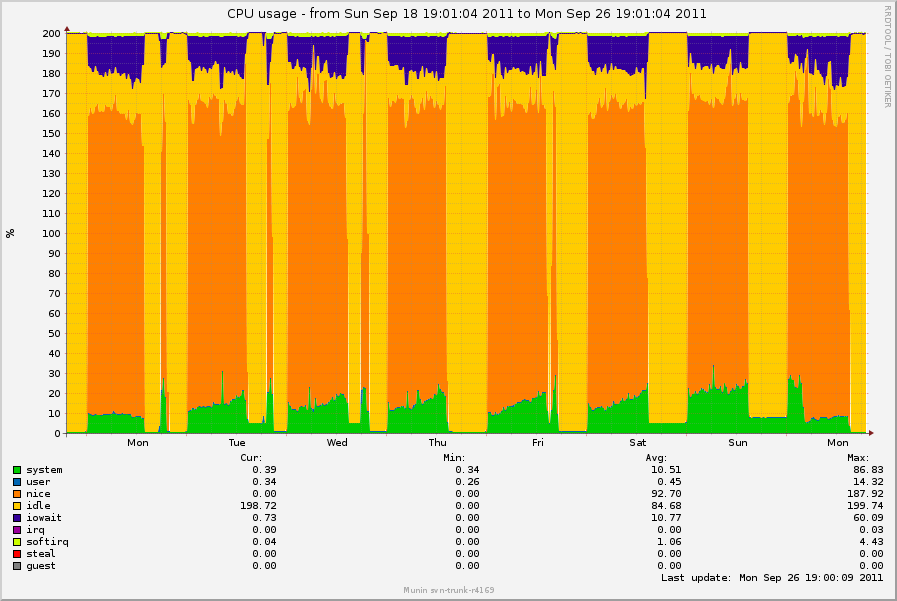
Running a kernel built on this commit, I can actually make the problem stop by just typing "sync". CPU then goes down to 0 and everything is fine. Future kernel versions, such as 2.6.36, do not change with just a "sync", but "sync;echo 3 > /proc/sys/vm/drop_caches;sync" _does_ stop the system CPU usage. I can bisect this change, too, if that would help.
Here is the commit:
commit b80c3cb628f0ebc241b02e38dd028969fb8026a2
Author: Trond Myklebust <[email protected]>
Date:   Fri Apr 9 19:07:07 2010 -0400
NFS: Ensure that writeback_single_inode() calls write_inode() when syncing
Since writeback_single_inode() checks the inode->i_state flags _before_ it flushes out the data, we need to ensure that the I_DIRTY_DATASYNC flag is already set. Otherwise we risk not seeing a call to write_inode(), which again means that we break fsync() et al...
fs/nfs/write.c +2 -2
@@ -421,6 +421,7 @@ static void nfs_mark_request_dirty(struct nfs_page *req) {__set_page_dirty_nobuffers (req->wb_page); +__mark_inode_dirty (req->wb_page->mapping->host,I_DIRTY_DATASYNC ); }#if defined(CONFIG_NFS_V3 ) || defined(CONFIG_NFS_V4 )
@@ -660,6 +661,7 @@ static int nfs_writepage_setup(struct nfs_open_context *ctx, struct page *page, req =nfs_setup_write_request (ctx, page, offset, count);if (IS_ERR (req))return PTR_ERR (req); +nfs_mark_request_dirty (req);/* Update file length */ nfs_grow_file (page, offset, count);nfs_mark_uptodate (page, req->wb_pgbase, req->wb_bytes);
@@ -739,8 +741,6 @@ int nfs_updatepage(struct file *file, struct page *page, status =nfs_writepage_setup (ctx, page, offset, count);if (status <0 )nfs_set_pageerror (page); -else -__set_page_dirty_nobuffers (page);dprintk ("NFS: nfs_updatepage returns %d (isize %lld)\n" , status, (long long )i_size_read (inode));
With the build before this commit, the system time stays low always and returns to 0% after every daily run.
Simon-
Quoted 89 lines · Trond Myklebust
Quoted 65 lines · Simon Kirby
Possibly related to the flush-processes-taking-CPU issues I saw previously, I thought this was interesting. I found a log-crunching box that does all of its work via NFS and spends most of the day sleeping. It has been using a linearly-increasing amount of system time during the time where is sleeping. munin graph:
http://0x.ca/sim/ref/2.6.36/cpu_logcrunch_nfs.png
top shows:
  PID USER      PR  NI  VIRT  RES  SHR S %CPU %MEM    TIME+  COMMAND
 4767 root      20   0     0    0    0 S   16  0.0   2413:29 flush-0:69
22385 root      20   0     0    0    0 S   10  0.0   1320:23 flush-0:70
(rest idle)
perf top shows:
-------------------------------------------------------------------------------------------
PerfTop: 252 irqs/sec kernel:97.2% exact: 0.0% [1000Hz cycles], (all, 2 CPUs)
-------------------------------------------------------------------------------------------samples pcnt function DSO
_______ _____ _______________________________ ___________912.00 21.2%
_raw_spin_lock[kernel]
592.00 13.8%nfs_writepages[kernel]
474.00 11.0%queue_io[kernel]
428.00 10.0%writeback_single_inode[kernel]
379.00 8.8%writeback_sb_inodes[kernel]
237.00 5.5%bit_waitqueue[kernel]
184.00 4.3%do_writepages[kernel]
169.00 3.9%__iget[kernel]
132.00 3.1%redirty_tail[kernel]
85.00 2.0% iput [kernel]
72.00 1.7%_atomic_dec_and_lock[kernel]
67.00 1.6%write_cache_pages[kernel]
63.00 1.5%port_inb[ipmi_si]
62.00 1.4%__mark_inode_dirty[kernel]
48.00 1.1%__wake_up_bit[kernel]
32.00 0.7%nfs_write_inode[kernel]
26.00 0.6%native_read_tsc[kernel]
25.00 0.6%radix_tree_gang_lookup_tag_slot[kernel]
25.00 0.6% schedule [kernel]
24.00 0.6%wake_up_bit[kernel]
20.00 0.5%apic_timer_interrupt[kernel]
19.00 0.4%ia32_syscall[kernel]
16.00 0.4%find_get_pages_tag[kernel]
15.00 0.3%_raw_spin_lock_irqsave[kernel]
15.00 0.3%load_balance[kernel]
13.00 0.3%ktime_get[kernel]
12.00 0.3%shrink_icache_memory[kernel]
11.00 0.3% semop libc-2.7.so
9.00 0.2%nfs_pageio_doio[kernel]
8.00 0.2%dso__find_symbolperf
8.00 0.2%down_read[kernel]
7.00 0.2%__switch_to[kernel]
7.00 0.2%__phys_addr[kernel]
7.00 0.2%nfs_pageio_init[kernel]
7.00 0.2%pagevec_lookup_tag[kernel]
7.00 0.2%_cond_resched[kernel]
7.00 0.2%up_read[kernel]
6.00 0.1%sched_clock_local[kernel]
5.00 0.1%rb_erase[kernel]
5.00 0.1%page_fault[kernel]Quoted 5 lines
"tcpdump -i any -n port 2049" and "nfsstat" shows this work does not actually result in any NFS packets.
Known 2.6.36 issue? This did not occur on 2.6.35.4, according to the munin graphs. I'll try 2.6.37-rc an see if it changes.
Possibly a side effect of the
fs/fs-writeback.cchanges in 2.6.36? You do appear to be hitting a lot of spinlock contention, but I suspect that a lot of it is coming fromwriteback_sb_inodes,writeback_single_inodeandqueue_io, all of which seem unnaturally high on your stats above.I don't see how you can be seeing no traffic on the wire. You are certainly hitting some page writeout (0.2%
nfs_pageio_doio).Cheers
TrondSignature · 6 lines
Trond Myklebust
Linux NFS client maintainer

NetApp
[email protected]
www.netapp.com
Re: NFS client growing system CPU
Quoted 9 lines · Simon Kirby
Hello!
Following up on "System CPU increasing on idle 2.6.36", this issue is still happening even on 3.1-rc7. So, since it has been 9 months since I reported this, I figured I'd bisect this issue. The first bisection ended in an IPMI regression that looked like the problem, so I had to start again. Eventually, I got commit
b80c3cb628f0ebc241b02e38dd028969fb8026a2which made it into 2.6.34-rc4.
Quoted 5 lines
With this commit, system CPU keeps rising as the log crunch box runs (reads log files via NFS and spews out HTML files into NFS-mounted report directories). When it finishes the daily run, the system time stays non-zero and continues to be higher and higher after each run, until the box never completes a run within a day due to all of the wasted cycles.
So reverting that commit fixes the problem on 3.1-rc7?
As far as I can see, doing so should be safe thanks to commit 5547e8aac6f71505d621a612de2fca0dd988b439 (writeback: Update dirty flags in two steps) which fixes the original problem at the VFS level.
Cheers
Trond
Signature · 6 lines
Trond Myklebust
Linux NFS client maintainer

NetApp
[email protected]
www.netapp.com
Re: NFS client growing system CPU
Quoted 16 lines · Trond Myklebust
Quoted 9 lines · Simon Kirby
Hello!
Following up on "System CPU increasing on idle 2.6.36", this issue is still happening even on 3.1-rc7. So, since it has been 9 months since I reported this, I figured I'd bisect this issue. The first bisection ended in an IPMI regression that looked like the problem, so I had to start again. Eventually, I got commit
b80c3cb628f0ebc241b02e38dd028969fb8026a2which made it into 2.6.34-rc4.Quoted 5 lines
With this commit, system CPU keeps rising as the log crunch box runs (reads log files via NFS and spews out HTML files into NFS-mounted report directories). When it finishes the daily run, the system time stays non-zero and continues to be higher and higher after each run, until the box never completes a run within a day due to all of the wasted cycles.
Quoted 5 lines
So reverting that commit fixes the problem on 3.1-rc7?
As far as I can see, doing so should be safe thanks to commit
5547e8aac6f71505d621a612de2fca0dd988b439(writeback: Update dirty flags in two steps) which fixes the original problem at the VFS level.
Hmm, I went to git revert b80c3cb628f0ebc241b02e38dd028969fb8026a2, but for some reason git left the nfs_mark_request_dirty(req); line in nfs_writepage_setup(), even though the original commit had that. Is that OK or should I remove that as well?
Once that is sorted, I'll build it and let it run for a day and let you know. Thanks!
Simon-
Re: NFS client growing system CPU
Quoted 24 lines · Simon Kirby
Quoted 16 lines · Trond Myklebust
Quoted 9 lines · Simon Kirby
Hello!
Following up on "System CPU increasing on idle 2.6.36", this issue is still happening even on 3.1-rc7. So, since it has been 9 months since I reported this, I figured I'd bisect this issue. The first bisection ended in an IPMI regression that looked like the problem, so I had to start again. Eventually, I got commit
b80c3cb628f0ebc241b02e38dd028969fb8026a2which made it into 2.6.34-rc4.Quoted 5 lines
With this commit, system CPU keeps rising as the log crunch box runs (reads log files via NFS and spews out HTML files into NFS-mounted report directories). When it finishes the daily run, the system time stays non-zero and continues to be higher and higher after each run, until the box never completes a run within a day due to all of the wasted cycles.
Quoted 5 lines
So reverting that commit fixes the problem on 3.1-rc7?
As far as I can see, doing so should be safe thanks to commit
5547e8aac6f71505d621a612de2fca0dd988b439(writeback: Update dirty flags in two steps) which fixes the original problem at the VFS level.
Quoted 7 lines
Hmm, I went to git revert
b80c3cb628f0ebc241b02e38dd028969fb8026a2, but for some reason git left thenfs_mark_request_dirty(req); line innfs_writepage_setup(), even though the original commit had that. Is that OK or should I remove that as well?Once that is sorted, I'll build it and let it run for a day and let you know. Thanks!
It shouldn't make any difference whether you leave it or remove it. The resulting second call to __set_page_dirty_nobuffers() will always be a no-op since the page will already be marked as dirty.
Cheers
Trond
Signature · 6 lines
Trond Myklebust
Linux NFS client maintainer

NetApp
[email protected]
www.netapp.com
Re: NFS client growing system CPU
Quoted 30 lines · Trond Myklebust
Quoted 29 lines · Simon Kirby
Quoted 16 lines · Trond Myklebust
Quoted 9 lines · Simon Kirby
Hello!
Following up on "System CPU increasing on idle 2.6.36", this issue is still happening even on 3.1-rc7. So, since it has been 9 months since I reported this, I figured I'd bisect this issue. The first bisection ended in an IPMI regression that looked like the problem, so I had to start again. Eventually, I got commit
b80c3cb628f0ebc241b02e38dd028969fb8026a2which made it into 2.6.34-rc4.Quoted 5 lines
With this commit, system CPU keeps rising as the log crunch box runs (reads log files via NFS and spews out HTML files into NFS-mounted report directories). When it finishes the daily run, the system time stays non-zero and continues to be higher and higher after each run, until the box never completes a run within a day due to all of the wasted cycles.
Quoted 5 lines
So reverting that commit fixes the problem on 3.1-rc7?
As far as I can see, doing so should be safe thanks to commit
5547e8aac6f71505d621a612de2fca0dd988b439(writeback: Update dirty flags in two steps) which fixes the original problem at the VFS level.Hmm, I went to git revert
b80c3cb628f0ebc241b02e38dd028969fb8026a2, but for some reason git left thenfs_mark_request_dirty(req); line innfs_writepage_setup(), even though the original commit had that. Is that OK or should I remove that as well?
Quoted 6 lines
Quoted 2 lines
Once that is sorted, I'll build it and let it run for a day and let you know. Thanks!
It shouldn't make any difference whether you leave it or remove it. The resulting second call to
__set_page_dirty_nobuffers()will always be a no-op since the page will already be marked as dirty.
Ok, confirmed, git revert b80c3cb628f0ebc241b02e38dd028969fb8026a2 on 3.1-rc7 fixes the problem for me. Does this make sense, then, or do we need further investigation and/or testing?
Simon-
Re: NFS client growing system CPU
Quoted 35 lines · Simon Kirby
Quoted 33 lines · Trond Myklebust
Quoted 31 lines · Simon Kirby
Quoted 16 lines · Trond Myklebust
Quoted 9 lines · Simon Kirby
Hello!
Following up on "System CPU increasing on idle 2.6.36", this issue is still happening even on 3.1-rc7. So, since it has been 9 months since I reported this, I figured I'd bisect this issue. The first bisection ended in an IPMI regression that looked like the problem, so I had to start again. Eventually, I got commit
b80c3cb628f0ebc241b02e38dd028969fb8026a2which made it into 2.6.34-rc4.Quoted 5 lines
With this commit, system CPU keeps rising as the log crunch box runs (reads log files via NFS and spews out HTML files into NFS-mounted report directories). When it finishes the daily run, the system time stays non-zero and continues to be higher and higher after each run, until the box never completes a run within a day due to all of the wasted cycles.
Quoted 5 lines
So reverting that commit fixes the problem on 3.1-rc7?
As far as I can see, doing so should be safe thanks to commit
5547e8aac6f71505d621a612de2fca0dd988b439(writeback: Update dirty flags in two steps) which fixes the original problem at the VFS level.Hmm, I went to git revert
b80c3cb628f0ebc241b02e38dd028969fb8026a2, but for some reason git left thenfs_mark_request_dirty(req); line innfs_writepage_setup(), even though the original commit had that. Is that OK or should I remove that as well?Once that is sorted, I'll build it and let it run for a day and let you know. Thanks!
Quoted 7 lines
Quoted 3 lines
It shouldn't make any difference whether you leave it or remove it. The resulting second call to
__set_page_dirty_nobuffers()will always be a no-op since the page will already be marked as dirty.Ok, confirmed, git revert
b80c3cb628f0ebc241b02e38dd028969fb8026a2on 3.1-rc7 fixes the problem for me. Does this make sense, then, or do we need further investigation and/or testing?
Just to clear up what I said before, it seems that on plain 3.1-rc8, I am actually able to clear the endless CPU use in nfs_writepages by just running "sync". I am not sure when this changed, but I'm pretty sure that some versions between 2.6.34 and 3.1-rc used to not be affected by just "sync" unless it was paired with drop_caches. Maybe this makes the problem more obvious...
Simon-
RE: NFS client growing system CPU
Quoted 7 lines
-----Original Message-----
From: Simon Kirby [mailto:[email protected]]
Sent: Thursday, September 29, 2011 8:58 PM
To: Myklebust, Trond
Cc: [email protected]; [email protected]
Subject: Re: NFS client growing system CPU
Quoted 13 lines
Quoted 11 lines · Simon Kirby
Quoted 9 lines · Trond Myklebust
Quoted 8 lines · Simon Kirby
Quoted 6 lines · Trond Myklebust
Quoted 5 lines · Simon Kirby
Hello!
Following up on "System CPU increasing on idle 2.6.36", this issue is still happening even on 3.1-rc7. So, since it has been 9 months since I reported this, I figured I'd bisect
this
Quoted 2 lines
Quoted 2 lines
Quoted 2 lines
Quoted 2 lines
Quoted 2 lines
Quoted 2 lines
issue. The first bisection ended in an IPMI regression that looked like the problem, so I had to start again.
Eventually,
Quoted 7 lines
Quoted 7 lines
Quoted 7 lines
Quoted 7 lines
Quoted 7 lines
Quoted 7 lines
I got commit
b80c3cb628f0ebc241b02e38dd028969fb8026a2which made it into 2.6.34-rc4.With this commit, system CPU keeps rising as the log crunch box runs (reads log files via NFS and spews out HTML files into NFS-mounted report directories). When it finishes the daily run, the system time stays non-zero and continues to
be
Quoted 1 line
Quoted 1 line
Quoted 1 line
Quoted 1 line
Quoted 1 line
Quoted 1 line
higher and higher after each run, until the box never
completes a
Quoted 7 lines
run within a day due to all of the wasted cycles.
Quoted 6 lines
Quoted 6 lines
Quoted 6 lines
Quoted 6 lines
So reverting that commit fixes the problem on 3.1-rc7?
As far as I can see, doing so should be safe thanks to commit
5547e8aac6f71505d621a612de2fca0dd988b439(writeback: Update dirty flags in two steps) which fixes the original problem at
the VFS
Quoted 4 lines
level.
Quoted 3 lines
Quoted 3 lines
Quoted 3 lines
Hmm, I went to git revert
b80c3cb628f0ebc241b02e38dd028969fb8026a2, but for some reason
git
Quoted 2 lines
Quoted 2 lines
Quoted 2 lines
Quoted 2 lines
left the
nfs_mark_request_dirty(req); line innfs_writepage_setup(), even though the original commit had that.
Is
Quoted 6 lines
that OK or should I remove that as well?
Quoted 5 lines
Quoted 5 lines
Quoted 3 lines
Once that is sorted, I'll build it and let it run for a day and let you know. Thanks!
It shouldn't make any difference whether you leave it or remove
it.
Quoted 4 lines
Quoted 4 lines
Quoted 2 lines
The resulting second call to
__set_page_dirty_nobuffers()will always be a no-op since the page will already be marked as dirty.Ok, confirmed, git revert
b80c3cb628f0ebc241b02e38dd028969fb8026a2
on
Quoted 1 line
Quoted 1 line
3.1-rc7 fixes the problem for me. Does this make sense, then, or do
we
Quoted 3 lines
Quoted 1 line
need further investigation and/or testing?
Just to clear up what I said before, it seems that on plain 3.1-rc8, I
am actually
Quoted 1 line
able to clear the endless CPU use in
nfs_writepagesby just running
"sync". I
Quoted 2 lines
am not sure when this changed, but I'm pretty sure that some versions between 2.6.34 and 3.1-rc used to not be affected by just "sync"
unless it
Quoted 2 lines
was paired with
drop_caches. Maybe this makes the problem more obvious...
Hi Simon,
I think you are just finding yourself cycling through the VFS writeback routines all the time because we dirty the inode for COMMIT at the same time as we dirty a new page. Usually, we want to wait until after the WRITE rpc call has completed, and so it was only the vfs race that forced us to write this workaround so that we can guarantee reliable fsync() behaviour.
My only concern at this point is to make sure that in reverting that patch, we haven't overlooked some other fsync() bug that this patch fixed. So far, it looks as if Dmitry's patch is sufficient to deal with any issues that I can see.
Cheers
Trond
Re: NFS client growing system CPU
Quoted 85 lines · Trond
Quoted 7 lines
-----Original Message-----
From: Simon Kirby [mailto:[email protected]]
Sent: Thursday, September 29, 2011 8:58 PM
To: Myklebust, Trond
Cc: [email protected]; [email protected]
Subject: Re: NFS client growing system CPUQuoted 13 lines
Quoted 11 lines · Simon Kirby
Quoted 9 lines · Trond Myklebust
Quoted 8 lines · Simon Kirby
Quoted 6 lines · Trond Myklebust
Quoted 5 lines · Simon Kirby
Hello!
Following up on "System CPU increasing on idle 2.6.36", this issue is still happening even on 3.1-rc7. So, since it has been 9 months since I reported this, I figured I'd bisect
this
Quoted 2 lines
Quoted 2 lines
Quoted 2 lines
Quoted 2 lines
Quoted 2 lines
Quoted 2 lines
issue. The first bisection ended in an IPMI regression that looked like the problem, so I had to start again.
Eventually,
Quoted 7 lines
Quoted 7 lines
Quoted 7 lines
Quoted 7 lines
Quoted 7 lines
Quoted 7 lines
I got commit
b80c3cb628f0ebc241b02e38dd028969fb8026a2which made it into 2.6.34-rc4.With this commit, system CPU keeps rising as the log crunch box runs (reads log files via NFS and spews out HTML files into NFS-mounted report directories). When it finishes the daily run, the system time stays non-zero and continues to
be
Quoted 1 line
Quoted 1 line
Quoted 1 line
Quoted 1 line
Quoted 1 line
Quoted 1 line
higher and higher after each run, until the box never
completes a
Quoted 7 lines
run within a day due to all of the wasted cycles.
Quoted 6 lines
Quoted 6 lines
Quoted 6 lines
Quoted 6 lines
So reverting that commit fixes the problem on 3.1-rc7?
As far as I can see, doing so should be safe thanks to commit
5547e8aac6f71505d621a612de2fca0dd988b439(writeback: Update dirty flags in two steps) which fixes the original problem atthe VFS
Quoted 4 lines
level.
Quoted 3 lines
Quoted 3 lines
Quoted 3 lines
Hmm, I went to git revert
b80c3cb628f0ebc241b02e38dd028969fb8026a2, but for some reasongit
Quoted 2 lines
Quoted 2 lines
Quoted 2 lines
Quoted 2 lines
left the
nfs_mark_request_dirty(req); line innfs_writepage_setup(), even though the original commit had that.Is
Quoted 6 lines
that OK or should I remove that as well?
Quoted 5 lines
Quoted 5 lines
Quoted 3 lines
Once that is sorted, I'll build it and let it run for a day and let you know. Thanks!
It shouldn't make any difference whether you leave it or remove
it.
Quoted 4 lines
Quoted 4 lines
Quoted 2 lines
The resulting second call to
__set_page_dirty_nobuffers()will always be a no-op since the page will already be marked as dirty.Ok, confirmed, git revert
b80c3cb628f0ebc241b02e38dd028969fb8026a2on
Quoted 1 line
Quoted 1 line
3.1-rc7 fixes the problem for me. Does this make sense, then, or do
we
Quoted 3 lines
Quoted 1 line
need further investigation and/or testing?
Just to clear up what I said before, it seems that on plain 3.1-rc8, I
am actually
Quoted 1 line
able to clear the endless CPU use in
nfs_writepagesby just running"sync". I
Quoted 2 lines
am not sure when this changed, but I'm pretty sure that some versions between 2.6.34 and 3.1-rc used to not be affected by just "sync"
unless it
Quoted 2 lines
was paired with
drop_caches. Maybe this makes the problem more obvious...Hi Simon,
I think you are just finding yourself cycling through the VFS writeback routines all the time because we dirty the inode for COMMIT at the same time as we dirty a new page. Usually, we want to wait until after the WRITE rpc call has completed, and so it was only the vfs race that forced us to write this workaround so that we can guarantee reliable
fsync()behaviour.
Quoted 4 lines
My only concern at this point is to make sure that in reverting that patch, we haven't overlooked some other
fsync()bug that this patch fixed. So far, it looks as if Dmitry's patch is sufficient to deal with any issues that I can see.
Hello!
So, this is a regression that has caused uptime issues for us since 2.6.34-rc4. Dmitry's patch went into 2.6.35, so I think this revert should be committed and be a stable candidate for 2.6.35 - 3.1.
We have not seen any problems resulting from the revert, but our loads are not particularly fsync()-heavy. How did things work before this patch, anyway?
Here is another graph showing the revert fixing the problem on this box with relatively simple workload (revert applied Tuesday evening):
http://0x.ca/sim/ref/3.1-rc8/cpu-analog02-revert-b80c3cb6.png
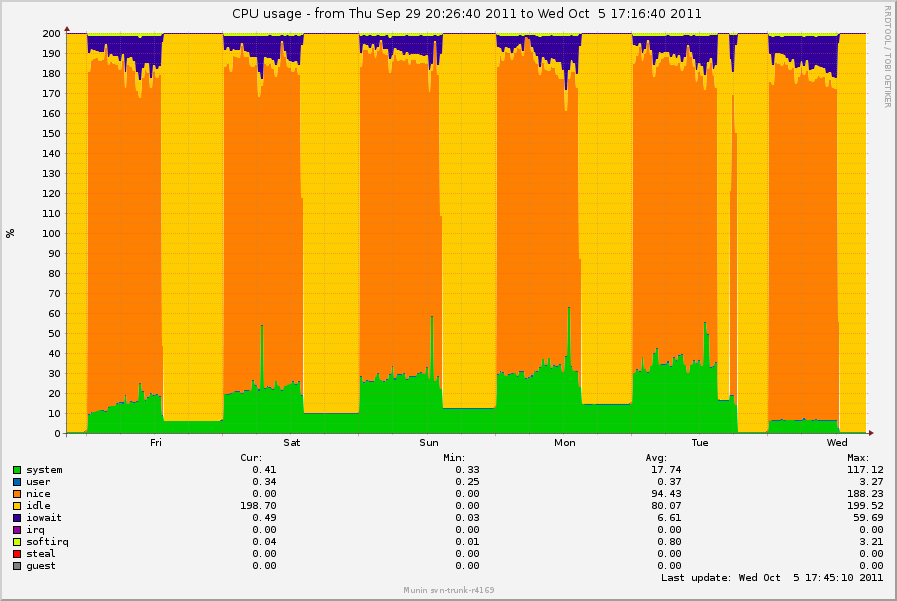
It is helping on many other boxes, too, but they get various spurts of memory pressure and other CPU spikes that cause the difference to be harder to see. We're still running your sunrpc/clnt.c debugging patch as well, but haven't hit the hang again yet.
Simon-
Quoted 10 lines · Simon Kirby
Possibly related to the flush-processes-taking-CPU issues I saw previously, I thought this was interesting. I found a log-crunching box that does all of its work via NFS and spends most of the day sleeping. It has been using a linearly-increasing amount of system time during the time where is sleeping. munin graph:
http://0x.ca/sim/ref/2.6.36/cpu_logcrunch_nfs.png
...
Known 2.6.36 issue? This did not occur on 2.6.35.4, according to the munin graphs. I'll try 2.6.37-rc an see if it changes.
So, back on this topic,
It seems that system CPU from "flush" processes is still increasing during and after periods of NFS activity, even with 2.6.37-rc5-git4:
http://0x.ca/sim/ref/2.6.37/cpu_nfs.png
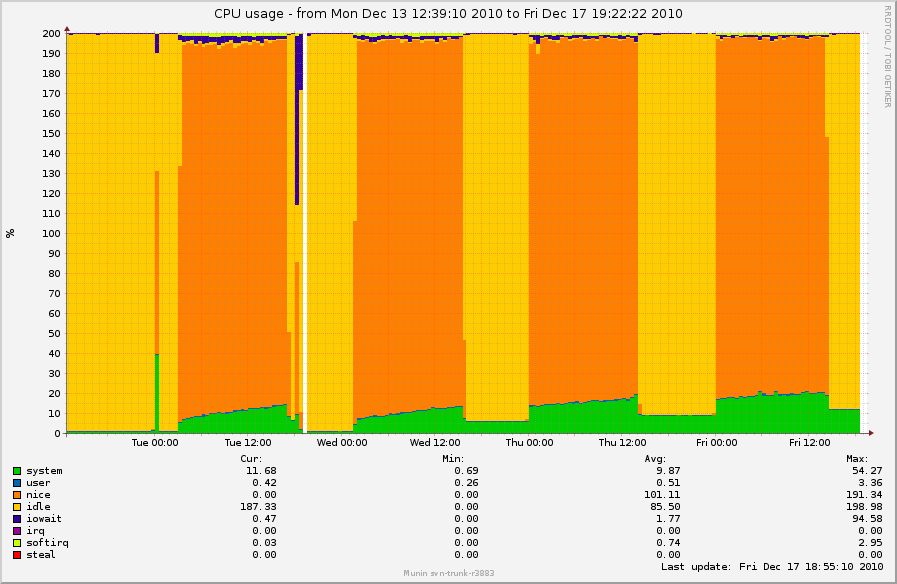
Something is definitely going on while NFS is active, and then keeps happening in the idle periods. top and perf top look the same as in 2.6.36. No userland activity at all, but the kernel keeps doing stuff.
I could bisect this, but I have to wait a day for each build, unless I can come up with a way to reproduce it more quickly. The mount points for which the flush processes are active are the two mount points where the logs are read from, rotated, compressed, and unlinked, and where the reports are written, running in parallel under an xargs -P 15.
I'm pretty sure the only syscalls that are reproducing this are read(), readdir(), lstat(), write(), rename(), unlink(), and close(). There's nothing special happening here...
Simon-
Quoted 30 lines · Simon Kirby
Quoted 10 lines · Simon Kirby
Possibly related to the flush-processes-taking-CPU issues I saw previously, I thought this was interesting. I found a log-crunching box that does all of its work via NFS and spends most of the day sleeping. It has been using a linearly-increasing amount of system time during the time where is sleeping. munin graph:
http://0x.ca/sim/ref/2.6.36/cpu_logcrunch_nfs.png
...
Known 2.6.36 issue? This did not occur on 2.6.35.4, according to the munin graphs. I'll try 2.6.37-rc an see if it changes.So, back on this topic,
It seems that system CPU from "flush" processes is still increasing during and after periods of NFS activity, even with 2.6.37-rc5-git4:
http://0x.ca/sim/ref/2.6.37/cpu_nfs.png
Something is definitely going on while NFS is active, and then keeps happening in the idle periods. top and perf top look the same as in 2.6.36. No userland activity at all, but the kernel keeps doing stuff.
I could bisect this, but I have to wait a day for each build, unless I can come up with a way to reproduce it more quickly. The mount points for which the flush processes are active are the two mount points where the logs are read from, rotated, compressed, and unlinked, and where the reports are written, running in parallel under an xargs -P 15.
Quoted 3 lines
I'm pretty sure the only syscalls that are reproducing this are
read(),readdir(),lstat(),write(),rename(),unlink(), andclose(). There's nothing special happening here...
I'm running 2.6.36 on a number of mail servers that do a great deal of write I/O to NFS (all Netapps, NFSv3, UDP). I've seen this exact same behaviour a number of times since moving to 2.6.36. I just had to powercycle a box a minute ago doing the same thing. Any time I've seen this, the only remedy is reboot. These boxes were last running a 2.6.32.x kernel and had no such behaviour. I didn't think to check nfsstat before rebooting but I can next time if it'd be useful.
'top' consistently showed 6 flush threads tying up 100% total of the CPU:
PID USER PR NI VIRT RES SHR S %CPU %MEM TIME+ COMMAND
4853 root 20 0 0 0 0 R 33 0.0 36:47.13
flush-0:26
4854 root 20 0 0 0 0 R 33 0.0 38:56.89
flush-0:27
4855 root 20 0 0 0 0 R 33 0.0 38:35.01
flush-0:28
4856 root 20 0 0 0 0 R 33 0.0 39:00.11
flush-0:29
4857 root 20 0 0 0 0 R 33 0.0 37:39.08
flush-0:30
4858 root 20 0 0 0 0 R 31 0.0 37:04.30 flush-0:31
perf top consistently showed _raw_spin_lock at over 50% (these boxes are only 2 cores though). shrink_icache_memory was usually near the top and nfs_writepages hung around the top 5 or 6. Looking at tcpdump, there was no actual packets getting sent to those Netapps (I was looking at all ports too, not just 2049). This 'perf top' is fairly representative of what I was seeing:
------------------------------------------------------------------------------
PerfTop: 23638 irqs/sec kernel:97.3% [100000 cycles], (all, 2 CPUs)
------------------------------------------------------------------------------
samples pcnt RIP kernel function
______ _______ _____ ________________ _______________
           330867.00 - 62.5% - 00000000003cc97a : _raw_spin_lock
            19496.00 -  3.7% - 00000000000c83e8 : shrink_icache_memory
            13634.00 -  2.6% - 00000000003cc12c : down_read
            12064.00 -  2.3% - 000000000004d817 : up_read
             7807.00 -  1.5% - 0000000000022c38 : kunmap_atomic_notypecheck
             7496.00 -  1.4% - 0000000000168258 : nfs_writepages
             7343.00 -  1.4% - 00000000000d0244 : writeback_single_inode
             5528.00 -  1.0% - 0000000000022d36 : kmap_atomic_prot
             4915.00 -  0.9% - 00000000000c75c4 : __iget
             3933.00 -  0.7% - 00000000000d0708 : writeback_sb_inodes
             3793.00 -  0.7% - 0000000000049d27 : wake_up_bit
             3579.00 -  0.7% - 00000000000c805c : dispose_list
             3487.00 -  0.7% - 00000000000d08cf : __mark_inode_dirty
             3144.00 -  0.6% - 00000000003cd890 : page_fault
2539.00 - 0.5% - 00000000001d6afc : _atomic_dec_and_lockQuoted 30 lines · Simon Kirby
Quoted 10 lines · Simon Kirby
Possibly related to the flush-processes-taking-CPU issues I saw previously, I thought this was interesting. I found a log-crunching box that does all of its work via NFS and spends most of the day sleeping. It has been using a linearly-increasing amount of system time during the time where is sleeping. munin graph:
http://0x.ca/sim/ref/2.6.36/cpu_logcrunch_nfs.png
...
Known 2.6.36 issue? This did not occur on 2.6.35.4, according to the munin graphs. I'll try 2.6.37-rc an see if it changes.So, back on this topic,
It seems that system CPU from "flush" processes is still increasing during and after periods of NFS activity, even with 2.6.37-rc5-git4:
http://0x.ca/sim/ref/2.6.37/cpu_nfs.pngSomething is definitely going on while NFS is active, and then keeps happening in the idle periods. top and perf top look the same as in 2.6.36. No userland activity at all, but the kernel keeps doing stuff.
I could bisect this, but I have to wait a day for each build, unless I can come up with a way to reproduce it more quickly. The mount points for which the flush processes are active are the two mount points where the logs are read from, rotated, compressed, and unlinked, and where the reports are written, running in parallel under an xargs -P 15.
Quoted 3 lines
I'm pretty sure the only syscalls that are reproducing this are
read(),readdir(),lstat(),write(),rename(),unlink(), andclose(). There's nothing special happening here...
I've noticed nfs_inode_cache is ever-increasing as well with 2.6.37:
OBJS ACTIVE USE OBJ SIZE SLABS OBJ/SLAB CACHE SIZE NAME
2562514 2541520 99% 0.95K 78739 33 2519648K nfs_inode_cache
467200 285110  61%    0.02K   1825      256      7300K kmalloc-16
299397 242350  80%    0.19K  14257       21     57028K dentry
217434 131978  60%    0.55K   7767       28    124272K radix_tree_node
215232  81522  37%    0.06K   3363       64     13452K kmalloc-64
183027 136802  74%    0.10K   4693       39     18772K buffer_head
101120  71184  70%    0.03K    790      128      3160K kmalloc-32
 79616  59713  75%    0.12K   2488       32      9952K kmalloc-128
 66560  41257  61%    0.01K    130      512       520K kmalloc-8
 42126  26650  63%    0.75K   2006       21     32096K ext3_inode_cache
http://0x.ca/sim/ref/2.6.37/inodes_nfs.png
http://0x.ca/sim/ref/2.6.37/cpu2_nfs.png
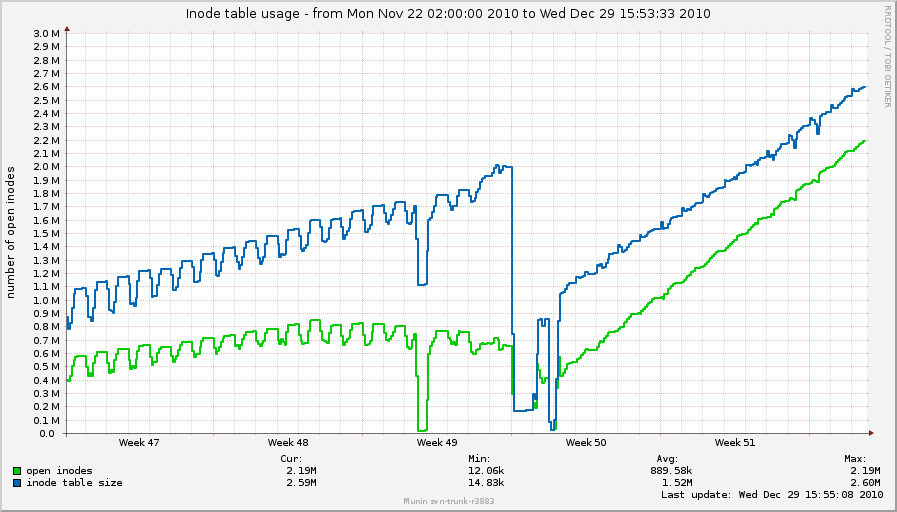
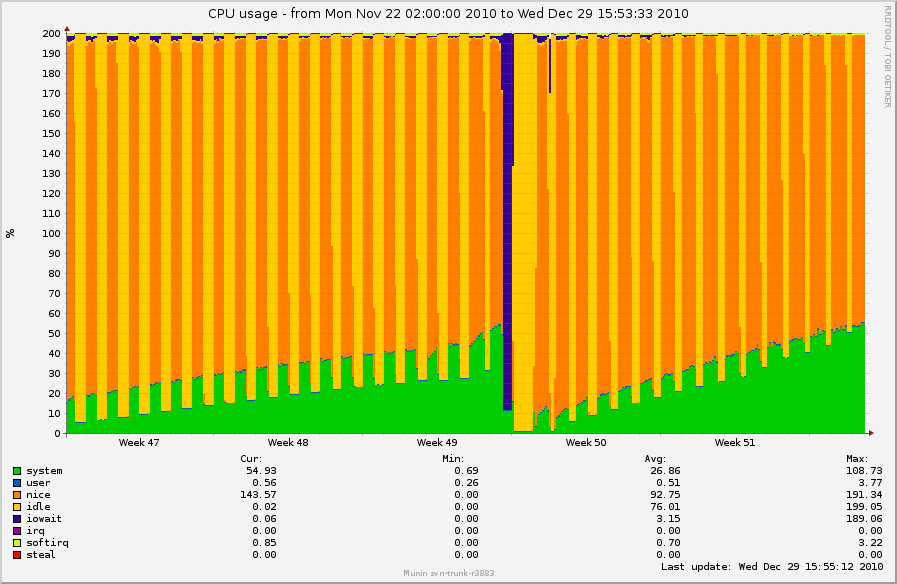
Perhaps I could bisect just fs/nfs changes between 2.6.35 and 2.6.36 to try to track this down without having to wait too long, unless somebody can see what is happening here.
Simon-
Quoted 50 lines · Simon Kirby
Quoted 30 lines · Simon Kirby
Quoted 10 lines · Simon Kirby
Possibly related to the flush-processes-taking-CPU issues I saw previously, I thought this was interesting. I found a log-crunching box that does all of its work via NFS and spends most of the day sleeping. It has been using a linearly-increasing amount of system time during the time where is sleeping. munin graph:
http://0x.ca/sim/ref/2.6.36/cpu_logcrunch_nfs.png
...
Known 2.6.36 issue? This did not occur on 2.6.35.4, according to the munin graphs. I'll try 2.6.37-rc an see if it changes.So, back on this topic,
It seems that system CPU from "flush" processes is still increasing during and after periods of NFS activity, even with 2.6.37-rc5-git4:
http://0x.ca/sim/ref/2.6.37/cpu_nfs.png
Something is definitely going on while NFS is active, and then keeps happening in the idle periods. top and perf top look the same as in 2.6.36. No userland activity at all, but the kernel keeps doing stuff.
I could bisect this, but I have to wait a day for each build, unless I can come up with a way to reproduce it more quickly. The mount points for which the flush processes are active are the two mount points where the logs are read from, rotated, compressed, and unlinked, and where the reports are written, running in parallel under an xargs -P 15.
Quoted 3 lines
I'm pretty sure the only syscalls that are reproducing this are
read(),readdir(),lstat(),write(),rename(),unlink(), andclose(). There's nothing special happening here...I've noticed
nfs_inode_cacheis ever-increasing as well with 2.6.37:OBJS ACTIVE USE OBJ SIZE SLABS OBJ/SLAB CACHE SIZE NAME 2562514 2541520 99% 0.95K 78739 33 2519648K
nfs_inode_cache467200 285110 61% 0.02K 1825 256 7300K kmalloc-16 299397 242350 80% 0.19K 14257 21 57028K dentry 217434 131978 60% 0.55K 7767 28 124272Kradix_tree_node215232 81522 37% 0.06K 3363 64 13452K kmalloc-64 183027 136802 74% 0.10K 4693 39 18772Kbuffer_head101120 71184 70% 0.03K 790 128 3160K kmalloc-32 79616 59713 75% 0.12K 2488 32 9952K kmalloc-128 66560 41257 61% 0.01K 130 512 520K kmalloc-8 42126 26650 63% 0.75K 2006 21 32096Kext3_inode_cache
Quoted 6 lines
http://0x.ca/sim/ref/2.6.37/inodes_nfs.png
http://0x.ca/sim/ref/2.6.37/cpu2_nfs.pngPerhaps I could bisect just fs/nfs changes between 2.6.35 and 2.6.36 to try to track this down without having to wait too long, unless somebody can see what is happening here.
I'll get started bisecting too, since this is something of a show-stopper. Boxes that pre-2.6.36 would stay up for months at a time now have to be powercycled every couple of days (which is about how long it takes for this behavior to show up). This is across-the-board for about 50 boxes, ranging from 2.6.36 to 2.6.36.2.
Simon: It's probably irrelevant since these are kernel threads, but I'm curious what distro your boxes are running. Ours are Debian Lenny, i386, Dell Poweredge 850s. Just trying to figure out any commonalities. I'll get my boxes back on 2.6.36.2 and start watching nfs_inode_cache as well.
Quoted 29 lines · Mark Moseley
Quoted 14 lines · Simon Kirby
I've noticed
nfs_inode_cacheis ever-increasing as well with 2.6.37:?OBJS ACTIVE ?USE OBJ SIZE ?SLABS OBJ/SLAB CACHE SIZE NAME 2562514 2541520 ?99% ? ?0.95K ?78739 ? ? ? 33 ? 2519648K
nfs_inode_cache467200 285110 ?61% ? ?0.02K ? 1825 ? ? ?256 ? ? ?7300K kmalloc-16 299397 242350 ?80% ? ?0.19K ?14257 ? ? ? 21 ? ? 57028K dentry 217434 131978 ?60% ? ?0.55K ? 7767 ? ? ? 28 ? ?124272Kradix_tree_node215232 ?81522 ?37% ? ?0.06K ? 3363 ? ? ? 64 ? ? 13452K kmalloc-64 183027 136802 ?74% ? ?0.10K ? 4693 ? ? ? 39 ? ? 18772Kbuffer_head101120 ?71184 ?70% ? ?0.03K ? ?790 ? ? ?128 ? ? ?3160K kmalloc-32 ?79616 ?59713 ?75% ? ?0.12K ? 2488 ? ? ? 32 ? ? ?9952K kmalloc-128 ?66560 ?41257 ?61% ? ?0.01K ? ?130 ? ? ?512 ? ? ? 520K kmalloc-8 ?42126 ?26650 ?63% ? ?0.75K ? 2006 ? ? ? 21 ? ? 32096Kext3_inode_cacheQuoted 6 lines
http://0x.ca/sim/ref/2.6.37/inodes_nfs.png
http://0x.ca/sim/ref/2.6.37/cpu2_nfs.pngPerhaps I could bisect just fs/nfs changes between 2.6.35 and 2.6.36 to try to track this down without having to wait too long, unless somebody can see what is happening here.
I'll get started bisecting too, since this is something of a show-stopper. Boxes that pre-2.6.36 would stay up for months at a time now have to be powercycled every couple of days (which is about how long it takes for this behavior to show up). This is across-the-board for about 50 boxes, ranging from 2.6.36 to 2.6.36.2.
Quoted 5 lines
Simon: It's probably irrelevant since these are kernel threads, but I'm curious what distro your boxes are running. Ours are Debian Lenny, i386, Dell Poweredge 850s. Just trying to figure out any commonalities. I'll get my boxes back on 2.6.36.2 and start watching
nfs_inode_cacheas well.
Same distro, x86_64, similar servers.
I'm not sure if the two cases I am seeing are exactly the same problem, but on the log crunching boxes, system time seems proportional to nfs_inode_cache and nfs_inode_cache just keeps growing forever; however, if I stop the load and unmount the NFS mount points, all of the nfs_inode_cache objects do actually go away (after umount finishes).
It seems the shrinker callback might not be working as intended here.
On the shared server case, the crazy spinlock contention from all of the flusher processes happens suddenly and overloads the boxes for 10-15 minutes, and then everything recovers. Over 21 of these boxes, they each have about 500k-700k nfs_inode_cache objects. The log cruncher hit 3.3 million nfs_inode_cache objects before I unmounted.
Are your boxes repeating this behaviour at any predictable interval?
Simon-
Quoted 47 lines · Simon Kirby
Quoted 29 lines · Mark Moseley
Quoted 14 lines · Simon Kirby
I've noticed
nfs_inode_cacheis ever-increasing as well with 2.6.37:?OBJS ACTIVE ?USE OBJ SIZE ?SLABS OBJ/SLAB CACHE SIZE NAME 2562514 2541520 ?99% ? ?0.95K ?78739 ? ? ? 33 ? 2519648K
nfs_inode_cache467200 285110 ?61% ? ?0.02K ? 1825 ? ? ?256 ? ? ?7300K kmalloc-16 299397 242350 ?80% ? ?0.19K ?14257 ? ? ? 21 ? ? 57028K dentry 217434 131978 ?60% ? ?0.55K ? 7767 ? ? ? 28 ? ?124272Kradix_tree_node215232 ?81522 ?37% ? ?0.06K ? 3363 ? ? ? 64 ? ? 13452K kmalloc-64 183027 136802 ?74% ? ?0.10K ? 4693 ? ? ? 39 ? ? 18772Kbuffer_head101120 ?71184 ?70% ? ?0.03K ? ?790 ? ? ?128 ? ? ?3160K kmalloc-32 ?79616 ?59713 ?75% ? ?0.12K ? 2488 ? ? ? 32 ? ? ?9952K kmalloc-128 ?66560 ?41257 ?61% ? ?0.01K ? ?130 ? ? ?512 ? ? ? 520K kmalloc-8 ?42126 ?26650 ?63% ? ?0.75K ? 2006 ? ? ? 21 ? ? 32096Kext3_inode_cacheQuoted 6 lines
http://0x.ca/sim/ref/2.6.37/inodes_nfs.png
http://0x.ca/sim/ref/2.6.37/cpu2_nfs.pngPerhaps I could bisect just fs/nfs changes between 2.6.35 and 2.6.36 to try to track this down without having to wait too long, unless somebody can see what is happening here.
I'll get started bisecting too, since this is something of a show-stopper. Boxes that pre-2.6.36 would stay up for months at a time now have to be powercycled every couple of days (which is about how long it takes for this behavior to show up). This is across-the-board for about 50 boxes, ranging from 2.6.36 to 2.6.36.2.
Quoted 5 lines
Simon: It's probably irrelevant since these are kernel threads, but I'm curious what distro your boxes are running. Ours are Debian Lenny, i386, Dell Poweredge 850s. Just trying to figure out any commonalities. I'll get my boxes back on 2.6.36.2 and start watching
nfs_inode_cacheas well.Same distro,
x86_64, similar servers.I'm not sure if the two cases I am seeing are exactly the same problem, but on the log crunching boxes, system time seems proportional to
nfs_inode_cacheandnfs_inode_cachejust keeps growing forever; however, if I stop the load and unmount the NFS mount points, all of thenfs_inode_cacheobjects do actually go away (after umount finishes).It seems the shrinker callback might not be working as intended here.
Quoted 7 lines
On the shared server case, the crazy spinlock contention from all of the flusher processes happens suddenly and overloads the boxes for 10-15 minutes, and then everything recovers. Over 21 of these boxes, they each have about 500k-700k
nfs_inode_cacheobjects. The log cruncher hit 3.3 millionnfs_inode_cacheobjects before I unmounted.Are your boxes repeating this behaviour at any predictable interval?
Simon:
My boxes definitely fall into the latter category, with spinlock regularly sitting at 60-80% CPU (according to 'perf top'). As far as predictability, not strictly, but it's typically after an uptime of 2-3 days. They take so long to get into this state that I've never seen the actual transition in person, just the after-effects of flush-0:xx gone crazy. These boxes have a number of other NFS mounts, but it's on the flush-0:xx's for the heavily written-to NFS mounts that are spinning wildly, which you'd expect to be the case. The infrequently written-to NFS servers' flush-0:xx isn't to be found in 'top' output.
I'd booted into older kernels after my initial reply, so I'm 14 hrs into booting a box back into 2.6.36.2 and another box into a double-bisected 2.6.35-2.6.36 kernel (my first bisect hit compile errors). Both are running normally but that fits with the pattern so far.
NFS Guys:
Anything else we can be digging up to help debug this? This is a pretty ugly issue.
Quoted 74 lines · Mark Moseley
Quoted 47 lines · Simon Kirby
Quoted 29 lines · Mark Moseley
Quoted 14 lines · Simon Kirby
I've noticed
nfs_inode_cacheis ever-increasing as well with 2.6.37:?OBJS ACTIVE ?USE OBJ SIZE ?SLABS OBJ/SLAB CACHE SIZE NAME 2562514 2541520 ?99% ? ?0.95K ?78739 ? ? ? 33 ? 2519648K
nfs_inode_cache467200 285110 ?61% ? ?0.02K ? 1825 ? ? ?256 ? ? ?7300K kmalloc-16 299397 242350 ?80% ? ?0.19K ?14257 ? ? ? 21 ? ? 57028K dentry 217434 131978 ?60% ? ?0.55K ? 7767 ? ? ? 28 ? ?124272Kradix_tree_node215232 ?81522 ?37% ? ?0.06K ? 3363 ? ? ? 64 ? ? 13452K kmalloc-64 183027 136802 ?74% ? ?0.10K ? 4693 ? ? ? 39 ? ? 18772Kbuffer_head101120 ?71184 ?70% ? ?0.03K ? ?790 ? ? ?128 ? ? ?3160K kmalloc-32 ?79616 ?59713 ?75% ? ?0.12K ? 2488 ? ? ? 32 ? ? ?9952K kmalloc-128 ?66560 ?41257 ?61% ? ?0.01K ? ?130 ? ? ?512 ? ? ? 520K kmalloc-8 ?42126 ?26650 ?63% ? ?0.75K ? 2006 ? ? ? 21 ? ? 32096Kext3_inode_cacheQuoted 6 lines
http://0x.ca/sim/ref/2.6.37/inodes_nfs.png
http://0x.ca/sim/ref/2.6.37/cpu2_nfs.pngPerhaps I could bisect just fs/nfs changes between 2.6.35 and 2.6.36 to try to track this down without having to wait too long, unless somebody can see what is happening here.
I'll get started bisecting too, since this is something of a show-stopper. Boxes that pre-2.6.36 would stay up for months at a time now have to be powercycled every couple of days (which is about how long it takes for this behavior to show up). This is across-the-board for about 50 boxes, ranging from 2.6.36 to 2.6.36.2.
Quoted 5 lines
Simon: It's probably irrelevant since these are kernel threads, but I'm curious what distro your boxes are running. Ours are Debian Lenny, i386, Dell Poweredge 850s. Just trying to figure out any commonalities. I'll get my boxes back on 2.6.36.2 and start watching
nfs_inode_cacheas well.Same distro,
x86_64, similar servers.I'm not sure if the two cases I am seeing are exactly the same problem, but on the log crunching boxes, system time seems proportional to
nfs_inode_cacheandnfs_inode_cachejust keeps growing forever; however, if I stop the load and unmount the NFS mount points, all of thenfs_inode_cacheobjects do actually go away (after umount finishes).It seems the shrinker callback might not be working as intended here.
Quoted 7 lines
On the shared server case, the crazy spinlock contention from all of the flusher processes happens suddenly and overloads the boxes for 10-15 minutes, and then everything recovers. Over 21 of these boxes, they each have about 500k-700k
nfs_inode_cacheobjects. The log cruncher hit 3.3 millionnfs_inode_cacheobjects before I unmounted.Are your boxes repeating this behaviour at any predictable interval?
Simon:
My boxes definitely fall into the latter category, with spinlock regularly sitting at 60-80% CPU (according to 'perf top'). As far as predictability, not strictly, but it's typically after an uptime of 2-3 days. They take so long to get into this state that I've never seen the actual transition in person, just the after-effects of flush-0:xx gone crazy. These boxes have a number of other NFS mounts, but it's on the flush-0:xx's for the heavily written-to NFS mounts that are spinning wildly, which you'd expect to be the case. The infrequently written-to NFS servers' flush-0:xx isn't to be found in 'top' output.I'd booted into older kernels after my initial reply, so I'm 14 hrs into booting a box back into 2.6.36.2 and another box into a double-bisected 2.6.35-2.6.36 kernel (my first bisect hit compile errors). Both are running normally but that fits with the pattern so far.
Quoted 4 lines
NFS Guys:
Anything else we can be digging up to help debug this? This is a pretty ugly issue.
NOTE: NFS/Kernel guys: I've left the 2.6.36.2 box still thrashing about in case there's something you'd like me to look at.
Ok, both my 2.6.36.2 kernel box and my 2.6.35->2.6.36 bisect box (was bisected to ce7db282a3830f57f5b05ec48288c23a5c4d66d5 -- this is my first time doing bisect, so I'll preemptively apologize for doing anything silly) both went berserk within 15 mins of each other, after an uptime of around 63 hours for 2.6.36.2 and 65 hours for the bisected box. The 2.6.36.2 one is still running with all the various flush-0:xx threads spinning wildly. The bisected box just keeled over and died, but is back up now. The only kernel messages logged are just of the "task kworker/4:1:359 blocked for more than 120 seconds" variety, all with _raw_spin_lock_irq at the top of the stack trace.
Looking at slabinfo, specifically, this: stats=$(grep nfs_inode_cache /proc/slabinfo | awk '{ print $2, $3 }')
the active_objs and num_objs both increase to over a million (these boxes are delivering mail to NFS-mounted mailboxes, so that's perfectly reasonable). On both boxes, looking at sar, things start to go awry around 10am today EST. At that time on the 2.6.36.2 box, the NFS numbers look like this:
Fri Jan  7 09:58:00 2011: 1079433 1079650
Fri Jan  7 09:59:00 2011: 1079632 1080300
Fri Jan  7 10:00:00 2011: 1080196 1080300
Fri Jan  7 10:01:01 2011: 1080599 1080716
Fri Jan  7 10:02:01 2011: 1081074 1081288
on the bisected, like this:
Fri Jan  7 09:59:34 2011: 1162786 1165320
Fri Jan  7 10:00:34 2011: 1163301 1165320
Fri Jan  7 10:01:34 2011: 1164369 1165450
Fri Jan  7 10:02:35 2011: 1164179 1165450
Fri Jan  7 10:03:35 2011: 1165795 1166958
When the bisected box finally died, the last numbers were:
Fri Jan  7 10:40:33 2011: 1177156 1177202
Fri Jan  7 10:42:21 2011: 1177157 1177306
Fri Jan  7 10:44:55 2011: 1177201 1177324
Fri Jan  7 10:45:55 2011: 1177746 1177826
On the still-thrashing 2.6.36.2 box, the highwater mark is:
Fri Jan 7 10:23:30 2011: 1084020 1084070
and once things went awry, the active_objs started falling away and the number_objs has stayed at 1084070. Last numbers were:
Fri Jan 7 12:19:34 2011: 826623 1084070
The bisected box had reached 1mil entries (or more significantly 1048576 entries) by y'day evening. The 2.6.36.2 box hit that by 7am EST today. So in neither case was there a big spike in entries.
These boxes have identical workloads. They're not accessible from the net, so there's no chance of a DDoS or something. The significance of 10am EST could be either uptime-related (all these have gone down after 2-3 days) or just due to the to-be-expected early morning spike in mail flow.
Quoted 136 lines · Mark Moseley
Quoted 74 lines · Mark Moseley
Quoted 47 lines · Simon Kirby
Quoted 29 lines · Mark Moseley
Quoted 14 lines · Simon Kirby
I've noticed
nfs_inode_cacheis ever-increasing as well with 2.6.37:?OBJS ACTIVE ?USE OBJ SIZE ?SLABS OBJ/SLAB CACHE SIZE NAME 2562514 2541520 ?99% ? ?0.95K ?78739 ? ? ? 33 ? 2519648K
nfs_inode_cache467200 285110 ?61% ? ?0.02K ? 1825 ? ? ?256 ? ? ?7300K kmalloc-16 299397 242350 ?80% ? ?0.19K ?14257 ? ? ? 21 ? ? 57028K dentry 217434 131978 ?60% ? ?0.55K ? 7767 ? ? ? 28 ? ?124272Kradix_tree_node215232 ?81522 ?37% ? ?0.06K ? 3363 ? ? ? 64 ? ? 13452K kmalloc-64 183027 136802 ?74% ? ?0.10K ? 4693 ? ? ? 39 ? ? 18772Kbuffer_head101120 ?71184 ?70% ? ?0.03K ? ?790 ? ? ?128 ? ? ?3160K kmalloc-32 ?79616 ?59713 ?75% ? ?0.12K ? 2488 ? ? ? 32 ? ? ?9952K kmalloc-128 ?66560 ?41257 ?61% ? ?0.01K ? ?130 ? ? ?512 ? ? ? 520K kmalloc-8 ?42126 ?26650 ?63% ? ?0.75K ? 2006 ? ? ? 21 ? ? 32096Kext3_inode_cacheQuoted 6 lines
http://0x.ca/sim/ref/2.6.37/inodes_nfs.png
http://0x.ca/sim/ref/2.6.37/cpu2_nfs.pngPerhaps I could bisect just fs/nfs changes between 2.6.35 and 2.6.36 to try to track this down without having to wait too long, unless somebody can see what is happening here.
I'll get started bisecting too, since this is something of a show-stopper. Boxes that pre-2.6.36 would stay up for months at a time now have to be powercycled every couple of days (which is about how long it takes for this behavior to show up). This is across-the-board for about 50 boxes, ranging from 2.6.36 to 2.6.36.2.
Quoted 5 lines
Simon: It's probably irrelevant since these are kernel threads, but I'm curious what distro your boxes are running. Ours are Debian Lenny, i386, Dell Poweredge 850s. Just trying to figure out any commonalities. I'll get my boxes back on 2.6.36.2 and start watching
nfs_inode_cacheas well.Same distro,
x86_64, similar servers.I'm not sure if the two cases I am seeing are exactly the same problem, but on the log crunching boxes, system time seems proportional to
nfs_inode_cacheandnfs_inode_cachejust keeps growing forever; however, if I stop the load and unmount the NFS mount points, all of thenfs_inode_cacheobjects do actually go away (after umount finishes).It seems the shrinker callback might not be working as intended here.
Quoted 7 lines
On the shared server case, the crazy spinlock contention from all of the flusher processes happens suddenly and overloads the boxes for 10-15 minutes, and then everything recovers. Over 21 of these boxes, they each have about 500k-700k
nfs_inode_cacheobjects. The log cruncher hit 3.3 millionnfs_inode_cacheobjects before I unmounted.Are your boxes repeating this behaviour at any predictable interval?
Simon:
My boxes definitely fall into the latter category, with spinlock regularly sitting at 60-80% CPU (according to 'perf top'). As far as predictability, not strictly, but it's typically after an uptime of 2-3 days. They take so long to get into this state that I've never seen the actual transition in person, just the after-effects of flush-0:xx gone crazy. These boxes have a number of other NFS mounts, but it's on the flush-0:xx's for the heavily written-to NFS mounts that are spinning wildly, which you'd expect to be the case. The infrequently written-to NFS servers' flush-0:xx isn't to be found in 'top' output.I'd booted into older kernels after my initial reply, so I'm 14 hrs into booting a box back into 2.6.36.2 and another box into a double-bisected 2.6.35-2.6.36 kernel (my first bisect hit compile errors). Both are running normally but that fits with the pattern so far.
Quoted 4 lines
NFS Guys:
Anything else we can be digging up to help debug this? This is a pretty ugly issue.NOTE: NFS/Kernel guys: I've left the 2.6.36.2 box still thrashing about in case there's something you'd like me to look at.
Ok, both my 2.6.36.2 kernel box and my 2.6.35->2.6.36 bisect box (was bisected to
ce7db282a3830f57f5b05ec48288c23a5c4d66d5-- this is my first time doing bisect, so I'll preemptively apologize for doing anything silly) both went berserk within 15 mins of each other, after an uptime of around 63 hours for 2.6.36.2 and 65 hours for the bisected box. The 2.6.36.2 one is still running with all the various flush-0:xx threads spinning wildly. The bisected box just keeled over and died, but is back up now. The only kernel messages logged are just of the "task kworker/4:1:359 blocked for more than 120 seconds" variety, all with_raw_spin_lock_irqat the top of the stack trace.Looking at slabinfo, specifically, this: stats=$(grep
nfs_inode_cache/proc/slabinfo| awk '{ print $2, $3 }')
theactive_objsandnum_objsboth increase to over a million (these boxes are delivering mail to NFS-mounted mailboxes, so that's perfectly reasonable). On both boxes, looking at sar, things start to go awry around 10am today EST. At that time on the 2.6.36.2 box, the NFS numbers look like this:Fri Jan 7 09:58:00 2011: 1079433 1079650
Fri Jan 7 09:59:00 2011: 1079632 1080300
Fri Jan 7 10:00:00 2011: 1080196 1080300
Fri Jan 7 10:01:01 2011: 1080599 1080716
Fri Jan 7 10:02:01 2011: 1081074 1081288on the bisected, like this:
Fri Jan  7 09:59:34 2011: 1162786 1165320
Fri Jan  7 10:00:34 2011: 1163301 1165320
Fri Jan  7 10:01:34 2011: 1164369 1165450
Fri Jan  7 10:02:35 2011: 1164179 1165450
Fri Jan 7 10:03:35 2011: 1165795 1166958When the bisected box finally died, the last numbers were:
Fri Jan  7 10:40:33 2011: 1177156 1177202
Fri Jan  7 10:42:21 2011: 1177157 1177306
Fri Jan  7 10:44:55 2011: 1177201 1177324
Fri Jan 7 10:45:55 2011: 1177746 1177826On the still-thrashing 2.6.36.2 box, the highwater mark is:
Fri Jan 7 10:23:30 2011: 1084020 1084070
and once things went awry, the
active_objsstarted falling away and thenumber_objshas stayed at 1084070. Last numbers were:Fri Jan 7 12:19:34 2011: 826623 1084070
The bisected box had reached 1mil entries (or more significantly 1048576 entries) by y'day evening. The 2.6.36.2 box hit that by 7am EST today. So in neither case was there a big spike in entries.
Quoted 6 lines
These boxes have identical workloads. They're not accessible from the net, so there's no chance of a DDoS or something. The significance of 10am EST could be either uptime-related (all these have gone down after 2-3 days) or just due to the to-be-expected early morning spike in mail flow.
Actually, I shouldn't say 'perfectly reasonable'. On other boxes in that pool, doing the same workload (but running 2.6.32.27), the number is more like:
117196 120756
after 9 days of uptime. So maybe 8 x that isn't quite reasonable after only 2.5 days of uptime.
Quoted 144 lines · Mark Moseley
Quoted 136 lines · Mark Moseley
Quoted 74 lines · Mark Moseley
Quoted 47 lines · Simon Kirby
Quoted 29 lines · Mark Moseley
Quoted 14 lines · Simon Kirby
I've noticed
nfs_inode_cacheis ever-increasing as well with 2.6.37:?OBJS ACTIVE ?USE OBJ SIZE ?SLABS OBJ/SLAB CACHE SIZE NAME 2562514 2541520 ?99% ? ?0.95K ?78739 ? ? ? 33 ? 2519648K
nfs_inode_cache467200 285110 ?61% ? ?0.02K ? 1825 ? ? ?256 ? ? ?7300K kmalloc-16 299397 242350 ?80% ? ?0.19K ?14257 ? ? ? 21 ? ? 57028K dentry 217434 131978 ?60% ? ?0.55K ? 7767 ? ? ? 28 ? ?124272Kradix_tree_node215232 ?81522 ?37% ? ?0.06K ? 3363 ? ? ? 64 ? ? 13452K kmalloc-64 183027 136802 ?74% ? ?0.10K ? 4693 ? ? ? 39 ? ? 18772Kbuffer_head101120 ?71184 ?70% ? ?0.03K ? ?790 ? ? ?128 ? ? ?3160K kmalloc-32 ?79616 ?59713 ?75% ? ?0.12K ? 2488 ? ? ? 32 ? ? ?9952K kmalloc-128 ?66560 ?41257 ?61% ? ?0.01K ? ?130 ? ? ?512 ? ? ? 520K kmalloc-8 ?42126 ?26650 ?63% ? ?0.75K ? 2006 ? ? ? 21 ? ? 32096Kext3_inode_cacheQuoted 6 lines
http://0x.ca/sim/ref/2.6.37/inodes_nfs.png
http://0x.ca/sim/ref/2.6.37/cpu2_nfs.pngPerhaps I could bisect just fs/nfs changes between 2.6.35 and 2.6.36 to try to track this down without having to wait too long, unless somebody can see what is happening here.
I'll get started bisecting too, since this is something of a show-stopper. Boxes that pre-2.6.36 would stay up for months at a time now have to be powercycled every couple of days (which is about how long it takes for this behavior to show up). This is across-the-board for about 50 boxes, ranging from 2.6.36 to 2.6.36.2.
Quoted 5 lines
Simon: It's probably irrelevant since these are kernel threads, but I'm curious what distro your boxes are running. Ours are Debian Lenny, i386, Dell Poweredge 850s. Just trying to figure out any commonalities. I'll get my boxes back on 2.6.36.2 and start watching
nfs_inode_cacheas well.Same distro,
x86_64, similar servers.I'm not sure if the two cases I am seeing are exactly the same problem, but on the log crunching boxes, system time seems proportional to
nfs_inode_cacheandnfs_inode_cachejust keeps growing forever; however, if I stop the load and unmount the NFS mount points, all of thenfs_inode_cacheobjects do actually go away (after umount finishes).It seems the shrinker callback might not be working as intended here.
Quoted 7 lines
On the shared server case, the crazy spinlock contention from all of the flusher processes happens suddenly and overloads the boxes for 10-15 minutes, and then everything recovers. Over 21 of these boxes, they each have about 500k-700k
nfs_inode_cacheobjects. The log cruncher hit 3.3 millionnfs_inode_cacheobjects before I unmounted.Are your boxes repeating this behaviour at any predictable interval?
Simon:
My boxes definitely fall into the latter category, with spinlock regularly sitting at 60-80% CPU (according to 'perf top'). As far as predictability, not strictly, but it's typically after an uptime of 2-3 days. They take so long to get into this state that I've never seen the actual transition in person, just the after-effects of flush-0:xx gone crazy. These boxes have a number of other NFS mounts, but it's on the flush-0:xx's for the heavily written-to NFS mounts that are spinning wildly, which you'd expect to be the case. The infrequently written-to NFS servers' flush-0:xx isn't to be found in 'top' output.I'd booted into older kernels after my initial reply, so I'm 14 hrs into booting a box back into 2.6.36.2 and another box into a double-bisected 2.6.35-2.6.36 kernel (my first bisect hit compile errors). Both are running normally but that fits with the pattern so far.
Quoted 4 lines
NFS Guys:
Anything else we can be digging up to help debug this? This is a pretty ugly issue.NOTE: NFS/Kernel guys: I've left the 2.6.36.2 box still thrashing about in case there's something you'd like me to look at.
Ok, both my 2.6.36.2 kernel box and my 2.6.35->2.6.36 bisect box (was bisected to
ce7db282a3830f57f5b05ec48288c23a5c4d66d5-- this is my first time doing bisect, so I'll preemptively apologize for doing anything silly) both went berserk within 15 mins of each other, after an uptime of around 63 hours for 2.6.36.2 and 65 hours for the bisected box. The 2.6.36.2 one is still running with all the various flush-0:xx threads spinning wildly. The bisected box just keeled over and died, but is back up now. The only kernel messages logged are just of the "task kworker/4:1:359 blocked for more than 120 seconds" variety, all with_raw_spin_lock_irqat the top of the stack trace.Looking at slabinfo, specifically, this: stats=$(grep
nfs_inode_cache/proc/slabinfo| awk '{ print $2, $3 }')
theactive_objsandnum_objsboth increase to over a million (these boxes are delivering mail to NFS-mounted mailboxes, so that's perfectly reasonable). On both boxes, looking at sar, things start to go awry around 10am today EST. At that time on the 2.6.36.2 box, the NFS numbers look like this:Fri Jan 7 09:58:00 2011: 1079433 1079650
Fri Jan 7 09:59:00 2011: 1079632 1080300
Fri Jan 7 10:00:00 2011: 1080196 1080300
Fri Jan 7 10:01:01 2011: 1080599 1080716
Fri Jan 7 10:02:01 2011: 1081074 1081288on the bisected, like this:
Fri Jan 7 09:59:34 2011: 1162786 1165320
Fri Jan 7 10:00:34 2011: 1163301 1165320
Fri Jan 7 10:01:34 2011: 1164369 1165450
Fri Jan 7 10:02:35 2011: 1164179 1165450
Fri Jan 7 10:03:35 2011: 1165795 1166958When the bisected box finally died, the last numbers were:
Fri Jan 7 10:40:33 2011: 1177156 1177202
Fri Jan 7 10:42:21 2011: 1177157 1177306
Fri Jan 7 10:44:55 2011: 1177201 1177324
Fri Jan 7 10:45:55 2011: 1177746 1177826On the still-thrashing 2.6.36.2 box, the highwater mark is:
Fri Jan 7 10:23:30 2011: 1084020 1084070
and once things went awry, the
active_objsstarted falling away and thenumber_objshas stayed at 1084070. Last numbers were:Fri Jan 7 12:19:34 2011: 826623 1084070
The bisected box had reached 1mil entries (or more significantly 1048576 entries) by y'day evening. The 2.6.36.2 box hit that by 7am EST today. So in neither case was there a big spike in entries.
Quoted 6 lines
These boxes have identical workloads. They're not accessible from the net, so there's no chance of a DDoS or something. The significance of 10am EST could be either uptime-related (all these have gone down after 2-3 days) or just due to the to-be-expected early morning spike in mail flow.
Quoted 9 lines
Actually, I shouldn't say 'perfectly reasonable'. On other boxes in that pool, doing the same workload (but running 2.6.32.27), the number is more like:
117196 120756
after 9 days of uptime. So maybe 8 x that isn't quite reasonable after only 2.5 days of uptime.
On the 2.6.36.2 box, after shutting down everything else that'd touch NFS, I let the flush threads spin for a long time with nfs and rpc debug turned up to 65535. I also tried unmounting one of the NFS partitions which hung for a very very long time. As they spun there was no debug logging except the occasional thing. It eventually spit out 197903 messages of "NFS: clear cookie (0xeadd3288/0x(nil))" (different addresses in each line, obviously) and since then things quieted back down. The flush-0:xx threads don't even show up in 'top' output anymore and _raw_spin_lock in 'perf top' has gone back down to its usual area of 3-5%.
Quoted 6 lines · Mark Moseley
NOTE: NFS/Kernel guys: I've left the 2.6.36.2 box still thrashing about in case there's something you'd like me to look at.
Ok, both my 2.6.36.2 kernel box and my 2.6.35->2.6.36 bisect box (was bisected to
ce7db282a3830f57f5b05ec48288c23a5c4d66d5-- this is my first time doing bisect, so I'll preemptively apologize for doing
That's a merge commit, so that doesn't sound right (it doesn't contain changes by itself). How were you running the bisect? Were you definitely seeing a good case since v2.6.35? Could you post your "git bisect log" so I can see if I can follow it?
Quoted 30 lines
anything silly) both went berserk within 15 mins of each other, after an uptime of around 63 hours for 2.6.36.2 and 65 hours for the bisected box. The 2.6.36.2 one is still running with all the various flush-0:xx threads spinning wildly. The bisected box just keeled over and died, but is back up now. The only kernel messages logged are just of the "task kworker/4:1:359 blocked for more than 120 seconds" variety, all with
_raw_spin_lock_irqat the top of the stack trace.Looking at slabinfo, specifically, this: stats=$(grep
nfs_inode_cache/proc/slabinfo| awk '{ print $2, $3 }')
theactive_objsandnum_objsboth increase to over a million (these boxes are delivering mail to NFS-mounted mailboxes, so that's perfectly reasonable). On both boxes, looking at sar, things start to go awry around 10am today EST. At that time on the 2.6.36.2 box, the NFS numbers look like this:Fri Jan 7 09:58:00 2011: 1079433 1079650 Fri Jan 7 09:59:00 2011: 1079632 1080300 Fri Jan 7 10:00:00 2011: 1080196 1080300 Fri Jan 7 10:01:01 2011: 1080599 1080716 Fri Jan 7 10:02:01 2011: 1081074 1081288on the bisected, like this:
Fri Jan 7 09:59:34 2011: 1162786 1165320 Fri Jan 7 10:00:34 2011: 1163301 1165320 Fri Jan 7 10:01:34 2011: 1164369 1165450 Fri Jan 7 10:02:35 2011: 1164179 1165450 Fri Jan 7 10:03:35 2011: 1165795 1166958
Quoted 6 lines
When the bisected box finally died, the last numbers were:
Fri Jan 7 10:40:33 2011: 1177156 1177202 Fri Jan 7 10:42:21 2011: 1177157 1177306 Fri Jan 7 10:44:55 2011: 1177201 1177324 Fri Jan 7 10:45:55 2011: 1177746 1177826
Yeah, I was seeing load proportional to these, but I don't think their growth is anything wrong. It just seems to be something that is taking up CPU from flush proceses as they grow, and something which is causing a thundering herd of reclaim with lots of spinlock contention.
Hmmm.. I tried to see if drop_caches would clear nfs_inode_cache and thus the CPU usage. The top of slabtop before doing anything:
OBJS ACTIVE USE OBJ SIZE SLABS OBJ/SLAB CACHE SIZE NAME
1256343 1221799 97% 0.95K 38071 33 1218272K nfs_inode_cache
# echo 2 > /proc/sys/vm/drop_caches
this took about 40 seconds to execute, and perf top showed this for pretty much the whole time:
             samples  pcnt function                 DSO
             _______ _____ ________________________ ___________

             1188.00 45.1% _raw_spin_lock           [kernel]
              797.00 30.2% rpcauth_cache_shrinker   [kernel]
              132.00  5.0% shrink_slab              [kernel]
               60.00  2.3% queue_io                 [kernel]
               59.00  2.2% _cond_resched            [kernel]
               44.00  1.7% nfs_writepages           [kernel]
               35.00  1.3% writeback_single_inode   [kernel]
               34.00  1.3% writeback_sb_inodes      [kernel]
               23.00  0.9% do_writepages            [kernel]
               20.00  0.8% bit_waitqueue            [kernel]
               15.00  0.6% redirty_tail             [kernel]
               11.00  0.4% __iget                   [kernel]
               11.00  0.4% __GI_strstr              libc-2.7.so
slabtop then showed:
OBJS ACTIVE USE OBJ SIZE SLABS OBJ/SLAB CACHE SIZE NAME
1256211 531720 42% 0.95K 38067 33 1218144K nfs_inode_cache
and this doesn't change further with drop_caches=3 or 1. It's strange that most of them were freed, but not all... We do actually have RPC_CREDCACHE_DEFAULT_HASHBITS set to 10 at build time, which might explain a bigger credcache and time to free that. Did you change your auth_hashtable_size at all? Anyway, even with all of that, system CPU doesn't change.
Ok, weird, Running "sync" actually caused "vmstat 1" to go from 25% CPU spikes every 5 seconds with nfs_writepages in the "perf top" every 5 seconds to being idle! /proc/vmstat showed only nr_dirty 8 and nr_writeback 0 before I ran "sync". Either that, or it was just good timing.
procs -----------memory---------- ---swap-- -----io---- -system-- ----cpu----
 r  b   swpd   free   buff  cache   si   so    bi    bo   in   cs us sy id wa
 0  0      0 6767892   9696  41088    0    0     5   180   15   70 62  7 29  1
 0  0      0 6767892   9696  41088    0    0     0     0 1124 1978  0  0 100  0
 0  0      0 6767892   9696  41088    0    0     0     0 1105 1967  0  0 100  0
 0  0      0 6767892   9696  41088    0    0     0     0 1180 1984  0  2 98  0
 2  0      0 6767892   9696  41088    0    0     0     0 2102 1968  0 22 78  0
 0  0      0 6767768   9704  41084    0    0     0    52 1504 2022  0  8 91  1
 0  0      0 6767768   9704  41084    0    0     0     0 1059 1965  0  0 100  0
 0  0      0 6767768   9704  41088    0    0     0     0 1077 1982  0  0 100  0
 0  0      0 6767768   9704  41088    0    0     0     0 1166 1972  1  2 97  0
 0  0      0 6767768   9704  41088    0    0     0     0 1353 1990  0  6 94  0
 0  0      0 6767644   9704  41100    0    0     0     0 2531 2050  0 27 72  0
 0  0      0 6767644   9704  41100    0    0     0     0 1065 1974  0  0 100  0
 1  0      0 6767644   9704  41100    0    0     0     0 1090 1967  0  0 100  0
 0  0      0 6767644   9704  41100    0    0     0     0 1175 1971  0  2 98  0
 0  0      0 6767644   9704  41100    0    0     0     0 1321 1967  0  6 94  0
 1  0      0 6767644   9712  41100    0    0     0    52 1995 1995  0 18 81  1
 0  0      0 6767644   9712  41100    0    0     0     0 1342 1964  0  6 94  0
 0  0      0 6767644   9712  41100    0    0     0     0 1064 1974  0  0 100  0
 0  0      0 6767644   9712  41100    0    0     0     0 1163 1968  0  2 98  0
 0  0      0 6767644   9712  41100    0    0     0     0 1390 1976  1  6 94  0
 0  0      0 6767768   9712  41112    0    0     0     0 1282 2018  0  1 99  0
 0  0      0 6767768   9712  41112    0    0     0     0 2166 1972  0 24 76  0
 0  0      0 6786260   9712  41112    0    0     0     0 1092 1989  0  0 100  0
 0  0      0 6786260   9712  41112    0    0     0     0 1039 2003  0  2 98  0
 0  0      0 6774588   9712  41112    0    0     0     0 1524 2015  3  9 89  0
 0  1      0 6770124   9716  41112    0    0     0    48 1315 1990  3  0 87 11
 1  0      0 6769628   9720  41112    0    0     0     4 2196 1966  0 20 79  0
 0  0      0 6768364   9724  41108    0    0    36     0 1403 2031  1  5 94  1
 0  0      0 6768388   9724  41144    0    0     0     0 1185 1969  0  2 98  0
 0  0      0 6768388   9724  41144    0    0     0     0 1351 1975  0  6 94  0
 0  0      0 6768140   9724  41156    0    0     0     0 1261 2020  0  1 99  0
 0  0      0 6768140   9724  41156    0    0     0     0 1053 1973  0  0 100  0
 1  0      0 6768140   9724  41156    0    0     0     0 2194 1971  1 26 73  0
 0  0      0 6768140   9732  41148    0    0     0    52 1283 2088  0  4 96  0
 2  0      0 6768140   9732  41156    0    0     0     0 1184 1965  0  2 98  0
 0  0      0 6786368   9732  41156    0    0     0     0 1297 2000  0  4 97  0
 0  0      0 6786384   9732  41156    0    0     0     0  998 1949  0  0 100  0
(stop vmstat 1, run sync, restart vmstat 1)
 1  0      0 6765304   9868  41736    0    0     0     0 1239 1967  0  0 100  0
 0  0      0 6765304   9868  41736    0    0     0     0 1174 2035  0  0 100  0
 0  0      0 6765304   9868  41736    0    0     0     0 1084 1976  0  0 100  0
 1  0      0 6765172   9868  41736    0    0     0     0 1100 1975  0  0 100  0
 0  0      0 6765304   9868  41760    0    0     0     0 1501 1997  1  1 98  0
 0  0      0 6765304   9868  41760    0    0     0     0 1092 1964  0  0 100  0
 1  0      0 6765304   9868  41760    0    0     0     0 1096 1963  0  0 100  0
 0  0      0 6765304   9868  41760    0    0     0     0 1083 1967  0  0 100  0
 0  0      0 6765304   9876  41752    0    0     0    76 1101 1980  0  0 99  1
 0  0      0 6765304   9876  41760    0    0     0     4 1199 2097  0  2 98  0
 0  0      0 6765304   9876  41760    0    0     0     0 1055 1964  0  0 100  0
 0  0      0 6765304   9876  41760    0    0     0     0 1064 1977  0  0 100  0
 0  0      0 6765304   9876  41760    0    0     0     0 1073 1968  0  0 100  0
 0  0      0 6765304   9876  41760    0    0     0     0 1080 1976  0  0 100  0
 0  0      0 6765156   9884  41772    0    0     0    20 1329 2034  1  1 98  1
 0  0      0 6765180   9884  41780    0    0     0     0 1097 1971  0  1 99  0
 0  0      0 6765180   9884  41780    0    0     0     0 1073 1960  0  0 100  0
 0  0      0 6765180   9884  41780    0    0     0     0 1079 1976  0  0 100  0
 0  0      0 6765172   9884  41780    0    0     0     0 1120 1980  0  0 100  0
 0  0      0 6765180   9892  41772    0    0     0    60 1097 1982  0  0 100  0
 0  0      0 6765180   9892  41780    0    0     0     0 1067 1969  0  0 100  0
 0  0      0 6765180   9892  41780    0    0     0     0 1063 1973  0  0 100  0
 0  0      0 6765180   9892  41780    0    0     0     0 1064 1969  0  1 100  0
Hmmm. I'll watch it and see if it climbs back up again. That would mean that for now, echo 2 > /proc/sys/vm/drop_caches ; sync is a workaround for the problem we're seeing with system CPU slowly creeping up since 2.6.36. I have no idea if this affects the sudden flush process spinlock contention and attempted writeback without much progress during normal load, but it certainly changes things here.
http://0x.ca/sim/ref/2.6.37/cpu_after_drop_caches_2_and_sync.png
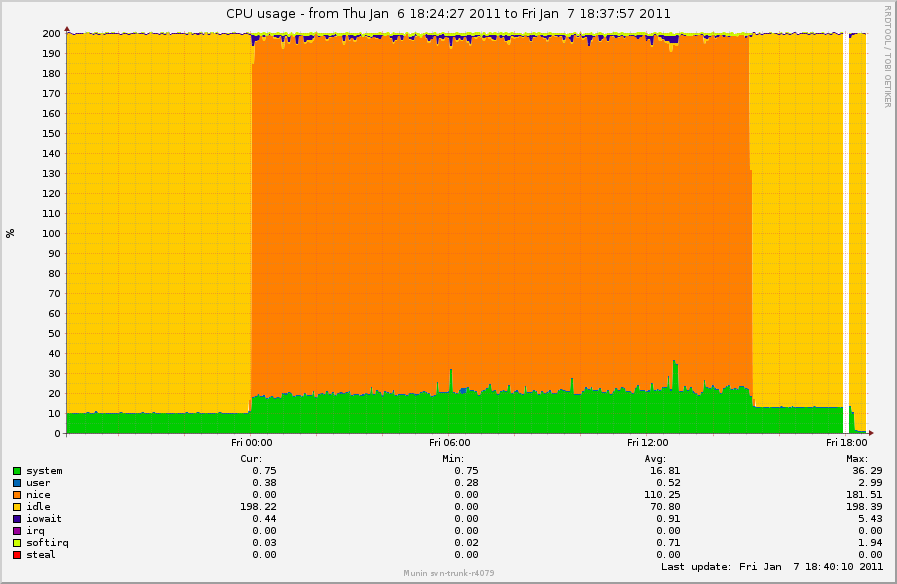
Simon-
Quoted 5 lines · Simon Kirby
Quoted 3 lines · Mark Moseley
NOTE: NFS/Kernel guys: I've left the 2.6.36.2 box still thrashing about in case there's something you'd like me to look at.
Quoted 8 lines
Quoted 3 lines
Ok, both my 2.6.36.2 kernel box and my 2.6.35->2.6.36 bisect box (was bisected to
ce7db282a3830f57f5b05ec48288c23a5c4d66d5-- this is my first time doing bisect, so I'll preemptively apologize for doingThat's a merge commit, so that doesn't sound right (it doesn't contain changes by itself). How were you running the bisect? Were you definitely seeing a good case since v2.6.35? Could you post your "git bisect log" so I can see if I can follow it?
Here's 'git bisect log':
# git bisect log
git bisect start
# bad: [f6f94e2ab1b33f0082ac22d71f66385a60d8157f] Linux 2.6.36
git bisect bad f6f94e2ab1b33f0082ac22d71f66385a60d8157f
# good: [9fe6206f400646a2322096b56c59891d530e8d51] Linux 2.6.35
git bisect good 9fe6206f400646a2322096b56c59891d530e8d51
# good: [78417334b5cb6e1f915b8fdcc4fce3f1a1b4420c] Merge branch
'bkl/core' of git://git.kernel.org/pub/scm/linux/kernel/git/frederic/random-tracing
git bisect good 78417334b5cb6e1f915b8fdcc4fce3f1a1b4420c
# good: [14a4fa20a10d76eb98b7feb25be60735217929ba] Merge branch
'for-linus' of git://git.kernel.org/pub/scm/linux/kernel/git/tiwai/sound-2.6
git bisect good 14a4fa20a10d76eb98b7feb25be60735217929ba
# bad: [ce7db282a3830f57f5b05ec48288c23a5c4d66d5] Merge branch
'for-linus' of git://git.kernel.org/pub/scm/linux/kernel/git/tj/percpu
git bisect bad ce7db282a3830f57f5b05ec48288c23a5c4d66d5
I did an initial checkout of stable
(git://git.kernel.org/pub/scm/linux/kernel/git/torvalds/linux-2.6.git)
and (after git bisect start), did a 'git bisect good v2.6.35; git bisect bad v2.6.36' but that seemed to be way too old. I tried to approximate 2.6.35.9->2.6.36 by doing 'git bisect good ea8a52f9f4bcc3420c38ae07f8378a2f18443970; git bisect bad f6f94e2ab1b33f0082ac22d71f66385a60d8157f' but that had compilation errors so I did 'git bisect good 9fe6206f400646a2322096b56c59891d530e8d51' which compiled ok -- heh, did I mention this was my first outing with 'git bisect' :)
Quoted 38 lines
Yeah, I was seeing load proportional to these, but I don't think their growth is anything wrong. It just seems to be something that is taking up CPU from flush proceses as they grow, and something which is causing a thundering herd of reclaim with lots of spinlock contention.
Hmmm.. I tried to see if
drop_cacheswould clearnfs_inode_cacheand thus the CPU usage. The top of slabtop before doing anything:OBJS ACTIVE USE OBJ SIZE SLABS OBJ/SLAB CACHE SIZE NAME 1256343 1221799 97% 0.95K 38071 33 1218272K
nfs_inode_cache# echo 2 > /proc/sys/vm/drop_cachesthis took about 40 seconds to execute, and perf top showed this for pretty much the whole time:
samples pcnt function DSO _______ _____ ________________________ ___________
1188.00 45.1%
_raw_spin_lock[kernel] 797.00 30.2%rpcauth_cache_shrinker[kernel] 132.00 5.0%shrink_slab[kernel] 60.00 2.3%queue_io[kernel] 59.00 2.2%_cond_resched[kernel] 44.00 1.7%nfs_writepages[kernel] 35.00 1.3%writeback_single_inode[kernel] 34.00 1.3%writeback_sb_inodes[kernel] 23.00 0.9%do_writepages[kernel] 20.00 0.8%bit_waitqueue[kernel] 15.00 0.6%redirty_tail[kernel] 11.00 0.4%__iget[kernel] 11.00 0.4%__GI_strstrlibc-2.7.soslabtop then showed:
OBJS ACTIVE USE OBJ SIZE SLABS OBJ/SLAB CACHE SIZE NAME 1256211 531720 42% 0.95K 38067 33 1218144K
nfs_inode_cache
Quoted 6 lines
and this doesn't change further with drop_caches=3 or 1. It's strange that most of them were freed, but not all... We do actually have
RPC_CREDCACHE_DEFAULT_HASHBITSset to 10 at build time, which might explain a bigger credcache and time to free that. Did you change yourauth_hashtable_sizeat all? Anyway, even with all of that, system CPU doesn't change.
Oh, now that's interesting. I'm setting RPC_CREDCACHE_DEFAULT_HASHBITS to 8 (and have been since Jan, so like 2.6.33 or something) -- I was having the same issue as in this thread,
http://www.spinics.net/lists/linux-nfs/msg09261.html. Bumping up RPC_CREDCACHE_DEFAULT_HASHBITS was like a miracle on some of our systems. I was going to get around to switching to the 'right way' to do that as a boot param one of these days, instead of a hack.
In the bisected kernel, I definitely did *not* touch RPC_CREDCACHE_DEFAULT_HASHBITS and it blew up anyway. If it hadn't completely died, it'd have been nice to see what 'perf top' said.
Quoted 70 lines
Ok, weird, Running "sync" actually caused "vmstat 1" to go from 25% CPU spikes every 5 seconds with
nfs_writepagesin the "perf top" every 5 seconds to being idle! /proc/vmstat showed onlynr_dirty8 andnr_writeback0 before I ran "sync". Either that, or it was just good timing.procs -----------memory---------- ---swap-- -----io---- -system-- ----cpu---- r b swpd free buff cache si so bi bo in cs us sy id wa 0 0 0 6767892 9696 41088 0 0 5 180 15 70 62 7 29 1 0 0 0 6767892 9696 41088 0 0 0 0 1124 1978 0 0 100 0 0 0 0 6767892 9696 41088 0 0 0 0 1105 1967 0 0 100 0 0 0 0 6767892 9696 41088 0 0 0 0 1180 1984 0 2 98 0 2 0 0 6767892 9696 41088 0 0 0 0 2102 1968 0 22 78 0 0 0 0 6767768 9704 41084 0 0 0 52 1504 2022 0 8 91 1 0 0 0 6767768 9704 41084 0 0 0 0 1059 1965 0 0 100 0 0 0 0 6767768 9704 41088 0 0 0 0 1077 1982 0 0 100 0 0 0 0 6767768 9704 41088 0 0 0 0 1166 1972 1 2 97 0 0 0 0 6767768 9704 41088 0 0 0 0 1353 1990 0 6 94 0 0 0 0 6767644 9704 41100 0 0 0 0 2531 2050 0 27 72 0 0 0 0 6767644 9704 41100 0 0 0 0 1065 1974 0 0 100 0 1 0 0 6767644 9704 41100 0 0 0 0 1090 1967 0 0 100 0 0 0 0 6767644 9704 41100 0 0 0 0 1175 1971 0 2 98 0 0 0 0 6767644 9704 41100 0 0 0 0 1321 1967 0 6 94 0 1 0 0 6767644 9712 41100 0 0 0 52 1995 1995 0 18 81 1 0 0 0 6767644 9712 41100 0 0 0 0 1342 1964 0 6 94 0 0 0 0 6767644 9712 41100 0 0 0 0 1064 1974 0 0 100 0 0 0 0 6767644 9712 41100 0 0 0 0 1163 1968 0 2 98 0 0 0 0 6767644 9712 41100 0 0 0 0 1390 1976 1 6 94 0 0 0 0 6767768 9712 41112 0 0 0 0 1282 2018 0 1 99 0 0 0 0 6767768 9712 41112 0 0 0 0 2166 1972 0 24 76 0 0 0 0 6786260 9712 41112 0 0 0 0 1092 1989 0 0 100 0 0 0 0 6786260 9712 41112 0 0 0 0 1039 2003 0 2 98 0 0 0 0 6774588 9712 41112 0 0 0 0 1524 2015 3 9 89 0 0 1 0 6770124 9716 41112 0 0 0 48 1315 1990 3 0 87 11 1 0 0 6769628 9720 41112 0 0 0 4 2196 1966 0 20 79 0 0 0 0 6768364 9724 41108 0 0 36 0 1403 2031 1 5 94 1 0 0 0 6768388 9724 41144 0 0 0 0 1185 1969 0 2 98 0 0 0 0 6768388 9724 41144 0 0 0 0 1351 1975 0 6 94 0 0 0 0 6768140 9724 41156 0 0 0 0 1261 2020 0 1 99 0 0 0 0 6768140 9724 41156 0 0 0 0 1053 1973 0 0 100 0 1 0 0 6768140 9724 41156 0 0 0 0 2194 1971 1 26 73 0 0 0 0 6768140 9732 41148 0 0 0 52 1283 2088 0 4 96 0 2 0 0 6768140 9732 41156 0 0 0 0 1184 1965 0 2 98 0 0 0 0 6786368 9732 41156 0 0 0 0 1297 2000 0 4 97 0 0 0 0 6786384 9732 41156 0 0 0 0 998 1949 0 0 100 0 (stop vmstat 1, run sync, restart vmstat 1)
1 0 0 6765304 9868 41736 0 0 0 0 1239 1967 0 0 100 0 0 0 0 6765304 9868 41736 0 0 0 0 1174 2035 0 0 100 0 0 0 0 6765304 9868 41736 0 0 0 0 1084 1976 0 0 100 0 1 0 0 6765172 9868 41736 0 0 0 0 1100 1975 0 0 100 0 0 0 0 6765304 9868 41760 0 0 0 0 1501 1997 1 1 98 0 0 0 0 6765304 9868 41760 0 0 0 0 1092 1964 0 0 100 0 1 0 0 6765304 9868 41760 0 0 0 0 1096 1963 0 0 100 0 0 0 0 6765304 9868 41760 0 0 0 0 1083 1967 0 0 100 0 0 0 0 6765304 9876 41752 0 0 0 76 1101 1980 0 0 99 1 0 0 0 6765304 9876 41760 0 0 0 4 1199 2097 0 2 98 0 0 0 0 6765304 9876 41760 0 0 0 0 1055 1964 0 0 100 0 0 0 0 6765304 9876 41760 0 0 0 0 1064 1977 0 0 100 0 0 0 0 6765304 9876 41760 0 0 0 0 1073 1968 0 0 100 0 0 0 0 6765304 9876 41760 0 0 0 0 1080 1976 0 0 100 0 0 0 0 6765156 9884 41772 0 0 0 20 1329 2034 1 1 98 1 0 0 0 6765180 9884 41780 0 0 0 0 1097 1971 0 1 99 0 0 0 0 6765180 9884 41780 0 0 0 0 1073 1960 0 0 100 0 0 0 0 6765180 9884 41780 0 0 0 0 1079 1976 0 0 100 0 0 0 0 6765172 9884 41780 0 0 0 0 1120 1980 0 0 100 0 0 0 0 6765180 9892 41772 0 0 0 60 1097 1982 0 0 100 0 0 0 0 6765180 9892 41780 0 0 0 0 1067 1969 0 0 100 0 0 0 0 6765180 9892 41780 0 0 0 0 1063 1973 0 0 100 0 0 0 0 6765180 9892 41780 0 0 0 0 1064 1969 0 1 100 0
Quoted 8 lines
Hmmm. I'll watch it and see if it climbs back up again. That would mean that for now, echo 2 >
/proc/sys/vm/drop_caches; sync is a workaround for the problem we're seeing with system CPU slowly creeping up since 2.6.36. I have no idea if this affects the sudden flush process spinlock contention and attempted writeback without much progress during normal load, but it certainly changes things here.http://0x.ca/sim/ref/2.6.37/cpu_after_drop_caches_2_and_sync.png
That's pretty painful to have to do though (less painful than the box becoming unusable, I'll admit). I wonder if when I did a umount on mine (which must've sync'd at least that mount), it gave something a big enough kick for the flush-0:xx threads to unstick themselves, presumably what happened with your sync (though I didn't drop the cache).