more detailed per-process transparent hugepage statistics
Subsystems (6)
cover more detailed per-process transparent hugepage statistics
I'm working on some more reports that transparent huge pages and KSM do not play nicely together. Basically, whenever THP's are present along with KSM, there is a lot of attrition over time, and we do not see much overall progress keeping THP's around:
http://sr71.net/~dave/ibm/038_System_Anonymous_Pages.png
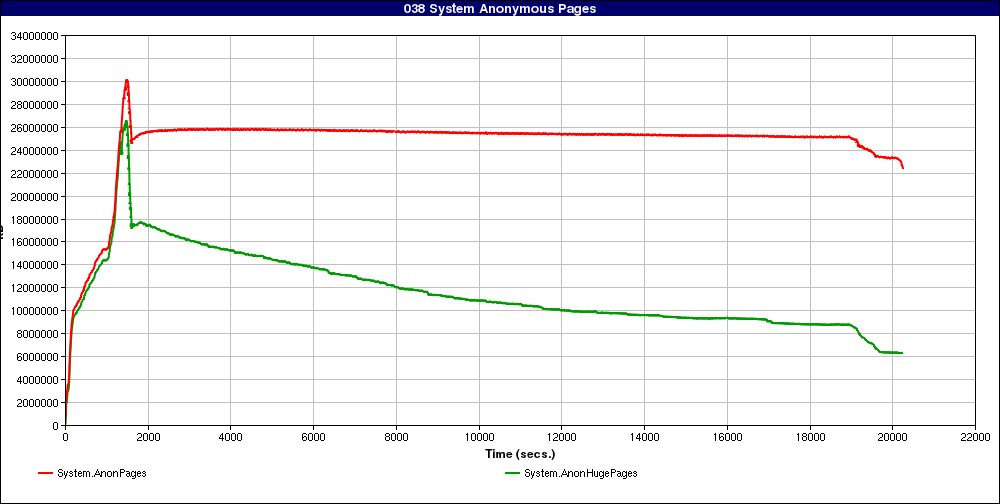
(That's Karl Rister's graph, thanks Karl!)
However, I realized that we do not currently have a nice way to find out where individual THP's might be on the system. We have an overall count, but no way of telling which processes or VMAs they might be in.
I started to implement this in the /proc/$pid/smaps code, but quickly realized that the lib/pagewalk.c code unconditionally splits THPs up. This set reworks that code a bit and, in the end, gives you a per-map count of the numbers of huge pages. It also makes it possible for page walks to _not_ split THPs.
RFC PATCH 1/6 count transparent hugepage splits
The khugepaged process collapses transparent hugepages for us. Whenever it collapses a page into a transparent hugepage, we increment a nice global counter exported in sysfs:
/sys/kernel/mm/transparent_hugepage/khugepaged/pages_collapsed
But, transparent hugepages also get broken down in quite a few places in the kernel. We do not have a good idea how how many of those collpased pages are "new" versus how many are just fixing up spots that got split a moment before.
Note: "splits" and "collapses" are opposites in this context.
This patch adds a new sysfs file:
/sys/kernel/mm/transparent_hugepage/pages_split
It is global, like "pages_collapsed", and is incremented whenever any transparent hugepage on the system has been broken down in to normal PAGE_SIZE base pages. This way, we can get an idea how well khugepaged is keeping up collapsing pages that have been split.
I put it under /sys/kernel/mm/transparent_hugepage/ instead of the khugepaged/ directory since it is not strictly related to khugepaged; it can get incremented on pages other than those collapsed by khugepaged.
The variable storing this is a plain integer. I needs the same amount of locking that 'khugepaged_pages_collapsed' has, for instance.
---
 linux-2.6.git-dave/Documentation/vm/transhuge.txt |    8 ++++++++
 linux-2.6.git-dave/mm/huge_memory.c               |   12 ++++++++++++
 2 files changed, 20 insertions(+)
mm/huge_memory.c renamed from mm/huge_memory.c~count-thp-splits +12 -0
@@ -38,6 +38,8 @@ unsigned long transparent_hugepage_flags (1 <<TRANSPARENT_HUGEPAGE_DEFRAG_FLAG )| (1 <<TRANSPARENT_HUGEPAGE_DEFRAG_KHUGEPAGED_FLAG ); +static unsigned int huge_pages_split; +/* default scan 8*512 pte (or vmas) every 30 second */ static unsigned int khugepaged_pages_to_scan__read_mostly =HPAGE_PMD_NR *8 ;static unsigned int khugepaged_pages_collapsed;
@@ -307,12 +309,20 @@ static struct kobj_attribute debug_cow_a__ATTR (debug_cow,0644 , debug_cow_show, debug_cow_store);#endif /* CONFIG_DEBUG_VM */ +static ssize_t pages_split_show (struct kobject *kobj, +struct kobj_attribute *attr,char *buf) +{ +return sprintf (buf,"%u\n" , huge_pages_split); +} +static struct kobj_attribute pages_split_attr =__ATTR_RO (pages_split); +static struct attribute *hugepage_attr[] = { &enabled_attr.attr, &defrag_attr.attr, #ifdef CONFIG_DEBUG_VM &debug_cow_attr.attr, #endif + &pages_split_attr.attr,NULL , };
@@ -1314,6 +1324,8 @@ static int __split_huge_page_map(struct }spin_unlock (&mm->page_table_lock); +if (ret) + huge_pages_split++;return ret; }
diff -puN fs/proc/meminfo.c~count-thp-splits fs/proc/meminfo.c
Documentation/vm/transhuge.txt renamed from Documentation/vm/transhuge.txt~count-thp-splits +8 -0
@@ -120,6 +120,14 @@ khugepaged will be automatically started transparent_hugepage/enabled is set to "always" or "madvise, and it'll be automatically shutdown if it's set to "never". +Not all kernel code is aware of transparent hugepages. Sometimes, +it is necessary to fall back to small pages so that this kernel +code can deal with small pages. This might also happen if, for +instance, munmap() was called in the middle of a transparent huge +page. We track these splits in: + + /sys/kernel/mm/transparent_hugepage/pages_split + khugepaged runs usually at low frequency so while one may not want to invoke defrag algorithms synchronously during the page faults, it should be worth invoking defrag at least in khugepaged. However it's
_
--
To unsubscribe, send a message with 'unsubscribe linux-mm' in the body to [email protected]. For more info on Linux MM,
see: http://www.linux-mm.org/ .
Fight unfair telecom policy in Canada: sign http://dissolvethecrtc.ca/
Don't email: <a href=mailto:"[email protected]"> [email protected] </a>
Re: [RFC][PATCH 1/6] count transparent hugepage splits
Quoted 28 lines · Dave Hansen
The khugepaged process collapses transparent hugepages for us. Whenever it collapses a page into a transparent hugepage, we increment a nice global counter exported in sysfs:
/sys/kernel/mm/transparent_hugepage/khugepaged/pages_collapsedBut, transparent hugepages also get broken down in quite a few places in the kernel. We do not have a good idea how how many of those collpased pages are "new" versus how many are just fixing up spots that got split a moment before.
Note: "splits" and "collapses" are opposites in this context.
This patch adds a new sysfs file:
/sys/kernel/mm/transparent_hugepage/pages_splitIt is global, like "
pages_collapsed", and is incremented whenever any transparent hugepage on the system has been broken down in to normalPAGE_SIZEbase pages. This way, we can get an idea how well khugepaged is keeping up collapsing pages that have been split.I put it under
/sys/kernel/mm/transparent_hugepage/instead of the khugepaged/ directory since it is not strictly related to khugepaged; it can get incremented on pages other than those collapsed by khugepaged.
Quoted 5 lines
The variable storing this is a plain integer. I needs the same amount of locking that '
khugepaged_pages_collapsed' has, for instance.Signed-off-by Dave Hansen <[email protected]>
Re: [RFC][PATCH 1/6] count transparent hugepage splits
In reply to Dave HansenQuoted 23 lines · Dave Hansen
The khugepaged process collapses transparent hugepages for us. Whenever it collapses a page into a transparent hugepage, we increment a nice global counter exported in sysfs:
/sys/kernel/mm/transparent_hugepage/khugepaged/pages_collapsedBut, transparent hugepages also get broken down in quite a few places in the kernel. We do not have a good idea how how many of those collpased pages are "new" versus how many are just fixing up spots that got split a moment before.
Note: "splits" and "collapses" are opposites in this context.
This patch adds a new sysfs file:
/sys/kernel/mm/transparent_hugepage/pages_splitIt is global, like "
pages_collapsed", and is incremented whenever any transparent hugepage on the system has been broken down in to normalPAGE_SIZEbase pages. This way, we can get an idea how well khugepaged is keeping up collapsing pages that have been split.
Quoted 8 lines
I put it under
/sys/kernel/mm/transparent_hugepage/instead of the khugepaged/ directory since it is not strictly related to khugepaged; it can get incremented on pages other than those collapsed by khugepaged.The variable storing this is a plain integer. I needs the same amount of locking that '
khugepaged_pages_collapsed' has, for instance.
i.e. no global locking, but we've accepted the occassional off-by-one error (even though splitting of hugepages isn't by any means lightning fast and the overhead of atomic ops would be negligible).
Quoted 1 line
Signed-off-by Dave Hansen <[email protected]>
--
To unsubscribe, send a message with 'unsubscribe linux-mm' in
the body to [email protected]. For more info on Linux MM,
see: http://www.linux-mm.org/ .
Fight unfair telecom internet charges in Canada: sign http://stopthemeter.ca/
Don't email: <a href=mailto:"[email protected]"> [email protected] </a>
Re: [RFC][PATCH 1/6] count transparent hugepage splits
Quoted 3 lines · David Rientjes
i.e. no global locking, but we've accepted the occassional off-by-one error (even though splitting of hugepages isn't by any means lightning fast and the overhead of atomic ops would be negligible).
Agreed losing an increment is not a problem, but in very large systems it will become a bottleneck. It's not super urgent, but I think it needs to become a per-cpu counter sooner than later (not needed immediately but I would appreciate an incremental patch soon to address that). split_huge_page is already fully SMP scalable if the rmap isn't shared (i.e. fully SMP scalable across different execve) and I'd like it to stay that way because split_huge_page can run at high frequency at times from different processes, so in very large systems it may be measurable, with that cacheline bouncing around 1024 cpus. pages_collapsed is not a problem because it's only used by one kernel thread so it can't be contended. Again not super urgent but better to optimize it ;).
--
To unsubscribe, send a message with 'unsubscribe linux-mm' in
the body to [email protected]. For more info on Linux MM,
see: http://www.linux-mm.org/ .
Fight unfair telecom internet charges in Canada: sign http://stopthemeter.ca/
Don't email: <a href=mailto:"[email protected]"> [email protected] </a>
Re: [RFC][PATCH 1/6] count transparent hugepage splits
Quoted 10 lines · Andrea Arcangeli
Quoted 3 lines · David Rientjes
i.e. no global locking, but we've accepted the occassional off-by-one error (even though splitting of hugepages isn't by any means lightning fast and the overhead of atomic ops would be negligible).
Agreed losing an increment is not a problem, but in very large systems it will become a bottleneck. It's not super urgent, but I think it needs to become a per-cpu counter sooner than later (not needed immediately but I would appreciate an incremental patch soon to address that).
Seems like something that would be fairly trivial with the existing count_vm_event() infrastructure. Any reason not to use that? I'll be happy to tack a patch on to my series.
-- Dave
--
To unsubscribe, send a message with 'unsubscribe linux-mm' in
the body to [email protected]. For more info on Linux MM,
see: http://www.linux-mm.org/ .
Fight unfair telecom internet charges in Canada: sign http://stopthemeter.ca/
Don't email: <a href=mailto:"[email protected]"> [email protected] </a>
RFC PATCH 2/6 pagewalk: only split huge pages when necessary
In reply to Dave HansenRight now, if a mm_walk has either ->pte_entry or ->pmd_entry set, it will unconditionally split and transparent huge pages it runs in to. In practice, that means that anyone doing a
cat /proc/$pid/smaps
will unconditionally break down every huge page in the process and depend on khugepaged to re-collapse it later. This is fairly suboptimal.
This patch changes that behavior. It teaches each ->pmd_entry handler (there are three) that they must break down the THPs themselves. Also, the _generic_ code will never break down a THP unless a ->pte_entry handler is actually set.
This means that the ->pmd_entry handlers can now choose to deal with THPs without breaking them down.
---
 linux-2.6.git-dave/fs/proc/task_mmu.c |    6 ++++++
 linux-2.6.git-dave/mm/pagewalk.c      |   24 ++++++++++++++++++++----
 2 files changed, 26 insertions(+), 4 deletions(-)
mm/pagewalk.c renamed from mm/pagewalk.c~pagewalk-dont-always-split-thp +20 -4
@@ -33,19 +33,35 @@ static int walk_pmd_range(pud_t *pud, un pmd =pmd_offset (pud, addr);do { + again: next =pmd_addr_end (addr, end); -split_huge_page_pmd (walk->mm, pmd); -if (pmd_none_or_clear_bad (pmd)) { +if (pmd_none (*pmd)) {if (walk->pte_hole) err = walk->pte_hole (addr, next, walk);if (err)break ;continue ; } +/* +* This implies that each ->pmd_entry() handler +* needs to know about pmd_trans_huge() pmds +*/ if (walk->pmd_entry) err = walk->pmd_entry (pmd, addr, next, walk); -if (!err && walk->pte_entry) - err =walk_pte_range (pmd, addr, next, walk); +if (err) +break ; + +/* +* Check this here so we only break down trans_huge +* pages when we _need_ to +*/ +if (!walk->pte_entry) +continue ; + +split_huge_page_pmd (walk->mm, pmd); +if (pmd_none_or_clear_bad (pmd)) + goto again; + err =walk_pte_range (pmd, addr, next, walk);if (err)break ; }while (pmd++, addr = next, addr != end);
fs/proc/task_mmu.c renamed from fs/proc/task_mmu.c~pagewalk-dont-always-split-thp +6 -0
@@ -343,6 +343,8 @@ static int smaps_pte_range(pmd_t *pmd, ustruct page *page;int mapcount; +split_huge_page_pmd (walk->mm, pmd); + pte =pte_offset_map_lock (vma->vm_mm, pmd, addr, &ptl);for (; addr != end; pte++, addr +=PAGE_SIZE ) { ptent = *pte;
@@ -467,6 +469,8 @@ static int clear_refs_pte_range(pmd_t *pspinlock_t *ptl;struct page *page; +split_huge_page_pmd (walk->mm, pmd); + pte =pte_offset_map_lock (vma->vm_mm, pmd, addr, &ptl);for (; addr != end; pte++, addr +=PAGE_SIZE ) { ptent = *pte;
@@ -623,6 +627,8 @@ static int pagemap_pte_range(pmd_t *pmd,pte_t *pte;int err =0 ; +split_huge_page_pmd (walk->mm, pmd); +/* find the first VMA at or above 'addr' */ vma =find_vma (walk->mm, addr);for (; addr != end; addr +=PAGE_SIZE ) {
_
--
To unsubscribe, send a message with 'unsubscribe linux-mm' in the body to [email protected]. For more info on Linux MM,
see: http://www.linux-mm.org/ .
Fight unfair telecom policy in Canada: sign http://dissolvethecrtc.ca/
Don't email: <a href=mailto:"[email protected]"> [email protected] </a>
Re: [RFC][PATCH 2/6] pagewalk: only split huge pages when necessary
Quoted 11 lines · Dave Hansen
Right now, if a
mm_walkhas either ->pte_entry or ->pmd_entry set, it will unconditionally split and transparent huge pages it runs in to. In practice, that means that anyone doing acat
/proc/$pid/smapswill unconditionally break down every huge page in the process and depend on khugepaged to re-collapse it later. This is fairly suboptimal.
Quoted 7 lines
This patch changes that behavior. It teaches each ->pmd_entry handler (there are three) that they must break down the THPs themselves. Also, the _generic_ code will never break down a THP unless a ->pte_entry handler is actually set.
This means that the ->pmd_entry handlers can now choose to deal with THPs without breaking them down.
Makes perfect sense. But you forgot to push down the splitting into the two handlers in mm/memcontrol.c.
Re: [RFC][PATCH 2/6] pagewalk: only split huge pages when necessary
Quoted 16 lines · Johannes Weiner
Quoted 15 lines · Dave Hansen
Right now, if a
mm_walkhas either ->pte_entry or ->pmd_entry set, it will unconditionally split and transparent huge pages it runs in to. In practice, that means that anyone doing acat
/proc/$pid/smapswill unconditionally break down every huge page in the process and depend on khugepaged to re-collapse it later. This is fairly suboptimal.
This patch changes that behavior. It teaches each ->pmd_entry handler (there are three) that they must break down the THPs themselves. Also, the _generic_ code will never break down a THP unless a ->pte_entry handler is actually set.
Quoted 5 lines
Quoted 2 lines
This means that the ->pmd_entry handlers can now choose to deal with THPs without breaking them down.
Makes perfect sense. But you forgot to push down the splitting into the two handlers in
mm/memcontrol.c.
I did indeed. I'll go fix those up. Thanks for the review!
-- Dave
Re: [RFC][PATCH 2/6] pagewalk: only split huge pages when necessary
In reply to Dave HansenQuoted 11 lines · Dave Hansen
Right now, if a
mm_walkhas either ->pte_entry or ->pmd_entry set, it will unconditionally split and transparent huge pages it runs in to. In practice, that means that anyone doing acat
/proc/$pid/smapswill unconditionally break down every huge page in the process and depend on khugepaged to re-collapse it later. This is fairly suboptimal.
Quoted 9 lines
This patch changes that behavior. It teaches each ->pmd_entry handler (there are three) that they must break down the THPs themselves. Also, the _generic_ code will never break down a THP unless a ->pte_entry handler is actually set.
This means that the ->pmd_entry handlers can now choose to deal with THPs without breaking them down.
No sign-off (goes for patches 3 and 4, as well)?
Quoted 10 lines
---
 linux-2.6.git-dave/fs/proc/task_mmu.c |    6 ++++++
 linux-2.6.git-dave/mm/pagewalk.c      |   24 ++++++++++++++++++++----
 2 files changed, 26 insertions(+), 4 deletions(-)
diff -puN
mm/pagewalk.c~pagewalk-dont-always-split-thpmm/pagewalk.c
mm/pagewalk.c static int walk_pmd_range(pud_t *pud, un · line 36
Quoted 4 lines
mm/pagewalk.c renamed from mm/pagewalk.c~pagewalk-dont-always-split-thp +1
-0@@ -33,19 +33,35 @@ static int walk_pmd_range(pud_t *pud, un pmd =pmd_offset (pud, addr); do { + again:
checkpatch will warn about the indent.
mm/pagewalk.c static int walk_pmd_range(pud_t *pud, un · line 38
Quoted 4 lines
mm/pagewalk.c renamed from mm/pagewalk.c~pagewalk-dont-always-split-thp +1
-2next =pmd_addr_end (addr, end); -split_huge_page_pmd (walk->mm, pmd); -if (pmd_none_or_clear_bad (pmd)) { +if (pmd_none (*pmd)) {
Not sure why this has been changed from pmd_none_or_clear_bad(), that's been done even prior to THP.
mm/pagewalk.c static int walk_pmd_range(pud_t *pud, un · line 48
Quoted 10 lines
mm/pagewalk.c renamed from mm/pagewalk.c~pagewalk-dont-always-split-thp +4
-0if (walk->pte_hole) err = walk->pte_hole (addr, next, walk);if (err)break ;continue ; } +/* +* This implies that each ->pmd_entry() handler +* needs to know about pmd_trans_huge() pmds +*/
Probably needs to be documented somewhere for users of pagewalk?
Quoted 43 lines
mm/pagewalk.c renamed from mm/pagewalk.c~pagewalk-dont-always-split-thp +14
-2if (walk->pmd_entry) err = walk->pmd_entry (pmd, addr, next, walk); -if (!err && walk->pte_entry) - err =walk_pte_range (pmd, addr, next, walk); +if (err) +break ; + +/* +* Check this here so we only break down trans_huge +* pages when we _need_ to +*/ +if (!walk->pte_entry) +continue ; + +split_huge_page_pmd (walk->mm, pmd); +if (pmd_none_or_clear_bad (pmd)) + goto again; + err =walk_pte_range (pmd, addr, next, walk);if (err)break ; }while (pmd++, addr = next, addr != end);diff -puN
fs/proc/task_mmu.c~pagewalk-dont-always-split-thpfs/proc/task_mmu.cfs/proc/task_mmu.c renamed from fs/proc/task_mmu.c~pagewalk-dont-always-split-thp +4
-0@@ -343,6 +343,8 @@ static int smaps_pte_range(pmd_t *pmd, ustruct page *page;int mapcount; +split_huge_page_pmd (walk->mm, pmd); + pte =pte_offset_map_lock (vma->vm_mm, pmd, addr, &ptl);for (; addr != end; pte++, addr +=PAGE_SIZE ) { ptent = *pte;@@ -467,6 +469,8 @@ static int clear_refs_pte_range(pmd_t *pspinlock_t *ptl;struct page *page; +split_huge_page_pmd (walk->mm, pmd); + pte =pte_offset_map_lock (vma->vm_mm, pmd, addr, &ptl);for (; addr != end; pte++, addr +=PAGE_SIZE ) { ptent = *pte;
fs/proc/task_mmu.c static int pagemap_pte_range(pmd_t *pmd, · line 634
Quoted 8 lines
fs/proc/task_mmu.c renamed from fs/proc/task_mmu.c~pagewalk-dont-always-split-thp +2
-0@@ -623,6 +627,8 @@ static int pagemap_pte_range(pmd_t *pmd,pte_t *pte;int err =0 ; +split_huge_page_pmd (walk->mm, pmd); +/* find the first VMA at or above 'addr' */ vma =find_vma (walk->mm, addr);for (; addr != end; addr +=PAGE_SIZE ) {
--
To unsubscribe, send a message with 'unsubscribe linux-mm' in
the body to [email protected]. For more info on Linux MM,
see: http://www.linux-mm.org/ .
Fight unfair telecom internet charges in Canada: sign http://stopthemeter.ca/
Don't email: <a href=mailto:"[email protected]"> [email protected] </a>
Re: [RFC][PATCH 2/6] pagewalk: only split huge pages when necessary
Quoted 11 lines · David Rientjes
mm/pagewalk.c static int walk_pmd_range(pud_t *pud, un · line 36
Quoted 8 lines
diff -puN
mm/pagewalk.c~pagewalk-dont-always-split-thpmm/pagewalk.cmm/pagewalk.c renamed from mm/pagewalk.c~pagewalk-dont-always-split-thp +1
-0@@ -33,19 +33,35 @@ static int walk_pmd_range(pud_t *pud, un pmd =pmd_offset (pud, addr); do { + again:checkpatch will warn about the indent.
Quoted 7 lines
mm/pagewalk.c static int walk_pmd_range(pud_t *pud, un · line 38
Quoted 4 lines
mm/pagewalk.c renamed from mm/pagewalk.c~pagewalk-dont-always-split-thp +1
-2next =pmd_addr_end (addr, end); -split_huge_page_pmd (walk->mm, pmd); -if (pmd_none_or_clear_bad (pmd)) { +if (pmd_none (*pmd)) {Not sure why this has been changed from
pmd_none_or_clear_bad(), that's been done even prior to THP.
The bad check will trigger on huge pmds. We can not use it here. We can, however, use pmd_none(). The bad check was moved below to where we actually dereference the pmd.
Quoted 4 lines
Quoted 4 lines
mm/pagewalk.c renamed from mm/pagewalk.c~pagewalk-dont-always-split-thp +0
-0if (walk->pte_hole) err = walk->pte_hole (addr, next, walk);if (err)break ;
Quoted 8 lines
mm/pagewalk.c static int walk_pmd_range(pud_t *pud, un · line 48
Quoted 6 lines
mm/pagewalk.c renamed from mm/pagewalk.c~pagewalk-dont-always-split-thp +4
-0continue ; } +/* +* This implies that each ->pmd_entry() handler +* needs to know about pmd_trans_huge() pmds +*/ Probably needs to be documented somewhere for users of pagewalk?
Probably, but we don't currently have any central documentation for it. Guess we could make some, or just ensure that all the users got updated. Any ideas where to put it other than the mm_walk struct?
-- Dave
Re: [RFC][PATCH 2/6] pagewalk: only split huge pages when necessary
Quoted 19 lines · Dave Hansen
Quoted 11 lines
mm/pagewalk.c static int walk_pmd_range(pud_t *pud, un · line 36
Quoted 8 lines
diff -puN
mm/pagewalk.c~pagewalk-dont-always-split-thpmm/pagewalk.cmm/pagewalk.c renamed from mm/pagewalk.c~pagewalk-dont-always-split-thp +1
-0@@ -33,19 +33,35 @@ static int walk_pmd_range(pud_t *pud, un pmd =pmd_offset (pud, addr); do { + again:checkpatch will warn about the indent.
Quoted 7 lines
mm/pagewalk.c static int walk_pmd_range(pud_t *pud, un · line 38
Quoted 4 lines
mm/pagewalk.c renamed from mm/pagewalk.c~pagewalk-dont-always-split-thp +1
-2next =pmd_addr_end (addr, end); -split_huge_page_pmd (walk->mm, pmd); -if (pmd_none_or_clear_bad (pmd)) { +if (pmd_none (*pmd)) {Not sure why this has been changed from
pmd_none_or_clear_bad(), that's been done even prior to THP.
Quoted 4 lines
The bad check will trigger on huge pmds. We can not use it here. We can, however, use
pmd_none(). The bad check was moved below to where we actually dereference the pmd.
Ah, right, thanks.
Quoted 13 lines
Quoted 4 lines
Quoted 4 lines
mm/pagewalk.c renamed from mm/pagewalk.c~pagewalk-dont-always-split-thp +0
-0if (walk->pte_hole) err = walk->pte_hole (addr, next, walk);if (err)break ;Quoted 8 lines
mm/pagewalk.c static int walk_pmd_range(pud_t *pud, un · line 48
Quoted 6 lines
mm/pagewalk.c renamed from mm/pagewalk.c~pagewalk-dont-always-split-thp +4
-0continue ; } +/* +* This implies that each ->pmd_entry() handler +* needs to know about pmd_trans_huge() pmds +*/ Probably needs to be documented somewhere for users of pagewalk?
Quoted 4 lines
Probably, but we don't currently have any central documentation for it. Guess we could make some, or just ensure that all the users got updated. Any ideas where to put it other than the
mm_walkstruct?
I think noting it where struct mm_walk is declared would be best (just a "/* must handle pmd_trans_huge() */" would be sufficient) although eventually it might be cleaner to add a ->pmd_huge_entry().
--
To unsubscribe, send a message with 'unsubscribe linux-mm' in
the body to [email protected]. For more info on Linux MM,
see: http://www.linux-mm.org/ .
Fight unfair telecom internet charges in Canada: sign http://stopthemeter.ca/
Don't email: <a href=mailto:"[email protected]"> [email protected] </a>
Re: [RFC][PATCH 2/6] pagewalk: only split huge pages when necessary
Quoted 7 lines · David Rientjes
Quoted 3 lines
Probably, but we don't currently have any central documentation for it. Guess we could make some, or just ensure that all the users got updated. Any ideas where to put it other than the
mm_walkstruct?I think noting it where struct
mm_walkis declared would be best (just a "/* must handlepmd_trans_huge()*/" would be sufficient) although eventually it might be cleaner to add a ->pmd_huge_entry().
For code maintenance, I really like _not_ hiding this in the API somewhere. This way, we have a great, self-explanatory tag wherever code (possibly) hasn't properly dealt with THPs. We get a nice, greppable, cscope'able:
split_huge_page_pmd()
wherever we need to "teach" the code about THP.
It's kinda like the BKL. :)
-- Dave
--
To unsubscribe, send a message with 'unsubscribe linux-mm' in
the body to [email protected]. For more info on Linux MM,
see: http://www.linux-mm.org/ .
Fight unfair telecom internet charges in Canada: sign http://stopthemeter.ca/
Don't email: <a href=mailto:"[email protected]"> [email protected] </a>
Re: [RFC][PATCH 2/6] pagewalk: only split huge pages when necessary
Quoted 10 lines · Dave Hansen
For code maintenance, I really like _not_ hiding this in the API somewhere. This way, we have a great, self-explanatory tag wherever code (possibly) hasn't properly dealt with THPs. We get a nice, greppable, cscope'able:
split_huge_page_pmd()wherever we need to "teach" the code about THP.
It's kinda like the BKL. :)
It is in my view too ;).
However currently it's not greppable if we don't differentiate it a bit from the legitimate/optimal usages. split_huge_page_pmd currently isn't always sign of code not THP aware. It's sign of not THP aware code only for cases like smaps that is readonly in terms of vma/pte mangling, but for example mprotect isn't a readonly thing and it's already fully mprotect aware, but split_huge_page_pmd still comes very handy when userland asks to create a vma that can't fit an hugepmd (there are several other places like that). When that ever happens (like changing protection of only the last 4k of an hugepage backed mapping) replacing the hugepmd with a regular pmd pointing to a pte (where we can alter the protection of only the last 4k) becomes compulsory. So it's not always a sign of lack of optimization, sometime it's needed and userland should be optimized instead ;).
--
To unsubscribe, send a message with 'unsubscribe linux-mm' in
the body to [email protected]. For more info on Linux MM,
see: http://www.linux-mm.org/ .
Fight unfair telecom internet charges in Canada: sign http://stopthemeter.ca/
Don't email: <a href=mailto:"[email protected]"> [email protected] </a>
RFC PATCH 3/6 break out smaps_pte_entry() from smaps_pte_range()
In reply to Dave HansenWe will use smaps_pte_entry() in a moment to handle both small and transparent large pages. But, we must break it out of smaps_pte_range() first.
---
 linux-2.6.git-dave/fs/proc/task_mmu.c |   85 ++++++++++++++++++----------------
 1 file changed, 46 insertions(+), 39 deletions(-)
fs/proc/task_mmu.c renamed from fs/proc/task_mmu.c~break-out-smaps_pte_entry +46 -39
@@ -333,56 +333,63 @@ struct mem_size_stats {u64 pss; }; -static int smaps_pte_range (pmd_t *pmd,unsigned long addr,unsigned long end, -struct mm_walk *walk) + +static void smaps_pte_entry (pte_t ptent,unsigned long addr, +struct mm_walk *walk) {struct mem_size_stats *mss = walk->private;struct vm_area_struct *vma = mss->vma; -pte_t *pte, ptent; -spinlock_t *ptl;struct page *page;int mapcount; -split_huge_page_pmd (walk->mm, pmd); - - pte =pte_offset_map_lock (vma->vm_mm, pmd, addr, &ptl); -for (; addr != end; pte++, addr +=PAGE_SIZE ) { - ptent = *pte; +if (is_swap_pte (ptent)) { + mss->swap +=PAGE_SIZE ; +return ; + } -if (is_swap_pte (ptent)) { - mss->swap +=PAGE_SIZE ; -continue ; - } +if (!pte_present (ptent)) +return ; -if (!pte_present (ptent)) -continue ; + page =vm_normal_page (vma, addr, ptent); +if (!page) +return ; + +if (PageAnon (page)) + mss->anonymous +=PAGE_SIZE ; + + mss->resident +=PAGE_SIZE ; +/* Accumulate the size in pages that have been accessed. */ +if (pte_young (ptent) ||PageReferenced (page)) + mss->referenced +=PAGE_SIZE ; + mapcount =page_mapcount (page); +if (mapcount >=2 ) { +if (pte_dirty (ptent) ||PageDirty (page)) + mss->shared_dirty +=PAGE_SIZE ; +else + mss->shared_clean +=PAGE_SIZE ; + mss->pss += (PAGE_SIZE <<PSS_SHIFT ) / mapcount; + }else { +if (pte_dirty (ptent) ||PageDirty (page)) + mss->private_dirty +=PAGE_SIZE ; +else + mss->private_clean +=PAGE_SIZE ; + mss->pss += (PAGE_SIZE <<PSS_SHIFT ); + } +} - page =vm_normal_page (vma, addr, ptent); -if (!page) -continue ; +static int smaps_pte_range (pmd_t *pmd,unsigned long addr,unsigned long end, +struct mm_walk *walk) +{ +struct mem_size_stats *mss = walk->private; +struct vm_area_struct *vma = mss->vma; +pte_t *pte; +spinlock_t *ptl; -if (PageAnon (page)) - mss->anonymous +=PAGE_SIZE ; +split_huge_page_pmd (walk->mm, pmd); - mss->resident +=PAGE_SIZE ; -/* Accumulate the size in pages that have been accessed. */ -if (pte_young (ptent) ||PageReferenced (page)) - mss->referenced +=PAGE_SIZE ; - mapcount =page_mapcount (page); -if (mapcount >=2 ) { -if (pte_dirty (ptent) ||PageDirty (page)) - mss->shared_dirty +=PAGE_SIZE ; -else - mss->shared_clean +=PAGE_SIZE ; - mss->pss += (PAGE_SIZE <<PSS_SHIFT ) / mapcount; - }else { -if (pte_dirty (ptent) ||PageDirty (page)) - mss->private_dirty +=PAGE_SIZE ; -else - mss->private_clean +=PAGE_SIZE ; - mss->pss += (PAGE_SIZE <<PSS_SHIFT ); - } - } + pte =pte_offset_map_lock (vma->vm_mm, pmd, addr, &ptl); +for (; addr != end; pte++, addr +=PAGE_SIZE ) +smaps_pte_entry (*pte, addr, walk);pte_unmap_unlock (pte -1 , ptl);cond_resched ();return 0 ;
diff -puN mm/huge_memory.c~break-out-smaps_pte_entry mm/huge_memory.c _
Re: [RFC][PATCH 3/6] break out smaps_pte_entry() from smaps_pte_range()
Quoted 4 lines · Dave Hansen
We will use
smaps_pte_entry()in a moment to handle both small and transparent large pages. But, we must break it out ofsmaps_pte_range()first.
--
To unsubscribe, send a message with 'unsubscribe linux-mm' in the body to [email protected]. For more info on Linux MM,
see: http://www.linux-mm.org/ .
Fight unfair telecom policy in Canada: sign http://dissolvethecrtc.ca/
Don't email: <a href=mailto:"[email protected]"> [email protected] </a>
Re: [RFC][PATCH 3/6] break out smaps_pte_entry() from smaps_pte_range()
In reply to Dave HansenQuoted 5 lines · Dave Hansen
We will use
smaps_pte_entry()in a moment to handle both small and transparent large pages. But, we must break it out ofsmaps_pte_range()first.
The extraction from smaps_pte_range() looks good. What's the performance impact on very frequent consumers of /proc/pid/smaps, though, as the result of the calls throughout the iteration if smaps_pte_entry() doesn't get inlined (supposedly because you'll be reusing the extracted function again elsewhere)?
Quoted 112 lines
---
 linux-2.6.git-dave/fs/proc/task_mmu.c |   85 ++++++++++++++++++----------------
 1 file changed, 46 insertions(+), 39 deletions(-)
diff -puN
fs/proc/task_mmu.c~break-out-smaps_pte_entryfs/proc/task_mmu.cfs/proc/task_mmu.c renamed from fs/proc/task_mmu.c~break-out-smaps_pte_entry +46
-39@@ -333,56 +333,63 @@ struct mem_size_stats {u64 pss; }; -static int smaps_pte_range (pmd_t *pmd,unsigned long addr,unsigned long end, -struct mm_walk *walk) + +static void smaps_pte_entry (pte_t ptent,unsigned long addr, +struct mm_walk *walk) {struct mem_size_stats *mss = walk->private;struct vm_area_struct *vma = mss->vma; -pte_t *pte, ptent; -spinlock_t *ptl;struct page *page;int mapcount; -split_huge_page_pmd (walk->mm, pmd); - - pte =pte_offset_map_lock (vma->vm_mm, pmd, addr, &ptl); -for (; addr != end; pte++, addr +=PAGE_SIZE ) { - ptent = *pte; +if (is_swap_pte (ptent)) { + mss->swap +=PAGE_SIZE ; +return ; + } -if (is_swap_pte (ptent)) { - mss->swap +=PAGE_SIZE ; -continue ; - } +if (!pte_present (ptent)) +return ; -if (!pte_present (ptent)) -continue ; + page =vm_normal_page (vma, addr, ptent); +if (!page) +return ; + +if (PageAnon (page)) + mss->anonymous +=PAGE_SIZE ; + + mss->resident +=PAGE_SIZE ; +/* Accumulate the size in pages that have been accessed. */ +if (pte_young (ptent) ||PageReferenced (page)) + mss->referenced +=PAGE_SIZE ; + mapcount =page_mapcount (page); +if (mapcount >=2 ) { +if (pte_dirty (ptent) ||PageDirty (page)) + mss->shared_dirty +=PAGE_SIZE ; +else + mss->shared_clean +=PAGE_SIZE ; + mss->pss += (PAGE_SIZE <<PSS_SHIFT ) / mapcount; + }else { +if (pte_dirty (ptent) ||PageDirty (page)) + mss->private_dirty +=PAGE_SIZE ; +else + mss->private_clean +=PAGE_SIZE ; + mss->pss += (PAGE_SIZE <<PSS_SHIFT ); + } +} - page =vm_normal_page (vma, addr, ptent); -if (!page) -continue ; +static int smaps_pte_range (pmd_t *pmd,unsigned long addr,unsigned long end, +struct mm_walk *walk) +{ +struct mem_size_stats *mss = walk->private; +struct vm_area_struct *vma = mss->vma; +pte_t *pte; +spinlock_t *ptl; -if (PageAnon (page)) - mss->anonymous +=PAGE_SIZE ; +split_huge_page_pmd (walk->mm, pmd); - mss->resident +=PAGE_SIZE ; -/* Accumulate the size in pages that have been accessed. */ -if (pte_young (ptent) ||PageReferenced (page)) - mss->referenced +=PAGE_SIZE ; - mapcount =page_mapcount (page); -if (mapcount >=2 ) { -if (pte_dirty (ptent) ||PageDirty (page)) - mss->shared_dirty +=PAGE_SIZE ; -else - mss->shared_clean +=PAGE_SIZE ; - mss->pss += (PAGE_SIZE <<PSS_SHIFT ) / mapcount; - }else { -if (pte_dirty (ptent) ||PageDirty (page)) - mss->private_dirty +=PAGE_SIZE ; -else - mss->private_clean +=PAGE_SIZE ; - mss->pss += (PAGE_SIZE <<PSS_SHIFT ); - } - } + pte =pte_offset_map_lock (vma->vm_mm, pmd, addr, &ptl); +for (; addr != end; pte++, addr +=PAGE_SIZE ) +smaps_pte_entry (*pte, addr, walk);pte_unmap_unlock (pte -1 , ptl);cond_resched ();return 0 ;
Quoted 2 lines
diff -puN
mm/huge_memory.c~break-out-smaps_pte_entrymm/huge_memory.c_
Is there a missing change to mm/huge_memory.c?
--
To unsubscribe, send a message with 'unsubscribe linux-mm' in
the body to [email protected]. For more info on Linux MM,
see: http://www.linux-mm.org/ .
Fight unfair telecom internet charges in Canada: sign http://stopthemeter.ca/
Don't email: <a href=mailto:"[email protected]"> [email protected] </a>
Re: [RFC][PATCH 3/6] break out smaps_pte_entry() from smaps_pte_range()
Quoted 10 lines · David Rientjes
Quoted 3 lines · Dave Hansen
We will use
smaps_pte_entry()in a moment to handle both small and transparent large pages. But, we must break it out ofsmaps_pte_range()first.The extraction from
smaps_pte_range()looks good. What's the performance impact on very frequent consumers of/proc/pid/smaps, though, as the result of the calls throughout the iteration ifsmaps_pte_entry()doesn't get inlined (supposedly because you'll be reusing the extracted function again elsewhere)?
We could try and coerce it in to always inlining it, I guess. I just can't imagine this changes the cost _that_ much. Unless I have some specific concers, I tend to leave this up to the compiler, and none of the users look particularly fastpathy or performance sensitive to me.
...
Quoted 11 lines
Quoted 9 lines
fs/proc/task_mmu.c renamed from fs/proc/task_mmu.c~break-out-smaps_pte_entry +3
-1- } + pte =pte_offset_map_lock (vma->vm_mm, pmd, addr, &ptl); +for (; addr != end; pte++, addr +=PAGE_SIZE ) +smaps_pte_entry (*pte, addr, walk);pte_unmap_unlock (pte -1 , ptl);cond_resched ();return 0 ;diff -puN
mm/huge_memory.c~break-out-smaps_pte_entrymm/huge_memory.c_Is there a missing change to
mm/huge_memory.c?
Nope, it was just more of those empty diffs like in the last patch. It's cruft from patch-scripts and some code that I use to ensure I don't miss file edits when making patches. I'll pull them out.
-- Dave
--
To unsubscribe, send a message with 'unsubscribe linux-mm' in
the body to [email protected]. For more info on Linux MM,
see: http://www.linux-mm.org/ .
Fight unfair telecom internet charges in Canada: sign http://stopthemeter.ca/
Don't email: <a href=mailto:"[email protected]"> [email protected] </a>
RFC PATCH 4/6 pass pte size argument in to smaps_pte_entry()
In reply to Dave HansenThis patch adds an argument to the new smaps_pte_entry() function to let it account in things other than PAGE_SIZE units. I changed all of the PAGE_SIZE sites, even though not all of them can be reached for transparent huge pages, just so this will continue to work without changes as THPs are improved.
---
 linux-2.6.git-dave/fs/proc/task_mmu.c |   24 ++++++++++++------------
 1 file changed, 12 insertions(+), 12 deletions(-)
fs/proc/task_mmu.c renamed from fs/proc/task_mmu.c~give-smaps_pte_range-a-size-arg +12 -12
@@ -335,7 +335,7 @@ struct mem_size_stats {static void smaps_pte_entry (pte_t ptent,unsigned long addr, -struct mm_walk *walk) +unsigned long ptent_size,struct mm_walk *walk) {struct mem_size_stats *mss = walk->private;struct vm_area_struct *vma = mss->vma;
@@ -343,7 +343,7 @@ static void smaps_pte_entry(pte_t ptent,int mapcount;if (is_swap_pte (ptent)) { - mss->swap +=PAGE_SIZE ; + mss->swap += ptent_size;return ; }
@@ -355,25 +355,25 @@ static void smaps_pte_entry(pte_t ptent,return ;if (PageAnon (page)) - mss->anonymous +=PAGE_SIZE ; + mss->anonymous += ptent_size; - mss->resident +=PAGE_SIZE ; + mss->resident += ptent_size;/* Accumulate the size in pages that have been accessed. */ if (pte_young (ptent) ||PageReferenced (page)) - mss->referenced +=PAGE_SIZE ; + mss->referenced += ptent_size; mapcount =page_mapcount (page);if (mapcount >=2 ) {if (pte_dirty (ptent) ||PageDirty (page)) - mss->shared_dirty +=PAGE_SIZE ; + mss->shared_dirty += ptent_size;else - mss->shared_clean +=PAGE_SIZE ; - mss->pss += (PAGE_SIZE <<PSS_SHIFT ) / mapcount; + mss->shared_clean += ptent_size; + mss->pss += (ptent_size <<PSS_SHIFT ) / mapcount; }else {if (pte_dirty (ptent) ||PageDirty (page)) - mss->private_dirty +=PAGE_SIZE ; + mss->private_dirty += ptent_size;else - mss->private_clean +=PAGE_SIZE ; - mss->pss += (PAGE_SIZE <<PSS_SHIFT ); + mss->private_clean += ptent_size; + mss->pss += (ptent_size <<PSS_SHIFT ); } }
@@ -389,7 +389,7 @@ static int smaps_pte_range(pmd_t *pmd, u pte =pte_offset_map_lock (vma->vm_mm, pmd, addr, &ptl);for (; addr != end; pte++, addr +=PAGE_SIZE ) -smaps_pte_entry (*pte, addr, walk); +smaps_pte_entry (*pte, addr,PAGE_SIZE , walk);pte_unmap_unlock (pte -1 , ptl);cond_resched ();return 0 ;
_
Re: [RFC][PATCH 4/6] pass pte size argument in to smaps_pte_entry()
Quoted 7 lines · Dave Hansen
This patch adds an argument to the new
smaps_pte_entry()function to let it account in things other thanPAGE_SIZEunits. I changed all of thePAGE_SIZEsites, even though not all of them can be reached for transparent huge pages, just so this will continue to work without changes as THPs are improved.
--
To unsubscribe, send a message with 'unsubscribe linux-mm' in the body to [email protected]. For more info on Linux MM,
see: http://www.linux-mm.org/ .
Fight unfair telecom policy in Canada: sign http://dissolvethecrtc.ca/
Don't email: <a href=mailto:"[email protected]"> [email protected] </a>
Re: [RFC][PATCH 4/6] pass pte size argument in to smaps_pte_entry()
In reply to Dave HansenQuoted 8 lines · Dave Hansen
This patch adds an argument to the new
smaps_pte_entry()function to let it account in things other thanPAGE_SIZEunits. I changed all of thePAGE_SIZEsites, even though not all of them can be reached for transparent huge pages, just so this will continue to work without changes as THPs are improved.
When signed-off:
RFC PATCH 5/6 teach smaps_pte_range() about THP pmds
In reply to Dave HansenThis adds code to explicitly detect and handle pmd_trans_huge() pmds. It then passes HPAGE_SIZE units in to the smap_pte_entry() function instead of PAGE_SIZE.
This means that using /proc/$pid/smaps now will no longer cause THPs to be broken down in to small pages.
---
 linux-2.6.git-dave/fs/proc/task_mmu.c |   12 ++++++++++++
 1 file changed, 12 insertions(+)
fs/proc/task_mmu.c renamed from fs/proc/task_mmu.c~teach-smaps_pte_range-about-thp-pmds +12 -0
@@ -1,5 +1,6 @@#include <linux/mm.h> #include <linux/hugetlb.h> +#include <linux/huge_mm.h> #include <linux/mount.h> #include <linux/seq_file.h> #include <linux/highmem.h>
@@ -385,6 +386,17 @@ static int smaps_pte_range(pmd_t *pmd, upte_t *pte;spinlock_t *ptl; +if (pmd_trans_huge (*pmd)) { +if (pmd_trans_splitting (*pmd)) { +spin_unlock (&walk->mm->page_table_lock); +wait_split_huge_page (vma->anon_vma, pmd); +spin_lock (&walk->mm->page_table_lock); + goto normal_ptes; + } +smaps_pte_entry (*(pte_t *)pmd, addr,HPAGE_SIZE , walk); +return 0 ; + } +normal_ptes:split_huge_page_pmd (walk->mm, pmd); pte =pte_offset_map_lock (vma->vm_mm, pmd, addr, &ptl);
diff -puN mm/vmscan.c~teach-smaps_pte_range-about-thp-pmds mm/vmscan.c
diff -puN include/trace/events/vmscan.h~teach-smaps_pte_range-about-thp-pmds include/trace/events/vmscan.h diff -puN mm/pagewalk.c~teach-smaps_pte_range-about-thp-pmds mm/pagewalk.c
diff -puN mm/huge_memory.c~teach-smaps_pte_range-about-thp-pmds mm/huge_memory.c
diff -puN mm/memory.c~teach-smaps_pte_range-about-thp-pmds mm/memory.c
diff -puN include/linux/huge_mm.h~teach-smaps_pte_range-about-thp-pmds include/linux/huge_mm.h diff -puN mm/internal.h~teach-smaps_pte_range-about-thp-pmds mm/internal.h
_
--
To unsubscribe, send a message with 'unsubscribe linux-mm' in the body to [email protected]. For more info on Linux MM,
see: http://www.linux-mm.org/ .
Fight unfair telecom policy in Canada: sign http://dissolvethecrtc.ca/
Don't email: <a href=mailto:"[email protected]"> [email protected] </a>
Re: [RFC][PATCH 5/6] teach smaps_pte_range() about THP pmds
Quoted 30 lines · Dave Hansen
This adds code to explicitly detect and handle
pmd_trans_huge()pmds. It then passesHPAGE_SIZEunits in to thesmap_pte_entry()function instead ofPAGE_SIZE.This means that using
/proc/$pid/smapsnow will no longer cause THPs to be broken down in to small pages.Signed-off-by Dave Hansen <[email protected]>---
 linux-2.6.git-dave/fs/proc/task_mmu.c |   12 ++++++++++++
 1 file changed, 12 insertions(+)
diff -puN
fs/proc/task_mmu.c~teach-smaps_pte_range-about-thp-pmdsfs/proc/task_mmu.cfs/proc/task_mmu.c renamed from fs/proc/task_mmu.c~teach-smaps_pte_range-about-thp-pmds +3
-0@@ -1,5 +1,6 @@#include <linux/mm.h> #include <linux/hugetlb.h> +#include <linux/huge_mm.h> #include <linux/mount.h> #include <linux/seq_file.h> #include <linux/highmem.h> @@ -385,6 +386,17 @@ static int smaps_pte_range(pmd_t *pmd, upte_t *pte;spinlock_t *ptl; +if (pmd_trans_huge (*pmd)) { +if (pmd_trans_splitting (*pmd)) {
fs/proc/task_mmu.c static int smaps_pte_range(pmd_t *pmd, u · line 400
Quoted 10 lines
fs/proc/task_mmu.c renamed from fs/proc/task_mmu.c~teach-smaps_pte_range-about-thp-pmds +9
-0+spin_unlock (&walk->mm->page_table_lock); +wait_split_huge_page (vma->anon_vma, pmd); +spin_lock (&walk->mm->page_table_lock); + goto normal_ptes; + } +smaps_pte_entry (*(pte_t *)pmd, addr,HPAGE_SIZE , walk); +return 0 ; + } +normal_ptes:split_huge_page_pmd (walk->mm, pmd);
This line can go away now...?
Looks good to me, otherwise.
Re: [RFC][PATCH 5/6] teach smaps_pte_range() about THP pmds
Quoted 15 lines · Johannes Weiner
fs/proc/task_mmu.c static int smaps_pte_range(pmd_t *pmd, u · line 400
Quoted 12 lines · Dave Hansen
fs/proc/task_mmu.c renamed from fs/proc/task_mmu.c~teach-smaps_pte_range-about-thp-pmds +11
-0+if (pmd_trans_huge (*pmd)) { +if (pmd_trans_splitting (*pmd)) { +spin_unlock (&walk->mm->page_table_lock); +wait_split_huge_page (vma->anon_vma, pmd); +spin_lock (&walk->mm->page_table_lock); + goto normal_ptes; + } +smaps_pte_entry (*(pte_t *)pmd, addr,HPAGE_SIZE , walk); +return 0 ; + } +normal_ptes:split_huge_page_pmd (walk->mm, pmd);This line can go away now...?
I did this because I was unsure what keeps khugepaged away from the newly-split ptes between the wait_split_huge_page() and the reacquisition of the mm->page_table_lock. mmap_sem, perhaps?
Looking at follow_page() and some of the other wait_split_huge_page(), it looks like this is unnecessary.
-- Dave
--
To unsubscribe, send a message with 'unsubscribe linux-mm' in the body to [email protected]. For more info on Linux MM,
see: http://www.linux-mm.org/ .
Fight unfair telecom policy in Canada: sign http://dissolvethecrtc.ca/
Don't email: <a href=mailto:"[email protected]"> [email protected] </a>
Re: [RFC][PATCH 5/6] teach smaps_pte_range() about THP pmds
Quoted 17 lines · Dave Hansen
Quoted 15 lines · Johannes Weiner
fs/proc/task_mmu.c static int smaps_pte_range(pmd_t *pmd, u · line 400
Quoted 12 lines · Dave Hansen
fs/proc/task_mmu.c renamed from fs/proc/task_mmu.c~teach-smaps_pte_range-about-thp-pmds +11
-0+if (pmd_trans_huge (*pmd)) { +if (pmd_trans_splitting (*pmd)) { +spin_unlock (&walk->mm->page_table_lock); +wait_split_huge_page (vma->anon_vma, pmd); +spin_lock (&walk->mm->page_table_lock); + goto normal_ptes; + } +smaps_pte_entry (*(pte_t *)pmd, addr,HPAGE_SIZE , walk); +return 0 ; + } +normal_ptes:split_huge_page_pmd (walk->mm, pmd);This line can go away now...?
Quoted 3 lines
I did this because I was unsure what keeps khugepaged away from the newly-split ptes between the
wait_split_huge_page()and the reacquisition of themm->page_table_lock.mmap_sem, perhaps?
Any of mmap_sem read mode, PG_lock and anon_vma_lock keeps khugepaged away.
Quoted 2 lines
Looking at
follow_page()and some of the otherwait_split_huge_page(), it looks like this is unnecessary.
When wait_split_huge_page returns after the pmd was splitting, the pmd can't return huge under you as long as you hold any of the above.
Re: [RFC][PATCH 5/6] teach smaps_pte_range() about THP pmds
In reply to Dave HansenQuoted 8 lines · Dave Hansen
This adds code to explicitly detect and handle
pmd_trans_huge()pmds. It then passesHPAGE_SIZEunits in to thesmap_pte_entry()function instead ofPAGE_SIZE.This means that using
/proc/$pid/smapsnow will no longer cause THPs to be broken down in to small pages.
Nice!
Quoted 21 lines
Signed-off-by Dave Hansen <[email protected]>---
 linux-2.6.git-dave/fs/proc/task_mmu.c |   12 ++++++++++++
 1 file changed, 12 insertions(+)
diff -puN
fs/proc/task_mmu.c~teach-smaps_pte_range-about-thp-pmdsfs/proc/task_mmu.cfs/proc/task_mmu.c renamed from fs/proc/task_mmu.c~teach-smaps_pte_range-about-thp-pmds +2
-0@@ -1,5 +1,6 @@#include <linux/mm.h> #include <linux/hugetlb.h> +#include <linux/huge_mm.h> #include <linux/mount.h> #include <linux/seq_file.h> #include <linux/highmem.h> @@ -385,6 +386,17 @@ static int smaps_pte_range(pmd_t *pmd, upte_t *pte;spinlock_t *ptl; +if (pmd_trans_huge (*pmd)) {
fs/proc/task_mmu.c static int smaps_pte_range(pmd_t *pmd, u · line 399
Quoted 10 lines
fs/proc/task_mmu.c renamed from fs/proc/task_mmu.c~teach-smaps_pte_range-about-thp-pmds +10
-0+if (pmd_trans_splitting (*pmd)) { +spin_unlock (&walk->mm->page_table_lock); +wait_split_huge_page (vma->anon_vma, pmd); +spin_lock (&walk->mm->page_table_lock); + goto normal_ptes; + } +smaps_pte_entry (*(pte_t *)pmd, addr,HPAGE_SIZE , walk); +return 0 ; + } +normal_ptes:
Small nitpick: the label isn't necessary, just use an else-clause on your nested conditional.
Quoted 11 lines
fs/proc/task_mmu.c renamed from fs/proc/task_mmu.c~teach-smaps_pte_range-about-thp-pmds +0
-0split_huge_page_pmd (walk->mm, pmd); pte =pte_offset_map_lock (vma->vm_mm, pmd, addr, &ptl);diff -puN
mm/vmscan.c~teach-smaps_pte_range-about-thp-pmdsmm/vmscan.c
diff -puNinclude/trace/events/vmscan.h~teach-smaps_pte_range-about-thp-pmdsinclude/trace/events/vmscan.hdiff -puNmm/pagewalk.c~teach-smaps_pte_range-about-thp-pmdsmm/pagewalk.c
diff -puNmm/huge_memory.c~teach-smaps_pte_range-about-thp-pmdsmm/huge_memory.c
diff -puNmm/memory.c~teach-smaps_pte_range-about-thp-pmdsmm/memory.c
diff -puNinclude/linux/huge_mm.h~teach-smaps_pte_range-about-thp-pmdsinclude/linux/huge_mm.hdiff -puNmm/internal.h~teach-smaps_pte_range-about-thp-pmdsmm/internal.h
_
What are all these?
--
To unsubscribe, send a message with 'unsubscribe linux-mm' in
the body to [email protected]. For more info on Linux MM,
see: http://www.linux-mm.org/ .
Fight unfair telecom internet charges in Canada: sign http://stopthemeter.ca/
Don't email: <a href=mailto:"[email protected]"> [email protected] </a>
Re: [RFC][PATCH 5/6] teach smaps_pte_range() about THP pmds
Quoted 4 lines · David Rientjes
Quoted 4 lines
fs/proc/task_mmu.c renamed from fs/proc/task_mmu.c~teach-smaps_pte_range-about-thp-pmds +0
-0@@ -385,6 +386,17 @@ static int smaps_pte_range(pmd_t *pmd, upte_t *pte;spinlock_t *ptl;
Quoted 14 lines
fs/proc/task_mmu.c static int smaps_pte_range(pmd_t *pmd, u · line 399
Quoted 11 lines
fs/proc/task_mmu.c renamed from fs/proc/task_mmu.c~teach-smaps_pte_range-about-thp-pmds +11
-0+if (pmd_trans_huge (*pmd)) { +if (pmd_trans_splitting (*pmd)) { +spin_unlock (&walk->mm->page_table_lock); +wait_split_huge_page (vma->anon_vma, pmd); +spin_lock (&walk->mm->page_table_lock); + goto normal_ptes; + } +smaps_pte_entry (*(pte_t *)pmd, addr,HPAGE_SIZE , walk); +return 0 ; + } +normal_ptes:Small nitpick: the label isn't necessary, just use an else-clause on your nested conditional.
Works for me.
Quoted 12 lines
Quoted 11 lines
fs/proc/task_mmu.c renamed from fs/proc/task_mmu.c~teach-smaps_pte_range-about-thp-pmds +0
-0split_huge_page_pmd (walk->mm, pmd); pte =pte_offset_map_lock (vma->vm_mm, pmd, addr, &ptl);diff -puN
mm/vmscan.c~teach-smaps_pte_range-about-thp-pmdsmm/vmscan.c
diff -puNinclude/trace/events/vmscan.h~teach-smaps_pte_range-about-thp-pmdsinclude/trace/events/vmscan.hdiff -puNmm/pagewalk.c~teach-smaps_pte_range-about-thp-pmdsmm/pagewalk.c
diff -puNmm/huge_memory.c~teach-smaps_pte_range-about-thp-pmdsmm/huge_memory.c
diff -puNmm/memory.c~teach-smaps_pte_range-about-thp-pmdsmm/memory.c
diff -puNinclude/linux/huge_mm.h~teach-smaps_pte_range-about-thp-pmdsinclude/linux/huge_mm.hdiff -puNmm/internal.h~teach-smaps_pte_range-about-thp-pmdsmm/internal.h
_
Quoted 1 line
What are all these?
Junk. I'll pull them out.
-- Dave
RFC PATCH 6/6 have smaps show transparent huge pages
In reply to Dave HansenNow that the mere act of _looking_ at /proc/$pid/smaps will not destroy transparent huge pages, tell how much of the VMA is actually mapped with them.
This way, we can make sure that we're getting THPs where we expect to see them.
---
 linux-2.6.git-dave/fs/proc/task_mmu.c |    4 ++++
 1 file changed, 4 insertions(+)
fs/proc/task_mmu.c renamed from fs/proc/task_mmu.c~teach-smaps-thp +4 -0
@@ -331,6 +331,7 @@ struct mem_size_stats {unsigned long private_dirty;unsigned long referenced;unsigned long anonymous; +unsigned long anonymous_thp;unsigned long swap;u64 pss; };
@@ -394,6 +395,7 @@ static int smaps_pte_range(pmd_t *pmd, uspin_lock (&walk->mm->page_table_lock); goto normal_ptes; } + mss->anonymous_thp +=HPAGE_SIZE ;smaps_pte_entry (*(pte_t *)pmd, addr,HPAGE_SIZE , walk);return 0 ; }
@@ -438,6 +440,7 @@ static int show_smap(struct seq_file *m,"Private_Dirty: %8lu kB\n" "Referenced: %8lu kB\n" "Anonymous: %8lu kB\n" +"AnonHugePages: %8lu kB\n" "Swap: %8lu kB\n" "KernelPageSize: %8lu kB\n" "MMUPageSize: %8lu kB\n"
@@ -451,6 +454,7 @@ static int show_smap(struct seq_file *m, mss.private_dirty >>10 , mss.referenced >>10 , mss.anonymous >>10 , + mss.anonymous_thp >>10 , mss.swap >>10 ,vma_kernel_pagesize (vma) >>10 , vma_mmu_pagesize(vma) >> 10,
_
--
To unsubscribe, send a message with 'unsubscribe linux-mm' in the body to [email protected]. For more info on Linux MM,
see: http://www.linux-mm.org/ .
Fight unfair telecom policy in Canada: sign http://dissolvethecrtc.ca/
Don't email: <a href=mailto:"[email protected]"> [email protected] </a>
Re: [RFC][PATCH 6/6] have smaps show transparent huge pages
Quoted 9 lines · Dave Hansen
Now that the mere act of _looking_ at
/proc/$pid/smapswill not destroy transparent huge pages, tell how much of the VMA is actually mapped with them.This way, we can make sure that we're getting THPs where we expect to see them.
Signed-off-by Dave Hansen <[email protected]>
Re: [RFC][PATCH 6/6] have smaps show transparent huge pages
In reply to Dave HansenQuoted 9 lines · Dave Hansen
Now that the mere act of _looking_ at
/proc/$pid/smapswill not destroy transparent huge pages, tell how much of the VMA is actually mapped with them.This way, we can make sure that we're getting THPs where we expect to see them.
Signed-off-by Dave Hansen <[email protected]>
--
To unsubscribe, send a message with 'unsubscribe linux-mm' in
the body to [email protected]. For more info on Linux MM,
see: http://www.linux-mm.org/ .
Fight unfair telecom internet charges in Canada: sign http://stopthemeter.ca/
Don't email: <a href=mailto:"[email protected]"> [email protected] </a>
Quoted 8 lines · Dave Hansen
I'm working on some more reports that transparent huge pages and KSM do not play nicely together. Basically, whenever THP's are present along with KSM, there is a lot of attrition over time, and we do not see much overall progress keeping THP's around:
http://sr71.net/~dave/ibm/038_System_Anonymous_Pages.png(That's Karl Rister's graph, thanks Karl!)
Well if the pages_sharing/pages_shared count goes up, this is a feature not a bug.... You need to print that too in the chart to show this is not ok.
KSM will slowdown performance also during copy-on-writes when pages_sharing goes up, not only because of creating non-linearity inside 2m chunks (which makes mandatory to use ptes and not hugepmd, it's not an inefficiency of some sort that can be optimized away unfortunately). We sure could change KSM to merge 2M pages instead of 4k pages, but then the memory-density would decrease of several order of magnitudes making the KSM scan almost useless (ok, with guest heavily using THP that may change, but all pagecache is still 4k... so for now it'd be next to useless).
I'm in the process of adding a no-ksm option to qemu-kvm command line so you can selectively choose which VM runs with KSM or not (otherwise you can switch ksm off globally to be sure not to degrade performance).
Quoted 10 lines
However, I realized that we do not currently have a nice way to find out where individual THP's might be on the system. We have an overall count, but no way of telling which processes or VMAs they might be in.
I started to implement this in the
/proc/$pid/smapscode, but quickly realized that thelib/pagewalk.ccode unconditionally splits THPs up. This set reworks that code a bit and, in the end, gives you a per-map count of the numbers of huge pages. It also makes it possible for page walks to _not_ split THPs.
That's something in the TODO list indeed thanks a lot for working on this (I think we discussed this earlier too).
I would prefer to close the issues that you just previously reported, sometime with mmap_sem and issues like that, before adding more features though but I don't want to defer things either so it's up to you.
--
To unsubscribe, send a message with 'unsubscribe linux-mm' in the body to [email protected]. For more info on Linux MM,
see: http://www.linux-mm.org/ .
Fight unfair telecom policy in Canada: sign http://dissolvethecrtc.ca/
Don't email: <a href=mailto:"[email protected]"> [email protected] </a>
Quoted 6 lines · Andrea Arcangeli
Quoted 5 lines · Dave Hansen
I'm working on some more reports that transparent huge pages and KSM do not play nicely together. Basically, whenever THP's are present along with KSM, there is a lot of attrition over time, and we do not see much overall progress keeping THP's around:
Quoted 7 lines
Quoted 3 lines
http://sr71.net/~dave/ibm/038_System_Anonymous_Pages.png(That's Karl Rister's graph, thanks Karl!)
Well if the pages_sharing/pages_shared count goes up, this is a feature not a bug.... You need to print that too in the chart to show this is not ok
Here are the KSM sharing bits for the same run:
http://sr71.net/~dave/ibm/009_KSM_Pages.png
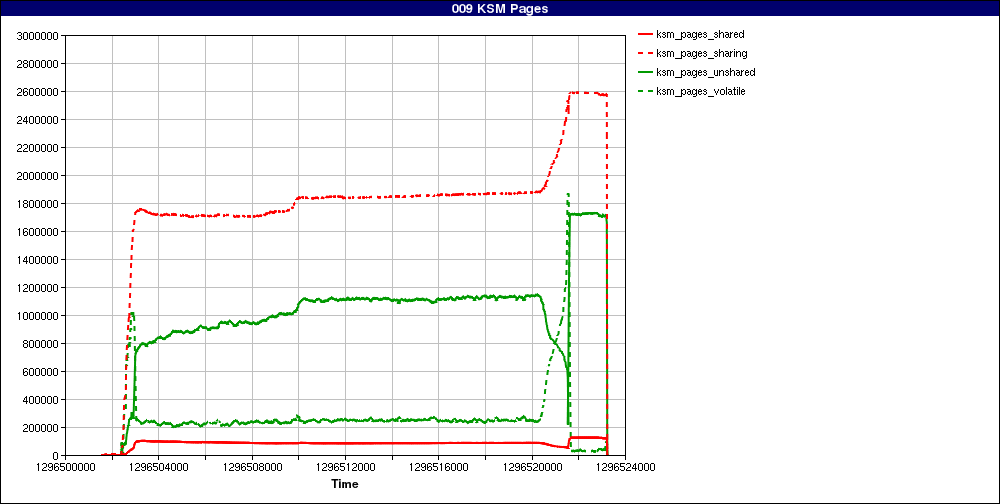
It bounces around a little bit on the ends, but it's fairly static during the test, even when there's a good downward slope on the THP's.
Hot of the presses, Karl also managed to do a run last night with the khugepaged scanning rates turned all the way up:
http://sr71.net/~dave/ibm/038_System_Anonymous_Pages-scan-always.png

The THP's there are a lot more stable. I'd read that as saying that the scanning probably just isn't keeping up with whatever is breaking the pages up.
Quoted 9 lines
KSM will slowdown performance also during copy-on-writes when
pages_sharinggoes up, not only because of creating non-linearity inside 2m chunks (which makes mandatory to use ptes and not hugepmd, it's not an inefficiency of some sort that can be optimized away unfortunately). We sure could change KSM to merge 2M pages instead of 4k pages, but then the memory-density would decrease of several order of magnitudes making the KSM scan almost useless (ok, with guest heavily using THP that may change, but all pagecache is still 4k... so for now it'd be next to useless).
Yup, unless we do something special, the odds of sharing those 2MB suckers are near zero.
Quoted 4 lines
I would prefer to close the issues that you just previously reported, sometime with
mmap_semand issues like that, before adding more features though but I don't want to defer things either so it's up to you.
I'm happy to hold on to them for another release. I'm actually going to go look at the freezes I saw now that I have these out in the wild. I'll probably stick them in a git tree and keep them up to date.
Are there any other THP issues you're chasing at the moment?
-- Dave
Quoted 22 lines · Dave Hansen
Quoted 6 lines · Andrea Arcangeli
Quoted 5 lines · Dave Hansen
I'm working on some more reports that transparent huge pages and KSM do not play nicely together. Basically, whenever THP's are present along with KSM, there is a lot of attrition over time, and we do not see much overall progress keeping THP's around:
Quoted 7 lines
Quoted 3 lines
http://sr71.net/~dave/ibm/038_System_Anonymous_Pages.png(That's Karl Rister's graph, thanks Karl!)
Well if the pages_sharing/pages_shared count goes up, this is a feature not a bug.... You need to print that too in the chart to show this is not ok
Here are the KSM sharing bits for the same run:
http://sr71.net/~dave/ibm/009_KSM_Pages.pngIt bounces around a little bit on the ends, but it's fairly static during the test, even when there's a good downward slope on the THP's.
Quoted 8 lines
Hot of the presses, Karl also managed to do a run last night with the khugepaged scanning rates turned all the way up:
http://sr71.net/~dave/ibm/038_System_Anonymous_Pages-scan-always.pngThe THP's there are a lot more stable. I'd read that as saying that the scanning probably just isn't keeping up with whatever is breaking the pages up.
This is exactly the case. But note that it's not obvious that keeping the hugepage number up steady is beneficial in terms of final
performance: what happens now is you split and collapse (collapse requires copy so it's more costly than split) hugepages at higher frequency than before (the hugepages are still split but now they're collapsed faster and ksm has to split them again). So now the speedup from hugepages needs to also offset the cost of the more frequent split/collapse events that didn't happen before.
So I guess considering the time is of the order of 2/3 hours and there are "only" 88G of memory, speeding up khugepaged is going to be beneficial considering how big boost hugepages gives to the guest with NPT/EPT and even bigger boost for regular shadow paging, but it also depends on guest. In short khugepaged by default is tuned in a way that can't run in the way of the CPU.
I recall Avi once suggested someday we'd need khugepaged running at 100% load cpu like it may happen for ksmd. It's not needed yet though but this is just to say you're perfectly right assuming the default scanning rate may be too slow. But it's really meant to be tuned depending on the size of the system, how many cores, how many gb of ram to scan etc, if KSM is on, etc...
KSM internal checksum check before adding rmap_items to the unstable tree already should prevent false sharing between ksm and khugepaged. Plus khugepaged will stay away if the page is shared by KSM. So because of this the risk of false sharing is low even running both at 100% load on the same VM.
khugepaged default scan rate may be good idea to increase too for large systems with lots of cpus and lots of memory, the default is super paranoid and to be optimistic to still get a net gain for the netbooks and cellphones if any collapse happens ;).
I'm generally very pleased to see these charts.
It reminds me that Microsoft and Oracle can't support hugepages and KSM simultaneously, and at least Oracle Xen doesn't even have KSM at all (there's some attempt to share guest cache or find equal I/O or stuff like that but it won't help for guest anonymous memory which incidentally is where HPC at places like LHC needs KSM running). Xen doesn't even support swapping (easy to use THP in hypervisor if you don't support swapping, of course Oracle Xen wouldn't support swapping even if it would use 4k pages.. ;).
So current status of KSM over THP, where KSM scans inside THP pages, and where 2m pages, 4k regular pages, and 4k KSM nonlinar pages with special rmap_item are mixed in the same VMA, and where both regular 4k pages, 2m pages and even the ksm pages are all swappable, and with mmu notifier keeping shadow MMU or NPT/EPT in full synchrony with the Linux VM so that both the KSM and THP algorithms are 100% secondary-mmu agnostic, is quite a milestone for 2.6.38 and I hope this will be a good proof of how the KVM design is superior and with less effort we can achieve things that they may never support with equal or better performance (in the KSM case our shared guest filesystem cache remains readonly mapped and natively handled by guest without any paravirt, like if KSM didn't merge anything).
Quoted 2 lines
I'm happy to hold on to them for another release. I'm actually going to go look at the freezes I saw now that I have these out in the wild.
I'm also going to have a closer look. The other report you can see search for subject "khugepaged" in lkml from JindA?ich (I think compaction is too heavy, a walk in the park compared to lumpy reclaim but we need to make it more latency friendly, I also got a report that latency increases with heavy I/O that I think is the same thing that JindA?ich sees).
Yet another report shows a full hang with khugepaged waiting on mmap_sem but I think that is not related to THP, maybe something hung on the mmap_sem, khugepaged doesn't seem the holder of it.
I myself had an issue with PROVE_LOCKING and I deadlocked inside _raw_spin_unlock_irq (how can I possibly deadlock inside unlock? must be prove locking bug? I didn't yet check if there have been updates in that area).
There is also a known bug that I didn't fix yet and it's the next thing I need to address and it's the pgd_lock hold with irq disabled taking the page_table_lock. That is buggy with THP=off too, but it only triggers with NR_CPUS small enough so to disable PT locks (for small smp builds PT lock becomes the page_table_lock and then it'll deadlock when sending IPI with page_table_lock hold because the vmalloc fault will take pgd_lock with irqs disabled). I've no idea why pgd_lock is taken with irq disabled.
No other issue. It's not as bad as it seems, likely turning congestion_wait in compaction and breaking the compaction look and a few other tweaks to compaction will solve the latency issue with lots of dirty cache. the pgd_lock is likely easily fixable too. Your issue and the mmap_sem read mode hang I didn't look into yet but they may not be related to this. Also your issue looked like the pgd_lock bug that I already know about, so maybe it's nothing new (maybe the mmap_sem too, I've no idea at the moment). I never reproduced this myself yet. Anyway there's nothing really concerning, no mm corruption or weird oops whatsoever ever reported, a spinlock or mmap_sem deadlock not enough to worry me ;).
Quoted 3 lines
I'll probably stick them in a git tree and keep them up to date.
Are there any other THP issues you're chasing at the moment?
I reviewed it too, and I see no problems. So if you fix those two bits that Johannes pointed out (remove the split that is superfluous after wait_ if you hold mmap_sem or rmap lock and add the split to the other walkers not yet covered) I think they can go in now without waiting.
--
To unsubscribe, send a message with 'unsubscribe linux-mm' in the body to [email protected]. For more info on Linux MM,
see: http://www.linux-mm.org/ .
Fight unfair telecom policy in Canada: sign http://dissolvethecrtc.ca/
Don't email: <a href=mailto:"[email protected]"> [email protected] </a>
Quoted 3 lines · Andrea Arcangeli
So now the speedup
from hugepages needs to also offset the cost of the more frequent split/collapse events that didn't happen before.
My concern here is the downward slope. I interpret that as saying that we'll eventually have _zero_ THPs. Plus, the benefits are decreasing constantly, even though the scanning overhead is fixed (or increasing even).
Quoted 6 lines
So I guess considering the time is of the order of 2/3 hours and there are "only" 88G of memory, speeding up khugepaged is going to be beneficial considering how big boost hugepages gives to the guest with NPT/EPT and even bigger boost for regular shadow paging, but it also depends on guest. In short khugepaged by default is tuned in a way that can't run in the way of the CPU.
I guess we could also try and figure out whether the khugepaged CPU overhead really comes from the scanning or the collapsing operations themselves. Should be as easy as some oprofiling.
If it really is the scanning, I bet we could be a lot more efficient with khugepaged as well. In the case of KVM guests, we're going to have awfully fixed virtual addresses and processes where collapsing can take place.
It might make sense to just have split_huge_page() stick the vaddr and the mm in a queue. khugepaged could scan those addresses first instead of just going after the system as a whole.
For cases where the page got split, but wasn't modified, should we have a non-copying, non-allocating fastpath to re-merge it?
-- Dave
--
To unsubscribe, send a message with 'unsubscribe linux-mm' in the body to [email protected]. For more info on Linux MM,
see: http://www.linux-mm.org/ .
Fight unfair telecom policy in Canada: sign http://dissolvethecrtc.ca/
Don't email: <a href=mailto:"[email protected]"> [email protected] </a>
Quoted 9 lines · Dave Hansen
Quoted 3 lines · Andrea Arcangeli
So now the speedup
from hugepages needs to also offset the cost of the more frequent split/collapse events that didn't happen before.My concern here is the downward slope. I interpret that as saying that we'll eventually have _zero_ THPs. Plus, the benefits are decreasing constantly, even though the scanning overhead is fixed (or increasing even).
It doesn't seem a downward slope, it seems to level out at 900000 pages. As shown by the other chart a faster khugepaged scan rate would make it level out at an higher percentage of memory being huge with an increased cost in khugepaged but it may very well payoff for the final performance (especially on plenty-core).
Quoted 3 lines
I guess we could also try and figure out whether the khugepaged CPU overhead really comes from the scanning or the collapsing operations themselves. Should be as easy as some oprofiling.
Actually I already know, the scanning is super fast. So it's no real big deal to increase the scanning. It's big deal only if there are plenty more of collapse/split. Compared to the KSM scan, the khugepaged scan costs nothing.
Quoted 8 lines
If it really is the scanning, I bet we could be a lot more efficient with khugepaged as well. In the case of KVM guests, we're going to have awfully fixed virtual addresses and processes where collapsing can take place.
It might make sense to just have
split_huge_page()stick the vaddr and the mm in a queue. khugepaged could scan those addresses first instead of just going after the system as a whole.
That would apply to KSM and swapping only though, not to all split_huge_page. It may not be bad idea. But the scanning really is fast. So it may not be necessary. Clearly the more memory you have, the faster the scanning has to be to obtain the same percentage of memory in hugepages in presence of KSM.
Also note: did you tune the ksmd scanning values? Or you only run echo 1 >run? Clearly if you increased the ksmd scanning values decreasing the scan_sleep_millisecs or increased the pages_scanned, you've to increase the khugepaged scanning values too accordingly. Not saying the current default is ok for such an huge system that you're using. But I doubt the ksm default is ok either for such an huge system. So if you go tweak ksmd at 100% cpu load (which will also cause more false sharing as the interval between the cksum comparsion before adding to unstable tree decreases significantly) and khugepaged doesn't collapse the false-sharing regions, it's normal. (in that case either slowdown ksm or speedup khugepaged would help, slowing down ksm may actually lead to better performance and not much less memory used)
In fact the "keep track" of split_huge_page location for khugepaged, may actually hide issues in KSM if there's a piece of memory flipped twice fast but that stays at the same value all the time, then the cksum heuristic that decides if the page is constant enough to be added to the unstable tree, may get false positives from the cksum. If we notice in KSM the page cows fast after after sharing it for a couple of times we should stop merging it. It'd be better to improve KSM intelligence to avoid false sharing in that case. Now I don't have enough data (I don't even know what runs in guest) clearly to tell if this could ever be because of 1) undetectable false sharing from KSM through the cksum, 2) a too fast ksm scan invalidating the ckshm, 3) or genuine khugepaged scan too slow not keeping up with KSM optimal changes (which would be perfectly normal if ksmd scan rate has been increased a lot but khugepaged wasn't accordingly).
In short I don't issues at the moment with this workload if increasing khugepaged (or slowing down ksm) optimizes it.
Quoted 2 lines
For cases where the page got split, but wasn't modified, should we have a non-copying, non-allocating fastpath to re-merge it?
Even if it's modified it's ok, as long as the pages are still physically contiguous collapse can happen in place. I never dreamed to attempt it only because of the increased complexity, __split_huge_page_refcount is complex enough so because I could avoid converting from regular page to hugepage in place I happily avoided it ;). That BUG_ON(page_mapcount != mapcount) I can have nightmares at night with it, so I was pleased not to have more of those. Anyway I think it's not important optimization we should spend more energy in making sure split_huge_page is never called for nothing. However in the mid term I'm not against it, it may always happen sometime that the hugepage is splitted by memory pressure but then the subpages aren't swapped out.
There's also one other thing to optimize that I think has more priority (it's not going to benefit KVM though) that is to collapse readonly shared anon pages, which currently it can't do.
--
To unsubscribe, send a message with 'unsubscribe linux-mm' in the body to [email protected]. For more info on Linux MM,
see: http://www.linux-mm.org/ .
Fight unfair telecom policy in Canada: sign http://dissolvethecrtc.ca/
Don't email: <a href=mailto:"[email protected]"> [email protected] </a>
Quoted 8 lines · Andrea Arcangeli
Quoted 3 lines
I guess we could also try and figure out whether the khugepaged CPU overhead really comes from the scanning or the collapsing operations themselves. Should be as easy as some oprofiling.
Actually I already know, the scanning is super fast. So it's no real big deal to increase the scanning. It's big deal only if there are plenty more of collapse/split. Compared to the KSM scan, the khugepaged scan costs nothing.
Just FYI, I did some profiling on a workload that constantly split and joined pages. Very little of the overhead was in the scanning itself, so I think you're dead-on here.
-- Dave
--
To unsubscribe, send a message with 'unsubscribe linux-mm' in
the body to [email protected]. For more info on Linux MM,
see: http://www.linux-mm.org/ .
Fight unfair telecom internet charges in Canada: sign http://stopthemeter.ca/
Don't email: <a href=mailto:"[email protected]"> [email protected] </a>
Hello,
Quoted 3 lines · Dave Hansen
Just FYI, I did some profiling on a workload that constantly split and joined pages. Very little of the overhead was in the scanning itself, so I think you're dead-on here.
Yep, my way to deduce it has been to set both to 100%, and check the rate of increase of /sys/kernel/mm/transparent_hugepage/khugepaged/full_scans vs /sys/kernel/mm/ksm/full_scans and the differences is enormous. So a 100% CPU ksmd scan can probably be followed more than well with a 1% CPU khugepaged scan and probably achieve the exact same hugepage ratio of a 100% khugepaged scan. The default khugepaged scan is super paranoid (it has to be, considering the default ksm scan is zero). Maybe we can still increase the default pages_to_scan a bit. I suspect most of the current cost should be in the scheduler and that only accounts for 1 kthread schedule event every 10 sec.
--
To unsubscribe, send a message with 'unsubscribe linux-mm' in
the body to [email protected]. For more info on Linux MM,
see: http://www.linux-mm.org/ .
Fight unfair telecom internet charges in Canada: sign http://stopthemeter.ca/
Don't email: <a href=mailto:"[email protected]"> [email protected] </a>
Quoted 14 lines · Dave Hansen
I'm working on some more reports that transparent huge pages and KSM do not play nicely together. Basically, whenever THP's are present along with KSM, there is a lot of attrition over time, and we do not see much overall progress keeping THP's around:
http://sr71.net/~dave/ibm/038_System_Anonymous_Pages.png(That's Karl Rister's graph, thanks Karl!)
However, I realized that we do not currently have a nice way to find out where individual THP's might be on the system. We have an overall count, but no way of telling which processes or VMAs they might be in.
Quoted 6 lines
I started to implement this in the
/proc/$pid/smapscode, but quickly realized that thelib/pagewalk.ccode unconditionally splits THPs up. This set reworks that code a bit and, in the end, gives you a per-map count of the numbers of huge pages. It also makes it possible for page walks to _not_ split THPs.
Nice! I'd like to start using this patchset immediately, I'm hoping you'll re-propose it with the fixes soon.
Thanks Dave.
--
To unsubscribe, send a message with 'unsubscribe linux-mm' in
the body to [email protected]. For more info on Linux MM,
see: http://www.linux-mm.org/ .
Fight unfair telecom internet charges in Canada: sign http://stopthemeter.ca/
Don't email: <a href=mailto:"[email protected]"> [email protected] </a>