iommu: Split iommu_unmaps
PATCH 1/1 iommu: Split iommu_unmaps
iommu_map splits requests into pages that the iommu driver reports that it can handle. The iommu_unmap path does not do the same. This can cause problems not only from callers that might expect the same behavior as the map path, but even from the failure path of iommu_map, should it fail at a point where it has mapped and needs to unwind a set of pages that the iommu driver cannot handle directly. amd_iommu, for example, will BUG_ON if asked to unmap a non power of 2 size.
Fix this by extracting and generalizing the sizing code from the iommu_map path and use it for both map and unmap.
---
 drivers/iommu/iommu.c |   63 +++++++++++++++++++++++++++----------------------
 1 file changed, 35 insertions(+), 28 deletions(-)
drivers/iommu/iommu.c +35 -28
@@ -754,6 +754,38 @@ int iommu_domain_has_cap(struct iommu_domain *domain, }EXPORT_SYMBOL_GPL (iommu_domain_has_cap); +static size_t iommu_pgsize (struct iommu_domain *domain, +unsigned long addr_merge,size_t size) +{ +unsigned int pgsize_idx; +size_t pgsize; + +/* Max page size that still fits into 'size' */ + pgsize_idx =__fls (size); + +/* need to consider alignment requirements ? */ +if (likely (addr_merge)) { +/* Max page size allowed by address */ +unsigned int align_pgsize_idx =__ffs (addr_merge); + pgsize_idx =min (pgsize_idx, align_pgsize_idx); + } + +/* build a mask of acceptable page sizes */ + pgsize = (1UL << (pgsize_idx +1 )) -1 ; + +/* throw away page sizes not supported by the hardware */ + pgsize &= domain->ops->pgsize_bitmap; + +/* make sure we're still sane */ +BUG_ON (!pgsize); + +/* pick the biggest page */ + pgsize_idx =__fls (pgsize); + pgsize =1UL << pgsize_idx; + +return pgsize; +} +int iommu_map (struct iommu_domain *domain,unsigned long iova,phys_addr_t paddr,size_t size,int prot) {
@@ -785,32 +817,7 @@ int iommu_map(struct iommu_domain *domain, unsigned long iova, (unsigned long)paddr, (unsigned long)size);while (size) { -unsigned long pgsize, addr_merge = iova | paddr; -unsigned int pgsize_idx; - -/* Max page size that still fits into 'size' */ - pgsize_idx =__fls (size); - -/* need to consider alignment requirements ? */ -if (likely (addr_merge)) { -/* Max page size allowed by both iova and paddr */ -unsigned int align_pgsize_idx =__ffs (addr_merge); - - pgsize_idx =min (pgsize_idx, align_pgsize_idx); - } - -/* build a mask of acceptable page sizes */ - pgsize = (1UL << (pgsize_idx +1 )) -1 ; - -/* throw away page sizes not supported by the hardware */ - pgsize &= domain->ops->pgsize_bitmap; - -/* make sure we're still sane */ -BUG_ON (!pgsize); - -/* pick the biggest page */ - pgsize_idx =__fls (pgsize); - pgsize =1UL << pgsize_idx; +size_t pgsize =iommu_pgsize (domain, iova | paddr, size);pr_debug ("mapping: iova 0x%lx pa 0x%lx pgsize %lu\n" , iova, (unsigned long )paddr, pgsize);
@@ -863,9 +870,9 @@ size_t iommu_unmap(struct iommu_domain *domain, unsigned long iova, size_t size)* or we hit an area that isn't mapped. */ while (unmapped < size) { -size_t left = size - unmapped; +size_t pgsize =iommu_pgsize (domain, iova, size - unmapped); - unmapped_page = domain->ops->unmap (domain, iova, left); + unmapped_page = domain->ops->unmap (domain, iova, pgsize);if (!unmapped_page)break ;
Joerg,
Any comments on this? I need this for vfio hugepage support, otherwise we risk getting a map failure that results in a BUG_ON from iommu_unmap_page in amd_iommu. I can take it in through my vfio tree to keep the dependencies together if you want to provide an ack. Thanks,
Alex
Quoted 106 lines · Alex Williamson
iommu_mapsplits requests into pages that the iommu driver reports that it can handle. Theiommu_unmappath does not do the same. This can cause problems not only from callers that might expect the same behavior as the map path, but even from the failure path ofiommu_map, should it fail at a point where it has mapped and needs to unwind a set of pages that the iommu driver cannot handle directly.amd_iommu, for example, willBUG_ONif asked to unmap a non power of 2 size.Fix this by extracting and generalizing the sizing code from the
iommu_mappath and use it for both map and unmap.Signed-off-by Alex Williamson <[email protected]>--- drivers/iommu/iommu.c | 63 +++++++++++++++++++++++++++---------------------- 1 file changed, 35 insertions(+), 28 deletions(-)drivers/iommu/iommu.c +35
-28@@ -754,6 +754,38 @@ int iommu_domain_has_cap(struct iommu_domain *domain, }EXPORT_SYMBOL_GPL (iommu_domain_has_cap); +static size_t iommu_pgsize (struct iommu_domain *domain, +unsigned long addr_merge,size_t size) +{ +unsigned int pgsize_idx; +size_t pgsize; + +/* Max page size that still fits into 'size' */ + pgsize_idx =__fls (size); + +/* need to consider alignment requirements ? */ +if (likely (addr_merge)) { +/* Max page size allowed by address */ +unsigned int align_pgsize_idx =__ffs (addr_merge); + pgsize_idx =min (pgsize_idx, align_pgsize_idx); + } + +/* build a mask of acceptable page sizes */ + pgsize = (1UL << (pgsize_idx +1 )) -1 ; + +/* throw away page sizes not supported by the hardware */ + pgsize &= domain->ops->pgsize_bitmap; + +/* make sure we're still sane */ +BUG_ON (!pgsize); + +/* pick the biggest page */ + pgsize_idx =__fls (pgsize); + pgsize =1UL << pgsize_idx; + +return pgsize; +} +int iommu_map (struct iommu_domain *domain,unsigned long iova,phys_addr_t paddr,size_t size,int prot) {@@ -785,32 +817,7 @@ int iommu_map(struct iommu_domain *domain, unsigned long iova, (unsigned long)paddr, (unsigned long)size);while (size) { -unsigned long pgsize, addr_merge = iova | paddr; -unsigned int pgsize_idx; - -/* Max page size that still fits into 'size' */ - pgsize_idx =__fls (size); - -/* need to consider alignment requirements ? */ -if (likely (addr_merge)) { -/* Max page size allowed by both iova and paddr */ -unsigned int align_pgsize_idx =__ffs (addr_merge); - - pgsize_idx =min (pgsize_idx, align_pgsize_idx); - } - -/* build a mask of acceptable page sizes */ - pgsize = (1UL << (pgsize_idx +1 )) -1 ; - -/* throw away page sizes not supported by the hardware */ - pgsize &= domain->ops->pgsize_bitmap; - -/* make sure we're still sane */ -BUG_ON (!pgsize); - -/* pick the biggest page */ - pgsize_idx =__fls (pgsize); - pgsize =1UL << pgsize_idx; +size_t pgsize =iommu_pgsize (domain, iova | paddr, size);pr_debug ("mapping: iova 0x%lx pa 0x%lx pgsize %lu\n" , iova, (unsigned long )paddr, pgsize);@@ -863,9 +870,9 @@ size_t iommu_unmap(struct iommu_domain *domain, unsigned long iova, size_t size)* or we hit an area that isn't mapped. */ while (unmapped < size) { -size_t left = size - unmapped; +size_t pgsize =iommu_pgsize (domain, iova, size - unmapped); - unmapped_page = domain->ops->unmap (domain, iova, left); + unmapped_page = domain->ops->unmap (domain, iova, pgsize);if (!unmapped_page)break ;
Quoted 8 lines · Alex Williamson
iommu_mapsplits requests into pages that the iommu driver reports that it can handle. Theiommu_unmappath does not do the same. This can cause problems not only from callers that might expect the same behavior as the map path, but even from the failure path ofiommu_map, should it fail at a point where it has mapped and needs to unwind a set of pages that the iommu driver cannot handle directly.amd_iommu, for example, willBUG_ONif asked to unmap a non power of 2 size.
Quoted 4 lines
Fix this by extracting and generalizing the sizing code from the
iommu_mappath and use it for both map and unmap.Signed-off-by Alex Williamson <[email protected]>
Ick, this is horrid and looks like it will introduce a massive performance hit.
Surely the answer is to fix the AMD driver so that it will just get on with it and unmap the {address, range} that it's asked to map?
And fix the generic iommu_map() code while we're at it, to do it the same way.
IOTLB flushes are *slow*, and on certain hardware with non-cache-coherent page tables even the dcache flush for the page table is slow. If you deliberately break it up into individual pages and do the flush between each one, rather than just unmapping the range, you are pessimising the performance quite hard.
A while back, I went through the Intel IOMMU code to make sure it was doing this right — it used to have this kind of bogosity with repeated per-page cache and IOTLB flushes *internally*, and the resulting performance improvement was shown at http://david.woodhou.se/iommu.png
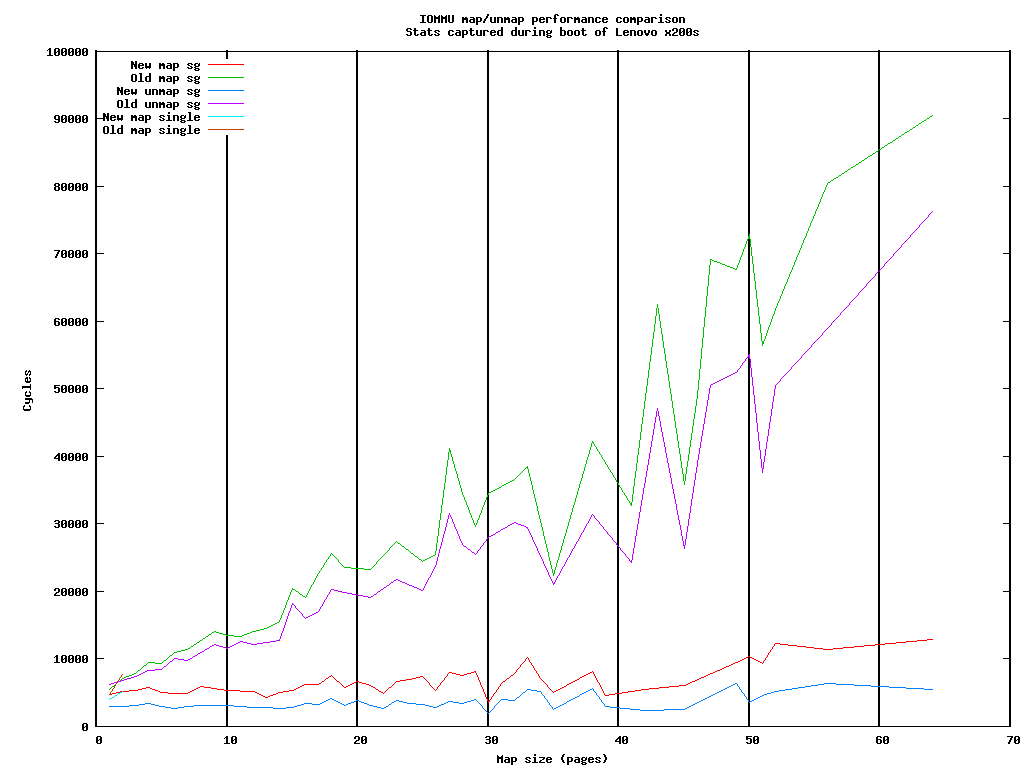
You will basically be undoing that work, by ensuring that the low-level driver never *sees* the full range.
If the AMD driver really can't handle more than one page at a time, let it loop for *itself* over the pages.
Signature · 2 lines
David Woodhouse                            Open Source Technology Centre
[email protected]                              Intel Corporation
Quoted 9 lines · David Woodhouse
Quoted 8 lines · Alex Williamson
iommu_mapsplits requests into pages that the iommu driver reports that it can handle. Theiommu_unmappath does not do the same. This can cause problems not only from callers that might expect the same behavior as the map path, but even from the failure path ofiommu_map, should it fail at a point where it has mapped and needs to unwind a set of pages that the iommu driver cannot handle directly.amd_iommu, for example, willBUG_ONif asked to unmap a non power of 2 size.
Quoted 7 lines
Quoted 4 lines
Fix this by extracting and generalizing the sizing code from the
iommu_mappath and use it for both map and unmap.Signed-off-by Alex Williamson <[email protected]>Ick, this is horrid and looks like it will introduce a massive performance hit.
For x86 there are essentially two users of iommu_unmap(), KVM and VFIO. Both of them try to unmap an individual page and look at the result to see how much was actually unmapped. Everything else appears to be error paths. So where exactly is this massive performance hit?
Quoted 2 lines
Surely the answer is to fix the AMD driver so that it will just get on with it and unmap the {address, range} that it's asked to map?
The IOMMU API allows iommu drivers to expose the page sizes they support. Mappings are done using these sizes so it only seems fair that unmappings should as well. At least that's what amd_iommu was expecting.
Quoted 9 lines
And fix the generic
iommu_map()code while we're at it, to do it the same way.IOTLB flushes are *slow*, and on certain hardware with non-cache-coherent page tables even the dcache flush for the page table is slow. If you deliberately break it up into individual pages and do the flush between each one, rather than just unmapping the range, you are pessimising the performance quite hard.
Quoted 7 lines
A while back, I went through the Intel IOMMU code to make sure it was doing this right — it used to have this kind of bogosity with repeated per-page cache and IOTLB flushes *internally*, and the resulting performance improvement was shown at http://david.woodhou.se/iommu.png
You will basically be undoing that work, by ensuring that the low-level driver never *sees* the full range.
That data is for dma_ops interfaces, not IOMMU API. How is changing iommu_unmap() in this way undoing any of your previous work?
Quoted 2 lines
If the AMD driver really can't handle more than one page at a time, let it loop for *itself* over the pages.
Sure, but that's a change to the API where I think this fix was correcting a bug in the implementation of the API. Are there users of iommu_unmap() that I don't know about? Given the in-tree users, there's not really a compelling argument to optimize. Thanks,
Alex
_______________________________________________
iommu mailing list
[email protected]
https://lists.linuxfoundation.org/mailman/listinfo/iommu
Quoted 15 lines · Alex Williamson
Quoted 14 lines · David Woodhouse
Quoted 12 lines · Alex Williamson
iommu_mapsplits requests into pages that the iommu driver reports that it can handle. Theiommu_unmappath does not do the same. This can cause problems not only from callers that might expect the same behavior as the map path, but even from the failure path ofiommu_map, should it fail at a point where it has mapped and needs to unwind a set of pages that the iommu driver cannot handle directly.amd_iommu, for example, willBUG_ONif asked to unmap a non power of 2 size.Fix this by extracting and generalizing the sizing code from the
iommu_mappath and use it for both map and unmap.Signed-off-by Alex Williamson <[email protected]>
Quoted 7 lines
Quoted 2 lines
Ick, this is horrid and looks like it will introduce a massive performance hit.
For x86 there are essentially two users of
iommu_unmap(), KVM and VFIO. Both of them try to unmap an individual page and look at the result to see how much was actually unmapped. Everything else appears to be error paths. So where exactly is this massive performance hit?
It's there, in the code that you describe. This patch is making that bogus behaviour even more firmly entrenched, and harder to fix.
There are out-of-tree users of this IOMMU API too. And while it sucks that they are out-of-tree, they are working on fixing that. And I've been talking to them about performance issues they already see on the map side.
Quoted 7 lines
Quoted 2 lines
Surely the answer is to fix the AMD driver so that it will just get on with it and unmap the {address, range} that it's asked to map?
The IOMMU API allows iommu drivers to expose the page sizes they support. Mappings are done using these sizes so it only seems fair that unmappings should as well. At least that's what
amd_iommuwas expecting.
This is silly.
The generic code has (almost) no business caring about the page sizes that the IOMMU driver will support. It should care about them *only* as an optimisation — "hey, if you manage to give me 2MiB pages I can work faster then". But it should *only* be an optimisation. Fundamentally, the map and unmap routines should just do as they're bloody told, without expecting their caller to break down the calls into individual pages.
Quoted 2 lines
That data is for
dma_opsinterfaces, not IOMMU API. How is changingiommu_unmap()in this way undoing any of your previous work?
That data is for the core map/unmap functions, which are accessed through both APIs. While iommu_map() has the problem as you described, iommu_unmap() didn't, and surely it would have been seeing the same improvements... until this patch?
Quoted 7 lines
Quoted 2 lines
If the AMD driver really can't handle more than one page at a time, let it loop for *itself* over the pages.
Sure, but that's a change to the API where I think this fix was correcting a bug in the implementation of the API. Are there users of
iommu_unmap()that I don't know about? Given the in-tree users, there's not really a compelling argument to optimize. Thanks,
It's a fix to a stupid API, yes. The current API has us manually marking the Intel IOMMU as supporting *all* sizes of pages, just so that this stupid "one page at a time" nonsense doesn't bite so hard... which should have raised alarm bells at the time we did it, really.
Signature · 1 line
dwmw2