mtd: spi-nor: add a new framework for SPI NOR
Subsystems (3)
cover mtd: spi-nor: add a new framework for SPI NOR
1.) Why add a new framework for SPI NOR?
The SPI-NOR controller such as Freescale's Quadspi controller is working in a different way from the SPI bus. It should knows the NOR commands to find the right LUT sequence. Unfortunately, the current code can not meet this requirement.
2.) How does this patch set do?
This patch set adds a new spi-nor layer.
Before this patch, the layer is like:
                   MTD
         ------------------------
                  m25p80
         ------------------------
	       spi bus driver
         ------------------------
	        SPI NOR chip
After this patch, the layer is like:
                   MTD
         ------------------------
                  spi-nor
         ------------------------
                  m25p80
         ------------------------
	       spi bus driver
         ------------------------
	       SPI NOR chip
With the spi-nor controller driver(Freescale Quadspi), it looks like:
                   MTD
         ------------------------
                  spi-nor
         ------------------------
                fsl-quadspi
         ------------------------
	       SPI NOR chip
3.) more details
This patch set adds a new data structrue spi_nor{}, clones most the common
code to spi-nor.c. Make the m25p80.c use the new APIs.
4.) TODO list:
3.1) add the new spi_nor_device{} for the spi-nor controller's device. 3.2) add the Freescale Quadspi driver.
Huang Shijie (4):
mtd: spi-nor: move the SPI NOR commands to a new header file
mtd: spi-nor: add a new data structrue spi_nor{}
mtd: spi-nor: add the framework for SPI NOR
mtd: m25p80: use the new spi-nor APIs
 drivers/mtd/Kconfig           |    2 +
 drivers/mtd/Makefile          |    1 +
 drivers/mtd/devices/Kconfig   |    2 +-
 drivers/mtd/devices/m25p80.c  | 1249 +++--------------------------------------
 drivers/mtd/spi-nor/Kconfig   |    6 +
 drivers/mtd/spi-nor/Makefile  |    1 +
 drivers/mtd/spi-nor/spi-nor.c | 1057 ++++++++++++++++++++++++++++++++++
 include/linux/mtd/spi-nor.h   |  101 ++++
 8 files changed, 1239 insertions(+), 1180 deletions(-)
 create mode 100644 drivers/mtd/spi-nor/Kconfig
 create mode 100644 drivers/mtd/spi-nor/Makefile
 create mode 100644 drivers/mtd/spi-nor/spi-nor.c
 create mode 100644 include/linux/mtd/spi-nor.h
Signature · 1 line
1.7.2.rc3
PATCH 1/4 mtd: spi-nor: move the SPI NOR commands to a new header file
This patch adds a new header :spi-nor.h,
and moves all the SPI NOR commands and relative macros into this new header.
This hearder can be used by the m25p80.c and other spi-nor controller, such as Freescale's Quadspi.
---
 drivers/mtd/devices/m25p80.c |   50 +--------------------------------------
 include/linux/mtd/spi-nor.h  |   53 ++++++++++++++++++++++++++++++++++++++++++
 2 files changed, 54 insertions(+), 49 deletions(-)
 create mode 100644 include/linux/mtd/spi-nor.h
drivers/mtd/devices/m25p80.c +1 -49
@@ -34,55 +34,7 @@#include <linux/spi/spi.h> #include <linux/spi/flash.h> - -/* Flash opcodes. */ -#define OPCODE_WREN 0x06/* Write enable */ -#define OPCODE_RDSR 0x05/* Read status register */ -#define OPCODE_WRSR 0x01/* Write status register 1 byte */ -#define OPCODE_NORM_READ 0x03/* Read data bytes (low frequency) */ -#define OPCODE_FAST_READ 0x0b/* Read data bytes (high frequency) */ -#define OPCODE_QUAD_READ 0x6b/* Read data bytes */ -#define OPCODE_PP 0x02/* Page program (up to 256 bytes) */ -#define OPCODE_BE_4K 0x20/* Erase 4KiB block */ -#define OPCODE_BE_4K_PMC 0xd7/* Erase 4KiB block on PMC chips */ -#define OPCODE_BE_32K 0x52/* Erase 32KiB block */ -#define OPCODE_CHIP_ERASE 0xc7/* Erase whole flash chip */ -#define OPCODE_SE 0xd8/* Sector erase (usually 64KiB) */ -#define OPCODE_RDID 0x9f/* Read JEDEC ID */ -#define OPCODE_RDCR 0x35/* Read configuration register */ - -/* 4-byte address opcodes - used on Spansion and some Macronix flashes. */ -#define OPCODE_NORM_READ_4B 0x13/* Read data bytes (low frequency) */ -#define OPCODE_FAST_READ_4B 0x0c/* Read data bytes (high frequency) */ -#define OPCODE_QUAD_READ_4B 0x6c/* Read data bytes */ -#define OPCODE_PP_4B 0x12/* Page program (up to 256 bytes) */ -#define OPCODE_SE_4B 0xdc/* Sector erase (usually 64KiB) */ - -/* Used for SST flashes only. */ -#define OPCODE_BP 0x02/* Byte program */ -#define OPCODE_WRDI 0x04/* Write disable */ -#define OPCODE_AAI_WP 0xad/* Auto address increment word program */ - -/* Used for Macronix and Winbond flashes. */ -#define OPCODE_EN4B 0xb7/* Enter 4-byte mode */ -#define OPCODE_EX4B 0xe9/* Exit 4-byte mode */ - -/* Used for Spansion flashes only. */ -#define OPCODE_BRWR 0x17/* Bank register write */ - -/* Status Register bits. */ -#define SR_WIP 1/* Write in progress */ -#define SR_WEL 2/* Write enable latch */ -/* meaning of other SR_* bits may differ between vendors */ -#define SR_BP0 4/* Block protect 0 */ -#define SR_BP1 8/* Block protect 1 */ -#define SR_BP2 0x10/* Block protect 2 */ -#define SR_SRWD 0x80/* SR write protect */ - -#define SR_QUAD_EN_MX 0x40/* Macronix Quad I/O */ - -/* Configuration Register bits. */ -#define CR_QUAD_EN_SPAN 0x2/* Spansion Quad I/O */ +#include <linux/mtd/spi-nor.h> /* Define max times to check status register before we give up. */ #define MAX_READY_WAIT_JIFFIES (40 * HZ)/* M25P16 specs 40s max chip erase */
include/linux/mtd/spi-nor.h new file +53 -0
53 lines not on this page · raw message
Signature · 1 line
1.7.2.rc3
PATCH 1/4 mtd: spi-nor: move the SPI NOR commands to a new header file
Hi Shijie,
Few feedbacks inline..
Quoted 5 lines
From: Huang Shijie [mailto:b32955 at freescale.com]
This patch adds a new header :spi-nor.h,
and moves all the SPI NOR commands and relative macros into this new header.
(1)
It's better to take all Flash vendor specific opcodes from DT.. With new framework we should do away with macros for each vendor, instead let each board file provide this information based on flash device which is mounted on it.
(2)
And also, I suggest not to touch m25p80 in anyway, bcoz it stable driver used by many. So unless spi-nor framework is accepted and is stable we m25p80 should continue working as it is.
Thus your patches should be independent of any existing driver or other frameworks. This way it might get accepted fast. Then later you can provide a way to attach m25p80 to spi-nor framework.
Thoughts ?
with regards, pekon
PATCH 1/4 mtd: spi-nor: move the SPI NOR commands to a new header file
Hi Pekon:
Quoted 2 lines
(1)
It's better to take all Flash vendor specific opcodes from DT..
firstly, some arch may does not support the DT, such as x86.
second, it makes people crazy if we put the opcodes in the DT :)
Quoted 4 lines
With new framework we should do away with macros for each vendor, instead let each board file provide this information based on flash device which is mounted on it.
Quoted 8 lines
(2)
And also, I suggest not to touch m25p80 in anyway, bcoz it stable driver used by many. So unless spi-nor framework is accepted and is stable we m25p80 should continue working as it is.
Thus your patches should be independent of any existing driver or other frameworks. This way it might get accepted fast. Then later you can provide a way to attach m25p80 to spi-nor framework.
Thoughts ?
the merge window is closed not long ago, and we have rc1 now.
Isn't it the BEST time to change the m25p80?
thanks
Huang Shijie
PATCH 1/4 mtd: spi-nor: move the SPI NOR commands to a new header file
Quoted 4 lines · Huang Shijie
Hi Pekon:
Quoted 2 lines
(1)
It's better to take all Flash vendor specific opcodes from DT..firstly, some arch may does not support the DT, such as x86.
Indeed, although the 'flash_platform_data' structure could be extended to provide similar functionality, if that were deemed the right way to go. However...
Quoted 2 lines
second, it makes people crazy if we put the opcodes in the DT :)
I would agree. Where possible, I think it's preferable for the driver to probe device properties at runtime. One benefit, often overlooked, is that it allows board manufacturers to second-source parts without having to rebuild, and possibly re-certify, binaries.
Quoted 14 lines
Quoted 5 lines
With new framework we should do away with macros for each vendor, instead let each board file provide this information based on flash device
which is mounted on it.Quoted 9 lines
(2)
And also, I suggest not to touch m25p80 in anyway, bcoz it stable driver used by many. So unless spi-nor framework is accepted and is stable we m25p80 should continue working as it is.
Thus your patches should be independent of any existing driver or other frameworks. This way it might get accepted fast. Then later you can provide
a way to attach m25p80 to spi-nor framework.
Thoughts ?
Quoted 4 lines
the merge window is closed not long ago, and we have rc1 now.
Isn't it the BEST time to change the m25p80?
The spi-nor framework has great potential, but I think you should allow some time for other driver developers to comment, and the framework to mature. Without greater support, it risks becoming another single-use framework.
Cheers,
Angus
Quoted 9 lines
thanks
Huang Shijie______________________________________________________
Linux MTD discussion mailing list
http://lists.infradead.org/mailman/listinfo/linux-mtd/
Signature · 8 lines
-------------------------------------
Angus Clark
ST Microelectronics (R&D) Ltd.
1000 Aztec West, Bristol, BS32 4SQ
email: angus.clark at st.com
tel: +44 (0) 1454 462389
st-tina: 065 2389
-------------------------------------
PATCH 2/4 mtd: spi-nor: add a new data structrue spi_nor{}
In reply to Huang ShijieThe spi_nor{} is cloned from the m25p{}.
The spi_nor{} can be used by both the m25p80 and spi-nor controller.
1) Add four hooks:
@read_reg: used to read the registers, such as read status register,
read ID, read configure register.
@write_reg: used to write the registers, such as write enable,
erase sector.
@read: use the proper read opcode to read out the data from the NOR.
@write: use the proper write opcode to write data to the NOR.
2) Add a new field sst_write_second for the SST NOR write.
3) change the @command field from pointer to array which makes the code more simple.
---
 drivers/mtd/devices/m25p80.c |    6 -----
 include/linux/mtd/spi-nor.h  |   43 ++++++++++++++++++++++++++++++++++++++++++
 2 files changed, 43 insertions(+), 6 deletions(-)
drivers/mtd/devices/m25p80.c +0 -6
@@ -44,12 +44,6 @@/****************************************************************************/ -enum read_type { -M25P80_NORMAL =0 , -M25P80_FAST , -M25P80_QUAD , -}; -struct m25p {struct spi_device *spi;struct mutex lock;
include/linux/mtd/spi-nor.h +43 -0
47 lines not on this page · raw message
Signature · 1 line
1.7.2.rc3
PATCH 2/4 mtd: spi-nor: add a new data structrue spi_nor{}
Quoted 1 line
From: Huang Shijie [mailto:b32955 at freescale.com]
[...]
include/linux/mtd/spi-nor.h line 59
Quoted 8 lines
include/linux/mtd/spi-nor.h +7
-0+#define MAX_CMD_SIZE 6 + +enum read_type { +M25P80_NORMAL =0 , +M25P80_FAST , +M25P80_QUAD , +};
Sorry. no 'M25P80' suffix here this is spi-nor.h :-)
include/linux/mtd/spi-nor.h line 63
Quoted 5 lines
include/linux/mtd/spi-nor.h +4
-0+ +struct spi_nor { +struct mutex lock; +struct mtd_info mtd;
mtd_info should not be present here. Rather it should be other way round 'mtd_info->priv = (struct spi_nor *) spi_nor;
include/linux/mtd/spi-nor.h line 64
Quoted 1 line
include/linux/mtd/spi-nor.h +1
-0+struct device *dev;
Again, spi_nor would be a MTD device, not a new type of device on its own. Thus you should use, mtd_info->dev.
include/linux/mtd/spi-nor.h line 68
Quoted 4 lines
include/linux/mtd/spi-nor.h +4
-0+u16 page_size; +u16 addr_width; +u8 erase_opcode; +u8 read_opcode;
s/read_opcode/read_flash_opcode
How about '+ u8 read_reg_opcode' ??
include/linux/mtd/spi-nor.h line 69
Quoted 1 line
include/linux/mtd/spi-nor.h +1
-0+u8 program_opcode;
+ How about '+ u8 write_reg_opcode' ??
include/linux/mtd/spi-nor.h line 71
Quoted 2 lines
include/linux/mtd/spi-nor.h +2
-0+u8 command[MAX_CMD_SIZE ]; +enum read_type flash_read;
s/read_type/read_mode
(agree .. there is nothing in the name, but it matches SPI generic framework)
Other missing fields I can think of are..
+ u8 read_dummy_cycles;
+ u8 write_dummy_cycles;
include/linux/mtd/spi-nor.h line 79
Quoted 9 lines
include/linux/mtd/spi-nor.h +8
-0+bool sst_write_second; + +/* +* Read the register: +* Read `len` length data from the register specified by the `opcode`, +* and store the data to the `buf`. +*/ +int (*read_reg)(struct spi_nor *flash,u8 opcode,u8 *buf,int len);
Do you need 'opcode' passed in argument here ?
Can you add it as 'read_reg_opcode' field in struct spi_nor ? 'read_reg_opcode' should be fixed for a device like a 'read_flash_opcode'.
include/linux/mtd/spi-nor.h line 87
Quoted 10 lines
include/linux/mtd/spi-nor.h +4
-0+ +/* +* Write the register: +* Write the `cmd_len` length data stored in the @command to the NOR,
include/linux/mtd/spi-nor.h +4
-0+* the command[0] stores the write opcode. `offset` is only used for +* erase operation, it should set to zero for other NOR commands. +*/ +int (*write_reg)(struct spi_nor *flash,int cmd_len,u32 offset);
Instead of having actual 'command[]' array in struct spi_nor, and pass its valid length here.. shouldn't you pass the command as u8[] here.. int (*write_reg)(struct spi_nor *flash, u8 *cmd, u32 cmd_len); where
	cmd[0] == command_opcode
	cmd[1] == command argument 1 (like offset for erase)
	cmd[2] == command argument 2
	...
Quoted 10 lines
include/linux/mtd/spi-nor.h +8
-1+ +/* write data */ +void (*write)(struct spi_nor *flash,loff_t to,size_t len, +size_t *retlen,const u_char *buf); +/* read data */ +int (*read)(struct spi_nor *flash,loff_t from,size_t len, + size_t *retlen, u_char *buf); +};#endif --
Quoted 2 lines
1.7.2.rc3
Sorry for bit intrusive feedback. But I think it would help you to refine it better. Also some reference below
http://lists.infradead.org/pipermail/linux-mtd/2013-October/049307.html
with regards, pekon
PATCH 2/4 mtd: spi-nor: add a new data structrue spi_nor{}
? 2013?11?26? 19:42, Gupta, Pekon ??:
Quoted 12 lines
Quoted 1 line
From: Huang Shijie [mailto:b32955 at freescale.com]
[...]
include/linux/mtd/spi-nor.h line 59
Quoted 7 lines
include/linux/mtd/spi-nor.h +7
-0+#define MAX_CMD_SIZE 6 + +enum read_type { +M25P80_NORMAL =0 , +M25P80_FAST , +M25P80_QUAD , +};Sorry. no 'M25P80' suffix here this is
spi-nor.h:-)
ok. thanks. :)
Quoted 9 lines
include/linux/mtd/spi-nor.h line 63
Quoted 5 lines
include/linux/mtd/spi-nor.h +4
-0+ +struct spi_nor { +struct mutex lock; +struct mtd_info mtd;
mtd_infoshould not be present here. Rather it should be other way round 'mtd_info->priv= (structspi_nor*)spi_nor;
put the mtd here can make code simple,
do David/Brian have any comment about this? If all object to put the mtd here, i will change it.
Quoted 5 lines
include/linux/mtd/spi-nor.h line 64
Quoted 1 line
include/linux/mtd/spi-nor.h +1
-0+struct device *dev;Again,
spi_norwould be a MTD device, not a new type of device on its own. Thus you should use,mtd_info->dev.
this dev pointer is not from the mtd_info->dev, it from the spi_device or other spi nor device .
Quoted 5 lines
include/linux/mtd/spi-nor.h line 68
Quoted 4 lines
include/linux/mtd/spi-nor.h +4
-0+u16 page_size; +u16 addr_width; +u8 erase_opcode; +u8 read_opcode;s/read_opcode/read_flash_opcode
why not keep the legacy name?
should we also rename the erase_opcode to erase_flash_opcode? :)
Quoted 7 lines
How about '+ u8
read_reg_opcode' ??include/linux/mtd/spi-nor.h line 69
Quoted 1 line
include/linux/mtd/spi-nor.h +1
-0+u8 program_opcode;+ How about '+ u8
write_reg_opcode' ??
Quoted 7 lines
include/linux/mtd/spi-nor.h line 71
Quoted 2 lines
include/linux/mtd/spi-nor.h +2
-0+u8 command[MAX_CMD_SIZE ]; +enum read_type flash_read;s/read_type/read_mode
(agree .. there is nothing in the name, but it matches SPI generic framework)Other missing fields I can think of are..
+ u8read_dummy_cycles;
I was wondering if other SPI NOR driver needs this field. current dummy is 8 clock cycles for quad-read/fast-read, but for DDR QUAD read, the dummy is not 8 clock cycles.
so i did not add this field to spi-nor{}.
I do not know how the m25p80 handle the non-8 clock cycles cases...
But it's okay to me to add this field to spi-nor{}.
Quoted 3 lines
+ u8
write_dummy_cycles;
do the write need a dummy?
I check the s25fl128s's quad page program, it does not need a dummy.
Quoted 4 lines
Quoted 4 lines
include/linux/mtd/spi-nor.h +4
-0+bool sst_write_second; + +/* +* Read the register:
Quoted 10 lines
include/linux/mtd/spi-nor.h line 79
Quoted 5 lines
include/linux/mtd/spi-nor.h +4
-0+* Read `len` length data from the register specified by the `opcode`, +* and store the data to the `buf`. +*/ +int (*read_reg)(struct spi_nor *flash,u8 opcode,u8 *buf,int len);Do you need 'opcode' passed in argument here ?
Can you add it as 'read_reg_opcode' field in structspi_nor? 'read_reg_opcode' should be fixed for a device like a 'read_flash_opcode'.
the @read_reg can be used to read id, read status and so on. so the opcode here is not a fixed value.
but i do not object to add the read_reg_opcode/write_reg_opcode to spi_nor{}.
Quoted 14 lines
include/linux/mtd/spi-nor.h line 87
Quoted 10 lines
include/linux/mtd/spi-nor.h +4
-0+ +/* +* Write the register: +* Write the `cmd_len` length data stored in the @command to the NOR,
include/linux/mtd/spi-nor.h +4
-0+* the command[0] stores the write opcode. `offset` is only used for +* erase operation, it should set to zero for other NOR commands. +*/ +int (*write_reg)(struct spi_nor *flash,int cmd_len,u32 offset);Instead of having actual 'command[]' array in struct
spi_nor, and pass its valid length here.. shouldn't you pass the command as u8[] here.. int (*write_reg)(structspi_nor*flash, u8 *cmd, u32cmd_len); where
Quoted 5 lines
	cmd[0] == command_opcode
	cmd[1] == command argument 1 (like offset for erase)
	cmd[2] == command argument 2
	...
is there any benefit of your code?
you will use a local array in the stack.
why not use the spi_nor->command which has used for a long time.
Quoted 7 lines
Quoted 7 lines
include/linux/mtd/spi-nor.h +7
-0+ +/* write data */ +void (*write)(struct spi_nor *flash,loff_t to,size_t len, +size_t *retlen,const u_char *buf); +/* read data */ +int (*read)(struct spi_nor *flash,loff_t from,size_t len, +size_t *retlen,u_char *buf);
Quoted 9 lines
Quoted 5 lines
+};
#endif
--
1.7.2.rc3Sorry for bit intrusive feedback. But I think it would help you to refine it better. Also some reference below
http://lists.infradead.org/pipermail/linux-mtd/2013-October/049307.html
thanks. I referenced it when i wrote this patch.
thanks
Huang Shijie
PATCH 2/4 mtd: spi-nor: add a new data structrue spi_nor{}
Dear Huang Shijie,
Quoted 25 lines
? 2013?11?26? 19:42, Gupta, Pekon ??:
Quoted 4 lines
Quoted 1 line
From: Huang Shijie [mailto:b32955 at freescale.com]
[...]
Quoted 9 lines
include/linux/mtd/spi-nor.h line 59
Quoted 7 lines
include/linux/mtd/spi-nor.h +7
-0+#define MAX_CMD_SIZE 6 + +enum read_type { +M25P80_NORMAL =0 , +M25P80_FAST , +M25P80_QUAD , +};Sorry. no 'M25P80' suffix here this is
spi-nor.h:-)ok. thanks. :)
Quoted 7 lines
include/linux/mtd/spi-nor.h line 63
Quoted 4 lines
include/linux/mtd/spi-nor.h +4
-0+ +struct spi_nor { +struct mutex lock; +struct mtd_info mtd;
mtd_infoshould not be present here. Rather it should be other way round 'mtd_info->priv= (structspi_nor*)spi_nor;
Quoted 1 line
put the mtd here can make code simple,
The MTD API functions will pass you the struct mtd_info anyway, so you will need to implement mtdinfo_to_yourdriverdata() function, no need for duplication.
Quoted 10 lines
do David/Brian have any comment about this? If all object to put the mtd here, i will change it.
Quoted 4 lines
include/linux/mtd/spi-nor.h line 64
Quoted 1 line
include/linux/mtd/spi-nor.h +1
-0+struct device *dev;Again,
spi_norwould be a MTD device, not a new type of device on its own. Thus you should use,mtd_info->dev.this dev pointer is not from the
mtd_info->dev, it from thespi_deviceor other spi nor device .
So this is your own device pointer or ... what kind of device pointer? [...]
Best regards,
Marek Vasut
PATCH 2/4 mtd: spi-nor: add a new data structrue spi_nor{}
? 2013?11?27? 17:32, Marek Vasut ??:
Quoted 1 line
So this is your own device pointer or ... what kind of device pointer?
the pointer from spi_device{}
Huang Shijie
PATCH 2/4 mtd: spi-nor: add a new data structrue spi_nor{}
Dear Huang Shijie,
Quoted 4 lines
? 2013?11?27? 17:32, Marek Vasut ??:
Quoted 1 line
So this is your own device pointer or ... what kind of device pointer?
the pointer from spi_device{}
OK, I am 200% positive you need to add comments into the structure about what exactly does each member of it mean AND it would be nice if you could rename them to have less generic names (like spi_dev instead of dev).
Thanks ! :)
Best regards,
Marek Vasut
PATCH 3/4 mtd: spi-nor: add the framework for SPI NOR
In reply to Huang ShijieThis patch cloned most of the m25p80.c. In theory, it adds a new spi-nor layer.
Before this patch, the layer is like:
                   MTD
         ------------------------
                  m25p80
         ------------------------
	       spi bus driver
         ------------------------
	        SPI NOR chip
After this patch, the layer is like:
                   MTD
         ------------------------
                  spi-nor
         ------------------------
                  m25p80
         ------------------------
	       spi bus driver
         ------------------------
	       SPI NOR chip
With the spi-nor controller driver(Freescale Quadspi), it looks like:
                   MTD
         ------------------------
                  spi-nor
         ------------------------
                fsl-quadspi
         ------------------------
	       SPI NOR chip
New APIs:
spi_nor_register: used to register a spi-nor flash.
spi_nor_unregister: used to unregister a spi-nor flash.
The m25p80 and spi-nor controller driver should implement the hooks
@read_reg, @write_reg, @write, @read.
---
 drivers/mtd/Kconfig           |    2 +
 drivers/mtd/Makefile          |    1 +
 drivers/mtd/devices/Kconfig   |    2 +-
 drivers/mtd/spi-nor/Kconfig   |    6 +
 drivers/mtd/spi-nor/Makefile  |    1 +
 drivers/mtd/spi-nor/spi-nor.c | 1057 +++++++++++++++++++++++++++++++++++++++++
 include/linux/mtd/spi-nor.h   |    5 +
 7 files changed, 1073 insertions(+), 1 deletions(-)
 create mode 100644 drivers/mtd/spi-nor/Kconfig
 create mode 100644 drivers/mtd/spi-nor/Makefile
 create mode 100644 drivers/mtd/spi-nor/spi-nor.c
drivers/mtd/Kconfig +2 -0
@@ -320,6 +320,8 @@ source "drivers/mtd/onenand/Kconfig" source "drivers/mtd/lpddr/Kconfig" +source "drivers/mtd/spi-nor/Kconfig" + source "drivers/mtd/ubi/Kconfig" endif # MTD
drivers/mtd/Makefile +1 -0
@@ -32,4 +32,5 @@ inftl-objs := inftlcore.o inftlmount.o obj-y += chips/ lpddr/ maps/ devices/ nand/ onenand/ tests/ +obj-$(CONFIG_MTD_SPI_NOR_BASE) += spi-nor/ obj-$(CONFIG_MTD_UBI) += ubi/
drivers/mtd/devices/Kconfig +1 -1
@@ -80,7 +80,7 @@ config MTD_DATAFLASH_OTP config MTD_M25P80 tristate "Support most SPI Flash chips (AT26DF, M25P, W25X, ...)" - depends on SPI_MASTER + depends on SPI_MASTER && MTD_SPI_NOR_BASE help This enables access to most modern SPI flash chips, used for program and data storage. Series supported include Atmel AT26DF,
drivers/mtd/spi-nor/Kconfig new file +6 -0
@@ -0,0 +1,6 @@ +config MTD_SPI_NOR_BASE + bool "the framework for SPI-NOR support" + depends on MTD + help + This is the framework for the SPI NOR which can be used by the SPI + device drivers and the SPI-NOR device driver.
drivers/mtd/spi-nor/Makefile new file +1 -0
@@ -0,0 +1 @@ +obj-$(CONFIG_MTD_SPI_NOR_BASE) += spi-nor.o
drivers/mtd/spi-nor/spi-nor.c new file +1057 -0
1,057 lines not on this page · raw message
include/linux/mtd/spi-nor.h +5 -0
@@ -93,4 +93,9 @@ struct spi_nor {int (*read)(struct spi_nor *flash,loff_t from,size_t len, size_t *retlen, u_char *buf); }; + +int spi_nor_register (struct spi_nor *flash,const struct spi_device_id *id, +bool quad_read); +int spi_nor_unregister (struct spi_nor *flash); +extern const struct spi_device_id spi_nor_ids[];#endif
Signature · 1 line
1.7.2.rc3
PATCH 3/4 mtd: spi-nor: add the framework for SPI NOR
Quoted 3 lines
From: Huang Shijie [mailto:b32955 at freescale.com]
This patch cloned most of them25p80.c. In theory, it adds a new spi-nor layer.
[...]
Quoted 2 lines
Signed-off-by Huang Shijie <[email protected]>
Is there a way we can also original m25p80 contributors' sign-off also? David/Brian, can you suggest ?
With regards, pekon
PATCH 3/4 mtd: spi-nor: add the framework for SPI NOR
In reply to Huang ShijieDear Huang Shijie,
Quoted 33 lines
This patch cloned most of the
m25p80.c. In theory, it adds a new spi-nor layer.Before this patch, the layer is like:
                   MTD
         ------------------------
                  m25p80
         ------------------------
	       spi bus driver
         ------------------------
	        SPI NOR chip
After this patch, the layer is like:
                   MTD
         ------------------------
                  spi-nor
         ------------------------
                  m25p80
         ------------------------
	       spi bus driver
         ------------------------
	       SPI NOR chip
With the spi-nor controller driver(Freescale Quadspi), it looks like:
                   MTD
         ------------------------
                  spi-nor
         ------------------------
                fsl-quadspi
         ------------------------
	       SPI NOR chip
Quoted 6 lines
New APIs:
spi_nor_register: used to register a spi-nor flash.
spi_nor_unregister: used to unregister a spi-nor flash.The m25p80 and spi-nor controller driver should implement the hooks
@read_reg, @write_reg, @write, @read.
I would approach this the other way around -- first I'd split the common code out from m25p80 driver and then I'd add my own driver which uses the common code. Then we won't have to review the common code (or such a large chunk of it anyway) again.
But I am still not too sure we need this new framework at all, I will wait for your reply on 0/4 .
Cheers!
Best regards,
Marek Vasut
PATCH 4/4 mtd: m25p80: use the new spi-nor APIs
In reply to Huang ShijieThis patch removes all the common code(including the m25p_ids) which has already been cloned to spi-nor.c, and implements the necessary hooks for spi_nor{}.
---
 drivers/mtd/devices/m25p80.c | 1193 +++---------------------------------------
 1 files changed, 69 insertions(+), 1124 deletions(-)
drivers/mtd/devices/m25p80.c +69 -1124
@@ -36,282 +36,43 @@#include <linux/spi/flash.h> #include <linux/mtd/spi-nor.h> -/* Define max times to check status register before we give up. */ -#define MAX_READY_WAIT_JIFFIES (40 * HZ)/* M25P16 specs 40s max chip erase */ -#define MAX_CMD_SIZE 6 - -#define JEDEC_MFR (_jedec_id) ((_jedec_id) >> 16) - -/****************************************************************************/ - -struct m25p { -struct spi_device *spi; -struct mutex lock; -struct mtd_info mtd; -u16 page_size; -u16 addr_width; -u8 erase_opcode; -u8 read_opcode; -u8 program_opcode; -u8 *command; -enum read_type flash_read; -}; - -static inline struct m25p *mtd_to_m25p (struct mtd_info *mtd) -{ - return container_of(mtd, struct m25p, mtd); -} - -/****************************************************************************/ - -/* -* Internal helper functions -*/ - -/* -* Read the status register, returning its value in the location -* Return the status register value. -* Returns negative if error occurred. -*/ -static int read_sr (struct m25p *flash) -{ -ssize_t retval; -u8 code =OPCODE_RDSR ; -u8 val; - - retval =spi_write_then_read (flash->spi, &code,1 , &val,1 ); - -if (retval <0 ) { -dev_err (&flash->spi->dev,"error %d reading SR\n" , - (int ) retval); -return retval; - } - -return val; -} - -/* -* Read configuration register, returning its value in the -* location. Return the configuration register value. -* Returns negative if error occured. -*/ -static int read_cr (struct m25p *flash) -{ -u8 code =OPCODE_RDCR ; -int ret; -u8 val; - - ret =spi_write_then_read (flash->spi, &code,1 , &val,1 ); -if (ret <0 ) { -dev_err (&flash->spi->dev,"error %d reading CR\n" , ret); -return ret; - } - -return val; -} -/* -* Write status register 1 byte -* Returns negative if error occurred. -*/ -static int write_sr (struct m25p *flash,u8 val) -{ - flash->command[0 ] =OPCODE_WRSR ; - flash->command[1 ] = val; - -return spi_write (flash->spi, flash->command,2 ); -} - -/* -* Set write enable latch with Write Enable command. -* Returns negative if error occurred. -*/ -static inline int write_enable (struct m25p *flash) -{ -u8 code =OPCODE_WREN ; - -return spi_write_then_read (flash->spi, &code,1 ,NULL ,0 ); -} - -/* -* Send write disble instruction to the chip. -*/ -static inline int write_disable (struct m25p *flash) -{ -u8 code =OPCODE_WRDI ; - -return spi_write_then_read (flash->spi, &code,1 ,NULL ,0 ); -} - -/* -* Enable/disable 4-byte addressing mode. +* Dummy Cycle calculation for different type of read. +* It can be used to support more commands with +* different dummy cycle requirements. */ -static inline int set_4byte (struct m25p *flash,u32 jedec_id,int enable) +static inline int m25p80_dummy_cycles_read (struct spi_nor *flash) { -int status; -bool need_wren = false; - -switch (JEDEC_MFR (jedec_id)) { -case CFI_MFR_ST :/* Micron, actually */ -/* Some Micron need WREN command; all will accept it */ - need_wren = true; -case CFI_MFR_MACRONIX : -case 0xEF /* winbond */ : -if (need_wren) -write_enable (flash); - - flash->command[0 ] = enable ?OPCODE_EN4B :OPCODE_EX4B ; - status =spi_write (flash->spi, flash->command,1 ); - -if (need_wren) -write_disable (flash); - -return status; +switch (flash->flash_read) { +case M25P80_FAST : +case M25P80_QUAD : +return 1 ; +case M25P80_NORMAL : +return 0 ;default : -/* Spansion style */ - flash->command[0 ] =OPCODE_BRWR ; - flash->command[1 ] = enable <<7 ; -return spi_write (flash->spi, flash->command,2 ); +dev_err (flash->dev,"No valid read type supported\n" ); +return -1 ; } } -/* -* Service routine to read status register until ready, or timeout occurs. -* Returns non-zero if error. -*/ -static int wait_till_ready (struct m25p *flash) +static inline struct spi_device *m25p_get_spi (struct spi_nor *flash) { -unsigned long deadline; -int sr; - - deadline = jiffies +MAX_READY_WAIT_JIFFIES ; - -do { -if ((sr =read_sr (flash)) <0 ) -break ; -else if (!(sr &SR_WIP )) -return 0 ; - -cond_resched (); - - }while (!time_after_eq (jiffies, deadline)); - -return 1 ; + return container_of(flash->dev, struct spi_device, dev); } -/* -* Write status Register and configuration register with 2 bytes -* The first byte will be written to the status register, while the -* second byte will be written to the configuration register. -* Return negative if error occured. -*/ -static int write_sr_cr (struct m25p *flash,u16 val) -{ - flash->command[0 ] =OPCODE_WRSR ; - flash->command[1 ] = val &0xff ; - flash->command[2 ] = (val >>8 ); - -return spi_write (flash->spi, flash->command,3 ); -} - -static int macronix_quad_enable (struct m25p *flash) -{ -int ret, val; -u8 cmd[2 ]; - cmd[0 ] =OPCODE_WRSR ; - - val =read_sr (flash); - cmd[1 ] = val |SR_QUAD_EN_MX ; -write_enable (flash); - -spi_write (flash->spi, &cmd,2 ); - -if (wait_till_ready (flash)) -return 1 ; - - ret =read_sr (flash); -if (!(ret >0 && (ret &SR_QUAD_EN_MX ))) { -dev_err (&flash->spi->dev,"Macronix Quad bit not set\n" ); -return -EINVAL ; - } - -return 0 ; -} - -static int spansion_quad_enable (struct m25p *flash) +static int m25p_read_reg (struct spi_nor *flash,u8 code,u8 *val,int len) {int ret; -int quad_en =CR_QUAD_EN_SPAN <<8 ; - -write_enable (flash); - - ret =write_sr_cr (flash, quad_en); -if (ret <0 ) { -dev_err (&flash->spi->dev, -"error while writing configuration register\n" ); -return -EINVAL ; - } +struct spi_device *spi =m25p_get_spi (flash); -/* read back and check it */ - ret =read_cr (flash); -if (!(ret >0 && (ret &CR_QUAD_EN_SPAN ))) { -dev_err (&flash->spi->dev,"Spansion Quad bit not set\n" ); -return -EINVAL ; - } - -return 0 ; -} - -static int set_quad_mode (struct m25p *flash,u32 jedec_id) -{ -int status; + ret =spi_write_then_read (spi, &code,1 , val, len); +if (ret <0 ) +dev_err (&spi->dev,"error %d reading %x\n" , ret, code); -switch (JEDEC_MFR (jedec_id)) { -case CFI_MFR_MACRONIX : - status =macronix_quad_enable (flash); -if (status) { -dev_err (&flash->spi->dev, -"Macronix quad-read not enabled\n" ); -return -EINVAL ; - } -return status; -default : - status =spansion_quad_enable (flash); -if (status) { -dev_err (&flash->spi->dev, -"Spansion quad-read not enabled\n" ); -return -EINVAL ; - } -return status; - } +return ret ; } -/* -* Erase the whole flash memory -* -* Returns 0 if successful, non-zero otherwise. -*/ -static int erase_chip (struct m25p *flash) -{ -pr_debug ("%s: %s %lldKiB\n" ,dev_name (&flash->spi->dev), __func__, - (long long )(flash->mtd.size >>10 )); - -/* Wait until finished previous write command. */ -if (wait_till_ready (flash)) -return 1 ; - -/* Send write enable, then erase commands. */ -write_enable (flash); - -/* Set up command buffer. */ - flash->command[0 ] =OPCODE_CHIP_ERASE ; - -spi_write (flash->spi, flash->command,1 ); - -return 0 ; -} - -static void m25p_addr2cmd (struct m25p *flash,unsigned int addr,u8 *cmd) +static void m25p_addr2cmd (struct spi_nor *flash,unsigned int addr,u8 *cmd) {/* opcode is in cmd[0] */ cmd[1 ] = addr >> (flash->addr_width *8 -8 );
@@ -320,143 +81,72 @@ static void m25p_addr2cmd(struct m25p *flash, unsigned int addr, u8 *cmd) cmd[4 ] = addr >> (flash->addr_width *8 -32 ); } -static int m25p_cmdsz (struct m25p *flash) +static int m25p_cmdsz (struct spi_nor *flash) {return 1 + flash->addr_width; } -/* -* Erase one sector of flash memory at offset ``offset'' which is any -* address within the sector which should be erased. -* -* Returns 0 if successful, non-zero otherwise. -*/ -static int erase_sector (struct m25p *flash,u32 offset) +static int m25p_write_reg (struct spi_nor *flash,int cmd_len,unsigned int addr) { -pr_debug ("%s: %s %dKiB at 0x%08x\n" ,dev_name (&flash->spi->dev), - __func__, flash->mtd.erasesize /1024 , offset); - -/* Wait until finished previous write command. */ -if (wait_till_ready (flash)) -return 1 ; - -/* Send write enable, then erase commands. */ -write_enable (flash); - -/* Set up command buffer. */ - flash->command[0 ] = flash->erase_opcode; -m25p_addr2cmd (flash, offset, flash->command); - -spi_write (flash->spi, flash->command,m25p_cmdsz (flash)); +/* set the address for erase. */ +if (flash->command[0 ] == flash->erase_opcode) { +m25p_addr2cmd (flash, addr, flash->command); + cmd_len =m25p_cmdsz (flash); + } -return 0 ; +return spi_write (m25p_get_spi (flash), flash->command, cmd_len); } -/****************************************************************************/ - -/* -* MTD implementation -*/ - -/* -* Erase an address range on the flash chip. The address range may extend -* one or more erase sectors. Return an error is there is a problem erasing. -*/ -static int m25p80_erase (struct mtd_info *mtd,struct erase_info *instr) +static void m25p_write (struct spi_nor *flash,loff_t to,size_t len, +size_t *retlen,const u_char *buf) { -struct m25p *flash =mtd_to_m25p (mtd); -u32 addr,len; -uint32_t rem; - -pr_debug ("%s: %s at 0x%llx, len %lld\n" ,dev_name (&flash->spi->dev), - __func__, (long long )instr->addr, - (long long )instr->len); - -div_u64_rem (instr->len, mtd->erasesize, &rem); -if (rem) -return -EINVAL ; - - addr = instr->addr; - len = instr->len; - -mutex_lock (&flash->lock); - -/* whole-chip erase? */ -if (len == flash->mtd.size) { -if (erase_chip (flash)) { - instr->state =MTD_ERASE_FAILED ; -mutex_unlock (&flash->lock); -return -EIO ; - } +struct spi_device *spi =m25p_get_spi (flash); +struct spi_transfer t[2 ] = {}; +struct spi_message m; +int cmd_sz =m25p_cmdsz (flash); -/* REVISIT in some cases we could speed up erasing large regions -* by using OPCODE_SE instead of OPCODE_BE_4K. We may have set up -* to use "small sector erase", but that's not always optimal. -*/ +spi_message_init (&m); -/* "sector"-at-a-time erase */ - }else { -while (len) { -if (erase_sector (flash, addr)) { - instr->state =MTD_ERASE_FAILED ; -mutex_unlock (&flash->lock); -return -EIO ; - } +if (flash->program_opcode ==OPCODE_AAI_WP && flash->sst_write_second) + cmd_sz =1 ; - addr += mtd->erasesize; - len -= mtd->erasesize; - } - } + flash->command[0 ] = flash->program_opcode; +m25p_addr2cmd (flash, to, flash->command); -mutex_unlock (&flash->lock); + t[0 ].tx_buf = flash->command; + t[0 ].len = cmd_sz; +spi_message_add_tail (&t[0 ], &m); - instr->state =MTD_ERASE_DONE ; -mtd_erase_callback (instr); + t[1 ].tx_buf = buf; + t[1 ].len = len; +spi_message_add_tail (&t[1 ], &m); -return 0 ; -} +spi_sync (spi, &m); -/* -* Dummy Cycle calculation for different type of read. -* It can be used to support more commands with -* different dummy cycle requirements. -*/ -static inline int m25p80_dummy_cycles_read (struct m25p *flash) -{ -switch (flash->flash_read) { -case M25P80_FAST : -case M25P80_QUAD : -return 1 ; -case M25P80_NORMAL : -return 0 ; -default : -dev_err (&flash->spi->dev,"No valid read type supported\n" ); -return -1 ; - } + *retlen += m.actual_length - cmd_sz; }/* * Read an address range from the flash chip. The address range * may be any size provided it is within the physical boundaries. */ -static int m25p80_read (struct mtd_info *mtd,loff_t from,size_t len, -size_t *retlen,u_char *buf) +static int m25p_read (struct spi_nor *flash,loff_t from,size_t len, +size_t *retlen,u_char *buf) { -struct m25p *flash =mtd_to_m25p (mtd); +struct spi_device *spi =m25p_get_spi (flash);struct spi_transfer t[2 ];struct spi_message m; -uint8_t opcode;int dummy; -pr_debug ("%s: %s from 0x%08x, len %zd\n" ,dev_name (&flash->spi->dev), - __func__, (u32 )from, len); -spi_message_init (&m);memset (t,0 , (sizeof t)); + flash->command[0 ] = flash->read_opcode; +m25p_addr2cmd (flash, from, flash->command); + dummy =m25p80_dummy_cycles_read (flash);if (dummy <0 ) { -dev_err (&flash->spi->dev,"No valid read command supported\n" ); +dev_err (flash->dev,"No valid read command supported\n" );return -EINVAL ; }
@@ -468,797 +158,52 @@ static int m25p80_read(struct mtd_info *mtd, loff_t from, size_t len, t[1 ].len = len;spi_message_add_tail (&t[1 ], &m); -mutex_lock (&flash->lock); - -/* Wait till previous write/erase is done. */ -if (wait_till_ready (flash)) { -/* REVISIT status return?? */ -mutex_unlock (&flash->lock); -return 1 ; - } - -/* Set up the write data buffer. */ - opcode = flash->read_opcode; - flash->command[0 ] = opcode; -m25p_addr2cmd (flash, from, flash->command); - -spi_sync (flash->spi, &m); +spi_sync (spi, &m); *retlen = m.actual_length -m25p_cmdsz (flash) - dummy; - -mutex_unlock (&flash->lock); -return 0 ; }/* -* Write an address range to the flash chip. Data must be written in -* FLASH_PAGESIZE chunks. The address range may be any size provided -* it is within the physical boundaries. -*/ -static int m25p80_write (struct mtd_info *mtd,loff_t to,size_t len, -size_t *retlen,const u_char *buf) -{ -struct m25p *flash =mtd_to_m25p (mtd); -u32 page_offset, page_size; -struct spi_transfer t[2 ]; -struct spi_message m; - -pr_debug ("%s: %s to 0x%08x, len %zd\n" ,dev_name (&flash->spi->dev), - __func__, (u32 )to, len); - -spi_message_init (&m); -memset (t,0 , (sizeof t)); - - t[0 ].tx_buf = flash->command; - t[0 ].len =m25p_cmdsz (flash); -spi_message_add_tail (&t[0 ], &m); - - t[1 ].tx_buf = buf; -spi_message_add_tail (&t[1 ], &m); - -mutex_lock (&flash->lock); - -/* Wait until finished previous write command. */ -if (wait_till_ready (flash)) { -mutex_unlock (&flash->lock); -return 1 ; - } - -write_enable (flash); - -/* Set up the opcode in the write buffer. */ - flash->command[0 ] = flash->program_opcode; -m25p_addr2cmd (flash, to, flash->command); - - page_offset = to & (flash->page_size -1 ); - -/* do all the bytes fit onto one page? */ -if (page_offset + len <= flash->page_size) { - t[1 ].len = len; - -spi_sync (flash->spi, &m); - - *retlen = m.actual_length -m25p_cmdsz (flash); - }else { -u32 i; - -/* the size of data remaining on the first page */ - page_size = flash->page_size - page_offset; - - t[1 ].len = page_size; -spi_sync (flash->spi, &m); - - *retlen = m.actual_length -m25p_cmdsz (flash); - -/* write everything in flash->page_size chunks */ -for (i = page_size; i < len; i += page_size) { - page_size = len - i; -if (page_size > flash->page_size) - page_size = flash->page_size; - -/* write the next page to flash */ -m25p_addr2cmd (flash, to + i, flash->command); - - t[1 ].tx_buf = buf + i; - t[1 ].len = page_size; - -wait_till_ready (flash); - -write_enable (flash); - -spi_sync (flash->spi, &m); - - *retlen += m.actual_length -m25p_cmdsz (flash); - } - } - -mutex_unlock (&flash->lock); - -return 0 ; -} - -static int sst_write (struct mtd_info *mtd,loff_t to,size_t len, -size_t *retlen,const u_char *buf) -{ -struct m25p *flash =mtd_to_m25p (mtd); -struct spi_transfer t[2 ]; -struct spi_message m; -size_t actual; -int cmd_sz, ret; - -pr_debug ("%s: %s to 0x%08x, len %zd\n" ,dev_name (&flash->spi->dev), - __func__, (u32 )to, len); - -spi_message_init (&m); -memset (t,0 , (sizeof t)); - - t[0 ].tx_buf = flash->command; - t[0 ].len =m25p_cmdsz (flash); -spi_message_add_tail (&t[0 ], &m); - - t[1 ].tx_buf = buf; -spi_message_add_tail (&t[1 ], &m); - -mutex_lock (&flash->lock); - -/* Wait until finished previous write command. */ - ret =wait_till_ready (flash); -if (ret) - goto time_out; - -write_enable (flash); - - actual = to %2 ; -/* Start write from odd address. */ -if (actual) { - flash->command[0 ] =OPCODE_BP ; -m25p_addr2cmd (flash, to, flash->command); - -/* write one byte. */ - t[1 ].len =1 ; -spi_sync (flash->spi, &m); - ret =wait_till_ready (flash); -if (ret) - goto time_out; - *retlen += m.actual_length -m25p_cmdsz (flash); - } - to += actual; - - flash->command[0 ] =OPCODE_AAI_WP ; -m25p_addr2cmd (flash, to, flash->command); - -/* Write out most of the data here. */ - cmd_sz =m25p_cmdsz (flash); -for (; actual < len -1 ; actual +=2 ) { - t[0 ].len = cmd_sz; -/* write two bytes. */ - t[1 ].len =2 ; - t[1 ].tx_buf = buf + actual; - -spi_sync (flash->spi, &m); - ret =wait_till_ready (flash); -if (ret) - goto time_out; - *retlen += m.actual_length - cmd_sz; - cmd_sz =1 ; - to +=2 ; - } -write_disable (flash); - ret =wait_till_ready (flash); -if (ret) - goto time_out; - -/* Write out trailing byte if it exists. */ -if (actual != len) { -write_enable (flash); - flash->command[0 ] =OPCODE_BP ; -m25p_addr2cmd (flash, to, flash->command); - t[0 ].len =m25p_cmdsz (flash); - t[1 ].len =1 ; - t[1 ].tx_buf = buf + actual; - -spi_sync (flash->spi, &m); - ret =wait_till_ready (flash); -if (ret) - goto time_out; - *retlen += m.actual_length -m25p_cmdsz (flash); -write_disable (flash); - } - -time_out: -mutex_unlock (&flash->lock); -return ret; -} - -static int m25p80_lock (struct mtd_info *mtd,loff_t ofs,uint64_t len) -{ -struct m25p *flash =mtd_to_m25p (mtd); -uint32_t offset = ofs; -uint8_t status_old, status_new; -int res =0 ; - -mutex_lock (&flash->lock); -/* Wait until finished previous command */ -if (wait_till_ready (flash)) { - res =1 ; - goto err; - } - - status_old =read_sr (flash); - -if (offset < flash->mtd.size-(flash->mtd.size/2 )) - status_new = status_old |SR_BP2 |SR_BP1 |SR_BP0 ; -else if (offset < flash->mtd.size-(flash->mtd.size/4 )) - status_new = (status_old & ~SR_BP0 ) |SR_BP2 |SR_BP1 ; -else if (offset < flash->mtd.size-(flash->mtd.size/8 )) - status_new = (status_old & ~SR_BP1 ) |SR_BP2 |SR_BP0 ; -else if (offset < flash->mtd.size-(flash->mtd.size/16 )) - status_new = (status_old & ~(SR_BP0 |SR_BP1 )) |SR_BP2 ; -else if (offset < flash->mtd.size-(flash->mtd.size/32 )) - status_new = (status_old & ~SR_BP2 ) |SR_BP1 |SR_BP0 ; -else if (offset < flash->mtd.size-(flash->mtd.size/64 )) - status_new = (status_old & ~(SR_BP2 |SR_BP0 )) |SR_BP1 ; -else - status_new = (status_old & ~(SR_BP2 |SR_BP1 )) |SR_BP0 ; - -/* Only modify protection if it will not unlock other areas */ -if ((status_new&(SR_BP2 |SR_BP1 |SR_BP0 )) > - (status_old&(SR_BP2 |SR_BP1 |SR_BP0 ))) { -write_enable (flash); -if (write_sr (flash, status_new) <0 ) { - res =1 ; - goto err; - } - } - -err:mutex_unlock (&flash->lock); -return res; -} - -static int m25p80_unlock (struct mtd_info *mtd,loff_t ofs,uint64_t len) -{ -struct m25p *flash =mtd_to_m25p (mtd); -uint32_t offset = ofs; -uint8_t status_old, status_new; -int res =0 ; - -mutex_lock (&flash->lock); -/* Wait until finished previous command */ -if (wait_till_ready (flash)) { - res =1 ; - goto err; - } - - status_old =read_sr (flash); - -if (offset+len > flash->mtd.size-(flash->mtd.size/64 )) - status_new = status_old & ~(SR_BP2 |SR_BP1 |SR_BP0 ); -else if (offset+len > flash->mtd.size-(flash->mtd.size/32 )) - status_new = (status_old & ~(SR_BP2 |SR_BP1 )) |SR_BP0 ; -else if (offset+len > flash->mtd.size-(flash->mtd.size/16 )) - status_new = (status_old & ~(SR_BP2 |SR_BP0 )) |SR_BP1 ; -else if (offset+len > flash->mtd.size-(flash->mtd.size/8 )) - status_new = (status_old & ~SR_BP2 ) |SR_BP1 |SR_BP0 ; -else if (offset+len > flash->mtd.size-(flash->mtd.size/4 )) - status_new = (status_old & ~(SR_BP0 |SR_BP1 )) |SR_BP2 ; -else if (offset+len > flash->mtd.size-(flash->mtd.size/2 )) - status_new = (status_old & ~SR_BP1 ) |SR_BP2 |SR_BP0 ; -else - status_new = (status_old & ~SR_BP0 ) |SR_BP2 |SR_BP1 ; - -/* Only modify protection if it will not lock other areas */ -if ((status_new&(SR_BP2 |SR_BP1 |SR_BP0 )) < - (status_old&(SR_BP2 |SR_BP1 |SR_BP0 ))) { -write_enable (flash); -if (write_sr (flash, status_new) <0 ) { - res =1 ; - goto err; - } - } - -err:mutex_unlock (&flash->lock); -return res; -} - -/****************************************************************************/ - -/* -* SPI device driver setup and teardown -*/ - -struct flash_info { -/* JEDEC id zero means "no ID" (most older chips); otherwise it has -* a high byte of zero plus three data bytes: the manufacturer id, -* then a two byte device id. -*/ -u32 jedec_id; -u16 ext_id; - -/* The size listed here is what works with OPCODE_SE, which isn't -* necessarily called a "sector" by the vendor. -*/ -unsigned sector_size; -u16 n_sectors; - -u16 page_size; -u16 addr_width; - -u16 flags; -#define SECT_4K 0x01/* OPCODE_BE_4K works uniformly */ -#define M25P_NO_ERASE 0x02/* No erase command needed */ -#define SST_WRITE 0x04/* use SST byte programming */ -#define M25P_NO_FR 0x08/* Can't do fastread */ -#define SECT_4K_PMC 0x10/* OPCODE_BE_4K_PMC works uniformly */ -#define M25P80_QUAD_READ 0x20/* Flash supports Quad Read */ -}; - -#define INFO (_jedec_id, _ext_id, _sector_size, _n_sectors, _flags) \ - ((kernel_ulong_t)&(struct flash_info) { \ - .jedec_id = (_jedec_id), \ - .ext_id = (_ext_id), \ - .sector_size = (_sector_size), \ - .n_sectors = (_n_sectors), \ - .page_size = 256, \ - .flags = (_flags), \ - }) - -#define CAT25_INFO (_sector_size, _n_sectors, _page_size, _addr_width, _flags) \ - ((kernel_ulong_t)&(struct flash_info) { \ - .sector_size = (_sector_size), \ - .n_sectors = (_n_sectors), \ - .page_size = (_page_size), \ - .addr_width = (_addr_width), \ - .flags = (_flags), \ - }) - -/* NOTE: double check command sets and memory organization when you add -* more flash chips. This current list focusses on newer chips, which -* have been converging on command sets which including JEDEC ID. -*/ -static const struct spi_device_id m25p_ids[] = { -/* Atmel -- some are (confusingly) marketed as "DataFlash" */ - {"at25fs010" ,INFO (0x1f6601 ,0 ,32 *1024 ,4 ,SECT_4K ) }, - {"at25fs040" ,INFO (0x1f6604 ,0 ,64 *1024 ,8 ,SECT_4K ) }, - - {"at25df041a" ,INFO (0x1f4401 ,0 ,64 *1024 ,8 ,SECT_4K ) }, - {"at25df321a" ,INFO (0x1f4701 ,0 ,64 *1024 ,64 ,SECT_4K ) }, - {"at25df641" ,INFO (0x1f4800 ,0 ,64 *1024 ,128 ,SECT_4K ) }, - - {"at26f004" ,INFO (0x1f0400 ,0 ,64 *1024 ,8 ,SECT_4K ) }, - {"at26df081a" ,INFO (0x1f4501 ,0 ,64 *1024 ,16 ,SECT_4K ) }, - {"at26df161a" ,INFO (0x1f4601 ,0 ,64 *1024 ,32 ,SECT_4K ) }, - {"at26df321" ,INFO (0x1f4700 ,0 ,64 *1024 ,64 ,SECT_4K ) }, - - {"at45db081d" ,INFO (0x1f2500 ,0 ,64 *1024 ,16 ,SECT_4K ) }, - -/* EON -- en25xxx */ - {"en25f32" ,INFO (0x1c3116 ,0 ,64 *1024 ,64 ,SECT_4K ) }, - {"en25p32" ,INFO (0x1c2016 ,0 ,64 *1024 ,64 ,0 ) }, - {"en25q32b" ,INFO (0x1c3016 ,0 ,64 *1024 ,64 ,0 ) }, - {"en25p64" ,INFO (0x1c2017 ,0 ,64 *1024 ,128 ,0 ) }, - {"en25q64" ,INFO (0x1c3017 ,0 ,64 *1024 ,128 ,SECT_4K ) }, - {"en25qh256" ,INFO (0x1c7019 ,0 ,64 *1024 ,512 ,0 ) }, - -/* ESMT */ - {"f25l32pa" ,INFO (0x8c2016 ,0 ,64 *1024 ,64 ,SECT_4K ) }, - -/* Everspin */ - {"mr25h256" ,CAT25_INFO (32 *1024 ,1 ,256 ,2 ,M25P_NO_ERASE |M25P_NO_FR ) }, - {"mr25h10" ,CAT25_INFO (128 *1024 ,1 ,256 ,3 ,M25P_NO_ERASE |M25P_NO_FR ) }, - -/* GigaDevice */ - {"gd25q32" ,INFO (0xc84016 ,0 ,64 *1024 ,64 ,SECT_4K ) }, - {"gd25q64" ,INFO (0xc84017 ,0 ,64 *1024 ,128 ,SECT_4K ) }, - -/* Intel/Numonyx -- xxxs33b */ - {"160s33b" ,INFO (0x898911 ,0 ,64 *1024 ,32 ,0 ) }, - {"320s33b" ,INFO (0x898912 ,0 ,64 *1024 ,64 ,0 ) }, - {"640s33b" ,INFO (0x898913 ,0 ,64 *1024 ,128 ,0 ) }, - -/* Macronix */ - {"mx25l2005a" ,INFO (0xc22012 ,0 ,64 *1024 ,4 ,SECT_4K ) }, - {"mx25l4005a" ,INFO (0xc22013 ,0 ,64 *1024 ,8 ,SECT_4K ) }, - {"mx25l8005" ,INFO (0xc22014 ,0 ,64 *1024 ,16 ,0 ) }, - {"mx25l1606e" ,INFO (0xc22015 ,0 ,64 *1024 ,32 ,SECT_4K ) }, - {"mx25l3205d" ,INFO (0xc22016 ,0 ,64 *1024 ,64 ,0 ) }, - {"mx25l3255e" ,INFO (0xc29e16 ,0 ,64 *1024 ,64 ,SECT_4K ) }, - {"mx25l6405d" ,INFO (0xc22017 ,0 ,64 *1024 ,128 ,0 ) }, - {"mx25l12805d" ,INFO (0xc22018 ,0 ,64 *1024 ,256 ,0 ) }, - {"mx25l12855e" ,INFO (0xc22618 ,0 ,64 *1024 ,256 ,0 ) }, - {"mx25l25635e" ,INFO (0xc22019 ,0 ,64 *1024 ,512 ,0 ) }, - {"mx25l25655e" ,INFO (0xc22619 ,0 ,64 *1024 ,512 ,0 ) }, - {"mx66l51235l" ,INFO (0xc2201a ,0 ,64 *1024 ,1024 ,M25P80_QUAD_READ ) }, - -/* Micron */ - {"n25q064" ,INFO (0x20ba17 ,0 ,64 *1024 ,128 ,0 ) }, - {"n25q128a11" ,INFO (0x20bb18 ,0 ,64 *1024 ,256 ,0 ) }, - {"n25q128a13" ,INFO (0x20ba18 ,0 ,64 *1024 ,256 ,0 ) }, - {"n25q256a" ,INFO (0x20ba19 ,0 ,64 *1024 ,512 ,SECT_4K ) }, - {"n25q512a" ,INFO (0x20bb20 ,0 ,64 *1024 ,1024 ,SECT_4K ) }, - -/* PMC */ - {"pm25lv512" ,INFO (0 ,0 ,32 *1024 ,2 ,SECT_4K_PMC ) }, - {"pm25lv010" ,INFO (0 ,0 ,32 *1024 ,4 ,SECT_4K_PMC ) }, - {"pm25lq032" ,INFO (0x7f9d46 ,0 ,64 *1024 ,64 ,SECT_4K ) }, - -/* Spansion -- single (large) sector size only, at least -* for the chips listed here (without boot sectors). -*/ - {"s25sl032p" ,INFO (0x010215 ,0x4d00 ,64 *1024 ,64 ,0 ) }, - {"s25sl064p" ,INFO (0x010216 ,0x4d00 ,64 *1024 ,128 ,0 ) }, - {"s25fl256s0" ,INFO (0x010219 ,0x4d00 ,256 *1024 ,128 ,0 ) }, - {"s25fl256s1" ,INFO (0x010219 ,0x4d01 ,64 *1024 ,512 ,M25P80_QUAD_READ ) }, - {"s25fl512s" ,INFO (0x010220 ,0x4d00 ,256 *1024 ,256 ,0 ) }, - {"s70fl01gs" ,INFO (0x010221 ,0x4d00 ,256 *1024 ,256 ,0 ) }, - {"s25sl12800" ,INFO (0x012018 ,0x0300 ,256 *1024 ,64 ,0 ) }, - {"s25sl12801" ,INFO (0x012018 ,0x0301 ,64 *1024 ,256 ,0 ) }, - {"s25fl129p0" ,INFO (0x012018 ,0x4d00 ,256 *1024 ,64 ,0 ) }, - {"s25fl129p1" ,INFO (0x012018 ,0x4d01 ,64 *1024 ,256 ,0 ) }, - {"s25sl004a" ,INFO (0x010212 ,0 ,64 *1024 ,8 ,0 ) }, - {"s25sl008a" ,INFO (0x010213 ,0 ,64 *1024 ,16 ,0 ) }, - {"s25sl016a" ,INFO (0x010214 ,0 ,64 *1024 ,32 ,0 ) }, - {"s25sl032a" ,INFO (0x010215 ,0 ,64 *1024 ,64 ,0 ) }, - {"s25sl064a" ,INFO (0x010216 ,0 ,64 *1024 ,128 ,0 ) }, - {"s25fl016k" ,INFO (0xef4015 ,0 ,64 *1024 ,32 ,SECT_4K ) }, - {"s25fl064k" ,INFO (0xef4017 ,0 ,64 *1024 ,128 ,SECT_4K ) }, - -/* SST -- large erase sizes are "overlays", "sectors" are 4K */ - {"sst25vf040b" ,INFO (0xbf258d ,0 ,64 *1024 ,8 ,SECT_4K |SST_WRITE ) }, - {"sst25vf080b" ,INFO (0xbf258e ,0 ,64 *1024 ,16 ,SECT_4K |SST_WRITE ) }, - {"sst25vf016b" ,INFO (0xbf2541 ,0 ,64 *1024 ,32 ,SECT_4K |SST_WRITE ) }, - {"sst25vf032b" ,INFO (0xbf254a ,0 ,64 *1024 ,64 ,SECT_4K |SST_WRITE ) }, - {"sst25vf064c" ,INFO (0xbf254b ,0 ,64 *1024 ,128 ,SECT_4K ) }, - {"sst25wf512" ,INFO (0xbf2501 ,0 ,64 *1024 ,1 ,SECT_4K |SST_WRITE ) }, - {"sst25wf010" ,INFO (0xbf2502 ,0 ,64 *1024 ,2 ,SECT_4K |SST_WRITE ) }, - {"sst25wf020" ,INFO (0xbf2503 ,0 ,64 *1024 ,4 ,SECT_4K |SST_WRITE ) }, - {"sst25wf040" ,INFO (0xbf2504 ,0 ,64 *1024 ,8 ,SECT_4K |SST_WRITE ) }, - -/* ST Microelectronics -- newer production may have feature updates */ - {"m25p05" ,INFO (0x202010 ,0 ,32 *1024 ,2 ,0 ) }, - {"m25p10" ,INFO (0x202011 ,0 ,32 *1024 ,4 ,0 ) }, - {"m25p20" ,INFO (0x202012 ,0 ,64 *1024 ,4 ,0 ) }, - {"m25p40" ,INFO (0x202013 ,0 ,64 *1024 ,8 ,0 ) }, - {"m25p80" ,INFO (0x202014 ,0 ,64 *1024 ,16 ,0 ) }, - {"m25p16" ,INFO (0x202015 ,0 ,64 *1024 ,32 ,0 ) }, - {"m25p32" ,INFO (0x202016 ,0 ,64 *1024 ,64 ,0 ) }, - {"m25p64" ,INFO (0x202017 ,0 ,64 *1024 ,128 ,0 ) }, - {"m25p128" ,INFO (0x202018 ,0 ,256 *1024 ,64 ,0 ) }, - {"n25q032" ,INFO (0x20ba16 ,0 ,64 *1024 ,64 ,0 ) }, - - {"m25p05-nonjedec" ,INFO (0 ,0 ,32 *1024 ,2 ,0 ) }, - {"m25p10-nonjedec" ,INFO (0 ,0 ,32 *1024 ,4 ,0 ) }, - {"m25p20-nonjedec" ,INFO (0 ,0 ,64 *1024 ,4 ,0 ) }, - {"m25p40-nonjedec" ,INFO (0 ,0 ,64 *1024 ,8 ,0 ) }, - {"m25p80-nonjedec" ,INFO (0 ,0 ,64 *1024 ,16 ,0 ) }, - {"m25p16-nonjedec" ,INFO (0 ,0 ,64 *1024 ,32 ,0 ) }, - {"m25p32-nonjedec" ,INFO (0 ,0 ,64 *1024 ,64 ,0 ) }, - {"m25p64-nonjedec" ,INFO (0 ,0 ,64 *1024 ,128 ,0 ) }, - {"m25p128-nonjedec" ,INFO (0 ,0 ,256 *1024 ,64 ,0 ) }, - - {"m45pe10" ,INFO (0x204011 ,0 ,64 *1024 ,2 ,0 ) }, - {"m45pe80" ,INFO (0x204014 ,0 ,64 *1024 ,16 ,0 ) }, - {"m45pe16" ,INFO (0x204015 ,0 ,64 *1024 ,32 ,0 ) }, - - {"m25pe20" ,INFO (0x208012 ,0 ,64 *1024 ,4 ,0 ) }, - {"m25pe80" ,INFO (0x208014 ,0 ,64 *1024 ,16 ,0 ) }, - {"m25pe16" ,INFO (0x208015 ,0 ,64 *1024 ,32 ,SECT_4K ) }, - - {"m25px32" ,INFO (0x207116 ,0 ,64 *1024 ,64 ,SECT_4K ) }, - {"m25px32-s0" ,INFO (0x207316 ,0 ,64 *1024 ,64 ,SECT_4K ) }, - {"m25px32-s1" ,INFO (0x206316 ,0 ,64 *1024 ,64 ,SECT_4K ) }, - {"m25px64" ,INFO (0x207117 ,0 ,64 *1024 ,128 ,0 ) }, - -/* Winbond -- w25x "blocks" are 64K, "sectors" are 4KiB */ - {"w25x10" ,INFO (0xef3011 ,0 ,64 *1024 ,2 ,SECT_4K ) }, - {"w25x20" ,INFO (0xef3012 ,0 ,64 *1024 ,4 ,SECT_4K ) }, - {"w25x40" ,INFO (0xef3013 ,0 ,64 *1024 ,8 ,SECT_4K ) }, - {"w25x80" ,INFO (0xef3014 ,0 ,64 *1024 ,16 ,SECT_4K ) }, - {"w25x16" ,INFO (0xef3015 ,0 ,64 *1024 ,32 ,SECT_4K ) }, - {"w25x32" ,INFO (0xef3016 ,0 ,64 *1024 ,64 ,SECT_4K ) }, - {"w25q32" ,INFO (0xef4016 ,0 ,64 *1024 ,64 ,SECT_4K ) }, - {"w25q32dw" ,INFO (0xef6016 ,0 ,64 *1024 ,64 ,SECT_4K ) }, - {"w25x64" ,INFO (0xef3017 ,0 ,64 *1024 ,128 ,SECT_4K ) }, - {"w25q64" ,INFO (0xef4017 ,0 ,64 *1024 ,128 ,SECT_4K ) }, - {"w25q128" ,INFO (0xef4018 ,0 ,64 *1024 ,256 ,SECT_4K ) }, - {"w25q80" ,INFO (0xef5014 ,0 ,64 *1024 ,16 ,SECT_4K ) }, - {"w25q80bl" ,INFO (0xef4014 ,0 ,64 *1024 ,16 ,SECT_4K ) }, - {"w25q128" ,INFO (0xef4018 ,0 ,64 *1024 ,256 ,SECT_4K ) }, - {"w25q256" ,INFO (0xef4019 ,0 ,64 *1024 ,512 ,SECT_4K ) }, - -/* Catalyst / On Semiconductor -- non-JEDEC */ - {"cat25c11" ,CAT25_INFO (16 ,8 ,16 ,1 ,M25P_NO_ERASE |M25P_NO_FR ) }, - {"cat25c03" ,CAT25_INFO (32 ,8 ,16 ,2 ,M25P_NO_ERASE |M25P_NO_FR ) }, - {"cat25c09" ,CAT25_INFO (128 ,8 ,32 ,2 ,M25P_NO_ERASE |M25P_NO_FR ) }, - {"cat25c17" ,CAT25_INFO (256 ,8 ,32 ,2 ,M25P_NO_ERASE |M25P_NO_FR ) }, - {"cat25128" ,CAT25_INFO (2048 ,8 ,64 ,2 ,M25P_NO_ERASE |M25P_NO_FR ) }, - { }, -}; -MODULE_DEVICE_TABLE (spi, m25p_ids); - -static const struct spi_device_id *jedec_probe (struct spi_device *spi) -{ -int tmp; -u8 code =OPCODE_RDID ; -u8 id[5 ]; -u32 jedec; -u16 ext_jedec; -struct flash_info *info; - -/* JEDEC also defines an optional "extended device information" -* string for after vendor-specific data, after the three bytes -* we use here. Supporting some chips might require using it. -*/ - tmp =spi_write_then_read (spi, &code,1 , id,5 ); -if (tmp <0 ) { -pr_debug ("%s: error %d reading JEDEC ID\n" , -dev_name (&spi->dev), tmp); -return ERR_PTR (tmp); - } - jedec = id[0 ]; - jedec = jedec <<8 ; - jedec |= id[1 ]; - jedec = jedec <<8 ; - jedec |= id[2 ]; - - ext_jedec = id[3 ] <<8 | id[4 ]; - -for (tmp =0 ; tmp <ARRAY_SIZE (m25p_ids) -1 ; tmp++) { - info = (void *)m25p_ids[tmp].driver_data; -if (info->jedec_id == jedec) { -if (info->ext_id !=0 && info->ext_id != ext_jedec) -continue ; -return &m25p_ids[tmp]; - } - } -dev_err (&spi->dev,"unrecognized JEDEC id %06x\n" , jedec); -return ERR_PTR (-ENODEV ); -} - - -/* * board specific setup should have ensured the SPI clock used here * matches what the READ command supports, at least until this driver * understands FAST_READ (for clocks over 25 MHz). */ static int m25p_probe (struct spi_device *spi) { -const struct spi_device_id *id =spi_get_device_id (spi); -struct flash_platform_data *data; -struct m25p *flash; -struct flash_info *info; -unsigned i; -struct mtd_part_parser_data ppdata; -struct device_node *np = spi->dev.of_node; -int ret; - -/* Platform data helps sort out which chip type we have, as -* well as how this board partitions it. If we don't have -* a chip ID, try the JEDEC id commands; they'll work for most -* newer chips, even if we don't recognize the particular chip. -*/ - data =dev_get_platdata (&spi->dev); -if (data && data->type) { -const struct spi_device_id *plat_id; - -for (i =0 ; i <ARRAY_SIZE (m25p_ids) -1 ; i++) { - plat_id = &m25p_ids[i]; -if (strcmp (data->type, plat_id->name)) -continue ; -break ; - } - -if (i <ARRAY_SIZE (m25p_ids) -1 ) - id = plat_id; -else -dev_warn (&spi->dev,"unrecognized id %s\n" , data->type); - } - - info = (void *)id->driver_data; - -if (info->jedec_id) { -const struct spi_device_id *jid; - - jid =jedec_probe (spi); -if (IS_ERR (jid)) { -return PTR_ERR (jid); - }else if (jid != id) { -/* -* JEDEC knows better, so overwrite platform ID. We -* can't trust partitions any longer, but we'll let -* mtd apply them anyway, since some partitions may be -* marked read-only, and we don't want to lose that -* information, even if it's not 100% accurate. -*/ -dev_warn (&spi->dev,"found %s, expected %s\n" , - jid->name, id->name); - id = jid; - info = (void *)jid->driver_data; - } - } +struct spi_nor *flash; flash =devm_kzalloc (&spi->dev,sizeof (*flash),GFP_KERNEL );if (!flash)return -ENOMEM ; - flash->command =devm_kzalloc (&spi->dev,MAX_CMD_SIZE ,GFP_KERNEL ); -if (!flash->command) -return -ENOMEM ; +/* install the hooks */ + flash->read = m25p_read; + flash->write = m25p_write; + flash->write_reg = m25p_write_reg; + flash->read_reg = m25p_read_reg; - flash->spi = spi; -mutex_init (&flash->lock); + flash->dev = &spi->dev;spi_set_drvdata (spi, flash); -/* -* Atmel, SST and Intel/Numonyx serial flash tend to power -* up with the software protection bits set -*/ - -if (JEDEC_MFR (info->jedec_id) ==CFI_MFR_ATMEL || -JEDEC_MFR (info->jedec_id) ==CFI_MFR_INTEL || -JEDEC_MFR (info->jedec_id) ==CFI_MFR_SST ) { -write_enable (flash); -write_sr (flash,0 ); - } - -if (data && data->name) - flash->mtd.name = data->name; -else - flash->mtd.name =dev_name (&spi->dev); - - flash->mtd.type =MTD_NORFLASH ; - flash->mtd.writesize =1 ; - flash->mtd.flags =MTD_CAP_NORFLASH ; - flash->mtd.size = info->sector_size * info->n_sectors; - flash->mtd._erase = m25p80_erase; - flash->mtd._read = m25p80_read; - -/* flash protection support for STmicro chips */ -if (JEDEC_MFR (info->jedec_id) ==CFI_MFR_ST ) { - flash->mtd._lock = m25p80_lock; - flash->mtd._unlock = m25p80_unlock; - } - -/* sst flash chips use AAI word program */ -if (info->flags &SST_WRITE ) - flash->mtd._write = sst_write; -else - flash->mtd._write = m25p80_write; - -/* prefer "small sector" erase if possible */ -if (info->flags &SECT_4K ) { - flash->erase_opcode =OPCODE_BE_4K ; - flash->mtd.erasesize =4096 ; - }else if (info->flags &SECT_4K_PMC ) { - flash->erase_opcode =OPCODE_BE_4K_PMC ; - flash->mtd.erasesize =4096 ; - }else { - flash->erase_opcode =OPCODE_SE ; - flash->mtd.erasesize = info->sector_size; - } - -if (info->flags &M25P_NO_ERASE ) - flash->mtd.flags |=MTD_NO_ERASE ; - - ppdata.of_node = spi->dev.of_node; - flash->mtd.dev.parent = &spi->dev; - flash->page_size = info->page_size; - flash->mtd.writebufsize = flash->page_size; - -if (np) { -/* If we were instantiated by DT, use it */ -if (of_property_read_bool (np,"m25p,fast-read" )) - flash->flash_read =M25P80_FAST ; - }else { -/* If we weren't instantiated by DT, default to fast-read */ - flash->flash_read =M25P80_FAST ; - } - -/* Some devices cannot do fast-read, no matter what DT tells us */ -if (info->flags &M25P_NO_FR ) - flash->flash_read =M25P80_NORMAL ; - -/* Quad-read mode takes precedence over fast/normal */ -if (spi->mode &SPI_RX_QUAD && info->flags &M25P80_QUAD_READ ) { - ret =set_quad_mode (flash, info->jedec_id); -if (ret) { -dev_err (&flash->spi->dev,"quad mode not supported\n" ); -return ret; - } - flash->flash_read =M25P80_QUAD ; - } - -/* Default commands */ -switch (flash->flash_read) { -case M25P80_QUAD : - flash->read_opcode =OPCODE_QUAD_READ ; -break ; -case M25P80_FAST : - flash->read_opcode =OPCODE_FAST_READ ; -break ; -case M25P80_NORMAL : - flash->read_opcode =OPCODE_NORM_READ ; -break ; -default : -dev_err (&flash->spi->dev,"No Read opcode defined\n" ); -return -EINVAL ; - } - - flash->program_opcode =OPCODE_PP ; - -if (info->addr_width) - flash->addr_width = info->addr_width; -else if (flash->mtd.size >0x1000000 ) { -/* enable 4-byte addressing if the device exceeds 16MiB */ - flash->addr_width =4 ; -if (JEDEC_MFR (info->jedec_id) ==CFI_MFR_AMD ) { -/* Dedicated 4-byte command set */ -switch (flash->flash_read) { -case M25P80_QUAD : - flash->read_opcode =OPCODE_QUAD_READ ; -break ; -case M25P80_FAST : - flash->read_opcode =OPCODE_FAST_READ_4B ; -break ; -case M25P80_NORMAL : - flash->read_opcode =OPCODE_NORM_READ_4B ; -break ; - } - flash->program_opcode =OPCODE_PP_4B ; -/* No small sector erase for 4-byte command set */ - flash->erase_opcode =OPCODE_SE_4B ; - flash->mtd.erasesize = info->sector_size; - }else -set_4byte (flash, info->jedec_id,1 ); - }else { - flash->addr_width =3 ; - } - -dev_info (&spi->dev,"%s (%lld Kbytes)\n" , id->name, - (long long )flash->mtd.size >>10 ); - -pr_debug ("mtd .name = %s, .size = 0x%llx (%lldMiB) " -".erasesize = 0x%.8x (%uKiB) .numeraseregions = %d\n" , - flash->mtd.name, - (long long )flash->mtd.size, (long long )(flash->mtd.size >>20 ), - flash->mtd.erasesize, flash->mtd.erasesize /1024 , - flash->mtd.numeraseregions); - -if (flash->mtd.numeraseregions) -for (i =0 ; i < flash->mtd.numeraseregions; i++) -pr_debug ("mtd.eraseregions[%d] = { .offset = 0x%llx, " -".erasesize = 0x%.8x (%uKiB), " -".numblocks = %d }\n" , - i, (long long )flash->mtd.eraseregions[i].offset, - flash->mtd.eraseregions[i].erasesize, - flash->mtd.eraseregions[i].erasesize /1024 , - flash->mtd.eraseregions[i].numblocks); - - -/* partitions should match sector boundaries; and it may be good to -* use readonly partitions for writeprotected sectors (BP2..BP0). -*/ -return mtd_device_parse_register (&flash->mtd,NULL , &ppdata, - data ? data->parts :NULL , - data ? data->nr_parts :0 ); +/* do the scan */ +return spi_nor_register (flash,spi_get_device_id (spi), + spi->mode &SPI_RX_QUAD ); } -static int m25p_remove (struct spi_device *spi) { -struct m25p *flash =spi_get_drvdata (spi); +struct spi_nor *flash =spi_get_drvdata (spi); -/* Clean up MTD stuff. */ -return mtd_device_unregister (&flash->mtd); +return spi_nor_unregister (flash); } -static struct spi_driver m25p80_driver = { .driver = { .name ="m25p80" , .owner =THIS_MODULE , }, - .id_table = m25p_ids, + .id_table = spi_nor_ids, .probe = m25p_probe, .remove = m25p_remove,
Signature · 1 line
1.7.2.rc3
cover mtd: spi-nor: add a new framework for SPI NOR
In reply to Huang ShijieHi Huang Shijie,
I have not gone through your proposal in detail yet, but I just wanted to say I fully support the motivation behind an update to the way Serial Flash is handled in the kernel. Looking at the various drivers supporting Serial Flash, it is obvious that the current framework is not adequate. Some have chosen to implement standalone drivers, in driver/mtd/devices, duplicating much of m25p80.c, while others have attempted to squeeze dedicated Serial Flash Controllers within the generic SPI framework, often requiring fragile heuristics to re-create the semantics of m25p80 which are lost over the SPI framework.
I will try to go through the patches in the next couple of days -- I have many pending tasks at present!
Cheers,
Angus
Quoted 67 lines · Huang Shijie
1.) Why add a new framework for SPI NOR?
The SPI-NOR controller such as Freescale's Quadspi controller is working in a different way from the SPI bus. It should knows the NOR commands to find the right LUT sequence. Unfortunately, the current code can not meet this requirement.2.) How does this patch set do?
This patch set adds a new spi-nor layer.
Before this patch, the layer is like:MTD ------------------------ m25p80 ------------------------ spi bus driver ------------------------ SPI NOR chipAfter this patch, the layer is like: MTD ------------------------ spi-nor ------------------------ m25p80 ------------------------ spi bus driver ------------------------ SPI NOR chipWith the spi-nor controller driver(Freescale Quadspi), it looks like:
                   MTD
         ------------------------
                  spi-nor
         ------------------------
                fsl-quadspi
         ------------------------
	       SPI NOR chip
3.) more details
This patch set adds a new data structrue spi_nor{}, clones most the common
code tospi-nor.c. Make them25p80.cuse the new APIs.4.) TODO list:
3.1) add the new spi_nor_device{} for the spi-nor controller's device. 3.2) add the Freescale Quadspi driver.Huang Shijie (4):
mtd: spi-nor: move the SPI NOR commands to a new header file
mtd: spi-nor: add a new data structrue spi_nor{}
mtd: spi-nor: add the framework for SPI NOR
mtd: m25p80: use the new spi-nor APIsdrivers/mtd/Kconfig | 2 + drivers/mtd/Makefile | 1 + drivers/mtd/devices/Kconfig | 2 +- drivers/mtd/devices/m25p80.c | 1249 +++-------------------------------------- drivers/mtd/spi-nor/Kconfig | 6 + drivers/mtd/spi-nor/Makefile | 1 + drivers/mtd/spi-nor/spi-nor.c | 1057 ++++++++++++++++++++++++++++++++++ include/linux/mtd/spi-nor.h | 101 ++++ 8 files changed, 1239 insertions(+), 1180 deletions(-) create mode 100644 drivers/mtd/spi-nor/Kconfig create mode 100644 drivers/mtd/spi-nor/Makefile create mode 100644 drivers/mtd/spi-nor/spi-nor.c create mode 100644 include/linux/mtd/spi-nor.h
cover mtd: spi-nor: add a new framework for SPI NOR
In reply to Huang Shijie+ Lee Jones, others
I'd like to keep a similar CC list for the various conversations going on about SPI NOR frameworks.
Quoted 67 lines · Huang Shijie
1.) Why add a new framework for SPI NOR?
The SPI-NOR controller such as Freescale's Quadspi controller is working in a different way from the SPI bus. It should knows the NOR commands to find the right LUT sequence. Unfortunately, the current code can not meet this requirement.2.) How does this patch set do?
This patch set adds a new spi-nor layer.
Before this patch, the layer is like:MTD ------------------------ m25p80 ------------------------ spi bus driver ------------------------ SPI NOR chipAfter this patch, the layer is like: MTD ------------------------ spi-nor ------------------------ m25p80 ------------------------ spi bus driver ------------------------ SPI NOR chipWith the spi-nor controller driver(Freescale Quadspi), it looks like:
                   MTD
         ------------------------
                  spi-nor
         ------------------------
                fsl-quadspi
         ------------------------
	       SPI NOR chip
3.) more details
This patch set adds a new data structrue spi_nor{}, clones most the common
code tospi-nor.c. Make them25p80.cuse the new APIs.4.) TODO list:
3.1) add the new spi_nor_device{} for the spi-nor controller's device. 3.2) add the Freescale Quadspi driver.Huang Shijie (4):
mtd: spi-nor: move the SPI NOR commands to a new header file
mtd: spi-nor: add a new data structrue spi_nor{}
mtd: spi-nor: add the framework for SPI NOR
mtd: m25p80: use the new spi-nor APIsdrivers/mtd/Kconfig | 2 + drivers/mtd/Makefile | 1 + drivers/mtd/devices/Kconfig | 2 +- drivers/mtd/devices/m25p80.c | 1249 +++-------------------------------------- drivers/mtd/spi-nor/Kconfig | 6 + drivers/mtd/spi-nor/Makefile | 1 + drivers/mtd/spi-nor/spi-nor.c | 1057 ++++++++++++++++++++++++++++++++++ include/linux/mtd/spi-nor.h | 101 ++++ 8 files changed, 1239 insertions(+), 1180 deletions(-) create mode 100644 drivers/mtd/spi-nor/Kconfig create mode 100644 drivers/mtd/spi-nor/Makefile create mode 100644 drivers/mtd/spi-nor/spi-nor.c create mode 100644 include/linux/mtd/spi-nor.h
cover mtd: spi-nor: add a new framework for SPI NOR
? 2013?11?27? 12:32, Brian Norris ??:
Quoted 2 lines
'd like to keep a similar CC list for the various conversations going on about SPI NOR frameworks.
it seems i missed to CC linux-SPI maillist.
thanks
Huang Shijie
cover mtd: spi-nor: add a new framework for SPI NOR
In reply to Brian NorrisHi Huang Shijie,
Quoted 11 lines · Brian Norris
+ Lee Jones, others
I'd like to keep a similar CC list for the various conversations going on about SPI NOR frameworks.
Quoted 5 lines · Huang Shijie
1.) Why add a new framework for SPI NOR?
The SPI-NOR controller such as Freescale's Quadspi controller is working in a different way from the SPI bus. It should knows the NOR commands to find the right LUT sequence. Unfortunately, the current code can not meet this requirement.
I fully support your argument for introducing a new framework to support Serial Flash controllers. Reiterating my previous comment:
"The kernel offers many examples of others who have struggled with the same problem. Some have chosen to write self-contained drivers (e.g. drivers/mtd/devices/spear_smi.c and drivers/mtd/devices/sst251.c) duplicating much of m25p80.c, while others have attempted to squeeze into the SPI framework (e.g. drivers/spi/spi-tegra20-sflash.c and drivers/spi/spi-falcon.c), relying on fragile heuristics to recreate the semantics of m25p80 that is lost over the , current circumstances SPI framework ."
However, having now been through your proposed framework, it would not seem to provide a generally applicable solution. Indeed, other than making the Serial Flash commands and the device table available, it is not obvious how it improves the situation for your own specific controller either; the read/write/read_reg/write_reg callbacks do not offer a great deal more than spi_read_then_write(). (Perhaps all will become clear when you submit the fsl-quadspi driver.)
As I see it, the main problem with the current support is that dedicated Serial Flash Controllers require a level of semantics that cannot be conveyed over the generic SPI framework. With this in mind, I would start by defining something along the lines of a "Serial Flash transfer". Some initial ramblings of my mind:
/**
* struct spi_nor_xfer_cfg - Structure for defining a Serial Flash transfer
* @wren: command for "Write Enable", or 0x00 for not required
* @cmd: command for operation
* @cmd_pins: number of pins to send @cmd (1, 2, 4)
* @addr: address for operation
* @addr_pins: number of pins to send @addr (1, 2, 4)
* @addr_width: number of address bytes (3,4, or 0 for address not required)
* @mode: mode data
* @mode_pins: number of pins to send @mode (1, 2, 4)
* @mode_cycles: number of mode cycles (0 for mode not required)
* @dummy_cycles: number of dummy cycles (0 for dummy not required)
*/
struct spi_nor_xfer_cfg {
	uint8_t		wren;
	uint8_t		cmd;
	int		cmd_pins;
	uint32_t	addr;
	int		addr_pins;
	int		addr_width;
	uint32_t	mode;
	int		mode_pins;
	int		mode_cycles;
	int		dummy_cycles;
};
We could then build up layers of functionality, based on two fundamental primitives:
int (*read_xfer)(struct spi_nor_info *info,
struct spi_nor_xfer_cfg *cfg, uint8_t *buf, size_t len);
int (*write_xfer)(struct spi_nor_info *info,
struct spi_nor_xfer_cfg *cfg, uint8_t *buf, size_t len);
Default implementations for standard operations could follow:
	int (*read_reg)(struct spi_nor_info *info,
			uint8_t cmd, uint8_t *reg, int len);
	int (*write_reg)(struct spi_nor_info *info,
			 uint8_t cmd, uint8_t *reg, int len,
			 int wren, int wtr);

	int (*readid)(struct spi_nor_info *info, uint8_t *readid);
	int (*wait_till_ready)(struct spi_nor_info *info);

	int (*read)(struct spi_nor_info *info, uint8_t buf, off_t offs, size_t len);
	int (*write)(struct spi_nor_info *info, off_t offs, size_t len);
	int (*erase_sector)(struct spi_nor_info *info, off_t offs);
Each driver would be required to implement read_xfer() and write_xfer(), and then free to either use the default implementations, or override with driver-optimised implementations.
In the case of a pure SPI Controller, read_xfer() and write_xfer() would simply flatten to spi_messages. The key benefit is that dedicated Serial Flash Controllers would be able to take advantage of the richer semantics offered by the 'spi_nor_xfer_cfg' data.
I would also expect the spi-nor framework to provide the following services, applicable to all Serial Flash drivers:
- determine devices properties at runtime, based on the READID data (and
perhaps SFDP, if and when it matures!). This should include supported opcodes (e.g. READ_1_1_4, READ_1_4_4, READ4B_1_1_4...), operating frequencies, mode and dummy requirements, means of setting Quad Enable, entering/exiting 4-byte addressing etc.
- provide optimal read, write and erase configurations, based on the combined
capabilities of the Serial Flash device and the H/W Controller.
- device specific configuration (e.g. setting QE, unlock BPx bits, DYB unlocking).
Getting back to reality, I realise undertaking such a task would be a huge commitment. I would be keen to put forward my own proposal, but current circumstances mean that that is unlikely to happen any time soon.
I guess in summary, while I am pleased that this area is being looked at, my own feeling is that proposed framework needs to be reworked for it to be generally applicable to other Serial Flash controllers. Of course, another option would be to stick with what is currently offered, and make do.
Cheers,
Angus
cover mtd: spi-nor: add a new framework for SPI NOR
Hi Angus:
thanks for the long suggestion. it's very useful.
Let's push the spi nor framework.:)
Quoted 33 lines
Hi Huang Shijie,
Quoted 11 lines · Brian Norris
+ Lee Jones, others
I'd like to keep a similar CC list for the various conversations going on about SPI NOR frameworks.
Quoted 5 lines · Huang Shijie
1.) Why add a new framework for SPI NOR?
The SPI-NOR controller such as Freescale's Quadspi controller is working in a different way from the SPI bus. It should knows the NOR commands to find the right LUT sequence. Unfortunately, the current code can not meet this requirement.I fully support your argument for introducing a new framework to support Serial Flash controllers. Reiterating my previous comment:
"The kernel offers many examples of others who have struggled with the same problem. Some have chosen to write self-contained drivers (e.g.
drivers/mtd/devices/spear_smi.canddrivers/mtd/devices/sst251.c) duplicating much ofm25p80.c, while others have attempted to squeeze into the SPI framework (e.g.drivers/spi/spi-tegra20-sflash.canddrivers/spi/spi-falcon.c), relying on fragile heuristics to recreate the semantics of m25p80 that is lost over the , current circumstances SPI framework ."However, having now been through your proposed framework, it would not seem to provide a generally applicable solution. Indeed, other than making the Serial Flash commands and the device table available, it is not obvious how it improves the situation for your own specific controller either; the read/write/read_reg/write_reg callbacks do not offer a great deal more than
spi_read_then_write(). (Perhaps all will become clear when you submit the fsl-quadspi driver.)
Quoted 8 lines
As I see it, the main problem with the current support is that dedicated Serial Flash Controllers require a level of semantics that cannot be conveyed over the generic SPI framework. With this in mind, I would start by defining something along the lines of a "Serial Flash transfer". Some initial ramblings of my mind:
/**
* structspi_nor_xfer_cfg- Structure for defining a Serial Flash transfer
* @wren: command for "Write Enable", or0x00for not required
why this wren is needed?
Quoted 5 lines
* @cmd: command for operation
* @cmd_pins: number of pins to send @cmd (1, 2, 4)
* @addr: address for operation
* @addr_pins: number of pins to send @addr (1, 2, 4)
* @addr_width: number of address bytes (3,4, or 0 for address not required)
this field has been in the spi_nor{} , it should be a fixed value. so i think we do not need this argument.
Quoted 30 lines
* @mode: mode data
* @mode_pins: number of pins to send @mode (1, 2, 4)
* @mode_cycles: number of mode cycles (0 for mode not required)
* @dummy_cycles: number of dummy cycles (0 for dummy not required)
*/struct spi_nor_xfer_cfg { uint8_t wren; uint8_t cmd; int cmd_pins; uint32_t addr; int addr_pins; int addr_width; uint32_t mode; int mode_pins; int mode_cycles; int dummy_cycles; };We could then build up layers of functionality, based on two fundamental primitives:
int (*read_xfer)(struct
spi_nor_info*info,
structspi_nor_xfer_cfg*cfg,uint8_t*buf,size_tlen);int (*write_xfer)(struct
spi_nor_info*info,
structspi_nor_xfer_cfg*cfg,uint8_t*buf,size_tlen);Default implementations for standard operations could follow:
Quoted 8 lines
	int (*read_reg)(struct spi_nor_info *info,
			uint8_t cmd, uint8_t *reg, int len);
	int (*write_reg)(struct spi_nor_info *info,
			 uint8_t cmd, uint8_t *reg, int len,
			 int wren, int wtr);

	int (*readid)(struct spi_nor_info *info, uint8_t *readid);
	int (*wait_till_ready)(struct spi_nor_info *info);
currently, we poll the status register.
why this hook is needed?
Quoted 4 lines
	int (*read)(struct spi_nor_info *info, uint8_t buf, off_t offs, size_t len);
	int (*write)(struct spi_nor_info *info, off_t offs, size_t len);
	int (*erase_sector)(struct spi_nor_info *info, off_t offs);
I also confused at this hook.
if we need erase_sector, do we still need the erase_chip()?
Quoted 18 lines
Each driver would be required to implement
read_xfer()andwrite_xfer(), and then free to either use the default implementations, or override with driver-optimised implementations.In the case of a pure SPI Controller,
read_xfer()andwrite_xfer()would simply flatten tospi_messages. The key benefit is that dedicated Serial Flash Controllers would be able to take advantage of the richer semantics offered by the 'spi_nor_xfer_cfg' data.I would also expect the spi-nor framework to provide the following services, applicable to all Serial Flash drivers:
- determine devices properties at runtime, based on the READID data (and
perhaps SFDP, if and when it matures!). This should include supported opcodes (e.g.READ_1_1_4,READ_1_4_4,READ4B_1_1_4...), operating frequencies, mode and dummy requirements, means of setting Quad Enable, entering/exiting 4-byte addressing etc.
Quoted 5 lines
- provide optimal read, write and erase configurations, based on the combined
capabilities of the Serial Flash device and the H/W Controller.- device specific configuration (e.g. setting QE, unlock BPx bits, DYB unlocking).
Does Jones have any opinion about this?
thanks
Huang Shijie
cover mtd: spi-nor: add a new framework for SPI NOR
Quoted 6 lines
From: Huang Shijie [mailto:b32955 at freescale.com] Hi Angus:
thanks for the long suggestion. it's very useful.Let's push the spi nor framework.:)
Yes, indeed nicely explained ..
[...]
Quoted 5 lines
Quoted 1 line
int (*wait_till_ready)(struct spi_nor_info *info);currently, we poll the status register.
why this hook is needed?
Currently there is no uniformity between different vendors to R/W Status and Config registers. Also the layout and functionality of various fields in Status and Config register vary from vendor to vendor. So, either you can define this for-each vendor.. Or let each driver handle it separately.
[...]
Quoted 5 lines
Quoted 1 line
int (*erase_sector)(struct spi_nor_info *info, off_t offs);I also confused at this hook.
if we need
erase_sector, do we still need theerase_chip()?
Yes, there are multiple types of erase commands..
(1) sector erase.
(2) block erase.
(3) bulk erase or chip erase.
Refer attachment ..
with regards, pekon
-------------- next part --------------
A non-text attachment was scrubbed...
Name: Serial_Flash_commands.png
Type: image/png
Size: 59763 bytes
Desc: Serial_Flash_commands.png
URL: <http://lists.infradead.org/pipermail/linux-arm-kernel/attachments/20131202/5f0ed78a/attachment-0001.png>
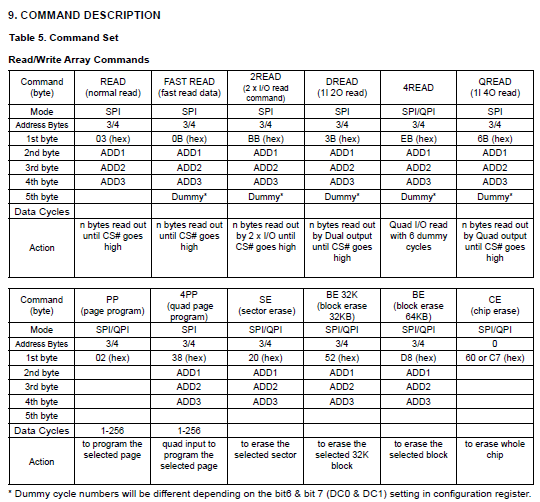
cover mtd: spi-nor: add a new framework for SPI NOR
In reply to Huang ShijieHi Huang Shijie
Quoted 4 lines · Huang Shijie
Hi Angus:
thanks for the long suggestion. it's very useful.Let's push the spi nor framework.:)
[...]
Quoted 6 lines
Quoted 5 lines
/**
* structspi_nor_xfer_cfg- Structure for defining a Serial Flash
transfer
* @wren: command for "Write Enable", or0x00for not requiredwhy this wren is needed?
Issuing WREN is needed for certain sequences of operations. I guess your question relates to why have I included it as part of the 'spi_nor_xfer_cfg' structure, when it could be controlled from the spi_nor layer with a separate spi_nor_xfer.
Well, firstly, I am aware of at least one H/W controller that can be optimised to issue the WREN command as part of a longer erase or write sequence, thereby avoiding the overheads of issuing a separate spi_nor_xfer.
However, the main reason was to try and come up with a generic representation for a typical Serial Flash transfer, capturing, where possible, the semantics of the intended operation, just in case that information can be used by the underlying H/W in some way. In this instance, the WREN cycles just represents another part of the transfer, in the same way as the command, address, mode, and dummy cycles.
Quoted 8 lines
Quoted 6 lines
* @cmd: command for operation
* @cmd_pins: number of pins to send @cmd (1, 2, 4)
* @addr: address for operation
* @addr_pins: number of pins to send @addr (1, 2, 4)
* @addr_width: number of address bytes (3,4, or 0 for address
not required)this field has been in the spi_nor{} , it should be a fixed value. so i think we do not need this argument.
The aim of the 'spi_nor_xfer_cfg' is to provide an interface between the spi-nor
layer and the underlying H/W driver. In some cases, the H/W may need to know
the address width (e.g. issuing a new command sequence, with an incremented address, following an arbitration stall). You could argue that the H/W driver should be able query the spi_nor structure, or perhaps store the addr_width field during an initialisation process, but I feel having it as part of the 'spi_nor_xfer_cfg' provides a cleaner interface between the two layers.
Quoted 37 lines
Quoted 37 lines
* @mode: mode data
* @mode_pins: number of pins to send @mode (1, 2, 4)
* @mode_cycles: number of mode cycles (0 for mode not required)
* @dummy_cycles: number of dummy cycles (0 for dummy not required)
*/struct spi_nor_xfer_cfg { uint8_t wren; uint8_t cmd; int cmd_pins; uint32_t addr; int addr_pins; int addr_width; uint32_t mode; int mode_pins; int mode_cycles; int dummy_cycles; };We could then build up layers of functionality, based on two fundamental primitives:
int (*read_xfer)(struct
spi_nor_info*info,
structspi_nor_xfer_cfg*cfg,
uint8_t*buf,size_tlen);int (*write_xfer)(struct
spi_nor_info*info,
structspi_nor_xfer_cfg*cfg,
uint8_t*buf,size_tlen);Default implementations for standard operations could follow:
int (*read_reg)(struct
spi_nor_info*info,
uint8_tcmd,uint8_t*reg, int len);
int (*write_reg)(structspi_nor_info*info,
uint8_tcmd,uint8_t*reg, int len,
int wren, int wtr);
Quoted 5 lines
Quoted 2 lines
    int (*readid)(struct spi_nor_info *info, uint8_t *readid);
    int (*wait_till_ready)(struct spi_nor_info *info);
currently, we poll the status register.
why this hook is needed?
The default implementation would do just as you suggest, and I would expect most H/W drivers to use the default implementation. However, some H/W Controllers can automate the polling of status registers, so having a hook allows the driver override the default behaviour.
Quoted 7 lines
Quoted 4 lines
int (*read)(struct
spi_nor_info*info,uint8_tbuf,off_toffs,size_t len); int (*write)(struct spi_nor_info *info, off_t offs, size_t len); int (*erase_sector)(struct spi_nor_info *info, off_t offs);I also confused at this hook.
if we need
erase_sector, do we still need theerase_chip()?
Serial Flash devices support various "Erase Sector" commands, and an "Erase Chip" command. The erase_sector() and erase_chip() hooks would just form the appropriate command sequences (e.g. Erase Chip does not require address cycles).
I have to admit, the circumstances that provoke an erase_chip() are rather limited. As far as I can see, the MTD tool 'mtd_debug' is the only component that can lead to an Erase Chip operation, and even then, only when the device is not partitioned. However, m25p80 supports Erase Chip, so I thought I would maintain that support here.
As I said before, my proposal was just some initial ramblings of my mind, and I am definitely open to discussion and other suggestions.
To be honest, I am just glad that someone is taking a look at this area. However, whether or not is it possible to come up with something that solves all our problems remains to be seen. It might turn out that the various H/W Controllers are just too different to fit into a single unified framework.
Cheers,
Angus
cover mtd: spi-nor: add a new framework for SPI NOR
? 2013?12?02? 19:19, Angus Clark ??:
Quoted 5 lines
To be honest, I am just glad that someone is taking a look at this area. However, whether or not is it possible to come up with something that solves all our problems remains to be seen. It might turn out that the various H/W Controllers are just too different to fit into a single unified framework.
Hi Angus & Pekon:
thanks for the explanations.
I am not sure that after we add more hooks, if it will meet Jones's new driver.
i will wait for Jones' comment for several days, and send out the next version if he does not reply this thread.
thanks
Huang Shijie
cover mtd: spi-nor: add a new framework for SPI NOR
Quoted 10 lines
Quoted 5 lines
To be honest, I am just glad that someone is taking a look at this area. However, whether or not is it possible to come up with something that solves all our problems remains to be seen. It might turn out that the various H/W Controllers are just too different to fit into a single unified framework.
Hi Angus & Pekon:
thanks for the explanations.I am not sure that after we add more hooks, if it will meet Jones's new driver.
Angus is the author of "Lee's" driver and knows more about it that I ever will, so whatever he says goes in that regard.
I would like to make a suggestion to Brian though. Even if the new framework is written within the next couple of months and the semantics do suit the FSM Controller driver, I'd still like the implementation that's currently on the list to be applied. That way we'd have a known good version of the driver which is almost identical to how ST's internal driver does now. The one that is present out in the wild (i.e. _real_ products).
I will subsequently volunteer to provide my utmost best efforts to port the driver over to the new framework as a new task once it has landed.
Quoted 2 lines
i will wait for Jones' comment for several days, and send out the next version if he does not reply this thread.
/me waves \o/
Signature · 4 lines
Lee Jones
Linaro STMicroelectronics Landing Team Lead
Linaro.org ? Open source software for ARM SoCs
Follow Linaro: Facebook | Twitter | Blog
cover mtd: spi-nor: add a new framework for SPI NOR
Quoted 7 lines · Lee Jones
I would like to make a suggestion to Brian though. Even if the new framework is written within the next couple of months and the semantics do suit the FSM Controller driver, I'd still like the implementation that's currently on the list to be applied. That way we'd have a known good version of the driver which is almost identical to how ST's internal driver does now. The one that is present out in the wild (i.e. _real_ products).
I think this suggestion is feasible: that we might merge this driver even if it doesn't try to fit to some (still vague) idea of what a "SPI NOR framework" should be. However, I don't know if the latter argument is valid; just because it's in real products doesn't mean we really want it as-is. But I think that in this case, the perfect may be the enemy of the good -- the "good" driver now is better than the "perfect" driver that never comes.
Quoted 3 lines
I will subsequently volunteer to provide my utmost best efforts to port the driver over to the new framework as a new task once it has landed.
I'll hold you to that! Do we have any collateral for that guarantee? ;)
Brian
cover mtd: spi-nor: add a new framework for SPI NOR
Quoted 9 lines · Brian Norris
Quoted 7 lines · Lee Jones
I would like to make a suggestion to Brian though. Even if the new framework is written within the next couple of months and the semantics do suit the FSM Controller driver, I'd still like the implementation that's currently on the list to be applied. That way we'd have a known good version of the driver which is almost identical to how ST's internal driver does now. The one that is present out in the wild (i.e. _real_ products).
Quoted 5 lines
I think this suggestion is feasible: that we might merge this driver even if it doesn't try to fit to some (still vague) idea of what a "SPI NOR framework" should be. However, I don't know if the latter argument is valid; just because it's in real products doesn't mean we really want it as-is.
True, it just makes things easier for us internally when we are due for a kernel version up-lift.
Quoted 3 lines
But I think that in this case, the perfect may be the enemy of the good -- the "good" driver now is better than the "perfect" driver that never comes.
+1
Quoted 5 lines
Quoted 3 lines
I will subsequently volunteer to provide my utmost best efforts to port the driver over to the new framework as a new task once it has landed.
I'll hold you to that! Do we have any collateral for that guarantee? ;)
My word is my bond Brian. Failing that, beer? :)
Signature · 4 lines
Lee Jones
Linaro STMicroelectronics Landing Team Lead
Linaro.org ? Open source software for ARM SoCs
Follow Linaro: Facebook | Twitter | Blog
cover mtd: spi-nor: add a new framework for SPI NOR
In reply to Angus ClarkHi Angus,
_nicely_ explained indeed :)
Quoted 11 lines
Hi Huang Shijie,
Quoted 8 lines · Brian Norris
+ Lee Jones, others
I'd like to keep a similar CC list for the various conversations going on about SPI NOR frameworks.
Quoted 2 lines · Huang Shijie
1.) Why add a new framework for SPI NOR?
Quoted 7 lines
Quoted 4 lines
Quoted 4 lines
The SPI-NOR controller such as Freescale's Quadspi controller is working in a different way from the SPI bus. It should knows the NOR commands to find the right LUT sequence. Unfortunately, the current code can not meet this requirement.
I fully support your argument for introducing a new framework to support Serial Flash controllers.
So do I, now I finally get the problem.
Quoted 77 lines
Reiterating my previous comment:
"The kernel offers many examples of others who have struggled with the same problem. Some have chosen to write self-contained drivers (e.g.
drivers/mtd/devices/spear_smi.canddrivers/mtd/devices/sst251.c) duplicating much ofm25p80.c, while others have attempted to squeeze into the SPI framework (e.g.drivers/spi/spi-tegra20-sflash.canddrivers/spi/spi-falcon.c), relying on fragile heuristics to recreate the semantics of m25p80 that is lost over the , current circumstances SPI framework ."However, having now been through your proposed framework, it would not seem to provide a generally applicable solution. Indeed, other than making the Serial Flash commands and the device table available, it is not obvious how it improves the situation for your own specific controller either; the read/write/read_reg/write_reg callbacks do not offer a great deal more than
spi_read_then_write(). (Perhaps all will become clear when you submit the fsl-quadspi driver.)As I see it, the main problem with the current support is that dedicated Serial Flash Controllers require a level of semantics that cannot be conveyed over the generic SPI framework. With this in mind, I would start by defining something along the lines of a "Serial Flash transfer". Some initial ramblings of my mind:
/**
* structspi_nor_xfer_cfg- Structure for defining a Serial Flash transfer
* @wren: command for "Write Enable", or0x00for not required
* @cmd: command for operation
* @cmd_pins: number of pins to send @cmd (1, 2, 4)
* @addr: address for operation
* @addr_pins: number of pins to send @addr (1, 2, 4)
* @addr_width: number of address bytes (3,4, or 0 for address not
required) * @mode: mode data
* @mode_pins: number of pins to send @mode (1, 2, 4)
* @mode_cycles: number of mode cycles (0 for mode not required)
* @dummy_cycles: number of dummy cycles (0 for dummy not required)
*/struct spi_nor_xfer_cfg { uint8_t wren; uint8_t cmd; int cmd_pins; uint32_t addr; int addr_pins; int addr_width; uint32_t mode; int mode_pins; int mode_cycles; int dummy_cycles; };We could then build up layers of functionality, based on two fundamental primitives:
int (*read_xfer)(struct
spi_nor_info*info,
structspi_nor_xfer_cfg*cfg,uint8_t*buf,size_tlen);int (*write_xfer)(struct
spi_nor_info*info,
structspi_nor_xfer_cfg*cfg,uint8_t*buf,size_tlen);Default implementations for standard operations could follow:
	int (*read_reg)(struct spi_nor_info *info,
			uint8_t cmd, uint8_t *reg, int len);
	int (*write_reg)(struct spi_nor_info *info,
			 uint8_t cmd, uint8_t *reg, int len,
			 int wren, int wtr);

	int (*readid)(struct spi_nor_info *info, uint8_t *readid);
	int (*wait_till_ready)(struct spi_nor_info *info);

	int (*read)(struct spi_nor_info *info, uint8_t buf, off_t offs, size_t
len); int (*write)(struct spi_nor_info *info, off_t offs, size_t len);
	int (*erase_sector)(struct spi_nor_info *info, off_t offs);
Quoted 3 lines
Each driver would be required to implement
read_xfer()andwrite_xfer(), and then free to either use the default implementations, or override with driver-optimised implementations.
I checked the VYBRIDRM.pdf datasheet. I grok down that the thing Vybrid does is it has such a lookup table. The table has 16 slots , each can contain up to 8 SPI NOR instructions . These instructions are programmed when the driver probe()s I suppose. To do a communication with the SPI NOR, you give the controller an index in this lookup table and it will execute this pre-programmed sequence of commands on the SPI NOR.
So yes, your API would work nicely with Vybrid. I agree about read_reg() and write_reg() functions, they will be needed for reading the standard CR/SR etc registers on the SPI NOR and also SPI NOR specific cruft if need be. As for readid(), I wonder if we cannot implement it via some generalized read_reg() call, I suspect we can for starters. Same goes for wait_till_read(), let's implement it in the spi-nor framework first and only if a piece of hardware can speed this up significantly by re-implementing it itself, they will change the framework.
The read() and write() calls are nice, something like mmap() might be interesting here as well, since based on what Poddar explained, his controller can somehow map the SPI flash into the CPU address space. I don't know how this should work precisely, but again, this can be left until such controller driver hits mainline and the benefits of such implementation would become obvious.
Finally, the erase_sector() call would probably need to be extended. I would rename it to simple erase(), since we can erase from sub-sectors (4K) to whole chip.
btw. I really like the idea of the new SPI NOR framework. The M25P80 driver could then be rewritten and plugged into the SPI NOR framework just like any other SPI NOR controller driver with "advanced capabilities".
Quoted 8 lines
In the case of a pure SPI Controller,
read_xfer()andwrite_xfer()would simply flatten tospi_messages. The key benefit is that dedicated Serial Flash Controllers would be able to take advantage of the richer semantics offered by the 'spi_nor_xfer_cfg' data.I would also expect the spi-nor framework to provide the following services, applicable to all Serial Flash drivers:
Quoted 8 lines
- determine devices properties at runtime, based on the READID data (and
perhaps SFDP, if and when it matures!). This should include supported opcodes (e.g.READ_1_1_4,READ_1_4_4,READ4B_1_1_4...), operating frequencies, mode and dummy requirements, means of setting Quad Enable, entering/exiting 4-byte addressing etc.- provide optimal read, write and erase configurations, based on the
combined capabilities of the Serial Flash device and the H/W Controller.
Talking about read-write-erase, why don't we -- instead of passing buffer -- pass a scatterlist ? I suppose that might make it easier for these "advanced" controller to do DMA on it.
Quoted 6 lines
- device specific configuration (e.g. setting QE, unlock BPx bits, DYB
unlocking).Getting back to reality, I realise undertaking such a task would be a huge commitment. I would be keen to put forward my own proposal, but current circumstances mean that that is unlikely to happen any time soon.
I'd love to take this on, but I need to flush my pipeline first ;-( Besides, it seems we have an abundance of good engineers here already, so maybe someone will actually write it ;-)
Quoted 5 lines
I guess in summary, while I am pleased that this area is being looked at, my own feeling is that proposed framework needs to be reworked for it to be generally applicable to other Serial Flash controllers. Of course, another option would be to stick with what is currently offered, and make do.
Full ACK.
Quoted 3 lines
Cheers,
Angus
cover mtd: spi-nor: add a new framework for SPI NOR
? 2013?12?03? 08:32, Marek Vasut ??:
Quoted 3 lines
Finally, the
erase_sector()call would probably need to be extended. I would rename it to simpleerase(), since we can erase from sub-sectors (4K) to whole chip.
yes. this is what i am coding now. I rename it to erase().
thanks
Huang Shijie
cover mtd: spi-nor: add a new framework for SPI NOR
In reply to Angus ClarkQuoted 5 lines · Angus Clark
As I see it, the main problem with the current support is that dedicated Serial Flash Controllers require a level of semantics that cannot be conveyed over the generic SPI framework. With this in mind, I would start by defining something along the lines of a "Serial Flash transfer".
I think this is the best way to describe the issue, and approach the solution.
We should be looking to extend the generic SPI framework to support what we need, rather than hacking around it purely on the MTD side.
As such, I'd be very interested in Mark's thoughts on it...
Signature · 9 lines
dwmw2

-------------- next part --------------
A non-text attachment was scrubbed...
Name: smime.p7s
Type: application/x-pkcs7-signature
Size: 5745 bytes
Desc: not available
URL: <http://lists.infradead.org/pipermail/linux-arm-kernel/attachments/20131203/2ad55abe/attachment.bin>
cover mtd: spi-nor: add a new framework for SPI NOR
Quoted 7 lines · David Woodhouse
Quoted 5 lines · Angus Clark
As I see it, the main problem with the current support is that dedicated Serial Flash Controllers require a level of semantics that cannot be conveyed over the generic SPI framework. With this in mind, I would start by defining something along the lines of a "Serial Flash transfer".
Quoted 7 lines
I think this is the best way to describe the issue, and approach the solution.
We should be looking to extend the generic SPI framework to support what we need, rather than hacking around it purely on the MTD side.
As such, I'd be very interested in Mark's thoughts on it...
Hmm, I thought we already had (some form of) this explanation weeks/months ago, yet the conclusion was that Mark doesn't want this in the SPI framework at all, since a dedicated Serial Flash Controller is not truly SPI. But perhaps I'm wrong.
On this topic, I have one more stick to throw on this fire; I have some Broadcom hardware that consists of two pieces:
(1) a true SPI controller, with single-line-I/O and
(2) a Serial Flash controller that can accelerate flash read, using dual/quad I/O.
The latter hardware cannot handle flash writes, only uses quad I/O for data (not addresses), has some other peculiarities specific to SPI flash, and is highly dependent on the former for providing complete SPI flash support. My current driver is not really upstream-ready, since (like Huang's original driver), it pretends to be a SPI driver yet requires "incestuous knowledge" of m25p80 / MTD. But I hope that any new framework can support hardware like mine.
I don't have public documentation for this hardware, but I can provide more detail if desired.
I mostly bring this up, though, because it is an example of hardware that
(a) can operate as a true SPI device (hardware (1) can handle generic SPI transfers), but
(b) requires knowledge of the details of SPI flash in order to get optimal usage out of the acceleration from (2).
In my book, point (a) and (b) hold some bearing over the question of "where should this SPI NOR framework live", because it is reasonable that a single driver for this hardware should be able to handle either true SPI devices or accelerated SPI-NOR flash.
Sorry for my late-ish addition to this discussion. There's been a lot of noise on this topic, and SPI flash is not the highest priority on my list for now (although it's certainly on the list).
Brian
cover mtd: spi-nor: add a new framework for SPI NOR
Quoted 9 lines · Brian Norris
I mostly bring this up, though, because it is an example of hardware that
(a) can operate as a true SPI device (hardware (1) can handle generic SPI transfers), but
(b) requires knowledge of the details of SPI flash in order to get optimal usage out of the acceleration from (2).
Quoted 4 lines
In my book, point (a) and (b) hold some bearing over the question of "where should this SPI NOR framework live", because it is reasonable that a single driver for this hardware should be able to handle either true SPI devices or accelerated SPI-NOR flash.
We have add a @read_id hook for the spi-nor layer, you can use it to read out more info (such as the Device Geometry Definition) for your spi-nor controller driver.
Is it okay?
thanks
Huang Shijie
cover mtd: spi-nor: add a new framework for SPI NOR
Quoted 15 lines · Huang Shijie
Quoted 9 lines · Brian Norris
I mostly bring this up, though, because it is an example of hardware that
(a) can operate as a true SPI device (hardware (1) can handle generic SPI transfers), but
(b) requires knowledge of the details of SPI flash in order to get optimal usage out of the acceleration from (2).Quoted 4 lines
In my book, point (a) and (b) hold some bearing over the question of "where should this SPI NOR framework live", because it is reasonable that a single driver for this hardware should be able to handle either true SPI devices or accelerated SPI-NOR flash.
Quoted 4 lines
We have add a @read_id hook for the spi-nor layer, you can use it to read out more info (such as the Device Geometry Definition) for your spi-nor controller driver.
Is it okay?
I'm not sure which @read_id hook you're talking about, as I've only skimmed the most recent thread, and it's not in the last patch series I have from you, I don't think. But that is not a response at all to the points I brought up. My statements have nothing to do with device geometry detection.
What I was actually addressing:
Your framework aligns with Mark's original suggestion: that the "SPI NOR" framework should be a separate layer held entirely within the MTD subsystem, and that any given driver is *either* a "SPI NOR" driver *or* a "true SPI" driver, not both.
I'm simply describing how my hardware is both, and perhaps (as David seems to be doing) we should reconsider the premise that this framework will exist solely and entirely within MTD.
Brian
cover mtd: spi-nor: add a new framework for SPI NOR
Quoted 19 lines · Brian Norris
Quoted 18 lines · Huang Shijie
Quoted 9 lines · Brian Norris
I mostly bring this up, though, because it is an example of hardware that
(a) can operate as a true SPI device (hardware (1) can handle generic SPI transfers), but
(b) requires knowledge of the details of SPI flash in order to get optimal usage out of the acceleration from (2).Quoted 4 lines
In my book, point (a) and (b) hold some bearing over the question of "where should this SPI NOR framework live", because it is reasonable that a single driver for this hardware should be able to handle either true SPI devices or accelerated SPI-NOR flash.
We have add a @read_id hook for the spi-nor layer, you can use it to read out more info (such as the Device Geometry Definition) for your spi-nor controller driver.
Quoted 7 lines
Quoted 1 line
Is it okay?
I'm not sure which @read_id hook you're talking about, as I've only skimmed the most recent thread, and it's not in the last patch series I have from you, I don't think. But that is not a response at all to the points I brought up. My statements have nothing to do with device geometry detection.
My meaning is You can write a new driver for the (b) with the new spi-nor layer,
In the new driver you can implement the @read_id yourself, and read out the the necessary info, and implement other hooks for the so-called peculiarities.
Quoted 7 lines
What I was actually addressing:
Your framework aligns with Mark's original suggestion: that the "SPI NOR" framework should be a separate layer held entirely within the MTD subsystem, and that any given driver is *either* a "SPI NOR" driver *or* a "true SPI" driver, not both.
You can only use a SPI-NOR driver, and you can abandon the "true SPI" driver.
Is there some limits that prevent we just code a SPI-NOR driver for your hardware?
thanks
Huang Shijie
cover mtd: spi-nor: add a new framework for SPI NOR
Quoted 22 lines · Huang Shijie
Quoted 21 lines · Brian Norris
Quoted 19 lines · Huang Shijie
Quoted 9 lines · Brian Norris
I mostly bring this up, though, because it is an example of hardware that
(a) can operate as a true SPI device (hardware (1) can handle generic SPI transfers), but
(b) requires knowledge of the details of SPI flash in order to get optimal usage out of the acceleration from (2).Quoted 4 lines
In my book, point (a) and (b) hold some bearing over the question of "where should this SPI NOR framework live", because it is reasonable that a single driver for this hardware should be able to handle either true SPI devices or accelerated SPI-NOR flash.
We have add a @read_id hook for the spi-nor layer, you can use it to read out more info (such as the Device Geometry Definition) for your spi-nor controller driver.
Is it okay?
Quoted 7 lines
Quoted 5 lines
I'm not sure which @read_id hook you're talking about, as I've only skimmed the most recent thread, and it's not in the last patch series I have from you, I don't think. But that is not a response at all to the points I brought up. My statements have nothing to do with device geometry detection.
My meaning is You can write a new driver for the (b) with the new spi-nor layer,
Yes, I can do that.
Quoted 2 lines
In the new driver you can implement the @read_id yourself, and read out the the necessary info, and implement other hooks for the so-called peculiarities.
Without giving a full judgment on the framework yet (I haven't followed as closely as I'd like), I expect that the SPI NOR API will cover the needs of my SPI NOR hardware.
Quoted 10 lines
Quoted 7 lines
What I was actually addressing:
Your framework aligns with Mark's original suggestion: that the "SPI NOR" framework should be a separate layer held entirely within the MTD subsystem, and that any given driver is *either* a "SPI NOR" driver *or* a "true SPI" driver, not both.
You can only use a SPI-NOR driver, and you can abandon the "true SPI" driver.
Is there some limits that prevent we just code a SPI-NOR driver for your hardware?
SPI is not used only for SPI NOR; it is useful for other things, like communicating with off-chip peripherals or microcontrollers, supporting touchscreens, LEDs, media controllers, etc. So with a SPI NOR framework living only in the MTD subsystem, I have to write two drivers: one (under drivers/spi/) to use only-(a) for controlling non-flash SPI devices, and one (under drivers/mtd/) to manage (a)+(b) on SPI NOR flash.
If, however, we can define a spi_nor_transfer like Angus suggested, and if we take that a step further and make it a first-class (but optional) citizen of the SPI framework, then we could have drivers that support SPI-only, SPI-NOR-only, or both.
Now, I'm not sure how exactly that sort of proposal would work yet, but I wanted to test the waters to see
- if this is a complete distortion of what Angus or David may have
suggested;
- if Mark thinks this is reasonable, or if he thinks I'm spouting nonsense; and
- if there is some obvious alternate way to support what I describe without moving the SPI-NOR layer into the SPI subsystem.
Brian
cover mtd: spi-nor: add a new framework for SPI NOR
Quoted 7 lines · Brian Norris
SPI is not used only for SPI NOR; it is useful for other things, like communicating with off-chip peripherals or microcontrollers, supporting touchscreens, LEDs, media controllers, etc. So with a SPI NOR framework living only in the MTD subsystem, I have to write two drivers: one (under
drivers/spi/) to use only-(a) for controlling non-flash SPI devices, and one (underdrivers/mtd/) to manage (a)+(b) on SPI NOR flash.
If the NOR is connected to a SPI bus controller which can attaches other SPI devices too, I think you use a pure SPI driver to access it;
If the NOR is connected to a SPI-NOR controller such as your spi-nor controller , you can use a SPI-NOR driver to access it.
Does your NOR flash connect to both the SPI bus controller and SPI-NOR controller at the same time? :) If it does connect to both of the controllers, I do not know how to handle it too.
Quoted 6 lines
If, however, we can define a
spi_nor_transferlike Angus suggested, and if we take that a step further and make it a first-class (but optional) citizen of the SPI framework, then we could have drivers that support SPI-only, SPI-NOR-only, or both.
I guess Mark will not agree with this. :)
thanks
Huang Shijie
Quoted 11 lines
Now, I'm not sure how exactly that sort of proposal would work yet, but I wanted to test the waters to see
- if this is a complete distortion of what Angus or David may havesuggested;- if Mark thinks this is reasonable, or if he thinks I'm spouting nonsense; and
- if there is some obvious alternate way to support what I describe without moving the SPI-NOR layer into the SPI subsystem.Brian
cover mtd: spi-nor: add a new framework for SPI NOR
In reply to Brian NorrisHi Brian,
Quoted 6 lines · Brian Norris
On this topic, I have one more stick to throw on this fire; I have some Broadcom hardware that consists of two pieces:
(1) a true SPI controller, with single-line-I/O and
(2) a Serial Flash controller that can accelerate flash read, using dual/quad I/O.
We support one platform with properties similar to the hardware you describe, and such a hybrid configuration was in mind when I was thinking about the spi-nor framework. I am not sure how well this will come across over email, but I envisage something like this:
                             spi-nor
                                |
                                v
                          [spi-nor-xfer]
                                |
         ------------------------------------------------
        |                       |                        |
        v                       v                        v
   spi-wrapper (<------)  hybrid-driver          serial-flash-driver
        |                       |                        |
      [SPI]                     |                        |
        |                       |                        |
        v                       |                        |
generic-spi-driver              |                        |
        |                       |                        |
        v                       v                        v
[generic-SPI-Cntrl]   [SPI-Flash-Read Cntrl]   [SPI-Flash-Controller]
The 'spi-nor' layer is responsible for Serial Flash domain knowledge, and how to generate 'spi-nor-xfer' messages. The 'spi-wrapper' would provide an interface to the generic SPI framework, flattening the 'spi-nor-xfer' message to standard SPI calls. The combination of 'spi-nor' and 'spi-wrapper' should achieve what we have today for the m25p80 driver. The 'serial-flash-driver' in the example provides an implementation for a dedicated Serial Flash Controller, making use of the spi-nor-xfer semantics where required. The 'hybrid-driver' could use the 'spi-wrapper' implementation for write and erase hooks, and optimised implementations for read hooks.
[...]
Quoted 8 lines
I mostly bring this up, though, because it is an example of hardware that
(a) can operate as a true SPI device (hardware (1) can handle generic SPI transfers), but
(b) requires knowledge of the details of SPI flash in order to get optimal usage out of the acceleration from (2).
Quoted 5 lines
In my book, point (a) and (b) hold some bearing over the question of "where should this SPI NOR framework live", because it is reasonable that a single driver for this hardware should be able to handle either true SPI devices or accelerated SPI-NOR flash.
Yes, I agree. At present, within the m25p80 driver, the knowledge of how to drive Serial Flash devices is entwined with an implementation that assumes a pure SPI Controller. Creating an additional layer of abstraction allows us to separate the two issues, and write drivers that can make us of generic SPI controllers, or take advantage of accelerated Serial Flash Controllers, or a combination of both.
I realise it is going to take a significant effort to get this off the ground and the framework will require some tuning to make sure it can accommodate the eccentric range of hardware out there. Unfortunately I am not in a position to commit much time myself, although I will help advise where I can. Ironically, once the ST Bristol site closes next year, I will have lots of time available, but no access to equipment!
Cheers,
Angus
cover mtd: spi-nor: add a new framework for SPI NOR
Quoted 33 lines · Angus Clark
Hi Brian,
Quoted 6 lines · Brian Norris
On this topic, I have one more stick to throw on this fire; I have some Broadcom hardware that consists of two pieces:
(1) a true SPI controller, with single-line-I/O and
(2) a Serial Flash controller that can accelerate flash read, using dual/quad I/O.We support one platform with properties similar to the hardware you describe, and such a hybrid configuration was in mind when I was thinking about the spi-nor framework. I am not sure how well this will come across over email, but I envisage something like this:
                             spi-nor
                                |
                                v
                          [spi-nor-xfer]
                                |
         ------------------------------------------------
        |                       |                        |
        v                       v                        v
   spi-wrapper (<------)  hybrid-driver          serial-flash-driver
        |                       |                        |
      [SPI]                     |                        |
        |                       |                        |
        v                       |                        |
generic-spi-driver              |                        |
        |                       |                        |
        v                       v                        v
[generic-SPI-Cntrl]   [SPI-Flash-Read Cntrl]   [SPI-Flash-Controller]
Quoted 10 lines
The 'spi-nor' layer is responsible for Serial Flash domain knowledge, and how to generate 'spi-nor-xfer' messages. The 'spi-wrapper' would provide an interface to the generic SPI framework, flattening the 'spi-nor-xfer' message to standard SPI calls. The combination of 'spi-nor' and 'spi-wrapper' should achieve what we have today for the m25p80 driver. The 'serial-flash-driver' in the example provides an implementation for a dedicated Serial Flash Controller, making use of the spi-nor-xfer semantics where required. The 'hybrid-driver' could use the 'spi-wrapper' implementation for write and erase hooks, and optimised implementations for read hooks.
For the diagram above, I think we can regard the hybrid driver as a kind of serial-flash-driver too.
thanks
Huang Shijie
cover mtd: spi-nor: add a new framework for SPI NOR
In reply to Angus ClarkQuoted 31 lines · Angus Clark
Quoted 6 lines · Brian Norris
On this topic, I have one more stick to throw on this fire; I have some Broadcom hardware that consists of two pieces:
(1) a true SPI controller, with single-line-I/O and
(2) a Serial Flash controller that can accelerate flash read, using dual/quad I/O.We support one platform with properties similar to the hardware you describe, and such a hybrid configuration was in mind when I was thinking about the spi-nor framework. I am not sure how well this will come across over email, but I envisage something like this:
                             spi-nor
                                |
                                v
                          [spi-nor-xfer]
                                |
         ------------------------------------------------
        |                       |                        |
        v                       v                        v
   spi-wrapper (<------)  hybrid-driver          serial-flash-driver
        |                       |                        |
      [SPI]                     |                        |
        |                       |                        |
        v                       |                        |
generic-spi-driver              |                        |
        |                       |                        |
        v                       v                        v
[generic-SPI-Cntrl]   [SPI-Flash-Read Cntrl]   [SPI-Flash-Controller]
Quoted 9 lines
The 'spi-nor' layer is responsible for Serial Flash domain knowledge, and how to generate 'spi-nor-xfer' messages. The 'spi-wrapper' would provide an interface to the generic SPI framework, flattening the 'spi-nor-xfer' message to standard SPI calls. The combination of 'spi-nor' and 'spi-wrapper' should achieve what we have today for the m25p80 driver. The 'serial-flash-driver' in the example provides an implementation for a dedicated Serial Flash Controller, making use of the spi-nor-xfer semantics where required. The 'hybrid-driver' could use the 'spi-wrapper' implementation for write and erase hooks, and optimised implementations for read hooks.
OK, that sounds reasonable. But how do I bind my "generic SPI driver" with my "SPI NOR accelerated read driver" to represent this? Does the hybrid driver (my accelerated-read driver) have to register itself as a SPI protocol driver (struct spi_driver)? The "controller" boundaries seem to get a little fuzzy under this design.
Brian
cover mtd: spi-nor: add a new framework for SPI NOR
In reply to Angus Clark? 2013?11?29? 22:52, Angus Clark ??:
Quoted 3 lines
int (*write_reg)(struct
spi_nor_info*info,
uint8_tcmd,uint8_t*reg, int len, int wren, int wtr);
I guess you add the 'wren' for the issuing write-enable before issuing the 'cmd'.
but what's 'wtr' for? i do not know what's the meaning of the 'wtr'.
thanks
Huang Shijie
cover mtd: spi-nor: add a new framework for SPI NOR
Quoted 9 lines · Huang Shijie
? 2013?11?29? 22:52, Angus Clark ??:
Quoted 3 lines
int (*write_reg)(struct
spi_nor_info*info,
uint8_tcmd,uint8_t*reg, int len,
int wren, int wtr);I guess you add the 'wren' for the issuing write-enable before issuing the 'cmd'.
but what's 'wtr' for? i do not know what's the meaning of the 'wtr'.
'wtr' is for "Wait 'til Ready". Some register writes are instant, while others require polling of the "Write In Progress" bit.
Cheers,
Angus
cover mtd: spi-nor: add a new framework for SPI NOR
Quoted 6 lines
From: Angus Clark [mailto:angus.clark at st.com]
Quoted 5 lines · Huang Shijie
? 2013?11?29? 22:52, Angus Clark ??:
Quoted 3 lines
int (*write_reg)(struct
spi_nor_info*info,
uint8_tcmd,uint8_t*reg, int len,
int wren, int wtr);
Quoted 9 lines
Quoted 5 lines
I guess you add the 'wren' for the issuing write-enable before issuing the 'cmd'.
but what's 'wtr' for? i do not know what's the meaning of the 'wtr'.
'wtr' is for "Wait 'til Ready". Some register writes are instant, while others require polling of the "Write In Progress" bit.
Unless a register is controlling a status of internal state-machine, or something It should be instantaneously writable.
Also polling should not be part of this particular *(write_reg), if a register needs to be polled then it should be part of *(write) or *(read) .. Like
WIP: Write-in-progress bit of flash
generic_flash_write(...) {
	while ((read_reg(STATUS_REG) & WIP) || ~timeout) {
		timeout--;
	};
With this it just came to my mind, that you also need a 'timeout' field in 'struct spinor-cfg'. This is because different controllers would be running at different clock speeds (and different SPI_CLK frequencies). So they need to specify a 'timeout' value for all polling accesses.
with regards, pekon
cover mtd: spi-nor: add a new framework for SPI NOR
Hi Pekon,
Quoted 2 lines · Pekon
Unless a register is controlling a status of internal state-machine, or something It should be instantaneously writable.
Yes, that is my point. Some register writes are instant, other are not, particularly those that involve non-volatile status or configuration bits.
Quoted 7 lines
Also polling should not be part of this particular *(write_reg), if a register needs to be polled then it should be part of *(write) or *(read) .. Like
WIP: Write-in-progress bit of flashgeneric_flash_write(...) { while ((read_reg(STATUS_REG) & WIP) || ~timeout) { timeout--; };
I am in two minds about where the WTR loop should live. On the one hand, moving it to the "generic_flash_write()" call offers H/W controllers the opportunity to optimise the polling, if they support such a feature (I know of some that will in the future).
However, requiring the H/W driver to perform the polling, including knowledge of the STATUS CMD, and the WIP bit-field, just seems like moving too much "intelligence" away from the spi-nor layer. What concerns me is when we get on to reading/clearing error flags (as now mandated on some Serial Flash devices, e.g. n25p512 and n25q00a), this will also need to be part of the generic write.
Quoted 2 lines
With this it just came to my mind, that you also need a 'timeout' field in 'struct spinor-cfg'.
Yes, that is a good point.
I would propose that the spi-nor layer retains responsibility for determining whether or not 'WTR' is required for a particular operation, and a suitable timeout. At some point, during initialisation, the H/W driver will need to inform the spi-nor layer about its capabilities (e.g. support for DUAL or QUAD mode, any warm-reset requirements, etc), and native support of WIP polling could be part of this set. The spi-nor layer could then decide whether to add the WTR flag and timeout to the spinor-cfg transfer, or to take responsibility itself, and execute its own polling loop. This gives greatest flexibility, which seems to be an important factor, while retaining the knowledge in the spi-nor layer.
Cheers,
Angus
cover mtd: spi-nor: add a new framework for SPI NOR
Quoted 16 lines · Angus Clark
Hi Pekon,
Quoted 2 lines · Pekon
Unless a register is controlling a status of internal state-machine, or something It should be instantaneously writable.
Yes, that is my point. Some register writes are instant, other are not, particularly those that involve non-volatile status or configuration bits.
Quoted 7 lines
Also polling should not be part of this particular *(write_reg), if a register needs to be polled then it should be part of *(write) or *(read) .. Like WIP: Write-in-progress bit of flash
generic_flash_write(...){while ((read_reg(STATUS_REG) & WIP) || ~timeout) {
Quoted 8 lines
Quoted 3 lines
		timeout--;

	};
I am in two minds about where the WTR loop should live. On the one hand, moving it to the "
generic_flash_write()" call offers H/W controllers the opportunity to optimise the polling, if they support such a feature (I know of some that will in the future).
I disagree we should bloat the API with features, that will be used by "possible future controllers" or "possible single controller", right from the start. The real question here is, can the API be designed in such a way, that the SR polling will happen in software NOW and only when a controller appears that can do polling in HW will the API be extended to support it ?
Quoted 12 lines
However, requiring the H/W driver to perform the polling, including knowledge of the STATUS CMD, and the WIP bit-field, just seems like moving too much "intelligence" away from the spi-nor layer. What concerns me is when we get on to reading/clearing error flags (as now mandated on some Serial Flash devices, e.g. n25p512 and n25q00a), this will also need to be part of the generic write.
Quoted 2 lines
With this it just came to my mind, that you also need a 'timeout' field in 'struct spinor-cfg'.
Yes, that is a good point.
Quoted 10 lines
I would propose that the spi-nor layer retains responsibility for determining whether or not 'WTR' is required for a particular operation, and a suitable timeout. At some point, during initialisation, the H/W driver will need to inform the spi-nor layer about its capabilities (e.g. support for DUAL or QUAD mode, any warm-reset requirements, etc), and native support of WIP polling could be part of this set. The spi-nor layer could then decide whether to add the WTR flag and timeout to the spinor-cfg transfer, or to take responsibility itself, and execute its own polling loop. This gives greatest flexibility, which seems to be an important factor, while retaining the knowledge in the spi-nor layer.
Sounds good!
Quoted 3 lines
Cheers,
Angus
Best regards,
Marek Vasut
cover mtd: spi-nor: add a new framework for SPI NOR
? 2013?12?04? 23:36, Marek Vasut ??:
Quoted 5 lines
I disagree we should bloat the API with features, that will be used by "possible future controllers" or "possible single controller", right from the start. The real question here is, can the API be designed in such a way, that the SR polling will happen in software NOW and only when a controller appears that can do polling in HW will the API be extended to support it ?
ok. Let's add this feature in the future when a real case occurs.
thanks
Huang Shijie
cover mtd: spi-nor: add a new framework for SPI NOR
Quoted 10 lines
From: Huang Shijie [mailto:b32955 at freescale.com]
Quoted 6 lines
? 2013?12?04? 23:36, Marek Vasut ??:
I disagree we should bloat the API with features, that will be used by "possible future controllers" or "possible single controller", right from the start. The real question here is, can the API be designed in such a way, that the SR polling will happen in software NOW and only when a controller appears that can do polling in HW will the API be extended to support it ?ok. Let's add this feature in the future when a real case occurs.
Sorry got lost.. Can you please summarize following plans for your next patch:
(1) Polling of status registers should be
(a) done in S/W (generic driver)
(b) done controller driver, which can be optimized for specific hardware
(2) How do you plan to have timeout value, (as serial flash can be pretty slow to access) ?
(a) independent for each access
- read timeouts per sector, which can be multiplied with read_len/sector_size
- write timeout per sector, which can be multiplied with write_len/sector_size
- erase timeout per block, which can be multiplied with erase_len/block_size
(b) Any other method, or leave it to controller driver ?
In my view, before proceeding to writing down a patch, I think
we should come-up with a doc/Readme, which defines all API and interface structs (taking Angus' proposal as baseline). And then refine that spec first. Otherwise there may be too many revisions spent on patch RFC's ..
Any thoughts ?
And is there a space in kernel_docs for such specs ?
With regards, pekon
cover mtd: spi-nor: add a new framework for SPI NOR
Quoted 8 lines · Pekon
Quoted 8 lines
From: Huang Shijie [mailto:b32955 at freescale.com]
Quoted 6 lines
? 2013?12?04? 23:36, Marek Vasut ??:
I disagree we should bloat the API with features, that will be used by "possible future controllers" or "possible single controller", right from the start. The real question here is, can the API be designed in such a way, that the SR polling will happen in software NOW and only when a controller appears that can do polling in HW will the API be extended to support it ?
Quoted 8 lines
Quoted 2 lines
ok. Let's add this feature in the future when a real case occurs.
Sorry got lost.. Can you please summarize following plans for your next patch:
(1) Polling of status registers should be
(a) done in S/W (generic driver)
(b) done controller driver, which can be optimized for specific hardware
For (b), we can implement the @wait_till_ready hook for the controller driver.
For (a), we use the default hook for @wait_till_ready.
Quoted 8 lines
(2) How do you plan to have timeout value, (as serial flash can be pretty slow to access) ?
(a) independent for each access
- read timeouts per sector, which can be multiplied with read_len/sector_size
- write timeout per sector, which can be multiplied with write_len/sector_size
- erase timeout per block, which can be multiplied with erase_len/block_size
(b) Any other method, or leave it to controller driver ?
Since i have no idea about this kind of spi-nor controller, so I prefer the (b).
Quoted 7 lines
In my view, before proceeding to writing down a patch, I think
we should come-up with a doc/Readme, which defines all API and interface structs (taking Angus' proposal as baseline). And then refine that spec first. Otherwise there may be too many revisions spent on patch RFC's ..Any thoughts ?
And is there a space inkernel_docsfor such specs ?
maybe the best solution is I send out the new version as soon as possible.
thanks
Huang Shijie
cover mtd: spi-nor: add a new framework for SPI NOR
In reply to Huang ShijieDear Huang Shijie,
Quoted 5 lines
1.) Why add a new framework for SPI NOR?
The SPI-NOR controller such as Freescale's Quadspi controller is working in a different way from the SPI bus. It should knows the NOR commands to find the right LUT sequence. Unfortunately, the current code can not meet this requirement.
Is there any kind of documentation for this controller available? I cannot quite understand how this controller works and why can it not be used with our current infrastructure.
Best regards,
Marek Vasut
cover mtd: spi-nor: add a new framework for SPI NOR
Dear Marek Vasut, Huang,
Quoted 11 lines · Marek Vasut
Dear Huang Shijie,
Quoted 5 lines
1.) Why add a new framework for SPI NOR?
The SPI-NOR controller such as Freescale's Quadspi controller is working in a different way from the SPI bus. It should knows the NOR commands to find the right LUT sequence. Unfortunately, the current code can not meet this requirement.Is there any kind of documentation for this controller available? I cannot quite understand how this controller works and why can it not be used with our current infrastructure.
I do have a similar requirement where my controller need to be configured from slave info. I have submiited a series in the mtd list adding that portion
of handling such cases. Here, is the patch which specific to m25p80 part.
http://patchwork.ozlabs.org/patch/294285/
The whole series can be found here:
https://www.mail-archive.com/linux-omap at vger.kernel.org/msg98691.html
Quoted 2 lines
Best regards,
Marek Vasut
cover mtd: spi-nor: add a new framework for SPI NOR
Dear Sourav Poddar,
Quoted 16 lines
Dear Marek Vasut, Huang,
Quoted 4 lines · Marek Vasut
Dear Huang Shijie,
Quoted 2 lines
1.) Why add a new framework for SPI NOR?
Quoted 8 lines
Quoted 4 lines
The SPI-NOR controller such as Freescale's Quadspi controller is working in a different way from the SPI bus. It should knows the NOR commands to find the right LUT sequence. Unfortunately, the current code can not meet this requirement.
Is there any kind of documentation for this controller available? I cannot quite understand how this controller works and why can it not be used with our current infrastructure.
Quoted 8 lines
I do have a similar requirement where my controller need to be configured from slave info. I have submiited a series in the mtd list adding that portion
of handling such cases. Here, is the patch which specific to m25p80 part.
http://patchwork.ozlabs.org/patch/294285/The whole series can be found here:
https://www.mail-archive.com/linux-omap at vger.kernel.org/msg98691.html
Is this TI QSPI the same thing as the Altera QSPI controller please ?
Otherwise, I seriously believe you and Huang should work on a common infrastructure. I would first like to understand how is the controller in DRA7xx different from regular SPI controller though. Is there any kind of documentation I could study please?
Best regards,
Marek Vasut
cover mtd: spi-nor: add a new framework for SPI NOR
Dear Marek Vasut,
Quoted 22 lines · Marek Vasut
Dear Sourav Poddar,
Quoted 20 lines
Dear Marek Vasut, Huang,
Quoted 11 lines · Marek Vasut
Dear Huang Shijie,
Quoted 6 lines
1.) Why add a new framework for SPI NOR?
The SPI-NOR controller such as Freescale's Quadspi controller is working in a different way from the SPI bus. It should knows the NOR commands to find the right LUT sequence. Unfortunately, the current code can not meet this requirement.
Is there any kind of documentation for this controller available? I cannot quite understand how this controller works and why can it not be used with our current infrastructure.
I do have a similar requirement where my controller need to be configured from slave info. I have submiited a series in the mtd list adding that portion
of handling such cases. Here, is the patch which specific to m25p80 part.
http://patchwork.ozlabs.org/patch/294285/
Quoted 4 lines
Quoted 2 lines
The whole series can be found here:
https://www.mail-archive.com/linux-omap at vger.kernel.org/msg98691.htmlIs this TI QSPI the same thing as the Altera QSPI controller please ?
No, its differenet.
Quoted 5 lines
Otherwise, I seriously believe you and Huang should work on a common infrastructure. I would first like to understand how is the controller in DRA7xx different from regular SPI controller though. Is there any kind of documentation I could study please?
Sorry, we dont have a public document yet.
Though, this is what ti qspi contoller has
It supports two modes of operation, one is SPI mode(normal), other is the memory mapped read mode.
For SPI mode, the state machine remains the same as it is with other spi controller
available.
For memory mapped, there is something more which we need to do around ..
1. There is a qspi "set up" register available, which needs to be filled with
information like flash opcode, dummy bytes etc. In short, flash
specific
details.
2 if the above register is configured with the required opcodes, then
whenever
we need to use memory mapped operations, we need to do is to
switch our
qspi controller to memory mapped mode.
Switching of this mode to memory mapped needs
a ) write to a particular qspi register
b) write to control module(optional based on SOC).
3. Once the above steps are configured, then the flash data will be mapped to a
particular memory address(SOC specific) from where the flash data
can be read.
The series
https://www.mail-archive.com/linux-omap at vger.kernel.org/msg98691.html tries to work on the above features, and tries to add a support for the same in the
spi framework and m25p80 code.
As you see in my patches, once we take care of the above points and add support
for memory mapped in m25p80 and qspi, then while doing a read in m25p80 we can
do memcpy at the beginning of m25p80_read and can bypass the entire SPI framework for memory mapped read operation. Throughput almost gets doubles with this,
as compared to normal SPI operations.
Please get back, if you need more info on this concept.
Quoted 2 lines
Best regards,
Marek Vasut
cover mtd: spi-nor: add a new framework for SPI NOR
Dear Sourav Poddar,
Quoted 32 lines
Dear Marek Vasut,
Quoted 24 lines · Marek Vasut
Dear Sourav Poddar,
Quoted 22 lines
Dear Marek Vasut, Huang,
Quoted 4 lines · Marek Vasut
Dear Huang Shijie,
Quoted 2 lines
1.) Why add a new framework for SPI NOR?
Quoted 8 lines
Quoted 4 lines
The SPI-NOR controller such as Freescale's Quadspi controller is working in a different way from the SPI bus. It should knows the NOR commands to find the right LUT sequence. Unfortunately, the current code can not meet this requirement.
Is there any kind of documentation for this controller available? I cannot quite understand how this controller works and why can it not be used with our current infrastructure.
I do have a similar requirement where my controller need to be configured from slave info. I have submiited a series in the mtd list adding that portion
of handling such cases. Here, is the patch which specific to m25p80 part. http://patchwork.ozlabs.org/patch/294285/Quoted 4 lines
Quoted 2 lines
The whole series can be found here:
https://www.mail-archive.com/linux-omap at vger.kernel.org/msg98691.htmlIs this TI QSPI the same thing as the Altera QSPI controller please ?
Quoted 8 lines
No, its differenet.
Quoted 4 lines
Otherwise, I seriously believe you and Huang should work on a common infrastructure. I would first like to understand how is the controller in DRA7xx different from regular SPI controller though. Is there any kind of documentation I could study please?
Sorry, we dont have a public document yet.
Sorry for the delayed reply. I am processing the input on the QSPI and I'm finally starting to understand what's going on in here.
Quoted 25 lines
Though, this is what ti qspi contoller has
It supports two modes of operation, one is SPI mode(normal), other is the memory mapped read mode.
For SPI mode, the state machine remains the same as it is with other spi controller
available.For memory mapped, there is something more which we need to do around ..
1. There is a qspi "set up" register available, which needs to be filled with
information like flash opcode, dummy bytes etc. In short, flash
specific
details.
2 if the above register is configured with the required opcodes, then
whenever
we need to use memory mapped operations, we need to do is to
switch our
qspi controller to memory mapped mode.
Switching of this mode to memory mapped needs
a ) write to a particular qspi register
b) write to control module(optional based on SOC).
Quoted 4 lines
3. Once the above steps are configured, then the flash data will be mapped to a
particular memory address(SOC specific) from where the flash data
can be read.
OK, but is the memory mapped mode of any use (but for booting I suppose) ? How does it handle large SPI NOR flashes (we have spansion devices as big as 128MiB), does it really hog a _large_ amount of address space from the CPU address space ? Or is the operation somehow indexed ? Why is it better than using DMA?
Quoted 15 lines
The series
https://www.mail-archive.com/linux-omap at vger.kernel.org/msg98691.html tries to work on the above features, and tries to add a support for the same in the
spi framework and m25p80 code.As you see in my patches, once we take care of the above points and add support
for memory mapped in m25p80 and qspi, then while doing a read in m25p80 we can
do memcpy at the beginning ofm25p80_readand can bypass the entire SPI framework for memory mapped read operation. Throughput almost gets doubles with this,
as compared to normal SPI operations.
Quoted 1 line
Please get back, if you need more info on this concept.
I am getting there, I'm just trying to wrap my head around these news here. Thanks for explaining in so much detail, it's very helpful!
cover mtd: spi-nor: add a new framework for SPI NOR
Dear Marek Vasut,
Quoted 32 lines · Marek Vasut
Dear Sourav Poddar,
Quoted 30 lines
Dear Marek Vasut,
Quoted 22 lines · Marek Vasut
Dear Sourav Poddar,
Quoted 20 lines
Dear Marek Vasut, Huang,
Quoted 11 lines · Marek Vasut
Dear Huang Shijie,
Quoted 6 lines
1.) Why add a new framework for SPI NOR?
The SPI-NOR controller such as Freescale's Quadspi controller is working in a different way from the SPI bus. It should knows the NOR commands to find the right LUT sequence. Unfortunately, the current code can not meet this requirement.
Is there any kind of documentation for this controller available? I cannot quite understand how this controller works and why can it not be used with our current infrastructure.
I do have a similar requirement where my controller need to be configured from slave info. I have submiited a series in the mtd list adding that portion
of handling such cases. Here, is the patch which specific to m25p80 part. http://patchwork.ozlabs.org/patch/294285/Quoted 3 lines
Quoted 2 lines
The whole series can be found here:
https://www.mail-archive.com/linux-omap at vger.kernel.org/msg98691.htmlIs this TI QSPI the same thing as the Altera QSPI controller please ?
No, its differenet.
Quoted 8 lines
Quoted 5 lines
Quoted 4 lines
Otherwise, I seriously believe you and Huang should work on a common infrastructure. I would first like to understand how is the controller in DRA7xx different from regular SPI controller though. Is there any kind of documentation I could study please?
Sorry, we dont have a public document yet.
Sorry for the delayed reply. I am processing the input on the QSPI and I'm finally starting to understand what's going on in here.
Thanks for the response.
Quoted 29 lines
Quoted 25 lines
Though, this is what ti qspi contoller has
It supports two modes of operation, one is SPI mode(normal), other is the memory mapped read mode.
For SPI mode, the state machine remains the same as it is with other spi controller
available.For memory mapped, there is something more which we need to do around ..
1. There is a qspi "set up" register available, which needs to be filled with
information like flash opcode, dummy bytes etc. In short, flash
specific
details.
2 if the above register is configured with the required opcodes, then
whenever
we need to use memory mapped operations, we need to do is to
switch our
qspi controller to memory mapped mode.
Switching of this mode to memory mapped needs
a ) write to a particular qspi register
b) write to control module(optional based on SOC).Quoted 4 lines
3. Once the above steps are configured, then the flash data will be mapped to a
particular memory address(SOC specific) from where the flash data
can be read.
Quoted 6 lines
OK, but is the memory mapped mode of any use (but for booting I suppose) ? How does it handle large SPI NOR flashes (we have spansion devices as big as 128MiB), does it really hog a _large_ amount of address space from the CPU address space ? Or is the operation somehow indexed ? Why is it better than using DMA?
Memory mapped will be of use whenever we try to read the flash content. Instead of going through the entire SPI framework, and raising interrupts, we can
memcpy the flash contents. I am using it for mounting a jffs2 filesystem.
For me the memory mapped regions are like in the range 5c000000 - 5fffffff, so
I can handle flash as large as 64MB.
As far as its comparison with DMA is concerned, I cant comment much about it.
My Qspi controller does not support DMA :(:(. So, memory mapped becomes the best option option for me.
Quoted 15 lines
Quoted 15 lines
The series
https://www.mail-archive.com/linux-omap at vger.kernel.org/msg98691.html tries to work on the above features, and tries to add a support for the same in the
spi framework and m25p80 code.As you see in my patches, once we take care of the above points and add support
for memory mapped in m25p80 and qspi, then while doing a read in m25p80 we can
do memcpy at the beginning ofm25p80_readand can bypass the entire SPI framework for memory mapped read operation. Throughput almost gets doubles with this,
as compared to normal SPI operations.
Quoted 3 lines
Quoted 1 line
Please get back, if you need more info on this concept.
I am getting there, I'm just trying to wrap my head around these news here. Thanks for explaining in so much detail, it's very helpful!
Thanks!
cover mtd: spi-nor: add a new framework for SPI NOR
Dear Sourav Poddar,
Quoted 103 lines
Dear Marek Vasut,
Quoted 41 lines · Marek Vasut
Dear Sourav Poddar,
Quoted 39 lines
Dear Marek Vasut,
Quoted 24 lines · Marek Vasut
Dear Sourav Poddar,
Quoted 22 lines
Dear Marek Vasut, Huang,
Quoted 4 lines · Marek Vasut
Dear Huang Shijie,
Quoted 2 lines
1.) Why add a new framework for SPI NOR?
Quoted 8 lines
Quoted 4 lines
The SPI-NOR controller such as Freescale's Quadspi controller is working in a different way from the SPI bus. It should knows the NOR commands to find the right LUT sequence. Unfortunately, the current code can not meet this requirement.
Is there any kind of documentation for this controller available? I cannot quite understand how this controller works and why can it not be used with our current infrastructure.
I do have a similar requirement where my controller need to be configured from slave info. I have submiited a series in the mtd list adding that portion
of handling such cases. Here, is the patch which specific to m25p80 part. http://patchwork.ozlabs.org/patch/294285/Quoted 4 lines
Quoted 2 lines
The whole series can be found here:
https://www.mail-archive.com/linux-omap at vger.kernel.org/msg98691.htmlIs this TI QSPI the same thing as the Altera QSPI controller please ?
No, its differenet.
Quoted 4 lines
Otherwise, I seriously believe you and Huang should work on a common infrastructure. I would first like to understand how is the controller in DRA7xx different from regular SPI controller though. Is there any kind of documentation I could study please?
Quoted 4 lines
Quoted 1 line
Sorry, we dont have a public document yet.
Sorry for the delayed reply. I am processing the input on the QSPI and I'm finally starting to understand what's going on in here.
Thanks for the response.
Quoted 39 lines
Quoted 39 lines
Though, this is what ti qspi contoller has
It supports two modes of operation, one is SPI mode(normal), other is the memory mapped read mode.
For SPI mode, the state machine remains the same as it is with other spi controller
available.For memory mapped, there is something more which we need to do around ..
1. There is a qspi "set up" register available, which needs to be filled with
information like flash opcode, dummy bytes etc. In short, flash
specific
details.
2 if the above register is configured with the required opcodes, then
wheneverwe need to use memory mapped operations, we need to do is to
switch our
qspi controller to memory mapped mode.
Switching of this mode to memory mapped needs
a ) write to a particular qspi register
b) write to control module(optional based on SOC).3. Once the above steps are configured, then the flash data will be mapped to a
particular memory address(SOC specific) from where the flash data
Quoted 7 lines
Quoted 1 line
can be read.
OK, but is the memory mapped mode of any use (but for booting I suppose) ? How does it handle large SPI NOR flashes (we have spansion devices as big as 128MiB), does it really hog a _large_ amount of address space from the CPU address space ? Or is the operation somehow indexed ? Why is it better than using DMA?
Memory mapped will be of use whenever we try to read the flash content. Instead of going through the entire SPI framework, and raising interrupts, we can
memcpy the flash contents. I am using it for mounting a jffs2 filesystem.
Quoted 8 lines
For me the memory mapped regions are like in the range
5c000000-5fffffff, so
I can handle flash as large as 64MB.As far as its comparison with DMA is concerned, I cant comment much about it.
My Qspi controller does not support DMA :(:(. So, memory mapped becomes the best option option for me.
OK, understood. So to sling large chunks of memory from SPI NOR to your DRAM, you need to issue these two steps in a loop:
1) write into the controller register the starting address of the SPI flash which you want to have available via the mmap interface
2) memcpy() from this mmaped area to DRAM
correct? Won't the second step be pretty CPU-intensive?
cover mtd: spi-nor: add a new framework for SPI NOR
Dear Marek Vasut,
Quoted 104 lines · Marek Vasut
Dear Sourav Poddar,
Quoted 94 lines
Dear Marek Vasut,
Quoted 32 lines · Marek Vasut
Dear Sourav Poddar,
Quoted 30 lines
Dear Marek Vasut,
Quoted 22 lines · Marek Vasut
Dear Sourav Poddar,
Quoted 20 lines
Dear Marek Vasut, Huang,
Quoted 11 lines · Marek Vasut
Dear Huang Shijie,
Quoted 6 lines
1.) Why add a new framework for SPI NOR?
The SPI-NOR controller such as Freescale's Quadspi controller is working in a different way from the SPI bus. It should knows the NOR commands to find the right LUT sequence. Unfortunately, the current code can not meet this requirement.
Is there any kind of documentation for this controller available? I cannot quite understand how this controller works and why can it not be used with our current infrastructure.
I do have a similar requirement where my controller need to be configured from slave info. I have submiited a series in the mtd list adding that portion
of handling such cases. Here, is the patch which specific to m25p80 part. http://patchwork.ozlabs.org/patch/294285/Quoted 3 lines
Quoted 2 lines
The whole series can be found here:
https://www.mail-archive.com/linux-omap at vger.kernel.org/msg98691.htmlIs this TI QSPI the same thing as the Altera QSPI controller please ?
No, its differenet.
Quoted 7 lines
Quoted 5 lines
Quoted 4 lines
Otherwise, I seriously believe you and Huang should work on a common infrastructure. I would first like to understand how is the controller in DRA7xx different from regular SPI controller though. Is there any kind of documentation I could study please?
Sorry, we dont have a public document yet.
Sorry for the delayed reply. I am processing the input on the QSPI and I'm finally starting to understand what's going on in here.
Thanks for the response.
Quoted 37 lines
Quoted 37 lines
Though, this is what ti qspi contoller has
It supports two modes of operation, one is SPI mode(normal), other is the memory mapped read mode.
For SPI mode, the state machine remains the same as it is with other spi controller
available.For memory mapped, there is something more which we need to do around ..
1. There is a qspi "set up" register available, which needs to be filled with
information like flash opcode, dummy bytes etc. In short, flash
specific
details.
2 if the above register is configured with the required opcodes, then
wheneverwe need to use memory mapped operations, we need to do is to
switch our
qspi controller to memory mapped mode.
Switching of this mode to memory mapped needs
a ) write to a particular qspi register
b) write to control module(optional based on SOC).3. Once the above steps are configured, then the flash data will be mapped to a
Quoted 8 lines
Quoted 3 lines
particular memory address(SOC specific) from where the flash data
can be read.
OK, but is the memory mapped mode of any use (but for booting I suppose) ? How does it handle large SPI NOR flashes (we have spansion devices as big as 128MiB), does it really hog a _large_ amount of address space from the CPU address space ? Or is the operation somehow indexed ? Why is it better than using DMA?
Memory mapped will be of use whenever we try to read the flash content. Instead of going through the entire SPI framework, and raising interrupts, we can
memcpy the flash contents. I am using it for mounting a jffs2 filesystem.Quoted 8 lines
For me the memory mapped regions are like in the range
5c000000-5fffffff, so
I can handle flash as large as 64MB.As far as its comparison with DMA is concerned, I cant comment much about it.
My Qspi controller does not support DMA :(:(. So, memory mapped becomes the best option option for me.
Quoted 8 lines
OK, understood. So to sling large chunks of memory from SPI NOR to your DRAM, you need to issue these two steps in a loop:
1) write into the controller register the starting address of the SPI flash which you want to have available via the mmap interface
2)memcpy()from this mmaped area to DRAMcorrect? Won't the second step be pretty CPU-intensive
No, we dont need to write the starting address in any register.
1. we need to write opcodes(flash specific) in a qspi set up register.
2. Switch to mmap mode using qspi SWITCH register.
Memory mapped address need to be avilable though to m25p80_read api to do memcpy, which is currently done by get_buf api.
We dont need to do the steps in a loop.
Point1 above is one time configurable.
point2 above need to be done whenever we want to use mmap operations.
memcpy(buf, base_addr + from, len) , where len <= min(FLASH_SIZE, MMAP
region)
cover mtd: spi-nor: add a new framework for SPI NOR
Dear Sourav Poddar,
Quoted 126 lines
Dear Marek Vasut,
Quoted 123 lines · Marek Vasut
Dear Sourav Poddar,
Quoted 109 lines
Dear Marek Vasut,
Quoted 43 lines · Marek Vasut
Dear Sourav Poddar,
Quoted 41 lines
Dear Marek Vasut,
Quoted 25 lines · Marek Vasut
Dear Sourav Poddar,
Quoted 23 lines
Dear Marek Vasut, Huang,
Quoted 10 lines · Marek Vasut
Dear Huang Shijie,
Quoted 7 lines
1.) Why add a new framework for SPI NOR?
The SPI-NOR controller such as Freescale's Quadspi controller is working in a different way from the SPI bus. It should knows the NOR commands to find the right LUT sequence. Unfortunately, the current code can not meet this requirement.
Quoted 3 lines
Is there any kind of documentation for this controller available? I cannot quite understand how this controller works and why can it not be used with our current infrastructure.
I do have a similar requirement where my controller need to be configured from slave info. I have submiited a series in the mtd list adding that portion
of handling such cases. Here, is the patch which specific to m25p80 part. http://patchwork.ozlabs.org/patch/294285/Quoted 5 lines
Quoted 3 lines
The whole series can be found here:
https://www.mail-archive.com/linux-omap at vger.kernel.org/msg98691.htm lIs this TI QSPI the same thing as the Altera QSPI controller please ?
No, its differenet.
Quoted 4 lines
Otherwise, I seriously believe you and Huang should work on a common infrastructure. I would first like to understand how is the controller in DRA7xx different from regular SPI controller though. Is there any kind of documentation I could study please?
Quoted 4 lines
Quoted 1 line
Sorry, we dont have a public document yet.
Sorry for the delayed reply. I am processing the input on the QSPI and I'm finally starting to understand what's going on in here.
Thanks for the response.
Quoted 42 lines
Quoted 42 lines
Though, this is what ti qspi contoller has
It supports two modes of operation, one is SPI mode(normal), other is the memory mapped read mode.
For SPI mode, the state machine remains the same as it is with other spi controller
available.For memory mapped, there is something more which we need to do around ..
1. There is a qspi "set up" register available, which needs to be filled with
information like flash opcode, dummy bytes etc. In short, flash
specific
details.
2 if the above register is configured with the required opcodes,
then wheneverwe need to use memory mapped operations, we need to do is to
switch our
qspi controller to memory mapped mode.
Switching of this mode to memory mapped needs
a ) write to a particular qspi register
b) write to control module(optional based on SOC).3. Once the above steps are configured, then the flash data will be mapped to a
particular memory address(SOC specific) from where the flash data
Quoted 7 lines
Quoted 1 line
can be read.
OK, but is the memory mapped mode of any use (but for booting I suppose) ? How does it handle large SPI NOR flashes (we have spansion devices as big as 128MiB), does it really hog a _large_ amount of address space from the CPU address space ? Or is the operation somehow indexed ? Why is it better than using DMA?
Memory mapped will be of use whenever we try to read the flash content. Instead of going through the entire SPI framework, and raising interrupts, we can
memcpy the flash contents. I am using it for mounting a jffs2 filesystem.Quoted 8 lines
For me the memory mapped regions are like in the range
5c000000-5fffffff, so
I can handle flash as large as 64MB.As far as its comparison with DMA is concerned, I cant comment much about it.
My Qspi controller does not support DMA :(:(. So, memory mapped becomes the best option option for me.OK, understood. So to sling large chunks of memory from SPI NOR to your DRAM, you need to issue these two steps in a loop:
Quoted 7 lines
Quoted 5 lines
1) write into the controller register the starting address of the SPI flash which you want to have available via the mmap interface
2)memcpy()from this mmaped area to DRAMcorrect? Won't the second step be pretty CPU-intensive
No, we dont need to write the starting address in any register.
OK, but how does this handle for example Spansion S70FL01GS , which is 1 GBit SPI NOR (128MB) if your memory map window is only 64MB?
Quoted 5 lines
1. we need to write opcodes(flash specific) in a qspi set up register.
2. Switch to mmap mode using qspi SWITCH register.Memory mapped address need to be avilable though to
m25p80_readapi to do memcpy, which is currently done byget_bufapi.
OK, got it.
Quoted 3 lines
We dont need to do the steps in a loop.
Point1 above is one time configurable.
point2 above need to be done whenever we want to use mmap operations.
OK, but copying the SPI NOR will be pretty CPU intensive, correct? You'd need to do memcpy() on a full 64MB of stuff on the CPU. I mean, that's what we had DMA for thus far, so the CPU can do more useful things.
Quoted 2 lines
memcpy(buf, base_addr + from, len), where len <= min(FLASH_SIZE, MMAP
region)
cover mtd: spi-nor: add a new framework for SPI NOR
Dear Marek Vasut,
Quoted 118 lines · Marek Vasut
Dear Sourav Poddar,
Quoted 116 lines
Dear Marek Vasut,
Quoted 113 lines · Marek Vasut
Dear Sourav Poddar,
Quoted 100 lines
Dear Marek Vasut,
Quoted 34 lines · Marek Vasut
Dear Sourav Poddar,
Quoted 32 lines
Dear Marek Vasut,
Quoted 23 lines · Marek Vasut
Dear Sourav Poddar,
Quoted 21 lines
Dear Marek Vasut, Huang,
Quoted 4 lines · Marek Vasut
Dear Huang Shijie,
Quoted 2 lines
1.) Why add a new framework for SPI NOR?
Quoted 8 lines
Quoted 5 lines
The SPI-NOR controller such as Freescale's Quadspi controller is working in a different way from the SPI bus. It should knows the NOR commands to find the right LUT sequence. Unfortunately, the current code can not meet this requirement.
Is there any kind of documentation for this controller available? I cannot quite understand how this controller works and why can it not be used with our current infrastructure.
I do have a similar requirement where my controller need to be configured from slave info. I have submiited a series in the mtd list adding that portion
of handling such cases. Here, is the patch which specific to m25p80 part. http://patchwork.ozlabs.org/patch/294285/Quoted 4 lines
Quoted 3 lines
The whole series can be found here:
https://www.mail-archive.com/linux-omap at vger.kernel.org/msg98691.htm lIs this TI QSPI the same thing as the Altera QSPI controller please ?
No, its differenet.
Quoted 7 lines
Quoted 5 lines
Quoted 4 lines
Otherwise, I seriously believe you and Huang should work on a common infrastructure. I would first like to understand how is the controller in DRA7xx different from regular SPI controller though. Is there any kind of documentation I could study please?
Sorry, we dont have a public document yet.
Sorry for the delayed reply. I am processing the input on the QSPI and I'm finally starting to understand what's going on in here.
Thanks for the response.
Quoted 42 lines
Quoted 42 lines
Though, this is what ti qspi contoller has
It supports two modes of operation, one is SPI mode(normal), other is the memory mapped read mode.
For SPI mode, the state machine remains the same as it is with other spi controller
available.For memory mapped, there is something more which we need to do around ..
1. There is a qspi "set up" register available, which needs to be filled with
information like flash opcode, dummy bytes etc. In short, flash
specific
details.
2 if the above register is configured with the required opcodes,
then wheneverwe need to use memory mapped operations, we need to do is to
switch our
qspi controller to memory mapped mode.
Switching of this mode to memory mapped needs
a ) write to a particular qspi register
b) write to control module(optional based on SOC).3. Once the above steps are configured, then the flash data will be mapped to a
particular memory address(SOC specific) from where the flash data
Quoted 6 lines
Quoted 1 line
can be read.
OK, but is the memory mapped mode of any use (but for booting I suppose) ? How does it handle large SPI NOR flashes (we have spansion devices as big as 128MiB), does it really hog a _large_ amount of address space from the CPU address space ? Or is the operation somehow indexed ? Why is it better than using DMA?
Memory mapped will be of use whenever we try to read the flash content. Instead of going through the entire SPI framework, and raising interrupts, we can
memcpy the flash contents. I am using it for mounting a jffs2 filesystem.Quoted 8 lines
For me the memory mapped regions are like in the range
5c000000-5fffffff, so
I can handle flash as large as 64MB.As far as its comparison with DMA is concerned, I cant comment much about it.
My Qspi controller does not support DMA :(:(. So, memory mapped becomes the best option option for me.OK, understood. So to sling large chunks of memory from SPI NOR to your DRAM, you need to issue these two steps in a loop:
Quoted 8 lines
Quoted 6 lines
Quoted 5 lines
1) write into the controller register the starting address of the SPI flash which you want to have available via the mmap interface
2)memcpy()from this mmaped area to DRAMcorrect? Won't the second step be pretty CPU-intensive
No, we dont need to write the starting address in any register.
OK, but how does this handle for example Spansion S70FL01GS , which is 1 GBit SPI NOR (128MB) if your memory map window is only 64MB?
So, the code added in m25p80 does not care about the flash size. It works for me
for 64MB flash spansion (S25fl256s) and Macronix( mx66l51235l, 128 MB) flash.
That memory mapped region info will from device tree. You can see patch16/17) of my
series.
so in m25p80_read,
memcpy(buf, base + from, len)
where,
base= memmaped base region
ex: ioremap(0x5c000000)
len = can be anything, (64mb, 128 mb etc..). Just we need to make sure that we have ioremapped the required region through dt.
For me, SOC takes care of the memory mapped region required.
DRA7xx board with 64mb spansion flash has mmap region (5c000000 - 5fffffff) AM43x board with 128mb macronix flash has mmap region (30000000 - 33fffffff)
Quoted 6 lines
Quoted 6 lines
1. we need to write opcodes(flash specific) in a qspi set up register.
2. Switch to mmap mode using qspi SWITCH register.Memory mapped address need to be avilable though to
m25p80_readapi to do memcpy, which is currently done byget_bufapi.
Quoted 8 lines
OK, got it.
Quoted 3 lines
We dont need to do the steps in a loop.
Point1 above is one time configurable.
point2 above need to be done whenever we want to use mmap operations.OK, but copying the SPI NOR will be pretty CPU intensive, correct? You'd need to do
memcpy()on a full 64MB of stuff on the CPU. I mean, that's what we had DMA for thus far, so the CPU can do more useful things.
Yes, but there is no DMA available for my controller.
Quoted 2 lines
Quoted 2 lines
memcpy(buf, base_addr + from, len), where len<= min(FLASH_SIZE, MMAP
region)
cover mtd: spi-nor: add a new framework for SPI NOR
Dear Sourav Poddar,
Quoted 157 lines
Dear Marek Vasut,
Quoted 134 lines · Marek Vasut
Dear Sourav Poddar,
Quoted 132 lines
Dear Marek Vasut,
Quoted 129 lines · Marek Vasut
Dear Sourav Poddar,
Quoted 111 lines
Dear Marek Vasut,
Quoted 44 lines · Marek Vasut
Dear Sourav Poddar,
Quoted 42 lines
Dear Marek Vasut,
Quoted 25 lines · Marek Vasut
Dear Sourav Poddar,
Quoted 23 lines
Dear Marek Vasut, Huang,
Quoted 10 lines · Marek Vasut
Dear Huang Shijie,
Quoted 7 lines
1.) Why add a new framework for SPI NOR?
The SPI-NOR controller such as Freescale's Quadspi controller is working in a different way from the SPI bus. It should knows the NOR commands to find the right LUT sequence. Unfortunately, the current code can not meet this requirement.
Quoted 3 lines
Is there any kind of documentation for this controller available? I cannot quite understand how this controller works and why can it not be used with our current infrastructure.
I do have a similar requirement where my controller need to be configured from slave info. I have submiited a series in the mtd list adding that portion
of handling such cases. Here, is the patch which specific to m25p80 part. http://patchwork.ozlabs.org/patch/294285/Quoted 6 lines
Quoted 3 lines
The whole series can be found here:
https://www.mail-archive.com/linux-omap atvger.kernel.org/msg98691.htm lIs this TI QSPI the same thing as the Altera QSPI controller please ?
No, its differenet.
Quoted 4 lines
Otherwise, I seriously believe you and Huang should work on a common infrastructure. I would first like to understand how is the controller in DRA7xx different from regular SPI controller though. Is there any kind of documentation I could study please?
Quoted 4 lines
Quoted 1 line
Sorry, we dont have a public document yet.
Sorry for the delayed reply. I am processing the input on the QSPI and I'm finally starting to understand what's going on in here.
Thanks for the response.
Quoted 43 lines
Quoted 43 lines
Though, this is what ti qspi contoller has
It supports two modes of operation, one is SPI mode(normal), other is the memory mapped read mode.
For SPI mode, the state machine remains the same as it is with other spi controller
available.For memory mapped, there is something more which we need to do around ..
1. There is a qspi "set up" register available, which needs to be filled with
information like flash opcode, dummy bytes etc. In short, flash
specific
details.
2 if the above register is configured with the required opcodes,
then wheneverwe need to use memory mapped operations, we need to do is to
switch our
qspi controller to memory mapped mode.
Switching of this mode to memory mapped needs
a ) write to a particular qspi register
b) write to control module(optional based on SOC).3. Once the above steps are configured, then the flash data will be mapped to a
particular memory address(SOC specific) from where the flash data
Quoted 7 lines
Quoted 1 line
can be read.
OK, but is the memory mapped mode of any use (but for booting I suppose) ? How does it handle large SPI NOR flashes (we have spansion devices as big as 128MiB), does it really hog a _large_ amount of address space from the CPU address space ? Or is the operation somehow indexed ? Why is it better than using DMA?
Memory mapped will be of use whenever we try to read the flash content. Instead of going through the entire SPI framework, and raising interrupts, we can
memcpy the flash contents. I am using it for mounting a jffs2 filesystem.Quoted 8 lines
For me the memory mapped regions are like in the range
5c000000-5fffffff, so
I can handle flash as large as 64MB.As far as its comparison with DMA is concerned, I cant comment much about it.
My Qspi controller does not support DMA :(:(. So, memory mapped becomes the best option option for me.OK, understood. So to sling large chunks of memory from SPI NOR to your DRAM, you need to issue these two steps in a loop:
1) write into the controller register the starting address of the SPI flash which you want to have available via the mmap interface
2)memcpy()from this mmaped area to DRAMQuoted 6 lines
Quoted 3 lines
Quoted 1 line
correct? Won't the second step be pretty CPU-intensive
No, we dont need to write the starting address in any register.
OK, but how does this handle for example Spansion S70FL01GS , which is 1 GBit SPI NOR (128MB) if your memory map window is only 64MB?
So, the code added in m25p80 does not care about the flash size. It works for me
for 64MB flash spansion (S25fl256s) andMacronix( mx66l51235l, 128 MB)flash.
That memory mapped region info will from device tree. You can see patch16/17) of my
series.
so inm25p80_read,
memcpy(buf, base + from, len)
where,
base= memmaped base regionex: ioremap(0x5c000000)
Quoted 8 lines
len = can be anything, (64mb, 128 mb etc..). Just we need to make sure that we have ioremapped the required region through dt.
For me, SOC takes care of the memory mapped region required.
DRA7xx board with 64mb spansion flash has mmap region (
5c000000-5fffffff) AM43x board with 128mb macronix flash has mmap region (30000000 -33fffffff)
You mean 0x3000_0000 - 0x33ff_ffff (with one less 'f'), or am I wrong? But 0x0400_0000 is only 64MiB, how can this map 128MiB SPI NOR? I am still not connecting with you here, I am sorry.
Does the QSPI controller simply chomp away N MiB of CPU address space? How big is the maximum N here ? I was under the impression that N=64 , but now I am a bit confused by your claim that you can use 128 MiB SPI NOR.
Quoted 13 lines
Quoted 13 lines
Quoted 6 lines
1. we need to write opcodes(flash specific) in a qspi set up register.
2. Switch to mmap mode using qspi SWITCH register.Memory mapped address need to be avilable though to
m25p80_readapi to do memcpy, which is currently done byget_bufapi.OK, got it.
Quoted 3 lines
We dont need to do the steps in a loop.
Point1 above is one time configurable.
point2 above need to be done whenever we want to use mmap operations.
Quoted 5 lines
Quoted 3 lines
OK, but copying the SPI NOR will be pretty CPU intensive, correct? You'd need to do
memcpy()on a full 64MB of stuff on the CPU. I mean, that's what we had DMA for thus far, so the CPU can do more useful things.Yes, but there is no DMA available for my controller.
OK, got it, thanks for explaining!
cover mtd: spi-nor: add a new framework for SPI NOR
Dear Marek Vasut,
Quoted 149 lines · Marek Vasut
Dear Sourav Poddar,
Quoted 147 lines
Dear Marek Vasut,
Quoted 120 lines · Marek Vasut
Dear Sourav Poddar,
Quoted 118 lines
Dear Marek Vasut,
Quoted 115 lines · Marek Vasut
Dear Sourav Poddar,
Quoted 102 lines
Dear Marek Vasut,
Quoted 35 lines · Marek Vasut
Dear Sourav Poddar,
Quoted 33 lines
Dear Marek Vasut,
Quoted 23 lines · Marek Vasut
Dear Sourav Poddar,
Quoted 21 lines
Dear Marek Vasut, Huang,
Quoted 4 lines · Marek Vasut
Dear Huang Shijie,
Quoted 2 lines
1.) Why add a new framework for SPI NOR?
Quoted 8 lines
Quoted 5 lines
The SPI-NOR controller such as Freescale's Quadspi controller is working in a different way from the SPI bus. It should knows the NOR commands to find the right LUT sequence. Unfortunately, the current code can not meet this requirement.
Is there any kind of documentation for this controller available? I cannot quite understand how this controller works and why can it not be used with our current infrastructure.
I do have a similar requirement where my controller need to be configured from slave info. I have submiited a series in the mtd list adding that portion
of handling such cases. Here, is the patch which specific to m25p80 part. http://patchwork.ozlabs.org/patch/294285/Quoted 5 lines
Quoted 3 lines
The whole series can be found here:
https://www.mail-archive.com/linux-omap atvger.kernel.org/msg98691.htm lIs this TI QSPI the same thing as the Altera QSPI controller please ?
No, its differenet.
Quoted 7 lines
Quoted 5 lines
Quoted 4 lines
Otherwise, I seriously believe you and Huang should work on a common infrastructure. I would first like to understand how is the controller in DRA7xx different from regular SPI controller though. Is there any kind of documentation I could study please?
Sorry, we dont have a public document yet.
Sorry for the delayed reply. I am processing the input on the QSPI and I'm finally starting to understand what's going on in here.
Thanks for the response.
Quoted 43 lines
Quoted 43 lines
Though, this is what ti qspi contoller has
It supports two modes of operation, one is SPI mode(normal), other is the memory mapped read mode.
For SPI mode, the state machine remains the same as it is with other spi controller
available.For memory mapped, there is something more which we need to do around ..
1. There is a qspi "set up" register available, which needs to be filled with
information like flash opcode, dummy bytes etc. In short, flash
specific
details.
2 if the above register is configured with the required opcodes,
then wheneverwe need to use memory mapped operations, we need to do is to
switch our
qspi controller to memory mapped mode.
Switching of this mode to memory mapped needs
a ) write to a particular qspi register
b) write to control module(optional based on SOC).3. Once the above steps are configured, then the flash data will be mapped to a
particular memory address(SOC specific) from where the flash data
Quoted 6 lines
Quoted 1 line
can be read.
OK, but is the memory mapped mode of any use (but for booting I suppose) ? How does it handle large SPI NOR flashes (we have spansion devices as big as 128MiB), does it really hog a _large_ amount of address space from the CPU address space ? Or is the operation somehow indexed ? Why is it better than using DMA?
Memory mapped will be of use whenever we try to read the flash content. Instead of going through the entire SPI framework, and raising interrupts, we can
memcpy the flash contents. I am using it for mounting a jffs2 filesystem.Quoted 8 lines
For me the memory mapped regions are like in the range
5c000000-5fffffff, so
I can handle flash as large as 64MB.As far as its comparison with DMA is concerned, I cant comment much about it.
My Qspi controller does not support DMA :(:(. So, memory mapped becomes the best option option for me.OK, understood. So to sling large chunks of memory from SPI NOR to your DRAM, you need to issue these two steps in a loop:
Quoted 8 lines
Quoted 6 lines
Quoted 5 lines
1) write into the controller register the starting address of the SPI flash which you want to have available via the mmap interface
2)memcpy()from this mmaped area to DRAMcorrect? Won't the second step be pretty CPU-intensive
No, we dont need to write the starting address in any register.
OK, but how does this handle for example Spansion S70FL01GS , which is 1 GBit SPI NOR (128MB) if your memory map window is only 64MB?
So, the code added in m25p80 does not care about the flash size. It works for me
for 64MB flash spansion (S25fl256s) andMacronix( mx66l51235l, 128 MB)flash.
That memory mapped region info will from device tree. You can see patch16/17) of my
series.
so inm25p80_read,
memcpy(buf, base + from, len)
where,
base= memmaped base regionex: ioremap(0x5c000000)len = can be anything, (64mb, 128 mb etc..). Just we need to make sure that we have ioremapped the required region through dt.
Quoted 9 lines
Quoted 5 lines
For me, SOC takes care of the memory mapped region required.
DRA7xx board with 64mb spansion flash has mmap region (
5c000000-5fffffff) AM43x board with 128mb macronix flash has mmap region (30000000 -33fffffff)You mean 0x3000_0000 - 0x33ff_ffff (with one less 'f'), or am I wrong? But 0x0400_0000 is only 64MiB, how can this map 128MiB SPI NOR? I am still not connecting with you here, I am sorry.
Sorry on my side for confusing you. I got confused with macronix flash sheet. Actually, here also the flash is 64MB, for which my SOC has the required memory map address space reserved.
Quoted 4 lines
Does the QSPI controller simply chomp away N MiB of CPU address space? How big is the maximum N here ? I was under the impression that N=64 , but now I am a bit confused by your claim that you can use 128 MiB SPI NOR.
Yes, and for my SOC(DRA7x and am43x), its 64MB.
Quoted 15 lines
Quoted 7 lines
Quoted 7 lines
Quoted 5 lines
1. we need to write opcodes(flash specific) in a qspi set up register.
2. Switch to mmap mode using qspi SWITCH register.Memory mapped address need to be avilable though to
m25p80_readapi to do memcpy, which is currently done byget_bufapi.OK, got it.
Quoted 7 lines
Quoted 6 lines
Quoted 3 lines
We dont need to do the steps in a loop.
Point1 above is one time configurable.
point2 above need to be done whenever we want to use mmap operations.OK, but copying the SPI NOR will be pretty CPU intensive, correct? You'd need to do
memcpy()on a full 64MB of stuff on the CPU. I mean, that's what we had DMA for thus far, so the CPU can do more useful things.Yes, but there is no DMA available for my controller.
OK, got it, thanks for explaining!
cover mtd: spi-nor: add a new framework for SPI NOR
Dear Sourav Poddar,
Quoted 182 lines
Dear Marek Vasut,
Quoted 167 lines · Marek Vasut
Dear Sourav Poddar,
Quoted 165 lines
Dear Marek Vasut,
Quoted 134 lines · Marek Vasut
Dear Sourav Poddar,
Quoted 132 lines
Dear Marek Vasut,
Quoted 129 lines · Marek Vasut
Dear Sourav Poddar,
Quoted 111 lines
Dear Marek Vasut,
Quoted 44 lines · Marek Vasut
Dear Sourav Poddar,
Quoted 42 lines
Dear Marek Vasut,
Quoted 25 lines · Marek Vasut
Dear Sourav Poddar,
Quoted 23 lines
Dear Marek Vasut, Huang,
Quoted 10 lines · Marek Vasut
Dear Huang Shijie,
Quoted 7 lines
1.) Why add a new framework for SPI NOR?
The SPI-NOR controller such as Freescale's Quadspi
controller is working in a different way from the SPI
bus. It should knows the NOR commands to find the
right LUT sequence. Unfortunately, the current code
can not meet this requirement.Quoted 3 lines
Is there any kind of documentation for this controller available? I cannot quite understand how this controller works and why can it not be used with our current infrastructure.
I do have a similar requirement where my controller need to be configured from slave info. I have submiited a series in the mtd list adding that portion
of handling such cases. Here, is the patch which specific to m25p80 part. http://patchwork.ozlabs.org/patch/294285/Quoted 6 lines
Quoted 3 lines
The whole series can be found here:
https://www.mail-archive.com/linux-omap at vger.kernel.org/msg98691 .h tm lIs this TI QSPI the same thing as the Altera QSPI controller please ?
No, its differenet.
Quoted 4 lines
Otherwise, I seriously believe you and Huang should work on a common infrastructure. I would first like to understand how is the controller in DRA7xx different from regular SPI controller though. Is there any kind of documentation I could study please?
Quoted 4 lines
Quoted 1 line
Sorry, we dont have a public document yet.
Sorry for the delayed reply. I am processing the input on the QSPI and I'm finally starting to understand what's going on in here.
Thanks for the response.
Quoted 43 lines
Quoted 43 lines
Though, this is what ti qspi contoller has
It supports two modes of operation, one is SPI mode(normal), other is the memory mapped read mode.
For SPI mode, the state machine remains the same as it is with other spi controller
available.For memory mapped, there is something more which we need to do around ..
1. There is a qspi "set up" register available, which needs to be filled with
information like flash opcode, dummy bytes etc. In short, flash
specific
details.
2 if the above register is configured with the required opcodes,
then wheneverwe need to use memory mapped operations, we need to do is to
switch our
qspi controller to memory mapped mode.
Switching of this mode to memory mapped needs
a ) write to a particular qspi register
b) write to control module(optional based on SOC).3. Once the above steps are configured, then the flash data will be mapped to a
particular memory address(SOC specific) from where the flash data
Quoted 7 lines
Quoted 1 line
can be read.
OK, but is the memory mapped mode of any use (but for booting I suppose) ? How does it handle large SPI NOR flashes (we have spansion devices as big as 128MiB), does it really hog a _large_ amount of address space from the CPU address space ? Or is the operation somehow indexed ? Why is it better than using DMA?
Memory mapped will be of use whenever we try to read the flash content. Instead of going through the entire SPI framework, and raising interrupts, we can
memcpy the flash contents. I am using it for mounting a jffs2 filesystem.Quoted 8 lines
For me the memory mapped regions are like in the range
5c000000-5fffffff, so
I can handle flash as large as 64MB.As far as its comparison with DMA is concerned, I cant comment much about it.
My Qspi controller does not support DMA :(:(. So, memory mapped becomes the best option option for me.OK, understood. So to sling large chunks of memory from SPI NOR to your DRAM, you need to issue these two steps in a loop:
1) write into the controller register the starting address of the SPI flash which you want to have available via the mmap interface
2)memcpy()from this mmaped area to DRAMQuoted 6 lines
Quoted 3 lines
Quoted 1 line
correct? Won't the second step be pretty CPU-intensive
No, we dont need to write the starting address in any register.
OK, but how does this handle for example Spansion S70FL01GS , which is 1 GBit SPI NOR (128MB) if your memory map window is only 64MB?
So, the code added in m25p80 does not care about the flash size. It works for me
for 64MB flash spansion (S25fl256s) andMacronix( mx66l51235l, 128 MB)flash.
That memory mapped region info will from device tree. You can see patch16/17) of my
series.
so inm25p80_read,
memcpy(buf, base + from, len)where,
base= memmaped base regionex: ioremap(0x5c000000)len = can be anything, (64mb, 128 mb etc..). Just we need to make sure that we have ioremapped the required region through dt.
For me, SOC takes care of the memory mapped region required.
Quoted 7 lines
Quoted 3 lines
DRA7xx board with 64mb spansion flash has mmap region (
5c000000-5fffffff) AM43x board with 128mb macronix flash has mmap region (30000000 -33fffffff)You mean 0x3000_0000 - 0x33ff_ffff (with one less 'f'), or am I wrong? But 0x0400_0000 is only 64MiB, how can this map 128MiB SPI NOR? I am still not connecting with you here, I am sorry.
Sorry on my side for confusing you. I got confused with macronix flash sheet. Actually, here also the flash is 64MB, for which my SOC has the required memory map address space reserved.
Quoted 6 lines
Quoted 4 lines
Does the QSPI controller simply chomp away N MiB of CPU address space? How big is the maximum N here ? I was under the impression that N=64 , but now I am a bit confused by your claim that you can use 128 MiB SPI NOR.
Yes, and for my SOC(DRA7x and am43x), its 64MB.
OK, I think I now clearly understand the requirement for your controller. Thank you!
cover mtd: spi-nor: add a new framework for SPI NOR
In reply to Marek VasutQuoted 27 lines · Marek Vasut
Dear Sourav Poddar,
Quoted 25 lines
Dear Marek Vasut,
Quoted 22 lines · Marek Vasut
Dear Sourav Poddar,
Quoted 20 lines
Dear Marek Vasut,
Quoted 17 lines · Marek Vasut
Dear Sourav Poddar,
Quoted 15 lines
Dear Marek Vasut,
Quoted 12 lines · Marek Vasut
Dear Sourav Poddar,
Quoted 10 lines
Dear Marek Vasut,
Quoted 7 lines · Marek Vasut
Dear Sourav Poddar,
Quoted 5 lines
Dear Marek Vasut, Huang,
Quoted 2 lines · Marek Vasut
Dear Huang Shijie,
Seriously, guys, can you please trim your citations? Include only what's absolutely needed for what you're saying right now!
Signature · 9 lines
dwmw2

-------------- next part --------------
A non-text attachment was scrubbed...
Name: smime.p7s
Type: application/x-pkcs7-signature
Size: 5745 bytes
Desc: not available
URL: <http://lists.infradead.org/pipermail/linux-arm-kernel/attachments/20131203/f8d8add7/attachment.bin>
cover mtd: spi-nor: add a new framework for SPI NOR
Quoted 2 lines · David Woodhouse
Seriously, guys, can you please trim your citations? Include only what's absolutely needed for what you're saying right now!
+1
Additionally, when trimming replies, can you please leave a proper
On <date / time>, <sende> wrote:
line before the quote? It helps to identify who said what in a quote, and it serves a much better purpose than leaving the 'Dear So-and-so' intact.
Seeing the following tells me who you were speaking to, not who was actually speaking:
Quoted 4 lines
Quoted 4 lines
Dear Sourav Poddar,
Quoted 2 lines
Dear Marek Vasut,
Particularly, it seems like Marek's and Huang's mailers tend to leave the attribution line off.
Thanks,
Brian
cover mtd: spi-nor: add a new framework for SPI NOR
Quoted 7 lines · Brian Norris
Quoted 2 lines · David Woodhouse
Seriously, guys, can you please trim your citations? Include only what's absolutely needed for what you're saying right now!
+1
Additionally, when trimming replies, can you please leave a proper
Sorry, I was so into the discussion I was carried away. I humbly apologize for my misstep.
Quoted 5 lines · On <date / time>, <sende> wrote:
line before the quote? It helps to identify who said what in a quote, and it serves a much better purpose than leaving the 'Dear So-and-so' intact.
Yeah, I was thinking about changing this for a while now.
Quoted 9 lines
Seeing the following tells me who you were speaking to, not who was
actually speaking:
Quoted 3 lines
Quoted 3 lines
Dear Sourav Poddar,
Quoted 1 line
Dear Marek Vasut,
Particularly, it seems like Marek's and Huang's mailers tend to leave the attribution line off.
Fixed now I hope.
Best regards,
Marek Vasut
cover mtd: spi-nor: add a new framework for SPI NOR
In reply to Marek Vasut? 2013?11?27? 17:27, Marek Vasut ??:
Quoted 3 lines
Is there any kind of documentation for this controller available? I cannot quite understand how this controller works and why can it not be used with our current infrastructure.
http://cache.freescale.com/files/32bit/doc/ref_manual/VYBRIDRM.pdf
thanks
Huang Shijie
cover mtd: spi-nor: add a new framework for SPI NOR
Dear Huang Shijie,
Quoted 6 lines
? 2013?11?27? 17:27, Marek Vasut ??:
Quoted 3 lines
Is there any kind of documentation for this controller available? I cannot quite understand how this controller works and why can it not be used with our current infrastructure.
http://cache.freescale.com/files/32bit/doc/ref_manual/VYBRIDRM.pdf
It's a nice bedside reading, I'm making my way through, thanks ;-)
Best regards,
Marek Vasut