qdisc bulk dequeuing and utilizing delayed tailptr updates
Subsystems (3)
v4 cover qdisc bulk dequeuing and utilizing delayed tailptr updates
This patch uses DaveM's recent API changes to dev_hard_start_xmit(), from the qdisc layer, to implement dequeue bulking.
In this V4 iteration we are choosing an conservative approach.
Patch V4:
- Patch rewritten in the Red Hat Neuchatel office jointed work with Hannes, Daniel and Florian.
- Conservative approach of only using on BQL enabled drivers
- No user tunable parameter, but limit bulking to 8 packets.
- For now, avoid bulking GSO packets packets.
---
Jesper Dangaard Brouer (1):
qdisc: bulk dequeue support for qdiscs with TCQ_F_ONETXQUEUE
 include/net/sch_generic.h |   16 +++++++++++++++
 net/sched/sch_generic.c   |   47 +++++++++++++++++++++++++++++++++++++++++++--
 2 files changed, 61 insertions(+), 2 deletions(-)
PATCH v4 1/1 qdisc: bulk dequeue support for qdiscs with TCQ_F_ONETXQUEUE
Based on DaveM's recent API work on dev_hard_start_xmit(), that allows sending/processing an entire skb list.
This patch implements qdisc bulk dequeue, by allowing multiple packets to be dequeued in dequeue_skb().
The optimization principle for this is two fold, (1) to amortize locking cost and (2) avoid expensive tailptr update for notifying HW.
(1) Several packets are dequeued while holding the qdisc root_lock,
amortizing locking cost over several packet. The dequeued SKB list is processed under the TXQ lock in dev_hard_start_xmit(), thus also amortizing the cost of the TXQ lock.
(2) Further more, dev_hard_start_xmit() will utilize the skb->xmit_more
API to delay HW tailptr update, which also reduces the cost per packet.
One restriction of the new API is that every SKB must belong to the same TXQ. This patch takes the easy way out, by restricting bulk dequeue to qdisc's with the TCQ_F_ONETXQUEUE flag, that specifies the qdisc only have attached a single TXQ.
Some detail about the flow; dev_hard_start_xmit() will process the skb list, and transmit packets individually towards the driver (see xmit_one()). In case the driver stops midway in the list, the remaining skb list is returned by dev_hard_start_xmit(). In sch_direct_xmit() this returned list is requeued by dev_requeue_skb().
To avoid overshooting the HW limits, which results in requeuing, the patch limits the amount of bytes dequeued, based on the drivers BQL limits. In-effect bulking will only happen for BQL enabled drivers. Besides the bytelimit from BQL, also limit bulking to maximum 8 packets to avoid any issues with available descriptor in HW.
For now, as a conservative approach, don't bulk dequeue GSO and segmented GSO packets, because testing showed requeuing occuring with segmented GSO packets.
Jointed work with Hannes, Daniel and Florian.
---
V4:
- Patch rewritten in the Red Hat Neuchatel office jointed work with Hannes, Daniel and Florian.
- Conservative approach of only using on BQL enabled drivers
- No user tunable parameter, but limit bulking to 8 packets.
- For now, avoid bulking GSO packets packets.
V3:
- Correct use of BQL
- Some minor adjustments based on feedback.
- Default setting only bulk dequeue 1 extra packet (2 packets).
V2:
- Restruct functions, split out functionality
- Use BQL bytelimit to avoid overshooting driver limits
---
 include/net/sch_generic.h |   16 +++++++++++++++
 net/sched/sch_generic.c   |   47 +++++++++++++++++++++++++++++++++++++++++++--
 2 files changed, 61 insertions(+), 2 deletions(-)
include/net/sch_generic.h +16 -0
@@ -6,6 +6,7 @@#include <linux/rcupdate.h> #include <linux/pkt_sched.h> #include <linux/pkt_cls.h> +#include <linux/dynamic_queue_limits.h> #include <net/gen_stats.h> #include <net/rtnetlink.h>
@@ -111,6 +112,21 @@ static inline void qdisc_run_end(struct Qdisc *qdisc) qdisc->__state &= ~__QDISC___STATE_RUNNING; } +static inline bool qdisc_may_bulk (const struct Qdisc *qdisc) +{ +return qdisc->flags &TCQ_F_ONETXQUEUE ; +} + +static inline int qdisc_avail_bulklimit (const struct netdev_queue *txq) +{ +#ifdef CONFIG_BQL +/* Non-BQL migrated drivers will return 0, too. */ +return dql_avail (&txq->dql); +#else +return 0 ; +#endif +} +static inline bool qdisc_is_throttled (const struct Qdisc *qdisc) {return test_bit (__QDISC_STATE_THROTTLED, &qdisc->state) ? true : false;
net/sched/sch_generic.c +45 -2
61 lines not on this page · raw message
Re: [net-next PATCH 1/1 V4] qdisc: bulk dequeue support for qdiscs with TCQ_F_ONETXQUEUE
Quoted 106 lines · Jesper Dangaard Brouer
Based on DaveM's recent API work on
dev_hard_start_xmit(), that allows sending/processing an entire skb list.This patch implements qdisc bulk dequeue, by allowing multiple packets to be dequeued in
dequeue_skb().The optimization principle for this is two fold, (1) to amortize locking cost and (2) avoid expensive tailptr update for notifying HW.
(1) Several packets are dequeued while holding the qdiscroot_lock,
amortizing locking cost over several packet. The dequeued SKB list is processed under the TXQ lock indev_hard_start_xmit(), thus also amortizing the cost of the TXQ lock.
(2) Further more,dev_hard_start_xmit()will utilize theskb->xmit_more
API to delay HW tailptr update, which also reduces the cost per packet.One restriction of the new API is that every SKB must belong to the same TXQ. This patch takes the easy way out, by restricting bulk dequeue to qdisc's with the
TCQ_F_ONETXQUEUEflag, that specifies the qdisc only have attached a single TXQ.Some detail about the flow;
dev_hard_start_xmit()will process the skb list, and transmit packets individually towards the driver (seexmit_one()). In case the driver stops midway in the list, the remaining skb list is returned bydev_hard_start_xmit(). Insch_direct_xmit()this returned list is requeued bydev_requeue_skb().To avoid overshooting the HW limits, which results in requeuing, the patch limits the amount of bytes dequeued, based on the drivers BQL limits. In-effect bulking will only happen for BQL enabled drivers. Besides the bytelimit from BQL, also limit bulking to maximum 8 packets to avoid any issues with available descriptor in HW.
For now, as a conservative approach, don't bulk dequeue GSO and segmented GSO packets, because testing showed requeuing occuring with segmented GSO packets.
Jointed work with Hannes, Daniel and Florian.
Signed-off-by Jesper Dangaard Brouer <[email protected]>Signed-off-by Hannes Frederic Sowa <[email protected]>Signed-off-by Daniel Borkmann <[email protected]>Signed-off-by Florian Westphal <[email protected]>---
V4:
- Patch rewritten in the Red Hat Neuchatel office jointed work with Hannes, Daniel and Florian.
- Conservative approach of only using on BQL enabled drivers
- No user tunable parameter, but limit bulking to 8 packets.
- For now, avoid bulking GSO packets packets.V3:
- Correct use of BQL
- Some minor adjustments based on feedback.
- Default setting only bulk dequeue 1 extra packet (2 packets).V2:
- Restruct functions, split out functionality
- Use BQL bytelimit to avoid overshooting driver limits--- include/net/sch_generic.h | 16 +++++++++++++++ net/sched/sch_generic.c | 47 +++++++++++++++++++++++++++++++++++++++++++-- 2 files changed, 61 insertions(+), 2 deletions(-)include/net/sch_generic.h +16
-0@@ -6,6 +6,7 @@#include <linux/rcupdate.h> #include <linux/pkt_sched.h> #include <linux/pkt_cls.h> +#include <linux/dynamic_queue_limits.h> #include <net/gen_stats.h> #include <net/rtnetlink.h> @@ -111,6 +112,21 @@ static inline void qdisc_run_end(struct Qdisc *qdisc) qdisc->__state &= ~__QDISC___STATE_RUNNING; } +static inline bool qdisc_may_bulk (const struct Qdisc *qdisc) +{ +return qdisc->flags &TCQ_F_ONETXQUEUE ; +} + +static inline int qdisc_avail_bulklimit (const struct netdev_queue *txq) +{ +#ifdef CONFIG_BQL +/* Non-BQL migrated drivers will return 0, too. */ +return dql_avail (&txq->dql); +#else +return 0 ; +#endif +} +static inline bool qdisc_is_throttled (const struct Qdisc *qdisc) {return test_bit (__QDISC_STATE_THROTTLED, &qdisc->state) ? true : false;net/sched/sch_generic.c +0
-0@@ -56,6 +56,42 @@ static inline int dev_requeue_skb(struct sk_buff *skb, struct Qdisc *q)return 0 ; }
net/sched/sch_generic.c static inline int dev_requeue_skb(struct sk_buff *skb, struct Qdisc *q) · line 67
Quoted 10 lines
net/sched/sch_generic.c +9
-0+static struct sk_buff *try_bulk_dequeue_skb (struct Qdisc *q, +struct sk_buff *head_skb, +int bytelimit) +{ +struct sk_buff *skb, *tail_skb = head_skb; +int budget =8 ;/* Arbitrary, but conservatively choosen limit */ + +while (bytelimit >0 && --budget >0 ) { +/* For now, don't bulk dequeue GSO (or GSO segmented) pkts */
Hmm... this is a serious limitation.
net/sched/sch_generic.c static inline int dev_requeue_skb(struct sk_buff *skb, struct Qdisc *q) · line 75
Quoted 8 lines
net/sched/sch_generic.c +8
-0+if (tail_skb->next ||skb_is_gso (tail_skb)) +break ; + + skb = q->dequeue (q); +if (!skb) +break ; + + bytelimit -= skb->len;/* covers GSO len */
Not really, use qdisc_pkt_len(skb) instead, to have a better byte count.
net/sched/sch_generic.c static inline int dev_requeue_skb(struct sk_buff *skb, struct Qdisc *q) · line 84
Quoted 9 lines
net/sched/sch_generic.c +9
-0+ skb =validate_xmit_skb (skb,qdisc_dev (q)); +if (!skb) +break ; + +/* "skb" can be a skb list after validate call above +* (GSO segmented), but it is okay to append it to +* current tail_skb->next, because next round will exit +* in-case "tail_skb->next" is a skb list. +*/
It would be trivial to change validate_xmit_skb() to return the head and tail of the chain. Walking the chain would hit hot cache lines, but it is better not having to walk it.
net/sched/sch_generic.c static inline int dev_requeue_skb(struct sk_buff *skb, struct Qdisc *q) · line 86
Quoted 2 lines
net/sched/sch_generic.c +2
-0+ tail_skb->next = skb; + tail_skb = skb;
So that here we do : tail_skb = tail;
Quoted 14 lines
net/sched/sch_generic.c +8
-0+ } + +return head_skb; +} + +/* Note that dequeue_skb can possibly return a SKB list (via skb->next). +* A requeued skb (via q->gso_skb) can also be a SKB list. +*/ static inline struct sk_buff *dequeue_skb (struct Qdisc *q) {struct sk_buff *skb = q->gso_skb;@@ -70,10 +106,17 @@ static inline struct sk_buff *dequeue_skb(struct Qdisc *q) }else skb =NULL ;
net/sched/sch_generic.c static inline struct sk_buff *dequeue_skb(struct Qdisc *q) · line 115
Quoted 10 lines
net/sched/sch_generic.c +6
-2}else { -if (!(q->flags &TCQ_F_ONETXQUEUE ) || !netif_xmit_frozen_or_stopped (txq)) { +if (!(q->flags &TCQ_F_ONETXQUEUE ) || + !netif_xmit_frozen_or_stopped (txq)) { +int bytelimit =qdisc_avail_bulklimit (txq); + skb = q->dequeue (q); -if (skb) +if (skb) { + bytelimit -= skb->len;
qdisc_pkt_len(skb)
net/sched/sch_generic.c static inline struct sk_buff *dequeue_skb(struct Qdisc *q) · line 122
Quoted 7 lines
net/sched/sch_generic.c +3
-0skb =validate_xmit_skb (skb,qdisc_dev (q)); + } +if (skb &&qdisc_may_bulk (q)) + skb =try_bulk_dequeue_skb (q, skb, bytelimit); } }
It looks good, but we really need to take care of TSO packets.
pktgen is nice, but do not represent the majority of the traffic we send from high performance host where we want this bulk dequeue thing ;)
Thanks guys !
Re: [net-next PATCH 1/1 V4] qdisc: bulk dequeue support for qdiscs with TCQ_F_ONETXQUEUE
Quoted 53 lines · On Wed, 24 Sep 2014 10:23:15 -0700 Eric Dumazet <[email protected]> wrote:
Quoted 52 lines · Jesper Dangaard Brouer
Based on DaveM's recent API work on
dev_hard_start_xmit(), that allows sending/processing an entire skb list.This patch implements qdisc bulk dequeue, by allowing multiple packets to be dequeued in
dequeue_skb().The optimization principle for this is two fold, (1) to amortize locking cost and (2) avoid expensive tailptr update for notifying HW.
(1) Several packets are dequeued while holding the qdiscroot_lock,
amortizing locking cost over several packet. The dequeued SKB list is processed under the TXQ lock indev_hard_start_xmit(), thus also amortizing the cost of the TXQ lock.
(2) Further more,dev_hard_start_xmit()will utilize theskb->xmit_more
API to delay HW tailptr update, which also reduces the cost per packet.One restriction of the new API is that every SKB must belong to the same TXQ. This patch takes the easy way out, by restricting bulk dequeue to qdisc's with the
TCQ_F_ONETXQUEUEflag, that specifies the qdisc only have attached a single TXQ.Some detail about the flow;
dev_hard_start_xmit()will process the skb list, and transmit packets individually towards the driver (seexmit_one()). In case the driver stops midway in the list, the remaining skb list is returned bydev_hard_start_xmit(). Insch_direct_xmit()this returned list is requeued bydev_requeue_skb().To avoid overshooting the HW limits, which results in requeuing, the patch limits the amount of bytes dequeued, based on the drivers BQL limits. In-effect bulking will only happen for BQL enabled drivers. Besides the bytelimit from BQL, also limit bulking to maximum 8 packets to avoid any issues with available descriptor in HW.
For now, as a conservative approach, don't bulk dequeue GSO and segmented GSO packets, because testing showed requeuing occuring with segmented GSO packets.
Jointed work with Hannes, Daniel and Florian.
Signed-off-by Jesper Dangaard Brouer <[email protected]>Signed-off-by Hannes Frederic Sowa <[email protected]>Signed-off-by Daniel Borkmann <[email protected]>Signed-off-by Florian Westphal <[email protected]>---
V4:
- Patch rewritten in the Red Hat Neuchatel office jointed work with Hannes, Daniel and Florian.
- Conservative approach of only using on BQL enabled drivers
- No user tunable parameter, but limit bulking to 8 packets.
- For now, avoid bulking GSO packets packets.
[...]
Quoted 8 lines
Quoted 8 lines
net/sched/sch_generic.c +0
-0@@ -56,6 +56,42 @@ static inline int dev_requeue_skb(struct sk_buff *skb, struct Qdisc *q)return 0 ; }
Quoted 11 lines
net/sched/sch_generic.c static inline int dev_requeue_skb(struct sk_buff *skb, struct Qdisc *q) · line 67
Quoted 9 lines
net/sched/sch_generic.c +9
-0+static struct sk_buff *try_bulk_dequeue_skb (struct Qdisc *q, +struct sk_buff *head_skb, +int bytelimit) +{ +struct sk_buff *skb, *tail_skb = head_skb; +int budget =8 ;/* Arbitrary, but conservatively choosen limit */ + +while (bytelimit >0 && --budget >0 ) { +/* For now, don't bulk dequeue GSO (or GSO segmented) pkts */ Hmm... this is a serious limitation.
We plan to remove this at a later point, this is just to be conservative.
Quoted 10 lines
net/sched/sch_generic.c static inline int dev_requeue_skb(struct sk_buff *skb, struct Qdisc *q) · line 75
Quoted 8 lines
net/sched/sch_generic.c +8
-0+if (tail_skb->next ||skb_is_gso (tail_skb)) +break ; + + skb = q->dequeue (q); +if (!skb) +break ; + + bytelimit -= skb->len;/* covers GSO len */ Not really, use
qdisc_pkt_len(skb)instead, to have a better byte count.
Understood, will update patch tomorrow.
Quoted 5 lines
Quoted 5 lines
net/sched/sch_generic.c +5
-0+ skb =validate_xmit_skb (skb,qdisc_dev (q)); +if (!skb) +break ; + +/* "skb" can be a skb list after validate call above
Quoted 8 lines
net/sched/sch_generic.c static inline int dev_requeue_skb(struct sk_buff *skb, struct Qdisc *q) · line 84
Quoted 4 lines
net/sched/sch_generic.c +4
-0+* (GSO segmented), but it is okay to append it to +* current tail_skb->next, because next round will exit +* in-case "tail_skb->next" is a skb list. +*/ It would be trivial to change
validate_xmit_skb()to return the head and tail of the chain. Walking the chain would hit hot cache lines, but it is better not having to walk it.
Yes, we could do this when we later add support for GSO segmented packets.
Quoted 23 lines
net/sched/sch_generic.c static inline int dev_requeue_skb(struct sk_buff *skb, struct Qdisc *q) · line 86
Quoted 2 lines
net/sched/sch_generic.c +2
-0+ tail_skb->next = skb; + tail_skb = skb;So that here we do :
tail_skb= tail;Quoted 18 lines
net/sched/sch_generic.c +10
-1+ } + +return head_skb; +} + +/* Note that dequeue_skb can possibly return a SKB list (via skb->next). +* A requeued skb (via q->gso_skb) can also be a SKB list. +*/ static inline struct sk_buff *dequeue_skb (struct Qdisc *q) {struct sk_buff *skb = q->gso_skb;@@ -70,10 +106,17 @@ static inline struct sk_buff *dequeue_skb(struct Qdisc *q) }else skb =NULL ; }else { -if (!(q->flags &TCQ_F_ONETXQUEUE ) || !netif_xmit_frozen_or_stopped (txq)) { +if (!(q->flags &TCQ_F_ONETXQUEUE ) || + !netif_xmit_frozen_or_stopped (txq)) {
Quoted 8 lines
net/sched/sch_generic.c static inline struct sk_buff *dequeue_skb(struct Qdisc *q) · line 115
Quoted 6 lines
net/sched/sch_generic.c +4
-1+int bytelimit =qdisc_avail_bulklimit (txq); + skb = q->dequeue (q); -if (skb) +if (skb) { + bytelimit -= skb->len;
qdisc_pkt_len(skb)
Okay, will update patch tomorrow.
Quoted 9 lines
net/sched/sch_generic.c static inline struct sk_buff *dequeue_skb(struct Qdisc *q) · line 122
Quoted 7 lines
net/sched/sch_generic.c +3
-0skb =validate_xmit_skb (skb,qdisc_dev (q)); + } +if (skb &&qdisc_may_bulk (q)) + skb =try_bulk_dequeue_skb (q, skb, bytelimit); } }It looks good, but we really need to take care of TSO packets.
As notes above, TSO packets are planned as a future feature. Lets first see if this works well, without introducing any HoL blocking issues or other regressions.
Quoted 2 lines
pktgen is nice, but do not represent the majority of the traffic we send from high performance host where we want this bulk dequeue thing ;)
This patch is actually targetted towards more normal use-cases. Pktgen cannot even use this work, as it bypass the qdisc layer...
Signature · 5 lines
Best regards,
  Jesper Dangaard Brouer
  MSc.CS, Sr. Network Kernel Developer at Red Hat
  Author of http://www.iptv-analyzer.org
  LinkedIn: http://www.linkedin.com/in/brouer
Re: [net-next PATCH 1/1 V4] qdisc: bulk dequeue support for qdiscs with TCQ_F_ONETXQUEUE
Quoted 91 lines · Jesper Dangaard Brouer
Quoted 53 lines · On Wed, 24 Sep 2014 10:23:15 -0700 Eric Dumazet <[email protected]> wrote:
Quoted 52 lines · Jesper Dangaard Brouer
Based on DaveM's recent API work on
dev_hard_start_xmit(), that allows sending/processing an entire skb list.This patch implements qdisc bulk dequeue, by allowing multiple packets to be dequeued in
dequeue_skb().The optimization principle for this is two fold, (1) to amortize locking cost and (2) avoid expensive tailptr update for notifying HW.
(1) Several packets are dequeued while holding the qdiscroot_lock,
amortizing locking cost over several packet. The dequeued SKB list is processed under the TXQ lock indev_hard_start_xmit(), thus also amortizing the cost of the TXQ lock.
(2) Further more,dev_hard_start_xmit()will utilize theskb->xmit_more
API to delay HW tailptr update, which also reduces the cost per packet.One restriction of the new API is that every SKB must belong to the same TXQ. This patch takes the easy way out, by restricting bulk dequeue to qdisc's with the
TCQ_F_ONETXQUEUEflag, that specifies the qdisc only have attached a single TXQ.Some detail about the flow;
dev_hard_start_xmit()will process the skb list, and transmit packets individually towards the driver (seexmit_one()). In case the driver stops midway in the list, the remaining skb list is returned bydev_hard_start_xmit(). Insch_direct_xmit()this returned list is requeued bydev_requeue_skb().To avoid overshooting the HW limits, which results in requeuing, the patch limits the amount of bytes dequeued, based on the drivers BQL limits. In-effect bulking will only happen for BQL enabled drivers. Besides the bytelimit from BQL, also limit bulking to maximum 8 packets to avoid any issues with available descriptor in HW.
For now, as a conservative approach, don't bulk dequeue GSO and segmented GSO packets, because testing showed requeuing occuring with segmented GSO packets.
Jointed work with Hannes, Daniel and Florian.
Signed-off-by Jesper Dangaard Brouer <[email protected]>Signed-off-by Hannes Frederic Sowa <[email protected]>Signed-off-by Daniel Borkmann <[email protected]>Signed-off-by Florian Westphal <[email protected]>---
V4:
- Patch rewritten in the Red Hat Neuchatel office jointed work with Hannes, Daniel and Florian.
- Conservative approach of only using on BQL enabled drivers
- No user tunable parameter, but limit bulking to 8 packets.
- For now, avoid bulking GSO packets packets.[...]
Quoted 8 lines
Quoted 8 lines
net/sched/sch_generic.c +0
-0@@ -56,6 +56,42 @@ static inline int dev_requeue_skb(struct sk_buff *skb, struct Qdisc *q)return 0 ; }Quoted 11 lines
net/sched/sch_generic.c static inline int dev_requeue_skb(struct sk_buff *skb, struct Qdisc *q) · line 67
Quoted 9 lines
net/sched/sch_generic.c +9
-0+static struct sk_buff *try_bulk_dequeue_skb (struct Qdisc *q, +struct sk_buff *head_skb, +int bytelimit) +{ +struct sk_buff *skb, *tail_skb = head_skb; +int budget =8 ;/* Arbitrary, but conservatively choosen limit */ + +while (bytelimit >0 && --budget >0 ) { +/* For now, don't bulk dequeue GSO (or GSO segmented) pkts */ Hmm... this is a serious limitation.
We plan to remove this at a later point, this is just to be conservative.
Quoted 10 lines
net/sched/sch_generic.c static inline int dev_requeue_skb(struct sk_buff *skb, struct Qdisc *q) · line 75
Quoted 8 lines
net/sched/sch_generic.c +8
-0+if (tail_skb->next ||skb_is_gso (tail_skb)) +break ; + + skb = q->dequeue (q); +if (!skb) +break ; + + bytelimit -= skb->len;/* covers GSO len */ Not really, use
qdisc_pkt_len(skb)instead, to have a better byte count.
Quoted 2 lines
Understood, will update patch tomorrow.
I believe drivers typically use skb->len for BQL tracking. Since bytelimit is based on BQL here, it might be more correct to use skb->len.
Quoted 79 lines
Quoted 11 lines
net/sched/sch_generic.c static inline int dev_requeue_skb(struct sk_buff *skb, struct Qdisc *q) · line 84
Quoted 10 lines
net/sched/sch_generic.c +9
-0+ skb =validate_xmit_skb (skb,qdisc_dev (q)); +if (!skb) +break ; + +/* "skb" can be a skb list after validate call above +* (GSO segmented), but it is okay to append it to +* current tail_skb->next, because next round will exit +* in-case "tail_skb->next" is a skb list. +*/ Quoted 3 lines
It would be trivial to change
validate_xmit_skb()to return the head and tail of the chain. Walking the chain would hit hot cache lines, but it is better not having to walk it.Yes, we could do this when we later add support for GSO segmented packets.
Quoted 23 lines
net/sched/sch_generic.c static inline int dev_requeue_skb(struct sk_buff *skb, struct Qdisc *q) · line 86
Quoted 2 lines
net/sched/sch_generic.c +2
-0+ tail_skb->next = skb; + tail_skb = skb;So that here we do :
tail_skb= tail;Quoted 18 lines
net/sched/sch_generic.c +10
-1+ } + +return head_skb; +} + +/* Note that dequeue_skb can possibly return a SKB list (via skb->next). +* A requeued skb (via q->gso_skb) can also be a SKB list. +*/ static inline struct sk_buff *dequeue_skb (struct Qdisc *q) {struct sk_buff *skb = q->gso_skb;@@ -70,10 +106,17 @@ static inline struct sk_buff *dequeue_skb(struct Qdisc *q) }else skb =NULL ; }else { -if (!(q->flags &TCQ_F_ONETXQUEUE ) || !netif_xmit_frozen_or_stopped (txq)) { +if (!(q->flags &TCQ_F_ONETXQUEUE ) || + !netif_xmit_frozen_or_stopped (txq)) {Quoted 8 lines
net/sched/sch_generic.c static inline struct sk_buff *dequeue_skb(struct Qdisc *q) · line 115
Quoted 6 lines
net/sched/sch_generic.c +4
-1+int bytelimit =qdisc_avail_bulklimit (txq); + skb = q->dequeue (q); -if (skb) +if (skb) { + bytelimit -= skb->len;
qdisc_pkt_len(skb)Okay, will update patch tomorrow.
Quoted 9 lines
net/sched/sch_generic.c static inline struct sk_buff *dequeue_skb(struct Qdisc *q) · line 122
Quoted 7 lines
net/sched/sch_generic.c +3
-0skb =validate_xmit_skb (skb,qdisc_dev (q)); + } +if (skb &&qdisc_may_bulk (q)) + skb =try_bulk_dequeue_skb (q, skb, bytelimit); } }It looks good, but we really need to take care of TSO packets.
As notes above, TSO packets are planned as a future feature. Lets first see if this works well, without introducing any HoL blocking issues or other regressions.
Quoted 2 lines
pktgen is nice, but do not represent the majority of the traffic we send from high performance host where we want this bulk dequeue thing ;)
This patch is actually targetted towards more normal use-cases. Pktgen cannot even use this work, as it bypass the qdisc layer...
--
Best regards,
Jesper Dangaard Brouer
MSc.CS, Sr. Network Kernel Developer at Red Hat
Author of http://www.iptv-analyzer.org
LinkedIn: http://www.linkedin.com/in/brouer
Re: [net-next PATCH 1/1 V4] qdisc: bulk dequeue support for qdiscs with TCQ_F_ONETXQUEUE
Quoted 4 lines · Tom Herbert
Quoted 1 line
I believe drivers typically use
skb->lenfor BQL tracking. Since bytelimit is based on BQL here, it might be more correct to useskb->len.
That is only because drivers dont have access to qdisc_pkt_len(skb) as :
- We can call them without any qdisc traversal
- We escaped from qdisc layer, and gso packet do not have the field set
And drivers actually update BQL inflight, while bulk dequeue do not update it (its a local copy)
I do not particularly care, as BQL do not have to be 100% precise.
Re: [net-next PATCH 1/1 V4] qdisc: bulk dequeue support for qdiscs with TCQ_F_ONETXQUEUE
Quoted 5 lines · Eric Dumazet
Quoted 4 lines · Tom Herbert
Quoted 1 line
I believe drivers typically use
skb->lenfor BQL tracking. Since bytelimit is based on BQL here, it might be more correct to useskb->len.
Speaking of BQL, I wonder if we now should try to not wakeup queues as soon some room was made, and instead have a 50% threshold ?
This would probably increase probability to have bulk dequeues ;)
include/linux/dynamic_queue_limits.h +7 -0
@@ -83,6 +83,13 @@ static inline int dql_avail(const struct dql *dql)return dql->adj_limit - dql->num_queued; } +/* Returns true if a queue occupancy is less than half capacity */ +static inline bool dql_half_avail (const struct dql *dql) +{ +return dql->adj_limit >= (dql->num_queued <<1 ); +} + +/* Record number of completed objects and recalculate the limit. */ void dql_completed (struct dql *dql,unsigned int count);
include/linux/netdevice.h +2 -2
@@ -2413,7 +2413,7 @@ static inline void netdev_tx_sent_queue(struct netdev_queue *dev_queue,smp_mb ();/* check again in case another CPU has just made room avail */ -if (unlikely (dql_avail (&dev_queue->dql) >=0 )) +if (unlikely (dql_half_avail (&dev_queue->dql)))clear_bit (__QUEUE_STATE_STACK_XOFF, &dev_queue->state);#endif }
@@ -2448,7 +2448,7 @@ static inline void netdev_tx_completed_queue(struct netdev_queue *dev_queue,*/ smp_mb (); -if (dql_avail (&dev_queue->dql) <0 ) +if (!dql_half_avail (&dev_queue->dql))return ;if (test_and_clear_bit (__QUEUE_STATE_STACK_XOFF, &dev_queue->state))
Re: [net-next PATCH 1/1 V4] qdisc: bulk dequeue support for qdiscs with TCQ_F_ONETXQUEUE
Quoted 12 lines · Eric Dumazet
Quoted 5 lines · Eric Dumazet
Quoted 4 lines · Tom Herbert
Quoted 1 line
I believe drivers typically use
skb->lenfor BQL tracking. Since bytelimit is based on BQL here, it might be more correct to useskb->len.Speaking of BQL, I wonder if we now should try to not wakeup queues as soon some room was made, and instead have a 50% threshold ?
This would probably increase probability to have bulk dequeues ;)
It would be good to have data on that. In the absence of TSO, I've seen BQL limits at around 30K for "standard" interrupt rates on 10G. This should mean that ~15K becomes available every interrupt period (the math is actually straightforward), so that should already have 10 packet batches which isn't bad!
It's also probably true that we can tradeoff batching for latency in many ways-- more batching increase latency, less batching helps latency. For instance, the interrupt rate can be modulated to balance between latency and batching (CPU utilization).
Tom
Quoted 43 lines
include/linux/dynamic_queue_limits.h +7
-0@@ -83,6 +83,13 @@ static inline int dql_avail(const struct dql *dql)return dql->adj_limit - dql->num_queued; } +/* Returns true if a queue occupancy is less than half capacity */ +static inline bool dql_half_avail (const struct dql *dql) +{ +return dql->adj_limit >= (dql->num_queued <<1 ); +} + +/* Record number of completed objects and recalculate the limit. */ void dql_completed (struct dql *dql,unsigned int count);include/linux/netdevice.h +2
-2@@ -2413,7 +2413,7 @@ static inline void netdev_tx_sent_queue(struct netdev_queue *dev_queue,smp_mb ();/* check again in case another CPU has just made room avail */ -if (unlikely (dql_avail (&dev_queue->dql) >=0 )) +if (unlikely (dql_half_avail (&dev_queue->dql)))clear_bit (__QUEUE_STATE_STACK_XOFF, &dev_queue->state);#endif }@@ -2448,7 +2448,7 @@ static inline void netdev_tx_completed_queue(struct netdev_queue *dev_queue,*/ smp_mb (); -if (dql_avail (&dev_queue->dql) <0 ) +if (!dql_half_avail (&dev_queue->dql))return ;if (test_and_clear_bit (__QUEUE_STATE_STACK_XOFF, &dev_queue->state))
Re: [net-next PATCH 1/1 V4] qdisc: bulk dequeue support for qdiscs with TCQ_F_ONETXQUEUE
Quoted 8 lines · Tom Herbert
Quoted 7 lines · Eric Dumazet
Quoted 5 lines · Eric Dumazet
Quoted 4 lines · Tom Herbert
Quoted 1 line
I believe drivers typically use
skb->lenfor BQL tracking. Since bytelimit is based on BQL here, it might be more correct to useskb->len.
Quoted 6 lines
Quoted 5 lines
Speaking of BQL, I wonder if we now should try to not wakeup queues as soon some room was made, and instead have a 50% threshold ?
This would probably increase probability to have bulk dequeues ;)
It would be good to have data on that.
+1.
Yes, I'd be very carefully observing BQL's behavior as these changes are made.
netperf-wrapper could rather easily sample bql's limit on as low as 10ms interval
I think....
and... me being me, I volunteer to watch 100Mbit and down.
Quoted 2 lines
In the absence of TSO, I've
seen BQL limits at around 30K for "standard" interrupt rates on 10G.
It is typically 3k at 100Mbit, 1500 at 10Mbit. It thus usually goes overlimit by a MTU. I have simple tons of data on this on tons of kernels for various platforms.
Quoted 8 lines
This should mean that ~15K becomes available every interrupt period (the math is actually straightforward), so that should already have 10 packet batches which isn't bad!
It's also probably true that we can tradeoff batching for latency in many ways-- more batching increase latency, less batching helps latency. For instance, the interrupt rate can be modulated to balance between latency and batching (CPU utilization).
I have long hoped that the actual BQL limit in play would feed into TCP small queues when there are a lot of flows to make each tcp "small" queue gradually smaller...
Quoted 45 lines
Tom
Quoted 43 lines
include/linux/dynamic_queue_limits.h +7
-0@@ -83,6 +83,13 @@ static inline int dql_avail(const struct dql *dql)return dql->adj_limit - dql->num_queued; } +/* Returns true if a queue occupancy is less than half capacity */ +static inline bool dql_half_avail (const struct dql *dql) +{ +return dql->adj_limit >= (dql->num_queued <<1 ); +} + +/* Record number of completed objects and recalculate the limit. */ void dql_completed (struct dql *dql,unsigned int count);include/linux/netdevice.h +2
-2@@ -2413,7 +2413,7 @@ static inline void netdev_tx_sent_queue(struct netdev_queue *dev_queue,smp_mb ();/* check again in case another CPU has just made room avail */ -if (unlikely (dql_avail (&dev_queue->dql) >=0 )) +if (unlikely (dql_half_avail (&dev_queue->dql)))clear_bit (__QUEUE_STATE_STACK_XOFF, &dev_queue->state);#endif }@@ -2448,7 +2448,7 @@ static inline void netdev_tx_completed_queue(struct netdev_queue *dev_queue,*/ smp_mb (); -if (dql_avail (&dev_queue->dql) <0 ) +if (!dql_half_avail (&dev_queue->dql))return ;if (test_and_clear_bit (__QUEUE_STATE_STACK_XOFF, &dev_queue->state))
Signature · 3 lines
Dave Täht

https://www.bufferbloat.net/projects/make-wifi-fast
Re: [net-next PATCH 1/1 V4] qdisc: bulk dequeue support for qdiscs with TCQ_F_ONETXQUEUE
Quoted 3 lines · Dave Taht
I have long hoped that the actual BQL limit in play would feed into TCP small queues when there are a lot of flows to make each tcp "small" queue gradually smaller...
Yep, but what do you do if you have 64 TX queues, each one having different BQL limits ? This looks like a NP problem when you also have millions of tcp flows.
Basically BQL limit is more a sign of local host being able to drain TX completions fast or not.
Here at Google, we have a very tiny queue of at most 2 packets per flow, and srtt being in usec units gives us a very dynamic signal, based on end to end measures.
I am experimenting moving TSQ processing from tasklet to workqueue, because we need faster response to {soft}irq when we so often enter TCP stack.
Re: [net-next PATCH 1/1 V4] qdisc: bulk dequeue support for qdiscs with TCQ_F_ONETXQUEUE
In reply to Eric DumazetQuoted 11 lines · Eric Dumazet
Quoted 5 lines · Eric Dumazet
Quoted 4 lines · Tom Herbert
Quoted 1 line
I believe drivers typically use
skb->lenfor BQL tracking. Since bytelimit is based on BQL here, it might be more correct to useskb->len.Speaking of BQL, I wonder if we now should try to not wakeup queues as soon some room was made, and instead have a 50% threshold ?
This would probably increase probability to have bulk dequeues ;)
It turned out the problem I noticed was caused by compiler trying to be smart, but involving a bad MESI transaction.
  0.05 │  mov    0xc0(%rax),%edi    // LOAD dql->num_queued
  0.48 │  mov    %edx,0xc8(%rax)    // STORE dql->last_obj_cnt = count
 58.23 │  add    %edx,%edi
  0.58 │  cmp    %edi,0xc4(%rax)
  0.76 │  mov    %edi,0xc0(%rax)    // STORE dql->num_queued += count
  0.72 │  js     bd8
I get an incredible 10 % gain by making sure cpu wont get the cache line in Shared mode.
(I also tried a barrier() in netdev_tx_sent_queue() between the
dql_queued(&dev_queue->dql, bytes);
-
+ barrier();
if (likely(dql_avail(&dev_queue->dql) >= 0))
But following patch seems cleaner
include/linux/dynamic_queue_limits.h +1 -1
@@ -80,7 +80,7 @@ static inline void dql_queued(struct dql *dql, unsigned int count)/* Returns how many objects can be queued, < 0 indicates over limit. */ static inline int dql_avail (const struct dql *dql) { -return dql->adj_limit - dql->num_queued; +return ACCESS_ONCE (dql->adj_limit) -ACCESS_ONCE (dql->num_queued); }
PATCH 1/1 dql: dql_queued() should write first to reduce bus transactions
From: Eric Dumazet <[email protected]>
While doing high throughput test on a BQL enabled NIC,
I found a very high cost in ndo_start_xmit() when accessing BQL data.
It turned out the problem was caused by compiler trying to be smart, but involving a bad MESI transaction :
  0.05 │  mov    0xc0(%rax),%edi    // LOAD dql->num_queued
  0.48 │  mov    %edx,0xc8(%rax)    // STORE dql->last_obj_cnt = count
 58.23 │  add    %edx,%edi
  0.58 │  cmp    %edi,0xc4(%rax)
  0.76 │  mov    %edi,0xc0(%rax)    // STORE dql->num_queued += count
  0.72 │  js     bd8
I got an incredible 10 % gain [1] by making sure cpu do not attempt to get the cache line in Shared mode, but directly requests for ownership.
New code :
	mov    %edx,0xc8(%rax)  // STORE dql->last_obj_cnt = count
	add    %edx,0xc0(%rax)  // RMW   dql->num_queued += count
	mov    0xc4(%rax),%ecx  // LOAD dql->adj_limit
	mov    0xc0(%rax),%edx  // LOAD dql->num_queued
	cmp    %edx,%ecx
The TX completion was running from another cpu, with high interrupts rate.
Note that I am using barrier() as a soft hint, as mb() here could be too heavy cost.
[1] This was a netperf TCP_STREAM with TSO disabled, but GSO enabled.
---
 include/linux/dynamic_queue_limits.h |   12 ++++++++++--
 1 file changed, 10 insertions(+), 2 deletions(-)
include/linux/dynamic_queue_limits.h +10 -2
@@ -73,14 +73,22 @@ static inline void dql_queued(struct dql *dql, unsigned int count) {BUG_ON (count >DQL_MAX_OBJECT ); - dql->num_queued += count; dql->last_obj_cnt = count; + +/* We want to force a write first, so that cpu do not attempt +* to get cache line containing last_obj_cnt, num_queued, adj_limit +* in Shared state, but directly does a Request For Ownership +* It is only a hint, we use barrier() only. +*/ +barrier (); + + dql->num_queued += count; }/* Returns how many objects can be queued, < 0 indicates over limit. */ static inline int dql_avail (const struct dql *dql) { -return dql->adj_limit - dql->num_queued; +return ACCESS_ONCE (dql->adj_limit) -ACCESS_ONCE (dql->num_queued); }/* Record number of completed objects and recalculate the limit. */
Re: [PATCH net-next] dql: dql_queued() should write first to reduce bus transactions
On Thu, 25 Sep 2014 23:04:56 -0700
Eric Dumazet <[email protected]> wrote:
[...]
Quoted 4 lines
It turned out the problem was caused by compiler trying to be smart, but involving a bad MESI transaction :
[...]
Quoted 4 lines
I got an incredible 10 % gain [1] by making sure cpu do not attempt to get the cache line in Shared mode, but directly requests for ownership.
[...]
Quoted 3 lines
Signed-off-by Eric Dumazet <[email protected]>---
I'm very impressed - thank you Eric for finding this!!!
Signature · 5 lines
Best regards,
  Jesper Dangaard Brouer
  MSc.CS, Sr. Network Kernel Developer at Red Hat
  Author of http://www.iptv-analyzer.org
  LinkedIn: http://www.linkedin.com/in/brouer
Re: [PATCH net-next] dql: dql_queued() should write first to reduce bus transactions
In reply to Eric DumazetQuoted 56 lines · Eric Dumazet
From: Eric Dumazet <[email protected]>
While doing high throughput test on a BQL enabled NIC,
I found a very high cost inndo_start_xmit()when accessing BQL data.It turned out the problem was caused by compiler trying to be smart, but involving a bad MESI transaction :
  0.05 │  mov    0xc0(%rax),%edi    // LOAD dql->num_queued
  0.48 │  mov    %edx,0xc8(%rax)    // STORE dql->last_obj_cnt = count
 58.23 │  add    %edx,%edi
  0.58 │  cmp    %edi,0xc4(%rax)
  0.76 │  mov    %edi,0xc0(%rax)    // STORE dql->num_queued += count
  0.72 │  js     bd8
I got an incredible 10 % gain [1] by making sure cpu do not attempt to get the cache line in Shared mode, but directly requests for ownership.
New code :
	mov    %edx,0xc8(%rax)  // STORE dql->last_obj_cnt = count
	add    %edx,0xc0(%rax)  // RMW   dql->num_queued += count
	mov    0xc4(%rax),%ecx  // LOAD dql->adj_limit
	mov    0xc0(%rax),%edx  // LOAD dql->num_queued
	cmp    %edx,%ecx
The TX completion was running from another cpu, with high interrupts rate.
Note that I am using
barrier()as a soft hint, asmb()here could be too heavy cost.[1] This was a netperf
TCP_STREAMwith TSO disabled, but GSO enabled.Signed-off-by Eric Dumazet <[email protected]>--- include/linux/dynamic_queue_limits.h | 12 ++++++++++-- 1 file changed, 10 insertions(+), 2 deletions(-)include/linux/dynamic_queue_limits.h +3
-1@@ -73,14 +73,22 @@ static inline void dql_queued(struct dql *dql, unsigned int count) {BUG_ON (count >DQL_MAX_OBJECT ); - dql->num_queued += count; dql->last_obj_cnt = count; + +/* We want to force a write first, so that cpu do not attempt +* to get cache line containing last_obj_cnt, num_queued,
adj_limit
include/linux/dynamic_queue_limits.h static inline void dql_queued(struct dql *dql, unsigned int count) · line 86
Quoted 7 lines
include/linux/dynamic_queue_limits.h +6
-0+* in Shared state, but directly does a Request For Ownership +* It is only a hint, we use barrier() only. +*/ +barrier (); + + dql->num_queued += count; }
I thought that prefetchw() would be the canonical way to solve write stalls in CPUs and prepare the specific cache line to be written to. Interesting, thanks Eric.
Thanks,
Hannes
Re: [PATCH net-next] dql: dql_queued() should write first to reduce bus transactions
Quoted 3 lines · Hannes Frederic Sowa
I thought that
prefetchw()would be the canonical way to solve write stalls in CPUs and prepare the specific cache line to be written to. Interesting, thanks Eric.
True, and I have a tcp_ack() (tcp_clean_rtx_queue() more exactly) patch that indeed uses prefetchw() to bring tcp_shinfo() in cache before the tcp_unlink_write_queue(skb, sk);
Performance went from 570000 packets per second to 820000 packets per second on a TSO=off GSO=off workload.
But this applies after the https://patchwork.ozlabs.org/patch/392877/
patch (tcp: change tcp_skb_pcount() location )
David Miller
maintainerRe: [PATCH net-next] dql: dql_queued() should write first to reduce bus transactions
In reply to Eric DumazetFrom: Eric Dumazet <[email protected]>
Date: Thu, 25 Sep 2014 23:04:56 -0700
Quoted 30 lines
From: Eric Dumazet <[email protected]>
While doing high throughput test on a BQL enabled NIC,
I found a very high cost inndo_start_xmit()when accessing BQL data.It turned out the problem was caused by compiler trying to be smart, but involving a bad MESI transaction :
  0.05 │  mov    0xc0(%rax),%edi    // LOAD dql->num_queued
  0.48 │  mov    %edx,0xc8(%rax)    // STORE dql->last_obj_cnt = count
 58.23 │  add    %edx,%edi
  0.58 │  cmp    %edi,0xc4(%rax)
  0.76 │  mov    %edi,0xc0(%rax)    // STORE dql->num_queued += count
  0.72 │  js     bd8
I got an incredible 10 % gain [1] by making sure cpu do not attempt to get the cache line in Shared mode, but directly requests for ownership.
New code :
	mov    %edx,0xc8(%rax)  // STORE dql->last_obj_cnt = count
	add    %edx,0xc0(%rax)  // RMW   dql->num_queued += count
	mov    0xc4(%rax),%ecx  // LOAD dql->adj_limit
	mov    0xc0(%rax),%edx  // LOAD dql->num_queued
	cmp    %edx,%ecx
The TX completion was running from another cpu, with high interrupts rate.
Quoted 6 lines
Note that I am using
barrier()as a soft hint, asmb()here could be too heavy cost.[1] This was a netperf
TCP_STREAMwith TSO disabled, but GSO enabled.Signed-off-by Eric Dumazet <[email protected]>
Ok now you're just showing off :-) Applied, thanks!
RE: [net-next PATCH 1/1 V4] qdisc: bulk dequeue support for qdiscs with TCQ_F_ONETXQUEUE
In reply to Eric DumazetFrom: Eric Dumazet
Quoted 1 line · Eric Dumazet
...
Quoted 11 lines
It turned out the problem I noticed was caused by compiler trying to be smart, but involving a bad MESI transaction.
  0.05   mov    0xc0(%rax),%edi    // LOAD dql->num_queued
  0.48   mov    %edx,0xc8(%rax)    // STORE dql->last_obj_cnt = count
 58.23   add    %edx,%edi
  0.58   cmp    %edi,0xc4(%rax)
  0.76   mov    %edi,0xc0(%rax)    // STORE dql->num_queued += count
  0.72   js     bd8
Quoted 2 lines
I get an incredible 10 % gain by making sure cpu wont get the cache line in Shared mode.
That is a stunning difference between requesting 'exclusive' access and upgrading 'shared' to exclusive.
Stinks of a cpu bug?
Or is the reported stall a side effect of waiting for the earlier 'cache line read' to complete in order to issue the 'upgrade to exclusive'. In which case gcc's instruction scheduler probably needs to be taught to schedule writes before reads.
Quoted 14 lines
(I also tried a
barrier()innetdev_tx_sent_queue()between thedql_queued(&dev_queue->dql, bytes);(quoted diff) +1
-1- + barrier(); if (likely(dql_avail(&dev_queue->dql) >= 0))But following patch seems cleaner
include/linux/dynamic_queue_limits.h +0
-0
include/linux/dynamic_queue_limits.h static inline void dql_queued(struct dql *dql, unsigned int count) · line 83
Quoted 5 lines
include/linux/dynamic_queue_limits.h +1
-1@@ -80,7 +80,7 @@ static inline void dql_queued(struct dql *dql, unsigned int count)/* Returns how many objects can be queued, < 0 indicates over limit. */ static inline int dql_avail (const struct dql *dql) { -return dql->adj_limit - dql->num_queued; +return ACCESS_ONCE (dql->adj_limit) -ACCESS_ONCE (dql->num_queued);
Dunno, that could have an impact on other calls where the values are already in registers - I suspect ACCESS_ONCE() forces an access.
David
RE: [net-next PATCH 1/1 V4] qdisc: bulk dequeue support for qdiscs with TCQ_F_ONETXQUEUE
From: David Laight
Quoted 17 lines
From: Eric Dumazet
Quoted 1 line · Eric Dumazet
...
Quoted 11 lines
It turned out the problem I noticed was caused by compiler trying to be smart, but involving a bad MESI transaction.
  0.05   mov    0xc0(%rax),%edi    // LOAD dql->num_queued
  0.48   mov    %edx,0xc8(%rax)    // STORE dql->last_obj_cnt = count
 58.23   add    %edx,%edi
  0.58   cmp    %edi,0xc4(%rax)
  0.76   mov    %edi,0xc0(%rax)    // STORE dql->num_queued += count
  0.72   js     bd8
Quoted 2 lines
I get an incredible 10 % gain by making sure cpu wont get the cache line in Shared mode.
Quoted 8 lines
That is a stunning difference between requesting 'exclusive' access and upgrading 'shared' to exclusive.
Stinks of a cpu bug?Or is the reported stall a side effect of waiting for the earlier 'cache line read' to complete in order to issue the 'upgrade to exclusive'. In which case gcc's instruction scheduler probably needs to be taught to schedule writes before reads.
Thinking further.
gcc is probably moving memory reads before writes under the assumption that the cpu might stall waiting for the read to complete but that the write can be buffered by the hardware.
That assumption is true for simple cpus (like the Nios2), but for x86 with its multiple instructions in flight (etc) may make little difference if the memory is in the cache.
OTOH it looks as though there is a big hit if you read then write a non-present cache line.
(This may even depend on which instructions get executed in parallel, minor changes to the code could easily change that.)
I wonder how easy it would be to modify gcc to remove (or even reverse) that memory ordering 'optimisation'.
David
RE: [net-next PATCH 1/1 V4] qdisc: bulk dequeue support for qdiscs with TCQ_F_ONETXQUEUE
Quoted 2 lines · David Laight
OTOH it looks as though there is a big hit if you read then write a non-present cache line.
Well, this is exactly what it is about. Welcome to the club.
This is a well known problem.
Look at following old commit :
Jamal Hadi Salim
maintainerRe: [net-next PATCH 1/1 V4] qdisc: bulk dequeue support for qdiscs with TCQ_F_ONETXQUEUE
In reply to Jesper Dangaard BrouerQuoted 10 lines · Jesper Dangaard Brouer
Quoted 2 lines · On Wed, 24 Sep 2014 10:23:15 -0700 Eric Dumazet <[email protected]> wrote:
pktgen is nice, but do not represent the majority of the traffic we send from high performance host where we want this bulk dequeue thing ;)
This patch is actually targetted towards more normal use-cases. Pktgen cannot even use this work, as it bypass the qdisc layer...
When you post these patches - can you please also post basic performance numbers? You dont have to show improvement if it is hard for bulking to kick in, but you need to show no harm in at least latency for the general use case (i.e not pktgen maybe forwarding activity or something sourced from tcp).
cheers,
jamal
Re: [net-next PATCH 1/1 V4] qdisc: bulk dequeue support for qdiscs with TCQ_F_ONETXQUEUE
Quoted 9 lines · On Wed, 24 Sep 2014 18:13:57 -0400 Jamal Hadi Salim <[email protected]> wrote:
Quoted 8 lines · Jesper Dangaard Brouer
Quoted 2 lines · On Wed, 24 Sep 2014 10:23:15 -0700 Eric Dumazet <[email protected]> wrote:
pktgen is nice, but do not represent the majority of the traffic we send from high performance host where we want this bulk dequeue thing ;)
Quoted 8 lines
Quoted 2 lines
This patch is actually targetted towards more normal use-cases. Pktgen cannot even use this work, as it bypass the qdisc layer...
When you post these patches - can you please also post basic performance numbers? You dont have to show improvement if it is hard for bulking to kick in, but you need to show no harm in at least latency for the general use case (i.e not pktgen maybe forwarding activity or something sourced from tcp).
I've done measurements with netperf-wrapper:
http://netoptimizer.blogspot.dk/2014/09/mini-tutorial-for-netperf-wrapper-setup.html
I have already previously posted my measurements here:
http://people.netfilter.org/hawk/qdisc/
http://people.netfilter.org/hawk/qdisc/measure01/
http://people.netfilter.org/hawk/qdisc/experiment01/
Please, see my previous mail where I described each graph.
The above measurements is for 10Gbit/s, but I've also done measurements on 1Gbit/s driver igb, and 10Mbit/s by forcing igb to use 10Mbit/s. Those results I forgot upload (and I cannot upload them right now, as I'm currently in Switzerland).
Signature · 5 lines
Best regards,
  Jesper Dangaard Brouer
  MSc.CS, Sr. Network Kernel Developer at Red Hat
  Author of http://www.iptv-analyzer.org
  LinkedIn: http://www.linkedin.com/in/brouer
Jamal Hadi Salim
maintainerRe: [net-next PATCH 1/1 V4] qdisc: bulk dequeue support for qdiscs with TCQ_F_ONETXQUEUE
Quoted 10 lines · Jesper Dangaard Brouer
On Wed, 24 Sep 2014 18:13:57 -0400
I've done measurements with netperf-wrapper:
http://netoptimizer.blogspot.dk/2014/09/mini-tutorial-for-netperf-wrapper-setup.htmlI have already previously posted my measurements here:
http://people.netfilter.org/hawk/qdisc/
http://people.netfilter.org/hawk/qdisc/measure01/
http://people.netfilter.org/hawk/qdisc/experiment01/
Theres a lot of data there to digest; all good looking. I will try to pay attention to detail and get back to you. What you have on those urls is fit for a paper, but what someone like me (with ADD) needs is a summary somewhere maybe in the commit logs.
Quoted 2 lines
Please, see my previous mail where I described each graph.
Is this patch 0?
I think a simple statement in the commit log that no cats were harmed ^W^W^W performance was affected. A paragraph at most but if you want to do more, DaveM actually has no problems if you write the details of a novel in patch 0.
cheers,
jamal
Re: [net-next PATCH 1/1 V4] qdisc: bulk dequeue support for qdiscs with TCQ_F_ONETXQUEUE
Quoted 21 lines · Jamal Hadi Salim
Quoted 4 lines · Jesper Dangaard Brouer
On Wed, 24 Sep 2014 18:13:57 -0400
Quoted 9 lines
I've done measurements with netperf-wrapper:
http://netoptimizer.blogspot.dk/2014/09/mini-tutorial-for-netperf-wrapper-setup.html
I have already previously posted my measurements here:
http://people.netfilter.org/hawk/qdisc/
http://people.netfilter.org/hawk/qdisc/measure01/
http://people.netfilter.org/hawk/qdisc/experiment01/Theres a lot of data there to digest; all good looking. I will try to pay attention to detail and get back to you. What you have on those urls is fit for a paper, but what someone like me (with ADD) needs is a summary somewhere maybe in the commit logs.
Quoted 9 lines
Quoted 2 lines
Please, see my previous mail where I described each graph.
Is this patch 0?
I think a simple statement in the commit log that no cats were harmed ^W^W^W performance was affected. A paragraph at most but if you want to do more, DaveM actually has no problems if you write the details of a novel in patch 0.
+1
A few test results in patch 0 are good. I like to have results for with and without patch. These should two things: 1) Any regressions caused by the patch 2) Performance gains (in that order of importance :-) ). There doesn't need to be a lot here, just something reasonably representative, simple, and should be easily reproducible. My expectation in bulk dequeue is that we should see no obvious regression and hopefully an improvement in CPU utilization-- are you able to verify this?
Quoted 2 lines
cheers,
jamal
Re: [net-next PATCH 1/1 V4] qdisc: bulk dequeue support for qdiscs with TCQ_F_ONETXQUEUE
Quoted 8 lines · On Thu, 25 Sep 2014 07:40:33 -0700 Tom Herbert <[email protected]> wrote:
A few test results in patch 0 are good. I like to have results for with and without patch. These should two things: 1) Any regressions caused by the patch 2) Performance gains (in that order of importance :-) ). There doesn't need to be a lot here, just something reasonably representative, simple, and should be easily reproducible. My expectation in bulk dequeue is that we should see no obvious regression and hopefully an improvement in CPU utilization-- are you able to verify this?
We are saving 3% CPU, as I described in my post with subject:
"qdisc/UDP_STREAM: measuring effect of qdisc bulk dequeue":
http://thread.gmane.org/gmane.linux.network/331152/focus=331154
Using UDP_STREAM on 1Gbit/s driver igb, I can show that the _raw_spin_lock calls are reduced with approx 3%, when enabling bulking of just 2 packets.
This test can only demonstrates a CPU usage reduction, as the throughput is already at maximum link (bandwidth) capacity.
Notice netperf option "-m 1472" which makes sure we are not sending UDP IP-fragments::
netperf -H 192.168.111.2 -t UDP_STREAM -l 120 -- -m 1472
Results from perf diff::
# Command: perf diff
# Event 'cycles'
 # Baseline  Delta    Symbol
 # no-bulk   bulk(1)
 # ........  .......  .........................................
 #
     7.05%   -3.03%  [k] _raw_spin_lock
     6.34%   +0.23%  [k] copy_user_enhanced_fast_string
     6.30%   +0.26%  [k] fib_table_lookup
     3.03%   +0.01%  [k] __slab_free
     3.00%   +0.08%  [k] intel_idle
     2.49%   +0.05%  [k] sock_alloc_send_pskb
     2.31%   +0.30%  netperf  [.] send_omni_inner
     2.12%   +0.12%  netperf  [.] send_data
     2.11%   +0.10%  [k] udp_sendmsg
     1.96%   +0.02%  [k] __ip_append_data
     1.48%   -0.01%  [k] __alloc_skb
     1.46%   +0.07%  [k] __mkroute_output
     1.34%   +0.05%  [k] __ip_select_ident
     1.29%   +0.03%  [k] check_leaf
     1.27%   +0.09%  [k] __skb_get_hash
A nitpick is that, this testing were done on V2 of the patchset.
Signature · 5 lines
Best regards,
  Jesper Dangaard Brouer
  MSc.CS, Sr. Network Kernel Developer at Red Hat
  Author of http://www.iptv-analyzer.org
  LinkedIn: http://www.linkedin.com/in/brouer
Re: [net-next PATCH 1/1 V4] qdisc: bulk dequeue support for qdiscs with TCQ_F_ONETXQUEUE
Quoted 12 lines · Jesper Dangaard Brouer
Quoted 8 lines · On Thu, 25 Sep 2014 07:40:33 -0700 Tom Herbert <[email protected]> wrote:
A few test results in patch 0 are good. I like to have results for with and without patch. These should two things: 1) Any regressions caused by the patch 2) Performance gains (in that order of importance :-) ). There doesn't need to be a lot here, just something reasonably representative, simple, and should be easily reproducible. My expectation in bulk dequeue is that we should see no obvious regression and hopefully an improvement in CPU utilization-- are you able to verify this?
Quoted 8 lines
We are saving 3% CPU, as I described in my post with subject:
"qdisc/UDP_STREAM: measuring effect of qdisc bulk dequeue":
http://thread.gmane.org/gmane.linux.network/331152/focus=331154Using
UDP_STREAMon 1Gbit/s driver igb, I can show that the_raw_spin_lockcalls are reduced with approx 3%, when enabling bulking of just 2 packets.
That's great. In commit log, would be good to have results with TCP_STREAM also and please report aggregate CPU utilization changes (like from mpstat).
Thanks,
Tom
Quoted 40 lines
This test can only demonstrates a CPU usage reduction, as the throughput is already at maximum link (bandwidth) capacity.
Notice netperf option "-m 1472" which makes sure we are not sending UDP IP-fragments::
netperf -H 192.168.111.2 -t
UDP_STREAM-l 120 -- -m 1472Results from perf diff::
# Command: perf diff
# Event 'cycles'# Baseline Delta Symbol # no-bulk bulk(1) # ........ ....... ......................................... # 7.05% -3.03% [k] _raw_spin_lock 6.34% +0.23% [k] copy_user_enhanced_fast_string 6.30% +0.26% [k] fib_table_lookup 3.03% +0.01% [k] __slab_free 3.00% +0.08% [k] intel_idle 2.49% +0.05% [k] sock_alloc_send_pskb 2.31% +0.30% netperf [.] send_omni_inner 2.12% +0.12% netperf [.] send_data 2.11% +0.10% [k] udp_sendmsg 1.96% +0.02% [k] __ip_append_data 1.48% -0.01% [k] __alloc_skb 1.46% +0.07% [k] __mkroute_output 1.34% +0.05% [k] __ip_select_ident 1.29% +0.03% [k] check_leaf 1.27% +0.09% [k] __skb_get_hashA nitpick is that, this testing were done on V2 of the patchset.
--
Best regards,
  Jesper Dangaard Brouer
  MSc.CS, Sr. Network Kernel Developer at Red Hat
  Author of http://www.iptv-analyzer.org
  LinkedIn: http://www.linkedin.com/in/brouer
Re: [net-next PATCH 1/1 V4] qdisc: bulk dequeue support for qdiscs with TCQ_F_ONETXQUEUE
Quoted 18 lines · On Thu, 25 Sep 2014 08:05:38 -0700 Tom Herbert <[email protected]> wrote:
Quoted 16 lines · Jesper Dangaard Brouer
Quoted 8 lines · On Thu, 25 Sep 2014 07:40:33 -0700 Tom Herbert <[email protected]> wrote:
A few test results in patch 0 are good. I like to have results for with and without patch. These should two things: 1) Any regressions caused by the patch 2) Performance gains (in that order of importance :-) ). There doesn't need to be a lot here, just something reasonably representative, simple, and should be easily reproducible. My expectation in bulk dequeue is that we should see no obvious regression and hopefully an improvement in CPU utilization-- are you able to verify this?
We are saving 3% CPU, as I described in my post with subject:
"qdisc/UDP_STREAM: measuring effect of qdisc bulk dequeue":
http://thread.gmane.org/gmane.linux.network/331152/focus=331154
Quoted 8 lines
Quoted 4 lines
Using
UDP_STREAMon 1Gbit/s driver igb, I can show that the_raw_spin_lockcalls are reduced with approx 3%, when enabling bulking of just 2 packets.That's great. In commit log, would be good to have results with
TCP_STREAMalso and please report aggregate CPU utilization changes (like from mpstat).
The TCP_STREAM is not a good test for this, because unless disabling both TSO and GSO the packets will not hit the code path (that this patch changes). When we later add support for TSO and GSO bulking, then it will make sense to include TCP_STREAM testing, not before.
I will redo the tests, once I get home to my testlab, as the remote lab I'm using now is annoyingly slow rebooting machines, as we not longer have a runtime option for enable/disable (I'm currently in Switzerland).
Signature · 5 lines
Best regards,
  Jesper Dangaard Brouer
  MSc.CS, Sr. Network Kernel Developer at Red Hat
  Author of http://www.iptv-analyzer.org
  LinkedIn: http://www.linkedin.com/in/brouer
Re: [net-next PATCH 1/1 V4] qdisc: bulk dequeue support for qdiscs with TCQ_F_ONETXQUEUE
Quoted 26 lines · Jesper Dangaard Brouer
Quoted 23 lines · On Thu, 25 Sep 2014 08:05:38 -0700 Tom Herbert <[email protected]> wrote:
Quoted 20 lines · Jesper Dangaard Brouer
Quoted 8 lines · On Thu, 25 Sep 2014 07:40:33 -0700 Tom Herbert <[email protected]> wrote:
A few test results in patch 0 are good. I like to have results for with and without patch. These should two things: 1) Any regressions caused by the patch 2) Performance gains (in that order of importance :-) ). There doesn't need to be a lot here, just something reasonably representative, simple, and should be easily reproducible. My expectation in bulk dequeue is that we should see no obvious regression and hopefully an improvement in CPU utilization-- are you able to verify this?
We are saving 3% CPU, as I described in my post with subject:
"qdisc/UDP_STREAM: measuring effect of qdisc bulk dequeue":
http://thread.gmane.org/gmane.linux.network/331152/focus=331154Using
UDP_STREAMon 1Gbit/s driver igb, I can show that the_raw_spin_lockcalls are reduced with approx 3%, when enabling bulking of just 2 packets.
Quoted 9 lines
Quoted 3 lines
That's great. In commit log, would be good to have results with
TCP_STREAMalso and please report aggregate CPU utilization changes (like from mpstat).The
TCP_STREAMis not a good test for this, because unless disabling both TSO and GSO the packets will not hit the code path (that this patch changes). When we later add support for TSO and GSO bulking, then it will make sense to includeTCP_STREAMtesting, not before.
Disabling TSO and GSO is fine. I'm interested to see interactions with TCP.
Quoted 10 lines
I will redo the tests, once I get home to my testlab, as the remote lab I'm using now is annoyingly slow rebooting machines, as we not longer have a runtime option for enable/disable (I'm currently in Switzerland).
--
Best regards,
  Jesper Dangaard Brouer
  MSc.CS, Sr. Network Kernel Developer at Red Hat
  Author of http://www.iptv-analyzer.org
  LinkedIn: http://www.linkedin.com/in/brouer
Re: [net-next PATCH 1/1 V4] qdisc: bulk dequeue support for qdiscs with TCQ_F_ONETXQUEUE
Hi Tom,
Quoted 6 lines · On Thu, 25 Sep 2014 08:58:54 -0700 Tom Herbert <[email protected]> wrote:
Quoted 5 lines · Jesper Dangaard Brouer
Quoted 3 lines · On Thu, 25 Sep 2014 08:05:38 -0700 Tom Herbert <[email protected]> wrote:
Quoted 2 lines · Jesper Dangaard Brouer
On Thu, 25 Sep 2014 07:40:33 -0700 Tom Herbert <[email protected]> wrote:
[...]
Quoted 11 lines
Quoted 10 lines
Quoted 4 lines
That's great. In commit log, would be good to have results with
TCP_STREAMalso and please report aggregate CPU utilization changes (like from mpstat).The
TCP_STREAMis not a good test for this, because unless disabling both TSO and GSO the packets will not hit the code path (that this patch changes). When we later add support for TSO and GSO bulking, then it will make sense to includeTCP_STREAMtesting, not before.Disabling TSO and GSO is fine. I'm interested to see interactions with TCP.
TCP already benefit from bulking, via TSO and especially for GSO segmented packets, and this patch does not bulk TSO and GSO packets.
Testing effect for TCP involves disabling TSO and GSO, but I had to enable GRO on the receiver, which reduces ACK packets, else the system could not exceed the 10Gbit/s link capacilty with none-bulking.
Test cmd:
* netperf -H 192.168.8.2 -t TCP_STREAM -l 1000 -D 1 -n -N
The measured perf diff benefit for TCP_STREAM were 4.66% less CPU used on calls to _raw_spin_lock() (mostly from sch_direct_xmit()).
Tool mpstat, while stressing the system with netperf 24x TCP_STREAM, shows:
* Disabled bulking: 8.30% soft 88.75% idle
* Enabled bulking: 7.80% soft 89.36% idle
Signature · 5 lines
Best regards, Jesper Dangaard Brouer MSc.CS, Sr. Network Kernel Developer at Red Hat Author of http://www.iptv-analyzer.org LinkedIn: http://www.linkedin.com/in/brouer
Re: [net-next PATCH 1/1 V4] qdisc: bulk dequeue support for qdiscs with TCQ_F_ONETXQUEUE
In reply to Jesper Dangaard BrouerQuoted 3 lines · On Thu, 25 Sep 2014 17:23:29 +0200 Jesper Dangaard Brouer <[email protected]>…
I will redo the tests, once I get home to my testlab, as the remote lab I'm using now is annoyingly slow rebooting machines, as we not longer have a runtime option for enable/disable (I'm currently in Switzerland).
I'm going to change the bulking "budget" from 8 packet to 7 packets, based on my netperf-wrapper test.
I've designed some tests for the tool "netperf-wrapper" that tries to measure the HoL blocking effect. I've turned down the link speed to 100Mbit/s on driver igb. And uses a single TXQ setup (cmdline: ethtool -L eth1 combined 1).
I can now show some kind of HoL blocking effect. The strange part is the HoL effect only occurs above 8 packets, 7 packet and below show no bad effect of this bulking patch.
Results 100Mbit/s test qdisc_prio_hol, latency in high prio band:
* GSO: stable average on 2.23ms
* TSO: varies between min 4.13ms to 4.41ms (range 0.28ms)
* No bulking: stable average on 1.71ms (3x outliners on 1.95ms)
* Bulking(8): varies between 1.71ms to 1.95ms (range 0.24ms)
* Bulking(7): stable average on 1.71ms (1x outliner on 1.95ms)
* Bulking(6): stable average on 1.71ms (3x outliners on 1.91ms)
* Bulking(5): stable average on 1.71ms (1x outliner on 1.91ms)
* Bulking(5): stable average on 1.71ms (1x outliner on 1.91ms)
* Bulking(4): stable average on 1.71ms (0x outliner)
Bulking(8) the calculation:
* Added delay were 0.24ms (1.95 - 1.71ms) corrosponding to 3000 bytes
* 1500 bytes *8 / 100Mbit = 0.12 ms
* (100*10^6)*(1.95/10^3)/8 = 24375 bytes
* (100*10^6)*(1.71/10^3)/8 = 21375 bytes
* Added HoL: 3000 bytes
* Still compared to TSO and GSO, the added HoL blocking is small.
Signature · 5 lines
Best regards, Jesper Dangaard Brouer MSc.CS, Sr. Network Kernel Developer at Red Hat Author of http://www.iptv-analyzer.org LinkedIn: http://www.linkedin.com/in/brouer
Re: [net-next PATCH 1/1 V4] qdisc: bulk dequeue support for qdiscs with TCQ_F_ONETXQUEUE
In reply to Jesper Dangaard BrouerQuoted 40 lines · Jesper Dangaard Brouer
We are saving 3% CPU, as I described in my post with subject:
"qdisc/UDP_STREAM: measuring effect of qdisc bulk dequeue":
http://thread.gmane.org/gmane.linux.network/331152/focus=331154Using
UDP_STREAMon 1Gbit/s driver igb, I can show that the_raw_spin_lockcalls are reduced with approx 3%, when enabling bulking of just 2 packets.This test can only demonstrates a CPU usage reduction, as the throughput is already at maximum link (bandwidth) capacity.
Notice netperf option "-m 1472" which makes sure we are not sending UDP IP-fragments::
netperf -H 192.168.111.2 -t
UDP_STREAM-l 120 -- -m 1472Results from perf diff::
# Command: perf diff
# Event 'cycles'# Baseline Delta Symbol # no-bulk bulk(1) # ........ ....... ......................................... # 7.05% -3.03% [k] _raw_spin_lock 6.34% +0.23% [k] copy_user_enhanced_fast_string 6.30% +0.26% [k] fib_table_lookup 3.03% +0.01% [k] __slab_free 3.00% +0.08% [k] intel_idle 2.49% +0.05% [k] sock_alloc_send_pskb 2.31% +0.30% netperf [.] send_omni_inner 2.12% +0.12% netperf [.] send_data 2.11% +0.10% [k] udp_sendmsg 1.96% +0.02% [k] __ip_append_data 1.48% -0.01% [k] __alloc_skb 1.46% +0.07% [k] __mkroute_output 1.34% +0.05% [k] __ip_select_ident 1.29% +0.03% [k] check_leaf 1.27% +0.09% [k] __skb_get_hash
Quoted 2 lines
A nitpick is that, this testing were done on V2 of the patchset.
You could avoid the fib_table_lookup() cost by using netperf -- -N -n
(connected UDP sockets)
And of course reduce message sizes to increase pps
Re: [net-next PATCH 1/1 V4] qdisc: bulk dequeue support for qdiscs with TCQ_F_ONETXQUEUE
In reply to Jesper Dangaard BrouerQuoted 24 lines · Jesper Dangaard Brouer
Quoted 9 lines · On Wed, 24 Sep 2014 18:13:57 -0400 Jamal Hadi Salim <[email protected]> wrote:
Quoted 8 lines · Jesper Dangaard Brouer
Quoted 2 lines · On Wed, 24 Sep 2014 10:23:15 -0700 Eric Dumazet <[email protected]> wrote:
pktgen is nice, but do not represent the majority of the traffic we send from high performance host where we want this bulk dequeue thing ;)
Quoted 8 lines
Quoted 2 lines
This patch is actually targetted towards more normal use-cases. Pktgen cannot even use this work, as it bypass the qdisc layer...
When you post these patches - can you please also post basic performance numbers? You dont have to show improvement if it is hard for bulking to kick in, but you need to show no harm in at least latency for the general use case (i.e not pktgen maybe forwarding activity or something sourced from tcp).
I've done measurements with netperf-wrapper:
http://netoptimizer.blogspot.dk/2014/09/mini-tutorial-for-netperf-wrapper-setup.html
Quoted 6 lines
I have already previously posted my measurements here:
http://people.netfilter.org/hawk/qdisc/
http://people.netfilter.org/hawk/qdisc/measure01/
http://people.netfilter.org/hawk/qdisc/experiment01/Please, see my previous mail where I described each graph.
Stuff like this:
http://people.netfilter.org/hawk/qdisc/experiment01/compare_TSO_vs_TSO_with_rxusec30__rr_latency.png
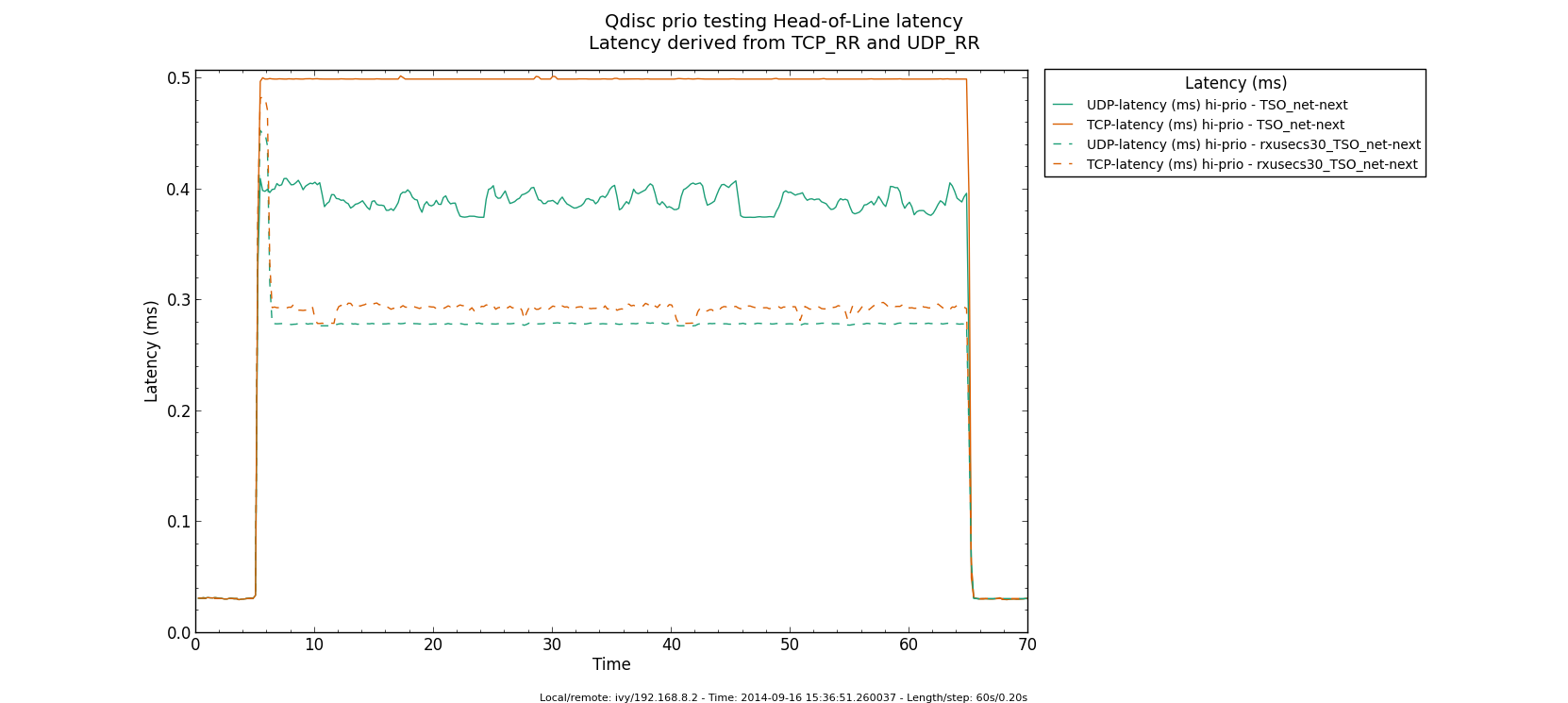
will no doubt make many a high speed trader happy.
My point being was that by repeating this experiment for each successive change (eric's 1/2 BQL patch, better batching, sch_fq, different ethernet drivers, etc),
you (or people duplicating the experiment) can produce ongoing comparison plots...
Quoted 11 lines
The above measurements is for 10Gbit/s, but I've also done measurements on 1Gbit/s driver igb, and 10Mbit/s by forcing igb to use 10Mbit/s. Those results I forgot upload (and I cannot upload them right now, as I'm currently in Switzerland).
--
Best regards,
Jesper Dangaard Brouer
MSc.CS, Sr. Network Kernel Developer at Red Hat
Author of http://www.iptv-analyzer.org
LinkedIn: http://www.linkedin.com/in/brouer
Signature · 3 lines
Dave Täht

https://www.bufferbloat.net/projects/make-wifi-fast