make global bitlock waitqueues per-node
Subsystems (7)
RFC PATCH 1/1 make global bitlock waitqueues per-node
I saw a 4.8->4.9 regression (details below) that I attributed to:
9dcb8b685f mm: remove per-zone hashtable of bitlock waitqueues
That commit took the bitlock waitqueues from being dynamically-allocated per-zone to being statically allocated and global. As suggested by Linus, this makes them per-node, but keeps them statically-allocated.
It leaves us with more waitqueues than the global approach, inherently scales it up as we gain nodes, and avoids generating code for page_zone() which was evidently quite ugly. The patch is pretty darn tiny too.
This turns what was a ~40% 4.8->4.9 regression into a 17% gain over what on 4.8 did. That gain is a _bit_ surprising, but not entirely unexpected since we now get much simpler code from no page_zone() and a fixed-size array for which we don't have to follow a pointer (and get to do power-of-2 math).
This boots in a small VM and on a multi-node NUMA system, but has not been tested widely. It definitely needs to be validated to make sure it properly initialzes the new structure in the various node hotplug cases before anybody goes applying it.
Original report below (sent privately by accident).
 include/linux/mmzone.h |    5 +++++
 kernel/sched/core.c    |   16 ----------------
 mm/filemap.c           |   22 +++++++++++++++++++++-
 mm/page_alloc.c        |    5 +++++
 4 files changed, 31 insertions(+), 17 deletions(-)
---
I'm seeing a 4.8->4.9 regression:
https://www.sr71.net/~dave/intel/2016-12-19-page_fault_3.processes.png
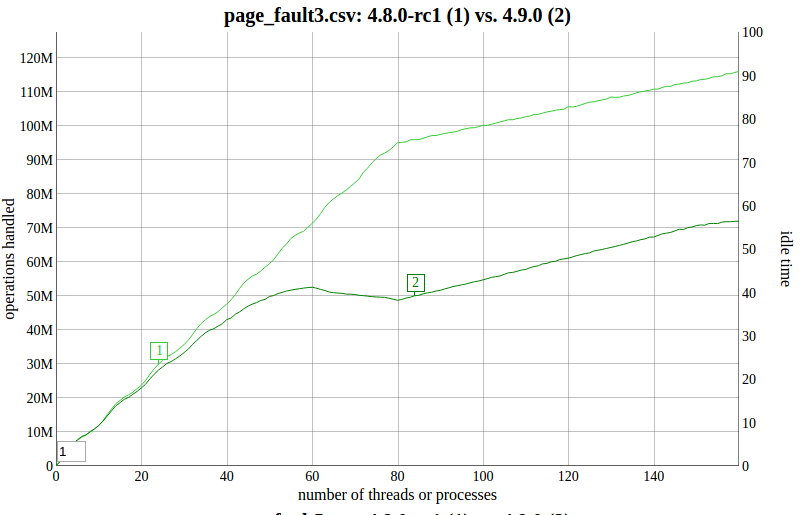
This is on a 160-thread 8-socket system. The workloads is a bunch of processes faulting in pages to separate MAP_SHARED mappings:
https://github.com/antonblanchard/will-it-scale/blob/master/tests/page_fault3.c
The smoking gun in the profiles is that __wake_up_bit() (called via unlock_page()) goes from ~1% to 4% in the profiles.
The workload is pretty maniacally touching random parts of the waitqueue, and missing the cache heavily. Now that it is shared, I suspect we're transferring cachelines across node boundaries in a way that we were not with the per-zone waitqueues.
This is *only* showing up with MAP_SHARED pages, not with anonymous pages. I think we do a lock_page()/unlock_page() pair in do_shared_fault(), which we avoid in the anonymous case. Reverting:
9dcb8b685f mm: remove per-zone hashtable of bitlock waitqueues
restores things to 4.8 behavior. The fact that automated testing didn't catch this probably means that it's pretty rare to find hardware that actually shows the problem, so I don't think it's worth reverting anything in mainline.
ut, the commit says:
Quoted 4 lines
As part of that earlier discussion, we had a much better solution for the NUMA scalability issue - by just making the page lock have a separate contention bit, the waitqueue doesn't even have to be looked at for the normal case.
So, maybe we should do that moving forward since we at least found one case that's pretty aversely affected.
---
 b/include/linux/mmzone.h |    5 +++++
 b/kernel/sched/core.c    |   16 ----------------
 b/mm/filemap.c           |   22 +++++++++++++++++++++-
 b/mm/page_alloc.c        |    5 +++++
 4 files changed, 31 insertions(+), 17 deletions(-)
include/linux/mmzone.h renamed from include/linux/mmzone.h~static-per-zone-waitqueue +5 -0
@@ -27,6 +27,9 @@#endif #define MAX_ORDER_NR_PAGES (1 << (MAX_ORDER - 1)) +#define WAIT_TABLE_BITS 8 +#define WAIT_TABLE_SIZE (1 << WAIT_TABLE_BITS) +/* * PAGE_ALLOC_COSTLY_ORDER is the order at which allocations are deemed * costly to service. That is between allocation orders which should
@@ -662,6 +665,8 @@ typedef struct pglist_data {unsigned long min_slab_pages;#endif /* CONFIG_NUMA */ +wait_queue_head_t wait_table[WAIT_TABLE_SIZE ]; +/* Write-intensive fields used by page reclaim */ ZONE_PADDING (_pad1_) spinlock_t lru_lock;
kernel/sched/core.c renamed from kernel/sched/core.c~static-per-zone-waitqueue +0 -16
@@ -7509,27 +7509,11 @@ static struct kmem_cache *task_group_cacDECLARE_PER_CPU (cpumask_var_t, load_balance_mask);DECLARE_PER_CPU (cpumask_var_t, select_idle_mask); -#define WAIT_TABLE_BITS 8 -#define WAIT_TABLE_SIZE (1 << WAIT_TABLE_BITS) -static wait_queue_head_t bit_wait_table[WAIT_TABLE_SIZE] __cacheline_aligned; - -wait_queue_head_t *bit_waitqueue (void *word,int bit) -{ -const int shift =BITS_PER_LONG ==32 ?5 :6 ; -unsigned long val = (unsigned long )word << shift | bit; - -return bit_wait_table +hash_long (val,WAIT_TABLE_BITS ); -} -EXPORT_SYMBOL (bit_waitqueue); -void __init sched_init (void ) {int i, j;unsigned long alloc_size =0 , ptr; -for (i =0 ; i <WAIT_TABLE_SIZE ; i++) -init_waitqueue_head (bit_wait_table + i); -#ifdef CONFIG_FAIR_GROUP_SCHED alloc_size +=2 * nr_cpu_ids *sizeof (void **);#endif
mm/filemap.c renamed from mm/filemap.c~static-per-zone-waitqueue +21 -1
@@ -779,6 +779,26 @@ EXPORT_SYMBOL(__page_cache_alloc);#endif /* +* We need 'nid' because page_waitqueue() needs to get the waitqueue +* for memory where virt_to_page() does not work, like highmem. +*/ +static wait_queue_head_t *__bit_waitqueue (void *word,int bit,int nid) +{ +const int shift =BITS_PER_LONG ==32 ?5 :6 ; +unsigned long val = (unsigned long )word << shift | bit; + +return &NODE_DATA (nid)->wait_table[hash_long (val,WAIT_TABLE_BITS )]; +} + +wait_queue_head_t *bit_waitqueue (void *word,int bit) +{ +const int __maybe_unused nid =page_to_nid (virt_to_page (word)); + +return __bit_waitqueue (word, bit, nid); +} +EXPORT_SYMBOL (bit_waitqueue); + +/* * In order to wait for pages to become available there must be * waitqueues associated with pages. By using a hash table of * waitqueues where the bucket discipline is to maintain all
@@ -790,7 +810,7 @@ EXPORT_SYMBOL(__page_cache_alloc);*/ wait_queue_head_t *page_waitqueue (struct page *page) { -return bit_waitqueue (page,0 ); +return __bit_waitqueue (page,0 ,page_to_nid (page)); }EXPORT_SYMBOL (page_waitqueue);
mm/page_alloc.c renamed from mm/page_alloc.c~static-per-zone-waitqueue +5 -0
@@ -5872,6 +5872,7 @@ void __paginginit free_area_init_node(inpg_data_t *pgdat =NODE_DATA (nid);unsigned long start_pfn =0 ;unsigned long end_pfn =0 ; +int i;/* pg_data_t should be reset to zero when it's allocated */ WARN_ON (pgdat->nr_zones || pgdat->kswapd_classzone_idx);
@@ -5892,6 +5893,10 @@ void __paginginit free_area_init_node(in zones_size, zholes_size);alloc_node_mem_map (pgdat); + +/* per-node page waitqueue initialization: */ +for (i =0 ; i <WAIT_TABLE_SIZE ; i++) +init_waitqueue_head (&pgdat->wait_table[i]);#ifdef CONFIG_FLAT_NODE_MEM_MAP printk(KERN_DEBUG "free_area_init_node: node %d, pgdat %08lx, node_mem_map %08lx\n", nid, (unsigned long)pgdat,
_
--
To unsubscribe, send a message with 'unsubscribe linux-mm' in the body to [email protected]. For more info on Linux MM,
see: http://www.linux-mm.org/ .
Don't email: <a href=mailto:"[email protected]"> [email protected] </a>
On Dec 19, 2016 2:58 PM, "Dave Hansen" <[email protected]> wrote:
This boots in a small VM and on a multi-node NUMA system, but has not been tested widely.
No, this is wrong.
+wait_queue_head_t *bit_waitqueue(void *word, int bit) +{
+ const int __maybe_unused nid = page_to_nid(virt_to_page(word));
+
+ return __bit_waitqueue(word, bit, nid);
No can do. Part of the problem with the old coffee was that it did that virt_to_page() crud. That doesn't work with the virtually mapped stack.
So bit_waitqueue() must not do the page lookup.
Only [un]lock_page() that already has a page can do the NID thing.
OK?
Linus
On Dec 19, 2016 3:07 PM, "Linus Torvalds" <[email protected]> wrote:
Part of the problem with the old coffee ..
Traveling. My phone always thinks I mean coffee when I swipe "code".
I can't blame it on not enough coffee this time. I should just double-check the autocorrect more.
Linus
Quoted 8 lines · Linus Torvalds
+wait_queue_head_t *bit_waitqueue(void *word, int bit) +{
+ const int__maybe_unusednid = page_to_nid(virt_to_page(word));
+
+ return__bit_waitqueue(word, bit, nid);No can do. Part of the problem with the old coffee was that it did that
virt_to_page()crud. That doesn't work with the virtually mapped stack.
Ahhh, got it.
So, what did you have in mind? Just redirect bit_waitqueue() to the "first_online_node" waitqueues?
wait_queue_head_t *bit_waitqueue(void *word, int bit)
{
        return __bit_waitqueue(word, bit, first_online_node);
}
We could do some fancy stuff like only do virt_to_page() for things in the linear map, but I'm not sure we'll see much of a gain for it. None of the other waitqueue users look as pathological as the 'struct page' ones. Maybe:
wait_queue_head_t *bit_waitqueue(void *word, int bit)
{
	int nid
	if (word >= VMALLOC_START) /* all addrs not in linear map */
		nid = first_online_node;
	else
		nid = page_to_nid(virt_to_page(word));
        return __bit_waitqueue(word, bit, nid);
}
--
To unsubscribe, send a message with 'unsubscribe linux-mm' in the body to [email protected]. For more info on Linux MM,
see: http://www.linux-mm.org/ .
Don't email: <a href=mailto:"[email protected]"> [email protected] </a>
Quoted 26 lines · On Mon, 19 Dec 2016 16:20:05 -0800 Dave Hansen <[email protected]>…
Quoted 8 lines · Linus Torvalds
+wait_queue_head_t *bit_waitqueue(void *word, int bit) +{
+ const int__maybe_unusednid = page_to_nid(virt_to_page(word));
+
+ return__bit_waitqueue(word, bit, nid);No can do. Part of the problem with the old coffee was that it did that
virt_to_page()crud. That doesn't work with the virtually mapped stack.Ahhh, got it.
So, what did you have in mind? Just redirect
bit_waitqueue()to the "first_online_node" waitqueues?
wait_queue_head_t*bit_waitqueue(void *word, int bit){ return __bit_waitqueue(word, bit, first_online_node); }We could do some fancy stuff like only do
virt_to_page()for things in the linear map, but I'm not sure we'll see much of a gain for it. None of the other waitqueue users look as pathological as the 'struct page' ones. Maybe:
wait_queue_head_t*bit_waitqueue(void *word, int bit)
Quoted 8 lines
{
	int nid
	if (word >= VMALLOC_START) /* all addrs not in linear map */
		nid = first_online_node;
	else
		nid = page_to_nid(virt_to_page(word));
        return __bit_waitqueue(word, bit, nid);
}
I think he meant just make the page_waitqueue do the per-node thing and leave bit_waitqueue as the global bit.
It would be cool if CPUs had an instruction that translates an address though. You could avoid all that lookup and just do it with the TLB :)
Thanks,
Nick
--
To unsubscribe, send a message with 'unsubscribe linux-mm' in the body to [email protected]. For more info on Linux MM,
see: http://www.linux-mm.org/ .
Don't email: <a href=mailto:"[email protected]"> [email protected] </a>
Quoted 38 lines · Nicholas Piggin
Quoted 26 lines · On Mon, 19 Dec 2016 16:20:05 -0800 Dave Hansen <[email protected]>…
Quoted 8 lines · Linus Torvalds
+wait_queue_head_t *bit_waitqueue(void *word, int bit) +{
+ const int__maybe_unusednid = page_to_nid(virt_to_page(word));
+
+ return__bit_waitqueue(word, bit, nid);No can do. Part of the problem with the old coffee was that it did that
virt_to_page()crud. That doesn't work with the virtually mapped stack.Ahhh, got it.
So, what did you have in mind? Just redirect
bit_waitqueue()to the "first_online_node" waitqueues?
wait_queue_head_t*bit_waitqueue(void *word, int bit){ return __bit_waitqueue(word, bit, first_online_node); }We could do some fancy stuff like only do
virt_to_page()for things in the linear map, but I'm not sure we'll see much of a gain for it. None of the other waitqueue users look as pathological as the 'struct page' ones. Maybe:
wait_queue_head_t*bit_waitqueue(void *word, int bit)Quoted 8 lines
{
	int nid
	if (word >= VMALLOC_START) /* all addrs not in linear map */
		nid = first_online_node;
	else
		nid = page_to_nid(virt_to_page(word));
        return __bit_waitqueue(word, bit, nid);
}
Quoted 3 lines
I think he meant just make the
page_waitqueuedo the per-node thing and leavebit_waitqueueas the global bit.
I'm pressed for time but at a glance, that might require a separate structure of wait_queues for page waitqueue. Most users of bit_waitqueue are not operating with pages. The first user is based on a word inside a block_device for example. All non-page users could assume node-0. It shrinks the available hash table space but as before, maybe collisions are not common enough to actually matter. That would be worth checking out. Alternatively, careful auditing to pick a node when it's known it's safe to call virt_to_page may work but it would be fragile.
Unfortunately I won't be able to review or test any patches until January 3rd after I'm back online properly. Right now, I have intermittent internet access at best. During the next 4 days, I know I definitely will not have any internet access.
The last time around, there were three patch sets to avoid the overhead for pages in particular. One was dropped (mine, based on Nick's old work) as it was too complicated. Peter had some patches but after enough hammering it failed due to a missed wakup that I didn't pin down before having to travel to a conference.
I hadn't tested Nick's prototype although it looked fine because others reviewed it before I looked and I was waiting for another version to appear. If one appears, I'll take a closer look and bash it across a few machines to see if it has any lost wakeup problems.
Signature · 8 lines
Mel Gorman
SUSE Labs

--
To unsubscribe, send a message with 'unsubscribe linux-mm' in
the body to [email protected].  For more info on Linux MM,
see: http://www.linux-mm.org/ .
Don't email: <a href=mailto:"[email protected]"> [email protected] </a>
Quoted 39 lines · On Tue, 20 Dec 2016 12:58:25 +0000 Mel Gorman <[email protected]>…
Quoted 38 lines · Nicholas Piggin
Quoted 34 lines · On Mon, 19 Dec 2016 16:20:05 -0800 Dave Hansen <[email protected]>…
Quoted 8 lines · Linus Torvalds
+wait_queue_head_t *bit_waitqueue(void *word, int bit) +{
+ const int__maybe_unusednid = page_to_nid(virt_to_page(word));
+
+ return__bit_waitqueue(word, bit, nid);No can do. Part of the problem with the old coffee was that it did that
virt_to_page()crud. That doesn't work with the virtually mapped stack.Ahhh, got it.
So, what did you have in mind? Just redirect
bit_waitqueue()to the "first_online_node" waitqueues?
wait_queue_head_t*bit_waitqueue(void *word, int bit){ return __bit_waitqueue(word, bit, first_online_node); }We could do some fancy stuff like only do
virt_to_page()for things in the linear map, but I'm not sure we'll see much of a gain for it. None of the other waitqueue users look as pathological as the 'struct page' ones. Maybe:
wait_queue_head_t*bit_waitqueue(void *word, int bit){ int nid if (word >= VMALLOC_START) /* all addrs not in linear map */ nid = first_online_node; else nid = page_to_nid(virt_to_page(word)); return __bit_waitqueue(word, bit, nid); }
Quoted 8 lines
Quoted 3 lines
I think he meant just make the
page_waitqueuedo the per-node thing and leavebit_waitqueueas the global bit.I'm pressed for time but at a glance, that might require a separate structure of
wait_queuesfor page waitqueue. Most users ofbit_waitqueueare not operating with pages. The first user is based on a word inside ablock_devicefor example. All non-page users could assume node-0.
Yes it would require something or other like that. Trivial to keep things balanced (if not local) over nodes by take a simple hash of the virtual address to spread over the nodes. Or just keep using this separate global table for the bit_waitqueue...
But before Linus grumps at me again, let's try to do the waitqueue avoidance bit first before we worry about that :)
Quoted 17 lines
It
shrinks the available hash table space but as before, maybe collisions are not common enough to actually matter. That would be worth checking out. Alternatively, careful auditing to pick a node when it's known it's safe to callvirt_to_pagemay work but it would be fragile.Unfortunately I won't be able to review or test any patches until January 3rd after I'm back online properly. Right now, I have intermittent internet access at best. During the next 4 days, I know I definitely will not have any internet access.
The last time around, there were three patch sets to avoid the overhead for pages in particular. One was dropped (mine, based on Nick's old work) as it was too complicated. Peter had some patches but after enough hammering it failed due to a missed wakup that I didn't pin down before having to travel to a conference.
Quoted 5 lines
I hadn't tested Nick's prototype although it looked fine because others reviewed it before I looked and I was waiting for another version to appear. If one appears, I'll take a closer look and bash it across a few machines to see if it has any lost wakeup problems.
Sure I'll respin it this week.
Thanks,
Nick
--
To unsubscribe, send a message with 'unsubscribe linux-mm' in the body to [email protected]. For more info on Linux MM,
see: http://www.linux-mm.org/ .
Don't email: <a href=mailto:"[email protected]"> [email protected] </a>
Quoted 7 lines · Dave Hansen
Quoted 6 lines · Linus Torvalds
+wait_queue_head_t *bit_waitqueue(void *word, int bit) +{
+ const int__maybe_unusednid = page_to_nid(virt_to_page(word));
+
+ return__bit_waitqueue(word, bit, nid);
Quoted 7 lines
Quoted 2 lines
No can do. Part of the problem with the old coffee was that it did that
virt_to_page()crud. That doesn't work with the virtually mapped stack.Ahhh, got it.
So, what did you have in mind? Just redirect
bit_waitqueue()to the "first_online_node" waitqueues?
That was my initial thought, but now that I'm back home and look at the code, I realize:
- we never merged the PageWaiters patch. I thought we already did,
because I didn't think there was any confusion left, but that was clearly just in my dreams.
I was surprised that you'd see the cache ping-pong with per-page
contention bit, but thought that maybe your benchmark was some kind of broken "fault in the same page over and over again on multiple nodes" thing. But it was simpler than that - you simply don't have the per-page contention bit at all.
And quite frankly, I still suspect that just doing the per-page
contention bit will solve everything, and we don't want to do the numa-spreading bit_waitqueue() at all.
- but if I'm wrong, and you can still see numa issues even with the
per-page contention bit in place, we should just treat "bit_waitqueue()" separately from the page waitqueue, and just have a separate (non-node) array for the bit-waitqueue.
I'll go back and try to see why the page flag contention patch didn't get applied.
Linus
--
To unsubscribe, send a message with 'unsubscribe linux-mm' in the body to [email protected]. For more info on Linux MM,
see: http://www.linux-mm.org/ .
Don't email: <a href=mailto:"[email protected]"> [email protected] </a>
Quoted 3 lines · Linus Torvalds
I'll go back and try to see why the page flag contention patch didn't get applied.
Ahh, a combination of warring patches by Nick and PeterZ, and worry about the page flag bits.
Damn. I had mentally marked this whole issue as "solved". But the fact that we know how to solve it doesn't mean it's done.
Linus
--
To unsubscribe, send a message with 'unsubscribe linux-mm' in the body to [email protected]. For more info on Linux MM,
see: http://www.linux-mm.org/ .
Don't email: <a href=mailto:"[email protected]"> [email protected] </a>
Peter Zijlstra
maintainerQuoted 8 lines · Linus Torvalds
Quoted 3 lines · Linus Torvalds
I'll go back and try to see why the page flag contention patch didn't get applied.
Ahh, a combination of warring patches by Nick and PeterZ, and worry about the page flag bits.
I think Nick actually had a patch freeing up a pageflag, although Hugh had a comment on that.
That said, I'm not a huge fan of his waiters patch, I'm still not sure why he wants to write another whole wait loop, but whatever. Whichever you prefer I suppose.
--
To unsubscribe, send a message with 'unsubscribe linux-mm' in the body to [email protected]. For more info on Linux MM,
see: http://www.linux-mm.org/ .
Don't email: <a href=mailto:"[email protected]"> [email protected] </a>
Peter Zijlstra
maintainerQuoted 10 lines · Peter Zijlstra
Quoted 8 lines · Linus Torvalds
Quoted 3 lines · Linus Torvalds
I'll go back and try to see why the page flag contention patch didn't get applied.
Ahh, a combination of warring patches by Nick and PeterZ, and worry about the page flag bits.
Quoted 6 lines
I think Nick actually had a patch freeing up a pageflag, although Hugh had a comment on that.
That said, I'm not a huge fan of his waiters patch, I'm still not sure why he wants to write another whole wait loop, but whatever. Whichever you prefer I suppose.
FWIW, here's mine.. compiles and boots on a NUMA x86_64 machine.
---
Subject: mm: Avoid slow path for unlock_page()
From: Peter Zijlstra <[email protected]>
Date: Thu, 27 Oct 2016 10:08:52 +0200
Currently we uncontidionally look up the page waitqueue and issue the wakeup for unlock_page(), even though there might not be anybody waiting.
Use another pageflag (PG_waiters) to keep track of the waitqueue state such that we can avoid the work when there are in fact no waiters queued.
Currently guarded by CONFIG_NUMA, which is not strictly correct as I've been told there actually are 32bit architectures that have NUMA. Ideally Nick manages to reclaim a pageflag and we can make this unconditional.
---
 include/linux/page-flags.h     |   19 ++++++++
 include/linux/pagemap.h        |   25 ++++++++--
 include/trace/events/mmflags.h |    7 +++
 mm/filemap.c                   |   94 +++++++++++++++++++++++++++++++++++++----
 4 files changed, 130 insertions(+), 15 deletions(-)
include/linux/page-flags.h +19 -0
@@ -73,6 +73,14 @@*/ enum pageflags { PG_locked,/* Page is locked. Don't touch. */ +#ifdef CONFIG_NUMA +/* +* This bit must end up in the same word as PG_locked (or any other bit +* we're waiting on), as per all architectures their bitop +* implementations. +*/ + PG_waiters,/* The hashed waitqueue has waiters */ +#endif PG_error, PG_referenced, PG_uptodate,
@@ -231,6 +239,9 @@ static __always_inline int TestClearPage#define TESTPAGEFLAG_FALSE (uname) \ static inline int Page##uname(const struct page *page) { return 0; } +#define TESTPAGEFLAG_TRUE (uname) \ +static inline int Page##uname(const struct page *page) { return 1; } +#define SETPAGEFLAG_NOOP (uname) \ static inline void SetPage##uname(struct page *page) { }
@@ -249,10 +260,18 @@ static inline int TestClearPage##uname(s#define PAGEFLAG_FALSE (uname) TESTPAGEFLAG_FALSE(uname) \ SETPAGEFLAG_NOOP(uname) CLEARPAGEFLAG_NOOP(uname) +#define PAGEFLAG_TRUE (uname) TESTPAGEFLAG_TRUE(uname) \ + SETPAGEFLAG_NOOP(uname) CLEARPAGEFLAG_NOOP(uname) +#define TESTSCFLAG_FALSE (uname) \ TESTSETFLAG_FALSE(uname) TESTCLEARFLAG_FALSE(uname) __PAGEFLAG(Locked, locked, PF_NO_TAIL) +#ifdef CONFIG_NUMA +PAGEFLAG(Waiters, waiters, PF_NO_TAIL) +#else +PAGEFLAG_TRUE (Waiters); +#endif PAGEFLAG(Error, error, PF_NO_COMPOUND) TESTCLEARFLAG(Error, error, PF_NO_COMPOUND) PAGEFLAG(Referenced, referenced, PF_HEAD)TESTCLEARFLAG (Referenced, referenced,PF_HEAD )
include/linux/pagemap.h +19 -6
@@ -436,7 +436,7 @@ extern void __lock_page(struct page *pagextern int __lock_page_killable (struct page *page);extern int __lock_page_or_retry (struct page *page,struct mm_struct *mm,unsigned int flags); -extern void unlock_page (struct page *page); +extern void __unlock_page (struct page *page);static inline int trylock_page (struct page *page) {
@@ -467,6 +467,20 @@ static inline int lock_page_killable(strreturn 0 ; } +static inline void unlock_page (struct page *page) +{ + page =compound_head (page); +VM_BUG_ON_PAGE (!PageLocked (page), page); +clear_bit_unlock (PG_locked, &page->flags); +/* +* Since PG_locked and PG_waiters are in the same word, Program-Order +* ensures the load of PG_waiters must not observe a value earlier +* than our clear_bit() store. +*/ +if (PageWaiters (page)) +__unlock_page (page); +} +/* * lock_page_or_retry - Lock the page, unless this would block and the * caller indicated that it can handle a retry.
@@ -491,11 +505,11 @@ extern int wait_on_page_bit_killable(strextern int wait_on_page_bit_killable_timeout (struct page *page,int bit_nr,unsigned long timeout); +extern int wait_on_page_lock (struct page *page,int mode); +static inline int wait_on_page_locked_killable (struct page *page) { -if (!PageLocked (page)) -return 0 ; -return wait_on_page_bit_killable (compound_head (page), PG_locked); +return wait_on_page_lock (page,TASK_KILLABLE ); }extern wait_queue_head_t *page_waitqueue (struct page *page);
@@ -513,8 +527,7 @@ static inline void wake_up_page(struct p*/ static inline void wait_on_page_locked (struct page *page) { -if (PageLocked (page)) -wait_on_page_bit (compound_head (page), PG_locked); +wait_on_page_lock (page,TASK_UNINTERRUPTIBLE ); }/*
include/trace/events/mmflags.h +7 -0
@@ -55,6 +55,12 @@ __def_gfpflag_names \ ) : "none" +#ifdef CONFIG_NUMA +#define IF_HAVE_PG_WAITERS (flag,string) {1UL << flag, string}, +#else +#define IF_HAVE_PG_WAITERS (flag,string) +#endif +#ifdef CONFIG_MMU #define IF_HAVE_PG_MLOCK (flag,string) ,{1UL << flag, string}#else
@@ -81,6 +87,7 @@#define __def_pageflag_names \ {1UL << PG_locked, "locked" }, \ +IF_HAVE_PG_WAITERS(PG_waiters, "waiters" ) \ {1UL << PG_error, "error" }, \ {1UL << PG_referenced, "referenced" }, \ {1UL << PG_uptodate, "uptodate" }, \
mm/filemap.c +85 -9
123 lines not on this page · raw message
--
To unsubscribe, send a message with 'unsubscribe linux-mm' in the body to [email protected]. For more info on Linux MM,
see: http://www.linux-mm.org/ .
Don't email: <a href=mailto:"[email protected]"> [email protected] </a>
Quoted 2 lines · Peter Zijlstra
FWIW, here's mine.. compiles and boots on a NUMA
x86_64machine.
So I like how your patch is smaller, but your patch is also broken.
First off, the whole contention bit is *not* NUMA-specific. It should help non-NUMA too, by avoiding the stupid extra cache miss.
Secondly, CONFIG_NUMA is a broken thing to test anyway, since adding a bit for the NUMA case can overflow the page flags as far as I can tell (MIPS seems to support NUMA on 32-bit, for example, but I didn't really check the Kconfig details). Making it dependent on 64-bit might be ok (and would fix the issue above - I don't think we really need to care too much about 32-bit any more)
But making it conditional at all means that now you have those two different cases for this, which is a maintenance nightmare. So don't do it even if we could say "screw 32-bit".
Anyway, the conditional thing could be fixed by just taking Nick's patch 1/2, and your patch (with the conditional bits stripped out).
I do think your approach of just re-using the existing bit waiting with just a page-specific waiting function is nicer than Nick's "let's just roll new waiting functions" approach. It also avoids the extra initcall.
Nick, comments?
Hugh - mind testing PeterZ's patch too? My comments about the conditional PG_waiters bit and page bit overflow are not relevant for your particular scenario, so you can ignore that part, and just take PaterZ's patch directly.
Linus
--
To unsubscribe, send a message with 'unsubscribe linux-mm' in the body to [email protected]. For more info on Linux MM,
see: http://www.linux-mm.org/ .
Don't email: <a href=mailto:"[email protected]"> [email protected] </a>
Quoted 23 lines · On Wed, 21 Dec 2016 10:02:27 -0800 Linus Torvalds…
Quoted 2 lines · Peter Zijlstra
FWIW, here's mine.. compiles and boots on a NUMA
x86_64machine.So I like how your patch is smaller, but your patch is also broken.
First off, the whole contention bit is *not* NUMA-specific. It should help non-NUMA too, by avoiding the stupid extra cache miss.
Secondly,
CONFIG_NUMAis a broken thing to test anyway, since adding a bit for the NUMA case can overflow the page flags as far as I can tell (MIPS seems to support NUMA on 32-bit, for example, but I didn't really check theKconfigdetails). Making it dependent on 64-bit might be ok (and would fix the issue above - I don't think we really need to care too much about 32-bit any more)But making it conditional at all means that now you have those two different cases for this, which is a maintenance nightmare. So don't do it even if we could say "screw 32-bit".
Anyway, the conditional thing could be fixed by just taking Nick's patch 1/2, and your patch (with the conditional bits stripped out).
Quoted 6 lines
I do think your approach of just re-using the existing bit waiting with just a page-specific waiting function is nicer than Nick's "let's just roll new waiting functions" approach. It also avoids the extra initcall.
Nick, comments?
Well yes we should take my patch 1 and use the new bit for this purpose regardless of what way we go with patch 2. I'll reply to that in the other mail.
Thanks,
Nick
--
To unsubscribe, send a message with 'unsubscribe linux-mm' in the body to [email protected]. For more info on Linux MM,
see: http://www.linux-mm.org/ .
Don't email: <a href=mailto:"[email protected]"> [email protected] </a>
Quoted 9 lines · On Thu, 22 Dec 2016 04:33:31 +1000 Nicholas Piggin <[email protected]> wrote:
Quoted 5 lines · On Wed, 21 Dec 2016 10:02:27 -0800 Linus Torvalds…
I do think your approach of just re-using the existing bit waiting with just a page-specific waiting function is nicer than Nick's "let's just roll new waiting functions" approach. It also avoids the extra initcall.
Quoted 5 lines
Quoted 1 line
Nick, comments?
Well yes we should take my patch 1 and use the new bit for this purpose regardless of what way we go with patch 2. I'll reply to that in the other mail.
Actually when I hit send, I thought your next mail was addressing a different subject. So back here.
Peter's patch is less code and in that regard a bit nicer. I tried going that way once, but I just thought it was a bit too sloppy to do nicely with wait bit APIs.
- The page can be added to waitqueue without PageWaiters being set. This is transient condition where the lock is retested, but it remains that PageWaiters is not quite the same as waitqueue_active to some degree.
- This set + retest means every time a page gets a waiter, the cost is 2 test-and-set for the lock bit plus 2 spin_lock+spin_unlock for the waitqueue.
- Setting PageWaiters is done outside the waitqueue lock, so you also have a new interleavings to think about versus clearing the bit.
- It fails to clear up the bit and return to fastpath when there are hash collisions. Yes I know this is a rare case and on average it probably does not matter. But jitter is important, but also we really *want* to keep the waitqueue table small and lean like you have made it if possible. None of this 100KB per zone crap -- I do want to keep it small and tolerating collisions better would help that.
Anyway that's about my 2c. Keep in mind Mel just said he might have seen a lockup with Peter's patch, and mine has not been hugely tested either, so let's wait for a bit more testing before merging either.
Although we could start pipelining the process by merging patch 1 if Hugh acks it (cc'ed), then I'll resend with SOB and Ack.
Thanks,
Nick
--
To unsubscribe, send a message with 'unsubscribe linux-mm' in the body to [email protected]. For more info on Linux MM,
see: http://www.linux-mm.org/ .
Don't email: <a href=mailto:"[email protected]"> [email protected] </a>
Quoted 3 lines · Nicholas Piggin
Peter's patch is less code and in that regard a bit nicer. I tried going that way once, but I just thought it was a bit too sloppy to do nicely with wait bit APIs.
So I have to admit that when I read through your and PeterZ's patches back-to-back, yours was easier to understand.
PeterZ's is smaller but kind of subtle. The whole "return zero from lock_page_wait() and go around again" and the locking around that isn't exactly clear. In contrast, yours has the obvious waitqueue spinlock.
I'll think about it. And yes, it would be good to have more testing, but at the same time xmas is imminent, and waiting around too much isn't going to help either..
Linus
--
To unsubscribe, send a message with 'unsubscribe linux-mm' in the body to [email protected]. For more info on Linux MM,
see: http://www.linux-mm.org/ .
Don't email: <a href=mailto:"[email protected]"> [email protected] </a>
Quoted 8 lines · On Wed, 21 Dec 2016 11:50:49 -0800 Linus Torvalds…
Quoted 3 lines · Nicholas Piggin
Peter's patch is less code and in that regard a bit nicer. I tried going that way once, but I just thought it was a bit too sloppy to do nicely with wait bit APIs.
So I have to admit that when I read through your and PeterZ's patches back-to-back, yours was easier to understand.
Quoted 8 lines
PeterZ's is smaller but kind of subtle. The whole "return zero from
lock_page_wait()and go around again" and the locking around that isn't exactly clear. In contrast, yours has the obvious waitqueue spinlock.I'll think about it. And yes, it would be good to have more testing, but at the same time xmas is imminent, and waiting around too much isn't going to help either..
Sure. Let's see if Dave and Mel get a chance to do some testing.
It might be a squeeze before Christmas. I realize we're going to fix it anyway so on one hand might as well get something in. On the other I didn't want to add a subtle bug then have everyone go on vacation.
How about I send up the page flag patch by Friday and that can bake while the main patch gets more testing / review?
Thanks,
Nick
--
To unsubscribe, send a message with 'unsubscribe linux-mm' in the body to [email protected]. For more info on Linux MM,
see: http://www.linux-mm.org/ .
Don't email: <a href=mailto:"[email protected]"> [email protected] </a>
Quoted 16 lines · Linus Torvalds
Quoted 2 lines · Peter Zijlstra
FWIW, here's mine.. compiles and boots on a NUMA
x86_64machine.So I like how your patch is smaller, but your patch is also broken.
First off, the whole contention bit is *not* NUMA-specific. It should help non-NUMA too, by avoiding the stupid extra cache miss.
Secondly,
CONFIG_NUMAis a broken thing to test anyway, since adding a bit for the NUMA case can overflow the page flags as far as I can tell (MIPS seems to support NUMA on 32-bit, for example, but I didn't really check theKconfigdetails). Making it dependent on 64-bit might be ok (and would fix the issue above - I don't think we really need to care too much about 32-bit any more)
Quoted 6 lines
But making it conditional at all means that now you have those two different cases for this, which is a maintenance nightmare. So don't do it even if we could say "screw 32-bit".
Anyway, the conditional thing could be fixed by just taking Nick's patch 1/2, and your patch (with the conditional bits stripped out).
Yup.
Quoted 6 lines
I do think your approach of just re-using the existing bit waiting with just a page-specific waiting function is nicer than Nick's "let's just roll new waiting functions" approach. It also avoids the extra initcall.
Quoted 6 lines
Nick, comments?
Hugh - mind testing PeterZ's patch too? My comments about the conditional
PG_waitersbit and page bit overflow are not relevant for your particular scenario, so you can ignore that part, and just take PaterZ's patch directly.
Right, I put them both through some loads yesterday and overnight:
Peter's patch and Nick's patch each work fine here, no issues seen with either (but I didn't attempt to compare them, aesthetically nor in performance).
Hugh
--
To unsubscribe, send a message with 'unsubscribe linux-mm' in the body to [email protected]. For more info on Linux MM,
see: http://www.linux-mm.org/ .
Don't email: <a href=mailto:"[email protected]"> [email protected] </a>
Quoted 4 lines · On Wed, 21 Dec 2016 09:09:31 +0100 Peter Zijlstra <[email protected]> wrote:
Quoted 3 lines · Linus Torvalds
Quoted 1 line · Linus Torvalds
Quoted 8 lines
Quoted 5 lines
Quoted 2 lines
I'll go back and try to see why the page flag contention patch didn't get applied.
Ahh, a combination of warring patches by Nick and PeterZ, and worry about the page flag bits.
I think Nick actually had a patch freeing up a pageflag, although Hugh had a comment on that.
Yeah I think he basically acked it. It had a small compound debug false positive but I think it's okay. I'm just testing it again.
Quoted 3 lines
That said, I'm not a huge fan of his waiters patch, I'm still not sure why he wants to write another whole wait loop, but whatever. Whichever you prefer I suppose.
Ah, I was waiting for some feedback, thanks.
Well I wanted to do it that way to keep the manipulation of the new bit under the same lock as the waitqueue, so as not to introduce new memory orderings vs testing waitqueue_active.
Thanks,
Nick
--
To unsubscribe, send a message with 'unsubscribe linux-mm' in the body to [email protected]. For more info on Linux MM,
see: http://www.linux-mm.org/ .
Don't email: <a href=mailto:"[email protected]"> [email protected] </a>
Quoted 13 lines · On Mon, 19 Dec 2016 14:58:26 -0800 Dave Hansen <[email protected]>…
I saw a 4.8->4.9 regression (details below) that I attributed to:
9dcb8b685fmm: remove per-zone hashtable of bitlock waitqueuesThat commit took the bitlock waitqueues from being dynamically-allocated per-zone to being statically allocated and global. As suggested by Linus, this makes them per-node, but keeps them statically-allocated.
It leaves us with more waitqueues than the global approach, inherently scales it up as we gain nodes, and avoids generating code for
page_zone()which was evidently quite ugly. The patch is pretty darn tiny too.
Quoted 5 lines
This turns what was a ~40% 4.8->4.9 regression into a 17% gain over what on 4.8 did. That gain is a _bit_ surprising, but not entirely unexpected since we now get much simpler code from no
page_zone()and a fixed-size array for which we don't have to follow a pointer (and get to do power-of-2 math).
I'll have to respin the PageWaiters patch and resend it. There were just a couple of small issues picked up in review. I've just got side tracked with getting a few other things done and haven't had time to benchmark it properly.
I'd still like to see what per-node waitqueues does on top of that. If it's significant for realistic workloads then it could be done for the page waitqueues as Linus said.
Thanks,
Nick
--
To unsubscribe, send a message with 'unsubscribe linux-mm' in the body to [email protected]. For more info on Linux MM,
see: http://www.linux-mm.org/ .
Don't email: <a href=mailto:"[email protected]"> [email protected] </a>
Quoted 55 lines · On Mon, 19 Dec 2016 14:58:26 -0800 Dave Hansen <[email protected]>…
I saw a 4.8->4.9 regression (details below) that I attributed to:
9dcb8b685fmm: remove per-zone hashtable of bitlock waitqueuesThat commit took the bitlock waitqueues from being dynamically-allocated per-zone to being statically allocated and global. As suggested by Linus, this makes them per-node, but keeps them statically-allocated.
It leaves us with more waitqueues than the global approach, inherently scales it up as we gain nodes, and avoids generating code for
page_zone()which was evidently quite ugly. The patch is pretty darn tiny too.This turns what was a ~40% 4.8->4.9 regression into a 17% gain over what on 4.8 did. That gain is a _bit_ surprising, but not entirely unexpected since we now get much simpler code from no
page_zone()and a fixed-size array for which we don't have to follow a pointer (and get to do power-of-2 math).This boots in a small VM and on a multi-node NUMA system, but has not been tested widely. It definitely needs to be validated to make sure it properly initialzes the new structure in the various node hotplug cases before anybody goes applying it.
Original report below (sent privately by accident).
 include/linux/mmzone.h |    5 +++++
 kernel/sched/core.c    |   16 ----------------
 mm/filemap.c           |   22 +++++++++++++++++++++-
 mm/page_alloc.c        |    5 +++++
 4 files changed, 31 insertions(+), 17 deletions(-)
---
I'm seeing a 4.8->4.9 regression:
https://www.sr71.net/~dave/intel/2016-12-19-page_fault_3.processes.pngThis is on a 160-thread 8-socket system. The workloads is a bunch of processes faulting in pages to separate
MAP_SHAREDmappings:https://github.com/antonblanchard/will-it-scale/blob/master/tests/page_fault3.c
The smoking gun in the profiles is that
__wake_up_bit()(called viaunlock_page()) goes from ~1% to 4% in the profiles.The workload is pretty maniacally touching random parts of the waitqueue, and missing the cache heavily. Now that it is shared, I suspect we're transferring cachelines across node boundaries in a way that we were not with the per-zone waitqueues.
This is *only* showing up with
MAP_SHAREDpages, not with anonymous pages. I think we do a lock_page()/unlock_page() pair indo_shared_fault(), which we avoid in the anonymous case. Reverting:
Quoted 6 lines
9dcb8b685fmm: remove per-zone hashtable of bitlock waitqueuesrestores things to 4.8 behavior. The fact that automated testing didn't catch this probably means that it's pretty rare to find hardware that actually shows the problem, so I don't think it's worth reverting anything in mainline.
I've been doing a bit of testing, and I don't know why you're seeing this.
I don't think I've been able to trigger any actual page lock contention so nothing gets put on the waitqueue to really bounce cache lines around that I can see. Yes there are some loads to check the waitqueue, but those should be cached read shared among CPUs so not cause interconnect traffic I would have thought.
After testing my PageWaiters patch, I'm maybe seeing 2% improvment on this workload (although powerpc doesn't do so well on this one due to virtual memory management overheads -- maybe x86 will show a bit more)
But the point is that after this, there should be no waitqueue activity at all. I haven't chased up a system with a lot of IOPS connected that would be needed to realistically test contended cases (which I thought I needed to show an improvement from per-node tables, but your test suggests not...)
Thanks,
Nick
Quoted 143 lines
ut, the commit says:
Quoted 4 lines
As part of that earlier discussion, we had a much better solution for the NUMA scalability issue - by just making the page lock have a separate contention bit, the waitqueue doesn't even have to be looked at for the normal case.
So, maybe we should do that moving forward since we at least found one case that's pretty aversely affected.
Cc Andreas Gruenbacher <[email protected]>Cc Bob Peterson <[email protected]>Cc Mel Gorman <[email protected]>Cc Peter Zijlstra <[email protected]>Cc Andy Lutomirski <[email protected]>Cc Steven Whitehouse <[email protected]>Cc Linus Torvalds <[email protected]>---
 b/include/linux/mmzone.h |    5 +++++
 b/kernel/sched/core.c    |   16 ----------------
 b/mm/filemap.c           |   22 +++++++++++++++++++++-
 b/mm/page_alloc.c        |    5 +++++
 4 files changed, 31 insertions(+), 17 deletions(-)
diff -puN
include/linux/mmzone.h~static-per-zone-waitqueueinclude/linux/mmzone.hinclude/linux/mmzone.h renamed from include/linux/mmzone.h~static-per-zone-waitqueue +5
-0@@ -27,6 +27,9 @@#endif #define MAX_ORDER_NR_PAGES (1 << (MAX_ORDER - 1)) +#define WAIT_TABLE_BITS 8 +#define WAIT_TABLE_SIZE (1 << WAIT_TABLE_BITS) +/* * PAGE_ALLOC_COSTLY_ORDER is the order at which allocations are deemed * costly to service. That is between allocation orders which should @@ -662,6 +665,8 @@ typedef struct pglist_data {unsigned long min_slab_pages;#endif /* CONFIG_NUMA */ +wait_queue_head_t wait_table[WAIT_TABLE_SIZE ]; +/* Write-intensive fields used by page reclaim */ ZONE_PADDING (_pad1_) spinlock_t lru_lock;diff -puN
kernel/sched/core.c~static-per-zone-waitqueuekernel/sched/core.ckernel/sched/core.c renamed from kernel/sched/core.c~static-per-zone-waitqueue +0
-16@@ -7509,27 +7509,11 @@ static struct kmem_cache *task_group_cacDECLARE_PER_CPU (cpumask_var_t, load_balance_mask);DECLARE_PER_CPU (cpumask_var_t, select_idle_mask); -#define WAIT_TABLE_BITS 8 -#define WAIT_TABLE_SIZE (1 << WAIT_TABLE_BITS) -static wait_queue_head_t bit_wait_table[WAIT_TABLE_SIZE] __cacheline_aligned; - -wait_queue_head_t *bit_waitqueue (void *word,int bit) -{ -const int shift =BITS_PER_LONG ==32 ?5 :6 ; -unsigned long val = (unsigned long )word << shift | bit; - -return bit_wait_table +hash_long (val,WAIT_TABLE_BITS ); -} -EXPORT_SYMBOL (bit_waitqueue); -void __init sched_init (void ) {int i, j;unsigned long alloc_size =0 , ptr; -for (i =0 ; i <WAIT_TABLE_SIZE ; i++) -init_waitqueue_head (bit_wait_table + i); -#ifdef CONFIG_FAIR_GROUP_SCHED alloc_size +=2 * nr_cpu_ids *sizeof (void **);#endif diff -puN
mm/filemap.c~static-per-zone-waitqueuemm/filemap.cmm/filemap.c renamed from mm/filemap.c~static-per-zone-waitqueue +21
-1@@ -779,6 +779,26 @@ EXPORT_SYMBOL(__page_cache_alloc);#endif /* +* We need 'nid' because page_waitqueue() needs to get the waitqueue +* for memory where virt_to_page() does not work, like highmem. +*/ +static wait_queue_head_t *__bit_waitqueue (void *word,int bit,int nid) +{ +const int shift =BITS_PER_LONG ==32 ?5 :6 ; +unsigned long val = (unsigned long )word << shift | bit; + +return &NODE_DATA (nid)->wait_table[hash_long (val,WAIT_TABLE_BITS )]; +} + +wait_queue_head_t *bit_waitqueue (void *word,int bit) +{ +const int __maybe_unused nid =page_to_nid (virt_to_page (word)); + +return __bit_waitqueue (word, bit, nid); +} +EXPORT_SYMBOL (bit_waitqueue); + +/* * In order to wait for pages to become available there must be * waitqueues associated with pages. By using a hash table of * waitqueues where the bucket discipline is to maintain all @@ -790,7 +810,7 @@ EXPORT_SYMBOL(__page_cache_alloc);*/ wait_queue_head_t *page_waitqueue (struct page *page) { -return bit_waitqueue (page,0 ); +return __bit_waitqueue (page,0 ,page_to_nid (page)); }EXPORT_SYMBOL (page_waitqueue);diff -puN
mm/page_alloc.c~static-per-zone-waitqueuemm/page_alloc.cmm/page_alloc.c renamed from mm/page_alloc.c~static-per-zone-waitqueue +5
-0@@ -5872,6 +5872,7 @@ void __paginginit free_area_init_node(inpg_data_t *pgdat =NODE_DATA (nid);unsigned long start_pfn =0 ;unsigned long end_pfn =0 ; +int i;/* pg_data_t should be reset to zero when it's allocated */ WARN_ON (pgdat->nr_zones || pgdat->kswapd_classzone_idx);@@ -5892,6 +5893,10 @@ void __paginginit free_area_init_node(in zones_size, zholes_size);alloc_node_mem_map (pgdat); + +/* per-node page waitqueue initialization: */ +for (i =0 ; i <WAIT_TABLE_SIZE ; i++) +init_waitqueue_head (&pgdat->wait_table[i]);#ifdef CONFIG_FLAT_NODE_MEM_MAP printk(KERN_DEBUG "free_area_init_node: node %d, pgdat %08lx, node_mem_map %08lx\n", nid, (unsigned long)pgdat,_
Quoted 5 lines
--
To unsubscribe, send a message with 'unsubscribe linux-mm' in the body to [email protected]. For more info on Linux MM,
see: http://www.linux-mm.org/ .
Don't email: <a href=mailto:"[email protected]"> [email protected] </a>
--
To unsubscribe, send a message with 'unsubscribe linux-mm' in the body to [email protected]. For more info on Linux MM,
see: http://www.linux-mm.org/ .
Don't email: <a href=mailto:"[email protected]"> [email protected] </a>
Quoted 7 lines · Nicholas Piggin
I've been doing a bit of testing, and I don't know why you're seeing this.
I don't think I've been able to trigger any actual page lock contention so nothing gets put on the waitqueue to really bounce cache lines around that I can see.
The "test is the waitqueue is empty" is going to cause cache misses even if there is no contention.
In fact, that's why I want the contention bit in the struct page - not because of any NUMA issues, but simply due to cache misses.
And yes, with no contention the bit waiting should hopefully be able to cache things shared - which should make the bouncing much less - but there's going to be a shitload of false sharing with any actual IO, so you will get bouncing due to that.
And then regular bouncing due simply to capacity misses (rather than the CPU's wanting exclusive access).
With the contention bit in place, the only people actually looking at the wait queues are the ones doing IO. At which point false sharing is going to go down dramatically, but even if it were to happen it goes from a "big issue" to "who cares, the cachemiss is not noticeable compared to the IO, even with a fast SSD".
Linus
--
To unsubscribe, send a message with 'unsubscribe linux-mm' in the body to [email protected]. For more info on Linux MM,
see: http://www.linux-mm.org/ .
Don't email: <a href=mailto:"[email protected]"> [email protected] </a>
Quoted 12 lines · On Wed, 21 Dec 2016 10:12:36 -0800 Linus Torvalds…
Quoted 7 lines · Nicholas Piggin
I've been doing a bit of testing, and I don't know why you're seeing this.
I don't think I've been able to trigger any actual page lock contention so nothing gets put on the waitqueue to really bounce cache lines around that I can see.
The "test is the waitqueue is empty" is going to cause cache misses even if there is no contention.
Quoted 7 lines
In fact, that's why I want the contention bit in the struct page - not because of any NUMA issues, but simply due to cache misses.
And yes, with no contention the bit waiting should hopefully be able to cache things shared - which should make the bouncing much less - but there's going to be a shitload of false sharing with any actual IO, so you will get bouncing due to that.
Well that's what I'm actually interested in, but I could not get it to do much bouncing at all. There was a significant amount of writes going through when having the backing store files on writeback filesystem, but even that was not really triggering a lot of actual waiters.
Not that I don't believe it could happen, and Dave's system is a lot bigger and faster and more NUMA than the one I was testing on. I'm just curious.
Thanks,
Nick
--
To unsubscribe, send a message with 'unsubscribe linux-mm' in the body to [email protected]. For more info on Linux MM,
see: http://www.linux-mm.org/ .
Don't email: <a href=mailto:"[email protected]"> [email protected] </a>