memory: Do not allow subregion out of the parent region range
PATCH 1/1 memory: Do not allow subregion out of the parent region range
If a subregion is mapped out of the parent region range, it will never get accessed. Since this is a bug, abort to help the developer notice the mistake.
---
 memory.c | 1 +
 1 file changed, 1 insertion(+)
memory.c +1 -0
@@ -2390,6 +2390,7 @@ static void memory_region_add_subregion_common(MemoryRegion *mr, {assert (!subregion->container); subregion->container = mr; +assert (offset +memory_region_size (subregion) <=memory_region_size (mr)); subregion->addr = offset;memory_region_update_container_subregions (subregion); }
Signature · 1 line
2.21.0
Quoted 15 lines · Philippe Mathieu-Daudé
If a subregion is mapped out of the parent region range, it will never get accessed. Since this is a bug, abort to help the developer notice the mistake.
Signed-off-by Philippe Mathieu-Daudé <[email protected]>--- memory.c | 1 + 1 file changed, 1 insertion(+)memory.c +0
-0
memory.c static void memory_region_add_subregion_common(MemoryRegion *mr, · line 2396
Quoted 7 lines
memory.c +1
-0@@ -2390,6 +2390,7 @@ static void memory_region_add_subregion_common(MemoryRegion *mr, {assert (!subregion->container); subregion->container = mr; +assert (offset +memory_region_size (subregion) <=memory_region_size (mr)); subregion->addr = offset;memory_region_update_container_subregions (subregion); }
I think in some cases this could be intentional, for example if you have different models with different BAR sizes and you organize this with the same tree of MemoryRegion and different sizes for the parent. I'm not saying this happens in the current devices we support, I'm just wondering if it should be a reason not to apply the patch. I suppose you did spend some time debugging something where the patch would have been useful; what was that something?
Paolo
Quoted 19 lines · Paolo Bonzini
Quoted 18 lines · Philippe Mathieu-Daudé
If a subregion is mapped out of the parent region range, it will never get accessed. Since this is a bug, abort to help the developer notice the mistake.
Signed-off-by Philippe Mathieu-Daudé <[email protected]>--- memory.c | 1 + 1 file changed, 1 insertion(+)memory.c +1
-0@@ -2390,6 +2390,7 @@ static void memory_region_add_subregion_common(MemoryRegion *mr, {assert (!subregion->container); subregion->container = mr; +assert (offset +memory_region_size (subregion) <=memory_region_size (mr));
Quoted 8 lines
memory.c static void memory_region_add_subregion_common(MemoryRegion *mr, · line 2396
Quoted 4 lines
memory.c +0
-0subregion->addr = offset;memory_region_update_container_subregions (subregion); }I think in some cases this could be intentional, for example if you have different models with different BAR sizes and you organize this with the same tree of MemoryRegion and different sizes for the parent.
But if a child is outside of the parent range, it can't be reached, right? I'm confused, maybe AddressSpace can do that, but MemoryRegion shouldn't?
In the PCI case, you will simply alias a subregion with memory_region_init_alias(..., size), and size has to be <= parent size. But you won't add the PCI region, you'll add the alias, so the assert won't fire.
Quoted 5 lines
I'm not
saying this happens in the current devices we support, I'm just wondering if it should be a reason not to apply the patch. I suppose you did spend some time debugging something where the patch would have been useful; what was that something?
I'm updating some devices to use relative base address, instead of absolute one. This is useful when a subdevice is reused in another device but mapped at a different location.
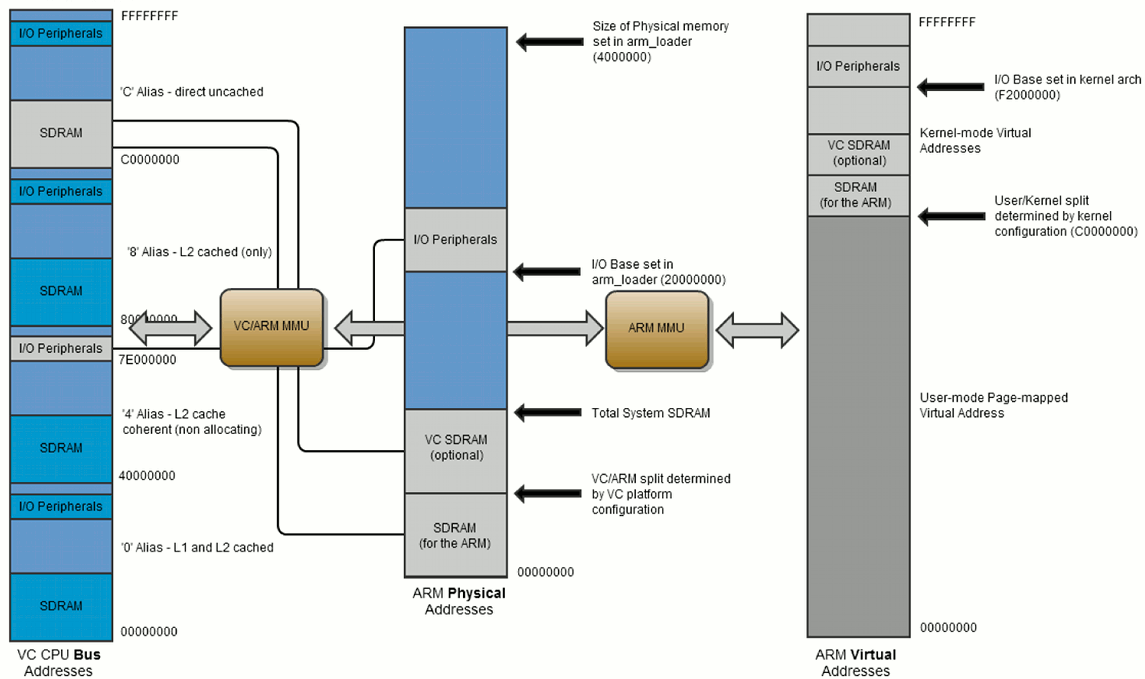
One case is the Raspberry Pi:
$ git grep BCM2835_VC_PERI_BASE
hw/arm/bcm2835_peripherals.c:20:#define BCM2835_VC_PERI_BASE 0x7e000000
hw/arm/bcm2835_peripherals.c:156: memory_region_add_subregion_overlap(&s->gpu_bus_mr, BCM2835_VC_PERI_BASE,
The GPU physical address space is 1GiB, and virtual is 4GiB. Currently the device is mapped in virtual space, not respecting the GPU cache mappings. If we move the chipset base address (and correct the cache mappings) this device ends out of the GPU physical address space.
To have it working I had to correct the physical address to 0x3e000000.
Maybe 'info mtree' is more explicit:
before:
address-space: bcm2835-dma-memory 0000000000000000-00000000ffffffff (prio 0, i/o): bcm2835-gpu
0000000000000000-000000003fffffff (prio 0, i/o): alias
bcm2835-gpu-ram-alias[*] @ram 0000000000000000-000000003fffffff
0000000040000000-000000007fffffff (prio 0, i/o): alias
bcm2835-gpu-ram-alias[*] @ram 0000000000000000-000000003fffffff
000000007e000000-000000007effffff (prio 1, i/o): alias
bcm2835-peripherals @bcm2835-peripherals 0000000000000000-0000000000ffffff
0000000080000000-00000000bfffffff (prio 0, i/o): alias
bcm2835-gpu-ram-alias[*] @ram 0000000000000000-000000003fffffff
00000000c0000000-00000000ffffffff (prio 0, i/o): alias
bcm2835-gpu-ram-alias[*] @ram 0000000000000000-000000003fffffff
after:
address-space: bcm2835-dma-memory 0000000000000000-00000000ffffffff (prio 0, i/o): gpu-bus
0000000000000000-000000003fffffff (prio 0, i/o): alias l1-l2-cached
@videocore 0000000000000000-000000003fffffff
0000000040000000-000000007fffffff (prio 0, i/o): alias
l2-cached-coherent @videocore 0000000000000000-000000003fffffff
0000000080000000-00000000bfffffff (prio 0, i/o): alias l2-cached
@videocore 0000000000000000-000000003fffffff
00000000c0000000-00000000ffffffff (prio 0, i/o): alias
direct-uncached @videocore 0000000000000000-000000003fffffff
memory-region: videocore
0000000000000000-000000003fffffff (prio 0, i/o): videocore
0000000000000000-000000003fffffff (prio 0, i/o): alias vc-ram @ram
0000000000000000-000000003fffffff
000000003e000000-000000003effffff (prio 1, i/o): alias vc-peripherals
@bcm2835-peripherals 0000000000000000-0000000000ffffff
Even clearer, a diff of 'info mtree -f':
(qemu) info mtree -f
FlatView #0
AS "bcm2835-fb-memory", root: gpu-bus
AS "bcm2835-property-memory", root: gpu-bus
AS "bcm2835-dma-memory", root: gpu-bus
Root memory region: gpu-bus
-  0000000000000000-000000003fffffff (prio 0, ram): ram
+  0000000000000000-000000003e002fff (prio 0, ram): ram
+  000000003e003000-000000003e00301f (prio 0, i/o): bcm2835-sys-timer
+  000000003e003020-000000003e006fff (prio 0, ram): ram @000000003e003020
+  000000003e007000-000000003e007fff (prio 0, i/o): bcm2835-dma
+  000000003e008000-000000003e00b1ff (prio 0, ram): ram @000000003e008000
+  000000003e00b200-000000003e00b3ff (prio 0, i/o): bcm2835-ic
+  000000003e00b400-000000003e00b43f (prio -1000, i/o): bcm2835-sp804
+  000000003e00b440-000000003e00b7ff (prio 0, ram): ram @000000003e00b440
+  000000003e00b800-000000003e00bbff (prio 0, i/o): bcm2835-mbox
+  000000003e00bc00-000000003e0fffff (prio 0, ram): ram @000000003e00bc00
+  000000003e100000-000000003e100fff (prio -1000, i/o): bcm2835-cprman
+  000000003e101000-000000003e101fff (prio 0, ram): ram @000000003e101000
+  000000003e102000-000000003e102fff (prio -1000, i/o): bcm2835-a2w
+  000000003e103000-000000003e103fff (prio 0, ram): ram @000000003e103000
+  000000003e104000-000000003e10400f (prio 0, i/o): bcm2835-rng
+  000000003e104010-000000003e1fffff (prio 0, ram): ram @000000003e104010
+  000000003e200000-000000003e200fff (prio 0, i/o): bcm2835_gpio
+  000000003e201000-000000003e201fff (prio 0, i/o): pl011
+  000000003e202000-000000003e202fff (prio 0, i/o): bcm2835-sdhost
+  000000003e203000-000000003e2030ff (prio -1000, i/o): bcm2835-i2s
+  000000003e203100-000000003e203fff (prio 0, ram): ram @000000003e203100
+  000000003e204000-000000003e20401f (prio -1000, i/o): bcm2835-spi0
+  000000003e204020-000000003e204fff (prio 0, ram): ram @000000003e204020
+  000000003e205000-000000003e20501f (prio -1000, i/o): bcm2835-i2c0
+  000000003e205020-000000003e20efff (prio 0, ram): ram @000000003e205020
+  000000003e20f000-000000003e20f07f (prio -1000, i/o): bcm2835-otp
+  000000003e20f080-000000003e211fff (prio 0, ram): ram @000000003e20f080
+  000000003e212000-000000003e212007 (prio 0, i/o): bcm2835-thermal
+  000000003e212008-000000003e213fff (prio 0, ram): ram @000000003e212008
+  000000003e214000-000000003e2140ff (prio -1000, i/o): bcm2835-spis
+  000000003e214100-000000003e214fff (prio 0, ram): ram @000000003e214100
+  000000003e215000-000000003e2150ff (prio 0, i/o): bcm2835-aux
+  000000003e215100-000000003e2fffff (prio 0, ram): ram @000000003e215100
+  000000003e300000-000000003e3000ff (prio 0, i/o): sdhci
+  000000003e300100-000000003e5fffff (prio 0, ram): ram @000000003e300100
+  000000003e600000-000000003e6000ff (prio -1000, i/o): bcm2835-smi
+  000000003e600100-000000003e803fff (prio 0, ram): ram @000000003e600100
+  000000003e804000-000000003e80401f (prio -1000, i/o): bcm2835-i2c1
+  000000003e804020-000000003e804fff (prio 0, ram): ram @000000003e804020
+  000000003e805000-000000003e80501f (prio -1000, i/o): bcm2835-i2c2
+  000000003e805020-000000003e8fffff (prio 0, ram): ram @000000003e805020
+  000000003e900000-000000003e907fff (prio -1000, i/o): bcm2835-dbus
+  000000003e908000-000000003e90ffff (prio 0, ram): ram @000000003e908000
+  000000003e910000-000000003e917fff (prio -1000, i/o): bcm2835-ave0
+  000000003e918000-000000003e97ffff (prio 0, ram): ram @000000003e918000
+  000000003e980000-000000003e980fff (prio -1000, i/o): dwc-usb2
+  000000003e981000-000000003edfffff (prio 0, ram): ram @000000003e981000
+  000000003ee00000-000000003ee000ff (prio -1000, i/o): bcm2835-sdramc
+  000000003ee00100-000000003ee04fff (prio 0, ram): ram @000000003ee00100
+  000000003ee05000-000000003ee050ff (prio 0, i/o): bcm2835-dma-chan15
+  000000003ee05100-000000003fffffff (prio 0, ram): ram @000000003ee05100
0000000040000000-000000007e002fff (prio 0, ram): ram 000000007e003000-000000007e00301f (prio 0, i/o): bcm2835-sys-timer 000000007e003020-000000007e006fff (prio 0, ram): ram @000000003e003020
@@ -56,5 +106,105 @@
000000007ee00100-000000007ee04fff (prio 0, ram): ram @000000003ee00100 000000007ee05000-000000007ee050ff (prio 0, i/o): bcm2835-dma-chan15 000000007ee05100-000000007fffffff (prio 0, ram): ram @000000003ee05100
-  0000000080000000-00000000bfffffff (prio 0, ram): ram
-  00000000c0000000-00000000ffffffff (prio 0, ram): ram
+  0000000080000000-00000000be002fff (prio 0, ram): ram
+  00000000be003000-00000000be00301f (prio 0, i/o): bcm2835-sys-timer
+  00000000be003020-00000000be006fff (prio 0, ram): ram @000000003e003020
+  00000000be007000-00000000be007fff (prio 0, i/o): bcm2835-dma
+  00000000be008000-00000000be00b1ff (prio 0, ram): ram @000000003e008000
+  00000000be00b200-00000000be00b3ff (prio 0, i/o): bcm2835-ic
+  00000000be00b400-00000000be00b43f (prio -1000, i/o): bcm2835-sp804
+  00000000be00b440-00000000be00b7ff (prio 0, ram): ram @000000003e00b440
+  00000000be00b800-00000000be00bbff (prio 0, i/o): bcm2835-mbox
+  00000000be00bc00-00000000be0fffff (prio 0, ram): ram @000000003e00bc00
+  00000000be100000-00000000be100fff (prio -1000, i/o): bcm2835-cprman
+  00000000be101000-00000000be101fff (prio 0, ram): ram @000000003e101000
+  00000000be102000-00000000be102fff (prio -1000, i/o): bcm2835-a2w
+  00000000be103000-00000000be103fff (prio 0, ram): ram @000000003e103000
+  00000000be104000-00000000be10400f (prio 0, i/o): bcm2835-rng
+  00000000be104010-00000000be1fffff (prio 0, ram): ram @000000003e104010
+  00000000be200000-00000000be200fff (prio 0, i/o): bcm2835_gpio
+  00000000be201000-00000000be201fff (prio 0, i/o): pl011
+  00000000be202000-00000000be202fff (prio 0, i/o): bcm2835-sdhost
+  00000000be203000-00000000be2030ff (prio -1000, i/o): bcm2835-i2s
+  00000000be203100-00000000be203fff (prio 0, ram): ram @000000003e203100
+  00000000be204000-00000000be20401f (prio -1000, i/o): bcm2835-spi0
+  00000000be204020-00000000be204fff (prio 0, ram): ram @000000003e204020
+  00000000be205000-00000000be20501f (prio -1000, i/o): bcm2835-i2c0
+  00000000be205020-00000000be20efff (prio 0, ram): ram @000000003e205020
+  00000000be20f000-00000000be20f07f (prio -1000, i/o): bcm2835-otp
+  00000000be20f080-00000000be211fff (prio 0, ram): ram @000000003e20f080
+  00000000be212000-00000000be212007 (prio 0, i/o): bcm2835-thermal
+  00000000be212008-00000000be213fff (prio 0, ram): ram @000000003e212008
+  00000000be214000-00000000be2140ff (prio -1000, i/o): bcm2835-spis
+  00000000be214100-00000000be214fff (prio 0, ram): ram @000000003e214100
+  00000000be215000-00000000be2150ff (prio 0, i/o): bcm2835-aux
+  00000000be215100-00000000be2fffff (prio 0, ram): ram @000000003e215100
+  00000000be300000-00000000be3000ff (prio 0, i/o): sdhci
+  00000000be300100-00000000be5fffff (prio 0, ram): ram @000000003e300100
+  00000000be600000-00000000be6000ff (prio -1000, i/o): bcm2835-smi
+  00000000be600100-00000000be803fff (prio 0, ram): ram @000000003e600100
+  00000000be804000-00000000be80401f (prio -1000, i/o): bcm2835-i2c1
+  00000000be804020-00000000be804fff (prio 0, ram): ram @000000003e804020
+  00000000be805000-00000000be80501f (prio -1000, i/o): bcm2835-i2c2
+  00000000be805020-00000000be8fffff (prio 0, ram): ram @000000003e805020
+  00000000be900000-00000000be907fff (prio -1000, i/o): bcm2835-dbus
+  00000000be908000-00000000be90ffff (prio 0, ram): ram @000000003e908000
+  00000000be910000-00000000be917fff (prio -1000, i/o): bcm2835-ave0
+  00000000be918000-00000000be97ffff (prio 0, ram): ram @000000003e918000
+  00000000be980000-00000000be980fff (prio -1000, i/o): dwc-usb2
+  00000000be981000-00000000bedfffff (prio 0, ram): ram @000000003e981000
+  00000000bee00000-00000000bee000ff (prio -1000, i/o): bcm2835-sdramc
+  00000000bee00100-00000000bee04fff (prio 0, ram): ram @000000003ee00100
+  00000000bee05000-00000000bee050ff (prio 0, i/o): bcm2835-dma-chan15
+  00000000bee05100-00000000bfffffff (prio 0, ram): ram @000000003ee05100
+  00000000c0000000-00000000fe002fff (prio 0, ram): ram
+  00000000fe003000-00000000fe00301f (prio 0, i/o): bcm2835-sys-timer
+  00000000fe003020-00000000fe006fff (prio 0, ram): ram @000000003e003020
+  00000000fe007000-00000000fe007fff (prio 0, i/o): bcm2835-dma
+  00000000fe008000-00000000fe00b1ff (prio 0, ram): ram @000000003e008000
+  00000000fe00b200-00000000fe00b3ff (prio 0, i/o): bcm2835-ic
+  00000000fe00b400-00000000fe00b43f (prio -1000, i/o): bcm2835-sp804
+  00000000fe00b440-00000000fe00b7ff (prio 0, ram): ram @000000003e00b440
+  00000000fe00b800-00000000fe00bbff (prio 0, i/o): bcm2835-mbox
+  00000000fe00bc00-00000000fe0fffff (prio 0, ram): ram @000000003e00bc00
+  00000000fe100000-00000000fe100fff (prio -1000, i/o): bcm2835-cprman
+  00000000fe101000-00000000fe101fff (prio 0, ram): ram @000000003e101000
+  00000000fe102000-00000000fe102fff (prio -1000, i/o): bcm2835-a2w
+  00000000fe103000-00000000fe103fff (prio 0, ram): ram @000000003e103000
+  00000000fe104000-00000000fe10400f (prio 0, i/o): bcm2835-rng
+  00000000fe104010-00000000fe1fffff (prio 0, ram): ram @000000003e104010
+  00000000fe200000-00000000fe200fff (prio 0, i/o): bcm2835_gpio
+  00000000fe201000-00000000fe201fff (prio 0, i/o): pl011
+  00000000fe202000-00000000fe202fff (prio 0, i/o): bcm2835-sdhost
+  00000000fe203000-00000000fe2030ff (prio -1000, i/o): bcm2835-i2s
+  00000000fe203100-00000000fe203fff (prio 0, ram): ram @000000003e203100
+  00000000fe204000-00000000fe20401f (prio -1000, i/o): bcm2835-spi0
+  00000000fe204020-00000000fe204fff (prio 0, ram): ram @000000003e204020
+  00000000fe205000-00000000fe20501f (prio -1000, i/o): bcm2835-i2c0
+  00000000fe205020-00000000fe20efff (prio 0, ram): ram @000000003e205020
+  00000000fe20f000-00000000fe20f07f (prio -1000, i/o): bcm2835-otp
+  00000000fe20f080-00000000fe211fff (prio 0, ram): ram @000000003e20f080
+  00000000fe212000-00000000fe212007 (prio 0, i/o): bcm2835-thermal
+  00000000fe212008-00000000fe213fff (prio 0, ram): ram @000000003e212008
+  00000000fe214000-00000000fe2140ff (prio -1000, i/o): bcm2835-spis
+  00000000fe214100-00000000fe214fff (prio 0, ram): ram @000000003e214100
+  00000000fe215000-00000000fe2150ff (prio 0, i/o): bcm2835-aux
+  00000000fe215100-00000000fe2fffff (prio 0, ram): ram @000000003e215100
+  00000000fe300000-00000000fe3000ff (prio 0, i/o): sdhci
+  00000000fe300100-00000000fe5fffff (prio 0, ram): ram @000000003e300100
+  00000000fe600000-00000000fe6000ff (prio -1000, i/o): bcm2835-smi
+  00000000fe600100-00000000fe803fff (prio 0, ram): ram @000000003e600100
+  00000000fe804000-00000000fe80401f (prio -1000, i/o): bcm2835-i2c1
+  00000000fe804020-00000000fe804fff (prio 0, ram): ram @000000003e804020
+  00000000fe805000-00000000fe80501f (prio -1000, i/o): bcm2835-i2c2
+  00000000fe805020-00000000fe8fffff (prio 0, ram): ram @000000003e805020
+  00000000fe900000-00000000fe907fff (prio -1000, i/o): bcm2835-dbus
+  00000000fe908000-00000000fe90ffff (prio 0, ram): ram @000000003e908000
+  00000000fe910000-00000000fe917fff (prio -1000, i/o): bcm2835-ave0
+  00000000fe918000-00000000fe97ffff (prio 0, ram): ram @000000003e918000
+  00000000fe980000-00000000fe980fff (prio -1000, i/o): dwc-usb2
+  00000000fe981000-00000000fedfffff (prio 0, ram): ram @000000003e981000
+  00000000fee00000-00000000fee000ff (prio -1000, i/o): bcm2835-sdramc
+  00000000fee00100-00000000fee04fff (prio 0, ram): ram @000000003ee00100
+  00000000fee05000-00000000fee050ff (prio 0, i/o): bcm2835-dma-chan15
+  00000000fee05100-00000000ffffffff (prio 0, ram): ram @000000003ee05100
This is for the raspi2, but there is a mmap schema for the raspi1:
https://www.cnx-software.com/wp-content/uploads/2012/02/BCM2835-Memory-Map-Large.png
I found another discrepancy in the Bonito north bridge, which maps in KSEG1 instead of physical:
$ git grep 'sysbus_mmio_map(.*, 0xb'
hw/pci-host/bonito.c:645:    sysbus_mmio_map(sysbus, 3, 0xbfe00200);
hw/pci-host/bonito.c:650:    sysbus_mmio_map(sysbus, 4, 0xbfe00300);
We can put this patch on hold for now, I might came back to this thread later with more use cases.
Regards,
Phil.
Quoted 9 lines · Philippe Mathieu-Daudé
Quoted 5 lines
Quoted 1 line
I think in some cases this could be intentional, for example if you have different models with different BAR sizes and you organize this with the same tree of MemoryRegion and different sizes for the parent.
But if a child is outside of the parent range, it can't be reached, right? I'm confused, maybe AddressSpace can do that, but MemoryRegion shouldn't?
Yes, the idea is that you could have for one version of the device
parent 0x000-0x7ff
     stuff 0x000-0x3ff
     morestuff 0x400-0x7ff
and for another
parent 0x000-0x3ff
     stuff 0x000-0x3ff
     morestuff 0x400-0x7ff
where parent is the BAR, and you can share the code to generate the tree underneath parent.
Quoted 4 lines
In the PCI case, you will simply alias a subregion with
memory_region_init_alias(..., size), and size has to be <= parent size. But you won't add the PCI region, you'll add the alias, so the assert won't fire.
Yes, this is a workaround though. You shouldn't need the alias.
I can see a case for your patch but I can also see one for the current behavior...
Paolo
Quoted 21 lines · Paolo Bonzini
Quoted 9 lines · Philippe Mathieu-Daudé
Quoted 5 lines
Quoted 1 line
I think in some cases this could be intentional, for example if you have different models with different BAR sizes and you organize this with the same tree of MemoryRegion and different sizes for the parent.
But if a child is outside of the parent range, it can't be reached, right? I'm confused, maybe AddressSpace can do that, but MemoryRegion shouldn't?
Yes, the idea is that you could have for one version of the device
parent 0x000-0x7ff
    stuff 0x000-0x3ff
    morestuff 0x400-0x7ff
Quoted 8 lines
and for another
parent 0x000-0x3ff
    stuff 0x000-0x3ff
    morestuff 0x400-0x7ff
where parent is the BAR, and you can share the code to generate the tree underneath parent.
I can see why you would have code reuse reasons to do that, but frankly it looks buggy and confusing. In the rare cases where this is indented, maybe add a flag making it explicit?
Quoted 14 lines
Quoted 5 lines
In the PCI case, you will simply alias a subregion with
memory_region_init_alias(..., size), and size has to be <= parent size. But you won't add the PCI region, you'll add the alias, so the assert won't fire.Yes, this is a workaround though. You shouldn't need the alias.
I can see a case for your patch but I can also see one for the current behavior...
Paolo
Quoted 27 lines · Christophe de Dinechin
Quoted 27 lines · Paolo Bonzini
Quoted 9 lines · Philippe Mathieu-Daudé
Quoted 5 lines
Quoted 1 line
I think in some cases this could be intentional, for example if you have different models with different BAR sizes and you organize this with the same tree of MemoryRegion and different sizes for the parent.
But if a child is outside of the parent range, it can't be reached, right? I'm confused, maybe AddressSpace can do that, but MemoryRegion shouldn't?
Yes, the idea is that you could have for one version of the device
parent 0x000-0x7ff
    stuff 0x000-0x3ff
    morestuff 0x400-0x7ff
and for another
parent 0x000-0x3ff
    stuff 0x000-0x3ff
    morestuff 0x400-0x7ff
Quoted 6 lines
Quoted 2 lines
where parent is the BAR, and you can share the code to generate the tree underneath parent.
I can see why you would have code reuse reasons to do that, but frankly it looks buggy and confusing. In the rare cases where this is indented, maybe add a flag making it explicit?
The guest OS is programming the BAR, producing a configuration that, while it doesn't make sense, is also legal per PCI. QEMU cannot abort for this configuration.
r~
Quoted 20 lines · Richard Henderson
Quoted 18 lines · Christophe de Dinechin
Quoted 17 lines · Paolo Bonzini
Yes, the idea is that you could have for one version of the device
parent 0x000-0x7ff
    stuff 0x000-0x3ff
    morestuff 0x400-0x7ff
and for another
parent 0x000-0x3ff
    stuff 0x000-0x3ff
    morestuff 0x400-0x7ff
where parent is the BAR, and you can share the code to generate the tree underneath parent.
Quoted 7 lines
Quoted 3 lines
I can see why you would have code reuse reasons to do that, but frankly it looks buggy and confusing. In the rare cases where this is indented, maybe add a flag making it explicit?
The guest OS is programming the BAR, producing a configuration that, while it doesn't make sense, is also legal per PCI. QEMU cannot abort for this configuration.
Does guest programming of the PCI BAR size actually change the size of the 'parent' region, or does it just result in the creation of an appropriately sized alias into 'parent' ?
thanks
-- PMM
Quoted 26 lines · Peter Maydell
Quoted 24 lines · Richard Henderson
Quoted 21 lines · Christophe de Dinechin
Quoted 9 lines · Paolo Bonzini
Yes, the idea is that you could have for one version of the device
parent 0x000-0x7ff
    stuff 0x000-0x3ff
    morestuff 0x400-0x7ff
Quoted 8 lines
and for another
parent 0x000-0x3ff
    stuff 0x000-0x3ff
    morestuff 0x400-0x7ff
where parent is the BAR, and you can share the code to generate the tree underneath parent.
I can see why you would have code reuse reasons to do that, but frankly it looks buggy and confusing. In the rare cases where this is indented, maybe add a flag making it explicit?
Quoted 7 lines
Quoted 3 lines
The guest OS is programming the BAR, producing a configuration that, while it doesn't make sense, is also legal per PCI. QEMU cannot abort for this configuration.
Does guest programming of the PCI BAR size actually change the size of the 'parent' region, or does it just result in the creation of an appropriately sized alias into 'parent' ?
Resizable BARs are not handled by the PCI host bridge but rather from the device itself, so the device is free to handle them either way.
Paolo
Quoted 31 lines · On Tue, 17 Dec 2019 19:31:41 +0100 Paolo Bonzini <[email protected]> wrote:
Quoted 30 lines · Peter Maydell
Quoted 27 lines · Richard Henderson
Quoted 15 lines · Christophe de Dinechin
Quoted 15 lines · Paolo Bonzini
Yes, the idea is that you could have for one version of the device
parent 0x000-0x7ff
    stuff 0x000-0x3ff
    morestuff 0x400-0x7ff
and for another
parent 0x000-0x3ff
    stuff 0x000-0x3ff
    morestuff 0x400-0x7ff
Quoted 6 lines
Quoted 2 lines
where parent is the BAR, and you can share the code to generate the tree underneath parent.
I can see why you would have code reuse reasons to do that, but frankly it looks buggy and confusing. In the rare cases where this is indented, maybe add a flag making it explicit?
The guest OS is programming the BAR, producing a configuration that, while it doesn't make sense, is also legal per PCI. QEMU cannot abort for this configuration.
Quoted 6 lines
Quoted 3 lines
Does guest programming of the PCI BAR size actually change the size of the 'parent' region, or does it just result in the creation of an appropriately sized alias into 'parent' ?
Resizable BARs are not handled by the PCI host bridge but rather from the device itself, so the device is free to handle them either way.
More specifically, it's the responsibility of drivers within the guest to resize the parent bridge aperture to make the extent of the BAR accessible. This does seem like an interesting way to implement a resizable BAR in QEMU though. Thanks,
Alex
Quoted 38 lines · Alex Williamson
Quoted 35 lines · On Tue, 17 Dec 2019 19:31:41 +0100 Paolo Bonzini <[email protected]> wrote:
Quoted 33 lines · Peter Maydell
Quoted 20 lines · Richard Henderson
Quoted 18 lines · Christophe de Dinechin
Quoted 17 lines · Paolo Bonzini
Yes, the idea is that you could have for one version of the device
   parent 0x000-0x7ff
     stuff 0x000-0x3ff
     morestuff 0x400-0x7ff
and for another
   parent 0x000-0x3ff
     stuff 0x000-0x3ff
     morestuff 0x400-0x7ff
where parent is the BAR, and you can share the code to generate the tree underneath parent.
Quoted 7 lines
Quoted 3 lines
I can see why you would have code reuse reasons to do that, but frankly it looks buggy and confusing. In the rare cases where this is indented, maybe add a flag making it explicit?
The guest OS is programming the BAR, producing a configuration that, while it doesn't make sense, is also legal per PCI. QEMU cannot abort for this configuration.
Does guest programming of the PCI BAR size actually change the size of the 'parent' region, or does it just result in the creation of an appropriately sized alias into 'parent' ?
Quoted 7 lines
Quoted 2 lines
Resizable BARs are not handled by the PCI host bridge but rather from the device itself, so the device is free to handle them either way.
More specifically, it's the responsibility of drivers within the guest to resize the parent bridge aperture to make the extent of the BAR accessible. This does seem like an interesting way to implement a resizable BAR in QEMU though. Thanks,
This is something I'm thinking about since some time, as I observed this behavior in 3 different MIPS boards with different northbridge chipset (Malta with the GT64120, Fuloong2E with the Bonito). The firmware sets one layout, Linux (or other) reinit & reorder all the memory layout. I guess Mark hit the same issue with his sparc64 based boards.