netfilter: nft_tproxy: make it terminal
Subsystems (2)
Pablo Neira Ayuso
maintainerPATCH 1/1 netfilter: nft_tproxy: make it terminal
tproxy action must be terminal since the intent of the user to steal the traffic and redirect to the port.
Align this behaviour to iptables to make it easier to migrate by issuing NF_ACCEPT for packets that are redirect to userspace process socket. Otherwise, NF_DROP packet if socket transparent flag is not set on.
---
 net/netfilter/nft_tproxy.c | 18 ++++++++++++------
 1 file changed, 12 insertions(+), 6 deletions(-)
net/netfilter/nft_tproxy.c +12 -6
@@ -74,10 +74,13 @@ static void nft_tproxy_eval_v4(const struct nft_expr *expr, skb->dev, NF_TPROXY_LOOKUP_LISTENER); } -if (sk &&nf_tproxy_sk_is_transparent (sk)) +if (sk &&nf_tproxy_sk_is_transparent (sk)) {nf_tproxy_assign_sock (skb, sk); -else - regs->verdict.code =NFT_BREAK ; + regs->verdict.code =NF_ACCEPT ; +return ; + } + + regs->verdict.code =NF_DROP ; }#if IS_ENABLED (CONFIG_NF_TABLES_IPV6 )
@@ -147,10 +150,13 @@ static void nft_tproxy_eval_v6(const struct nft_expr *expr, }/* NOTE: assign_sock consumes our sk reference */ -if (sk &&nf_tproxy_sk_is_transparent (sk)) +if (sk &&nf_tproxy_sk_is_transparent (sk)) {nf_tproxy_assign_sock (skb, sk); -else - regs->verdict.code =NFT_BREAK ; + regs->verdict.code =NF_ACCEPT ; +return ; + } + + regs->verdict.code =NF_DROP ; }#endif
Signature · 1 line
2.30.2
Florian Westphal
maintainerQuoted 5 lines · Pablo Neira Ayuso
tproxy action must be terminal since the intent of the user to steal the traffic and redirect to the port.
Align this behaviour to iptables to make it easier to migrate by issuingNF_ACCEPTfor packets that are redirect to userspace process socket. Otherwise,NF_DROPpacket if socket transparent flag is not set on.
The nonterminal behaviour is intentional. This change will likely break existing setups.
nft add rule filter divert tcp dport 80 tproxy to :50080 meta mark set 1 accept
This is a documented example.
Pablo Neira Ayuso
maintainerQuoted 7 lines · Florian Westphal
Quoted 5 lines · Pablo Neira Ayuso
tproxy action must be terminal since the intent of the user to steal the traffic and redirect to the port.
Align this behaviour to iptables to make it easier to migrate by issuingNF_ACCEPTfor packets that are redirect to userspace process socket. Otherwise,NF_DROPpacket if socket transparent flag is not set on.
Quoted 6 lines
The nonterminal behaviour is intentional. This change will likely break existing setups.
nft add rule filter divert tcp dport 80 tproxy to :50080 meta mark set 1 accept
This is a documented example.
Ouch. Example could have been:
nft add rule filter divert tcp dport 80 socket transparent meta set 1 tproxy to :50080
but it is too late.
Quick idea: extend tproxy extension to add a flag to consume it:
tproxy to :50080 flags consume
Pablo Neira Ayuso
maintainerQuoted 17 lines · Pablo Neira Ayuso
Quoted 7 lines · Florian Westphal
Quoted 5 lines · Pablo Neira Ayuso
tproxy action must be terminal since the intent of the user to steal the traffic and redirect to the port.
Align this behaviour to iptables to make it easier to migrate by issuingNF_ACCEPTfor packets that are redirect to userspace process socket. Otherwise,NF_DROPpacket if socket transparent flag is not set on.Quoted 6 lines
The nonterminal behaviour is intentional. This change will likely break existing setups.
nft add rule filter divert tcp dport 80 tproxy to :50080 meta mark set 1 accept
This is a documented example.
Ouch. Example could have been:
Quoted 7 lines
nft add rule filter divert tcp dport 80 socket transparent meta set 1 tproxy to :50080
but it is too late.
Quick idea: extend tproxy extension to add a flag to consume it:
tproxy to :50080 flags consume
Scratch that, this is very silly: it is not different than just adding 'accept' after it...
Florian Westphal
maintainerQuoted 11 lines · Pablo Neira Ayuso
Quoted 10 lines · Florian Westphal
Quoted 5 lines · Pablo Neira Ayuso
tproxy action must be terminal since the intent of the user to steal the traffic and redirect to the port.
Align this behaviour to iptables to make it easier to migrate by issuingNF_ACCEPTfor packets that are redirect to userspace process socket. Otherwise,NF_DROPpacket if socket transparent flag is not set on.The nonterminal behaviour is intentional. This change will likely break existing setups.
Quoted 7 lines
Quoted 3 lines
nft add rule filter divert tcp dport 80 tproxy to :50080 meta mark set 1 accept
This is a documented example.
Ouch. Example could have been:
nft add rule filter divert tcp dport 80 socket transparent meta set 1 tproxy to :50080
Yes, but its not the same.
With the statements switched, all tcp dport 80 have the mark set. With original example, the mark is set only if tproxy found a transparent sk.
Pablo Neira Ayuso
maintainerQuoted 18 lines · Florian Westphal
Quoted 17 lines · Pablo Neira Ayuso
Quoted 7 lines · Florian Westphal
Quoted 5 lines · Pablo Neira Ayuso
tproxy action must be terminal since the intent of the user to steal the traffic and redirect to the port.
Align this behaviour to iptables to make it easier to migrate by issuingNF_ACCEPTfor packets that are redirect to userspace process socket. Otherwise,NF_DROPpacket if socket transparent flag is not set on.Quoted 6 lines
The nonterminal behaviour is intentional. This change will likely break existing setups.
nft add rule filter divert tcp dport 80 tproxy to :50080 meta mark set 1 accept
This is a documented example.
Ouch. Example could have been:
Quoted 7 lines
Quoted 1 line
nft add rule filter divert tcp dport 80 socket transparent meta set 1 tproxy to :50080
Yes, but its not the same.
With the statements switched, all tcp dport 80 have the mark set. With original example, the mark is set only if tproxy found a transparent sk.
Indeed, thanks for correcting me.
I'm remembering now why this was done to provide to address the ugly mark hack that xt_TPROXY provides.
While this is making harder to migrate, making it non-terminal is allowing to make more handling such as ct/meta marking after it.
I think we just have to document this in man nft(8).
Quoted 30 lines · Pablo Neira Ayuso
Quoted 18 lines · Florian Westphal
Quoted 17 lines · Pablo Neira Ayuso
Quoted 7 lines · Florian Westphal
Quoted 5 lines · Pablo Neira Ayuso
tproxy action must be terminal since the intent of the user to steal the traffic and redirect to the port.
Align this behaviour to iptables to make it easier to migrate by issuingNF_ACCEPTfor packets that are redirect to userspace process socket. Otherwise,NF_DROPpacket if socket transparent flag is not set on.Quoted 6 lines
The nonterminal behaviour is intentional. This change will likely break existing setups.
nft add rule filter divert tcp dport 80 tproxy to :50080 meta mark set 1 accept
This is a documented example.
Ouch. Example could have been:
Quoted 7 lines
Quoted 1 line
nft add rule filter divert tcp dport 80 socket transparent meta set 1 tproxy to :50080
Yes, but its not the same.
With the statements switched, all tcp dport 80 have the mark set. With original example, the mark is set only if tproxy found a transparent sk.
Indeed, thanks for correcting me.
Quoted 7 lines
I'm remembering now why this was done to provide to address the ugly mark hack that
xt_TPROXYprovides.While this is making harder to migrate, making it non-terminal is allowing to make more handling such as ct/meta marking after it.
I think we just have to document this in man nft(8).
I think that at this point in time the current state can not be broken based on this discussion, I just left the comment in the bugzilla about the possibility but it is clear now that people that have already started using this feature with nftables must not experience a disruption.
On the other side, users that need to migrate will have to adapt more things so I don't think it should be a big deal.
What I really think is that users should have a way to terminate processing to avoid other rules to interfere with the tproxy functionality
Pablo Neira Ayuso
maintainerQuoted 39 lines · Antonio Ojea
Quoted 30 lines · Pablo Neira Ayuso
Quoted 18 lines · Florian Westphal
Quoted 17 lines · Pablo Neira Ayuso
Quoted 7 lines · Florian Westphal
Quoted 5 lines · Pablo Neira Ayuso
tproxy action must be terminal since the intent of the user to steal the traffic and redirect to the port.
Align this behaviour to iptables to make it easier to migrate by issuingNF_ACCEPTfor packets that are redirect to userspace process socket. Otherwise,NF_DROPpacket if socket transparent flag is not set on.Quoted 6 lines
The nonterminal behaviour is intentional. This change will likely break existing setups.
nft add rule filter divert tcp dport 80 tproxy to :50080 meta mark set 1 accept
This is a documented example.
Ouch. Example could have been:
Quoted 7 lines
Quoted 1 line
nft add rule filter divert tcp dport 80 socket transparent meta set 1 tproxy to :50080
Yes, but its not the same.
With the statements switched, all tcp dport 80 have the mark set. With original example, the mark is set only if tproxy found a transparent sk.
Indeed, thanks for correcting me.
Quoted 7 lines
I'm remembering now why this was done to provide to address the ugly mark hack that
xt_TPROXYprovides.While this is making harder to migrate, making it non-terminal is allowing to make more handling such as ct/meta marking after it.
I think we just have to document this in man nft(8).
Quoted 10 lines
I think that at this point in time the current state can not be broken based on this discussion, I just left the comment in the bugzilla about the possibility but it is clear now that people that have already started using this feature with nftables must not experience a disruption.
On the other side, users that need to migrate will have to adapt more things so I don't think it should be a big deal.
What I really think is that users should have a way to terminate processing to avoid other rules to interfere with the tproxy functionality
It is possible to add an explicit 'accept' verdict as the example above displays:
tcp dport 80 tproxy to :50080 meta mark set 1 accept
^^^^^^
is this sufficient in your opinion? If so, I made this quick update for man nft(8).
doc/statements.txt +5 -0
@@ -604,6 +604,11 @@ table inet x { } ------------------------------------- +Note that the tproxy statement is non-terminal to allow post-processing of +packets, such as updating the packet marking. This is a change in behavior +compared to the legacy iptables TPROXY target which is terminal. To terminate +the packet processing after the tproxy statement, remember to issue a verdict. + SYNPROXY STATEMENT ~~~~~~~~~~~~~~~~~~ This statement will process TCP three-way-handshake parallel in netfilter
Hi,
Quoted 51 lines · Pablo Neira Ayuso
Quoted 39 lines · Antonio Ojea
Quoted 30 lines · Pablo Neira Ayuso
Quoted 18 lines · Florian Westphal
Quoted 17 lines · Pablo Neira Ayuso
Quoted 7 lines · Florian Westphal
Quoted 5 lines · Pablo Neira Ayuso
tproxy action must be terminal since the intent of the user to steal the traffic and redirect to the port.
Align this behaviour to iptables to make it easier to migrate by issuingNF_ACCEPTfor packets that are redirect to userspace process socket. Otherwise,NF_DROPpacket if socket transparent flag is not set on.Quoted 6 lines
The nonterminal behaviour is intentional. This change will likely break existing setups.
nft add rule filter divert tcp dport 80 tproxy to :50080 meta mark set 1 accept
This is a documented example.
Ouch. Example could have been:
Quoted 7 lines
Quoted 1 line
nft add rule filter divert tcp dport 80 socket transparent meta set 1 tproxy to :50080
Yes, but its not the same.
With the statements switched, all tcp dport 80 have the mark set. With original example, the mark is set only if tproxy found a transparent sk.
Indeed, thanks for correcting me.
Quoted 7 lines
I'm remembering now why this was done to provide to address the ugly mark hack that
xt_TPROXYprovides.While this is making harder to migrate, making it non-terminal is allowing to make more handling such as ct/meta marking after it.
I think we just have to document this in man nft(8).
Quoted 10 lines
I think that at this point in time the current state can not be broken based on this discussion, I just left the comment in the bugzilla about the possibility but it is clear now that people that have already started using this feature with nftables must not experience a disruption.
On the other side, users that need to migrate will have to adapt more things so I don't think it should be a big deal.
What I really think is that users should have a way to terminate processing to avoid other rules to interfere with the tproxy functionality
Quoted 5 lines
It is possible to add an explicit 'accept' verdict as the example above displays:
tcp dport 80 tproxy to :50080 meta mark set 1 accept
^^^^^^
I wonder if this is sufficient: The packet will still appear in following chains, etc. So shouldn't one use 'drop' verdict instead or does that prevent the proxying somehow?
Hmm. Looking at nft_nat.c, 'accept' seems consistent with what nat statements do implicitly.
Quoted 2 lines
is this sufficient in your opinion? If so, I made this quick update for man nft(8).
In addition to that, I will update tproxy_tg_xlate() in iptables.git to emit a verdict, too.
Also I should update the respective wiki article[1] once more with added translation testsuite links - at least the one for TPROXY is missing.
Cheers, Phil
Pablo Neira Ayuso
maintainerQuoted 60 lines · Phil Sutter
Hi,
Quoted 51 lines · Pablo Neira Ayuso
Quoted 39 lines · Antonio Ojea
Quoted 30 lines · Pablo Neira Ayuso
Quoted 18 lines · Florian Westphal
Quoted 17 lines · Pablo Neira Ayuso
Quoted 7 lines · Florian Westphal
Quoted 5 lines · Pablo Neira Ayuso
tproxy action must be terminal since the intent of the user to steal the traffic and redirect to the port.
Align this behaviour to iptables to make it easier to migrate by issuingNF_ACCEPTfor packets that are redirect to userspace process socket. Otherwise,NF_DROPpacket if socket transparent flag is not set on.Quoted 6 lines
The nonterminal behaviour is intentional. This change will likely break existing setups.
nft add rule filter divert tcp dport 80 tproxy to :50080 meta mark set 1 accept
This is a documented example.
Ouch. Example could have been:
Quoted 7 lines
Quoted 1 line
nft add rule filter divert tcp dport 80 socket transparent meta set 1 tproxy to :50080
Yes, but its not the same.
With the statements switched, all tcp dport 80 have the mark set. With original example, the mark is set only if tproxy found a transparent sk.
Indeed, thanks for correcting me.
Quoted 7 lines
I'm remembering now why this was done to provide to address the ugly mark hack that
xt_TPROXYprovides.While this is making harder to migrate, making it non-terminal is allowing to make more handling such as ct/meta marking after it.
I think we just have to document this in man nft(8).
Quoted 10 lines
I think that at this point in time the current state can not be broken based on this discussion, I just left the comment in the bugzilla about the possibility but it is clear now that people that have already started using this feature with nftables must not experience a disruption.
On the other side, users that need to migrate will have to adapt more things so I don't think it should be a big deal.
What I really think is that users should have a way to terminate processing to avoid other rules to interfere with the tproxy functionalityQuoted 5 lines
It is possible to add an explicit 'accept' verdict as the example above displays:
tcp dport 80 tproxy to :50080 meta mark set 1 accept
^^^^^^
Quoted 6 lines
I wonder if this is sufficient: The packet will still appear in following chains, etc. So shouldn't one use 'drop' verdict instead or does that prevent the proxying somehow?
Hmm. Looking at
nft_nat.c, 'accept' seems consistent with what nat statements do implicitly.
Yes, and xt_TPROXY does NF_ACCEPT.
On the other hand, I can see it does NF_DROP it socket is not transparent, it does NFT_BREAK instead, so policy keeps evaluating the packet.
Quoted 7 lines
Quoted 2 lines
is this sufficient in your opinion? If so, I made this quick update for man nft(8).
Acked-by Phil Sutter <[email protected]>In addition to that, I will update
tproxy_tg_xlate()in iptables.git to emit a verdict, too.
Thanks, this is very convenient.
Quoted 2 lines
Also I should update the respective wiki article[1] once more with added translation testsuite links - at least the one for TPROXY is missing.
Great, thanks.
I still have to update wiki to extend set element timeout with the recent information I provided in [email protected] ML too.
Florian Westphal
maintainerQuoted 8 lines · Pablo Neira Ayuso
Quoted 2 lines
Hmm. Looking at
nft_nat.c, 'accept' seems consistent with what nat statements do implicitly.Yes, and
xt_TPROXYdoesNF_ACCEPT.On the other hand, I can see it does
NF_DROPit socket is not transparent, it doesNFT_BREAKinstead, so policy keeps evaluating the packet.
Yes, this is more flexible since you can log+drop for instance in next rule(s) to alert that proxy isn't running for example.
Quoted 9 lines
Quoted 7 lines
Quoted 2 lines
is this sufficient in your opinion? If so, I made this quick update for man nft(8).
Acked-by Phil Sutter <[email protected]>In addition to that, I will update
tproxy_tg_xlate()in iptables.git to emit a verdict, too.Thanks, this is very convenient.
Agreed, it should append accept keyword in the translator.
Quoted 5 lines · Florian Westphal
Quoted 3 lines · Pablo Neira Ayuso
Quoted 2 lines
Hmm. Looking at
nft_nat.c, 'accept' seems consistent with what nat statements do implicitly.
Quoted 9 lines
Quoted 5 lines
Yes, and
xt_TPROXYdoesNF_ACCEPT.On the other hand, I can see it does
NF_DROPit socket is not transparent, it doesNFT_BREAKinstead, so policy keeps evaluating the packet.Yes, this is more flexible since you can log+drop for instance in next rule(s) to alert that proxy isn't running for example.
This is super useful, in the scenario that the transparent proxy takes over the DNATed virtual IP, if the transparent proxy process is not running the packet goes to the DNATed virtual IP so the clients don't observe any disruption.
Quoted 11 lines
Quoted 9 lines
Quoted 7 lines
Quoted 2 lines
is this sufficient in your opinion? If so, I made this quick update for man nft(8).
Acked-by Phil Sutter <[email protected]>In addition to that, I will update
tproxy_tg_xlate()in iptables.git to emit a verdict, too.Thanks, this is very convenient.
Agreed, it should append accept keyword in the translator.
I'm not completely following the technical details sorry.
With my current configuration I do set an accept action
udp dport 53 tproxy ip to 127.0.0.1:46659 accept
and I have dnat statements after that action.
The packet is "proxied" but "nftrace monitor" shows that the subsequent rules are evaluated and I also can observe that the NAT entries are added on the conntrack table despite the packet being proxied.
I think that there has to be a way to indicate that after some point the subsequent rules can not take actions, per example, the conntrack entries generated by the DNAT rules, at least with UDP, interfere with subsequent packets .
Phil Sutter
reviewerHi Antonio,
Quoted 12 lines · Antonio Ojea
Quoted 11 lines · Florian Westphal
Quoted 8 lines · Pablo Neira Ayuso
Quoted 2 lines
Hmm. Looking at
nft_nat.c, 'accept' seems consistent with what nat statements do implicitly.Yes, and
xt_TPROXYdoesNF_ACCEPT.On the other hand, I can see it does
NF_DROPit socket is not transparent, it doesNFT_BREAKinstead, so policy keeps evaluating the packet.
Quoted 8 lines
Quoted 3 lines
Yes, this is more flexible since you can log+drop for instance in next rule(s) to alert that proxy isn't running for example.
This is super useful, in the scenario that the transparent proxy takes over the DNATed virtual IP, if the transparent proxy process is not running the packet goes to the DNATed virtual IP so the clients don't observe any disruption.
So here's a use-case for why non-terminal tproxy statement is superior over terminal one. :)
Quoted 5 lines
Quoted 5 lines
Quoted 5 lines
Quoted 5 lines
Quoted 2 lines
is this sufficient in your opinion? If so, I made this quick update for man nft(8).
Acked-by Phil Sutter <[email protected]>
Quoted 8 lines
Quoted 6 lines
Quoted 4 lines
Quoted 2 lines
In addition to that, I will update
tproxy_tg_xlate()in iptables.git to emit a verdict, too.Thanks, this is very convenient.
Agreed, it should append accept keyword in the translator.
I'm not completely following the technical details sorry.
In essence, tproxy statement does not set a verdict unless it fails to find a suitable socket. A sample ruleset illustrating this is:
| table t {
| 	chain c {
| 		type filter hook prerouting priority 0
| 		tproxy to :1234 log "packet tproxied" accept
| 		log "no socket on port 1234 or not transparent?" drop
| 	}
| }
Quoted 5 lines
With my current configuration I do set an accept action
udp dport 53 tproxy ip to 127.0.0.1:46659 accept
and I have dnat statements after that action.
For the record, your ruleset looks like this (quoting from the kselftest you sent me):
| table inet filter {
|        chain divert {
|                type filter hook prerouting priority -100; policy accept;
|                $ip_proto daddr $virtual_ip udp dport 8080 tproxy ip_proto to :12345 meta mark set 1 accept
|        }
|        # Removing this chain makes the first connection to succeed
|        chain PREROUTING {
|                type nat hook prerouting priority 1; policy accept;
|                $ip_proto daddr $virtual_ip udp dport 8080 dnat to umgen inc mod 2 map { 0 : $ns2_ip , 1: $ns3_ip }
|        }
| }
Foundational lecture: 'accept' verdict covers the current hook only. Like with iptables, if you accept in e.g. PREROUTING, INPUT may still see the packet. 'drop' verdict OTOH discards the packet, so no following hooks will see it (obviously).
Your case is special because of the different types. If I interpret this correctly, a new connection's packet will get tproxied by divert chain and dnatted by PREROUTING chain (which sets up a conntrack entry). The second packet will hit conntrack in prerouting hook at priority -200 (according to the big picture[1]) and your tproxy rule does not match anymore. The nat type chain does not see the packet as it's not a new connection. Maybe this explains the behaviour you're seeing.
In order to avoid the inadvertent dnat of tproxied packets, terminating the divert chain's rule with 'drop' instead of 'accept' should do - if tproxy fails, it set NFT_BREAK so the packet continues and hits PREROUTING chain (if the connection is new).
Cheers, Phil
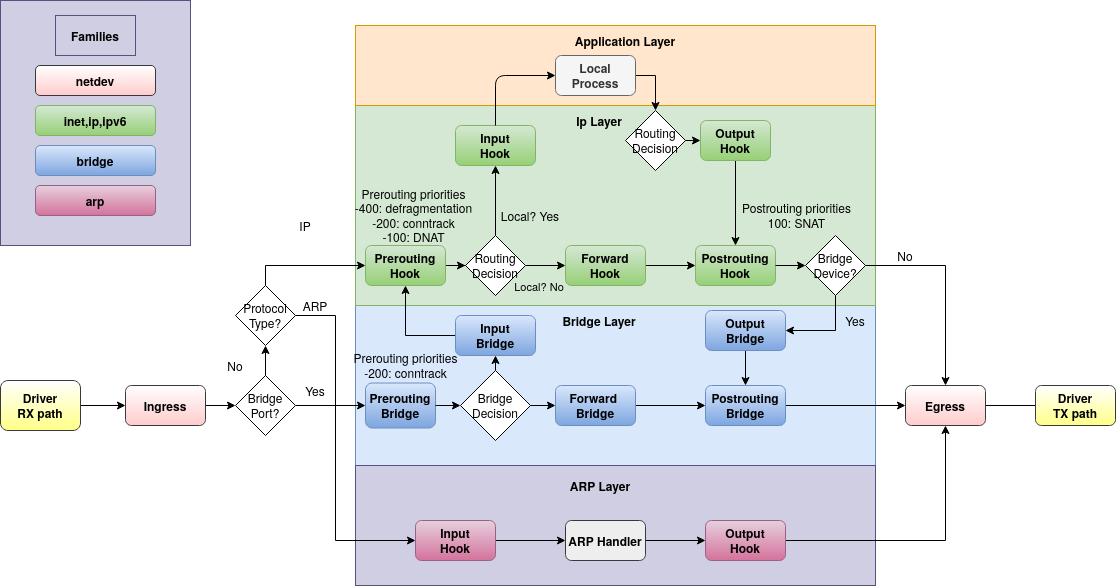
Quoted 87 lines · Phil Sutter
Hi Antonio,
Quoted 12 lines · Antonio Ojea
Quoted 11 lines · Florian Westphal
Quoted 8 lines · Pablo Neira Ayuso
Quoted 2 lines
Hmm. Looking at
nft_nat.c, 'accept' seems consistent with what nat statements do implicitly.Yes, and
xt_TPROXYdoesNF_ACCEPT.On the other hand, I can see it does
NF_DROPit socket is not transparent, it doesNFT_BREAKinstead, so policy keeps evaluating the packet.Quoted 8 lines
Quoted 3 lines
Yes, this is more flexible since you can log+drop for instance in next rule(s) to alert that proxy isn't running for example.
This is super useful, in the scenario that the transparent proxy takes over the DNATed virtual IP, if the transparent proxy process is not running the packet goes to the DNATed virtual IP so the clients don't observe any disruption.
So here's a use-case for why non-terminal tproxy statement is superior over terminal one. :)
Quoted 5 lines
Quoted 5 lines
Quoted 5 lines
Quoted 5 lines
Quoted 2 lines
is this sufficient in your opinion? If so, I made this quick update for man nft(8).
Acked-by Phil Sutter <[email protected]>Quoted 8 lines
Quoted 6 lines
Quoted 4 lines
Quoted 2 lines
In addition to that, I will update
tproxy_tg_xlate()in iptables.git to emit a verdict, too.Thanks, this is very convenient.
Agreed, it should append accept keyword in the translator.
I'm not completely following the technical details sorry.
In essence, tproxy statement does not set a verdict unless it fails to find a suitable socket. A sample ruleset illustrating this is:
| table t {
|       chain c {
|               type filter hook prerouting priority 0
|               tproxy to :1234 log "packet tproxied" accept
|               log "no socket on port 1234 or not transparent?" drop
|       }
| }
Quoted 5 lines
With my current configuration I do set an accept action
udp dport 53 tproxy ip to 127.0.0.1:46659 accept
and I have dnat statements after that action.
For the record, your ruleset looks like this (quoting from the kselftest you sent me):
| table inet filter {
|        chain divert {
|                type filter hook prerouting priority -100; policy accept;
|                $ip_proto daddr $virtual_ip udp dport 8080 tproxy ip_proto to :12345 meta mark set 1 accept
|        }
|        # Removing this chain makes the first connection to succeed
|        chain PREROUTING {
|                type nat hook prerouting priority 1; policy accept;
|                $ip_proto daddr $virtual_ip udp dport 8080 dnat to umgen inc mod 2 map { 0 : $ns2_ip , 1: $ns3_ip }
|        }
| }
Foundational lecture: 'accept' verdict covers the current hook only. Like with iptables, if you accept in e.g. PREROUTING, INPUT may still see the packet. 'drop' verdict OTOH discards the packet, so no following hooks will see it (obviously).
Your case is special because of the different types. If I interpret this correctly, a new connection's packet will get tproxied by divert chain and dnatted by PREROUTING chain (which sets up a conntrack entry). The second packet will hit conntrack in prerouting hook at priority -200 (according to the big picture[1]) and your tproxy rule does not match anymore. The nat type chain does not see the packet as it's not a new connection. Maybe this explains the behaviour you're seeing.
Quoted 4 lines
In order to avoid the inadvertent dnat of tproxied packets, terminating the divert chain's rule with 'drop' instead of 'accept' should do - if tproxy fails, it set
NFT_BREAKso the packet continues and hits PREROUTING chain (if the connection is new).
Awesome, I just add a rule that drops the tproxied marked packets
| meta mark 1 drop
and works perfectly.
Although, since it is not really intuitive you have to do this it will be nice to have it documented
Thanks
Quoted 4 lines
Cheers, Phil