Extending LOG target to display pid
Quoted 8 lines · Tobias DiPasquale
Quoted 4 lines · Nick Hay
2. Any ideas on how I can get the pid of a local packet's creator in the log module? I couldn't find any structures connected to the
sk_buffthat might contain it, and couldn't think of where the data would originally come from.
Quoted 6 lines
A security framework, with the proper auditing and accounting mechanisms in place in the network stack could make this possible (any it may already be). But in general, it would be quite a lot of work to add the necessary code to the stack to account for the sending/receiving PID at the correct stage. Unless you're doing MAC, its probably not worth it.
My original intention was to replicate some part of Windows' ZoneAlarm
package: the ability to recognise which program was asking for access, and to filter based on that. Noticing a strange packet that was blocked by my filter on outgoing ports, and not being able to find out where it came from was the immediate motivation :)
Is it better to try this at the SELinux level, blocking/monitoring/adjusting access to socket creation/use?
Quoted 7 lines
Quoted 1 line
Actually... would
current->pidwork?No, because there's no guarantee that the same process is on the CPU by the time the packet hits your rule.
Can't check on #1 right now, but I believe that its filled in by the module itself in whatever way it chooses.
-- Nick
-----BEGIN PGP SIGNED MESSAGE-----
Hash: SHA1
Quoting Nick Hay on 2005-07-05 23:56 UTC:
Quoted 5 lines
My original intention was to replicate some part of Windows' ZoneAlarm
package: the ability to recognise which program was asking for access, and to filter based on that. Noticing a strange packet that was blocked by my filter on outgoing ports, and not being able to find out where it came from was the immediate motivation :)
I made this kind of program some years ago ; it pops up a window if some yet-unknown program tries to access anything.. You then have the options to create a rule on-the-fly if you want or just accept/reject that specific packet. It uses the QUEUE target of iptables which sends the whole packet to userspace. I have tweaked the kernel code to send the PID as well. This whole thing has only been tested with outgoing connections, and it worked well.
It isn't user-friendly like ZoneAlarm, but it sure is hacker-friendly :)
I have three clients implemented, one text-based (for desperate console hacking), one gtk-based written in C and one java-gnome-based (gtk wrapper lib for java) written in Java. The Java one has the most features. It would probably not be too hard to rewrite the java version for some other toolkit like Swing or SWT.
Here's some screenshots, the first one from the java-gnome version and the second from the C-gtk version:
http://xkr47.outerspace.dyndns.org/tmp/firefly-java-1.png
http://xkr47.outerspace.dyndns.org/tmp/firewall-layout-5.png
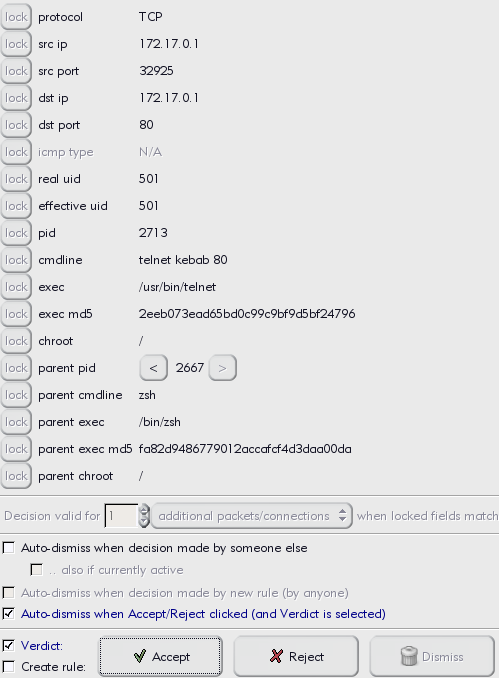
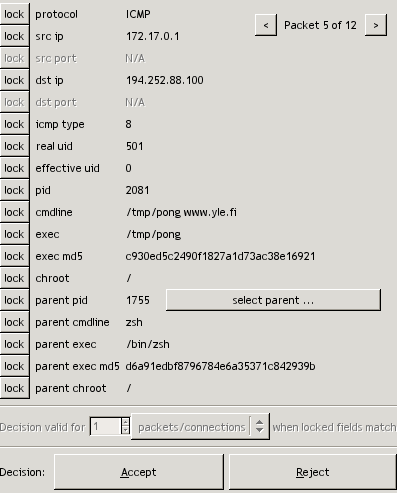
If you are interested I could pack it up for you..
- --
- - xkr47
-----BEGIN PGP SIGNATURE-----
Version: GnuPG v1.4.1 (GNU/Linux)
iD8DBQFCzMxxxyF48ZTvn+4RAo/VAJ9Rxw8mc483cOMz/zvvWlGikz7ycACeIuWN /yLfUiUvzg7pcKJHwDeb/gY=
=UALz
-----END PGP SIGNATURE-----