iptables, ipsec, and host2host
trying this again on the -devel list. the basic question i'm trying to answer is if there really isn't a way to filter esp/ah packets after decryption/decapsulation in host2host mode. i've looked at what i think is the current linus kernel and don't see any changes to esp/ah handling to address this. is tunnel mode the only way i can do filtering on the packets after ah/esp have done their work?
Quoted 7 lines
Quoted 1 line
i have been scouring the net and i can't find any clues to whether i can do filtering after ipsec has decrypted a packet on a host2host connection. net2net goes through the filters a second time, but host2host doesn't seem to do that. is there some other method i can use to filter the traffic after being decrypted?
ok, i'm following up to myself. i dug into the kernel source (for redhat/centos 5) and have found that there don't appear to be any hooks in the
ah4.coresp4.ccode to pass packets back through netfilter after decapsution/decryption. from what i can tell tunnel mode (net2net) gets the double pass through netfilter only because of the use of the ip-ip protocol andipip.cdoes anetif_rxcall after decapsulation.so maybe i should go dig into the current (from linus) kernel sources to see if there have been any changes. but i'm hoping that someone here might know if there is a reason that ah/esp packets aren't passed through netfilter again after being decapsulated/decrypted? or should i go find the ipsec mailing list?
my underlying goal is for a monitoring system that i want to be able to see into customer sites via ipsec, but i don't want them to be able to come back over the ipsec connection to my system. i could setup tunnels to each site, but host2host is really more what i want.
Quoted 1 line · Joe Pruett
trying this again on the -devel list. the basic question i'm trying to answer is if there really isn't a way to filter esp/ah packets after decryption/decapsulation in host2host mode. i've looked at what i think is the current linus kernel and don't see any changes to esp/ah handling to address this. is tunnel mode the only way i can do filtering on the packets after ah/esp have done their work?
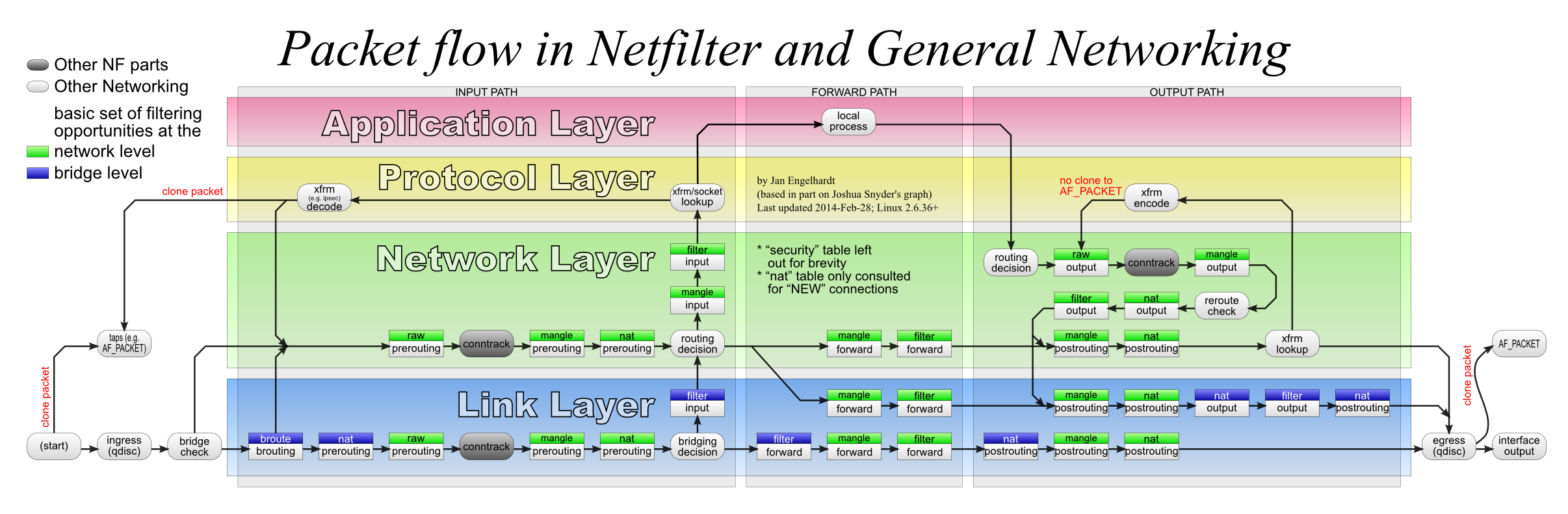
Packets in both tunnel and transport mode traverse the netfilter hooks after decapsulation and before encapsulation. From a users POV there should be nothing special about it.
Quoted 11 lines · Patrick McHardy
Quoted 6 lines · Joe Pruett
trying this again on the -devel list. the basic question i'm trying to answer is if there really isn't a way to filter esp/ah packets after decryption/decapsulation in host2host mode. i've looked at what i think is the current linus kernel and don't see any changes to esp/ah handling to address this. is tunnel mode the only way i can do filtering on the packets after ah/esp have done their work?
Packets in both tunnel and transport mode traverse the netfilter hooks after decapsulation and before encapsulation. From a users POV there should be nothing special about it.
Precisely, see http://jengelh.medozas.de/images/nf-packet-flow.png .
Quoted 11 lines
Quoted 6 lines · Joe Pruett
trying this again on the -devel list. the basic question i'm trying to answer is if there really isn't a way to filter esp/ah packets after decryption/decapsulation in host2host mode. i've looked at what i think is the current linus kernel and don't see any changes to esp/ah handling to address this. is tunnel mode the only way i can do filtering on the packets after ah/esp have done their work?
Packets in both tunnel and transport mode traverse the netfilter hooks after decapsulation and before encapsulation. From a users POV there should be nothing special about it.
i don't see that behaviour on rhel/centos 5 kernels. could this have changed since 2.6.18? for tunnel mode, it looks to me like the ip-ip module is what causes traffic to be seen after decrypt/decap, and i just don't see anything like that for transport mode.
i'll do some more experiments.
Quoted 7 lines · Joe Pruett
Quoted 3 lines
Packets in both tunnel and transport mode traverse the netfilter hooks after decapsulation and before encapsulation. From a users POV there should be nothing special about it.
i don't see that behaviour on rhel/centos 5 kernels. could this have changed since 2.6.18? for tunnel mode, it looks to me like the ip-ip module is what causes traffic to be seen after decrypt/decap, and i just don't see anything like that for transport mode.
i'll do some more experiments.
IIRC the IPsec support was merged around 2.6.17, but that might be wrong.
Quoted 8 lines · Joe Pruett
Quoted 8 lines
Quoted 6 lines · Joe Pruett
trying this again on the -devel list. the basic question i'm trying to answer is if there really isn't a way to filter esp/ah packets after decryption/decapsulation in host2host mode. i've looked at what i think is the current linus kernel and don't see any changes to esp/ah handling to address this. is tunnel mode the only way i can do filtering on the packets after ah/esp have done their work?
Quoted 8 lines
Quoted 3 lines
Packets in both tunnel and transport mode traverse the netfilter hooks after decapsulation and before encapsulation. From a users POV there should be nothing special about it.
i don't see that behaviour on rhel/centos 5 kernels. could this have changed since 2.6.18? for tunnel mode, it looks to me like the ip-ip module is what causes traffic to be seen after decrypt/decap, and i just don't see anything like that for transport mode.
ipip is not used for ipsec.
Quoted 1 line · Jan Engelhardt
ipip is not used for ipsec.
my reading of the code was that in tunnel mode, the next protocol header is ip and so the packet then gets handed off to the ip-ip handler. and that is where i saw it being handed off to the recv routine again. that seemed to match what i see with tcpdump since both the ipsec packet and the decrypted packet show up.
Quoted 7 lines · Joe Pruett
Quoted 1 line · Jan Engelhardt
ipip is not used for ipsec.
my reading of the code was that in tunnel mode, the next protocol header is ip and so the packet then gets handed off to the ip-ip handler.
Still the ipip.ko module (used for creating an explicit tunnel interface) is not used nor required to be loaded.
When an ESP packet with IPv4 outer address is received, the function ip_rcv() will eventually deal with it, moved to the xfrm decoder and then reinjected by calling netif_rx (see xfrm_input.c) on the skb with its decoded payload.
Also, do not confuse IP-in-ESP-over-IPv4 with IP-(in/over)-IP. For about every router and subsystem other than xfrm, there is no way to look into ESP payload and hence, it's just ESP-on-IPv4 or ESP-on-IPv6.
Quoted 8 lines · Jan Engelhardt
Still the ipip.ko module (used for creating an explicit tunnel interface) is not used nor required to be loaded.
When an ESP packet with IPv4 outer address is received, the function
ip_rcv()will eventually deal with it, moved to the xfrm decoder and then reinjected by callingnetif_rx(seexfrm_input.c) on the skb with its decoded payload.
Quoted 4 lines
Also, do not confuse IP-in-ESP-over-IPv4 with IP-(in/over)-IP. For about every router and subsystem other than xfrm, there is no way to look into ESP payload and hence, it's just ESP-on-IPv4 or ESP-on-IPv6.
i have to now beg forgivness. i think i ended up doing some of my testing on a rhel/centos 4 box which is only 2.6.9 with ipsec backported. now that i correctly tested on my version 5 box, everything is working as i expect. follow that with a few minutes of code reading and i convinced myself that host2host just wasn't doing what i wanted. i'll go crawl back under the rocks now :-).
Quoted 1 line · Joe Pruett
i have to now beg forgivness. i think i ended up doing some of my testing on a rhel/centos 4 box which is only 2.6.9 with ipsec backported. now that i correctly tested on my version 5 box, everything is working as i expect. follow that with a few minutes of code reading and i convinced myself that host2host just wasn't doing what i wanted. i'll go crawl back under the rocks now :-).
and i forgot to add that the rhel/centos 4 kernel does not reprocess the decrypted/decapsulated packets. once you accept the ah/esp packet, it doesn't go through the iptables again. this is ok for my scenario where i want my central machine to be able to see inside the firewall of the remote systems. i just don't want the remotes to be able to see back beyond what the normal firewall allows. i've already learned about using packet marks to allow my net2net traffic to bypass the firewalls and was expecting to need the same for host2host and when the first box i tried didn't need that, i started digging and got myself turned around. so at least i'm not a total crackpot.