spi: driver for Cirrus EP93xx SPI controller
Subsystems (5)
v4 cover spi: driver for Cirrus EP93xx SPI controller
Hello,
This is fourth iteration of the driver. I tried to address most of the review comments I received.
Changes to previous version:
- dropped polling mode, there is no real use for that
- changes according review comments by Grant Likely, Martin Guy, and H. Hartley Sweeten
Previous version can be found here (with review comments):
http://lists.infradead.org/pipermail/linux-arm-kernel/2010-April/012941.html
Let's hope I didn't forget anything.
Tested with my TS-7260 board with mmc_spi and at25 drivers.
Note that patch 2/2 depends on patch that is already in Russell's patch tracking system:
http://www.arm.linux.org.uk/developer/patches/viewpatch.php?id=5998/1
Thanks,
MW
Mika Westerberg (2):
spi: implemented driver for Cirrus EP93xx SPI controller
ep93xx: SPI driver platform support code
 arch/arm/mach-ep93xx/clock.c                    |   14 +
 arch/arm/mach-ep93xx/core.c                     |   48 ++
 arch/arm/mach-ep93xx/include/mach/ep93xx-regs.h |    1 +
 arch/arm/mach-ep93xx/include/mach/ep93xx_spi.h  |   32 +
 arch/arm/mach-ep93xx/include/mach/platform.h    |    2 +
 drivers/spi/Kconfig                             |   11 +
 drivers/spi/Makefile                            |    1 +
 drivers/spi/ep93xx_spi.c                        |  992 +++++++++++++++++++++++
 8 files changed, 1101 insertions(+), 0 deletions(-)
 create mode 100644 arch/arm/mach-ep93xx/include/mach/ep93xx_spi.h
 create mode 100644 drivers/spi/ep93xx_spi.c
PATCH v4 1/2 spi: implemented driver for Cirrus EP93xx SPI controller
This patch adds an SPI master driver for the Cirrus EP93xx SPI controller found in EP93xx chips (EP9301, EP9302, EP9307, EP9312 and EP9315).
---
 arch/arm/mach-ep93xx/include/mach/ep93xx_spi.h |   32 +
 drivers/spi/Kconfig                            |   11 +
 drivers/spi/Makefile                           |    1 +
 drivers/spi/ep93xx_spi.c                       |  992 ++++++++++++++++++++++++
 4 files changed, 1036 insertions(+), 0 deletions(-)
 create mode 100644 arch/arm/mach-ep93xx/include/mach/ep93xx_spi.h
 create mode 100644 drivers/spi/ep93xx_spi.c
arch/arm/mach-ep93xx/include/mach/ep93xx_spi.h new file +32 -0
@@ -0,0 +1,32 @@ +#ifndef __ASM_MACH_EP93XX_SPI_H +#define __ASM_MACH_EP93XX_SPI_H + +struct spi_device ; + +/** +* struct ep93xx_spi_info - EP93xx specific SPI descriptor +* @num_chipselect: number of chip selects on this board, must be +* at least one +* @cs_control: chip select control function. Can be %NULL if not needed. +* +* This structure is passed from board support files to EP93xx SPI controller +* driver. It provides callback hook to control chip select lines that are +* allocated in board support files during the board initialization. +*/ +struct ep93xx_spi_info { +int num_chipselect; +/* +* cs_control() - control board chipselect GPIO lines +* @spi: SPI device whose chipselect is controlled +* @value: value to set the chip select line to +* +* This function is used to control board specific chip select lines. +* @value is either %0 or %1. +* +* This function is called from thread context and can sleep if +* necessary. +*/ +void (*cs_control)(struct spi_device *spi,int value); +}; + +#endif /* __ASM_MACH_EP93XX_SPI_H */
drivers/spi/Kconfig +11 -0
@@ -117,6 +117,17 @@ config SPI_DAVINCI help SPI master controller for DaVinci and DA8xx SPI modules. +config SPI_EP93XX + tristate "Cirrus Logic EP93xx SPI controller" + depends on ARCH_EP93XX + help + This enables using the Cirrus EP93xx SPI controller in master + mode. This driver supports EP9301, EP9302, EP9307, EP9312 and EP9315 + chips. + + To compile this driver as a module, choose M here. The module will be + called ep93xx_spi. + config SPI_GPIO tristate "GPIO-based bitbanging SPI Master" depends on GENERIC_GPIO
drivers/spi/Makefile +1 -0
@@ -21,6 +21,7 @@ obj-$(CONFIG_SPI_DAVINCI) += davinci_spi.o obj-$(CONFIG_SPI_DESIGNWARE) += dw_spi.o obj-$(CONFIG_SPI_DW_PCI) += dw_spi_pci.o obj-$(CONFIG_SPI_DW_MMIO) += dw_spi_mmio.o +obj-$(CONFIG_SPI_EP93XX) += ep93xx_spi.o obj-$(CONFIG_SPI_GPIO) += spi_gpio.o obj-$(CONFIG_SPI_IMX) += spi_imx.o obj-$(CONFIG_SPI_LM70_LLP) += spi_lm70llp.o
drivers/spi/ep93xx_spi.c new file +992 -0
992 lines not on this page · raw message
Signature · 1 line
1.5.6.5
PATCH v4 1/2 spi: implemented driver for Cirrus EP93xx SPI controller
Quoted 4 lines · Mika Westerberg
This patch adds an SPI master driver for the Cirrus EP93xx SPI controller found in EP93xx chips (EP9301, EP9302, EP9307, EP9312 and EP9315).
Signed-off-by Mika Westerberg <[email protected]>
Mika,
I'm still looking this over but I have one quick comment.
Quoted 23 lines
drivers/spi/ep93xx_spi.c new file +23
-0+/** +* ep93xx_spi_select_device() - select given SPI device +* @espi: ep93xx SPI controller struct +* @spi: SPI device to select +* +* Function asserts chipselect line as specified in @spi->chip_select in board +* specific manner. +* +* Note that this function is called from a thread context and can sleep. +*/ +static inline void ep93xx_spi_select_device (const struct ep93xx_spi *espi, +struct spi_device *spi) +{ +if (espi->cs_control) + espi->cs_control (spi, !!(spi->mode &SPI_CS_HIGH )); +} + +/** +* ep93xx_spi_deselect_device() - deselects given SPI device +* @espi: ep93xx SPI controller struct +* @spi: SPI device to deselect +* +* Function deasserts chipselect line as specified in @spi->chip_select in board
drivers/spi/ep93xx_spi.c line 317
Quoted 10 lines
drivers/spi/ep93xx_spi.c new file +10
-0+* specific manner. +* +* Note that this function is called from a thread context and can sleep. +*/ +static inline void ep93xx_spi_deselect_device (const struct ep93xx_spi *espi, +struct spi_device *spi) +{ +if (espi->cs_control) + espi->cs_control (spi, !(spi->mode &SPI_CS_HIGH )); +}
These two functions can be combined.
/**
* ep93xx_spi_chip_select() - select/deselect a given SPI device
* @espi: ep93xx SPI controller struct
* @spi: SPI device to select
* @assert: flag to assert the chip select line
*
* Note that this function is called from a thread context and can sleep. */
static void ep93xx_spi_chip_select(const struct ep93xx_spi *espi,
struct spi_device *spi, int assert)
{
	int value = (spi->mode & SPI_CS_HIGH) ? !!assert : !assert;

	if (espi->cs_control)
		espi->cs_control(spi, value);
}
Then just do:
ep93xx_spi_select_device(espi, msg->spi, 1); /* assert the spi chip select */
ep93xx_spi_select_device(espi, msg->spi, 0); /* deassert the spi chip select */
Regards,
Hartley
PATCH v4 1/2 spi: implemented driver for Cirrus EP93xx SPI controller
Quoted 63 lines · H Hartley Sweeten
Quoted 4 lines · Mika Westerberg
This patch adds an SPI master driver for the Cirrus EP93xx SPI controller found in EP93xx chips (EP9301, EP9302, EP9307, EP9312 and EP9315).
Signed-off-by Mika Westerberg <[email protected]>Mika,
I'm still looking this over but I have one quick comment.
Quoted 23 lines
drivers/spi/ep93xx_spi.c new file +23
-0+/** +* ep93xx_spi_select_device() - select given SPI device +* @espi: ep93xx SPI controller struct +* @spi: SPI device to select +* +* Function asserts chipselect line as specified in @spi->chip_select in board +* specific manner. +* +* Note that this function is called from a thread context and can sleep. +*/ +static inline void ep93xx_spi_select_device (const struct ep93xx_spi *espi, +struct spi_device *spi) +{ +if (espi->cs_control) + espi->cs_control (spi, !!(spi->mode &SPI_CS_HIGH )); +} + +/** +* ep93xx_spi_deselect_device() - deselects given SPI device +* @espi: ep93xx SPI controller struct +* @spi: SPI device to deselect +* +* Function deasserts chipselect line as specified in @spi->chip_select in board drivers/spi/ep93xx_spi.c line 317
Quoted 10 lines
drivers/spi/ep93xx_spi.c new file +10
-0+* specific manner. +* +* Note that this function is called from a thread context and can sleep. +*/ +static inline void ep93xx_spi_deselect_device (const struct ep93xx_spi *espi, +struct spi_device *spi) +{ +if (espi->cs_control) + espi->cs_control (spi, !(spi->mode &SPI_CS_HIGH )); +}These two functions can be combined.
/**
*ep93xx_spi_chip_select()- select/deselect a given SPI device
* @espi: ep93xx SPI controller struct
* @spi: SPI device to select
* @assert: flag to assert the chip select line
*
* Note that this function is called from a thread context and can sleep. */
static void ep93xx_spi_chip_select(const structep93xx_spi*espi,
structspi_device*spi, int assert){ int value = (spi->mode & SPI_CS_HIGH) ? !!assert : !assert; if (espi->cs_control) espi->cs_control(spi, value); }
Quoted 5 lines
Then just do:
ep93xx_spi_select_device(espi, msg->spi, 1); /* assert the spi chip select */
ep93xx_spi_select_device(espi, msg->spi, 0); /* deassert the spi chip select */
I think it is more readable to do:
ep93xx_spi_select_device(espi, msg->spi);
and
ep93xx_spi_deselect_device(espi, msg->spi);
It can be seen from the function names what we are doing.
Thanks,
MW
PATCH v4 1/2 spi: implemented driver for Cirrus EP93xx SPI controller
Quoted 29 lines · Mika Westerberg
Quoted 20 lines
These two functions can be combined.
/**
*ep93xx_spi_chip_select()- select/deselect a given SPI device
* @espi: ep93xx SPI controller struct
* @spi: SPI device to select
* @assert: flag to assert the chip select line
*
* Note that this function is called from a thread context and can sleep. */
static void ep93xx_spi_chip_select(const structep93xx_spi*espi,
structspi_device*spi, int assert){ int value = (spi->mode & SPI_CS_HIGH) ? !!assert : !assert; if (espi->cs_control) espi->cs_control(spi, value); }Quoted 5 lines
Then just do:
ep93xx_spi_select_device(espi, msg->spi, 1); /* assert the spi chip select */
ep93xx_spi_select_device(espi, msg->spi, 0); /* deassert the spi chip select */I think it is more readable to do:
Quoted 7 lines
ep93xx_spi_select_device(espi, msg->spi);and
ep93xx_spi_deselect_device(espi, msg->spi);It can be seen from the function names what we are doing.
So rename the combined function to ep93xx_spi_cs_control and pass the "control" parameter as a bool; true = selected, false = deselected.
Having the two almost identical functions is a bit redundant. It also gives you two places to have to maintain basically the same operation. I think this is what Grant was referring to with his previous comment.
Regards,
Hartley
PATCH v4 1/2 spi: implemented driver for Cirrus EP93xx SPI controller
Quoted 9 lines · H Hartley Sweeten
Quoted 8 lines · Mika Westerberg
I think it is more readable to do:
ep93xx_spi_select_device(espi, msg->spi);and
ep93xx_spi_deselect_device(espi, msg->spi);
Quoted 8 lines
Quoted 1 line
It can be seen from the function names what we are doing.
So rename the combined function to
ep93xx_spi_cs_controland pass the "control" parameter as a bool; true = selected, false = deselected.Having the two almost identical functions is a bit redundant. It also gives you two places to have to maintain basically the same operation. I think this is what Grant was referring to with his previous comment.
Agreed. Will do.
Thanks,
MW
PATCH v4 1/2 spi: implemented driver for Cirrus EP93xx SPI controller
Mika,
I have added some debug messages to the driver trying to figure out how to chain the transfers in a message together in order to keep the SFRM signal asserted for the entire message. I still haven't worked out a good solution but I did notice something else.
First, every spi transaction, including a single byte transfer, is going to generate at least two interrupts. One when the interrupts are first enabled because the TX FIFO is empty. And a second when that byte has been transferred and the TX FIFO is again empty.
The first interrupt can be prevented by priming the TX FIFO before enabling the interrupts. All you need to do is call ep93xx_spi_read_write right before ep93xx_spi_enable_interrupts.
Second, at high clock rates the RX FIFO will actually start to fill as you are putting data into the TX FIFO. If you add an inner reader loop to the writer loop in ep93xx_spi_read_write you can take advantage of this and reduce the number of interrupts generated for large transfers.
For instance the mmc_spi driver regularly does 3 transfer messages where the last transfer is a 512 byte read. With your current v4 driver this message averages 69 interrupts to complete. By adding the inner reader it reduces the number of interrupts to an average of 40.
Regards,
Hartley
PATCH v4 1/2 spi: implemented driver for Cirrus EP93xx SPI controller
On Wed, Apr 21, 2010 at 09:47:14PM -0500, H Hartley Sweeten wrote:
[...]
Quoted 8 lines
First, every spi transaction, including a single byte transfer, is going to generate at least two interrupts. One when the interrupts are first enabled because the TX FIFO is empty. And a second when that byte has been transferred and the TX FIFO is again empty.
The first interrupt can be prevented by priming the TX FIFO before enabling the interrupts. All you need to do is call
ep93xx_spi_read_writeright beforeep93xx_spi_enable_interrupts.
OK thanks.
Quoted 5 lines
Second, at high clock rates the RX FIFO will actually start to fill as you are putting data into the TX FIFO. If you add an inner reader loop to the writer loop in
ep93xx_spi_read_writeyou can take advantage of this and reduce the number of interrupts generated for large transfers.
I originally had inner read loop in the first version of the driver but it wasn't functioning as it should (this was pointed out by Martin). But now when we have explicit FIFO size handling, I think that it can be added there again.
Thanks,
MW
PATCH v4 1/2 spi: implemented driver for Cirrus EP93xx SPI controller
In reply to H Hartley SweetenQuoted 21 lines · H Hartley Sweeten
I have added some debug messages to the driver trying to figure out how to chain the transfers in a message together in order to keep the SFRM signal asserted for the entire message. I still haven't worked out a good solution but I did notice something else.
First, every spi transaction, including a single byte transfer, is going to generate at least two interrupts. One when the interrupts are first enabled because the TX FIFO is empty. And a second when that byte has been transferred and the TX FIFO is again empty.
The first interrupt can be prevented by priming the TX FIFO before enabling the interrupts. All you need to do is call
ep93xx_spi_read_writeright beforeep93xx_spi_enable_interrupts.Second, at high clock rates the RX FIFO will actually start to fill as you are putting data into the TX FIFO. If you add an inner reader loop to the writer loop in
ep93xx_spi_read_writeyou can take advantage of this and reduce the number of interrupts generated for large transfers.
Quoted 5 lines
For instance the
mmc_spidriver regularly does 3 transfer messages where the last transfer is a 512 byte read. With your current v4 driver this message averages 69 interrupts to complete. By adding the inner reader it reduces the number of interrupts to an average of 40.
I assume you mean something like
        /* read as long as RX FIFO has frames in it */
        while (ep93xx_spi_read_u8(espi, SSPSR) & SSPSR_RNE) {
                ep93xx_do_read(espi, t);
                espi->fifo_level--;
        }

        /* write as long as TX FIFO has room */
        while (espi->fifo_level < SPI_FIFO_SIZE && espi->tx < t->len) {
                ep93xx_do_write(espi, t);
                espi->fifo_level++;
+
+ while (ep93xx_spi_read_u8(espi, SSPSR) & SSPSR_RNE) {
+ ep93xx_do_read(espi, t);
+ espi->fifo_level--;
+ }
}
Well, you're gonna love this :)
I've run some timing tests on this, and it turns out to give the same data transfer speed but take more system CPU time: 64% instead of 60%, i.e it is slower.
You are seeing a lower interrupt count, not because more useful work is being done in each interrupt, but only because the extra code in the inner loop makes the interrupt routine slower. Bear with me...
I'm using v4 with mika's continuity hack compiled for speed not space and averaging the vmstat "sy" output column over 50 seconds while block-reading 20 meg with dd from /dev/mmcblk0 to /dev/null using a fairly old Sandisk 1MB SD card and clocking at 3.7 MHz.
All tests report 367 or 368 kB/sec; the variability of the system time average in successive runs is about 1%
Figures are (commas separate values from successive runs) v4 with Mika's hack:
     61.9,60.2%  234724,234727 irq/MB
with "while" reader in write loop:
     63.4,64.5%  197772,97801 irq/MB
with "if" reader in while loop:
     61.9,62.5%  197845,197847  irq/MB
with an "if" reader after the write loop:
     66.0,67.1%  278207,277166 irq/MB
with a "while" reader after the write loop:
     67.0%  275000 irq/MB
Further, on a suspicion about the silliness of the per-transfer bits_per_word being checked right down the bottom of the lowest lever byte-read/writing routine instead of once per transfer, I split ep93xx_spi_read and _write into 8 and 16-bit variants, and checked t->bits_per_word once outside the read and write loops.
This gives:
60.0% 59.3% 285906 irq/MB
Note: it takes *more* interrupts to transfer a megabyte when the interrupt routine is more efficient!
The reason is that almost all of those interrupts happen while waiting for the last 4, 3, 2 or 1 bytes of a transfer to arrive in the RX FIFO. On this dreadful chip there is no interrupt mechanism to say "the TX buffer is empty and the received data has finished arriving". There is only "the TX buffer is half empty or less" and "the RX buffer is half full or more", so repeated interrupts now perform the function that the old busy-wait loop performed in v1.
This is another good reason to unite multiple transfers into one continuous stream, to have less of this effective busy-waiting with interrupts spinning madly.
It now occurs to me that another step in CPU efficiency could be had by abusing the receive-fifo-is-half-full interrupt to signal the completion of a transfer. This would only work for transfers of four or more words and would need some careful jiggery-pokery at end of transfer to turn the tx-fifo-is-half-empty interrupt enable off and ensure that exactly four words would end up in the RX FIFO.
It's a horrible thought, and I suspect that the DMA engine is the real answer.
M
PATCH v4 1/2 spi: implemented driver for Cirrus EP93xx SPI controller
In reply to H Hartley SweetenQuoted 8 lines · H Hartley Sweeten
First, every spi transaction, including a single byte transfer, is going to generate at least two interrupts. One when the interrupts are first enabled because the TX FIFO is empty. And a second when that byte has been transferred and the TX FIFO is again empty.
The first interrupt can be prevented by priming the TX FIFO before enabling the interrupts. All you need to do is call
ep93xx_spi_read_writeright beforeep93xx_spi_enable_interrupts.
Nice. That increases the data throughput from 367 to 372 kB/sec and reduces the CPU usage from 61 to 60.2% for large transfers
M
PATCH v4 1/2 spi: implemented driver for Cirrus EP93xx SPI controller
Martin,
I'm replying to both of your previous messages.
Quoted 6 lines · Martin Guy
Quoted 5 lines · H Hartley Sweeten
First, every spi transaction, including a single byte transfer, is going to generate at least two interrupts. One when the interrupts are first enabled because the TX FIFO is empty. And a second when that byte has been transferred and the TX FIFO is again empty.
Quoted 6 lines
Quoted 3 lines
The first interrupt can be prevented by priming the TX FIFO before enabling the interrupts. All you need to do is call
ep93xx_spi_read_writeright beforeep93xx_spi_enable_interrupts.Nice. That increases the data throughput from 367 to 372 kB/sec and reduces the CPU usage from 61 to 60.2% for large transfers
I figured "priming the fifo" before turning the transfer over to the interrupt handler would help.
Quoted 24 lines · Martin Guy
Quoted 11 lines
Second, at high clock rates the RX FIFO will actually start to fill as you are putting data into the TX FIFO. If you add an inner reader loop to the writer loop in
ep93xx_spi_read_writeyou can take advantage of this and reduce the number of interrupts generated for large transfers.For instance the
mmc_spidriver regularly does 3 transfer messages where the last transfer is a 512 byte read. With your current v4 driver this message averages 69 interrupts to complete. By adding the inner reader it reduces the number of interrupts to an average of 40.I assume you mean something like
       /* read as long as RX FIFO has frames in it */
       while (ep93xx_spi_read_u8(espi, SSPSR) & SSPSR_RNE) {
               ep93xx_do_read(espi, t);
               espi->fifo_level--;
       }

       /* write as long as TX FIFO has room */
       while (espi->fifo_level < SPI_FIFO_SIZE && espi->tx < t->len) {
               ep93xx_do_write(espi, t);
               espi->fifo_level++;
Review
Quoted 6 lines
(quoted diff) +5
-0+ + while (ep93xx_spi_read_u8(espi, SSPSR) & SSPSR_RNE) { + ep93xx_do_read(espi, t); + espi->fifo_level--; + } }
Exactly what I did.
Quoted 19 lines
Well, you're gonna love this :)
I've run some timing tests on this, and it turns out to give the same data transfer speed but take more system CPU time: 64% instead of 60%, i.e it is slower.
You are seeing a lower interrupt count, not because more useful work is being done in each interrupt, but only because the extra code in the inner loop makes the interrupt routine slower. Bear with me...
I'm using v4 with mika's continuity hack compiled for speed not space and averaging the vmstat "sy" output column over 50 seconds while block-reading 20 meg with dd from
/dev/mmcblk0to/dev/nullusing a fairly old Sandisk 1MB SD card and clocking at 3.7 MHz.
All tests report 367 or 368 kB/sec; the variability of the system time average in successive runs is about 1%Figures are (commas separate values from successive runs) v4 with Mika's hack:
Quoted 9 lines
     61.9,60.2%  234724,234727 irq/MB
with "while" reader in write loop:
     63.4,64.5%  197772,97801 irq/MB
with "if" reader in while loop:
     61.9,62.5%  197845,197847  irq/MB
with an "if" reader after the write loop:
     66.0,67.1%  278207,277166 irq/MB
with a "while" reader after the write loop:
     67.0%  275000 irq/MB
I am surprised my this :-(. I thought getting rid of the extra interrupt context switches would help the data transfer time. Oh well...
Quoted 8 lines
Further, on a suspicion about the silliness of the per-transfer
bits_per_wordbeing checked right down the bottom of the lowest lever byte-read/writing routine instead of once per transfer, I splitep93xx_spi_readand_writeinto 8 and 16-bit variants, and checkedt->bits_per_wordonce outside the read and write loops.This gives:
60.0% 59.3% 285906 irq/MB
It looks like splitting the 8/16-bit read/write routines does help with cpu usage compared to the tests above. Was the data transfer (kB/sec) any better?
Quoted 10 lines
Note: it takes *more* interrupts to transfer a megabyte when the interrupt routine is more efficient!
The reason is that almost all of those interrupts happen while waiting for the last 4, 3, 2 or 1 bytes of a transfer to arrive in the RX FIFO. On this dreadful chip there is no interrupt mechanism to say "the TX buffer is empty and the received data has finished arriving". There is only "the TX buffer is half empty or less" and "the RX buffer is half full or more", so repeated interrupts now perform the function that the old busy-wait loop performed in v1.
Agree. Kind of a pain...
Quoted 3 lines
This is another good reason to unite multiple transfers into one continuous stream, to have less of this effective busy-waiting with interrupts spinning madly.
Yes. Too bad we can't also combine multiple messages that might be in the queue...
But, if this gets to complicated it might not be worth holding off getting it merged, at least into linux-next or possibly into the staging branch. At that point it will be easier to provide patches. I still have one hanging for Mika to expand the chip select options.
Quoted 6 lines
It now occurs to me that another step in CPU efficiency could be had by abusing the receive-fifo-is-half-full interrupt to signal the completion of a transfer. This would only work for transfers of four or more words and would need some careful jiggery-pokery at end of transfer to turn the tx-fifo-is-half-empty interrupt enable off and ensure that exactly four words would end up in the RX FIFO.
That might work but I think it could break horribly. The "jiggery-pokery" could end up being pretty messy.
But, the tx-fifo-is-half-empty might be what is needed to handle the multiple transfer merging. We know the driver is finished transfering the data to the fifo when (espi->tx == t->len). At this point we are just wating for the last (fifo_level) bytes to come in on the rx fifo, this could be anything from 1 to 8 bytes. If it's <= 4 the next interrupt will be a tx-fifo-is-half-empty which is killing us trying to pull those last bytes out of the rx fifo. So how about something like this@the end of ep93xx_spi_read_write:
	if (can_continue && espi->tx == t->len) {
		if (fifo_level < SPI_FIFO_SIZE/2) {
			/*
			 * Pull the next transfer out of the queue and
			 * use it to finish filling the tx fifo.  The
			 * next interrupt will complete this transfer.
			 * We then need to continue with the next transfer.
			 */
		}
	}
Quoted 1 line
It's a horrible thought, and I suspect that the DMA engine is the real answer.
The DMA engine might help but it's not here yet....
Regards,
Hartley
PATCH v4 1/2 spi: implemented driver for Cirrus EP93xx SPI controller
Quoted 6 lines · H Hartley Sweeten
Quoted 6 lines
Further, on a suspicion about the silliness of the per-transfer
bits_per_wordbeing checked right down the bottom of the lowest lever byte-read/writing routine instead of once per transfer, I splitep93xx_spi_readand_writeinto 8 and 16-bit variants, and checkedt->bits_per_wordonce outside the read and write loops.
Quoted 7 lines
Quoted 2 lines
This gives:
60.0% 59.3% 285906 irq/MBIt looks like splitting the 8/16-bit read/write routines does help
with cpu usage compared to the tests above. Was the data transfer (kB/sec) any better?
No, exactly the same.
PATCH v4 1/2 spi: implemented driver for Cirrus EP93xx SPI controller
In reply to Mika WesterbergQuoted 5 lines · Mika Westerberg
This patch adds an SPI master driver for the Cirrus EP93xx SPI controller found in EP93xx chips (EP9301, EP9302, EP9307, EP9312 and EP9315).
Signed-off-by Mika Westerberg <[email protected]>
Mika,
I discovered one gotcha with this driver. Bear with me through this...
1. ep93xx_spi_process_message is called by the workqueue worker function to handle a spi_message queued in by the ep93xx_spi_transfer function. Before starting the actual transfer the chip select to the device is asserted.
2. ep93xx_spi_process_transfer processes each transfer in the spi_message, one at a time, and does a wait_for_completion on each transfer.
3. When the entire spi_message has been transferred the chip select to the device is deasserted.
The problem is if a hardware design uses the SFRM1 pin as part of the chip select logic. The EP93xx User's Guide states that "the SFRMOUT signal behaves as a slave Select" in Motorola SPI mode. This signal behaves differently depending on the SPI_MODE_* used.
Modes 0 and 2:
SFRMOUT is forced HIGH during idle periods.
Start of transmission, SFRMOUT is driven LOW.
Single word transmission, SFRMOUT is returned to its idle HIGH state one
SCLKOUT period after the last bit has been captured.
Back-to-back transmissions, SFRMOUT signal is pulsed HIGH between each
data word transfer. On completion the SFRMOUT pin returns to its idle HIGH state one SCLKOUT period after the last bit has been captured.
Modes 1 and 3:
SFRMOUT is forced HIGH during idle periods.
Start of transmission, SFRMOUT is driven LOW.
Single word transmission, SFRMOUT is returned to its idle HIGH state one
SCLKOUT period after the last bit has been captured.
Back-to-back transmissions, SFRMOUT signal is held LOW between each
data word transfer. On completion the SFRMOUT pin returns to its idle HIGH state one SCLKOUT period after the last bit has been captured.
So, since each transfer does a wait_for_completion, all the data is transmitted which causes the SFRMOUT pin to go HIGH between each transfer in the message.
For devices like the sst25lf040a SPI Flash on the EDB93xx boards this causes a problem. To read data from that device you need to send a two part message. The first part is a write transfer with the one byte command and three byte address. This is then followed by a read transfer to get the data. But since the SFRMOUT pin goes high this ends the command.
The driver Ryan and I worked on actually does work with the sst25lf040a on the EDB93xx boards. But now that I know what the issue is, it was actually a race condition. Sometimes it worked and sometimes it didn't...
I would think the Sim.One board (Martin?) would have the same issue with the mmc card since that design uses the SFRMOUT pin directly for the chip select.
Is there anyway to keep the transfers going in a muiltipart message?
Regards,
Hartley
PATCH v4 1/2 spi: implemented driver for Cirrus EP93xx SPI controller
Quoted 46 lines · H Hartley Sweeten
Quoted 2 lines · Mika Westerberg
This patch adds an SPI master driver for the Cirrus EP93xx SPI controller found in EP93xx chips (EP9301, EP9302, EP9307, EP9312 and EP9315).
I discovered one gotcha with this driver. Bear with me through this...
1.
ep93xx_spi_process_messageis called by the workqueue worker function to handle aspi_messagequeued in by theep93xx_spi_transferfunction. Before starting the actual transfer the chip select to the device is asserted.
2.ep93xx_spi_process_transferprocesses each transfer in thespi_message, one at a time, and does await_for_completionon each transfer.
3. When the entirespi_messagehas been transferred the chip select to the device is deasserted.The problem is if a hardware design uses the SFRM1 pin as part of the chip select logic. The EP93xx User's Guide states that "the SFRMOUT signal behaves as a slave Select" in Motorola SPI mode. This signal behaves differently depending on the SPI_MODE_* used.
Modes 0 and 2:
SFRMOUT is forced HIGH during idle periods.
Start of transmission, SFRMOUT is driven LOW.
Single word transmission, SFRMOUT is returned to its idle HIGH state one
SCLKOUT period after the last bit has been captured.
Back-to-back transmissions, SFRMOUT signal is pulsed HIGH between each
data word transfer. On completion the SFRMOUT pin returns to its idle HIGH state one SCLKOUT period after the last bit has been captured.Modes 1 and 3:
SFRMOUT is forced HIGH during idle periods.
Start of transmission, SFRMOUT is driven LOW.
Single word transmission, SFRMOUT is returned to its idle HIGH state one
SCLKOUT period after the last bit has been captured.
Back-to-back transmissions, SFRMOUT signal is held LOW between each
data word transfer. On completion the SFRMOUT pin returns to its idle HIGH state one SCLKOUT period after the last bit has been captured.So, since each transfer does a
wait_for_completion, all the data is transmitted which causes the SFRMOUT pin to go HIGH between each transfer in the message.For devices like the sst25lf040a SPI Flash on the EDB93xx boards this causes a problem. To read data from that device you need to send a two part message. The first part is a write transfer with the one byte command and three byte address. This is then followed by a read transfer to get the data. But since the SFRMOUT pin goes high this ends the command.
Quoted 8 lines
The driver Ryan and I worked on actually does work with the sst25lf040a on the EDB93xx boards. But now that I know what the issue is, it was actually a race condition. Sometimes it worked and sometimes it didn't...
I would think the Sim.One board (Martin?) would have the same issue with the mmc card since that design uses the SFRMOUT pin directly for the chip select.
Is there anyway to keep the transfers going in a muiltipart message?
I just changed the SPI mode selection, which is in the board definition file, from Mode 0 to Mode 3 (the two modes that sample data on the rising clock edge, as required by MMC/SD). It dramatically increases linear block read throughput:
MMC: from 307kB/sec to 353kB/sec
SD: from 317 to 365
SD MLC: from 327 to 378
with 82000 interrupts per second and 60% cpu usage
presumably because the poor card isn't being deselected once every byte.
M
PATCH v4 1/2 spi: implemented driver for Cirrus EP93xx SPI controller
Quoted 65 lines · Martin Guy
Quoted 46 lines · H Hartley Sweeten
Quoted 2 lines · Mika Westerberg
This patch adds an SPI master driver for the Cirrus EP93xx SPI controller found in EP93xx chips (EP9301, EP9302, EP9307, EP9312 and EP9315).
I discovered one gotcha with this driver. Bear with me through this...
1.
ep93xx_spi_process_messageis called by the workqueue worker function to handle aspi_messagequeued in by theep93xx_spi_transferfunction. Before starting the actual transfer the chip select to the device is asserted.
2.ep93xx_spi_process_transferprocesses each transfer in thespi_message, one at a time, and does await_for_completionon each transfer.
3. When the entirespi_messagehas been transferred the chip select to the device is deasserted.The problem is if a hardware design uses the SFRM1 pin as part of the chip select logic. The EP93xx User's Guide states that "the SFRMOUT signal behaves as a slave Select" in Motorola SPI mode. This signal behaves differently depending on the SPI_MODE_* used.
Modes 0 and 2:
SFRMOUT is forced HIGH during idle periods.
Start of transmission, SFRMOUT is driven LOW.
Single word transmission, SFRMOUT is returned to its idle HIGH state one
SCLKOUT period after the last bit has been captured.
Back-to-back transmissions, SFRMOUT signal is pulsed HIGH between each
data word transfer. On completion the SFRMOUT pin returns to its idle HIGH state one SCLKOUT period after the last bit has been captured.Modes 1 and 3:
SFRMOUT is forced HIGH during idle periods.
Start of transmission, SFRMOUT is driven LOW.
Single word transmission, SFRMOUT is returned to its idle HIGH state one
SCLKOUT period after the last bit has been captured.
Back-to-back transmissions, SFRMOUT signal is held LOW between each
data word transfer. On completion the SFRMOUT pin returns to its idle HIGH state one SCLKOUT period after the last bit has been captured.So, since each transfer does a
wait_for_completion, all the data is transmitted which causes the SFRMOUT pin to go HIGH between each transfer in the message.For devices like the sst25lf040a SPI Flash on the EDB93xx boards this causes a problem. To read data from that device you need to send a two part message. The first part is a write transfer with the one byte command and three byte address. This is then followed by a read transfer to get the data. But since the SFRMOUT pin goes high this ends the command.
Quoted 8 lines
The driver Ryan and I worked on actually does work with the sst25lf040a on the EDB93xx boards. But now that I know what the issue is, it was actually a race condition. Sometimes it worked and sometimes it didn't...
I would think the Sim.One board (Martin?) would have the same issue with the mmc card since that design uses the SFRMOUT pin directly for the chip select.
Is there anyway to keep the transfers going in a muiltipart message?
I just changed the SPI mode selection, which is in the board definition file, from Mode 0 to Mode 3 (the two modes that sample data on the rising clock edge, as required by MMC/SD). It dramatically increases linear block read throughput:
MMC: from 307kB/sec to 353kB/sec
SD: from 317 to 365
SD MLC: from 327 to 378
with 82000 interrupts per second and 60% cpu usage
Quoted 1 line
presumably because the poor card isn't being deselected once every byte.
Yes, Mode 3 should perform better since the protocol is not enforcing the chip select deassertion between every byte.
You should still be getting a chip select deassertion between every transfer in a multipart message since the Sim.One uses the SFRM1 line for the chip select. I haven't actually looked through the mmc_spi driver to see if this happens.
Is there any possibility you could look at the actual bus with a logic analyzer?
My concern with the comments above is that currently this driver will not work on the EDB93xx boards with the SPI Flash device. I did hack one of my boards to remove the SFRM1 signal from the chip select and it does "fix" the problem. But, that's kind of an ugly solution for most users.
Regards,
Hartley
PATCH v4 1/2 spi: implemented driver for Cirrus EP93xx SPI controller
Quoted 2 lines · H Hartley Sweeten
Quoted 1 line · Martin Guy
On 4/20/10, H Hartley Sweeten <[email protected]> wrote:
[snip]
Quoted 20 lines
Quoted 11 lines
Quoted 1 line
Is there anyway to keep the transfers going in a muiltipart message?
I just changed the SPI mode selection, which is in the board definition file, from Mode 0 to Mode 3 (the two modes that sample data on the rising clock edge, as required by MMC/SD). It dramatically increases linear block read throughput:
MMC: from 307kB/sec to 353kB/sec
SD: from 317 to 365
SD MLC: from 327 to 378
with 82000 interrupts per second and 60% cpu usageQuoted 1 line
presumably because the poor card isn't being deselected once every byte.
Yes, Mode 3 should perform better since the protocol is not enforcing the chip select deassertion between every byte.
You should still be getting a chip select deassertion between every transfer in a multipart message since the Sim.One uses the SFRM1 line for the chip select. I haven't actually looked through the
mmc_spidriver to see if this happens.
Quoted 6 lines
Is there any possibility you could look at the actual bus with a logic analyzer?
My concern with the comments above is that currently this driver will not work on the EDB93xx boards with the SPI Flash device. I did hack one of my boards to remove the SFRM1 signal from the chip select and it does "fix" the problem. But, that's kind of an ugly solution for most users.
Just for the record. Here are the (approximate) logic analyzer timings for the Read-ID command to the SPI Flash (Mode 3, 20MHz max speed):
Assertion of GPIO chip select: 0us
Assertion of SFRM1 (start of xfer): +22.5us
4 byte Read-ID command xfer: +4.5us
SFRM1 deasserts at end of xfer
Assertion of SFRM1 (start of xfer): +26.45us
2 byte ManID/DevID read xfer: +2.25us
SFRM1 deasserts at end of xfer
Deassertion of GPIO chip select: +10.25us
So the entire 4+2 byte message took 65.95us, of which the actual data was only 6.75us. The "dead-time" between the two spi transfers was 40.1% of the total xfer time.
Regards,
Hartley
PATCH v4 1/2 spi: implemented driver for Cirrus EP93xx SPI controller
In reply to H Hartley SweetenQuoted 8 lines · H Hartley Sweeten
Quoted 7 lines · Martin Guy
Quoted 6 lines · H Hartley Sweeten
So, since each transfer does a
wait_for_completion, all the data is transmitted which causes the SFRMOUT pin to go HIGH between each transfer in the message.
...
I would think the Sim.One board (Martin?) would have the same issue with the mmc card since that design uses the SFRMOUT pin directly for the chip select.
Quoted 5 lines
Quoted 1 line
Quoted 1 line
Is there anyway to keep the transfers going in a muiltipart message?
You should still be getting a chip select deassertion between every transfer in a multipart message since the Sim.One uses the SFRM1 line for the chip select. I haven't actually looked through the
mmc_spidriver to see if this happens.
OK, can I see if understand what you're saying, that ep93xx_spi_process_message() calls ep93xx_spi_process_transfer() multiple times using:
        list_for_each_entry(t, &msg->transfers, transfer_list) {
                ep93xx_spi_process_transfer(espi, msg, t);
...
and process_transfer() waits for each message block to be completely transmitted and received, so a transaction that consists of several messages will (or may) cause the device to be deselected between parts of the same message, which may cause a failure.
I have noticed on card insertion, the last line of:
mmc0: problem reading switch capabilities, performance might suffer.
mmc0: host does not support reading read-only switch. assuming write-enable.
mmc0: new SD card on SPI
mmcblk0: mmc0:0000 SD 952 MiB
mmcblk0: p1 p2 p4
mmcblk0: retrying using single block read
and the SDHC cards I have don't work at all, spewing tons of:
mmcblk0: error -38 sending status comand
mmcblk0: error -38 sending read/write command, response 0x4, card status 0xff04end_request: I/O error, dev mmcblk0, sector 7744509
Quoted 1 line
Is there any possibility you could look at the actual bus with a logic analyzer?
Not easily, but it seems a likely cause.
To prevent card deselection mid-message I think we would need to handle multi-transfer messages by making the start of transfers 2..N continuous with the end of transfers 1..N-1 instead of draining the reply from each one before starting the next.
Am I on the right track?
M
PATCH v4 1/2 spi: implemented driver for Cirrus EP93xx SPI controller
Quoted 19 lines · Martin Guy
Quoted 8 lines · H Hartley Sweeten
Quoted 7 lines · Martin Guy
Quoted 6 lines · H Hartley Sweeten
So, since each transfer does a
wait_for_completion, all the data is transmitted which causes the SFRMOUT pin to go HIGH between each transfer in the message.
...
I would think the Sim.One board (Martin?) would have the same issue with the mmc card since that design uses the SFRMOUT pin directly for the chip select.Quoted 5 lines
Quoted 1 line
Quoted 1 line
Is there anyway to keep the transfers going in a muiltipart message?
You should still be getting a chip select deassertion between every transfer in a multipart message since the Sim.One uses the SFRM1 line for the chip select. I haven't actually looked through the
mmc_spidriver to see if this happens.OK, can I see if understand what you're saying, that
ep93xx_spi_process_message()callsep93xx_spi_process_transfer()multiple times using:
Quoted 7 lines
       list_for_each_entry(t, &msg->transfers, transfer_list) {
               ep93xx_spi_process_transfer(espi, msg, t);
...
andprocess_transfer()waits for each message block to be completely transmitted and received, so a transaction that consists of several messages will (or may) cause the device to be deselected between parts of the same message, which may cause a failure.
Exactly.
Quoted 8 lines
I have noticed on card insertion, the last line of:
mmc0: problem reading switch capabilities, performance might suffer.
mmc0: host does not support reading read-only switch. assuming write-enable.
mmc0: new SD card on SPI
mmcblk0: mmc0:0000 SD 952 MiB
mmcblk0: p1 p2 p4
mmcblk0: retrying using single block read
That message might be related to the SFRM1 line being deasserted.
You could try cutting the trace going to pin 1 (CS pin) of the mmc socket and jumpering it to one of the EGPIO pins on JP15 (the LCD header) or JP16 (the keypad header). You will of course need to modify your platform init to use the new chip select line.
Quoted 4 lines
and the SDHC cards I have don't work at all, spewing tons of:
mmcblk0: error -38 sending status comand
mmcblk0: error -38 sending read/write command, response0x4, card status0xff04end_request: I/O error, dev mmcblk0, sector 7744509
I haven't seen those error messages before. Of course I don't have any SDHC cards... ;-)
Quoted 8 lines
Quoted 1 line
Is there any possibility you could look at the actual bus with a logic analyzer?
Not easily, but it seems a likely cause.
To prevent card deselection mid-message I think we would need to handle multi-transfer messages by making the start of transfers 2..N continuous with the end of transfers 1..N-1 instead of draining the reply from each one before starting the next.Am I on the right track?
Yes. I'm just not sure how to implement this.
Regards,
Hartley
PATCH v4 1/2 spi: implemented driver for Cirrus EP93xx SPI controller
Quoted 11 lines · H Hartley Sweeten
Quoted 8 lines · Martin Guy
I have noticed on card insertion, the last line of:
mmc0: problem reading switch capabilities, performance might suffer.
mmc0: host does not support reading read-only switch. assuming write-enable.
mmc0: new SD card on SPI
mmcblk0: mmc0:0000 SD 952 MiB
mmcblk0: p1 p2 p4
mmcblk0: retrying using single block readThat message might be related to the SFRM1 line being deasserted.
This message comes, depending on the card you are using.
It is easily reproduced with following command:
# fdisk -l
Problem there seems to be that fdisk (and also part of block layer that reads partition table) seeks to the end of the disk and reads last block. I remember reading some mail thread about the matter and it could be that some cards do read-ahead which causes the response message to return failure (address error as a response to STOP message which is completely bogus).
You can enable MMC debugging and see if this is the case with your card also.
I actually debugged this further some time ago and after failure if card status register is read, there is no failure at all (card is in correct state).
Quoted 5 lines
You could try cutting the trace going to pin 1 (CS pin) of the mmc socket and jumpering it to one of the EGPIO pins on JP15 (the LCD header) or JP16 (the keypad header). You will of course need to modify your platform init to use the new chip select line.
Quoted 7 lines
Quoted 4 lines
and the SDHC cards I have don't work at all, spewing tons of:
mmcblk0: error -38 sending status comand
mmcblk0: error -38 sending read/write command, response0x4, card status0xff04end_request: I/O error, dev mmcblk0, sector 7744509I haven't seen those error messages before. Of course I don't have any SDHC cards... ;-)
With my TS-7260 board, SDHC cards work (but it uses GPIO lines).
MW
PATCH v4 1/2 spi: implemented driver for Cirrus EP93xx SPI controller
In reply to H Hartley SweetenQuoted 10 lines · H Hartley Sweeten
Quoted 7 lines · Martin Guy
Not easily, but it seems a likely cause.
To prevent card deselection mid-message I think we would need to handle multi-transfer messages by making the start of transfers 2..N continuous with the end of transfers 1..N-1 instead of draining the reply from each one before starting the next.Am I on the right track?
Yes. I'm just not sure how to implement this.
I made a hack that allows transfer handler to continue to the next transfer directly if there is no special per transfer settings in the message. Could you try that out and report whether SFRMOUT works better with it?
Note that this is just to make sure that we are on the right track.
Patch is against v4 of the driver.
Thanks,
MW
drivers/spi/ep93xx_spi.c +60 -6
@@ -106,6 +106,8 @@ struct ep93xx_spi {unsigned long min_rate;unsigned long max_rate;bool running; +bool can_continue; +struct spi_transfer *last_transfer;struct workqueue_struct *wq;struct work_struct msg_work;struct completion wait;
@@ -380,6 +382,7 @@ static int ep93xx_spi_transfer(struct spi_device *spi, struct spi_message *msg)struct ep93xx_spi *espi =spi_master_get_devdata (spi->master);struct spi_transfer *t;unsigned long flags; +bool can_continue = true;if (!msg || !msg->complete)return -EINVAL ;
@@ -387,11 +390,21 @@ static int ep93xx_spi_transfer(struct spi_device *spi, struct spi_message *msg)/* first validate each transfer */ list_for_each_entry (t, &msg->transfers, transfer_list) {if (t->bits_per_word) { + can_continue = false;if (t->bits_per_word <4 || t->bits_per_word >16 )return -EINVAL ; } -if (t->speed_hz && t->speed_hz < espi->min_rate) +if (t->speed_hz) { + can_continue = false; +if (t->speed_hz < espi->min_rate)return -EINVAL ; + } +if (t->cs_change && + !list_is_last (&t->transfer_list, &msg->transfers)) { + can_continue = false; + } +if (t->delay_usecs) + can_continue = false; }/*
@@ -400,7 +413,7 @@ static int ep93xx_spi_transfer(struct spi_device *spi, struct spi_message *msg)* error in transfer and @msg->state is used to hold pointer to the * current transfer (or %NULL if no active current transfer). */ - msg->state =NULL ; + msg->state = (void *)can_continue; msg->status =0 ; msg->actual_length =0 ;
@@ -606,10 +619,33 @@ static void ep93xx_spi_process_message(struct ep93xx_spi *espi,ep93xx_spi_chip_setup (espi,spi_get_ctldata (msg->spi));ep93xx_spi_select_device (espi, msg->spi); -list_for_each_entry (t, &msg->transfers, transfer_list) { -ep93xx_spi_process_transfer (espi, msg, t); -if (msg->status) -break ; +if (msg->state) { + espi->can_continue = true; + espi->last_transfer = list_entry(msg->transfers.prev, struct spi_transfer, + transfer_list); + }else { + espi->can_continue = false; + espi->last_transfer =NULL ; + } + +/* +* In case there is no transfer specific settings in this message we +* can transfer the whole message with interrupts. Otherwise we need +* to perform transfer specific stuff in thread context. +*/ +if (espi->can_continue) { + msg->state = list_first_entry(&msg->transfers, struct spi_transfer, + transfer_list); + espi->rx =0 ; + espi->tx =0 ; +ep93xx_spi_enable_interrupts (espi); +wait_for_completion (&espi->wait); + }else { +list_for_each_entry (t, &msg->transfers, transfer_list) { +ep93xx_spi_process_transfer (espi, msg, t); +if (msg->status) +break ; + } }/*
@@ -792,6 +828,24 @@ static irqreturn_t ep93xx_spi_interrupt(int irq, void *dev_id)* interrupt then. */ return IRQ_HANDLED ; + }else { +/* +* If we can continue directly to the next transfer, do +* that now. +*/ +if (espi->can_continue) { +struct spi_message *msg = espi->current_msg; +struct spi_transfer *t = msg->state; + +if (t != espi->last_transfer) { + msg->state = list_entry(t->transfer_list.next, struct spi_transfer, + transfer_list); + espi->rx =0 ; + espi->tx =0 ; +return IRQ_HANDLED ; + } + } +/* otherwise we are ready */ } }
PATCH v4 1/2 spi: implemented driver for Cirrus EP93xx SPI controller
Quoted 128 lines · Mika Westerberg
Quoted 10 lines · H Hartley Sweeten
Quoted 7 lines · Martin Guy
Not easily, but it seems a likely cause.
To prevent card deselection mid-message I think we would need to handle multi-transfer messages by making the start of transfers 2..N continuous with the end of transfers 1..N-1 instead of draining the reply from each one before starting the next.Am I on the right track?
Yes. I'm just not sure how to implement this.
I made a hack that allows transfer handler to continue to the next transfer directly if there is no special per transfer settings in the message. Could you try that out and report whether SFRMOUT works better with it?
Note that this is just to make sure that we are on the right track.
Patch is against v4 of the driver.
Thanks,
MWdrivers/spi/ep93xx_spi.c +52
-6@@ -106,6 +106,8 @@ struct ep93xx_spi {unsigned long min_rate;unsigned long max_rate;bool running; +bool can_continue; +struct spi_transfer *last_transfer;struct workqueue_struct *wq;struct work_struct msg_work;struct completion wait;@@ -380,6 +382,7 @@ static int ep93xx_spi_transfer(struct spi_device *spi, struct spi_message *msg)struct ep93xx_spi *espi =spi_master_get_devdata (spi->master);struct spi_transfer *t;unsigned long flags; +bool can_continue = true;if (!msg || !msg->complete)return -EINVAL ;@@ -387,11 +390,21 @@ static int ep93xx_spi_transfer(struct spi_device *spi, struct spi_message *msg)/* first validate each transfer */ list_for_each_entry (t, &msg->transfers, transfer_list) {if (t->bits_per_word) { + can_continue = false;if (t->bits_per_word <4 || t->bits_per_word >16 )return -EINVAL ; } -if (t->speed_hz && t->speed_hz < espi->min_rate) +if (t->speed_hz) { + can_continue = false; +if (t->speed_hz < espi->min_rate)return -EINVAL ; + } +if (t->cs_change && + !list_is_last (&t->transfer_list, &msg->transfers)) { + can_continue = false; + } +if (t->delay_usecs) + can_continue = false; }/* @@ -400,7 +413,7 @@ static int ep93xx_spi_transfer(struct spi_device *spi, struct spi_message *msg)* error in transfer and @msg->state is used to hold pointer to the * current transfer (or %NULL if no active current transfer). */ - msg->state =NULL ; + msg->state = (void *)can_continue; msg->status =0 ; msg->actual_length =0 ;@@ -606,10 +619,33 @@ static void ep93xx_spi_process_message(struct ep93xx_spi *espi,ep93xx_spi_chip_setup (espi,spi_get_ctldata (msg->spi));ep93xx_spi_select_device (espi, msg->spi); -list_for_each_entry (t, &msg->transfers, transfer_list) { -ep93xx_spi_process_transfer (espi, msg, t); -if (msg->status) -break ; +if (msg->state) { + espi->can_continue = true; + espi->last_transfer = list_entry(msg->transfers.prev, struct spi_transfer, + transfer_list); + }else { + espi->can_continue = false; + espi->last_transfer =NULL ; + } + +/* +* In case there is no transfer specific settings in this message we +* can transfer the whole message with interrupts. Otherwise we need +* to perform transfer specific stuff in thread context. +*/ +if (espi->can_continue) { + msg->state = list_first_entry(&msg->transfers, struct spi_transfer, + transfer_list); + espi->rx =0 ; + espi->tx =0 ; +ep93xx_spi_enable_interrupts (espi); +wait_for_completion (&espi->wait); + }else { +list_for_each_entry (t, &msg->transfers, transfer_list) { +ep93xx_spi_process_transfer (espi, msg, t); +if (msg->status) +break ; + } }/* @@ -792,6 +828,24 @@ static irqreturn_t ep93xx_spi_interrupt(int irq, void *dev_id)* interrupt then. */ return IRQ_HANDLED ; + }else { +/* +* If we can continue directly to the next transfer, do +* that now. +*/ +if (espi->can_continue) { +struct spi_message *msg = espi->current_msg; +struct spi_transfer *t = msg->state; + +if (t != espi->last_transfer) {
drivers/spi/ep93xx_spi.c static irqreturn_t ep93xx_spi_interrupt(int irq, void *dev_id) · line 850
Quoted 10 lines
drivers/spi/ep93xx_spi.c +8
-0+ msg->state = list_entry(t->transfer_list.next, struct spi_transfer, + transfer_list); + espi->rx =0 ; + espi->tx =0 ; +return IRQ_HANDLED ; + } + } +/* otherwise we are ready */ } }
Same results are your v4 driver. But, I think your on the right track.
I think the problem is in the ep93xx_spi_read_write routine. That function returns 0 as long as there is still data left in the current transfer. The only time it doesn't return 0, which will cause the can_continue, is when:
	if (espi->rx == t->len) {
		msg->actual_length += t->len;
		return t->len;
	}
At this point the tx and rx fifos will both be empty, which causes the SSP peripheral to raise the SFRM signal.
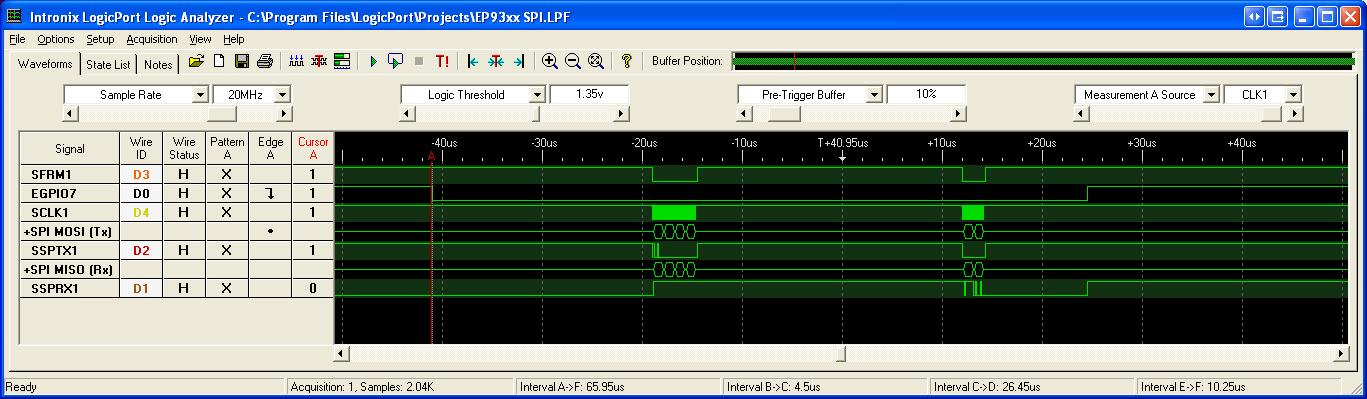
A picture is worth a thousand words... Attached is a logic analyzer capture of the Read-ID command and response from the SPI Flash. EGPIO7 is my chip select to the flash. The first 4 SPI MOSI (Tx) blocks are the 0x90, 0x00, 0x00, 0x00 command to the flash. You will notice that the SFRM line is asserted for those bytes. A bit later are the 2 SPI MISO (Rx) responses from the flash with the ManID/DevID, again with the SFRM line asserted.
If the can_continue stuff worked correctly the second block should be right with the first block.
I'm going to try hacking the spi flash driver to send the command/response as a 6-byte full duplex message to make sure it works.
Regards,
Hartley
-------------- next part --------------
A non-text attachment was scrubbed...
Name: ep93xx_spi.PNG
Type: image/png
Size: 38169 bytes
Desc: ep93xx_spi.PNG
URL: <http://lists.infradead.org/pipermail/linux-arm-kernel/attachments/20100421/4959d367/attachment-0001.png>
PATCH v4 1/2 spi: implemented driver for Cirrus EP93xx SPI controller
Quoted 1 line · H Hartley Sweeten
Same results are your v4 driver. But, I think your on the right track.
Thanks for testing.
Quoted 11 lines
I think the problem is in the
ep93xx_spi_read_writeroutine. That function returns 0 as long as there is still data left in the current transfer. The only time it doesn't return 0, which will cause thecan_continue, is when:if (espi->rx == t->len) { msg->actual_length += t->len; return t->len; }At this point the tx and rx fifos will both be empty, which causes the SSP peripheral to raise the SFRM signal.
True.
Quoted 6 lines
A picture is worth a thousand words... Attached is a logic analyzer capture of the Read-ID command and response from the SPI Flash. EGPIO7 is my chip select to the flash. The first 4 SPI MOSI (Tx) blocks are the
0x90,0x00,0x00,0x00command to the flash. You will notice that the SFRM line is asserted for those bytes. A bit later are the 2 SPI MISO (Rx) responses from the flash with the ManID/DevID, again with the SFRM line asserted.
Yeah, it clearly shows that SFRMOUT is deasserted between transfers :(
I will try to work out some sort of hack which will keep the FIFOs from emptying.
MW
PATCH v4 1/2 spi: implemented driver for Cirrus EP93xx SPI controller
Quoted 26 lines · Mika Westerberg
Quoted 1 line · H Hartley Sweeten
Same results are your v4 driver. But, I think your on the right track.
Thanks for testing.
Quoted 11 lines
I think the problem is in the
ep93xx_spi_read_writeroutine. That function returns 0 as long as there is still data left in the current transfer. The only time it doesn't return 0, which will cause thecan_continue, is when:if (espi->rx == t->len) { msg->actual_length += t->len; return t->len; }At this point the tx and rx fifos will both be empty, which causes the SSP peripheral to raise the SFRM signal.
True.
Quoted 6 lines
A picture is worth a thousand words... Attached is a logic analyzer capture of the Read-ID command and response from the SPI Flash. EGPIO7 is my chip select to the flash. The first 4 SPI MOSI (Tx) blocks are the
0x90,0x00,0x00,0x00command to the flash. You will notice that the SFRM line is asserted for those bytes. A bit later are the 2 SPI MISO (Rx) responses from the flash with the ManID/DevID, again with the SFRM line asserted.
Quoted 6 lines
Yeah, it clearly shows that SFRMOUT is deasserted between transfers :(
I will try to work out some sort of hack which will keep the FIFOs from emptying.
MW
I still have not found time to test this, but I think this is the problem we had we resulted in us using polling mode rather than interrupts. If the spi fifo empties then it will deassert the frame signal. By using polling code we could ensure that the fifos would not drain at the incorrect time. The other solution is to use an externally drivable signal for the frame (such as a gpio), but this is obviously not possible on some existing hardware.
~Ryan
Signature · 7 lines
Bluewater Systems Ltd - ARM Technology Solution Centre Ryan Mallon 5 Amuri Park, 404 Barbadoes St ryan at bluewatersys.com PO Box 13 889, Christchurch 8013 http://www.bluewatersys.com New Zealand Phone: +64 3 3779127 Freecall: Australia 1800 148 751 Fax: +64 3 3779135 USA 1800 261 2934
PATCH v4 1/2 spi: implemented driver for Cirrus EP93xx SPI controller
In reply to H Hartley SweetenQuoted 7 lines · H Hartley Sweeten
Same results are your v4 driver. But, I think your on the right track.
I think the problem is in the
ep93xx_spi_read_writeroutine. That function returns 0 as long as there is still data left in the current transfer. The only time it doesn't return 0, which will cause thecan_continue, is when:
Quoted 7 lines
	if (espi->rx == t->len) {
		msg->actual_length += t->len;
		return t->len;
	}
At this point the tx and rx fifos will both be empty, which causes the SSP peripheral to raise the SFRM signal.
Hi again,
I crafted up next hack. It includes also your priming the FIFO finding (thanks for that). Following patch is against v4 version of the driver.
It performs another read/write after given transfer is finished. I'm hoping that it could make it before SFRMOUT is deasserted.
Could you test this in your setup?
Thanks,
MW
drivers/spi/ep93xx_spi.c +161 -90
@@ -105,6 +105,7 @@ struct ep93xx_spi {int irq;unsigned long min_rate;unsigned long max_rate; +bool continuous;bool running;struct workqueue_struct *wq;struct work_struct msg_work;
@@ -380,6 +381,7 @@ static int ep93xx_spi_transfer(struct spi_device *spi, struct spi_message *msg)struct ep93xx_spi *espi =spi_master_get_devdata (spi->master);struct spi_transfer *t;unsigned long flags; +bool continuous = true;if (!msg || !msg->complete)return -EINVAL ;
@@ -389,9 +391,19 @@ static int ep93xx_spi_transfer(struct spi_device *spi, struct spi_message *msg)if (t->bits_per_word) {if (t->bits_per_word <4 || t->bits_per_word >16 )return -EINVAL ; + continuous = false; } -if (t->speed_hz && t->speed_hz < espi->min_rate) +if (t->speed_hz) { +if (t->speed_hz < espi->min_rate)return -EINVAL ; + continuous = false; + } +if (t->cs_change) { +if (!list_is_last (&t->transfer_list, &msg->transfers)) + continuous = false; + } +if (t->delay_usecs) + continuous = false; }/*
@@ -399,8 +411,11 @@ static int ep93xx_spi_transfer(struct spi_device *spi, struct spi_message *msg)* suitable for us. We use @msg->status to signal whether there was * error in transfer and @msg->state is used to hold pointer to the * current transfer (or %NULL if no active current transfer). +* +* We hold continuation information in @msg->state while it is not +* processed. */ - msg->state =NULL ; + msg->state = (void *)continuous; msg->status =0 ; msg->actual_length =0 ;
@@ -550,6 +565,91 @@ static void ep93xx_spi_process_transfer(struct ep93xx_spi *espi,ep93xx_spi_chip_setup (espi, chip); } +/** +* bits_per_word() - returns bits per word for current message +*/ +static inline int bits_per_word (const struct ep93xx_spi *espi) +{ +struct spi_message *msg = espi->current_msg; +struct spi_transfer *t = msg->state; + +return t->bits_per_word ? t->bits_per_word : msg->spi->bits_per_word; +} + +static void ep93xx_do_write (struct ep93xx_spi *espi,struct spi_transfer *t) +{ +if (bits_per_word (espi) >8 ) { +u16 tx_val =0 ; + +if (t->tx_buf) + tx_val = ((u16 *)t->tx_buf)[espi->tx]; +ep93xx_spi_write_u16 (espi,SSPDR , tx_val); + espi->tx +=sizeof (tx_val); + }else { +u8 tx_val =0 ; + +if (t->tx_buf) + tx_val = ((u8 *)t->tx_buf)[espi->tx]; +ep93xx_spi_write_u8 (espi,SSPDR , tx_val); + espi->tx +=sizeof (tx_val); + } +} + +static void ep93xx_do_read (struct ep93xx_spi *espi,struct spi_transfer *t) +{ +if (bits_per_word (espi) >8 ) { +u16 rx_val; + + rx_val =ep93xx_spi_read_u16 (espi,SSPDR ); +if (t->rx_buf) + ((u16 *)t->rx_buf)[espi->rx] = rx_val; + espi->rx +=sizeof (rx_val); + }else { +u8 rx_val; + + rx_val =ep93xx_spi_read_u8 (espi,SSPDR ); +if (t->rx_buf) + ((u8 *)t->rx_buf)[espi->rx] = rx_val; + espi->rx +=sizeof (rx_val); + } +} + +/** +* ep93xx_spi_read_write() - perform next RX/TX transfer +* @espi: ep93xx SPI controller struct +* +* This function transfers next bytes (or half-words) to/from RX/TX FIFOs. If +* called several times, the whole transfer will be completed. Returns %0 when +* current transfer was not yet completed otherwise length of the transfer +* (>%0). When this function is finished, RX FIFO should be empty and TX FIFO +* should be full. +*/ +static int ep93xx_spi_read_write (struct ep93xx_spi *espi) +{ +struct spi_message *msg = espi->current_msg; +struct spi_transfer *t = msg->state; + +/* read as long as RX FIFO has frames in it */ +while ((ep93xx_spi_read_u8 (espi,SSPSR ) &SSPSR_RNE )) { +ep93xx_do_read (espi, t); + espi->fifo_level--; + } + +/* write as long as TX FIFO has room */ +while (espi->fifo_level <SPI_FIFO_SIZE && espi->tx < t->len) { +ep93xx_do_write (espi, t); + espi->fifo_level++; + } + +if (espi->rx == t->len) { + msg->actual_length += t->len; +return t->len; + } + +return 0 ; +} + +/* * ep93xx_spi_process_message() - process one SPI message * @espi: ep93xx SPI controller struct
@@ -569,6 +669,8 @@ static void ep93xx_spi_process_message(struct ep93xx_spi *espi,struct spi_transfer *t;int err; + espi->continuous = (bool )msg->state; +/* * Enable the SPI controller and its clock. */
@@ -606,12 +708,43 @@ static void ep93xx_spi_process_message(struct ep93xx_spi *espi,ep93xx_spi_chip_setup (espi,spi_get_ctldata (msg->spi));ep93xx_spi_select_device (espi, msg->spi); -list_for_each_entry (t, &msg->transfers, transfer_list) { -ep93xx_spi_process_transfer (espi, msg, t); -if (msg->status) -break ; +if (espi->continuous) { +/* +* We can transfer all the transfers continuously. +*/ + espi->rx =0 ; + espi->tx =0 ; + msg->state = list_first_entry(&msg->transfers, struct spi_transfer, + transfer_list); + +/* prime the first transfer */ +if (ep93xx_spi_read_write (espi)) { +/* +* Transfer was completed. Pick next one and continue +* if necessary. +*/ + t = msg->state; +if (list_is_last (&t->transfer_list, &msg->transfers)) + goto done; + + espi->rx =0 ; + espi->tx =0 ; + msg->state =list_entry (t->transfer_list.next, + struct spi_transfer, + transfer_list); + } + +ep93xx_spi_enable_interrupts (espi); +wait_for_completion (&espi->wait); + }else { +list_for_each_entry (t, &msg->transfers, transfer_list) { +ep93xx_spi_process_transfer (espi, msg, t); +if (msg->status) +break ; + } } +done:/* * Now the whole message is transferred (or failed for some reason). We * deselect the device and disable the SPI controller.
@@ -667,90 +800,6 @@ static void ep93xx_spi_work(struct work_struct *work) }/** -* bits_per_word() - returns bits per word for current message -*/ -static inline int bits_per_word (const struct ep93xx_spi *espi) -{ -struct spi_message *msg = espi->current_msg; -struct spi_transfer *t = msg->state; - -return t->bits_per_word ? t->bits_per_word : msg->spi->bits_per_word; -} - -static void ep93xx_do_write (struct ep93xx_spi *espi,struct spi_transfer *t) -{ -if (bits_per_word (espi) >8 ) { -u16 tx_val =0 ; - -if (t->tx_buf) - tx_val = ((u16 *)t->tx_buf)[espi->tx]; -ep93xx_spi_write_u16 (espi,SSPDR , tx_val); - espi->tx +=sizeof (tx_val); - }else { -u8 tx_val =0 ; - -if (t->tx_buf) - tx_val = ((u8 *)t->tx_buf)[espi->tx]; -ep93xx_spi_write_u8 (espi,SSPDR , tx_val); - espi->tx +=sizeof (tx_val); - } -} - -static void ep93xx_do_read (struct ep93xx_spi *espi,struct spi_transfer *t) -{ -if (bits_per_word (espi) >8 ) { -u16 rx_val; - - rx_val =ep93xx_spi_read_u16 (espi,SSPDR ); -if (t->rx_buf) - ((u16 *)t->rx_buf)[espi->rx] = rx_val; - espi->rx +=sizeof (rx_val); - }else { -u8 rx_val; - - rx_val =ep93xx_spi_read_u8 (espi,SSPDR ); -if (t->rx_buf) - ((u8 *)t->rx_buf)[espi->rx] = rx_val; - espi->rx +=sizeof (rx_val); - } -} - -/** -* ep93xx_spi_read_write() - perform next RX/TX transfer -* @espi: ep93xx SPI controller struct -* -* This function transfers next bytes (or half-words) to/from RX/TX FIFOs. If -* called several times, the whole transfer will be completed. Returns %0 when -* current transfer was not yet completed otherwise length of the transfer -* (>%0). When this function is finished, RX FIFO should be empty and TX FIFO -* should be full. -*/ -static int ep93xx_spi_read_write (struct ep93xx_spi *espi) -{ -struct spi_message *msg = espi->current_msg; -struct spi_transfer *t = msg->state; - -/* read as long as RX FIFO has frames in it */ -while ((ep93xx_spi_read_u8 (espi,SSPSR ) &SSPSR_RNE )) { -ep93xx_do_read (espi, t); - espi->fifo_level--; - } - -/* write as long as TX FIFO has room */ -while (espi->fifo_level <SPI_FIFO_SIZE && espi->tx < t->len) { -ep93xx_do_write (espi, t); - espi->fifo_level++; - } - -if (espi->rx == t->len) { - msg->actual_length += t->len; -return t->len; - } - -return 0 ; -} - -/** * ep93xx_spi_interrupt() - SPI interrupt handler * @irq: IRQ number (not used) * @dev_id: pointer to EP93xx controller struct
@@ -792,6 +841,27 @@ static irqreturn_t ep93xx_spi_interrupt(int irq, void *dev_id)* interrupt then. */ return IRQ_HANDLED ; + }else { +struct spi_message *msg = espi->current_msg; +struct spi_transfer *t = msg->state; + +if (!espi->continuous) + goto done; + +if (!list_is_last (&t->transfer_list, &msg->transfers)) { +/* +* Pick next transfer and refill the FIFO. +*/ + msg->state =list_entry (t->transfer_list.next, + struct spi_transfer, + transfer_list); + espi->rx =0 ; + espi->tx =0 ; + +ep93xx_spi_read_write (espi); +return IRQ_HANDLED ; + } +/* we are done here */ } }
@@ -800,6 +870,7 @@ static irqreturn_t ep93xx_spi_interrupt(int irq, void *dev_id)* any case we disable interrupts and notify the worker to handle * any post-processing of the message. */ +done:ep93xx_spi_disable_interrupts (espi);complete (&espi->wait);return IRQ_HANDLED ;
PATCH v4 1/2 spi: implemented driver for Cirrus EP93xx SPI controller
Quoted 13 lines · Mika Westerberg
Quoted 12 lines · H Hartley Sweeten
Same results are your v4 driver. But, I think your on the right track.
I think the problem is in the
ep93xx_spi_read_writeroutine. That function returns 0 as long as there is still data left in the current transfer. The only time it doesn't return 0, which will cause thecan_continue, is when:if (espi->rx == t->len) { msg->actual_length += t->len; return t->len; }
Quoted 7 lines
Quoted 2 lines
At this point the tx and rx fifos will both be empty, which causes the SSP peripheral to raise the SFRM signal.
Hi again,
I crafted up next hack. It includes also your priming the FIFO finding (thanks for that).
Great!
Quoted 6 lines
Following patch is against v4 version of the driver.
It performs another read/write after given transfer is finished. I'm hoping that it could make it before SFRMOUT is deasserted.
Could you test this in your setup?
Same results.
I hacked your driver to allow me to toggle a gpio when the interrupt routine starts and exits.
I captured the 4 byte write/2 byte read caused by the spi_write_then_read in the sst25l driver when it does the Read-ID command. The chip select goes low followed by the first 4 byte transfer of the message due to the fifo's getting primed. This transfer actually doesn't finish since the rx data has not been received. So the interrupts just get enabled as normal.
The data starts transferring when the first byte is placed in the tx fifo. It takes about 4.45us to send/receive the 4 bytes. Approximately 15.9us after the last byte has been received the interrupt routine starts. It then takes about 5.7us for the second 2 byte transfer to start. So there is a total of about 21.6us between the two transfers where SFRM is deasserted.
Let me know if you want the picture posted.
[snip]
Quoted 57 lines
drivers/spi/ep93xx_spi.c +39
-4+/** +* ep93xx_spi_read_write() - perform next RX/TX transfer +* @espi: ep93xx SPI controller struct +* +* This function transfers next bytes (or half-words) to/from RX/TX FIFOs. If +* called several times, the whole transfer will be completed. Returns %0 when +* current transfer was not yet completed otherwise length of the transfer +* (>%0). When this function is finished, RX FIFO should be empty and TX FIFO +* should be full. +*/ +static int ep93xx_spi_read_write (struct ep93xx_spi *espi) +{ +struct spi_message *msg = espi->current_msg; +struct spi_transfer *t = msg->state; + +/* read as long as RX FIFO has frames in it */ +while ((ep93xx_spi_read_u8 (espi,SSPSR ) &SSPSR_RNE )) { +ep93xx_do_read (espi, t); + espi->fifo_level--; + } + +/* write as long as TX FIFO has room */ +while (espi->fifo_level <SPI_FIFO_SIZE && espi->tx < t->len) { +ep93xx_do_write (espi, t); + espi->fifo_level++; + } + +if (espi->rx == t->len) { + msg->actual_length += t->len; +return t->len; + } + +return 0 ; +} + +/* * ep93xx_spi_process_message() - process one SPI message * @espi: ep93xx SPI controller struct @@ -569,6 +669,8 @@ static void ep93xx_spi_process_message(struct ep93xx_spi *espi,struct spi_transfer *t;int err; + espi->continuous = (bool )msg->state; +/* * Enable the SPI controller and its clock. */ @@ -606,12 +708,43 @@ static void ep93xx_spi_process_message(struct ep93xx_spi *espi,ep93xx_spi_chip_setup (espi,spi_get_ctldata (msg->spi));ep93xx_spi_select_device (espi, msg->spi); -list_for_each_entry (t, &msg->transfers, transfer_list) { -ep93xx_spi_process_transfer (espi, msg, t); -if (msg->status) -break ; +if (espi->continuous) {
drivers/spi/ep93xx_spi.c static void ep93xx_spi_process_message(struct ep93xx_spi *espi, · line 721
Quoted 10 lines
drivers/spi/ep93xx_spi.c +10
-0+/* +* We can transfer all the transfers continuously. +*/ + espi->rx =0 ; + espi->tx =0 ; + msg->state = list_first_entry(&msg->transfers, struct spi_transfer, + transfer_list); + +/* prime the first transfer */ +if (ep93xx_spi_read_write (espi)) {
On the first read/write for a transfer this condition can never succeed.
The ep93xx_spi_read_write function first empties the rx fifo then fills the tx fifo. Putting any data in the tx fifo means that you are going to have to come back to empty the rx fifo.
So, the block below never executes.
Quoted 7 lines
drivers/spi/ep93xx_spi.c +7
-0+/* +* Transfer was completed. Pick next one and continue +* if necessary. +*/ + t = msg->state; +if (list_is_last (&t->transfer_list, &msg->transfers)) + goto done;
drivers/spi/ep93xx_spi.c static void ep93xx_spi_process_message(struct ep93xx_spi *espi, · line 738
Quoted 10 lines
drivers/spi/ep93xx_spi.c +10
-0+ + espi->rx =0 ; + espi->tx =0 ; + msg->state =list_entry (t->transfer_list.next, + struct spi_transfer, + transfer_list); + } + +ep93xx_spi_enable_interrupts (espi); +wait_for_completion (&espi->wait);
Even if the first read/write did succeed you are not starting the second transfer. This is just passing the operation off to the interrupt routine using the second transfer in the message.
[snip]
Quoted 18 lines
drivers/spi/ep93xx_spi.c +10
-1-/** * ep93xx_spi_interrupt() - SPI interrupt handler * @irq: IRQ number (not used) * @dev_id: pointer to EP93xx controller struct @@ -792,6 +841,27 @@ static irqreturn_t ep93xx_spi_interrupt(int irq, void *dev_id)* interrupt then. */ return IRQ_HANDLED ; + }else { +struct spi_message *msg = espi->current_msg; +struct spi_transfer *t = msg->state; + +if (!espi->continuous) + goto done; + +if (!list_is_last (&t->transfer_list, &msg->transfers)) { +/* +* Pick next transfer and refill the FIFO.
drivers/spi/ep93xx_spi.c static irqreturn_t ep93xx_spi_interrupt(int irq, void *dev_id) · line 863
Quoted 10 lines
drivers/spi/ep93xx_spi.c +10
-0+*/ + msg->state =list_entry (t->transfer_list.next, + struct spi_transfer, + transfer_list); + espi->rx =0 ; + espi->tx =0 ; + +ep93xx_spi_read_write (espi); +return IRQ_HANDLED ; + }
Here the N transfer has been completed and we are trying to continue with the N+1 transfer. This should work but I need to figure out a way to capture it with my logic analyzer. The only problem is if the N transfer is complete that means the tx and rx fifos are empty so the SFRM signal is going to be deasserted. The N+1 transfer might start really soon after but there will still be a glitch in the SFRM signal.
drivers/spi/ep93xx_spi.c static irqreturn_t ep93xx_spi_interrupt(int irq, void *dev_id) · line 864
Quoted 1 line
drivers/spi/ep93xx_spi.c +1
-0+/* we are done here */
Regards,
Hartley
PATCH v4 1/2 spi: implemented driver for Cirrus EP93xx SPI controller
Quoted 4 lines · H Hartley Sweeten
Quoted 1 line · Mika Westerberg
Could you test this in your setup?
Same results.
OK. thanks for testing.
Quoted 9 lines
I hacked your driver to allow me to toggle a gpio when the interrupt routine starts and exits.
I captured the 4 byte write/2 byte read caused by the
spi_write_then_readin the sst25l driver when it does the Read-ID command. The chip select goes low followed by the first 4 byte transfer of the message due to the fifo's getting primed. This transfer actually doesn't finish since the rx data has not been received. So the interrupts just get enabled as normal.
Quoted 5 lines
The data starts transferring when the first byte is placed in the tx fifo. It takes about 4.45us to send/receive the 4 bytes. Approximately 15.9us after the last byte has been received the interrupt routine starts. It then takes about 5.7us for the second 2 byte transfer to start. So there is a total of about 21.6us between the two transfers where SFRM is deasserted.
If I understand this correctly, for this particular message it might have worked if the priming is not done? What I mean is that if we start the transfer in interrupt handler and after the transfer is finished, immediately continue with the next one (like in the patch) could it make SFRM to stay asserted (at least shorten the gap)?
Quoted 34 lines
Quoted 21 lines
/*
*ep93xx_spi_process_message()- process one SPI message
* @espi: ep93xx SPI controller structdrivers/spi/ep93xx_spi.c +3
-4@@ -569,6 +669,8 @@ static void ep93xx_spi_process_message(struct ep93xx_spi *espi,struct spi_transfer *t;int err; + espi->continuous = (bool )msg->state; +/* * Enable the SPI controller and its clock. */ @@ -606,12 +708,43 @@ static void ep93xx_spi_process_message(struct ep93xx_spi *espi,ep93xx_spi_chip_setup (espi,spi_get_ctldata (msg->spi));ep93xx_spi_select_device (espi, msg->spi); -list_for_each_entry (t, &msg->transfers, transfer_list) { -ep93xx_spi_process_transfer (espi, msg, t); -if (msg->status) -break ; +if (espi->continuous) {drivers/spi/ep93xx_spi.c static void ep93xx_spi_process_message(struct ep93xx_spi *espi, · line 721
Quoted 10 lines
drivers/spi/ep93xx_spi.c +10
-0+/* +* We can transfer all the transfers continuously. +*/ + espi->rx =0 ; + espi->tx =0 ; + msg->state = list_first_entry(&msg->transfers, struct spi_transfer, + transfer_list); + +/* prime the first transfer */ +if (ep93xx_spi_read_write (espi)) {On the first read/write for a transfer this condition can never succeed.
Quoted 5 lines
The
ep93xx_spi_read_writefunction first empties the rx fifo then fills the tx fifo. Putting any data in the tx fifo means that you are going to have to come back to empty the rx fifo.So, the block below never executes.
I also figured that out after I sent the hack to you...
Quoted 13 lines
Quoted 13 lines
drivers/spi/ep93xx_spi.c +13
-0+/* +* Transfer was completed. Pick next one and continue +* if necessary. +*/ + t = msg->state; +if (list_is_last (&t->transfer_list, &msg->transfers)) + goto done; + + espi->rx =0 ; + espi->tx =0 ; + msg->state =list_entry (t->transfer_list.next, + struct spi_transfer, + transfer_list);
Quoted 8 lines
drivers/spi/ep93xx_spi.c static void ep93xx_spi_process_message(struct ep93xx_spi *espi, · line 738
Quoted 4 lines
drivers/spi/ep93xx_spi.c +4
-0+ } + +ep93xx_spi_enable_interrupts (espi); +wait_for_completion (&espi->wait);Even if the first read/write did succeed you are not starting the second transfer. This is just passing the operation off to the interrupt routine using the second transfer in the message.
Right.
Quoted 27 lines
Quoted 27 lines
drivers/spi/ep93xx_spi.c +19
-1-/** * ep93xx_spi_interrupt() - SPI interrupt handler * @irq: IRQ number (not used) * @dev_id: pointer to EP93xx controller struct @@ -792,6 +841,27 @@ static irqreturn_t ep93xx_spi_interrupt(int irq, void *dev_id)* interrupt then. */ return IRQ_HANDLED ; + }else { +struct spi_message *msg = espi->current_msg; +struct spi_transfer *t = msg->state; + +if (!espi->continuous) + goto done; + +if (!list_is_last (&t->transfer_list, &msg->transfers)) { +/* +* Pick next transfer and refill the FIFO. +*/ + msg->state =list_entry (t->transfer_list.next, + struct spi_transfer, + transfer_list); + espi->rx =0 ; + espi->tx =0 ; + +ep93xx_spi_read_write (espi); +return IRQ_HANDLED ;
Quoted 8 lines
Review static irqreturn_t ep93xx_spi_interrupt(int irq, void *dev_id) · line 863
Quoted 1 line
(quoted diff) +1
-0+ }Here the N transfer has been completed and we are trying to continue with the N+1 transfer. This should work but I need to figure out a way to capture it with my logic analyzer. The only problem is if the N transfer is complete that means the tx and rx fifos are empty so the SFRM signal is going to be deasserted. The N+1 transfer might start really soon after but there will still be a glitch in the SFRM signal.
It would be great if you manage to capture it with the logic analyzer. Even if we get small glitch it means that we are going into right direction (then we just need to figure out how to keep the FIFO from emptying).
Other alternative is to use polling mode in v3 of the driver and see if it works better.
Thanks,
MW
PATCH v4 1/2 spi: implemented driver for Cirrus EP93xx SPI controller
Quoted 23 lines · Mika Westerberg
Quoted 4 lines · H Hartley Sweeten
Quoted 1 line · Mika Westerberg
Could you test this in your setup?
Same results.
OK. thanks for testing.
Quoted 9 lines
I hacked your driver to allow me to toggle a gpio when the interrupt routine starts and exits.
I captured the 4 byte write/2 byte read caused by the
spi_write_then_readin the sst25l driver when it does the Read-ID command. The chip select goes low followed by the first 4 byte transfer of the message due to the fifo's getting primed. This transfer actually doesn't finish since the rx data has not been received. So the interrupts just get enabled as normal.Quoted 5 lines
The data starts transferring when the first byte is placed in the tx fifo. It takes about 4.45us to send/receive the 4 bytes. Approximately 15.9us after the last byte has been received the interrupt routine starts. It then takes about 5.7us for the second 2 byte transfer to start. So there is a total of about 21.6us between the two transfers where SFRM is deasserted.
Quoted 4 lines
If I understand this correctly, for this particular message it might have worked if the priming is not done? What I mean is that if we start the transfer in interrupt handler and after the transfer is finished, immediately continue with the next one (like in the patch) could it make SFRM to stay asserted (at least shorten the gap)?
Hmmm.. It might have. I didn't test that before I started hacking...
Quoted 102 lines
Quoted 34 lines
Quoted 21 lines
/*
*ep93xx_spi_process_message()- process one SPI message
* @espi: ep93xx SPI controller structdrivers/spi/ep93xx_spi.c +3
-4@@ -569,6 +669,8 @@ static void ep93xx_spi_process_message(struct ep93xx_spi *espi,struct spi_transfer *t;int err; + espi->continuous = (bool )msg->state; +/* * Enable the SPI controller and its clock. */ @@ -606,12 +708,43 @@ static void ep93xx_spi_process_message(struct ep93xx_spi *espi,ep93xx_spi_chip_setup (espi,spi_get_ctldata (msg->spi));ep93xx_spi_select_device (espi, msg->spi); -list_for_each_entry (t, &msg->transfers, transfer_list) { -ep93xx_spi_process_transfer (espi, msg, t); -if (msg->status) -break ; +if (espi->continuous) {drivers/spi/ep93xx_spi.c static void ep93xx_spi_process_message(struct ep93xx_spi *espi, · line 721
Quoted 10 lines
drivers/spi/ep93xx_spi.c +10
-0+/* +* We can transfer all the transfers continuously. +*/ + espi->rx =0 ; + espi->tx =0 ; + msg->state = list_first_entry(&msg->transfers, struct spi_transfer, + transfer_list); + +/* prime the first transfer */ +if (ep93xx_spi_read_write (espi)) {On the first read/write for a transfer this condition can never succeed.
Quoted 5 lines
The
ep93xx_spi_read_writefunction first empties the rx fifo then fills the tx fifo. Putting any data in the tx fifo means that you are going to have to come back to empty the rx fifo.So, the block below never executes.
I also figured that out after I sent the hack to you...
Quoted 13 lines
Quoted 13 lines
drivers/spi/ep93xx_spi.c +13
-0+/* +* Transfer was completed. Pick next one and continue +* if necessary. +*/ + t = msg->state; +if (list_is_last (&t->transfer_list, &msg->transfers)) + goto done; + + espi->rx =0 ; + espi->tx =0 ; + msg->state =list_entry (t->transfer_list.next, + struct spi_transfer, + transfer_list);Quoted 8 lines
drivers/spi/ep93xx_spi.c static void ep93xx_spi_process_message(struct ep93xx_spi *espi, · line 738
Quoted 4 lines
drivers/spi/ep93xx_spi.c +4
-0+ } + +ep93xx_spi_enable_interrupts (espi); +wait_for_completion (&espi->wait);Even if the first read/write did succeed you are not starting the second transfer. This is just passing the operation off to the interrupt routine using the second transfer in the message.
Right.
Quoted 27 lines
Quoted 27 lines
drivers/spi/ep93xx_spi.c +19
-1-/** * ep93xx_spi_interrupt() - SPI interrupt handler * @irq: IRQ number (not used) * @dev_id: pointer to EP93xx controller struct @@ -792,6 +841,27 @@ static irqreturn_t ep93xx_spi_interrupt(int irq, void *dev_id)* interrupt then. */ return IRQ_HANDLED ; + }else { +struct spi_message *msg = espi->current_msg; +struct spi_transfer *t = msg->state; + +if (!espi->continuous) + goto done; + +if (!list_is_last (&t->transfer_list, &msg->transfers)) { +/* +* Pick next transfer and refill the FIFO. +*/ + msg->state =list_entry (t->transfer_list.next, + struct spi_transfer, + transfer_list); + espi->rx =0 ; + espi->tx =0 ; + +ep93xx_spi_read_write (espi); +return IRQ_HANDLED ;Quoted 8 lines
Review static irqreturn_t ep93xx_spi_interrupt(int irq, void *dev_id) · line 863
Quoted 1 line
(quoted diff) +1
-0+ }Here the N transfer has been completed and we are trying to continue with the N+1 transfer. This should work but I need to figure out a way to capture it with my logic analyzer. The only problem is if the N transfer is complete that means the tx and rx fifos are empty so the SFRM signal is going to be deasserted. The N+1 transfer might start really soon after but there will still be a glitch in the SFRM signal.
Quoted 4 lines
It would be great if you manage to capture it with the logic analyzer. Even if we get small glitch it means that we are going into right direction (then we just need to figure out how to keep the FIFO from emptying).
I still haven't been able to catch this.
Quoted 2 lines
Other alternative is to use polling mode in v3 of the driver and see if it works better.
I think the interrupt mode is still the better way to go.
I was able to hack your driver to keep the continuous transfer going in a multi-transaction message. Unfortunately I don't have an easy way to generate a diff to send the necessary patch. The hack does work with the sst25l driver. It correctly detects the end of the first 4 byte transfer and immediately chains in the second 2 byte transfer. It ends up looking like this:
WWWWwwIRRRRFCRRFi
Where:
'W' is a write for the current transfer
'w' is a write for the next transfer
'I' is the start of the interrupt
'R' is a read for the current transfer
'F' is the completion of the current transfer
'C' is the chain to the next transfer
'i' is the end of the interrupt
So, at the start of the message the fifo's get primed with the 4+2 of the entire message. Then interrupts are enabled. When the interrupt occurs the first 4 byte transfer is read. When that completes the interrupt routine chains to the next transfer and then reads the next 2 bytes. When that completes the message is finished so the interrupts get disabled and espi->wait is completed.
Unfortunately is seems to break the mmc_spi driver for some reason. I still haven't figured out why.
If you can post your latest updates to the v4 driver I will create a patch against it so others can test this also.
Regards,
Hartley
PATCH v4 1/2 spi: implemented driver for Cirrus EP93xx SPI controller
Quoted 6 lines · H Hartley Sweeten
I was able to hack your driver to keep the continuous transfer going in a multi-transaction message. Unfortunately I don't have an easy way to generate a diff to send the necessary patch. The hack does work with the sst25l driver. It correctly detects the end of the first 4 byte transfer and immediately chains in the second 2 byte transfer. It ends up looking like this:
Sorry for the length of this message. I want to give as much detail as possible so hopefully someone has an idea on this... ;-)
I modified my hack a bit so that the message transactions are dumped at the end of all transactions in the message. I'm using Mika's hack to determine if the message could be continuous then displaying a debug about the message. By setting the 'continuous' flag to false right after that it disables my hack to make the transaction continuous so the message gets processed in the normal fashion.
The debug output decodes as:
S a transfer specific setting was made (in ep93xx_spi_process_transfer)
NOTE: I have never actually seen this happen.
  +   start of a transfer (in ep93xx_spi_process_fransfer).
  -   end of a transfer (in ep93xx_spi_process_fransfer).
  I   entered ep93xx_spi_interrupt
  I   exited ep93xx_spi_interrupt
  C   chained to the next transfer in a continuous transaction
  nR  the n number of fifo reads (in ep93xx_spi_read_write) or just 'R' if
only 1 byte is read; !8R if more than 8 reads were done (should never happen).
nW the n number of fifo writes (in ep93xx_spi_read_write) or just 'W' if
only 1 byte is written; !8W if more than 8 writes were done (should never happen).
nw the n number of fifo writes from the next transfer (in
ep93xx_spi_read_write) or just 'w' if only 1 byte is written; !8w if more than 8 writes were done (should never happen). NOTE: this only occurs with doing a continuous transaction.
F the transfer is complete ((espi->rx == t->len) in ep93xx_spi_read_write)
For the sst25l driver, with continuous transactions disabled, I get this for the Read-ID command (this is with SPI_DEBUG and MMC_DEBUG enabled):
spi spi0.0: setup mode 3, 8 bits/w, 20000000 Hz max --> 0 ep93xx-spi ep93xx-spi.0: 2 part continuous transaction (6 bytes) for sst25l ep93xx-spi ep93xx-spi.0: Done: +4WI4RFi-+2WI2RFi-
sst25l spi0.0: sst25lf040a (512 KiB)
Creating 3 MTD partitions on "SPI Flash":
0x000000000000-0x000000001000 : "SPI bootstrap" 0x000000001000-0x000000002000 : "Bootstrap config" 0x000000002000-0x000000080000 : "unallocated"
ep93xx-spi ep93xx-spi.0: registered child spi0.0
With continuous transactions enabled its:
spi spi0.0: setup mode 3, 8 bits/w, 20000000 Hz max --> 0 ep93xx-spi ep93xx-spi.0: 2 part continuous transaction (6 bytes) for sst25l ep93xx-spi ep93xx-spi.0: Done: 4W2wI4RFC2RFi
sst25l spi0.0: sst25lf040a (512 KiB)
Creating 3 MTD partitions on "SPI Flash":
0x000000000000-0x000000001000 : "SPI bootstrap" 0x000000001000-0x000000002000 : "Bootstrap config" 0x000000002000-0x000000080000 : "unallocated"
ep93xx-spi ep93xx-spi.0: registered child spi0.0
The '+' and '-' are missing since the transfer is started in ep93xx_spi_process_messange and then handed off to the interrupt routine without first calling ep93xx_spi_process_transfer. You can see the 2 bytes of the second transfer getting chained to the first 4 bytes during the priming of the fifo. Then after the interrupt the first 4 reads finish the first transaction. The next transaction is then chained in and also finishes (2 reads) then the interrupt completes. Message done!
With the mmc_spi driver the output is WAY to long to post. But, with continuous transactions disabled the card works fine. With continuous transactions enabled it doesn't for some reason.
I have looked over the output a number of times and it appears the continuous transfer works correctly. There are 3 that happen when the mmc_spi driver has the spi clock set to 400000 Hz max, I believe this is while the upper layers are detecting/configuring the card. One happens after a CMD10 and is a "mmc_spi: read block, 16 bytes" and is a 16+2 byte message. This is followed by a CMD9 then another "mmc_spi: read block, 16 bytes" which is another 16+2 byte message. Then there is a CMD55 and a CMD51. The CMD51 does a 9 byte message then a 1 byte message followed by a "mmc_spi: read block, 8 bytes". That's followed by 4 separate 1 byte messages then an 8+2 byte message. All of these n+m messages appear to work fine as a continuous transfer.
Shortly after this the following is output:
mmc0: new SD card on SPI
mmcblk0: mmc0:0000 S064B 60.6 MiB (ro)
mmcblk0:
Right after that there is a CMD18. I think this is where the upper layer is trying to read the partition table. This is where it getting interesting compared to the non- continuous transfer.
mmcblk0: mmc0:0000 S064B 60.6 MiB (ro)
mmcblk0:
mmc0: starting CMD18 arg 00000000 flags 000000b5
mmc0:     blksz 512 blocks 8 flags 00000200 tsac 100 ms nsac 10000
mmc0:     CMD12 arg 00000000 flags 0000049d
mmc_spi spi0.1:   mmc_spi: CMD18, resp R1
ep93xx-spi ep93xx-spi.0: 1 part transaction (9 bytes) for mmc_spi
ep93xx-spi ep93xx-spi.0: Done: +8WI8RWiIRFi-
ep93xx-spi ep93xx-spi.0: 1 part transaction (1 byte) for mmc_spi
ep93xx-spi ep93xx-spi.0: Done: +WIRFi-
mmc_spi spi0.1:     mmc_spi: read block, 512 bytes
ep93xx-spi ep93xx-spi.0: 1 part transaction (1 byte) for mmc_spi
ep93xx-spi ep93xx-spi.0: Done: +WIRFi-
ep93xx-spi ep93xx-spi.0: 1 part transaction (1 byte) for mmc_spi
ep93xx-spi ep93xx-spi.0: Done: +WIRFi-
ep93xx-spi ep93xx-spi.0: 1 part transaction (1 byte) for mmc_spi
ep93xx-spi ep93xx-spi.0: Done: +WIRFi-
ep93xx-spi ep93xx-spi.0: 1 part transaction (1 byte) for mmc_spi
ep93xx-spi ep93xx-spi.0: Done: +WIRFi-
ep93xx-spi ep93xx-spi.0: 3 part continuous transaction (515 bytes) for mmc_spi
ep93xx-spi ep93xx-spi.0: Done: 8WI8R8WiI8R8WiI8R8WiI8R8WiI8R8WiI8R8WiI8R8Wi
					 I8R8WiI8R8WiI8R8WiI8R8WiI8R8WiI8R8WiI8R8Wi
                               I8R8WiI8R8WiI8R8WiI8R8WiI8R8WiI8R8WiI8R8Wi
					 I8R8WiI8R8WiI8R8WiI8R8WiI8R8WiI8R8WiI8R8Wi
					 I8R8WiI8R8WiI8R8WiI8R8WiI8R8WiI8R8WiI8R8Wi
					 I8R8WiI8R8WiI8R8WiI8R8WiI8R8WiI8R8WiI8R8Wi
					 I8R8WiI8R8WiI8R8WiI8R8WiI8R8WiI8R8WiI8R8Wi
					 I8R8WiI8R8WiI8R8WiI8R8WiI8R8WiI8R8WiI8R8Wi
					 I8R8WiI8R8WiI8R8WiI8R8WiI8R8WiI8R8WiI8R8Wi
					 I8R2wFC2RwFCiIRFi
mmc_spi spi0.1: mmc_spi: read block, 512 bytes
ep93xx-spi ep93xx-spi.0: 1 part transaction (1 byte) for mmc_spi ep93xx-spi ep93xx-spi.0: Done: +WIRFi-
ep93xx-spi ep93xx-spi.0: 1 part transaction (1 byte) for mmc_spi ep93xx-spi ep93xx-spi.0: Done: +WIRFi-
ep93xx-spi ep93xx-spi.0: 3 part continuous transaction (515 bytes) for mmc_spi ep93xx-spi ep93xx-spi.0: Done: 8WI8R8WiI8R8WiI8R8WiI8R8WiI8R8WiI8R8WiI8R8Wi
					 I8R8WiI8R8WiI8R8WiI8R8WiI8R8WiI8R8WiI8R8Wi
					 I8R8WiI8R8WiI8R8WiI8R8WiI8R8WiI8R8WiI8R8Wi
					 I8R8WiI8R8WiI8R8WiI8R8WiI8R8WiI8R8WiI8R8Wi
					 I8R8WiI8R8WiI8R8WiI8R8WiI8R8WiI8R8WiI8R8Wi
					 I8R8WiI8R8WiI8R8WiI8R8WiI8R8WiI8R8WiI8R8Wi
					 I8R8WiI8R8WiI8R8WiI8R8WiI8R8WiI8R8WiI8R8Wi
					 I8R8WiI8R8WiI8R8WiI8R8WiI8R8WiI8R8WiI8R8Wi
					 I8R8WiI8R8WiI8R8WiI8R8WiI8R8WiI8R8WiI8R8Wi
					 I8R2wFC2RwFCiIRFi
mmc_spi spi0.1: read - crc error: crc_val=0x0000, computed=0x8258 len=512
mmc_spi spi0.1: read status -84
mmc_spi spi0.1:   mmc_spi: CMD12, resp R1B
ep93xx-spi ep93xx-spi.0: 1 part transaction (29 bytes) for mmc_spi
ep93xx-spi ep93xx-spi.0: Done: +8WI8R8WiI8R8WiI8R5WiI5RFi-
mmc_spi spi0.1: setup mode 3, 8 bits/w, 20000000 Hz max --> 0
mmc0: req done (CMD18): 0: 00000000 00000000 00000000 00000000
mmc0:     512 bytes transferred: -84
mmc0:     (CMD12): 0: 00000000 00000000 00000000 00000000
mmcblk0: retrying using single block read
At this point everything just goes nuts. There are a bunch of CMD17 then CMD13.
mmc0: starting CMD17 arg 00000000 flags 000000b5
mmc0:     blksz 512 blocks 1 flags 00000200 tsac 100 ms nsac 10000
mmc_spi spi0.1:   mmc_spi: CMD17, resp R1
ep93xx-spi ep93xx-spi.0: 1 part transaction (9 bytes) for mmc_spi
ep93xx-spi ep93xx-spi.0: Done: +8WI8RWiIRFi-
mmc_spi spi0.1:   ... CMD17 response SPI_R1: resp 0004 00000000
mmc_spi spi0.1: setup mode 3, 8 bits/w, 20000000 Hz max --> 0
mmc0: req done (CMD17): -38: 00000004 00000000 00000000 00000000
mmc0:     0 bytes transferred: 0
mmc0: starting CMD13 arg 00000000 flags 00000195
mmc_spi spi0.1:   mmc_spi: CMD13, resp R2/R5
ep93xx-spi ep93xx-spi.0: 1 part transaction (18 bytes) for mmc_spi
ep93xx-spi ep93xx-spi.0: Done: +8WI8R8WiI8R2WiI2RFi-
mmc_spi spi0.1:   ... CMD13 response SPI_R2/R5: resp 0004 00000000
mmc_spi spi0.1: setup mode 3, 8 bits/w, 20000000 Hz max --> 0
mmc0: req done (CMD13): -38: 00000004 00000000 00000000 00000000
mmcblk0: error -38 sending status comand
mmcblk0: error -38 sending read/write command, response 0x4, card status 0x4
end_request: I/O error, dev mmcblk0, sector 0
The only difference appears the be the arg for CMD17 and the end_request output:
mmc0: starting CMD17 arg 00000000 flags 000000b5
...end_request: I/O error, dev mmcblk0, sector 0
mmc0: starting CMD17 arg 00000200 flags 000000b5
...end_request: I/O error, dev mmcblk0, sector 1
mmc0: starting CMD17 arg 00000400 flags 000000b5
...end_request: I/O error, dev mmcblk0, sector 2
mmc0: starting CMD17 arg 00000600 flags 000000b5
...end_request: I/O error, dev mmcblk0, sector 3
mmc0: starting CMD17 arg 00000800 flags 000000b5
...end_request: I/O error, dev mmcblk0, sector 4
mmc0: starting CMD17 arg 00000a00 flags 000000b5
...end_request: I/O error, dev mmcblk0, sector 5
mmc0: starting CMD17 arg 00000c00 flags 000000b5
...end_request: I/O error, dev mmcblk0, sector 6
mmc0: starting CMD17 arg 00000e00 flags 000000b5
...end_request: I/O error, dev mmcblk0, sector 7
Then there is a:
Buffer I/O error on device mmcblk0, logical block 0
mmc0: starting CMD18 arg 00000000 flags 000000b5
mmc0:     blksz 512 blocks 8 flags 00000200 tsac 100 ms nsac 10000
mmc0:     CMD12 arg 00000000 flags 0000049d
mmc_spi spi0.1:   mmc_spi: CMD18, resp R1
ep93xx-spi ep93xx-spi.0: 1 part transaction (9 bytes) for mmc_spi
ep93xx-spi ep93xx-spi.0: Done: +8WI8RWiIRFi-
mmc_spi spi0.1:   ... CMD18 response SPI_R1: resp 0004 00000000
mmc_spi spi0.1: setup mode 3, 8 bits/w, 20000000 Hz max --> 0
mmc0: req done (CMD18): -38: 00000004 00000000 00000000 00000000
mmc0:     0 bytes transferred: 0
mmc0:     (CMD12): 0: 00000000 00000000 00000000 00000000
mmcblk0: retrying using single block read
Followed by all the CMD17 stuff above again. Then it ends with:
Buffer I/O error on device mmcblk0, logical block 0
unable to read partition table
I can't see any reason why the continuous transfer would cause a crc error. Even if it did I can't see why the single block reads would all fail, all of then are composed of 1 transfer messages.
Anyone have some suggestions?
Again, sorry for the long message.
Regards,
Hartley
PATCH v4 1/2 spi: implemented driver for Cirrus EP93xx SPI controller
Quoted 6 lines · H Hartley Sweeten
Quoted 2 lines · H Hartley Sweeten
I was able to hack your driver to keep the continuous transfer going in a multi-transaction message.
I modified my hack a bit so that the message transactions are dumped at the end of all transactions in the message.
Yes, you cannot issue printk's while the transfer is active, because that totally changes the timing.
Quoted 1 line
I'm using Mika's hack to determine if the message could be continuous
I've thought about this some more, and the "continuity check" seems to done in the wrong place. Instead of having the loop_for_all thing at the top level, then having a race to keep the transfer going inside the interrupt routine, the structure needs to change so that the looping construct is initialised at the top level, but steps from one transfer to the next inside the interrupt routine, the same way as it is the irw routine that steps from one word to the next of a transfer. This implies adding the "looping" variable into the struct.
But it gets worse. To react in time, we must get from the half-empty interrupt being asserted to the point where we refill the TX FIFO within 4 (maybe 5?) words. 32 bits at 3.7MHz is about 8.5 us. With E2 silicon at 7.4MHz this is 4 us. If we don't react in time, for example because another interrupt routing is already in progress, the TX buffer empties, and SFRMOUT goes high in the middle of a transfer. Does this happen in practice? Well, you can check for it in the IRQ
routine: if a transfer has been started, there is more to send but the device has gone idle, then we have not reacted quickly enough and SFRMOUT will have gone high:
static int ep93xx_spi_read_write(struct ep93xx_spi *espi)
{
        struct spi_message *msg = espi->current_msg;
        struct spi_transfer *t = msg->state;

        /* read as long as RX FIFO has frames in it */
        while ((ep93xx_spi_read_u8(espi, SSPSR) & SSPSR_RNE)) {
                ep93xx_do_read(espi, t);
                espi->fifo_level--;
        }

        if (espi->tx  >0 && espi->tx < t->len&&
!(ep93xx_spi_read_u16(espi, SSPSR) & SSPSR_BSY)) {
                /* More to transmit but device has gone idle means that
                 * SFRMOUT will have gone high */
                printk("ep93xx-spi: Underrun\n");
        }

        /* write as long as TX FIFO has room */
        while (espi->fifo_level < SPI_FIFO_SIZE && espi->tx < t->len) {
                ep93xx_do_write(espi, t);
                espi->fifo_level++;
        }
then displaying a debug
Quoted 230 lines
about the message. By setting the 'continuous' flag to false right after that it disables my hack to make the transaction continuous so the message gets processed in the normal fashion.
The debug output decodes as:
S a transfer specific setting was made (inep93xx_spi_process_transfer)
NOTE: I have never actually seen this happen.+ start of a transfer (in ep93xx_spi_process_fransfer). - end of a transfer (in ep93xx_spi_process_fransfer). I entered ep93xx_spi_interrupt I exited ep93xx_spi_interrupt C chained to the next transfer in a continuous transaction nR the n number of fifo reads (in ep93xx_spi_read_write) or just 'R' ifonly 1 byte is read; !8R if more than 8 reads were done (should never happen).
nW the n number of fifo writes (inep93xx_spi_read_write) or just 'W' if
only 1 byte is written; !8W if more than 8 writes were done (should never happen).
nw the n number of fifo writes from the next transfer (in
ep93xx_spi_read_write) or just 'w' if only 1 byte is written; !8w if more than 8 writes were done (should never happen). NOTE: this only occurs with doing a continuous transaction.
F the transfer is complete ((espi->rx==t->len) inep93xx_spi_read_write)For the sst25l driver, with continuous transactions disabled, I get this for the Read-ID command (this is with
SPI_DEBUGandMMC_DEBUGenabled):spi spi0.0: setup mode 3, 8 bits/w, 20000000 Hz max --> 0 ep93xx-spi ep93xx-spi.0: 2 part continuous transaction (6 bytes) for sst25l ep93xx-spi ep93xx-spi.0: Done: +4WI4RFi-+2WI2RFi-
sst25l spi0.0: sst25lf040a (512 KiB)
Creating 3 MTD partitions on "SPI Flash":
0x000000000000-0x000000001000 : "SPI bootstrap" 0x000000001000-0x000000002000 : "Bootstrap config" 0x000000002000-0x000000080000 : "unallocated"
ep93xx-spi ep93xx-spi.0: registered child spi0.0With continuous transactions enabled its:
spi spi0.0: setup mode 3, 8 bits/w, 20000000 Hz max --> 0 ep93xx-spi ep93xx-spi.0: 2 part continuous transaction (6 bytes) for sst25l ep93xx-spi ep93xx-spi.0: Done: 4W2wI4RFC2RFi
sst25l spi0.0: sst25lf040a (512 KiB)
Creating 3 MTD partitions on "SPI Flash":
0x000000000000-0x000000001000 : "SPI bootstrap" 0x000000001000-0x000000002000 : "Bootstrap config" 0x000000002000-0x000000080000 : "unallocated"
ep93xx-spi ep93xx-spi.0: registered child spi0.0The '+' and '-' are missing since the transfer is started in
ep93xx_spi_process_messangeand then handed off to the interrupt routine without first callingep93xx_spi_process_transfer. You can see the 2 bytes of the second transfer getting chained to the first 4 bytes during the priming of the fifo. Then after the interrupt the first 4 reads finish the first transaction. The next transaction is then chained in and also finishes (2 reads) then the interrupt completes. Message done!With the
mmc_spidriver the output is WAY to long to post. But, with continuous transactions disabled the card works fine. With continuous transactions enabled it doesn't for some reason.I have looked over the output a number of times and it appears the continuous transfer works correctly. There are 3 that happen when the
mmc_spidriver has the spi clock set to 400000 Hz max, I believe this is while the upper layers are detecting/configuring the card. One happens after a CMD10 and is a "mmc_spi: read block, 16 bytes" and is a 16+2 byte message. This is followed by a CMD9 then another "mmc_spi: read block, 16 bytes" which is another 16+2 byte message. Then there is a CMD55 and a CMD51. The CMD51 does a 9 byte message then a 1 byte message followed by a "mmc_spi: read block, 8 bytes". That's followed by 4 separate 1 byte messages then an 8+2 byte message. All of these n+m messages appear to work fine as a continuous transfer.Shortly after this the following is output:
mmc0: new SD card on SPI
mmcblk0: mmc0:0000 S064B 60.6 MiB (ro)
mmcblk0:Right after that there is a CMD18. I think this is where the upper layer is trying to read the partition table. This is where it getting interesting compared to the non- continuous transfer.
mmcblk0: mmc0:0000 S064B 60.6 MiB (ro)
mmcblk0:
mmc0: starting CMD18 arg 00000000 flags000000b5
mmc0: blksz 512 blocks 8 flags 00000200 tsac 100 ms nsac 10000
mmc0: CMD12 arg 00000000 flags0000049d
mmc_spispi0.1:mmc_spi: CMD18, resp R1
ep93xx-spi ep93xx-spi.0: 1 part transaction (9 bytes) formmc_spiep93xx-spi ep93xx-spi.0: Done: +8WI8RWiIRFi-
ep93xx-spi ep93xx-spi.0: 1 part transaction (1 byte) formmc_spiep93xx-spi ep93xx-spi.0: Done: +WIRFi-
mmc_spispi0.1:mmc_spi: read block, 512 bytes
ep93xx-spi ep93xx-spi.0: 1 part transaction (1 byte) formmc_spiep93xx-spi ep93xx-spi.0: Done: +WIRFi-
ep93xx-spi ep93xx-spi.0: 1 part transaction (1 byte) formmc_spiep93xx-spi ep93xx-spi.0: Done: +WIRFi-
ep93xx-spi ep93xx-spi.0: 1 part transaction (1 byte) formmc_spiep93xx-spi ep93xx-spi.0: Done: +WIRFi-
ep93xx-spi ep93xx-spi.0: 1 part transaction (1 byte) formmc_spiep93xx-spi ep93xx-spi.0: Done: +WIRFi-
ep93xx-spi ep93xx-spi.0: 3 part continuous transaction (515 bytes) formmc_spiep93xx-spi ep93xx-spi.0: Done: 8WI8R8WiI8R8WiI8R8WiI8R8WiI8R8WiI8R8WiI8R8WiI8R8WiI8R8WiI8R8WiI8R8WiI8R8WiI8R8WiI8R8Wi I8R8WiI8R8WiI8R8WiI8R8WiI8R8WiI8R8WiI8R8Wi I8R8WiI8R8WiI8R8WiI8R8WiI8R8WiI8R8WiI8R8Wi I8R8WiI8R8WiI8R8WiI8R8WiI8R8WiI8R8WiI8R8Wi I8R8WiI8R8WiI8R8WiI8R8WiI8R8WiI8R8WiI8R8Wi I8R8WiI8R8WiI8R8WiI8R8WiI8R8WiI8R8WiI8R8Wi I8R8WiI8R8WiI8R8WiI8R8WiI8R8WiI8R8WiI8R8Wi I8R8WiI8R8WiI8R8WiI8R8WiI8R8WiI8R8WiI8R8Wi I8R2wFC2RwFCiIRFi mmc_spi spi0.1: mmc_spi: read block, 512 bytes ep93xx-spi ep93xx-spi.0: 1 part transaction (1 byte) for mmc_spi ep93xx-spi ep93xx-spi.0: Done: +WIRFi- ep93xx-spi ep93xx-spi.0: 1 part transaction (1 byte) for mmc_spi ep93xx-spi ep93xx-spi.0: Done: +WIRFi- ep93xx-spi ep93xx-spi.0: 3 part continuous transaction (515 bytes) for mmc_spi ep93xx-spi ep93xx-spi.0: Done: 8WI8R8WiI8R8WiI8R8WiI8R8WiI8R8WiI8R8WiI8R8Wi I8R8WiI8R8WiI8R8WiI8R8WiI8R8WiI8R8WiI8R8Wi I8R8WiI8R8WiI8R8WiI8R8WiI8R8WiI8R8WiI8R8Wi I8R8WiI8R8WiI8R8WiI8R8WiI8R8WiI8R8WiI8R8Wi I8R8WiI8R8WiI8R8WiI8R8WiI8R8WiI8R8WiI8R8Wi I8R8WiI8R8WiI8R8WiI8R8WiI8R8WiI8R8WiI8R8Wi I8R8WiI8R8WiI8R8WiI8R8WiI8R8WiI8R8WiI8R8Wi I8R8WiI8R8WiI8R8WiI8R8WiI8R8WiI8R8WiI8R8Wi I8R8WiI8R8WiI8R8WiI8R8WiI8R8WiI8R8WiI8R8Wi I8R2wFC2RwFCiIRFi
mmc_spispi0.1: read - crc error: crc_val=0x0000, computed=0x8258 len=512mmc_spispi0.1: read status -84
mmc_spispi0.1:mmc_spi: CMD12, resp R1B
ep93xx-spi ep93xx-spi.0: 1 part transaction (29 bytes) formmc_spiep93xx-spi ep93xx-spi.0: Done: +8WI8R8WiI8R8WiI8R5WiI5RFi-mmc_spispi0.1: setup mode 3, 8 bits/w, 20000000 Hz max --> 0
mmc0: req done (CMD18): 0: 00000000 00000000 00000000 00000000
mmc0: 512 bytes transferred: -84
mmc0: (CMD12): 0: 00000000 00000000 00000000 00000000mmcblk0: retrying using single block read
At this point everything just goes nuts. There are a bunch of CMD17 then CMD13.
mmc0: starting CMD17 arg 00000000 flags
000000b5
mmc0: blksz 512 blocks 1 flags 00000200 tsac 100 ms nsac 10000
mmc_spispi0.1:mmc_spi: CMD17, resp R1
ep93xx-spi ep93xx-spi.0: 1 part transaction (9 bytes) formmc_spiep93xx-spi ep93xx-spi.0: Done: +8WI8RWiIRFi-
mmc_spispi0.1: ... CMD17 responseSPI_R1: resp 0004 00000000
mmc_spispi0.1: setup mode 3, 8 bits/w, 20000000 Hz max --> 0
mmc0: req done (CMD17): -38: 00000004 00000000 00000000 00000000
mmc0: 0 bytes transferred: 0
mmc0: starting CMD13 arg 00000000 flags 00000195
mmc_spispi0.1:mmc_spi: CMD13, resp R2/R5
ep93xx-spi ep93xx-spi.0: 1 part transaction (18 bytes) formmc_spiep93xx-spi ep93xx-spi.0: Done: +8WI8R8WiI8R2WiI2RFi-
mmc_spispi0.1: ... CMD13 response SPI_R2/R5: resp 0004 00000000
mmc_spispi0.1: setup mode 3, 8 bits/w, 20000000 Hz max --> 0
mmc0: req done (CMD13): -38: 00000004 00000000 00000000 00000000mmcblk0: error -38 sending status comand
mmcblk0: error -38 sending read/write command, response
0x4, card status0x4
end_request: I/O error, dev mmcblk0, sector 0The only difference appears the be the arg for CMD17 and the
end_requestoutput:mmc0: starting CMD17 arg 00000000 flags
000000b5
...
end_request: I/O error, dev mmcblk0, sector 0
mmc0: starting CMD17 arg 00000200 flags000000b5
...
end_request: I/O error, dev mmcblk0, sector 1
mmc0: starting CMD17 arg 00000400 flags000000b5
...
end_request: I/O error, dev mmcblk0, sector 2
mmc0: starting CMD17 arg 00000600 flags000000b5
...
end_request: I/O error, dev mmcblk0, sector 3
mmc0: starting CMD17 arg 00000800 flags000000b5
...
end_request: I/O error, dev mmcblk0, sector 4
mmc0: starting CMD17 arg00000a00flags000000b5
...
end_request: I/O error, dev mmcblk0, sector 5
mmc0: starting CMD17 arg00000c00flags000000b5
...
end_request: I/O error, dev mmcblk0, sector 6
mmc0: starting CMD17 arg00000e00flags000000b5
...
end_request: I/O error, dev mmcblk0, sector 7Then there is a:
Buffer I/O error on device mmcblk0, logical block 0
mmc0: starting CMD18 arg 00000000 flags000000b5
mmc0: blksz 512 blocks 8 flags 00000200 tsac 100 ms nsac 10000
mmc0: CMD12 arg 00000000 flags0000049d
mmc_spispi0.1:mmc_spi: CMD18, resp R1
ep93xx-spi ep93xx-spi.0: 1 part transaction (9 bytes) formmc_spiep93xx-spi ep93xx-spi.0: Done: +8WI8RWiIRFi-
mmc_spispi0.1: ... CMD18 responseSPI_R1: resp 0004 00000000
mmc_spispi0.1: setup mode 3, 8 bits/w, 20000000 Hz max --> 0
mmc0: req done (CMD18): -38: 00000004 00000000 00000000 00000000
mmc0: 0 bytes transferred: 0
mmc0: (CMD12): 0: 00000000 00000000 00000000 00000000mmcblk0: retrying using single block read
Followed by all the CMD17 stuff above again. Then it ends with:
Buffer I/O error on device mmcblk0, logical block 0
unable to read partition tableI can't see any reason why the continuous transfer would cause a crc error. Even if it did I can't see why the single block reads would all fail, all of then are composed of 1 transfer messages.
Anyone have some suggestions?
Again, sorry for the long message.
Regards,
Hartley
PATCH v4 1/2 spi: implemented driver for Cirrus EP93xx SPI controller
Sorry about the incomplete message. Finger trouble.
On 4/25/10, Martin Guy <[email protected]> wrote:
...
Quoted 3 lines
SFRMOUT will have gone high:
if (espi->tx >0 && espi->tx < t->len
&& !(ep93xx_spi_read_u16(espi, SSPSR) & SSPSR_BSY)) {Quoted 4 lines
                /* More to transmit but device has gone idle means that
                 * SFRMOUT will have gone high */
                printk("ep93xx-spi: Underrun\n");
        }
I've also done a version that doesn't printk() in the middle of it, which affects timing, but counts the underruns and reports at end of transfer. The result is that every 512-byte block underruns at least once, sometimes twice.
I'll run a few more tests, e.g. dropping the clock rate, but at this point I'd be inclined to declare it impossible to keep SFRMOUT low during a transfer, and just use the simple non-continuous code with a comment at the top of the file that explains why you can't use SFRMOUT as a chip select for devices that require CS to remain asserted for the duration of a transfer.
M
PATCH v4 1/2 spi: implemented driver for Cirrus EP93xx SPI controller
Quoted 14 lines · Martin Guy
Sorry about the incomplete message. Finger trouble.
On 4/25/10, Martin Guy <[email protected]> wrote:
...Quoted 8 lines
SFRMOUT will have gone high:
        if (espi->tx  >0 && espi->tx < t->len
              && !(ep93xx_spi_read_u16(espi, SSPSR) & SSPSR_BSY)) {
                /* More to transmit but device has gone idle means that
                 * SFRMOUT will have gone high */
                printk("ep93xx-spi: Underrun\n");
        }
Quoted 4 lines
I've also done a version that doesn't
printk()in the middle of it, which affects timing, but counts the underruns and reports at end of transfer. The result is that every 512-byte block underruns at least once, sometimes twice.
I haven't actually looked for the underrun by checking the SSPSR_BSY bit but my guess is actually underruns a lot more than that. Depends on where you are doing the check above on if you actually see it.
During the 512+2+1 message that is sent when the mmc_spi driver is doing a block read, the 512 byte transfer goes like this:
1) 8 writes, prime the tx fifo
SFRMOUT asserts when the first bit of the first byte starts transmitting
2) Interrupt
3) 8 reads, we must have emptied the tx fifo and filled the rx fifo SFRMOUT de-asserts after the the last bit of the last byte is received
4) 8 writes, fifo's are empty so we re-fill them
SFRMOUT asserts when the first bit of the first byte starts transmitting
5) end of interupt
6) go back to 2
Basically, anytime the espi->fifo_level == 8 and we can do an 8 byte read you have to assume that the SFRMOUT signal has already been de- asserted.
This matches what I am seeing with the logic analyzer.
I have modifed my board so that I now have an external GPIO for the chip select. That chip select goes low then shortly after, the SFRMOUT signal goes low and 8 bytes are pumped out then SFRMOUT goes back high. A bit later the interrupt happens, indicated by another GPIO I toggle in the interrupt routine. Right before the interrupt ends I again see SFRMOUT go low and 8 more bytes are pumped out. The interrupt actually completes before the data is all pumped out. But again SFRMOUT gets de-asserted before the next interrupt occurs. This keeps happening until all the data in the message is finally transferred, at which point the external GPIO chip select is finally de-asserted.
Quoted 6 lines
I'll run a few more tests, e.g. dropping the clock rate, but at this point I'd be inclined to declare it impossible to keep SFRMOUT low during a transfer, and just use the simple non-continuous code with a comment at the top of the file that explains why you can't use SFRMOUT as a chip select for devices that require CS to remain asserted for the duration of a transfer.
With a slow enough clock you can probably get to a point where SFRMOUT will stay deasserted during the entire 512 byte transfer. But it would still de-assert during the switch to the next transfer in the message.
Regardless, I tend to agree with you. Because of the chip design, it's impossible (or at least you can't guarantee) to keep the SFRMOUT low during a transfer. Some devices can live with this others can't. Oh well.
A Documentation/spi/ep93xx_spi.txt really should be created to note this limitation as well as showing an example of the platform support needed to use this driver.
Regards,
Hartley
PATCH v4 1/2 spi: implemented driver for Cirrus EP93xx SPI controller
Hi,
I just answer to this last message as it seems that continuous transfer is really not a 100% solid solution; It makes things more complicated than need to be and benefit for that is probably not worth the additional complexity. Feel free to disagree :)
Quoted 8 lines · H Hartley Sweeten
Quoted 6 lines · Martin Guy
I'll run a few more tests, e.g. dropping the clock rate, but at this point I'd be inclined to declare it impossible to keep SFRMOUT low during a transfer, and just use the simple non-continuous code with a comment at the top of the file that explains why you can't use SFRMOUT as a chip select for devices that require CS to remain asserted for the duration of a transfer.
Quoted 7 lines
With a slow enough clock you can probably get to a point where SFRMOUT will stay deasserted during the entire 512 byte transfer. But it would still de-assert during the switch to the next transfer in the message.
Regardless, I tend to agree with you. Because of the chip design, it's impossible (or at least you can't guarantee) to keep the SFRMOUT low during a transfer. Some devices can live with this others can't. Oh well.
For the MMC over SPI at least we really cannot ever make fully compliant solution with SFRMOUT because, during init phase protocol sends CMD0 (reset) with chipselect active high (SPI_CS_HIGH). This forces SD/MMC card to SPI mode. However, many cards seem to work without any chipselect logic at all (with Sim.One for example).
Quoted 3 lines
A
Documentation/spi/ep93xx_spi.txtreally should be created to note this limitation as well as showing an example of the platform support needed to use this driver.
Do we all agree that we can live with GPIOs as chipselect? Or do we continue investigation to make it work with boards that use SFRMOUT as CS?
I have following plans for v5 (in case we don't care about SFRMOUT). Before doing the changes I would like to hear your opinnion.
- prime the FIFO first in every transfer (Hartley's suggestion)
- address review comments for v4
- add Martin's patch for clearing SSPICR only if we get ROR
- add necessary documentation under Documentation/spi/ep93xx_spi.txt
Thanks,
MW
PATCH v4 1/2 spi: implemented driver for Cirrus EP93xx SPI controller
Quoted 7 lines · Mika Westerberg
Hi,
I just answer to this last message as it seems that continuous transfer is really not a 100% solid solution; It makes things more complicated than need to be and benefit for that is probably not worth the additional complexity. Feel free to disagree :)
I agree. Trying to make the transfer continuous is not solid and does complicate the code. Drop it.
Quoted 17 lines · H Hartley Sweeten
Quoted 8 lines · Martin Guy
Quoted 6 lines
I'll run a few more tests, e.g. dropping the clock rate, but at this point I'd be inclined to declare it impossible to keep SFRMOUT low during a transfer, and just use the simple non-continuous code with a comment at the top of the file that explains why you can't use SFRMOUT as a chip select for devices that require CS to remain asserted for the duration of a transfer.
Quoted 7 lines
With a slow enough clock you can probably get to a point where SFRMOUT will stay deasserted during the entire 512 byte transfer. But it would still de-assert during the switch to the next transfer in the message.
Regardless, I tend to agree with you. Because of the chip design, it's impossible (or at least you can't guarantee) to keep the SFRMOUT low during a transfer. Some devices can live with this others can't. Oh well.
Quoted 5 lines
For the MMC over SPI at least we really cannot ever make fully compliant solution with SFRMOUT because, during init phase protocol sends CMD0 (reset) with chipselect active high (
SPI_CS_HIGH). This forces SD/MMC card to SPI mode. However, many cards seem to work without any chipselect logic at all (with Sim.One for example).
Good point. Any driver that requests SPI_CS_HIGH will be "broken" by using the SFRMOUT signal for the chip select. I think the Sim.One board test have just been lucky with the mmc/sc-cards. There are probably many cards that will not work correctly on that platform.
Quoted 7 lines
A
Documentation/spi/ep93xx_spi.txtreally should be created to note this limitation as well as showing an example of the platform support needed to use this driver.Do we all agree that we can live with GPIOs as chipselect? Or do we continue investigation to make it work with boards that use SFRMOUT as CS?
I think we can live with the GPIOs for chip selects.
Quoted 4 lines
I have following plans for v5 (in case we don't care about SFRMOUT). Before doing the changes I would like to hear your opinnion.
- prime the FIFO first in every transfer (Hartley's suggestion)
I think this helps regardless. I makes sure the hardware is actually doing something when a transfer starts instead of waiting for the first interrupt to get things going.
Quoted 2 lines
- address review comments for v4
- add Martin's patch for clearing SSPICR only if we get ROR
Moving the interrupt clear into the unlikely() path probably makes sense. It keeps the code from having to do the unnecessary memory write every time.
Also, is the IRQ_NONE check before that really necessary? The IRQ_EP93XX_SSP is not a chained interrupt so if ep93xx_spi_interrupt gets called I would assume the interrupt must be valid.
Quoted 1 line
- add necessary documentation under
Documentation/spi/ep93xx_spi.txt
Sounds good.
Once you post the v5 version I will test it then send you a patch for allowing non-built-in GPIOs to be used for chip selects.
Regards,
Hartley
PATCH v4 1/2 spi: implemented driver for Cirrus EP93xx SPI controller
In reply to H Hartley SweetenQuoted 7 lines · H Hartley Sweeten
With a slow enough clock you can probably get to a point where SFRMOUT will stay deasserted during the entire 512 byte transfer. But it would still de-assert during the switch to the next transfer in the message.
Regardless, I tend to agree with you. Because of the chip design, it's impossible (or at least you can't guarantee) to keep the SFRMOUT low during a transfer. Some devices can live with this others can't. Oh well.
One more thing I forgot to mention. With DMA there are 2 buffers per channel which means that the controller can continue right to the next transfer so SFRMOUT might work better.
Regards,
MW
PATCH v4 1/2 spi: implemented driver for Cirrus EP93xx SPI controller
In reply to H Hartley SweetenQuoted 10 lines · H Hartley Sweeten
During the 512+2+1 message that is sent when the
mmc_spidriver is doing a block read, the 512 byte transfer goes like this:1) 8 writes, prime the tx fifo
SFRMOUT asserts when the first bit of the first byte starts transmitting
2) Interrupt
3) 8 reads, we must have emptied the tx fifo and filled the rx fifo SFRMOUT de-asserts after the the last bit of the last byte is received
Are you printk-ing the diagnostics in the irq routine?
If so, that slows it down enough to ensure every 8-word block underruns.
Here are stats for 512-word transfers from SD card at 3.7 MHz; figures are number of underruns/total number of reads and the distribution of words read per interrupt [0..8], collected during the transfer and printed once the transfer is over)
1/102 [1,0,2,0,0,100,0,0,1]
1/102 [1,0,2,0,0,100,0,0,1]
1/102 [1,0,2,0,0,100,0,0,1]
2/104 [1,1,0,2,21,76,3,1,2]
3/102 [1,1,1,1,11,85,1,1,3]
4/100 [1,0,1,1,7,83,3,2,4]
while 1- and 2-word transfers seem to be caught on the second interrupt. [1,2,0,0,0,0,0,0,0]
[1,1,0,0,0,0,0,0,0]
Quoted 2 lines
I have modifed my board so that I now have an external GPIO for the chip select.
Yes, we'll have to do that too.
Quoted 4 lines
Quoted 1 line
I'll run a few more tests, e.g. dropping the clock rate
With a slow enough clock you can probably get to a point where SFRMOUT
will stay deasserted during the entire 512 byte transfer
I've tried it down to 400kHz and transfers still underrun (!)
So it does seem that SFRMOUT cannot be used as a chip select unless we revert to the old busy-wait-for-whole-transfer code, which causes 100% CPU usage during transfers.
and 1ms-long pauses (for 512 words at 3.7MHz).
This suggests that we can only handle SFRMOUT used as chip select correctly by reinstating polling mode, adding the continuous transfer code and allowing the board definition code to specify that polling mode be used for such devices.
(much as I hate polling mode :)
Quoted 2 lines
But it would
still de-assert during the switch to the next transfer in the message.
Am I right in thinking that the GPIO chip select currently remains asserted as it should during a multi-transfer message?
M
PATCH v4 1/2 spi: implemented driver for Cirrus EP93xx SPI controller
Quoted 12 lines · Martin Guy
Quoted 10 lines · H Hartley Sweeten
During the 512+2+1 message that is sent when the
mmc_spidriver is doing a block read, the 512 byte transfer goes like this:1) 8 writes, prime the tx fifo
SFRMOUT asserts when the first bit of the first byte starts transmitting
2) Interrupt
3) 8 reads, we must have emptied the tx fifo and filled the rx fifo SFRMOUT de-asserts after the the last bit of the last byte is received
Quoted 2 lines
Are you printk-ing the diagnostics in the irq routine?
If so, that slows it down enough to ensure every 8-word block underruns.
No, all my printk's happen outside the interrupt context.
Quoted 12 lines
Here are stats for 512-word transfers from SD card at 3.7 MHz; figures are number of underruns/total number of reads and the distribution of words read per interrupt [0..8], collected during the transfer and printed once the transfer is over)
1/102 [1,0,2,0,0,100,0,0,1]
1/102 [1,0,2,0,0,100,0,0,1]
1/102 [1,0,2,0,0,100,0,0,1]
2/104 [1,1,0,2,21,76,3,1,2]
3/102 [1,1,1,1,11,85,1,1,3]
4/100 [1,0,1,1,7,83,3,2,4]
Quoted 3 lines
while 1- and 2-word transfers seem to be caught on the second interrupt. [1,2,0,0,0,0,0,0,0]
[1,1,0,0,0,0,0,0,0]
External stuff could be causing the differences. In my testing, I only have the mmc_spi driver running since I was trying to capture it on the logic analyzer. Ethernet, etc. are all shutdown.
Quoted 16 lines
Quoted 2 lines
I have modifed my board so that I now have an external GPIO for the chip select.
Yes, we'll have to do that too.
Quoted 4 lines
Quoted 1 line
I'll run a few more tests, e.g. dropping the clock rate
With a slow enough clock you can probably get to a point where SFRMOUT
will stay deasserted during the entire 512 byte transferI've tried it down to 400kHz and transfers still underrun (!)
So it does seem that SFRMOUT cannot be used as a chip select unless we revert to the old busy-wait-for-whole-transfer code, which causes 100% CPU usage during transfers.
and 1ms-long pauses (for 512 words at 3.7MHz).
Quoted 5 lines
This suggests that we can only handle SFRMOUT used as chip select correctly by reinstating polling mode, adding the continuous transfer code and allowing the board definition code to specify that polling mode be used for such devices.
(much as I hate polling mode :)
I don't think we should worry about polling mode for now. With the external GPIO chip select we don't have to worry about what the SFRMOUT signal is doing.
Quoted 5 lines
Quoted 1 line
But it would
still de-assert during the switch to the next transfer in the message.
Am I right in thinking that the GPIO chip select currently remains asserted as it should during a multi-transfer message?
Yes. It gets asserted at the start and de-asserted at the end of ep93xx_spi_process_message.
Actually, I think your supposed to check the cs_change flag at the end of the message to see if the protocol is hinting to leave the chip select asserted for the next message. Of course this also means you need to verify that the next message is actually for the same device.
Regards,
Hartley
PATCH v4 1/2 spi: implemented driver for Cirrus EP93xx SPI controller
In reply to Martin GuyHi Martin,
Quoted 5 lines · Martin Guy
and the SDHC cards I have don't work at all, spewing tons of:
mmcblk0: error -38 sending status comand
mmcblk0: error -38 sending read/write command, response0x4, card status0xff04end_request: I/O error, dev mmcblk0, sector 7744509
I bought today a new 4GB SDHC card and with that I get similar errors that you are getting. I hacked around quick fix which seems to work in my case. I'm wondering whether you could check if it helps with your SDHC card as well?
This problem is easy to reproduce, just read last sector of the card (I wrote simple C program but running fdisk -l does the same).
Patch is below.
Thanks,
MW
Quoted 1 line
From
d98fcab5f26e3ee8185232b51baeaae66b1ac0f3Mon Sep 17 00:00:00 2001
From: Mika Westerberg <[email protected]>
Date: Thu, 29 Apr 2010 21:14:32 +0300
Subject: [PATCH] mmc_block: use single block reads for last block on SPI
Some SD-cards fail when doing multiblock read for last block with SPI host. Real reason is not known but as workaround we can perform this last read using multiple single block reads.
---
 drivers/mmc/card/block.c |   19 +++++++++++++++++++
 1 files changed, 19 insertions(+), 0 deletions(-)
drivers/mmc/card/block.c +19 -0
@@ -277,6 +277,25 @@ static int mmc_blk_issue_rq(struct mmc_queue *mq, struct request *req)if (brq.data.blocks > card->host->max_blk_count) brq.data.blocks = card->host->max_blk_count; +if (mmc_host_is_spi (card->host)) { +/* +* Some SD-cards fail when we are reading last block +* with multiblock read. In these cases we automatically +* use single block reads. This only happens on SPI +* hosts. +*/ +if (rq_data_dir (req) ==READ && brq.data.blocks >1 ) { +sector_t s =blk_rq_pos (req) + brq.data.blocks; + +if (s >=get_capacity (md->disk)) { + disable_multi =1 ; +printk (KERN_DEBUG "%s: using single block " +"read for this request\n" , + req->rq_disk->disk_name); + } + } + } +/* * After a read error, we redo the request one sector at a time * in order to accurately determine which sectors can be read
Signature · 1 line
1.5.6.5
PATCH v4 1/2 spi: implemented driver for Cirrus EP93xx SPI controller
In reply to H Hartley SweetenQuoted 11 lines · H Hartley Sweeten
Quoted 5 lines · Mika Westerberg
This patch adds an SPI master driver for the Cirrus EP93xx SPI controller found in EP93xx chips (EP9301, EP9302, EP9307, EP9312 and EP9315).
Signed-off-by Mika Westerberg <[email protected]>Mika,
I discovered one gotcha with this driver. Bear with me through this...
Quoted 7 lines
1.
ep93xx_spi_process_messageis called by the workqueue worker function to handle aspi_messagequeued in by theep93xx_spi_transferfunction. Before starting the actual transfer the chip select to the device is asserted.
2.ep93xx_spi_process_transferprocesses each transfer in thespi_message, one at a time, and does await_for_completionon each transfer.
3. When the entirespi_messagehas been transferred the chip select to the device is deasserted.
Yes. There is possibility that last transfer ->cs_change is set which can be used by SPI controller drivers to keep the chip selected in case next message is going to the same device.
However, I haven't implemented that as it is optional (but trivial to add afterwards).
Quoted 23 lines
The problem is if a hardware design uses the SFRM1 pin as part of the chip select logic. The EP93xx User's Guide states that "the SFRMOUT signal behaves as a slave Select" in Motorola SPI mode. This signal behaves differently depending on the SPI_MODE_* used.
Modes 0 and 2:
SFRMOUT is forced HIGH during idle periods.
Start of transmission, SFRMOUT is driven LOW.
Single word transmission, SFRMOUT is returned to its idle HIGH state one
SCLKOUT period after the last bit has been captured.
Back-to-back transmissions, SFRMOUT signal is pulsed HIGH between each
data word transfer. On completion the SFRMOUT pin returns to its idle HIGH state one SCLKOUT period after the last bit has been captured.Modes 1 and 3:
SFRMOUT is forced HIGH during idle periods.
Start of transmission, SFRMOUT is driven LOW.
Single word transmission, SFRMOUT is returned to its idle HIGH state one
SCLKOUT period after the last bit has been captured.
Back-to-back transmissions, SFRMOUT signal is held LOW between each
data word transfer. On completion the SFRMOUT pin returns to its idle HIGH state one SCLKOUT period after the last bit has been captured.
Quoted 2 lines
So, since each transfer does a
wait_for_completion, all the data is transmitted which causes the SFRMOUT pin to go HIGH between each transfer in the message.
Yes, unfortunately. SFRMOUT cannot be software controlled so it is not suitable for general purpose chipselect. This was the sole purpose of using GPIO lines for chipselects.
Quoted 6 lines
For devices like the sst25lf040a SPI Flash on the EDB93xx boards this causes a problem. To read data from that device you need to send a two part message. The first part is a write transfer with the one byte command and three byte address. This is then followed by a read transfer to get the data. But since the SFRMOUT pin goes high this ends the command.
Quoted 8 lines
The driver Ryan and I worked on actually does work with the sst25lf040a on the EDB93xx boards. But now that I know what the issue is, it was actually a race condition. Sometimes it worked and sometimes it didn't...
I would think the Sim.One board (Martin?) would have the same issue with the mmc card since that design uses the SFRMOUT pin directly for the chip select.
Is there anyway to keep the transfers going in a muiltipart message?
I'm not exactly sure but "polling" mode sounds something that could work around that. It just need to be sure that it transmits continuously to keep the SFRMOUT asserted.
You could try v3 of the driver with:
# modprobe ep93xx-spi transfer_method=0
and see if it works there.
An alternative would be that interrupt handler schedules tasklet which then takes next transfer immediately once current transfer is finished.
Thanks,
MW
PATCH v4 1/2 spi: implemented driver for Cirrus EP93xx SPI controller
Quoted 20 lines · Mika Westerberg
Quoted 11 lines · H Hartley Sweeten
Quoted 5 lines · Mika Westerberg
This patch adds an SPI master driver for the Cirrus EP93xx SPI controller found in EP93xx chips (EP9301, EP9302, EP9307, EP9312 and EP9315).
Signed-off-by Mika Westerberg <[email protected]>Mika,
I discovered one gotcha with this driver. Bear with me through this...
Quoted 7 lines
1.
ep93xx_spi_process_messageis called by the workqueue worker function to handle aspi_messagequeued in by theep93xx_spi_transferfunction. Before starting the actual transfer the chip select to the device is asserted.
2.ep93xx_spi_process_transferprocesses each transfer in thespi_message, one at a time, and does await_for_completionon each transfer.
3. When the entirespi_messagehas been transferred the chip select to the device is deasserted.
Quoted 5 lines
Yes. There is possibility that last transfer ->cs_change is set which can be used by SPI controller drivers to keep the chip selected in case next message is going to the same device.
However, I haven't implemented that as it is optional (but trivial to add afterwards).
It should be implemented. The mmc_spi driver basically requires this. Refer to this comment in the mmc_spi driver:
* - We tell the controller to keep the chipselect active from the
* beginning of an mmc_host_ops.request until the end. So beware
* of SPI controller drivers that mis-handle the cs_change flag!
*
* However, many cards seem OK with chipselect flapping up/down
* during that time ... at least on unshared bus segments.
Quoted 23 lines
Quoted 23 lines
The problem is if a hardware design uses the SFRM1 pin as part of the chip select logic. The EP93xx User's Guide states that "the SFRMOUT signal behaves as a slave Select" in Motorola SPI mode. This signal behaves differently depending on the SPI_MODE_* used.
Modes 0 and 2:
SFRMOUT is forced HIGH during idle periods.
Start of transmission, SFRMOUT is driven LOW.
Single word transmission, SFRMOUT is returned to its idle HIGH state one
SCLKOUT period after the last bit has been captured.
Back-to-back transmissions, SFRMOUT signal is pulsed HIGH between each
data word transfer. On completion the SFRMOUT pin returns to its idle HIGH state one SCLKOUT period after the last bit has been captured.Modes 1 and 3:
SFRMOUT is forced HIGH during idle periods.
Start of transmission, SFRMOUT is driven LOW.
Single word transmission, SFRMOUT is returned to its idle HIGH state one
SCLKOUT period after the last bit has been captured.
Back-to-back transmissions, SFRMOUT signal is held LOW between each
data word transfer. On completion the SFRMOUT pin returns to its idle HIGH state one SCLKOUT period after the last bit has been captured.
Quoted 6 lines
Quoted 2 lines
So, since each transfer does a
wait_for_completion, all the data is transmitted which causes the SFRMOUT pin to go HIGH between each transfer in the message.Yes, unfortunately. SFRMOUT cannot be software controlled so it is not suitable for general purpose chipselect. This was the sole purpose of using GPIO lines for chipselects.
I agree. But existing ep93xx designs, the EDB93xx boards and Sim.One for instance, use the SFRMOUT either directly for the chip select or as part of the logic generating the chip select. If possible it would be nice to handle this.
Quoted 15 lines
Quoted 6 lines
For devices like the sst25lf040a SPI Flash on the EDB93xx boards this causes a problem. To read data from that device you need to send a two part message. The first part is a write transfer with the one byte command and three byte address. This is then followed by a read transfer to get the data. But since the SFRMOUT pin goes high this ends the command.>
Quoted 8 lines
The driver Ryan and I worked on actually does work with the sst25lf040a on the EDB93xx boards. But now that I know what the issue is, it was actually a race condition. Sometimes it worked and sometimes it didn't...
I would think the Sim.One board (Martin?) would have the same issue with the mmc card since that design uses the SFRMOUT pin directly for the chip select.
Is there anyway to keep the transfers going in a muiltipart message?
Quoted 8 lines
I'm not exactly sure but "polling" mode sounds something that could work around that. It just need to be sure that it transmits continuously to keep the SFRMOUT asserted.
You could try v3 of the driver with:
# modprobe ep93xx-spi transfer_method=0and see if it works there.
I'll try to test this later. The driver Ryan and I had used polling and it worked but I think there was a race condition in it which occasionally broke the transfer.
Quoted 2 lines
An alternative would be that interrupt handler schedules tasklet which then takes next transfer immediately once current transfer is finished.
I think you would need to:
1. detect when all the transmit data in a transfer has been sent to the fifo
2. if there is another transfer pending, and a cs_change has not been requested, get it and start pumping it's transmit data into the fifo
3. read the remaining data for the first transfer then complete it
4. the pending transfer, which is already started, becomes the current transfer
Does this sound reasonable?
Regards,
Hartley
PATCH v4 1/2 spi: implemented driver for Cirrus EP93xx SPI controller
In reply to Mika WesterbergHi, another little fix:
EP93xx User's Manual -> Synchronous Serial Port -> Registers
SSPIIR description:
"Read Only
Note: A write to this register clears the receive overrun interrupt, regardless of the data
value written."
It doesn't affect the RIS/TIS ones, which are caused by the state of the device.
so
static irqreturn_t ep93xx_spi_interrupt(int irq, void *dev_id) {
...
if (!(irq_status & (SSPIIR_RORIS | SSPIIR_TIS | SSPIIR_RIS)))
return IRQ_NONE; /* not for us */
- /* clear the interrupt */
- ep93xx_spi_write_u8(espi, SSPICR, 0);
        /*
         * If we got ROR (receive overrun) interrupt we know that something is
         * wrong. Just abort the message.
         */
        if (unlikely(irq_status & SSPIIR_RORIS)) {
+               /* clear the overrun interrupt */
+               ep93xx_spi_write_u8(espi, SSPICR, 0);
                dev_warn(&espi->pdev->dev,
                         "receive overrun, aborting the message\n");
                espi->current_msg->status = -EIO;
} else {PATCH v4 1/2 spi: implemented driver for Cirrus EP93xx SPI controller
Quoted 24 lines · Martin Guy
Hi, another little fix:
EP93xx User's Manual -> Synchronous Serial Port -> Registers
SSPIIR description:
"Read Only
Note: A write to this register clears the receive overrun interrupt, regardless of the data
value written."It doesn't affect the RIS/TIS ones, which are caused by the state of the device.
so
static
irqreturn_tep93xx_spi_interrupt(int irq, void *dev_id){
...
if (!(irq_status & (SSPIIR_RORIS|SSPIIR_TIS|SSPIIR_RIS)))
returnIRQ_NONE; /* not for us */(quoted diff) +0
-2- /* clear the interrupt */ - ep93xx_spi_write_u8(espi, SSPICR, 0); /*
Review
Quoted 10 lines
(quoted diff) +2
-0* If we got ROR (receive overrun) interrupt we know that something is * wrong. Just abort the message. */ if (unlikely(irq_status & SSPIIR_RORIS)) { + /* clear the overrun interrupt */ + ep93xx_spi_write_u8(espi, SSPICR, 0); dev_warn(&espi->pdev->dev, "receive overrun, aborting the message\n"); espi->current_msg->status = -EIO; } else {
With this patch the interrupts only get cleared if it's a ROR interrupt.
Do the RIS/TIS interrupts get cleared by the upper layers? If so, do we really need to clear the ROR interrupt here?
Regards,
Hartley
PATCH v4 1/2 spi: implemented driver for Cirrus EP93xx SPI controller
Quoted 22 lines · H Hartley Sweeten
Quoted 10 lines · Martin Guy
static
irqreturn_tep93xx_spi_interrupt(int irq, void *dev_id){
...
if (!(irq_status & (SSPIIR_RORIS|SSPIIR_TIS|SSPIIR_RIS)))
returnIRQ_NONE; /* not for us */(quoted diff) +0
-2- /* clear the interrupt */ - ep93xx_spi_write_u8(espi, SSPICR, 0); /*Review
Quoted 10 lines
(quoted diff) +2
-0* If we got ROR (receive overrun) interrupt we know that something is * wrong. Just abort the message. */ if (unlikely(irq_status & SSPIIR_RORIS)) { + /* clear the overrun interrupt */ + ep93xx_spi_write_u8(espi, SSPICR, 0); dev_warn(&espi->pdev->dev, "receive overrun, aborting the message\n"); espi->current_msg->status = -EIO; } else {
Quoted 4 lines
With this patch the interrupts only get cleared if it's a ROR interrupt.
Do the RIS/TIS interrupts get cleared by the upper layers? If so, do we really need to clear the ROR interrupt here?
I believe it is not necessary but doesn't hurt either so I would keep it.
Regards,
MW
PATCH v4 1/2 spi: implemented driver for Cirrus EP93xx SPI controller
In reply to H Hartley SweetenQuoted 15 lines · H Hartley Sweeten
Quoted 4 lines
(quoted diff) +0
-2- /* clear the interrupt */ - ep93xx_spi_write_u8(espi, SSPICR, 0); /*Review
Quoted 10 lines
(quoted diff) +2
-0* If we got ROR (receive overrun) interrupt we know that something is * wrong. Just abort the message. */ if (unlikely(irq_status & SSPIIR_RORIS)) { + /* clear the overrun interrupt */ + ep93xx_spi_write_u8(espi, SSPICR, 0); dev_warn(&espi->pdev->dev, "receive overrun, aborting the message\n"); espi->current_msg->status = -EIO; } else {
Quoted 4 lines
With this patch the interrupts only get cleared if it's a ROR interrupt.
Do the RIS/TIS interrupts get cleared by the upper layers? If so, do we really need to clear the ROR interrupt here?
RX/TX interrupts are cleared by emptying the RX FIFO or filling the TX FIFO to less/more than half full. There is no explicit clearing of the IRQ.
The ROR interrupt instead remains active until you explicitly clear it by writing (anything( to SSPICR, so it would remain on forever otherwise.
M
PATCH v4 2/2 ep93xx: SPI driver platform support code
In reply to Mika WesterbergThis patch adds platform side support code for EP93xx SPI driver. This includes clock, resources and muxing. There is a new function: ep93xx_register_spi() that can be used by board support code to register new SPI devices for the board.
This patch depends on following ARM patch:
5998/1 ep93xx: added chip revision reading function
---
 arch/arm/mach-ep93xx/clock.c                    |   14 +++++++
 arch/arm/mach-ep93xx/core.c                     |   48 +++++++++++++++++++++++
 arch/arm/mach-ep93xx/include/mach/ep93xx-regs.h |    1 +
 arch/arm/mach-ep93xx/include/mach/platform.h    |    2 +
 4 files changed, 65 insertions(+), 0 deletions(-)
arch/arm/mach-ep93xx/clock.c +14 -0
@@ -96,6 +96,10 @@ static struct clk clk_keypad = { .enable_mask = EP93XX_SYSCON_KEYTCHCLKDIV_KEN, .set_rate = set_keytchclk_rate, }; +static struct clk clk_spi = { + .parent = &clk_xtali, + .rate =EP93XX_EXT_CLK_RATE , +};static struct clk clk_pwm = { .parent = &clk_xtali, .rate =EP93XX_EXT_CLK_RATE ,
@@ -186,6 +190,7 @@ static struct clk_lookup clocks[] = {INIT_CK ("ep93xx-ohci" ,NULL , &clk_usb_host),INIT_CK ("ep93xx-keypad" ,NULL , &clk_keypad),INIT_CK ("ep93xx-fb" ,NULL , &clk_video), +INIT_CK ("ep93xx-spi" ,NULL , &clk_spi),INIT_CK (NULL ,"pwm_clk" , &clk_pwm),INIT_CK (NULL ,"m2p0" , &clk_m2p0), INIT_CK(NULL, "m2p1", &clk_m2p1),
@@ -473,6 +478,14 @@ static int __init ep93xx_clock_init(void)/* Initialize the pll2 derived clocks */ clk_usb_host.rate = clk_pll2.rate / (((value >>28 ) &0xf ) +1 ); +/* +* EP93xx SSP clock rate was doubled in version E2. For more information +* see: +* http://www.cirrus.com/en/pubs/appNote/AN273REV4.pdf +*/ +if (ep93xx_chip_revision () <EP93XX_CHIP_REV_E2 ) + clk_spi.rate /=2 ; +pr_info ("PLL1 running at %ld MHz, PLL2@%ld MHz\n" , clk_pll1.rate /1000000 , clk_pll2.rate /1000000 ); pr_info("FCLK %ld MHz, HCLK %ld MHz, PCLK %ld MHz\n",
@@ -480,6 +493,7 @@ static int __init ep93xx_clock_init(void) clk_p.rate / 1000000);clkdev_add_table (clocks,ARRAY_SIZE (clocks)); +return 0 ; }arch_initcall (ep93xx_clock_init);
arch/arm/mach-ep93xx/core.c +48 -0
60 lines not on this page · raw message
arch/arm/mach-ep93xx/include/mach/ep93xx-regs.h +1 -0
@@ -106,6 +106,7 @@#define EP93XX_AAC_BASE EP93XX_APB_IOMEM(0x00080000) +#define EP93XX_SPI_PHYS_BASE EP93XX_APB_PHYS(0x000a0000)#define EP93XX_SPI_BASE EP93XX_APB_IOMEM(0x000a0000)#define EP93XX_IRDA_BASE EP93XX_APB_IOMEM(0x000b0000)
arch/arm/mach-ep93xx/include/mach/platform.h +2 -0
@@ -9,6 +9,7 @@ struct i2c_board_info;struct platform_device ;struct ep93xxfb_mach_info ;struct ep93xx_keypad_platform_data ; +struct ep93xx_spi_info ;struct ep93xx_eth_data {
@@ -34,6 +35,7 @@ static inline void ep93xx_devcfg_clear_bits(unsigned int bits) }void ep93xx_register_eth (struct ep93xx_eth_data *data,int copy_addr); +int ep93xx_register_spi (struct ep93xx_spi_info *info);void ep93xx_register_i2c (struct i2c_gpio_platform_data *data,struct i2c_board_info *devices,int num);void ep93xx_register_fb (struct ep93xxfb_mach_info *data);
Signature · 1 line
1.5.6.5
PATCH v4 2/2 ep93xx: SPI driver platform support code
Quoted 9 lines · Mika Westerberg
This patch adds platform side support code for EP93xx SPI driver. This includes clock, resources and muxing. There is a new function:
ep93xx_register_spi()that can be used by board support code to register new SPI devices for the board.This patch depends on following ARM patch:
5998/1 ep93xx: added chip revision reading functionSigned-off-by Mika Westerberg <[email protected]>
Mika,
This is looking really good. A couple comments below.
Quoted 12 lines
---
 arch/arm/mach-ep93xx/clock.c                    |   14 +++++++
 arch/arm/mach-ep93xx/core.c                     |   48 +++++++++++++++++++++++
 arch/arm/mach-ep93xx/include/mach/ep93xx-regs.h |    1 +
 arch/arm/mach-ep93xx/include/mach/platform.h    |    2 +
 4 files changed, 65 insertions(+), 0 deletions(-)
arch/arm/mach-ep93xx/clock.c +0
-0
arch/arm/mach-ep93xx/clock.c static struct clk clk_keypad = { · line 101
Quoted 6 lines
arch/arm/mach-ep93xx/clock.c +3
-0@@ -96,6 +96,10 @@ static struct clk clk_keypad = { .enable_mask = EP93XX_SYSCON_KEYTCHCLKDIV_KEN, .set_rate = set_keytchclk_rate, }; +static struct clk clk_spi = { + .parent = &clk_xtali, + .rate =EP93XX_EXT_CLK_RATE ,
Good.
arch/arm/mach-ep93xx/clock.c static struct clk_lookup clocks[] = { · line 193
Quoted 9 lines
arch/arm/mach-ep93xx/clock.c +2
-0+};static struct clk clk_pwm = { .parent = &clk_xtali, .rate =EP93XX_EXT_CLK_RATE ,@@ -186,6 +190,7 @@ static struct clk_lookup clocks[] = {INIT_CK ("ep93xx-ohci" ,NULL , &clk_usb_host),INIT_CK ("ep93xx-keypad" ,NULL , &clk_keypad),INIT_CK ("ep93xx-fb" ,NULL , &clk_video), + INIT_CK("ep93xx-spi", NULL, &clk_spi),
Comment on this farther below...
Quoted 4 lines
arch/arm/mach-ep93xx/clock.c +0
-0INIT_CK (NULL ,"pwm_clk" , &clk_pwm),INIT_CK (NULL ,"m2p0" , &clk_m2p0), INIT_CK(NULL, "m2p1", &clk_m2p1),
arch/arm/mach-ep93xx/clock.c static int __init ep93xx_clock_init(void) · line 487
Quoted 10 lines
arch/arm/mach-ep93xx/clock.c +7
-0@@ -473,6 +478,14 @@ static int __init ep93xx_clock_init(void)/* Initialize the pll2 derived clocks */ clk_usb_host.rate = clk_pll2.rate / (((value >>28 ) &0xf ) +1 ); +/* +* EP93xx SSP clock rate was doubled in version E2. For more information +* see: +* http://www.cirrus.com/en/pubs/appNote/AN273REV4.pdf +*/ +if (ep93xx_chip_revision () <EP93XX_CHIP_REV_E2 ) + clk_spi.rate /=2 ;
Good.
Quoted 36 lines
arch/arm/mach-ep93xx/clock.c +2
-0+pr_info ("PLL1 running at %ld MHz, PLL2 at %ld MHz\n" , clk_pll1.rate /1000000 , clk_pll2.rate /1000000 ); pr_info("FCLK %ld MHz, HCLK %ld MHz, PCLK %ld MHz\n",@@ -480,6 +493,7 @@ static int __init ep93xx_clock_init(void) clk_p.rate / 1000000);clkdev_add_table (clocks,ARRAY_SIZE (clocks)); +return 0 ; }arch_initcall (ep93xx_clock_init);arch/arm/mach-ep93xx/core.c +9
-0@@ -35,6 +35,7 @@#include <mach/hardware.h> #include <mach/fb.h> #include <mach/ep93xx_keypad.h> +#include <mach/ep93xx_spi.h> #include <asm/mach/map.h> #include <asm/mach/time.h> @@ -363,6 +364,53 @@ void __init ep93xx_register_eth(struct ep93xx_eth_data *data, int copy_addr)platform_device_register (&ep93xx_eth_device); } +static struct ep93xx_spi_info ep93xx_spi_master_data; + +static struct resource ep93xx_spi_resources[] = { + { + .start =EP93XX_SPI_PHYS_BASE , + .end =EP93XX_SPI_PHYS_BASE +0x18 -1 , + .flags =IORESOURCE_MEM , + },
arch/arm/mach-ep93xx/core.c void __init ep93xx_register_eth(struct ep93xx_eth_data *data, int copy_addr) · line 384
Quoted 10 lines
arch/arm/mach-ep93xx/core.c +10
-0+ { + .start = IRQ_EP93XX_SSP, + .end = IRQ_EP93XX_SSP, + .flags = IORESOURCE_IRQ, + }, +}; + +static struct platform_device ep93xx_spi_device = { + .name ="ep93xx-spi" , + .id =-1 ,
This field is normally copied to the 'master->bus_num' field in the spi driver. In the API a -1 bus_num indicates a dynamically assigned bus ID. It would probably be cleaner to set the id here to 0 and change the line in the driver from:
+ master->bus_num = 0;
To
+ master->bus_num = pdev->id;
This will change the dev_id for the spi clock to 'ep93xx-spi.0' so the INIT_CK above will need to be changed also.
Quoted 5 lines
arch/arm/mach-ep93xx/core.c +5
-0+ .dev = { + .platform_data = &ep93xx_spi_master_data, + }, + .num_resources = ARRAY_SIZE(ep93xx_spi_resources), + .resource = ep93xx_spi_resources,
arch/arm/mach-ep93xx/core.c void __init ep93xx_register_eth(struct ep93xx_eth_data *data, int copy_addr) · line 399
Quoted 10 lines
arch/arm/mach-ep93xx/core.c +10
-0+}; + +/** +* ep93xx_register_spi() - registers spi platform device +* @info: ep93xx board specific spi master info (__initdata) +* +* This function registers platform device for the EP93xx SPI controller and +* also makes sure that SPI pins are muxed so that I2S is not using those +* pins. Caller should allocate necessary GPIO lines and register any SPI +* devices before calling this (see also spi_register_board_info()).
It will be a bit cleaner to just pass the spi_board_info to this function and do the spi_register_board_info here. Look at the ep93xx_register_i2c function.
arch/arm/mach-ep93xx/core.c void __init ep93xx_register_eth(struct ep93xx_eth_data *data, int copy_addr) · line 403
Quoted 4 lines
arch/arm/mach-ep93xx/core.c +4
-0+* +* Returns %0 in success and negative value in case of failure. +*/ +int __init ep93xx_register_spi (struct ep93xx_spi_info *info)
I'm not sure if the return value is necessary since this is all during init. None of the other registration routines bother checking the platform_device_register return value. You can probably just drop it here and make this a 'void'
Quoted 45 lines
arch/arm/mach-ep93xx/core.c +10
-0+{ +/* +* When SPI is used, we need to make sure that I2S is muxed off from +* SPI pins. +*/ +ep93xx_devcfg_clear_bits (EP93XX_SYSCON_DEVCFG_I2SONSSP ); + + ep93xx_spi_master_data = *info; +return platform_device_register (&ep93xx_spi_device); +}/************************************************************************* * EP93xx i2c peripheral handling arch/arm/mach-ep93xx/include/mach/ep93xx-regs.h +1
-0@@ -106,6 +106,7 @@#define EP93XX_AAC_BASE EP93XX_APB_IOMEM(0x00080000) +#define EP93XX_SPI_PHYS_BASE EP93XX_APB_PHYS(0x000a0000)#define EP93XX_SPI_BASE EP93XX_APB_IOMEM(0x000a0000)#define EP93XX_IRDA_BASE EP93XX_APB_IOMEM(0x000b0000)arch/arm/mach-ep93xx/include/mach/platform.h +2
-0@@ -9,6 +9,7 @@ struct i2c_board_info;struct platform_device ;struct ep93xxfb_mach_info ;struct ep93xx_keypad_platform_data ; +struct ep93xx_spi_info ;struct ep93xx_eth_data {@@ -34,6 +35,7 @@ static inline void ep93xx_devcfg_clear_bits(unsigned int bits) }void ep93xx_register_eth (struct ep93xx_eth_data *data,int copy_addr); +int ep93xx_register_spi (struct ep93xx_spi_info *info);void ep93xx_register_i2c (struct i2c_gpio_platform_data *data,struct i2c_board_info *devices,int num);void ep93xx_register_fb (struct ep93xxfb_mach_info *data);