Reviving the Proxy Execution Series
Subsystems (5)
cover Reviving the Proxy Execution Series
Proxy execution is an approach to implementing priority inheritance based on distinguishing between a task's scheduler context (information required in order to make scheduling decisions about when the task gets to run, such as its scheduler class and priority) and its execution context (information required to actually run the task, such as CPU affinity). With proxy execution enabled, a task p1 that blocks on a mutex remains on the runqueue, but its "blocked" status and the mutex on which it blocks are recorded. If p1 is selected to run while still blocked, the lock owner p2 can run "on its behalf", inheriting p1's scheduler context. Execution context is not inherited, meaning that e.g. the CPUs where p2 can run are still determined by its own affinity and not p1's.
In practice a number of more complicated situations can arise: the mutex owner might itself be blocked on another mutex, or it could be sleeping, running on a different CPU, in the process of migrating between CPUs, etc. Details on handling these various cases can be found in patch 7/11 ("sched: Add proxy execution"), particularly in the implementation of proxy() and accompanying comments.
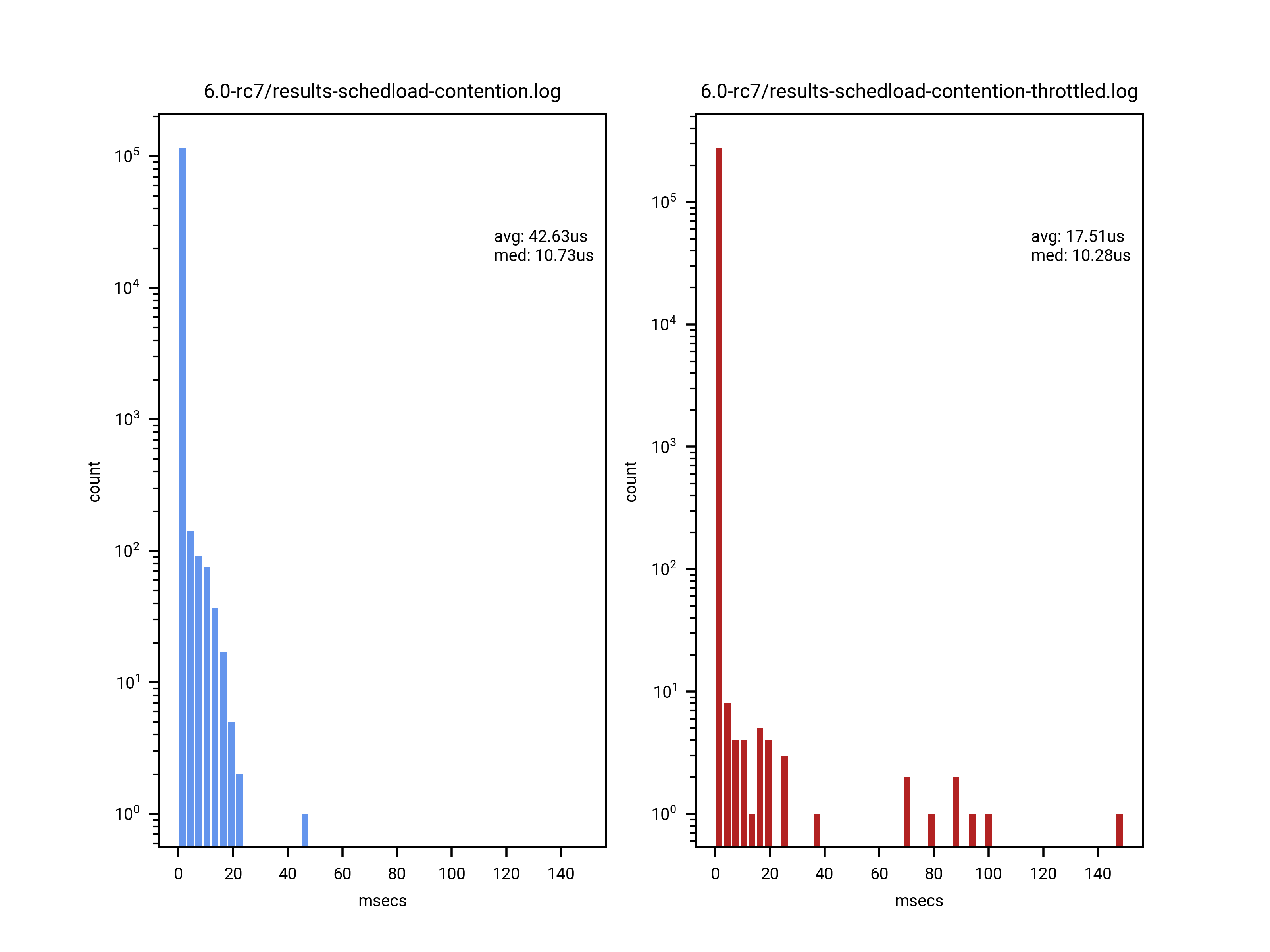
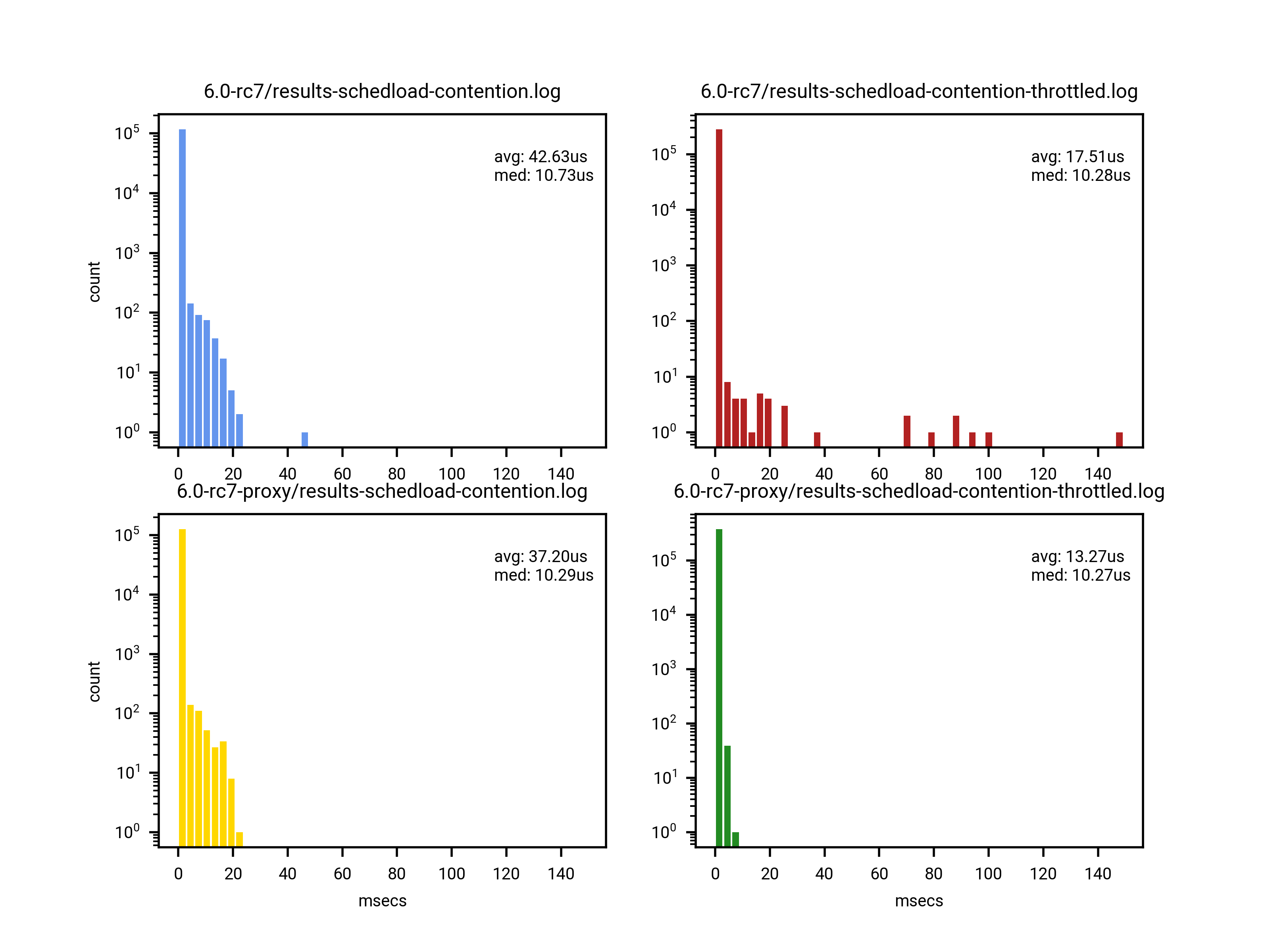
Past discussions of proxy execution have often focused on the benefits for deadline scheduling. Current interest for Android is based more on desire for a broad solution to priority inversion on kernel mutexes, including among CFS tasks. One notable scenario arises when cpu cgroups are used to throttle less important background tasks. Priority inversion can occur when an "important" unthrottled task blocks on a mutex held by an "unimportant" task whose CPU time is constrained using cpu shares. The result is higher worst case latencies for the unthrottled task.[0] Testing by John Stultz with a simple reproducer [1] showed promising results for this case, with proxy execution appearing to eliminate the large latency spikes associated with priority inversion.[2]
Proxy execution has been discussed over the past few years at several conferences[3][4][5], but (as far as I'm aware) patches implementing the concept have not been discussed on the list since Juri Lelli's RFC in 2018.[6] This series is an updated version of that patchset, seeking to incorporate subsequent work by Juri[7], Valentin Schneider[8] and Peter Zijlstra along with some new fixes.
Testing so far has focused on stability, mostly via mutex locktorture with some tweaks to more quickly trigger proxy execution bugs. These locktorture changes are included at the end of the series for reference. The current series survives runs of >72 hours on QEMU without crashes, deadlocks, etc. Testing on Pixel 6 with the android-mainline kernel [9] yields similar results. In both cases, testing used >2 CPUs and CONFIG_FAIR_GROUP_SCHED=y, a configuration Valentin Schneider reported[10] showed stability problems with earlier versions of the series.
That said, these are definitely still a work in progress, with some known remaining issues (e.g. warnings while booting on Pixel 6, suspicious looking min/max vruntime numbers) and likely others I haven't found yet. I've done my best to eliminate checks and code paths made redundant by new fixes but some probably remain. There's no attempt yet to handle core scheduling. Performance testing so far has been limited to the aforementioned priority inversion reproducer. The hope in sharing now is to revive the discussion on proxy execution and get some early input for continuing to revise & refine the patches.
[0] https://raw.githubusercontent.com/johnstultz-work/priority-inversion-demo/main/results/charts/6.0-rc7-throttling-starvation.png
[1] https://github.com/johnstultz-work/priority-inversion-demo
[2] https://raw.githubusercontent.com/johnstultz-work/priority-inversion-demo/main/results/charts/6.0-rc7-vanilla-vs-proxy.png
[3] https://lpc.events/event/2/contributions/62/
[4] https://lwn.net/Articles/793502/
[5] https://lwn.net/Articles/820575/
[6] https://lore.kernel.org/lkml/[email protected]/
[7] https://github.com/jlelli/linux/tree/experimental/deadline/proxy-rfc-v2
[8] https://gitlab.arm.com/linux-arm/linux-vs/-/tree/mainline/sched/proxy-rfc-v3/
[9] https://source.android.com/docs/core/architecture/kernel/android-common
[10] https://lpc.events/event/7/contributions/758/attachments/585/1036/lpc20-proxy.pdf#page=4
Connor O'Brien (2):
torture: support randomized shuffling for proxy exec testing
locktorture: support nested mutexes
Juri Lelli (3):
locking/mutex: make mutex::wait_lock irq safe
kernel/locking: Expose mutex_owner()
sched: Fixup task CPUs for potential proxies.
Peter Zijlstra (4):
locking/ww_mutex: Remove wakeups from under mutex::wait_lock locking/mutex: Rework task_struct::blocked_on
sched: Split scheduler execution context
sched: Add proxy execution
Valentin Schneider (2):
kernel/locking: Add p->blocked_on wrapper
sched/rt: Fix proxy/current (push,pull)ability
 include/linux/mutex.h        |   2 +
 include/linux/sched.h        |  15 +-
 include/linux/ww_mutex.h     |   3 +
 init/Kconfig                 |   7 +
 init/init_task.c             |   1 +
 kernel/Kconfig.locks         |   2 +-
 kernel/fork.c                |   6 +-
 kernel/locking/locktorture.c |  20 +-
 kernel/locking/mutex-debug.c |   9 +-
 kernel/locking/mutex.c       | 109 +++++-
 kernel/locking/ww_mutex.h    |  31 +-
 kernel/sched/core.c          | 679 +++++++++++++++++++++++++++++++++--
 kernel/sched/deadline.c      |  37 +-
 kernel/sched/fair.c          |  33 +-
 kernel/sched/rt.c            |  63 ++--
 kernel/sched/sched.h         |  42 ++-
 kernel/torture.c             |  10 +-
 17 files changed, 955 insertions(+), 114 deletions(-)
Signature · 1 line
2.38.0.rc1.362.ged0d419d3c-goog
RFC PATCH 1/11 locking/ww_mutex: Remove wakeups from under mutex::wait_lock
From: Peter Zijlstra <[email protected]>
In preparation to nest mutex::wait_lock under rq::lock we need to remove wakeups from under it.
---
 include/linux/ww_mutex.h  | 3 +++
 kernel/locking/mutex.c    | 8 ++++++++
 kernel/locking/ww_mutex.h | 9 +++++++--
 kernel/sched/core.c       | 7 +++++++
 4 files changed, 25 insertions(+), 2 deletions(-)
include/linux/ww_mutex.h +3 -0
@@ -19,6 +19,7 @@#include <linux/mutex.h> #include <linux/rtmutex.h> +#include <linux/sched/wake_q.h> #if defined(CONFIG_DEBUG_MUTEXES ) || \ (defined(CONFIG_PREEMPT_RT ) && defined(CONFIG_DEBUG_RT_MUTEXES ))
@@ -58,6 +59,7 @@ struct ww_acquire_ctx {unsigned int acquired;unsigned short wounded;unsigned short is_wait_die; +struct wake_q_head wake_q;#ifdef DEBUG_WW_MUTEXES unsigned int done_acquire;struct ww_class *ww_class;
@@ -137,6 +139,7 @@ static inline void ww_acquire_init(struct ww_acquire_ctx *ctx, ctx->acquired =0 ; ctx->wounded = false; ctx->is_wait_die = ww_class->is_wait_die; +wake_q_init (&ctx->wake_q);#ifdef DEBUG_WW_MUTEXES ctx->ww_class = ww_class; ctx->done_acquire =0 ;
kernel/locking/mutex.c +8 -0
@@ -676,6 +676,8 @@ __mutex_lock_common(struct mutex *lock, unsigned int state, unsigned int subclas }raw_spin_unlock (&lock->wait_lock); +if (ww_ctx) +ww_ctx_wake (ww_ctx);schedule_preempt_disabled (); first =__mutex_waiter_is_first (lock, &waiter);
@@ -725,6 +727,8 @@ __mutex_lock_common(struct mutex *lock, unsigned int state, unsigned int subclasww_mutex_lock_acquired (ww, ww_ctx);raw_spin_unlock (&lock->wait_lock); +if (ww_ctx) +ww_ctx_wake (ww_ctx);preempt_enable ();return 0 ;
@@ -736,6 +740,8 @@ __mutex_lock_common(struct mutex *lock, unsigned int state, unsigned int subclasraw_spin_unlock (&lock->wait_lock);debug_mutex_free_waiter (&waiter);mutex_release (&lock->dep_map, ip); +if (ww_ctx) +ww_ctx_wake (ww_ctx);preempt_enable ();return ret; }
@@ -946,9 +952,11 @@ static noinline void __sched __mutex_unlock_slowpath(struct mutex *lock, unsigneif (owner &MUTEX_FLAG_HANDOFF )__mutex_handoff (lock, next); +preempt_disable ();raw_spin_unlock (&lock->wait_lock);wake_up_q (&wake_q); +preempt_enable (); }#ifndef CONFIG_DEBUG_LOCK_ALLOC
kernel/locking/ww_mutex.h +7 -2
@@ -161,6 +161,11 @@ static inline void lockdep_assert_wait_lock_held(struct rt_mutex *lock)#endif /* WW_RT */ +void ww_ctx_wake (struct ww_acquire_ctx *ww_ctx) +{ +wake_up_q (&ww_ctx->wake_q); +} +/* * Wait-Die: * The newer transactions are killed when:
@@ -284,7 +289,7 @@ __ww_mutex_die(struct MUTEX *lock, struct MUTEX_WAITER *waiter,#ifndef WW_RT debug_mutex_wake_waiter (lock, waiter);#endif -wake_up_process (waiter->task); +wake_q_add (&ww_ctx->wake_q, waiter->task); }return true;
@@ -331,7 +336,7 @@ static bool __ww_mutex_wound(struct MUTEX *lock,* wakeup pending to re-read the wounded state. */ if (owner != current) -wake_up_process (owner); +wake_q_add (&ww_ctx->wake_q, owner);return true; }
kernel/sched/core.c +7 -0
@@ -1013,6 +1013,13 @@ void wake_up_q(struct wake_q_head *head)wake_up_process (task);put_task_struct (task); } +/* +* XXX connoro: seems this is needed now that ww_ctx_wake() passes in a +* wake_q_head that is embedded in struct ww_acquire_ctx rather than +* declared locally. +*/ + head->first = node; + head->lastp = &head->first; }/*
Signature · 1 line
2.38.0.rc1.362.ged0d419d3c-goog
Waiman Long
reviewerRe: [RFC PATCH 01/11] locking/ww_mutex: Remove wakeups from under mutex::wait_lock
Quoted 41 lines · Connor O'Brien
kernel/locking/ww_mutex.h +7
-2@@ -161,6 +161,11 @@ static inline void lockdep_assert_wait_lock_held(struct rt_mutex *lock)#endif /* WW_RT */ +void ww_ctx_wake (struct ww_acquire_ctx *ww_ctx) +{ +wake_up_q (&ww_ctx->wake_q); +} +/* * Wait-Die: * The newer transactions are killed when: @@ -284,7 +289,7 @@ __ww_mutex_die(struct MUTEX *lock, struct MUTEX_WAITER *waiter,#ifndef WW_RT debug_mutex_wake_waiter (lock, waiter);#endif -wake_up_process (waiter->task); +wake_q_add (&ww_ctx->wake_q, waiter->task); }return true;@@ -331,7 +336,7 @@ static bool __ww_mutex_wound(struct MUTEX *lock,* wakeup pending to re-read the wounded state. */ if (owner != current) -wake_up_process (owner); +wake_q_add (&ww_ctx->wake_q, owner);return true; }kernel/sched/core.c +0
-0@@ -1013,6 +1013,13 @@ void wake_up_q(struct wake_q_head *head)wake_up_process (task);put_task_struct (task);
kernel/sched/core.c void wake_up_q(struct wake_q_head *head) · line 1024
Quoted 10 lines
kernel/sched/core.c +7
-0} +/* +* XXX connoro: seems this is needed now that ww_ctx_wake() passes in a +* wake_q_head that is embedded in struct ww_acquire_ctx rather than +* declared locally. +*/ + head->first = node; + head->lastp = &head->first; }
You shouldn't do wake_q_init() here in wake_up_q(). Instead, you should do it in ww_ctx_wake() right after the wake_up_q() call.
Cheers,
Longman
Re: [RFC PATCH 01/11] locking/ww_mutex: Remove wakeups from under mutex::wait_lock
Quoted 43 lines · Waiman Long
Quoted 42 lines · Connor O'Brien
kernel/locking/ww_mutex.h +7
-2@@ -161,6 +161,11 @@ static inline void lockdep_assert_wait_lock_held(struct rt_mutex *lock)#endif /* WW_RT */ +void ww_ctx_wake (struct ww_acquire_ctx *ww_ctx) +{ +wake_up_q (&ww_ctx->wake_q); +} +/* * Wait-Die: * The newer transactions are killed when: @@ -284,7 +289,7 @@ __ww_mutex_die(struct MUTEX *lock, struct MUTEX_WAITER *waiter,#ifndef WW_RT debug_mutex_wake_waiter (lock, waiter);#endif -wake_up_process (waiter->task); +wake_q_add (&ww_ctx->wake_q, waiter->task); }return true;@@ -331,7 +336,7 @@ static bool __ww_mutex_wound(struct MUTEX *lock,* wakeup pending to re-read the wounded state. */ if (owner != current) -wake_up_process (owner); +wake_q_add (&ww_ctx->wake_q, owner);return true; }kernel/sched/core.c +4
-0@@ -1013,6 +1013,13 @@ void wake_up_q(struct wake_q_head *head)wake_up_process (task);put_task_struct (task); } +/* +* XXX connoro: seems this is needed now that ww_ctx_wake() passes in a +* wake_q_head that is embedded in struct ww_acquire_ctx rather than +* declared locally.
Quoted 8 lines
kernel/sched/core.c void wake_up_q(struct wake_q_head *head) · line 1023
Quoted 4 lines
kernel/sched/core.c +3
-0+*/ + head->first = node; + head->lastp = &head->first; }You shouldn't do
wake_q_init()here inwake_up_q(). Instead, you should do it inww_ctx_wake()right after thewake_up_q()call.
:
Exactly, it is also mentioned in the wake_q.h header:
* The DEFINE_WAKE_Q macro declares and initializes the list head.
* wake_up_q() does NOT reinitialize the list; it's expected to be
* called near the end of a function. Otherwise, the list can be
* re-initialized for later re-use by wake_q_init().
*
Thanks.
Re: [RFC PATCH 01/11] locking/ww_mutex: Remove wakeups from under mutex::wait_lock
In reply to Waiman LongQuoted 48 lines · Waiman Long
Quoted 46 lines · Connor O'Brien
kernel/locking/ww_mutex.h +7
-2@@ -161,6 +161,11 @@ static inline void lockdep_assert_wait_lock_held(struct rt_mutex *lock)#endif /* WW_RT */ +void ww_ctx_wake (struct ww_acquire_ctx *ww_ctx) +{ +wake_up_q (&ww_ctx->wake_q); +} +/* * Wait-Die: * The newer transactions are killed when: @@ -284,7 +289,7 @@ __ww_mutex_die(struct MUTEX *lock, struct MUTEX_WAITER *waiter,#ifndef WW_RT debug_mutex_wake_waiter (lock, waiter);#endif -wake_up_process (waiter->task); +wake_q_add (&ww_ctx->wake_q, waiter->task); }return true;@@ -331,7 +336,7 @@ static bool __ww_mutex_wound(struct MUTEX *lock,* wakeup pending to re-read the wounded state. */ if (owner != current) -wake_up_process (owner); +wake_q_add (&ww_ctx->wake_q, owner);return true; }kernel/sched/core.c +4
-0@@ -1013,6 +1013,13 @@ void wake_up_q(struct wake_q_head *head)wake_up_process (task);put_task_struct (task); } +/* +* XXX connoro: seems this is needed now that ww_ctx_wake() passes in a +* wake_q_head that is embedded in struct ww_acquire_ctx rather than +* declared locally.
Quoted 8 lines
kernel/sched/core.c void wake_up_q(struct wake_q_head *head) · line 1024
Quoted 5 lines
kernel/sched/core.c +3
-0+*/ + head->first = node; + head->lastp = &head->first; }You shouldn't do
wake_q_init()here inwake_up_q(). Instead, you should do it inww_ctx_wake()right after thewake_up_q()call.
Thanks, will fix this in the next version.
Quoted 4 lines
Cheers,
Longman
RFC PATCH 2/11 locking/mutex: Rework task_struct::blocked_on
In reply to Connor O'BrienFrom: Peter Zijlstra <[email protected]>
Track the blocked-on relation for mutexes, this allows following this relation at schedule time.
task
| blocked-on
v
mutex
| owner
v
task
---
 include/linux/sched.h        | 6 ++----
 kernel/fork.c                | 4 ++--
 kernel/locking/mutex-debug.c | 9 +++++----
 kernel/locking/mutex.c       | 6 ++++++
 4 files changed, 15 insertions(+), 10 deletions(-)
include/linux/sched.h +2 -4
@@ -1130,10 +1130,8 @@ struct task_struct {struct rt_mutex_waiter *pi_blocked_on;#endif -#ifdef CONFIG_DEBUG_MUTEXES -/* Mutex deadlock detection: */ -struct mutex_waiter *blocked_on; -#endif +struct task_struct *blocked_proxy;/* task that is boosting us */ +struct mutex *blocked_on;/* lock we're blocked on */ #ifdef CONFIG_DEBUG_ATOMIC_SLEEP int non_block_count;
kernel/fork.c +2 -2
@@ -2208,9 +2208,9 @@ static __latent_entropy struct task_struct *copy_process(lockdep_init_task (p);#endif -#ifdef CONFIG_DEBUG_MUTEXES + p->blocked_proxy =NULL ;/* nobody is boosting us yet */ p->blocked_on =NULL ;/* not blocked yet */ -#endif +#ifdef CONFIG_BCACHE p->sequential_io =0 ; p->sequential_io_avg =0 ;
kernel/locking/mutex-debug.c +5 -4
@@ -52,17 +52,18 @@ void debug_mutex_add_waiter(struct mutex *lock, struct mutex_waiter *waiter, {lockdep_assert_held (&lock->wait_lock); -/* Mark the current thread as blocked on the lock: */ - task->blocked_on = waiter; +/* Current thread can't be already blocked (since it's executing!) */ +DEBUG_LOCKS_WARN_ON (task->blocked_on); }void debug_mutex_remove_waiter (struct mutex *lock,struct mutex_waiter *waiter,struct task_struct *task) { +struct mutex *blocked_on =READ_ONCE (task->blocked_on); +DEBUG_LOCKS_WARN_ON (list_empty (&waiter->list));DEBUG_LOCKS_WARN_ON (waiter->task != task); -DEBUG_LOCKS_WARN_ON (task->blocked_on != waiter); - task->blocked_on =NULL ; +DEBUG_LOCKS_WARN_ON (blocked_on && blocked_on != lock);INIT_LIST_HEAD (&waiter->list); waiter->task =NULL ;
kernel/locking/mutex.c +6 -0
@@ -645,6 +645,7 @@ __mutex_lock_common(struct mutex *lock, unsigned int state, unsigned int subclas goto err_early_kill; } + current->blocked_on = lock;set_current_state (state);trace_contention_begin (lock,LCB_F_MUTEX );for (;;) {
@@ -682,6 +683,10 @@ __mutex_lock_common(struct mutex *lock, unsigned int state, unsigned int subclas first =__mutex_waiter_is_first (lock, &waiter); +/* +* Gets reset by ttwu_runnable(). +*/ + current->blocked_on = lock;set_current_state (state);/* * Here we order against unlock; we must either see it change
@@ -715,6 +720,7 @@ __mutex_lock_common(struct mutex *lock, unsigned int state, unsigned int subclas }__mutex_remove_waiter (lock, &waiter); + current->blocked_on =NULL ;debug_mutex_free_waiter (&waiter);
Signature · 1 line
2.38.0.rc1.362.ged0d419d3c-goog
RFC PATCH 3/11 kernel/locking: Add p->blocked_on wrapper
In reply to Connor O'BrienFrom: Valentin Schneider <[email protected]>
This lets us assert p->blocked_lock is held whenever we access p->blocked_on.
XXX: just make a pointer return, so we can also check at get's.
---
 include/linux/sched.h  | 7 +++++++
 kernel/locking/mutex.c | 6 +++---
 2 files changed, 10 insertions(+), 3 deletions(-)
include/linux/sched.h +7 -0
@@ -2201,6 +2201,13 @@ static inline int rwlock_needbreak(rwlock_t *lock)#endif } +static inline void set_task_blocked_on (struct task_struct *p,struct mutex *m) +{ +lockdep_assert_held (&p->blocked_lock); + + p->blocked_on = m; +} + static __always_inline bool need_resched(void) {return unlikely (tif_need_resched ());
kernel/locking/mutex.c +3 -3
@@ -645,7 +645,7 @@ __mutex_lock_common(struct mutex *lock, unsigned int state, unsigned int subclas goto err_early_kill; } - current->blocked_on = lock; +set_task_blocked_on (current, lock);set_current_state (state);trace_contention_begin (lock,LCB_F_MUTEX );for (;;) {
@@ -686,7 +686,7 @@ __mutex_lock_common(struct mutex *lock, unsigned int state, unsigned int subclas/* * Gets reset by ttwu_runnable(). */ - current->blocked_on = lock; +set_task_blocked_on (current, lock);set_current_state (state);/* * Here we order against unlock; we must either see it change
@@ -720,7 +720,7 @@ __mutex_lock_common(struct mutex *lock, unsigned int state, unsigned int subclas }__mutex_remove_waiter (lock, &waiter); - current->blocked_on =NULL ; +set_task_blocked_on (current,NULL );debug_mutex_free_waiter (&waiter);
Signature · 1 line
2.38.0.rc1.362.ged0d419d3c-goog
RFC PATCH 4/11 locking/mutex: make mutex::wait_lock irq safe
In reply to Connor O'BrienFrom: Juri Lelli <[email protected]>
mutex::wait_lock might be nested under rq->lock.
Make it irq safe then.
---
 kernel/locking/mutex.c    | 18 ++++++++++--------
 kernel/locking/ww_mutex.h | 22 ++++++++++++----------
 2 files changed, 22 insertions(+), 18 deletions(-)
kernel/locking/mutex.c +10 -8
@@ -572,6 +572,7 @@ __mutex_lock_common(struct mutex *lock, unsigned int state, unsigned int subclas {struct mutex_waiter waiter;struct ww_mutex *ww; +unsigned long flags;int ret;if (!use_ww_ctx)
@@ -614,7 +615,7 @@ __mutex_lock_common(struct mutex *lock, unsigned int state, unsigned int subclasreturn 0 ; } -raw_spin_lock (&lock->wait_lock); +raw_spin_lock_irqsave (&lock->wait_lock, flags);/* * After waiting to acquire the wait_lock, try again. */
@@ -676,7 +677,7 @@ __mutex_lock_common(struct mutex *lock, unsigned int state, unsigned int subclas goto err; } -raw_spin_unlock (&lock->wait_lock); +raw_spin_unlock_irqrestore (&lock->wait_lock, flags);if (ww_ctx)ww_ctx_wake (ww_ctx);schedule_preempt_disabled ();
@@ -703,9 +704,9 @@ __mutex_lock_common(struct mutex *lock, unsigned int state, unsigned int subclastrace_contention_begin (lock,LCB_F_MUTEX ); } -raw_spin_lock (&lock->wait_lock); +raw_spin_lock_irqsave (&lock->wait_lock, flags); } -raw_spin_lock (&lock->wait_lock); +raw_spin_lock_irqsave (&lock->wait_lock, flags); acquired:__set_current_state (TASK_RUNNING );
@@ -732,7 +733,7 @@ __mutex_lock_common(struct mutex *lock, unsigned int state, unsigned int subclasif (ww_ctx)ww_mutex_lock_acquired (ww, ww_ctx); -raw_spin_unlock (&lock->wait_lock); +raw_spin_unlock_irqrestore (&lock->wait_lock, flags);if (ww_ctx)ww_ctx_wake (ww_ctx);preempt_enable ();
@@ -743,7 +744,7 @@ __mutex_lock_common(struct mutex *lock, unsigned int state, unsigned int subclas__mutex_remove_waiter (lock, &waiter); err_early_kill:trace_contention_end (lock, ret); -raw_spin_unlock (&lock->wait_lock); +raw_spin_unlock_irqrestore (&lock->wait_lock, flags);debug_mutex_free_waiter (&waiter);mutex_release (&lock->dep_map, ip);if (ww_ctx)
@@ -915,6 +916,7 @@ static noinline void __sched __mutex_unlock_slowpath(struct mutex *lock, unsignestruct task_struct *next =NULL ;DEFINE_WAKE_Q (wake_q);unsigned long owner; +unsigned long flags;mutex_release (&lock->dep_map, ip);
@@ -941,7 +943,7 @@ static noinline void __sched __mutex_unlock_slowpath(struct mutex *lock, unsigne } } -raw_spin_lock (&lock->wait_lock); +raw_spin_lock_irqsave (&lock->wait_lock, flags);debug_mutex_unlock (lock);if (!list_empty (&lock->wait_list)) {/* get the first entry from the wait-list: */
@@ -959,7 +961,7 @@ static noinline void __sched __mutex_unlock_slowpath(struct mutex *lock, unsigne__mutex_handoff (lock, next);preempt_disable (); -raw_spin_unlock (&lock->wait_lock); +raw_spin_unlock_irqrestore (&lock->wait_lock, flags);wake_up_q (&wake_q);preempt_enable ();
kernel/locking/ww_mutex.h +12 -10
@@ -70,14 +70,14 @@ __ww_mutex_has_waiters(struct mutex *lock)return atomic_long_read (&lock->owner) &MUTEX_FLAG_WAITERS ; } -static inline void lock_wait_lock (struct mutex *lock) +static inline void lock_wait_lock (struct mutex *lock,unsigned long *flags) { -raw_spin_lock (&lock->wait_lock); +raw_spin_lock_irqsave (&lock->wait_lock, *flags); } -static inline void unlock_wait_lock (struct mutex *lock) +static inline void unlock_wait_lock (struct mutex *lock,unsigned long flags) { -raw_spin_unlock (&lock->wait_lock); +raw_spin_unlock_irqrestore (&lock->wait_lock, flags); }static inline void lockdep_assert_wait_lock_held (struct mutex *lock)
@@ -144,14 +144,14 @@ __ww_mutex_has_waiters(struct rt_mutex *lock)return rt_mutex_has_waiters (&lock->rtmutex); } -static inline void lock_wait_lock (struct rt_mutex *lock) +static inline void lock_wait_lock (struct rt_mutex *lock,unsigned long *flags) { -raw_spin_lock (&lock->rtmutex.wait_lock); +raw_spin_lock_irqsave (&lock->rtmutex.wait_lock, *flags); } -static inline void unlock_wait_lock (struct rt_mutex *lock) +static inline void unlock_wait_lock (struct rt_mutex *lock,flags ) { -raw_spin_unlock (&lock->rtmutex.wait_lock); +raw_spin_unlock_irqrestore (&lock->rtmutex.wait_lock, flags); }static inline void lockdep_assert_wait_lock_held (struct rt_mutex *lock)
@@ -382,6 +382,8 @@ __ww_mutex_check_waiters(struct MUTEX *lock, struct ww_acquire_ctx *ww_ctx) static __always_inline voidww_mutex_set_context_fastpath (struct ww_mutex *lock,struct ww_acquire_ctx *ctx) { +unsigned long flags; +ww_mutex_lock_acquired (lock, ctx);/*
@@ -409,9 +411,9 @@ ww_mutex_set_context_fastpath(struct ww_mutex *lock, struct ww_acquire_ctx *ctx)* Uh oh, we raced in fastpath, check if any of the waiters need to * die or wound us. */ -lock_wait_lock (&lock->base); +lock_wait_lock (&lock->base, &flags);__ww_mutex_check_waiters (&lock->base, ctx); -unlock_wait_lock (&lock->base); +unlock_wait_lock (&lock->base, flags); }static __always_inline int
Signature · 1 line
2.38.0.rc1.362.ged0d419d3c-goog
Re: [RFC PATCH 04/11] locking/mutex: make mutex::wait_lock irq safe
Quoted 6 lines · Connor O'Brien
From: Juri Lelli <[email protected]>
mutex::wait_lockmight be nested underrq->lock.Make it irq safe then.
Hi Juri, can you give an example where not doing this is an issue?
When nested under rq->lock, interrupts should already be disabled, otherwise try_to_wake_up() from an interrupt can cause a deadlock no? Then, why do you need this patch?
Thanks.
Quoted 162 lines
Signed-off-by Juri Lelli <[email protected]>Signed-off-by Peter Zijlstra (Intel) <[email protected]>[rebase & fix {un,}lock_wait_lock helpers in ww_mutex.h]Signed-off-by Connor O'Brien <[email protected]>--- kernel/locking/mutex.c | 18 ++++++++++-------- kernel/locking/ww_mutex.h | 22 ++++++++++++---------- 2 files changed, 22 insertions(+), 18 deletions(-)kernel/locking/mutex.c +10
-8@@ -572,6 +572,7 @@ __mutex_lock_common(struct mutex *lock, unsigned int state, unsigned int subclas {struct mutex_waiter waiter;struct ww_mutex *ww; +unsigned long flags;int ret;if (!use_ww_ctx)@@ -614,7 +615,7 @@ __mutex_lock_common(struct mutex *lock, unsigned int state, unsigned int subclasreturn 0 ; } -raw_spin_lock (&lock->wait_lock); +raw_spin_lock_irqsave (&lock->wait_lock, flags);/* * After waiting to acquire the wait_lock, try again. */ @@ -676,7 +677,7 @@ __mutex_lock_common(struct mutex *lock, unsigned int state, unsigned int subclas goto err; } -raw_spin_unlock (&lock->wait_lock); +raw_spin_unlock_irqrestore (&lock->wait_lock, flags);if (ww_ctx)ww_ctx_wake (ww_ctx);schedule_preempt_disabled ();@@ -703,9 +704,9 @@ __mutex_lock_common(struct mutex *lock, unsigned int state, unsigned int subclastrace_contention_begin (lock,LCB_F_MUTEX ); } -raw_spin_lock (&lock->wait_lock); +raw_spin_lock_irqsave (&lock->wait_lock, flags); } -raw_spin_lock (&lock->wait_lock); +raw_spin_lock_irqsave (&lock->wait_lock, flags); acquired:__set_current_state (TASK_RUNNING );@@ -732,7 +733,7 @@ __mutex_lock_common(struct mutex *lock, unsigned int state, unsigned int subclasif (ww_ctx)ww_mutex_lock_acquired (ww, ww_ctx); -raw_spin_unlock (&lock->wait_lock); +raw_spin_unlock_irqrestore (&lock->wait_lock, flags);if (ww_ctx)ww_ctx_wake (ww_ctx);preempt_enable ();@@ -743,7 +744,7 @@ __mutex_lock_common(struct mutex *lock, unsigned int state, unsigned int subclas__mutex_remove_waiter (lock, &waiter); err_early_kill:trace_contention_end (lock, ret); -raw_spin_unlock (&lock->wait_lock); +raw_spin_unlock_irqrestore (&lock->wait_lock, flags);debug_mutex_free_waiter (&waiter);mutex_release (&lock->dep_map, ip);if (ww_ctx)@@ -915,6 +916,7 @@ static noinline void __sched __mutex_unlock_slowpath(struct mutex *lock, unsignestruct task_struct *next =NULL ;DEFINE_WAKE_Q (wake_q);unsigned long owner; +unsigned long flags;mutex_release (&lock->dep_map, ip);@@ -941,7 +943,7 @@ static noinline void __sched __mutex_unlock_slowpath(struct mutex *lock, unsigne } } -raw_spin_lock (&lock->wait_lock); +raw_spin_lock_irqsave (&lock->wait_lock, flags);debug_mutex_unlock (lock);if (!list_empty (&lock->wait_list)) {/* get the first entry from the wait-list: */ @@ -959,7 +961,7 @@ static noinline void __sched __mutex_unlock_slowpath(struct mutex *lock, unsigne__mutex_handoff (lock, next);preempt_disable (); -raw_spin_unlock (&lock->wait_lock); +raw_spin_unlock_irqrestore (&lock->wait_lock, flags);wake_up_q (&wake_q);preempt_enable ();kernel/locking/ww_mutex.h +12
-11@@ -70,14 +70,14 @@ __ww_mutex_has_waiters(struct mutex *lock)return atomic_long_read (&lock->owner) &MUTEX_FLAG_WAITERS ; } -static inline void lock_wait_lock (struct mutex *lock) +static inline void lock_wait_lock (struct mutex *lock,unsigned long *flags) { -raw_spin_lock (&lock->wait_lock); +raw_spin_lock_irqsave (&lock->wait_lock, *flags); } -static inline void unlock_wait_lock (struct mutex *lock) +static inline void unlock_wait_lock (struct mutex *lock,unsigned long flags) { -raw_spin_unlock (&lock->wait_lock); +raw_spin_unlock_irqrestore (&lock->wait_lock, flags); }static inline void lockdep_assert_wait_lock_held (struct mutex *lock)@@ -144,14 +144,14 @@ __ww_mutex_has_waiters(struct rt_mutex *lock)return rt_mutex_has_waiters (&lock->rtmutex); } -static inline void lock_wait_lock (struct rt_mutex *lock) +static inline void lock_wait_lock (struct rt_mutex *lock,unsigned long *flags) { -raw_spin_lock (&lock->rtmutex.wait_lock); +raw_spin_lock_irqsave (&lock->rtmutex.wait_lock, *flags); } -static inline void unlock_wait_lock (struct rt_mutex *lock) +static inline void unlock_wait_lock (struct rt_mutex *lock,flags ) { -raw_spin_unlock (&lock->rtmutex.wait_lock); +raw_spin_unlock_irqrestore (&lock->rtmutex.wait_lock, flags); }static inline void lockdep_assert_wait_lock_held (struct rt_mutex *lock)@@ -382,6 +382,8 @@ __ww_mutex_check_waiters(struct MUTEX *lock, struct ww_acquire_ctx *ww_ctx) static __always_inline voidww_mutex_set_context_fastpath (struct ww_mutex *lock,struct ww_acquire_ctx *ctx) { +unsigned long flags; +ww_mutex_lock_acquired (lock, ctx);/* @@ -409,9 +411,9 @@ ww_mutex_set_context_fastpath(struct ww_mutex *lock, struct ww_acquire_ctx *ctx)* Uh oh, we raced in fastpath, check if any of the waiters need to * die or wound us. */ -lock_wait_lock (&lock->base); +lock_wait_lock (&lock->base, &flags);__ww_mutex_check_waiters (&lock->base, ctx); -unlock_wait_lock (&lock->base); +unlock_wait_lock (&lock->base, flags); }static __always_inline int --2.38.0.rc1.362.ged0d419d3c-goog
RFC PATCH 5/11 sched: Split scheduler execution context
In reply to Connor O'BrienFrom: Peter Zijlstra <[email protected]>
Lets define the scheduling context as all the scheduler state in task_struct and the execution context as all state required to run the task.
Currently both are intertwined in task_struct. We want to logically split these such that we can run the execution context of one task with the scheduling context of another.
To this purpose introduce rq::proxy to point to the task_struct used for scheduler state and preserve rq::curr to denote the execution context.
XXX connoro: A couple cases here may need more discussion:
- sched_yield() and yield_to(): whether we call the sched_class methods for rq->curr or rq->proxy, there seem to be cases where proxy exec could cause a yielding mutex owner to run again immediately. How much of a concern is this?
- push_rt_task() calls find_lowest_rq() which can only be invoked on RT tasks (scheduler context) but considers CPU affinity (execution context). For now we call find_lowest_rq() on rq->curr, bailing out when it is not RT, but does this give the desired behavior?
[add additional comments and update more sched_class code to use
rq::proxy]
---
 kernel/sched/core.c     | 63 +++++++++++++++++++++++++++++++----------
 kernel/sched/deadline.c | 35 ++++++++++++-----------
 kernel/sched/fair.c     | 20 +++++++------
 kernel/sched/rt.c       | 42 ++++++++++++++++-----------
 kernel/sched/sched.h    | 23 +++++++++++++--
 5 files changed, 124 insertions(+), 59 deletions(-)
kernel/sched/core.c +48 -15
@@ -772,12 +772,13 @@ static enum hrtimer_restart hrtick(struct hrtimer *timer) { struct rq *rq = container_of(timer, struct rq, hrtick_timer);struct rq_flags rf; +struct task_struct *curr = rq->proxy;WARN_ON_ONCE (cpu_of (rq) !=smp_processor_id ());rq_lock (rq, &rf);update_rq_clock (rq); - rq->curr->sched_class->task_tick (rq, rq->curr,1 ); + curr->sched_class->task_tick (rq, curr,1 );rq_unlock (rq, &rf);return HRTIMER_NORESTART ;
@@ -2186,16 +2187,18 @@ static inline void check_class_changed(struct rq *rq, struct task_struct *p,void check_preempt_curr (struct rq *rq,struct task_struct *p,int flags) { -if (p->sched_class == rq->curr->sched_class) - rq->curr->sched_class->check_preempt_curr (rq, p, flags); -else if (sched_class_above (p->sched_class, rq->curr->sched_class)) +struct task_struct *curr = rq->proxy; + +if (p->sched_class == curr->sched_class) + curr->sched_class->check_preempt_curr (rq, p, flags); +else if (sched_class_above (p->sched_class, curr->sched_class))resched_curr (rq);/* * A queue event has occurred, and we're going to schedule. In * this case, we can save a useless back to back clock update. */ -if (task_on_rq_queued (rq->curr) &&test_tsk_need_resched (rq->curr)) +if (task_on_rq_queued (curr) &&test_tsk_need_resched (rq->curr))rq_clock_skip_update (rq); }
@@ -2571,7 +2574,11 @@ __do_set_cpus_allowed(struct task_struct *p, const struct cpumask *new_mask, u32lockdep_assert_held (&p->pi_lock); queued =task_on_rq_queued (p); - running =task_current (rq, p); +/* +* XXX is changing affinity of a proxy a problem? +* Consider for example put_prev_ set_curr_ below... +*/ + running =task_current_proxy (rq, p);if (queued) {/*
@@ -5376,7 +5383,7 @@ unsigned long long task_sched_runtime(struct task_struct *p)* project cycles that may never be accounted to this * thread, breaking clock_gettime(). */ -if (task_current (rq, p) &&task_on_rq_queued (p)) { +if (task_current_proxy (rq, p) &&task_on_rq_queued (p)) {prefetch_curr_exec_start (p);update_rq_clock (rq); p->sched_class->update_curr (rq);
@@ -5444,10 +5451,11 @@ void scheduler_tick(void) {int cpu =smp_processor_id ();struct rq *rq =cpu_rq (cpu); -struct task_struct *curr = rq->curr;struct rq_flags rf;unsigned long thermal_pressure;u64 resched_latency; +/* accounting goes to the proxy task */ +struct task_struct *curr = rq->proxy;arch_scale_freq_tick ();sched_clock_tick ();
@@ -5539,6 +5547,13 @@ static void sched_tick_remote(struct work_struct *work)if (cpu_is_offline (cpu)) goto out_unlock; +/* +* XXX don't we need to account to rq->proxy? +* Maybe, since this is a remote tick for full dynticks mode, we are +* always sure that there is no proxy (only a single task is running. +*/ +SCHED_WARN_ON (rq->curr != rq->proxy); +update_rq_clock (rq);if (!is_idle_task (curr)) {
@@ -6462,7 +6477,7 @@ static void __sched notrace __schedule(unsigned int sched_mode) switch_count = &prev->nvcsw; } - next =pick_next_task (rq, prev, &rf); + rq->proxy = next =pick_next_task (rq, prev, &rf);clear_tsk_need_resched (prev);clear_preempt_need_resched ();#ifdef CONFIG_SCHED_DEBUG
@@ -6929,7 +6944,10 @@ void rt_mutex_setprio(struct task_struct *p, struct task_struct *pi_task) prev_class = p->sched_class; queued =task_on_rq_queued (p); - running =task_current (rq, p); +/* +* XXX how does (proxy exec) mutexes and RT_mutexes work together?! +*/ + running =task_current_proxy (rq, p);if (queued)dequeue_task (rq, p, queue_flag);if (running)
@@ -7017,7 +7035,10 @@ void set_user_nice(struct task_struct *p, long nice) goto out_unlock; } queued =task_on_rq_queued (p); - running =task_current (rq, p); +/* +* XXX see concerns about do_set_cpus_allowed, rt_mutex_prio & Co. +*/ + running =task_current_proxy (rq, p);if (queued)dequeue_task (rq, p,DEQUEUE_SAVE |DEQUEUE_NOCLOCK );if (running)
@@ -7581,7 +7602,10 @@ static int __sched_setscheduler(struct task_struct *p, } queued =task_on_rq_queued (p); - running =task_current (rq, p); +/* +* XXX and again, how is this safe w.r.t. proxy exec? +*/ + running =task_current_proxy (rq, p);if (queued)dequeue_task (rq, p, queue_flags);if (running)
@@ -8276,6 +8300,11 @@ static void do_sched_yield(void) rq =this_rq_lock_irq (&rf);schedstat_inc (rq->yld_count); +/* +* XXX how about proxy exec? +* If a task currently proxied by some other task yields, should we +* apply the proxy or the current yield "behaviour" ? +*/ current->sched_class->yield_task (rq);preempt_disable ();
@@ -8625,6 +8654,10 @@ EXPORT_SYMBOL(yield);*/ int __sched yield_to(struct task_struct *p, bool preempt) { +/* +* XXX what about current being proxied? +* Should we use proxy->sched_class methods in this case? +*/ struct task_struct *curr = current;struct rq *rq, *p_rq;unsigned long flags;
@@ -8984,7 +9017,7 @@ void __init init_idle(struct task_struct *idle, int cpu)__set_task_cpu (idle, cpu);rcu_read_unlock (); - rq->idle = idle; + rq->proxy = rq->idle = idle;rcu_assign_pointer (rq->curr, idle); idle->on_rq =TASK_ON_RQ_QUEUED ;#ifdef CONFIG_SMP
@@ -9087,7 +9120,7 @@ void sched_setnuma(struct task_struct *p, int nid) rq =task_rq_lock (p, &rf); queued =task_on_rq_queued (p); - running =task_current (rq, p); + running =task_current_proxy (rq, p);if (queued)dequeue_task (rq, p,DEQUEUE_SAVE );
@@ -10209,7 +10242,7 @@ void sched_move_task(struct task_struct *tsk) rq =task_rq_lock (tsk, &rf);update_rq_clock (rq); - running =task_current (rq, tsk); + running =task_current_proxy (rq, tsk); queued =task_on_rq_queued (tsk);if (queued)
kernel/sched/deadline.c +18 -17
@@ -1176,7 +1176,7 @@ static enum hrtimer_restart dl_task_timer(struct hrtimer *timer)#endif enqueue_task_dl (rq, p,ENQUEUE_REPLENISH ); -if (dl_task (rq->curr)) +if (dl_task (rq->proxy))check_preempt_curr_dl (rq, p,0 );else resched_curr (rq);
@@ -1303,7 +1303,7 @@ static u64 grub_reclaim(u64 delta, struct rq *rq, struct sched_dl_entity *dl_se)*/ static void update_curr_dl (struct rq *rq) { -struct task_struct *curr = rq->curr; +struct task_struct *curr = rq->proxy;struct sched_dl_entity *dl_se = &curr->dl;u64 delta_exec, scaled_delta_exec;int cpu =cpu_of (rq);
@@ -1819,7 +1819,7 @@ static int find_later_rq(struct task_struct *task);static int select_task_rq_dl (struct task_struct *p,int cpu,int flags) { -struct task_struct *curr; +struct task_struct *curr, *proxy;bool select_rq;struct rq *rq;
@@ -1830,6 +1830,7 @@ select_task_rq_dl(struct task_struct *p, int cpu, int flags)rcu_read_lock (); curr =READ_ONCE (rq->curr);/* unlocked access */ + proxy =READ_ONCE (rq->proxy);/* * If we are dealing with a -deadline task, we must
@@ -1840,9 +1841,9 @@ select_task_rq_dl(struct task_struct *p, int cpu, int flags)* other hand, if it has a shorter deadline, we * try to make it stay here, it might be important. */ - select_rq =unlikely (dl_task (curr)) && + select_rq =unlikely (dl_task (proxy)) && (curr->nr_cpus_allowed <2 || - !dl_entity_preempt (&p->dl, &curr->dl)) && + !dl_entity_preempt (&p->dl, &proxy->dl)) && p->nr_cpus_allowed >1 ;/*
@@ -1907,7 +1908,7 @@ static void check_preempt_equal_dl(struct rq *rq, struct task_struct *p)* let's hope p can move out. */ if (rq->curr->nr_cpus_allowed ==1 || - !cpudl_find (&rq->rd->cpudl, rq->curr,NULL )) + !cpudl_find (&rq->rd->cpudl, rq->proxy,NULL ))return ;/*
@@ -1946,7 +1947,7 @@ static int balance_dl(struct rq *rq, struct task_struct *p, struct rq_flags *rf)static void check_preempt_curr_dl (struct rq *rq,struct task_struct *p,int flags) { -if (dl_entity_preempt (&p->dl, &rq->curr->dl)) { +if (dl_entity_preempt (&p->dl, &rq->proxy->dl)) {resched_curr (rq);return ; }
@@ -1956,7 +1957,7 @@ static void check_preempt_curr_dl(struct rq *rq, struct task_struct *p,* In the unlikely case current and p have the same deadline * let us try to decide what's the best thing to do... */ -if ((p->dl.deadline == rq->curr->dl.deadline) && +if (p->dl.deadline == rq->proxy->dl.deadline && !test_tsk_need_resched (rq->curr))check_preempt_equal_dl (rq, p);#endif /* CONFIG_SMP */
@@ -1991,7 +1992,7 @@ static void set_next_task_dl(struct rq *rq, struct task_struct *p, bool first)if (hrtick_enabled_dl (rq))start_hrtick_dl (rq, p); -if (rq->curr->sched_class != &dl_sched_class) +if (rq->proxy->sched_class != &dl_sched_class)update_dl_rq_load_avg (rq_clock_pelt (rq), rq,0 );deadline_queue_push_tasks (rq);
@@ -2311,8 +2312,8 @@ static int push_dl_task(struct rq *rq)* can move away, it makes sense to just reschedule * without going further in pushing next_task. */ -if (dl_task (rq->curr) && -dl_time_before (next_task->dl.deadline, rq->curr->dl.deadline) && +if (dl_task (rq->proxy) && +dl_time_before (next_task->dl.deadline, rq->proxy->dl.deadline) && rq->curr->nr_cpus_allowed >1 ) {resched_curr (rq);return 0 ;
@@ -2439,7 +2440,7 @@ static void pull_dl_task(struct rq *this_rq)* deadline than the current task of its runqueue. */ if (dl_time_before (p->dl.deadline, - src_rq->curr->dl.deadline)) + src_rq->proxy->dl.deadline)) goto skip;if (is_migration_disabled (p)) {
@@ -2478,9 +2479,9 @@ static void task_woken_dl(struct rq *rq, struct task_struct *p)if (!task_running (rq, p) && !test_tsk_need_resched (rq->curr) && p->nr_cpus_allowed >1 && -dl_task (rq->curr) && +dl_task (rq->proxy) && (rq->curr->nr_cpus_allowed <2 || - !dl_entity_preempt (&p->dl, &rq->curr->dl))) { + !dl_entity_preempt (&p->dl, &rq->proxy->dl))) {push_dl_tasks (rq); } }
@@ -2644,12 +2645,12 @@ static void switched_to_dl(struct rq *rq, struct task_struct *p)return ; } -if (rq->curr != p) { +if (rq->proxy != p) {#ifdef CONFIG_SMP if (p->nr_cpus_allowed >1 && rq->dl.overloaded)deadline_queue_push_tasks (rq);#endif -if (dl_task (rq->curr)) +if (dl_task (rq->proxy))check_preempt_curr_dl (rq, p,0 );else resched_curr (rq);
@@ -2665,7 +2666,7 @@ static void switched_to_dl(struct rq *rq, struct task_struct *p)static void prio_changed_dl (struct rq *rq,struct task_struct *p,int oldprio) { -if (task_on_rq_queued (p) ||task_current (rq, p)) { +if (task_on_rq_queued (p) ||task_current_proxy (rq, p)) {#ifdef CONFIG_SMP /* * This might be too much, but unfortunately
kernel/sched/fair.c +12 -8
@@ -924,7 +924,7 @@ static void update_curr(struct cfs_rq *cfs_rq)static void update_curr_fair (struct rq *rq) { -update_curr (cfs_rq_of (&rq->curr->se)); +update_curr (cfs_rq_of (&rq->proxy->se)); } static inline void
@@ -5645,7 +5645,7 @@ static void hrtick_start_fair(struct rq *rq, struct task_struct *p)s64 delta = slice - ran;if (delta <0 ) { -if (task_current (rq, p)) +if (task_current_proxy (rq, p))resched_curr (rq);return ; }
@@ -5660,7 +5660,7 @@ static void hrtick_start_fair(struct rq *rq, struct task_struct *p)*/ static void hrtick_update (struct rq *rq) { -struct task_struct *curr = rq->curr; +struct task_struct *curr = rq->proxy;if (!hrtick_enabled_fair (rq) || curr->sched_class != &fair_sched_class)return ;
@@ -7229,7 +7229,7 @@ static void set_skip_buddy(struct sched_entity *se)*/ static void check_preempt_wakeup (struct rq *rq,struct task_struct *p,int wake_flags) { -struct task_struct *curr = rq->curr; +struct task_struct *curr = rq->proxy;struct sched_entity *se = &curr->se, *pse = &p->se;struct cfs_rq *cfs_rq =task_cfs_rq (curr);int scale = cfs_rq->nr_running >= sched_nr_latency;
@@ -7263,7 +7263,7 @@ static void check_preempt_wakeup(struct rq *rq, struct task_struct *p, int wake_* prevents us from potentially nominating it as a false LAST_BUDDY * below. */ -if (test_tsk_need_resched (curr)) +if (test_tsk_need_resched (rq->curr))return ;/* Idle tasks are by definition preempted by non-idle tasks. */
@@ -8260,7 +8260,7 @@ static bool __update_blocked_others(struct rq *rq, bool *done)* update_load_avg() can call cpufreq_update_util(). Make sure that RT, * DL and IRQ signals have been updated before updating CFS. */ - curr_class = rq->curr->sched_class; + curr_class = rq->proxy->sched_class; thermal_pressure =arch_scale_thermal_pressure (cpu_of (rq));
@@ -11416,6 +11416,10 @@ static void task_tick_fair(struct rq *rq, struct task_struct *curr, int queued)entity_tick (cfs_rq, se, queued); } +/* +* XXX need to use execution context (rq->curr) for task_tick_numa and +* update_misfit_status? +*/ if (static_branch_unlikely (&sched_numa_balancing))task_tick_numa (rq, curr);
@@ -11479,7 +11483,7 @@ prio_changed_fair(struct rq *rq, struct task_struct *p, int oldprio)* our priority decreased, or if we are not currently running on * this runqueue and our priority is higher than the current's */ -if (task_current (rq, p)) { +if (task_current_proxy (rq, p)) {if (p->prio > oldprio)resched_curr (rq); }else
@@ -11621,7 +11625,7 @@ static void switched_to_fair(struct rq *rq, struct task_struct *p)* kick off the schedule if running, otherwise just see * if we can still preempt the current task. */ -if (task_current (rq, p)) +if (task_current_proxy (rq, p))resched_curr (rq);else check_preempt_curr (rq, p,0 );
kernel/sched/rt.c +25 -17
146 lines not on this page · raw message
kernel/sched/sched.h +21 -2
@@ -1014,7 +1014,12 @@ struct rq {*/ unsigned int nr_uninterruptible; -struct task_struct __rcu *curr; +/* +* XXX connoro: could different names (e.g. exec_ctx and sched_ctx) help +* with readability? +*/ +struct task_struct __rcu *curr;/* Execution context */ +struct task_struct *proxy;/* Scheduling context (policy) */ struct task_struct *idle;struct task_struct *stop;unsigned long next_balance;
@@ -2055,11 +2060,25 @@ static inline u64 global_rt_runtime(void)return (u64 )sysctl_sched_rt_runtime *NSEC_PER_USEC ; } +/* +* Is p the current execution context? +*/ static inline int task_current (struct rq *rq,struct task_struct *p) {return rq->curr == p; } +/* +* Is p the current scheduling context? +* +* Note that it might be the current execution context at the same time if +* rq->curr == rq->proxy == p. +*/ +static inline int task_current_proxy (struct rq *rq,struct task_struct *p) +{ +return rq->proxy == p; +} +static inline int task_running (struct rq *rq,struct task_struct *p) {#ifdef CONFIG_SMP
@@ -2214,7 +2233,7 @@ struct sched_class {static inline void put_prev_task (struct rq *rq,struct task_struct *prev) { -WARN_ON_ONCE (rq->curr != prev); +WARN_ON_ONCE (rq->proxy != prev); prev->sched_class->put_prev_task (rq, prev); }
Signature · 1 line
2.38.0.rc1.362.ged0d419d3c-goog
Re: [RFC PATCH 05/11] sched: Split scheduler execution context
Hi,
Just on the yield bits (my opinion):
Quoted 15 lines · Connor O'Brien
From: Peter Zijlstra <[email protected]>
Lets define the scheduling context as all the scheduler state in
task_structand the execution context as all state required to run the task.Currently both are intertwined in
task_struct. We want to logically split these such that we can run the execution context of one task with the scheduling context of another.To this purpose introduce
rq::proxyto point to thetask_structused for scheduler state and preserverq::currto denote the execution context.
Quoted 5 lines
XXX connoro: A couple cases here may need more discussion:
-sched_yield()andyield_to(): whether we call thesched_classmethods forrq->currorrq->proxy, there seem to be cases where proxy exec could cause a yielding mutex owner to run again immediately. How much of a concern is this?
A task chosen to run again after calling yield is not unprecedented. From sched_yield manpage:
"If the calling thread is the only thread in the highest priority list at that time, it will continue to run after a call to sched_yield()."
[...]
kernel/sched/core.c static void do_sched_yield(void) · line 8308
Quoted 10 lines
kernel/sched/core.c +5
-0@@ -8276,6 +8300,11 @@ static void do_sched_yield(void) rq =this_rq_lock_irq (&rf);schedstat_inc (rq->yld_count); +/* +* XXX how about proxy exec? +* If a task currently proxied by some other task yields, should we +* apply the proxy or the current yield "behaviour" ? +*/ current->sched_class->yield_task (rq);
I think we should keep it simple and keep the existing yield behavior. If there was no priority inversion, and lock owner called yield, why should it behave any differently?
kernel/sched/core.c EXPORT_SYMBOL(yield); · line 8663
Quoted 13 lines
kernel/sched/core.c +4
-0preempt_disable ();@@ -8625,6 +8654,10 @@ EXPORT_SYMBOL(yield);*/ int __sched yield_to(struct task_struct *p, bool preempt) { +/* +* XXX what about current being proxied? +* Should we use proxy->sched_class methods in this case? +*/ struct task_struct *curr = current;struct rq *rq, *p_rq;unsigned long flags;
Ditto.
Review void __init init_idle(struct task_struct *idle, int cpu)
Quoted 1 line
(quoted diff) +0
-0@@ -8984,7 +9017,7 @@ void __init init_idle(struct task_struct *idle, int cpu)
[...]
Thanks,
- Joel
Valentin Schneider
reviewerRe: [RFC PATCH 05/11] sched: Split scheduler execution context
In reply to Connor O'Brienkernel/sched/deadline.c static u64 grub_reclaim(u64 delta, struct rq *rq, struct sched_dl_entity *dl_se) · line 1306
Quoted 6 lines · Connor O'Brien
kernel/sched/deadline.c +1
-1@@ -1303,7 +1303,7 @@ static u64 grub_reclaim(u64 delta, struct rq *rq, struct sched_dl_entity *dl_se)*/ static void update_curr_dl (struct rq *rq) { -struct task_struct *curr = rq->curr; +struct task_struct *curr = rq->proxy;
I found a note pointing out that Juri has a patch to unify the update_curr*() functions as part of the deadline servers thing; I think it could be picked as a standalone to at least unify the curr = rq->proxy trickery - this will also (hopefully) remove redundancy for whatever we do to expose sane runtime values to userspace.
Last iteration I could find is:
Re: [RFC PATCH 05/11] sched: Split scheduler execution context
Quoted 15 lines · Valentin Schneider
kernel/sched/deadline.c static u64 grub_reclaim(u64 delta, struct rq *rq, struct sched_dl_entity *dl_se) · line 1306
Quoted 6 lines · Connor O'Brien
kernel/sched/deadline.c +1
-1@@ -1303,7 +1303,7 @@ static u64 grub_reclaim(u64 delta, struct rq *rq, struct sched_dl_entity *dl_se)*/ static void update_curr_dl (struct rq *rq) { -struct task_struct *curr = rq->curr; +struct task_struct *curr = rq->proxy;I found a note pointing out that Juri has a patch to unify the update_curr*() functions as part of the deadline servers thing; I think it could be picked as a standalone to at least unify the curr =
rq->proxytrickery - this will also (hopefully) remove redundancy for whatever we do to expose sane runtime values to userspace.
Quoted 3 lines
Last iteration I could find is:
That makes sense, thanks for the pointer to this patch.
RFC PATCH 6/11 kernel/locking: Expose mutex_owner()
In reply to Connor O'BrienFrom: Juri Lelli <[email protected]>
Implementing proxy execution requires that scheduler code be able to identify the current owner of a mutex. Expose a new helper mutex_owner() for this purpose.
---
 include/linux/mutex.h  | 2 ++
 kernel/locking/mutex.c | 5 +++++
 2 files changed, 7 insertions(+)
include/linux/mutex.h +2 -0
@@ -118,6 +118,8 @@ do { \extern void __mutex_init (struct mutex *lock,const char *name,struct lock_class_key *key); +extern struct task_struct *mutex_owner (struct mutex *lock); +/** * mutex_is_locked - is the mutex locked * @lock: the mutex to be queried
kernel/locking/mutex.c +5 -0
@@ -81,6 +81,11 @@ static inline struct task_struct *__mutex_owner(struct mutex *lock)return (struct task_struct *)(atomic_long_read (&lock->owner) & ~MUTEX_FLAGS ); } +struct task_struct *mutex_owner (struct mutex *lock) +{ +return __mutex_owner (lock); +} +static inline struct task_struct *__owner_task (unsigned long owner) {return (struct task_struct *)(owner & ~MUTEX_FLAGS );
Signature · 1 line
2.38.0.rc1.362.ged0d419d3c-goog
RFC PATCH 7/11 sched: Add proxy execution
In reply to Connor O'BrienFrom: Peter Zijlstra <[email protected]>
A task currently holding a mutex (executing a critical section) might find benefit in using scheduling contexts of other tasks blocked on the same mutex if they happen to have higher priority of the current owner (e.g., to prevent priority inversions).
Proxy execution lets a task do exactly that: if a mutex owner has waiters, it can use waiters' scheduling context to potentially continue running if preempted.
The basic mechanism is implemented by this patch, the core of which resides in the proxy() function. Potential proxies (i.e., tasks blocked on a mutex) are not dequeued, so, if one of them is actually selected by schedule() as the next task to be put to run on a CPU, proxy() is used to walk the blocked_on relation and find which task (mutex owner) might be able to use the proxy's scheduling context.
Here come the tricky bits. In fact, owner task might be in all sort of states when a proxy is found (blocked, executing on a different CPU, etc.). Details on how to handle different situations are to be found in proxy() code comments.
---
 include/linux/sched.h   |   2 +
 init/Kconfig            |   7 +
 init/init_task.c        |   1 +
 kernel/Kconfig.locks    |   2 +-
 kernel/fork.c           |   2 +
 kernel/locking/mutex.c  |  78 +++++-
 kernel/sched/core.c     | 585 +++++++++++++++++++++++++++++++++++++++-
 kernel/sched/deadline.c |   2 +-
 kernel/sched/fair.c     |  13 +-
 kernel/sched/rt.c       |   3 +-
 kernel/sched/sched.h    |  21 +-
 11 files changed, 694 insertions(+), 22 deletions(-)
include/linux/sched.h +2 -0
@@ -1132,6 +1132,8 @@ struct task_struct {struct task_struct *blocked_proxy;/* task that is boosting us */ struct mutex *blocked_on;/* lock we're blocked on */ +struct list_head blocked_entry;/* tasks blocked on us */ +raw_spinlock_t blocked_lock;#ifdef CONFIG_DEBUG_ATOMIC_SLEEP int non_block_count;
init/Kconfig +7 -0
@@ -922,6 +922,13 @@ config NUMA_BALANCING_DEFAULT_ENABLED If set, automatic NUMA balancing will be enabled if running on a NUMA machine. +config PROXY_EXEC + bool "Proxy Execution" + default n + help + This option enables proxy execution, a mechanism for mutex owning + tasks to inherit the scheduling context of higher priority waiters. + menuconfig CGROUPS bool "Control Group support" select KERNFS
init/init_task.c +1 -0
@@ -130,6 +130,7 @@ struct task_struct init_task .journal_info = NULL,INIT_CPU_TIMERS (init_task) .pi_lock =__RAW_SPIN_LOCK_UNLOCKED (init_task.pi_lock), + .blocked_lock = __RAW_SPIN_LOCK_UNLOCKED(init_task.blocked_lock), .timer_slack_ns = 50000, /* 50 usec default slack */ .thread_pid = &init_struct_pid, .thread_group = LIST_HEAD_INIT(init_task.thread_group),
kernel/Kconfig.locks +1 -1
@@ -226,7 +226,7 @@ config ARCH_SUPPORTS_ATOMIC_RMW config MUTEX_SPIN_ON_OWNER def_bool y - depends on SMP && ARCH_SUPPORTS_ATOMIC_RMW + depends on SMP && ARCH_SUPPORTS_ATOMIC_RMW && !PROXY_EXEC config RWSEM_SPIN_ON_OWNER def_bool y
kernel/fork.c +2 -0
@@ -2106,6 +2106,7 @@ static __latent_entropy struct task_struct *copy_process(ftrace_graph_init_task (p);rt_mutex_init_task (p); +raw_spin_lock_init (&p->blocked_lock);lockdep_assert_irqs_enabled ();#ifdef CONFIG_PROVE_LOCKING
@@ -2210,6 +2211,7 @@ static __latent_entropy struct task_struct *copy_process( p->blocked_proxy =NULL ;/* nobody is boosting us yet */ p->blocked_on =NULL ;/* not blocked yet */ +INIT_LIST_HEAD (&p->blocked_entry);#ifdef CONFIG_BCACHE p->sequential_io =0 ;
kernel/locking/mutex.c +71 -7
144 lines not on this page · raw message
kernel/sched/core.c +576 -9
651 lines not on this page · raw message
kernel/sched/deadline.c +1 -1
@@ -1748,7 +1748,7 @@ static void enqueue_task_dl(struct rq *rq, struct task_struct *p, int flags)enqueue_dl_entity (&p->dl, flags); -if (!task_current (rq, p) && p->nr_cpus_allowed >1 ) +if (!task_current (rq, p) && p->nr_cpus_allowed >1 && !task_is_blocked (p))enqueue_pushable_dl_task (rq, p); }
kernel/sched/fair.c +11 -2
@@ -7370,7 +7370,9 @@ pick_next_task_fair(struct rq *rq, struct task_struct *prev, struct rq_flags *rf goto idle;#ifdef CONFIG_FAIR_GROUP_SCHED -if (!prev || prev->sched_class != &fair_sched_class) +if (!prev || + prev->sched_class != &fair_sched_class || + rq->curr != rq->proxy) goto simple;/*
@@ -7888,6 +7890,9 @@ int can_migrate_task(struct task_struct *p, struct lb_env *env)lockdep_assert_rq_held (env->src_rq); +if (task_is_blocked (p)) +return 0 ; +/* * We do not migrate tasks that are: * 1) throttled_lb_pair, or
@@ -7938,7 +7943,11 @@ int can_migrate_task(struct task_struct *p, struct lb_env *env)/* Record that we found at least one task that could run on dst_cpu */ env->flags &= ~LBF_ALL_PINNED ; -if (task_running (env->src_rq, p)) { +/* +* XXX mutex unlock path may have marked proxy as unblocked allowing us to +* reach this point, but we still shouldn't migrate it. +*/ +if (task_running (env->src_rq, p) ||task_current_proxy (env->src_rq, p)) {schedstat_inc (p->stats.nr_failed_migrations_running);return 0 ; }
kernel/sched/rt.c +2 -1
@@ -1548,7 +1548,8 @@ enqueue_task_rt(struct rq *rq, struct task_struct *p, int flags)enqueue_rt_entity (rt_se, flags); -if (!task_current (rq, p) && p->nr_cpus_allowed >1 ) +if (!task_current (rq, p) && p->nr_cpus_allowed >1 && + !task_is_blocked (p))enqueue_pushable_task (rq, p); }
kernel/sched/sched.h +20 -1
@@ -2079,6 +2079,19 @@ static inline int task_current_proxy(struct rq *rq, struct task_struct *p)return rq->proxy == p; } +#ifdef CONFIG_PROXY_EXEC +static inline bool task_is_blocked (struct task_struct *p) +{ +return !!p->blocked_on; +} +#else /* !PROXY_EXEC */ +static inline bool task_is_blocked (struct task_struct *p) +{ +return false; +} + +#endif /* PROXY_EXEC */ +static inline int task_running (struct rq *rq,struct task_struct *p) {#ifdef CONFIG_SMP
@@ -2233,12 +2246,18 @@ struct sched_class {static inline void put_prev_task (struct rq *rq,struct task_struct *prev) { -WARN_ON_ONCE (rq->proxy != prev); +WARN_ON_ONCE (rq->curr != prev && prev != rq->proxy); + +/* XXX connoro: is this check necessary? */ +if (prev == rq->proxy &&task_cpu (prev) !=cpu_of (rq)) +return ; + prev->sched_class->put_prev_task (rq, prev); }static inline void set_next_task (struct rq *rq,struct task_struct *next) { +WARN_ON_ONCE (!task_current_proxy (rq, next)); next->sched_class->set_next_task (rq, next, false); }
Signature · 1 line
2.38.0.rc1.362.ged0d419d3c-goog
Re: [RFC PATCH 07/11] sched: Add proxy execution
Hi,
Quoted 33 lines · Connor O'Brien
From: Peter Zijlstra <[email protected]>
A task currently holding a mutex (executing a critical section) might find benefit in using scheduling contexts of other tasks blocked on the same mutex if they happen to have higher priority of the current owner (e.g., to prevent priority inversions).
Proxy execution lets a task do exactly that: if a mutex owner has waiters, it can use waiters' scheduling context to potentially continue running if preempted.
The basic mechanism is implemented by this patch, the core of which resides in the
proxy()function. Potential proxies (i.e., tasks blocked on a mutex) are not dequeued, so, if one of them is actually selected byschedule()as the next task to be put to run on a CPU,proxy()is used to walk theblocked_onrelation and find which task (mutex owner) might be able to use the proxy's scheduling context.Here come the tricky bits. In fact, owner task might be in all sort of states when a proxy is found (blocked, executing on a different CPU, etc.). Details on how to handle different situations are to be found in
proxy()code comments.Signed-off-by Peter Zijlstra (Intel) <[email protected]>[rebased, added comments and changelog]Signed-off-by Juri Lelli <[email protected]>[Fixed rebase conflicts][squashed sched: Ensure blocked_on is always guarded by blocked_lock]Signed-off-by Valentin Schneider <[email protected]>[fix rebase conflicts, various fixes & tweaks commented inline][squashed sched: Use rq->curr vs rq->proxy checks]Signed-off-by Connor O'Brien <[email protected]>
[..]
Quoted 20 lines
kernel/sched/core.c +20
-0+#ifdef CONFIG_PROXY_EXEC + +/* +* Find who @next (currently blocked on a mutex) can proxy for. +* +* Follow the blocked-on relation: +* +* ,-> task +* | | blocked-on +* | v +* proxied-by | mutex +* | | owner +* | v +* `-- task +* +* and set the proxied-by relation, this latter is used by the mutex code +* to find which (blocked) task to hand-off to. +* +* Lock order: +*
kernel/sched/core.c pick_next_task(struct rq *rq, struct task_struct *prev, struct rq_flags *rf) · line 6557
Quoted 10 lines
kernel/sched/core.c +10
-0+* p->pi_lock +* rq->lock +* mutex->wait_lock +* p->blocked_lock +* +* Returns the task that is going to be used as execution context (the one +* that is actually going to be put to run on cpu_of(rq)). +*/ +static struct task_struct * +proxy (struct rq *rq,struct task_struct *next,struct rq_flags *rf)
Dang, this is intense ;-) , but cool..
Just some inital high level questions / comments from me:
Quoted 6 lines
kernel/sched/core.c +6
-0+{ +struct task_struct *p = next; +struct task_struct *owner =NULL ; +struct mutex *mutex; +struct rq *that_rq; +int this_cpu, that_cpu;
kernel/sched/core.c pick_next_task(struct rq *rq, struct task_struct *prev, struct rq_flags *rf) · line 6573
Quoted 10 lines
kernel/sched/core.c +10
-0+bool curr_in_chain = false; +LIST_HEAD (migrate_list); + + this_cpu =cpu_of (rq); + +/* +* Follow blocked_on chain. +* +* TODO: deadlock detection +*/
This function is awfully big and feels like it should be split up for readability.
Quoted 51 lines
kernel/sched/core.c +51
-0+for (p = next; p->blocked_on; p = owner) { + mutex = p->blocked_on; +/* Something changed in the chain, pick_again */ +if (!mutex) +return NULL ; + +/* +* By taking mutex->wait_lock we hold off concurrent mutex_unlock() +* and ensure @owner sticks around. +*/ +raw_spin_lock (&mutex->wait_lock); +raw_spin_lock (&p->blocked_lock); + +/* Check again that p is blocked with blocked_lock held */ +if (!task_is_blocked (p) || mutex != p->blocked_on) { +/* +* Something changed in the blocked_on chain and +* we don't know if only at this level. So, let's +* just bail out completely and let __schedule +* figure things out (pick_again loop). +*/ +raw_spin_unlock (&p->blocked_lock); +raw_spin_unlock (&mutex->wait_lock); +return NULL ; + } + +if (task_current (rq, p)) + curr_in_chain = true; + + owner =mutex_owner (mutex); +/* +* XXX can't this be 0|FLAGS? See __mutex_unlock_slowpath for(;;) +* Mmm, OK, this can't probably happen because we force +* unlock to skip the for(;;) loop. Is this acceptable though? +*/ +if (task_cpu (owner) != this_cpu) + goto migrate_task; + +if (task_on_rq_migrating (owner)) + goto migrating_task; + +if (owner == p) + goto owned_task; + +if (!owner->on_rq) + goto blocked_task; + +/* +* OK, now we're absolutely sure @owner is not blocked _and_ +* on this rq, therefore holding @rq->lock is sufficient to +* guarantee its existence, as per ttwu_remote().
kernel/sched/core.c pick_next_task(struct rq *rq, struct task_struct *prev, struct rq_flags *rf) · line 6634
Quoted 10 lines
kernel/sched/core.c +10
-0+*/ +raw_spin_unlock (&p->blocked_lock); +raw_spin_unlock (&mutex->wait_lock); + + owner->blocked_proxy = p; + } + +WARN_ON_ONCE (!owner->on_rq); + +return owner;
Here, for CFS, doesn't this mean that the ->vruntime of the blocked task does not change while it is giving the owner a chance to run?
So that feels like if the blocked task is on the left-most node of the cfs rbtree, then it will always proxy to the owner while not letting other unrelated CFS tasks to run. That sounds like a breakage of fairness.
Or did I miss something?
kernel/sched/core.c pick_next_task(struct rq *rq, struct task_struct *prev, struct rq_flags *rf) · line 6647
Quoted 13 lines
kernel/sched/core.c +13
-0+ +migrate_task: +/* +* The blocked-on relation must not cross CPUs, if this happens +* migrate @p to the @owner's CPU. +* +* This is because we must respect the CPU affinity of execution +* contexts (@owner) but we can ignore affinity for scheduling +* contexts (@p). So we have to move scheduling contexts towards +* potential execution contexts. +* +* XXX [juril] what if @p is not the highest prio task once migrated +* to @owner's CPU?
Then that sounds like the right thing is happening, and @p will not proxy() to @owner. Why does @p need to be highest prio?
kernel/sched/core.c pick_next_task(struct rq *rq, struct task_struct *prev, struct rq_flags *rf) · line 6651
Quoted 4 lines
kernel/sched/core.c +4
-0+* +* XXX [juril] also, after @p is migrated it is not migrated back once +* @owner releases the lock? Isn't this a potential problem w.r.t. +* @owner affinity settings?
Juri, Do you mean here, '@p affinity settings' ? @p's affinity is being ignored right?
kernel/sched/core.c pick_next_task(struct rq *rq, struct task_struct *prev, struct rq_flags *rf) · line 6654
Quoted 3 lines
kernel/sched/core.c +3
-0+* [juril] OK. It is migrated back into its affinity mask in +* ttwu_remote(), or by using wake_cpu via select_task_rq, guess we +* might want to add a comment about that here. :-)
Good idea!
I am also wondering, how much more run-queue lock contention do these additional migrations add, that we did not have before. Do we have any data on that? Too much migration should not negate benefits of PE hopefully.
thanks,
- Joel
Quoted 413 lines
kernel/sched/core.c +271
-2+* TODO: could optimize by finding the CPU of the final owner +* and migrating things there. Given: +* +* CPU0 CPU1 CPU2 +* +* a ----> b ----> c +* +* the current scheme would result in migrating 'a' to CPU1, +* then CPU1 would migrate b and a to CPU2. Only then would +* CPU2 run c. +*/ + that_cpu =task_cpu (owner); + that_rq =cpu_rq (that_cpu); +/* +* @owner can disappear, simply migrate to @that_cpu and leave that CPU +* to sort things out. +*/ +raw_spin_unlock (&p->blocked_lock); +raw_spin_unlock (&mutex->wait_lock); + +/* +* Since we're going to drop @rq, we have to put(@next) first, +* otherwise we have a reference that no longer belongs to us. Use +* @fake_task to fill the void and make the next pick_next_task() +* invocation happy. +* +* XXX double, triple think about this. +* XXX put doesn't work with ON_RQ_MIGRATE +* +* CPU0 CPU1 +* +* B mutex_lock(X) +* +* A mutex_lock(X) <- B +* A __schedule() +* A pick->A +* A proxy->B +* A migrate A to CPU1 +* B mutex_unlock(X) -> A +* B __schedule() +* B pick->A +* B switch_to (A) +* A ... does stuff +* A ... is still running here +* +* * BOOM * +*/ +put_prev_task (rq, next); +if (curr_in_chain) { + rq->proxy = rq->idle; +set_tsk_need_resched (rq->idle); +/* +* XXX [juril] don't we still need to migrate @next to +* @owner's CPU? +*/ +return rq->idle; + } + rq->proxy = rq->idle; + +for (; p; p = p->blocked_proxy) { +int wake_cpu = p->wake_cpu; + +WARN_ON (p == rq->curr); + +deactivate_task (rq, p,0 ); +set_task_cpu (p, that_cpu); +/* +* We can abuse blocked_entry to migrate the thing, because @p is +* still on the rq. +*/ +list_add (&p->blocked_entry, &migrate_list); + +/* +* Preserve p->wake_cpu, such that we can tell where it +* used to run later. +*/ + p->wake_cpu = wake_cpu; + } + +rq_unpin_lock (rq, rf); +raw_spin_rq_unlock (rq); +raw_spin_rq_lock (that_rq); + +while (!list_empty (&migrate_list)) { + p = list_first_entry(&migrate_list, struct task_struct, blocked_entry); +list_del_init (&p->blocked_entry); + +enqueue_task (that_rq, p,0 ); +check_preempt_curr (that_rq, p,0 ); + p->on_rq =TASK_ON_RQ_QUEUED ; +/* +* check_preempt_curr has already called +* resched_curr(that_rq) in case it is +* needed. +*/ + } + +raw_spin_rq_unlock (that_rq); +raw_spin_rq_lock (rq); +rq_repin_lock (rq, rf); + +return NULL ;/* Retry task selection on _this_ CPU. */ + +migrating_task: +/* +* XXX connoro: one of the chain of mutex owners is currently +* migrating to this CPU, but has not yet been enqueued because +* we are holding the rq lock. As a simple solution, just schedule +* rq->idle to give the migration a chance to complete. Much like +* the migrate_task case we should end up back in proxy(), this +* time hopefully with all relevant tasks already enqueued. +*/ +raw_spin_unlock (&p->blocked_lock); +raw_spin_unlock (&mutex->wait_lock); +put_prev_task (rq, next); + rq->proxy = rq->idle; +set_tsk_need_resched (rq->idle); +return rq->idle; +owned_task: +/* +* Its possible we interleave with mutex_unlock like: +* +* lock(&rq->lock); +* proxy() +* mutex_unlock() +* lock(&wait_lock); +* next(owner) = current->blocked_proxy; +* unlock(&wait_lock); +* +* wake_up_q(); +* ... +* ttwu_runnable() +* __task_rq_lock() +* lock(&wait_lock); +* owner == p +* +* Which leaves us to finish the ttwu_runnable() and make it go. +* +* XXX is this happening in case of an HANDOFF to p? +* In any case, reading of the owner in __mutex_unlock_slowpath is +* done atomically outside wait_lock (only adding waiters to wake_q is +* done inside the critical section). +* Does this means we can get to proxy _w/o an owner_ if that was +* cleared before grabbing wait_lock? Do we account for this case? +* OK we actually do (see PROXY_EXEC ifdeffery in unlock function). +*/ + +set_task_blocked_on (owner,NULL ); + +/* +* XXX connoro: previous versions would immediately run owner here if +* it's allowed to run on this CPU, but this creates potential races +* with the wakeup logic. Instead we can just take the blocked_task path +* when owner is already !on_rq, or else schedule rq->idle so that ttwu_runnable +* can get the rq lock and mark owner as running. +*/ +if (!owner->on_rq) + goto blocked_task; + +raw_spin_unlock (&p->blocked_lock); +raw_spin_unlock (&mutex->wait_lock); +put_prev_task (rq, next); + rq->proxy = rq->idle; +set_tsk_need_resched (rq->idle); +return rq->idle; + +blocked_task: +/* +* XXX connoro: rq->curr must not be added to the blocked_entry list +* or else ttwu_do_activate could enqueue it elsewhere before it switches out +* here. The approach to avoiding this is the same as in the migrate_task case. +*/ +if (curr_in_chain) { +raw_spin_unlock (&p->blocked_lock); +raw_spin_unlock (&mutex->wait_lock); +put_prev_task (rq, next); + rq->proxy = rq->idle; +set_tsk_need_resched (rq->idle); +return rq->idle; + } +/* +* If !@owner->on_rq, holding @rq->lock will not pin the task, +* so we cannot drop @mutex->wait_lock until we're sure its a blocked +* task on this rq. +* +* We use @owner->blocked_lock to serialize against ttwu_activate(). +* Either we see its new owner->on_rq or it will see our list_add(). +*/ +if (owner != p) { +raw_spin_unlock (&p->blocked_lock); +raw_spin_lock (&owner->blocked_lock); + } + +/* +* Walk back up the blocked_proxy relation and enqueue them all on @owner +* +* ttwu_activate() will pick them up and place them on whatever rq +* @owner will run next. +* XXX connoro: originally we would jump back into the main proxy() loop +* owner->on_rq !=0 path, but if we then end up taking the owned_task path +* then we can overwrite p->on_rq after ttwu_do_activate sets it to 1 which breaks +* the assumptions made in ttwu_do_activate. +*/ +if (!owner->on_rq) { +for (; p; p = p->blocked_proxy) { +if (p == owner) +continue ; +BUG_ON (!p->on_rq); +deactivate_task (rq, p,DEQUEUE_SLEEP ); +if (task_current_proxy (rq, p)) { +put_prev_task (rq, next); + rq->proxy = rq->idle; + } +/* +* XXX connoro: need to verify this is necessary. The rationale is that +* ttwu_do_activate must not have a chance to activate p elsewhere before +* it's fully extricated from its old rq. +*/ +smp_mb (); +list_add (&p->blocked_entry, &owner->blocked_entry); + } + } +if (task_current_proxy (rq, next)) { +put_prev_task (rq, next); + rq->proxy = rq->idle; + } +raw_spin_unlock (&owner->blocked_lock); +raw_spin_unlock (&mutex->wait_lock); + + return NULL; /* retry task selection */ +} +#else /* PROXY_EXEC */ +static struct task_struct * +proxy (struct rq *rq,struct task_struct *next,struct rq_flags *rf) +{ +return next; +} +#endif /* PROXY_EXEC */ +/* * __schedule() is the main scheduler function. * @@ -6447,7 +6984,7 @@ static void __sched notrace __schedule(unsigned int sched_mode)if (!(sched_mode &SM_MASK_PREEMPT ) && prev_state) {if (signal_pending_state (prev_state, prev)) {WRITE_ONCE (prev->__state,TASK_RUNNING ); - }else { + }else if (!task_is_blocked (prev)) { prev->sched_contributes_to_load = (prev_state &TASK_UNINTERRUPTIBLE ) && !(prev_state & TASK_NOLOAD) &&@@ -6473,11 +7010,37 @@ static void __sched notrace __schedule(unsigned int sched_mode)atomic_inc (&rq->nr_iowait);delayacct_blkio_start (); } + }else { +/* +* XXX +* Let's make this task, which is blocked on +* a mutex, (push/pull)able (RT/DL). +* Unfortunately we can only deal with that by +* means of a dequeue/enqueue cycle. :-/ +*/ +dequeue_task (rq, prev,0 ); +enqueue_task (rq, prev,0 ); } switch_count = &prev->nvcsw; } - rq->proxy = next =pick_next_task (rq, prev, &rf); +pick_again: +/* +* If picked task is actually blocked it means that it can act as a +* proxy for the task that is holding the mutex picked task is blocked +* on. Get a reference to the blocked (going to be proxy) task here. +* Note that if next isn't actually blocked we will have rq->proxy == +* rq->curr == next in the end, which is intended and means that proxy +* execution is currently "not in use". +*/ + rq->proxy = next =pick_next_task (rq, rq->proxy, &rf); + next->blocked_proxy =NULL ; +if (unlikely (task_is_blocked (next))) { + next =proxy (rq, next, &rf); +if (!next) + goto pick_again; + } +clear_tsk_need_resched (prev);clear_preempt_need_resched ();#ifdef CONFIG_SCHED_DEBUG @@ -6565,6 +7128,10 @@ static inline void sched_submit_work(struct task_struct *tsk)*/ SCHED_WARN_ON (current->__state &TASK_RTLOCK_WAIT ); +/* XXX still necessary? tsk_is_pi_blocked check here was deleted... */ +if (task_is_blocked (tsk)) +return ; +/* * If we are going to sleep and we have plugged IO queued, * make sure to submit it to avoid deadlocks. kernel/sched/deadline.c +1
-1@@ -1748,7 +1748,7 @@ static void enqueue_task_dl(struct rq *rq, struct task_struct *p, int flags)enqueue_dl_entity (&p->dl, flags); -if (!task_current (rq, p) && p->nr_cpus_allowed >1 ) +if (!task_current (rq, p) && p->nr_cpus_allowed >1 && !task_is_blocked (p))enqueue_pushable_dl_task (rq, p); }kernel/sched/fair.c +11
-2@@ -7370,7 +7370,9 @@ pick_next_task_fair(struct rq *rq, struct task_struct *prev, struct rq_flags *rf goto idle;#ifdef CONFIG_FAIR_GROUP_SCHED -if (!prev || prev->sched_class != &fair_sched_class) +if (!prev || + prev->sched_class != &fair_sched_class || + rq->curr != rq->proxy) goto simple;/* @@ -7888,6 +7890,9 @@ int can_migrate_task(struct task_struct *p, struct lb_env *env)lockdep_assert_rq_held (env->src_rq); +if (task_is_blocked (p)) +return 0 ; +/* * We do not migrate tasks that are: * 1) throttled_lb_pair, or @@ -7938,7 +7943,11 @@ int can_migrate_task(struct task_struct *p, struct lb_env *env)/* Record that we found at least one task that could run on dst_cpu */ env->flags &= ~LBF_ALL_PINNED ; -if (task_running (env->src_rq, p)) { +/* +* XXX mutex unlock path may have marked proxy as unblocked allowing us to +* reach this point, but we still shouldn't migrate it. +*/ +if (task_running (env->src_rq, p) ||task_current_proxy (env->src_rq, p)) {schedstat_inc (p->stats.nr_failed_migrations_running);return 0 ; }kernel/sched/rt.c +2
-1@@ -1548,7 +1548,8 @@ enqueue_task_rt(struct rq *rq, struct task_struct *p, int flags)enqueue_rt_entity (rt_se, flags); -if (!task_current (rq, p) && p->nr_cpus_allowed >1 ) +if (!task_current (rq, p) && p->nr_cpus_allowed >1 && + !task_is_blocked (p))enqueue_pushable_task (rq, p); }kernel/sched/sched.h +20
-1@@ -2079,6 +2079,19 @@ static inline int task_current_proxy(struct rq *rq, struct task_struct *p)return rq->proxy == p; } +#ifdef CONFIG_PROXY_EXEC +static inline bool task_is_blocked (struct task_struct *p) +{ +return !!p->blocked_on; +} +#else /* !PROXY_EXEC */ +static inline bool task_is_blocked (struct task_struct *p) +{ +return false; +} + +#endif /* PROXY_EXEC */ +static inline int task_running (struct rq *rq,struct task_struct *p) {#ifdef CONFIG_SMP @@ -2233,12 +2246,18 @@ struct sched_class {static inline void put_prev_task (struct rq *rq,struct task_struct *prev) { -WARN_ON_ONCE (rq->proxy != prev); +WARN_ON_ONCE (rq->curr != prev && prev != rq->proxy); + +/* XXX connoro: is this check necessary? */ +if (prev == rq->proxy &&task_cpu (prev) !=cpu_of (rq)) +return ; + prev->sched_class->put_prev_task (rq, prev); }static inline void set_next_task (struct rq *rq,struct task_struct *next) { +WARN_ON_ONCE (!task_current_proxy (rq, next)); next->sched_class->set_next_task (rq, next, false); }Signature · 1 line
2.38.0.rc1.362.ged0d419d3c-goog
Juri Lelli
maintainerRe: [RFC PATCH 07/11] sched: Add proxy execution
On 12/10/22 01:54, Joel Fernandes wrote:
...
Quoted 7 lines
Quoted 7 lines
kernel/sched/core.c +7
-0+migrate_task: +/* +* The blocked-on relation must not cross CPUs, if this happens +* migrate @p to the @owner's CPU. +* +* This is because we must respect the CPU affinity of execution +* contexts (@owner) but we can ignore affinity for scheduling
Quoted 8 lines
kernel/sched/core.c pick_next_task(struct rq *rq, struct task_struct *prev, struct rq_flags *rf) · line 6647
Quoted 5 lines
kernel/sched/core.c +5
-0+* contexts (@p). So we have to move scheduling contexts towards +* potential execution contexts. +* +* XXX [juril] what if @p is not the highest prio task once migrated +* to @owner's CPU? Then that sounds like the right thing is happening, and @p will not
proxy()to @owner. Why does @p need to be highest prio?
No, indeed. I (now :) don't think the above is a problem.
Quoted 7 lines
kernel/sched/core.c pick_next_task(struct rq *rq, struct task_struct *prev, struct rq_flags *rf) · line 6651
Quoted 4 lines
kernel/sched/core.c +4
-0+* +* XXX [juril] also, after @p is migrated it is not migrated back once +* @owner releases the lock? Isn't this a potential problem w.r.t. +* @owner affinity settings? Juri, Do you mean here, '@p affinity settings' ? @p's affinity is being ignored right?
Yeah, @p affinity.
Quoted 5 lines
kernel/sched/core.c pick_next_task(struct rq *rq, struct task_struct *prev, struct rq_flags *rf) · line 6654
Quoted 3 lines
kernel/sched/core.c +3
-0+* [juril] OK. It is migrated back into its affinity mask in +* ttwu_remote(), or by using wake_cpu via select_task_rq, guess we +* might want to add a comment about that here. :-) Good idea!
Connor, maybe you can add such a comment in the next version? Thanks!
Quoted 3 lines
I am also wondering, how much more run-queue lock contention do these additional migrations add, that we did not have before. Do we have any data on that? Too much migration should not negate benefits of PE hopefully.
Looks like this is a sensible thing to measure.
Best,
Juri
Re: [RFC PATCH 07/11] sched: Add proxy execution
In reply to Joel FernandesQuoted 103 lines · Joel Fernandes
Hi,
Quoted 33 lines · Connor O'Brien
From: Peter Zijlstra <[email protected]>
A task currently holding a mutex (executing a critical section) might find benefit in using scheduling contexts of other tasks blocked on the same mutex if they happen to have higher priority of the current owner (e.g., to prevent priority inversions).
Proxy execution lets a task do exactly that: if a mutex owner has waiters, it can use waiters' scheduling context to potentially continue running if preempted.
The basic mechanism is implemented by this patch, the core of which resides in the
proxy()function. Potential proxies (i.e., tasks blocked on a mutex) are not dequeued, so, if one of them is actually selected byschedule()as the next task to be put to run on a CPU,proxy()is used to walk theblocked_onrelation and find which task (mutex owner) might be able to use the proxy's scheduling context.Here come the tricky bits. In fact, owner task might be in all sort of states when a proxy is found (blocked, executing on a different CPU, etc.). Details on how to handle different situations are to be found in
proxy()code comments.Signed-off-by Peter Zijlstra (Intel) <[email protected]>[rebased, added comments and changelog]Signed-off-by Juri Lelli <[email protected]>[Fixed rebase conflicts][squashed sched: Ensure blocked_on is always guarded by blocked_lock]Signed-off-by Valentin Schneider <[email protected]>[fix rebase conflicts, various fixes & tweaks commented inline][squashed sched: Use rq->curr vs rq->proxy checks]Signed-off-by Connor O'Brien <[email protected]>[..]
Quoted 51 lines
kernel/sched/core.c +51
-0+for (p = next; p->blocked_on; p = owner) { + mutex = p->blocked_on; +/* Something changed in the chain, pick_again */ +if (!mutex) +return NULL ; + +/* +* By taking mutex->wait_lock we hold off concurrent mutex_unlock() +* and ensure @owner sticks around. +*/ +raw_spin_lock (&mutex->wait_lock); +raw_spin_lock (&p->blocked_lock); + +/* Check again that p is blocked with blocked_lock held */ +if (!task_is_blocked (p) || mutex != p->blocked_on) { +/* +* Something changed in the blocked_on chain and +* we don't know if only at this level. So, let's +* just bail out completely and let __schedule +* figure things out (pick_again loop). +*/ +raw_spin_unlock (&p->blocked_lock); +raw_spin_unlock (&mutex->wait_lock); +return NULL ; + } + +if (task_current (rq, p)) + curr_in_chain = true; + + owner =mutex_owner (mutex); +/* +* XXX can't this be 0|FLAGS? See __mutex_unlock_slowpath for(;;) +* Mmm, OK, this can't probably happen because we force +* unlock to skip the for(;;) loop. Is this acceptable though? +*/ +if (task_cpu (owner) != this_cpu) + goto migrate_task; + +if (task_on_rq_migrating (owner)) + goto migrating_task; + +if (owner == p) + goto owned_task; + +if (!owner->on_rq) + goto blocked_task; + +/* +* OK, now we're absolutely sure @owner is not blocked _and_ +* on this rq, therefore holding @rq->lock is sufficient to +* guarantee its existence, as per ttwu_remote(). kernel/sched/core.c pick_next_task(struct rq *rq, struct task_struct *prev, struct rq_flags *rf) · line 6634
Quoted 10 lines
kernel/sched/core.c +10
-0+*/ +raw_spin_unlock (&p->blocked_lock); +raw_spin_unlock (&mutex->wait_lock); + + owner->blocked_proxy = p; + } + +WARN_ON_ONCE (!owner->on_rq); + +return owner;Here, for CFS, doesn't this mean that the ->vruntime of the blocked task does not change while it is giving the owner a chance to run?
Quoted 5 lines
So that feels like if the blocked task is on the left-most node of the cfs rbtree, then it will always proxy to the owner while not letting other unrelated CFS tasks to run. That sounds like a breakage of fairness.
Or did I miss something?
And indeed I missed something that Peter does in "sched: Split scheduler execution context". Where, the proxy of the task should have its accounting updated in the scheduler tick path so in theory and also cause preemption, so in theory at least this should not be an issue. :-)
thanks,
- Joel
Quoted 456 lines
kernel/sched/core.c pick_next_task(struct rq *rq, struct task_struct *prev, struct rq_flags *rf) · line 6647
Quoted 13 lines
kernel/sched/core.c +13
-0+ +migrate_task: +/* +* The blocked-on relation must not cross CPUs, if this happens +* migrate @p to the @owner's CPU. +* +* This is because we must respect the CPU affinity of execution +* contexts (@owner) but we can ignore affinity for scheduling +* contexts (@p). So we have to move scheduling contexts towards +* potential execution contexts. +* +* XXX [juril] what if @p is not the highest prio task once migrated +* to @owner's CPU? Then that sounds like the right thing is happening, and @p will not
proxy()to @owner. Why does @p need to be highest prio?kernel/sched/core.c pick_next_task(struct rq *rq, struct task_struct *prev, struct rq_flags *rf) · line 6651
Quoted 4 lines
kernel/sched/core.c +4
-0+* +* XXX [juril] also, after @p is migrated it is not migrated back once +* @owner releases the lock? Isn't this a potential problem w.r.t. +* @owner affinity settings? Juri, Do you mean here, '@p affinity settings' ? @p's affinity is being ignored right?
kernel/sched/core.c pick_next_task(struct rq *rq, struct task_struct *prev, struct rq_flags *rf) · line 6654
Quoted 3 lines
kernel/sched/core.c +3
-0+* [juril] OK. It is migrated back into its affinity mask in +* ttwu_remote(), or by using wake_cpu via select_task_rq, guess we +* might want to add a comment about that here. :-) Good idea!
I am also wondering, how much more run-queue lock contention do these additional migrations add, that we did not have before. Do we have any data on that? Too much migration should not negate benefits of PE hopefully.
thanks,
- Joel
Quoted 413 lines
kernel/sched/core.c +271
-2+* TODO: could optimize by finding the CPU of the final owner +* and migrating things there. Given: +* +* CPU0 CPU1 CPU2 +* +* a ----> b ----> c +* +* the current scheme would result in migrating 'a' to CPU1, +* then CPU1 would migrate b and a to CPU2. Only then would +* CPU2 run c. +*/ + that_cpu =task_cpu (owner); + that_rq =cpu_rq (that_cpu); +/* +* @owner can disappear, simply migrate to @that_cpu and leave that CPU +* to sort things out. +*/ +raw_spin_unlock (&p->blocked_lock); +raw_spin_unlock (&mutex->wait_lock); + +/* +* Since we're going to drop @rq, we have to put(@next) first, +* otherwise we have a reference that no longer belongs to us. Use +* @fake_task to fill the void and make the next pick_next_task() +* invocation happy. +* +* XXX double, triple think about this. +* XXX put doesn't work with ON_RQ_MIGRATE +* +* CPU0 CPU1 +* +* B mutex_lock(X) +* +* A mutex_lock(X) <- B +* A __schedule() +* A pick->A +* A proxy->B +* A migrate A to CPU1 +* B mutex_unlock(X) -> A +* B __schedule() +* B pick->A +* B switch_to (A) +* A ... does stuff +* A ... is still running here +* +* * BOOM * +*/ +put_prev_task (rq, next); +if (curr_in_chain) { + rq->proxy = rq->idle; +set_tsk_need_resched (rq->idle); +/* +* XXX [juril] don't we still need to migrate @next to +* @owner's CPU? +*/ +return rq->idle; + } + rq->proxy = rq->idle; + +for (; p; p = p->blocked_proxy) { +int wake_cpu = p->wake_cpu; + +WARN_ON (p == rq->curr); + +deactivate_task (rq, p,0 ); +set_task_cpu (p, that_cpu); +/* +* We can abuse blocked_entry to migrate the thing, because @p is +* still on the rq. +*/ +list_add (&p->blocked_entry, &migrate_list); + +/* +* Preserve p->wake_cpu, such that we can tell where it +* used to run later. +*/ + p->wake_cpu = wake_cpu; + } + +rq_unpin_lock (rq, rf); +raw_spin_rq_unlock (rq); +raw_spin_rq_lock (that_rq); + +while (!list_empty (&migrate_list)) { + p = list_first_entry(&migrate_list, struct task_struct, blocked_entry); +list_del_init (&p->blocked_entry); + +enqueue_task (that_rq, p,0 ); +check_preempt_curr (that_rq, p,0 ); + p->on_rq =TASK_ON_RQ_QUEUED ; +/* +* check_preempt_curr has already called +* resched_curr(that_rq) in case it is +* needed. +*/ + } + +raw_spin_rq_unlock (that_rq); +raw_spin_rq_lock (rq); +rq_repin_lock (rq, rf); + +return NULL ;/* Retry task selection on _this_ CPU. */ + +migrating_task: +/* +* XXX connoro: one of the chain of mutex owners is currently +* migrating to this CPU, but has not yet been enqueued because +* we are holding the rq lock. As a simple solution, just schedule +* rq->idle to give the migration a chance to complete. Much like +* the migrate_task case we should end up back in proxy(), this +* time hopefully with all relevant tasks already enqueued. +*/ +raw_spin_unlock (&p->blocked_lock); +raw_spin_unlock (&mutex->wait_lock); +put_prev_task (rq, next); + rq->proxy = rq->idle; +set_tsk_need_resched (rq->idle); +return rq->idle; +owned_task: +/* +* Its possible we interleave with mutex_unlock like: +* +* lock(&rq->lock); +* proxy() +* mutex_unlock() +* lock(&wait_lock); +* next(owner) = current->blocked_proxy; +* unlock(&wait_lock); +* +* wake_up_q(); +* ... +* ttwu_runnable() +* __task_rq_lock() +* lock(&wait_lock); +* owner == p +* +* Which leaves us to finish the ttwu_runnable() and make it go. +* +* XXX is this happening in case of an HANDOFF to p? +* In any case, reading of the owner in __mutex_unlock_slowpath is +* done atomically outside wait_lock (only adding waiters to wake_q is +* done inside the critical section). +* Does this means we can get to proxy _w/o an owner_ if that was +* cleared before grabbing wait_lock? Do we account for this case? +* OK we actually do (see PROXY_EXEC ifdeffery in unlock function). +*/ + +set_task_blocked_on (owner,NULL ); + +/* +* XXX connoro: previous versions would immediately run owner here if +* it's allowed to run on this CPU, but this creates potential races +* with the wakeup logic. Instead we can just take the blocked_task path +* when owner is already !on_rq, or else schedule rq->idle so that ttwu_runnable +* can get the rq lock and mark owner as running. +*/ +if (!owner->on_rq) + goto blocked_task; + +raw_spin_unlock (&p->blocked_lock); +raw_spin_unlock (&mutex->wait_lock); +put_prev_task (rq, next); + rq->proxy = rq->idle; +set_tsk_need_resched (rq->idle); +return rq->idle; + +blocked_task: +/* +* XXX connoro: rq->curr must not be added to the blocked_entry list +* or else ttwu_do_activate could enqueue it elsewhere before it switches out +* here. The approach to avoiding this is the same as in the migrate_task case. +*/ +if (curr_in_chain) { +raw_spin_unlock (&p->blocked_lock); +raw_spin_unlock (&mutex->wait_lock); +put_prev_task (rq, next); + rq->proxy = rq->idle; +set_tsk_need_resched (rq->idle); +return rq->idle; + } +/* +* If !@owner->on_rq, holding @rq->lock will not pin the task, +* so we cannot drop @mutex->wait_lock until we're sure its a blocked +* task on this rq. +* +* We use @owner->blocked_lock to serialize against ttwu_activate(). +* Either we see its new owner->on_rq or it will see our list_add(). +*/ +if (owner != p) { +raw_spin_unlock (&p->blocked_lock); +raw_spin_lock (&owner->blocked_lock); + } + +/* +* Walk back up the blocked_proxy relation and enqueue them all on @owner +* +* ttwu_activate() will pick them up and place them on whatever rq +* @owner will run next. +* XXX connoro: originally we would jump back into the main proxy() loop +* owner->on_rq !=0 path, but if we then end up taking the owned_task path +* then we can overwrite p->on_rq after ttwu_do_activate sets it to 1 which breaks +* the assumptions made in ttwu_do_activate. +*/ +if (!owner->on_rq) { +for (; p; p = p->blocked_proxy) { +if (p == owner) +continue ; +BUG_ON (!p->on_rq); +deactivate_task (rq, p,DEQUEUE_SLEEP ); +if (task_current_proxy (rq, p)) { +put_prev_task (rq, next); + rq->proxy = rq->idle; + } +/* +* XXX connoro: need to verify this is necessary. The rationale is that +* ttwu_do_activate must not have a chance to activate p elsewhere before +* it's fully extricated from its old rq. +*/ +smp_mb (); +list_add (&p->blocked_entry, &owner->blocked_entry); + } + } +if (task_current_proxy (rq, next)) { +put_prev_task (rq, next); + rq->proxy = rq->idle; + } +raw_spin_unlock (&owner->blocked_lock); +raw_spin_unlock (&mutex->wait_lock); + + return NULL; /* retry task selection */ +} +#else /* PROXY_EXEC */ +static struct task_struct * +proxy (struct rq *rq,struct task_struct *next,struct rq_flags *rf) +{ +return next; +} +#endif /* PROXY_EXEC */ +/* * __schedule() is the main scheduler function. * @@ -6447,7 +6984,7 @@ static void __sched notrace __schedule(unsigned int sched_mode)if (!(sched_mode &SM_MASK_PREEMPT ) && prev_state) {if (signal_pending_state (prev_state, prev)) {WRITE_ONCE (prev->__state,TASK_RUNNING ); - }else { + }else if (!task_is_blocked (prev)) { prev->sched_contributes_to_load = (prev_state &TASK_UNINTERRUPTIBLE ) && !(prev_state & TASK_NOLOAD) &&@@ -6473,11 +7010,37 @@ static void __sched notrace __schedule(unsigned int sched_mode)atomic_inc (&rq->nr_iowait);delayacct_blkio_start (); } + }else { +/* +* XXX +* Let's make this task, which is blocked on +* a mutex, (push/pull)able (RT/DL). +* Unfortunately we can only deal with that by +* means of a dequeue/enqueue cycle. :-/ +*/ +dequeue_task (rq, prev,0 ); +enqueue_task (rq, prev,0 ); } switch_count = &prev->nvcsw; } - rq->proxy = next =pick_next_task (rq, prev, &rf); +pick_again: +/* +* If picked task is actually blocked it means that it can act as a +* proxy for the task that is holding the mutex picked task is blocked +* on. Get a reference to the blocked (going to be proxy) task here. +* Note that if next isn't actually blocked we will have rq->proxy == +* rq->curr == next in the end, which is intended and means that proxy +* execution is currently "not in use". +*/ + rq->proxy = next =pick_next_task (rq, rq->proxy, &rf); + next->blocked_proxy =NULL ; +if (unlikely (task_is_blocked (next))) { + next =proxy (rq, next, &rf); +if (!next) + goto pick_again; + } +clear_tsk_need_resched (prev);clear_preempt_need_resched ();#ifdef CONFIG_SCHED_DEBUG @@ -6565,6 +7128,10 @@ static inline void sched_submit_work(struct task_struct *tsk)*/ SCHED_WARN_ON (current->__state &TASK_RTLOCK_WAIT ); +/* XXX still necessary? tsk_is_pi_blocked check here was deleted... */ +if (task_is_blocked (tsk)) +return ; +/* * If we are going to sleep and we have plugged IO queued, * make sure to submit it to avoid deadlocks. kernel/sched/deadline.c +1
-1@@ -1748,7 +1748,7 @@ static void enqueue_task_dl(struct rq *rq, struct task_struct *p, int flags)enqueue_dl_entity (&p->dl, flags); -if (!task_current (rq, p) && p->nr_cpus_allowed >1 ) +if (!task_current (rq, p) && p->nr_cpus_allowed >1 && !task_is_blocked (p))enqueue_pushable_dl_task (rq, p); }kernel/sched/fair.c +11
-2@@ -7370,7 +7370,9 @@ pick_next_task_fair(struct rq *rq, struct task_struct *prev, struct rq_flags *rf goto idle;#ifdef CONFIG_FAIR_GROUP_SCHED -if (!prev || prev->sched_class != &fair_sched_class) +if (!prev || + prev->sched_class != &fair_sched_class || + rq->curr != rq->proxy) goto simple;/* @@ -7888,6 +7890,9 @@ int can_migrate_task(struct task_struct *p, struct lb_env *env)lockdep_assert_rq_held (env->src_rq); +if (task_is_blocked (p)) +return 0 ; +/* * We do not migrate tasks that are: * 1) throttled_lb_pair, or @@ -7938,7 +7943,11 @@ int can_migrate_task(struct task_struct *p, struct lb_env *env)/* Record that we found at least one task that could run on dst_cpu */ env->flags &= ~LBF_ALL_PINNED ; -if (task_running (env->src_rq, p)) { +/* +* XXX mutex unlock path may have marked proxy as unblocked allowing us to +* reach this point, but we still shouldn't migrate it. +*/ +if (task_running (env->src_rq, p) ||task_current_proxy (env->src_rq, p)) {schedstat_inc (p->stats.nr_failed_migrations_running);return 0 ; }kernel/sched/rt.c +2
-1@@ -1548,7 +1548,8 @@ enqueue_task_rt(struct rq *rq, struct task_struct *p, int flags)enqueue_rt_entity (rt_se, flags); -if (!task_current (rq, p) && p->nr_cpus_allowed >1 ) +if (!task_current (rq, p) && p->nr_cpus_allowed >1 && + !task_is_blocked (p))enqueue_pushable_task (rq, p); }kernel/sched/sched.h +20
-2@@ -2079,6 +2079,19 @@ static inline int task_current_proxy(struct rq *rq, struct task_struct *p)return rq->proxy == p; } +#ifdef CONFIG_PROXY_EXEC +static inline bool task_is_blocked (struct task_struct *p) +{ +return !!p->blocked_on; +} +#else /* !PROXY_EXEC */ +static inline bool task_is_blocked (struct task_struct *p) +{ +return false; +} + +#endif /* PROXY_EXEC */ +static inline int task_running (struct rq *rq,struct task_struct *p) {#ifdef CONFIG_SMP @@ -2233,12 +2246,18 @@ struct sched_class {static inline void put_prev_task (struct rq *rq,struct task_struct *prev) { -WARN_ON_ONCE (rq->proxy != prev); +WARN_ON_ONCE (rq->curr != prev && prev != rq->proxy); + +/* XXX connoro: is this check necessary? */ +if (prev == rq->proxy &&task_cpu (prev) !=cpu_of (rq)) +return ; + prev->sched_class->put_prev_task (rq, prev); }static inline void set_next_task (struct rq *rq,struct task_struct *next) { +WARN_ON_ONCE (!task_current_proxy (rq, next)); next->sched_class->set_next_task (rq, next, false); } --2.38.0.rc1.362.ged0d419d3c-goog
Peter Zijlstra
maintainerRe: [RFC PATCH 07/11] sched: Add proxy execution
In reply to Joel FernandesQuoted 8 lines · Joel Fernandes
Here, for CFS, doesn't this mean that the ->vruntime of the blocked task does not change while it is giving the owner a chance to run?
So that feels like if the blocked task is on the left-most node of the cfs rbtree, then it will always proxy to the owner while not letting other unrelated CFS tasks to run. That sounds like a breakage of fairness.
Or did I miss something?
So CFS will pick the leftmost task, if it happens to be the lock owner, it will run as normal, owner time will advance.
When owner time is advanced enough to not be elegible anymore, it is likely a blocked task is selected, at which time we'll advance it's vruntime.
All this repeats until the whole block chain has advanced enough to make the owner elegible again and the whole thing repeats.
From this it is easy to see that the critical secion executes with the direct sum of the blockchain as a whole (all of them will have donated their relative time to make the owner elegible again) -- provided the critical section is of course long enough for this to matter (or it's owner's weight small enough etc..).
Steven Rostedt
reviewerRe: [RFC PATCH 07/11] sched: Add proxy execution
Quoted 5 lines · On Sat, 15 Oct 2022 15:53:19 +0200 Peter Zijlstra <[email protected]> wrote:
Quoted 1 line
From this it is easy to see that the critical secion executes with the
direct sum of the blockchain as a whole (all of them will have donated their relative time to make the owner elegible again) -- provided the critical section is of course long enough for this to matter (or it's owner's weight small enough etc..).
Does this mean that a lower priority task could do a sort of DOS attack on a high priority task, if it creates a bunch of threads that constantly grabs a shared lock from the higher priority task? That is, the higher priority task could possibly lose a lot of its quota due to other tasks running on its behalf in the critical section?
-- Steve
Re: [RFC PATCH 07/11] sched: Add proxy execution
Quoted 13 lines · Steven Rostedt
On Sat, 15 Oct 2022 15:53:19 +0200
Quoted 5 lines · Peter Zijlstra
Quoted 1 line
From this it is easy to see that the critical secion executes with the
direct sum of the blockchain as a whole (all of them will have donated their relative time to make the owner elegible again) -- provided the critical section is of course long enough for this to matter (or it's owner's weight small enough etc..).
Quoted 5 lines
Does this mean that a lower priority task could do a sort of DOS attack on a high priority task, if it creates a bunch of threads that constantly grabs a shared lock from the higher priority task? That is, the higher priority task could possibly lose a lot of its quota due to other tasks running on its behalf in the critical section?
Just my opinion: I can see that as a problem, but on the other hand, if a bunch of threads are acquiring a shared lock to block a high priority task, then they are probably causing a DOS-type of issue anyway whether PE is enabled or not. Even if a prio inheritance mechanism boosts them, they’re still making the progress of the blocking high priority tasks slower. Or, did I miss something in this use case?
Thanks.
Peter Zijlstra
maintainerRe: [RFC PATCH 07/11] sched: Add proxy execution
In reply to Steven RostedtQuoted 9 lines · Steven Rostedt
Quoted 5 lines · On Sat, 15 Oct 2022 15:53:19 +0200 Peter Zijlstra <[email protected]> wrote:
Quoted 1 line
From this it is easy to see that the critical secion executes with the
direct sum of the blockchain as a whole (all of them will have donated their relative time to make the owner elegible again) -- provided the critical section is of course long enough for this to matter (or it's owner's weight small enough etc..).
Quoted 5 lines
Does this mean that a lower priority task could do a sort of DOS attack on a high priority task, if it creates a bunch of threads that constantly grabs a shared lock from the higher priority task? That is, the higher priority task could possibly lose a lot of its quota due to other tasks running on its behalf in the critical section?
Less than without PE; without PE the high prio task will be blocked and starved, with PE at least they'll help push the low prio thing ahead and get on with things.
Additionally, the highest priotiy waiter will get the lock next.
Re: [RFC PATCH 07/11] sched: Add proxy execution
Quoted 1 line · Peter Zijlstra
Additionally, the highest priotiy waiter will get the lock next.
True for RT. But for CFS, priority is share and there will be no guarantee the 'highest priority' task will run as soon as the lock is released to grab it, no?
For example I can envisage:
	+--------+----------------+--------+--------
	|  p0    |       p1       |   p0   |   p1
	+--------+----------------+--------+--------
              ^  ^                 ^      ^ ^
	      |  |                 |      | |
              |  |                 |      | Fails to hold the lock
	  holds lock        releases lock | and proxy execs for p0 again
	         |                        |
		 |                        |
	     tries to hold lock         holds lock again
proxy execs for p0
The notion of priority in CFS as it stands doesn't help in providing any guarantees in who will be able to hold the lock next. I haven't looked at the patches closely, so this might be handled already. I think the situation will be worse if there're more tasks contending for the lock. Priority will influences the chances, but the end result who holds the lock next is effectively random, AFAICT.
I had a conversation once with an app developer who came from iOS world and they were confused why their higher priority task is not preempting the lower priority one when they ported it to Android.
I wonder sometimes if we need to introduce a true notion of priority for CFS. I don't see why an app developer who would like to create 3 tasks and give them strict priority order relative to each others can't do that. At the moment they have little option in controlling execution order.
Actually I think we need two types of priorities:
* global priorities for a sys admin to say which apps are more important to run over other apps. Or fairly share it if equal priority.
* local priorities for an app to control which of its tasks are more important to run over other tasks it owns.
The concept of share doesn't allow controlling execution order - and forces us to look at things like latency_nice to, somewhat, overcome this limitation.
Thanks
--
Qais Yousef
Re: [RFC PATCH 07/11] sched: Add proxy execution
Quoted 11 lines · Qais Yousef
Quoted 1 line · Peter Zijlstra
Additionally, the highest priotiy waiter will get the lock next.
True for RT. But for CFS, priority is share and there will be no guarantee the 'highest priority' task will run as soon as the lock is released to grab it, no?
But the mutex lock owner should have done a wake_up in the mutex unlock path, which is arranged in FIFO order, if I am not mistaken. Subsequently the scheduler will at least get a chance to see if the thing that is waiting for the lock is of higher priority, at the next preemption point.
If it did not get to run, I don’t think that’s an issue — it was not highest priority as far as the scheduler is concerned. No?
Steve was teaching me some of this code recently, he could chime in :)
Quoted 12 lines
For example I can envisage:
   +--------+----------------+--------+--------
   |  p0    |       p1       |   p0   |   p1
   +--------+----------------+--------+--------
             ^  ^                 ^      ^ ^
         |  |                 |      | |
             |  |                 |      | Fails to hold the lock
     holds lock        releases lock | and proxy execs for p0 again
            |                        |
        |                        |
        tries to hold lock         holds lock again
Quoted 8 lines
proxy execs for p0
The notion of priority in CFS as it stands doesn't help in providing any guarantees in who will be able to hold the lock next. I haven't looked at the patches closely, so this might be handled already. I think the situation will be worse if there're more tasks contending for the lock. Priority will influences the chances, but the end result who holds the lock next is effectively random, AFAICT.
The wake up during unlock is FIFO order of waiters though. So that’s deterministic.
Quoted 8 lines
I had a conversation once with an app developer who came from iOS world and they were confused why their higher priority task is not preempting the lower priority one when they ported it to Android.
I wonder sometimes if we need to introduce a true notion of priority for CFS. I don't see why an app developer who would like to create 3 tasks and give them strict priority order relative to each others can't do that. At the moment they have little option in controlling execution order.
I want to talk more about this with you, I am actually working on something similar. Let’s talk ;)
Thanks,
- Joel
Quoted 17 lines
Actually I think we need two types of priorities:
* global priorities for a sys admin to say which apps are more important to run over other apps. Or fairly share it if equal priority.
* local priorities for an app to control which of its tasks are more important to run over other tasks it owns.The concept of share doesn't allow controlling execution order - and forces us to look at things like
latency_niceto, somewhat, overcome this limitation.Thanks
--
Qais Yousef
Re: [RFC PATCH 07/11] sched: Add proxy execution
Quoted 6 lines · Joel Fernandes
Quoted 6 lines · Qais Yousef
On 10/17/22 09:26, Peter Zijlstra wrote:
Quoted 7 lines
Quoted 5 lines
Quoted 1 line
Additionally, the highest priotiy waiter will get the lock next.
True for RT. But for CFS, priority is share and there will be no guarantee the 'highest priority' task will run as soon as the lock is released to grab it, no?
But the mutex lock owner should have done a
wake_upin the mutex unlock path,
I admit I'm a bit speculating in terms of how mutexes/futexes will behave.
I thought we could still end up with a situation where all (or some) waiters could wake up and race to hold the lock. Which now thinking about it is bad news for RT on SMP systems since lower priority tasks on other CPUs could get the lock before higher priority ones on another CPU. So maybe this situation can never happen..
Quoted 3 lines
which is arranged in FIFO order, if I am not mistaken. Subsequently the scheduler will at least get a chance to see if the thing that is waiting for the lock is of higher priority, at the next preemption point.
Right. If it's always ticketed, then we guarantee the order of who holds the lock first. But the order of which the lock is held/requested/locked is not the same as priority. And I am not sure if all variations of locks/configs will exhibit the same behavior TBH.
Again I haven't looked closely at the patches/code, but I only seen the notion of priority in rt_mutex; probably something similar was done in the PE patches.
__waiter_prio() in rt_mutex.c returns DEFAULT_PRIO for !rt_prio(). So it seems for me for CFS the prio will not influence the top_waiter and they will be just queued at the bottom in-order. For rt_mutex that is; which apparently is obsolete from PE perspective.
I probably have speculated based on that rt_mutex behavior. Apologies if I jumped guns.
Quoted 2 lines
If it did not get to run, I don’t think that’s an issue — it was not highest priority as far as the scheduler is concerned. No?
For CFS priority === share; but maybe you refer to some implementation detail I missed here. IOW, for CFS highest priority is the most starved task, which is influenced by nice, but doesn't guarantee who gets to run next?
Quoted 1 line
Steve was teaching me some of this code recently, he could chime in :)
Would be good for the rest of us to get enlightened too :-)
Quoted 17 lines
Quoted 10 lines
For example I can envisage:
   +--------+----------------+--------+-------- |  p0    |       p1
   |   p0   |   p1 +--------+----------------+--------+--------
   ^  ^                 ^      ^ ^ |  |                 |      | | |  |                 |      | Fails
   to hold the lock holds lock        releases lock | and proxy execs for
   p0 again |                        | |                        | tries to
   hold lock         holds lock again proxy execs for p0
Quoted 6 lines
The notion of priority in CFS as it stands doesn't help in providing any guarantees in who will be able to hold the lock next. I haven't looked at the patches closely, so this might be handled already. I think the situation will be worse if there're more tasks contending for the lock. Priority will influences the chances, but the end result who holds the lock next is effectively random, AFAICT.
Quoted 2 lines
The wake up during unlock is FIFO order of waiters though. So that’s deterministic.
Deterministic in respecting the order the lock was held. But not deterministic in terms of the priority of the tasks in that order. IOW, that order is based on time rather than priority.
Say we have 4 CFS tasks, 3 are priority 0 and one is priority -19. If the 3 tasks @prio_0 try to hold the lock before the one @prio_-19; then the FIFO order means the higher priority one will be the last to get the lock. And the other tasks - depending how long they hold the lock for - could cause the @prio_-19 task to run as a proxy for multiple slices first. Which is the potential problem I was trying to highlight. The @prio_-19 task will not appear to have been starved for multiple slices since it runs; but as a proxy.
Again, maybe there's a devilish detail in the patches that addresses that and it's not really a problem.
Quoted 5 lines
Quoted 5 lines
I had a conversation once with an app developer who came from iOS world and they were confused why their higher priority task is not preempting the lower priority one when they ported it to Android.
Quoted 7 lines
Quoted 4 lines
I wonder sometimes if we need to introduce a true notion of priority for CFS. I don't see why an app developer who would like to create 3 tasks and give them strict priority order relative to each others can't do that. At the moment they have little option in controlling execution order.
I want to talk more about this with you, I am actually working on something similar. Let’s talk ;)
Oh. Yes, let us talk! :-)
Cheers
--
Qais Yousef
Peter Zijlstra
maintainerRe: [RFC PATCH 07/11] sched: Add proxy execution
In reply to Joel FernandesQuoted 7 lines · Joel Fernandes
Quoted 7 lines
(quoted diff) +7
-0+migrate_task: + /* + * The blocked-on relation must not cross CPUs, if this happens + * migrate @p to the @owner's CPU. + * + * This is because we must respect the CPU affinity of execution + * contexts (@owner) but we can ignore affinity for scheduling
Quoted 8 lines
Review
Quoted 5 lines
(quoted diff) +5
-0+ * contexts (@p). So we have to move scheduling contexts towards + * potential execution contexts. + * + * XXX [juril] what if @p is not the highest prio task once migrated + * to @owner's CPU?Then that sounds like the right thing is happening, and @p will not
proxy()to @owner. Why does @p need to be highest prio?
So all this is a head-ache and definitely introduces some inversion cases -- doubly so when combined with lovely things like migrate_disable().
But even aside from the obvious affinity related pain; there is another issue. Per:
kernel/sched/rt.c +0 -0
@@ -1548,7 +1548,8 @@ enqueue_task_rt(struct rq *rq, struct task_struct *p, int flags)
enqueue_rt_entity(rt_se, flags);
- if (!task_current(rq, p) && p->nr_cpus_allowed > 1)
+ if (!task_current(rq, p) && p->nr_cpus_allowed > 1 &&
+ !task_is_blocked(p))
		enqueue_pushable_task(rq, p);
}
blocked entries are NOT put on the pushable list -- this means that the normal mitigation for resolving a priority inversion like described above (having both P_max and P_max-1 on the same CPU) no longer works. That is, normally we would resolve the situation by pushing P_max-1 to another CPU. But not with PE as it currently stands.
The reason we remove blocked entries from the pushable list is because must migrate them towards the execution context (and respect the execution context's affinity constraints).
Basically the whole push-pull RT balancer scheme is broken vs PE, and that is a bit of a head-ache :/
Peter Zijlstra
maintainerRe: [RFC PATCH 07/11] sched: Add proxy execution
In reply to Connor O'Brienkernel/locking/mutex.c static noinline void __sched __mutex_unlock_slowpath(struct mutex *lock, unsigne · line 1033
Quoted 10 lines · Connor O'Brien
kernel/locking/mutex.c +4
-1@@ -965,7 +1026,10 @@ static noinline void __sched __mutex_unlock_slowpath(struct mutex *lock, unsigneif (owner &MUTEX_FLAG_HANDOFF )__mutex_handoff (lock, next); -preempt_disable (); +preempt_disable ();/* XXX connoro: why disable preemption here? */ +#ifdef CONFIG_PROXY_EXEC +raw_spin_unlock (¤t->blocked_lock); +#endif raw_spin_unlock_irqrestore (&lock->wait_lock, flags);
Because if we wouldn't have preemption disabled it would preempt here, before the wakeup:
kernel/locking/mutex.c static noinline void __sched __mutex_unlock_slowpath(struct mutex *lock, unsigne · line 1035
Quoted 1 line
kernel/locking/mutex.c +0
-0wake_up_q (&wake_q);
And you'd be stuck with a priority inversion.
Peter Zijlstra
maintainerRe: [RFC PATCH 07/11] sched: Add proxy execution
In reply to Connor O'Brienkernel/locking/mutex.c __mutex_lock_common(struct mutex *lock, unsigned int state, unsigned int subclas · line 713
Quoted 8 lines · Connor O'Brien
kernel/locking/mutex.c +4
-0@@ -703,15 +707,28 @@ __mutex_lock_common(struct mutex *lock, unsigned int state, unsigned int subclasbreak ;if (first) { +bool acquired; + +/* +* XXX connoro: mutex_optimistic_spin() can schedule, so
I'm thinking it might be better to remove that schedule point for PROXY_EXEC instead of doing this.
Getting preempted right after acquiring a lock is less of a problem with PE on than it is without it.
Quoted 18 lines
kernel/locking/mutex.c +13
-1+* we need to release these locks before calling it. +* This needs refactoring though b/c currently we take +* the locks earlier than necessary when proxy exec is +* disabled and release them unnecessarily when it's +* enabled. At a minimum, need to verify that releasing +* blocked_lock here doesn't create any races. +*/ +raw_spin_unlock (¤t->blocked_lock); +raw_spin_unlock_irqrestore (&lock->wait_lock, flags);trace_contention_begin (lock,LCB_F_MUTEX |LCB_F_SPIN ); -if (mutex_optimistic_spin (lock, ww_ctx, &waiter)) + acquired =mutex_optimistic_spin (lock, ww_ctx, &waiter); +raw_spin_lock_irqsave (&lock->wait_lock, flags); +raw_spin_lock (¤t->blocked_lock); +if (acquired)break ;trace_contention_begin (lock,LCB_F_MUTEX ); }
Peter Zijlstra
maintainerRe: [RFC PATCH 07/11] sched: Add proxy execution
In reply to Connor O'BrienQuoted 5 lines · Connor O'Brien
init/Kconfig +0
-0
init/Kconfig config NUMA_BALANCING_DEFAULT_ENABLED · line 931
Quoted 10 lines
init/Kconfig +7
-0@@ -922,6 +922,13 @@ config NUMA_BALANCING_DEFAULT_ENABLED If set, automatic NUMA balancing will be enabled if running on a NUMA machine. +config PROXY_EXEC + bool "Proxy Execution" + default n + help + This option enables proxy execution, a mechanism for mutex owning + tasks to inherit the scheduling context of higher priority waiters. +
I tihnk the way you have it here you should add something like:
depends on !SCHED_CORE
Dietmar Eggemann
reviewerRe: [RFC PATCH 07/11] sched: Add proxy execution
In reply to Connor O'BrienQuoted 1 line · Connor O'Brien
From: Peter Zijlstra <[email protected]>
[...]
Quoted 6 lines
+ * Returns the task that is going to be used as execution context (the one
+ * that is actually going to be put to run oncpu_of(rq)).
+ */kernel/sched/core.c +3
-0+static struct task_struct * +proxy (struct rq *rq,struct task_struct *next,struct rq_flags *rf) +{
[...]
Quoted 1 line
+migrate_task:
[...]
kernel/sched/core.c pick_next_task(struct rq *rq, struct task_struct *prev, struct rq_flags *rf) · line 6679
Quoted 4 lines
kernel/sched/core.c +4
-0+/* +* Since we're going to drop @rq, we have to put(@next) first, +* otherwise we have a reference that no longer belongs to us. Use +* @fake_task to fill the void and make the next pick_next_task()
^^^^^^^^^^
There was a static struct task_struct fake_task in
https://lkml.kernel.org/r/[email protected]
but now IMHO we use rq->idle <-- (1)
Quoted 23 lines
kernel/sched/core.c +23
-0+* invocation happy. +* +* XXX double, triple think about this. +* XXX put doesn't work with ON_RQ_MIGRATE +* +* CPU0 CPU1 +* +* B mutex_lock(X) +* +* A mutex_lock(X) <- B +* A __schedule() +* A pick->A +* A proxy->B +* A migrate A to CPU1 +* B mutex_unlock(X) -> A +* B __schedule() +* B pick->A +* B switch_to (A) +* A ... does stuff +* A ... is still running here +* +* * BOOM * +*/
kernel/sched/core.c pick_next_task(struct rq *rq, struct task_struct *prev, struct rq_flags *rf) · line 6712
Quoted 10 lines
kernel/sched/core.c +10
-0+put_prev_task (rq, next); +if (curr_in_chain) { + rq->proxy = rq->idle; +set_tsk_need_resched (rq->idle); +/* +* XXX [juril] don't we still need to migrate @next to +* @owner's CPU? +*/ +return rq->idle; + }
--> (1)
Quoted 14 lines
kernel/sched/core.c +14
-0+ rq->proxy = rq->idle; + +for (; p; p = p->blocked_proxy) { +int wake_cpu = p->wake_cpu; + +WARN_ON (p == rq->curr); + +deactivate_task (rq, p,0 ); +set_task_cpu (p, that_cpu); +/* +* We can abuse blocked_entry to migrate the thing, because @p is +* still on the rq. +*/ +list_add (&p->blocked_entry, &migrate_list);
kernel/sched/core.c pick_next_task(struct rq *rq, struct task_struct *prev, struct rq_flags *rf) · line 6736
Quoted 10 lines
kernel/sched/core.c +10
-0+ +/* +* Preserve p->wake_cpu, such that we can tell where it +* used to run later. +*/ + p->wake_cpu = wake_cpu; + } + +rq_unpin_lock (rq, rf); +raw_spin_rq_unlock (rq);
Don't we run into rq_pin_lock()'s:
SCHED_WARN_ON(rq->balance_callback && rq->balance_callback != &balance_push_callback)
by releasing rq lock between queue_balance_callback(, push_rt/dl_tasks) and __balance_callbacks()?
[...]
Re: [RFC PATCH 07/11] sched: Add proxy execution
Hello Dietmar,
Quoted 24 lines · Dietmar Eggemann
Quoted 1 line · Connor O'Brien
From: Peter Zijlstra <[email protected]>
[...]
Quoted 6 lines
+ * Returns the task that is going to be used as execution context (the one
+ * that is actually going to be put to run oncpu_of(rq)).
+ */kernel/sched/core.c +3
-0+static struct task_struct * +proxy (struct rq *rq,struct task_struct *next,struct rq_flags *rf) +{[...]
Quoted 1 line
+migrate_task:
[...]
kernel/sched/core.c pick_next_task(struct rq *rq, struct task_struct *prev, struct rq_flags *rf) · line 6679
Quoted 4 lines
kernel/sched/core.c +4
-0+/* +* Since we're going to drop @rq, we have to put(@next) first, +* otherwise we have a reference that no longer belongs to us. Use +* @fake_task to fill the void and make the next pick_next_task()
Quoted 5 lines
^^^^^^^^^^There was a
static struct task_struct fake_taskin
https://lkml.kernel.org/r/[email protected]
but now IMHO we userq->idle<-- (1)
Ok.
Quoted 34 lines
Quoted 23 lines
kernel/sched/core.c +23
-0+* invocation happy. +* +* XXX double, triple think about this. +* XXX put doesn't work with ON_RQ_MIGRATE +* +* CPU0 CPU1 +* +* B mutex_lock(X) +* +* A mutex_lock(X) <- B +* A __schedule() +* A pick->A +* A proxy->B +* A migrate A to CPU1 +* B mutex_unlock(X) -> A +* B __schedule() +* B pick->A +* B switch_to (A) +* A ... does stuff +* A ... is still running here +* +* * BOOM * +*/ kernel/sched/core.c pick_next_task(struct rq *rq, struct task_struct *prev, struct rq_flags *rf) · line 6712
Quoted 10 lines
kernel/sched/core.c +10
-0+put_prev_task (rq, next); +if (curr_in_chain) { + rq->proxy = rq->idle; +set_tsk_need_resched (rq->idle); +/* +* XXX [juril] don't we still need to migrate @next to +* @owner's CPU? +*/ +return rq->idle; + }
Quoted 1 line
--> (1)
Sorry but what has this got to do with your comment below?
Quoted 27 lines
Quoted 14 lines
kernel/sched/core.c +14
-0+ rq->proxy = rq->idle; + +for (; p; p = p->blocked_proxy) { +int wake_cpu = p->wake_cpu; + +WARN_ON (p == rq->curr); + +deactivate_task (rq, p,0 ); +set_task_cpu (p, that_cpu); +/* +* We can abuse blocked_entry to migrate the thing, because @p is +* still on the rq. +*/ +list_add (&p->blocked_entry, &migrate_list);kernel/sched/core.c pick_next_task(struct rq *rq, struct task_struct *prev, struct rq_flags *rf) · line 6736
Quoted 10 lines
kernel/sched/core.c +10
-0+ +/* +* Preserve p->wake_cpu, such that we can tell where it +* used to run later. +*/ + p->wake_cpu = wake_cpu; + } + +rq_unpin_lock (rq, rf); +raw_spin_rq_unlock (rq);Don't we run into rq_pin_lock()'s:
Quoted 5 lines
SCHED_WARN_ON(rq->balance_callback && rq->balance_callback != &balance_push_callback)by releasing rq lock between
queue_balance_callback(, push_rt/dl_tasks)and__balance_callbacks()?
Apologies, I’m a bit lost here. The code you are responding to inline does not call rq_pin_lock, it calls rq_unpin_lock. So what scenario does the warning trigger according to you?
Thanks,
- Joel
Quoted 2 lines
[...]
Dietmar Eggemann
reviewerRe: [RFC PATCH 07/11] sched: Add proxy execution
Quoted 6 lines · Joel Fernandes
Hello Dietmar,
Quoted 4 lines · Dietmar Eggemann
Quoted 1 line · Connor O'Brien
From: Peter Zijlstra <[email protected]>
[...]
Quoted 11 lines
Quoted 11 lines
Quoted 10 lines
kernel/sched/core.c +10
-0+put_prev_task (rq, next); +if (curr_in_chain) { + rq->proxy = rq->idle; +set_tsk_need_resched (rq->idle); +/* +* XXX [juril] don't we still need to migrate @next to +* @owner's CPU? +*/ +return rq->idle; + }
Quoted 3 lines
Quoted 1 line
--> (1)
Sorry but what has this got to do with your comment below?
This was the place where fake_task was used in:
https://lkml.kernel.org/r/[email protected]
+migrate_task:
...
+ }
+ rq->proxy = &fake_task; <-- !!!
+
+ for (; p; p = p->blocked_task) {
Quoted 1 line
Quoted 1 line
Quoted 1 line
+
rq->proxy=rq->idle;
We use rq->idle now,
[...]
Quoted 5 lines
Quoted 5 lines
kernel/sched/core.c pick_next_task(struct rq *rq, struct task_struct *prev, struct rq_flags *rf) · line 6736
Quoted 2 lines
kernel/sched/core.c +2
-0+rq_unpin_lock (rq, rf); +raw_spin_rq_unlock (rq);Don't we run into rq_pin_lock()'s:
Quoted 7 lines
Quoted 5 lines
SCHED_WARN_ON(rq->balance_callback && rq->balance_callback != &balance_push_callback)by releasing rq lock between
queue_balance_callback(, push_rt/dl_tasks)and__balance_callbacks()?Apologies, I’m a bit lost here. The code you are responding to inline does not call
rq_pin_lock, it callsrq_unpin_lock. So what scenario does the warning trigger according to you?
True, but the code which sneaks in between proxy()'s raw_spin_rq_unlock(rq) and raw_spin_rq_lock(rq) does.
__schedule()
rq->proxy = next = pick_next_task()
    __pick_next_task()

      pick_next_task_rt()

        set_next_task_rt()

          rt_queue_push_tasks()

            queue_balance_callback(..., push_rt_tasks); <-- queue rt cb
proxy()
raw_spin_rq_unlock(rq)
... <-- other thread does rq_lock_XXX(rq)
raw_spin_rq_lock_XXX(rq)
rq_pin_lock(rq)
raw_spin_rq_lock(rq)
context_switch()
finish_task_switch()
finish_lock_switch()
__balance_callbacks(rq) <-- run rt cb here
__balance_callbacks(rq)() <-- or run rt cb here
Re: [RFC PATCH 07/11] sched: Add proxy execution
Quoted 36 lines · Dietmar Eggemann
Quoted 6 lines · Joel Fernandes
Hello Dietmar,
Quoted 4 lines · Dietmar Eggemann
Quoted 1 line · Connor O'Brien
From: Peter Zijlstra <[email protected]>
[...]
Quoted 11 lines
Quoted 11 lines
Quoted 10 lines
kernel/sched/core.c +10
-0+put_prev_task (rq, next); +if (curr_in_chain) { + rq->proxy = rq->idle; +set_tsk_need_resched (rq->idle); +/* +* XXX [juril] don't we still need to migrate @next to +* @owner's CPU? +*/ +return rq->idle; + }Quoted 3 lines
Quoted 1 line
--> (1)
Sorry but what has this got to do with your comment below?
This was the place where
fake_taskwas used in:https://lkml.kernel.org/r/[email protected]
(quoted diff) +5
-0+migrate_task: + } + rq->proxy = &fake_task; <-- !!! + + for (; p; p = p->blocked_task) {
Quoted 3 lines
Quoted 1 line
Quoted 1 line
Quoted 1 line
+
rq->proxy=rq->idle;We use
rq->idlenow,
I see. I need to research that, but a comment below:
Quoted 10 lines
[...]
Quoted 8 lines
Quoted 8 lines
kernel/sched/core.c pick_next_task(struct rq *rq, struct task_struct *prev, struct rq_flags *rf) · line 6736
Quoted 2 lines
kernel/sched/core.c +2
-0+rq_unpin_lock (rq, rf); +raw_spin_rq_unlock (rq);Don't we run into rq_pin_lock()'s:
SCHED_WARN_ON(rq->balance_callback && rq->balance_callback != &balance_push_callback)
Quoted 8 lines
Quoted 4 lines
Quoted 2 lines
by releasing rq lock between
queue_balance_callback(, push_rt/dl_tasks)and__balance_callbacks()?Apologies, I’m a bit lost here. The code you are responding to inline does not call
rq_pin_lock, it callsrq_unpin_lock. So what scenario does the warning trigger according to you?True, but the code which sneaks in between proxy()'s
raw_spin_rq_unlock(rq)andraw_spin_rq_lock(rq)does.
Got it now, thanks a lot for clarifying. Can this be fixed by do a __balance_callbacks() at:
Quoted 14 lines
__schedule()
rq->proxy= next =pick_next_task()__pick_next_task() pick_next_task_rt() set_next_task_rt() rt_queue_push_tasks() queue_balance_callback(..., push_rt_tasks); <-- queue rt cb
Quoted 2 lines
proxy()
... here, before doing the following unlock?
Quoted 10 lines
raw_spin_rq_unlock(rq)... <-- other thread does
rq_lock_XXX(rq)
raw_spin_rq_lock_XXX(rq)
rq_pin_lock(rq)
raw_spin_rq_lock(rq)
context_switch()
Quoted 7 lines
finish_task_switch()
finish_lock_switch()
__balance_callbacks(rq)<-- run rt cb here__balance_callbacks(rq)() <-- or run rt cb here
Hmm also Connor, does locktorture do hotplug? Maybe it should to reproduce the balance issues.
thanks,
- Joel
Dietmar Eggemann
reviewerRe: [RFC PATCH 07/11] sched: Add proxy execution
Quoted 8 lines · Joel Fernandes
Quoted 7 lines · Dietmar Eggemann
Quoted 6 lines · Joel Fernandes
Hello Dietmar,
Quoted 4 lines · Dietmar Eggemann
Quoted 1 line · Connor O'Brien
From: Peter Zijlstra <[email protected]>
[...]
Quoted 11 lines
Quoted 11 lines
Quoted 11 lines
Quoted 10 lines
Review
Quoted 2 lines
(quoted diff) +2
-0+ rq_unpin_lock(rq, rf); + raw_spin_rq_unlock(rq);Don't we run into rq_pin_lock()'s:
SCHED_WARN_ON(rq->balance_callback && rq->balance_callback != &balance_push_callback)by releasing rq lock between
queue_balance_callback(, push_rt/dl_tasks)and__balance_callbacks()?
Quoted 8 lines
Quoted 5 lines
Quoted 1 line
Apologies, I’m a bit lost here. The code you are responding to inline does not call
rq_pin_lock, it callsrq_unpin_lock. So what scenario does the warning trigger according to you?True, but the code which sneaks in between proxy()'s
raw_spin_rq_unlock(rq)andraw_spin_rq_lock(rq)does.Got it now, thanks a lot for clarifying. Can this be fixed by do a
__balance_callbacks()at:
I tried the:
head = splice_balance_callbacks(rq) task_rq_unlock(rq, p, &rf); ... balance_callbacks(rq, head);
separation known from __sched_setscheduler() in __schedule() (right after pick_next_task()) but it doesn't work. Lot of BUG: scheduling while atomic:
[ 0.384135] BUG: scheduling while atomic: swapper/0/1/0x00000002 [ 0.384198] INFO: lockdep is turned off. [ 0.384241] Modules linked in: [ 0.384289] CPU: 0 PID: 1 Comm: swapper/0 Tainted: G W 6.1.0-rc2-00023-g8a4c0a9d97ce-dirty #166 [ 0.384375] Hardware name: ARM Juno development board (r0) (DT) [ 0.384426] Call trace: [ 0.384454] dump_backtrace.part.0+0xe4/0xf0 [ 0.384501] show_stack+0x18/0x40 [ 0.384540] dump_stack_lvl+0x8c/0xb8 [ 0.384582] dump_stack+0x18/0x34 [ 0.384622] __schedule_bug+0x88/0xa0 [ 0.384666] __schedule+0xae0/0xba4 [ 0.384711] schedule+0x5c/0xfc [ 0.384754] schedule_timeout+0xcc/0x10c [ 0.384798] __wait_for_common+0xe4/0x1f4 [ 0.384847] wait_for_completion+0x20/0x2c [ 0.384897] kthread_park+0x58/0xd0
...
Quoted 34 lines
Quoted 15 lines
__schedule()
rq->proxy= next =pick_next_task()__pick_next_task() pick_next_task_rt() set_next_task_rt() rt_queue_push_tasks() queue_balance_callback(..., push_rt_tasks); <-- queue rt cbQuoted 2 lines
proxy()... here, before doing the following unlock?
Quoted 14 lines
raw_spin_rq_unlock(rq)... <-- other thread does
rq_lock_XXX(rq)
raw_spin_rq_lock_XXX(rq)
rq_pin_lock(rq)
raw_spin_rq_lock(rq)
context_switch()
finish_task_switch()
finish_lock_switch()
Quoted 7 lines
Quoted 3 lines
__balance_callbacks(rq)<-- run rt cb here__balance_callbacks(rq)() <-- or run rt cb here
Hmm also Connor, does locktorture do hotplug? Maybe it should to reproduce the balance issues.
I can reproduce this reliably with making the locktorture writer realtime.
--%<--
kernel/locking/locktorture.c +2 -1
@@ -676,7 +676,8 @@ static int lock_torture_writer(void *arg)DEFINE_TORTURE_RANDOM (rand);VERBOSE_TOROUT_STRING ("lock_torture_writer task started" ); -set_user_nice (current,MAX_NICE ); +if (!rt_task (current)) +set_user_nice (current,MAX_NICE ); do { if ((torture_random(&rand) & 0xfffff) == 0)
kernel/torture.c +9 -1
@@ -57,6 +57,9 @@ module_param(verbose_sleep_duration, int, 0444);static int random_shuffle;module_param (random_shuffle, int,0444 ); +static int lock_torture_writer_fifo; +module_param (lock_torture_writer_fifo, int,0444 ); +static char *torture_type;static int verbose;
@@ -734,7 +737,7 @@ bool stutter_wait(const char *title)cond_resched_tasks_rcu_qs (); spt =READ_ONCE (stutter_pause_test);for (; spt; spt =READ_ONCE (stutter_pause_test)) { -if (!ret) { +if (!ret && !rt_task (current)) {sched_set_normal (current,MAX_NICE ); ret = true; }
@@ -944,6 +947,11 @@ int _torture_create_kthread(int (*fn)(void *arg), void *arg, char *s, char *m, *tp =NULL ;return ret; } + +if (lock_torture_writer_fifo && + !strncmp (s,"lock_torture_writer" ,strlen (s))) +sched_set_fifo (*tp); +wake_up_process (*tp);// Process is sleeping, so ordering provided. torture_shuffle_task_register (*tp);return ret;
Re: [RFC PATCH 07/11] sched: Add proxy execution
Hello Dietmar,
Quoted 34 lines · Dietmar Eggemann
Quoted 8 lines · Joel Fernandes
Quoted 7 lines · Dietmar Eggemann
Quoted 6 lines · Joel Fernandes
Hello Dietmar,
Quoted 4 lines · Dietmar Eggemann
Quoted 1 line · Connor O'Brien
From: Peter Zijlstra <[email protected]>
[...]
Quoted 11 lines
Quoted 11 lines
Quoted 11 lines
Quoted 10 lines
Review
Quoted 2 lines
(quoted diff) +2
-0+ rq_unpin_lock(rq, rf); + raw_spin_rq_unlock(rq);Don't we run into rq_pin_lock()'s:
SCHED_WARN_ON(rq->balance_callback && rq->balance_callback != &balance_push_callback)by releasing rq lock between
queue_balance_callback(, push_rt/dl_tasks)and__balance_callbacks()?Quoted 8 lines
Quoted 5 lines
Quoted 1 line
Apologies, I’m a bit lost here. The code you are responding to inline does not call
rq_pin_lock, it callsrq_unpin_lock. So what scenario does the warning trigger according to you?True, but the code which sneaks in between proxy()'s
raw_spin_rq_unlock(rq)andraw_spin_rq_lock(rq)does.Got it now, thanks a lot for clarifying. Can this be fixed by do a
__balance_callbacks()at:I tried the:
Quoted 8 lines
head = splice_balance_callbacks(rq) task_rq_unlock(rq, p, &rf); ... balance_callbacks(rq, head);separation known from
__sched_setscheduler()in__schedule()(right afterpick_next_task()) but it doesn't work. Lot ofBUG: scheduling while atomic:
How about something like the following? This should exclude concurrent balance callback queues from other CPUs and let us release the rq lock early in proxy(). I ran locktorture with your diff to make writer threads RT, and I cannot reproduce any crash with it:
---8<-----------------------
From: "Joel Fernandes (Google)" <[email protected]>
Subject: [PATCH] Exclude balance callback queuing during proxy's migrate
In commit 565790d28b1e ("sched: Fix balance_callback()"), it is clear that rq lock needs to be held when __balance_callbacks() in schedule() is called. However, it is possible that because rq lock is dropped in proxy(), another CPU, say in __sched_setscheduler() can queue balancing callbacks and cause issues.
To remedy this, exclude balance callback queuing on other CPUs, during the proxy().
--- kernel/sched/core.c | 15 +++++++++++++++ kernel/sched/sched.h | 3 +++ 2 files changed, 18 insertions(+)
kernel/sched/core.c +15 -0
@@ -6739,6 +6739,10 @@ proxy(struct rq *rq, struct task_struct *next, struct rq_flags *rf) p->wake_cpu = wake_cpu; } +// Prevent other CPUs from queuing balance callbacks while we migrate +// tasks in the migrate_list with the rq lock released. +raw_spin_lock (&rq->balance_lock); +rq_unpin_lock (rq, rf);raw_spin_rq_unlock (rq);raw_spin_rq_lock (that_rq);
@@ -6758,7 +6762,18 @@ proxy(struct rq *rq, struct task_struct *next, struct rq_flags *rf) }raw_spin_rq_unlock (that_rq); + +// This may make lockdep unhappy as we acquire rq->lock with balance_lock +// held. But that should be a false positive, as the following pattern +// happens only on the current CPU with interrupts disabled: +// rq_lock() +// balance_lock(); +// rq_unlock(); +// rq_lock(); raw_spin_rq_lock (rq); + +raw_spin_unlock (&rq->balance_lock); +rq_repin_lock (rq, rf);return NULL ;/* Retry task selection on _this_ CPU. */
kernel/sched/sched.h +3 -0
@@ -1057,6 +1057,7 @@ struct rq {unsigned long cpu_capacity_orig;struct callback_head *balance_callback; +raw_spinlock_t balance_lock;unsigned char nohz_idle_balance;unsigned char idle_balance;
@@ -1748,6 +1749,7 @@ queue_balance_callback(struct rq *rq, void (*func)(struct rq *rq)) {lockdep_assert_rq_held (rq); +raw_spin_lock (&rq->balance_lock);/* * Don't (re)queue an already queued item; nor queue anything when
@@ -1760,6 +1762,7 @@ queue_balance_callback(struct rq *rq, head->func = (void (*)(struct callback_head *))func; head->next = rq->balance_callback; rq->balance_callback = head; +raw_spin_unlock (&rq->balance_lock); }#define rcu_dereference_check_sched_domain (p) \
Signature · 1 line
2.38.1.584.g0f3c55d4c2-goog
Re: [RFC PATCH 07/11] sched: Add proxy execution
Quoted 91 lines · Joel Fernandes
Hello Dietmar,
Quoted 34 lines · Dietmar Eggemann
Quoted 8 lines · Joel Fernandes
Quoted 7 lines · Dietmar Eggemann
Quoted 6 lines · Joel Fernandes
Hello Dietmar,
Quoted 4 lines · Dietmar Eggemann
Quoted 1 line · Connor O'Brien
From: Peter Zijlstra <[email protected]>
[...]
Quoted 11 lines
Quoted 11 lines
Quoted 11 lines
Quoted 10 lines
Review
Quoted 2 lines
(quoted diff) +2
-0+ rq_unpin_lock(rq, rf); + raw_spin_rq_unlock(rq);Don't we run into rq_pin_lock()'s:
SCHED_WARN_ON(rq->balance_callback && rq->balance_callback != &balance_push_callback)by releasing rq lock between
queue_balance_callback(, push_rt/dl_tasks)and__balance_callbacks()?Quoted 8 lines
Quoted 5 lines
Quoted 1 line
Apologies, I’m a bit lost here. The code you are responding to inline does not call
rq_pin_lock, it callsrq_unpin_lock. So what scenario does the warning trigger according to you?True, but the code which sneaks in between proxy()'s
raw_spin_rq_unlock(rq)andraw_spin_rq_lock(rq)does.Got it now, thanks a lot for clarifying. Can this be fixed by do a
__balance_callbacks()at:I tried the:
Quoted 8 lines
head = splice_balance_callbacks(rq) task_rq_unlock(rq, p, &rf); ... balance_callbacks(rq, head);separation known from
__sched_setscheduler()in__schedule()(right afterpick_next_task()) but it doesn't work. Lot ofBUG: scheduling while atomic:How about something like the following? This should exclude concurrent balance callback queues from other CPUs and let us release the rq lock early in
proxy(). I ran locktorture with your diff to make writer threads RT, and I cannot reproduce any crash with it:---8<-----------------------
From: "Joel Fernandes (Google)" <[email protected]>
Subject: [PATCH] Exclude balance callback queuing during proxy's migrateIn commit
565790d28b1e("sched: Fixbalance_callback()"), it is clear that rq lock needs to be held when__balance_callbacks()inschedule()is called. However, it is possible that because rq lock is dropped inproxy(), another CPU, say in__sched_setscheduler()can queue balancing callbacks and cause issues.To remedy this, exclude balance callback queuing on other CPUs, during the
proxy().Reported-by Dietmar Eggemann <[email protected]>Signed-off-by Joel Fernandes (Google) <[email protected]>--- kernel/sched/core.c | 15 +++++++++++++++ kernel/sched/sched.h | 3 +++ 2 files changed, 18 insertions(+)kernel/sched/core.c +4
-0@@ -6739,6 +6739,10 @@ proxy(struct rq *rq, struct task_struct *next, struct rq_flags *rf) p->wake_cpu = wake_cpu; } +// Prevent other CPUs from queuing balance callbacks while we migrate +// tasks in the migrate_list with the rq lock released. +raw_spin_lock (&rq->balance_lock); +rq_unpin_lock (rq, rf);raw_spin_rq_unlock (rq);raw_spin_rq_lock (that_rq);@@ -6758,7 +6762,18 @@ proxy(struct rq *rq, struct task_struct *next, struct rq_flags *rf) }
kernel/sched/core.c proxy(struct rq *rq, struct task_struct *next, struct rq_flags *rf) · line 6773
Quoted 10 lines
kernel/sched/core.c +8
-0raw_spin_rq_unlock (that_rq); + +// This may make lockdep unhappy as we acquire rq->lock with balance_lock +// held. But that should be a false positive, as the following pattern +// happens only on the current CPU with interrupts disabled: +// rq_lock() +// balance_lock(); +// rq_unlock(); +// rq_lock(); raw_spin_rq_lock (rq);
Hmm, I think there's still a chance of deadlock here. I need to rethink it a bit, but that's the idea I was going for.
thanks,
- Joel
Quoted 37 lines
kernel/sched/core.c +3
-0+ +raw_spin_unlock (&rq->balance_lock); +rq_repin_lock (rq, rf);return NULL ;/* Retry task selection on _this_ CPU. */ kernel/sched/sched.h +3
-1@@ -1057,6 +1057,7 @@ struct rq {unsigned long cpu_capacity_orig;struct callback_head *balance_callback; +raw_spinlock_t balance_lock;unsigned char nohz_idle_balance;unsigned char idle_balance;@@ -1748,6 +1749,7 @@ queue_balance_callback(struct rq *rq, void (*func)(struct rq *rq)) {lockdep_assert_rq_held (rq); +raw_spin_lock (&rq->balance_lock);/* * Don't (re)queue an already queued item; nor queue anything when @@ -1760,6 +1762,7 @@ queue_balance_callback(struct rq *rq, head->func = (void (*)(struct callback_head *))func; head->next = rq->balance_callback; rq->balance_callback = head; +raw_spin_unlock (&rq->balance_lock); }#define rcu_dereference_check_sched_domain (p) \ --2.38.1.584.g0f3c55d4c2-goog
Re: [RFC PATCH 07/11] sched: Add proxy execution
Quoted 92 lines · Joel Fernandes
Quoted 91 lines · Joel Fernandes
Hello Dietmar,
Quoted 34 lines · Dietmar Eggemann
Quoted 8 lines · Joel Fernandes
Quoted 7 lines · Dietmar Eggemann
Quoted 6 lines · Joel Fernandes
Hello Dietmar,
Quoted 4 lines · Dietmar Eggemann
Quoted 1 line · Connor O'Brien
From: Peter Zijlstra <[email protected]>
[...]
Quoted 11 lines
Quoted 11 lines
Quoted 11 lines
Quoted 10 lines
Review
Quoted 2 lines
(quoted diff) +2
-0+ rq_unpin_lock(rq, rf); + raw_spin_rq_unlock(rq);Don't we run into rq_pin_lock()'s:
SCHED_WARN_ON(rq->balance_callback && rq->balance_callback != &balance_push_callback)by releasing rq lock between
queue_balance_callback(, push_rt/dl_tasks)and__balance_callbacks()?Quoted 8 lines
Quoted 5 lines
Quoted 1 line
Apologies, I’m a bit lost here. The code you are responding to inline does not call
rq_pin_lock, it callsrq_unpin_lock. So what scenario does the warning trigger according to you?True, but the code which sneaks in between proxy()'s
raw_spin_rq_unlock(rq)andraw_spin_rq_lock(rq)does.Got it now, thanks a lot for clarifying. Can this be fixed by do a
__balance_callbacks()at:I tried the:
Quoted 8 lines
head = splice_balance_callbacks(rq) task_rq_unlock(rq, p, &rf); ... balance_callbacks(rq, head);separation known from
__sched_setscheduler()in__schedule()(right afterpick_next_task()) but it doesn't work. Lot ofBUG: scheduling while atomic:How about something like the following? This should exclude concurrent balance callback queues from other CPUs and let us release the rq lock early in
proxy(). I ran locktorture with your diff to make writer threads RT, and I cannot reproduce any crash with it:---8<-----------------------
From: "Joel Fernandes (Google)" <[email protected]>
Subject: [PATCH] Exclude balance callback queuing during proxy's migrateIn commit
565790d28b1e("sched: Fixbalance_callback()"), it is clear that rq lock needs to be held when__balance_callbacks()inschedule()is called. However, it is possible that because rq lock is dropped inproxy(), another CPU, say in__sched_setscheduler()can queue balancing callbacks and cause issues.To remedy this, exclude balance callback queuing on other CPUs, during the
proxy().Reported-by Dietmar Eggemann <[email protected]>Signed-off-by Joel Fernandes (Google) <[email protected]>--- kernel/sched/core.c | 15 +++++++++++++++ kernel/sched/sched.h | 3 +++ 2 files changed, 18 insertions(+)kernel/sched/core.c +4
-0@@ -6739,6 +6739,10 @@ proxy(struct rq *rq, struct task_struct *next, struct rq_flags *rf) p->wake_cpu = wake_cpu; } +// Prevent other CPUs from queuing balance callbacks while we migrate +// tasks in the migrate_list with the rq lock released. +raw_spin_lock (&rq->balance_lock); +rq_unpin_lock (rq, rf);raw_spin_rq_unlock (rq);raw_spin_rq_lock (that_rq);@@ -6758,7 +6762,18 @@ proxy(struct rq *rq, struct task_struct *next, struct rq_flags *rf) }
Quoted 13 lines
kernel/sched/core.c proxy(struct rq *rq, struct task_struct *next, struct rq_flags *rf) · line 6773
Quoted 10 lines
kernel/sched/core.c +8
-0raw_spin_rq_unlock (that_rq); + +// This may make lockdep unhappy as we acquire rq->lock with balance_lock +// held. But that should be a false positive, as the following pattern +// happens only on the current CPU with interrupts disabled: +// rq_lock() +// balance_lock(); +// rq_unlock(); +// rq_lock(); raw_spin_rq_lock (rq);Hmm, I think there's still a chance of deadlock here. I need to rethink it a bit, but that's the idea I was going for.
Took care of that, and came up with the below. Tested with locktorture and it survives. Thoughts?
---8<-----------------------
From: "Joel Fernandes (Google)" <[email protected]>
Subject: [PATCH v2] Exclude balance callback queuing during proxy's migrate
In commit 565790d28b1e ("sched: Fix balance_callback()"), it is clear that rq lock needs to be held when __balance_callbacks() in schedule() is called. However, it is possible that because rq lock is dropped in proxy(), another CPU, say in __sched_setscheduler() can queue balancing callbacks and cause issues.
To remedy this, exclude balance callback queuing on other CPUs, during the proxy().
--- kernel/sched/core.c | 72 ++++++++++++++++++++++++++++++++++++++++++-- kernel/sched/sched.h | 3 ++ 2 files changed, 73 insertions(+), 2 deletions(-)
kernel/sched/core.c +70 -2
@@ -633,6 +633,29 @@ struct rq *__task_rq_lock(struct task_struct *p, struct rq_flags *rf) } } +/* +* Helper to call __task_rq_lock safely, in scenarios where we might be about to +* queue a balance callback on a remote CPU. That CPU might be in proxy(), and +* could have released its rq lock while holding balance_lock. So release rq +* lock in such a situation to avoid deadlock, and retry. +*/ +struct rq *__task_rq_lock_balance (struct task_struct *p,struct rq_flags *rf) +{ +struct rq *rq; +bool locked = false; + +do { +if (locked) { +__task_rq_unlock (rq, rf); +cpu_relax (); + } + rq =__task_rq_lock (p, rf); + locked = true; + }while (raw_spin_is_locked (&rq->balance_lock)); + +return rq; +} +/* * task_rq_lock - lock p->pi_lock and lock the rq @p resides on. */
@@ -675,6 +698,29 @@ struct rq *task_rq_lock(struct task_struct *p, struct rq_flags *rf) } } +/* +* Helper to call task_rq_lock safely, in scenarios where we might be about to +* queue a balance callback on a remote CPU. That CPU might be in proxy(), and +* could have released its rq lock while holding balance_lock. So release rq +* lock in such a situation to avoid deadlock, and retry. +*/ +struct rq *task_rq_lock_balance (struct task_struct *p,struct rq_flags *rf) +{ +struct rq *rq; +bool locked = false; + +do { +if (locked) { +task_rq_unlock (rq, p, rf); +cpu_relax (); + } + rq =task_rq_lock (p, rf); + locked = true; + }while (raw_spin_is_locked (&rq->balance_lock)); + +return rq; +} +/* * RQ-clock updating methods: */
@@ -6739,6 +6785,12 @@ proxy(struct rq *rq, struct task_struct *next, struct rq_flags *rf) p->wake_cpu = wake_cpu; } +/* +* Prevent other CPUs from queuing balance callbacks while we migrate +* tasks in the migrate_list with the rq lock released. +*/ +raw_spin_lock (&rq->balance_lock); +rq_unpin_lock (rq, rf);raw_spin_rq_unlock (rq);raw_spin_rq_lock (that_rq);
@@ -6758,7 +6810,21 @@ proxy(struct rq *rq, struct task_struct *next, struct rq_flags *rf) }raw_spin_rq_unlock (that_rq); + +/* +* This may make lockdep unhappy as we acquire rq->lock with +* balance_lock held. But that should be a false positive, as the +* following pattern happens only on the current CPU with interrupts +* disabled: +* rq_lock() +* balance_lock(); +* rq_unlock(); +* rq_lock(); +*/ raw_spin_rq_lock (rq); + +raw_spin_unlock (&rq->balance_lock); +rq_repin_lock (rq, rf);return NULL ;/* Retry task selection on _this_ CPU. */
@@ -7489,7 +7555,7 @@ void rt_mutex_setprio(struct task_struct *p, struct task_struct *pi_task)if (p->pi_top_task == pi_task && prio == p->prio && !dl_prio (prio))return ; - rq =__task_rq_lock (p, &rf); + rq =__task_rq_lock_balance (p, &rf);update_rq_clock (rq);/* * Set under pi_lock && rq->lock, such that the value can be used under
@@ -8093,7 +8159,8 @@ static int __sched_setscheduler(struct task_struct *p,* To be able to change p->policy safely, the appropriate * runqueue lock must be held. */ - rq =task_rq_lock (p, &rf); + rq =task_rq_lock_balance (p, &rf); +update_rq_clock (rq);/*
@@ -10312,6 +10379,7 @@ void __init sched_init(void) rq =cpu_rq (i);raw_spin_lock_init (&rq->__lock); +raw_spin_lock_init (&rq->balance_lock); rq->nr_running =0 ; rq->calc_load_active =0 ; rq->calc_load_update = jiffies +LOAD_FREQ ;
kernel/sched/sched.h +3 -0
@@ -1057,6 +1057,7 @@ struct rq {unsigned long cpu_capacity_orig;struct callback_head *balance_callback; +raw_spinlock_t balance_lock;unsigned char nohz_idle_balance;unsigned char idle_balance;
@@ -1748,6 +1749,7 @@ queue_balance_callback(struct rq *rq, void (*func)(struct rq *rq)) {lockdep_assert_rq_held (rq); +raw_spin_lock (&rq->balance_lock);/* * Don't (re)queue an already queued item; nor queue anything when
@@ -1760,6 +1762,7 @@ queue_balance_callback(struct rq *rq, head->func = (void (*)(struct callback_head *))func; head->next = rq->balance_callback; rq->balance_callback = head; +raw_spin_unlock (&rq->balance_lock); }#define rcu_dereference_check_sched_domain (p) \
Signature · 1 line
2.38.1.584.g0f3c55d4c2-goog
Re: [RFC PATCH 07/11] sched: Add proxy execution
Quoted 109 lines · Joel Fernandes
Quoted 94 lines · Joel Fernandes
Quoted 93 lines · Joel Fernandes
Hello Dietmar,
Quoted 36 lines · Dietmar Eggemann
Quoted 8 lines · Joel Fernandes
Quoted 7 lines · Dietmar Eggemann
Quoted 6 lines · Joel Fernandes
Hello Dietmar,
Quoted 4 lines · Dietmar Eggemann
Quoted 1 line · Connor O'Brien
From: Peter Zijlstra <[email protected]>
[...]
Quoted 15 lines
Quoted 15 lines
Quoted 14 lines
Quoted 10 lines
Review
Quoted 2 lines
(quoted diff) +2
-0+ rq_unpin_lock(rq, rf); + raw_spin_rq_unlock(rq);Don't we run into rq_pin_lock()'s:
SCHED_WARN_ON(rq->balance_callback && rq->balance_callback != &balance_push_callback)by releasing rq lock between
queue_balance_callback(, push_rt/dl_tasks)and__balance_callbacks()?Apologies, I’m a bit lost here. The code you are responding to inline does not call
rq_pin_lock, it callsrq_unpin_lock. So what scenario does the warning trigger according to you?Quoted 6 lines
Quoted 3 lines
True, but the code which sneaks in between proxy()'s
raw_spin_rq_unlock(rq)andraw_spin_rq_lock(rq)does.Got it now, thanks a lot for clarifying. Can this be fixed by do a
__balance_callbacks()at:I tried the:
Quoted 8 lines
head = splice_balance_callbacks(rq) task_rq_unlock(rq, p, &rf); ... balance_callbacks(rq, head);separation known from
__sched_setscheduler()in__schedule()(right afterpick_next_task()) but it doesn't work. Lot ofBUG: scheduling while atomic:How about something like the following? This should exclude concurrent balance callback queues from other CPUs and let us release the rq lock early in
proxy(). I ran locktorture with your diff to make writer threads RT, and I cannot reproduce any crash with it:---8<-----------------------
From: "Joel Fernandes (Google)" <[email protected]>
Subject: [PATCH] Exclude balance callback queuing during proxy's migrateIn commit
565790d28b1e("sched: Fixbalance_callback()"), it is clear that rq lock needs to be held when__balance_callbacks()inschedule()is called. However, it is possible that because rq lock is dropped inproxy(), another CPU, say in__sched_setscheduler()can queue balancing callbacks and cause issues.To remedy this, exclude balance callback queuing on other CPUs, during the
proxy().Reported-by Dietmar Eggemann <[email protected]>Signed-off-by Joel Fernandes (Google) <[email protected]>--- kernel/sched/core.c | 15 +++++++++++++++ kernel/sched/sched.h | 3 +++ 2 files changed, 18 insertions(+)kernel/sched/core.c +4
-0@@ -6739,6 +6739,10 @@ proxy(struct rq *rq, struct task_struct *next, struct rq_flags *rf) p->wake_cpu = wake_cpu; } +// Prevent other CPUs from queuing balance callbacks while we migrate +// tasks in the migrate_list with the rq lock released. +raw_spin_lock (&rq->balance_lock); +rq_unpin_lock (rq, rf);raw_spin_rq_unlock (rq);raw_spin_rq_lock (that_rq);@@ -6758,7 +6762,18 @@ proxy(struct rq *rq, struct task_struct *next, struct rq_flags *rf) }Quoted 13 lines
kernel/sched/core.c proxy(struct rq *rq, struct task_struct *next, struct rq_flags *rf) · line 6773
Quoted 10 lines
kernel/sched/core.c +8
-0raw_spin_rq_unlock (that_rq); + +// This may make lockdep unhappy as we acquire rq->lock with balance_lock +// held. But that should be a false positive, as the following pattern +// happens only on the current CPU with interrupts disabled: +// rq_lock() +// balance_lock(); +// rq_unlock(); +// rq_lock(); raw_spin_rq_lock (rq);Hmm, I think there's still a chance of deadlock here. I need to rethink it a bit, but that's the idea I was going for.
Quoted 2 lines
Took care of that, and came up with the below. Tested with locktorture and it survives. Thoughts?
Found a new bug in my patch during locktorture + hotplug. I was missing an unlock() during early return of queue_balance_callback(). Please try the following version of the patch for testing. To trigger the bug in the v2, I gave the following options to locktorture:
locktorture.stutter=5 locktorture.torture_type=mutex_lock locktorture.onoff_interval=1 locktorture.onoff_holdoff=10 locktorture.nwriters_stress=10
Now it is fixed.
---8<-----------------------
From: "Joel Fernandes (Google)" <[email protected]>
Subject: [PATCH v3] Exclude balance callback queuing during proxy's migrate
In commit 565790d28b1e ("sched: Fix balance_callback()"), it is clear that rq lock needs to be held when __balance_callbacks() in schedule() is called. However, it is possible that because rq lock is dropped in proxy(), another CPU, say in __sched_setscheduler() can queue balancing callbacks and cause issues.
To remedy this, exclude balance callback queuing on other CPUs, during the proxy().
--- kernel/sched/core.c | 72 ++++++++++++++++++++++++++++++++++++++++++-- kernel/sched/sched.h | 7 ++++- 2 files changed, 76 insertions(+), 3 deletions(-)
kernel/sched/core.c +70 -2
@@ -633,6 +633,29 @@ struct rq *__task_rq_lock(struct task_struct *p, struct rq_flags *rf) } } +/* +* Helper to call __task_rq_lock safely, in scenarios where we might be about to +* queue a balance callback on a remote CPU. That CPU might be in proxy(), and +* could have released its rq lock while holding balance_lock. So release rq +* lock in such a situation to avoid deadlock, and retry. +*/ +struct rq *__task_rq_lock_balance (struct task_struct *p,struct rq_flags *rf) +{ +struct rq *rq; +bool locked = false; + +do { +if (locked) { +__task_rq_unlock (rq, rf); +cpu_relax (); + } + rq =__task_rq_lock (p, rf); + locked = true; + }while (raw_spin_is_locked (&rq->balance_lock)); + +return rq; +} +/* * task_rq_lock - lock p->pi_lock and lock the rq @p resides on. */
@@ -675,6 +698,29 @@ struct rq *task_rq_lock(struct task_struct *p, struct rq_flags *rf) } } +/* +* Helper to call task_rq_lock safely, in scenarios where we might be about to +* queue a balance callback on a remote CPU. That CPU might be in proxy(), and +* could have released its rq lock while holding balance_lock. So release rq +* lock in such a situation to avoid deadlock, and retry. +*/ +struct rq *task_rq_lock_balance (struct task_struct *p,struct rq_flags *rf) +{ +struct rq *rq; +bool locked = false; + +do { +if (locked) { +task_rq_unlock (rq, p, rf); +cpu_relax (); + } + rq =task_rq_lock (p, rf); + locked = true; + }while (raw_spin_is_locked (&rq->balance_lock)); + +return rq; +} +/* * RQ-clock updating methods: */
@@ -6739,6 +6785,12 @@ proxy(struct rq *rq, struct task_struct *next, struct rq_flags *rf) p->wake_cpu = wake_cpu; } +/* +* Prevent other CPUs from queuing balance callbacks while we migrate +* tasks in the migrate_list with the rq lock released. +*/ +raw_spin_lock (&rq->balance_lock); +rq_unpin_lock (rq, rf);raw_spin_rq_unlock (rq);raw_spin_rq_lock (that_rq);
@@ -6758,7 +6810,21 @@ proxy(struct rq *rq, struct task_struct *next, struct rq_flags *rf) }raw_spin_rq_unlock (that_rq); + +/* +* This may make lockdep unhappy as we acquire rq->lock with +* balance_lock held. But that should be a false positive, as the +* following pattern happens only on the current CPU with interrupts +* disabled: +* rq_lock() +* balance_lock(); +* rq_unlock(); +* rq_lock(); +*/ raw_spin_rq_lock (rq); + +raw_spin_unlock (&rq->balance_lock); +rq_repin_lock (rq, rf);return NULL ;/* Retry task selection on _this_ CPU. */
@@ -7489,7 +7555,7 @@ void rt_mutex_setprio(struct task_struct *p, struct task_struct *pi_task)if (p->pi_top_task == pi_task && prio == p->prio && !dl_prio (prio))return ; - rq =__task_rq_lock (p, &rf); + rq =__task_rq_lock_balance (p, &rf);update_rq_clock (rq);/* * Set under pi_lock && rq->lock, such that the value can be used under
@@ -8093,7 +8159,8 @@ static int __sched_setscheduler(struct task_struct *p,* To be able to change p->policy safely, the appropriate * runqueue lock must be held. */ - rq =task_rq_lock (p, &rf); + rq =task_rq_lock_balance (p, &rf); +update_rq_clock (rq);/*
@@ -10312,6 +10379,7 @@ void __init sched_init(void) rq =cpu_rq (i);raw_spin_lock_init (&rq->__lock); +raw_spin_lock_init (&rq->balance_lock); rq->nr_running =0 ; rq->calc_load_active =0 ; rq->calc_load_update = jiffies +LOAD_FREQ ;
kernel/sched/sched.h +6 -1
@@ -1057,6 +1057,7 @@ struct rq {unsigned long cpu_capacity_orig;struct callback_head *balance_callback; +raw_spinlock_t balance_lock;unsigned char nohz_idle_balance;unsigned char idle_balance;
@@ -1748,18 +1749,22 @@ queue_balance_callback(struct rq *rq, void (*func)(struct rq *rq)) {lockdep_assert_rq_held (rq); +raw_spin_lock (&rq->balance_lock);/* * Don't (re)queue an already queued item; nor queue anything when * balance_push() is active, see the comment with * balance_push_callback. */ -if (unlikely (head->next || rq->balance_callback == &balance_push_callback)) +if (unlikely (head->next || rq->balance_callback == &balance_push_callback)) { +raw_spin_unlock (&rq->balance_lock);return ; + } head->func = (void (*)(struct callback_head *))func; head->next = rq->balance_callback; rq->balance_callback = head; +raw_spin_unlock (&rq->balance_lock); }#define rcu_dereference_check_sched_domain (p) \
Signature · 1 line
2.38.1.584.g0f3c55d4c2-goog
Re: [RFC PATCH 07/11] sched: Add proxy execution
In reply to Connor O'BrienQuoted 23 lines · Connor O'Brien
From: Peter Zijlstra <[email protected]>
A task currently holding a mutex (executing a critical section) might find benefit in using scheduling contexts of other tasks blocked on the same mutex if they happen to have higher priority of the current owner (e.g., to prevent priority inversions).
Proxy execution lets a task do exactly that: if a mutex owner has waiters, it can use waiters' scheduling context to potentially continue running if preempted.
The basic mechanism is implemented by this patch, the core of which resides in the
proxy()function. Potential proxies (i.e., tasks blocked on a mutex) are not dequeued, so, if one of them is actually selected byschedule()as the next task to be put to run on a CPU,proxy()is used to walk theblocked_onrelation and find which task (mutex owner) might be able to use the proxy's scheduling context.Here come the tricky bits. In fact, owner task might be in all sort of states when a proxy is found (blocked, executing on a different CPU, etc.). Details on how to handle different situations are to be found in
proxy()code comments.
Quoted 11 lines
Signed-off-by Peter Zijlstra (Intel) <[email protected]>[rebased, added comments and changelog]Signed-off-by Juri Lelli <[email protected]>[Fixed rebase conflicts][squashed sched: Ensure blocked_on is always guarded by blocked_lock]Signed-off-by Valentin Schneider <[email protected]>[fix rebase conflicts, various fixes & tweaks commented inline][squashed sched: Use rq->curr vs rq->proxy checks]Signed-off-by Connor O'Brien <[email protected]>
While we are evaluating linux scalability on high core count system, we found that hackbench pipe mode is sensitive to mutex_lock(). So we looked at this patch set to see if it makes any difference.
Tested on a system with 112 online CPUs. The hackbench launches 8 groups, each group has 14 pairs of sender/receiver. Every sender sends data via pipe to each receiver in the same group, thus it is a 14 * 14 reproducer/consumer matrix in every group, and 14 * 14 * 8 concurrent read/write in total. With pe patch applied, we observed some throughput regression. According to perf profiling, the system has higher idle time(raised from 16% to 39%).
And one hot path is:do_idle() -> schedule_idle() -> __schedule() -> pick_next_task_fair() -> newidle_balance() It seems that the systems spends quite some time in newidle_balance() which
is costly on a 112 CPUs system. My understanding is that, if the CPU
quits idle in do_idle(), it is very likely to have a pending ttwu request. So when this CPU further reaches schedule_idle()->pick_next_task_fair(),
it should find a candidate task. But unfortunately in our case it fails to find any runnable task, thus has to pick the idle task, which triggers the costly
load balance. Is this caused by a race condition that someone else migtate the runnable task to the other CPU? Besides, a more generic question is, if the mutex lock owners/blockers have the same priority, is proxy execution suitible for this scenario?
I'm glad to test with what you suggest, appreciated for any suggestion.
The flamegraph of vanilla 6.0-rc7:
https://raw.githubusercontent.com/yu-chen-surf/schedtests/master/results/proxy_execution/flamegraph_vanilla_6.0.0-rc7.svg

The flamegraph of vanilla 6.0-rc7 + proxy execution:
https://raw.githubusercontent.com/yu-chen-surf/schedtests/master/results/proxy_execution/flamegraph_pe_6.0.0-rc7.svg

thanks,
Chenyu
RFC PATCH 8/11 sched: Fixup task CPUs for potential proxies.
In reply to Connor O'BrienFrom: Juri Lelli <[email protected]>
When a mutex owner with potential proxies wakes up those proxies are activated as well, on the same CPU of the owner. They might have been sleeping on a different CPU however.
Fixup potential proxies CPU at wakeup time before activating them (or they get woken up with a wrong CPU reference).
XXX connoro: plan is to fold this into "sched: Add proxy execution" in future versions.
--- kernel/sched/core.c | 12 ++++++++++-- 1 file changed, 10 insertions(+), 2 deletions(-)
kernel/sched/core.c +10 -2
@@ -3733,8 +3733,15 @@ ttwu_do_activate(struct rq *rq, struct task_struct *p, int wake_flags,raw_spin_unlock (&pp->blocked_lock);break ; } +/* XXX can't call set_task_cpu() because we are not holding +* neither pp->pi_lock nor task's rq lock. This should however +* be fine as this task can't be woken up as it is blocked on +* this mutex atm. +* A problem however might be that __set_task_cpu() calls +* set_task_rq() which deals with groups and such... +*/ +__set_task_cpu (pp,cpu_of (rq));activate_task (rq, pp, en_flags); - pp->on_rq =TASK_ON_RQ_QUEUED ;resched_curr (rq);raw_spin_unlock (&pp->blocked_lock); }
@@ -7114,7 +7121,8 @@ static inline void sched_submit_work(struct task_struct *tsk)* If a worker goes to sleep, notify and ask workqueue whether it * wants to wake up a task to maintain concurrency. */ -if (task_flags & (PF_WQ_WORKER |PF_IO_WORKER )) { +if ((task_flags & (PF_WQ_WORKER |PF_IO_WORKER )) && + !task_is_blocked (tsk)) {if (task_flags &PF_WQ_WORKER )wq_worker_sleeping (tsk);else
Signature · 1 line
2.38.0.rc1.362.ged0d419d3c-goog
RFC PATCH 9/11 sched/rt: Fix proxy/current (push,pull)ability
In reply to Connor O'BrienFrom: Valentin Schneider <[email protected]>
Proxy execution forms atomic pairs of tasks: a proxy (scheduling context) and an owner (execution context). The proxy, along with the rest of the blocked chain, follows the owner wrt CPU placement.
They can be the same task, in which case push/pull doesn't need any modification. When they are different, however,
FIFO1 & FIFO42:
,-> RT42 | | blocked-on | v proxied-by | mutex | | owner | v `-- RT1
RT1
RT42
CPU0 CPU1
^ ^
| | overloaded !overloaded rq prio = 42 rq prio = 0
RT1 is eligible to be pushed to CPU1, but should that happen it will "carry" RT42 along. Clearly here neither RT1 nor RT42 must be seen as push/pullable.
Furthermore, tasks becoming blocked on a mutex don't need an explicit dequeue/enqueue cycle to be made (push/pull)able: they have to be running to block on a mutex, thus they will eventually hit put_prev_task().
XXX: pinned tasks becoming unblocked should be removed from the push/pull lists, but those don't get to see __schedule() straight away.
--- kernel/sched/core.c | 36 ++++++++++++++++++++++++++---------- kernel/sched/rt.c | 22 +++++++++++++++++----- 2 files changed, 43 insertions(+), 15 deletions(-)
kernel/sched/core.c +26 -10
@@ -6891,12 +6891,28 @@ proxy(struct rq *rq, struct task_struct *next, struct rq_flags *rf) return NULL; /* retry task selection */ } + +static inline void proxy_tag_curr (struct rq *rq,struct task_struct *next) +{ +/* +* pick_next_task() calls set_next_task() on the proxy at some +* point, which ensures it is not push/pullable. However, the +* proxy *and* the owner form an atomic pair wrt push/pull. +* +* Make sure owner is not pushable. Unfortunately we can only +* deal with that by means of a dequeue/enqueue cycle. :-/ +*/ +dequeue_task (rq, next,DEQUEUE_NOCLOCK |DEQUEUE_SAVE ); +enqueue_task (rq, next,ENQUEUE_NOCLOCK |ENQUEUE_RESTORE ); +}#else /* PROXY_EXEC */ static struct task_struct *proxy (struct rq *rq,struct task_struct *next,struct rq_flags *rf) {return next; } + +static inline void proxy_tag_curr (struct rq *rq,struct task_struct *next) { }#endif /* PROXY_EXEC */ /*
@@ -6945,6 +6961,7 @@ static void __sched notrace __schedule(unsigned int sched_mode)unsigned long prev_state;struct rq_flags rf;struct rq *rq; +bool proxied;int cpu; cpu =smp_processor_id ();
@@ -7017,20 +7034,11 @@ static void __sched notrace __schedule(unsigned int sched_mode)atomic_inc (&rq->nr_iowait);delayacct_blkio_start (); } - }else { -/* -* XXX -* Let's make this task, which is blocked on -* a mutex, (push/pull)able (RT/DL). -* Unfortunately we can only deal with that by -* means of a dequeue/enqueue cycle. :-/ -*/ -dequeue_task (rq, prev,0 ); -enqueue_task (rq, prev,0 ); } switch_count = &prev->nvcsw; } + proxied = !!prev->blocked_proxy; pick_again:/* * If picked task is actually blocked it means that it can act as a
@@ -7061,6 +7069,10 @@ static void __sched notrace __schedule(unsigned int sched_mode)* changes to task_struct made by pick_next_task(). */ RCU_INIT_POINTER (rq->curr, next); + +if (unlikely (!task_current_proxy (rq, next))) +proxy_tag_curr (rq, next); +/* * The membarrier system call requires each architecture * to have a full memory barrier after updating
@@ -7085,6 +7097,10 @@ static void __sched notrace __schedule(unsigned int sched_mode)/* Also unlocks the rq: */ rq =context_switch (rq, prev, next, &rf); }else { +/* In case next was already curr but just got blocked_proxy */ +if (unlikely (!proxied && next->blocked_proxy)) +proxy_tag_curr (rq, next); + rq->clock_update_flags &= ~(RQCF_ACT_SKIP |RQCF_REQ_SKIP );rq_unpin_lock (rq, &rf);
kernel/sched/rt.c +17 -5
@@ -1548,9 +1548,21 @@ enqueue_task_rt(struct rq *rq, struct task_struct *p, int flags)enqueue_rt_entity (rt_se, flags); -if (!task_current (rq, p) && p->nr_cpus_allowed >1 && - !task_is_blocked (p)) -enqueue_pushable_task (rq, p); +/* +* Current can't be pushed away. Proxy is tied to current, so don't +* push it either. +*/ +if (task_current (rq, p) ||task_current_proxy (rq, p)) +return ; + +/* +* Pinned tasks can't be pushed. +* Affinity of blocked tasks doesn't matter. +*/ +if (!task_is_blocked (p) && p->nr_cpus_allowed ==1 ) +return ; + +enqueue_pushable_task (rq, p); }static void dequeue_task_rt (struct rq *rq,struct task_struct *p,int flags)
@@ -1841,9 +1853,9 @@ static void put_prev_task_rt(struct rq *rq, struct task_struct *p)/* * The previous task needs to be made eligible for pushing -* if it is still active +* if it is still active. Affinity of blocked task doesn't matter. */ -if (on_rt_rq (&p->rt) && p->nr_cpus_allowed >1 ) +if (on_rt_rq (&p->rt) && (p->nr_cpus_allowed >1 ||task_is_blocked (p)))enqueue_pushable_task (rq, p); }
Signature · 1 line
2.38.0.rc1.362.ged0d419d3c-goog
Valentin Schneider
reviewerRe: [RFC PATCH 09/11] sched/rt: Fix proxy/current (push,pull)ability
Quoted 1 line · Connor O'Brien
From: Valentin Schneider <[email protected]>
This was one of my attempts at fixing RT load balancing (the BUG_ON in pick_next_pushable_task() was quite easy to trigger), but I ended up convincing myself this was insufficient - this only "tags" the donor and the proxy, the entire blocked chain needs tagging. Hopefully not all of what I'm about to write is nonsense, some of the neurons I need for this haven't been used in a while - to be taken with a grain of salt.
Consider pick_highest_pushable_task() - we don't want any task in a blocked chain to be pickable. There's no point in migrating it, we'll just hit schedule()->proxy(), follow p->blocked_on and most likely move it back to where the rest of the chain is. This applies any sort of balancing (CFS, RT, DL).
ATM I think PE breaks the "run the N highest priority task on our N CPUs" policy. Consider:
p0 (FIFO42)
|
| blocked_on
v
p1 (FIFO41)
|
| blocked_on
vp2 (FIFO40)
Add on top p3 an unrelated FIFO1 task, and p4 an unrelated CFS task.
CPU0
current: p0
proxy: p2
enqueued: p0, p1, p2, p3
CPU1
current: p4
proxy: p4
enqueued: p4
pick_next_pushable_task() on CPU0 would pick p1 as the next highest priority task to push away to e.g. CPU1, but that would be undone as soon as proxy() happens on CPU1: we'd notice the CPU boundary and punt it back to CPU0. What we would want here is to pick p3 instead to have it run on CPU1.
I *think* we want only the proxy of an entire blocked-chain to be visible to load-balance, unfortunately PE gathers the blocked-chain onto the donor's CPU which kinda undoes that.
Having the blocked tasks remain in the rq is very handy as it directly gives us the scheduling context and we can unwind the blocked chain for the execution context, but it does wreak havock in load-balancing :/
Re: [RFC PATCH 09/11] sched/rt: Fix proxy/current (push,pull)ability
Quoted 10 lines · Valentin Schneider
Quoted 1 line · Connor O'Brien
From: Valentin Schneider <[email protected]>
This was one of my attempts at fixing RT load balancing (the
BUG_ONinpick_next_pushable_task()was quite easy to trigger), but I ended up convincing myself this was insufficient - this only "tags" the donor and the proxy, the entire blocked chain needs tagging. Hopefully not all of what I'm about to write is nonsense, some of the neurons I need for this haven't been used in a while - to be taken with a grain of salt.
Made sense to me! Thanks, this was really helpful for understanding the interactions between proxy execution & load balancing.
Quoted 33 lines
Consider
pick_highest_pushable_task()- we don't want any task in a blocked chain to be pickable. There's no point in migrating it, we'll just hit schedule()->proxy(), followp->blocked_onand most likely move it back to where the rest of the chain is. This applies any sort of balancing (CFS, RT, DL).ATM I think PE breaks the "run the N highest priority task on our N CPUs" policy. Consider:
p0 (FIFO42) | | blocked_on v p1 (FIFO41) | | blocked_on v p2 (FIFO40)Add on top p3 an unrelated FIFO1 task, and p4 an unrelated CFS task.
CPU0
current: p0
proxy: p2
enqueued: p0, p1, p2, p3CPU1
current: p4
proxy: p4
enqueued: p4
Quoted 5 lines
pick_next_pushable_task()on CPU0 would pick p1 as the next highest priority task to push away to e.g. CPU1, but that would be undone as soon asproxy()happens on CPU1: we'd notice the CPU boundary and punt it back to CPU0. What we would want here is to pick p3 instead to have it run on CPU1.
Given this point, is there any reason that blocked tasks should ever be pushable, even if they are not part of the blocked chain for the currently running task? If we could just check task_is_blocked() rather than needing to know whether the task is in the middle of the "active" chain, that would seem to simplify things greatly. I think that approach might also require another dequeue/enqueue, in ttwu_runnable(), to catch non-proxy blocked tasks becoming unblocked (and therefore pushable), but that *seems* OK...though I could certainly be missing something.
A related load balancing correctness question that caught my eye while taking another look at this code: when we have rq->curr != rq->proxy and then rq->curr is preempted and switches out, IIUC rq->curr should become pushable immediately - but this does not seem to be the case even with this patch. Is there a path that handles this case that I'm just missing, or a reason that no special handling is needed? Otherwise I wonder if __schedule() might need a dequeue/enqueue for the prev task as well in this case.
Quoted 9 lines
I *think* we want only the proxy of an entire blocked-chain to be visible to load-balance, unfortunately PE gathers the blocked-chain onto the donor's CPU which kinda undoes that.
Having the blocked tasks remain in the rq is very handy as it directly gives us the scheduling context and we can unwind the blocked chain for the execution context, but it does wreak havock in load-balancing :/
Valentin Schneider
reviewerRe: [RFC PATCH 09/11] sched/rt: Fix proxy/current (push,pull)ability
Quoted 32 lines · Connor O'Brien
Quoted 25 lines · Valentin Schneider
Consider:
p0 (FIFO42) | | blocked_on v p1 (FIFO41) | | blocked_on v p2 (FIFO40)Add on top p3 an unrelated FIFO1 task, and p4 an unrelated CFS task.
CPU0
current: p0
proxy: p2
enqueued: p0, p1, p2, p3CPU1
current: p4
proxy: p4
enqueued: p4Quoted 5 lines
pick_next_pushable_task()on CPU0 would pick p1 as the next highest priority task to push away to e.g. CPU1, but that would be undone as soon asproxy()happens on CPU1: we'd notice the CPU boundary and punt it back to CPU0. What we would want here is to pick p3 instead to have it run on CPU1.
Quoted 10 lines
Given this point, is there any reason that blocked tasks should ever be pushable, even if they are not part of the blocked chain for the currently running task? If we could just check
task_is_blocked()rather than needing to know whether the task is in the middle of the "active" chain, that would seem to simplify things greatly. I think that approach might also require another dequeue/enqueue, inttwu_runnable(), to catch non-proxy blocked tasks becoming unblocked (and therefore pushable), but that *seems* OK...though I could certainly be missing something.
So for an active chain yes we probably don't want any task in the chain to be visible to load-balance - proxy and curr because they both make up the currently-executed task (but there are active load balances in e.g. CFS...), and the rest of the chain because of the above issues.
As for blocked tasks in a separate chain, ideally we would want them to be picked up by load-balance. Consider:
blocked_on owner
p0 ------------> m0 -------> p1
FIFO4 FIFO3
blocked_on owner
p2 ------------> m1 -------> p3
FIFO2 FIFO1
If all those tasks end up on a single CPU for whatever reason, we'll pick p0, go through proxy(), and run p1.
If p2 isn't made visible to load-balance, we'll try to move p3 away - unfortunately nothing will make it bring p2 with it. So if all other CPUs are running FIFO1 tasks, load-balance will do nothing.
If p2 is made visible to load-balance, we'll try to move it away, but if/when we try to pick it we'll move it back to where p3 is... One possible change here is to make the blocked chain migrate towards the proxy rather than the owner - this makes scheduling priority considerations a bit saner, but is bad towards the owner (migrating blocked tasks is "cheap", migrating running tasks isn't).
Quoted 8 lines
A related load balancing correctness question that caught my eye while taking another look at this code: when we have
rq->curr!=rq->proxyand thenrq->curris preempted and switches out, IIUCrq->currshould become pushable immediately - but this does not seem to be the case even with this patch. Is there a path that handles this case that I'm just missing, or a reason that no special handling is needed? Otherwise I wonder if__schedule()might need a dequeue/enqueue for the prev task as well in this case.
pick_next_task() does a put_prev_task() before picking the new highest priority task, so if curr gets preempted (IOW pick_next_task() returns a p != curr) then it has had put_prev_task() done on it which which should make it pushable.
Quoted 9 lines
Quoted 9 lines
I *think* we want only the proxy of an entire blocked-chain to be visible to load-balance, unfortunately PE gathers the blocked-chain onto the donor's CPU which kinda undoes that.
Having the blocked tasks remain in the rq is very handy as it directly gives us the scheduling context and we can unwind the blocked chain for the execution context, but it does wreak havock in load-balancing :/
Juri Lelli
maintainerRe: [RFC PATCH 09/11] sched/rt: Fix proxy/current (push,pull)ability
Quoted 68 lines · Valentin Schneider
Quoted 32 lines · Connor O'Brien
Quoted 25 lines · Valentin Schneider
Consider:
p0 (FIFO42) | | blocked_on v p1 (FIFO41) | | blocked_on v p2 (FIFO40)Add on top p3 an unrelated FIFO1 task, and p4 an unrelated CFS task.
CPU0
current: p0
proxy: p2
enqueued: p0, p1, p2, p3CPU1
current: p4
proxy: p4
enqueued: p4Quoted 5 lines
pick_next_pushable_task()on CPU0 would pick p1 as the next highest priority task to push away to e.g. CPU1, but that would be undone as soon asproxy()happens on CPU1: we'd notice the CPU boundary and punt it back to CPU0. What we would want here is to pick p3 instead to have it run on CPU1.Quoted 10 lines
Given this point, is there any reason that blocked tasks should ever be pushable, even if they are not part of the blocked chain for the currently running task? If we could just check
task_is_blocked()rather than needing to know whether the task is in the middle of the "active" chain, that would seem to simplify things greatly. I think that approach might also require another dequeue/enqueue, inttwu_runnable(), to catch non-proxy blocked tasks becoming unblocked (and therefore pushable), but that *seems* OK...though I could certainly be missing something.So for an active chain yes we probably don't want any task in the chain to be visible to load-balance - proxy and curr because they both make up the currently-executed task (but there are active load balances in e.g. CFS...), and the rest of the chain because of the above issues.
As for blocked tasks in a separate chain, ideally we would want them to be picked up by load-balance. Consider:
blocked_onowner
p0 ------------> m0 -------> p1
FIFO4 FIFO3
blocked_onowner
p2 ------------> m1 -------> p3
FIFO2 FIFO1If all those tasks end up on a single CPU for whatever reason, we'll pick p0, go through
proxy(), and run p1.If p2 isn't made visible to load-balance, we'll try to move p3 away - unfortunately nothing will make it bring p2 with it. So if all other CPUs are running FIFO1 tasks, load-balance will do nothing.
Quoted 6 lines
If p2 is made visible to load-balance, we'll try to move it away, but if/when we try to pick it we'll move it back to where p3 is... One possible change here is to make the blocked chain migrate towards the proxy rather than the owner - this makes scheduling priority considerations a bit saner, but is bad towards the owner (migrating blocked tasks is "cheap", migrating running tasks isn't).
Plus we need to consider owner's affinity, maybe it can't really migrate towards proxy's CPU.
It looks like in general we would like to perform load balancing decisions considering potential proxies attributes? Guess it might soon turn into a mess to implement, though.
Valentin Schneider
reviewerRe: [RFC PATCH 09/11] sched/rt: Fix proxy/current (push,pull)ability
Quoted 9 lines · Juri Lelli
Quoted 4 lines · Valentin Schneider
One possible change here is to make the blocked chain migrate towards the proxy rather than the owner - this makes scheduling priority considerations a bit saner, but is bad towards the owner (migrating blocked tasks is "cheap", migrating running tasks isn't).
Plus we need to consider owner's affinity, maybe it can't really migrate towards proxy's CPU.
Right, "little" detail I forgot...
Quoted 3 lines
It looks like in general we would like to perform load balancing decisions considering potential proxies attributes? Guess it might soon turn into a mess to implement, though.
I can't think of anything clever right now, but we do need something like that to get "feature parity" with rtmutexes.
Re: [RFC PATCH 09/11] sched/rt: Fix proxy/current (push,pull)ability
In reply to Valentin SchneiderQuoted 62 lines · Valentin Schneider
Quoted 32 lines · Connor O'Brien
Quoted 25 lines · Valentin Schneider
Consider:
p0 (FIFO42) | | blocked_on v p1 (FIFO41) | | blocked_on v p2 (FIFO40)Add on top p3 an unrelated FIFO1 task, and p4 an unrelated CFS task.
CPU0
current: p0
proxy: p2
enqueued: p0, p1, p2, p3CPU1
current: p4
proxy: p4
enqueued: p4Quoted 5 lines
pick_next_pushable_task()on CPU0 would pick p1 as the next highest priority task to push away to e.g. CPU1, but that would be undone as soon asproxy()happens on CPU1: we'd notice the CPU boundary and punt it back to CPU0. What we would want here is to pick p3 instead to have it run on CPU1.Quoted 10 lines
Given this point, is there any reason that blocked tasks should ever be pushable, even if they are not part of the blocked chain for the currently running task? If we could just check
task_is_blocked()rather than needing to know whether the task is in the middle of the "active" chain, that would seem to simplify things greatly. I think that approach might also require another dequeue/enqueue, inttwu_runnable(), to catch non-proxy blocked tasks becoming unblocked (and therefore pushable), but that *seems* OK...though I could certainly be missing something.So for an active chain yes we probably don't want any task in the chain to be visible to load-balance - proxy and curr because they both make up the currently-executed task (but there are active load balances in e.g. CFS...), and the rest of the chain because of the above issues.
As for blocked tasks in a separate chain, ideally we would want them to be picked up by load-balance. Consider:
blocked_onowner
p0 ------------> m0 -------> p1
FIFO4 FIFO3
blocked_onowner
p2 ------------> m1 -------> p3
FIFO2 FIFO1
Quoted 6 lines
If all those tasks end up on a single CPU for whatever reason, we'll pick p0, go through
proxy(), and run p1.If p2 isn't made visible to load-balance, we'll try to move p3 away - unfortunately nothing will make it bring p2 with it. So if all other CPUs are running FIFO1 tasks, load-balance will do nothing.
Got it, makes sense & will need to think some more about this case.
Another case to consider: if we have another task p4 on the same CPU also blocked on m0, should it be pushable? There might not be much point in pushing it away from p1, but preventing that seems like it would complicate things even further since it would require that the entire tree of tasks blocked on p1 not be visible to load-balance.
Quoted 17 lines
If p2 is made visible to load-balance, we'll try to move it away, but if/when we try to pick it we'll move it back to where p3 is... One possible change here is to make the blocked chain migrate towards the proxy rather than the owner - this makes scheduling priority considerations a bit saner, but is bad towards the owner (migrating blocked tasks is "cheap", migrating running tasks isn't).
Quoted 8 lines
A related load balancing correctness question that caught my eye while taking another look at this code: when we have
rq->curr!=rq->proxyand thenrq->curris preempted and switches out, IIUCrq->currshould become pushable immediately - but this does not seem to be the case even with this patch. Is there a path that handles this case that I'm just missing, or a reason that no special handling is needed? Otherwise I wonder if__schedule()might need a dequeue/enqueue for the prev task as well in this case.
Quoted 4 lines
pick_next_task()does aput_prev_task()before picking the new highest priority task, so if curr gets preempted (IOWpick_next_task()returns a p != curr) then it has hadput_prev_task()done on it which which should make it pushable.
Right now, that call to put_prev_task() passes in rq->proxy rather than rq->curr, which IIUC means that if the outgoing rq->proxy is newly pushable due to no longer being the "donor" task/scheduling context then that will be detected - but I don't see how this does anything about the outgoing rq->curr. Consider if we have the following tasks all on a single CPU with the p0->p1 chain currently running, and then p2 is raised to FIFO3:
blocked_on owner
p0 ------------> m0 -------> p1
FIFO2 FIFO1
blocked_on owner
p2 ------------> m1 -------> p3
FIFO1 FIFO1
My understanding is that the p2->p3 chain would preempt and __schedule() would call put_prev_task() on p0, set_next_task() on p2, and proxy_tag_curr() on p3, all of which will appropriately update those tasks' pushability. But p1 should become pushable now that it's switching out, and I don't see how that occurs.
RFC PATCH 10/11 torture: support randomized shuffling for proxy exec testing
In reply to Connor O'BrienQuick hack to better surface bugs in proxy execution.
Shuffling sets the same cpu affinities for all tasks, which makes us less likely to hit paths involving migrating blocked tasks onto a cpu where they can't run. Add an element of randomness to allow affinities of different writer tasks to diverge.
--- kernel/torture.c | 10 ++++++++-- 1 file changed, 8 insertions(+), 2 deletions(-)
kernel/torture.c +8 -2
@@ -54,6 +54,9 @@ module_param(verbose_sleep_frequency, int, 0444);static int verbose_sleep_duration =1 ;module_param (verbose_sleep_duration, int,0444 ); +static int random_shuffle; +module_param (random_shuffle, int,0444 ); +static char *torture_type;static int verbose;
@@ -518,6 +521,7 @@ static void torture_shuffle_task_unregister_all(void)*/ static void torture_shuffle_tasks (void ) { +DEFINE_TORTURE_RANDOM (rand);struct shuffle_task *stp;cpumask_setall (shuffle_tmp_mask);
@@ -537,8 +541,10 @@ static void torture_shuffle_tasks(void)cpumask_clear_cpu (shuffle_idle_cpu, shuffle_tmp_mask);mutex_lock (&shuffle_task_mutex); -list_for_each_entry (stp, &shuffle_task_list, st_l) -set_cpus_allowed_ptr (stp->st_t, shuffle_tmp_mask); +list_for_each_entry (stp, &shuffle_task_list, st_l) { +if (!random_shuffle ||torture_random (&rand) &0x1 ) +set_cpus_allowed_ptr (stp->st_t, shuffle_tmp_mask); + }mutex_unlock (&shuffle_task_mutex);cpus_read_unlock ();
Signature · 1 line
2.38.0.rc1.362.ged0d419d3c-goog
Re: [RFC PATCH 10/11] torture: support randomized shuffling for proxy exec testing
Quoted 35 lines · Connor O'Brien
Quick hack to better surface bugs in proxy execution.
Shuffling sets the same cpu affinities for all tasks, which makes us less likely to hit paths involving migrating blocked tasks onto a cpu where they can't run. Add an element of randomness to allow affinities of different writer tasks to diverge.
Signed-off-by Connor O'Brien <[email protected]>--- kernel/torture.c | 10 ++++++++-- 1 file changed, 8 insertions(+), 2 deletions(-)kernel/torture.c +4
-0@@ -54,6 +54,9 @@ module_param(verbose_sleep_frequency, int, 0444);static int verbose_sleep_duration =1 ;module_param (verbose_sleep_duration, int,0444 ); +static int random_shuffle; +module_param (random_shuffle, int,0444 ); +static char *torture_type;static int verbose;@@ -518,6 +521,7 @@ static void torture_shuffle_task_unregister_all(void)*/ static void torture_shuffle_tasks (void ) { +DEFINE_TORTURE_RANDOM (rand);struct shuffle_task *stp;cpumask_setall (shuffle_tmp_mask);
kernel/torture.c static void torture_shuffle_tasks(void) · line 548
Quoted 10 lines
kernel/torture.c +4
-2@@ -537,8 +541,10 @@ static void torture_shuffle_tasks(void)cpumask_clear_cpu (shuffle_idle_cpu, shuffle_tmp_mask);mutex_lock (&shuffle_task_mutex); -list_for_each_entry (stp, &shuffle_task_list, st_l) -set_cpus_allowed_ptr (stp->st_t, shuffle_tmp_mask); +list_for_each_entry (stp, &shuffle_task_list, st_l) { +if (!random_shuffle ||torture_random (&rand) &0x1 ) +set_cpus_allowed_ptr (stp->st_t, shuffle_tmp_mask); + }mutex_unlock (&shuffle_task_mutex);
Instead of doing it this way, maybe another approach is to randomize the sleep interval in:
*/
static int torture_shuffle(void *arg)
{
VERBOSE_TOROUT_STRING("torture_shuffle task started");
do {
schedule_timeout_interruptible(shuffle_interval);
torture_shuffle_tasks();
...
} while (...)
...
}Right now with this patch you still wakeup the shuffle thread when skipping the affinity set operation.
thanks,
- Joel
Re: [RFC PATCH 10/11] torture: support randomized shuffling for proxy exec testing
Quoted 15 lines
Instead of doing it this way, maybe another approach is to randomize the sleep interval in:
*/
static inttorture_shuffle(void *arg){ VERBOSE_TOROUT_STRING("torture_shuffle task started"); do { schedule_timeout_interruptible(shuffle_interval); torture_shuffle_tasks(); ... } while (...) ... }
Quoted 7 lines
Right now with this patch you still wakeup the shuffle thread when skipping the affinity set operation.
thanks,
- Joel
Wouldn't the affinities of all the tasks still change in lockstep then? The intent with this patch is to get into situations where the tasks have different affinity masks, which I think requires changing the behavior of torture_shuffle_tasks() rather than how often it's called.
Re: [RFC PATCH 10/11] torture: support randomized shuffling for proxy exec testing
Quoted 20 lines · Connor O'Brien
Quoted 20 lines
Instead of doing it this way, maybe another approach is to randomize the sleep interval in:
*/
static inttorture_shuffle(void *arg){ VERBOSE_TOROUT_STRING("torture_shuffle task started"); do { schedule_timeout_interruptible(shuffle_interval); torture_shuffle_tasks(); ... } while (...) ... }Right now with this patch you still wakeup the shuffle thread when skipping the affinity set operation.
thanks,
Quoted 8 lines
Quoted 2 lines
- Joel
Wouldn't the affinities of all the tasks still change in lockstep then? The intent with this patch is to get into situations where the tasks have different affinity masks, which I think requires changing the behavior of
torture_shuffle_tasks()rather than how often it's called.
Correct me if I'm wrong, but you are still changing the affinities of all the tasks at the same time (shuffle_task_list still has all the threads being set to the same affinity). The difference is with your patch, you occasionally skip punching a consecutive hole into shuffle_tmp_mask.
I was thinking how you could make this patch more upstreamable, you are right calling less often is not what you are specifically looking for. However, would a better approach be to:
a) randomize the shuffle duration.
b) Instead of skipping the set_cpus_allowed_ptr(), why not randomize the number of times you call cpumask_next() to pick a random hole.
These are just some ideas.
thanks,
- Joel
RFC PATCH 11/11 locktorture: support nested mutexes
In reply to Connor O'BrienQuick hack to better surface bugs in proxy execution.
The single lock used by locktorture does not reliably exercise proxy exec code paths for handling chains of blocked tasks involving >1 mutex. Add 2 more mutexes and randomize whether they are taken.
--- kernel/locking/locktorture.c | 20 ++++++++++++++++++-- 1 file changed, 18 insertions(+), 2 deletions(-)
kernel/locking/locktorture.c +18 -2
@@ -48,6 +48,8 @@ torture_param(int, stat_interval, 60,torture_param (int, stutter,5 ,"Number of jiffies to run/halt test, 0=disable" );torture_param (int, verbose,1 ,"Enable verbose debugging printk()s" ); +torture_param (int, nlocks,1 , +"Number of locks" );static char *torture_type ="spin_lock" ;module_param (torture_type, charp,0444 );
@@ -327,6 +329,8 @@ static struct lock_torture_ops rw_lock_irq_ops = { };static DEFINE_MUTEX (torture_mutex); +static DEFINE_MUTEX (torture_mutex2); +static DEFINE_MUTEX (torture_mutex3); static int torture_mutex_lock(int tid __maybe_unused) __acquires(torture_mutex)
@@ -666,6 +670,7 @@ static struct lock_torture_ops percpu_rwsem_lock_ops = {*/ static int lock_torture_writer (void *arg) { +bool twolocks = false, threelocks = false;struct lock_stress_stats *lwsp = arg;int tid = lwsp - cxt.lwsa;DEFINE_TORTURE_RANDOM (rand);
@@ -677,6 +682,12 @@ static int lock_torture_writer(void *arg)if ((torture_random (&rand) &0xfffff ) ==0 )schedule_timeout_uninterruptible (1 ); + twolocks = nlocks >1 ? (torture_random (&rand) &0x1 ) :0 ; +if (twolocks) +mutex_lock (&torture_mutex2); + threelocks = nlocks >2 ? (torture_random (&rand) &0x2 ) :0 ; +if (threelocks) +mutex_lock (&torture_mutex3); cxt.cur_ops->task_boost (&rand); cxt.cur_ops->writelock (tid);if (WARN_ON_ONCE (lock_is_write_held))
@@ -691,6 +702,11 @@ static int lock_torture_writer(void *arg)WRITE_ONCE (last_lock_release, jiffies); cxt.cur_ops->writeunlock (tid); +if (threelocks) +mutex_unlock (&torture_mutex3); +if (twolocks) +mutex_unlock (&torture_mutex2); +stutter_wait ("lock_torture_writer" ); }while (!torture_must_stop ());
@@ -830,11 +846,11 @@ lock_torture_print_module_parms(struct lock_torture_ops *cur_ops, const char *tag) {pr_alert ("%s" TORTURE_FLAG -"--- %s%s: nwriters_stress=%d nreaders_stress=%d stat_interval=%d verbose=%d shuffle_interval=%d stutter=%d shutdown_secs=%d onoff_interval=%d onoff_holdoff=%d\n" , +"--- %s%s: nwriters_stress=%d nreaders_stress=%d stat_interval=%d verbose=%d shuffle_interval=%d stutter=%d shutdown_secs=%d onoff_interval=%d onoff_holdoff=%d nlocks=%d\n" , torture_type, tag, cxt.debug_lock ?" [debug]" :"" , cxt.nrealwriters_stress, cxt.nrealreaders_stress, stat_interval, verbose, shuffle_interval, stutter, shutdown_secs, - onoff_interval, onoff_holdoff); + onoff_interval, onoff_holdoff, nlocks); }static void lock_torture_cleanup (void )
Signature · 1 line
2.38.0.rc1.362.ged0d419d3c-goog
Juri Lelli
maintainerHi Connor,
Thanks a lot for reviving this!
On 03/10/22 21:44, Connor O'Brien wrote:
...
Quoted 4 lines
Past discussions of proxy execution have often focused on the benefits for deadline scheduling. Current interest for Android is based more on desire for a broad solution to priority inversion on kernel mutexes, including among CFS tasks. One notable scenario arises when cpu cgroups
Quoted 8 lines
are used to throttle less important background tasks. Priority inversion can occur when an "important" unthrottled task blocks on a mutex held by an "unimportant" task whose CPU time is constrained using cpu shares. The result is higher worst case latencies for the unthrottled task.[0] Testing by John Stultz with a simple reproducer [1] showed promising results for this case, with proxy execution appearing to eliminate the large latency spikes associated with priority inversion.[2]
Uh, interesting. :)
...
Quoted 9 lines
Testing so far has focused on stability, mostly via mutex locktorture with some tweaks to more quickly trigger proxy execution bugs. These locktorture changes are included at the end of the series for reference. The current series survives runs of >72 hours on QEMU without crashes, deadlocks, etc. Testing on Pixel 6 with the android-mainline kernel [9] yields similar results. In both cases, testing used >2 CPUs and
CONFIG_FAIR_GROUP_SCHED=y, a configuration Valentin Schneider reported[10] showed stability problems with earlier versions of the series.
Cool. I started playing with it again and don't have much to report yet (guess it's a good sign). I'll continue testing.
Quoted 9 lines
That said, these are definitely still a work in progress, with some known remaining issues (e.g. warnings while booting on Pixel 6, suspicious looking min/max vruntime numbers) and likely others I haven't found yet. I've done my best to eliminate checks and code paths made redundant by new fixes but some probably remain. There's no attempt yet to handle core scheduling. Performance testing so far has been limited to the aforementioned priority inversion reproducer. The hope in sharing now is to revive the discussion on proxy execution and get some early input for continuing to revise & refine the patches.
I think another fundamental question I'm not sure we spent much time on yet is how to deal with rtmutexes. I understand you are not particularly interested in them for your usecase, but we'll need to come up with a story/implementation that considers rtmutexes as well (possibly replacing the current PI implementation?). The need for thinking about this "from the start" is quite important as soon as PREEMPT_RT is enabled (I tried to port this series on latest RT) and in general for usecases relying on rtmutexes running mainline. Not sure if you already thought about it and/or if we first want to address open questions of the current implementation. Just wondering if we might be missing important details if we don't look at the full picture right away.
Thanks!
Juri
Peter Zijlstra
maintainerQuoted 2 lines · Juri Lelli
I think another fundamental question I'm not sure we spent much time on yet is how to deal with rtmutexes.
Delete them ;-) If PE works, they have no value left.
Juri Lelli
maintainerQuoted 7 lines · Peter Zijlstra
Quoted 2 lines · Juri Lelli
I think another fundamental question I'm not sure we spent much time on yet is how to deal with rtmutexes.
Delete them ;-) If PE works, they have no value left.
Oh, OK. :)
Peter Zijlstra
maintainerQuoted 6 lines · Connor O'Brien
Proxy execution has been discussed over the past few years at several conferences[3][4][5], but (as far as I'm aware) patches implementing the concept have not been discussed on the list since Juri Lelli's RFC in 2018.[6] This series is an updated version of that patchset, seeking to incorporate subsequent work by Juri[7], Valentin Schneider[8] and Peter Zijlstra along with some new fixes.
I actually did a forward port at some point after core-scheduling and had a sort-of working version -- although I do remember it being an even bigger pain in the arse than normal.
I think I handed those patches to Joel at some point...
Quoted 50 lines · Connor O'Brien
Proxy execution is an approach to implementing priority inheritance based on distinguishing between a task's scheduler context (information required in order to make scheduling decisions about when the task gets to run, such as its scheduler class and priority) and its execution context (information required to actually run the task, such as CPU affinity). With proxy execution enabled, a task p1 that blocks on a mutex remains on the runqueue, but its "blocked" status and the mutex on which it blocks are recorded. If p1 is selected to run while still blocked, the lock owner p2 can run "on its behalf", inheriting p1's scheduler context. Execution context is not inherited, meaning that e.g. the CPUs where p2 can run are still determined by its own affinity and not p1's.
In practice a number of more complicated situations can arise: the mutex owner might itself be blocked on another mutex, or it could be sleeping, running on a different CPU, in the process of migrating between CPUs, etc. Details on handling these various cases can be found in patch 7/11 ("sched: Add proxy execution"), particularly in the implementation of
proxy()and accompanying comments.Past discussions of proxy execution have often focused on the benefits for deadline scheduling. Current interest for Android is based more on desire for a broad solution to priority inversion on kernel mutexes, including among CFS tasks. One notable scenario arises when cpu cgroups are used to throttle less important background tasks. Priority inversion can occur when an "important" unthrottled task blocks on a mutex held by an "unimportant" task whose CPU time is constrained using cpu shares. The result is higher worst case latencies for the unthrottled task.[0] Testing by John Stultz with a simple reproducer [1] showed promising results for this case, with proxy execution appearing to eliminate the large latency spikes associated with priority inversion.[2]
Proxy execution has been discussed over the past few years at several conferences[3][4][5], but (as far as I'm aware) patches implementing the concept have not been discussed on the list since Juri Lelli's RFC in 2018.[6] This series is an updated version of that patchset, seeking to incorporate subsequent work by Juri[7], Valentin Schneider[8] and Peter Zijlstra along with some new fixes.
Testing so far has focused on stability, mostly via mutex locktorture with some tweaks to more quickly trigger proxy execution bugs. These locktorture changes are included at the end of the series for reference. The current series survives runs of >72 hours on QEMU without crashes, deadlocks, etc. Testing on Pixel 6 with the android-mainline kernel [9] yields similar results. In both cases, testing used >2 CPUs and
CONFIG_FAIR_GROUP_SCHED=y, a configuration Valentin Schneider reported[10] showed stability problems with earlier versions of the series.
Quoted 9 lines
That said, these are definitely still a work in progress, with some known remaining issues (e.g. warnings while booting on Pixel 6, suspicious looking min/max vruntime numbers) and likely others I haven't found yet. I've done my best to eliminate checks and code paths made redundant by new fixes but some probably remain. There's no attempt yet to handle core scheduling. Performance testing so far has been limited to the aforementioned priority inversion reproducer. The hope in sharing now is to revive the discussion on proxy execution and get some early input for continuing to revise & refine the patches.
I ran a test to check CFS time sharing. The accounting on top is confusing, but ftrace confirms the proxying happening.
Task A - pid 122
Task B - pid 123
Task C - pid 121
Task D - pid 124
Here D and B just spin all the time. C is lock owner (in-kernel mutex) and spins all the time, while A blocks on the same in-kernel mutex and remains blocked.
Then I did "top -H" while the test was running which gives below output. The first column is PID, and the third-last column is CPU percentage.
Without PE:
121 root 20 0 99496 4 0 R 33.6 0.0 0:02.76 t (task C) 123 root 20 0 99496 4 0 R 33.2 0.0 0:02.75 t (task B) 124 root 20 0 99496 4 0 R 33.2 0.0 0:02.75 t (task D)
With PE:
PID
122 root 20 0 99496 4 0 D 25.3 0.0 0:22.21 t (task A) 121 root 20 0 99496 4 0 R 25.0 0.0 0:22.20 t (task C) 123 root 20 0 99496 4 0 R 25.0 0.0 0:22.20 t (task B) 124 root 20 0 99496 4 0 R 25.0 0.0 0:22.20 t (task D)
With PE, I was expecting 2 threads with 25% and 1 thread with 50%. Instead I get 4 threads with 25% in the top. Ftrace confirms that the D-state task is in fact not running and proxying to the owner task so everything seems working correctly, but the accounting seems confusing, as in, it is confusing to see the D-state task task taking 25% CPU when it is obviously "sleeping".
Yeah, yeah, I know D is proxying for C (while being in the uninterruptible sleep state), so may be it is OK then, but I did want to bring this up :-)
thanks,
- Joel
Quoted 53 lines
[0] https://raw.githubusercontent.com/johnstultz-work/priority-inversion-demo/main/results/charts/6.0-rc7-throttling-starvation.png
[1] https://github.com/johnstultz-work/priority-inversion-demo
[2] https://raw.githubusercontent.com/johnstultz-work/priority-inversion-demo/main/results/charts/6.0-rc7-vanilla-vs-proxy.png
[3] https://lpc.events/event/2/contributions/62/
[4] https://lwn.net/Articles/793502/
[5] https://lwn.net/Articles/820575/
[6] https://lore.kernel.org/lkml/[email protected]/
[7] https://github.com/jlelli/linux/tree/experimental/deadline/proxy-rfc-v2
[8] https://gitlab.arm.com/linux-arm/linux-vs/-/tree/mainline/sched/proxy-rfc-v3/
[9] https://source.android.com/docs/core/architecture/kernel/android-common
[10] https://lpc.events/event/7/contributions/758/attachments/585/1036/lpc20-proxy.pdf#page=4Connor O'Brien (2):
torture: support randomized shuffling for proxy exec testing
locktorture: support nested mutexesJuri Lelli (3):
locking/mutex: makemutex::wait_lockirq safe
kernel/locking: Exposemutex_owner()
sched: Fixup task CPUs for potential proxies.Peter Zijlstra (4):
locking/ww_mutex: Remove wakeups from undermutex::wait_locklocking/mutex: Reworktask_struct::blocked_on
sched: Split scheduler execution context
sched: Add proxy executionValentin Schneider (2):
kernel/locking: Addp->blocked_onwrapper
sched/rt: Fix proxy/current (push,pull)abilityinclude/linux/mutex.h | 2 + include/linux/sched.h | 15 +- include/linux/ww_mutex.h | 3 + init/Kconfig | 7 + init/init_task.c | 1 + kernel/Kconfig.locks | 2 +- kernel/fork.c | 6 +- kernel/locking/locktorture.c | 20 +- kernel/locking/mutex-debug.c | 9 +- kernel/locking/mutex.c | 109 +++++- kernel/locking/ww_mutex.h | 31 +- kernel/sched/core.c | 679 +++++++++++++++++++++++++++++++++-- kernel/sched/deadline.c | 37 +- kernel/sched/fair.c | 33 +- kernel/sched/rt.c | 63 ++-- kernel/sched/sched.h | 42 ++- kernel/torture.c | 10 +- 17 files changed, 955 insertions(+), 114 deletions(-)Signature · 1 line
2.38.0.rc1.362.ged0d419d3c-goog
Quoted 27 lines · Joel Fernandes
I ran a test to check CFS time sharing. The accounting on top is confusing, but ftrace confirms the proxying happening.
Task A - pid 122
Task B - pid 123
Task C - pid 121
Task D - pid 124Here D and B just spin all the time. C is lock owner (in-kernel mutex) and spins all the time, while A blocks on the same in-kernel mutex and remains blocked.
Then I did "top -H" while the test was running which gives below output. The first column is PID, and the third-last column is CPU percentage.
Without PE:
121 root 20 0 99496 4 0 R 33.6 0.0 0:02.76 t (task C) 123 root 20 0 99496 4 0 R 33.2 0.0 0:02.75 t (task B) 124 root 20 0 99496 4 0 R 33.2 0.0 0:02.75 t (task D)With PE:
PID122 root 20 0 99496 4 0 D 25.3 0.0 0:22.21 t (task A) 121 root 20 0 99496 4 0 R 25.0 0.0 0:22.20 t (task C) 123 root 20 0 99496 4 0 R 25.0 0.0 0:22.20 t (task B) 124 root 20 0 99496 4 0 R 25.0 0.0 0:22.20 t (task D)
Quoted 8 lines
With PE, I was expecting 2 threads with 25% and 1 thread with 50%. Instead I get 4 threads with 25% in the top. Ftrace confirms that the D-state task is in fact not running and proxying to the owner task so everything seems working correctly, but the accounting seems confusing, as in, it is confusing to see the D-state task task taking 25% CPU when it is obviously "sleeping".
Yeah, yeah, I know D is proxying for C (while being in the uninterruptible sleep state), so may be it is OK then, but I did want to bring this up :-)
I seem to remember Valentin raised similar issue about how userspace view can get confusing/misleading:
https://www.youtube.com/watch?v=UQNOT20aCEg&t=3h21m41s
Cheers
--
Qais Yousef
Quoted 39 lines · Qais Yousef
Quoted 33 lines · Joel Fernandes
I ran a test to check CFS time sharing. The accounting on top is confusing, but ftrace confirms the proxying happening.
Task A - pid 122
Task B - pid 123
Task C - pid 121
Task D - pid 124Here D and B just spin all the time. C is lock owner (in-kernel mutex) and spins all the time, while A blocks on the same in-kernel mutex and remains blocked.
Then I did "top -H" while the test was running which gives below output. The first column is PID, and the third-last column is CPU percentage.
Without PE:
121 root 20 0 99496 4 0 R 33.6 0.0 0:02.76 t (task C) 123 root 20 0 99496 4 0 R 33.2 0.0 0:02.75 t (task B) 124 root 20 0 99496 4 0 R 33.2 0.0 0:02.75 t (task D)With PE:
PID122 root 20 0 99496 4 0 D 25.3 0.0 0:22.21 t (task A) 121 root 20 0 99496 4 0 R 25.0 0.0 0:22.20 t (task C) 123 root 20 0 99496 4 0 R 25.0 0.0 0:22.20 t (task B) 124 root 20 0 99496 4 0 R 25.0 0.0 0:22.20 t (task D)With PE, I was expecting 2 threads with 25% and 1 thread with 50%. Instead I get 4 threads with 25% in the top. Ftrace confirms that the D-state task is in fact not running and proxying to the owner task so everything seems working correctly, but the accounting seems confusing, as in, it is confusing to see the D-state task task taking 25% CPU when it is obviously "sleeping".
Quoted 7 lines
Quoted 2 lines
Yeah, yeah, I know D is proxying for C (while being in the uninterruptible sleep state), so may be it is OK then, but I did want to bring this up :-)
I seem to remember Valentin raised similar issue about how userspace view can get confusing/misleading:
https://www.youtube.com/watch?v=UQNOT20aCEg&t=3h21m41s
Thanks for the pointer! Glad to see the consensus was that this is not acceptable.
I think we ought to write a patch to fix the accounting, for this series. I propose adding 2 new entries to proc/pid/stat which I think Juri was also sort of was alluding to:
1. Donated time.
2. Proxied time.
User space can then add or subtract this, to calculate things correctly. Or just display them in new columns. I think it will also actually show how much the proxying is happening for a use case.
Thoughts?
Thanks.
Quoted 4 lines
Cheers
--
Qais Yousef
Juri Lelli
maintainerQuoted 50 lines · Joel Fernandes
Quoted 39 lines · Qais Yousef
Quoted 33 lines · Joel Fernandes
I ran a test to check CFS time sharing. The accounting on top is confusing, but ftrace confirms the proxying happening.
Task A - pid 122
Task B - pid 123
Task C - pid 121
Task D - pid 124Here D and B just spin all the time. C is lock owner (in-kernel mutex) and spins all the time, while A blocks on the same in-kernel mutex and remains blocked.
Then I did "top -H" while the test was running which gives below output. The first column is PID, and the third-last column is CPU percentage.
Without PE:
121 root 20 0 99496 4 0 R 33.6 0.0 0:02.76 t (task C) 123 root 20 0 99496 4 0 R 33.2 0.0 0:02.75 t (task B) 124 root 20 0 99496 4 0 R 33.2 0.0 0:02.75 t (task D)With PE:
PID122 root 20 0 99496 4 0 D 25.3 0.0 0:22.21 t (task A) 121 root 20 0 99496 4 0 R 25.0 0.0 0:22.20 t (task C) 123 root 20 0 99496 4 0 R 25.0 0.0 0:22.20 t (task B) 124 root 20 0 99496 4 0 R 25.0 0.0 0:22.20 t (task D)With PE, I was expecting 2 threads with 25% and 1 thread with 50%. Instead I get 4 threads with 25% in the top. Ftrace confirms that the D-state task is in fact not running and proxying to the owner task so everything seems working correctly, but the accounting seems confusing, as in, it is confusing to see the D-state task task taking 25% CPU when it is obviously "sleeping".
Quoted 7 lines
Quoted 2 lines
Yeah, yeah, I know D is proxying for C (while being in the uninterruptible sleep state), so may be it is OK then, but I did want to bring this up :-)
I seem to remember Valentin raised similar issue about how userspace view can get confusing/misleading:
https://www.youtube.com/watch?v=UQNOT20aCEg&t=3h21m41sThanks for the pointer! Glad to see the consensus was that this is not acceptable.
Quoted 6 lines
I think we ought to write a patch to fix the accounting, for this series. I propose adding 2 new entries to proc/pid/stat which I think Juri was also sort of was alluding to:
1. Donated time.
2. Proxied time.
Sounds like a useful addition, at least from a debugging point of view.
Quoted 3 lines
User space can then add or subtract this, to calculate things correctly. Or just display them in new columns. I think it will also actually show how much the proxying is happening for a use case.
Guess we'll however need to be backward compatible with old userspace? Probably reporting the owner as running while proxied (as in the comparison case vs. rtmutexes Valentin showed).
Quoted 61 lines · Juri Lelli
Quoted 50 lines · Joel Fernandes
Quoted 39 lines · Qais Yousef
Quoted 33 lines · Joel Fernandes
I ran a test to check CFS time sharing. The accounting on top is confusing, but ftrace confirms the proxying happening.
Task A - pid 122
Task B - pid 123
Task C - pid 121
Task D - pid 124Here D and B just spin all the time. C is lock owner (in-kernel mutex) and spins all the time, while A blocks on the same in-kernel mutex and remains blocked.
Then I did "top -H" while the test was running which gives below output. The first column is PID, and the third-last column is CPU percentage.
Without PE:
121 root 20 0 99496 4 0 R 33.6 0.0 0:02.76 t (task C) 123 root 20 0 99496 4 0 R 33.2 0.0 0:02.75 t (task B) 124 root 20 0 99496 4 0 R 33.2 0.0 0:02.75 t (task D)With PE:
PID122 root 20 0 99496 4 0 D 25.3 0.0 0:22.21 t (task A) 121 root 20 0 99496 4 0 R 25.0 0.0 0:22.20 t (task C) 123 root 20 0 99496 4 0 R 25.0 0.0 0:22.20 t (task B) 124 root 20 0 99496 4 0 R 25.0 0.0 0:22.20 t (task D)With PE, I was expecting 2 threads with 25% and 1 thread with 50%. Instead I get 4 threads with 25% in the top. Ftrace confirms that the D-state task is in fact not running and proxying to the owner task so everything seems working correctly, but the accounting seems confusing, as in, it is confusing to see the D-state task task taking 25% CPU when it is obviously "sleeping".
Quoted 7 lines
Quoted 2 lines
Yeah, yeah, I know D is proxying for C (while being in the uninterruptible sleep state), so may be it is OK then, but I did want to bring this up :-)
I seem to remember Valentin raised similar issue about how userspace view can get confusing/misleading:
https://www.youtube.com/watch?v=UQNOT20aCEg&t=3h21m41sThanks for the pointer! Glad to see the consensus was that this is not acceptable.
Quoted 6 lines
I think we ought to write a patch to fix the accounting, for this series. I propose adding 2 new entries to proc/pid/stat which I think Juri was also sort of was alluding to:
1. Donated time.
2. Proxied time.Sounds like a useful addition, at least from a debugging point of view.
Quoted 7 lines
Quoted 3 lines
User space can then add or subtract this, to calculate things correctly. Or just display them in new columns. I think it will also actually show how much the proxying is happening for a use case.
Guess we'll however need to be backward compatible with old userspace? Probably reporting the owner as running while proxied (as in the comparison case vs. rtmutexes Valentin showed).
Hi Juri,
Yes I was thinking of leaving the old metrics alone and just providing the new ones as additional fields in /proc/pid/stats . Then the tools adjust as needed with the new information. From kernel PoV we provide the maximum information.
Thanks,
- Joel
Quoted 51 lines · Juri Lelli
Quoted 50 lines · Joel Fernandes
Quoted 39 lines · Qais Yousef
Quoted 33 lines · Joel Fernandes
I ran a test to check CFS time sharing. The accounting on top is confusing, but ftrace confirms the proxying happening.
Task A - pid 122
Task B - pid 123
Task C - pid 121
Task D - pid 124Here D and B just spin all the time. C is lock owner (in-kernel mutex) and spins all the time, while A blocks on the same in-kernel mutex and remains blocked.
Then I did "top -H" while the test was running which gives below output. The first column is PID, and the third-last column is CPU percentage.
Without PE:
121 root 20 0 99496 4 0 R 33.6 0.0 0:02.76 t (task C) 123 root 20 0 99496 4 0 R 33.2 0.0 0:02.75 t (task B) 124 root 20 0 99496 4 0 R 33.2 0.0 0:02.75 t (task D)With PE:
PID122 root 20 0 99496 4 0 D 25.3 0.0 0:22.21 t (task A) 121 root 20 0 99496 4 0 R 25.0 0.0 0:22.20 t (task C) 123 root 20 0 99496 4 0 R 25.0 0.0 0:22.20 t (task B) 124 root 20 0 99496 4 0 R 25.0 0.0 0:22.20 t (task D)With PE, I was expecting 2 threads with 25% and 1 thread with 50%. Instead I get 4 threads with 25% in the top. Ftrace confirms that the D-state task is in fact not running and proxying to the owner task so everything seems working correctly, but the accounting seems confusing, as in, it is confusing to see the D-state task task taking 25% CPU when it is obviously "sleeping".
Quoted 7 lines
Quoted 2 lines
Yeah, yeah, I know D is proxying for C (while being in the uninterruptible sleep state), so may be it is OK then, but I did want to bring this up :-)
I seem to remember Valentin raised similar issue about how userspace view can get confusing/misleading:
https://www.youtube.com/watch?v=UQNOT20aCEg&t=3h21m41sThanks for the pointer! Glad to see the consensus was that this is not acceptable.
Quoted 8 lines
Quoted 6 lines
I think we ought to write a patch to fix the accounting, for this series. I propose adding 2 new entries to proc/pid/stat which I think Juri was also sort of was alluding to:
1. Donated time.
2. Proxied time.Sounds like a useful addition, at least from a debugging point of view.
They look useful addition to me too.
Quoted 9 lines
Quoted 4 lines
User space can then add or subtract this, to calculate things correctly. Or just display them in new columns. I think it will also actually show how much the proxying is happening for a use case.
Guess we'll however need to be backward compatible with old userspace? Probably reporting the owner as running while proxied (as in the comparison case vs. rtmutexes Valentin showed).
Or invent a new task_state? Doesn't have to be a real one, just report a new letter for tasks in PE state. We could use 'r' to indicate running BUT..
Cheers
--
Qais Yousef
Quoted 60 lines · Qais Yousef
Quoted 55 lines · Juri Lelli
Quoted 55 lines · Joel Fernandes
Quoted 39 lines · Qais Yousef
Quoted 33 lines · Joel Fernandes
I ran a test to check CFS time sharing. The accounting on top is confusing, but ftrace confirms the proxying happening.
Task A - pid 122
Task B - pid 123
Task C - pid 121
Task D - pid 124Here D and B just spin all the time. C is lock owner (in-kernel mutex) and spins all the time, while A blocks on the same in-kernel mutex and remains blocked.
Then I did "top -H" while the test was running which gives below output. The first column is PID, and the third-last column is CPU percentage.
Without PE:
121 root 20 0 99496 4 0 R 33.6 0.0 0:02.76 t (task C) 123 root 20 0 99496 4 0 R 33.2 0.0 0:02.75 t (task B) 124 root 20 0 99496 4 0 R 33.2 0.0 0:02.75 t (task D)With PE:
PID122 root 20 0 99496 4 0 D 25.3 0.0 0:22.21 t (task A) 121 root 20 0 99496 4 0 R 25.0 0.0 0:22.20 t (task C) 123 root 20 0 99496 4 0 R 25.0 0.0 0:22.20 t (task B) 124 root 20 0 99496 4 0 R 25.0 0.0 0:22.20 t (task D)With PE, I was expecting 2 threads with 25% and 1 thread with 50%. Instead I get 4 threads with 25% in the top. Ftrace confirms that the D-state task is in fact not running and proxying to the owner task so everything seems working correctly, but the accounting seems confusing, as in, it is confusing to see the D-state task task taking 25% CPU when it is obviously "sleeping".
Quoted 7 lines
Quoted 2 lines
Yeah, yeah, I know D is proxying for C (while being in the uninterruptible sleep state), so may be it is OK then, but I did want to bring this up :-)
I seem to remember Valentin raised similar issue about how userspace view can get confusing/misleading:
Thanks for the pointer! Glad to see the consensus was that this is not acceptable.
I think we ought to write a patch to fix the accounting, for this series. I propose adding 2 new entries to proc/pid/stat which I think Juri was also sort of was alluding to:
Quoted 6 lines
Quoted 4 lines
Quoted 2 lines
1. Donated time.
2. Proxied time.Sounds like a useful addition, at least from a debugging point of view.
They look useful addition to me too.
Thanks.
Quoted 11 lines
Quoted 8 lines
Quoted 3 lines
User space can then add or subtract this, to calculate things correctly. Or just display them in new columns. I think it will also actually show how much the proxying is happening for a use case.
Guess we'll however need to be backward compatible with old userspace? Probably reporting the owner as running while proxied (as in the comparison case vs. rtmutexes Valentin showed).
Or invent a new
task_state? Doesn't have to be a real one, just report a new letter for tasks in PE state. We could use 'r' to indicate running BUT..
This is a good idea, especially for tracing. I still feel the time taken in the state is also important to add so that top displays percentage properly.
Best,
-J
Quoted 4 lines
Cheers
--
Qais Yousef
Hello,
Quoted 4 lines · Connor O'Brien
Proxy execution is an approach to implementing priority inheritance based on distinguishing between a task's scheduler context (information required in order to make scheduling decisions about when the task gets to run, such as its scheduler class and priority) and its execution
Quoted 8 lines
context (information required to actually run the task, such as CPU affinity). With proxy execution enabled, a task p1 that blocks on a mutex remains on the runqueue, but its "blocked" status and the mutex on which it blocks are recorded. If p1 is selected to run while still blocked, the lock owner p2 can run "on its behalf", inheriting p1's scheduler context. Execution context is not inherited, meaning that e.g. the CPUs where p2 can run are still determined by its own affinity and not p1's.
This is cool. We have a problem (others should have encountered it too) that priority inversion happened when the rwsem writer is waiting for many readers which held lock but are throttled by CFS bandwidth control. (In our use case, the rwsem is the mm_struct->mmap_sem)
So I'm curious if this work can also solve this problem? If we don't dequeue the rwsem writer when it blocked on the rwsem, then CFS scheduler pick it to run, we can use blocked chain to find the readers to run?
Thanks!
Quoted 20 lines · Chengming Zhou
Hello,
Quoted 5 lines · Connor O'Brien
Proxy execution is an approach to implementing priority inheritance based on distinguishing between a task's scheduler context (information required in order to make scheduling decisions about when the task gets to run, such as its scheduler class and priority) and its execution
Quoted 8 lines
context (information required to actually run the task, such as CPU affinity). With proxy execution enabled, a task p1 that blocks on a mutex remains on the runqueue, but its "blocked" status and the mutex on which it blocks are recorded. If p1 is selected to run while still blocked, the lock owner p2 can run "on its behalf", inheriting p1's scheduler context. Execution context is not inherited, meaning that e.g. the CPUs where p2 can run are still determined by its own affinity and not p1's.
Quoted 8 lines
This is cool. We have a problem (others should have encountered it too) that priority inversion happened when the rwsem writer is waiting for many readers which held lock but are throttled by CFS bandwidth control. (In our use case, the rwsem is the
mm_struct->mmap_sem)So I'm curious if this work can also solve this problem? If we don't dequeue the rwsem writer when it blocked on the rwsem, then CFS scheduler pick it to run, we can use blocked chain to find the readers to run?
That seems a lot harder and unsupported by current patch set AFAICS (my exposure to this work is about a week so take it with a grain of salt). You could have multiple readers so how would you choose which reader to proxy for (round robin?). Also, you no longer have a chain but a tree of chains, with the leaves being each reader - so you have to track that somehow, then keep migrating the blocked tasks in the chain to each readers CPU. Possibly migrating a lot more than in the case of a single chain. Also it’s not clear if it will be beneficial as proxying for one reader does not mean you’re improving the situation if it is another reader that is in need of the boost.
Thanks.
Quoted 3 lines
Thanks!
Quoted 25 lines · Joel Fernandes
Quoted 25 lines · Chengming Zhou
Hello,
Quoted 5 lines · Connor O'Brien
Proxy execution is an approach to implementing priority inheritance based on distinguishing between a task's scheduler context (information required in order to make scheduling decisions about when the task gets to run, such as its scheduler class and priority) and its execution
Quoted 8 lines
context (information required to actually run the task, such as CPU affinity). With proxy execution enabled, a task p1 that blocks on a mutex remains on the runqueue, but its "blocked" status and the mutex on which it blocks are recorded. If p1 is selected to run while still blocked, the lock owner p2 can run "on its behalf", inheriting p1's scheduler context. Execution context is not inherited, meaning that e.g. the CPUs where p2 can run are still determined by its own affinity and not p1's.
This is cool. We have a problem (others should have encountered it too) that priority inversion happened when the rwsem writer is waiting for many readers which held lock but are throttled by CFS bandwidth control. (In our use case, the rwsem is the
mm_struct->mmap_sem)
Quoted 6 lines
Quoted 3 lines
So I'm curious if this work can also solve this problem? If we don't dequeue the rwsem writer when it blocked on the rwsem, then CFS scheduler pick it to run, we can use blocked chain to find the readers to run?
That seems a lot harder and unsupported by current patch set AFAICS (my exposure to this work is about a week so take it with a grain of salt). You could have multiple readers so how would you choose which reader to proxy for (round robin?). Also, you no longer have a chain but a tree of chains, with the leaves being each reader - so you have to track that somehow, then keep migrating the blocked tasks in the chain to each readers CPU. Possibly migrating a lot more than in the case of a single chain. Also it’s not clear if it will be beneficial as proxying for one reader does not mean you’re improving the situation if it is another reader that is in need of the boost.
Thanks for your reply, it's indeed more complex than I think, and proxying for just one reader is also less efficient.
But this rwsem priority inversion problem hurts us so much that we are afraid to use CFS bandwidth control now. Imaging when 10 readers held mmap_sem then throttled for 20ms, the writer will have to wait for at least 200ms, which become worse if the writer held other lock.
Thanks.
Quoted 37 lines · Chengming Zhou
Quoted 25 lines · Joel Fernandes
Quoted 25 lines
Quoted 3 lines · Chengming Zhou
Hello,
Quoted 5 lines · Connor O'Brien
Proxy execution is an approach to implementing priority inheritance based on distinguishing between a task's scheduler context (information required in order to make scheduling decisions about when the task gets to run, such as its scheduler class and priority) and its execution
Quoted 8 lines
context (information required to actually run the task, such as CPU affinity). With proxy execution enabled, a task p1 that blocks on a mutex remains on the runqueue, but its "blocked" status and the mutex on which it blocks are recorded. If p1 is selected to run while still blocked, the lock owner p2 can run "on its behalf", inheriting p1's scheduler context. Execution context is not inherited, meaning that e.g. the CPUs where p2 can run are still determined by its own affinity and not p1's.
This is cool. We have a problem (others should have encountered it too) that priority inversion happened when the rwsem writer is waiting for many readers which held lock but are throttled by CFS bandwidth control. (In our use case, the rwsem is the
mm_struct->mmap_sem)Quoted 6 lines
Quoted 3 lines
So I'm curious if this work can also solve this problem? If we don't dequeue the rwsem writer when it blocked on the rwsem, then CFS scheduler pick it to run, we can use blocked chain to find the readers to run?
That seems a lot harder and unsupported by current patch set AFAICS (my exposure to this work is about a week so take it with a grain of salt). You could have multiple readers so how would you choose which reader to proxy for (round robin?). Also, you no longer have a chain but a tree of chains, with the leaves being each reader - so you have to track that somehow, then keep migrating the blocked tasks in the chain to each readers CPU. Possibly migrating a lot more than in the case of a single chain. Also it’s not clear if it will be beneficial as proxying for one reader does not mean you’re improving the situation if it is another reader that is in need of the boost.
Quoted 6 lines
Thanks for your reply, it's indeed more complex than I think, and proxying for just one reader is also less efficient.
But this rwsem priority inversion problem hurts us so much that we are afraid to use CFS bandwidth control now. Imaging when 10 readers held
mmap_semthen throttled for 20ms, the writer will have to wait for at least 200ms, which become worse if the writer held other lock.
I hear you. But on the other hand with so many readers the writer is bound to starve anyway. Rwsem is unfair to the writer by definition. But yes, I agree PE (if made to) can help here. I suggest also look into the per-VMA locks and maple tree work that Suren et all are doing, to improve the situation.
Thanks.
Quoted 3 lines
Thanks.