contribute: define clear limits on bug report volume
PATCH 1/1 contribute: define clear limits on bug report volume
Recently QEMU has received a denial of service attack on its bug tracker in the form of 120 reports in 10 minutes, and now repeated by another reporter in the form of 50 reports in the same day.
Prior to switching security disclosures to the bug tracker, single reporters have submited 18, 22, and 114 bug reports.
None of this is sustainable. It is an effective denial of service attack on the project maintainers' time. Every bug report is a TODO item added to someone's workload.
It is time to put hard limits on how many bugs, discovered with assitance of automated tools, we are willing to accept in a givenm time frame.
This patch proposal suggests
* No more than 5 bugs per week, per reporter
* No more than 10 bugs are permitted to be open at any time, per reporter.
This is explicitly scoped to bugs discovered with the assistance of automated tools. Bugs where a human puts in exclusively personal time / effort to discover a problem are not limited.
---
 contribute/report-a-bug.md | 37 +++++++++++++++++++++++++++++++++++++
 1 file changed, 37 insertions(+)
contribute/report-a-bug.md +37 -0
@@ -32,6 +32,43 @@ on GitLab, taking into account the following guidance. triage of their output to validate all findings and reproducer scenarios prior to submitting a bug report. +* QEMU policy forbids the bulk filing of large numbers of + bug disclosures that were generated with automated tools + (AI/LLM, static analysis, fuzers). Such actions are not + a benefit to the project, placing an unsustainable burden + on maintainers. + + * **No more than 5 bug/security reports, discovered + with assistance of automated tools, are permitted + to be filed per week, per reporter.** + * **No more than 10 bug/security reports, discovered + with assistance of automated tools are permitted + to be open at any time, per reporter.** + * Reporters must refrain from filing any reports + that would cause these thresholds to be exceeded + without first obtaining explicit prior permission + from project maintainers. + * Reporters are **required** to respond to triage + comments from maintainers on bugs related to + automated tools on a timely basis. + * If at any time, the project maintainers request + the reporter to stop filing bug reports discovered + with assistance of automated tools, this must be + honoured. + + Ignoring any of the above rules may lead to the bugs being + mass closed without further triage, even if valid reports. + In cases where the filing limits are grossly exceeded, + the reporter's GitLab account may be reported for abuse + (spam), potentially leading to termination. + + If intending to file large numbers of bug disclosures + in aggregate, reporters are expected to invest their + time in writing patches, providing the patches for + review, and then further responding to feedback and + iterating on the patches until a maintainer accepts + them for it. + * Reproduce the problem directly with a QEMU command-line. Avoid frontends and management stacks, to ensure that the bug is in QEMU itself and not in a frontend and make it easier for
Signature · 1 line
2.55.0
Quoted 69 lines · Daniel P. Berrangé
Recently QEMU has received a denial of service attack on its bug tracker in the form of 120 reports in 10 minutes, and now repeated by another reporter in the form of 50 reports in the same day.
Prior to switching security disclosures to the bug tracker, single reporters have submited 18, 22, and 114 bug reports.
None of this is sustainable. It is an effective denial of service attack on the project maintainers' time. Every bug report is a TODO item added to someone's workload.
It is time to put hard limits on how many bugs, discovered with assitance of automated tools, we are willing to accept in a givenm time frame.
This patch proposal suggests
* No more than 5 bugs per week, per reporter
* No more than 10 bugs are permitted to be open at any time, per reporter.This is explicitly scoped to bugs discovered with the assistance of automated tools. Bugs where a human puts in exclusively personal time / effort to discover a problem are not limited.
Signed-off-by Daniel P. Berrangé <[email protected]>--- contribute/report-a-bug.md | 37 +++++++++++++++++++++++++++++++++++++ 1 file changed, 37 insertions(+)contribute/report-a-bug.md +30
-0@@ -32,6 +32,43 @@ on GitLab, taking into account the following guidance. triage of their output to validate all findings and reproducer scenarios prior to submitting a bug report. +* QEMU policy forbids the bulk filing of large numbers of + bug disclosures that were generated with automated tools + (AI/LLM, static analysis, fuzers). Such actions are not + a benefit to the project, placing an unsustainable burden + on maintainers. + + * **No more than 5 bug/security reports, discovered + with assistance of automated tools, are permitted + to be filed per week, per reporter.** + * **No more than 10 bug/security reports, discovered + with assistance of automated tools are permitted + to be open at any time, per reporter.** + * Reporters must refrain from filing any reports + that would cause these thresholds to be exceeded + without first obtaining explicit prior permission + from project maintainers. + * Reporters are **required** to respond to triage + comments from maintainers on bugs related to + automated tools on a timely basis. + * If at any time, the project maintainers request + the reporter to stop filing bug reports discovered + with assistance of automated tools, this must be + honoured. + + Ignoring any of the above rules may lead to the bugs being + mass closed without further triage, even if valid reports. + In cases where the filing limits are grossly exceeded, + the reporter's GitLab account may be reported for abuse + (spam), potentially leading to termination. +
contribute/report-a-bug.md on GitLab, taking into account the following guidance. · line 74
Quoted 10 lines
contribute/report-a-bug.md +7
-0+ If intending to file large numbers of bug disclosures + in aggregate, reporters are expected to invest their + time in writing patches, providing the patches for + review, and then further responding to feedback and + iterating on the patches until a maintainer accepts + them for it. + * Reproduce the problem directly with a QEMU command-line. Avoid frontends and management stacks, to ensure that the bug is in QEMU itself and not in a frontend and make it easier for
It comes across as quite a draconian limit but to be honest after a 6 months of dealing with this flood I'm less inclined to be polite about it:
Signature · 2 lines
Alex Bennée
Virtualisation Tech Lead @ Linaro
Quoted 77 lines · Alex Bennée
Quoted 75 lines · Daniel P. Berrangé
Recently QEMU has received a denial of service attack on its bug tracker in the form of 120 reports in 10 minutes, and now repeated by another reporter in the form of 50 reports in the same day.
Prior to switching security disclosures to the bug tracker, single reporters have submited 18, 22, and 114 bug reports.
None of this is sustainable. It is an effective denial of service attack on the project maintainers' time. Every bug report is a TODO item added to someone's workload.
It is time to put hard limits on how many bugs, discovered with assitance of automated tools, we are willing to accept in a givenm time frame.
This patch proposal suggests
* No more than 5 bugs per week, per reporter
* No more than 10 bugs are permitted to be open at any time, per reporter.This is explicitly scoped to bugs discovered with the assistance of automated tools. Bugs where a human puts in exclusively personal time / effort to discover a problem are not limited.
Signed-off-by Daniel P. Berrangé <[email protected]>--- contribute/report-a-bug.md | 37 +++++++++++++++++++++++++++++++++++++ 1 file changed, 37 insertions(+)contribute/report-a-bug.md +36
-0@@ -32,6 +32,43 @@ on GitLab, taking into account the following guidance. triage of their output to validate all findings and reproducer scenarios prior to submitting a bug report. +* QEMU policy forbids the bulk filing of large numbers of + bug disclosures that were generated with automated tools + (AI/LLM, static analysis, fuzers). Such actions are not + a benefit to the project, placing an unsustainable burden + on maintainers. + + * **No more than 5 bug/security reports, discovered + with assistance of automated tools, are permitted + to be filed per week, per reporter.** + * **No more than 10 bug/security reports, discovered + with assistance of automated tools are permitted + to be open at any time, per reporter.** + * Reporters must refrain from filing any reports + that would cause these thresholds to be exceeded + without first obtaining explicit prior permission + from project maintainers. + * Reporters are **required** to respond to triage + comments from maintainers on bugs related to + automated tools on a timely basis. + * If at any time, the project maintainers request + the reporter to stop filing bug reports discovered + with assistance of automated tools, this must be + honoured. + + Ignoring any of the above rules may lead to the bugs being + mass closed without further triage, even if valid reports. + In cases where the filing limits are grossly exceeded, + the reporter's GitLab account may be reported for abuse + (spam), potentially leading to termination. + + If intending to file large numbers of bug disclosures + in aggregate, reporters are expected to invest their + time in writing patches, providing the patches for + review, and then further responding to feedback and + iterating on the patches until a maintainer accepts + them for it.
Quoted 8 lines
contribute/report-a-bug.md on GitLab, taking into account the following guidance. · line 74
Quoted 4 lines
contribute/report-a-bug.md +1
-0+ * Reproduce the problem directly with a QEMU command-line. Avoid frontends and management stacks, to ensure that the bug is in QEMU itself and not in a frontend and make it easier forIt comes across as quite a draconian limit but to be honest after a 6 months of dealing with this flood I'm less inclined to be polite about it:
Yes it is draconian. Aside from the periodic "mass filing" incidents, what prompted me is seeing the graph you produced at:
https://www.qemu.org/screenshots/2026-09-culm-issues.svg
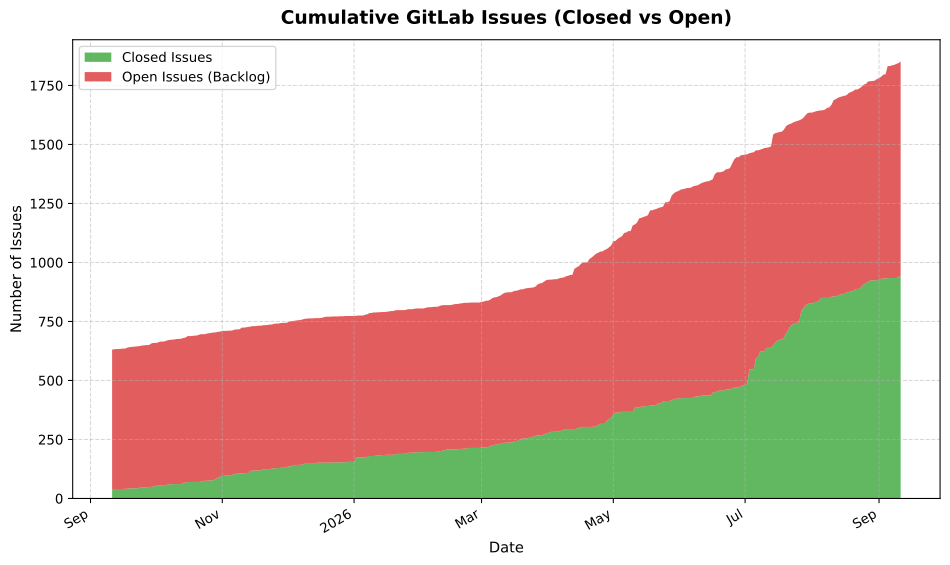
We see the increasing gap between open & closed bugs from March, where we failed to keep up with the flow arriving on [email protected]
In July we bulk imported the mails to gitlab, and between many maintainers we resolved alot over a month. After that first month though, we reverted to the widening gap, at the same rate we saw when triage was limited to just [email protected]
My reading of that is that even opening up triage to all QEMU maintainers has not fixed our scaling problem. We already burnt people out from dealing with these reports from automated tools.
Ideally I would like reporters to put in more personal effort beyond the initial bug filing. If they do that then bugs might get through triage and patch review more effectively and get closed quicker, allowing filing of more reports.
If reporters put in that more sustained patch curation effort instead of fire-and-forget, then I expect they wouldn't have time for filing so many bugs to begin with, making the limit less of a problem.
Also if they're putting in greater effort, I'd be amenable to granting them an exception to exceed the limits on bug filing. IMHO any regular maintainers are implicitly exempt from the limits given their ongoing beneficial work for the project.
IOW, the bug limit should be a problem primarily for people working on a "file-and-forget" basis.
Still, I welcome suggestions for other ideas, or if we should have different limits in some level ?
With regards,
Daniel
Signature · 3 lines
|: https://berrange.com       ~~        https://hachyderm.io/@berrange :|
|: https://libvirt.org          ~~          https://entangle-photo.org :|
|: https://pixelfed.art/berrange   ~~    https://fstop138.berrange.com :|
Quoted 10 lines · Daniel P. Berrangé
Quoted 3 lines · Alex Bennée
It comes across as quite a draconian limit but to be honest after a 6 months of dealing with this flood I'm less inclined to be polite about it:
Yes it is draconian. Aside from the periodic "mass filing" incidents, what prompted me is seeing the graph you produced at:
We're pulling the emergency brake. Minor injuries must be accepted in order to avoid major ones.
I'm not sure the policy gets that across. "Not a benefit to the project" and "place an unsustainable burden on maintainers" feel to me like British understatement for "harm the project" and "threaten to destroy the maintainer community".
Quoted 20 lines
We see the increasing gap between open & closed bugs from March, where we failed to keep up with the flow arriving on [email protected]
In July we bulk imported the mails to gitlab, and between many maintainers we resolved alot over a month. After that first month though, we reverted to the widening gap, at the same rate we saw when triage was limited to just [email protected]
My reading of that is that even opening up triage to all QEMU maintainers has not fixed our scaling problem. We already burnt people out from dealing with these reports from automated tools.
Ideally I would like reporters to put in more personal effort beyond the initial bug filing. If they do that then bugs might get through triage and patch review more effectively and get closed quicker, allowing filing of more reports.
Quoted 4 lines
If reporters put in that more sustained patch curation effort instead of fire-and-forget, then I expect they wouldn't have time for filing so many bugs to begin with, making the limit less of a problem.
Wouldn't it be nice.
Quoted 11 lines
Also if they're putting in greater effort, I'd be amenable to granting them an exception to exceed the limits on bug filing. IMHO any regular maintainers are implicitly exempt from the limits given their ongoing beneficial work for the project.
IOW, the bug limit should be a problem primarily for people working on a "file-and-forget" basis.
Still, I welcome suggestions for other ideas, or if we should have different limits in some level ?
Submitters submit when they expect the effort to be worth their while. I call this friction. It helps deter low-value contributions. It's more effective when it can be felt upfront.
AI has lowered upfront friction for bug submitters.
AI has not yet materially lowered the cost of triage, review, etc.
The policy change doesn't restore upfront friction, it merely gives us license to ignore certain submitters who flood us.
Sadly, I don't have any bright ideas on how to restore friction.
Quoted 18 lines · Daniel P. Berrangé
Recently QEMU has received a denial of service attack on its bug tracker in the form of 120 reports in 10 minutes, and now repeated by another reporter in the form of 50 reports in the same day.
Prior to switching security disclosures to the bug tracker, single reporters have submited 18, 22, and 114 bug reports.
None of this is sustainable. It is an effective denial of service attack on the project maintainers' time. Every bug report is a TODO item added to someone's workload.
It is time to put hard limits on how many bugs, discovered with assitance of automated tools, we are willing to accept in a givenm time frame.
This patch proposal suggests
Quoted 7 lines
* No more than 5 bugs per week, per reporter
* No more than 10 bugs are permitted to be open at any time, per reporter.This is explicitly scoped to bugs discovered with the assistance of automated tools. Bugs where a human puts in exclusively personal time / effort to discover a problem are not limited.
I think this is a good idea, thanks for writing it up!
contribute/report-a-bug.md on GitLab, taking into account the following guidance. · line 37
Quoted 11 lines
contribute/report-a-bug.md +3
-0@@ -32,6 +32,43 @@ on GitLab, taking into account the following guidance. triage of their output to validate all findings and reproducer scenarios prior to submitting a bug report. +* QEMU policy forbids the bulk filing of large numbers of + bug disclosures that were generated with automated tools + (AI/LLM, static analysis, fuzers). Such actions are not
s/fuzers/fuzzers/ ?
If you agree, I can fix the typo and commit the patch, no need to respin.
Thomas
Good idea, Daniel. While you're fixing typos, Thomas:
Quoted 8 lines · Thomas Huth
Quoted 7 lines · Daniel P. Berrangé
Recently QEMU has received a denial of service attack on its bug tracker in the form of 120 reports in 10 minutes, and now repeated by another reporter in the form of 50 reports in the same day.
Prior to switching security disclosures to the bug tracker, single reporters have submited 18, 22, and 114 bug reports.
submitted.
Quoted 7 lines
Quoted 7 lines
None of this is sustainable. It is an effective denial of service attack on the project maintainers' time. Every bug report is a TODO item added to someone's workload.
It is time to put hard limits on how many bugs, discovered with assitance of automated tools, we are willing to accept
assistance
Quoted 1 line
Quoted 1 line
in a givenm time frame.
given
r~
Quoted 19 lines · Richard Henderson
Good idea, Daniel. While you're fixing typos, Thomas:
Quoted 8 lines · Thomas Huth
Quoted 7 lines · Daniel P. Berrangé
Recently QEMU has received a denial of service attack on its bug tracker in the form of 120 reports in 10 minutes, and now repeated by another reporter in the form of 50 reports in the same day.
Prior to switching security disclosures to the bug tracker, single reporters have submited 18, 22, and 114 bug reports.
submitted.
Quoted 5 lines
Quoted 5 lines
None of this is sustainable. It is an effective denial of service attack on the project maintainers' time. Every bug report is a TODO item added to someone's workload.
Quoted 8 lines
Quoted 2 lines
Quoted 2 lines
It is time to put hard limits on how many bugs, discovered with assitance of automated tools, we are willing to accept
assistance
Quoted 1 line
Quoted 1 line
in a givenm time frame.
given
Thanks, I've fixed the typos and pushed it to the repo now.
Thomas
Quoted 36 lines · Daniel P. Berrangé
Recently QEMU has received a denial of service attack on its bug tracker in the form of 120 reports in 10 minutes, and now repeated by another reporter in the form of 50 reports in the same day.
Prior to switching security disclosures to the bug tracker, single reporters have submited 18, 22, and 114 bug reports.
None of this is sustainable. It is an effective denial of service attack on the project maintainers' time. Every bug report is a TODO item added to someone's workload.
It is time to put hard limits on how many bugs, discovered with assitance of automated tools, we are willing to accept in a givenm time frame.
This patch proposal suggests
* No more than 5 bugs per week, per reporter
* No more than 10 bugs are permitted to be open at any time, per reporter.This is explicitly scoped to bugs discovered with the assistance of automated tools. Bugs where a human puts in exclusively personal time / effort to discover a problem are not limited.
Signed-off-by Daniel P. Berrangé <[email protected]>--- contribute/report-a-bug.md | 37 +++++++++++++++++++++++++++++++++++++ 1 file changed, 37 insertions(+)contribute/report-a-bug.md +0
-0
contribute/report-a-bug.md on GitLab, taking into account the following guidance. · line 37
Quoted 6 lines
contribute/report-a-bug.md +3
-0@@ -32,6 +32,43 @@ on GitLab, taking into account the following guidance. triage of their output to validate all findings and reproducer scenarios prior to submitting a bug report. +* QEMU policy forbids the bulk filing of large numbers of + bug disclosures that were generated with automated tools + (AI/LLM, static analysis, fuzers). Such actions are not
fuzzers
Quoted 2 lines
contribute/report-a-bug.md +2
-0+ a benefit to the project, placing an unsustainable burden + on maintainers.
[...]
Quoted 7 lines · Daniel P. Berrangé
Recently QEMU has received a denial of service attack on its bug tracker in the form of 120 reports in 10 minutes, and now repeated by another reporter in the form of 50 reports in the same day.
Prior to switching security disclosures to the bug tracker, single reporters have submited 18, 22, and 114 bug reports.
submitted
Quoted 6 lines
None of this is sustainable. It is an effective denial of service attack on the project maintainers' time. Every bug report is a TODO item added to someone's workload.
It is time to put hard limits on how many bugs, discovered with assitance of automated tools, we are willing to accept
assistance
Quoted 1 line
in a givenm time frame.
given
Quoted 42 lines
This patch proposal suggests
* No more than 5 bugs per week, per reporter
* No more than 10 bugs are permitted to be open at any time, per reporter.This is explicitly scoped to bugs discovered with the assistance of automated tools. Bugs where a human puts in exclusively personal time / effort to discover a problem are not limited.
Signed-off-by Daniel P. Berrangé <[email protected]>--- contribute/report-a-bug.md | 37 +++++++++++++++++++++++++++++++++++++ 1 file changed, 37 insertions(+)contribute/report-a-bug.md +19
-0@@ -32,6 +32,43 @@ on GitLab, taking into account the following guidance. triage of their output to validate all findings and reproducer scenarios prior to submitting a bug report. +* QEMU policy forbids the bulk filing of large numbers of + bug disclosures that were generated with automated tools + (AI/LLM, static analysis, fuzers). Such actions are not + a benefit to the project, placing an unsustainable burden + on maintainers. + + * **No more than 5 bug/security reports, discovered + with assistance of automated tools, are permitted + to be filed per week, per reporter.** + * **No more than 10 bug/security reports, discovered + with assistance of automated tools are permitted + to be open at any time, per reporter.** + * Reporters must refrain from filing any reports + that would cause these thresholds to be exceeded + without first obtaining explicit prior permission + from project maintainers. + * Reporters are **required** to respond to triage + comments from maintainers on bugs related to + automated tools on a timely basis.
contribute/report-a-bug.md on GitLab, taking into account the following guidance. · line 63
Quoted 10 lines
contribute/report-a-bug.md +10
-0+ * If at any time, the project maintainers request + the reporter to stop filing bug reports discovered + with assistance of automated tools, this must be + honoured. + + Ignoring any of the above rules may lead to the bugs being + mass closed without further triage, even if valid reports. + In cases where the filing limits are grossly exceeded, + the reporter's GitLab account may be reported for abuse + (spam), potentially leading to termination.
Do we know if people are doing this purely for the recognition? Perhaps we could suggest that if these rules are broken, all bug reports submitted by the reporter will remain private (to reporters) on GitLab: if a maintainer decides to fix a reported bug at their discretion, the original reporter will not be credited in the commit message.
contribute/report-a-bug.md on GitLab, taking into account the following guidance. · line 74
Quoted 10 lines
contribute/report-a-bug.md +7
-0+ If intending to file large numbers of bug disclosures + in aggregate, reporters are expected to invest their + time in writing patches, providing the patches for + review, and then further responding to feedback and + iterating on the patches until a maintainer accepts + them for it. + * Reproduce the problem directly with a QEMU command-line. Avoid frontends and management stacks, to ensure that the bug is in QEMU itself and not in a frontend and make it easier for
ATB,
Mark.
Quoted 1 line · Mark Cave-Ayland
On 24/09/2026 14:56, Daniel P. Berrangé wrote:
[...]
Quoted 7 lines
contribute/report-a-bug.md on GitLab, taking into account the following guidance. · line 63
Quoted 5 lines
contribute/report-a-bug.md +5
-0+ Ignoring any of the above rules may lead to the bugs being + mass closed without further triage, even if valid reports. + In cases where the filing limits are grossly exceeded, + the reporter's GitLab account may be reported for abuse + (spam), potentially leading to termination.Do we know if people are doing this purely for the recognition? Perhaps we could suggest that if these rules are broken, all bug reports submitted by the reporter will remain private (to reporters) on GitLab: if a maintainer decides to fix a reported bug at their discretion, the original reporter will not be credited in the commit message.
Reducing the reward might be a possible partial replacement for friction.
However, to not give credit for a bug we first need to fix the bug. This has turned out to be pretty much infeasible in the cases covered by the proposed policy.
[...]