HID: validate report length and constants
PATCH 1/1 HID: validate report length and constants
From 4956d80ba2bcdb0f5410dfe9365331bcece781cb Mon Sep 17 00:00:00 2001
From: Davide Beatrici <[email protected]>
Date: Tue, 2 Dec 2025 05:00:52 +0100
Subject: [PATCH] HID: validate report length and constants
MIME-Version: 1.0
Content-Type: text/plain; charset=UTF-8
Content-Transfer-Encoding: 8bit
The HID specification defines Input(Constant) fields as padding or reserved bits that must remain zero at runtime. Currently, Linux accepts non‑zero values in these fields, allowing malformed reports to propagate to userspace.
The ATK X1 SE (373b:1107) is a popular USB mouse that triggers weird behavior. A few seconds after connecting it sends a packet that is detected as malformed by WireShark, but the kernel happily accepts and parses it.
Until the device is disconnected, modifier keys are forced into a fixed state:
LeftControl (0xe0): UP
LeftShift (0xe1): UP
LeftAlt (0xe2): DOWN
LeftGUI (0xe3): UP
RightControl (0xe4): UP
RightShift (0xe5): DOWN
RightAlt (0xe6): DOWN
RightGUI (0xe7): UP
And unknown keys are kept pressed:
kernel: usb 5-1: Unknown key (scancode 0xb2) pressed.
kernel: usb 5-1: Unknown key (scancode 0xff) pressed.
kernel: usb 5-1: Unknown key (scancode 0xff) pressed.
kernel: usb 5-1: Unknown key (scancode 0xc0) pressed.
kernel: usb 5-1: Unknown key (scancode 0xb6) pressed.
kernel: usb 5-1: Unknown key (scancode 0xff) pressed.
kernel: usb 5-1: Unknown key (scancode 0xff) pressed.
This patch extends hid-core to record Constant slices during descriptor parsing and validate them at runtime. Reports with non‑zero Constant bits are rejected, and a ratelimited warning is logged. Legitimate Data/Relative fields (buttons, motion axes, wheel) continue to pass through unchanged.
Malformed reports are suppressed and no longer show up with usbmon/WireShark. All other USB devices I own still work flawlessly after applying this patch, but this is definitely something that requires extensive testing!
---
 drivers/hid/hid-core.c | 134 ++++++++++++++++++++++++++++++++++++++++-
 include/linux/hid.h    |  15 +++++
 2 files changed, 146 insertions(+), 3 deletions(-)
drivers/hid/hid-core.c +77 -0
@@ -280,6 +280,81 @@ static int hid_add_usage(struct hid_parser *parser, unsigned usage, u8 size)return 0 ; } +/* +* Append metadata for runtime payload validation. +*/ + +static int hid_validate_append_bits (struct hid_report *r,const __u16 bit_off,const __u16 bit_len) +{ +struct hid_report_validate *v = &r->validate; +struct hid_const_slice *slices =krealloc (v->const_slices, + (v->const_count +1 ) *sizeof (*slices),GFP_KERNEL ); +if (!slices) +return -ENOMEM ; + + v->const_slices = slices; + v->const_slices[v->const_count].bit_off = bit_off; + v->const_slices[v->const_count].bit_len = bit_len; + v->const_count++; + +return 0 ; +} + +/* +* Validate runtime payload. +*/ + +static bool hid_validate_report (struct hid_device *hid,struct hid_report *r, +const __u8 *buf,size_t len) +{ +const __u8 *payload; +size_t payload_len; +__u16 i; + +/* Report ID handling: if present, buf[0] is ID; payload follows */ + payload = r->id ? buf +1 : buf; + payload_len = r->id ? (len ? len -1 :0 ) : len; + +if (r->validate.payload_len && payload_len != r->validate.payload_len) { +hid_warn_ratelimited (hid, +"Malformed report: length %zu != expected %u (ID %u)\n" , + payload_len, r->validate.payload_len, r->id); +return false; + } + +for (i =0 ; i < r->validate.const_count; i++) { +const __u16 bit_off = r->validate.const_slices[i].bit_off; +const __u16 bit_len = r->validate.const_slices[i].bit_len; +const __u16 end_bit = bit_off + bit_len; + +for (__u16 b = bit_off; b < end_bit;) { +size_t byte_off = b >>3 ; +size_t bit_in_byte = b &7 ; + +__u16 rem_bits = end_bit - b; +__u8 span = (__u8 )min_t (__u16, rem_bits,8 - bit_in_byte); +__u8 mask = ((1u << span) -1 ) << bit_in_byte; + +if (byte_off >= payload_len) { +hid_warn_ratelimited (hid, +"Malformed report: const slice OOB (bit_off %u, len %u)\n" , + bit_off, bit_len); +return false; + } +if (payload[byte_off] & mask) { +hid_warn_ratelimited (hid, +"Malformed report: non-zero constant at byte %zu mask 0x%02x val 0x%02x\n" , + byte_off, mask, payload[byte_off]); +return false; + } + + b += span; + } + } + +return true; +} +/* * Register a new field for this report. */
@@ -303,6 +378,8 @@ static int hid_add_field(struct hid_parser *parser, unsigned report_type, unsignreturn -1 ; } + parser->curr_report = report; +/* Handle both signed and unsigned cases properly */ if ((parser->global.logical_minimum < 0 && parser->global.logical_maximum <
@@ -638,11 +715,13 @@ static void hid_concatenate_last_usage_page(struct hid_parser *parser)
 static int hid_parser_main(struct hid_parser *parser, struct hid_item
*item)
{
__u32 data;
+ __u8 flags;
int ret;
hid_concatenate_last_usage_page(parser);
data = item_udata(item);
+ flags = (u8)data;
 	switch (item->tag) {
 	case HID_MAIN_ITEM_TAG_BEGIN_COLLECTION:
@@ -651,15 +730,61 @@ static int hid_parser_main(struct hid_parser *parser,
 struct hid_item *item)
 	case HID_MAIN_ITEM_TAG_END_COLLECTION:
 		ret = close_collection(parser);
 		break;
-	case HID_MAIN_ITEM_TAG_INPUT:
+	case HID_MAIN_ITEM_TAG_INPUT: {
+		__u16 offset_bits, size_bits;
+
+		if (flags & HID_MAIN_ITEM_RESERVED_MASK) {
+			hid_warn_ratelimited(parser->device,
+				"Malformed input descriptor: reserved bits set (0x%02x)\n",
+				flags);
+			return -EINVAL;
+		}
+
+		/* Compute field range in bits */
+		offset_bits = parser->curr_offset;
+		size_bits   = parser->global.report_size * parser->global.report_count;
+
+		/* Record Input(Constant) slices for runtime validation */
+		if ((flags & HID_MAIN_ITEM_CONSTANT) && parser->curr_report) {
+			/* Record bit-granular slice: store bit offset and size */
+			ret = hid_validate_append_bits(parser->curr_report, offset_bits,
 size_bits);
+			if (ret)
+				return ret;
+		}
+
+		/* Advance offset and add field */
+		parser->curr_offset += size_bits;
+
 		ret = hid_add_field(parser, HID_INPUT_REPORT, data);
+		if (!ret && parser->curr_report) {
+			/* Expected payload length (bytes) excluding the optional ID */
+			parser->curr_report->validate.payload_len = (parser->curr_report->size +
 7) / 8;
+		}
+
 		break;
-	case HID_MAIN_ITEM_TAG_OUTPUT:
+	}
+	case HID_MAIN_ITEM_TAG_OUTPUT: {
+		if (flags & HID_MAIN_ITEM_RESERVED_MASK) {
+			hid_warn_ratelimited(parser->device,
+				"Malformed output descriptor: reserved bits set (0x%02x)\n",
+				flags);
+			return -EINVAL;
+		}
+
 		ret = hid_add_field(parser, HID_OUTPUT_REPORT, data);
 		break;
-	case HID_MAIN_ITEM_TAG_FEATURE:
+	}
+	case HID_MAIN_ITEM_TAG_FEATURE: {
+		if (flags & HID_MAIN_ITEM_RESERVED_MASK) {
+			hid_warn_ratelimited(parser->device,
+				"Malformed feature descriptor: reserved bits set (0x%02x)\n",
+				flags);
+			return -EINVAL;
+		}
+
 		ret = hid_add_field(parser, HID_FEATURE_REPORT, data);
 		break;
+	}
 	default:
 		if (item->tag >= HID_MAIN_ITEM_TAG_RESERVED_MIN &&
 			item->tag <= HID_MAIN_ITEM_TAG_RESERVED_MAX)
@@ -2062,6 +2187,9 @@ int hid_report_raw_event(struct hid_device *hid, enum hid_report_type type, u8 *
 		memset(cdata + csize, 0, rsize - csize);
 	}

+	if (!hid_validate_report(hid, report, data, size))
+		goto out;
+
 	if ((hid->claimed & HID_CLAIMED_HIDDEV) && hid->hiddev_report_event)
 		hid->hiddev_report_event(hid, report);
 	if (hid->claimed & HID_CLAIMED_HIDRAW) {
include/linux/hid.h +15 -0
@@ -88,6 +88,7 @@ struct hid_item {* HID report descriptor main item contents */ +#define HID_MAIN_ITEM_RESERVED_MASK 0x0c8/* HID 1.11: flags reserved bits (3, 6, 7) must be zero */ #define HID_MAIN_ITEM_CONSTANT 0x001#define HID_MAIN_ITEM_VARIABLE 0x002#define HID_MAIN_ITEM_RELATIVE 0x004
@@ -560,6 +561,17 @@ struct hid_field_entry {__s32 priority; }; +struct hid_const_slice { +__u16 bit_off; +__u16 bit_len; +}; + +struct hid_report_validate { +struct hid_const_slice *const_slices; +__u16 const_count; +__u16 payload_len; +}; +struct hid_report {struct list_head list;struct list_head hidinput_list;
@@ -576,6 +588,7 @@ struct hid_report {/* tool related state */ bool tool_active;/* whether the current tool is active */ unsigned int tool;/* BTN_TOOL_* */ +struct hid_report_validate validate; };#define HID_MAX_IDS 256
@@ -760,6 +773,8 @@ struct hid_parser {unsigned int collection_stack_size;struct hid_device *device;unsigned int scan_flags; +__u16 curr_offset; +struct hid_report *curr_report; };struct hid_class_descriptor {
Signature · 1 line
2.51.2
Benjamin Tissoires
maintainerQuoted 8 lines · Davide Beatrici
From
4956d80ba2bcdb0f5410dfe9365331bcece781cbMon Sep 17 00:00:00 2001
From: Davide Beatrici <[email protected]>
Date: Tue, 2 Dec 2025 05:00:52 +0100
Subject: [PATCH] HID: validate report length and constants
MIME-Version: 1.0
Content-Type: text/plain; charset=UTF-8
Content-Transfer-Encoding: 8bit
Quoted 4 lines
The HID specification defines Input(Constant) fields as padding or reserved bits that must remain zero at runtime. Currently, Linux accepts non‑zero values in these fields, allowing malformed reports to propagate to userspace.
Yep, this is on purpose because Miscrosoft's own driver works that way and many HID devices do not bother to mark the non constant bits as data. So if you enforce the spec here, you'll break a numerous of devices unfortunatelly.
Quoted 6 lines
The ATK X1 SE (373b:1107) is a popular USB mouse that triggers weird behavior.
A few seconds after connecting it sends a packet that is detected as malformed
by WireShark, but the kernel happily accepts and parses it.
Can you show us what packets are emitted?
If it's a firmware bug, we better have a specific driver for it could be a HID-BPF program that just filters out the unwanted reports.
Also, how does Windows behave with this mouse? Does it need a special driver?
Quoted 15 lines
Until the device is disconnected, modifier keys are forced into a fixed state:
LeftControl (
0xe0): UP
LeftShift (0xe1): UP
LeftAlt (0xe2): DOWN
LeftGUI (0xe3): UP
RightControl (0xe4): UP
RightShift (0xe5): DOWN
RightAlt (0xe6): DOWN
RightGUI (0xe7): UPAnd unknown keys are kept pressed:
Quoted 8 lines
kernel: usb 5-1: Unknown key (scancode
0xb2) pressed.
kernel: usb 5-1: Unknown key (scancode0xff) pressed.
kernel: usb 5-1: Unknown key (scancode0xff) pressed.kernel: usb 5-1: Unknown key (scancode
0xc0) pressed.
kernel: usb 5-1: Unknown key (scancode0xb6) pressed.
kernel: usb 5-1: Unknown key (scancode0xff) pressed.
kernel: usb 5-1: Unknown key (scancode0xff) pressed.
Looks like there is something wrong either in the report descriptor of this mouse, either in the emitted reports.
Quoted 7 lines
This patch extends hid-core to record Constant slices during descriptor parsing and validate them at runtime. Reports with non‑zero Constant bits are
rejected, and a ratelimited warning is logged. Legitimate Data/Relative fields
(buttons, motion axes, wheel) continue to pass through unchanged.
Ouch. If I read you correctly, you are rejecting the entire report if a constant field is not 0. It is common for constant fields to be just garbage (whatever is in the memory, because writing firmware is hard), so even if we were to accept this patch, this would break even more devices :(
Quoted 5 lines
Malformed reports are suppressed and no longer show up with usbmon/WireShark.
All other USB devices I own still work flawlessly after applying this patch, but this is definitely something that requires extensive testing!
I am pretty sure the HID selftests will fail with this patch applied, because there are probably a couple of devices there with the "non constant" behaviour.
Cheers,
Benjamin
Quoted 253 lines
Signed-off-by Davide Beatrici <[email protected]>--- drivers/hid/hid-core.c | 134 ++++++++++++++++++++++++++++++++++++++++- include/linux/hid.h | 15 +++++ 2 files changed, 146 insertions(+), 3 deletions(-)drivers/hid/hid-core.c +64
-0@@ -280,6 +280,81 @@ static int hid_add_usage(struct hid_parser *parser, unsigned usage, u8 size) return 0; } +/* +* Append metadata for runtime payload validation. +*/ + +static int hid_validate_append_bits (struct hid_report *r,const __u16 bit_off,const __u16 bit_len) +{ +struct hid_report_validate *v = &r->validate; +struct hid_const_slice *slices =krealloc (v->const_slices, + (v->const_count +1 ) *sizeof (*slices),GFP_KERNEL ); +if (!slices) +return -ENOMEM ; + + v->const_slices = slices; + v->const_slices[v->const_count].bit_off = bit_off; + v->const_slices[v->const_count].bit_len = bit_len; + v->const_count++; + +return 0 ; +} + +/* +* Validate runtime payload. +*/ + +static bool hid_validate_report (struct hid_device *hid,struct hid_report *r, +const __u8 *buf,size_t len) +{ +const __u8 *payload; +size_t payload_len; +__u16 i; + +/* Report ID handling: if present, buf[0] is ID; payload follows */ + payload = r->id ? buf +1 : buf; + payload_len = r->id ? (len ? len -1 :0 ) : len; + +if (r->validate.payload_len && payload_len != r->validate.payload_len) { +hid_warn_ratelimited (hid, +"Malformed report: length %zu != expected %u (ID %u)\n" , + payload_len, r->validate.payload_len, r->id); +return false; + } + +for (i =0 ; i < r->validate.const_count; i++) { +const __u16 bit_off = r->validate.const_slices[i].bit_off; +const __u16 bit_len = r->validate.const_slices[i].bit_len; +const __u16 end_bit = bit_off + bit_len; + +for (__u16 b = bit_off; b < end_bit;) { +size_t byte_off = b >>3 ; +size_t bit_in_byte = b &7 ; + +__u16 rem_bits = end_bit - b; +__u8 span = (__u8 )min_t (__u16, rem_bits,8 - bit_in_byte); +__u8 mask = ((1u << span) -1 ) << bit_in_byte; + +if (byte_off >= payload_len) { +hid_warn_ratelimited (hid, +"Malformed report: const slice OOB (bit_off %u, len %u)\n" , + bit_off, bit_len); +return false; + } +if (payload[byte_off] & mask) { + hid_warn_ratelimited(hid, + "Malformed report: non-zero constant at byte %zu mask 0x%02x val0x%02x\n",
drivers/hid/hid-core.c +11
-0+ byte_off, mask, payload[byte_off]); +return false; + } + + b += span; + } + } + +return true; +} +/* * Register a new field for this report. */ @@ -303,6 +378,8 @@ static int hid_add_field(struct hid_parser *parser,unsigned
report_type, unsigndrivers/hid/hid-core.c +4
-0return -1 ; } + parser->curr_report = report; +/* Handle both signed and unsigned cases properly */ if ((parser->global.logical_minimum < 0 && parser->global.logical_maximum <@@ -638,11 +715,13 @@ static void hid_concatenate_last_usage_page(struct hid_parser *parser)static int hid_parser_main (struct hid_parser *parser,struct hid_item *item) {__u32 data; +__u8 flags;int ret;hid_concatenate_last_usage_page (parser); data =item_udata (item); + flags = (u8 )data;drivers/hid/hid-core.c +49
-3switch (item->tag) {case HID_MAIN_ITEM_TAG_BEGIN_COLLECTION :@@ -651,15 +730,61 @@ static int hid_parser_main(struct hid_parser *parser, struct hid_item *item)case HID_MAIN_ITEM_TAG_END_COLLECTION : ret =close_collection (parser);break ; -case HID_MAIN_ITEM_TAG_INPUT : +case HID_MAIN_ITEM_TAG_INPUT : { +__u16 offset_bits, size_bits; + +if (flags &HID_MAIN_ITEM_RESERVED_MASK ) { +hid_warn_ratelimited (parser->device, +"Malformed input descriptor: reserved bits set (0x%02x)\n" , + flags); +return -EINVAL ; + } + +/* Compute field range in bits */ + offset_bits = parser->curr_offset; + size_bits = parser->global.report_size * parser->global.report_count; + +/* Record Input(Constant) slices for runtime validation */ +if ((flags &HID_MAIN_ITEM_CONSTANT ) && parser->curr_report) { +/* Record bit-granular slice: store bit offset and size */ + ret =hid_validate_append_bits (parser->curr_report, offset_bits, size_bits); +if (ret) +return ret; + } + +/* Advance offset and add field */ + parser->curr_offset += size_bits; + ret =hid_add_field (parser,HID_INPUT_REPORT , data); +if (!ret && parser->curr_report) { +/* Expected payload length (bytes) excluding the optional ID */ + parser->curr_report->validate.payload_len = (parser->curr_report->size +7 ) /8 ; + } +break ; -case HID_MAIN_ITEM_TAG_OUTPUT : + } +case HID_MAIN_ITEM_TAG_OUTPUT : { +if (flags &HID_MAIN_ITEM_RESERVED_MASK ) { +hid_warn_ratelimited (parser->device, +"Malformed output descriptor: reserved bits set (0x%02x)\n" , + flags); +return -EINVAL ; + } + ret =hid_add_field (parser,HID_OUTPUT_REPORT , data);break ; -case HID_MAIN_ITEM_TAG_FEATURE : + } +case HID_MAIN_ITEM_TAG_FEATURE : { +if (flags &HID_MAIN_ITEM_RESERVED_MASK ) { +hid_warn_ratelimited (parser->device, +"Malformed feature descriptor: reserved bits set (0x%02x)\n" , + flags); +return -EINVAL ; + } + ret =hid_add_field (parser,HID_FEATURE_REPORT , data);break ; + }drivers/hid/hid-core.c +0
-0default :if (item->tag >=HID_MAIN_ITEM_TAG_RESERVED_MIN && item->tag <=HID_MAIN_ITEM_TAG_RESERVED_MAX )@@ -2062,6 +2187,9 @@ int hid_report_raw_event(struct hid_device *hid, enum
hid_report_typetype, u8 *drivers/hid/hid-core.c +3
-0memset (cdata + csize,0 , rsize - csize); } +if (!hid_validate_report (hid, report, data, size)) + goto out; +if ((hid->claimed &HID_CLAIMED_HIDDEV ) && hid->hiddev_report_event) hid->hiddev_report_event (hid, report);if (hid->claimed &HID_CLAIMED_HIDRAW ) {include/linux/hid.h +1
-0@@ -88,6 +88,7 @@ struct hid_item {* HID report descriptor main item contents */ +#define HID_MAIN_ITEM_RESERVED_MASK 0x0c8/* HID 1.11: flags reserved bits (3, 6, 7) must be zero */
#defineHID_MAIN_ITEM_CONSTANT0x001
#defineHID_MAIN_ITEM_VARIABLE0x002
#defineHID_MAIN_ITEM_RELATIVE0x004include/linux/hid.h +14
-0@@ -560,6 +561,17 @@ struct hid_field_entry {__s32 priority; }; +struct hid_const_slice { +__u16 bit_off; +__u16 bit_len; +}; + +struct hid_report_validate { +struct hid_const_slice *const_slices; +__u16 const_count; +__u16 payload_len; +}; +struct hid_report {struct list_head list;struct list_head hidinput_list;@@ -576,6 +588,7 @@ struct hid_report {/* tool related state */ bool tool_active;/* whether the current tool is active */ unsigned int tool;/* BTN_TOOL_* */ +struct hid_report_validate validate; };#define HID_MAX_IDS 256@@ -760,6 +773,8 @@ struct hid_parser {unsigned int collection_stack_size;struct hid_device *device;unsigned int scan_flags; +__u16 curr_offset; +struct hid_report *curr_report; };struct hid_class_descriptor {Signature · 1 line
2.51.2
Thank you very much for your feedback!
I can send you a new identical device for testing if you would like.
Quoted 7 lines
Can you show us what packets are emitted?
If it's a firmware bug, we better have a specific driver for it could be a HID-BPF program that just filters out the unwanted reports.
Also, how does Windows behave with this mouse? Does it need a special driver?
Sorry, I should've mentioned the malformed packet also shows up on Windows, but is seemingly ignored because there appear to be no side effects whatsoever.
No special driver needed, it's detected as a standard HID mouse.
WireShark capture:
https://dl.houseof.software/misc/atk_x1_se_malformed_packet.pcapng
Packet screenshot:
https://dl.houseof.software/misc/atk_x1_se_malformed_packet.png
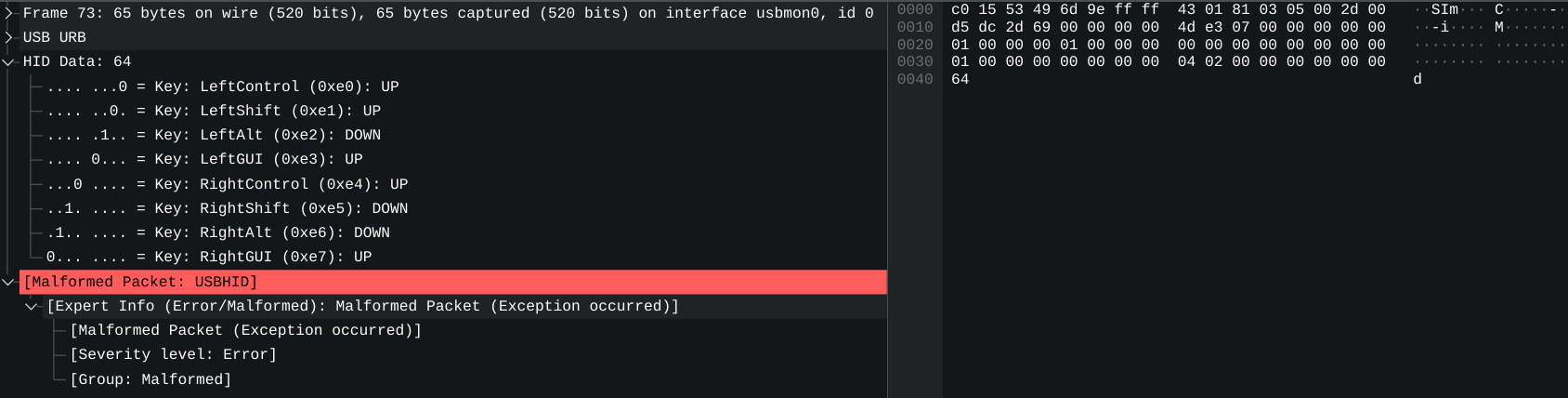
Quoted 2 lines
Looks like there is something wrong either in the report descriptor of this mouse, either in the emitted reports.
Definitely. I have already informed the manufacturer, who confirmed the mouse has only been tested on Windows.
My inquiry was forwarded to their R&D team, hopefully a firmware update will be released soon.
Quoted 11 lines
Yep, this is on purpose because Miscrosoft's own driver works that way and many HID devices do not bother to mark the non constant bits as data. So if you enforce the spec here, you'll break a numerous of devices unfortunatelly.
Ouch. If I read you correctly, you are rejecting the entire report if a constant field is not 0. It is common for constant fields to be just garbage (whatever is in the memory, because writing firmware is hard), so even if we were to accept this patch, this would break even more devices :(
Quoted 3 lines
I am pretty sure the HID selftests will fail with this patch applied, because there are probably a couple of devices there with the "non constant" behaviour.
Oh, in that case let's just drop that part from the patch, since it's actually not altering the behavior with this specific device.
The malformed packet is detected and rejected by two checks:
Malformed report: raw_len=1 payload_len=1 expected=8 (ID 0) Malformed report: const slice OOB (bit_off 8, len 8)
Quoted 4 lines · Davide Beatrici
Thank you very much for your feedback!
I can send you a new identical device for testing if you would like.
Can you supply the Device, Configuration, and Report Descriptors?
Thanks,
Terry
Quoted 51 lines
Quoted 7 lines
Can you show us what packets are emitted?
If it's a firmware bug, we better have a specific driver for it could be a HID-BPF program that just filters out the unwanted reports.
Also, how does Windows behave with this mouse? Does it need a special driver?
Sorry, I should've mentioned the malformed packet also shows up on Windows, but is seemingly ignored because there appear to be no side effects whatsoever.
No special driver needed, it's detected as a standard HID mouse.
WireShark capture:
https://dl.houseof.software/misc/atk_x1_se_malformed_packet.pcapngPacket screenshot:
https://dl.houseof.software/misc/atk_x1_se_malformed_packet.pngQuoted 2 lines
Looks like there is something wrong either in the report descriptor of this mouse, either in the emitted reports.
Definitely. I have already informed the manufacturer, who confirmed the mouse has only been tested on Windows.
My inquiry was forwarded to their R&D team, hopefully a firmware update will be released soon.
Quoted 11 lines
Yep, this is on purpose because Miscrosoft's own driver works that way and many HID devices do not bother to mark the non constant bits as data. So if you enforce the spec here, you'll break a numerous of devices unfortunatelly.
Ouch. If I read you correctly, you are rejecting the entire report if a constant field is not 0. It is common for constant fields to be just garbage (whatever is in the memory, because writing firmware is hard), so even if we were to accept this patch, this would break even more devices :(
Quoted 3 lines
I am pretty sure the HID selftests will fail with this patch applied, because there are probably a couple of devices there with the "non constant" behaviour.
Oh, in that case let's just drop that part from the patch, since it's actually not altering the behavior with this specific device.
The malformed packet is detected and rejected by two checks:
Malformed report: raw_len=1 payload_len=1 expected=8 (ID 0) Malformed report: const slice OOB (
bit_off8, len 8)
Quoted 1 line
Can you supply the Device, Configuration, and Report Descriptors?
Sure.
Device Descriptor:
  idVendor           0x373b Compx
  idProduct          0x1107 ATK X1 SE Nearlink
  bcdDevice          1.21
  bcdUSB             2.00
  bMaxPacketSize0    64
  iManufacturer      1 Compx
  iProduct           2 ATK X1 SE Nearlink
bNumConfigurations 1
Configuration Descriptor:
  wTotalLength       0x0054
  bNumInterfaces     3
  bmAttributes       0xa0 (Bus Powered, Remote Wakeup)
  MaxPower           494mA
Interface 0: HID Keyboard
HID Descriptor: wDescriptorLength 77
Endpoint IN 0x81, Interrupt, 64 bytes
Interface 1: HID (non‑boot)
HID Descriptor: wDescriptorLength 156
Endpoint IN 0x82, Interrupt, 64 bytes
Interface 2: HID Mouse
HID Descriptor: wDescriptorLength 87
Endpoint IN 0x83, Interrupt, 64 bytes
Report Descriptors:
Interface 2 (Mouse):
05 01 09 02 A1 01 09 01 A1 00 05 09 19 01 29 05
15 00 25 01 95 05 75 01 81 02 95 01 75 03 81 01
05 01 09 30 09 31 16 00 80 26 FF 7F 75 10 95 02
81 06 C0 A1 00 05 01 09 38 15 81 25 7F 75 08 95
01 81 06 C0 A1 00 05 0C 0A 38 02 95 01 75 08 15
81 25 7F 81 06 C0 C0
Interface 1 (HID composite):
05 0C 09 01 A1 01 85 05 15 00 26 14 05 19 00 2A
14 05 75 10 95 01 81 00 C0 05 01 09 80 A1 01 85
03 19 81 29 83 15 00 25 01 95 03 75 01 81 02 95
01 75 05 81 01 C0 05 01 09 06 A1 01 85 04 05 07
15 00 25 01 19 00 29 9F 95 A0 75 01 81 02 C0 06
02 FF 09 02 A1 01 85 13 15 00 26 FF 00 75 08 95
13 09 02 81 00 09 02 91 00 C0 06 02 FF 09 02 A1
01 85 08 15 00 26 FF 00 75 08 95 10 09 02 81 00
09 02 91 00 C0 06 04 FF 09 02 A1 01 85 06 09 02
15 00 26 FF 00 75 08 95 07 B1 02 C0
Interface 0 (Keyboard):
05 01 09 06 A1 01 05 08 19 01 29 03 15 00 25 01
75 01 95 03 91 02 95 05 91 01 05 07 19 E0 29 E7
15 00 25 01 75 01 95 08 81 02 75 08 95 01 81 01
05 07 19 00 2A FF 00 15 00 26 FF 00 75 08 95 05
81 00 05 FF 09 03 75 08 95 01 81 02 C0
Benjamin Tissoires
maintainerQuoted 54 lines · Davide Beatrici
Quoted 1 line
Can you supply the Device, Configuration, and Report Descriptors?
Sure.
Device Descriptor:
  idVendor           0x373b Compx
  idProduct          0x1107 ATK X1 SE Nearlink
  bcdDevice          1.21
  bcdUSB             2.00
  bMaxPacketSize0    64
  iManufacturer      1 Compx
  iProduct           2 ATK X1 SE Nearlink
bNumConfigurations 1
Configuration Descriptor:
  wTotalLength       0x0054
  bNumInterfaces     3
  bmAttributes       0xa0 (Bus Powered, Remote Wakeup)
  MaxPower           494mA
Interface 0: HID Keyboard
HID Descriptor: wDescriptorLength 77
Endpoint IN0x81, Interrupt, 64 bytesInterface 1: HID (non‑boot)
HID Descriptor: wDescriptorLength 156
Endpoint IN0x82, Interrupt, 64 bytesInterface 2: HID Mouse
HID Descriptor: wDescriptorLength 87
Endpoint IN0x83, Interrupt, 64 bytesReport Descriptors:
Interface 2 (Mouse):
05 01 09 02 A1 01 09 01 A1 00 05 09 19 01 29 05
15 00 25 01 95 05 75 01 81 02 95 01 75 03 81 01
05 01 09 30 09 31 16 00 80 26 FF 7F 75 10 95 02
81 06 C0 A1 00 05 01 09 38 15 81 25 7F 75 08 95
01 81 06 C0 A1 00 05 0C 0A 38 02 95 01 75 08 15
81 25 7F 81 06 C0 C0Interface 1 (HID composite):
05 0C 09 01 A1 01 85 05 15 00 26 14 05 19 00 2A
14 05 75 10 95 01 81 00 C0 05 01 09 80 A1 01 85
03 19 81 29 83 15 00 25 01 95 03 75 01 81 02 95
01 75 05 81 01 C0 05 01 09 06 A1 01 85 04 05 07
15 00 25 01 19 00 29 9F 95 A0 75 01 81 02 C0 06
02 FF 09 02 A1 01 85 13 15 00 26 FF 00 75 08 95
13 09 02 81 00 09 02 91 00 C0 06 02 FF 09 02 A1
01 85 08 15 00 26 FF 00 75 08 95 10 09 02 81 00
09 02 91 00 C0 06 04 FF 09 02 A1 01 85 06 09 02
15 00 26 FF 00 75 08 95 07 B1 02 C0
Quoted 6 lines
Interface 0 (Keyboard):
05 01 09 06 A1 01 05 08 19 01 29 03 15 00 25 01
75 01 95 03 91 02 95 05 91 01 05 07 19 E0 29 E7
15 00 25 01 75 01 95 08 81 02 75 08 95 01 81 01
05 07 19 00 2A FF 00 15 00 26 FF 00 75 08 95 05
81 00 05 FF 09 03 75 08 95 01 81 02 C0
Thanks for the logs.
So after analysing the wireshark capture and these, the problem is that the device sends a USB report of length 1 on the keyboard interface when we should actually get one of size 8.
However, the device also shows an output report of size 1, but it is not supposed to send it as an input report. I wonder if the firmware bug is not that it tries to give the host the current state of its output report at plug (which is wrong but Windows must be papering over it).
Anyway couple of observations:
- the URB is of size 1, so the fact that the constant field is not 0 means that we are just reading random memory at offset 1 in the provided data, so you might have a chance that it eventually becomes 0
- the fix should be focusing on the length of the provided report, not on the content. However, in hid_report_raw_event(), just before you inserted your call to your hid_validate_report(), there is already a check on the length of the report which memsets to 0 the rest of the buffer. This seems a little bit optimistic if the provided buffer from USB is exactly the size of the provided "size" argument. But then, why would you get random data in the const fields if there is a memset if the provided length is "1"?
So, can you add a printk before your call to hid_validate_report() to show the provided "size" argument (csize), or just enable the hid_dbg() trace output which should tell us if we enter that test and do the memset (which I suppose we are not).
Cheers,
Benjamin
Quoted 4 lines
However, the device also shows an output report of size 1, but it is not supposed to send it as an input report. I wonder if the firmware bug is not that it tries to give the host the current state of its output report at plug (which is wrong but Windows must be papering over it).
On that note, I noticed the malformed packet is not sent upon reconnecting the device if it's been plugged in for some time.
When that happens I can reproduce the issue by enabling a wireless mode through the switch on the bottom and wait a bit before disabling it and connecting the device again.
I suspect the battery gets slightly discharged and the device sends a "charging complete" signal or something.
Quoted 3 lines
- the URB is of size 1, so the fact that the constant field is not 0 means that we are just reading random memory at offset 1 in the provided data, so you might have a chance that it eventually becomes 0
Good point, if it's effectively random memory we cannot rely on that.
Quoted 9 lines
- the fix should be focusing on the length of the provided report, not on the content. However, in
hid_report_raw_event(), just before you inserted your call to yourhid_validate_report(), there is already a check on the length of the report which memsets to 0 the rest of the buffer. This seems a little bit optimistic if the provided buffer from USB is exactly the size of the provided "size" argument. But then, why would you get random data in the const fields if there is a memset if the provided length is "1"?
Quoted 4 lines
So, can you add a printk before your call to
hid_validate_report()to show the provided "size" argument (csize), or just enable thehid_dbg()trace output which should tell us if we enter that test and do the memset (which I suppose we are not).
report 8 has csize=16 rsize=16
report 0 has csize=1 rsize=8
report 0 is too short, (1 < 8)
Which means we do enter the test and execute the memset()...
Quoted 5 lines
report 8 has csize=16 rsize=16
report 0 has csize=1 rsize=8
report 0 is too short, (1 < 8)Which means we do enter the test and execute the
memset()...
I added further debug prints to trace the flow after that:
hid-generic 0003:373B:1107.000F: report 8 has csize=16 rsize=16 hid-generic 0003:373B:1107.000F: Calling hiddev_report_event() hid-generic 0003:373B:1107.000F: Calling hidraw_report_event() hid-generic 0003:373B:1107.000F: Calling hid_process_report() hid-generic 0003:373B:1107.000F: Calling hidinput_report_event() hid-generic 0003:373B:1107.000E: report 0 has csize=1 rsize=8 hid-generic 0003:373B:1107.000E: report 0 is too short, (1 < 8) hid-generic 0003:373B:1107.000E: Calling hidraw_report_event() hid-generic 0003:373B:1107.000E: Calling hid_process_report() hid-generic 0003:373B:1107.000E: Calling hidinput_report_event() hid-generic 0003:373B:1107.0010: report 0 has csize=7 rsize=7 hid-generic 0003:373B:1107.0010: Calling hidraw_report_event() hid-generic 0003:373B:1107.0010: Calling hid_process_report() hid-generic 0003:373B:1107.0010: Calling hidinput_report_event()
The last report is a normal mouse movement.
Benjamin Tissoires
maintainerQuoted 23 lines · Davide Beatrici
Quoted 5 lines
report 8 has csize=16 rsize=16
report 0 has csize=1 rsize=8
report 0 is too short, (1 < 8)Which means we do enter the test and execute the
memset()...I added further debug prints to trace the flow after that:
hid-generic 0003:373B:1107.000F: report 8 has csize=16 rsize=16 hid-generic 0003:373B:1107.000F: Calling
hiddev_report_event()hid-generic 0003:373B:1107.000F: Callinghidraw_report_event()hid-generic 0003:373B:1107.000F: Callinghid_process_report()hid-generic 0003:373B:1107.000F: Callinghidinput_report_event()hid-generic 0003:373B:1107.000E: report 0 has csize=1 rsize=8 hid-generic 0003:373B:1107.000E: report 0 is too short, (1 < 8) hid-generic 0003:373B:1107.000E: Callinghidraw_report_event()hid-generic 0003:373B:1107.000E: Callinghid_process_report()hid-generic 0003:373B:1107.000E: Callinghidinput_report_event()hid-generic 0003:373B:1107.0010: report 0 has csize=7 rsize=7 hid-generic 0003:373B:1107.0010: Callinghidraw_report_event()hid-generic 0003:373B:1107.0010: Callinghid_process_report()hid-generic 0003:373B:1107.0010: Callinghidinput_report_event()
Quoted 1 line
The last report is a normal mouse movement.
Thanks for the logs.
So the most conservative change should be to either:
- have a HID-BPF program that strips out reports of size 1
- have a new kernel driver for this device which maps to .raw_event() and rejects reports of size 1.
AFAICT, all the transport drivers are allocating the buffer with enough space, so the memset should be safe, meaning that we can not enforce the size to be at least the report size without risking of breaking devices as this code has been around for a while.
IMO, the simplest is the HID-BPF route, as it's a matter of going to the udev-hid-bpf project [1], add your program in the testing dir, and submit a merge request. This way your device will be fixed and I'll eventually take care of putting the HID-BPF program in drivers/hid/bpf/progs so it gets installed in all distributions.
Cheers,
Benjamin
Quoted 5 lines
IMO, the simplest is the HID-BPF route, as it's a matter of going to the udev-hid-bpf project [1], add your program in the testing dir, and submit a merge request. This way your device will be fixed and I'll eventually take care of putting the HID-BPF program in
drivers/hid/bpf/progsso it gets installed in all distributions.
I apologize for the delay, I had to figure out why OpenMandriva's kernel was not exposing the hid_bpf_ops structure.
Turns out CONFIG_HID_BPF had to be enabled and CONFIG_FUNCTION_TRACER too.
Here's the merge request for udev-hid-bpf:
https://gitlab.freedesktop.org/libevdev/udev-hid-bpf/-/merge_requests/212
Quoted 2 lines
have a new kernel driver for this device which maps to .raw_event() and rejects reports of size 1.
I actually just realized my previous mouse, a Kysona M600, has a specific driver (hid-kysona) that seemingly handles battery status reports.
That may be the cause for it randomly stopping registering clicks and scrolls until it is moved (i.e. registers a movement).
But that's a story for another thread!
I wonder if we can put together a single universal driver for these devices...