xfrm: interface: Don't hide plain packets from netfilter
Subsystems (5)
Phil Sutter
reviewerPATCH v2 1/1 xfrm: interface: Don't hide plain packets from netfilter
With an IPsec tunnel without dedicated interface, netfilter sees locally generated packets twice as they exit the physical interface: Once as "the inner packet" with IPsec context attached and once as the encrypted (ESP) packet.
With xfrm_interface, the inner packet did not traverse NF_INET_LOCAL_OUT hook anymore, making it impossible to match on both inner header values and associated IPsec data from that hook.
Fix this by looping packets transmitted from xfrm_interface through NF_INET_LOCAL_OUT before passing them on to dst_output(), which makes behaviour consistent again from netfilter's point of view.
---
Changes since v1:
- Extend recipients list, no code changes.
---
 net/xfrm/xfrm_interface.c | 3 ++-
 1 file changed, 2 insertions(+), 1 deletion(-)
net/xfrm/xfrm_interface.c +2 -1
@@ -317,7 +317,8 @@ xfrmi_xmit2(struct sk_buff *skb, struct net_device *dev, struct flowi *fl)skb_dst_set (skb, dst); skb->dev = tdev; - err =dst_output (xi->net, skb->sk, skb); + err =NF_HOOK (skb_dst (skb)->ops->family,NF_INET_LOCAL_OUT , xi->net, + skb->sk, skb,NULL ,skb_dst (skb)->dev, dst_output);if (net_xmit_eval (err) ==0 ) {struct pcpu_sw_netstats *tstats =this_cpu_ptr (dev->tstats);
Signature · 1 line
2.28.0
Le 07/12/2020 à 14:43, Phil Sutter a écrit :
Quoted 27 lines
With an IPsec tunnel without dedicated interface, netfilter sees locally generated packets twice as they exit the physical interface: Once as "the inner packet" with IPsec context attached and once as the encrypted (ESP) packet.
With
xfrm_interface, the inner packet did not traverseNF_INET_LOCAL_OUThook anymore, making it impossible to match on both inner header values and associated IPsec data from that hook.Fix this by looping packets transmitted from
xfrm_interfacethroughNF_INET_LOCAL_OUTbefore passing them on todst_output(), which makes behaviour consistent again from netfilter's point of view.Fixes f203b76d78092 ("xfrm: Add virtual xfrm interfaces")Signed-off-by Phil Sutter <[email protected]>---
Changes since v1:
- Extend recipients list, no code changes.--- net/xfrm/xfrm_interface.c | 3 ++- 1 file changed, 2 insertions(+), 1 deletion(-)net/xfrm/xfrm_interface.c +0
-0
net/xfrm/xfrm_interface.c xfrmi_xmit2(struct sk_buff *skb, struct net_device *dev, struct flowi *fl) · line 320
Quoted 5 lines
net/xfrm/xfrm_interface.c +1
-1@@ -317,7 +317,8 @@ xfrmi_xmit2(struct sk_buff *skb, struct net_device *dev, struct flowi *fl)skb_dst_set (skb, dst); skb->dev = tdev; - err =dst_output (xi->net, skb->sk, skb); + err = NF_HOOK(skb_dst(skb)->ops->family, NF_INET_LOCAL_OUT, xi->net,
skb->protocol must be correctly set, maybe better to use it instead of skb_dst(skb)->ops->family?
net/xfrm/xfrm_interface.c xfrmi_xmit2(struct sk_buff *skb, struct net_device *dev, struct flowi *fl) · line 321
Quoted 1 line
net/xfrm/xfrm_interface.c +1
-0+ skb->sk, skb, NULL, skb_dst(skb)->dev, dst_output);
And here, tdev instead of skb_dst(skb)->dev ?
Quoted 4 lines
net/xfrm/xfrm_interface.c +0
-0if (net_xmit_eval (err) ==0 ) {struct pcpu_sw_netstats *tstats =this_cpu_ptr (dev->tstats);
Phil Sutter
reviewerHi Nicolas,
Quoted 1 line · Nicolas Dichtel
Le 07/12/2020 à 14:43, Phil Sutter a écrit :
[...]
Quoted 8 lines
Quoted 8 lines
net/xfrm/xfrm_interface.c +0
-0@@ -317,7 +317,8 @@ xfrmi_xmit2(struct sk_buff *skb, struct net_device *dev, struct flowi *fl)skb_dst_set (skb, dst); skb->dev = tdev;
Quoted 4 lines
net/xfrm/xfrm_interface.c xfrmi_xmit2(struct sk_buff *skb, struct net_device *dev, struct flowi *fl) · line 320
Quoted 2 lines
net/xfrm/xfrm_interface.c +1
-1- err =dst_output (xi->net, skb->sk, skb); + err = NF_HOOK(skb_dst(skb)->ops->family, NF_INET_LOCAL_OUT, xi->net,
skb->protocolmust be correctly set, maybe better to use it instead of skb_dst(skb)->ops->family?
skb->protocol holds ETH_P_* values in network byte order, NF_HOOK() expects an NFPROTO_* value, so this would at least not be a simple replacement. Actually I copied the code from xfrm_output_resume() in xfrm_output.c, where skb_dst(skb)->ops is dereferenced without checking as well. Do you think this is risky?
Quoted 2 lines
net/xfrm/xfrm_interface.c xfrmi_xmit2(struct sk_buff *skb, struct net_device *dev, struct flowi *fl) · line 321
Quoted 1 line
net/xfrm/xfrm_interface.c +1
-0+ skb->sk, skb, NULL, skb_dst(skb)->dev, dst_output);And here, tdev instead of skb_dst(skb)->dev ?
Well yes, tdev was set to dst->dev earlier. Likewise I could use dst directly instead of skb_dst(skb) to simplify the call a bit further. OTOH I like how in the version above it is clear that skb's dst should be used, irrespective of the code above (and any later changes that may receive). No strong opinion though, so if your version is regarded the preferred one, I'm fine with that.
Thanks, Phil
Le 08/12/2020 à 15:00, Phil Sutter a écrit :
Quoted 13 lines
Hi Nicolas,
Quoted 1 line · Nicolas Dichtel
Le 07/12/2020 à 14:43, Phil Sutter a écrit :
[...]
Quoted 8 lines
Quoted 8 lines
net/xfrm/xfrm_interface.c +0
-0@@ -317,7 +317,8 @@ xfrmi_xmit2(struct sk_buff *skb, struct net_device *dev, struct flowi *fl)skb_dst_set (skb, dst); skb->dev = tdev;
Quoted 7 lines
Quoted 4 lines
net/xfrm/xfrm_interface.c xfrmi_xmit2(struct sk_buff *skb, struct net_device *dev, struct flowi *fl) · line 320
Quoted 2 lines
net/xfrm/xfrm_interface.c +1
-1- err =dst_output (xi->net, skb->sk, skb); + err = NF_HOOK(skb_dst(skb)->ops->family, NF_INET_LOCAL_OUT, xi->net,
skb->protocolmust be correctly set, maybe better to use it instead of skb_dst(skb)->ops->family?
skb->protocolholds ETH_P_* values in network byte order,NF_HOOK()expects an NFPROTO_* value, so this would at least not be a simple
Yes, right. I forgot that.
Quoted 10 lines
Quoted 3 lines
net/xfrm/xfrm_interface.c xfrmi_xmit2(struct sk_buff *skb, struct net_device *dev, struct flowi *fl) · line 321
Quoted 2 lines
net/xfrm/xfrm_interface.c +1
-0+ skb->sk, skb, NULL, skb_dst(skb)->dev, dst_output);And here, tdev instead of skb_dst(skb)->dev ?
Well yes, tdev was set to
dst->devearlier. Likewise I could use dst directly instead ofskb_dst(skb)to simplify the call a bit further. OTOH I like how in the version above it is clear that skb's dst should be used, irrespective of the code above (and any later changes that may receive). No strong opinion though, so if your version is regarded the preferred one, I'm fine with that.
I would vote for tdev, because:
- the reader don't have to wonder why tdev is used for dst->dev and not for NF_HOOK();
- tdev has probably been declared so that dst->dev is dereferenced only once;
- using the same variable everywhere in the function eases code reading.
Thank you,
Nicolas
Hi Phil,
Quoted 10 lines · Phil Sutter
With an IPsec tunnel without dedicated interface, netfilter sees locally generated packets twice as they exit the physical interface: Once as "the inner packet" with IPsec context attached and once as the encrypted (ESP) packet.
With
xfrm_interface, the inner packet did not traverseNF_INET_LOCAL_OUThook anymore, making it impossible to match on both inner header values and associated IPsec data from that hook.
Why wouldn't locally generated traffic not traverse the NF_INET_LOCAL_OUT hook via e.g. __ip_local_out() when xmitted on an xfrmi? I would expect it to appear in netfilter, but without the IPsec context, as it's not
there yet.
Quoted 3 lines
Fix this by looping packets transmitted from
xfrm_interfacethroughNF_INET_LOCAL_OUTbefore passing them on todst_output(), which makes behaviour consistent again from netfilter's point of view.
When an XFRM interface is used when forwarding, why would it be correct for NF_INET_LOCAL_OUT to observe the inner packet?
What am I missing?
Thanks!
Eyal.
Phil Sutter
reviewerHi Eyal,
Quoted 12 lines · Eyal Birger
Quoted 10 lines · Phil Sutter
With an IPsec tunnel without dedicated interface, netfilter sees locally generated packets twice as they exit the physical interface: Once as "the inner packet" with IPsec context attached and once as the encrypted (ESP) packet.
With
xfrm_interface, the inner packet did not traverseNF_INET_LOCAL_OUThook anymore, making it impossible to match on both inner header values and associated IPsec data from that hook.
Quoted 5 lines
Why wouldn't locally generated traffic not traverse the
NF_INET_LOCAL_OUThook via e.g.__ip_local_out()when xmitted on an xfrmi? I would expect it to appear in netfilter, but without the IPsec context, as it's not
there yet.
Yes, that's right. Having an iptables rule with LOG target in OUTPUT chain, a packet sent from the local host is logged multiple times:
| IN= OUT=xfrm SRC=192.168.111.1 DST=192.168.111.2 LEN=84 TOS=0x00 PREC=0x00 TTL=64 ID=21840 DF
| PROTO=ICMP TYPE=8 CODE=0 ID=56857 SEQ=1
| IN= OUT=eth0 SRC=192.168.111.1 DST=192.168.111.2 LEN=84 TOS=0x00 PREC=0x00 TTL=64 ID=21840 DF PROTO=ICMP TYPE=8 CODE=0 ID=56857 SEQ=1
| IN= OUT=eth0 SRC=192.168.1.1 DST=192.168.1.2 LEN=140 TOS=0x00 PREC=0x00 TTL=64 ID=0 DF PROTO=ESP SPI=0x1000
First when being sent to xfrm interface, then two times between xfrm and eth0, the second time as ESP packet. This is with my patch applied. Without it, the second log entry is missing. I'm arguing the above is consistent to IPsec without xfrm interface:
| IN= OUT=eth1 SRC=192.168.112.1 DST=192.168.112.2 LEN=84 TOS=0x00 PREC=0x00 TTL=64 ID=49341 DF PROTO=ICMP TYPE=8 CODE=0 ID=44114 SEQ=1 | IN= OUT=eth1 SRC=192.168.2.1 DST=192.168.2.2 LEN=140 TOS=0x00 PREC=0x00 TTL=64 ID=37109 DF PROTO=ESP SPI=0x1000
The packet appears twice being sent to eth1, the second time as ESP packet. I understand xfrm interface as a collector of to-be-xfrmed packets, dropping those which do not match a policy.
Quoted 6 lines
Quoted 3 lines
Fix this by looping packets transmitted from
xfrm_interfacethroughNF_INET_LOCAL_OUTbefore passing them on todst_output(), which makes behaviour consistent again from netfilter's point of view.When an XFRM interface is used when forwarding, why would it be correct for
NF_INET_LOCAL_OUTto observe the inner packet?
A valid question, indeed. One could interpret packets being forwarded by those tunneling devices emit the packets one feeds them from the local host. I just checked and ip_vti behaves identical to xfrm_interface prior to my patch, so maybe my patch is crap and the inability to match on ipsec context data when using any of those devices is just by design.
Thanks, Phil
Hi Phil,
Quoted 46 lines · Phil Sutter
Hi Eyal,
Quoted 12 lines · Eyal Birger
Quoted 10 lines · Phil Sutter
With an IPsec tunnel without dedicated interface, netfilter sees locally generated packets twice as they exit the physical interface: Once as "the inner packet" with IPsec context attached and once as the encrypted (ESP) packet.
With
xfrm_interface, the inner packet did not traverseNF_INET_LOCAL_OUThook anymore, making it impossible to match on both inner header values and associated IPsec data from that hook.Quoted 5 lines
Why wouldn't locally generated traffic not traverse the
NF_INET_LOCAL_OUThook via e.g.__ip_local_out()when xmitted on an xfrmi? I would expect it to appear in netfilter, but without the IPsec context, as it's not
there yet.Yes, that's right. Having an iptables rule with LOG target in OUTPUT chain, a packet sent from the local host is logged multiple times:
| IN= OUT=xfrm SRC=192.168.111.1 DST=192.168.111.2 LEN=84 TOS=0x00 PREC=0x00 TTL=64 ID=21840 DF
| PROTO=ICMP TYPE=8 CODE=0 ID=56857 SEQ=1
| IN= OUT=eth0 SRC=192.168.111.1 DST=192.168.111.2 LEN=84 TOS=0x00 PREC=0x00 TTL=64 ID=21840 DF PROTO=ICMP TYPE=8 CODE=0 ID=56857 SEQ=1
| IN= OUT=eth0 SRC=192.168.1.1 DST=192.168.1.2 LEN=140 TOS=0x00 PREC=0x00 TTL=64 ID=0 DF PROTO=ESP SPI=0x1000
First when being sent to xfrm interface, then two times between xfrm and eth0, the second time as ESP packet. This is with my patch applied. Without it, the second log entry is missing. I'm arguing the above is consistent to IPsec without xfrm interface:
| IN= OUT=eth1 SRC=192.168.112.1 DST=192.168.112.2 LEN=84 TOS=0x00 PREC=0x00 TTL=64 ID=49341 DF PROTO=ICMP TYPE=8 CODE=0 ID=44114 SEQ=1 | IN= OUT=eth1 SRC=192.168.2.1 DST=192.168.2.2 LEN=140 TOS=0x00 PREC=0x00 TTL=64 ID=37109 DF PROTO=ESP SPI=0x1000
The packet appears twice being sent to eth1, the second time as ESP packet. I understand xfrm interface as a collector of to-be-xfrmed packets, dropping those which do not match a policy.
Quoted 4 lines
Quoted 3 lines
Fix this by looping packets transmitted from
xfrm_interfacethroughNF_INET_LOCAL_OUTbefore passing them on todst_output(), which makes behaviour consistent again from netfilter's point of view.
Quoted 9 lines
Quoted 2 lines
When an XFRM interface is used when forwarding, why would it be correct for
NF_INET_LOCAL_OUTto observe the inner packet?A valid question, indeed. One could interpret packets being forwarded by those tunneling devices emit the packets one feeds them from the local host. I just checked and
ip_vtibehaves identical toxfrm_interfaceprior to my patch, so maybe my patch is crap and the inability to match on ipsec context data when using any of those devices is just by design.
I would find such interpretation and behavior to be surprising for an IPsec forwarder...
I guess some functionality of policy matching is lost with these devices; although they do offer the ability to match ipsec traffic based on the destination interface it is possible to have multiple ipsec flows share the same device so netfilter doesn't provide the ability to distinguish between different flows on the outbound direction in such cases.
Thanks,
Eyal.
Le 09/12/2020 à 15:40, Eyal Birger a écrit :
Quoted 8 lines
Hi Phil,
Quoted 5 lines · Phil Sutter
Hi Eyal,
Quoted 1 line · Eyal Birger
On Mon, Dec 7, 2020 at 4:07 PM Phil Sutter <[email protected]> wrote:
[snip]
Quoted 11 lines
Quoted 11 lines
The packet appears twice being sent to eth1, the second time as ESP packet. I understand xfrm interface as a collector of to-be-xfrmed packets, dropping those which do not match a policy.
Quoted 6 lines
Quoted 3 lines
Fix this by looping packets transmitted from
xfrm_interfacethroughNF_INET_LOCAL_OUTbefore passing them on todst_output(), which makes behaviour consistent again from netfilter's point of view.When an XFRM interface is used when forwarding, why would it be correct for
NF_INET_LOCAL_OUTto observe the inner packet?
I think it is valid because:
- it would be consistent with ip tunnels (see iptunnel_xmit())
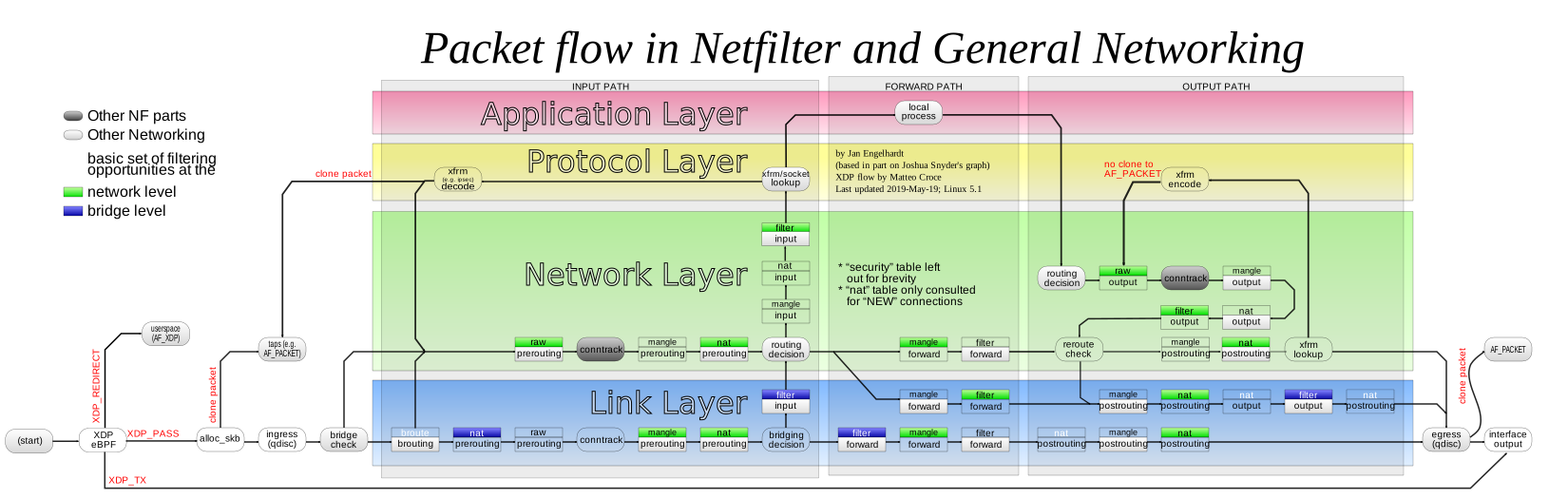
- it would be consistent with the standard xfrm path see [1]
- from the POV of the forwarder, the packet is locally emitted, the src @ is owned by the forwarder.
[1] https://upload.wikimedia.org/wikipedia/commons/3/37/Netfilter-packet-flow.svg
Quoted 6 lines
Quoted 6 lines
A valid question, indeed. One could interpret packets being forwarded by those tunneling devices emit the packets one feeds them from the local host. I just checked and
ip_vtibehaves identical toxfrm_interfaceprior to my patch, so maybe my patch is crap and the inability to match on ipsec context data when using any of those devices is just by design.
There was no real design for vti[6] interfaces, it's why xfrmi interfaces have been added. But they should be consistent I think, so this patch should handle xfrmi and vti[6] together.
Regards,
Nicolas
Quoted 13 lines
Quoted 1 line
I would find such interpretation and behavior to be surprising for an IPsec forwarder...
I guess some functionality of policy matching is lost with these devices; although they do offer the ability to match ipsec traffic based on the destination interface it is possible to have multiple ipsec flows share the same device so netfilter doesn't provide the ability to distinguish between different flows on the outbound direction in such cases.Thanks,
Eyal.
Hi Nicolas,
Quoted 16 lines · Nicolas Dichtel
Quoted 8 lines · Eyal Birger
Hi Phil,
Quoted 5 lines · Phil Sutter
Hi Eyal,
Quoted 1 line · Eyal Birger
On Mon, Dec 7, 2020 at 4:07 PM Phil Sutter <[email protected]> wrote:
[snip]
Quoted 5 lines
Quoted 5 lines
The packet appears twice being sent to eth1, the second time as ESP packet. I understand xfrm interface as a collector of to-be-xfrmed packets, dropping those which do not match a policy.
Quoted 8 lines
Quoted 6 lines
Quoted 6 lines
Quoted 6 lines
Quoted 3 lines
Fix this by looping packets transmitted from
xfrm_interfacethroughNF_INET_LOCAL_OUTbefore passing them on todst_output(), which makes behaviour consistent again from netfilter's point of view.When an XFRM interface is used when forwarding, why would it be correct for
NF_INET_LOCAL_OUTto observe the inner packet?I think it is valid because:
- it would be consistent with ip tunnels (seeiptunnel_xmit())
Are you referring to the flow:
iptunnel_xmit()
    ip_local_out()
      __ip_local_out()
        nf_hook(.., NF_INET_LOCAL_OUT, ...)
If I understand that flow correctly it operates on the outer packet as it is called after all the header had been pushed already. no? Or are you referring to a different flow?
Quoted 1 line
- it would be consistent with the standard xfrm path see [1]
In the regular path as well I understand the OUTPUT hooks are called after xfrm encoding in the forwarding case, so they can't see the inner packet.
Quoted 2 lines
- from the POV of the forwarder, the packet is locally emitted, the src @ is owned by the forwarder.
The inner IP source address is not owned by the forwarder to my understanding.
Quoted 9 lines
Quoted 6 lines
Quoted 6 lines
A valid question, indeed. One could interpret packets being forwarded by those tunneling devices emit the packets one feeds them from the local host. I just checked and
ip_vtibehaves identical toxfrm_interfaceprior to my patch, so maybe my patch is crap and the inability to match on ipsec context data when using any of those devices is just by design.There was no real design for vti[6] interfaces, it's why xfrmi interfaces have been added. But they should be consistent I think, so this patch should handle xfrmi and vti[6] together.
I also think they should be consistent. But it'd still be confusing to me to get an OUTPUT hook on the inner packet in the forwarding case.
Thanks,
Eyal.
Le 10/12/2020 à 12:48, Eyal Birger a écrit :
Quoted 1 line
Hi Nicolas,
Hi Eyal,
Quoted 3 lines
On Thu, Dec 10, 2020 at 1:10 PM Nicolas Dichtel
<[email protected]> wrote:
[snip]
Quoted 2 lines
I also think they should be consistent. But it'd still be confusing to me to get an OUTPUT hook on the inner packet in the forwarding case.
I re-read the whole thread and I agree with you. There is no reason to pass the inner packet through the OUTPUT hook (my comment about the consistency with ip tunnels is still valid ;-)).
Sorry for the confusion.
Phil, with nftables, you can match the 'kind' of the interface, that should be enough to match packets, isn't it?
Regards,
Nicolas
Phil Sutter
reviewerHi Nicolas,
Quoted 6 lines · Nicolas Dichtel
Le 10/12/2020 à 12:48, Eyal Birger a écrit :
Quoted 2 lines
On Thu, Dec 10, 2020 at 1:10 PM Nicolas Dichtel
<[email protected]> wrote:[snip]
Quoted 2 lines
I also think they should be consistent. But it'd still be confusing to me to get an OUTPUT hook on the inner packet in the forwarding case.
Quoted 7 lines
I re-read the whole thread and I agree with you. There is no reason to pass the inner packet through the OUTPUT hook (my comment about the consistency with ip tunnels is still valid ;-)).
Sorry for the confusion.Phil, with nftables, you can match the 'kind' of the interface, that should be enough to match packets, isn't it?
Yes, sure. Also, the inner packet passes POSTROUTING hook with ipsec context present, it's just not visible in OUTPUT. Of course the broader question is what do people use ipsec context matches for. If it's really just to ensure traffic is encrypted, xfrm_interface alone is sufficient.
Originally this was reported as "ipsec match stops working if xfrm_interface is used" and I suspected it's a bug in the driver. Knowing the behaviour is expected (and at least consistent with vti), the case is closed from my side. :)
Thanks, Phil