NFSD: add enable-dontcache and initially use it to add DIO support
Subsystems (8)
cover NFSD: add enable-dontcache and initially use it to add DIO support
Hi,
This series introduces 'enable-dontcache' to NFSD's debugfs interface, once enabled NFSD will selectively make use of O_DIRECT when issuing read and write IO:
- all READs will use O_DIRECT (both aligned and misaligned)
- all DIO-aligned WRITEs will use O_DIRECT (useful for SUNRPC RDMA)
- misaligned WRITEs currently continue to use normal buffered IO
Q: Why not actually use RWF_DONTCACHE (yet)?
A:
If IO can is properly DIO-aligned, or can be made to be, using O_DIRECT is preferred over DONTCACHE because of its reduced CPU and memory usage. Relative to NFSD using RWF_DONTCACHE for misaligned WRITEs, I've briefly discussed with Jens that follow-on dontcache work is needed to justify falling back to actually using RWF_DONTCACHE. Specifically, Hammerspace benchmarking has confirmed as Jeff Layton suggested at Bakeathon, we need dontcache to be enhanced to not immediately dropbehind when IO completes -- because it works against us (due to RMW needing to read without benefit of cache), whereas buffered IO enables misaligned IO to be more performant. Jens thought that delayed dropbehind is certainly doable but that he needed to reason through it further (so timing on availability is TBD). As soon as it is possible I'll happily switch NFSD's misaligned write IO fallback from normal buffered IO to actually using RWF_DONTCACHE.
Continuing with what this patchset provides:
NFSD now uses STATX_DIOALIGN and STATX_DIO_READ_ALIGN to get and store DIO alignment attributes from underlying filesystem in associated nfsd_file. This is done when the nfsd_file is first opened for a regular file.
A new RWF_DIRECT flag is added to include/uapi/linux/fs.h to allow NFSD to use O_DIRECT on a per-IO basis.
If enable-dontcache=1 then RWF_DIRECT will be set for all READ IO (even if the IO is misaligned, thanks to expanding the read to be aligned for use with DIO, as suggested by Jeff and Chuck at the NFS Bakeathon held recently in Ann Arbor).
NFSD will also set RWF_DIRECT if a WRITE's IO is aligned relative to DIO alignment (both page and disk alignment). This works quite well for aligned WRITE IO with SUNRPC's RDMA transport as-is, because it maps the WRITE payload into aligned pages. But more work is needed to be able to leverage O_DIRECT when SUNRPC's regular TCP transport is used. I spent quite a bit of time analyzing the existing xdr_buf code and NFSD's use of it. Unfortunately, the WRITE payload gets stored in misaligned pages such that O_DIRECT isn't possible without a copy (completely defeating the point). I'll reply to this cover letter to start a subthread to discuss how best to deal with misaligned write IO (by association with Hammerspace, I'm most interested in NFS v3).
Performance benefits of using O_DIRECT in NFSD:
Hammerspace's testbed was 10 NFS servers connected via 800Gbit RDMA networking (mlx5_core), each with 1TB of memory, 48 cores (2 NUMA nodes) and 8 ScaleFlux NVMe devices (each with two 3.5TB namespaces. Theoretical max for reads per NVMe device is 14GB/s, or ~7GB/s per namespace).
And 10 client systems each running 64 IO threads.
The O_DIRECT performance win is pretty fantastic thanks to reduced CPU and memory use, particularly for workloads with a working set that far exceeds the available memory of a given server. This patchset's changes (though patch 5, patch 6 wasn't written until after benchmarking performed) enabled Hammerspace to improve its IO500.org benchmark result (as submitted for this week's ISC 2025 in Hamburg, Germany) by 25%.
That 25% improvement on IO500 is owed to NFS servers seeing:
- reduced CPU usage from 100% to ~50%
O_DIRECT:
write: 51% idle, 25% system, 14% IO wait, 2% IRQ
read: 55% idle, 9% system, 32.5% IO wait, 1.5% IRQ buffered:
write: 17.8% idle, 67.5% system, 8% IO wait, 2% IRQ
read: 3.29% idle, 94.2% system, 2.5% IO wait, 1% IRQ
- reduced memory usage from just under 100% (987GiB for reads, 978GiB for writes) to only ~244 MB for cache+buffer use (for both reads and writes).
- buffered would tip-over due to kswapd and kcompactd struggling to find free memory during reclaim.
- increased NVMe throughtput when comparing O_DIRECT vs buffered:
O_DIRECT: 8-10 GB/s for writes, 9-11.8 GB/s for reads
buffered: 8 GB/s for writes, 4-5 GB/s for reads
- abiliy to support more IO threads per client system (from 48 to 64)
The performance improvement highlight of the numerous individual tests in the IO500 collection of benchamrks was in the IOR "easy" test:
Write:
O_DIRECT: [RESULT]      ior-easy-write     420.351599 GiB/s : time 869.650 seconds
CACHED:   [RESULT]      ior-easy-write     368.268722 GiB/s : time 413.647 seconds
Read:
O_DIRECT: [RESULT]      ior-easy-read     446.790791 GiB/s : time 818.219 seconds
CACHED:   [RESULT]      ior-easy-read     284.706196 GiB/s : time 534.950 seconds
It is suspected that patch 6 in this patchset will improve IOR "hard" read results. The "hard" name comes from the fact that it performs all IO using a mislaigned blocksize of 47008 bytes (which happens to be the IO size I showed ftrace output for in the 6th patch's header).
All review and discussion is welcome, thanks!
Mike
Mike Snitzer (6):
NFSD: add the ability to enable use of RWF_DONTCACHE for all IO
NFSD: filecache: add STATX_DIOALIGN and STATX_DIO_READ_ALIGN support
NFSD: pass nfsd_file to nfsd_iter_read()
fs: introduce RWF_DIRECT to allow using O_DIRECT on a per-IO basis
NFSD: leverage DIO alignment to selectively issue O_DIRECT reads and writes
NFSD: issue READs using O_DIRECT even if IO is misaligned
 fs/nfsd/debugfs.c          |  39 +++++++++++++
 fs/nfsd/filecache.c        |  32 +++++++++++
 fs/nfsd/filecache.h        |   4 ++
 fs/nfsd/nfs4xdr.c          |   8 +--
 fs/nfsd/nfsd.h             |   1 +
 fs/nfsd/trace.h            |  37 +++++++++++++
 fs/nfsd/vfs.c              | 111 ++++++++++++++++++++++++++++++++++---
 fs/nfsd/vfs.h              |  17 +-----
 include/linux/fs.h         |   2 +-
 include/linux/sunrpc/svc.h |   5 +-
 include/uapi/linux/fs.h    |   5 +-
 11 files changed, 231 insertions(+), 30 deletions(-)
Signature · 1 line
2.44.0
PATCH 1/6 NFSD: add the ability to enable use of RWF_DONTCACHE for all IO
Add 'enable-dontcache' to NFSD's debugfs interface so that: Any data read or written by NFSD will either not be cached (thanks to O_DIRECT) or will be removed from the page cache upon completion (DONTCACHE).
enable-dontcache is 0 by default. It may be enabled with:
echo 1 > /sys/kernel/debug/nfsd/enable-dontcache
FOP_DONTCACHE must be advertised as supported by the underlying filesystem (e.g. XFS), otherwise if/when 'enable-dontcache' is 1 all IO flagged with RWF_DONTCACHE will fail with -EOPNOTSUPP.
---
 fs/nfsd/debugfs.c | 39 +++++++++++++++++++++++++++++++++++++++
 fs/nfsd/nfsd.h    |  1 +
 fs/nfsd/vfs.c     | 12 +++++++++++-
 3 files changed, 51 insertions(+), 1 deletion(-)
fs/nfsd/debugfs.c +39 -0
@@ -32,6 +32,42 @@ static int nfsd_dsr_set(void *data, u64 val)DEFINE_DEBUGFS_ATTRIBUTE (nfsd_dsr_fops, nfsd_dsr_get, nfsd_dsr_set,"%llu\n" ); +/* +* /sys/kernel/debug/nfsd/enable-dontcache +* +* Contents: +* %0: NFS READ and WRITE are not allowed to use dontcache +* %1: NFS READ and WRITE are allowed to use dontcache +* +* NFSD's dontcache support reserves the right to use O_DIRECT +* if it chooses (instead of dontcache's usual pagecache-based +* dropbehind semantics). +* +* The default value of this setting is zero (dontcache is +* disabled). This setting takes immediate effect for all NFS +* versions, all exports, and in all NFSD net namespaces. +*/ + +static int nfsd_dontcache_get (void *data,u64 *val) +{ + *val = nfsd_enable_dontcache ?1 :0 ; +return 0 ; +} + +static int nfsd_dontcache_set (void *data,u64 val) +{ +if (val >0 ) { +/* Must first also disable-splice-read */ + nfsd_disable_splice_read = true; + nfsd_enable_dontcache = true; + }else + nfsd_enable_dontcache = false; +return 0 ; +} + +DEFINE_DEBUGFS_ATTRIBUTE (nfsd_dontcache_fops, nfsd_dontcache_get, + nfsd_dontcache_set,"%llu\n" ); +void nfsd_debugfs_exit (void ) {debugfs_remove_recursive (nfsd_top_dir);
@@ -44,4 +80,7 @@ void nfsd_debugfs_init(void)debugfs_create_file ("disable-splice-read" ,S_IWUSR |S_IRUGO , nfsd_top_dir,NULL , &nfsd_dsr_fops); + +debugfs_create_file ("enable-dontcache" ,S_IWUSR |S_IRUGO , + nfsd_top_dir,NULL , &nfsd_dontcache_fops); }
fs/nfsd/nfsd.h +1 -0
@@ -155,6 +155,7 @@ static inline void nfsd_debugfs_exit(void) {}#endif extern bool nfsd_disable_splice_read__read_mostly ; +extern bool nfsd_enable_dontcache__read_mostly ;extern int nfsd_max_blksize;
fs/nfsd/vfs.c +11 -1
@@ -49,6 +49,7 @@#define NFSDDBG_FACILITY NFSDDBG_FILEOPbool nfsd_disable_splice_read__read_mostly ; +bool nfsd_enable_dontcache__read_mostly ;/** * nfserrno - Map Linux errnos to NFS errnos
@@ -1086,6 +1087,7 @@ __be32 nfsd_iter_read(struct svc_rqst *rqstp, struct svc_fh *fhp,unsigned long v, total;struct iov_iter iter;loff_t ppos = offset; +rwf_t flags =0 ;ssize_t host_err;size_t len;
@@ -1103,7 +1105,11 @@ __be32 nfsd_iter_read(struct svc_rqst *rqstp, struct svc_fh *fhp,trace_nfsd_read_vector (rqstp, fhp, offset, *count);iov_iter_bvec (&iter,ITER_DEST , rqstp->rq_bvec, v, *count); - host_err =vfs_iter_read (file, &iter, &ppos,0 ); + +if (nfsd_enable_dontcache) + flags |=RWF_DONTCACHE ; + + host_err =vfs_iter_read (file, &iter, &ppos, flags);return nfsd_finish_read (rqstp, fhp, file, offset, count, eof, host_err); }
@@ -1209,6 +1215,10 @@ nfsd_vfs_write(struct svc_rqst *rqstp, struct svc_fh *fhp, nvecs =xdr_buf_to_bvec (rqstp->rq_bvec, rqstp->rq_maxpages, payload);iov_iter_bvec (&iter,ITER_SOURCE , rqstp->rq_bvec, nvecs, *cnt); + +if (nfsd_enable_dontcache) + flags |=RWF_DONTCACHE ; + since =READ_ONCE (file->f_wb_err);if (verf)nfsd_copy_write_verifier (verf, nn);
Signature · 1 line
2.44.0
Re: [PATCH 1/6] NFSD: add the ability to enable use of RWF_DONTCACHE for all IO
Quoted 6 lines · Mike Snitzer
Add 'enable-dontcache' to NFSD's debugfs interface so that: Any data read or written by NFSD will either not be cached (thanks to
O_DIRECT) or will be removed from the page cache upon completion (DONTCACHE).enable-dontcache is 0 by default. It may be enabled with:
echo 1 >/sys/kernel/debug/nfsd/enable-dontcache
Having this as a global debug-only interface feels a bit odd.
Re: [PATCH 1/6] NFSD: add the ability to enable use of RWF_DONTCACHE for all IO
Quoted 10 lines · Christoph Hellwig
Quoted 6 lines · Mike Snitzer
Add 'enable-dontcache' to NFSD's debugfs interface so that: Any data read or written by NFSD will either not be cached (thanks to
O_DIRECT) or will be removed from the page cache upon completion (DONTCACHE).enable-dontcache is 0 by default. It may be enabled with:
echo 1 >/sys/kernel/debug/nfsd/enable-dontcacheHaving this as a global debug-only interface feels a bit odd.
I generally agree, I originally proposed nfsd.nfsd_dontcache=Y modparam:
https://lore.kernel.org/linux-nfs/[email protected]/
(and even implemented formal NFSD per-export "dontcache" control, which Trond and I both think is probably needed).
But (ab)using debugfs is the approach Chuck and Jeff would like to take for experimental NFSD changes so that we can kick the tires without having to support an interface until the end of time. See commit 9fe5ea760e64 ("NFSD: Add /sys/kernel/debug/nfsd") for more on the general thinking. First consumer was commit c9dcd1de7977 ("NFSD:
Add experimental setting to disable the use of splice read").
I'm fine with using debugfs, means to an end with no strings attached.
Once we have confidence in what is needed we can pivot back to a modparam or per-export controls or whatever.
Mike
Jeff Layton
maintainerRe: [PATCH 1/6] NFSD: add the ability to enable use of RWF_DONTCACHE for all IO
Quoted 26 lines · Mike Snitzer
Quoted 10 lines · Christoph Hellwig
Quoted 6 lines · Mike Snitzer
Add 'enable-dontcache' to NFSD's debugfs interface so that: Any data read or written by NFSD will either not be cached (thanks to
O_DIRECT) or will be removed from the page cache upon completion (DONTCACHE).enable-dontcache is 0 by default. It may be enabled with:
echo 1 >/sys/kernel/debug/nfsd/enable-dontcacheHaving this as a global debug-only interface feels a bit odd.
I generally agree, I originally proposed nfsd.nfsd_dontcache=Y modparam:
https://lore.kernel.org/linux-nfs/[email protected]/(and even implemented formal NFSD per-export "dontcache" control, which Trond and I both think is probably needed).
But (ab)using debugfs is the approach Chuck and Jeff would like to take for experimental NFSD changes so that we can kick the tires without having to support an interface until the end of time. See commit
9fe5ea760e64("NFSD: Add/sys/kernel/debug/nfsd") for more on the general thinking. First consumer was commitc9dcd1de7977("NFSD:
Add experimental setting to disable the use of splice read").
Quoted 5 lines
I'm fine with using debugfs, means to an end with no strings attached.
Once we have confidence in what is needed we can pivot back to a modparam or per-export controls or whatever.
Yeah. I think this will probably end up being a per-export setting. We're just hesitant to commit to an interface until we have a bit more experience with this.
Signature · 1 line
Jeff Layton <[email protected]>
Re: [PATCH 1/6] NFSD: add the ability to enable use of RWF_DONTCACHE for all IO
In reply to Christoph HellwigQuoted 9 lines · Christoph Hellwig
Quoted 6 lines · Mike Snitzer
Add 'enable-dontcache' to NFSD's debugfs interface so that: Any data read or written by NFSD will either not be cached (thanks to
O_DIRECT) or will be removed from the page cache upon completion (DONTCACHE).enable-dontcache is 0 by default. It may be enabled with:
echo 1 >/sys/kernel/debug/nfsd/enable-dontcacheHaving this as a global debug-only interface feels a bit odd.
This interface is temporary. We expect to implement export options to control it if that turns out to be necessary.
I don't feel we understand the full performance implications for most workloads yet, so it seems premature to design and introduce a permanent administrative interface.
Signature · 1 line
Chuck Lever
Re: [PATCH 1/6] NFSD: add the ability to enable use of RWF_DONTCACHE for all IO
In reply to Mike SnitzerQuoted 3 lines · Mike Snitzer
Add 'enable-dontcache' to NFSD's debugfs interface so that: Any data read or written by NFSD will either not be cached (thanks to
O_DIRECT) or will be removed from the page cache upon completion (DONTCACHE).
I thought we were going to do two switches: One for reads and one for writes? I could be misremembering.
After all, you are describing two different facilities here: a form of direct I/O for READs, and RWF_DONTCACHE for WRITEs (I think?).
Quoted 104 lines
enable-dontcache is 0 by default. It may be enabled with:
echo 1 >/sys/kernel/debug/nfsd/enable-dontcache
FOP_DONTCACHEmust be advertised as supported by the underlying filesystem (e.g. XFS), otherwise if/when 'enable-dontcache' is 1 all IO flagged withRWF_DONTCACHEwill fail with-EOPNOTSUPP.Signed-off-by Mike Snitzer <[email protected]>--- fs/nfsd/debugfs.c | 39 +++++++++++++++++++++++++++++++++++++++ fs/nfsd/nfsd.h | 1 + fs/nfsd/vfs.c | 12 +++++++++++- 3 files changed, 51 insertions(+), 1 deletion(-)fs/nfsd/debugfs.c +39
-0@@ -32,6 +32,42 @@ static int nfsd_dsr_set(void *data, u64 val)DEFINE_DEBUGFS_ATTRIBUTE (nfsd_dsr_fops, nfsd_dsr_get, nfsd_dsr_set,"%llu\n" ); +/* +* /sys/kernel/debug/nfsd/enable-dontcache +* +* Contents: +* %0: NFS READ and WRITE are not allowed to use dontcache +* %1: NFS READ and WRITE are allowed to use dontcache +* +* NFSD's dontcache support reserves the right to use O_DIRECT +* if it chooses (instead of dontcache's usual pagecache-based +* dropbehind semantics). +* +* The default value of this setting is zero (dontcache is +* disabled). This setting takes immediate effect for all NFS +* versions, all exports, and in all NFSD net namespaces. +*/ + +static int nfsd_dontcache_get (void *data,u64 *val) +{ + *val = nfsd_enable_dontcache ?1 :0 ; +return 0 ; +} + +static int nfsd_dontcache_set (void *data,u64 val) +{ +if (val >0 ) { +/* Must first also disable-splice-read */ + nfsd_disable_splice_read = true; + nfsd_enable_dontcache = true; + }else + nfsd_enable_dontcache = false; +return 0 ; +} + +DEFINE_DEBUGFS_ATTRIBUTE (nfsd_dontcache_fops, nfsd_dontcache_get, + nfsd_dontcache_set,"%llu\n" ); +void nfsd_debugfs_exit (void ) {debugfs_remove_recursive (nfsd_top_dir);@@ -44,4 +80,7 @@ void nfsd_debugfs_init(void)debugfs_create_file ("disable-splice-read" ,S_IWUSR |S_IRUGO , nfsd_top_dir,NULL , &nfsd_dsr_fops); + +debugfs_create_file ("enable-dontcache" ,S_IWUSR |S_IRUGO , + nfsd_top_dir,NULL , &nfsd_dontcache_fops); }fs/nfsd/nfsd.h +1
-0@@ -155,6 +155,7 @@ static inline void nfsd_debugfs_exit(void) {}#endif extern bool nfsd_disable_splice_read__read_mostly ; +extern bool nfsd_enable_dontcache__read_mostly ;extern int nfsd_max_blksize;fs/nfsd/vfs.c +2
-0@@ -49,6 +49,7 @@#define NFSDDBG_FACILITY NFSDDBG_FILEOPbool nfsd_disable_splice_read__read_mostly ; +bool nfsd_enable_dontcache__read_mostly ;/** * nfserrno - Map Linux errnos to NFS errnos @@ -1086,6 +1087,7 @@ __be32 nfsd_iter_read(struct svc_rqst *rqstp, struct svc_fh *fhp,unsigned long v, total;struct iov_iter iter;loff_t ppos = offset; +rwf_t flags =0 ;ssize_t host_err;size_t len;
fs/nfsd/vfs.c __be32 nfsd_iter_read(struct svc_rqst *rqstp, struct svc_fh *fhp, · line 1110
Quoted 7 lines
fs/nfsd/vfs.c +3
-1@@ -1103,7 +1105,11 @@ __be32 nfsd_iter_read(struct svc_rqst *rqstp, struct svc_fh *fhp,trace_nfsd_read_vector (rqstp, fhp, offset, *count);iov_iter_bvec (&iter,ITER_DEST , rqstp->rq_bvec, v, *count); - host_err =vfs_iter_read (file, &iter, &ppos,0 ); + +if (nfsd_enable_dontcache) + flags |=RWF_DONTCACHE ;
Two things:
- Maybe NFSD should record whether the file system is DONTCACHE-enabled in @fhp or in the export it is associated with, and then check that setting here before asserting RWF_DONTCACHE
- I thought we were going with O_DIRECT for READs.
Quoted 16 lines
fs/nfsd/vfs.c +6
-0+ + host_err =vfs_iter_read (file, &iter, &ppos, flags);return nfsd_finish_read (rqstp, fhp, file, offset, count, eof, host_err); }@@ -1209,6 +1215,10 @@ nfsd_vfs_write(struct svc_rqst *rqstp, struct svc_fh *fhp, nvecs =xdr_buf_to_bvec (rqstp->rq_bvec, rqstp->rq_maxpages, payload);iov_iter_bvec (&iter,ITER_SOURCE , rqstp->rq_bvec, nvecs, *cnt); + +if (nfsd_enable_dontcache) + flags |=RWF_DONTCACHE ; + since =READ_ONCE (file->f_wb_err);if (verf)nfsd_copy_write_verifier (verf, nn);
Signature · 1 line
Chuck Lever
Re: [PATCH 1/6] NFSD: add the ability to enable use of RWF_DONTCACHE for all IO
Quoted 7 lines · Chuck Lever
Quoted 3 lines · Mike Snitzer
Add 'enable-dontcache' to NFSD's debugfs interface so that: Any data read or written by NFSD will either not be cached (thanks to
O_DIRECT) or will be removed from the page cache upon completion (DONTCACHE).I thought we were going to do two switches: One for reads and one for writes? I could be misremembering.
We did discuss the possibility of doing that. Still can-do if that's what you'd prefer.
Quoted 2 lines
After all, you are describing two different facilities here: a form of direct I/O for READs, and
RWF_DONTCACHEfor WRITEs (I think?).
My thinking was NFSD doesn't need to provide faithful pure RWF_DONTCACHE if it really doesn't make sense. But the "dontcache" name can be (ab)used by NFSD to define it how it sees fit (O_DIRECT doesn't cache so it seems fair). What I arrived at with this patchset is how I described in my cover letter:
When 'enable-dontcache' is used:
- all READs will use O_DIRECT (both DIO-aligned and misaligned)
- all DIO-aligned WRITEs will use O_DIRECT (useful for SUNRPC RDMA)
- misaligned WRITEs currently continue to use normal buffered IO
But we reserve the right to iterate on the implementation details as we see fit. Still using the umbrella of 'dontcache'.
Quoted 31 lines
Quoted 21 lines
fs/nfsd/vfs.c +2
-0@@ -49,6 +49,7 @@#define NFSDDBG_FACILITY NFSDDBG_FILEOPbool nfsd_disable_splice_read__read_mostly ; +bool nfsd_enable_dontcache__read_mostly ;/** * nfserrno - Map Linux errnos to NFS errnos @@ -1086,6 +1087,7 @@ __be32 nfsd_iter_read(struct svc_rqst *rqstp, struct svc_fh *fhp,unsigned long v, total;struct iov_iter iter;loff_t ppos = offset; +rwf_t flags =0 ;ssize_t host_err;size_t len;fs/nfsd/vfs.c __be32 nfsd_iter_read(struct svc_rqst *rqstp, struct svc_fh *fhp, · line 1110
Quoted 7 lines
fs/nfsd/vfs.c +3
-1@@ -1103,7 +1105,11 @@ __be32 nfsd_iter_read(struct svc_rqst *rqstp, struct svc_fh *fhp,trace_nfsd_read_vector (rqstp, fhp, offset, *count);iov_iter_bvec (&iter,ITER_DEST , rqstp->rq_bvec, v, *count); - host_err =vfs_iter_read (file, &iter, &ppos,0 ); + +if (nfsd_enable_dontcache) + flags |=RWF_DONTCACHE ;Two things:
Quoted 3 lines
- Maybe NFSD should record whether the file system is DONTCACHE-enabled in @fhp or in the export it is associated with, and then check that setting here before asserting
RWF_DONTCACHE
Sure, that'd be safer than allowing RWF_DONTCACHE to be tried only to get EOPNOTSUPP because the underlying filesystem doesn't enable support.
Could follow what I did with nfsd_file only storing the dio_* alignment data retrieved from statx IFF 'enable-dontcache' was enabled at the time the nfsd_file was opened.
By adding check for FOP_DONTCACHE being set in underlying filesystem. But as-is, we're not actually using RWF_DONTCACHE in the final form of what I've provided in this patchset. So can easily circle back to adding this if/when we do decide to use RWF_DONTCACHE.
Quoted 1 line
- I thought we were going with
O_DIRECTfor READs.
Yes, this is just an intermediate patch that goes away in later patches. I was more focused on minimal patch to get the 'enable-dontcache' debugfs interface in place and tweaking it to its ultimate form in later patch.
I put in place a more general framework that can evolve... it being more free-form (e.g. "don't worry your pretty head about the implementation details, we'll worry for you").
Causes some reviewer angst I suppose, so I can just fold patches to do away with unused intermediate state.
Mike
Jeff Layton
maintainerRe: [PATCH 1/6] NFSD: add the ability to enable use of RWF_DONTCACHE for all IO
Quoted 6 lines · Mike Snitzer
Quoted 5 lines · Chuck Lever
Quoted 3 lines · Mike Snitzer
Add 'enable-dontcache' to NFSD's debugfs interface so that: Any data read or written by NFSD will either not be cached (thanks to
O_DIRECT) or will be removed from the page cache upon completion (DONTCACHE).
Quoted 6 lines
Quoted 2 lines
I thought we were going to do two switches: One for reads and one for writes? I could be misremembering.
We did discuss the possibility of doing that. Still can-do if that's what you'd prefer.
Having them as separate controls in debugfs is fine for experimentation's sake, but I imagine we'll need to be all-in one way or the other with a real interface.
I think if we can crack the problem of receiving WRITE payloads into an already-aligned buffer, then that becomes much more feasible. I think that's a solveable problem.
Quoted 80 lines
Quoted 2 lines
After all, you are describing two different facilities here: a form of direct I/O for READs, and
RWF_DONTCACHEfor WRITEs (I think?).My thinking was NFSD doesn't need to provide faithful pure
RWF_DONTCACHEif it really doesn't make sense. But the "dontcache" name can be (ab)used by NFSD to define it how it sees fit (O_DIRECTdoesn't cache so it seems fair). What I arrived at with this patchset is how I described in my cover letter:When 'enable-dontcache' is used:
- all READs will useO_DIRECT(both DIO-aligned and misaligned)
- all DIO-aligned WRITEs will useO_DIRECT(useful for SUNRPC RDMA)
- misaligned WRITEs currently continue to use normal buffered IOBut we reserve the right to iterate on the implementation details as we see fit. Still using the umbrella of 'dontcache'.
Quoted 31 lines
Quoted 21 lines
fs/nfsd/vfs.c +2
-0@@ -49,6 +49,7 @@#define NFSDDBG_FACILITY NFSDDBG_FILEOPbool nfsd_disable_splice_read__read_mostly ; +bool nfsd_enable_dontcache__read_mostly ;/** * nfserrno - Map Linux errnos to NFS errnos @@ -1086,6 +1087,7 @@ __be32 nfsd_iter_read(struct svc_rqst *rqstp, struct svc_fh *fhp,unsigned long v, total;struct iov_iter iter;loff_t ppos = offset; +rwf_t flags =0 ;ssize_t host_err;size_t len;fs/nfsd/vfs.c __be32 nfsd_iter_read(struct svc_rqst *rqstp, struct svc_fh *fhp, · line 1110
Quoted 7 lines
fs/nfsd/vfs.c +3
-1@@ -1103,7 +1105,11 @@ __be32 nfsd_iter_read(struct svc_rqst *rqstp, struct svc_fh *fhp,trace_nfsd_read_vector (rqstp, fhp, offset, *count);iov_iter_bvec (&iter,ITER_DEST , rqstp->rq_bvec, v, *count); - host_err =vfs_iter_read (file, &iter, &ppos,0 ); + +if (nfsd_enable_dontcache) + flags |=RWF_DONTCACHE ;Two things:
Quoted 3 lines
- Maybe NFSD should record whether the file system is DONTCACHE-enabled in @fhp or in the export it is associated with, and then check that setting here before asserting
RWF_DONTCACHESure, that'd be safer than allowing
RWF_DONTCACHEto be tried only to get EOPNOTSUPP because the underlying filesystem doesn't enable support.Could follow what I did with
nfsd_fileonly storing the dio_* alignment data retrieved from statx IFF 'enable-dontcache' was enabled at the time thenfsd_filewas opened.By adding check for
FOP_DONTCACHEbeing set in underlying filesystem. But as-is, we're not actually usingRWF_DONTCACHEin the final form of what I've provided in this patchset. So can easily circle back to adding this if/when we do decide to useRWF_DONTCACHE.Quoted 1 line
- I thought we were going with
O_DIRECTfor READs.Yes, this is just an intermediate patch that goes away in later patches. I was more focused on minimal patch to get the 'enable-dontcache' debugfs interface in place and tweaking it to its ultimate form in later patch.
I put in place a more general framework that can evolve... it being more free-form (e.g. "don't worry your pretty head about the implementation details, we'll worry for you").
Causes some reviewer angst I suppose, so I can just fold patches to do away with unused intermediate state.
Mike
Signature · 1 line
Jeff Layton <[email protected]>
need SUNRPC TCP to receive into aligned pages [was: Re: [PATCH 1/6] NFSD: add the ability to enable use of RWF_DONTCACHE for all IO]
Quoted 14 lines · Jeff Layton
Quoted 6 lines · Mike Snitzer
Quoted 5 lines · Chuck Lever
Quoted 3 lines · Mike Snitzer
Add 'enable-dontcache' to NFSD's debugfs interface so that: Any data read or written by NFSD will either not be cached (thanks to
O_DIRECT) or will be removed from the page cache upon completion (DONTCACHE).Quoted 6 lines
Quoted 2 lines
I thought we were going to do two switches: One for reads and one for writes? I could be misremembering.
We did discuss the possibility of doing that. Still can-do if that's what you'd prefer.
Quoted 7 lines
Having them as separate controls in debugfs is fine for experimentation's sake, but I imagine we'll need to be all-in one way or the other with a real interface.
I think if we can crack the problem of receiving WRITE payloads into an already-aligned buffer, then that becomes much more feasible. I think that's a solveable problem.
You'd immediately be my hero! Let's get into it:
In a previously reply to this thread you aptly detailed what I found out the hard way (with too much xdr_buf code review and tracing):
Quoted 14 lines · Jeff Layton
Quoted 13 lines
NFSD will also set
RWF_DIRECTif a WRITE's IO is aligned relative to DIO alignment (both page and disk alignment). This works quite well for aligned WRITE IO with SUNRPC's RDMA transport as-is, because it maps the WRITE payload into aligned pages. But more work is needed to be able to leverageO_DIRECTwhen SUNRPC's regular TCP transport is used. I spent quite a bit of time analyzing the existingxdr_bufcode and NFSD's use of it. Unfortunately, the WRITE payload gets stored in misaligned pages such thatO_DIRECTisn't possible without a copy (completely defeating the point). I'll reply to this cover letter to start a subthread to discuss how best to deal with misaligned write IO (by association with Hammerspace, I'm most interested in NFS v3).
Quoted 7 lines
Tricky problem.
svc_tcp_recvfrom()just slurps the whole RPC into therq_pagesarray. To get alignment right, you'd probably have to do the receive in a much more piecemeal way.Basically, you'd need to decode as you receive chunks of the message, and look out for WRITEs, and then set it up so that their payloads are received with proper alignment.
1)
Yes, and while I arrived at the same exact conclusion I was left with dread about the potential for "breaking too many eggs to make that tasty omelette".
If you (or others) see a way forward to have SUNRPC TCP's XDR receive "inline" decode (rather than have the 2 stage process you covered above) that'd be fantastic. Seems like really old tech-debt in SUNRPC from a time when such care about alignment of WRITE payload pages was completely off engineers' collective radar (owed to NFSD only using buffered IO I assume?).
2)
One hack that I verified to work for READ and WRITE IO on my particular TCP testbed was to front-pad the first "head" page of the xdr_buf such that the WRITE payload started at the 2nd page of rq_pages. So that looked like this hack for my usage:
net/sunrpc/svc_xprt.c +3 -1
@@ -676,7 +676,9 @@ static bool svc_alloc_arg(struct svc_rqst *rqstp)/* Make arg->head point to first page and arg->pages point to rest */ arg->head[0 ].iov_base =page_address (rqstp->rq_pages[0 ]); - arg->head[0 ].iov_len =PAGE_SIZE ; +// FIXME: front-pad optimized to align TCP's WRITE payload +// but may not be enough for other operations? + arg->head[0 ].iov_len =148 ; arg->pages = rqstp->rq_pages +1 ; arg->page_base =0 ;/* save at least one page for response */
That gut "but may not be enough for other operations?" comment proved to be prophetic.
Sadly it went on to fail spectacularly for other ops (specifically READDIR and READDIRPLUS, probably others would too) because xdr_inline_decode() _really_ doesn't like going beyond the end of the xdr_buf's inline "head" page. It could be that even if xdr_inline_decode() et al was "fixed" (which isn't for the faint of heart given xdr_buf's more complex nature) there will likely be other mole(s) that pop up. And in addition, we'd be wasting space in the xdr_buf's head page (PAGE_SIZE-frontpad). So I moved on from trying to see this frontpad hack through to completion.
3)
Lastly, for completeness, I also mentioned briefly in a previous recent reply:
Quoted 7 lines · Mike Snitzer
Quoted 4 lines · Jeff Layton
In any case, for now at least, unless you're using RDMA, it's going to end up falling back to buffered writes everywhere. The data is almost never going to be properly aligned coming in off the wire. That might be fixable though.
Quoted 5 lines
Ben Coddington mentioned to me that soft-iwarp would allow use of RDMA over TCP to workaround SUNRPC TCP's XDR handling always storing the write payload in misaligned IO. But that's purely a stop-gap workaround, which needs testing (to see if soft-iwap negates the win of using
O_DIRECT, etc).
(Ab)using soft-iwarp as the basis for easily getting page aligned TCP WRITE payloads seems pretty gross given we are chasing utmost performance, etc.
All said, I welcome your sage advice and help on this effort to DIO-align SUNRPC TCP's WRITE payload pages.
Thanks,
Mike
Jeff Layton
maintainerRe: need SUNRPC TCP to receive into aligned pages [was: Re: [PATCH 1/6] NFSD: add the ability to enable use of RWF_DONTCACHE for all IO]
Quoted 120 lines · Mike Snitzer
Quoted 14 lines · Jeff Layton
Quoted 6 lines · Mike Snitzer
Quoted 5 lines · Chuck Lever
Quoted 3 lines · Mike Snitzer
Add 'enable-dontcache' to NFSD's debugfs interface so that: Any data read or written by NFSD will either not be cached (thanks to
O_DIRECT) or will be removed from the page cache upon completion (DONTCACHE).Quoted 6 lines
Quoted 2 lines
I thought we were going to do two switches: One for reads and one for writes? I could be misremembering.
We did discuss the possibility of doing that. Still can-do if that's what you'd prefer.
Quoted 7 lines
Having them as separate controls in debugfs is fine for experimentation's sake, but I imagine we'll need to be all-in one way or the other with a real interface.
I think if we can crack the problem of receiving WRITE payloads into an already-aligned buffer, then that becomes much more feasible. I think that's a solveable problem.
You'd immediately be my hero! Let's get into it:
In a previously reply to this thread you aptly detailed what I found out the hard way (with too much
xdr_bufcode review and tracing):Quoted 14 lines · Jeff Layton
Quoted 13 lines
NFSD will also set
RWF_DIRECTif a WRITE's IO is aligned relative to DIO alignment (both page and disk alignment). This works quite well for aligned WRITE IO with SUNRPC's RDMA transport as-is, because it maps the WRITE payload into aligned pages. But more work is needed to be able to leverageO_DIRECTwhen SUNRPC's regular TCP transport is used. I spent quite a bit of time analyzing the existingxdr_bufcode and NFSD's use of it. Unfortunately, the WRITE payload gets stored in misaligned pages such thatO_DIRECTisn't possible without a copy (completely defeating the point). I'll reply to this cover letter to start a subthread to discuss how best to deal with misaligned write IO (by association with Hammerspace, I'm most interested in NFS v3).Quoted 7 lines
Tricky problem.
svc_tcp_recvfrom()just slurps the whole RPC into therq_pagesarray. To get alignment right, you'd probably have to do the receive in a much more piecemeal way.Basically, you'd need to decode as you receive chunks of the message, and look out for WRITEs, and then set it up so that their payloads are received with proper alignment.
1)
Yes, and while I arrived at the same exact conclusion I was left with dread about the potential for "breaking too many eggs to make that tasty omelette".If you (or others) see a way forward to have SUNRPC TCP's XDR receive "inline" decode (rather than have the 2 stage process you covered above) that'd be fantastic. Seems like really old tech-debt in SUNRPC from a time when such care about alignment of WRITE payload pages was completely off engineers' collective radar (owed to NFSD only using buffered IO I assume?).
2)
One hack that I verified to work for READ and WRITE IO on my particular TCP testbed was to front-pad the first "head" page of thexdr_bufsuch that the WRITE payload started at the 2nd page ofrq_pages. So that looked like this hack for my usage:net/sunrpc/svc_xprt.c +3
-1@@ -676,7 +676,9 @@ static bool svc_alloc_arg(struct svc_rqst *rqstp)/* Make arg->head point to first page and arg->pages point to rest */ arg->head[0 ].iov_base =page_address (rqstp->rq_pages[0 ]); - arg->head[0 ].iov_len =PAGE_SIZE ; +// FIXME: front-pad optimized to align TCP's WRITE payload +// but may not be enough for other operations? + arg->head[0 ].iov_len =148 ; arg->pages = rqstp->rq_pages +1 ; arg->page_base =0 ;/* save at least one page for response */ That gut "but may not be enough for other operations?" comment proved to be prophetic.
Sadly it went on to fail spectacularly for other ops (specifically READDIR and READDIRPLUS, probably others would too) because
xdr_inline_decode()_really_ doesn't like going beyond the end of the xdr_buf's inline "head" page. It could be that even ifxdr_inline_decode()et al was "fixed" (which isn't for the faint of heart given xdr_buf's more complex nature) there will likely be other mole(s) that pop up. And in addition, we'd be wasting space in the xdr_buf's head page (PAGE_SIZE-frontpad). So I moved on from trying to see this frontpad hack through to completion.3)
Lastly, for completeness, I also mentioned briefly in a previous recent reply:Quoted 7 lines · Mike Snitzer
Quoted 4 lines · Jeff Layton
In any case, for now at least, unless you're using RDMA, it's going to end up falling back to buffered writes everywhere. The data is almost never going to be properly aligned coming in off the wire. That might be fixable though.
Quoted 5 lines
Ben Coddington mentioned to me that soft-iwarp would allow use of RDMA over TCP to workaround SUNRPC TCP's XDR handling always storing the write payload in misaligned IO. But that's purely a stop-gap workaround, which needs testing (to see if soft-iwap negates the win of using
O_DIRECT, etc).(Ab)using soft-iwarp as the basis for easily getting page aligned TCP WRITE payloads seems pretty gross given we are chasing utmost performance, etc.
Quoted 5 lines
All said, I welcome your sage advice and help on this effort to DIO-align SUNRPC TCP's WRITE payload pages.
Thanks,
Mike
(Sent this to Mike only by accident yesterday -- resending to the full list now)
I've been looking over the code today. Basically, I think we need to have svc_tcp_recvfrom() receive in phases. At a high level:
1/ receive the record marker (just like it does today)
2/ receive enough for the RPC header and then decode it.
3/ Use the rpc program and version from the decoded header to look up the svc_program. Add an optional pg_tcp_recvfrom callback to that structure that will receive the rest of the data into the buffer. If pg_tcp_recvfrom isn't set, then just call svc_tcp_read_msg() like we do today.
For NFSv3, pc_tcp_recvfrom can just look at the procedure. If it's anything but a WRITE we'll just do what we do today (svc_tcp_read_msg()).
For a WRITE, we'll receive the first part of the WRITE3args (everything but the data) into rq_pages, and decode it. We can then use that info to figure out the alignment. Advance to the next page in rq_pages, and then to the point where the data is properly aligned. Do the receive into that spot.
Then we just add a RQ_ALIGNED_DATA to rqstp->rq_flags, and teach nfsd3_proc_write how to find the data and do a DIO write when it's set.
Unaligned writes are still a problem though. If two WRITE RPCs come in for different parts of the same block at the same time, then you could end up losing the result of the first write. I don't see a way to make that non-racy.
NFSv4 will also be a bit of a challenge. We'll need to receive the whole compound one operation at a time. If we hit a WRITE, then we can just do the same thing that we do for v3 to align the data.
I'd probably aim to start with an implementation for v3, and then add v4 support in a second phase.
I'm interested in working on this. It'll be a fair bit of work though. I'll need to think about how to break this up into manageable pieces.
Signature · 1 line
Jeff Layton <[email protected]>
Jeff Layton
maintainerRe: need SUNRPC TCP to receive into aligned pages [was: Re: [PATCH 1/6] NFSD: add the ability to enable use of RWF_DONTCACHE for all IO]
Quoted 165 lines · Jeff Layton
Quoted 120 lines · Mike Snitzer
Quoted 14 lines · Jeff Layton
Quoted 6 lines · Mike Snitzer
Quoted 5 lines · Chuck Lever
Quoted 3 lines · Mike Snitzer
Add 'enable-dontcache' to NFSD's debugfs interface so that: Any data read or written by NFSD will either not be cached (thanks to
O_DIRECT) or will be removed from the page cache upon completion (DONTCACHE).Quoted 6 lines
Quoted 2 lines
I thought we were going to do two switches: One for reads and one for writes? I could be misremembering.
We did discuss the possibility of doing that. Still can-do if that's what you'd prefer.
Quoted 7 lines
Having them as separate controls in debugfs is fine for experimentation's sake, but I imagine we'll need to be all-in one way or the other with a real interface.
I think if we can crack the problem of receiving WRITE payloads into an already-aligned buffer, then that becomes much more feasible. I think that's a solveable problem.
You'd immediately be my hero! Let's get into it:
In a previously reply to this thread you aptly detailed what I found out the hard way (with too much
xdr_bufcode review and tracing):Quoted 14 lines · Jeff Layton
Quoted 13 lines
NFSD will also set
RWF_DIRECTif a WRITE's IO is aligned relative to DIO alignment (both page and disk alignment). This works quite well for aligned WRITE IO with SUNRPC's RDMA transport as-is, because it maps the WRITE payload into aligned pages. But more work is needed to be able to leverageO_DIRECTwhen SUNRPC's regular TCP transport is used. I spent quite a bit of time analyzing the existingxdr_bufcode and NFSD's use of it. Unfortunately, the WRITE payload gets stored in misaligned pages such thatO_DIRECTisn't possible without a copy (completely defeating the point). I'll reply to this cover letter to start a subthread to discuss how best to deal with misaligned write IO (by association with Hammerspace, I'm most interested in NFS v3).Quoted 7 lines
Tricky problem.
svc_tcp_recvfrom()just slurps the whole RPC into therq_pagesarray. To get alignment right, you'd probably have to do the receive in a much more piecemeal way.Basically, you'd need to decode as you receive chunks of the message, and look out for WRITEs, and then set it up so that their payloads are received with proper alignment.
1)
Yes, and while I arrived at the same exact conclusion I was left with dread about the potential for "breaking too many eggs to make that tasty omelette".If you (or others) see a way forward to have SUNRPC TCP's XDR receive "inline" decode (rather than have the 2 stage process you covered above) that'd be fantastic. Seems like really old tech-debt in SUNRPC from a time when such care about alignment of WRITE payload pages was completely off engineers' collective radar (owed to NFSD only using buffered IO I assume?).
2)
One hack that I verified to work for READ and WRITE IO on my particular TCP testbed was to front-pad the first "head" page of thexdr_bufsuch that the WRITE payload started at the 2nd page ofrq_pages. So that looked like this hack for my usage:net/sunrpc/svc_xprt.c +3
-1@@ -676,7 +676,9 @@ static bool svc_alloc_arg(struct svc_rqst *rqstp)/* Make arg->head point to first page and arg->pages point to rest */ arg->head[0 ].iov_base =page_address (rqstp->rq_pages[0 ]); - arg->head[0 ].iov_len =PAGE_SIZE ; +// FIXME: front-pad optimized to align TCP's WRITE payload +// but may not be enough for other operations? + arg->head[0 ].iov_len =148 ; arg->pages = rqstp->rq_pages +1 ; arg->page_base =0 ;/* save at least one page for response */ That gut "but may not be enough for other operations?" comment proved to be prophetic.
Sadly it went on to fail spectacularly for other ops (specifically READDIR and READDIRPLUS, probably others would too) because
xdr_inline_decode()_really_ doesn't like going beyond the end of the xdr_buf's inline "head" page. It could be that even ifxdr_inline_decode()et al was "fixed" (which isn't for the faint of heart given xdr_buf's more complex nature) there will likely be other mole(s) that pop up. And in addition, we'd be wasting space in the xdr_buf's head page (PAGE_SIZE-frontpad). So I moved on from trying to see this frontpad hack through to completion.3)
Lastly, for completeness, I also mentioned briefly in a previous recent reply:Quoted 7 lines · Mike Snitzer
Quoted 4 lines · Jeff Layton
In any case, for now at least, unless you're using RDMA, it's going to end up falling back to buffered writes everywhere. The data is almost never going to be properly aligned coming in off the wire. That might be fixable though.
Quoted 5 lines
Ben Coddington mentioned to me that soft-iwarp would allow use of RDMA over TCP to workaround SUNRPC TCP's XDR handling always storing the write payload in misaligned IO. But that's purely a stop-gap workaround, which needs testing (to see if soft-iwap negates the win of using
O_DIRECT, etc).(Ab)using soft-iwarp as the basis for easily getting page aligned TCP WRITE payloads seems pretty gross given we are chasing utmost performance, etc.
Quoted 5 lines
All said, I welcome your sage advice and help on this effort to DIO-align SUNRPC TCP's WRITE payload pages.
Thanks,
Mike(Sent this to Mike only by accident yesterday -- resending to the full list now)
I've been looking over the code today. Basically, I think we need to have
svc_tcp_recvfrom()receive in phases. At a high level:1/ receive the record marker (just like it does today)
2/ receive enough for the RPC header and then decode it.
3/ Use the rpc program and version from the decoded header to look up the
svc_program. Add an optionalpg_tcp_recvfromcallback to that structure that will receive the rest of the data into the buffer. Ifpg_tcp_recvfromisn't set, then just callsvc_tcp_read_msg()like we do today.For NFSv3,
pc_tcp_recvfromcan just look at the procedure. If it's anything but a WRITE we'll just do what we do today (svc_tcp_read_msg()).For a WRITE, we'll receive the first part of the WRITE3args (everything but the data) into
rq_pages, and decode it. We can then use that info to figure out the alignment. Advance to the next page inrq_pages, and then to the point where the data is properly aligned. Do the receive into that spot.Then we just add a
RQ_ALIGNED_DATAtorqstp->rq_flags, and teachnfsd3_proc_writehow to find the data and do a DIO write when it's set.Unaligned writes are still a problem though. If two WRITE RPCs come in for different parts of the same block at the same time, then you could end up losing the result of the first write. I don't see a way to make that non-racy.
NFSv4 will also be a bit of a challenge. We'll need to receive the whole compound one operation at a time. If we hit a WRITE, then we can just do the same thing that we do for v3 to align the data.
Quoted 5 lines
I'd probably aim to start with an implementation for v3, and then add v4 support in a second phase.
I'm interested in working on this. It'll be a fair bit of work though. I'll need to think about how to break this up into manageable pieces.
Mike asked me to detail the race that I see between unaligned writes:
Since we'd have to fill a block before writing, the only way I can see to do this with DIO would be to pre-populate the incomplete blocks at the ends of the range before receiving the data into the buffer.
Most filesystems allow you to do concurrent DIO writes to the same file in parallel. XFS, for instance only locks the inode->i_rwsem for read when doing a DIO write.
Suppose we have two adjacent 1.5k WRITES going to a filesystem that has 1k blocks. Both writes end up doing DIO reads to fill the unwritten part of the same block, and then receive in the data. Then they both issue their writes to the fs (2k each). The second writer will end up clobbering the data that the first wrote in the shared block.
Signature · 1 line
Jeff Layton <[email protected]>
Re: need SUNRPC TCP to receive into aligned pages [was: Re: [PATCH 1/6] NFSD: add the ability to enable use of RWF_DONTCACHE for all IO]
In reply to Jeff LaytonQuoted 135 lines · Jeff Layton
Quoted 120 lines · Mike Snitzer
Quoted 14 lines · Jeff Layton
Quoted 6 lines · Mike Snitzer
Quoted 5 lines · Chuck Lever
Quoted 3 lines · Mike Snitzer
Add 'enable-dontcache' to NFSD's debugfs interface so that: Any data read or written by NFSD will either not be cached (thanks to
O_DIRECT) or will be removed from the page cache upon completion (DONTCACHE).Quoted 6 lines
Quoted 2 lines
I thought we were going to do two switches: One for reads and one for writes? I could be misremembering.
We did discuss the possibility of doing that. Still can-do if that's what you'd prefer.
Quoted 7 lines
Having them as separate controls in debugfs is fine for experimentation's sake, but I imagine we'll need to be all-in one way or the other with a real interface.
I think if we can crack the problem of receiving WRITE payloads into an already-aligned buffer, then that becomes much more feasible. I think that's a solveable problem.
You'd immediately be my hero! Let's get into it:
In a previously reply to this thread you aptly detailed what I found out the hard way (with too much
xdr_bufcode review and tracing):Quoted 14 lines · Jeff Layton
Quoted 13 lines
NFSD will also set
RWF_DIRECTif a WRITE's IO is aligned relative to DIO alignment (both page and disk alignment). This works quite well for aligned WRITE IO with SUNRPC's RDMA transport as-is, because it maps the WRITE payload into aligned pages. But more work is needed to be able to leverageO_DIRECTwhen SUNRPC's regular TCP transport is used. I spent quite a bit of time analyzing the existingxdr_bufcode and NFSD's use of it. Unfortunately, the WRITE payload gets stored in misaligned pages such thatO_DIRECTisn't possible without a copy (completely defeating the point). I'll reply to this cover letter to start a subthread to discuss how best to deal with misaligned write IO (by association with Hammerspace, I'm most interested in NFS v3).Quoted 7 lines
Tricky problem.
svc_tcp_recvfrom()just slurps the whole RPC into therq_pagesarray. To get alignment right, you'd probably have to do the receive in a much more piecemeal way.Basically, you'd need to decode as you receive chunks of the message, and look out for WRITEs, and then set it up so that their payloads are received with proper alignment.
1)
Yes, and while I arrived at the same exact conclusion I was left with dread about the potential for "breaking too many eggs to make that tasty omelette".If you (or others) see a way forward to have SUNRPC TCP's XDR receive "inline" decode (rather than have the 2 stage process you covered above) that'd be fantastic. Seems like really old tech-debt in SUNRPC from a time when such care about alignment of WRITE payload pages was completely off engineers' collective radar (owed to NFSD only using buffered IO I assume?).
2)
One hack that I verified to work for READ and WRITE IO on my particular TCP testbed was to front-pad the first "head" page of thexdr_bufsuch that the WRITE payload started at the 2nd page ofrq_pages. So that looked like this hack for my usage:net/sunrpc/svc_xprt.c +3
-1@@ -676,7 +676,9 @@ static bool svc_alloc_arg(struct svc_rqst *rqstp)/* Make arg->head point to first page and arg->pages point to rest */ arg->head[0 ].iov_base =page_address (rqstp->rq_pages[0 ]); - arg->head[0 ].iov_len =PAGE_SIZE ; +// FIXME: front-pad optimized to align TCP's WRITE payload +// but may not be enough for other operations? + arg->head[0 ].iov_len =148 ; arg->pages = rqstp->rq_pages +1 ; arg->page_base =0 ;/* save at least one page for response */ That gut "but may not be enough for other operations?" comment proved to be prophetic.
Sadly it went on to fail spectacularly for other ops (specifically READDIR and READDIRPLUS, probably others would too) because
xdr_inline_decode()_really_ doesn't like going beyond the end of the xdr_buf's inline "head" page. It could be that even ifxdr_inline_decode()et al was "fixed" (which isn't for the faint of heart given xdr_buf's more complex nature) there will likely be other mole(s) that pop up. And in addition, we'd be wasting space in the xdr_buf's head page (PAGE_SIZE-frontpad). So I moved on from trying to see this frontpad hack through to completion.3)
Lastly, for completeness, I also mentioned briefly in a previous recent reply:Quoted 7 lines · Mike Snitzer
Quoted 4 lines · Jeff Layton
In any case, for now at least, unless you're using RDMA, it's going to end up falling back to buffered writes everywhere. The data is almost never going to be properly aligned coming in off the wire. That might be fixable though.
Quoted 5 lines
Ben Coddington mentioned to me that soft-iwarp would allow use of RDMA over TCP to workaround SUNRPC TCP's XDR handling always storing the write payload in misaligned IO. But that's purely a stop-gap workaround, which needs testing (to see if soft-iwap negates the win of using
O_DIRECT, etc).(Ab)using soft-iwarp as the basis for easily getting page aligned TCP WRITE payloads seems pretty gross given we are chasing utmost performance, etc.
Quoted 5 lines
All said, I welcome your sage advice and help on this effort to DIO-align SUNRPC TCP's WRITE payload pages.
Thanks,
Mike(Sent this to Mike only by accident yesterday -- resending to the full list now)
I've been looking over the code today. Basically, I think we need to have
svc_tcp_recvfrom()receive in phases. At a high level:1/ receive the record marker (just like it does today)
Quoted 7 lines
2/ receive enough for the RPC header and then decode it.
3/ Use the rpc program and version from the decoded header to look up the
svc_program. Add an optionalpg_tcp_recvfromcallback to that structure that will receive the rest of the data into the buffer. Ifpg_tcp_recvfromisn't set, then just callsvc_tcp_read_msg()like we do today.
The layering violations here are mind-blowing.
Quoted 22 lines
For NFSv3,
pc_tcp_recvfromcan just look at the procedure. If it's anything but a WRITE we'll just do what we do today (svc_tcp_read_msg()).For a WRITE, we'll receive the first part of the WRITE3args (everything but the data) into
rq_pages, and decode it. We can then use that info to figure out the alignment. Advance to the next page inrq_pages, and then to the point where the data is properly aligned. Do the receive into that spot.Then we just add a
RQ_ALIGNED_DATAtorqstp->rq_flags, and teachnfsd3_proc_writehow to find the data and do a DIO write when it's set.Unaligned writes are still a problem though. If two WRITE RPCs come in for different parts of the same block at the same time, then you could end up losing the result of the first write. I don't see a way to make that non-racy.
NFSv4 will also be a bit of a challenge. We'll need to receive the whole compound one operation at a time. If we hit a WRITE, then we can just do the same thing that we do for v3 to align the data.
Quoted 5 lines
I'd probably aim to start with an implementation for v3, and then add v4 support in a second phase.
I'm interested in working on this. It'll be a fair bit of work though. I'll need to think about how to break this up into manageable pieces.
Bruce has been thinking about payload alignment schemes for at least ten years. My opinion has always been:
- We have this already via RDMA, even over TCP
- Any scheme like this will still not perform as well as RDMA
- NFS/TCP is kind of a "works everywhere" technology that I prefer to not screw around with
- The corner cases will be troubling us for many years
- Only a handful of users will truly benefit from it
- There are plenty of higher priority items on our to-do list.
Signature · 1 line
Chuck Lever
Re: need SUNRPC TCP to receive into aligned pages [was: Re: [PATCH 1/6] NFSD: add the ability to enable use of RWF_DONTCACHE for all IO]
Quoted 138 lines · Chuck Lever
Quoted 137 lines · Jeff Layton
Quoted 120 lines · Mike Snitzer
Quoted 14 lines · Jeff Layton
Quoted 6 lines · Mike Snitzer
Quoted 5 lines · Chuck Lever
Quoted 3 lines · Mike Snitzer
Add 'enable-dontcache' to NFSD's debugfs interface so that: Any data read or written by NFSD will either not be cached (thanks to
O_DIRECT) or will be removed from the page cache upon completion (DONTCACHE).Quoted 6 lines
Quoted 2 lines
I thought we were going to do two switches: One for reads and one for writes? I could be misremembering.
We did discuss the possibility of doing that. Still can-do if that's what you'd prefer.
Quoted 7 lines
Having them as separate controls in debugfs is fine for experimentation's sake, but I imagine we'll need to be all-in one way or the other with a real interface.
I think if we can crack the problem of receiving WRITE payloads into an already-aligned buffer, then that becomes much more feasible. I think that's a solveable problem.
You'd immediately be my hero! Let's get into it:
In a previously reply to this thread you aptly detailed what I found out the hard way (with too much
xdr_bufcode review and tracing):Quoted 14 lines · Jeff Layton
Quoted 13 lines
NFSD will also set
RWF_DIRECTif a WRITE's IO is aligned relative to DIO alignment (both page and disk alignment). This works quite well for aligned WRITE IO with SUNRPC's RDMA transport as-is, because it maps the WRITE payload into aligned pages. But more work is needed to be able to leverageO_DIRECTwhen SUNRPC's regular TCP transport is used. I spent quite a bit of time analyzing the existingxdr_bufcode and NFSD's use of it. Unfortunately, the WRITE payload gets stored in misaligned pages such thatO_DIRECTisn't possible without a copy (completely defeating the point). I'll reply to this cover letter to start a subthread to discuss how best to deal with misaligned write IO (by association with Hammerspace, I'm most interested in NFS v3).Quoted 7 lines
Tricky problem.
svc_tcp_recvfrom()just slurps the whole RPC into therq_pagesarray. To get alignment right, you'd probably have to do the receive in a much more piecemeal way.Basically, you'd need to decode as you receive chunks of the message, and look out for WRITEs, and then set it up so that their payloads are received with proper alignment.
1)
Yes, and while I arrived at the same exact conclusion I was left with dread about the potential for "breaking too many eggs to make that tasty omelette".If you (or others) see a way forward to have SUNRPC TCP's XDR receive "inline" decode (rather than have the 2 stage process you covered above) that'd be fantastic. Seems like really old tech-debt in SUNRPC from a time when such care about alignment of WRITE payload pages was completely off engineers' collective radar (owed to NFSD only using buffered IO I assume?).
2)
One hack that I verified to work for READ and WRITE IO on my particular TCP testbed was to front-pad the first "head" page of thexdr_bufsuch that the WRITE payload started at the 2nd page ofrq_pages. So that looked like this hack for my usage:net/sunrpc/svc_xprt.c +3
-1@@ -676,7 +676,9 @@ static bool svc_alloc_arg(struct svc_rqst *rqstp)/* Make arg->head point to first page and arg->pages point to rest */ arg->head[0 ].iov_base =page_address (rqstp->rq_pages[0 ]); - arg->head[0 ].iov_len =PAGE_SIZE ; +// FIXME: front-pad optimized to align TCP's WRITE payload +// but may not be enough for other operations? + arg->head[0 ].iov_len =148 ; arg->pages = rqstp->rq_pages +1 ; arg->page_base =0 ;/* save at least one page for response */ That gut "but may not be enough for other operations?" comment proved to be prophetic.
Sadly it went on to fail spectacularly for other ops (specifically READDIR and READDIRPLUS, probably others would too) because
xdr_inline_decode()_really_ doesn't like going beyond the end of the xdr_buf's inline "head" page. It could be that even ifxdr_inline_decode()et al was "fixed" (which isn't for the faint of heart given xdr_buf's more complex nature) there will likely be other mole(s) that pop up. And in addition, we'd be wasting space in the xdr_buf's head page (PAGE_SIZE-frontpad). So I moved on from trying to see this frontpad hack through to completion.3)
Lastly, for completeness, I also mentioned briefly in a previous recent reply:Quoted 7 lines · Mike Snitzer
Quoted 4 lines · Jeff Layton
In any case, for now at least, unless you're using RDMA, it's going to end up falling back to buffered writes everywhere. The data is almost never going to be properly aligned coming in off the wire. That might be fixable though.
Quoted 5 lines
Ben Coddington mentioned to me that soft-iwarp would allow use of RDMA over TCP to workaround SUNRPC TCP's XDR handling always storing the write payload in misaligned IO. But that's purely a stop-gap workaround, which needs testing (to see if soft-iwap negates the win of using
O_DIRECT, etc).(Ab)using soft-iwarp as the basis for easily getting page aligned TCP WRITE payloads seems pretty gross given we are chasing utmost performance, etc.
Quoted 5 lines
All said, I welcome your sage advice and help on this effort to DIO-align SUNRPC TCP's WRITE payload pages.
Thanks,
Mike(Sent this to Mike only by accident yesterday -- resending to the full list now)
I've been looking over the code today. Basically, I think we need to have
svc_tcp_recvfrom()receive in phases. At a high level:1/ receive the record marker (just like it does today)
2/ receive enough for the RPC header and then decode it.
Quoted 7 lines
Quoted 5 lines
3/ Use the rpc program and version from the decoded header to look up the
svc_program. Add an optionalpg_tcp_recvfromcallback to that structure that will receive the rest of the data into the buffer. Ifpg_tcp_recvfromisn't set, then just callsvc_tcp_read_msg()like we do today.The layering violations here are mind-blowing.
What's already been mentioned elsewhere, but not yet here:
The transmitter could always just tell the receiver where the data is, we'd need an NFS v3.1 and an extension for v4.2?
Pot Stirred,
Ben
Re: need SUNRPC TCP to receive into aligned pages [was: Re: [PATCH 1/6] NFSD: add the ability to enable use of RWF_DONTCACHE for all IO]
Quoted 8 lines · Benjamin Coddington
What's already been mentioned elsewhere, but not yet here:
The transmitter could always just tell the receiver where the data is, we'd need an NFS v3.1 and an extension for v4.2?
Pot Stirred,
Ben
Yeah, forgot to mention giving serious consideration to extending specs to make this happen easier. Pros and cons to doing so.
Thanks for raising it.
Mike
Re: need SUNRPC TCP to receive into aligned pages [was: Re: [PATCH 1/6] NFSD: add the ability to enable use of RWF_DONTCACHE for all IO]
Quoted 10 lines · Mike Snitzer
Quoted 8 lines · Benjamin Coddington
What's already been mentioned elsewhere, but not yet here:
The transmitter could always just tell the receiver where the data is, we'd need an NFS v3.1 and an extension for v4.2?
Pot Stirred,
Ben
Quoted 6 lines
Yeah, forgot to mention giving serious consideration to extending specs to make this happen easier. Pros and cons to doing so.
Thanks for raising it.
Mike
NFS/RDMA does this already. Let's not re-invent the wheel.
Signature · 1 line
Chuck Lever
Re: need SUNRPC TCP to receive into aligned pages [was: Re: [PATCH 1/6] NFSD: add the ability to enable use of RWF_DONTCACHE for all IO]
Quoted 11 lines · Chuck Lever
Quoted 10 lines · Mike Snitzer
Quoted 8 lines · Benjamin Coddington
What's already been mentioned elsewhere, but not yet here:
The transmitter could always just tell the receiver where the data is, we'd need an NFS v3.1 and an extension for v4.2?
Pot Stirred,
Ben
Quoted 8 lines
Quoted 6 lines
Yeah, forgot to mention giving serious consideration to extending specs to make this happen easier. Pros and cons to doing so.
Thanks for raising it.
Mike
NFS/RDMA does this already. Let's not re-invent the wheel.
TCP is ubiquitous, I know you seem to really not want us to seriously pursue fixing/improving things to allow for the WRITE payload to be stored in an aligned buffer that allows zero-copy but... the value of not requiring any RDMA hardware or client changes is too compelling to ignore.
RDMA either requires specialized hardware or software (soft-iwarp or soft-roce).
Imposing those as requirements isn't going to be viable for a large portion of existing deployments.
Re: need SUNRPC TCP to receive into aligned pages [was: Re: [PATCH 1/6] NFSD: add the ability to enable use of RWF_DONTCACHE for all IO]
Quoted 3 lines · Mike Snitzer
the value of
not requiring any RDMA hardware or client changes is too compelling to ignore.
I think you are vastly inflating that value.
The numbers you have presented are for big systems that are already on a fast RDMA-capable network.
You haven't demonstrated much of an issue for low-intensity workloads like small home directory servers. For those, unaligned WRITEs are totally adequate and would see no real improvement if the server could handle unaligned payloads slightly more efficiently.
I also haven't seen specific data that showed it is only the buffer alignment issue that is slowing down NFS WRITE. IME it is actually the per-inode i_rwsem that is the major bottleneck.
Quoted 5 lines
RDMA either requires specialized hardware or software (soft-iwarp or soft-roce).
Imposing those as requirements isn't going to be viable for a large portion of existing deployments.
I don't see clear evidence that most deployments have a buffer alignment problem. It's easy to pick on and explain, but that doesn't mean it is pervasive.
Some deployments have intensive performance and scalability requirements. Those are the ones where RDMA is appropriate and feasible.
Thus IMO you're trying to solve a problem that a) is already solved and
b) does not exist for most NFS users on TCP fabrics.
There is so much low-hanging fruit here. I really don't believe it is valuable to pursue protocol changes that will take geological amounts of time and energy to accomplish, especially because we have a solution now that is effective where it needs to be.
Signature · 1 line
Chuck Lever
Re: need SUNRPC TCP to receive into aligned pages [was: Re: [PATCH 1/6] NFSD: add the ability to enable use of RWF_DONTCACHE for all IO]
In reply to Chuck LeverQuoted 1 line · Chuck Lever
NFS/RDMA does this already. Let's not re-invent the wheel.
The other thing that fixes the problem (but also creates various others) are the block/scsi/nvme layouts, which gurantee that all the data transfers to the data device us block protocols that gets this right. Well, unless you run them over TCP and still get the whole receive side copy issue in the drivers, but at least the copied payload is always aligned.
Jeff Layton
maintainerRe: need SUNRPC TCP to receive into aligned pages [was: Re: [PATCH 1/6] NFSD: add the ability to enable use of RWF_DONTCACHE for all IO]
In reply to Chuck LeverQuoted 138 lines · Chuck Lever
Quoted 137 lines · Jeff Layton
Quoted 120 lines · Mike Snitzer
Quoted 14 lines · Jeff Layton
Quoted 6 lines · Mike Snitzer
Quoted 5 lines · Chuck Lever
Quoted 3 lines · Mike Snitzer
Add 'enable-dontcache' to NFSD's debugfs interface so that: Any data read or written by NFSD will either not be cached (thanks to
O_DIRECT) or will be removed from the page cache upon completion (DONTCACHE).Quoted 6 lines
Quoted 2 lines
I thought we were going to do two switches: One for reads and one for writes? I could be misremembering.
We did discuss the possibility of doing that. Still can-do if that's what you'd prefer.
Quoted 7 lines
Having them as separate controls in debugfs is fine for experimentation's sake, but I imagine we'll need to be all-in one way or the other with a real interface.
I think if we can crack the problem of receiving WRITE payloads into an already-aligned buffer, then that becomes much more feasible. I think that's a solveable problem.
You'd immediately be my hero! Let's get into it:
In a previously reply to this thread you aptly detailed what I found out the hard way (with too much
xdr_bufcode review and tracing):Quoted 14 lines · Jeff Layton
Quoted 13 lines
NFSD will also set
RWF_DIRECTif a WRITE's IO is aligned relative to DIO alignment (both page and disk alignment). This works quite well for aligned WRITE IO with SUNRPC's RDMA transport as-is, because it maps the WRITE payload into aligned pages. But more work is needed to be able to leverageO_DIRECTwhen SUNRPC's regular TCP transport is used. I spent quite a bit of time analyzing the existingxdr_bufcode and NFSD's use of it. Unfortunately, the WRITE payload gets stored in misaligned pages such thatO_DIRECTisn't possible without a copy (completely defeating the point). I'll reply to this cover letter to start a subthread to discuss how best to deal with misaligned write IO (by association with Hammerspace, I'm most interested in NFS v3).Quoted 7 lines
Tricky problem.
svc_tcp_recvfrom()just slurps the whole RPC into therq_pagesarray. To get alignment right, you'd probably have to do the receive in a much more piecemeal way.Basically, you'd need to decode as you receive chunks of the message, and look out for WRITEs, and then set it up so that their payloads are received with proper alignment.
1)
Yes, and while I arrived at the same exact conclusion I was left with dread about the potential for "breaking too many eggs to make that tasty omelette".If you (or others) see a way forward to have SUNRPC TCP's XDR receive "inline" decode (rather than have the 2 stage process you covered above) that'd be fantastic. Seems like really old tech-debt in SUNRPC from a time when such care about alignment of WRITE payload pages was completely off engineers' collective radar (owed to NFSD only using buffered IO I assume?).
2)
One hack that I verified to work for READ and WRITE IO on my particular TCP testbed was to front-pad the first "head" page of thexdr_bufsuch that the WRITE payload started at the 2nd page ofrq_pages. So that looked like this hack for my usage:net/sunrpc/svc_xprt.c +3
-1@@ -676,7 +676,9 @@ static bool svc_alloc_arg(struct svc_rqst *rqstp)/* Make arg->head point to first page and arg->pages point to rest */ arg->head[0 ].iov_base =page_address (rqstp->rq_pages[0 ]); - arg->head[0 ].iov_len =PAGE_SIZE ; +// FIXME: front-pad optimized to align TCP's WRITE payload +// but may not be enough for other operations? + arg->head[0 ].iov_len =148 ; arg->pages = rqstp->rq_pages +1 ; arg->page_base =0 ;/* save at least one page for response */ That gut "but may not be enough for other operations?" comment proved to be prophetic.
Sadly it went on to fail spectacularly for other ops (specifically READDIR and READDIRPLUS, probably others would too) because
xdr_inline_decode()_really_ doesn't like going beyond the end of the xdr_buf's inline "head" page. It could be that even ifxdr_inline_decode()et al was "fixed" (which isn't for the faint of heart given xdr_buf's more complex nature) there will likely be other mole(s) that pop up. And in addition, we'd be wasting space in the xdr_buf's head page (PAGE_SIZE-frontpad). So I moved on from trying to see this frontpad hack through to completion.3)
Lastly, for completeness, I also mentioned briefly in a previous recent reply:Quoted 7 lines · Mike Snitzer
Quoted 4 lines · Jeff Layton
In any case, for now at least, unless you're using RDMA, it's going to end up falling back to buffered writes everywhere. The data is almost never going to be properly aligned coming in off the wire. That might be fixable though.
Quoted 5 lines
Ben Coddington mentioned to me that soft-iwarp would allow use of RDMA over TCP to workaround SUNRPC TCP's XDR handling always storing the write payload in misaligned IO. But that's purely a stop-gap workaround, which needs testing (to see if soft-iwap negates the win of using
O_DIRECT, etc).(Ab)using soft-iwarp as the basis for easily getting page aligned TCP WRITE payloads seems pretty gross given we are chasing utmost performance, etc.
Quoted 5 lines
All said, I welcome your sage advice and help on this effort to DIO-align SUNRPC TCP's WRITE payload pages.
Thanks,
Mike(Sent this to Mike only by accident yesterday -- resending to the full list now)
I've been looking over the code today. Basically, I think we need to have
svc_tcp_recvfrom()receive in phases. At a high level:1/ receive the record marker (just like it does today)
2/ receive enough for the RPC header and then decode it.
Quoted 8 lines
Quoted 5 lines
3/ Use the rpc program and version from the decoded header to look up the
svc_program. Add an optionalpg_tcp_recvfromcallback to that structure that will receive the rest of the data into the buffer. Ifpg_tcp_recvfromisn't set, then just callsvc_tcp_read_msg()like we do today.The layering violations here are mind-blowing.
Aww. I don't think it's too bad.
Quoted 32 lines
Quoted 23 lines
For NFSv3,
pc_tcp_recvfromcan just look at the procedure. If it's anything but a WRITE we'll just do what we do today (svc_tcp_read_msg()).For a WRITE, we'll receive the first part of the WRITE3args (everything but the data) into
rq_pages, and decode it. We can then use that info to figure out the alignment. Advance to the next page inrq_pages, and then to the point where the data is properly aligned. Do the receive into that spot.Then we just add a
RQ_ALIGNED_DATAtorqstp->rq_flags, and teachnfsd3_proc_writehow to find the data and do a DIO write when it's set.Unaligned writes are still a problem though. If two WRITE RPCs come in for different parts of the same block at the same time, then you could end up losing the result of the first write. I don't see a way to make that non-racy.
NFSv4 will also be a bit of a challenge. We'll need to receive the whole compound one operation at a time. If we hit a WRITE, then we can just do the same thing that we do for v3 to align the data.
Quoted 5 lines
I'd probably aim to start with an implementation for v3, and then add v4 support in a second phase.
I'm interested in working on this. It'll be a fair bit of work though. I'll need to think about how to break this up into manageable pieces.
Bruce has been thinking about payload alignment schemes for at least ten years. My opinion has always been:
Quoted 8 lines
- We have this already via RDMA, even over TCP
- Any scheme like this will still not perform as well as RDMA
- NFS/TCP is kind of a "works everywhere" technology that I prefer to not screw around with
- The corner cases will be troubling us for many years
- Only a handful of users will truly benefit from it
- There are plenty of higher priority items on our to-do list.
If you're against the idea, I won't waste my time.
It would require some fairly hefty rejiggering of the receive code. The v4 part would be pretty nightmarish to work out too since you'd have to decode the compound as you receive to tell where the next op starts.
The potential for corruption with unaligned writes is also pretty nasty.
Signature · 1 line
Jeff Layton <[email protected]>
Re: need SUNRPC TCP to receive into aligned pages [was: Re: [PATCH 1/6] NFSD: add the ability to enable use of RWF_DONTCACHE for all IO]
Quoted 8 lines · Jeff Layton
If you're against the idea, I won't waste my time.
It would require some fairly hefty rejiggering of the receive code. The v4 part would be pretty nightmarish to work out too since you'd have to decode the compound as you receive to tell where the next op starts.
The potential for corruption with unaligned writes is also pretty nasty.
Maybe I'm missing an improvement to the receive buffer handling in modern network hardware, but AFAIK this still would only help you to align the sunrpc data buffer to page boundaries, but avoid the data copy from the hardware receive buffer to the sunrpc data buffer as you still don't have hardware header splitting.
And I don't even know what this is supposed to buy the nfs server. Direct I/O writes need to have the proper file offset alignment, but as far as Linux is concerned we don't require any memory alignment. Most storage hardware has requirements for the memory alignment that we pass on, but typically that's just a dword (4-byte) alignment, which matches the alignment sunrpc wants for most XDR data structures anyway. So what additional alignment is actually needed for support direct I/O writes assuming that is the goal? (I might also simply misunderstand the problem).
Re: need SUNRPC TCP to receive into aligned pages [was: Re: [PATCH 1/6] NFSD: add the ability to enable use of RWF_DONTCACHE for all IO]
Quoted 7 lines · Christoph Hellwig
Quoted 6 lines · Jeff Layton
If you're against the idea, I won't waste my time.
It would require some fairly hefty rejiggering of the receive code. The v4 part would be pretty nightmarish to work out too since you'd have to decode the compound as you receive to tell where the next op starts.
Quoted 8 lines
Quoted 2 lines
The potential for corruption with unaligned writes is also pretty nasty.
Maybe I'm missing an improvement to the receive buffer handling in modern network hardware, but AFAIK this still would only help you to align the sunrpc data buffer to page boundaries, but avoid the data copy from the hardware receive buffer to the sunrpc data buffer as you still don't have hardware header splitting.
Correct, everything that Jeff detailed is about ensuring the WRITE payload is received into page aligned boundary.
Which in practice has proven a hard requirement for O_DIRECT in my testing -- but I could be hitting some bizarre driver bug in my TCP testbed (which sadly sits ontop of older VMware guests/drivers).
But if you looking at patch 5 in this series:
https://lore.kernel.org/linux-nfs/[email protected]/
I added fs/nfsd/vfs.c:is_dio_aligned(), which is basically a tweaked ditto of fs/btrfs/direct-io.c:check_direct_IO():
static bool is_dio_aligned(const struct iov_iter *iter, loff_t offset,
const u32 blocksize)
{
        u32 blocksize_mask;

        if (!blocksize)
                return false;

        blocksize_mask = blocksize - 1;
        if ((offset & blocksize_mask) ||
            (iov_iter_alignment(iter) & blocksize_mask))
                return false;

        return true;
}
And fs/nfsd/vfs.c:nfsd_vfs_write() has (after my patch 5):
        nvecs = xdr_buf_to_bvec(rqstp->rq_bvec, rqstp->rq_maxpages, payload);
        iov_iter_bvec(&iter, ITER_SOURCE, rqstp->rq_bvec, nvecs, *cnt);

        if (nfsd_enable_dontcache) {
                if (is_dio_aligned(&iter, offset, nf->nf_dio_offset_align))
                        flags |= RWF_DIRECT;
What I found is that unless SUNRPC TPC stored the WRITE payload in a page-aligned boundary then iov_iter_alignment() would fail.
The @payload arg above, with my SUNRPC TCP testing, was always offset 148 bytes into the first page of the pages allocated for xdr_buf's use, which is rqstp->rq_pages, which is allocated by net/sunrpc/svc_xprt.c:svc_alloc_arg().
Quoted 9 lines
And I don't even know what this is supposed to buy the nfs server. Direct I/O writes need to have the proper file offset alignment, but as far as Linux is concerned we don't require any memory alignment. Most storage hardware has requirements for the memory alignment that we pass on, but typically that's just a dword (4-byte) alignment, which matches the alignment sunrpc wants for most XDR data structures anyway. So what additional alignment is actually needed for support direct I/O writes assuming that is the goal? (I might also simply misunderstand the problem).
THIS... this is the very precise question/detail I discussed with Hammerspace's CEO David Flynn when discussing Linux's O_DIRECT support. David shares your understanding and confusion. And all I could tell him is that in practice I always page-aligned my data buffers used to issue O_DIRECT. And that in this instance if I don't then O_DIRECT doesn't work (if I commented out the iov_iter_alignment check in is_dio_aligned above).
But is that simply due to xdr_buf_to_bvec()'s use of bvec_set_virt() for xdr_buf "head" page (first page of rqstp->rg_pages)? Whereas you can see xdr_buf_to_bvec() uses bvec_set_page() to add each of the other pages that immediately follow the first "head" page.
All said, if Linux can/should happily allow non-page-aligned DIO (and we only need to worry about the on-disk DIO alignment requirements) that'd be wonderful.
Then its just a matter of finding where that is broken...
Happy to dig into this further if you might nudge me in the right direction.
Thanks,
Mike
Jeff Layton
maintainerRe: need SUNRPC TCP to receive into aligned pages [was: Re: [PATCH 1/6] NFSD: add the ability to enable use of RWF_DONTCACHE for all IO]
Quoted 86 lines · Mike Snitzer
Quoted 7 lines · Christoph Hellwig
Quoted 6 lines · Jeff Layton
If you're against the idea, I won't waste my time.
It would require some fairly hefty rejiggering of the receive code. The v4 part would be pretty nightmarish to work out too since you'd have to decode the compound as you receive to tell where the next op starts.
Quoted 8 lines
Quoted 2 lines
The potential for corruption with unaligned writes is also pretty nasty.
Maybe I'm missing an improvement to the receive buffer handling in modern network hardware, but AFAIK this still would only help you to align the sunrpc data buffer to page boundaries, but avoid the data copy from the hardware receive buffer to the sunrpc data buffer as you still don't have hardware header splitting.
Correct, everything that Jeff detailed is about ensuring the WRITE payload is received into page aligned boundary.
Which in practice has proven a hard requirement for
O_DIRECTin my testing -- but I could be hitting some bizarre driver bug in my TCP testbed (which sadly sits ontop of older VMware guests/drivers).But if you looking at patch 5 in this series:
https://lore.kernel.org/linux-nfs/[email protected]/I added fs/nfsd/vfs.c:is_dio_aligned(), which is basically a tweaked ditto of fs/btrfs/direct-io.c:check_direct_IO():
static bool is_dio_aligned(const struct
iov_iter*iter,loff_toffset,
const u32 blocksize){ u32 blocksize_mask; if (!blocksize) return false; blocksize_mask = blocksize - 1; if ((offset & blocksize_mask) || (iov_iter_alignment(iter) & blocksize_mask)) return false; return true; }And fs/nfsd/vfs.c:nfsd_vfs_write() has (after my patch 5):
        nvecs = xdr_buf_to_bvec(rqstp->rq_bvec, rqstp->rq_maxpages, payload);
        iov_iter_bvec(&iter, ITER_SOURCE, rqstp->rq_bvec, nvecs, *cnt);

        if (nfsd_enable_dontcache) {
                if (is_dio_aligned(&iter, offset, nf->nf_dio_offset_align))
                        flags |= RWF_DIRECT;
What I found is that unless SUNRPC TPC stored the WRITE payload in a page-aligned boundary then
iov_iter_alignment()would fail.The @payload arg above, with my SUNRPC TCP testing, was always offset 148 bytes into the first page of the pages allocated for xdr_buf's use, which is
rqstp->rq_pages, which is allocated by net/sunrpc/svc_xprt.c:svc_alloc_arg().Quoted 9 lines
And I don't even know what this is supposed to buy the nfs server. Direct I/O writes need to have the proper file offset alignment, but as far as Linux is concerned we don't require any memory alignment. Most storage hardware has requirements for the memory alignment that we pass on, but typically that's just a dword (4-byte) alignment, which matches the alignment sunrpc wants for most XDR data structures anyway. So what additional alignment is actually needed for support direct I/O writes assuming that is the goal? (I might also simply misunderstand the problem).
THIS... this is the very precise question/detail I discussed with Hammerspace's CEO David Flynn when discussing Linux's
O_DIRECTsupport. David shares your understanding and confusion. And all I could tell him is that in practice I always page-aligned my data buffers used to issueO_DIRECT. And that in this instance if I don't thenO_DIRECTdoesn't work (if I commented out theiov_iter_alignmentcheck inis_dio_alignedabove).But is that simply due to xdr_buf_to_bvec()'s use of
bvec_set_virt()forxdr_buf"head" page (first page ofrqstp->rg_pages)? Whereas you can seexdr_buf_to_bvec()usesbvec_set_page()to add each of the other pages that immediately follow the first "head" page.
Quoted 9 lines
All said, if Linux can/should happily allow non-page-aligned DIO (and we only need to worry about the on-disk DIO alignment requirements) that'd be wonderful.
Then its just a matter of finding where that is broken...
Happy to dig into this further if you might nudge me in the right direction.
This is an excellent point. If the memory alignment doesn't matter, then maybe it's enough to just receive the same way we do today and just pad out to the correct blocksize in the bvec array if the data is unaligned vs. the blocksize.
We still have the problem of how to do a proper RMW though to deal with unaligned writes. A couple of possibilities come to mind:
1. nfsd could just return nfserr_inval when a write is unaligned and the export is set up for DIO writes. IOW, just project the requirement about alignment to the client. This might be the safest option, at least initially. Unaligned writes are pretty uncommon. Most clients will probably never hit the error.
2. What if we added a new "rmw_iter" operation to file_operations that could be used for unaligned writes? XFS (for instance) could take the i_rwsem exclusive, do DIO reads of the end blocks into bounce pages, copy in the unaligned bits at the ends of the iter, do a DIO write and release the lock. It'll be slow as hell, but it wouldn't be racy.
Mike, would you be amenable to option #1, at least initially? If we can come up with a way to do unaligned writes safely, we could relax the restriction later.
I'm only half serious about rmw_iter, but it does seem like that could work.
Signature · 1 line
Jeff Layton <[email protected]>
Re: need SUNRPC TCP to receive into aligned pages [was: Re: [PATCH 1/6] NFSD: add the ability to enable use of RWF_DONTCACHE for all IO]
Quoted 4 lines · Jeff Layton
This is an excellent point. If the memory alignment doesn't matter, then maybe it's enough to just receive the same way we do today and just pad out to the correct blocksize in the bvec array if the data is unaligned vs. the blocksize.
Note that the size and the logical offset of direct I/O writes needs to be aligned to at least the sector size of the device, and for out of place writing file systems the block size of the file system. It's just the memory address that (usually) only has minimal alignment requirements. So no need to pad anything IFF you writes have the right logical offset alignment and size, and if they don't, no padding is going to help you.
Quoted 5 lines
1. nfsd could just return
nfserr_invalwhen a write is unaligned and the export is set up for DIO writes. IOW, just project the requirement about alignment to the client. This might be the safest option, at least initially. Unaligned writes are pretty uncommon. Most clients will probably never hit the error.
Eww. While requiring aligned writes sounds fine (the block layout family requires it), you'll really want to come up with a draft that allows clients to opt into it. Something like the server offers an attribute, that the client opts into or so.
Quoted 5 lines
2. What if we added a new "
rmw_iter" operation tofile_operationsthat could be used for unaligned writes? XFS (for instance) could take thei_rwsemexclusive, do DIO reads of the end blocks into bounce pages, copy in the unaligned bits at the ends of the iter, do a DIO write and release the lock. It'll be slow as hell, but it wouldn't be racy.
That does sound doable. But it's a fair amount of extra VFS and file system code, so it needs very solid numbers to back it up.
Re: need SUNRPC TCP to receive into aligned pages [was: Re: [PATCH 1/6] NFSD: add the ability to enable use of RWF_DONTCACHE for all IO]
In reply to Mike SnitzerQuoted 2 lines · Mike Snitzer
Which in practice has proven a hard requirement for
O_DIRECTin my testing
What fails if you don't page align the memory?
Quoted 5 lines
But if you looking at patch 5 in this series:
https://lore.kernel.org/linux-nfs/[email protected]/I added fs/nfsd/vfs.c:is_dio_aligned(), which is basically a tweaked ditto of fs/btrfs/direct-io.c:check_direct_IO():
No idea why btrfs still has this, but it's not a general requirement from the block layer or other file system. You just need to be aligned to the dma alignment in the queue limits, which for most NVMe, SCSI or ATA devices reports a dword alignment. Some of the more obscure drivers might require more alignment, or just report it due to copy and paste.
Quoted 2 lines
What I found is that unless SUNRPC TPC stored the WRITE payload in a page-aligned boundary then
iov_iter_alignment()would fail.
iov_iter_alignment would fail, or yout check based on it? The latter will fail, but it doesn't check anything that matters :)
Re: need SUNRPC TCP to receive into aligned pages [was: Re: [PATCH 1/6] NFSD: add the ability to enable use of RWF_DONTCACHE for all IO]
Quoted 12 lines · Christoph Hellwig
Quoted 2 lines · Mike Snitzer
Which in practice has proven a hard requirement for
O_DIRECTin my testingWhat fails if you don't page align the memory?
Quoted 5 lines
But if you looking at patch 5 in this series:
https://lore.kernel.org/linux-nfs/[email protected]/I added fs/nfsd/vfs.c:is_dio_aligned(), which is basically a tweaked ditto of fs/btrfs/direct-io.c:check_direct_IO():
Quoted 6 lines
No idea why btrfs still has this, but it's not a general requirement from the block layer or other file system. You just need to be aligned to the dma alignment in the queue limits, which for most NVMe, SCSI or ATA devices reports a dword alignment. Some of the more obscure drivers might require more alignment, or just report it due to copy and paste.
Yeah, should probably be fixed and the rest of filesystems audited.
Quoted 6 lines
Quoted 2 lines
What I found is that unless SUNRPC TPC stored the WRITE payload in a page-aligned boundary then
iov_iter_alignment()would fail.
iov_iter_alignmentwould fail, or yout check based on it? The latter will fail, but it doesn't check anything that matters :)
The latter, the check based on iov_iter_alignment() failed. I understand your point.
Thankfully I can confirm that dword alignment is all that is needed on modern hardware, just showing my work:
I retested a 512K write payload that is aligned to the XFS bdev's logical_block_size (512b) fails when I skip the iov_iter_alignment() check at a high level.
Because it fails in fs/iomap/direct-io.c:iomap_dio_bio_iter() with this check:
        if ((pos | length) & (bdev_logical_block_size(iomap->bdev) - 1) ||
            !bdev_iter_is_aligned(iomap->bdev, dio->submit.iter))
                return -EINVAL;
Because:
static inline bool bdev_iter_is_aligned(struct block_device *bdev,
struct iov_iter *iter)
{
return iov_iter_is_aligned(iter, bdev_dma_alignment(bdev),
bdev_logical_block_size(bdev) - 1);
}
and because bdev_dma_alignment for my particular test bdev is 511 :(
But that's OK... my test bdev is a bad example (archaic VMware vSphere provided SCSI device): it doesn't reflect expected modern hardware.
But I just slapped together a test pmem blockdevice (memory backed, using memmap=6G!18G) and it too has dma_alignment=511
I do have access to a KVM guest with a virtio_scsi root bdev that has dma_alignment=3
I also just confirmed that modern NVMe devices on another testbed also have dma_alignment=3, whew...
I'd like NFSD to be able to know if its bvec is dma-aligned, before issuing DIO writes to underlying XFS. AFAIK I can do that simply by checking the STATX_DIOALIGN provided dio_mem_align...
Thanks,
Mike
Re: need SUNRPC TCP to receive into aligned pages [was: Re: [PATCH 1/6] NFSD: add the ability to enable use of RWF_DONTCACHE for all IO]
Quoted 5 lines · Mike Snitzer
But that's OK... my test bdev is a bad example (archaic VMware vSphere provided SCSI device): it doesn't reflect expected modern hardware.
But I just slapped together a test pmem blockdevice (memory backed, using memmap=6G!18G) and it too has dma_alignment=511
That's the block layer default when not overriden by the driver, I guess pmem folks didn't are enough. I suspect it should not have any alignment requirements at all.
Quoted 3 lines
I'd like NFSD to be able to know if its bvec is dma-aligned, before issuing DIO writes to underlying XFS. AFAIK I can do that simply by checking the
STATX_DIOALIGNprovideddio_mem_align...
Exactly.
Re: need SUNRPC TCP to receive into aligned pages [was: Re: [PATCH 1/6] NFSD: add the ability to enable use of RWF_DONTCACHE for all IO]
Quoted 10 lines · Christoph Hellwig
Quoted 5 lines · Mike Snitzer
But that's OK... my test bdev is a bad example (archaic VMware vSphere provided SCSI device): it doesn't reflect expected modern hardware.
But I just slapped together a test pmem blockdevice (memory backed, using memmap=6G!18G) and it too has dma_alignment=511
That's the block layer default when not overriden by the driver, I guess pmem folks didn't care enough. I suspect it should not have any alignment requirements at all.
Yeah, I hacked it with this just to quickly simulate NVMe's dma_alignment:
drivers/nvdimm/pmem.c +1 -0
@@ -457,6 +457,7 @@ static int pmem_attach_disk(struct device *dev, .max_hw_sectors = UINT_MAX, .features = BLK_FEAT_WRITE_CACHE | BLK_FEAT_SYNCHRONOUS, + .dma_alignment = 3, };int nid =dev_to_node (dev), fua;struct resource *res = &nsio->res;
Quoted 5 lines
Quoted 3 lines
I'd like NFSD to be able to know if its bvec is dma-aligned, before issuing DIO writes to underlying XFS. AFAIK I can do that simply by checking the
STATX_DIOALIGNprovideddio_mem_align...Exactly.
I'm finding that even with dma_alignment=3 the bvec, that nfsd_vfs_write()'s call to xdr_buf_to_bvec() produces from NFS's WRITE payload, still causes iov_iter_aligned_bvec() to return false.
The reason is that iov_iter_aligned_bvec() inspects each member of the bio_vec in isolation (in its while() loop). So even though NFS WRITE payload's overall size is aligned on-disk (e.g. offset=0 len=512K) its first and last bvec members are _not_ aligned (due to 512K NFS WRITE payload being offset 148 bytes into the first page of the pages allocated for it by SUNRPC). So iov_iter_aligned_bvec() fails at this check:
if (len & len_mask)
return false;
with tracing I added:
  nfsd-14027   [001] .....  3734.668780: nfsd_vfs_write: iov_iter_aligned_bvec: addr_mask=3 len_mask=511
  nfsd-14027   [001] .....  3734.668781: nfsd_vfs_write: iov_iter_aligned_bvec: len=3948 & len_mask=511 failed
Is this another case of the checks being too strict? The bvec does describe a contiguous 512K extent of on-disk LBA, just not if inspected piece-wise.
BTW, XFS's directio code _will_ also check with iov_iter_aligned_bvec() via iov_iter_is_aligned().
Mike
RFC PATCH 1/1 lib/iov_iter: remove piecewise bvec length checking in iov_iter_aligned_bvec [was: Re: need SUNRPC TCP to receive into aligned pages]
[Cc'ing Al and Andrew]
Quoted 53 lines · Mike Snitzer
Quoted 10 lines · Christoph Hellwig
Quoted 5 lines · Mike Snitzer
But that's OK... my test bdev is a bad example (archaic VMware vSphere provided SCSI device): it doesn't reflect expected modern hardware.
But I just slapped together a test pmem blockdevice (memory backed, using memmap=6G!18G) and it too has dma_alignment=511
That's the block layer default when not overriden by the driver, I guess pmem folks didn't care enough. I suspect it should not have any alignment requirements at all.
Yeah, I hacked it with this just to quickly simulate NVMe's
dma_alignment:drivers/nvdimm/pmem.c +1
-0@@ -457,6 +457,7 @@ static int pmem_attach_disk(struct device *dev, .max_hw_sectors = UINT_MAX, .features = BLK_FEAT_WRITE_CACHE | BLK_FEAT_SYNCHRONOUS, + .dma_alignment = 3, };int nid =dev_to_node (dev), fua;struct resource *res = &nsio->res;Quoted 6 lines
Quoted 4 lines
I'd like NFSD to be able to know if its bvec is dma-aligned, before issuing DIO writes to underlying XFS. AFAIK I can do that simply by checking the
STATX_DIOALIGNprovideddio_mem_align...Exactly.
I'm finding that even with dma_alignment=3 the bvec, that nfsd_vfs_write()'s call to
xdr_buf_to_bvec()produces from NFS's WRITE payload, still causesiov_iter_aligned_bvec()to return false.The reason is that
iov_iter_aligned_bvec()inspects each member of thebio_vecin isolation (in itswhile()loop). So even though NFS WRITE payload's overall size is aligned on-disk (e.g. offset=0 len=512K) its first and last bvec members are _not_ aligned (due to 512K NFS WRITE payload being offset 148 bytes into the first page of the pages allocated for it by SUNRPC). Soiov_iter_aligned_bvec()fails at this check:if (len &
len_mask)return false;with tracing I added:
  nfsd-14027   [001] .....  3734.668780: nfsd_vfs_write: iov_iter_aligned_bvec: addr_mask=3 len_mask=511
  nfsd-14027   [001] .....  3734.668781: nfsd_vfs_write: iov_iter_aligned_bvec: len=3948 & len_mask=511 failed
Quoted 6 lines
Is this another case of the checks being too strict? The bvec does describe a contiguous 512K extent of on-disk LBA, just not if inspected piece-wise.
BTW, XFS's directio code _will_ also check with
iov_iter_aligned_bvec()viaiov_iter_is_aligned().
This works, I just don't know what (if any) breakage it exposes us to:
Author: Mike Snitzer <[email protected]>
Date: Tue Jun 17 22:04:44 2025 +0000
Subject: lib/iov_iter: remove piecewise bvec length checking in iov_iter_aligned_bvec
iov_iter_aligned_bvec() is strictly checking alignment of each element of the bvec to arrive at whether the bvec is aligned relative to dma_alignment and on-disk alignment. Checking each element individually results in disallowing a bvec that in aggregate is perfectly aligned relative to the provided @len_mask.
Relax the on-disk alignment checking such that it is done on the full extent described by the bvec but still do piecewise checking of the dma_alignment for each bvec's bv_offset.
This allows for NFS's WRITE payload to be issued using O_DIRECT as long as the bvec created with xdr_buf_to_bvec() is composed of pages that respect the underlying device's dma_alignment (@addr_mask) and the overall contiguous on-disk extent is aligned relative to the logical_block_size (@len_mask).
lib/iov_iter.c +3 -2
@@ -819,13 +819,14 @@ static bool iov_iter_aligned_bvec(const struct iov_iter *i, unsigned addr_mask,unsigned skip = i->iov_offset;size_t size = i->count; +if (size & len_mask) +return false; + do { size_t len = bvec->bv_len; if (len > size) len = size; - if (len & len_mask) - return false; if ((unsigned long)(bvec->bv_offset + skip) & addr_mask) return false;
NeilBrown
reviewerRe: need SUNRPC TCP to receive into aligned pages [was: Re: [PATCH 1/6] NFSD: add the ability to enable use of RWF_DONTCACHE for all IO]
In reply to Jeff LaytonQuoted 5 lines · Jeff Layton
I've been looking over the code today. Basically, I think we need to have
svc_tcp_recvfrom()receive in phases. At a high level:1/ receive the record marker (just like it does today)
Long ago (IETF 47??) I heard someone talking about a "smart" network card that would detect UDP packets to port 2049, split the data into the largest power-of-2 as a final component and the remainder as a header, and DMA them into memory that way. This would very often put the data in page-aligned memory.
We could do the same thing here.
Currently we copy as much as will fit into the "header" and the rest into the "pages". We could instead use power-of-2 maths to put some in the header and a whole number of pages into the "pages".
This would probably work well for NFSv3 and shouldn't make NFSv4 worse It wouldn't provide a guarantee, but could provide a useful optimisation.
NeilBrown
Re: [PATCH 1/6] NFSD: add the ability to enable use of RWF_DONTCACHE for all IO
In reply to Jeff LaytonQuoted 3 lines · Jeff Layton
I think if we can crack the problem of receiving WRITE payloads into an already-aligned buffer, then that becomes much more feasible. I think that's a solveable problem.
It's called RDMA :)
To place write payloads into page aligned buffer, the NIC needs to split the various headers from the payload. The data placement part of RDMA naturally takes care of that. If you want to do it without TCP, you need hardware that is aware of the protocol headers up to the XDR level. I know and the days where NFS was a big thing there were NICs that could do this offload with the right firmware, and I wouldn't be surprised if that's still the case.
Re: [PATCH 1/6] NFSD: add the ability to enable use of RWF_DONTCACHE for all IO
Quoted 7 lines · Christoph Hellwig
Quoted 3 lines · Jeff Layton
I think if we can crack the problem of receiving WRITE payloads into an already-aligned buffer, then that becomes much more feasible. I think that's a solveable problem.
It's called RDMA :)
Quoted 9 lines
To place write payloads into page aligned buffer, the NIC needs to split the various headers from the payload. The data placement part of RDMA naturally takes care of that. If you want to do it without TCP, you need hardware that is aware of the protocol headers up to the XDR level. I know and the days where NFS was a big thing there were NICs that could do this offload with the right firmware, and I wouldn't be surprised if that's still the case.
Agreed: RDMA is the long-standing solution to this problem.
For TCP:
- For low workload intensity, handling unaligned payloads is adequate.
- For moderate intensity workloads, software RXE, or better, software iWARP is the right answer. It's just a matter of making those drivers work efficiently.
- For high intensity workloads, hardware RDMA is the right answer.
Signature · 1 line
Chuck Lever
Re: [PATCH 1/6] NFSD: add the ability to enable use of RWF_DONTCACHE for all IO
In reply to Mike SnitzerQuoted 11 lines · Mike Snitzer
Quoted 7 lines · Chuck Lever
Quoted 3 lines · Mike Snitzer
Add 'enable-dontcache' to NFSD's debugfs interface so that: Any data read or written by NFSD will either not be cached (thanks to
O_DIRECT) or will be removed from the page cache upon completion (DONTCACHE).I thought we were going to do two switches: One for reads and one for writes? I could be misremembering.
We did discuss the possibility of doing that. Still can-do if that's what you'd prefer.
For our experimental interface, I think having read and write enablement as separate settings is wise, so please do that.
One quibble, though: The name "enable_dontcache" might be directly meaningful to you, but I think others might find "enable_dont" to be oxymoronic. And, it ties the setting to a specific kernel technology:RWF_DONTCACHE.
So: Can we call these settings "io_cache_read" and "io_cache_write" ?
They could each carry multiple settings:
0: Use page cache
1: Use RWF_DONTCACHE
2: Use O_DIRECT
You can choose to implement any or all of the above three mechanisms.
Quoted 16 lines
Quoted 2 lines
After all, you are describing two different facilities here: a form of direct I/O for READs, and
RWF_DONTCACHEfor WRITEs (I think?).My thinking was NFSD doesn't need to provide faithful pure
RWF_DONTCACHEif it really doesn't make sense. But the "dontcache" name can be (ab)used by NFSD to define it how it sees fit (O_DIRECTdoesn't cache so it seems fair). What I arrived at with this patchset is how I described in my cover letter:When 'enable-dontcache' is used:
- all READs will useO_DIRECT(both DIO-aligned and misaligned)
- all DIO-aligned WRITEs will useO_DIRECT(useful for SUNRPC RDMA)
- misaligned WRITEs currently continue to use normal buffered IOBut we reserve the right to iterate on the implementation details as we see fit. Still using the umbrella of 'dontcache'.
Signature · 1 line
Chuck Lever
Re: [PATCH 1/6] NFSD: add the ability to enable use of RWF_DONTCACHE for all IO
Quoted 23 lines · Chuck Lever
Quoted 11 lines · Mike Snitzer
Quoted 7 lines · Chuck Lever
Quoted 3 lines · Mike Snitzer
Add 'enable-dontcache' to NFSD's debugfs interface so that: Any data read or written by NFSD will either not be cached (thanks to
O_DIRECT) or will be removed from the page cache upon completion (DONTCACHE).I thought we were going to do two switches: One for reads and one for writes? I could be misremembering.
We did discuss the possibility of doing that. Still can-do if that's what you'd prefer.
For our experimental interface, I think having read and write enablement as separate settings is wise, so please do that.
One quibble, though: The name "
enable_dontcache" might be directly meaningful to you, but I think others might find "enable_dont" to be oxymoronic. And, it ties the setting to a specific kernel technology:RWF_DONTCACHE.So: Can we call these settings "
io_cache_read" and "io_cache_write" ?
Quoted 7 lines
They could each carry multiple settings:
0: Use page cache
1: UseRWF_DONTCACHE
2: UseO_DIRECTYou can choose to implement any or all of the above three mechanisms.
I like it, will do for v2. But will have O_DIRECT=1 and RWF_DONTCACHE=2.
Thanks,
Mike
Re: [PATCH 1/6] NFSD: add the ability to enable use of RWF_DONTCACHE for all IO
Quoted 26 lines · Mike Snitzer
Quoted 25 lines · Chuck Lever
Quoted 11 lines · Mike Snitzer
Quoted 7 lines · Chuck Lever
Quoted 3 lines · Mike Snitzer
Add 'enable-dontcache' to NFSD's debugfs interface so that: Any data read or written by NFSD will either not be cached (thanks to
O_DIRECT) or will be removed from the page cache upon completion (DONTCACHE).I thought we were going to do two switches: One for reads and one for writes? I could be misremembering.
We did discuss the possibility of doing that. Still can-do if that's what you'd prefer.
For our experimental interface, I think having read and write enablement as separate settings is wise, so please do that.
One quibble, though: The name "
enable_dontcache" might be directly meaningful to you, but I think others might find "enable_dont" to be oxymoronic. And, it ties the setting to a specific kernel technology:RWF_DONTCACHE.So: Can we call these settings "
io_cache_read" and "io_cache_write" ?They could each carry multiple settings:
Quoted 7 lines
Quoted 5 lines
0: Use page cache
1: UseRWF_DONTCACHE
2: UseO_DIRECTYou can choose to implement any or all of the above three mechanisms.
I like it, will do for v2. But will have O_DIRECT=1 and RWF_DONTCACHE=2.
For io_cache_read, either settings 1 and 2 need to set disable_splice_read, or the io_cache_read setting has to be considered by nfsd_read_splice_ok() when deciding to use nfsd_iter_read() or splice read.
However, it would be slightly nicer if we could decide whether splice read can be removed /before/ this series is merged. Can you get NFSD tested with IOR with disable_splice_read both enabled and disabled (no direct I/O)? Then we can compare the results to ensure that there is no negative performance impact for removing the splice read code.
Signature · 1 line
Chuck Lever
Re: [PATCH 1/6] NFSD: add the ability to enable use of RWF_DONTCACHE for all IO
Quoted 31 lines · Chuck Lever
Quoted 30 lines · Mike Snitzer
Quoted 29 lines · Chuck Lever
Quoted 11 lines · Mike Snitzer
Quoted 7 lines · Chuck Lever
Quoted 3 lines · Mike Snitzer
Add 'enable-dontcache' to NFSD's debugfs interface so that: Any data read or written by NFSD will either not be cached (thanks to
O_DIRECT) or will be removed from the page cache upon completion (DONTCACHE).I thought we were going to do two switches: One for reads and one for writes? I could be misremembering.
We did discuss the possibility of doing that. Still can-do if that's what you'd prefer.
For our experimental interface, I think having read and write enablement as separate settings is wise, so please do that.
One quibble, though: The name "
enable_dontcache" might be directly meaningful to you, but I think others might find "enable_dont" to be oxymoronic. And, it ties the setting to a specific kernel technology:RWF_DONTCACHE.So: Can we call these settings "
io_cache_read" and "io_cache_write" ?They could each carry multiple settings:
0: Use page cache
1: UseRWF_DONTCACHE
2: UseO_DIRECT
Quoted 8 lines
Quoted 3 lines
Quoted 1 line
You can choose to implement any or all of the above three mechanisms.
I like it, will do for v2. But will have O_DIRECT=1 and RWF_DONTCACHE=2.
For
io_cache_read, either settings 1 and 2 need to setdisable_splice_read, or theio_cache_readsetting has to be considered bynfsd_read_splice_ok()when deciding to usenfsd_iter_read()or splice read.
Yes, I understand.
Quoted 5 lines
However, it would be slightly nicer if we could decide whether splice read can be removed /before/ this series is merged. Can you get NFSD tested with IOR with
disable_splice_readboth enabled and disabled (no direct I/O)? Then we can compare the results to ensure that there is no negative performance impact for removing the splice read code.
I can ask if we have a small window of opportunity to get this tested, will let you know if so.
Re: [PATCH 1/6] NFSD: add the ability to enable use of RWF_DONTCACHE for all IO
Quoted 43 lines · Mike Snitzer
Quoted 31 lines · Chuck Lever
Quoted 30 lines · Mike Snitzer
Quoted 29 lines · Chuck Lever
Quoted 11 lines · Mike Snitzer
Quoted 7 lines · Chuck Lever
Quoted 3 lines · Mike Snitzer
Add 'enable-dontcache' to NFSD's debugfs interface so that: Any data read or written by NFSD will either not be cached (thanks to
O_DIRECT) or will be removed from the page cache upon completion (DONTCACHE).I thought we were going to do two switches: One for reads and one for writes? I could be misremembering.
We did discuss the possibility of doing that. Still can-do if that's what you'd prefer.
For our experimental interface, I think having read and write enablement as separate settings is wise, so please do that.
One quibble, though: The name "
enable_dontcache" might be directly meaningful to you, but I think others might find "enable_dont" to be oxymoronic. And, it ties the setting to a specific kernel technology:RWF_DONTCACHE.So: Can we call these settings "
io_cache_read" and "io_cache_write" ?They could each carry multiple settings:
0: Use page cache
1: UseRWF_DONTCACHE
2: UseO_DIRECTQuoted 8 lines
Quoted 3 lines
Quoted 1 line
You can choose to implement any or all of the above three mechanisms.
I like it, will do for v2. But will have O_DIRECT=1 and RWF_DONTCACHE=2.
For
io_cache_read, either settings 1 and 2 need to setdisable_splice_read, or theio_cache_readsetting has to be considered bynfsd_read_splice_ok()when deciding to usenfsd_iter_read()or splice read.Yes, I understand.
Quoted 9 lines
Quoted 5 lines
However, it would be slightly nicer if we could decide whether splice read can be removed /before/ this series is merged. Can you get NFSD tested with IOR with
disable_splice_readboth enabled and disabled (no direct I/O)? Then we can compare the results to ensure that there is no negative performance impact for removing the splice read code.I can ask if we have a small window of opportunity to get this tested, will let you know if so.
I was able to enlist the help of Keith (cc'd) to get some runs in to compare splice_read vs vectored read. A picture is worth 1000 words:
https://original.art/NFSD_splice_vs_buffered_read_IOR_EASY.jpg

Left side is with splice_read running IOR_EASY with 48, 64, 96 PPN (Processes Per Node on each client) respectively. Then the same IOR_EASY workload progression for buffered IO on the right side.
6x servers with 1TB memory and 48 cpus, each configured with 32 NFSD threads, with CPU pinning and 4M Read Ahead. 6x clients running IOR_EASY.
This was Keith's take on splice_read's benefits:
- Is overall faster than buffered at any PPN.
- Is able to scale higher with PPN (whereas buffered is flat).
- Safe to say splice_read allows NFSD to do more IO then standard buffered.
(These results came _after_ I did the patch to remove all the splice_read related code from NFSD and SUNRPC.. while cathartic, alas it seems it isn't meant to be at this point. I'll let you do the honors in the future if/when you deem splice_read worthy of removal.)
Mike
Re: [PATCH 1/6] NFSD: add the ability to enable use of RWF_DONTCACHE for all IO
Quoted 62 lines · Mike Snitzer
Quoted 43 lines · Mike Snitzer
Quoted 31 lines · Chuck Lever
Quoted 30 lines · Mike Snitzer
Quoted 29 lines · Chuck Lever
Quoted 11 lines · Mike Snitzer
Quoted 7 lines · Chuck Lever
Quoted 3 lines · Mike Snitzer
Add 'enable-dontcache' to NFSD's debugfs interface so that: Any data read or written by NFSD will either not be cached (thanks to
O_DIRECT) or will be removed from the page cache upon completion (DONTCACHE).I thought we were going to do two switches: One for reads and one for writes? I could be misremembering.
We did discuss the possibility of doing that. Still can-do if that's what you'd prefer.
For our experimental interface, I think having read and write enablement as separate settings is wise, so please do that.
One quibble, though: The name "
enable_dontcache" might be directly meaningful to you, but I think others might find "enable_dont" to be oxymoronic. And, it ties the setting to a specific kernel technology:RWF_DONTCACHE.So: Can we call these settings "
io_cache_read" and "io_cache_write" ?They could each carry multiple settings:
0: Use page cache
1: UseRWF_DONTCACHE
2: UseO_DIRECTQuoted 8 lines
Quoted 3 lines
Quoted 1 line
You can choose to implement any or all of the above three mechanisms.
I like it, will do for v2. But will have O_DIRECT=1 and RWF_DONTCACHE=2.
For
io_cache_read, either settings 1 and 2 need to setdisable_splice_read, or theio_cache_readsetting has to be considered bynfsd_read_splice_ok()when deciding to usenfsd_iter_read()or splice read.Yes, I understand.
Quoted 9 lines
Quoted 5 lines
However, it would be slightly nicer if we could decide whether splice read can be removed /before/ this series is merged. Can you get NFSD tested with IOR with
disable_splice_readboth enabled and disabled (no direct I/O)? Then we can compare the results to ensure that there is no negative performance impact for removing the splice read code.I can ask if we have a small window of opportunity to get this tested, will let you know if so.
I was able to enlist the help of Keith (cc'd) to get some runs in to compare
splice_readvs vectored read. A picture is worth 1000 words:
https://original.art/NFSD_splice_vs_buffered_read_IOR_EASY.jpgLeft side is with
splice_readrunningIOR_EASYwith 48, 64, 96 PPN (Processes Per Node on each client) respectively. Then the sameIOR_EASYworkload progression for buffered IO on the right side.
Quoted 8 lines
6x servers with 1TB memory and 48 cpus, each configured with 32 NFSD threads, with CPU pinning and 4M Read Ahead. 6x clients running
IOR_EASY.This was Keith's take on splice_read's benefits:
- Is overall faster than buffered at any PPN.
- Is able to scale higher with PPN (whereas buffered is flat).
- Safe to saysplice_readallows NFSD to do more IO then standard buffered.
I thank you and Keith for the data!
Quoted 4 lines
(These results came _after_ I did the patch to remove all the
splice_readrelated code from NFSD and SUNRPC.. while cathartic, alas it seems it isn't meant to be at this point. I'll let you do the honors in the future if/when you deemsplice_readworthy of removal.)
If we were to make all NFS READ operations use O_DIRECT, then of course NFSD's splice read should be removed at that point.
Signature · 1 line
Chuck Lever
Re: [PATCH 1/6] NFSD: add the ability to enable use of RWF_DONTCACHE for all IO
Quoted 66 lines · Chuck Lever
Quoted 65 lines · Mike Snitzer
Quoted 43 lines · Mike Snitzer
Quoted 31 lines · Chuck Lever
Quoted 30 lines · Mike Snitzer
Quoted 29 lines · Chuck Lever
Quoted 11 lines · Mike Snitzer
Quoted 7 lines · Chuck Lever
Quoted 3 lines · Mike Snitzer
Add 'enable-dontcache' to NFSD's debugfs interface so that: Any data read or written by NFSD will either not be cached (thanks to
O_DIRECT) or will be removed from the page cache upon completion (DONTCACHE).I thought we were going to do two switches: One for reads and one for writes? I could be misremembering.
We did discuss the possibility of doing that. Still can-do if that's what you'd prefer.
For our experimental interface, I think having read and write enablement as separate settings is wise, so please do that.
One quibble, though: The name "
enable_dontcache" might be directly meaningful to you, but I think others might find "enable_dont" to be oxymoronic. And, it ties the setting to a specific kernel technology:RWF_DONTCACHE.So: Can we call these settings "
io_cache_read" and "io_cache_write" ?They could each carry multiple settings:
0: Use page cache
1: UseRWF_DONTCACHE
2: UseO_DIRECTQuoted 8 lines
Quoted 3 lines
Quoted 1 line
You can choose to implement any or all of the above three mechanisms.
I like it, will do for v2. But will have O_DIRECT=1 and RWF_DONTCACHE=2.
For
io_cache_read, either settings 1 and 2 need to setdisable_splice_read, or theio_cache_readsetting has to be considered bynfsd_read_splice_ok()when deciding to usenfsd_iter_read()or splice read.Yes, I understand.
Quoted 9 lines
Quoted 5 lines
However, it would be slightly nicer if we could decide whether splice read can be removed /before/ this series is merged. Can you get NFSD tested with IOR with
disable_splice_readboth enabled and disabled (no direct I/O)? Then we can compare the results to ensure that there is no negative performance impact for removing the splice read code.I can ask if we have a small window of opportunity to get this tested, will let you know if so.
I was able to enlist the help of Keith (cc'd) to get some runs in to compare
splice_readvs vectored read. A picture is worth 1000 words:
https://original.art/NFSD_splice_vs_buffered_read_IOR_EASY.jpgLeft side is with
splice_readrunningIOR_EASYwith 48, 64, 96 PPN (Processes Per Node on each client) respectively. Then the sameIOR_EASYworkload progression for buffered IO on the right side.6x servers with 1TB memory and 48 cpus, each configured with 32 NFSD threads, with CPU pinning and 4M Read Ahead. 6x clients running
IOR_EASY.
Quoted 7 lines
Quoted 5 lines
This was Keith's take on splice_read's benefits:
- Is overall faster than buffered at any PPN.
- Is able to scale higher with PPN (whereas buffered is flat).
- Safe to saysplice_readallows NFSD to do more IO then standard buffered.I thank you and Keith for the data!
You're welcome.
Quoted 7 lines
Quoted 4 lines
(These results came _after_ I did the patch to remove all the
splice_readrelated code from NFSD and SUNRPC.. while cathartic, alas it seems it isn't meant to be at this point. I'll let you do the honors in the future if/when you deemsplice_readworthy of removal.)If we were to make all NFS READ operations use
O_DIRECT, then of course NFSD's splice read should be removed at that point.
Yes, that makes sense. I still need to try Christoph's idea (hope to do so over next 24hrs):
https://lore.kernel.org/linux-nfs/[email protected]/
But for now, here is my latest NFSD O_DIRECT/DONTCACHE work, think of the top 6 commits as a preview of what'll be v2 of this series:
https://git.kernel.org/pub/scm/linux/kernel/git/snitzer/linux.git/log/?h=kernel-6.12.24/nfsd-testing
Re: [PATCH 1/6] NFSD: add the ability to enable use of RWF_DONTCACHE for all IO
Quoted 85 lines · Mike Snitzer
Quoted 66 lines · Chuck Lever
Quoted 65 lines · Mike Snitzer
Quoted 43 lines · Mike Snitzer
Quoted 31 lines · Chuck Lever
Quoted 30 lines · Mike Snitzer
Quoted 29 lines · Chuck Lever
Quoted 11 lines · Mike Snitzer
Quoted 7 lines · Chuck Lever
Quoted 3 lines · Mike Snitzer
Add 'enable-dontcache' to NFSD's debugfs interface so that: Any data read or written by NFSD will either not be cached (thanks to
O_DIRECT) or will be removed from the page cache upon completion (DONTCACHE).I thought we were going to do two switches: One for reads and one for writes? I could be misremembering.
We did discuss the possibility of doing that. Still can-do if that's what you'd prefer.
For our experimental interface, I think having read and write enablement as separate settings is wise, so please do that.
One quibble, though: The name "
enable_dontcache" might be directly meaningful to you, but I think others might find "enable_dont" to be oxymoronic. And, it ties the setting to a specific kernel technology:RWF_DONTCACHE.So: Can we call these settings "
io_cache_read" and "io_cache_write" ?They could each carry multiple settings:
0: Use page cache
1: UseRWF_DONTCACHE
2: UseO_DIRECTQuoted 8 lines
Quoted 3 lines
Quoted 1 line
You can choose to implement any or all of the above three mechanisms.
I like it, will do for v2. But will have O_DIRECT=1 and RWF_DONTCACHE=2.
For
io_cache_read, either settings 1 and 2 need to setdisable_splice_read, or theio_cache_readsetting has to be considered bynfsd_read_splice_ok()when deciding to usenfsd_iter_read()or splice read.Yes, I understand.
Quoted 9 lines
Quoted 5 lines
However, it would be slightly nicer if we could decide whether splice read can be removed /before/ this series is merged. Can you get NFSD tested with IOR with
disable_splice_readboth enabled and disabled (no direct I/O)? Then we can compare the results to ensure that there is no negative performance impact for removing the splice read code.I can ask if we have a small window of opportunity to get this tested, will let you know if so.
I was able to enlist the help of Keith (cc'd) to get some runs in to compare
splice_readvs vectored read. A picture is worth 1000 words:
https://original.art/NFSD_splice_vs_buffered_read_IOR_EASY.jpgLeft side is with
splice_readrunningIOR_EASYwith 48, 64, 96 PPN (Processes Per Node on each client) respectively. Then the sameIOR_EASYworkload progression for buffered IO on the right side.6x servers with 1TB memory and 48 cpus, each configured with 32 NFSD threads, with CPU pinning and 4M Read Ahead. 6x clients running
IOR_EASY.Quoted 7 lines
Quoted 5 lines
This was Keith's take on splice_read's benefits:
- Is overall faster than buffered at any PPN.
- Is able to scale higher with PPN (whereas buffered is flat).
- Safe to saysplice_readallows NFSD to do more IO then standard buffered.I thank you and Keith for the data!
You're welcome.
Quoted 7 lines
Quoted 4 lines
(These results came _after_ I did the patch to remove all the
splice_readrelated code from NFSD and SUNRPC.. while cathartic, alas it seems it isn't meant to be at this point. I'll let you do the honors in the future if/when you deemsplice_readworthy of removal.)If we were to make all NFS READ operations use
O_DIRECT, then of course NFSD's splice read should be removed at that point.
Quoted 7 lines
Yes, that makes sense. I still need to try Christoph's idea (hope to do so over next 24hrs):
https://lore.kernel.org/linux-nfs/[email protected]/But for now, here is my latest NFSD O_DIRECT/DONTCACHE work, think of the top 6 commits as a preview of what'll be v2 of this series:
https://git.kernel.org/pub/scm/linux/kernel/git/snitzer/linux.git/log/?h=kernel-6.12.24/nfsd-testing
I was waiting for a series repost, but in the meantime...
The one thing that caught my eye was the relocation of fh_getattr().
- If fh_getattr() is to be moved to fs/nfsd/vfs.c, then it should be renamed nfsd_getattr() (or similar) to match the API naming convention in that file.
- If fh_getattr() is to keep its current name, then it should be moved to where the other fh_yada() functions reside, in fs/nfsd/nfsfh.c
In a private tree, I constructed a patch to do the latter. I can post that for comment.
Signature · 1 line
Chuck Lever
Re: [PATCH 1/6] NFSD: add the ability to enable use of RWF_DONTCACHE for all IO
Quoted 22 lines · Chuck Lever
Quoted 5 lines · Mike Snitzer
Quoted 3 lines · Chuck Lever
If we were to make all NFS READ operations use
O_DIRECT, then of course NFSD's splice read should be removed at that point.Quoted 7 lines
Yes, that makes sense. I still need to try Christoph's idea (hope to do so over next 24hrs):
https://lore.kernel.org/linux-nfs/[email protected]/But for now, here is my latest NFSD O_DIRECT/DONTCACHE work, think of the top 6 commits as a preview of what'll be v2 of this series:
https://git.kernel.org/pub/scm/linux/kernel/git/snitzer/linux.git/log/?h=kernel-6.12.24/nfsd-testingI was waiting for a series repost, but in the meantime...
The one thing that caught my eye was the relocation of
fh_getattr().- If
fh_getattr()is to be moved tofs/nfsd/vfs.c, then it should be renamednfsd_getattr()(or similar) to match the API naming convention in that file.
Quoted 6 lines
- If
fh_getattr()is to keep its current name, then it should be moved to where the otherfh_yada()functions reside, infs/nfsd/nfsfh.cIn a private tree, I constructed a patch to do the latter. I can post that for comment.
Hi,
Sure, I can clean it up to take your patch into account. Please share your patch (either pointer to commit in a branch or via email).
Tangent to explain why I've fallen off the face of the earth:
I have just been focused on trying to get client-side misaligned O_DIRECT READ IO to be expanded to be DIO-aligned like I did with NFSD. Turns out it is quite involved (took a week of focused development to arrive at the fact that NFS client's nfs_page and pagelist code's use of memory as an array is entirely incompatiable. Discussed with Trond and the way forward would require having NFS client fill in xdr_buf's bvec and manage manually.. but that's a serious hack. Better long term goal is to convert xdr_buf over to using bio_vec like NFSD is using.
So rather than do any of that _now_, I just today implemented an NFS LOCALIO fallback to issuing the misaligned DIO READ using remote call to NFSD (able to do so on a per-IO basis if READ is misaligned). Seems to work really well, but does force LOCALIO to go remote (over loopback network) just so it can leverage our new NFSD mode to use O_DIRECT and expand misaligned writes, which is enabled with:
echo 2 > /sys/kernel/debug/nfsd/io_cache_read
All said, I'll get everything cleaned up and send out v2 of this patchset on Monday. (If you share your patch I can rebase ontop of it and hopefully still get v2 out on Monday)
Thanks, and Happy 4th of July!
Mike
Re: [PATCH 1/6] NFSD: add the ability to enable use of RWF_DONTCACHE for all IO
Quoted 54 lines · Mike Snitzer
Quoted 22 lines · Chuck Lever
Quoted 5 lines · Mike Snitzer
Quoted 3 lines · Chuck Lever
If we were to make all NFS READ operations use
O_DIRECT, then of course NFSD's splice read should be removed at that point.Quoted 7 lines
Yes, that makes sense. I still need to try Christoph's idea (hope to do so over next 24hrs):
https://lore.kernel.org/linux-nfs/[email protected]/But for now, here is my latest NFSD O_DIRECT/DONTCACHE work, think of the top 6 commits as a preview of what'll be v2 of this series:
https://git.kernel.org/pub/scm/linux/kernel/git/snitzer/linux.git/log/?h=kernel-6.12.24/nfsd-testingI was waiting for a series repost, but in the meantime...
The one thing that caught my eye was the relocation of
fh_getattr().- If
fh_getattr()is to be moved tofs/nfsd/vfs.c, then it should be renamednfsd_getattr()(or similar) to match the API naming convention in that file.Quoted 6 lines
- If
fh_getattr()is to keep its current name, then it should be moved to where the otherfh_yada()functions reside, infs/nfsd/nfsfh.cIn a private tree, I constructed a patch to do the latter. I can post that for comment.
Hi,
Sure, I can clean it up to take your patch into account. Please share your patch (either pointer to commit in a branch or via email).
Tangent to explain why I've fallen off the face of the earth:
I have just been focused on trying to get client-side misalignedO_DIRECTREAD IO to be expanded to be DIO-aligned like I did with NFSD. Turns out it is quite involved (took a week of focused development to arrive at the fact that NFS client'snfs_pageand pagelist code's use of memory as an array is entirely incompatiable. Discussed with Trond and the way forward would require having NFS client fill in xdr_buf's bvec and manage manually.. but that's a serious hack. Better long term goal is to convertxdr_bufover to usingbio_veclike NFSD is using.So rather than do any of that _now_, I just today implemented an NFS LOCALIO fallback to issuing the misaligned DIO READ using remote call to NFSD (able to do so on a per-IO basis if READ is misaligned). Seems to work really well, but does force LOCALIO to go remote (over loopback network) just so it can leverage our new NFSD mode to use
O_DIRECTand expand misaligned writes, which is enabled with:
echo 2 >/sys/kernel/debug/nfsd/io_cache_read
Quoted 3 lines
All said, I'll get everything cleaned up and send out v2 of this patchset on Monday. (If you share your patch I can rebase ontop of it and hopefully still get v2 out on Monday)
https://lore.kernel.org/linux-nfs/[email protected]/T/#t
But no-one has yet offered an opinion about whether to rename fh_getattr or move it to fs/nfsd/nfsfh.c. Things might change.
Signature · 1 line
Chuck Lever
PATCH 2/6 NFSD: filecache: add STATX_DIOALIGN and STATX_DIO_READ_ALIGN support
In reply to Mike SnitzerUse STATX_DIOALIGN and STATX_DIO_READ_ALIGN to get and store DIO alignment attributes from underlying filesystem in associated nfsd_file. This is done when the nfsd_file is first opened for a regular file.
---
 fs/nfsd/filecache.c | 32 ++++++++++++++++++++++++++++++++
 fs/nfsd/filecache.h |  4 ++++
 fs/nfsd/vfs.c       | 17 +++++++++++++++++
 fs/nfsd/vfs.h       | 15 ++-------------
 4 files changed, 55 insertions(+), 13 deletions(-)
fs/nfsd/filecache.c +32 -0
@@ -231,6 +231,9 @@ nfsd_file_alloc(struct net *net, struct inode *inode, unsigned char need,refcount_set (&nf->nf_ref,1 ); nf->nf_may = need; nf->nf_mark =NULL ; + nf->nf_dio_mem_align =0 ; + nf->nf_dio_offset_align =0 ; + nf->nf_dio_read_offset_align =0 ;return nf; }
@@ -1069,6 +1072,33 @@ nfsd_file_is_cached(struct inode *inode)return ret; } +static __be32 +nfsd_file_getattr (const struct svc_fh *fhp,struct nfsd_file *nf) +{ +struct inode *inode =file_inode (nf->nf_file); +struct kstat stat; +__be32 status; + +/* Currently only need to get DIO alignment info for regular files */ +if (!S_ISREG (inode->i_mode)) +return nfs_ok; + + status =fh_getattr (fhp, &stat); +if (status != nfs_ok) +return status; + +if (stat.result_mask &STATX_DIOALIGN ) { + nf->nf_dio_mem_align = stat.dio_mem_align; + nf->nf_dio_offset_align = stat.dio_offset_align; + } +if (stat.result_mask &STATX_DIO_READ_ALIGN ) + nf->nf_dio_read_offset_align = stat.dio_read_offset_align; +else + nf->nf_dio_read_offset_align = nf->nf_dio_offset_align; + +return status; +} + static __be32 nfsd_file_do_acquire(struct svc_rqst *rqstp, struct net *net, struct svc_cred *cred,
@@ -1187,6 +1217,8 @@ nfsd_file_do_acquire(struct svc_rqst *rqstp, struct net *net, } status =nfserrno (ret);trace_nfsd_file_open (nf, status); +if (status == nfs_ok) + status =nfsd_file_getattr (fhp, nf); } }else status = nfserr_jukebox;
fs/nfsd/filecache.h +4 -0
@@ -54,6 +54,10 @@ struct nfsd_file {struct list_head nf_gc;struct rcu_head nf_rcu;ktime_t nf_birthtime; + +u32 nf_dio_mem_align; +u32 nf_dio_offset_align; +u32 nf_dio_read_offset_align; };int nfsd_file_cache_init (void );
fs/nfsd/vfs.c +17 -0
@@ -2672,3 +2672,20 @@ nfsd_permission(struct svc_cred *cred, struct svc_export *exp,return err?nfserrno (err) :0 ; } + +__be32 fh_getattr (const struct svc_fh *fh,struct kstat *stat) +{ +u32 request_mask =STATX_BASIC_STATS ; +struct path p = {.mnt = fh->fh_export->ex_path.mnt, + .dentry = fh->fh_dentry}; +struct inode *inode =d_inode (p.dentry); + +if (nfsd_enable_dontcache &&S_ISREG (inode->i_mode)) + request_mask |= (STATX_DIOALIGN |STATX_DIO_READ_ALIGN ); + +if (fh->fh_maxsize ==NFS4_FHSIZE ) + request_mask |= (STATX_BTIME |STATX_CHANGE_COOKIE ); + +return nfserrno (vfs_getattr (&p, stat, request_mask, +AT_STATX_SYNC_AS_STAT )); +}
fs/nfsd/vfs.h +2 -13
@@ -160,6 +160,8 @@ __be32 nfsd_permission(struct svc_cred *cred, struct svc_export *exp,void nfsd_filp_close (struct file *fp); +__be32 fh_getattr (const struct svc_fh *fh,struct kstat *stat); +static inline int fh_want_write (struct svc_fh *fh) {int ret;
@@ -180,17 +182,4 @@ static inline void fh_drop_write(struct svc_fh *fh) } } -static inline __be32 fh_getattr (const struct svc_fh *fh,struct kstat *stat) -{ -u32 request_mask =STATX_BASIC_STATS ; -struct path p = {.mnt = fh->fh_export->ex_path.mnt, - .dentry = fh->fh_dentry}; - -if (fh->fh_maxsize ==NFS4_FHSIZE ) - request_mask |= (STATX_BTIME |STATX_CHANGE_COOKIE ); - -return nfserrno (vfs_getattr (&p, stat, request_mask, -AT_STATX_SYNC_AS_STAT )); -} -#endif /* LINUX_NFSD_VFS_H */
Signature · 1 line
2.44.0
PATCH 3/6 NFSD: pass nfsd_file to nfsd_iter_read()
In reply to Mike SnitzerPrepares for nfsd_iter_read() to use DIO alignment stored in nfsd_file.
---
 fs/nfsd/nfs4xdr.c | 8 ++++----
 fs/nfsd/vfs.c     | 7 ++++---
 fs/nfsd/vfs.h     | 2 +-
 3 files changed, 9 insertions(+), 8 deletions(-)
fs/nfsd/nfs4xdr.c +4 -4
@@ -4479,7 +4479,7 @@ static __be32 nfsd4_encode_splice_read(static __be32 nfsd4_encode_readv (struct nfsd4_compoundres *resp,struct nfsd4_read *read, -struct file *file,unsigned long maxcount) +unsigned long maxcount) {struct xdr_stream *xdr = resp->xdr;unsigned int base = xdr->buf->page_len & ~PAGE_MASK ;
@@ -4490,7 +4490,7 @@ static __be32 nfsd4_encode_readv(struct nfsd4_compoundres *resp,if (xdr_reserve_space_vec (xdr, maxcount) <0 )return nfserr_resource; - nfserr =nfsd_iter_read (resp->rqstp, read->rd_fhp, file, + nfserr =nfsd_iter_read (resp->rqstp, read->rd_fhp, read->rd_nf, read->rd_offset, &maxcount, base, &read->rd_eof); read->rd_length = maxcount;
@@ -4537,7 +4537,7 @@ nfsd4_encode_read(struct nfsd4_compoundres *resp, __be32 nfserr,if (file->f_op->splice_read && splice_ok) nfserr =nfsd4_encode_splice_read (resp, read, file, maxcount);else - nfserr =nfsd4_encode_readv (resp, read, file, maxcount); + nfserr =nfsd4_encode_readv (resp, read, maxcount);if (nfserr) {xdr_truncate_encode (xdr, eof_offset);return nfserr;
@@ -5433,7 +5433,7 @@ nfsd4_encode_read_plus_data(struct nfsd4_compoundres *resp,if (file->f_op->splice_read && splice_ok) nfserr =nfsd4_encode_splice_read (resp, read, file, maxcount);else - nfserr =nfsd4_encode_readv (resp, read, file, maxcount); + nfserr =nfsd4_encode_readv (resp, read, maxcount);if (nfserr)return nfserr;
fs/nfsd/vfs.c +4 -3
@@ -1068,7 +1068,7 @@ __be32 nfsd_splice_read(struct svc_rqst *rqstp, struct svc_fh *fhp,* nfsd_iter_read - Perform a VFS read using an iterator * @rqstp: RPC transaction context * @fhp: file handle of file to be read -* @file: opened struct file of file to be read +* @nf: opened struct nfsd_file of file to be read * @offset: starting byte offset * @count: IN: requested number of bytes; OUT: number of bytes read * @base: offset in first page of read buffer
@@ -1081,9 +1081,10 @@ __be32 nfsd_splice_read(struct svc_rqst *rqstp, struct svc_fh *fhp,* returned. */ __be32 nfsd_iter_read (struct svc_rqst *rqstp,struct svc_fh *fhp, -struct file *file,loff_t offset,unsigned long *count, +struct nfsd_file *nf,loff_t offset,unsigned long *count,unsigned int base,u32 *eof) { +struct file *file = nf->nf_file;unsigned long v, total;struct iov_iter iter;loff_t ppos = offset;
@@ -1311,7 +1312,7 @@ __be32 nfsd_read(struct svc_rqst *rqstp, struct svc_fh *fhp,if (file->f_op->splice_read &&nfsd_read_splice_ok (rqstp)) err =nfsd_splice_read (rqstp, fhp, file, offset, count, eof);else - err =nfsd_iter_read (rqstp, fhp, file, offset, count,0 , eof); + err =nfsd_iter_read (rqstp, fhp, nf, offset, count,0 , eof);nfsd_file_put (nf);trace_nfsd_read_done (rqstp, fhp, offset, *count);
fs/nfsd/vfs.h +1 -1
@@ -121,7 +121,7 @@ __be32 nfsd_splice_read(struct svc_rqst *rqstp, struct svc_fh *fhp,unsigned long *count, u32 *eof);__be32 nfsd_iter_read (struct svc_rqst *rqstp,struct svc_fh *fhp, -struct file *file,loff_t offset, +struct nfsd_file *nf,loff_t offset,unsigned long *count,unsigned int base,u32 *eof);bool nfsd_read_splice_ok (struct svc_rqst *rqstp);
Signature · 1 line
2.44.0
PATCH 4/6 fs: introduce RWF_DIRECT to allow using O_DIRECT on a per-IO basis
In reply to Mike SnitzerAvoids the need to open code do_iter_readv_writev() purely to request that a sync iocb make use of IOCB_DIRECT.
Care was taken to preserve the long-established value for IOCB_DIRECT (1 << 17) when introducing RWF_DIRECT.
---
 include/linux/fs.h      | 2 +-
 include/uapi/linux/fs.h | 5 ++++-
 2 files changed, 5 insertions(+), 2 deletions(-)
include/linux/fs.h +1 -1
@@ -324,7 +324,7 @@ struct readahead_control;/* non-RWF related bits - start at 16 */ #define IOCB_EVENTFD (1 << 16) -#define IOCB_DIRECT (1 << 17) +#define IOCB_DIRECT (__force int) RWF_DIRECT#define IOCB_WRITE (1 << 18)/* iocb->ki_waitq is valid */ #define IOCB_WAITQ (1 << 19)
include/uapi/linux/fs.h +4 -1
@@ -335,10 +335,13 @@ typedef int __bitwise __kernel_rwf_t;/* buffered IO that drops the cache after reading or writing data */ #define RWF_DONTCACHE ((__force __kernel_rwf_t)0x00000080) +/* per-IO O_DIRECT, using (1 << 17) or 0x00020000 for compat with IOCB_DIRECT */ +#define RWF_DIRECT ((__force __kernel_rwf_t)(1 << 17)) +/* mask of flags supported by the kernel */ #define RWF_SUPPORTED (RWF_HIPRI | RWF_DSYNC | RWF_SYNC | RWF_NOWAIT |\ RWF_APPEND | RWF_NOAPPEND | RWF_ATOMIC |\ - RWF_DONTCACHE) + RWF_DONTCACHE | RWF_DIRECT)#define PROCFS_IOCTL_MAGIC 'f'
Signature · 1 line
2.44.0
Re: [PATCH 4/6] fs: introduce RWF_DIRECT to allow using O_DIRECT on a per-IO basis
Quoted 5 lines · Mike Snitzer
Avoids the need to open code
do_iter_readv_writev()purely to request that a sync iocb make use ofIOCB_DIRECT.Care was taken to preserve the long-established value for
IOCB_DIRECT(1 << 17) when introducingRWF_DIRECT.
What is the problem with using vfs_iocb_iter_read instead of vfs_iter_read and passing the iocb directly?
Re: [PATCH 4/6] fs: introduce RWF_DIRECT to allow using O_DIRECT on a per-IO basis
Quoted 9 lines · Christoph Hellwig
Quoted 5 lines · Mike Snitzer
Avoids the need to open code
do_iter_readv_writev()purely to request that a sync iocb make use ofIOCB_DIRECT.Care was taken to preserve the long-established value for
IOCB_DIRECT(1 << 17) when introducingRWF_DIRECT.What is the problem with using
vfs_iocb_iter_readinstead ofvfs_iter_readand passing the iocb directly?
Open to whatever. I just didn't want to open code do_iter_readv_writev() like my header said at the start.
Mike
Re: [PATCH 4/6] fs: introduce RWF_DIRECT to allow using O_DIRECT on a per-IO basis
In reply to Christoph HellwigQuoted 9 lines · Christoph Hellwig
Quoted 5 lines · Mike Snitzer
Avoids the need to open code
do_iter_readv_writev()purely to request that a sync iocb make use ofIOCB_DIRECT.Care was taken to preserve the long-established value for
IOCB_DIRECT(1 << 17) when introducingRWF_DIRECT.What is the problem with using
vfs_iocb_iter_readinstead ofvfs_iter_readand passing the iocb directly?
Christoph, are you suggesting that nfsd_iter_read() should always call vfs_iocb_iter_read() instead of vfs_iter_read()? That might be a nice clean up in general.
Signature · 1 line
Chuck Lever
Re: [PATCH 4/6] fs: introduce RWF_DIRECT to allow using O_DIRECT on a per-IO basis
Quoted 8 lines · Chuck Lever
Quoted 7 lines · Christoph Hellwig
Quoted 5 lines · Mike Snitzer
Avoids the need to open code
do_iter_readv_writev()purely to request that a sync iocb make use ofIOCB_DIRECT.Care was taken to preserve the long-established value for
IOCB_DIRECT(1 << 17) when introducingRWF_DIRECT.
Quoted 6 lines
Quoted 2 lines
What is the problem with using
vfs_iocb_iter_readinstead ofvfs_iter_readand passing the iocb directly?Christoph, are you suggesting that
nfsd_iter_read()should always callvfs_iocb_iter_read()instead ofvfs_iter_read()? That might be a nice clean up in general.
Yes. I don't think it's such a big cleanup because the helper is a bit lower level. But IFF we are going down the route of using direct I/O this will also allow to do asynchronous I/O instead of blocking the server threads as well.
PATCH 5/6 NFSD: leverage DIO alignment to selectively issue O_DIRECT reads and writes
In reply to Mike SnitzerIO must be aligned, otherwise it falls back to using buffered IO.
RWF_DONTCACHE is _not_ currently used for misaligned IO (even when nfsd/enable-dontcache=1) because it works against us (due to RMW needing to read without benefit of cache), whereas buffered IO enables misaligned IO to be more performant.
---
 fs/nfsd/vfs.c | 40 ++++++++++++++++++++++++++++++++++++----
 1 file changed, 36 insertions(+), 4 deletions(-)
fs/nfsd/vfs.c +36 -4
@@ -1064,6 +1064,22 @@ __be32 nfsd_splice_read(struct svc_rqst *rqstp, struct svc_fh *fhp,return nfsd_finish_read (rqstp, fhp, file, offset, count, eof, host_err); } +static bool is_dio_aligned (const struct iov_iter *iter,loff_t offset, +const u32 blocksize) +{ +u32 blocksize_mask; + +if (!blocksize) +return false; + + blocksize_mask = blocksize -1 ; +if ((offset & blocksize_mask) || + (iov_iter_alignment (iter) & blocksize_mask)) +return false; + +return true; +} +/** * nfsd_iter_read - Perform a VFS read using an iterator * @rqstp: RPC transaction context
@@ -1107,8 +1123,16 @@ __be32 nfsd_iter_read(struct svc_rqst *rqstp, struct svc_fh *fhp,trace_nfsd_read_vector (rqstp, fhp, offset, *count);iov_iter_bvec (&iter,ITER_DEST , rqstp->rq_bvec, v, *count); -if (nfsd_enable_dontcache) - flags |=RWF_DONTCACHE ; +if (nfsd_enable_dontcache) { +if (is_dio_aligned (&iter, offset, nf->nf_dio_read_offset_align)) + flags |=RWF_DIRECT ; +/* FIXME: not using RWF_DONTCACHE for misaligned IO because it works +* against us (due to RMW needing to read without benefit of cache), +* whereas buffered IO enables misaligned IO to be more performant. +*/ +//else +// flags |= RWF_DONTCACHE; + } host_err =vfs_iter_read (file, &iter, &ppos, flags);return nfsd_finish_read (rqstp, fhp, file, offset, count, eof, host_err);
@@ -1217,8 +1241,16 @@ nfsd_vfs_write(struct svc_rqst *rqstp, struct svc_fh *fhp, nvecs =xdr_buf_to_bvec (rqstp->rq_bvec, rqstp->rq_maxpages, payload);iov_iter_bvec (&iter,ITER_SOURCE , rqstp->rq_bvec, nvecs, *cnt); -if (nfsd_enable_dontcache) - flags |=RWF_DONTCACHE ; +if (nfsd_enable_dontcache) { +if (is_dio_aligned (&iter, offset, nf->nf_dio_offset_align)) + flags |=RWF_DIRECT ; +/* FIXME: not using RWF_DONTCACHE for misaligned IO because it works +* against us (due to RMW needing to read without benefit of cache), +* whereas buffered IO enables misaligned IO to be more performant. +*/ +//else +// flags |= RWF_DONTCACHE; + } since =READ_ONCE (file->f_wb_err);if (verf)
Signature · 1 line
2.44.0
Re: [PATCH 5/6] NFSD: leverage DIO alignment to selectively issue O_DIRECT reads and writes
Quoted 6 lines · Mike Snitzer
IO must be aligned, otherwise it falls back to using buffered IO.
RWF_DONTCACHEis _not_ currently used for misaligned IO (even when nfsd/enable-dontcache=1) because it works against us (due to RMW needing to read without benefit of cache), whereas buffered IO enables misaligned IO to be more performant.
This seems to "randomly" mix direct I/O and buffered I/O on a file. That's basically asking for data corruption due to invalidation races.
But maybe also explain what this is trying to address to start with?
Re: [PATCH 5/6] NFSD: leverage DIO alignment to selectively issue O_DIRECT reads and writes
Quoted 9 lines · Christoph Hellwig
Quoted 6 lines · Mike Snitzer
IO must be aligned, otherwise it falls back to using buffered IO.
RWF_DONTCACHEis _not_ currently used for misaligned IO (even when nfsd/enable-dontcache=1) because it works against us (due to RMW needing to read without benefit of cache), whereas buffered IO enables misaligned IO to be more performant.This seems to "randomly" mix direct I/O and buffered I/O on a file.
It isn't random, if the IO is DIO-aligned it uses direct I/O.
Quoted 1 line
That's basically asking for data corruption due to invalidation races.
I've seen you speak of said dragons in other threads and even commit headers, etc. Could be they are lurking, but I took the approach of "implement it [this patchset] and see what breaks". It hasn't broken yet, despite my having thrown a large battery of testing at it (which includes all of Hammerspace's automated sanities testing that uses many testsuites, e.g. xfstests, mdtest, etc, etc).
But the IOR "hard" workload, which checks for corruption and uses 47008 blocksize to force excessive RMW, hasn't yet been ran with my "[PATCH 6/6] NFSD: issue READs using O_DIRECT even if IO is misaligned" [0]. That IOR "hard" testing will likely happen today.
Quoted 1 line
But maybe also explain what this is trying to address to start with?
Ha, I suspect you saw my too-many-words 0th patch header [1] and ignored it? Solid feedback, I need to be more succinct and I'm probably too close to this work to see the gaps in introduction and justification but will refine, starting now:
Overview: NFSD currently only uses buffered IO and it routinely falls over due to the problems RWF_DONTCACHE was developed to workaround. But RWF_DONTCACHE also uses buffered IO and page cache and also suffers from inefficiencies that direct IO doesn't. Buffered IO's cpu and memory consumption is particularly unwanted for resource constrained systems.
Maybe some pictures are worth 1000+ words.
Here is a flamegraph showing buffered IO causing reclaim to bring the system to a halt (when workload's working set far exceeds available memory): https://original.art/buffered_read.svg

Here is flamegraph for the same type of workload but using DONTCACHE instead of normal buffered IO: https://original.art/dontcache_read.svg

Dave Chinner provided his analysis of why DONTCACHE was struggling [2]. And I gave further context to others and forecast that I'd be working on implementing NFSD support for using O_DIRECT [3]. Then I discussed how to approach the implementation with Chuck, Jeff and others at the recent NFS Bakeathon. This series implements my take on what was discussed.
This graph shows O_DIRECT vs buffered IO for the IOR "easy" workload ("easy" because it uses aligned 1 MiB IOs rather than 47008 bytes like IOR "hard"): https://original.art/NFSD_direct_vs_buffered_IO.jpg
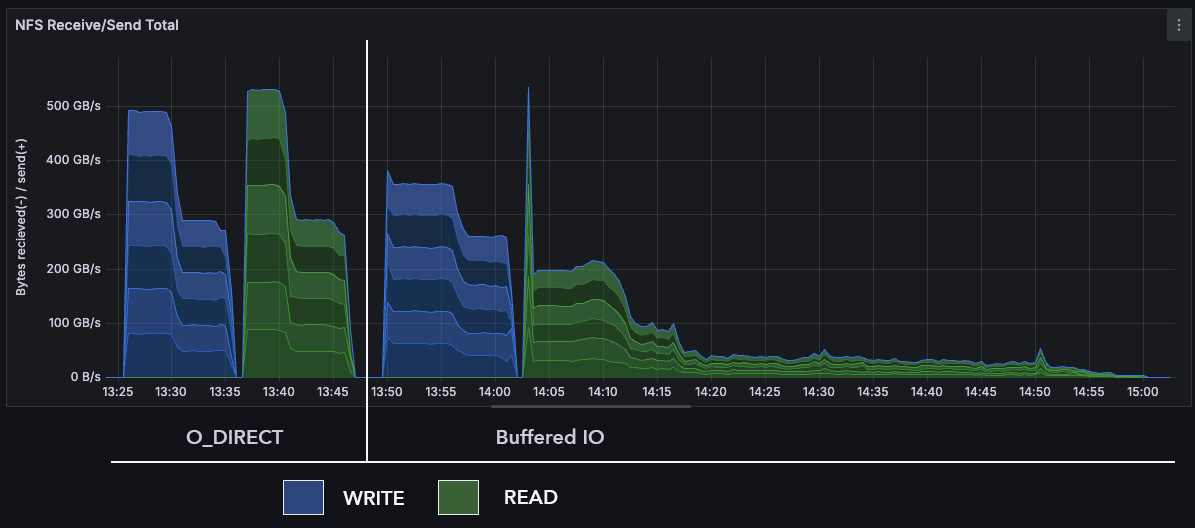
Buffered IO is generally worse across the board. DONTCACHE provides welcome reclaim storm relief without the alignment requirements of O_DIRECT but there really is no substitute for O_DIRECT if we're able to use it. My patchset shows NFSD can and that it is much more deterministic and less resource hungry.
Direct I/O is definitely the direction we need to go, with DONTCACHE fallback for misaligned write IO (once it is able to delay its dropbehind to work better with misaligned IO).
Mike
[0]: https://lore.kernel.org/linux-nfs/[email protected]/
[1]: https://lore.kernel.org/linux-nfs/[email protected]/
[2]: https://lore.kernel.org/linux-nfs/[email protected]/
[3]: https://lore.kernel.org/linux-nfs/[email protected]/
Jeff Layton
maintainerRe: [PATCH 5/6] NFSD: leverage DIO alignment to selectively issue O_DIRECT reads and writes
Quoted 13 lines · Mike Snitzer
Quoted 9 lines · Christoph Hellwig
Quoted 6 lines · Mike Snitzer
IO must be aligned, otherwise it falls back to using buffered IO.
RWF_DONTCACHEis _not_ currently used for misaligned IO (even when nfsd/enable-dontcache=1) because it works against us (due to RMW needing to read without benefit of cache), whereas buffered IO enables misaligned IO to be more performant.This seems to "randomly" mix direct I/O and buffered I/O on a file.
It isn't random, if the IO is DIO-aligned it uses direct I/O.
Quoted 9 lines
Quoted 1 line
That's basically asking for data corruption due to invalidation races.
I've seen you speak of said dragons in other threads and even commit headers, etc. Could be they are lurking, but I took the approach of "implement it [this patchset] and see what breaks". It hasn't broken yet, despite my having thrown a large battery of testing at it (which includes all of Hammerspace's automated sanities testing that uses many testsuites, e.g. xfstests, mdtest, etc, etc).
I'm concerned here too. Invalidation races can mean silent data corruption. We'll need to ensure that this is safe.
Incidentally, is there a good testcase for this? Something that does buffered and direct I/O from different tasks and looks for inconsistencies?
Quoted 49 lines
But the IOR "hard" workload, which checks for corruption and uses 47008 blocksize to force excessive RMW, hasn't yet been ran with my "[PATCH 6/6] NFSD: issue READs using
O_DIRECTeven if IO is misaligned" [0]. That IOR "hard" testing will likely happen today.Quoted 1 line
But maybe also explain what this is trying to address to start with?
Ha, I suspect you saw my too-many-words 0th patch header [1] and ignored it? Solid feedback, I need to be more succinct and I'm probably too close to this work to see the gaps in introduction and justification but will refine, starting now:
Overview: NFSD currently only uses buffered IO and it routinely falls over due to the problems
RWF_DONTCACHEwas developed to workaround. ButRWF_DONTCACHEalso uses buffered IO and page cache and also suffers from inefficiencies that direct IO doesn't. Buffered IO's cpu and memory consumption is particularly unwanted for resource constrained systems.Maybe some pictures are worth 1000+ words.
Here is a flamegraph showing buffered IO causing reclaim to bring the system to a halt (when workload's working set far exceeds available memory): https://original.art/buffered_read.svg
Here is flamegraph for the same type of workload but using DONTCACHE instead of normal buffered IO: https://original.art/dontcache_read.svg
Dave Chinner provided his analysis of why DONTCACHE was struggling [2]. And I gave further context to others and forecast that I'd be working on implementing NFSD support for using
O_DIRECT[3]. Then I discussed how to approach the implementation with Chuck, Jeff and others at the recent NFS Bakeathon. This series implements my take on what was discussed.This graph shows
O_DIRECTvs buffered IO for the IOR "easy" workload ("easy" because it uses aligned 1 MiB IOs rather than 47008 bytes like IOR "hard"): https://original.art/NFSD_direct_vs_buffered_IO.jpgBuffered IO is generally worse across the board. DONTCACHE provides welcome reclaim storm relief without the alignment requirements of
O_DIRECTbut there really is no substitute forO_DIRECTif we're able to use it. My patchset shows NFSD can and that it is much more deterministic and less resource hungry.Direct I/O is definitely the direction we need to go, with DONTCACHE fallback for misaligned write IO (once it is able to delay its dropbehind to work better with misaligned IO).
Quoted 6 lines
Mike
[0]: https://lore.kernel.org/linux-nfs/[email protected]/
[1]: https://lore.kernel.org/linux-nfs/[email protected]/
[2]: https://lore.kernel.org/linux-nfs/[email protected]/
[3]: https://lore.kernel.org/linux-nfs/[email protected]/
To summarize: the basic problem is that the pagecache is pretty useless for satisfying READs from nfsd. Most NFS workloads don't involve I/O to the same files from multiple clients. The client ends up having most of the data in its cache already and only very rarely do we need to revisit the data on the server.
At the same time, it's really easy to overwhelm the storage with pagecache writeback with modern memory sizes. Having nfsd bypass the pagecache altogether is potentially a huge performance win, if it can be made to work safely.
Signature · 1 line
Jeff Layton <[email protected]>
Re: [PATCH 5/6] NFSD: leverage DIO alignment to selectively issue O_DIRECT reads and writes
Quoted 7 lines · Jeff Layton
I'm concerned here too. Invalidation races can mean silent data corruption. We'll need to ensure that this is safe.
Incidentally, is there a good testcase for this? Something that does buffered and direct I/O from different tasks and looks for inconsistencies?
We have a few xfstets racing different kinds of I/O and triggers the failing invalidation warnings. I'm not sure anything combines this with checks for data integrity.
Re: [PATCH 5/6] NFSD: leverage DIO alignment to selectively issue O_DIRECT reads and writes
In reply to Mike SnitzerQuoted 4 lines · Mike Snitzer
Quoted 3 lines · Christoph Hellwig
Quoted 2 lines · Mike Snitzer
IO must be aligned, otherwise it falls back to using buffered IO.
Quoted 8 lines
Quoted 6 lines
Quoted 4 lines
RWF_DONTCACHEis _not_ currently used for misaligned IO (even when nfsd/enable-dontcache=1) because it works against us (due to RMW needing to read without benefit of cache), whereas buffered IO enables misaligned IO to be more performant.This seems to "randomly" mix direct I/O and buffered I/O on a file.
It isn't random, if the IO is DIO-aligned it uses direct I/O.
Which as an I/O pattern does look pretty random :)
Quoted 6 lines
Quoted 1 line
But maybe also explain what this is trying to address to start with?
Ha, I suspect you saw my too-many-words 0th patch header [1] and ignored it? Solid feedback, I need to be more succinct and I'm probably too close to this work to see the gaps in introduction and justification but will refine, starting now:
Well, I was mostly asking about the description for this patch in particular. Given that all the naming and the previous patches seemed to be about dontcache I/O having optional direct I/O in here looked really confusing.
Re: [PATCH 5/6] NFSD: leverage DIO alignment to selectively issue O_DIRECT reads and writes
In reply to Mike SnitzerQuoted 64 lines · Mike Snitzer
IO must be aligned, otherwise it falls back to using buffered IO.
RWF_DONTCACHEis _not_ currently used for misaligned IO (even when nfsd/enable-dontcache=1) because it works against us (due to RMW needing to read without benefit of cache), whereas buffered IO enables misaligned IO to be more performant.Signed-off-by Mike Snitzer <[email protected]>--- fs/nfsd/vfs.c | 40 ++++++++++++++++++++++++++++++++++++---- 1 file changed, 36 insertions(+), 4 deletions(-)fs/nfsd/vfs.c +26
-4@@ -1064,6 +1064,22 @@ __be32 nfsd_splice_read(struct svc_rqst *rqstp, struct svc_fh *fhp,return nfsd_finish_read (rqstp, fhp, file, offset, count, eof, host_err); } +static bool is_dio_aligned (const struct iov_iter *iter,loff_t offset, +const u32 blocksize) +{ +u32 blocksize_mask; + +if (!blocksize) +return false; + + blocksize_mask = blocksize -1 ; +if ((offset & blocksize_mask) || + (iov_iter_alignment (iter) & blocksize_mask)) +return false; + +return true; +} +/** * nfsd_iter_read - Perform a VFS read using an iterator * @rqstp: RPC transaction context @@ -1107,8 +1123,16 @@ __be32 nfsd_iter_read(struct svc_rqst *rqstp, struct svc_fh *fhp,trace_nfsd_read_vector (rqstp, fhp, offset, *count);iov_iter_bvec (&iter,ITER_DEST , rqstp->rq_bvec, v, *count); -if (nfsd_enable_dontcache) - flags |=RWF_DONTCACHE ; +if (nfsd_enable_dontcache) { +if (is_dio_aligned (&iter, offset, nf->nf_dio_read_offset_align)) + flags |=RWF_DIRECT ; +/* FIXME: not using RWF_DONTCACHE for misaligned IO because it works +* against us (due to RMW needing to read without benefit of cache), +* whereas buffered IO enables misaligned IO to be more performant. +*/ +//else +// flags |= RWF_DONTCACHE; + } host_err =vfs_iter_read (file, &iter, &ppos, flags);return nfsd_finish_read (rqstp, fhp, file, offset, count, eof, host_err);@@ -1217,8 +1241,16 @@ nfsd_vfs_write(struct svc_rqst *rqstp, struct svc_fh *fhp, nvecs =xdr_buf_to_bvec (rqstp->rq_bvec, rqstp->rq_maxpages, payload);iov_iter_bvec (&iter,ITER_SOURCE , rqstp->rq_bvec, nvecs, *cnt); -if (nfsd_enable_dontcache) - flags |=RWF_DONTCACHE ;
fs/nfsd/vfs.c nfsd_vfs_write(struct svc_rqst *rqstp, struct svc_fh *fhp, · line 1253
Quoted 10 lines
fs/nfsd/vfs.c +10
-0+if (nfsd_enable_dontcache) { +if (is_dio_aligned (&iter, offset, nf->nf_dio_offset_align)) + flags |=RWF_DIRECT ; +/* FIXME: not using RWF_DONTCACHE for misaligned IO because it works +* against us (due to RMW needing to read without benefit of cache), +* whereas buffered IO enables misaligned IO to be more performant. +*/ +//else +// flags |= RWF_DONTCACHE; + }
IMO adding RWF_DONTCACHE first then replacing it later in the series with a form of O_DIRECT is confusing. Also, why add RWF_DONTCACHE here and then take it away "because it doesn't work"?
But OK, your series is really a proof-of-concept. Something to work out before it is merge-ready, I guess.
It is much more likely for NFS READ requests to be properly aligned. Clients are generally good about that. NFS WRITE request alignment is going to be arbitrary. Fwiw.
However, one thing we discussed at bake-a-thon was what to do about unstable WRITEs. For unstable WRITEs, the server has to cache the write data at least until the client sends a COMMIT. Otherwise the server will have to convert all UNSTABLE writes to FILE_SYNC writes, and that can have performance implications.
One thing you might consider is to continue using the page cache for unstable WRITEs, and then use fadvise DONTNEED after a successful COMMIT operation to reduce page cache footprint. Unstable writes to the same range of the file might be a problem, however.
Quoted 2 lines
fs/nfsd/vfs.c +0
-0since =READ_ONCE (file->f_wb_err);if (verf)
Signature · 1 line
Chuck Lever
Jeff Layton
maintainerRe: [PATCH 5/6] NFSD: leverage DIO alignment to selectively issue O_DIRECT reads and writes
Quoted 87 lines · Chuck Lever
Quoted 64 lines · Mike Snitzer
IO must be aligned, otherwise it falls back to using buffered IO.
RWF_DONTCACHEis _not_ currently used for misaligned IO (even when nfsd/enable-dontcache=1) because it works against us (due to RMW needing to read without benefit of cache), whereas buffered IO enables misaligned IO to be more performant.Signed-off-by Mike Snitzer <[email protected]>--- fs/nfsd/vfs.c | 40 ++++++++++++++++++++++++++++++++++++---- 1 file changed, 36 insertions(+), 4 deletions(-)fs/nfsd/vfs.c +26
-4@@ -1064,6 +1064,22 @@ __be32 nfsd_splice_read(struct svc_rqst *rqstp, struct svc_fh *fhp,return nfsd_finish_read (rqstp, fhp, file, offset, count, eof, host_err); } +static bool is_dio_aligned (const struct iov_iter *iter,loff_t offset, +const u32 blocksize) +{ +u32 blocksize_mask; + +if (!blocksize) +return false; + + blocksize_mask = blocksize -1 ; +if ((offset & blocksize_mask) || + (iov_iter_alignment (iter) & blocksize_mask)) +return false; + +return true; +} +/** * nfsd_iter_read - Perform a VFS read using an iterator * @rqstp: RPC transaction context @@ -1107,8 +1123,16 @@ __be32 nfsd_iter_read(struct svc_rqst *rqstp, struct svc_fh *fhp,trace_nfsd_read_vector (rqstp, fhp, offset, *count);iov_iter_bvec (&iter,ITER_DEST , rqstp->rq_bvec, v, *count); -if (nfsd_enable_dontcache) - flags |=RWF_DONTCACHE ; +if (nfsd_enable_dontcache) { +if (is_dio_aligned (&iter, offset, nf->nf_dio_read_offset_align)) + flags |=RWF_DIRECT ; +/* FIXME: not using RWF_DONTCACHE for misaligned IO because it works +* against us (due to RMW needing to read without benefit of cache), +* whereas buffered IO enables misaligned IO to be more performant. +*/ +//else +// flags |= RWF_DONTCACHE; + } host_err =vfs_iter_read (file, &iter, &ppos, flags);return nfsd_finish_read (rqstp, fhp, file, offset, count, eof, host_err);@@ -1217,8 +1241,16 @@ nfsd_vfs_write(struct svc_rqst *rqstp, struct svc_fh *fhp, nvecs =xdr_buf_to_bvec (rqstp->rq_bvec, rqstp->rq_maxpages, payload);iov_iter_bvec (&iter,ITER_SOURCE , rqstp->rq_bvec, nvecs, *cnt); -if (nfsd_enable_dontcache) - flags |=RWF_DONTCACHE ;fs/nfsd/vfs.c nfsd_vfs_write(struct svc_rqst *rqstp, struct svc_fh *fhp, · line 1253
Quoted 10 lines
fs/nfsd/vfs.c +10
-0+if (nfsd_enable_dontcache) { +if (is_dio_aligned (&iter, offset, nf->nf_dio_offset_align)) + flags |=RWF_DIRECT ; +/* FIXME: not using RWF_DONTCACHE for misaligned IO because it works +* against us (due to RMW needing to read without benefit of cache), +* whereas buffered IO enables misaligned IO to be more performant. +*/ +//else +// flags |= RWF_DONTCACHE; + }IMO adding
RWF_DONTCACHEfirst then replacing it later in the series with a form ofO_DIRECTis confusing. Also, why addRWF_DONTCACHEhere and then take it away "because it doesn't work"?But OK, your series is really a proof-of-concept. Something to work out before it is merge-ready, I guess.
It is much more likely for NFS READ requests to be properly aligned. Clients are generally good about that. NFS WRITE request alignment is going to be arbitrary. Fwiw.
Quoted 6 lines
However, one thing we discussed at bake-a-thon was what to do about unstable WRITEs. For unstable WRITEs, the server has to cache the write data at least until the client sends a COMMIT. Otherwise the server will have to convert all UNSTABLE writes to
FILE_SYNCwrites, and that can have performance implications.
If we're doing synchronous, direct I/O writes then why not just respond with FILE_SYNC? The write should be on the platter by the time it returns.
Quoted 4 lines
One thing you might consider is to continue using the page cache for unstable WRITEs, and then use fadvise DONTNEED after a successful COMMIT operation to reduce page cache footprint. Unstable writes to the same range of the file might be a problem, however.
Since the client sends almost everything UNSTABLE, that would probably erase most of the performance win. The only reason I can see to use buffered I/O in this mode would be because we had to deal with an unaligned write and need to do a RMW cycle on a block.
The big question is whether mixing buffered and direct I/O writes like this is safe across all exportable filesystems. I'm not yet convinced of that.
Signature · 1 line
Jeff Layton <[email protected]>
Re: [PATCH 5/6] NFSD: leverage DIO alignment to selectively issue O_DIRECT reads and writes
Quoted 95 lines · Jeff Layton
Quoted 87 lines · Chuck Lever
Quoted 64 lines · Mike Snitzer
IO must be aligned, otherwise it falls back to using buffered IO.
RWF_DONTCACHEis _not_ currently used for misaligned IO (even when nfsd/enable-dontcache=1) because it works against us (due to RMW needing to read without benefit of cache), whereas buffered IO enables misaligned IO to be more performant.Signed-off-by Mike Snitzer <[email protected]>--- fs/nfsd/vfs.c | 40 ++++++++++++++++++++++++++++++++++++---- 1 file changed, 36 insertions(+), 4 deletions(-)fs/nfsd/vfs.c +26
-4@@ -1064,6 +1064,22 @@ __be32 nfsd_splice_read(struct svc_rqst *rqstp, struct svc_fh *fhp,return nfsd_finish_read (rqstp, fhp, file, offset, count, eof, host_err); } +static bool is_dio_aligned (const struct iov_iter *iter,loff_t offset, +const u32 blocksize) +{ +u32 blocksize_mask; + +if (!blocksize) +return false; + + blocksize_mask = blocksize -1 ; +if ((offset & blocksize_mask) || + (iov_iter_alignment (iter) & blocksize_mask)) +return false; + +return true; +} +/** * nfsd_iter_read - Perform a VFS read using an iterator * @rqstp: RPC transaction context @@ -1107,8 +1123,16 @@ __be32 nfsd_iter_read(struct svc_rqst *rqstp, struct svc_fh *fhp,trace_nfsd_read_vector (rqstp, fhp, offset, *count);iov_iter_bvec (&iter,ITER_DEST , rqstp->rq_bvec, v, *count); -if (nfsd_enable_dontcache) - flags |=RWF_DONTCACHE ; +if (nfsd_enable_dontcache) { +if (is_dio_aligned (&iter, offset, nf->nf_dio_read_offset_align)) + flags |=RWF_DIRECT ; +/* FIXME: not using RWF_DONTCACHE for misaligned IO because it works +* against us (due to RMW needing to read without benefit of cache), +* whereas buffered IO enables misaligned IO to be more performant. +*/ +//else +// flags |= RWF_DONTCACHE; + } host_err =vfs_iter_read (file, &iter, &ppos, flags);return nfsd_finish_read (rqstp, fhp, file, offset, count, eof, host_err);@@ -1217,8 +1241,16 @@ nfsd_vfs_write(struct svc_rqst *rqstp, struct svc_fh *fhp, nvecs =xdr_buf_to_bvec (rqstp->rq_bvec, rqstp->rq_maxpages, payload);iov_iter_bvec (&iter,ITER_SOURCE , rqstp->rq_bvec, nvecs, *cnt); -if (nfsd_enable_dontcache) - flags |=RWF_DONTCACHE ;fs/nfsd/vfs.c nfsd_vfs_write(struct svc_rqst *rqstp, struct svc_fh *fhp, · line 1253
Quoted 10 lines
fs/nfsd/vfs.c +10
-0+if (nfsd_enable_dontcache) { +if (is_dio_aligned (&iter, offset, nf->nf_dio_offset_align)) + flags |=RWF_DIRECT ; +/* FIXME: not using RWF_DONTCACHE for misaligned IO because it works +* against us (due to RMW needing to read without benefit of cache), +* whereas buffered IO enables misaligned IO to be more performant. +*/ +//else +// flags |= RWF_DONTCACHE; + }IMO adding
RWF_DONTCACHEfirst then replacing it later in the series with a form ofO_DIRECTis confusing. Also, why addRWF_DONTCACHEhere and then take it away "because it doesn't work"?But OK, your series is really a proof-of-concept. Something to work out before it is merge-ready, I guess.
It is much more likely for NFS READ requests to be properly aligned. Clients are generally good about that. NFS WRITE request alignment is going to be arbitrary. Fwiw.
Quoted 6 lines
However, one thing we discussed at bake-a-thon was what to do about unstable WRITEs. For unstable WRITEs, the server has to cache the write data at least until the client sends a COMMIT. Otherwise the server will have to convert all UNSTABLE writes to
FILE_SYNCwrites, and that can have performance implications.
Quoted 3 lines
If we're doing synchronous, direct I/O writes then why not just respond with
FILE_SYNC? The write should be on the platter by the time it returns.
Because "platter". On some devices, writes are slow.
For some workloads, unstable is faster. I have an experimental series that makes NFSD convert all NFS WRITEs to FILE_SYNC. It was not an across the board win, even with an NVMe-backed file system.
Quoted 5 lines
Quoted 4 lines
One thing you might consider is to continue using the page cache for unstable WRITEs, and then use fadvise DONTNEED after a successful COMMIT operation to reduce page cache footprint. Unstable writes to the same range of the file might be a problem, however.
Quoted 8 lines
Since the client sends almost everything UNSTABLE, that would probably erase most of the performance win. The only reason I can see to use buffered I/O in this mode would be because we had to deal with an unaligned write and need to do a RMW cycle on a block.
The big question is whether mixing buffered and direct I/O writes like this is safe across all exportable filesystems. I'm not yet convinced of that.
Agreed, that deserves careful scrutiny.
Signature · 1 line
Chuck Lever
Jeff Layton
maintainerRe: [PATCH 5/6] NFSD: leverage DIO alignment to selectively issue O_DIRECT reads and writes
Quoted 100 lines · Chuck Lever
Quoted 95 lines · Jeff Layton
Quoted 87 lines · Chuck Lever
Quoted 64 lines · Mike Snitzer
IO must be aligned, otherwise it falls back to using buffered IO.
RWF_DONTCACHEis _not_ currently used for misaligned IO (even when nfsd/enable-dontcache=1) because it works against us (due to RMW needing to read without benefit of cache), whereas buffered IO enables misaligned IO to be more performant.Signed-off-by Mike Snitzer <[email protected]>--- fs/nfsd/vfs.c | 40 ++++++++++++++++++++++++++++++++++++---- 1 file changed, 36 insertions(+), 4 deletions(-)fs/nfsd/vfs.c +26
-4@@ -1064,6 +1064,22 @@ __be32 nfsd_splice_read(struct svc_rqst *rqstp, struct svc_fh *fhp,return nfsd_finish_read (rqstp, fhp, file, offset, count, eof, host_err); } +static bool is_dio_aligned (const struct iov_iter *iter,loff_t offset, +const u32 blocksize) +{ +u32 blocksize_mask; + +if (!blocksize) +return false; + + blocksize_mask = blocksize -1 ; +if ((offset & blocksize_mask) || + (iov_iter_alignment (iter) & blocksize_mask)) +return false; + +return true; +} +/** * nfsd_iter_read - Perform a VFS read using an iterator * @rqstp: RPC transaction context @@ -1107,8 +1123,16 @@ __be32 nfsd_iter_read(struct svc_rqst *rqstp, struct svc_fh *fhp,trace_nfsd_read_vector (rqstp, fhp, offset, *count);iov_iter_bvec (&iter,ITER_DEST , rqstp->rq_bvec, v, *count); -if (nfsd_enable_dontcache) - flags |=RWF_DONTCACHE ; +if (nfsd_enable_dontcache) { +if (is_dio_aligned (&iter, offset, nf->nf_dio_read_offset_align)) + flags |=RWF_DIRECT ; +/* FIXME: not using RWF_DONTCACHE for misaligned IO because it works +* against us (due to RMW needing to read without benefit of cache), +* whereas buffered IO enables misaligned IO to be more performant. +*/ +//else +// flags |= RWF_DONTCACHE; + } host_err =vfs_iter_read (file, &iter, &ppos, flags);return nfsd_finish_read (rqstp, fhp, file, offset, count, eof, host_err);@@ -1217,8 +1241,16 @@ nfsd_vfs_write(struct svc_rqst *rqstp, struct svc_fh *fhp, nvecs =xdr_buf_to_bvec (rqstp->rq_bvec, rqstp->rq_maxpages, payload);iov_iter_bvec (&iter,ITER_SOURCE , rqstp->rq_bvec, nvecs, *cnt); -if (nfsd_enable_dontcache) - flags |=RWF_DONTCACHE ;fs/nfsd/vfs.c nfsd_vfs_write(struct svc_rqst *rqstp, struct svc_fh *fhp, · line 1253
Quoted 10 lines
fs/nfsd/vfs.c +10
-0+if (nfsd_enable_dontcache) { +if (is_dio_aligned (&iter, offset, nf->nf_dio_offset_align)) + flags |=RWF_DIRECT ; +/* FIXME: not using RWF_DONTCACHE for misaligned IO because it works +* against us (due to RMW needing to read without benefit of cache), +* whereas buffered IO enables misaligned IO to be more performant. +*/ +//else +// flags |= RWF_DONTCACHE; + }IMO adding
RWF_DONTCACHEfirst then replacing it later in the series with a form ofO_DIRECTis confusing. Also, why addRWF_DONTCACHEhere and then take it away "because it doesn't work"?But OK, your series is really a proof-of-concept. Something to work out before it is merge-ready, I guess.
It is much more likely for NFS READ requests to be properly aligned. Clients are generally good about that. NFS WRITE request alignment is going to be arbitrary. Fwiw.
Quoted 6 lines
However, one thing we discussed at bake-a-thon was what to do about unstable WRITEs. For unstable WRITEs, the server has to cache the write data at least until the client sends a COMMIT. Otherwise the server will have to convert all UNSTABLE writes to
FILE_SYNCwrites, and that can have performance implications.Quoted 3 lines
If we're doing synchronous, direct I/O writes then why not just respond with
FILE_SYNC? The write should be on the platter by the time it returns.
Quoted 6 lines
Because "platter". On some devices, writes are slow.
For some workloads, unstable is faster. I have an experimental series that makes NFSD convert all NFS WRITEs to
FILE_SYNC. It was not an across the board win, even with an NVMe-backed file system.
Presumably, those devices wouldn't be exported in this mode. That's probably a good argument for making this settable on a per-export basis.
Quoted 11 lines
Quoted 11 lines
Quoted 5 lines
One thing you might consider is to continue using the page cache for unstable WRITEs, and then use fadvise DONTNEED after a successful COMMIT operation to reduce page cache footprint. Unstable writes to the same range of the file might be a problem, however.
Since the client sends almost everything UNSTABLE, that would probably erase most of the performance win. The only reason I can see to use buffered I/O in this mode would be because we had to deal with an unaligned write and need to do a RMW cycle on a block.
Quoted 6 lines
Quoted 3 lines
The big question is whether mixing buffered and direct I/O writes like this is safe across all exportable filesystems. I'm not yet convinced of that.
Agreed, that deserves careful scrutiny.
Like Mike is asking though, I need a better understanding of the potential races here:
XFS, for instance, takes the i_rwsem shared around dio writes and exclusive around buffered, so they should exclude each other. If we did all the buffered writes as RWF_SYNC, would that prevent corruption?
In any case, for now at least, unless you're using RDMA, it's going to end up falling back to buffered writes everywhere. The data is almost never going to be properly aligned coming in off the wire. That might be fixable though.
Signature · 1 line
Jeff Layton <[email protected]>
Re: [PATCH 5/6] NFSD: leverage DIO alignment to selectively issue O_DIRECT reads and writes
Quoted 66 lines · Jeff Layton
Quoted 65 lines · Chuck Lever
Quoted 64 lines · Jeff Layton
Quoted 63 lines · Chuck Lever
Quoted 62 lines · Mike Snitzer
IO must be aligned, otherwise it falls back to using buffered IO.
RWF_DONTCACHEis _not_ currently used for misaligned IO (even when nfsd/enable-dontcache=1) because it works against us (due to RMW needing to read without benefit of cache), whereas buffered IO enables misaligned IO to be more performant.Signed-off-by Mike Snitzer <[email protected]>--- fs/nfsd/vfs.c | 40 ++++++++++++++++++++++++++++++++++++---- 1 file changed, 36 insertions(+), 4 deletions(-)fs/nfsd/vfs.c +26
-2@@ -1064,6 +1064,22 @@ __be32 nfsd_splice_read(struct svc_rqst *rqstp, struct svc_fh *fhp,return nfsd_finish_read (rqstp, fhp, file, offset, count, eof, host_err); } +static bool is_dio_aligned (const struct iov_iter *iter,loff_t offset, +const u32 blocksize) +{ +u32 blocksize_mask; + +if (!blocksize) +return false; + + blocksize_mask = blocksize -1 ; +if ((offset & blocksize_mask) || + (iov_iter_alignment (iter) & blocksize_mask)) +return false; + +return true; +} +/** * nfsd_iter_read - Perform a VFS read using an iterator * @rqstp: RPC transaction context @@ -1107,8 +1123,16 @@ __be32 nfsd_iter_read(struct svc_rqst *rqstp, struct svc_fh *fhp,trace_nfsd_read_vector (rqstp, fhp, offset, *count);iov_iter_bvec (&iter,ITER_DEST , rqstp->rq_bvec, v, *count); -if (nfsd_enable_dontcache) - flags |=RWF_DONTCACHE ; +if (nfsd_enable_dontcache) { +if (is_dio_aligned (&iter, offset, nf->nf_dio_read_offset_align)) + flags |=RWF_DIRECT ; +/* FIXME: not using RWF_DONTCACHE for misaligned IO because it works +* against us (due to RMW needing to read without benefit of cache), +* whereas buffered IO enables misaligned IO to be more performant. +*/ +//else +// flags |= RWF_DONTCACHE; + } host_err =vfs_iter_read (file, &iter, &ppos, flags);return nfsd_finish_read (rqstp, fhp, file, offset, count, eof, host_err);@@ -1217,8 +1241,16 @@ nfsd_vfs_write(struct svc_rqst *rqstp, struct svc_fh *fhp, nvecs =xdr_buf_to_bvec (rqstp->rq_bvec, rqstp->rq_maxpages, payload);iov_iter_bvec (&iter,ITER_SOURCE , rqstp->rq_bvec, nvecs, *cnt);
Quoted 16 lines
Quoted 8 lines
Quoted 8 lines
Quoted 8 lines
Quoted 8 lines
fs/nfsd/vfs.c +6
-2-if (nfsd_enable_dontcache) - flags |=RWF_DONTCACHE ; +if (nfsd_enable_dontcache) { +if (is_dio_aligned (&iter, offset, nf->nf_dio_offset_align)) + flags |=RWF_DIRECT ; +/* FIXME: not using RWF_DONTCACHE for misaligned IO because it works +* against us (due to RMW needing to read without benefit of cache), +* whereas buffered IO enables misaligned IO to be more performant. Quoted 8 lines
Quoted 8 lines
Quoted 8 lines
fs/nfsd/vfs.c __be32 nfsd_iter_read(struct svc_rqst *rqstp, struct svc_fh *fhp, · line 1135
Quoted 4 lines
fs/nfsd/vfs.c +4
-0+*/ +//else +// flags |= RWF_DONTCACHE; + }IMO adding
RWF_DONTCACHEfirst then replacing it later in the series with a form ofO_DIRECTis confusing. Also, why addRWF_DONTCACHEhere and then take it away "because it doesn't work"?
I spoke to this in a previous reply. I can fold patches to elininate this distraction in v2.
Quoted 6 lines
Quoted 6 lines
Quoted 6 lines
Quoted 6 lines
But OK, your series is really a proof-of-concept. Something to work out before it is merge-ready, I guess.
It is much more likely for NFS READ requests to be properly aligned. Clients are generally good about that. NFS WRITE request alignment is going to be arbitrary. Fwiw.
Correct, thankfully TCP reads don't misalign their payload like TCP writes do. As you know, the value of patch 6 is that application IO that generates misaligned IO (as a side-effect of misaligned read blocksize, e.g. IOR hard's 47008 blocksize) can issue reads using O_DIRECT.
Quoted 10 lines
Quoted 10 lines
Quoted 10 lines
Quoted 6 lines
However, one thing we discussed at bake-a-thon was what to do about unstable WRITEs. For unstable WRITEs, the server has to cache the write data at least until the client sends a COMMIT. Otherwise the server will have to convert all UNSTABLE writes to
FILE_SYNCwrites, and that can have performance implications.If we're doing synchronous, direct I/O writes then why not just respond with
FILE_SYNC? The write should be on the platter by the time it returns.
For v2 I'll look to formalize responding with FILE_SYNC when 'enable-dontcache' is set.
Quoted 10 lines
Quoted 6 lines
Because "platter". On some devices, writes are slow.
For some workloads, unstable is faster. I have an experimental series that makes NFSD convert all NFS WRITEs to
FILE_SYNC. It was not an across the board win, even with an NVMe-backed file system.Presumably, those devices wouldn't be exported in this mode. That's probably a good argument for making this settable on a per-export basis.
Correct. This shouldn't be used by default. But if/when it makes sense, it *really* sings.
Quoted 17 lines
Quoted 10 lines
Quoted 10 lines
Quoted 4 lines
One thing you might consider is to continue using the page cache for unstable WRITEs, and then use fadvise DONTNEED after a successful COMMIT operation to reduce page cache footprint. Unstable writes to the same range of the file might be a problem, however.
Since the client sends almost everything UNSTABLE, that would probably erase most of the performance win. The only reason I can see to use buffered I/O in this mode would be because we had to deal with an unaligned write and need to do a RMW cycle on a block.
Quoted 6 lines
Quoted 3 lines
The big question is whether mixing buffered and direct I/O writes like this is safe across all exportable filesystems. I'm not yet convinced of that.
Agreed, that deserves careful scrutiny.
Quoted 8 lines
Like Mike is asking though, I need a better understanding of the potential races here:
XFS, for instance, takes the
i_rwsemshared around dio writes and exclusive around buffered, so they should exclude each other.If we did all the buffered writes as
RWF_SYNC, would that prevent corruption?
I welcome any help pinning down what must be done to ensure this is safe ("this" being: arbitrary switching between buffered and direct IO and associated page cache invalidation). But to be 100% clear:
NFSD exporting XFS with enable-dontcache=1 has worked very well.
Do we need to go to the extreme of each filesystem exporting support with a new flag like FOP_INVALIDATES_BUFFERED_VS_DIRECT? And if set, any evidence to the contrary is a bug?
And does the VFS have a role in ensuring it's safe or can we assume vfs/mm/etc are intended to be safe and any core common code that proves otherwise is a bug?
Quoted 4 lines
In any case, for now at least, unless you're using RDMA, it's going to end up falling back to buffered writes everywhere. The data is almost never going to be properly aligned coming in off the wire. That might be fixable though.
Ben Coddington mentioned to me that soft-iwarp would allow use of RDMA over TCP to workaround SUNRPC TCP's XDR handling always storing the write payload in misaligned IO. But that's purely a stop-gap workaround, which needs testing (to see if soft-iwap negates the win of using O_DIRECT, etc).
But a long-term better fix is absolutely needed, to be continued (in the subthread I need to get going)...
Mike
Re: [PATCH 5/6] NFSD: leverage DIO alignment to selectively issue O_DIRECT reads and writes
In reply to Jeff LaytonQuoted 3 lines · Jeff Layton
XFS, for instance, takes the
i_rwsemshared around dio writes and exclusive around buffered, so they should exclude each other. If we did all the buffered writes asRWF_SYNC, would that prevent corruption?
The big issue is memory mapped I/O, which doesn't take any locks. I guess you could declare using a nfs exported file locally as a bad idea, but I know plenty of setups doing it.
Re: [PATCH 5/6] NFSD: leverage DIO alignment to selectively issue O_DIRECT reads and writes
In reply to Chuck LeverQuoted 9 lines · Chuck Lever
Quoted 3 lines
If we're doing synchronous, direct I/O writes then why not just respond with
FILE_SYNC? The write should be on the platter by the time it returns.Because "platter". On some devices, writes are slow.
For some workloads, unstable is faster. I have an experimental series that makes NFSD convert all NFS WRITEs to
FILE_SYNC. It was not an across the board win, even with an NVMe-backed file system.
For everything that is not a pure overwrite on a file system that passes them through, and a device not having a volatile write cache FILE_SYNC currently is slower. That might change for file systems logging synchronous writes (I'm playing with that for XFS a bit again), but even then you only want to selectively do that when the client specifically requests O_DSYNC semantics as you'd easily overwhelm the log and introduce a log write amplification.
Re: [PATCH 5/6] NFSD: leverage DIO alignment to selectively issue O_DIRECT reads and writes
In reply to Jeff LaytonQuoted 8 lines · Jeff Layton
Quoted 4 lines
write data at least until the client sends a COMMIT. Otherwise the server will have to convert all UNSTABLE writes to
FILE_SYNCwrites, and that can have performance implications.If we're doing synchronous, direct I/O writes then why not just respond with
FILE_SYNC? The write should be on the platter by the time it returns.
Only if you do O_DSYNC writes. Which are painfully slow for lots of configurations. Otherwise you still need to issue an fdatasync.
But can you help me refreshing why UNSTABLE semantics require having the data in the page cache?
PATCH 6/6 NFSD: issue READs using O_DIRECT even if IO is misaligned
In reply to Mike SnitzerIf enable-dontcache is used, expand any misaligned READ to the next DIO-aligned block (on either end of the READ).
Reserve an extra page in svc_serv_maxpages() because nfsd_iter_read() might need two extra pages when a READ payload is not DIO-aligned -- but nfsd_iter_read() and nfsd_splice_actor() are mutually exclusive (so reuse page reserved for nfsd_splice_actor).
Also add nfsd_read_vector_dio trace event. This combination of trace events is useful:
echo 1 > /sys/kernel/tracing/events/nfsd/nfsd_read_vector/enable echo 1 > /sys/kernel/tracing/events/nfsd/nfsd_read_vector_dio/enable echo 1 > /sys/kernel/tracing/events/nfsd/nfsd_read_io_done/enable echo 1 > /sys/kernel/tracing/events/xfs/xfs_file_direct_read/enable
Which for this dd command:
dd if=/mnt/share1/test of=/dev/null bs=47008 count=2 iflag=direct
Results in:
 nfsd-16580   [001] .....  5672.403130: nfsd_read_vector_dio: xid=0x5ccf019c fh_hash=0xe4dadb60 offset=0 len=47008 start=0+0 end=47104-96
 nfsd-16580   [001] .....  5672.403131: nfsd_read_vector: xid=0x5ccf019c fh_hash=0xe4dadb60 offset=0 len=47104
 nfsd-16580   [001] .....  5672.403134: xfs_file_direct_read: dev 253:0 ino 0x1c2388c1 disize 0x16f40 pos 0x0 bytecount 0xb800
 nfsd-16580   [001] .....  5672.404380: nfsd_read_io_done: xid=0x5ccf019c fh_hash=0xe4dadb60 offset=0 len=47008
 nfsd-16580   [001] .....  5672.404672: nfsd_read_vector_dio: xid=0x5dcf019c fh_hash=0xe4dadb60 offset=47008 len=47008 start=46592+416 end=94208-192
 nfsd-16580   [001] .....  5672.404672: nfsd_read_vector: xid=0x5dcf019c fh_hash=0xe4dadb60 offset=46592 len=47616
 nfsd-16580   [001] .....  5672.404673: xfs_file_direct_read: dev 253:0 ino 0x1c2388c1 disize 0x16f40 pos 0xb600 bytecount 0xba00
 nfsd-16580   [001] .....  5672.405771: nfsd_read_io_done: xid=0x5dcf019c fh_hash=0xe4dadb60 offset=47008 len=47008
---
 fs/nfsd/trace.h            | 37 ++++++++++++++++++++++
 fs/nfsd/vfs.c              | 65 ++++++++++++++++++++++++++++----------
 include/linux/sunrpc/svc.h |  5 ++-
 3 files changed, 90 insertions(+), 17 deletions(-)
fs/nfsd/trace.h +37 -0
@@ -473,6 +473,43 @@ DEFINE_NFSD_IO_EVENT(write_done);DEFINE_NFSD_IO_EVENT (commit_start);DEFINE_NFSD_IO_EVENT (commit_done); +TRACE_EVENT (nfsd_read_vector_dio, + TP_PROTO(struct svc_rqst *rqstp, + struct svc_fh *fhp, + u64 offset, + u32 len, + loff_t start, + loff_t start_extra, + loff_t end, + loff_t end_extra), +TP_ARGS (rqstp, fhp, offset, len, start, start_extra, end, end_extra), +TP_STRUCT__entry ( + __field(u32, xid) + __field(u32, fh_hash) + __field(u64, offset) + __field(u32, len) + __field(loff_t, start) + __field(loff_t, start_extra) + __field(loff_t, end) +__field (loff_t, end_extra) + ), +TP_fast_assign ( + __entry->xid = be32_to_cpu(rqstp->rq_xid); + __entry->fh_hash = knfsd_fh_hash(&fhp->fh_handle); + __entry->offset = offset; + __entry->len = len; + __entry->start = start; + __entry->start_extra = start_extra; + __entry->end = end; + __entry->end_extra = end_extra; + ), +TP_printk ("xid=0x%08x fh_hash=0x%08x offset=%llu len=%u start=%llu+%llu end=%llu-%llu" , + __entry->xid, __entry->fh_hash, + __entry->offset, __entry->len, + __entry->start, __entry->start_extra, + __entry->end, __entry->end_extra) +); + DECLARE_EVENT_CLASS(nfsd_err_class, TP_PROTO(struct svc_rqst *rqstp, struct svc_fh *fhp,
fs/nfsd/vfs.c +49 -16
91 lines not on this page · raw message
include/linux/sunrpc/svc.h +4 -1
@@ -163,10 +163,13 @@ extern u32 svc_max_payload(const struct svc_rqst *rqstp);* pages, one for the request, and one for the reply. * nfsd_splice_actor() might need an extra page when a READ payload * is not page-aligned. +* nfsd_iter_read() might need two extra pages when a READ payload +* is not DIO-aligned -- but nfsd_iter_read() and nfsd_splice_actor() +* are mutually exclusive. */ static inline unsigned long svc_serv_maxpages (const struct svc_serv *serv) { -return DIV_ROUND_UP (serv->sv_max_mesg,PAGE_SIZE ) +2 +1 ; +return DIV_ROUND_UP (serv->sv_max_mesg,PAGE_SIZE ) +2 +1 +1 ; }/*
Signature · 1 line
2.44.0
Jeff Layton
maintainerQuoted 9 lines · Mike Snitzer
Hi,
This series introduces 'enable-dontcache' to NFSD's debugfs interface, once enabled NFSD will selectively make use of
O_DIRECTwhen issuing read and write IO:
- all READs will useO_DIRECT(both aligned and misaligned)
- all DIO-aligned WRITEs will useO_DIRECT(useful for SUNRPC RDMA)
- misaligned WRITEs currently continue to use normal buffered IO
Quoted 17 lines
Q: Why not actually use
RWF_DONTCACHE(yet)?
A:
If IO can is properly DIO-aligned, or can be made to be, usingO_DIRECTis preferred over DONTCACHE because of its reduced CPU and memory usage. Relative to NFSD usingRWF_DONTCACHEfor misaligned WRITEs, I've briefly discussed with Jens that follow-on dontcache work is needed to justify falling back to actually usingRWF_DONTCACHE. Specifically, Hammerspace benchmarking has confirmed as Jeff Layton suggested at Bakeathon, we need dontcache to be enhanced to not immediately dropbehind when IO completes -- because it works against us (due to RMW needing to read without benefit of cache), whereas buffered IO enables misaligned IO to be more performant. Jens thought that delayed dropbehind is certainly doable but that he needed to reason through it further (so timing on availability is TBD). As soon as it is possible I'll happily switch NFSD's misaligned write IO fallback from normal buffered IO to actually usingRWF_DONTCACHE.
To be clear, my concern with *_DONTCACHE is this bit in generic_write_sync():
        } else if (iocb->ki_flags & IOCB_DONTCACHE) {
                struct address_space *mapping = iocb->ki_filp->f_mapping;

                filemap_fdatawrite_range_kick(mapping, iocb->ki_pos - count,
                                              iocb->ki_pos - 1);
        }
I understand why it was done, but it means that we're kicking off writeback for small ranges after every write. I think we'd be better served by allowing for a little batching, and just kick off writeback (maybe even for the whole inode) after a short delay. IOW, I agree with Dave Chinner that we need some sort of writebehind window.
The dropbehind part (where we drop it from the pagecache after writeback completes) is fine, IMO.
Quoted 15 lines
Continuing with what this patchset provides:
NFSD now uses
STATX_DIOALIGNandSTATX_DIO_READ_ALIGNto get and store DIO alignment attributes from underlying filesystem in associatednfsd_file. This is done when thenfsd_fileis first opened for a regular file.A new
RWF_DIRECTflag is added toinclude/uapi/linux/fs.hto allow NFSD to useO_DIRECTon a per-IO basis.If enable-dontcache=1 then
RWF_DIRECTwill be set for all READ IO (even if the IO is misaligned, thanks to expanding the read to be aligned for use with DIO, as suggested by Jeff and Chuck at the NFS Bakeathon held recently in Ann Arbor).
Quoted 12 lines
NFSD will also set
RWF_DIRECTif a WRITE's IO is aligned relative to DIO alignment (both page and disk alignment). This works quite well for aligned WRITE IO with SUNRPC's RDMA transport as-is, because it maps the WRITE payload into aligned pages. But more work is needed to be able to leverageO_DIRECTwhen SUNRPC's regular TCP transport is used. I spent quite a bit of time analyzing the existingxdr_bufcode and NFSD's use of it. Unfortunately, the WRITE payload gets stored in misaligned pages such thatO_DIRECTisn't possible without a copy (completely defeating the point). I'll reply to this cover letter to start a subthread to discuss how best to deal with misaligned write IO (by association with Hammerspace, I'm most interested in NFS v3).
Tricky problem. svc_tcp_recvfrom() just slurps the whole RPC into the rq_pages array. To get alignment right, you'd probably have to do the receive in a much more piecemeal way.
Basically, you'd need to decode as you receive chunks of the message, and look out for WRITEs, and then set it up so that their payloads are received with proper alignment.
Anyway, separate thread to discuss that sounds good.
Quoted 42 lines
Performance benefits of using
O_DIRECTin NFSD:Hammerspace's testbed was 10 NFS servers connected via 800Gbit RDMA networking (
mlx5_core), each with 1TB of memory, 48 cores (2 NUMA nodes) and 8 ScaleFlux NVMe devices (each with two 3.5TB namespaces. Theoretical max for reads per NVMe device is 14GB/s, or ~7GB/s per namespace).And 10 client systems each running 64 IO threads.
The
O_DIRECTperformance win is pretty fantastic thanks to reduced CPU and memory use, particularly for workloads with a working set that far exceeds the available memory of a given server. This patchset's changes (though patch 5, patch 6 wasn't written until after benchmarking performed) enabled Hammerspace to improve its IO500.org benchmark result (as submitted for this week's ISC 2025 in Hamburg, Germany) by 25%.That 25% improvement on IO500 is owed to NFS servers seeing:
- reduced CPU usage from 100% to ~50%
O_DIRECT:
write: 51% idle, 25% system, 14% IO wait, 2% IRQ
read: 55% idle, 9% system, 32.5% IO wait, 1.5% IRQ buffered:
write: 17.8% idle, 67.5% system, 8% IO wait, 2% IRQ
read: 3.29% idle, 94.2% system, 2.5% IO wait, 1% IRQ- reduced memory usage from just under 100% (987GiB for reads, 978GiB for writes) to only ~244 MB for cache+buffer use (for both reads and writes).
- buffered would tip-over due to kswapd and kcompactd struggling to find free memory during reclaim.- increased NVMe throughtput when comparing
O_DIRECTvs buffered:
O_DIRECT: 8-10 GB/s for writes, 9-11.8 GB/s for reads
buffered: 8 GB/s for writes, 4-5 GB/s for reads- abiliy to support more IO threads per client system (from 48 to 64)
The performance improvement highlight of the numerous individual tests in the IO500 collection of benchamrks was in the IOR "easy" test:
Quoted 8 lines
Write:
O_DIRECT: [RESULT]      ior-easy-write     420.351599 GiB/s : time 869.650 seconds
CACHED:   [RESULT]      ior-easy-write     368.268722 GiB/s : time 413.647 seconds
Read:
O_DIRECT: [RESULT]      ior-easy-read     446.790791 GiB/s : time 818.219 seconds
CACHED:   [RESULT]      ior-easy-read     284.706196 GiB/s : time 534.950 seconds
Wow!
Quoted 28 lines
It is suspected that patch 6 in this patchset will improve IOR "hard" read results. The "hard" name comes from the fact that it performs all IO using a mislaigned blocksize of 47008 bytes (which happens to be the IO size I showed ftrace output for in the 6th patch's header).
All review and discussion is welcome, thanks!
MikeMike Snitzer (6):
NFSD: add the ability to enable use ofRWF_DONTCACHEfor all IO
NFSD: filecache: addSTATX_DIOALIGNandSTATX_DIO_READ_ALIGNsupport
NFSD: passnfsd_filetonfsd_iter_read()
fs: introduceRWF_DIRECTto allow usingO_DIRECTon a per-IO basis
NFSD: leverage DIO alignment to selectively issueO_DIRECTreads and writes
NFSD: issue READs usingO_DIRECTeven if IO is misalignedfs/nfsd/debugfs.c | 39 +++++++++++++ fs/nfsd/filecache.c | 32 +++++++++++ fs/nfsd/filecache.h | 4 ++ fs/nfsd/nfs4xdr.c | 8 +-- fs/nfsd/nfsd.h | 1 + fs/nfsd/trace.h | 37 +++++++++++++ fs/nfsd/vfs.c | 111 ++++++++++++++++++++++++++++++++++--- fs/nfsd/vfs.h | 17 +----- include/linux/fs.h | 2 +- include/linux/sunrpc/svc.h | 5 +- include/uapi/linux/fs.h | 5 +- 11 files changed, 231 insertions(+), 30 deletions(-)
Signature · 1 line
Jeff Layton <[email protected]>
Quoted 8 lines · Jeff Layton
To be clear, my concern with
*_DONTCACHEis this bit ingeneric_write_sync():I understand why it was done, but it means that we're kicking off writeback for small ranges after every write. I think we'd be better served by allowing for a little batching, and just kick off writeback (maybe even for the whole inode) after a short delay. IOW, I agree with Dave Chinner that we need some sort of writebehind window.
Agreed. Not offloading to the worker threads also hurts the I/O pattern. I guess Jens did that to not overwhelm the single threaded worker thread, but that might be solved with the pending series for multiple writeback workers.
Another thing is that using the page cache for reads is probably rather pointless. I've been wondering if we should just change the direct I/O read code to read from the page cache if there are cached pages and otherwise go direct to the device. That would make a setup using buffered writes (without or without the dontcache flag) and direct I/O reads safe.
Quoted 7 lines · Christoph Hellwig
Another thing is that using the page cache for reads is probably rather pointless. I've been wondering if we should just change the direct I/O read code to read from the page cache if there are cached pages and otherwise go direct to the device. That would make a setup using buffered writes (without or without the dontcache flag) and direct I/O reads safe.
Yes, that sounds like a good idea. Just an idea at this point or have you tried to implement it?
I'll start looking at associated code, but may slip until next week.
FYI, I mentioned this earlier at one point in this thread but I was thinking the IOR "hard" benchmark would offer a solid test for invalidating page cache vs O_DIRECT read when ran against NFS/NFSD with this NFSD O_DIRECT series applied: which causes NFSD's misaligned IO to use buffered IO for writes and O_DIRECT for reads. NFSD issuing the misaligned write to XFS will force RMW when writing, creating pages that must be invalidated for any subsequent NFSD read.
Turns out IOR "hard" does in fact fail spectacularly with:
WARNING: Incorrect data on read (6640830 errors found).
It doesn't fail if the 6th patch in this series isn't used:
https://lore.kernel.org/linux-nfs/[email protected]/
Could be a bug in that patch but I think it more likely IOR-hard is teasing out the invalidation race you mentioned at the start.
We're retesting with RWF_SYNC set for the buffered write IO (which Jeff suggested earlier in this thread).
But your idea seems important to pursue.
I won't be posting a v2 for this series until I can find/fix this IOR-hard testcase.
Mike
Quoted 11 lines · Mike Snitzer
Quoted 7 lines · Christoph Hellwig
Another thing is that using the page cache for reads is probably rather pointless. I've been wondering if we should just change the direct I/O read code to read from the page cache if there are cached pages and otherwise go direct to the device. That would make a setup using buffered writes (without or without the dontcache flag) and direct I/O reads safe.
Yes, that sounds like a good idea. Just an idea at this point or have you tried to implement it?
Just an idea.
Quoted 2 lines
FYI, I mentioned this earlier at one point in this thread but I was thinking the IOR "hard"
Sorry, but what is IOR?
Quoted 119 lines · Mike Snitzer
Hi,
This series introduces 'enable-dontcache' to NFSD's debugfs interface, once enabled NFSD will selectively make use of
O_DIRECTwhen issuing read and write IO:
- all READs will useO_DIRECT(both aligned and misaligned)
- all DIO-aligned WRITEs will useO_DIRECT(useful for SUNRPC RDMA)
- misaligned WRITEs currently continue to use normal buffered IOQ: Why not actually use
RWF_DONTCACHE(yet)?
A:
If IO can is properly DIO-aligned, or can be made to be, usingO_DIRECTis preferred over DONTCACHE because of its reduced CPU and memory usage. Relative to NFSD usingRWF_DONTCACHEfor misaligned WRITEs, I've briefly discussed with Jens that follow-on dontcache work is needed to justify falling back to actually usingRWF_DONTCACHE. Specifically, Hammerspace benchmarking has confirmed as Jeff Layton suggested at Bakeathon, we need dontcache to be enhanced to not immediately dropbehind when IO completes -- because it works against us (due to RMW needing to read without benefit of cache), whereas buffered IO enables misaligned IO to be more performant. Jens thought that delayed dropbehind is certainly doable but that he needed to reason through it further (so timing on availability is TBD). As soon as it is possible I'll happily switch NFSD's misaligned write IO fallback from normal buffered IO to actually usingRWF_DONTCACHE.Continuing with what this patchset provides:
NFSD now uses
STATX_DIOALIGNandSTATX_DIO_READ_ALIGNto get and store DIO alignment attributes from underlying filesystem in associatednfsd_file. This is done when thenfsd_fileis first opened for a regular file.A new
RWF_DIRECTflag is added toinclude/uapi/linux/fs.hto allow NFSD to useO_DIRECTon a per-IO basis.If enable-dontcache=1 then
RWF_DIRECTwill be set for all READ IO (even if the IO is misaligned, thanks to expanding the read to be aligned for use with DIO, as suggested by Jeff and Chuck at the NFS Bakeathon held recently in Ann Arbor).NFSD will also set
RWF_DIRECTif a WRITE's IO is aligned relative to DIO alignment (both page and disk alignment). This works quite well for aligned WRITE IO with SUNRPC's RDMA transport as-is, because it maps the WRITE payload into aligned pages. But more work is needed to be able to leverageO_DIRECTwhen SUNRPC's regular TCP transport is used. I spent quite a bit of time analyzing the existingxdr_bufcode and NFSD's use of it. Unfortunately, the WRITE payload gets stored in misaligned pages such thatO_DIRECTisn't possible without a copy (completely defeating the point). I'll reply to this cover letter to start a subthread to discuss how best to deal with misaligned write IO (by association with Hammerspace, I'm most interested in NFS v3).Performance benefits of using
O_DIRECTin NFSD:Hammerspace's testbed was 10 NFS servers connected via 800Gbit RDMA networking (
mlx5_core), each with 1TB of memory, 48 cores (2 NUMA nodes) and 8 ScaleFlux NVMe devices (each with two 3.5TB namespaces. Theoretical max for reads per NVMe device is 14GB/s, or ~7GB/s per namespace).And 10 client systems each running 64 IO threads.
The
O_DIRECTperformance win is pretty fantastic thanks to reduced CPU and memory use, particularly for workloads with a working set that far exceeds the available memory of a given server. This patchset's changes (though patch 5, patch 6 wasn't written until after benchmarking performed) enabled Hammerspace to improve its IO500.org benchmark result (as submitted for this week's ISC 2025 in Hamburg, Germany) by 25%.That 25% improvement on IO500 is owed to NFS servers seeing:
- reduced CPU usage from 100% to ~50%
O_DIRECT:
write: 51% idle, 25% system, 14% IO wait, 2% IRQ
read: 55% idle, 9% system, 32.5% IO wait, 1.5% IRQ buffered:
write: 17.8% idle, 67.5% system, 8% IO wait, 2% IRQ
read: 3.29% idle, 94.2% system, 2.5% IO wait, 1% IRQ- reduced memory usage from just under 100% (987GiB for reads, 978GiB for writes) to only ~244 MB for cache+buffer use (for both reads and writes).
- buffered would tip-over due to kswapd and kcompactd struggling to find free memory during reclaim.- increased NVMe throughtput when comparing
O_DIRECTvs buffered:
O_DIRECT: 8-10 GB/s for writes, 9-11.8 GB/s for reads
buffered: 8 GB/s for writes, 4-5 GB/s for reads- abiliy to support more IO threads per client system (from 48 to 64)
The performance improvement highlight of the numerous individual tests in the IO500 collection of benchamrks was in the IOR "easy" test:
Write:
O_DIRECT: [RESULT] ior-easy-write 420.351599 GiB/s : time 869.650 seconds CACHED: [RESULT] ior-easy-write 368.268722 GiB/s : time 413.647 secondsRead:
O_DIRECT: [RESULT] ior-easy-read 446.790791 GiB/s : time 818.219 seconds CACHED: [RESULT] ior-easy-read 284.706196 GiB/s : time 534.950 secondsIt is suspected that patch 6 in this patchset will improve IOR "hard" read results. The "hard" name comes from the fact that it performs all IO using a mislaigned blocksize of 47008 bytes (which happens to be the IO size I showed ftrace output for in the 6th patch's header).
All review and discussion is welcome, thanks!
MikeMike Snitzer (6):
NFSD: add the ability to enable use ofRWF_DONTCACHEfor all IO
NFSD: filecache: addSTATX_DIOALIGNandSTATX_DIO_READ_ALIGNsupport
NFSD: passnfsd_filetonfsd_iter_read()
fs: introduceRWF_DIRECTto allow usingO_DIRECTon a per-IO basis
NFSD: leverage DIO alignment to selectively issueO_DIRECTreads and writes
NFSD: issue READs usingO_DIRECTeven if IO is misaligned
Quoted 13 lines
 fs/nfsd/debugfs.c          |  39 +++++++++++++
 fs/nfsd/filecache.c        |  32 +++++++++++
 fs/nfsd/filecache.h        |   4 ++
 fs/nfsd/nfs4xdr.c          |   8 +--
 fs/nfsd/nfsd.h             |   1 +
 fs/nfsd/trace.h            |  37 +++++++++++++
 fs/nfsd/vfs.c              | 111 ++++++++++++++++++++++++++++++++++---
 fs/nfsd/vfs.h              |  17 +-----
 include/linux/fs.h         |   2 +-
 include/linux/sunrpc/svc.h |   5 +-
 include/uapi/linux/fs.h    |   5 +-
 11 files changed, 231 insertions(+), 30 deletions(-)
Hey Mike!
There's a lot to digest here! A few general comments:
- Since this isn't a series that you intend I should apply immediately to nfsd-next, let's mark subsequent postings with "RFC".
- Before diving into the history and design, your cover letter should start with a clear problem statement. What are you trying to fix? I think that might be what Christoph is missing in his comment on 5/6. Maybe it's in the cover letter now, but it reads to me like the lede is buried.
- In addition to the big iron results, I'd like to see benchmark results for small I/O workloads, and workloads with slower persistent storage, and workloads on slower network fabrics (ie, TCP).
Signature · 1 line
Chuck Lever
Quoted 135 lines · Chuck Lever
Quoted 119 lines · Mike Snitzer
Hi,
This series introduces 'enable-dontcache' to NFSD's debugfs interface, once enabled NFSD will selectively make use of
O_DIRECTwhen issuing read and write IO:
- all READs will useO_DIRECT(both aligned and misaligned)
- all DIO-aligned WRITEs will useO_DIRECT(useful for SUNRPC RDMA)
- misaligned WRITEs currently continue to use normal buffered IOQ: Why not actually use
RWF_DONTCACHE(yet)?
A:
If IO can is properly DIO-aligned, or can be made to be, usingO_DIRECTis preferred over DONTCACHE because of its reduced CPU and memory usage. Relative to NFSD usingRWF_DONTCACHEfor misaligned WRITEs, I've briefly discussed with Jens that follow-on dontcache work is needed to justify falling back to actually usingRWF_DONTCACHE. Specifically, Hammerspace benchmarking has confirmed as Jeff Layton suggested at Bakeathon, we need dontcache to be enhanced to not immediately dropbehind when IO completes -- because it works against us (due to RMW needing to read without benefit of cache), whereas buffered IO enables misaligned IO to be more performant. Jens thought that delayed dropbehind is certainly doable but that he needed to reason through it further (so timing on availability is TBD). As soon as it is possible I'll happily switch NFSD's misaligned write IO fallback from normal buffered IO to actually usingRWF_DONTCACHE.Continuing with what this patchset provides:
NFSD now uses
STATX_DIOALIGNandSTATX_DIO_READ_ALIGNto get and store DIO alignment attributes from underlying filesystem in associatednfsd_file. This is done when thenfsd_fileis first opened for a regular file.A new
RWF_DIRECTflag is added toinclude/uapi/linux/fs.hto allow NFSD to useO_DIRECTon a per-IO basis.If enable-dontcache=1 then
RWF_DIRECTwill be set for all READ IO (even if the IO is misaligned, thanks to expanding the read to be aligned for use with DIO, as suggested by Jeff and Chuck at the NFS Bakeathon held recently in Ann Arbor).NFSD will also set
RWF_DIRECTif a WRITE's IO is aligned relative to DIO alignment (both page and disk alignment). This works quite well for aligned WRITE IO with SUNRPC's RDMA transport as-is, because it maps the WRITE payload into aligned pages. But more work is needed to be able to leverageO_DIRECTwhen SUNRPC's regular TCP transport is used. I spent quite a bit of time analyzing the existingxdr_bufcode and NFSD's use of it. Unfortunately, the WRITE payload gets stored in misaligned pages such thatO_DIRECTisn't possible without a copy (completely defeating the point). I'll reply to this cover letter to start a subthread to discuss how best to deal with misaligned write IO (by association with Hammerspace, I'm most interested in NFS v3).Performance benefits of using
O_DIRECTin NFSD:Hammerspace's testbed was 10 NFS servers connected via 800Gbit RDMA networking (
mlx5_core), each with 1TB of memory, 48 cores (2 NUMA nodes) and 8 ScaleFlux NVMe devices (each with two 3.5TB namespaces. Theoretical max for reads per NVMe device is 14GB/s, or ~7GB/s per namespace).And 10 client systems each running 64 IO threads.
The
O_DIRECTperformance win is pretty fantastic thanks to reduced CPU and memory use, particularly for workloads with a working set that far exceeds the available memory of a given server. This patchset's changes (though patch 5, patch 6 wasn't written until after benchmarking performed) enabled Hammerspace to improve its IO500.org benchmark result (as submitted for this week's ISC 2025 in Hamburg, Germany) by 25%.That 25% improvement on IO500 is owed to NFS servers seeing:
- reduced CPU usage from 100% to ~50%
O_DIRECT:
write: 51% idle, 25% system, 14% IO wait, 2% IRQ
read: 55% idle, 9% system, 32.5% IO wait, 1.5% IRQ buffered:
write: 17.8% idle, 67.5% system, 8% IO wait, 2% IRQ
read: 3.29% idle, 94.2% system, 2.5% IO wait, 1% IRQ- reduced memory usage from just under 100% (987GiB for reads, 978GiB for writes) to only ~244 MB for cache+buffer use (for both reads and writes).
- buffered would tip-over due to kswapd and kcompactd struggling to find free memory during reclaim.- increased NVMe throughtput when comparing
O_DIRECTvs buffered:
O_DIRECT: 8-10 GB/s for writes, 9-11.8 GB/s for reads
buffered: 8 GB/s for writes, 4-5 GB/s for reads- abiliy to support more IO threads per client system (from 48 to 64)
The performance improvement highlight of the numerous individual tests in the IO500 collection of benchamrks was in the IOR "easy" test:
Write:
O_DIRECT: [RESULT]      ior-easy-write     420.351599 GiB/s : time 869.650 seconds
CACHED:   [RESULT]      ior-easy-write     368.268722 GiB/s : time 413.647 seconds
Read:
O_DIRECT: [RESULT]      ior-easy-read     446.790791 GiB/s : time 818.219 seconds
CACHED:   [RESULT]      ior-easy-read     284.706196 GiB/s : time 534.950 seconds
It is suspected that patch 6 in this patchset will improve IOR "hard" read results. The "hard" name comes from the fact that it performs all IO using a mislaigned blocksize of 47008 bytes (which happens to be the IO size I showed ftrace output for in the 6th patch's header).
All review and discussion is welcome, thanks!
MikeMike Snitzer (6):
NFSD: add the ability to enable use ofRWF_DONTCACHEfor all IO
NFSD: filecache: addSTATX_DIOALIGNandSTATX_DIO_READ_ALIGNsupport
NFSD: passnfsd_filetonfsd_iter_read()
fs: introduceRWF_DIRECTto allow usingO_DIRECTon a per-IO basis
NFSD: leverage DIO alignment to selectively issueO_DIRECTreads and writes
NFSD: issue READs usingO_DIRECTeven if IO is misalignedQuoted 13 lines
 fs/nfsd/debugfs.c          |  39 +++++++++++++
 fs/nfsd/filecache.c        |  32 +++++++++++
 fs/nfsd/filecache.h        |   4 ++
 fs/nfsd/nfs4xdr.c          |   8 +--
 fs/nfsd/nfsd.h             |   1 +
 fs/nfsd/trace.h            |  37 +++++++++++++
 fs/nfsd/vfs.c              | 111 ++++++++++++++++++++++++++++++++++---
 fs/nfsd/vfs.h              |  17 +-----
 include/linux/fs.h         |   2 +-
 include/linux/sunrpc/svc.h |   5 +-
 include/uapi/linux/fs.h    |   5 +-
 11 files changed, 231 insertions(+), 30 deletions(-)
Quoted 3 lines
Hey Mike!
There's a lot to digest here!
For sure. Thanks for working through it. My hope is it resonates and is meaningful to digest *after* reading through my lede-burying cover letter *and* the patches themselves. Let it wash over you.
It only adds 200 lines of change, folding patches might reduce weirdness. How best to sequence and fold changes will be useful feedback.
Quoted 4 lines
A few general comments:
- Since this isn't a series that you intend I should apply immediately to nfsd-next, let's mark subsequent postings with "RFC".
Yeah, my first posting should've been RFC.
But I'd be in favor of working with urgency so that by v6.16-rc4/5 you and Jeff are fine with it for the 6.17 merge window.
Quoted 5 lines
- Before diving into the history and design, your cover letter should start with a clear problem statement. What are you trying to fix? I think that might be what Christoph is missing in his comment on 5/6. Maybe it's in the cover letter now, but it reads to me like the lede is buried.
Yeah, I struggled/struggle to distill sweeping work with various talking points down into a concise and natural flow. Probably should taken my cover letter and fed it to some AI. ;)
Quoted 3 lines
- In addition to the big iron results, I'd like to see benchmark results for small I/O workloads, and workloads with slower persistent storage, and workloads on slower network fabrics (ie, TCP).
It is opt-in so thankfully every class of usecase doesn't need to be something I've covered personally. I'd welcome others to discover how this work impacts their workload of choice.
But yeah, TCP with virt systems in the lab is what I developed against for quite a while. It exposed that write IO is never aligned, so I eventually put that to one side because the initial target use was on a cluster with more capable RDMA network.
Thanks,
Mike
Quoted 10 lines · Mike Snitzer
Quoted 4 lines · Chuck Lever
A few general comments:
- Since this isn't a series that you intend I should apply immediately to nfsd-next, let's mark subsequent postings with "RFC".
Yeah, my first posting should've been RFC.
But I'd be in favor of working with urgency so that by v6.16-rc4/5 you and Jeff are fine with it for the 6.17 merge window.
Since this series doesn't fix a crasher or security bug, and since I have plenty of other swords in the forge, I can't commit to a particular landing spot yet.
Signature · 1 line
Chuck Lever
Quoted 7 lines · Chuck Lever
Quoted 6 lines · Mike Snitzer
Quoted 4 lines · Chuck Lever
A few general comments:
- Since this isn't a series that you intend I should apply immediately to nfsd-next, let's mark subsequent postings with "RFC".
Quoted 8 lines
Quoted 4 lines
Yeah, my first posting should've been RFC.
But I'd be in favor of working with urgency so that by v6.16-rc4/5 you and Jeff are fine with it for the 6.17 merge window.
Since this series doesn't fix a crasher or security bug, and since I have plenty of other swords in the forge, I can't commit to a particular landing spot yet.
Completely understood, you asked my intention so I spoke to it in reply. Obviously we just take it as it comes. See how things go.
Thanks,
Mike
Quoted 8 lines · Mike Snitzer
The
O_DIRECTperformance win is pretty fantastic thanks to reduced CPU and memory use, particularly for workloads with a working set that far exceeds the available memory of a given server. This patchset's changes (though patch 5, patch 6 wasn't written until after benchmarking performed) enabled Hammerspace to improve its IO500.org benchmark result (as submitted for this week's ISC 2025 in Hamburg, Germany) by 25%.
Quoted 8 lines
That 25% improvement on IO500 is owed to NFS servers seeing:
- reduced CPU usage from 100% to ~50%
O_DIRECT:
write: 51% idle, 25% system, 14% IO wait, 2% IRQ
read: 55% idle, 9% system, 32.5% IO wait, 1.5% IRQ buffered:
write: 17.8% idle, 67.5% system, 8% IO wait, 2% IRQ
read: 3.29% idle, 94.2% system, 2.5% IO wait, 1% IRQ
The IO wait and IRQ numbers for the buffered results appear to be significantly better than for O_DIRECT. Can you help us understand that? Is device utilization better or worse with O_DIRECT?
Quoted 11 lines
- reduced memory usage from just under 100% (987GiB for reads, 978GiB for writes) to only ~244 MB for cache+buffer use (for both reads and writes).
- buffered would tip-over due to kswapd and kcompactd struggling to find free memory during reclaim.- increased NVMe throughtput when comparing
O_DIRECTvs buffered:
O_DIRECT: 8-10 GB/s for writes, 9-11.8 GB/s for reads
buffered: 8 GB/s for writes, 4-5 GB/s for reads- ability to support more IO threads per client system (from 48 to 64)
This last item: how do you measure the "ability to support more threads"? Is there a latency curve that is flatter? Do you see changes in the latency distribution and the number of latency outliers?
My general comment here is kind of in the "related or future work" category. This is not an objection, just thinking out loud.
But, can we get more insight into specifically where the CPU utilization reduction comes from? Is it lock contention? Is it inefficient data structure traversal? Any improvement here benefits everyone, so that should be a focus of some study.
If the memory utilization is a problem, that sounds like an issue with kernel systems outside of NFSD, or perhaps some system tuning can be done to improve matters. Again, drilling into this and trying to improve it will benefit everyone.
These results do point to some problems, clearly. Whether NFSD using direct I/O is the best solution is not obvious to me yet.
Signature · 1 line
Chuck Lever
Quoted 11 lines · Chuck Lever
Quoted 10 lines · Mike Snitzer
The
O_DIRECTperformance win is pretty fantastic thanks to reduced CPU and memory use, particularly for workloads with a working set that far exceeds the available memory of a given server. This patchset's changes (though patch 5, patch 6 wasn't written until after benchmarking performed) enabled Hammerspace to improve its IO500.org benchmark result (as submitted for this week's ISC 2025 in Hamburg, Germany) by 25%.That 25% improvement on IO500 is owed to NFS servers seeing:
- reduced CPU usage from 100% to ~50%
Apples: 10 servers, 10 clients, 64 PPN (Processes Per Node):
Quoted 3 lines
Quoted 3 lines
O_DIRECT:
write: 51% idle, 25% system, 14% IO wait, 2% IRQ
read: 55% idle, 9% system, 32.5% IO wait, 1.5% IRQ
Oranges: 6 servers, 6 clients, 128 PPN:
Quoted 7 lines
Quoted 3 lines
buffered:
write: 17.8% idle, 67.5% system, 8% IO wait, 2% IRQ
read: 3.29% idle, 94.2% system, 2.5% IO wait, 1% IRQThe IO wait and IRQ numbers for the buffered results appear to be significantly better than for
O_DIRECT. Can you help us understand that? Is device utilization better or worse withO_DIRECT?
It was a post-mortum data analysis fail: when I worked with others (Jon and Keith, cc'd) to collect performance data for use in my 0th header (above) we didn't have buffered IO performance data from the full IO500-scale benchmark (10 servers, 10 clients). I missed that the above married apples and oranges until you noticed something off...
Sorry about that. We don't currently have the full 10 nodes available, so Keith re-ran IOR "easy" testing with 6 nodes to collect new data.
NOTE his run was with much larger PPN (128 instead of 64) coupled with reduction of both the number of client and server nodes (from 10 to 6) used.
Here is CPU usage for one of the server nodes while running IOR "easy" with 128 PPN on each of 6 clients, against 6 servers:
- reduced CPU usage from 100% to ~56% for read and 71.6% for Write O_DIRECT:
write: 28.4% idle, 50% system, 13% IO wait, 2% IRQ
read: 44% idle, 11% system, 39% IO wait, 1.8% IRQ
buffered:
write: 17% idle, 68.4% system, 8.5% IO wait, 2% IRQ
read: 3.51% idle, 94.5% system, 0% IO wait, 0.6% IRQ
And associated NVMe performance:
- increased NVMe throughtput when comparing O_DIRECT vs buffered:
O_DIRECT: 10.5 GB/s for writes, 11.6 GB/s for reads
buffered: 7.75-8 GB/s for writes, 4 GB/s before tip over but 800MB/s after for reads
("tipover" is when reclaim starts to dominate due to inability to efficiently find free pages so kswapd and kcompactd burn a lot of resources).
And again here is the associated 6 node IOR easy NVMe performance in graph form: https://original.art/NFSD_direct_vs_buffered_IO.jpg
Quoted 5 lines
Quoted 5 lines
- reduced memory usage from just under 100% (987GiB for reads, 978GiB for writes) to only ~244 MB for cache+buffer use (for both reads and writes).
- buffered would tip-over due to kswapd and kcompactd struggling to find free memory during reclaim.
This memory usage data is still the case with the 6 server testbed.
Quoted 3 lines
Quoted 3 lines
- increased NVMe throughtput when comparing
O_DIRECTvs buffered:
O_DIRECT: 8-10 GB/s for writes, 9-11.8 GB/s for reads
buffered: 8 GB/s for writes, 4-5 GB/s for reads
And again, here is the end result for the IOR easy benchmark:
From Hammerspace's 10 node IO500 reported summary of IOR easy result:
Write:
O_DIRECT: [RESULT]      ior-easy-write     420.351599 GiB/s : time 869.650 seconds
CACHED:   [RESULT]      ior-easy-write     368.268722 GiB/s : time 413.647 seconds
Read:
O_DIRECT: [RESULT]      ior-easy-read     446.790791 GiB/s : time 818.219 seconds
CACHED:   [RESULT]      ior-easy-read     284.706196 GiB/s : time 534.950 seconds
From Hammerspace's 6 node run, IOR's summary output format (as opposed to IO500 reported summary from above 10 node result):
Write:
IO mode:  access    bw(MiB/s)  IOPS       Latency(s)  block(KiB) xfer(KiB)  open(s)    wr/rd(s)   close(s)   total(s)   iter
--------  ------    ---------  ----       ----------  ---------- ---------  --------   --------   --------   --------   ----
O_DIRECT  write     348132     348133     0.002035    278921216  1024.00    0.040978   600.89     384.04     600.90     0
CACHED    write     295579     295579     0.002416    278921216  1024.00    0.051602   707.73     355.27     707.73     0
IO mode:  access    bw(MiB/s)  IOPS       Latency(s)  block(KiB) xfer(KiB)  open(s)    wr/rd(s)   close(s)   total(s)   iter
--------  ------    ---------  ----       ----------  ---------- ---------  --------   --------   --------   --------   ----
O_DIRECT  read      347971     347973     0.001928    278921216  1024.00    0.017612   601.17     421.30     601.17     0
CACHED    read      60653      60653      0.006894    278921216  1024.00    0.017279   3448.99    2975.23    3448.99    0
Quoted 5 lines
Quoted 1 line
- ability to support more IO threads per client system (from 48 to 64)
This last item: how do you measure the "ability to support more threads"? Is there a latency curve that is flatter? Do you see changes in the latency distribution and the number of latency outliers?
Mainly in the context of the IOR benchmark's result, we can see that increasing PPN becomes detrimental because the score doesn't improve or gets worse.
Quoted 7 lines
My general comment here is kind of in the "related or future work" category. This is not an objection, just thinking out loud.
But, can we get more insight into specifically where the CPU utilization reduction comes from? Is it lock contention? Is it inefficient data structure traversal? Any improvement here benefits everyone, so that should be a focus of some study.
Buffered IO just commands more resources than O_DIRECT for workloads with a working set that exceeds system memory.
Each of the 6 servers has 1TiB of memory.
So for the above 6 client 128 PPN IOT "easy" run, each client thread is writing and then reading 266 GiB. That creates an aggregate working set of 199.50 TiB
The 199.50 TiB working set dwarfs the servers' aggregate 6 TiB of memory. Being able to drive each of the 8 NVMe in each server as efficiently as possible is critical.
As you can see from the above NVMe performance above O_DIRECT is best.
Quoted 4 lines
If the memory utilization is a problem, that sounds like an issue with kernel systems outside of NFSD, or perhaps some system tuning can be done to improve matters. Again, drilling into this and trying to improve it will benefit everyone.
Yeah, there is an extensive iceberg level issue with buffered IO and MM (reclaim's use of kswapd and kcompactd to find free pages) that underpins the justifcation for RWF_DONTCACHE being developed and merged. I'm not the best person to speak to all the long-standing challenges (Willy, Dave, Jens, others would be better).
Quoted 2 lines
These results do point to some problems, clearly. Whether NFSD using direct I/O is the best solution is not obvious to me yet.
All solutions are on the table. O_DIRECT just happens to be the most straight-forward to work through at this point.
Dave Chinner's feeling that O_DIRECT a much better solution than RWF_DONTCACHE for NFSD certainly helped narrow my focus too, from:
https://lore.kernel.org/linux-nfs/[email protected]/
"The nfs client largely aligns all of the page caceh based IO, so I'd think that O_DIRECT on the server side would be much more performant than RWF_DONTCACHE. Especially as XFS will do concurrent O_DIRECT writes all the way down to the storage....."
(Dave would be correct about NFSD's page alignment if RDMA used, but obviously not the case if TCP used due to SUNRPC TCP's WRITE payload being received into misaligned pages).
Thanks,
Mike
Quoted 8 lines · Mike Snitzer
Quoted 4 lines · Chuck Lever
But, can we get more insight into specifically where the CPU utilization reduction comes from? Is it lock contention? Is it inefficient data structure traversal? Any improvement here benefits everyone, so that should be a focus of some study.
Buffered IO just commands more resources than
O_DIRECTfor workloads with a working set that exceeds system memory.
No doubt. However, using direct I/O has some consequences that we might be able to avoid if we understand better how to manage the server's cache rather than not caching at all.
Quoted 11 lines
Each of the 6 servers has 1TiB of memory.
So for the above 6 client 128 PPN IOT "easy" run, each client thread is writing and then reading 266 GiB. That creates an aggregate working set of 199.50 TiB
The 199.50 TiB working set dwarfs the servers' aggregate 6 TiB of memory. Being able to drive each of the 8 NVMe in each server as efficiently as possible is critical.
As you can see from the above NVMe performance above
O_DIRECTis best.
Well, I see that it is the better choice between full caching v. direct I/O when the backing storage is nearly as fast as memory. The sticking point for me there is what will happen with slower backing storage.
Quoted 8 lines
"The nfs client largely aligns all of the page caceh based IO, so I'd think that
O_DIRECTon the server side would be much more performant thanRWF_DONTCACHE. Especially as XFS will do concurrentO_DIRECTwrites all the way down to the storage....."(Dave would be correct about NFSD's page alignment if RDMA used, but obviously not the case if TCP used due to SUNRPC TCP's WRITE payload being received into misaligned pages).
RDMA gives us the opportunity to align the sink buffer pages on the NFS server, yes. However I'm not sure if NFSD currently goes to the trouble of actually doing that alignment before starting RDMA Reads. There always seems to be one or more data copies needed when going through nfsd_vfs_write().
If the application has aligned the WRITE payload already, we might not notice that deficiency for many common workloads. For example, if most unaligned writes come from small payloads, server-side re-alignment might not matter -- there could be intrinsic RMW cycles that erase the benefits of buffer alignment. Big payloads are usually aligned to memory and file pages already.
Something to look into.
Signature · 1 line
Chuck Lever