Discussion: performance issue on event activation mode
Hello David & Zdenek,
I send this mail for a well known performance issue:
when system is attached huge numbers of devices. (ie. 1000+ disks), the [email protected] costs too much time and systemd is very easy to time out, and enter emergency shell in the end.
This performance topic had been discussed in there some times, and the issue was lasting for many years. From the lvm2 latest code, this issue still can't be fix completely. The latest code add new function _pvscan_aa_quick(), which makes the booting time largely reduce but still can's fix this issue utterly.
In my test env, x86 qemu-kvm machine, 6vcpu, 22GB mem, 1015 pv/vg/lv, comparing with/without _pvscan_aa_quick() code, booting time reduce from "9min 51s" to "2min 6s". But after switching to direct activation, the booting time is 8.7s (for longest lvm2 services: lvm2-activation-early.service).
The hot spot of event activation is dev_cache_scan, which time complexity is O(n^2). And at the same time, systemd-udev worker will generate/run [email protected] on all detecting disks. So the overall is O(n^3).
```
dev_cache_scan //order: O(n^2)
 + _insert_dirs //O(n)
 | if obtain_device_list_from_udev() true
 |   _insert_udev_dir //O(n)
 |
 + dev_cache_index_devs //O(n)

There are 'n' [email protected] running: O(n)
Overall: O(n) * O(n^2) => O(n^3)
```
Question/topic:
Could we find out a final solution to have a good performance & scale well under event-based activation?
Maybe two solutions (Martin & I discussed):
1. During boot phase, lvm2 automatically swithes to direct activation mode ("event_activation = 0"). After booted, switch back to the event activation mode.
Booting phase is a speical stage. *During boot*, we could "pretend" that direct activation (event_activation=0) is set, and rely on lvm2-activation-*.service for PV detection. Once lvm2-activation-net.service has finished, we could "switch on" event activation.
More precisely: pvscan --cache would look at some file under /run, e.g. /run/lvm2/boot-finished, and quit immediately if the file doesn't exist (as if event_activation=0 was set). In lvm2-activation-net.service, we would add something like:
```
ExecStartPost=/bin/touch /run/lvm2/boot-finished
```
... so that, from this point in time onward, "pvscan --cache" would _not_ quit immediately any more, but run normally (assuming that the global event_activation setting is 1). This way we'd get the benefit of using the static activation services during boot (good performance) while still being able to react to udev events after booting has finished.
This idea would be worked out with very few code changes. The result would be a huge step forward on booting time.
2. change [email protected] running mode from parallel to serival.
This idea looks a little weird, it goes the opposite trend of today's programming technologies: parallel programming on multi-cores.
idea:
the action of lvm2 scaning "/dev" is hard to change, the outside parallel [email protected] could change from parallel to serial.
For example, a running pvscan instance could set a "running" flag in tmpfs (ie. /run/lvm/) indicating that no other pvscan process should be called in parallel. If another pvscan is invoked and sees "running", it would create a "pending" flag, and quit. Any other pvscan process seeing the "pending" flag would just quit. If the first instance sees the "pending" flag, it would atomically remove "pending" and restart itself, in order to catch any device that might have appeared since the previous sysfs scan.
In most condition, devices had been found by once pvscan scanning, then next time of pvscan scanning should work with order O(n), because the target device had been inserted internal cache tree already. and on overall, there is only a single pvscan process would be running at any given time.
We could create a list of pending to-be-scanned devices then (might be directory entries in some tmpfs directory). On exit, pvscan could check this dir and restart if it's non-empty.
Thanks
Heming
_______________________________________________
linux-lvm mailing list
[email protected]
https://listman.redhat.com/mailman/listinfo/linux-lvm
read the LVM HOW-TO at http://tldp.org/HOWTO/LVM-HOWTO/
This might be a simpler way to control the number of threads at the same time.
On large machines (cpu wise, memory wise and disk wise). I have only seen
lvm timeout when udev_children is set to default. The default seems to be
set wrong, and the default seemed to be tuned for a case where a large number of the disks on the machine were going to be timing out (or otherwise really really slow), so to support this case a huge number of
threads was required.. I found that with it set to default on a close to
100 core machine that udev got about 87 minutes of time during the boot up (about 2 minutes). Changing the number of children to =4 resulted in udev getting around 2-3 minutes in the same window, and actually resulted in a
much faster boot up and a much more reliable boot up (no timeouts). We
experienced these timeouts on a number of the larger machines (70 cores or
more) before we debugged and determined what was going on. It would
appear that the udev threads on the giant machines with a lot of disk are overwhelming each other in some sort of tight (either process creating system time or some other resource constraint) loop and causing contention and doing very little useful work.
Just an observation, this may have nothing to do with what you have going
on, but what you are describing sounds very close to what I debugged. We
were doing "ps axuwwS | grep -i udev" just after boot up to determine how much cpu time udev was getting during boot up, and determined that as we lowered the children the time got less, and the boot up got faster and stopped timing out. And since udev was getting 90 minutes in an elapsed time of around 120 seconds, it had to be using a significant number of threads during boot up. I believe these same udev threads call the pvscans.
Below is one case, but I know there are several other similar cases for
other distributions. Note the number of default workers = 8 +number_of_cpus * 64 which is going to be a disaster as it will result in one thread per disk/lun being started at the same time or the max_number_of_workers. Either of which will result in a high degree of non-productive useless system contention on a machine with a significant number of luns.
https://www.suse.com/support/kb/doc/?id=000019156
Quoted 113 lines · On Sun, Jun 6, 2021 at 1:16 AM [email protected] <[email protected]>…
Hello David & Zdenek,
I send this mail for a well known performance issue:
when system is attached huge numbers of devices. (ie. 1000+ disks), the [email protected] costs too much time and systemd is very easy to time out, and enter emergency shell in the end.This performance topic had been discussed in there some times, and the issue was
lasting for many years. From the lvm2 latest code, this issue still can't be fix
completely. The latest code add new function_pvscan_aa_quick(), which makes the
booting time largely reduce but still can's fix this issue utterly.In my test env, x86 qemu-kvm machine, 6vcpu, 22GB mem, 1015 pv/vg/lv, comparing
with/without_pvscan_aa_quick()code, booting time reduce from "9min 51s" to
"2min 6s". But after switching to direct activation, the booting time is 8.7s
(for longest lvm2 services: lvm2-activation-early.service).The hot spot of event activation is
dev_cache_scan, which time complexity is
O(n^2). And at the same time, systemd-udev worker will generate/run [email protected] on all detecting disks. So the overall is O(n^3).``` dev_cache_scan //order: O(n^2) + _insert_dirs //O(n) | if obtain_device_list_from_udev() true | _insert_udev_dir //O(n) | + dev_cache_index_devs //O(n) There are 'n' [email protected] running: O(n) Overall: O(n) * O(n^2) => O(n^3) ```Question/topic:
Could we find out a final solution to have a good performance & scale well under
event-based activation?Maybe two solutions (Martin & I discussed):
1. During boot phase, lvm2 automatically swithes to direct activation mode ("
event_activation= 0"). After booted, switch back to the event activation mode.Booting phase is a speical stage. *During boot*, we could "pretend" that direct
activation (event_activation=0) is set, and rely on lvm2-activation-*.service
for PV detection. Once lvm2-activation-net.service has finished, we could "switch on" event activation.More precisely: pvscan --cache would look at some file under /run, e.g.
/run/lvm2/boot-finished, and quit immediately if the file doesn't exist
(as if event_activation=0 was set). In lvm2-activation-net.service, we would add
something like:``` ExecStartPost=/bin/touch /run/lvm2/boot-finished ```... so that, from this point in time onward, "pvscan --cache" would _not_ quit
immediately any more, but run normally (assuming that the globalevent_activationsetting is 1). This way we'd get the benefit of using the static activation services during boot (good performance) while still being able
to react to udev events after booting has finished.This idea would be worked out with very few code changes. The result would be a huge step forward on booting time.
2. change [email protected] running mode from parallel to serival.
This idea looks a little weird, it goes the opposite trend of today's programming technologies: parallel programming on multi-cores.
idea:
the action of lvm2 scaning "/dev" is hard to change, the outside parallel [email protected] could change from parallel to serial.For example, a running pvscan instance could set a "running" flag in tmpfs (ie.
/run/lvm/) indicating that no other pvscan process should be called in parallel.
If another pvscan is invoked and sees "running", it would create a "pending"
flag, and quit. Any other pvscan process seeing the "pending" flag would just quit. If the first instance sees the "pending" flag, it would atomically remove "pending" and restart itself, in order to catch any device
that might have appeared since the previous sysfs scan.
In most condition, devices had been found by once pvscan scanning, then next time of pvscan scanning should work with order O(n), because the target device had been inserted internal cache tree already. and on overall,
there is only a single pvscan process would be running at any given time.We could create a list of pending to-be-scanned devices then (might be directory
entries in some tmpfs directory). On exit, pvscan could check this dir and restart if it's non-empty.
Quoted 10 lines
Thanks
Heming_______________________________________________
linux-lvm mailing list
[email protected]
https://listman.redhat.com/mailman/listinfo/linux-lvm
read the LVM HOW-TO at http://tldp.org/HOWTO/LVM-HOWTO/
_______________________________________________
linux-lvm mailing list
[email protected]
https://listman.redhat.com/mailman/listinfo/linux-lvm
read the LVM HOW-TO at http://tldp.org/HOWTO/LVM-HOWTO/
Quoted 14 lines · Roger Heflin
This might be a simpler way to control the number of threads at the same time.
On large machines (cpu wise, memory wise and disk wise). I have only seen lvm timeout when
udev_childrenis set to default. The default seems to be set wrong, and the default seemed to be tuned for a case where a large number of the disks on the machine were going to be timing out (or otherwise really really slow), so to support this case a huge number of threads was required.. I found that with it set to default on a close to 100 core machine that udev got about 87 minutes of time during the boot up (about 2 minutes). Changing the number of children to =4 resulted in udev getting around 2-3 minutes in the same window, and actually resulted in a much faster boot up and a much more reliable boot up (no timeouts).
Wow, setting the number of children to 4 is pretty radical. We decrease this parameter often on large machines, but we never went all the way down to a single-digit number. If that's really necessary under whatever circumstances, it's clear evidence of udev's deficiencies.
I am not sure if it's better than Heming's suggestion though. It would affect every device in the system. It wouldn't even be possible to process more than 4 totally different events at the same time.
Most importantly, this was about LVM2 scanning of physical volumes. The number of udev workers has very little influence on PV scanning, because the udev rules only activate systemd service. The actual scanning takes place in [email protected]. And unlike udev, there's no limit for the number of instances of a given systemd service template that can run at any given time.
Note that there have been various changes in the way udev calculates the default number of workers; what udev will use by default depends on the systemd version and may even be patched by the distribution.
Quoted 5 lines
Below is one case, but I know there are several other similar cases for other distributions. Note the number of default workers = 8 +
number_of_cpus* 64 which is going to be a disaster as it will result in one thread per disk/lun being started at the same time or themax_number_of_workers.
What distribution are you using? This is not the default formula for children-max any more, and hasn't been for a while.
Regards
Martin
_______________________________________________
linux-lvm mailing list
[email protected]
https://listman.redhat.com/mailman/listinfo/linux-lvm
read the LVM HOW-TO at http://tldp.org/HOWTO/LVM-HOWTO/
Quoted 16 lines · Martin Wilck
Quoted 14 lines · Roger Heflin
This might be a simpler way to control the number of threads at the same time.
On large machines (cpu wise, memory wise and disk wise). I have only seen lvm timeout when
udev_childrenis set to default. The default seems to be set wrong, and the default seemed to be tuned for a case where a large number of the disks on the machine were going to be timing out (or otherwise really really slow), so to support this case a huge number of threads was required.. I found that with it set to default on a close to 100 core machine that udev got about 87 minutes of time during the boot up (about 2 minutes). Changing the number of children to =4 resulted in udev getting around 2-3 minutes in the same window, and actually resulted in a much faster boot up and a much more reliable boot up (no timeouts).
Quoted 9 lines
Wow, setting the number of children to 4 is pretty radical. We decrease this parameter often on large machines, but we never went all the way down to a single-digit number. If that's really necessary under whatever circumstances, it's clear evidence of udev's deficiencies.
I am not sure if it's better than Heming's suggestion though. It would affect every device in the system. It wouldn't even be possible to process more than 4 totally different events at the same time.
hello
I tested udev.children_max with value 1, 2 & 4. The results showed it didn't take effect, and the booting time even longer than before. This solution may suite for some special cases.
(my env: kvm-qemu vm, 6vpu, 22G mem, 1015 disks)
Regards
heming
_______________________________________________
linux-lvm mailing list
[email protected]
https://listman.redhat.com/mailman/listinfo/linux-lvm
read the LVM HOW-TO at http://tldp.org/HOWTO/LVM-HOWTO/
The case we had is large physical machines with around 1000 disks. We did
not see the issue on the smaller cpu/disked physicals and/or vm's. It seemed like both high cpu counts and high disk counts were needed, but in
our environment both of those are usually together. The smallest
machines that had the issues had 72 threads (36 actual cores). And the
disk devices were all SSD SAN luns so I would expect all of the devices to respond to and return IO requests in under .3ms under normal conditions. They were also all partitioned and multipath'ed. 90% of the disk would not have had any LVM on them at all but would have been at least initial scanned by something, but the systemd LVM parts where what was timing out, and based on the time udev was getting in the 90-120 seconds (90 minutes of time) it very much seemed to be having serious cpu time issues doing something.
I have done some simple tests forking a bunch of tests forking off a bunch of /usr/sbin/lvm pvscan --cache major:minor in the background and in parallel rapidly and cannot get it to really act badly except with numbers that are >20000.
And if I am reading the direct case pvscan that is fast about the only thing that differs is that it does not spawn off lots of processes and events and just does the pvscan once. Between udev and systemd I am not clear on how many different events have to be handled and how many of those events need to spawn new threads and/or fork new processes off. Something doing one of those 2 things or both would seem to have been the cause of the issue I saw in the past.
When it has difficult booting up like this what does ps axuS | grep udev look like time wise?
Quoted 29 lines · On Mon, Jun 7, 2021 at 10:30 AM [email protected] <[email protected]>…
Quoted 16 lines · Martin Wilck
Quoted 14 lines · Roger Heflin
This might be a simpler way to control the number of threads at the same time.
On large machines (cpu wise, memory wise and disk wise). I have
only seen lvm timeout whenudev_childrenis set to default. The
default seems to be set wrong, and the default seemed to be tuned for a case where a large number of the disks on the machine were going to be timing out (or otherwise really really slow), so to support this
case a huge number of threads was required.. I found that with it
set to default on a close to 100 core machine that udev got about 87 minutes of time during the boot up (about 2 minutes). Changing the number of children to =4 resulted in udev getting around 2-3 minutes in the same window, and actually resulted in a much faster boot up and a much more reliable boot up (no timeouts).Quoted 9 lines
Wow, setting the number of children to 4 is pretty radical. We decrease this parameter often on large machines, but we never went all the way down to a single-digit number. If that's really necessary under whatever circumstances, it's clear evidence of udev's deficiencies.
I am not sure if it's better than Heming's suggestion though. It would affect every device in the system. It wouldn't even be possible to process more than 4 totally different events at the same time.
hello
Quoted 10 lines
I tested udev.children_max with value 1, 2 & 4. The results showed it didn't take effect, and the booting time even longer than before. This solution may suite for some special cases.
(my env: kvm-qemu vm, 6vpu, 22G mem, 1015 disks)
Regards
heming
_______________________________________________
linux-lvm mailing list
[email protected]
https://listman.redhat.com/mailman/listinfo/linux-lvm
read the LVM HOW-TO at http://tldp.org/HOWTO/LVM-HOWTO/
Quoted 39 lines · On Mo, 2021-06-07 at 23:30 +0800, [email protected] wrote:
Quoted 32 lines · Martin Wilck
Quoted 15 lines · Roger Heflin
This might be a simpler way to control the number of threads at the
same time.On large machines (cpu wise, memory wise and disk wise). I have only seen lvm timeout when
udev_childrenis set to default. The default seems to be set wrong, and the default seemed to be tuned for
a case where a large number of the disks on the machine were going to
be timing out (or otherwise really really slow), so to support this
case a huge number of threads was required.. I found that with it
set to default on a close to 100 core machine that udev got aboutQuoted 8 lines
87
minutes of time during the boot up (about 2 minutes). Changing the
number of children to =4 resulted in udev getting around 2-3 minutes
in the same window, and actually resulted in a much faster boot up
and a much more reliable boot up (no timeouts).Wow, setting the number of children to 4 is pretty radical. We decrease
this parameter often on large machines, but we never went all the way
down to a single-digit number. If that's really necessary under whatever circumstances, it's clear evidence of udev's deficiencies.Quoted 5 lines
I am not sure if it's better than Heming's suggestion though. It would
affect every device in the system. It wouldn't even be possible to process more than 4 totally different events at the same time.
Quoted 5 lines
hello
I tested udev.children_max with value 1, 2 & 4. The results showed it didn't take effect, and the booting time even longer than before. This solution may suite for some special cases.
Thanks, good to know. There may be other scenarios where Roger's suggestion might help. But it should be clear that no distribution will ever use such low limits, because it'd slow down booting on other systems unnecessarily.
Thanks,
Martin
_______________________________________________
linux-lvm mailing list
[email protected]
https://listman.redhat.com/mailman/listinfo/linux-lvm
read the LVM HOW-TO at http://tldp.org/HOWTO/LVM-HOWTO/
Quoted 6 lines · Martin Wilck
Most importantly, this was about LVM2 scanning of physical volumes. The number of udev workers has very little influence on PV scanning, because the udev rules only activate systemd service. The actual scanning takes place in [email protected]. And unlike udev, there's no limit for the number of instances of a given systemd service template that can run at any given time.
Excessive device scanning has been the historical problem in this area, but Heming mentioned dev_cache_scan() specifically as a problem. That was surprising to me since it doesn't scan/read devices, it just creates a list of device names on the system (either readdir in /dev or udev listing.) If there are still problems with excessive scannning/reading, we'll need some more diagnosis of what's happening, there could be some cases we've missed.
Dave
_______________________________________________
linux-lvm mailing list
[email protected]
https://listman.redhat.com/mailman/listinfo/linux-lvm
read the LVM HOW-TO at http://tldp.org/HOWTO/LVM-HOWTO/
Quoted 10 lines · David Teigland
Quoted 8 lines · Martin Wilck
Most importantly, this was about LVM2 scanning of physical volumes. The
number of udev workers has very little influence on PV scanning, because the udev rules only activate systemd service. The actual scanning takes place in [email protected]. And unlike udev, there's
no limit for the number of instances of a given systemd service template that can run at any given time.
Quoted 9 lines
Excessive device scanning has been the historical problem in this area, but Heming mentioned
dev_cache_scan()specifically as a problem. That was
surprising to me since it doesn't scan/read devices, it just creates a list of device names on the system (either readdir in /dev or udev listing.) If there are still problems with excessive scannning/reading,
we'll need some more diagnosis of what's happening, there could be some cases we've missed.
Heming didn't include his measurement results in the initial post. Here's a small summary. Heming will be able to provide more details. You'll see that the effects are quite drastic, factors 3-4 between every step below, factor >60 between best and worst. I'd say these results are typical for what we observe also on real-world systems.
kvm-qemu, 6 vcpu, 20G memory, 1258 scsi disks, 1015 vg/lv Shown is "systemd-analyze blame" output.
1) lvm2 2.03.05 (SUSE SLE15-SP2), obtain_device_list_from_udev=1 & event_activation=1 9min 51.782s lvm2-pvscan@253:2.service 9min 51.626s lvm2-pvscan@65:96.service (many other lvm2-pvscan@ services follow)
2) lvm2 latest master
obtain_device_list_from_udev=1 & event_activation=1
2min 6.736s lvm2-pvscan@70:384.service
2min 6.628s lvm2-pvscan@70:400.service
3) lvm2 latest master
obtain_device_list_from_udev=0 & event_activation=1
40.589s lvm2-pvscan@131:976.service
40.589s lvm2-pvscan@131:928.service4) lvm2 latest master obtain_device_list_from_udev=0 & event_activation=0, 21.034s dracut-initqueue.service 8.674s lvm2-activation-early.service
IIUC, 2) is the effect of _pvscan_aa_quick(). 3) is surprising; apparently libudev's device detection causes a factor 3 slowdown. While 40s is not bad, you can see that event based activation still performs far worse than "serial" device detection lvm2-activation- early.service.
Personally, I'm sort of wary about obtain_device_list_from_udev=0 because I'm uncertain whether it might break multipath/MD detection. Perhaps you can clarify that.
Regards
Martin
_______________________________________________
linux-lvm mailing list
[email protected]
https://listman.redhat.com/mailman/listinfo/linux-lvm
read the LVM HOW-TO at http://tldp.org/HOWTO/LVM-HOWTO/
Quoted 9 lines · Martin Wilck
IIUC, 2) is the effect of
_pvscan_aa_quick(). 3) is surprising; apparently libudev's device detection causes a factor 3 slowdown. While 40s is not bad, you can see that event based activation still performs far worse than "serial" device detection lvm2-activation- early.service.Personally, I'm sort of wary about obtain_device_list_from_udev=0 because I'm uncertain whether it might break multipath/MD detection. Perhaps you can clarify that.
Yes, that's an issue, but it's something we've needed to clean up for a while, and I made a small start on it a while back.
obtain_device_list_from_udev is supposed to only control whether lvm gets a list of device names from readdir /dev, or from libudev. My preference is default 0, readdir /dev. This avoids the performance problem and makes lvm less dependent on the vagaries of udev in general.
But, as you and Peter mentioned, obtain_device_list_from_udev also became entangled with md/mpath detection methods, which is more closely related to external_device_info_source=udev|none.
I think it would be an improvement to:
. Make obtain_device_list_from_udev only control how we get the device
list. Then we can easily default to 0 and readdir /dev if it's better.
. Use both native md/mpath detection *and* udev info when it's readily
available (don't wait for it), instead of limiting ourselves to one source of info. If either source indicates an md/mpath component, then we consider it true.
The second point means we are free to change obtain_device_list_from_udev as we wish, without affecting md/mpath detection. It may also improve md/mpath detection overall.
A third related improvement that could follow is to add stronger native mpath detection, in which lvm uses uses /etc/multipath/wwids, directly or through a multipath library, to identify mpath components. This would supplement the existing sysfs and udev sources, and address the difficult case where the mpath device is not yet set up.
Dave
_______________________________________________
linux-lvm mailing list
[email protected]
https://listman.redhat.com/mailman/listinfo/linux-lvm
read the LVM HOW-TO at http://tldp.org/HOWTO/LVM-HOWTO/
Quoted 6 lines · David Teigland
. Use both native md/mpath detection *and* udev info when it's readily
available (don't wait for it), instead of limiting ourselves to one source of info. If either source indicates an md/mpath component, then we consider it true.
Hm. You can boot with "multipath=off" which udev would take into account. What would you do in that case? Native mpath detection would probably not figure it out.
multipath-tools itself follows the "try udev and fall back to native if it fails" approach, which isn't always perfect, either.
Quoted 10 lines
A third related improvement that could follow is to add stronger native
mpath detection, in which lvm uses uses/etc/multipath/wwids, directly or
through a multipath library, to identify mpath components. This would
supplement the existing sysfs and udev sources, and address the difficult
case where the mpath device is not yet set up.
Please don't. Use libmpathvalid if you want to improve in this area. That's what it was made for.
Regards,
Martin
_______________________________________________
linux-lvm mailing list
[email protected]
https://listman.redhat.com/mailman/listinfo/linux-lvm
read the LVM HOW-TO at http://tldp.org/HOWTO/LVM-HOWTO/
Dne 08. 06. 21 v 17:47 Martin Wilck napsal(a):
Quoted 23 lines · David Teigland
Quoted 5 lines
. Use both native md/mpath detection *and* udev info when it's readily
available (don't wait for it), instead of limiting ourselves to one source of info. If either source indicates an md/mpath component, then we consider it true.Hm. You can boot with "multipath=off" which udev would take into account. What would you do in that case? Native mpath detection would probably not figure it out.
multipath-tools itself follows the "try udev and fall back to native if it fails" approach, which isn't always perfect, either.
Quoted 10 lines
A third related improvement that could follow is to add stronger native
mpath detection, in which lvm uses uses/etc/multipath/wwids, directly or
through a multipath library, to identify mpath components. This would
supplement the existing sysfs and udev sources, and address the difficult
case where the mpath device is not yet set up.
Quoted 2 lines
Please don't. Use libmpathvalid if you want to improve in this area. That's what it was made for.
Problem is addition of another dependency here.
We may probably think about using 'dlopen' and if library is present use it, but IMHO libmpathvalid should be integrated into libblkid in some way - linking another library to many other projects that needs to detect MP devices really complicates this a lot. libblkid should be able to decode this and make things much cleaner.
I'd also vote for lvm2 plugin for blkid as forking thousands of process simply always will take a lot of time (but this would require quite some code shufling withing lvm codebase).
Zdenek
_______________________________________________
linux-lvm mailing list
[email protected]
https://listman.redhat.com/mailman/listinfo/linux-lvm
read the LVM HOW-TO at http://tldp.org/HOWTO/LVM-HOWTO/
Quoted 17 lines · Zdenek Kabelac
Quoted 11 lines
Quoted 11 lines
A third related improvement that could follow is to add stronger native
mpath detection, in which lvm uses uses/etc/multipath/wwids, directly or
through a multipath library, to identify mpath components. This would
supplement the existing sysfs and udev sources, and address the difficult
case where the mpath device is not yet set up.Quoted 3 lines
Please don't. Use libmpathvalid if you want to improve in this area.
That's what it was made for.Problem is addition of another dependency here.
Quoted 9 lines
We may probably think about using 'dlopen' and if library is present use it,
but IMHO libmpathvalid should be integrated into libblkid in some way -
linking another library to many other projects that needs to detect MP devices
really complicates this a lot. libblkid should be able to decode this and
make things much cleaner.
Fair enough. I just wanted to say "don't start hardcoding anything new in lvm2". Currently, you won't find libmpathvalid on many distributions.
Martin
_______________________________________________
linux-lvm mailing list
[email protected]
https://listman.redhat.com/mailman/listinfo/linux-lvm
read the LVM HOW-TO at http://tldp.org/HOWTO/LVM-HOWTO/
Quoted 3 lines · Martin Wilck
Hm. You can boot with "multipath=off" which udev would take into account. What would you do in that case? Native mpath detection would probably not figure it out.
libmpathvalid will still know?
Quoted 2 lines
Please don't. Use libmpathvalid if you want to improve in this area. That's what it was made for.
Yes, that sounds better (it didn't exist when I last experimented with this idea.)
Dave
_______________________________________________
linux-lvm mailing list
[email protected]
https://listman.redhat.com/mailman/listinfo/linux-lvm
read the LVM HOW-TO at http://tldp.org/HOWTO/LVM-HOWTO/
Quoted 7 lines · David Teigland
Quoted 4 lines · Martin Wilck
Hm. You can boot with "multipath=off" which udev would take into account. What would you do in that case? Native mpath detection would
probably not figure it out.libmpathvalid will still know?
No. You got me :-)
But it would be the right place for implementing this if required.
Martin
_______________________________________________
linux-lvm mailing list
[email protected]
https://listman.redhat.com/mailman/listinfo/linux-lvm
read the LVM HOW-TO at http://tldp.org/HOWTO/LVM-HOWTO/
Quoted 5 lines · David Teigland
I think it would be an improvement to:
. Make
obtain_device_list_from_udevonly control how we get the device
list. Then we can easily default to 0 and readdir /dev if it's better.
Quoted 8 lines
. Use both native md/mpath detection *and* udev info when it's readily
available (don't wait for it), instead of limiting ourselves to one source of info. If either source indicates an md/mpath component, then we consider it true.The second point means we are free to change
obtain_device_list_from_udevas we wish, without affecting md/mpath detection. It may also improve md/mpath detection overall.
Here are the initial patches I'm testing (libmpathvalid not yet added)
https://sourceware.org/git/?p=lvm2.git;a=shortlog;h=refs/heads/dev-dct-device-info-1
devices: rework native and udev device info
. Make the obtain_device_list_from_udev setting
affect only the choice of readdir /dev vs libudev for a device name listing. The setting no longer controls if udev is used for device type checks.
. Change obtain_device_list_from_udev default to 0.
A list of device names is obtained from readdir /dev by default, which is faster than libudev (especially with many devices.)
. Change external_device_info_source="none" behavior:
remove libudev device info queries for "none", so libudev usage will be avoided entirely. "none" remains the default setting.
. Change external_device_info_source="udev" behavior:
information from libudev is added to the native device info rather than replacing the native device info. This may be useful if there is some gap in the lvm native device info.
. Remove sleep/retry loop when attempting libudev
queries for device info. udev info will simply
be skipped if it's not immediately available.
Because udev info is supplementary to native
info, it's not essential to get it.
filter-usable: remove udev dev size check
For the pv_min_size check, always use dev_get_size() which is commonly used elsewhere, and don't bother asking libudev for the device size when external_device_info_source=udev.
_______________________________________________
linux-lvm mailing list
[email protected]
https://listman.redhat.com/mailman/listinfo/linux-lvm
read the LVM HOW-TO at http://tldp.org/HOWTO/LVM-HOWTO/
Dne 15. 06. 21 v 19:03 David Teigland napsal(a):
Quoted 18 lines · David Teigland
Quoted 5 lines
I think it would be an improvement to:
. Make
obtain_device_list_from_udevonly control how we get the device
list. Then we can easily default to 0 and readdir /dev if it's better.Quoted 8 lines
. Use both native md/mpath detection *and* udev info when it's readily
available (don't wait for it), instead of limiting ourselves to one source of info. If either source indicates an md/mpath component, then we consider it true.The second point means we are free to change
obtain_device_list_from_udevas we wish, without affecting md/mpath detection. It may also improve md/mpath detection overall.Here are the initial patches I'm testing (libmpathvalid not yet added)
https://sourceware.org/git/?p=lvm2.git;a=shortlog;h=refs/heads/dev-dct-device-info-1
Quoted 7 lines
devices: rework native and udev device info
. Make the
obtain_device_list_from_udevsetting
affect only the choice of readdir /dev vs libudev for a device name listing. The setting no longer controls if udev is used for device type checks.
While in the local testing it may appear devices on laptops are always fast, in some cases it may actually be more expensive to check physical device instead on checking content of udev DB.
So for some users this may result in performance regression as udevDB is in ramdisk - while there are device where it's opening may take seconds depending on operating status (disk suspend, disk firmware upgrade....)
(one of lvmetad aspects should have been to avoid waking suspended device)
Quoted 4 lines
. Change
obtain_device_list_from_udevdefault to 0.
A list of device names is obtained from readdir /dev by default, which is faster than libudev (especially with many devices.)
So we need at least backward compatible setting for those users where the performance impact would cause regression.
Zdenek
_______________________________________________
linux-lvm mailing list
[email protected]
https://listman.redhat.com/mailman/listinfo/linux-lvm
read the LVM HOW-TO at http://tldp.org/HOWTO/LVM-HOWTO/
Quoted 11 lines · David Teigland
Quoted 10 lines · David Teigland
I think it would be an improvement to:
. Make
obtain_device_list_from_udevonly control how we get the device
list. Then we can easily default to 0 and readdir /dev if it's better.. Use both native md/mpath detection *and* udev info when it's readily
available (don't wait for it), instead of limiting ourselves to one source of info. If either source indicates an md/mpath component, then we consider it true.
Quoted 7 lines
Quoted 3 lines
The second point means we are free to change
obtain_device_list_from_udevas we wish, without affecting md/mpath detection. It may also improve md/mpath detection overall.Here are the initial patches I'm testing (libmpathvalid not yet added)
https://sourceware.org/git/?p=lvm2.git;a=shortlog;h=refs/heads/dev-dct-device-info-1
I compiled & tested the code.
I don't know if I missed something, the result didn't show any progress.
the result of "devices/obtain_device_list_from_udev=0" even got regression: from 23.3 => 39.8
the lvm2 version with dev-dct-device-info-1 branch code
``` sle15sp2-base40g:~ # lvm version LVM version: 2.03.13(2)-git (2021-05-07) Library version: 1.02.179-git (2021-05-07) Driver version: 4.40.0 Configuration: ./configure --host=x86_64-suse-linux-gnu --build=x86_64-suse-linux-gnu --program-prefix= --disable-dependency-tracking --prefix=/usr --exec-prefix=/usr --bindir=/usr/bin --sbindir=/usr/sbin --sysconfdir=/etc --datadir=/usr/share --includedir=/usr/include --libdir=/usr/lib64 --libexecdir=/usr/lib --localstatedir=/var --sharedstatedir=/var/lib --mandir=/usr/share/man --infodir=/usr/share/info --disable-dependency-tracking --enable-dmeventd --enable-cmdlib --enable-udev_rules --enable-udev_sync --with-udev-prefix=/usr/ --enable-selinux --enable-pkgconfig --with-usrlibdir=/usr/lib64 --with-usrsbindir=/usr/sbin --with-default-dm-run-dir=/run --with-tmpfilesdir=/usr/lib/tmpfiles.d --with-thin=internal --with-device-gid=6 --with-device-mode=0640 --with-device-uid=0 --with-dmeventd-path=/usr/sbin/dmeventd --with-thin-check=/usr/sbin/thin_check --with-thin-dump=/usr/sbin/thin_dump --with-thin-repair=/usr/sbin/thin_repair --enable-blkid_wiping --enable-lvmpolld --enable-rea ltime --with-cache=internal --with-default-locking-dir=/run/lock/lvm --with-default-pid-dir=/run --with-default-run-dir=/run/lvm --enable-fsadm --disable-silent-rules --enable-write_install --with-vdo=none ```
Installation with cmd: make install && dracut -f --add "lvm"
top 10 blame services
```
external_device_info_source = "none"
obtain_device_list_from_udev = 1
event_activation = 1
udev_sync = 1
sle15sp2-base40g:~ # systemd-analyze blame | head -n 10
2min 4.515s lvm2-pvscan@135:720.service
2min 4.332s lvm2-pvscan@135:704.service
2min 3.162s lvm2-pvscan@8:768.service
2min 2.168s lvm2-pvscan@135:672.service
2min 2.166s lvm2-pvscan@135:688.service
1min 55.275s lvm2-pvscan@130:688.service
1min 52.541s lvm2-pvscan@135:656.service
1min 52.483s lvm2-pvscan@135:640.service
1min 51.066s lvm2-pvscan@128:688.service
1min 51.065s lvm2-pvscan@128:704.service
devices/obtain_device_list_from_udev=0
global/event_activation=1
activation/udev_sync=1
sle15sp2-base40g:~ # systemd-analyze blame | head -n 10
39.845s lvm2-pvscan@133:576.service
39.830s lvm2-pvscan@133:640.service
39.829s lvm2-pvscan@133:720.service
39.827s lvm2-pvscan@132:736.service
39.825s lvm2-pvscan@132:656.service
39.823s lvm2-pvscan@132:672.service
39.821s lvm2-pvscan@132:720.service
39.820s lvm2-pvscan@132:544.service
39.819s lvm2-pvscan@132:624.service
39.808s lvm2-pvscan@132:576.servic
```*** compare with my previous test result. (list in below) ***
```
external_device_info_source = "none"
devices/obtain_device_list_from_udev=1
global/event_activation=1
activation/udev_sync=1
2min 6.736s lvm2-pvscan@70:384.service
2min 6.628s lvm2-pvscan@70:400.service
2min 6.554s lvm2-pvscan@69:432.service
2min 6.518s lvm2-pvscan@69:480.service
2min 6.478s lvm2-pvscan@69:416.service
2min 6.277s lvm2-pvscan@69:464.service
2min 5.791s lvm2-pvscan@69:544.service
devices/obtain_device_list_from_udev=0
global/event_activation=1
activation/udev_sync=1
34.908s dracut-initqueue.service
25.440s systemd-udev-settle.service
23.335s lvm2-pvscan@66:832.service
23.335s lvm2-pvscan@65:976.service
23.335s lvm2-pvscan@66:784.service
23.335s lvm2-pvscan@65:816.service
23.335s lvm2-pvscan@8:976.service
23.327s lvm2-pvscan@66:864.service
23.323s lvm2-pvscan@66:848.service
23.316s lvm2-pvscan@65:800.service
```Thanks
Heming
_______________________________________________
linux-lvm mailing list
[email protected]
https://listman.redhat.com/mailman/listinfo/linux-lvm
read the LVM HOW-TO at http://tldp.org/HOWTO/LVM-HOWTO/
Quoted 10 lines · On Thu, Jun 17, 2021 at 12:18:47AM +0800, [email protected] wrote:
I don't know if I missed something, the result didn't show any progress.
the result of "devices/obtain_device_list_from_udev=0" even got regression: from 23.3 => 39.8the lvm2 version with dev-dct-device-info-1 branch code ```
sle15sp2-base40g:~ # lvm version
LVM version: 2.03.13(2)-git (2021-05-07)
Library version: 1.02.179-git (2021-05-07) Driver version: 4.40.0
Configuration: ./configure --host=x86_64-suse-linux-gnu --build=x86_64-suse-linux-gnu --program-prefix= --disable-dependency-tracking --prefix=/usr --exec-prefix=/usr --bindir=/usr/bin --sbindir=/usr/sbin --sysconfdir=/etc --datadir=/usr/share --includedir=/usr/include --libdir=/usr/lib64 --libexecdir=/usr/lib --localstatedir=/var --sharedstatedir=/var/lib --mandir=/usr/share/man --infodir=/usr/share/info --disable-dependency-tracking --enable-dmeventd --enable-cmdlib --enable-udev_rules --enable-udev_sync --with-udev-prefix=/usr/ --enable-selinux --enable-pkgconfig --with-usrlibdir=/usr/lib64 --with-usrsbindir=/usr/sbin --with-default-dm-run-dir=/run --with-tmpfilesdir=/usr/lib/tmpfiles.d --with-thin=internal --with-device-gid=6 --with-device-mode=0640 --with-device-uid=0 --with-dmeventd-path=/usr/sbin/dmeventd --with-thin-check=/usr/sbin/thin_check --with-thin-dump=/usr/sbin/thin_dump --with-thin-repair=/usr/sbin/thin_repair --enable-blkid_wiping --enable-lvmpolld --enable-re
altime --with-cache=internal --with-default-locking-dir=/run/lock/lvm --with-default-pid-dir=/run --with-default-run-dir=/run/lvm --enable-fsadm --disable-silent-rules --enable-write_install --with-vdo=none
Quoted 10 lines
``` Installation with cmd: make install && dracut -f --add "lvm" top 10 blame services ```
external_device_info_source= "none"obtain_device_list_from_udev= 1event_activation= 1udev_sync= 1
Thanks for running that again. From your previous testing, my conclusion was that libudev caused the slowdown. So, the patch is supposed to avoid all libudev calls by default, and rely only on lvm's native device type detection. The default settings to avoid libudev, are:
obtain_device_list_from_udev = 0
external_device_info_source = "none"
I'm not sure which of your test results match those settings, but if those results are not improved, then we should look further to see if the slowdown is caused by something other than libudev calls.
Dave
_______________________________________________
linux-lvm mailing list
[email protected]
https://listman.redhat.com/mailman/listinfo/linux-lvm
read the LVM HOW-TO at http://tldp.org/HOWTO/LVM-HOWTO/
Quoted 11 lines · David Teigland
Quoted 10 lines · On Thu, Jun 17, 2021 at 12:18:47AM +0800, [email protected] wrote:
I don't know if I missed something, the result didn't show any progress.
the result of "devices/obtain_device_list_from_udev=0" even got regression: from 23.3 => 39.8the lvm2 version with dev-dct-device-info-1 branch code ```
sle15sp2-base40g:~ # lvm version
LVM version: 2.03.13(2)-git (2021-05-07)
Library version: 1.02.179-git (2021-05-07) Driver version: 4.40.0
Configuration: ./configure --host=x86_64-suse-linux-gnu --build=x86_64-suse-linux-gnu --program-prefix= --disable-dependency-tracking --prefix=/usr --exec-prefix=/usr --bindir=/usr/bin --sbindir=/usr/sbin --sysconfdir=/etc --datadir=/usr/share --includedir=/usr/include --libdir=/usr/lib64 --libexecdir=/usr/lib --localstatedir=/var --sharedstatedir=/var/lib --mandir=/usr/share/man --infodir=/usr/share/info --disable-dependency-tracking --enable-dmeventd --enable-cmdlib --enable-udev_rules --enable-udev_sync --with-udev-prefix=/usr/ --enable-selinux --enable-pkgconfig --with-usrlibdir=/usr/lib64 --with-usrsbindir=/usr/sbin --with-default-dm-run-dir=/run --with-tmpfilesdir=/usr/lib/tmpfiles.d --with-thin=internal --with-device-gid=6 --with-device-mode=0640 --with-device-uid=0 --with-dmeventd-path=/usr/sbin/dmeventd --with-thin-check=/usr/sbin/thin_check --with-thin-dump=/usr/sbin/thin_dump --with-thin-repair=/usr/sbin/thin_repair --enable-blkid_wiping --enable-lvmpolld --enable-
realtime --with-cache=internal --with-default-locking-dir=/run/lock/lvm --with-default-pid-dir=/run --with-default-run-dir=/run/lvm --enable-fsadm --disable-silent-rules --enable-write_install --with-vdo=none
Quoted 16 lines
Quoted 10 lines
``` Installation with cmd: make install && dracut -f --add "lvm" top 10 blame services ```
external_device_info_source= "none"obtain_device_list_from_udev= 1event_activation= 1udev_sync= 1Thanks for running that again. From your previous testing, my conclusion was that libudev caused the slowdown. So, the patch is supposed to avoid all libudev calls by default, and rely only on lvm's native device type detection. The default settings to avoid libudev, are:
Quoted 7 lines
obtain_device_list_from_udev= 0
external_device_info_source= "none"I'm not sure which of your test results match those settings, but if those results are not improved, then we should look further to see if the slowdown is caused by something other than libudev calls.
the default value of external_device_info_source is "none" and I didn't change it. So below (from my last mail) is your wanted result, it's worse than before (23.3 vs 39.8).
```
devices/obtain_device_list_from_udev=0
global/event_activation=1
activation/udev_sync=1
sle15sp2-base40g:~ # systemd-analyze blame | head -n 10
39.845s lvm2-pvscan@133:576.service
39.830s lvm2-pvscan@133:640.service
39.829s lvm2-pvscan@133:720.service
39.827s lvm2-pvscan@132:736.service
39.825s lvm2-pvscan@132:656.service
39.823s lvm2-pvscan@132:672.service
39.821s lvm2-pvscan@132:720.service
39.820s lvm2-pvscan@132:544.service
39.819s lvm2-pvscan@132:624.service
39.808s lvm2-pvscan@132:576.servic
```the booting time out problem cause by two side:
1> libudev take much time
2> thousands of [email protected] running on the same time
the new patch or existing code (with obtain_device_list_from_udev=0) can avoid <1>. but <2> is still not to avoid. (direct activation can avoid it)
Thanks,
heming
_______________________________________________
linux-lvm mailing list
[email protected]
https://listman.redhat.com/mailman/listinfo/linux-lvm
read the LVM HOW-TO at http://tldp.org/HOWTO/LVM-HOWTO/
Quoted 6 lines · On Thu, Jun 17, 2021 at 11:46:55AM +0800, [email protected] wrote:
the booting time out problem cause by two side:
1> libudev take much time
2> thousands of [email protected] running on the same timethe new patch or existing code (with obtain_device_list_from_udev=0) can avoid <1>. but <2> is still not to avoid. (direct activation can avoid it)
Thanks, I'll set up a similar test, hopefully we can avoid such extreme delays with the current activation mechanism. I expect we'll also look at combining a fixed lvm-activation service followed by uevent-driven activations, which should be more efficient.
Dave
_______________________________________________
linux-lvm mailing list
[email protected]
https://listman.redhat.com/mailman/listinfo/linux-lvm
read the LVM HOW-TO at http://tldp.org/HOWTO/LVM-HOWTO/
Quoted 54 lines · Martin Wilck
Quoted 10 lines · David Teigland
Quoted 8 lines · Martin Wilck
Most importantly, this was about LVM2 scanning of physical volumes. The
number of udev workers has very little influence on PV scanning, because the udev rules only activate systemd service. The actual scanning takes place in [email protected]. And unlike udev, there's
no limit for the number of instances of a given systemd service template that can run at any given time.Quoted 9 lines
Excessive device scanning has been the historical problem in this area, but Heming mentioned
dev_cache_scan()specifically as a problem. That was
surprising to me since it doesn't scan/read devices, it just creates a list of device names on the system (either readdir in /dev or udev listing.) If there are still problems with excessive scannning/reading,
we'll need some more diagnosis of what's happening, there could be some cases we've missed.Heming didn't include his measurement results in the initial post. Here's a small summary. Heming will be able to provide more details. You'll see that the effects are quite drastic, factors 3-4 between every step below, factor >60 between best and worst. I'd say these results are typical for what we observe also on real-world systems.
kvm-qemu, 6 vcpu, 20G memory, 1258 scsi disks, 1015 vg/lv Shown is "systemd-analyze blame" output.
1) lvm2 2.03.05 (SUSE SLE15-SP2), obtain_device_list_from_udev=1 & event_activation=1 9min 51.782s lvm2-pvscan@253:2.service 9min 51.626s lvm2-pvscan@65:96.service (many other lvm2-pvscan@ services follow)
2) lvm2 latest masterobtain_device_list_from_udev=1 & event_activation=1 2min 6.736s lvm2-pvscan@70:384.service 2min 6.628s lvm2-pvscan@70:400.service 3) lvm2 latest master obtain_device_list_from_udev=0 & event_activation=1 40.589s lvm2-pvscan@131:976.service 40.589s lvm2-pvscan@131:928.service4) lvm2 latest master obtain_device_list_from_udev=0 & event_activation=0, 21.034s dracut-initqueue.service 8.674s lvm2-activation-early.service
IIUC, 2) is the effect of
_pvscan_aa_quick(). 3) is surprising; apparently libudev's device detection causes a factor 3 slowdown. While 40s is not bad, you can see that event based activation still performs far worse than "serial" device detection lvm2-activation- early.service.
Quoted 8 lines
Personally, I'm sort of wary about obtain_device_list_from_udev=0 because I'm uncertain whether it might break multipath/MD detection. Perhaps you can clarify that.
Regards
Martin
my latest test results. there combines 3 cfg items:
devices/obtain_device_list_from_udev global/event_activation activation/udev_sync
<0> is under lvm2-2.03.05+
<1> ~ <8> is under lvm2-2.03.12+
all results are from "systemd-analyze blame", and I only post top n services.
0>
with suse 15sp2 lvm2 version: lvm2-2.03.05+
"systemd-analyze blame" show the top serives:
devices/obtain_device_list_from_udev=1
global/event_activation=1
activation/udev_sync=1
9min 51.782s lvm2-pvscan@253:2.service <===
9min 51.626s lvm2-pvscan@65:96.service
9min 51.625s lvm2-pvscan@65:208.service
9min 51.624s lvm2-pvscan@65:16.service
9min 51.622s lvm2-pvscan@8:176.service
9min 51.614s lvm2-pvscan@65:144.service1>
devices/obtain_device_list_from_udev=1
global/event_activation=0
activation/udev_sync=0
18.307s dracut-initqueue.service
6.168s btrfsmaintenance-refresh.service
4.327s systemd-udev-settle.service
3.633s wicked.service
2.976s lvm2-activation-early.service <===
1.560s lvm2-pvscan@135:832.service
1.559s lvm2-pvscan@135:816.service
1.558s lvm2-pvscan@135:784.service
1.558s lvm2-pvscan@134:976.service
1.557s lvm2-pvscan@134:832.service
1.556s dev-system-swap.swap
1.554s lvm2-pvscan@134:992.service
1.553s lvm2-pvscan@134:1008.service2>
devices/obtain_device_list_from_udev=0
global/event_activation=0
activation/udev_sync=0
17.164s dracut-initqueue.service
10.420s wicked.service
7.109s btrfsmaintenance-refresh.service
4.471s systemd-udev-settle.service
3.415s lvm2-activation-early.service <===
1.679s lvm2-pvscan@135:816.service
1.678s lvm2-pvscan@135:832.service
1.677s lvm2-pvscan@134:992.service
1.675s lvm2-pvscan@135:784.service
1.674s lvm2-pvscan@134:928.service
1.673s lvm2-pvscan@134:896.service
1.673s dev-system-swap.swap
1.672s lvm2-pvscan@134:1008.service3>
devices/obtain_device_list_from_udev=1
global/event_activation=0
activation/udev_sync=1
17.552s dracut-initqueue.service
7.401s lvm2-activation-early.service <====
6.519s btrfsmaintenance-refresh.service
5.375s systemd-udev-settle.service
3.588s wicked.service
1.723s wickedd-nanny.service
1.686s wickedd.service
1.655s lvm2-pvscan@129:992.service
1.654s lvm2-pvscan@129:960.service
1.653s lvm2-pvscan@129:896.service
1.652s lvm2-pvscan@130:784.service
1.651s lvm2-pvscan@130:768.service4>
devices/obtain_device_list_from_udev=0
global/event_activation=0
activation/udev_sync=1
17.975s dracut-initqueue.service
10.162s wicked.service
8.238s lvm2-activation-early.service <===
6.955s btrfsmaintenance-refresh.service
4.444s systemd-udev-settle.service
1.800s rsyslog.service
1.768s wickedd.service
1.751s kbdsettings.service
1.751s kdump-early.service
1.602s lvm2-pvscan@135:832.service
1.601s lvm2-pvscan@135:816.service
1.601s lvm2-pvscan@135:784.service
1.600s lvm2-pvscan@134:1008.service
1.599s dev-system-swap.swap
1.598s lvm2-pvscan@134:832.service5>
devices/obtain_device_list_from_udev=0
global/event_activation=1
activation/udev_sync=1
34.908s dracut-initqueue.service
25.440s systemd-udev-settle.service
23.335s lvm2-pvscan@66:832.service <===
23.335s lvm2-pvscan@65:976.service
23.335s lvm2-pvscan@66:784.service
23.335s lvm2-pvscan@65:816.service
23.335s lvm2-pvscan@8:976.service
23.327s lvm2-pvscan@66:864.service
23.323s lvm2-pvscan@66:848.service
23.316s lvm2-pvscan@65:800.service6>
devices/obtain_device_list_from_udev=0
global/event_activation=1
activation/udev_sync=0
36.222s lvm2-pvscan@134:912.service <===
36.222s lvm2-pvscan@134:816.service
36.222s lvm2-pvscan@134:784.service
36.221s lvm2-pvscan@133:816.service
36.221s lvm2-pvscan@133:848.service
36.220s lvm2-pvscan@133:928.service
36.220s lvm2-pvscan@133:768.service
36.219s lvm2-pvscan@133:992.service
36.218s lvm2-pvscan@133:784.service
36.218s lvm2-pvscan@134:800.service
36.218s lvm2-pvscan@133:864.service
36.217s lvm2-pvscan@133:896.service
36.209s lvm2-pvscan@133:960.service
36.197s lvm2-pvscan@134:1008.service7>
devices/obtain_device_list_from_udev=1
global/event_activation=1
activation/udev_sync=1
2min 6.736s lvm2-pvscan@70:384.service <===
2min 6.628s lvm2-pvscan@70:400.service
2min 6.554s lvm2-pvscan@69:432.service
2min 6.518s lvm2-pvscan@69:480.service
2min 6.478s lvm2-pvscan@69:416.service
2min 6.277s lvm2-pvscan@69:464.service
2min 5.791s lvm2-pvscan@69:544.service8>
devices/obtain_device_list_from_udev=1
global/event_activation=1
activation/udev_sync=0
2min 27.091s lvm2-pvscan@129:944.service <===
2min 26.952s lvm2-pvscan@129:912.service
2min 26.950s lvm2-pvscan@129:880.service
2min 26.947s lvm2-pvscan@129:960.service
2min 26.947s lvm2-pvscan@129:928.service
2min 26.947s lvm2-pvscan@129:832.service
2min 26.938s lvm2-pvscan@129:848.service
2min 26.733s lvm2-pvscan@129:864.service
2min 16.241s lvm2-pvscan@66:976.service
2min 15.166s lvm2-pvscan@66:992.service_______________________________________________
linux-lvm mailing list
[email protected]
https://listman.redhat.com/mailman/listinfo/linux-lvm
read the LVM HOW-TO at http://tldp.org/HOWTO/LVM-HOWTO/
Quoted 8 lines · David Teigland
Quoted 6 lines · Martin Wilck
Most importantly, this was about LVM2 scanning of physical volumes. The number of udev workers has very little influence on PV scanning, because the udev rules only activate systemd service. The actual scanning takes place in [email protected]. And unlike udev, there's no limit for the number of instances of a given systemd service template that can run at any given time.
Quoted 8 lines
Excessive device scanning has been the historical problem in this area, but Heming mentioned
dev_cache_scan()specifically as a problem. That was surprising to me since it doesn't scan/read devices, it just creates a list of device names on the system (either readdir in /dev or udev listing.) If there are still problems with excessive scannning/reading, we'll need some more diagnosis of what's happening, there could be some cases we've missed.
the dev_cache_scan doesn't have direct disk IOs, but libudev will scan/read udev db which issue real disk IOs (location is /run/udev/data). we can see with combination "obtain_device_list_from_udev=0 & event_activation=1" could largely reduce booting time from 2min6s to 40s. the key is dev_cache_scan() does the scan device by itself (scaning "/dev").
I am not very familiar with systemd-udev, below shows a little more info about libudev path. the top function is _insert_udev_dir, this function:
1. scans/reads /sys/class/block/. O(n)
2. scans/reads udev db (/run/udev/data). may O(n)
udev will call device_read_db => handle_db_line to handle every line of a db file.
3. does qsort & deduplication the devices list. O(n) + O(n)
4. has lots of "memory alloc" & "string copy" actions during working. it takes too much memory, from the host side, use 'top' can see:
- direct activation only used 2G memory during boot
- event activation cost ~20G memory.
I didn't test the related udev code, and guess the <2> takes too much time. And there are thousand scanning job parallel in /run/udev/data, meanwhile there are many devices need to generate udev db file in the same dir. I am not sure if the filesystem can perfect handle this scenario. the another code path, obtain_device_list_from_udev=0, which triggers to scan/read "/dev", this dir has less write IOs than /run/udev/data.
Regards
heming
_______________________________________________
linux-lvm mailing list
[email protected]
https://listman.redhat.com/mailman/listinfo/linux-lvm
read the LVM HOW-TO at http://tldp.org/HOWTO/LVM-HOWTO/
Quoted 43 lines · On 6/9/21 12:18 AM, [email protected] wrote:
Quoted 8 lines · David Teigland
Quoted 6 lines · Martin Wilck
Most importantly, this was about LVM2 scanning of physical volumes. The number of udev workers has very little influence on PV scanning, because the udev rules only activate systemd service. The actual scanning takes place in [email protected]. And unlike udev, there's no limit for the number of instances of a given systemd service template that can run at any given time.
Quoted 8 lines
Excessive device scanning has been the historical problem in this area, but Heming mentioned
dev_cache_scan()specifically as a problem. That was surprising to me since it doesn't scan/read devices, it just creates a list of device names on the system (either readdir in /dev or udev listing.) If there are still problems with excessive scannning/reading, we'll need some more diagnosis of what's happening, there could be some cases we've missed.the
dev_cache_scandoesn't have direct disk IOs, but libudev will scan/read udev db which issue real disk IOs (location is/run/udev/data). we can see with combination "obtain_device_list_from_udev=0 & event_activation=1" could largely reduce booting time from 2min6s to 40s. the key isdev_cache_scan()does the scan device by itself (scaning "/dev").I am not very familiar with systemd-udev, below shows a little more info about libudev path. the top function is
_insert_udev_dir, this function:
1. scans/reads/sys/class/block/. O(n)
2. scans/reads udev db (/run/udev/data). may O(n)
udev will calldevice_read_db=>handle_db_lineto handle every line of a db file.
3. does qsort & deduplication the devices list. O(n) + O(n)
4. has lots of "memory alloc" & "string copy" actions during working. it takes too much memory, from the host side, use 'top' can see:
- direct activation only used 2G memory during boot
- event activation cost ~20G memory.I didn't test the related udev code, and guess the <2> takes too much time. And there are thousand scanning job parallel in
/run/udev/data, meanwhile there are many devices need to generate udev db file in the same dir. I am not sure if the filesystem can perfect handle this scenario. the another code path, obtain_device_list_from_udev=0, which triggers to scan/read "/dev", this dir has less write IOs than/run/udev/data.
Quoted 2 lines
Regards
heming
I made a minor mistake: above <3> qsort time is O(logn).
More info about my analysis:
I set filter in lvm.conf, the rule: filter = [ "a|/dev/vda2|", "r|.*|" ] the booting time reduced a little, from 2min 6s to 1min 42s.
The vm vda2 layout:
# lsblk | egrep -A 4 "^vd" vda 253:0 0 40G 0 disk ├─vda1 253:1 0 8M 0 part └─vda2 253:2 0 40G 0 part ├─system-swap 254:0 0 2G 0 lvm [SWAP] └─system-root 254:1 0 35G 0 lvm /
the filter rule denies all the LVs except rootfs LVs.
the rule makes _pvscan_cache_args() to remove dev from devl->list by nodata filters. the hot spot narrow to setup_devices (calling dev_cache_scan()).
_______________________________________________
linux-lvm mailing list
[email protected]
https://listman.redhat.com/mailman/listinfo/linux-lvm
read the LVM HOW-TO at http://tldp.org/HOWTO/LVM-HOWTO/
Either my mailbox or lvm mail list is broken, I can't see my last two mails appear in the mail list.
This mail I will mention another issue about [email protected]. both event activation and direct activation have same issue:
the shutdown take much time.
the code logic in pvscan_cache_cmd() only takes effect on activation job:
```
if (do_activate &&
!find_config_tree_bool(cmd, global_event_activation_CFG, NULL)) {
log_verbose("Ignoring pvscan --cache -aay because event_activation is disabled.");
return ECMD_PROCESSED;
}
```and I have a question about the script [email protected]:
why there also does a scan job when stopping? could we remove/modify this line?
``` ExecStop=@SBINDIR@/lvm pvscan --cache %i ```
Regards
heming
Quoted 43 lines · On 6/9/21 12:18 AM, [email protected] wrote:
Quoted 8 lines · David Teigland
Quoted 6 lines · Martin Wilck
Most importantly, this was about LVM2 scanning of physical volumes. The number of udev workers has very little influence on PV scanning, because the udev rules only activate systemd service. The actual scanning takes place in [email protected]. And unlike udev, there's no limit for the number of instances of a given systemd service template that can run at any given time.
Quoted 8 lines
Excessive device scanning has been the historical problem in this area, but Heming mentioned
dev_cache_scan()specifically as a problem. That was surprising to me since it doesn't scan/read devices, it just creates a list of device names on the system (either readdir in /dev or udev listing.) If there are still problems with excessive scannning/reading, we'll need some more diagnosis of what's happening, there could be some cases we've missed.the
dev_cache_scandoesn't have direct disk IOs, but libudev will scan/read udev db which issue real disk IOs (location is/run/udev/data). we can see with combination "obtain_device_list_from_udev=0 & event_activation=1" could largely reduce booting time from 2min6s to 40s. the key isdev_cache_scan()does the scan device by itself (scaning "/dev").I am not very familiar with systemd-udev, below shows a little more info about libudev path. the top function is
_insert_udev_dir, this function:
1. scans/reads/sys/class/block/. O(n)
2. scans/reads udev db (/run/udev/data). may O(n)
udev will calldevice_read_db=>handle_db_lineto handle every line of a db file.
3. does qsort & deduplication the devices list. O(n) + O(n)
4. has lots of "memory alloc" & "string copy" actions during working. it takes too much memory, from the host side, use 'top' can see:
- direct activation only used 2G memory during boot
- event activation cost ~20G memory.I didn't test the related udev code, and guess the <2> takes too much time. And there are thousand scanning job parallel in
/run/udev/data, meanwhile there are many devices need to generate udev db file in the same dir. I am not sure if the filesystem can perfect handle this scenario. the another code path, obtain_device_list_from_udev=0, which triggers to scan/read "/dev", this dir has less write IOs than/run/udev/data.
Quoted 2 lines
Regards
heming
_______________________________________________
linux-lvm mailing list
[email protected]
https://listman.redhat.com/mailman/listinfo/linux-lvm
read the LVM HOW-TO at http://tldp.org/HOWTO/LVM-HOWTO/
Quoted 4 lines · Heming Zhao
This mail I will mention another issue about [email protected]. both event activation and direct activation have same issue:
the shutdown take much time.
Quoted 8 lines
the code logic in pvscan_cache_cmd() only takes effect on activation job:
``` if (do_activate && !find_config_tree_bool(cmd, global_event_activation_CFG, NULL)) { log_verbose("Ignoring pvscan --cache -aay because event_activation is disabled."); return ECMD_PROCESSED; } ```
Good point, event_activation=0 should also apply to pvscan on device removal.
Quoted 5 lines
and I have a question about the script [email protected]:
why there also does a scan job when stopping? could we remove/modify this line?``` ExecStop=@SBINDIR@/lvm pvscan --cache %i ```
This removes the /run/lvm/pvs_online/ file for the device. If the PVs for the VG are all removed, and then they are all reattached, pvscan will autoactivate the VG again. This reactivation isn't a core capability, or one that we've explicitly mentioned or supported, but it's there. I can imagine that reactivation may be undesirable in many cases, and it's certainly reasonable to remove the ExecStop as needed. Some time ago I suggested that we stop doing repeated autoactivation entirely, which would let us remove the ExecStop. But we don't know the extent to which users depend on this behavior, so we haven't considered it further. Perhaps pvscan could detect system shutdown and exit directly without doing anything?
For the future, the new udev rule I mentioned in an earlier message no longer does this and removes the lvm2-pvscan service.
Dave
_______________________________________________
linux-lvm mailing list
[email protected]
https://listman.redhat.com/mailman/listinfo/linux-lvm
read the LVM HOW-TO at http://tldp.org/HOWTO/LVM-HOWTO/
Quoted 35 lines · David Teigland
Quoted 4 lines · Heming Zhao
This mail I will mention another issue about [email protected]. both event activation and direct activation have same issue:
the shutdown take much time.Quoted 8 lines
the code logic in pvscan_cache_cmd() only takes effect on activation job:
``` if (do_activate && !find_config_tree_bool(cmd, global_event_activation_CFG, NULL)) { log_verbose("Ignoring pvscan --cache -aay because event_activation is disabled."); return ECMD_PROCESSED; } ```Good point, event_activation=0 should also apply to pvscan on device removal.
Quoted 5 lines
and I have a question about the script [email protected]:
why there also does a scan job when stopping? could we remove/modify this line?``` ExecStop=@SBINDIR@/lvm pvscan --cache %i ```This removes the
/run/lvm/pvs_online/file for the device. If the PVs for the VG are all removed, and then they are all reattached, pvscan will autoactivate the VG again. This reactivation isn't a core capability, or one that we've explicitly mentioned or supported, but it's there. I can imagine that reactivation may be undesirable in many cases, and it's certainly reasonable to remove the ExecStop as needed. Some time ago I suggested that we stop doing repeated autoactivation entirely, which would let us remove the ExecStop. But we don't know the extent to which users depend on this behavior, so we haven't considered it further. Perhaps pvscan could detect system shutdown and exit directly without doing anything?
Quoted 5 lines
For the future, the new udev rule I mentioned in an earlier message no longer does this and removes the lvm2-pvscan service.
Dave
Thank you for your explaination. I am reading your code in dev-next branch.
Heming
_______________________________________________
linux-lvm mailing list
[email protected]
https://listman.redhat.com/mailman/listinfo/linux-lvm
read the LVM HOW-TO at http://tldp.org/HOWTO/LVM-HOWTO/
Quoted 6 lines · On So, 2021-06-06 at 14:15 +0800, [email protected] wrote:
1. During boot phase, lvm2 automatically swithes to direct activation mode
("event_activation= 0"). After booted, switch back to the event activation mode.
Quoted 7 lines
Booting phase is a speical stage. *During boot*, we could "pretend" that direct
activation (event_activation=0) is set, and rely on lvm2-activation- *.service
for PV detection. Once lvm2-activation-net.service has finished, we could
"switch on" event activation.
I like this idea. Alternatively, we could discuss disabling event activation only in the "coldplug" phase after switching root (i.e. between start of systemd-udev-trigger.service and lvm2- activation.service), because that's the critical time span during which 1000s of events can happen simultaneously.
Regards
Martin
_______________________________________________
linux-lvm mailing list
[email protected]
https://listman.redhat.com/mailman/listinfo/linux-lvm
read the LVM HOW-TO at http://tldp.org/HOWTO/LVM-HOWTO/
Dne 07. 06. 21 v 17:48 Martin Wilck napsal(a):
Quoted 13 lines · On So, 2021-06-06 at 14:15 +0800, [email protected] wrote:
Quoted 5 lines
1. During boot phase, lvm2 automatically swithes to direct activation mode
("event_activation= 0"). After booted, switch back to the event activation mode.Quoted 7 lines
Booting phase is a speical stage. *During boot*, we could "pretend" that direct
activation (event_activation=0) is set, and rely on lvm2-activation- *.service
for PV detection. Once lvm2-activation-net.service has finished, we could
"switch on" event activation.
Quoted 5 lines
I like this idea. Alternatively, we could discuss disabling event activation only in the "coldplug" phase after switching root (i.e. between start of systemd-udev-trigger.service and lvm2- activation.service), because that's the critical time span during which 1000s of events can happen simultaneously.
Hello
In lvm2 we never actually suggested to use 'autoactivation' during the boot - this case doesn't make much sense - as it's already know ahead of time which device ID is needed to be activated. So whoever started to use autoactivation during boot - did it his own distro way. Fedora nor RHEL uses this. On second note David is currently trying to optimize and rework Dracut's booting as it didn't aged quite well and there are several weak points to be fixed.
Regards
Zdenek
_______________________________________________
linux-lvm mailing list
[email protected]
https://listman.redhat.com/mailman/listinfo/linux-lvm
read the LVM HOW-TO at http://tldp.org/HOWTO/LVM-HOWTO/
Quoted 15 lines · Martin Wilck
Quoted 6 lines · On So, 2021-06-06 at 14:15 +0800, [email protected] wrote:
1. During boot phase, lvm2 automatically swithes to direct activation mode
("event_activation= 0"). After booted, switch back to the event activation mode.Quoted 7 lines
Booting phase is a speical stage. *During boot*, we could "pretend" that direct
activation (event_activation=0) is set, and rely on lvm2-activation- *.service
for PV detection. Once lvm2-activation-net.service has finished, we could
"switch on" event activation.
Quoted 5 lines
I like this idea. Alternatively, we could discuss disabling event activation only in the "coldplug" phase after switching root (i.e. between start of systemd-udev-trigger.service and lvm2- activation.service), because that's the critical time span during which 1000s of events can happen simultaneously.
If there are say 1000 PVs already present on the system, there could be real savings in having one lvm command process all 1000, and then switch over to processing uevents for any further devices afterward. The switch over would be delicate because of the obvious races involved with new devs appearing, but probably feasible. I'd like to see the scale of improvement from a proof of concept before we spend too much time on the details.
Dave
_______________________________________________
linux-lvm mailing list
[email protected]
https://listman.redhat.com/mailman/listinfo/linux-lvm
read the LVM HOW-TO at http://tldp.org/HOWTO/LVM-HOWTO/
Quoted 22 lines · David Teigland
Quoted 15 lines · Martin Wilck
Quoted 6 lines · On So, 2021-06-06 at 14:15 +0800, [email protected] wrote:
1. During boot phase, lvm2 automatically swithes to direct activation mode
("event_activation= 0"). After booted, switch back to the event activation mode.Quoted 7 lines
Booting phase is a speical stage. *During boot*, we could "pretend" that direct
activation (event_activation=0) is set, and rely on lvm2-activation- *.service
for PV detection. Once lvm2-activation-net.service has finished, we could
"switch on" event activation.Quoted 5 lines
I like this idea. Alternatively, we could discuss disabling event activation only in the "coldplug" phase after switching root (i.e. between start of systemd-udev-trigger.service and lvm2- activation.service), because that's the critical time span during which 1000s of events can happen simultaneously.
Quoted 5 lines
If there are say 1000 PVs already present on the system, there could be real savings in having one lvm command process all 1000, and then switch over to processing uevents for any further devices afterward. The switch over would be delicate because of the obvious races involved with new devs appearing, but probably feasible.
Maybe to avoid the race, we could possibly write the proposed "/run/lvm2/boot-finished" right before we initiate scanning in "vgchange -aay" that is a part of the lvm2-activation-net.service (the last service to do the direct activation).
A few event-based pvscans could fire during the window between
"scan initiated phase" in lvm2-activation-net.service's "ExecStart=vgchange -aay..." and the originally proposed "ExecStartPost=/bin/touch /run/lvm2/boot-finished", but I think still better than missing important uevents completely in this window.
Peter
_______________________________________________
linux-lvm mailing list
[email protected]
https://listman.redhat.com/mailman/listinfo/linux-lvm
read the LVM HOW-TO at http://tldp.org/HOWTO/LVM-HOWTO/
Quoted 18 lines · Peter Rajnoha
Quoted 10 lines · David Teigland
If there are say 1000 PVs already present on the system, there could be
real savings in having one lvm command process all 1000, and then switch
over to processing uevents for any further devices afterward. The switch
over would be delicate because of the obvious races involved with new devs
appearing, but probably feasible.Maybe to avoid the race, we could possibly write the proposed "
/run/lvm2/boot-finished" right before we initiate scanning in "vgchange
-aay" that is a part of the lvm2-activation-net.service (the last service to do the direct activation).
Quoted 7 lines
A few event-based pvscans could fire during the window between "scan initiated phase" in lvm2-activation-net.service's "ExecStart=vgchange -aay..."
and the originally proposed "ExecStartPost=/bin/touch/run/lvm2/boot-finished",
but I think still better than missing important uevents completely in this window.
That sounds reasonable. I was thinking along similar lines. Note that in the case where we had problems lately, all actual activation (and slowness) happened in lvm2-activation-early.service.
Regards,
Martin
_______________________________________________
linux-lvm mailing list
[email protected]
https://listman.redhat.com/mailman/listinfo/linux-lvm
read the LVM HOW-TO at http://tldp.org/HOWTO/LVM-HOWTO/
Quoted 27 lines · Martin Wilck
Quoted 18 lines · Peter Rajnoha
Quoted 10 lines · David Teigland
If there are say 1000 PVs already present on the system, there could be
real savings in having one lvm command process all 1000, and then switch
over to processing uevents for any further devices afterward. The switch
over would be delicate because of the obvious races involved with new devs
appearing, but probably feasible.Maybe to avoid the race, we could possibly write the proposed "
/run/lvm2/boot-finished" right before we initiate scanning in "vgchange
-aay" that is a part of the lvm2-activation-net.service (the last service to do the direct activation).Quoted 7 lines
A few event-based pvscans could fire during the window between "scan initiated phase" in lvm2-activation-net.service's "ExecStart=vgchange -aay..."
and the originally proposed "ExecStartPost=/bin/touch/run/lvm2/boot-finished",
but I think still better than missing important uevents completely in this window.
Quoted 4 lines
That sounds reasonable. I was thinking along similar lines. Note that in the case where we had problems lately, all actual activation (and slowness) happened in lvm2-activation-early.service.
Yes, I think most of the activations are covered with the first service where most of the devices are already present, then the rest is covered by the other two services.
Anyway, I'd still like to know why exactly obtain_device_list_from_udev=1 is so slow. The only thing that it does is that it calls libudev's enumeration for "block" subsystem devs. We don't even check if the device is intialized in udev in this case if I remember correctly, so if there's any udev processing in parallel hapenning, it shouldn't be slowing down. BUT we're waiting for udev records to get initialized for filtering reasons, like mpath and MD component detection. We should probably inspect this in detail and see where the time is really taken underneath before we do any futher changes...
Peter
_______________________________________________
linux-lvm mailing list
[email protected]
https://listman.redhat.com/mailman/listinfo/linux-lvm
read the LVM HOW-TO at http://tldp.org/HOWTO/LVM-HOWTO/
Dne 08. 06. 21 v 15:41 Peter Rajnoha napsal(a):
Quoted 33 lines · Martin Wilck
Quoted 24 lines · Peter Rajnoha
Quoted 16 lines · David Teigland
Quoted 9 lines
If there are say 1000 PVs already present on the system, there could be
real savings in having one lvm command process all 1000, and then switch
over to processing uevents for any further devices afterward. The switch
over would be delicate because of the obvious races involved with new devs
appearing, but probably feasible.Maybe to avoid the race, we could possibly write the proposed "
/run/lvm2/boot-finished" right before we initiate scanning in "vgchange
-aay" that is a part of the lvm2-activation-net.service (the last service to do the direct activation).Quoted 7 lines
A few event-based pvscans could fire during the window between "scan initiated phase" in lvm2-activation-net.service's "ExecStart=vgchange -aay..."
and the originally proposed "ExecStartPost=/bin/touch/run/lvm2/boot-finished",
but I think still better than missing important uevents completely in this window.Quoted 4 lines
That sounds reasonable. I was thinking along similar lines. Note that in the case where we had problems lately, all actual activation (and slowness) happened in lvm2-activation-early.service.
Yes, I think most of the activations are covered with the first service where most of the devices are already present, then the rest is covered by the other two services.
Quoted 9 lines
Anyway, I'd still like to know why exactly obtain_device_list_from_udev=1 is so slow. The only thing that it does is that it calls libudev's enumeration for "block" subsystem devs. We don't even check if the device is intialized in udev in this case if I remember correctly, so if there's any udev processing in parallel hapenning, it shouldn't be slowing down. BUT we're waiting for udev records to get initialized for filtering reasons, like mpath and MD component detection. We should probably inspect this in detail and see where the time is really taken underneath before we do any futher changes...
This remains me - did we already fix the anoying problem of 'repeated' sleep for every 'unfinished' udev intialization?
I believe there should be exactly one sleep try to wait for udev and if it doesn't work - go with out.
But I've seen some trace where the sleep was repeatedly for each device were udev was 'uninitiated'.
Clearly this doesn't fix the problem of 'unitialized udev' but at least avoid extremely lengthy sleeping lvm command.
Zdene
_______________________________________________
linux-lvm mailing list
[email protected]
https://listman.redhat.com/mailman/listinfo/linux-lvm
read the LVM HOW-TO at http://tldp.org/HOWTO/LVM-HOWTO/
Quoted 48 lines · Zdenek Kabelac
Dne 08. 06. 21 v 15:41 Peter Rajnoha napsal(a):
Quoted 33 lines · Martin Wilck
Quoted 24 lines · Peter Rajnoha
Quoted 16 lines · David Teigland
Quoted 9 lines
If there are say 1000 PVs already present on the system, there could be
real savings in having one lvm command process all 1000, and then switch
over to processing uevents for any further devices afterward. The switch
over would be delicate because of the obvious races involved with new devs
appearing, but probably feasible.Maybe to avoid the race, we could possibly write the proposed "
/run/lvm2/boot-finished" right before we initiate scanning in "vgchange
-aay" that is a part of the lvm2-activation-net.service (the last service to do the direct activation).Quoted 7 lines
A few event-based pvscans could fire during the window between "scan initiated phase" in lvm2-activation-net.service's "ExecStart=vgchange -aay..."
and the originally proposed "ExecStartPost=/bin/touch/run/lvm2/boot-finished",
but I think still better than missing important uevents completely in this window.Quoted 4 lines
That sounds reasonable. I was thinking along similar lines. Note that in the case where we had problems lately, all actual activation (and slowness) happened in lvm2-activation-early.service.
Yes, I think most of the activations are covered with the first service where most of the devices are already present, then the rest is covered by the other two services.
Quoted 9 lines
Anyway, I'd still like to know why exactly obtain_device_list_from_udev=1 is so slow. The only thing that it does is that it calls libudev's enumeration for "block" subsystem devs. We don't even check if the device is intialized in udev in this case if I remember correctly, so if there's any udev processing in parallel hapenning, it shouldn't be slowing down. BUT we're waiting for udev records to get initialized for filtering reasons, like mpath and MD component detection. We should probably inspect this in detail and see where the time is really taken underneath before we do any futher changes...
This remains me - did we already fix the anoying problem of 'repeated' sleep for every 'unfinished' udev intialization?
Quoted 8 lines
I believe there should be exactly one sleep try to wait for udev and if it doesn't work - go with out.
But I've seen some trace where the sleep was repeatedly for each device were udev was 'uninitiated'.
Clearly this doesn't fix the problem of 'unitialized udev' but at least avoid extremely lengthy sleeping lvm command.
The sleep + iteration is still there!
The issue is that we're relying now on udev db records that contain info about mpath and MD components - without this, the detection (and hence filtering) could fail in certain cases. So if go without checking udev db, that'll be a step back. As an alternative, we'd need to call out mpath and MD directly from LVM2 if we really wanted to avoid checking udev db (but then, we're checking the same thing that is already checked by udev means).
Peter
_______________________________________________
linux-lvm mailing list
[email protected]
https://listman.redhat.com/mailman/listinfo/linux-lvm
read the LVM HOW-TO at http://tldp.org/HOWTO/LVM-HOWTO/
Dne 08. 06. 21 v 15:56 Peter Rajnoha napsal(a):
Quoted 58 lines · Zdenek Kabelac
Quoted 47 lines
Dne 08. 06. 21 v 15:41 Peter Rajnoha napsal(a):
Quoted 33 lines · Martin Wilck
Quoted 24 lines · Peter Rajnoha
Quoted 16 lines · David Teigland
Quoted 9 lines
If there are say 1000 PVs already present on the system, there could be
real savings in having one lvm command process all 1000, and then switch
over to processing uevents for any further devices afterward. The switch
over would be delicate because of the obvious races involved with new devs
appearing, but probably feasible.Maybe to avoid the race, we could possibly write the proposed "
/run/lvm2/boot-finished" right before we initiate scanning in "vgchange
-aay" that is a part of the lvm2-activation-net.service (the last service to do the direct activation).Quoted 7 lines
A few event-based pvscans could fire during the window between "scan initiated phase" in lvm2-activation-net.service's "ExecStart=vgchange -aay..."
and the originally proposed "ExecStartPost=/bin/touch/run/lvm2/boot-finished",
but I think still better than missing important uevents completely in this window.Quoted 4 lines
That sounds reasonable. I was thinking along similar lines. Note that in the case where we had problems lately, all actual activation (and slowness) happened in lvm2-activation-early.service.
Yes, I think most of the activations are covered with the first service where most of the devices are already present, then the rest is covered by the other two services.
Quoted 9 lines
Anyway, I'd still like to know why exactly obtain_device_list_from_udev=1 is so slow. The only thing that it does is that it calls libudev's enumeration for "block" subsystem devs. We don't even check if the device is intialized in udev in this case if I remember correctly, so if there's any udev processing in parallel hapenning, it shouldn't be slowing down. BUT we're waiting for udev records to get initialized for filtering reasons, like mpath and MD component detection. We should probably inspect this in detail and see where the time is really taken underneath before we do any futher changes...
This remains me - did we already fix the anoying problem of 'repeated' sleep for every 'unfinished' udev intialization?
Quoted 8 lines
I believe there should be exactly one sleep try to wait for udev and if it doesn't work - go with out.
But I've seen some trace where the sleep was repeatedly for each device were udev was 'uninitiated'.
Clearly this doesn't fix the problem of 'unitialized udev' but at least avoid extremely lengthy sleeping lvm command.
The sleep + iteration is still there!
Quoted 7 lines
The issue is that we're relying now on udev db records that contain info about mpath and MD components - without this, the detection (and hence filtering) could fail in certain cases. So if go without checking udev db, that'll be a step back. As an alternative, we'd need to call out mpath and MD directly from LVM2 if we really wanted to avoid checking udev db (but then, we're checking the same thing that is already checked by udev means).
Few things here: I've already seen traces where we've been waiting for udev basically 'endlessly' - like if sleep actually does not help at all.
So either our command holds some lock - preventing 'udev' rule to finish - or some other trouble is blocking it.
My point why we should wait 'just once' is - that if the 1st. sleep didn't help - likely all other next sleep for other devices won't help either.
So we may like report some 'garbage' if we don't have all the info from udev we need to - but at least it won't take so many minutes, and in some cases the device isn't actually needed for successful command completiion.
But of course we should figure out why udev isn't initialized in-time.
Zdenek
_______________________________________________
linux-lvm mailing list
[email protected]
https://listman.redhat.com/mailman/listinfo/linux-lvm
read the LVM HOW-TO at http://tldp.org/HOWTO/LVM-HOWTO/
Quoted 9 lines · Peter Rajnoha
The issue is that we're relying now on udev db records that contain info about mpath and MD components - without this, the detection (and hence filtering) could fail in certain cases. So if go without checking
udev db, that'll be a step back. As an alternative, we'd need to call out mpath and MD directly from LVM2 if we really wanted to avoid checking udev db (but then, we're checking the same thing that is already checked by udev means).
Recent multipath-tools ships the "libmpathvalid" library that could be used for this purpose, to make the logic comply with what multipathd itself uses. It could be used as an alternative to libudev for this part of the equation.
Martin
_______________________________________________
linux-lvm mailing list
[email protected]
https://listman.redhat.com/mailman/listinfo/linux-lvm
read the LVM HOW-TO at http://tldp.org/HOWTO/LVM-HOWTO/
Quoted 11 lines · Martin Wilck
Quoted 9 lines · Peter Rajnoha
The issue is that we're relying now on udev db records that contain info about mpath and MD components - without this, the detection (and hence filtering) could fail in certain cases. So if go without checking
udev db, that'll be a step back. As an alternative, we'd need to call out mpath and MD directly from LVM2 if we really wanted to avoid checking udev db (but then, we're checking the same thing that is already checked by udev means).
Quoted 4 lines
Recent multipath-tools ships the "libmpathvalid" library that could be used for this purpose, to make the logic comply with what multipathd itself uses. It could be used as an alternative to libudev for this part of the equation.
Ah, yes, sure! Still, we have the MD in play...
Out of curiosity - if you disable mpath and MD component detection in lvm.conf, can you still hit the issue? (Of course, if you're not using any of the two in your stack.)
Peter
_______________________________________________
linux-lvm mailing list
[email protected]
https://listman.redhat.com/mailman/listinfo/linux-lvm
read the LVM HOW-TO at http://tldp.org/HOWTO/LVM-HOWTO/
Quoted 9 lines · Peter Rajnoha
Quoted 6 lines · Martin Wilck
Recent multipath-tools ships the "libmpathvalid" library that could be used for this purpose, to make the logic comply with what multipathd itself uses. It could be used as an alternative to libudev
for this part of the equation.Ah, yes, sure! Still, we have the MD in play...
That's easier than multipath, because you can check for RAID meta data.
Quoted 4 lines
Out of curiosity - if you disable mpath and MD component detection in lvm.conf, can you still hit the issue? (Of course, if you're not using
any of the two in your stack.)
The performance issue, you mean? Heming would need to answer that.
Thanks,
Martin
_______________________________________________
linux-lvm mailing list
[email protected]
https://listman.redhat.com/mailman/listinfo/linux-lvm
read the LVM HOW-TO at http://tldp.org/HOWTO/LVM-HOWTO/
Quoted 27 lines · Martin Wilck
Quoted 18 lines · Peter Rajnoha
Quoted 10 lines · David Teigland
If there are say 1000 PVs already present on the system, there could be
real savings in having one lvm command process all 1000, and then switch
over to processing uevents for any further devices afterward. The switch
over would be delicate because of the obvious races involved with new devs
appearing, but probably feasible.Maybe to avoid the race, we could possibly write the proposed "
/run/lvm2/boot-finished" right before we initiate scanning in "vgchange
-aay" that is a part of the lvm2-activation-net.service (the last service to do the direct activation).Quoted 7 lines
A few event-based pvscans could fire during the window between "scan initiated phase" in lvm2-activation-net.service's "ExecStart=vgchange -aay..."
and the originally proposed "ExecStartPost=/bin/touch/run/lvm2/boot-finished",
but I think still better than missing important uevents completely in this window.
Quoted 3 lines
That sounds reasonable. I was thinking along similar lines. Note that in the case where we had problems lately, all actual activation (and slowness) happened in lvm2-activation-early.service.
I've implemented a solution like this and would like any thoughts, improvements, or testing to verify it can help:
https://sourceware.org/git/?p=lvm2.git;a=shortlog;h=refs/heads/dev-dct-activation-switch-1
I've taken some direction from the lvm activation generator, but there are details of that I'm not too familiar with, so I may be missing something (in particular it has three activation points but I'm showing two below.) This new method would probably let us drop the activation-generator, since we could easily configure an equivalent using this new method.
Here's how it works:
uevents for PVs run pvscan with the new option --eventactivation check. This makes pvscan check if the /run/lvm/event-activation-on file exists. If not, pvscan does nothing.
lvm-activate-vgs-main.service
. always runs (not generated)
. does not wait for other virtual block device systems to start . runs vgchange -aay to activate any VGs already present
lvm-activate-vgs-last.service
. always runs (not generated)
. runs after other systems, like multipathd, have started (we want it
to find as many VGs to activate as possible)
. runs vgchange -aay --eventactivation enable
. the --eventactivation enable creates /run/lvm/event-activation-on,
which enables the traditional pvscan activations from uevents.
. this vgchange also creates pv online files for existing PVs.
(Future pvscans will need the online files to know when VGs are completed, i.e. for VGs that are partially complete at the point of switching to event based actvivation.)
uevents for PVs continue to run pvscan with the new option --eventactivation check, but the check now sees the event-activation-on temp file, so they will do activation as they have before.
Notes:
- To avoid missing VGs during the transition to event-based, the vgchange in lvm-activate-vgs-last will create event-activation-on before doing anything else. This means for a period of time both vgchange and pvscan may attempt to activate the same VG. These commits use the existing mechanism to resolve this (the --vgonline option and /run/lvm/vgs_online).
- We could use the new lvm-activate-* services to replace the activation generator when lvm.conf event_activation=0. This would be done by simply not creating the event-activation-on file when event_activation=0.
- To do the reverse, and use only event based activation without any lvm-activate-vgs services, a new lvm.conf setting could be used, e.g. event_activation_switch=0 and disabling lvm-activate-vgs services.
Dave
_______________________________________________
linux-lvm mailing list
[email protected]
https://listman.redhat.com/mailman/listinfo/linux-lvm
read the LVM HOW-TO at http://tldp.org/HOWTO/LVM-HOWTO/
Quoted 100 lines · David Teigland
Quoted 32 lines · Martin Wilck
Quoted 21 lines · Peter Rajnoha
Quoted 13 lines · David Teigland
If there are say 1000 PVs already present on the system, there could be
real savings in having one lvm command process all 1000, and then
switch
over to processing uevents for any further devices afterward. The
switch
over would be delicate because of the obvious races involved with
new devs
appearing, but probably feasible.Maybe to avoid the race, we could possibly write the proposed "
/run/lvm2/boot-finished" right before we initiate scanning in "vgchange
-aay" that is a part of the lvm2-activation-net.service (the last service to do the direct activation).Quoted 9 lines
A few event-based pvscans could fire during the window between "scan initiated phase" in lvm2-activation-net.service's "ExecStart=vgchange -aay..."
and the originally proposed "ExecStartPost=/bin/touch/run/lvm2/boot-
finished",
but I think still better than missing important uevents completely in
this window.Quoted 5 lines
That sounds reasonable. I was thinking along similar lines. Note that
in the case where we had problems lately, all actual activation (and
slowness) happened in lvm2-activation-early.service.I've implemented a solution like this and would like any thoughts, improvements, or testing to verify it can help:
https://sourceware.org/git/?p=lvm2.git;a=shortlog;h=refs/heads/dev-dct-activation-switch-1I've taken some direction from the lvm activation generator, but there are
details of that I'm not too familiar with, so I may be missing something
(in particular it has three activation points but I'm showing two below.)
This new method would probably let us drop the activation-generator, since
we could easily configure an equivalent using this new method.Here's how it works:
uevents for PVs run pvscan with the new option --eventactivation check.
This makes pvscan check if the/run/lvm/event-activation-onfile exists.
If not, pvscan does nothing.lvm-activate-vgs-main.service
. always runs (not generated)
. does not wait for other virtual block device systems to start . runs vgchange -aay to activate any VGs already presentlvm-activate-vgs-last.service
. always runs (not generated)
. runs after other systems, like multipathd, have started (we want it to find as many VGs to activate as possible)
. runs vgchange -aay --eventactivation enable
. the --eventactivation enable creates/run/lvm/event-activation-on, which enables the traditional pvscan activations from uevents. . this vgchange also creates pv online files for existing PVs. (Future pvscans will need the online files to know when VGs are completed, i.e. for VGs that are partially complete at the point of switching to event based actvivation.)uevents for PVs continue to run pvscan with the new option --eventactivation check, but the check now sees the event-activation- on
temp file, so they will do activation as they have before.Notes:
- To avoid missing VGs during the transition to event-based, the vgchange
in lvm-activate-vgs-last will create event-activation-on before doing anything else. This means for a period of time both vgchange and pvscan
may attempt to activate the same VG. These commits use the existing mechanism to resolve this (the --vgonline option and/run/lvm/vgs_online).- We could use the new lvm-activate-* services to replace the activation
generator when lvm.conf event_activation=0. This would be done by simply
not creating the event-activation-on file when event_activation=0.
Quoted 3 lines
- To do the reverse, and use only event based activation without any lvm-activate-vgs services, a new lvm.conf setting could be used, e.g. event_activation_switch=0 and disabling lvm-activate-vgs services.
This last idea sounds awkward to me. But the rest is very nice. Heming, do you agree we should give it a try?
Thanks,
Martin
_______________________________________________
linux-lvm mailing list
[email protected]
https://listman.redhat.com/mailman/listinfo/linux-lvm
read the LVM HOW-TO at http://tldp.org/HOWTO/LVM-HOWTO/
Quoted 101 lines · Martin Wilck
Quoted 100 lines · David Teigland
Quoted 32 lines · Martin Wilck
Quoted 21 lines · Peter Rajnoha
Quoted 13 lines · David Teigland
If there are say 1000 PVs already present on the system, there could be
real savings in having one lvm command process all 1000, and then
switch
over to processing uevents for any further devices afterward. The
switch
over would be delicate because of the obvious races involved with
new devs
appearing, but probably feasible.Maybe to avoid the race, we could possibly write the proposed "
/run/lvm2/boot-finished" right before we initiate scanning in "vgchange
-aay" that is a part of the lvm2-activation-net.service (the last service to do the direct activation).Quoted 9 lines
A few event-based pvscans could fire during the window between "scan initiated phase" in lvm2-activation-net.service's "ExecStart=vgchange -aay..."
and the originally proposed "ExecStartPost=/bin/touch/run/lvm2/boot-
finished",
but I think still better than missing important uevents completely in
this window.Quoted 5 lines
That sounds reasonable. I was thinking along similar lines. Note that
in the case where we had problems lately, all actual activation (and
slowness) happened in lvm2-activation-early.service.I've implemented a solution like this and would like any thoughts, improvements, or testing to verify it can help:
https://sourceware.org/git/?p=lvm2.git;a=shortlog;h=refs/heads/dev-dct-activation-switch-1I've taken some direction from the lvm activation generator, but there are
details of that I'm not too familiar with, so I may be missing something
(in particular it has three activation points but I'm showing two below.)
This new method would probably let us drop the activation-generator, since
we could easily configure an equivalent using this new method.Here's how it works:
uevents for PVs run pvscan with the new option --eventactivation check.
This makes pvscan check if the/run/lvm/event-activation-onfile exists.
If not, pvscan does nothing.lvm-activate-vgs-main.service
. always runs (not generated)
. does not wait for other virtual block device systems to start . runs vgchange -aay to activate any VGs already presentlvm-activate-vgs-last.service
. always runs (not generated)
. runs after other systems, like multipathd, have started (we want it
to find as many VGs to activate as possible)
. runs vgchange -aay --eventactivation enable
. the --eventactivation enable creates/run/lvm/event-activation-on,
which enables the traditional pvscan activations from uevents.
. this vgchange also creates pv online files for existing PVs.
(Future pvscans will need the online files to know when VGs are completed, i.e. for VGs that are partially complete at the point of switching to event based actvivation.)uevents for PVs continue to run pvscan with the new option --eventactivation check, but the check now sees the event-activation- on
temp file, so they will do activation as they have before.Notes:
- To avoid missing VGs during the transition to event-based, the vgchange
in lvm-activate-vgs-last will create event-activation-on before doing anything else. This means for a period of time both vgchange and pvscan
may attempt to activate the same VG. These commits use the existing mechanism to resolve this (the --vgonline option and/run/lvm/vgs_online).- We could use the new lvm-activate-* services to replace the activation
generator when lvm.conf event_activation=0. This would be done by simply
not creating the event-activation-on file when event_activation=0.
Quoted 7 lines
Quoted 3 lines
- To do the reverse, and use only event based activation without any lvm-activate-vgs services, a new lvm.conf setting could be used, e.g. event_activation_switch=0 and disabling lvm-activate-vgs services.
This last idea sounds awkward to me. But the rest is very nice. Heming, do you agree we should give it a try?
the last note is do the compatible things. we can't image & can't test all the use cases, create a switch is a good idea.
but believe me, except lvm2 developers, no one understand event/direct activation story. the new cfg item (event_activation_switch) is related with another item (event_activation) will make users confuse.
We should help users to do the best performance job/selection. So we could reuse the item "event_activation", current value is 0 and 1, we can add new value '2'. i.e.:
0 - disable event_activation (use direct activation)
1 - new behaviour
2 - old/legacy mode/behavior
default value is 1 but the lvm behavior is changed. if anyone want to use/reset, to assign '2' to this item.
-------
I had verified this new feature in my env. this feature make a great progress.
new feature with lvm config:obtain_device_list_from_udev = 1event_activation = 1udev_sync = 1
systemd-analyze blame: (top 9 items)
20.809s lvm2-pvscan@134:544.service
20.808s lvm2-pvscan@134:656.service
20.808s lvm2-pvscan@134:528.service
20.807s lvm2-pvscan@133:640.service
20.806s lvm2-pvscan@133:672.service
20.785s lvm2-pvscan@134:672.service
20.784s lvm2-pvscan@134:624.service
20.784s lvm2-pvscan@128:1008.service
20.783s lvm2-pvscan@128:832.servicethe same lvm config costed 2min 6.736s (could find this result from my previous mail).
and the shortest time in previous mail is 17.552s, under cfg:
obtain_device_list_from_udev=1, event_activation=0, udev_sync=1
the result (20.809s) is very close to direct activation, which is also reasonable. (lvm first uses direct mode then switch to event mode)
Thanks,
Heming
_______________________________________________
linux-lvm mailing list
[email protected]
https://listman.redhat.com/mailman/listinfo/linux-lvm
read the LVM HOW-TO at http://tldp.org/HOWTO/LVM-HOWTO/
Hi!
the patches and logic looks promising, there's just one thing I'm worried about...
Quoted 18 lines · David Teigland
I've implemented a solution like this and would like any thoughts, improvements, or testing to verify it can help:
https://sourceware.org/git/?p=lvm2.git;a=shortlog;h=refs/heads/dev-dct-activation-switch-1I've taken some direction from the lvm activation generator, but there are details of that I'm not too familiar with, so I may be missing something (in particular it has three activation points but I'm showing two below.) This new method would probably let us drop the activation-generator, since we could easily configure an equivalent using this new method.
Here's how it works:
uevents for PVs run pvscan with the new option --eventactivation check. This makes pvscan check if the
/run/lvm/event-activation-onfile exists. If not, pvscan does nothing.lvm-activate-vgs-main.service
. always runs (not generated)
...
Quoted 2 lines
lvm-activate-vgs-last.service
. always runs (not generated)
...
Quoted 3 lines
- We could use the new lvm-activate-* services to replace the activation generator when lvm.conf event_activation=0. This would be done by simply not creating the event-activation-on file when event_activation=0.
...the issue I see here is around the systemd-udev-settle:
- the setup where lvm-activate-vgs*.service are always there (not generated only on event_activation=0 as it was before with the original lvm2-activation-*.service) practically means we always make a dependency on systemd-udev-settle.service, which we shouldn't do in case we have event_activation=1.
- If we want to make sure that we run our "non-event-based activation" after systemd-udev-settle.service, we also need to use "After=systemd-udev-settle.service" (the "Wants" will only make the udev settle service executed, but it doesn't order it with respect to our activation services, so it can happen in parallel - we want it to happen after the udev settle).
Now the question is whether we really need the systemd-udev-settle at all, even for that non-event-based lvm activation. The udev-settle is just to make sure that all the udev processing and udev db content is complete for all triggered devices. But if we're not reading udev db and we're OK that those devices might be open in parallel to lvm activation period (e.g. because there's blkid scan done on disks/PVs), we should be OK even without that settle. However, we're reading some info from udev db, right? (like the multipath component state etc.)
Signature · 7 lines
Peter _______________________________________________ linux-lvm mailing list [email protected] https://listman.redhat.com/mailman/listinfo/linux-lvm read the LVM HOW-TO at http://tldp.org/HOWTO/LVM-HOWTO/
Quoted 5 lines · Peter Rajnoha
Quoted 3 lines
- We could use the new lvm-activate-* services to replace the activation generator when lvm.conf event_activation=0. This would be done by simply not creating the event-activation-on file when event_activation=0.
...the issue I see here is around the systemd-udev-settle:
Thanks, I have a couple questions about the udev-settle to understand that better, although it seems we may not need it.
Quoted 5 lines
- the setup where lvm-activate-vgs*.service are always there (not generated only on event_activation=0 as it was before with the original lvm2-activation-*.service) practically means we always make a dependency on systemd-udev-settle.service, which we shouldn't do in case we have event_activation=1.
Why wouldn't the event_activation=1 case want a dependency on udev-settle?
Quoted 6 lines
- If we want to make sure that we run our "non-event-based activation" after systemd-udev-settle.service, we also need to use "After=systemd-udev-settle.service" (the "Wants" will only make the udev settle service executed, but it doesn't order it with respect to our activation services, so it can happen in parallel - we want it to happen after the udev settle).
So we may not fully benefit from settling unless we use After (although the benefits are uncertain as mentioned below.)
Quoted 8 lines
Now the question is whether we really need the systemd-udev-settle at all, even for that non-event-based lvm activation. The udev-settle is just to make sure that all the udev processing and udev db content is complete for all triggered devices. But if we're not reading udev db and we're OK that those devices might be open in parallel to lvm activation period (e.g. because there's blkid scan done on disks/PVs), we should be OK even without that settle. However, we're reading some info from udev db, right? (like the multipath component state etc.)
- Reading the udev db: with the default external_device_info_source=none we no longer ask the udev db for any info about devs. (We now follow that setting strictly, and only ask udev when source=udev.)
- Concurrent blkid and activation: I can't find an issue with this (couldn't force any interference with some quick tests.)
- I wonder if After=udev-settle could have an incidental but meaningful effect of more PVs being in place before the service runs?
I'll try dropping udev-settle in all cases to see how things look.
Dave
_______________________________________________
linux-lvm mailing list
[email protected]
https://listman.redhat.com/mailman/listinfo/linux-lvm
read the LVM HOW-TO at http://tldp.org/HOWTO/LVM-HOWTO/
Hello David and Peter,
Quoted 20 lines · David Teigland
Quoted 7 lines · Peter Rajnoha
Quoted 5 lines
- We could use the new lvm-activate-* services to replace the activation
generator when lvm.conf event_activation=0. This would be done by simply
not creating the event-activation-on file when event_activation=0....the issue I see here is around the systemd-udev-settle:
Thanks, I have a couple questions about the udev-settle to understand that
better, although it seems we may not need it.Quoted 6 lines
- the setup where lvm-activate-vgs*.service are always there (not generated only on event_activation=0 as it was before with the original lvm2-activation-*.service) practically means we always make a dependency on systemd-udev-settle.service, which we shouldn't
do in case we have event_activation=1.
Quoted 2 lines
Why wouldn't the event_activation=1 case want a dependency on udev- settle?
You said it should wait for multipathd, which in turn waits for udev settle. And indeed it makes some sense. After all: the idea was to avoid locking issues or general resource starvation during uevent storms, which typically occur in the coldplug phase, and for which the completion of "udev settle" is the best available indicator.
Quoted 12 lines
Quoted 11 lines
- If we want to make sure that we run our "non-event-based activation"
after systemd-udev-settle.service, we also need to use "After=systemd-udev-settle.service" (the "Wants" will only make the
udev settle service executed, but it doesn't order it with respect
to our activation services, so it can happen in parallel - we want
it to happen after the udev settle).
Quoted 3 lines
So we may not fully benefit from settling unless we use After (although
the benefits are uncertain as mentioned below.)
Side note :You may be aware that the systemd people are deprecating this service (e.g.
https://github.com/opensvc/multipath-tools/issues/3).
I'm arguing against it (perhaps you want to join in :-), but odds are that it'll disappear sooner or later. Fot the time being, I don't see a good alternative.
The dependency type you have to use depends on what you need. Do you really only depend on udev settle because of multipathd? I don't think so; even without multipath, thousands of PVs being probed simultaneously can bring the performance of parallel pvscans down. That was the original motivation for this discussion, after all. If this is so, you should use both "Wants" and "After". Otherwise, using only "After" might be sufficient.
Quoted 17 lines
Quoted 16 lines
Now the question is whether we really need the systemd-udev-settle at
all, even for that non-event-based lvm activation. The udev-settle is
just to make sure that all the udev processing and udev db content is
complete for all triggered devices. But if we're not reading udev db and
we're OK that those devices might be open in parallel to lvm activation
period (e.g. because there's blkid scan done on disks/PVs), we should be
OK even without that settle. However, we're reading some info from udev db,
right? (like the multipath component state etc.)
Quoted 5 lines
- Reading the udev db: with the default external_device_info_source=none
we no longer ask the udev db for any info about devs. (We now follow
that setting strictly, and only ask udev when source=udev.)
This is a different discussion, but if you don't ask udev, how do you determine (reliably, and consistently with other services) whether a given device will be part of a multipath device or a MD Raid member?
I know well there are arguments both for and against using udev in this context, but whatever optimizations you implement, they should work both ways.
Quoted 2 lines
- Concurrent blkid and activation: I can't find an issue with this (couldn't force any interference with some quick tests.)
In the past, there were issues with either pvscan or blkid (or multipath) failing to open a device while another process had opened it exclusively. I've never understood all the subtleties. See systemd commit 3ebdb81 ("udev: serialize/synchronize block device event handling with file locks").
Quoted 3 lines
- I wonder if After=udev-settle could have an incidental but meaningful
effect of more PVs being in place before the service runs?
After=udev-settle will make sure that you're past a coldplug uevent storm during boot. IMO this is the most important part of the equation. I'd be happy to find a solution for this that doesn't rely on udev settle, but I don't see any.
Regards
Martin
Quoted 5 lines
I'll try dropping udev-settle in all cases to see how things look.
Dave
_______________________________________________
linux-lvm mailing list
[email protected]
https://listman.redhat.com/mailman/listinfo/linux-lvm
read the LVM HOW-TO at http://tldp.org/HOWTO/LVM-HOWTO/
Quoted 23 lines · Martin Wilck
Hello David and Peter,
Quoted 20 lines · David Teigland
Quoted 7 lines · Peter Rajnoha
Quoted 5 lines
- We could use the new lvm-activate-* services to replace the activation
generator when lvm.conf event_activation=0. This would be done by simply
not creating the event-activation-on file when event_activation=0....the issue I see here is around the systemd-udev-settle:
Thanks, I have a couple questions about the udev-settle to understand that
better, although it seems we may not need it.Quoted 6 lines
- the setup where lvm-activate-vgs*.service are always there (not generated only on event_activation=0 as it was before with the original lvm2-activation-*.service) practically means we always make a dependency on systemd-udev-settle.service, which we shouldn't
do in case we have event_activation=1.
Quoted 8 lines
Quoted 2 lines
Why wouldn't the event_activation=1 case want a dependency on udev- settle?
You said it should wait for multipathd, which in turn waits for udev settle. And indeed it makes some sense. After all: the idea was to avoid locking issues or general resource starvation during uevent storms, which typically occur in the coldplug phase, and for which the completion of "udev settle" is the best available indicator.
Hi Martin, thanks, you have some interesting details here.
Right, the idea is for lvm-activate-vgs-last to wait for other services like multipath (or anything else that a PV would typically sit on), so that it will be able to activate as many VGs as it can that are present at startup. And we avoid responding to individual coldplug events for PVs, saving time/effort/etc.
Quoted 3 lines
I'm arguing against it (perhaps you want to join in :-), but odds are that it'll disappear sooner or later. Fot the time being, I don't see a good alternative.
multipath has more complex udev dependencies, I'll be interested to see how you manage to reduce those, since I've been reducing/isolating our udev usage also.
Quoted 7 lines
The dependency type you have to use depends on what you need. Do you really only depend on udev settle because of multipathd? I don't think so; even without multipath, thousands of PVs being probed simultaneously can bring the performance of parallel pvscans down. That was the original motivation for this discussion, after all. If this is so, you should use both "Wants" and "After". Otherwise, using only "After" might be sufficient.
I don't think we really need the settle. If device nodes for PVs are present, then vgchange -aay from lvm-activate-vgs* will see them and activate VGs from them, regardless of what udev has or hasn't done with them yet.
Quoted 8 lines
Quoted 4 lines
- Reading the udev db: with the default external_device_info_source=none
we no longer ask the udev db for any info about devs. (We now follow that setting strictly, and only ask udev when source=udev.)This is a different discussion, but if you don't ask udev, how do you determine (reliably, and consistently with other services) whether a given device will be part of a multipath device or a MD Raid member?
Firstly, with the new devices file, only the actual md/mpath device will be in the devices file, the components will not be, so lvm will never attempt to look at an md or mpath component device.
Otherwise, when the devices file is not used,
md: from reading the md headers from the disk
mpath: from reading sysfs links and /etc/multipath/wwids
Quoted 5 lines
In the past, there were issues with either pvscan or blkid (or multipath) failing to open a device while another process had opened it exclusively. I've never understood all the subtleties. See systemd commit 3ebdb81 ("udev: serialize/synchronize block device event handling with file locks").
Those locks look like a fine solution if a problem comes up like that. I suspect the old issues may have been caused by a program using an exclusive open when it shouldn't.
Quoted 4 lines
After=udev-settle will make sure that you're past a coldplug uevent storm during boot. IMO this is the most important part of the equation. I'd be happy to find a solution for this that doesn't rely on udev settle, but I don't see any.
I don't think multipathd is listening to uevents directly? If it were, you might use a heuristic to detect a change in uevents (e.g. the volume) and conclude coldplug is finished.
Dave
_______________________________________________
linux-lvm mailing list
[email protected]
https://listman.redhat.com/mailman/listinfo/linux-lvm
read the LVM HOW-TO at http://tldp.org/HOWTO/LVM-HOWTO/
Quoted 60 lines · David Teigland
Quoted 33 lines · Martin Wilck
Hello David and Peter,
Quoted 26 lines · David Teigland
Quoted 9 lines · Peter Rajnoha
Quoted 7 lines
- We could use the new lvm-activate-* services to replace the activation
generator when lvm.conf event_activation=0. This would be done by
simply
not creating the event-activation-on file when event_activation=0....the issue I see here is around the systemd-udev-settle:
Thanks, I have a couple questions about the udev-settle to understand
that
better, although it seems we may not need it.Quoted 9 lines
- the setup where lvm-activate-vgs*.service are always there (not
generated only on event_activation=0 as it was before with the
original lvm2-activation-*.service) practically means we always
make a dependency on systemd-udev-settle.service, which we shouldn't
do in case we have event_activation=1.Quoted 3 lines
Why wouldn't the event_activation=1 case want a dependency on udev-
settle?Quoted 7 lines
You said it should wait for multipathd, which in turn waits for udev
settle. And indeed it makes some sense. After all: the idea was to avoid locking issues or general resource starvation during uevent storms, which typically occur in the coldplug phase, and for which the
completion of "udev settle" is the best available indicator.Hi Martin, thanks, you have some interesting details here.
Right, the idea is for lvm-activate-vgs-last to wait for other services
like multipath (or anything else that a PV would typically sit on), so
that it will be able to activate as many VGs as it can that are present at
startup. And we avoid responding to individual coldplug events for PVs,
saving time/effort/etc.Quoted 5 lines
I'm arguing against it (perhaps you want to join in :-), but odds are
that it'll disappear sooner or later. Fot the time being, I don't see a
good alternative.
Quoted 5 lines
multipath has more complex udev dependencies, I'll be interested to see
how you manage to reduce those, since I've been reducing/isolating our
udev usage also.
I have pondered this quite a bit, but I can't say I have a concrete plan.
To avoid depending on "udev settle", multipathd needs to partially revert to udev-independent device detection. At least during initial startup, we may encounter multipath maps with members that don't exist in the udev db, and we need to deal with this situation gracefully. We currently don't, and it's a tough problem to solve cleanly. Not relying on udev opens up a Pandora's box wrt WWID determination, for example. Any such change would without doubt carry a large risk of regressions in some scenarios, which we wouldn't want to happen in our large customer's data centers.
I also looked into Lennart's "storage daemon" concept where multipathd would continue running over the initramfs/rootfs switch, but that would be yet another step with even higher risk.
Quoted 13 lines
Quoted 12 lines
The dependency type you have to use depends on what you need. Do you
really only depend on udev settle because of multipathd? I don't think
so; even without multipath, thousands of PVs being probed simultaneously can bring the performance of parallel pvscans down. That
was the original motivation for this discussion, after all. If this is
so, you should use both "Wants" and "After". Otherwise, using only "After" might be sufficient.
Quoted 5 lines
I don't think we really need the settle. If device nodes for PVs are present, then vgchange -aay from lvm-activate-vgs* will see them and activate VGs from them, regardless of what udev has or hasn't done with
them yet.
Hm. This would mean that the switch to event-based PV detection could happen before "udev settle" ends. A coldplug storm of uevents could create 1000s of PVs in a blink after event-based detection was enabled. Wouldn't that resurrect the performance issues that you are trying to fix with this patch set?
Quoted 14 lines
Quoted 7 lines
Quoted 6 lines
- Reading the udev db: with the default external_device_info_source=none
we no longer ask the udev db for any info about devs. (We now follow that setting strictly, and only ask udev when source=udev.)Quoted 6 lines
This is a different discussion, but if you don't ask udev, how do you
determine (reliably, and consistently with other services) whether a
given device will be part of a multipath device or a MD Raid member?
Quoted 4 lines
Firstly, with the new devices file, only the actual md/mpath device will
be in the devices file, the components will not be, so lvm will never attempt to look at an md or mpath component device.
I have to look more closely into the devices file and how it's created and used.
Quoted 3 lines
Otherwise, when the devices file is not used,
md: from reading the md headers from the disk
mpath: from reading sysfs links and/etc/multipath/wwids
Ugh. Reading sysfs links means that you're indirectly depending on udev, because udev creates those. It's *more* fragile than calling into libudev directly, IMO. Using /etc/multipath/wwids is plain wrong in general. It works only on distros that use "find_multipaths strict", like RHEL. Not to mention that the path can be customized in multipath.conf.
Quoted 8 lines
Quoted 7 lines
In the past, there were issues with either pvscan or blkid (or multipath) failing to open a device while another process had opened it
exclusively. I've never understood all the subtleties. See systemd commit 3ebdb81 ("udev: serialize/synchronize block device event handling with file locks").
Quoted 4 lines
Those locks look like a fine solution if a problem comes up like that.
I suspect the old issues may have been caused by a program using an exclusive open when it shouldn't.
Possible. I haven't seen many of these issues recently. Very rarely, I see reports of a mount command mysteriously, sporadically failing during boot. It's very hard to figure out why that happens if it does. I suspect some transient effect of this kind.
Quoted 7 lines
Quoted 6 lines
After=udev-settle will make sure that you're past a coldplug uevent storm during boot. IMO this is the most important part of the equation.
I'd be happy to find a solution for this that doesn't rely on udev settle, but I don't see any.
Quoted 5 lines
I don't think multipathd is listening to uevents directly? If it were,
you might use a heuristic to detect a change in uevents (e.g. the volume)
and conclude coldplug is finished.
multipathd does listen to uevents (only "udev" events, not "kernel"). But that doesn't help us on startup. Currently we try hard to start up after coldplug is finished. multipathd doesn't have a concurrency issue like LVM2 (at least I hope so; it handles events with just two threads, a producer and a consumer). The problem is rather that dm devices survive the initramfs->rootfs switch, while member devices don't (see above).
Cheers,
Martin
Quoted 3 lines
Dave
_______________________________________________
linux-lvm mailing list
[email protected]
https://listman.redhat.com/mailman/listinfo/linux-lvm
read the LVM HOW-TO at http://tldp.org/HOWTO/LVM-HOWTO/
Quoted 5 lines · Martin Wilck
Hm. This would mean that the switch to event-based PV detection could happen before "udev settle" ends. A coldplug storm of uevents could create 1000s of PVs in a blink after event-based detection was enabled. Wouldn't that resurrect the performance issues that you are trying to fix with this patch set?
Possibly, I'm unsure how this looks in practice, so I need to try it. When the device node exists will make a difference, not only when the uevent occurs.
Quoted 7 lines
Quoted 3 lines
Otherwise, when the devices file is not used,
md: from reading the md headers from the disk
mpath: from reading sysfs links and/etc/multipath/wwidsUgh. Reading sysfs links means that you're indirectly depending on udev, because udev creates those. It's *more* fragile than calling into libudev directly, IMO.
I meant /sys/dev/block/... (some of those files are links). We don't look at /dev symlinks created by udev.
Quoted 4 lines
Using
/etc/multipath/wwidsis plain wrong in
general. It works only on distros that use "find_multipathsstrict", like RHEL. Not to mention that the path can be customized in multipath.conf.
Right, it's not great and I held off for a couple years adding that. As a practical matter it can at least help. There's a constant stream of problems with mpath component detection, so anything that can help I'm interested in. I expect we could be more intelligent understanding multipath config to handle more cases.
Quoted 7 lines
multipathd does listen to uevents (only "udev" events, not "kernel"). But that doesn't help us on startup. Currently we try hard to start up after coldplug is finished. multipathd doesn't have a concurrency issue like LVM2 (at least I hope so; it handles events with just two threads, a producer and a consumer). The problem is rather that dm devices survive the
initramfs->rootfsswitch, while member devices don't (see above).
The other day I suggested that multipath devices not be set up in the initramfs at all. If the root fs requires mpath, then handle that as a special one-off setup. Then the transition problems go away. But, I know basically nothing about this, so I won't be surprised if there are reasons it's done this way.
Dave
_______________________________________________
linux-lvm mailing list
[email protected]
https://listman.redhat.com/mailman/listinfo/linux-lvm
read the LVM HOW-TO at http://tldp.org/HOWTO/LVM-HOWTO/
Benjamin Marzinski
maintainerQuoted 41 lines · David Teigland
Quoted 5 lines · Martin Wilck
Hm. This would mean that the switch to event-based PV detection could happen before "udev settle" ends. A coldplug storm of uevents could create 1000s of PVs in a blink after event-based detection was enabled. Wouldn't that resurrect the performance issues that you are trying to fix with this patch set?
Possibly, I'm unsure how this looks in practice, so I need to try it. When the device node exists will make a difference, not only when the uevent occurs.
Quoted 7 lines
Quoted 3 lines
Otherwise, when the devices file is not used,
md: from reading the md headers from the disk
mpath: from reading sysfs links and/etc/multipath/wwidsUgh. Reading sysfs links means that you're indirectly depending on udev, because udev creates those. It's *more* fragile than calling into libudev directly, IMO.
I meant
/sys/dev/block/... (some of those files are links). We don't look at /dev symlinks created by udev.Quoted 4 lines
Using
/etc/multipath/wwidsis plain wrong in
general. It works only on distros that use "find_multipathsstrict", like RHEL. Not to mention that the path can be customized in multipath.conf.Right, it's not great and I held off for a couple years adding that. As a practical matter it can at least help. There's a constant stream of problems with mpath component detection, so anything that can help I'm interested in. I expect we could be more intelligent understanding multipath config to handle more cases.
Quoted 7 lines
multipathd does listen to uevents (only "udev" events, not "kernel"). But that doesn't help us on startup. Currently we try hard to start up after coldplug is finished. multipathd doesn't have a concurrency issue like LVM2 (at least I hope so; it handles events with just two threads, a producer and a consumer). The problem is rather that dm devices survive the
initramfs->rootfsswitch, while member devices don't (see above).
Quoted 5 lines
The other day I suggested that multipath devices not be set up in the initramfs at all. If the root fs requires mpath, then handle that as a special one-off setup. Then the transition problems go away. But, I know basically nothing about this, so I won't be surprised if there are reasons it's done this way.
If you don't need the device to pivot to the real filesystem and LVM, MD, etc. don't activate those devices in the initramfs, you don't need to include the multipath module when building the initramfs in dracut. Many existing setups with multipath already work this way. The problem we need to solve is the setups that DO need the multipath device to exist before other devices get stacked on top or filesystems get mounted in the initramfs.
-Ben
Quoted 2 lines
Dave
_______________________________________________
linux-lvm mailing list
[email protected]
https://listman.redhat.com/mailman/listinfo/linux-lvm
read the LVM HOW-TO at http://tldp.org/HOWTO/LVM-HOWTO/
Benjamin Marzinski
maintainerQuoted 70 lines · Martin Wilck
Quoted 60 lines · David Teigland
Quoted 33 lines · Martin Wilck
Hello David and Peter,
Quoted 26 lines · David Teigland
Quoted 9 lines · Peter Rajnoha
Quoted 7 lines
- We could use the new lvm-activate-* services to replace the activation
generator when lvm.conf event_activation=0. This would be done by
simply
not creating the event-activation-on file when event_activation=0....the issue I see here is around the systemd-udev-settle:
Thanks, I have a couple questions about the udev-settle to understand
that
better, although it seems we may not need it.Quoted 9 lines
- the setup where lvm-activate-vgs*.service are always there (not
generated only on event_activation=0 as it was before with the
original lvm2-activation-*.service) practically means we always
make a dependency on systemd-udev-settle.service, which we shouldn't
do in case we have event_activation=1.Quoted 3 lines
Why wouldn't the event_activation=1 case want a dependency on udev-
settle?Quoted 7 lines
You said it should wait for multipathd, which in turn waits for udev
settle. And indeed it makes some sense. After all: the idea was to avoid locking issues or general resource starvation during uevent storms, which typically occur in the coldplug phase, and for which the
completion of "udev settle" is the best available indicator.Hi Martin, thanks, you have some interesting details here.
Right, the idea is for lvm-activate-vgs-last to wait for other services
like multipath (or anything else that a PV would typically sit on), so
that it will be able to activate as many VGs as it can that are present at
startup. And we avoid responding to individual coldplug events for PVs,
saving time/effort/etc.Quoted 5 lines
I'm arguing against it (perhaps you want to join in :-), but odds are
that it'll disappear sooner or later. Fot the time being, I don't see a
good alternative.Quoted 5 lines
multipath has more complex udev dependencies, I'll be interested to see
how you manage to reduce those, since I've been reducing/isolating our
udev usage also.I have pondered this quite a bit, but I can't say I have a concrete plan.
Quoted 9 lines
To avoid depending on "udev settle", multipathd needs to partially revert to udev-independent device detection. At least during initial startup, we may encounter multipath maps with members that don't exist in the udev db, and we need to deal with this situation gracefully. We currently don't, and it's a tough problem to solve cleanly. Not relying on udev opens up a Pandora's box wrt WWID determination, for example. Any such change would without doubt carry a large risk of regressions in some scenarios, which we wouldn't want to happen in our large customer's data centers.
I'm not actually sure that it's as bad as all that. We just may need a way for multipathd to detect if the coldplug has happened. I'm sure if we say we need it to remove the udev settle, we can get some method to check this. Perhaps there is one already, that I don't know about. If multipathd starts up and the coldplug hasn't happened, we can just assume the existing devices are correct, and set up the paths enough to check them, until we are notified that the coldplug has finished. Then we just run reconfigure, and continue along like everything currently is. The basic idea it to have multipathd run in mode where its only concern is monitoring the paths of the existing devices, until we're notified that the coldplug has completed. The important thing would be to make sure that we can't accidentally miss the notification that the coldplug has completed. But we could always time out if it takes too long, and we haven't gotten any uevents recently.
Quoted 3 lines
I also looked into Lennart's "storage daemon" concept where multipathd would continue running over the initramfs/rootfs switch, but that would be yet another step with even higher risk.
This is the "set argv[0][0] = '@' to disble initramfs daemon killing" concept, right? We still have the problem where the udev database gets cleared, so if we ever need to look at that while processing the coldplug events, we'll have problems.
Quoted 51 lines
Quoted 13 lines
Quoted 12 lines
The dependency type you have to use depends on what you need. Do you
really only depend on udev settle because of multipathd? I don't think
so; even without multipath, thousands of PVs being probed simultaneously can bring the performance of parallel pvscans down. That
was the original motivation for this discussion, after all. If this is
so, you should use both "Wants" and "After". Otherwise, using only "After" might be sufficient.Quoted 5 lines
I don't think we really need the settle. If device nodes for PVs are present, then vgchange -aay from lvm-activate-vgs* will see them and activate VGs from them, regardless of what udev has or hasn't done with
them yet.Hm. This would mean that the switch to event-based PV detection could happen before "udev settle" ends. A coldplug storm of uevents could create 1000s of PVs in a blink after event-based detection was enabled. Wouldn't that resurrect the performance issues that you are trying to fix with this patch set?
Quoted 14 lines
Quoted 7 lines
Quoted 6 lines
- Reading the udev db: with the default external_device_info_source=none
we no longer ask the udev db for any info about devs. (We now follow that setting strictly, and only ask udev when source=udev.)Quoted 6 lines
This is a different discussion, but if you don't ask udev, how do you
determine (reliably, and consistently with other services) whether a
given device will be part of a multipath device or a MD Raid member?Quoted 4 lines
Firstly, with the new devices file, only the actual md/mpath device will
be in the devices file, the components will not be, so lvm will never attempt to look at an md or mpath component device.I have to look more closely into the devices file and how it's created and used.
Quoted 3 lines
Otherwise, when the devices file is not used,
md: from reading the md headers from the disk
mpath: from reading sysfs links and/etc/multipath/wwids
Quoted 6 lines
Ugh. Reading sysfs links means that you're indirectly depending on udev, because udev creates those. It's *more* fragile than calling into libudev directly, IMO. Using
/etc/multipath/wwidsis plain wrong in general. It works only on distros that use "find_multipathsstrict", like RHEL. Not to mention that the path can be customized in multipath.conf.
I admit that a wwid being in the wwids file doesn't mean that it is definitely a multipath path device (it could always still be blacklisted for instance). Also, the ability to move the wwids file is unfortunate, and probably never used. But it is the case that every wwid in the wwids file has had a multipath device successfully created for it. This is true regardless of the find_multipaths setting, and seems to me to be a good hint. Conversely, if a device wwid isn't in the wwids file, then it very likely has never been multipathed before (assuming that the wwids file is on a writable filesystem).
So relying on it being correct is wrong, but it certainly provides useful hints.
Quoted 39 lines
Quoted 8 lines
Quoted 7 lines
In the past, there were issues with either pvscan or blkid (or multipath) failing to open a device while another process had opened it
exclusively. I've never understood all the subtleties. See systemd commit 3ebdb81 ("udev: serialize/synchronize block device event handling with file locks").Quoted 4 lines
Those locks look like a fine solution if a problem comes up like that.
I suspect the old issues may have been caused by a program using an exclusive open when it shouldn't.Possible. I haven't seen many of these issues recently. Very rarely, I see reports of a mount command mysteriously, sporadically failing during boot. It's very hard to figure out why that happens if it does. I suspect some transient effect of this kind.
Quoted 7 lines
Quoted 6 lines
After=udev-settle will make sure that you're past a coldplug uevent storm during boot. IMO this is the most important part of the equation.
I'd be happy to find a solution for this that doesn't rely on udev settle, but I don't see any.Quoted 5 lines
I don't think multipathd is listening to uevents directly? If it were,
you might use a heuristic to detect a change in uevents (e.g. the volume)
and conclude coldplug is finished.multipathd does listen to uevents (only "udev" events, not "kernel"). But that doesn't help us on startup. Currently we try hard to start up after coldplug is finished. multipathd doesn't have a concurrency issue like LVM2 (at least I hope so; it handles events with just two threads, a producer and a consumer). The problem is rather that dm devices survive the
initramfs->rootfsswitch, while member devices don't (see above).
Quoted 7 lines
Cheers,
MartinQuoted 3 lines
Dave
_______________________________________________
linux-lvm mailing list
[email protected]
https://listman.redhat.com/mailman/listinfo/linux-lvm
read the LVM HOW-TO at http://tldp.org/HOWTO/LVM-HOWTO/
Quoted 23 lines · Benjamin Marzinski
Quoted 6 lines · Martin Wilck
On Tue, 2021-09-28 at 09:42 -0500, David Teigland wrote:
I have pondered this quite a bit, but I can't say I have a concrete plan.
Quoted 15 lines
To avoid depending on "udev settle", multipathd needs to partially revert to udev-independent device detection. At least during initial
startup, we may encounter multipath maps with members that don't exist
in the udev db, and we need to deal with this situation gracefully. We
currently don't, and it's a tough problem to solve cleanly. Not relying
on udev opens up a Pandora's box wrt WWID determination, for example.
Any such change would without doubt carry a large risk of regressions
in some scenarios, which we wouldn't want to happen in our large customer's data centers.
Quoted 7 lines
I'm not actually sure that it's as bad as all that. We just may need a
way for multipathd to detect if the coldplug has happened. I'm sure if
we say we need it to remove the udev settle, we can get some method to
check this. Perhaps there is one already, that I don't know about.
Our ideas are not so far apart, but this is the wrong thread on the wrong mailing list :-) Adding dm-devel.
My thinking is: if during startup multipathd encounters existing maps with member devices missing in udev, it can test the existence of the devices in sysfs, and if the devices are present there, it shouldn't flush the maps. This should probably be a general principle, not only during startup or "boot" (wondering if it makes sense to try and add a concept like "started during boot" to multipathd - I'd rather try to keep it generic). Anyway, however you put it, that means that we'd deviate at least to some extent from the current "always rely on udev" principle. That's what I meant. Perhaps I exaggerated the difficulties. Anyway, details need to be worked out, and I expect some rough edges.
Quoted 11 lines
Quoted 5 lines
I also looked into Lennart's "storage daemon" concept where multipathd
would continue running over the initramfs/rootfs switch, but that would
be yet another step with even higher risk.This is the "set argv[0][0] = '@' to disble initramfs daemon killing" concept, right? We still have the problem where the udev database gets
cleared, so if we ever need to look at that while processing the coldplug events, we'll have problems.
If multipathd had started during initrd processing, it would have seen the uevents for the member devices. There are no "remove" events, so multipathd might not even notice that the devices are gone. But libudev queries on the devices could fail between pivot and coldplug, which is perhaps even nastier... Also, a daemon running like this would live in a separate, detached mount namespace. It couldn't just reread its configuration file or the wwids file; it would have no access to the ordinary root FS.
Quoted 14 lines
Quoted 5 lines
Quoted 4 lines
Otherwise, when the devices file is not used,
md: from reading the md headers from the disk
mpath: from reading sysfs links and/etc/multipath/wwidsQuoted 8 lines
Ugh. Reading sysfs links means that you're indirectly depending on udev, because udev creates those. It's *more* fragile than calling into
libudev directly, IMO. Using/etc/multipath/wwidsis plain wrong in general. It works only on distros that use "find_multipathsstrict",
like RHEL. Not to mention that the path can be customized in multipath.conf.
Quoted 15 lines
I admit that a wwid being in the wwids file doesn't mean that it is definitely a multipath path device (it could always still be blacklisted
for instance). Also, the ability to move the wwids file is unfortunate,
and probably never used. But it is the case that every wwid in the wwids
file has had a multipath device successfully created for it. This is true regardless of thefind_multipathssetting, and seems to me to be a
good hint. Conversely, if a device wwid isn't in the wwids file, then it
very likely has never been multipathed before (assuming that the wwids
file is on a writable filesystem).
Hm. I hear you, but I am able to run "multipath -a" and add a wwid to the file without it being created. Actually I'm able to add bogus wwids to the file in this way.
Regards,
Martin
Quoted 1 line
--
dm-devel mailing list
[email protected]
https://listman.redhat.com/mailman/listinfo/dm-devel
Quoted 14 lines · Benjamin Marzinski
Quoted 12 lines · Martin Wilck
I have pondered this quite a bit, but I can't say I have a concrete plan.
To avoid depending on "udev settle", multipathd needs to partially revert to udev-independent device detection. At least during initial startup, we may encounter multipath maps with members that don't exist in the udev db, and we need to deal with this situation gracefully. We currently don't, and it's a tough problem to solve cleanly. Not relying on udev opens up a Pandora's box wrt WWID determination, for example. Any such change would without doubt carry a large risk of regressions in some scenarios, which we wouldn't want to happen in our large customer's data centers.
Quoted 4 lines
I'm not actually sure that it's as bad as all that. We just may need a way for multipathd to detect if the coldplug has happened. I'm sure if we say we need it to remove the udev settle, we can get some method to check this. Perhaps there is one already, that I don't know about. If
The coldplug events are synthesized and as such, they all now contain SYNTH_UUID=<UUID> key-value pair with kernel>=4.13:
I've already tried to proposee a patch for systemd/udev that would mark all uevents coming from the trigger (including the one used at boot for coldplug) with an extra key-value pair that we could easily match in rules, but that was not accepted. So right now, we could detect that synthesized uevent happened, though we can't be sure it was the actual udev trigger at boot. For that, we'd need the extra marks. I can give it another try though, maybe if there are more people asking for this functionality, we'll be at better position for this to be accepted.
Signature · 7 lines
Peter _______________________________________________ linux-lvm mailing list [email protected] https://listman.redhat.com/mailman/listinfo/linux-lvm read the LVM HOW-TO at http://tldp.org/HOWTO/LVM-HOWTO/
Quoted 38 lines · Peter Rajnoha
Quoted 22 lines · Benjamin Marzinski
Quoted 4 lines · Martin Wilck
I have pondered this quite a bit, but I can't say I have a concrete
plan.Quoted 16 lines
To avoid depending on "udev settle", multipathd needs to partially
revert to udev-independent device detection. At least during initial
startup, we may encounter multipath maps with members that don't exist
in the udev db, and we need to deal with this situation gracefully. We
currently don't, and it's a tough problem to solve cleanly. Not relying
on udev opens up a Pandora's box wrt WWID determination, for example.
Any such change would without doubt carry a large risk of regressions
in some scenarios, which we wouldn't want to happen in our large customer's data centers.Quoted 8 lines
I'm not actually sure that it's as bad as all that. We just may need a
way for multipathd to detect if the coldplug has happened. I'm sure if
we say we need it to remove the udev settle, we can get some method to
check this. Perhaps there is one already, that I don't know about. IfThe coldplug events are synthesized and as such, they all now contain SYNTH_UUID=<UUID> key-value pair with kernel>=4.13:
Quoted 13 lines
I've already tried to proposee a patch for systemd/udev that would mark
all uevents coming from the trigger (including the one used at boot for
coldplug) with an extra key-value pair that we could easily match in rules,
but that was not accepted. So right now, we could detect that synthesized uevent happened, though we can't be sure it was the actual
udev trigger at boot. For that, we'd need the extra marks. I can give it
another try though, maybe if there are more people asking for this functionality, we'll be at better position for this to be accepted.
That would allow us to discern synthetic events, but I'm unsure how this what help us. Here, what matters is to figure out when we don't expect any more of them to arrive.
I guess it would be possible to compare the list of (interesting) devices in sysfs with the list of devices in the udev db. For multipathd, we could
- scan set U of udev devices on startup
- scan set S of sysfs devices on startup
- listen for uevents for updating both S and U
- after each uevent, check if the difference set of S and U is emtpy
- if yes, coldplug has finished
- otherwise, continue waiting, possibly until some timeout expires.
It's more difficult for LVM because you have no daemon maintaining state.
Martin
Quoted 1 line
_______________________________________________
linux-lvm mailing list
[email protected]
https://listman.redhat.com/mailman/listinfo/linux-lvm
read the LVM HOW-TO at http://tldp.org/HOWTO/LVM-HOWTO/
Quoted 68 lines · Martin Wilck
Quoted 38 lines · Peter Rajnoha
Quoted 22 lines · Benjamin Marzinski
Quoted 4 lines · Martin Wilck
I have pondered this quite a bit, but I can't say I have a concrete
plan.Quoted 16 lines
To avoid depending on "udev settle", multipathd needs to partially
revert to udev-independent device detection. At least during initial
startup, we may encounter multipath maps with members that don't exist
in the udev db, and we need to deal with this situation gracefully. We
currently don't, and it's a tough problem to solve cleanly. Not relying
on udev opens up a Pandora's box wrt WWID determination, for example.
Any such change would without doubt carry a large risk of regressions
in some scenarios, which we wouldn't want to happen in our large customer's data centers.Quoted 8 lines
I'm not actually sure that it's as bad as all that. We just may need a
way for multipathd to detect if the coldplug has happened. I'm sure if
we say we need it to remove the udev settle, we can get some method to
check this. Perhaps there is one already, that I don't know about. IfThe coldplug events are synthesized and as such, they all now contain SYNTH_UUID=<UUID> key-value pair with kernel>=4.13:
Quoted 13 lines
I've already tried to proposee a patch for systemd/udev that would mark
all uevents coming from the trigger (including the one used at boot for
coldplug) with an extra key-value pair that we could easily match in rules,
but that was not accepted. So right now, we could detect that synthesized uevent happened, though we can't be sure it was the actual
udev trigger at boot. For that, we'd need the extra marks. I can give it
another try though, maybe if there are more people asking for this functionality, we'll be at better position for this to be accepted.That would allow us to discern synthetic events, but I'm unsure how this what help us. Here, what matters is to figure out when we don't expect any more of them to arrive.
I guess it would be possible to compare the list of (interesting) devices in sysfs with the list of devices in the udev db. For multipathd, we could
- scan set U of udev devices on startup
- scan set S of sysfs devices on startup
- listen for uevents for updating both S and U
- after each uevent, check if the difference set of S and U is emtpy
- if yes, coldplug has finished
- otherwise, continue waiting, possibly until some timeout expires.
Quoted 3 lines
It's more difficult for LVM because you have no daemon maintaining state.
Another performance story:
The legacy lvm2 (2.02.xx) with lvmetad daemon, the event-activation mode is very likely timeout on a large scale PVs.
When customer met this issue, we suggested them to disable lvmetad.
Heming
_______________________________________________
linux-lvm mailing list
[email protected]
https://listman.redhat.com/mailman/listinfo/linux-lvm
read the LVM HOW-TO at http://tldp.org/HOWTO/LVM-HOWTO/
Quoted 69 lines · On 9/30/21 10:07, [email protected] wrote:
Quoted 68 lines · Martin Wilck
Quoted 38 lines · Peter Rajnoha
Quoted 22 lines · Benjamin Marzinski
Quoted 4 lines · Martin Wilck
I have pondered this quite a bit, but I can't say I have a concrete
plan.Quoted 16 lines
To avoid depending on "udev settle", multipathd needs to partially
revert to udev-independent device detection. At least during initial
startup, we may encounter multipath maps with members that don't exist
in the udev db, and we need to deal with this situation gracefully. We
currently don't, and it's a tough problem to solve cleanly. Not relying
on udev opens up a Pandora's box wrt WWID determination, for example.
Any such change would without doubt carry a large risk of regressions
in some scenarios, which we wouldn't want to happen in our large customer's data centers.Quoted 8 lines
I'm not actually sure that it's as bad as all that. We just may need a
way for multipathd to detect if the coldplug has happened. I'm sure if
we say we need it to remove the udev settle, we can get some method to
check this. Perhaps there is one already, that I don't know about. IfThe coldplug events are synthesized and as such, they all now contain SYNTH_UUID=<UUID> key-value pair with kernel>=4.13:
Quoted 13 lines
I've already tried to proposee a patch for systemd/udev that would mark
all uevents coming from the trigger (including the one used at boot for
coldplug) with an extra key-value pair that we could easily match in rules,
but that was not accepted. So right now, we could detect that synthesized uevent happened, though we can't be sure it was the actual
udev trigger at boot. For that, we'd need the extra marks. I can give it
another try though, maybe if there are more people asking for this functionality, we'll be at better position for this to be accepted.That would allow us to discern synthetic events, but I'm unsure how this what help us. Here, what matters is to figure out when we don't expect any more of them to arrive.
I guess it would be possible to compare the list of (interesting) devices in sysfs with the list of devices in the udev db. For multipathd, we could
- scan set U of udev devices on startup
- scan set S of sysfs devices on startup
- listen for uevents for updating both S and U
- after each uevent, check if the difference set of S and U is emtpy
- if yes, coldplug has finished
- otherwise, continue waiting, possibly until some timeout expires.
Quoted 8 lines
Quoted 3 lines
It's more difficult for LVM because you have no daemon maintaining state.
Another performance story:
The legacy lvm2 (2.02.xx) with lvmetad daemon, the event-activation mode is very likely timeout on a large scale PVs.
When customer met this issue, we suggested them to disable lvmetad.
We've already dumped lvmetad. Has this also been an issue with lvm versions without lvmetad, but still using the event-activation mode? (...the lvm versions where instead of lvmetad, we use the helper files under /run/lvm to track the state of incoming PVs and VG completeness)
Also, when I tried bootup with over 1000 devices in place (though in a VM, I don't have access to real machine with so many devices), I've noticed a performance regression in libudev itself with the interface to enumerate devices (which is the default obtain_device_list_from_udev=1 in lvm.conf):
https://bugzilla.redhat.com/show_bug.cgi?id=1986158
It's very important to measure what's exactly causing the delays. And also important how we measure it - I'm not that trustful to systemd-analyze blame as it's very misty of what it is actually measuring.
I just want to say that some of the issues might simply be regressions/issues with systemd/udev that could be fixed. We as providers of block device abstractions where we need to handle, sometimes, thousands of devices, might be the first ones to hit these issues.
Signature · 7 lines
Peter _______________________________________________ linux-lvm mailing list [email protected] https://listman.redhat.com/mailman/listinfo/linux-lvm read the LVM HOW-TO at http://tldp.org/HOWTO/LVM-HOWTO/
Quoted 78 lines · Peter Rajnoha
Quoted 68 lines · On 9/30/21 10:07, [email protected] wrote:
Quoted 67 lines · Martin Wilck
Quoted 37 lines · Peter Rajnoha
Quoted 22 lines · Benjamin Marzinski
Quoted 4 lines · Martin Wilck
I have pondered this quite a bit, but I can't say I have a concrete
plan.Quoted 16 lines
To avoid depending on "udev settle", multipathd needs to partially
revert to udev-independent device detection. At least during initial
startup, we may encounter multipath maps with members that don't exist
in the udev db, and we need to deal with this situation gracefully. We
currently don't, and it's a tough problem to solve cleanly. Not relying
on udev opens up a Pandora's box wrt WWID determination, for example.
Any such change would without doubt carry a large risk of regressions
in some scenarios, which we wouldn't want to happen in our large customer's data centers.Quoted 8 lines
I'm not actually sure that it's as bad as all that. We just may need a
way for multipathd to detect if the coldplug has happened. I'm sure if
we say we need it to remove the udev settle, we can get some method to
check this. Perhaps there is one already, that I don't know about. IfThe coldplug events are synthesized and as such, they all now contain SYNTH_UUID=<UUID> key-value pair with kernel>=4.13:
Quoted 13 lines
I've already tried to proposee a patch for systemd/udev that would mark
all uevents coming from the trigger (including the one used at boot for
coldplug) with an extra key-value pair that we could easily match in rules,
but that was not accepted. So right now, we could detect that synthesized uevent happened, though we can't be sure it was the actual
udev trigger at boot. For that, we'd need the extra marks. I can give it
another try though, maybe if there are more people asking for this functionality, we'll be at better position for this to be accepted.That would allow us to discern synthetic events, but I'm unsure how this what help us. Here, what matters is to figure out when we don't expect any more of them to arrive.
I guess it would be possible to compare the list of (interesting) devices in sysfs with the list of devices in the udev db. For multipathd, we could
- scan set U of udev devices on startup
- scan set S of sysfs devices on startup
- listen for uevents for updating both S and U
- after each uevent, check if the difference set of S and U is emtpy
- if yes, coldplug has finished
- otherwise, continue waiting, possibly until some timeout expires.Quoted 8 lines
Quoted 3 lines
It's more difficult for LVM because you have no daemon maintaining state.
Another performance story:
The legacy lvm2 (2.02.xx) with lvmetad daemon, the event-activation mode is very likely timeout on a large scale PVs.
When customer met this issue, we suggested them to disable lvmetad.
Quoted 9 lines
We've already dumped lvmetad. Has this also been an issue with lvm versions without lvmetad, but still using the event-activation mode? (...the lvm versions where instead of lvmetad, we use the helper files under
/run/lvmto track the state of incoming PVs and VG completeness)Also, when I tried bootup with over 1000 devices in place (though in a VM, I don't have access to real machine with so many devices), I've noticed a performance regression in libudev itself with the interface to enumerate devices (which is the default obtain_device_list_from_udev=1 in lvm.conf):
https://bugzilla.redhat.com/show_bug.cgi?id=1986158It's very important to measure what's exactly causing the delays. And also important how we measure it - I'm not that trustful to systemd-analyze blame as it's very misty of what it is actually measuring.
I just want to say that some of the issues might simply be regressions/issues with systemd/udev that could be fixed. We as providers of block device abstractions where we need to handle, sometimes, thousands of devices, might be the first ones to hit these issues.
The rhel8 callgrind picture (https://prajnoha.fedorapeople.org/bz1986158/rhel8_libudev_critical_cost.png)
responds to my analysis:
https://listman.redhat.com/archives/linux-lvm/2021-June/msg00022.htmlhandle_db_line took too much time and become the hotspot.
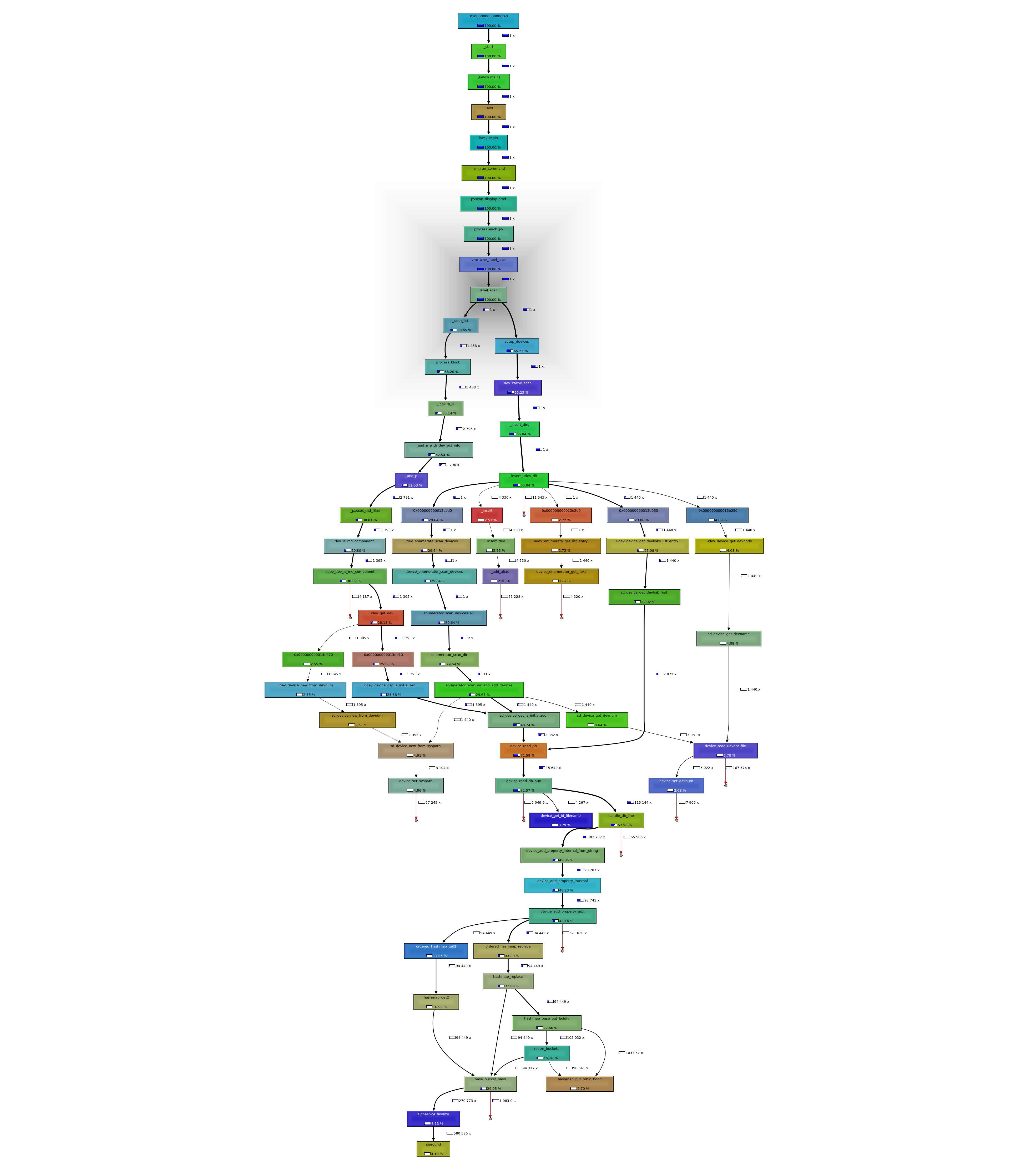
Heming
_______________________________________________
linux-lvm mailing list
[email protected]
https://listman.redhat.com/mailman/listinfo/linux-lvm
read the LVM HOW-TO at http://tldp.org/HOWTO/LVM-HOWTO/
Quoted 7 lines · On Thu, 2021-09-30 at 23:32 +0800, [email protected] wrote:
Quoted 6 lines
I just want to say that some of the issues might simply be regressions/issues with systemd/udev that could be fixed. We as providers of block device abstractions where we need to handle, sometimes, thousands of devices, might be the first ones to hit these issues.
Quoted 6 lines
The rhel8 callgrind picture
(https://prajnoha.fedorapeople.org/bz1986158/rhel8_libudev_critical_cost.png
)
responds to my analysis:
https://listman.redhat.com/archives/linux-lvm/2021-June/msg00022.htmlhandle_db_linetook too much time and become the hotspot.
I missed that post. You wrote
Quoted 1 line
the
dev_cache_scandoesn't have direct disk IOs, but libudev will
scan/read
Quoted 7 lines
udev db which issue real disk IOs (location is
/run/udev/data).
...
2. scans/reads udev db (/run/udev/data). may O(n)
udev will calldevice_read_db=>handle_db_lineto handle every
line of a db file.
...
I didn't test the related udev code, and guess the <2> takes too much
time.
... but note that /run/udev is on tmpfs, not on a real disk. So the accesses should be very fast unless there's some locking happening.
Regards
Martin
_______________________________________________
linux-lvm mailing list
[email protected]
https://listman.redhat.com/mailman/listinfo/linux-lvm
read the LVM HOW-TO at http://tldp.org/HOWTO/LVM-HOWTO/
Quoted 26 lines · Martin Wilck
Quoted 7 lines · On Thu, 2021-09-30 at 23:32 +0800, [email protected] wrote:
Quoted 6 lines
I just want to say that some of the issues might simply be regressions/issues with systemd/udev that could be fixed. We as providers of block device abstractions where we need to handle, sometimes, thousands of devices, might be the first ones to hit these issues.
Quoted 6 lines
The rhel8 callgrind picture
(https://prajnoha.fedorapeople.org/bz1986158/rhel8_libudev_critical_cost.png
)
responds to my analysis:
https://listman.redhat.com/archives/linux-lvm/2021-June/msg00022.htmlhandle_db_linetook too much time and become the hotspot.I missed that post. You wrote
Quoted 1 line
the
dev_cache_scandoesn't have direct disk IOs, but libudev willscan/read
Quoted 7 lines
udev db which issue real disk IOs (location is
/run/udev/data).
...
2. scans/reads udev db (/run/udev/data). may O(n)
udev will calldevice_read_db=>handle_db_lineto handle every
line of a db file.
...
I didn't test the related udev code, and guess the <2> takes too much
Quoted 4 lines
time.
... but note that
/run/udevis on tmpfs, not on a real disk. So the accesses should be very fast unless there's some locking happening.
Yes, indeed! I think this is a regression.
The results/graphs show that lots of time is spent on some internal hashmap handling. I don't see this in older versions of udev like the one bundled with systemd v219 (I compared RHEL7 and 8, haven't done detailed bisection yet). My suspicion is that some of the code in udev got more shared with native systemd code, like that hash usage, so this might be the clue, but someone from systemd/udev should look more closer into this.
Signature · 7 lines
Peter _______________________________________________ linux-lvm mailing list [email protected] https://listman.redhat.com/mailman/listinfo/linux-lvm read the LVM HOW-TO at http://tldp.org/HOWTO/LVM-HOWTO/
Quoted 9 lines · On Thu, 2021-09-30 at 16:07 +0800, [email protected] wrote:
On 9/30/21 3:51 PM, Martin Wilck wrote:
Another performance story:
The legacy lvm2 (2.02.xx) with lvmetad daemon, the event-activation mode
is very likely timeout on a large scale PVs.
When customer met this issue, we suggested them to disable lvmetad.
Right. IIRC, that used to be a common suggestion to make without having detailed clues about the issue at hand... it would help more often than not.
In theory, I believe that a well written daemon maintaining and consistent internal state (and possibly manipulating it) would scale better than thousands of clients trying to access state in some shared fashion (database, filesystem tree, whatever). I have no clue why that didn't work with lvmetad. It had other issues I never clearly understood, either. No need to discuss it further, as it has been abandoned anyway.
Martin
_______________________________________________
linux-lvm mailing list
[email protected]
https://listman.redhat.com/mailman/listinfo/linux-lvm
read the LVM HOW-TO at http://tldp.org/HOWTO/LVM-HOWTO/
Quoted 53 lines · Martin Wilck
Quoted 38 lines · Peter Rajnoha
Quoted 22 lines · Benjamin Marzinski
Quoted 4 lines · Martin Wilck
I have pondered this quite a bit, but I can't say I have a concrete
plan.Quoted 16 lines
To avoid depending on "udev settle", multipathd needs to partially
revert to udev-independent device detection. At least during initial
startup, we may encounter multipath maps with members that don't exist
in the udev db, and we need to deal with this situation gracefully. We
currently don't, and it's a tough problem to solve cleanly. Not relying
on udev opens up a Pandora's box wrt WWID determination, for example.
Any such change would without doubt carry a large risk of regressions
in some scenarios, which we wouldn't want to happen in our large customer's data centers.Quoted 8 lines
I'm not actually sure that it's as bad as all that. We just may need a
way for multipathd to detect if the coldplug has happened. I'm sure if
we say we need it to remove the udev settle, we can get some method to
check this. Perhaps there is one already, that I don't know about. IfThe coldplug events are synthesized and as such, they all now contain SYNTH_UUID=<UUID> key-value pair with kernel>=4.13:
Quoted 13 lines
I've already tried to proposee a patch for systemd/udev that would mark
all uevents coming from the trigger (including the one used at boot for
coldplug) with an extra key-value pair that we could easily match in rules,
but that was not accepted. So right now, we could detect that synthesized uevent happened, though we can't be sure it was the actual
udev trigger at boot. For that, we'd need the extra marks. I can give it
another try though, maybe if there are more people asking for this functionality, we'll be at better position for this to be accepted.
Quoted 4 lines
That would allow us to discern synthetic events, but I'm unsure how this what help us. Here, what matters is to figure out when we don't expect any more of them to arrive.
I think this would require different approach on systemd/udev side. Currently, "udevadm trigger --setlle" uses different UUID for each synthesized uevent's SYNTH_UUID. This is actually not exactly how it was meant to be used. Instead, the SYNTH_UUID was also meant to be used as form of grouping - so in case of "udevadm trigger", there should be a single UUID used to group all the generated uevents based on that UUID. Then, this logic could be enhanced in a way that there would be different SYNTH_UUID used for each subsystem (e.g. block), hence we could wait for each subsystem's devices separately, not being dragged by waiting for anything else.
So then we could have services like:
systemd-udev-settle-block.service
systemd-udev-settle-othersubsystem.service
...
And then place our services after that. We'd need to elaborate a bit if more fine grained separation would be needed or not...
If we see this udev settle as the key point, then I think we should probably concentrate on enhancing systemd/udev to provide this functionality (and primarily the udevadm trigger functionality and waiting for related synthesized events). I think the infrastructure to accomplish this is already there. It just needs suitable user-space changes (the udevadm trigger).
Quoted 6 lines
I guess it would be possible to compare the list of (interesting) devices in sysfs with the list of devices in the udev db. For multipathd, we could
- scan set U of udev devices on startup
- scan set S of sysfs devices on startup
Well, I think that's exactly the functionality that could be provided by the settle separation as described above... And then everybody could benefit from this.
Quoted 16 lines
- listen for uevents for updating both S and U
- after each uevent, check if the difference set of S and U is emtpy
- if yes, coldplug has finished
- otherwise, continue waiting, possibly until some timeout expires.It's more difficult for LVM because you have no daemon maintaining state.
Martin
Quoted 1 line
Signature · 7 lines
Peter _______________________________________________ linux-lvm mailing list [email protected] https://listman.redhat.com/mailman/listinfo/linux-lvm read the LVM HOW-TO at http://tldp.org/HOWTO/LVM-HOWTO/
Quoted 6 lines · Peter Rajnoha
If we see this udev settle as the key point, then I think we should probably concentrate on enhancing systemd/udev to provide this functionality (and primarily the udevadm trigger functionality and waiting for related synthesized events). I think the infrastructure to accomplish this is already there. It just needs suitable user-space changes (the udevadm trigger).
I think it would be nice if the waiting/settling concept was generalized a little more than we have now, to make it easier to improve or replace the implementation, either as we find better mechanisms or as user needs vary.
Dave
_______________________________________________
linux-lvm mailing list
[email protected]
https://listman.redhat.com/mailman/listinfo/linux-lvm
read the LVM HOW-TO at http://tldp.org/HOWTO/LVM-HOWTO/
Benjamin Marzinski
maintainerQuoted 61 lines · Martin Wilck
Quoted 38 lines · Peter Rajnoha
Quoted 22 lines · Benjamin Marzinski
Quoted 4 lines · Martin Wilck
I have pondered this quite a bit, but I can't say I have a concrete
plan.Quoted 16 lines
To avoid depending on "udev settle", multipathd needs to partially
revert to udev-independent device detection. At least during initial
startup, we may encounter multipath maps with members that don't exist
in the udev db, and we need to deal with this situation gracefully. We
currently don't, and it's a tough problem to solve cleanly. Not relying
on udev opens up a Pandora's box wrt WWID determination, for example.
Any such change would without doubt carry a large risk of regressions
in some scenarios, which we wouldn't want to happen in our large customer's data centers.Quoted 8 lines
I'm not actually sure that it's as bad as all that. We just may need a
way for multipathd to detect if the coldplug has happened. I'm sure if
we say we need it to remove the udev settle, we can get some method to
check this. Perhaps there is one already, that I don't know about. IfThe coldplug events are synthesized and as such, they all now contain SYNTH_UUID=<UUID> key-value pair with kernel>=4.13:
Quoted 13 lines
I've already tried to proposee a patch for systemd/udev that would mark
all uevents coming from the trigger (including the one used at boot for
coldplug) with an extra key-value pair that we could easily match in rules,
but that was not accepted. So right now, we could detect that synthesized uevent happened, though we can't be sure it was the actual
udev trigger at boot. For that, we'd need the extra marks. I can give it
another try though, maybe if there are more people asking for this functionality, we'll be at better position for this to be accepted.That would allow us to discern synthetic events, but I'm unsure how this what help us. Here, what matters is to figure out when we don't expect any more of them to arrive.
I guess it would be possible to compare the list of (interesting) devices in sysfs with the list of devices in the udev db. For multipathd, we could
Quoted 5 lines
- scan set U of udev devices on startup
- scan set S of sysfs devices on startup
- listen for uevents for updating both S and U
- after each uevent, check if the difference set of S and U is emtpy
- if yes, coldplug has finished
For multipathd, we don't even need to care when all the block devices have been processed. We only need to care about devices that are currently multipathed. If multipathd starts up and notices devices that are in S and not in U, but those devices aren't currently part of a multipath device, it can ignore them.
Quoted 12 lines
- otherwise, continue waiting, possibly until some timeout expires.
It's more difficult for LVM because you have no daemon maintaining state.
Martin
Quoted 1 line
_______________________________________________
linux-lvm mailing list
[email protected]
https://listman.redhat.com/mailman/listinfo/linux-lvm
read the LVM HOW-TO at http://tldp.org/HOWTO/LVM-HOWTO/
Quoted 9 lines · Benjamin Marzinski
On Thu, Sep 30, 2021 at 07:51:08AM +0000, Martin Wilck wrote:
For multipathd, we don't even need to care when all the block devices have been processed. We only need to care about devices that are currently multipathed. If multipathd starts up and notices devices that
are in S and not in U, but those devices aren't currently part of a multipath device, it can ignore them.
True. Sorry for being imprecise.
Martin
_______________________________________________
linux-lvm mailing list
[email protected]
https://listman.redhat.com/mailman/listinfo/linux-lvm
read the LVM HOW-TO at http://tldp.org/HOWTO/LVM-HOWTO/
Quoted 13 lines · Martin Wilck
Quoted 6 lines · David Teigland
Firstly, with the new devices file, only the actual md/mpath device will
be in the devices file, the components will not be, so lvm will never
attempt to look at an md or mpath component device.I have to look more closely into the devices file and how it's created
and used.
Quoted 8 lines
Quoted 3 lines
Otherwise, when the devices file is not used,
md: from reading the md headers from the disk
mpath: from reading sysfs links and/etc/multipath/wwidsUgh. Reading sysfs links means that you're indirectly depending on udev, because udev creates those. It's *more* fragile than calling into
libudev directly, IMO.
Bah. Mental short-circuit. You wrote "sysfs symlinks" and I read "/dev/disk symlinks". Sorry! Then, I'm not quite sure what symlinks you are talking about though.
Martin
_______________________________________________
linux-lvm mailing list
[email protected]
https://listman.redhat.com/mailman/listinfo/linux-lvm
read the LVM HOW-TO at http://tldp.org/HOWTO/LVM-HOWTO/
Quoted 23 lines · Martin Wilck
Hello David and Peter,
Quoted 20 lines · David Teigland
Quoted 7 lines · Peter Rajnoha
Quoted 5 lines
- We could use the new lvm-activate-* services to replace the activation
generator when lvm.conf event_activation=0. This would be done by simply
not creating the event-activation-on file when event_activation=0....the issue I see here is around the systemd-udev-settle:
Thanks, I have a couple questions about the udev-settle to understand that
better, although it seems we may not need it.Quoted 6 lines
- the setup where lvm-activate-vgs*.service are always there (not generated only on event_activation=0 as it was before with the original lvm2-activation-*.service) practically means we always make a dependency on systemd-udev-settle.service, which we shouldn't
do in case we have event_activation=1.
Quoted 9 lines
Quoted 2 lines
Why wouldn't the event_activation=1 case want a dependency on udev- settle?
You said it should wait for multipathd, which in turn waits for udev settle. And indeed it makes some sense. After all: the idea was to avoid locking issues or general resource starvation during uevent storms, which typically occur in the coldplug phase, and for which the completion of "udev settle" is the best available indicator.
Udevd already limits the number of concurent worker processes processing the udev rules for each uevent. So even if we trigger all the uevents, they are not processed all in parallel, there's some queueing.
However, whether this is good or not depends on perspective - you could have massive paralelism and a risk of resource starvation or, from the other side, you could have timeouts because something wasn't processed in time for other parts of the system which are waiting for dependencies.
Also, the situation might differ based on the fact whether during the uevent processing we're only looking at that concrete single device for which we've just received an event or whether we also need to look at other devices.
Signature · 7 lines
Peter _______________________________________________ linux-lvm mailing list [email protected] https://listman.redhat.com/mailman/listinfo/linux-lvm read the LVM HOW-TO at http://tldp.org/HOWTO/LVM-HOWTO/
Quoted 11 lines · Peter Rajnoha
Quoted 9 lines · Martin Wilck
You said it should wait for multipathd, which in turn waits for udev
settle. And indeed it makes some sense. After all: the idea was to avoid locking issues or general resource starvation during uevent storms, which typically occur in the coldplug phase, and for which the
completion of "udev settle" is the best available indicator.
Quoted 6 lines
Udevd already limits the number of concurent worker processes processing the udev rules for each uevent. So even if we trigger all the
uevents, they are not processed all in parallel, there's some queueing.
This is true, but there are situations where reducing the number of workers to anything reasonable hasn't helped avoid contention (udev.children-max=1 is unrealistic :-) ). Heming can fill in the details, I believe. When contention happens, it's very difficult to debug what's going on, as it's usually during boot, the system is unresponsive, and it only happens on very large installments that developers rarely have access to. But Heming went quite a long way analyzing this.
Quoted 9 lines
However, whether this is good or not depends on perspective - you could
have massive paralelism and a risk of resource starvation or, from the
other side, you could have timeouts because something wasn't processed
in time for other parts of the system which are waiting for dependencies.
Quoted 5 lines
Also, the situation might differ based on the fact whether during the uevent processing we're only looking at that concrete single device for
which we've just received an event or whether we also need to look at other devices.
Yes, "it depends". We are looking for a solution that "works well" for any setup without specific tuning. Meaning that the system doesn't stall for substantial amounts of time during boot.
Regards
Martin
_______________________________________________
linux-lvm mailing list
[email protected]
https://listman.redhat.com/mailman/listinfo/linux-lvm
read the LVM HOW-TO at http://tldp.org/HOWTO/LVM-HOWTO/
Quoted 10 lines · David Teigland
Quoted 5 lines · Peter Rajnoha
Quoted 3 lines
- We could use the new lvm-activate-* services to replace the activation generator when lvm.conf event_activation=0. This would be done by simply not creating the event-activation-on file when event_activation=0.
...the issue I see here is around the systemd-udev-settle:
Thanks, I have a couple questions about the udev-settle to understand that better, although it seems we may not need it.
Quoted 8 lines
Quoted 5 lines
- the setup where lvm-activate-vgs*.service are always there (not generated only on event_activation=0 as it was before with the original lvm2-activation-*.service) practically means we always make a dependency on systemd-udev-settle.service, which we shouldn't do in case we have event_activation=1.
Why wouldn't the event_activation=1 case want a dependency on udev-settle?
For event-based activation, I'd expect it to really behave in event-based manner, that is, to respond to events as soon as they come and not wait for all the other devices unnecessarily.
The use of udev-settle is always a pain - for example, if there's a mount point defined on top of an LV, with udev-settle as dependency, we practically wait for all devices to settle. With 'all', I mean even devices which are not block devices and which are not event related to any of that LVM layout and the stack underneath. So simply we could be waiting uselessly and we could increase possibility of a timeout (...for the mount point etc.).
With the settle in play, we'd have this sequence/ordering with the services/executions:
systemd-udev-settle.service --> lvm-activate-vgs-main.service --> lvm-activate-vgs-last.service --> event-based pvscans
Quoted 19 lines
Quoted 6 lines
- If we want to make sure that we run our "non-event-based activation" after systemd-udev-settle.service, we also need to use "After=systemd-udev-settle.service" (the "Wants" will only make the udev settle service executed, but it doesn't order it with respect to our activation services, so it can happen in parallel - we want it to happen after the udev settle).
So we may not fully benefit from settling unless we use After (although the benefits are uncertain as mentioned below.)
Quoted 8 lines
Now the question is whether we really need the systemd-udev-settle at all, even for that non-event-based lvm activation. The udev-settle is just to make sure that all the udev processing and udev db content is complete for all triggered devices. But if we're not reading udev db and we're OK that those devices might be open in parallel to lvm activation period (e.g. because there's blkid scan done on disks/PVs), we should be OK even without that settle. However, we're reading some info from udev db, right? (like the multipath component state etc.)
Quoted 3 lines
- Reading the udev db: with the default external_device_info_source=none we no longer ask the udev db for any info about devs. (We now follow that setting strictly, and only ask udev when source=udev.)
Hmm, thinking about this, I've just realized one more important and related thing here I didn't realize before - the LVM regex filters! These may contain symlink names as one can find them in /dev. But for those symlinks, we need to be sure that the rules are already applied. This practically means that:
- For non-event-based activation, we need udev-settle (so we're sure all the rules are applied for all devices we might be scanning).
- For event-based activation, we need to be sure that we use "RUN" rule, not any of "IMPORT{program}" or "PROGRAM" rule. The difference is that the "RUN" rules are applied after all the other udev rules are already applied for current uevent, including creation of symlinks. And currently, we have IMPORT{program}="pvscan..." in our rule, unfortunately...
So what if someone defines an LVM regex filter that accepts only the symlink name which is just to be created based on udev rules we're processing right now?
(The nodes under /dev are OK because they're created in devtmpfs as soon as the devices are created in kernel, but those symlinks in /dev are always created by udev based on udev rules.)
Quoted 7 lines
- Concurrent blkid and activation: I can't find an issue with this (couldn't force any interference with some quick tests.)
- I wonder if After=udev-settle could have an incidental but meaningful effect of more PVs being in place before the service runs?
The nodes are already there, the symlinks could be missing because the udev rules haven't been processed yet.
Non-event-based LVM activation needs to wait for settle for sure (because there's full scan across all devices).
Event-based LVM activation just needs to be sure that:
- the pvscan only scans the single device (the one for which there's the uevent currently being processed),
- the pvscan should be called in a way that we have all the symlinks in place so the regex filter still works for symlinks (== putting the pvscan onto a RUN exec queue).
Quoted 4 lines
I'll try dropping udev-settle in all cases to see how things look.
Dave
Signature · 7 lines
Peter _______________________________________________ linux-lvm mailing list [email protected] https://listman.redhat.com/mailman/listinfo/linux-lvm read the LVM HOW-TO at http://tldp.org/HOWTO/LVM-HOWTO/
Quoted 29 lines · Peter Rajnoha
Quoted 24 lines · David Teigland
Quoted 8 lines · Peter Rajnoha
Quoted 6 lines
- We could use the new lvm-activate-* services to replace the activation
generator when lvm.conf event_activation=0. This would be done by simply
not creating the event-activation-on file when event_activation=0....the issue I see here is around the systemd-udev-settle:
Thanks, I have a couple questions about the udev-settle to understand that
better, although it seems we may not need it.Quoted 9 lines
- the setup where lvm-activate-vgs*.service are always there (not
generated only on event_activation=0 as it was before with the
original lvm2-activation-*.service) practically means we always
make a dependency on systemd-udev-settle.service, which we shouldn't
do in case we have event_activation=1.Quoted 3 lines
Why wouldn't the event_activation=1 case want a dependency on udev- settle?
Quoted 5 lines
For event-based activation, I'd expect it to really behave in event- based
manner, that is, to respond to events as soon as they come and not wait
for all the other devices unnecessarily.
I may be missing something here. Perhaps I misunderstood David's concept. Of course event-based activation is best - in theory. The reason we're having this discussion is that it may cause thousands of event handlers being executed in parallel, and that we have seen cases where this was causing the system to stall during boot for minutes, or even forever. The ideal solution for that would be to figure out how to avoid the contention, but I thought you and David had given up on that.
Heming has shown that the "static" activation didn't suffer from this problem. So, to my understanding, David was seeking for a way to reconcile these two concepts, by starting out statically and switching to event-based activation when we can without the risk of stalling. To do that, we must figure out when to switch, and (like it or not) udev settle is the best indicator we have.
Also IMO David was striving for a solution that "just works" efficiently both an small and big systems, without the admin having to adjust configuration files.
Quoted 11 lines
The use of udev-settle is always a pain - for example, if there's a mount
point defined on top of an LV, with udev-settle as dependency, we practically
wait for all devices to settle. With 'all', I mean even devices which are not
block devices and which are not event related to any of that LVM layout and
the stack underneath. So simply we could be waiting uselessly and we could increase possibility of a timeout (...for the mount point etc.).
True, but is there anything better?
Quoted 11 lines
Non-event-based LVM activation needs to wait for settle for sure (because
there's full scan across all devices).Event-based LVM activation just needs to be sure that:
- the pvscan only scans the single device (the one for which there's
the uevent currently being processed),
If that really worked without taking any locks (e.g. on the data structures about VGs), it would be the answer.
Martin
_______________________________________________
linux-lvm mailing list
[email protected]
https://listman.redhat.com/mailman/listinfo/linux-lvm
read the LVM HOW-TO at http://tldp.org/HOWTO/LVM-HOWTO/
Quoted 21 lines · Martin Wilck
Quoted 3 lines · Peter Rajnoha
For event-based activation, I'd expect it to really behave in event- based manner, that is, to respond to events as soon as they come and not wait for all the other devices unnecessarily.
I may be missing something here. Perhaps I misunderstood David's concept. Of course event-based activation is best - in theory. The reason we're having this discussion is that it may cause thousands of event handlers being executed in parallel, and that we have seen cases where this was causing the system to stall during boot for minutes, or even forever. The ideal solution for that would be to figure out how to avoid the contention, but I thought you and David had given up on that.
Heming has shown that the "static" activation didn't suffer from this problem. So, to my understanding, David was seeking for a way to reconcile these two concepts, by starting out statically and switching to event-based activation when we can without the risk of stalling. To do that, we must figure out when to switch, and (like it or not) udev settle is the best indicator we have.
Quoted 3 lines
Also IMO David was striving for a solution that "just works" efficiently both an small and big systems, without the admin having to adjust configuration files.
Right, this is not entirely event based any longer, so there could be some advantage of an event-based system that we sacrifice. I think that will be a good tradeoff for the large majority of cases, and will make a good default.
Quoted 6 lines
Quoted 6 lines
The use of udev-settle is always a pain - for example, if there's a mount point defined on top of an LV, with udev-settle as dependency, we practically wait for all devices to settle. With 'all', I mean even devices which are not block devices and which are not event related to any of that LVM layout and the stack underneath. So simply we could be waiting uselessly and we could increase possibility of a timeout (...for the mount point etc.).
One theoretical advantage of an event-based system is that it reacts immediately, so you get faster results. In practice it's often anything but immediate, largely because of extra work and moving parts in the event-based scheme, processing each event individually. So, the simpler non-event-based method will often be faster I think, and more robust (all the moving parts are where things break, so best to minimize them.)
You've filled in some interesting details about udev-settle for me, and it sounds like there are some ideas forming about an alternative, which would offer us a better way to switch to event-base-mode. I'd like to be able to simply replace the systemd-udev-settle dependency with an improved "new-settle" dependency when that's ready.
Dave
_______________________________________________
linux-lvm mailing list
[email protected]
https://listman.redhat.com/mailman/listinfo/linux-lvm
read the LVM HOW-TO at http://tldp.org/HOWTO/LVM-HOWTO/
Quoted 4 lines · Peter Rajnoha
Hmm, thinking about this, I've just realized one more important and related thing here I didn't realize before - the LVM regex filters! These may contain symlink names as one can find them in /dev. But for those symlinks, we need to be sure that the rules are already applied. This practically means that:
At least at RH we're enabling the devices file by default (meaning no filter) in the same timeframe that we're looking at these activation services. So, I don't think this is a big factor.
Quoted 9 lines
- For non-event-based activation, we need udev-settle (so we're sure all the rules are applied for all devices we might be scanning).
- For event-based activation, we need to be sure that we use "RUN" rule, not any of "IMPORT{program}" or "PROGRAM" rule. The difference is that the "RUN" rules are applied after all the other udev rules are already applied for current uevent, including creation of symlinks. And currently, we have IMPORT{program}="pvscan..." in our rule, unfortunately...
That's pretty subtle, I'm wary about propagating such specific and delicate behavior, seems fragile.
Quoted 6 lines
The nodes are already there, the symlinks could be missing because the udev rules haven't been processed yet.
Non-event-based LVM activation needs to wait for settle for sure (because there's full scan across all devices).
Quoted 8 lines
Event-based LVM activation just needs to be sure that:
- the pvscan only scans the single device (the one for which there's the uevent currently being processed),
- the pvscan should be called in a way that we have all the symlinks in place so the regex filter still works for symlinks (== putting the pvscan onto a RUN exec queue).
I think we're looking at a udev-settle dependency (or alternative) for all cases, best to just make that explicit and consistent, and isolated in one place. I'm not really seeing a downside to that. Then, focus efforts on refining a replacement. If the subtle dependencies are spread around then it's hard to extract and improve the unwanted parts.
Dave
_______________________________________________
linux-lvm mailing list
[email protected]
https://listman.redhat.com/mailman/listinfo/linux-lvm
read the LVM HOW-TO at http://tldp.org/HOWTO/LVM-HOWTO/
Quoted 10 lines · David Teigland
Quoted 4 lines · Peter Rajnoha
Hmm, thinking about this, I've just realized one more important and related thing here I didn't realize before - the LVM regex filters! These may contain symlink names as one can find them in /dev. But for those symlinks, we need to be sure that the rules are already applied. This practically means that:
At least at RH we're enabling the devices file by default (meaning no filter) in the same timeframe that we're looking at these activation services. So, I don't think this is a big factor.
OK, if we don't need access to all the aliases (all the symlink names under /dev), then that's great. We just need to make sure the devices file is then always used with pvscan called out of the udev rule.
Quoted 10 lines
Quoted 9 lines
- For non-event-based activation, we need udev-settle (so we're sure all the rules are applied for all devices we might be scanning).
- For event-based activation, we need to be sure that we use "RUN" rule, not any of "IMPORT{program}" or "PROGRAM" rule. The difference is that the "RUN" rules are applied after all the other udev rules are already applied for current uevent, including creation of symlinks. And currently, we have IMPORT{program}="pvscan..." in our rule, unfortunately...
Quoted 3 lines
That's pretty subtle, I'm wary about propagating such specific and delicate behavior, seems fragile.
Yeah, that was just because I didn't realize we don't actually need those symlinks and the classic filter is ignored in this case. I thought we had a bug in our current 69-dm-lvm.rules where we call IMPORT{progra}=pvscan in which case all the symlinks are not created yet. I'm glad it's not the case.
Quoted 15 lines
Quoted 6 lines
The nodes are already there, the symlinks could be missing because the udev rules haven't been processed yet.
Non-event-based LVM activation needs to wait for settle for sure (because there's full scan across all devices).
Quoted 8 lines
Event-based LVM activation just needs to be sure that:
- the pvscan only scans the single device (the one for which there's the uevent currently being processed),
- the pvscan should be called in a way that we have all the symlinks in place so the regex filter still works for symlinks (== putting the pvscan onto a RUN exec queue).
Quoted 5 lines
I think we're looking at a udev-settle dependency (or alternative) for all cases, best to just make that explicit and consistent, and isolated in one place. I'm not really seeing a downside to that. Then, focus efforts on refining a replacement. If the subtle dependencies are spread around then it's hard to extract and improve the unwanted parts.
So then we can concentrate on minimizing the set of devices we need to "settle". Right now, I don't see technical obstacles to implementing this, but the separation of systemd-udev-settle.service into pieces would be a first step for this to perform better, I think.
The only problematic part here might be systemd/udev's aversion to anything having "udev-settle" in mind. But I think if we're able to show them the difference and advantage of using the settle here by presenting real numbers and analysis, there might be a chance. The separation of udev-settle into pieces would surely help too, because we could isolate the settle to devices we're only interested in.
We can surely discuss that with them. Would be great if we find consensus here on all sides, I don't want to fight with or completely ignore systemd/udev guys and their optinions...
Signature · 7 lines
Peter _______________________________________________ linux-lvm mailing list [email protected] https://listman.redhat.com/mailman/listinfo/linux-lvm read the LVM HOW-TO at http://tldp.org/HOWTO/LVM-HOWTO/
Quoted 14 lines · David Teigland
Quoted 11 lines · Peter Rajnoha
- For event-based activation, we need to be sure that we use "RUN"
rule, not any of "IMPORT{program}" or "PROGRAM" rule. The difference
is that the "RUN" rules are applied after all the other udev rules are
already applied for current uevent, including creation of symlinks. And
currently, we have IMPORT{program}="pvscan..." in our rule, unfortunately...
Quoted 2 lines
That's pretty subtle, I'm wary about propagating such specific and delicate behavior, seems fragile.
I'd like to second Peter here, "RUN" is in general less fragile than "IMPORT{PROGRAM}". You should use IMPORT{PROGRAM}" if and only if
- the invoked program can work with incomplete udev state of a device (the progrem should not try to access the device via libudev, it should rather get properties either from sysfs or the uevent's environment variables)
- you need the result or the output of the program in order to proceed with rules processing.
Regards,
Martin
_______________________________________________
linux-lvm mailing list
[email protected]
https://listman.redhat.com/mailman/listinfo/linux-lvm
read the LVM HOW-TO at http://tldp.org/HOWTO/LVM-HOWTO/
Quoted 9 lines · Martin Wilck
I'd like to second Peter here, "RUN" is in general less fragile than "IMPORT{PROGRAM}". You should use IMPORT{PROGRAM}" if and only if
- the invoked program can work with incomplete udev state of a device (the progrem should not try to access the device via libudev, it should rather get properties either from sysfs or the uevent's environment variables)
- you need the result or the output of the program in order to proceed with rules processing.
Those are both true in this case. I can't say I like it either, but udev rules force hacky solutions on us. I began trying to use RUN several months ago and I think I gave up trying to find a way to pass values from the RUN program back into the udev rule (possibly by writing values to a temp file and then doing IMPORT{file}). The udev rule needs the name of the VG to activate, and that name comes from the pvscan. For an even uglier form of this, see the equivalent I wrote for dracut:
https://github.com/dracutdevs/dracut/pull/1567/files
The latest version of the hybrid service+event activation is here
https://sourceware.org/git/?p=lvm2.git;a=shortlog;h=refs/heads/dev-dct-activation-switch-7
I've made it simple to edit lvm.conf to switch between:
- activation from fixed services only
- activation from events only
- activation from fixes services first, then from events
There are sure to be tradeoffs, we know that many concurrent activations from events are slow, and fixed services which are more serialized could be delayed from slow devices. I'm still undecided on the best default setting, i.e. which will work best for most people, and would welcome any thoughts or relevant experience.
Dave
_______________________________________________
linux-lvm mailing list
[email protected]
https://listman.redhat.com/mailman/listinfo/linux-lvm
read the LVM HOW-TO at http://tldp.org/HOWTO/LVM-HOWTO/
Quoted 20 lines · David Teigland
Quoted 9 lines · Martin Wilck
I'd like to second Peter here, "RUN" is in general less fragile than "IMPORT{PROGRAM}". You should use IMPORT{PROGRAM}" if and only if
- the invoked program can work with incomplete udev state of a device (the progrem should not try to access the device via libudev, it should rather get properties either from sysfs or the uevent's environment variables)
- you need the result or the output of the program in order to proceed with rules processing.Those are both true in this case. I can't say I like it either, but udev rules force hacky solutions on us. I began trying to use RUN several months ago and I think I gave up trying to find a way to pass values from the RUN program back into the udev rule (possibly by writing values to a temp file and then doing IMPORT{file}). The udev rule needs the name of the VG to activate, and that name comes from the pvscan. For an even uglier form of this, see the equivalent I wrote for dracut:
https://github.com/dracutdevs/dracut/pull/1567/files
Quoted 7 lines
The latest version of the hybrid service+event activation is here
https://sourceware.org/git/?p=lvm2.git;a=shortlog;h=refs/heads/dev-dct-activation-switch-7I've made it simple to edit lvm.conf to switch between:
- activation from fixed services only
- activation from events only
- activation from fixes services first, then from events
For the branch code of dev-dct-activation-switch-7, If the comment before event_activation_enable() is correct. option "event_activation" becomes useless. I still prefer to use one switcher to control all behaviors.
Quoted 7 lines
There are sure to be tradeoffs, we know that many concurrent activations from events are slow, and fixed services which are more serialized could be delayed from slow devices. I'm still undecided on the best default setting, i.e. which will work best for most people, and would welcome any thoughts or relevant experience.
from my test results, I never meet delay issue under serialized mode (except udev.children_max=1). I prefer to set services first, then events. This style will triggers performance issue after entering events mode, but this is under expectation.
Thanks,
Heming
_______________________________________________
linux-lvm mailing list
[email protected]
https://listman.redhat.com/mailman/listinfo/linux-lvm
read the LVM HOW-TO at http://tldp.org/HOWTO/LVM-HOWTO/
Dne 18. 10. 21 v 17:04 David Teigland napsal(a):
Quoted 28 lines · Martin Wilck
Quoted 9 lines
I'd like to second Peter here, "RUN" is in general less fragile than "IMPORT{PROGRAM}". You should use IMPORT{PROGRAM}" if and only if
- the invoked program can work with incomplete udev state of a device (the progrem should not try to access the device via libudev, it should rather get properties either from sysfs or the uevent's environment variables)
- you need the result or the output of the program in order to proceed with rules processing.Those are both true in this case. I can't say I like it either, but udev rules force hacky solutions on us. I began trying to use RUN several months ago and I think I gave up trying to find a way to pass values from the RUN program back into the udev rule (possibly by writing values to a temp file and then doing IMPORT{file}). The udev rule needs the name of the VG to activate, and that name comes from the pvscan. For an even uglier form of this, see the equivalent I wrote for dracut:
https://github.com/dracutdevs/dracut/pull/1567/filesThe latest version of the hybrid service+event activation is here
https://sourceware.org/git/?p=lvm2.git;a=shortlog;h=refs/heads/dev-dct-activation-switch-7I've made it simple to edit lvm.conf to switch between:
- activation from fixed services only
- activation from events only
- activation from fixes services first, then from events
Quoted 5 lines
There are sure to be tradeoffs, we know that many concurrent activations from events are slow, and fixed services which are more serialized could be delayed from slow devices. I'm still undecided on the best default setting, i.e. which will work best for most people, and would welcome any thoughts or relevant experience.
I've some testing for these issues - we are trimming some 'easy' to fix issues away (so git HEAD should be now be actually already somewhat bit faster).
The more generic solution with auto activation should likely try to 'active' as much found complete VGs as it can at any given moment in time.
ATM lvm2 suffers when it's being running massively parallel - this has not been yet fully analyzed - but there is certainly much better throughput if there is limitted amount of 'parallel' executed lvm2 commands.
Our goal ATM is to accelerate 'pvscan'.
We could think if there is some easy mechanism how to 'accumulate' complete VGs and activate all of them in single 'vgchange' command - and run the next after the running one is finished - this currently gives reasonable good 'throughput' and should work without 'exceptional' case of being fast only once.
Another point for thinking is 'limiting' set of PVs for this activation command - so we avoid repetitive validations of the whole system - for this should be usable option --devices|--devicesfile - but needs some thinking how to use this in smart way with the 'collected' activation.
Regards
Zdenek
_______________________________________________
linux-lvm mailing list
[email protected]
https://listman.redhat.com/mailman/listinfo/linux-lvm
read the LVM HOW-TO at http://tldp.org/HOWTO/LVM-HOWTO/
Quoted 6 lines · Zdenek Kabelac
The more generic solution with auto activation should likely try to 'active' as much found complete VGs as it can at any given moment in time.
ATM lvm2 suffers when it's being running massively parallel - this has not been yet fully analyzed - but there is certainly much better throughput if there is limitted amount of 'parallel' executed lvm2 commands.
There a couple of possible bottlenecks that we can analyze separately:
1. the bottleneck of processing 100's or 1000's of uevents+pvscans.
2. the bottleneck of large number of concurrent vgchange -aay vgname.
The lvm-activate-vgs services completely avoid 1 by skipping them all, and it also avoids 2 with one vgchange -aay *. So, it seems to be pretty close to an optimal solution, but I am interested to know more precisely which bottlenecks we're avoiding.
I believe you're suggesting that bottleneck 1 doesn't really exist, and that we're mainly suffering from 2. If that's true, then we could continue to utilize all the uevents+pvsans, and take advantage of them to optimize the vgchange -aay commands.
That's an interesting idea, and we actually have the capabilities to try that right now in my latest dev branch. The commit "hints: new pvs_online type" will do just that. It will use the pvs_online files (created by each uevent+pvscan) to determine which PVs to activate from.
$ pvs
PV VG Fmt Attr PSize PFree
/dev/mapper/mpatha mm lvm2 a-- <931.01g <931.00g
/dev/sdc cd lvm2 a-- <931.01g 931.00g
/dev/sdd cd lvm2 a-- <931.01g <931.01g
$ rm /run/lvm/{pvs,vgs}_online/*
$ vgchange -an
0 logical volume(s) in volume group "cd" now active
0 logical volume(s) in volume group "mm" now active
$ vgchange -aay
1 logical volume(s) in volume group "cd" now active
3 logical volume(s) in volume group "mm" now active
$ vgchange -an
0 logical volume(s) in volume group "cd" now active
0 logical volume(s) in volume group "mm" now active
$ pvscan --cache /dev/sdc
pvscan[929329] PV /dev/sdc online.
$ pvscan --cache /dev/sdd
pvscan[929330] PV /dev/sdd online.
$ vgchange -aay --config devices/hints=pvs_online
1 logical volume(s) in volume group "cd" now active
$ pvscan --cache /dev/mapper/mpatha
pvscan[929338] PV /dev/mapper/mpatha online.
$ vgchange -aay --config devices/hints=pvs_online
1 logical volume(s) in volume group "cd" now active
3 logical volume(s) in volume group "mm" now activevgchange is activating VGs only from the PVs that have been pvscan'ed. So if a large volume of uevents+pvscans is not actually a bottleneck, then it looks like we could use them to optimize the vgchange commands in the lvm-activate-vgs services. I'll set up some tests to see how it compares.
Dave
_______________________________________________
linux-lvm mailing list
[email protected]
https://listman.redhat.com/mailman/listinfo/linux-lvm
read the LVM HOW-TO at http://tldp.org/HOWTO/LVM-HOWTO/
Quoted 7 lines · David Teigland
I began trying to use RUN several
months ago and I think I gave up trying to find a way to pass values from
the RUN program back into the udev rule (possibly by writing values to a
temp file and then doing IMPORT{file}).
That can't work, because RUN is executed *after* all rules have been processed. That's documented in the man page. I don't quite understand what you're trying to achieve.
Martin
_______________________________________________
linux-lvm mailing list
[email protected]
https://listman.redhat.com/mailman/listinfo/linux-lvm
read the LVM HOW-TO at http://tldp.org/HOWTO/LVM-HOWTO/
Quoted 8 lines · Martin Wilck
Quoted 4 lines
I began trying to use RUN several months ago and I think I gave up trying to find a way to pass values from the RUN program back into the udev rule (possibly by writing values to a temp file and then doing IMPORT{file}).
That can't work, because RUN is executed *after* all rules have been processed. That's documented in the man page. I don't quite understand what you're trying to achieve.
I was just providing some background history after you and Peter both mentioned the idea of using RUN instead of IMPORT. That is, I gave up trying to use RUN many months ago because it wouldn't work, while IMPORT actually does what we need, to produce the vgname variable inside the rule.
_______________________________________________
linux-lvm mailing list
[email protected]
https://listman.redhat.com/mailman/listinfo/linux-lvm
read the LVM HOW-TO at http://tldp.org/HOWTO/LVM-HOWTO/
Quoted 8 lines · David Teigland
I was just providing some background history after you and Peter both mentioned the idea of using RUN instead of IMPORT. That is, I gave up
trying to use RUN many months ago because it wouldn't work, while IMPORT
actually does what we need, to produce the vgname variable inside the rule.
I see. The problem with IMPORT (like RUN, actually) is that it's required to finish quickly, which might not be the case if we encounter resource shortage / contention as observed by Heming. If that happens, the programs started may be killed by udevd, with unpredictable results.
Regards
Martin
_______________________________________________
linux-lvm mailing list
[email protected]
https://listman.redhat.com/mailman/listinfo/linux-lvm
read the LVM HOW-TO at http://tldp.org/HOWTO/LVM-HOWTO/
Quoted 5 lines · Martin Wilck
I see. The problem with IMPORT (like RUN, actually) is that it's required to finish quickly, which might not be the case if we encounter resource shortage / contention as observed by Heming. If that happens, the programs started may be killed by udevd, with unpredictable results.
We've been optimizing the pvscan --cache command that gets the VG name from the disk and checks if the VG is complete. It's pretty small and fast at this point. Also, the lvm-activate-vgs services that we have been discussing should result in a large number of those pvscans doing nothing (i.e. those that are triggered prior to lvm-activate-vgs-last.service will see that event-based activation is not yet enabled and will exit.)
Dave
_______________________________________________
linux-lvm mailing list
[email protected]
https://listman.redhat.com/mailman/listinfo/linux-lvm
read the LVM HOW-TO at http://tldp.org/HOWTO/LVM-HOWTO/
Hi Heming,
Thanks for the analysis and tying things together for us so clearly, and I like the ideas you've outlined.
Quoted 10 lines · On Sun, Jun 06, 2021 at 02:15:23PM +0800, [email protected] wrote:
I send this mail for a well known performance issue:
when system is attached huge numbers of devices. (ie. 1000+ disks), the [email protected] costs too much time and systemd is very easy to time out, and enter emergency shell in the end.This performance topic had been discussed in there some times, and the issue was lasting for many years. From the lvm2 latest code, this issue still can't be fix completely. The latest code add new function
_pvscan_aa_quick(), which makes the booting time largely reduce but still can's fix this issue utterly.
Quoted 4 lines
In my test env, x86 qemu-kvm machine, 6vcpu, 22GB mem, 1015 pv/vg/lv, comparing with/without
_pvscan_aa_quick()code, booting time reduce from "9min 51s" to "2min 6s". But after switching to direct activation, the booting time is 8.7s (for longest lvm2 services: lvm2-activation-early.service).
Interesting, it's good to see the "quick" optimization is so effective. Another optimization that should be helping in many cases is the "vgs_online" file which will prevent concurrent pvscans from all attempting to autoactivate a VG.
Quoted 4 lines
The hot spot of event activation is
dev_cache_scan, which time complexity is O(n^2). And at the same time, systemd-udev worker will generate/run [email protected] on all detecting disks. So the overall is O(n^3).
Quoted 11 lines
```
dev_cache_scan //order: O(n^2)
  + _insert_dirs //O(n)
  | if obtain_device_list_from_udev() true
  |   _insert_udev_dir //O(n)
  |
  + dev_cache_index_devs //O(n)

There are 'n' [email protected] running: O(n)
Overall: O(n) * O(n^2) => O(n^3)
```
I knew the dev_cache_scan was inefficient, but didn't realize it was having such a negative impact, especially since it isn't reading devices. Some details I'm interested to look at more closely (and perhaps you already have some answers here):
1. Does obtain_device_list_from_udev=0 improve things? I recently noticed that 0 appeared to be faster (anecdotally), and proposed we change the default to 0 (also because I'm biased toward avoiding udev whenever possible.)
2. We should probably move or improve the "index_devs" step; it's not the main job of dev_cache_scan and I suspect this could be done more efficiently, or avoided in many cases.
3. pvscan --cache is supposed to be scalable because it only (usually) reads the single device that is passed to it, until activation is needed, at which point all devices are read to perform a proper VG activation. However, pvscan does not attempt to reduce dev_cache_scan since I didn't know it was a problem. It probably makes sense to avoid a full dev_cache_scan when pvscan is only processing one device (e.g. setup_device() rather than setup_devices().)
Quoted 3 lines
Question/topic:
Could we find out a final solution to have a good performance & scale well under event-based activation?
First, you might not have seen my recently added udev rule for autoactivation, I apologize it's been sitting in the "dev-next" branch since we've not figured out a good a branching strategy for this change. We just began getting some feedback on this change last week:
There's a similar change I'm working on for dracut:
https://github.com/dracutdevs/dracut/pull/1506
Each device uevent still triggers a pvscan --cache, reading just the one device, but when a VG is complete, the udev rule runs systemd-run vgchange -aay VG. Since it's not changing dev_cache_scan usage, the issues you're describing will still need to be looked at.
Quoted 19 lines
Maybe two solutions (Martin & I discussed):
1. During boot phase, lvm2 automatically swithes to direct activation mode ("
event_activation= 0"). After booted, switch back to the event activation mode.Booting phase is a speical stage. *During boot*, we could "pretend" that direct activation (event_activation=0) is set, and rely on lvm2-activation-*.service for PV detection. Once lvm2-activation-net.service has finished, we could "switch on" event activation.
More precisely: pvscan --cache would look at some file under /run, e.g.
/run/lvm2/boot-finished, and quit immediately if the file doesn't exist (as if event_activation=0 was set). In lvm2-activation-net.service, we would add something like:``` ExecStartPost=/bin/touch /run/lvm2/boot-finished ```
Quoted 8 lines
... so that, from this point in time onward, "pvscan --cache" would _not_ quit immediately any more, but run normally (assuming that the global
event_activationsetting is 1). This way we'd get the benefit of using the static activation services during boot (good performance) while still being able to react to udev events after booting has finished.This idea would be worked out with very few code changes. The result would be a huge step forward on booting time.
This sounds appealing to me, I've always found it somewhat dubious how we pretend each device is newly attached, and process it individually, even if all devices are already present. We should be taking advantage of the common case when many or most devices are already present, which is what you're doing here. Async/event-based processing has it's place, but it's surely not always the best answer. I will think some more about the details of how this might work, it seems promising.
Quoted 21 lines
2. change [email protected] running mode from parallel to serival.
This idea looks a little weird, it goes the opposite trend of today's programming technologies: parallel programming on multi-cores.
idea:
the action of lvm2 scaning "/dev" is hard to change, the outside parallel [email protected] could change from parallel to serial.For example, a running pvscan instance could set a "running" flag in tmpfs (ie.
/run/lvm/) indicating that no other pvscan process should be called in parallel. If another pvscan is invoked and sees "running", it would create a "pending" flag, and quit. Any other pvscan process seeing the "pending" flag would just quit. If the first instance sees the "pending" flag, it would atomically remove "pending" and restart itself, in order to catch any device that might have appeared since the previous sysfs scan.
In most condition, devices had been found by once pvscan scanning, then next time of pvscan scanning should work with order O(n), because the target device had been inserted internal cache tree already. and on overall, there is only a single pvscan process would be running at any given time.
Quoted 3 lines
We could create a list of pending to-be-scanned devices then (might be directory entries in some tmpfs directory). On exit, pvscan could check this dir and restart if it's non-empty.
The present design is based on pvscan --cache reading only the one device that has been attached, and I think that's good. I'd expect that also lends itself to running pvscans in parallel, since they are all reading different devices. If it's just dev_cache_scan that needs optimizing, I expect there are better ways to do that than adding serialization. This is also related to the number of udev workers as mentioned in the next email. So I think we need to narrow down the problem a little more before we know if serializing is going to be the right answer, or where/how to do it.
Dave
_______________________________________________
linux-lvm mailing list
[email protected]
https://listman.redhat.com/mailman/listinfo/linux-lvm
read the LVM HOW-TO at http://tldp.org/HOWTO/LVM-HOWTO/
Quoted 6 lines · On Sun, Jun 06, 2021 at 02:15:23PM +0800, [email protected] wrote:
dev_cache_scan//order: O(n^2)
+_insert_dirs//O(n)| if obtain_device_list_from_udev() true | _insert_udev_dir //O(n) |+
dev_cache_index_devs//O(n)
I've been running some experiments and trying some patches to improve this. By setting obtain_device_list_from_udev=0, and using the attached patch to disable dev_cache_index_devs, the pvscan is much better.
systemctl status lvm2-pvscan appears to show that the pvscan command itself runs for only 2-4 seconds, while the service as a whole takes around 15 seconds. See the 16 sec gap below from the end of pvscan to the systemd Started message. If that's accurate, the remaining delay would lie outside lvm.
Jul 02 15:27:57 localhost.localdomain systemd[1]: Starting LVM event activation on device 253:1710...
Jul 02 15:28:00 localhost.localdomain lvm[65620]:   pvscan[65620] PV /dev/mapper/mpathalz online, VG 1ed02c7d-0019-43c4-91b5-f220f3521ba9 is complete.
Jul 02 15:28:00 localhost.localdomain lvm[65620]:   pvscan[65620] VG 1ed02c7d-0019-43c4-91b5-f220f3521ba9 run autoactivation.
Jul 02 15:28:00 localhost.localdomain lvm[65620]:   1 logical volume(s) in volume group "1ed02c7d-0019-43c4-91b5-f220f3521ba9" now active
Jul 02 15:28:16 localhost.localdomain systemd[1]: Started LVM event activation on device 253:1710.
Quoted 1 line
From
f862af22f499e2828cf14ae52b9f3382816b66c5Mon Sep 17 00:00:00 2001
From: David Teigland <[email protected]>
Date: Thu, 1 Jul 2021 17:25:43 -0500
Subject: [PATCH] pvscan: skip indexing devices used by LVs
dev_cache_index_devs() is taking a large amount of time when there are many PVs. The index keeps track of devices that are currently in use by active LVs. This info is used to print warnings for users in some limited cases.
The checks/warnings that are enabled by the index are not needed by pvscan --cache, so disable it in this case.
This may be expanded to other cases in future commits. dev_cache_index_devs should also be improved in another commit to avoid the extreme delays with many devices.
---
 lib/commands/toolcontext.c | 1 +
 lib/commands/toolcontext.h | 1 +
 lib/device/dev-cache.c     | 9 +++++----
 lib/device/dev-cache.h     | 2 +-
 lib/metadata/metadata.c    | 3 ++-
 tools/lvmdevices.c         | 2 +-
 tools/pvscan.c             | 2 ++
 7 files changed, 13 insertions(+), 7 deletions(-)
lib/commands/toolcontext.c +1 -0
@@ -1608,6 +1608,7 @@ struct cmd_context *create_toolcontext(unsigned is_clvmd, cmd->handles_missing_pvs =0 ; cmd->handles_unknown_segments =0 ; cmd->hosttags =0 ; + cmd->check_devs_used =1 ;dm_list_init (&cmd->arg_value_groups);dm_list_init (&cmd->formats);dm_list_init (&cmd->segtypes);
lib/commands/toolcontext.h +1 -0
@@ -192,6 +192,7 @@ struct cmd_context { unsigned filter_nodata_only:1; /* only use filters that do not require data from the dev */ unsigned run_by_dmeventd:1; /* command is being run by dmeventd */ unsigned sysinit:1; /* --sysinit is used */ + unsigned check_devs_used:1; /* check devs used by LVs *//* * Devices and filtering.
lib/device/dev-cache.c +5 -4
@@ -1139,7 +1139,7 @@ static int _insert(const char *path, const struct stat *info,return 1 ; } -void dev_cache_scan (void ) +void dev_cache_scan (struct cmd_context *cmd) {log_debug_devs ("Creating list of system devices." );
@@ -1147,7 +1147,8 @@ void dev_cache_scan(void)_insert_dirs (&_cache.dirs); - (void )dev_cache_index_devs (); +if (cmd->check_devs_used) + (void )dev_cache_index_devs (); }int dev_cache_has_scanned (void )
@@ -1583,7 +1584,7 @@ struct device *dev_cache_get_by_devt(struct cmd_context *cmd, dev_t dev, structlog_debug_devs ("Device num not found in dev_cache repeat dev_cache_scan for %d:%d" , (int )MAJOR (dev), (int )MINOR (dev)); -dev_cache_scan (); +dev_cache_scan (cmd); d = (struct device *)btree_lookup (_cache.devices, (uint32_t ) dev);if (!d)
@@ -1953,7 +1954,7 @@ int setup_devices(struct cmd_context *cmd)* This will not open or read any devices, but may look at sysfs properties. * This list of devs comes from looking /dev entries, or from asking libudev. */ -dev_cache_scan (); +dev_cache_scan (cmd);/* * Match entries from cmd->use_devices with device structs in dev-cache.
lib/device/dev-cache.h +1 -1
@@ -48,7 +48,7 @@ int dev_cache_exit(void);*/ int dev_cache_check_for_open_devices (void ); -void dev_cache_scan (void ); +void dev_cache_scan (struct cmd_context *cmd);int dev_cache_has_scanned (void );int dev_cache_add_dir (const char *path);
lib/metadata/metadata.c +2 -1
@@ -5132,7 +5132,8 @@ struct volume_group *vg_read(struct cmd_context *cmd, const char *vg_name, constif (!check_pv_dev_sizes (vg))log_warn ("WARNING: One or more devices used as PVs in VG %s have changed sizes." , vg->name); -_check_devs_used_correspond_with_vg (vg); +if (cmd->check_devs_used) +_check_devs_used_correspond_with_vg (vg);if (!_access_vg_lock_type (cmd, vg, lockd_state, &failure)) {/* Either FAILED_LOCK_TYPE or FAILED_LOCK_MODE were set. */
tools/lvmdevices.c +1 -1
@@ -171,7 +171,7 @@ int lvmdevices(struct cmd_context *cmd, int argc, char **argv)log_error ("Failed to read the devices file." );return ECMD_FAILED ; } -dev_cache_scan (); +dev_cache_scan (cmd);device_ids_match (cmd);if (arg_is_set (cmd, check_ARG) ||arg_is_set (cmd, update_ARG)) {
tools/pvscan.c +2 -0
@@ -1627,6 +1627,8 @@ int pvscan_cache_cmd(struct cmd_context *cmd, int argc, char **argv)dm_list_init (&complete_vgnames); + cmd->check_devs_used =0 ; +if (do_activate && !find_config_tree_bool (cmd, global_event_activation_CFG,NULL )) {log_verbose ("Ignoring pvscan --cache -aay because event_activation is disabled." );
Signature · 1 line
2.10.1
_______________________________________________
linux-lvm mailing list
[email protected]
https://listman.redhat.com/mailman/listinfo/linux-lvm
read the LVM HOW-TO at http://tldp.org/HOWTO/LVM-HOWTO/
Quoted 13 lines · David Teigland
Quoted 6 lines · On Sun, Jun 06, 2021 at 02:15:23PM +0800, [email protected] wrote:
dev_cache_scan//order: O(n^2)
+_insert_dirs//O(n)| if obtain_device_list_from_udev() true | _insert_udev_dir //O(n) |+
dev_cache_index_devs//O(n)I've been running some experiments and trying some patches to improve this. By setting obtain_device_list_from_udev=0, and using the attached patch to disable
dev_cache_index_devs, the pvscan is much better.
Quoted 5 lines
systemctl status lvm2-pvscan appears to show that the pvscan command itself runs for only 2-4 seconds, while the service as a whole takes around 15 seconds. See the 16 sec gap below from the end of pvscan to the systemd Started message. If that's accurate, the remaining delay would lie outside lvm.
Not necessarily. It could be pvscan stalling for 16s after printing the "now active" message for some reason before exiting (with 0).
Quoted 7 lines
Jul 02 15:27:57 localhost.localdomain systemd[1]: Starting LVM event activation on device 253:1710...
Jul 02 15:28:00 localhost.localdomain lvm[65620]:   pvscan[65620] PV /dev/mapper/mpathalz online, VG 1ed02c7d-0019-43c4-91b5-f220f3521ba9 is complete.
Jul 02 15:28:00 localhost.localdomain lvm[65620]:   pvscan[65620] VG 1ed02c7d-0019-43c4-91b5-f220f3521ba9 run autoactivation.
Jul 02 15:28:00 localhost.localdomain lvm[65620]:   1 logical volume(s) in volume group "1ed02c7d-0019-43c4-91b5-f220f3521ba9" now active
Jul 02 15:28:16 localhost.localdomain systemd[1]: Started LVM event activation on device 253:1710.
Quoted 5 lines
_______________________________________________
linux-lvm mailing list
[email protected]
https://listman.redhat.com/mailman/listinfo/linux-lvm
read the LVM HOW-TO at http://tldp.org/HOWTO/LVM-HOWTO/
_______________________________________________
linux-lvm mailing list
[email protected]
https://listman.redhat.com/mailman/listinfo/linux-lvm
read the LVM HOW-TO at http://tldp.org/HOWTO/LVM-HOWTO/
Quoted 28 lines · David Teigland
Quoted 6 lines · On Sun, Jun 06, 2021 at 02:15:23PM +0800, [email protected] wrote:
dev_cache_scan//order: O(n^2)
+_insert_dirs//O(n)| if obtain_device_list_from_udev() true | _insert_udev_dir //O(n) |+
dev_cache_index_devs//O(n)I've been running some experiments and trying some patches to improve this. By setting obtain_device_list_from_udev=0, and using the attached
patch to disabledev_cache_index_devs, the pvscan is much better.systemctl status lvm2-pvscan appears to show that the pvscan command itself runs for only 2-4 seconds, while the service as a whole takes around 15 seconds. See the 16 sec gap below from the end of pvscan to the systemd Started message. If that's accurate, the remaining delay
would lie outside lvm.Jul 02 15:27:57 localhost.localdomain systemd[1]: Starting LVM event activation on device 253:1710... Jul 02 15:28:00 localhost.localdomain lvm[65620]: pvscan[65620] PV /dev/mapper/mpathalz online, VG 1ed02c7d-0019-43c4-91b5-f220f3521ba9 is complete. Jul 02 15:28:00 localhost.localdomain lvm[65620]: pvscan[65620] VG 1ed02c7d-0019-43c4-91b5-f220f3521ba9 run autoactivation. Jul 02 15:28:00 localhost.localdomain lvm[65620]: 1 logical
Quoted 2 lines
volume(s) in volume group "1ed02c7d-0019-43c4-91b5-f220f3521ba9" now active
Printing this message is really the last thing that pvscan does?
Quoted 2 lines
Jul 02 15:28:16 localhost.localdomain systemd[1]: Started LVM eventactivation on device 253:1710.
If systemd is very busy, it might take some time until it sees the completion of the unit. We may need to involve systemd experts. Anyway, what counts is the behavior if we have lots of parallel pvscan processes.
Thanks,
Martin
_______________________________________________
linux-lvm mailing list
[email protected]
https://listman.redhat.com/mailman/listinfo/linux-lvm
read the LVM HOW-TO at http://tldp.org/HOWTO/LVM-HOWTO/
Quoted 32 lines · Martin Wilck
Quoted 28 lines · David Teigland
Quoted 6 lines · On Sun, Jun 06, 2021 at 02:15:23PM +0800, [email protected] wrote:
dev_cache_scan//order: O(n^2)
+_insert_dirs//O(n)| if obtain_device_list_from_udev() true | _insert_udev_dir //O(n) |+
dev_cache_index_devs//O(n)I've been running some experiments and trying some patches to improve this. By setting obtain_device_list_from_udev=0, and using the attached
patch to disabledev_cache_index_devs, the pvscan is much better.systemctl status lvm2-pvscan appears to show that the pvscan command itself runs for only 2-4 seconds, while the service as a whole takes around 15 seconds. See the 16 sec gap below from the end of pvscan to the systemd Started message. If that's accurate, the remaining delay
would lie outside lvm.Jul 02 15:27:57 localhost.localdomain systemd[1]: Starting LVM event activation on device 253:1710... Jul 02 15:28:00 localhost.localdomain lvm[65620]: pvscan[65620] PV /dev/mapper/mpathalz online, VG 1ed02c7d-0019-43c4-91b5-f220f3521ba9 is complete. Jul 02 15:28:00 localhost.localdomain lvm[65620]: pvscan[65620] VG 1ed02c7d-0019-43c4-91b5-f220f3521ba9 run autoactivation. Jul 02 15:28:00 localhost.localdomain lvm[65620]: 1 logicalQuoted 2 lines
volume(s) in volume group "1ed02c7d-0019-43c4-91b5-f220f3521ba9" now active
Quoted 1 line
Printing this message is really the last thing that pvscan does?
I've not seen anything measurable after that message. However, digging through the command init/exit paths I did find libudev setup/destroy calls that can also be skipped when the command is not accessing libudev info. A quick check seemed to show some further improvement from dropping those. (That will be part of the larger patch isolating libudev usage.)
I'm still seeing significant delay between the apparent command exit and the systemd "Started" message, but this will require a little more work to prove.
Dave
_______________________________________________
linux-lvm mailing list
[email protected]
https://listman.redhat.com/mailman/listinfo/linux-lvm
read the LVM HOW-TO at http://tldp.org/HOWTO/LVM-HOWTO/
Quoted 41 lines · David Teigland
Quoted 32 lines · Martin Wilck
Quoted 28 lines · David Teigland
Quoted 6 lines · On Sun, Jun 06, 2021 at 02:15:23PM +0800, [email protected] wrote:
dev_cache_scan//order: O(n^2)
+_insert_dirs//O(n)| if obtain_device_list_from_udev() true | _insert_udev_dir //O(n) |+
dev_cache_index_devs//O(n)I've been running some experiments and trying some patches to improve this. By setting obtain_device_list_from_udev=0, and using the attached
patch to disabledev_cache_index_devs, the pvscan is much better.systemctl status lvm2-pvscan appears to show that the pvscan command itself runs for only 2-4 seconds, while the service as a whole takes around 15 seconds. See the 16 sec gap below from the end of pvscan to the systemd Started message. If that's accurate, the remaining delay
would lie outside lvm.Jul 02 15:27:57 localhost.localdomain systemd[1]: Starting LVM event activation on device 253:1710... Jul 02 15:28:00 localhost.localdomain lvm[65620]: pvscan[65620] PV /dev/mapper/mpathalz online, VG 1ed02c7d-0019-43c4-91b5-f220f3521ba9 is complete. Jul 02 15:28:00 localhost.localdomain lvm[65620]: pvscan[65620] VG 1ed02c7d-0019-43c4-91b5-f220f3521ba9 run autoactivation. Jul 02 15:28:00 localhost.localdomain lvm[65620]: 1 logicalQuoted 2 lines
volume(s) in volume group "1ed02c7d-0019-43c4-91b5-f220f3521ba9" now active
Quoted 1 line
Printing this message is really the last thing that pvscan does?
I've not seen anything measurable after that message. However, digging through the command init/exit paths I did find libudev setup/destroy calls that can also be skipped when the command is not accessing libudev info. A quick check seemed to show some further improvement from dropping those. (That will be part of the larger patch isolating libudev usage.)
Quoted 4 lines
I'm still seeing significant delay between the apparent command exit and the systemd "Started" message, but this will require a little more work to prove.
I applied the patch and got the very similar result.
```with patch
# systemd-analyze blame
         27.679s lvm2-pvscan@134:896.service
         27.664s lvm2-pvscan@134:800.service
         27.648s lvm2-pvscan@134:960.service
         27.645s lvm2-pvscan@132:816.service
         27.589s lvm2-pvscan@134:816.service
         27.582s lvm2-pvscan@133:992.service
         ... ...

# systemctl status lvm2-pvscan@134:896.service
... ...
Jul 03 19:43:02 sle15sp2-base40g systemd[1]: Starting LVM event activation on device 134:896...
Jul 03 19:43:03 sle15sp2-base40g lvm[24817]:   pvscan[24817] PV /dev/sdalm online, VG vg_sdalm is complet>
Jul 03 19:43:03 sle15sp2-base40g lvm[24817]:   pvscan[24817] VG vg_sdalm run autoactivation.
Jul 03 19:43:03 sle15sp2-base40g lvm[24817]:   1 logical volume(s) in volume group "vg_sdalm" now active
Jul 03 19:43:30 sle15sp2-base40g systemd[1]: Started LVM event activation on device 134:896.
```
the 27.679s get from 19:43:30 minus 19:43:02.
and 27s is 10s quick than the lvm without patch (by today's test result)
```without patch
# systemd-analyze blame
         37.650s lvm2-pvscan@133:992.service
         37.650s lvm2-pvscan@133:1008.service
         37.649s lvm2-pvscan@133:896.service
         37.649s lvm2-pvscan@134:960.service
         37.612s lvm2-pvscan@133:880.service
         37.612s lvm2-pvscan@133:864.servic
         ... ...

# systemctl status lvm2-pvscan@133:992.service
... ...
Jul 03 19:31:28 sle15sp2-base40g systemd[1]: Starting LVM event activation on device 133:992...
Jul 03 19:31:30 sle15sp2-base40g lvm[24243]:   pvscan[24243] PV /dev/sdalc online, VG vg_sdalc is complet>
Jul 03 19:31:30 sle15sp2-base40g lvm[24243]:   pvscan[24243] VG vg_sdalc run autoactivation.
Jul 03 19:31:30 sle15sp2-base40g lvm[24243]:   1 logical volume(s) in volume group "vg_sdalc" now active
Jul 03 19:32:05 sle15sp2-base40g systemd[1]: Started LVM event activation on device 133:992.
```
I added log in lvm2 code, the time of log "1 logical volume(s) in volume group "vg_sdalm" now active" is the real pvscan finished time. Martin comment in previous mail is may right, systemd is may busy and delayed to detect/see the pvscan service completion.
Thanks,
heming
_______________________________________________
linux-lvm mailing list
[email protected]
https://listman.redhat.com/mailman/listinfo/linux-lvm
read the LVM HOW-TO at http://tldp.org/HOWTO/LVM-HOWTO/
I wonder if using a shell wrapper to detect whether pvscan actually exits way earlier than the unit does is a more accurate approach.
Quoted 101 lines · On Sat, 3 Jul 2021 at 19:50, [email protected] <[email protected]> wrote:
Quoted 41 lines · David Teigland
Quoted 32 lines · Martin Wilck
Quoted 28 lines · David Teigland
Quoted 6 lines · On Sun, Jun 06, 2021 at 02:15:23PM +0800, [email protected] wrote:
dev_cache_scan//order: O(n^2)
+_insert_dirs//O(n)| if obtain_device_list_from_udev() true | _insert_udev_dir //O(n) |+
dev_cache_index_devs//O(n)I've been running some experiments and trying some patches to improve this. By setting obtain_device_list_from_udev=0, and using the attached
patch to disabledev_cache_index_devs, the pvscan is much better.systemctl status lvm2-pvscan appears to show that the pvscan command itself runs for only 2-4 seconds, while the service as a whole takes around 15 seconds. See the 16 sec gap below from the end of pvscan to the systemd Started message. If that's accurate, the remaining delay
would lie outside lvm.Jul 02 15:27:57 localhost.localdomain systemd[1]: Starting LVM event activation on device 253:1710... Jul 02 15:28:00 localhost.localdomain lvm[65620]: pvscan[65620] PV /dev/mapper/mpathalz online, VG 1ed02c7d-0019-43c4-91b5-f220f3521ba9 is complete. Jul 02 15:28:00 localhost.localdomain lvm[65620]: pvscan[65620] VG 1ed02c7d-0019-43c4-91b5-f220f3521ba9 run autoactivation. Jul 02 15:28:00 localhost.localdomain lvm[65620]: 1 logicalQuoted 2 lines
volume(s) in volume group "1ed02c7d-0019-43c4-91b5-f220f3521ba9" now active
Quoted 1 line
Printing this message is really the last thing that pvscan does?
I've not seen anything measurable after that message. However, digging through the command init/exit paths I did find libudev setup/destroy calls that can also be skipped when the command is not accessing libudev info. A quick check seemed to show some further improvement from dropping those. (That will be part of the larger patch isolating libudev usage.)
Quoted 4 lines
I'm still seeing significant delay between the apparent command exit and the systemd "Started" message, but this will require a little more work to prove.
I applied the patch and got the very similar result.
```with patch
# systemd-analyze blame
          27.679s lvm2-pvscan@134:896.service
          27.664s lvm2-pvscan@134:800.service
          27.648s lvm2-pvscan@134:960.service
          27.645s lvm2-pvscan@132:816.service
          27.589s lvm2-pvscan@134:816.service
          27.582s lvm2-pvscan@133:992.service
          ... ...

# systemctl status lvm2-pvscan@134:896.service
... ...
Jul 03 19:43:02 sle15sp2-base40g systemd[1]: Starting LVM event activation on device 134:896...
Jul 03 19:43:03 sle15sp2-base40g lvm[24817]:   pvscan[24817] PV /dev/sdalm online, VG vg_sdalm is complet>
Jul 03 19:43:03 sle15sp2-base40g lvm[24817]:   pvscan[24817] VG vg_sdalm run autoactivation.
Jul 03 19:43:03 sle15sp2-base40g lvm[24817]:   1 logical volume(s) in volume group "vg_sdalm" now active
Jul 03 19:43:30 sle15sp2-base40g systemd[1]: Started LVM event activation on device 134:896.
```
the 27.679s get from 19:43:30 minus 19:43:02.
and 27s is 10s quick than the lvm without patch (by today's test result)
```without patch
# systemd-analyze blame
          37.650s lvm2-pvscan@133:992.service
          37.650s lvm2-pvscan@133:1008.service
          37.649s lvm2-pvscan@133:896.service
          37.649s lvm2-pvscan@134:960.service
          37.612s lvm2-pvscan@133:880.service
          37.612s lvm2-pvscan@133:864.servic
          ... ...

# systemctl status lvm2-pvscan@133:992.service
... ...
Jul 03 19:31:28 sle15sp2-base40g systemd[1]: Starting LVM event activation on device 133:992...
Jul 03 19:31:30 sle15sp2-base40g lvm[24243]:   pvscan[24243] PV /dev/sdalc online, VG vg_sdalc is complet>
Jul 03 19:31:30 sle15sp2-base40g lvm[24243]:   pvscan[24243] VG vg_sdalc run autoactivation.
Jul 03 19:31:30 sle15sp2-base40g lvm[24243]:   1 logical volume(s) in volume group "vg_sdalc" now active
Jul 03 19:32:05 sle15sp2-base40g systemd[1]: Started LVM event activation on device 133:992.
```
I added log in lvm2 code, the time of log "1 logical volume(s) in volume group "
vg_sdalm" now active" is the real pvscan finished time. Martin comment in previous mail is may right, systemd is may busy and delayed to detect/see the pvscan service completion.Thanks,
heming
Quoted 5 lines
_______________________________________________
linux-lvm mailing list
[email protected]
https://listman.redhat.com/mailman/listinfo/linux-lvm
read the LVM HOW-TO at http://tldp.org/HOWTO/LVM-HOWTO/
_______________________________________________
linux-lvm mailing list
[email protected]
https://listman.redhat.com/mailman/listinfo/linux-lvm
read the LVM HOW-TO at http://tldp.org/HOWTO/LVM-HOWTO/