route cache DoS testing and softirqs
Subsystems (5)
Robert Olsson noticed dst cache overflows while doing DoS stress testing in a 2.6 based router setup a few months and davem, alexey, robert and I have been discussing this privately since then (198 mails, no less!!). Recently, I set up an environment to test Robert's problem and have been characterizing it. My setup is -
pktgen box --- in router out --
eth0 eth0 <-> dumm0
10.0.0.1 10.0.0.2 5.0.0.1
The router box is a 2-way P4 xeon 2.4 GHz with 256MB memory. I use Robert's pktgen script -
CLONE_SKB="clone_skb 1"
PKT_SIZE="pkt_size 60"
#COUNT="count 0"
COUNT="count 10000000"
IPG="ipg 0"
PGDEV=/proc/net/pktgen/eth0
echo "Configuring $PGDEV"
pgset "$COUNT"
pgset "$CLONE_SKB"
pgset "$PKT_SIZE"
pgset "$IPG"
pgset "flag IPDST_RND"
pgset "dst_min 5.0.0.0"
pgset "dst_max 5.255.255.255"
pgset "flows 32768"
pgset "flowlen 10"
With this, wthin a few seconds of starting pktgen, I get dst cache overflow messages. I use the following instrumentation patch to look at what's happening -
http://lse.sourceforge.net/locking/rcu/rtcache/pktgen/patches/15-rcu-debug.patch
I tried both vanilla 2.6.0 and 2.6.0 + throttle-rcu patch which limits RCU to 4 updates per RCU tasklet. The results are here -
http://lse.sourceforge.net/locking/rcu/rtcache/pktgen/gracedata/cpu-grace.png

This graph shows the maximum grace period during ~4ms time buckets on x-axis.
Couple of things are clear from this -
1. RCU grace periods of upto 300ms are seen. 300ms + 100Kpps packet amounts to about 30000 pending dst entries which result in route cache overflow.
2. throttle-rcu is only marginally better (10% less worst case grace period).
So, what causes RCU to stall for 300ms odd time ? I did some measurements using the following patch -
http://lse.sourceforge.net/locking/rcu/rtcache/pktgen/patches/25-softirq-debug.patch
It applies on top of the 15-rcu-debug patch. This counts the number of softirqs (in effect and approximation) during ~4ms time buckets. The result is here -
http://lse.sourceforge.net/locking/rcu/rtcache/pktgen/softirq/cpu-softirq.png

The rcu grace period spikes are always accompanied by softirq frequency spikes. So, this indicates that it is the large number of quick-running softirqs that cause userland starvation which in turn result in RCU delays. This raises a fundamental question - should we work around this by providing a quiescent point at the end of every softirq handler (giving softirqs its own RCU mechanism) or should we address a wider problem, the system getting overwhelmed by heavy softirq load, and try to implement a real softirq throttling mechanism that balances cpu use.
Robert demonstrated to us sometime ago with a small timestamping user program to show that it can get starved for more than 6 seconds in his system. So userland starvation is an issue.
Thanks
Dipankar
Quoted 73 lines · Dipankar Sarma
Robert Olsson noticed dst cache overflows while doing DoS stress testing in a 2.6 based router setup a few months and davem, alexey, robert and I have been discussing this privately since then (198 mails, no less!!). Recently, I set up an environment to test Robert's problem and have been characterizing it. My setup is -
pktgen box --- in router out --
eth0 eth0 <-> dumm010.0.0.1 10.0.0.2 5.0.0.1
The router box is a 2-way P4 xeon 2.4 GHz with 256MB memory. I use Robert's pktgen script -
CLONE_SKB="clone_skb 1"
PKT_SIZE="pkt_size 60"
#COUNT="count 0"
COUNT="count 10000000"
IPG="ipg 0"PGDEV=/proc/net/pktgen/eth0
echo "Configuring $PGDEV"
pgset "$COUNT"
pgset "$CLONE_SKB"
pgset "$PKT_SIZE"
pgset "$IPG"
pgset "flagIPDST_RND"
pgset "dst_min5.0.0.0"
pgset "dst_max5.255.255.255"
pgset "flows 32768"
pgset "flowlen 10"With this, wthin a few seconds of starting pktgen, I get dst cache overflow messages. I use the following instrumentation patch to look at what's happening -
http://lse.sourceforge.net/locking/rcu/rtcache/pktgen/patches/15-rcu-debug.patch
I tried both vanilla 2.6.0 and 2.6.0 + throttle-rcu patch which limits RCU to 4 updates per RCU tasklet. The results are here -http://lse.sourceforge.net/locking/rcu/rtcache/pktgen/gracedata/cpu-grace.png
This graph shows the maximum grace period during ~4ms time buckets on x-axis.
Couple of things are clear from this -
1. RCU grace periods of upto 300ms are seen. 300ms + 100Kpps packet amounts to about 30000 pending dst entries which result in route cache overflow.
2. throttle-rcu is only marginally better (10% less worst case grace period).
So, what causes RCU to stall for 300ms odd time ? I did some measurements using the following patch -
http://lse.sourceforge.net/locking/rcu/rtcache/pktgen/patches/25-softirq-debug.patch
It applies on top of the 15-rcu-debug patch. This counts the number of softirqs (in effect and approximation) during ~4ms time buckets. The result is here -
http://lse.sourceforge.net/locking/rcu/rtcache/pktgen/softirq/cpu-softirq.png
The rcu grace period spikes are always accompanied by softirq frequency spikes. So, this indicates that it is the large number of quick-running softirqs that cause userland starvation which in turn result in RCU delays. This raises a fundamental question - should we work around this by providing a quiescent point at the end of every softirq handler (giving softirqs its own RCU mechanism) or should we address a wider problem, the system getting overwhelmed by heavy softirq load, and try to implement a real softirq throttling mechanism that balances cpu use.
Quoted 4 lines
Robert demonstrated to us sometime ago with a small timestamping user program to show that it can get starved for more than 6 seconds in his system. So userland starvation is an issue.
softirqs are already capable of being offloaded to scheduler-friendy kernel threads to avoid starvation, if this wasn't the case NAPI would have no way to work in the first place and everything else would fall apart too, not just the rcu-route-cache. I don't think high latencies and starvation are the same thing, starvation means for "indefinite time" and you can't hang userspace for indefinite time using softirqs. For sure the irq based load, and in turn softirqs too, can take a large amount of cpu (though not 100%, this is why it cannot be called starvation).
the only real starvation you can claim is in presence of an _hard_irq flood, not a softirq one. Ingo had some patch for the hardirq throttling, unfortunately those pathes were mixed with irrelevant softirq changes, but the hardirq part of these patches was certainly valid (though in most business environments I imagine if one is under hardirq attack in the local ethernet, the last worry is probably the throttling of hardirqs ;)
The softirq issue you mention simply shows how these softirqs keeps being served with slightly higher prio than the regular kernel code, and by doing so they make more progress than regular kernel code during spike of softirq load. The problem with rcu based softirq load, is that these softirqs requires the scheduler to keep going or they overflow if they keep running instead of the scheduler. They require the scheduler to keep up with the softirq load. This has never been the case so far, and serving softirq as fast as possible is normally a good thing for server/firewalls, the small unfariness (note unfariness != starvation) it generates has never been an issue, because so far the softirq never required the scheduler to work in order to do their work, rcu changed this in the routing cache specific case.
So you're simply asking the ksoftirqd offloading to become more aggressive, and to make the softirq even more scheduler friendly, something I never had a reason to do yet, since ksoftirqd already eliminates the starvation issue, and secondly because I did care about the performance of softirq first (delaying softirqs is derimental for performance if it happens frequently w/o this kind of flood-load). I even got a patch for 2.4 doing this kind of changes to the softirqd for similar reasons on embedded systems where the cpu spent on the softirqs would been way too much under attack. I had to back it out since it was causing drop of performance in specweb or something like that and nobody but the embdedded people needed it. But now here we've a case where it makes even more sense since the hardirq aren't strictly related to this load, this load with the rcu-routing-cache is just about letting the scheduler go together witn an intensive softirq load. So we can try again with a truly userspace throttling of the softirqs (and in 2.4 I didn't change the nice from 19 to -20 so maybe this will just work perfectly).
btw, the set_current_state(TASK_INTERRUPTIBLE) before kthread_should_stop seems overkill w.r.t. smp locking, plus the code is written in the wrong way around, all set_current_state are in the wrong place. It's harmless but I cleaned up that bit as well.
I would suggest to give this untested patch a try and see if it fixes your problem completely or not:
kernel/softirq.c renamed from kernel/softirq.c.~1~ +17 -13
@@ -58,6 +58,14 @@ static inline void wakeup_softirqd(void)wake_up_process (tsk); } +static inline int local_softirqd_running (void ) +{ +/* Interrupts are disabled: no need to stop preemption */ +struct task_struct *tsk =__get_cpu_var (ksoftirqd); + +return tsk && tsk->state ==TASK_RUNNING ; +} +/* * We restart softirq processing MAX_SOFTIRQ_RESTART times, * and we fall back to softirqd after that.
@@ -71,13 +79,15 @@ static inline void wakeup_softirqd(void) asmlinkage void do_softirq(void) { -int max_restart =MAX_SOFTIRQ_RESTART ; +int max_restart;__u32 pending;unsigned long flags; -if (in_interrupt ()) +if (in_interrupt () ||local_softirqd_running ())return ; + max_restart =MAX_SOFTIRQ_RESTART ; +local_irq_save (flags); pending =local_softirq_pending ();
@@ -308,16 +318,14 @@ void __init softirq_init(void)static int ksoftirqd (void * __bind_cpu) { -set_user_nice (current,19 ); +set_user_nice (current,-20 ); current->flags |=PF_IOTHREAD ; -set_current_state (TASK_INTERRUPTIBLE ); -while (!kthread_should_stop ()) { -if (!local_softirq_pending ()) +if (!local_softirq_pending ()) { +__set_current_state (TASK_INTERRUPTIBLE );schedule (); - -__set_current_state (TASK_RUNNING ); + }while (local_softirq_pending ()) {/* Preempt disable stops cpu going offline.
@@ -331,20 +339,16 @@ static int ksoftirqd(void * __bind_cpu)cond_resched (); } -__set_current_state (TASK_INTERRUPTIBLE ); } -__set_current_state (TASK_RUNNING );return 0 ; wait_to_die:preempt_enable ();/* Wait for kthread_stop */ -__set_current_state (TASK_INTERRUPTIBLE );while (!kthread_should_stop ()) { -schedule ();__set_current_state (TASK_INTERRUPTIBLE ); +schedule (); } -__set_current_state (TASK_RUNNING );return 0 ; }
Quoted 4 lines · Andrea Arcangeli
btw, the
set_current_state(TASK_INTERRUPTIBLE)beforekthread_should_stopseems overkill w.r.t. smp locking, plus the code is written in the wrong way around, allset_current_stateare in the wrong place. It's harmless but I cleaned up that bit as well.
I think set_current_state(TASK_INTERRUPTIBLE) before kthread_should_stop() _is_ required, otherwise kthread_stop can fail to destroy a kthread.
kthread_stop does:
1. kthread_stop_info.k = k;
2. wake_up_process(k);
and if ksoftirqd were to do :
	a. while (!kthread_should_stop()) {
        b.         __set_current_state(TASK_INTERRUPTIBLE);
        c.         schedule();
           }
There is a (narrow) possibility here that a) happens _after_ 1) as well as
b) _after_ 2).
In such a case kthread_stop would have failed to wake up the kthread!
The same race is avoided if ksoftirqd does:
        a. __set_current_state(TASK_INTERRUPTIBLE);
	b. while (!kthread_should_stop()) {
        c.         schedule();
        d.         __set_current_state(TASK_INTERRUPTIBLE);
           }

        e. __set_current_state(TASK_RUNNING);
In this case, even if b) happens _after_ 1) and c) _after_ 2), schedule simply returns immediately because task's state would have been set to TASK_RUNNING by 2). It goes back to the kthread_should_stop() check and exits!
Signature · 5 lines
Thanks and Regards,
Srivatsa Vaddagiri,
Linux Technology Center,
IBM Software Labs,
Bangalore, INDIA - 560017
Quoted 7 lines · Srivatsa Vaddagiri
kthread_stopdoes:1. kthread_stop_info.k = k;
2.wake_up_process(k);and if ksoftirqd were to do :
Quoted 8 lines
	a. while (!kthread_should_stop()) {
        b.         __set_current_state(TASK_INTERRUPTIBLE);
        c.         schedule();
           }
There is a (narrow) possibility here that a) happens _after_ 1) as well as
b) _after_ 2).
hmm .. I meant a) happening _before_ 1) and b) happening _after_ 2) ..
Quoted 10 lines
        a. __set_current_state(TASK_INTERRUPTIBLE);
	b. while (!kthread_should_stop()) {
        c.         schedule();
        d.         __set_current_state(TASK_INTERRUPTIBLE);
           }

        e. __set_current_state(TASK_RUNNING);
In this case, even if b) happens _after_ 1) and c) _after_ 2),
Again I meant "even if b) happens _before_ 1) and c) _after_ 2) !!
Quoted 3 lines
schedule simply returns immediately because task's state would have been set to
TASK_RUNNINGby 2). It goes back to thekthread_should_stop()check and exits!
Signature · 5 lines
Thanks and Regards,
Srivatsa Vaddagiri,
Linux Technology Center,
IBM Software Labs,
Bangalore, INDIA - 560017
Quoted 26 lines · Srivatsa Vaddagiri
Quoted 7 lines · Srivatsa Vaddagiri
kthread_stopdoes:1. kthread_stop_info.k = k;
2.wake_up_process(k);and if ksoftirqd were to do :
Quoted 8 lines
	a. while (!kthread_should_stop()) {
        b.         __set_current_state(TASK_INTERRUPTIBLE);
        c.         schedule();
           }
There is a (narrow) possibility here that a) happens _after_ 1) as well as
b) _after_ 2).hmm .. I meant a) happening _before_ 1) and b) happening _after_ 2) ..
Quoted 7 lines
        a. __set_current_state(TASK_INTERRUPTIBLE);
	b. while (!kthread_should_stop()) {
        c.         schedule();
        d.         __set_current_state(TASK_INTERRUPTIBLE);
           }
Quoted 9 lines
Quoted 3 lines
e. __set_current_state(TASK_RUNNING);In this case, even if b) happens _after_ 1) and c) _after_ 2),
Again I meant "even if b) happens _before_ 1) and c) _after_ 2) !!
Quoted 3 lines
schedule simply returns immediately because task's state would have been set to
TASK_RUNNINGby 2). It goes back to thekthread_should_stop()check and exits!
you're right, I had a private email exchange with Andrew about this yesterday, he promptly pointed it out too. But my point is that the previous code was broken too, it wasn't me breaking the code, I only simplified already broken code instead of fixing it for real. His tree should get the proper fixes soon. All those __ in front of the set_current_state in that function made the ordering worthless and that's why I cleaned them up.
The softirq part in the patch however is orthogonal to the above races, so I didn't post an update since it didn't impact testing.
Quoted 8 lines · Srivatsa Vaddagiri
Quoted 4 lines · Andrea Arcangeli
btw, the
set_current_state(TASK_INTERRUPTIBLE)beforekthread_should_stopseems overkill w.r.t. smp locking, plus the code is written in the wrong way around, allset_current_stateare in the wrong place. It's harmless but I cleaned up that bit as well.I think
set_current_state(TASK_INTERRUPTIBLE)beforekthread_should_stop()_is_ required, otherwisekthread_stopcan fail to destroy a kthread.
The problem is that kthread_stop used to send a signal to the kthread, which meant we didn't have to beware of races (since it would never sleep any more): kthread_should_stop() was called signal_pending 8)
Andrew hated the signal mechanism, so I abandoned it, but didn't go back and fix all the users. It's tempting to send a signal anyway to make life simpler, though, although that might set a bad example for others.
Rusty.
Signature · 1 line
Anyone who quotes me in their signature is an idiot -- Rusty Russell
Quoted 7 lines · Andrea Arcangeli
the only real starvation you can claim is in presence of an
_hard_irqflood, not a softirq one. Ingo had some patch for the hardirq throttling, unfortunately those pathes were mixed with irrelevant softirq changes, but the hardirq part of these patches was certainly valid (though in most business environments I imagine if one is under hardirq attack in the local ethernet, the last worry is probably the throttling of hardirqs ;)
Hmm.. What about firewalls and routers on the internet ? Shouldn't they care ?
Quoted 9 lines
So you're simply asking the ksoftirqd offloading to become more aggressive, and to make the softirq even more scheduler friendly, something I never had a reason to do yet, since ksoftirqd already eliminates the starvation issue, and secondly because I did care about the performance of softirq first (delaying softirqs is derimental for performance if it happens frequently w/o this kind of flood-load). I even got a patch for 2.4 doing this kind of changes to the softirqd for similar reasons on embedded systems where the cpu spent on the softirqs would been way too much under attack. I had to back it out since it was
Quoted 8 lines
causing drop of performance in specweb or something like that and nobody but the embdedded people needed it. But now here we've a case where it makes even more sense since the hardirq aren't strictly related to this load, this load with the rcu-routing-cache is just about letting the scheduler go together witn an intensive softirq load. So we can try again with a truly userspace throttling of the softirqs (and in 2.4 I didn't change the nice from 19 to -20 so maybe this will just work perfectly).
Tried it and it didn't work. I still got dst cache overflows. I will dig out more numbers about what what happened - is ksoftirqd a pig still or we are mostly doing short softirq bursts on the back of a hardirq flood.
Thanks
Dipankar
Quoted 19 lines · Dipankar Sarma
Quoted 9 lines · Andrea Arcangeli
So you're simply asking the ksoftirqd offloading to become more aggressive, and to make the softirq even more scheduler friendly, something I never had a reason to do yet, since ksoftirqd already eliminates the starvation issue, and secondly because I did care about the performance of softirq first (delaying softirqs is derimental for performance if it happens frequently w/o this kind of flood-load). I even got a patch for 2.4 doing this kind of changes to the softirqd for similar reasons on embedded systems where the cpu spent on the softirqs would been way too much under attack. I had to back it out since it was
Quoted 8 lines
causing drop of performance in specweb or something like that and nobody but the embdedded people needed it. But now here we've a case where it makes even more sense since the hardirq aren't strictly related to this load, this load with the rcu-routing-cache is just about letting the scheduler go together witn an intensive softirq load. So we can try again with a truly userspace throttling of the softirqs (and in 2.4 I didn't change the nice from 19 to -20 so maybe this will just work perfectly).
Quoted 4 lines
Tried it and it didn't work. I still got dst cache overflows. I will dig out more numbers about what what happened - is ksoftirqd a pig still or we are mostly doing short softirq bursts on the back of a hardirq flood.
It doesn't look as if we are processing much from ksoftirqd at all in this case. I did the following instrumentation -
        if (in_interrupt() && local_softirqd_running())
                return;
        max_restart = MAX_SOFTIRQ_RESTART;
        local_irq_save(flags);

        if (rcu_trace) {
                int cpu = smp_processor_id();
                per_cpu(softirq_count, cpu)++;
                if (local_softirqd_running() && current == __get_cpu_var(ksoftirqd))
                        per_cpu(ksoftirqd_count, cpu)++;
                else if (!in_interrupt())
                        per_cpu(other_softirq_count, cpu)++;
        }
        pending = local_softirq_pending();
A look at the softirq_count, ksoftirqd_count and other_softirq_count shows -
CPU 0 : 638240 554 637686
CPU 1 : 102316 1 102315
CPU 2 : 675696 557 675139
CPU 3 : 102305 0 102305
So, it doesn't seem supprising that your ksoftirqd offloading didn't really help much. The softirq frequency and grace period graph looks pretty much same without that patch -
http://lse.sourceforge.net/locking/rcu/rtcache/pktgen/andrea/cpu-softirq.png
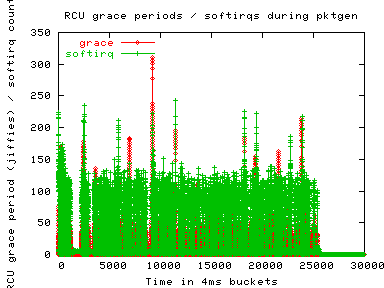
We are simply calling do_softirq() too much it seems and not letting other things run on the system. Perhaps we need to look at real throttling of softirqs ?
Thanks
Dipankar
Quoted 29 lines · Dipankar Sarma
It doesn't look as if we are processing much from ksoftirqd at all in this case. I did the following instrumentation -
        if (in_interrupt() && local_softirqd_running())
                return;
        max_restart = MAX_SOFTIRQ_RESTART;
        local_irq_save(flags);

        if (rcu_trace) {
                int cpu = smp_processor_id();
                per_cpu(softirq_count, cpu)++;
                if (local_softirqd_running() && current == __get_cpu_var(ksoftirqd))
                        per_cpu(ksoftirqd_count, cpu)++;
                else if (!in_interrupt())
                        per_cpu(other_softirq_count, cpu)++;
        }
        pending = local_softirq_pending();
A look at the
softirq_count,ksoftirqd_countandother_softirq_countshows -CPU 0 : 638240 554 637686
CPU 1 : 102316 1 102315
CPU 2 : 675696 557 675139
CPU 3 : 102305 0 102305So, it doesn't seem supprising that your ksoftirqd offloading didn't really help much. The softirq frequency and grace period graph looks pretty much same without that patch -
Quoted 6 lines
http://lse.sourceforge.net/locking/rcu/rtcache/pktgen/andrea/cpu-softirq.png
We are simply calling
do_softirq()too much it seems and not letting other things run on the system. Perhaps we need to look at real throttling of softirqs ?
I see what's going on now, yes my patch cannot help. the workload is simply generating too much hardirq load, and it's like if we don't use softirq at all but that we process the packet inside the hardirq for this matter. As far as RCU is concerned it's like if there a no softirq at all but that we process everything in the hardirq.
so what you're looking after is a new feature then:
1) rate limit the hardirqs
2) rate limit only part of the irq load (i.e. the softirq, that's handy since it's already splitted out) to scheduler-aware context (not inside irq context anymore)
3) stop processing packets in irqs in the first place (NAPI or similar)
however I start to think they can be all wrong, and that rcu is simply not suitable for purerely irq usages like this. w/o rcu there would be no need of the scheduler keeping up with the irq load, and in some usage I can imagine that it is a feature to prioritize heavily on the irq load vs scheduler-aware context.
Quoted 6 lines · Andrea Arcangeli
I see what's going on now, yes my patch cannot help. the workload is simply generating too much hardirq load, and it's like if we don't use softirq at all but that we process the packet inside the hardirq for this matter. As far as RCU is concerned it's like if there a no softirq at all but that we process everything in the hardirq.
Quoted 6 lines
so what you're looking after is a new feature then:
1) rate limit the hardirqs
2) rate limit only part of the irq load (i.e. the softirq, that's handy since it's already splitted out) to scheduler-aware context (not inside irq context anymore)
There were a number of somewhat ugly softirq limiting patches that Robert tried out (not spitting them to scheduler-aware context) and some combination of that worked well in Robert's setup. I will see if I can revive that. That said, we would need to find out how badly we affect network performance with that thing.
Quoted 7 lines
3) stop processing packets in irqs in the first place (NAPI or similar)
however I start to think they can be all wrong, and that rcu is simply not suitable for purerely irq usages like this. w/o rcu there would be no need of the scheduler keeping up with the irq load, and in some usage I can imagine that it is a feature to prioritize heavily on the irq load vs scheduler-aware context.
Not necessarily, we can do a call_rcu_bh() just for softirqs with softirq handler completion as a quiescent state. That will likely help with the route cache overflow problem atleast.
Thanks
Dipankar
Quoted 3 lines · Dipankar Sarma
Not necessarily, we can do a
call_rcu_bh()just for softirqs with softirq handler completion as a quiescent state. That will likely help with the route cache overflow problem atleast.
cute, I like this. You're right all we care about is a quiscient point against softirq context (this should work fine against regular kernel context under local_bh_disable too). This really sounds a smart and optimal and finegriend solution to me. The only thing I'm concerned about is if it slowdown further the fast paths, but I can imagine that you can implement it purerly with tasklets and no change to the fast paths (I mean, I wouldn't enjoy further instrumentations like the stuff you had to add to the scheduler especially in the preempt case). I mean, you've just to run 1 magic takklet per cpu then you declare the quiscient point. The only annoyance will be the queueing of these tasklets in every cpu, that may need IPIs or some nasty locking. Of course we should use the higher prio tasklets, so they run before the other softirqs.
Is this the suggestion from Alexey or did he suggest something else? the details of his suggestion weren't clear to me.
after call_rcu_bh everything else w.r.t. softirq/scheduler will return low prio. I mean, the everything else will return a "irq load (hardirq+softirq) runs on top of kernel context and they're not accounted by the scheduler" like it has always been in the last thousand kernel releases ;) that may need solving eventually, but still the routing cache sounds optimal with the call_rcu_bh.
Quoted 6 lines · Andrea Arcangeli
I see what's going on now, yes my patch cannot help. the workload is simply generating too much hardirq load, and it's like if we don't use softirq at all but that we process the packet inside the hardirq for this matter. As far as RCU is concerned it's like if there a no softirq at all but that we process everything in the hardirq.
Quoted 7 lines
so what you're looking after is a new feature then:
1) rate limit the hardirqs
2) rate limit only part of the irq load (i.e. the softirq, that's handy since it's already splitted out) to scheduler-aware context (not inside irq context anymore)
3) stop processing packets in irqs in the first place (NAPI or similar)
Hello!
No Andrea it pure softirq workload. Interfaces runs with irq disabled at this load w. NAPI. Softirq's are run from spin_unlock_bh etc when doing route lookup and GC. And the more fine-grained locking we do the the more do_softirq's are run.
Cheers.
--ro
Quoted 15 lines · Robert Olsson
Quoted 6 lines · Andrea Arcangeli
I see what's going on now, yes my patch cannot help. the workload is simply generating too much hardirq load, and it's like if we don't use softirq at all but that we process the packet inside the hardirq for this matter. As far as RCU is concerned it's like if there a no softirq at all but that we process everything in the hardirq.
Quoted 7 lines
so what you're looking after is a new feature then:
1) rate limit the hardirqs
2) rate limit only part of the irq load (i.e. the softirq, that's handy since it's already splitted out) to scheduler-aware context (not inside irq context anymore)
3) stop processing packets in irqs in the first place (NAPI or similar)
Quoted 4 lines
No Andrea it pure softirq workload. Interfaces runs with irq disabled at this load w. NAPI. Softirq's are run from
spin_unlock_bhetc when doing route lookup and GC. And the more fine-grained locking we do the the more do_softirq's are run.
Not lookup, we don't take the lock in lookup. Probably route insertions which will happen very frequently in this case.
Thanks
Dipankar
Hello!
Quoted 15 lines
Quoted 4 lines
Robert demonstrated to us sometime ago with a small timestamping user program to show that it can get starved for more than 6 seconds in his system. So userland starvation is an issue.
softirqs are already capable of being offloaded to scheduler-friendy kernel threads to avoid starvation, if this wasn't the case NAPI would have no way to work in the first place and everything else would fall apart too, not just the rcu-route-cache. I don't think high latencies and starvation are the same thing, starvation means for "indefinite time" and you can't hang userspace for indefinite time using softirqs. For sure the irq based load, and in turn softirqs too, can take a large amount of cpu (though not 100%, this is why it cannot be called starvation).
Quoted 2 lines
the only real starvation you can claim is in presence of an
_hard_irqflood, not a softirq one.
There are no hardirqs in the case under investigation, remember?
What's about the problem it really splits to two ones:
1. The _new_ problem when bad latency of rcu hurts core functionality. This is precise description:
Quoted 6 lines
to keep up with the softirq load. This has never been the case so far, and serving softirq as fast as possible is normally a good thing for server/firewalls, the small unfariness (note unfariness != starvation) it generates has never been an issue, because so far the softirq never required the scheduler to work in order to do their work, rcu changed this in the routing cache specific case.
We had one full solution for this issue not changing anything in scheduler/softirq relationship: to run rcu task for the things sort of dst cache not from process context, but essentially as part of do_softirq(). Simple, stupid and apparently solves new problems which rcu created.
Another solution is just to increase memory consumption limits to deal with current rcu latency. F.e. 300ms latency just requires additional space for pps*300ms objects, which are handled by RCU. The problem with this is that pps is the thing which increases when cpu power grows and that 300ms is not a mathematically established limit too.
Quoted 2 lines
So you're simply asking the ksoftirqd offloading to become more aggressive,
It is the second challenge.
Andrea, it is experimenatl fact: this "small unfariness" stalls process contexts for >=6 seconds and gives them microscopic slices. We could live with this (provided RCU problem is solved in some way). Essentially, the only trouble for me was that we could use existing rcu bits to make offloading to ksoftirqd more smart (not aggressive, _smart_). The absense of RCU quiescent states looks too close to absence of forward progress in process contexts, it was anticipating similarity. The dumb throttling do_softirq made not from ksoftirqd context when starvation is detected which we tested the last summer is not only ugly, it really might hurt router performance, you are right here too. It is the challenge:
or we proceed with this idea and invent something, or we just forget about this concentrating on RCU.
Alexey
Quoted 4 lines · On Wed, Mar 31, 2004 at 12:05:05AM +0400, [email protected] wrote:
What's about the problem it really splits to two ones:
1. The _new_ problem when bad latency of rcu hurts core functionality. This is precise description:
Which essentially happens due to userland starvation during a softirq flood.
Quoted 8 lines
Quoted 7 lines
to keep up with the softirq load. This has never been the case so far, and serving softirq as fast as possible is normally a good thing for server/firewalls, the small unfariness (note unfariness != starvation) it generates has never been an issue, because so far the softirq never required the scheduler to work in order to do their work, rcu changed this in the routing cache specific case.
Quoted 5 lines
We had one full solution for this issue not changing anything in scheduler/softirq relationship: to run rcu task for the things sort of dst cache not from process context, but essentially as part of
do_softirq(). Simple, stupid and apparently solves new problems which rcu created.
Can you be a little bit more specific about this solution ? There were a number of them discussed during our private emails and I can't tell which one you are talking about.
Quoted 6 lines
Another solution is just to increase memory consumption limits to deal with current rcu latency. F.e. 300ms latency just requires additional space for pps*300ms objects, which are handled by RCU. The problem with this is that pps is the thing which increases when cpu power grows and that 300ms is not a mathematically established limit too.
I don't think increasing memory consumption limit is a good idea.
Quoted 4 lines
Andrea, it is experimenatl fact: this "small unfariness" stalls process contexts for >=6 seconds and gives them microscopic slices. We could live with this (provided RCU problem is solved in some way). Essentially, the only trouble for me was that we could use existing rcu bits to make
Quoted 8 lines
offloading to ksoftirqd more smart (not aggressive, _smart_). The absense of RCU quiescent states looks too close to absence of forward progress in process contexts, it was anticipating similarity. The dumb throttling
do_softirqmade not from ksoftirqd context when starvation is detected which we tested the last summer is not only ugly, it really might hurt router performance, you are right here too. It is the challenge:
or we proceed with this idea and invent something, or we just forget about this concentrating on RCU.
Exactly. And the throttling will likely not be enough by ksoftirqd as indicated by my earlier experiments. We have potential fixes for RCU through a call_rcu_bh() interface where completion of a softirq handler is a quiescent state. I am working on forward porting that old patch from our discussion last year and testing in my environment. That should increase the number of quiescent state points significantly and hopefully reduce the grace period significantly. But this does nothing to help userland starvation.
Thanks
Dipankar
Hello!
Quoted 7 lines
Quoted 5 lines
We had one full solution for this issue not changing anything in scheduler/softirq relationship: to run rcu task for the things sort of dst cache not from process context, but essentially as part of
do_softirq(). Simple, stupid and apparently solves new problems which rcu created.Can you be a little bit more specific about this solution ?
It is about that your suggestion, which you outlined below :-)
Quoted 7 lines
as indicated by my earlier experiments. We have potential fixes for RCU through a
call_rcu_bh()interface where completion of a softirq handler is a quiescent state. I am working on forward porting that old patch from our discussion last year and testing in my environment. That should increase the number of quiescent state points significantly and hopefully reduce the grace period significantly. But this does nothing to help userland starvation.
Alexey
Quoted 17 lines · On Wed, Mar 31, 2004 at 12:05:05AM +0400, [email protected] wrote:
Hello!
Quoted 15 lines
Quoted 4 lines
Robert demonstrated to us sometime ago with a small timestamping user program to show that it can get starved for more than 6 seconds in his system. So userland starvation is an issue.
softirqs are already capable of being offloaded to scheduler-friendy kernel threads to avoid starvation, if this wasn't the case NAPI would have no way to work in the first place and everything else would fall apart too, not just the rcu-route-cache. I don't think high latencies and starvation are the same thing, starvation means for "indefinite time" and you can't hang userspace for indefinite time using softirqs. For sure the irq based load, and in turn softirqs too, can take a large amount of cpu (though not 100%, this is why it cannot be called starvation).
Quoted 4 lines
Quoted 2 lines
the only real starvation you can claim is in presence of an
_hard_irqflood, not a softirq one.There are no hardirqs in the case under investigation, remember?
no hardirqs? there must be tons of hardirqs if ksoftirqd never runs.
Quoted 13 lines
What's about the problem it really splits to two ones:
1. The _new_ problem when bad latency of rcu hurts core functionality. This is precise description:
Quoted 6 lines
to keep up with the softirq load. This has never been the case so far, and serving softirq as fast as possible is normally a good thing for server/firewalls, the small unfariness (note unfariness != starvation) it generates has never been an issue, because so far the softirq never required the scheduler to work in order to do their work, rcu changed this in the routing cache specific case.
Quoted 5 lines
We had one full solution for this issue not changing anything in scheduler/softirq relationship: to run rcu task for the things sort of dst cache not from process context, but essentially as part of
do_softirq(). Simple, stupid and apparently solves new problems which rcu created.
I don't understand exactly the details of how this works but I trust you ;)
Quoted 6 lines
Another solution is just to increase memory consumption limits to deal with current rcu latency. F.e. 300ms latency just requires additional space for pps*300ms objects, which are handled by RCU. The problem with this is that pps is the thing which increases when cpu power grows and that 300ms is not a mathematically established limit too.
I consider this more a workaround than a solution ;). It also depends how much boost you get from the rcu scalability in smp to evaluate if the above solution could be worthwhile, I don't know the exact numbers myself.
Quoted 8 lines
Quoted 2 lines
So you're simply asking the ksoftirqd offloading to become more aggressive,
It is the second challenge.
Andrea, it is experimenatl fact: this "small unfariness" stalls process contexts for >=6 seconds and gives them microscopic slices. We could live with this (provided RCU problem is solved in some way). Essentially,
yes, we could live with this if it wasn't for RCU not making any progress and the irq load depending on the RCU to make progress.
Quoted 9 lines
the only trouble for me was that we could use existing rcu bits to make offloading to ksoftirqd more smart (not aggressive, _smart_). The absense of RCU quiescent states looks too close to absence of forward progress in process contexts, it was anticipating similarity. The dumb throttling
do_softirqmade not from ksoftirqd context when starvation is detected which we tested the last summer is not only ugly, it really might hurt router performance, you are right here too. It is the challenge:
or we proceed with this idea and invent something, or we just forget about this concentrating on RCU.
So basically you're suggesting to use the rcu grace period "timeout" to choose when to defer the softirq load to userspace, right? That should work. I mean, it will need some instrumentation to define the "timeout", but it's very similar to the patch I already posted, rather than local_softirqd_running() we'll check for rcu_timed_out() and we'll wakeup ksofitrqd in that case and we'll return immediatly from do_softirq. That will still risk to lose some packet from the backlog though, since we'll process softirqs at a slower peace (but that's partly the feature).
That sounds a bit too rcu centric though, I mean, if we do this, maybe we should make it indipendent from rcu, and we could detect a too long time spent in softirq load, and we can offload softirqs in function of that instead of the rcu_timed_out() thing.
Quoted 3 lines · On Tue, 30 Mar 2004 23:14:50 +0200 Andrea Arcangeli <[email protected]> wrote:
Quoted 1 line
There are no hardirqs in the case under investigation, remember?
no hardirqs? there must be tons of hardirqs if ksoftirqd never runs.
NAPI should be kicking in for this workload, and I know for a fact it is for Robert's case. There should only be a few thousand hard irqs per second.
Until the RX ring is depleted the device's hardirqs will not be re- enabled.
Quoted 5 lines · David S. Miller
Quoted 2 lines · On Tue, 30 Mar 2004 23:14:50 +0200 Andrea Arcangeli <[email protected]> wrote:
Quoted 1 line
There are no hardirqs in the case under investigation, remember?
Quoted 8 lines
Quoted 1 line
no hardirqs? there must be tons of hardirqs if ksoftirqd never runs.
NAPI should be kicking in for this workload, and I know for a fact it is for Robert's case. There should only be a few thousand hard irqs per second.
Until the RX ring is depleted the device's hardirqs will not be re- enabled.
then Dipankar is reproducing with a workload that is completely different. I've only seen the emails from Dipankar so I couldn't know it was a NAPI load.
He posted these numbers:
	softirq_count, ksoftirqd_count and other_softirq_count shows -

	CPU 0 : 638240  554     637686
	CPU 1 : 102316  1       102315
	CPU 2 : 675696  557     675139
	CPU 3 : 102305  0       102305
that means nothing runs in ksoftirqd for Dipankar, so he cannot be using NAPI.
Either that or I'm misreading his numbers, or his stats results are wrong.
Quoted 4 lines · On Tue, 30 Mar 2004 23:37:42 +0200 Andrea Arcangeli <[email protected]> wrote:
that means nothing runs in ksoftirqd for Dipankar, so he cannot be using NAPI.
Either that or I'm misreading his numbers, or his stats results are wrong.
If these numbers are with your "if (ksoftirqd_pending()) return;" thing at the top of do_softirq() then I must agree with you.
Otherwise, keep in mind what I said, and also as Robert mentioned every single local_bh_enable() is going to call do_softirq() if the count falls to zero.
Quoted 3 lines · David S. Miller
Otherwise, keep in mind what I said, and also as Robert mentioned every single
local_bh_enable()is going to calldo_softirq()if the count falls to zero.
I was less concerned about the do_sofitrq in local_bh_enable, since that runs in a scheduler-aware context, so at least the timeslice is definitely accounted for and it'll schedule at some point (unlike with an hardirq flood). Actually the length of the default timeslice matters too here, lowering the max timeslice to 10msec would certainly reduce the effect.
call_rcu_bh will fix the local_bh_enable too. The only problem with call_rcu_bh is how to queue the tasklets in every cpu (an IPI sounds overkill at high frequency, because effectively here we're running the rcu callbacks in a potential fast path). OTOH if we've to add a spinlock to queue the tasklet, then we might as well take a spinlock in the routing cache in the first place (at least for this workload).
Quoted 11 lines · Andrea Arcangeli
Quoted 3 lines · David S. Miller
Otherwise, keep in mind what I said, and also as Robert mentioned every single
local_bh_enable()is going to calldo_softirq()if the count falls to zero.I was less concerned about the
do_sofitrqinlocal_bh_enable, since that runs in a scheduler-aware context, so at least the timeslice is definitely accounted for and it'll schedule at some point (unlike with an hardirq flood). Actually the length of the default timeslice matters too here, lowering the max timeslice to 10msec would certainly reduce the effect.
That is there in my list of things to test.
Quoted 6 lines
call_rcu_bhwill fix thelocal_bh_enabletoo. The only problem withcall_rcu_bhis how to queue the tasklets in every cpu (an IPI sounds overkill at high frequency, because effectively here we're running the rcu callbacks in a potential fast path). OTOH if we've to add a spinlock to queue the tasklet, then we might as well take a spinlock in the routing cache in the first place (at least for this workload).
I don't do any of this. I just have a separate quiescent state counter for softirq RCU. It is incremented for regular quiescent points like cswitch, userland, idle loop as well as at the completion of each softirq handler. call_rcu_bh() uses its own queues. Everything else works like call_rcu().
Thanks
Dipankar
Quoted 5 lines · Dipankar Sarma
I don't do any of this. I just have a separate quiescent state counter for softirq RCU. It is incremented for regular quiescent points like cswitch, userland, idle loop as well as at the completion of each softirq handler.
call_rcu_bh()uses its own queues. Everything else works likecall_rcu().
the point is that you want this counter to increase in every cpu quick, that's why I was thinking at posting the tasklet, if the counter doesn't increase from softirq, you fallback in the grace period length of the non-bh rcu.
maybe the softirq load is so high in all cpus that just the additional counter will fix it w/o having to post any additional tasklet (I very much hope so but especially with irq binding I don't see it happening, however with irq binding you may have a call_rcu_bh_cpuset). You should give it a try and see if it just works.
Quoted 12 lines · Andrea Arcangeli
Quoted 5 lines · Dipankar Sarma
I don't do any of this. I just have a separate quiescent state counter for softirq RCU. It is incremented for regular quiescent points like cswitch, userland, idle loop as well as at the completion of each softirq handler.
call_rcu_bh()uses its own queues. Everything else works likecall_rcu().the point is that you want this counter to increase in every cpu quick, that's why I was thinking at posting the tasklet, if the counter doesn't increase from softirq, you fallback in the grace period length of the non-bh rcu.
Quoted 5 lines
maybe the softirq load is so high in all cpus that just the additional counter will fix it w/o having to post any additional tasklet (I very much hope so but especially with irq binding I don't see it happening, however with irq binding you may have a
call_rcu_bh_cpuset). You should give it a try and see if it just works.
Ah, forcing CPUs for quiescent state is my last WMD if I have to use it ever :)
Thanks
Dipankar
Quoted 9 lines · Andrea Arcangeli
He posted these numbers:
	softirq_count, ksoftirqd_count and other_softirq_count shows -

	CPU 0 : 638240  554     637686
	CPU 1 : 102316  1       102315
	CPU 2 : 675696  557     675139
	CPU 3 : 102305  0       102305
Quoted 4 lines
that means nothing runs in ksoftirqd for Dipankar, so he cannot be using NAPI.
Either that or I'm misreading his numbers, or his stats results are wrong.
Well we have to ask Dipankar... But I'll buy a beer if it's not on. :)
Anyway w. NAPI enabled. 2 * 304 kpps DoS flows into eth0, eth2. Flows are 2 * 10 Millions 64 byte pkts. 32 k buckets routehash. Full Internet routing means ~130 k routes. Linux 2.6.4 2*2.66 MHz XEON.
 26:        896          0   IO-APIC-level  eth0
 27:      25197          0   IO-APIC-level  eth1
 28:          8        579   IO-APIC-level  eth2
 29:         10      26112   IO-APIC-level  eth3
T-put is seen on output dev. eth1, eth3. So about 16% of incoming load,
eth0   1500   0 1577468 9631270 9631270 8422828    237      0      0      0 BRU
eth1   1500   0     42      0      0      0 1573355      0      0      0 BRU
eth2   1500   0 1636154 9603432 9603432 8363849     41      0      0      0 BRU
eth3   1500   0     54      0      0      0 1632274      0      0      0 BRU
And lots of
.
.
printk: 1898 messages suppressed.
dst cache overflow
printk: 829 messages suppressed.
dst cache overflow
Cheers.
--ro
Quoted 28 lines · Andrea Arcangeli
Quoted 5 lines · David S. Miller
Quoted 2 lines · On Tue, 30 Mar 2004 23:14:50 +0200 Andrea Arcangeli <[email protected]> wrote:
Quoted 1 line
There are no hardirqs in the case under investigation, remember?
Quoted 8 lines
Quoted 1 line
no hardirqs? there must be tons of hardirqs if ksoftirqd never runs.
NAPI should be kicking in for this workload, and I know for a fact it is for Robert's case. There should only be a few thousand hard irqs per second.
Until the RX ring is depleted the device's hardirqs will not be re- enabled.
then Dipankar is reproducing with a workload that is completely different. I've only seen the emails from Dipankar so I couldn't know it was a NAPI load.
He posted these numbers:
	softirq_count, ksoftirqd_count and other_softirq_count shows -

	CPU 0 : 638240  554     637686
	CPU 1 : 102316  1       102315
	CPU 2 : 675696  557     675139
	CPU 3 : 102305  0       102305
Quoted 2 lines
that means nothing runs in ksoftirqd for Dipankar, so he cannot be using NAPI.
And I am not. I am still on 2.6.0 and there seems to be no NAPI support for the e100 there. Should I try 2.6.4 where e100 has NAPI support ?
Anyway, even without softirqs on the back of hardirqs, there are other ways of softirq overload as seen in Robert's setup.
Thanks
Dipankar
Quoted 5 lines · Dipankar Sarma
And I am not. I am still on 2.6.0 and there seems to be no NAPI support for the e100 there. Should I try 2.6.4 where e100 has NAPI support ?
Anyway, even without softirqs on the back of hardirqs, there are other ways of softirq overload as seen in Robert's setup.
Well I see some hardirq's most from TX and timer interrups and HZ=1000 can can change the way softirq's are run a bit.
I hacked do_softirq() sources so we can understand how things work a bit better. (Use fastroute stats from /proc/net/softnet_stat).
ksoftird == softirq's sourced from ksofttirq
irqexit == softirq's sourced from interrupt exitbh_enbl == softirq's sourced local_bh_enable
Before run
total droppped tsquz throttl bh_enbl ksoftird irqexit other
00000000 00000000 00000000 00000000 000000e8 0000017e 00030411 00000000 00000000 00000000 00000000 00000000 000000ae 00000277 00030349 00000000
After DoS (See description from previous mail)
total droppped tsquz throttl bh_enbl ksoftird irqexit other00164c55 00000000 000021de 00000000 000000fc 0000229f 0003443c 00000000 001695e7 00000000 0000224d 00000000 00000162 0000236f 000342f7 00000000
So the major part of softirq's are run from irqexit and therefor out of scheduler control. This even with RX polling (eth0, eth2) We still have some TX interrupts plus timer interrupts now at 1000Hz. Which probably reduces the number of softirq's that ksoftirqd runs.
CPU0 CPU1
  0:     297156          0    IO-APIC-edge  timer
  1:        431          0    IO-APIC-edge  i8042
  2:          0          0          XT-PIC  cascade
  8:          0          0    IO-APIC-edge  rtc
 14:      34527          0    IO-APIC-edge  ide0
 26:        131          0   IO-APIC-level  eth0
 27:      22910          0   IO-APIC-level  eth1
 28:          8        124   IO-APIC-level  eth2
 29:          9      23197   IO-APIC-level  eth3
NMI:          0          0
LOC:     297060     297059
Cheers.
--ro
On Wed, Mar 31, 2004 at 08:46:09PM +0200, Robert Olsson wrote:
Content-Description: message body text
Quoted 8 lines
Before run
total droppped tsquz throttl
bh_enblksoftird irqexit other
00000000 00000000 00000000 00000000000000e80000017e00030411 00000000 00000000 00000000 00000000 00000000000000ae00000277 00030349 00000000After DoS (See description from previous mail)
Quoted 8 lines
total droppped tsquz throttl
bh_enblksoftird irqexit other00164c5500000000000021de00000000000000fc0000229f0003443c00000000001695e7000000000000224d00000000 000001620000236f000342f700000000So the major part of softirq's are run from irqexit and therefor out of scheduler control. This even with RX polling (eth0, eth2) We still have some TX interrupts plus timer interrupts now at 1000Hz. Which probably reduces the number of softirq's that ksoftirqd runs.
So, NAPI or not we get userland stalls due to packetflooding.
Looking at some of the old patches we discussed privately, it seems this is what was done earlier -
1. Use rcu-softirq.patch which provides call_rcu_bh() for softirqs only.
2. Limit non-ksoftirqd softirqs - get a measure of userland stall (using an api rcu_grace_period(cpu)) and if it is too long, expire the timeslice of the current process and start sending everything to ksoftirqd.
By reducing the softirq time at the back of a hardirq or local_bh_enable(), we should be able to bring a bit more fairness. I am working on the patches, will test and publish later.
Thanks
Dipankar
Quoted 14 lines · Dipankar Sarma
On Wed, Mar 31, 2004 at 08:46:09PM +0200, Robert Olsson wrote:
Content-Description: message body textQuoted 12 lines
Before run
total droppped tsquz throttl
bh_enblksoftird irqexit other
00000000 00000000 00000000 00000000000000e80000017e00030411 00000000 00000000 00000000 00000000 00000000000000ae00000277 00030349 00000000After DoS (See description from previous mail)
total droppped tsquz throttl
bh_enblksoftird irqexit other00164c5500000000000021de00000000000000fc0000229f0003443c00000000001695e7000000000000224d00000000 000001620000236f000342f700000000
Quoted 6 lines
Quoted 4 lines
So the major part of softirq's are run from irqexit and therefor out of scheduler control. This even with RX polling (eth0, eth2) We still have some TX interrupts plus timer interrupts now at 1000Hz. Which probably reduces the number of softirq's that ksoftirqd runs.
So, NAPI or not we get userland stalls due to packetflooding.
indeed, the most of the softirq load happens within irqs even with NAPI as we were talking about, so Alexey and DaveM were wrong about the hardirq load being non significant.
Maybe the problem is simply that NAPI should be tuned more aggressively, it may have to poll for a longer time before giving up.
Quoted 5 lines
Looking at some of the old patches we discussed privately, it seems this is what was done earlier -
1. Use rcu-softirq.patch which provides
call_rcu_bh()for softirqs only.
this is the one I prefer if it performs.
Quoted 4 lines
2. Limit non-ksoftirqd softirqs - get a measure of userland stall (using an api
rcu_grace_period(cpu)) and if it is too long, expire the timeslice of the current process and start sending everything to ksoftirqd.
yep, this may be desiderable eventually just to be fair with tasks, but I believe it's partly an orthogonal with the rcu grace period length.
Quoted 3 lines
By reducing the softirq time at the back of a hardirq or
local_bh_enable(), we should be able to bring a bit more fairness. I am working on the patches, will test and publish later.
I consider this as the approch number 2 too.
Quoted 9 lines · Andrea Arcangeli
Quoted 1 line · Dipankar Sarma
So, NAPI or not we get userland stalls due to packetflooding.
indeed, the most of the softirq load happens within irqs even with NAPI as we were talking about, so Alexey and DaveM were wrong about the hardirq load being non significant.
Maybe the problem is simply that NAPI should be tuned more aggressively, it may have to poll for a longer time before giving up.
Perhaps yes, but we still have softirqs from local_bh_enable()s to deal with.
Quoted 7 lines
Quoted 5 lines
Looking at some of the old patches we discussed privately, it seems this is what was done earlier -
1. Use rcu-softirq.patch which provides
call_rcu_bh()for softirqs only.this is the one I prefer if it performs.
I just tried the attached patch (forward ported and some aggressive things deleted) and there was no route cache overflow during pktgen testing. So, this is a good approach, however this is not going to solve userland stalls.
Robert, btw, this rcu-softirq patch is slightly different from the earlier one in the sense that now every softirq handler completion is a quiescent point. Earlier each iteration of softirqs was a quiescent point. So this has more quiescent points.
Quoted 8 lines
Quoted 5 lines
2. Limit non-ksoftirqd softirqs - get a measure of userland stall (using an api
rcu_grace_period(cpu)) and if it is too long, expire the timeslice of the current process and start sending everything to ksoftirqd.yep, this may be desiderable eventually just to be fair with tasks, but I believe it's partly an orthogonal with the rcu grace period length.
Yes, it is. Delaying softirqs will delay RCU grace periods. But it will also affect i/o throughput. So this is a balancing act anyway.
Quoted 5 lines
Quoted 3 lines
By reducing the softirq time at the back of a hardirq or
local_bh_enable(), we should be able to bring a bit more fairness. I am working on the patches, will test and publish later.I consider this as the approch number 2 too.
Well, I don't really have #1 and #2. I think we need to understand if there are the situations where such stalls are unacceptable and if so fix softirqs for them. RCU OOMs we can probably work around anyway.
Thanks
Dipankar
Provide a new call_rcu_bh() interface that can be used in softirq only situations. Completion of a softirq handler is considered a quiescent point apart from regular quiescent points. If there is any read from process context, then it must be protected by rcu_read_lock/unlock_bh().
 include/linux/rcupdate.h |   40 ++++++---
 kernel/rcupdate.c        |  207 ++++++++++++++++++++++++++++-------------------
 kernel/softirq.c         |   12 ++
 net/decnet/dn_route.c    |    6 -
 net/ipv4/route.c         |   28 +++---
 5 files changed, 183 insertions(+), 110 deletions(-)
include/linux/rcupdate.h renamed from include/linux/rcupdate.h~rcu-softirq +29 -11
@@ -99,38 +99,56 @@ struct rcu_data { }; DECLARE_PER_CPU(struct rcu_data, rcu_data); +DECLARE_PER_CPU(struct rcu_data, rcu_bh_data);extern struct rcu_ctrlblk rcu_ctrlblk; - +extern struct rcu_ctrlblk rcu_bh_ctrlblk; +#define RCU_qsctr (cpu) (per_cpu(rcu_data, (cpu)).qsctr) -#define RCU_last_qsctr (cpu) (per_cpu(rcu_data, (cpu)).last_qsctr) -#define RCU_batch (cpu) (per_cpu(rcu_data, (cpu)).batch)#define RCU_nxtlist (cpu) (per_cpu(rcu_data, (cpu)).nxtlist) -#define RCU_curlist (cpu) (per_cpu(rcu_data, (cpu)).curlist) - +#define RCU_bh_qsctr (cpu) (per_cpu(rcu_bh_data, (cpu)).qsctr) +#define RCU_bh_nxtlist (cpu) (per_cpu(rcu_bh_data, (cpu)).nxtlist) +#define RCU_QSCTR_INVALID 0 -static inline int rcu_pending (int cpu) +static inline int __rcu_pending (int cpu,struct rcu_ctrlblk *rcp, +struct rcu_data *rdp) { -if ((!list_empty (&RCU_curlist (cpu)) && -rcu_batch_before (RCU_batch (cpu), rcu_ctrlblk.curbatch)) || - (list_empty (&RCU_curlist (cpu)) && - !list_empty (&RCU_nxtlist (cpu))) || -cpu_isset (cpu, rcu_ctrlblk.rcu_cpu_mask)) +if ((!list_empty (&rdp->curlist) && +rcu_batch_before (rdp->batch, rcp->curbatch)) || + (list_empty (&rdp->curlist) && + !list_empty (&rdp->nxtlist)) || +cpu_isset (cpu, rcp->rcu_cpu_mask))return 1 ;else return 0 ; } +static inline int rcu_pending_bh (int cpu) +{ +return __rcu_pending (cpu, &rcu_bh_ctrlblk, &per_cpu (rcu_bh_data, cpu)); +} +static inline int rcu_pending (int cpu) +{ +return __rcu_pending (cpu, &rcu_ctrlblk, &per_cpu (rcu_data, cpu)) || +__rcu_pending (cpu, &rcu_bh_ctrlblk, &per_cpu (rcu_bh_data, cpu)); +}#define rcu_read_lock () preempt_disable()#define rcu_read_unlock () preempt_enable() +#define rcu_read_lock_bh () local_bh_disable() +#define rcu_read_unlock_bh () local_bh_enable()extern void rcu_init (void );extern void rcu_check_callbacks (int cpu,int user); +extern void rcu_process_callbacks_bh (int cpu);/* Exported interfaces */ extern void FASTCALL (call_rcu (struct rcu_head *head,void (*func)(void *arg),void *arg)); +extern void FASTCALL (call_rcu_bh (struct rcu_head *head, +void (*func)(void *arg),void *arg));extern void synchronize_kernel (void ); +extern struct rcu_ctrlblk rcu_ctrlblk; +#endif /* __KERNEL__ */ #endif /* __LINUX_RCUPDATE_H */
kernel/rcupdate.c renamed from kernel/rcupdate.c~rcu-softirq +124 -83
256 lines not on this page · raw message
kernel/softirq.c renamed from kernel/softirq.c~rcu-softirq +11 -1
@@ -73,6 +73,7 @@ asmlinkage void do_softirq(void)int max_restart =MAX_SOFTIRQ_RESTART ;__u32 pending;unsigned long flags; +int cpu;if (in_interrupt ())return ;
@@ -85,6 +86,7 @@ asmlinkage void do_softirq(void)struct softirq_action *h;local_bh_disable (); + cpu =smp_processor_id (); restart:/* Reset the pending bitmask before enabling irqs */ local_softirq_pending () =0 ;
@@ -94,8 +96,10 @@ restart: h = softirq_vec;do { -if (pending &1 ) +if (pending &1 ) { h->action (h); +RCU_bh_qsctr (cpu)++; + } h++; pending >>=1 ; }while (pending);
@@ -107,6 +111,7 @@ restart: goto restart;if (pending)wakeup_softirqd (); +__local_bh_enable (); }
@@ -117,6 +122,11 @@ EXPORT_SYMBOL(do_softirq);void local_bh_enable (void ) { +int cpu =smp_processor_id (); + +if (softirq_count () == (1 <<SOFTIRQ_SHIFT )) { +RCU_bh_qsctr (cpu)++; + }__local_bh_enable ();WARN_ON (irqs_disabled ()); if (unlikely(!in_interrupt() &&
net/decnet/dn_route.c renamed from net/decnet/dn_route.c~rcu-softirq +4 -2
@@ -146,14 +146,16 @@ static __inline__ unsigned dn_hash(unsigstatic inline void dnrt_free (struct dn_route *rt) { -call_rcu (&rt->u.dst.rcu_head, (void (*)(void *))dst_free, &rt->u.dst); +call_rcu_bh (&rt->u.dst.rcu_head, (void (*)(void *))dst_free, + &rt->u.dst); }static inline void dnrt_drop (struct dn_route *rt) {if (rt)dst_release (&rt->u.dst); -call_rcu (&rt->u.dst.rcu_head, (void (*)(void *))dst_free, &rt->u.dst); +call_rcu_bh (&rt->u.dst.rcu_head, (void (*)(void *))dst_free, + &rt->u.dst); }static void dn_dst_check_expire (unsigned long dummy)
net/ipv4/route.c renamed from net/ipv4/route.c~rcu-softirq +15 -13
@@ -224,11 +224,11 @@ static struct rtable *rt_cache_get_firststruct rt_cache_iter_state *st = seq->private;for (st->bucket = rt_hash_mask; st->bucket >=0 ; --st->bucket) { -rcu_read_lock (); +rcu_read_lock_bh (); r = rt_hash_table[st->bucket].chain;if (r)break ; -rcu_read_unlock (); +rcu_read_unlock_bh (); }return r; }
@@ -240,10 +240,10 @@ static struct rtable *rt_cache_get_next(smp_read_barrier_depends (); r = r->u.rt_next;while (!r) { -rcu_read_unlock (); +rcu_read_unlock_bh ();if (--st->bucket <0 )break ; -rcu_read_lock (); +rcu_read_lock_bh (); r = rt_hash_table[st->bucket].chain; }return r;
@@ -279,7 +279,7 @@ static void *rt_cache_seq_next(struct sestatic void rt_cache_seq_stop (struct seq_file *seq,void *v) {if (v && v !=SEQ_START_TOKEN ) -rcu_read_unlock (); +rcu_read_unlock_bh (); }static int rt_cache_seq_show (struct seq_file *seq,void *v)
@@ -437,13 +437,15 @@ static struct file_operations rt_cpu_seqstatic __inline__void rt_free (struct rtable *rt) { -call_rcu (&rt->u.dst.rcu_head, (void (*)(void *))dst_free, &rt->u.dst); +call_rcu_bh (&rt->u.dst.rcu_head, (void (*)(void *))dst_free, + &rt->u.dst); }static __inline__void rt_drop (struct rtable *rt) {ip_rt_put (rt); -call_rcu (&rt->u.dst.rcu_head, (void (*)(void *))dst_free, &rt->u.dst); +call_rcu_bh (&rt->u.dst.rcu_head, (void (*)(void *))dst_free, + &rt->u.dst); }static __inline__int rt_fast_clean (struct rtable *rth)
@@ -2223,7 +2225,7 @@ int __ip_route_output_key(struct rtable hash =rt_hash_code (flp->fl4_dst, flp->fl4_src ^ (flp->oif <<5 ), flp->fl4_tos); -rcu_read_lock (); +rcu_read_lock_bh ();for (rth = rt_hash_table[hash].chain; rth; rth = rth->u.rt_next) {smp_read_barrier_depends (); if (rth->fl.fl4_dst == flp->fl4_dst &&
@@ -2239,13 +2241,13 @@ int __ip_route_output_key(struct rtabledst_hold (&rth->u.dst); rth->u.dst.__use++;RT_CACHE_STAT_INC (out_hit); -rcu_read_unlock (); +rcu_read_unlock_bh (); *rp = rth;return 0 ; }RT_CACHE_STAT_INC (out_hlist_search); } -rcu_read_unlock (); +rcu_read_unlock_bh ();return ip_route_output_slow (rp, flp); }
@@ -2455,7 +2457,7 @@ int ip_rt_dump(struct sk_buff *skb, strif (h < s_h)continue ;if (h > s_h) s_idx =0 ; -rcu_read_lock (); +rcu_read_lock_bh ();for (rt = rt_hash_table[h].chain, idx =0 ; rt; rt = rt->u.rt_next, idx++) {smp_read_barrier_depends ();
@@ -2466,12 +2468,12 @@ int ip_rt_dump(struct sk_buff *skb, str cb->nlh->nlmsg_seq, RTM_NEWROUTE, 1) <= 0) {dst_release (xchg (&skb->dst,NULL )); -rcu_read_unlock (); +rcu_read_unlock_bh (); goto done; }dst_release (xchg (&skb->dst,NULL )); } -rcu_read_unlock (); +rcu_read_unlock_bh (); } done:
_
Quoted 5 lines · Dipankar Sarma
Robert, btw, this rcu-softirq patch is slightly different from the earlier one in the sense that now every softirq handler completion is a quiescent point. Earlier each iteration of softirqs was a quiescent point. So this has more quiescent points.
Hello!
Yes it seems reduce RCU latency in our setup as well. It does not eliminate overflows but reduces with ~50% and increases the throughput a bit. dst cache overflow depends on RCU-delay + gc_min_interval and the number of entries freed per sec so this means RCU has improved. Also the user app doing gettimeofday seems to be better scheduled. The worst starvation improved from ~7.5 to ~4.4 sec.
Cheers.
--ro
Setup as described before.
Without patch
=============
2 * 283 kpps (eth0, eth2) 32768 flows and 10 pkts flow
Kernel Interface table
Iface MTU Met RX-OK RX-ERR RX-DRP RX-OVR TX-OK TX-ERR TX-DRP TX-OVR Flags
eth0   1500   0 5419435 8802471 8802471 4580569     44      0      0      0 BRU
eth1   1500   0     45      0      0      0 5417465      0      0      0 BRU
eth2   1500   0 5372943 8849348 8849348 4627060     44      0      0      0 BRU
eth3   1500   0     46      0      0      0 5371007      0      0      0 BRU
/proc/net/rt_cache_stat (3:rd last is ovfr)
000034d0  0046284e 000c8986 00000000 00000000 00000000 00000000 00000000  00000000 00000000 00000000 000bf952 000bf173 000007b8 000007b3 0081b228 00000000
000034d0  004559f4 000ca247 00000000 00000000 00000000 00000000 00000000  00000000 00000000 00000000 000c369c 000c2edf 00000799 00000792 008057a4 00000000
User app max delay 7.5 Sec
WIth RCU patch
===============
2 * 284 kpps 32768 flows and 10 pkts flow
Iface MTU Met RX-OK RX-ERR RX-DRP RX-OVR TX-OK TX-ERR TX-DRP TX-OVR Flags
eth0   1500   0 5838522 8704663 8704663 4161481     44      0      0      0 BRU
eth1   1500   0     45      0      0      0 5837586      0      0      0 BRU
eth2   1500   0 5957987 8643714 8643714 4042016     44      0      0      0 BRU
eth3   1500   0     46      0      0      0 5957051      0      0      0 BRU
/proc/net/rt_cache_stat
0002dcb5  004b6add 000dac08 00000000 00000000 00000000 00000000 00000000  00000000 00000000 00000000 000d029a 000cfec3 000003aa 000003a9 008c80b2 00000000
0002dcb5  004d2db5 000dbbda 00000000 00000000 00000000 00000000 00000000  00000000 00000000 00000000 000cfa51 000cf67e 000003b1 000003aa 008eb195 00000000
User app max delay 4.4 Sec
Quoted 9 lines · Robert Olsson
Quoted 5 lines · Dipankar Sarma
Robert, btw, this rcu-softirq patch is slightly different from the earlier one in the sense that now every softirq handler completion is a quiescent point. Earlier each iteration of softirqs was a quiescent point. So this has more quiescent points.
Quoted 7 lines
Hello!
Yes it seems reduce RCU latency in our setup as well. It does not eliminate overflows but reduces with ~50% and increases the throughput a bit. dst cache overflow depends on RCU-delay +
gc_min_intervaland the number of entries freed per sec so this means RCU has improved. Also the user app doing gettimeofday seems to be better scheduled. The worst starvation improved from ~7.5 to ~4.4 sec.
Looks better atleast. Can you apply the following patch (rs-throttle-rcu) on top of rcu-softirq.patch in your tree and see if helps a little bit more ? Please make sure to set the kernel paramenters rcupdate.maxbatch to 4 and rcupdate.plugticks to 0. You can make sure of those parameters by looking at dmesg (rcu prints them out during boot). I just merged it, but have not tested this patch yet.
Thanks
Dipankar
Throttle rcu by forcing a limit on how many callbacks per softirq and also implement a configurable plug. Applies on top of the rcu-softirq (hence rs-) patch.
 include/linux/list.h     |   21 +++++++++++++++++++++
 include/linux/rcupdate.h |    7 ++++++-
 kernel/rcupdate.c        |   33 +++++++++++++++++++++++++--------
 kernel/sched.c           |    2 ++
 4 files changed, 54 insertions(+), 9 deletions(-)
include/linux/list.h renamed from include/linux/list.h~rs-throttle-rcu +21 -0
@@ -251,6 +251,27 @@ static inline void list_splice(struct li__list_splice (list, head); } +static inline void __list_splice_tail (struct list_head *list, +struct list_head *head) +{ +struct list_head *first = list->next; +struct list_head *last = list->prev; +struct list_head *at = head->prev; + + first->prev = at; + at->next = first; + head->prev = last; + last->next = head; +} + + +static inline void list_splice_tail (struct list_head *list, +struct list_head *head) +{ +if (!list_empty (list)) +__list_splice_tail (list, head); +} +/** * list_splice_init - join two lists and reinitialise the emptied list. * @list: the new list to add.
include/linux/rcupdate.h renamed from include/linux/rcupdate.h~rs-throttle-rcu +6 -1
@@ -96,10 +96,12 @@ struct rcu_data {long batch;/* Batch # for current RCU batch */ struct list_head nxtlist;struct list_head curlist; +struct list_head donelist; }; DECLARE_PER_CPU(struct rcu_data, rcu_data); DECLARE_PER_CPU(struct rcu_data, rcu_bh_data); +DECLARE_PER_CPU (int, rcu_plugticks);extern struct rcu_ctrlblk rcu_ctrlblk;extern struct rcu_ctrlblk rcu_bh_ctrlblk;
@@ -107,6 +109,8 @@ extern struct rcu_ctrlblk rcu_bh_ctrlblk#define RCU_nxtlist (cpu) (per_cpu(rcu_data, (cpu)).nxtlist)#define RCU_bh_qsctr (cpu) (per_cpu(rcu_bh_data, (cpu)).qsctr)#define RCU_bh_nxtlist (cpu) (per_cpu(rcu_bh_data, (cpu)).nxtlist) + +#define RCU_plugticks (cpu) (per_cpu(rcu_plugticks, (cpu)))#define RCU_QSCTR_INVALID 0
@@ -117,7 +121,8 @@ static inline int __rcu_pending(int cpu, rcu_batch_before(rdp->batch, rcp->curbatch)) || (list_empty (&rdp->curlist) && !list_empty (&rdp->nxtlist)) || - cpu_isset(cpu, rcp->rcu_cpu_mask)) +cpu_isset (cpu, rcp->rcu_cpu_mask) || + (!list_empty(&rdp->donelist) && RCU_plugticks(cpu) == 0)) return 1; else return 0;
kernel/rcupdate.c renamed from kernel/rcupdate.c~rs-throttle-rcu +25 -8
@@ -39,6 +39,7 @@#include <asm/atomic.h> #include <asm/bitops.h> #include <linux/module.h> +#include <linux/moduleparam.h> #include <linux/completion.h> #include <linux/percpu.h> #include <linux/notifier.h>
@@ -59,6 +60,10 @@ DEFINE_PER_CPU(struct rcu_data, rcu_bh_d/* Fake initialization required by compiler */ static DEFINE_PER_CPU(struct tasklet_struct, rcu_tasklet) = {NULL};#define RCU_tasklet (cpu) (per_cpu(rcu_tasklet, cpu)) +DEFINE_PER_CPU (int, rcu_plugticks) =0 ; + +static int maxbatch =1000000 ; +static int plugticks =4 ;/** * call_rcu - Queue an RCU update request.
@@ -112,16 +117,23 @@ void call_rcu_bh(struct rcu_head *head,* Invoke the completed RCU callbacks. They are expected to be in * a per-cpu list. */ -static void rcu_do_batch (struct list_head *list) +static void rcu_do_batch (int cpu,struct list_head *list) {struct list_head *entry;struct rcu_head *head; +int count =0 ;while (!list_empty (list)) { entry = list->next;list_del (entry); head = list_entry(entry, struct rcu_head, list); head->func (head->arg); +if (++count >= maxbatch) { +RCU_plugticks (cpu) = plugticks; +if (!RCU_plugticks (cpu)) +tasklet_hi_schedule (&RCU_tasklet (cpu)); +break ; + } } }
@@ -178,7 +190,7 @@ out_unlock:spin_unlock (&rcp->mutex); } -static void __rcu_process_callbacks (struct rcu_ctrlblk *rcp, +static void __rcu_process_callbacks (int cpu,struct rcu_ctrlblk *rcp,struct rcu_data *rdp) {LIST_HEAD (list);
@@ -186,6 +198,7 @@ static void __rcu_process_callbacks(struif (!list_empty (&rdp->curlist) &&rcu_batch_after (rcp->curbatch, rdp->batch)) {list_splice (&rdp->curlist, &list); +list_splice_tail (&rdp->curlist, &rdp->donelist);INIT_LIST_HEAD (&rdp->curlist); }
@@ -206,13 +219,13 @@ static void __rcu_process_callbacks(strulocal_irq_enable (); }rcu_check_quiescent_state (rcp, rdp); -if (!list_empty (&list)) -rcu_do_batch (&list); +if (!list_empty (&rdp->donelist) && !RCU_plugticks (cpu)) +rcu_do_batch (cpu, &rdp->donelist); }void rcu_process_callbacks_bh (int cpu) { -__rcu_process_callbacks (&rcu_bh_ctrlblk, &per_cpu (rcu_bh_data, cpu)); +__rcu_process_callbacks (cpu, &rcu_bh_ctrlblk, &per_cpu (rcu_bh_data, cpu)); }/*
@@ -221,8 +234,8 @@ void rcu_process_callbacks_bh(int cpu)static void rcu_process_callbacks (unsigned long unused) {int cpu =smp_processor_id (); -__rcu_process_callbacks (&rcu_ctrlblk, &per_cpu (rcu_data, cpu)); -__rcu_process_callbacks (&rcu_bh_ctrlblk, &per_cpu (rcu_bh_data, cpu)); +__rcu_process_callbacks (cpu, &rcu_ctrlblk, &per_cpu (rcu_data, cpu)); +__rcu_process_callbacks (cpu, &rcu_bh_ctrlblk, &per_cpu (rcu_bh_data, cpu)); }void rcu_check_callbacks (int cpu,int user)
@@ -234,7 +247,7 @@ void rcu_check_callbacks(int cpu, int usRCU_bh_qsctr (cpu)++; }else if (!in_softirq ())RCU_bh_qsctr (cpu)++; -tasklet_schedule (&RCU_tasklet (cpu)); +tasklet_hi_schedule (&RCU_tasklet (cpu)); }static void __devinit rcu_online_cpu (struct rcu_data *rdp)
@@ -242,6 +255,7 @@ static void __devinit rcu_online_cpu(strmemset (rdp,0 ,sizeof (*rdp));INIT_LIST_HEAD (&rdp->nxtlist);INIT_LIST_HEAD (&rdp->curlist); +INIT_LIST_HEAD (&rdp->donelist); } static int __devinit rcu_cpu_notify(struct notifier_block *self,
@@ -277,6 +291,7 @@ void __init rcu_init(void) (void *)(long)smp_processor_id());/* Register notifier for non-boot CPUs */ register_cpu_notifier (&rcu_nb); +printk ("RCU: maxbatch = %d, plugticks = %d\n" , maxbatch, plugticks); }
@@ -302,6 +317,8 @@ void synchronize_kernel(void)wait_for_completion (&completion); } +module_param (maxbatch, int,0 ); +module_param (plugticks, int,0 );EXPORT_SYMBOL (call_rcu);EXPORT_SYMBOL (call_rcu_bh);
kernel/sched.c renamed from kernel/sched.c~rs-throttle-rcu +2 -0
@@ -1486,6 +1486,8 @@ void scheduler_tick(int user_ticks, intif (rcu_pending (cpu))rcu_check_callbacks (cpu, user_ticks); +if (RCU_plugticks (cpu)) +RCU_plugticks (cpu)--;/* note: this timer irq context must be accounted for as well */ if (hardirq_count () -HARDIRQ_OFFSET ) {
_
Quoted 6 lines · Dipankar Sarma
Looks better atleast. Can you apply the following patch (rs-throttle-rcu) on top of rcu-softirq.patch in your tree and see if helps a little bit more ? Please make sure to set the kernel paramenters rcupdate.maxbatch to 4 and rcupdate.plugticks to 0. You can make sure of those parameters by looking at dmesg (rcu prints them out during boot). I just merged it, but have not tested this patch yet.
OK!
Well not tested yet but I don't think we will get rid overflow totally in my setup. I've done a little experimental patch so *all* softirq's are run via ksoftirqd.
total droppped tsquz throttl bh_enbl ksoftird irqexit other009bee0c 00000000 00004aa7 00000000 00000000 0336a637 00000078 00000000 0054d381 00000000 00004ca0 00000000 00000000 032f8e48 00000000 00000000
I still see dst overflows. But the priority of the ksoftird's can now control the user apps behavior even during softirq DoS.
Cheers.
--ro
On Tue, Apr 06, 2004 at 02:55:19PM +0200, Robert Olsson wrote:
Content-Description: message body text
Quoted 8 lines
Quoted 6 lines · Dipankar Sarma
Looks better atleast. Can you apply the following patch (rs-throttle-rcu) on top of rcu-softirq.patch in your tree and see if helps a little bit more ? Please make sure to set the kernel paramenters rcupdate.maxbatch to 4 and rcupdate.plugticks to 0. You can make sure of those parameters by looking at dmesg (rcu prints them out during boot). I just merged it, but have not tested this patch yet.
Quoted 5 lines
OK!
Well not tested yet but I don't think we will get rid overflow totally in my setup. I've done a little experimental patch so *all* softirq's are run via ksoftirqd.
Robert, you should try out rs-throttle-rcu.patch. The idea is that we don't run too many callbacks in a single rcu. In my setup, at 100kpps, I see as many as 30000 rcu callbacks in a single tasklet handler. That is likely hurting even the softirq-only RCU grace periods. Setting rcupdate.maxbatch=4 will do only 4 per tasklet thus providing more quiescent points to the system.
Thanks
Dipankar
Quoted 6 lines · Dipankar Sarma
Robert, you should try out rs-throttle-rcu.patch. The idea is that we don't run too many callbacks in a single rcu. In my setup, at 100kpps, I see as many as 30000 rcu callbacks in a single tasklet handler. That is likely hurting even the softirq-only RCU grace periods. Setting rcupdate.maxbatch=4 will do only 4 per tasklet thus providing more quiescent points to the system.
Hello!
No bad things happens, lots of overflows and drop in performance and the userland app can stall for 32 sec. We seems to spin in softirq to much and still don't get things done.
Cheers.
--ro
Without patch
=============
Iface MTU Met RX-OK RX-ERR RX-DRP RX-OVR TX-OK TX-ERR TX-DRP TX-OVR Flags
eth0   1500   0 5568922 8823920 8823920 4431083     46      0      0      0 BRU
eth1   1500   0     45      0      0      0 5567591      0      0      0 BRU
eth2   1500   0 5742954 8731915 8731915 4257049     42      0      0      0 BRU
eth3   1500   0     46      0      0      0 5741617      0      0      0 BRU
/proc/net/rt_cache_stat [overflow 3:rd last]
00009e0f  004809d5 000cefee 00000000 00000000 00000000 00000000 00000000  00000000 00000000 00000000 000c8c85 000c8725 0000053a 00000533 0085c6f6 00000000
00009e0f  004aa57e 000cfc18 00000000 00000000 00000000 00000000 00000000  00000000 00000000 00000000 000c4920 000c43b8 00000541 0000053d 0088c546 00000000
With patch
===========
RCU: maxbatch = 4, plugticks = 0
Iface MTU Met RX-OK RX-ERR RX-DRP RX-OVR TX-OK TX-ERR TX-DRP TX-OVR Flags
eth0   1500   0 922395 9792296 9792296 9077609     45      0      0      0 BRU
eth1   1500   0     47      0      0      0 909892      0      0      0 BRU
eth2   1500   0 922586 9789706 9789706 9077417     45      0      0      0 BRU
eth3   1500   0     48      0      0      0 909992      0      0      0 BRU
/proc/net/rt_cache_stat [overflow 3:rd last]
00000018  000bc6e3 00024c63 00000000 00000000 00000000 00000000 00000000  00000000 00000000 00000000 00021077 0001df2f 000030e2 000030d9 0011ed4d 00000000
00000018  000bc27d 0002518a 00000000 00000000 00000000 00000000 00000000  00000000 00000000 00000000 00020d75 0001dbba 0000313c 00003135 00122fc9 00000000
Quoted 9 lines · Robert Olsson
Quoted 6 lines · Dipankar Sarma
Robert, you should try out rs-throttle-rcu.patch. The idea is that we don't run too many callbacks in a single rcu. In my setup, at 100kpps, I see as many as 30000 rcu callbacks in a single tasklet handler. That is likely hurting even the softirq-only RCU grace periods. Setting rcupdate.maxbatch=4 will do only 4 per tasklet thus providing more quiescent points to the system.
Quoted 5 lines
Hello!
No bad things happens, lots of overflows and drop in performance and the userland app can stall for 32 sec. We seems to spin in softirq to much and still don't get things done.
Argh!! Andrea, this means that throttling rcu callbacks with back-to-back rcu tasklets for better scheduling latency is bad for this kind of DoS situation. I think we will have to address the softirq limiting question.
That said, Robert, one last experiment - if you are running UP, can you try the following patchset (should apply on top of vanilla 2.6.x) ? This implements direct invocation of callbacks instead of waiting for rcu grace periods in UP kernel. This would be a good data point to understand what happens.
Thanks
Dipankar
A new interface call_rcu_rt() allows the updates to happen immediately in a UP kernel. This assumes that no RCU protection is needed against interrupts.
 include/linux/rcupdate.h |   14 ++++++++++++++
 1 files changed, 14 insertions(+)
include/linux/rcupdate.h renamed from include/linux/rcupdate.h~rcu-rt-latency +14 -0
@@ -131,6 +131,20 @@ extern void rcu_check_callbacks(int cpu,extern void FASTCALL (call_rcu (struct rcu_head *head,void (*func)(void *arg),void *arg));extern void synchronize_kernel (void ); +#if !defined(CONFIG_SMP ) && defined(CONFIG_PREEMPT ) +static inline void call_rcu_rt (struct rcu_head *head, +void (*func)(void *arg),void *arg) +{ +func (arg); +} +#else +static inline void call_rcu_rt (struct rcu_head *head, +void (*func)(void *arg),void *arg) +{ +call_rcu (head, func, arg); +} +#endif +#endif /* __KERNEL__ */ #endif /* __LINUX_RCUPDATE_H */
_
Use the new call_rcu_rt() primitive to immediately free dentries to slab for UP/CONFIG_PREEMPT. This should improve scheduling latencies by reducing rcu callback processing time.
 fs/dcache.c |    2 +-
 1 files changed, 1 insertion(+), 1 deletion(-)
fs/dcache.c renamed from fs/dcache.c~dcache-rcu-latency +1 -1
@@ -78,7 +78,7 @@ static void d_free(struct dentry *dentry {if (dentry->d_op && dentry->d_op->d_release) dentry->d_op->d_release (dentry); -call_rcu (&dentry->d_rcu, d_callback, dentry); +call_rcu_rt (&dentry->d_rcu, d_callback, dentry); }/*
_
 include/linux/rcupdate.h |    2 ++
 net/ipv4/route.c         |   26 +++++++++++++-------------
 2 files changed, 15 insertions(+), 13 deletions(-)
net/ipv4/route.c renamed from net/ipv4/route.c~rtcache-rcu-latency +13 -13
@@ -223,11 +223,11 @@ static struct rtable *rt_cache_get_firststruct rt_cache_iter_state *st = seq->private;for (st->bucket = rt_hash_mask; st->bucket >=0 ; --st->bucket) { -rcu_read_lock (); +rcu_read_lock_bh (); r = rt_hash_table[st->bucket].chain;if (r)break ; -rcu_read_unlock (); +rcu_read_unlock_bh (); }return r; }
@@ -239,10 +239,10 @@ static struct rtable *rt_cache_get_next(smp_read_barrier_depends (); r = r->u.rt_next;while (!r) { -rcu_read_unlock (); +rcu_read_unlock_bh ();if (--st->bucket <0 )break ; -rcu_read_lock (); +rcu_read_lock_bh (); r = rt_hash_table[st->bucket].chain; }return r;
@@ -278,7 +278,7 @@ static void *rt_cache_seq_next(struct sestatic void rt_cache_seq_stop (struct seq_file *seq,void *v) {if (v && v !=SEQ_START_TOKEN ) -rcu_read_unlock (); +rcu_read_unlock_bh (); }static int rt_cache_seq_show (struct seq_file *seq,void *v)
@@ -436,13 +436,13 @@ static struct file_operations rt_cpu_seqstatic __inline__void rt_free (struct rtable *rt) { -call_rcu (&rt->u.dst.rcu_head, (void (*)(void *))dst_free, &rt->u.dst); +call_rcu_rt (&rt->u.dst.rcu_head, (void (*)(void *))dst_free, &rt->u.dst); }static __inline__void rt_drop (struct rtable *rt) {ip_rt_put (rt); -call_rcu (&rt->u.dst.rcu_head, (void (*)(void *))dst_free, &rt->u.dst); +call_rcu_rt (&rt->u.dst.rcu_head, (void (*)(void *))dst_free, &rt->u.dst); }static __inline__int rt_fast_clean (struct rtable *rth)
@@ -2216,7 +2216,7 @@ int __ip_route_output_key(struct rtable hash =rt_hash_code (flp->fl4_dst, flp->fl4_src ^ (flp->oif <<5 ), flp->fl4_tos); -rcu_read_lock (); +rcu_read_lock_bh ();for (rth = rt_hash_table[hash].chain; rth; rth = rth->u.rt_next) {smp_read_barrier_depends (); if (rth->fl.fl4_dst == flp->fl4_dst &&
@@ -2232,13 +2232,13 @@ int __ip_route_output_key(struct rtabledst_hold (&rth->u.dst); rth->u.dst.__use++;RT_CACHE_STAT_INC (out_hit); -rcu_read_unlock (); +rcu_read_unlock_bh (); *rp = rth;return 0 ; }RT_CACHE_STAT_INC (out_hlist_search); } -rcu_read_unlock (); +rcu_read_unlock_bh ();return ip_route_output_slow (rp, flp); }
@@ -2448,7 +2448,7 @@ int ip_rt_dump(struct sk_buff *skb, strif (h < s_h)continue ;if (h > s_h) s_idx =0 ; -rcu_read_lock (); +rcu_read_lock_bh ();for (rt = rt_hash_table[h].chain, idx =0 ; rt; rt = rt->u.rt_next, idx++) {smp_read_barrier_depends ();
@@ -2459,12 +2459,12 @@ int ip_rt_dump(struct sk_buff *skb, str cb->nlh->nlmsg_seq, RTM_NEWROUTE, 1) <= 0) {dst_release (xchg (&skb->dst,NULL )); -rcu_read_unlock (); +rcu_read_unlock_bh (); goto done; }dst_release (xchg (&skb->dst,NULL )); } -rcu_read_unlock (); +rcu_read_unlock_bh (); } done:
include/linux/rcupdate.h renamed from include/linux/rcupdate.h~rtcache-rcu-latency +2 -0
@@ -123,6 +123,8 @@ static inline int rcu_pending(int cpu)#define rcu_read_lock () preempt_disable()#define rcu_read_unlock () preempt_enable() +#define rcu_read_lock_bh () local_bh_disable() +#define rcu_read_unlock_bh () local_bh_enable()extern void rcu_init (void );extern void rcu_check_callbacks (int cpu,int user);
_
Hello!
Quoted 2 lines
setup. I've done a little experimental patch so *all* softirq's are run via ksoftirqd.
BTW what's about performance in this extremal situation?
Also, Robert, let's count the numbers again. With this change you should have latency much less 100msec when priority of ksoftirqd is high. So, rcu problem must be solved at current flow rates.
This enforces me to suspect we have another source of overflows. F.e. one silly place could be that you set gc_min_interval via sysctl, which uses second resolution (yup :-(). With one second you get maximal ip_rt_max_size/1 second flow rate, it is _not_ a lot.
Alexey
Quoted 1 line · [email protected] writes:
BTW what's about performance in this extremal situation?
First I used the patch to defer all softirq's to ksoftirq with call_rcu_bh() patch. Sofar this has been the best combination giving both pure sofirq performance and also good response from the userland apps.
I also tried other TCP apps netperf and could note any performance degradation which I was expecting.
Quoted 4 lines
Also, Robert, let's count the numbers again. With this change you should have latency much less 100msec when priority of ksoftirqd is high. So, rcu problem must be solved at current flow rates.
This enforces me to suspect we have another source of overflows.
Certainly. I said to Dipankar we should not expect all overflows to disappear the setup I use now. But the call_rcu_bh() patch improved things so it cured some latency caused by RCU. But I don't think we can do much better now in terms dst overflow.
Quoted 1 line
F.e. one silly place could be that you set
gc_min_intervalvia sysctl,
I should not...
Quoted 2 lines
which uses second resolution (yup :-(). With one second you get maximal ip_rt_max_size/1 second flow rate, it is _not_ a lot.
From /proc
gc_min_interval = 0
max_size = 262144
Cheers.
--ro
Quoted 2 lines · Andrea Arcangeli
Maybe the problem is simply that NAPI should be tuned more aggressively, it may have to poll for a longer time before giving up.
It cannot poll much more... 20 Million packets were injected in total there were 250 RX irq's. Most from my ssh sessions. There are some TX interrupts... it's another story
Packet flooding is just our way to generate load and kernel locking must work with and without irq's. As far as I understand the real problem is when do_softirq is run from irqexit etc.
Some thoughts...
If we tag the different do_softirq sources (look in my testpatch) we can control the softirqs better. For example; do_softirq's from irqexit etc could be given low a "max_restart" this to move processing to ksoftird maybe even dynamic.
Cheers.
--ro
Quoted 9 lines · Robert Olsson
Quoted 2 lines · Andrea Arcangeli
Maybe the problem is simply that NAPI should be tuned more aggressively, it may have to poll for a longer time before giving up.
It cannot poll much more... 20 Million packets were injected in total there were 250 RX irq's. Most from my ssh sessions. There are some TX interrupts... it's another story
I didn't focus much on the irq count, but now that I look at it, it looks like the biggest source of softirq in irq context is the timer irq, not the network irq. That explains the problem and why NAPI couldn't avoid the softirq load in irq context, NAPI avoids the network irqs, but the softirqs keeps running in irq context.
So lowering HZ to 100 should mitigate the problem significantly.
But I feel like we should change the softirq code so that the irqexit runs only the softirq setup by the current (or nested) irq handler. This way the timer irq will stop executing the softirqs posted by the network stack and it may very well fix the problem completely. This definitely will help fairness too.
Quoted 3 lines
Packet flooding is just our way to generate load and kernel locking must work with and without irq's. As far as I understand the real problem is when
do_softirqis run from irqexit etc.
yes, but it's run from the _timer_ irq as far as I can tell. Changing the softirq code so that the irqexit only processes softirqs posted in the irq handlers should fix it.
Quoted 4 lines
If we tag the different
do_softirqsources (look in my testpatch) we can control the softirqs better. For example; do_softirq's from irqexit etc could be given low a "max_restart" this to move processing to ksoftird maybe even dynamic.
max_restart is needed exactly to avoid irqexit load to be offloaded to regular kernel context, so that's basically saying that we should disable max_restart but that's not a good solution for some non-NAPI workload.
Hello!
Quoted 7 lines
I didn't focus much on the irq count, but now that I look at it, it looks like the biggest source of softirq in irq context is the timer irq, not the network irq. That explains the problem and why NAPI couldn't avoid the softirq load in irq context, NAPI avoids the network irqs, but the softirqs keeps running in irq context.
So lowering HZ to 100 should mitigate the problem significantly.
Plus local_bh_enable(), which was actually the first source discovered by Robert year ago. It does not contribute now, but Robert could turn it on starting some non-trivial process context workload.
We have lots of places where we do local_bh_disable/enable() several times in row and each of them triggers full do_softirq() run without schedule() in between. See?
The thing which I want to say is: source of do_softirq() does not matter. All of them happening outside of ksoftirqd are equally bad, unaccountable, uncontrollable and will show up in some situation.
What's about some accounting do_softirq() in some way as a starting point? F.e. one way is to account all timer ticks happened while do_softirq() to ksoftirqd instead of current process (I am not sure that this is even possible without race conditions). Or something like that.
Alexey
Quoted 4 lines · On Thu, Apr 01, 2004 at 10:43:45AM +0400, [email protected] wrote:
What's about some accounting
do_softirq()in some way as a starting point? F.e. one way is to account all timer ticks happened whiledo_softirq()to ksoftirqd instead of current process (I am not sure that this is even possible without race conditions). Or something like that.
This sounds reasonable. However as a start I was thinking at having hardirq run only the softirq they posted actively, and local_bh_enable run only the softirq that have been posted by the critical section (not from hardirqs happening on top of it). And leave everything else for ksoftirqd. this will complicate the bitmask setting and bitmask management but it sounds doable.
This will still leave some unfariness under an irq driven flood (partly a feature to provide as usual the lowest possible latency for stuff like not busy routers where NAPI isn't needed) but at least it avoids hardirq to overload excessively the task that happens to run with bh disabled most of the time, and it will^Wshould allow NAPI to offload the softirq to ksoftirqd completely.
comments?
Hello!
Quoted 4 lines
This sounds reasonable. However as a start I was thinking at having hardirq run only the softirq they posted actively, and
local_bh_enablerun only the softirq that have been posted by the critical section (not from hardirqs happening on top of it).
To all that I remember Ingo insisted that the run from local_bh_enable() is necessary for softirqs triggered by hardirqs while softirqs are disabled. Otherwise he observed random delays and redundant scheduler activity breaking at least tux fast path.
Alexey
Quoted 5 lines · Andrea Arcangeli
But I feel like we should change the softirq code so that the irqexit runs only the softirq setup by the current (or nested) irq handler. This way the timer irq will stop executing the softirqs posted by the network stack and it may very well fix the problem completely. This definitely will help fairness too.
How would softirq's scheduled be softirq's be run?
For a definitive solution a think Alexey analysis make sense:
"All of them happening outside of ksoftirqd are equally bad, unaccountable, uncontrollable and will show up in some situation."
FYI. I did some more experiments:
Simple sycall test: user app = ank-time-loop (does gettimeofday in a loop)
=========================================================================
Before
total droppped tsquz throttl bh_enbl ksoftird irqexit other
00000099 00000000 00000000 00000000 0000005d 00000005 000163a2 00000000 00000008 00000000 00000000 00000000 00000009 00000000 000162f6 00000000
ank-time-loop
After 10 sec.000000c0 00000000 00000000 00000000 0000005d 00000005 0001c3d2 00000000 00000008 00000000 00000000 00000000 00000009 00000000 0001c2f3 00000000
So syscalls "in this context" seems to do_softirq() via irqexit.
Route DoS while BGP tables are loading. ank-time-loop is running.
================================================================
total droppped tsquz throttl bh_enbl ksoftird irqexit other000000c2 00000000 00000000 00000000 00000042 00000005 0001aef8 00000000 00000008 00000000 00000000 00000000 00000017 00000001 0001adba 00000000
After run:000b3a10 00000000 00000eda 00000000 000006f6 0000052e 00041c06 00000000 000b0500 00000000 00000ec1 00000000 0000075e 00000197 000419f2 00000000
Most softirq's are run from irqexit but we see local_bh_enable is running softirq's too. And only a minority of softirq's is running under scheduler control. As discussed we before with 100Hz timer we would expect lower rates from irqexit.
Cheers.
--ro