Kernel 2.6.9 Multiple Page Allocation Failures (Part 2)
Subsystems (4)
Quoted 3 lines · Andrew Morton
Quoted 1 line
swapper: page allocation failure. order:0, mode:0x20
This should be harmless - networking will recover. The TSO fix was merged a week or so ago.
Ahem,
i don't think its all that harmless:
My machine got hundreds of the same in a row even after raising vm.min_free_kbytes to 8192 and playing with vm.* in one direction and then in the other one. Essentially the application took 2.2GB and cache was around 1.7GB of 4GB available memory. The machine swapping heavily at ~3m intervals and setting swappiness to zero did not help.
I tried the following kernels: 2.6.9-mm1, 2.6.10-rc1-bk12, 2.6.9-rc3-bk6, 2.6.9-rc3-bk5 all of which froze at some point presenting me only with the above page allocation failure. (no more sysrq)
2.6.9 gave me this in the end: http://zaphods.net/~zaphodb/recursive_die.png
Which was the point i decided to give 2.4 a try and guess what: This is running faster and at higher packet rates than the 2.6 kernels achived and is stable for the last three hours which at this load is more than the abovementioned 2.6 kernels managed.
I got the impression there is another 2.6 vm-instability which made it in the kernel after 2.6.7.
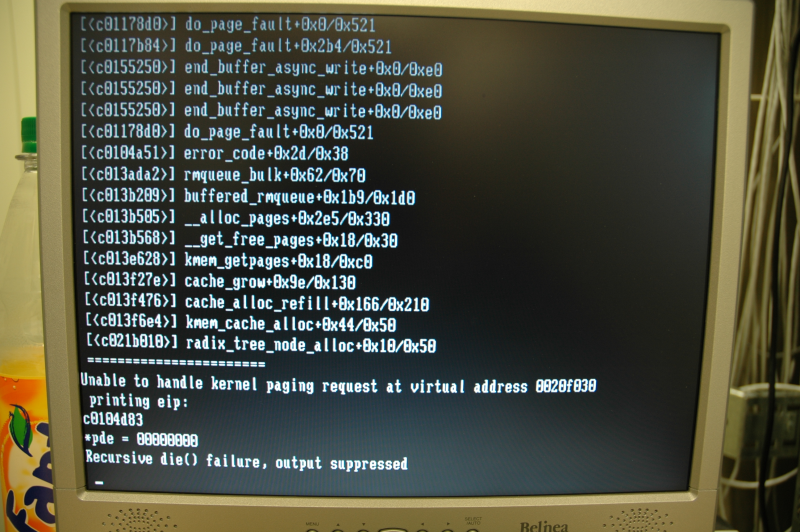
The machine is a Dual Opteron on Tyan K8S 4GB ECC-RAM running debian/unstable (yes thats 32-bit only) from a 3ware 9000 Controller (SATA) - 8 250GB Disks configured as single disks, no hw raid. Root-FS resides on SoftwareRAID, Application uses xfs filesystems on the disks.
I attached some vmstat and slapinfo output during the swapping-phase. Dont remember the exact kernel here but it was 2.6. (yes, the hostname is kernel. ;)
Stefan
Nov  2 17:12:26 kernel kernel: swapper: page allocation failure. order:0, mode:0x20
Nov  2 17:12:26 kernel kernel:  [__alloc_pages+417/800] __alloc_pages+0x1a1/0x320
Nov  2 17:12:26 kernel kernel:  [__get_free_pages+24/48] __get_free_pages+0x18/0x30
Nov  2 17:12:26 kernel kernel:  [kmem_getpages+24/192] kmem_getpages+0x18/0xc0
Nov  2 17:12:26 kernel kernel:  [cache_grow+157/304] cache_grow+0x9d/0x130
Nov  2 17:12:26 kernel kernel:  [nf_hook_slow+178/240] nf_hook_slow+0xb2/0xf0
Nov  2 17:12:26 kernel kernel:  [cache_alloc_refill+363/544] cache_alloc_refill+0x16b/0x220
Nov  2 17:12:26 kernel kernel:  [__kmalloc+122/144] __kmalloc+0x7a/0x90
Nov  2 17:12:26 kernel kernel:  [alloc_skb+50/208] alloc_skb+0x32/0xd0
Nov  2 17:12:26 kernel kernel:  [pg0+945331568/1068909568] tg3_alloc_rx_skb+0x70/0x130 [tg3]
Nov  2 17:12:26 kernel kernel:  [pg0+945332742/1068909568] tg3_rx+0x206/0x3b0 [tg3]
Nov  2 17:12:26 kernel kernel:  [pg0+945333307/1068909568] tg3_poll+0x8b/0x130 [tg3]
Nov  2 17:12:26 kernel kernel:  [net_rx_action+112/240] net_rx_action+0x70/0xf0
Nov  2 17:12:26 kernel kernel:  [__do_softirq+184/208] __do_softirq+0xb8/0xd0
Nov  2 17:12:26 kernel kernel:  [do_softirq+45/48] do_softirq+0x2d/0x30
Nov  2 17:12:26 kernel kernel:  [do_IRQ+43/64] do_IRQ+0x2b/0x40
Nov  2 17:12:26 kernel kernel:  [common_interrupt+24/32] common_interrupt+0x18/0x20
Nov  2 17:12:26 kernel kernel:  [default_idle+0/64] default_idle+0x0/0x40
Nov  2 17:12:26 kernel kernel:  [default_idle+44/64] default_idle+0x2c/0x40
Nov  2 17:12:26 kernel kernel:  [cpu_idle+51/64] cpu_idle+0x33/0x40
Nov  2 17:12:26 kernel kernel:  [start_kernel+332/368] start_kernel+0x14c/0x170
Nov  2 17:12:26 kernel kernel:  [unknown_bootoption+0/416] unknown_bootoption+0x0/0x1a0
procs -----------memory---------- ---swap-- -----io---- --system-- ----cpu----
 r  b   swpd   free   buff  cache   si   so    bi    bo   in    cs us sy id wa
 1  1 132964   3272   6420 1681888    0    0  1401  7668 15763   691  4 23 40 33
 1  1 132964   3100   6380 1685256    0    0  1928 11176 16051   705  4 27 39 30
 0  1 132964   3292   6212 1685288    0    0  1788  7575 16031   720  5 23 51 21
 0  2 132964   4016   6432 1683368    0    0  1752  9379 16221   652  4 26 46 24
 0  2 134180 197092    520 1496176   26  175  2473 12866 16302  1630  5 27 21 48
 1  0 145608  89844   1476 1604432   56 1182  2672  9028 16248   822  4 26 37 32
 1  0 145608  15148   2016 1675404   20    0  2127  4868 16193   612  4 26 48 22
 0  1 146816   3152   2432 1688956  171  122  1872  6761 14757   583  2 15 29 53
 0  2 146816   3972   2736 1693380  298    0  1982  7910 15626   666  3 23 48 27
 1  0 146816   4028   2796 1689412  170    0  1759  7339 15586   597  2 18 35 45
 0  1 146816   4136   2984 1690960  127    0  2091  7396 16146   557  3 26 43 27
 0  3 146816   4320   3460 1685736   86    0  2042  7381 15981   597  3 23 32 41
 0  1 146816  16820   3556 1672304   73    0  1082  9960 15361   777  2 18 34 46
 0  1 146816   3348   3704 1686584   40    0  1762  8153 16247   633  4 26 42 28
 0  2 146816   5700   3912 1683600   26    0  1973  9772 16120   669  4 24 42 30
 0  0 146816   6096   4084 1674224   32    0  1478  7469 15378   569  2 18 33 47
 0  3 146816   4284   4148 1680812   15    0  1052  8376 15717   576  3 24 43 30
 0  1 146816   3572   4412 1684472   29    0  1660 10212 15740   597  3 22 38 37
 0  0 146816   6220   4576 1680260   24    0  2256  8223 16015   656  4 25 47 25
 0  1 146816   3448   4436 1683892   11    0  1526  8507 15820   628  4 21 38 37
 0  0 146816   3152   4552 1687964   10    0  1609  9256 16244   665  4 25 52 18
 0  0 146816   4212   4660 1683816    5    0  1524  8207 16066   545  3 25 42 30
labinfo - version: 2.1
# name <active_objs> <num_objs> <objsize> <objperslab> <pagesperslab> : tunables <batchcount> <limit> <sharedfactor> : slabdata <active_slabs> <num_slabs> <sharedavail> ip_conntrack_expect 0 0 128 31 1 : tunables 120 60 8 : slabdata 0 0 0 ip_conntrack 22024 23748 320 12 1 : tunables 54 27 8 : slabdata 1979 1979 85 fib6_nodes 5 119 32 119 1 : tunables 120 60 8 : slabdata 1 1 0 ip6_dst_cache 4 15 256 15 1 : tunables 120 60 8 : slabdata 1 1 0 ndisc_cache 1 20 192 20 1 : tunables 120 60 8 : slabdata 1 1 0 rawv6_sock 4 11 704 11 2 : tunables 54 27 8 : slabdata 1 1 0 udpv6_sock 1 6 640 6 1 : tunables 54 27 8 : slabdata 1 1 0 tcpv6_sock 5 6 1216 3 1 : tunables 24 12 8 : slabdata 2 2 0 unix_sock 23 27 448 9 1 : tunables 54 27 8 : slabdata 3 3 0 tcp_tw_bucket 6281 7192 128 31 1 : tunables 120 60 8 : slabdata 232 232 120 tcp_bind_bucket 6 226 16 226 1 : tunables 120 60 8 : slabdata 1 1 0 tcp_open_request 214 310 128 31 1 : tunables 120 60 8 : slabdata 10 10 0 inet_peer_cache 2 61 64 61 1 : tunables 120 60 8 : slabdata 1 1 0 secpath_cache 0 0 128 31 1 : tunables 120 60 8 : slabdata 0 0 0 xfrm_dst_cache 0 0 256 15 1 : tunables 120 60 8 : slabdata 0 0 0 ip_fib_alias 9 226 16 226 1 : tunables 120 60 8 : slabdata 1 1 0 ip_fib_hash 9 119 32 119 1 : tunables 120 60 8 : slabdata 1 1 0 ip_dst_cache 11007 13515 256 15 1 : tunables 120 60 8 : slabdata 901 901 0 arp_cache 1 20 192 20 1 : tunables 120 60 8 : slabdata 1 1 0 raw_sock 3 7 512 7 1 : tunables 54 27 8 : slabdata 1 1 0 udp_sock 3 8 512 8 1 : tunables 54 27 8 : slabdata 1 1 0 tcp_sock 7192 7910 1088 7 2 : tunables 24 12 8 : slabdata 1130 1130 72 flow_cache 0 0 128 31 1 : tunables 120 60 8 : slabdata 0 0 0 dm-snapshot-in 128 162 48 81 1 : tunables 120 60 8 : slabdata 2 2 0 dm-snapshot-ex 0 0 16 226 1 : tunables 120 60 8 : slabdata 0 0 0 dm-crypt_io 0 0 76 52 1 : tunables 120 60 8 : slabdata 0 0 0 dm_tio 0 0 16 226 1 : tunables 120 60 8 : slabdata 0 0 0 dm_io 0 0 16 226 1 : tunables 120 60 8 : slabdata 0 0 0 scsi_cmd_cache 100 100 384 10 1 : tunables 54 27 8 : slabdata 10 10 27 cfq_ioc_pool 0 0 24 156 1 : tunables 120 60 8 : slabdata 0 0 0 cfq_pool 0 0 104 38 1 : tunables 120 60 8 : slabdata 0 0 0 crq_pool 0 0 52 75 1 : tunables 120 60 8 : slabdata 0 0 0 deadline_drq 0 0 48 81 1 : tunables 120 60 8 : slabdata 0 0 0 as_arq 515 845 60 65 1 : tunables 120 60 8 : slabdata 13 13 300 xfs_chashlist 583 740 20 185 1 : tunables 120 60 8 : slabdata 4 4 0 xfs_ili 1873 2184 140 28 1 : tunables 120 60 8 : slabdata 78 78 0 xfs_ifork 0 0 56 70 1 : tunables 120 60 8 : slabdata 0 0 0 xfs_efi_item 15 15 260 15 1 : tunables 54 27 8 : slabdata 1 1 0 xfs_efd_item 15 15 260 15 1 : tunables 54 27 8 : slabdata 1 1 0 xfs_buf_item 639 783 148 27 1 : tunables 120 60 8 : slabdata 29 29 284 xfs_dabuf 10 226 16 226 1 : tunables 120 60 8 : slabdata 1 1 0 xfs_da_state 0 0 336 12 1 : tunables 54 27 8 : slabdata 0 0 0 xfs_trans 260 260 596 13 2 : tunables 54 27 8 : slabdata 20 20 27 xfs_inode 2212 3135 368 11 1 : tunables 54 27 8 : slabdata 285 285 0 xfs_btree_cur 120 120 132 30 1 : tunables 120 60 8 : slabdata 4 4 0 xfs_bmap_free_item 24 290 12 290 1 : tunables 120 60 8 : slabdata 1 1 0 xfs_buf_t 690 870 256 15 1 : tunables 120 60 8 : slabdata 58 58 224 linvfs_icache 2003 2673 344 11 1 : tunables 54 27 8 : slabdata 243 243 0 hugetlbfs_inode_cache 1 12 312 12 1 : tunables 54 27 8 : slabdata 1 1 0 ext2_inode_cache 0 0 448 9 1 : tunables 54 27 8 : slabdata 0 0 0 ext2_xattr 0 0 44 88 1 : tunables 120 60 8 : slabdata 0 0 0 journal_handle 135 135 28 135 1 : tunables 120 60 8 : slabdata 1 1 0 journal_head 849 2835 48 81 1 : tunables 120 60 8 : slabdata 35 35 60 revoke_table 2 290 12 290 1 : tunables 120 60 8 : slabdata 1 1 0 revoke_record 109 226 16 226 1 : tunables 120 60 8 : slabdata 1 1 0 ext3_inode_cache 414 707 508 7 1 : tunables 54 27 8 : slabdata 101 101 0 ext3_xattr 0 0 44 88 1 : tunables 120 60 8 : slabdata 0 0 0 dnotify_cache 0 0 20 185 1 : tunables 120 60 8 : slabdata 0 0 0 eventpoll_pwq 0 0 36 107 1 : tunables 120 60 8 : slabdata 0 0 0 eventpoll_epi 0 0 128 31 1 : tunables 120 60 8 : slabdata 0 0 0 kioctx 0 0 192 20 1 : tunables 120 60 8 : slabdata 0 0 0 kiocb 0 0 128 31 1 : tunables 120 60 8 : slabdata 0 0 0 fasync_cache 0 0 16 226 1 : tunables 120 60 8 : slabdata 0 0 0 shmem_inode_cache 7 9 408 9 1 : tunables 54 27 8 : slabdata 1 1 0 posix_timers_cache 0 0 104 38 1 : tunables 120 60 8 : slabdata 0 0 0 uid_cache 3 61 64 61 1 : tunables 120 60 8 : slabdata 1 1 0 sgpool-128 32 33 2560 3 2 : tunables 24 12 8 : slabdata 11 11 0 sgpool-64 32 33 1280 3 1 : tunables 24 12 8 : slabdata 11 11 0 sgpool-32 102 102 640 6 1 : tunables 54 27 8 : slabdata 17 17 27 sgpool-16 96 96 320 12 1 : tunables 54 27 8 : slabdata 8 8 0 sgpool-8 200 200 192 20 1 : tunables 120 60 8 : slabdata 10 10 60 blkdev_ioc 84 135 28 135 1 : tunables 120 60 8 : slabdata 1 1 0 blkdev_queue 10 20 372 10 1 : tunables 54 27 8 : slabdata 2 2 0 blkdev_requests 471 840 140 28 1 : tunables 120 60 8 : slabdata 30 30 240 biovec-(256) 256 256 3072 2 2 : tunables 24 12 8 : slabdata 128 128 0 biovec-128 256 260 1536 5 2 : tunables 24 12 8 : slabdata 52 52 0 biovec-64 320 320 768 5 1 : tunables 54 27 8 : slabdata 64 64 0 biovec-16 350 380 192 20 1 : tunables 120 60 8 : slabdata 19 19 0 biovec-4 374 427 64 61 1 : tunables 120 60 8 : slabdata 7 7 0 biovec-1 1456 3164 16 226 1 : tunables 120 60 8 : slabdata 14 14 480 bio 1418 2196 64 61 1 : tunables 120 60 8 : slabdata 36 36 480 file_lock_cache 23 43 92 43 1 : tunables 120 60 8 : slabdata 1 1 0 sock_inode_cache 7064 7830 384 10 1 : tunables 54 27 8 : slabdata 783 783 135 skbuff_head_cache 14636 23220 192 20 1 : tunables 120 60 8 : slabdata 1161 1161 420 sock 3 10 384 10 1 : tunables 54 27 8 : slabdata 1 1 0 proc_inode_cache 321 360 328 12 1 : tunables 54 27 8 : slabdata 30 30 0 sigqueue 19 27 148 27 1 : tunables 120 60 8 : slabdata 1 1 0 radix_tree_node 22347 28602 276 14 1 : tunables 54 27 8 : slabdata 2043 2043 27 bdev_cache 30 45 448 9 1 : tunables 54 27 8 : slabdata 5 5 0 mnt_cache 26 62 128 31 1 : tunables 120 60 8 : slabdata 2 2 0 inode_cache 1040 1128 312 12 1 : tunables 54 27 8 : slabdata 94 94 0 dentry_cache 10067 15400 140 28 1 : tunables 120 60 8 : slabdata 550 550 240 filp 8189 9100 192 20 1 : tunables 120 60 8 : slabdata 455 455 60 names_cache 26 26 4096 1 1 : tunables 24 12 8 : slabdata 26 26 0 idr_layer_cache 112 116 136 29 1 : tunables 120 60 8 : slabdata 4 4 0 buffer_head 345712 472959 48 81 1 : tunables 120 60 8 : slabdata 5839 5839 480 mm_struct 91 91 576 7 1 : tunables 54 27 8 : slabdata 13 13 0 vm_area_struct 1994 2205 88 45 1 : tunables 120 60 8 : slabdata 49 49 0 fs_cache 86 183 64 61 1 : tunables 120 60 8 : slabdata 3 3 0 files_cache 87 99 448 9 1 : tunables 54 27 8 : slabdata 11 11 0 signal_cache 111 165 256 15 1 : tunables 120 60 8 : slabdata 11 11 0 sighand_cache 104 108 1344 3 1 : tunables 24 12 8 : slabdata 36 36 0 task_struct 111 111 1280 3 1 : tunables 24 12 8 : slabdata 37 37 0 anon_vma 635 870 12 290 1 : tunables 120 60 8 : slabdata 3 3 0 pgd 115 238 32 119 1 : tunables 120 60 8 : slabdata 2 2 0 pmd 180 180 4096 1 1 : tunables 24 12 8 : slabdata 180 180 0 size-131072(DMA) 0 0 131072 1 32 : tunables 8 4 0 : slabdata 0 0 0 size-131072 0 0 131072 1 32 : tunables 8 4 0 : slabdata 0 0 0 size-65536(DMA) 0 0 65536 1 16 : tunables 8 4 0 : slabdata 0 0 0 size-65536 19 19 65536 1 16 : tunables 8 4 0 : slabdata 19 19 0 size-32768(DMA) 0 0 32768 1 8 : tunables 8 4 0 : slabdata 0 0 0 size-32768 139 139 32768 1 8 : tunables 8 4 0 : slabdata 139 139 0 size-16384(DMA) 0 0 16384 1 4 : tunables 8 4 0 : slabdata 0 0 0 size-16384 151 153 16384 1 4 : tunables 8 4 0 : slabdata 151 153 0 size-8192(DMA) 0 0 8192 1 2 : tunables 8 4 0 : slabdata 0 0 0 size-8192 365 365 8192 1 2 : tunables 8 4 0 : slabdata 365 365 0 size-4096(DMA) 0 0 4096 1 1 : tunables 24 12 8 : slabdata 0 0 0 size-4096 770 770 4096 1 1 : tunables 24 12 8 : slabdata 770 770 48 size-2048(DMA) 0 0 2048 2 1 : tunables 24 12 8 : slabdata 0 0 0 size-2048 14460 14556 2048 2 1 : tunables 24 12 8 : slabdata 7278 7278 12 size-1024(DMA) 0 0 1024 4 1 : tunables 54 27 8 : slabdata 0 0 0 size-1024 888 888 1024 4 1 : tunables 54 27 8 : slabdata 222 222 54 size-512(DMA) 0 0 512 8 1 : tunables 54 27 8 : slabdata 0 0 0 size-512 886 1352 512 8 1 : tunables 54 27 8 : slabdata 169 169 108 size-256(DMA) 0 0 256 15 1 : tunables 120 60 8 : slabdata 0 0 0 size-256 270 300 256 15 1 : tunables 120 60 8 : slabdata 20 20 0 size-192(DMA) 0 0 192 20 1 : tunables 120 60 8 : slabdata 0 0 0 size-192 156 180 192 20 1 : tunables 120 60 8 : slabdata 9 9 0 size-128(DMA) 0 0 128 31 1 : tunables 120 60 8 : slabdata 0 0 0 size-128 1921 2635 128 31 1 : tunables 120 60 8 : slabdata 85 85 0 size-64(DMA) 0 0 64 61 1 : tunables 120 60 8 : slabdata 0 0 0 size-64 7293 13603 64 61 1 : tunables 120 60 8 : slabdata 223 223 480 size-32(DMA) 0 0 32 119 1 : tunables 120 60 8 : slabdata 0 0 0 size-32 10802 19516 32 119 1 : tunables 120 60 8 : slabdata 164 164 120 kmem_cache 160 160 192 20 1 : tunables 120 60 8 : slabdata 8 8 0
Quoted 9 lines · Stefan Schmidt
Quoted 3 lines · Andrew Morton
Quoted 1 line
swapper: page allocation failure. order:0, mode:0x20
This should be harmless - networking will recover. The TSO fix was merged a week or so ago.
Ahem,
i don't think its all that harmless:
My machine got hundreds of the same in a row even after raising vm.min_free_kbytes to 8192 and playing with vm.* in one direction and then in the other one.
What is min_free_kbytes default on your machine?
Quoted 7 lines
Essentially the application took 2.2GB and cache was around 1.7GB of 4GB available memory. The machine swapping heavily at ~3m intervals and setting swappiness to zero did not help.
I tried the following kernels: 2.6.9-mm1, 2.6.10-rc1-bk12, 2.6.9-rc3-bk6, 2.6.9-rc3-bk5 all of which froze at some point presenting me only with the above page allocation failure. (no more sysrq)
2.6.9 gave me this in the end: http://zaphods.net/~zaphodb/recursive_die.png
This should be harmless as Andrew said - it would be helpful if you could plug a serial cable to the box - this last oops on the picture doesnt say much.
How intense is the network traffic you're generating?
Quoted 6 lines
Which was the point i decided to give 2.4 a try and guess what: This is running faster and at higher packet rates than the 2.6 kernels achived and is stable for the last three hours which at this load is more than the abovementioned 2.6 kernels managed.
I got the impression there is another 2.6 vm-instability which made it in the kernel after 2.6.7.
2.6.7 was stable under the same load?
2.4 keeps a higher amount of free pages around, but you should be able to tune that with vm.min_free_kbytes...
For some reason the VM is not being able to keep enough pages free. But then it shouldnt matter - if the tg3 driver can't allocate memory it should drop the packet and not lockup.
Something is definately screwed, and there are quite an amount of similar reports.
XFS also seems to be very memory hungry...
Quoted 198 lines
The machine is a Dual Opteron on Tyan K8S 4GB ECC-RAM running debian/unstable (yes thats 32-bit only) from a 3ware 9000 Controller (SATA) - 8 250GB Disks configured as single disks, no hw raid. Root-FS resides on SoftwareRAID, Application uses xfs filesystems on the disks.
I attached some vmstat and slapinfo output during the swapping-phase. Dont remember the exact kernel here but it was 2.6. (yes, the hostname is kernel. ;)
Stefan
Nov  2 17:12:26 kernel kernel: swapper: page allocation failure. order:0, mode:0x20
Nov  2 17:12:26 kernel kernel:  [__alloc_pages+417/800] __alloc_pages+0x1a1/0x320
Nov  2 17:12:26 kernel kernel:  [__get_free_pages+24/48] __get_free_pages+0x18/0x30
Nov  2 17:12:26 kernel kernel:  [kmem_getpages+24/192] kmem_getpages+0x18/0xc0
Nov  2 17:12:26 kernel kernel:  [cache_grow+157/304] cache_grow+0x9d/0x130
Nov  2 17:12:26 kernel kernel:  [nf_hook_slow+178/240] nf_hook_slow+0xb2/0xf0
Nov  2 17:12:26 kernel kernel:  [cache_alloc_refill+363/544] cache_alloc_refill+0x16b/0x220
Nov  2 17:12:26 kernel kernel:  [__kmalloc+122/144] __kmalloc+0x7a/0x90
Nov  2 17:12:26 kernel kernel:  [alloc_skb+50/208] alloc_skb+0x32/0xd0
Nov  2 17:12:26 kernel kernel:  [pg0+945331568/1068909568] tg3_alloc_rx_skb+0x70/0x130 [tg3]
Nov  2 17:12:26 kernel kernel:  [pg0+945332742/1068909568] tg3_rx+0x206/0x3b0 [tg3]
Nov  2 17:12:26 kernel kernel:  [pg0+945333307/1068909568] tg3_poll+0x8b/0x130 [tg3]
Nov  2 17:12:26 kernel kernel:  [net_rx_action+112/240] net_rx_action+0x70/0xf0
Nov  2 17:12:26 kernel kernel:  [__do_softirq+184/208] __do_softirq+0xb8/0xd0
Nov  2 17:12:26 kernel kernel:  [do_softirq+45/48] do_softirq+0x2d/0x30
Nov  2 17:12:26 kernel kernel:  [do_IRQ+43/64] do_IRQ+0x2b/0x40
Nov  2 17:12:26 kernel kernel:  [common_interrupt+24/32] common_interrupt+0x18/0x20
Nov  2 17:12:26 kernel kernel:  [default_idle+0/64] default_idle+0x0/0x40
Nov  2 17:12:26 kernel kernel:  [default_idle+44/64] default_idle+0x2c/0x40
Nov  2 17:12:26 kernel kernel:  [cpu_idle+51/64] cpu_idle+0x33/0x40
Nov  2 17:12:26 kernel kernel:  [start_kernel+332/368] start_kernel+0x14c/0x170
Nov  2 17:12:26 kernel kernel:  [unknown_bootoption+0/416] unknown_bootoption+0x0/0x1a0
procs -----------memory---------- ---swap-- -----io---- --system-- ----cpu----
 r  b   swpd   free   buff  cache   si   so    bi    bo   in    cs us sy id wa
 1  1 132964   3272   6420 1681888    0    0  1401  7668 15763   691  4 23 40 33
 1  1 132964   3100   6380 1685256    0    0  1928 11176 16051   705  4 27 39 30
 0  1 132964   3292   6212 1685288    0    0  1788  7575 16031   720  5 23 51 21
 0  2 132964   4016   6432 1683368    0    0  1752  9379 16221   652  4 26 46 24
 0  2 134180 197092    520 1496176   26  175  2473 12866 16302  1630  5 27 21 48
 1  0 145608  89844   1476 1604432   56 1182  2672  9028 16248   822  4 26 37 32
 1  0 145608  15148   2016 1675404   20    0  2127  4868 16193   612  4 26 48 22
 0  1 146816   3152   2432 1688956  171  122  1872  6761 14757   583  2 15 29 53
 0  2 146816   3972   2736 1693380  298    0  1982  7910 15626   666  3 23 48 27
 1  0 146816   4028   2796 1689412  170    0  1759  7339 15586   597  2 18 35 45
 0  1 146816   4136   2984 1690960  127    0  2091  7396 16146   557  3 26 43 27
 0  3 146816   4320   3460 1685736   86    0  2042  7381 15981   597  3 23 32 41
 0  1 146816  16820   3556 1672304   73    0  1082  9960 15361   777  2 18 34 46
 0  1 146816   3348   3704 1686584   40    0  1762  8153 16247   633  4 26 42 28
 0  2 146816   5700   3912 1683600   26    0  1973  9772 16120   669  4 24 42 30
 0  0 146816   6096   4084 1674224   32    0  1478  7469 15378   569  2 18 33 47
 0  3 146816   4284   4148 1680812   15    0  1052  8376 15717   576  3 24 43 30
 0  1 146816   3572   4412 1684472   29    0  1660 10212 15740   597  3 22 38 37
 0  0 146816   6220   4576 1680260   24    0  2256  8223 16015   656  4 25 47 25
 0  1 146816   3448   4436 1683892   11    0  1526  8507 15820   628  4 21 38 37
 0  0 146816   3152   4552 1687964   10    0  1609  9256 16244   665  4 25 52 18
 0  0 146816   4212   4660 1683816    5    0  1524  8207 16066   545  3 25 42 30
labinfo - version: 2.1
# name <active_objs> <num_objs> <objsize> <objperslab> <pagesperslab> : tunables <batchcount> <limit> <sharedfactor> : slabdata <active_slabs> <num_slabs> <sharedavail> ip_conntrack_expect 0 0 128 31 1 : tunables 120 60 8 : slabdata 0 0 0 ip_conntrack 22024 23748 320 12 1 : tunables 54 27 8 : slabdata 1979 1979 85 fib6_nodes 5 119 32 119 1 : tunables 120 60 8 : slabdata 1 1 0 ip6_dst_cache 4 15 256 15 1 : tunables 120 60 8 : slabdata 1 1 0 ndisc_cache 1 20 192 20 1 : tunables 120 60 8 : slabdata 1 1 0 rawv6_sock 4 11 704 11 2 : tunables 54 27 8 : slabdata 1 1 0 udpv6_sock 1 6 640 6 1 : tunables 54 27 8 : slabdata 1 1 0 tcpv6_sock 5 6 1216 3 1 : tunables 24 12 8 : slabdata 2 2 0 unix_sock 23 27 448 9 1 : tunables 54 27 8 : slabdata 3 3 0 tcp_tw_bucket 6281 7192 128 31 1 : tunables 120 60 8 : slabdata 232 232 120 tcp_bind_bucket 6 226 16 226 1 : tunables 120 60 8 : slabdata 1 1 0 tcp_open_request 214 310 128 31 1 : tunables 120 60 8 : slabdata 10 10 0 inet_peer_cache 2 61 64 61 1 : tunables 120 60 8 : slabdata 1 1 0 secpath_cache 0 0 128 31 1 : tunables 120 60 8 : slabdata 0 0 0 xfrm_dst_cache 0 0 256 15 1 : tunables 120 60 8 : slabdata 0 0 0 ip_fib_alias 9 226 16 226 1 : tunables 120 60 8 : slabdata 1 1 0 ip_fib_hash 9 119 32 119 1 : tunables 120 60 8 : slabdata 1 1 0 ip_dst_cache 11007 13515 256 15 1 : tunables 120 60 8 : slabdata 901 901 0 arp_cache 1 20 192 20 1 : tunables 120 60 8 : slabdata 1 1 0 raw_sock 3 7 512 7 1 : tunables 54 27 8 : slabdata 1 1 0 udp_sock 3 8 512 8 1 : tunables 54 27 8 : slabdata 1 1 0 tcp_sock 7192 7910 1088 7 2 : tunables 24 12 8 : slabdata 1130 1130 72 flow_cache 0 0 128 31 1 : tunables 120 60 8 : slabdata 0 0 0 dm-snapshot-in 128 162 48 81 1 : tunables 120 60 8 : slabdata 2 2 0 dm-snapshot-ex 0 0 16 226 1 : tunables 120 60 8 : slabdata 0 0 0 dm-crypt_io 0 0 76 52 1 : tunables 120 60 8 : slabdata 0 0 0 dm_tio 0 0 16 226 1 : tunables 120 60 8 : slabdata 0 0 0 dm_io 0 0 16 226 1 : tunables 120 60 8 : slabdata 0 0 0 scsi_cmd_cache 100 100 384 10 1 : tunables 54 27 8 : slabdata 10 10 27 cfq_ioc_pool 0 0 24 156 1 : tunables 120 60 8 : slabdata 0 0 0 cfq_pool 0 0 104 38 1 : tunables 120 60 8 : slabdata 0 0 0 crq_pool 0 0 52 75 1 : tunables 120 60 8 : slabdata 0 0 0 deadline_drq 0 0 48 81 1 : tunables 120 60 8 : slabdata 0 0 0 as_arq 515 845 60 65 1 : tunables 120 60 8 : slabdata 13 13 300 xfs_chashlist 583 740 20 185 1 : tunables 120 60 8 : slabdata 4 4 0 xfs_ili 1873 2184 140 28 1 : tunables 120 60 8 : slabdata 78 78 0 xfs_ifork 0 0 56 70 1 : tunables 120 60 8 : slabdata 0 0 0 xfs_efi_item 15 15 260 15 1 : tunables 54 27 8 : slabdata 1 1 0 xfs_efd_item 15 15 260 15 1 : tunables 54 27 8 : slabdata 1 1 0 xfs_buf_item 639 783 148 27 1 : tunables 120 60 8 : slabdata 29 29 284 xfs_dabuf 10 226 16 226 1 : tunables 120 60 8 : slabdata 1 1 0 xfs_da_state 0 0 336 12 1 : tunables 54 27 8 : slabdata 0 0 0 xfs_trans 260 260 596 13 2 : tunables 54 27 8 : slabdata 20 20 27 xfs_inode 2212 3135 368 11 1 : tunables 54 27 8 : slabdata 285 285 0 xfs_btree_cur 120 120 132 30 1 : tunables 120 60 8 : slabdata 4 4 0 xfs_bmap_free_item 24 290 12 290 1 : tunables 120 60 8 : slabdata 1 1 0 xfs_buf_t 690 870 256 15 1 : tunables 120 60 8 : slabdata 58 58 224 linvfs_icache 2003 2673 344 11 1 : tunables 54 27 8 : slabdata 243 243 0 hugetlbfs_inode_cache 1 12 312 12 1 : tunables 54 27 8 : slabdata 1 1 0 ext2_inode_cache 0 0 448 9 1 : tunables 54 27 8 : slabdata 0 0 0 ext2_xattr 0 0 44 88 1 : tunables 120 60 8 : slabdata 0 0 0 journal_handle 135 135 28 135 1 : tunables 120 60 8 : slabdata 1 1 0 journal_head 849 2835 48 81 1 : tunables 120 60 8 : slabdata 35 35 60 revoke_table 2 290 12 290 1 : tunables 120 60 8 : slabdata 1 1 0 revoke_record 109 226 16 226 1 : tunables 120 60 8 : slabdata 1 1 0 ext3_inode_cache 414 707 508 7 1 : tunables 54 27 8 : slabdata 101 101 0 ext3_xattr 0 0 44 88 1 : tunables 120 60 8 : slabdata 0 0 0 dnotify_cache 0 0 20 185 1 : tunables 120 60 8 : slabdata 0 0 0 eventpoll_pwq 0 0 36 107 1 : tunables 120 60 8 : slabdata 0 0 0 eventpoll_epi 0 0 128 31 1 : tunables 120 60 8 : slabdata 0 0 0 kioctx 0 0 192 20 1 : tunables 120 60 8 : slabdata 0 0 0 kiocb 0 0 128 31 1 : tunables 120 60 8 : slabdata 0 0 0 fasync_cache 0 0 16 226 1 : tunables 120 60 8 : slabdata 0 0 0 shmem_inode_cache 7 9 408 9 1 : tunables 54 27 8 : slabdata 1 1 0 posix_timers_cache 0 0 104 38 1 : tunables 120 60 8 : slabdata 0 0 0 uid_cache 3 61 64 61 1 : tunables 120 60 8 : slabdata 1 1 0 sgpool-128 32 33 2560 3 2 : tunables 24 12 8 : slabdata 11 11 0 sgpool-64 32 33 1280 3 1 : tunables 24 12 8 : slabdata 11 11 0 sgpool-32 102 102 640 6 1 : tunables 54 27 8 : slabdata 17 17 27 sgpool-16 96 96 320 12 1 : tunables 54 27 8 : slabdata 8 8 0 sgpool-8 200 200 192 20 1 : tunables 120 60 8 : slabdata 10 10 60 blkdev_ioc 84 135 28 135 1 : tunables 120 60 8 : slabdata 1 1 0 blkdev_queue 10 20 372 10 1 : tunables 54 27 8 : slabdata 2 2 0 blkdev_requests 471 840 140 28 1 : tunables 120 60 8 : slabdata 30 30 240 biovec-(256) 256 256 3072 2 2 : tunables 24 12 8 : slabdata 128 128 0 biovec-128 256 260 1536 5 2 : tunables 24 12 8 : slabdata 52 52 0 biovec-64 320 320 768 5 1 : tunables 54 27 8 : slabdata 64 64 0 biovec-16 350 380 192 20 1 : tunables 120 60 8 : slabdata 19 19 0 biovec-4 374 427 64 61 1 : tunables 120 60 8 : slabdata 7 7 0 biovec-1 1456 3164 16 226 1 : tunables 120 60 8 : slabdata 14 14 480 bio 1418 2196 64 61 1 : tunables 120 60 8 : slabdata 36 36 480 file_lock_cache 23 43 92 43 1 : tunables 120 60 8 : slabdata 1 1 0 sock_inode_cache 7064 7830 384 10 1 : tunables 54 27 8 : slabdata 783 783 135 skbuff_head_cache 14636 23220 192 20 1 : tunables 120 60 8 : slabdata 1161 1161 420 sock 3 10 384 10 1 : tunables 54 27 8 : slabdata 1 1 0 proc_inode_cache 321 360 328 12 1 : tunables 54 27 8 : slabdata 30 30 0 sigqueue 19 27 148 27 1 : tunables 120 60 8 : slabdata 1 1 0 radix_tree_node 22347 28602 276 14 1 : tunables 54 27 8 : slabdata 2043 2043 27 bdev_cache 30 45 448 9 1 : tunables 54 27 8 : slabdata 5 5 0 mnt_cache 26 62 128 31 1 : tunables 120 60 8 : slabdata 2 2 0 inode_cache 1040 1128 312 12 1 : tunables 54 27 8 : slabdata 94 94 0 dentry_cache 10067 15400 140 28 1 : tunables 120 60 8 : slabdata 550 550 240 filp 8189 9100 192 20 1 : tunables 120 60 8 : slabdata 455 455 60 names_cache 26 26 4096 1 1 : tunables 24 12 8 : slabdata 26 26 0 idr_layer_cache 112 116 136 29 1 : tunables 120 60 8 : slabdata 4 4 0 buffer_head 345712 472959 48 81 1 : tunables 120 60 8 : slabdata 5839 5839 480 mm_struct 91 91 576 7 1 : tunables 54 27 8 : slabdata 13 13 0 vm_area_struct 1994 2205 88 45 1 : tunables 120 60 8 : slabdata 49 49 0 fs_cache 86 183 64 61 1 : tunables 120 60 8 : slabdata 3 3 0 files_cache 87 99 448 9 1 : tunables 54 27 8 : slabdata 11 11 0 signal_cache 111 165 256 15 1 : tunables 120 60 8 : slabdata 11 11 0 sighand_cache 104 108 1344 3 1 : tunables 24 12 8 : slabdata 36 36 0 task_struct 111 111 1280 3 1 : tunables 24 12 8 : slabdata 37 37 0 anon_vma 635 870 12 290 1 : tunables 120 60 8 : slabdata 3 3 0 pgd 115 238 32 119 1 : tunables 120 60 8 : slabdata 2 2 0 pmd 180 180 4096 1 1 : tunables 24 12 8 : slabdata 180 180 0 size-131072(DMA) 0 0 131072 1 32 : tunables 8 4 0 : slabdata 0 0 0 size-131072 0 0 131072 1 32 : tunables 8 4 0 : slabdata 0 0 0 size-65536(DMA) 0 0 65536 1 16 : tunables 8 4 0 : slabdata 0 0 0 size-65536 19 19 65536 1 16 : tunables 8 4 0 : slabdata 19 19 0 size-32768(DMA) 0 0 32768 1 8 : tunables 8 4 0 : slabdata 0 0 0 size-32768 139 139 32768 1 8 : tunables 8 4 0 : slabdata 139 139 0 size-16384(DMA) 0 0 16384 1 4 : tunables 8 4 0 : slabdata 0 0 0 size-16384 151 153 16384 1 4 : tunables 8 4 0 : slabdata 151 153 0 size-8192(DMA) 0 0 8192 1 2 : tunables 8 4 0 : slabdata 0 0 0 size-8192 365 365 8192 1 2 : tunables 8 4 0 : slabdata 365 365 0 size-4096(DMA) 0 0 4096 1 1 : tunables 24 12 8 : slabdata 0 0 0 size-4096 770 770 4096 1 1 : tunables 24 12 8 : slabdata 770 770 48 size-2048(DMA) 0 0 2048 2 1 : tunables 24 12 8 : slabdata 0 0 0 size-2048 14460 14556 2048 2 1 : tunables 24 12 8 : slabdata 7278 7278 12 size-1024(DMA) 0 0 1024 4 1 : tunables 54 27 8 : slabdata 0 0 0 size-1024 888 888 1024 4 1 : tunables 54 27 8 : slabdata 222 222 54 size-512(DMA) 0 0 512 8 1 : tunables 54 27 8 : slabdata 0 0 0 size-512 886 1352 512 8 1 : tunables 54 27 8 : slabdata 169 169 108 size-256(DMA) 0 0 256 15 1 : tunables 120 60 8 : slabdata 0 0 0 size-256 270 300 256 15 1 : tunables 120 60 8 : slabdata 20 20 0 size-192(DMA) 0 0 192 20 1 : tunables 120 60 8 : slabdata 0 0 0 size-192 156 180 192 20 1 : tunables 120 60 8 : slabdata 9 9 0 size-128(DMA) 0 0 128 31 1 : tunables 120 60 8 : slabdata 0 0 0 size-128 1921 2635 128 31 1 : tunables 120 60 8 : slabdata 85 85 0 size-64(DMA) 0 0 64 61 1 : tunables 120 60 8 : slabdata 0 0 0 size-64 7293 13603 64 61 1 : tunables 120 60 8 : slabdata 223 223 480 size-32(DMA) 0 0 32 119 1 : tunables 120 60 8 : slabdata 0 0 0 size-32 10802 19516 32 119 1 : tunables 120 60 8 : slabdata 164 164 120 kmem_cache 160 160 192 20 1 : tunables 120 60 8 : slabdata 8 8 0
Quoted 1 line · Marcelo Tosatti
What is
min_free_kbytesdefault on your machine?
I think it was 768, definitely around 700-800.
2.6.9 said:
Dentry cache hash table entries: 131072 (order: 7, 524288 bytes) Inode-cache hash table entries: 65536 (order: 6, 262144 bytes)
Memory: 4058200k/4095936k available (2005k kernel code, 36816k reserved, 995k data, 196k init, 3178432k highmem)
Quoted 6 lines
Quoted 3 lines
I tried the following kernels: 2.6.9-mm1, 2.6.10-rc1-bk12, 2.6.9-rc3-bk6, 2.6.9-rc3-bk5 all of which froze at some point presenting me only with the above page allocation failure. (no more sysrq)
This should be harmless as Andrew said - it would be helpful if you could plug a serial cable to the box - this last oops on the picture doesnt say much.
Well right now the machine is running 2.4.28-rc1 with the 3w-9nnn patch by Adam Radford from this list and i would like to see it run stable for about a day before i give 2.6 another try. I think i'll have a terminal server hooked up by then.
Quoted 1 line
How intense is the network traffic you're generating?
I was around 60-80 mbit/s each direction at i think 16k interrupts/s.
With 2.4.28-rc1 this is currently at 180mbit/s 27kpps up, 116mbit/s 24kpps down still swapping a bit but no kernel messages on this, just around 1.7 rx errors/s.
Quoted 1 line
2.6.7 was stable under the same load?
No, sorry to give you this impression, 2.6.7 is just what some of my collegues and i consider the more stable 2.6 kernel under heavy i/o load.
Quoted 2 lines
Something is definately screwed, and there are quite an amount of similar reports.
Can i tell people its ok to see nf_hook_slow in the stack trace as it's vm-related? A collegue was quite bluffed when i showed him. ;)
Quoted 1 line
XFS also seems to be very memory hungry...
I have 8 XFS-Filesystems in use here with several thousand files from some k to your 'usual' 4GB DVD-image. XFS built as a module at first and then inline but that did not change anything off course. 2x200 + 6x250GB that is.
Stefan
Re: Kernel 2.6.9 Multiple Page Allocation Failures
Quoted 33 lines · Stefan Schmidt
Quoted 1 line · Marcelo Tosatti
What is
min_free_kbytesdefault on your machine?I think it was 768, definitely around 700-800.
2.6.9 said:
Dentry cache hash table entries: 131072 (order: 7, 524288 bytes) Inode-cache hash table entries: 65536 (order: 6, 262144 bytes)
Memory: 4058200k/4095936k available (2005k kernel code, 36816k reserved, 995k data, 196k init, 3178432k highmem)Quoted 6 lines
Quoted 3 lines
I tried the following kernels: 2.6.9-mm1, 2.6.10-rc1-bk12, 2.6.9-rc3-bk6, 2.6.9-rc3-bk5 all of which froze at some point presenting me only with the above page allocation failure. (no more sysrq)
This should be harmless as Andrew said - it would be helpful if you could plug a serial cable to the box - this last oops on the picture doesnt say much.
Well right now the machine is running 2.4.28-rc1 with the 3w-9nnn patch by Adam Radford from this list and i would like to see it run stable for about a day before i give 2.6 another try. I think i'll have a terminal server hooked up by then.
Quoted 1 line
How intense is the network traffic you're generating?
I was around 60-80 mbit/s each direction at i think 16k interrupts/s.
With 2.4.28-rc1 this is currently at 180mbit/s 27kpps up, 116mbit/s 24kpps down still swapping a bit but no kernel messages on this, just around 1.7 rx errors/s.
Quoted 1 line
2.6.7 was stable under the same load?
No, sorry to give you this impression, 2.6.7 is just what some of my collegues and i consider the more stable 2.6 kernel under heavy i/o load.
Quoted 2 lines
Something is definately screwed, and there are quite an amount of similar reports.
Quoted 7 lines
Can i tell people its ok to see
nf_hook_slowin the stack trace as it's vm-related? A collegue was quite bluffed when i showed him. ;)Quoted 1 line
XFS also seems to be very memory hungry...
I have 8 XFS-Filesystems in use here with several thousand files from some k to your 'usual' 4GB DVD-image. XFS built as a module at first and then inline but that did not change anything off course. 2x200 + 6x250GB that is.
Stefan, Lukas,
Can you please run your workload which cause 0-order page allocation failures with the following patch, pretty please?
We will have more information on the free areas state when the allocation fails.
Andrew, please apply it to the next -mm, will you?
mm/page_alloc.c +1 -0
@@ -902,6 +902,7 @@" order:%d, mode:0x%x\n" , p->comm, order, gfp_mask);dump_stack (); +show_free_areas (); }return NULL ; got_pg:
Re: Kernel 2.6.9 Multiple Page Allocation Failures
Hi all,
Quoted 9 lines · Marcelo Tosatti
Stefan, Lukas,
Can you please run your workload which cause 0-order page allocation failures with the following patch, pretty please?
We will have more information on the free areas state when the allocation fails.
Andrew, please apply it to the next -mm, will you?
here is the trace:
klogd: page allocation failure. order:0, mode: 0x20
[__alloc_pages+441/862] __alloc_pages+0x1b9/0x363 [__get_free_pages+42/63] __get_free_pages+0x25/0x3f [kmem_getpages+37/201] kmem_getpages+0x21/0xc9 [cache_grow+175/333] cache_grow+0xab/0x14d [cache_alloc_refill+376/537] cache_alloc_refill+0x174/0x219 [__kmalloc+137/140] __kmalloc+0x85/0x8c [alloc_skb+75/224] alloc_skb+0x47/0xe0 [e1000_alloc_rx_buffers+72/227] e1000_alloc_rx_buffers+0x44/0xe3 [e1000_clean_rx_irq+402/1095] e1000_clean_rx_irq+0x18e/0x447 [e1000_clean+85/202] e1000_clean+0x51/0xca [net_rx_action+123/246] net_rx_action+0x77/0xf6 [__do_softirq+183/198] __do_softirq+0xb7/0xc6 [do_softirq+45/47] do_softirq+0x2d/0x2f [do_IRQ+274/304] do_IRQ+0x112/0x130 [common_interrupt+24/32] common_interrupt+0x18/0x20 [_spin_unlock_irq+13/28] _spin_unlock_irq+0x9/0x1c [do_syslog+295/990] do_syslog+0x127/0x3de [autoremove_wake_function+0/87] autoremove_wake_function+0x0/0x57 [autoremove_wake_function+0/87] autoremove_wake_function+0x0/0x57 [dnotify_parent+62/166] dnotify_parent+0x3a/0xa6 [vfs_read+180/281] vfs_read+0xb0/0x119 [sys_read+85/128] sys_read+0x51/0x80 [syscall_call+7/11] syscall_call+0x7/0xb
DMA per-cpu:
cpu 0 hot: low 2, high 6, batch 1
cpu 0 cold: low 0, high 2, batch 1
cpu 1 hot: low 2, high 6, batch 1
cpu 1 cold: low 0, high 2, batch 1
Normal per-cpu:
cpu 0 hot: low 32, high 96, batch 16
cpu 0 cold: low 0, high 32, batch 16
cpu 1 hot: low 32, high 96, batch 16
cpu 1 cold: low 0, high 32, batch 16
HighMem per-cpu:
cpu 0 hot: low 14, high 42, batch 7
cpu 0 cold: low 0, high 14, batch 7
cpu 1 hot: low 14, high 42, batch 7
cpu 1 cold: low 0, high 14, batch 7
Free pages: 348kB (112kB HighMem)
Active:38175 inactive:210615 dirty:95618 writeback:2461 unstable:0 free:87 slab:7706 mapped:14968 pagetables:404 DMA free:4kB min:12kB low:24kB high:36kB active:456kB inactive:11152kB present:16384kB protections[]: 0 0 0
Normal free:232kB min:708kB low:1416kB high:384kB active:40264kB inactive:88296kB present:131008kB protections[]: 0 0 0
HighMem free:112kB min:128kB low:256kB high:384kB active:40264kB inactive:88296kB present:131008kB protections[]: 0 0 0
DMA: 1*4kB 0*8kB 0*16kB 0*32kB 0*64kB 0*128kB 0*256kB 0*512kB 0*1024kB 0*2048kB 0*4096kB = 4kB
Normal: 0*4kB 1*8kB 0*16kB 1*32kB 1*64kB 1*128kB 0*256kB 0*512kB 0*1024kB 0*2048kB 0*4096kB = 232kB
HighMem: 0*4kB 0*8kB 1*16kB 1*32kB 1*64kB 0*128kB 0*256kB 0*512kB 0*1024kB 0*2048kB 0*4096kB = 112kB Swap cache: add 1, delete 1, find 0/0, race 0+0
Signature · 1 line
Lukáš Hejtmánek
Re: Kernel 2.6.9 Multiple Page Allocation Failures
Quoted 14 lines · Lukas Hejtmanek
Hi all,
Quoted 9 lines · Marcelo Tosatti
Stefan, Lukas,
Can you please run your workload which cause 0-order page allocation failures with the following patch, pretty please?
We will have more information on the free areas state when the allocation fails.
Andrew, please apply it to the next -mm, will you?
Quoted 12 lines
here is the trace:
klogd: page allocation failure. order:0, mode:0x20
[__alloc_pages+441/862]__alloc_pages+0x1b9/0x363[__get_free_pages+42/63]__get_free_pages+0x25/0x3f[kmem_getpages+37/201]kmem_getpages+0x21/0xc9[cache_grow+175/333]cache_grow+0xab/0x14d[cache_alloc_refill+376/537]cache_alloc_refill+0x174/0x219[__kmalloc+137/140]__kmalloc+0x85/0x8c[alloc_skb+75/224]alloc_skb+0x47/0xe0[e1000_alloc_rx_buffers+72/227]e1000_alloc_rx_buffers+0x44/0xe3[e1000_clean_rx_irq+402/1095]e1000_clean_rx_irq+0x18e/0x447[e1000_clean+85/202]e1000_clean+0x51/0xca
What kernel is in use here?
There was a problem related to e1000 and TSO which was leading to these over-aggressive atomic allocations. That was fixed (within ./net/) post-2.6.9.
Re: Kernel 2.6.9 Multiple Page Allocation Failures
Quoted 21 lines · Andrew Morton
Quoted 8 lines
Quoted 7 lines
Can you please run your workload which cause 0-order page allocation failures with the following patch, pretty please?
We will have more information on the free areas state when the allocation fails.
Andrew, please apply it to the next -mm, will you?
Quoted 12 lines
here is the trace:
klogd: page allocation failure. order:0, mode:0x20
[__alloc_pages+441/862]__alloc_pages+0x1b9/0x363[__get_free_pages+42/63]__get_free_pages+0x25/0x3f[kmem_getpages+37/201]kmem_getpages+0x21/0xc9[cache_grow+175/333]cache_grow+0xab/0x14d[cache_alloc_refill+376/537]cache_alloc_refill+0x174/0x219[__kmalloc+137/140]__kmalloc+0x85/0x8c[alloc_skb+75/224]alloc_skb+0x47/0xe0[e1000_alloc_rx_buffers+72/227]e1000_alloc_rx_buffers+0x44/0xe3[e1000_clean_rx_irq+402/1095]e1000_clean_rx_irq+0x18e/0x447[e1000_clean+85/202]e1000_clean+0x51/0xca
Quoted 5 lines
What kernel is in use here?
There was a problem related to e1000 and TSO which was leading to these over-aggressive atomic allocations. That was fixed (within
./net/) post-2.6.9.
I use vanilla 2.6.9.
Signature · 1 line
Lukáš Hejtmánek
Re: Kernel 2.6.9 Multiple Page Allocation Failures
Quoted 22 lines · Lukas Hejtmanek
Quoted 21 lines · Andrew Morton
Quoted 20 lines
Quoted 7 lines
Can you please run your workload which cause 0-order page allocation failures with the following patch, pretty please?
We will have more information on the free areas state when the allocation fails.
Andrew, please apply it to the next -mm, will you?
here is the trace:
klogd: page allocation failure. order:0, mode:0x20
[__alloc_pages+441/862]__alloc_pages+0x1b9/0x363[__get_free_pages+42/63]__get_free_pages+0x25/0x3f[kmem_getpages+37/201]kmem_getpages+0x21/0xc9[cache_grow+175/333]cache_grow+0xab/0x14d[cache_alloc_refill+376/537]cache_alloc_refill+0x174/0x219[__kmalloc+137/140]__kmalloc+0x85/0x8c[alloc_skb+75/224]alloc_skb+0x47/0xe0[e1000_alloc_rx_buffers+72/227]e1000_alloc_rx_buffers+0x44/0xe3[e1000_clean_rx_irq+402/1095]e1000_clean_rx_irq+0x18e/0x447[e1000_clean+85/202]e1000_clean+0x51/0xca
Quoted 7 lines
Quoted 5 lines
What kernel is in use here?
There was a problem related to e1000 and TSO which was leading to these over-aggressive atomic allocations. That was fixed (within
./net/) post-2.6.9.I use vanilla 2.6.9.
Lukas,
So you can be hitting the e1000/TSO issue - care to retest with 2.6.10-rc1-mm3/4 please?
Thanks a lot for testing!
Re: Kernel 2.6.9 Multiple Page Allocation Failures
Quoted 4 lines
Lukas,
So you can be hitting the e1000/TSO issue - care to retest with 2.6.10-rc1-mm3/4 please?
2.6.10-rc1-mm3 with CONFIG_PREEMPT=y and CONFIG_PREEMPT_BKL=y results with: (and many more xfs related calls)
Nov 10 21:21:05 undomiel1 kernel: BUG: using smp_processor_id() in preemptible [00000001] code: swapper/1
Nov 10 21:21:05 undomiel1 kernel: caller is xfs_dir2_lookup+0x26/0x157
Nov 10 21:21:05 undomiel1 kernel:  [<c025dbf4>] smp_processor_id+0xa8/0xb8
Nov 10 21:21:05 undomiel1 kernel:  [<c020679b>] xfs_dir2_lookup+0x26/0x157
Nov 10 21:21:05 undomiel1 kernel:  [<c020679b>] xfs_dir2_lookup+0x26/0x157
Nov 10 21:21:05 undomiel1 kernel:  [<c025a4e7>] send_uevent+0x148/0x1a0
Nov 10 21:21:05 undomiel1 kernel:  [<c025a61a>] do_kobject_uevent+0xdb/0x109
Nov 10 21:21:05 undomiel1 kernel:  [<c023ba15>] xfs_access+0x4d/0x5b
Nov 10 21:21:05 undomiel1 kernel:  [<c023766e>] xfs_dir_lookup_int+0x4c/0x12b
Nov 10 21:21:05 undomiel1 kernel:  [<c01611a3>] link_path_walk+0xd4a/0xe17
Nov 10 21:21:05 undomiel1 kernel:  [<c023ce74>] xfs_lookup+0x50/0x88
Nov 10 21:21:05 undomiel1 kernel:  [<c0249300>] linvfs_lookup+0x58/0x96
Nov 10 21:21:05 undomiel1 kernel:  [<c016017a>] real_lookup+0xc20xe3
Nov 10 21:21:05 undomiel1 kernel:  [<c016044e>] do_lookup+0x96/0xa1
Signature · 1 line
Lukáš Hejtmánek
Re: Kernel 2.6.9 Multiple Page Allocation Failures
Quoted 10 lines · Lukas Hejtmanek
2.6.10-rc1-mm3 with
CONFIG_PREEMPT=yandCONFIG_PREEMPT_BKL=yresults with: (and many more xfs related calls)Nov 10 21:21:05 undomiel1 kernel: BUG: using smp_processor_id() in preemptible [00000001] code: swapper/1 Nov 10 21:21:05 undomiel1 kernel: caller is xfs_dir2_lookup+0x26/0x157 Nov 10 21:21:05 undomiel1 kernel: [<c025dbf4>] smp_processor_id+0xa8/0xb8 Nov 10 21:21:05 undomiel1 kernel: [<c020679b>] xfs_dir2_lookup+0x26/0x157 Nov 10 21:21:05 undomiel1 kernel: [<c020679b>] xfs_dir2_lookup+0x26/0x157 Nov 10 21:21:05 undomiel1 kernel: [<c025a4e7>] send_uevent+0x148/0x1a0
That's XFS_STATS_INC() and friends.
I don't think there's really a bug here. It's a tiny bit racy, but that will merely cause a small inaccuracy in the stats.
I think I'll just drop the debug patch. You can disable CONFIG_DEBUG_PREEMPT to shut things up.
Re: Kernel 2.6.9 Multiple Page Allocation Failures
Quoted 12 lines · Andrew Morton
Quoted 10 lines · Lukas Hejtmanek
2.6.10-rc1-mm3 with
CONFIG_PREEMPT=yandCONFIG_PREEMPT_BKL=yresults with: (and many more xfs related calls)Nov 10 21:21:05 undomiel1 kernel: BUG: using smp_processor_id() in preemptible [00000001] code: swapper/1 Nov 10 21:21:05 undomiel1 kernel: caller is xfs_dir2_lookup+0x26/0x157 Nov 10 21:21:05 undomiel1 kernel: [<c025dbf4>] smp_processor_id+0xa8/0xb8 Nov 10 21:21:05 undomiel1 kernel: [<c020679b>] xfs_dir2_lookup+0x26/0x157 Nov 10 21:21:05 undomiel1 kernel: [<c020679b>] xfs_dir2_lookup+0x26/0x157 Nov 10 21:21:05 undomiel1 kernel: [<c025a4e7>] send_uevent+0x148/0x1a0
Quoted 7 lines
That's
XFS_STATS_INC()and friends.I don't think there's really a bug here. It's a tiny bit racy, but that will merely cause a small inaccuracy in the stats.
I think I'll just drop the debug patch. You can disable
CONFIG_DEBUG_PREEMPTto shut things up.
It did not help :( I had to disable CONFIG_PREEMPT to shut it up.
I had:CONFIG_PREEMPT=yCONFIG_PREEMPT_BKL=yCONFIG_DEBUG_PREEMPT=y
It did what I wrote.
Then I had:CONFIG_PREEMPT=y
#CONFIG_PREEMPT_BKL=y
#CONFIG_DEBUG_PREEMPT=y
and I had the same (or similar messages)
Now I have disabled all the preempt stuff and it is ok. (but not ok with allocation failure, see next mail)
Signature · 1 line
Lukáš Hejtmánek
Re: Kernel 2.6.9 Multiple Page Allocation Failures
Quoted 14 lines · Lukas Hejtmanek
Quoted 6 lines
I don't think there's really a bug here. It's a tiny bit racy, but that will merely cause a small inaccuracy in the stats.
I think I'll just drop the debug patch. You can disable
CONFIG_DEBUG_PREEMPTto shut things up.It did not help :( I had to disable
CONFIG_PREEMPTto shut it up.I had:
CONFIG_PREEMPT=yCONFIG_PREEMPT_BKL=yCONFIG_DEBUG_PREEMPT=y
Quoted 7 lines
It did what I wrote.
Then I had:CONFIG_PREEMPT=y
#CONFIG_PREEMPT_BKL=y
#CONFIG_DEBUG_PREEMPT=yand I had the same (or similar messages)
Confused. Disabling CONFIG_DEBUG_PREEMPT should make those messages go away. lib/kernel_lock.c has:
#if defined(CONFIG_PREEMPT) && defined(__smp_processor_id) && \
defined(CONFIG_DEBUG_PREEMPT)
/*
* Debugging check.
*/
unsigned int smp_processor_id(void)
{
	...

	printk(KERN_ERR "BUG: using smp_processor_id() in preemptible [%08x] code: %s/%d\n", preempt_count(), current->comm, current->pid);
	print_symbol("caller is %s\n", (long)__builtin_return_address(0));
dump_stack();Re: Kernel 2.6.9 Multiple Page Allocation Failures
In reply to Marcelo TosattiQuoted 4 lines · Marcelo Tosatti
So you can be hitting the e1000/TSO issue - care to retest with 2.6.10-rc1-mm3/4 please?
Thanks a lot for testing!
This is from 2.6.10-rc1-mm3: (i added show_free..)
swapper: page allocation failure. order:0, mode:0x20
  [<c0137f28>] __alloc_pages+0x242/0x40e
  [<c0138119>] __get_free_pages+0x25/0x3f
  [<c032ed55>] tcp_v4_rcv+0x69a/0x9b5
  [<c013b189>] kmem_getpages+0x21/0xc9
  [<c013be3a>] cache_grow+0xab/0x14d
  [<c013c05e>] cache_alloc_refill+0x182/0x244
  [<c013c3ec>] __kmalloc+0x85/0x8c
  [<c02fac89>] alloc_skb+0x47/0xe0
  [<c02997ca>] e1000_alloc_rx_buffers+0x44/0xe3
  [<c029944b>] e1000_clean_rx_irq+0x17c/0x4b7
  [<c0298fd0>] e1000_clean+0x51/0xe7
  [<c03010dc>] net_rx_action+0x7f/0x11f
  [<c011daa3>] __do_softirq+0xb7/0xc6
  [<c011dadf>] do_softirq+0x2d/0x2f
  [<c010614e>] do_IRQ+0x1e/0x24
  [<c0104756>] common_interrupt+0x1a/0x20
  [<c0101eae>] default_idle+0x0/0x2c
  [<c0101ed7>] default_idle+0x29/0x2c
  [<c0101f40>] cpu_idle+0x33/0x3c
  [<c0448a1f>] start_kernel+0x14c/0x165
  [<c04484bd>] unknown_bootoption+0x0/0x1ab
 DMA per-cpu:
 cpu 0 hot: low 2, high 6, batch 1
 cpu 0 cold: low 0, high 2, batch 1
 cpu 1 hot: low 2, high 6, batch 1
 cpu 1 cold: low 0, high 2, batch 1
 Normal per-cpu:
 cpu 0 hot: low 32, high 96, batch 16
 cpu 0 cold: low 0, high 32, batch 16
 cpu 1 hot: low 32, high 96, batch 16
 cpu 1 cold: low 0, high 32, batch 16
 HighMem per-cpu:
 cpu 0 hot: low 14, high 42, batch 7
 cpu 0 cold: low 0, high 14, batch 7
 cpu 1 hot: low 14, high 42, batch 7
 cpu 1 cold: low 0, high 14, batch 7
 Free pages:         532kB (252kB HighMem)
 Active:39820 inactive:208936 dirty:104508 writeback:672 unstable:0 free:133 slab:7779 mapped:15810 pagetables:410
 DMA free:8kB min:12kB low:24kB high:36kB active:384kB inactive:11400kB present:16384kB pages_scanned:192 all_unreclaimable? no
 protections[]: 0 0 0
 DMA: 0*4kB 1*8kB 0*16kB 0*32kB 0*64kB 0*128kB 0*256kB 0*512kB 0*1024kB 0*2048kB 0*4096kB = 8kB
 Normal: 0*4kB 0*8kB 1*16kB 0*32kB 0*64kB 0*128kB 1*256kB 0*512kB 0*1024kB 0*2048kB 0*4096kB = 272kB
 HighMem: 15*4kB 8*8kB 2*16kB 1*32kB 1*64kB 0*128kB 0*256kB 0*512kB 0*1024kB 0*2048kB 0*4096kB = 252kB
 Swap cache: add 1, delete 0, find 0/0, race 0+0
 printk: 696 messages suppressed.
 swapper: page allocation failure. order:0, mode:0x20
Signature · 1 line
Lukáš Hejtmánek
Re: Kernel 2.6.9 Multiple Page Allocation Failures
Quoted 47 lines · Lukas Hejtmanek
Quoted 4 lines · Marcelo Tosatti
So you can be hitting the e1000/TSO issue - care to retest with 2.6.10-rc1-mm3/4 please?
Thanks a lot for testing!
This is from 2.6.10-rc1-mm3: (i added
show_free..)swapper: page allocation failure. order:0, mode:0x20
  [<c0137f28>] __alloc_pages+0x242/0x40e
  [<c0138119>] __get_free_pages+0x25/0x3f
  [<c032ed55>] tcp_v4_rcv+0x69a/0x9b5
  [<c013b189>] kmem_getpages+0x21/0xc9
  [<c013be3a>] cache_grow+0xab/0x14d
  [<c013c05e>] cache_alloc_refill+0x182/0x244
  [<c013c3ec>] __kmalloc+0x85/0x8c
  [<c02fac89>] alloc_skb+0x47/0xe0
  [<c02997ca>] e1000_alloc_rx_buffers+0x44/0xe3
  [<c029944b>] e1000_clean_rx_irq+0x17c/0x4b7
  [<c0298fd0>] e1000_clean+0x51/0xe7
  [<c03010dc>] net_rx_action+0x7f/0x11f
  [<c011daa3>] __do_softirq+0xb7/0xc6
  [<c011dadf>] do_softirq+0x2d/0x2f
  [<c010614e>] do_IRQ+0x1e/0x24
  [<c0104756>] common_interrupt+0x1a/0x20
  [<c0101eae>] default_idle+0x0/0x2c
  [<c0101ed7>] default_idle+0x29/0x2c
  [<c0101f40>] cpu_idle+0x33/0x3c
  [<c0448a1f>] start_kernel+0x14c/0x165
  [<c04484bd>] unknown_bootoption+0x0/0x1ab
 DMA per-cpu:
 cpu 0 hot: low 2, high 6, batch 1
 cpu 0 cold: low 0, high 2, batch 1
 cpu 1 hot: low 2, high 6, batch 1
 cpu 1 cold: low 0, high 2, batch 1
 Normal per-cpu:
 cpu 0 hot: low 32, high 96, batch 16
 cpu 0 cold: low 0, high 32, batch 16
 cpu 1 hot: low 32, high 96, batch 16
 cpu 1 cold: low 0, high 32, batch 16
 HighMem per-cpu:
 cpu 0 hot: low 14, high 42, batch 7
 cpu 0 cold: low 0, high 14, batch 7
 cpu 1 hot: low 14, high 42, batch 7
 cpu 1 cold: low 0, high 14, batch 7
 Free pages:         532kB (252kB HighMem)
 Active:39820 inactive:208936 dirty:104508 writeback:672 unstable:0 free:133 slab:7779 mapped:15810 pagetables:410
Quoted 8 lines
 DMA free:8kB min:12kB low:24kB high:36kB active:384kB inactive:11400kB present:16384kB pages_scanned:192 all_unreclaimable? no
 protections[]: 0 0 0
 DMA: 0*4kB 1*8kB 0*16kB 0*32kB 0*64kB 0*128kB 0*256kB 0*512kB 0*1024kB 0*2048kB 0*4096kB = 8kB
 Normal: 0*4kB 0*8kB 1*16kB 0*32kB 0*64kB 0*128kB 1*256kB 0*512kB 0*1024kB 0*2048kB 0*4096kB = 272kB
 HighMem: 15*4kB 8*8kB 2*16kB 1*32kB 1*64kB 0*128kB 0*256kB 0*512kB 0*1024kB 0*2048kB 0*4096kB = 252kB
 Swap cache: add 1, delete 0, find 0/0, race 0+0
 printk: 696 messages suppressed.
 swapper: page allocation failure. order:0, mode:0x20
OK, do you have Nick watermark fixes in?
They increase the GFP_ATOMIC buffer (memory reserved for GFP_ATOMIC allocations) significantly, which is exactly the case here.
Its in Andrew's -mm tree already (the last -mm-bk contains it).
Its attached just in case - hope it ends this story.
---
 linux-2.6-npiggin/mm/page_alloc.c |   41 +++++++++++++++++++++-----------------
 1 files changed, 23 insertions(+), 18 deletions(-)
mm/page_alloc.c renamed from mm/page_alloc.c~mm-restore-atomic-buffer +23 -18
@@ -1935,8 +1935,12 @@ static void setup_per_zone_pages_min(voi lowmem_pages; } - zone->pages_low = zone->pages_min *2 ; - zone->pages_high = zone->pages_min *3 ; +/* +* When interpreting these watermarks, just keep in mind that: +* zone->pages_min == (zone->pages_min * 4) / 4; +*/ + zone->pages_low = (zone->pages_min *5 ) /4 ; + zone->pages_high = (zone->pages_min *6 ) /4 ;spin_unlock_irqrestore (&zone->lru_lock, flags); } }
@@ -1945,24 +1949,25 @@ static void setup_per_zone_pages_min(voi* Initialise min_free_kbytes. * * For small machines we want it small (128k min). For large machines -* we want it large (16MB max). But it is not linear, because network +* we want it large (64MB max). But it is not linear, because network * bandwidth does not increase linearly with machine size. We use * -* min_free_kbytes = sqrt(lowmem_kbytes) +* min_free_kbytes = 4 * sqrt(lowmem_kbytes), for better accuracy: +* min_free_kbytes = sqrt(lowmem_kbytes * 16) * * which yields * -* 16MB: 128k -* 32MB: 181k -* 64MB: 256k -* 128MB: 362k -* 256MB: 512k -* 512MB: 724k -* 1024MB: 1024k -* 2048MB: 1448k -* 4096MB: 2048k -* 8192MB: 2896k -* 16384MB: 4096k +* 16MB: 512k +* 32MB: 724k +* 64MB: 1024k +* 128MB: 1448k +* 256MB: 2048k +* 512MB: 2896k +* 1024MB: 4096k +* 2048MB: 5792k +* 4096MB: 8192k +* 8192MB: 11584k +* 16384MB: 16384k */ static int __init init_per_zone_pages_min (void ) {
@@ -1970,11 +1975,11 @@ static int __init init_per_zone_pages_mi lowmem_kbytes =nr_free_buffer_pages () * (PAGE_SIZE >>10 ); - min_free_kbytes =int_sqrt (lowmem_kbytes); + min_free_kbytes =int_sqrt (lowmem_kbytes *16 );if (min_free_kbytes <128 ) min_free_kbytes =128 ; -if (min_free_kbytes >16384 ) - min_free_kbytes =16384 ; +if (min_free_kbytes >65536 ) + min_free_kbytes =65536 ;setup_per_zone_pages_min ();setup_per_zone_protection ();return 0 ;
_
Re: Kernel 2.6.9 Multiple Page Allocation Failures
Quoted 1 line · Marcelo Tosatti
OK, do you have Nick watermark fixes in?
Well I've applied it and it seems to be ok. Thanks.
Hope that fix will be included in 2.6.10 final.
Signature · 1 line
Lukáš Hejtmánek
Re: Kernel 2.6.9 Multiple Page Allocation Failures
In reply to Marcelo TosattiQuoted 8 lines · Marcelo Tosatti
OK, do you have Nick watermark fixes in?
They increase the
GFP_ATOMICbuffer (memory reserved forGFP_ATOMICallocations) significantly, which is exactly the case here.Its in Andrew's -mm tree already (the last -mm-bk contains it).
Its attached just in case - hope it ends this story.
Well today it reported page allocation failure again. I remind that I have increased socket buffers:/sbin/sysctl -w net/core/rmem_max=8388608/sbin/sysctl -w net/core/wmem_max=8388608/sbin/sysctl -w net/core/rmem_default=1048576/sbin/sysctl -w net/core/wmem_default=1048576/sbin/sysctl -w net/ipv4/tcp_window_scaling=1/sbin/sysctl -w net/ipv4/tcp_rmem="4096 1048576 8388608" /sbin/sysctl -w net/ipv4/tcp_wmem="4096 1048576 8388608" /sbin/ifconfig eth0 txqueuelen 1000
I've tried to incdease min_free_kbytes to 10240 and it did not help :(
Nov 11 21:51:32 undomiel1 kernel: swapper: page allocation failure. order:0, mode:0x20
Nov 11 21:51:32 undomiel1 kernel:  [<c0137f28>] __alloc_pages+0x242/0x40e
Nov 11 21:51:32 undomiel1 kernel:  [<c0138119>] __get_free_pages+0x25/0x3f
Nov 11 21:51:32 undomiel1 kernel:  [<c032ed61>] tcp_v4_rcv+0x69a/0x9b5
Nov 11 21:51:32 undomiel1 kernel:  [<c013b195>] kmem_getpages+0x21/0xc9
Nov 11 21:51:32 undomiel1 kernel:  [<c013be46>] cache_grow+0xab/0x14d
Nov 11 21:51:32 undomiel1 kernel:  [<c013c06a>] cache_alloc_refill+0x182/0x244
Nov 11 21:51:32 undomiel1 kernel:  [<c013c3f8>] __kmalloc+0x85/0x8c
Nov 11 21:51:32 undomiel1 kernel:  [<c02fac95>] alloc_skb+0x47/0xe0
Nov 11 21:51:32 undomiel1 kernel:  [<c02997d6>] e1000_alloc_rx_buffers+0x44/0xe3
Nov 11 21:51:32 undomiel1 kernel:  [<c0299457>] e1000_clean_rx_irq+0x17c/0x4b7
....
Nov 11 21:51:32 undomiel1 kernel: DMA per-cpu:
Nov 11 21:51:32 undomiel1 kernel: cpu 0 hot: low 2, high 6, batch 1
Nov 11 21:51:32 undomiel1 kernel: cpu 0 cold: low 0, high 2, batch 1
Nov 11 21:51:32 undomiel1 kernel: cpu 1 hot: low 2, high 6, batch 1
Nov 11 21:51:32 undomiel1 kernel: cpu 1 cold: low 0, high 2, batch 1
Nov 11 21:51:32 undomiel1 kernel: Normal per-cpu:
Nov 11 21:51:32 undomiel1 kernel: cpu 0 hot: low 32, high 96, batch 16
Nov 11 21:51:32 undomiel1 kernel: cpu 0 cold: low 0, high 32, batch 16
Nov 11 21:51:32 undomiel1 kernel: cpu 1 hot: low 32, high 96, batch 16
Nov 11 21:51:32 undomiel1 kernel: cpu 1 cold: low 0, high 32, batch 16
Nov 11 21:51:32 undomiel1 kernel: HighMem per-cpu:
Nov 11 21:51:32 undomiel1 kernel: cpu 0 hot: low 14, high 42, batch 7
Nov 11 21:51:32 undomiel1 kernel: cpu 0 cold: low 0, high 14, batch 7
Nov 11 21:51:32 undomiel1 kernel: cpu 1 hot: low 14, high 42, batch 7
Nov 11 21:51:32 undomiel1 kernel: cpu 1 cold: low 0, high 14, batch 7
Nov 11 21:51:32 undomiel1 kernel:
Nov 11 21:51:32 undomiel1 kernel: Free pages:        1604kB (112kB HighMem)
Nov 11 21:51:32 undomiel1 kernel: Active:28524 inactive:219608 dirty:102206 writeback:2906 unstable:0 free:401 slab:8164 mapped:16804 pagetables:430
Nov 11 21:51:32 undomiel1 kernel: DMA free:28kB min:72kB low:88kB high:108kB active:1048kB inactive:10324kB present:16384kB pages_scanned:0 all_unreclaimable? no
Nov 11 21:51:32 undomiel1 kernel: protections[]: 0 0 0
Nov 11 21:51:32 undomiel1 kernel: Normal free:1464kB min:4020kB low:5024kB high:6028kB active:81152kB inactive:771468kB present:901120kB pages_scanned:0 all_unreclaimable? no
Nov 11 21:51:32 undomiel1 kernel: protections[]: 0 0 0
Nov 11 21:51:32 undomiel1 kernel: HighMem free:112kB min:128kB low:160kB high:192kB active:31896kB inactive:96640kB present:131008kB pages_scanned:0 all_unreclaimable? no
Nov 11 21:51:32 undomiel1 kernel: protections[]: 0 0 0
Nov 11 21:51:32 undomiel1 kernel: DMA: 1*4kB 1*8kB 1*16kB 0*32kB 0*64kB 0*128kB 0*256kB 0*512kB 0*1024kB 0*2048kB 0*4096kB = 28kB
Nov 11 21:51:32 undomiel1 kernel: Normal: 0*4kB 1*8kB 1*16kB 1*32kB 0*64kB 1*128kB 1*256kB 0*512kB 1*1024kB 0*2048kB 0*4096kB = 1464kB
Nov 11 21:51:32 undomiel1 kernel: HighMem: 0*4kB 0*8kB 1*16kB 1*32kB 1*64kB 0*128kB 0*256kB 0*512kB 0*1024kB 0*2048kB 0*4096kB = 112kB
Nov 11 21:51:32 undomiel1 kernel: Swap cache: add 10, delete 10, find 0/0, race 0+0
Signature · 1 line
Lukáš Hejtmánek
Re: Kernel 2.6.9 Multiple Page Allocation Failures
Quoted 23 lines · Lukas Hejtmanek
Quoted 9 lines · Marcelo Tosatti
OK, do you have Nick watermark fixes in?
They increase the
GFP_ATOMICbuffer (memory reserved forGFP_ATOMICallocations) significantly, which is exactly the case here.Its in Andrew's -mm tree already (the last -mm-bk contains it).
Its attached just in case - hope it ends this story.
Well today it reported page allocation failure again. I remind that I have increased socket buffers:
/sbin/sysctl-w net/core/rmem_max=8388608/sbin/sysctl-w net/core/wmem_max=8388608/sbin/sysctl-w net/core/rmem_default=1048576/sbin/sysctl-w net/core/wmem_default=1048576/sbin/sysctl-w net/ipv4/tcp_window_scaling=1/sbin/sysctl-w net/ipv4/tcp_rmem="4096 1048576 8388608"/sbin/sysctl-w net/ipv4/tcp_wmem="4096 1048576 8388608"/sbin/ifconfigeth0 txqueuelen 1000
Quoted 3 lines
I've tried to incdease
min_free_kbytesto 10240 and it did not help :(
OK. Occasional page allocation failures are not a problem, although if it is an order-0 allocation it may be an idea to increase min_free_kbytes a bit more.
I think you said earlier that you had min_free_kbytes set to 8192? Well after applying my patch, the memory watermarks get squashed down, so you'd want to set it to at least 16384 afterward. Maybe more.
That shouldn't cause it to actually keep more memory free than 2.6.8 did with an 8192 setting.
Re: Kernel 2.6.9 Multiple Page Allocation Failures
Quoted 3 lines · Nick Piggin
OK. Occasional page allocation failures are not a problem, although if it is an order-0 allocation it may be an idea to increase
min_free_kbytesa bit more.
What about more than occasional but more like constant errors? ;)
Quoted 4 lines
I think you said earlier that you had
min_free_kbytesset to 8192? Well after applying my patch, the memory watermarks get squashed down, so you'd want to set it to at least 16384 afterward. Maybe more.
I took the default from 2.6.10-rc1-bk19 with your patch and doubled it. No luck with the following values subsequently applied:
#vm.min_free_kbytes=3831
#vm.min_free_kbytes=7662
#vm.min_free_kbytes=15324
#vm.min_free_kbytes=61296
vm.min_free_kbytes=65535
Did not help against the page allocation errors or boosting up the machines performance.
I got XFS filesystem corruption in the end which (just) perhaps was triggered by page allocation errors for it says:
XFS internal error XFS_WANT_CORRUPTED_RETURN after several page allocation errors for the application having XFS in its stack trace leading to:
kernel: xfs_force_shutdown(sdd5,0x8) called from line 1091 of file
fs/xfs/xfs_trans.c. Return address = 0xc0212e5c
kernel: Filesystem "sdd5": Corruption of in-memory data detected.
Shutting down filesystem: sdd5
kernel: Please umount the filesystem, and rectify the problem(s)
Corruption of in-memory data sounds like something we would not want to happen, right?
I attached full traces to http://oss.sgi.com/bugzilla/show_bug.cgi?id=345 which is an rather old ticket dealing with page allocation errors and xfs but perhaps it does fit.
Stefan
Re: Kernel 2.6.9 Multiple Page Allocation Failures
Quoted 10 lines · Stefan Schmidt
Quoted 3 lines · Nick Piggin
OK. Occasional page allocation failures are not a problem, although if it is an order-0 allocation it may be an idea to increase
min_free_kbytesa bit more.What about more than occasional but more like constant errors? ;)
Quoted 4 lines
I think you said earlier that you had
min_free_kbytesset to 8192? Well after applying my patch, the memory watermarks get squashed down, so you'd want to set it to at least 16384 afterward. Maybe more.
Quoted 9 lines
I took the default from 2.6.10-rc1-bk19 with your patch and doubled it. No luck with the following values subsequently applied:
#vm.min_free_kbytes=3831
#vm.min_free_kbytes=7662
#vm.min_free_kbytes=15324
#vm.min_free_kbytes=61296
vm.min_free_kbytes=65535
Did not help against the page allocation errors or boosting up the machines performance.
Nick, such high reservations should have protected the system from OOM.
Quoted 5 lines
I got XFS filesystem corruption in the end which (just) perhaps was triggered by page allocation errors for it says:
XFS internal errorXFS_WANT_CORRUPTED_RETURNafter several page allocation errors for the application having XFS in its stack trace leading to:
kernel:xfs_force_shutdown(sdd5,0x8)called from line 1091 of file
Quoted 7 lines
fs/xfs/xfs_trans.c. Return address = 0xc0212e5ckernel: Filesystem "sdd5": Corruption of in-memory data detected.
Shutting down filesystem: sdd5
kernel: Please umount the filesystem, and rectify the problem(s)Corruption of in-memory data sounds like something we would not want to happen, right?
Definately. I suspect XFS is unable to handle OOM graciously, or some other problem.
Quoted 5 lines
I attached full traces to http://oss.sgi.com/bugzilla/show_bug.cgi?id=345 which is an rather old ticket dealing with page allocation errors and xfs but perhaps it does fit.
Stefan
Re: Kernel 2.6.9 Multiple Page Allocation Failures
Quoted 10 lines · Marcelo Tosatti
Quoted 9 lines
I took the default from 2.6.10-rc1-bk19 with your patch and doubled it. No luck with the following values subsequently applied:
#vm.min_free_kbytes=3831
#vm.min_free_kbytes=7662
#vm.min_free_kbytes=15324
#vm.min_free_kbytes=61296
vm.min_free_kbytes=65535
Did not help against the page allocation errors or boosting up the machines performance.
Quoted 4 lines
Nick, such high reservations should have protected the system from OOM.
Definately. I suspect XFS is unable to handle OOM graciously, or some other problem.
It seems that both Stefan and me are using XFS. Does someone have this problems with another filesystem? Unfortunately I cannot change fs. Can you Stefen?
Signature · 1 line
Lukáš Hejtmánek
Re: Kernel 2.6.9 Multiple Page Allocation Failures
Quoted 4 lines · Lukas Hejtmanek
Quoted 2 lines
Definately. I suspect XFS is unable to handle OOM graciously, or some other problem.
It seems that both Stefan and me are using XFS. Does someone have this problems with another filesystem? Unfortunately I cannot change fs. Can you Stefen?
Yes, i'll switch to EXT2 now. We'll see. Needs about 1d to fill up again and i think if there is no filesystem corruption after say 5d i'll blame xfs. ;)
Stefan
Re: Kernel 2.6.9 Multiple Page Allocation Failures
Quoted 4 lines · Stefan Schmidt
Quoted 2 lines
It seems that both Stefan and me are using XFS. Does someone have this problems with another filesystem? Unfortunately I cannot change fs. Can you Stefen?
Yes, i'll switch to EXT2 now. We'll see. Needs about 1d to fill up again and i think if there is no filesystem corruption after say 5d i'll blame xfs. ;)
Err, later...
After aborting badblocks on the first disks xfs partition (ctrl-c) and then running "mkfs.ext2 -v -T largefile4 -O dir_index,sparse_super -m 0" i got a "Kernel panic - not syncing: Attempting to free lock on active lock list" via serial. Still on 2.6.10-rc1-bk23-watermark. I will provide you with a screenshot monday morning if there is any.
I just updated the debian/unstable i386 installation so it should be debian version 1.35-8 of the e2fsprogs package.
*sigh*,
Stefan
Re: Kernel 2.6.9 Multiple Page Allocation Failures
Hello,
I found out that 2.6.6-bk4 kernel is OK.
Bugs in 2.6.9 results e.g. in a blocking select on the network socket :(
Signature · 1 line
Lukáš Hejtmánek
Re: Kernel 2.6.9 Multiple Page Allocation Failures
Quoted 2 lines · Lukas Hejtmanek
I found out that 2.6.6-bk4 kernel is OK.
That kernel didn't have the TSO thing. Pretty much all of these reports have been against e1000_alloc_rx_buffers() since the TSO changes went in.
I may have been asleep at the time. Could someone pleeeeze explain to me why the introduction of TSO has thrown this additional pressure onto the atomic memory allocations?
Did you try disabling TSO, btw?
Re: Kernel 2.6.9 Multiple Page Allocation Failures
Quoted 4 lines · Andrew Morton
Quoted 2 lines · Lukas Hejtmanek
I found out that 2.6.6-bk4 kernel is OK.
Quoted 8 lines
That kernel didn't have the TSO thing. Pretty much all of these reports have been against
e1000_alloc_rx_buffers()since the TSO changes went in.I may have been asleep at the time. Could someone pleeeeze explain to me why the introduction of TSO has thrown this additional pressure onto the atomic memory allocations?
Did you try disabling TSO, btw?
I did it. Allocation failure is still there :(
ethtool -k eth0
Offload parameters for eth0:
rx-checksumming: on
tx-checksumming: on
scatter-gather: on
tcp segmentation offload: off
kernel: swapper: page allocation failure. order:0, mode:0x20
kernel:  [__alloc_pages+441/862] __alloc_pages+0x1b9/0x363
kernel:  [__get_free_pages+42/63] __get_free_pages+0x25/0x3f
kernel:  [kmem_getpages+37/201] kmem_getpages+0x21/0xc9
kernel:  [cache_grow+175/333] cache_grow+0xab/0x14d
kernel:  [cache_alloc_refill+376/537] cache_alloc_refill+0x174/0x219
kernel:  [kmem_ptr_validate+2/73] kmem_cache_alloc+0x4b/0x4d
kernel:  [alloc_skb+41/224] alloc_skb+0x25/0xe0
kernel:  [e1000_alloc_rx_buffers+72/227] e1000_alloc_rx_buffers+0x44/0xe3
kernel:  [e1000_clean_rx_irq+402/1095] e1000_clean_rx_irq+0x18e/0x447
kernel:  [__kfree_skb+135/253] __kfree_skb+0x83/0xfd
kernel:  [e1000_clean+85/202] e1000_clean+0x51/0xca
This is failure really related to e1000. But there is another one:
kernel: swapper: page allocation failure. order:0, mode:0x20
kernel:  [__alloc_pages+441/862] __alloc_pages+0x1b9/0x363
kernel:  [__get_free_pages+42/63] __get_free_pages+0x25/0x3f
kernel:  [kmem_getpages+37/201] kmem_getpages+0x21/0xc9
kernel:  [cache_grow+175/333] cache_grow+0xab/0x14d
kernel:  [cache_alloc_refill+376/537] cache_alloc_refill+0x174/0x219
kernel:  [kmem_ptr_validate+2/73] kmem_cache_alloc+0x4b/0x4d
kernel:  [alloc_skb+41/224] alloc_skb+0x25/0xe0
kernel:  [tcp_send_ack+57/223] tcp_send_ack+0x35/0xdf
kernel:  [tcp_delack_timer+247/447] tcp_delack_timer+0xf3/0x1bf
kernel:  [i8042_controller_init+0/315] i8042_timer_func+0x1f/0x23
kernel:  [tcp_delack_timer+4/447] tcp_delack_timer+0x0/0x1bf
kernel:  [run_timer_softirq+207/392] run_timer_softirq+0xcf/0x188
kernel:  [net_rx_action+123/246] net_rx_action+0x77/0xf6
kernel:  [__do_softirq+183/198] __do_softirq+0xb7/0xc6
kernel:  [do_softirq+45/47] do_softirq+0x2d/0x2f
kernel:  [do_IRQ+274/304] do_IRQ+0x112/0x130
I still suspect XFS and it's page buffer as order 0 allocation shoud be
successful when:
kernel: Free pages: 500kB (140kB HighMem)
kernel: Active:22289 inactive:223140 dirty:102306 writeback:2663 unstable:0 free:125 slab:11088 mapped:18036 pagetables:428
kernel: DMA free:8kB min:16kB low:32kB high:48kB active:1132kB inactive:9912kB present:16384kB
kernel: protections[]: 0 0 0
kernel: Normal free:352kB min:936kB low:1872kB high:2808kB active:53460kB inactive:788652kB present:901120kB
kernel: protections[]: 0 0 0
kernel: HighMem free:140kB min:128kB low:256kB high:384kB active:34564kB inactive:93996kB present:131008kB
kernel: protections[]: 0 0 0
kernel: DMA: 0*4kB 1*8kB 0*16kB 0*32kB 0*64kB 0*128kB 0*256kB 0*512kB 0*1024kB 0*2048kB 0*4096kB = 8kB
kernel: Normal: 0*4kB 0*8kB 0*16kB 1*32kB 1*64kB 0*128kB 1*256kB 0*512kB 0*1024kB 0*2048kB 0*4096kB = 352kB
kernel: HighMem: 1*4kB 1*8kB 2*16kB 1*32kB 1*64kB 0*128kB 0*256kB 0*512kB 0*1024kB 0*2048kB 0*4096kB = 140kB
I can see in each zone at least one page free.
min_free_kbytes is set to 957
Signature · 1 line
Lukáš Hejtmánek
Re: Kernel 2.6.9 Multiple Page Allocation Failures
Quoted 5 lines · Lukas Hejtmanek
Quoted 4 lines
Quoted 1 line
I found out that 2.6.6-bk4 kernel is OK.
That kernel didn't have the TSO thing. Pretty much all of these reports have been against
e1000_alloc_rx_buffers()since the TSO changes went in. Did you try disabling TSO, btw?I did it. Allocation failure is still there :(
I had no luck with/without TSO either but on tg3.
I disabled the on-disk-caching component of the application and it now runs without page allocation errors. Currently it is running smoothly at ~500mbit/s and ~80kpps in each direction at ~44k interrupts/s, so the problematic combination seems to be many open files, high i/o transaction rate or troughput and heavy networking load. (tso currently on)
Caching on ext2-fs in general seemed to generate less page allocation errors than on xfs and none of the traces i looked over so far showed involvement of the filesystem i.e. were all triggered by alloc_skb.
Stefan
Re: Kernel 2.6.9 Multiple Page Allocation Failures
Quoted 9 lines · Stefan Schmidt
I had no luck with/without TSO either but on tg3.
I disabled the on-disk-caching component of the application and it now runs without page allocation errors. Currently it is running smoothly at ~500mbit/s and ~80kpps in each direction at ~44k interrupts/s, so the problematic combination seems to be many open files, high i/o transaction rate or troughput and heavy networking load. (tso currently on)
Caching on ext2-fs in general seemed to generate less page allocation errors than on xfs and none of the traces i looked over so far showed involvement of the filesystem i.e. were all triggered byalloc_skb.
I found that just high network i/o (generated by iperf at 900Mbps) is ok. Problematic seems to be file uploading. I'm using IBP servers that listen through many threads and stores blocks (5MB each) on local disk. After whole memory (1GB) is used as cache then the first allocation failure occurs.
Signature · 1 line
Lukáš Hejtmánek
Re: Kernel 2.6.9 Multiple Page Allocation Failures
In reply to Stefan SchmidtQuoted 7 lines · Stefan Schmidt
Quoted 5 lines · Lukas Hejtmanek
Quoted 4 lines
Quoted 1 line
I found out that 2.6.6-bk4 kernel is OK.
That kernel didn't have the TSO thing. Pretty much all of these reports have been against
e1000_alloc_rx_buffers()since the TSO changes went in. Did you try disabling TSO, btw?I did it. Allocation failure is still there :(
Quoted 9 lines
I had no luck with/without TSO either but on tg3.
I disabled the on-disk-caching component of the application and it now runs without page allocation errors. Currently it is running smoothly at ~500mbit/s and ~80kpps in each direction at ~44k interrupts/s, so the problematic combination seems to be many open files, high i/o transaction rate or troughput and heavy networking load. (tso currently on)
Caching on ext2-fs in general seemed to generate less page allocation errors than on xfs and none of the traces i looked over so far showed involvement of the filesystem i.e. were all triggered byalloc_skb.
hm, OK, interesting.
It's quite possible that XFS is performing rather too many GFP_ATOMIC allocations and is depleting the page reserves. Although increasing /proc/sys/vm/min_free_kbytes should help there.
Nathan, it would be a worthwhile exercise to consider replacing GFP_ATOMIC with (GFP_ATOMIC & ~ __GFP_HIGH) where appropriate. This is because GFP_ATOMIC does two distinct things:
a) Don't sleep, so we can call it from within-spinlock and interrupt contexts.
b) Dip further into the page reserves.
If there are places in XFS where it only needs one of these two behaviours, it would be good to select just that one.
Re: Kernel 2.6.9 Multiple Page Allocation Failures
Quoted 3 lines · Andrew Morton
It's quite possible that XFS is performing rather too many
GFP_ATOMICallocations and is depleting the page reserves. Although increasing/proc/sys/vm/min_free_kbytesshould help there.
Btw, how the min_free_kbytes works?
I have up to 1MB TCP windows. If I'm running out of memory then kswapd should try to free some memory (or bdflush). But on GE I can receive data faster then disk is able to swap or flush buffers. So I should keep min_free big enough to give time to disk to flush/swap data?
Signature · 1 line
Lukáš Hejtmánek
Re: Kernel 2.6.9 Multiple Page Allocation Failures
Quoted 7 lines · Lukas Hejtmanek
Quoted 3 lines · Andrew Morton
It's quite possible that XFS is performing rather too many
GFP_ATOMICallocations and is depleting the page reserves. Although increasing/proc/sys/vm/min_free_kbytesshould help there.Btw, how the
min_free_kbytesworks?
The page reclaim code and the page allocator will aim to keep that amount of memory free for emergency, IRQ and atomic allocations.
Quoted 2 lines
I have up to 1MB TCP windows. If I'm running out of memory then kswapd should try to free some memory (or bdflush).
yes, there's some latency involved. Especially on uniprocessor - if the CPU is stuck in an interrupt handler refilling a huge network Rx ring then waking kswapd won't do anything and you will run out of memory.
Quoted 3 lines
But on GE I can receive data faster then
disk is able to swap or flush buffers. So I should keepmin_freebig enough to give time to disk to flush/swap data?
All I can say is "experiment with it".
It might be useful to renice kswapd so that userspace processes do not increase its latency.
Re: Kernel 2.6.9 Multiple Page Allocation Failures
Quoted 4 lines · Andrew Morton
All I can say is "experiment with it".
It might be useful to renice kswapd so that userspace processes do not increase its latency.
Hmm, increasing the min free kb to 64MB and renicing kswapd to -8 seems to solve the issue. However, for me it seems as not so good solution mainly because 2.6.6-bk4 kernel is just ok without any tweeks.
Signature · 1 line
Lukáš Hejtmánek
Re: Kernel 2.6.9 Multiple Page Allocation Failures
Quoted 9 lines · Lukas Hejtmanek
Quoted 4 lines · Andrew Morton
All I can say is "experiment with it".
It might be useful to renice kswapd so that userspace processes do not increase its latency.
Hmm, increasing the min free kb to 64MB and renicing kswapd to -8 seems to solve the issue. However, for me it seems as not so good solution mainly because 2.6.6-bk4 kernel is just ok without any tweeks.
Forgot one more think. Renicing kswapd resulted in xfsbufd oops at reboot. (Regarding preeption)
Signature · 1 line
Lukáš Hejtmánek
Re: Kernel 2.6.9 Multiple Page Allocation Failures
In reply to Lukas HejtmanekQuoted 12 lines · Lukas Hejtmanek
Quoted 5 lines · Andrew Morton
All I can say is "experiment with it".
It might be useful to renice kswapd so that userspace processes do not increase its latency.
Hmm, increasing the min free kb to 64MB and renicing kswapd to -8 seems to solve the issue. However, for me it seems as not so good solution mainly because 2.6.6-bk4 kernel is just ok without any tweeks.
You're using 2.6.9, right? 2.6.10 should be better in this regard.
Re: Kernel 2.6.9 Multiple Page Allocation Failures
Quoted 1 line · Nick Piggin
You're using 2.6.9, right? 2.6.10 should be better in this regard.
Yes, 2.6.9. I'm waiting for 2.6.10 final.
I tried also 2.6.10-rc1-mm3 but there was problably some memory corruption as /proc/loadavg displayed almost random load in range 0-2000. (according to http://undomiel1.ics.muni.cz/mrtg/load_1m.png)

Signature · 1 line
Lukáš Hejtmánek
Re: Kernel 2.6.9 Multiple Page Allocation Failures
Quoted 8 lines · Lukas Hejtmanek
Quoted 2 lines · Nick Piggin
You're using 2.6.9, right? 2.6.10 should be better in this regard.
Yes, 2.6.9. I'm waiting for 2.6.10 final.
OK. As a temporary fix for 2.6.9, increasing min_free_kbytes is the best thing you can do.
If you are able to test 2.6.10-rc3, that would be nice.
Quoted 6 lines
I tried also 2.6.10-rc1-mm3 but there was problably some memory corruption as
/proc/loadavgdisplayed almost random load in range 0-2000. (according to http://undomiel1.ics.muni.cz/mrtg/load_1m.png)
Re: Kernel 2.6.9 Multiple Page Allocation Failures
Quoted 1 line · Nick Piggin
If you are able to test 2.6.10-rc3, that would be nice.
No better. min_free_kb is set by default to 3831 but I can still reproduce this:
swapper: page allocation failure. order:0, mode:0x20
 [<c0135472>] __alloc_pages+0x1b7/0x35b
 [<c013563b>] __get_free_pages+0x25/0x3f
 [<c0138725>] kmem_getpages+0x21/0xc9
 [<c0139253>] alloc_slabmgmt+0x55/0x5f
 [<c01393d2>] cache_grow+0xab/0x14d
 [<c01395f0>] cache_alloc_refill+0x17c/0x221
 [<c0139932>] __kmalloc+0x85/0x8c
 [<c02f49e9>] alloc_skb+0x47/0xe0
 [<c0294b97>] e1000_alloc_rx_buffers+0x44/0xe3
 [<c029489a>] e1000_clean_rx_irq+0x18e/0x447
 [<c02f4c37>] __kfree_skb+0x83/0x107
 [<c029447b>] e1000_clean+0x51/0xca
 [<c02fabbe>] net_rx_action+0x77/0xf6
 [<c011b8f7>] __do_softirq+0xb7/0xc6
 [<c0104979>] do_softirq+0x4a/0x59
 =======================
 [<c012f909>] irq_exit+0x3a/0x3c
 [<c0104875>] do_IRQ+0x4d/0x6a
 [<c0102ed6>] common_interrupt+0x1a/0x20
 [<c010050e>] default_idle+0x0/0x2c
 [<c0100537>] default_idle+0x29/0x2c
 [<c01005ac>] cpu_idle+0x3f/0x58
 [<c043fa20>] start_kernel+0x14c/0x165
 [<c043f4bd>] unknown_bootoption+0x0/0x1ab
Signature · 1 line
Lukáš Hejtmánek
Re: Kernel 2.6.9 Multiple Page Allocation Failures
Quoted 9 lines · Lukas Hejtmanek
Quoted 2 lines · Nick Piggin
If you are able to test 2.6.10-rc3, that would be nice.
No better.
min_free_kbis set by default to 3831 but I can still reproduce this:swapper: page allocation failure. order:0, mode:0x20
What value do you have to raise min_free_kb to in order to be unable to reproduce the warnings?
Re: Kernel 2.6.9 Multiple Page Allocation Failures
Quoted 8 lines · Nick Piggin
Quoted 5 lines
No better.
min_free_kbis set by default to 3831 but I can still reproduce this:swapper: page allocation failure. order:0, mode:0x20
What value do you have to raise
min_free_kbto in order to be unable to reproduce the warnings?
I'm trying to find it. I have 16MB now and it is still not enough. I remind that 2.6.6 was quite ok even with 900kB of reserve.
Signature · 1 line
Lukáš Hejtmánek
Re: Kernel 2.6.9 Multiple Page Allocation Failures
In reply to Nick PigginQuoted 8 lines · Nick Piggin
Quoted 5 lines
No better.
min_free_kbis set by default to 3831 but I can still reproduce this:swapper: page allocation failure. order:0, mode:0x20
What value do you have to raise
min_free_kbto in order to be unable to reproduce the warnings?
32MB seems to be ok but it will require further testing to be sure.
Signature · 1 line
Lukáš Hejtmánek
Re: Kernel 2.6.9 Multiple Page Allocation Failures
Quoted 4 lines · Lukas Hejtmanek
Quoted 2 lines · Nick Piggin
Quoted 2 lines
No better.
min_free_kbis set by default to 3831 but I can still reproduce this:
Quoted 10 lines
Quoted 6 lines
Quoted 3 lines
swapper: page allocation failure. order:0, mode:0x20
What value do you have to raise
min_free_kbto in order to be unable to reproduce the warnings?32MB seems to be ok but it will require further testing to be sure.
Seems pretty excessive - although maybe your increased socket buffers and txqueuelen are contributing?
Re: Kernel 2.6.9 Multiple Page Allocation Failures
Quoted 6 lines · Nick Piggin
Quoted 3 lines
32MB seems to be ok but it will require further testing to be sure.
Seems pretty excessive - although maybe your increased socket buffers and txqueuelen are contributing?
Yes they are. Without increasing it is just ok. But increasing is ok in 2.6.6.
Signature · 1 line
Lukáš Hejtmánek
Re: Kernel 2.6.9 Multiple Page Allocation Failures
Quoted 6 lines · Lukas Hejtmanek
Quoted 4 lines · Nick Piggin
Quoted 4 lines
32MB seems to be ok but it will require further testing to be sure.
Quoted 7 lines
Quoted 3 lines
Seems pretty excessive - although maybe your increased socket buffers and txqueuelen are contributing?
Yes they are. Without increasing it is just ok. But increasing is ok in 2.6.6.
Perhaps they weren't working properly in 2.6.6, or something else is buggy in 2.6.9. 16MB in 2.6.9 should definitely give a a larger atomic reserve than 900K in 2.6.6... so if it isn't an issue with network buffer behaviour, then the only other possibility AFAIKS is that page reclaim latency or efficiency has got much worse. This would be unlikely as it should cause problems and regressions on other workloads.
Re: Kernel 2.6.9 Multiple Page Allocation Failures
Quoted 8 lines · Nick Piggin
Perhaps they weren't working properly in 2.6.6, or something else is buggy in
2.6.9. 16MB in 2.6.9 should definitely give a a larger atomic reserve than 900K
in 2.6.6... so if it isn't an issue with network buffer behaviour, then the only other possibility AFAIKS is that page reclaim latency or efficiency has got much worse. This would be unlikely as it should cause problems and regressions on other workloads.
Increasing TCP buffers in 2.6.6 works somehow because it eliminates high RTT over the large distance.
Here is exaclty what I do:/sbin/sysctl -w net/core/rmem_max=8388608 /sbin/sysctl -w net/core/wmem_max=8388608 /sbin/sysctl -w net/core/rmem_default=1048576 /sbin/sysctl -w net/core/wmem_default=1048576 /sbin/sysctl -w net/ipv4/tcp_window_scaling=1 /sbin/sysctl -w net/ipv4/tcp_rmem="4096 1048576 8388608" /sbin/sysctl -w net/ipv4/tcp_wmem="4096 1048576 8388608" echo 32768 > /proc/sys/vm/min_free_kbytes /sbin/ifconfig eth0 txqueuelen 1000
Signature · 1 line
Lukáš Hejtmánek
Re: Kernel 2.6.9 Multiple Page Allocation Failures
In reply to Andrew MortonHi there,
Quoted 11 lines · Andrew Morton
Quoted 7 lines · Stefan Schmidt
and ~80kpps in each direction at ~44k interrupts/s, so the problematic combination seems to be many open files, high i/o transaction rate or troughput and heavy networking load. (tso currently on)
Caching on ext2-fs in general seemed to generate less page allocation errors than on xfs and none of the traces i looked over so far showed involvement of the filesystem i.e. were all triggered byalloc_skb.hm, OK, interesting.
Quoted 7 lines
It's quite possible that XFS is performing rather too many
GFP_ATOMICallocations and is depleting the page reserves. Although increasing/proc/sys/vm/min_free_kbytesshould help there.Nathan, it would be a worthwhile exercise to consider replacing
GFP_ATOMICwith (GFP_ATOMIC& ~__GFP_HIGH) where appropriate.
...
(i.e. zero? so future-proofing for if GFP_ATOMIC != __GFP_HIGH?)
Quoted 2 lines
If there are places in XFS where it only needs one of these two behaviours, it would be good to select just that one.
OK, I took a quick look through - there's two places where we use GFP_ATOMIC at the moment. One is a log debug/tracing chunk of code, wont be coming into play here, I'll go back and rework that later. The second is in the metadata buffering code, and is in a spot where we can cope with a failure (don't need to dip into emergency pools at all) but looks like we're avoiding sleeping there.
Does this patch improve things for your workload, Stefan?
cheers.
Signature · 16 lines
Nathan


Index: xfs-linux-2.6/fs/xfs/linux-2.6/xfs_buf.c
===================================================================
--- xfs-linux-2.6.orig/fs/xfs/linux-2.6/xfs_buf.c
+++ xfs-linux-2.6/fs/xfs/linux-2.6/xfs_buf.c
@@ -183,7 +183,7 @@
 {
 	a_list_t	*aentry;

-	aentry = kmalloc(sizeof(a_list_t), GFP_ATOMIC);
+	aentry = kmalloc(sizeof(a_list_t), (GFP_ATOMIC & ~__GFP_HIGH));
 	if (aentry) {
 		spin_lock(&as_lock);
aentry->next = as_free_head;Re: Kernel 2.6.9 Multiple Page Allocation Failures
Quoted 6 lines · Nathan Scott
Quoted 4 lines
Nathan, it would be a worthwhile exercise to consider replacing
GFP_ATOMICwith (GFP_ATOMIC& ~__GFP_HIGH) where appropriate.
...(i.e. zero? so future-proofing for if
GFP_ATOMIC!=__GFP_HIGH?)
yup. (GFP_ATOMIC & ~ __GFP_HIGH) would mean "allocate atomically, but if this means use emergency pools, then don't bother with that".
Quoted 9 lines
Quoted 2 lines
If there are places in XFS where it only needs one of these two behaviours, it would be good to select just that one.
OK, I took a quick look through - there's two places where we use
GFP_ATOMICat the moment. One is a log debug/tracing chunk of code, wont be coming into play here, I'll go back and rework that later. The second is in the metadata buffering code, and is in a spot where we can cope with a failure (don't need to dip into emergency pools at all) but looks like we're avoiding sleeping there.
Just two callsites? That's less that I imagined. Looks like my theory comes unstuck.
Re: Kernel 2.6.9 Multiple Page Allocation Failures
In reply to Nathan ScottQuoted 8 lines · Nathan Scott
OK, I took a quick look through - there's two places where we use
GFP_ATOMICat the moment. One is a log debug/tracing chunk of code, wont be coming into play here, I'll go back and rework that later. The second is in the metadata buffering code, and is in a spot where we can cope with a failure (don't need to dip into emergency pools at all) but looks like we're avoiding sleeping there.Does this patch improve things for your workload, Stefan?
This change leads to:
Filesystem "sda1": XFS internal error xfs_da_do_buf(1) at line 2176 of file fs/x fs/xfs_da_btree.c. Caller 0xc0200641
 [<c02003da>] xfs_da_do_buf+0x72a/0x8df
 [<c0200641>] xfs_da_read_buf+0x57/0x5b
 [<c023e16c>] kmem_zone_alloc+0x50/0x96
 [<c01fe46c>] xfs_da_node_lookup_int+0x80/0x369
 [<c0200641>] xfs_da_read_buf+0x57/0x5b
 [<c02090e4>] xfs_dir2_leafn_lookup_int+0x381/0x551
 [<c02090e4>] xfs_dir2_leafn_lookup_int+0x381/0x551
 [<c01fe5f6>] xfs_da_node_lookup_int+0x20a/0x369
 [<c020ae13>] xfs_dir2_node_lookup+0x3f/0xb9
 [<c0202725>] xfs_dir2_lookup+0x13e/0x14e
 [<c0168342>] update_atime+0xd0/0xd5
 [<c0131f02>] do_generic_mapping_read+0x2bc/0x53f
 [<c02333e2>] xfs_dir_lookup_int+0x4c/0x12b
 [<c0238bd5>] xfs_lookup+0x50/0x88
 [<c0244ff0>] linvfs_lookup+0x58/0x96
 [<c015bd7e>] real_lookup+0xcd/0xf0
 [<c015bff4>] do_lookup+0x96/0xa1
 [<c015c692>] link_path_walk+0x693/0xd13
 [<c015cfbe>] path_lookup+0x93/0x155
 [<c015d674>] open_namei+0x85/0x60c
 [<c014dcd1>] filp_open+0x3e/0x64
 [<c014ea08>] vfs_read+0xc9/0x119
 [<c014dfac>] get_unused_fd+0x7b/0xcf
 [<c014e0f4>] sys_open+0x49/0x89
 [<c0103fcf>] syscall_call+0x7/0xb
xfs_da_do_buf: bno 96
Signature · 1 line
Lukáš Hejtmánek
Re: Kernel 2.6.9 Multiple Page Allocation Failures
Quoted 8 lines · Lukas Hejtmanek
Quoted 1 line · Nathan Scott
Does this patch improve things for your workload, Stefan?
This change leads to:
Filesystem "sda1": XFS internal error
xfs_da_do_buf(1)at line 2176 of file fs/xfs/xfs_da_btree.c. Caller0xc0200641
[<c02003da>]xfs_da_do_buf+0x72a/0x8df
Hmmm, thats not healthy -- the patch might be making some other lurking problem more likely to hit; what workload are you using to hit this? (is it reproducible?) I haven't come across this in the testing I've done so far, so I'm keen to try your case.
thanks.
Signature · 1 line
Nathan
Re: Kernel 2.6.9 Multiple Page Allocation Failures
Quoted 4 lines · Nathan Scott
Hmmm, thats not healthy -- the patch might be making some other lurking problem more likely to hit; what workload are you using to hit this? (is it reproducible?) I haven't come across this in the testing I've done so far, so I'm keen to try your case.
IBP server tried to recover disk allocations. That means 1 thread is reading many files. One by one.
It did only once as I did not want to loose data I rather switched to previous version of the kernel immediatelly.
[removed unnecessary cc]
Signature · 1 line
Lukáš Hejtmánek
Re: Kernel 2.6.9 Multiple Page Allocation Failures
In reply to Andrew MortonQuoted 5 lines · Andrew Morton
hm, OK, interesting.
It's quite possible that XFS is performing rather too many
GFP_ATOMICallocations and is depleting the page reserves. Although increasing/proc/sys/vm/min_free_kbytesshould help there.
There's only a single place in XFS (and a second one for debug builds) doing GFP_ATOMIC allocations.
Re: Kernel 2.6.9 Multiple Page Allocation Failures
In reply to Andrew MortonQuoted 7 lines · Andrew Morton
Quoted 1 line · Lukas Hejtmanek
I found out that 2.6.6-bk4 kernel is OK.
That kernel didn't have the TSO thing. Pretty much all of these reports have been against
e1000_alloc_rx_buffers()since the TSO changes went in.
This possibly related patch went into 2.6 and it bugged me as Ganesh didn't address the reservations mentioned in the thread:
http://oss.sgi.com/projects/netdev/archive/2004-07/msg00704.html
Pa'draig.
Re: Kernel 2.6.9 Multiple Page Allocation Failures
Quoted 7 lines · [email protected] wrote:
Quoted 5 lines · Andrew Morton
Quoted 1 line · Lukas Hejtmanek
I found out that 2.6.6-bk4 kernel is OK.
Quoted 7 lines
Quoted 2 lines
That kernel didn't have the TSO thing. Pretty much all of these reports have been against
e1000_alloc_rx_buffers()since the TSO changes went in.This possibly related patch went into 2.6 and it bugged me as Ganesh didn't address the reservations mentioned in the thread:
http://oss.sgi.com/projects/netdev/archive/2004-07/msg00704.html
The use of vmalloc() can cause consumption or fragmentation of the virtual address space which is set aside for all vmalloc()s, but it will not cause the particular problem which we're seeing here: exhaustion of the interrupt-time page reserves.
Re: Kernel 2.6.9 Multiple Page Allocation Failures
In reply to Andrew MortonQuoted 2 lines · Andrew Morton
Quoted 2 lines
here is the trace:
klogd: page allocation failure. order:0, mode:0x20
...
Quoted 7 lines
Quoted 4 lines
[alloc_skb+75/224]
alloc_skb+0x47/0xe0[e1000_alloc_rx_buffers+72/227]e1000_alloc_rx_buffers+0x44/0xe3[e1000_clean_rx_irq+402/1095]e1000_clean_rx_irq+0x18e/0x447[e1000_clean+85/202]e1000_clean+0x51/0xcaThere was a problem related to e1000 and TSO which was leading to these over-aggressive atomic allocations. That was fixed (within
./net/) post-2.6.9.
I got the following with 2.6.10-rc1-mm4:
swapper: page allocation failure. order:0, mode:0x20
 [<c013edfd>] __alloc_pages+0x20d/0x390
 [<c013ef98>] __get_free_pages+0x18/0x30
 [<c0141728>] kmem_getpages+0x18/0xc0
 [<c01423ad>] cache_grow+0x9d/0x130
 [<c01425bc>] cache_alloc_refill+0x17c/0x240
 [<c0142874>] kmem_cache_alloc+0x44/0x50
 [<c02e429e>] skb_clone+0xe/0x190
 [<c031082e>] tcp_retransmit_skb+0x21e/0x300
 [<c0308c96>] tcp_enter_loss+0x66/0x230
 [<c031258f>] tcp_retransmit_timer+0xdf/0x400
 [<c02ada31>] scsi_io_completion+0x111/0x480
 [<c0127b52>] del_timer+0x62/0x80
 [<c0312979>] tcp_write_timer+0xc9/0x100
 [<c03128b0>] tcp_write_timer+0x0/0x100
 [<c01281e2>] run_timer_softirq+0xe2/0x1c0
 [<c02a8fe1>] scsi_finish_command+0x81/0xd0
 [<c0124038>] __do_softirq+0xb8/0xd0
 [<c012407d>] do_softirq+0x2d/0x30
 [<c011324f>] smp_apic_timer_interrupt+0x5f/0xd0
 [<c010498c>] apic_timer_interrupt+0x1c/0x24
 [<c0102030>] default_idle+0x0/0x40
 [<c010205c>] default_idle+0x2c/0x40
 [<c01020e3>] cpu_idle+0x33/0x40
DMA per-cpu:
cpu 0 hot: low 2, high 6, batch 1
cpu 0 cold: low 0, high 2, batch 1
cpu 1 hot: low 2, high 6, batch 1
cpu 1 cold: low 0, high 2, batch 1
Normal per-cpu:
cpu 0 hot: low 32, high 96, batch 16
cpu 0 cold: low 0, high 32, batch 16
cpu 1 hot: low 32, high 96, batch 16
cpu 1 cold: low 0, high 32, batch 16
HighMem per-cpu:
cpu 0 hot: low 32, high 96, batch 16
cpu 0 cold: low 0, high 32, batch 16
cpu 1 hot: low 32, high 96, batch 16
cpu 1 cold: low 0, high 32, batch 16
Free pages: 4664kB (1600kB HighMem)
Active:489259 inactive:478496 dirty:105435 writeback:796 unstable:0 free:1166 slab:41902 mapped:481292 pagetables:1211 DMA free:56kB min:144kB low:288kB high:432kB active:4600kB inactive:3156kB present:16384kB pages_scanned:32 all_unreclaimable? no protections[]: 0 0 0
Normal free:3008kB min:8044kB low:16088kB high:24132kB active:323776kB inactive:370488kB present:901120kB pages_scanned:64 all_unreclaimable? no protections[]: 0 0 0
HighMem free:1600kB min:512kB low:1024kB high:1536kB active:1628660kB inactive:1540340kB present:3178432kB pages_scanned:0 all_unreclaimable? no protections[]: 0 0 0
DMA: 0*4kB 1*8kB 1*16kB 1*32kB 0*64kB 0*128kB 0*256kB 0*512kB 0*1024kB 0*2048kB 0*4096kB = 56kB
Normal: 0*4kB 0*8kB 0*16kB 0*32kB 1*64kB 1*128kB 1*256kB 1*512kB 0*1024kB 1*2048kB 0*4096kB = 3008kB
HighMem: 24*4kB 24*8kB 14*16kB 8*32kB 5*64kB 0*128kB 0*256kB 1*512kB 0*1024kB 0*2048kB 0*4096kB = 1600kB
Swap cache: add 494, delete 439, find 171/197, race 0+0
Dual Opteron, 4GB, 3ware 9508, tg3 for BCM5704.
Offload parameters for eth0:
rx-checksumming: on
tx-checksumming: on
scatter-gather: on
tcp segmentation offload: off
Stefan
2.6.10-rc1-mm4 -1 EAGAIN after allocation failure was: Re: Kernel 2.6.9 Multiple Page Allocation Failures
Alright, i got a funny thing here that i suspect to be an(other?) vm issue:
We are running a third-party closed source software which handles many tcp sessions and reads and writes that to/from several disks/partitions. With 2.6.10-rc1-mm4 it is the first time we notice that, right after the kernel throws a swapper: page allocation error thread (just like the ones you already know), the interrupt rate, connection count and traffic decreases subsequently.
Here is part of a vmstat 10:
procs -----------memory---------- ---swap-- -----io---- --system-- ----cpu----
 r  b   swpd   free   buff  cache   si   so    bi    bo   in    cs us sy id wa
 1  0  11312  19404    268 1896896    0    0  1091 17578 25463  1225  7 38 37 18
 0  0  11312  26372    180 1892836    0    0  1182 21433 25576  1216  7 38 31 24
 1  2  11308  23784    608 1890168    0    0  1252 20667 25532  1243  7 40 24 29
 0  2  11308  23304    428 1890552    0    0  1174 20363 25948  1332  7 40 32 21
 1  1  11304  18496    444 1893328    0    0  1630 20506 25840  1322  7 38 30 26
 1  1  11304   8712    232 1905508    0    0  1528 19662 26245  1305  7 40 25 28
 1  0  11304  18952    180 1894000    0    0  1595 19680 26275  1215  7 38 27 28
 1  0  11304  22404    132 1896632    0    0   369 17724 24072  1045  7 37 49  7
 1  0  11304  23956    492 1899876    0    0   504 19609 20829  1151  9 34 49  7
 1  0  11304  25380    460 1908340    0    0   424 17983 16964   927  9 28 55  8
 1  0  11304  18244    464 1922140    0    0   309 14431 13417   836 10 27 60  3
 0  0  11304  17720    472 1928388    0    0   224 11868 9933   607 11 23 63  3
 1  0  11304  25720    476 1924440    0    0   133  7663 6780   504 10 20 68  2
 1  0  11304  24156    488 1928168    0    0   107  6244 5011   315  8 18 73  1
 0  0  11304  19544    712 1934268    0    0    76  3191 4464   299  8 18 73  1
 0  0  11304  19248    728 1936564    0    0    23  1802 4002   249  7 17 76  0
 1  0  11304  27092    736 1929892    0    0    16  1336 3655   284  6 16 78  0
 0  0  11304  26472    752 1931984    0    0    19  1508 3408   248  5 16 78  1
 0  0  11304  19000    768 1940944    0    0    20  1398 3195   226  5 14 81  0
 1  0  11304  21460    776 1938896    0    0    14  1084 3057   241  5 14 82  0
 0  0  11304  26268    848 1934608    0    0    12   927 2906   218  5 13 82  0
 1  1  11304  22076    900 1939860    0    0    18   679 2897   215  5 11 84  1
 0  0  11304  25880    952 1936748    0    0    17   653 2713   251  4 13 82  1
 0  0  11304  20436    976 1942368    0    0     8  1117 2703   229  5 11 83  1
...
strace shows:
01:38:50.316041 gettimeofday({1100047130, 316054}, NULL) = 0
01:38:50.316188 poll([{fd=5671, events=POLLIN}, {fd=2727, events=POLLIN}, {fd=6663, events=POLLIN}, {fd=197, events=POLLIN}, {fd=3978, events=POLLIN}, {fd=779, events=POLLIN}, ...{line continues like this}...
...
01:38:50.328056 accept(5, 0xbffd4ab8, [16]) = -1 EAGAIN (Resource temporarily unavailable) ...{an awful lot of these}...
...
01:38:50.329585 futex(0xaf1a698, FUTEX_WAIT, 92828, {0, 9964000}) = -1 ETIMEDOUT (Connection timed out) ...{some of these}...
...
Application says:
"n.n.n.n:p Client closed connection in body read"
To me it seems like suddently all those open sockets are suddenly 'temporarily unavailable' to the application and so the connections time out.
I have not (yet?) seen this behaviour on 2.6.9, 2.6.9-mm1, 2.6.10-rc1-bk12 or 2.6.10-rc1-mm3.
I am able to reproduce the behaviour if under the same load iptraf or tethereal are started. (First thought it might be because of the promisc mode.)
This seems to be what _might_ have triggered this although it was logged happened 5m earlier than the traffic decay:
printk: 36 messages suppressed.
swapper: page allocation failure. order:0, mode:0x20
[__alloc_pages+525/912] __alloc_pages+0x20d/0x390 [__get_free_pages+24/48] __get_free_pages+0x18/0x30 [kmem_getpages+24/192] kmem_getpages+0x18/0xc0 [cache_grow+157/304] cache_grow+0x9d/0x130 [cache_alloc_refill+380/576] cache_alloc_refill+0x17c/0x240 [__kmalloc+122/144] __kmalloc+0x7a/0x90 [alloc_skb+50/208] alloc_skb+0x32/0xd0 [tg3_alloc_rx_skb+112/304] tg3_alloc_rx_skb+0x70/0x130 [tg3_rx+518/944] tg3_rx+0x206/0x3b0 [tg3_poll+139/336] tg3_poll+0x8b/0x150 [net_rx_action+125/288] net_rx_action+0x7d/0x120 [__do_softirq+184/208] __do_softirq+0xb8/0xd0 [do_softirq+45/48] do_softirq+0x2d/0x30 [do_IRQ+30/48] do_IRQ+0x1e/0x30 [common_interrupt+26/32] common_interrupt+0x1a/0x20 [default_idle+0/64] default_idle+0x0/0x40 [default_idle+44/64] default_idle+0x2c/0x40 [cpu_idle+51/64] cpu_idle+0x33/0x40 [start_kernel+331/368] start_kernel+0x14b/0x170 [unknown_bootoption+0/432] unknown_bootoption+0x0/0x1b0
DMA per-cpu:
cpu 0 hot: low 2, high 6, batch 1
cpu 0 cold: low 0, high 2, batch 1
cpu 1 hot: low 2, high 6, batch 1
cpu 1 cold: low 0, high 2, batch 1
Normal per-cpu:
cpu 0 hot: low 32, high 96, batch 16
cpu 0 cold: low 0, high 32, batch 16
cpu 1 hot: low 32, high 96, batch 16
cpu 1 cold: low 0, high 32, batch 16
HighMem per-cpu:
cpu 0 hot: low 32, high 96, batch 16
cpu 0 cold: low 0, high 32, batch 16
cpu 1 hot: low 32, high 96, batch 16
cpu 1 cold: low 0, high 32, batch 16
Free pages: 4616kB (1600kB HighMem)
Active:504159 inactive:454759 dirty:20020 writeback:115 unstable:0 free:1154 slab:50758 mapped:489095 pagetables:1222 DMA free:56kB min:144kB low:288kB high:432kB active:1936kB inactive:4932kB present:16384kB pages_scanned:32 all_unreclaimable? no protections[]: 0 0 0
Normal free:2960kB min:8044kB low:16088kB high:24132kB active:492320kB inactive:166992kB present:901120kB pages_scanned:62 all_unreclaimable? no protections[]: 0 0 0
HighMem free:1600kB min:512kB low:1024kB high:1536kB active:1522380kB inactive:1647112kB present:3178432kB pages_scanned:0 all_unreclaimable? no protections[]: 0 0 0
DMA: 0*4kB 1*8kB 1*16kB 1*32kB 0*64kB 0*128kB 0*256kB 0*512kB 0*1024kB 0*2048kB 0*4096kB = 56kB
Normal: 0*4kB 0*8kB 1*16kB 0*32kB 2*64kB 0*128kB 1*256kB 1*512kB 0*1024kB 1*2048kB 0*4096kB = 2960kB
HighMem: 6*4kB 3*8kB 41*16kB 0*32kB 6*64kB 0*128kB 0*256kB 1*512kB 0*1024kB 0*2048kB 0*4096kB = 1600kB
Swap cache: add 154147, delete 151810, find 29532/39794, race 0+0
Stefan
Re: 2.6.10-rc1-mm4 -1 EAGAIN after allocation failure was: Re: Kernel 2.6.9 Multiple Page Allocation Failures
Added netdev to Cc. Full cite.
Quoted 97 lines · Stefan Schmidt
Alright, i got a funny thing here that i suspect to be an(other?) vm issue:
We are running a third-party closed source software which handles many tcp sessions and reads and writes that to/from several disks/partitions. With 2.6.10-rc1-mm4 it is the first time we notice that, right after the kernel throws a swapper: page allocation error thread (just like the ones you already know), the interrupt rate, connection count and traffic decreases subsequently.
Here is part of a vmstat 10:
procs -----------memory---------- ---swap-- -----io---- --system-- ----cpu----r b swpd free buff cache si so bi bo in cs us sy id wa 1 0 11312 19404 268 1896896 0 0 1091 17578 25463 1225 7 38 37 18 0 0 11312 26372 180 1892836 0 0 1182 21433 25576 1216 7 38 31 24 1 2 11308 23784 608 1890168 0 0 1252 20667 25532 1243 7 40 24 29 0 2 11308 23304 428 1890552 0 0 1174 20363 25948 1332 7 40 32 21 1 1 11304 18496 444 1893328 0 0 1630 20506 25840 1322 7 38 30 26 1 1 11304 8712 232 1905508 0 0 1528 19662 26245 1305 7 40 25 28 1 0 11304 18952 180 1894000 0 0 1595 19680 26275 1215 7 38 27 28 1 0 11304 22404 132 1896632 0 0 369 17724 24072 1045 7 37 49 7 1 0 11304 23956 492 1899876 0 0 504 19609 20829 1151 9 34 49 7 1 0 11304 25380 460 1908340 0 0 424 17983 16964 927 9 28 55 8 1 0 11304 18244 464 1922140 0 0 309 14431 13417 836 10 27 60 3 0 0 11304 17720 472 1928388 0 0 224 11868 9933 607 11 23 63 3 1 0 11304 25720 476 1924440 0 0 133 7663 6780 504 10 20 68 2 1 0 11304 24156 488 1928168 0 0 107 6244 5011 315 8 18 73 1 0 0 11304 19544 712 1934268 0 0 76 3191 4464 299 8 18 73 1 0 0 11304 19248 728 1936564 0 0 23 1802 4002 249 7 17 76 0 1 0 11304 27092 736 1929892 0 0 16 1336 3655 284 6 16 78 0 0 0 11304 26472 752 1931984 0 0 19 1508 3408 248 5 16 78 1 0 0 11304 19000 768 1940944 0 0 20 1398 3195 226 5 14 81 0 1 0 11304 21460 776 1938896 0 0 14 1084 3057 241 5 14 82 0 0 0 11304 26268 848 1934608 0 0 12 927 2906 218 5 13 82 0 1 1 11304 22076 900 1939860 0 0 18 679 2897 215 5 11 84 1 0 0 11304 25880 952 1936748 0 0 17 653 2713 251 4 13 82 1 0 0 11304 20436 976 1942368 0 0 8 1117 2703 229 5 11 83 1...
strace shows:
01:38:50.316041gettimeofday({1100047130, 316054}, NULL)= 0
01:38:50.316188 poll([{fd=5671, events=POLLIN}, {fd=2727, events=POLLIN}, {fd=6663, events=POLLIN}, {fd=197, events=POLLIN}, {fd=3978, events=POLLIN}, {fd=779, events=POLLIN}, ...{line continues like this}...
...
01:38:50.328056accept(5, 0xbffd4ab8, [16])= -1 EAGAIN (Resource temporarily unavailable) ...{an awful lot of these}...
...
01:38:50.329585futex(0xaf1a698, FUTEX_WAIT, 92828, {0, 9964000})= -1 ETIMEDOUT (Connection timed out) ...{some of these}...
...
Application says:
"n.n.n.n:p Client closed connection in body read"To me it seems like suddently all those open sockets are suddenly 'temporarily unavailable' to the application and so the connections time out.
I have not (yet?) seen this behaviour on 2.6.9, 2.6.9-mm1, 2.6.10-rc1-bk12 or 2.6.10-rc1-mm3.
I am able to reproduce the behaviour if under the same load iptraf or tethereal are started. (First thought it might be because of the promisc mode.)This seems to be what _might_ have triggered this although it was logged happened 5m earlier than the traffic decay:
printk: 36 messages suppressed.
swapper: page allocation failure. order:0, mode:0x20
[__alloc_pages+525/912]__alloc_pages+0x20d/0x390[__get_free_pages+24/48]__get_free_pages+0x18/0x30[kmem_getpages+24/192]kmem_getpages+0x18/0xc0[cache_grow+157/304]cache_grow+0x9d/0x130[cache_alloc_refill+380/576]cache_alloc_refill+0x17c/0x240[__kmalloc+122/144]__kmalloc+0x7a/0x90[alloc_skb+50/208]alloc_skb+0x32/0xd0[tg3_alloc_rx_skb+112/304]tg3_alloc_rx_skb+0x70/0x130[tg3_rx+518/944]tg3_rx+0x206/0x3b0[tg3_poll+139/336]tg3_poll+0x8b/0x150[net_rx_action+125/288]net_rx_action+0x7d/0x120[__do_softirq+184/208]__do_softirq+0xb8/0xd0[do_softirq+45/48]do_softirq+0x2d/0x30[do_IRQ+30/48]do_IRQ+0x1e/0x30[common_interrupt+26/32]common_interrupt+0x1a/0x20[default_idle+0/64]default_idle+0x0/0x40[default_idle+44/64]default_idle+0x2c/0x40[cpu_idle+51/64]cpu_idle+0x33/0x40[start_kernel+331/368]start_kernel+0x14b/0x170[unknown_bootoption+0/432]unknown_bootoption+0x0/0x1b0
DMA per-cpu:
cpu 0 hot: low 2, high 6, batch 1
cpu 0 cold: low 0, high 2, batch 1
cpu 1 hot: low 2, high 6, batch 1
cpu 1 cold: low 0, high 2, batch 1
Normal per-cpu:
cpu 0 hot: low 32, high 96, batch 16
cpu 0 cold: low 0, high 32, batch 16
cpu 1 hot: low 32, high 96, batch 16
cpu 1 cold: low 0, high 32, batch 16
HighMem per-cpu:
cpu 0 hot: low 32, high 96, batch 16
cpu 0 cold: low 0, high 32, batch 16
cpu 1 hot: low 32, high 96, batch 16
cpu 1 cold: low 0, high 32, batch 16
Quoted 13 lines
Free pages: 4616kB (1600kB HighMem)
Active:504159 inactive:454759 dirty:20020 writeback:115 unstable:0 free:1154 slab:50758 mapped:489095 pagetables:1222 DMA free:56kB min:144kB low:288kB high:432kB active:1936kB inactive:4932kB present:16384kB pages_scanned:32all_unreclaimable? no protections[]: 0 0 0
Normal free:2960kB min:8044kB low:16088kB high:24132kB active:492320kB inactive:166992kB present:901120kB pages_scanned:62all_unreclaimable? no protections[]: 0 0 0
HighMem free:1600kB min:512kB low:1024kB high:1536kB active:1522380kB inactive:1647112kB present:3178432kB pages_scanned:0all_unreclaimable? no protections[]: 0 0 0
DMA: 0*4kB 1*8kB 1*16kB 1*32kB 0*64kB 0*128kB 0*256kB 0*512kB 0*1024kB 0*2048kB 0*4096kB = 56kB
Normal: 0*4kB 0*8kB 1*16kB 0*32kB 2*64kB 0*128kB 1*256kB 1*512kB 0*1024kB 1*2048kB 0*4096kB = 2960kB
HighMem: 6*4kB 3*8kB 41*16kB 0*32kB 6*64kB 0*128kB 0*256kB 1*512kB 0*1024kB 0*2048kB 0*4096kB = 1600kB
Swap cache: add 154147, delete 151810, find 29532/39794, race 0+0
Well you've definitely used up all the memory which is available for atomic allocations. Are you using an increased /proc/sys/vm/min_free_kbytes there?
As for the application collapse: dunno. Maybe networking broke. It would be interesting to test Linus's current tree, at ftp://ftp.kernel.org/pub/linux/kernel/v2.6/snapshots/patch-2.6.10-rc1-bk19.gz
Re: 2.6.10-rc1-mm4 -1 EAGAIN after allocation failure was: Re: Kernel 2.6.9 Multiple Page Allocation Failures
Quoted 2 lines · Andrew Morton
Well you've definitely used up all the memory which is available for atomic allocations. Are you using an increased
/proc/sys/vm/min_free_kbytesthere?
Yes, vm.min_free_kbytes=8192.
For other vm-settings find sysctl.conf attached.
Netdev: tg3 BCM5704r03, TSO off, ~32kpps rx, ~35kpps tx, ~2 rx errors/s
Quoted 3 lines
As for the application collapse: dunno. Maybe networking broke. It would be interesting to test Linus's current tree, at ftp://ftp.kernel.org/pub/linux/kernel/v2.6/snapshots/patch-2.6.10-rc1-bk19.gz
Will try that tomorrow. Would you suggest printing out show_free_areas(); there too? I don't know what kind of an overhead that will generate on subsequent stack traces.
Stefan
#
# /etc/sysctl.conf - Configuration file for setting system variables
# See sysctl.conf (5) for information.
#
#kernel.domainname = example.com
#net/ipv4/icmp_echo_ignore_broadcasts=1
vm.min_free_kbytes=8192
vm.dirty_expire_centisecs=1000
#vm.dirty_expire_centisecs=3000
vm.dirty_writeback_centisecs=250
#vm.dirty_writeback_centisecs=500
vm.dirty_ratio=10
#vm.dirty_ratio=40
vm.dirty_background_ratio=2
#vm.dirty_background_ratio=10
vm.swappiness=0
#vm.swappiness=60
vm.overcommit_ratio=0
#vm.overcommit_ratio=50
#default:
#vm.bdflush=30 500     0       0       500     3000    60      20      0
#vm.bdflush=10 500 0 0 500 1500 60 5 0
net.ipv4.tcp_rmem=4096 87380 174760
net.ipv4.tcp_wmem=4096 16384 131072
net.core.rmem_default=108544
net.core.wmem_default=108544
net.core.wmem_max=1048576
#net.core.wmem_max=131071
net.core.rmem_max=1048576
#net.core.rmem_max=131071
net.core.somaxconn=1024
#net.core.somaxconn=128
net.ipv4.tcp_max_syn_backlog=2048
#net.ipv4.tcp_max_syn_backlog=1024
net.ipv4.tcp_ecn=0
net.ipv4.tcp_abort_on_overflow=1
#net.ipv4.tcp_abort_on_overflow=0
et.core.netdev_max_backlog=300
#net.ipv4.tcp_keepalive_time=600
net.ipv4.tcp_moderate_rcvbuf=1
net.ipv4.netfilter.ip_conntrack_max=65536
fs.xfs.age_buffer_centisecs=300
#fs.xfs.age_buffer_centisecs=1500
fs.xfs.xfsbufd_centisecs=200
#fs.xfs.xfsbufd_centisecs=100
fs.xfs.xfssyncd_centisecs=600
#fs.xfs.xfssyncd_centisecs=3000
fs.aio-max-nr=131072
#fs.aio-max-nr=65536
Re: 2.6.10-rc1-mm4 -1 EAGAIN after allocation failure was: Re: Kernel 2.6.9 Multiple Page Allocation Failures
Quoted 7 lines · Stefan Schmidt
Quoted 4 lines
As for the application collapse: dunno. Maybe networking broke. It would be interesting to test Linus's current tree, at ftp://ftp.kernel.org/pub/linux/kernel/v2.6/snapshots/patch-2.6.10-rc1-bk19.gz
Will try that tomorrow. Would you suggest printing out
show_free_areas(); there too? I don't know what kind of an overhead that will generate on subsequent stack traces.
I don't think it'd help much - we know what's happening.
It would be interesting to keep increasing min_free_kbytes, see if you can characterise the system's response to this setting.
Re: 2.6.10-rc1-mm4 -1 EAGAIN after allocation failure was: Re: Kernel 2.6.9 Multiple Page Allocation Failures
In reply to Stefan SchmidtQuoted 11 lines · Stefan Schmidt
Quoted 3 lines · Andrew Morton
Well you've definitely used up all the memory which is available for atomic allocations. Are you using an increased
/proc/sys/vm/min_free_kbytesthere?Yes, vm.min_free_kbytes=8192.
For other vm-settings find sysctl.conf attached.Netdev: tg3 BCM5704r03, TSO off, ~32kpps rx, ~35kpps tx, ~2 rx errors/s
Quoted 9 lines
Quoted 4 lines
As for the application collapse: dunno. Maybe networking broke. It would be interesting to test Linus's current tree, at ftp://ftp.kernel.org/pub/linux/kernel/v2.6/snapshots/patch-2.6.10-rc1-bk19.gz
Will try that tomorrow. Would you suggest printing out
show_free_areas(); there too? I don't know what kind of an overhead that will generate on subsequent stack traces.
Stefan,
Can you try the following patch, please? It is diffed against 2.6.10-rc1, but I think it should apply to -mm kernels as well.
Basically 2.6.8 and earlier kernels had some quirks in the page allocator that would allow for example, a large portion of "DMA" memory to be reserved for network memory allocations (atomic allocations). After 'fixing' this problem, 2.6.9 is effectively left with about a quarter the amount of memory reserved for network allocations compared with 2.6.8.
The following patch roughly restores parity there. Thanks.
Nick
---
 linux-2.6-npiggin/mm/page_alloc.c |   41 +++++++++++++++++++++-----------------
 1 files changed, 23 insertions(+), 18 deletions(-)
mm/page_alloc.c renamed from mm/page_alloc.c~mm-restore-atomic-buffer +23 -18
@@ -1935,8 +1935,12 @@ static void setup_per_zone_pages_min(voi lowmem_pages; } - zone->pages_low = zone->pages_min *2 ; - zone->pages_high = zone->pages_min *3 ; +/* +* When interpreting these watermarks, just keep in mind that: +* zone->pages_min == (zone->pages_min * 4) / 4; +*/ + zone->pages_low = (zone->pages_min *5 ) /4 ; + zone->pages_high = (zone->pages_min *6 ) /4 ;spin_unlock_irqrestore (&zone->lru_lock, flags); } }
@@ -1945,24 +1949,25 @@ static void setup_per_zone_pages_min(voi* Initialise min_free_kbytes. * * For small machines we want it small (128k min). For large machines -* we want it large (16MB max). But it is not linear, because network +* we want it large (64MB max). But it is not linear, because network * bandwidth does not increase linearly with machine size. We use * -* min_free_kbytes = sqrt(lowmem_kbytes) +* min_free_kbytes = 4 * sqrt(lowmem_kbytes), for better accuracy: +* min_free_kbytes = sqrt(lowmem_kbytes * 16) * * which yields * -* 16MB: 128k -* 32MB: 181k -* 64MB: 256k -* 128MB: 362k -* 256MB: 512k -* 512MB: 724k -* 1024MB: 1024k -* 2048MB: 1448k -* 4096MB: 2048k -* 8192MB: 2896k -* 16384MB: 4096k +* 16MB: 512k +* 32MB: 724k +* 64MB: 1024k +* 128MB: 1448k +* 256MB: 2048k +* 512MB: 2896k +* 1024MB: 4096k +* 2048MB: 5792k +* 4096MB: 8192k +* 8192MB: 11584k +* 16384MB: 16384k */ static int __init init_per_zone_pages_min (void ) {
@@ -1970,11 +1975,11 @@ static int __init init_per_zone_pages_mi lowmem_kbytes =nr_free_buffer_pages () * (PAGE_SIZE >>10 ); - min_free_kbytes =int_sqrt (lowmem_kbytes); + min_free_kbytes =int_sqrt (lowmem_kbytes *16 );if (min_free_kbytes <128 ) min_free_kbytes =128 ; -if (min_free_kbytes >16384 ) - min_free_kbytes =16384 ; +if (min_free_kbytes >65536 ) + min_free_kbytes =65536 ;setup_per_zone_pages_min ();setup_per_zone_protection ();return 0 ;
_
Re: 2.6.10-rc1-mm4 -1 EAGAIN after allocation failure was: Re: Kernel 2.6.9 Multiple Page Allocation Failures
Quoted 10 lines · Nick Piggin
Can you try the following patch, please? It is diffed against 2.6.10-rc1, but I think it should apply to -mm kernels as well.
Basically 2.6.8 and earlier kernels had some quirks in the page allocator that would allow for example, a large portion of "DMA" memory to be reserved for network memory allocations (atomic allocations). After 'fixing' this problem, 2.6.9 is effectively left with about a quarter the amount of memory reserved for network allocations compared with 2.6.8.
The following patch roughly restores parity there. Thanks.
I applied the patch to 2.6.10-rc1-mm4 and the application froze again, but i just remembered that i changed a kernel-option in mm4 and forgot about that yesterday:
I unset CONFIG_PACKET_MMAP and i suppose this could have this kind of effect on high connection rates.
I set it back to CONFIG_PACKET_MMAP=y and if the application does not freeze for some hours at this load we can blame at least this issue (-1 EAGAIN) on that parameter.
My variation of Harrisberger's Fourth Law of the Lab:
Experience is directly proportional to the amount of braincells ruined.
*ouch*,
Stefan
Re: 2.6.10-rc1-mm4 -1 EAGAIN after allocation failure was: Re: Kernel 2.6.9 Multiple Page Allocation Failures
Quoted 2 lines · Stefan Schmidt
Quoted 2 lines
Can you try the following patch, please? It is diffed against 2.6.10-rc1, but I think it should apply to -mm kernels as well.
I did. No apparent change with mm4 and vm.min_free_kbytes = 8192. I will try latest bk next.
Quoted 5 lines
I unset
CONFIG_PACKET_MMAPand i suppose this could have this kind of effect on high connection rates.
I set it back toCONFIG_PACKET_MMAP=yand if the application does not freeze for some hours at this load we can blame at least this issue (-1 EAGAIN) on that parameter.
Nope, that didn't change anything, still getting EAGAIN, checked two times.
Stefan
Re: 2.6.10-rc1-mm4 -1 EAGAIN after allocation failure was: Re: Kernel 2.6.9 Multiple Page Allocation Failures
Quoted 6 lines · Stefan Schmidt
Quoted 2 lines · Stefan Schmidt
Quoted 2 lines
Can you try the following patch, please? It is diffed against 2.6.10-rc1, but I think it should apply to -mm kernels as well.
I did. No apparent change with mm4 and vm.min_free_kbytes = 8192. I will try latest bk next.
Quoted 6 lines
Quoted 5 lines
I unset
CONFIG_PACKET_MMAPand i suppose this could have this kind of effect on high connection rates.
I set it back toCONFIG_PACKET_MMAP=yand if the application does not freeze for some hours at this load we can blame at least this issue (-1 EAGAIN) on that parameter.Nope, that didn't change anything, still getting EAGAIN, checked two times.
Hi Stefan,
Its not clear to me - do you have Nick's watermark patch in?
Re: 2.6.10-rc1-mm4 -1 EAGAIN after allocation failure was: Re: Kernel 2.6.9 Multiple Page Allocation Failures
Quoted 9 lines · Marcelo Tosatti
Quoted 8 lines
Quoted 1 line
Quoted 1 line
Can you try the following patch, please? It is diffed against 2.6.10-rc1,
I did. No apparent change with mm4 and vm.min_free_kbytes = 8192. I will try latest bk next.
Quoted 3 lines
I set it back to
CONFIG_PACKET_MMAP=yand if the application does not freeze for some hours at this load we can blame at least this issue (-1 EAGAIN) on that parameter.Nope, that didn't change anything, still getting EAGAIN, checked two times.
Its not clear to me - do you have Nick's watermark patch in?
Yes i have vm.min_free_kbytes=8192 and Nick's patch in mm4. I'll try rc1-bk19 with his restore-atomic-buffer patch in a few minutes.
Stefan
Signature · 1 line
The reason computer chips are so small is computers don't eat much.
Re: 2.6.10-rc1-mm4 -1 EAGAIN after allocation failure was: Re: Kernel 2.6.9 Multiple Page Allocation Failures
Quoted 5 lines · Stefan Schmidt
Quoted 3 lines · Marcelo Tosatti
Quoted 3 lines
Quoted 1 line
Quoted 1 line
Can you try the following patch, please? It is diffed against 2.6.10-rc1,
I did. No apparent change with mm4 and vm.min_free_kbytes = 8192. I will try latest bk next.
Quoted 7 lines
Quoted 5 lines
Quoted 4 lines
Quoted 3 lines
I set it back to
CONFIG_PACKET_MMAP=yand if the application does not freeze for some hours at this load we can blame at least this issue (-1 EAGAIN) on that parameter.Nope, that didn't change anything, still getting EAGAIN, checked two times.
Its not clear to me - do you have Nick's watermark patch in?
Yes i have vm.min_free_kbytes=8192 and Nick's patch in mm4. I'll try rc1-bk19 with his restore-atomic-buffer patch in a few minutes.
Stefan,
Please always run your tests with show_free_area() call at the page allocation failure path.
I fully disagree with Andrew when he says
"I don't think it'd help much - we know what's happening."
Re: 2.6.10-rc1-mm4 -1 EAGAIN after allocation failure was: Re: Kernel 2.6.9 Multiple Page Allocation Failures
In reply to Stefan SchmidtQuoted 12 lines · Stefan Schmidt
Quoted 10 lines · Marcelo Tosatti
Quoted 10 lines
Quoted 2 lines
Quoted 2 lines
Can you try the following patch, please? It is diffed against 2.6.10-rc1,
I did. No apparent change with mm4 and vm.min_free_kbytes = 8192. I will try latest bk next.
Quoted 4 lines
I set it back to
CONFIG_PACKET_MMAP=yand if the application does not freeze for some hours at this load we can blame at least this issue (-1 EAGAIN) on that parameter.
Quoted 8 lines
Quoted 4 lines
Quoted 2 lines
Nope, that didn't change anything, still getting EAGAIN, checked two times.
Its not clear to me - do you have Nick's watermark patch in?
Yes i have vm.min_free_kbytes=8192 and Nick's patch in mm4. I'll try rc1-bk19 with his restore-atomic-buffer patch in a few minutes.
You'll actually want to increase min_free_kbytes in order to have the same amount of memory free as 2.6.8 did.
Start by applying my patch and using the default min_free_kbytes. Then increase it until the page allocation failures stop, and let us know what the end result was.
BTW we should probably have a message in the page allocation failure path to tell people to try increasing /proc/sys/vm/min_free_kbytes...
Re: 2.6.10-rc1-mm4 -1 EAGAIN after allocation failure was: Re: Kernel 2.6.9 Multiple Page Allocation Failures
Quoted 33 lines · Nick Piggin
Quoted 16 lines · Stefan Schmidt
Quoted 14 lines · Marcelo Tosatti
Quoted 14 lines
Quoted 3 lines
Quoted 3 lines
Can you try the following patch, please? It is diffed against 2.6.10-rc1,
I did. No apparent change with mm4 and vm.min_free_kbytes = 8192. I will try
latest bk next.Quoted 6 lines
I set it back to
CONFIG_PACKET_MMAP=yand if the application does not freeze
for some hours at this load we can blame at least this issue (-1 EAGAIN) on
that parameter.Quoted 9 lines
Quoted 5 lines
Quoted 3 lines
Nope, that didn't change anything, still getting EAGAIN, checked two times.
Its not clear to me - do you have Nick's watermark patch in?
Yes i have vm.min_free_kbytes=8192 and Nick's patch in mm4. I'll try rc1-bk19 with his restore-atomic-buffer patch in a few minutes.
You'll actually want to increase
min_free_kbytesin order to have the same amount of memory free as 2.6.8 did.
Quoted 9 lines
Start by applying my patch and using the default
min_free_kbytes. Then increase
it until the page allocation failures stop, and let us know what the end result
was.BTW we should probably have a message in the page allocation failure path to tell people to try increasing
/proc/sys/vm/min_free_kbytes...
We are having a similar problem (at least i think). although I have up'd the min_free_kbytes to what was suggested in this post and havent seen these messages _yet_.
Nov  7 13:02:23 aragorn kernel: swapper: page allocation failure.
order:1, mode:0x20
Nov  7 13:02:23 aragorn kernel: [<c01356f2>] __alloc_pages+0x1b3/0x358
Nov  7 13:02:23 aragorn kernel: [<c01358bc>] __get_free_pages+0x25/0x3f
Nov  7 13:02:23 aragorn kernel: [<c01389b0>] kmem_getpages+0x21/0xc9
Nov  7 13:02:23 aragorn kernel: [<c013968f>] cache_grow+0xab/0x14d
Nov  7 13:02:23 aragorn kernel: [<c01398a5>]
cache_alloc_refill+0x174/0x219
Nov  7 13:02:23 aragorn kernel: [<c0139b17>] kmem_cache_alloc+0x4b/0x4d
Nov  7 13:02:23 aragorn kernel: [<c0238118>] sk_alloc+0x34/0xa7
Nov  7 13:02:23 aragorn kernel: [<c026d485>]
tcp_create_openreq_child+0x34/0x558
Nov  7 13:02:23 aragorn kernel: [<c0269d81>]
tcp_v4_syn_recv_sock+0x47/0x2ea
Nov  7 13:02:23 aragorn kernel: [<c026db74>] tcp_check_req+0x1cb/0x4df
Nov  7 13:02:23 aragorn kernel: [<f88b64f0>] tg3_start_xmit+0x3f4/0x4f5
[tg3]
Nov  7 13:02:23 aragorn kernel: [<f88b64f0>] tg3_start_xmit+0x3f4/0x4f5
[tg3]
Nov  7 13:02:23 aragorn kernel: [<c023ec88>] dev_queue_xmit+0x120/0x284
Nov  7 13:02:23 aragorn kernel: [<c0248a0e>] qdisc_restart+0x17/0x1d9
Nov  7 13:02:23 aragorn kernel: [<c023ec88>] dev_queue_xmit+0x120/0x284
Nov  7 13:02:23 aragorn kernel: [<c0252a95>] ip_finish_output+0xbb/0x1b9
Nov  7 13:02:23 aragorn kernel: [<c025310d>] ip_queue_xmit+0x3f1/0x500
Nov  7 13:02:23 aragorn kernel: [<c01122a9>] try_to_wake_up+0x1de/0x26c
Nov  7 13:02:23 aragorn kernel: [<c0111c5c>] recalc_task_prio+0x93/0x188
Nov  7 13:02:23 aragorn kernel: [<c0111de1>] activate_task+0x90/0xa4
Nov  7 13:02:23 aragorn kernel: [<c01122a9>] try_to_wake_up+0x1de/0x26c
Nov  7 13:02:23 aragorn kernel: [<c0113c3d>] __wake_up_common+0x3f/0x5e
Nov  7 13:02:23 aragorn kernel: [<c0113c9c>] __wake_up+0x40/0x56
Nov  7 13:02:23 aragorn kernel: [<c026a08a>] tcp_v4_hnd_req+0x66/0x20a
Nov  7 13:02:23 aragorn kernel: [<c026dedb>] tcp_child_process+0x53/0xc4
Nov  7 13:02:23 aragorn kernel: [<c026a45e>] tcp_v4_do_rcv+0xd7/0x12d
Nov  7 13:02:23 aragorn kernel: [<c026ab8c>] tcp_v4_rcv+0x6d8/0x90f
Nov  7 13:02:23 aragorn kernel: [<c0111c5c>] recalc_task_prio+0x93/0x188
Nov  7 13:02:23 aragorn kernel: [<c024fd92>] ip_local_deliver+0xb5/0x201
Nov  7 13:02:23 aragorn kernel: [<c025021a>] ip_rcv+0x33c/0x47e
Nov  7 13:02:23 aragorn kernel: [<c0112fe8>]
find_busiest_group+0xe4/0x316
Nov  7 13:02:23 aragorn kernel: [<c023f2db>]
netif_receive_skb+0x1ac/0x242
Nov  7 13:02:23 aragorn kernel: [<c0239309>] alloc_skb+0x47/0xe0
Nov  7 13:02:23 aragorn kernel: [<f88b5a66>] tg3_rx+0x2a7/0x3fa [tg3]
Nov  7 13:02:23 aragorn kernel: [<f88b5c46>] tg3_poll+0x8d/0x130 [tg3]
Nov  7 13:02:23 aragorn kernel: [<c023f4f3>] net_rx_action+0x77/0xf6
Nov  7 13:02:23 aragorn kernel: [<c011b9cf>] __do_softirq+0xb7/0xc6
Nov  7 13:02:23 aragorn kernel: [<c011ba0b>] do_softirq+0x2d/0x2f
Nov  7 13:02:23 aragorn kernel: [<c0106adf>] do_IRQ+0x112/0x130
Nov  7 13:02:23 aragorn kernel: [<c010494c>] common_interrupt+0x18/0x20
Nov  7 13:02:23 aragorn kernel: [<c0101f1e>] default_idle+0x0/0x2c
Nov  7 13:02:23 aragorn kernel: [<c0101f47>] default_idle+0x29/0x2c
Nov  7 13:02:23 aragorn kernel: [<c0101fbc>] cpu_idle+0x3f/0x58
Nov  7 13:02:23 aragorn kernel: [<c031e9d5>] start_kernel+0x16e/0x189
Nov  7 13:02:23 aragorn kernel: [<c031e49f>]
unknown_bootoption+0x0/0x15c
Nov  7 13:02:23 aragorn kernel: swapper: page allocation failure.
order:1, mode:0x20
Nov  7 13:02:23 aragorn kernel: [<c01356f2>] __alloc_pages+0x1b3/0x358
Nov  7 13:02:23 aragorn kernel: [<c01358bc>] __get_free_pages+0x25/0x3f
Nov  7 13:02:23 aragorn kernel: [<c01389b0>] kmem_getpages+0x21/0xc9
Nov  7 13:02:23 aragorn syslog-ng[1574]: Error accepting AF_UNIX
connection, opened connections: 100, max: 100
Nov  7 13:02:23 aragorn kernel: [<c013968f>] cache_grow+0xab/0x14d
Nov  7 13:02:23 aragorn kernel: [<c01398a5>]
cache_alloc_refill+0x174/0x219
Nov  7 13:02:23 aragorn kernel: [<c0139b17>] kmem_cache_alloc+0x4b/0x4d
Nov  7 13:02:23 aragorn kernel: [<c0238118>] sk_alloc+0x34/0xa7
Nov  7 13:02:23 aragorn kernel: [<c026d485>]
tcp_create_openreq_child+0x34/0x558
Nov  7 13:02:23 aragorn kernel: [<c0269d81>]
tcp_v4_syn_recv_sock+0x47/0x2ea
Nov  7 13:02:23 aragorn kernel: [<c026db74>] tcp_check_req+0x1cb/0x4df
Nov  7 13:02:23 aragorn kernel: [<f88b64f0>] tg3_start_xmit+0x3f4/0x4f5
[tg3]
Nov  7 13:02:23 aragorn kernel: [<f88b64f0>] tg3_start_xmit+0x3f4/0x4f5
[tg3]
Nov  7 13:02:23 aragorn kernel: [<c023ec88>] dev_queue_xmit+0x120/0x284
Nov  7 13:02:23 aragorn kernel: [<c0248a0e>] qdisc_restart+0x17/0x1d9
Nov  7 13:02:23 aragorn kernel: [<c023ec88>] dev_queue_xmit+0x120/0x284
Nov  7 13:02:23 aragorn kernel: [<c0252a95>] ip_finish_output+0xbb/0x1b9
Nov  7 13:02:23 aragorn kernel: [<c0111c5c>] recalc_task_prio+0x93/0x188
Nov  7 13:02:23 aragorn kernel: [<c0111c5c>] recalc_task_prio+0x93/0x188
Nov  7 13:02:23 aragorn kernel: [<f88b64f0>] tg3_start_xmit+0x3f4/0x4f5
[tg3]
Nov  7 13:02:23 aragorn kernel: [<c027dc75>]
fib_validate_source+0x22c/0x257
Nov  7 13:02:23 aragorn kernel: [<c0248a0e>] qdisc_restart+0x17/0x1d9
Nov  7 13:02:23 aragorn kernel: [<c023ec88>] dev_queue_xmit+0x120/0x284
Nov  7 13:02:23 aragorn kernel: [<c0252a95>] ip_finish_output+0xbb/0x1b9
Nov  7 13:02:23 aragorn kernel: [<c025310d>] ip_queue_xmit+0x3f1/0x500
Nov  7 13:02:23 aragorn kernel: [<c026a08a>] tcp_v4_hnd_req+0x66/0x20a
Nov  7 13:02:23 aragorn kernel: [<c024ea28>]
ip_route_output_flow+0x2f/0x9d
Nov  7 13:02:23 aragorn kernel: [<c026a45e>] tcp_v4_do_rcv+0xd7/0x12d
Nov  7 13:02:23 aragorn kernel: [<c026ab8c>] tcp_v4_rcv+0x6d8/0x90f
Nov  7 13:02:23 aragorn kernel: [<c024fd92>] ip_local_deliver+0xb5/0x201
Nov  7 13:02:23 aragorn kernel: [<c025021a>] ip_rcv+0x33c/0x47e
Nov  7 13:02:23 aragorn kernel: [<c023f2db>]
netif_receive_skb+0x1ac/0x242
Nov  7 13:02:23 aragorn kernel: [<c0239309>] alloc_skb+0x47/0xe0
Nov  7 13:02:23 aragorn kernel: [<f88b5a66>] tg3_rx+0x2a7/0x3fa [tg3]
Nov  7 13:02:23 aragorn kernel: [<f88b5c46>] tg3_poll+0x8d/0x130 [tg3]
Nov  7 13:02:23 aragorn kernel: [<c023f4f3>] net_rx_action+0x77/0xf6
Nov  7 13:02:23 aragorn kernel: [<c011b9cf>] __do_softirq+0xb7/0xc6
Nov  7 13:02:23 aragorn kernel: [<c0106adf>] do_IRQ+0x112/0x130
Nov  7 13:02:23 aragorn kernel: [<c010494c>] common_interrupt+0x18/0x20
Nov  7 13:02:23 aragorn kernel: [<c0101f1e>] default_idle+0x0/0x2c
Nov  7 13:02:23 aragorn kernel: [<c0101f47>] default_idle+0x29/0x2c
Nov  7 13:02:23 aragorn kernel: [<c0101fbc>] cpu_idle+0x3f/0x58
Nov  7 13:02:23 aragorn kernel: [<c031e9d5>] start_kernel+0x16e/0x189
Nov  7 13:02:23 aragorn kernel: [<c031e49f>]
unknown_bootoption+0x0/0x15c
$ lspci
0000:00:00.0 Host bridge: ServerWorks CMIC-LE Host Bridge (GC-LE
chipset) (rev 33)
0000:00:00.1 Host bridge: ServerWorks CMIC-LE Host Bridge (GC-LE
chipset)
0000:00:00.2 Host bridge: ServerWorks CMIC-LE Host Bridge (GC-LE
chipset)
0000:00:0e.0 VGA compatible controller: ATI Technologies Inc Rage XL
(rev 27)
0000:00:0f.0 Host bridge: ServerWorks CSB5 South Bridge (rev 93)
0000:00:0f.1 IDE interface: ServerWorks CSB5 IDE Controller (rev 93)
0000:00:0f.2 USB Controller: ServerWorks OSB4/CSB5 OHCI USB Controller
(rev 05)
0000:00:0f.3 ISA bridge: ServerWorks CSB5 LPC bridge
0000:00:10.0 Host bridge: ServerWorks CIOB-E I/O Bridge with Gigabit
Ethernet (rev 12)
0000:00:10.2 Host bridge: ServerWorks CIOB-E I/O Bridge with Gigabit
Ethernet (rev 12)
0000:00:11.0 Host bridge: ServerWorks CIOB-X2 PCI-X I/O Bridge (rev 05)
0000:00:11.2 Host bridge: ServerWorks CIOB-X2 PCI-X I/O Bridge (rev 05)
0000:02:00.0 Ethernet controller: Broadcom Corporation NetXtreme BCM5704
Gigabit Ethernet (rev 02)
0000:02:00.1 Ethernet controller: Broadcom Corporation NetXtreme BCM5704
Gigabit Ethernet (rev 02)
0000:04:03.0 RAID bus controller: Dell PowerEdge Expandable RAID
controller 4/Di (rev 02)