qdisc: bulk dequeue support
Subsystems (5)
v6 cover qdisc: bulk dequeue support
This patchset uses DaveM's recent API changes to dev_hard_start_xmit(), from the qdisc layer, to implement dequeue bulking.
Patch01: "qdisc: bulk dequeue support for qdiscs with TCQ_F_ONETXQUEUE"
- Implement basic qdisc dequeue bulking
- This time, 100% relying on BQL limits, no magic safe-guard constants
Patch02: "qdisc: dequeue bulking also pickup GSO/TSO packets"
- Extend bulking to bulk several GSO/TSO packets
- Seperate patch, as it introduce a small regression, see test section.
We do have a patch03, which exports a userspace tunable as a BQL tunable, that can byte-cap or disable the bulking/bursting. But we could not agree on it internally, thus not sending it now. We basically strive to avoid adding any new userspace tunable.
Testing patch01:
================
Demonstrating the performance improvement of qdisc dequeue bulking, is
tricky because the effect only "kicks-in" once the qdisc system have a backlog. Thus, for a backlog to form, we need either 1) to exceed wirespeed of the link or 2) exceed the capability of the device driver.
For practical use-cases, the measureable effect of this will be a reduction in CPU usage
01-TCP_STREAM:
--------------
Testing effect for TCP involves disabling TSO and GSO, because TCP already benefit from bulking, via TSO and especially for GSO segmented packets. This patch view TSO/GSO as a seperate kind of bulking, and avoid further bulking of these packet types.
The measured perf diff benefit (at 10Gbit/s) for a single netperf TCP_STREAM were 9.24% less CPU used on calls to _raw_spin_lock() (mostly from sch_direct_xmit).
If my E5-2695v2(ES) CPU is tuned according to:
http://netoptimizer.blogspot.dk/2014/04/basic-tuning-for-network-overload.html
Then it is possible that a single netperf TCP_STREAM, with GSO and TSO disabled, can utilize all bandwidth on a 10Gbit/s link. This will then cause a standing backlog queue at the qdisc layer.
Trying to pressure the system some more CPU util wise, I'm starting 24x TCP_STREAMs and monitoring the overall CPU utilization. This confirms bulking saves CPU cycles when it "kicks-in".
Tool mpstat, while stressing the system with netperf 24x TCP_STREAM, shows:
 * Disabled bulking: sys:2.58%  soft:8.50%  idle:88.78%
 * Enabled  bulking: sys:2.43%  soft:7.66%  idle:89.79%
02-UDP_STREAM
-------------
The measured perf diff benefit for UDP_STREAM were 6.41% less CPU used on calls to _raw_spin_lock(). 24x UDP_STREAM with packet size -m 1472 (to avoid sending UDP/IP fragments).
03-trafgen driver test
----------------------
The performance of the 10Gbit/s ixgbe driver is limited due to updating the HW ring-queue tail-pointer on every packet. As previously demonstrated with pktgen.
Using trafgen to send RAW frames from userspace (via AF_PACKET), and forcing it through qdisc path (with option --qdisc-path and -t0), sending with 12 CPUs.
I can demonstrate this driver layer limitation:
* 12.8 Mpps with no qdisc bulking
* 14.8 Mpps with qdisc bulking (full 10G-wirespeed)
Testing patch02:
================
Testing Bulking several GSO/TSO packets:
Measuring HoL (Head-of-Line) blocking for TSO and GSO, with netperf-wrapper. Bulking several TSO show no performance regressions (requeues were in the area 32 requeues/sec for 10G while transmitting approx 813Kpps).
Bulking several GSOs does show small regression or very small improvement (requeues were in the area 8000 requeues/sec, for 10G while transmitting approx 813Kpps).
Using ixgbe 10Gbit/s with GSO bulking, we can measure some additional
latency. Base-case, which is "normal" GSO bulking, sees varying high-prio queue delay between 0.38ms to 0.47ms. Bulking several GSOs together, result in a stable high-prio queue delay of 0.50ms.
Corrosponding to:
(10000*10^6)*((0.50-0.47)/10^3)/8 = 37500 bytes
(10000*10^6)*((0.50-0.38)/10^3)/8 = 150000 bytes
37500/1500 = 25 pkts
150000/1500 = 100 pkts
Using igb at 100Mbit/s with GSO bulking, shows an improvement.
Base-case sees varying high-prio queue delay between 2.23ms to 2.35ms diff of 0.12ms corrosponding to 1500 bytes at 100Mbit/s. Bulking several GSOs together, result in a stable high-prio queue delay of 2.23ms.
---
Jesper Dangaard Brouer (2):
qdisc: dequeue bulking also pickup GSO/TSO packets
qdisc: bulk dequeue support for qdiscs with TCQ_F_ONETXQUEUE
 include/net/sch_generic.h |   16 ++++++++++++++++
 net/sched/sch_generic.c   |   40 ++++++++++++++++++++++++++++++++++++++--
 2 files changed, 54 insertions(+), 2 deletions(-)
PATCH v6 1/2 qdisc: bulk dequeue support for qdiscs with TCQ_F_ONETXQUEUE
Based on DaveM's recent API work on dev_hard_start_xmit(), that allows sending/processing an entire skb list.
This patch implements qdisc bulk dequeue, by allowing multiple packets to be dequeued in dequeue_skb().
The optimization principle for this is two fold, (1) to amortize locking cost and (2) avoid expensive tailptr update for notifying HW.
(1) Several packets are dequeued while holding the qdisc root_lock,
amortizing locking cost over several packet. The dequeued SKB list is processed under the TXQ lock in dev_hard_start_xmit(), thus also amortizing the cost of the TXQ lock.
(2) Further more, dev_hard_start_xmit() will utilize the skb->xmit_more
API to delay HW tailptr update, which also reduces the cost per packet.
One restriction of the new API is that every SKB must belong to the same TXQ. This patch takes the easy way out, by restricting bulk dequeue to qdisc's with the TCQ_F_ONETXQUEUE flag, that specifies the qdisc only have attached a single TXQ.
Some detail about the flow; dev_hard_start_xmit() will process the skb list, and transmit packets individually towards the driver (see xmit_one()). In case the driver stops midway in the list, the remaining skb list is returned by dev_hard_start_xmit(). In sch_direct_xmit() this returned list is requeued by dev_requeue_skb().
To avoid overshooting the HW limits, which results in requeuing, the patch limits the amount of bytes dequeued, based on the drivers BQL limits. In-effect bulking will only happen for BQL enabled drivers.
Small amounts for extra HoL blocking (2x MTU/0.24ms) were measured at 100Mbit/s, with bulking 8 packets, but the oscillating nature of the measurement indicate something, like sched latency might be causing this effect. More comparisons show, that this oscillation goes away occationally. Thus, we disregard this artifact completely and remove any "magic" bulking limit.
For now, as a conservative approach, stop bulking when seeing TSO and segmented GSO packets. They already benefit from bulking on their own. A followup patch add this, to allow easier bisect-ability for finding regressions.
Jointed work with Hannes, Daniel and Florian.
---
V6:
- Remove packet "budget" limit, rely 100% on BQL
V5:
- Changed "budget" limit to 7 packets (from 8)
- Choosing to use skb->len, because BQL uses that
- Added testing results to patch desc
V4:
- Patch rewritten in the Red Hat Neuchatel office jointed work with Hannes, Daniel and Florian.
- Conservative approach of only using on BQL enabled drivers
- No user tunable parameter, but limit bulking to 8 packets.
- For now, avoid bulking GSO packets packets.
V3:
- Correct use of BQL
- Some minor adjustments based on feedback.
- Default setting only bulk dequeue 1 extra packet (2 packets).
V2:
- Restruct functions, split out functionality
- Use BQL bytelimit to avoid overshooting driver limits
---
 include/net/sch_generic.h |   16 ++++++++++++++++
 net/sched/sch_generic.c   |   46 +++++++++++++++++++++++++++++++++++++++++++--
 2 files changed, 60 insertions(+), 2 deletions(-)
include/net/sch_generic.h +16 -0
@@ -7,6 +7,7 @@#include <linux/pkt_sched.h> #include <linux/pkt_cls.h> #include <linux/percpu.h> +#include <linux/dynamic_queue_limits.h> #include <net/gen_stats.h> #include <net/rtnetlink.h>
@@ -119,6 +120,21 @@ static inline void qdisc_run_end(struct Qdisc *qdisc) qdisc->__state &= ~__QDISC___STATE_RUNNING; } +static inline bool qdisc_may_bulk (const struct Qdisc *qdisc) +{ +return qdisc->flags &TCQ_F_ONETXQUEUE ; +} + +static inline int qdisc_avail_bulklimit (const struct netdev_queue *txq) +{ +#ifdef CONFIG_BQL +/* Non-BQL migrated drivers will return 0, too. */ +return dql_avail (&txq->dql); +#else +return 0 ; +#endif +} +static inline bool qdisc_is_throttled (const struct Qdisc *qdisc) {return test_bit (__QDISC_STATE_THROTTLED, &qdisc->state) ? true : false;
net/sched/sch_generic.c +44 -2
60 lines not on this page · raw message
PATCH v6 2/2 qdisc: dequeue bulking also pickup GSO/TSO packets
In reply to Jesper Dangaard BrouerThe TSO and GSO segmented packets already benefit from bulking on their own.
The TSO packets have always taken advantage of the only updating the tailptr once for a large packet.
The GSO segmented packets have recently taken advantage of bulking xmit_more API, via merge commit 53fda7f7f9e8 ("Merge branch 'xmit_list'"), specifically via commit 7f2e870f2a4 ("net:
Move main gso loop out of dev_hard_start_xmit() into helper.") allowing qdisc requeue of remaining list. And via commit ce93718fb7cd ("net: Don't keep around original SKB when we software segment GSO frames.").
This patch allow further bulking of TSO/GSO packets together, when dequeueing from the qdisc.
Testing:
Measuring HoL (Head-of-Line) blocking for TSO and GSO, with
netperf-wrapper. Bulking several TSO show no performance regressions (requeues were in the area 32 requeues/sec).
Bulking several GSOs does show small regression or very small improvement (requeues were in the area 8000 requeues/sec).
Using ixgbe 10Gbit/s with GSO bulking, we can measure some additional
latency. Base-case, which is "normal" GSO bulking, sees varying high-prio queue delay between 0.38ms to 0.47ms. Bulking several GSOs together, result in a stable high-prio queue delay of 0.50ms.
Using igb at 100Mbit/s with GSO bulking, shows an improvement.
Base-case sees varying high-prio queue delay between 2.23ms to 2.35ms diff of 0.12ms corrosponding to 1500 bytes at 100Mbit/s. Bulking several GSOs together, result in a stable high-prio queue delay of 2.23ms.
---
 net/sched/sch_generic.c |   12 +++---------
 1 files changed, 3 insertions(+), 9 deletions(-)
net/sched/sch_generic.c +3 -9
@@ -63,10 +63,6 @@ static struct sk_buff *try_bulk_dequeue_skb(struct Qdisc *q,struct sk_buff *skb, *tail_skb = head_skb;while (bytelimit >0 ) { -/* For now, don't bulk dequeue GSO (or GSO segmented) pkts */ -if (tail_skb->next ||skb_is_gso (tail_skb)) -break ; - skb = q->dequeue (q);if (!skb)break ;
@@ -76,11 +72,9 @@ static struct sk_buff *try_bulk_dequeue_skb(struct Qdisc *q,if (!skb)break ; -/* "skb" can be a skb list after validate call above -* (GSO segmented), but it is okay to append it to -* current tail_skb->next, because next round will exit -* in-case "tail_skb->next" is a skb list. -*/ +while (tail_skb->next)/* GSO list goto tail */ + tail_skb = tail_skb->next; + tail_skb->next = skb; tail_skb = skb; }
Re: [net-next PATCH V6 2/2] qdisc: dequeue bulking also pickup GSO/TSO packets
Quoted 33 lines · Jesper Dangaard Brouer
The TSO and GSO segmented packets already benefit from bulking on their own.
Signed-off-by Florian Westphal <[email protected]>Signed-off-by Jesper Dangaard Brouer <[email protected]>Signed-off-by Hannes Frederic Sowa <[email protected]>Signed-off-by Daniel Borkmann <[email protected]>---
 net/sched/sch_generic.c |   12 +++---------
 1 files changed, 3 insertions(+), 9 deletions(-)
net/sched/sch_generic.c +0
-4@@ -63,10 +63,6 @@ static struct sk_buff *try_bulk_dequeue_skb(struct Qdisc *q,struct sk_buff *skb, *tail_skb = head_skb;while (bytelimit >0 ) { -/* For now, don't bulk dequeue GSO (or GSO segmented) pkts */ -if (tail_skb->next ||skb_is_gso (tail_skb)) -break ; - skb = q->dequeue (q);if (!skb)break ;@@ -76,11 +72,9 @@ static struct sk_buff *try_bulk_dequeue_skb(struct Qdisc *q,if (!skb)break ;
net/sched/sch_generic.c static struct sk_buff *try_bulk_dequeue_skb(struct Qdisc *q, · line 79
Quoted 10 lines
net/sched/sch_generic.c +3
-5-/* "skb" can be a skb list after validate call above -* (GSO segmented), but it is okay to append it to -* current tail_skb->next, because next round will exit -* in-case "tail_skb->next" is a skb list. -*/ +while (tail_skb->next)/* GSO list goto tail */ + tail_skb = tail_skb->next; + tail_skb->next = skb; tail_skb = skb;
Thanks a lot guys. I am testing this patch set today.
Re: [net-next PATCH V6 2/2] qdisc: dequeue bulking also pickup GSO/TSO packets
On 10/02/2014 04:35 PM, Eric Dumazet wrote:
...
Quoted 1 line
Thanks a lot guys. I am testing this patch set today.
That's great, thanks!
Quoted 7 lines · Jesper Dangaard Brouer
This patchset uses DaveM's recent API changes to
dev_hard_start_xmit(), from the qdisc layer, to implement dequeue bulking.Patch01: "qdisc: bulk dequeue support for qdiscs with
TCQ_F_ONETXQUEUE"
- Implement basic qdisc dequeue bulking
- This time, 100% relying on BQL limits, no magic safe-guard constants
Quoted 9 lines
Patch02: "qdisc: dequeue bulking also pickup GSO/TSO packets"
- Extend bulking to bulk several GSO/TSO packets
- Seperate patch, as it introduce a small regression, see test section.We do have a patch03, which exports a userspace tunable as a BQL tunable, that can byte-cap or disable the bulking/bursting. But we could not agree on it internally, thus not sending it now. We basically strive to avoid adding any new userspace tunable.
Unfortunately we probably still need something. If BQL were disabled (by setting BQL min_limit to infinity) then we'll always dequeue all the packets in the qdisc. Disabling BQL might be legitimate in deployment if say a bug is found in a device that prevents prompt transmit completions for some corner case.
Quoted 99 lines
Testing patch01:
================
Demonstrating the performance improvement of qdisc dequeue bulking, is
tricky because the effect only "kicks-in" once the qdisc system have a backlog. Thus, for a backlog to form, we need either 1) to exceed wirespeed of the link or 2) exceed the capability of the device driver.For practical use-cases, the measureable effect of this will be a reduction in CPU usage
01-TCP_STREAM:
--------------
Testing effect for TCP involves disabling TSO and GSO, because TCP already benefit from bulking, via TSO and especially for GSO segmented packets. This patch view TSO/GSO as a seperate kind of bulking, and avoid further bulking of these packet types.The measured perf diff benefit (at 10Gbit/s) for a single netperf
TCP_STREAMwere 9.24% less CPU used on calls to_raw_spin_lock()(mostly fromsch_direct_xmit).If my E5-2695v2(ES) CPU is tuned according to:
http://netoptimizer.blogspot.dk/2014/04/basic-tuning-for-network-overload.html
Then it is possible that a single netperfTCP_STREAM, with GSO and TSO disabled, can utilize all bandwidth on a 10Gbit/s link. This will then cause a standing backlog queue at the qdisc layer.Trying to pressure the system some more CPU util wise, I'm starting 24x
TCP_STREAMsand monitoring the overall CPU utilization. This confirms bulking saves CPU cycles when it "kicks-in".Tool mpstat, while stressing the system with netperf 24x
TCP_STREAM, shows:* Disabled bulking: sys:2.58% soft:8.50% idle:88.78% * Enabled bulking: sys:2.43% soft:7.66% idle:89.79%02-UDP_STREAM
-------------
The measured perf diff benefit forUDP_STREAMwere 6.41% less CPU used on calls to_raw_spin_lock(). 24xUDP_STREAMwith packet size -m 1472 (to avoid sending UDP/IP fragments).03-trafgen driver test
----------------------
The performance of the 10Gbit/s ixgbe driver is limited due to updating the HW ring-queue tail-pointer on every packet. As previously demonstrated with pktgen.Using trafgen to send RAW frames from userspace (via
AF_PACKET), and forcing it through qdisc path (with option --qdisc-path and -t0), sending with 12 CPUs.I can demonstrate this driver layer limitation:
* 12.8 Mpps with no qdisc bulking
* 14.8 Mpps with qdisc bulking (full 10G-wirespeed)Testing patch02:
================
Testing Bulking several GSO/TSO packets:Measuring HoL (Head-of-Line) blocking for TSO and GSO, with netperf-wrapper. Bulking several TSO show no performance regressions (requeues were in the area 32 requeues/sec for 10G while transmitting approx 813Kpps).
Bulking several GSOs does show small regression or very small improvement (requeues were in the area 8000 requeues/sec, for 10G while transmitting approx 813Kpps).
Using ixgbe 10Gbit/s with GSO bulking, we can measure some additional
latency. Base-case, which is "normal" GSO bulking, sees varying high-prio queue delay between 0.38ms to 0.47ms. Bulking several GSOs together, result in a stable high-prio queue delay of 0.50ms.Corrosponding to:
(10000*10^6)*((0.50-0.47)/10^3)/8 = 37500 bytes
(10000*10^6)*((0.50-0.38)/10^3)/8 = 150000 bytes
37500/1500 = 25 pkts
150000/1500 = 100 pktsUsing igb at 100Mbit/s with GSO bulking, shows an improvement.
Base-case sees varying high-prio queue delay between 2.23ms to 2.35ms diff of 0.12ms corrosponding to 1500 bytes at 100Mbit/s. Bulking several GSOs together, result in a stable high-prio queue delay of 2.23ms.---
Jesper Dangaard Brouer (2):
qdisc: dequeue bulking also pickup GSO/TSO packets
qdisc: bulk dequeue support for qdiscs withTCQ_F_ONETXQUEUEinclude/net/sch_generic.h | 16 ++++++++++++++++ net/sched/sch_generic.c | 40 ++++++++++++++++++++++++++++++++++++++-- 2 files changed, 54 insertions(+), 2 deletions(-)--
Quoted 5 lines · Tom Herbert
Unfortunately we probably still need something. If BQL were disabled (by setting BQL
min_limitto infinity) then we'll always dequeue all the packets in the qdisc. Disabling BQL might be legitimate in deployment if say a bug is found in a device that prevents prompt transmit completions for some corner case.
Unfortunately, there is nothing we can do if a ndo_start_xmit() function is buggy.
For example, if a prior packet is queued on NIC TX ring (with xmit_more set to 1)
Then following packet given to ndo_start_xmit() returns infamous NETDEV_TX_BUSY, we are screwed.
mlx4 driver for example has this bug.
Thats why I advocate we have no artifical limit : We are going to catch driver bugs sooner and fix them before xmit_more support is validated, for each driver that claims to support it.
Amir, the problem with NETDEV_TX_BUSY in mlx4 need to be fixed.
PATCH 1/1 mlx4: add a new xmit_more counter
From: Eric Dumazet <[email protected]>
ethtool -S reports a new counter, tracking number of time doorbell was not triggered, because skb->xmit_more was set.
$ ethtool -S eth0 | egrep "tx_packet|xmit_more"
     tx_packets: 2413288400
     xmit_more: 666121277
I merged the tso_packet false sharing avoidance in this patch as well.
---
 drivers/net/ethernet/mellanox/mlx4/en_ethtool.c |    1
 drivers/net/ethernet/mellanox/mlx4/en_port.c    |   17 +++++++++-----
 drivers/net/ethernet/mellanox/mlx4/en_tx.c      |    4 ++-
 drivers/net/ethernet/mellanox/mlx4/mlx4_en.h    |    5 +++-
 4 files changed, 19 insertions(+), 8 deletions(-)
drivers/net/ethernet/mellanox/mlx4/en_ethtool.c +1 -0
@@ -112,6 +112,7 @@ static const char main_strings[][ETH_GSTRING_LEN] = {/* port statistics */ "tso_packets" , +"xmit_more" ,"queue_stopped" ,"wake_queue" ,"tx_timeout" ,"rx_alloc_failed" , "rx_csum_good", "rx_csum_none", "tx_chksum_offload",
drivers/net/ethernet/mellanox/mlx4/en_port.c +11 -6
@@ -150,14 +150,19 @@ int mlx4_en_DUMP_ETH_STATS(struct mlx4_en_dev *mdev, u8 port, u8 reset) priv->port_stats.tx_chksum_offload =0 ; priv->port_stats.queue_stopped =0 ; priv->port_stats.wake_queue =0 ; + priv->port_stats.tso_packets =0 ; + priv->port_stats.xmit_more =0 ;for (i =0 ; i < priv->tx_ring_num; i++) { - stats->tx_packets += priv->tx_ring[i]->packets; - stats->tx_bytes += priv->tx_ring[i]->bytes; - priv->port_stats.tx_chksum_offload += priv->tx_ring[i]->tx_csum; - priv->port_stats.queue_stopped += - priv->tx_ring[i]->queue_stopped; - priv->port_stats.wake_queue += priv->tx_ring[i]->wake_queue; +const struct mlx4_en_tx_ring *ring = priv->tx_ring[i]; + + stats->tx_packets += ring->packets; + stats->tx_bytes += ring->bytes; + priv->port_stats.tx_chksum_offload += ring->tx_csum; + priv->port_stats.queue_stopped += ring->queue_stopped; + priv->port_stats.wake_queue += ring->wake_queue; + priv->port_stats.tso_packets += ring->tso_packets; + priv->port_stats.xmit_more += ring->xmit_more; } stats->rx_errors = be64_to_cpu(mlx4_en_stats->PCS) +
drivers/net/ethernet/mellanox/mlx4/en_tx.c +3 -1
@@ -840,7 +840,7 @@ netdev_tx_t mlx4_en_xmit(struct sk_buff *skb, struct net_device *dev)* note that we already verified that it is linear */ memcpy (tx_desc->lso.header, skb->data, lso_header_size); - priv->port_stats.tso_packets++; + ring->tso_packets++; i = ((skb->len - lso_header_size) /skb_shinfo (skb)->gso_size) + !!((skb->len - lso_header_size) %skb_shinfo (skb)->gso_size); tx_info->nr_bytes = skb->len + (i -1 ) * lso_header_size;
@@ -910,6 +910,8 @@ netdev_tx_t mlx4_en_xmit(struct sk_buff *skb, struct net_device *dev)wmb ();iowrite32be (ring->doorbell_qpn, ring->bf.uar->map +MLX4_SEND_DOORBELL ); + }else { + ring->xmit_more++; } }
drivers/net/ethernet/mellanox/mlx4/mlx4_en.h +4 -1
@@ -279,6 +279,8 @@ struct mlx4_en_tx_ring {unsigned long tx_csum;unsigned long queue_stopped;unsigned long wake_queue; +unsigned long tso_packets; +unsigned long xmit_more;struct mlx4_bf bf;bool bf_enabled;bool bf_alloced;
@@ -426,6 +428,7 @@ struct mlx4_en_pkt_stats {struct mlx4_en_port_stats {unsigned long tso_packets; +unsigned long xmit_more;unsigned long queue_stopped;unsigned long wake_queue;unsigned long tx_timeout;
@@ -433,7 +436,7 @@ struct mlx4_en_port_stats {unsigned long rx_chksum_good;unsigned long rx_chksum_none;unsigned long tx_chksum_offload; -#define NUM_PORT_STATS 8 +#define NUM_PORT_STATS 9 };struct mlx4_en_perf_stats {
Quoted 10 lines · Eric Dumazet
Quoted 5 lines · Tom Herbert
Unfortunately we probably still need something. If BQL were disabled (by setting BQL
min_limitto infinity) then we'll always dequeue all the packets in the qdisc. Disabling BQL might be legitimate in deployment if say a bug is found in a device that prevents prompt transmit completions for some corner case.
Quoted 3 lines
Unfortunately, there is nothing we can do if a
ndo_start_xmit()function is buggy.
I was referring more to device bugs not driver bugs. But even so, if a user hits a problem like this in the system, disabling something like BQL would probably be a better recourse than bringing their network down.
Minimally we should at least test with BQL disabled, it might not be so horrible. I suppose in the worse case we're at least limited by the qdisc limit.
Quoted 16 lines
For example, if a prior packet is queued on NIC TX ring (with
xmit_moreset to 1)Then following packet given to
ndo_start_xmit()returns infamousNETDEV_TX_BUSY, we are screwed.mlx4 driver for example has this bug.
Thats why I advocate we have no artifical limit : We are going to catch driver bugs sooner and fix them before
xmit_moresupport is validated, for each driver that claims to support it.Amir, the problem with
NETDEV_TX_BUSYin mlx4 need to be fixed.
Quoted 18 lines · Tom Herbert
Quoted 7 lines · Jesper Dangaard Brouer
This patchset uses DaveM's recent API changes to
dev_hard_start_xmit(), from the qdisc layer, to implement dequeue bulking.Patch01: "qdisc: bulk dequeue support for qdiscs with
TCQ_F_ONETXQUEUE"
- Implement basic qdisc dequeue bulking
- This time, 100% relying on BQL limits, no magic safe-guard constantsQuoted 9 lines
Patch02: "qdisc: dequeue bulking also pickup GSO/TSO packets"
- Extend bulking to bulk several GSO/TSO packets
- Seperate patch, as it introduce a small regression, see test section.We do have a patch03, which exports a userspace tunable as a BQL tunable, that can byte-cap or disable the bulking/bursting. But we could not agree on it internally, thus not sending it now. We basically strive to avoid adding any new userspace tunable.
Quoted 5 lines
Unfortunately we probably still need something. If BQL were disabled (by setting BQL
min_limitto infinity) then we'll always dequeue all the packets in the qdisc. Disabling BQL might be legitimate in deployment if say a bug is found in a device that prevents prompt transmit completions for some corner case.
Hmm. Thats confusing.
So you are saying to disable bql one should do
cat limit_max > limit_min ?
But thats not the same as having a bql-unaware driver.
Seems to get same behavior as non-bql aware driver (where dql_avail always returns 0 since num_queued and adj_limit remain at 0) is to set
echo 0 > limit_max
... which makes dql_avail() return 0, which then also turns off bulk dequeue.
Confused,
Florian
Quoted 33 lines · Florian Westphal
Quoted 18 lines · Tom Herbert
Quoted 7 lines · Jesper Dangaard Brouer
This patchset uses DaveM's recent API changes to
dev_hard_start_xmit(), from the qdisc layer, to implement dequeue bulking.Patch01: "qdisc: bulk dequeue support for qdiscs with
TCQ_F_ONETXQUEUE"
- Implement basic qdisc dequeue bulking
- This time, 100% relying on BQL limits, no magic safe-guard constantsQuoted 9 lines
Patch02: "qdisc: dequeue bulking also pickup GSO/TSO packets"
- Extend bulking to bulk several GSO/TSO packets
- Seperate patch, as it introduce a small regression, see test section.We do have a patch03, which exports a userspace tunable as a BQL tunable, that can byte-cap or disable the bulking/bursting. But we could not agree on it internally, thus not sending it now. We basically strive to avoid adding any new userspace tunable.
Quoted 5 lines
Unfortunately we probably still need something. If BQL were disabled (by setting BQL
min_limitto infinity) then we'll always dequeue all the packets in the qdisc. Disabling BQL might be legitimate in deployment if say a bug is found in a device that prevents prompt transmit completions for some corner case.Hmm. Thats confusing.
So you are saying to disable bql one should do
cat
limit_max>limit_min?But thats not the same as having a bql-unaware driver.
Quoted 8 lines
Seems to get same behavior as non-bql aware driver (where
dql_availalways returns 0 sincenum_queuedandadj_limitremain at 0) is to setecho 0 >
limit_max... which makes
dql_avail()return 0, which then also turns off bulk dequeue.
So Tom point is that we might have a BQL enabled driver, but for some reason admin wants to set limit_min to 10000000.
Then the admin wants also to restrict the xmit_more batches to 13 packets.
Then a debugging facility might be nice to have.
What about adding 2 attributes :
/sys/class/net/ethX/queues/tx-Y/xmit_more_inflight (live number of
deferred frames on this TX queue, waiting a doorbell to kick the NIC)
/sys/class/net/ethX/queues/tx-Y/xmit_more_limit (default to 8)
Quoted 25 lines · Florian Westphal
Quoted 18 lines · Tom Herbert
Quoted 7 lines · Jesper Dangaard Brouer
This patchset uses DaveM's recent API changes to
dev_hard_start_xmit(), from the qdisc layer, to implement dequeue bulking.Patch01: "qdisc: bulk dequeue support for qdiscs with
TCQ_F_ONETXQUEUE"
- Implement basic qdisc dequeue bulking
- This time, 100% relying on BQL limits, no magic safe-guard constantsQuoted 9 lines
Patch02: "qdisc: dequeue bulking also pickup GSO/TSO packets"
- Extend bulking to bulk several GSO/TSO packets
- Seperate patch, as it introduce a small regression, see test section.We do have a patch03, which exports a userspace tunable as a BQL tunable, that can byte-cap or disable the bulking/bursting. But we could not agree on it internally, thus not sending it now. We basically strive to avoid adding any new userspace tunable.
Quoted 5 lines
Unfortunately we probably still need something. If BQL were disabled (by setting BQL
min_limitto infinity) then we'll always dequeue all the packets in the qdisc. Disabling BQL might be legitimate in deployment if say a bug is found in a device that prevents prompt transmit completions for some corner case.
Quoted 6 lines
Hmm. Thats confusing.
So you are saying to disable bql one should do
cat
limit_max>limit_min?
echo max > limit_min
echo max > limit_max
"Disables" BQL by forcing the limit to be really big.
Quoted 2 lines
But thats not the same as having a bql-unaware driver.
Yes, that's true. This does not disable the accounting and limit check which is where a bug would manifest itself.
Quoted 4 lines
Seems to get same behavior as non-bql aware driver (where
dql_availalways returns 0 sincenum_queuedandadj_limitremain at 0) is to set
That doesn't work for BQL, if dql_avail returning zero means we can queue only one packet.
Quoted 7 lines
echo 0 >
limit_max... which makes
dql_avail()return 0, which then also turns off bulk dequeue.Confused,
Florian
I withdraw my comment.
David Miller
maintainerFrom: Jesper Dangaard Brouer <[email protected]>
Date: Wed, 01 Oct 2014 22:35:31 +0200
Quoted 2 lines
This patchset uses DaveM's recent API changes to
dev_hard_start_xmit(), from the qdisc layer, to implement dequeue bulking.
Series applied, thanks for all of your hard work!
Quoted 7 lines · David Miller
From: Jesper Dangaard Brouer <[email protected]>
Date: Wed, 01 Oct 2014 22:35:31 +0200Quoted 2 lines
This patchset uses DaveM's recent API changes to
dev_hard_start_xmit(), from the qdisc layer, to implement dequeue bulking.Series applied, thanks for all of your hard work!
I thinks its possible to make all validate_xmit_skb() calls outside of qdisc lock. GSO segmentation of TX checksuming should not prevent other cpus from queueing other skbs in the qdisc.
I will spend some time on this.
David Miller
maintainerFrom: Eric Dumazet <[email protected]>
Date: Fri, 03 Oct 2014 13:57:49 -0700
Quoted 12 lines · David Miller
Quoted 7 lines
From: Jesper Dangaard Brouer <[email protected]>
Date: Wed, 01 Oct 2014 22:35:31 +0200Quoted 2 lines
This patchset uses DaveM's recent API changes to
dev_hard_start_xmit(), from the qdisc layer, to implement dequeue bulking.Series applied, thanks for all of your hard work!
I thinks its possible to make all
validate_xmit_skb()calls outside of qdisc lock.
I completely agree, and I sort of intended this to happen when I split all the code into that new function.
GSO segmentation of TX checksuming should not prevent other
Quoted 3 lines
cpus from queueing other skbs in the qdisc.
I will spend some time on this.
Thanks!
Quoted 9 lines · David Miller
I completely agree, and I sort of intended this to happen when I split all the code into that new function.
GSO segmentation of TX checksuming should not prevent other
Quoted 3 lines
cpus from queueing other skbs in the qdisc.
I will spend some time on this.
Thanks!
I just did my first reboot, will make sure everything is working well before sending the patch ;)
Quoted 6 lines · Eric Dumazet
Quoted 4 lines · David Miller
I completely agree, and I sort of intended this to happen when I split all the code into that new function.
GSO segmentation of TX checksuming should not prevent other
Quoted 8 lines
Quoted 5 lines
Quoted 3 lines
cpus from queueing other skbs in the qdisc.
I will spend some time on this.
Thanks!
I just did my first reboot, will make sure everything is working well before sending the patch ;)
This is awesome...
40Gb rate, with TSO=on or TSO=off, it does not matter anymore.
Quoted 11 lines · Eric Dumazet
Quoted 10 lines · Eric Dumazet
Quoted 8 lines · David Miller
I completely agree, and I sort of intended this to happen when I split all the code into that new function.
GSO segmentation of TX checksuming should not prevent other
Quoted 3 lines
cpus from queueing other skbs in the qdisc.
I will spend some time on this.
Quoted 9 lines
Quoted 4 lines
Quoted 1 line
Thanks!
I just did my first reboot, will make sure everything is working well before sending the patch ;)
This is awesome...
40Gb rate, with TSO=on or TSO=off, it does not matter anymore.
This is with or without GSO?
Quoted 2 lines
David Miller
maintainerFrom: Eric Dumazet <[email protected]>
Date: Fri, 03 Oct 2014 15:15:35 -0700
Quoted 11 lines · Eric Dumazet
Quoted 10 lines · David Miller
Quoted 9 lines
I completely agree, and I sort of intended this to happen when I split all the code into that new function.
GSO segmentation of TX checksuming should not prevent other
Quoted 3 lines
cpus from queueing other skbs in the qdisc.
I will spend some time on this.
Quoted 8 lines
Quoted 4 lines
Quoted 1 line
Thanks!
I just did my first reboot, will make sure everything is working well before sending the patch ;)
This is awesome...
40Gb rate, with TSO=on or TSO=off, it does not matter anymore.
Kick ass!
PATCH 1/1 qdisc: validate skb without holding lock
In reply to Eric DumazetFrom: Eric Dumazet <[email protected]>
Validation of skb can be pretty expensive :
GSO segmentation and/or checksum computations.
We can do this without holding qdisc lock, so that other cpus can queue additional packets.
Trick is that requeued packets were already validated, so we carry a boolean so that sch_direct_xmit() can validate a fresh skb list, or directly use an old one.
Tested on 40Gb NIC (8 TX queues) and 200 concurrent flows, 48 threads host.
Turning TSO on or off had no effect on throughput, only few more cpu cycles. Lock contention on qdisc lock disappeared.
Same if disabling TX checksum offload.
---
 include/linux/netdevice.h |    2 -
 include/net/pkt_sched.h   |    2 -
 net/core/dev.c            |   29 +++++++++++++++--
 net/sched/sch_generic.c   |   61 ++++++++++++++++--------------------
 4 files changed, 56 insertions(+), 38 deletions(-)
include/linux/netdevice.h +1 -1
@@ -2821,7 +2821,7 @@ int dev_set_mac_address(struct net_device *, struct sockaddr *);int dev_change_carrier (struct net_device *,bool new_carrier);int dev_get_phys_port_id (struct net_device *dev,struct netdev_phys_port_id *ppid); -struct sk_buff *validate_xmit_skb (struct sk_buff *skb,struct net_device *dev); +struct sk_buff *validate_xmit_skb_list (struct sk_buff *skb,struct net_device *dev);struct sk_buff *dev_hard_start_xmit (struct sk_buff *skb,struct net_device *dev,struct netdev_queue *txq,int *ret);int __dev_forward_skb (struct net_device *dev,struct sk_buff *skb);
include/net/pkt_sched.h +1 -1
@@ -99,7 +99,7 @@ void qdisc_put_stab(struct qdisc_size_table *tab);void qdisc_warn_nonwc (const char *txt,struct Qdisc *qdisc);int sch_direct_xmit (struct sk_buff *skb,struct Qdisc *q,struct net_device *dev,struct netdev_queue *txq, -spinlock_t *root_lock); +spinlock_t *root_lock,bool validate);void __qdisc_run (struct Qdisc *q);
net/core/dev.c +26 -3
@@ -2655,7 +2655,7 @@ struct sk_buff *validate_xmit_vlan(struct sk_buff *skb, netdev_features_t featurreturn skb; } -struct sk_buff *validate_xmit_skb (struct sk_buff *skb,struct net_device *dev) +static struct sk_buff *validate_xmit_skb (struct sk_buff *skb,struct net_device *dev) {netdev_features_t features;
@@ -2720,6 +2720,30 @@ out_null:return NULL ; } +struct sk_buff *validate_xmit_skb_list (struct sk_buff *skb,struct net_device *dev) +{ +struct sk_buff *next, *head =NULL , *tail; + +while (skb) { + next = skb->next; + skb->next =NULL ; + skb =validate_xmit_skb (skb, dev); +if (skb) { +struct sk_buff *end = skb; + +while (end->next) + end = end->next; +if (!head) + head = skb; +else + tail->next = skb; + tail = end; + } + skb = next; + } +return head; +} +static void qdisc_pkt_len_init (struct sk_buff *skb) {const struct skb_shared_info *shinfo =skb_shinfo (skb);
@@ -2786,8 +2810,7 @@ static inline int __dev_xmit_skb(struct sk_buff *skb, struct Qdisc *q,qdisc_bstats_update (q, skb); - skb =validate_xmit_skb (skb, dev); -if (skb &&sch_direct_xmit (skb, q, dev, txq, root_lock)) { +if (sch_direct_xmit (skb, q, dev, txq, root_lock, true)) {if (unlikely (contended)) {spin_unlock (&q->busylock); contended = false;
net/sched/sch_generic.c +28 -33
124 lines not on this page · raw message
Re: [PATCH net-next] qdisc: validate skb without holding lock
From: Eric Dumazet <[email protected]>
Date: Fri, 03 Oct 2014 15:31:07 -0700
Quoted 16 lines
From: Eric Dumazet <[email protected]>
Validation of skb can be pretty expensive :
GSO segmentation and/or checksum computations.
We can do this without holding qdisc lock, so that other cpus can queue additional packets.
Trick is that requeued packets were already validated, so we carry a boolean so that
sch_direct_xmit()can validate a fresh skb list, or directly use an old one.Tested on 40Gb NIC (8 TX queues) and 200 concurrent flows, 48 threads host.
Quoted 6 lines
Turning TSO on or off had no effect on throughput, only few more cpu cycles. Lock contention on qdisc lock disappeared.
Same if disabling TX checksum offload.
Signed-off-by Eric Dumazet <[email protected]>
Applied, thanks Eric!
Quoted 14 lines · Tom Herbert
Quoted 13 lines · Eric Dumazet
Quoted 12 lines · Eric Dumazet
Quoted 9 lines · David Miller
I completely agree, and I sort of intended this to happen when I split all the code into that new function.
GSO segmentation of TX checksuming should not prevent other
Quoted 3 lines
cpus from queueing other skbs in the qdisc.
I will spend some time on this.
Thanks!
Quoted 8 lines
Quoted 7 lines
Quoted 2 lines
I just did my first reboot, will make sure everything is working well before sending the patch ;)
This is awesome...
40Gb rate, with TSO=on or TSO=off, it does not matter anymore.
This is with or without GSO?
GSO=on
But with GSO off, I also get line rate, only spending more cpu.
    25.05%  [kernel]          [k] copy_user_enhanced_fast_string
     3.17%  [kernel]          [k] _raw_spin_lock
     2.65%  [kernel]          [k] tcp_sendmsg
     2.43%  [kernel]          [k] tcp_ack
     2.08%  [kernel]          [k] __netif_receive_skb_core
     1.88%  [kernel]          [k] menu_select
     1.69%  [kernel]          [k] put_compound_page
     1.50%  [kernel]          [k] flush_smp_call_function_queue
     1.48%  [kernel]          [k] int_sqrt
     1.43%  [kernel]          [k] call_function_single_interrupt
     1.42%  [kernel]          [k] cpuidle_enter_state
     1.21%  perf              [.] 0x00000000000353f2
     1.10%  [kernel]          [k] tcp_init_tso_segs
     1.05%  [kernel]          [k] memcpy
     1.01%  [kernel]          [k] __skb_clone
     0.91%  [kernel]          [k] irq_entries_start
     0.84%  [kernel]          [k] get_nohz_timer_target
     0.84%  [kernel]          [k] put_page
     0.82%  [kernel]          [k] tcp_write_xmit
     0.82%  [kernel]          [k] get_page_from_freelist
     0.82%  [kernel]          [k] llist_reverse_order
     0.80%  [kernel]          [k] native_sched_clock
     0.79%  [kernel]          [k] cpu_startup_entry
     0.78%  [kernel]          [k] kmem_cache_free
The killer combination is GSO=off and TX=off, of course.
     9.90%  [kernel]          [k] csum_partial_copy_generic
     7.64%  [kernel]          [k] _raw_spin_lock
     6.10%  [kernel]          [k] tcp_ack
     5.11%  [kernel]          [k] __skb_clone
     3.90%  [kernel]          [k] __alloc_skb
     3.78%  [kernel]          [k] skb_release_data
     3.45%  [kernel]          [k] csum_partial
     3.17%  [kernel]          [k] __kfree_skb
     3.07%  [kernel]          [k] skb_clone
     2.44%  [kernel]          [k] __kmalloc_node_track_caller
     2.26%  [kernel]          [k] tcp_init_tso_segs
     2.25%  [kernel]          [k] kfree
     1.98%  [kernel]          [k] pfifo_fast_dequeue
     1.61%  [kernel]          [k] tcp_set_skb_tso_segs
1.45% [kernel] [k] kmem_cache_free Re: [PATCH net-next] qdisc: validate skb without holding lock
In reply to David MillerQuoted 1 line · David Miller
Applied, thanks Eric!
Thanks David
Another problem we need to address is the quota in __qdisc_run() is no longer meaningfull, if each qdisc_restart() can pump many packets.
An idea would be to use the bstats (or cpu_qstats if applicable)
PATCH 1/1 net: skb_segment() provides list head and tail
In reply to Eric DumazetFrom: Eric Dumazet <[email protected]>
Its unfortunate we have to walk again skb list to find the tail after segmentation, even if data is probably hot in cpu caches.
skb_segment() can store the tail of the list into segs->prev, and validate_xmit_skb_list() can immediately get the tail.
---
 net/core/dev.c    |   27 +++++++++++++++------------
 net/core/skbuff.c |    5 +++++
 2 files changed, 20 insertions(+), 12 deletions(-)
net/core/dev.c +15 -12
@@ -2724,22 +2724,25 @@ struct sk_buff *validate_xmit_skb_list(struct sk_buff *skb, struct net_device *d {struct sk_buff *next, *head =NULL , *tail; -while (skb) { +for (; skb !=NULL ; skb = next) { next = skb->next; skb->next =NULL ; + +/* in case skb wont be segmented, point to itself */ + skb->prev = skb; + skb =validate_xmit_skb (skb, dev); -if (skb) { -struct sk_buff *end = skb; +if (!skb) +continue ; -while (end->next) - end = end->next; -if (!head) - head = skb; -else - tail->next = skb; - tail = end; - } - skb = next; +if (!head) + head = skb; +else + tail->next = skb; +/* If skb was segmented, skb->prev points to +* the last segment. If not, it still contains skb. +*/ + tail = skb->prev; }return head; }
net/core/skbuff.c +5 -0
@@ -3083,6 +3083,11 @@ perform_csum_check: } }while ((offset += len) < head_skb->len); +/* Some callers want to get the end of the list. +* Put it in segs->prev to avoid walking the list. +* (see validate_xmit_skb_list() for example) +*/ + segs->prev = tail;return segs; err:
Re: [PATCH net-next] mlx4: add a new xmit_more counter
In reply to Eric DumazetFrom: Eric Dumazet <[email protected]>
Date: Thu, 02 Oct 2014 08:24:21 -0700
Quoted 5 lines
From: Eric Dumazet <[email protected]>
ethtool -S reports a new counter, tracking number of time doorbell was not triggered, because
skb->xmit_morewas set.
Quoted 7 lines
$ ethtool -S eth0 | egrep "tx_packet|xmit_more"
     tx_packets: 2413288400
     xmit_more: 666121277
I merged the
tso_packetfalse sharing avoidance in this patch as well.Signed-off-by Eric Dumazet <[email protected]>
Applied, thanks Eric.
Re: [PATCH net-next] net: skb_segment() provides list head and tail
In reply to Eric DumazetFrom: Eric Dumazet <[email protected]>
Date: Fri, 03 Oct 2014 20:59:19 -0700
Quoted 9 lines
From: Eric Dumazet <[email protected]>
Its unfortunate we have to walk again skb list to find the tail after segmentation, even if data is probably hot in cpu caches.
skb_segment()can store the tail of the list intosegs->prev, andvalidate_xmit_skb_list()can immediately get the tail.Signed-off-by Eric Dumazet <[email protected]>
Applied, thanks Eric.
Re: [PATCH net-next] qdisc: validate skb without holding lock
In reply to David MillerQuoted 12 lines · On Fri, 03 Oct 2014 15:36:45 -0700 (PDT) David Miller <[email protected]>…
From: Eric Dumazet <[email protected]>
Date: Fri, 03 Oct 2014 15:31:07 -0700Quoted 9 lines
From: Eric Dumazet <[email protected]>
Validation of skb can be pretty expensive :
GSO segmentation and/or checksum computations.
We can do this without holding qdisc lock, so that other cpus can queue additional packets.
[...]
Quoted 3 lines
Quoted 3 lines
Turning TSO on or off had no effect on throughput, only few more cpu cycles. Lock contention on qdisc lock disappeared.
This is good work! Lock contention significantly reduced!
My 10G tests just 2x 10G netperf TCP_STREAM shows:
With GSO=off TSO=off, _raw_spin_lock is now only at perf top#13 with
1.44% (80% from qdisc calls, 60% is from __dev_queue_xmit and 20% from sch_direct_xmit) (before with qdisc bulking is was 2.66%).
The "show off" case is GSO=on TSO=off, where raw_spin_lock is now only
at perf top#26 with 0.85% and only 54.74% comes from qdisc calls (52.07% sch_direct_xmit and 2.67% __dev_queue_xmit).
This is some significant improvements to the kernels xmit layer, me very happy!!! :-))) Thanks everyone!
Signature · 5 lines
Best regards,
  Jesper Dangaard Brouer
  MSc.CS, Sr. Network Kernel Developer at Red Hat
  Author of http://www.iptv-analyzer.org
  LinkedIn: http://www.linkedin.com/in/brouer
Quota in __qdisc_run() (was: qdisc: validate skb without holding lock)
In reply to Eric DumazetQuoted 2 lines · On Fri, 03 Oct 2014 16:30:44 -0700 Eric Dumazet <[email protected]> wrote:
Another problem we need to address is the quota in
__qdisc_run()is no longer meaningfull, if eachqdisc_restart()can pump many packets.
I fully agree. My earlier "magic" packet limit was covering/pampering over this issue.
Quoted 1 line
An idea would be to use the bstats (or
cpu_qstatsif applicable)
Please elaborate some more, as I don't completely follow (feel free to show with a patch ;-)).
Signature · 5 lines
Best regards,
  Jesper Dangaard Brouer
  MSc.CS, Sr. Network Kernel Developer at Red Hat
  Author of http://www.iptv-analyzer.org
  LinkedIn: http://www.linkedin.com/in/brouer
Re: Quota in __qdisc_run() (was: qdisc: validate skb without holding lock)
Quoted 7 lines · Jesper Dangaard Brouer
Quoted 2 lines · On Fri, 03 Oct 2014 16:30:44 -0700 Eric Dumazet <[email protected]> wrote:
Another problem we need to address is the quota in
__qdisc_run()is no longer meaningfull, if eachqdisc_restart()can pump many packets.I fully agree. My earlier "magic" packet limit was covering/pampering over this issue.
Although quota was multiplied by 7 or 8 in worst case ?
Quoted 6 lines
Quoted 2 lines
An idea would be to use the bstats (or
cpu_qstatsif applicable)Please elaborate some more, as I don't completely follow (feel free to show with a patch ;-)).
I was hoping John could finish the percpu stats before I do that.
Problem with q->bstats.packets is that TSO packets with 45 MSS add 45 to this counter.
Using a time quota would be better, but : jiffies is too big, and local_clock() might be too expensive.
Re: Quota in __qdisc_run() (was: qdisc: validate skb without holding lock)
Quoted 10 lines · On Tue, 07 Oct 2014 05:47:18 -0700 Eric Dumazet <[email protected]> wrote:
Quoted 7 lines · Jesper Dangaard Brouer
Quoted 2 lines · On Fri, 03 Oct 2014 16:30:44 -0700 Eric Dumazet <[email protected]> wrote:
Another problem we need to address is the quota in
__qdisc_run()is no longer meaningfull, if eachqdisc_restart()can pump many packets.I fully agree. My earlier "magic" packet limit was covering/pampering over this issue.
Although quota was multiplied by 7 or 8 in worst case ?
Yes, exactly not a very elegant solution ;-)
Quoted 6 lines
Quoted 5 lines
Quoted 1 line
An idea would be to use the bstats (or
cpu_qstatsif applicable)Please elaborate some more, as I don't completely follow (feel free to show with a patch ;-)).
Quoted 7 lines
I was hoping John could finish the percpu stats before I do that.
Problem with
q->bstats.packetsis that TSO packets with 45 MSS add 45 to this counter.Using a time quota would be better, but : jiffies is too big, and
local_clock()might be too expensive.
Hannes hacked up this patch for me... (didn't finish testing)
The basic idea is we want keep/restore the quota fairness between qdisc's , that we sort of broke with commit 5772e9a346 ("qdisc: bulk dequeue support for qdiscs with TCQ_F_ONETXQUEUE").
We choose not to account for the number of packets inside the TSO/GSO packets ("skb_gso_segs"). As the previous fairness also had this "defect".
You might view this as a short term solution, until you can fix it with your q->bstats.packets or time quota?
[RFC PATCH] net_sched: restore quota limits after bulk dequeue
net/sched/sch_generic.c +18 -9
@@ -57,17 +57,19 @@ static inline int dev_requeue_skb(struct sk_buff *skb, struct Qdisc *q)static void try_bulk_dequeue_skb (struct Qdisc *q,struct sk_buff *skb, -const struct netdev_queue *txq) +const struct netdev_queue *txq, +int *quota) {int bytelimit =qdisc_avail_bulklimit (txq) - skb->len; -while (bytelimit >0 ) { +while (bytelimit >0 && *quota >0 ) {struct sk_buff *nskb = q->dequeue (q);if (!nskb)break ; bytelimit -= nskb->len;/* covers GSO len */ + --*quota; skb->next = nskb; skb = nskb; }
@@ -77,7 +79,7 @@ static void try_bulk_dequeue_skb(struct Qdisc *q,/* Note that dequeue_skb can possibly return a SKB list (via skb->next). * A requeued skb (via q->gso_skb) can also be a SKB list. */ -static struct sk_buff *dequeue_skb (struct Qdisc *q,bool *validate) +static struct sk_buff *dequeue_skb (struct Qdisc *q,bool *validate,int *quota) {struct sk_buff *skb = q->gso_skb;const struct netdev_queue *txq = q->dev_queue;
@@ -87,18 +89,25 @@ static struct sk_buff *dequeue_skb(struct Qdisc *q, bool *validate)/* check the reason of requeuing without tx lock first */ txq =skb_get_tx_queue (txq->dev, skb);if (!netif_xmit_frozen_or_stopped (txq)) { +struct sk_buff *iskb = skb; + q->gso_skb =NULL ; q->q.qlen--; - }else +do + --*quota; +while ((iskb = skb->next)); + }else { skb =NULL ; + }/* skb in gso_skb were already validated */ *validate = false; }else {if (!(q->flags &TCQ_F_ONETXQUEUE ) || !netif_xmit_frozen_or_stopped (txq)) { skb = q->dequeue (q); + --*quota;if (skb &&qdisc_may_bulk (q)) -try_bulk_dequeue_skb (q, skb, txq); +try_bulk_dequeue_skb (q, skb, txq, quota); } }return skb;
@@ -204,7 +213,7 @@ int sch_direct_xmit(struct sk_buff *skb, struct Qdisc *q,* >0 - queue is not empty. * */ -static inline int qdisc_restart (struct Qdisc *q) +static inline int qdisc_restart (struct Qdisc *q,int *quota) {struct netdev_queue *txq;struct net_device *dev;
@@ -213,7 +222,7 @@ static inline int qdisc_restart(struct Qdisc *q)bool validate;/* Dequeue packet */ - skb =dequeue_skb (q, &validate); + skb =dequeue_skb (q, &validate, quota);if (unlikely (!skb))return 0 ;
@@ -230,13 +239,13 @@ void __qdisc_run(struct Qdisc *q) {int quota = weight_p; -while (qdisc_restart (q)) { +while (qdisc_restart (q, "a)) {/* * Ordered by possible occurrence: Postpone processing if * 1. we've exceeded packet quota * 2. another process needs the CPU; */ -if (--quota <=0 ||need_resched ()) { +if (quota <=0 ||need_resched ()) {__netif_schedule (q);break ; }
Re: Quota in __qdisc_run() (was: qdisc: validate skb without holding lock)
Quoted 85 lines · Jesper Dangaard Brouer
Quoted 10 lines · On Tue, 07 Oct 2014 05:47:18 -0700 Eric Dumazet <[email protected]> wrote:
Quoted 7 lines · Jesper Dangaard Brouer
Quoted 2 lines · On Fri, 03 Oct 2014 16:30:44 -0700 Eric Dumazet <[email protected]> wrote:
Another problem we need to address is the quota in
__qdisc_run()is no longer meaningfull, if eachqdisc_restart()can pump many packets.I fully agree. My earlier "magic" packet limit was covering/pampering over this issue.
Although quota was multiplied by 7 or 8 in worst case ?
Yes, exactly not a very elegant solution ;-)
Quoted 6 lines
Quoted 5 lines
Quoted 1 line
An idea would be to use the bstats (or
cpu_qstatsif applicable)Please elaborate some more, as I don't completely follow (feel free to show with a patch ;-)).
Quoted 7 lines
I was hoping John could finish the percpu stats before I do that.
Problem with
q->bstats.packetsis that TSO packets with 45 MSS add 45 to this counter.Using a time quota would be better, but : jiffies is too big, and
local_clock()might be too expensive.Hannes hacked up this patch for me... (didn't finish testing)
The basic idea is we want keep/restore the quota fairness between qdisc's , that we sort of broke with commit
5772e9a346("qdisc: bulk dequeue support for qdiscs withTCQ_F_ONETXQUEUE").We choose not to account for the number of packets inside the TSO/GSO packets ("
skb_gso_segs"). As the previous fairness also had this "defect".You might view this as a short term solution, until you can fix it with your
q->bstats.packetsor time quota?[RFC PATCH]
net_sched: restore quota limits after bulk dequeuenet/sched/sch_generic.c +4
-2@@ -57,17 +57,19 @@ static inline int dev_requeue_skb(struct sk_buff *skb, struct Qdisc *q)static void try_bulk_dequeue_skb (struct Qdisc *q,struct sk_buff *skb, -const struct netdev_queue *txq) +const struct netdev_queue *txq, +int *quota) {int bytelimit =qdisc_avail_bulklimit (txq) - skb->len; -while (bytelimit >0 ) { +while (bytelimit >0 && *quota >0 ) {struct sk_buff *nskb = q->dequeue (q);if (!nskb)break ; bytelimit -= nskb->len;/* covers GSO len */ + --*quota; skb->next = nskb; skb = nskb;}net/sched/sch_generic.c +1
-1@@ -77,7 +79,7 @@ static void try_bulk_dequeue_skb(struct Qdisc *q,/* Note that dequeue_skb can possibly return a SKB list (via skb->next). * A requeued skb (via q->gso_skb) can also be a SKB list. */ -static struct sk_buff *dequeue_skb (struct Qdisc *q,bool *validate) +static struct sk_buff *dequeue_skb (struct Qdisc *q,bool *validate,int *quota) {struct sk_buff *skb = q->gso_skb;const struct netdev_queue *txq = q->dev_queue;net/sched/sch_generic.c +0
-0@@ -87,18 +89,25 @@ static struct sk_buff *dequeue_skb(struct Qdisc *q, bool *validate)/* check the reason of requeuing without tx lock first */
net/sched/sch_generic.c static struct sk_buff *dequeue_skb(struct Qdisc *q, · line 99
Quoted 10 lines
net/sched/sch_generic.c +5
-1txq =skb_get_tx_queue (txq->dev, skb);if (!netif_xmit_frozen_or_stopped (txq)) { +struct sk_buff *iskb = skb; + q->gso_skb =NULL ; q->q.qlen--; - }else +do + --*quota; +while ((iskb = skb->next));
This needs to be:
do
...
while ((iskb = iskb->next))
Bye,
Hannes
Re: Quota in __qdisc_run() (was: qdisc: validate skb without holding lock)
Quoted 5 lines · Hannes Frederic Sowa
This needs to be:
do
...
while ((iskb =iskb->next))
I do not feel needed to break the bulk dequeue at precise quota boundary. These quotas are advisory, and bql prefers to get its full budget for appropriate feedback from TX completion.
Quota was a packet quota, which was quite irrelevant if segmentation had to be done, so I would just let the dequeue be done so that we benefit from optimal xmit_more.
net/sched/sch_generic.c +13 -7
@@ -58,7 +58,8 @@ static inline int dev_requeue_skb(struct sk_buff *skb, struct Qdisc *q)static void try_bulk_dequeue_skb (struct Qdisc *q,struct sk_buff *skb, -const struct netdev_queue *txq) +const struct netdev_queue *txq, +int *packets) {int bytelimit =qdisc_avail_bulklimit (txq) - skb->len;
@@ -71,6 +72,7 @@ static void try_bulk_dequeue_skb(struct Qdisc *q, bytelimit -= nskb->len;/* covers GSO len */ skb->next = nskb; skb = nskb; + (*packets)++; } skb->next =NULL ; }
@@ -78,11 +80,13 @@ static void try_bulk_dequeue_skb(struct Qdisc *q,/* Note that dequeue_skb can possibly return a SKB list (via skb->next). * A requeued skb (via q->gso_skb) can also be a SKB list. */ -static struct sk_buff *dequeue_skb (struct Qdisc *q,bool *validate) +static struct sk_buff *dequeue_skb (struct Qdisc *q,bool *validate, +int *packets) {struct sk_buff *skb = q->gso_skb;const struct netdev_queue *txq = q->dev_queue; + *packets =1 ;/* yes, this might be not accurate, only if BQL is wrong */ *validate = true;if (unlikely (skb)) {/* check the reason of requeuing without tx lock first */
@@ -99,7 +103,7 @@ static struct sk_buff *dequeue_skb(struct Qdisc *q, bool *validate) !netif_xmit_frozen_or_stopped(txq)) { skb = q->dequeue (q);if (skb &&qdisc_may_bulk (q)) -try_bulk_dequeue_skb (q, skb, txq); +try_bulk_dequeue_skb (q, skb, txq, packets); } }return skb;
@@ -205,7 +209,7 @@ int sch_direct_xmit(struct sk_buff *skb, struct Qdisc *q,* >0 - queue is not empty. * */ -static inline int qdisc_restart (struct Qdisc *q) +static inline int qdisc_restart (struct Qdisc *q,int *packets) {struct netdev_queue *txq;struct net_device *dev;
@@ -214,7 +218,7 @@ static inline int qdisc_restart(struct Qdisc *q)bool validate;/* Dequeue packet */ - skb =dequeue_skb (q, &validate); + skb =dequeue_skb (q, &validate, packets);if (unlikely (!skb))return 0 ;
@@ -230,14 +234,16 @@ static inline int qdisc_restart(struct Qdisc *q)void __qdisc_run (struct Qdisc *q) {int quota = weight_p; +int packets; -while (qdisc_restart (q)) { +while (qdisc_restart (q, &packets)) {/* * Ordered by possible occurrence: Postpone processing if * 1. we've exceeded packet quota * 2. another process needs the CPU; */ -if (--quota <=0 ||need_resched ()) { + quota -= packets; +if (quota <=0 ||need_resched ()) {__netif_schedule (q);break ; }
Re: Quota in __qdisc_run() (was: qdisc: validate skb without holding lock)
Quoted 3 lines · Eric Dumazet
Quota was a packet quota, which was quite irrelevant if segmentation had to be done, so I would just let the dequeue be done so that we benefit from optimal
xmit_more.
And it also is better to allow receiver to get full LRO/GRO aggregation, if we do not break GSO train in multiple parts.
Re: Quota in __qdisc_run() (was: qdisc: validate skb without holding lock)
In reply to Hannes Frederic SowaQuoted 1 line · On Tue, 07 Oct 2014 16:43:33 +0200 Hannes Frederic Sowa…
On Tue, Oct 7, 2014, at 15:30, Jesper Dangaard Brouer wrote:
[...]
Quoted 5 lines
Quoted 5 lines
The basic idea is we want keep/restore the quota fairness between qdisc's , that we sort of broke with commit
5772e9a346("qdisc: bulk dequeue support for qdiscs withTCQ_F_ONETXQUEUE").
[...]
Quoted 6 lines
This needs to be:
do
...
while ((iskb =iskb->next))
Check, testing with this update, now.
My netperf-wrapper test with GSO=off TSO=off, looks much more stable at keeping the 10G link fully utilized. Before, without this patch, I could not get stable results at 10G with GSO=off TSO=off. Think this really does address the fairness (I didn't think I would be able to measure it).
The other cases (GSO=on,TSO=off) and (GSO=on,TSO=on) looks the same.
Signature · 5 lines
Best regards,
  Jesper Dangaard Brouer
  MSc.CS, Sr. Network Kernel Developer at Red Hat
  Author of http://www.iptv-analyzer.org
  LinkedIn: http://www.linkedin.com/in/brouer
David Miller
maintainerRe: Quota in __qdisc_run()
In reply to Eric DumazetFrom: Eric Dumazet <[email protected]>
Date: Tue, 07 Oct 2014 08:01:20 -0700
Quoted 8 lines · Hannes Frederic Sowa
Quoted 6 lines
This needs to be:
do
...
while ((iskb =iskb->next))
Quoted 7 lines
I do not feel needed to break the bulk dequeue at precise quota boundary. These quotas are advisory, and bql prefers to get its full budget for appropriate feedback from TX completion.
Quota was a packet quota, which was quite irrelevant if segmentation had to be done, so I would just let the dequeue be done so that we benefit from optimal
xmit_more.
Yes, this makes sense, do a full qdisc_restart() cycle without boundaries, then check how much quota was used afterwards to guard the outermost loop.
Re: Quota in __qdisc_run()
Quoted 2 lines · David Miller
Yes, this makes sense, do a full
qdisc_restart()cycle without boundaries, then check how much quota was used afterwards to guard the outermost loop.
I am testing this, and also am testing the xmit_more patch for I40E.
Will send patches today.
Thanks
Re: Quota in __qdisc_run()
In reply to David MillerQuoted 15 lines · On Tue, 07 Oct 2014 13:19:38 -0400 (EDT) David Miller <[email protected]>…
From: Eric Dumazet <[email protected]>
Date: Tue, 07 Oct 2014 08:01:20 -0700Quoted 12 lines · Hannes Frederic Sowa
Quoted 6 lines
This needs to be:
do
...
while ((iskb =iskb->next))I do not feel needed to break the bulk dequeue at precise quota boundary. These quotas are advisory, and bql prefers to get its full budget for appropriate feedback from TX completion.
Quoted 6 lines
Quoted 3 lines
Quota was a packet quota, which was quite irrelevant if segmentation had to be done, so I would just let the dequeue be done so that we benefit from optimal
xmit_more.Yes, this makes sense, do a full
qdisc_restart()cycle without boundaries, then check how much quota was used afterwards to guard the outermost loop.
According to my measurements, at 10Gbit/s TCP_STREAM test the BQL limit is 381528 bytes / 1514 = 252 packets, that will (potentially) be bulk dequeued at once (with your version of the patch).
It seems to have the potential to exceed the weight_p(64) quite a lot. And with e.g. TX ring size 512, we also also challenge the drivers at this early adoption phase of tailptr writes. Just saying...
Signature · 5 lines
Best regards,
  Jesper Dangaard Brouer
  MSc.CS, Sr. Network Kernel Developer at Red Hat
  Author of http://www.iptv-analyzer.org
  LinkedIn: http://www.linkedin.com/in/brouer
Re: Quota in __qdisc_run()
In reply to Eric DumazetQuoted 6 lines · On Tue, 07 Oct 2014 10:32:12 -0700 Eric Dumazet <[email protected]> wrote:
Quoted 2 lines · David Miller
Yes, this makes sense, do a full
qdisc_restart()cycle without boundaries, then check how much quota was used afterwards to guard the outermost loop.I am testing this, and also am testing the
xmit_morepatch for I40E.
Check, I'm also testing both yours and Hannes patch.
Results at:
http://people.netfilter.org/hawk/qdisc/measure18_restore_quota_fairness/
http://people.netfilter.org/hawk/qdisc/measure19_restore_quota_erics/
http://people.netfilter.org/hawk/qdisc/measure20_no_quota_baseline_at_git_02c0fc1/
Signature · 5 lines
Best regards,
  Jesper Dangaard Brouer
  MSc.CS, Sr. Network Kernel Developer at Red Hat
  Author of http://www.iptv-analyzer.org
  LinkedIn: http://www.linkedin.com/in/brouer
Re: Quota in __qdisc_run()
In reply to Jesper Dangaard BrouerQuoted 4 lines · Jesper Dangaard Brouer
According to my measurements, at 10Gbit/s
TCP_STREAMtest the BQL limit is 381528 bytes / 1514 = 252 packets, that will (potentially) be bulk dequeued at once (with your version of the patch).
That's because you use a single queue maybe ?
In reality, 10Gbe NIC are used in multiqueue mode ...
Here we have limits around 2 TSO packets.
Even with only 4 tx queues I have :
# sar -n DEV 3 3 |grep eth1
12:05:19 PM      eth1 147217.67 809066.67   9488.71 1196207.78      0.00      0.00      0.00
12:05:22 PM      eth1 145958.00 807822.33   9407.48 1194366.73      0.00      0.00      0.00
12:05:25 PM      eth1 147502.33 804739.33   9507.26 1189804.23      0.00      0.00      0.33
Average:         eth1 146892.67 807209.44   9467.82 1193459.58      0.00      0.00      0.11
grep . /sys/class/net/eth1/queues/tx*/byte_queue_limits/{inflight,limit} /sys/class/net/eth1/queues/tx-0/byte_queue_limits/inflight:115064 /sys/class/net/eth1/queues/tx-1/byte_queue_limits/inflight:0 /sys/class/net/eth1/queues/tx-2/byte_queue_limits/inflight:0 /sys/class/net/eth1/queues/tx-3/byte_queue_limits/inflight:0 /sys/class/net/eth1/queues/tx-0/byte_queue_limits/limit:102952 /sys/class/net/eth1/queues/tx-1/byte_queue_limits/limit:124148 /sys/class/net/eth1/queues/tx-2/byte_queue_limits/limit:102952 /sys/class/net/eth1/queues/tx-3/byte_queue_limits/limit:136260
Quoted 4 lines
It seems to have the potential to exceed the
weight_p(64)quite a lot. And with e.g. TX ring size 512, we also also challenge the drivers at this early adoption phase of tailptr writes. Just saying...
Yep, but remind we want to squeeze bugs out of the drivers, then add additional knobs later.
Whatever limit we choose in core networking stack (being 64 packets for example), hardware might have different constraints that need to be taken care of in the driver.
Re: Quota in __qdisc_run()
Quoted 8 lines · On Tue, 07 Oct 2014 12:10:15 -0700 Eric Dumazet <[email protected]> wrote:
Quoted 4 lines · Jesper Dangaard Brouer
According to my measurements, at 10Gbit/s
TCP_STREAMtest the BQL limit is 381528 bytes / 1514 = 252 packets, that will (potentially) be bulk dequeued at once (with your version of the patch).That's because you use a single queue maybe ?
No, I just double checked.
I was using a single netperf TCP_STREAM with GRO=off TSO=off.
Quoted 1 line
Here we have limits around 2 TSO packets.
Which should be approx 128k
Just tested with GRO=on TSO=on single TCP_STREAM, which is weird as I should hit your 2xTSO limit right, and inflight shows 408780.
And I do have (which I guess is the 2xTSO):
/proc/sys/net/ipv4/tcp_limit_output_bytes:131072
$ grep -H . /sys/class/net/eth4/queues/tx-*/byte_queue_limits/{inflight,limit}
/sys/class/net/eth4/queues/tx-0/byte_queue_limits/inflight:0
/sys/class/net/eth4/queues/tx-10/byte_queue_limits/inflight:0
/sys/class/net/eth4/queues/tx-11/byte_queue_limits/inflight:0
/sys/class/net/eth4/queues/tx-1/byte_queue_limits/inflight:0
/sys/class/net/eth4/queues/tx-2/byte_queue_limits/inflight:0
/sys/class/net/eth4/queues/tx-3/byte_queue_limits/inflight:0
/sys/class/net/eth4/queues/tx-4/byte_queue_limits/inflight:0
/sys/class/net/eth4/queues/tx-5/byte_queue_limits/inflight:0
/sys/class/net/eth4/queues/tx-6/byte_queue_limits/inflight:0
/sys/class/net/eth4/queues/tx-7/byte_queue_limits/inflight:0
/sys/class/net/eth4/queues/tx-8/byte_queue_limits/inflight:408780
/sys/class/net/eth4/queues/tx-9/byte_queue_limits/inflight:0
/sys/class/net/eth4/queues/tx-0/byte_queue_limits/limit:340848
/sys/class/net/eth4/queues/tx-10/byte_queue_limits/limit:340650
/sys/class/net/eth4/queues/tx-11/byte_queue_limits/limit:367902
/sys/class/net/eth4/queues/tx-1/byte_queue_limits/limit:272520
/sys/class/net/eth4/queues/tx-2/byte_queue_limits/limit:204390
/sys/class/net/eth4/queues/tx-3/byte_queue_limits/limit:162856
/sys/class/net/eth4/queues/tx-4/byte_queue_limits/limit:158314
/sys/class/net/eth4/queues/tx-5/byte_queue_limits/limit:136260
/sys/class/net/eth4/queues/tx-6/byte_queue_limits/limit:140802
/sys/class/net/eth4/queues/tx-7/byte_queue_limits/limit:152258
/sys/class/net/eth4/queues/tx-8/byte_queue_limits/limit:340650
/sys/class/net/eth4/queues/tx-9/byte_queue_limits/limit:340650
Strange...
Quoted 9 lines
Even with only 4 tx queues I have :
# sar -n DEV 3 3 |grep eth1
12:05:19 PM      eth1 147217.67 809066.67   9488.71 1196207.78      0.00      0.00      0.00
12:05:22 PM      eth1 145958.00 807822.33   9407.48 1194366.73      0.00      0.00      0.00
12:05:25 PM      eth1 147502.33 804739.33   9507.26 1189804.23      0.00      0.00      0.33
Average:         eth1 146892.67 807209.44   9467.82 1193459.58      0.00      0.00      0.11
Quoted 9 lines
grep .
/sys/class/net/eth1/queues/tx*/byte_queue_limits/{inflight,limit}/sys/class/net/eth1/queues/tx-0/byte_queue_limits/inflight:115064/sys/class/net/eth1/queues/tx-1/byte_queue_limits/inflight:0/sys/class/net/eth1/queues/tx-2/byte_queue_limits/inflight:0/sys/class/net/eth1/queues/tx-3/byte_queue_limits/inflight:0/sys/class/net/eth1/queues/tx-0/byte_queue_limits/limit:102952/sys/class/net/eth1/queues/tx-1/byte_queue_limits/limit:124148/sys/class/net/eth1/queues/tx-2/byte_queue_limits/limit:102952/sys/class/net/eth1/queues/tx-3/byte_queue_limits/limit:136260
Guess this is okay, 115064 / 1514 = 76 pkts which is closer to the 64 weight_p.
Quoted 7 lines
Quoted 4 lines
It seems to have the potential to exceed the
weight_p(64)quite a lot. And with e.g. TX ring size 512, we also also challenge the drivers at this early adoption phase of tailptr writes. Just saying...Yep, but remind we want to squeeze bugs out of the drivers, then add additional knobs later.
Okay, for squeezing out bugs, then I understand this more aggressive bulking strategy. I'm all in then!
Quoted 3 lines
Whatever limit we choose in core networking stack (being 64 packets for example), hardware might have different constraints that need to be taken care of in the driver.
Signature · 5 lines
Best regards,
  Jesper Dangaard Brouer
  MSc.CS, Sr. Network Kernel Developer at Red Hat
  Author of http://www.iptv-analyzer.org
  LinkedIn: http://www.linkedin.com/in/brouer
Re: Quota in __qdisc_run()
In reply to Jesper Dangaard BrouerQuoted 8 lines · On Tue, 7 Oct 2014 20:37:00 +0200 Jesper Dangaard Brouer <[email protected]>…
Quoted 5 lines · On Tue, 07 Oct 2014 10:32:12 -0700 Eric Dumazet <[email protected]> wrote:
Quoted 2 lines · David Miller
Yes, this makes sense, do a full
qdisc_restart()cycle without boundaries, then check how much quota was used afterwards to guard the outermost loop.
Quoted 8 lines
Quoted 1 line
I am testing this, and also am testing the
xmit_morepatch for I40E.Check, I'm also testing both yours and Hannes patch.
Results at:
http://people.netfilter.org/hawk/qdisc/measure18_restore_quota_fairness/
http://people.netfilter.org/hawk/qdisc/measure19_restore_quota_erics/
http://people.netfilter.org/hawk/qdisc/measure20_no_quota_baseline_at_git_02c0fc1/
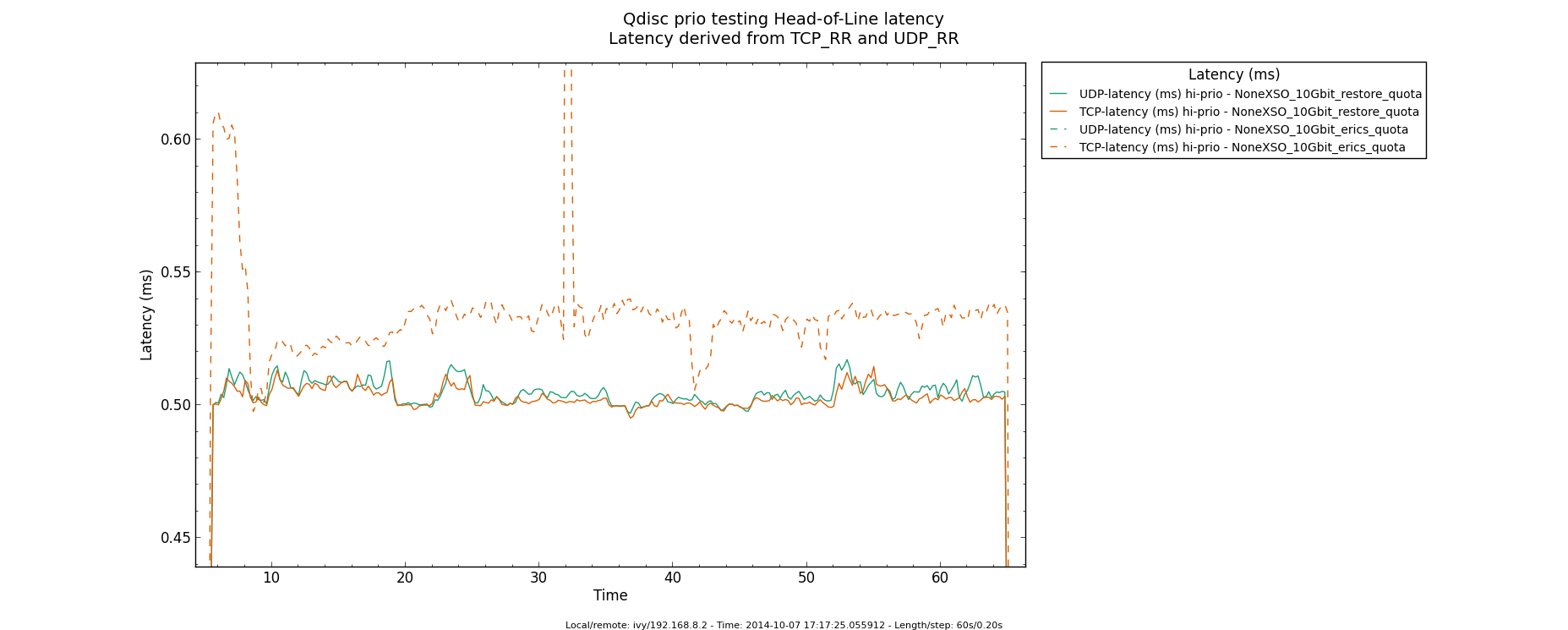
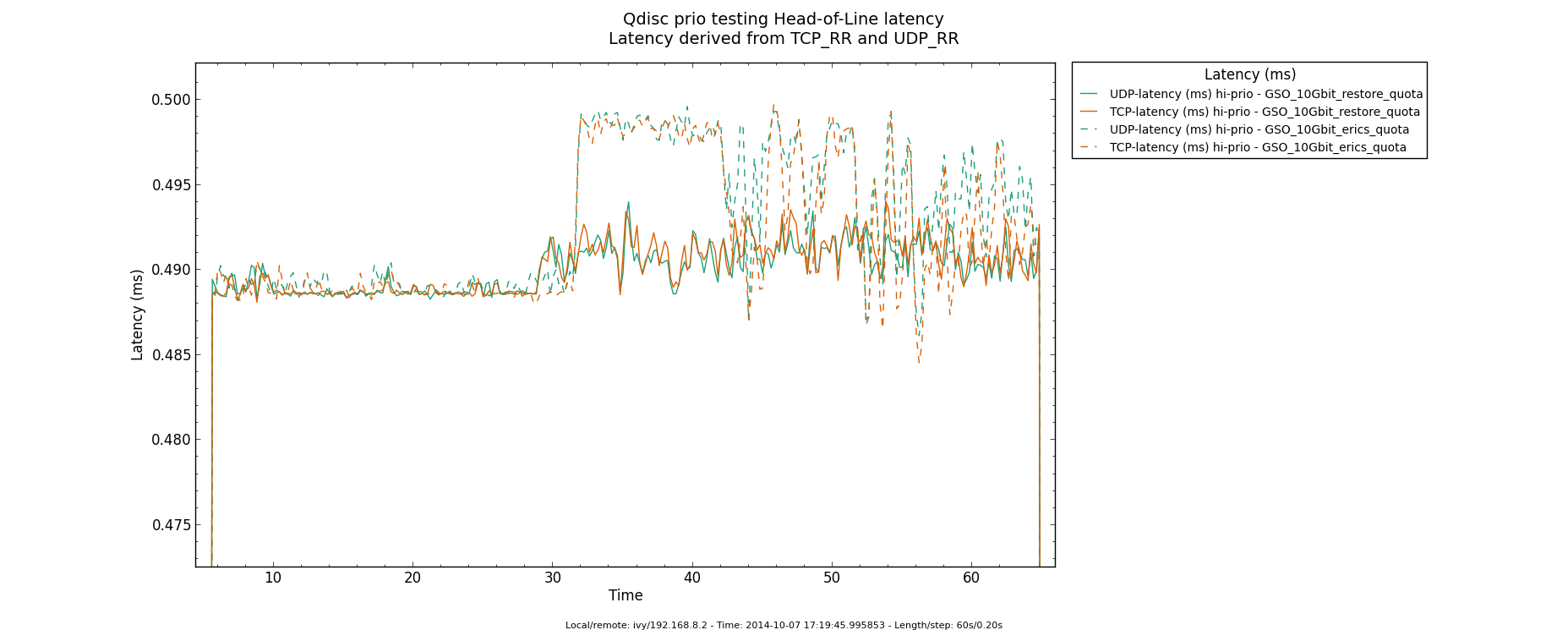
These tests are with ixgbe with a single TXQ, in-order to measure the effect of HoL, by taking advantage of the high prio queue of pfifo_fast.
(Cmdline trick for a single TXQ: "ethtool -L eth4 combined 1")
In case GSO=off TSO=off, Hannes "wins" with 0.04ms
http://people.netfilter.org/hawk/qdisc/measure19_restore_quota_erics/compare_rr_latency_eric_vs_hannes_NoneXSO.png
which I guess we should not be concerned with.
In case GSO=on TSO=off, the diff is max 0.01ms (to Hannes advantage ;-)) Notice the extreme zoom level:
http://people.netfilter.org/hawk/qdisc/measure19_restore_quota_erics/compare_rr_latency_eric_vs_hannes_GSO.png
In case GSO=on TSO=on, there are some spikes, where Eric's version have the highest spike.
http://people.netfilter.org/hawk/qdisc/measure19_restore_quota_erics/compare_rr_latency_eric_vs_hannes_TSO.png
Again nothing we should worry about.
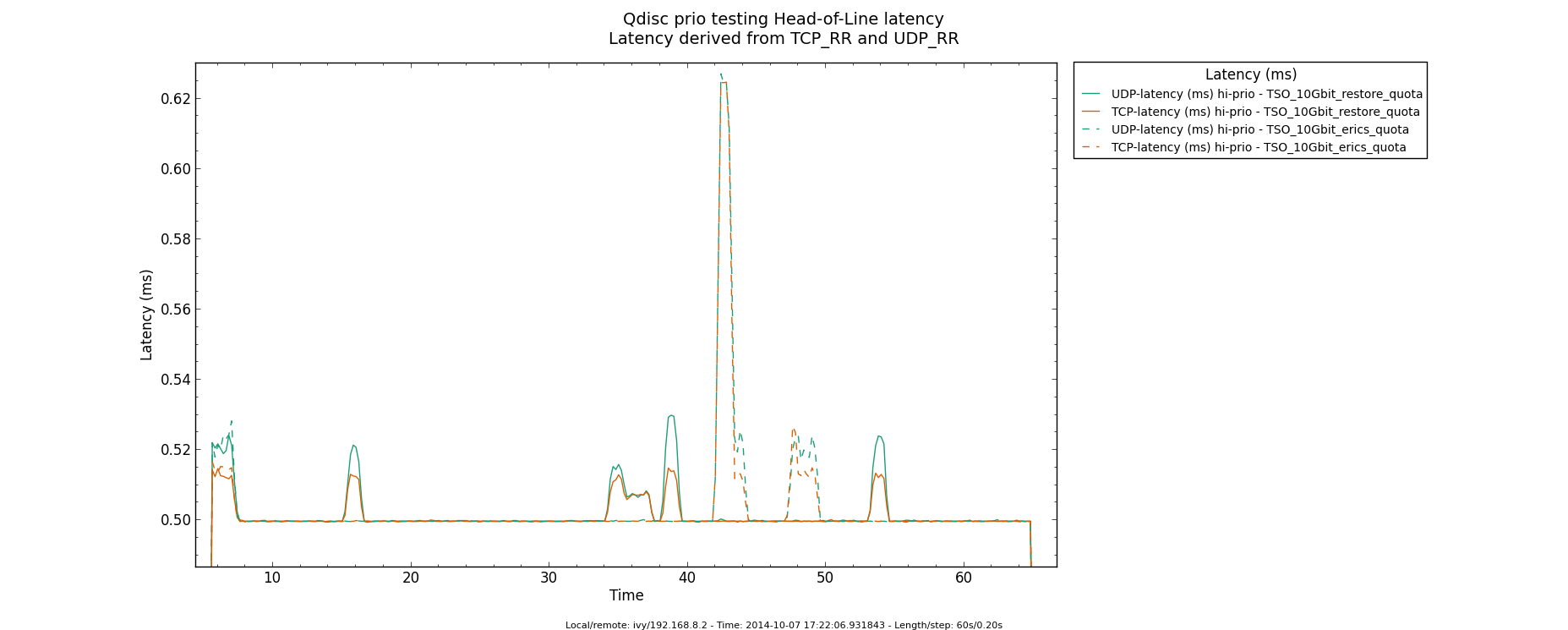
Thus, guess we can safely go with Eric's solution, even-thought Hannes version consistently shows less HoL blocking and less sever spikes, as the difference is so small. I'm ACKing Eric's version...
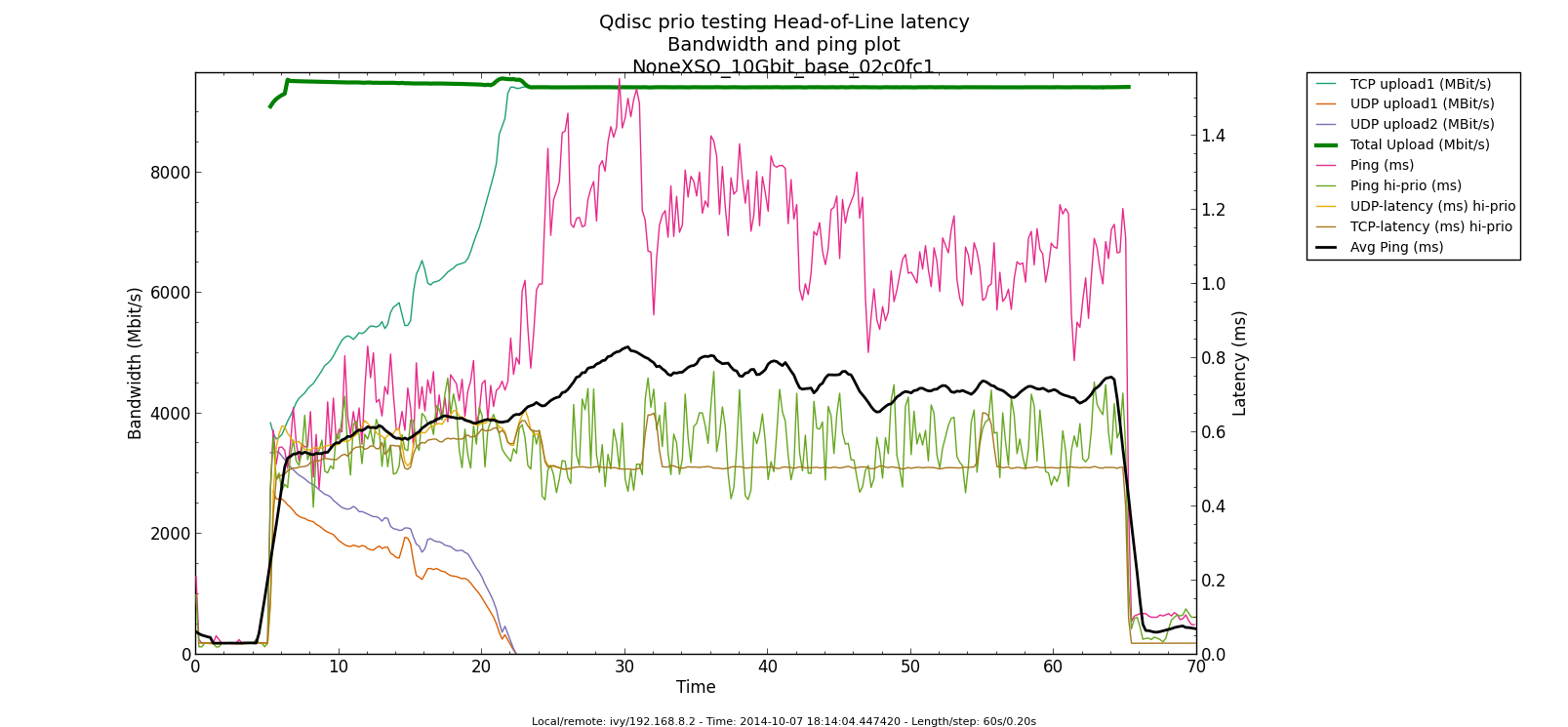
We do need this patch, as can be seen by the baseline test at git commit 02c0fc1. Where some bandwidth unfairness to the UDP flows happens, but only in the case GSO=off TSO=off (others are fine).
http://people.netfilter.org/hawk/qdisc/measure20_no_quota_baseline_at_git_02c0fc1/NoneXSO_10Gbit_base_02c0fc1_bandwidth_totals_unfairness.png
Kind of strange, but it went away in the two quota tests.
Signature · 5 lines
Best regards,
  Jesper Dangaard Brouer
  MSc.CS, Sr. Network Kernel Developer at Red Hat
  Author of http://www.iptv-analyzer.org
  LinkedIn: http://www.linkedin.com/in/brouer
Re: Quota in __qdisc_run()
In reply to Eric DumazetQuoted 12 lines · Eric Dumazet
Quoted 7 lines · Jesper Dangaard Brouer
Quoted 2 lines · On Fri, 03 Oct 2014 16:30:44 -0700 Eric Dumazet <[email protected]> wrote:
Another problem we need to address is the quota in
__qdisc_run()is no longer meaningfull, if eachqdisc_restart()can pump many packets.I fully agree. My earlier "magic" packet limit was covering/pampering over this issue.
Although quota was multiplied by 7 or 8 in worst case ?
Quoted 1 line
Quoted 7 lines
Quoted 5 lines
Quoted 1 line
An idea would be to use the bstats (or
cpu_qstatsif applicable)Please elaborate some more, as I don't completely follow (feel free to show with a patch ;-)).
I was hoping John could finish the percpu stats before I do that.
What stats are you referring to? I assume the remaining stats in the xmit path mostly in sch_generic.c? By the way I need to do another review of the classifier code paths but I believe we could drop the ingress qdisc lock now (finally)...
Also some clean up in sch_generic.c could help this. Notes for myself mostly,
dev_requeue_skb() can be a void its return value is always 0
the users of handle_dev_cpu_collision and sch_direct_xmit don't use the qlen for anything returning any positive integer looks like it would work.
Thanks,
John
Signature · 1 line
John Fastabend Intel Corporation