Complex Camera Workshop - Tokyo - Jun, 19
PATCH v2 1/1 Complex Camera Workshop - Tokyo - Jun, 19
Hi all,
I consolidated hopefully all comments I receive on the past announcement with regards to the complex camera workshop we're planning to happen in Tokyo, just before the Open Source Summit in Japan.
The main focus of the workshop is to allow supporting devices with MC-based hardware connected to a camera.
I'm enclosing a detailed description of the problem, in order to allow the interested parties to be at the same page.
We need to work towards an agenda for the meeting.
From my side, I think we should have at least the following topics at the agenda:
- a quick review about what's currently at libv4l2;
- a presentation about PipeWire solution;
- a discussion with the requirements for the new solution;
- a discussion about how we'll address - who will do what.
Comments? Suggestions?
Are there anyone else planning to either be there physically or via Google Hangouts?
Tomaz,
Do you have any limit about the number of people that could join us via Google Hangouts?
Regards,
Mauro
---
1. Introduction
===============
1.1 V4L2 Kernel aspects
-----------------------
The media subsystem supports two types of devices:
- "traditional" media hardware, supported via V4L2 API. On such hardware, opening a single device node (usually /dev/video0) is enough to control the entire device. We call it as devnode-based devices.
An application sometimes may need to use multiple video nodes with devnode-based drivers to capture multiple streams in parallel (when the hardware allows it of course). That's quite common for Analog TV devices, where both /dev/video0 and /dev/vbi0 are opened at the same time.
- Media-controller based devices. On those devices, there are typically several /dev/video? nodes and several /dev/v4l2-subdev? nodes, plus a media controller device node (usually /dev/media0).
We call it as mc-based devices. Controlling the hardware require opening the media device (/dev/media0), setup the pipeline and adjust the sub-devices via /dev/v4l2-subdev?. Only streaming is controlled by /dev/video?.
In other words, both configuration and streaming go through the video device node on devnode-based drivers, while video device nodes are used used for streaming on mc-based drivers.
With devnode-based drivers, "standard" media applications, including open source ones (Camorama, Cheese, Xawtv, Firefox, Chromium, ...) and closed source ones (Skype, Chrome, ...) support devnode-based devices[1]. Also, when just one media device is connected, the streaming/control device is typically /dev/video0.
[1] It should be noticed that closed-source applications tend to have various bugs that prevent them from working properly on many devnode-based devices. Due to that, some additional blocks were requred at libv4l to support some of them. Skype is a good example, as we had to include a software scaler in libv4l to make it happy. So in practice not everything works smoothly with closed-source applications with devnode-based drivers. A few such adjustments were also made on some drivers and/or libv4l, in order to fulfill some open-source app requirements.
Support for mc-based devices currently require an specialized application in order to prepare the device for its usage (setup pipelines, adjust hardware controls, etc). Once pipeline is set, the streaming goes via /dev/video?, although usually some /dev/v4l2-subdev? devnodes should also be opened, in order to implement algorithms designed to make video quality reasonable. On such devices, it is not uncommon that the device used by the application to be a random number (on OMAP3 driver, typically, is either /dev/video4 or /dev/video6).
One example of such hardware is at the OMAP3-based hardware:
http://www.infradead.org/~mchehab/mc-next-gen/omap3-igepv2-with-tvp5150.png
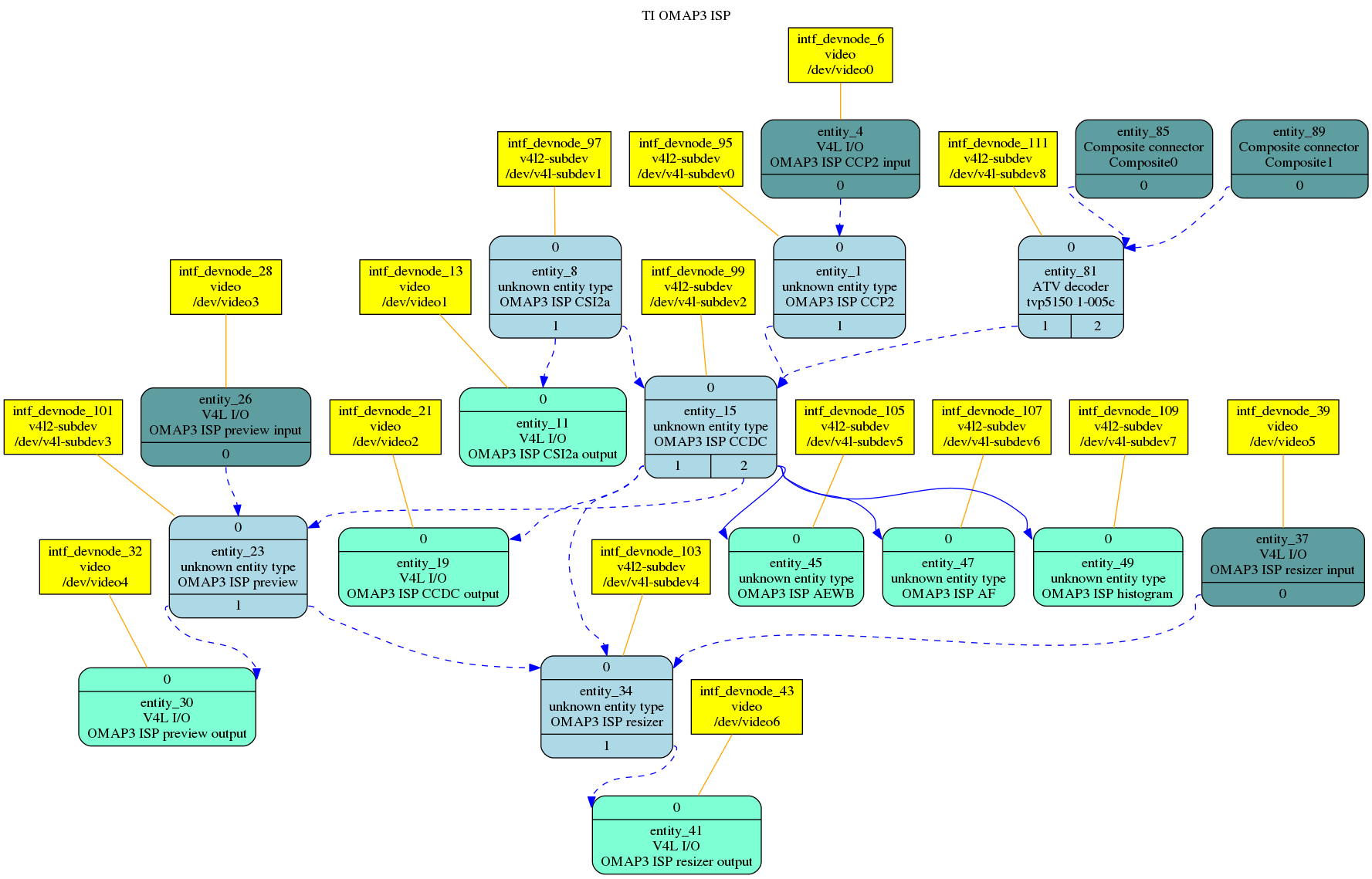
On the picture, there's a graph with the hardware blocks in blue/dark/blue and the corresponding devnode interfaces in yellow.
The mc-based approach was taken when support for Nokia N9/N900 cameras was added (with has OMAP3 SoC). It is required because the camera hardware on SoC comes with a media processor (ISP), with does a lot more than just capturing, allowing complex algorithms to enhance image quality in runtime. Those algorithms are known as 3A - an acronym for 3 other acronyms:
- AE (Auto Exposure);
- AF (Auto Focus);
- AWB (Auto White Balance).
The main reason that drove the MC design is that the 3A algorithms (that is the 3A control loop, and sometimes part of the image processing itself) often need to run, at least partially, on the CPU. As a kernel-space implementation wasn't possible, we needed a lower-level UAPI.
Setting a camera with such ISPs are harder because the pipelines to be set actually depends the requirements for those 3A algorithms to run. Also, usually, the 3A algorithms use some chipset-specific userspace API, that exports some image properties, calculated by the ISP, to speed up the convergence of those algorithms.
Btw, usually, the 3A algorithms are IP-protected, provided by vendors as binary only blobs, although there are a few OSS implementations.
Part of the problem is that, so far, there isn't a proper userspace API to implement 3A libraries. Once we have an userspace camera stack, we hope that we'll gradually increase the number and quality of open-source 3A stacks.
1.2 V4L2 userspace aspects
--------------------------
Back when USB cameras were introduced, the hardware were really simple:
they had a CMOS or CCD camera sensor and a chip that bridges the data though USB. Camera sensors typically provide data using a bayer format, but they usually have their own proprietary ways to pack the data at the USB bridges, in order to reduce the bandwidth (the first implementations were using USB version 1.1).
So, V4L2 has a myriad of different formats, in order to match each camera sensor format. At the end of the day, applications were able to use only a subset of the available hardware, since they need to come with format converters for all formats the developer uses (usually a very small subset of the available ones).
That's said, newer cameras are converged towards a small set of standard formats - except for secondary data streams (like depth maps). Yet, industrial cameras, and newer technologies, like 3D, light-field, etc may still bring newer formats.
To end with this mess, an userspace library was written, called libv4l. It supports all those proprietary formats. So, applications can use a RGB or YUV format, without needing to concern about conversions.
The way it works is by adding wrappers to system calls: open, close, ioctl, mmap, mmunmap. So, a conversion to use it is really simple:
at the source code of the apps, all it was needed is to prepend the existing calls with "v4l2_", e. g. v4l2_open, v4l2_close, etc.
All open source apps we know now supports libv4l. On a few (like gstreamer), support for it is optional.
It should be noted that libv4l also handles scaling and rough auto-gain and auto-white balance that are required by some cameras to achieve a usable image.
In order to support closed source, another wrapper was added, allowing to call any closed source application to use it, by using LD_PRELOAD. For example, using skype with it is as simple as calling it with:
$ LD_PRELOAD=/usr/lib/libv4l/v4l1compat.so /usr/bin/skypeforlinux
2. Current problems
===================
2.1 Libv4l can slow image handling
----------------------------------
Nowadays, almost all new "simple" cameras are connected via USB using the UVC class (USB Video Class). UVC standardized the allowed formats, and most apps just implement them. The UVC hardware is more complex, having format converters inside it. So, for most usages, format conversion isn't needed anymore.
The need of doing format conversion in software makes libv4l slow, requiring lots of CPU usage in order to convert a 4K or 8K format, being even worse with 3D cameras.
Also, due to the need of supporting LD_PRELOAD, zero-buffer copy via DMA_BUFFER currently doesn't work with libv4l.
Right now, gstreamer defaults to not enable libv4l2, due to several reasons:
- Crash when CREATE_BUFS is being used;
- Crash in the jpeg decoder (when frames are corrupted);
- App exporting DMABuf need to be aware of emulation, otherwise the
    DMABuf exported are in the orignal format;
  - RW emulation only initialize the queue on first read (causing
    userspace poll() to fail);
- Signature of v4l2_mmap does not match mmap() (minor);
- The colorimetry does not seem emulated when conversion;
- Sub-optimal locking (at least deadlocks were fixed).
Most of the above are due to new features added to Kernel uAPI, but not added to libv4l2.
These issues are already worked around in GStreamer, but with the lost of features of course. There is other cases were something worked without libv4l2, but didn't work with libv4l2, but Gstreamer developers haven't tracked down the cause yet. Since 1.14, libv4l2 can be enabled at run-time using env GST_V4L2_USE_LIBV4L2=1.
2.2 Modern hardware is starting to come with "complex" camera ISP
-----------------------------------------------------------------
While mc-based devices were limited to SoC, it was easy to "delegate" the task of talking with the hardware to the embedded hardware designers.
However, this is changing. Dell Latitude 5285 laptop is a standard PC with an i3-core, i5-core or i7-core CPU, with comes with the Intel IMU3 ISP hardware[2].
[2] https://www.spinics.net/lists/linux-usb/msg167478.html
There, instead of an USB camera, the hardware is equipped with a MC-based ISP, connected to its camera. Currently, despite having a Kernel driver for it, the camera doesn't work with any userspace application.
I'm also aware of other projects that are considering the usage of mc-based devices for non-dedicated hardware.
3. How to solve it?
===================
That's the main focus of the meeting :-)
From a previous discussion I had with media sub-maintainers, there are at least two actions that seem required. I'm listing them below as an starting point for the discussions, but we can eventually come up with some different approach after the meeting.
3.1 Library support for mc-based hardware
=========================================
In order to support those hardware, we'll need to do some redesign, mainly at userspace, via a library[3] that will replace/compliment libv4l2.
The idea is to work on a library API that will allow to split the format conversion on a separate part of it, add support for DMA Buffer and come up with a way for the library to work transparently with both devnode-based and mc-based hardware.
The library should be capable of doing dynamic pipeline setups, including the functionality of allow tranfering buffers between different media devices, as, on several cases, a a camera input device node should be connected to a m2m device that would be doing some image processing, and providing output data on a standard video output format.
One possibility is to redesign libv4l2. It should be noticed that Videolan people is working on a daemon that could also provide another way to implement it[4].
Once we get a proper camera stack, we need to support traditional applications that use libv4l2 and/or the new library directly. To that end we will need to expose the libv4l2 API on top of the camera stack (through libv4l2 if it makes sense, or through a separate implementation) and implement a transparent LD_PRELOAD-based library.
That envolves adding capacity to the library to setup hardware pipelines and to propagate controls among their sub-devices. Eventually, part of it will be done in Kernel.
That should give performance increase at the library and would allow gstreamer to use it by default, without compromising performance.
[3] I don't discard that some Kernel changes could also be part of the solution, like, for example, doing control propagation along the pipeline on simple use case scenarios.
[4] With the venue of sandboxed application, there is a need to control access to cameras through a daemon. The same daemon is also used to control access to screen capture on Wayland (instead of letting any random application capture your screen, like on X11). The effort is lead by the desktop team at RedHat. PipeWire already have V4L2 native support and is integrated in GStreamer already in a way that it can totally replace the V4L2 capture component there. PipeWire is plugin based, so more type of camera support can be added. Remote daemon can also provide streams, as this is the case for compositors and screen casting. An extra benefit is that you can have multiple application reading frames from the same camera. It also allow sandboxed application (the do not have access to /dev) to use the cameras. In this context, proprietary or HW specific algorithm could be implemented in userspace as PipeWire plugins, and then application will automatically be enable to enumerate and use these.
3.2 libv4l2 support for 3A algorithms
=====================================
The 3A algorithm handing is highly dependent on the hardware. The idea here is to allow libv4l to have a set of 3A algorithms that will be specific to certain mc-based hardware.
One requirement, if we want vendor stacks to use our solution, is that it should allow allow external closed-source algorithms to run as well.
The 3A library API must be standardized, to allow the closed-source vendor implementation to be replaced by an open-source implementation should someone have the time and energy (and qualifications) to write one.
Sandboxed execution of the 3A library must be possible as closed-source can't always be blindly trusted. This includes the ability to wrap the library in a daemon should the platform's multimedia stack wishes and to avoid any direct access to the kernel devices by the 3A library itself (all accesses should be marshaled by the camera stack).
Please note that this daemon is *not* a camera daemon that would communicates with the V4L2 driver through a custom back channel.
The decision to run the 3A library in a sandboxed process or to call it directly from the camera stack should be left to the camera stack and to the platform integrator, and should not be visible by the 3A library.
The 3A library must be usable on major Linux-based camera stacks (the Android and Chrome OS camera HALs are certainly important targets, more can be added) unmodified, which will allow usage of the vendor binary provided for Chrome OS or Android on regular Linux systems.
It would make sense to design a modular camera stack, and try to make most components as platform-independent as possible. This should include:
- the kernel drivers (V4L2-compliant and usable without any closed-source userspace component);
- the 3A library
- any other component that could be shared (for instance a possible request API library).
The rest of the code will mostly be glue around those components to integrate them in a particular camera stack, and should be as platform-agnostic as possible.
In the case of the Android camera HAL, ideally it would be a glue that could be used with different camera vendors (probably with some kind of vendor-specific configuration, or possibly with a separate vendor-specific component to handle pipeline configuration).
4 Complex camera workshop
=========================
The workshop will be happening in Tokyo, Japan, at Jun, 19, at the google offices. The location is:
〒106-6126 Tokyo, Minato, Roppongi, 6 Chome−10−1 Roppongi Hills Mori Tower 44F
4.1 Physical Attendees
======================
Tomasz Figa <[email protected]>
Mauro Carvalho Chehab <Mauro Carvalho Chehab <[email protected]> Kieran Bingham <[email protected]>
Laurent Pinchart <[email protected]>
Niklas Söderlund <[email protected]>
Zheng, Jian Xu Zheng <[email protected]>
Anywone else?
4.2. Attendees Via Google Hangouts
==================================
Hans Verkuil <[email protected]> - Via Google Hangouts - maybe only on afternoon
Javier Martinez Canillas <[email protected]> - Via Google Hangouts - only on reasonable TZ-compatible-hours Ricky - Google camera team in Taipei - Via Google Hangouts
Anywone else?
Hi Mauro,
Quoted 1 line · Mauro Carvalho Chehab
Hi all,
[snip]
Quoted 11 lines
4.1 Physical Attendees
======================Tomasz Figa <[email protected]>
Mauro Carvalho Chehab <Mauro Carvalho Chehab <[email protected]> Kieran Bingham <[email protected]>
Laurent Pinchart <[email protected]>
Niklas Söderlund <[email protected]>
Zheng, Jian Xu Zheng <[email protected]>Anywone else?
Sorry, I've not listed myself in reply to the previous email.
As I'll be in Tokyo for OSS, I would like to join you for the meeting.
Thanks
j
Quoted 15 lines · Mauro Carvalho Chehab
Hi all,
I consolidated hopefully all comments I receive on the past announcement with regards to the complex camera workshop we're planning to happen in Tokyo, just before the Open Source Summit in Japan.
The main focus of the workshop is to allow supporting devices with MC-based hardware connected to a camera.
I'm enclosing a detailed description of the problem, in order to allow the interested parties to be at the same page.
We need to work towards an agenda for the meeting.
Quoted 7 lines
From my side, I think we should have at least the following topics at the agenda:
- a quick review about what's currently at libv4l2;
- a presentation about PipeWire solution;
- a discussion with the requirements for the new solution;
- a discussion about how we'll address - who will do what.
I believe Intel's Jian Xu would be able to give us some brief introduction to IPU3 hardware architecture and possibly also upcoming hardware generations as well.
My experience with existing generations of ISPs from other vendors is that the main principles of operation are very similar to the model represented by IPU3 and very much different to the OMAP3 example mentioned by Mauro below. I further commented on it below.
Quoted 11 lines
Comments? Suggestions?
Are there anyone else planning to either be there physically or via Google Hangouts?
Tomaz,
Do you have any limit about the number of people that could join us via Google Hangouts?
Technically, Hangouts should be able to work with really huge multi-party conferences. There is obviously some limitation on client side, since thumbnails of participants need to be decoded at real time, so even if the resolution is low, if the client is very slow, there might be some really bad frame drop happening on client side.
However, I often have meetings with around 8 parties and it tends to work fine. We can also disable video of all participants, who don't need to present anything at the moment and the problem would go away completely.
Quoted 50 lines
Regards,
Mauro---
1. Introduction
===============1.1 V4L2 Kernel aspects
-----------------------The media subsystem supports two types of devices:
- "traditional" media hardware, supported via V4L2 API. On such hardware, opening a single device node (usually
/dev/video0) is enough to control the entire device. We call it as devnode-based devices.
An application sometimes may need to use multiple video nodes with devnode-based drivers to capture multiple streams in parallel (when the hardware allows it of course). That's quite common for Analog TV devices, where both/dev/video0and/dev/vbi0are opened at the same time.- Media-controller based devices. On those devices, there are typically several
/dev/video? nodes and several/dev/v4l2-subdev? nodes, plus a media controller device node (usually/dev/media0).
We call it as mc-based devices. Controlling the hardware require opening the media device (/dev/media0), setup the pipeline and adjust the sub-devices via/dev/v4l2-subdev?. Only streaming is controlled by/dev/video?.In other words, both configuration and streaming go through the video device node on devnode-based drivers, while video device nodes are used used for streaming on mc-based drivers.
With devnode-based drivers, "standard" media applications, including open source ones (Camorama, Cheese, Xawtv, Firefox, Chromium, ...) and closed source ones (Skype, Chrome, ...) support devnode-based devices[1]. Also, when just one media device is connected, the streaming/control device is typically
/dev/video0.[1] It should be noticed that closed-source applications tend to have various bugs that prevent them from working properly on many devnode-based devices. Due to that, some additional blocks were requred at libv4l to support some of them. Skype is a good example, as we had to include a software scaler in libv4l to make it happy. So in practice not everything works smoothly with closed-source applications with devnode-based drivers. A few such adjustments were also made on some drivers and/or libv4l, in order to fulfill some open-source app requirements.
Quoted 6 lines
Support for mc-based devices currently require an specialized application in order to prepare the device for its usage (setup pipelines, adjust hardware controls, etc). Once pipeline is set, the streaming goes via
/dev/video?, although usually some/dev/v4l2-subdev? devnodes should also be opened, in order to implement algorithms designed to make video quality reasonable.
To further complicate the problem, on many modern imaging subsystems (Intel IPU3, Rockchip RKISP1), there is more than 1 video output (CAPTURE device), for example:
1) full resolution capture stream and
2) downscaled preview stream.
Moreover, many ISPs also produce per-frame metadata (statistics) for 3A algorithms, which then produces per-frame metadata (parameters) for processing of next frame. These would be also exposed as /dev/video? nodes with respective V4L2_BUF_TYPE_META_* queues.
It is complicated even more on systems with separate input (e.g. CSI2) and processing (ISP) hardware, such as Intel IPU3. In such case, the raw frames captured from the CSI2 interface directly are not usable for end-user applications. This means that some component in userspace needs to forward the raw frames to the ISP and only the output of the ISP can be passed to the application.
Quoted 40 lines
On such devices, it is not uncommon that the device used by the application to be a random number (on OMAP3 driver, typically, is either
/dev/video4or/dev/video6).One example of such hardware is at the OMAP3-based hardware:
http://www.infradead.org/~mchehab/mc-next-gen/omap3-igepv2-with-tvp5150.pngOn the picture, there's a graph with the hardware blocks in blue/dark/blue and the corresponding devnode interfaces in yellow.
The mc-based approach was taken when support for Nokia N9/N900 cameras was added (with has OMAP3 SoC). It is required because the camera hardware on SoC comes with a media processor (ISP), with does a lot more than just capturing, allowing complex algorithms to enhance image quality in runtime. Those algorithms are known as 3A - an acronym for 3 other acronyms:
- AE (Auto Exposure);
- AF (Auto Focus);
- AWB (Auto White Balance).The main reason that drove the MC design is that the 3A algorithms (that is the 3A control loop, and sometimes part of the image processing itself) often need to run, at least partially, on the CPU. As a kernel-space implementation wasn't possible, we needed a lower-level UAPI.
Setting a camera with such ISPs are harder because the pipelines to be set actually depends the requirements for those 3A algorithms to run. Also, usually, the 3A algorithms use some chipset-specific userspace API, that exports some image properties, calculated by the ISP, to speed up the convergence of those algorithms.
Btw, usually, the 3A algorithms are IP-protected, provided by vendors as binary only blobs, although there are a few OSS implementations.
Part of the problem is that, so far, there isn't a proper userspace API to implement 3A libraries. Once we have an userspace camera stack, we hope that we'll gradually increase the number and quality of open-source 3A stacks.
[snip]
Quoted 11 lines
2.2 Modern hardware is starting to come with "complex" camera ISP
-----------------------------------------------------------------While mc-based devices were limited to SoC, it was easy to "delegate" the task of talking with the hardware to the embedded hardware designers.
However, this is changing. Dell Latitude 5285 laptop is a standard PC with an i3-core, i5-core or i7-core CPU, with comes with the Intel IMU3 ISP hardware[2].
IPU3 :)
Quoted 11 lines
[2] https://www.spinics.net/lists/linux-usb/msg167478.html
There, instead of an USB camera, the hardware is equipped with a MC-based ISP, connected to its camera. Currently, despite having a Kernel driver for it, the camera doesn't work with any userspace application.
I'm also aware of other projects that are considering the usage of mc-based devices for non-dedicated hardware.
[snip]
Quoted 30 lines
3.2 libv4l2 support for 3A algorithms
=====================================The 3A algorithm handing is highly dependent on the hardware. The idea here is to allow libv4l to have a set of 3A algorithms that will be specific to certain mc-based hardware.
One requirement, if we want vendor stacks to use our solution, is that it should allow allow external closed-source algorithms to run as well.
The 3A library API must be standardized, to allow the closed-source vendor implementation to be replaced by an open-source implementation should someone have the time and energy (and qualifications) to write one.
Sandboxed execution of the 3A library must be possible as closed-source can't always be blindly trusted. This includes the ability to wrap the library in a daemon should the platform's multimedia stack wishes and to avoid any direct access to the kernel devices by the 3A library itself (all accesses should be marshaled by the camera stack).
Please note that this daemon is *not* a camera daemon that would communicates with the V4L2 driver through a custom back channel.
The decision to run the 3A library in a sandboxed process or to call it directly from the camera stack should be left to the camera stack and to the platform integrator, and should not be visible by the 3A library.
Quoted 4 lines
The 3A library must be usable on major Linux-based camera stacks (the Android and Chrome OS camera HALs are certainly important targets, more can be added) unmodified, which will allow usage of the vendor binary provided for Chrome OS or Android on regular Linux systems.
This is quite an interesting idea and it would be really useful if it could be done. I'm kind of worried, though, about Android in particular, since the execution environment in Android differs significantly from a regular Linux distributions (including Chrome OS, which is not so far from such), namely:
- different libc (bionic) and dynamic linker - I guess this could be solved by static linking?
- dedicated toolchains - perhaps not much of a problem if the per-arch ABI is the same?
Quoted 19 lines
It would make sense to design a modular camera stack, and try to make most components as platform-independent as possible. This should include:
- the kernel drivers (V4L2-compliant and usable without any closed-source userspace component);
- the 3A library
- any other component that could be shared (for instance a possible request API library).The rest of the code will mostly be glue around those components to integrate them in a particular camera stack, and should be as platform-agnostic as possible.
In the case of the Android camera HAL, ideally it would be a glue that could be used with different camera vendors (probably with some kind of vendor-specific configuration, or possibly with a separate vendor-specific component to handle pipeline configuration).
Quoted 7 lines
4 Complex camera workshop
=========================The workshop will be happening in Tokyo, Japan, at Jun, 19, at the google offices. The location is:
〒106-6126 Tokyo, Minato, Roppongi, 6 Chome−10−1 Roppongi Hills Mori Tower 44F
Nearest station exits:
- Hibiya line Roppongi station exit 1c (recommended)
- Oedo line Roppongi station exit 3 (and few minutes walk)
Quoted 4 lines
4.1 Physical Attendees
======================
Quoted 8 lines
Tomasz Figa <[email protected]>
Mauro Carvalho Chehab <Mauro Carvalho Chehab <[email protected]> Kieran Bingham <[email protected]>
Laurent Pinchart <[email protected]>
Niklas Söderlund <[email protected]>
Zheng, Jian Xu Zheng <[email protected]>Anywone else?
Looking at latest reply in this thread:
jacopo mondi <[email protected]>
Anyone else, please tell me beforehand (at least 1-2 days before), as I need to take care of building access, since it's a multi-tenant office building. I'll contact each attendee separately with further details by email.
Quoted 6 lines
4.2. Attendees Via Google Hangouts
==================================Hans Verkuil <[email protected]> - Via Google Hangouts - maybe only on afternoon
Javier Martinez Canillas <[email protected]> - Via Google Hangouts - only on reasonable TZ-compatible-hours
What time zone would that be? I guess we could try to tweak the agenda to take this into account.
Best regards.
Tomasz
[adding Wim Taymans and Mario Limonciello to CC who said that they may also join via Hangous]
Quoted 15 lines · Tomasz Figa
Quoted 13 lines · Mauro Carvalho Chehab
Hi all,
I consolidated hopefully all comments I receive on the past announcement with regards to the complex camera workshop we're planning to happen in Tokyo, just before the Open Source Summit in Japan.
The main focus of the workshop is to allow supporting devices with MC-based hardware connected to a camera.
I'm enclosing a detailed description of the problem, in order to allow the interested parties to be at the same page.
Quoted 7 lines
Quoted 7 lines
We need to work towards an agenda for the meeting.
From my side, I think we should have at least the following topics at the agenda:
- a quick review about what's currently at libv4l2;
- a presentation about PipeWire solution;
Wim mentioned that he could do this.
Quoted 276 lines
Quoted 2 lines
- a discussion with the requirements for the new solution;
- a discussion about how we'll address - who will do what.I believe Intel's Jian Xu would be able to give us some brief introduction to IPU3 hardware architecture and possibly also upcoming hardware generations as well.
My experience with existing generations of ISPs from other vendors is that the main principles of operation are very similar to the model represented by IPU3 and very much different to the OMAP3 example mentioned by Mauro below. I further commented on it below.
Quoted 11 lines
Comments? Suggestions?
Are there anyone else planning to either be there physically or via Google Hangouts?
Tomaz,
Do you have any limit about the number of people that could join us via Google Hangouts?
Technically, Hangouts should be able to work with really huge multi-party conferences. There is obviously some limitation on client side, since thumbnails of participants need to be decoded at real time, so even if the resolution is low, if the client is very slow, there might be some really bad frame drop happening on client side.
However, I often have meetings with around 8 parties and it tends to work fine. We can also disable video of all participants, who don't need to present anything at the moment and the problem would go away completely.
Quoted 50 lines
Regards,
Mauro---
1. Introduction
===============1.1 V4L2 Kernel aspects
-----------------------The media subsystem supports two types of devices:
- "traditional" media hardware, supported via V4L2 API. On such hardware, opening a single device node (usually
/dev/video0) is enough to control the entire device. We call it as devnode-based devices.
An application sometimes may need to use multiple video nodes with devnode-based drivers to capture multiple streams in parallel (when the hardware allows it of course). That's quite common for Analog TV devices, where both/dev/video0and/dev/vbi0are opened at the same time.- Media-controller based devices. On those devices, there are typically several
/dev/video? nodes and several/dev/v4l2-subdev? nodes, plus a media controller device node (usually/dev/media0).
We call it as mc-based devices. Controlling the hardware require opening the media device (/dev/media0), setup the pipeline and adjust the sub-devices via/dev/v4l2-subdev?. Only streaming is controlled by/dev/video?.In other words, both configuration and streaming go through the video device node on devnode-based drivers, while video device nodes are used used for streaming on mc-based drivers.
With devnode-based drivers, "standard" media applications, including open source ones (Camorama, Cheese, Xawtv, Firefox, Chromium, ...) and closed source ones (Skype, Chrome, ...) support devnode-based devices[1]. Also, when just one media device is connected, the streaming/control device is typically
/dev/video0.[1] It should be noticed that closed-source applications tend to have various bugs that prevent them from working properly on many devnode-based devices. Due to that, some additional blocks were requred at libv4l to support some of them. Skype is a good example, as we had to include a software scaler in libv4l to make it happy. So in practice not everything works smoothly with closed-source applications with devnode-based drivers. A few such adjustments were also made on some drivers and/or libv4l, in order to fulfill some open-source app requirements.
Quoted 6 lines
Support for mc-based devices currently require an specialized application in order to prepare the device for its usage (setup pipelines, adjust hardware controls, etc). Once pipeline is set, the streaming goes via
/dev/video?, although usually some/dev/v4l2-subdev? devnodes should also be opened, in order to implement algorithms designed to make video quality reasonable.To further complicate the problem, on many modern imaging subsystems (Intel IPU3, Rockchip RKISP1), there is more than 1 video output (CAPTURE device), for example:
1) full resolution capture stream and
2) downscaled preview stream.Moreover, many ISPs also produce per-frame metadata (statistics) for 3A algorithms, which then produces per-frame metadata (parameters) for processing of next frame. These would be also exposed as
/dev/video? nodes with respective V4L2_BUF_TYPE_META_* queues.It is complicated even more on systems with separate input (e.g. CSI2) and processing (ISP) hardware, such as Intel IPU3. In such case, the raw frames captured from the CSI2 interface directly are not usable for end-user applications. This means that some component in userspace needs to forward the raw frames to the ISP and only the output of the ISP can be passed to the application.
Quoted 40 lines
On such devices, it is not uncommon that the device used by the application to be a random number (on OMAP3 driver, typically, is either
/dev/video4or/dev/video6).One example of such hardware is at the OMAP3-based hardware:
http://www.infradead.org/~mchehab/mc-next-gen/omap3-igepv2-with-tvp5150.pngOn the picture, there's a graph with the hardware blocks in blue/dark/blue and the corresponding devnode interfaces in yellow.
The mc-based approach was taken when support for Nokia N9/N900 cameras was added (with has OMAP3 SoC). It is required because the camera hardware on SoC comes with a media processor (ISP), with does a lot more than just capturing, allowing complex algorithms to enhance image quality in runtime. Those algorithms are known as 3A - an acronym for 3 other acronyms:
- AE (Auto Exposure);
- AF (Auto Focus);
- AWB (Auto White Balance).The main reason that drove the MC design is that the 3A algorithms (that is the 3A control loop, and sometimes part of the image processing itself) often need to run, at least partially, on the CPU. As a kernel-space implementation wasn't possible, we needed a lower-level UAPI.
Setting a camera with such ISPs are harder because the pipelines to be set actually depends the requirements for those 3A algorithms to run. Also, usually, the 3A algorithms use some chipset-specific userspace API, that exports some image properties, calculated by the ISP, to speed up the convergence of those algorithms.
Btw, usually, the 3A algorithms are IP-protected, provided by vendors as binary only blobs, although there are a few OSS implementations.
Part of the problem is that, so far, there isn't a proper userspace API to implement 3A libraries. Once we have an userspace camera stack, we hope that we'll gradually increase the number and quality of open-source 3A stacks.
[snip]
Quoted 11 lines
2.2 Modern hardware is starting to come with "complex" camera ISP
-----------------------------------------------------------------While mc-based devices were limited to SoC, it was easy to "delegate" the task of talking with the hardware to the embedded hardware designers.
However, this is changing. Dell Latitude 5285 laptop is a standard PC with an i3-core, i5-core or i7-core CPU, with comes with the Intel IMU3 ISP hardware[2].
IPU3 :)
Quoted 11 lines
[2] https://www.spinics.net/lists/linux-usb/msg167478.html
There, instead of an USB camera, the hardware is equipped with a MC-based ISP, connected to its camera. Currently, despite having a Kernel driver for it, the camera doesn't work with any userspace application.
I'm also aware of other projects that are considering the usage of mc-based devices for non-dedicated hardware.
[snip]
Quoted 30 lines
3.2 libv4l2 support for 3A algorithms
=====================================The 3A algorithm handing is highly dependent on the hardware. The idea here is to allow libv4l to have a set of 3A algorithms that will be specific to certain mc-based hardware.
One requirement, if we want vendor stacks to use our solution, is that it should allow allow external closed-source algorithms to run as well.
The 3A library API must be standardized, to allow the closed-source vendor implementation to be replaced by an open-source implementation should someone have the time and energy (and qualifications) to write one.
Sandboxed execution of the 3A library must be possible as closed-source can't always be blindly trusted. This includes the ability to wrap the library in a daemon should the platform's multimedia stack wishes and to avoid any direct access to the kernel devices by the 3A library itself (all accesses should be marshaled by the camera stack).
Please note that this daemon is *not* a camera daemon that would communicates with the V4L2 driver through a custom back channel.
The decision to run the 3A library in a sandboxed process or to call it directly from the camera stack should be left to the camera stack and to the platform integrator, and should not be visible by the 3A library.
Quoted 4 lines
The 3A library must be usable on major Linux-based camera stacks (the Android and Chrome OS camera HALs are certainly important targets, more can be added) unmodified, which will allow usage of the vendor binary provided for Chrome OS or Android on regular Linux systems.
This is quite an interesting idea and it would be really useful if it could be done. I'm kind of worried, though, about Android in particular, since the execution environment in Android differs significantly from a regular Linux distributions (including Chrome OS, which is not so far from such), namely:
- different libc (bionic) and dynamic linker - I guess this could be solved by static linking?
- dedicated toolchains - perhaps not much of a problem if the per-arch ABI is the same?Quoted 19 lines
It would make sense to design a modular camera stack, and try to make most components as platform-independent as possible. This should include:
- the kernel drivers (V4L2-compliant and usable without any closed-source userspace component);
- the 3A library
- any other component that could be shared (for instance a possible request API library).The rest of the code will mostly be glue around those components to integrate them in a particular camera stack, and should be as platform-agnostic as possible.
In the case of the Android camera HAL, ideally it would be a glue that could be used with different camera vendors (probably with some kind of vendor-specific configuration, or possibly with a separate vendor-specific component to handle pipeline configuration).
Quoted 7 lines
4 Complex camera workshop
=========================The workshop will be happening in Tokyo, Japan, at Jun, 19, at the google offices. The location is:
〒106-6126 Tokyo, Minato, Roppongi, 6 Chome−10−1 Roppongi Hills Mori Tower 44F
Nearest station exits:
- Hibiya line Roppongi station exit 1c (recommended)
- Oedo line Roppongi station exit 3 (and few minutes walk)Quoted 4 lines
4.1 Physical Attendees
======================Quoted 8 lines
Tomasz Figa <[email protected]>
Mauro Carvalho Chehab <Mauro Carvalho Chehab <[email protected]> Kieran Bingham <[email protected]>
Laurent Pinchart <[email protected]>
Niklas Söderlund <[email protected]>
Zheng, Jian Xu Zheng <[email protected]>Anywone else?
Looking at latest reply in this thread:
jacopo mondi <[email protected]>
Anyone else, please tell me beforehand (at least 1-2 days before), as I need to take care of building access, since it's a multi-tenant office building. I'll contact each attendee separately with further details by email.
Quoted 1 line
Quoted 9 lines
Quoted 5 lines
4.2. Attendees Via Google Hangouts
==================================Hans Verkuil <[email protected]> - Via Google Hangouts - maybe only on afternoon
Javier Martinez Canillas <[email protected]> - Via Google Hangouts - only on reasonable TZ-compatible-hoursWhat time zone would that be? I guess we could try to tweak the agenda to take this into account.
Wim, Nicolas and myself are in CEST (UTC +2). The best time for Wim to do the PipeWire presentation would be 10:30 am CEST.
Best regards,
Javier
Em Wed, 6 Jun 2018 13:19:39 +0900
Tomasz Figa <[email protected]> escreveu:
Quoted 20 lines
Quoted 18 lines · Mauro Carvalho Chehab
Hi all,
I consolidated hopefully all comments I receive on the past announcement with regards to the complex camera workshop we're planning to happen in Tokyo, just before the Open Source Summit in Japan.
The main focus of the workshop is to allow supporting devices with MC-based hardware connected to a camera.
I'm enclosing a detailed description of the problem, in order to allow the interested parties to be at the same page.
We need to work towards an agenda for the meeting.
From my side, I think we should have at least the following topics at the agenda:
Quoted 8 lines
Quoted 4 lines
- a quick review about what's currently at libv4l2;
- a presentation about PipeWire solution;
- a discussion with the requirements for the new solution;
- a discussion about how we'll address - who will do what.I believe Intel's Jian Xu would be able to give us some brief introduction to IPU3 hardware architecture and possibly also upcoming hardware generations as well.
That would be great!
Quoted 23 lines
My experience with existing generations of ISPs from other vendors is that the main principles of operation are very similar to the model represented by IPU3 and very much different to the OMAP3 example mentioned by Mauro below. I further commented on it below.
Quoted 11 lines
Comments? Suggestions?
Are there anyone else planning to either be there physically or via Google Hangouts?
Tomaz,
Do you have any limit about the number of people that could join us via Google Hangouts?
Technically, Hangouts should be able to work with really huge multi-party conferences. There is obviously some limitation on client side, since thumbnails of participants need to be decoded at real time, so even if the resolution is low, if the client is very slow, there might be some really bad frame drop happening on client side.
Quoted 4 lines
However, I often have meetings with around 8 parties and it tends to work fine. We can also disable video of all participants, who don't need to present anything at the moment and the problem would go away completely.
Ok, good!
Quoted 56 lines
Quoted 49 lines
Regards,
Mauro---
1. Introduction
===============1.1 V4L2 Kernel aspects
-----------------------The media subsystem supports two types of devices:
- "traditional" media hardware, supported via V4L2 API. On such hardware, opening a single device node (usually
/dev/video0) is enough to control the entire device. We call it as devnode-based devices.
An application sometimes may need to use multiple video nodes with devnode-based drivers to capture multiple streams in parallel (when the hardware allows it of course). That's quite common for Analog TV devices, where both/dev/video0and/dev/vbi0are opened at the same time.- Media-controller based devices. On those devices, there are typically several
/dev/video? nodes and several/dev/v4l2-subdev? nodes, plus a media controller device node (usually/dev/media0).
We call it as mc-based devices. Controlling the hardware require opening the media device (/dev/media0), setup the pipeline and adjust the sub-devices via/dev/v4l2-subdev?. Only streaming is controlled by/dev/video?.In other words, both configuration and streaming go through the video device node on devnode-based drivers, while video device nodes are used used for streaming on mc-based drivers.
With devnode-based drivers, "standard" media applications, including open source ones (Camorama, Cheese, Xawtv, Firefox, Chromium, ...) and closed source ones (Skype, Chrome, ...) support devnode-based devices[1]. Also, when just one media device is connected, the streaming/control device is typically
/dev/video0.[1] It should be noticed that closed-source applications tend to have various bugs that prevent them from working properly on many devnode-based devices. Due to that, some additional blocks were requred at libv4l to support some of them. Skype is a good example, as we had to include a software scaler in libv4l to make it happy. So in practice not everything works smoothly with closed-source applications with devnode-based drivers. A few such adjustments were also made on some drivers and/or libv4l, in order to fulfill some open-source app requirements.
Quoted 6 lines
Support for mc-based devices currently require an specialized application in order to prepare the device for its usage (setup pipelines, adjust hardware controls, etc). Once pipeline is set, the streaming goes via
/dev/video?, although usually some/dev/v4l2-subdev? devnodes should also be opened, in order to implement algorithms designed to make video quality reasonable.
Quoted 5 lines
To further complicate the problem, on many modern imaging subsystems (Intel IPU3, Rockchip RKISP1), there is more than 1 video output (CAPTURE device), for example:
1) full resolution capture stream and
2) downscaled preview stream.
OMAP3 also has both full-res and downscaled for previews, on separate /dev/video.
On a "simple" usecase (like PC apps and videoconference), just one /dev/video is enough. For devices used to take static pictures, both streams are important.
Quoted 4 lines
Moreover, many ISPs also produce per-frame metadata (statistics) for 3A algorithms, which then produces per-frame metadata (parameters) for processing of next frame. These would be also exposed as
/dev/video? nodes with respective V4L2_BUF_TYPE_META_* queues.
True, but the metadata frames don't need to go the the application, as it will be consumed by the 3A logic.
Quoted 7 lines
It is complicated even more on systems with separate input (e.g. CSI2) and processing (ISP) hardware, such as Intel IPU3. In such case, the raw frames captured from the CSI2 interface directly are not usable for end-user applications. This means that some component in userspace needs to forward the raw frames to the ISP and only the output of the ISP can be passed to the application.
Yes. Nowadays, several devices do the same.
Quoted 49 lines
Quoted 40 lines
On such devices, it is not uncommon that the device used by the application to be a random number (on OMAP3 driver, typically, is either
/dev/video4or/dev/video6).One example of such hardware is at the OMAP3-based hardware:
http://www.infradead.org/~mchehab/mc-next-gen/omap3-igepv2-with-tvp5150.pngOn the picture, there's a graph with the hardware blocks in blue/dark/blue and the corresponding devnode interfaces in yellow.
The mc-based approach was taken when support for Nokia N9/N900 cameras was added (with has OMAP3 SoC). It is required because the camera hardware on SoC comes with a media processor (ISP), with does a lot more than just capturing, allowing complex algorithms to enhance image quality in runtime. Those algorithms are known as 3A - an acronym for 3 other acronyms:
- AE (Auto Exposure);
- AF (Auto Focus);
- AWB (Auto White Balance).The main reason that drove the MC design is that the 3A algorithms (that is the 3A control loop, and sometimes part of the image processing itself) often need to run, at least partially, on the CPU. As a kernel-space implementation wasn't possible, we needed a lower-level UAPI.
Setting a camera with such ISPs are harder because the pipelines to be set actually depends the requirements for those 3A algorithms to run. Also, usually, the 3A algorithms use some chipset-specific userspace API, that exports some image properties, calculated by the ISP, to speed up the convergence of those algorithms.
Btw, usually, the 3A algorithms are IP-protected, provided by vendors as binary only blobs, although there are a few OSS implementations.
Part of the problem is that, so far, there isn't a proper userspace API to implement 3A libraries. Once we have an userspace camera stack, we hope that we'll gradually increase the number and quality of open-source 3A stacks.
[snip]
Quoted 8 lines
2.2 Modern hardware is starting to come with "complex" camera ISP
-----------------------------------------------------------------While mc-based devices were limited to SoC, it was easy to "delegate" the task of talking with the hardware to the embedded hardware designers.
Quoted 5 lines
Quoted 3 lines
However, this is changing. Dell Latitude 5285 laptop is a standard PC with an i3-core, i5-core or i7-core CPU, with comes with the Intel IMU3 ISP hardware[2].
IPU3 :)
Yeah, I noticed the typo too late. I actually fixed it at the announcement at linuxtv.org.
Quoted 47 lines
Quoted 11 lines
[2] https://www.spinics.net/lists/linux-usb/msg167478.html
There, instead of an USB camera, the hardware is equipped with a MC-based ISP, connected to its camera. Currently, despite having a Kernel driver for it, the camera doesn't work with any userspace application.
I'm also aware of other projects that are considering the usage of mc-based devices for non-dedicated hardware.
[snip]
Quoted 30 lines
3.2 libv4l2 support for 3A algorithms
=====================================The 3A algorithm handing is highly dependent on the hardware. The idea here is to allow libv4l to have a set of 3A algorithms that will be specific to certain mc-based hardware.
One requirement, if we want vendor stacks to use our solution, is that it should allow allow external closed-source algorithms to run as well.
The 3A library API must be standardized, to allow the closed-source vendor implementation to be replaced by an open-source implementation should someone have the time and energy (and qualifications) to write one.
Sandboxed execution of the 3A library must be possible as closed-source can't always be blindly trusted. This includes the ability to wrap the library in a daemon should the platform's multimedia stack wishes and to avoid any direct access to the kernel devices by the 3A library itself (all accesses should be marshaled by the camera stack).
Please note that this daemon is *not* a camera daemon that would communicates with the V4L2 driver through a custom back channel.
The decision to run the 3A library in a sandboxed process or to call it directly from the camera stack should be left to the camera stack and to the platform integrator, and should not be visible by the 3A library.
Quoted 4 lines
The 3A library must be usable on major Linux-based camera stacks (the Android and Chrome OS camera HALs are certainly important targets, more can be added) unmodified, which will allow usage of the vendor binary provided for Chrome OS or Android on regular Linux systems.
Quoted 7 lines
This is quite an interesting idea and it would be really useful if it could be done. I'm kind of worried, though, about Android in particular, since the execution environment in Android differs significantly from a regular Linux distributions (including Chrome OS, which is not so far from such), namely:
- different libc (bionic) and dynamic linker - I guess this could be solved by static linking?
Static link is one possible solution. IMHO, we should try to make it use just a C library (if possible) and be sure that it will also compile with bionic/ulibc in order to make it easier to be used by Android and other embedded distros.
Quoted 2 lines
- dedicated toolchains - perhaps not much of a problem if the per-arch ABI is the same?
Depending on library dependency, we could likely make it work with more than one toolchain. I guess acconfig works with Android, right? If so, it could auto-adjust to the different toolchains everywhere.
Quoted 53 lines
Quoted 18 lines
It would make sense to design a modular camera stack, and try to make most components as platform-independent as possible. This should include:
- the kernel drivers (V4L2-compliant and usable without any closed-source userspace component);
- the 3A library
- any other component that could be shared (for instance a possible request API library).The rest of the code will mostly be glue around those components to integrate them in a particular camera stack, and should be as platform-agnostic as possible.
In the case of the Android camera HAL, ideally it would be a glue that could be used with different camera vendors (probably with some kind of vendor-specific configuration, or possibly with a separate vendor-specific component to handle pipeline configuration).
Quoted 7 lines
4 Complex camera workshop
=========================The workshop will be happening in Tokyo, Japan, at Jun, 19, at the google offices. The location is:
〒106-6126 Tokyo, Minato, Roppongi, 6 Chome−10−1 Roppongi Hills Mori Tower 44F
Nearest station exits:
- Hibiya line Roppongi station exit 1c (recommended)
- Oedo line Roppongi station exit 3 (and few minutes walk)Quoted 4 lines
4.1 Physical Attendees
======================Quoted 8 lines
Tomasz Figa <[email protected]>
Mauro Carvalho Chehab <Mauro Carvalho Chehab <[email protected]> Kieran Bingham <[email protected]>
Laurent Pinchart <[email protected]>
Niklas Söderlund <[email protected]>
Zheng, Jian Xu Zheng <[email protected]>Anywone else?
Looking at latest reply in this thread:
jacopo mondi <[email protected]>
Anyone else, please tell me beforehand (at least 1-2 days before), as I need to take care of building access, since it's a multi-tenant office building. I'll contact each attendee separately with further details by email.
Quoted 1 line
Quoted 8 lines
Quoted 5 lines
4.2. Attendees Via Google Hangouts
==================================Hans Verkuil <[email protected]> - Via Google Hangouts - maybe only on afternoon
Javier Martinez Canillas <[email protected]> - Via Google Hangouts - only on reasonable TZ-compatible-hoursWhat time zone would that be? I guess we could try to tweak the agenda to take this into account.
Thanks,
Mauro
Quoted 6 lines · Mauro Carvalho Chehab
Em Wed, 6 Jun 2018 13:19:39 +0900
Tomasz Figa <[email protected]> escreveu:Quoted 2 lines
On Mon, Jun 4, 2018 at 10:33 PM Mauro Carvalho Chehab <[email protected]> wrote:
[snip]
Quoted 47 lines
Quoted 34 lines
Quoted 29 lines
3.2 libv4l2 support for 3A algorithms
=====================================The 3A algorithm handing is highly dependent on the hardware. The idea here is to allow libv4l to have a set of 3A algorithms that will be specific to certain mc-based hardware.
One requirement, if we want vendor stacks to use our solution, is that it should allow allow external closed-source algorithms to run as well.
The 3A library API must be standardized, to allow the closed-source vendor implementation to be replaced by an open-source implementation should someone have the time and energy (and qualifications) to write one.
Sandboxed execution of the 3A library must be possible as closed-source can't always be blindly trusted. This includes the ability to wrap the library in a daemon should the platform's multimedia stack wishes and to avoid any direct access to the kernel devices by the 3A library itself (all accesses should be marshaled by the camera stack).
Please note that this daemon is *not* a camera daemon that would communicates with the V4L2 driver through a custom back channel.
The decision to run the 3A library in a sandboxed process or to call it directly from the camera stack should be left to the camera stack and to the platform integrator, and should not be visible by the 3A library.
Quoted 4 lines
The 3A library must be usable on major Linux-based camera stacks (the Android and Chrome OS camera HALs are certainly important targets, more can be added) unmodified, which will allow usage of the vendor binary provided for Chrome OS or Android on regular Linux systems.
Quoted 7 lines
This is quite an interesting idea and it would be really useful if it could be done. I'm kind of worried, though, about Android in particular, since the execution environment in Android differs significantly from a regular Linux distributions (including Chrome OS, which is not so far from such), namely:
- different libc (bionic) and dynamic linker - I guess this could be solved by static linking?Static link is one possible solution. IMHO, we should try to make it use just a C library (if possible) and be sure that it will also compile with bionic/ulibc in order to make it easier to be used by Android and other embedded distros.
Quoted 6 lines
Quoted 2 lines
- dedicated toolchains - perhaps not much of a problem if the per-arch ABI is the same?
Depending on library dependency, we could likely make it work with more than one toolchain. I guess acconfig works with Android, right? If so, it could auto-adjust to the different toolchains everywhere.
That works for open source libraries obviously. I was thinking more about the closed source 3A libraries coming from Android, since we can't recompile them.
Best regards,
Tomasz
Em Thu, 7 Jun 2018 16:47:50 +0900
Tomasz Figa <[email protected]> escreveu:
Quoted 59 lines
Quoted 6 lines · Mauro Carvalho Chehab
Em Wed, 6 Jun 2018 13:19:39 +0900
Tomasz Figa <[email protected]> escreveu:Quoted 2 lines
On Mon, Jun 4, 2018 at 10:33 PM Mauro Carvalho Chehab <[email protected]> wrote:
[snip]
Quoted 50 lines
Quoted 34 lines
Quoted 29 lines
3.2 libv4l2 support for 3A algorithms
=====================================The 3A algorithm handing is highly dependent on the hardware. The idea here is to allow libv4l to have a set of 3A algorithms that will be specific to certain mc-based hardware.
One requirement, if we want vendor stacks to use our solution, is that it should allow allow external closed-source algorithms to run as well.
The 3A library API must be standardized, to allow the closed-source vendor implementation to be replaced by an open-source implementation should someone have the time and energy (and qualifications) to write one.
Sandboxed execution of the 3A library must be possible as closed-source can't always be blindly trusted. This includes the ability to wrap the library in a daemon should the platform's multimedia stack wishes and to avoid any direct access to the kernel devices by the 3A library itself (all accesses should be marshaled by the camera stack).
Please note that this daemon is *not* a camera daemon that would communicates with the V4L2 driver through a custom back channel.
The decision to run the 3A library in a sandboxed process or to call it directly from the camera stack should be left to the camera stack and to the platform integrator, and should not be visible by the 3A library.
Quoted 4 lines
The 3A library must be usable on major Linux-based camera stacks (the Android and Chrome OS camera HALs are certainly important targets, more can be added) unmodified, which will allow usage of the vendor binary provided for Chrome OS or Android on regular Linux systems.
Quoted 7 lines
This is quite an interesting idea and it would be really useful if it could be done. I'm kind of worried, though, about Android in particular, since the execution environment in Android differs significantly from a regular Linux distributions (including Chrome OS, which is not so far from such), namely:
- different libc (bionic) and dynamic linker - I guess this could be solved by static linking?Static link is one possible solution. IMHO, we should try to make it use just a C library (if possible) and be sure that it will also compile with bionic/ulibc in order to make it easier to be used by Android and other embedded distros.
Quoted 2 lines
- dedicated toolchains - perhaps not much of a problem if the per-arch ABI is the same?
Quoted 7 lines
Quoted 3 lines
Depending on library dependency, we could likely make it work with more than one toolchain. I guess acconfig works with Android, right? If so, it could auto-adjust to the different toolchains everywhere.
That works for open source libraries obviously. I was thinking more about the closed source 3A libraries coming from Android, since we can't recompile them.
Ah! It probably makes sense to place them on some sandboxed environment. If we're using that, it probably makes sense to have them running on a sort of daemon with a sockets-based API.
If we're willing to do that, it doesn't really matter how the 3A was implemented. It can even be in Java. All it matters is to have a way to plug the library to it. A config file could provide such link, telling what 3A library should be used (and, eventually, what commands should be used to start/stop the daemon).
Thanks,
Mauro
Quoted 362 lines · Mauro Carvalho Chehab
Hi all,
I consolidated hopefully all comments I receive on the past announcement with regards to the complex camera workshop we're planning to happen in Tokyo, just before the Open Source Summit in Japan.
The main focus of the workshop is to allow supporting devices with MC-based hardware connected to a camera.
I'm enclosing a detailed description of the problem, in order to allow the interested parties to be at the same page.
We need to work towards an agenda for the meeting.
From my side, I think we should have at least the following topics at the agenda:
- a quick review about what's currently at libv4l2;
- a presentation about PipeWire solution;
- a discussion with the requirements for the new solution;
- a discussion about how we'll address - who will do what.Comments? Suggestions?
Are there anyone else planning to either be there physically or via Google Hangouts?
Tomaz,
Do you have any limit about the number of people that could join us via Google Hangouts?
Regards,
Mauro---
1. Introduction
===============1.1 V4L2 Kernel aspects
-----------------------The media subsystem supports two types of devices:
- "traditional" media hardware, supported via V4L2 API. On such hardware, opening a single device node (usually
/dev/video0) is enough to control the entire device. We call it as devnode-based devices.
An application sometimes may need to use multiple video nodes with devnode-based drivers to capture multiple streams in parallel (when the hardware allows it of course). That's quite common for Analog TV devices, where both/dev/video0and/dev/vbi0are opened at the same time.- Media-controller based devices. On those devices, there are typically several
/dev/video? nodes and several/dev/v4l2-subdev? nodes, plus a media controller device node (usually/dev/media0).
We call it as mc-based devices. Controlling the hardware require opening the media device (/dev/media0), setup the pipeline and adjust the sub-devices via/dev/v4l2-subdev?. Only streaming is controlled by/dev/video?.In other words, both configuration and streaming go through the video device node on devnode-based drivers, while video device nodes are used used for streaming on mc-based drivers.
With devnode-based drivers, "standard" media applications, including open source ones (Camorama, Cheese, Xawtv, Firefox, Chromium, ...) and closed source ones (Skype, Chrome, ...) support devnode-based devices[1]. Also, when just one media device is connected, the streaming/control device is typically
/dev/video0.[1] It should be noticed that closed-source applications tend to have various bugs that prevent them from working properly on many devnode-based devices. Due to that, some additional blocks were requred at libv4l to support some of them. Skype is a good example, as we had to include a software scaler in libv4l to make it happy. So in practice not everything works smoothly with closed-source applications with devnode-based drivers. A few such adjustments were also made on some drivers and/or libv4l, in order to fulfill some open-source app requirements.
Support for mc-based devices currently require an specialized application in order to prepare the device for its usage (setup pipelines, adjust hardware controls, etc). Once pipeline is set, the streaming goes via
/dev/video?, although usually some/dev/v4l2-subdev? devnodes should also be opened, in order to implement algorithms designed to make video quality reasonable. On such devices, it is not uncommon that the device used by the application to be a random number (on OMAP3 driver, typically, is either/dev/video4or/dev/video6).One example of such hardware is at the OMAP3-based hardware:
http://www.infradead.org/~mchehab/mc-next-gen/omap3-igepv2-with-tvp5150.pngOn the picture, there's a graph with the hardware blocks in blue/dark/blue and the corresponding devnode interfaces in yellow.
The mc-based approach was taken when support for Nokia N9/N900 cameras was added (with has OMAP3 SoC). It is required because the camera hardware on SoC comes with a media processor (ISP), with does a lot more than just capturing, allowing complex algorithms to enhance image quality in runtime. Those algorithms are known as 3A - an acronym for 3 other acronyms:
- AE (Auto Exposure);
- AF (Auto Focus);
- AWB (Auto White Balance).The main reason that drove the MC design is that the 3A algorithms (that is the 3A control loop, and sometimes part of the image processing itself) often need to run, at least partially, on the CPU. As a kernel-space implementation wasn't possible, we needed a lower-level UAPI.
Setting a camera with such ISPs are harder because the pipelines to be set actually depends the requirements for those 3A algorithms to run. Also, usually, the 3A algorithms use some chipset-specific userspace API, that exports some image properties, calculated by the ISP, to speed up the convergence of those algorithms.
Btw, usually, the 3A algorithms are IP-protected, provided by vendors as binary only blobs, although there are a few OSS implementations.
Part of the problem is that, so far, there isn't a proper userspace API to implement 3A libraries. Once we have an userspace camera stack, we hope that we'll gradually increase the number and quality of open-source 3A stacks.
1.2 V4L2 userspace aspects
--------------------------Back when USB cameras were introduced, the hardware were really simple:
they had a CMOS or CCD camera sensor and a chip that bridges the data though USB. Camera sensors typically provide data using a bayer format, but they usually have their own proprietary ways to pack the data at the USB bridges, in order to reduce the bandwidth (the first implementations were using USB version 1.1).So, V4L2 has a myriad of different formats, in order to match each camera sensor format. At the end of the day, applications were able to use only a subset of the available hardware, since they need to come with format converters for all formats the developer uses (usually a very small subset of the available ones).
That's said, newer cameras are converged towards a small set of standard formats - except for secondary data streams (like depth maps). Yet, industrial cameras, and newer technologies, like 3D, light-field, etc may still bring newer formats.
To end with this mess, an userspace library was written, called libv4l. It supports all those proprietary formats. So, applications can use a RGB or YUV format, without needing to concern about conversions.
The way it works is by adding wrappers to system calls: open, close, ioctl, mmap, mmunmap. So, a conversion to use it is really simple:
at the source code of the apps, all it was needed is to prepend the existing calls with "v4l2_", e. g.v4l2_open,v4l2_close, etc.All open source apps we know now supports libv4l. On a few (like gstreamer), support for it is optional.
It should be noted that libv4l also handles scaling and rough auto-gain and auto-white balance that are required by some cameras to achieve a usable image.
In order to support closed source, another wrapper was added, allowing to call any closed source application to use it, by using
LD_PRELOAD. For example, using skype with it is as simple as calling it with:$ LD_PRELOAD=/usr/lib/libv4l/v4l1compat.so /usr/bin/skypeforlinux2. Current problems
===================2.1 Libv4l can slow image handling
----------------------------------Nowadays, almost all new "simple" cameras are connected via USB using the UVC class (USB Video Class). UVC standardized the allowed formats, and most apps just implement them. The UVC hardware is more complex, having format converters inside it. So, for most usages, format conversion isn't needed anymore.
The need of doing format conversion in software makes libv4l slow, requiring lots of CPU usage in order to convert a 4K or 8K format, being even worse with 3D cameras.
Also, due to the need of supporting
LD_PRELOAD, zero-buffer copy viaDMA_BUFFERcurrently doesn't work with libv4l.Right now, gstreamer defaults to not enable libv4l2, due to several reasons:
- Crash whenCREATE_BUFSis being used;
- Crash in the jpeg decoder (when frames are corrupted);
- App exporting DMABuf need to be aware of emulation, otherwise theDMABuf exported are in the orignal format; - RW emulation only initialize the queue on first read (causing userspace poll() to fail);- Signature of
v4l2_mmapdoes not matchmmap()(minor);
- The colorimetry does not seem emulated when conversion;
- Sub-optimal locking (at least deadlocks were fixed).Most of the above are due to new features added to Kernel uAPI, but not added to libv4l2.
These issues are already worked around in GStreamer, but with the lost of features of course. There is other cases were something worked without libv4l2, but didn't work with libv4l2, but Gstreamer developers haven't tracked down the cause yet. Since 1.14, libv4l2 can be enabled at run-time using env GST_V4L2_USE_LIBV4L2=1.
2.2 Modern hardware is starting to come with "complex" camera ISP
-----------------------------------------------------------------While mc-based devices were limited to SoC, it was easy to "delegate" the task of talking with the hardware to the embedded hardware designers.
However, this is changing. Dell Latitude 5285 laptop is a standard PC with an i3-core, i5-core or i7-core CPU, with comes with the Intel IMU3 ISP hardware[2].
[2] https://www.spinics.net/lists/linux-usb/msg167478.html
There, instead of an USB camera, the hardware is equipped with a MC-based ISP, connected to its camera. Currently, despite having a Kernel driver for it, the camera doesn't work with any userspace application.
I'm also aware of other projects that are considering the usage of mc-based devices for non-dedicated hardware.
3. How to solve it?
===================That's the main focus of the meeting :-)
From a previous discussion I had with media sub-maintainers, there are at least two actions that seem required. I'm listing them below as an starting point for the discussions, but we can eventually come up with some different approach after the meeting.
3.1 Library support for mc-based hardware
=========================================In order to support those hardware, we'll need to do some redesign, mainly at userspace, via a library[3] that will replace/compliment libv4l2.
The idea is to work on a library API that will allow to split the format conversion on a separate part of it, add support for DMA Buffer and come up with a way for the library to work transparently with both devnode-based and mc-based hardware.
The library should be capable of doing dynamic pipeline setups, including the functionality of allow tranfering buffers between different media devices, as, on several cases, a a camera input device node should be connected to a m2m device that would be doing some image processing, and providing output data on a standard video output format.
One possibility is to redesign libv4l2. It should be noticed that Videolan people is working on a daemon that could also provide another way to implement it[4].
Once we get a proper camera stack, we need to support traditional applications that use libv4l2 and/or the new library directly. To that end we will need to expose the libv4l2 API on top of the camera stack (through libv4l2 if it makes sense, or through a separate implementation) and implement a transparent LD_PRELOAD-based library.
That envolves adding capacity to the library to setup hardware pipelines and to propagate controls among their sub-devices. Eventually, part of it will be done in Kernel.
That should give performance increase at the library and would allow gstreamer to use it by default, without compromising performance.
[3] I don't discard that some Kernel changes could also be part of the solution, like, for example, doing control propagation along the pipeline on simple use case scenarios.
[4] With the venue of sandboxed application, there is a need to control access to cameras through a daemon. The same daemon is also used to control access to screen capture on Wayland (instead of letting any random application capture your screen, like on X11). The effort is lead by the desktop team at RedHat. PipeWire already have V4L2 native support and is integrated in GStreamer already in a way that it can totally replace the V4L2 capture component there. PipeWire is plugin based, so more type of camera support can be added. Remote daemon can also provide streams, as this is the case for compositors and screen casting. An extra benefit is that you can have multiple application reading frames from the same camera. It also allow sandboxed application (the do not have access to /dev) to use the cameras. In this context, proprietary or HW specific algorithm could be implemented in userspace as PipeWire plugins, and then application will automatically be enable to enumerate and use these.
3.2 libv4l2 support for 3A algorithms
=====================================The 3A algorithm handing is highly dependent on the hardware. The idea here is to allow libv4l to have a set of 3A algorithms that will be specific to certain mc-based hardware.
One requirement, if we want vendor stacks to use our solution, is that it should allow allow external closed-source algorithms to run as well.
The 3A library API must be standardized, to allow the closed-source vendor implementation to be replaced by an open-source implementation should someone have the time and energy (and qualifications) to write one.
Sandboxed execution of the 3A library must be possible as closed-source can't always be blindly trusted. This includes the ability to wrap the library in a daemon should the platform's multimedia stack wishes and to avoid any direct access to the kernel devices by the 3A library itself (all accesses should be marshaled by the camera stack).
Please note that this daemon is *not* a camera daemon that would communicates with the V4L2 driver through a custom back channel.
The decision to run the 3A library in a sandboxed process or to call it directly from the camera stack should be left to the camera stack and to the platform integrator, and should not be visible by the 3A library.
The 3A library must be usable on major Linux-based camera stacks (the Android and Chrome OS camera HALs are certainly important targets, more can be added) unmodified, which will allow usage of the vendor binary provided for Chrome OS or Android on regular Linux systems.
It would make sense to design a modular camera stack, and try to make most components as platform-independent as possible. This should include:
- the kernel drivers (V4L2-compliant and usable without any closed-source userspace component);
- the 3A library
- any other component that could be shared (for instance a possible request API library).The rest of the code will mostly be glue around those components to integrate them in a particular camera stack, and should be as platform-agnostic as possible.
In the case of the Android camera HAL, ideally it would be a glue that could be used with different camera vendors (probably with some kind of vendor-specific configuration, or possibly with a separate vendor-specific component to handle pipeline configuration).
4 Complex camera workshop
=========================The workshop will be happening in Tokyo, Japan, at Jun, 19, at the google offices. The location is:
〒106-6126 Tokyo, Minato, Roppongi, 6 Chome−10−1 Roppongi Hills Mori Tower 44F
4.1 Physical Attendees
======================
Quoted 8 lines
Tomasz Figa <[email protected]>
Mauro Carvalho Chehab <Mauro Carvalho Chehab <[email protected]> Kieran Bingham <[email protected]>
Laurent Pinchart <[email protected]>
Niklas Söderlund <[email protected]>
Zheng, Jian Xu Zheng <[email protected]>Anywone else?
I will probably be there as well.
Alexandre Courbot <[email protected]>
Cheers,
Alex.
Quoted 9 lines
4.2. Attendees Via Google Hangouts
==================================Hans Verkuil <[email protected]> - Via Google Hangouts - maybe only on afternoon
Javier Martinez Canillas <[email protected]> - Via Google Hangouts - only on reasonable TZ-compatible-hours Ricky - Google camera team in Taipei - Via Google HangoutsAnywone else?
[+CC Ricky]
Quoted 379 lines · Mauro Carvalho Chehab
Hi all,
I consolidated hopefully all comments I receive on the past announcement with regards to the complex camera workshop we're planning to happen in Tokyo, just before the Open Source Summit in Japan.
The main focus of the workshop is to allow supporting devices with MC-based hardware connected to a camera.
I'm enclosing a detailed description of the problem, in order to allow the interested parties to be at the same page.
We need to work towards an agenda for the meeting.
From my side, I think we should have at least the following topics at the agenda:
- a quick review about what's currently at libv4l2;
- a presentation about PipeWire solution;
- a discussion with the requirements for the new solution;
- a discussion about how we'll address - who will do what.Comments? Suggestions?
Are there anyone else planning to either be there physically or via Google Hangouts?
Tomaz,
Do you have any limit about the number of people that could join us via Google Hangouts?
Regards,
Mauro---
1. Introduction
===============1.1 V4L2 Kernel aspects
-----------------------The media subsystem supports two types of devices:
- "traditional" media hardware, supported via V4L2 API. On such hardware, opening a single device node (usually
/dev/video0) is enough to control the entire device. We call it as devnode-based devices.
An application sometimes may need to use multiple video nodes with devnode-based drivers to capture multiple streams in parallel (when the hardware allows it of course). That's quite common for Analog TV devices, where both/dev/video0and/dev/vbi0are opened at the same time.- Media-controller based devices. On those devices, there are typically several
/dev/video? nodes and several/dev/v4l2-subdev? nodes, plus a media controller device node (usually/dev/media0).
We call it as mc-based devices. Controlling the hardware require opening the media device (/dev/media0), setup the pipeline and adjust the sub-devices via/dev/v4l2-subdev?. Only streaming is controlled by/dev/video?.In other words, both configuration and streaming go through the video device node on devnode-based drivers, while video device nodes are used used for streaming on mc-based drivers.
With devnode-based drivers, "standard" media applications, including open source ones (Camorama, Cheese, Xawtv, Firefox, Chromium, ...) and closed source ones (Skype, Chrome, ...) support devnode-based devices[1]. Also, when just one media device is connected, the streaming/control device is typically
/dev/video0.[1] It should be noticed that closed-source applications tend to have various bugs that prevent them from working properly on many devnode-based devices. Due to that, some additional blocks were requred at libv4l to support some of them. Skype is a good example, as we had to include a software scaler in libv4l to make it happy. So in practice not everything works smoothly with closed-source applications with devnode-based drivers. A few such adjustments were also made on some drivers and/or libv4l, in order to fulfill some open-source app requirements.
Support for mc-based devices currently require an specialized application in order to prepare the device for its usage (setup pipelines, adjust hardware controls, etc). Once pipeline is set, the streaming goes via
/dev/video?, although usually some/dev/v4l2-subdev? devnodes should also be opened, in order to implement algorithms designed to make video quality reasonable. On such devices, it is not uncommon that the device used by the application to be a random number (on OMAP3 driver, typically, is either/dev/video4or/dev/video6).One example of such hardware is at the OMAP3-based hardware:
http://www.infradead.org/~mchehab/mc-next-gen/omap3-igepv2-with-tvp5150.pngOn the picture, there's a graph with the hardware blocks in blue/dark/blue and the corresponding devnode interfaces in yellow.
The mc-based approach was taken when support for Nokia N9/N900 cameras was added (with has OMAP3 SoC). It is required because the camera hardware on SoC comes with a media processor (ISP), with does a lot more than just capturing, allowing complex algorithms to enhance image quality in runtime. Those algorithms are known as 3A - an acronym for 3 other acronyms:
- AE (Auto Exposure);
- AF (Auto Focus);
- AWB (Auto White Balance).The main reason that drove the MC design is that the 3A algorithms (that is the 3A control loop, and sometimes part of the image processing itself) often need to run, at least partially, on the CPU. As a kernel-space implementation wasn't possible, we needed a lower-level UAPI.
Setting a camera with such ISPs are harder because the pipelines to be set actually depends the requirements for those 3A algorithms to run. Also, usually, the 3A algorithms use some chipset-specific userspace API, that exports some image properties, calculated by the ISP, to speed up the convergence of those algorithms.
Btw, usually, the 3A algorithms are IP-protected, provided by vendors as binary only blobs, although there are a few OSS implementations.
Part of the problem is that, so far, there isn't a proper userspace API to implement 3A libraries. Once we have an userspace camera stack, we hope that we'll gradually increase the number and quality of open-source 3A stacks.
1.2 V4L2 userspace aspects
--------------------------Back when USB cameras were introduced, the hardware were really simple:
they had a CMOS or CCD camera sensor and a chip that bridges the data though USB. Camera sensors typically provide data using a bayer format, but they usually have their own proprietary ways to pack the data at the USB bridges, in order to reduce the bandwidth (the first implementations were using USB version 1.1).So, V4L2 has a myriad of different formats, in order to match each camera sensor format. At the end of the day, applications were able to use only a subset of the available hardware, since they need to come with format converters for all formats the developer uses (usually a very small subset of the available ones).
That's said, newer cameras are converged towards a small set of standard formats - except for secondary data streams (like depth maps). Yet, industrial cameras, and newer technologies, like 3D, light-field, etc may still bring newer formats.
To end with this mess, an userspace library was written, called libv4l. It supports all those proprietary formats. So, applications can use a RGB or YUV format, without needing to concern about conversions.
The way it works is by adding wrappers to system calls: open, close, ioctl, mmap, mmunmap. So, a conversion to use it is really simple:
at the source code of the apps, all it was needed is to prepend the existing calls with "v4l2_", e. g.v4l2_open,v4l2_close, etc.All open source apps we know now supports libv4l. On a few (like gstreamer), support for it is optional.
It should be noted that libv4l also handles scaling and rough auto-gain and auto-white balance that are required by some cameras to achieve a usable image.
In order to support closed source, another wrapper was added, allowing to call any closed source application to use it, by using
LD_PRELOAD. For example, using skype with it is as simple as calling it with:$ LD_PRELOAD=/usr/lib/libv4l/v4l1compat.so /usr/bin/skypeforlinux2. Current problems
===================2.1 Libv4l can slow image handling
----------------------------------Nowadays, almost all new "simple" cameras are connected via USB using the UVC class (USB Video Class). UVC standardized the allowed formats, and most apps just implement them. The UVC hardware is more complex, having format converters inside it. So, for most usages, format conversion isn't needed anymore.
The need of doing format conversion in software makes libv4l slow, requiring lots of CPU usage in order to convert a 4K or 8K format, being even worse with 3D cameras.
Also, due to the need of supporting
LD_PRELOAD, zero-buffer copy viaDMA_BUFFERcurrently doesn't work with libv4l.Right now, gstreamer defaults to not enable libv4l2, due to several reasons:
- Crash whenCREATE_BUFSis being used;
- Crash in the jpeg decoder (when frames are corrupted);
- App exporting DMABuf need to be aware of emulation, otherwise theDMABuf exported are in the orignal format; - RW emulation only initialize the queue on first read (causing userspace poll() to fail);- Signature of
v4l2_mmapdoes not matchmmap()(minor);
- The colorimetry does not seem emulated when conversion;
- Sub-optimal locking (at least deadlocks were fixed).Most of the above are due to new features added to Kernel uAPI, but not added to libv4l2.
These issues are already worked around in GStreamer, but with the lost of features of course. There is other cases were something worked without libv4l2, but didn't work with libv4l2, but Gstreamer developers haven't tracked down the cause yet. Since 1.14, libv4l2 can be enabled at run-time using env GST_V4L2_USE_LIBV4L2=1.
2.2 Modern hardware is starting to come with "complex" camera ISP
-----------------------------------------------------------------While mc-based devices were limited to SoC, it was easy to "delegate" the task of talking with the hardware to the embedded hardware designers.
However, this is changing. Dell Latitude 5285 laptop is a standard PC with an i3-core, i5-core or i7-core CPU, with comes with the Intel IMU3 ISP hardware[2].
[2] https://www.spinics.net/lists/linux-usb/msg167478.html
There, instead of an USB camera, the hardware is equipped with a MC-based ISP, connected to its camera. Currently, despite having a Kernel driver for it, the camera doesn't work with any userspace application.
I'm also aware of other projects that are considering the usage of mc-based devices for non-dedicated hardware.
3. How to solve it?
===================That's the main focus of the meeting :-)
From a previous discussion I had with media sub-maintainers, there are at least two actions that seem required. I'm listing them below as an starting point for the discussions, but we can eventually come up with some different approach after the meeting.
3.1 Library support for mc-based hardware
=========================================In order to support those hardware, we'll need to do some redesign, mainly at userspace, via a library[3] that will replace/compliment libv4l2.
The idea is to work on a library API that will allow to split the format conversion on a separate part of it, add support for DMA Buffer and come up with a way for the library to work transparently with both devnode-based and mc-based hardware.
The library should be capable of doing dynamic pipeline setups, including the functionality of allow tranfering buffers between different media devices, as, on several cases, a a camera input device node should be connected to a m2m device that would be doing some image processing, and providing output data on a standard video output format.
One possibility is to redesign libv4l2. It should be noticed that Videolan people is working on a daemon that could also provide another way to implement it[4].
Once we get a proper camera stack, we need to support traditional applications that use libv4l2 and/or the new library directly. To that end we will need to expose the libv4l2 API on top of the camera stack (through libv4l2 if it makes sense, or through a separate implementation) and implement a transparent LD_PRELOAD-based library.
That envolves adding capacity to the library to setup hardware pipelines and to propagate controls among their sub-devices. Eventually, part of it will be done in Kernel.
That should give performance increase at the library and would allow gstreamer to use it by default, without compromising performance.
[3] I don't discard that some Kernel changes could also be part of the solution, like, for example, doing control propagation along the pipeline on simple use case scenarios.
[4] With the venue of sandboxed application, there is a need to control access to cameras through a daemon. The same daemon is also used to control access to screen capture on Wayland (instead of letting any random application capture your screen, like on X11). The effort is lead by the desktop team at RedHat. PipeWire already have V4L2 native support and is integrated in GStreamer already in a way that it can totally replace the V4L2 capture component there. PipeWire is plugin based, so more type of camera support can be added. Remote daemon can also provide streams, as this is the case for compositors and screen casting. An extra benefit is that you can have multiple application reading frames from the same camera. It also allow sandboxed application (the do not have access to /dev) to use the cameras. In this context, proprietary or HW specific algorithm could be implemented in userspace as PipeWire plugins, and then application will automatically be enable to enumerate and use these.
3.2 libv4l2 support for 3A algorithms
=====================================The 3A algorithm handing is highly dependent on the hardware. The idea here is to allow libv4l to have a set of 3A algorithms that will be specific to certain mc-based hardware.
One requirement, if we want vendor stacks to use our solution, is that it should allow allow external closed-source algorithms to run as well.
The 3A library API must be standardized, to allow the closed-source vendor implementation to be replaced by an open-source implementation should someone have the time and energy (and qualifications) to write one.
Sandboxed execution of the 3A library must be possible as closed-source can't always be blindly trusted. This includes the ability to wrap the library in a daemon should the platform's multimedia stack wishes and to avoid any direct access to the kernel devices by the 3A library itself (all accesses should be marshaled by the camera stack).
Please note that this daemon is *not* a camera daemon that would communicates with the V4L2 driver through a custom back channel.
The decision to run the 3A library in a sandboxed process or to call it directly from the camera stack should be left to the camera stack and to the platform integrator, and should not be visible by the 3A library.
The 3A library must be usable on major Linux-based camera stacks (the Android and Chrome OS camera HALs are certainly important targets, more can be added) unmodified, which will allow usage of the vendor binary provided for Chrome OS or Android on regular Linux systems.
It would make sense to design a modular camera stack, and try to make most components as platform-independent as possible. This should include:
- the kernel drivers (V4L2-compliant and usable without any closed-source userspace component);
- the 3A library
- any other component that could be shared (for instance a possible request API library).The rest of the code will mostly be glue around those components to integrate them in a particular camera stack, and should be as platform-agnostic as possible.
In the case of the Android camera HAL, ideally it would be a glue that could be used with different camera vendors (probably with some kind of vendor-specific configuration, or possibly with a separate vendor-specific component to handle pipeline configuration).
4 Complex camera workshop
=========================The workshop will be happening in Tokyo, Japan, at Jun, 19, at the google offices. The location is:
〒106-6126 Tokyo, Minato, Roppongi, 6 Chome−10−1 Roppongi Hills Mori Tower 44F
4.1 Physical Attendees
======================Tomasz Figa <[email protected]>
Mauro Carvalho Chehab <Mauro Carvalho Chehab <[email protected]> Kieran Bingham <[email protected]>
Laurent Pinchart <[email protected]>
Niklas Söderlund <[email protected]>
Zheng, Jian Xu Zheng <[email protected]>Anywone else?
4.2. Attendees Via Google Hangouts
==================================Hans Verkuil <[email protected]> - Via Google Hangouts - maybe only on afternoon
Javier Martinez Canillas <[email protected]> - Via Google Hangouts - only on reasonable TZ-compatible-hours Ricky - Google camera team in Taipei - Via Google HangoutsAnywone else?
A message that is not in the archive (sent off-list or not yet received): [email protected]
Hello,
Quoted 25 lines · On Monday, 18 June 2018 11:42:37 EEST Paul Elder wrote:
Quoted 24 lines · Mauro Carvalho Chehab
Hi all,
I consolidated hopefully all comments I receive on the past announcement with regards to the complex camera workshop we're planning to happen in Tokyo, just before the Open Source Summit in Japan.
The main focus of the workshop is to allow supporting devices with MC-based hardware connected to a camera.
I'm enclosing a detailed description of the problem, in order to allow the interested parties to be at the same page.
We need to work towards an agenda for the meeting.
From my side, I think we should have at least the following topics at the agenda:
- a quick review about what's currently at libv4l2;
- a presentation about PipeWire solution;
- a discussion with the requirements for the new solution;
- a discussion about how we'll address - who will do what.Comments? Suggestions?
Quoted 8 lines
Quoted 2 lines
Are there anyone else planning to either be there physically or via Google Hangouts?
My name is Paul Elder. I am a university student studying computer science, and I am interested in complex camera support in Linux.
If it's not too late, could I join this meeting as well please, as I am in Tokyo?
For the record, Paul is working with Kieran and me on V4L2 (and UVC in particular).
Signature · 3 lines
Regards,

Laurent Pinchart
Hi Paul,
Quoted 30 lines · Paul Elder
Hello all,
Quoted 24 lines · Mauro Carvalho Chehab
Hi all,
I consolidated hopefully all comments I receive on the past announcement
with regards to the complex camera workshop we're planning to happen in Tokyo, just before the Open Source Summit in Japan.The main focus of the workshop is to allow supporting devices with MC-based
hardware connected to a camera.I'm enclosing a detailed description of the problem, in order to allow the interested parties to be at the same page.
We need to work towards an agenda for the meeting.
From my side, I think we should have at least the following topics at the agenda:
- a quick review about what's currently at libv4l2;
- a presentation about PipeWire solution;
- a discussion with the requirements for the new solution;
- a discussion about how we'll address - who will do what.
Quoted 8 lines
Quoted 5 lines
Comments? Suggestions?
Are there anyone else planning to either be there physically or via Google Hangouts?
My name is Paul Elder. I am a university student studying computer science, and I am interested in complex camera support in Linux.
If it's not too late, could I join this meeting as well please, as I am in Tokyo?
Done. You should have received 3 further emails with necessary invitations.
Best regards,
Tomasz
Hi Tomasz,
Quoted 42 lines · Tomasz Figa
Hi Paul,
Quoted 6 lines · Paul Elder
Hello all,
On June 4, 2018 10:33:03 PM GMT+09:00, Mauro Carvalho Chehab
Quoted 5 lines · <[email protected]> wrote:
Quoted 5 lines
Hi all,
I consolidated hopefully all comments I receive on the past announcement
with regards to the complex camera workshop we're planning to happenin
Quoted 6 lines
Quoted 6 lines
Tokyo, just before the Open Source Summit in Japan.
The main focus of the workshop is to allow supporting devices with MC-based
hardware connected to a camera.Quoted 6 lines
Quoted 6 lines
I'm enclosing a detailed description of the problem, in order to allow the interested parties to be at the same page.
We need to work towards an agenda for the meeting.
From my side, I think we should have at least the following topics
at
Quoted 12 lines
Quoted 12 lines
the agenda:
- a quick review about what's currently at libv4l2;
- a presentation about PipeWire solution;
- a discussion with the requirements for the new solution;
- a discussion about how we'll address - who will do what.Comments? Suggestions?
Are there anyone else planning to either be there physically or via Google Hangouts?
Quoted 8 lines
Quoted 1 line
My name is Paul Elder. I am a university student studying computer
science, and I am interested in complex camera support in Linux.
Quoted 2 lines
If it's not too late, could I join this meeting as well please, as I
am in Tokyo?
Done. You should have received 3 further emails with necessary invitations.
Thank you.
I have only received two: 来訪者事前登録のご案内, and the Google invitation.
Paul
Signature · 1 line
Sent from my Android device with K-9 Mail. Please excuse my brevity.