Turn single segment imports into ITER_UBUF
Subsystems (16)
Jens Axboe
maintainerPATCH 3/11 IB/hfi1: check for user backed iterator, not specific iterator type
In reply to Jens AxboeIn preparation for switching single segment iterators to using ITER_UBUF, swap the check for whether we are user backed or not. While at it, move it outside the srcu locking area to clean up the code a bit.
---
 drivers/infiniband/hw/hfi1/file_ops.c | 7 ++-----
 1 file changed, 2 insertions(+), 5 deletions(-)
drivers/infiniband/hw/hfi1/file_ops.c +2 -5
@@ -267,6 +267,8 @@ static ssize_t hfi1_write_iter(struct kiocb *kiocb, struct iov_iter *from)if (!HFI1_CAP_IS_KSET (SDMA ))return -EINVAL ; +if (!from->user_backed) +return -EINVAL ; idx =srcu_read_lock (&fd->pq_srcu); pq =srcu_dereference (fd->pq, &fd->pq_srcu);if (!cq || !pq) {
@@ -274,11 +276,6 @@ static ssize_t hfi1_write_iter(struct kiocb *kiocb, struct iov_iter *from)return -EIO ; } -if (!iter_is_iovec (from) || !dim) { -srcu_read_unlock (&fd->pq_srcu, idx); -return -EINVAL ; - } -trace_hfi1_sdma_request (fd->dd, fd->uctxt->ctxt, fd->subctxt, dim);if (atomic_read (&pq->n_reqs) == pq->n_max_reqs) {
Signature · 1 line
2.39.2
Jens Axboe
maintainerPATCH 6/11 iov_iter: add iter_iov_addr() and iter_iov_len() helpers
In reply to Jens AxboeThese just return the address and length of the current iovec segment in the iterator. Convert existing iov_iter_iovec() users to use them instead of getting a copy of the current vec.
---
 fs/read_write.c     | 11 +++++------
 include/linux/uio.h |  2 ++
 io_uring/rw.c       | 27 +++++++++++++--------------
 mm/madvise.c        |  9 ++++-----
 4 files changed, 24 insertions(+), 25 deletions(-)
fs/read_write.c +5 -6
@@ -749,15 +749,14 @@ static ssize_t do_loop_readv_writev(struct file *filp, struct iov_iter *iter,return -EOPNOTSUPP ;while (iov_iter_count (iter)) { -struct iovec iovec =iov_iter_iovec (iter);ssize_t nr;if (type ==READ ) { - nr = filp->f_op->read (filp, iovec.iov_base, - iovec.iov_len, ppos); + nr = filp->f_op->read (filp,iter_iov_addr (iter), +iter_iov_len (iter), ppos); }else { - nr = filp->f_op->write (filp, iovec.iov_base, - iovec.iov_len, ppos); + nr = filp->f_op->write (filp,iter_iov_addr (iter), +iter_iov_len (iter), ppos); }if (nr <0 ) {
@@ -766,7 +765,7 @@ static ssize_t do_loop_readv_writev(struct file *filp, struct iov_iter *iter,break ; } ret += nr; -if (nr != iovec.iov_len) +if (nr !=iter_iov_len (iter))break ;iov_iter_advance (iter, nr); }
include/linux/uio.h +2 -0
@@ -70,6 +70,8 @@ struct iov_iter { };#define iter_iov (iter) (iter)->__iov +#define iter_iov_addr (iter) (iter_iov(iter)->iov_base + (iter)->iov_offset) +#define iter_iov_len (iter) (iter_iov(iter)->iov_len - (iter)->iov_offset)static inline enum iter_type iov_iter_type (const struct iov_iter *i) {
io_uring/rw.c +13 -14
@@ -447,26 +447,25 @@ static ssize_t loop_rw_iter(int ddir, struct io_rw *rw, struct iov_iter *iter) ppos =io_kiocb_ppos (kiocb);while (iov_iter_count (iter)) { -struct iovec iovec; +void __user *addr; +size_t len;ssize_t nr;if (iter_is_ubuf (iter)) { - iovec.iov_base = iter->ubuf + iter->iov_offset; - iovec.iov_len =iov_iter_count (iter); + addr = iter->ubuf + iter->iov_offset; + len =iov_iter_count (iter); }else if (!iov_iter_is_bvec (iter)) { - iovec =iov_iter_iovec (iter); + addr =iter_iov_addr (iter); + len =iter_iov_len (iter); }else { - iovec.iov_base =u64_to_user_ptr (rw->addr); - iovec.iov_len = rw->len; + addr =u64_to_user_ptr (rw->addr); + len = rw->len; } -if (ddir ==READ ) { - nr = file->f_op->read (file, iovec.iov_base, - iovec.iov_len, ppos); - }else { - nr = file->f_op->write (file, iovec.iov_base, - iovec.iov_len, ppos); - } +if (ddir ==READ ) + nr = file->f_op->read (file, addr, len, ppos); +else + nr = file->f_op->write (file, addr, len, ppos);if (nr <0 ) {if (!ret)
@@ -482,7 +481,7 @@ static ssize_t loop_rw_iter(int ddir, struct io_rw *rw, struct iov_iter *iter)if (!rw->len)break ; } -if (nr != iovec.iov_len) +if (nr != len)break ; }
mm/madvise.c +4 -5
@@ -1456,7 +1456,7 @@ SYSCALL_DEFINE5(process_madvise, int, pidfd, const struct iovec __user *, vec, size_t, vlen, int, behavior, unsigned int, flags) { ssize_t ret; -struct iovec iovstack[UIO_FASTIOV ], iovec; +struct iovec iovstack[UIO_FASTIOV ];struct iovec *iov = iovstack;struct iov_iter iter;struct task_struct *task;
@@ -1503,12 +1503,11 @@ SYSCALL_DEFINE5(process_madvise, int, pidfd, const struct iovec __user *, vec, total_len =iov_iter_count (&iter);while (iov_iter_count (&iter)) { - iovec =iov_iter_iovec (&iter); - ret =do_madvise (mm, (unsigned long )iovec.iov_base, - iovec.iov_len, behavior); + ret =do_madvise (mm, (unsigned long )iter_iov_addr (&iter), +iter_iov_len (&iter), behavior);if (ret <0 )break ; -iov_iter_advance (&iter, iovec.iov_len); +iov_iter_advance (&iter,iter_iov_len (&iter)); } ret = (total_len -iov_iter_count (&iter)) ? : ret;
Signature · 1 line
2.39.2
Jens Axboe
maintainerPATCH 8/11 iov_iter: set nr_segs = 1 for ITER_UBUF
In reply to Jens AxboeTo avoid needing to check if a given user backed iov_iter is of type ITER_IOVEC or ITER_UBUF, set the number of segments for the ITER_UBUF case to 1 as we're carrying a single segment.
---
 include/linux/uio.h | 3 ++-
 1 file changed, 2 insertions(+), 1 deletion(-)
include/linux/uio.h +2 -1
@@ -355,7 +355,8 @@ static inline void iov_iter_ubuf(struct iov_iter *i, unsigned int direction, .user_backed = true, .data_source = direction, .ubuf = buf, - .count = count + .count = count, + .nr_segs = 1 }; }/* Flags for iov_iter_get/extract_pages*() */
Signature · 1 line
2.39.2
Jens Axboe
maintainercover Turn single segment imports into ITER_UBUF
Hi,
No real changes since v6, just sending it out so that whatever is in my tree matches what has been sent out upstream. Changes since v6:
- Rearrange a few of the sound/IB patches to avoid them seeing ITER_UBUF in the middle of the series. End result is the same.
- Correct a few comments, notably one on why __ubuf_iovec isn't const.
Passes all my testing, and also re-ran the micro benchmark as it's probably more relevant than my peak testing. In short, it's reading 4k from /dev/zero in a loop with readv. Before the patches, that'd be turned into an ITER_IOVEC, and after an ITER_UBUF. Graph here:
https://kernel.dk/4k-zero-read.png
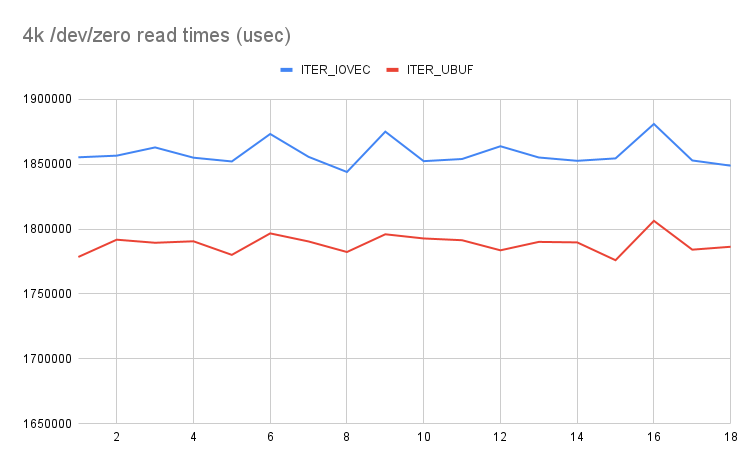
and in real numbers it ends up being a 3.7% reduction with using ITER_UBUF. Sadly, in absolute numbers, comparing read(2) and readv(2), the latter takes 2.11x as long in the stock kernel, and 2.01x as long with the patches. So while single segment is better now than before, it's still waaaay slower than having to copy in a single iovec. Testing was run with all security mitigations off.
Signature · 1 line
Jens Axboe
Jens Axboe
maintainerPATCH 1/11 block: ensure bio_alloc_map_data() deals with ITER_UBUF correctly
This helper blindly copies the iovec, even if we don't have one. Make this case a bit smarter by only doing so if we have an iovec array to copy.
---
 block/blk-map.c | 5 +++--
 1 file changed, 3 insertions(+), 2 deletions(-)
block/blk-map.c +3 -2
@@ -29,10 +29,11 @@ static struct bio_map_data *bio_alloc_map_data(struct iov_iter *data, bmd =kmalloc (struct_size (bmd, iov, data->nr_segs), gfp_mask);if (!bmd)return NULL ; -memcpy (bmd->iov, data->iov,sizeof (struct iovec ) * data->nr_segs); bmd->iter = *data; -if (iter_is_iovec (data)) +if (iter_is_iovec (data)) { +memcpy (bmd->iov, data->iov,sizeof (struct iovec ) * data->nr_segs); bmd->iter.iov = bmd->iov; + }return bmd; }
Signature · 1 line
2.39.2
Jens Axboe
maintainerPATCH 2/11 iov_iter: add iter_iovec() helper
In reply to Jens AxboeThis returns a pointer to the current iovec entry in the iterator. Only useful with ITER_IOVEC right now, but it prepares us to treat ITER_UBUF and ITER_IOVEC identically for the first segment.
Rename struct iov_iter->iov to iov_iter->__iov to find any potentially troublesome spots, and also to prevent anyone from adding new code that accesses iter->iov directly.
---
 block/blk-map.c                          |  4 +-
 drivers/infiniband/hw/hfi1/file_ops.c    |  3 +-
 drivers/infiniband/hw/qib/qib_file_ops.c |  2 +-
 drivers/net/tun.c                        |  3 +-
 drivers/vhost/scsi.c                     |  2 +-
 fs/btrfs/file.c                          | 11 +++--
 fs/fuse/file.c                           |  2 +-
 include/linux/uio.h                      |  9 ++--
 io_uring/net.c                           |  4 +-
 io_uring/rw.c                            |  8 ++--
 lib/iov_iter.c                           | 56 +++++++++++++-----------
 sound/core/pcm_native.c                  | 22 ++++++----
 12 files changed, 73 insertions(+), 53 deletions(-)
block/blk-map.c +2 -2
@@ -31,8 +31,8 @@ static struct bio_map_data *bio_alloc_map_data(struct iov_iter *data,return NULL ; bmd->iter = *data;if (iter_is_iovec (data)) { -memcpy (bmd->iov, data->iov,sizeof (struct iovec ) * data->nr_segs); - bmd->iter.iov = bmd->iov; +memcpy (bmd->iov,iter_iov (data),sizeof (struct iovec ) * data->nr_segs); + bmd->iter.__iov = bmd->iov; }return bmd; }
drivers/infiniband/hw/hfi1/file_ops.c +2 -1
@@ -287,11 +287,12 @@ static ssize_t hfi1_write_iter(struct kiocb *kiocb, struct iov_iter *from) }while (dim) { +const struct iovec *iov =iter_iov (from);int ret;unsigned long count =0 ; ret =hfi1_user_sdma_process_request ( - fd, (struct iovec *)(from->iov + done), + fd, (struct iovec *)(iov + done), dim, &count);if (ret) { reqs = ret;
drivers/infiniband/hw/qib/qib_file_ops.c +1 -1
@@ -2248,7 +2248,7 @@ static ssize_t qib_write_iter(struct kiocb *iocb, struct iov_iter *from)if (!iter_is_iovec (from) || !from->nr_segs || !pq)return -EINVAL ; -return qib_user_sdma_writev (rcd, pq, from->iov, from->nr_segs); +return qib_user_sdma_writev (rcd, pq,iter_iov (from), from->nr_segs); }static struct class *qib_class;
drivers/net/tun.c +2 -1
@@ -1486,7 +1486,8 @@ static struct sk_buff *tun_napi_alloc_frags(struct tun_file *tfile, skb->truesize += skb->data_len;for (i =1 ; i < it->nr_segs; i++) { -size_t fragsz = it->iov[i].iov_len; +const struct iovec *iov =iter_iov (it); +size_t fragsz = iov->iov_len;struct page *page;void *frag;
drivers/vhost/scsi.c +1 -1
@@ -671,7 +671,7 @@ vhost_scsi_calc_sgls(struct iov_iter *iter, size_t bytes, int max_sgls) {int sgl_count =0 ; -if (!iter || !iter->iov) { +if (!iter || !iter_iov (iter)) {pr_err ("%s: iter->iov is NULL, but expected bytes: %zu" " present\n" , __func__, bytes);return -EINVAL ;
fs/btrfs/file.c +8 -3
@@ -3730,10 +3730,15 @@ static int check_direct_read(struct btrfs_fs_info *fs_info,if (!iter_is_iovec (iter))return 0 ; -for (seg =0 ; seg < iter->nr_segs; seg++) -for (i = seg +1 ; i < iter->nr_segs; i++) -if (iter->iov[seg].iov_base == iter->iov[i].iov_base) +for (seg =0 ; seg < iter->nr_segs; seg++) { +for (i = seg +1 ; i < iter->nr_segs; i++) { +const struct iovec *iov1 =iter_iov (iter) + seg; +const struct iovec *iov2 =iter_iov (iter) + i; + +if (iov1->iov_base == iov2->iov_base)return -EINVAL ; + } + }return 0 ; }
fs/fuse/file.c +1 -1
@@ -1419,7 +1419,7 @@ static ssize_t fuse_cache_write_iter(struct kiocb *iocb, struct iov_iter *from)static inline unsigned long fuse_get_user_addr (const struct iov_iter *ii) { -return (unsigned long )ii->iov->iov_base + ii->iov_offset; +return (unsigned long )iter_iov (ii)->iov_base + ii->iov_offset; } static inline size_t fuse_get_frag_size(const struct iov_iter *ii,
include/linux/uio.h +6 -3
@@ -51,7 +51,8 @@ struct iov_iter { };size_t count;union { -const struct iovec *iov; +/* use iter_iov() to get the current vec */ +const struct iovec *__iov;const struct kvec *kvec;const struct bio_vec *bvec;struct xarray *xarray;
@@ -68,6 +69,8 @@ struct iov_iter { }; }; +#define iter_iov (iter) (iter)->__iov +static inline enum iter_type iov_iter_type (const struct iov_iter *i) {return i->iter_type;
@@ -146,9 +149,9 @@ static inline size_t iov_length(const struct iovec *iov, unsigned long nr_segs)static inline struct iovec iov_iter_iovec (const struct iov_iter *iter) {return (struct iovec ) { - .iov_base = iter->iov->iov_base + iter->iov_offset, + .iov_base =iter_iov (iter)->iov_base + iter->iov_offset, .iov_len =min (iter->count, - iter->iov->iov_len - iter->iov_offset), +iter_iov (iter)->iov_len - iter->iov_offset), }; }
io_uring/net.c +2 -2
@@ -184,8 +184,8 @@ static int io_setup_async_msg(struct io_kiocb *req, async_msg->msg.msg_name = &async_msg->addr;/* if were using fast_iov, set it to the new one */ if (iter_is_iovec (&kmsg->msg.msg_iter) && !kmsg->free_iov) { -size_t fast_idx = kmsg->msg.msg_iter.iov - kmsg->fast_iov; - async_msg->msg.msg_iter.iov = &async_msg->fast_iov[fast_idx]; +size_t fast_idx =iter_iov (&kmsg->msg.msg_iter) - kmsg->fast_iov; + async_msg->msg.msg_iter.__iov = &async_msg->fast_iov[fast_idx]; }return -EAGAIN ;
io_uring/rw.c +4 -4
@@ -503,10 +503,10 @@ static void io_req_map_rw(struct io_kiocb *req, const struct iovec *iovec,if (!iovec) {unsigned iov_off =0 ; - io->s.iter.iov = io->s.fast_iov; -if (iter->iov != fast_iov) { - iov_off = iter->iov - fast_iov; - io->s.iter.iov += iov_off; + io->s.iter.__iov = io->s.fast_iov; +if (iter->__iov != fast_iov) { + iov_off =iter_iov (iter) - fast_iov; + io->s.iter.__iov += iov_off; }if (io->s.fast_iov != fast_iov) memcpy(io->s.fast_iov + iov_off, fast_iov + iov_off,
lib/iov_iter.c +30 -26
167 lines not on this page · raw message
sound/core/pcm_native.c +14 -8
@@ -3521,6 +3521,7 @@ static ssize_t snd_pcm_readv(struct kiocb *iocb, struct iov_iter *to)unsigned long i;void __user **bufs;snd_pcm_uframes_t frames; +const struct iovec *iov =iter_iov (to); pcm_file = iocb->ki_filp->private_data; substream = pcm_file->substream;
@@ -3534,14 +3535,16 @@ static ssize_t snd_pcm_readv(struct kiocb *iocb, struct iov_iter *to)return -EINVAL ;if (to->nr_segs >1024 || to->nr_segs != runtime->channels)return -EINVAL ; -if (!frame_aligned (runtime, to->iov->iov_len)) +if (!frame_aligned (runtime, iov->iov_len))return -EINVAL ; - frames =bytes_to_samples (runtime, to->iov->iov_len); + frames =bytes_to_samples (runtime, iov->iov_len); bufs =kmalloc_array (to->nr_segs,sizeof (void *),GFP_KERNEL );if (bufs ==NULL )return -ENOMEM ; -for (i =0 ; i < to->nr_segs; ++i) - bufs[i] = to->iov[i].iov_base; +for (i =0 ; i < to->nr_segs; ++i) { + bufs[i] = iov->iov_base; + iov++; + } result =snd_pcm_lib_readv (substream, bufs, frames);if (result >0 ) result =frames_to_bytes (runtime, result);
@@ -3558,6 +3561,7 @@ static ssize_t snd_pcm_writev(struct kiocb *iocb, struct iov_iter *from)unsigned long i;void __user **bufs;snd_pcm_uframes_t frames; +const struct iovec *iov =iter_iov (from); pcm_file = iocb->ki_filp->private_data; substream = pcm_file->substream;
@@ -3570,14 +3574,16 @@ static ssize_t snd_pcm_writev(struct kiocb *iocb, struct iov_iter *from)if (!iter_is_iovec (from))return -EINVAL ;if (from->nr_segs >128 || from->nr_segs != runtime->channels || - !frame_aligned (runtime, from->iov->iov_len)) + !frame_aligned (runtime, iov->iov_len))return -EINVAL ; - frames =bytes_to_samples (runtime, from->iov->iov_len); + frames =bytes_to_samples (runtime, iov->iov_len); bufs =kmalloc_array (from->nr_segs,sizeof (void *),GFP_KERNEL );if (bufs ==NULL )return -ENOMEM ; -for (i =0 ; i < from->nr_segs; ++i) - bufs[i] = from->iov[i].iov_base; +for (i =0 ; i < from->nr_segs; ++i) { + bufs[i] = iov->iov_base; + iov++; + } result =snd_pcm_lib_writev (substream, bufs, frames);if (result >0 ) result =frames_to_bytes (runtime, result);
Signature · 1 line
2.39.2
Jens Axboe
maintainerPATCH 4/11 IB/qib: check for user backed iterator, not specific iterator type
In reply to Jens AxboeIn preparation for switching single segment iterators to using ITER_UBUF, swap the check for whether we are user backed or not.
---
 drivers/infiniband/hw/qib/qib_file_ops.c | 2 +-
 1 file changed, 1 insertion(+), 1 deletion(-)
drivers/infiniband/hw/qib/qib_file_ops.c +1 -1
@@ -2245,7 +2245,7 @@ static ssize_t qib_write_iter(struct kiocb *iocb, struct iov_iter *from)struct qib_ctxtdata *rcd =ctxt_fp (iocb->ki_filp);struct qib_user_sdma_queue *pq = fp->pq; -if (!iter_is_iovec (from) || !from->nr_segs || !pq) +if (!from->user_backed || !from->nr_segs || !pq)return -EINVAL ;return qib_user_sdma_writev (rcd, pq,iter_iov (from), from->nr_segs);
Signature · 1 line
2.39.2
Jens Axboe
maintainerPATCH 5/11 ALSA: pcm: check for user backed iterator, not specific iterator type
In reply to Jens AxboeIn preparation for switching single segment iterators to using ITER_UBUF, swap the check for whether we are user backed or not.
---
 sound/core/pcm_native.c | 4 ++--
 1 file changed, 2 insertions(+), 2 deletions(-)
sound/core/pcm_native.c +2 -2
@@ -3531,7 +3531,7 @@ static ssize_t snd_pcm_readv(struct kiocb *iocb, struct iov_iter *to)if (runtime->state ==SNDRV_PCM_STATE_OPEN || runtime->state ==SNDRV_PCM_STATE_DISCONNECTED )return -EBADFD ; -if (!iter_is_iovec (to)) +if (!to->user_backed)return -EINVAL ;if (to->nr_segs >1024 || to->nr_segs != runtime->channels)return -EINVAL ;
@@ -3571,7 +3571,7 @@ static ssize_t snd_pcm_writev(struct kiocb *iocb, struct iov_iter *from)if (runtime->state ==SNDRV_PCM_STATE_OPEN || runtime->state ==SNDRV_PCM_STATE_DISCONNECTED )return -EBADFD ; -if (!iter_is_iovec (from)) +if (!from->user_backed)return -EINVAL ;if (from->nr_segs >128 || from->nr_segs != runtime->channels || !frame_aligned (runtime, iov->iov_len))
Signature · 1 line
2.39.2
Jens Axboe
maintainerPATCH 7/11 iov_iter: remove iov_iter_iovec()
In reply to Jens AxboeNo more users are left of this function.
---
 include/linux/uio.h | 9 ---------
 1 file changed, 9 deletions(-)
include/linux/uio.h +0 -9
@@ -148,15 +148,6 @@ static inline size_t iov_length(const struct iovec *iov, unsigned long nr_segs)return ret; } -static inline struct iovec iov_iter_iovec (const struct iov_iter *iter) -{ -return (struct iovec ) { - .iov_base =iter_iov (iter)->iov_base + iter->iov_offset, - .iov_len =min (iter->count, -iter_iov (iter)->iov_len - iter->iov_offset), - }; -} -size_t copy_page_from_iter_atomic (struct page *page,unsigned offset,size_t bytes,struct iov_iter *i);void iov_iter_advance (struct iov_iter *i,size_t bytes);
Signature · 1 line
2.39.2
Jens Axboe
maintainerPATCH 9/11 iov_iter: overlay struct iovec and ubuf/len
In reply to Jens AxboeAdd an internal struct iovec that we can return as a pointer, with the fields of the iovec overlapping with the ITER_UBUF ubuf and length fields.
Then we can have iter_iov() check for the appropriate type, and return &iter->__ubuf_iovec for ITER_UBUF and iter->__iov for ITER_IOVEC and things will magically work out for a single segment request regardless of either type.
---
 include/linux/uio.h | 44 +++++++++++++++++++++++++++++++++++---------
 1 file changed, 35 insertions(+), 9 deletions(-)
include/linux/uio.h +35 -9
@@ -49,15 +49,35 @@ struct iov_iter {size_t iov_offset;int last_offset; }; -size_t count; +/* +* Hack alert: overlay ubuf_iovec with iovec + count, so +* that the members resolve correctly regardless of the type +* of iterator used. This means that you can use: +* +* &iter->__ubuf_iovec or iter->__iov +* +* interchangably for the user_backed cases, hence simplifying +* some of the cases that need to deal with both. +*/ union { -/* use iter_iov() to get the current vec */ -const struct iovec *__iov; -const struct kvec *kvec; -const struct bio_vec *bvec; -struct xarray *xarray; -struct pipe_inode_info *pipe; -void __user *ubuf; +/* +* This really should be a const, but we cannot do that without +* also modifying any of the zero-filling iter init functions. +* Leave it non-const for now, but it should be treated as such. +*/ +struct iovec __ubuf_iovec; +struct { +union { +/* use iter_iov() to get the current vec */ +const struct iovec *__iov; +const struct kvec *kvec; +const struct bio_vec *bvec; +struct xarray *xarray; +struct pipe_inode_info *pipe; +void __user *ubuf; + }; +size_t count; + }; };union {unsigned long nr_segs;
@@ -69,7 +89,13 @@ struct iov_iter { }; }; -#define iter_iov (iter) (iter)->__iov +static inline const struct iovec *iter_iov (const struct iov_iter *iter) +{ +if (iter->iter_type ==ITER_UBUF ) +return (const struct iovec *) &iter->__ubuf_iovec; +return iter->__iov; +} +#define iter_iov_addr (iter) (iter_iov(iter)->iov_base + (iter)->iov_offset)#define iter_iov_len (iter) (iter_iov(iter)->iov_len - (iter)->iov_offset)
Signature · 1 line
2.39.2
Jens Axboe
maintainerPATCH 10/11 iov_iter: convert import_single_range() to ITER_UBUF
In reply to Jens AxboeSince we're just importing a single vector, we don't have to turn it into an ITER_IOVEC. Instead turn it into an ITER_UBUF, which is cheaper to iterate.
---
 lib/iov_iter.c | 4 +---
 1 file changed, 1 insertion(+), 3 deletions(-)
lib/iov_iter.c +1 -3
@@ -1870,9 +1870,7 @@ int import_single_range(int rw, void __user *buf, size_t len,if (unlikely (!access_ok (buf, len)))return -EFAULT ; - iov->iov_base = buf; - iov->iov_len = len; -iov_iter_init (i, rw, iov,1 , len); +iov_iter_ubuf (i, rw, buf, len);return 0 ; }EXPORT_SYMBOL (import_single_range);
Signature · 1 line
2.39.2
Jens Axboe
maintainerPATCH 11/11 iov_iter: import single vector iovecs as ITER_UBUF
In reply to Jens AxboeAdd a special case to __import_iovec(), which imports a single segment iovec as an ITER_UBUF rather than an ITER_IOVEC. ITER_UBUF is cheaper to iterate than ITER_IOVEC, and for a single segment iovec, there's no point in using a segmented iterator.
---
 lib/iov_iter.c | 27 +++++++++++++++++++++++++++
 1 file changed, 27 insertions(+)
lib/iov_iter.c +27 -0
@@ -1784,6 +1784,30 @@ struct iovec *iovec_from_user(const struct iovec __user *uvec,return iov; } +/* +* Single segment iovec supplied by the user, import it as ITER_UBUF. +*/ +static ssize_t __import_iovec_ubuf (int type,const struct iovec __user *uvec, +struct iovec **iovp,struct iov_iter *i, +bool compat) +{ +struct iovec *iov = *iovp; +ssize_t ret; + +if (compat) + ret =copy_compat_iovec_from_user (iov, uvec,1 ); +else + ret =copy_iovec_from_user (iov, uvec,1 ); +if (unlikely (ret)) +return ret; + + ret =import_ubuf (type, iov->iov_base, iov->iov_len, i); +if (unlikely (ret)) +return ret; + *iovp =NULL ; +return i->count; +} +ssize_t __import_iovec (int type,const struct iovec __user *uvec,unsigned nr_segs,unsigned fast_segs,struct iovec **iovp,struct iov_iter *i,bool compat)
@@ -1792,6 +1816,9 @@ ssize_t __import_iovec(int type, const struct iovec __user *uvec,unsigned long seg;struct iovec *iov; +if (nr_segs ==1 ) +return __import_iovec_ubuf (type, uvec, iovp, i, compat); + iov =iovec_from_user (uvec, nr_segs, fast_segs, *iovp, compat);if (IS_ERR (iov)) { *iovp =NULL ;
Signature · 1 line
2.39.2
Quoted 6 lines · Jens Axboe
Sadly, in absolute numbers, comparing read(2) and readv(2), the latter takes 2.11x as long in the stock kernel, and 2.01x as long with the patches. So while single segment is better now than before, it's still waaaay slower than having to copy in a single iovec. Testing was run with all security mitigations off.
What does the profile say? Iis it all in import_iovec() or what?
I do note that we have some completely horrid "helper" functions in the iter paths: things like "do_iter_readv_writev()" supposedly being a common function , but then it ends up doing some small setup and just doing a conditional on the "type" after all, so when it isn't inlined, you have those things that don't predict well at all.
And the iter interfaces don't have just that iterator, they have the whole kiocb overhead too. All in the name of being generic. Most file descriptors don't even support the simpler ".read" interface, because they want the whole thing with IOCB_DIRECT flags etc.
So to some degree it's unfair to compare read-vs-read_iter. The latter has all that disgusting support for O_DIRECT and friends, and testing with /dev/null just doesn't show that part.
Linus
Jens Axboe
maintainerQuoted 16 lines · Linus Torvalds
Quoted 6 lines · On Thu, Mar 30, 2023 at 9:47?AM Jens Axboe <[email protected]> wrote:
Sadly, in absolute numbers, comparing read(2) and readv(2), the latter takes 2.11x as long in the stock kernel, and 2.01x as long with the patches. So while single segment is better now than before, it's still waaaay slower than having to copy in a single iovec. Testing was run with all security mitigations off.
What does the profile say? Iis it all in
import_iovec()or what?I do note that we have some completely horrid "helper" functions in the iter paths: things like "
do_iter_readv_writev()" supposedly being a common function , but then it ends up doing some small setup and just doing a conditional on the "type" after all, so when it isn't inlined, you have those things that don't predict well at all.
Quoted 8 lines
And the iter interfaces don't have just that iterator, they have the whole kiocb overhead too. All in the name of being generic. Most file descriptors don't even support the simpler ".read" interface, because they want the whole thing with
IOCB_DIRECTflags etc.So to some degree it's unfair to compare read-vs-read_iter. The latter has all that disgusting support for
O_DIRECTand friends, and testing with/dev/nulljust doesn't show that part.
Oh I agree, and particularly for the "read from /dev/zero" case it's not very interesting, as it does too different things there as well. It was just more of a "gah it's potentially this bad" outburst than anything else, the numbers I did care about was readv before and after patches, not read vs readv.
That said, there might be things to improve here. But that's a task for another time. perf diff of a read vs readv run below.
# Event 'cycles'
#
# Baseline  Delta Abs  Shared Object         Symbol
# ........  .........  ....................  .....................................
#
              +40.56%  [kernel.vmlinux]      [k] iov_iter_zero
              +12.59%  [kernel.vmlinux]      [k] copy_user_enhanced_fast_string
    21.56%    -11.10%  [kernel.vmlinux]      [k] entry_SYSCALL_64
               +7.67%  [kernel.vmlinux]      [k] _copy_from_user
               +7.40%  libc.so.6             [.] __GI___readv
     3.76%     -2.22%  [kernel.vmlinux]      [k] __fsnotify_parent
               +2.13%  [kernel.vmlinux]      [k] do_iter_read
               +2.02%  [kernel.vmlinux]      [k] do_iter_readv_writev
               +1.89%  [kernel.vmlinux]      [k] __import_iovec
               +1.59%  [kernel.vmlinux]      [k] do_readv
     3.15%     -1.43%  [kernel.vmlinux]      [k] __fget_light
               +1.42%  [kernel.vmlinux]      [k] vfs_readv
               +1.32%  [kernel.vmlinux]      [k] read_iter_zero
     2.39%     -1.30%  [kernel.vmlinux]      [k] syscall_exit_to_user_mode
     1.89%     -1.17%  [kernel.vmlinux]      [k] exit_to_user_mode_prepare
     2.01%     -1.10%  [kernel.vmlinux]      [k] do_syscall_64
     2.04%     -1.06%  [kernel.vmlinux]      [k] __fdget_pos
     1.93%     -0.99%  [kernel.vmlinux]      [k] syscall_enter_from_user_mode
               +0.81%  [kernel.vmlinux]      [k] __get_task_ioprio
     1.03%     -0.56%  [kernel.vmlinux]      [k] fpregs_assert_state_consistent
     0.85%     -0.49%  [kernel.vmlinux]      [k] syscall_exit_to_user_mode_prepare
               +0.45%  [kernel.vmlinux]      [k] import_iovec
               +0.20%  [kernel.vmlinux]      [k] kfree
               +0.18%  [kernel.vmlinux]      [k] __x64_sys_readv
               +0.06%  read-zero             [.] readv@plt
               +0.01%  [kernel.vmlinux]      [k] filemap_map_pages
               +0.01%  ld-linux-x86-64.so.2  [.] check_match
     0.00%     +0.00%  [kernel.vmlinux]      [k] memset_erms
     0.00%     -0.00%  [kernel.vmlinux]      [k] perf_iterate_ctx
               +0.00%  [kernel.vmlinux]      [k] xfs_iunlock
     0.49%     -0.00%  read-zero             [.] main
               +0.00%  [kernel.vmlinux]      [k] arch_get_unmapped_area_topdown
               +0.00%  [kernel.vmlinux]      [k] pcpu_alloc
               +0.00%  [kernel.vmlinux]      [k] perf_event_exec
               +0.00%  taskset               [.] 0x0000000000002ebd
     0.00%     +0.00%  [kernel.vmlinux]      [k] perf_ibs_handle_irq
     0.00%     -0.00%  [kernel.vmlinux]      [k] perf_ibs_start
    32.88%             [kernel.vmlinux]      [k] read_zero
    15.22%             libc.so.6             [.] read
     6.27%             [kernel.vmlinux]      [k] vfs_read
     2.60%             [kernel.vmlinux]      [k] ksys_read
     1.02%             [kernel.vmlinux]      [k] __cond_resched
     0.41%             [kernel.vmlinux]      [k] rcu_all_qs
     0.35%             [kernel.vmlinux]      [k] __x64_sys_read
     0.12%             read-zero             [.] read@plt
     0.01%             ld-linux-x86-64.so.2  [.] _dl_load_cache_lookup
     0.01%             ld-linux-x86-64.so.2  [.] _dl_check_map_versions
     0.00%             [kernel.vmlinux]      [k] _find_next_or_bit
     0.00%             [kernel.vmlinux]      [k] perf_event_update_userpage
     0.00%             [kernel.vmlinux]      [k] native_sched_clock
Signature · 1 line
Jens Axboe
Quoted 3 lines · Jens Axboe
That said, there might be things to improve here. But that's a task for another time.
So I ended up looking at this, and funnily enough, the *compat* version of the "copy iovec from user" is actually written to be a lot more efficient than the "native" version.
The reason is that the compat version has to load the data one field at a time anyway to do the conversion, so it open-codes the loop. And it does it all using the efficient "user_access_begin()" etc, so it generates good code.
In contrast, the native version just does a "copy_from_user()" and then loops over the result to verify it. And that's actually pretty horrid. Doing the open-coded loop that fetches and verifies the iov entries one at a time should be much better.
I dunno. That's my gut feel, at least. And it may explain why your "readv()" benchmark has "_copy_from_user()" much higher up than the "read()" case.
Something like the attached *may* help.
Untested - I only checked the generated assembly to see that it seems to be sane, but I might have done something stupid. I basically copied the compat code, fixed it up for non-compat types, and then massaged it a bit more.
Linus
 lib/iov_iter.c | 35 ++++++++++++++++++++++++++---------
 1 file changed, 26 insertions(+), 9 deletions(-)
lib/iov_iter.c +26 -9
@@ -1731,18 +1731,35 @@ static int copy_compat_iovec_from_user(struct iovec *iov, }static int copy_iovec_from_user (struct iovec *iov, -const struct iovec __user *uvec,unsigned long nr_segs) +const struct iovec __user *uiov,unsigned long nr_segs) { -unsigned long seg; +int ret = -EFAULT ; -if (copy_from_user (iov, uvec, nr_segs *sizeof (*uvec))) +if (!user_access_begin (uiov, nr_segs *sizeof (*uiov)))return -EFAULT ; -for (seg =0 ; seg < nr_segs; seg++) { -if ((ssize_t )iov[seg].iov_len <0 ) -return -EINVAL ; - } -return 0 ; +do { +void __user *buf; +ssize_t len; + +unsafe_get_user (len, &uiov->iov_len, uaccess_end); +unsafe_get_user (buf, &uiov->iov_base, uaccess_end); + +/* check for size_t not fitting in ssize_t .. */ +if (unlikely (len <0 )) { + ret = -EINVAL ; + goto uaccess_end; + } + iov->iov_base = buf; + iov->iov_len = len; + + uiov++; iov++; + }while (--nr_segs); + + ret =0 ; +uaccess_end: +user_access_end (); +return ret; } struct iovec *iovec_from_user(const struct iovec __user *uvec,
@@ -1767,7 +1784,7 @@ struct iovec *iovec_from_user(const struct iovec __user *uvec,return ERR_PTR (-ENOMEM ); } -if (compat) +if (unlikely (compat)) ret =copy_compat_iovec_from_user (iov, uvec, nr_segs);else ret =copy_iovec_from_user (iov, uvec, nr_segs);
Jens Axboe
maintainerQuoted 23 lines · Linus Torvalds
Quoted 3 lines · Jens Axboe
That said, there might be things to improve here. But that's a task for another time.
So I ended up looking at this, and funnily enough, the *compat* version of the "copy iovec from user" is actually written to be a lot more efficient than the "native" version.
The reason is that the compat version has to load the data one field at a time anyway to do the conversion, so it open-codes the loop. And it does it all using the efficient "
user_access_begin()" etc, so it generates good code.In contrast, the native version just does a "
copy_from_user()" and then loops over the result to verify it. And that's actually pretty horrid. Doing the open-coded loop that fetches and verifies the iov entries one at a time should be much better.I dunno. That's my gut feel, at least. And it may explain why your "
readv()" benchmark has "_copy_from_user()" much higher up than the "read()" case.
Quoted 6 lines
Something like the attached *may* help.
Untested - I only checked the generated assembly to see that it seems to be sane, but I might have done something stupid. I basically copied the compat code, fixed it up for non-compat types, and then massaged it a bit more.
That's a nice improvement - about 6% better for the single vec case, And that's the full "benchmark". Here are the numbers in usec for the read-zero. Lower is better, obviously.
-git
1793883
1809305
1782602
1777280
1803978
1798792
1791190
1802017
1804558
1813370
1807696
1785887
1785506
1789876
1780018
1793932
1803655
1798186
-git+patch
1685393
1685891
1688886
1679967
1687551
1693233
1684883
1688779
1682103
1684944
1686928
1687984
1686729
1687009
1684660
1687295
1684893
1685309
Signature · 1 line
Jens Axboe
Jens Axboe
maintainerQuoted 26 lines · Jens Axboe
Quoted 25 lines · Linus Torvalds
Quoted 3 lines · Jens Axboe
That said, there might be things to improve here. But that's a task for another time.
So I ended up looking at this, and funnily enough, the *compat* version of the "copy iovec from user" is actually written to be a lot more efficient than the "native" version.
The reason is that the compat version has to load the data one field at a time anyway to do the conversion, so it open-codes the loop. And it does it all using the efficient "
user_access_begin()" etc, so it generates good code.In contrast, the native version just does a "
copy_from_user()" and then loops over the result to verify it. And that's actually pretty horrid. Doing the open-coded loop that fetches and verifies the iov entries one at a time should be much better.I dunno. That's my gut feel, at least. And it may explain why your "
readv()" benchmark has "_copy_from_user()" much higher up than the "read()" case.Something like the attached *may* help.
Quoted 8 lines
Quoted 4 lines
Untested - I only checked the generated assembly to see that it seems to be sane, but I might have done something stupid. I basically copied the compat code, fixed it up for non-compat types, and then massaged it a bit more.
That's a nice improvement - about 6% better for the single vec case, And that's the full "benchmark". Here are the numbers in usec for the read-zero. Lower is better, obviously.
Linus, are you going to turn this into a proper patch? This is too good to not pursue.
Signature · 1 line
Jens Axboe
Quoted 3 lines · Jens Axboe
Linus, are you going to turn this into a proper patch? This is too good to not pursue.
So I initially was planning on doing just that for 6.4.
However, I looked more at it, and I'm now fairly convinced that the biggest problem is that we have basically screwed up our simple "copy_to/from_user()" with all the indirection.
So yes, that patch may end up being a 6% improvement on the made-up load, but a *large* reason for that is that we just do horribly badly on a plain "copy_from_user()", and I think I could fix that.
The problems with "copy_from_user()" are:
- it's *two* function calls ("_copy_to_user()" and then "raw_copy_to_user()")
- we have entirely lost all "this is how big the copy is" at all levels
and my stupid patch basically improves on copy_iovec_from_user() by fixing those two issues:
- it inlines it all by using the "unsafe_get_user()" interfaces
- it recovers the access sizes by just accessing the fields directly
and in the process it gets rid of us being really really piggy in "copy_from_user()".
Now, there are a few reason *why* we are so piggy in copy_from_user(), mainly
(a) CLAC/STAC is just slow and 'access_ok()' is big
(b) we have lots of debug boiler plate crap. Things like
- might_fault() (PROVE_LOCKING || DEBUG_ATOMIC_SLEEP)
- check_copy_size() (HARDENED_USERCOPY)
- test should_fail_usercopy() (FAULT_INJECTION_USERCOPY)
- do instrument_copy_from_user_before/after (KASAN)
- clear the end of the buffer on failures (legacy behavior)
(c) you probably don't have a CPU with X86_FEATURE_FSRM
Now, what (a) and (b) does is to make it unreasonable to inline copy_from/to_user(). Particularly when those debug options are set, but even without them, it's just not reasonable to inline.
Long long ago, we used to special-case small constant-sized user copies, but all of that has gone away. That's lovely (it used to be horrid in the header files, and caused problems)
And (c) means that the small cases tend to suck, although with all the other overhead (two function calls, possibly with return stack counting, CLAC/STAC, 'lfence' for speculation control etc etc), that's almost not an issue. It's just extra cycles.
Again, that hack to copy_iovec_from_user() ends up working so well simply because it avoids all the *stupid* stuff. Yes, it still obviously does the CLAC/STAC and the access_ok(), but it's ok to inline when it's just that special code, not some random 'copy_from_user()' that doesn't matter.
Anyway, what this long rant is about is that I'm looking at what I can do to improve "copy_from_user()" instead. It's a pain, because of all those debug options, but I actually have a disgusting patch that would make it possible to have a much better copy_from_user.
How disgusting, you say? Let me quote part of it:
+#define __a(n,a) ((unsigned long)(n)&((a)-1))
+#define statically_aligned(n,a) \
+ (__builtin_constant_p(__a(n,a)) && !__a(n,a))
+
+extern unsigned long copy_from_user_a16(void *to, const void __user
*from, unsigned long n);
+extern unsigned long copy_from_user_a8(void *to, const void __user
*from, unsigned long n);
+extern unsigned long copy_from_user_a4(void *to, const void __user
*from, unsigned long n);
...
+ if (statically_aligned(n, 16))
+ n = copy_from_user_a16(to, from, n);
+ else if (statically_aligned(n, 8))
+ n = copy_from_user_a8(to, from, n);
+ else if (statically_aligned(n, 4))
+ n = copy_from_user_a4(to, from, n);
+ else
+ n = _copy_from_user(to, from, n);
and it turns out that both gcc and clang are smart enough that even when you don't have a *constant* size, when you have code like
if (copy_from_user(iov, uvec, nr_segs * sizeof(*uvec)))
return -EFAULT;
that "statically_aligned()" thing will notice that "look, that size is a multiple of 16", and my disgusting patch replaces the "I have lost all sign of the size of the copy" user copy with a call to copy_from_user_a16().
And interestingly, that "size is 16-byte aligned" happens a *lot*. It happens for that uvec case, but it also happens for things like "cp_new_stat()" that copies a "struct stat" to user space, because 'struct stat' is something like 144 bytes (9*16) on x86-64.
So yes, I can improve the iovec copy. Easy peasy. Get rid of the crazy overhead from a generic interface and from our disgusting debugging code.
Or I could try to improve copy_to/from_user() in general.
My current patch is too ugly to actually live, and making it even better (encode the size range when it is statically known, not just a few "size is X-byte aligned") would make it uglier still.
I'm idly thinking about trying to teach 'objtool' to pick the right function target by hiding the size information in a separate section.
I may decide that "just doing iovecs" is just so much simpler, and that trying to improve the generic case is too painful. But that's the issue right now - I know I *could* just improve copy_from_user() enough that at least with sane configurations, that iovec improvement would basically not be worth it.
The problem here is at least partly "sane configurations". At least Fedora enables HARDENED_USERCOPY. And if you have that enabled, then "copy_to/from_user()" is _always_ going to suck, and doing a special "copy iovecs by avoiding it" is always going to be better, if only because you avoid the debug overhead.
Argh.
Linus