Aliasing on ALi5451
Hi!
I've tried to do loadspeaker identification using the ALi5451 chipset in my laptop. I saw a strong drop in the spectrum above ~2kHz when a ran the ADC:s at 44100 (I used a high quality microphone and a mic pre-amp). I then wired the audio output directly to the input with the same result - strong attenuation above 2kHz (I used wideband white noise as identication signal). Then I generated a chirp signal (5 sec sine sweep from 0-24kHz using Matlab) at 48kHz sampling rate which I recorded using Audacity at 8, 44.1, and 48 kHz. There was clearly freqeuency folding (aliasing) for all sampling freqs except 48 kHz (see the time-freq plot at: http://www.signal.uu.se/Staff/fl/chirp_test.jpg).
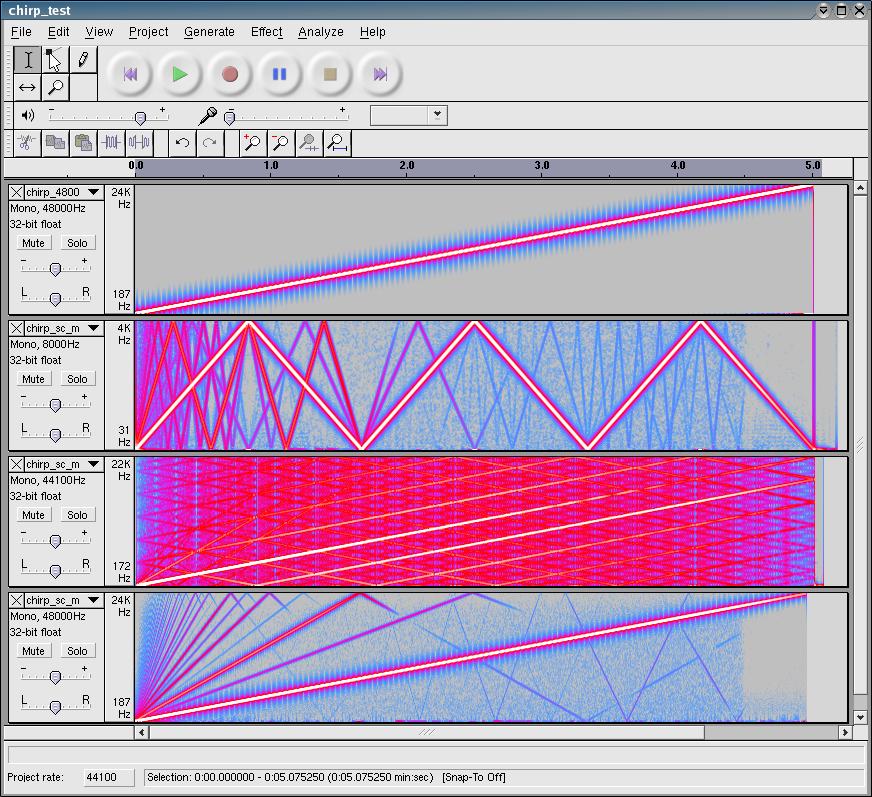
From the specs of the cs4299 chip (used in ALi 5451) it allways runs at 48 kHz and uses sample rate converters for the other sampling freqs. However, the anti-aliasing filters (if there are any) do not seem to adapt when changing sampling freq. I also checked
cat /proc/asound/5451/pcm0p/sub0/hw_params
and
cat /proc/asound/5451/pcm0c/sub0/hw_params
when playing/recording and the sampling freqs. was correct. Is this a driver issue or is it just a bad sound chip?
Regards
Fredrik
-------------------------------------------------------
This SF.net email is sponsored by: ObjectStore.
If flattening out C++ or Java code to make your application fit in a relational database is painful, don't do it! Check out ObjectStore. Now part of Progress Software. http://www.objectstore.net/sourceforge
A message that is not in the archive (sent off-list or not yet received): 1053786705.876.11.camel@localhost
Quoted 3 lines · Manuel Jander
As far as i know, using a fixed rate codec implies a fixed antialiasing filter too. So there is no need to adjust a antialiasing filter.
Yes your right the sample rate converters should do the job.
Quoted 4 lines
I think thats the really reason why most audio card use AC97 codec with a samplerate converter instead of a programable codec, since the a varying antialiasing
filter semes more costly to me than a samplerate coverter.
Quoted 10 lines
While implementing the Aureal alsa driver, i found several situations where bad samplerate converter parameters caused strong aliasing. I would try to find the bug in the samplerate converter setup if any.
On the other hand, there are some audio cards like the CMedia 8378 that have nearly useless ADC's in their codec, because of too low samplerates. If the codec is a AC97, it should be fine, because they usually work at 48KHz, so there could only be problems with white noise (bad chip+board or preamp design).
Yes the codec is (should be) AC97 compatible. The sample rate converters are controlled by two registers (2Ch and 32h) one for the DAC:s and one for the ADC:s. The values of these registers for the supported sample rates are:
     8000   1F40
   11050   2B11
   16000   3B80
   22050   5622
   32000   7D00
   44100   AC44
   48000   BB80
I have tried to find the code in the ALSA sources where these values are set without success (any help appriciated). My idea is to set the sampling rate to a fixed value, for example AC44 (44.1 kHz), recompile the alsa drivers, and check if the problem dissapears.
Fredrik
Quoted 58 lines
Best regards,
Manuel Jander.
Quoted 46 lines · Fredrik Lingvall
Hi!
I've tried to do loadspeaker identification using the ALi5451 chipset in my laptop. I saw a strong drop in the spectrum above ~2kHz when a ran the ADC:s at 44100 (I used a high quality microphone and a mic pre-amp). I then wired the audio output directly to the input with the same result - strong attenuation above 2kHz (I used wideband white noise as identication signal). Then I generated a chirp signal (5 sec sine sweep from 0-24kHz using Matlab) at 48kHz sampling rate which I recorded using Audacity at 8, 44.1, and 48 kHz. There was clearly freqeuency folding (aliasing) for all sampling freqs except 48 kHz (see the time-freq plot at: http://www.signal.uu.se/Staff/fl/chirp_test.jpg).
From the specs of the cs4299 chip (used in ALi 5451) it allways runs at 48 kHz and uses sample rate converters for the other sampling freqs. However, the anti-aliasing filters (if there are any) do not seem to adapt when changing sampling freq. I also checked
cat
/proc/asound/5451/pcm0p/sub0/hw_paramsand
cat
/proc/asound/5451/pcm0c/sub0/hw_paramswhen playing/recording and the sampling freqs. was correct. Is this a driver issue or is it just a bad sound chip?
Regards
Fredrik
-------------------------------------------------------
This SF.net email is sponsored by: ObjectStore.
If flattening out C++ or Java code to make your application fit in a relational database is painful, don't do it! Check out ObjectStore. Now part of Progress Software. http://www.objectstore.net/sourceforge
_______________________________________________
Alsa-devel mailing list
[email protected]
https://lists.sourceforge.net/lists/listinfo/alsa-devel
-------------------------------------------------------
This SF.net email is sponsored by: ObjectStore.
If flattening out C++ or Java code to make your application fit in a relational database is painful, don't do it! Check out ObjectStore. Now part of Progress Software. http://www.objectstore.net/sourceforge