Instant crash with rtl8169 and large packets
Subsystems (2)
PATCH RESEND 1/1 Instant crash with rtl8169 and large packets
[Please excuse me for the resend, --
picked the wrong address for netdev again]
Hello.
This is a resend (sort of) of several months old email. Previous email about this issue has been mostly ignored.
The situation is very simple: with an RTL8169 (probably onboard) GigE card which, by default, is configured to have MTU (maximal transmission unit) to be 1500 bytes, it's *trivial* to instantly crash the machine by sending it a *single* packet of size >1500 bytes (provided the network switch can handle jumbo frames).
I verified with on several different machines - all I were able to find with this card - and all behaves exactly the same.
When sending a packet of size, say, 3000 bytes (ping -s 3000) from another machine to a machine running rtl8169 with no MTU configured, kernel OOPSes.
I captured one such OOPS (unfortunately without the first line few lines) here:
http://www.corpit.ru/mjt/r8169-mtu-oops.jpg
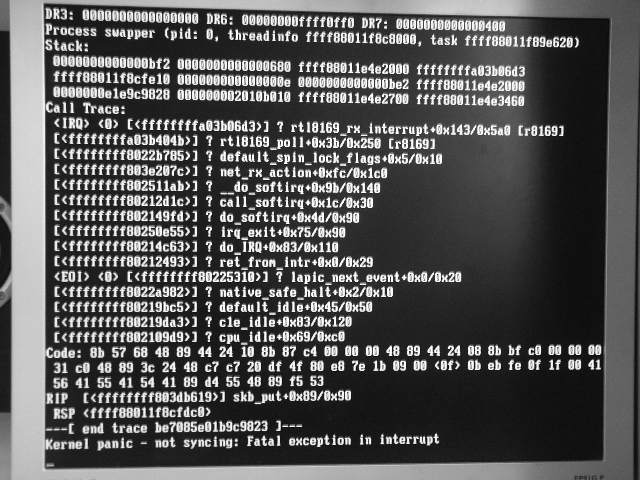
(since the network goes boom at that time, no network console is working).
But for anyone familiar with the driver's internals it should be easy to figure the issue out.
This is, in my opinion, quite a serious issue. And I've no idea why it is being ignored for several months.
Thanks.
/mjt
Quoted 28 lines · Michael Tokarev
[Please excuse me for the resend, --
picked the wrong address for netdev again]Hello.
This is a resend (sort of) of several months old email. Previous email about this issue has been mostly ignored.
The situation is very simple: with an RTL8169 (probably onboard) GigE card which, by default, is configured to have MTU (maximal transmission unit) to be 1500 bytes, it's *trivial* to instantly crash the machine by sending it a *single* packet of size >1500 bytes (provided the network switch can handle jumbo frames).
I verified with on several different machines - all I were able to find with this card - and all behaves exactly the same.
When sending a packet of size, say, 3000 bytes (ping -s 3000) from another machine to a machine running rtl8169 with no MTU configured, kernel OOPSes.
I captured one such OOPS (unfortunately without the first line few lines) here:
Quoted 8 lines
(since the network goes boom at that time, no network console is working).
But for anyone familiar with the driver's internals it should be easy to figure the issue out.
This is, in my opinion, quite a serious issue. And I've no idea why it is being ignored for several months.
I suppose you use a recent kernel ?
Could you please try following patch ?
Thank you
drivers/net/r8169.c +1 -1
@@ -3468,7 +3468,7 @@ static int rtl8169_rx_interrupt(struct net_device *dev,if (status & DescOwn)break ; -if (unlikely (status & RxRES)) { +if (unlikely (status & (RxRES | RxRWT | RxRUNT | RxCRC | RxFOVF))) {if (netif_msg_rx_err (tp)) { printk(KERN_INFO "%s: Rx ERROR. status = %08x\n",
Thank you Eric for the reply.
Quoted 1 line · Eric Dumazet
Michael Tokarev a écrit :
[]
Quoted 6 lines
Quoted 6 lines
The situation is very simple: with an RTL8169 (probably onboard) GigE card which, by default, is configured to have MTU (maximal transmission unit) to be 1500 bytes, it's *trivial* to instantly crash the machine by sending it a *single* packet of size >1500 bytes (provided the network switch can handle jumbo frames).
[]
Quoted 3 lines
Quoted 1 line
I suppose you use a recent kernel ?
http://marc.info/?t=123462473200002 -- here's my first attempt, at Feb this year. It was 2.6.27 or so. Right now I'm running 2.6.29[.4]. So I think yes, I use a recent kernel.
Quoted 1 line
Could you please try following patch ?
[]
drivers/net/r8169.c static int rtl8169_rx_interrupt(struct net_device *dev, · line 3474
Quoted 13 lines
drivers/net/r8169.c +1
-1@@ -3468,7 +3468,7 @@ static int rtl8169_rx_interrupt(struct net_device *dev,if (status & DescOwn)break ; -if (unlikely (status & RxRES)) { +if (unlikely (status & (RxRES | RxRWT | RxRUNT | RxCRC | RxFOVF))) {if (netif_msg_rx_err (tp)) { printk(KERN_INFO "%s: Rx ERROR. status = %08x\n",
Tried that one, got no printk (at least not a visible one) and exactly the same OOPS as before. Trivial test with
ping -c1 -s3000 $my_ip_addr
(learned to add -c1 because the previous time my machine crashed several times in a row till I figured out what's going on and unplugged the ethernet cord -- even if ping were running from an xterm executed from the machine to which I were pinging to! :)
Also got ext4fs corruption when rebooted (it's a staging area so nothing important is there but still.. "interesting").
Also tried 32bit kernel (were using 64bits -- exactly the same result).
I wish I had a serial cable or even a serial port on this machine.... But I guess it'd not help anyway, because the machine locks hard.
Thanks!
/mjt
Quoted 57 lines · Michael Tokarev
Thank you Eric for the reply.
Quoted 1 line · Eric Dumazet
Michael Tokarev a écrit :
[]
Quoted 6 lines
Quoted 6 lines
The situation is very simple: with an RTL8169 (probably onboard) GigE card which, by default, is configured to have MTU (maximal transmission unit) to be 1500 bytes, it's *trivial* to instantly crash the machine by sending it a *single* packet of size >1500 bytes (provided the network switch can handle jumbo frames).
[]
Quoted 3 lines
Quoted 1 line
I suppose you use a recent kernel ?
http://marc.info/?t=123462473200002 -- here's my first attempt, at Feb this year. It was 2.6.27 or so. Right now I'm running 2.6.29[.4]. So I think yes, I use a recent kernel.
Quoted 1 line
Could you please try following patch ?
[]
Quoted 13 lines
drivers/net/r8169.c +1
-1@@ -3468,7 +3468,7 @@ static int rtl8169_rx_interrupt(struct net_device *dev, if (status & DescOwn) break; -if (unlikely (status & RxRES)) { +if (unlikely (status & (RxRES | RxRWT | RxRUNT | RxCRC | RxFOVF))) {if (netif_msg_rx_err (tp)) {Quoted 2 lines
                 printk(KERN_INFO
                        "%s: Rx ERROR. status = %08x\n",
Tried that one, got no printk (at least not a visible one) and exactly the same OOPS as before. Trivial test with
ping -c1 -s3000 $my_ip_addr
(learned to add -c1 because the previous time my machine crashed several times
in a row till I figured out what's going on and unplugged the ethernet cord --
even if ping were running from an xterm executed from the machine to which I
were pinging to! :)Also got ext4fs corruption when rebooted (it's a staging area so nothing important
is there but still.. "interesting").Also tried 32bit kernel (were using 64bits -- exactly the same result).
Quoted 7 lines
I wish I had a serial cable or even a serial port on this machine.... But I guess
it'd not help anyway, because the machine locks hard.Thanks!
/mjt
OK, 2nd try then :)
Thanks
drivers/net/r8169.c +2 -1
@@ -3495,7 +3495,8 @@ static int rtl8169_rx_interrupt(struct net_device *dev,* frames. They are seen as a symptom of over-mtu * sized frames. */ -if (unlikely (rtl8169_fragmented_frame (status))) { +if (unlikely (rtl8169_fragmented_frame (status) || + (unsigned int )pkt_size > tp->rx_buf_sz)) { dev->stats.rx_dropped++; dev->stats.rx_length_errors++;rtl8169_mark_to_asic (desc, tp->rx_buf_sz);
Quoted 1 line · Eric Dumazet
Michael Tokarev a écrit :
[]
Quoted 6 lines
Quoted 6 lines
Quoted 6 lines
Quoted 6 lines
The situation is very simple: with an RTL8169 (probably onboard) GigE card which, by default, is configured to have MTU (maximal transmission unit) to be 1500 bytes, it's *trivial* to instantly crash the machine by sending it a *single* packet of size >1500 bytes (provided the network switch can handle jumbo frames).
[]
Quoted 7 lines
OK, 2nd try then :)
drivers/net/r8169.c +0
-0
drivers/net/r8169.c static int rtl8169_rx_interrupt(struct net_device *dev, · line 3502
Quoted 9 lines
drivers/net/r8169.c +2
-1@@ -3495,7 +3495,8 @@ static int rtl8169_rx_interrupt(struct net_device *dev,* frames. They are seen as a symptom of over-mtu * sized frames. */ -if (unlikely (rtl8169_fragmented_frame (status))) { +if (unlikely (rtl8169_fragmented_frame (status) || + (unsigned int )pkt_size > tp->rx_buf_sz)) { dev->stats.rx_dropped++; dev->stats.rx_length_errors++;rtl8169_mark_to_asic (desc, tp->rx_buf_sz);
This one behaves much better. There's no instant crash anymore, and the 'dropped' and 'frame' stats in ifconfig gets incremented with each ping.
It fails down the line however. I wasn't able to reply to this email after doing the ping test with the above change (no more large packets were sent). With OOPSes like this one:
 general protection fault: 0000 [#1] SMP
 last sysfs file: /sys/devices/pci0000:00/0000:00:01.0/0000:01:05.0/drm/card0/dev
 CPU 0
 Modules linked in: radeon drm r8169 powernow_k8 autofs4 nfsd nfs lockd nfs_acl auth_rpcgss sunrpc quota_v2
 Pid: 10917, comm: icedove-bin Not tainted 2.6.29-x86-64 #2.6.29.4 System Product Name
 RIP: 0010:[<ffffffff8029889b>]  [<ffffffff8029889b>] put_page+0x1b/0x170
 RSP: 0018:ffff8800cd8fdb88  EFLAGS: 00210296
 RAX: 0000000000000020 RBX: 6d6c6b6a69686766 RCX: 0000000000000760
 RDX: ffff88011d9f1680 RSI: ffff88011d9f139b RDI: 6d6c6b6a69686766
 RBP: ffff88011c936ac0 R08: 0000000000000001 R09: 0000000000000000
 R10: ffffffff80552840 R11: 0000000000200293 R12: ffff88011d03e080
 R13: 0000000000000030 R14: ffff88011d03e4bc R15: 0000000000000000
 FS:  0000000000000000(0000) GS:ffffffff80608000(0063) knlGS:00000000f220bb90
 CS:  0010 DS: 002b ES: 002b CR0: 0000000080050033
 CR2: 000000000820302c CR3: 0000000116c57000 CR4: 00000000000006e0
 DR0: 0000000000000000 DR1: 0000000000000000 DR2: 0000000000000000
 DR3: 0000000000000000 DR6: 00000000ffff0ff0 DR7: 0000000000000400
 Process icedove-bin (pid: 10917, threadinfo ffff8800cd8fc000, task ffff8801158d8820)
 Stack:
  0000000000000000 0000000000000001 ffff88011c936ac0 ffff88011d03e080
  0000000000000030 ffffffff803dbc7f 0000000000000319 ffff88011c936ac0
  0000000000000000 ffffffff803db911 ffff88011c936ac0 ffffffff80418a88
 Call Trace:
  [<ffffffff803dbc7f>] ? skb_release_data+0xaf/0xe0
  [<ffffffff803db911>] ? __kfree_skb+0x11/0xa0
  [<ffffffff80418a88>] ? tcp_recvmsg+0x6d8/0x950
  [<ffffffff8046f91e>] ? _spin_lock_irqsave+0x2e/0x40
  [<ffffffff803d61b0>] ? sock_common_recvmsg+0x30/0x50
  [<ffffffff803d4365>] ? sock_recvmsg+0xd5/0x110
  [<ffffffff80244640>] ? default_wake_function+0x0/0x10
  [<ffffffff802d5019>] ? file_update_time+0x59/0x140
  [<ffffffff80261e90>] ? autoremove_wake_function+0x0/0x30
  [<ffffffff8046fa25>] ? _spin_lock+0x5/0x10
  [<ffffffff8026f109>] ? futex_wake+0x129/0x140
  [<ffffffff803d3ab2>] ? sockfd_lookup_light+0x22/0x90
  [<ffffffff803d56e9>] ? sys_recvfrom+0xe9/0x180
  [<ffffffff80261e90>] ? autoremove_wake_function+0x0/0x30
  [<ffffffff8046d8c5>] ? thread_return+0x3d/0x6d8
  [<ffffffff803f6c86>] ? compat_sys_socketcall+0x136/0x1f0
  [<ffffffff80238c47>] ? cstar_dispatch+0x7/0x4a
 Code: 2c fd ff ff eb db 66 2e 0f 1f 84 00 00 00 00 00 48 83 ec 28 48 89 5c 24 08 48 89 6c 24 10 48 89 fb 4c
 RIP  [<ffffffff8029889b>] put_page+0x1b/0x170
  RSP <ffff8800cd8fdb88>
 ---[ end trace c2d84c667e0d946d ]---
(it probably has nothing to do with radeon drm sysfs file (it is NOT the binary fglrx module by the way)).
Looks like some memory corruption. And most probably it is in that error path in r8169 driver - it is the only new codepath which were executed here. The problem is quite repeatable - after sending a single large ping system starts behaving like the above at random.
So we're on a right way it seems, but there's more than one issue here.
By the way, is there anything else we can do here but drop the packet? Or is there any REASON to do something else?
Thanks!
/mjt
Quoted 96 lines · Michael Tokarev
Quoted 1 line · Eric Dumazet
Michael Tokarev a écrit :
[]
Quoted 6 lines
Quoted 6 lines
Quoted 6 lines
Quoted 6 lines
The situation is very simple: with an RTL8169 (probably onboard) GigE card which, by default, is configured to have MTU (maximal transmission unit) to be 1500 bytes, it's *trivial* to instantly crash the machine by sending it a *single* packet of size >1500 bytes (provided the network switch can handle jumbo frames).
[]
Quoted 16 lines
OK, 2nd try then :)
drivers/net/r8169.c +2
-1@@ -3495,7 +3495,8 @@ static int rtl8169_rx_interrupt(structnet_device *dev, * frames. They are seen as a symptom of over-mtu * sized frames. */ -if (unlikely (rtl8169_fragmented_frame (status))) { +if (unlikely (rtl8169_fragmented_frame (status) || + (unsigned int )pkt_size > tp->rx_buf_sz)) { dev->stats.rx_dropped++; dev->stats.rx_length_errors++;Quoted 1 line
rtl8169_mark_to_asic(desc, tp->rx_buf_sz);This one behaves much better. There's no instant crash anymore, and the 'dropped' and 'frame' stats in ifconfig gets incremented with each ping.
It fails down the line however. I wasn't able to reply to this email after doing the ping test with the above change (no more large packets were sent).
With OOPSes like this one:general protection fault: 0000 [#1] SMP last sysfs file: /sys/devices/pci0000:00/0000:00:01.0/0000:01:05.0/drm/card0/dev CPU 0 Modules linked in: radeon drm r8169 powernow_k8 autofs4 nfsd nfs lockd nfs_acl auth_rpcgss sunrpc quota_v2 Pid: 10917, comm: icedove-bin Not tainted 2.6.29-x86-64 #2.6.29.4 System Product Name RIP: 0010:[<ffffffff8029889b>] [<ffffffff8029889b>] put_page+0x1b/0x170 RSP: 0018:ffff8800cd8fdb88 EFLAGS: 00210296 RAX: 0000000000000020 RBX: 6d6c6b6a69686766 RCX: 0000000000000760 RDX: ffff88011d9f1680 RSI: ffff88011d9f139b RDI: 6d6c6b6a69686766 RBP: ffff88011c936ac0 R08: 0000000000000001 R09: 0000000000000000 R10: ffffffff80552840 R11: 0000000000200293 R12: ffff88011d03e080 R13: 0000000000000030 R14: ffff88011d03e4bc R15: 0000000000000000 FS: 0000000000000000(0000) GS:ffffffff80608000(0063)knlGS:00000000f220bb90
CS: 0010 DS: 002b ES: 002b CR0: 0000000080050033
CR2:000000000820302cCR3:0000000116c57000CR4:00000000000006e0
DR0: 0000000000000000 DR1: 0000000000000000 DR2: 0000000000000000
DR3: 0000000000000000 DR6:00000000ffff0ff0DR7: 0000000000000400 Process icedove-bin (pid: 10917, threadinfoffff8800cd8fc000, taskffff8801158d8820)Stack: 0000000000000000 0000000000000001 ffff88011c936ac0 ffff88011d03e080 0000000000000030 ffffffff803dbc7f 0000000000000319 ffff88011c936ac0 0000000000000000 ffffffff803db911 ffff88011c936ac0 ffffffff80418a88 Call Trace: [<ffffffff803dbc7f>] ? skb_release_data+0xaf/0xe0 [<ffffffff803db911>] ? __kfree_skb+0x11/0xa0 [<ffffffff80418a88>] ? tcp_recvmsg+0x6d8/0x950 [<ffffffff8046f91e>] ? _spin_lock_irqsave+0x2e/0x40 [<ffffffff803d61b0>] ? sock_common_recvmsg+0x30/0x50 [<ffffffff803d4365>] ? sock_recvmsg+0xd5/0x110 [<ffffffff80244640>] ? default_wake_function+0x0/0x10 [<ffffffff802d5019>] ? file_update_time+0x59/0x140 [<ffffffff80261e90>] ? autoremove_wake_function+0x0/0x30 [<ffffffff8046fa25>] ? _spin_lock+0x5/0x10 [<ffffffff8026f109>] ? futex_wake+0x129/0x140 [<ffffffff803d3ab2>] ? sockfd_lookup_light+0x22/0x90 [<ffffffff803d56e9>] ? sys_recvfrom+0xe9/0x180 [<ffffffff80261e90>] ? autoremove_wake_function+0x0/0x30 [<ffffffff8046d8c5>] ? thread_return+0x3d/0x6d8 [<ffffffff803f6c86>] ? compat_sys_socketcall+0x136/0x1f0 [<ffffffff80238c47>] ? cstar_dispatch+0x7/0x4a Code: 2c fd ff ff eb db 66 2e 0f 1f 84 00 00 00 00 00 48 83 ec 28 48 89 5c 24 08 48 89 6c 24 10 48 89 fb 4c RIP [<ffffffff8029889b>] put_page+0x1b/0x170 RSP <ffff8800cd8fdb88> ---[ end trace c2d84c667e0d946d ]---(it probably has nothing to do with radeon drm sysfs file (it is NOT the binary fglrx module by the way)).
Looks like some memory corruption. And most probably it is in that error path in r8169 driver - it is the only new codepath which were executed here. The problem is quite repeatable - after sending a single large ping system starts behaving like the above at random.
Quoted 6 lines
So we're on a right way it seems, but there's more than one issue here.
By the way, is there anything else we can do here but drop the packet? Or is there any REASON to do something else?
Hmm... this code path is not new, I believe your adapter is buggy, because it is overwriting part of memory it should not touch at all.
When this driver queues a skb in rx queue, it tells NIC the max size of the skb, and apparently NIC happily delivers packets with larger sizes, so probably DMA wrote data past end of skb data.
Try to change
static void rtl_set_rx_max_size(void __iomem *ioaddr)
RTL_W16(RxMaxSize, 16383);
to ->
RTL_W16(RxMaxSize, RX_BUF_SIZE);
(But it will probably break jumbo frames rx as well)
Quoted 30 lines · Eric Dumazet
Quoted 29 lines · Michael Tokarev
Quoted 1 line · Eric Dumazet
Michael Tokarev a écrit :
[]
Quoted 6 lines
Quoted 6 lines
Quoted 6 lines
Quoted 6 lines
The situation is very simple: with an RTL8169 (probably onboard) GigE card which, by default, is configured to have MTU (maximal transmission unit) to be 1500 bytes, it's *trivial* to instantly crash the machine by sending it a *single* packet of size >1500 bytes (provided the network switch can handle jumbo frames).
[]
Quoted 15 lines
OK, 2nd try then :)
drivers/net/r8169.c +2
-1@@ -3495,7 +3495,8 @@ static int rtl8169_rx_interrupt(structnet_device *dev, * frames. They are seen as a symptom of over-mtu * sized frames. */ -if (unlikely (rtl8169_fragmented_frame (status))) { +if (unlikely (rtl8169_fragmented_frame (status) || + (unsigned int )pkt_size > tp->rx_buf_sz)) { dev->stats.rx_dropped++; dev->stats.rx_length_errors++;Quoted 1 line
rtl8169_mark_to_asic(desc, tp->rx_buf_sz);This one behaves much better. There's no instant crash anymore, and the 'dropped' and 'frame' stats in ifconfig gets incremented with each ping.
Quoted 6 lines
Quoted 6 lines
It fails down the line however. I wasn't able to reply to this email after doing the ping test with the above change (no more large packets were sent).
With OOPSes like this one:general protection fault: 0000 [#1] SMP
[]
Quoted 3 lines
Quoted 3 lines
[<
ffffffff803dbc7f>] ?skb_release_data+0xaf/0xe0[<ffffffff803db911>] ?__kfree_skb+0x11/0xa0[<ffffffff80418a88>] ?tcp_recvmsg+0x6d8/0x950
[]
Quoted 5 lines
Quoted 5 lines
Looks like some memory corruption. And most probably it is in that error path in r8169 driver - it is the only new codepath which were executed here. The problem is quite repeatable - after sending a single large ping system starts behaving like the above at random.
[]
Quoted 6 lines
Hmm... this code path is not new, I believe your adapter is buggy, because it is overwriting part of memory it should not touch at all.
When this driver queues a skb in rx queue, it tells NIC the max size of the skb, and apparently NIC happily delivers packets with larger sizes, so probably DMA wrote data past end of skb data.
That's a very likely situation.
Quoted 10 lines
Try to change
static void
rtl_set_rx_max_size(void __iomem *ioaddr)RTL_W16(RxMaxSize, 16383);to ->
RTL_W16(RxMaxSize, RX_BUF_SIZE);(But it will probably break jumbo frames rx as well)
(RX_BUF_SIZE is defined as 1536).
Aha, so it should set some flags instead (as were tested in your first try), for packets larger than that. Makes sense.
But if we told the NIC that we can receive 16K buffers, and it delivered 3K packet to us, we've got some memory corruption... I.e., the problem is that we told the driver that we can handle 16k buffers but actually we had only 1500, no?
Lemme check this all...
Setting RxMaxSize to RX_BUF_SIZE indeed solved the problem, -- I don't see random corruptions like the last one above.
But after setting RxMaxSize to 2500, I can trigger your 2nd check/patch condition (for pkt_size > tp->rx_buf_sz) for packets <2500 in size, and your *first* check/patch condition (RxRES | RxRWT | RxRUNT | RxCRC | RxFOVF) for packets >2500 in size.
So to me (who has no knowledge about hardware at all), it looks like the card behaves quite correctly.
Also note that I've seen this behavior on several different machines. Here @home where I'm doing this all testing I've Asus M3A78-EM motherboard (AMD780), and the second one is Gigabyte GA-MA74GM-S2H (AMD740) - both behaves very similarly. Both are AMD7xx, but I've seen the same problem on Intel-based machines too.
I'll try out some more tests later today. (And there's another issue with these NICs -- the famous, quite frequent under load "NETDEV WATCHDOG: eth0 (r8169): transmit timed out" errors, which are quite annoying... Also shown by both the above-mentioned mobos and by other machines).
Thanks!
/mjt
Quoted 100 lines · Michael Tokarev
Quoted 30 lines · Eric Dumazet
Quoted 29 lines · Michael Tokarev
Quoted 1 line · Eric Dumazet
Michael Tokarev a écrit :
[]
Quoted 6 lines
Quoted 6 lines
Quoted 6 lines
Quoted 6 lines
The situation is very simple: with an RTL8169 (probably onboard) GigE card which, by default, is configured to have MTU (maximal transmission unit) to be 1500 bytes, it's *trivial* to instantly crash the machine by sending it a *single* packet of size >1500 bytes (provided the network switch can handle jumbo frames).
[]
Quoted 15 lines
OK, 2nd try then :)
drivers/net/r8169.c +2
-1@@ -3495,7 +3495,8 @@ static int rtl8169_rx_interrupt(structnet_device *dev, * frames. They are seen as a symptom of over-mtu * sized frames. */ -if (unlikely (rtl8169_fragmented_frame (status))) { +if (unlikely (rtl8169_fragmented_frame (status) || + (unsigned int )pkt_size > tp->rx_buf_sz)) { dev->stats.rx_dropped++; dev->stats.rx_length_errors++;Quoted 1 line
rtl8169_mark_to_asic(desc, tp->rx_buf_sz);This one behaves much better. There's no instant crash anymore, and the 'dropped' and 'frame' stats in ifconfig gets incremented with each ping.
Quoted 7 lines
Quoted 7 lines
It fails down the line however. I wasn't able to reply to this email after
doing the ping test with the above change (no more large packets were sent).
With OOPSes like this one:general protection fault: 0000 [#1] SMP[]
Quoted 3 lines
Quoted 3 lines
[<
ffffffff803dbc7f>] ?skb_release_data+0xaf/0xe0[<ffffffff803db911>] ?__kfree_skb+0x11/0xa0[<ffffffff80418a88>] ?tcp_recvmsg+0x6d8/0x950[]
Quoted 5 lines
Quoted 5 lines
Looks like some memory corruption. And most probably it is in that error path in r8169 driver - it is the only new codepath which were executed here. The problem is quite repeatable - after sending a single large ping system starts behaving like the above at random.
[]
Quoted 9 lines
Hmm... this code path is not new, I believe your adapter is buggy, because it
is overwriting part of memory it should not touch at all.When this driver queues a skb in rx queue, it tells NIC the max size of the skb,
and apparently NIC happily delivers packets with larger sizes, so probably DMA
wrote data past end of skb data.That's a very likely situation.
Quoted 8 lines
Try to change
static voidrtl_set_rx_max_size(void __iomem *ioaddr)RTL_W16(RxMaxSize, 16383);to ->
RTL_W16(RxMaxSize, RX_BUF_SIZE);(But it will probably break jumbo frames rx as well)
(
RX_BUF_SIZEis defined as 1536).
Aha, so it should set some flags instead (as were tested in your first try), for packets larger than that. Makes sense.But if we told the NIC that we can receive 16K buffers, and it delivered 3K packet to us, we've got some memory corruption... I.e., the problem is that we told the driver that we can handle 16k buffers but actually we had only 1500, no?
Lemme check this all...
Setting RxMaxSize to
RX_BUF_SIZEindeed solved the problem, -- I don't see random corruptions like the last one above.But after setting RxMaxSize to 2500, I can trigger your 2nd check/patch condition (for
pkt_size>tp->rx_buf_sz) for packets <2500 in size, and your *first* check/patch condition (RxRES | RxRWT | RxRUNT | RxCRC | RxFOVF) for packets >2500 in size.So to me (who has no knowledge about hardware at all), it looks like the card behaves quite correctly.
Also note that I've seen this behavior on several different machines. Here @home where I'm doing this all testing I've Asus M3A78-EM motherboard (AMD780), and the second one is Gigabyte GA-MA74GM-S2H (AMD740) - both behaves very similarly. Both are AMD7xx, but I've seen the same problem on Intel-based machines too.
Quoted 8 lines
I'll try out some more tests later today. (And there's another issue with these NICs -- the famous, quite frequent under load "NETDEV WATCHDOG: eth0 (r8169): transmit timed out" errors, which are quite annoying... Also shown by both the above-mentioned mobos and by other machines).
Thanks!
OK I suspect driver is buggy since 2.6.10 days :)
Could you try this patch ?
Thanks
drivers/net/r8169.c +5 -5
@@ -2357,10 +2357,10 @@ static u16 rtl_rw_cpluscmd(void __iomem *ioaddr)return cmd; } -static void rtl_set_rx_max_size (void __iomem *ioaddr) +static void rtl_set_rx_max_size (void __iomem *ioaddr,unsigned int rx_buf_sz) {/* Low hurts. Let's disable the filtering. */ -RTL_W16 (RxMaxSize,16383 ); +RTL_W16 (RxMaxSize, rx_buf_sz); }static void rtl8169_set_magic_reg (void __iomem *ioaddr,unsigned mac_version)
@@ -2407,7 +2407,7 @@ static void rtl_hw_start_8169(struct net_device *dev)RTL_W8 (EarlyTxThres, EarlyTxThld); -rtl_set_rx_max_size (ioaddr); +rtl_set_rx_max_size (ioaddr, tp->rx_buf_sz); if ((tp->mac_version == RTL_GIGA_MAC_VER_01) || (tp->mac_version == RTL_GIGA_MAC_VER_02) ||
@@ -2668,7 +2668,7 @@ static void rtl_hw_start_8168(struct net_device *dev)RTL_W8 (EarlyTxThres, EarlyTxThld); -rtl_set_rx_max_size (ioaddr); +rtl_set_rx_max_size (ioaddr, tp->rx_buf_sz); tp->cp_cmd |=RTL_R16 (CPlusCmd) | PktCntrDisable |INTT_1 ;
@@ -2846,7 +2846,7 @@ static void rtl_hw_start_8101(struct net_device *dev)RTL_W8 (EarlyTxThres, EarlyTxThld); -rtl_set_rx_max_size (ioaddr); +rtl_set_rx_max_size (ioaddr, tp->rx_buf_sz); tp->cp_cmd |=rtl_rw_cpluscmd (ioaddr) | PCIMulRW;
Quoted 1 line · Eric Dumazet
OK I suspect driver is buggy since 2.6.10 days :)
I browsed the git history for a while but don't see since when it might be broken. But again, I don't know the code nor the hardware.
Quoted 1 line
Could you try this patch ?
That makes quite some sense, except of two comments - pure speculation/guesses really, since I don't know the hw.
The patch does not re-program the card when we change MTU (where we merely set internal rx_buf_sz, but don't tell the card about this). Maybe we should call this method in rtl8169_set_rxbufsize() too?
I don't know almost anything about things like vlans for example, but guess they use some additional headers. Does those need some space too? Maybe its better to allocate "a bit" more room in skb for that stuff?
Recompiling the driver now...
/mjt
Michael Tokarev
Tested-byEric Dumazet wrote:
[]
Quoted 3 lines
OK I suspect driver is buggy since 2.6.10 days :)
Could you try this patch ?
Tried it, and it appears to work. Tried various MTU combinations and packet sizes. Checked iperf too, with and without the patch and with different MTU too, to be sure the patch does not introduce any slowdowns - everything looks sane. In case the incoming packet is larger than the RX buffer size, errors' and frames' RX stats gets incremented.
The only somewhat odd thing is that rx path accepts packets larger than MTU by 3 bytes. For example, if I set mtu to 2000, the largest packet I can send is 2003 bytes; with mtu=2002, largest actual packet size is 2005 bytes. This is complete frame - in terms of ping size (ping -s) it's 1975 and 1977 bytes. That to say, maybe we still have some corner case somewhere, for packets larger than mtu by 1, 2 or 3 bytes.
Also I didn't try MTU < 1500.
Other than that,
And by the way, your email client uses quoted-printable encoding. I had to use trivial perl one-liner to convert your patches to plaintext. JFYI.
Thanks!
/mjt
Quoted 51 lines
drivers/net/r8169.c +5
-6@@ -2357,10 +2357,10 @@ static u16 rtl_rw_cpluscmd(void __iomem *ioaddr)return cmd; } -static void rtl_set_rx_max_size (void __iomem *ioaddr) +static void rtl_set_rx_max_size (void __iomem *ioaddr,unsigned int rx_buf_sz) {/* Low hurts. Let's disable the filtering. */ -RTL_W16 (RxMaxSize,16383 ); +RTL_W16 (RxMaxSize, rx_buf_sz); }static void rtl8169_set_magic_reg (void __iomem *ioaddr,unsigned mac_version)@@ -2407,7 +2407,7 @@ static void rtl_hw_start_8169(struct net_device *dev)RTL_W8 (EarlyTxThres, EarlyTxThld); -rtl_set_rx_max_size (ioaddr); +rtl_set_rx_max_size (ioaddr, tp->rx_buf_sz); if ((tp->mac_version == RTL_GIGA_MAC_VER_01) || (tp->mac_version == RTL_GIGA_MAC_VER_02) ||@@ -2668,7 +2668,7 @@ static void rtl_hw_start_8168(struct net_device *dev)RTL_W8 (EarlyTxThres, EarlyTxThld); -rtl_set_rx_max_size (ioaddr); +rtl_set_rx_max_size (ioaddr, tp->rx_buf_sz); tp->cp_cmd |=RTL_R16 (CPlusCmd) | PktCntrDisable |INTT_1 ;@@ -2846,7 +2846,7 @@ static void rtl_hw_start_8101(struct net_device *dev)RTL_W8 (EarlyTxThres, EarlyTxThld); -rtl_set_rx_max_size (ioaddr); +rtl_set_rx_max_size (ioaddr, tp->rx_buf_sz); tp->cp_cmd |=rtl_rw_cpluscmd (ioaddr) | PCIMulRW; --To unsubscribe from this list: send the line "unsubscribe linux-kernel" in the body of a message to [email protected]
More majordomo info at http://vger.kernel.org/majordomo-info.html
Please read the FAQ at http://www.tux.org/lkml/
Quoted 21 lines · Michael Tokarev
Eric Dumazet wrote:
[]Quoted 3 lines
OK I suspect driver is buggy since 2.6.10 days :)
Could you try this patch ?
Tried it, and it appears to work. Tried various MTU combinations and packet sizes. Checked iperf too, with and without the patch and with different MTU too, to be sure the patch does not introduce any slowdowns - everything looks sane. In case the incoming packet is larger than the RX buffer size,
errors' andframes' RX stats gets incremented.The only somewhat odd thing is that rx path accepts packets larger than MTU by 3 bytes. For example, if I set mtu to 2000, the largest packet I can send is 2003 bytes; with mtu=2002, largest actual packet size is 2005 bytes. This is complete frame - in terms of ping size (ping -s) it's 1975 and 1977 bytes. That to say, maybe we still have some corner case somewhere, for packets larger than mtu by 1, 2 or 3 bytes.
Quoted 5 lines
Also I didn't try MTU < 1500.
Other than that,
Tested-by Michael Tokarev <[email protected]>
Could you confirm this last patch was ok without former two patches ?
Quoted 4 lines
And by the way, your email client uses quoted-printable encoding. I had to use trivial perl one-liner to convert your patches to plaintext. JFYI.
Ah yes, this is when I reply to one of your mail, thank you for the hint.
When submitting a new mail, my thunderbird agent uses a regular "Content-Transfer-Encoding: 7bit"
BTW, this driver uses NAPI, but still calls dev_kfree_skb_irq() in rtl8169_tx_interrupt()
You probably can get better performance calling dev_kfree_skb(tx_skb->skb); instead
@@ -3372,7 +3372,7 @@ static void rtl8169_tx_interrupt(struct net_device *dev,
                rtl8169_unmap_tx_skb(tp->pci_dev, tx_skb, tp->TxDescArray + entry);

                if (status & LastFrag) {
-                       dev_kfree_skb_irq(tx_skb->skb);
+                       dev_kfree_skb(tx_skb->skb);
                        tx_skb->skb = NULL;
                }
dirty_tx++;Quoted 21 lines · Eric Dumazet
Quoted 20 lines · Michael Tokarev
Eric Dumazet wrote:
[]Quoted 3 lines
OK I suspect driver is buggy since 2.6.10 days :)
Could you try this patch ?
Tried it, and it appears to work. Tried various MTU combinations and packet sizes. Checked iperf too, with and without the patch and with different MTU too, to be sure the patch does not introduce any slowdowns - everything looks sane. In case the incoming packet is larger than the RX buffer size,
errors' andframes' RX stats gets incremented.The only somewhat odd thing is that rx path accepts packets larger than MTU by 3 bytes. For example, if I set mtu to 2000, the largest packet I can send is 2003 bytes; with mtu=2002, largest actual packet size is 2005 bytes. This is complete frame - in terms of ping size (ping -s) it's 1975 and 1977 bytes. That to say, maybe we still have some corner case somewhere, for packets larger than mtu by 1, 2 or 3 bytes.
Quoted 7 lines
Quoted 5 lines
Also I didn't try MTU < 1500.
Other than that,
Tested-by Michael Tokarev <[email protected]>Could you confirm this last patch was ok without former two patches ?
Yes, it's the last patch without former two which were for debugging as I understand them. Got fresh 2.6.29.4 source and applied your last patch to it, recompiled. All the testing above were done this way.
Quoted 7 lines
Quoted 3 lines
And by the way, your email client uses quoted-printable encoding. I had to use trivial perl one-liner to convert your patches to plaintext. JFYI.
Ah yes, this is when I reply to one of your mail, thank you for the hint.
When submitting a new mail, my thunderbird agent uses a regular "Content-Transfer-Encoding: 7bit"
Heh. I know why it's this way. Due to your "Michael Tokarev a écrit" in first line. Which gets added by Thunderbird, and which causes it to force quoted-printable instead of 7bit, because of this "é". Mine offers "пишет" instead of "écrit" ("wrote" in English) and the result is similar.
Review static void rtl8169_tx_interrupt(struct net_device *dev, · line 3378
Quoted 13 lines
BTW, this driver uses NAPI, but still calls
dev_kfree_skb_irq()inrtl8169_tx_interrupt()You probably can get better performance calling
dev_kfree_skb(tx_skb->skb); instead(quoted diff) +1
-1@@ -3372,7 +3372,7 @@ static void rtl8169_tx_interrupt(struct net_device *dev, rtl8169_unmap_tx_skb(tp->pci_dev, tx_skb, tp->TxDescArray + entry); if (status & LastFrag) { - dev_kfree_skb_irq(tx_skb->skb); + dev_kfree_skb(tx_skb->skb); tx_skb->skb = NULL; } dirty_tx++;
Well, the performance is quite good -- 935Mb/sec according to iperf for TCP. With UDP I got 1.05Gb/sec, but CPU usage is 100% during all test time (for TCP test the CPU is in use for less than 5%). I'll try the change tomorrow (it's 01:27 here now already).
Thank you for the good work!
/mjt
Michael Tokarev <[email protected]> :
[...]
Quoted 5 lines
I'll try out some more tests later today. (And there's another issue with these NICs -- the famous, quite frequent under load "NETDEV WATCHDOG: eth0 (r8169): transmit timed out" errors, which are quite annoying... Also shown by both the above-mentioned mobos and by other machines).
This one should be fixed by commit f11a377b3f4e897d11f0e8d1fc688667e2f19708 in mainline.
Signature · 1 line
Ueimor
Quoted 3 lines · Michael Tokarev
Well, the performance is quite good -- 935Mb/sec according to iperf for TCP. With UDP I got 1.05Gb/sec, but CPU usage is 100% during all test time (for TCP test the CPU is in use for less than 5%).
BTW you may want to try pktgen for TX bandwidth tests (a kernel module). In "clone" mode a slow IXP425 (ARM XScale) 533 MHz + Intel's 82541xx E1000 chip are able to transmit 1500-byte packets at full gigabit speed.
Signature · 1 line
Krzysztof Halasa