lvmcache in writeback mode
Hi,
Since a couple of days I switched from bcache to lvmcache, running a Linux 3.17.7 kernel. I was surprised that it was so easy to setup lvmcache. :)
The system is a hypervisor and NFS-server. The LV that is used by the NFS-server is 1TB, 35GB SSD cache is attached (1GB metadata). One of the VMs runs a collectd (http://collectd.org/) server, which reads/writes a lot of RRD files via NFS on the LV that uses lvmcache.
My experience with bcache was that the RRD files were always in the SSD cache, because they were used so often, which was great! With bcache in writethrough mode the collectd VM had an average of 8-10% Wait-IO, because it had to wait until writes were written to the HDD. bcache in writeback mode resulted in ~1% Wait-IO on the VM. The writeback cache made writes very fast.
Now I switched to lvmcache. This is the output of dmsetup status:
0 2147483648 cache 8 2246/262144 128 135644/573440 366608 166900 7866816 295290 0 127321 0 1 writeback 2 migration_threshold 2048 mq 10 random_threshold 4 sequential_threshold 512 discard_promote_adjustment 1 read_promote_adjustment 0 write_promote_adjustment 0
As you can see I set read_promote_adjustment and write_promote_adjustment to 0.
I created a collectd plugin to monitor the lvmcache usage:
https://github.com/pommi/collectd-lvmcache
Here are the results of the past 2 hours:
http://pommi.nethuis.nl/wp-content/uploads/2014/12/lvmcache-usage.png
http://pommi.nethuis.nl/wp-content/uploads/2014/12/lvmcache-stats.png
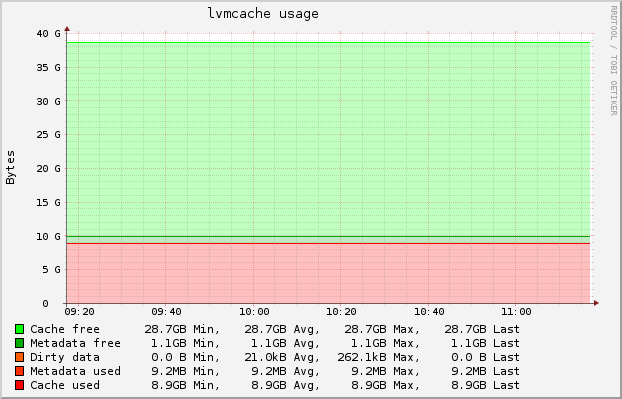
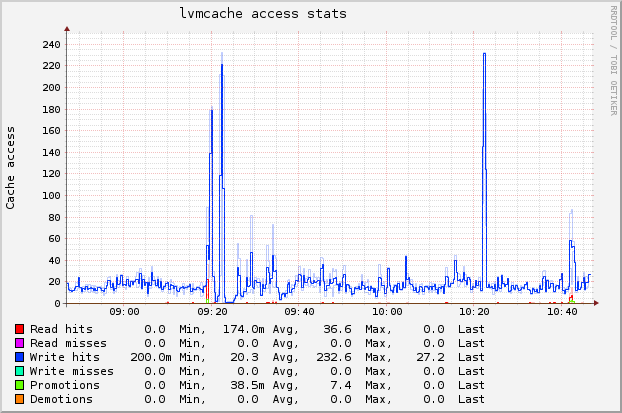
The 2nd link shows you that there are many "Write hits". You can almost 1-on-1 map these to this graph, which shows the eth0 network packets (NFS traffic) on the collectd VM:
http://pommi.nethuis.nl/wp-content/uploads/2014/12/lvmcache-vm-networkpackets.png
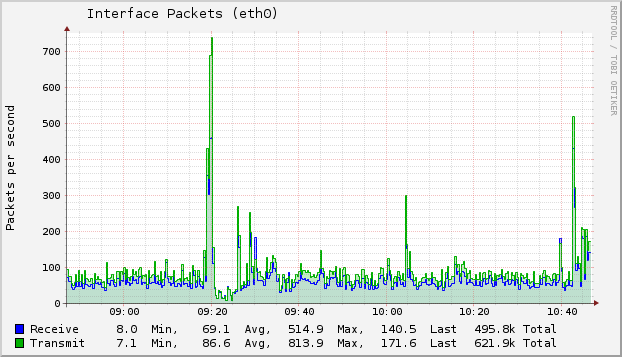
So I think the conclusion is that the lvmcache writeback is used quite well for caching the collectd RRDs.
But... when I look at the CPU usage of the VM there is 8-10% Wait-IO (this also matches the 2 graphs mentioned above almost 1-on-1):
http://pommi.nethuis.nl/wp-content/uploads/2014/12/lvmcache-vm-load.png
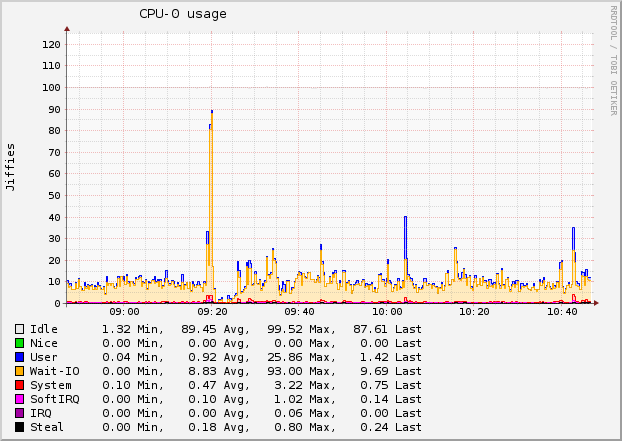
This is equal to having no SSD cache at all or bcache in writethrough mode. I was expecting ~1% Wait-IO.
How can this be explained?
From the stats its clear that the pattern of "Network Packets", being NFS traffic, matches the lvmcache "Write hits" pattern. Does lvmcache in writeback mode still wait for its data to be written to the HDD? Does "Write hits" mean something different? Is "dmsetup status" giving me wrong information? Or do I still have to set some lvmcache settings to make this work as expected?
Signature · 2 lines
Regards,
Pim
Quoted 7 lines · Pim van den Berg
But... when I look at the CPU usage of the VM there is 8-10% Wait-IO (this also matches the 2 graphs mentioned above almost 1-on-1):
http://pommi.nethuis.nl/wp-content/uploads/2014/12/lvmcache-vm-load.pngThis is equal to having no SSD cache at all or bcache in writethrough mode. I was expecting ~1% Wait-IO.
Quoted 8 lines
How can this be explained?
From the stats its clear that the pattern of "Network Packets", being NFS traffic, matches the lvmcache "Write hits" pattern. Does lvmcache in writeback mode still wait for its data to be written to the HDD? Does "Write hits" mean something different? Is "dmsetup status" giving me wrong information? Or do I still have to set some lvmcache settings to make this work as expected?
I think your expectations of writeback mode are correct, but to spell it out here some pseudo code.
In writeback mode:
if block is on ssd
write to ssd, complete bio once written
increment write hit counter
else
write to origin and complete
increment write miss counter
writethrough mode:
if block on ssd
write to ssd, then origin, complete
increment write hit counter
else
write to origin and complete
increment write miss counter
Some things that can slow down IOs:
- Changing a mapping due to the promotion or demotion of a block requires and metadata commit. (Check LVM2 has put the metadata on the ssd rather than spindle).
- REQ_DISCARD. This is an expensive operation. I advise people to periodically use fstrim rather than having the fs do it automatically when it deletes files.
- Background writeback IO could possibly be interferring with incoming writes. eg, if a dirty block is being written back when a write to that block comes in then the write will be stalled. Looking at the code I can see we're being very agressive about writing everything back irrespective of how recently the block was hit. It would be trivial to change it to only writeback after a number of policy 'ticks'. I'll do some experiments ...
- Joe