"raw" table versus "filter" table
Hi,
according to the well-known netfilter schematic:
http://inai.de/images/nf-packet-flow.png
the "raw" table is processed before the "filter" table.
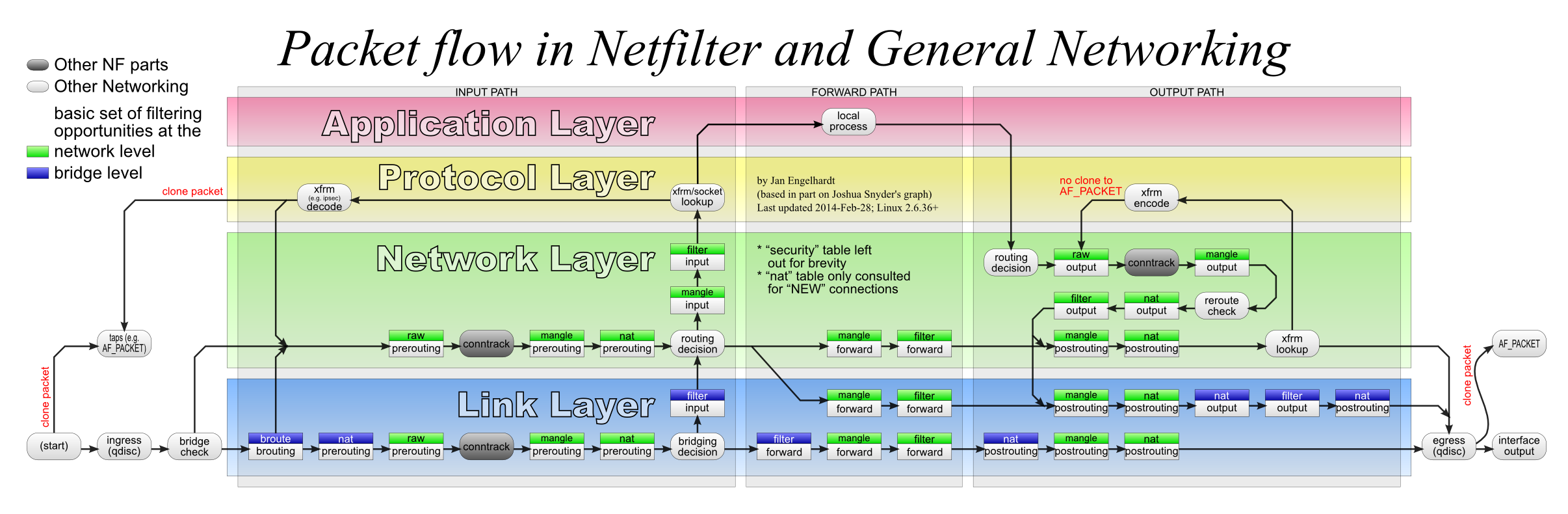
I tested it with some usual commands without problem:
    iptables --table raw --append PREROUTING --source 1.2.3.4 --jump REJECT
    iptables --table raw --append PREROUTING --in-interface lo --jump ACCEPT
- the packets are handled sooner, without the need to go though conntrack+mangle+nat+routing. So less CPU/memory stress (and in turn lightly compensated by the fact the iptable_raw module has to be loaded ?)
- only one rule in case the box is also a router (won't be ok for every rules, obviously) because there is no need to add the same rule for filter/forward
The documentations I found always describe the raw table to be used in strict cases. But none give even the smallest justification.
--> Is there any reasons not to use the raw table, apart dogmatic ones ?
Quoted 19 lines · On Wed, 18 Nov 2015 22:47:02 +0100 David TAILLANDIER - DIGI VALUE…
Hi,
according to the well-known netfilter schematic:
http://inai.de/images/nf-packet-flow.png
the "raw" table is processed before the "filter" table.I tested it with some usual commands without problem:
    iptables --table raw --append PREROUTING --source 1.2.3.4 --jump REJECT
    iptables --table raw --append PREROUTING --in-interface lo --jump ACCEPT
- the packets are handled sooner, without the need to go though conntrack+mangle+nat+routing. So less CPU/memory stress (and in turn lightly compensated by the fact the
iptable_rawmodule has to be loaded ?)
- only one rule in case the box is also a router (won't be ok for every rules, obviously) because there is no need to add the same rule for filter/forward
Quoted 4 lines
The documentations I found always describe the raw table to be used in strict cases. But none give even the smallest justification.
--> Is there any reasons not to use the raw table, apart dogmatic ones ?
Don't have an answer, but I'll have to look into 'raw' for Smoothwall Express. I'll use pert near *anything* that will reduce 'wasteful' CPU load. Combined with ipset, it should be possible to drop all packets to and from 'banned' public IPs using fewer CPU cycles. I already drop INVALID in mangle:PREROUTING. Dropping packets to and from banned addresses in raw:PREROUTING and rejecting packets to banned IPs in raw:OUTPUT would reduce unneeded processing. Of course, this idea depends on whether ipset can be used in the raw table.
One drawback is that NAT doesn't have a chance to re-address these packets. But this might not be too bad, since one doesn't want any traffic to or from banned IPs anyway.
Neal
Quoted 5 lines · David TAILLANDIER - DIGI VALUE
The documentations I found always describe the raw table to be used in strict cases. But none give even the smallest justification.
--> Is there any reasons not to use the raw table, apart dogmatic ones ?
Any match that requires conntrack, NAT or routing to be applied won't work in the raw table. Only simple rules are possible.