Follow up on UBD discussion
A message that is not in the archive (sent off-list or not yet received): [email protected]
Hello Gabriel,
CC linux-block and hope you don't mind, :-)
Quoted 6 lines · Gabriel Krisman Bertazi
Hi Ming,
First of all, I hope I didn't put you on the spot too much during the discussion. My original proposal was to propose my design, but your implementation quite solved the questions I had. :)
I think that is open source, then we can put efforts together to make things better.
Quoted 6 lines
I'd like to follow up to restart the communication and see where I can help more with UBD. As I said during the talk, I've done some fio runs and I was able to saturate NBD much faster than UBD:
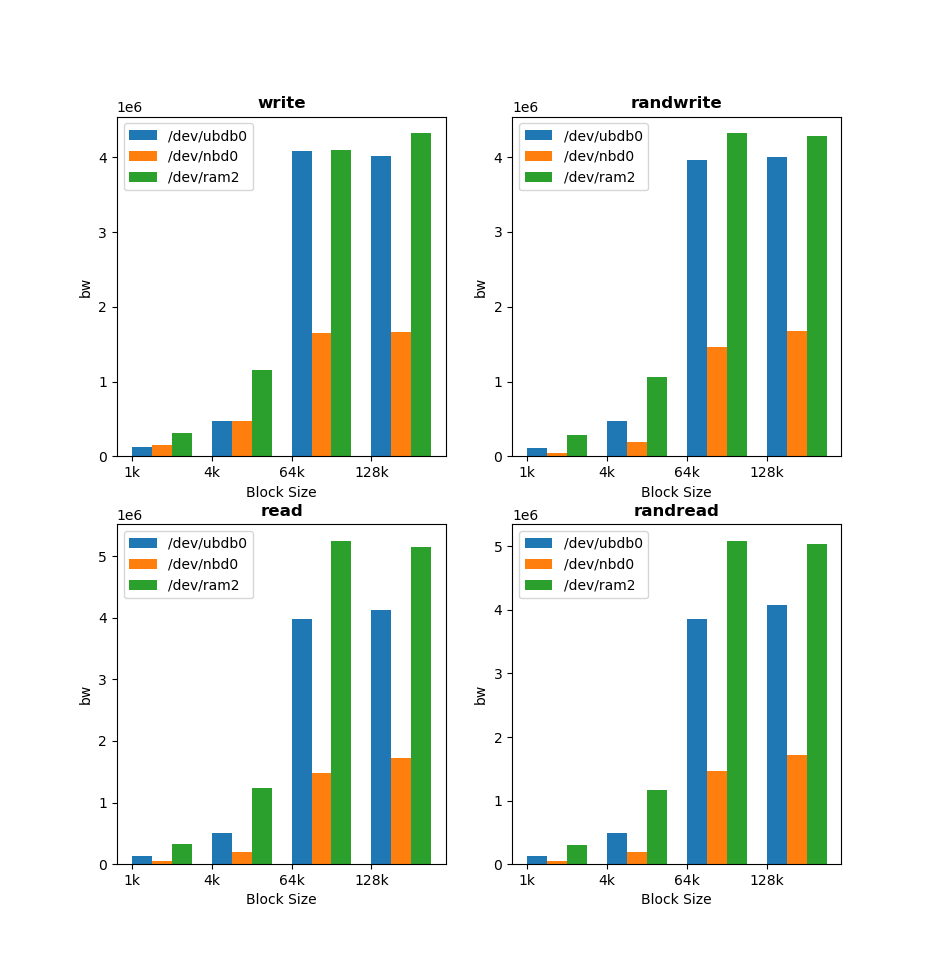
Yeah, that is true since NBD has extra socket communication cost which can't be efficient as io_uring.
Quoted 9 lines
I've also wrote some fixes to the initialization path, which I planned to send to you as soon as you published your code, but I think you might want to take a look already and see if you want to just squash it into your code base.
I pushed those fixes here:
I have added the 1st fix and 3rd patch into my tree:
https://github.com/ming1/linux/commits/v5.17-ubd-dev
The added check in 2nd patch is done lockless, which may not be reliable enough, so I didn't add it. Also adding device is in slow path, and no necessary to improve in that code path.
I also cleaned up ubd driver a bit: debug code cleanup, remove zero copy code, remove command of UBD_IO_GET_DATA and always make ubd driver builtin.
ubdsrv part has been cleaned up too:
https://github.com/ming1/ubdsrv
Quoted 3 lines
I'm looking into adding support for multiple driver queues next, and should be able to share some patches on that shortly.
OK, please post them on linux-block so that more eyes can look at the code, meantime the ubdsrv side needs to handle MQ too.
Sooner or later, the single ubdsrv task may be saturated by copying data and io_uring command communication only, which can be shown by running io on ubd-null target. In my lattop, the ubdsrv cpu utilization is close to 90% when IOPS is > 500K. So MQ may help some fast backing cases.
Thanks,
Ming
Quoted 58 lines · Ming Lei
Hello Gabriel,
CC linux-block and hope you don't mind, :-)
Quoted 6 lines · Gabriel Krisman Bertazi
Hi Ming,
First of all, I hope I didn't put you on the spot too much during the discussion. My original proposal was to propose my design, but your implementation quite solved the questions I had. :)
I think that is open source, then we can put efforts together to make things better.
Quoted 6 lines
I'd like to follow up to restart the communication and see where I can help more with UBD. As I said during the talk, I've done some fio runs and I was able to saturate NBD much faster than UBD:
Yeah, that is true since NBD has extra socket communication cost which can't be efficient as
io_uring.Quoted 9 lines
I've also wrote some fixes to the initialization path, which I planned to send to you as soon as you published your code, but I think you might want to take a look already and see if you want to just squash it into your code base.
I pushed those fixes here:
I have added the 1st fix and 3rd patch into my tree:
https://github.com/ming1/linux/commits/v5.17-ubd-dev
The added check in 2nd patch is done lockless, which may not be reliable enough, so I didn't add it. Also adding device is in slow path, and no necessary to improve in that code path.
I also cleaned up ubd driver a bit: debug code cleanup, remove zero copy code, remove command of
UBD_IO_GET_DATAand always make ubd driver builtin.ubdsrv part has been cleaned up too:
https://github.com/ming1/ubdsrv
Quoted 3 lines
I'm looking into adding support for multiple driver queues next, and should be able to share some patches on that shortly.
OK, please post them on linux-block so that more eyes can look at the code, meantime the ubdsrv side needs to handle MQ too.
Quoted 8 lines
Sooner or later, the single ubdsrv task may be saturated by copying data and
io_uringcommand communication only, which can be shown by running io on ubd-null target. In my lattop, the ubdsrv cpu utilization is close to 90% when IOPS is > 500K. So MQ may help some fast backing cases.Thanks,
Ming
Hi Ming,
Now I am learning your userspace block driver(UBD) [1][2] and we plan to replace TCMU by UBD as a new choice for implementing userspace bdev for its high performance and simplicity.
First, we have conducted some tests by fio and perf to evaluate UBD.
1) UBD achieves higher throughput than TCMU. We think TCMU suffers from the complicated SCSI layer and does not support multiqueue. However
UBD is simply using io_uring passthrough and may support multiqueue in the future.(Note that even with a single queue now , UBD outperforms TCMU)
2) Some functions in UBD result in high CPU utilization and we guess they also lower throughput. For example, ubdsrv_submit_fetch_commands() frequently iterates on the array of UBD IOs and wastes CPU when no IO is ready to be submitted. Besides, ubd_copy_pages() asks CPU to copy data between bio vectors and UBD internal buffers while handling write and read requests and it could be eliminated by supporting zero-copy.
Second, I'd like to share some ideas on UBD. I'm not sure if they are reasonable so please figure out my mistakes.
1) UBD issues one sqe to commit last completed request and fetch a new one. Then, blk-mq's queue_rq() issues a new UBD IO request and completes one cqe for the fetch command. We have evaluated that io_submit_sqes() costs some CPU and steps of building a new sqe may lower throughput. Here I'd like to give a new solution: never submit sqe but trump up a cqe(with information of new UBD IO request) when calling queue_rq(). I am inspired by one io_uring flag: IORING_POLL_ADD_MULTI, with which a user issues only one sqe for polling an fd and repeatedly gets multiple cqes when new events occur. Dose this solution break the architecture of UBD?
2) UBDSRV(the userspace part) should not allocate data buffers itself. When an application configs many queues with bigger iodepth, UBDSRV has to preallocate more buffers(size = 256KiB) and results in heavy memory overhead. I think data buffers should be allocated by applications themselves and passed to UBDSRV. In this way UBD offers more flexibility. However, while handling a write request, the control flow returns to the kernel part again to set buf addr and copy data from bio vectors. Is ioctl helpful by setting buf addr and copying write data to app buf?
3) ubd_fetch_and_submit() frequently iterates on the array of ubd IOs and wastes CPU when no IO is ready to be submitted. I think it can be optimized by adding a new array storing UBD IOs that are ready to be commit back to the kernel part. Then we could batch these IOs and avoid unnecessary iterations on IOs which are not ready(fetching or handling by targets).
4) Zero-copy support is important and we are trying to implement it now.
5) Currently, UBD only support the loop target with io_uirng and all works(1.get one cqe 2.issue target io_uring IO 3.get target io_uring IO completion 4.prepare one sqe) are done in one thread. As far as I know, some applications such as SPDK, network fs and customized distribution
systems do not support io_uring well. I think we should separate target IO handling from the UBDSRV loop and allow applications handle target IOs themselves. Is this suggestion reasonable? (Or UBD should focus on io_uring-supported targets?)
Regards,
Zhang
[1] https://github.com/ming1/ubdsrv
[2]https://github.com/ming1/linux/commits/v5.17-ubd-dev
Quoted 74 lines · ZiyangZhang
Quoted 58 lines · Ming Lei
Hello Gabriel,
CC linux-block and hope you don't mind, :-)
Quoted 6 lines · Gabriel Krisman Bertazi
Hi Ming,
First of all, I hope I didn't put you on the spot too much during the discussion. My original proposal was to propose my design, but your implementation quite solved the questions I had. :)
I think that is open source, then we can put efforts together to make things better.
Quoted 6 lines
I'd like to follow up to restart the communication and see where I can help more with UBD. As I said during the talk, I've done some fio runs and I was able to saturate NBD much faster than UBD:
Yeah, that is true since NBD has extra socket communication cost which can't be efficient as
io_uring.Quoted 9 lines
I've also wrote some fixes to the initialization path, which I planned to send to you as soon as you published your code, but I think you might want to take a look already and see if you want to just squash it into your code base.
I pushed those fixes here:
I have added the 1st fix and 3rd patch into my tree:
https://github.com/ming1/linux/commits/v5.17-ubd-dev
The added check in 2nd patch is done lockless, which may not be reliable enough, so I didn't add it. Also adding device is in slow path, and no necessary to improve in that code path.
I also cleaned up ubd driver a bit: debug code cleanup, remove zero copy code, remove command of
UBD_IO_GET_DATAand always make ubd driver builtin.ubdsrv part has been cleaned up too:
https://github.com/ming1/ubdsrv
Quoted 3 lines
I'm looking into adding support for multiple driver queues next, and should be able to share some patches on that shortly.
OK, please post them on linux-block so that more eyes can look at the code, meantime the ubdsrv side needs to handle MQ too.
Quoted 8 lines
Sooner or later, the single ubdsrv task may be saturated by copying data and
io_uringcommand communication only, which can be shown by running io on ubd-null target. In my lattop, the ubdsrv cpu utilization is close to 90% when IOPS is > 500K. So MQ may help some fast backing cases.Thanks,
MingHi Ming,
Now I am learning your userspace block driver(UBD) [1][2] and we plan to replace TCMU by UBD as a new choice for implementing userspace bdev for its high performance and simplicity.
Quoted 6 lines
First, we have conducted some tests by fio and perf to evaluate UBD.
1) UBD achieves higher throughput than TCMU. We think TCMU suffers from the complicated SCSI layer and does not support multiqueue. However
UBD is simply usingio_uringpassthrough and may support multiqueue in the future.(Note that even with a single queue now , UBD outperforms TCMU)
MQ isn't hard to support, and it is basically workable now:
https://github.com/ming1/ubdsrv/commits/devel
https://github.com/ming1/linux/commits/my_for-5.18-ubd-devel
Just the affinity of pthread for each queue isn't setup yet.
Quoted 7 lines
2) Some functions in UBD result in high CPU utilization and we guess they also lower throughput. For example,
ubdsrv_submit_fetch_commands()frequently iterates on the array of UBD IOs and wastes CPU when no IO is ready to be submitted. Besides,ubd_copy_pages()asks CPU to copy data between bio vectors and UBD internal buffers while handling write and read requests and it could be eliminated by supporting zero-copy.
copy itself doesn't take much cpu, see the following trace:
-   34.36%     3.73%  ubd              [kernel.kallsyms]             [k] ubd_copy_pages.isra.0                               ▒
   - 30.63% ubd_copy_pages.isra.0                                                                                            ▒
      - 23.86% internal_get_user_pages_fast                                                                                  ▒
         + 21.14% get_user_pages_unlocked                                                                                    ▒
         + 2.62% lockless_pages_from_mm                                                                                      ▒
        6.42% ubd_release_pages.constprop.0
And we may provide option to allow to pin pages in the disk lifetime for avoiding the cost in _get_user_pages_fast().
zero-copy has to touch page table, and its cost may be expensive too. The big problem is that MM doesn't provide mechanism to support generic remapping kernel pages to userspace.
Quoted 4 lines
Second, I'd like to share some ideas on UBD. I'm not sure if they are reasonable so please figure out my mistakes.
Quoted 10 lines
1) UBD issues one sqe to commit last completed request and fetch a new one. Then, blk-mq's
queue_rq()issues a new UBD IO request and completes one cqe for the fetch command. We have evaluated thatio_submit_sqes()costs some CPU and steps of building a new sqe may lower throughput. Here I'd like to give a new solution: never submit sqe but trump up a cqe(with information of new UBD IO request) when callingqueue_rq(). I am inspired by oneio_uringflag:IORING_POLL_ADD_MULTI, with which a user issues only one sqe for polling an fd and repeatedly gets multiple cqes when new events occur. Dose this solution break the architecture of UBD?
But each cqe has to be associated with one sqe, if I understand correctly.
I will research IORING_POLL_ADD_MULTI a bit and see if it can help UBD. And yes, batching is really important for UBD's performance.
Quoted 5 lines
2) UBDSRV(the userspace part) should not allocate data buffers itself. When an application configs many queues with bigger iodepth, UBDSRV has to preallocate more buffers(size = 256KiB) and results in heavy memory overhead. I think data buffers should be allocated by applications
That is just virtual memory, and pages can be reclaimed after IO is done.
Quoted 5 lines
themselves and passed to UBDSRV. In this way UBD offers more flexibility. However, while handling a write request, the control flow returns to the kernel part again to set buf addr and copy data from bio vectors. Is ioctl helpful by setting buf addr and copying write data to app buf?
It is pretty easy to pass application buffer to UBD_IO_FETCH_REQ or UBD_IO_COMMIT_AND_FETCH_REQ, just by overriding ios[i].buf_addr which is sent to ubd driver via ubdsrv_io_cmd->addr.
No need any ioctl, and io_uring command can handle everything.
I think the idea is good, and we can provide one option for using pre-allocated buffer or application buffer.
But the application buffer has to be in same process VM space with ubdsrv daemon, otherwise it becomes slower to pin these application buffers/pages.
Quoted 7 lines
3)
ubd_fetch_and_submit()frequently iterates on the array of ubd IOs and wastes CPU when no IO is ready to be submitted. I think it can be optimized by adding a new array storing UBD IOs that are ready to be commit back to the kernel part. Then we could batch these IOs and avoid unnecessary iterations on IOs which are not ready(fetching or handling by targets).
That should be easy to avoid the whole queue iteration, but my perf trace doesn't show ubd_fetch_and_submit() consumes too much CPU.
Quoted 2 lines
4) Zero-copy support is important and we are trying to implement it now.
I talked with Xiaoguang wrt. zero-copy support, and looks it isn't ready as one generic approach. If it is ready, it is easy to integrate to UBD.
Quoted 4 lines
5) Currently, UBD only support the loop target with
io_uirngand allworks(1.get one cqe 2.issue target io_uring IO 3.get target io_uring IO completion 4.prepare one sqe)are done in one thread. As far as I know,
loop is one example, and it provides similar function with kernel loop by < 200 lines of userspace code.
Quoted 5 lines
some applications such as SPDK, network fs and customized distribution
systems do not supportio_uringwell. I think we should separate target IO handling from the UBDSRV loop and allow applications handle target IOs themselves. Is this suggestion reasonable? (Or UBD should focus on io_uring-supported targets?)
UBD provides one framework for implementing userspace block driver, you can do everything for handling the IO in userspace. The target code just needs to implement callbacks defined in ubdsrv_tgt_type, so it has been separated from ubd loop already. But UBD is still in early stage, and the interface will continue to improve or re-design. Or can you explain your ideas in a bit details? It could be very helpful if you can provide some application background.
Reason why I suggested to use io_uring is that io_uring is very efficient, also async IO has been proved as very efficient approach for handling io.
Thanks
Ming
hi,
Quoted 114 lines · ZiyangZhang
Quoted 65 lines · Ming Lei
Quoted 50 lines
Hello Gabriel,
CC linux-block and hope you don't mind, :-)
Quoted 5 lines · Gabriel Krisman Bertazi
Hi Ming,
First of all, I hope I didn't put you on the spot too much during the discussion. My original proposal was to propose my design, but your implementation quite solved the questions I had. :)
I think that is open source, then we can put efforts together to make things better.
Quoted 5 lines
I'd like to follow up to restart the communication and see where I can help more with UBD. As I said during the talk, I've done some fio runs and I was able to saturate NBD much faster than UBD:
Yeah, that is true since NBD has extra socket communication cost which can't be efficient as
io_uring.Quoted 8 lines
I've also wrote some fixes to the initialization path, which I planned to send to you as soon as you published your code, but I think you might want to take a look already and see if you want to just squash it into your code base.
I pushed those fixes here:
I have added the 1st fix and 3rd patch into my tree:
https://github.com/ming1/linux/commits/v5.17-ubd-dev
The added check in 2nd patch is done lockless, which may not be reliable enough, so I didn't add it. Also adding device is in slow path, and no necessary to improve in that code path.
I also cleaned up ubd driver a bit: debug code cleanup, remove zero copy code, remove command of
UBD_IO_GET_DATAand always make ubd driver builtin.ubdsrv part has been cleaned up too:
https://github.com/ming1/ubdsrv
Quoted 2 lines
I'm looking into adding support for multiple driver queues next, and should be able to share some patches on that shortly.
OK, please post them on linux-block so that more eyes can look at the code, meantime the ubdsrv side needs to handle MQ too.
Quoted 8 lines
Sooner or later, the single ubdsrv task may be saturated by copying data and
io_uringcommand communication only, which can be shown by running io on ubd-null target. In my lattop, the ubdsrv cpu utilization is close to 90% when IOPS is > 500K. So MQ may help some fast backing cases.Thanks,
MingHi Ming,
Now I am learning your userspace block driver(UBD) [1][2] and we plan to replace TCMU by UBD as a new choice for implementing userspace bdev for its high performance and simplicity.
Quoted 6 lines
First, we have conducted some tests by fio and perf to evaluate UBD.
1) UBD achieves higher throughput than TCMU. We think TCMU suffers from the complicated SCSI layer and does not support multiqueue. However
UBD is simply usingio_uringpassthrough and may support multiqueue in the future.(Note that even with a single queue now , UBD outperforms TCMU)MQ isn't hard to support, and it is basically workable now:
https://github.com/ming1/ubdsrv/commits/devel
https://github.com/ming1/linux/commits/my_for-5.18-ubd-develJust the affinity of pthread for each queue isn't setup yet.
Quoted 6 lines
2) Some functions in UBD result in high CPU utilization and we guess they also lower throughput. For example,
ubdsrv_submit_fetch_commands()frequently iterates on the array of UBD IOs and wastes CPU when no IO is ready to be submitted. Besides,ubd_copy_pages()asks CPU to copy data between bio vectors and UBD internal buffers while handling write and read requests and it could be eliminated by supporting zero-copy.copy itself doesn't take much cpu, see the following trace:
-   34.36%     3.73%  ubd              [kernel.kallsyms]             [k] ubd_copy_pages.isra.0                               ▒
   - 30.63% ubd_copy_pages.isra.0                                                                                            ▒
      - 23.86% internal_get_user_pages_fast                                                                                  ▒
         + 21.14% get_user_pages_unlocked                                                                                    ▒
         + 2.62% lockless_pages_from_mm                                                                                      ▒
        6.42% ubd_release_pages.constprop.0
And we may provide option to allow to pin pages in the disk lifetime for avoiding the cost in
_get_user_pages_fast().zero-copy has to touch page table, and its cost may be expensive too. The big problem is that MM doesn't provide mechanism to support generic remapping kernel pages to userspace.
Quoted 13 lines
Second, I'd like to share some ideas on UBD. I'm not sure if they are reasonable so please figure out my mistakes.
1) UBD issues one sqe to commit last completed request and fetch a new one. Then, blk-mq's
queue_rq()issues a new UBD IO request and completes one cqe for the fetch command. We have evaluated thatio_submit_sqes()costs some CPU and steps of building a new sqe may lower throughput. Here I'd like to give a new solution: never submit sqe but trump up a cqe(with information of new UBD IO request) when callingqueue_rq(). I am inspired by oneio_uringflag:IORING_POLL_ADD_MULTI, with which a user issues only one sqe for polling an fd and repeatedly gets multiple cqes when new events occur. Dose this solution break the architecture of UBD?
Quoted 2 lines
But each cqe has to be associated with one sqe, if I understand correctly.
Yeah, for current io_uring implementation, it is. But if io_uring offers below helper:
void io_gen_cqe_direct(struct file *file, u64 user_data, s32 res, u32 cflags) {
struct io_ring_ctx *ctx;
ctx = file->private_data;
spin_lock(&ctx->completion_lock); __io_fill_cqe(ctx, user_data, res, cflags); io_commit_cqring(ctx); spin_unlock(&ctx->completion_lock); io_cqring_ev_posted(ctx);
}
Then in ubd driver:
1) device setup stage
We attach io_uring files and user_data to every ubd hard queue.
2) when blk-mq->queue_rq() is called.io_gen_cqe_direct() will be called in ubd's queue_rq, and we put ubd io request's qid and tag info into cqe's res field, then we don't need to issue sqe to fetch io cmds.
Regards,
Xiaoguang Wang
Quoted 67 lines
I will research
IORING_POLL_ADD_MULTIa bit and see if it can help UBD. And yes, batching is really important for UBD's performance.Quoted 4 lines
2) UBDSRV(the userspace part) should not allocate data buffers itself. When an application configs many queues with bigger iodepth, UBDSRV has to preallocate more buffers(size = 256KiB) and results in heavy memory overhead. I think data buffers should be allocated by applications
That is just virtual memory, and pages can be reclaimed after IO is done.
Quoted 5 lines
themselves and passed to UBDSRV. In this way UBD offers more flexibility. However, while handling a write request, the control flow returns to the kernel part again to set buf addr and copy data from bio vectors. Is ioctl helpful by setting buf addr and copying write data to app buf?
It is pretty easy to pass application buffer to
UBD_IO_FETCH_REQorUBD_IO_COMMIT_AND_FETCH_REQ, just by overriding ios[i].buf_addr which is sent to ubd driver viaubdsrv_io_cmd->addr.No need any ioctl, and
io_uringcommand can handle everything.I think the idea is good, and we can provide one option for using pre-allocated buffer or application buffer.
But the application buffer has to be in same process VM space with ubdsrv daemon, otherwise it becomes slower to pin these application buffers/pages.
Quoted 6 lines
3)
ubd_fetch_and_submit()frequently iterates on the array of ubd IOs and wastes CPU when no IO is ready to be submitted. I think it can be optimized by adding a new array storing UBD IOs that are ready to be commit back to the kernel part. Then we could batch these IOs and avoid unnecessary iterations on IOs which are not ready(fetching or handling by targets).That should be easy to avoid the whole queue iteration, but my perf trace doesn't show
ubd_fetch_and_submit()consumes too much CPU.Quoted 1 line
4) Zero-copy support is important and we are trying to implement it now.
I talked with Xiaoguang wrt. zero-copy support, and looks it isn't ready as one generic approach. If it is ready, it is easy to integrate to UBD.
Quoted 3 lines
5) Currently, UBD only support the loop target with
io_uirngand allworks(1.get one cqe 2.issue target io_uring IO 3.get target io_uring IO completion 4.prepare one sqe)are done in one thread. As far as I know,loop is one example, and it provides similar function with kernel loop by < 200 lines of userspace code.
Quoted 5 lines
some applications such as SPDK, network fs and customized distribution
systems do not supportio_uringwell. I think we should separate target IO handling from the UBDSRV loop and allow applications handle target IOs themselves. Is this suggestion reasonable? (Or UBD should focus on io_uring-supported targets?)UBD provides one framework for implementing userspace block driver, you can do everything for handling the IO in userspace. The target code just needs to implement callbacks defined in
ubdsrv_tgt_type, so it has been separated from ubd loop already. But UBD is still in early stage, and the interface will continue to improve or re-design. Or can you explain your ideas in a bit details? It could be very helpful if you can provide some application background.Reason why I suggested to use
io_uringis thatio_uringis very efficient, also async IO has been proved as very efficient approach for handling io.Thanks
Ming
Quoted 132 lines · Xiaoguang Wang
hi,
Quoted 114 lines · ZiyangZhang
Quoted 65 lines · Ming Lei
Quoted 50 lines
Hello Gabriel,
CC linux-block and hope you don't mind, :-)
Quoted 5 lines · Gabriel Krisman Bertazi
Hi Ming,
First of all, I hope I didn't put you on the spot too much during the discussion. My original proposal was to propose my design, but your implementation quite solved the questions I had. :)
I think that is open source, then we can put efforts together to make things better.
Quoted 5 lines
I'd like to follow up to restart the communication and see where I can help more with UBD. As I said during the talk, I've done some fio runs and I was able to saturate NBD much faster than UBD:
Yeah, that is true since NBD has extra socket communication cost which can't be efficient as
io_uring.Quoted 8 lines
I've also wrote some fixes to the initialization path, which I planned to send to you as soon as you published your code, but I think you might want to take a look already and see if you want to just squash it into your code base.
I pushed those fixes here:
I have added the 1st fix and 3rd patch into my tree:
https://github.com/ming1/linux/commits/v5.17-ubd-dev
The added check in 2nd patch is done lockless, which may not be reliable enough, so I didn't add it. Also adding device is in slow path, and no necessary to improve in that code path.
I also cleaned up ubd driver a bit: debug code cleanup, remove zero copy code, remove command of
UBD_IO_GET_DATAand always make ubd driver builtin.ubdsrv part has been cleaned up too:
https://github.com/ming1/ubdsrv
Quoted 2 lines
I'm looking into adding support for multiple driver queues next, and should be able to share some patches on that shortly.
OK, please post them on linux-block so that more eyes can look at the code, meantime the ubdsrv side needs to handle MQ too.
Quoted 8 lines
Sooner or later, the single ubdsrv task may be saturated by copying data and
io_uringcommand communication only, which can be shown by running io on ubd-null target. In my lattop, the ubdsrv cpu utilization is close to 90% when IOPS is > 500K. So MQ may help some fast backing cases.Thanks,
MingHi Ming,
Now I am learning your userspace block driver(UBD) [1][2] and we plan to replace TCMU by UBD as a new choice for implementing userspace bdev for its high performance and simplicity.
Quoted 6 lines
First, we have conducted some tests by fio and perf to evaluate UBD.
1) UBD achieves higher throughput than TCMU. We think TCMU suffers from the complicated SCSI layer and does not support multiqueue. However
UBD is simply usingio_uringpassthrough and may support multiqueue in the future.(Note that even with a single queue now , UBD outperforms TCMU)MQ isn't hard to support, and it is basically workable now:
https://github.com/ming1/ubdsrv/commits/devel
https://github.com/ming1/linux/commits/my_for-5.18-ubd-develJust the affinity of pthread for each queue isn't setup yet.
Quoted 6 lines
2) Some functions in UBD result in high CPU utilization and we guess they also lower throughput. For example,
ubdsrv_submit_fetch_commands()frequently iterates on the array of UBD IOs and wastes CPU when no IO is ready to be submitted. Besides,ubd_copy_pages()asks CPU to copy data between bio vectors and UBD internal buffers while handling write and read requests and it could be eliminated by supporting zero-copy.copy itself doesn't take much cpu, see the following trace:
-   34.36%     3.73%  ubd              [kernel.kallsyms]             [k] ubd_copy_pages.isra.0                               ▒
   - 30.63% ubd_copy_pages.isra.0                                                                                            ▒
      - 23.86% internal_get_user_pages_fast                                                                                  ▒
         + 21.14% get_user_pages_unlocked                                                                                    ▒
         + 2.62% lockless_pages_from_mm                                                                                      ▒
        6.42% ubd_release_pages.constprop.0
And we may provide option to allow to pin pages in the disk lifetime for avoiding the cost in
_get_user_pages_fast().zero-copy has to touch page table, and its cost may be expensive too. The big problem is that MM doesn't provide mechanism to support generic remapping kernel pages to userspace.
Quoted 13 lines
Second, I'd like to share some ideas on UBD. I'm not sure if they are reasonable so please figure out my mistakes.
1) UBD issues one sqe to commit last completed request and fetch a new one. Then, blk-mq's
queue_rq()issues a new UBD IO request and completes one cqe for the fetch command. We have evaluated thatio_submit_sqes()costs some CPU and steps of building a new sqe may lower throughput. Here I'd like to give a new solution: never submit sqe but trump up a cqe(with information of new UBD IO request) when callingqueue_rq(). I am inspired by oneio_uringflag:IORING_POLL_ADD_MULTI, with which a user issues only one sqe for polling an fd and repeatedly gets multiple cqes when new events occur. Dose this solution break the architecture of UBD?Quoted 2 lines
But each cqe has to be associated with one sqe, if I understand correctly.
Yeah, for current
io_uringimplementation, it is. But ifio_uringoffers below helper:
voidio_gen_cqe_direct(struct file *file, u64 user_data, s32 res, u32 cflags){
structio_ring_ctx*ctx;
ctx =file->private_data;
spin_lock(&ctx->completion_lock);__io_fill_cqe(ctx, user_data, res, cflags);io_commit_cqring(ctx);spin_unlock(&ctx->completion_lock);io_cqring_ev_posted(ctx);
}
Quoted 7 lines
Then in ubd driver:
1) device setup stage
We attachio_uringfiles anduser_datato every ubd hard queue.2) when blk-mq->queue_rq() is called.
io_gen_cqe_direct()will be called in ubd'squeue_rq, and we put ubd io request's qid and tag info into cqe's res field, then we don't need to issue sqe to fetch io cmds.
The above way is actually anti io_uring design, and I don't think it may improve much since submitting UBD_IO_COMMIT_AND_FETCH_REQ is pretty lightweight.
Also without re-submitting UBD_IO_COMMIT_AND_FETCH_REQ command, how can you commit io handling result from ubd server and ask ubd driver to complete io request?
Thanks,
Ming
hi,
Quoted 34 lines
Quoted 34 lines
Quoted 14 lines
Quoted 4 lines
Second, I'd like to share some ideas on UBD. I'm not sure if they are reasonable so please figure out my mistakes.
Quoted 10 lines
1) UBD issues one sqe to commit last completed request and fetch a new one. Then, blk-mq's
queue_rq()issues a new UBD IO request and completes one cqe for the fetch command. We have evaluated thatio_submit_sqes()costs some CPU and steps of building a new sqe may lower throughput. Here I'd like to give a new solution: never submit sqe but trump up a cqe(with information of new UBD IO request) when callingqueue_rq(). I am inspired by oneio_uringflag:IORING_POLL_ADD_MULTI, with which a user issues only one sqe for polling an fd and repeatedly gets multiple cqes when new events occur. Dose this solution break the architecture of UBD?Quoted 2 lines
But each cqe has to be associated with one sqe, if I understand correctly.
Yeah, for current
io_uringimplementation, it is. But ifio_uringoffers below helper:
voidio_gen_cqe_direct(struct file *file, u64 user_data, s32 res, u32 cflags){
structio_ring_ctx*ctx;
ctx =file->private_data;
spin_lock(&ctx->completion_lock);__io_fill_cqe(ctx, user_data, res, cflags);io_commit_cqring(ctx);spin_unlock(&ctx->completion_lock);io_cqring_ev_posted(ctx);
}Then in ubd driver:
1) device setup stage
We attachio_uringfiles anduser_datato every ubd hard queue.
Quoted 5 lines
Quoted 3 lines
2) when blk-mq->queue_rq() is called.
io_gen_cqe_direct()will be called in ubd'squeue_rq, and we put ubd io request's qid and tag info into cqe's res field, then we don't need to issue sqe to fetch io cmds.The above way is actually anti
io_uringdesign, and I don't think it may improve much since submittingUBD_IO_COMMIT_AND_FETCH_REQis pretty lightweight.
Actually I don't come up with this idea mostly for performance reason :) Just try to simplify codes a bit:
1) In current implementation, ubdsrv will need to submit queue depth number of sqes firstly, and ubd_ctrl_start_dev() will also need to wait all sqes to be submitted.
2) Try to make ubd_queue_rq simpler, it maybe just call one io_gen_cqe_direct().
Quoted 4 lines
Also without re-submitting
UBD_IO_COMMIT_AND_FETCH_REQcommand, how can you commit io handling result from ubd server and ask ubd driver to complete io request?
No, I don't mean to remove COMMIT command, we still need io_uring async command feature to support ubd COMMIT or GETDATA command.
I have another concern that currently there are may flags in ubd kernel or ubdsrv, such as:
#define UBDSRV_NEED_FETCH_RQ (1UL << 0)
#define UBDSRV_NEED_COMMIT_RQ_COMP (1UL << 1)
#define UBDSRV_IO_FREE (1UL << 2)
#define UBDSRV_IO_HANDLING (1UL << 3)
#define UBDSRV_NEED_GET_DATA (1UL << 4)
Some of their names looks weird, for example UBDSRV_IO_FREE. I think more flags may result in more state machine error.
Regards,
Xiaoguang Wang
Quoted 4 lines
Thanks,
Ming
Quoted 39 lines · Xiaoguang Wang
hi,
Quoted 37 lines
Quoted 37 lines
Quoted 14 lines
Quoted 4 lines
Second, I'd like to share some ideas on UBD. I'm not sure if they are reasonable so please figure out my mistakes.
Quoted 10 lines
1) UBD issues one sqe to commit last completed request and fetch a new one. Then, blk-mq's
queue_rq()issues a new UBD IO request and completes one cqe for the fetch command. We have evaluated thatio_submit_sqes()costs some CPU and steps of building a new sqe may lower throughput. Here I'd like to give a new solution: never submit sqe but trump up a cqe(with information of new UBD IO request) when callingqueue_rq(). I am inspired by oneio_uringflag:IORING_POLL_ADD_MULTI, with which a user issues only one sqe for polling an fd and repeatedly gets multiple cqes when new events occur. Dose this solution break the architecture of UBD?Quoted 2 lines
But each cqe has to be associated with one sqe, if I understand correctly.
Yeah, for current
io_uringimplementation, it is. But ifio_uringoffers below helper:
voidio_gen_cqe_direct(struct file *file, u64 user_data, s32 res, u32 cflags){
structio_ring_ctx*ctx;
ctx =file->private_data;
spin_lock(&ctx->completion_lock);__io_fill_cqe(ctx, user_data, res, cflags);io_commit_cqring(ctx);spin_unlock(&ctx->completion_lock);io_cqring_ev_posted(ctx);
}Then in ubd driver:
1) device setup stage
We attachio_uringfiles anduser_datato every ubd hard queue.2) when blk-mq->queue_rq() is called.
io_gen_cqe_direct()will be called in ubd'squeue_rq, and we put ubd io request's qid and tag info into cqe's res field, then we don't need to issue sqe to fetch io cmds.
Quoted 6 lines
Quoted 2 lines
The above way is actually anti
io_uringdesign, and I don't think it may improve much since submittingUBD_IO_COMMIT_AND_FETCH_REQis pretty lightweight.Actually I don't come up with this idea mostly for performance reason :) Just try to simplify codes a bit:
1) In current implementation, ubdsrv will need to submit queue depth number of sqes firstly, andubd_ctrl_start_dev()will also need to wait all sqes to be submitted.
Yes, because handling IO need the associated io_uring commend reached to ubd driver first.
Quoted 1 line
2) Try to make
ubd_queue_rqsimpler, it maybe just call oneio_gen_cqe_direct().
But it has to work at least. Also not see real simplification in your suggestion.
Quoted 7 lines
Quoted 5 lines
Also without re-submitting
UBD_IO_COMMIT_AND_FETCH_REQcommand, how can you commit io handling result from ubd server and ask ubd driver to complete io request?No, I don't mean to remove COMMIT command, we still need
io_uringasync command feature to support ubd COMMIT or GETDATA command.
GETDATA command has been removed, because task_work_add() is used to complete io_uring command(UBD_IO_COMMIT_AND_FETCH_REQ or UBD_IO_FETCH_REQ), so pinning pages and copying data is always done in ubdsrv daemon context.
You may not get the whole idea:
1) UBD_IO_FETCH_REQ is only submitted to ubd driver before starting device because at the beginning there isn't any IO handled, so no need to send COMMIT.
2) after device is started, only UBD_IO_COMMIT_AND_FETCH_REQ is submitted for both committing io handling result to driver and fetching new io request, and UBD_IO_COMMIT_AND_FETCH_REQ can be thought as combined command of COMMIT and UBD_IO_FETCH_REQ.
3) COMMIT command is just submitted after queue is aborted, since we needn't to fetch request any more, and just need to commit in-flight request's result to ubd driver.
If you meant using COMMIT with io_gen_cqe_direct(), what benefit can we get? Still one command is required for handling IO, that is exactly what UBD_IO_COMMIT_AND_FETCH_REQ is doing.
Quoted 4 lines
I have another concern that currently there are may flags in ubd kernel or ubdsrv, such as:
#defineUBDSRV_NEED_FETCH_RQ(1UL << 0)
UBDSRV_NEED_FETCH_RQ means the to be queued io_uring command has to fetch new io request from ubd driver.
Quoted 1 line
#define
UBDSRV_NEED_COMMIT_RQ_COMP(1UL << 1)
UBDSRV_NEED_COMMIT_RQCOMP means the to be queued io_uring command has to commit io handling result to ubd driver.
Quoted 1 line
#define
UBDSRV_IO_FREE(1UL << 2)
Only io with this flag can be queued to ubd driver. Once this flag is cleared, it means the io command has been submitted to ubd driver.
Quoted 1 line
#define
UBDSRV_IO_HANDLING(1UL << 3)
UBDSRV_IO_HANDLING means the io command is being handled by target code.
Quoted 1 line
#define
UBDSRV_NEED_GET_DATA(1UL << 4)
The above one has been removed.
Quoted 3 lines
Some of their names looks weird, for example
UBDSRV_IO_FREE. I think more flags may result in more state machine error.
Figuring out perfect name is always not easy, but I don't think they are weird since the above short comments explained them clearly.
Thanks,
Ming
hi,
Quoted 55 lines · Xiaoguang Wang
Quoted 38 lines
hi,
Quoted 36 lines
Quoted 36 lines
Quoted 13 lines
Quoted 13 lines
Second, I'd like to share some ideas on UBD. I'm not sure if they are reasonable so please figure out my mistakes.
1) UBD issues one sqe to commit last completed request and fetch a new one. Then, blk-mq's
queue_rq()issues a new UBD IO request and completes one cqe for the fetch command. We have evaluated thatio_submit_sqes()costs some CPU and steps of building a new sqe may lower throughput. Here I'd like to give a new solution: never submit sqe but trump up a cqe(with information of new UBD IO request) when callingqueue_rq(). I am inspired by oneio_uringflag:IORING_POLL_ADD_MULTI, with which a user issues only one sqe for polling an fd and repeatedly gets multiple cqes when new events occur. Dose this solution break the architecture of UBD?Quoted 2 lines
But each cqe has to be associated with one sqe, if I understand correctly.
Yeah, for current
io_uringimplementation, it is. But ifio_uringoffers below helper:
voidio_gen_cqe_direct(struct file *file, u64 user_data, s32 res, u32 cflags){
structio_ring_ctx*ctx;
ctx =file->private_data;
spin_lock(&ctx->completion_lock);__io_fill_cqe(ctx, user_data, res, cflags);io_commit_cqring(ctx);spin_unlock(&ctx->completion_lock);io_cqring_ev_posted(ctx);
}Then in ubd driver:
1) device setup stage
We attachio_uringfiles anduser_datato every ubd hard queue.2) when blk-mq->queue_rq() is called.
io_gen_cqe_direct()will be called in ubd'squeue_rq, and we put ubd io request's qid and tag info into cqe's res field, then we don't need to issue sqe to fetch io cmds.Quoted 6 lines
Quoted 2 lines
The above way is actually anti
io_uringdesign, and I don't think it may improve much since submittingUBD_IO_COMMIT_AND_FETCH_REQis pretty lightweight.Actually I don't come up with this idea mostly for performance reason :) Just try to simplify codes a bit:
1) In current implementation, ubdsrv will need to submit queue depth number of sqes firstly, andubd_ctrl_start_dev()will also need to wait all sqes to be submitted.Yes, because handling IO need the associated
io_uringcommend reached to ubd driver first.Quoted 1 line
2) Try to make
ubd_queue_rqsimpler, it maybe just call oneio_gen_cqe_direct().But it has to work at least. Also not see real simplification in your suggestion.
Quoted 3 lines
Quoted 3 lines
Also without re-submitting
UBD_IO_COMMIT_AND_FETCH_REQcommand, how can you commit io handling result from ubd server and ask ubd driver to complete io request?
Quoted 6 lines
Quoted 2 lines
No, I don't mean to remove COMMIT command, we still need
io_uringasync command feature to support ubd COMMIT or GETDATA command.GETDATA command has been removed, because
task_work_add()is used to completeio_uringcommand(UBD_IO_COMMIT_AND_FETCH_REQ or UBD_IO_FETCH_REQ), so pinning pages and copying data is always done in ubdsrv daemon context.
OK, I'll read your latest codes.
Quoted 7 lines
You may not get the whole idea:
1)
UBD_IO_FETCH_REQis only submitted to ubd driver before starting device because at the beginning there isn't any IO handled, so no need to send COMMIT.
Quoted 8 lines
2) after device is started, only
UBD_IO_COMMIT_AND_FETCH_REQis submitted for both committing io handling result to driver and fetching new io request, andUBD_IO_COMMIT_AND_FETCH_REQcan be thought as combined command of COMMIT andUBD_IO_FETCH_REQ.3) COMMIT command is just submitted after queue is aborted, since we needn't to fetch request any more, and just need to commit in-flight request's result to ubd driver.
Thanks for detailed clarification.
I think I have understood codes better now.
Quoted 4 lines
If you meant using COMMIT with
io_gen_cqe_direct(), what benefit can we get? Still one command is required for handling IO, that is exactly whatUBD_IO_COMMIT_AND_FETCH_REQis doing.
Agree now.
Quoted 18 lines
Quoted 4 lines
I have another concern that currently there are may flags in ubd kernel or ubdsrv, such as:
#defineUBDSRV_NEED_FETCH_RQ(1UL << 0)
UBDSRV_NEED_FETCH_RQmeans the to be queuedio_uringcommand has to fetch new io request from ubd driver.Quoted 1 line
#define
UBDSRV_NEED_COMMIT_RQ_COMP(1UL << 1)
UBDSRV_NEED_COMMIT_RQCOMPmeans the to be queuedio_uringcommand has to commit io handling result to ubd driver.Quoted 1 line
#define
UBDSRV_IO_FREE(1UL << 2)Only io with this flag can be queued to ubd driver. Once this flag is cleared, it means the io command has been submitted to ubd driver.
Quoted 1 line
#define
UBDSRV_IO_HANDLING(1UL << 3)
UBDSRV_IO_HANDLINGmeans the io command is being handled by target code.
Quoted 7 lines
Quoted 1 line
#define
UBDSRV_NEED_GET_DATA(1UL << 4)The above one has been removed.
Quoted 2 lines
Some of their names looks weird, for example
UBDSRV_IO_FREE. I think more flags may result in more state machine error.Figuring out perfect name is always not easy, but I don't think they are weird since the above short comments explained them clearly.
OK, thanks for these clarifications again.
Regards,
Xiaoguang Wang
Quoted 4 lines
Thanks,
Ming
Quoted 82 lines · Ming Lei
Quoted 74 lines · ZiyangZhang
Quoted 58 lines · Ming Lei
Hello Gabriel,
CC linux-block and hope you don't mind, :-)
Quoted 6 lines · Gabriel Krisman Bertazi
Hi Ming,
First of all, I hope I didn't put you on the spot too much during the discussion. My original proposal was to propose my design, but your implementation quite solved the questions I had. :)
I think that is open source, then we can put efforts together to make things better.
Quoted 6 lines
I'd like to follow up to restart the communication and see where I can help more with UBD. As I said during the talk, I've done some fio runs and I was able to saturate NBD much faster than UBD:
Yeah, that is true since NBD has extra socket communication cost which can't be efficient as
io_uring.Quoted 9 lines
I've also wrote some fixes to the initialization path, which I planned to send to you as soon as you published your code, but I think you might want to take a look already and see if you want to just squash it into your code base.
I pushed those fixes here:
I have added the 1st fix and 3rd patch into my tree:
https://github.com/ming1/linux/commits/v5.17-ubd-dev
The added check in 2nd patch is done lockless, which may not be reliable enough, so I didn't add it. Also adding device is in slow path, and no necessary to improve in that code path.
I also cleaned up ubd driver a bit: debug code cleanup, remove zero copy code, remove command of
UBD_IO_GET_DATAand always make ubd driver builtin.ubdsrv part has been cleaned up too:
https://github.com/ming1/ubdsrv
Quoted 3 lines
I'm looking into adding support for multiple driver queues next, and should be able to share some patches on that shortly.
OK, please post them on linux-block so that more eyes can look at the code, meantime the ubdsrv side needs to handle MQ too.
Quoted 8 lines
Sooner or later, the single ubdsrv task may be saturated by copying data and
io_uringcommand communication only, which can be shown by running io on ubd-null target. In my lattop, the ubdsrv cpu utilization is close to 90% when IOPS is > 500K. So MQ may help some fast backing cases.Thanks,
MingHi Ming,
Now I am learning your userspace block driver(UBD) [1][2] and we plan to replace TCMU by UBD as a new choice for implementing userspace bdev for its high performance and simplicity.
Quoted 6 lines
First, we have conducted some tests by fio and perf to evaluate UBD.
1) UBD achieves higher throughput than TCMU. We think TCMU suffers from the complicated SCSI layer and does not support multiqueue. However
UBD is simply usingio_uringpassthrough and may support multiqueue in the future.(Note that even with a single queue now , UBD outperforms TCMU)
Quoted 6 lines
MQ isn't hard to support, and it is basically workable now:
https://github.com/ming1/ubdsrv/commits/devel
https://github.com/ming1/linux/commits/my_for-5.18-ubd-develJust the affinity of pthread for each queue isn't setup yet.
Thanks Ming, I will try your new code.
Quoted 9 lines
Quoted 8 lines
2) Some functions in UBD result in high CPU utilization and we guess they also lower throughput. For example,
ubdsrv_submit_fetch_commands()frequently iterates on the array of UBD IOs and wastes CPU when no IO is ready to be submitted. Besides,ubd_copy_pages()asks CPU to copy data between bio vectors and UBD internal buffers while handling write and read requests and it could be eliminated by supporting zero-copy.
Quoted 8 lines
copy itself doesn't take much cpu, see the following trace:
-   34.36%     3.73%  ubd              [kernel.kallsyms]             [k] ubd_copy_pages.isra.0                               ▒
   - 30.63% ubd_copy_pages.isra.0                                                                                            ▒
      - 23.86% internal_get_user_pages_fast                                                                                  ▒
         + 21.14% get_user_pages_unlocked                                                                                    ▒
         + 2.62% lockless_pages_from_mm                                                                                      ▒
        6.42% ubd_release_pages.constprop.0
I got the following trace:
- 26.49% 2.26% ubd [ubd] [k] ubd_commit_completion
- 24.24% ubd_commit_completion
- 24.00% ubd_copy_pages.isra.0
- 10.73% internal_get_user_pages_fast
- 9.05% get_user_pages_unlocked
- 8.92% __get_user_pages
- 5.61% follow_page_pte
- 1.83% folio_mark_accessed
0.70% __lru_cache_activate_folio
- 1.25% _raw_spin_lock
0.61% preempt_count_add
0.91% try_grab_page
1.02% follow_pmd_mask.isra.0
0.58% follow_page_mask
0.52% follow_pud_mask
- 1.35% gup_pud_range.constprop.0
1.22% gup_pmd_range.constprop.0
- 7.71% memcpy_erms
- 0.68% asm_common_interrupt
- 0.67% common_interrupt
- 0.62% __common_interrupt
- 0.60% handle_edge_irq
- 0.53% handle_irq_event
- 0.51% __handle_irq_event_percpu
vring_interrupt
4.07% ubd_release_pages.constprop.0
Quoted 44 lines
And we may provide option to allow to pin pages in the disk lifetime for avoiding the cost in
_get_user_pages_fast().zero-copy has to touch page table, and its cost may be expensive too. The big problem is that MM doesn't provide mechanism to support generic remapping kernel pages to userspace.
Quoted 4 lines
Second, I'd like to share some ideas on UBD. I'm not sure if they are reasonable so please figure out my mistakes.
Quoted 10 lines
1) UBD issues one sqe to commit last completed request and fetch a new one. Then, blk-mq's
queue_rq()issues a new UBD IO request and completes one cqe for the fetch command. We have evaluated thatio_submit_sqes()costs some CPU and steps of building a new sqe may lower throughput. Here I'd like to give a new solution: never submit sqe but trump up a cqe(with information of new UBD IO request) when callingqueue_rq(). I am inspired by oneio_uringflag:IORING_POLL_ADD_MULTI, with which a user issues only one sqe for polling an fd and repeatedly gets multiple cqes when new events occur. Dose this solution break the architecture of UBD?But each cqe has to be associated with one sqe, if I understand correctly.
I will research
IORING_POLL_ADD_MULTIa bit and see if it can help UBD. And yes, batching is really important for UBD's performance.Quoted 5 lines
2) UBDSRV(the userspace part) should not allocate data buffers itself. When an application configs many queues with bigger iodepth, UBDSRV has to preallocate more buffers(size = 256KiB) and results in heavy memory overhead. I think data buffers should be allocated by applications
That is just virtual memory, and pages can be reclaimed after IO is done.
Quoted 5 lines
themselves and passed to UBDSRV. In this way UBD offers more flexibility. However, while handling a write request, the control flow returns to the kernel part again to set buf addr and copy data from bio vectors. Is ioctl helpful by setting buf addr and copying write data to app buf?
Quoted 3 lines
It is pretty easy to pass application buffer to
UBD_IO_FETCH_REQorUBD_IO_COMMIT_AND_FETCH_REQ, just by overriding ios[i].buf_addr which is sent to ubd driver viaubdsrv_io_cmd->addr.
Maybe one app allocates one data buffer until it gets a UBD IO request because it does not know the data size and pre-allocation is forbidden. In this way, UBD_IO_FETCH_REQ or UBD_IO_COMMIT_AND_FETCH_REQ are not helpful.
Quoted 18 lines
No need any ioctl, and
io_uringcommand can handle everything.I think the idea is good, and we can provide one option for using pre-allocated buffer or application buffer.
But the application buffer has to be in same process VM space with ubdsrv daemon, otherwise it becomes slower to pin these application buffers/pages.
Quoted 7 lines
3)
ubd_fetch_and_submit()frequently iterates on the array of ubd IOs and wastes CPU when no IO is ready to be submitted. I think it can be optimized by adding a new array storing UBD IOs that are ready to be commit back to the kernel part. Then we could batch these IOs and avoid unnecessary iterations on IOs which are not ready(fetching or handling by targets).
Quoted 2 lines
That should be easy to avoid the whole queue iteration, but my perf trace doesn't show
ubd_fetch_and_submit()consumes too much CPU.
My trace:
- 2.63% 1.71% ubd ubd [.]ubdsrv_submit_fetch_commands
- 1.71% 0x495641000034d33d
__libc_start_main
main
cmd_dev_add
ubdsrv_start_dev
ubdsrv_start_io_daemon
- start_daemon
- 1.70% ubdsrv_io_handler
ubdsrv_submit_fetch_commands
0.92% ubdsrv_submit_fetch_commands
Quoted 21 lines
Quoted 3 lines
4) Zero-copy support is important and we are trying to implement it now.
I talked with Xiaoguang wrt. zero-copy support, and looks it isn't ready as one generic approach. If it is ready, it is easy to integrate to UBD.
Quoted 4 lines
5) Currently, UBD only support the loop target with
io_uirngand allworks(1.get one cqe 2.issue target io_uring IO 3.get target io_uring IO completion 4.prepare one sqe)are done in one thread. As far as I know,loop is one example, and it provides similar function with kernel loop by < 200 lines of userspace code.
Quoted 5 lines
some applications such as SPDK, network fs and customized distribution
systems do not supportio_uringwell. I think we should separate target IO handling from the UBDSRV loop and allow applications handle target IOs themselves. Is this suggestion reasonable? (Or UBD should focus on io_uring-supported targets?)
Quoted 7 lines
UBD provides one framework for implementing userspace block driver, you can do everything for handling the IO in userspace. The target code just needs to implement callbacks defined in
ubdsrv_tgt_type, so it has been separated from ubd loop already. But UBD is still in early stage, and the interface will continue to improve or re-design. Or can you explain your ideas in a bit details? It could be very helpful if you can provide some application background.
The app:
1) Another worker thread per queue(not the UBD daemon thread per queue)gets(by one API provides by UBDSRV such as ubdsrv_get_new_req) one new UBD IO(from blk-mq) with io_size, io_off and tag.
2) handles the new IO(e.g. app_write_req_handle, app_read_req_handle)in one worker threads(not in the UBD daemon thread).
3) One IO completes and the worker thread should notify the UBD daemon thread.
Currently, I find:
	if (cqe->user_data & (1ULL << 63)) {
		ubdsrv_handle_tgt_cqe(dev, q, cqe);
		return;
	}
in ubdsrv.c:ubdsrv_handle_cqe. This assumes a target should use io_uring to handle IO requests, and the app above does not support io_uring. Maybe we should re-design the IO handling logic.
Quoted 7 lines
Reason why I suggested to use
io_uringis thatio_uringis very efficient, also async IO has been proved as very efficient approach for handling io.Thanks
Ming
Quoted 154 lines · Ziyang Zhang
Quoted 82 lines · Ming Lei
Quoted 74 lines · ZiyangZhang
Quoted 58 lines · Ming Lei
Hello Gabriel,
CC linux-block and hope you don't mind, :-)
Quoted 6 lines · Gabriel Krisman Bertazi
Hi Ming,
First of all, I hope I didn't put you on the spot too much during the discussion. My original proposal was to propose my design, but your implementation quite solved the questions I had. :)
I think that is open source, then we can put efforts together to make things better.
Quoted 6 lines
I'd like to follow up to restart the communication and see where I can help more with UBD. As I said during the talk, I've done some fio runs and I was able to saturate NBD much faster than UBD:
Yeah, that is true since NBD has extra socket communication cost which can't be efficient as
io_uring.Quoted 9 lines
I've also wrote some fixes to the initialization path, which I planned to send to you as soon as you published your code, but I think you might want to take a look already and see if you want to just squash it into your code base.
I pushed those fixes here:
I have added the 1st fix and 3rd patch into my tree:
https://github.com/ming1/linux/commits/v5.17-ubd-dev
The added check in 2nd patch is done lockless, which may not be reliable enough, so I didn't add it. Also adding device is in slow path, and no necessary to improve in that code path.
I also cleaned up ubd driver a bit: debug code cleanup, remove zero copy code, remove command of
UBD_IO_GET_DATAand always make ubd driver builtin.ubdsrv part has been cleaned up too:
https://github.com/ming1/ubdsrv
Quoted 3 lines
I'm looking into adding support for multiple driver queues next, and should be able to share some patches on that shortly.
OK, please post them on linux-block so that more eyes can look at the code, meantime the ubdsrv side needs to handle MQ too.
Quoted 8 lines
Sooner or later, the single ubdsrv task may be saturated by copying data and
io_uringcommand communication only, which can be shown by running io on ubd-null target. In my lattop, the ubdsrv cpu utilization is close to 90% when IOPS is > 500K. So MQ may help some fast backing cases.Thanks,
MingHi Ming,
Now I am learning your userspace block driver(UBD) [1][2] and we plan to replace TCMU by UBD as a new choice for implementing userspace bdev for its high performance and simplicity.
Quoted 6 lines
First, we have conducted some tests by fio and perf to evaluate UBD.
1) UBD achieves higher throughput than TCMU. We think TCMU suffers from the complicated SCSI layer and does not support multiqueue. However
UBD is simply usingio_uringpassthrough and may support multiqueue in the future.(Note that even with a single queue now , UBD outperforms TCMU)Quoted 6 lines
MQ isn't hard to support, and it is basically workable now:
https://github.com/ming1/ubdsrv/commits/devel
https://github.com/ming1/linux/commits/my_for-5.18-ubd-develJust the affinity of pthread for each queue isn't setup yet.
Thanks Ming, I will try your new code.
Quoted 9 lines
Quoted 8 lines
2) Some functions in UBD result in high CPU utilization and we guess they also lower throughput. For example,
ubdsrv_submit_fetch_commands()frequently iterates on the array of UBD IOs and wastes CPU when no IO is ready to be submitted. Besides,ubd_copy_pages()asks CPU to copy data between bio vectors and UBD internal buffers while handling write and read requests and it could be eliminated by supporting zero-copy.Quoted 8 lines
copy itself doesn't take much cpu, see the following trace:
-   34.36%     3.73%  ubd              [kernel.kallsyms]             [k] ubd_copy_pages.isra.0                               ▒
   - 30.63% ubd_copy_pages.isra.0                                                                                            ▒
      - 23.86% internal_get_user_pages_fast                                                                                  ▒
         + 21.14% get_user_pages_unlocked                                                                                    ▒
         + 2.62% lockless_pages_from_mm                                                                                      ▒
        6.42% ubd_release_pages.constprop.0
I got the following trace:
- 26.49% 2.26% ubd [ubd] [k]ubd_commit_completion- 24.24%
ubd_commit_completion- 24.00% ubd_copy_pages.isra.0
- 10.73%
internal_get_user_pages_fast- 9.05%
get_user_pages_unlocked- 8.92%
__get_user_pages- 5.61%
follow_page_pte- 1.83%
folio_mark_accessed0.70%
__lru_cache_activate_folio- 1.25%
_raw_spin_lock0.61%
preempt_count_add0.91%
try_grab_page1.02% follow_pmd_mask.isra.0
0.58%
follow_page_mask0.52%
follow_pud_mask- 1.35% gup_pud_range.constprop.0
1.22% gup_pmd_range.constprop.0
- 7.71%
memcpy_erms- 0.68%
asm_common_interrupt- 0.67%
common_interrupt- 0.62%
__common_interrupt- 0.60%
handle_edge_irq
Quoted 7 lines
- 0.53%
handle_irq_event- 0.51%
__handle_irq_event_percpu
vring_interrupt4.07% ubd_release_pages.constprop.0
OK, but both internal_get_user_pages_fast and ubd_release_pages still takes 15%, and memcpy_erms() is 7.7%. But mm zero copy isn't ready, so memcpy can't be avoided, also zero copy has other cost, which may be big enough too.
One approach I thought of for reducing cost of pinning pages is to release pages lazily, such as, release page when the request is idle for enough time, meantime takes LRU way to free pages when number of total pinned pages are beyond max allowed amount. IMO, this approach should get much improvement, but it needs pre-allocation of userspace buffer, and the implementation shouldn't be very hard.
Quoted 46 lines
Quoted 46 lines
And we may provide option to allow to pin pages in the disk lifetime for avoiding the cost in
_get_user_pages_fast().zero-copy has to touch page table, and its cost may be expensive too. The big problem is that MM doesn't provide mechanism to support generic remapping kernel pages to userspace.
Quoted 4 lines
Second, I'd like to share some ideas on UBD. I'm not sure if they are reasonable so please figure out my mistakes.
Quoted 10 lines
1) UBD issues one sqe to commit last completed request and fetch a new one. Then, blk-mq's
queue_rq()issues a new UBD IO request and completes one cqe for the fetch command. We have evaluated thatio_submit_sqes()costs some CPU and steps of building a new sqe may lower throughput. Here I'd like to give a new solution: never submit sqe but trump up a cqe(with information of new UBD IO request) when callingqueue_rq(). I am inspired by oneio_uringflag:IORING_POLL_ADD_MULTI, with which a user issues only one sqe for polling an fd and repeatedly gets multiple cqes when new events occur. Dose this solution break the architecture of UBD?But each cqe has to be associated with one sqe, if I understand correctly.
I will research
IORING_POLL_ADD_MULTIa bit and see if it can help UBD. And yes, batching is really important for UBD's performance.Quoted 5 lines
2) UBDSRV(the userspace part) should not allocate data buffers itself. When an application configs many queues with bigger iodepth, UBDSRV has to preallocate more buffers(size = 256KiB) and results in heavy memory overhead. I think data buffers should be allocated by applications
That is just virtual memory, and pages can be reclaimed after IO is done.
Quoted 5 lines
themselves and passed to UBDSRV. In this way UBD offers more flexibility. However, while handling a write request, the control flow returns to the kernel part again to set buf addr and copy data from bio vectors. Is ioctl helpful by setting buf addr and copying write data to app buf?
Quoted 8 lines
Quoted 3 lines
It is pretty easy to pass application buffer to
UBD_IO_FETCH_REQorUBD_IO_COMMIT_AND_FETCH_REQ, just by overriding ios[i].buf_addr which is sent to ubd driver viaubdsrv_io_cmd->addr.Maybe one app allocates one data buffer until it gets a UBD IO request because it does not know the data size and pre-allocation is forbidden. In this way,
UBD_IO_FETCH_REQorUBD_IO_COMMIT_AND_FETCH_REQare not helpful.
The userspace buffer from app can be seen when UBD_IO_COMMIT_AND_FETCH_REQ is sent to ubd driver.
Quoted 37 lines
Quoted 19 lines
No need any ioctl, and
io_uringcommand can handle everything.I think the idea is good, and we can provide one option for using pre-allocated buffer or application buffer.
But the application buffer has to be in same process VM space with ubdsrv daemon, otherwise it becomes slower to pin these application buffers/pages.
Quoted 7 lines
3)
ubd_fetch_and_submit()frequently iterates on the array of ubd IOs and wastes CPU when no IO is ready to be submitted. I think it can be optimized by adding a new array storing UBD IOs that are ready to be commit back to the kernel part. Then we could batch these IOs and avoid unnecessary iterations on IOs which are not ready(fetching or handling by targets).Quoted 2 lines
That should be easy to avoid the whole queue iteration, but my perf trace doesn't show
ubd_fetch_and_submit()consumes too much CPU.My trace:
- 2.63% 1.71% ubd ubd [.]ubdsrv_submit_fetch_commands- 1.71%
0x495641000034d33d
__libc_start_mainmain
cmd_dev_add
ubdsrv_start_dev
ubdsrv_start_io_daemon
Quoted 7 lines
-
start_daemon- 1.70%
ubdsrv_io_handler
ubdsrv_submit_fetch_commands0.92%
ubdsrv_submit_fetch_commands
Looks it is still not heavy enough, and we can use one per-queue/thread bitmap to track IOs which need to be queued to ubd driver, and the change should be easy.
Quoted 41 lines
Quoted 22 lines
Quoted 4 lines
4) Zero-copy support is important and we are trying to implement it now.
I talked with Xiaoguang wrt. zero-copy support, and looks it isn't ready as one generic approach. If it is ready, it is easy to integrate to UBD.
Quoted 4 lines
5) Currently, UBD only support the loop target with
io_uirngand allworks(1.get one cqe 2.issue target io_uring IO 3.get target io_uring IO completion 4.prepare one sqe)are done in one thread. As far as I know,loop is one example, and it provides similar function with kernel loop by < 200 lines of userspace code.
Quoted 5 lines
some applications such as SPDK, network fs and customized distribution
systems do not supportio_uringwell. I think we should separate target IO handling from the UBDSRV loop and allow applications handle target IOs themselves. Is this suggestion reasonable? (Or UBD should focus on io_uring-supported targets?)Quoted 7 lines
UBD provides one framework for implementing userspace block driver, you can do everything for handling the IO in userspace. The target code just needs to implement callbacks defined in
ubdsrv_tgt_type, so it has been separated from ubd loop already. But UBD is still in early stage, and the interface will continue to improve or re-design. Or can you explain your ideas in a bit details? It could be very helpful if you can provide some application background.The app:
1) Another worker thread per queue(not the UBD daemon thread per queue)gets(by one API provides by UBDSRV such asubdsrv_get_new_req) one new UBD IO(from blk-mq) withio_size,io_offand tag.2) handles the new IO(e.g.
app_write_req_handle, app_read_req_handle)in one worker threads(not in the UBD daemon thread).3) One IO completes and the worker thread should notify the UBD daemon thread.
Quoted 8 lines
Currently, I find:
	if (cqe->user_data & (1ULL << 63)) {
		ubdsrv_handle_tgt_cqe(dev, q, cqe);
		return;
	}
in ubdsrv.c:ubdsrv_handle_cqe. This assumes a target should use
io_uringto handle IO requests, and the app above does not supportio_uring. Maybe we should re-design the IO handling logic.
You can export one helper of ubdsrv_complete_io() for target code
void ubdsrv_complete_io(struct ubdsrv_dev *dev,
struct ubdsrv_queue *q, int tag, int res)
{
        struct ubd_io *io = &q->ios[tag];

        io->result = res;

        /* Mark this IO as free and ready for issuing to ubd driver */
        io->flags |= (UBDSRV_NEED_COMMIT_RQ_COMP | UBDSRV_IO_FREE);

        /* clear handling */
        io->flags &= ~UBDSRV_IO_HANDLING;
}
Then the target code calls ubdsrv_complete_io(), but you have to add new approach to wakeup the ubdsrv pthread daemon which can wait in io_uring_enter(). That is why I still suggest to try to use io_uring for handling IO.
If you really have high performance requirement, and if cost of pining pages in ubdsrv pthread daemon were saved, maybe you can run your app_write_req_handle()/ app_read_req_handle() in the ubdsrv pthread context directly if it is implemented in AIO style.
Thanks,
Ming
Quoted 225 lines · Ming Lei
Quoted 154 lines · Ziyang Zhang
Quoted 82 lines · Ming Lei
Quoted 74 lines · ZiyangZhang
Quoted 58 lines · Ming Lei
Hello Gabriel,
CC linux-block and hope you don't mind, :-)
Quoted 6 lines · Gabriel Krisman Bertazi
Hi Ming,
First of all, I hope I didn't put you on the spot too much during the discussion. My original proposal was to propose my design, but your implementation quite solved the questions I had. :)
I think that is open source, then we can put efforts together to make things better.
Quoted 6 lines
I'd like to follow up to restart the communication and see where I can help more with UBD. As I said during the talk, I've done some fio runs and I was able to saturate NBD much faster than UBD:
Yeah, that is true since NBD has extra socket communication cost which can't be efficient as
io_uring.Quoted 9 lines
I've also wrote some fixes to the initialization path, which I planned to send to you as soon as you published your code, but I think you might want to take a look already and see if you want to just squash it into your code base.
I pushed those fixes here:
I have added the 1st fix and 3rd patch into my tree:
https://github.com/ming1/linux/commits/v5.17-ubd-dev
The added check in 2nd patch is done lockless, which may not be reliable enough, so I didn't add it. Also adding device is in slow path, and no necessary to improve in that code path.
I also cleaned up ubd driver a bit: debug code cleanup, remove zero copy code, remove command of
UBD_IO_GET_DATAand always make ubd driver builtin.ubdsrv part has been cleaned up too:
https://github.com/ming1/ubdsrv
Quoted 3 lines
I'm looking into adding support for multiple driver queues next, and should be able to share some patches on that shortly.
OK, please post them on linux-block so that more eyes can look at the code, meantime the ubdsrv side needs to handle MQ too.
Quoted 8 lines
Sooner or later, the single ubdsrv task may be saturated by copying data and
io_uringcommand communication only, which can be shown by running io on ubd-null target. In my lattop, the ubdsrv cpu utilization is close to 90% when IOPS is > 500K. So MQ may help some fast backing cases.Thanks,
MingHi Ming,
Now I am learning your userspace block driver(UBD) [1][2] and we plan to replace TCMU by UBD as a new choice for implementing userspace bdev for its high performance and simplicity.
Quoted 6 lines
First, we have conducted some tests by fio and perf to evaluate UBD.
1) UBD achieves higher throughput than TCMU. We think TCMU suffers from the complicated SCSI layer and does not support multiqueue. However
UBD is simply usingio_uringpassthrough and may support multiqueue in the future.(Note that even with a single queue now , UBD outperforms TCMU)Quoted 6 lines
MQ isn't hard to support, and it is basically workable now:
https://github.com/ming1/ubdsrv/commits/devel
https://github.com/ming1/linux/commits/my_for-5.18-ubd-develJust the affinity of pthread for each queue isn't setup yet.
Thanks Ming, I will try your new code.
Quoted 9 lines
Quoted 8 lines
2) Some functions in UBD result in high CPU utilization and we guess they also lower throughput. For example,
ubdsrv_submit_fetch_commands()frequently iterates on the array of UBD IOs and wastes CPU when no IO is ready to be submitted. Besides,ubd_copy_pages()asks CPU to copy data between bio vectors and UBD internal buffers while handling write and read requests and it could be eliminated by supporting zero-copy.Quoted 8 lines
copy itself doesn't take much cpu, see the following trace:
-   34.36%     3.73%  ubd              [kernel.kallsyms]             [k] ubd_copy_pages.isra.0                               ▒
   - 30.63% ubd_copy_pages.isra.0                                                                                            ▒
      - 23.86% internal_get_user_pages_fast                                                                                  ▒
         + 21.14% get_user_pages_unlocked                                                                                    ▒
         + 2.62% lockless_pages_from_mm                                                                                      ▒
        6.42% ubd_release_pages.constprop.0
I got the following trace:
- 26.49% 2.26% ubd [ubd] [k]ubd_commit_completion- 24.24%
ubd_commit_completion- 24.00% ubd_copy_pages.isra.0
- 10.73%
internal_get_user_pages_fast- 9.05%
get_user_pages_unlocked- 8.92%
__get_user_pages- 5.61%
follow_page_pte- 1.83%
folio_mark_accessed0.70%
__lru_cache_activate_folio- 1.25%
_raw_spin_lock0.61%
preempt_count_add0.91%
try_grab_page1.02% follow_pmd_mask.isra.0
0.58%
follow_page_mask0.52%
follow_pud_mask- 1.35% gup_pud_range.constprop.0
1.22% gup_pmd_range.constprop.0
- 7.71%
memcpy_erms- 0.68%
asm_common_interrupt- 0.67%
common_interrupt- 0.62%
__common_interrupt- 0.60%
handle_edge_irqQuoted 7 lines
- 0.53%
handle_irq_event- 0.51%
__handle_irq_event_percpu
vring_interrupt4.07% ubd_release_pages.constprop.0
OK, but both
internal_get_user_pages_fastandubd_release_pagesstill takes 15%, andmemcpy_erms()is 7.7%. But mm zero copy isn't ready, so memcpy can't be avoided, also zero copy has other cost, which may be big enough too.One approach I thought of for reducing cost of pinning pages is to release pages lazily, such as, release page when the request is idle for enough time, meantime takes LRU way to free pages when number of total pinned pages are beyond max allowed amount. IMO, this approach should get much improvement, but it needs pre-allocation of userspace buffer, and the implementation shouldn't be very hard.
Quoted 50 lines
Quoted 49 lines
And we may provide option to allow to pin pages in the disk lifetime for avoiding the cost in
_get_user_pages_fast().zero-copy has to touch page table, and its cost may be expensive too. The big problem is that MM doesn't provide mechanism to support generic remapping kernel pages to userspace.
Quoted 4 lines
Second, I'd like to share some ideas on UBD. I'm not sure if they are reasonable so please figure out my mistakes.
Quoted 10 lines
1) UBD issues one sqe to commit last completed request and fetch a new one. Then, blk-mq's
queue_rq()issues a new UBD IO request and completes one cqe for the fetch command. We have evaluated thatio_submit_sqes()costs some CPU and steps of building a new sqe may lower throughput. Here I'd like to give a new solution: never submit sqe but trump up a cqe(with information of new UBD IO request) when callingqueue_rq(). I am inspired by oneio_uringflag:IORING_POLL_ADD_MULTI, with which a user issues only one sqe for polling an fd and repeatedly gets multiple cqes when new events occur. Dose this solution break the architecture of UBD?But each cqe has to be associated with one sqe, if I understand correctly.
I will research
IORING_POLL_ADD_MULTIa bit and see if it can help UBD. And yes, batching is really important for UBD's performance.Quoted 5 lines
2) UBDSRV(the userspace part) should not allocate data buffers itself. When an application configs many queues with bigger iodepth, UBDSRV has to preallocate more buffers(size = 256KiB) and results in heavy memory overhead. I think data buffers should be allocated by applications
That is just virtual memory, and pages can be reclaimed after IO is done.
Quoted 5 lines
themselves and passed to UBDSRV. In this way UBD offers more flexibility. However, while handling a write request, the control flow returns to the kernel part again to set buf addr and copy data from bio vectors. Is ioctl helpful by setting buf addr and copying write data to app buf?
It is pretty easy to pass application buffer to
UBD_IO_FETCH_REQorUBD_IO_COMMIT_AND_FETCH_REQ, just by overriding ios[i].buf_addr which is sent to ubd driver viaubdsrv_io_cmd->addr.
Quoted 7 lines
Quoted 4 lines
Maybe one app allocates one data buffer until it gets a UBD IO request because it does not know the data size and pre-allocation is forbidden. In this way,
UBD_IO_FETCH_REQorUBD_IO_COMMIT_AND_FETCH_REQare not helpful.The userspace buffer from app can be seen when
UBD_IO_COMMIT_AND_FETCH_REQis sent to ubd driver.
Hi Ming,
I re-thinked and here is one case and UBD_IO_COMMIT_AND_FETCH_REQ is not helpful:
(1) One sqe with UBD_IO_COMMIT_AND_FETCH_REQ is sent to ubd kernel driver but no buf addr is assigned because the app allocates bufs only after it gets one new IO req.
(2) One write req(in one cqe) is sent back to UBDSRV and app try to handle it.
(3) App allocates the buffer after knowing the data size.
(4) We may need a data copy in kernel part now(NEED_DATA)
UBDSRV(without NEED_DATA) does not allow apps allocate bufs "after" getting an write IO req. (Maybe this app is too strange...)
Now, the app has to ''pre''-allocate bufs so the addr can be sent
with new sqe(UBD_IO_COMMIT_AND_FETCH_REQ) in advance.
Regards,
Zhang
Quoted 128 lines
Quoted 38 lines
Quoted 20 lines
No need any ioctl, and
io_uringcommand can handle everything.I think the idea is good, and we can provide one option for using pre-allocated buffer or application buffer.
But the application buffer has to be in same process VM space with ubdsrv daemon, otherwise it becomes slower to pin these application buffers/pages.
Quoted 7 lines
3)
ubd_fetch_and_submit()frequently iterates on the array of ubd IOs and wastes CPU when no IO is ready to be submitted. I think it can be optimized by adding a new array storing UBD IOs that are ready to be commit back to the kernel part. Then we could batch these IOs and avoid unnecessary iterations on IOs which are not ready(fetching or handling by targets).Quoted 2 lines
That should be easy to avoid the whole queue iteration, but my perf trace doesn't show
ubd_fetch_and_submit()consumes too much CPU.My trace:
- 2.63% 1.71% ubd ubd [.]ubdsrv_submit_fetch_commands- 1.71%
0x495641000034d33d
__libc_start_mainmain
cmd_dev_add
ubdsrv_start_dev
ubdsrv_start_io_daemonQuoted 7 lines
-
start_daemon- 1.70%
ubdsrv_io_handler
ubdsrv_submit_fetch_commands0.92%
ubdsrv_submit_fetch_commandsLooks it is still not heavy enough, and we can use one per-queue/thread bitmap to track IOs which need to be queued to ubd driver, and the change should be easy.
Quoted 41 lines
Quoted 22 lines
Quoted 4 lines
4) Zero-copy support is important and we are trying to implement it now.
I talked with Xiaoguang wrt. zero-copy support, and looks it isn't ready as one generic approach. If it is ready, it is easy to integrate to UBD.
Quoted 4 lines
5) Currently, UBD only support the loop target with
io_uirngand allworks(1.get one cqe 2.issue target io_uring IO 3.get target io_uring IO completion 4.prepare one sqe)are done in one thread. As far as I know,loop is one example, and it provides similar function with kernel loop by < 200 lines of userspace code.
Quoted 5 lines
some applications such as SPDK, network fs and customized distribution
systems do not supportio_uringwell. I think we should separate target IO handling from the UBDSRV loop and allow applications handle target IOs themselves. Is this suggestion reasonable? (Or UBD should focus on io_uring-supported targets?)Quoted 7 lines
UBD provides one framework for implementing userspace block driver, you can do everything for handling the IO in userspace. The target code just needs to implement callbacks defined in
ubdsrv_tgt_type, so it has been separated from ubd loop already. But UBD is still in early stage, and the interface will continue to improve or re-design. Or can you explain your ideas in a bit details? It could be very helpful if you can provide some application background.The app:
1) Another worker thread per queue(not the UBD daemon thread per queue)gets(by one API provides by UBDSRV such asubdsrv_get_new_req) one new UBD IO(from blk-mq) withio_size,io_offand tag.2) handles the new IO(e.g.
app_write_req_handle, app_read_req_handle)in one worker threads(not in the UBD daemon thread).3) One IO completes and the worker thread should notify the UBD daemon thread.
Quoted 8 lines
Currently, I find:
	if (cqe->user_data & (1ULL << 63)) {
		ubdsrv_handle_tgt_cqe(dev, q, cqe);
		return;
	}
in ubdsrv.c:ubdsrv_handle_cqe. This assumes a target should use
io_uringto handle IO requests, and the app above does not supportio_uring. Maybe we should re-design the IO handling logic.You can export one helper of
ubdsrv_complete_io()for target codevoid ubdsrv_complete_io(struct
ubdsrv_dev*dev,
structubdsrv_queue*q, int tag, int res){ struct ubd_io *io = &q->ios[tag]; io->result = res; /* Mark this IO as free and ready for issuing to ubd driver */ io->flags |= (UBDSRV_NEED_COMMIT_RQ_COMP | UBDSRV_IO_FREE); /* clear handling */ io->flags &= ~UBDSRV_IO_HANDLING; }Then the target code calls
ubdsrv_complete_io(), but you have to add new approach to wakeup the ubdsrv pthread daemon which can wait inio_uring_enter(). That is why I still suggest to try to useio_uringfor handling IO.If you really have high performance requirement, and if cost of pining pages in ubdsrv pthread daemon were saved, maybe you can run your app_write_req_handle()/
app_read_req_handle()in the ubdsrv pthread context directly if it is implemented in AIO style.Thanks,
Ming
Quoted 234 lines · Ziyang Zhang
Quoted 225 lines · Ming Lei
Quoted 154 lines · Ziyang Zhang
Quoted 82 lines · Ming Lei
Quoted 74 lines · ZiyangZhang
Quoted 58 lines · Ming Lei
Hello Gabriel,
CC linux-block and hope you don't mind, :-)
Quoted 6 lines · Gabriel Krisman Bertazi
Hi Ming,
First of all, I hope I didn't put you on the spot too much during the discussion. My original proposal was to propose my design, but your implementation quite solved the questions I had. :)
I think that is open source, then we can put efforts together to make things better.
Quoted 6 lines
I'd like to follow up to restart the communication and see where I can help more with UBD. As I said during the talk, I've done some fio runs and I was able to saturate NBD much faster than UBD:
Yeah, that is true since NBD has extra socket communication cost which can't be efficient as
io_uring.Quoted 9 lines
I've also wrote some fixes to the initialization path, which I planned to send to you as soon as you published your code, but I think you might want to take a look already and see if you want to just squash it into your code base.
I pushed those fixes here:
I have added the 1st fix and 3rd patch into my tree:
https://github.com/ming1/linux/commits/v5.17-ubd-dev
The added check in 2nd patch is done lockless, which may not be reliable enough, so I didn't add it. Also adding device is in slow path, and no necessary to improve in that code path.
I also cleaned up ubd driver a bit: debug code cleanup, remove zero copy code, remove command of
UBD_IO_GET_DATAand always make ubd driver builtin.ubdsrv part has been cleaned up too:
https://github.com/ming1/ubdsrv
Quoted 3 lines
I'm looking into adding support for multiple driver queues next, and should be able to share some patches on that shortly.
OK, please post them on linux-block so that more eyes can look at the code, meantime the ubdsrv side needs to handle MQ too.
Quoted 8 lines
Sooner or later, the single ubdsrv task may be saturated by copying data and
io_uringcommand communication only, which can be shown by running io on ubd-null target. In my lattop, the ubdsrv cpu utilization is close to 90% when IOPS is > 500K. So MQ may help some fast backing cases.Thanks,
MingHi Ming,
Now I am learning your userspace block driver(UBD) [1][2] and we plan to replace TCMU by UBD as a new choice for implementing userspace bdev for its high performance and simplicity.
Quoted 6 lines
First, we have conducted some tests by fio and perf to evaluate UBD.
1) UBD achieves higher throughput than TCMU. We think TCMU suffers from the complicated SCSI layer and does not support multiqueue. However
UBD is simply usingio_uringpassthrough and may support multiqueue in the future.(Note that even with a single queue now , UBD outperforms TCMU)Quoted 6 lines
MQ isn't hard to support, and it is basically workable now:
https://github.com/ming1/ubdsrv/commits/devel
https://github.com/ming1/linux/commits/my_for-5.18-ubd-develJust the affinity of pthread for each queue isn't setup yet.
Thanks Ming, I will try your new code.
Quoted 9 lines
Quoted 8 lines
2) Some functions in UBD result in high CPU utilization and we guess they also lower throughput. For example,
ubdsrv_submit_fetch_commands()frequently iterates on the array of UBD IOs and wastes CPU when no IO is ready to be submitted. Besides,ubd_copy_pages()asks CPU to copy data between bio vectors and UBD internal buffers while handling write and read requests and it could be eliminated by supporting zero-copy.Quoted 8 lines
copy itself doesn't take much cpu, see the following trace:
-   34.36%     3.73%  ubd              [kernel.kallsyms]             [k] ubd_copy_pages.isra.0                               ▒
   - 30.63% ubd_copy_pages.isra.0                                                                                            ▒
      - 23.86% internal_get_user_pages_fast                                                                                  ▒
         + 21.14% get_user_pages_unlocked                                                                                    ▒
         + 2.62% lockless_pages_from_mm                                                                                      ▒
        6.42% ubd_release_pages.constprop.0
I got the following trace:
- 26.49% 2.26% ubd [ubd] [k]ubd_commit_completion- 24.24%
ubd_commit_completion- 24.00% ubd_copy_pages.isra.0
- 10.73%
internal_get_user_pages_fast- 9.05%
get_user_pages_unlocked- 8.92%
__get_user_pages- 5.61%
follow_page_pte- 1.83%
folio_mark_accessed0.70%
__lru_cache_activate_folio- 1.25%
_raw_spin_lock0.61%
preempt_count_add0.91%
try_grab_page1.02% follow_pmd_mask.isra.0
0.58%
follow_page_mask0.52%
follow_pud_mask- 1.35% gup_pud_range.constprop.0
1.22% gup_pmd_range.constprop.0
- 7.71%
memcpy_erms- 0.68%
asm_common_interrupt- 0.67%
common_interrupt- 0.62%
__common_interrupt- 0.60%
handle_edge_irqQuoted 7 lines
- 0.53%
handle_irq_event- 0.51%
__handle_irq_event_percpu
vring_interrupt4.07% ubd_release_pages.constprop.0
OK, but both
internal_get_user_pages_fastandubd_release_pagesstill takes 15%, andmemcpy_erms()is 7.7%. But mm zero copy isn't ready, so memcpy can't be avoided, also zero copy has other cost, which may be big enough too.One approach I thought of for reducing cost of pinning pages is to release pages lazily, such as, release page when the request is idle for enough time, meantime takes LRU way to free pages when number of total pinned pages are beyond max allowed amount. IMO, this approach should get much improvement, but it needs pre-allocation of userspace buffer, and the implementation shouldn't be very hard.
Quoted 50 lines
Quoted 49 lines
And we may provide option to allow to pin pages in the disk lifetime for avoiding the cost in
_get_user_pages_fast().zero-copy has to touch page table, and its cost may be expensive too. The big problem is that MM doesn't provide mechanism to support generic remapping kernel pages to userspace.
Quoted 4 lines
Second, I'd like to share some ideas on UBD. I'm not sure if they are reasonable so please figure out my mistakes.
Quoted 10 lines
1) UBD issues one sqe to commit last completed request and fetch a new one. Then, blk-mq's
queue_rq()issues a new UBD IO request and completes one cqe for the fetch command. We have evaluated thatio_submit_sqes()costs some CPU and steps of building a new sqe may lower throughput. Here I'd like to give a new solution: never submit sqe but trump up a cqe(with information of new UBD IO request) when callingqueue_rq(). I am inspired by oneio_uringflag:IORING_POLL_ADD_MULTI, with which a user issues only one sqe for polling an fd and repeatedly gets multiple cqes when new events occur. Dose this solution break the architecture of UBD?But each cqe has to be associated with one sqe, if I understand correctly.
I will research
IORING_POLL_ADD_MULTIa bit and see if it can help UBD. And yes, batching is really important for UBD's performance.Quoted 5 lines
2) UBDSRV(the userspace part) should not allocate data buffers itself. When an application configs many queues with bigger iodepth, UBDSRV has to preallocate more buffers(size = 256KiB) and results in heavy memory overhead. I think data buffers should be allocated by applications
That is just virtual memory, and pages can be reclaimed after IO is done.
Quoted 5 lines
themselves and passed to UBDSRV. In this way UBD offers more flexibility. However, while handling a write request, the control flow returns to the kernel part again to set buf addr and copy data from bio vectors. Is ioctl helpful by setting buf addr and copying write data to app buf?
It is pretty easy to pass application buffer to
UBD_IO_FETCH_REQorUBD_IO_COMMIT_AND_FETCH_REQ, just by overriding ios[i].buf_addr which is sent to ubd driver viaubdsrv_io_cmd->addr.Quoted 7 lines
Quoted 4 lines
Maybe one app allocates one data buffer until it gets a UBD IO request because it does not know the data size and pre-allocation is forbidden. In this way,
UBD_IO_FETCH_REQorUBD_IO_COMMIT_AND_FETCH_REQare not helpful.The userspace buffer from app can be seen when
UBD_IO_COMMIT_AND_FETCH_REQis sent to ubd driver.
Quoted 6 lines
Hi Ming,
I re-thinked and here is one case and
UBD_IO_COMMIT_AND_FETCH_REQis not helpful:(1) One sqe with
UBD_IO_COMMIT_AND_FETCH_REQis sent to ubd kernel driver but no buf addr is assigned because the app allocates bufs only after it gets one new IO req.
No, UBD_IO_COMMIT_AND_FETCH_REQ is only sent to kernel driver iff the previous IO request in this tag slot is completed by ubdsrv. So once the IO request is done, the ubdsrv target side should be IDLE for this IO slot.
Storage is traditional C/S model: here client is the application of doing IO on /dev/ubdbN, and server is the 'ubdsrv' daemon with the target implementation.
So your app for handling target is part of the server, which should only be active in case that there is pending IO from client of /dev/ubdbN.
So UBD_IO_COMMIT_AND_FETCH_REQ without buffer address attached is absolutely invalid.
Thanks,
Ming
Quoted 135 lines · Ming Lei
Quoted 74 lines · ZiyangZhang
Quoted 58 lines · Ming Lei
Hello Gabriel,
CC linux-block and hope you don't mind, :-)
Quoted 6 lines · Gabriel Krisman Bertazi
Hi Ming,
First of all, I hope I didn't put you on the spot too much during the discussion. My original proposal was to propose my design, but your implementation quite solved the questions I had. :)
I think that is open source, then we can put efforts together to make things better.
Quoted 6 lines
I'd like to follow up to restart the communication and see where I can help more with UBD. As I said during the talk, I've done some fio runs and I was able to saturate NBD much faster than UBD:
Yeah, that is true since NBD has extra socket communication cost which can't be efficient as
io_uring.Quoted 9 lines
I've also wrote some fixes to the initialization path, which I planned to send to you as soon as you published your code, but I think you might want to take a look already and see if you want to just squash it into your code base.
I pushed those fixes here:
I have added the 1st fix and 3rd patch into my tree:
https://github.com/ming1/linux/commits/v5.17-ubd-dev
The added check in 2nd patch is done lockless, which may not be reliable enough, so I didn't add it. Also adding device is in slow path, and no necessary to improve in that code path.
I also cleaned up ubd driver a bit: debug code cleanup, remove zero copy code, remove command of
UBD_IO_GET_DATAand always make ubd driver builtin.ubdsrv part has been cleaned up too:
https://github.com/ming1/ubdsrv
Quoted 3 lines
I'm looking into adding support for multiple driver queues next, and should be able to share some patches on that shortly.
OK, please post them on linux-block so that more eyes can look at the code, meantime the ubdsrv side needs to handle MQ too.
Quoted 8 lines
Sooner or later, the single ubdsrv task may be saturated by copying data and
io_uringcommand communication only, which can be shown by running io on ubd-null target. In my lattop, the ubdsrv cpu utilization is close to 90% when IOPS is > 500K. So MQ may help some fast backing cases.Thanks,
MingHi Ming,
Now I am learning your userspace block driver(UBD) [1][2] and we plan to replace TCMU by UBD as a new choice for implementing userspace bdev for its high performance and simplicity.
Quoted 6 lines
First, we have conducted some tests by fio and perf to evaluate UBD.
1) UBD achieves higher throughput than TCMU. We think TCMU suffers from the complicated SCSI layer and does not support multiqueue. However
UBD is simply usingio_uringpassthrough and may support multiqueue in the future.(Note that even with a single queue now , UBD outperforms TCMU)MQ isn't hard to support, and it is basically workable now:
https://github.com/ming1/ubdsrv/commits/devel
https://github.com/ming1/linux/commits/my_for-5.18-ubd-develJust the affinity of pthread for each queue isn't setup yet.
Quoted 7 lines
2) Some functions in UBD result in high CPU utilization and we guess they also lower throughput. For example,
ubdsrv_submit_fetch_commands()frequently iterates on the array of UBD IOs and wastes CPU when no IO is ready to be submitted. Besides,ubd_copy_pages()asks CPU to copy data between bio vectors and UBD internal buffers while handling write and read requests and it could be eliminated by supporting zero-copy.copy itself doesn't take much cpu, see the following trace:
-   34.36%     3.73%  ubd              [kernel.kallsyms]             [k] ubd_copy_pages.isra.0                               ▒
   - 30.63% ubd_copy_pages.isra.0                                                                                            ▒
      - 23.86% internal_get_user_pages_fast                                                                                  ▒
         + 21.14% get_user_pages_unlocked                                                                                    ▒
         + 2.62% lockless_pages_from_mm                                                                                      ▒
        6.42% ubd_release_pages.constprop.0
And we may provide option to allow to pin pages in the disk lifetime for avoiding the cost in
_get_user_pages_fast().zero-copy has to touch page table, and its cost may be expensive too. The big problem is that MM doesn't provide mechanism to support generic remapping kernel pages to userspace.
Quoted 4 lines
Second, I'd like to share some ideas on UBD. I'm not sure if they are reasonable so please figure out my mistakes.
Quoted 10 lines
1) UBD issues one sqe to commit last completed request and fetch a new one. Then, blk-mq's
queue_rq()issues a new UBD IO request and completes one cqe for the fetch command. We have evaluated thatio_submit_sqes()costs some CPU and steps of building a new sqe may lower throughput. Here I'd like to give a new solution: never submit sqe but trump up a cqe(with information of new UBD IO request) when callingqueue_rq(). I am inspired by oneio_uringflag:IORING_POLL_ADD_MULTI, with which a user issues only one sqe for polling an fd and repeatedly gets multiple cqes when new events occur. Dose this solution break the architecture of UBD?But each cqe has to be associated with one sqe, if I understand correctly.
I will research
IORING_POLL_ADD_MULTIa bit and see if it can help UBD. And yes, batching is really important for UBD's performance.Quoted 1 line
Quoted 7 lines
Quoted 4 lines
2) UBDSRV(the userspace part) should not allocate data buffers itself. When an application configs many queues with bigger iodepth, UBDSRV has to preallocate more buffers(size = 256KiB) and results in heavy memory overhead. I think data buffers should be allocated by applications
That is just virtual memory, and pages can be reclaimed after IO is done.
Hi Ming,
I am worried about the fixed-size(size is max io size, 256KiB) pre-allocated data buffers in UBDSRV may consume too much memory. Do you mean these pages can be reclaimed by sth like madvise()? If swap is not set and madvise() is not called, these pages may not be reclaimed.
Regards,
Zhang
Quoted 65 lines
Quoted 6 lines
themselves and passed to UBDSRV. In this way UBD offers more flexibility. However, while handling a write request, the control flow returns to the kernel part again to set buf addr and copy data from bio vectors. Is ioctl helpful by setting buf addr and copying write data to app buf?
It is pretty easy to pass application buffer to
UBD_IO_FETCH_REQorUBD_IO_COMMIT_AND_FETCH_REQ, just by overriding ios[i].buf_addr which is sent to ubd driver viaubdsrv_io_cmd->addr.No need any ioctl, and
io_uringcommand can handle everything.I think the idea is good, and we can provide one option for using pre-allocated buffer or application buffer.
But the application buffer has to be in same process VM space with ubdsrv daemon, otherwise it becomes slower to pin these application buffers/pages.
Quoted 7 lines
3)
ubd_fetch_and_submit()frequently iterates on the array of ubd IOs and wastes CPU when no IO is ready to be submitted. I think it can be optimized by adding a new array storing UBD IOs that are ready to be commit back to the kernel part. Then we could batch these IOs and avoid unnecessary iterations on IOs which are not ready(fetching or handling by targets).That should be easy to avoid the whole queue iteration, but my perf trace doesn't show
ubd_fetch_and_submit()consumes too much CPU.Quoted 2 lines
4) Zero-copy support is important and we are trying to implement it now.
I talked with Xiaoguang wrt. zero-copy support, and looks it isn't ready as one generic approach. If it is ready, it is easy to integrate to UBD.
Quoted 4 lines
5) Currently, UBD only support the loop target with
io_uirngand allworks(1.get one cqe 2.issue target io_uring IO 3.get target io_uring IO completion 4.prepare one sqe)are done in one thread. As far as I know,loop is one example, and it provides similar function with kernel loop by < 200 lines of userspace code.
Quoted 5 lines
some applications such as SPDK, network fs and customized distribution
systems do not supportio_uringwell. I think we should separate target IO handling from the UBDSRV loop and allow applications handle target IOs themselves. Is this suggestion reasonable? (Or UBD should focus on io_uring-supported targets?)UBD provides one framework for implementing userspace block driver, you can do everything for handling the IO in userspace. The target code just needs to implement callbacks defined in
ubdsrv_tgt_type, so it has been separated from ubd loop already. But UBD is still in early stage, and the interface will continue to improve or re-design. Or can you explain your ideas in a bit details? It could be very helpful if you can provide some application background.Reason why I suggested to use
io_uringis thatio_uringis very efficient, also async IO has been proved as very efficient approach for handling io.Thanks
Ming