btrfs: dynamic and periodic block_group reclaim
cover btrfs: dynamic and periodic block_group reclaim
Btrfs's block_group allocator suffers from a well known problem, that it is capable of eagerly allocating too much space to either data or metadata (most often data, absent bugs) and then later be unable to allocate more space for the other, when needed. When data starves metadata, this can extra painfully result in read only filesystems that need careful manual balancing to fix.
This can be worked around by:
- enabling automatic reclaim
- periodically running balance
Neither of these enjoy widespread use, as far as I know, though the former is used at scale at Meta with good results.
This patch set expands on automatic reclaim, adding the ability to set a dynamic reclaim threshold that appropriately scales with the global file system allocation conditions as well as periodic reclaim which runs that reclaim sweep in the cleaner thread. Together, I believe they constitute a robust and general automatic reclaim system that should avoid unfortunate read only filesystems in all but extreme conditions, where space is running quite low anyway and failure is more reasonable.
I ran it on three workloads (described in detail on the dynamic reclaim patch) but they are:
1. bounce allocations around X% full.
2. fill up all the way and introduce full fragmentation.
3. write in a fragmented way until the filesystem is just about full. script can be found here:
https://github.com/boryas/scripts/tree/main/fio/reclaim
The important results can be seen here (full results explorable at bur.io/dyn-rec/)
bounce at 30%, much higher relocations with a fixed threshold:
https://bur.io/dyn-rec/bounce-30/relocs.png

hard 30% fragmentation, dynamic actually reclaims, relocs not crazy:
https://bur.io/dyn-rec/strict_frag-30/unalloc_bytes.png
https://bur.io/dyn-rec/strict_frag-30/relocs.png


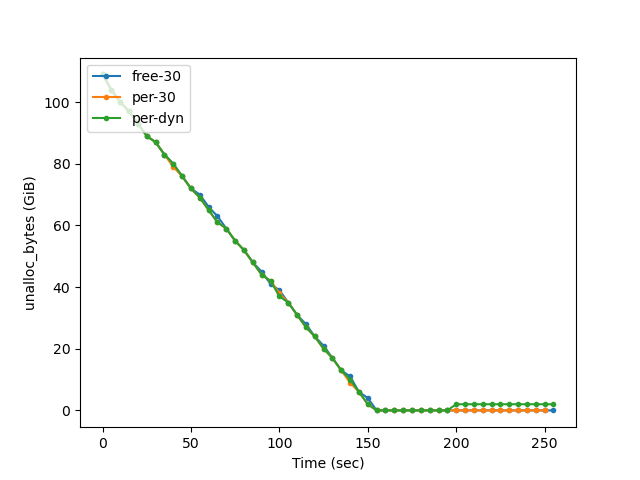
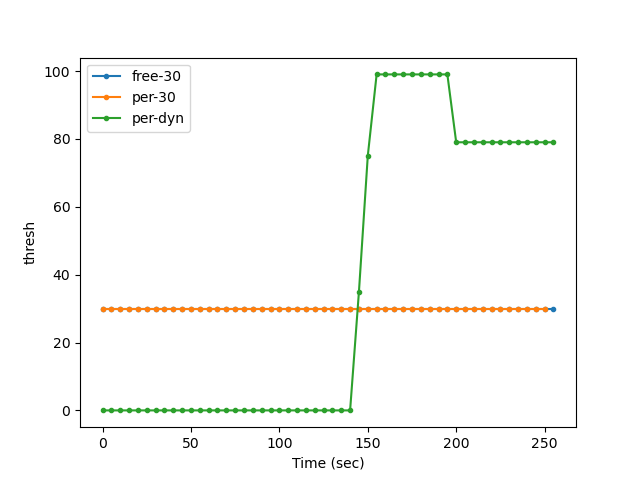
fill it all the way up, not crazy churn, but saving a buffer:
https://bur.io/dyn-rec/last_gig/unalloc_bytes.png
https://bur.io/dyn-rec/last_gig/relocs.png
https://bur.io/dyn-rec/last_gig/thresh.png

Boris Burkov (6):
btrfs: report reclaim count in sysfs
btrfs: store fs_info on space_info
btrfs: dynamic block_group reclaim threshold
btrfs: periodic block_group reclaim
btrfs: urgent periodic reclaim pass
btrfs: prevent pathological periodic reclaim loops
 fs/btrfs/block-group.c |  26 ++++---
 fs/btrfs/block-group.h |   1 +
 fs/btrfs/space-info.c  | 165 +++++++++++++++++++++++++++++++++++++++++
 fs/btrfs/space-info.h  |  28 +++++++
 fs/btrfs/sysfs.c       |  79 +++++++++++++++++++-
 5 files changed, 289 insertions(+), 10 deletions(-)
Signature · 1 line
2.43.0
PATCH 1/6 btrfs: report reclaim count in sysfs
When evaluating various reclaim strategies/thresholds against each other, it is useful to collect data about the amount of reclaim happening. Expose it via sysfs per space_info.
---
 fs/btrfs/block-group.c | 3 +++
 fs/btrfs/space-info.h  | 6 ++++++
 fs/btrfs/sysfs.c       | 2 ++
 3 files changed, 11 insertions(+)
fs/btrfs/block-group.c +3 -0
@@ -1858,6 +1858,9 @@ void btrfs_reclaim_bgs_work(struct work_struct *work)div64_u64 (bg->used *100 , bg->length), div64_u64(zone_unusable * 100, bg->length));trace_btrfs_reclaim_block_group (bg); +spin_lock (&space_info->lock); + space_info->reclaim_count++; +spin_unlock (&space_info->lock); ret =btrfs_relocate_chunk (fs_info, bg->start);if (ret) {btrfs_dec_block_group_ro (bg);
fs/btrfs/space-info.h +6 -0
@@ -156,6 +156,12 @@ struct btrfs_space_info {struct kobject kobj;struct kobject *block_group_kobjs[BTRFS_NR_RAID_TYPES ]; + +/* +* Monotonically increasing counter of relocated block groups. +* Exposed in /sys/fs/<uuid>/allocation/<type>/reclaim_count +*/ +u64 reclaim_count; };struct reserve_ticket {
fs/btrfs/sysfs.c +2 -0
@@ -894,6 +894,7 @@ SPACE_INFO_ATTR(bytes_readonly);SPACE_INFO_ATTR (bytes_zone_unusable);SPACE_INFO_ATTR (disk_used);SPACE_INFO_ATTR (disk_total); +SPACE_INFO_ATTR (reclaim_count);BTRFS_ATTR_RW (space_info, chunk_size, btrfs_chunk_size_show, btrfs_chunk_size_store);BTRFS_ATTR (space_info, size_classes, btrfs_size_classes_show);
@@ -949,6 +950,7 @@ static struct attribute *space_info_attrs[] = {BTRFS_ATTR_PTR (space_info, bg_reclaim_threshold),BTRFS_ATTR_PTR (space_info, chunk_size),BTRFS_ATTR_PTR (space_info, size_classes), +BTRFS_ATTR_PTR (space_info, reclaim_count), #ifdef CONFIG_BTRFS_DEBUG BTRFS_ATTR_PTR(space_info, force_chunk_alloc), #endif
Signature · 1 line
2.43.0
PATCH 2/6 btrfs: store fs_info on space_info
In reply to Boris BurkovThis is handy when computing space_info dynamic reclaim thresholds where we do not have access to a block group. We could add it to the various functions as a parameter, but it seems reasonable for space_info to have an fs_info pointer.
---
 fs/btrfs/space-info.c | 1 +
 fs/btrfs/space-info.h | 1 +
 2 files changed, 2 insertions(+)
fs/btrfs/space-info.c +1 -0
@@ -233,6 +233,7 @@ static int create_space_info(struct btrfs_fs_info *info, u64 flags)if (!space_info)return -ENOMEM ; + space_info->fs_info = info;for (i =0 ; i <BTRFS_NR_RAID_TYPES ; i++)INIT_LIST_HEAD (&space_info->block_groups[i]);init_rwsem (&space_info->groups_sem);
fs/btrfs/space-info.h +1 -0
@@ -85,6 +85,7 @@ enum btrfs_flush_state { };struct btrfs_space_info { +struct btrfs_fs_info *fs_info;spinlock_t lock;u64 total_bytes;/* total bytes in the space,
Signature · 1 line
2.43.0
PATCH 3/6 btrfs: dynamic block_group reclaim threshold
In reply to Boris BurkovWe can currently recover allocated block_groups by:
- explicitly starting balance operations
- "auto reclaim" via bg_reclaim_threshold
The latter works by checking against a fixed threshold on frees. If we pass from above the threshold to below, relocation triggers and the block group will get reclaimed by the cleaner thread (assuming it is still eligible)
Picking a threshold is challenging. Too high, and you end up trying to reclaim very full block_groups which is quite costly, and you don't do reclaim on block_groups that don't get quite THAT full, but could still be quite fragmented and stranding a lot of space. Too low, and you similarly miss out on reclaim even if you badly need it to avoid running out of unallocated space, if you have heavily fragmented block groups living above the threshold.
No matter the threshold, it suffers from a workload that happens to bounce around that threshold, which can introduce arbitrary amounts of reclaim waste.
To improve this situation, introduce a dynamic threshold. The basic idea behind this threshold is that it should be high when there is lots of unused space, and little unallocated space, relative to fs size. OTOH, when either unused is low or unallocated is high, reclaim is not that important, so we can set a quite low threshold.
The formula to acheive this is:
(unused / allocated) * (unused / unallocated)
which is also clamped to 90% as fuller than that is very challenging to reclaim flat out, and means the file system is legitimately quite full.
I tested this by running it on three interesting workloads:
1. bounce allocations around X% full.
2. fill up all the way and introduce full fragmentation.
3. write in a fragmented way until the filesystem is just about full.
1. and 2. attack the weaknesses of a fixed threshold; fixed either works perfectly or fully falls apart, depending on the threshold. Dynamic always handles these cases well.
3. attacks dynamic by checking whether it is too zealous to reclaim in conditions with low unallocated and low unused. It tends to claw back 1GiB of unallocated fairly aggressively, but not much more. Early versions of dynamic threshold struggled on this test.
Additional work could be done to intelligently ratchet up the urgency of reclaim in very low unallocated conditions. Existing mechanisms are already useless in that case anyway.
---
 fs/btrfs/block-group.c | 18 +++++-----
 fs/btrfs/space-info.c  | 74 ++++++++++++++++++++++++++++++++++++++++++
 fs/btrfs/space-info.h  |  8 +++++
 fs/btrfs/sysfs.c       | 43 +++++++++++++++++++++++-
 4 files changed, 134 insertions(+), 9 deletions(-)
fs/btrfs/block-group.c +10 -8
@@ -1702,24 +1702,21 @@ static inline bool btrfs_should_reclaim(struct btrfs_fs_info *fs_info)static bool should_reclaim_block_group (struct btrfs_block_group *bg,u64 bytes_freed) { -const struct btrfs_space_info *space_info = bg->space_info; -const int reclaim_thresh =READ_ONCE (space_info->bg_reclaim_threshold); +const int thresh_pct =btrfs_calc_reclaim_threshold (bg->space_info); +u64 thresh_bytes =mult_perc (bg->length, thresh_pct);const u64 new_val = bg->used;const u64 old_val = new_val + bytes_freed; -u64 thresh; -if (reclaim_thresh ==0 ) +if (thresh_bytes ==0 )return false; - thresh =mult_perc (bg->length, reclaim_thresh); -/* * If we were below the threshold before don't reclaim, we are likely a * brand new block group and we don't want to relocate new block groups. */ -if (old_val < thresh) +if (old_val < thresh_bytes)return false; -if (new_val >= thresh) +if (new_val >= thresh_bytes)return false;return true; }
@@ -1779,6 +1776,7 @@ void btrfs_reclaim_bgs_work(struct work_struct *work)/* Don't race with allocators so take the groups_sem */ down_write (&space_info->groups_sem); +spin_lock (&space_info->lock);spin_lock (&bg->lock);if (bg->reserved || bg->pinned || bg->ro) {/*
@@ -1788,6 +1786,7 @@ void btrfs_reclaim_bgs_work(struct work_struct *work)* this block group. */ spin_unlock (&bg->lock); +spin_unlock (&space_info->lock);up_write (&space_info->groups_sem); goto next; }
@@ -1806,6 +1805,7 @@ void btrfs_reclaim_bgs_work(struct work_struct *work)if (!btrfs_test_opt (fs_info,DISCARD_ASYNC ))btrfs_mark_bg_unused (bg);spin_unlock (&bg->lock); +spin_unlock (&space_info->lock);up_write (&space_info->groups_sem); goto next;
@@ -1822,10 +1822,12 @@ void btrfs_reclaim_bgs_work(struct work_struct *work)*/ if (!should_reclaim_block_group (bg, bg->length)) {spin_unlock (&bg->lock); +spin_unlock (&space_info->lock);up_write (&space_info->groups_sem); goto next; }spin_unlock (&bg->lock); +spin_unlock (&space_info->lock);/* * Get out fast, in case we're read-only or unmounting the
fs/btrfs/space-info.c +74 -0
88 lines not on this page · raw message
fs/btrfs/space-info.h +8 -0
@@ -163,6 +163,12 @@ struct btrfs_space_info {* Exposed in /sys/fs/<uuid>/allocation/<type>/reclaim_count */ u64 reclaim_count; + +/* +* If true, use the dynamic relocation threshold, instead of the +* fixed bg_reclaim_threshold. +*/ +bool dynamic_reclaim; };struct reserve_ticket {
@@ -245,4 +251,6 @@ void btrfs_dump_space_info_for_trans_abort(struct btrfs_fs_info *fs_info);void btrfs_init_async_reclaim_work (struct btrfs_fs_info *fs_info);u64 btrfs_account_ro_block_groups_free_space (struct btrfs_space_info *sinfo); +int btrfs_calc_reclaim_threshold (struct btrfs_space_info *space_info); +#endif /* BTRFS_SPACE_INFO_H */
fs/btrfs/sysfs.c +42 -1
68 lines not on this page · raw message
Signature · 1 line
2.43.0
PATCH 4/6 btrfs: periodic block_group reclaim
In reply to Boris BurkovWe currently employ a edge-triggered block group reclaim strategy which marks block groups for reclaim as they free down past a threshold.
With a dynamic threshold, this is worse than doing it in a level-triggered fashion periodically. That is because the reclaim itself happens periodically, so the threshold at that point in time is what really matters, not the threshold at freeing time. If we mark the reclaim in a big pass, then sort by usage and do reclaim, we also benefit from a negative feedback loop preventing unnecessary reclaims as we crunch through the "best" candidates.
Since this is quite a different model, it requires some additional support. The edge triggered reclaim has a good heuristic for not reclaiming fresh block groups, so we need to replace that with a typical GC sweep mark which skips block groups that have seen an allocation since the last sweep.
---
 fs/btrfs/block-group.c |  2 ++
 fs/btrfs/block-group.h |  1 +
 fs/btrfs/space-info.c  | 51 ++++++++++++++++++++++++++++++++++++++++++
 fs/btrfs/space-info.h  |  7 ++++++
 fs/btrfs/sysfs.c       | 34 ++++++++++++++++++++++++++++
 5 files changed, 95 insertions(+)
fs/btrfs/block-group.c +2 -0
@@ -1898,6 +1898,7 @@ void btrfs_reclaim_bgs_work(struct work_struct *work)void btrfs_reclaim_bgs (struct btrfs_fs_info *fs_info) { +btrfs_reclaim_sweep (fs_info);spin_lock (&fs_info->unused_bgs_lock);if (!list_empty (&fs_info->reclaim_bgs))queue_work (system_unbound_wq, &fs_info->reclaim_bgs_work);
@@ -3565,6 +3566,7 @@ int btrfs_update_block_group(struct btrfs_trans_handle *trans, old_val += num_bytes; cache->used = old_val; cache->reserved -= num_bytes; + cache->reclaim_mark =0 ; space_info->bytes_reserved -= num_bytes; space_info->bytes_used += num_bytes; space_info->disk_used += num_bytes * factor;
fs/btrfs/block-group.h +1 -0
@@ -250,6 +250,7 @@ struct btrfs_block_group {struct work_struct zone_finish_work;struct extent_buffer *last_eb;enum btrfs_block_group_size_class size_class; +u64 reclaim_mark; };static inline u64 btrfs_block_group_end (struct btrfs_block_group *block_group)
fs/btrfs/space-info.c +51 -0
54 lines not on this page · raw message
fs/btrfs/space-info.h +7 -0
@@ -169,6 +169,12 @@ struct btrfs_space_info {* fixed bg_reclaim_threshold. */ bool dynamic_reclaim; + +/* +* Periodically check all block groups against the reclaim +* threshold in the cleaner thread. +*/ +bool periodic_reclaim; };struct reserve_ticket {
@@ -252,5 +258,6 @@ void btrfs_init_async_reclaim_work(struct btrfs_fs_info *fs_info);u64 btrfs_account_ro_block_groups_free_space (struct btrfs_space_info *sinfo);int btrfs_calc_reclaim_threshold (struct btrfs_space_info *space_info); +int btrfs_reclaim_sweep (struct btrfs_fs_info *fs_info);#endif /* BTRFS_SPACE_INFO_H */
fs/btrfs/sysfs.c +34 -0
@@ -971,6 +971,39 @@ BTRFS_ATTR_RW(space_info, dynamic_reclaim, btrfs_sinfo_dynamic_reclaim_show, btrfs_sinfo_dynamic_reclaim_store); +static ssize_t btrfs_sinfo_periodic_reclaim_show (struct kobject *kobj, +struct kobj_attribute *a, +char *buf) +{ +struct btrfs_space_info *space_info =to_space_info (kobj); + +return sysfs_emit (buf,"%d\n" ,READ_ONCE (space_info->periodic_reclaim)); +} + +static ssize_t btrfs_sinfo_periodic_reclaim_store (struct kobject *kobj, +struct kobj_attribute *a, +const char *buf,size_t len) +{ +struct btrfs_space_info *space_info =to_space_info (kobj); +int periodic_reclaim; +int ret; + + ret =kstrtoint (buf,10 , &periodic_reclaim); +if (ret) +return ret; + +if (periodic_reclaim <0 ) +return -EINVAL ; + +WRITE_ONCE (space_info->periodic_reclaim, periodic_reclaim !=0 ); + +return len; +} + +BTRFS_ATTR_RW (space_info, periodic_reclaim, + btrfs_sinfo_periodic_reclaim_show, + btrfs_sinfo_periodic_reclaim_store); +/* * Allocation information about block group types. *
@@ -992,6 +1025,7 @@ static struct attribute *space_info_attrs[] = {BTRFS_ATTR_PTR (space_info, chunk_size),BTRFS_ATTR_PTR (space_info, size_classes),BTRFS_ATTR_PTR (space_info, reclaim_count), +BTRFS_ATTR_PTR (space_info, periodic_reclaim), #ifdef CONFIG_BTRFS_DEBUG BTRFS_ATTR_PTR(space_info, force_chunk_alloc), #endif
Signature · 1 line
2.43.0
PATCH 5/6 btrfs: urgent periodic reclaim pass
In reply to Boris BurkovPeriodic reclaim attempts to avoid block_groups seeing active use with a sweep mark that gets cleared on allocation and set on a sweep. In urgent conditions where we have very little unallocated space, we want to be able to override this mechanism.
Introduce a second pass that only happens if we fail to find a reclaim candidate and reclaim is urgent. In that case, do a second pass where all block groups are eligible.
---
 fs/btrfs/space-info.c | 35 ++++++++++++++++++++++++++++++++++-
 1 file changed, 34 insertions(+), 1 deletion(-)
fs/btrfs/space-info.c +34 -1
@@ -1945,17 +1945,35 @@ int btrfs_calc_reclaim_threshold(struct btrfs_space_info *space_info)return READ_ONCE (space_info->bg_reclaim_threshold); } +/* +* Under "urgent" reclaim, we will reclaim even fresh block groups that have +* recently seen successful allocations, as we are desperate to reclaim +* whatever we can to avoid ENOSPC in a transaction leading to a readonly fs. +*/ +static bool is_reclaim_urgent (struct btrfs_space_info *space_info) +{ +struct btrfs_fs_info *fs_info = space_info->fs_info; +u64 unalloc =atomic64_read (&fs_info->free_chunk_space); +u64 chunk_size =min (READ_ONCE (space_info->chunk_size),SZ_1G ); + +return unalloc < chunk_size; +} +static int do_reclaim_sweep (struct btrfs_fs_info *fs_info,struct btrfs_space_info *space_info,int raid) {struct btrfs_block_group *bg;int thresh_pct; +bool try_again = true; +bool urgent;spin_lock (&space_info->lock); + urgent =is_reclaim_urgent (space_info); thresh_pct =btrfs_calc_reclaim_threshold (space_info);spin_unlock (&space_info->lock);down_read (&space_info->groups_sem); +again:list_for_each_entry (bg, &space_info->block_groups[raid], list) {u64 thresh;bool reclaim = false;
@@ -1963,14 +1981,29 @@ static int do_reclaim_sweep(struct btrfs_fs_info *fs_info,btrfs_get_block_group (bg);spin_lock (&bg->lock); thresh =mult_perc (bg->length, thresh_pct); -if (bg->used < thresh && bg->reclaim_mark) +if (bg->used < thresh && bg->reclaim_mark) { + try_again = false; reclaim = true; + } bg->reclaim_mark++;spin_unlock (&bg->lock);if (reclaim)btrfs_mark_bg_to_reclaim (bg);btrfs_put_block_group (bg); } + +/* +* In situations where we are very motivated to reclaim (low unalloc) +* use two passes to make the reclaim mark check best effort. +* +* If we have any staler groups, we don't touch the fresher ones, but if we +* really need a block group, do take a fresh one. +*/ +if (try_again && urgent) { + try_again = false; + goto again; + } +up_read (&space_info->groups_sem);return 0 ; }
Signature · 1 line
2.43.0
PATCH 6/6 btrfs: prevent pathological periodic reclaim loops
In reply to Boris BurkovPeriodic reclaim runs the risk of getting stuck in a state where it keeps reclaiming the same block group over and over. This can happen if
1. reclaiming that block_group fails
2. reclaiming that block_group fails to move any extents into existing block_groups and just allocates a fresh chunk and moves everything.
Currently, 1. is a very tight loop inside the reclaim worker. That is critical for edge triggered reclaim or else we risk forgetting about a reclaimable group. On the other hand, with level triggered reclaim we can break out of that loop and get it later.
With that fixed, 2. applies to both failures and "successes" with no progress. If we have done a periodic reclaim on a space_info and nothing has changed in that space_info, there is not much point to trying again, so don't, until some space gets free.
---
 fs/btrfs/block-group.c | 3 ++-
 fs/btrfs/space-info.c  | 6 ++++++
 fs/btrfs/space-info.h  | 6 ++++++
 3 files changed, 14 insertions(+), 1 deletion(-)
fs/btrfs/block-group.c +2 -1
@@ -1871,7 +1871,7 @@ void btrfs_reclaim_bgs_work(struct work_struct *work) } next: -if (ret) +if (ret && !READ_ONCE (space_info->periodic_reclaim))btrfs_mark_bg_to_reclaim (bg);btrfs_put_block_group (bg);
@@ -3580,6 +3580,7 @@ int btrfs_update_block_group(struct btrfs_trans_handle *trans, space_info->bytes_used -= num_bytes; space_info->disk_used -= num_bytes * factor; + space_info->periodic_reclaim_ready = true; reclaim =should_reclaim_block_group (cache, num_bytes);spin_unlock (&cache->lock);
fs/btrfs/space-info.c +6 -0
@@ -1968,6 +1968,12 @@ static int do_reclaim_sweep(struct btrfs_fs_info *fs_info,bool urgent;spin_lock (&space_info->lock); +if (space_info->periodic_reclaim_ready) { + space_info->periodic_reclaim_ready = false; + }else { +spin_unlock (&space_info->lock); +return 0 ; + } urgent =is_reclaim_urgent (space_info); thresh_pct =btrfs_calc_reclaim_threshold (space_info);spin_unlock (&space_info->lock);
fs/btrfs/space-info.h +6 -0
@@ -175,6 +175,12 @@ struct btrfs_space_info {* threshold in the cleaner thread. */ bool periodic_reclaim; + +/* +* Periodic reclaim should be a no-op if a space_info hasn't +* freed any space since the last time we tried. +*/ +bool periodic_reclaim_ready; };struct reserve_ticket {
Signature · 1 line
2.43.0
kernel test robot
build botRe: [PATCH 4/6] btrfs: periodic block_group reclaim
In reply to Boris Burkovkernel test robot noticed the following build warnings:
Hi Boris,
kernel test robot noticed the following build warnings:
[auto build test WARNING on kdave/for-next]
[also build test WARNING on linus/master v6.8-rc2 next-20240202] [If your patch is applied to the wrong git tree, kindly drop us a note. And when submitting patch, we suggest to use '--base' as documented in
https://git-scm.com/docs/git-format-patch#_base_tree_information]
url:    https://github.com/intel-lab-lkp/linux/commits/Boris-Burkov/btrfs-report-reclaim-count-in-sysfs/20240203-071516
base:   https://git.kernel.org/pub/scm/linux/kernel/git/kdave/linux.git for-next
patch link:    https://lore.kernel.org/r/1173e535ec7b46bda33ed2dc4219027502763902.1706914865.git.boris%40bur.io
patch subject: [PATCH 4/6] btrfs: periodic block_group reclaim
config: i386-randconfig-141-20240204 (https://download.01.org/0day-ci/archive/20240205/[email protected]/config)
compiler: gcc-12 (Debian 12.2.0-14) 12.2.0
If you fix the issue in a separate patch/commit (i.e. not just a new version of the same patch/commit), kindly add following tags
| Reported-by: kernel test robot <[email protected]>
| Closes: https://lore.kernel.org/oe-kbuild-all/[email protected]/
smatch warnings:fs/btrfs/space-info.c:1996 btrfs_reclaim_sweep() error: uninitialized symbol 'ret'.
vim +/ret +1996 fs/btrfs/space-info.c
1977
1978 int btrfs_reclaim_sweep(struct btrfs_fs_info *fs_info)
1979 {
1980 int ret;
1981 int raid;
1982 struct btrfs_space_info *space_info;
1983
1984 list_for_each_entry(space_info, &fs_info->space_info, list) {
1985 if (space_info->flags & BTRFS_BLOCK_GROUP_SYSTEM)
1986 continue;
1987 if (!READ_ONCE(space_info->periodic_reclaim))
1988 continue;
1989 for (raid = 0; raid < BTRFS_NR_RAID_TYPES; raid++) {
1990 ret = do_reclaim_sweep(fs_info, space_info, raid);
1991 if (ret)
1992 return ret;
1993 }
1994 }
1995
> 1996 return ret;
Signature · 2 lines
0-DAY CI Kernel Test Service
https://github.com/intel/lkp-tests/wiki
Quoted 7 lines · Boris Burkov
Btrfs's
block_groupallocator suffers from a well known problem, that it is capable of eagerly allocating too much space to either data or metadata (most often data, absent bugs) and then later be unable to allocate more space for the other, when needed. When data starves metadata, this can extra painfully result in read only filesystems that need careful manual balancing to fix.
Quoted 6 lines
This can be worked around by:
- enabling automatic reclaim
- periodically running balanceNeither of these enjoy widespread use, as far as I know, though the former is used at scale at Meta with good results.
https://github.com/kdave/btrfsmaintenance is to my knowledge widely used and installed on distros. (Also my most starred project on github.)
The idea is to make the balance separate from kernel, allowing users and administrators to easily tweak the parameters and timing. We haven't added automatic reclaim to kernel as it tends to start at the worst time. The jobs from btrfsmaintenance are scheduled according to the calendar events (systemd.timer).
Also the jobs don't have to be ran at all, the package not installed.
The problem with balancing amount of data and metadata chunks is known and there are only heuristics, we can't solve that without knowing the exact usage pattern.
Quoted 8 lines
This patch set expands on automatic reclaim, adding the ability to set a dynamic reclaim threshold that appropriately scales with the global file system allocation conditions as well as periodic reclaim which runs that reclaim sweep in the cleaner thread. Together, I believe they constitute a robust and general automatic reclaim system that should avoid unfortunate read only filesystems in all but extreme conditions, where space is running quite low anyway and failure is more reasonable.
Quoted 7 lines
I ran it on three workloads (described in detail on the dynamic reclaim patch) but they are:
1. bounce allocations around X% full.
2. fill up all the way and introduce full fragmentation.
3. write in a fragmented way until the filesystem is just about full. script can be found here:
https://github.com/boryas/scripts/tree/main/fio/reclaim
A common workload on distros is regular system update (rolling distro) with snapshots (snapper) and cleanup. This can create a lot of under used block groups, both data and metadata. Reclaiming that preriodically was one of the ground ideas for the btrfsmaintenance project.
The reclaim is needed to make the space more compact as the randomly removed unused extents create holes for new data so this is a good example for either scripted or automatic reclaim.
However you can also find use case where this would harm performance or just waste IO as the data are short lived and shuffling around unused block groups does not help much.
The exact parameters of auto reclaim also depend on the storage type, an NVMe would be probably fine with any amount of data, HDD not so much.
I don't know from your description above what's the estimated frequency of the reclaim? I understand that the urgent reclaim would start as needed, but otherwise the frequency of reclaim of say 30% used block groups can stay fine for a few days, as there are usually more new data than deletions.
Also with more block groups around it's more likely to find good candidates for the size classes and then do the placement.
Quoted 15 lines
The important results can be seen here (full results explorable at bur.io/dyn-rec/)
bounce at 30%, much higher relocations with a fixed threshold:
https://bur.io/dyn-rec/bounce-30/relocs.pnghard 30% fragmentation, dynamic actually reclaims, relocs not crazy:
https://bur.io/dyn-rec/strict_frag-30/unalloc_bytes.png
https://bur.io/dyn-rec/strict_frag-30/relocs.pngfill it all the way up, not crazy churn, but saving a buffer:
https://bur.io/dyn-rec/last_gig/unalloc_bytes.png
https://bur.io/dyn-rec/last_gig/relocs.png
https://bur.io/dyn-rec/last_gig/thresh.png
Quoted 7 lines
Boris Burkov (6):
btrfs: report reclaim count in sysfs
btrfs: storefs_infoonspace_info
btrfs: dynamicblock_groupreclaim threshold
btrfs: periodicblock_groupreclaim
btrfs: urgent periodic reclaim pass
btrfs: prevent pathological periodic reclaim loops
So one thing is to have the mechanism for the reclaim, I think that's the easy part, the tuning will be interesting.
Quoted 12 lines · David Sterba
Quoted 11 lines · Boris Burkov
Btrfs's
block_groupallocator suffers from a well known problem, that it is capable of eagerly allocating too much space to either data or metadata (most often data, absent bugs) and then later be unable to allocate more space for the other, when needed. When data starves metadata, this can extra painfully result in read only filesystems that need careful manual balancing to fix.This can be worked around by:
- enabling automatic reclaim
- periodically running balance
Quoted 5 lines
Quoted 2 lines
Neither of these enjoy widespread use, as far as I know, though the former is used at scale at Meta with good results.
https://github.com/kdave/btrfsmaintenance is to my knowledge widely used and installed on distros. (Also my most starred project on github.)
Oh, cool, I'm glad that is out there and being used. I'm sorry for my ignorance.
Quoted 6 lines
The idea is to make the balance separate from kernel, allowing users and administrators to easily tweak the parameters and timing. We haven't added automatic reclaim to kernel as it tends to start at the worst time. The jobs from btrfsmaintenance are scheduled according to the calendar events (systemd.timer).
Makes sense.
Quoted 6 lines
Also the jobs don't have to be ran at all, the package not installed.
The problem with balancing amount of data and metadata chunks is known and there are only heuristics, we can't solve that without knowing the exact usage pattern.
Agreed.
Quoted 17 lines
Quoted 9 lines
This patch set expands on automatic reclaim, adding the ability to set a dynamic reclaim threshold that appropriately scales with the global file system allocation conditions as well as periodic reclaim which runs that reclaim sweep in the cleaner thread. Together, I believe they constitute a robust and general automatic reclaim system that should avoid unfortunate read only filesystems in all but extreme conditions, where space is running quite low anyway and failure is more reasonable.
Quoted 7 lines
I ran it on three workloads (described in detail on the dynamic reclaim patch) but they are:
1. bounce allocations around X% full.
2. fill up all the way and introduce full fragmentation.
3. write in a fragmented way until the filesystem is just about full. script can be found here:
https://github.com/boryas/scripts/tree/main/fio/reclaim
Quoted 4 lines
A common workload on distros is regular system update (rolling distro) with snapshots (snapper) and cleanup. This can create a lot of under used block groups, both data and metadata. Reclaiming that preriodically was one of the ground ideas for the btrfsmaintenance project.
I believe this is pretty similar to my workload 2 in spirit, except I haven't done much with snapshots. I would love to run this workload so I'll try to set it up with a VM. If you have a script for it already, or even tips for setting it up, I would be quite grateful :)
I think that the "lots of random deletes leave empty block groups" workload is the most interesting one in general for reclaim, and I think it's cool that it happens in the real world :)
Quoted 8 lines
The reclaim is needed to make the space more compact as the randomly removed unused extents create holes for new data so this is a good example for either scripted or automatic reclaim.
However you can also find use case where this would harm performance or just waste IO as the data are short lived and shuffling around unused block groups does not help much.
+1, definitely trying to avoid this.
Quoted 3 lines
The exact parameters of auto reclaim also depend on the storage type, an NVMe would be probably fine with any amount of data, HDD not so much.
Good point, have only tested on NVMe. Definitely needs to be tunable to not abuse HDDs.
Quoted 9 lines
I don't know from your description above what's the estimated frequency of the reclaim? I understand that the urgent reclaim would start as needed, but otherwise the frequency of reclaim of say 30% used block groups can stay fine for a few days, as there are usually more new data than deletions.
Also with more block groups around it's more likely to find good candidates for the size classes and then do the placement.
I think talking about my workload 2 here is helpful. Roughly, it writes out 100G in a ~110G disk, then deletes 70G in perfectly fragmenting stripes, so if we were way too aggressive, or used the current autoreclaim with an unlucky threshold, we would reclaim all 100 block_groups. Dynamic reclaim's threshold spikes up to max, relocates 7 block groups, which is enough to negative feedback loop it back to a low threshold and not doing more reclaim.
see https://bur.io/dyn-rec/strict_frag-30/thresh.png for the threshold curve and https://bur.io/dyn-rec/strict_frag-30/relocs.png for the reclaim counts. (I didn't hack it up perfectly evilly to make the 30% threshold config relocate 100 block groups in that graph, FWIW)

I will try to more systematically plot threshold curves to get a better sense for how to cause the most reclaims possible for a worst case estimate.
In case you were asking more about the period it runs at:
As written right now, it runs with every cleaner thread run, but skips block_groups that got an allocation since the last cleaner thread run. I think you make an excellent point that the rate is much better to be more like "daily" or "weekly" rather than "minutely". That gives more time to reach a quiescent state, fill in gaps with small writes, etc. At the minimum, I think the periodic reclaim ought to have a configurable period with a relatively long default (this should help with HDD too?)
Quoted 24 lines
Quoted 16 lines
The important results can be seen here (full results explorable at bur.io/dyn-rec/)
bounce at 30%, much higher relocations with a fixed threshold:
https://bur.io/dyn-rec/bounce-30/relocs.pnghard 30% fragmentation, dynamic actually reclaims, relocs not crazy:
https://bur.io/dyn-rec/strict_frag-30/unalloc_bytes.png
https://bur.io/dyn-rec/strict_frag-30/relocs.pngfill it all the way up, not crazy churn, but saving a buffer:
https://bur.io/dyn-rec/last_gig/unalloc_bytes.png
https://bur.io/dyn-rec/last_gig/relocs.png
https://bur.io/dyn-rec/last_gig/thresh.pngQuoted 7 lines
Boris Burkov (6):
btrfs: report reclaim count in sysfs
btrfs: storefs_infoonspace_info
btrfs: dynamicblock_groupreclaim threshold
btrfs: periodicblock_groupreclaim
btrfs: urgent periodic reclaim pass
btrfs: prevent pathological periodic reclaim loops
Quoted 2 lines
So one thing is to have the mechanism for the reclaim, I think that's the easy part, the tuning will be interesting.
My 2c based on what I learned from this effort, and from your feedback:
Our two goals should be:
1. Avoid unnecessary reclaim, it wastes user resources and can hurt their system's performance.
2. Prevent unallocated=1MiB before it's too late.
I think anything with a fixed threshold is unlikely to fully achieve either goal, as unlucky workloads will either operate below the threshold and reclaim too much or above it and never reclaim.
I believe the dynamic threshold with a negative feedback loop is the right sort of idea for achieving both goals. Ultimately, it is a continuous function that encodes "reclaim at all costs when it's really bad, don't reclaim much otherwise". I think it could also work to get rid of the extra distraction from modelling it with a continuous function and trying to encode the two goals more discretely/directly.
i.e.,
Very long period, low threshold periodic maintenance (basically exactly btrfsmaintenance, doesn't need to be in kernel) and the kernel having "urgent" conditions where it reclaims more aggressively in a limited way, just to get us back to a few gigs of unalloc.
I also saw that btrfsmaintenance defaults to dusage=5 then dusage=10 which is lower (but similar to!) the quiescent state thresholds I have seen in my tests (around 15-20). I may try to tune it to land around 10% for most healthy fses, as that seems to be the safest number we know.
By the way, I think the dynamic threshold could be implemented fully in userspace by using the limit flag of balance and recalculating the threshold between each reclaim. Would you be more interested in experimenting with that in btrfsmaintenance? I do think that in the long run, some kind of "urgent unalloc protection" does belong in the kernel by default, assuming we can really nail it down perfectly.
Thanks for your feedback,
Boris
Quoted 7 lines · Boris Burkov
Quoted 5 lines · David Sterba
On Fri, Feb 02, 2024 at 03:12:42PM -0800, Boris Burkov wrote:
A common workload on distros is regular system update (rolling distro) with snapshots (snapper) and cleanup. This can create a lot of under used block groups, both data and metadata. Reclaiming that preriodically was one of the ground ideas for the btrfsmaintenance project.
Quoted 8 lines
I believe this is pretty similar to my workload 2 in spirit, except I haven't done much with snapshots. I would love to run this workload so I'll try to set it up with a VM. If you have a script for it already, or even tips for setting it up, I would be quite grateful :)
I think that the "lots of random deletes leave empty block groups" workload is the most interesting one in general for reclaim, and I think it's cool that it happens in the real world :)
As a simulation of that I'm using git based workload that randomly checks out commits and does a snapshot. A once working script is herehttps://github.com/kdave/testunion/blob/master/test-snapgit/startme (I maybe have some updates but I'd have to find the most recent version).
The used git repo should provide large files too so it's closer to what eg. rpm does.
Quoted 5 lines
Quoted 2 lines
The exact parameters of auto reclaim also depend on the storage type, an NVMe would be probably fine with any amount of data, HDD not so much.
Good point, have only tested on NVMe. Definitely needs to be tunable to not abuse HDDs.
I think we'll need an automatic classification of devices, now it's third type that I know could use it (raid mirror balancing, checksum offload and this one).
There's more to reply to, I'll continue on another day.