btrfs: dynamic and periodic block_group reclaim
cover btrfs: dynamic and periodic block_group reclaim
Btrfs's block_group allocator suffers from a well known problem, that it is capable of eagerly allocating too much space to either data or metadata (most often data, absent bugs) and then later be unable to allocate more space for the other, when needed. When data starves metadata, this can extra painfully result in read only filesystems that need careful manual balancing to fix.
This can be worked around by:
- enabling automatic reclaim
- periodically running balance
The latter is widely deployed via btrfsmaintenance
(https://github.com/kdave/btrfsmaintenance) and the former is used at scale at Meta with good results. However, neither of those solutions is perfect, as they both currently use a fixed threshold. A fixed threshold is vulnerable to workloads that trigger high amounts of reclaim. This has led to btrfsmaintenance setting very conservative thresholds of 5 and 10 percent of data block groups.
(https://github.com/kdave/btrfsmaintenance/commit/edbbfffe592f47c2849a8825f523e2ccc38b15f5)
At Meta, we deal with an elevated level of reclaim which would be desirable to reduce.
This patch set expands on automatic reclaim, adding the ability to set a dynamic reclaim threshold that appropriately scales with the global file system allocation conditions as well as periodic reclaim which runs that reclaim sweep in the cleaner thread. Together, I believe they constitute a robust and general automatic reclaim system that should avoid unfortunate read only filesystems in all but extreme conditions, where space is running quite low anyway and failure is more reasonable.
At a very high level, the dynamic threshold's strategy is to set a fixed target of unallocated block groups (10 block groups) and linearly scale its aggression the further we are from that target. That way we do no automatic reclaim until we actually press against the unallocated target, allowing the allocator to gradually fill fragmented space with new extents, but do claw back space after workloads that use and free a bunch of space, perhaps with fragmentation.
I ran it on three workloads (described in detail on the dynamic reclaim patch) but they are:
1. bounce allocations around X% full.
2. fill up all the way and introduce full fragmentation.
3. write in a fragmented way until the filesystem is just about full. script can be found here:
https://github.com/boryas/scripts/tree/main/fio/reclaim
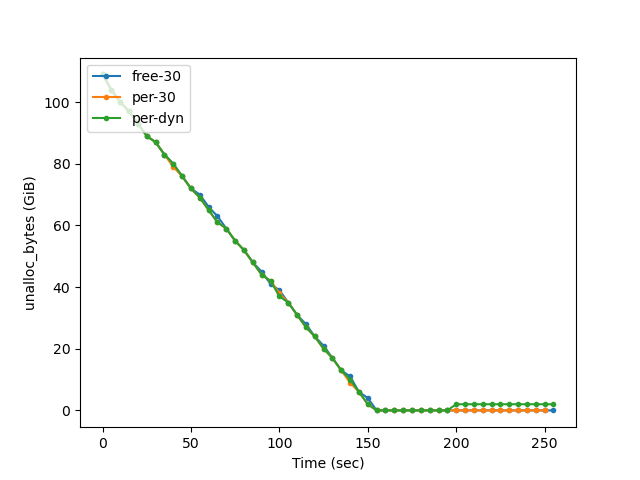
The important results can be seen here (full results explorable at
https://bur.io/dyn-rec/)
bounce at 30%, higher relocations with a fixed threshold:
https://bur.io/dyn-rec/bounce/reclaims.png
https://bur.io/dyn-rec/bounce/reclaim_bytes.png
https://bur.io/dyn-rec/bounce/unalloc_bytes.png
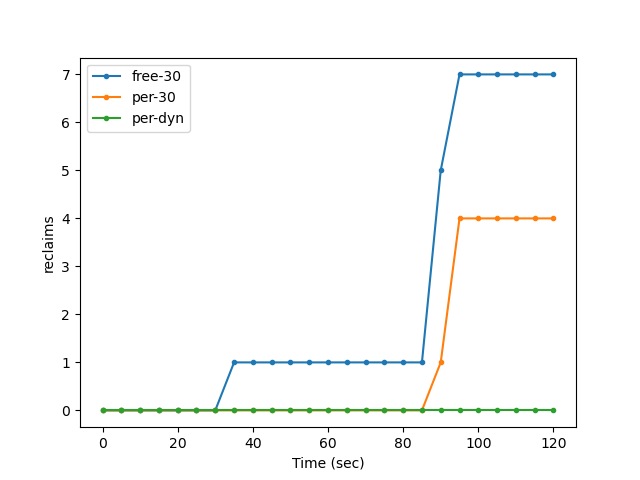
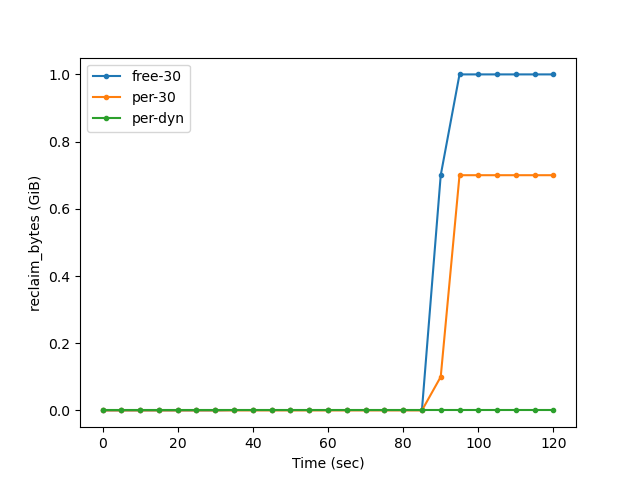
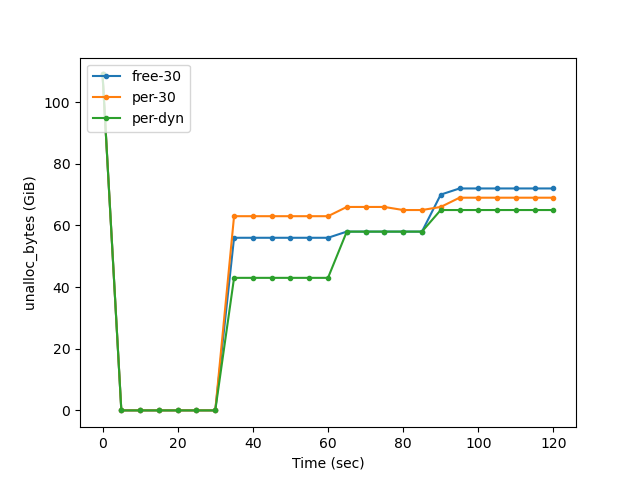
hard 30% fragmentation, dynamic actually reclaims, relocs not crazy:
https://bur.io/dyn-rec/strict_frag/reclaims.png
https://bur.io/dyn-rec/strict_frag/reclaim_bytes.png
https://bur.io/dyn-rec/strict_frag/unalloc_bytes.png
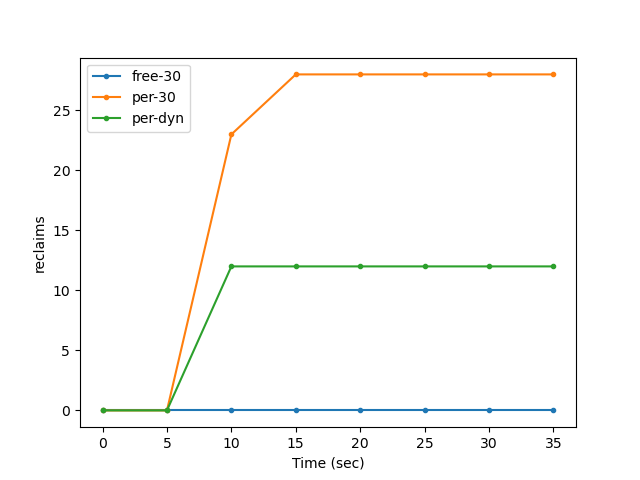
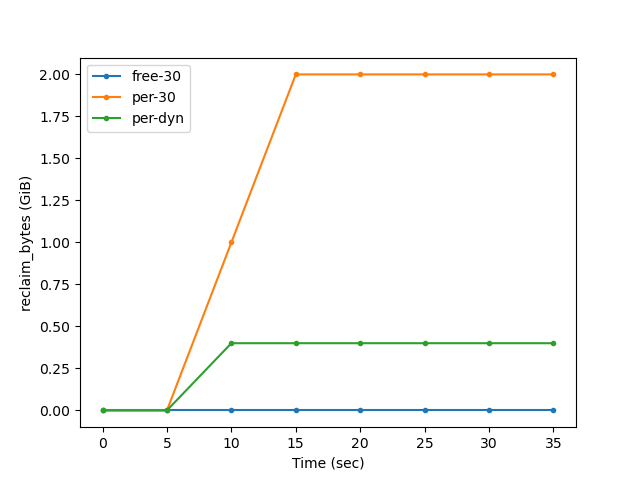
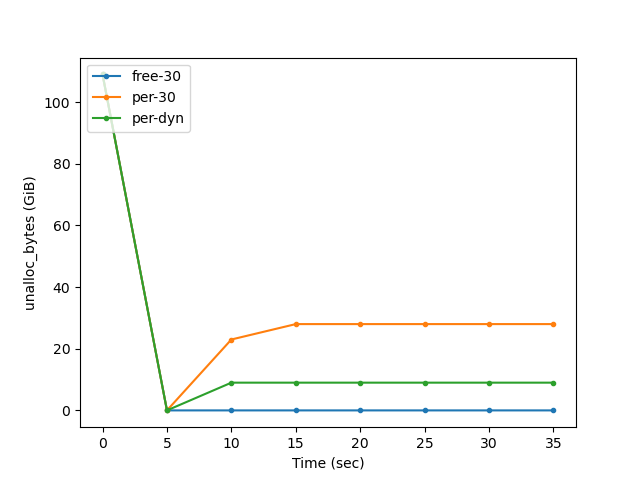
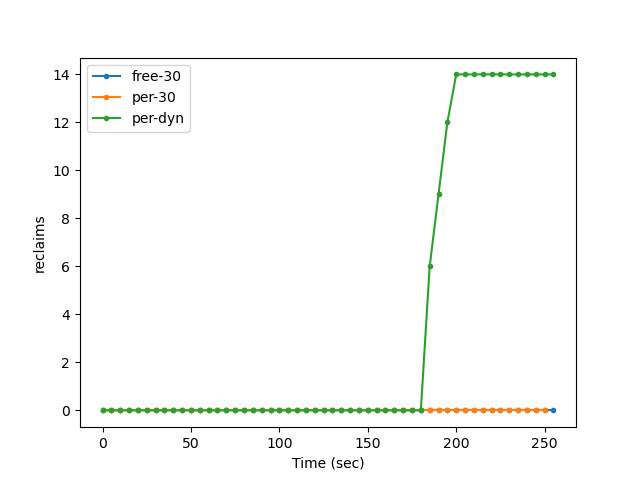
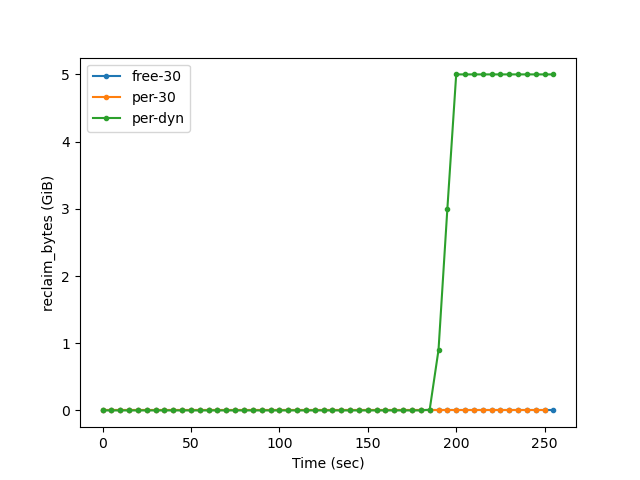
fill it all the way up in a fragmented way, then keep making allocations:
https://bur.io/dyn-rec/last_gig/reclaims.png
https://bur.io/dyn-rec/last_gig/reclaim_bytes.png
https://bur.io/dyn-rec/last_gig/unalloc_bytes.png
Boris Burkov (6):
btrfs: report reclaim stats in sysfs
btrfs: store fs_info on space_info
btrfs: dynamic block_group reclaim threshold
btrfs: periodic block_group reclaim
btrfs: prevent pathological periodic reclaim loops
btrfs: urgent periodic reclaim pass
 fs/btrfs/block-group.c |  42 ++++++--
 fs/btrfs/block-group.h |   1 +
 fs/btrfs/space-info.c  | 240 +++++++++++++++++++++++++++++++++++++++--
 fs/btrfs/space-info.h  |  42 ++++++++
 fs/btrfs/sysfs.c       |  81 +++++++++++++-
 5 files changed, 383 insertions(+), 23 deletions(-)
Signature · 1 line
2.44.0
PATCH 1/6 btrfs: report reclaim stats in sysfs
When evaluating various reclaim strategies/thresholds against each other, it is useful to collect data about the amount of reclaim happening. Expose a count and byte count via sysfs per space_info.
---
 fs/btrfs/block-group.c | 10 ++++++++++
 fs/btrfs/space-info.h  | 12 ++++++++++++
 fs/btrfs/sysfs.c       |  4 ++++
 3 files changed, 26 insertions(+)
fs/btrfs/block-group.c +10 -0
@@ -1821,6 +1821,7 @@ void btrfs_reclaim_bgs_work(struct work_struct *work)list_sort (NULL , &fs_info->reclaim_bgs, reclaim_bgs_cmp);while (!list_empty (&fs_info->reclaim_bgs)) {u64 zone_unusable; +u64 reclaimed;int ret =0 ; bg = list_first_entry(&fs_info->reclaim_bgs,
@@ -1913,11 +1914,20 @@ void btrfs_reclaim_bgs_work(struct work_struct *work)div64_u64 (bg->used *100 , bg->length), div64_u64(zone_unusable * 100, bg->length));trace_btrfs_reclaim_block_group (bg); + reclaimed = bg->used; ret =btrfs_relocate_chunk (fs_info, bg->start);if (ret) {btrfs_dec_block_group_ro (bg);btrfs_err (fs_info,"error relocating chunk %llu" , bg->start); +spin_lock (&space_info->lock); + space_info->reclaim_count++; +spin_unlock (&space_info->lock); + }else { +spin_lock (&space_info->lock); + space_info->reclaim_count++; + space_info->reclaim_bytes += reclaimed; +spin_unlock (&space_info->lock); } next:
fs/btrfs/space-info.h +12 -0
@@ -165,6 +165,18 @@ struct btrfs_space_info {struct kobject kobj;struct kobject *block_group_kobjs[BTRFS_NR_RAID_TYPES ]; + +/* +* Monotonically increasing counter of block group reclaim attempts +* Exposed in /sys/fs/<uuid>/allocation/<type>/reclaim_count +*/ +u64 reclaim_count; + +/* +* Monotonically increasing counter of reclaimed bytes +* Exposed in /sys/fs/<uuid>/allocation/<type>/reclaim_bytes +*/ +u64 reclaim_bytes; };struct reserve_ticket {
fs/btrfs/sysfs.c +4 -0
@@ -894,6 +894,8 @@ SPACE_INFO_ATTR(bytes_readonly);SPACE_INFO_ATTR (bytes_zone_unusable);SPACE_INFO_ATTR (disk_used);SPACE_INFO_ATTR (disk_total); +SPACE_INFO_ATTR (reclaim_count); +SPACE_INFO_ATTR (reclaim_bytes);BTRFS_ATTR_RW (space_info, chunk_size, btrfs_chunk_size_show, btrfs_chunk_size_store);BTRFS_ATTR (space_info, size_classes, btrfs_size_classes_show);
@@ -949,6 +951,8 @@ static struct attribute *space_info_attrs[] = {BTRFS_ATTR_PTR (space_info, bg_reclaim_threshold),BTRFS_ATTR_PTR (space_info, chunk_size),BTRFS_ATTR_PTR (space_info, size_classes), +BTRFS_ATTR_PTR (space_info, reclaim_count), +BTRFS_ATTR_PTR (space_info, reclaim_bytes), #ifdef CONFIG_BTRFS_DEBUG BTRFS_ATTR_PTR(space_info, force_chunk_alloc), #endif
Signature · 1 line
2.44.0
PATCH 2/6 btrfs: store fs_info on space_info
In reply to Boris BurkovThis is handy when computing space_info dynamic reclaim thresholds where we do not have access to a block group. We could add it to the various functions as a parameter, but it seems reasonable for space_info to have an fs_info pointer.
---
 fs/btrfs/space-info.c | 1 +
 fs/btrfs/space-info.h | 1 +
 2 files changed, 2 insertions(+)
fs/btrfs/space-info.c +1 -0
@@ -232,6 +232,7 @@ static int create_space_info(struct btrfs_fs_info *info, u64 flags)if (!space_info)return -ENOMEM ; + space_info->fs_info = info;for (i =0 ; i <BTRFS_NR_RAID_TYPES ; i++)INIT_LIST_HEAD (&space_info->block_groups[i]);init_rwsem (&space_info->groups_sem);
fs/btrfs/space-info.h +1 -0
@@ -94,6 +94,7 @@ enum btrfs_flush_state { };struct btrfs_space_info { +struct btrfs_fs_info *fs_info;spinlock_t lock;u64 total_bytes;/* total bytes in the space,
Signature · 1 line
2.44.0
PATCH 3/6 btrfs: dynamic block_group reclaim threshold
In reply to Boris BurkovWe can currently recover allocated block_groups by:
- explicitly starting balance operations
- "auto reclaim" via bg_reclaim_threshold
The latter works by checking against a fixed threshold on frees. If we pass from above the threshold to below, relocation triggers and the block group will get reclaimed by the cleaner thread (assuming it is still eligible)
Picking a threshold is challenging. Too high, and you end up trying to reclaim very full block_groups which is quite costly, and you don't do reclaim on block_groups that don't get quite THAT full, but could still be quite fragmented and stranding a lot of space. Too low, and you similarly miss out on reclaim even if you badly need it to avoid running out of unallocated space, if you have heavily fragmented block groups living above the threshold.
No matter the threshold, it suffers from a workload that happens to bounce around that threshold, which can introduce arbitrary amounts of reclaim waste.
To improve this situation, introduce a dynamic threshold. The basic idea behind this threshold is that it should be very lax when there is plenty of unallocated space, and increasingly aggressive as we approach zero unallocated space. To that end, it sets a target for unallocated space (10 chunks) and then linearly increases the threshold as the amount of space short of the target we are increases. The formula is:
(target - unalloc) / target
I tested this by running it on three interesting workloads:
1. bounce allocations around X% full.
2. fill up all the way and introduce full fragmentation.
3. write in a fragmented way until the filesystem is just about full.
1. and 2. attack the weaknesses of a fixed threshold; fixed either works perfectly or fully falls apart, depending on the threshold. Dynamic always handles these cases well.
3. attacks dynamic by checking whether it is too zealous to reclaim in conditions with low unallocated and low unused. It tends to claw back 1GiB of unallocated fairly aggressively, but not much more. Early versions of dynamic threshold struggled on this test.
graphs of the data and results from those experiments can be found at:
https://bur.io/dyn-rec/
I did not put in extra effort to "fully" exploit 1. and 2. to make fixed threshold look REALLY bad, vs merely worse, but it would not be hard to do.
Additional work could be done to intelligently ratchet up the urgency of reclaim in very low unallocated conditions or to make the allocator try to break up allocations rather than use critical last block groups. Some of this space is currently being explored by Johannes for zoned filesystems. That is mostly independent of the choice of reclaim strategy.
---
 fs/btrfs/block-group.c |  18 ++++---
 fs/btrfs/space-info.c  | 115 +++++++++++++++++++++++++++++++++++++----
 fs/btrfs/space-info.h  |   8 +++
 fs/btrfs/sysfs.c       |  43 ++++++++++++++-
 4 files changed, 164 insertions(+), 20 deletions(-)
fs/btrfs/block-group.c +10 -8
@@ -1757,24 +1757,21 @@ static inline bool btrfs_should_reclaim(struct btrfs_fs_info *fs_info)static bool should_reclaim_block_group (struct btrfs_block_group *bg,u64 bytes_freed) { -const struct btrfs_space_info *space_info = bg->space_info; -const int reclaim_thresh =READ_ONCE (space_info->bg_reclaim_threshold); +const int thresh_pct =btrfs_calc_reclaim_threshold (bg->space_info); +u64 thresh_bytes =mult_perc (bg->length, thresh_pct);const u64 new_val = bg->used;const u64 old_val = new_val + bytes_freed; -u64 thresh; -if (reclaim_thresh ==0 ) +if (thresh_bytes ==0 )return false; - thresh =mult_perc (bg->length, reclaim_thresh); -/* * If we were below the threshold before don't reclaim, we are likely a * brand new block group and we don't want to relocate new block groups. */ -if (old_val < thresh) +if (old_val < thresh_bytes)return false; -if (new_val >= thresh) +if (new_val >= thresh_bytes)return false;return true; }
@@ -1835,6 +1832,7 @@ void btrfs_reclaim_bgs_work(struct work_struct *work)/* Don't race with allocators so take the groups_sem */ down_write (&space_info->groups_sem); +spin_lock (&space_info->lock);spin_lock (&bg->lock);if (bg->reserved || bg->pinned || bg->ro) {/*
@@ -1844,6 +1842,7 @@ void btrfs_reclaim_bgs_work(struct work_struct *work)* this block group. */ spin_unlock (&bg->lock); +spin_unlock (&space_info->lock);up_write (&space_info->groups_sem); goto next; }
@@ -1862,6 +1861,7 @@ void btrfs_reclaim_bgs_work(struct work_struct *work)if (!btrfs_test_opt (fs_info,DISCARD_ASYNC ))btrfs_mark_bg_unused (bg);spin_unlock (&bg->lock); +spin_unlock (&space_info->lock);up_write (&space_info->groups_sem); goto next;
@@ -1878,10 +1878,12 @@ void btrfs_reclaim_bgs_work(struct work_struct *work)*/ if (!should_reclaim_block_group (bg, bg->length)) {spin_unlock (&bg->lock); +spin_unlock (&space_info->lock);up_write (&space_info->groups_sem); goto next; }spin_unlock (&bg->lock); +spin_unlock (&space_info->lock);/* * Get out fast, in case we're read-only or unmounting the
fs/btrfs/space-info.c +104 -11
145 lines not on this page · raw message
fs/btrfs/space-info.h +8 -0
@@ -178,6 +178,12 @@ struct btrfs_space_info {* Exposed in /sys/fs/<uuid>/allocation/<type>/reclaim_bytes */ u64 reclaim_bytes; + +/* +* If true, use the dynamic relocation threshold, instead of the +* fixed bg_reclaim_threshold. +*/ +bool dynamic_reclaim; };struct reserve_ticket {
@@ -260,4 +266,6 @@ void btrfs_dump_space_info_for_trans_abort(struct btrfs_fs_info *fs_info);void btrfs_init_async_reclaim_work (struct btrfs_fs_info *fs_info);u64 btrfs_account_ro_block_groups_free_space (struct btrfs_space_info *sinfo); +int btrfs_calc_reclaim_threshold (struct btrfs_space_info *space_info); +#endif /* BTRFS_SPACE_INFO_H */
fs/btrfs/sysfs.c +42 -1
68 lines not on this page · raw message
Signature · 1 line
2.44.0
PATCH 4/6 btrfs: periodic block_group reclaim
In reply to Boris BurkovWe currently employ a edge-triggered block group reclaim strategy which marks block groups for reclaim as they free down past a threshold.
With a dynamic threshold, this is worse than doing it in a level-triggered fashion periodically. That is because the reclaim itself happens periodically, so the threshold at that point in time is what really matters, not the threshold at freeing time. If we mark the reclaim in a big pass, then sort by usage and do reclaim, we also benefit from a negative feedback loop preventing unnecessary reclaims as we crunch through the "best" candidates.
Since this is quite a different model, it requires some additional support. The edge triggered reclaim has a good heuristic for not reclaiming fresh block groups, so we need to replace that with a typical GC sweep mark which skips block groups that have seen an allocation since the last sweep.
---
 fs/btrfs/block-group.c |  2 ++
 fs/btrfs/block-group.h |  1 +
 fs/btrfs/space-info.c  | 51 ++++++++++++++++++++++++++++++++++++++++++
 fs/btrfs/space-info.h  |  7 ++++++
 fs/btrfs/sysfs.c       | 34 ++++++++++++++++++++++++++++
 5 files changed, 95 insertions(+)
fs/btrfs/block-group.c +2 -0
@@ -1960,6 +1960,7 @@ void btrfs_reclaim_bgs_work(struct work_struct *work)void btrfs_reclaim_bgs (struct btrfs_fs_info *fs_info) { +btrfs_reclaim_sweep (fs_info);spin_lock (&fs_info->unused_bgs_lock);if (!list_empty (&fs_info->reclaim_bgs))queue_work (system_unbound_wq, &fs_info->reclaim_bgs_work);
@@ -3658,6 +3659,7 @@ int btrfs_update_block_group(struct btrfs_trans_handle *trans, old_val += num_bytes; cache->used = old_val; cache->reserved -= num_bytes; + cache->reclaim_mark =0 ; space_info->bytes_reserved -= num_bytes; space_info->bytes_used += num_bytes; space_info->disk_used += num_bytes * factor;
fs/btrfs/block-group.h +1 -0
@@ -263,6 +263,7 @@ struct btrfs_block_group {struct work_struct zone_finish_work;struct extent_buffer *last_eb;enum btrfs_block_group_size_class size_class; +u64 reclaim_mark; };static inline u64 btrfs_block_group_end (struct btrfs_block_group *block_group)
fs/btrfs/space-info.c +51 -0
54 lines not on this page · raw message
fs/btrfs/space-info.h +7 -0
@@ -184,6 +184,12 @@ struct btrfs_space_info {* fixed bg_reclaim_threshold. */ bool dynamic_reclaim; + +/* +* Periodically check all block groups against the reclaim +* threshold in the cleaner thread. +*/ +bool periodic_reclaim; };struct reserve_ticket {
@@ -267,5 +273,6 @@ void btrfs_init_async_reclaim_work(struct btrfs_fs_info *fs_info);u64 btrfs_account_ro_block_groups_free_space (struct btrfs_space_info *sinfo);int btrfs_calc_reclaim_threshold (struct btrfs_space_info *space_info); +int btrfs_reclaim_sweep (struct btrfs_fs_info *fs_info);#endif /* BTRFS_SPACE_INFO_H */
fs/btrfs/sysfs.c +34 -0
@@ -972,6 +972,39 @@ BTRFS_ATTR_RW(space_info, dynamic_reclaim, btrfs_sinfo_dynamic_reclaim_show, btrfs_sinfo_dynamic_reclaim_store); +static ssize_t btrfs_sinfo_periodic_reclaim_show (struct kobject *kobj, +struct kobj_attribute *a, +char *buf) +{ +struct btrfs_space_info *space_info =to_space_info (kobj); + +return sysfs_emit (buf,"%d\n" ,READ_ONCE (space_info->periodic_reclaim)); +} + +static ssize_t btrfs_sinfo_periodic_reclaim_store (struct kobject *kobj, +struct kobj_attribute *a, +const char *buf,size_t len) +{ +struct btrfs_space_info *space_info =to_space_info (kobj); +int periodic_reclaim; +int ret; + + ret =kstrtoint (buf,10 , &periodic_reclaim); +if (ret) +return ret; + +if (periodic_reclaim <0 ) +return -EINVAL ; + +WRITE_ONCE (space_info->periodic_reclaim, periodic_reclaim !=0 ); + +return len; +} + +BTRFS_ATTR_RW (space_info, periodic_reclaim, + btrfs_sinfo_periodic_reclaim_show, + btrfs_sinfo_periodic_reclaim_store); +/* * Allocation information about block group types. *
@@ -994,6 +1027,7 @@ static struct attribute *space_info_attrs[] = {BTRFS_ATTR_PTR (space_info, size_classes),BTRFS_ATTR_PTR (space_info, reclaim_count),BTRFS_ATTR_PTR (space_info, reclaim_bytes), +BTRFS_ATTR_PTR (space_info, periodic_reclaim), #ifdef CONFIG_BTRFS_DEBUG BTRFS_ATTR_PTR(space_info, force_chunk_alloc), #endif
Signature · 1 line
2.44.0
PATCH 5/6 btrfs: prevent pathological periodic reclaim loops
In reply to Boris BurkovPeriodic reclaim runs the risk of getting stuck in a state where it keeps reclaiming the same block group over and over. This can happen if
1. reclaiming that block_group fails
2. reclaiming that block_group fails to move any extents into existing block_groups and just allocates a fresh chunk and moves everything.
Currently, 1. is a very tight loop inside the reclaim worker. That is critical for edge triggered reclaim or else we risk forgetting about a reclaimable group. On the other hand, with level triggered reclaim we can break out of that loop and get it later.
With that fixed, 2. applies to both failures and "successes" with no progress. If we have done a periodic reclaim on a space_info and nothing has changed in that space_info, there is not much point to trying again, so don't, until enough space gets free, which we capture with a heuristic of needing to net free 1 chunk.
---
 fs/btrfs/block-group.c | 12 ++++++---
 fs/btrfs/space-info.c  | 56 ++++++++++++++++++++++++++++++++++++------
 fs/btrfs/space-info.h  | 14 +++++++++++
 3 files changed, 71 insertions(+), 11 deletions(-)
fs/btrfs/block-group.c +9 -3
@@ -1924,6 +1924,8 @@ void btrfs_reclaim_bgs_work(struct work_struct *work) bg->start);spin_lock (&space_info->lock); space_info->reclaim_count++; +if (READ_ONCE (space_info->periodic_reclaim)) + space_info->periodic_reclaim_ready = false;spin_unlock (&space_info->lock); }else {spin_lock (&space_info->lock);
@@ -1933,7 +1935,7 @@ void btrfs_reclaim_bgs_work(struct work_struct *work) } next: -if (ret) +if (ret && !READ_ONCE (space_info->periodic_reclaim))btrfs_mark_bg_to_reclaim (bg);btrfs_put_block_group (bg);
@@ -3663,6 +3665,8 @@ int btrfs_update_block_group(struct btrfs_trans_handle *trans, space_info->bytes_reserved -= num_bytes; space_info->bytes_used += num_bytes; space_info->disk_used += num_bytes * factor; +if (READ_ONCE (space_info->periodic_reclaim)) +btrfs_space_info_update_reclaimable (space_info, -num_bytes);spin_unlock (&cache->lock);spin_unlock (&space_info->lock); }else {
@@ -3672,8 +3676,10 @@ int btrfs_update_block_group(struct btrfs_trans_handle *trans,btrfs_space_info_update_bytes_pinned (info, space_info, num_bytes); space_info->bytes_used -= num_bytes; space_info->disk_used -= num_bytes * factor; - - reclaim =should_reclaim_block_group (cache, num_bytes); +if (READ_ONCE (space_info->periodic_reclaim)) +btrfs_space_info_update_reclaimable (space_info, num_bytes); +else + reclaim =should_reclaim_block_group (cache, num_bytes);spin_unlock (&cache->lock);spin_unlock (&space_info->lock);
fs/btrfs/space-info.c +48 -8
89 lines not on this page · raw message
fs/btrfs/space-info.h +14 -0
@@ -190,6 +190,17 @@ struct btrfs_space_info {* threshold in the cleaner thread. */ bool periodic_reclaim; + +/* +* Periodic reclaim should be a no-op if a space_info hasn't +* freed any space since the last time we tried. +*/ +bool periodic_reclaim_ready; + +/* +* Net bytes freed or allocated since the last reclaim pass. +*/ +s64 reclaimable_bytes; };struct reserve_ticket {
@@ -272,6 +283,9 @@ void btrfs_dump_space_info_for_trans_abort(struct btrfs_fs_info *fs_info);void btrfs_init_async_reclaim_work (struct btrfs_fs_info *fs_info);u64 btrfs_account_ro_block_groups_free_space (struct btrfs_space_info *sinfo); +void btrfs_space_info_update_reclaimable (struct btrfs_space_info *space_info,s64 bytes); +void btrfs_set_periodic_reclaim_ready (struct btrfs_space_info *space_info,bool ready); +bool btrfs_should_periodic_reclaim (struct btrfs_space_info *space_info);int btrfs_calc_reclaim_threshold (struct btrfs_space_info *space_info);int btrfs_reclaim_sweep (struct btrfs_fs_info *fs_info);
Signature · 1 line
2.44.0
PATCH 6/6 btrfs: urgent periodic reclaim pass
In reply to Boris BurkovPeriodic reclaim attempts to avoid block_groups seeing active use with a sweep mark that gets cleared on allocation and set on a sweep. In urgent conditions where we have very little unallocated space (less than one chunk used by the threshold calculation for the unallocated target), we want to be able to override this mechanism.
Introduce a second pass that only happens if we fail to find a reclaim candidate and reclaim is urgent. In that case, do a second pass where all block groups are eligible.
---
 fs/btrfs/space-info.c | 35 ++++++++++++++++++++++++++++++++++-
 1 file changed, 34 insertions(+), 1 deletion(-)
fs/btrfs/space-info.c +34 -1
@@ -1965,17 +1965,35 @@ int btrfs_calc_reclaim_threshold(struct btrfs_space_info *space_info)return READ_ONCE (space_info->bg_reclaim_threshold); } +/* +* Under "urgent" reclaim, we will reclaim even fresh block groups that have +* recently seen successful allocations, as we are desperate to reclaim +* whatever we can to avoid ENOSPC in a transaction leading to a readonly fs. +*/ +static bool is_reclaim_urgent (struct btrfs_space_info *space_info) +{ +struct btrfs_fs_info *fs_info = space_info->fs_info; +u64 unalloc =atomic64_read (&fs_info->free_chunk_space); +u64 data_chunk_size =calc_effective_data_chunk_size (fs_info); + +return unalloc < data_chunk_size; +} +static int do_reclaim_sweep (struct btrfs_fs_info *fs_info,struct btrfs_space_info *space_info,int raid) {struct btrfs_block_group *bg;int thresh_pct; +bool try_again = true; +bool urgent;spin_lock (&space_info->lock); + urgent =is_reclaim_urgent (space_info); thresh_pct =btrfs_calc_reclaim_threshold (space_info);spin_unlock (&space_info->lock);down_read (&space_info->groups_sem); +again:list_for_each_entry (bg, &space_info->block_groups[raid], list) {u64 thresh;bool reclaim = false;
@@ -1983,14 +2001,29 @@ static int do_reclaim_sweep(struct btrfs_fs_info *fs_info,btrfs_get_block_group (bg);spin_lock (&bg->lock); thresh =mult_perc (bg->length, thresh_pct); -if (bg->used < thresh && bg->reclaim_mark) +if (bg->used < thresh && bg->reclaim_mark) { + try_again = false; reclaim = true; + } bg->reclaim_mark++;spin_unlock (&bg->lock);if (reclaim)btrfs_mark_bg_to_reclaim (bg);btrfs_put_block_group (bg); } + +/* +* In situations where we are very motivated to reclaim (low unalloc) +* use two passes to make the reclaim mark check best effort. +* +* If we have any staler groups, we don't touch the fresher ones, but if we +* really need a block group, do take a fresh one. +*/ +if (try_again && urgent) { + try_again = false; + goto again; + } +up_read (&space_info->groups_sem);return 0 ; }
Signature · 1 line
2.44.0
Re: [PATCH 1/6] btrfs: report reclaim stats in sysfs
In reply to Boris BurkovQuoted 34 lines · Boris Burkov
When evaluating various reclaim strategies/thresholds against each other, it is useful to collect data about the amount of reclaim happening. Expose a count and byte count via sysfs per
space_info.Signed-off-by Boris Burkov <[email protected]>--- fs/btrfs/block-group.c | 10 ++++++++++ fs/btrfs/space-info.h | 12 ++++++++++++ fs/btrfs/sysfs.c | 4 ++++ 3 files changed, 26 insertions(+)fs/btrfs/block-group.c +3
-0@@ -1821,6 +1821,7 @@ void btrfs_reclaim_bgs_work(struct work_struct *work)list_sort (NULL , &fs_info->reclaim_bgs, reclaim_bgs_cmp);while (!list_empty (&fs_info->reclaim_bgs)) {u64 zone_unusable; +u64 reclaimed;int ret =0 ; bg = list_first_entry(&fs_info->reclaim_bgs,@@ -1913,11 +1914,20 @@ void btrfs_reclaim_bgs_work(struct work_struct *work)div64_u64 (bg->used *100 , bg->length), div64_u64(zone_unusable * 100, bg->length));trace_btrfs_reclaim_block_group (bg); + reclaimed = bg->used; ret =btrfs_relocate_chunk (fs_info, bg->start);if (ret) {btrfs_dec_block_group_ro (bg);btrfs_err (fs_info,"error relocating chunk %llu" , bg->start); +spin_lock (&space_info->lock);
fs/btrfs/block-group.c void btrfs_reclaim_bgs_work(struct work_struct *work) · line 1933
Quoted 10 lines
fs/btrfs/block-group.c +7
-0+ space_info->reclaim_count++; +spin_unlock (&space_info->lock); + }else { +spin_lock (&space_info->lock); + space_info->reclaim_count++; + space_info->reclaim_bytes += reclaimed; +spin_unlock (&space_info->lock); } next:
Using this you could save yourself an 'else':
+ reclaimed = bg->used;
                   ret = btrfs_relocate_chunk(fs_info, bg->start);

                   if (ret) {

                           btrfs_dec_block_group_ro(bg);

                           btrfs_err(fs_info, "error relocating chunk
%llu",
                                     bg->start);
+ reclaimed = 0;
}
+ spin_lock(&space_info->lock);
+ space_info->reclaim_count++;
+ space_info->reclaim_bytes += reclaimed;
+ spin_unlock(&space_info->lock);
Otherwise:
Re: [PATCH 2/6] btrfs: store fs_info on space_info
In reply to Boris BurkovYep that's handy
Re: [PATCH 3/6] btrfs: dynamic block_group reclaim threshold
In reply to Boris BurkovQuoted 20 lines · Boris Burkov
fs/btrfs/space-info.c +20
-0+/* +* The fundamental goal of automatic reclaim is to protect the filesystem's +* unallocated space and thus minimize the probability of the filesystem going +* read only when a metadata allocation failure causes a transaction abort. +* +* However, relocations happen into the space_info's unused space, therefore +* automatic reclaim must also back off as that space runs low. There is no +* value in doing trivial "relocations" of re-writing the same block group +* into a fresh one. +* +* Furthermore, we want to avoid doing too much reclaim even if there are good +* candidates. This is because the allocator is pretty good at filling up the +* holes with writes. So we want to do just enough reclaim to try and stay +* safe from running out of unallocated space but not be wasteful about it. +* +* Therefore, the dynamic reclaim threshold is calculated as follows: +* - calculate a target unallocated amount of 5 block group sized chunks +* - ratchet up the intensity of reclaim depending on how far we are from +* that target by using a formula of unalloc / target to set the threshold. +*
fs/btrfs/space-info.c u64 btrfs_account_ro_block_groups_free_space(struct btrfs_space_info *sinfo) · line 1943
Quoted 10 lines
fs/btrfs/space-info.c +10
-0+* Typically with 10 block groups as the target, the discrete values this comes +* out to are 0, 10, 20, ... , 80, 90, and 99. +*/ +static int calc_dynamic_reclaim_threshold (struct btrfs_space_info *space_info) +{ +struct btrfs_fs_info *fs_info = space_info->fs_info; +u64 unalloc =atomic64_read (&fs_info->free_chunk_space); +u64 target =calc_unalloc_target (fs_info); +u64 alloc = space_info->total_bytes; +u64 used =btrfs_space_info_used (space_info, false);
As btrfs_space_info_used() includes bytes_zone_unusable, I /think/ we need to subtract it here again, or add it to unused.
Quoted 12 lines
fs/btrfs/space-info.c +12
-0+u64 unused = alloc - used; +u64 want = target > unalloc ? target - unalloc :0 ; +u64 data_chunk_size =calc_effective_data_chunk_size (fs_info); +/* Cast to int is OK because want <= target */ +int ratio =calc_pct_ratio (want, target); + +/* If we have no unused space, don't bother, it won't work anyway */ +if (unused < data_chunk_size) +return 0 ; + +return ratio; +}