] Automatically place guest on host's NUMA nodes with xl
RFC PATCH 1/1 ] Automatically place guest on host's NUMA nodes with xl
Hello Everybody,
This is the first take of the automatic placement of a guest on the host NUMA nodes I've been working on for a while. It, right now, takes into account the amount of memory the guest needs as compared to the amount of free memory on the various nodes.
It's still in [RFC] status, as there are still quite a bit of design choices I'd like to discuss, and quite a bit of changes I've made on which I'd really like to have a second opinion. :-P
Just very quickly, these are refactorings of existing data structures and code, paving the way for the real "meat":
 1 of 10  libxc: Generalize xenctl_cpumap to just xenctl_map
 2 of 10  libxl: Generalize libxl_cpumap to just libxl_map
 3 of 10  libxc, libxl: Introduce xc_nodemap_t and libxl_nodemap
 4 of 10  libxl: Introduce libxl_get_numainfo() calling xc_numainfo()
These enable NUMA affinity to be eplicitly specified with xl, both via config file and command line:
5 of 10 xl: Explicit node affinity specification for guests via config file 6 of 10 xl: Allow user to set or change node affinity on-line
And this is where the fun happens, as these patches contain the core of the automatic placement logic and the modifications to the (credit) scheduler needed for taking NUMA node affinity into account:
 7 of 10  sched_credit: Let the scheduler know about `node affinity`
 8 of 10  xl: Introduce First Fit memory-wise placement of guests on nodes
 9 of 10  xl: Introduce Best and Worst Fit guest placement algorithms
Finally, here it comes some rationale and user-level oriented documentation:
10 of 10 xl: Some automatic NUMA placement documentation
Some of the changelogs contain a TODO list, with stuff that need to be considered, thought about, or just added, perhaps in the next version of the series. Also, the various patches have quite a bit of 'XXX' marked code comments, to better highlight the spots where I think I might have done something scary, or where I would like discussion the to concentrate on. Providing any kind of feedback about these design and coding decisions (I mean the TODOs and XXXs) I made, is really going to be of great help to me! :-)
As per the timing... I know we're in feature freeze, and I don't see much about the issue this series tackles in the release plan. So, I'll be more than happy if (even if just some of) the patches becomes 4.2 material, and I can commit on giving them as much testing and benchmarking as possible, but I understand if this is judged to be too immature for being considered.
I did some benchmarking about the current performances of Xen on a (small) NUMA machine, and you can see them here:
http://xenbits.xen.org/people/dariof/benchmarks/specjbb2005/
This is _before_ any of these patches, just xen-unstable with plain vcpu-pinning. As changelogs say, I'm benchmarking the various features this series introduces as well, and I'll share the results as soon as they'll be ready.
Thanks and Regards,
Dario
Signature · 4 lines
<<This happens because I choose it to happen!>> (Raistlin Majere)
-------------------------------------------------------------------
Dario Faggioli, Ph.D, http://retis.sssup.it/people/faggioli
Senior Software Engineer, Citrix Systems R&D Ltd., Cambridge (UK)
RFC PATCH 1/1 ] libxc: Generalize xenctl_cpumap to just xenctl_map
In preparation for adding an xc_nodemap_t and its related hadling logic. Just add one indirection layer, and try to retain the interface as much as possible (although some small bits here and there have been affected).
tools/libxc/xc_cpupool.c +2 -2
@@ -90,7 +90,7 @@ xc_cpupoolinfo_t *xc_cpupool_getinfo(xc_ sysctl.u.cpupool_op.op =XEN_SYSCTL_CPUPOOL_OP_INFO ; sysctl.u.cpupool_op.cpupool_id = poolid;set_xen_guest_handle (sysctl.u.cpupool_op.cpumap.bitmap, local); - sysctl.u.cpupool_op.cpumap.nr_cpus = local_size *8 ; + sysctl.u.cpupool_op.cpumap.nr_elems = local_size *8 ; err =do_sysctl_save (xch, &sysctl);
@@ -184,7 +184,7 @@ xc_cpumap_t xc_cpupool_freeinfo(xc_inter sysctl.cmd = XEN_SYSCTL_cpupool_op; sysctl.u.cpupool_op.op =XEN_SYSCTL_CPUPOOL_OP_FREEINFO ;set_xen_guest_handle (sysctl.u.cpupool_op.cpumap.bitmap, local); - sysctl.u.cpupool_op.cpumap.nr_cpus = mapsize *8 ; + sysctl.u.cpupool_op.cpumap.nr_elems = mapsize *8 ; err =do_sysctl_save (xch, &sysctl);
tools/libxc/xc_domain.c +2 -2
@@ -142,7 +142,7 @@ int xc_vcpu_setaffinity(xc_interface *xcset_xen_guest_handle (domctl.u.vcpuaffinity.cpumap.bitmap, local); - domctl.u.vcpuaffinity.cpumap.nr_cpus = cpusize *8 ; + domctl.u.vcpuaffinity.cpumap.nr_elems = cpusize *8 ; ret =do_domctl (xch, &domctl);
@@ -182,7 +182,7 @@ int xc_vcpu_getaffinity(xc_interface *xc domctl.u.vcpuaffinity.vcpu = vcpu;set_xen_guest_handle (domctl.u.vcpuaffinity.cpumap.bitmap, local); - domctl.u.vcpuaffinity.cpumap.nr_cpus = cpusize *8 ; + domctl.u.vcpuaffinity.cpumap.nr_elems = cpusize *8 ; ret =do_domctl (xch, &domctl);
tools/libxc/xc_tbuf.c +1 -1
@@ -134,7 +134,7 @@ int xc_tbuf_set_cpu_mask(xc_interface *xbitmap_64_to_byte (bytemap, &mask64,sizeof (mask64) *8 );set_xen_guest_handle (sysctl.u.tbuf_op.cpu_mask.bitmap, bytemap); - sysctl.u.tbuf_op.cpu_mask.nr_cpus =sizeof (bytemap) *8 ; + sysctl.u.tbuf_op.cpu_mask.nr_elems =sizeof (bytemap) *8 ; ret =do_sysctl (xch, &sysctl);
xen/arch/x86/platform_hypercall.c +2 -2
@@ -365,7 +365,7 @@ ret_t do_platform_op(XEN_GUEST_HANDLE(xe {uint32_t cpu;uint64_t idletime, now =NOW (); -struct xenctl_cpumap ctlmap; +struct xenctl_map ctlmap;cpumask_var_t cpumap;XEN_GUEST_HANDLE (uint8) cpumap_bitmap;XEN_GUEST_HANDLE (uint64) idletimes;
@@ -378,7 +378,7 @@ ret_t do_platform_op(XEN_GUEST_HANDLE(xeif ( cpufreq_controller != FREQCTL_dom0_kernel )break ; - ctlmap.nr_cpus = op->u.getidletime.cpumap_nr_cpus; + ctlmap.nr_elems = op->u.getidletime.cpumap_nr_cpus;guest_from_compat_handle (cpumap_bitmap, op->u.getidletime.cpumap_bitmap); ctlmap.bitmap.p = cpumap_bitmap.p;/* handle -> handle_64 conversion */
xen/common/domctl.c +45 -22
109 lines not on this page · raw message
xen/include/public/arch-x86/xen-mca.h +1 -1
@@ -414,7 +414,7 @@ struct xen_mc_mceinject {struct xen_mc_inject_v2 {uint32_t flags; -struct xenctl_cpumap cpumap; +struct xenctl_map cpumap; };#endif
xen/include/public/domctl.h +1 -1
@@ -283,7 +283,7 @@ DEFINE_XEN_GUEST_HANDLE(xen_domctl_getvc/* XEN_DOMCTL_getvcpuaffinity */ struct xen_domctl_vcpuaffinity {uint32_t vcpu;/* IN */ -struct xenctl_cpumap cpumap;/* IN/OUT */ +struct xenctl_map cpumap;/* IN/OUT */ };typedef struct xen_domctl_vcpuaffinity xen_domctl_vcpuaffinity_t ;DEFINE_XEN_GUEST_HANDLE (xen_domctl_vcpuaffinity_t);
xen/include/public/sysctl.h +3 -3
@@ -71,8 +71,8 @@ struct xen_sysctl_tbuf_op {#define XEN_SYSCTL_TBUFOP_disable 5uint32_t cmd;/* IN/OUT variables */ -struct xenctl_cpumap cpu_mask; -uint32_t evt_mask; +struct xenctl_map cpu_mask; +uint32_t evt_mask;/* OUT variables */ uint64_aligned_t buffer_mfn;uint32_t size;/* Also an IN variable! */
@@ -531,7 +531,7 @@ struct xen_sysctl_cpupool_op {uint32_t domid;/* IN: M */ uint32_t cpu;/* IN: AR */ uint32_t n_dom;/* OUT: I */ -struct xenctl_cpumap cpumap;/* OUT: IF */ +struct xenctl_map cpumap;/* OUT: IF */ };typedef struct xen_sysctl_cpupool_op xen_sysctl_cpupool_op_t ;DEFINE_XEN_GUEST_HANDLE (xen_sysctl_cpupool_op_t);
xen/include/public/xen.h +2 -2
@@ -822,9 +822,9 @@ typedef uint8_t xen_domain_handle_t[16];#endif #ifndef __ASSEMBLY__ -struct xenctl_cpumap { +struct xenctl_map {XEN_GUEST_HANDLE_64 (uint8) bitmap; -uint32_t nr_cpus; +uint32_t nr_elems; };#endif
xen/include/xen/cpumask.h +3 -3
@@ -424,8 +424,8 @@ extern cpumask_t cpu_present_map;#define for_each_present_cpu (cpu) for_each_cpu(cpu, &cpu_present_map)/* Copy to/from cpumap provided by control tools. */ -struct xenctl_cpumap ; -int cpumask_to_xenctl_cpumap (struct xenctl_cpumap *,const cpumask_t *); -int xenctl_cpumap_to_cpumask (cpumask_var_t *,const struct xenctl_cpumap *); +struct xenctl_map ; +int cpumask_to_xenctl_cpumap (struct xenctl_map *,const cpumask_t *); +int xenctl_cpumap_to_cpumask (cpumask_var_t *,const struct xenctl_map *);#endif /* __XEN_CPUMASK_H */
xen/include/xlat.lst +1 -1
@@ -2,7 +2,7 @@
 # ! - needs translation
 # ? - needs checking
 ?	dom0_vga_console_info		xen.h
-?	xenctl_cpumap			xen.h
+?	xenctl_map			xen.h
 ?	mmu_update			xen.h
 !	mmuext_op			xen.h
 !	start_info			xen.h
RFC PATCH 1/1 ] libxl: Generalize libxl_cpumap to just libxl_map
In reply to Dario FaggioliIn preparation for adding a libxl_nodemap and its related hadling logic. No changes to the interface this time.
tools/libxl/libxl.h +18 -3
@@ -277,11 +277,23 @@ typedef uint32_t libxl_hwcap[8];typedef uint64_t libxl_ev_user ; -typedef struct { +struct libxl_map {uint32_t size;/* number of bytes in map */ uint8_t *map; -}libxl_cpumap ; -void libxl_cpumap_dispose (libxl_cpumap *map); +}; +void libxl_map_dispose (struct libxl_map *map); + +typedef struct libxl_map libxl_cpumap ; +static inline void libxl_cpumap_dispose (libxl_cpumap *cpumap) +{ +return libxl_map_dispose (cpumap); +} + +typedef struct libxl_map libxl_nodemap ; +static inline void libxl_nodemap_dispose (libxl_nodemap *nodemap) +{ +return libxl_map_dispose (nodemap); +} typedef struct { /*
@@ -474,6 +486,9 @@ int libxl_domain_preserve(libxl_ctx *ctx/* get max. number of cpus supported by hypervisor */ int libxl_get_max_cpus (libxl_ctx *ctx); +/* get max. number of NUMA nodes supported by hypervisor */ +int libxl_get_max_nodes (libxl_ctx *ctx); +/* * Run the configured bootloader for a PV domain and update * info->kernel, info->u.pv.ramdisk and info->u.pv.cmdline as
tools/libxl/libxl_utils.c +39 -33
86 lines not on this page · raw message
tools/libxl/libxl_utils.h +31 -6
@@ -64,21 +64,46 @@ int libxl_devid_to_device_nic(libxl_ctxint libxl_vdev_to_device_disk (libxl_ctx *ctx,uint32_t domid,const char *vdev,libxl_device_disk *disk); +int libxl_map_test (struct libxl_map *map,int elem); +void libxl_map_set (struct libxl_map *map,int elem); +void libxl_map_reset (struct libxl_map *map,int elem); +static inline void libxl_map_set_any (struct libxl_map *map) +{ +memset (map->map,-1 , map->size); +} +static inline void libxl_map_set_none (struct libxl_map *map) +{ +memset (map->map,0 , map->size); +} +static inline int libxl_map_elem_valid (struct libxl_map *map,int elem) +{ +return elem >=0 && elem < (map->size *8 ); +} +int libxl_cpumap_alloc (libxl_ctx *ctx,libxl_cpumap *cpumap); -int libxl_cpumap_test (libxl_cpumap *cpumap,int cpu); -void libxl_cpumap_set (libxl_cpumap *cpumap,int cpu); -void libxl_cpumap_reset (libxl_cpumap *cpumap,int cpu); +static inline int libxl_cpumap_test (libxl_cpumap *cpumap,int cpu) +{ +return libxl_map_test (cpumap, cpu); +} +static inline void libxl_cpumap_set (libxl_cpumap *cpumap,int cpu) +{ +libxl_map_set (cpumap, cpu); +} +static inline void libxl_cpumap_reset (libxl_cpumap *cpumap,int cpu) +{ +libxl_map_reset (cpumap, cpu); +}static inline void libxl_cpumap_set_any (libxl_cpumap *cpumap) { -memset (cpumap->map,-1 , cpumap->size); +libxl_map_set_any (cpumap); }static inline void libxl_cpumap_set_none (libxl_cpumap *cpumap) { -memset (cpumap->map,0 , cpumap->size); +libxl_map_set_none (cpumap); }static inline int libxl_cpumap_cpu_valid (libxl_cpumap *cpumap,int cpu) { -return cpu >=0 && cpu < (cpumap->size *8 ); +return libxl_map_elem_valid (cpumap, cpu); }#define libxl_for_each_cpu (var, map) for (var = 0; var < (map).size * 8; var++)#define libxl_for_each_set_cpu (v, m) for (v = 0; v < (m).size * 8; v++) \
RFC PATCH 1/1 ] libxc, libxl: Introduce xc_nodemap_t and libxl_nodemap
In reply to Dario FaggioliExactly as we have xc_cpumap_t, something similar for representing NUMA nodes (i.e., xc_nodemap_t and nodemap_t) could be useful. The same applies to libxl_cpumap, which on its turn now has its node-related counterpart, libxl_nodemap.
This is all in preparation for making it possible explicit specification of the node affinity of a guest.
tools/libxc/xc_misc.c +31 -3
@@ -35,21 +35,49 @@ int xc_get_max_cpus(xc_interface *xch)return max_cpus; } +int xc_get_max_nodes (xc_interface *xch) +{ +static int max_nodes =0 ; +xc_physinfo_t physinfo; + +if ( max_nodes ) +return max_nodes; + +if ( !xc_physinfo (xch, &physinfo) ) + max_nodes = physinfo.max_node_id +1 ; + +return max_nodes; +} +int xc_get_cpumap_size (xc_interface *xch) {return (xc_get_max_cpus (xch) +7 ) /8 ; } -xc_cpumap_t xc_cpumap_alloc (xc_interface *xch) +int xc_get_nodemap_size (xc_interface *xch) { -int sz; +return (xc_get_max_nodes (xch) +7 ) /8 ; +} - sz =xc_get_cpumap_size (xch); +/* XXX See [*] below ... */ +static xc_cpumap_t __xc_map_alloc (xc_interface *xch,int sz) +{if (sz ==0 )return NULL ;return calloc (1 , sz); } +xc_cpumap_t xc_cpumap_alloc (xc_interface *xch) +{ +return __xc_map_alloc (xch,xc_get_cpumap_size (xch)); +} + +xc_nodemap_t xc_nodemap_alloc (xc_interface *xch) +{ +/* XXX [*] How bad is this? Ideas? */ +return (xc_nodemap_t )__xc_map_alloc (xch,xc_get_nodemap_size (xch)); +} + int xc_readconsolering(xc_interface *xch, char *buffer, unsigned int *pnr_chars,
tools/libxc/xenctrl.h +14 -0
@@ -330,6 +330,20 @@ int xc_get_cpumap_size(xc_interface *xchxc_cpumap_t xc_cpumap_alloc (xc_interface *xch);/* +* NODEMAP handling +*/ +typedef uint8_t *xc_nodemap_t ; + +/* return maximum number of NUMA nodes the hypervisor supports */ +int xc_get_max_nodes (xc_interface *xch); + +/* return array size for nodemap */ +int xc_get_nodemap_size (xc_interface *xch); + +/* allocate a nodemap */ +xc_nodemap_t xc_nodemap_alloc (xc_interface *xch); + +/* * DOMAIN DEBUGGING FUNCTIONS */
tools/libxl/libxl_utils.c +16 -0
@@ -486,11 +486,27 @@ int libxl_cpumap_alloc(libxl_ctx *ctx, lreturn libxl_map_alloc (ctx, cpumap, max_cpus); } +int libxl_nodemap_alloc (libxl_ctx *ctx,libxl_nodemap *nodemap) +{ +int max_nodes; + + max_nodes =libxl_get_max_nodes (ctx); +if (max_nodes ==0 ) +return ERROR_FAIL ; + +return libxl_map_alloc (ctx, nodemap, max_nodes); +} +int libxl_get_max_cpus (libxl_ctx *ctx) {return xc_get_max_cpus (ctx->xch); } +int libxl_get_max_nodes (libxl_ctx *ctx) +{ +return xc_get_max_nodes (ctx->xch); +} +int libxl__enum_from_string (const libxl_enum_string_table *t,const char *s,int *e) {
tools/libxl/libxl_utils.h +29 -0
@@ -109,6 +109,35 @@ static inline int libxl_cpumap_cpu_valid#define libxl_for_each_set_cpu (v, m) for (v = 0; v < (m).size * 8; v++) \ if (libxl_cpumap_test(&(m), v)) +int libxl_nodemap_alloc (libxl_ctx *ctx,libxl_nodemap *nodemap); +static inline int libxl_nodemap_test (libxl_nodemap *nodemap,int node) +{ +return libxl_map_test (nodemap, node); +} +static inline void libxl_nodemap_set (libxl_nodemap *nodemap,int node) +{ +libxl_map_set (nodemap, node); +} +static inline void libxl_nodemap_reset (libxl_nodemap *nodemap,int node) +{ +libxl_map_reset (nodemap, node); +} +static inline void libxl_nodemap_set_any (libxl_nodemap *nodemap) +{ +libxl_map_set_any (nodemap); +} +static inline void libxl_nodemap_set_none (libxl_nodemap *nodemap) +{ +libxl_map_set_none (nodemap); +} +static inline int libxl_nodemap_node_valid (libxl_nodemap *nodemap,int node) +{ +return libxl_map_elem_valid (nodemap, node); +} +#define libxl_for_each_node (var, map) for (var = 0; var < (map).size * 8; var++) +#define libxl_for_each_set_node (v, m) for (v = 0; v < (m).size * 8; v++) \ + if (libxl_nodemap_test(&(m), v)) +static inline uint32_t libxl__sizekb_to_mb (uint32_t s) {return (s +1023 ) /1024 ; }
xen/common/domctl.c +8 -0
@@ -116,6 +116,14 @@ int xenctl_cpumap_to_cpumask(cpumask_varreturn err; } +int xenctl_nodemap_to_nodemask (nodemask_t *nodemask, +const struct xenctl_map *xenctl_nodemap) +{ +return xenctl_map_to_bitmap (nodes_addr (*nodemask), + xenctl_nodemap, +MAX_NUMNODES ); +} +static inline int is_free_domid (domid_t dom) {struct domain *d;
RFC PATCH 1/1 ] libxl: Introduce libxl_get_numainfo() calling xc_numainfo()
In reply to Dario Faggiolixc_numainfo is already there, and it provides information about things like free memory on each NUMA node and distances among the various nodes. In preparation of putting an automatic domain-on-nodes placement logic --which will benefit a lot from having such information available-- make it possible to retrieve them within libxl by a new libxl_get_numainfo() API call (very similar to libxl_get_topologyinfo).
TODO: * Enable exporting node distances as soon as we figure out
how to stick an array in an IDL defined type (patches have been posted, will rebase onto them if it'll turn out to be the case.
tools/libxl/libxl.c +77 -0
@@ -2830,6 +2830,83 @@ int libxl_get_physinfo(libxl_ctx *ctx, lreturn 0 ; } +libxl_numainfo *libxl_get_numainfo (libxl_ctx *ctx,int *nr) +{ +xc_numainfo_t ninfo; +DECLARE_HYPERCALL_BUFFER (xc_node_to_memsize_t, memsize); +DECLARE_HYPERCALL_BUFFER (xc_node_to_memfree_t, memfree); +DECLARE_HYPERCALL_BUFFER (uint32_t, node_distances); +libxl_numainfo *ret =NULL ; +int i, max_nodes; + + max_nodes =libxl_get_max_nodes (ctx); +if (max_nodes ==0 ) + { +LIBXL__LOG (ctx,XTL_ERROR ,"Unable to determine number of NODES" ); +return NULL ; + } + + memsize =xc_hypercall_buffer_alloc + (ctx->xch, memsize,sizeof (*memsize) * max_nodes); + memfree =xc_hypercall_buffer_alloc + (ctx->xch, memfree,sizeof (*memfree) * max_nodes); + node_distances =xc_hypercall_buffer_alloc + (ctx->xch, node_distances,sizeof (*node_distances) * max_nodes * max_nodes); +if ((memsize ==NULL ) || (memfree ==NULL ) || (node_distances ==NULL )) { +LIBXL__LOG_ERRNOVAL (ctx,XTL_ERROR ,ENOMEM , +"Unable to allocate hypercall arguments" ); + goto fail; + } + +set_xen_guest_handle (ninfo.node_to_memsize, memsize); +set_xen_guest_handle (ninfo.node_to_memfree, memfree); +set_xen_guest_handle (ninfo.node_to_node_distance, node_distances); + ninfo.max_node_index = max_nodes -1 ; +if (xc_numainfo (ctx->xch, &ninfo) !=0 ) { +LIBXL__LOG_ERRNO (ctx,LIBXL__LOG_ERROR ,"getting numainfo" ); + goto fail; + } + + ret =malloc (sizeof (libxl_numainfo) * max_nodes); +if (ret ==NULL ) { +LIBXL__LOG_ERRNOVAL (ctx,XTL_ERROR ,ENOMEM , +"Unable to allocate return value" ); + goto fail; + } +/* XXX Neglect node distances for now, as we need some sort of array +* type support in the IDL. RFC patches for that have been posted, +* will rebase on top of those for next round if it is the case. +* +* for (i = 0; i < max_nodes; i++) { +* ret[i].distances = malloc(sizeof(*node_distances) * max_nodes); +* if (ret == NULL) { +* for (int j = i; j >=0; j--) +* free(ret[i].distances); +* free(ret); +* goto fail; +* } +* } +*/ + +for (i =0 ; i < max_nodes; i++) { + ret[i].size = memsize[i]; + ret[i].free = memfree[i]; +/* for (int j = 0; j < max_nodes; j++) +* ret[i].distances[j] = +* node_distances[i*(max_nodes+1) + j]; +*/ + } + +fail: +xc_hypercall_buffer_free (ctx->xch, memsize); +xc_hypercall_buffer_free (ctx->xch, memfree); +xc_hypercall_buffer_free (ctx->xch, node_distances); + +if (ret) + *nr = max_nodes; +return ret; +} +libxl_cputopology *libxl_get_cpu_topology (libxl_ctx *ctx,int *nr) {xc_topologyinfo_t tinfo;
tools/libxl/libxl.h +2 -0
@@ -716,6 +716,8 @@ int libxl_userdata_retrieve(libxl_ctx *c*/ int libxl_get_physinfo (libxl_ctx *ctx,libxl_physinfo *physinfo); +libxl_numainfo *libxl_get_numainfo (libxl_ctx *ctx,int *nr); +void libxl_numainfo_list_free (libxl_numainfo *,int nr);#define LIBXL_CPUTOPOLOGY_INVALID_ENTRY (~(uint32_t)0)libxl_cputopology *libxl_get_cpu_topology (libxl_ctx *ctx,int *nr);void libxl_cputopology_list_free (libxl_cputopology *,int nr);
tools/libxl/libxl_types.idl +6 -0
@@ -411,6 +411,12 @@ libxl_physinfo = Struct("physinfo", [
     ("cap_hvm_directio", bool),
     ], dir=DIR_OUT)

+libxl_numainfo = Struct("numainfo", [
+    ("size", uint64),
+    ("free", uint64),
+    ("distances", uint32),
+    ], dir=DIR_OUT)
+
 libxl_cputopology = Struct("cputopology", [
     ("core", uint32),
     ("socket", uint32),
tools/libxl/libxl_utils.c +8 -0
@@ -521,6 +521,14 @@ int libxl__enum_from_string(const libxl_return ERROR_FAIL ; } +void libxl_numainfo_list_free (libxl_numainfo *list,int nr) +{ +int i; +for (i =0 ; i < nr; i++) +libxl_numainfo_dispose (&list[i]); +free (list); +} +void libxl_cputopology_list_free (libxl_cputopology *list,int nr) {int i;
RFC PATCH 1/1 ] xl: Explicit node affinity specification for guests via config file
In reply to Dario FaggioliLet the user specify the NUMA node affinity of a guest via the 'nodes=' config switch. Explicitly listing the intended target host nodes is required as of now.
A valid setting will directly impact the node_affinity mask of the guest, i.e., it will change the behaviour of the low level memory allocator. On the other hand, this commit does not affect by any means how the guest's vCPUs are scheduled on the host's pCPUs.
TODO: * Better investigate and test interactions with cpupools.
docs/man/xl.cfg.pod.5 +9 -0
@@ -112,6 +112,15 @@ List of which cpus the guest is allowed
 (all vcpus will run on cpus 0,2,3,5), or `cpus=["2", "3"]` (all vcpus
 will run on cpus 2 and 3).

+=item B<nodes=[ NODE, NODE, ...]>
+
+List of the NUMA nodes of the host the guest should be considered
+`affine` with. Being affine to a (set of) NUMA node(s) mainly means
+the guest's memory is going to be allocated on those node(s).
+
+A list of nodes should be specified as follows: `nodes=["0", "3"]`
+for the guest to be affine with nodes 0 and 3.
+
 =item B<memory=MBYTES>

 Start the guest with MBYTES megabytes of RAM.
tools/libxc/xc_domain.c +38 -0
@@ -110,6 +110,44 @@ int xc_domain_shutdown(xc_interface *xch } +int xc_domain_node_affinity (xc_interface *xch, +uint32_t domid, +xc_nodemap_t node_affinity) +{ +DECLARE_DOMCTL ; +DECLARE_HYPERCALL_BUFFER (uint8_t, local); +int ret =-1 ; +int nodesize; + + nodesize =xc_get_nodemap_size (xch); +if (!nodesize) + { +PERROR ("Could not get number of nodes" ); + goto out; + } + + local =xc_hypercall_buffer_alloc (xch, local, nodesize); +if ( local ==NULL ) + { +PERROR ("Could not allocate memory for domain_node_affinity domctl hypercall" ); + goto out; + } + + domctl.cmd = XEN_DOMCTL_node_affinity; + domctl.domain = (domid_t )domid; + +memcpy (local, node_affinity, nodesize); +set_xen_guest_handle (domctl.u.node_affinity.nodemap.bitmap, local); + domctl.u.node_affinity.nodemap.nr_elems = nodesize *8 ; + + ret =do_domctl (xch, &domctl); + +xc_hypercall_buffer_free (xch, local); + + out: +return ret; +} + int xc_vcpu_setaffinity(xc_interface *xch, uint32_t domid, int vcpu,
tools/libxc/xenctrl.h +13 -0
@@ -520,6 +520,19 @@ int xc_watchdog(xc_interface *xch,uint32_t id, uint32_t timeout); +/** +* This function explicitly sets the affinity of a domain with the +* host NUMA nodes. +* +* @parm xch a handle to an open hypervisor interface. +* @parm domid the domain id in which vcpus are to be created. +* @parm node_affinity the map of the affine nodes. +* @return 0 on success, -1 on failure. +*/ +int xc_domain_node_affinity (xc_interface *xch, +uint32_t domind, +xc_nodemap_t node_affinity); + int xc_vcpu_setaffinity(xc_interface *xch, uint32_t domid, int vcpu,
tools/libxl/gentest.py +14 -1
@@ -20,7 +20,7 @@ def randomize_case(s):
 def randomize_enum(e):
     return random.choice([v.name for v in e.values])

-handcoded = ["libxl_cpumap", "libxl_key_value_list",
+handcoded = ["libxl_cpumap", "libxl_nodemap", "libxl_key_value_list",
              "libxl_cpuid_policy_list", "libxl_file_reference",
              "libxl_string_list"]
@@ -119,6 +119,19 @@ static void libxl_cpumap_rand_init(libxl
     }
 }

+static void libxl_nodemap_rand_init(libxl_nodemap *nodemap)
+{
+    int i;
+    nodemap->size = rand() % 16;
+    nodemap->map = calloc(nodemap->size, sizeof(*nodemap->map));
+    libxl_for_each_node(i, *nodemap) {
+        if (rand() % 2)
+            libxl_nodemap_set(nodemap, i);
+        else
+            libxl_nodemap_reset(nodemap, i);
+    }
+}
+
 static void libxl_key_value_list_rand_init(libxl_key_value_list *pkvl)
 {
     int i, nr_kvp = rand() % 16;
tools/libxl/libxl.c +10 -0
@@ -3082,6 +3082,16 @@ int libxl_set_vcpuaffinity_all(libxl_ctxreturn rc; } +int libxl_set_node_affinity (libxl_ctx *ctx,uint32_t domid, +libxl_nodemap *nodemap) +{ +if (xc_domain_node_affinity (ctx->xch, domid, nodemap->map)) { +LIBXL__LOG_ERRNO (ctx,LIBXL__LOG_ERROR ,"setting node affinity" ); +return ERROR_FAIL ; + } +return 0 ; +} +int libxl_set_vcpuonline (libxl_ctx *ctx,uint32_t domid,libxl_cpumap *cpumap) {GC_INIT (ctx);
tools/libxl/libxl.h +2 -0
@@ -727,6 +727,8 @@ int libxl_set_vcpuaffinity(libxl_ctx *ct libxl_cpumap *cpumap);int libxl_set_vcpuaffinity_all (libxl_ctx *ctx,uint32_t domid,unsigned int max_vcpus,libxl_cpumap *cpumap); +int libxl_set_node_affinity (libxl_ctx *ctx,uint32_t domid, +libxl_nodemap *nodemap);int libxl_set_vcpuonline (libxl_ctx *ctx,uint32_t domid,libxl_cpumap *cpumap);libxl_scheduler libxl_get_scheduler (libxl_ctx *ctx);
tools/libxl/libxl_create.c +6 -0
@@ -121,6 +121,12 @@ int libxl__domain_build_info_setdefault(libxl_cpumap_set_any (&b_info->cpumap); } +if (!b_info->nodemap.size) { +if (libxl_nodemap_alloc (CTX , &b_info->nodemap)) +return ERROR_NOMEM ; +libxl_nodemap_set_none (&b_info->nodemap); + } +if (b_info->max_memkb ==LIBXL_MEMKB_DEFAULT ) b_info->max_memkb =32 *1024 ;if (b_info->target_memkb ==LIBXL_MEMKB_DEFAULT )
tools/libxl/libxl_dom.c +1 -0
@@ -67,6 +67,7 @@ int libxl__build_pre(libxl__gc *gc, uintchar *xs_domid, *con_domid;xc_domain_max_vcpus (ctx->xch, domid, info->max_vcpus);libxl_set_vcpuaffinity_all (ctx, domid, info->max_vcpus, &info->cpumap); +libxl_set_node_affinity (ctx, domid, &info->nodemap);xc_domain_setmaxmem (ctx->xch, domid, info->target_memkb +LIBXL_MAXMEM_CONSTANT );if (info->type ==LIBXL_DOMAIN_TYPE_PV ) xc_domain_set_memmap_limit(ctx->xch, domid,
tools/libxl/libxl_json.c +20 -0
@@ -119,6 +119,26 @@ out:return s; } +yajl_gen_status libxl_nodemap_gen_json (yajl_gen hand, +libxl_nodemap *nodemap) +{ +yajl_gen_status s; +int i; + + s =yajl_gen_array_open (hand); +if (s != yajl_gen_status_ok) goto out; + +libxl_for_each_node (i, *nodemap) { +if (libxl_nodemap_test (nodemap, i)) { + s =yajl_gen_integer (hand, i); +if (s != yajl_gen_status_ok) goto out; + } + } + s =yajl_gen_array_close (hand); +out: +return s; +} +yajl_gen_status libxl_key_value_list_gen_json (yajl_gen hand,libxl_key_value_list *pkvl) {
tools/libxl/libxl_json.h +1 -0
@@ -27,6 +27,7 @@ yajl_gen_status libxl_domid_gen_json(yajyajl_gen_status libxl_uuid_gen_json (yajl_gen hand,libxl_uuid *p);yajl_gen_status libxl_mac_gen_json (yajl_gen hand,libxl_mac *p);yajl_gen_status libxl_cpumap_gen_json (yajl_gen hand,libxl_cpumap *p); +yajl_gen_status libxl_nodemap_gen_json (yajl_gen hand,libxl_nodemap *p);yajl_gen_status libxl_cpuid_policy_list_gen_json (yajl_gen hand,libxl_cpuid_policy_list *p);yajl_gen_status libxl_string_list_gen_json (yajl_gen hand,libxl_string_list *p);
tools/libxl/libxl_types.idl +2 -0
@@ -11,6 +11,7 @@ libxl_domid = Builtin("domid", json_fn =
 libxl_uuid = Builtin("uuid", passby=PASS_BY_REFERENCE)
 libxl_mac = Builtin("mac", passby=PASS_BY_REFERENCE)
 libxl_cpumap = Builtin("cpumap", dispose_fn="libxl_cpumap_dispose", passby=PASS_BY_REFERENCE)
+libxl_nodemap = Builtin("nodemap", dispose_fn="libxl_nodemap_dispose", passby=PASS_BY_REFERENCE)
 libxl_cpuid_policy_list = Builtin("cpuid_policy_list", dispose_fn="libxl_cpuid_dispose", passby=PASS_BY_REFERENCE)

 libxl_string_list = Builtin("string_list", dispose_fn="libxl_string_list_dispose", passby=PASS_BY_REFERENCE)
@@ -233,6 +234,7 @@ libxl_domain_build_info = Struct("domain
     ("max_vcpus",       integer),
     ("cur_vcpus",       integer),
     ("cpumap",          libxl_cpumap),
+    ("nodemap",         libxl_nodemap),
     ("tsc_mode",        libxl_tsc_mode),
     ("max_memkb",       MemKB),
     ("target_memkb",    MemKB),
tools/libxl/xl_cmdimpl.c +34 -1
@@ -515,7 +515,7 @@ static void parse_config_data(const charconst char *buf;long l;XLU_Config *config; -XLU_ConfigList *cpus, *vbds, *nics, *pcis, *cvfbs, *cpuids; +XLU_ConfigList *cpus, *nodes, *vbds, *nics, *pcis, *cvfbs, *cpuids;int pci_power_mgmt =0 ;int pci_msitranslate =1 ;int pci_permissive =0 ;
@@ -628,6 +628,39 @@ static void parse_config_data(const charfree (buf2); } +if (!xlu_cfg_get_list (config,"nodes" , &nodes,0 ,0 )) { +int i, n_nodes =0 ; + +if (libxl_nodemap_alloc (ctx, &b_info->nodemap)) { +fprintf (stderr,"Unable to allocate nodemap\n" ); +exit (1 ); + } + +libxl_nodemap_set_none (&b_info->nodemap); +while ((buf =xlu_cfg_get_listitem (nodes, n_nodes)) !=NULL ) { + i =atoi (buf); +if (!libxl_nodemap_node_valid (&b_info->nodemap, i)) { +fprintf (stderr,"node %d illegal\n" , i); +exit (1 ); + } +libxl_nodemap_set (&b_info->nodemap, i); + n_nodes++; + } + +if (n_nodes ==0 ) +fprintf (stderr,"No valid node found: no affinity will be set\n" ); + } +else { +/* +* XXX What would a sane default be? I think doing nothing +* (i.e., relying on cpu-affinity/cpupool ==> the current +* behavior) should be just fine. +* That would mean we're saying to the user "if you want us +* to take care of NUMA, please tell us, maybe just putting +* 'nodes=auto', but tell us... otherwise we do as usual". +*/ + } +if (!xlu_cfg_get_long (config,"memory" , &l,0 )) { b_info->max_memkb = l *1024 ; b_info->target_memkb = b_info->max_memkb;
tools/python/xen/lowlevel/xl/xl.c +12 -0
@@ -243,6 +243,18 @@ int attrib__libxl_cpumap_set(PyObject *vreturn 0 ; } +int attrib__libxl_nodemap_set (PyObject *v,libxl_nodemap *pptr) +{ +int i; +long node; + +for (i =0 ; i <PyList_Size (v); i++) { + node =PyInt_AsLong (PyList_GetItem (v, i)); +libxl_nodemap_set (pptr, node); + } +return 0 ; +} +int attrib__libxl_file_reference_set (PyObject *v,libxl_file_reference *pptr) {return genwrap__string_set (v, &pptr->path);
xen/common/domain.c +44 -3
78 lines not on this page · raw message
xen/common/domctl.c +21 -0
@@ -621,6 +621,27 @@ long do_domctl(XEN_GUEST_HANDLE(xen_domc }break ; +case XEN_DOMCTL_node_affinity: + { +domid_t dom = op->domain; +struct domain *d =rcu_lock_domain_by_id (dom); +nodemask_t new_affinity; + + ret = -ESRCH ; +if ( d ==NULL ) +break ; + +/* XXX We need an xsm_* for this I guess, right? */ + + ret =xenctl_nodemap_to_nodemask (&new_affinity, + &op->u.node_affinity.nodemap); +if ( !ret ) + ret =domain_set_node_affinity (d, &new_affinity); + +rcu_unlock_domain (d); + } +break ; +case XEN_DOMCTL_setvcpuaffinity:case XEN_DOMCTL_getvcpuaffinity: {
xen/common/keyhandler.c +11 -0
@@ -217,6 +217,14 @@ static void cpuset_print(char *set, int *set++ ='\0' ; } +static void nodeset_print (char *set,int size,const nodemask_t *mask) +{ + *set++ ='[' ; + set +=nodelist_scnprintf (set, size-2 , mask); + *set++ =']' ; + *set++ ='\0' ; +} +static void periodic_timer_print (char *str,int size,uint64_t period) {if ( period ==0 )
@@ -272,6 +280,9 @@ static void dump_domains(unsigned char kdump_pageframe_info (d); +nodeset_print (tmpstr,sizeof (tmpstr), &d->node_affinity); +printk ("NODE affinity for domain %d: %s\n" , d->domain_id, tmpstr); +printk ("VCPU information and callbacks for domain %u:\n" , d->domain_id);for_each_vcpu ( d, v )
xen/include/public/domctl.h +11 -0
@@ -278,6 +278,15 @@ typedef struct xen_domctl_getvcpuinfo xeDEFINE_XEN_GUEST_HANDLE (xen_domctl_getvcpuinfo_t); +/* Set the NUMA node(s) with which the guest is `affine`. */ +/* XEN_DOMCTL_node_affinity */ +struct xen_domctl_node_affinity { +struct xenctl_map nodemap;/* IN */ +}; +typedef struct xen_domctl_node_affinity xen_domctl_node_affinity_t ; +DEFINE_XEN_GUEST_HANDLE (xen_domctl_node_affinity_t); + +/* Get/set which physical cpus a vcpu can execute on. */ /* XEN_DOMCTL_setvcpuaffinity */ /* XEN_DOMCTL_getvcpuaffinity */
@@ -914,6 +923,7 @@ struct xen_domctl {#define XEN_DOMCTL_set_access_required 64#define XEN_DOMCTL_audit_p2m 65#define XEN_DOMCTL_set_virq_handler 66 +#define XEN_DOMCTL_node_affinity 67#define XEN_DOMCTL_gdbsx_guestmemio 1000#define XEN_DOMCTL_gdbsx_pausevcpu 1001#define XEN_DOMCTL_gdbsx_unpausevcpu 1002
@@ -927,6 +937,7 @@ struct xen_domctl {struct xen_domctl_getpageframeinfo getpageframeinfo;struct xen_domctl_getpageframeinfo2 getpageframeinfo2;struct xen_domctl_getpageframeinfo3 getpageframeinfo3; +struct xen_domctl_node_affinity node_affinity;struct xen_domctl_vcpuaffinity vcpuaffinity;struct xen_domctl_shadow_op shadow_op;struct xen_domctl_max_mem max_mem;
xen/include/xen/nodemask.h +12 -2
@@ -8,8 +8,9 @@* See detailed comments in the file linux/bitmap.h describing the * data type on which these nodemasks are based. * -* For details of nodemask_scnprintf() and nodemask_parse(), -* see bitmap_scnprintf() and bitmap_parse() in lib/bitmap.c. +* For details of nodemask_scnprintf(), nodelist_scnpintf() and +* nodemask_parse(), see bitmap_scnprintf() and bitmap_parse() +* in lib/bitmap.c. * * The available nodemask operations are: *
@@ -48,6 +49,7 @@* unsigned long *nodes_addr(mask) Array of unsigned long's in mask * * int nodemask_scnprintf(buf, len, mask) Format nodemask for printing +* int nodelist_scnprintf(buf, len, mask) Format nodemask as a list for printing * int nodemask_parse(ubuf, ulen, mask) Parse ascii string as nodemask * * for_each_node_mask(node, mask) for-loop node over mask
@@ -280,6 +282,14 @@ static inline int __first_unset_node(con#define nodes_addr (src) ((src).bits) +#define nodelist_scnprintf (buf, len, src) \ + __nodelist_scnprintf((buf), (len), (src), MAX_NUMNODES) +static inline int __nodelist_scnprintf (char *buf,int len, +const nodemask_t *srcp,int nbits) +{ +return bitmap_scnlistprintf (buf, len, srcp->bits, nbits); +} +#if 0 #define nodemask_scnprintf (buf, len, src) \ __nodemask_scnprintf((buf), (len), &(src), MAX_NUMNODES)
xen/include/xen/sched.h +6 -1
@@ -346,8 +346,12 @@ struct domain/* Various mem_events */ struct mem_event_per_domain *mem_event; -/* Currently computed from union of all vcpu cpu-affinity masks. */ +/* +* Can be specified by the user. If that is not the case, it is +* computed from the union of all the vcpu cpu-affinity masks. +*/ nodemask_t node_affinity; +int has_node_affinity;unsigned int last_alloc_node;spinlock_t node_affinity_lock; };
@@ -416,6 +420,7 @@ static inline void get_knownalive_domainASSERT (!(atomic_read (&d->refcnt) &DOMAIN_DESTROYED )); } +int domain_set_node_affinity (struct domain *d,const nodemask_t *affinity);void domain_update_node_affinity (struct domain *d); struct domain *domain_create(
RFC PATCH 1/1 ] xl: Allow user to set or change node affinity on-line
In reply to Dario FaggioliFor feature parity with vcpu affinity, allow for specifying node affinity not only at domain creation time, but at run-time too.
Of course this is not going to be equally effective, as it will only affect future memory allocations without touching what's already there. However, in future we might want to change this, and use this as an interface for sort-of manual "domain node migration".
docs/man/xl.pod.1 +20 -0
@@ -556,6 +556,26 @@ different run state is appropriate.  Pin
 this, by ensuring certain VCPUs can only run on certain physical
 CPUs.

+=item B<node-affinity> I<domain-id> I<nodes>
+
+Set the NUMA node affinity for the domain, i.e., the set of NUMA
+nodes of the host from which the memory of the domain will be
+allocated. More specificallly, the domain's memory will be split
+in equal (well, as equal as possible) parts among all the nodes
+it is affine with, The keyword B<all> can be used to have the
+domain affine to all NUMA nodes in the host.
+
+Normally NUMA node affinity of a domain is automatically computed
+from its VCPU affinity. The default behaviour is to have it equal
+to all the nodes the PCPUs onto which the VCPUs of the domain are
+pinned belong to. Manually specifying it can be used to restrict
+this to a specific subset of the host NUMA nodes, for improved
+locality of memory accesses by the domain. Notice, however, that
+this will not affect the memory that has already been allocated.
+For having the full amount of memory allocated on specific node(s)
+at domain creation time, the domain's configuration file is what
+should be used.
+
 =item B<vncviewer> [I<OPTIONS>] I<domain-id>

 Attach to domain's VNC server, forking a vncviewer process.
tools/libxl/libxl_utils.c +1 -1
@@ -442,7 +442,7 @@ void libxl_map_dispose(struct libxl_mapfree (map->map); } -static int libxl_map_alloc (libxl_ctx *ctx,struct libxl_map *map,int n_elems) +int libxl_map_alloc (libxl_ctx *ctx,struct libxl_map *map,int n_elems) {int sz;
tools/libxl/libxl_utils.h +5 -0
@@ -64,6 +64,7 @@ int libxl_devid_to_device_nic(libxl_ctxint libxl_vdev_to_device_disk (libxl_ctx *ctx,uint32_t domid,const char *vdev,libxl_device_disk *disk); +int libxl_map_alloc (libxl_ctx *ctx,struct libxl_map *map,int n_elems);int libxl_map_test (struct libxl_map *map,int elem);void libxl_map_set (struct libxl_map *map,int elem);void libxl_map_reset (struct libxl_map *map,int elem);
@@ -79,6 +80,10 @@ static inline int libxl_map_elem_valid(s {return elem >=0 && elem < (map->size *8 ); } +#define libxl_for_each_elem (v, m) for (v = 0; v < (m).size * 8; v++) +#define libxl_for_each_set_elem (v, m) for (v = 0; v < (m).size * 8; v++) \ + if (libxl_map_test(&(m), v)) +int libxl_cpumap_alloc (libxl_ctx *ctx,libxl_cpumap *cpumap);static inline int libxl_cpumap_test (libxl_cpumap *cpumap,int cpu)
tools/libxl/xl.h +1 -0
@@ -54,6 +54,7 @@ int main_config_update(int argc, char **int main_button_press (int argc,char **argv);int main_vcpupin (int argc,char **argv);int main_vcpuset (int argc,char **argv); +int main_nodeaffinity (int argc,char **argv);int main_memmax (int argc,char **argv);int main_memset (int argc,char **argv);int main_sched_credit (int argc,char **argv);
tools/libxl/xl_cmdimpl.c +71 -27
142 lines not on this page · raw message
tools/libxl/xl_cmdtable.c +5 -0
@@ -195,6 +195,11 @@ struct cmd_spec cmd_table[] = {"Set the number of active VCPUs allowed for the domain" ,"<Domain> <vCPUs>" , }, + { "node-affinity", + &main_nodeaffinity,0 , +"Set the NUMA node affinity for the domain" , +"<Domain> <Nodes|all>" , + }, { "list-vm", &main_list_vm,0 , "List the VMs,without DOM0",
RFC PATCH 1/1 ] sched_credit: Let the scheduler know about `node affinity`
In reply to Dario FaggioliBasic idea is: cpu-affinity tells where a vcpu can run, while node-affinity tells where (in terms of on what NUMA nodes, but that of course imply a set of CPUs) all the vcpus of the domain should/prefer to run... Problems starts when you have both of them speaking at the same time!
Respecting vcpu-affinity should remain the primary concern, thus what we do here is add some two-step logic here and there in the scheduler (i.e., where vcpu-affinity related decisions are being undertaken). During the first step, we check the && of vcpu and node affinity masks, aiming at giving some precedence to the CPUs that are both suitable and preferrable for the domain. However, if that fails in finding a valid CPU, the node-affinity is just ignored and, in the second step, we just fallback to vcpu-affinity, as the original behaviour was.
Both the introduced overhead and the benefits this provides has to be investigated and compared against each other, possibly in varying conditions and running different workloads.
Finally, although still at the RFC level, efforts have been made to write the code in a flexible enough fashion so that, if we ever want to introduce further balancing steps, it shouldn't be too much of a pain.
TODO: * Better investigate and test interactions with cpupools.
* Test, verify and benchmark. Then test, verify and benchmark again, and again and again. What I know as of know is that it does not explode that easily, but whether it works properly and, more important, brings any benefit, this has to be proven (and yes, I'm out running these tests and benchs already, but do not esitate to manifest your will for helping with that :-D).
* Add some counter/stats, e.g., to serve the purpose outlined right above.
XXX I'm benchmarking this just right now, and peeking at the results
they don't seem too bad. Numbers are mostly close to the case where the VM is already pinned to a node when created. I'll post the results as soon as I can, and I'll be happy to investigate any issue, if you feel like the approach could be the right one.
docs/man/xl.cfg.pod.5 +2 -0
@@ -117,6 +117,8 @@ will run on cpus 2 and 3).
 List of the NUMA nodes of the host the guest should be considered
 `affine` with. Being affine to a (set of) NUMA node(s) mainly means
 the guest's memory is going to be allocated on those node(s).
+Also, the scheduler will prefer (but not force) running the guest's
+vcpus on the cpus of the affine node(s).

 A list of nodes should be specified as follows: `nodes=["0", "3"]`
 for the guest to be affine with nodes 0 and 3.
xen/common/sched_credit.c +200 -38
316 lines not on this page · raw message
xen/include/xen/nodemask.h +7 -0
@@ -195,6 +195,13 @@ static inline int __nodes_weight(const nreturn bitmap_weight (srcp->bits, nbits); } +#define nodes_copy (dst, src) __nodes_copy(&(dst), &(src), MAX_NUMNODES) +static inline void __nodes_copy (nodemask_t *dstp, +const nodemask_t *srcp,int nbits) +{ +bitmap_copy (dstp->bits, srcp->bits, nbits); +} +#define nodes_shift_right (dst, src, n) \ __nodes_shift_right(&(dst), &(src), (n), MAX_NUMNODES) static inline void __nodes_shift_right(nodemask_t *dstp,
RFC PATCH 1/1 ] xl: Introduce First Fit memory-wise placement of guests on nodes
In reply to Dario FaggioliAllow the user to ask for automatic placement of a new domain onto the NUMA nodes of the host. The most important consideration, wrt to this, definitely is how much free memory we have on the various nodes vs. how much memory the domain needs, and this is exactly what is used to drive the algorithm decisions. Some more refinement, e.g., adding more factors, like actual load on the CPUs, etc, to the "equation" can be easily added later.
The placement logic is very simple and it uses the First Fit algorithm. This basically means the domain is put in the first node (or, perhaps, set of nodes) with enough free memory. A form of `sanity check' is performed after the memory-wise placement, to be sure the domain has at least as much pCPUs available as its vCPUs, and if that is not the case, more nodes are added to its affinity map.
The user can ask for full automatic placement, in which case the least possible number of nodes will be used, or provide some hints, such as how many nodes he wants the domain to be affine to. He can also ask for a more specific placement (an explicit list of nodes), and the algorithm will honour that, if possible, or just fail. Finally, if the user doesn't say anything about node affinity, but the domain has some vcpu affinity, the algorithm will use that information as a starting point for placing it.
TODO: * As usual, relationship with cpupools should be better
both defined and (then) checked.
* This only takes memory into account, forgetting about how busy the CPUs of the various nodes are. Heuristics for taking that into account too need to be thought about, and proper support for gathering the data they need for working (e.g., stats about load on pCPUs?) implemented.
* This just ignores node distances, as exporting such info via libxl would be better when we'll have arrays in the IDL; however, spots where such information should be considered are clearly identified and marked, so it should be trivial to put it in place once we'll have the proper backup.
* Checking for free memory in xl' and then allocating it to domains in Xen is prone to race conditions. Domain creation should be fine, given the current --very coarse-- locking discipline implemented in xl' itself, but, for instance, nothing protect creation and ballooning from running into each other. This affects the present code as well (freemem() already checks for free memory in the creation process), but can get particularly nasty with this changes applied. It needs to be solved somehow... Solutions are under consideration.
* Benchmarks, e.g., something like put a bunch of VM on "auto" placement policy and check for some kind of aggregate throughput (I'm working on this, in order to have it happening by means of the same infrastructure I used for producing the results referred to in the #0 mail).
add-firstfit-automatic-domain-placement.patch
docs/man/xl.cfg.pod.5 +30 -0
@@ -122,6 +122,36 @@ vcpus on the cpus of the affine node(s).

 A list of nodes should be specified as follows: `nodes=["0", "3"]`
 for the guest to be affine with nodes 0 and 3.
+It is also possible to ask for automatic placement of the guest on
+host nodes by either using `nodes="auto"` or just putting the number
+of nodes the guest should span, e.g., `nodes=2`. In the former case,
+xl will try to make the guest affine with the lowest possible number
+of nodes, in the latter it will try to make it affine to the provided
+number of them.
+
+=item B<nodes_policy="NODE-POLICY">
+
+Allows for better specifying how to automatically set the guest NUMA
+affinity. Available C<NODE-POLICY>-ies are:
+
+=over 4
+
+=item B<auto>
+
+use a not better specified (xl-implementation dependant) algorithm
+to try automatically fitting the guest on the host's NUMA nodes
+
+=item B<ffit>
+
+use the First Fit algorithm to try automatically fitting the
+guest on the host's NUMA nodes
+
+=back
+
+This option interacts with `nodes=` such that, if the number of
+nodes to use is specified there (e.g., `nodes=2`), xl will use
+the specified policy to try  fitting the guest on that exact
+number of NUMA nodes of the host.

 =item B<memory=MBYTES>
tools/libxl/libxl_utils.c +15 -0
@@ -454,6 +454,15 @@ int libxl_map_alloc(libxl_ctx *ctx, strureturn 0 ; } +static void libxl_map_copy (/*XXX libxl_ctx *ctx, */ struct libxl_map *dptr, +const struct libxl_map *sptr) +{ +int sz; + + sz = dptr->size = sptr->size; +memcpy (dptr->map, sptr->map, sz *sizeof (*dptr->map)); +} +int libxl_map_test (struct libxl_map *map,int elem) {if (elem >= map->size *8 )
@@ -497,6 +506,12 @@ int libxl_nodemap_alloc(libxl_ctx *ctx,return libxl_map_alloc (ctx, nodemap, max_nodes); } +void libxl_nodemap_copy (/*XXX libxl_ctx *ctx, */ libxl_nodemap *dst, +const libxl_nodemap *src) +{ +libxl_map_copy (/*XXX ctx, */ dst, src); +} +int libxl_get_max_cpus (libxl_ctx *ctx) {return xc_get_max_cpus (ctx->xch);
tools/libxl/libxl_utils.h +2 -0
@@ -115,6 +115,8 @@ static inline int libxl_cpumap_cpu_validif (libxl_cpumap_test (&(m), v)) int libxl_nodemap_alloc(libxl_ctx *ctx, libxl_nodemap *nodemap); +void libxl_nodemap_copy (/*XXX libxl_ctx *ctx, */ libxl_nodemap *dst, +const libxl_nodemap *src);static inline int libxl_nodemap_test (libxl_nodemap *nodemap,int node) {return libxl_map_test (nodemap, node);
tools/libxl/xl_cmdimpl.c +426 -1
469 lines not on this page · raw message
xen/arch/x86/numa.c +3 -2
@@ -365,10 +365,11 @@ static void dump_numa(unsigned char key)for_each_online_node (i) {paddr_t pa = (paddr_t)(NODE_DATA (i)->node_start_pfn +1 )<<PAGE_SHIFT ; -printk ("idx%d -> NODE%d start->%lu size->%lu\n" , +printk ("idx%d -> NODE%d start->%lu size->%lu free->%lu\n" , i,NODE_DATA (i)->node_id,NODE_DATA (i)->node_start_pfn, -NODE_DATA (i)->node_spanned_pages); +NODE_DATA (i)->node_spanned_pages, +avail_node_heap_pages (i));/* sanity check phys_to_nid() */ printk ("phys_to_nid(%" PRIpaddr") -> %d should be %d\n" , pa,phys_to_nid (pa),NODE_DATA (i)->node_id);
RFC PATCH 1/1 ] xl: Introduce Best and Worst Fit guest placement algorithms
In reply to Dario FaggioliBesides than "auto" and "ffit", as per the previous patch, enable Best and Worst Fit placement heuristics to xl, for the user to chose them in the config file. Implementation just sits on top of the First Fit algorithm code, with just the proper reordering of the nodes and their free memory before invoking it (and after it finishes).
TODO: * As usual for this series, benchmarking and testing,
as much thorough and comprehensive as possible!
docs/man/xl.cfg.pod.5 +10 -0
@@ -146,6 +146,16 @@ to try automatically fitting the guest o
 use the First Fit algorithm to try automatically fitting the
 guest on the host's NUMA nodes

+=item B<bfit>
+
+use the Best Fit algorithm to try automatically fitting the
+guest on the host's NUMA nodes
+
+=item B<wfit>
+
+use the Worst Fit algorithm to try automatically fitting the
+guest on the host's NUMA nodes
+
 =back

 This option interacts with `nodes=` such that, if the number of
tools/libxl/xl_cmdimpl.c +152 -2
193 lines not on this page · raw message
RFC PATCH 1/1 ] xl: Some automatic NUMA placement documentation
In reply to Dario FaggioliAdd some rationale and usage documentation for the new automatic NUMA placement feature of xl.
TODO: * Decide whether we want to have things like "Future Steps/Roadmap"
and/or "Performances/Benchmarks Results" here as well.
docs/misc/xl-numa-placement.txt new file +205 -0
@@ -0,0 +1,205 @@ + ------------------------------------- + NUMA Guest Placement Design and Usage + ------------------------------------- + +Xen deals with Non-Uniform Memory Access (NUMA) machines in many ways. For +example each domain has its own "node affinity", i.e., a set of NUMA nodes +of the host from which memory for that domain is allocated. That becomes +very important as soon as many domains start running memory-intensive +workloads on a shared host. In fact, accessing non node-local memory +locations costs much more than node-local ones, to the point that the +degradation in performance is likely to be noticeable. + +It is then quite obvious that, any mechanism that enable the most of the +memory accesses for the most of the most of the guest domains to stay +local is something very important to achieve when dealing with NUMA +platforms. + + +Node Affinity and CPU Affinity +------------------------------ + +There is another very popular 'affinity', besides node affinity we are +discussing here, which is '(v)cpu affinity'. Moreover, to make things +even worse, the two are different but somehow related things. In fact, +in both Xen and Linux worlds, 'cpu affinity' is the set of CPUs a domain +(that would be a task, when talking about Linux) can be scheduled on. +This seems to have few to do with memory accesses, but it does, as the +CPU where a domain run is also from where it tries to access its memory, +i.e., that is one half of what decides whether a memory access is remote +or local --- the other half being where the location it wants to access +is stored. + +Of course, if a domain is known to only run on a subset of the physical +CPUs of the host, it is very easy to turn all its memory accesses into +local ones, by just constructing it's node affinity (in Xen) basing on +what nodes these CPUs belongs to. Actually, that is exactly what is being +done by the hypervisor by default, as soon as it finds out a domain (or +better, the vcpus of a domain, but let's avoid getting into too much +details here) has a cpu affinity. + +This is working quite well, but it requires the user/system administrator +to explicitly specify such property --- the cpu affinity --- while the +domain is being created, or Xen won't be able to exploit that for ensuring +accesses locality. + +On the other hand, as node affinity directly affects where domain's memory +lives, it makes a lot of sense for it to be involved in scheduling decisions, +as it would be great if the hypervisor would manage in scheduling all the +vcpus of all the domains on CPUs attached to the various domains' local +memory. That is why, the node affinity of a domain is treated by the scheduler +as the set of nodes on which it would be preferable to run it, although +not at the cost of violating the scheduling algorithm behavior and +invariants. This means it Xen will check whether a vcpu of a domain can run +on one of the CPUs belonging to the nodes of the domain's node affinity, +but will better run it somewhere else --- even on another, remote, CPU --- +than violating the priority ordering (e.g., by kicking out from there another +running vcpu with higher priority) it is designed to enforce. + +So, last but not least, what if a domain has both vcpu and node affinity, and +they only partially match or they do not match at all (to understand how that +can happen, see the following sections)? Well, in such case, all the domain +memory will be allocated reflecting its node affinity, while scheduling will +happen according to its vcpu affinities, meaning that it is easy enough to +construct optimal, sub-optimal, neutral and even bad and awful configurations +(which is something nice, e.g., for benchmarking purposes). The remainder +part of this document is explaining how to do so. + + +Specifying Node Affinity +------------------------ + +Besides being automatically computed from the vcpu affinities of a domain +(or also from it being part of a cpupool) within Xen, it might make sense +for the user to specify the node affinity of its domains by hand, while +editing their config files, as another form of partitioning the host +resources. If that is the case, this is where the "nodes" option of the xl +config file becomes useful. In fact, specifying something like the below + + nodes = [ '0', '1', '3', '4' ] + +in a domain configuration file would result in Xen assigning host NUMA nodes +number 0, 1, 3 and 4 to the domain's node affinity, regardless of any vcpu +affinity setting for the same domain. The idea is, yes, the to things are +related, and if only one is present, it makes sense to use the other for +inferring it, but it is always possible to explicitly specify both of them, +independently on how good or awful it could end up being. + +Therefore, this is what one should expect when using "nodes", perhaps in +conjunction with "cpus" in a domain configuration file: + + * `cpus = "0, 1"` and no `nodes=` at all + (i.e., only vcpu affinity specified): + domain's vcpus can and will run only on host CPUs 0 and 1. Also, as + domain's node affinity will be computed by Xen and set to whatever + nodes host CPUs 0 and 1 belongs, all the domain's memory accesses will + be local accesses; + + * `nodes = [ '0', '1' ]` and no `cpus=` at all + (i.e., only node affinity present): + domain's vcpus can run on any of the host CPUs, but the scheduler (at + least if credit is used, as it is the only scheduler supporting this + right now) will try running them on the CPUs that are part of host + NUMA nodes 0 and 1. Memory-wise, all the domain's memory will be + allocated on host NUMA nodes nodes 0 and 1. This means the most of + the memory accesses of the domain should be local, but that will + depend on the on-line load, behavior and actual scheduling of both + the domain in question and all the other domains on the same host; + + * `nodes = [ '0', '1' ]` and `cpus = "0"`, with CPU 0 within node 0: + (i.e., cpu affinity subset of node affinity): + domain's vcpus can and will only run on host CPU 0. As node affinity + is being explicitly set to host NUMA nodes 0 and 1 --- which includes + CPU 0 --- all the memory access of the domain will be local; + + * `nodes = [ '0', '1' ]` and `cpus = "0, 4", with CPU 0 in node 0 but + CPU 4 in, say, node 2 (i.e., cpu affinity superset of node affinity): + domain's vcpus can run on host CPUs 0 and 4, with CPU 4 not being within + the node affinity (explicitly set to host NUMA nodes 0 and 1). The + (credit) scheduler will try to keep memory accesses local by scheduling + the domain's vcpus on CPU 0, but it may not achieve 100% success; + + * `nodes = [ '0', '1' ]` and `cpus = "4"`, with CPU 4 within, say, node 2 + (i.e., cpu affinity disjointed with node affinity): + domain's vcpus can and will run only on host CPU 4, i.e., completely + "outside" of the chosen node affinity. That necessarily means all the + domain's memory access will be remote. + + +Automatic NUMA Placement +------------------------ + +Just in case one does not want to take the burden of manually specifying +all the node (and, perhaps, CPU) affinities for all its domains, xl implements +some automatic placement logic. This basically means the user can ask the +toolstack to try sorting things out in the best possible way for him. +This is instead of specifying manually a domain's node affinity and can be +paired or not with any vcpu affinity (in case it is, the relationship between +vcpu and node affinities just stays as stated above). To serve this purpose, +a new domain config switch has been introduces, i.e., the "nodes_policy" +option. As the name suggests, it allows for specifying a policy to be used +while attempting automatic placement of the new domain. Available policies +at the time of writing are: + + * "auto": automatic placement by means of a not better specified (xl + implementation dependant) algorithm. It is basically for those + who do want automatic placement, but have no idea what policy + or algorithm would be better... <<Just give me a sane default!>> + + * "ffit": automatic placement via the First Fit algorithm, applied checking + the memory requirement of the domain against the amount of free + memory in the various host NUMA nodes; + + * "bfit": automatic placement via the Best Fit algorithm, applied checking + the memory requirement of the domain against the amount of free + memory in the various host NUMA nodes; + + * "wfit": automatic placement via the Worst Fit algorithm, applied checking + the memory requirement of the domain against the amount of free + memory in the various host NUMA nodes; + +The various algorithms have been implemented as they offer different behavior +and performances (for different performance metrics). For instance, First Fit +is known to be efficient and quick, and it generally works better than Best +Fit wrt memory fragmentation, although it tends to occupy "early" nodes more +than "late" ones. On the other hand, Best Fit aims at optimizing memory usage, +although it introduces quite a bit of fragmentation, by leaving large amounts +of small free memory areas. Finally, the idea behind Worst Fit is that it will +leave big enough free memory chunks to limit the amount of fragmentation, but +it (as well as Best Fit does) is more expensive in terms of execution time, as +it needs the "list" of free memory areas to be kept sorted. + +Therefore, achieving automatic placement actually happens by properly using +the "nodes" and "nodes_config" configuration options as follows: + + * `nodes="auto` or `nodes_policy="auto"`: + xl will try fitting the domain on the host NUMA nodes by using its + own default placing algorithm, with default parameters. Most likely, + all nodes will be considered suitable for the domain (unless a vcpu + affinity is specified, see the last entry of this list; + + * `nodes_policy="ffit"` (or `"bfit"`, `"wfit"`) and no `nodes=` at all: + xl will try fitting the domain on the host NUMA nodes by using the + requested policy. All nodes will be considered suitable for the + domain, and consecutive fitting attempts will be performed while + increasing the number of nodes on which to put the domain itself + (unless a vcpu affinity is specified, see the last entry of this list); + + * `nodes_policy="auto"` (or `"ffit"`, `"bfit"`, `"wfit"`) and `nodes=2`: + xl will try fitting the domain on the host NUMA nodes by using the + requested policy and only the number of nodes specified in `nodes=` + (2 in this example). All the nodes will be considered suitable for + the domain, and consecutive attempts will be performed while + increasing such a value; + + * `nodes_policy="auto"` (or `"ffit"`, `"bfit"`, `"wfit"`) and `cpus="0-6": + xl will try fitting the domain on the host NUMA nodes to which the CPUs + specified as vcpu affinity (0 to 6 in this example) belong, by using the + requested policy. In case it fails, consecutive fitting attempts will + be performed with both a reduced (first) and an increased (next) number + of nodes). + +Different usage patterns --- like specifying both a policy and a list of nodes +are accepted, but does not make much sense after all. Therefore, although xl +will try at its best to interpret user's will, the resulting behavior is +somehow unspecified.
Re: [PATCH 01 of 10 [RFC]] libxc: Generalize xenctl_cpumap to just xenctl_map
In reply to Dario FaggioliQuoted 4 lines · Dario Faggioli
In preparation for adding an
xc_nodemap_tand its related hadling logic. Just add one indirection layer, and try to retain the interface as much as possible (although some small bits here and there have been affected).
This patch is fine with me on the whole (one comment below), but in this kind of a patch I think you need to include exactly what it is patch does. I.e.:
1. Replace xenctl_cpumap with xenctl_map
2. Implement bitmap_to_xenctl_map and the reverse
3. Re-implement cpumask_to_xenctl_map with bitmap_to_xenctl_map and vice versa.
4. Other than #3, no functional changes.
Quoted 258 lines
Signed-off-by Dario Faggioli<[email protected]>tools/libxc/xc_cpupool.c +2
-2@@ -90,7 +90,7 @@ xc_cpupoolinfo_t *xc_cpupool_getinfo(xc_ sysctl.u.cpupool_op.op =XEN_SYSCTL_CPUPOOL_OP_INFO ; sysctl.u.cpupool_op.cpupool_id = poolid;set_xen_guest_handle (sysctl.u.cpupool_op.cpumap.bitmap, local); - sysctl.u.cpupool_op.cpumap.nr_cpus = local_size *8 ; + sysctl.u.cpupool_op.cpumap.nr_elems = local_size *8 ; err =do_sysctl_save (xch,&sysctl);@@ -184,7 +184,7 @@ xc_cpumap_t xc_cpupool_freeinfo(xc_inter sysctl.cmd = XEN_SYSCTL_cpupool_op; sysctl.u.cpupool_op.op =XEN_SYSCTL_CPUPOOL_OP_FREEINFO ;set_xen_guest_handle (sysctl.u.cpupool_op.cpumap.bitmap, local); - sysctl.u.cpupool_op.cpumap.nr_cpus = mapsize *8 ; + sysctl.u.cpupool_op.cpumap.nr_elems = mapsize *8 ; err =do_sysctl_save (xch,&sysctl);tools/libxc/xc_domain.c +2
-2@@ -142,7 +142,7 @@ int xc_vcpu_setaffinity(xc_interface *xcset_xen_guest_handle (domctl.u.vcpuaffinity.cpumap.bitmap, local); - domctl.u.vcpuaffinity.cpumap.nr_cpus = cpusize *8 ; + domctl.u.vcpuaffinity.cpumap.nr_elems = cpusize *8 ; ret =do_domctl (xch,&domctl);@@ -182,7 +182,7 @@ int xc_vcpu_getaffinity(xc_interface *xc domctl.u.vcpuaffinity.vcpu = vcpu;set_xen_guest_handle (domctl.u.vcpuaffinity.cpumap.bitmap, local); - domctl.u.vcpuaffinity.cpumap.nr_cpus = cpusize *8 ; + domctl.u.vcpuaffinity.cpumap.nr_elems = cpusize *8 ; ret =do_domctl (xch,&domctl);tools/libxc/xc_tbuf.c +1
-1@@ -134,7 +134,7 @@ int xc_tbuf_set_cpu_mask(xc_interface *xbitmap_64_to_byte (bytemap,&mask64,sizeof (mask64) *8 );set_xen_guest_handle (sysctl.u.tbuf_op.cpu_mask.bitmap, bytemap); - sysctl.u.tbuf_op.cpu_mask.nr_cpus =sizeof (bytemap) *8 ; + sysctl.u.tbuf_op.cpu_mask.nr_elems =sizeof (bytemap) *8 ; ret =do_sysctl (xch,&sysctl);xen/arch/x86/platform_hypercall.c +2
-2@@ -365,7 +365,7 @@ ret_t do_platform_op(XEN_GUEST_HANDLE(xe {uint32_t cpu;uint64_t idletime, now =NOW (); -struct xenctl_cpumap ctlmap; +struct xenctl_map ctlmap;cpumask_var_t cpumap;XEN_GUEST_HANDLE (uint8) cpumap_bitmap;XEN_GUEST_HANDLE (uint64) idletimes;@@ -378,7 +378,7 @@ ret_t do_platform_op(XEN_GUEST_HANDLE(xeif ( cpufreq_controller != FREQCTL_dom0_kernel )break ; - ctlmap.nr_cpus = op->u.getidletime.cpumap_nr_cpus; + ctlmap.nr_elems = op->u.getidletime.cpumap_nr_cpus;guest_from_compat_handle (cpumap_bitmap, op->u.getidletime.cpumap_bitmap); ctlmap.bitmap.p = cpumap_bitmap.p;/* handle -> handle_64 conversion */ xen/common/domctl.c +45
-22@@ -31,28 +31,29 @@static DEFINE_SPINLOCK (domctl_lock);DEFINE_SPINLOCK (vcpu_alloc_lock); -int cpumask_to_xenctl_cpumap ( -struct xenctl_cpumap *xenctl_cpumap,const cpumask_t *cpumask) +int bitmap_to_xenctl_map (struct xenctl_map *xenctl_map, +const unsigned long *bitmap, +unsigned int nbits) {unsigned int guest_bytes, copy_bytes, i;uint8_t zero =0 ;int err =0 ; -uint8_t *bytemap =xmalloc_array (uint8_t, (nr_cpu_ids +7 ) /8 ); +uint8_t *bytemap =xmalloc_array (uint8_t, (nbits +7 ) /8 );if ( !bytemap )return -ENOMEM ; - guest_bytes = (xenctl_cpumap->nr_cpus +7 ) /8 ; - copy_bytes = min_t(unsigned int, guest_bytes, (nr_cpu_ids + 7) / 8); + guest_bytes = (xenctl_map->nr_elems +7 ) /8 ; + copy_bytes = min_t(unsigned int, guest_bytes, (nbits + 7) / 8); -bitmap_long_to_byte (bytemap,cpumask_bits (cpumask), nr_cpu_ids); +bitmap_long_to_byte (bytemap, bitmap, nbits);if ( copy_bytes !=0 ) -if (copy_to_guest (xenctl_cpumap->bitmap, bytemap, copy_bytes) ) +if (copy_to_guest (xenctl_map->bitmap, bytemap, copy_bytes) ) err = -EFAULT ;for ( i = copy_bytes; !err&& i< guest_bytes; i++ ) -if (copy_to_guest_offset (xenctl_cpumap->bitmap, i,&zero,1 ) ) +if (copy_to_guest_offset (xenctl_map->bitmap, i,&zero,1 ) ) err = -EFAULT ;xfree (bytemap);@@ -60,36 +61,58 @@ int cpumask_to_xenctl_cpumap(return err; } -int xenctl_cpumap_to_cpumask ( -cpumask_var_t *cpumask,const struct xenctl_cpumap *xenctl_cpumap) +int xenctl_map_to_bitmap (unsigned long *bitmap, +const struct xenctl_map *xenctl_map, +unsigned int nbits) {unsigned int guest_bytes, copy_bytes;int err =0 ; -uint8_t *bytemap =xzalloc_array (uint8_t, (nr_cpu_ids +7 ) /8 ); +uint8_t *bytemap =xzalloc_array (uint8_t, (nbits +7 ) /8 );if ( !bytemap )return -ENOMEM ; - guest_bytes = (xenctl_cpumap->nr_cpus +7 ) /8 ; - copy_bytes = min_t(unsigned int, guest_bytes, (nr_cpu_ids + 7) / 8); + guest_bytes = (xenctl_map->nr_elems +7 ) /8 ; + copy_bytes = min_t(unsigned int, guest_bytes, (nbits + 7) / 8);if ( copy_bytes !=0 ) { -if (copy_from_guest (bytemap, xenctl_cpumap->bitmap, copy_bytes) ) +if (copy_from_guest (bytemap, xenctl_map->bitmap, copy_bytes) ) err = -EFAULT ; -if ( (xenctl_cpumap->nr_cpus&7 )&& (guest_bytes<=sizeof (bytemap)) ) - bytemap[guest_bytes-1 ]&= ~(0xff << (xenctl_cpumap->nr_cpus&7 )); +if ( (xenctl_map->nr_elems&7 )&& (guest_bytes<=sizeof (bytemap)) ) + bytemap[guest_bytes-1 ]&= ~(0xff << (xenctl_map->nr_elems&7 )); } -if ( err ) -/* nothing */ ; -else if (alloc_cpumask_var (cpumask) ) -bitmap_byte_to_long (cpumask_bits (*cpumask), bytemap, nr_cpu_ids); +if ( !err ) +bitmap_byte_to_long (bitmap, bytemap, nbits); + +xfree (bytemap); + +return err; +} + +int cpumask_to_xenctl_cpumap (struct xenctl_map *xenctl_cpumap, +const cpumask_t *cpumask) +{ +return bitmap_to_xenctl_map (xenctl_cpumap,cpumask_bits (cpumask), + nr_cpu_ids); +} + +int xenctl_cpumap_to_cpumask (cpumask_var_t *cpumask, +const struct xenctl_map *xenctl_cpumap) +{ +int err =0 ; + +if (alloc_cpumask_var (cpumask) ) { + err =xenctl_map_to_bitmap (cpumask_bits (*cpumask), xenctl_cpumap, + nr_cpu_ids); +/* In case of error, cleanup is up to us, as the caller won't care! */ +if ( err ) +free_cpumask_var (*cpumask); + }else err = -ENOMEM ; -xfree (bytemap); -return err; }xen/include/public/arch-x86/xen-mca.h +1
-1@@ -414,7 +414,7 @@ struct xen_mc_mceinject {struct xen_mc_inject_v2 {uint32_t flags; -struct xenctl_cpumap cpumap; +struct xenctl_map cpumap; };#endif xen/include/public/domctl.h +1
-1@@ -283,7 +283,7 @@ DEFINE_XEN_GUEST_HANDLE(xen_domctl_getvc/* XEN_DOMCTL_getvcpuaffinity */ struct xen_domctl_vcpuaffinity {uint32_t vcpu;/* IN */ -struct xenctl_cpumap cpumap;/* IN/OUT */ +struct xenctl_map cpumap;/* IN/OUT */ };typedef struct xen_domctl_vcpuaffinity xen_domctl_vcpuaffinity_t ;DEFINE_XEN_GUEST_HANDLE (xen_domctl_vcpuaffinity_t);xen/include/public/sysctl.h +3
-3@@ -71,8 +71,8 @@ struct xen_sysctl_tbuf_op {#define XEN_SYSCTL_TBUFOP_disable 5uint32_t cmd;/* IN/OUT variables */ -struct xenctl_cpumap cpu_mask; -uint32_t evt_mask; +struct xenctl_map cpu_mask; +uint32_t evt_mask;/* OUT variables */ uint64_aligned_t buffer_mfn;uint32_t size;/* Also an IN variable! */ @@ -531,7 +531,7 @@ struct xen_sysctl_cpupool_op {uint32_t domid;/* IN: M */ uint32_t cpu;/* IN: AR */ uint32_t n_dom;/* OUT: I */ -struct xenctl_cpumap cpumap;/* OUT: IF */ +struct xenctl_map cpumap;/* OUT: IF */ };typedef struct xen_sysctl_cpupool_op xen_sysctl_cpupool_op_t ;DEFINE_XEN_GUEST_HANDLE (xen_sysctl_cpupool_op_t);xen/include/public/xen.h +2
-2@@ -822,9 +822,9 @@ typedef uint8_t xen_domain_handle_t[16];#endif #ifndef __ASSEMBLY__ -struct xenctl_cpumap { +struct xenctl_map {XEN_GUEST_HANDLE_64 (uint8) bitmap; -uint32_t nr_cpus; +uint32_t nr_elems; };#endif
xen/include/xen/cpumask.h extern cpumask_t cpu_present_map; · line 429
Quoted 9 lines
xen/include/xen/cpumask.h +3
-3@@ -424,8 +424,8 @@ extern cpumask_t cpu_present_map;#define for_each_present_cpu (cpu) for_each_cpu(cpu,&cpu_present_map)/* Copy to/from cpumap provided by control tools. */ -struct xenctl_cpumap ; -int cpumask_to_xenctl_cpumap (struct xenctl_cpumap *,const cpumask_t *); -int xenctl_cpumap_to_cpumask (cpumask_var_t *,const struct xenctl_cpumap *); +struct xenctl_map ; +int cpumask_to_xenctl_cpumap (struct xenctl_map *,const cpumask_t *); +int xenctl_cpumap_to_cpumask (cpumask_var_t *,const struct xenctl_map *);
You should probably s/cpumap/map/; in the function names as well.
Quoted 14 lines
xen/include/xen/cpumask.h +0
-0#endif /* __XEN_CPUMASK_H */ xen/include/xlat.lst +1
-1@@ -2,7 +2,7 @@ # ! - needs translation # ? - needs checking ? dom0_vga_console_info xen.h -? xenctl_cpumap xen.h +? xenctl_map xen.h ? mmu_update xen.h ! mmuext_op xen.h ! start_info xen.h
Re: [PATCH 01 of 10 [RFC]] libxc: Generalize xenctl_cpumap to just xenctl_map
Quoted 9 lines · George Dunlap
Quoted 4 lines · Dario Faggioli
In preparation for adding an
xc_nodemap_tand its related hadling logic. Just add one indirection layer, and try to retain the interface as much as possible (although some small bits here and there have been affected).This patch is fine with me on the whole (one comment below), but in this kind of a patch I think you need to include exactly what it is patch does. I.e.:
Quoted 6 lines
1. Replace
xenctl_cpumapwithxenctl_map
2. Implementbitmap_to_xenctl_mapand the reverse
3. Re-implementcpumask_to_xenctl_mapwithbitmap_to_xenctl_mapand vice versa.
4. Other than #3, no functional changes.
Ok, I can do that when reposting (and for other similar patches as well).
Quoted 6 lines
Quoted 6 lines
xen/include/xen/cpumask.h +0
-0@@ -424,8 +424,8 @@ extern cpumask_t cpu_present_map;#define for_each_present_cpu (cpu) for_each_cpu(cpu,&cpu_present_map)
Quoted 9 lines
xen/include/xen/cpumask.h extern cpumask_t cpu_present_map; · line 429
Quoted 7 lines
xen/include/xen/cpumask.h +3
-3/* Copy to/from cpumap provided by control tools. */ -struct xenctl_cpumap ; -int cpumask_to_xenctl_cpumap (struct xenctl_cpumap *,const cpumask_t *); -int xenctl_cpumap_to_cpumask (cpumask_var_t *,const struct xenctl_cpumap *); +struct xenctl_map ; +int cpumask_to_xenctl_cpumap (struct xenctl_map *,const cpumask_t *); +int xenctl_cpumap_to_cpumask (cpumask_var_t *,const struct xenctl_map *);You should probably s/cpumap/map/; in the function names as well.
Well, I retained the old name as the callers expect to use these functions as that old name says, i.e., passing a cpumap and wanting a cpumask back (for the first one). Thus, I was trying to avoid affecting callers, exploiting the fact that xenctl_cpumap is a typedef to libxl_map after all.
However, if that is too ugly, I surely can change function names, as well as provide one more layer of indirection (xenctl_cpumap_to_cpumask calling xenctl_map_to_cpumask). Just let me know what you prefer. :-)
Thanks and Regards,
Dario
Signature · 4 lines
<<This happens because I choose it to happen!>> (Raistlin Majere)
-----------------------------------------------------------------
Dario Faggioli, Ph.D, http://retis.sssup.it/people/faggioli
Senior Software Engineer, Citrix Systems R&D Ltd., Cambridge (UK)
_______________________________________________
Xen-devel mailing list
[email protected]
http://lists.xen.org/xen-devel
Re: [PATCH 03 of 10 [RFC]] libxc, libxl: Introduce xc_nodemap_t and libxl_nodemap
In reply to Dario FaggioliQuoted 53 lines · Dario Faggioli
Exactly as we have
xc_cpumap_t, something similar for representing NUMA nodes (i.e.,xc_nodemap_tandnodemap_t) could be useful. The same applies tolibxl_cpumap, which on its turn now has its node-related counterpart,libxl_nodemap.This is all in preparation for making it possible explicit specification of the
node affinityof a guest.Signed-off-by Dario Faggioli<[email protected]>tools/libxc/xc_misc.c +21
-3@@ -35,21 +35,49 @@ int xc_get_max_cpus(xc_interface *xch)return max_cpus; } +int xc_get_max_nodes (xc_interface *xch) +{ +static int max_nodes =0 ; +xc_physinfo_t physinfo; + +if ( max_nodes ) +return max_nodes; + +if ( !xc_physinfo (xch,&physinfo) ) + max_nodes = physinfo.max_node_id +1 ; + +return max_nodes; +} +int xc_get_cpumap_size (xc_interface *xch) {return (xc_get_max_cpus (xch) +7 ) /8 ; } -xc_cpumap_t xc_cpumap_alloc (xc_interface *xch) +int xc_get_nodemap_size (xc_interface *xch) { -int sz; +return (xc_get_max_nodes (xch) +7 ) /8 ; +} - sz =xc_get_cpumap_size (xch); +/* XXX See [*] below ... */ +static xc_cpumap_t __xc_map_alloc (xc_interface *xch,int sz) +{if (sz ==0 )return NULL ;return calloc (1 , sz); } +xc_cpumap_t xc_cpumap_alloc (xc_interface *xch)
tools/libxc/xc_misc.c int xc_get_max_cpus(xc_interface *xch) · line 80
Quoted 10 lines
tools/libxc/xc_misc.c +10
-0+{ +return __xc_map_alloc (xch,xc_get_cpumap_size (xch)); +} + +xc_nodemap_t xc_nodemap_alloc (xc_interface *xch) +{ +/* XXX [*] How bad is this? Ideas? */ +return (xc_nodemap_t )__xc_map_alloc (xch,xc_get_nodemap_size (xch)); +} +
I don't think it's incredibly terrible if it would buy us something; but I don't really see that it does. Two functions would be a lot more readable, IMHO.
Other than that, looks fine.
Quoted 115 lines
tools/libxc/xc_misc.c +0
-0int xc_readconsolering(xc_interface *xch, char *buffer, unsigned int *pnr_chars,tools/libxc/xenctrl.h +14
-0@@ -330,6 +330,20 @@ int xc_get_cpumap_size(xc_interface *xchxc_cpumap_t xc_cpumap_alloc (xc_interface *xch);/* +* NODEMAP handling +*/ +typedef uint8_t *xc_nodemap_t ; + +/* return maximum number of NUMA nodes the hypervisor supports */ +int xc_get_max_nodes (xc_interface *xch); + +/* return array size for nodemap */ +int xc_get_nodemap_size (xc_interface *xch); + +/* allocate a nodemap */ +xc_nodemap_t xc_nodemap_alloc (xc_interface *xch); + +/* * DOMAIN DEBUGGING FUNCTIONS */ tools/libxl/libxl_utils.c +16
-0@@ -486,11 +486,27 @@ int libxl_cpumap_alloc(libxl_ctx *ctx, lreturn libxl_map_alloc (ctx, cpumap, max_cpus); } +int libxl_nodemap_alloc (libxl_ctx *ctx,libxl_nodemap *nodemap) +{ +int max_nodes; + + max_nodes =libxl_get_max_nodes (ctx); +if (max_nodes ==0 ) +return ERROR_FAIL ; + +return libxl_map_alloc (ctx, nodemap, max_nodes); +} +int libxl_get_max_cpus (libxl_ctx *ctx) {return xc_get_max_cpus (ctx->xch); } +int libxl_get_max_nodes (libxl_ctx *ctx) +{ +return xc_get_max_nodes (ctx->xch); +} +int libxl__enum_from_string (const libxl_enum_string_table *t,const char *s,int *e) {tools/libxl/libxl_utils.h +29
-0@@ -109,6 +109,35 @@ static inline int libxl_cpumap_cpu_valid#define libxl_for_each_set_cpu (v, m) for (v = 0; v< (m).size * 8; v++) \ if (libxl_cpumap_test(&(m), v)) +int libxl_nodemap_alloc (libxl_ctx *ctx,libxl_nodemap *nodemap); +static inline int libxl_nodemap_test (libxl_nodemap *nodemap,int node) +{ +return libxl_map_test (nodemap, node); +} +static inline void libxl_nodemap_set (libxl_nodemap *nodemap,int node) +{ +libxl_map_set (nodemap, node); +} +static inline void libxl_nodemap_reset (libxl_nodemap *nodemap,int node) +{ +libxl_map_reset (nodemap, node); +} +static inline void libxl_nodemap_set_any (libxl_nodemap *nodemap) +{ +libxl_map_set_any (nodemap); +} +static inline void libxl_nodemap_set_none (libxl_nodemap *nodemap) +{ +libxl_map_set_none (nodemap); +} +static inline int libxl_nodemap_node_valid (libxl_nodemap *nodemap,int node) +{ +return libxl_map_elem_valid (nodemap, node); +} +#define libxl_for_each_node (var, map) for (var = 0; var< (map).size * 8; var++) +#define libxl_for_each_set_node (v, m) for (v = 0; v< (m).size * 8; v++) \ + if (libxl_nodemap_test(&(m), v)) +static inline uint32_t libxl__sizekb_to_mb (uint32_t s) {return (s +1023 ) /1024 ; }xen/common/domctl.c +8
-0@@ -116,6 +116,14 @@ int xenctl_cpumap_to_cpumask(cpumask_varreturn err; } +int xenctl_nodemap_to_nodemask (nodemask_t *nodemask, +const struct xenctl_map *xenctl_nodemap) +{ +return xenctl_map_to_bitmap (nodes_addr (*nodemask), + xenctl_nodemap, +MAX_NUMNODES ); +} +static inline int is_free_domid (domid_t dom) {struct domain *d;
Re: [PATCH 01 of 10 [RFC]] libxc: Generalize xenctl_cpumap to just xenctl_map
In reply to Dario FaggioliQuoted 9 lines · Dario Faggioli
Quoted 9 lines
xen/include/xen/cpumask.h extern cpumask_t cpu_present_map; · line 429
Quoted 7 lines
/* Copy to/from cpumap provided by control tools. */
xen/include/xen/cpumask.h +3
-3-struct xenctl_cpumap ; -int cpumask_to_xenctl_cpumap (struct xenctl_cpumap *,const cpumask_t *); -int xenctl_cpumap_to_cpumask (cpumask_var_t *,const struct xenctl_cpumap *); +struct xenctl_map ; +int cpumask_to_xenctl_cpumap (struct xenctl_map *,const cpumask_t *); +int xenctl_cpumap_to_cpumask (cpumask_var_t *,const struct xenctl_map *);You should probably s/cpumap/map/; in the function names as well.
Quoted 3 lines
Well, I retained the old name as the callers expect to use these functions as that old name says, i.e., passing a cpumap and wanting a cpumask back (for the first one).
I obviously meant for the _second_ one here. :-P
Dario
Signature · 4 lines
<<This happens because I choose it to happen!>> (Raistlin Majere)
-----------------------------------------------------------------
Dario Faggioli, Ph.D, http://retis.sssup.it/people/faggioli
Senior Software Engineer, Citrix Systems R&D Ltd., Cambridge (UK)
_______________________________________________
Xen-devel mailing list
[email protected]
http://lists.xen.org/xen-devel
Re: [PATCH 03 of 10 [RFC]] libxc, libxl: Introduce xc_nodemap_t and libxl_nodemap
In reply to George DunlapQuoted 9 lines · George Dunlap
Quoted 9 lines
tools/libxc/xc_misc.c +3
-1- sz =xc_get_cpumap_size (xch); +/* XXX See [*] below ... */ +static xc_cpumap_t __xc_map_alloc (xc_interface *xch,int sz) +{if (sz ==0 )return NULL ;return calloc (1 , sz); }
Quoted 14 lines
tools/libxc/xc_misc.c int xc_get_max_cpus(xc_interface *xch) · line 80
Quoted 11 lines
tools/libxc/xc_misc.c +11
-0+xc_cpumap_t xc_cpumap_alloc (xc_interface *xch) +{ +return __xc_map_alloc (xch,xc_get_cpumap_size (xch)); +} + +xc_nodemap_t xc_nodemap_alloc (xc_interface *xch) +{ +/* XXX [*] How bad is this? Ideas? */ +return (xc_nodemap_t )__xc_map_alloc (xch,xc_get_nodemap_size (xch)); +} +I don't think it's incredibly terrible if it would buy us something; but I don't really see that it does.
Fine. :-)
Quoted 3 lines
Two functions would be a lot more
readable, IMHO.
I'm not entirely sure I see what you mean with "two functions". The main issue here is __xc_map_alloc returning an xc_cpumap_t. BTW, reading your comment it came to my mind that something like the below (removing __xc_map_alloc, which after all, is very small!) would be better... Was it this what you had in mind when talking about two functions?
xc_cpumap_t xc_cpumap_alloc(xc_interface *xch)
{
    if (sz == 0)
        return NULL;
    return calloc(1, sz);
}
xc_nodemap_t xc_nodemap_alloc(xc_interface *xch)
{
    if (sz == 0)
        return NULL;
    return calloc(1, sz);
}
Quoted 2 lines
Other than that, looks fine.
Thanks for looking into this so quickly! :-P
Dario
Signature · 4 lines
<<This happens because I choose it to happen!>> (Raistlin Majere)
-----------------------------------------------------------------
Dario Faggioli, Ph.D, http://retis.sssup.it/people/faggioli
Senior Software Engineer, Citrix Systems R&D Ltd., Cambridge (UK)
_______________________________________________
Xen-devel mailing list
[email protected]
http://lists.xen.org/xen-devel
Re: [PATCH 10 of 10 [RFC]] xl: Some automatic NUMA placement documentation
In reply to Dario FaggioliQuoted 5 lines · Dario Faggioli
Add some rationale and usage documentation for the new automatic NUMA placement feature of xl.
TODO: * Decide whether we want to have things like "Future Steps/Roadmap"
and/or "Performances/Benchmarks Results" here as well.
I think these would be better in the list archives and on the wiki respectively.
docs/misc/xl-numa-placement.txt
Quoted 6 lines
Signed-off-by Dario Faggioli <[email protected]>docs/misc/xl-numa-placement.txt new file +0
-0
It looks like you are using something approximating markdown syntax here, so you might as well name this xl-numa-placement.markdown and get a .html version etc almost for free.
Quoted 18 lines
docs/misc/xl-numa-placement.txt new file +17
-0@@ -0,0 +1,205 @@ + ------------------------------------- + NUMA Guest Placement Design and Usage + ------------------------------------- + +Xen deals with Non-Uniform Memory Access (NUMA) machines in many ways. For +example each domain has its own "node affinity", i.e., a set of NUMA nodes +of the host from which memory for that domain is allocated. That becomes +very important as soon as many domains start running memory-intensive +workloads on a shared host. In fact, accessing non node-local memory +locations costs much more than node-local ones, to the point that the +degradation in performance is likely to be noticeable. + +It is then quite obvious that, any mechanism that enable the most of the +memory accesses for the most of the most of the guest domains to stay +local is something very important to achieve when dealing with NUMA +platforms. +
docs/misc/xl-numa-placement.txt line 27
Quoted 10 lines
docs/misc/xl-numa-placement.txt new file +10
-0+ +Node Affinity and CPU Affinity +------------------------------ + +There is another very popular 'affinity', besides node affinity we are +discussing here, which is '(v)cpu affinity'. Moreover, to make things +even worse, the two are different but somehow related things. In fact, +in both Xen and Linux worlds, 'cpu affinity' is the set of CPUs a domain +(that would be a task, when talking about Linux) can be scheduled on. +This seems to have few to do with memory accesses, but it does, as the
^little
docs/misc/xl-numa-placement.txt line 35
Quoted 8 lines
docs/misc/xl-numa-placement.txt new file +8
-0+CPU where a domain run is also from where it tries to access its memory, +i.e., that is one half of what decides whether a memory access is remote +or local --- the other half being where the location it wants to access +is stored. + +Of course, if a domain is known to only run on a subset of the physical +CPUs of the host, it is very easy to turn all its memory accesses into +local ones, by just constructing it's node affinity (in Xen) basing on
^based
Quoted 38 lines
docs/misc/xl-numa-placement.txt new file +38
-0+what nodes these CPUs belongs to. Actually, that is exactly what is being +done by the hypervisor by default, as soon as it finds out a domain (or +better, the vcpus of a domain, but let's avoid getting into too much +details here) has a cpu affinity. + +This is working quite well, but it requires the user/system administrator +to explicitly specify such property --- the cpu affinity --- while the +domain is being created, or Xen won't be able to exploit that for ensuring +accesses locality. + +On the other hand, as node affinity directly affects where domain's memory +lives, it makes a lot of sense for it to be involved in scheduling decisions, +as it would be great if the hypervisor would manage in scheduling all the +vcpus of all the domains on CPUs attached to the various domains' local +memory. That is why, the node affinity of a domain is treated by the scheduler +as the set of nodes on which it would be preferable to run it, although +not at the cost of violating the scheduling algorithm behavior and +invariants. This means it Xen will check whether a vcpu of a domain can run +on one of the CPUs belonging to the nodes of the domain's node affinity, +but will better run it somewhere else --- even on another, remote, CPU --- +than violating the priority ordering (e.g., by kicking out from there another +running vcpu with higher priority) it is designed to enforce. + +So, last but not least, what if a domain has both vcpu and node affinity, and +they only partially match or they do not match at all (to understand how that +can happen, see the following sections)? Well, in such case, all the domain +memory will be allocated reflecting its node affinity, while scheduling will +happen according to its vcpu affinities, meaning that it is easy enough to +construct optimal, sub-optimal, neutral and even bad and awful configurations +(which is something nice, e.g., for benchmarking purposes). The remainder +part of this document is explaining how to do so. + + +Specifying Node Affinity +------------------------ + +Besides being automatically computed from the vcpu affinities of a domain +(or also from it being part of a cpupool) within Xen, it might make sense
docs/misc/xl-numa-placement.txt line 83
Quoted 10 lines
docs/misc/xl-numa-placement.txt new file +10
-0+for the user to specify the node affinity of its domains by hand, while +editing their config files, as another form of partitioning the host +resources. If that is the case, this is where the "nodes" option of the xl +config file becomes useful. In fact, specifying something like the below + + nodes = [ '0', '1', '3', '4' ] + +in a domain configuration file would result in Xen assigning host NUMA nodes +number 0, 1, 3 and 4 to the domain's node affinity, regardless of any vcpu +affinity setting for the same domain. The idea is, yes, the to things are
two
Quoted 20 lines
docs/misc/xl-numa-placement.txt new file +20
-0+related, and if only one is present, it makes sense to use the other for +inferring it, but it is always possible to explicitly specify both of them, +independently on how good or awful it could end up being. + +Therefore, this is what one should expect when using "nodes", perhaps in +conjunction with "cpus" in a domain configuration file: + + * `cpus = "0, 1"` and no `nodes=` at all + (i.e., only vcpu affinity specified): + domain's vcpus can and will run only on host CPUs 0 and 1. Also, as + domain's node affinity will be computed by Xen and set to whatever + nodes host CPUs 0 and 1 belongs, all the domain's memory accesses will + be local accesses; + + * `nodes = [ '0', '1' ]` and no `cpus=` at all + (i.e., only node affinity present): + domain's vcpus can run on any of the host CPUs, but the scheduler (at + least if credit is used, as it is the only scheduler supporting this + right now) will try running them on the CPUs that are part of host + NUMA nodes 0 and 1. Memory-wise, all the domain's memory will be
docs/misc/xl-numa-placement.txt line 113
Quoted 10 lines
docs/misc/xl-numa-placement.txt new file +10
-0+ allocated on host NUMA nodes nodes 0 and 1. This means the most of + the memory accesses of the domain should be local, but that will + depend on the on-line load, behavior and actual scheduling of both + the domain in question and all the other domains on the same host; + + * `nodes = [ '0', '1' ]` and `cpus = "0"`, with CPU 0 within node 0: + (i.e., cpu affinity subset of node affinity): + domain's vcpus can and will only run on host CPU 0. As node affinity + is being explicitly set to host NUMA nodes 0 and 1 --- which includes + CPU 0 --- all the memory access of the domain will be local;
In this case won't some of (half?) the memory come from node 1 and therefore be non-local to cpu 0?
docs/misc/xl-numa-placement.txt line 122
Quoted 9 lines
docs/misc/xl-numa-placement.txt new file +9
-0+ + * `nodes = [ '0', '1' ]` and `cpus = "0, 4", with CPU 0 in node 0 but + CPU 4 in, say, node 2 (i.e., cpu affinity superset of node affinity): + domain's vcpus can run on host CPUs 0 and 4, with CPU 4 not being within + the node affinity (explicitly set to host NUMA nodes 0 and 1). The + (credit) scheduler will try to keep memory accesses local by scheduling + the domain's vcpus on CPU 0, but it may not achieve 100% success; + + * `nodes = [ '0', '1' ]` and `cpus = "4"`, with CPU 4 within, say, node 2
These examples might be a little clearer if you defined up front what the nodes and cpus were and then used that for all of them?
Quoted 10 lines
docs/misc/xl-numa-placement.txt new file +10
-0+ (i.e., cpu affinity disjointed with node affinity): + domain's vcpus can and will run only on host CPU 4, i.e., completely + "outside" of the chosen node affinity. That necessarily means all the + domain's memory access will be remote. + + +Automatic NUMA Placement +------------------------ + +Just in case one does not want to take the burden of manually specifying
docs/misc/xl-numa-placement.txt line 142
Quoted 10 lines
docs/misc/xl-numa-placement.txt new file +10
-0+all the node (and, perhaps, CPU) affinities for all its domains, xl implements +some automatic placement logic. This basically means the user can ask the +toolstack to try sorting things out in the best possible way for him. +This is instead of specifying manually a domain's node affinity and can be +paired or not with any vcpu affinity (in case it is, the relationship between +vcpu and node affinities just stays as stated above). To serve this purpose, +a new domain config switch has been introduces, i.e., the "nodes_policy" +option. As the name suggests, it allows for specifying a policy to be used +while attempting automatic placement of the new domain. Available policies +at the time of writing are:
A bunch of what follows would be good to have in the xl or xl.cfg man pages too/instead. (I started with this docs patch so I haven't actually looked at the earlier ones yet, perhaps this is already the case)
Quoted 39 lines
docs/misc/xl-numa-placement.txt new file +39
-0+ + * "auto": automatic placement by means of a not better specified (xl + implementation dependant) algorithm. It is basically for those + who do want automatic placement, but have no idea what policy + or algorithm would be better... <<Just give me a sane default!>> + + * "ffit": automatic placement via the First Fit algorithm, applied checking + the memory requirement of the domain against the amount of free + memory in the various host NUMA nodes; + + * "bfit": automatic placement via the Best Fit algorithm, applied checking + the memory requirement of the domain against the amount of free + memory in the various host NUMA nodes; + + * "wfit": automatic placement via the Worst Fit algorithm, applied checking + the memory requirement of the domain against the amount of free + memory in the various host NUMA nodes; + +The various algorithms have been implemented as they offer different behavior +and performances (for different performance metrics). For instance, First Fit +is known to be efficient and quick, and it generally works better than Best +Fit wrt memory fragmentation, although it tends to occupy "early" nodes more +than "late" ones. On the other hand, Best Fit aims at optimizing memory usage, +although it introduces quite a bit of fragmentation, by leaving large amounts +of small free memory areas. Finally, the idea behind Worst Fit is that it will +leave big enough free memory chunks to limit the amount of fragmentation, but +it (as well as Best Fit does) is more expensive in terms of execution time, as +it needs the "list" of free memory areas to be kept sorted. + +Therefore, achieving automatic placement actually happens by properly using +the "nodes" and "nodes_config" configuration options as follows: + + * `nodes="auto` or `nodes_policy="auto"`: + xl will try fitting the domain on the host NUMA nodes by using its + own default placing algorithm, with default parameters. Most likely, + all nodes will be considered suitable for the domain (unless a vcpu + affinity is specified, see the last entry of this list; + + * `nodes_policy="ffit"` (or `"bfit"`, `"wfit"`) and no `nodes=` at all:
docs/misc/xl-numa-placement.txt
Quoted 10 lines
docs/misc/xl-numa-placement.txt new file +10
-0+ xl will try fitting the domain on the host NUMA nodes by using the + requested policy. All nodes will be considered suitable for the + domain, and consecutive fitting attempts will be performed while + increasing the number of nodes on which to put the domain itself + (unless a vcpu affinity is specified, see the last entry of this list); + + * `nodes_policy="auto"` (or `"ffit"`, `"bfit"`, `"wfit"`) and `nodes=2`: + xl will try fitting the domain on the host NUMA nodes by using the + requested policy and only the number of nodes specified in `nodes=` + (2 in this example).
Number of nodes rather than specifically node 2? This is different to the examples in the preceding section?
Quoted 15 lines
docs/misc/xl-numa-placement.txt new file +14
-0All the nodes will be considered suitable for + the domain, and consecutive attempts will be performed while + increasing such a value; + + * `nodes_policy="auto"` (or `"ffit"`, `"bfit"`, `"wfit"`) and `cpus="0-6": + xl will try fitting the domain on the host NUMA nodes to which the CPUs + specified as vcpu affinity (0 to 6 in this example) belong, by using the + requested policy. In case it fails, consecutive fitting attempts will + be performed with both a reduced (first) and an increased (next) number + of nodes). + +Different usage patterns --- like specifying both a policy and a list of nodes +are accepted, but does not make much sense after all. Therefore, although xl +will try at its best to interpret user's will, the resulting behavior is +somehow unspecified.
Re: [PATCH 05 of 10 [RFC]] xl: Explicit node affinity specification for guests via config file
In reply to Dario FaggioliQuoted 9 lines · Dario Faggioli
Let the user specify the NUMA node affinity of a guest via the 'nodes=' config switch. Explicitly listing the intended target host nodes is required as of now.
A valid setting will directly impact the
node_affinitymask of the guest, i.e., it will change the behaviour of the low level memory allocator. On the other hand, this commit does not affect by any means how the guest's vCPUs are scheduled on the host's pCPUs.
I would probably break this into three separate patches, starting with the hypervisor, then libxc, then libxl, especially since they tend to have different maintainers and committers.
Quoted 11 lines
TODO: * Better investigate and test interactions with cpupools.
Signed-off-by Dario Faggioli<[email protected]>docs/man/xl.cfg.pod.5 +0
-0@@ -112,6 +112,15 @@ List of which cpus the guest is allowed (all vcpus will run on cpus 0,2,3,5), or `cpus=["2", "3"]` (all vcpus will run on cpus 2 and 3).
docs/man/xl.cfg.pod.5 List of which cpus the guest is allowed · line 123
Quoted 10 lines
docs/man/xl.cfg.pod.5 +9
-0+=item B<nodes=[ NODE, NODE, ...]> + +List of the NUMA nodes of the host the guest should be considered +`affine` with. Being affine to a (set of) NUMA node(s) mainly means +the guest's memory is going to be allocated on those node(s). + +A list of nodes should be specified as follows: `nodes=["0", "3"]` +for the guest to be affine with nodes 0 and 3. +
Hmm, I think that using "affine" here is technically correct, and is what one would use if writing a research paper; but it's unusual to hear the word in more common English; it would be more common to hear someone describe a VM as "having affinity with". How about something like this:
"The list of NUMA nodes the domain is considered to have affinity with. Memory from the guest will be allocated from these nodes."
(Technically you're also not supposed to end a sentence with a preposition, but I think "...with which the domain is considered to have affinity" is just to awkward.)
Also, is there a way to specify that the affinity to be to all nodes and/or based on the vcpu mask of the vcpus?
Quoted 61 lines
docs/man/xl.cfg.pod.5 +0
-0=item B<memory=MBYTES> Start the guest with MBYTES megabytes of RAM.tools/libxc/xc_domain.c +38
-0@@ -110,6 +110,44 @@ int xc_domain_shutdown(xc_interface *xch } +int xc_domain_node_affinity (xc_interface *xch, +uint32_t domid, +xc_nodemap_t node_affinity) +{ +DECLARE_DOMCTL ; +DECLARE_HYPERCALL_BUFFER (uint8_t, local); +int ret =-1 ; +int nodesize; + + nodesize =xc_get_nodemap_size (xch); +if (!nodesize) + { +PERROR ("Could not get number of nodes" ); + goto out; + } + + local =xc_hypercall_buffer_alloc (xch, local, nodesize); +if ( local ==NULL ) + { +PERROR ("Could not allocate memory for domain_node_affinity domctl hypercall" ); + goto out; + } + + domctl.cmd = XEN_DOMCTL_node_affinity; + domctl.domain = (domid_t )domid; + +memcpy (local, node_affinity, nodesize); +set_xen_guest_handle (domctl.u.node_affinity.nodemap.bitmap, local); + domctl.u.node_affinity.nodemap.nr_elems = nodesize *8 ; + + ret =do_domctl (xch,&domctl); + +xc_hypercall_buffer_free (xch, local); + + out: +return ret; +} + int xc_vcpu_setaffinity(xc_interface *xch, uint32_t domid, int vcpu,tools/libxc/xenctrl.h +3
-0@@ -520,6 +520,19 @@ int xc_watchdog(xc_interface *xch,uint32_t id, uint32_t timeout); +/** +* This function explicitly sets the affinity of a domain with the +* host NUMA nodes.
tools/libxc/xenctrl.h int xc_watchdog(xc_interface *xch, · line 535
Quoted 10 lines
tools/libxc/xenctrl.h +10
-0+* +* @parm xch a handle to an open hypervisor interface. +* @parm domid the domain id in which vcpus are to be created. +* @parm node_affinity the map of the affine nodes. +* @return 0 on success, -1 on failure. +*/ +int xc_domain_node_affinity (xc_interface *xch, +uint32_t domind, +xc_nodemap_t node_affinity); +
Seems like it would be useful to have both a get and a set.
Quoted 59 lines
tools/libxc/xenctrl.h +0
-0int xc_vcpu_setaffinity(xc_interface *xch, uint32_t domid, int vcpu,tools/libxl/gentest.py +14
-1@@ -20,7 +20,7 @@ def randomize_case(s): def randomize_enum(e): return random.choice([v.name for v in e.values]) -handcoded = ["libxl_cpumap", "libxl_key_value_list", +handcoded = ["libxl_cpumap", "libxl_nodemap", "libxl_key_value_list", "libxl_cpuid_policy_list", "libxl_file_reference", "libxl_string_list"]@@ -119,6 +119,19 @@ static void libxl_cpumap_rand_init(libxl } } +static void libxl_nodemap_rand_init(libxl_nodemap *nodemap) +{ + int i; + nodemap->size = rand() % 16; + nodemap->map = calloc(nodemap->size, sizeof(*nodemap->map)); + libxl_for_each_node(i, *nodemap) { + if (rand() % 2) + libxl_nodemap_set(nodemap, i); + else + libxl_nodemap_reset(nodemap, i); + } +} + static void libxl_key_value_list_rand_init(libxl_key_value_list *pkvl) { int i, nr_kvp = rand() % 16;tools/libxl/libxl.c +10
-0@@ -3082,6 +3082,16 @@ int libxl_set_vcpuaffinity_all(libxl_ctxreturn rc; } +int libxl_set_node_affinity (libxl_ctx *ctx,uint32_t domid, +libxl_nodemap *nodemap) +{ +if (xc_domain_node_affinity (ctx->xch, domid, nodemap->map)) { +LIBXL__LOG_ERRNO (ctx,LIBXL__LOG_ERROR ,"setting node affinity" ); +return ERROR_FAIL ; + } +return 0 ; +} +int libxl_set_vcpuonline (libxl_ctx *ctx,uint32_t domid,libxl_cpumap *cpumap) {GC_INIT (ctx);
tools/libxl/libxl.h int libxl_set_vcpuaffinity(libxl_ctx *ct · line 731
Quoted 5 lines
tools/libxl/libxl.h +2
-0@@ -727,6 +727,8 @@ int libxl_set_vcpuaffinity(libxl_ctx *ct libxl_cpumap *cpumap);int libxl_set_vcpuaffinity_all (libxl_ctx *ctx,uint32_t domid,unsigned int max_vcpus,libxl_cpumap *cpumap); +int libxl_set_node_affinity (libxl_ctx *ctx,uint32_t domid, +libxl_nodemap *nodemap);
Hmm -- is there really no libxl_get_vcpuaffinity()? That seems to be a missing component...
Quoted 127 lines
tools/libxl/libxl.h +0
-0int libxl_set_vcpuonline (libxl_ctx *ctx,uint32_t domid,libxl_cpumap *cpumap);libxl_scheduler libxl_get_scheduler (libxl_ctx *ctx);tools/libxl/libxl_create.c +6
-0@@ -121,6 +121,12 @@ int libxl__domain_build_info_setdefault(libxl_cpumap_set_any (&b_info->cpumap); } +if (!b_info->nodemap.size) { +if (libxl_nodemap_alloc (CTX ,&b_info->nodemap)) +return ERROR_NOMEM ; +libxl_nodemap_set_none (&b_info->nodemap); + } +if (b_info->max_memkb ==LIBXL_MEMKB_DEFAULT ) b_info->max_memkb =32 *1024 ;if (b_info->target_memkb ==LIBXL_MEMKB_DEFAULT )tools/libxl/libxl_dom.c +1
-0@@ -67,6 +67,7 @@ int libxl__build_pre(libxl__gc *gc, uintchar *xs_domid, *con_domid;xc_domain_max_vcpus (ctx->xch, domid, info->max_vcpus);libxl_set_vcpuaffinity_all (ctx, domid, info->max_vcpus,&info->cpumap); +libxl_set_node_affinity (ctx, domid,&info->nodemap);xc_domain_setmaxmem (ctx->xch, domid, info->target_memkb +LIBXL_MAXMEM_CONSTANT );if (info->type ==LIBXL_DOMAIN_TYPE_PV ) xc_domain_set_memmap_limit(ctx->xch, domid,tools/libxl/libxl_json.c +20
-0@@ -119,6 +119,26 @@ out:return s; } +yajl_gen_status libxl_nodemap_gen_json (yajl_gen hand, +libxl_nodemap *nodemap) +{ +yajl_gen_status s; +int i; + + s =yajl_gen_array_open (hand); +if (s != yajl_gen_status_ok) goto out; + +libxl_for_each_node (i, *nodemap) { +if (libxl_nodemap_test (nodemap, i)) { + s =yajl_gen_integer (hand, i); +if (s != yajl_gen_status_ok) goto out; + } + } + s =yajl_gen_array_close (hand); +out: +return s; +} +yajl_gen_status libxl_key_value_list_gen_json (yajl_gen hand,libxl_key_value_list *pkvl) {tools/libxl/libxl_json.h +1
-0@@ -27,6 +27,7 @@ yajl_gen_status libxl_domid_gen_json(yajyajl_gen_status libxl_uuid_gen_json (yajl_gen hand,libxl_uuid *p);yajl_gen_status libxl_mac_gen_json (yajl_gen hand,libxl_mac *p);yajl_gen_status libxl_cpumap_gen_json (yajl_gen hand,libxl_cpumap *p); +yajl_gen_status libxl_nodemap_gen_json (yajl_gen hand,libxl_nodemap *p);yajl_gen_status libxl_cpuid_policy_list_gen_json (yajl_gen hand,libxl_cpuid_policy_list *p);yajl_gen_status libxl_string_list_gen_json (yajl_gen hand,libxl_string_list *p);tools/libxl/libxl_types.idl +2
-0@@ -11,6 +11,7 @@ libxl_domid = Builtin("domid", json_fn = libxl_uuid = Builtin("uuid", passby=PASS_BY_REFERENCE) libxl_mac = Builtin("mac", passby=PASS_BY_REFERENCE) libxl_cpumap = Builtin("cpumap", dispose_fn="libxl_cpumap_dispose", passby=PASS_BY_REFERENCE) +libxl_nodemap = Builtin("nodemap", dispose_fn="libxl_nodemap_dispose", passby=PASS_BY_REFERENCE) libxl_cpuid_policy_list = Builtin("cpuid_policy_list", dispose_fn="libxl_cpuid_dispose", passby=PASS_BY_REFERENCE) libxl_string_list = Builtin("string_list", dispose_fn="libxl_string_list_dispose", passby=PASS_BY_REFERENCE)@@ -233,6 +234,7 @@ libxl_domain_build_info = Struct("domain ("max_vcpus", integer), ("cur_vcpus", integer), ("cpumap", libxl_cpumap), + ("nodemap", libxl_nodemap), ("tsc_mode", libxl_tsc_mode), ("max_memkb", MemKB), ("target_memkb", MemKB),tools/libxl/xl_cmdimpl.c +22
-1@@ -515,7 +515,7 @@ static void parse_config_data(const charconst char *buf;long l;XLU_Config *config; -XLU_ConfigList *cpus, *vbds, *nics, *pcis, *cvfbs, *cpuids; +XLU_ConfigList *cpus, *nodes, *vbds, *nics, *pcis, *cvfbs, *cpuids;int pci_power_mgmt =0 ;int pci_msitranslate =1 ;int pci_permissive =0 ;@@ -628,6 +628,39 @@ static void parse_config_data(const charfree (buf2); } +if (!xlu_cfg_get_list (config,"nodes" ,&nodes,0 ,0 )) { +int i, n_nodes =0 ; + +if (libxl_nodemap_alloc (ctx,&b_info->nodemap)) { +fprintf (stderr,"Unable to allocate nodemap\n" ); +exit (1 ); + } + +libxl_nodemap_set_none (&b_info->nodemap); +while ((buf =xlu_cfg_get_listitem (nodes, n_nodes)) !=NULL ) { + i =atoi (buf); +if (!libxl_nodemap_node_valid (&b_info->nodemap, i)) { +fprintf (stderr,"node %d illegal\n" , i); +exit (1 ); + } +libxl_nodemap_set (&b_info->nodemap, i); + n_nodes++; + } + +if (n_nodes ==0 ) +fprintf (stderr,"No valid node found: no affinity will be set\n" );
tools/libxl/xl_cmdimpl.c static void parse_config_data(const char · line 661
Quoted 10 lines
tools/libxl/xl_cmdimpl.c +10
-0+ } +else { +/* +* XXX What would a sane default be? I think doing nothing +* (i.e., relying on cpu-affinity/cpupool ==> the current +* behavior) should be just fine. +* That would mean we're saying to the user "if you want us +* to take care of NUMA, please tell us, maybe just putting +* 'nodes=auto', but tell us... otherwise we do as usual". +*/
I think that for this patch, doing nothing is fine (which means removing the whole else clause). But once we have the auto placement, I think that "nodes=auto" should be the default.
Quoted 121 lines
tools/libxl/xl_cmdimpl.c +2
-0+ } +if (!xlu_cfg_get_long (config,"memory" ,&l,0 )) { b_info->max_memkb = l *1024 ; b_info->target_memkb = b_info->max_memkb;tools/python/xen/lowlevel/xl/xl.c +12
-0@@ -243,6 +243,18 @@ int attrib__libxl_cpumap_set(PyObject *vreturn 0 ; } +int attrib__libxl_nodemap_set (PyObject *v,libxl_nodemap *pptr) +{ +int i; +long node; + +for (i =0 ; i<PyList_Size (v); i++) { + node =PyInt_AsLong (PyList_GetItem (v, i)); +libxl_nodemap_set (pptr, node); + } +return 0 ; +} +int attrib__libxl_file_reference_set (PyObject *v,libxl_file_reference *pptr) {return genwrap__string_set (v,&pptr->path);xen/common/domain.c +44
-3@@ -222,6 +222,7 @@ struct domain *domain_create(spin_lock_init (&d->node_affinity_lock); d->node_affinity =NODE_MASK_ALL ; + d->has_node_affinity =0 ;spin_lock_init (&d->shutdown_lock); d->shutdown_code =-1 ;@@ -337,7 +338,7 @@ void domain_update_node_affinity(struct {cpumask_var_t cpumask;cpumask_var_t online_affinity; -const cpumask_t *online; +const cpumask_t *online =cpupool_online_cpumask (d->cpupool);nodemask_t nodemask =NODE_MASK_NONE ;struct vcpu *v;unsigned int node;@@ -350,9 +351,22 @@ void domain_update_node_affinity(structreturn ; } - online =cpupool_online_cpumask (d->cpupool); +spin_lock (&d->node_affinity_lock); -spin_lock (&d->node_affinity_lock); +/* +* If someone explicitly told us our NUMA affinity, avoid messing +* that up. Notice, however, that vcpu affinity is still what +* drives all scheduling decisions. +* +* XXX I'm quite sure this is fine wrt to the various v->cpu_affinity +* (at least, that was the intended design!). Could it be useful +* to cross-check d->node_affinity against `online`? The basic +* idea here is "Hey, if you shoot yourself in the foot... You've +* shot in the foot!", but, you know... +*/ +if ( d->has_node_affinity ) + goto out; + for_each_vcpu ( d, v ) {@@ -365,6 +379,8 @@ void domain_update_node_affinity(structnode_set (node, nodemask); d->node_affinity = nodemask; + +out:spin_unlock (&d->node_affinity_lock);free_cpumask_var (online_affinity);@@ -372,6 +388,31 @@ void domain_update_node_affinity(struct } +int domain_set_node_affinity (struct domain *d,const nodemask_t *affinity) +{ +spin_lock (&d->node_affinity_lock); + +/* +* Being/becoming affine to _no_ nodes is not going to work, +* let's take it as the `reset node affinity` command. +*/ +if (nodes_empty (*affinity) ) + { + d->has_node_affinity =0 ; +spin_unlock (&d->node_affinity_lock); +domain_update_node_affinity (d); +return 0 ; + } + + d->has_node_affinity =1 ; + d->node_affinity = *affinity; + +spin_unlock (&d->node_affinity_lock); + +return 0 ; +} + +struct domain *get_domain_by_id (domid_t dom) {struct domain *d;xen/common/domctl.c +1
-0@@ -621,6 +621,27 @@ long do_domctl(XEN_GUEST_HANDLE(xen_domc }break ; +case XEN_DOMCTL_node_affinity:
xen/common/domctl.c long do_domctl(XEN_GUEST_HANDLE(xen_domc · line 634
Quoted 10 lines
xen/common/domctl.c +10
-0+ { +domid_t dom = op->domain; +struct domain *d =rcu_lock_domain_by_id (dom); +nodemask_t new_affinity; + + ret = -ESRCH ; +if ( d ==NULL ) +break ; + +/* XXX We need an xsm_* for this I guess, right? */
Yes. :-)
Quoted 118 lines
xen/common/domctl.c +10
-0+ + ret =xenctl_nodemap_to_nodemask (&new_affinity, +&op->u.node_affinity.nodemap); +if ( !ret ) + ret =domain_set_node_affinity (d,&new_affinity); + +rcu_unlock_domain (d); + } +break ; +case XEN_DOMCTL_setvcpuaffinity:case XEN_DOMCTL_getvcpuaffinity: {xen/common/keyhandler.c +11
-0@@ -217,6 +217,14 @@ static void cpuset_print(char *set, int *set++ ='\0' ; } +static void nodeset_print (char *set,int size,const nodemask_t *mask) +{ + *set++ ='[' ; + set +=nodelist_scnprintf (set, size-2 , mask); + *set++ =']' ; + *set++ ='\0' ; +} +static void periodic_timer_print (char *str,int size,uint64_t period) {if ( period ==0 )@@ -272,6 +280,9 @@ static void dump_domains(unsigned char kdump_pageframe_info (d); +nodeset_print (tmpstr,sizeof (tmpstr),&d->node_affinity); +printk ("NODE affinity for domain %d: %s\n" , d->domain_id, tmpstr); +printk ("VCPU information and callbacks for domain %u:\n" , d->domain_id);for_each_vcpu ( d, v )xen/include/public/domctl.h +11
-0@@ -278,6 +278,15 @@ typedef struct xen_domctl_getvcpuinfo xeDEFINE_XEN_GUEST_HANDLE (xen_domctl_getvcpuinfo_t); +/* Set the NUMA node(s) with which the guest is `affine`. */ +/* XEN_DOMCTL_node_affinity */ +struct xen_domctl_node_affinity { +struct xenctl_map nodemap;/* IN */ +}; +typedef struct xen_domctl_node_affinity xen_domctl_node_affinity_t ; +DEFINE_XEN_GUEST_HANDLE (xen_domctl_node_affinity_t); + +/* Get/set which physical cpus a vcpu can execute on. */ /* XEN_DOMCTL_setvcpuaffinity */ /* XEN_DOMCTL_getvcpuaffinity */ @@ -914,6 +923,7 @@ struct xen_domctl {#define XEN_DOMCTL_set_access_required 64#define XEN_DOMCTL_audit_p2m 65#define XEN_DOMCTL_set_virq_handler 66 +#define XEN_DOMCTL_node_affinity 67#define XEN_DOMCTL_gdbsx_guestmemio 1000#define XEN_DOMCTL_gdbsx_pausevcpu 1001#define XEN_DOMCTL_gdbsx_unpausevcpu 1002@@ -927,6 +937,7 @@ struct xen_domctl {struct xen_domctl_getpageframeinfo getpageframeinfo;struct xen_domctl_getpageframeinfo2 getpageframeinfo2;struct xen_domctl_getpageframeinfo3 getpageframeinfo3; +struct xen_domctl_node_affinity node_affinity;struct xen_domctl_vcpuaffinity vcpuaffinity;struct xen_domctl_shadow_op shadow_op;struct xen_domctl_max_mem max_mem;xen/include/xen/nodemask.h +12
-2@@ -8,8 +8,9 @@* See detailed comments in the file linux/bitmap.h describing the * data type on which these nodemasks are based. * -* For details of nodemask_scnprintf() and nodemask_parse(), -* see bitmap_scnprintf() and bitmap_parse() in lib/bitmap.c. +* For details of nodemask_scnprintf(), nodelist_scnpintf() and +* nodemask_parse(), see bitmap_scnprintf() and bitmap_parse() +* in lib/bitmap.c. * * The available nodemask operations are: * @@ -48,6 +49,7 @@* unsigned long *nodes_addr(mask) Array of unsigned long's in mask * * int nodemask_scnprintf(buf, len, mask) Format nodemask for printing +* int nodelist_scnprintf(buf, len, mask) Format nodemask as a list for printing * int nodemask_parse(ubuf, ulen, mask) Parse ascii string as nodemask * * for_each_node_mask(node, mask) for-loop node over mask @@ -280,6 +282,14 @@ static inline int __first_unset_node(con#define nodes_addr (src) ((src).bits) +#define nodelist_scnprintf (buf, len, src) \ + __nodelist_scnprintf((buf), (len), (src), MAX_NUMNODES) +static inline int __nodelist_scnprintf (char *buf,int len, +const nodemask_t *srcp,int nbits) +{ +return bitmap_scnlistprintf (buf, len, srcp->bits, nbits); +} +#if 0 #define nodemask_scnprintf (buf, len, src) \ __nodemask_scnprintf((buf), (len),&(src), MAX_NUMNODES)
xen/include/xen/sched.h struct domain · line 354
Quoted 10 lines
xen/include/xen/sched.h +5
-1@@ -346,8 +346,12 @@ struct domain/* Various mem_events */ struct mem_event_per_domain *mem_event; -/* Currently computed from union of all vcpu cpu-affinity masks. */ +/* +* Can be specified by the user. If that is not the case, it is +* computed from the union of all the vcpu cpu-affinity masks. +*/ nodemask_t node_affinity; +int has_node_affinity;
There's something that seems a bit clunky about this; but I can't really think of a better way. At every least I'd change the name of the element here to something more descriptive; perhaps "auto_node_affinity" (which would invert the meaning)?
Quoted 11 lines
xen/include/xen/sched.h +1
-0unsigned int last_alloc_node;spinlock_t node_affinity_lock; };@@ -416,6 +420,7 @@ static inline void get_knownalive_domainASSERT (!(atomic_read (&d->refcnt)&DOMAIN_DESTROYED )); } +int domain_set_node_affinity (struct domain *d,const nodemask_t *affinity);void domain_update_node_affinity (struct domain *d); struct domain *domain_create(
Re: [PATCH 06 of 10 [RFC]] xl: Allow user to set or change node affinity on-line
In reply to Dario FaggioliQuoted 9 lines · Dario Faggioli
For feature parity with vcpu affinity, allow for specifying node affinity not only at domain creation time, but at run-time too.
Of course this is not going to be equally effective, as it will only affect future memory allocations without touching what's already there. However, in future we might want to change this, and use this as an interface for sort-of manual "domain node migration".
I think this is a good idea.
I think if you take my suggestion to rework the previous patch into hypervisor, libxc, and libxl components, you should also move the xl stuff out of that patch and into this one (so that the xl and libxl changes relating to node affinity are each in their own patches).
Quoted 240 lines
Signed-off-by Dario Faggioli<[email protected]>docs/man/xl.pod.1 +20
-0@@ -556,6 +556,26 @@ different run state is appropriate. Pin this, by ensuring certain VCPUs can only run on certain physical CPUs. +=item B<node-affinity> I<domain-id> I<nodes> + +Set the NUMA node affinity for the domain, i.e., the set of NUMA +nodes of the host from which the memory of the domain will be +allocated. More specificallly, the domain's memory will be split +in equal (well, as equal as possible) parts among all the nodes +it is affine with, The keyword B<all> can be used to have the +domain affine to all NUMA nodes in the host. + +Normally NUMA node affinity of a domain is automatically computed +from its VCPU affinity. The default behaviour is to have it equal +to all the nodes the PCPUs onto which the VCPUs of the domain are +pinned belong to. Manually specifying it can be used to restrict +this to a specific subset of the host NUMA nodes, for improved +locality of memory accesses by the domain. Notice, however, that +this will not affect the memory that has already been allocated. +For having the full amount of memory allocated on specific node(s) +at domain creation time, the domain's configuration file is what +should be used. + =item B<vncviewer> [I<OPTIONS>] I<domain-id> Attach to domain's VNC server, forking a vncviewer process.tools/libxl/libxl_utils.c +1
-1@@ -442,7 +442,7 @@ void libxl_map_dispose(struct libxl_mapfree (map->map); } -static int libxl_map_alloc (libxl_ctx *ctx,struct libxl_map *map,int n_elems) +int libxl_map_alloc (libxl_ctx *ctx,struct libxl_map *map,int n_elems) {int sz;tools/libxl/libxl_utils.h +5
-0@@ -64,6 +64,7 @@ int libxl_devid_to_device_nic(libxl_ctxint libxl_vdev_to_device_disk (libxl_ctx *ctx,uint32_t domid,const char *vdev,libxl_device_disk *disk); +int libxl_map_alloc (libxl_ctx *ctx,struct libxl_map *map,int n_elems);int libxl_map_test (struct libxl_map *map,int elem);void libxl_map_set (struct libxl_map *map,int elem);void libxl_map_reset (struct libxl_map *map,int elem);@@ -79,6 +80,10 @@ static inline int libxl_map_elem_valid(s {return elem>=0 && elem< (map->size *8 ); } +#define libxl_for_each_elem (v, m) for (v = 0; v< (m).size * 8; v++) +#define libxl_for_each_set_elem (v, m) for (v = 0; v< (m).size * 8; v++) \ + if (libxl_map_test(&(m), v)) +int libxl_cpumap_alloc (libxl_ctx *ctx,libxl_cpumap *cpumap);static inline int libxl_cpumap_test (libxl_cpumap *cpumap,int cpu)tools/libxl/xl.h +1
-0@@ -54,6 +54,7 @@ int main_config_update(int argc, char **int main_button_press (int argc,char **argv);int main_vcpupin (int argc,char **argv);int main_vcpuset (int argc,char **argv); +int main_nodeaffinity (int argc,char **argv);int main_memmax (int argc,char **argv);int main_memset (int argc,char **argv);int main_sched_credit (int argc,char **argv);tools/libxl/xl_cmdimpl.c +71
-27@@ -448,65 +448,75 @@ static void split_string_into_string_lisfree (s); } -static int vcpupin_parse (char *cpu,libxl_cpumap *cpumap) +static int affinity_parse (char *str,struct libxl_map *map,int n_elems) { -libxl_cpumap exclude_cpumap; -uint32_t cpuida, cpuidb; +struct libxl_map exclude_map; +uint32_t stra, strb;char *endptr, *toka, *tokb, *saveptr =NULL ; -int i, rc =0 , rmcpu; - -if (!strcmp (cpu,"all" )) { -libxl_cpumap_set_any (cpumap); +int i, rc =0 , rmelem; + +if (!strcmp (str,"all" )) { +libxl_map_set_any (map);return 0 ; } -if (libxl_cpumap_alloc (ctx,&exclude_cpumap)) { -fprintf (stderr,"Error: Failed to allocate cpumap.\n" ); +if (libxl_map_alloc (ctx,&exclude_map, n_elems)) { +fprintf (stderr,"Error: Failed to allocate libxl_map.\n" );return ENOMEM ; } -for (toka =strtok_r (cpu,"," ,&saveptr); toka; +for (toka =strtok_r (str,"," ,&saveptr); toka; toka =strtok_r (NULL ,"," ,&saveptr)) { - rmcpu =0 ; + rmelem =0 ;if (*toka =='^' ) {/* This (These) Cpu(s) will be removed from the map */ toka++; - rmcpu =1 ; + rmelem =1 ; }/* Extract a valid (range of) cpu(s) */ - cpuida = cpuidb =strtoul (toka,&endptr,10 ); + stra = strb =strtoul (toka,&endptr,10 );if (endptr == toka) {fprintf (stderr,"Error: Invalid argument.\n" ); rc =EINVAL ; - goto vcpp_out; + goto afp_out; }if (*endptr =='-' ) { tokb = endptr +1 ; - cpuidb =strtoul (tokb,&endptr,10 ); -if (endptr == tokb || cpuida> cpuidb) { + strb =strtoul (tokb,&endptr,10 ); +if (endptr == tokb || stra> strb) {fprintf (stderr,"Error: Invalid argument.\n" ); rc =EINVAL ; - goto vcpp_out; + goto afp_out; } } -while (cpuida<= cpuidb) { - rmcpu ==0 ?libxl_cpumap_set (cpumap, cpuida) : -libxl_cpumap_set (&exclude_cpumap, cpuida); - cpuida++; +while (stra<= strb) { + rmelem ==0 ?libxl_map_set (map, stra) : +libxl_map_set (&exclude_map, stra); + stra++; } }/* Clear all the cpus from the removal list */ -libxl_for_each_set_cpu (i, exclude_cpumap) { -libxl_cpumap_reset (cpumap, i); - } - -vcpp_out: -libxl_cpumap_dispose (&exclude_cpumap); +libxl_for_each_set_elem (i, exclude_map) { +libxl_map_reset (map, i); + } + +afp_out: +libxl_map_dispose (&exclude_map);return rc; } +static inline int vcpupin_parse (char *cpu,libxl_cpumap *cpumap) +{ +return affinity_parse (cpu, cpumap,libxl_get_max_cpus (ctx)); +} + +static inline int nodeaffinity_parse (char *nodes,libxl_nodemap *nodemap) +{ +return affinity_parse (nodes, nodemap,libxl_get_max_nodes (ctx)); +} + static void parse_config_data(const char *configfile_filename_report, const char *configfile_data, int configfile_len,@@ -3873,6 +3883,40 @@ int main_vcpuset(int argc, char **argv)return 0 ; } +static void nodeaffinity (const char *d,char *nodes) +{ +libxl_nodemap nodemap; + +find_domain (d); + +if (libxl_nodemap_alloc (ctx,&nodemap)) + goto nodeaffinity_out; + +if (!strcmp (nodes,"all" )) +libxl_nodemap_set_any (&nodemap); +else if (nodeaffinity_parse (nodes,&nodemap)) + goto nodeaffinity_out1; + +if (libxl_set_node_affinity (ctx, domid,&nodemap) ==-1 ) +fprintf (stderr,"Could not set node affinity for dom `%d'.\n" , domid); + + nodeaffinity_out1: +libxl_nodemap_dispose (&nodemap); + nodeaffinity_out: + ; +} + +int main_nodeaffinity (int argc,char **argv) +{ +int opt; + +if ((opt =def_getopt (argc, argv,"" ,"node-affinity" ,2 )) !=-1 ) +return opt; + +nodeaffinity (argv[optind], argv[optind+1 ]); +return 0 ; +} +static void output_xeninfo (void ) {const libxl_version_info *info;tools/libxl/xl_cmdtable.c +5
-0@@ -195,6 +195,11 @@ struct cmd_spec cmd_table[] = {"Set the number of active VCPUs allowed for the domain" ,"<Domain> <vCPUs>" , }, + { "node-affinity", +&main_nodeaffinity,0 , +"Set the NUMA node affinity for the domain" , +"<Domain> <Nodes|all>" , + }, { "list-vm", &main_list_vm,0 , "List the VMs,without DOM0",
Re: [PATCH 10 of 10 [RFC]] xl: Some automatic NUMA placement documentation
In reply to Ian CampbellQuoted 10 lines · Ian Campbell
Quoted 5 lines · Dario Faggioli
Add some rationale and usage documentation for the new automatic NUMA placement feature of xl.
TODO: * Decide whether we want to have things like "Future Steps/Roadmap"
and/or "Performances/Benchmarks Results" here as well.I think these would be better in the list archives and on the wiki respectively.
Ok, fine. I already posted the link in this thread and will continue to do so, as I'll put together a blog post and a wiki page about benchmarks.
As for future steps/roadmap, let's first see what comes out from this series... :-)
Quoted 11 lines
docs/misc/xl-numa-placement.txt
Quoted 6 lines
Signed-off-by Dario Faggioli <[email protected]>docs/misc/xl-numa-placement.txt new file +0
-0It looks like you are using something approximating markdown syntax here, so you might as well name this xl-numa-placement.markdown and get a .html version etc almost for free.
Actually, that was another question I had and forgot to ask, i.e., what format should this file come with. I sort of took inspiration from xl-disk-configuration.txt and went for a plain text file, but I of course can go for a full-fledged markdown syntax. Thanks.
Quoted 6 lines
docs/misc/xl-numa-placement.txt line 35
Quoted 3 lines
docs/misc/xl-numa-placement.txt new file +3
-0+Of course, if a domain is known to only run on a subset of the physical +CPUs of the host, it is very easy to turn all its memory accesses into +local ones, by just constructing it's node affinity (in Xen) basing on^based
Ok, to this ans to all typos/english howlers as well. Thanks a lot for looking into this! :-)
Quoted 9 lines
docs/misc/xl-numa-placement.txt line 113
Quoted 5 lines
+ *
nodes = [ '0', '1' ]andcpus = "0", with CPU 0 within node 0:docs/misc/xl-numa-placement.txt new file +4
-0+ (i.e., cpu affinity subset of node affinity): + domain's vcpus can and will only run on host CPU 0. As node affinity + is being explicitly set to host NUMA nodes 0 and 1 --- which includes + CPU 0 --- all the memory access of the domain will be local;In this case won't some of (half?) the memory come from node 1 and therefore be non-local to cpu 0?
Oops, yep, you're right, that's not what I meant to write!
Quoted 4 lines
Quoted 4 lines
docs/misc/xl-numa-placement.txt new file +4
-0+ + * `nodes = [ '0', '1' ]` and `cpus = "0, 4", with CPU 0 in node 0 but + CPU 4 in, say, node 2 (i.e., cpu affinity superset of node affinity): + domain's vcpus can run on host CPUs 0 and 4, with CPU 4 not being within
Quoted 9 lines
docs/misc/xl-numa-placement.txt line 122
Quoted 5 lines
docs/misc/xl-numa-placement.txt new file +5
-0+ the node affinity (explicitly set to host NUMA nodes 0 and 1). The + (credit) scheduler will try to keep memory accesses local by scheduling + the domain's vcpus on CPU 0, but it may not achieve 100% success; + + * `nodes = [ '0', '1' ]` and `cpus = "4"`, with CPU 4 within, say, node 2These examples might be a little clearer if you defined up front what the nodes and cpus were and then used that for all of them?
Good, idea, I will do that.
Quoted 4 lines
A bunch of what follows would be good to have in the xl or xl.cfg man pages too/instead. (I started with this docs patch so I haven't actually looked at the earlier ones yet, perhaps this is already the case)
Single patches that introduces the various features tries to document them as well, but not with this level of details. I'm fine with putting there whatever you think it could fit, just le me know, perhaps on the comments on those patches, or whatever you like.
Quoted 20 lines
Quoted 20 lines
docs/misc/xl-numa-placement.txt new file +17
-0+ + * "auto": automatic placement by means of a not better specified (xl + implementation dependant) algorithm. It is basically for those + who do want automatic placement, but have no idea what policy + or algorithm would be better... <<Just give me a sane default!>> + + * "ffit": automatic placement via the First Fit algorithm, applied checking + the memory requirement of the domain against the amount of free + memory in the various host NUMA nodes; + + * "bfit": automatic placement via the Best Fit algorithm, applied checking + the memory requirement of the domain against the amount of free + memory in the various host NUMA nodes; + + * "wfit": automatic placement via the Worst Fit algorithm, applied checking + the memory requirement of the domain against the amount of free + memory in the various host NUMA nodes;
Quoted 8 lines
docs/misc/xl-numa-placement.txt
Quoted 4 lines
+ *
nodes_policy="auto"(or"ffit","bfit","wfit") andnodes=2:docs/misc/xl-numa-placement.txt new file +3
-0+ xl will try fitting the domain on the host NUMA nodes by using the + requested policy and only the number of nodes specified in `nodes=` + (2 in this example).Number of nodes rather than specifically node 2? This is different to the examples in the preceding section?
It is. I'll try to clarify things as per your suggestion. However, talking about syntax, here's what the series allows "nodes" and "nodes_policy" to be:
* "nodes=": - a list ([ '0', '3' ]), and in this case the elements of the list are specific nodes you want to use;
- an integer (2), and in this case that is the _number_ of nodes you want to use, with the algorithm free to arbitrary decide which ones to pick;
- the string "auto", and in this case you tell the
algorithm: <<please, do whatever you like and make me happy>> :-)
* "nodes_policy=" - the string "auto", the same as above
- the strings "ffit", "bfit" and "wfit", with the meaning reported by the doc in he patch.
There is some overlapping but I wanted to make it possible for one to write just things like:
nodes = [ '0', '3' ]
or:
nodes = "auto"
or:
nodes_policy = "wfit"
nodes = 2
without introducing too much different options. On the down side, this could obviously lead to awkward or nonsensical combinations... I tried to intercept the worst of them during config file parsing, and can surely push this farther.
So the important question here is, besides from the fact I'll try to clarify things better, do you think the interface is both comprehensive and clear enough? Or should we think to something different?
Thanks a lot again and Regards,
Dario
Signature · 4 lines
<<This happens because I choose it to happen!>> (Raistlin Majere)
-----------------------------------------------------------------
Dario Faggioli, Ph.D, http://retis.sssup.it/people/faggioli
Senior Software Engineer, Citrix Systems R&D Ltd., Cambridge (UK)
_______________________________________________
Xen-devel mailing list
[email protected]
http://lists.xen.org/xen-devel
Re: [PATCH 05 of 10 [RFC]] xl: Explicit node affinity specification for guests via config file
In reply to George DunlapQuoted 22 lines · George Dunlap
Quoted 6 lines · Dario Faggioli
docs/man/xl.cfg.pod.5 +0
-0@@ -112,6 +112,15 @@ List of which cpus the guest is allowed (all vcpus will run on cpus 0,2,3,5), or `cpus=["2", "3"]` (all vcpus will run on cpus 2 and 3).docs/man/xl.cfg.pod.5 List of which cpus the guest is allowed · line 123
Quoted 10 lines
docs/man/xl.cfg.pod.5 +9
-0+=item B<nodes=[ NODE, NODE, ...]> + +List of the NUMA nodes of the host the guest should be considered +`affine` with. Being affine to a (set of) NUMA node(s) mainly means +the guest's memory is going to be allocated on those node(s). + +A list of nodes should be specified as follows: `nodes=["0", "3"]` +for the guest to be affine with nodes 0 and 3. +Hmm, I think that using "affine" here is technically correct, and is what one would use if writing a research paper; but it's unusual to hear the word in more common English; it would be more common to hear someone describe a VM as "having affinity with". How about something like this:
Quoted 2 lines
"The list of NUMA nodes the domain is considered to have affinity with. Memory from the guest will be allocated from these nodes."
That's clunky sentence, the "considered" doesn't add anything. Or perhaps:
"The NUMA nodes preferred by the guest. Memory for the guest will be allocated on these nodes."
The need for quotes around the node numbers is odd. Can that requirement be removed?
David
Formatting of emails which are comments on patches.
In reply to George DunlapSomeone wrote:
) On 11/04/12 14:17, Dario Faggioli wrote:
) ) [9 lines of quoted prose]
) [3 lines of replying prose]
) )
) ) [1 line of quoted prose]
) )
) ) Signed-off-by: Dario Faggioli<[email protected]) ) )
) ) [16 lines of diff, quoted without any elision] ) [4 lines of prose]
)
) [2 lines of prose]
)
) [3 lines of prose]
)
) [2 lines of prose]
) ) [71 lines of diff, quoted without any elision] ) [1 line of prose]
) ) [64 lines of diff, quoted without any elision]
etc. (I have replaced ">" with ")" to try to subvert email programs which do something special with quoted text so that you can see what it looks like to me.)
This is unnecessarily hard to read. What it looks like on my screen can be seen here:
http://www.chiark.greenend.org.uk/~ijackson/2012/email-formatting.png
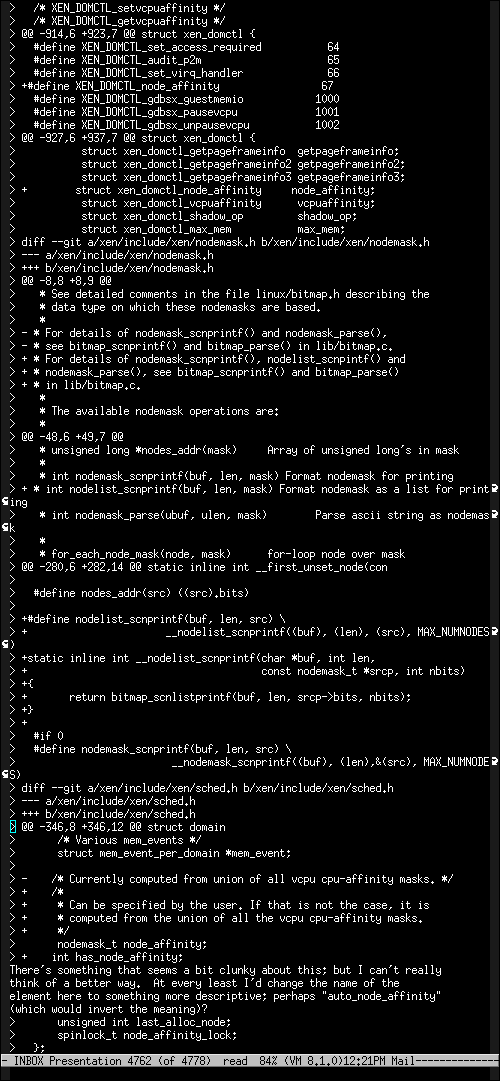
Can I ask people to:
* Trim diffs when replying to patches. There is no need to quote the whole patch. Just quote the parts which are needed to understand your comments.
* Leave a blank line between quoted text of any kind and your own added text.
That will help your comments stand out, and be read. This is particularly important if the quoted patches come to more than 80 columns, because then there are lots of breaks in the ">" down the left hand side due to wrap damage and they are hard to tell from interspersed comments.
Thanks and sorry to be picky.
Ian.
Re: Formatting of emails which are comments on patches.
Quoted 9 lines · Ian Jackson
Can I ask people to:
* Trim diffs when replying to patches. There is no need to quote the whole patch. Just quote the parts which are needed to understand your comments.
* Leave a blank line between quoted text of any kind and your own added text.
Quoted 7 lines
That will help your comments stand out, and be read. This is particularly important if the quoted patches come to more than 80 columns, because then there are lots of breaks in the ">" down the left hand side due to wrap damage and they are hard to tell from interspersed comments.
Thanks and sorry to be picky.
No problem -- sorry for not doing my own trimming; gmail does a good job trimming stuff automatically, so I forget what it looks like.
-George
Re: [PATCH 06 of 10 [RFC]] xl: Allow user to set or change node affinity on-line
In reply to George DunlapQuoted 7 lines · George Dunlap
Quoted 5 lines
Of course this is not going to be equally effective, as it will only affect future memory allocations without touching what's already there. However, in future we might want to change this, and use this as an interface for sort-of manual "domain node migration".
I think this is a good idea.
That is always something nice to hear. :-)
Quoted 5 lines
I think if you take my suggestion to rework the previous patch into hypervisor, libxc, and libxl components, you should also move the xl stuff out of that patch and into this one (so that the xl and libxl changes relating to node affinity are each in their own patches).
Sounds reasonable, I sure will do that.
Thanks,
Dario
Signature · 4 lines
<<This happens because I choose it to happen!>> (Raistlin Majere)
-----------------------------------------------------------------
Dario Faggioli, Ph.D, http://retis.sssup.it/people/faggioli
Senior Software Engineer, Citrix Systems R&D Ltd., Cambridge (UK)
_______________________________________________
Xen-devel mailing list
[email protected]
http://lists.xen.org/xen-devel
Re: [PATCH 05 of 10 [RFC]] xl: Explicit node affinity specification for guests via config file
In reply to George DunlapQuoted 9 lines · George Dunlap
Quoted 5 lines
A valid setting will directly impact the
node_affinitymask of the guest, i.e., it will change the behaviour of the low level memory allocator. On the other hand, this commit does not affect by any means how the guest's vCPUs are scheduled on the host's pCPUs.I would probably break this into three separate patches, starting with the hypervisor, then libxc, then libxl, especially since they tend to have different maintainers and committers.
That's fine.
Quoted 8 lines
docs/man/xl.cfg.pod.5 List of which cpus the guest is allowed · line 123
Quoted 3 lines
docs/man/xl.cfg.pod.5 +3
-0+A list of nodes should be specified as follows: `nodes=["0", "3"]` +for the guest to be affine with nodes 0 and 3. +Hmm, I think that using "affine" here is technically correct, and is what one would use if writing a research paper; but it's unusual to hear the word in more common English; it would be more common to hear someone describe a VM as "having affinity with".
I see...
Quoted 5 lines
How about something like this:
"The list of NUMA nodes the domain is considered to have affinity with. Memory from the guest will be allocated from these nodes."
Sounds good, I'll go for it. Thanks for looking at these stuff too, I really need and enjoy some good English training! :-P
Quoted 3 lines
Also, is there a way to specify that the affinity to be to all nodes and/or based on the vcpu mask of the vcpus?
Well, yes but no. :-) Actually, if you do not specify any affinity, the default is right now 'all nodes'. As we might want to change that, I'll add something like nodes="all". Similarly, if you don't specify any "nodes=", and you have some vcpu-affinity, this patch won't call any node_affinity setting routine, so that the default behavior of building it up upon vcpu-affinity will be retained. Actually, even with the following patches that introduces automatic placement, if no node-affinity is specified, while a vcpu-affinity is, the algorithm will try to place the domain where vcpu-affinity is saying.
So, summarizing, I'll add some means of saying "all nodes", while I don't think anything is needed to say "do what vcpu-affinity wants", but I'm more than open to suggestions and alternatives if you think this is not good/clear enough.
Quoted 6 lines
Quoted 6 lines
+/**
+ * This function explicitly sets the affinity of a domain with the
+ * host NUMA nodes.
+ *
+ * @parm xch a handle to an open hypervisor interface.
+ * @parm domid the domain id in which vcpus are to be created.
Quoted 9 lines
tools/libxc/xenctrl.h int xc_watchdog(xc_interface *xch, · line 535
Quoted 7 lines
+ * @parm
node_affinitythe map of the affine nodes.
+ * @return 0 on success, -1 on failure.
+ */tools/libxc/xenctrl.h +4
-0+int xc_domain_node_affinity (xc_interface *xch, +uint32_t domind, +xc_nodemap_t node_affinity); +Seems like it would be useful to have both a get and a set.
Ok. Not right now, but I agree it would make it a more sane interface. Will add a *_get_affinity (and change this to *_set_affinity)
Quoted 6 lines
Quoted 6 lines
  int libxl_set_vcpuonline(libxl_ctx *ctx, uint32_t domid, libxl_cpumap *cpumap)
  {
      GC_INIT(ctx);
tools/libxl/libxl.h +0
-0
Quoted 9 lines
tools/libxl/libxl.h int libxl_set_vcpuaffinity(libxl_ctx *ct · line 731
Quoted 6 lines
tools/libxl/libxl.h +2
-0@@ -727,6 +727,8 @@ int libxl_set_vcpuaffinity(libxl_ctx *ct libxl_cpumap *cpumap);int libxl_set_vcpuaffinity_all (libxl_ctx *ctx,uint32_t domid,unsigned int max_vcpus,libxl_cpumap *cpumap); +int libxl_set_node_affinity (libxl_ctx *ctx,uint32_t domid, +libxl_nodemap *nodemap);Hmm -- is there really no
libxl_get_vcpuaffinity()? That seems to be a missing component...
Apparently not, seems like `xl vcpu-list' reaches out print_vcpuinfo() (xl.c:4268 here) which figures out thing by its own with something like this:
    /* CPU AFFINITY */
    print_bitmap(vcpuinfo->cpumap.map, nr_cpus, stdout);
Should we change this?
Quoted 10 lines
tools/libxl/libxl.h int libxl_set_vcpuaffinity(libxl_ctx *ct
Quoted 10 lines
tools/libxl/libxl.h +10
-0+ } +else { +/* +* XXX What would a sane default be? I think doing nothing +* (i.e., relying on cpu-affinity/cpupool ==> the current +* behavior) should be just fine. +* That would mean we're saying to the user "if you want us +* to take care of NUMA, please tell us, maybe just putting +* 'nodes=auto', but tell us... otherwise we do as usual". +*/
Quoted 4 lines
I think that for this patch, doing nothing is fine (which means removing the whole else clause). But once we have the auto placement, I think that "nodes=auto" should be the default.
Ok, that makes sense. I'm running benchmarks comparing the three different policies I've implemented so far (see patches 8 and 9), to understand if they make any sense at all and, if they do, which one would be better suited for being used as the default policy. Will post the results as soon as they finish.
Quoted 4 lines
Quoted 4 lines
tools/libxl/libxl.h +4
-0+case XEN_DOMCTL_node_affinity: + { +domid_t dom = op->domain; +struct domain *d =rcu_lock_domain_by_id (dom);
Quoted 9 lines
tools/libxl/libxl.h
Quoted 7 lines
tools/libxl/libxl.h +7
-0+nodemask_t new_affinity; + + ret = -ESRCH ; +if ( d ==NULL ) +break ; + +/* XXX We need an xsm_* for this I guess, right? */ Yes. :-)
Ok, I'll look into it and put it together for the next release of this series. I'm planning to take great inspiration from the one in *_vcpu_affinity, do you think that could be the right thing?
Quoted 7 lines
Quoted 7 lines
xen/include/xen/sched.h +0
-0@@ -346,8 +346,12 @@ struct domain/* Various mem_events */ struct mem_event_per_domain *mem_event;
Quoted 12 lines
xen/include/xen/sched.h struct domain · line 354
Quoted 7 lines
xen/include/xen/sched.h +5
-1-/* Currently computed from union of all vcpu cpu-affinity masks. */ +/* +* Can be specified by the user. If that is not the case, it is +* computed from the union of all the vcpu cpu-affinity masks. +*/ nodemask_t node_affinity; +int has_node_affinity;There's something that seems a bit clunky about this; but I can't really think of a better way. At every least I'd change the name of the element here to something more descriptive; perhaps "
auto_node_affinity" (which would invert the meaning)?
You know what, I really don't like this either, but I need something that tells me whether I should compute the node affinity from vcpu-affinity/cpupool or the user has set that to something I shouldn't touch, and did not find any other way of doing such than adding this "flag". I kind of took inspiration from d->is_pinned although, yes, I know, that is used for different purposes.
Any suggestion is welcome, in the meanwhile, I'll change the name and the semantic to what you're suggesting.
Thanks and Regards,
Dario
Signature · 4 lines
<<This happens because I choose it to happen!>> (Raistlin Majere)
-----------------------------------------------------------------
Dario Faggioli, Ph.D, http://retis.sssup.it/people/faggioli
Senior Software Engineer, Citrix Systems R&D Ltd., Cambridge (UK)
_______________________________________________
Xen-devel mailing list
[email protected]
http://lists.xen.org/xen-devel
Re: [PATCH 05 of 10 [RFC]] xl: Explicit node affinity specification for guests via config file
In reply to David VrabelQuoted 5 lines · David Vrabel
Quoted 5 lines
Hmm, I think that using "affine" here is technically correct, and is what one would use if writing a research paper; but it's unusual to hear the word in more common English; it would be more common to hear someone describe a VM as "having affinity with". How about something like this:
Quoted 8 lines
Quoted 2 lines
"The list of NUMA nodes the domain is considered to have affinity with. Memory from the guest will be allocated from these nodes."
That's clunky sentence, the "considered" doesn't add anything. Or perhaps:
"The NUMA nodes preferred by the guest. Memory for the guest will be allocated on these nodes."
Wow, that is even cooler, thanks! :-)
Quoted 3 lines
The need for quotes around the node numbers is odd. Can that requirement be removed?
I'm not sure I ever checked/tried doing that. It's the plain libxl parser for lists, which I've always seen taking strings in all the examples I found, but I haven't ever looked at the actual code... I'll figure that out and, if possible, get rid of them. I agree they're disturbing.
Thanks,
Dario
Signature · 4 lines
<<This happens because I choose it to happen!>> (Raistlin Majere)
-----------------------------------------------------------------
Dario Faggioli, Ph.D, http://retis.sssup.it/people/faggioli
Senior Software Engineer, Citrix Systems R&D Ltd., Cambridge (UK)
_______________________________________________
Xen-devel mailing list
[email protected]
http://lists.xen.org/xen-devel
Re: [PATCH 07 of 10 [RFC]] sched_credit: Let the scheduler know about `node affinity`
In reply to Dario FaggioliQuoted 6 lines · Dario Faggioli
Basic idea is: cpu-affinity tells where a vcpu can run, while node-affinity tells where (in terms of on what NUMA nodes, but that of course imply a set of CPUs) all the vcpus of the domain should/prefer to run... Problems starts when you have both of them speaking at the same time!
Quoted 8 lines
<snip>
XXX I'm benchmarking this just right now, and peeking at the results
they don't seem too bad. Numbers are mostly close to the case where the VM is already pinned to a node when created. I'll post the results as soon as I can, and I'll be happy to investigate any issue, if you feel like the approach could be the right one.
Some of them are ready, and here they come:
http://xenbits.xen.org/people/dariof/benchmarks/specjbb2005-numa/index.html
Look, for example, at this one here:
http://xenbits.xen.org/people/dariof/benchmarks/specjbb2005-numa/kernbench_avgstd.png

Where the red line is the default Xen behavior (no pinning, no affinity, nothing!), the dark blue line is the best case (domain pinned at creation ==> all memory accesses are local) and the light blue line is this one patch in action, i.e., domain _with_affinity_ to node #0 and no pinning at all.
It's very nice (at least for me! :-D) to see it almost always does better than default, and it manage in getting quite close to the best case scenario when load increases.
Still on the "nice things" side, there doesn't appear to be significative regressions introduced by this patch, if the new node-affinity feature is not stressed, as it shows by comparing the "before" and "after" the patch graphs (looking at matching curves):
(before) http://xenbits.xen.org/people/dariof/benchmarks/specjbb2005/kernbench_avgstd.png
(after) http://xenbits.xen.org/people/dariof/benchmarks/specjbb2005-numa/kernbench_avgstd.png

Unfortunately, there seems to be at least some issues with the cases where load is not so high. In fact, given VMs have 4 vcpus and host has 16 pcpus, there are less vcpus than pcpus up to the run involving 4 VMs, which is actually where things starts to work well, while before they're near or even worst than default! :-O
Any thoughts?
Again, if you think the approach taken here could be a sensible one, I'll start digging what's going on (by some tracing etc.), and I'm sure I can work out the low-load cases and "persuade" them to behave better. :-D
Thanks and Regards,
Dario
Signature · 4 lines
<<This happens because I choose it to happen!>> (Raistlin Majere)
-----------------------------------------------------------------
Dario Faggioli, Ph.D, http://retis.sssup.it/people/faggioli
Senior Software Engineer, Citrix Systems R&D Ltd., Cambridge (UK)
_______________________________________________
Xen-devel mailing list
[email protected]
http://lists.xen.org/xen-devel
Re: [PATCH 09 of 10 [RFC]] xl: Introduce Best and Worst Fit guest placement algorithms
In reply to Dario FaggioliQuoted 10 lines · Dario Faggioli
Besides than "auto" and "ffit", as per the previous patch, enable Best and Worst Fit placement heuristics to
xl, for the user to chose them in the config file. Implementation just sits on top of the First Fit algorithm code, with just the proper reordering of the nodes and their free memory before invoking it (and after it finishes).TODO: * As usual for this series, benchmarking and testing,
as much thorough and comprehensive as possible!
I manage in getting some numbers from these placement heuristics too.
http://xenbits.xen.org/people/dariof/benchmarks/specjbb2005-numa_aggr/index.html
As a foreword, they come from some of the benchmarks I already run, and from running some new ones, but with the same logic and infrastructure, meaning:
- all the VMs were equal in (memory) size
- all the VMs had the same # of VCPUs
- all the VMs are always created in the very same order These are definitely not the best condition for stressing the algorithms, neither they are for trying to understand the algorithms' differences and capabilities of bringing performance benefits... Anyway, they're _something_, and a slight improvement wrt default placement is already noticeable in the graphs. :-)
Look, for example, at one here this:
http://xenbits.xen.org/people/dariof/benchmarks/specjbb2005-numa_aggr/2.html
And compare the red curve (default placement/schedulig) with all the other ones. They all represents the aggregate throughput achieved by the SpecJBB 2005 benchmark --counting (and averaging it on) all the VMs-- when varying the number of VMs, so as usual for SpecJBB, higher is better.
"wfit" and "bfit" clearly works better than "default", which would have been desirable, and actually expected, especially for Worst Fit, in this particular scenario. It is also normal that "ffit" does a worse job than "default" until the number of VMs excedes 4. In fact, considering the amount of RAM each VM has (without forgetting some RAM is assigned to Dom0 as well), with less than 5 VMs all of them are fitted on the first NUMA node, thus the memory accesses are local, but the load distribution is clearly sub-optimal!
As for the scheduling related results, more serious testing and tracing is needed in order to verify things are happening as expected, but the graphs seemed nice to me, and I thus thought it could be worth sending them, while working on having more interesting ones. :-)
Thanks and Regards,
Dario
Signature · 4 lines
<<This happens because I choose it to happen!>> (Raistlin Majere)
-----------------------------------------------------------------
Dario Faggioli, Ph.D, http://retis.sssup.it/people/faggioli
Senior Software Engineer, Citrix Systems R&D Ltd., Cambridge (UK)
_______________________________________________
Xen-devel mailing list
[email protected]
http://lists.xen.org/xen-devel
Re: [PATCH 07 of 10 [RFC]] sched_credit: Let the scheduler know about `node affinity`
In reply to Dario FaggioliQuoted 36 lines · Dario Faggioli
Basic idea is: cpu-affinity tells where a vcpu can run, while node-affinity tells where (in terms of on what NUMA nodes, but that of course imply a set of CPUs) all the vcpus of the domain should/prefer to run... Problems starts when you have both of them speaking at the same time!
Respecting vcpu-affinity should remain the primary concern, thus what we do here is add some two-step logic here and there in the scheduler (i.e., where vcpu-affinity related decisions are being undertaken). During the first step, we check the
&&of vcpu and node affinity masks, aiming at giving some precedence to the CPUs that are both suitable and preferrable for the domain. However, if that fails in finding a valid CPU, the node-affinity is just ignored and, in the second step, we just fallback to vcpu-affinity, as the original behaviour was.Both the introduced overhead and the benefits this provides has to be investigated and compared against each other, possibly in varying conditions and running different workloads.
Finally, although still at the RFC level, efforts have been made to write the code in a flexible enough fashion so that, if we ever want to introduce further balancing steps, it shouldn't be too much of a pain.
TODO: * Better investigate and test interactions with cpupools.
* Test, verify and benchmark. Then test, verify and benchmark again, and again and again. What I know as of know is that it does not explode that easily, but whether it works properly and, more important, brings any benefit, this has to be proven (and yes, I'm out running these tests and benchs already, but do not esitate to manifest your will for helping with that :-D).
* Add some counter/stats, e.g., to serve the purpose outlined right above.
Quoted 5 lines
XXX I'm benchmarking this just right now, and peeking at the results
they don't seem too bad. Numbers are mostly close to the case where the VM is already pinned to a node when created. I'll post the results as soon as I can, and I'll be happy to investigate any issue, if you feel like the approach could be the right one.
Hey Dario,
Sorry for the long delay in reviewing this.
Overall I think the approach is good. A few points:
xen/common/sched_credit.c line 111
Quoted 9 lines
/*
+ * Node Balancing
+ */xen/common/sched_credit.c +6
-0+#define CSCHED_BALANCE_NODE_AFFINITY 1 +#define CSCHED_BALANCE_CPU_AFFINITY 0 +#define CSCHED_BALANCE_START_STEP CSCHED_BALANCE_NODE_AFFINITY +#define CSCHED_BALANCE_END_STEP CSCHED_BALANCE_CPU_AFFINITY + +
This thing of defining "START_STEP" and "END_STEP" seems a bit fragile. I think it would be better to always start at 0, and go until CSCHED_BALANCE_MAX.
xen/common/sched_credit.c struct csched_dom { · line 172
Quoted 11 lines
xen/common/sched_credit.c +11
-0+/* +* Let's cache domain's dom->node_affinity here as an +* optimization for a couple of hot paths. In fact, +* knowing whether or not dom->node_affinity has changed +* would allow us to avoid rebuilding node_affinity_cpumask +* (below) duing node balancing and/or scheduling. +*/ +nodemask_t node_affinity_cache; +/* Basing on what dom->node_affinity says, +* on what CPUs would we like to run most? */ +cpumask_t node_affinity_cpumask;
I think the comments here need to be more clear. The main points are:
* node_affinity_cpumask is the dom->node_affinity translated from a nodemask into a cpumask
* Because doing the nodemask -> cpumask translation may be expensive, node_affinity_cache stores the last translated value, so we can avoid doing the translation if nothing has changed.
xen/common/sched_credit.c static inline void · line 256
Quoted 4 lines
xen/common/sched_credit.c +4
-0+#define csched_balance (__step) \ + for ( (__step) = CSCHED_BALANCE_START_STEP; \ + (__step)>= CSCHED_BALANCE_END_STEP; \ + (__step)-- )
I don't like this. For one, it's fragile; if for some reason you switched NODE_AFFINITY and CPU_AFFINITY above, suddenly this loop would go the wrong direction.
I don't think there's any reason not to just use "for(step=0; step < CSCHED_BALANCE_MAX; step++)" -- it's not ugly and it means you know exactly what's going on without having to go search for the macro.
xen/common/sched_credit.c static inline void · line 261
Quoted 5 lines
xen/common/sched_credit.c +5
-0+ +/* +* Sort-of conversion between node-affinity and vcpu-affinity for the domain, +* i.e., a cpumask containing all the cpus from all the set nodes in the +* node-affinity mask of the domain.
This needs to be clearer -- vcpu-affinity doesn't have anything to do with this function, and there's nothing "sort-of" about the conversion. :-)
I think you mean to say, "Create a cpumask from the node affinity mask."
Quoted 8 lines
+ *
+ * Notice that we completely forget about serializing this (both here and
+ * in the various sites wherenode_affinity_cpumaskis used) against
+ *d->node_affinity_lock. That would be hard to do properly, as that lock
+ * is a non IRQ-safe one, and it would be nearly impossible to access it
+ * from the scheduling code. However, although this leaves some room for
+ * races with code paths that updatesd->node_affinity, it all should still
+ * be fine, considering:
Quoted 7 lines
+ *  (1) d->node_affinity updates are going to be quite rare;
+ *  (2) this balancing logic is kind-of "best effort" anyway;
+ *  (3) given (1), any inconsistencies are likely to be fixed by the next
+ * call to this same function without risking going into instability.
+ *
+ * XXX Validate (via testing/benchmarking) whether this is true, as it
+ * likely sounds to be, or it causes unexpected issues.
Ack.
Quoted 9 lines
xen/common/sched_credit.c +9
-0+/* Put together the cpumask we are going to use for this balancing step */ +static int +csched_balance_cpumask (const struct vcpu *vc,int step,cpumask_t *mask) +{ +struct domain *d = vc->domain; +struct csched_dom *sdom =CSCHED_DOM (d); + +/* +* Only two possible steps exists for now: node and vcpu affinity.
xen/common/sched_credit.c static inline void · line 315
Quoted 10 lines
xen/common/sched_credit.c +10
-0+* If this domain does not have a node-affinity or is affine to all the +* nodes, just return th vcpu-affinity mask (for *this* vcpu) and +* stop the balancing process. +*/ +if ( !d->has_node_affinity ||nodes_full (d->node_affinity) || + step ==CSCHED_BALANCE_CPU_AFFINITY ) + { +cpumask_copy (mask, vc->cpu_affinity); +return CSCHED_BALANCE_CPU_AFFINITY ; + }
Hmm -- this mechanism seems kind of fragile. It seems like returning -1 or something, and having the caller call "continue", would be easier for future coders (potentially you or I) to reason about.
xen/common/sched_credit.c static inline void · line 325
Quoted 7 lines
xen/common/sched_credit.c +7
-0+/* +* XXX As of now (with only two possible steps, this is easy and readable +* enough. If more steps become necessary at some point in time, we +* can keep an array of cpumask_t in dom_data and return the proper +* element via step-indexing such an array. Of course, we can turn +* this like that even right now... Thoughts? +*/
Beware of early optimization. :-) Just make sure to mark this down for something to look at for profiling.
xen/common/sched_credit.c boolean_param("tickle_one_idle_cpu", opt · line 367
Quoted 13 lines
static inline void
xen/common/sched_credit.c +12
-0+__cpumask_tickle(cpumask_t *mask, const cpumask_t *idle_mask) +{ +CSCHED_STAT_CRANK (tickle_idlers_some); +if ( opt_tickle_one_idle ) + { +this_cpu (last_tickle_cpu) = +cpumask_cycle (this_cpu (last_tickle_cpu), idle_mask); +cpumask_set_cpu (this_cpu (last_tickle_cpu), mask); + } +else +cpumask_or (mask, mask, idle_mask); +}
I don't see any reason to make this into a function -- it's only called once, and it's not that long. Unless you're concerned about too many indentations making the lines too short?
Quoted 2 lines
+
csched_balance(balance_step){
Again, I'd make this a for() loop.
xen/common/sched_credit.c csched_alloc_domdata(const struct schedu · line 1017
Quoted 9 lines
sdom->dom = dom;xen/common/sched_credit.c +8
-0+/* +*XXX This would be 'The Right Thing', but as it is still too +* early and d->node_affinity has not settled yet, maybe we +* can just init the two masks with something like all-nodes +* and all-cpus and rely on the first balancing call for +* having them updated? +*/ +csched_build_balance_cpumask (sdom);
We might as well do what you've got here, unless it's likely to produce garbage. This isn't exactly a hot path. :-)
Other than that, looks good -- Thanks!
-George
Re: [PATCH 08 of 10 [RFC]] xl: Introduce First Fit memory-wise placement of guests on nodes
In reply to Dario FaggioliHey Dario,
Thanks for the work on this -- this is obviously a very complicated area to try to make sense of. Of course, that makes it even more complicated to review -- sorry this has taken so long. (comments inline)
docs/man/xl.cfg.pod.5 vcpus on the cpus of the affine node(s). · line 142
Quoted 5 lines · Dario Faggioli
docs/man/xl.cfg.pod.5 +5
-0+ +=item B<auto> + +use a not better specified (xl-implementation dependant) algorithm +to try automatically fitting the guest on the host's NUMA nodes
Uum, you mean, "Use the default placement algorithm"? :-) We should specify which one this will be here.
tools/libxl/xl_cmdimpl.c static const char *action_on_shutdown_na · line 127
Quoted 13 lines
tools/libxl/xl_cmdimpl.c +13
-0+ +/* Automatic placement policies symbols, with the following meaning: +* NONE : no automatic placement at all; +* STATIC : explicit nodes specification. +* FFIT : use the First Fit algorithm for automatic placement; +* AUTO : an not better specified automatic placement, likely +* to be implemented as a short circuit to (one of) +* the above(s); +*/ +#define NODES_POLICY_NONE 0 +#define NODES_POLICY_STATIC 1 +#define NODES_POLICY_FFIT 2 +#define NODES_POLICY_AUTO 3
This is minor, but it seems like "auto" should be 1, so if we add another policy, the policies are all together, without having to move AUTO around every time.
tools/libxl/xl_cmdimpl.c static const char *action_on_shutdown_na · line 163
Quoted 6 lines
tools/libxl/xl_cmdimpl.c +6
-0+ +/* Store the policy for the domain while parsing */ +static int nodes_policy =NODES_POLICY_DEFAULT ; + +/* Store the number of nodes to be used while parsing */ +static int num_nodes_policy =0 ;
Why are "nodes_policy" and "num_nodes_policy" not passed in along with b_info?
tools/libxl/xl_cmdimpl.c afp_out:
Quoted 6 lines
tools/libxl/xl_cmdimpl.c +6
-0+static int nodes_policy_parse (const char *pol,long int *policy) +{ +int i; +const char *n; + +for (i =0 ; i<sizeof (nodes_policy_names) /sizeof (nodes_policy_names[0 ]); i++) {
I personally prefer an explicit NODES_POLICY_MAX, but I'll let the libxl maintainers decide on that.
tools/libxl/xl_cmdimpl.c afp_out: · line 645
Quoted 8 lines
tools/libxl/xl_cmdimpl.c +8
-0+ +/* Determine how much free memory we want on each of the nodes +* that will end up in suitable_nodes. Either adding or ignoring +* the modulus of the integer division should be fine (the total +* number of nodes should be in the order of tens of them), so +* let's add it as it should be more safe. +*/ + memb_node = (memb / (*nodes)) + (memb % (*nodes));
Wouldn't it just be easier to do a "round-up" function here, like this:
memb_node = ( (memb + *nodes -1) / (*nodes) )
Also, is it really necessary for a VM to have an equal amount of memory on every node? It seems like it would be better to have 75% on one node and 25% on a second node than to have 25% on four nodes, for example. Furthermore, insisting on an even amount fragments the node memory further -- i.e., if we chose to have 25% on four nodes instead of 75% on one and 25% on another, that will make it harder for another VM to fit on a single node as well.
The need for NODES_POLICY_RETRY_DEC is an artifact of the above; if nodes were allowed to be assymetric, you wouldn't need to *decrease* the number of nodes to find *more* memory.
tools/libxl/xl_cmdimpl.c afp_out: · line 670
Quoted 6 lines
tools/libxl/xl_cmdimpl.c +6
-0+/* Apply the asked retry policy for the next round. Notice +* that it would be pointless to increase nodes without also +* adding some nodes to the map! */ + *nodes += retry; +if (retry ==NODES_POLICY_RETRY_INC ) +__add_nodes_to_nodemap (nodemap, numa, nr_nodes, retry);
Hmm -- if I'm reading this right, the only time the nodemap won't be all nodes is if (1) the user specified nodes, or (2) there's a cpumask in effect. If we're going to override that setting, wouldn't it make sense to just expand to all numa nodes?
Hmm -- though I suppose what you'd really want to try is adding each node in turn, rather than one at a time (i.e., if the cpus are pinned to nodes 2 and 3, and [2,3] doesn't work, try [1,2,3] and [2,3,4] before trying [1,2,3,4]. But that's starting to get really complicated -- I wonder if it's better to just fail and let the user change the pinnings / configuration node mapping.
tools/libxl/xl_cmdimpl.c afp_out: · line 733
Quoted 7 lines
tools/libxl/xl_cmdimpl.c +7
-0+ +/* If a nodemap has been specified, just comply with that. +* OTOH, if there's no nodemap, rely on cpumap (if any), and +* fallback to all node if even that is empty. Also consider +* all the nodes to be valid if only the number (i.e., _how_ +* _many_ of them instead of _which_ of them) of nodes the +* domain wants is provided.
I feel like this comment could be made more clear...
tools/libxl/xl_cmdimpl.c afp_out: · line 743
Quoted 10 lines
tools/libxl/xl_cmdimpl.c +10
-0+* +* Concering retries, if a specific set of nodes is specified, +* just try that and give up if we fail. If, instead, a set of +* CPUs onto which to pin the domain is specified, try first +* the exact nodes those CPUs belongs to, then also try both +* a smaller and a bigger number of nodes. The same happens if +* we just have the number of nodes to be used. Finally, if +* there is no node-affinity, no cpu-pinning, no number of nodes, +* start trying with one node and increase at the configured +* rate (considering all the nodes to be suitable).
This should be above the "do {} while()" loop below. (Also, see comment on increasing node map above.)
tools/libxl/xl_cmdimpl.c afp_out: · line 663
Quoted 5 lines
tools/libxl/xl_cmdimpl.c +5
-0+ +if (use_cpus>= b_info->max_vcpus) { + rc =0 ; +break ; + }
Hmm -- there's got to be a better way to find out the minimum number of nodes to house a given number of vcpus than just starting at 1 and re-trying until we have enough.
tools/libxl/xl_cmdimpl.c afp_out: · line 847
Quoted 2 lines
tools/libxl/xl_cmdimpl.c +2
-0+/* Add one more node and retry fitting the domain */ +__add_nodes_to_nodemap (&new_nodemap, numa, nr_nodes,1 );
Same comment as above.
tools/libxl/xl_cmdimpl.c start: · line 2124
Quoted 5 lines
tools/libxl/xl_cmdimpl.c +4
-0+ ret =place_domain (&d_config.b_info); +if (ret ==ESRCH || ret ==ENOSPC ) { +fprintf (stderr,"failed to place the domain, fallback to all nodes\n" ); +libxl_nodemap_set_any (&d_config.b_info.nodemap);
Hmm -- is this the right fallback? I think in general, if the user asks for X to be done, and X cannot be done for whatever reason, the right thing is to tell the user that X cannot be done and let them sort it out, rather than resorting to Y (unless that's been set).
Is it the case that if any node placement fails, then they'll all fail? Or to put it the other way, is it the case that if there is *some* placement, that any placement algorithm will eventually find it? If so, then I think this fallback may make sense, as there's nothing for the user to really do.
Quoted 7 lines
xen/arch/x86/numa.c +0
-0@@ -365,10 +365,11 @@ static void dump_numa(unsigned char key)for_each_online_node (i) {paddr_t pa = (paddr_t)(NODE_DATA (i)->node_start_pfn +1 )<<PAGE_SHIFT ;
xen/arch/x86/numa.c static void dump_numa(unsigned char key) · line 375
Quoted 10 lines
xen/arch/x86/numa.c +3
-2-printk ("idx%d -> NODE%d start->%lu size->%lu\n" , +printk ("idx%d -> NODE%d start->%lu size->%lu free->%lu\n" , i,NODE_DATA (i)->node_id,NODE_DATA (i)->node_start_pfn, -NODE_DATA (i)->node_spanned_pages); +NODE_DATA (i)->node_spanned_pages, +avail_node_heap_pages (i));/* sanity check phys_to_nid() */ printk ("phys_to_nid(%" PRIpaddr") -> %d should be %d\n" , pa,phys_to_nid (pa),NODE_DATA (i)->node_id);
This should be in its own patch.
-George
Re: [PATCH 07 of 10 [RFC]] sched_credit: Let the scheduler know about `node affinity`
In reply to George DunlapQuoted 2 lines · George Dunlap
Hey Dario,
Hi!
Quoted 2 lines
Sorry for the long delay in reviewing this.
No problem, thanks to you for taking the time to look at the patches so thoroughly!
Quoted 2 lines
Overall I think the approach is good.
That's nice to hear. :-)
Quoted 4 lines
Quoted 4 lines
/*
+ * Node Balancing
+ */
+#defineCSCHED_BALANCE_NODE_AFFINITY1
Quoted 9 lines
xen/common/sched_credit.c line 111
Quoted 5 lines
xen/common/sched_credit.c +5
-0+#define CSCHED_BALANCE_CPU_AFFINITY 0 +#define CSCHED_BALANCE_START_STEP CSCHED_BALANCE_NODE_AFFINITY +#define CSCHED_BALANCE_END_STEP CSCHED_BALANCE_CPU_AFFINITY + +This thing of defining "
START_STEP" and "END_STEP" seems a bit fragile. I think it would be better to always start at 0, and go untilCSCHED_BALANCE_MAX.
Ok, I agree that this is fragile and probably also a bit overkill. I'll make it simpler as you're suggesting.
Quoted 11 lines
xen/common/sched_credit.c struct csched_dom { · line 172
Quoted 11 lines
xen/common/sched_credit.c +11
-0+/* +* Let's cache domain's dom->node_affinity here as an +* optimization for a couple of hot paths. In fact, +* knowing whether or not dom->node_affinity has changed +* would allow us to avoid rebuilding node_affinity_cpumask +* (below) duing node balancing and/or scheduling. +*/ +nodemask_t node_affinity_cache; +/* Basing on what dom->node_affinity says, +* on what CPUs would we like to run most? */ +cpumask_t node_affinity_cpumask;
Quoted 7 lines
I think the comments here need to be more clear. The main points are:
*node_affinity_cpumaskis thedom->node_affinitytranslated from a nodemask into a cpumask
* Because doing the nodemask -> cpumask translation may be expensive,node_affinity_cachestores the last translated value, so we can avoid doing the translation if nothing has changed.
Ok, will do.
Quoted 9 lines
Quoted 4 lines
+/*
+ * Sort-of conversion between node-affinity and vcpu-affinity for the domain,
+ * i.e., a cpumask containing all the cpus from all the set nodes in the
+ * node-affinity mask of the domain.This needs to be clearer -- vcpu-affinity doesn't have anything to do with this function, and there's nothing "sort-of" about the conversion. :-)
I think you mean to say, "Create a cpumask from the node affinity mask."
Exactly, I'll try to clarify.
Quoted 8 lines
Quoted 8 lines
static inline void
xen/common/sched_credit.c +7
-0+__cpumask_tickle(cpumask_t *mask, const cpumask_t *idle_mask) +{ +CSCHED_STAT_CRANK (tickle_idlers_some); +if ( opt_tickle_one_idle ) + { +this_cpu (last_tickle_cpu) = +cpumask_cycle (this_cpu (last_tickle_cpu), idle_mask);
Quoted 9 lines
xen/common/sched_credit.c boolean_param("tickle_one_idle_cpu", opt · line 367
Quoted 5 lines
xen/common/sched_credit.c +5
-0+cpumask_set_cpu (this_cpu (last_tickle_cpu), mask); + } +else +cpumask_or (mask, mask, idle_mask); +}I don't see any reason to make this into a function -- it's only called once, and it's not that long. Unless you're concerned about too many indentations making the lines too short?
That was part of it, but I'll put it back and see if I can have it looking good enough. :-)
Quoted 9 lines
xen/common/sched_credit.c csched_alloc_domdata(const struct schedu · line 1017
Quoted 9 lines
sdom->dom = dom;xen/common/sched_credit.c +8
-0+/* +*XXX This would be 'The Right Thing', but as it is still too +* early and d->node_affinity has not settled yet, maybe we +* can just init the two masks with something like all-nodes +* and all-cpus and rely on the first balancing call for +* having them updated? +*/ +csched_build_balance_cpumask (sdom);
Quoted 3 lines
We might as well do what you've got here, unless it's likely to produce garbage. This isn't exactly a hot path. :-)
Well, I won't call it garbage, so that's probably fine. I was concerned about be thing be clear and meaningful enough. Having this here could make us (and or future coders :-D) think that they can rely on the balance mask somehow, while that is not entirely true. I'll re-check the code and see how I can make it something better for next posting...
Quoted 2 lines
Other than that, looks good -- Thanks!
Good to know, thanks to you!
Regards,
Dario
Signature · 4 lines
<<This happens because I choose it to happen!>> (Raistlin Majere) ----------------------------------------------------------------- Dario Faggioli, Ph.D, http://retis.sssup.it/people/faggioli Senior Software Engineer, Citrix Systems R&D Ltd., Cambridge (UK)
_______________________________________________
Xen-devel mailing list
[email protected]
http://lists.xen.org/xen-devel
Re: [PATCH 08 of 10 [RFC]] xl: Introduce First Fit memory-wise placement of guests on nodes
In reply to George DunlapQuoted 2 lines · George Dunlap
Hey Dario,
Hi again,
Quoted 4 lines
Thanks for the work on this -- this is obviously a very complicated area to try to make sense of. Of course, that makes it even more complicated to review -- sorry this has taken so long. (comments inline)
Again, no problem at all!
Quoted 7 lines
docs/man/xl.cfg.pod.5 vcpus on the cpus of the affine node(s). · line 142
Quoted 5 lines
docs/man/xl.cfg.pod.5 +5
-0+ +=item B<auto> + +use a not better specified (xl-implementation dependant) algorithm +to try automatically fitting the guest on the host's NUMA nodesUum, you mean, "Use the default placement algorithm"? :-) We should specify which one this will be here.
Quoted 17 lines
tools/libxl/xl_cmdimpl.c static const char *action_on_shutdown_na · line 127
Quoted 13 lines
tools/libxl/xl_cmdimpl.c +13
-0+ +/* Automatic placement policies symbols, with the following meaning: +* NONE : no automatic placement at all; +* STATIC : explicit nodes specification. +* FFIT : use the First Fit algorithm for automatic placement; +* AUTO : an not better specified automatic placement, likely +* to be implemented as a short circuit to (one of) +* the above(s); +*/ +#define NODES_POLICY_NONE 0 +#define NODES_POLICY_STATIC 1 +#define NODES_POLICY_FFIT 2 +#define NODES_POLICY_AUTO 3This is minor, but it seems like "auto" should be 1, so if we add another policy, the policies are all together, without having to move AUTO around every time.
Ok, I'll reorganize this bit to be more sensible, which also includes changing the names of the policies and some others cleanups.
Quoted 9 lines
tools/libxl/xl_cmdimpl.c static const char *action_on_shutdown_na · line 163
Quoted 6 lines
tools/libxl/xl_cmdimpl.c +6
-0+ +/* Store the policy for the domain while parsing */ +static int nodes_policy =NODES_POLICY_DEFAULT ; + +/* Store the number of nodes to be used while parsing */ +static int num_nodes_policy =0 ;Why are "
nodes_policy" and "num_nodes_policy" not passed in along withb_info?
That was my first implementation. Then I figured out that I want to do the placement in _xl_, not in _libxl_, so I really don't need to muck up build info with placement related stuff. Should I use b_info anyway, even if I don't need these fields while in libxl?
Quoted 9 lines
tools/libxl/xl_cmdimpl.c afp_out:
Quoted 6 lines
tools/libxl/xl_cmdimpl.c +6
-0+static int nodes_policy_parse (const char *pol,long int *policy) +{ +int i; +const char *n; + +for (i =0 ; i<sizeof (nodes_policy_names) /sizeof (nodes_policy_names[0 ]); i++) {I personally prefer an explicit
NODES_POLICY_MAX, but I'll let the libxl maintainers decide on that.
Sounds definitely nicer. I just did it like that because I found a very similar example in xl itself, but I'm open about changing this to whatever you and libxl maintainers reach a consensus on. :-)
Quoted 11 lines
tools/libxl/xl_cmdimpl.c afp_out: · line 645
Quoted 8 lines
tools/libxl/xl_cmdimpl.c +8
-0+ +/* Determine how much free memory we want on each of the nodes +* that will end up in suitable_nodes. Either adding or ignoring +* the modulus of the integer division should be fine (the total +* number of nodes should be in the order of tens of them), so +* let's add it as it should be more safe. +*/ + memb_node = (memb / (*nodes)) + (memb % (*nodes));Wouldn't it just be easier to do a "round-up" function here, like this:
memb_node= ( (memb + *nodes -1) / (*nodes) )
Yep, it probably is, thanks. :-)
Quoted 8 lines
Also, is it really necessary for a VM to have an equal amount of memory on every node? It seems like it would be better to have 75% on one node and 25% on a second node than to have 25% on four nodes, for example. Furthermore, insisting on an even amount fragments the node memory further -- i.e., if we chose to have 25% on four nodes instead of 75% on one and 25% on another, that will make it harder for another VM to fit on a single node as well.
Ok, that is something quite important to discuss. What you propose makes a lot of sense, although some issues comes to my mind:
- which percent should I try, and in what order? I mean, 75%/25% sounds reasonable, but maybe also 80%/20% or even 60%/40% helps your point. So, should I just decide an asymmetrical layout and try it (instead of 50%/50%) or do you have some sort of "trial and error" approach, with different layouts being attempted one after the other, in mind? The problem is very complex and finding a (good) solution will easily start depending on which layout we try first, in which order we try the other ones (if at all) and on the free memory we have on the various nodes... We can probably state it as an integer optimization problem, but I'm not sure we want to put a GLPK (GNU Linear Programming Kit) solver within xl! :-O
- suppose I go for 75%/25%, what about the scheduling oof the VM? Right now, with 50%/50% I can set node affinity to both the nodes and rest ensured things won't be that bad. I'll be getting something in the middle between best and worst performances, as the benchmarks show. Doing the same with 75%/25% means I can be instructing the scheduler to run the VM on a node where it has far fewer probability of accessing local memory than the other one. OTOH, if setting node affinity to just the node with 75% of the mem, I'm risking always generating 25% of remote accesses, which will keep us apart from the best case performance, isn't it?
- what about the asymmetrical layout of choice (let's stick to 75%/25%) does not fit anywhere and I really need one more (or one less) node... I mean, how do I partition memory in that case?
Please, don't get me wrong, I see your point and really think it makes sense. I've actually thought along the same line for a while, but then I couldn't find an answers to the questions above.
That's why, kind of falling back with Xen's default "striped" approach (although on as less nodes as possible, which is _much_ better than the actual Xen's default!). It looked simple enough to write, read and understand, while still providing statistically consistent performances.
If we, together, manage in sorting out the issues, I'm all for asymmetrical placement myself! :-D
Quoted 4 lines
The need for
NODES_POLICY_RETRY_DECis an artifact of the above; if nodes were allowed to be assymetric, you wouldn't need to *decrease* the number of nodes to find *more* memory.
I agree, let's try figure out how we think the heuristics should look like, ok? That being done, I'll be happy to kill RETRY_DEC if it turns out to be useless! :-P
Quoted 11 lines
tools/libxl/xl_cmdimpl.c afp_out: · line 670
Quoted 6 lines
tools/libxl/xl_cmdimpl.c +6
-0+/* Apply the asked retry policy for the next round. Notice +* that it would be pointless to increase nodes without also +* adding some nodes to the map! */ + *nodes += retry; +if (retry ==NODES_POLICY_RETRY_INC ) +__add_nodes_to_nodemap (nodemap, numa, nr_nodes, retry);Hmm -- if I'm reading this right, the only time the nodemap won't be all nodes is if (1) the user specified nodes, or (2) there's a cpumask in effect. If we're going to override that setting, wouldn't it make sense to just expand to all numa nodes?
As you wish, the whole "what to do if what I've been provided with doesn't work" is in the *wild guess* status, meaning I tried to figure out what would be best to do, but I might well be far from the actual correct solution, provided there is one.
Trying to enlarge the nodemap step by step is potentially yielding better performances, but is probably not so near to the "least surprise" principle one should use when designing UIs. :-(
Quoted 5 lines
Hmm -- though I suppose what you'd really want to try is adding each node in turn, rather than one at a time (i.e., if the cpus are pinned to nodes 2 and 3, and [2,3] doesn't work, try [1,2,3] and [2,3,4] before trying [1,2,3,4].
Yep, that makes a real lot of sense, thanks! I can definitely try doing that, although it will complicate the code a bit...
Quoted 4 lines
But that's starting to get really complicated -- I
wonder if it's better to just fail and let the user change the pinnings / configuration node mapping.
Well, that will probably be the least surprising behaviour.
Again, just let me know what you think it's best among the various alternatives and I'll go for it.
Quoted 5 lines
tools/libxl/xl_cmdimpl.c afp_out: · line 663
Quoted 5 lines
tools/libxl/xl_cmdimpl.c +5
-0+ +if (use_cpus>= b_info->max_vcpus) { + rc =0 ; +break ; + }
Quoted 7 lines
Hmm -- there's got to be a better way to find out the minimum number of nodes to house a given number of vcpus than just starting at 1 and re-trying until we have enough.
tools/libxl/xl_cmdimpl.c afp_out: · line 847
Quoted 2 lines
tools/libxl/xl_cmdimpl.c +2
-0+/* Add one more node and retry fitting the domain */ +__add_nodes_to_nodemap (&new_nodemap, numa, nr_nodes,1 );Same comment as above.
I'm not sure I'm getting this. The whole point here is let's consider free memory on the various nodes first, and then adjust the result if some other constraints are being violated.
However, if what you mean is I could check beforehand whether or not the user provided configuration will give us enough CPUs and avoid testing scenarios that are guaranteed to fail, then I agree and I'll reshape the code to look like that. This triggers the heuristics re-designing stuff from above again, as one have to decide what to do if user asks for "nodes=[1,3]" and I discover (earlier) that I need one more node for having enough CPUs (I mean, what node should I try first?).
Quoted 10 lines
tools/libxl/xl_cmdimpl.c start: · line 2124
Quoted 5 lines
tools/libxl/xl_cmdimpl.c +4
-0+ ret =place_domain (&d_config.b_info); +if (ret ==ESRCH || ret ==ENOSPC ) { +fprintf (stderr,"failed to place the domain, fallback to all nodes\n" ); +libxl_nodemap_set_any (&d_config.b_info.nodemap);Hmm -- is this the right fallback? I think in general, if the user asks for X to be done, and X cannot be done for whatever reason, the right thing is to tell the user that X cannot be done and let them sort it out, rather than resorting to Y (unless that's been set).
I agree and I will go for this.
Quoted 6 lines
Is it the case that if any node placement fails, then they'll all fail? Or to put it the other way, is it the case that if there is *some* placement, that any placement algorithm will eventually find it? If so, then I think this fallback may make sense, as there's nothing for the user to really do.
Well, that's tricky. I mean, if we were only talking about fitting all the VM's memory on one single node, then yes, no matter how you order the list of nodes, if there is at least one with enough space for the VM, you'll find it. However, we might be dealing with "fit the VM in multiple nodes" scenarios, which is a completely different thing, and changing the number of nodes onto which you're trying to fit the VM will change pretty much everything.
So, I'm not entirely sure I answered your question but the point is your idea above is the best one: if you ask something and we don't manage in getting it done, just stop and let you figure things out. I've only one question about this approach, what if the automatic placement is/becomes the default? I mean, avoiding any kind of fallback (which again, makes sense to me in case the user is explicitly asking something specific) would mean a completely NUMA-unaware VM creation can be aborted even if the user did not say anything... How do we deal with this?
Quoted 7 lines
xen/arch/x86/numa.c
Quoted 5 lines
xen/arch/x86/numa.c +0
-0This should be in its own patch.
Ok.
Thanks lot again for taking a look!
Regards,
Dario
Signature · 4 lines
<<This happens because I choose it to happen!>> (Raistlin Majere) ----------------------------------------------------------------- Dario Faggioli, Ph.D, http://retis.sssup.it/people/faggioli Senior Software Engineer, Citrix Systems R&D Ltd., Cambridge (UK)
_______________________________________________
Xen-devel mailing list
[email protected]
http://lists.xen.org/xen-devel
Re: [PATCH 08 of 10 [RFC]] xl: Introduce First Fit memory-wise placement of guests on nodes
Quoted 9 lines · Dario Faggioli
Quoted 8 lines
tools/libxl/xl_cmdimpl.c afp_out: · line 663
Quoted 5 lines
tools/libxl/xl_cmdimpl.c +5
-0+ +if (use_cpus>= b_info->max_vcpus) { + rc =0 ; +break ; + }Hmm -- there's got to be a better way to find out the minimum number of nodes to house a given number of vcpus than just starting at 1 and re-trying until we have enough.
Quoted 9 lines
...
However, if what you mean is I could check beforehand whether or not the
user provided configuration will give us enough CPUs and avoid testing scenarios that are guaranteed to fail, then I agree and I'll reshape the
code to look like that.
Actually, thinking more about this, I'm not even sure I can do what I stated above. In fact, I don't think I can assume the number of CPUs each node is made up of to be known, without actually checking it for the specific node(s) I want to try using. What if some CPUs are off-line and stuff like that?
I might have to recheck, but reading topology information takes on/offline-ness into account, which is something I lose if I assume some static x number of CPUs in each node. Also, are we sure archs with different number of CPUs in different nodes won't ever exist? :-P Finally, consider this is likely going to change when we will have some mechanism for taking the actual load on the CPUs into account, so maybe it's not worth spending much time on it right now.
So, given what we currently export wrt topology, and all the above, I'm not sure I can see any cleverer way of figuring our how many CPUs/nodes I need than explicitly counting them (for what it counts, xend is also doing the same AFAIUI :-) ).
Thoughts?
Thanks and Regards,
Dario
Signature · 4 lines
<<This happens because I choose it to happen!>> (Raistlin Majere) ----------------------------------------------------------------- Dario Faggioli, Ph.D, http://retis.sssup.it/people/faggioli Senior Software Engineer, Citrix Systems R&D Ltd., Cambridge (UK)
_______________________________________________
Xen-devel mailing list
[email protected]
http://lists.xen.org/xen-devel
Re: [PATCH 08 of 10 [RFC]] xl: Introduce First Fit memory-wise placement of guests on nodes
Quoted 33 lines · Dario Faggioli
Quoted 9 lines · Dario Faggioli
Quoted 8 lines
tools/libxl/xl_cmdimpl.c afp_out: · line 663
Quoted 5 lines
tools/libxl/xl_cmdimpl.c +5
-0+ +if (use_cpus>= b_info->max_vcpus) { + rc =0 ; +break ; + }Hmm -- there's got to be a better way to find out the minimum number of nodes to house a given number of vcpus than just starting at 1 and re-trying until we have enough.
Quoted 9 lines
...
However, if what you mean is I could check beforehand whether or not the
user provided configuration will give us enough CPUs and avoid testing scenarios that are guaranteed to fail, then I agree and I'll reshape the
code to look like that.Actually, thinking more about this, I'm not even sure I can do what I stated above. In fact, I don't think I can assume the number of CPUs each node is made up of to be known, without actually checking it for the specific node(s) I want to try using. What if some CPUs are off-line and stuff like that?
I might have to recheck, but reading topology information takes on/offline-ness into account, which is something I lose if I assume some static x number of CPUs in each node. Also, are we sure archs with different number of CPUs in different nodes won't ever exist? :-P Finally, consider this is likely going to change when we will have some mechanism for taking the actual load on the CPUs into account, so maybe it's not worth spending much time on it right now.
Quoted 4 lines
So, given what we currently export wrt topology, and all the above, I'm not sure I can see any cleverer way of figuring our how many CPUs/nodes I need than explicitly counting them (for what it counts, xend is also doing the same AFAIUI :-) ).
If xend does it this way then this is IMHO also appropriate for (lib)xl in 4.2 at this stage in the release. For 4.3 we can figure out the right way to do it.
Ian.
Re: [PATCH 08 of 10 [RFC]] xl: Introduce First Fit memory-wise placement of guests on nodes
In reply to Dario FaggioliQuoted 5 lines · Dario Faggioli
Actually, thinking more about this, I'm not even sure I can do what I stated above. In fact, I don't think I can assume the number of CPUs each node is made up of to be known, without actually checking it for the specific node(s) I want to try using. What if some CPUs are off-line and stuff like that?
Hmm, yeah, off-line cpus are certainly going to be an issue. If each node has an equal number of cores, we should at least be able to find a *minimum* number of nodes, and then increase it from there; then in the common case (where there are no offline cpus), we'll only have a single pass.
But I think the priority right now is getting something useable for the 4.2 release; so I think getting to a reasonable functionality quickly (i.e., with a minimum amount of effort from you) makes sense. If that means leaving it as is for the moment, that's fine. This won't be a hot path, so a little bit of inefficiency should be acceptable. We can always come back and revisit it later.
-George
Re: [PATCH 08 of 10 [RFC]] xl: Introduce First Fit memory-wise placement of guests on nodes
In reply to Dario FaggioliQuoted 9 lines · Dario Faggioli
Quoted 9 lines
tools/libxl/xl_cmdimpl.c static const char *action_on_shutdown_na · line 163
Quoted 6 lines
tools/libxl/xl_cmdimpl.c +6
-0+ +/* Store the policy for the domain while parsing */ +static int nodes_policy =NODES_POLICY_DEFAULT ; + +/* Store the number of nodes to be used while parsing */ +static int num_nodes_policy =0 ;Why are "
nodes_policy" and "num_nodes_policy" not passed in along withb_info?
Quoted 4 lines
That was my first implementation. Then I figured out that I want to do the placement in _xl_, not in _libxl_, so I really don't need to muck up build info with placement related stuff. Should I use
b_infoanyway, even if I don't need these fields while in libxl?
Ah right -- yeah, probably since b_info is a libxl structure, you shouldn't add it in there. But in that case you should probably add another xl-specific structure and pass it through, rather than having global variables, I think. It's only used in the handful of placement functions, right?
Quoted 3 lines
Sounds definitely nicer. I just did it like that because I found a very similar example in xl itself, but I'm open about changing this to whatever you and libxl maintainers reach a consensus on. :-)
Right. This is always a bit tricky, balancing your own taste for how to do things, and following the style of the code that you're modifying.
Quoted 8 lines
Quoted 8 lines
Also, is it really necessary for a VM to have an equal amount of memory on every node? It seems like it would be better to have 75% on one node and 25% on a second node than to have 25% on four nodes, for example. Furthermore, insisting on an even amount fragments the node memory further -- i.e., if we chose to have 25% on four nodes instead of 75% on one and 25% on another, that will make it harder for another VM to fit on a single node as well.
Quoted 6 lines
Ok, that is something quite important to discuss. What you propose makes a lot of sense, although some issues comes to my mind:
- which percent should I try, and in what order? I mean, 75%/25% sounds reasonable, but maybe also 80%/20% or even 60%/40% helps your point.
I had in mind no constraints at all on the ratios -- basically, if you can find N nodes such that the sum of free memory is enough to create the VM, even 99%/1%, then go for that rather than looking for N+1. Obviously finding a more balanced option would be better. One option would be to scan through finding all sets of N nodes that will satisfy the criteria, and then choose the most "balanced" one. That might be more than we need for 4.2, so another option would be to look for evenly balanced nodes first, then if we don't find a set, look for any set. (That certainly fits with the "first fit" description!)
Quoted 1 line
- suppose I go for 75%/25%, what about the scheduling oof the VM?
Haha -- yeah, for a research paper, you'd probably implement some kind of lottery scheduling algorithm that would schedule it on one node 75% of the time and another node 25% of the time. :-) But I think that just making the node affinity equal to both of them will be good enough for now. There will be some variability in performance, but there will be some of that anyway depending on what node's memory the guest happens to use more.
This actually kind of a different issue, but I'll bring it up now because it's related. (Something to toss in for thinking about in 4.3 really.) Suppose there are 4 cores and 16GiB per node, and a VM has 8 vcpus and 8GiB of RAM. The algorithm you have here will attempt to put 4GiB on each of two nodes (since it will take 2 nodes to get 8 cores). However, it's pretty common for larger VMs to have way more vcpus than they actually use at any one time. So it might actually have better performance to put all 8GiB on one node, and set the node affinity accordingly. In the rare event that more than 4 vcpus are active, a handful of vcpus will have all remote accesses, but the majority of the time, all of the cpus will have local accesses. (OTOH, maybe that should be only a policy thing that we should recommend in the documentation...)
Quoted 8 lines
Please, don't get me wrong, I see your point and really think it makes sense. I've actually thought along the same line for a while, but then I couldn't find an answers to the questions above.
That's why, kind of falling back with Xen's default "striped" approach (although on as less nodes as possible, which is _much_ better than the actual Xen's default!). It looked simple enough to write, read and understand, while still providing statistically consistent performances.
Dude, this is open source. Be opinionated. ;-)
What do you think of my suggestions above?
Quoted 18 lines
Quoted 1 line
Hmm -- if I'm reading this right, the only time the nodemap won't be all nodes is if (1) the user specified nodes, or (2) there's a cpumask in effect. If we're going to override that setting, wouldn't it make sense to just expand to all numa nodes?
As you wish, the whole "what to do if what I've been provided with doesn't work" is in the *wild guess* status, meaning I tried to figure out what would be best to do, but I might well be far from the actual correct solution, provided there is one.
Trying to enlarge the nodemap step by step is potentially yielding better performances, but is probably not so near to the "least surprise" principle one should use when designing UIs. :-(
Quoted 5 lines
Hmm -- though I suppose what you'd really want to try is adding each node in turn, rather than one at a time (i.e., if the cpus are pinned to nodes 2 and 3, and [2,3] doesn't work, try [1,2,3] and [2,3,4] before trying [1,2,3,4].
Yep, that makes a real lot of sense, thanks! I can definitely try doing that, although it will complicate the code a bit...
Quoted 8 lines
Quoted 4 lines
But that's starting to get really complicated -- I
wonder if it's better to just fail and let the user change the pinnings / configuration node mapping.Well, that will probably be the least surprising behaviour.
Again, just let me know what you think it's best among the various alternatives and I'll go for it.
I think if the user specifies a nodemap, and that nodemap doesn't have enough memory, we should throw an error.
If there's a node_affinity set, no memory on that node, but memory on a *different* node, what will Xen do? It will allocate memory on some other node, right?
So ATM even if you specify a cpumask, you'll get memory on the masked nodes first, and then memory elsewhere (probably in a fairly random manner); but as much of the memory as possible will be on the masked nodes. I wonder then if we shouldnt' just keep that behavior -- i.e., if there's a cpumask specified, just return the nodemask from that mask, and let Xen put as much as possible on that node and let the rest fall where it may.
What do you think?
Quoted 8 lines
Quoted 8 lines
tools/libxl/xl_cmdimpl.c afp_out: · line 663
Quoted 5 lines
tools/libxl/xl_cmdimpl.c +5
-0+ +if (use_cpus>= b_info->max_vcpus) { + rc =0 ; +break ; + }Hmm -- there's got to be a better way to find out the minimum number of nodes to house a given number of vcpus than just starting at 1 and re-trying until we have enough.
Quoted 7 lines
Quoted 4 lines
tools/libxl/xl_cmdimpl.c afp_out: · line 847
Quoted 2 lines
tools/libxl/xl_cmdimpl.c +2
-0+/* Add one more node and retry fitting the domain */ +__add_nodes_to_nodemap (&new_nodemap, numa, nr_nodes,1 );Same comment as above.
I'm not sure I'm getting this. The whole point here is let's consider free memory on the various nodes first, and then adjust the result if some other constraints are being violated.
Sorry, wrong above -- I meant the other comment about __add_nodes_to_nodemap(). :-)
Quoted 7 lines
However, if what you mean is I could check beforehand whether or not the user provided configuration will give us enough CPUs and avoid testing scenarios that are guaranteed to fail, then I agree and I'll reshape the code to look like that. This triggers the heuristics re-designing stuff from above again, as one have to decide what to do if user asks for "nodes=[1,3]" and I discover (earlier) that I need one more node for having enough CPUs (I mean, what node should I try first?).
No, that's not exactly what I meant. Suppose there are 4 cores per node, and a VM has 16 vcpus, and NUMA is just set to auto, with no other parameters. If I'm reading your code right, what it will do is first try to find a set of 1 node that will satisfy the constraints, then 2 nodes, then 3, nodes, then 4, &c. Since there are at most 4 cores per node, we know that 1, 2, and 3 nodes are going to fail, regardless of how much memory there is or how many cpus are offline. So why not just start with 4, if the user hasn't specified anything? Then if 4 doesn't work (either because there's not enough memory, or some of the cpus are offline), then we can start bumping it up to 5, 6, &c.
That's what I was getting at -- but again, if it makes it too complicated, trading a bit of extra passes for a significant chunk of your debugging time is OK. :-)
Quoted 9 lines
So, I'm not entirely sure I answered your question but the point is your idea above is the best one: if you ask something and we don't manage in getting it done, just stop and let you figure things out. I've only one question about this approach, what if the automatic placement is/becomes the default? I mean, avoiding any kind of fallback (which again, makes sense to me in case the user is explicitly asking something specific) would mean a completely NUMA-unaware VM creation can be aborted even if the user did not say anything... How do we deal with this?
Well, if the user didn't specify anything, then we can't contradict anything he specified, right? :-) If the user doesn't specify anything, and the default is "numa=auto", then I think we're free to do whatever we think is best regarding NUMA placement; in fact, I think we should try to avoid failing VM creation if it's at all possible. I just meant what I think we should do if the user asked for specific NUMA nodes or a specific number of nodes. (I think that cpu masks should probably behave as it does now -- set the numa_affinity, but not fail domain creation if there's not enough memory on those nodes.)
It seems like we have a number of issues here that would be good for more people to come in on -- what if I attempt to summarize the high-level decisions we're talking about so that it's easier for more people to comment on them?
-George
Quoted 15 lines
Quoted 8 lines
xen/arch/x86/numa.c
Quoted 6 lines
xen/arch/x86/numa.c +0
-0This should be in its own patch.
Ok.
Thanks lot again for taking a look!
Regards,
Dario
Re: [PATCH 08 of 10 [RFC]] xl: Introduce First Fit memory-wise placement of guests on nodes
Quoted 6 lines · George Dunlap
Quoted 6 lines
Quoted 2 lines
Why are "
nodes_policy" and "num_nodes_policy" not passed in along withb_info?That was my first implementation. Then I figured out that I want to do the placement in _xl_, not in _libxl_, so I really don't need to muck up build info with placement related stuff. Should I use
b_infoanyway, even if I don't need these fields while in libxl?
Quoted 6 lines
Ah right -- yeah, probably since
b_infois a libxl structure, you shouldn't add it in there. But in that case you should probably add another xl-specific structure and pass it through, rather than having global variables, I think. It's only used in the handful of placement functions, right?
It is and yes, I can and will try to "pack" it better. Thanks.
Quoted 8 lines
Quoted 3 lines
- which percent should I try, and in what order? I mean, 75%/25% sounds reasonable, but maybe also 80%/20% or even 60%/40% helps your point.
I had in mind no constraints at all on the ratios -- basically, if you can find N nodes such that the sum of free memory is enough to create the VM, even 99%/1%, then go for that rather than looking for N+1. Obviously finding a more balanced option would be better.
I see, and this looks both reasonable and doable with reasonable effort. :-)
Quoted 7 lines
One option
would be to scan through finding all sets of N nodes that will satisfy the criteria, and then choose the most "balanced" one. That might be more than we need for 4.2, so another option would be to look for evenly balanced nodes first, then if we don't find a set, look for any set. (That certainly fits with the "first fit" description!)
Yep, that would need some extra effort that we might want to postpone. I like what you proposed above and I'll look into putting it together without turning xl too much into a set-theory processing machine. ;-D
Quoted 5 lines
Quoted 1 line
- suppose I go for 75%/25%, what about the scheduling oof the VM?
Haha -- yeah, for a research paper, you'd probably implement some kind of lottery scheduling algorithm that would schedule it on one node 75% of the time and another node 25% of the time. :-)
That would be awesome. I know a bunch of people that would manage in getting at leat 3 or 4 publications out of this idea (one about the idea, one about the implementation, one about the statistical guarantees, etc.). :-P :-P
Quoted 6 lines
But I think that just
making the node affinity equal to both of them will be good enough for now. There will be some variability in performance, but there will be some of that anyway depending on what node's memory the guest happens to use more.
Agreed. I'm really thinking about taking your suggestion about keeping thee layout "fluid" and then set the affinity to all of the involved nodes. Thanks again.
Quoted 5 lines
This actually kind of a different issue, but I'll bring it up now because it's related. (Something to toss in for thinking about in 4.3 really.) Suppose there are 4 cores and 16GiB per node, and a VM has 8 vcpus and 8GiB of RAM. The algorithm you have here will attempt to put 4GiB on each of two nodes (since it will take 2 nodes to get 8 cores).
Quoted 9 lines
However, it's pretty common for larger VMs to have way more vcpus than they actually use at any one time. So it might actually have better performance to put all 8GiB on one node, and set the node affinity accordingly. In the rare event that more than 4 vcpus are active, a handful of vcpus will have all remote accesses, but the majority of the time, all of the cpus will have local accesses. (OTOH, maybe that should be only a policy thing that we should recommend in the documentation...)
That makes a lot of sense, and I was also thinking along the very same line. Once we'll have a proper mechanism to account for CPU load we could put another policing re this thing, i.e., once we've got all the information about the memory, what should we do with respect to (v)cpus? Should we spread the load or prefer some more "packed" placement? Again, I think we can both add more tunables and also make things dynamic (e.g., have all the 8 vcpus on the 4 cpus of a node and, if they're generating too much remote accesses, expand the node affinity and move some of the memory) when we'll have more of the mechanism in place.
Quoted 2 lines
Dude, this is open source. Be opinionated. ;-)
Thanks for the advice... From now on, I'll do my best! :-)
Quoted 2 lines
What do you think of my suggestions above?
As I said, I actually like it.
Quoted 3 lines
I think if the user specifies a nodemap, and that nodemap doesn't have enough memory, we should throw an error.
Agreed.
Quoted 4 lines
If there's a
node_affinityset, no memory on that node, but memory on a *different* node, what will Xen do? It will allocate memory on some other node, right?
Yep.
Quoted 8 lines
So ATM even if you specify a cpumask, you'll get memory on the masked nodes first, and then memory elsewhere (probably in a fairly random manner); but as much of the memory as possible will be on the masked nodes. I wonder then if we shouldnt' just keep that behavior -- i.e., if there's a cpumask specified, just return the nodemask from that mask, and let Xen put as much as possible on that node and let the rest fall where it may.
Well, sounds reasonable after all, and I'm pretty sure it would simplify the code a bit, which is something not bad at all. So yes, I'm inclined to agree on this.
Quoted 7 lines
Quoted 7 lines
However, if what you mean is I could check beforehand whether or not the user provided configuration will give us enough CPUs and avoid testing scenarios that are guaranteed to fail, then I agree and I'll reshape the code to look like that. This triggers the heuristics re-designing stuff from above again, as one have to decide what to do if user asks for "nodes=[1,3]" and I discover (earlier) that I need one more node for having enough CPUs (I mean, what node should I try first?).
Quoted 11 lines
No, that's not exactly what I meant. Suppose there are 4 cores per node, and a VM has 16 vcpus, and NUMA is just set to auto, with no other parameters. If I'm reading your code right, what it will do is first try to find a set of 1 node that will satisfy the constraints, then 2 nodes, then 3, nodes, then 4, &c. Since there are at most 4 cores per node, we know that 1, 2, and 3 nodes are going to fail, regardless of how much memory there is or how many cpus are offline. So why not just start with 4, if the user hasn't specified anything? Then if 4 doesn't work (either because there's not enough memory, or some of the cpus are offline), then we can start bumping it up to 5, 6, &c.
Fine, I got it now, thanks for clarifying (both here and in the other e-mail). I'll look into that and, if it doesn't cost too much thinking/coding/debugging time, I'll go for it.
Quoted 4 lines
That's what I was getting at -- but again, if it makes it too complicated, trading a bit of extra passes for a significant chunk of your debugging time is OK. :-)
I'll sure act like this. I really want this thing out ASAP.
Quoted 8 lines
Well, if the user didn't specify anything, then we can't contradict anything he specified, right? :-) If the user doesn't specify anything, and the default is "numa=auto", then I think we're free to do whatever we think is best regarding NUMA placement; in fact, I think we should try to avoid failing VM creation if it's at all possible. I just meant what I think we should do if the user asked for specific NUMA nodes or a specific number of nodes.
I agree, and it should be easy enough to discern in which of these two situations we are and act accordingly.
Quoted 3 lines
It seems like we have a number of issues here that would be good for more people to come in on --
This is something I really would enjoy a lot!
Quoted 4 lines
what if I attempt to summarize the
high-level decisions we're talking about so that it's easier for more people to comment on them?
That would be very helpful, indeed.
Thanks and Regards,
Dario
Signature · 4 lines
<<This happens because I choose it to happen!>> (Raistlin Majere) ----------------------------------------------------------------- Dario Faggioli, Ph.D, http://retis.sssup.it/people/faggioli Senior Software Engineer, Citrix Systems R&D Ltd., Cambridge (UK)
_______________________________________________
Xen-devel mailing list
[email protected]
http://lists.xen.org/xen-devel