PHC frequency fine tuning
Subsystems (5)
Richard Cochran
maintainercover PHC frequency fine tuning
This series expands the PTP Hardware Clock subsystem by adding a method that passes the frequency tuning word to the the drivers without dropping the low order bits. Keeping those bits is useful for drivers whose frequency resolution is higher than 1 ppb.
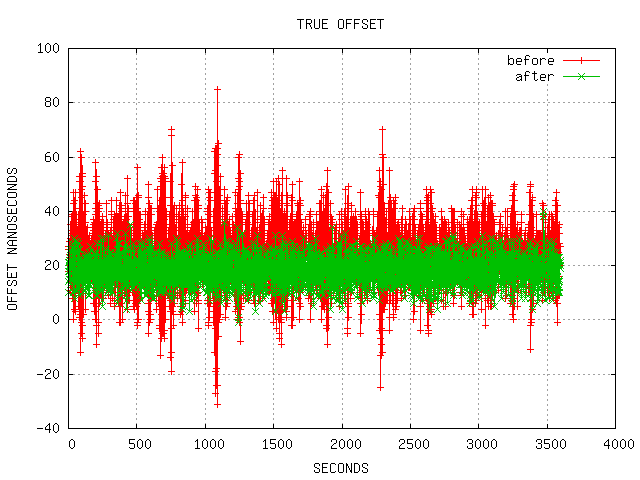
The appended script (below) runs a simple demonstration of the improvement. This test needs two Intel i210 PCIe cards installed in the same PC, with their SDP0 pins connected by copper wire. Measuring the estimated offset (from the ptp4l servo) and the true offset (from the PPS) over one hour yields the following statistics.
|        |   Est. Before |    Est. After |   True Before |    True After |
|--------+---------------+---------------+---------------+---------------|
| min    | -5.200000e+01 | -1.600000e+01 | -3.100000e+01 | -1.000000e+00 |
| max    | +5.700000e+01 | +2.500000e+01 | +8.500000e+01 | +4.000000e+01 |
| pk-pk: | +1.090000e+02 | +4.100000e+01 | +1.160000e+02 | +4.100000e+01 |
| mean   | +6.472222e-02 | +1.277778e-02 | +2.422083e+01 | +1.826083e+01 |
| stddev | +1.158006e+01 | +4.581982e+00 | +1.207708e+01 | +4.981435e+00 |
Here the numbers in units of nanoseconds, and the ~20 nanosecond PPS offset is due to input/output delays on the i210's external interface logic.
With the series applied, both the peak to peak error and the standard deviation improve by a factor of more than two. These two graphs show the improvement nicely.
http://linuxptp.sourceforge.net/fine-tuning/fine-est.png

http://linuxptp.sourceforge.net/fine-tuning/fine-tru.png
Thanks,
Richard
Richard Cochran (3):
ptp: Introduce a high resolution frequency adjustment method.
ptp: igb: Use the high resolution frequency method.
ptp: dp83640: Use the high resolution frequency method.
 drivers/net/ethernet/intel/igb/igb_ptp.c | 16 ++++++++--------
 drivers/net/phy/dp83640.c                | 14 +++++++-------
 drivers/ptp/ptp_clock.c                  |  5 ++++-
 include/linux/ptp_clock_kernel.h         |  8 ++++++++
 4 files changed, 27 insertions(+), 16 deletions(-)
Signature · 35 lines
2.1.4

---
#!/bin/sh

set -e
set -x

killall ptp4l || true

DUR=3600
ETHA=eth6
ETHB=eth3
DEVA=/dev/ptp`ethtool -T $ETHA | awk '/PTP/ {print $4}'`
DEVB=/dev/ptp`ethtool -T $ETHB | awk '/PTP/ {print $4}'`

testptp -d $DEVA -p 0

for x in $DEVA $DEVB; do
	testptp -d $x -f 0
	testptp -d $x -s
done

testptp -d $DEVA -L 0,2  # periodic output
testptp -d $DEVB -L 0,1  # external time stamp
testptp -d $DEVA -p 2000000000

ptp4l -m -q -2 -i $ETHA > log.master &
ptp4l -m -q -2 -i $ETHB -s > log.slave &

sleep 60
testptp -d $DEVB -e $DUR > log.pps
tail -n $DUR log.slave > log.est

killall ptp4l
Richard Cochran
maintainerPATCH 1/3 ptp: Introduce a high resolution frequency adjustment method.
The internal PTP Hardware Clock (PHC) interface limits the resolution for frequency adjustments to one part per billion. However, some hardware devices allow finer adjustment, and making use of the increased resolution improves synchronization measurably on such devices.
This patch adds an alternative method that allows finer frequency tuning by passing the scaled ppm value to PHC drivers. This value comes from user space, and it has a resolution of about 0.015 ppb. We also deprecate the older method, anticipating its removal once existing drivers have been converted over.
---
 drivers/ptp/ptp_clock.c          | 5 ++++-
 include/linux/ptp_clock_kernel.h | 8 ++++++++
 2 files changed, 12 insertions(+), 1 deletion(-)
drivers/ptp/ptp_clock.c +4 -1
@@ -153,7 +153,10 @@ static int ptp_clock_adjtime(struct posix_clock *pc, struct timex *tx)s32 ppb =scaled_ppm_to_ppb (tx->freq);if (ppb > ops->max_adj || ppb < -ops->max_adj)return -ERANGE ; - err = ops->adjfreq (ops, ppb); +if (ops->adjfine) + err = ops->adjfine (ops, tx->freq); +else + err = ops->adjfreq (ops, ppb); ptp->dialed_frequency = tx->freq; }else if (tx->modes ==0 ) { tx->freq = ptp->dialed_frequency;
include/linux/ptp_clock_kernel.h +8 -0
@@ -58,7 +58,14 @@ struct system_device_crosststamp;* * clock operations * +* @adjfine: Adjusts the frequency of the hardware clock. +* parameter scaled_ppm: Desired frequency offset from +* nominal frequency in parts per million, but with a +* 16 bit binary fractional field. +* * @adjfreq: Adjusts the frequency of the hardware clock. +* This method is deprecated. New drivers should implement +* the @adjfine method instead. * parameter delta: Desired frequency offset from nominal frequency * in parts per billion *
@@ -108,6 +115,7 @@ struct ptp_clock_info {int n_pins;int pps;struct ptp_pin_desc *pin_config; +int (*adjfine)(struct ptp_clock_info *ptp,long scaled_ppm);int (*adjfreq)(struct ptp_clock_info *ptp,s32 delta);int (*adjtime)(struct ptp_clock_info *ptp,s64 delta);int (*gettime64)(struct ptp_clock_info *ptp,struct timespec64 *ts);
Signature · 1 line
2.1.4
Richard Cochran
maintainerPATCH 2/3 ptp: igb: Use the high resolution frequency method.
In reply to Richard CochranThe 82580 and related devices offer a frequency resolution of about 0.029 ppb. This patch lets users of the device benefit from the increased frequency resolution when tuning the clock.
---
 drivers/net/ethernet/intel/igb/igb_ptp.c | 16 ++++++++--------
 1 file changed, 8 insertions(+), 8 deletions(-)
drivers/net/ethernet/intel/igb/igb_ptp.c +8 -8
@@ -226,7 +226,7 @@ static int igb_ptp_adjfreq_82576(struct ptp_clock_info *ptp, s32 ppb)return 0 ; } -static int igb_ptp_adjfreq_82580 (struct ptp_clock_info *ptp,s32 ppb) +static int igb_ptp_adjfine_82580 (struct ptp_clock_info *ptp,long scaled_ppm) { struct igb_adapter *igb = container_of(ptp, struct igb_adapter, ptp_caps);
@@ -235,13 +235,13 @@ static int igb_ptp_adjfreq_82580(struct ptp_clock_info *ptp, s32 ppb)u64 rate;u32 inca; -if (ppb <0 ) { +if (scaled_ppm <0 ) { neg_adj =1 ; - ppb = -ppb; + scaled_ppm = -scaled_ppm; } - rate = ppb; - rate <<=26 ; - rate =div_u64 (rate,1953125 ); + rate = scaled_ppm; + rate <<=13 ; + rate =div_u64 (rate,15625 ); inca = rate &INCVALUE_MASK ;if (neg_adj)
@@ -1103,7 +1103,7 @@ void igb_ptp_init(struct igb_adapter *adapter) adapter->ptp_caps.max_adj =62499999 ; adapter->ptp_caps.n_ext_ts =0 ; adapter->ptp_caps.pps =0 ; - adapter->ptp_caps.adjfreq = igb_ptp_adjfreq_82580; + adapter->ptp_caps.adjfine = igb_ptp_adjfine_82580; adapter->ptp_caps.adjtime = igb_ptp_adjtime_82576; adapter->ptp_caps.gettime64 = igb_ptp_gettime_82576; adapter->ptp_caps.settime64 = igb_ptp_settime_82576;
@@ -1131,7 +1131,7 @@ void igb_ptp_init(struct igb_adapter *adapter) adapter->ptp_caps.n_pins =IGB_N_SDP ; adapter->ptp_caps.pps =1 ; adapter->ptp_caps.pin_config = adapter->sdp_config; - adapter->ptp_caps.adjfreq = igb_ptp_adjfreq_82580; + adapter->ptp_caps.adjfine = igb_ptp_adjfine_82580; adapter->ptp_caps.adjtime = igb_ptp_adjtime_i210; adapter->ptp_caps.gettime64 = igb_ptp_gettime_i210; adapter->ptp_caps.settime64 = igb_ptp_settime_i210;
Signature · 1 line
2.1.4
Re: [PATCH net-next 2/3] ptp: igb: Use the high resolution frequency method.
Quoted 44 lines · Richard Cochran
The 82580 and related devices offer a frequency resolution of about 0.029 ppb.??This patch lets users of the device benefit from the increased frequency resolution when tuning the clock.
Signed-off-by Richard Cochran <[email protected]>---
?drivers/net/ethernet/intel/igb/igb_ptp.c | 16 ++++++++-------- ?1 file changed, 8 insertions(+), 8 deletions(-)drivers/net/ethernet/intel/igb/igb_ptp.c +0
-0@@ -226,7 +226,7 @@ static int igb_ptp_adjfreq_82576(struct ptp_clock_info *ptp, s32 ppb) ? return 0; ?}?
-static intigb_ptp_adjfreq_82580(struct ptp_clock_info *ptp, s32 ppb)
+static intigb_ptp_adjfine_82580(struct ptp_clock_info *ptp, long scaled_ppm)
?{
? structigb_adapter*igb = container_of(ptp, structigb_adapter,
? ???????ptp_caps);drivers/net/ethernet/intel/igb/igb_ptp.c +0
-0@@ -235,13 +235,13 @@ static int igb_ptp_adjfreq_82580(struct ptp_clock_info *ptp, s32 ppb) ? u64 rate; ? u32 inca;?
drivers/net/ethernet/intel/igb/igb_ptp.c +1
-1-if (ppb <0 ) { +if (scaled_ppm <0 ) {?
neg_adj= 1;drivers/net/ethernet/intel/igb/igb_ptp.c +1
-1- ppb = -ppb; + scaled_ppm = -scaled_ppm;? }
drivers/net/ethernet/intel/igb/igb_ptp.c +3
-3- rate = ppb; - rate <<=26 ; - rate =div_u64 (rate,1953125 ); + rate = scaled_ppm; + rate <<=13 ; + rate =div_u64 (rate,15625 );
Quoted 1 line
?
I'm curious how you generate the new math here, since this can be tricky, and I could use more examples in order to port to some of the other drivers implementations. I'm not quit sure how to handle the value when the lower 16 bits are fractional.
Thanks,
Jake
Quoted 20 lines
? inca = rate &
INCVALUE_MASK;
? if (neg_adj)drivers/net/ethernet/intel/igb/igb_ptp.c +2
-2@@ -1103,7 +1103,7 @@ void igb_ptp_init(struct igb_adapter *adapter) ? adapter->ptp_caps.max_adj = 62499999; ? adapter->ptp_caps.n_ext_ts = 0; ? adapter->ptp_caps.pps = 0; - adapter->ptp_caps.adjfreq = igb_ptp_adjfreq_82580; + adapter->ptp_caps.adjfine = igb_ptp_adjfine_82580; ? adapter->ptp_caps.adjtime = igb_ptp_adjtime_82576; ? adapter->ptp_caps.gettime64 = igb_ptp_gettime_82576; ? adapter->ptp_caps.settime64 = igb_ptp_settime_82576;@@ -1131,7 +1131,7 @@ void igb_ptp_init(struct igb_adapter *adapter) ? adapter->ptp_caps.n_pins = IGB_N_SDP; ? adapter->ptp_caps.pps = 1; ? adapter->ptp_caps.pin_config = adapter->sdp_config; - adapter->ptp_caps.adjfreq = igb_ptp_adjfreq_82580; + adapter->ptp_caps.adjfine = igb_ptp_adjfine_82580; ? adapter->ptp_caps.adjtime = igb_ptp_adjtime_i210; ? adapter->ptp_caps.gettime64 = igb_ptp_gettime_i210; ? adapter->ptp_caps.settime64 = igb_ptp_settime_i210;
Richard Cochran
maintainerRe: [PATCH net-next 2/3] ptp: igb: Use the high resolution frequency method.
Quoted 12 lines · Jacob E
drivers/net/ethernet/intel/igb/igb_ptp.c static int igb_ptp_adjfreq_82580(struct ptp_clock_info *ptp, s32 ppb) · line 244
Quoted 6 lines · Richard Cochran
drivers/net/ethernet/intel/igb/igb_ptp.c +3
-3- rate = ppb; - rate <<=26 ; - rate =div_u64 (rate,1953125 ); + rate = scaled_ppm; + rate <<=13 ; + rate =div_u64 (rate,15625 );I'm curious how you generate the new math here, since this can be tricky, and I could use more examples in order to port to some of the other drivers implementations. I'm not quit sure how to handle the value when the lower 16 bits are fractional.
TL;DR version:
In ptp_clock.c we convert scaled_ppm to ppb like this.
ppb = scaled_ppm * 10^3 * 2^-16
If you already have a working driver that does
regval = ppb * SOMEMATH;
then just substitute
	regval = (scaled_ppm * 10^3 * 2^-16) * SOMEMATH;
	       = (scaled_ppm *  5^3 * 2^-13) * SOMEMATH;
and simplify by combining the 5^3 and 2^-13 constants into SOMEMATH.
Longer explanation:
You have to consider how the frequency adjustment HW works, case by case. Both the i210 and the phyter have an adjustment register that holds units of 2^-32 nanoseconds per 8 nanosecond clock period, and so the rate from adjustment value 1 is (2^-32 / 8).
Then with the old interface, the conversion from "adjustment unit" to ppb was (2^-32 / 8 * 10^9) or (2^-26 * 5^9). The conversion the other way needs the inverse, and so the code did (ppb << 26) / 5^9.
With the new interface, the conversion from "adjustment unit" to scaled_ppm is (2^-32 / 8 * 10^6 * 2^16) or (2^-13 * 5^6). The code converts the other direction using the inverse, (s_ppm << 13) / 5^6.
HTH,
Richard
RE: [PATCH net-next 2/3] ptp: igb: Use the high resolution frequency method.
Quoted 33 lines
-----Original Message-----
From: Richard Cochran [mailto:richardcochran at gmail.com]
Sent: Wednesday, November 09, 2016 5:12 AM
To: Keller, Jacob E <[email protected]>
Cc: netdev at vger.kernel.org; tglx at linutronix.de; Manfred.Rudigier at omicron.at; ulrik.debie-os at e2big.org; stefan.sorensen at spectralink.com;
davem at davemloft.net; Kirsher, Jeffrey T <[email protected]>; john.stultz at linaro.org; intel-wired-lan at lists.osuosl.org
Subject: Re: [PATCH net-next 2/3] ptp: igb: Use the high resolution frequency method.Quoted 12 lines · Jacob E
drivers/net/ethernet/intel/igb/igb_ptp.c static int igb_ptp_adjfreq_82580(struct ptp_clock_info *ptp, s32 ppb) · line 244
Quoted 6 lines · Richard Cochran
drivers/net/ethernet/intel/igb/igb_ptp.c +3
-3- rate = ppb; - rate <<=26 ; - rate =div_u64 (rate,1953125 ); + rate = scaled_ppm; + rate <<=13 ; + rate =div_u64 (rate,15625 );I'm curious how you generate the new math here, since this can be tricky, and I could use more examples in order to port to some of the other drivers implementations. I'm not quit sure how to handle the value when the lower 16 bits are fractional.
TL;DR version:
In
ptp_clock.cwe convertscaled_ppmto ppb like this.ppb = scaled_ppm * 10^3 * 2^-16If you already have a working driver that does
Quoted 9 lines
regval = ppb * SOMEMATH;then just substitute
	regval = (scaled_ppm * 10^3 * 2^-16) * SOMEMATH;
	       = (scaled_ppm *  5^3 * 2^-13) * SOMEMATH;
and simplify by combining the 5^3 and 2^-13 constants into SOMEMATH.
Thanks, this makes more sense :)
Quoted 7 lines
Longer explanation:
You have to consider how the frequency adjustment HW works, case by case. Both the i210 and the phyter have an adjustment register that holds units of 2^-32 nanoseconds per 8 nanosecond clock period, and so the rate from adjustment value 1 is (2^-32 / 8).
Quoted 8 lines
Then with the old interface, the conversion from "adjustment unit" to ppb was (2^-32 / 8 * 10^9) or (2^-26 * 5^9). The conversion the other way needs the inverse, and so the code did (ppb << 26) / 5^9.
With the new interface, the conversion from "adjustment unit" to
scaled_ppmis (2^-32 / 8 * 10^6 * 2^16) or (2^-13 * 5^6). The code converts the other direction using the inverse, (s_ppm<< 13) / 5^6.
Right. This helps.
Thanks,
Jake
Quoted 2 lines
HTH,
Richard
Re: [PATCH net-next 2/3] ptp: igb: Use the high resolution frequency method.
In reply to Richard CochranQuoted 6 lines · Richard Cochran
The 82580 and related devices offer a frequency resolution of about 0.029 ppb.??This patch lets users of the device benefit from the increased frequency resolution when tuning the clock.
Signed-off-by Richard Cochran <[email protected]>---
Additionally, what about min/max frequency check? Wouldn't this need to be updated for the new adjfine operation?
Thanks,
Jake
Richard Cochran
maintainerRe: [PATCH net-next 2/3] ptp: igb: Use the high resolution frequency method.
Quoted 2 lines · Jacob E
Additionally, what about min/max frequency check? Wouldn't this need to be updated for the new adjfine operation?
In theory you might increase the max by some sub-ppb value, but we cannot express that as the resolution of the user space interface is in ppb, and that little extra is not important anyhow.
Thanks,
Richard
Richard Cochran
maintainerPATCH 3/3 ptp: dp83640: Use the high resolution frequency method.
In reply to Richard CochranThe dp83640 has a frequency resolution of about 0.029 ppb. This patch lets users of the device benefit from the increased frequency resolution when tuning the clock.
---
 drivers/net/phy/dp83640.c | 14 +++++++-------
 1 file changed, 7 insertions(+), 7 deletions(-)
drivers/net/phy/dp83640.c +7 -7
@@ -375,7 +375,7 @@ static int periodic_output(struct dp83640_clock *clock,/* ptp clock methods */ -static int ptp_dp83640_adjfreq (struct ptp_clock_info *ptp,s32 ppb) +static int ptp_dp83640_adjfine (struct ptp_clock_info *ptp,long scaled_ppm) {struct dp83640_clock *clock = container_of(ptp, struct dp83640_clock, caps);
@@ -384,13 +384,13 @@ static int ptp_dp83640_adjfreq(struct ptp_clock_info *ptp, s32 ppb)int neg_adj =0 ;u16 hi, lo; -if (ppb <0 ) { +if (scaled_ppm <0 ) { neg_adj =1 ; - ppb = -ppb; + scaled_ppm = -scaled_ppm; } - rate = ppb; - rate <<=26 ; - rate =div_u64 (rate,1953125 ); + rate = scaled_ppm; + rate <<=13 ; + rate =div_u64 (rate,15625 ); hi = (rate >>16 ) &PTP_RATE_HI_MASK ;if (neg_adj)
@@ -1035,7 +1035,7 @@ static void dp83640_clock_init(struct dp83640_clock *clock, struct mii_bus *bus) clock->caps.n_per_out =N_PER_OUT ; clock->caps.n_pins =DP83640_N_PINS ; clock->caps.pps =0 ; - clock->caps.adjfreq = ptp_dp83640_adjfreq; + clock->caps.adjfine = ptp_dp83640_adjfine; clock->caps.adjtime = ptp_dp83640_adjtime; clock->caps.gettime64 = ptp_dp83640_gettime; clock->caps.settime64 = ptp_dp83640_settime;
Signature · 1 line
2.1.4
Quoted 6 lines · Richard Cochran
This series expands the PTP Hardware Clock subsystem by adding a method that passes the frequency tuning word to the the drivers without dropping the low order bits.??Keeping those bits is useful for
drivers whose frequency resolution is higher than 1 ppb.
Makes sense.
Quoted 27 lines
The appended script (below) runs a simple demonstration of the improvement.??This test needs two Intel i210 PCIe cards installed in the same PC, with their SDP0 pins connected by copper wire.??Measuring
the estimated offset (from the ptp4l servo) and the true offset (from the PPS) over one hour yields the following statistics.Quoted 15 lines
???????|???Est. Before |????Est. After |???True Before |????True After |
--------+---------------+---------------+---------------+--------
-------|
min????| -5.200000e+01 | -1.600000e+01 | -3.100000e+01 | -1.000000e+00 |
max????| +5.700000e+01 | +2.500000e+01 | +8.500000e+01 | +4.000000e+01 |
pk-pk: | +1.090000e+02 | +4.100000e+01 | +1.160000e+02 | +4.100000e+01 |
mean???| +6.472222e-02 | +1.277778e-02 | +2.422083e+01 | +1.826083e+01 |
stddev | +1.158006e+01 | +4.581982e+00 | +1.207708e+01 | +4.981435e+00 |Here the numbers in units of nanoseconds, and the ~20 nanosecond PPS offset is due to input/output delays on the i210's external interface logic.
Quoted 9 lines
With the series applied, both the peak to peak error and the standard deviation improve by a factor of more than two.??These two graphs show
the improvement nicely.
Wow, nice! I'll take a look at the actual patches in a few minutes, but this is a really nice improvement!
Thanks,
Jake
Quoted 15 lines
Thanks,
RichardRichard Cochran (3):
? ptp: Introduce a high resolution frequency adjustment method. ? ptp: igb: Use the high resolution frequency method. ? ptp: dp83640: Use the high resolution frequency method.?drivers/net/ethernet/intel/igb/igb_ptp.c | 16 ++++++++-------- ?drivers/net/phy/dp83640.c????????????????| 14 +++++++------- ?drivers/ptp/ptp_clock.c??????????????????|??5 ++++- ?include/linux/ptp_clock_kernel.h?????????|??8 ++++++++?4 files changed, 27 insertions(+), 16 deletions(-)
David Miller
maintainerFrom: Richard Cochran <[email protected]>
Date: Tue, 8 Nov 2016 22:49:15 +0100
Quoted 4 lines
This series expands the PTP Hardware Clock subsystem by adding a method that passes the frequency tuning word to the the drivers without dropping the low order bits. Keeping those bits is useful for drivers whose frequency resolution is higher than 1 ppb.
Series applied, thanks Richard.