PHC frequency fine tuning
Get series with b4
b4 am [email protected]Versions newest first
- v1 Latest3 patches 7 repliesIn review
Patches in v1 No applies recorded yet
| # | Subject and files | Size | Replies | Applied |
|---|---|---|---|---|
| 1/3 | ptp: Introduce a high resolution frequency adjustment method.drivers/ include/ | +12 | 0 replies | |
| 2/3 | ptp: igb: Use the high resolution frequency method.drivers/ | +8 | 5 replies | |
| 3/3 | ptp: dp83640: Use the high resolution frequency method.drivers/ | +7 | 0 replies |
Reviews trailers per patch
No Reviewed-by, Acked-by or Tested-by trailers for v1 yet.
Cover letter [PATCH net-next 0/3] PHC frequency fine tuning
This series expands the PTP Hardware Clock subsystem by adding a method that passes the frequency tuning word to the the drivers without dropping the low order bits. Keeping those bits is useful for drivers whose frequency resolution is higher than 1 ppb.
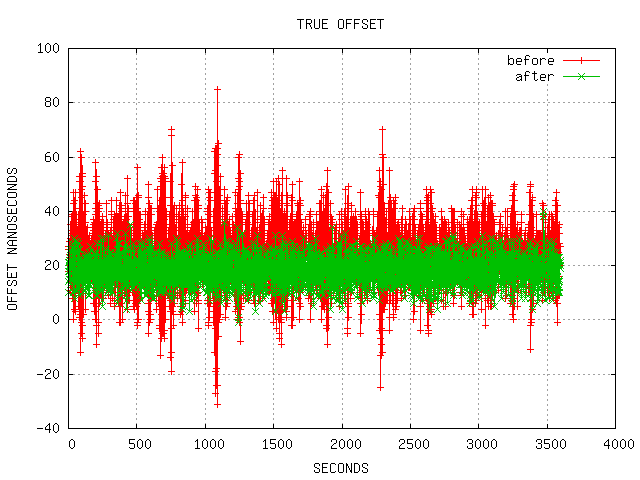
The appended script (below) runs a simple demonstration of the improvement. This test needs two Intel i210 PCIe cards installed in the same PC, with their SDP0 pins connected by copper wire. Measuring the estimated offset (from the ptp4l servo) and the true offset (from the PPS) over one hour yields the following statistics.
|        |   Est. Before |    Est. After |   True Before |    True After |
|--------+---------------+---------------+---------------+---------------|
| min    | -5.200000e+01 | -1.600000e+01 | -3.100000e+01 | -1.000000e+00 |
| max    | +5.700000e+01 | +2.500000e+01 | +8.500000e+01 | +4.000000e+01 |
| pk-pk: | +1.090000e+02 | +4.100000e+01 | +1.160000e+02 | +4.100000e+01 |
| mean   | +6.472222e-02 | +1.277778e-02 | +2.422083e+01 | +1.826083e+01 |
| stddev | +1.158006e+01 | +4.581982e+00 | +1.207708e+01 | +4.981435e+00 |
Here the numbers in units of nanoseconds, and the ~20 nanosecond PPS offset is due to input/output delays on the i210's external interface logic.
With the series applied, both the peak to peak error and the standard deviation improve by a factor of more than two. These two graphs show the improvement nicely.
http://linuxptp.sourceforge.net/fine-tuning/fine-est.png

http://linuxptp.sourceforge.net/fine-tuning/fine-tru.png
Thanks,
Richard
Richard Cochran (3):
ptp: Introduce a high resolution frequency adjustment method.
ptp: igb: Use the high resolution frequency method.
ptp: dp83640: Use the high resolution frequency method.
 drivers/net/ethernet/intel/igb/igb_ptp.c | 16 ++++++++--------
 drivers/net/phy/dp83640.c                | 14 +++++++-------
 drivers/ptp/ptp_clock.c                  |  5 ++++-
 include/linux/ptp_clock_kernel.h         |  8 ++++++++
 4 files changed, 27 insertions(+), 16 deletions(-)
Signature · 35 lines
2.1.4

---
#!/bin/sh

set -e
set -x

killall ptp4l || true

DUR=3600
ETHA=eth6
ETHB=eth3
DEVA=/dev/ptp`ethtool -T $ETHA | awk '/PTP/ {print $4}'`
DEVB=/dev/ptp`ethtool -T $ETHB | awk '/PTP/ {print $4}'`

testptp -d $DEVA -p 0

for x in $DEVA $DEVB; do
	testptp -d $x -f 0
	testptp -d $x -s
done

testptp -d $DEVA -L 0,2  # periodic output
testptp -d $DEVB -L 0,1  # external time stamp
testptp -d $DEVA -p 2000000000

ptp4l -m -q -2 -i $ETHA > log.master &
ptp4l -m -q -2 -i $ETHB -s > log.slave &

sleep 60
testptp -d $DEVB -e $DUR > log.pps
tail -n $DUR log.slave > log.est

killall ptp4l